Giro-Martin elected Student Assembly president as referendums pass
LIAM GLAVIN // FLAT HAT NEWS EDITOR
Junior class president elected, students vote overwhelmingly to restrict Flock, establish Firewall for Freedom
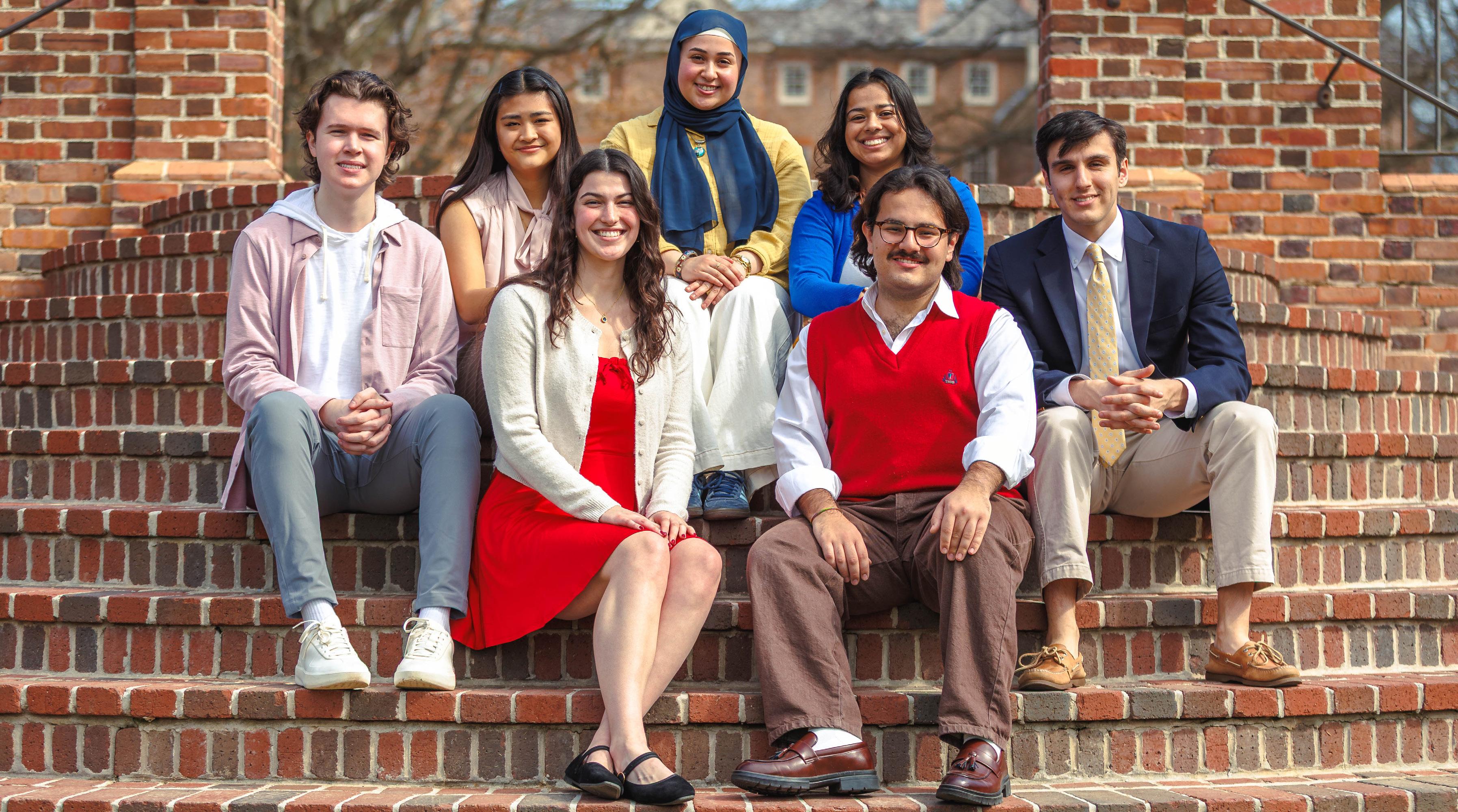
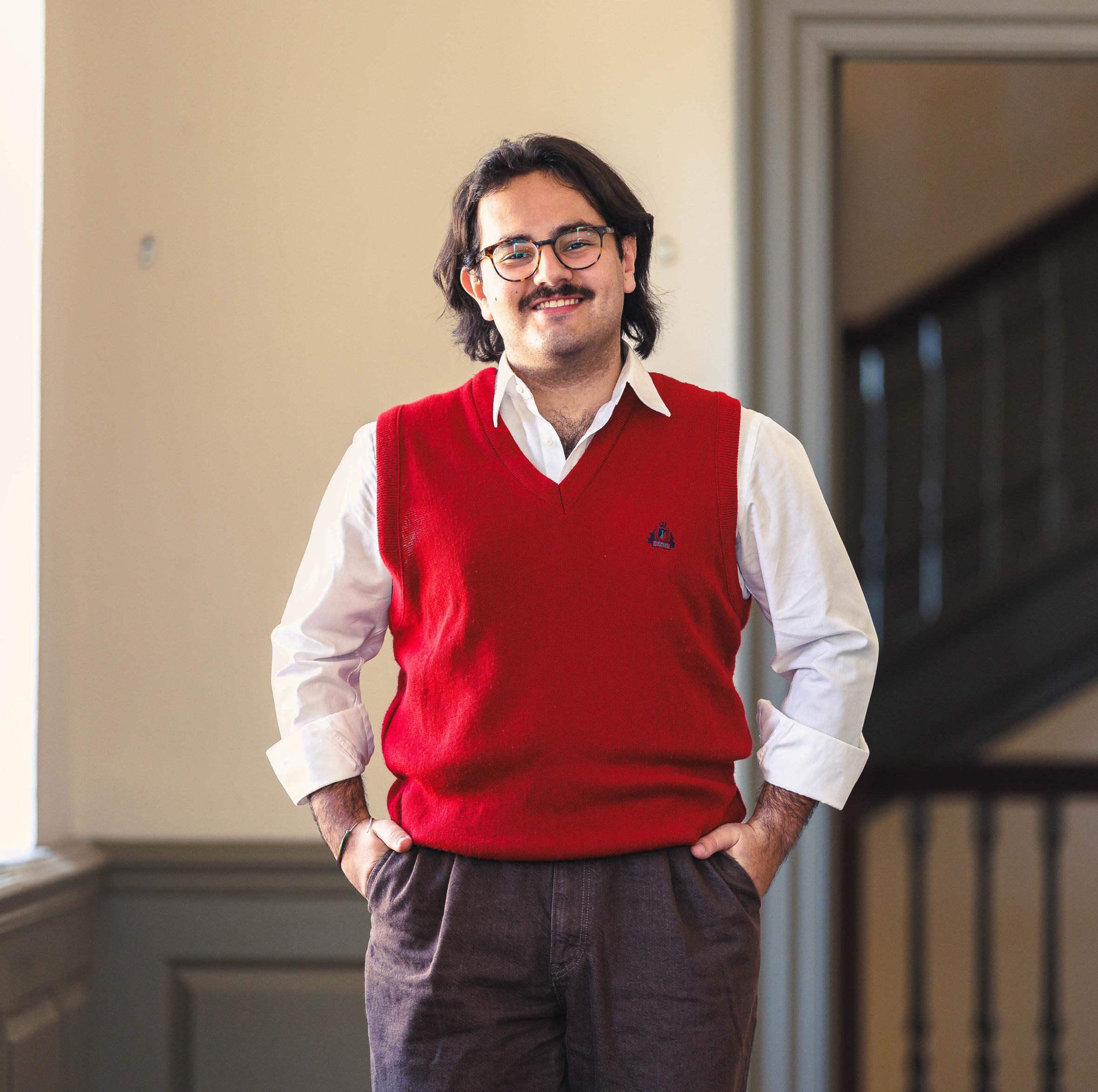
Thursday, March 26, Class of 2027 President Nico Giro-Martin ’27 and Undersecretary for Health and Safety and former Sen. Sophie Kennedy ’27 won the College of William and Mary’s Student Assembly student body presidential election. The ticket was initially challenged by Phillip Matijevic ’27 and Isabel Torres ’27, who withdrew from the election and left the Giro-Martin-Kennedy candidacy unopposed.
Total turnout for the election was reported as 1,667 votes for the presidential election and 1,670 votes for the referendums. 2,647 students voted in last year’s election, and 3,607 the year prior.
Giro-Martin expressed excitement about the
election results and reiterated his preparedness to work for the student body.
“It feels great to be seen by everyone and for everyone to see the work that we want to do,” he said.
Kennedy characterized their campaign as a positive experience in hearing from students, something they say they plan to continue doing during their tenure.
“We want to be as accessible as possible,” she said. “We want to keep that door open for students, so that we can make sure that Student Assembly is working for them.”
Giro-Martin said he hopes to continue his work on pedestrian safety as student body president at the College.
Kennedy said she hopes to continue health and safety initiatives for students, such as the annual Safety and Accessibility Walk, an advocacy event that seeks to find accessibility pitfalls around campus. She also mentioned the Take Back the Night event, which raises awareness for sexual violence, as something the pair hopes to continue.
Students at the College also overwhelmingly approved two referendum questions. The first question calls on the College to cancel its contract with Flock, an AI-powered automatic license plate reader that operates on campus. 88.6% of students voted in favor of the College ending its relationship with Flock surveillance, while 7% of students voted against and 4.4% of
students abstained.
“[Flock] surveillance data is uploaded to Flock’s cloud system, and participating agencies can search and share this database across jurisdictions,” the Flock referendum explanation reads. “Through a series of intentional and unintentional data privacy breaches, Flock has repeatedly shown itself to be an unreliable and unethical company.”
The Flock referendum question also calls on College administrators to publicly retract and apologize for their accused misleading statements on Flock and its surveillance on members of the campus community.
Community members gather for 'No Kings' protest at courthouse College students, representatives, Williamsburg locals rally against Trump administration
Thursday, March 26, Williamsburg, Va. residents Dennis Gerard and Mark Sullivan stood on Duke of Gloucester Street in Colonial Williamsburg. They carried signs reading “NO KINGS” with golden crowns crossed out in red. Gerard expressed concern with what he views as political apathy among students at the College of William and Mary.
“I grew up in the late ’60s and early ’70s, so I don’t understand the college apathy,” he said. “We need more sustained involvement by students. We have a rally every Friday at the courthouse, and it’s all gray hairs.”
Sullivan urged students to speak out against what he views as the abuses of President Donald Trump’s administration.
“We need to get out there and show [Trump supporters] that they can’t break all the rules,” he said.
Sullivan explained that his grandkids and their futures are a primary motivation in his protests against the Trump administration.
“I don’t want them to grow up in a situation where there’s no more democracy,” he said.
Adrian Ryan ’27, president of the College's Young Democrats, described his interpretation of the No Kings protests.
“I expect this upcoming protest to be similar to past No Kings protests,” he said. “I do not expect many college students to participate, but I hope that a lot of college students do turn out.”
Ryan disagreed with Gerard and Sullivan’s assertion about students being politically apathetic to the Trump administration’s actions. Instead, he argued that the timing of the event likely played a role in some students’ absences.
“I don’t expect a lot of college students to attend just because we are at a busy time in the semester,” Ryan said. “I applaud all those who are able to attend the protests and exercise the First Amendment right to do that.”
Saturday, March 28, hundreds gathered at the Williamsburg/James City County General District Court for the Williamsburg No Kings protest.
Protesters carried signs and flags against the Trump administration, which referenced the president’s connection to disgraced financier Jeffrey Epstein, the war in Iran, tariffs and recent U.S. Immigration and Customs Enforcement prosecution of immigrant communities.
A College alumnus, who asked to remain anonymous, explained their motivation in attending the protest.
“I think it’s absolutely essential that we get [Trump] out of here,” they said. "This guy’s trouble, and he’s dangerous. He’s acting like a king.”
The alumnus believes that the perceived apathy from students at the College is not new. They said they witnessed similar behavior during the Vietnam War protests.
“I was a student here 50-plus years ago during Vietnam,” the alumnus said. “The students [then] were apathetic. Vietnam was not on most of our radar.”
The alumnus added that they now do some teaching on campus and believes students will become more engaged as they age.
Williamsburg resident Heather Meaney-Allen, one of the speakers at
the protest, addressed the importance of the rally’s large turnout.
“We are making history,” MeaneyAllen said. “You made a moral choice coming out here today to have your voice counted.”
Virginia 71st District Delegate Jessica Anderson attended and spoke on why she felt it was important to protest.
“We continue to see unilateral authoritarianism from this president,” Anderson said. “We continue to see him go against our constitution, violate the rights of our citizens and our residents, and now, we’re in a war that we had no congressional approval on.”
Further, attendee and Williamsburg resident Marisol Lambert believes that lower student turnout was driven by a lack of access to transportation.
“I wish we could do it at William and Mary or Colonial Williamsburg,” Lambert said. “I don’t think we should be blaming [students] for these things.”
Sharon Powell, an immigration attorney in the City of Williamsburg, was among the speakers at the rally. Her speech centered on how small
acts of political advocacy can create widespread change.
“Hope is what allows people to keep going when systems feel stacked against them,” Powell said. “Hope leads to courage, and courage leads to action, and action leads to change.”
Powell asserted that continued activism for justice requires resilience and determination.
“There are days when the work feels overwhelming,” she said. “Days when the problems feel too big, too entrenched and too urgent, days I look at a sticky note on my computer that asks me one question: ‘What is one small act I can do today to change someone’s life?’ Just one. Not everything. Not solving the whole system. Just one step.”
Powell, who has worked as an immigration attorney for the past 12 years, said that the current level of support and turnout in defense of immigrants has been unprecedentedly high. This inspires her to continue pushing forward in her work.
“We move forward. Not all at once. Not perfectly, but step by step,” Powell said.
COURTESY IMAGE / NATE BOYLE
news insight
A lot of times, we sort of lose the idea of what our purpose is. I think that itʼs important, especially as college students, to hear other peopleʼs perspectives.
-- Daisy Maxwell
Tuesday, April 21, Virginians will vote on a proposed constitutional amendment at the special election. The plan was officially signed into law by Gov. Abigail Spanberger D.P.S. ʼ26 on Friday, Feb. 20 and is pending voter approval. The map was passed by the Democratic-majority General Assembly, with the Senate approving it 21-18 on Thursday, Feb. 19 and the House 63-35 on Tuesday, Feb 10.
Under current law, Virginiaʼs congressional districts are drawn once every 10 years by the Virginia Redistricting Commission. The last redraw was in 2021.
The proposed amendment gives the General Assembly authority to redraw Virginia congressional districts, in limited capacity, before 2031. Should another state redraw congressional districts, the Virginia General Assembly will be able to rework congressional districts as well. This power would remain with the General Assembly until October 31, 2030, and the Virginia Redistricting Commission would reassume the authority in 2031. A proposed map has already been approved by the General Assembly. The practice of mid-decade congressional redistricting is growing in popularity, with Virginia lawmakers citing the precedent of other states as a basis for the proposal. A vote “yes” would allow the General Assembly to put the proposed map into effect before the 2026 Congressional Elections. A vote “no” would leave the power with the Virginia Redistricting Commission and keep the current district map.
Student Assembly President-elect Nico Giro-Martin reflects on leadership experience
Giro-Martin discusses goals for upcoming term, highlights other campus leadership roles
ROBIN PERDUE // FLAT HAT NEWS EDITOR
In the fall of 2023, Nico Giro-Martin ’27 decided to run for class president. It was then he met his now vice president, Sophie Kennedy ’27, who ran as his opponent. Te pair reconnected and combined their passion for student government, winning the Student Assembly student body presidential election Tursday, March 26.
Giro-Martin has served as class president for three years.
While an experienced leader within SA, he said that this transition has still had its discrepancies.
“I started in freshman year, so I’m not new to putting my face out,” he said. “But then, blowing that up to like 9,000 people, both undergrads and graduates, is just a whole other scope. It really felt different, and I’m opening myself up to these people that I have never met, and they have never met me.”
Outside of SA, Giro-Martin is an active member of the Latin American Student Union. He served as historian during his sophomore year and is currently finishing his time as copresident alongside Carlos Juarez ’27.
“I think the biggest thing I’ve been a part of is LASU,” he said. “It is an amazing space of community and a space where I have been able to grow my leadership skills running the executive board with Carlos.”
Giro-Martin is confident that his leadership experience with LASU will translate well to his new role.
“It’s a lot of management and understanding of what the organization wants,” he said. “Some people are in it for the intramurals, some people are in it for the social aspect and some for the cultural. Balancing that with our budget and time constraints are all things that I tackled during my time as president.”
Giro-Martin’s personal hobbies are also rooted in his values.
“Throughout this campaign, I’ve talked about the things I can do for you,” he said. “I haven’t really talked about who I am.”
Giro-Martin mentioned his love for thrifting.
“I’m very big on sustainable fashion and understanding our impact on the environment, and that’s something that I bring into thrifting,” he said.
He also emphasized his passion for cinema.
“The Oscars are like my Super Bowl,” he said. “Awards season is just a beautiful time for me. If I ever have free time, and sometimes when I’m not even free, I’m still watching a movie.”
Giro-Martin highlighted some of his broader goals and interests for the upcoming term.
“There’s a lot of things I hope to change, especially reworking our data analytics department. It’s had a lot of time put into it, but with very little results,” he said. “We do hope to bring efficient care to Student Assembly and to students with our data.”
The issue of pedestrian safety is particularly meaningful to Giro-Martin. During his time in the senate, he sponsored the Pedestrian Safety Act, which added a new crosswalk and crosswalk safety lights on Jamestown Road near Lemon Hall.
“It’s finding ways to do smaller changes on campus
in something I am interested in,” he said. “In general, an educational campaign for public safety is also something I am really interested in doing.”
He noted that Kennedy hopes to rework the inclusion of period products in campus bathrooms.
“Currently, the senate is pushing the Period Act and Period Project in general, which will fund all further replacements,” he said. “Logistically, we don’t have the right working facilities to get these products adequately refilled. At the end of the day, we’re not serving the students well enough.”
Giro-Martin said that he has spoken with former SA President Zoe Wang ’25 M.P.P. ’26, who has worked with the Virginia General Assembly to push for free health products in all Commonwealth schools. He hopes to continue this advocacy throughout his term.
“Other than those two things, it really is just seeing as we go,” he said. “Hopefully through that, we get some work done.”
The support of Giro-Martin’s team and peers has been crucial to his success.
“It’s these people that I surround myself with that I am just so in awe of and so in love with because they are campus to me,” he said. “They are William and Mary to me. And I hope to take care of them as much as I take care of the student body.”
He highlighted a few integral members of his process, including Kennedy.
“She is truly my rock when I don’t know what to do,” he said. “When I need just a second opinion, she’s always there for me, and she has just so much love for Student Assembly and the student body as well, which is exactly what we need in Student Assembly.”
Giro-Martin also mentioned the former SA presidents.
“The three presidents that I’ve experienced, Sydney Thayer [’24], Terra Sloane [’25], Zoe Wang, they’ve all taken their own very unique spin on this position,” he said. “I’m learning from each one of them and looking at how they took care of Student Assembly and what I can bring to it.”
As an international relations major, Giro-Martin believes that the skills he will gain as president will help his career goals.
“I’m constantly tuned into politics, but I’ve always been interested in student government even before I knew I wanted to get into this kind of career,” he said. “This is definitely shaping me and helping my understanding of how to collaborate with bodies in Richmond and state-level governments. It is something very new to me, so I’m going to have to learn in my time as student body president.” Applications for the upcoming cabinet opened Monday, March 30.
“We’re currently working with the current administration to understand the pinpoints that they’ve left behind so that we can carry those on while continuing our own projects,” Giro-Martin said. “I’m excited to get to work.”
COURTESY IMAGE / NATE BOYLE
College hosts TEDx event, students, community members deliver speeches
Speakers deliver talks on 2026 theme “The Next 250:
Seven College community members spoke about a diverse range of subjects, delving into their interpretations of the theme.
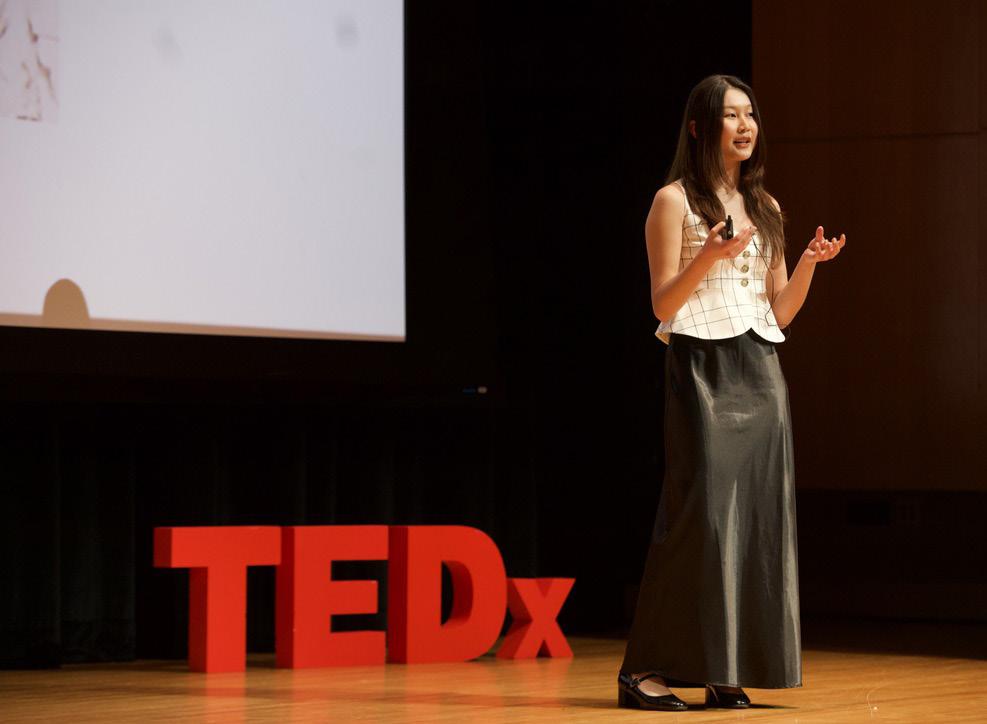
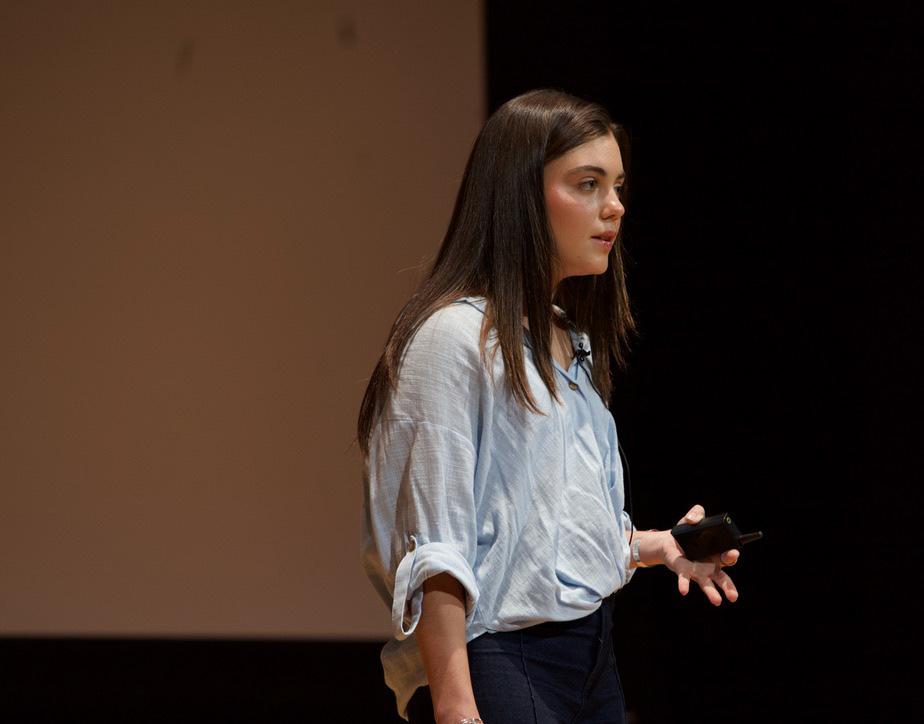
Thursday, March 26, students gathered in the Sadler Center’s Commonwealth Auditorium for the College of William and Mary’s 13th annual TEDx event. The topic of this year’s talks was “The Next 250: Building a Future That Values Purpose Over Progress.”
TEDx student co-chair Elijah Glassford ’28 spoke about the theme’s significance.
“We wanted it to be sort of a path forward and a way to look forward to 250 years instead of always looking back,” Glassford said. “Of course, it’s extremely important what our history has led us to today. But it was really fun to hear from individuals and how they view the next 250 in the United States.”
EVENTS
“I think that the speakers captured a good range of classes and experiences,” attendee Avika Amin ’29 said. “Each of them had a unique experience to share.”
Jason Zheng ’26, the frst speaker, delivered a talk inspired by his cultural background and upbringing. He emphasized his passion for civic leadership and service.
Following Zheng, Eva Jaber ’28 discussed art’s potential as a form of political advocacy.
Glassford, an art history major himself, appreciated the topic.
“To hear Eva’s insight on how our relationship is much more than just the visual experience, that was very powerful because it is a muscle for change,” Glassford said.
Technology analyst Dave Sobel ’97 spoke next about the power of small businesses and the transformation of technology in the country.
Next, audience members heard from Director of Confict Resolution and Education Emily Gerst, who highlighted conversation value and cancel culture’s shortcomings. Her speech was inspired by country singer Morgan Wallen and his controversies.
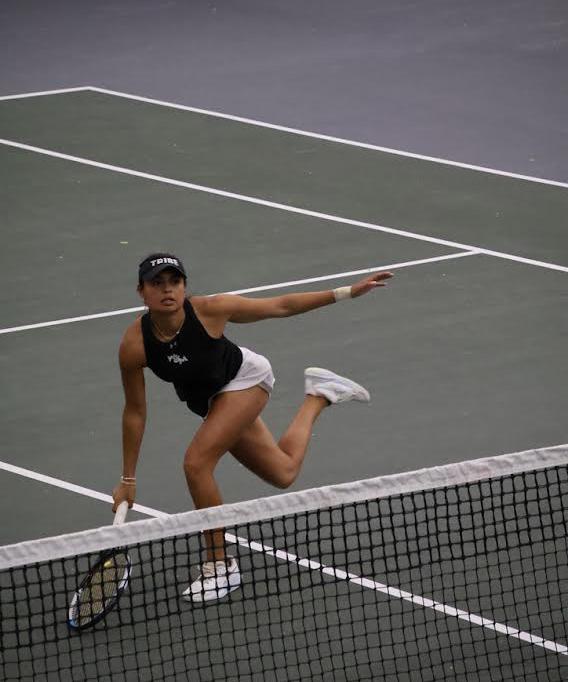
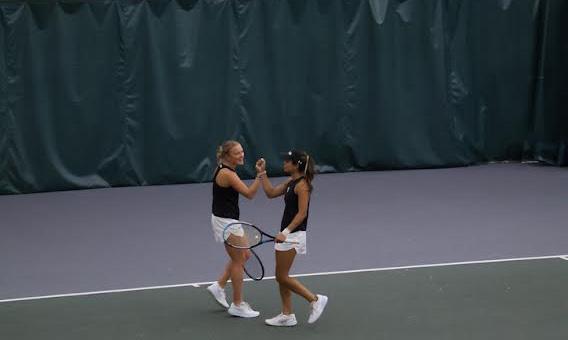
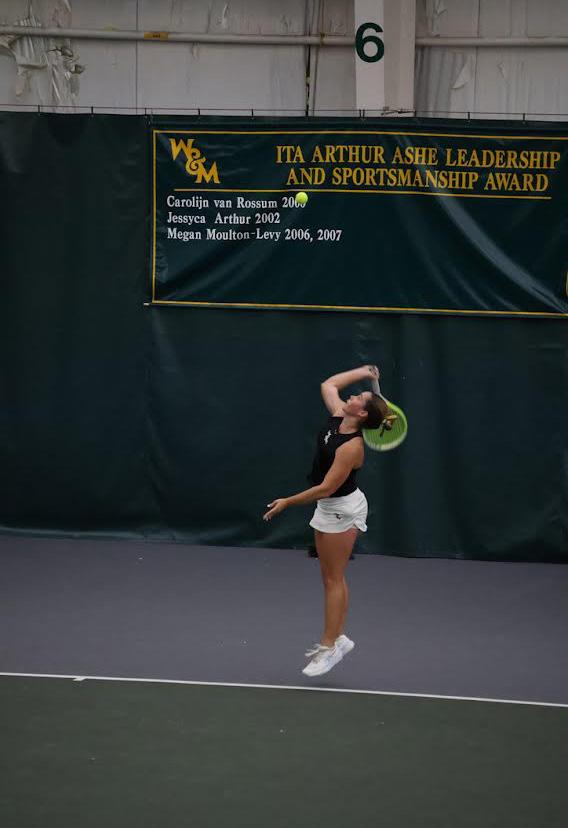
Julia Viesi ’29, a member of the College’s women’s tennis team, was the ffth speaker. Her talk centered on purposeful action as a means to achieve success.
Te penultimate speaker, visiting professor of fnance and Executive Partner at the Raymond A. Mason School of Business Tina Foraker-Blackwell, stressed the signifcance of fnancial literacy.
Following the event, Foraker-Blackwell shared her takeaways from the presentations.
“So inform yourself, ask others, take a class, but be informed and understand that you’re enabling your independence and frankly that for the next generation,” Foraker-Blackwell said.
Jenny Wang ’29, who discussed her interpretation of consumption trends as a GenZer, concluded the event.
After reading an out-of-touch article about consumerism, Wang
said she wanted to highlight attainable goals for students with purchasing power.
“Go out there, find who you are, make sure you know who you are without having to buy it,” she said. “Whether it is literally buying thwings, or it’s consuming copious amounts of media, or doing other things, make sure you have a good community, a good support system, and make sure you experience life to find who you are.”
Student attendees appreciated the speakers’ perspectives.
“A lot of times, we sort of lose that idea of what our purpose is,” attendee Daisy Maxwell ’29 said. “And so I think that it’s important, especially as college students, to hear other people’s perspectives.”
Whole of Government Center afliate Col. Nathan Finney delivers book talk
United States Army soldier discusses research on national security strategy, military policy, wartime mobilization
Thursday, March 26, the College of William and Mary hosted United States Army soldier, historian and author Col. Nathan Finney in Swem Library’s Hive Event Space. Finney discussed his 2025 book titled “Orchestrating Power: The American Associational State in the First World War.”
Finney serves as an affiliate at the College’s Whole of Government Center and is a senior mentor for the Project on International Peace and Security. He is also a member of the Council on Foreign Relations, an American foreign policy think tank, and serves as the director of the Commander’s Initiatives Group for the U.S. Army Western Hemisphere Command.
Finney received a B.A. in anthropology from the University of Arizona. He also holds two master’s degrees in public administration from Harvard University and the University of Kansas, as well as a Ph.D. in history from Duke University.
For his service in the army, Finney won the 2021 Gold Order of Saint Gabriel from the United States Army Strategist Association. This award recognizes individuals with extraordinary, careerspanning contributions to the U.S. Army’s strategic plans and policy community.
Finney’s research focuses on national security decision-making, strategy, civil-military relations, military policy, mobilization and war. His book explores the American mobilization efforts relating to World War I, centering on the role of private and state-level organizations in war preparations. Finney analyzes North Carolina’s Council of Defense System to illustrate the role that institutions other than the federal government played in the World War I effort.
Finney explained how he drew inspiration for his book from a project he pursued in 2014, when the U.S. Army was under significant pressure to downsize and experienced intense congressional sequestration. The Army chief of staff at the time, Gen. Raymond Odierno, assembled a small team to analyze the idea of reconstitution: the study of how the army has historically grown rapidly in size. Finney was a member of this team and quickly became interested in reconstitution and mobilization during World War I.
“Orchestrating Power” is constructed through four narratives. The first details the story of Joseph Hyde Pratt, who convinced the North Carolina governor to establish a council of defense. The second analyzes the building of military power and draft processes through the efforts of John Langston. The third focuses on the politics
of partial inclusion and the role of women in war mobilization efforts while maintaining a gendered sociopolitical order. Conversely, the fourth centers on the politics of exclusion, discussing the barring of Black North Carolinians from mobilization.
After discussing his book, Finney gave the floor to audience members for a questionand-answer session.
Attendee Eileen Ackley ’26 said she found the discussions of the four separate stories most compelling, along with the diffusion of responsibility to different states as a result of a weak federal bureaucracy.
“When push comes to shove, there is a lot of power in the individual civilians, as well as your local and smaller systems of government, in mobilization and also achieving a greater war effort,” she said. “It really comes down to people being able to step up at the end of the day, as seen by these councils of defense in generating military power.”
Nina Appicello ’26 spoke on the diversity of the College’s Global Research Institute, one of the event’s organizers.
“What I found most interesting about the talk is that the Global Research Institute is so entirely interdisciplinary that even though it was a talk about history, he was getting asked many questions about the applications of technology and future
implications,” Appicello said. “What I am taking away from this event is that there are so many careers where one can pursue research in a non-academic setting.”
Associate Chair of Government and teaching professor Dennis Smith also attended the talk. Smith works closely with Finney through the College’s PIPS program.
“You normally think that something as important as mobilization is being handled by the government, like state and federal bureaucracy,” Smith said. “But the fact that this was really about trying to tap into political and business networks at the state and local level, that was surprising.”
Smith found the topic of social groups to be particularly insightful and relevant.
“I really think it’s about the importance of social groups in how the government achieves big things,” he said. “Normally, when we think in terms of politics, we think of political parties, we think of bureaucracies, but we don’t really think of social networks.”
Throughout the event, Finney mentioned he has always felt like a member of the Tribe. He said that every visit to the College feels like returning home.
Finney’s writing journey does not end with “Orchestrating Power,” however. He is currently working on his next book, which centers on Cold War Taiwan.
Economics department hosts economist, researcher, discusses impact of AI on economic trends, labor market
AND NAMAN
Tuesday, March 24, the College of William and Mary’s Department of Economics hosted Jed Kolko, an economist and researcher, for a talk on the impact of artifcial intelligence on the labor market in the Sadler Center’s Tidewater rooms. Kolko discussed labor market patterns and the increasing efect of AI on economic trends.
Kolko, the Department of Economics’ March Tang Scholar in Residence, is currently a senior fellow at the Peterson Institute for International Economics.
Kolko previously served as undersecretary of commerce for economic afairs for the United States under the Biden administration. Earlier, he was the chief economist at Indeed and the chief economist and vice president of analytics at Trulia. His work centers around economic analysis of public policy regarding labor markets and technology.
Kolko noted the signifcance of working across such a wide scope of roles. He explained how he believes these experiences help him better understand the concepts he handles daily.
“It’s always been very important for me to work in diferent kinds of places and see how diferent kinds of organizations do research and use data,” he said. “I feel like having worked in a range of diferent kinds of organizations has helped me see
how research and economics gets done from a lot of diferent angles.”
Early in the talk, Kolko made clear that he could not provide a defnitive answer to how AI will afect the labor market — something he said is nearly impossible to determine.
Te truth is, this talk really isn’t about AI in the labor market,” he said.
“‘AI in the labor market’ is kind of an excuse to take a step back and talk about something else. What this talk is really about is how we make sense of something we don’t understand.”
However, he noted that the mass implementation of AI has still led to widespread concern.
“In a very deep sense, kind of nobody understands AI,” Kolko said.
“We don’t really know how it works. But what is striking is how much of a potential impact AI could have and how much concern, excitement, anxiety and investment AI has spurred for a technology that even its creators fundamentally don’t understand.”
Kolko stressed that comparing claims regarding AI to the evidence helps reveal how narratives are constructed.
“Tis is a talk about storytelling and various forms of bias, how data gets used, some of the limitations of the data that are used for these sorts of analyses, the data that we wish we had and some ways in which history and past technological innovations are useful,” he said.
Kolko noted that inconclusive labor market statistics and their divergence from historical trends obscure understanding of AI’s impact.
“Right now, the U.S. labor market is sending mixed signals: Te key measures that we use to understand the state of the labor market are pointing in diferent directions,” he said. “Tese mixed signals make it very possible to really choose your own adventure about what you believe about the labor market.”
For students who hope to enter the job market in the near future, Kolko pointed to low hiring as a particularly concerning indicator for their prospects.
“Te low hiring rate has a particular implication for you, and that is that low hiring hurts young workers,” Kolko said.
“When there’s a low hiring rate, even when the unemployment rate is low, it means people who are trying to get into the labor market for the frst time can’t as easily.”
Jenny Wang ’29 found Kolko’s talk especially relevant for college-aged students. She highlighted the importance of understanding exactly how AI may impact these workforce outcomes.
“It’s really important, especially for young people our age, to learn more about AI and how it’s going to afect the labor force,” Wang said. “We’re going to be the next generation that is afected by all of this.”
While some have attributed low hiring
to AI, Kolko remains skeptical of this view.
“People have wondered whether AI is responsible for the low hiring rate, and I think the answer is probably not,” he said. “Te likeliest answer seems to be that there was a lot of over-hiring during the pandemic, and we’re paying the price of that now.”
Kolko attributes the emphasis on AI in the labor market to an efect he calls “pundit projection.”
“Pundits, or anyone who tells the stories, writes the narratives, does the research, essentially generates the discourse about AI in the labor market,” he said. “In other words, they worry about the things that they think might afect themselves.”
According to Kolko, reports of both labor market outcomes and company performances tend to overstate AI’s impact.
“AI is not driving the trends we’re seeing in the labor market, even though there is an incentive to see everything equivalent to AI,” he said. “CEOs and lots of other people have an incentive to attribute what they’re doing to AI, whether or not it’s true.”
Kolko said that individuals in the workplace should focus on being adaptable and developing new skills to avoid being outpaced by AI.
In this respect, he expressed hope for college-aged students early in their careers.
“Who can adapt might or might not have much to do with whether their job is exposed to AI or the automation risk of AI,” Kolko said. “Almost all of you who are not my generation will adapt more easily than I will.”
Kirsten Johnson ’26 MPP ’27, a public policy student who will soon be graduating and looking for work, found that Kolko’s perspective on potential AI replacement in the workforce eased some of her concerns.
“I have a stake in the labor market, because obviously we’re all going into that pretty soon,” she said. “It gave me a lot more hope than I was expecting. I was expecting to come out of this more depressed about AI and its labor market, but when he pointed out how students that go to a pretty elite university and are U.S. citizens really have amazing opportunities and do have adaptability, [it] made me a lot more secure.”
Despite what Kolko views as the overattribution of economic consequences to AI, he said it is still necessary to work toward increased awaress of AI’s impacts on the labor market.
“Tere’s been a lot of news about government data being under threat,” Kolko said. “Tese risks will make it harder for us to see what is happening today, compare it to the past and imagine what the future might look like.”
EVIE FREEMAN AND ABIGAIL FURCY THE FLAT HAT
MAGGIE OʼKIEFFE FLAT HAT VARIETY ASSOC.
CAROLYN REID / THE FLAT HAT
Jenny Wang ʻ29 closed the event with a discussion of happiness and consumerism.
CAROLYN REID / THE FLAT HAT
Julia Viesi ʻ29 delivered her talk on purpose-driven growth and impact of injury
Mark Washko speaks to Public Policy club, offers professional advice
Wednesday, March 25, the College of William and Mary’s Public Policy Club hosted Mark Washko ’90 M.P.P. ’94 as part of its spring speaker series. Washko is a senior government affairs advisor and lobbyist, currently living in Vienna, Va.
Washko received a degree in government from the College before returning for a master’s degree in public policy two years later. He was a member of the second graduating class of the Thomas Jefferson Program in Public Policy and later received his law degree from Vermont Law and Graduate School.
Public Policy club Co-President Nathan Yang ’28 said that the organization’s speakers typically attend via Zoom.
“Mark is one of our few in-person events that we’ve had, which is really great because we get to interact with them in a room and in a discussion style,” Yang said.
Morgan Benosky ’29 described her motivations for attending the event.
“I came here because I decided to get more exposure to what different types of jobs are, and I was pretty interested in government when I came here,” she said.
After outlining his jobs and pursuits as a lobbyist in Washington, D.C., Washko imparted wisdom to those seeking careers in public policy.
“The first thing you have to do is decide if you want to be an analyst or an advocate,” he said. “For those of you in public policy, there are people who want to go write the policy, do all the
research, and there are people who want to advocate for it.”
He then outlined a path toward careers in government.
“Nothing is better than on-the-job training,” Washko said. “It does two things: It either reinforces your thinking that I want to do this, or, in the case of my working at a law firm for two years, says, ‘I never want to do that again.’ Either way, it’s helping you define your career choices.”
Washko spoke about what it means to be a lobbyist in Washington, emphasizing the less glamorous aspects of the job.
“A lot of time is, frankly, spent listening,” he said. “But really, the job of a lobbyist is about advocating for a position, sharing information.”
According to Washko, lobbyists supply Congress with specialized information about a certain topic. The representatives’ legislative assistants then brief them about the topics, advising them to vote accordingly. In this way, lobbyists are a form of salespeople, marketing their causes in exchange for congressional support.
Washko elaborated on his recommendations for securing a position as a lobbyist. He said the first step is generally working on Capitol Hill or the executive branch.
“Get some experience, know who you are,” he said. “Then, you become attractive to trade associations, which represent industries or their member organizations, like the realtors that I work for, and then corporations like the one I work for, or multiclient firms, where you were looking to work.”
He emphasized the importance of connections in
Washington, advising attendees to build relationships with everyone they meet.
Similarly, he urged students to have the confidence to further their networks.
“You have to put yourself out there,” he said. “Make your own luck, as I say, but be willing to participate in the process.”
Washko also discussed the path to working for a nongovernmental organization.
“It can be very fulfilling if you’re passionate about an issue,” he said.
He stressed the camaraderie among College alumni living in Washington.
“People in Washington generally want to help other people because it’s a two-way street,” Washko said. “There’s a mutual benefit to it. People will want to help you.”
Washko also highlighted the College’s Washington Center as a particularly useful resource.
“The school is not going to guarantee you a job — you have to do that,” he said. “But if you take a lot of steps, reach out to a lot of alumni, it’s so easy.”
He concluded his talk by reminding attendees that they are already working toward building their networks with College community members.
“Keep doing that. The person who will hire you for the best job of your career probably doesn’t know you exist yet, but someone in your network may know that person,” Washko said. “So, they can make the introduction that changes everything.”
Senate passes ZeroEyes referendum bill, discusses College marketing
Tuesday, March 24, Chief Marketing Officer Heather Golden met with the Student Assembly Senate to discuss the development of the College of William and Mary’s brand strategy and marketing infrastructure. She explained how University Marketing formally began in 2021, following a study conducted by the College that revealed a lack of strong name recognition beyond the state of Virginia.
“We wanted to make sure we were telling a unified story,” Golden said.
The three primary marketing goals for the College that Golden outlined to the Senate were strengthening the College’s institutional reputation around the country, supporting advancement efforts for students and improving undergraduate enrollment outreach.
Golden described the College’s new public brand hub, which provides guidelines for design and outward messaging. This new addition will ensure consistency in how the College presents itself across platforms.
“If you look and feel different every time you put yourself out there, you really don’t have a brand,” Golden said.
The updated strategy modifies the College’s primary visual mark. While the traditional College cipher and 1693 designation will remain in its marketing, University Marketing plans to now emphasize the College’s name in signage and communications.
“We don’t do a great job of telling you when you’re on campus,” Golden said, referencing
the College’s porous layout.
Creative Director for the College Michael Bartolotta discussed Canto, the digital asset management system implemented by the College. This platform will house photography, logos and branding materials accessible to students and departments. He shared that the College plans to implement an enterprisewide Canva system, providing access to a professional design platform for all students.
“This is really about helping people help themselves while staying within the brand,” Bartolotta said.
The speakers concluded with a discussion of various student engagement initiatives, such as social media content programs, surveys and focus groups.
Following the presentation to the senate, Sen. Ryan Ponmakha ’28 asked about efforts to expand the College’s national outreach. Golden noted that increased advertising and marketing efforts have begun to improve application rates in underrepresented regions.
Afterward, Sen. James Holden J.D. ’27 was sworn in as a senator for the College of William and Mary Law School.
Chair of Finance Sen. Mackenna Wyckoff ’28 then presented the fourth quarter finance report. Wyckoff said that approximately $51,808 was allocated to student organizations across campus this quarter, with 91 groups receiving funding out of 112 requests.
The senate introduced two new pieces of legislation for consideration.
The Pride Month Act II, sponsored by Class
of 2027 President Nico Giro-Martin ’27 and Sen. Nina Argel ’28, focuses on funding a queer prom event.
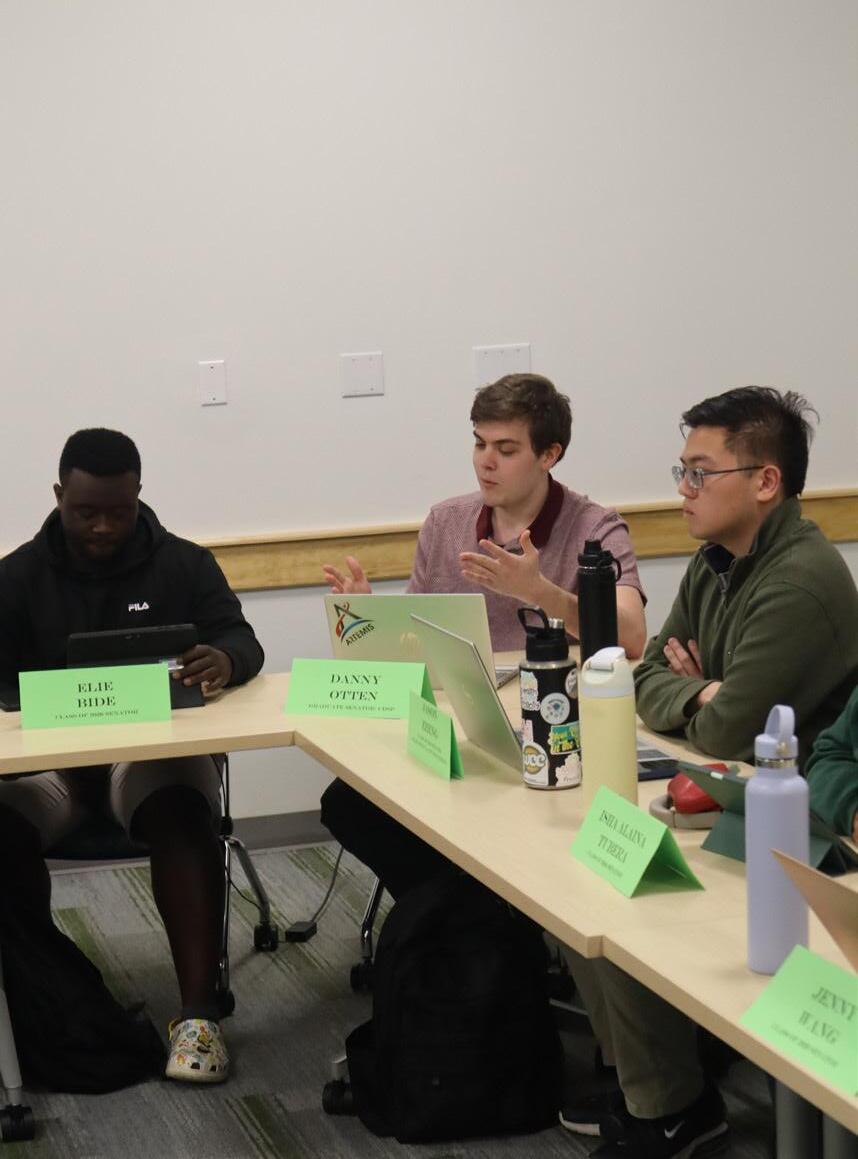
The ZeroEyes Referendum Disavowal Act, introduced by Sen. Danny Otten B.S. ’23 Ph.D. ’27, aims to allow SA the opportunity to reconsider its support for the upcoming ZeroEyes referendum following a scheduled meeting with Associate Vice President for Public Safety Cliff Everton ’96.
Deliberation then moved to the ZeroEyes Referendum Act, which proposed placing a referendum on the ballot for students to voice their opinions regarding the College’s partnership with ZeroEyes surveillance, an AIpowered weapons detection system.
Members of the Student Experience Committee expressed concern about the rushed timeline on Otten’s bill and lack of student education on the issue. The Policy and Student Rights Committee voiced an opposing viewpoint, emphasizing the importance of allowing students a say on this public safety issue.
Multiple senators raised concerns that the proposed timeline, under 48 hours before the referendum, was not sufficient for students to become fully informed.
Despite calls to postpone the vote, Otten said that he would submit the referendum regardless of senate action, as he had the required signatures. Otten’s statement shifted the debate to a question of whether SA should formally support his bill, wait to more thoroughly educate the public or withdraw its support.
After continued debate on the measure,
referendum bill.
Spanberger holds fireside chat, commemorates women in leadership Governor discusses balancing familial responsibilities with chief of staff, students express gratitude for event
Thursday, March 26, Gov. Abigail
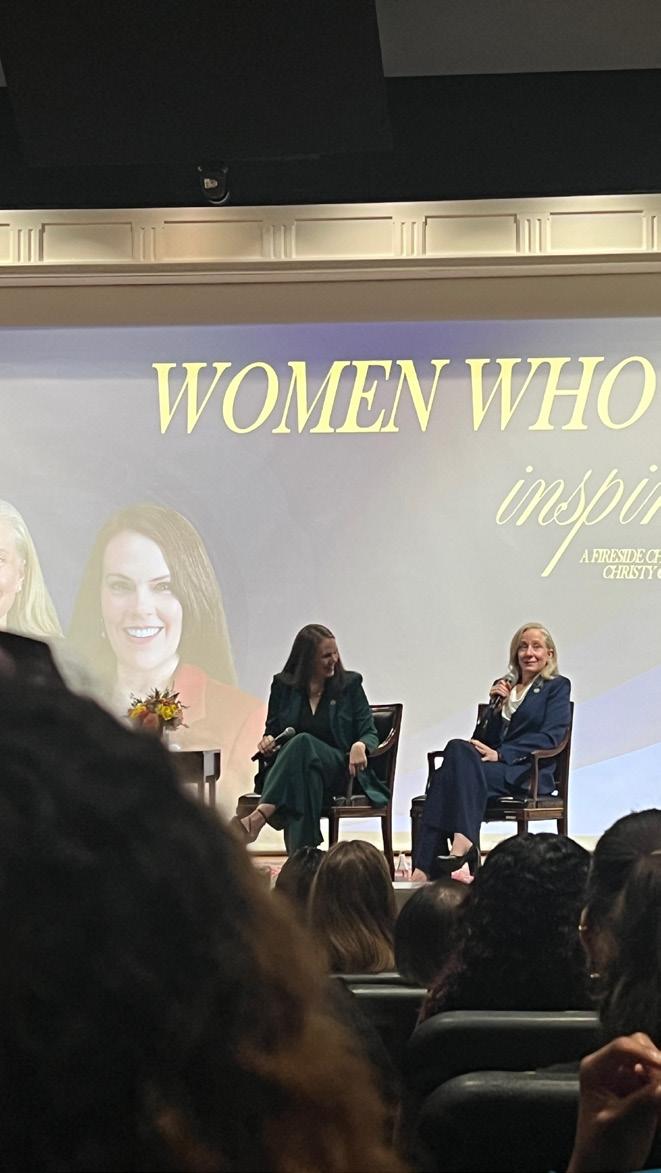
Spanberger D.P.S. ’26 and Chief of Staff Bonnie Krenz-Schnurman held a fireside chat for Women’s History Month in Richmond, Va. Several students from the College of William and Mary were invited to attend.
Spanberger is the first woman to be elected governor of Virginia.
Student Assembly Sen. Mackenna
Wyckoff ’28 was among the invitees.
“I really find that Abigail
Spanberger being our first woman governor is so inspirational,” she said.
“As somebody who wants to go into politics and policy, she’s really an inspiring figure for me.”
Spanberger began the fireside chat by discussing her political journey with Krenz-Schnurman.
Krenz-Schnurman is the first female chief of staff to a governor of Virginia, who is currently serving under the new administration.
Although Spanberger initially hired Krenz-Schnurman as a policy expert, Spanberger promoted her to chief of staff because of her high qualifications.
“The record that we had in terms of effectiveness within the halls of Congress, the number of bills that I got passed into law, not all of them standalones, [was] because Bonnie created a team,” Spanberger said.
Krenz-Schnurman joked about Spanberger’s praise, relating it to her boss’s philosophy surrounding her work. She said that Spanberger’s career in public service and her commitment to serving the American people drew her to the governor’s team.
“Can you tell that the governor is one of the world’s most supportive, uplifting bosses to work for?” she said. “She demonstrated the kind of leadership that I wanted to work on behalf of in government.”
The conversation shifted to how the two balance their careers with
their personal lives. Both Spanberger and Krenz-Schnurman are mothers: Spanberger has three school-aged children, while Krenz-Schnurman has a three-month-old daughter.
“There’s a lot of multitasking in my life right now,” Krenz-Schnurman said. “But it’s such a privilege to make it all work.”
Krenz-Schnurman explained how her work schedule is typically filled with meetings with various cabinet members, Virginia legislators and external stakeholders.
“[My job is] essentially a lot of keeping the operation of government going,” she said. “[I’m] trying to keep those gears turning so that we can make the decision about what we need to bubble up to the governor and where her time can be most strategically deployed on the most important issues.”
Esma Akram ’26, chief of staff for the 2025-26 SA administration, attended the talk and commented on the value of learning about KrenzSchnurman’s work.
“I thought it’d be a great opportunity to see what her life is like and what her job is like,” she said. “It is something that is similar to what I’ve seen at such a small scale at William and Mary, [and it is] something that I would love to pursue in the future.”
The discussion turned to the legacy the two women hope to leave following their historic Virginia administration. Spanberger said that she wanted to
change assumptions about mothers’ capabilities in the workplace.
“I do want people to see that if you want to do what we are doing, you can do it,” she said. “It isn’t easy, and to be clear, it isn’t for everyone. But, I want to change expectations.”
Spanberger emphasized the significance of motherhood during her first congressional campaign. She described how she defied apprehensions surrounding her family life with strong leadership.
Spanberger also hopes her administration will help Virginia navigate the challenges posed by the federal government.
“People have gotten into this place where they think that government doesn’t work, or everything’s broken,” she said. “Particularly when it’s contrasted with what’s happening at the federal level, our ability to just have Virginia be a little bit of a sunny spot, and it’s that larger scale of chaos, is a goal.”
The pair looked at a series of photographs significant to both their political careers and women’s history in Virginia.
One photo depicted the moment just after Spanberger won her first election for the House of Representatives in 2018. Her youngest daughter, a toddler at the time, played at Spanberger’s feet, asking the then newly-elected congresswoman to pick her up as she gave a speech.
“I remember thinking, ‘Oh my
God, I can’t figure out what it’s going to look like,’” Spanberger said. “And then I thought, ‘Well, f—, I just won.’ For me, this represents the determination to make both of these really important things in my life work at the same time.”
Spanberger expanded on how that moment mattered to her constituents.
“I had multiple women say that they had that framed photo on their desk at work or in a place of prominence for them to remember as they were coming up in their motherhood/ career road that you can find your balance,” Spanberger said.
Krenz-Schnurman added that the Spanberger administration tries to accommodate its own staff’s family lives in the workplace.
“I think that both of us would like it to be the case that people don’t feel like they have to hide their family obligations, that those can be out in the open and that that isn’t seen as detracting from the work that you’re doing,” she said.
The talk ended with a few preselected questions from audience members, including one asking what advice the two had for women striving to make meaningful change during this unprecedented time.
Krenz-Schnurman responsed to the audience question by highlighting the importance of stepping up to challenges when things get difficult.
the senate unanimously voted to approve an amended version of Otten’s bill that would hold the ZeroEyes referendum approximately two weeks after their current meeting on April 7. Otten eventually said that he would not release the votes of senators if they voted for the amended version of his ZeroEyes
LILA REIDY FLAT HAT NEWS ASSOC.
LIAM GLAVIN / THE FLAT HAT Otten urged the senate to pass his ZeroEyes legislation.
NICOLE ZAJAC FLAT HAT NEWS ASSOC.
STAFF COLUMN
Bye, Taylor Frankie Paul, but why don’t you have company?
Lila Reidy
Reality television star Taylor Frankie Paul has been in the news headlines lately for the last-minute cancellation of her “The Bachelorette” season’s debut. The reason “The Bachelor” franchise pulled her season so abruptly was due to a newly released video where she attacks her ex-boyfriend, Dakota Mortensen. The video shows her throwing chairs, one of which hits her sleeping daughter, and when asked to stop for the sake of the child’s safety, she is heard verbally assaulting Mortensen. She is intoxicated in the video and acting incredibly unsafe around her children and boyfriend.
Paul is famous for her lifestyle and parenting content on TikTok and stars in the reality series “The Secret Lives of Mormon Wives.” She is the first Bachelorette to have a criminal record.
Let’s back up to 2023, when the incident occurred. Paul was arrested and pled guilty to one count of aggravated assault, according to Salt Lake City Fox affiliate. By taking a plea agreement, two counts of domestic violence, a class-A misdemeanor charge of child abuse and a misdemeanor charge of criminal mischief were dismissed.
During the filming of her season, Paul was on probation for this incident, confining her to the United States. All of this seemed to be okay to the “Bachelor” franchise, but the resurgence of the violent video was the last straw for the producers.
I am not denying that Taylor Frankie Paul is in the wrong, but we have seen men walk away from incidents just like this, with just as many fans as before. Within the “Bachelor” franchise itself, Season 23 lead Colton Underwood had a restraining order filed against
him by one of his contestants, Cassie Randolph. Underwood was allegedly stalking and harassing her, tracking her vehicle and arriving unprompted at her home. Interestingly, the restraining order was soon dismissed.
Underwood has come out as gay and is rising to more fame as a recent contestant of the reality series “The Traitors.” How has he emerged from this drama uncanceled and unscathed? Is this evidence of a double-standard between men and women?
This comparison holds a startlingly similar situation, but a wide contrast in results from both the “Bachelor” executives and the public.
Stepping outside of “Bachelor” ‘paradise,’ we can see this in more mainstream celebrities, too. In 2009, Chris Brown was charged with felony assault after showing physical violence against Rihanna.
He pled guilty to the charge and was on probation for five years.
This did not stop him from continuing to write and produce music, building up his following. Brown even tweeted in 2010, “Boyz run from [their] mistakes. Men learn from them!!!”
But it seems he has to fall in with the former group, as in 2012, Brown was involved in multiple altercations in a New York City nightclub, putting him on probation once again. The list of his felonies is seemingly endless, with incidents filed almost every year.
In 2025, Brown was arrested for striking his producer with a bottle of tequila multiple times.
Flash forward to today, he is on tour for his newest album “11:11,” with tickets averaging $200. I wonder what he’s wishing for on that angel number?
This further proves that men and women are not held to the same standards in their actions.
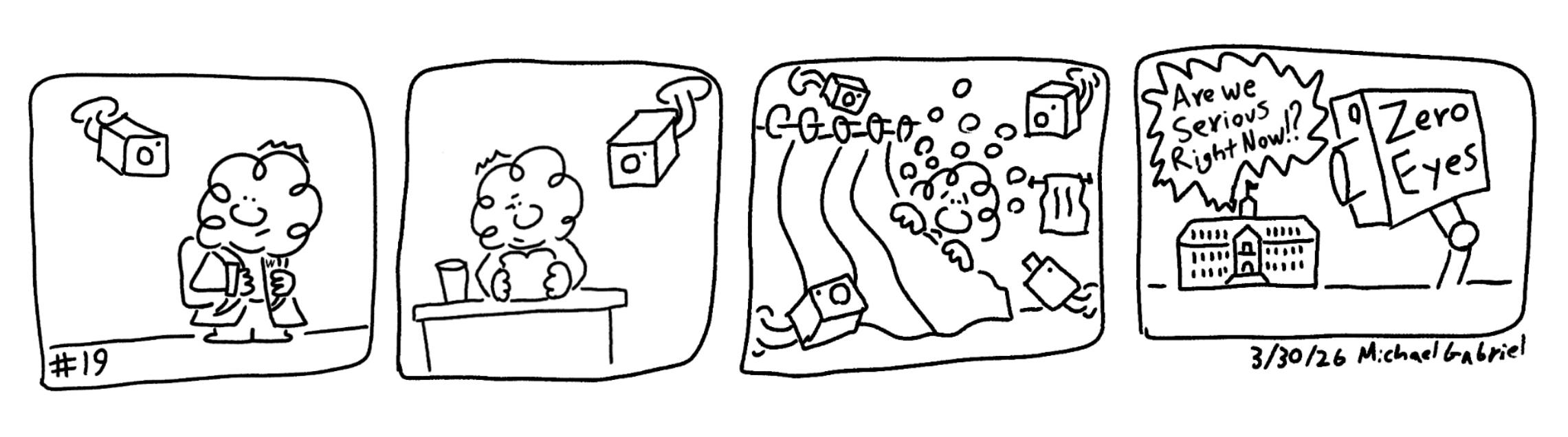
Willy and Mary #19
While, sure, people disapproved of Chris Brown’s repeated violence, he still isn’t canceled. Or at least canceled enough to not currently be on tour, even after 17 years’ worth of felonies. He was intoxicated and threatening people’s safety in many of these accounts, just like Paul. Why was Paul so easily canceled and not Brown? She should be, but is it because of her gender that her opportunities were so quickly pulled out from under her? It shouldn’t be a question of either/ or, but of both receiving penalties and decreased support.
Another example of this is country singer Zach Bryan. Bryan previously served in the U.S. Navy, where he met his ex-wife, Rose Madden, in 2020. They later divorced in 2021, with Bryan serving divorce papers to her while she was deployed. Still, he continued to tour and produce music, growing his fanbase to over 8 million on social media platforms.
Most recently, Bryan had a very public breakup with Barstool Sports’ Brianna LaPaglia in late 2024, where she ranted about their toxic relationship on her podcast, cataloging him cheating on her and being emotionally abusive. According to her, Bryan offered her $12 million to sign a non-disclosure agreement about their relationship. This does not seem like a thing that a non-guilty person would do. There is an emerging pattern in how he treats women, with these only being his most popular offenses.
Yet Bryan and his music continue to rise to fame: his most recent tour’s tickets average exceeding $500. A general consensus of fans is that his private life is not the public’s business, saying on Reddit that the focus on his relationships is too invasive.
I disagree. If we are holding Paul to this standard in her personal life, which, don’t get me wrong, we should, all of these men should be similarly canceled and dismissed from the public focus for doing ultimately the same thing. These double standards for men and women are pervasive in different ways throughout the world. While this is an example on a celebrity scale, these standards exist on campus, too. Make sure that you’re holding your male friends to the same standards academically, socially and emotionally because they should be capable of meeting them. All that to say, yeah, Taylor Frankie Paul, you’re in the wrong, but why don’t you have company?
Lila Reidy (she/her) is a junior double majoring in English and gender, sexuality and women studies and an associate news editor at The Flat Hat. She teaches yoga and is a member of Kappa Delta sorority at the College. She also loves coffee, camping and thrifting.
Response to “You won’t learn humanities through classes”
As an English professor at the College of William and Mary for nearly 30 years, I read with interest Nora Yoon’s ’27 column, “You won’t learn humanities through classes,” especially their comment, “Nor is there a guarantee that your [humanities] professor will be a grounded, lucid educator with the ability to impart the universality of their field, rather than just take the subject’s significance for granted and get right to making you memorize arguments, interpretations and other painfully specific information.” I regret both that Yoon’s past humanities courses apparently emphasized memorization and that they remain unsure whether their English professors’ scholarship “builds and contributes to an existing body of knowledge that is benefitted by their work” in the same way as their science professors’ research. Still, whatever our failings, we humanities scholars expect that our students back up their claims with evidence, just as scientists do. Rather than reading a book written by any current instructor on campus to investigate this issue, Yoon quotes a 1949 journal entry by Susan Sontag disparaging humanities professors’ writings as “long (hundreds of pages) monographs on such subjects as: The Use of ‘Tu’ and ‘Vous’ in Voltaire.” Do any recent works by English or modern languages professors at the College strike them as THAT esoteric? I’d invite Yoon to read Adam Potkay’s “Hope: A Literary History” or Jennifer Lorden’s “Forms of Devotion in Early English Poetry” (to name only two recent books by colleagues that combine deep thought about literary culture with critiques of existing scholarship) to
see whether they still view English professors’ scholarship as needlessly narrow and obscure.
Later in their column, Yoon says that while taking a creative writing class, they found inspiration in a quotation from Werner Herzog that dismissed the need for factual knowledge in favor of the emotional truth of art. Frankly, I don’t understand why we can’t have both. I very much hope that Yoon and their fellow students will give literature courses in the College of Arts and Sciences a(nother) chance. Reading privately for inspiration certainly can aid in one’s personal development, but many humanities professors see our role as guiding our students toward illumination through art — much as Virgil leads Dante through the Inferno and to a reunion with his beloved Beatrice in the Purgatorio. Especially now, when surveys show that students feel increasingly isolated and “vibes” often trump knowledge of facts, discussing literature with other human beings, having an educated instructor help shape that shared inquiry and studying selected background information relevant to a writer’s historical context can help students appreciate the value of literature and the humanities more fully than solitary reading. Give it a try — put a literature course in your PATH cart this spring!
Suzanne Hagedorn has taught in the English department and program in Medieval and Renaissance Studies at the College of William and Mary since 1997 and serves as corresponding secretary of Phi Beta Kappa, Alpha of Virginia. Off campus, she enjoys reading, cooking, opera and spending time with her husband, son and their two cats, Misty and Smokey. Contact her at schage@wm.edu.
MAYER TAWFIK / THE FLAT HAT
THE FLAT HAT
GRAPHIC BY ISABEL VOLDEN / THE FLAT HAT
COMIC BY MICHAEL GABRIEL / THE FLAT HAT
Twins need space, too
This scenario has played out countless times in my life: A stranger sees my sister, Adelle, and I together at school, at work or around town. They smile politely, then look at us with puzzled expressions and ask, “Are you two twins?” It’s a question we’ve heard a thousand times. We always nod and smile back. Then comes the inevitable follow-up question: “So, what’s it like to be a twin?”
It’s a strange question when you think about it. Asking me what it’s like to be a twin is like me asking someone, “What’s it like to not be one?” I don’t have the comparison point they are looking for, only my own experience. But that experience has shaped everything about who I am, and it’s also why I believe twins need space to become their own people.
For starters, being a twin means always having someone I can truly trust and confide in. While we can’t read each other’s minds like people often assume, we understand each other in ways others can’t. We pick up on each other’s unspoken cues, and with her, I can be vulnerable in ways I’m not with anyone else. Our lives are intertwined through shared experienc-
STAFF COLUMN
es, milestones and memories, making our bond different from others.
Growing up, Adelle and I shared everything from a bedroom and memories to, fortunately for her, a physical resemblance. People knew us as the Gravina twins, and while we were lucky not to be mixed up too much, thanks to her red hair and my blonde hair, many people still thought of us as a unit rather than individuals. For the most part, we had the same friends, played the same sports and had similar interests. We were rarely separated. Being a twin is complicated. It’s not just about closeness, but also about identity. While most siblings naturally develop as individuals, twins often form a shared identity revolving around their relationship. Psychologist Joan Friedman argues that being constantly seen as a pair can make it harder for twins to develop a strong sense of individuality, something I’ve experienced firsthand.
Even as we tried to assert our individuality — through different sports like swimming and running, different majors like English and biology and even different personal styles — we were still often seen as part of a pair.
Even when I tried to be my own person, I still felt defined as part of ‘us’ instead of ‘me.’
That’s why I believe twins should seriously consider going to different colleges, not just for the space, but because it strengthens something just as important: a sense of self.
Going to college without my twin sister was a major change. For the first time, I had to figure out who I was without my twin by my side. No one else around me faced quite the same test: Can you function without your other half right beside you? It was unfamiliar to me, uncomfortable at times, but also necessary.
At the College of William and Mary, I’ve learned how to adjust to life without my twin by my side. For most of my life, we were rarely apart, so going to different colleges tested my independence greatly.
I’ve come to believe that, for many twins, going to different schools is beneficial — not simply for separation, but for the chance to develop a sense of identity outside of the twin dynamic. Being here has given me the space to form my own identity, build new relationships and explore different interests. And I truly think that my twin sister and I are closer than we have ever been, despite being a plane ride away. While not every twin will feel the same urge for space, for me, that separation has been formative.
Without a doubt, sibling relationships, especially twin relationships, are complex. They’re about closeness, but also about learning who you are apart from each other. So when people ask me now what it’s like to be a twin, I can finally tell them it’s about having someone who will always be there, even when they’re not.
Ava Gravina ’28 is a psychology and English major at William and Mary. She swims with Club Swim and writes for the school’s pop culture magazine, The DoG Street Journal. She is from outside Boston and enjoys spending time with friends, baking, reading psychological thrillers and watching rom-coms. You can contact her at acgravina@wm.edu.
Guys, I miss Adam Jutt. You’re telling me I have to sit down and write this whole thing by myself? Anyway, welcome back to Eva’s Apple. I feel like it’s been a while since I started with an anecdote, so allow me to give you a rare window into the life of Eva.
If you’ve read some of the earlier editions of Eva’s Apple, you know that I have a crazy dog named Pretzel who inexplicably hates me. She used to ignore me when I walked into the house. She wouldn’t wag her tail or run up to greet me. She would just look right through me. When my mom tried to get her to wake me up in the mornings, she would walk into my room, steal something and leave without ever acknowledging my existence. This semester, I have been intentionally pursuing a self care and personal growth plan that I call my rEVAlution. Suddenly, when I visit home, Pretzel has been treating me with respect — with reverence, even. She sits beside me
as I play piano. She sleeps by my side while I watch “Love is Blind.”
She bonks my phone out of my hand with her snout and replaces it with a ball or a bone when she wants my attention. I got a dog for companionship and emotional support, but she hated me at my worst. She only loves me at my best.
I’ve learned that Pretzel is the opposite of a therapy dog. She’s a go-to-therapy dog — the type of animal that only likes people who have worked extensively on themselves and don’t rely on her at all for kindness, support or understanding. None of you will ever understand the feeling of looking at a little sentient chicken nugget who you would literally do anything for with the knowledge that they would give you up for a taste of mozzarella cheese.
I’ve made it to better days now that Pretzel has decided I am selfsufficient enough to be worthy of love, but I look back on those dark times and genuinely cannot remem-
ber how I didn’t crumble under the weight of my own inadequacy. This brings me to our question of the week, which is as follows:
“What are ways you stay mentally calm in times of hardship?”
One of the most popular songs about steadfastness in the face of unrequited love (one of the most demoralizing types of hardship) is “Grenade” by Bruno Mars. I would catch a grenade for Pretzel, and, before I reinvented myself, she would never have done the same for me. Since our boy Bruno has already bottled up the essence of hardship and shared it with us through song, you may wonder why I still feel the need to weigh in. Listen closely when I say that you cannot trust anyone, and I mean ANYONE, to guide you in life besides me — least of all Bruno Mars. I firmly believe that “Grenade” is the closest to a perversion of the divine that we mortals have the capacity to perceive. Worse, people stream the song as if it isn’t a sacrilegious lie set to a catchy tune. Stay with me here. I keep seeing these memes about that part of the song that goes like: “Should’ve known you was trouble from the first kiss / Had your eyes wide open, why were they open?” All the memes making fun of this lyric point to how disquieting it is that her eyes were open and are always like “NO BECAUSE WHY WERE THEY OPEN?” However, I challenge you to question the songwriter himself, not the subject of his songs. HOW WOULD BRUNO HAVE KNOWN HER EYES WERE OPEN IF HIS EYES HAD NOT ALSO BEEN OPEN? Can’t you see? HIS EYES WERE WIDE OPEN TOO. The gall. The hypocrisy. It’s sickening. You can’t take advice from that man. You
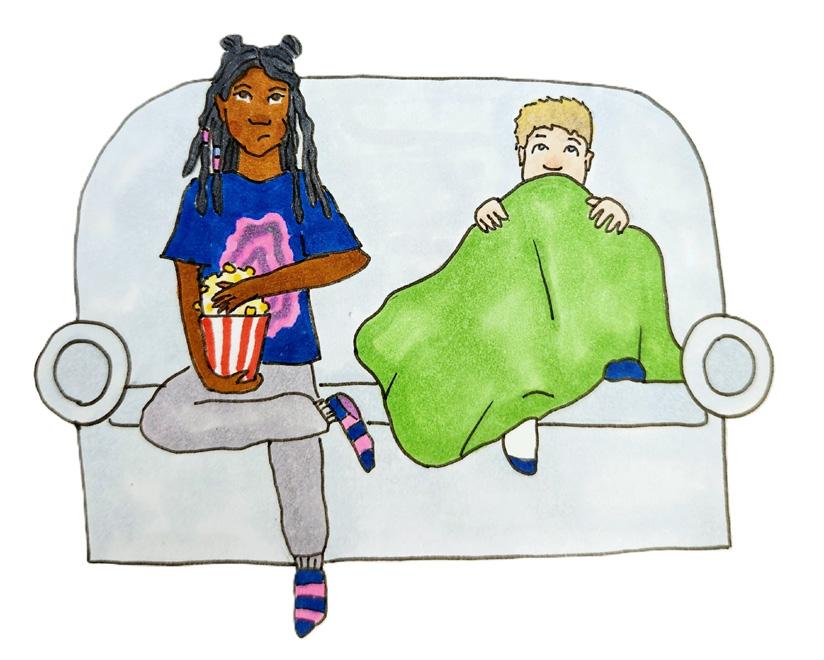
In defense of movie night
The release of “Project Hail Mary” was a special deal for me, mostly because, for the first time in my life, I got to go see a movie in theaters without having a single member of my family around. A group of friends and I went to see the film together at the local Movie Tavern, and we found it to be worthwhile. The film itself was a wonderful experience, and I encourage everyone to go see it. One of my friends wrote a review on Letterboxd, which I happen to largely agree with. To summarize his point: The film hits all of the right emotional beats at all the right moments, making it one of the best blockbuster films to have been released in quite a while. This more than makes up for the lack of innovation in the film’s script, as it manages to effectively utilize every element of its story.
However, I did not write this piece solely as a movie review. That’s best left to my colleagues in the Variety section. I wrote it to plead with the students at the College of William and Mary: See movies with friends more, either in a theater or on campus. The decline of the movie theater is a much-discussed phenomenon and a real shame. Lots of films (like “Project Hail Mary”) are best enjoyed in the atmosphere of the cinema. The big screen, the immersive sound and the taste of butterslathered popcorn mixed with the fizzle of Coca-Cola are all part of the cinematic experience, and they elevate the sensation of movie watching greatly. This is combined with a communal element; although no one talks, sharing popcorn with friends and laughing along at the same jokes is certainly a bonding experience. Not talking or being able to access cell phones during the movie is, if anything, better, as it forces you as the viewer to pay attention, enabling better discussions about what you saw on the way back (much as my friends and I had on the bus ride back to campus). However, just because going to a theater is the best way to experience movies doesn’t make it the most easily doable. Being short on cash is part of the college student experience, and tickets on average cost over $15 a pop. This means
can’t rely on his music to make you feel seen and understood. It’s me and you against the world, dear reader, with our eyes and hearts wide open. So, with that, I will give you the sole correct answer about how to stay mentally calm in times of hardship. Based on my anecdote about the rough patch I went through with my dog, it’s clear that I have the appropriate lived experience to speak credibly on this matter. I am certain that the framework I used to train my dog is the exact framework that people can employ to train themselves into being completely nonchalant in situations that ostensibly warrant the utmost chalantness. I have detailed ideas to make yourself less concerned with external hardship below. Follow it closely, and I can guarantee that you will not fail almost as confidently as I can guarantee that Bruno Mars is an open-eyed hypocrite.
1. Learn fun little tricks. When you’re struggling with feeling unworthy, the healthiest and most productive thing to do is learn weird little party tricks to make yourself more interesting and thus likeable. For example, my anthropomorphized baguette of a brother learned how to solve a Rubik’s cube with his eyes closed. I have a ligament irregularity that enables me to hold and crush cups with my shoulder blades. Pretzel can catch blueberries in her mouth. You need to find your party trick, but it has to be completely and totally unique in order to make you special. I’ve listed some for your consideration: put on a wet suit and build a dam in the nearest body of running water so you can brag that you’re an ecological engineer at your next party; get plastic surgery to look exactly like
that some students might not have this available as an option. However, I can propose my own alternatives.
In my dorm, I have a set-up with an old TV linked to a DVD player, as well as a microwave and popcorn popper. I often have friends over to watch movies and TV shows using DVDs from either Earl Gregg Swem Library or my personal collection, and it’s wonderful. It’s probably one of my favorite parts of my college experience. If you have an old DVD player and TV or monitor laying around your house, you could ask your parents if you could bring it next semester. It’ll take some effort to set up, but if you love watching movies and enjoy the social experience, you won’t regret it. Streaming movies using various services is also an option in 2026. While watching movies or shows on a computer is not preferable, especially in a large group setting, it still is a way to enjoy them. If you have a monitor, you could connect the two devices, solving the screen issue more effectively and enabling better group-watching.
Many clubs on campus also watch movies either regularly or sporadically. Maybe checking out a few to see if they’re for you and fit your schedule might be worthwhile.
The important thing is to engage in these activities as part of a group. I’ve written before about how so many modern problems could be solved if we interacted with each other again, and I think it’d be a shame if film-watching became a solely individual experience with no communal aspect. It might be a slight improvement over scrolling through brain rot on TikTok, since you’re taking the time to commit attention to a piece of media, but it might not be much of one.
Once you find your group of people, though, don’t forget to watch a movie together — it can be a bonding experience just as good as any other.
Shawn Mendes and steal someone’s credit card at the next event you go to, buy yourself an overnight business class ticket to Japan and then run through Tokyo singing “Lost in Japan” by Shawn Mendes; learn how to give someone a bowl cut in under three and a half minutes and try it on an unsuspecting great-aunt at your next family reunion! You are worthy of being loved; you just have to do a complete overhaul of your interests, hobbies and ambitions to maximize your shock factor. Turning heads is always more important than winning hearts.
2. Make up jingles to motivate yourself. When my dog used to run away from the toothbrush or get fussy when I moisturized her paws, I would sing her silly little songs to calm her down. She hates them. She would go from being fussy to being downright hostile. That’s the energy we need to channel when we’re feeling down in the dumps. When going through hard times, don’t be sad. Be angry. Sing yourself little songs making fun of your situation that make you so furious that you forget the hard times you were going through and can only focus on the hell you are putting yourself through. For example, imagine that you’re in a situation where you said you would get your satire advice column to someone by a certain time and you are not done with it yet. The worst thing about hardship is that it’s not always in your control. What you want to do is cause secondary issues so that you’re now dealing with problems that are completely within your control because you unnecessarily caused them! Become so deli-
ciously chalant about something other than your original issue, so much so that you don’t have any energy to focus on the real problem at hand. Get that generative mind of yours to work.
3. Pavlov yourself. There was this scientist named Ivan Pavlov who proved that dogs can be conditioned to salivate at the sound of a metronome when that sound is consistently associated with food. I set up a bell system for Pretzel to ring whenever she needed to go potty but she now only rings the bell to get my attention when I’m eating, so I’ll give her something. She turned the tables and Pavloved ME. What you need to do is Pavlov yourself into developing an unconscious habit where you feel happy and stress-free when you hear a certain sound. Logically, you want to be happy as much as possible, so you should Pavlov yourself with the most common sound in your life: the sound of your own voice. Every time you speak, you should give yourself a little reward until you just expect a nice prize for every conversation you have. If a dog could Pavlov me, you can certainly Pavlov yourself.
Hope this helps, my divas! I’m going to go seek validation from my doggo, and I’ll see you in two weeks.
Eva Jaber ’28 (she/her) is a prospective English or international relations major. She is a member of the Cleftomaniacs, an a cappella group, an ESL tutor and hopes to encourage peaceminded advocacy on campus. Contact her at ehjaber@wm.edu.
Eva Jaber FLAT HAT OPINIONS ASSOC.
Ava Gravina FLAT HAT OPINIONS EDITOR
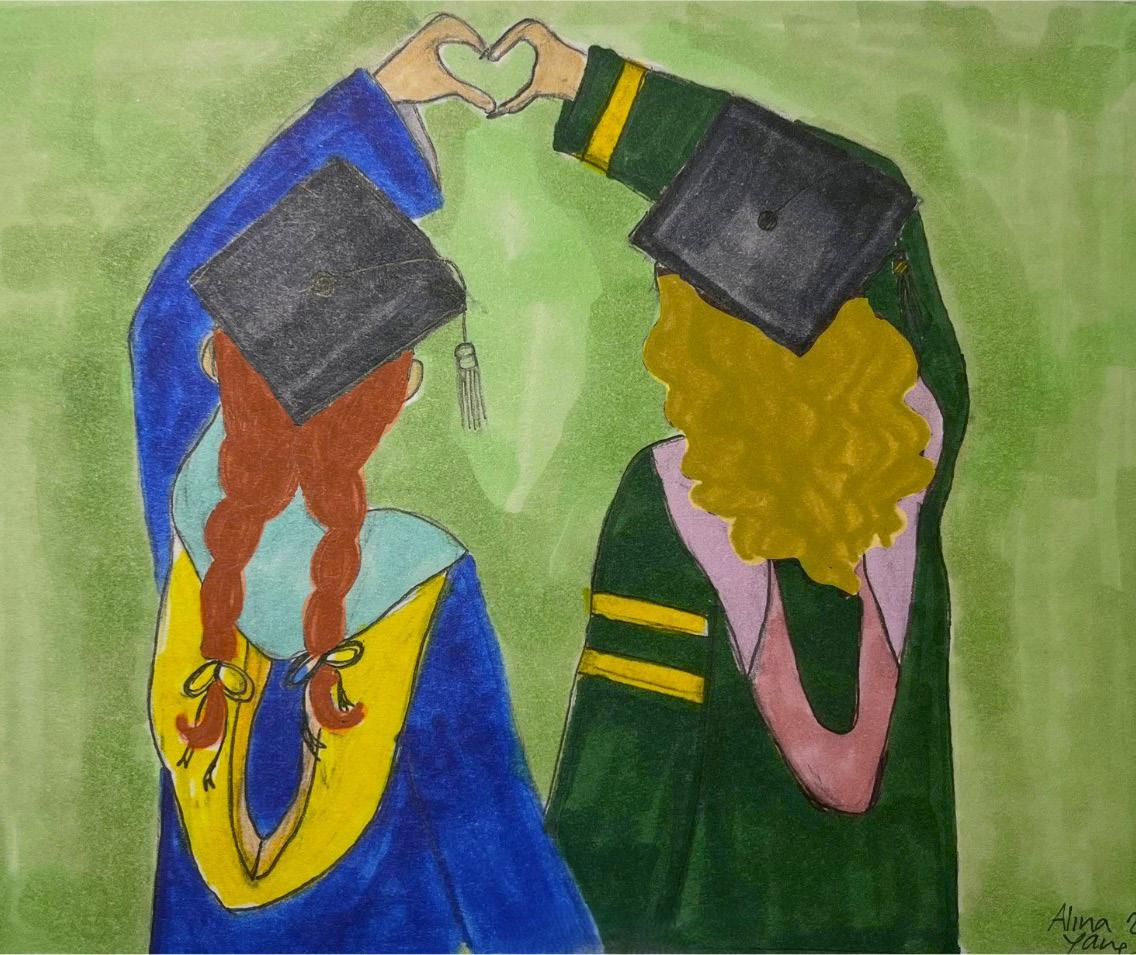
GRAPHIC BY ALINA YANG / THE FLAT HAT
Carson Burch FLAT HAT OPINIONS ASSOC.
GRAPHIC BY ISABEL VOLDEN / THE FLAT HAT
EVA JABER / THE FLAT HAT
variety
Dancing beyond bor ders
Rasa
Across Borders explores gender, caste, sexual orientation
SAKAI-CHEN // THE FLAT HAT
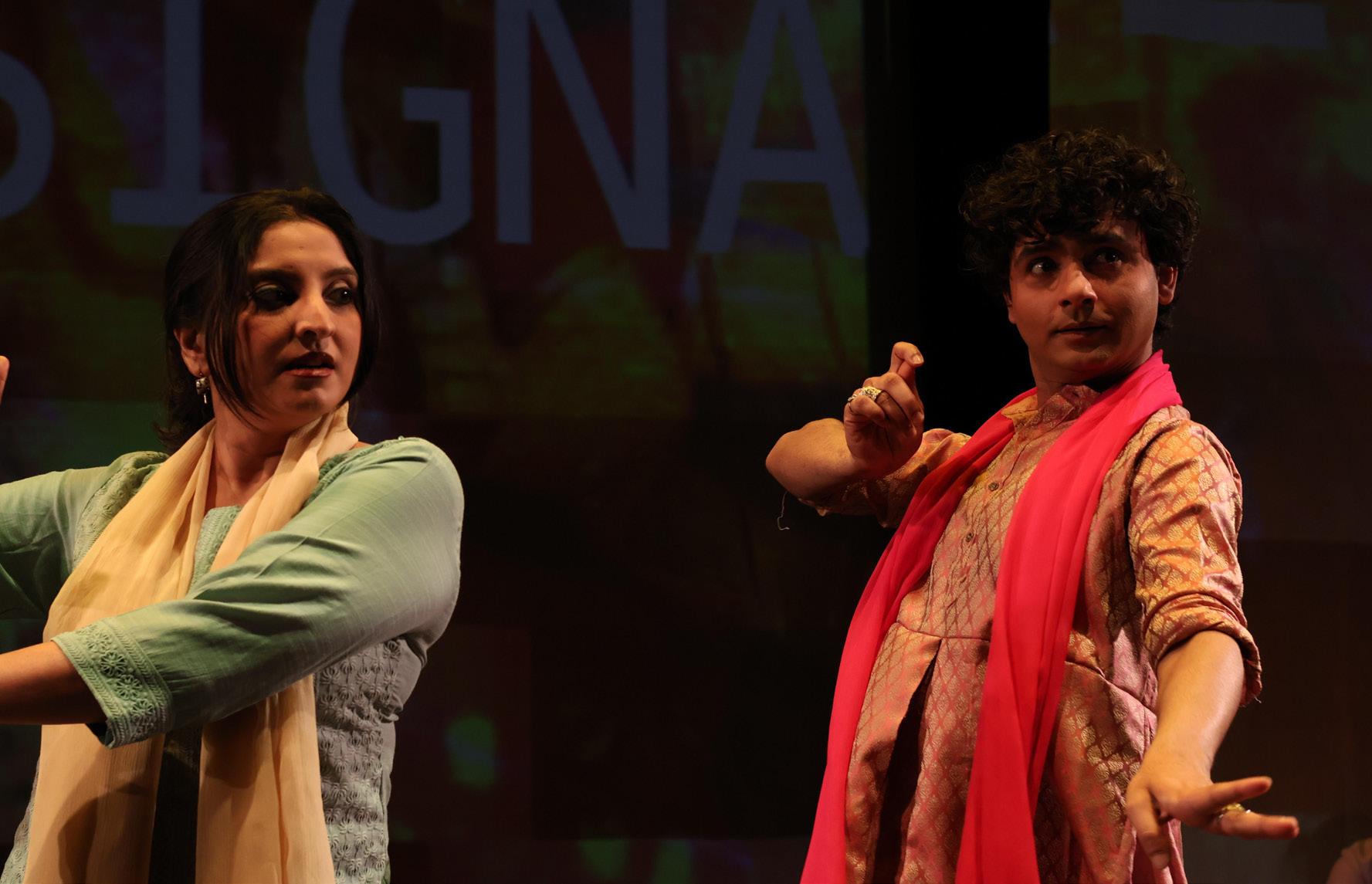
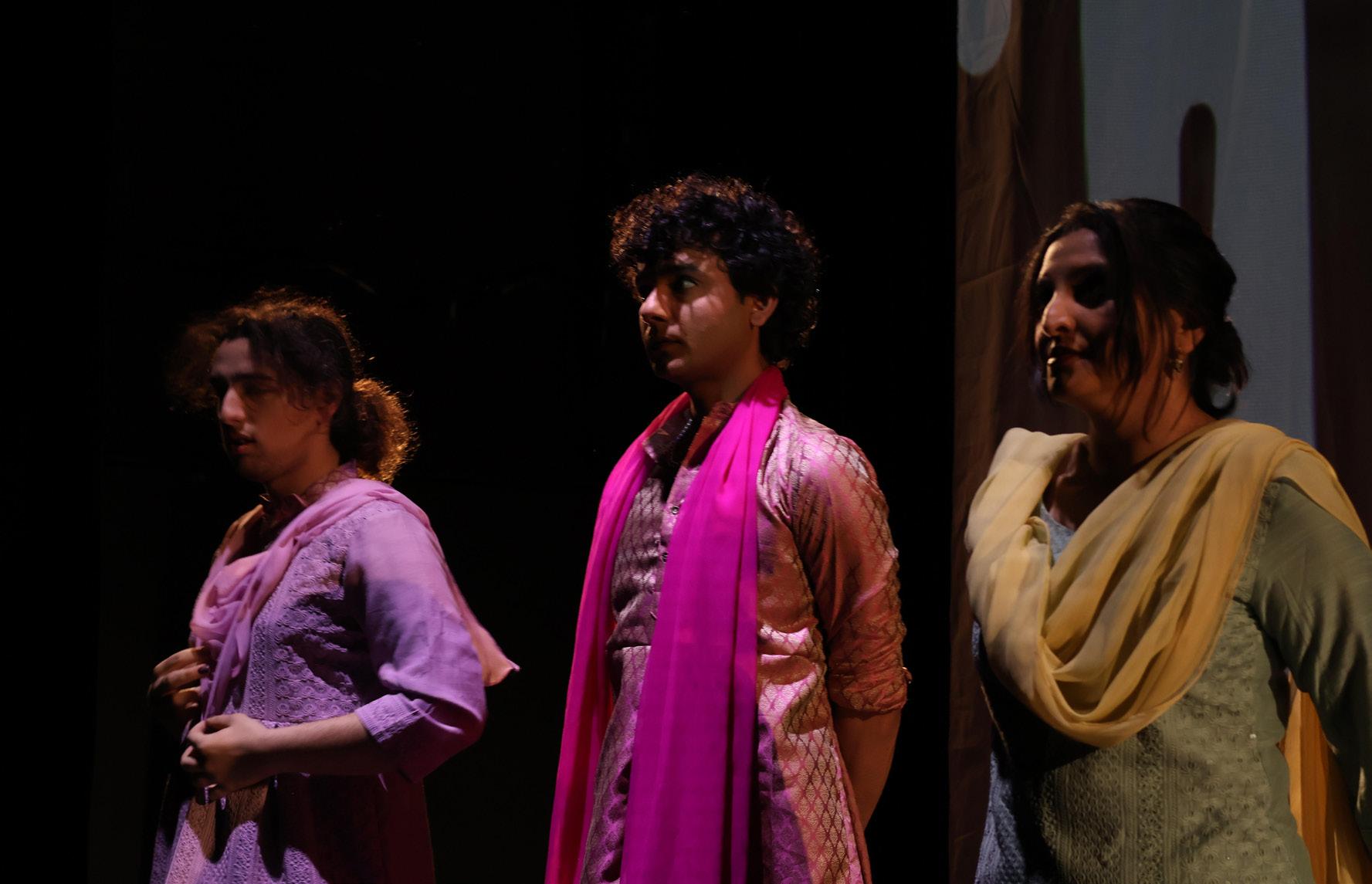
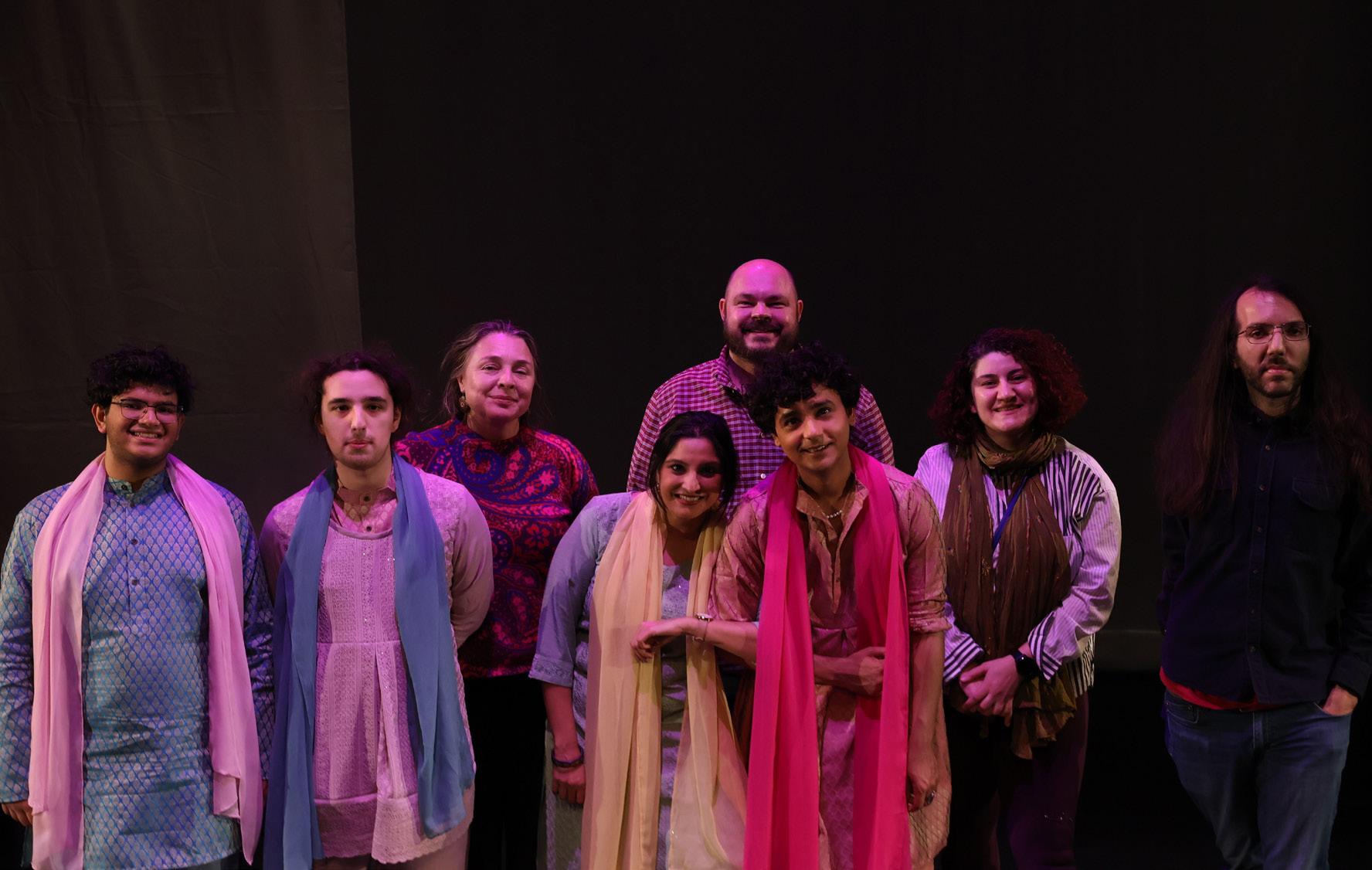
Friday, March 27, the Art and Science Exchange sponsored “Rasa Across Borders,” a theater performance held in Phi Beta Kappa Memorial Hall. The performance opened with upbeat, plucky music as the stage lights turned on, and four performers in kurtas walked on stage. There were four sheets of fabric draped from the ceiling, which projected videos from Pakistani and West Bengali dancers and activists.
Throughout the performance, stories were communicated through monologue, projected videos, Bharatanatyam, Kathak, Sufi Dhamal and Mujra influenced dances, and classical Bharatanatyam-inspired dance on stage.
Some memorable moments included a projected video of Palash Dutta, a West Bengali dancer and Kothi youth activist, dancing in a field of flowers. These calmer moments were juxtaposed with more tense scenes.
One such scene projected a patchwork of TikTok videos, headlines and news clips looping audio that overlapped while performers stopped dancing and distressedly stomped.
There were also somber moments where performers told difficult stories about their experience with religion and mental health. Interspersed were stories from the collaborators in West Bengal and Kolkata, told in Urdu. And there was the joyous dancing to “Pink Pony Club” by Chappell Roan.
One of the videos used in the performance was of Leila, a Pakistani transgender writer and performer, who explained that rasa represented elemental human emotions. These emotions were learned in childhood and relearned later in life. She shared that rasa is a powerful tool to connect with other people. Thus, rasa can give people courage to show t he world who they are. The show explored these themes of elemental human emotions across experiences of gender, sex, caste, sexual orientation and continents. Through these various stories, Rasa stitched together themes of LGBTQ+ struggle, resilience and resistance. More specifically, Rasa shares stories of family abandonment, violence and perseverance.
This performance started out as an idea between Associate Professor of Theatre and Performance and Gender, Sexuality and Women’s Studies Claire Pamment, Assistant Profe ssor of
Applied Science Indranath Mitra and Assistant Professor of Sociology and Gender, Sexuality and Women’s Studies Diya Bose. Bose wanted to explore transnational dialogue and synergies through their research and networks with South Asian gender expansive communities. They formed community partnerships with the Gender Interactive Alliance in Karachi and the Kolkata Anandam for Equality and Justice. They were then joined by students Ash Kelley ’28 and Nikhil Vattathara ’29.
Performers noted that creating this theater piece was collaborative in nature. Mitra explained that rehearsals often started with watching video submissions from activists and performers from West Bengal and Pakistan and reflecting on them.
These rehearsals cons isted of exercises and questions from “How are we all feeling today?” to “Where are we, who are we and what stories are important to us?”
A lot of these exercises centered around sharing vulnerable, personal stories.
“I would tell my story, and then Claire would listen to me,” Mitra said. “That was very important, and then she would share her story, and I would listen to it. So then what happens is that expands my safe space from just around me and brings one more person. In the same way, the stories from these rehearsals got shared and the safe space kept expanding, and tonight, everybody who came to the show is in my safe space.”
Te process of incorporating these stories in the performance was difcult at times, especially when they centered around sensitive topics. Vattathara attributed a lot of the success of handling these stories with care to their director, Pamment.
“Without her patience and guidance, this project would’ve been impossible,” Vattathara said. “We dealt with some topics and stories that were extremely heavy and difficult, and I think we understood when people needed some space from a scene, or when people were feeling uncomfortable. We did a lot of exercises that helped us stay emotionally and physically healthy.”
For many performers, this was their frst experience in a devised theatre project. Vattathara noted that this project helped him develop as a performer and change maker.
“I remember being extremely frustrated and angry at how much the people I love had
to go through for just wanting to live as their authentic selves. And the more I got into acting, the more I realized how powerful p erformance can be in influencing minds and inspiring change, and I hope that I can make the world a better place for everyone through that,” Vattathara said.
Kelley explained that she signed up to be a performer not knowing what it would become and how great of an impact it would have on her.
“It has been one of the pieces of theater I have worked on that is perhaps one of the more foundational pieces to me, and it is something I will continue to take with me for as long as I continue to do theater,” Kelley said.
The following panel discussion strongly emphasized performance as a form of protest and resistance. Many of the performers highlighted that individual expression was a way to welcome others into their protest.
The moderator of the panel, University of Massachusetts Amherst Associate Professor of Women’s, Gender and Sexuality Studies Svati Shah, described how the performance reflected syncretism, or an amalgamation of religions, cultures and identities.
“Syncretism is a way to describe, among other places, South Asia. Syncretism is the concept that allows us to understand how so many histories, art movements, philosophies and ways of life can exist in one place over millenia. Syncretism is a very human concept,” Shah said.
Shah also to uched on the significance of art in certain political climates.
“Syncretism is also a thing that fascists hate. Syncretism is too fluid, too unruly, too undisciplined. Fortunately for us, it is not something that can be so easily be repressed because it is human,” Shah said.
The performance and discussion afterward expressed disappointment with India’s Transgender Persons Amendment Bill of 2026, which reversed India’s expansive acknowledgement of trans rights.
“There is something to performing that is its own protest. And I firmly believe it is our role as people who perform in whatever capacity, whether it is sitting behind a light board or it’s
dancing on stage; it is our job to fight back in any way we can,” Kelley said.
Bose shared lessons from engaging in theater for the first time. Bose’s artistic expressions of her authentic self were poetry and dance. As a dancer trained in classical Bharatanatyam, she was used to telling stories in dance form. She explained that Bharatanatyam was wellequipped to tell stories because of its three pillars: Bhava (another word for rasa or embodied expression), Raga (musicality) and Taal (rhythm). This project was the first time she applied her dance storytelling to theater.
“Theater has been a beautiful metaphor for the activism I’ve been working with for all of these years,” Bose said.
In terms of future direction for the project, Pamment said the performers in West Bengal and Pakistan will be working with local organizations to stage their original devised theatre projects in Karachi and Kolkata in May. These performers will draw upon the College’s work and create response pieces to their art.
“The project contributes to transnational di alogue and movement building across borders, especially important at a time when violent anti-trans legislation and sentiments are bounding across national borders,” Pamment said.
Vattathara noted what people should take away from the performance.
“I hope that everyone who saw it, or really everyone in general, knows how important telling your stories can be. I remember so much in my life how much I’ve been inspired and comforted by others’ stories. As difficult as things may be right now, humanity is beautiful because we’re all so different, yet all so deeply connected,” Vattathara said.
Kelley added their perspective during the panel.
“If you are looking for reassurance about speaking up when the entire system that you’re speaking against is doing all it can to silence you: If you speak up, you are not alone. The only time you can actually be alone is if you don’t say a word,” Kelley said.
For those interested in queer theater, Pamment said she will be offering a course next fall called “Devising Queer Theatre” to create a theater project on the College’s queer histories.
MAYA
CHAPs have your back
Conduct and Honor Advisors Program helps students navigate honor violations
When the College of William and Mary students find themselves receiving emails from the Student Accountability and Restorative Practices office, it can be one of the more stressful situations they will face during their academic career. Fortunately, they don’t have to navigate it on their own.
The Conduct and Honor Advisors Program is a 20-member student organization that pairs students facing honor or conduct violations with trained peer advisors who guide them through every step of the resolution process. Operating under SARP alongside the Honor Council and Conduct Council, CHAPs serves as part legal counsel and part counselor in an entirely student-run process.
“Frequently our job kind of balances the role of a lawyer,” former CHAPs vice-chair Will Liethen ’26 said. “But it combines that role with almost a therapist role.”
What sets the College’s system apart from those at most universities is the administration of these councils.
“A lot of work that we do as students, as advisors and the Honor and Conduct Councils, is usually taken up by school administrators at other universities,” newly-elected CHAPs chair Christina Wu ’27 said.
Liethen described the investigative committee that compiles evidence and transcripts to the five-member panel of Honor Council students that preside over formal hearings.
“Some people think of it like a kind of court case,” Liethen said.
“And that’s kind of a good analogy, but not quite, as it’s not adversarial, especially since the entire process is student-run.”
When a student is assigned or requests a CHAP advisor, the program begins with an initial intake meeting. From there, the advisor’s work spans the entire resolution process, reviewing case materials,
identifying potential witnesses and preparing the respondent for the questions they’re likely to face.
“CHAPs will create a timeline of events,” Liethen said. “They’ll also create a summary of disputed facts. A student’s saying they didn’t cheat on this assignment but the professor’s saying they did — that would be a disputed fact.”
CHAPs don’t speak for their clients the way a lawyer would, however.
“We don’t have the ability to argue on a respondent’s behalf,” CHAPs member Jenna Morris ’28 said. “But I think what’s more rewarding is that we prepare them to be able to argue on their own behalf. So we help walk them through the process.”
That preparation can make a measurable difference. A first-time defendant simply doesn’t have access to the institutional knowledge of proceedings.
“But a CHAP who has seen 20 or more cases already, we’re going to know the types of questions that they’re going to be asked and help them prepare themselves and be able to present their perspective in a sharper lens than a student going through the process without CHAP,” Liethen said.
During Liethen’s term as vice-chair, CHAPs handled roughly 100 cases, the majority of which were honor cases involving allegations of lying, cheating or plagiarism, as opposed to conduct cases, which typically covers issues like alcohol violations, theft or dormitory conflicts.
CHAPs repeatedly described the emotional weight of these cases for students as the most challenging aspect to grapple with.
“A lot of times, this is going to be the worst part of someone’s college experience, being accused of an honor code violation,” Liethen said. “And even if it’s a lower-level conduct case, William and Mary students are typically a bit highstrung and haven’t been in much trouble in their lives. So having someone who has seen a lot of cases and knows the process can be a kind
of calming presence — especially when you see all these emails coming at you from SARP.”
Morris put it simply.
“Just hearing from another student who’s acknowledging the academic hardship that they’re going through is really, really beneficial,” Morris said.
Morris added another benefit of the CHAP program.
“We’re all students, and the entire process is student-run,” Morris said. “It’s truly peer on peer, which I think puts a level of emotion and humanity back into it.”
Overall, CHAP’s work has a guiding principle of approaching justice as something restorative. Tey have foresight and an overarching goal to take all perspectives into consideration.
“Restorative justice is diferent from other approaches to justice, such as retributivism, which is if someone causes some harm, then they deserve to be punished in a certain way,” Wu said.
“Restorative justice is diferent because it looks at the harm that a student may have caused in the community and asks, ‘What can we do to repair that harm within the community?’”
Advisors are trained to approach each case without assumptions and to adapt to case circumstances they may never have encountered before.
“Sometimes that happens, when we get grad school cases as well,” Wu said.
“And so sometimes that means digging a little deeper, taking a few more minutes to prepare for the meeting.”
Morris further explained the CHAPs’ approach to cases. Advisors are required to be candid with hearing panels, and they cannot knowingly provide false or misleading information. They also must recuse themselves if they feel they cannot effectively support a student while upholding that obligation.
“CHAPs have a pretty strong ethical code that we have to follow,” Morris said.
For each of these three members, the path into CHAPs was diferent, but the reasons they stayed had a similar note.
Morris credits her peers in Mock Trial, where overlapping members recommended she get involved with
CHAP’s work.
“I think the thing that drew me in was they were talking about how you help advise people through the honor and conduct process, and then just talking about it being a really, really rewarding thing,” Morris said.
Liethen thanks the program for giving him the opportunity to lead and introducing him to the world of advocacy. Thanks to CHAPs, he began to consider law school.
“I wouldn’t say typically I’d be someone who would apply to a leadership role,” Liethen said, “But CHAPs was just something that I was so invested in that I ended up deciding that being vicechair would be something that I’m interested in.”
Wu, similarly, has professional goals she developed as a CHAPs advisor.
“I personally am interested in going to law school,” Wu said. “I thought that this particular activity, trying to uphold the values of procedural justice, and advocacy for certain rights that students have — I was drawn to that aspect.”
Wu describes how CHAP remained, as a whole, the most meaningful experience of her time at the College.
“Some of the most impactful moments that I have personally felt, or have experienced, are when I get to connect with the student as a fellow student and as a peer,” Wu said.
Students going through honor cases receive a CHAP by default, though it is ultimately up to each respondent whether they choose to use the advisor’s services. For conduct cases, requesting a CHAP is an option available to all students.
Morris has simple advice when it comes to this decision.
“Not only are they going to help calm your nerves, but there’s information that they may have that you would never even think of, which can be extremely helpful in a proceeding,” Morris said. “If I could give advice to anyone on this campus, this would be: request a CHAP.”
GRETTA ANDERSON // THE FLAT HAT
sports
Saturday, March 28, William and Mary women’s tennis (12-5, 5-0 CAA) fell to No. 29 North Carolina Charlotte (17-3, 3-0 The American) 4-3 at the McCormack-Nagelsen Tennis Center in Williamsburg, Va. The match was the second in a weekend series between the teams and Liberty (12-6, 0-0 CUSA).
The Tribe entered Saturday’s match on a five-match win streak, four of which were against Coastal Athletic Association rivals. The opposing 49ers defeated Liberty 4-2 earlier in the day, recording an 11-match win streak.
On court No. 3, seniors Emma Pell and Yaelle Vaissaud jumped to an early 3-1 lead, giving the Tribe momentum out of the gate. Pell and Vaissaud handily took the first decided set of the day, with a final score of 6-2. With the day’s win, the pair moved to 16-2 on the season, including an eight-match win streak. Over on court No. 2, the Tribe, led by freshman Alexia Gonzalez-Galino and sophomore Mira Kernagis, stalled out. Charlotte redshirt junior Shona Nakano and freshman Andrea Chacon took the set 6-2, marking their eighth win in 10 matches. Shortly after, Charlotte sophomore Ni Xi and junior Sara Suchankova rallied to secure a 6-3 win over William and Mary senior Sia Chaudry and junior Francesca Davis. With Xi and
Suchankova’s win, Charlotte clinched the doubles point, leading the match 1-0.
“[We] would have liked to have won at No. 1 and No. 2 doubles but came up short,” assistant coach Steve Schram reflected.
After the break, the Tribe got back to work with new momentum. On court No. 4, Kernagis jumped out to a twogame lead, and on court No. 5, freshman Rebeka Svabikova led comfortably early on in the first set. However, this did not last on courts No. 1, No. 6 and No. 3, where Xi took the first set 6-0, Chacon won 6-4 and Nakano bested Davis 6-1.
“I think it’s easy to lose belief when you’re going down early, but you just know that we all have that level, and it’s just competing as hard as we can,” Davis said following the match.
Not long after, Svabikova and Kernagis both won their first sets 6-4. Plays moved slower on the No. 2 court between freshman Tilda Larsson and Suchankova, as the two alternated winning games. Larsson came out ahead after the first set, emerging from an early 3-3 tie.
Within the second set of singles, momentum stalled for the Green and Gold. Xi remained dominant on court No. 1, ultimately securing the victory in the second set. On courts No. 4 and No. 5, Charlotte sophomores Prisca Abbas and Yelyzaveta Chainykova handily took the second set to force a third.
The Tribe stood its ground, as Davis found herself back in the match on court No. 3. Davis put on a strong effort to get a secondset 6-4 victory, forcing the third set and taking back Nakano’s early control. On court No. 6, Gonzalez-Galino found a rhythm, forcing a third set with a commanding 6-1 second-set win.
The match on court No. 2 between Larsson and Suchankova proved highly contested. Larsson led throughout the second set; however, Suchankova prevailed, forcing a third set after an extra tiebreaker game.
Back on court No. 3, Davis won the third set 6-2. The win improved Davis’ season record to 22-4 and brought her to an eight-match win streak. Throughout the season, the Somerset, England native has shone on court No. 3 with an 81% win rate.
Across the facility on courts No. 4 and No. 6, the 49ers dominated early in the third set. Chacon quickly took the third
best card for the Tribe that round, and a tied career best.
golf faced off in the Kingsmill Intercollegiate against 14 other teams from across the nation. The event took place at the Kingsmill River Course in Williamsburg, Va., and the Tribe finished eighth.
March 23, with
As the second round took place, the Tribe saw its leaderboard position fall. With a few holes remaining, the round was halted due to darkness, leaving the Tribe in seventh place with a 631 (+55) before the second day.
Sophomore Jennifer Osborne finished with an 80 (+8), tying 29th individually through day one and the best score by the Green and Gold in round two. Junior Samantha Skinner, who placed 33rd, also finished in the top half of the field with a combined score of 158 (+14) in the first two rounds.
As round three began, the Tribe posted its worst combined score of the tournament: a 331 (+43). Freshman Reagan Garnsey carded her strongest round of the tournament — the Tribe’s round-best 79 (+7) — and finished 39th overall in the tournament with a 241 (+25). Suk finished 24th, posting a 236 (+20) total over all three rounds. Osborne recorded a 240 (+24) total to place 38th, and Skinner finished in 31st place with a 238 (+22). Overall, William and Mary finished eighth in the Kingsmill Intercollegiate with a 962 (+98) across the three rounds of play. The first-place trophy was awarded to Dartmouth, which finished with a 885 (+21).
Up next, the Tribe will participate in the Carolina Challenge Cup at North Carolina Chapel Hill’s Finley Golf Club Saturday, April 4, in Chapel Hill, N.C.
At the same time as the Kingsmill Intercollegiate, William and Mary men’s golf achieved first place in the Golden Horseshoe Intercollegiate with a score of 850 (-2), the second-best score to par in the history of the tournament and the best since the tournament changed to the Golden Horseshoe Gold Course in Williamsburg, Va., in 2019.
The first round saw the best score of any team during the tournament, as the Tribe finished 278 (-6), led by freshmen Eli Felty
set, giving Gonzalez-Galino her first loss of the season in the No. 6 spot. With Chacon’s win, the 49ers were one match away from clinching the victory.
With its back against the wall, the Tribe looked to shift the momentum. Svabikova forced the match on court No. 5 to a third set, where she ultimately won. Kernagis rallied back from three games down to force a tiebreaker and level the match at 3-3.
However, hope quickly faded as attention turned to court No. 2, where Suchankova generated a convincing third-set win. Despite a strong effort from the Tribe, the 49ers took the match 4-3.
“We want to be peaking at the right time and playing our best tennis come conference tournaments, so this was a good match to prepare us for that,” Schram said.
Sunday, March 29, the Tribe fell to Liberty 3-4.
The Green and Gold looks to bounce back against No.
and Talon Dingledine, who both completed the round with a 68 (-3). Graduate student Matthew Monastero also finished below par with a 70 (-1). The second round saw further success for the Tribe, with a tournamentleading 286 (+2). Sophomore Grady Williams led the Tribe this round, securing a careerbest 70 (-1) finish that included an eagle on the 498-yard, par-5 second hole. Junior Preston Burton finished 71 (E), which, when combined with similarly low scores from Monastero, Felty and Dingledine, solidified the Tribe’s lead going into day two.
The Green and Gold finished round three with another combined score of 286 (+2), earning the Tribe its second win of the season. Felty recorded another below-par round of 69 (-2), placing him fourth individually for the tournament with a score of 210 (-3). Dingledine and Williams both finished 214 (+1) individually, with Burton and Monastero following in a share of 13th with a total score of 215 (+2). Following the win, Tribe men’s golf will head to Pawley’s Island, S.C., to participate in the Golfweek/Stifel Spring Challenge at True Blue Golf Club from Monday, April 6, to Wednesday, April 8.
NATE ROSS FLAT HAT COPY CHIEF
COURTESY IMAGE / JENNIFER OSBORNE
Womenʼs golf returns to action on April 4 in Chapel Hill, N.C.
COURTESY IMAGE / JENNIFER OSBORNE
Sophomore Jennifer Osborne finished the second round with the best individual score of any Tribe golfer.
KIMBERLY McCANN / THE FLAT HAT Saturdayʼs defeat versus Charlotte marked the Tribeʼs first loss since Friday, March 6.
COURTESY IMAGE / JENNIFER OSBORNE While women placed eighth, menʼs golf claimed victory.
William and Mary baseball drops weekend conference series
an unsuccessful base-stealing attempt from graduate student
outfielder Jackson Woolwine bringing the game to a close.
Friday, March 27, to Sunday, March 29, William and Mary baseball (12-14, 4-5 CAA) lost a weekend series to Coastal Athletic Association rival North Carolina Wilmington (18-9, 7-2 CAA). The Tribe fell to the Seahawks 5-3 on Friday and 22-1 on Saturday before salvaging a 9-8 win on Sunday afternoon at Brooks Field in Wilmington, N.C.
The Tribe started the weekend series brightly, jumping ahead in Friday’s game 3-0 by the end of the third inning.
Freshman infielder and pitcher Jett Humphreys carried over his strong play from the previous series against North Carolina A&T, where he recorded six RBIs over three games, with a single that brought home senior outfielder Charlie Iriotakis.
The same could be said for sophomore infielder Jamie Laskofski, who extended the Tribe’s lead to 2-0 in the top of the third inning with his fourth home run of the season, before Iriotakis brought home the Tribe’s third run of the game with an RBI groundout.
A two-out triple from redshirt freshman infielder Matthew Kosuda put the Tribe in position to add to its lead, but freshman outfielder Chase Ecker struck out, bringing the inning to a close.
With the Tribe’s offense putting runs on the board early, sophomore pitcher Zach Boyd retired Seahawks batters in an efficient fashion, allowing just three baserunners across four innings.
Unable to extend its three-run lead any further but reinforced by strong pitching, the Tribe entered the bottom of the seventh inning in a dominant position. However, the away team soon unraveled.
After a double from junior infielder Trevor Lucas, the Seahawks brought home their first run of the game, setting themselves up to cut further into the Tribe’s advantage. With the bases now loaded, the Seahawks brought home four more runs, turning what started with a three-run Tribe lead into a two-run lead for the home team. The Tribe finally stopped the bleeding after freshman pitcher Connor Jernigan struck out junior outfielder Jake Bechtel, evading another bases-loaded situation.
Now trailing, the Tribe immediately went to work at the top of the eighth.
Following a single from Ecker and a fielding error from UNCW, William and Mary found itself with runners on second and third bases with two outs. However, the situation amounted to nothing after a groundout from redshirt sophomore infielder Kevin Francella brought the inning to a close.
Facing its last chance to erase the two-run deficit, the Tribe got another runner on base in the bottom of the ninth inning with a single from redshirt junior catcher Witt Scafidi. However, this marked the extent of the Tribe’s comeback efforts, with
After a hard-fought loss on Friday night, Saturday’s encounter between the teams went completely south for the Tribe.
-Head coach Rob McCoy “ ”
I did not say anything to them, I just said the sun will come up tomorrow.
The Seahawks jumped on redshirt junior pitcher Luke Calveric immediately, with graduate student infielder Kevin Jones hitting a two-run homer on only the second at-bat of the game. The damage did not stop there, however. After Calveric hit three Seahawks batters, UNCW extended its lead to 4-0.
The bottom of the second inning was much the same for Calveric and the Tribe. A two-run single from junior infielder Danny O’Brien extended the Seahawks’ lead to 6-0, and after hitting his fourth batter of the game, Calveric’s afternoon ended.
With freshman pitcher Jack Pye now on the mound, the UNCW onslaught continued. Three consecutive UNCW hits ballooned the lead to 11-0 before Pye managed to bring the inning to an end.
Already facing a double-digit deficit, the Tribe’s offense also stalled. Through the first three innings of the game, the Tribe recorded zero hits and got only two players on base.
In the top of the fifth inning, the Tribe had its first real chance of the game to cut into the UNCW lead after back-toback walks from graduate student infielder Connor Chavez and Ecker. With runners on second and third bases, Francella struck out, ending the inning without any runs scored from the away team.
The bottom of the fifth brought more damage from the Seahawks, who managed to load the bases with zero outs in the inning. A throwing error followed by a single and a sacrifice
fly out brought in three more runs, extending UNCW’s lead to 16-0.
Simply playing for pride, the Tribe secured one run in the top of the sixth after junior infielder Anthony Greco hit his second homer of the season.
“The one thing that he did when we were getting beat on. He stayed locked in,” head coach Rob McCoy said, complimenting Greco.
Unsatisfied with its 15-run lead, the Seahawks went back to work in the bottom of the sixth. With two outs already recorded in the inning, UNCW rattled off six runs, including a two-run homer from sophomore infielder Brady Thompson. When freshman pitcher Derek Baker ended the inning, the UNCW advantage stood at 22-1.
The National Collegiate Athletic Association baseball mercy rule brought the game to an end after the Tribe left two men on base in the top of the seventh.
The message from McCoy following the game to his team left no doubt.
“I did not say anything to them, I just said the sun will come up tomorrow,” he said.
McCoy remained confident that his team would improve its performance in the series finale.
“They are competitive, they know [that] they got to show up the next day,” he said.
After spurning a bases-loaded opportunity situation at the top of the first inning, the Tribe quickly paid the price.
Singles from sophomore infielder Mason Hughes and Jones secured the first two runs of the game for the Seahawks in the bottom of the third. Lucas then drove in the home team’s third run of the inning with a sacrifice fly out.
UNCW extended its lead to four runs in the bottom of the fifth inning with a sacrifice fly out from redshirt senior outfielder John Newton.
The Tribe rally started immediately at the top of the sixth, with Greco hitting his second home run of the series, cutting the deficit to two runs.
“He stepped up, and when he got a chance, he made the most of it,” McCoy said.
While the Seahawks successfully limited the Tribe to only two runs in the bottom of the sixth, the away team’s comeback efforts continued in the bottom of the seventh. Iriotakis brought in the Tribe’s third run with a sacrifice fly out before Laskofski leveled the score at 4-4 off a passed ball.
“We just kept playing, we just kept grounding out atbats,” McCoy said. “They blinked and gave us an opportunity to get some guys on base and then start spinning the game a little bit on them.”
Desperate to avoid a series sweep, the Tribe turned the game for good in the top of the eighth and ninth innings.
Redshirt sophomore infielder Trey Christman’s fifth homer of the season gave his team a 7-4 lead in the top of the eighth before the Tribe added two much-needed insurance runs in the top of the ninth.
With a five-run lead and needing to retire three more UNCW hitters, the Tribe made the bottom of the ninth inning anything but easy.
The Seahawks worked the bases loaded with zero outs in the inning, driving in two runs. After a hit batter and a wild pitch, the Tribe’s lead was down to just one.
Despite seeing his team’s lead nearly evaporate, McCoy never lost confidence that the Tribe would manage to close out the win.
“I am pretty optimistic, so I am just thinking that we are going to get the next play,” he said.
With the lead at just one run and one out on the board, McCoy brought on sophomore pitcher Jack Weight to finish the job, which he did efficiently.
Weight retired the only two UNCW batters he faced, giving the Tribe a much-needed win to finish off the weekend.
“Guys kept their composure, they are always going to try and come back at some point,” said McCoy, who added that Friday’s blown lead helped prepare his team for the similar effort it made Sunday afternoon.
Keeping the series loss in mind, McCoy was quick to take positives away from the weekend.
“With each passing weekend, I see more and more good stuff and guys developing,” McCoy said. “As we continue to get guys in spots and have them step up and trust their training and playing free of fear, that is a good sign.”
The Tribe will return to action Tuesday, March 31 against out-of-conference foe Virginia