Students speak at City Council, advocate against Flock surveillance
Students raise concerns about privacy, misuse of data collected by
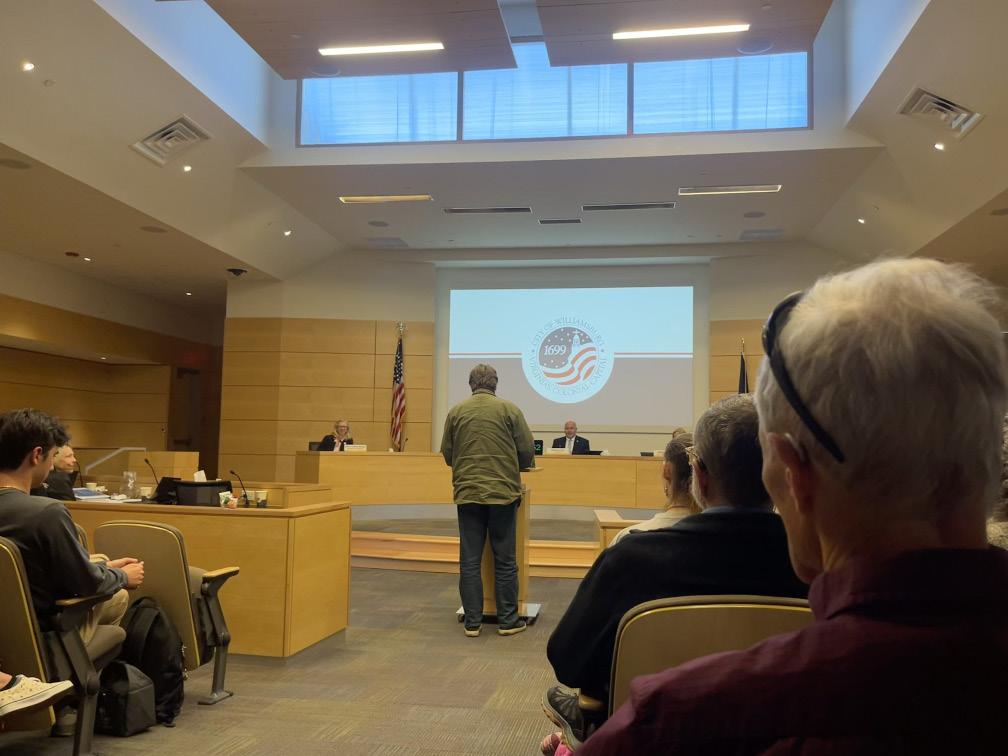
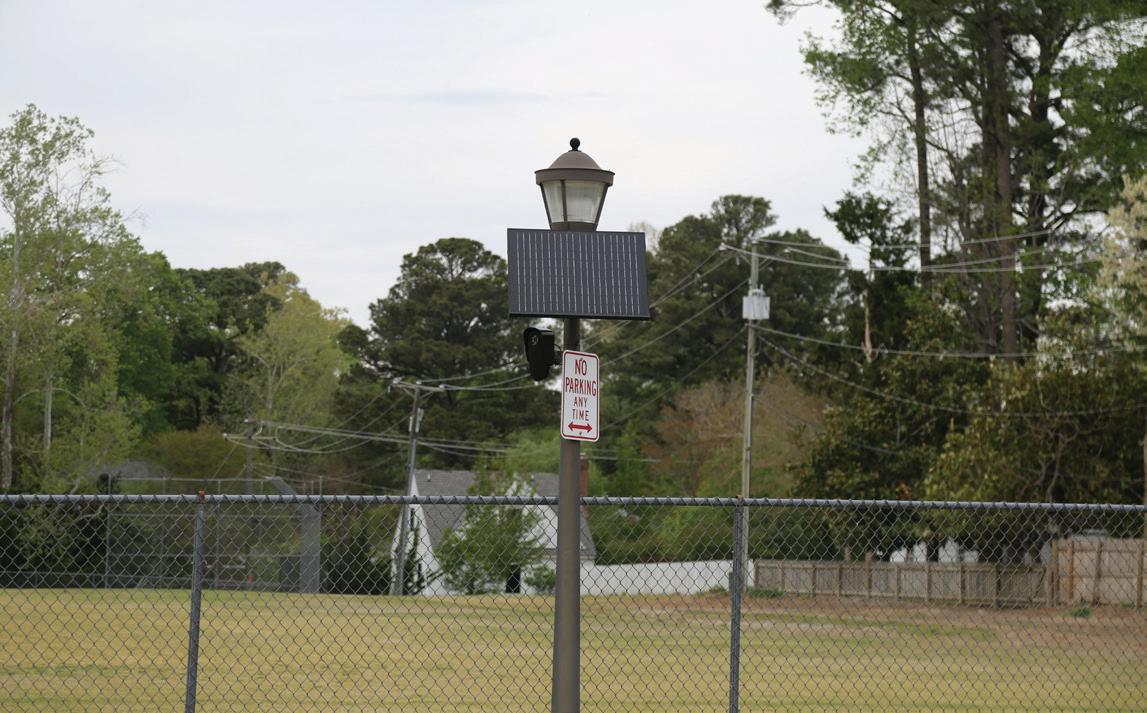
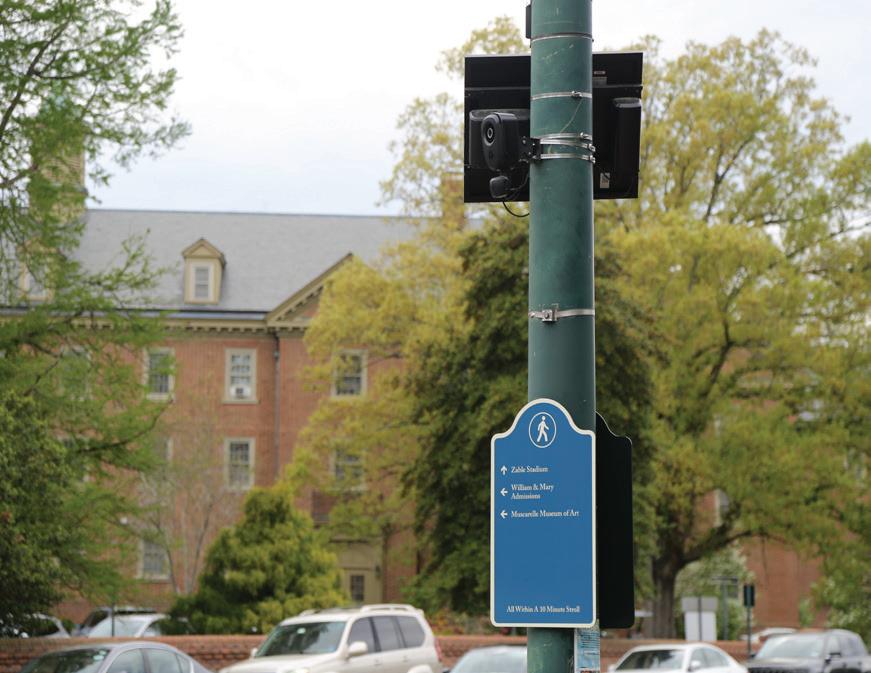
Thursday, April 9, students from the College of William and Mary attended the Williamsburg City Council meeting to raise concerns regarding Flock Safety. Flock is an automatic license plate reader system powered by artificial intelligence that has been implemented across the City of Williamsburg and at the College.
Anti-Flock advocates raised concerns about privacy and the use of some Flock data by federal immigration enforcement as key risks of the technology.
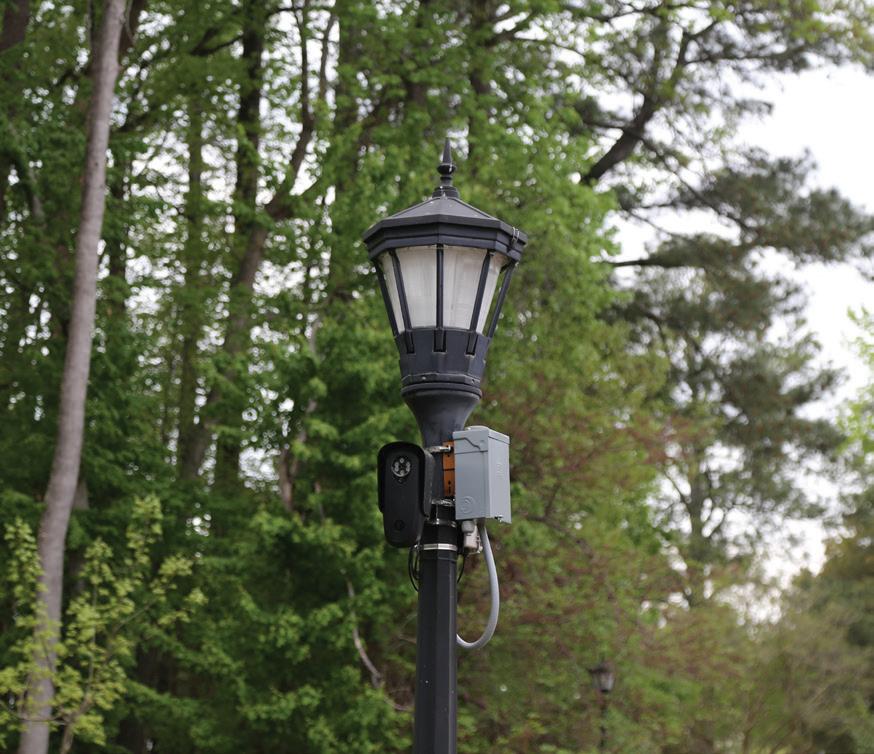
In addition to license plates, Flock cameras use artificial intelligence to record other vehicle characteristics, such as type, color, unique alterations and whether a car frequently passes by any of its cameras. This information is stored on the FlockOS system, allowing local law enforcement to search for vehicle details.
The Williamsburg Police Department began
its Flock implementation with a trial program in 2021. The City’s Flock program has now expanded and includes over 30 cameras. Virginia state law places restrictions on the storage and sharing of data collected by Flock and similar technologies. These restrictions include requiring all data to be deleted after 21 days and prohibiting police departments from sharing data with out-of-state partners. This law also requires that data only be shared pursuant to specific requests relating to law enforcement actions.
A report by the Virginia State Crime Commission found that 13% of surveyed state law enforcement agencies that contracted with Flock allowed out-of-state or federal law enforcement continuous access to their data. The survey also found that 21% of state law enforcement agencies regularly retained their Flock data for over 21 days. Both of these actions
are explicitly prohibited by Virginia law.
Reporting by The Richmond Times-Dispatch found that federal immigration enforcement accessed Flock data in Richmond, Va., without the permission of local police.
Thursday, March 26, students at the College overwhelmingly voted to pass a referendum calling on the William and Mary Police Department to cancel its Flock contract, which is separate from the City’s contract.
Ella Forlin ’27 spoke during the public comment portion of the meeting. She shared her opposition to Flock, expressing concern about U.S. Immigration and Customs Enforcement’s ability to access local Flock data without the direct permission of the City’s police.
Forlin noted that the City’s Flock cameras are also connected across a statewide network. She said that even if Williamsburg police are diligent
plate readers
in their data protection, local data could remain vulnerable to other Virginia police departments that may not safeguard it.
“When our data is shared as widely as it is, there are always ways for nefarious actors and people who are not intended to have this information to get it,” she said.
Charlie Goodman ’27 said that he views Flock surveillance cameras as privacy violations.
“These cameras are on 24/7, recording every license plate that passes them,” he said. “They are not for traffic enforcement. They are for tracking people. Police officers can access this license plate data without a warrant.” Goodman noted that cities such as Denver, Colo., and Staunton, Va., as well as the state of Illinois, have terminated their Flock contracts.
College hosts Take Back the Night sexual assault awareness event
Friday, April 10, students at the College of William and Mary and local community members gathered on Sadler Terrace for the College’s inaugural Take Back the Night event. Take Back the Night is an international event that helps raise awareness about sexual violence and support survivors.
Yasmin Kudrati-Plummer ’27 and Candice Fox, assistant director of the Office of Health Promotion and sexual violence prevention specialist, formed a planning committee of students — Georgia Horgan ’27, Mary Catherine Slagle ’26, Lydia-Louise Merritt ’27, Erin Reiley ’27 and Ashlyn Connolly ’28 — to help organize the event. Campus organizations involved included Someone You Know, Student Assembly and The Haven.
Fox emphasized the importance of having students lead the event.
“The age group that’s affected the most by sexual assault is 18-24,” she
said. “If we’re having people speaking out about this epidemic, it has to be that community of people who are creating a culture change.”
Reiley, the president of Someone You Know, described what it was like to plan the event.
“There hasn't really been a precedent, which has been fun and also challenging because we have to come up with the structure of everything ourselves,” she said. “It's definitely satisfying to know what we have done will set a precedent for future years.”
Reiley attributed much of the success in planning the event to the contributions and support of other organizations.
“What's been most rewarding is seeing how fully everyone has committed themselves to it, whether they're a part of the planning committee or not,” she said. “As soon as we brought up the idea for Take Back the Night to AMP, they were all in, wanting to help out wherever they could.”
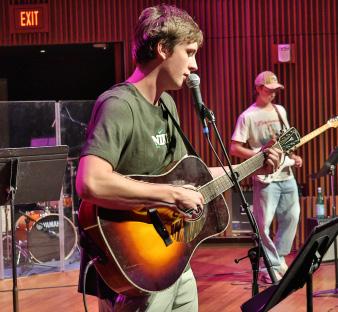
The event started with a performance from student band Royal Fish. It transitioned to tabling from local and campus organizations, followed by speeches, a march around the Sunken Garden and an original song performed by Kudrati-Plummer.
During the next section of the event, the Speak-Out, sexual assault survivors had their writing read aloud. People had the option to share their stories on stage.
Kudrati-Plummer described what it was like participating in the Speak-Out.
“People were sharing their own stories, and I had the courage to share my own,” she said. “It was so emotional but so beautiful and heart-wrenching.”
Kudrati-Plummer explained the significance of creating a space for survivors to share their stories, especially when they are often discouraged or silenced.
“I feel an event like this is here to show people it’s okay to share,” she said. “Even if you’re not ready, even if it’s going to take you years before
you’re ready, you will be supported.”
Reiley spoke on the importance of recognizing gender and sexual violence as an issue on campus.
“There's very much a perception here at William and Mary that because we are a relatively safe campus and Williamsburg is a relatively safe area, sexual violence doesn't happen,” she said. “I think that some people are really hesitant to view it as a wider cultural or societal issue.”
Kudrati-Plummer highlighted how the College’s latest sexual misconduct survey from 2018 found that 70% of respondents experienced some form of harassment or sexual misconduct.
Merritt hopes that Take Back the Night will inspire community members to act in their own spheres of influence and speak out against violence-supportive culture.
“When we come together, we can recognize this as a bigger problem,” she said.
Fox said that she hopes this event will help promote healthy relationships.
“Education is more than just
information,” Fox said. “It’s about having honest conversations with peers and community members about consent and how we can create healthier relationships with one another because no one is really taught that.”
Fox also said she hopes the event will help students feel more comfortable seeking help.
“One out of three people have been in an abusive relationship. That means you probably know someone, and that’s affecting you,” she said. “The Haven is also there for vicarious trauma as well, which I don’t think a lot of students recognize.”
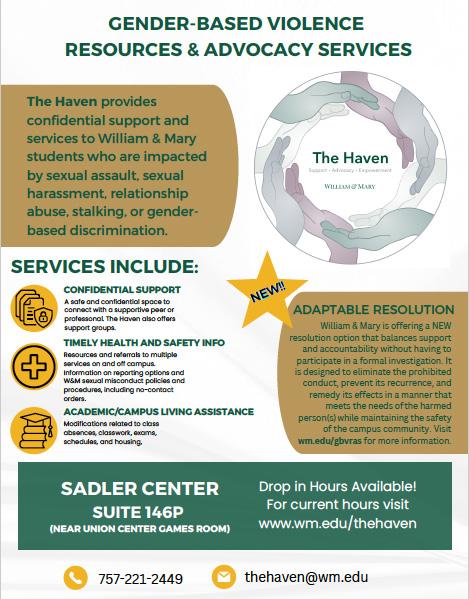
Slagle, a confidential peer advocate at The Haven, emphasized the value of the peer advocate program. Students can walk in or schedule an appointment.
“My biggest hope is that people who come out of the event know that there are a lot of resources for them and that they have people that they can share their story with and be supported in that,” she said.
MAYA SAKAI-CHEN THE FLAT HAT
PHOTOS BY JAMIE HOLT / THE FLAT HAT
news insight
Education is more than just information, itʼs about having honest conversations with peers and community members about consent and how we can create healthier relationships with one another.
-- Assistant Director of the Office of Health Promotion and Sexual Violence Prevention Specialist
Monday, April 6, students at the College of William and Mary voted to approve a referendum calling on the College to cancel its contract with ZeroEyes, a surveillance company that specializes in artificial intelligence-enabled firearm detection.
The ZeroEyes referendum follows studentsʼ approval of two earlier referendums on Flock AI-powered surveillance cameras, as well as another calling on the College to establish a “Firewall For Freedom” to protect the rights of students against the Trump administration. Of the 1,256 students who voted, 89.6% voted in favor of the College canceling its contract with ZeroEyes, while 9% voted against the referendum and 1.4% abstained. The overall turnout for the election was 1,256 votes, lower than the recent Student Assembly spring election, which recorded 1,667 votes. It was also below the two earlier referendums, in which 1,670 students voted.
The ZeroEyes referendum was placed on a ballot separate from the spring 2026 SA general election, after the senate passed a bill that placed the referendum at a later date.
The College pays an annual fee of $82,600 to embed the ZeroEyes software into up to 400 cameras around campus.
Shoulders has been an active member of The Gallery for all fou r of their years at the College, working up to the editor-in-ch ief position.
Sydney Shoulders reflects on contributions to College literary arts publication, Innocence Club
LILA REIDY // FLAT HAT NEWS ASSOC.
Sydney Shoulders ’26 has a magnetic presence that only amplifes their determination to uplift voices in any way possible. Shoulders is double-majoring in English and philosophy at the College of William and Mary and will be graduating in May.
Shoulders serves as co-editor-in-chief of The Gallery — the College’s literary arts publication — alongside Ashleigh Pyle ’26. Shoulders is also on the Innocence Club’s executive team and will be attending law school in the fall in pursuit of a career as a public defender.
Te Gallery prints once per semester and publishes student prose, poetry, art and photography. Te club meets weekly to review anonymous peer submissions, collaboratively editing in a Socratic seminar-style discussion.
“All of our submissions are anonymous, which we think is really important because it allows the artist to choose to be in the room if that’s something that they desire, if they want to hear feedback,” Shoulders said. “We just collect student art and try to spread it and put it out on campus.”
As a member of the club their entire time at the College, Shoulders cited its impact on their friendships.
“I joined my freshman fall, it was the frst club thing I did,” they said. “Two of my closest friends and I, one of whom is the co-editor, were all in the same freshman dorm, and it was how we got really close, so that was nice.”
Aside from relationships, Shoulders found fulfllment in editing for the publication.
“I was a very consistent member, and then my junior year, I became the prose editor, which basically just meant that I was in charge of copy editing prose pieces and emailing prose writers if they had any questions,” Shoulders said. “Ten, I was chosen for the editor[-in-chief] role.”
Although they served as prose editor, Shoulders’ own submissions are typically poetry.
“I’ve always been a huge reader,” they said. “Prose is my main interest, but we have a page limit, and I typically write stuf that goes beyond the page limit. So, I haven’t submitted prose very seriously to Te Gallery.”
Shoulders highlighted their responsibilities as co-editor-in-chief.
“It’s a lot of everything,” they said. “It’s a lot more advertising than perhaps you would initially expect. You know, just kind of spreading the word, communicating with diferent organizations and departments to get people to submit. But then also, on a technical side, I lead the meetings. I put all of the pieces on the board for the week, and I lead the discussion around the critique and try to get people to engage critically with stuf.”
In addition to leading the meetings and handling student submissions, Shoulders and Pyle work with Adobe InDesign, formatting and arranging the physical publication.
Tey share the production workload with anyone who chooses to help, and they show them the ropes.
“We call it ‘Pub Week,’” Shoulders said. “We have general members come and also help put together pages, which is really nice, and it lets people kind of get behind the scenes. Tere’s no minimum amount of involvement you need to help build the pages.” Shoulders stepped into the editor-in-chief role in fall 2025.
“It’s been really rewarding, honestly, because I feel like I put a lot of time into the club, so getting to lead it and hopefully make other people feel as inspired by it as I did is really nice,” they said. “I feel like there are a few spaces for people who like writing and reading, but there are not really as many as you would maybe expect, given how ‘liberal artsy’ we are as a campus. So getting to cultivate a space like that is important.”
Tey emphasized the club’s impact on the community amid changing social and governmental policies.
“It’s just nice to create a space where people can get together each week and talk about writing,” Shoulders said. “I feel like that’s very important, especially right now with AI and funding and everything.”
While Shoulders and Pyle facilitate the discussions on student work, they do not vote on what is published.
“We’re just presenting the pieces to the group and then kind of trying to lead a conversation as best as we can,” Shoulders said. Shoulders spoke on the importance of promoting student publications like Te Gallery.
“It’s very important, especially just with all the attacks on the humanities in higher ed,” Shoulders said. “Just creating a space for people to read together and also inadvertently share recommendations of poems and writers keeps a sort of literary spirit alive on the campus, which I think is really important.”
Tey noted the joy of seeing a student’s submissions evolve and watching their writing develop.
Tere are a lot of really talented people here who I feel like I’ve seen kind of grow and develop,” they said. “Getting to tell them, whether directly or indirectly, ‘You’re really talented,’ I think is really, really cool and afrming.”
Aside from Te Gallery, Shoulders serves as the Innocence Club’s outreach and education chair.
“I help make the presentations and do events and things like that on campus for issues related to criminal justice and people who are wrongfully convicted,” they said.
Shoulders is also a member of the W&M Legal Scholars Program and is completing a senior honors thesis with the English department on masculinity, labor and purpose in 20th-century existentialist literature.
Shoulders said that their interest in literature has evolved.
“I liked reading, and then I got the job at the bookstore, and then that afrmed it because you become familiar with so many books just through putting them away,” they said. “Tat’s helped make me hopefully a good leader in Te Gallery. I have a pretty big wealth of authors and stuf to pull from for comparative purposes.”
ROBIN PERDUE / THE FLAT HAT
FLAT HAT NEWS BRIEF
COURTESY
NAMAN MISHRA / FLAT HAT NEWS EDITOR
WMPD Chief Sean Dunn discusses Flock surveillance technology concerns
Police chief responds to local opinion regarding AI-powered security cameras, ensures legality, safety
NAMAN MISHRA FLAT HAT NEWS EDITOR
Friday, April 10, Te Flat Hat interviewed Williamsburg Police Department Chief Sean Dunn regarding the City of Williamsburg’s usage of FlockOS Safety technology. Dunn addressed student concerns regarding data privacy and security.
Flock is an artifcial intelligence-powered automatic license plate reader camera system that has been implemented across the City and the College of William and Mary. Tursday, March 26, students voted overwhelmingly to ask the College to cancel its Flock contract. Tursday, April 9, students attended a Williamsburg City Council meeting to voice concerns about the technology.
Dunn began by explaining how the Williamsburg Police Department frst utilized Flock Safety technology through a trial period in 2021.
“I had a representative from the Flock company reach out to me and ask me if we would be interested in piloting their program,” he said. “Frankly, I explained that we were a very safe city, and I wasn’t sure how benefcial Flock would be for our community, but that I’d be happy to try it out on this no-cost trial.”
Dunn said the Flock trial quickly yielded positive results for local law enforcement.
“Tey put it at a number of locations, and probably within two or three weeks, we had so many successful contacts as a result of the license plate reader tool that I felt like, ‘Wow, this is something that would make our community much safer,’” he said. “Tat started our goal of expanding this program.”
Dunn cited two particular examples of Williamsburg law enforcement using Flock data to resolve investigations. One case resulted in the apprehension of a man, Richard Lee Gibson, who attempted to assault a student at the College. After his arrest, Gibson was found to also be the culprit of a separate assault dating back to 1987. In another case, Flock data helped locate a missing senior citizen who sufered from dementia.
“Te ability of this [Flock] to make our community safer — those are the reasons that I’m supportive of license plate reader technology,” he said. “I know that there’s a downside, and I know that there’s some risk, but I think that the value to the community, in my opinion, certainly outweighs that risk.”
When Flock and other automatic license plate reader systems were frst developed, the police department was aware of privacy concerns, Dunn said.
“Tere is the constant conversation around [Flock] and the
EVENTS
privacy considerations that are associated with this tool and the importance of law enforcement appropriately using this tool — not just most of the time or some of the time, but all of the time, without exception,” he said. “We would never want to do anything where we have a misuse because our community would certainly feel betrayed by that, and that’s the last thing we want to do.”
Dunn said that the City’s Flock systems only operate in public spaces and do not document private data.
“We could grab a lawn chair and sit at any point in the city and collect tags all day long,” he said. “It is data that’s publicly available on public right of ways, without any search warrant or any legal reasoning or anything else.”
Dunn said that Flock data is far less personal than many other forms of technology.
“If you are concerned about the privacy of a license plate reader capturing your vehicle at a particular point in time, you probably don’t have a cell phone,” he said. “I don’t think that [Flock] being on public roadways compares to the ‘Big Brother’ that most people carry in their pockets with their cell phones.”
Many anti-Flock advocates argue that the technology violates Fourth Amendment privacy rights guaranteed by the U.S. Constitution. Some have even challenged the technology in federal court on those grounds. Dunn refuted claims that Flock systems are unconstitutional under this standard.
“Tere’s nothing in the Fourth Amendment that says, ‘Te right of the people to be secure in public places,’” he said. “It’s about being secure in your houses, papers and efects against unreasonable searches and seizures. [Flock operates] only on public roadways and vehicular trafc, and it’s not continuous monitoring.”
Tere also exists a high concentration of Flock cameras in the City. Per capita, the City has nearly triple the number of Flock cameras compared to Norfolk, Va., and over fve times the regional average. Te rate of cameras per mile of road or square mile of area is also above average.
An analysis by Matthew Esposito ’26 found that the majority of the City’s residents will cross the path of a Flock camera while traveling to essential locations such as grocery stores, schools or hospitals.
Dunn said that the City’s higher concentration of Flock cameras mostly relates to the City’s layout.
“Unlike a lot of communities, we’re not just a square, a rectangle, or a circle — we’re a very oddly-shaped road,” he said. “It’s just a matter of the way our roads are. I think that’s largely based on the shape of our city and our desire to be able to monitor.”
Dunn noted that tourism in the City creates additional security challenges that Flock could help address with what he considers a relatively small infringement on privacy.
“As a tourist community and a historic community, we do have some vulnerabilities that some communities may not have, and we potentially could be a target for diferent types of activity that would certainly be unwanted,” he said. “I think that the minimal privacy invasion whilst on public roadways is justifed by the safeguards that we are able to work towards.”
Dunn explained how the City has tried to be open about its use of Flock technology.
“We have not been secretive about it,” he said. “We want folks to know that we have this technology here, and if you come here to commit crime, we’re going to use that technology to attempt to hold you accountable for whatever crime you’ve committed.”
Dunn explained the statewide Flock data-sharing system in which the Williamsburg Police Department participates. Te statewide sharing system allows Virginia police departments to participate in a “hotlist” system, which allows police to mark certain vehicles and notifes them when these cars drive by a Flock camera.
“If we take a police report, let’s just say for a missing person, that police report ultimately goes to the Virginia State Police and what’s called the Virginia Criminal Information Network,” he said. “Tat then becomes what I call a ‘hotlist.’”
Virginia law prohibits sharing automatic license plate reader data with out-of-state law enforcement agencies for most purposes unrelated to the implementation of state law and restricts data storage to 21 days.
A report by the Virginia State Crime Commission found that 13% of Virginia law enforcement agencies allowed out-of-state or federal law enforcement continuous access to their Flock data. It also found that 21% of state law enforcement regularly stored data for longer than 21 days.
Dunn said that he trusts Flock’s ability to prevent agencies from breaking the law, intentionally or unintentionally.
“I actually had the opportunity to meet with Flock’s leadership, and I shared with them some of the questions that I was receiving and some of the conversation that was occurring in the community,” he said. “The response that I was given from Flock was that, in the states where they have their systems in place, they pay very close attention to the legislation, and they ensure compliance on their systems.”
College hosts sixth annual WMSURE Undergraduate Research Conference
Student-researchers deliver talks on ongoing projects covering alcohol use, prenatal care, food insecurity
SANJANA MANGHNANI
THE FLAT HAT
Friday, April 10, the William & Mary Scholars Undergraduate Research Experience hosted the College of William and Mary’s sixth annual WMSURE Undergraduate Research Conference in the Sadler Center.
Te event included two sessions of student research talks, additional posters and digital presentations and concluded with declarations of the winners for each session.
The WMSURE program provides support and guidance to undergraduate students at the College interested in pursuing research and is specifically designed to aid William & Mary Scholars, first-generation students and Pell-eligible students. The research projects presented at the conference covered several disciplines and topics.
Anna Diaz ’28 used a survey study design to research alcohol use among Latino college students.
“My project was on adverse childhood experiences, poor attitudes towards professional help and drinking to cope in specifically Latino college students,” she said. “There’s a lot of literature on white students and how they drink. However, there’s next to none on Latino students.”
Based on analysis of survey data, Diaz found evidence of problematic alcohol use among Latino college students, as adverse childhood experiences were correlated with drinking to cope.
Wendy Rios Flores ’27 also conducted research centered on Latino populations.
STUDENT ASSEMBLY
Student
“My overarching question is: What prenatal care limitations have Hispanic/Latina women with gestational diabetes mellitus encountered in the U.S. since 2005?” she said.
Rios Flores explained the motivations behind her project.
“It’s very important to understand that Latina/Hispanic women have the highest prevalence of this condition in the U.S.,” she said. “If left untreated, gestational diabetes can lead to the development of type 2 diabetes as well as more health complications.”
Rios Flores focused on research conducted between 2005 and 2025 and referenced sources from multiple databases.
“Advocacy for programs that help these underserved groups, especially during maternal care, is crucial,” she said. “Ultimately, health care should be a right and not a privilege.”
Rios Flores found that issues such as technological fluency and linguistic and cultural barriers contributed to care limitations, causing adverse long-term effects and health disparities.
“Overall, these problems kind of stack up on one another, and they kind of create this bigger problem,” she said. “That’s why it’s so prevalent within this community beyond GDM [gestational diabetes mellitus] and Hispanic/Latina women in general.”
Rios Flores said the process was eye-opening.
“I think what I found most unexpected was how big the disparity is,” she said. “I think I knew it was an issue,
but actually researching it and looking at maps and seeing little dots of where these free clinics or places that do have physicians speak Spanish versus seeing everything that doesn’t have it.”
Dawn Harris ’26 conducted her research on misconceptions surrounding food insecurity, inspired by her work with the nonprofit Candy Cares, Inc.
“Te most common misconception that we’ve heard was that we must serve a lot of homeless populations, but that’s not the case,” she said. “Te second-biggest misconception we heard was that people believe that they aren’t as deserving as others for the resources, or people may need it more than they do, when that’s not the case at all.”
Harris’ project relied on oral narratives.
“To tie it into perspective, I created a list of interview questions to ask participants who are willing to be anonymously interviewed, as well as one Southeastern Virginia Food Bank representative to compile oral narratives for the public to hear the everyday stories of people and for the food bank representative to talk about the type of people that they serve at their pantry,” Harris said.
Her research also involved creating data visualizations using Python and ArcGIS based on Candy Cares’ demographic data from 2022–24.
“I want to use these maps to convey to the public that the main demographic being served right now are middle-class families or households and that it’s okay to ask for help,” Harris said. “But in order to make them
feel more at ease, I have the oral narrative that shares the stories of the participants I mentioned earlier and the food bank representative.”
For Harris, WMSURE provided guidance and support. While Harris had never used ArcGIS before pursuing her project, she said her mentor, history professor Adrienne Petty, directed her to the College’s Center for Geospatial Analysis.
“They gave me a thorough rundown on how to use it, and they helped me with any errors I came across,” she said. “They definitely made the process smoother.”
Rios Flores said that the program helped motivate her to complete the research project.
“This is something that I’ve always been interested in, but I think I’ve never found the thing to kind of tell me like, ‘You should do this,’” she said. “Being able to work with the WMSURE staff and other students and having my advisor help me out through this process and making sure that they checked in with me throughout the summer, it felt so much more real.”
Diaz credited the WMSURE program with helping her feel prepared to present.
“We had to do a Zoom call where we had to tell about our research a little bit, and I think even though it was terrifying, it helped a lot to fgure out how I want to eventually present,” Diaz said. “Tis is the second time I’ve presented this, we’ve presented in the fall symposium, so I feel like even though it was scary, it defnitely taught me how to then present it in front of people and not be so scared.”
Assembly discusses referendum report, renews Busch Gardens Day Independent Elections Commission delivers report on recent elections, AI technology surveillance referendum
ALEX NAKAMITSU
THE FLAT HAT
Tuesday, April 7, Chair of the Independent Elections Commission Meagan Kenney ’27 delivered a report on the recent Student Assembly elections and referendums. Te IEC enforces the campaign rules of SA elections.
Tis election cycle had no reported campaign violations, Kenney said.
Voter turnout for elected positions was low for all classes.
Te class of 2027 logged a 26.83% turnout, while the classes of 2028 and 2029 recorded 25.46% and 22.79%, respectively. Te student body election for SA president and vice president had the lowest turnout of 17.57%.
Kenney attributes this low turnout to the several uncontested races. Kenney cited past contested races which saw higher turnout.
“2024 was the most voter turnout I saw from 2020 to 2026, and we think, in part, it was a contested election, and there was a very big referendum on that ballot,” Kenney said. “So we think that contributed to the very large increase in voter turnout. [In] 2025, it was also a contested election, but this election, we
did have an uncontested election.”
Kenney also addressed the recent referendums, which students voted on. The referendums on establishing a Firewall for Freedom and canceling the College of William and Mary’’s contract with AI surveillance companies Flock and ZeroEyes all overwhelmingly passed.
Kenney expressed concern over recent code changes and their impacts on the three referendums. Te Bolstering Ethics of Election Fairness Act Part IV, which senators unanimously passed on Tuesday, March 3, struck certain stipulations on deadlines for submitting signatures for a referendum.
Te amended code now states, “Question(s) must be presented with at least 250 William & Mary student signatures, with full names and issued William and Mary emails, submitted within 21 academic days before the General Election to appear on the ballot. Te Elections Commission shall post the question written as provided by the petitioners.”
Kenney said this led to petition submissions occurring days before the election, which gave the IEC no time to
review the petitions.
“We had to put them on the ballot without time to verify the language of them, to make sure it wasn’t biased. Tere’s no time to verify signatures, but we were obligated by code to put them on the ballot,” she said. “So that’s something that we’d like to avoid in the future, because without this clearly defned timeline, we cannot really guarantee a fair, neutral and unbiased referendum in the election.”
Secretary of Data & Analytics Langston Spencer-Hamm ’27 presented the results of the Omnibus Survey, which gauges student perspectives on campus life, health, engagement and residency.
“Many students felt that their schedules are consumed by classes and studying, leading to a lack of time for basic needs like eating and sleeping, making it nearly impossible to schedule or attend appointments during the school day,” the report stated.
Of the 420 respondents, 78% said that on a daily basis, they are either experiencing a moderate or high amount of stress in terms of academics. In terms of mental health care, concerns about wait time were
the most cited perceived barrier for seeking care at the College.
“Maybe when you’re thinking about bills or things, it’s like, how do we address this higher amount of stress among students?” Spencer-Hamm suggested to the chamber.
Senators unanimously passed the Busch Gardens Day Act, sponsored by Sen. Jenny Wang ’29, Chair of Finance and Sen. Mackenna Wyckof ’28, Sen. Neha Baskar ’29 and class of 2029
President Daria Lesmerises ’29.
The bill will bring back Busch Gardens Day for the first time since 2019, giving students, faculty and staff discounted ticket rates to the amusement park. SA will provide transport to the park on Friday, Sept. 25 and will arrange funding for Student Leadership Development to run an online ticketing platform.
Before voting, the College of William and Mary Law School Sen. Brooks Alderman J.D. ’26 noted that Busch Gardens is a subsidiary of United Parks and Resorts, which also owns all the Sea World subsidiaries.
“I want to preface this by saying I fully support this bill, before I go into
buzz-kill mode, I just want to point out, because I think it’s important for my conscience, that Sea World is a pretty awful company when it comes to this treatment of animals,” Alderman said. Director of Student Leadership Development Anne Arseneau ’89 M.A.Ed ’92 also noted that this initiative will require more work on the senators’ end to complete than others, as distribution of the physical tickets will have to happen in person. Arseneau also warned that SA will face financial repercussions if they fail to sell enough tickets to meet Busch Gardens’ minimum required to activate the discount.
“This is a big lift, and you have to meet that minimum, because last time I sponsored you for $16,000, and I don’t have $16,000,” Arseneau said. “You all will pay the penalty if you don’t meet the minimum.”
Senators passed the Closing of the 333rd Session Act, which officially transfers all passed, past and pending bills to the 334th session. The new session will officially begin on Monday, April 13.
Williamsburg Mayor Douglas Pons acknowledges Flock privacy concerns
Councilmember Stacy Kern-Scheerer says Williamsburg City Council will consider student privacy worries
“You can look to Illinois, where Flock allowed data to be illegally shared for up to a year with agencies external to the state,” he said. “Williamsburg should stand alongside Staunton and other cities against a company that has built a system prone to abuse and believes they should be immune from public criticism.”
Matthew Esposito ’26 noted the high density of Flock cameras in Williamsburg. Esposito conducted an analysis and found that over 60% of Williamsburg homes cross the paths of Flock cameras while en route to essential utilities, such as schools, hospitals or supermarkets.
“We have an extremely high concentration of these cameras within Williamsburg,” he said. “It’s actually one of the highest in the country — it’s somewhere in the top 10 or 15.”
James Holden J.D. ’27 said he does not believe that Virginia law is sufficient in preventing abuse by federal law enforcement.
“We have unfortunately witnessed, over the past year or so, a federal government which has promised to respect the sovereignty of state and local governments, instead violating that sovereignty guaranteed in the Constitution when it comes to their political expediency,” he said. “I remain unconvinced that this data being collected is being sufficiently protected from those who would seek to misuse it in violation of Virginia law for political purposes.”
Sarah Ewing, a worker at Commons Dining Hall, spoke at the meeting. Tey said they hope to reinforce the voices of students.
“I value the students as members of our community, and I have served many of them meals,” they said. “I also understand
that many people do not give equal weight to the comments of students due to the fact that many will leave this community upon completing their degrees. So, as a permanent resident of Williamsburg, I would also like to express my support for canceling the contract with Flock.”
Ewing described what they see as the importance of raising concerns directly to those in government.
“I’ve done a lot of reading on the reporting on Flock cameras, and I find their use in our community deeply concerning,” they said. “If we don’t voice our concerns, then we can’t expect them to make any change.”
Goodman similarly highlighted the value of public advocacy to local representatives.
“We want to try to collectively voice our concern in a way that’s productive,” he said. “We elected them. Making our voices heard, letting them know that there are members of this community that don’t approve of this technology, will hopefully bring us a step closer to actually canceling the contract.”
Councilmember Stacy Kern-Scheerer said that students have raised valuable concerns that city officials should consider.
“I think it’s really important for us to hear the perspective of members of the community,” she said. “It hit a lot of really important points that are important for us to consider about where there are vulnerabilities and weaknesses that may have an impact on members of our community.”
Kern-Scheerer noted the difficulty of balancing public safety and privacy.
“We’re always trying as a society to balance public safety with
privacy and make sure that measures for public safety actually do keep people safe,” she said. “I think that times have shown that that balance is very difficult for us to strike.”
Mayor of Williamsburg Douglas Pons also emphasized the importance of civic engagement.
“It’s representative government,” he said. “It’s good to see folks be passionate about an issue and bring them forward to be considered.”
Pons said that the topics raised by students have sparked discussions in the City’s government regarding Flock usage.
Sean Dunn expresses confdence in Virginia law regulating Flock cameras
Williamsburg Police Chief says City would not share data with ICE, discusses possibility of Flock expansion
Dunn also refuted concerns that Flock data may be vulnerable to security breaches, including hacks. He said all systems containing private data are held to high standards of security.
“In my conversation with Flock leadership, they insist that their cloud server has not been hacked, and I have to believe that,” he said. “We’re audited by the state police to ensure that what we’re doing is compliant. Because of that, I have comfort in Flock and their database.” Cities across the country, including Staunton, Va. and Charlottesville, Va., have canceled their contracts with Flock. Dunn said these cancellations do not cause him concern and that he believes the current criticism Flock is garnering will push the company to increase its security.
“If [Flock] had a breach, or if they had some kind of major catastrophe, they would lose a lot of customers,” he said. “They’ve got to get it right every time. That’s the sort of thing that gives me comfort, and I think it’s the sort of thing that should give our community comfort.”
Dunn cited an example where he found that Flock automatically deleted data after 21
Thursday, April 2, the College of William and Mary’s Department of Africana Studies held a tribute reading of Kenyan author and academic Ngugi wa Thiong’o’s works in the wake of his recent passing in May 2025. The event sought to honor his memory by inviting faculty and students to read or listen to short excerpts of his work.
Thiong’o was most well-known for his novels and contributions to modern African literature. From advocating for literature written in Indigenous African languages to creating new forms of theater, Thiong’o challenged the prevalence of European and colonial literary tradition in Kenya.
Thiong’o’s works, which often criticized government corruption and encouraged performance in Indigenous languages, faced government backlash and led to his subsequent imprisonment. Despite this, Thiong’o’s works succeeded
days had passed.
“We had a situation where, at 28 days and about three or four hours, we realized that we might have a case that could be assisted through the use of Flock,” he said. “We didn’t have any reason to suspect that that would be the case until that moment. So we went to the system, not sure if there would be the information that we were looking for there or not, and we literally found that the information was purged.”
In response to reporting on instances where law enforcement misused Flock data for undocumented or private reasons, Dunn insisted that the system’s safeguards and record-keeping would allow any abuse of access to be uncovered.
“For an officer to query the database, [they] would have to type in a reason, and it would have to be for law enforcement purposes, conducting an investigation,” he said. “[They] would have to type in a case number, a report number. When we do our monthly audits, if something seems at all out of place, we have this officer who we know used his credentials to run this particular search, and it does make a great audit trail for us. The system is set up to discourage the types of things that people are concerned about, the inappropriate usage of this database.”
Dunn said that any officers who abuse Flock data would be fired and prosecuted.
“In Virginia, that is just how seriously our legislators are taking this matter,” Dunn said. “It isn’t one of those things where an officer could just playfully do some inappropriate searches; they know that their job and their freedom is at jeopardy if they misuse this tool.”
Dunn said that the Williamsburg Police Department does not collaborate with U.S. Immigration and Customs Enforcement and that it has no plans to do so in the future.
“That would not be appropriate for our community, even if we were allowed to,” he said. “Right now, we would be prohibited, even if we chose to. I don’t see that ever changing.”
in spreading his political ideas and protesting against inequality.
The event began with opening remarks by Dean of the College of Arts and Sciences Suzanne Raitt, who introduced the organizers, Senior Associate Dean for Academic Culture and Faculty Development Wanjiru Mbure and assistant professor of English and Africana studies Chima Osakwe.
The remarks detailed the reasons for holding the event, both in terms of Thiong’o’s life and his literary legacy.
“His family invited us to celebrate his spirit, his legacy,” Mbure said.
Osakwe echoed this sentiment.
“His thoughts represent the most effective link between African thought and the postcolonial theory,” Osakwe said. “So we are here today to celebrate him, to honor him, because he made important contributions to African literature.”
Before the readings began, Mbure taught the audience how to greet people in Gikuyu, a language native to Kenya. Thiong’o’s work was considered revolutionary, in
Dunn said that despite ICE reportedly widely using Virginia Flock data for its past enforcement operations and recorded instances where ICE has accessed Flock data without the permission of local police, he believes Virginia law will prevent further violations.
“Virginia implemented some pretty major changes, and I think it went a long way towards preventing this sort of thing,” he said. “We’ve absolutely got to have the best systems in place that we can so that we are doing our very best to discourage the misuse.”
Some privacy advocates have expressed concern that the Trump administration could obtain Flock data in violation of state law. For instance, the state of Illinois found that Flock shared data with U.S. Customs and Border Protection despite prohibitions in its state law. Dunn said he does not believe such a situation could occur in the City.
“It’s a tool for local law enforcement, and it’s an effective tool. I don’t think there’s any place for it with immigration,” Dunn said. “I really don’t see that changing, and I can’t imagine there would be a scenario where federal authorities would misuse that data.”
Dunn said that, if immigration enforcement officials were to request access to the City’s Flock data, he would deny the request and report it.
“Our response [to a request from ICE] would be, ‘Absolutely not,’” he said. “That’s an inappropriate request. We are prohibited by law from doing that.”
Dunn said that he would consider expanding the City’s Flock usage if any risks arose that he thought the software could help dissuade.
“We have no plans to expand at this point,” he said. “However, I always say [it] with the caveat: Should there be a specific issue or need — and it’s easy with us being a tourist community — if we had some specific or even non-specific credible information about some threat here, and if I felt like a Flock camera might help us to prevent that threat,
both the literary and political sense, partly because he primarily wrote his works in Gikuyu. This reflected his efforts to combat linguistic feudalism and the marginalization of native African languages.
Dativa Eyembe ’26 read some of Thiong’o’s poetry at the event. As a Swahili speaker, she felt a connection to Thiong’o’s insistence on keeping language alive in the face of resistance.
“This is the language I speak, and I want to speak it whenever I can, even if someone else doesn’t understand it,” Eyembe said. “It’s not always about really what I’m saying but feeling what I was saying.”
The speakers also highlighted themes of inequality and the fight for justice in Thiong’o’s works.
“One thing I very much like about him, and which I know many people also like about his work, is his passionate commitment to social justice,” Osakwe said. “For him, it’s not just about art for art’s sake.”
Osakwe hopes that the audience left with a desire to further explore Thiong’o’s works and messages.
I would certainly entertain the possibility of expanding our Flock program. But absent some specific situation, I have no plans to expand our program.”
Dunn said he appreciates the conversations he has with students who express concern with Flock and that he hopes to remain open to their input.
“There were a number of individuals that spoke at City Council that I’ve personally met with to discuss Flock and license plate reader technology in general,” he said. “I try to be very open and very transparent. I think that as we have the conversation, as we talk through the technology and the legislation, it helps members of our community have some comfort in how it’s being utilized here in the City of Williamsburg.”
Dunn said the Williamsburg Police Department does not have any plans to decrease its Flock usage.
“What some members of our community want is for us to discontinue our use of license plate reader technology, and I don’t think that’s right for our community,” he said.
“Read his works, get a sense of what he’s talking about, because he is the kind of writer that wants to make the world a better place,” Osakwe said. “He is deeply opposed to injustice.”
Rin Braxton ’26, a volunteer reader at the event, mentioned recent controversies regarding Thiong’o.
“His son Mukoma wa Ngugi came out [and] said that his father was supposedly abusing his first wife, who died in 1995,” Braxton said,
To address this, Braxton read Thiong’o’s short story, “The Black Bird,” which tackles themes of opposing violence.
“I just thought it was odd that he wrote such an amazing story about isolation, but also his wife had to go through that, at least allegedly,” Braxton said.
Braxton argued that the works of influential figures — like Thiong’o — should be interpreted critically.
“You can still honor people’s legacy, but also criticize them,” Braxton said. Eyembe said that Thiong’o’s ideas, which were considered controversial and groundbreaking at the time, should continue to be understood and preserved.
“When you have to fight for something like that, you should probably look at what people are saying and why they’re fighting for something,” Eyembe said.
NAMAN MISHRA / THE FLAT HAT Students have expressed concerns about ICE's use of Flock.
NAMAN MISHRA / THE FLAT HAT Dunn says Flock's safeguards will prevent abuse of the system.
MELANIA FRYE FLAT HAT NEWS ASSOC.
COURTESY IMAGE / WIKIMEDIA COMMONS Thiongoʼo emphasized justice in his works.
NAMAN MISHRA / THE FLAT HAT Students have expressed privacy concerns about federal access to Flock data. POLITICS
data
Rate My Professor: students review College faculty, classrooms
Analysis provides insight into student perceptions of professors,
departments, difficulty
ANDREW HENRICKSON FLAT HAT DATA EDITOR
When students at the College of William and Mary register for classes, they often turn to Rate My Professors, a website that allows students to anonymously rate professors from the United States, United Kingdom and Canada.
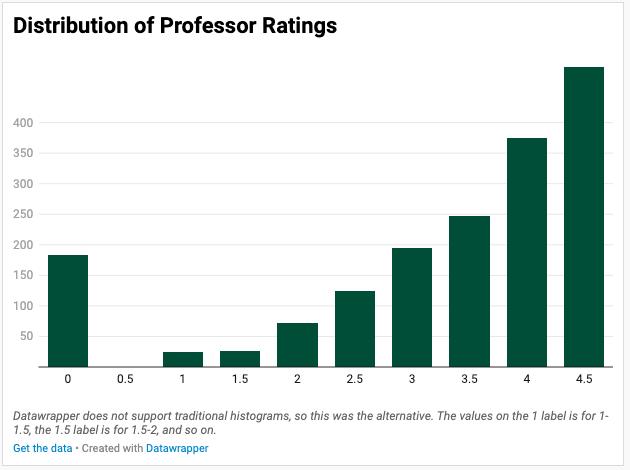
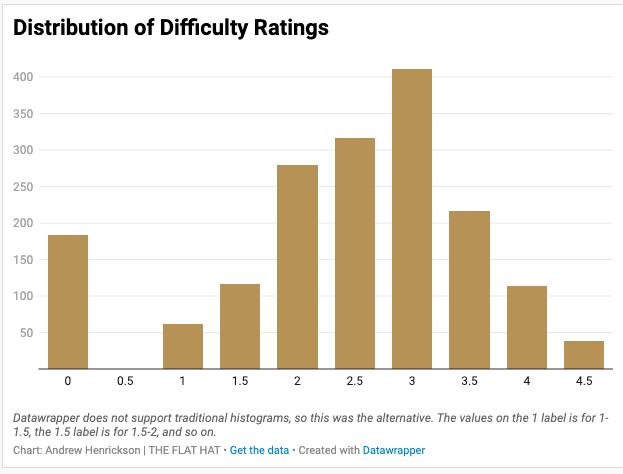
When a student submits a review, they report their overall professor quality rating and perceived difficulty for a class on a scale of 0-5. Students can also share whether they would take another class with the same professor and write a short blurb expressing any other specific details about a professor or course.
The Flat Hat spoke with students about their experiences using Rate My Professors when searching for classes.
Lucas Fernandez ’28 said he did not use the website his first semester at the College but has used it since.
“I learned about it for next semester, and it was really helpful,” Fernandez said.
Thomas Norman ’28 said that he heavily considers a professor’s ranking before deciding to take one of their classes.
“I almost won’t take classes if there is not a Rate My Professor on them,” Norman said. “For me, that is the deciding factor for almost every class I take. If the quality rating is below 3.5, I will not take it.”
Sam Isler ’28 said that he uses the website while acknowledging that the rankings might not be entirely accurate.
“It can be useful if you know nothing about the professor, but what is more beneficial is using your network of friends,” Isler said. “Freshman fall, I took a class with a professor with a terrible score, and she ended up being wonderful. It’s all perspective.”
The Flat Hat extracted a dataset of every review posted about a professor at the College. The information gathered contained professor names, departments, quality ratings, difficulty scores, the percentage of students who would have taken a course again and the number of overall ratings.
In total, there exist 33,511 Rate My Professor ratings about 1,738 professors at the College.
On average, a professor had 19 reviews, with a median of 9.5. Neuroscience Coordinator and teaching professor of psychological sciences Christy Porter recorded the highest number of student ratings at 228. Mathematics teaching professor Marylou Zapf had the 10th most at 156.
The economics department recorded the highest number of student ratings at 2,822. Psychology placed second and history third, with 2,491 and 2,331 total reviews, respectively.
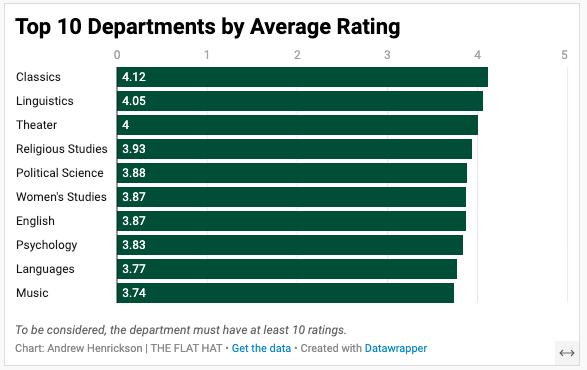
The classics department saw the overall highest-quality student rating at 4.12 out of 5. The linguistics department recorded the second-highest total quality rating at 4.05 out of 5. Marine sciences posted the lowest total department quality ranking at 1.25 out of 5.
Brendan Maynard ’27 shared why he believes Rate My Professors rankings may not always be accurate.
“Curriculums can change, and classes get easier,” Maynard said. “I feel that a lot of bad reviews brings down the overall professor ratings.”
Isler echoed this sentiment.
“You are your own student, so how are you to listen to someone’s rating when they are not you?”
Student Assembly Senate meeting attendance consistently high
Senators with lowest attendance for outgoing 333rd SA session explain absences
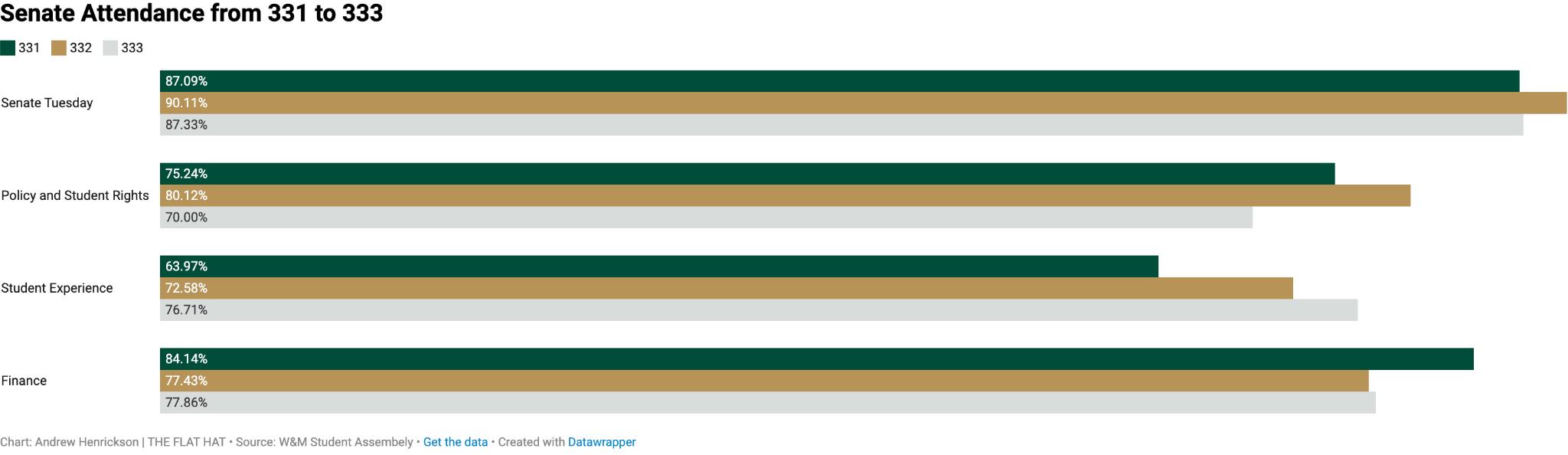
Monday, April 13, the newly-elected Student Assembly representatives will be inaugurated in the Great Hall of the Sir Christopher Wren Building, officially commencing the 334th session of SA. As the 333rd session comes to a close, The Flat Hat has compiled data on attendance at weekly senate and committee meetings.
Regular attendance to meetings is mandated, per the Student Assembly Code. Excessive absences may result in a senator being subject to an attendance review or facing impeachment.
“An Article of Impeachment shall automatically be introduced by the secretary of the Senate after an undergraduate Senator’s eighth absence or a graduate Senator’s twelfth absence in a session,” the code states.
Committee meeting absences count for half an absence, and senate absences count for one absence. The code stipulates, “Should a Senator miss a Senate meeting, or some Senate-wide initiative which the Senate Chair deems mandatory, it shall count as an absence, regardless of it being excused or not.”
Tuesday senate meetings maintained
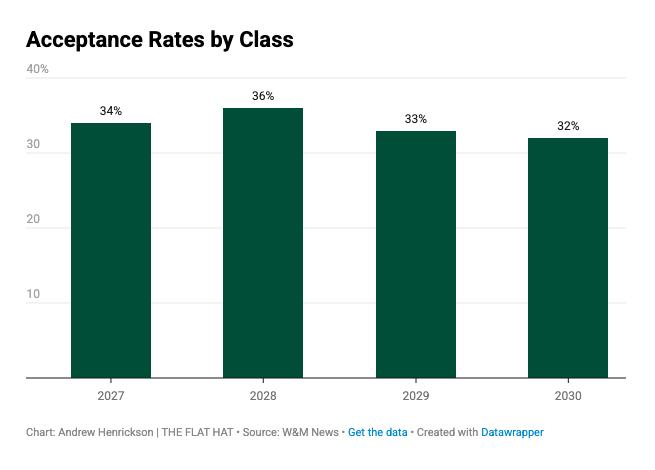
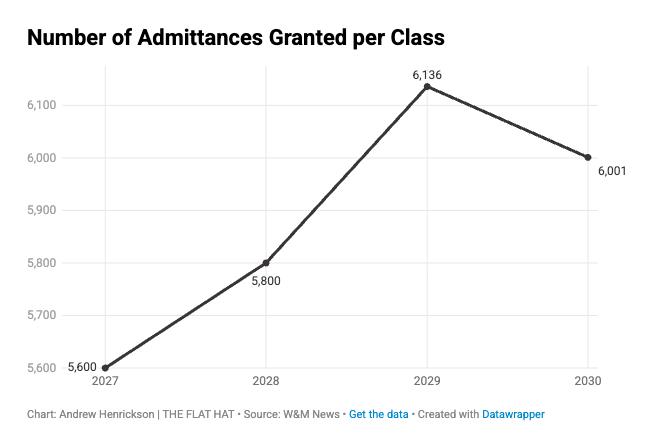
The College of William and Mary recently released the admissions statistics for the incoming class of 2030 on W&M News.
This year, the College granted admission to 6,001 prospective students from a pool of 17,432 applicants, with an overall admissions rate of 34%. This acceptance percentage is down two percentage
relatively high attendance overall, with a 94.8% average attendance rate. Committee meeting attendance was generally lower, with Policy & Student Rights recording the lowest average attendance at 75.2%
Due to the higher threshold of permitted absences, attendance among graduate senators was lower compared to that of undergraduate senators. Graduate senators averaged an 83.7% attendance rate, while undergraduate senators maintained a rate of 92.9%.
Most senators remained under the threshold of absences to warrant an attendance review or impeachment. Graduate Arts & Sciences
Sen. Jenny Merriman recorded six unexcused absences from Tuesday senate meetings and four unexcused absences from Policy & Student Rights committee meetings, amounting to eight total unexcused absences. An attendance review was never conducted, as her final absence occurred during the last senate meeting of the session. Merriman posted the highest absence rate of all senators.
Merriman did not respond to a request for comment.
College of William and Mary Law School Sen. Brooks Alderman J.D. ’26 had three excused absences and two unexcused absences from
points compared to the class of 2029. Prospective students of the class of 2030 recorded a middle-50% SAT score range from 1420-1520 and a middle-50% ACT score range from 33-35. Compared to last year, median SAT scores saw a slight increase from 1410-1520, while median ACT scores remained the same.
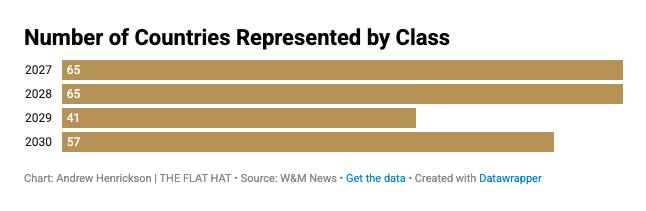
The admitted class of 2030 spans 57 countries compared to the class of 2029’s 41.
Zoe Miyamoto ’27, who works at
Tuesday senate meetings, as well as four unexcused absences and one excused absence from finance committee meetings, totaling 7.5 absences.
Law school exams, family-related travel and serving as an editor for the Environmental Law and Policy Review were among reasons Alderman listed for missed meetings.
“When I attend the senate meetings, which is the overwhelming majority of them, I am fully present and making sure I read every bill, every piece of legislation that’s coming in front of us, so that when I vote on it, I’ve fully considered it, and I’m able to vote in a way that I think reflects both my own personal feelings on the matters as well as what I think would best be best for the Law School,” Alderman said. “I think I did just
about as well as I could have; there were some moments where I had to balance priorities.”
Chair of the Senate Sen. Mayer Tawfik ’27 recorded the highest number of absences among the undergraduate senators; however, most were excused. He had two excused absences from senate meetings, as well as six excused and two unexcused absences from Student Experience committee meetings. Tawfik cited “significant personal circumstances” which necessitated travel to his home that led to the missed committee meetings.
“The two senate meetings [I missed] were due to fluctuations in my blood sugar levels[,] which rendered me unable to run the meetings,” he wrote in a text message.
the undergraduate admissions office, described her experience volunteering at Day for Admitted Students.
“I was able to interact with students who are excited about the prospect of admittance,” she said. “It is really special to be able to celebrate these admitted students and see all of the results of their hard work.”
The College received 1,606 early decision applications this year. Of those applicants, 760 were offered admission to the College.
Stanton Dodson ’27, an orientation aide last summer, expressed excitement at meeting the incoming class of 2030.
“It’s awesome to see the new faces that arrive on campus for the first time each year,” he said. “All of the students I get to meet bring their own unique personalities that make W and M what it is.”
Associate Provost for Enrollment and Dean of Admission Tim Wolfe said he looks forward to seeing the class of 2030 flourish on campus in a W&M News press release.
“Based on the academic quality, experiences and talents displayed in the applications of our admitted students, I’m confident this class will make William & Mary proud and be among the best of
nation,” Wolfe said.
in
ALEX NAKAMITSU THE FLAT HAT
Data Editor Andrew Henrickson
ANDREW HENRICKSON /
ANDREW
ANDREW HENRICKSON
variety
Banding Together
in Matoaka Amphitheater
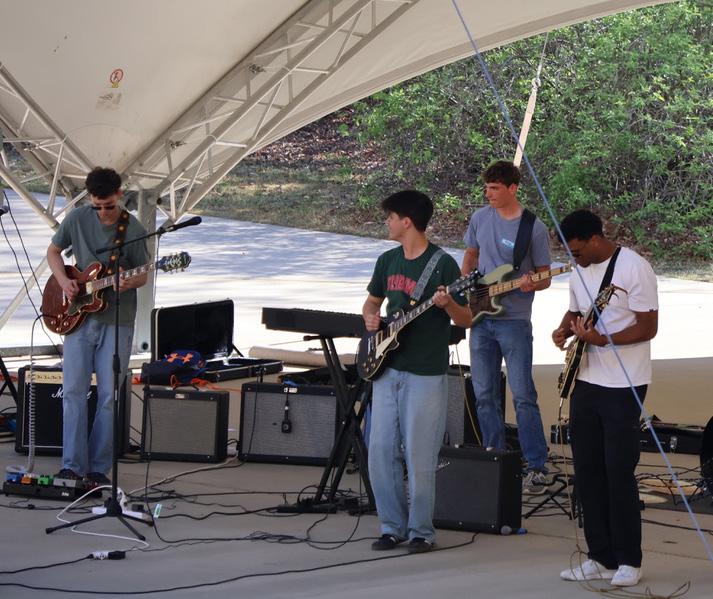
Friday, April 10, golden sunshine, rhythmic guitars and happy chatter filled the Martha Wren Briggs Amphitheatre at Lake Matoaka during the College of William and Mary’s annual Woodstock music festival. The event was hosted by the Sigma Pi fraternity and TribeTHON in a collaborative effort to support their shared philanthropic partner, the Children’s Hospital of the King’s Daughters in Norfolk, Va.
“TribeTHON is William and Mary’s chapter of Children’s Miracle Network Dance Marathon. We are a student-led, yearround philanthropic organization that raises critical funds for our local Children’s Miracle Network hospital,” TribeTHON Executive Director Amelia Dunning ’26 said. “100% of our funds raised go directly to CHKD, and these donations allow CHKD to purchase medical supplies, fund pediatric medical research and crucial programs that are not covered by insurance.”
The impact of these funds is crucial. Over the past few years, the hospital has made significant breakthroughs in cystic fibrosis research that have the potential to expand life expectancies, a milestone that Dunning notes is made possible in part by the fundraising efforts of organizations like hers. TribeTHON is the only THON chapter that directly supports the local Norfolk hospital, for which the Woodstock event helps provide essential resources.
Student organizers start the planning process as early as December. When it comes to scheduling, the groups attempt to promote high attendance by coinciding festivities with the College’s Day for Admitted Students. Although organizers say the impact of the event is worth it, running a festival at this scale
doesn’t come without its challenges.
Behind the scenes, the organizers continuously fought logistical challenges. When one of the performing bands pulled out at the last minute, the Sigma Pi philanthropy chair managed to successfully coordinate with band Magnolia Rifle to fill the slot. However, the challenges didn’t end with the lineup.
“I could walk you through a number of challenges,” Dunning said. “We didn’t have tables. The amphitheater doesn’t actually let you set up stuff for bands, so they had to bring all their own equipment. We were running around with extension cord issues earlier today.”
Even the food wasn’t spared from difficulties. The original donut vendor hit their donation quota and had to pull out, but luckily, a member of the organization and her aunt stepped up and personally acquired 10 dozen donuts to save the day. No matter the challenge, the power of community and a shared goal ensured that the show went on.
The student musicians were excited by the opportunity to perform, including the newly-formed band, Magnolia Rifle.
“We want to play anywhere, you know? We just want to play gigs,” band member Santiago Knepp ’28 said.
Although it was his band’s first time playing the event, Knepp had participated in the event before as a member of other groups.
“I love the amphitheater,” Knepp said. “It’s got great acoustics; it’s a good sound system that they set up, so it was fun.”
Performing at Woodstock also held some personal nostalgia for him.
“I remember coming here on Day for Admitted Students when I was a senior. I came here, and I watched the future drummer and guitarist in one of my bands play,” Knepp said. “They were sophomores then, and now I’m a sophomore, and we just played, you know? It’s kind of full circle.”
For curious fans, Magnolia Rifle has more gigs coming up, including one Thursday, April 30 on Sadler Terrace and one Sunday, May 10 as part of another music festival. Woodstock is only the beginning for this band.
The band Haul is also getting their start, having formed just last November. They created the band to fill in for a last minute spot at the Meridian, writing their songs in only an hour. They’ve come a long way since then.
“We had a lot of songs that we were working on, like originals that we wanted to play for people and eventually, hopefully in the future, to get recorded and stuf like that. We worked a lot over winter break to get ready for this semester,” band member Finn McCormack ’29 said. “So we’re doing a lot of shows this semester just to work with the band, and we’re doing a lot of rehearsals, but it’s been great.”
Te band enjoyed playing at Woodstock and would happily do it again.
“It has really snowballed, which has been fun,” guitarist and vocalist Barrett Worrell ’29 said. “Tis is like the dream lineup. I love all the other bands that we played with — really talented musicians and just really good vibes.”
For the students in the audience, Woodstock ofered the chance to kick back, relax and listen to good music, all while supporting their peers and a good cause.
For Fiona Morris ’28, it was her frst time attending the event.
“I just wanted to come, have a chill evening with some of my friends and listen to some good music,” Morris said.
Grace Hufman ’26, who was also at Woodstock for the frst time, expressed similar sentiments.
“I love listening to live music, especially when it’s supporting my peers on campus and for a good cause,” Hufman said.
She said the festival is also a great opportunity to discover new music groups on campus.
“I like hearing so many different bands and seeing the talent on campus that I wouldn’t have seen otherwise,” Huffman said. “I feel like it’s hard to discover these bands without going to events like these, and it’s just fun to see how many good musicians we have on campus.”
Dånce for å difference
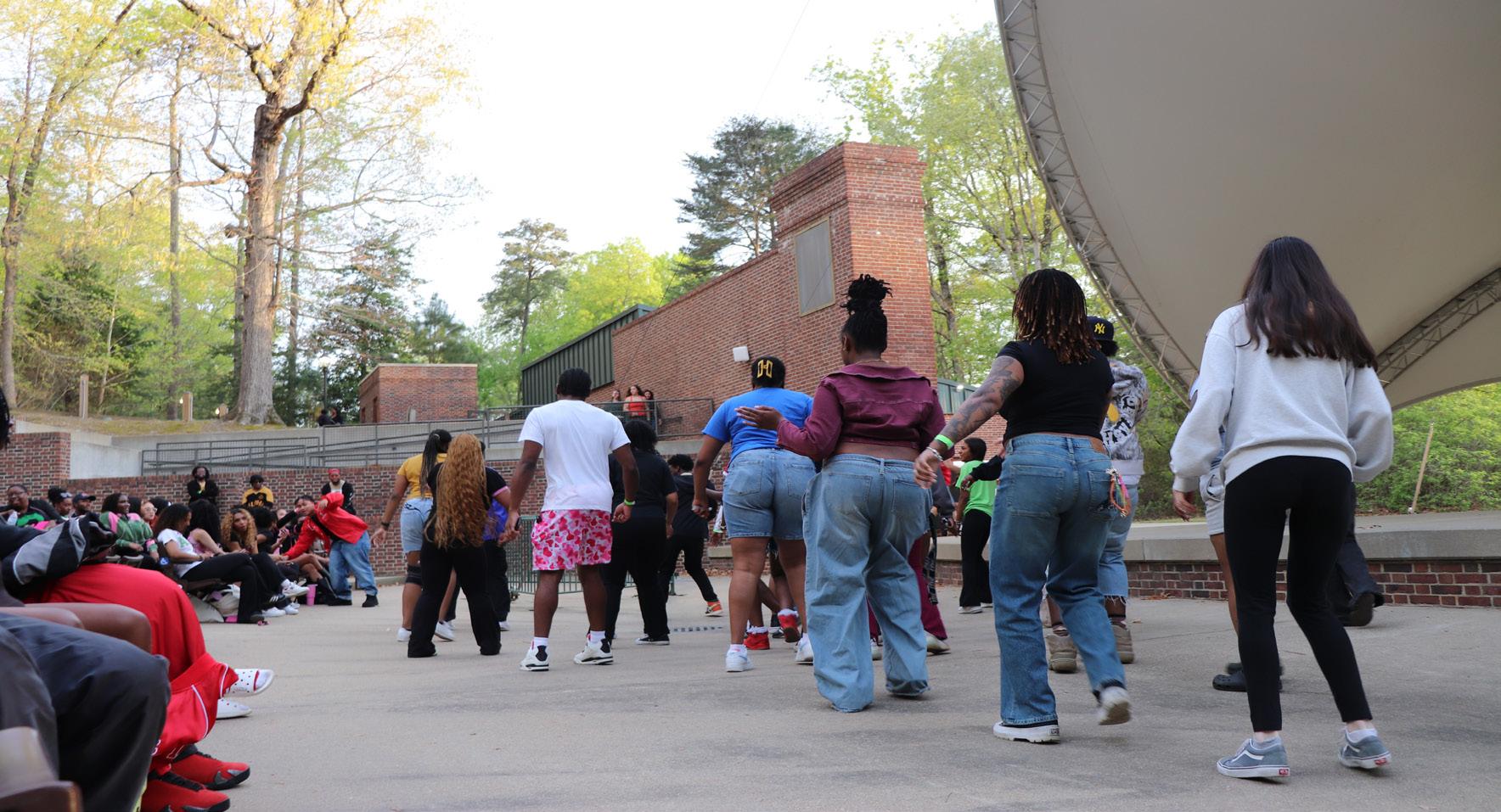
Sunday, April 12, historically Black sorority and fraternity members joined together onstage at the Martha Wren Briggs Amphitheatre at Lake Matoaka, stomping, stepping and singing. NPHC Yard Show is an annual musical and dance performance run by historically Black fraternities and sororities since 2018. It celebrates their history on the College of William and Mary’s campus. NPHC pushes for greater representation of the Black community on the College’s predominantly white campus.
NPHC vice president Nya Teferi ’27 introduced the show with brief remarks on the performance’s signifcance and background on historically Black fraternity and sorority life at the College.
Te program’s dances were rooted in history, as sororities and fraternities highlighted their place within the College’s past and within the Black community through rhythm and sway.
Beginning the program, fraternity Alpha Phi Alpha did a three-man dance, slipping and sliding to the beat. Te dance ended with the trio coming together in a row. Yet, for all the smoothness of their moves, the quiet solemnity of their voices created a pause in the crowd as they shouted out their founding year.
Next, sorority Alpha Kappa Alpha did a group dance, with sharp movements and black shirts that caught the crowd’s attention. As they danced, they shouted out their founding date, along with phrases like, “Oh so pretty!” Te sisters leaned into the song’s light
comedic background to contrast the serious signifcance of their role as the frst Black sorority in the nation.
Te fraternity Kappa Alpha Psi, outftted in full suits, did a line dance with fve performers, stomping and strolling. Tey fnished in a classic jazzy line,
holding canes with their hands on each others’ backs.
In between these performances, Teferi and her cohost performed in blue suits, breaking into a classic foss to represent the NPHC leadership.
Te intermission wasn’t a break in the celebration, but a proliferation as over thirty audience members joined the performers on the foor of Matoaka Amphitheater.
For the grand fnale, the Mu Upsilon chapter of the Delta Sigma Teta sorority sang their song, “All my love, peace, and happiness, I’m gonna give it all to Delta,” in a sweet soprano, while performing a perfectly synchronized line dance. It was a sea of red outfts as the sisters supported one another in a line.
Te event organizers, Teferi and NPHC community outreach chair Jazmine Klinedinst ’28, emphasized the importance of the show in representing the college’s Black community.
“Tis is how we spread awareness that we’re loud, we’re doing amazing things,” Klinedinst said.
Klinedinst highlighted the commitment, preparation and dedication that go into the show.
“Tey make it look so easy, but it’s probably around hours each night, for months beforehand,” Klinedinst said.
Delta Sigma Teta sorority president Kennedy Byrd ’26 emphasized the legacy of historically Black
fraternity and sorority organizations on campus. As a member of the first historically Black sorority on the College’s campus, founded in 1976, and a legacy Delta, Byrd recognizes the significance of the NPHC show.
“Just being able to represent, being on a majority white campus and being able to show what culture means to us and being able to kind of showcase what we’re about, that means everything to us,” Byrd said.
Teferi stressed that NPHC’s dance steps aren’t just about representation, but also commemoration of the Black community on campus.
“Tis show is meant to support our work, including the Garden Project. Te Garden Project is a push for memorialization for historically black sororities and fraternities on William and Mary’s campus,” Teferi said.
NPHC’s Garden Project campaign would provide formal statues to recognize each historically Black fraternity and sorority’s place in the history and social life of the College.
“There’s the regular sorority and fraternity court, but there’s no commemoration of historically Black sororities and fraternities on campus,” Tefferi said.
KIMBERLY MCCANN / THE FLAT HAT
KIMBERLY MCCANN / THE FLAT HAT
CHOPT D ROPS NEW ROCK
Student band performs first live album in Comey Recital Hall
GABRIELLA COLCAGNO // THE FLAT HAT
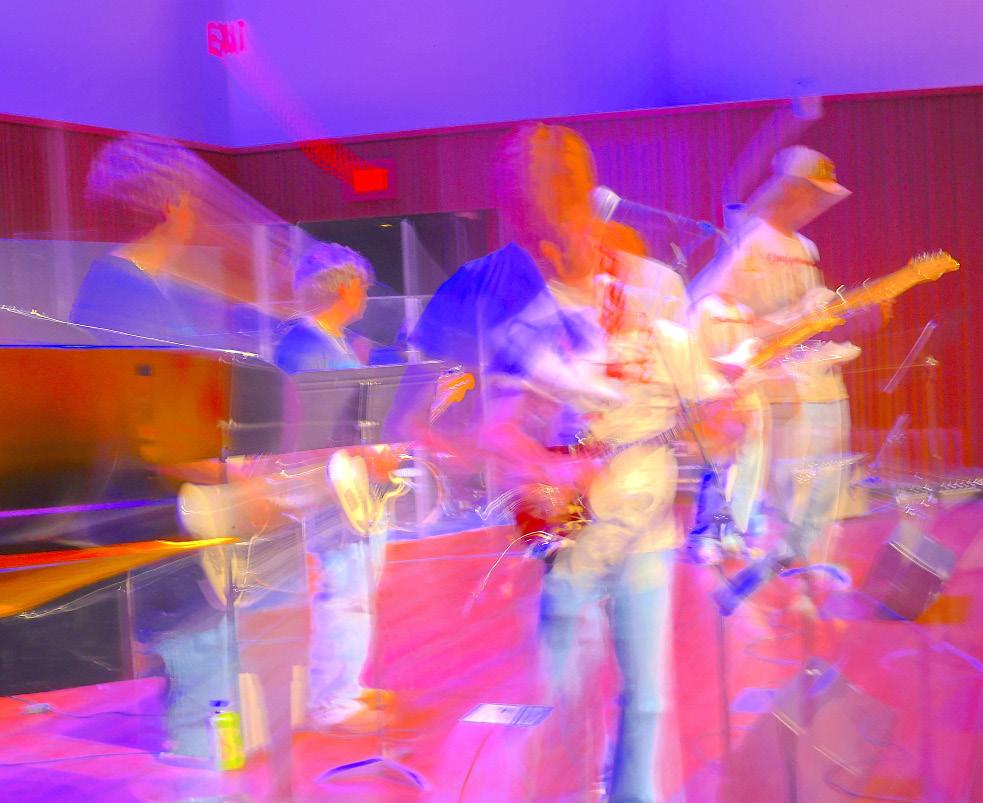
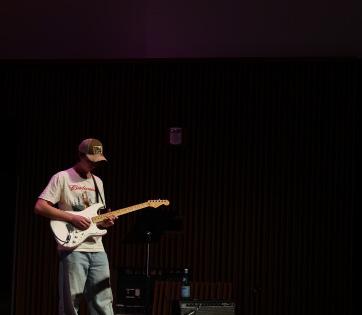
Friday, April 10, the Comey Recital Hall of the Music Arts Center came alive as the indie rock band CHOPT performed their hearts out for their live album performance.
The band’s new album is a project they had been working towards as part of a senior project for band member Jarret Haft ’26. The band planned to record the live performance of their album and release that audio on streaming platforms. The band consists of five upperclassmen at the College: Vocalist and keyboardist Mark Strand ’26, rhythm guitarist and vocalist Jarrett Haft ’26, drummer and vocalist Ian Jenkins ’26, bass guitarist Liam Ellis ’27 and lead guitarist Stone Fisher ’26. The five students are a part of the same fraternity, Kappa Delta Rho, and began their band in the fall of 2025.
Jenkins, Strand and Haft lived in the same house their sophomore year, where they were able to share their passion for music with each other. As Strand expressed it, the “nucleus” of the band formed there. From there, Fisher and Ellis joined the group, and they all began creating original pieces. The band name, CHOPT, is in reference to the slang term chopped, meaning conventionally unattractive.
“I just think that we don’t take ourselves too seriously,” Jenkins said. “And so by calling our band chopped, by calling ourselves chopped, I think it just kind of takes a little bit of
pressure, honestly, off of the band.”
The band shared the impact creating the album had on them as a collaborative unit.
“It’s really forced us to trust each other or trust each other’s instincts,” Strand said. “And so, to do that, I think it’s built our trust in each other to make sure that we have a product that we like and we all come to a consensus on.”
Walking into the performance, audience members received a handdrawn flyer of information for the concert surrounded by unique doodles and jokes. The performance itself consisted of a tracklist with nine original songs, ranging from meaningful pieces about longing to silly tunes about a wombat in a living room.
The members shared the songs that are most meaningful to them.
“I think the song that means most to me is probably ‘Hey You,’” Jenkins said. “I think it’s a very universal experience of seeing someone that you just are so captivated by that you want to go up and say hi to them, but you don’t know how. And you’re trying to hype yourself up, but it’s just, it’s not quite there.”
Fisher, the lead guitarist, recalled his trouble finding the right chords for the song “Wombat,” and how it helped him register the true meaning of the lyrics.
“My favorite song that we play is ‘Wombat,’” Fisher said. “And a lot of
the times I get kind of tripped up on the chords. And I was worried about that for so long that I didn’t register what the song was about, and then when I finally read through the lyrics and realized that when we were singing about a wombat in the living room, it just made me smile.”
Strand shared his personal experience that inspired the track “Knock It Down.”
“That song meant a lot to me because it was about this friend that I had whose house got torn down. And his mom came over to my house and she was crying about it. It felt like this really big emotional thing to see this place that I’d hung out with my friend at, and now it was stripped away in just a matter of weeks,” Strand said. “And so, I think it was cool to be able to write a song around it, because I think it felt like I had some kind of therapy from just honoring that place and that home through the process of writing about it.”
The passion each member had for the entire album was evident through their performance. They entered and began with their opening song, “Questions.” They proceeded with an introduction of each of their members and a soulful performance of “I Wish I Could,” which Haft believes is the group’s most compelling and vulnerable track.
“Especially for kids growing up and for boys growing up, it’s a really, really difficult time, figuring out who you want to be and what you want to do, and I think that assurance was something that personally would have helped me all the time knowing I’m going to be okay. And same with the rest of us,” Haft said. “I think that could help a lot of people get through some hard times and know that everything is going to be okay.”
During the closing of “Hey You,” the guitarists drew closer to the sound system, creating feedback and encompassing the theater in the sound of rock and roll. At the end of the live album performance, the audience gave the last song a standing ovation.
Haft noted what the overarching message of the album is.
“Anyone can make music. Doesn’t mean it’s good, including us. And we are chopped and stay chopped,” Haft said.
CHOPT gives special thanks to the William and Mary Music Department; their advisor, Visiting Assistant Teaching Professor of Music Elisse
BREAKING THE BINARY
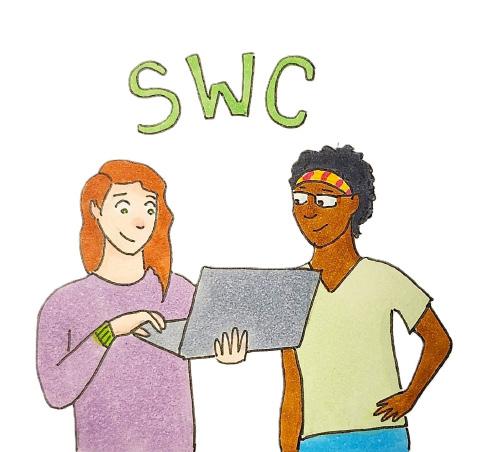
On any given Tuesday evening i n Tucker Hall, you can find a group of women helping their fellow club members and the local Williamsburg community to succeed in the fields of computer and data science.
Technically, the Society of Women in Computing is the women’s branch of the Association for Computing Machinery at the College of William and Mary. Computer science has historically been a male-dominated discipline, so creating spaces where women in the feld can support and uplift each other is especially important. President Mary Midkif ’27 shared her frsthand experience of how SWC has helped her feel more confdent in her computer science coursework.
“Some computer science classes are just so heavy and stressful. Being able to always know someone in that classroom, especially a woman, is really helpful,” Midkiff said. “You’re able to work on stuff and talk things out with each other.”
RACHEL ROBBINS
Secretary Natasha Guharoy ’27 echoed this sentiment. As a data science major and finance minor, she frequently finds herself in academic spaces with a relatively lower proportion of women to men. SWC has helped her bridge that gap and find points of connection with the fellow women in her classes.
“I actually joined my freshman year because I wanted to see a community for people that were women in STEM, especially because the further you go down in classes, even within data science, it dwindles a little,” Guharoy said. “But the Society of Women in Computing has been so nice, and it helps me feel so much more comfortable because I do think I would be much more nervous without having a group.”
In addition to serving as a dedicated space for women at the College in computer and data science, SWC also engages in outreach to the local Williamsburg community through educational instruction at Matoaka Elementary School. SWC co-outreach chair Bibisha Acharya ’28 described the types of programs that SWC leads.
“We go to different elementary or middle schools and teach students about coding and introduce them to computer science concepts and robotics,” Acharya said. “In the robotics program, they’re specifically making LEGO robots and using block coding, and in the gifted program, we’re introducing children to simple coding concepts that they practice on their laptops.”
Co-outreach chair Ashley Escobar ’28 elaborated on the personal fulfillment that comes from working with local students.
“It’s a great thing to put on your resume,” Escobar said. “You also feel great about yourself afterwards,; like I just helped a bunch of kids learn something new. It’s a
good feeling.”
Professionally, SWC offers workshops throughout the year centered on developing LinkedIn profiles and resumes, as well as taking headshots and developing summer project ideas to help build resumes. Midkiff mentioned that the club also teaches specific coding skills applicable to courses in computer and data science, including offering a GitHub workshop.
“Basically, we’re helping people understand what they should be doing alongside their schoolwork,” Midkiff said.
SWC also frequently invites successful alumni in the field to share career advice. Guharoy emphasized the value she has found in growing her professional network through these events.
“I look up to so many of the people from past years because they’re so well accomplished,” Guharoy said. ”They have these crazy cool internships, and they’re so vocal about how they went through the process. It’s a very nice space to grow connections in that sense, especially in computer science, where so many people need to understand networking.”
Besides career development, having a space with people who are primarily pursuing coursework in computer and data science is helpful for getting tips about classes. Both majors have relatively rigid structures, so understanding how prerequisites and course times interact can make planning schedules much easier. Escobar highlighted how connecting with SWC members has helped her during registration, especially at the start of the semester.
“I feel like they just give helpful resources and information that I wouldn’t know,” Escobar said. “I remember one day, during our interest meeting, we were talking about
the CS professors and their pros and cons. So that was also informative for knowing what professors to take in the future and what classes, too.”
However, participation in SWC is not limited to computer and data science majors. Many members are minors in one of the fields, or are simply interested in incorporating coding into their future careers. Acharya stressed the broad nature of the organization.
“Honestly, it’s all inclusive. If you’re specifically interested in tech, I guess it would be best for you, but we invite anyone,” Acharya said. “You don’t have to be a STEM major; you could also just be someone who’s supportive.”
In the future, SWC hopes to expand its outreach program to closer elementary schools in order to improve accessibility for current club members, and is currently reaching out to middle schools as well. They also hope to work more directly with the Association for Computing Machinery at the College. However, Midkiff is happy with how SWC is currently acting as a space for women to bond with each other on campus.
“This semester has been extremely successful. It’s been amazing,” Midkiff said.
“We’ve had a lot of people show up to our meetings, and everyone interacts and it makes me so happy. We had a game night the other night where we played Roblox Dress to Impress together, and that was so fun.”
Guharoy also emphasized the importance of connecting with classmates outside of a classroom setting.
“You’re like, ‘Wait, we’re all real people outside of academics,’” Guharoy said.
SWC meets variably on Tuesdays at 8 PM in Tucker 221. Further information on meeting times and locations can be found on their Instagram account @wmswc.
La Barre; Casey O’Neal; Ben Whiting; CHOPT Crew; Kappa Delta Rho; and their loved ones for their support.
If you’re interested in seeing the
band play some of their original songs from their latest release, they will be performing next at the Big MAC music festival in the Music Arts Center’s Concert Hall on Sunday, May 10.
GRAPHIC BY ISABEL VOLDEN // THE FLAT HAT
COURTESTY IMAGE // ARIE VAN DAM
COURTESY IMAGES // ARIE VAN DAM
BY AIDA BEKELE / THE FLAT HAT
Shortcuts BY DAVID OMITOGUN / THE FLAT HAT
BY ALINA YANG / THE FLAT HAT
BY BENJAMIN OTERO / THE FLAT HAT
BY SOPHIE FRANK / THE FLAT HAT William & Mary Had a Little Lamb
BY ISABEL VOLDEN / THE FLAT HAT
BY GRETTA ANDERSON / THE FLAT HAT
Snapshots of Spring
We don’t need Flock watching our campus
Reyes
GRAPHIC BY GRETTA ANDERSON / THE FLAT HAT
The College of William and Mary has a $33,000 contract with Flock Safety for the use of Flock Falcon cameras on campus. These license plate reader cameras gather license plate and vehicle appearance information about passing cars, including make, model, color and dents. Flock has national and state networks of information from its cameras that participating customers can access using search terms. The goal of these networks is to aid police in criminal investigations.
A referendum on the College’s 2026 spring student election ballot reflects community concern over the College’s partnership with Flock. The referendum asked students to vote for or against the termination of the College’s contract with Flock.
This goal is admirable. Flock is an unethical and incompetent company that the College should not share data with or rely on for security purposes. Flock has permitted federal agencies involved in immigration enforcement to access its network, as well as police seeking to prosecute a woman for an alleged abortion.
There are many examples of the dangerous misuse of Flock data. In particular, Flock has been very unclear about the level of access that federal agencies, including federal immigration agencies, have to its data. When Flock began a pilot program focused on human trafficking and fentanyl with Customs and Border Protection and the Department of Homeland Security, it did not disclose this program to customers. Since Flock had previously stated that it had no federal contracts, Flock customers had no reason to suspect that immigration agencies would be able to access Flock’s network of data. Given the violent and indiscriminate nature of recent immigration enforcement, Flock customers deserved to know about Flock’s pillot program with these agencies. Additionally, CBP then began requesting data from police across the country, which some departments granted. In some cases, giving this access to CBP was unintentional because it was not clearly identified as a federal agency when it requested data from local police forces. It was Flock’s responsibility to clearly identify CBP in its network so that users could make informed decisions about data shar-
ing, especially because some states have laws prohibiting immigration-related data sharing with federal agencies.
According to Flock CEO Garrett Langley, “there have been conflicting reports in the media about Flock’s relationship with federal agencies, and some of our public statements inadvertently provided inaccurate information ... We clearly communicated poorly. We also didn’t create distinct permissions and protocols in the Flock system to ensure local compliance for federal agency users.”
It is unacceptable for a company dealing with large amounts of sensitive data to make mistakes as catastrophic as these. Companies employ staff to write accurate and clear statements for them; there is absolutely no reason that Flock should have been making “inadvertently” inaccurate statements. And even though Flock’s pilot programs with CBP and DHS were focused on trafficking and fentanyl, they should have built in safeguards to prevent these federal agencies from using Flock data for immigration purposes as well.
This federal accessing of immigration enforcement-related data is illegal in some states and ethically questionable given recent violent immigration enforcement.
Flock’s pilot programs with these federal agencies have ended. But audit logs reveal that police departments are now conducting immigration related searches on behalf of federal agencies.
Users are required to list a reason for their search, and some police have given “ICE” or “immigration” as the reasons for their searches. The College participates in the Flock Virginia State Network, allowing police in Virginia to share data from its LPR cameras. Other Virginia police departments could potentially be using information from the College’s cameras to aid Immigration and Customs Enforcement.
The College’s data sharing is also concerning because other Virginia police agencies have displayed a disregard for the Virginia laws on LPR use. A Virginia State Crime Commission survey revealed that many Virginia police agencies retained LPR data for more than 21 days or shared it with out-of-state or federal agencies, which are prohibited by state law. A third of Virginia police agencies did not respond to the
survey, indicating that the noncompliance rate may be even higher than it seems. The College should not be participating in a Flock network that could place LPR data from campus cameras in untrustworthy hands.
Another concern is the use of Flock to prosecute women for having abortions. A Texas sheriff searched Flock’s national network in an attempt to locate a Texas woman who had a selfadministered abortion. Police used Flock to attempt to track this woman across state lines and even reviewed footage from states where abortion was legal. Flock, of course, denied that this occurred, despite clear evidence to the contrary.
Since these incidents, Flock has stated that it has implemented keyword filters to block illegal searches about immigration and abortion. However, Flock’s past actions suggest that the company will never adequately protect its customers’ data.
Evidence also suggests that Langley is an untrustworthy steward of the College’s data. In response to criticisms of Flock, he has used inflammatory language to attack detractors. In a Forbes interview, when asked about DeFlock, an antiFlock organization, Langley compared the activist group to terrorists and Antifa, and he accused them of seeking to undermine order and safety.
In an email sent out to customers, Langley wrote, “Let’s call this what it is: Flock, and the law enforcement agencies we partner with, are under coordinated attack. The attacks aren’t new. You’ve been dealing with this for forever, and we’ve been dealing with this since our founding, from the same activist groups who want to defund the police, weaken public safety, and normalize lawlessness.”
Flock is not only an irresponsible company that should not be trusted with the College’s data; it is also led by a fearmongerer who attacks critics instead of responding to legitimate privacy concerns. The College must not continue to align itself with such a figure.
In response to student concern, the College has affirmed that it only retains data from the LPR cameras for 21 days, which is required by state law.
Additionally, an announcement on the College news page states, “Readers are used only in public areas to deter and solve crime — particularly by perpetrators from outside the campus community.”
However, this does not eliminate the dangers associated with sharing data with other police departments in Virginia, as described above, or of the College maintaining a contract with a company that has demonstrated itself to be negligent and untrustworthy.
Flock’s technology has repeatedly been used for persecutory purposes, and its CEO is an arrogant dogmatist. The College’s campus is not under a significant enough threat from outside criminals driving onto campus for these ethically questionable LPR cameras to be necessary.
Lucia Reyes ’29 is a prospective psychology major and creative writing minor. She enjoys writing, reading, playing The Sims and listening to the rock and indie music. On campus, she is involved in Best Buddies, Cheese Club and Oriental Tea Club. Contact her at lareyes@wm.edu.
Spring has sprung, spring with it!
The first full week of shortsweather has hit the College of William and Mary! With that, we can now officially claim the start of the true spring season here on campus. The trees are dumping pollen, and as it turns out, you actually do have spring allergies! Fall course registration is upon us. Everyone, brace yourselves for whatever PATH has planned for your 2026-27 schedule. Do you think that if we wear our pj’s inside out and put spoons under our pillows it will stop the ever-daunting 8 a.m., or does that only count for snow days? Speaking of 8 a.m. classes, that extra credit you tacked on this semester looked really good on your DegreeWorks, but with finals on the horizon and the mid-semester slog well underway, it’s sure not feeling so great.
Spring is finally here, and the long-awaited end to the College’s winter stretch has brought with it, you guessed it, more work. If you weren’t already convinced, here comes four separate tour groups all bottlenecking on the skybridge just in time to make your late morning start even later. Don’t forget to smile so they know how much you love it!
As you trudge through a half-inch of pollen to get to your 80-minute COLL requirement class, and your brain feels like it’s swollen twice its size, stop and take a minute. This is cliché, but take a deep breath and remember where you are in that very moment. Listen to the world around you (tune out the construction if need be) and listen for the sounds of spring. Try picking your head out of your final paper for the class you doom scrolled through most of, and go check out the farmers’ market. While you’re at it, walk down to the Capitol Building or go see the lambs and calves in Colonial Williamsburg. They’ll have grown up to be sheep and cows before you know it; your Instagram story deserves to see them in their prime!
The daffodils have been blooming like crazy, and now
here come the dogwoods and the azaleas. Yes, there is plenty of pollen, but c’mon, look at nature — they deserve to get back at us a little. Enjoy the blooming of spring and stop by the Student Health Center; already, my roommate and I have both gone to get allergy meds.
Tanning on the Sunken Garden has hit its stride; go lie out on those towels in bikinis and hope that your 70-year-old humanities professor doesn’t walk by in full business casual attire. Bring your backpack so you can take your readings out to justify all the ‘outside studying’ you’re doing, but promise you won’t actually ruin the energy by doing real school work. Stay for golden hour, and in between Snapchatting your situationship and hometown link, take a moment to appreciate being alive.
My point is, life is strange, especially here. It’s strange and hard, and sometimes it all feels like too much to get a grip on. However, it's springtime! There is an intrinsic whimsy to this thawing out of the world; don’t let the College crazies keep you from taking full advantage of the warming weather. There will, of course, be times here when you simply must get that paper done, but please don’t let the baby animals grow up before you get the chance to see them. The readings might not all get done, and that one random from that party a few weeks back might stop texting you, but the flowers won’t always be in bloom either.
Choose the way you live your life, and choose to live it with some of the same excitement that spring breathes into the rest of the world.
Cate Woodrum ‘29 (she/her) is a government and philosophy major from Richmond, Virginia. Outside of The Flat Hat, she is a member of the Kappa Alpha Theta sorority and a peer advisor for the conduct and honor councils. She enjoys getting to be a part of W&M life through the paper as well as sharing the college experience with her friends. You can almost always find her dragging them around campus and CW on an unprovoked side quest.
GRAPHIC BY ISABEL VOLDEN / THE FLAT HAT
COMIC
Willy and Mary #20
COMIC BY MICHAEL GABRIEL / THE FLAT HAT
The most essential command
Carson Burch FLAT HAT OPINIONS ASSOC.
“The Party told you to reject the evidence of your eyes and ears. It was their final, most essential command.”
The above is, for those unaware, a quote from George Orwell’s “1984.” It comes to me often in modern political discourse, which at least in the West is more drenched in dishonesty than when he wrote it. It has been the operative principle of our entire national life, and it covers subjects from massive scandals to as mundane of subjects as redistricting. Not looking is now the operative rule of politics.
Donald Trump is a master at taking advantage of this rule. Indeed, the core of his political success has been making his supporters not read too closely and ignore conduct that, if done in the days before social media and hyper-partisanship, would have gotten him removed from office. Aside from such obvious examples as his skittishness surrounding the Epstein files, this trend can be seen in a wide array of issues — remember when Trump threatened Denmark to hand over Greenland because he did not get a Nobel Peace Prize? While forgetting this incident is easy and understandable in light of the constant stream of outrage we are inundated with 24/7, the idea of the President threatening an ally because he hadn’t been given a medal is ridiculous and demonstrates a profound lack of mental maturity on the part of the leader of the Free World.
However, the nature of our time demands that we ignore this and pretend that the President is capable of responsibly exercising the power entrusted to him, even when he’s proven he lacks the mental capacity to do so. The story didn’t even command media attention for that long; ask yourself if you even remembered this outrageous conduct before I brought it up in this article. I bet the answer is no.
Similarly, Trump’s much-vaunted claim that he is “draining the swamp” requires not looking or thinking critically about his conduct. His cryptocurrency ventures are a phenomenal example: It’s hard to think of anything more corrupt than the President setting rules for industries he has companies in and owes billions of dollars of his net worth to. Trump’s jet from Qatar is another example of public corruption. Why else would they give him a high-class jet other than an attempt at foreign influence? The fact that Attorney General Pam Bondi signed off on it doesn’t make me feel any better when she herself was previously a registered lobbyist for Qatar.
Although it may be easy for Democrats to decry this (and they should), they have also asked their own voters not to look and see the evidence before them. In fact, part of what got me first thinking about this was reflecting on Joe Biden’s 2024 reelection campaign
in a discussion with friends: The idea that he was up for another four years in the job required not paying close attention to his many embarrassing public appearances, and the debate exposed it as a lie for the whole country to see. Too many top Democrats were complicit; most national-level Democratic officials supported his reelection campaign, and many liberal influencers who should’ve called out the deception instead partook in it. Jon Stewart ’84 should not have been one of the only major liberal figures to call this out before the debate.
This trend continued even after Biden stepped down. I recall seeing multiple opinion pieces comparing him to Cincinnatus, a Roman politician who laid down his emergency powers upon having resolved the crisis that got them granted to him. This always struck me as absurd: Cincinnatus didn’t need declining poll numbers and the prospect of certain electoral defeat to step aside. He instead did it for the good of Rome in a demonstration of civic virtue unthinkable from any representative of our modern political class.
I’d argue the upcoming redistricting referendum is another example of rank dishonesty. The advertisements I see for the topic constantly insist that it’s about “fairness” and “letting the people decide,” but the whole point of this redistricting is for politicians in Richmond, Va. to entrench Democratic control of Virginia’s congressional delegation — a goal rather contrary to these stated aims. Regardless of whether you think it’s necessary to offset similar moves by states like Texas, I don’t see how this is more democratic, as it denies representation to a large swathe of Virginians.
Dishonesty is not new to American politics, nor to politics in general. In the ancient Greek historian Thucydides’ “History of the Peloponnesian War,” he writes that a civil war in the city-state of Corcyra led to words losing all meaning, with restraint, moderation and critical thought now being deemed forms of cowardice, weakness and indecisiveness. However, in an American context, this level of pervasive lying is something I’d argue is a development of the last 10 years. With this torrent of disinformation in the air, how can one navigate this environment? How can one be a good citizen?
While it’s not easy, the simple answer is to always engage in critical thinking. It’s important to treat all claims made by partisan actors, ranging from politicians to their commentariat sympathizers to the rage-bait accounts on social media, with skepticism, especially when they conform entirely to your preconceived worldview. People fall for misinformation most readily when it validates their extant narrative of how the world works or aligns with what they want to be true, so trying to avoid this common cognitive trap is essential. I won’t pretend this is an easy fix. Believing something that one wishes was true is common human behavior. I myself have fallen into that habit many times and will probably do so again in the future. It is, however, important to at least make the effort if we want to engage with reality as it is and move forward as a nation.
Otherwise, we are merely obeying the most essential command — and sacrificing our capacity for independent thought in the process.. CarsonBurch‘28isagovernmentmajor fromChesapeake,Virginia.Heisamember oftheHistoryClub,PublicPolicyClub, Lutheran Students’Association and Theodore RooseveltSociety.Outsideofhisstudiesand sociallife,heenjoysreadingabouthistorical and current events in addition to dinosaurs. Contact him at ceburch@wm.edu.
The best part of every week in the life of Eva is when I decide what question I’m answering for my bimonthly Apple. I start to see the world completely differently. Nothing matters except the quest for my answer. For Eva’s Apple #2, wherein I provided brilliant situationship advice (if you haven’t read that one yet, that’s the reason things haven’t been going your way in life), the human beings around me ceased to be nuanced individuals and instead became potential case studies for my analysis of love and loss. If I expressed interest in your life during the week leading up to March 5, 2025, it was — and I’ll
hold your hand while I tell you this — completely disingenuous and driven by ulterior motives. Did I ask you invasive questions about your relationship status? Did I mutter “Okay, yep, I can work with that” under my breath while you poured your heart out about a recent breakup? Now you know that you were my fieldwork.
This week, while I was scrolling on my explore page and giggling at a hummingbird meme that said, “I just flew non-stop over the Gulf of Mexico. I fought a headwind for 400 miles. I weigh less than a nickel. If that red feeder isn’t freshly washed and filled when I land, I
Transfer portal reform: Fixing the unfixable
The crowning of the Michigan Wolverines as the 2026 NCAA men’s basketball tournament champions, while marking the end of the game-playing season, also heralds the start of an entirely different beast: the transfer portal.
In the spring of 2025, over 2,000 Division I male basketball players entered the transfer portal, a number that almost certainly will be either met or surpassed in the coming weeks — and a number that already includes players from the College of William and Mary. In just the first days of the portal being open, the Tribe had already lost its top two scorers: guard Reese Miller ’27 and forward Tunde Vahlberg Fasasi ’27.
While discussions around the number of players, many of whom never find a new home, entering the transfer portal are necessary to have when evaluating the health of the sport as a whole, there is one specific transfer form that needs to be evaluated: the mid/low-major to high-major jump.
For the sake of this article, the highmajor level will include the Atlantic Coast Conference, Big East Conference, Southeastern Conference, Big Ten Conference and Big 12 Conference. Yes, there are outliers (I see you, Gonzaga University, University of Memphis and friends), but this designation will help make the low/mid-major and high-major dichotomy easier to understand.
After the 2024-25 season, 14 of the 26 low/mid-major conference players-ofthe-year decided to make this very jump, taking advantage of the chance to play at the highest level. Most importantly, the 14 programs who saw the backbone of their team leave at a moment’s notice received zero (!) financial compensation for their loss.
For some of these transfers, it worked very well — St. John’s guard Dylan Darling, who came to Queens from Idaho State, hit the game winning shot against the University of Kansas in the second round of this year’s tournament. For some of them, however, the word “flop” is the only applicable term. 2025 Atlantic Sun player
am taking it out on your patio furniture,” I felt a twinge of guilt about the fact that I wasn’t being productive. For a moment, I started to console myself by repeating the following affirmations: My productiveoutputisnotmyworth;Iam more than the things I accomplish; my work-lifebalanceismysuperpower.But then it dawned on me. My productive output is my worth. I need to stop making excuses for the legitimacy of my procrastination and start finding ways to reframe my brainrot time as necessary for the production of quality work. Then, I posted my call for Apple questions. As potential questions of the week rolled in, I was struck by a particular submission that seemed to offer a perfect solution to the problem at hand. Suddenly, I was not scrolling my day away. I was doing field research.
The question of the week is as follows: “Advice for building a meme/ screenshot collection as inspiring, diverse, and full as urs?”
You don’t really know a person (me) until you’ve heard their innermost thoughts (seen the “memes” folder of my camera roll). I am a firm believer in the notion that a sense of humor is an acquired skill. I’ve never seen a baby that could do stand-up comedy straight out of the womb. If you can show me evidence to the contrary, I’ll reconsider my position. In the meantime, I will spread my gospel far and wide.
Very few people have had the privilege of seeing the over 200-image folder that is my meme collection. That’s
an intentional choice. Every joke I use in daily conversation is recycled and repurposed from the generative mind of another. No one. I repeat — NO ONE — has ever had an original thought. We are simply parrots who practice the same bits over and over and over again until they land. I often pause mid-conversation to whip out my phone and write down a joke that came up organically to use in a later Apple. I have a notes app open on my phone right now full of quotes like, “We’re not losing the ancient texts,” “Six Kevin” and “No mogging in the popular education spiral.” I have no idea what any of these mean, but I know they meant something to me before, and perhaps they will mean something to me again someday. When they do, I will use them in an Apple. You see, that’s all life is: doing crowdwork until a joke sticks. Then you hold onto that routine for dear life until you are old and jaded and boring and no longer wanted. Then you pivot. Rinse, repeat and revel. So, what is my advice for building the perfect meme collection? Well, this question asker wants to know how to make a meme collection inspiring, diverse and full. Behold! I have provided you with advice to achieve all three: 1) Inspiring: A few days ago, I sent my friend Lindsay (hi Lindsay — she copy edits this column) a meme of a guy walking toward a portal that said, “The only way to thug it out is to thug it through.” She responded, “Woah…this is so inspirational.” I made Lindsay feel understood, motivated, reborn. That’s
teams are fielding $22 million rosters (now I am looking at you, University of Kentucky), fixed payments to mid- and low-major programs could go a long way in ensuring high-level competition up and down the college basketball pyramid. The implementation would undoubtedly be messy, especially given the NCAA’s propensity to make even positive reforms harder than necessary, but it would carry many benefits.
For one, these payments would allow mid- and low-major programs to reinvest in their own teams, while also keeping coaches from feeling that they need to also find a new school to have any chance of consistently competing.
of the year Jacob Ognacevic, who made the move from Lipscomb University to University of Washington, saw his pergame scoring drop from 20 to 3.1, and his minutes plummet from 33.8 to 12.5.
While these anecdotes are important, there is no value in trying to relitigate why these players decided to make the jump.
Rather, let us not punish players who try to advance their careers, but instead reward the schools who trusted them and provided the platform to make the jump. A trip across the pond provides worthy insights and anecdotes, and just maybe a possible solution to the drama and trauma surrounding transfers “up.”
In the summer of 2024, highly rated Chelsea FC youth winger Rio Ngumoha made the decision to leave Chelsea and switch to northeast powerhouse Liverpool FC. Ngumoha made the move following the expiration of his Chelsea contract, allowing Liverpool to move for him without paying the up-front fee to Chelsea that traditional player transfers entail.
It is not the move itself that holds importance (at least for this argument), as youth players around Europe move club to club all the time, but rather a report from The Athletic in February of this year that Liverpool would indeed have to pay at least £2.8 million to Chelsea in the form of “training and development” compensation. With our short excursion across the pond complete, let us leave Chelsea, Liverpool and Ngumoha but take the idea of “training and development” compensation with us back home.
When FIFA implemented this form of compensation, the goal was to reward clubs (especially smaller clubs) for the work they do developing youth players.
So, while Liverpool and Chelsea are both massive clubs, the application of such reforms in U.S. college basketball would make even more sense.
In an era where high-major programs are backed by billionaire entrepreneurs and multi-national corporations (yes, I’m looking at you, Tyson Chicken), and
The implementation of training and development compensation could also help attract new donors to lowand mid-major programs, who would see an already-existing pool of money available to teams that they could then contribute to, rather than having to create entire Name, Image and Likeness funds on their own. Donors typically don’t like to be among the first, or alone.
The College’s basketball team has also dealt with its own experience of star players leaving to pursue opportunities at the high-major level. After the 202021 season, star guard Luke Loewe, who had averaged 16.2 points per game, left for Big Ten outfit University of Minnesota. Going back a bit deeper into the archives, after the 2018-19 season, the Tribe lost its second leading scorer Justin Pierce to the University of North Carolina at Chapel Hill.
Even though hindsight is 20/20, the case of the College can still be a valuable thought experiment. If the Tribe had received compensation from Minnesota and UNC, how could its rosters have shaped up in the following year? I cannot go back in time, but perhaps a 5-27 season, like what happened in the year after Loewe’s departure, could have been avoided.
The idea of money distribution down the college basketball pyramid might come across to some as some wonky 21st-century socialist and sports collaboration, but the fact is that the money taking over college basketball is not leaving any time soon. Instead, working within this now money-flushed system could, and should, bring incentives for team No. 1 all the way to No. 361. JacobTobman‘29isagovernment majorfromBrooklyn,NewYork.At TheFlatHatheisthesportseditor. Outsideofschoolyoucanoftenfind himwatchingthePremierLeague ontheweekendorcatchingalive basketballgamebackathomein NewYorkCity.Youcancontacthim atjtobman@wm.edu.
what a good meme does. I knew it would give Lindsay the serotonin boost she needed because I had personal experience being rescued from the depths of despair by the very same meme. On Monday, I ordered a four-egg chili cheese scramble at Hohl for lunch before remembering that I already had a two-egg omelette for breakfast. I refuse to waste food. When the chili cheese scramble came, I feasted upon the dish. Did I consume half a dozen eggs in less than four hours? Maybe. But the only way to thug it out is to thug it through. So, when I saw that Lindsay was spiritually feeling like a half-a-dozen-egg-underfour-hour-consuming lad, I knew what meme would do the trick. To know how to inspire others, you need to have had experiences that taught you how to overcome challenges. Have you lived an easy, stress-free life? You can go to Sadler right now and get an omelette. Wait two and a half hours, and then order a four-egg chili cheese scramble from Hohl. Half a dozen eggs in under four hours. You have to thug it through.
2) Diverse: Your reservoir of memes needs to span the entire spectrum of human emotions. I Googled what the most negative human emotion is, and anger is the first thing that came up. Perfect. I have a meme in my collection that says, “unfortunately i’m not nonchalant, i will set you on fire.” What’s the world’s most positive human emotion? Google says joy. Great. I have a meme in my collection that shows a cartoon duck saying, “i like juice box.”
Want a more nuanced emotion? Let’s try ambition. My favorite meme in my collection is just a white background with black text that says, “I took a screenshot of the whole world.” You wanna see ingenuity? I have a meme of a puppy wearing a hairbow that says, “I LUV EATING DRY CEREAL IT’S LIKE EATING DOG FOOD 4 GIRLS.” The possibilities are endless.
3) Full: A good meme has to make you feel complete — as if something was missing that you couldn’t quite place, and then an image comes along with a small bit of text that changes everything. One of the most powerful memes in my collection is a baby pony standing inside a tire that says, “born to be babygirl ... forced to be big dawg.” In this world, we are all just babygirls facing challenges and experiences that necessitate our posing as big dawgs. A good meme to help us articulate that experience can make it all the easier to persevere. Sure, there may be a light at the end of the tunnel, but why not light a candle along the way? My memes are my candles. They can be yours, too. All you have to do is muster up the courage to bring the flame to the wick. We’re all thinking the same thing. That was bars. See you in two weeks. Eva Jaber ’28 (she/her) is a prospectiveEnglishorinternational relationsmajor.Sheisamemberof theCleftomaniacs,anacappellagroup, anESLtutorandhopestoencourage peace-mindedadvocacyoncampus. Contactheratehjaber@wm.edu.
Eva Jaber FLAT HAT OPINIONS ASSOC Eva’s Apple #20: She memes well
COURTESY IMAGE / DEVIANT ART
Jacob Tobman FLAT HAT SPORTS EDITOR
GRAPHIC BY ALINA YANG / THE FLAT HAT
GRAPHIC BY MICHAEL GABRIEL / THE FLAT HAT
sports
Wednesday, April 15,
Zeta Kromah looks to pave road for fellow Liberian athletes
Tribe womenʼs soccer sophomore midfielder never forgets her roots
Sophomore midfielder Zeta Kromah’s journey to William and Mary is far from typical. From Liberia to Nebraska to Williamsburg, Va., her path epitomizes the blazing of an entirely new trail.
Kromah’s journey starts in the Liberian capital, Monrovia, home to nearly 2 million residents. There, she featured for LEAD Monrovia Football Academy.
“LEAD is basically where I learned everything,” Kromah said. “I learned how to be a leader, work hard, dream big.”
During her youth in Liberia, Kromah looked up to soccer players Lionel Messi and Cristiano Ronaldo for both what they achieved on the field and how they carried themselves off the pitch.
“Messi is an inspirational player who does not talk a lot, he just lets his work on the field do the talking,” Kromah said. “I also like Ronaldo because of his perseverance, his mentality.”
While Kromah now plays and lives in the United States, she remains connected with her LEAD teammates.
In addition to playing for LEAD, Kromah also featured for the Liberian women’s national team at multiple levels. Kromah’s first call-up for her country came in 2019, when she played for Liberia’s first U-17 women’s team.
“I was a goalkeeper at that point, but when I made the team, the coaches took me as a midfielder,” Kromah said. Kromah’s time with the U-17 group ended with her wearing the captain’s armband. After her first experience with the senior national team, Kromah moved to Fremont, Neb., where she featured for both Fremont High School and Fremont Soccer Club.
Despite moving to an entirely new country in high school without her family, Kromah settled in immediately.
“I had a pre-departure orientation for six months before coming to America, so I pretty much knew about the American culture,” Kromah said. “My host family, they have hosted lots of international students, so they know what students face.”
After recording seven goals and four assists for Fremont High School, Kromah returned to Liberia, where she searched for a U.S. university.
“I started reaching out to coaches and seeing if I can get a scholarship because that was the most important thing,” Kromah said. “I wanted to go to college outside Liberia because college in Liberia is strictly academic.”
Kromah credits LEAD Academy co-founder Will Smith ’14 for assisting her throughout the process, especially when it came to acting as an intermediary between her and collegiate soccer programs in the U.S.
However, the timing of Kromah’s search for a college proved challenging, as it came late in the process. Many schools had already finalized their rosters and distributed scholarship money.
Despite this, Tribe women’s soccer head coach Julie Shackford and associate head coach Marsha Lycan still took a chance on Kromah.
“I got on a Zoom with Shackford, she was really impressed, and then that is how they started [to] fit me into the team,” Kromah said.
Even today, she and Shackford still recall this story, Kromah added.
Both Shackford and Lycan recognized Kromah’s contributions to both the Tribe and her community back home.
“She has a true giving spirit, shown in the way she gives back to her Monrovian community and creates opportunities in soccer that would not otherwise exist,” Shackford said.
During her time at William and Mary thus far, Kromah has developed as much off the field as she has on it — something that took her by surprise.
“William and Mary has taught me a lot about building connections, being a community with a sense of belonging,” Kromah said. “I really appreciate my teammates, they are all super supportive, the coaches who support me on and off the pitch.”
Kromah’s story extends beyond her journey to William and Mary. She remains committed to giving back to the next generation of Liberian soccer players.
This past winter, she founded Tribe Stars in Liberia. The organization serves to empower underserved youth through the sport Kromah holds dear to her heart.
COURTESY IMAGE / ZETA KROMAH
Despite massive changes in her life, Kromah has adjusted to every new setting.
“I want a lot of kids to feel like a star wherever they are, [and] I am taking my Tribe community to Liberia,” Kromah said.
While Tribe Stars only launched recently, the first camp Kromah hosted saw incredible success.
“[At] the first camp, we hosted 105 participants, where we had several workshops on the importance of leadership, teamwork and building confidence,” Kromah said.
While there was no shortage of young Liberians passionate about soccer, Kromah had to look elsewhere to help these children turn their dreams into a reality.
“I thought of reaching out to possible donors, [the] William and Mary community and around Virginia, to donate used soccer equipment for those kids,” Kromah said. “We donated [that] equipment to kids, they were really excited.”
Looking forward, Kromah knows what she hopes to achieve.
“For soccer, the plan is to go pro,” Kromah said. ”The main reason I want to go pro is just to help my community — to help build a lot of infrastructure, give kids the opportunity, the education and just make my community a better place.”
Tribe golf shows promise, falls short at away tournaments
Menʼs, womenʼs teams finish sixth and ninth at respective events
Saturday, April 4, Monday, April 6, Tuesday, April 7 and Wednesday, April 8, William and Mary women’s and men’s golf competed in the Carolina Challenge Cup at North Carolina Chapel Hill’s Finley Golf Course in Chapel Hill, N.C. and the Golfweek/Stifel Spring Challenge at True Blue Golf Club in Pawley’s Island, S.C. At the Carolina Challenge Cup, Tribe women’s golf finished ninth of 13 with a 619 (+59), and the men finished sixth at the Golfweek/Stiftel Spring Challenge.
Round one began early with an 18-hole shotgun start. The Tribe finished in seventh place at the end of the round, with a 303 (+23), led by freshman Reagan Garnsey.
Garnsey finished the round with a 68 (-2), including a three-hole birdie stretch on the par-five 15, par-four 16 and par-three 17. This marked Garnsey’s first sub-par round of her career. The next best Tribe cards were sophomore Jennifer Osborne and junior Katie Suk’s 77 (+7).
The second round commenced that same afternoon with another shotgun start. The Green and Gold carded a 316 (+36), dropping to ninth place, while Michigan State took home first with a total of 552 (-8).
Garnsey recorded another strong round, carding a 71 (+1) and sharing fifth place overall with Michigan State freshman Lucia Valderrama at a total 139 (-1) on the day.
Garnsey’s performance marked the seventhbest 36-hole and the best par-70 score in program history. Osborne finished with another 77 (+7), tying with three others at 154 (+14) and 41st overall. Suk finished tied in 59th with a 163 (+23), and senior Avery Thompson tied in 61st with a 164 (+24).
At True Blue Golf Club, men’s golf finished sixth out of 16 teams, led by strong play from freshman Talon Dingledine.
The first-round score of 290 (+2) proved to be the Tribe’s worst. Dingledine finished with a 71 (-1), thanks to birdies on both par-fives on the front nine. Junior Preston Burton carded an impressive 72 (E) on the first day, followed by a 73 (+1) from graduate student Matthew Monastero and a 74 (+2) from freshman Eli Felty. Sophomore Grady Williams finished with a 76 (+4). Overall, the Tribe ended the round in third place.
The Tribe recorded its best performance of the tournament during the second round. Dingledine finished with another 71 (-1) due to a string of birdies to begin the back nine. Monastero also finished under par for the round with a 71 (-1). Burton carded another 72 (E), while Williams and Felty finished just behind
with 73 (+1) and 74 (+2), respectively. Overall, however, the Tribe’s 287 (-1) was not enough to keep the team in third place.
William and Mary carded a 286 (E) in round three to finish the challenge in sixth place with a total of 865 (+1).
Dingledine once again shot under par with a third-round 70 (-2) that placed him seventh individually with a 212 (-4). The tournament marked his sixth top-10 finish of the season, the third most in a single season in program history. Burton finished tied in 13th with an overall 215 (-1), helped by an under-par third round. Felty carded a
219 (+3) for the tournament to tie for 29th, while Monastero finished one shot back at 220 (+4) in a tie for 34th. Williams finished tied in 60th with a 226 (+10). Connecticut finished first across the three days with an 849 (-15).
Friday, April 17 to Sunday, April 19, the women’s team will hit the road once again for the Coastal Athletic Association championship at The Clubs at St. James in Southport, N.C. The men’s team next competes on Monday, April 13 and Tuesday, April 14 in the West Virginia Mountaineer Invitational at Pete Dye Golf Club in Bridgeport, W.Va.
sports
The title of “student-athlete” is a difficult one, no matter the school, with the demands of academics, travel, practice, recovery and games — a responsibility even greater at an institution like William and Mary.
After four years on the men’s gymnastics team, senior Ricky Pizem has mastered his routine while managing to enjoy the college experience.
Over the course of his four years in the program, the Brecksville, Ohio native has developed into a standout athlete. This season, he holds the senior team captain title.
Reflecting on his years at William and Mary, Pizem is proud of how far he has come and how his gymnastics journey started.
“I got into gymnastics because of my mom,” Pizem said. “She would take me to ‘Mommy and Me’ classes when I was really young, and then I showed off that I liked it and have been doing it ever since.”
Starting so early, Pizem viewed gymnastics as a necessity, something that he couldn’t imagine his life without.
“I have no recollection of my life before gymnastics,” Pizem said. “To me, I have always been doing it; it has always been a part of my life.”
He turned to coaches and idols, like six-time U.S. national all-around champion Sam Mikulak, to fuel his love for the sport. Through these influences, he pushed himself to gain skills and routines that opened the doors to the collegiate level.
“I had always thought of competing at the collegiate level as a possibility, and once I hit high school, I was like, ‘Man, I might actually have a chance at this,’” Pizem said.
College recruiters began contacting Pizem during his junior year of high school.
“When they started to reach out, I realized that there actually was a possibility I could achieve this, so I pursued it hard, but it had always been a dream of mine,” Pizem said.
Throughout the process and his time at William and Mary, Pizem’s family, teammates and coaches have been his No. 1 fans.
“One of my teammates growing up came here; he was a senior in high school when I was a freshman, and I had two alumni from my home gym who I knew come here, so that’s kind of how I knew about the school as early as I did,” Pizem said.
The opportunity to excel both athletically and academically was important for Pizem. Upon touring William and Mary, Pizem
said that the school was the only place that truly felt like home.
From the moment he met the team and his future coaches, he knew he belonged with the Tribe.
“I felt like I would be able to perform on the team as much as I could and have the most opportunity in that sense,” Pizem said.
“Out of all of the schools that offer DI men’s gymnastics, this was definitely the best opportunity academic-wise.
As an athlete, Pizem practices Mondays through Fridays, roughly from 1:30-5 p.m. While Pizem has managed to reach all his graduation requirements as a finance major, he initially found scheduling his classes around practice challenging.
“It becomes important to stay on top of academics and schoolwork,” Pizem said. “I find getting my work done at the beginning of the week, especially when we leave on Wednesdays or Thursdays for travel, works the best for me to maintain my workload while being a student-athlete.”
It is not just the practice and recovery that Pizem has to worry about, but also the extensive travel the team embarks on during the season.
“In the spring, we are traveling to about 11 or 12 meets throughout the year, and about 9 or 10 of those are typically away,” Pizem said.
This means the team only has roughly four to five weeks when they are home.
“I try my best to do schoolwork while we’re on the trip, which can be hard sometimes,” Pizem said. “But it’s mainly about getting it done so you can enjoy the travel and not have it be a burden on your mind while competing.”
In a sport like gymnastics that is often individualistic, Pizem still believes that support from teammates aids personal performance.
“I think a lot of people get caught up on individual success in this sport. While it might not seem like it, it is a very teamoriented sport,” Pizem said. “While performing for yourself might get that good score that goes towards the team, you should do it for the team, not for yourself, because you are going to get a lot more out of it that way.”
In his final season with Tribe men’s gymnastics, Pizem earned all-Eastern College Athletic Conference honors and qualified to compete in the National Collegiate Athletic Association Championships on vault and high bar. The Championships will take place on Friday, April 17 and Saturday, April 18, where Pizem will compete alongside seven of his teammates at Illinois Urbana-Champaign’s State Farm Center in Champaign, Ill.
“Going into this year, I knew it was going to be my last, and I have been trying to take the time to process that, but I have nothing but gratitude for this team and for my experiences here,” Pizem said. “It’s sad going into this weekend knowing it’s going to be my last routine, my last meet ever, but to me, all good things come to an end eventually, and I’ll be able to look back on this time and remember it in a great way and forever be grateful for it.”
After dedicating over 20 years to the sport, Pizem understands that his body and mind are ready to move on to the next chapter. Going into the NCAA Championships, Pizem plans to give the competition everything he has.
“Looking back as my career’s about to be over soon, it’s everything I kind of ever thought it would be, and I’m glad that it worked out and that I took the opportunities and pursued it,” he said.
Tor Sigurjonsson’s collegiate bet pays of heading into junior campaign
Iceland native looks to turn personal success into greater win total in 2026 season
For a country of around 400,000 people, Iceland has developed a rich tradition of soccer excellence, holding the achievement of being the second-smallest nation — in terms of population — to reach the World Cup.
Despite its small population, Icelandic natives can be found playing all around the world — including Williamsburg, Va.
Hailing from the tiny town of Reydarfjordur, Iceland, sophomore midfielder Thor Sigurjonsson has quickly established himself as a consistent contributor for William and Mary men’s soccer. Over his first two seasons, Sigurjonsson has started all 30 matches for head coach Chris Norris ’95.
Despite his success in Williamsburg, Sigurjonsson’s decision to leave home and test his luck in the United States was by no means an easy one.
“I had heard about a lot of players that went and had been successful and loved it here, others that did not so much, and left after a year or so,” Sigurjonsson said. “I decided to take the chance.”
After undergoing the recruitment process with the agency Soccer & Education USA, Sigurjonsson came into contact with Norris.
While many players make visits to potential schools during their time in high school, Sigurjonsson made no visits to Williamsburg before he decided to commit; nevertheless, he was convinced.
“Coach came to Iceland and met with me there, and other coaches did not do
that, so that was a big part of my decision,” Sigurjonsson said.
Upon his arrival in the U.S. before the 2024 season, Sigurjonsson worked through many challenges.
“[The] language barrier, the academics here [with] everything in English, so that showed in my GPA, which has only gone up since my first semester,” Sigurjonsson said.
It was not just the language adaptation that Sigurjonsson had to work through, but also the weather. Summer temperatures in Williamsburg were not like anything he had experienced in Iceland.
“Coming here in August and training in this heat was brutal at first, but I have gotten used to it now,” Sigurjonsson said.
Comparing the game he grew up playing between Iceland and the U.S., Sigurjonsson noticed some key differences.
“I feel like the college game and the MLS, it is a lot more physical,” Sigurjonsson said.
Sigurjonsson said that there is more emphasis placed on skilled and smaller players in European play.
Despite these differences, Sigurjonsson feels that he has translated well to the American game.
“I do not feel like I had to adjust my game style because I kind of fit the description of a college player — just fit and strong,” he said.
Having started every game so far, Sigurjonsson hopes to help improve the team’s results heading into his junior season.
“Result-wise, it has been difficult, but I could see us do well next year with the incoming players and also the improvements of the whole team,” Sigurjonsson said.
While Sigurjonsson now features almost exclusively as a midfielder, this was not always the case.
“I started as a winger,” he said. “I think it was the first time [for] under-17s that I switched to midfield.”
While his first two years in the U.S. have been successful at a personal level, Sigurjonsson still reminisces on his dream of playing professionally, one he held growing up in Iceland.
“When I took the decision, I kind of gave up on maybe the pro dream,” Sigurjonsson said. “It is not fully out of the picture, but I had accepted at that time that I was maybe not going pro.”
Sigurjonsson is taking the long view with his William and Mary experience.
“Whether I will stay here after school or if I will go home, I think that degree will help me a lot,” he said.
JACOB TOBMAN FLAT HAT SPORTS EDITOR
COURTESY IMAGE / RICKY PIZEM
Pizem earned USA Gymnastics Collegiate All-America honors and the 2026 ECAC Sportsmanship Award while serving as a strong athlete on vault, pommel and high bar.
COURTESTY IMAGE / RICKY PIZEM
In his final season with the Tribe, Pizem earned all-ECAC honors on the high bar and advanced to the NCAA championships in Champaign, Ill.
COURTESY IMAGE / THOR SIGURJONSSON Sigurjonsson is preparing for his junior season.
COURTESY IMAGE / THOR SIGURJONSSON Sigurjonsson has started every Tribe match since his arrival before the 2024 season.