
Little progress in BOV rankings discussion
Working group on rankings may give update at Nov. meeting
 PEERAWUT RUANGSAWASDI FLAT HAT CHIEF STAFF WRITER
Wednesday, Sept. 27 to Friday, Sept. 29, the College of William and Mary’s board of visitors met to discuss pressing matters facing the College.
ursday, the Committee on Institutional Advancement discussed enrollment numbers, admission statistics, fundraising updates and the All-In campaign.
The committee largely skipped discussion about the College’s 12-spot drop in the U.S. News and World Report’s annual rankings. The board charged College President Katherine Rowe with forming a working group to explore the College’s options and approaches to the rankings in July. At that time, the working group was also tasked with presenting its report to the committee.
According to College Vice President for Strategy and Innovation Jeremy P. Martin Ph.D. ’12, MBA ’17, who serves as chairman for the working group, members of the group held initial meetings on Aug. 29 and Sept. 15. However, the group did not submit its nal report to the committee at the September board meeting.
“We do have a working group underway on values and rankings,” Martin said. “As you’ll recall, the charge is to do both.”
e committee received its direction from Rowe in August following the board’s summer retreat. “ e working group should identify an approach to rankings that a rms the primacy of the university’s mission,” Rowe wrote in an email to committee members. “ e group will draft a statement conveying that approach to the William & Mary community, building on the president’s back-to-campus message and fall communications.”
Martin also detailed the College’s plan to conduct a fall positioning study. The survey is designed to identify the College’s perceived strengths, weaknesses and opportunities among prospective and current students.
e survey will include feedback from 1000 prospective students and 1000 current undergraduate students, with an executive report due the week of Nov. 20.
Board member S. Douglas Bunch '02, J.D. '06 commented on the recent rankings report for the College.
“Anyone who discounts William & Mary because of our rankings misunderstands where our priorities lie — they misjudge the end game we’re striving for,” Bunch wrote in an email to e Flat Hat. “Where the rankings depart from William & Mary’s values, William & Mary will not follow.”

Bunch also emphasized the College’s commitment to focus on factors that the College deems relevant.
“Maybe one day the rankings will catch up with what students and alumni and prospective students and faculty care about, and what’s actually relevant,” Bunch added. “And then we’ll align. Until then William & Mary will focus on what actually matters, as opposed to manufactured benchmarks that don’t reflect who we are or what we hope to be.”
BANNED BUT NOT SILENCED
English department's "Banned Books Jam" celebrates censored titles
Wednesday, Oct. 4, the College of William and Mary’s English department hosted its inaugural “Banned Books Jam,” a reading session dedicated to various banned books at the Martha Wren Briggs Amphitheater at Lake Matoaka.
The event took place in honor of Banned Books Week, an annual event celebrating titles banned in libraries, schools and prisons across the country. Book banning continues to remain a highly relevant and contested issue in America today.

Chair of the English department Brett Wilson opened the event with a speech about the increasing number of challenged titles in our country.
“Challenges keep going up,” Wilson said.
“By far the greatest share of those challenges zeroed in on LGBTQ, Black and Indigenous works and creators, as though these people and these ideas are inherently divisive, as though readers need to be protected against accidentally learning about their pasts, presents and futures, their lives, their tribulations and their joy.”
Wilson, along with Sara E. Nance Professor of English Melanie Dawson and other College English professors, organized the event to highlight titles that are currently banned in libraries across the country, have historically been banned and titles that have been the subject of heavy discourse in the past few years. In his speech, Wilson remarked on Banned Books Week itself.
“Banned Books Week was started by the American Library Association to celebrate the

freedom to read,” Wilson said.
Following this opening speech, members of the College’s faculty, staff and student body read selections from various banned books, including “1984” by George Orwell, the children’s book “And Tango Makes Three” by Justin Richardson and Peter Parnell and “Gender Queer: A Memoir,” by Maia Kobabe, which is currently banned in 15 states.
Adjunct professor of English Maddy LaTurner presented a selection from “George,” a book later retitled “Melissa,” by author Alex Gino. The book features a young, transgender main character.
“There’s voices being silenced, and we are that voice today,” LaTurner said. “We get to participate in the stories that don’t get told very often.”
Many members of the College community turned out in support of the event, either to present readings or to simply listen to the presentations.
Attendee Cate Oken ’27 reflected on the current state of book-banning in the United States.
“I really just don’t think that taking away the access of books is something that this country should be supporting,” Oken said. “It actively goes against what this country tells us is right.”
Julia Greiner ’27 presented the selection from “And Tango Makes Three,” a children’s book that has been banned from some states for featuring a same-sex penguin couple. Greiner commented on the importance of events like the Book Banning Jam and their
ability to bring attention to prominent issues.
“I also think they are a sort of a semi-defiant way of proclaiming that these books are banned but we’re going to read them anyway,” Greiner said. “I'm still kind of sad that it’s banned, because it was just a really sweet book when I read it as a kid.”
Book banning is a particularly relevant issue in Virginia. According to a 2022 Richmond Times-Dispatch article, dozens of school districts across the state have banned a number of titles in recent years, including “The Absolutely True Diary of a Part-Time Indian” by Sherman Alexie, “Dear White America” by Tim Wise and Kobabe’s “Gender Queer.” Events like the Banned Books Jam hosted by the College are taking place throughout both the state and country in direct protest of these measures.
Closing his speech, Wilson emphasized the personal importance of reading, especially the reading of banned books, as an English professor.
“To teach university English, as I and some of my friends here are fortunate to do, means relying on the curiosity and the empathy that books teach their readers,” Wilson said. “They teach us to feel, and sometimes, too, the terrors in these books teach us how to survive. And beyond that, the rebellions, small and large, quiet and raucous, they teach us to wage. And so today, we dare to come together, and, in deceptively simple, but always still risky, fashion — we dare to read.”
Inaugural Indigenous People's Feast highlights local indigenous cuisine
relationship between Indigenous food systems, technology and politics.
Sunday, Oct. 8, members of Indigenous communities throughout the United States gathered in the School of Education’s Matoaka Room for the inaugural Indigenous People’s Feast.
Incoming Director of Innovation and Entrepreneurship in Conservation at the Institute for Integrative Conservation Troy Wiipongwii MPP ’18 led the event, highlighting local tribal e orts to revitalize Indigenous food systems in Virginia.
A 2022 Indigenous food sovereignty grant, awarded by the omas F. and Kate Miller Je ress Memorial Trust, made Wiipongwii’s research possible. His work largely focuses on the
“We’re building decision support tools for tribal communities to make better decisions on what to grow, how much to grow, where to grow it,” Wiipongwii — who is of Chickahominy descent — said. “It’s really balancing multiple competing strains of sustainability, cultural use, health needs and economy and optimizing what you grow for food sovereignty.”
By hosting the feast, Wiipongwii emphasized the importance of food as a gathering element for Indigenous peoples.
“I thought that this feast would be a really good showcase of what happens on the consumer end,” Wiipongwii said in an interview.
He worked alongside local
Indigenous chefs and leaders to organize the feast, including Lonnie and Ginger Custalow, Jasmine Anderson, Joe Rocchi, Tomalita Peterson, Beth Roach, Ben Walters, Keenan Stewart and Lynette Allston, among others.
Before the event began, guests ate appetizers of bison meat pies and Indigenous fry bread. Chefs also served beverages, including apple cider, a traditional citrusflavored drink and teas from Indigenous plants.
e event opened with a land acknowledgment and introduction by Allston, chief of the Nottoway Indian Tribe of Virginia, and Dakota Kinsel ’26. Allston emphasized the importance of land acknowledgements, particularly
those related to the College of William and Mary. “Land acknowledgements are really a catalyst for advancement,” Allston said. “William and Mary made a declaration, and over the past two decades, they have adhered to that declaration to help and advance the Virginia tribes.”

Allston mentioned the Brafferton Indian School at the College, which instructed young Indigenous men between 1723 and 1776. Allston referenced the cultural shift in food consumption for Indigenous men attending the school during this period.
“What was it like to eat English food?” Allston said. “ is was a culture shock, coming from all the di erent tribal towns.”
Before attendees started their meal, Walters of the Nottoway Indian Tribe gave the Tuscarora anksgiving Address, and the chefs shared information about the traditional Indigenous foods they prepared. Among these dishes were collard greens, brown chicken, Indigenous shrimp and wild rice jollof. e meal was served bu et style.
Several chefs emphasized the connection between family and cooking.
“What I brought with me today are things that were handed down from my grandmother,” Peterson of the Lumbee Tribe said. “I was raised by very, very strong women, and they were very self-sufficient and hard workers.”
Inside Variety International student tackles first American football game Isabella McNutt '27 gives her take page 4 INDEX Pro le News Opinions Variety Sports 2 3-4 5-6 7-8 9 Inside Opinions Inside Sports Art Day, All Day Williamsburg community, students come together for art day celebration for Muscarelle's 40th birthday at the Stryker Center and Williamsburg Community Building page 7 William and Mary takes down Georgetown, wins 4-1 Tribe nishes three game homestand on a high note after dropping rst two page 9
Vol. 113, Iss. 10 | Wednesday, October 11 The Weekly Student Newspaper of The College of William and Mary flathatnews.com | @theflathat
SHANNON RAYMOND // FLAT HAT NEWS
JULIANA GOMIEN / THE FLAT HAT
Troy Wiipongwii organizes event featuring bison meat pies, wild rice jollof curated by indigenous chefs CAMPUS MADDIE MOHAMADI THE FLAT HAT
READ MORE AT FLATHATNEWS.COM READ MORE AT FLATHATNEWS.COM
City of Williamsburg, Williamsburg Area Arts Commission fund Occasion for the Arts
Friday, Oct. 6 to Sunday, Oct. 9, An Occasion for the Arts hosted over 100 artists on Duke of Gloucester Street in Williamsburg, Va. AOFTA has hosted its annual free event in Williamsburg since its founding in 1969. An Occasion of the Arts was financially supported by the City of Williamsburg and the Williamsburg Area Arts Commission.
“We are especially proud to draw outstanding artists from around the country on the first weekend in October each year,” AOFTAʼs website reads. “We are equally proud of having an exceptional youth component to the show. We provide space for talented young people to display their work in partnership with Williamsburg Contemporary Art Center, a place for young people to create their own artwork.”
The festival included seven live performances from various artists, including musician Daniel Scruggs, pop-rock band Scrapper Tuesday and local band Joeʼs Day Off. Art mediums from vendors ranged from displays of printmaking and photography to sculpture, glass and ceramics.

In 2015, AOFTA began providing an endowment to the Williamsburg Community Foundation to support local art opportunities.
“The fund will provide grants to non-profit organizations and local schools in order to assure continued support of young artists in our area,” the 2015 WCF announcement said. “The fund will have an advisory committee of AOFTA volunteers that will develop guidelines and initiatives for grants.”
T HE F LAT H AT
ʻSTABILITAS ET FIDESʼ | ESTABLISHED OCT. 3,
Decorated with a LEGO Marvel Nano Gauntlet, a full-size marble chess set and a signed Shake Weight given to him from past colleagues at AbbVie pharmaceutical, newly hired assistant chemistry professor Isaiah Speight’s desk is a testament to his personality.
Speight joined the College of William and Mary in August 2023, where he specializes in mechanochemistry and leads a research group focused on sustainability in chemistry from a non-traditional standpoint. Speight hopes to advance sustainable practices in areas like resource management, nancial considerations and educational approaches.
“In the pharma industry, there is a lot of waste generated, but the common person doesn’t think too much about it because those medicines are saving lives,” Speight said. “But when you think about how much waste is generated in that process, it’s a lot, like it’s a pretty decent amount. You could ll Olympic swimming pools with the waste you generate from pharmaceutical manufacturing.”
For Speight, sustainability in his eld also holds personal signi cance. “ inking about how larger companies can tend to situate themselves in environments that are near lower-income communities and then that waste component, you know, spill o , run o , fumes, etcetera,” Speight said. “Being able to develop new methods of chemistry, that wasted production can also potentially lead to better quality of life to those communities that are housed near large chemical production plants and sites.”
Speight’s early fascination with science came from his father, who has worked as a radiation therapist at the Naval Hospital in Portsmouth, Va. for the past three decades. Instead of a traditional baking soda volcano, Speight recalled how they grew crystals from scratch together.
His dad also passed down a love for video games. In fact, for a brief period as an undergraduate student at Norfolk State University, Speight pursued computer science to become a game developer. However, the amount of math required eventually turned him back to chemistry.

During the summer before his senior year at Norfolk, Speight collaborated with Vanderbilt University organic chemistry professor Steve Townsend on replicating complex carbohydrates found in human breast milk to use for formula additives.
While he wasn’t particularly interested in biochemistry, the sustainability aspect, as well as Townsend’s mentorship, signi cantly in uenced Speight’s career. He later returned to Vanderbilt to earn his doctorate in chemistry. Speight said that if he did not pursue chemistry as a career path, he probably would have considered psychology.
At Vanderbilt, Speight became involved with the National Organization of Black Chemists and Chemical Engineers, which gave him a new sense of belonging.
“NOBCChE creates a very unique environment where we come together as black chemists, but when we are all together, we’re not Black chemists, we are just chemists.” Speight said.
He served as the organization’s National Student Representative for two years, then as the Western Regional Chair for two years until eventually stepping down at the start of October 2023. Professor Dana Lashley runs the NOBCChE chapter at the College.
Speight is the rst Black male professor in the history of the College’s chemistry department, which feels bittersweet to him.
“ ere is the bitter part of it, of why I am the one and why did it take so long?” Speight said. “But then there is the sweet part of it. Even though I am one, it doesn’t mean that I have to be the only one. And now that I am here, those students who could not look at the faculty and say that I see myself in this person, they can now and I can be to them what my mentors were to me.”
Speight recognizes the importance of representation in all elds, and ultimately aspires to provide a safe and supportive environment for his students to thrive as their authentic self while at the College.
“ ere has to be a level of visibility at various points that allow people to feel included and feel like I can talk to this person about my problems,” Speight said. “I may not be able to talk to everybody, but I got at least one person I can go to, and that makes a di erence in the ability to say ‘I can make it the next day. I can continue to push forward, I can continue to go and get this degree that I’ve wanted. I can survive in this space that doesn’t always feel welcoming to me, but I can be welcomed in this corner and I can use that energy from that corner to go ght against the world.’”
Outside of chemistry, Speight noted his love for cooking.
“Now, if I couldn’t do anything science related at all, 100% had to be pulled away from science, I would probably spend more time trying to be a better cook,” he said.
Speight shared some advice for students entering the STEM eld, advising them to take up chess.
“When you get to the more difficult parts of your STEM degree, whether it’s early or late, nine times out of 10, it is not a problem with the science — it is a problem with your ability to do problem solving, and playing chess removes the rules of science and teaches you how to work within a fixed space with rules,” Speight said. “But to get to a point for an answer that is undefined, the root from the beginning of the game to checkmate does not have a fixed path.”
College’s board of visitors tours Performing Arts Complex
Board members walk through music building, Phi Beta Kappa Memorial Hall in Arts Quarter
CHLOE COHEN THE FLAT HAT
Thursday, Sept. 28, the College of William and Mary board of visitors toured the Campus’s new Performing Arts Complex.
Director of Facilities, Planning Design and Construction Dan Pisaniello led board members through the music building, which he described as having the themes of openness and cleanliness.
Upon entering the Music Building’s main performance space, which seats approximately 500 guests, board members were greeted with an unexpected performance by a student organist and instructor. This included a rendition of the Alma Mater, with some board members joining in to shout “Hark! Hark! Hark!” Pisaniello then led board members
through the Music Building’s box-inbox soundproof practice rooms, which far outnumber those in Ewell Hall.
In terms of student feedback, Pisaniello said music and theater students, as well as students with a hobby in the arts, are excited for the additional practice opportunities that the new rooms offer.
At one tour stop, a board member questioned the space’s lack of College branding. He presented the lack of branding as a missed opportunity, as such efforts would be inexpensive.
College President Katherine Rowe explained plans to include the College’s cypher in the space. Rowe also praised the Commonwealth of Virginia for its investment in the College’s Performing Arts Center Complex.
“What institution gets $125 million for the arts?” Rowe said.
The tour proceeded to Phi Beta
Kappa Memorial Hall, home to the College’s Main Stage Theater, Studio Theater, Laboratory Theater, Scene Shop, Light Lab and Costume Shop.
Board members also visited the lobby space shared by performance venues, the Dance Lab and Black Box Theater –– a dual-functional classroom and performance space with over 200 seats, a control booth, a walkable ceiling grid and the Scene Shop.
Relics of the original Phi Beta Kappa Hall remain, including the structural columns which stand in the Main Stage Theater, while the stage and lift have been restored.
Before sitting down for lunch, President Rowe and board member Barbara L. Johnson J.D. ’84 tested the performance space’s acoustics with a memorized recitation of William Shakespeare’s Sonnet 73.
“ “ THE BUZZ THE FLAT HAT | Wednesday, October 11, 2023 | Page 2 News Editor Abigail Connelly News Editor Emma Henry News Editor Daniel Kalish fhnews@gmail.com CORRECTIONS e Flat Hat wishes to correct any fact printed incorrectly. Corrections may be submitted in email to the editor of the section in which the incorrect information was printed. Requests for corrections will be accepted at any time. news insight
They teach us to feel, and sometimes, too, the terrors in these books teach us how to survive. And beyond that, the rebellions, small and large, quiet and raucous, they teach us to wage. And so today, we dare to come together, and, in deceptively simple, but always still risky, fashion -- we dare to read.
̶Chair, Associate Professor of English Brett Wilson
Assistant chemistry professor Isaiah Speight fosters sustainabi lity, inclusion in academia
A THOUSAND WORDS RYAN GOODMAN / THE FLAT HAT
“I can be to them what my mentors were to me”
FLAT HAT NEWS BRIEF
CLARE GIFFORD // FLAT HAT NEWS ASSOC.
COURTESY IMAGE / ISAIAH SPEIGHT
Speight encourages students majoring in STEM to try their hand at chess games, citing its role in logical reasoning and problem solving.
EMMA HENRY / FLAT HAT NEWS EDITOR
1911 Org #101 P.O. Box 8795, Williamsburg, VA 23187 Editor flathat.editor@gmail.com Managing flathat.managing@gmail.com Executive flathat.executive@gmail.com Magazine editor@flathatmagazine.com News fhnews@gmail.com Sports flathatsports@gmail.com Copy flathatcopy@gmail.com Opinions fhopinions@gmail.com Variety flathat.variety@gmail.com Photos flathatphotos@gmail.com Online flathatonline@gmail.com Advertising flathatads@gmail.com Graphics flathat.art@gmail.com Ombudsman flathat.ombuds@gmail.com Molly Parks Editor-in-Chief Jake Forbes Managing Editor Vivian Hoang Executive Editor Adam Jutt Digital Media Editor Anna Arnsberger Operations Coordinator Conor Downey Business Manager Myles Rescher Business Manager Abigail Connelly News Editor Emma Henry News Editor Daniel Kalish News Editor Miles Mortimer Variety Editor Agavni Mehrabi Variety Editor Ethan Qin Sports Editor Max Grill Sports Editor Avi Joshi Opinons Editor Chris Schneider Videos Editor Lisa Coleman Data Editor Camila Anderson Social Media Editor Karis Koutsourelakis Social Media Editor Yelena Fleming Graphics Editor Ryan Goodman Photos Editor Crystal Wang Copy Chief Peerawut Ruangsawasdi Chief Staff Writer Anu Desai Copy Editor Veronica Bondi Copy Editor Annabelle Glassman Copy Editor Maddie Harris Copy Editor Caitlin Noe Copy Editor Joe Wehmeyer News Assoc. Editor Ian Harman News Assoc. Editor Clare Gifford News Assoc. Editor Phebe Fahmy Variety Assoc. Editor Emma Halman Variety Assoc. Editor Ava Edwards Variety Assoc. Editor Gabriel Black-Planas Chief Features Writer John Powers Opinions Assoc. Editor Ellie Kurlander Opinions Assoc. Editor Lauren Meyer Opinions Assoc. Editor Bushra Bablu Opinions Assoc. Editor Damien Kanner-Bitetti Opinions Assoc. Editor Elizabeth Brady Opinions Assoc. Editor Samuel Li Photos Assoc. Editor Elliott Lee Chief Sports Writer, Photos Assoc. Editor Laci Miller Sports Assoc. Editor Catherine Storke Graphics Assoc. Editor Jonah Randell Ombuds Assoc. Editor Nora Keely Ombuds Assoc. Editor Shradha Dinesh Data Assoc. Editor Abhayprad Jha Data Assoc. Editor Jenine Samara Podcast Assoc. Editor Maddie Cassidy Fact Checker Alisha Khodabocus Fact Checker Jana Smith-Perry Fact Checker Mollie Shiflett Opinions Editor
Sarah Devendorf Ombudsman
Historic Triangle Democrats host “Get Out the Vote” rally
State senator Monty Mason addresses gun violence, reproductive rights, school safety
PEERAWUT RUANGSAWASDI CHIEF STAFF WRITERFriday, Sept. 29, State Sen. Monty Mason ’89, D-Williamsburg, participated in the “Get Out the Vote” rally hosted by Historic Triangle Democrats in the College of William and Mary’s Sadler Commonwealth Auditorium. Former Representative Gabby Gi ords, Mayor of Richmond Levar Stoney, Del. Mike Mullin, D-Newport News, former Del. Jay Jones ’10 and Historic Triangle Democrats Chair Jen Tierney ’88 participated in the event as well.
During the event, Mason mentioned that while he has prioritized education, mental health and school safety in o ce, the Republicancontrolled House of Delegates has hindered his progress on these priorities. Mason referred to Richneck Elementary School as an example of school safety, where a six-year-old student shot rst-grade teacher Abby Zwerner in January 2023.
“Richneck Elementary is in the heart of my district,” Mason said. “And when you’re knocking in that neighborhood, looking at a picturesque school that unfortunately all of America has seen for all the wrong reasons, people say, ‘What are you going to do to help them?’”
Mason criticized his opponent, Sheri of York County and Poquoson J. D. “Danny” Diggs, for his opposition to gun safety laws. Diggs previously appeared on the Tucker Carlson Tonight show on Fox News in February, 2020 and said that Democrats were clueless about how rearms function.

“Long before this election started, my opponent was using the culture war that they’re using today in education and against our educators,” Mason said. “ e culture wars to make guns a yes or a no. Rather than coming to the table and working with us for common sense solutions.”
Gi ords, who survived an assassination attempt in 2011, received a standing ovation when she arrived. A gun safety advocate and a former member of the House of Representatives from Arizona, Gi ords emphasized the need for cooperation during her speech in support of Mason.
“I chose to make a new start, to move ahead, to not look back,” she said. “I’m relearning so many things, how to walk, how to talk. And I’m ghting to make the country safer. Join me. Let’s move ahead together. Amen.” Jones, who ran for state attorney general in 2021, laid out his criticisms of Republicans.
CAMPUS
“We’ve got a lieutenant governor who pops up at the mouth when there are gun violence, tragedies in Richmond, talking about stu that doesn’t matter. We’ve got an attorney general. You guys probably know I don’t like him all that much. I got something to say about that in a couple of years. But they want help. at’s the scariest thing in the world. ey want to keep their majority in the House of Delegates. ey want to ip the Senate of Virginia. And we’re not going to let them do that because they don’t re ect our values, now, do they?” Jones said. Jones further a rmed his support for Mason.
her loss, but we celebrate her accomplishments today. And a major accomplishment of hers was that she was the author of the assault weapons ban in the United States of America.”
Stoney’s address was interrupted by Aubrey “Japharii” Jones, president of Black Lives Matter 757, who, using a megaphone, called Mason a racist. Mason recently came under re when a ier advertising a Pi Lambda Phi fraternity mock “slave auction” fundraiser resurfaced.
e ier includes a drawing of a half-dressed fraternity pledge wearing shackles, standing on an auction block. In 1989, when the event was held, Mason was the president of the College’s chapter. A copy of the ier is available in Swem Libary’s Special Collections.
Jones was then escorted out of the auditorium and Stoney resumed his remarks.
“I don’t know about y’all,” Stoney said. “We’re sending Monty Mason back to the State Senate.”
Stoney then listed Republican-controlled states like Georgia, Florida and Texas, asking the audience to help prevent Republicans from taking control of Virginia.
“ ey don’t have candidates like Monty Mason who know that parents matter and he knows that teachers matter too and our children matter most,” he said. “ ey don’t have candidates who care about a woman’s right to choose. ey want to put themselves in between the doctor and the patient. at’s not who we are in Virginia. I know you guys believe that and agree with me, too.”
Stoney, whose relatives live in Mason’s districts, started his remarks by paying tribute to the late U.S. Sen. Dianne Feinstein, D-Ca.
“You know, just hours ago, we lost the champion in Dianne Feinstein, senator from California,” Stoney said. “And obviously, we mourn
ey would have banned books in our school, books in our libraries,” Stoney said. “Well, folks, I have a better ban for you. Let’s ban weapons of war in this state. Here’s the thing, I can just get you miles away from the Commonwealth to tell you what their plan is. But you can just look right here in our state. Look at the legislation that the Republicans led last year in the House. If it wasn’t for the brick wall of the State Senate, then those laws will be the law of the Commonwealth. But thankfully, we had a Democratic Senate. We must retain that Democratic Senate, and we have to send Monty Mason back to the State Senate.”
Mason rea rmed his commitment to win the race.
“ e governor says the only way they take control in the Senate is to win my seat,” Mason said. “We are not going to let that happen.” e College’s Young Democrats Campaign Coordinators Dylan Gurl ’25 and Maya Mitchell ’26, who attended the rally, both detailed why they support Mason’s campaign.
Director of Slave Wrecks Project Stephen Lubkemann discusses research

SWP strives to redefine maritime archaeology, emphasizes working with local communities
EMMA HENRY FLAT HAT NEWS EDITORThursday, Sept. 28, Stephen Lubkemann, the director of graduate studies, anthropology M.A. program for second years and associate professor of anthropology and international affairs at The George Washington University, visited the College of William and Mary’s Commonwealth Auditorium to discuss his work as co-founder and international coordinator of the Slave Wrecks Project. The SWP is a network of organizations dedicated to interdisciplinary research and the history of the global slave trade using maritime archaeology. The College’s departments of anthropology, history and American studies cosponsored Lubkemann’s talk, titled “Present Pasts: Slave Wrecks Project in Seven Shipwrecks.”
e Smithsonian’s National Museum of African American History and Culture currently hosts the SWP, which partners with institutions such as the United States National Parks Service, GWU, Diving with a Purpose and Iziko Museums of South Africa.
“Perhaps the single greatest symbol of the transatlantic slave trade is the ships that carried captive Africans across the Atlantic never to return,” the museum’s website reads. “Locating, documenting and preserving this cultural heritage has the potential to reshape understandings of the past, making unique and unprecedented contributions to the study of the global slave trade.”
Chair of the College’s anthropology department and Forrest D. Murden Professor of anthropology Audrey Horning introduced Lubkemann.
“I have a longstanding interest in maritime archaeology, a longstanding frustration with public
perceptions of maritime archaeology, in particular treasure hunting, and shipwrecks, as we all know, are sites of human trauma,” Horning said. “Many of these shipwrecks are, of course, associated with the horrors of the slave trade, so there is a legacy here to be engaged with.”
think about the way in which it shaped everything, in which it was a ubiquitous presence,” Lubkemann said. “It’s important to not just be a scholar of the slave trade, but to understand the ways in which the slave trade and enslavement shaped the world we live in today and continue to shape the world we live in today through the
public in transformative ways.
e most professional archaeologists and the most professional historians here, when they step outside of their narrow area of focus, implicitly they’re relying on public pasts,” Lubkemann said. “Changing public pasts, I’m going to suggest, is important in changing professional past-making as well – in recalibrating questions.”
Lubkemann began his discussion of signi cant shipwrecks during the Transatlantic Slave Trade with the São José. is slave ship originated in Portugal and sank near Cape Town, South Africa in the late 1700s. Remains of the São José have been on display at the NMAAHC since 2015. e SWP is now working with colleagues in Mozambique to document the process by which the São José originated. Lubkemann mentioned how tracking the business operations of the owner of the São José has helped tell this history.
“We see the relationships between the di erent aspects of this person’s business, of this commerce in India that is intimately related and both inform and informing of slave trade activities that are occurring in East Africa,” Lubkemann said. “We have descendent commwnities that literally remember, have a living memory, of having come from Mozambique.”
Monday, Oct. 2, the College of William and Mary’s Schroeder Center for Health Policy hosted a talk titled “Strengthening the Current and Future Nursing Workforce.” Douglas Staiger, the Joan Sloan Dickey Third Century Professor of Economics at Dartmouth College, delivered the presentation. Staiger’s talk was the second of the Schroeder Center’s three-part series dedicated to educating the College community about healthcare workforce shortages in the United States. In addition to teaching, Staiger works as a research associate at the National Bureau of Economic Research. He co-founded ArborMetrix, a healthcare analytics company that provides performance measurements for surgeons working in hospitals, aimed at maximizing quality of care for patients.
Staiger began with a discussion of the highly gendered nature of nursing in the 20th century, when the workforce was composed almost entirely of women.
Lubkemann began by discussing the importance of the project’s work, mentioning that no other maritime process has impacted the modern world as much as the trans-Atlantic slave trade. According to Lubkemann, over 50,000 trans-Atlantic voyages were documented from 1500 to 1880, with 12 million enslaved people surviving the crossings.
“When we’re looking at the slave trade, we need to
Staiger mentioned that the first nationwide shortage happened once gender equality grew and more women turned away from nursing toward newfound opportunities.
“Nursing was a woman’s occupation for years, and then women got other opportunities, starting in the seventies, and suddenly nobody was going into nursing,” Staiger said.
Despite this initial drop, Staiger explained, the nursing profession rebounded surprisingly well in the 2000s, with widespread nursing campaigns, new bachelors programs and financial incentives drawing more talent each year. According to Staiger, higher education for nursing is a significant investment, but one that pays off tremendously.
“They are encouraging four-year bachelor’s nursing degrees, Bachelor of Science for nurses, and that’s a bigger investment,” Staiger said. “But, if people can make that investment, it has an incredible return. You get good pay, a good job and good job security out of it.”
One of the biggest challenges in recent years, Staiger noted, has been
enduring legacies of this past.”
Lubkemann emphasized that when he and his colleagues began looking at this subject in maritime archaeology, there were only a handful of investigations into slave shipwrecks, many of which were motivated by treasure hunting. With the creation of the project, Lubkemann hopes he and his colleagues can help shape public pasts in a way that illuminates and reckons with history while engaging the
the COVID-19 pandemic and the disproportionate strain placed on the nursing workforce as a result. This strain led many nurses to retire due to burnout, causing a significant drop in the number of nurses in 2021.
Furthermore, Staiger detailed that students are less prepared than ever before to enter nursing school, mainly due to the pandemic’s restraints on learning.
“We’re on average quite a bit behind where earlier cohorts had been because of the pandemic and the school closures and all that,” Staiger said. “They’re really not where they should be, and nursing schools are worried they’re not going to be able to pass the licensure test.”
Despite these challenges, Staiger closed his talk on an optimistic note, stating that with more financial incentives from healthcare employers and continued growth in nursing school enrollment, strengthening the nursing workforce is within reach.
“Our forecasts currently, assuming that entry stays a little bit above where it currently is, which we would expect
Lubkemann mentioned that since Portugal was one of the most signi cant countries participating in the slave trade from the beginning to end, the SWP is also working with people in Lisbon, Portugal, to create the Heretics of Social Memory Working Group. e group is dedicated to ghting against the traditional ways in which public pasts are shaped. SWP is also working with the City Museum of Lisbon to raise funds for an exhibition, and is beginning to help train teachers in the country to educate students about this part of their history.
because it’s been growing forever, we’re going to add over a million nurses to the workforce on top of retirements by 2030,” Staiger said.
The Schroeder Center, directed by Paul R. Verkuil Professor of Economics
Jennifer Mellor, offers different courses each year that fit emerging trends in the healthcare industry. Mellor currently teaches a course focused on healthcare workforce shortages originating from the pandemic. Her students attended the talk, and she felt Staiger’s presentation tied perfectly into their class discussion on non-governmental solutions to healthcare shortages.
“Not all problems need governments to fix them,” Mellor said. “He spoke to that a little bit as well by talking about the things that private employers can do on their own and how governments can simply support their existing actions.”
Meghan Salaga ’24, a public policy and economics major, is a member of Mellor’s class. Salaga, originally from a rural area, was particularly intrigued by Staiger’s remarks on the lack of nursing diversity
in rural areas, which resonated with her personal experience.
“Even though it doesn’t seem that way, there are more diverse populations, Black, Hispanic, Asian populations in the rural areas that don’t see themselves represented in the healthcare workforce,” Salaga said. “I just think it’s definitely a very pressing issue to bring more diversity to the workforce in general.”
Senior lecturer of kinesiology Ashleigh Everhardt Queen serves as the College’s pre-nursing advisor. Queen emphasized how the College’s liberal arts education thoroughly prepares students for nursing school, providing them with a well-rounded understanding of the healthcare industry.
“I think the liberal arts education also makes our students more aware of things in health care that maybe you might not see if you went two years undergrad and then two years into nursing school at the undergrad level, because you have that awareness of the social issues and the politics around health care, which I think is a huge bene t for the nursing eld,” Queen said.
THE FLAT HAT Page 3 Wednesday, October 11, 2023
POLITICS
College’s Schroeder Center hosts talk on current, future nursing workforce Speakers emphasize concerns over preparedness for nursing schools, burnout during COVID-19 pandemic
PEERAWUT RUANGSAWASDI / THE FLAT HAT
SAM BELMAR AND ISEN LEE THE FLAT HAT CAMPUS READ MORE AT FLATHATNEWS.COM READ MORE AT FLATHATNEWS.COM
Protestors at the rally called out Mason for a 1989 racis t Pi Lambda Phi flier
EMMA HENRY / THE FLAT HAT
SWP works with organizations such as the National Parks Service, Diving with a Purpose and George Washington University.
CAMPUS
Special Collections hosts book talk on Richmond Theater Fire
Authors Baker and Beanland present on casualties, aftermath of event in relation to slavery, misogyny
ursday, Sept. 28, the College of William and Mary’s Special Collections Research Center at the Earl Gregg Swem Library hosted authors Meredith Baker M.A. ’07 and Rachel Beanland to discuss their books on the Richmond eater Fire of 1811. e Molly Elliot Seawell Endowment, an initiative dedicated to supporting female authors in Virginia, sponsored the event.
e hour-long discussion, moderated by associate professor of creative writing and English literature Brian Castleberry, attracted students and Williamsburg locals familiar with both authors.

Baker, a writer based in D.C., began the initial research for her non ction book, “ e Richmond eater Fire: Early America’s First Great Disaster”, as a history graduate student at the College.
e book was published in 2012, later winning the Jules and Frances Laundry Award and Phi Alpha eta First Book Award.
In part, Baker’s work inspired Richmond novelist Beanland to begin working on her ction novel, “ e House is on Fire”, which is based on the same topic. Beanland’s novel was published in April 2023 and has garnered attention from the Washington Post and Good Morning America.
Both authors’ main attraction to writing about the Richmond eater Fire was its signi cance amidst its progressive fading from modern consciousness.
According to Baker and Beanland, in an era situated between the American Revolution and Civil War, Richmond, Va. in 1811 was a relatively small town with a population of 10000. e town was split on the basis of race between white individuals and enslaved Black individuals. In the early 1900s, Richmond was known for its gambling and horse racing, musical performances and amusement parks.
e general lack of records from this time presented a signi cant challenge to both Baker and Beanland when attempting to accurately depict the historical context in their work.
“Well, I was a little jealous of people who had written things closer to the present because it would have really been wonderful to have photographs of some of these places and people,” Baker said. “But we don’t, for example, have a really good drawing of what the theater looked like. But I pieced
BOARD OF VISITORS
together, I don’t know, 40 di erent accounts of people who were in it and jigsaw-style put it together.”
Castleberry was fascinated by their e ort to bring this historical event back to life.
“ eir two books opened up that era for me,” Castleberry said. “Especially Meredith’s, you know, really do resound with so many aspects of what life was like around this time. e way they were talking about it, I feel like is really true.”
Both authors emphasized the importance of incorporating female and BIPOC perspectives to provide a more accurate and comprehensive narrative of the incident.
“I was certainly very interested in that angle, in which Meredith does a lovely job talking about in her book. And I felt sure that there was a story there, because you know 72 people died and 42 of them were women. ere’s a story. And so for me, it would have felt like an incomplete book not to spend some time focusing on that,” Beanland said.
An often-overlooked historical gure featured in both authors’ works was Gilbert Hunt, an enslaved blacksmith who caught multiple people who were being thrown from burning windows.
For both authors the inclusion of slavery, racism and misogyny prevalent in early 19th century Virginian society was vital to incorporate into their storytelling. is choice to include such topics, however, has fostered discontent with some readers.
Beanland recounted a recent disinvitation from a book event in Florida due to her portrayal of slavery in her novel.
According to the authors, on the night of Dec. 26, 1811, the Richmond eater was packed at about 20% over-capacity for a double-header play production. Towards the end of the second act, a raised chandelier set the roof ablaze. Within minutes, ames had engulfed the whole hall. Shortcomings in the building’s construction made escape nearly impossible, resulting in the death of 72 individuals at the scene, including 42 women and six Blacks.
For Baker and Beanland, their focus was less on the re’s origins and more on its aftermath, particularly through examining what was documented and what was omitted from records.
“When I set out to write this novel, it wasn’t like I necessarily set out to write a novel about slavery,” Beandland said. “I set out to write a novel about the Richmond eater Fire. But the reality is, you can’t write a book about Richmond, Virginia without addressing slavery. And I think people who live in Virginia know that. You know, I think we are very aware of the fact that you can’t tell a story without talking about slavery, but I think that in other parts of the country, that is more di cult to wrap your head around and maybe there are parts of the country that pretend you can tell these stories without it.”
Following the talk, both authors answered several audience questions during a light reception in Special Collections.
Special collections student-employee and English major Harrison Clingman ’26 listened to the discussion from the front desk.
“I’ve never heard of either of them and their books before, but I had been working with some of their theses downstairs and it’s de nitely interesting to hear some of their voices who have actually been through the whole doctorate, Masters and Ph.D. program here,” Clingman said.
College BOV convenes quarterly meeting, establishes performance indicators
breaks for faculty members’ children. is proposal stems from similar programs at other universities that documented higher retention rates for faculty.
Committee on Audit, Risk, and Compliance
Wednesday, Sept. 27 to Friday, Sept. 29, the board of visitors at the College of William and Mary convened during its quarterly meeting. Various committees primarily focused on the establishment of Key Performance Indicators, or KPI, to track performance.
While alumni groups and other members of the College community have shared their concerns with the College’s recent drop in the U.S. News and World Report’s rankings, the board did not discuss rankings.
Richard Bland College Committee
e board heard remarks from Richard Bland College of William and Mary President Debbie Sydow, RBC Student Assembly Vice President Kylie McCoy and members of the RBC administration.
Of note, the committee discussed a proposal to expand the pathway from RBC to the College, especially for in-state and low-income students.
Beginning in Spring 2024 and continuing for each spring semester, RBC will choose up to 15 rst-year in-state students who are Pell Grant recipients that are committed to attending the College and designate these students as Promise Scholars with a conditional o er of admission to the College for their third and fourth years.
McCoy presented the student perspective to the BOV, most notably discussing the increase in RBC campus life activities.
“It’s been shocking how much student engagement we’re having compared to last year where students would always say, ‘Well there’s nothing to do on campus!’ It’s now, ‘ ere’s always something to do on campus,’” McCoy said.
Committee on Academic A airs
e board initiated the discussion by addressing faculty concerns. Of primary concern was the consideration of a program that would provide tuition
POLITICS
e Academic A airs committee’s meeting centered on KPIs, as the College has unveiled a strategic plan outlined by six KPIs. ree of those KPIs focus on student success: Applied Learning Opportunities, Post-Graduation Outcomes and Student Success.
e remaining three KPIs are dedicated to faculty, including Faculty Research, Faculty Teaching and Faculty Research and Impact. Faculty Research seeks to increase the number of submissions for large-scale interdisciplinary grants and increase the number of research grants.
“One of the things that really impacts students experience is access to classes they want access to,” Board member Kendrick F. Ashton, Jr. ’98 said.
“One of the tension points that always existed here is the ght to be in classes. I think it would be helpful to understand how frustrated students may be with respect to getting access to the class they want access to.”
In an attempt to alleviate student frustrations, the College will implement a new registration initiative for the upcoming semester, according to Associate Provost and University Registrar Alana Davis. All students will enter the CourseLeaf software system during the same period and rank class options during a “shopping” period.
“You come out of that period with a cart,” Davis said. en behind the scenes, once that shopping period closes, this o ce and the system engage in a process where we then engage the priority groups and student time slots.”
Class priority will go from seniors to freshmen, and students will still be able to make adjustments to their schedule once they receive them.
During the end of the meeting, the board also discussed graduation rates for students receiving Pell Grants and rst-generation college students.
e board heard reports from Chief Compliance O cer Pamela H. Mason, who provided the latest updates on compliance reports and investigations. According to Mason, there is an increase in reports and investigations from the previous year. In 2022, there were nine investigations and 140 reports. In 2023, there have been 12 investigations and 149 reports.
e majority of cases reported to the O ce of Compliance and Equity in 2023 falls under Title IX.
Don Butler, interim acting vice president for public safety and chief of police, and Police Department Detective Sarah Crowe gave reports on the College’s threat assessment process. Additionally, Butler detailed the College’s plan to cooperate with the state government and the latest numbers on the logging of criminal data.
Committee on Administration, Buildings and Grounds
e board heard reports from Sean Hughes, interim College associate vice president for business a airs. Hughes provided an update on the 10-to-100-year campus plan update commissioned in July 2023 by College President Katherine Rowe.
is comprehensive campus plan aims to lead the College to re-accreditation by the Southern Association of Colleges and Schools Commission on Colleges in 2025-2026. e plan is supported by three major areas — the learning spaces plan and the housing and dining plan, which both span 10 years, while the landscape plan spans 100 years.
e board will have oversight of the plan through the College’s Design Review Board chaired by board member Ardine Williams and the board’s committee on Administration, Buildings and Grounds. e plan will come before the board for approval in 2026.
Performing Arts Complex Tour
Teachers and board members toured the newly completed music building, as well as the remodeled Phi Beta Kappa Hall. ese buildings are two major
contributions to the College’s performing arts section, complete with dedicated conference venues, acoustic spaces and theater halls within each of the buildings dedicated to supporting performing arts classes. ey were really intentional about acoustics and providing spaces where students could practice and learn, which I think is really awesome,” Sydney ayer ’24, Student Assembly president and representative for the board of visitors to administration, buildings and grounds, said.
Committee on Financial A airs
e board acknowledged changes to the current state budget, nalized the 2024-2030 Six Year Plan and reviewed new potential budget requests.
Details regarding the Six Year Plan have been modi ed to align with state priorities. e proposal includes plans to increase tuition by 3% for FY2025, allocate the new revenue to salary increases, detail nancial aid and Vision 2026 goals and detail improvements in access and a ordability, career readiness and growth in the Computer and Data Science departments.
Committee on Institutional Advancement
e board heard reports from College Vice President for Strategy and Innovation Jeremy P. Martin Ph.D. ’12, MBA. ’17 on enrollment and admissions, including updates from the working groups on rankings.
Martin also presented a new plan for the College’s integrated marketing strategy, headed by three working groups on content, experience and media. He then laid out the latest data for the College’s admission statistics, with the College admitting and waitlisting approximately 33% and 20% of applicants, respectively.
Rowe established a working group to explore the College’s ranking options in July, and Martin gave an update on recent progress. He said the group has convened twice and will submit more progress to the committee in the future.
American Solidarity Party member Peter Sonski speaks to Theodore Roosevelt Society
ASP presidential nominee discusses Christian democracy, center-right stance on political conversations, parties
Wednesday, Sept. 27, American Solidarity Party presidential nominee Peter Sonski spoke at the College of William and Mary’s eodore Roosevelt Society meeting in Blow Hall.
According to the American Solidarity Party’s website, the ASP is a Christian Democratic party promoting pro-life ideas, social justice, environmental conservation and international peace.
According to the TRS Instagram page, the group is dedicated to conservative political and philosophical conversations and debates. TRS President Ben Frogel ’25 began the event by detailing the nature of Sonski’s chances at the American presidency.
“We promised you a candidate for president, and in some o cial sense, we have delivered,” Frogel said. “Some of us may be excited if we hear his name on election night coverage on November
30, 2024, but none of us expect to see him carrying a state. Why, then, has Peter Sonski made the trek all the way to Williamsburg? Hopefully, not so that I can insult his candidacy.”
Frogel noted the two-party nature of the American political system.
“Voting for a third party is an endorsement of a particular idea, a set of ideas that compromise that party’s platform — the third party candidacy then functions as a critique,” Frogel said. “ e ASP cuts through normal American discourse by seeing the controversies surrounding organized labor, abortion, environmental protections and other issues with a consistently pro-life ethic.”
Sonski, who won the ASP’s primary earlier this year, currently serves as a member of the Regional School District 17 Board of Education in Connecticut.
During the event, Sonski drew parallels between himself and President eodore Roosevelt, noting that he felt the political
culture of Roosevelt’s time was similar to the modern day.
Sonski then detailed his early life.
“I grew up in a blue collar household and registered as a Democrat at age 18, and I voted for Jimmy Carter, but I left the Democrat Party formally in the 1980s,” Sonski said. “In reality, it was the Democratic Party, the party of little guy, that left me, and it decided that the little guy in the womb was exposable.”
Sonski also referenced a Pew Research Center survey, citing Americans’ declining faith in politics. He said he entered politics at a time characterized by hyperpartisanship and dysfunction.
“Americans have long been critical of politicians and skeptical of the federal government,” Sonski said. “But today, Americans’ views of politics and elected o cials are unrelentingly negative, with little hope of improvement on the horizon.”
A Christian Democrat, Sonski has previously registered as both a Republican
and a Democrat before joining the ASP.
“The ASP is about citizenship,” Sonski said. “The ASP’s roots are in Christian democracy.”
Sonski said Christian democracy would later develop in response to the rise of socialism and communism in Europe.
“In socialism, as well as in communism, we see a perversion of justice,” Sonski said. e pursuit of equality in communists, who laid the framework of government tyranny that cut the role of legitimate right and property, as well as the role of religion in society.”
Sonski also criticized capitalism and liberalism, citing their overemphasis on individuality, pro t growth and exploitation
“Christian democracy falls into neither of these categories,” Sonski said. “[Rich and poor can] cooperate to create a true, just society.”
Sonski also emphasized the ASP’s commitment to the pro-life cause, but also to strong social welfare policies.
e American Solidarity Party sees the
protection of human life in conception until natural death, from womb to tomb,” Sonski said. “It doesn’t merely seek after laws to restrict abortions, but also demand a system of true support for families, including accessible and a ordable health care for parents and children, including expanding Medicaid funding.”
Sonski said he would place the ASP as center-right on social issues and center-left on scal issues.
On international and military issues, answering a question from an attendee, Sonski said he supports sanctions against Russia, and providing defensive and humanitarian aid to Ukraine. But above all, he said he supports diplomatic measures to resolve the con ict.
While he cited former President Donald Trump’s indictments as a contributing reason to the decline in Americans’ faith in government, he credited Trump with creating the United States Space Force.
THE FLAT HAT Wednesday, October 11, 2023 Page 4
CLARE GIFFORD FLAT HAT NEWS ASSOC.
CHARLOTTE CASTLE, YANA GLEIMAN, JULIANA GOMIEN, DIPERSAN KOIRALA, PEERAWUT RUANGSAWASDI THE FLAT HAT
Various committees discuss compliance, financial affairs, institutional advancement, academic affairs
READ MORE AT FLATHATNEWS.COM
PEERAWUT RUANGSAWASDI CHIEF STAFF WRITER
RYAN GOODMAN / THE FLAT HAT
READ MORE AT FLATHATNEWS.COM
The 1811 Richmond Theater Fire killed 72 people, most of which were women.
Got room for a double major or minor? Make it philosophy
The ancient Mesopotamians must have spent some of their free time thinking about whether altruism and selfishness can coexist. However, a quick Google search will tell you that philosophy originated in the 6th century B.C. with the ancient Greeks. Surely, something that has lived on for more than 26 centuries must bring us some sort of continuing benefit.
Why else would the state spend hundreds of thousands annually to keep it alive in our college curriculum?
My heart breaks to think of the widespread opinion of the term “philosophy major,” which has become synonymous with “future unemployed homebody who strokes his overgrown beard and contemplates the cosmos all day.” I cannot speak for all philosophy majors when I say that this scenario is not my life’s plan, but what I will say is that immersing myself in classes that are focused on critical thinking and speculation will serve me better than many other majors would.
If I do my job right, I will convince you to think beyond the stereotypes of the present and to at least consider getting into the discipline that blows my mind. Here are four benefits to studying philosophy at the College of William and Mary.

First, philosophy applies to anything and everything I have tried and failed to name something that could be better understood without the tools of philosophy. From poverty to artificial intelligence, the discipline helps inform our understanding of every dimension of life.
Before moving forward, it is necessary for me to distinguish between what I call “content majors” and “skill majors.” Degrees in content majors confirm that a graduate has a certain body of knowledge about a topic; biology is a good example. Degrees in skill majors verify that a graduate has developed a skill in college. The latter subgroup of majors is too often subject to criticism and condescension. This is because they guarantee less; having an English degree does not mean you have read all the world’s literature, but having a biology degree guarantees that you know the Krebs Cycle. Philosophy, for another exam-
ple, is a “skill major” because it teaches us how to think, not what to think. Its methods are transferable to every field.
That being said, I do acknowledge that my two-category system is overly simple — all majors require some combination of content knowledge and skill building.

Now to continue on, I believe that philosophy is a particularly good pairing with a hard science major. While science is our primary tool for gathering knowledge about our surroundings, philosophy provides the wisdom with which we can better navigate it. There is a reason that a core requirement of the College’s data science major is ethics in data science; it is dangerous to arm students with tools as powerful as machine learning without installing an understanding of its right and wrong uses.
Philosophy can also apply to your own life. During the spring semester of my freshman year, a friend told me about a rough patch she went through. Her father, instead of sending words of affirmation or showing up to campus to provide support, had sent her some books on stoic philosophy. My distaste went unexpressed.
A few weeks later, I found myself in a similar mess. Strangely, I felt that my friend’s father’s method was worth a try. Stoicism teaches us to develop strength of mind as a way to overcome hardships and not concern ourselves with what is out of our control. If you’re interested in this school of thought, I recommend that you check out Ryan Holiday’s “The Daily Stoic,” or “Meditations” by Marcus Aurelius. Like many aspects of philosophy, stoicism is ancient in its origins yet applicable today.
The study of philosophy also helps with the navigation of day-to-day information. With the Age of the Internet, separating truth from fiction is a daily challenge. Unless we stay away from our phones and laptops (and friends), we cannot control what information we are exposed to. This need not be a bad thing if we can improve how we interpret and filter this information influx.
Philosophy presents us with an excellent way to deal with this: critical thinking. This term is constantly heard and rarely understood, but it can be defined as the evaluation of available facts through a questioning lens. It discourages us from accepting all that we

hear. If we apply critical thinking, we can stop falling prey to information meant to take advantage of our biases. You can also become a more interesting person by employing and studying philosophy. It is no surprise that the “deep talks” we chase in all of our relationships have philosophical roots. The questions that fuel these late-night introspections are the same ones that are broached more rigorously in philosophy classes. I feel a new awe every time I walk out of a philosophy course having discussed the origins of
skepticism, the nature of personal identity or whether machines will ever match us in consciousness.
Now, I want to be clear: I do not seek to convert anyone who has taken and despised a philosophy class to major in it. To those who are interested in philosophy but are discouraged by what people say: I’m not asking you to give up anything else. The years of philosophical discussions with classmates (and hopefully, friends) are something that reading online posts will simply not give you.
And then there’s the many wellmeaning relatives who will tell you to expect a future job at McDonald’s when you tell them you want to major in philosophy. Even though that will happen, all I ask is that you don’t let negative comments like these be the reason you knock a philosophy major off the table. SheoliLele’26isaprospectivemath andphilosophydoublemajor.She usesherfreetimetopaint,takephotos aroundcampusanddebate.Contact her atsmlele@wm.edu.
International student tackles first American football game

from fans and the infamous pouring of Gatorade onto the winning coach after a victory.
But these moments of pure spirit were interrupted by glimpses of reality. I always knew football, by nature, was a difficult sport. Like any other sport, it is exhausting, both physically and mentally. But football is unique just because of how physically brutal it is. I just never realized the true extent of brutality until I saw a football injury up close. The second an ambulance drove onto the field, I started hearing about the extensive injuries that football players go through in just one season.
After posting an Instagram story of the College of William and Mary game against Maine a few weeks ago, my messages flooded with the same question: “Are college football games really like the movies?” This sounds rather absurd to anyone who has ever been to an American football game before because of course it is not like the movies; we are not living in some cheesy rom-com from the early 2000s. But to me, an international student from Budapest, Hungary, this question was not so easy to answer.
On the other side of the ocean, football is a sport where players kick the ball around on an 11-a-side pitch to score goals in massive nets at each end of the field. But it’s different here in the states. Here it’s an obsession. It’s a surreal daydream of dressing up in gold and green and going to tailgates before herds of students flood the stadium to see a series of fumbles, sacks and, hopefully, a touchdown or two. Despite knowing absolutely nothing about football (so much so that I had to ask my friends for “football terms” just to write this piece), I had very high expectations for my first American football game, mainly because of every rom-com that was
ever made. The guy scores the winning touchdown, the crowd goes wild and everyone has the time of their life at the game, right? I expected nothing less.
As I made the rainy, somewhat treacherous trek past Crim Dell to Zable Stadium, any hopes I had to live out that football fantasy faded. I became instantly soaked by the downpour as I headed into the deserted student section. It was not at all what I had pictured for my first football game, but what kind of a psycho goes out in a downpour to watch football anyways? So, I couldn’t be too disappointed. From then on, my expectations were low — I would stand in the rain for a little, watch a few plays and head back to my dorm.
My American football experience seemed destined to be bleak — all the way up until the football team rushed onto the field, and I became instantly enchanted by the swarm of players. It was at that moment that I understood why football was so all-encompassing. The game itself, so confusing and violent, was only the beginning of my enjoyment. Game day was filled with fantasy, rom-com-like moments of catching a T-shirt that the dance team threw into the stands, passionate shouting
Despite the physical risks that football players undertake, we, the fans, watch play after play as our players and their opponents absolutely obliterate one another, and we love it. The hardship of injuries combined with surreal, rom-com moments interconnect to create a once-in-a-lifetime experience. That’s the part the movies understood: that feeling of excitement and thrill of attending a football game, even when you don't know the first thing about the game. However, what these directors and writers missed, is the raw emotion that you feel as a student when you watch your classmates give their all on that field. It is that aspect of football that makes the experience all the more sublime.
A football game is much more than the plays, the tackles and the points on the board. It encompasses everything a rom-com makes it out to be and more; it is a truly thrilling once-in-a-lifetime experience like no other. So, yes, football games are just like the movies, and if anything, they might just be a little bit better.
Isabella McNutt ’27 is a internationalrelationsandhistorydouble major,andsheisamemberofAlpha ChiOmega.Shelovestraveling,basketball and music. Contact her at immcnutt@wm.edu.
opinions THE F L AT HAT Opinions Editor Mollie Shiflett Opinions Editor Avi Joshi fhopinions@gmail.com // @theflathat | Wednesday, October 11, 2023 | Page 5
GUEST COLUMN
GUEST COLUMN
THE FLAT HAT Isabella McNutt
RYAN GOODMAN / THE FLAT HAT
JAMIE HOLT / THE FLAT HAT
COMIC Fuzzy 48: Fuzzy announces his running mate
COMIC BY ARIANNA STEWART / THE FLAT HAT
THE FLAT HAT
Sheoli Lele
GUEST COLUMN
Disney live-action movies: where dreams come true

When I first read that Disney was planning to make liveaction remakes of pretty much all of their vast library of animated movies, with remakes of classics like “Snow White and Seven Dwarfs” and “Lilo & Stitch” slated to arrive next spring, I was just as confused as the next person. Like many other students at the College of William and Mary, I thought that the originals were pretty much perfect; I must have seen the original “The Little Mermaid” movie upwards of ten times throughout the first ten years of my life.
So, before I saw any Disney movie remakes, I assumed that they were cash grabs, using beloved franchises to squeeze a couple more bucks out of parents desperate to occupy their children’s time. In fact, the first live-action remake I saw, “The Lion King,” seemed to confirm this belief for me. The movie was lackluster, and the animation style was incredibly boring. The music itself was fine, but it’s “The Lion King” — the music was going to be good no matter what. I allowed myself to feel secure in the assumption that live-action remakes were all going to be boring, pasteboard carbon copies of their much better animated counterparts.
However, I then saw the remake of “Aladdin,” and while I wasn’t exactly taken with most of the movie (especially Will Smith as the genie), a little inkling of doubt began to take root in my mind. While much of the movie was worse than the original, there was one major standout for me: Naomi Scott as Jasmine.
Sadie Downingchance to do anything more important than become the wife of a sultan, not a sultan herself like live-action Jasmine.
The idea that all Disney live-action remakes are bad and unnecessary was finally shaken out of me for good when I saw “The Little Mermaid.” Now, most people might remember “The Little Mermaid” for all the controversy around Disney casting Halle Bailey, a Black actress, to play Ariel, who had only ever been a white character in the world of Disney. Some claimed that casting a Black woman to play Ariel is unrealistic and unfaithful to Hans Christen Andersen’s original story, which was set in 19th century Denmark and thus depicted Ariel as white. To that, I say that in Andersen’s original story, Ariel is 15, the prince is 21, she has her tongue cut out and she dies at the end instead of living happily ever after with her beloved prince. For a Disney movie, how faithful to the original story do critics actually want it to be?
Beyond the criticism about the diversity of a fantasy movie’s casting, critics claim that the movie remake was unnecessary and fell flat. On both charges, I disagree. While I love the animated “The Little Mermaid,” the story is fundamentally about a teenage girl who, for most of the story, is voiceless and searching for validation from a man who only likes her for her looks. In the live-action “Little Mermaid,” Ariel, while voiceless, takes agency over her own life, and her chemistry with Prince Eric is realistic and not just based on her looks and his shallow ideas about her personality. Part of this is due to the fact that Bailey and Jonah Hauer-King, who plays Prince Eric, have real-life chemistry, but it’s also worth noting that some of the changes made for the live-action version actually make it better.
However, a movie doesn’t have to be perfect to be enjoyable. Sometimes it doesn’t even have to be good to be enjoyable. Disney live-action remakes are mostly enjoyable, and that’s all that really matters. Just because you don’t like it doesn’t mean it’s terrible, and just because I like it doesn’t mean it’s amazing. It comfortably rests somewhere in between, in the sweet spot where a movie is fun to enjoy.
Though I love the animated versions of these movies, I will be seeing the liveaction ones because I now understand that sometimes changes made for them are necessary and actually make the story better.
I encourage you to try out some Disney remakes. You might be surprised how much you end up liking them in the end. SadieDowning‘26isapartofWordshopandtheBoard GamesClub,andshehopestojoinabookcluboncampus. Sheisalsoafrequentandearnestdefenderofmanymoviesthatpeoplemightconsidertobebad.ContactSadieat sedowning@wm.edu.
Naomi Scott’s amazing vocals shook me out of my assumption that all Disney live-action remakes are boring and uninspired. Disney also added a new song in the live-action “Aladdin” just for Jasmine, and while it doesn’t have the same magic as most animated Disney movie songs do, it still struck a chord with me. For those who haven’t seen the movie, Jasmine sings a song about how her own wants and needs feel unimportant and ignored because she’s a princess, and princesses are supposed to marry, not rule, like she wants to. When I saw that as a 15-year-old, I wondered what it would have been like to hear that song as a little girl and to see a Jasmine confident in her own abilities beyond marriage, unlike the Jasmine in the animated “Aladdin.” While animated Jasmine is strongwilled and competent in her own right, she is never given the
GUEST COLUMN
For instance, there are multiple scenes in which Ariel and Prince Eric spend time with each other and learn more about each other beyond an instant attraction. Throughout the film, Ariel also relies less on external help and stands on her own as a competent and active player in her destiny that needs nobody else to save her from the villain at the end of the movie. This depiction of a strong woman gives young girls who watch this movie a realistic yet powerful princess to look up to, not just a beautiful one.
Though most of the Disney remakes I discuss in this article came out years ago, I think it’s important to think about them when remembering the Disney remakes that will come out in the coming months, like “Snow White and the Seven Dwarfs” and “Lilo and Stitch.” Though I love the animated versions of these movies, I will be seeing the live action ones because I now understand that sometimes the changes made for them are necessary and actually make the story better. I would suggest checking them out, even if you think they’re not going to be good. I tend to see a predisposition towards all-or-nothing thinking with students at the College, in which those I know decide that they cannot enjoy a film with flaws or that a film is inherently bad because they personally dislike it.
I loved Orientation week, here’s why
Lana AltunashviliNow in my second month of my freshman year, I have no doubt that at some point, somebody I know will pass me by and say hello as I sit outside on Sadler Terrace. It feels as though I know so many people, and as if I’ve been here much longer than a meager month. Even after these 30 days, I find myself looking back at my very first week at the College of William and Mary — Orientation week. Some people love it, others hate it and some are simply glad they made it through those seven days. I’m glad to be part of the first group, and here’s why.
Before coming here, I’d probably exhausted the limited supply of YouTube videos on the College’s orientation. I was excited to come here, but that excitement was also accompanied by the fear of “not fitting in” or “not making friends,” which are valid concerns when leaving high school. I had not only changed states like many other students, but I’d changed countries,
continents and primary languages. It’s a lot to process for someone who’s spent 18 years of their life in one place, studying at one school for 12 years and surrounded by the same people. It’s exciting and nervewracking at the same time. And yet, the day had come. There I was, in the front seat of the car, looking out the window at my new home for the next four years.
I won’t lie, being greeted by an Orientation Aide screaming, “WELCOME
TO THE TRIBE” at the top of his lungs was funny and weirdly welcoming (whoever you were, I hope your vocal cords are doing well). After that, I’d gotten my key and set out to DuPont Hall. Now, you might say, “Well, Dupont is pretty close to everything. Caf is right there, they have air conditioning — no wonder she liked Orientation.” And maybe that did have some influence on my perception of that week, but I think the most important thing to me goes back to the first person I saw at the College: that OA screaming at oncoming cars. The highlighters, I think, are what made Orientation feel so special. Now, I’m not typically the most energetic person. Neither am I a morning person. So waking up at 7:30 a.m. was not my idea of the perfect first week of college. But I have to admit, being in a completely new environment, meeting an entire hall of new people and having one of my OAs play “Party in the U.S.A” by Miley Cyrus at full volume motivated me to make the most of that week. It wasn’t the scheduled events that I loved, but rather the moments of normalcy during those events or in between them. Bonding over stories, mutual discoveries or anything else made me feel like I was a part of something bigger than myself.
Memories like being stuck at Sadler with our OAs during a particularly rainy day stick out to me when thinking of that time. That day, we decided to stay in and ended up talking quite a bit not only about the College, but also ourselves. It seems to me there’s nothing more effective in establishing a friendship than having a few laughs, spending precious moments with people that haven’t known you for long but welcome you nonetheless — you find yourself sharing personal bits and pieces of yourself. And those bits and pieces don’t even have to be deeply personal: they can be something seemingly ordinary but still something you’ve seldom divulged to others. At that point, the OAs had built an atmosphere that was fun and non-judgmental; they made me see the College as a place where I
could grow and be genuinely happy with people I liked.
Now a month later, after all of these memories have faded, I’ve realized that what made Orientation week so special wasn’t really what we were doing, but rather that we were together, trading stories and sharing parts of ourselves with people that we’d grown closer to over the past few days. To an extent, I don’t even remember the heat or the unbearable humidity. What I do remember is going to Colonial Williamsburg with everyone, visiting Marketplace, playing Mafia at the Slice and chanting “Du-du-du-du-du-dupont!” at the Zable Stadium to the melody of “Seven Nation Army” by The White Stripes. My point is that by the end of that week, I knew I had people to turn to if I felt lost; I knew I’d have familiar faces around campus. By the time Convocation rolled around, this place — once so foreign to me on move-in day — felt much more like home. And who knows, maybe because of all this, next year I’ll try to make orientation week as special for the class of 2028 just like how my OAs made it for me.
LanaAltunashvili‘27isaprospective biologymajor.SheisaJamesMonroe Scholar and a member of Club Tennis. Contactheratlaltunashvili@wm.edu.
THE FLAT HAT Wedneday, October 11, 2023 Page 6
THE FLAT HAT
THE FLAT HAT
The idea that all Disney live-action remakes are bad and unnecessary was finally shaken out of me for good when I saw “The Little Mermaid.”EMMA HENRY / THE FLAT HAT
Some people love it, others hate it and some are simply glad they have made it through those seven days.
It seems to me thereʼs nothing more effective in establishing a friendship than having a few laughs, spending precious moments with people that havenʼt known you for long but welcome you nonetheless.RYAN GOODMAN / THE FLAT HAT
Art day, all day
Local community, students come together for art day celebration for Muscarelleʼs 40th birthday
Saturday, Sept. 30, the Muscarelle Museum of Art hosted Community Art Day at the Williamsburg Community Building and the Stryker Center in celebration of the Muscarelle’s 40th birthday. Community members and students enjoyed a chalk art competition, live music from student bands and organizations, lawn games, student art vendors and a communally created quilt. Inside the Stryker Center, visitors explored an exhibit featuring detailed information on the past, present and future of the museum and its collection.
The ongoing expansion and renovation of the Muscarelle building has produced challenges with maintaining relevance and connectivity. With galleries closed and precious art in storage, the museum has shifted its resources to community engagement projects like the Community Art Day. Events and Marketing Manager of the Muscarelle Museum Julie Tucker elaborated on the challenges of keeping the museum relevant during ongoing construction.
“Our museum is closed, which has been an interesting challenge for us. How do we keep people engaged?” Tucker said. “How do we keep moving forward with our mission of engaging people with the arts when we don’t actually have a museum to welcome them into?”
Despite the hindrance, Tucker and others at the Muscarelle have found purpose in greater community collaboration and outreach.
“I say it’s been good for us because it has forced us to collaborate,” Tucker said. “We’re reaching out to different offices around campus, different arts organizations in town, so it’s opening up all kinds of interesting collaborations.”
Community engagement and visibility were centered as the primary priorities of Community Art Day, which monumentally serves as the first time that the museum has facilitated a large-scale event since before the COVID-19 pandemic. These goals were especially important to Tucker as a mother of two daughters who wanted to figure out the best way to effectively include local families.
“I know in the past Muscarelle has done all kinds of family events, [but] this is the first one that we’ve held since the pandemic,” said Tucker. “So we really wanted to have a day where we’re welcoming our entire community. So families are a big focus, but also the campus community is another big focus. We’ve been trying to craft the day in a way that will draw
out students, faculty and staff and really give them an opportunity to have fun and connect and have some arts experiences.”
Tucker also acknowledged that event planning and preparation was a team effort between the Muscarelle staff, interns and volunteers, and she specifically recognized the efforts of Events and Marketing intern Hannah Saad ’24.
“She really conceived how the day would run,” Tucker said in reference to Saad. “She found the student musical acts. She reached out to the student art vendors. And so she was really integral to pulling this together. And then it’s just been a team effort.”
Saad further shared her experiences putting together the event from behind the scenes, sharing her excitement at seeing her hard work finally pay off.
“It’s very exciting that it’s finally happening because I feel like I’ve been helping coordinate logistics and ideate things,” Saad said. “And to see it all come to fruition is very exciting.”

Another major piece of the Museum’s current outreach program is the communal quilt, which is the brainchild of Director of Engagement and Distinguished Artist in Residence at the Muscarelle Steve Prince. While the original plan for the quilt was to lay it down the mile-long length between the Sir Christopher Wren Building and the Colonial Capitol building in Williamsburg, it is currently composed of six to seven patches that span 150 feet in length and ten feet in width. Each square patch tells the story of each individual person who has contributed through any of the many workshops Prince has led for the project.
“[Prince] does so much out in the community, and the communal quilt has been a huge project,” Tucker said. “I want to say he’s been doing it for about two years. If you’ve ever met Steve, he is a man of great ambition.”
Talia Snyder Romero ’25, a student who has worked on the quilt with Prince, says she profoundly appreciates what Prince has done to foster solidarity throughout the campus and beyond.
“I really love Steve Prince,” Romero said. “I think his mission of including William and Mary, and integrating art projects into the community is really cool, so the community quilt is something I have contributed a patch to. I’ve done one of his workshops, and he leads them really amazingly, and his whole mission is, I think, pretty inspiring because I overall think that there is a bit of an issue in the divide between the student body and the community.”
Kimberly Hill ’24, the owner of the small embroidery business Sunrise Hill LLC, similarly expressed her admiration for the quilt project, especially as one of the student vendors represented at Community Art Day. To create a more inclusive community that helps to bridge the divide that Romero alluded to, Hill suggests that the College hosts more pop-up opportunities for student art vendors so that they can better engage with others in the Williamsburg locale.
“I actually think it’d be super cool if the school could put on a relatively large vendor style pop up market for students to kind of dip their toes into the realm of entrepreneurship and also express [their] creative liberties,” Hill said. “It’s a really good way for the community to see us not just as students, but as a larger whole.”
Bailey Anderson ’26, another student art vendor who specializes in jewelry, further praised the collegial aspect of Community Art Day that she especially enjoyed.
“It’s very collaborative,” Anderson said. “We’re getting to meet new people that are also selling and trying to get their businesses out there.”
Hill shared similar sentiments to Anderson about the opportunity to meet new people in the local community.
“I love seeing other William and Mary students, especially other vendors, and I really enjoy talking to community members,” Hill said.

The positive effects that student vendors experienced from being a part of Community Art Day seem to successfully match the organizers’ original goals of including more students in their vision for the celebratory event.
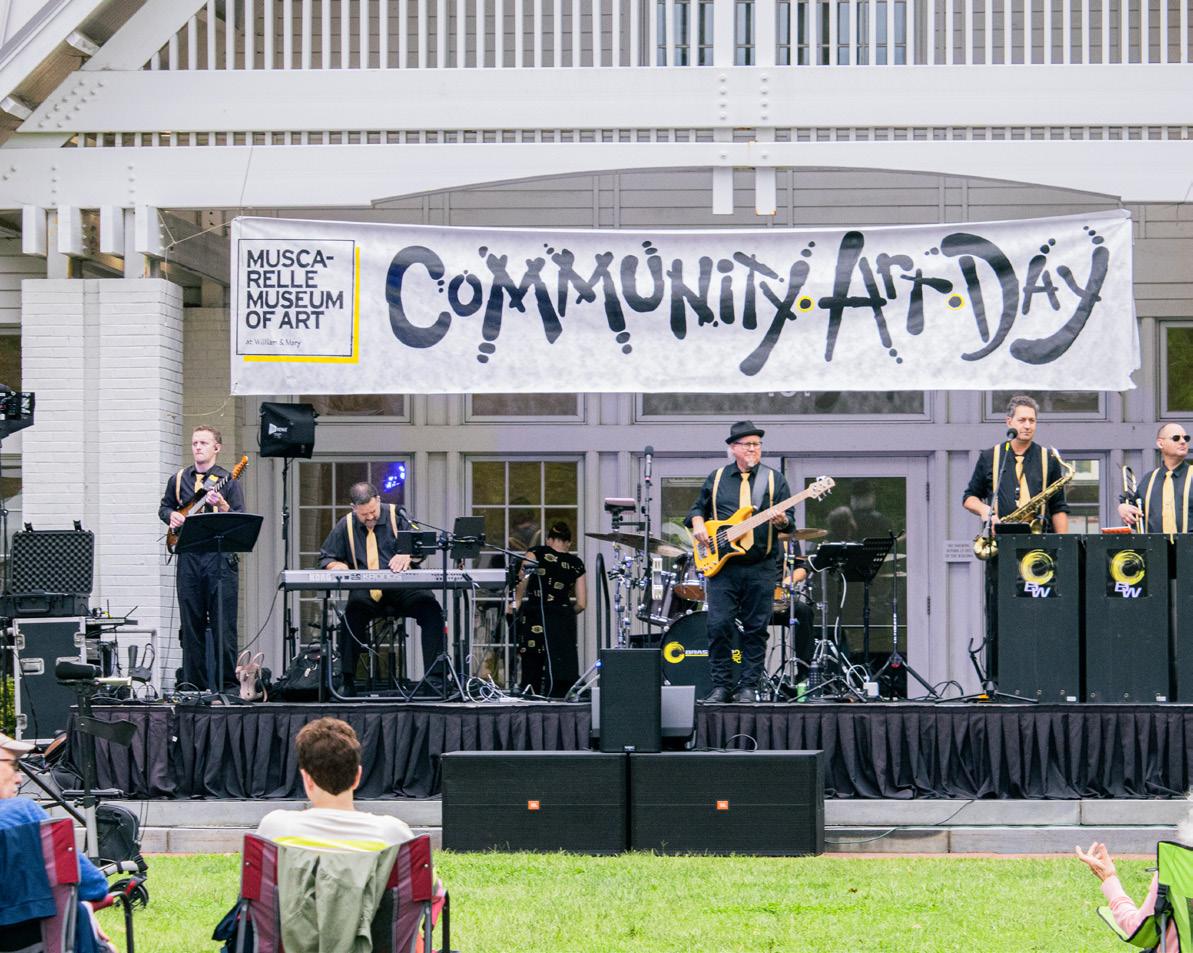

“We thought [having student artists] would be a really great way to get more students involved than just the people that work here and give them the opportunity to have a platform for the greater community space and then also entice more members of the William and Mary community to come out and see what we’re doing,” Saad said.
Inside the Williamsburg Community Building, the fun continued. Visitors of all ages took part in coloring page activities based on the various works from the Muscarelle collection, and attendees were also encouraged to embellish tote bags featuring a Steve Prince design using fabric markers that were provided by the event organizers.
“It’s hard to say no to a free tote bag,” Tucker said, and it is clear the Williamsburg community agreed.
| Wednesday, October 11, 2023 | Page 7 variety THE FLAT HAT Variety Editor Agavni Mehrabi Variety Editor Miles Mortimer flathat.variety@gmail.com // @theflathat RYAN GOODMAN / THE FLAT HAT
LORENZO SHORT // THE FLAT HAT
GRAPHIC BY / CATHERINE STORKE
Hosting the harvest
Friday, Oct. 6, the College of William and Mary’s Chinese Student Organization hosted its annual Harvest Moon Festival in Sadler Center’s Commonwealth Auditorium that included performances and dances. e show, titled “Harry Peng and the Deadly Suns,” was followed by a catered dinner from Peter Chang.

e Harvest Moon Festival, also referred to as the Moon or Mid-Autumn Festival, takes place on the 15th day of the eighth month of the lunar calendar year. It is a traditional Chinese celebration that focuses on honoring the harvest moon in hopes of promising a good yield of crops. It is also a time for reuniting with family, gazing at the moon and eating delicious mooncakes, a rich Chinese pastry with di erent llings that are typically sweet. is festival is also celebrated by other East and Southeast Asian cultures under di erent names, such as the Chuseok festival in Korea.
CSO president Vanessa Yen ’26 expressed pride for the show’s inclusivity as she says it allowed students from all di erent backgrounds to learn and experience some of the traditions, cultures and myths that make up Chinese culture.


“It doesn’t matter what race you are, it doesn’t matter what language you speak at all,” Yen said. “[ e show is] open, and it should be accessible to everybody because in the end, it’s an appreciation of culture. It doesn’t matter. Whatever knowledge you came in with, whatever language you came in with, it’s just meant for everybody.”
For this year, the CSO decided to adapt elements of the popular Chinese folk tale of Cháng’é and Hou Yi into the well-known 2009 Harry Potter book, “Harry Potter and the Deathly Hallows.”
Co-culture chair Sophia Caldarone ’24 commented on the intricate planning process that took place months before the show and how the cultural chairs’ love for the Harry Potter book series came into play for their nal decision for the show’s theme.
Another element that influenced their choice was the popularity and recognizability that the Harry Potter saga
carries as Caldarone noted it was important that they made the Chinese myth behind the festival accessible and understandable for everyone in the audience.
“We’re just trying to get people interested in the cultural history of the Harvest Moon Festival,” Caldarone said. “Relating it to popular media has always been something we’ve done before. Last year, we did Percy
Aakash Vittala ’27. Audience members follow the trio of Hermoine, Ron and Harry Peng as they go an adventure to try and eliminate the horcruxes — or in this case, the suns — which Voldemort places fragments of his soul into in exchange for immortality as long as these objects are not destroyed. Within its storyline, the show also featured a
opportunities to not only pick up new skills, but also make new friends.
“Training was really fun,” Yee said. “We would meet over the weekend and we would learn the choreography from Alice, it was a really great way to meet new people. Learning the dances was also really fun because it was a style of dance that I had never done before.”
Audience member Rachel Huang ’27 expressed particular appreciation for the dance performances, which stood out to her while watching the show.
“I liked all of the dance segments of the show,” Huang said. “I thought the show overall was really good, but my favorite part was de nitely all of the dance performances.”
“One of my friends is the performance chair, so she helped choreograph two of the dances, and one of my friends is acting, so I’m just very proud of them because they put a lot of work into it,” audience member Mia Hanlon ’25 echoed.
A touching moment near the end of the performance was when Lucius Malfoy, Draco’s father, accepted Draco’s rejection of his father’s future evil plans for him, which then allowed Draco to open up to his father about what he truly wanted to pursue in life: his love for Peng. e audience’s gushing and cheering following this scene resonated around the auditorium and returned at the end of the performance when all the cast and crew members went back on stage for nal bows.
At the conclusion of the show, Vittala fondly recounted his positive experiences rehearsing for the show and says his time with the CSO community has been one full of fun.
Jackson, so that’s why we chose Harry Potter because it’s also popular.”
e tale of Cháng’é was seamlessly incorporated into the plot of “Harry Potter and the Deathly Hallows” while also including LGBTQ+ themes. In the show, Draco Malfoy, played by Igor Gobulkov ’27, has a love interest that goes by the name of Harry Peng, played by
multitude of dances performed by di erent members of CSO as well as student-run dance crew Zodiacs. ese dances, choreographed by the CSO performance chair Alice Ji ’26, ranged from modern to traditional, with energetic fan dances and graceful water sleeve dances. CSO member and dance performer Clare Yee ’27 described how preparation for the show gave her ample
“It’s de nitely been an adventure, especially because a lot of our rehearsals will be from 9 to 11 [p.m.] or so,” Vittala said. “But genuinely, I think it’s been some of the best times I have had on campus. Everyone is very welcoming, everyone is very goofy, it’s very funny, so it makes it a good time. You forget how much time has actually passed when you’re performing and rehearsing, so I’ve had a blast at rehearsals.”
CONFRONTING THE CRISIS
With temperatures and sea levels rising worldwide, the entire world is seeing the effects of global climate change. However, despite global warming negatively impacting everyone, minorities and those of lower socioeconomic status are often the ones bearing the brunt of global warming’s adverse effects. Often residing in neighborhoods near sites of immense environmental damage with reduced exposure to green areas like parks and nature reserves, those of lower socioeconomic status disproportionately experience environmental injustice.
However, at the College of William and Mary, Minorities Against the Climate Crisis is taking action to support and bring awareness to minority communities experiencing these climate injustices. Ethan Stewart ’25, the president and founder of the club, said he started the organization to educate others and investigate solutions that could alleviate the disparate impact of climate change on socioeconomically disadvantaged communities.
“I’m very passionate about the planet and the people on it,” Stewart said. “I see a lot of misinformation that goes around the climate crisis, it’s a mix of ignorance and also not understanding the true e ects of it. e main e ect is going to be on people who look like me, a lot of our friends and our families.”
Stewart said that as a biology and environmental science double major, he always wanted to start a science-based club on campus and had consulted some of his professors to help him hone in on a focus for his organization. He ultimately decided to have the club spotlight climate change as he wanted to combat the misinformation, nihilism and apathy that he saw surrounding the topic.
“It’s important to understand the e ects of where the world is going to go because I live here,” Stewart said. “I happen to exist on this planet, and I’d like to keep existing on this planet in a very comfortable way. And that can only be done through proper education, community organization and through proper discipline and training.”
Club secretary Isha Alaina Tubera ’26 explained that one of the strategies the club uses to meet this goal of education and training are informational presentations. Each of the club’s general body meetings typically revolves around an executive
HANNAH SAWYER // THE FLAT HAT
board member giving a presentation on a topic related to the climate crisis in hopes of more meaningfully motivating other students to make a di erence in their communities, she says.
In addition to raising awareness through education, Stewart also identi ed community building as a key goal of the organization.
“One of our main priorities is to basically teach or bring back the idea of forming proper human connections beyond just living close to each other, like the social sphere of actually creating community coming together commonly to talk, to discuss, to have fun, to raise hope,” Stewart said. “Because beyond just the fundraising aspect — which you need to do
and also being bought out by foreign companies cutting out beaches that my grandmother, my mother used to go that now I can’t go to,” Stewart said. “ e shing villages were being submerged in the water, and people were sleeping when stu like that happened. I’ve seen that globally that people are losing their homelands, their connections with the planet and their environment. It sickens me because I believe humans are animals who are part of the world, and I think we should be allowed to enjoy our world and not have to watch it su er. Many of my grandparents, my aunties, my uncles, my mother and my family no longer have the same world that they used to live in.”
reaching out to local conservation houses as they work to build a food forest, or a garden made up of trees that provides communities with nuts and berries while simultaneously improving air quality in a local underprivileged community.
is focus on the climate inequalities faced by minority groups and the actionable steps they are taking to combat these issues are what sets it apart from other environmental groups on campus, Tubera says.
“I think when it comes to the climate crisis, there’s very broad goals,” Tubera said. “Because there’s this focus, I think [MACC] brings light to the people and these marginalized communities that are going to be a ected.”
is sentiment rang true for club member Molly Edmonds ’27, who said she was drawn to the club because she recognized the importance of MACC as both a safe space and platform for minorities and their perspectives.
“I know a lot of minorities don’t feel comfortable being in clubs that are mostly white people because they just can’t relate to them at all,” Edmonds said. “I think this club has a lot of minorities in it … so I think [MACC] makes them feel more comfortable so that way they can share their opinions and views instead of their voices getting drowned out.”
Tubera said that it is important for college students to take climate change prevention into their own hands. She added that students being more aware of the actions they take in their daily lives and their carbon footprint can be one of the rst steps to alleviating damage done by global warming.
“Even though the news is saying all this stu , and it feels like we’re in impending doom, we still can still make change,” Tubera said. “Change really just starts in our own backyard.”
because it’s important to raise money for these issues — it’s also important to create a long lasting community of people that understand the effects and how they can work together.”
For Tubera and Stewart, the ght against the climate crisis is a personal one. e two have family in the Philippines and Jamaica, respectively, who they say have been facing worsening storms and ooding as a result of global climate change.
“I lived in Jamaica originally. It’s an island nation, and we do experience water levels rising
e club hopes to take on larger projects in the future, but as a new organization at the College, they are mainly seeking to build up their impact on campus by getting involved with local projects and by partnering with other groups on campus.
For instance, MACC, along with the Filipino American Student Association, the Asian American Student Initiative and the People of Color Art Collective, hosted a table in the Sadler Center Atrium to collect donations to support those a ected by the Maui wild res Sept. 19 and 20. Tubera also noted that the club has been

Tubera said that many new students and other prospective members attended the rst meeting, so she hopes the club is able to grow in size in the future. She also noted that she is proud of the work that Stewart has done to build the club from the ground up.
“We had a good turnout. I’m very, very pleased. I’m so proud of Ethan because it’s his vision come to life, being able to recruit many people, especially a lot of freshmen,” Tubera said. “I’m very excited to see where the club goes, because I know that there are a lot of other people who are very passionate about this.”
THE FLAT HAT Wednesday, October 11, 2023 Page 8
MARY LOYOLA-GOMEZ // THE FLAT HAT
COURTESY IMAGE / KARA PARK
Minorities Against Climate Crisis takes action against global climate change, its affects on disadvantaged communities
Chinese Student Organization hosts its annual Harvest Moon Festival entitled “Harry Peng and the Deadly Suns”COURTESY IMAGES / REENIE TIAN Members of People of Color Art Collective are pictured tabling at a Maui fire fundraiser, which MACC helped host to support those affected by the fire.
Tribe finishes three game homestand on high note after dropping first two William and Mary overpowers Georgetown in 4-1 victory
Sunday, Oct. 8, William and Mary field hockey (5-6, 3-1 CAA) defeated Georgetown (1-12, 0-4 Big East) 4-1 in dominant fashion.


Prior to Sunday afternoon’s matchup, the Tribe lost 1-0 to Coastal Athletic Association opponent Hofstra (5-7, 1-2 CAA) Oct. 6. Although the match went scoreless for 80 minutes, visiting side Hofstra overcame William and Mary in a 4-2 shootout.
The Tribe looked to recover in the final game of its three game homestand against the opposing Hoyas. Sunday’s game marked the eighth meeting between William and Mary and Georgetown, with the Tribe boasting a 7-1 historic record against the visitors from Washington, D.C.
The Tribe’s continued dominance against Georgetown actualized almost immediately with a sixth-minute goal from graduate student midfielder/forward Lauren Curran. Assisted by
senior midfielder Jayden Moon, Curran connected on a clinical finish into the side board, marking her fourth goal of the season. The Hoyas evened the score with a goal from junior midfielder/forward Emma van der Veen, the lone Georgetown goal of the day. This score marked van der Veen’s second goal of the season.
William and Mary responded with a goal from junior midfielder/forward Sara Bartzen. With three minutes, seven seconds left in the second quarter, Curran aired a flashy pass over the Hoya defense and connected with Bartzen near the right end line. Bartzen controlled the ball and found the back of the goal to give the Tribe a 2-1 lead, recording her first collegiate goal.
With 18 seconds left in the first half, Georgetown received a penalty that resulted in a Tribe corner. Graduate student defender Audrey Domovich converted the scoring opportunity, finding the back of the goal for her first score of the game. Graduate student forward/midfielder Lonica McKinney and senior midfielder Maddie McGaughey received credit for the assist, their third and fourth of the season, respectively. William and Mary entered halftime with a 3-1 lead.
Exiting the locker room, the Tribe found itself with a scoring opportunity a mere 37 seconds into the second half.
FOOTBALL
After another Georgetown penalty, Curran stepped up to the penalty spot, burying her second goal of the match and teamleading fifth of the season. The Tribe maintained its 4-1 lead over the Hoyas for the remainder of the game, improving its season record to 5-6.
This game marked the fourth two-goal game of the season for a Tribe player and was Domovich’s second. William and Mary dominated the game statistically, as well, recording 13 shots, including nine on goal, compared to Georgetown’s nine total shots. The Tribe also held a 4-3 advantage in penalty corners, including the one Curran turned into a goal.

Senior goalkeeper Maddie George recorded six saves on the day, seeing 55 minutes of gametime before making way for freshman goalkeeper Alexandra de Jesus to play the final five minutes, 39 seconds.
The Tribe will look to continue its winning ways in a conference bout against CAA foe Drexel (9-4, 2-1 CAA) Friday, Oct. 13 at Buckley Field in Philadelphia, Pa.
Green and Goldʼs early lead falls apart, UVA secures first win of 2023 Tribe falls to Virginia in only FBS matchup of season, 27-13
Saturday, Oct. 7, William and Mary football (4-2, 2-1 CAA) lost a hardfought, out-ofconference matchup against University of Virginia (1-5, 0-2 ACC) 27-13 at Scott Stadium in Charlottesville, Va.
The Tribe traveled to Charlottesville on Saturday for the team’s only FBS matchup of the season, hoping to take down a Virginia team on the road that started off the season with five straight losses.
With Tribe fans flocking to Scott Stadium, William and Mary looked to defeat the neighboring Cavaliers for the first time since 2009.
After winning the coin toss and deferring the opening kick, the Tribe defense took the field looking to suppress UVA senior quarterback Tony Muskett and a dangerous UVA offense. Following a seven-yard rush from UVA senior running back Kobe Pace, Tribe senior defensive lineman Nate Lynn and junior outside linebacker John Pius responded with a menacing sack, forcing a loss of 10 yards and an intimidating fourth-and-13 situation for UVA. After a 32 yard punt, William and Mary’s offense took the field with optimal field position at its opponent 44-yard line.
Coming off of a loss to Elon the week before, the Tribe offense looked determined to cement a solid lead from the get-go on Saturday. Junior running back Malachi Imoh got the drive started with a shifty nine yard rush, which he then followed up with a five yard reception to move the chains for the Tribe. After gains from junior quarterback Hollis Mathis and redshirt freshman wide
receiver Carson Jenkins, senior kicker Caden Bonoffski connected on his first field goal of the day from 38 yards out to put the Tribe up 3-0.
UVA was quick to respond. Starting at its 31, the Cavaliers pushed down the field largely thanks to a 17 yard rush from sixth-year running back Perris Jones. After a seven yard completion from Muskett and another seven yard rush from Pace, sophomore kicker Will Bettridge lined-up and drilled a 45-yard field goal, evening the game at 3-3.
The Tribe offense kept its foot on the gas on the ensuing possession. Junior quarterback Darius Wilson attacked the Cavalier offense on the ground, rushing for 22 yards combined in two of the Tribe’s first plays of the drive. After a UVA personal foul and two Wilson and Imoh empty rush attempts, Bonoffski took the field again, this time from 48 yards out. Bonoffski, who has not missed a kick since the Tribe’s opening win against Campbell, drilled the field goal to set a new season long and put William and Mary back on top with just over a minute left in the quarter.
As the second quarter began, the Tribe defense wreaked havoc on the Cavaliers. After back-to-back penalties from both teams, Pius forced, recovered and returned a Muskett fumble for 57 yards to the Cavalier four-yard line.
The Tribe went back to the run game, this time utilizing Mathis and sophomore running back Martin Lucas on the carries. After three attempts at the goal line, Lucas finally found a gap to secure William and Mary’s first and only touchdown of the day. Bonoffski converted the extra point, and with just over 12 minutes left in the half, the Tribe held a commanding 13-3 lead over UVA.
Muskett, looking to bounce back from his score-allowing fumble the drive before, turned to his receivers for some much needed offensive production. In the first play of the drive, Muskett recorded a completion to junior wide receiver Malachi Fields for a 22 yard gain. Immediately after, Muskett completed a 17 yard pass to senior tight end Sackett Wood Jr., securing another Cavalier first down at the Tribe 27-yard line. After an incompletion and a 12 yard rush from Jones, Muskett returned to his run, this time finding the endzone. After a made extra point, the Cavaliers closed the gap to three, and with nine minutes, thirty seconds left in the second, the Tribe took control of the ball again.
its
the Tribe
After a quick three-and-out, UVA’s offense took the field again. Two plays after a 17yard completion to graduate student wide receiver Malik Washington and a Cavalier first down, Muskett unleashed a 42-yard bomb to Washington again, pushing the UVA offense to the Tribe 15-yard line. Despite a seven yard run from Pace, the Green and Gold defense was able to limit UVA’s damage to just a field goal, evening the score at 1313, with less than three minutes left to play.
After two three-and-outs from William and Mary and one from UVA, the Cavaliers’s offense took the field for its final time of the half with just 55 seconds left to play. Pace started the drive with another monster run, this time for 18 yards, while securing a commanding UVA first down. Immediately after the run, Muskett connected with freshman wide receiver Jaden Gibson for 16 more yards. After a 10 yard gain on the ground, Muskett found Washington for a quick nine yard gain, leaving just 11 seconds on the clock. From the 26-yard line, Muskett connected with Fields again for his first passing touchdown of the game, and with just seven seconds left in the half, UVA pulled ahead by seven.
In a matter of minutes, William and Mary found itself behind, after leading by 10 just minutes before.
The Tribe’s offense went silent in the third.
In its two offensive possessions, the Green and Gold went three-and-out and failed to convert on a fourth-and-two at the UVA eightyard line. Luckily, its defense kept the game close. In its first offensive possession of the half, the Cavaliers came out strong, marching
down the field leading to the Tribe’s 15-yard line. On a third-and-11, Muskett’s pass was broken up by senior cornerback Ryan Poole and intercepted by senior defensive back Malcolm Spencer, preventing a UVA score and preserving the lead to just seven going into the final 15 minutes.
UVA started the fourth quarter eager to put away the visiting Tribe. After converting two fourth-down attempts, Muskett connected with Washington again for another UVA touchdown, this time from 27 yards out. Bettridge drilled the extra point, and with just over 11 minutes left in the game, the Tribe found itself down 27-13 with time winding down. The Tribe offense looked to respond, but despite two more solid runs and a few short completions from Wilson, William and Mary’s progress halted on a fourth-and-four at the UVA 23-yard line with just under five minutes to play. UVA held the ball as the clock ran out, and as the game came to an end, the Cavaliers walked away with its first win of the season.
The Tribe was outmatched in almost every offensive statistic, including total rushing and passing yards (221 vs 147 and 232 vs. 72), first downs (27 vs. 15) and average yard per play (6.4 vs. 3.8).

Wilson finished Saturday’s game going 14-18 for 72 passing yards while rushing for a team-leading 74 yards. Mathis followed second in rushing yards, recording 44, while Lucas secured the Tribe’s only touchdown of the day.
William and Mary will look to right the ship Saturday, Oct. 21 against CAA opponent Towson (24, 1-2 CAA) at Zable Stadium in Williamsburg, Va.

sports | Wednesday, October 11, 2023 | Page 9 THE FLAT HAT
HOCKEY
FIELD
ETHAN QIN FLAT HAT SPORTS EDITOR
ANNA MCCLELLAN / THE FLAT HAT
Senior midfielder Maddie McGaughey pushes the ball up the field during the Tribeʼs win against Georgetown. McGaughey finished with an assist in the game.
Unlike
last offensive
found limited success on the field this
drive,
time.
MAX GRILL FLAT HAT SPORTS EDITOR
ANNA MCCLELLAN / THE FLAT HAT
The Tribeʼs defense kicked it back into gear on Saturday, only allowing one goal for the sixth time this season. William and Mary is 4-2 in those games.
