Phase One of Williamsburg African American Heritage Trail receives over $300,000 in funding
Jack Boyd ʼ23ʼs research, supported by Lemon Project grant, receives federal funding
History major Jack Boyd ’23 was approached by College of William and Mary Chancellor Professor of Biology and Director of the 1693 Scholars Program Dan Cristol in the spring of his freshman year with an opportunity to conduct oral histories in Williamsburg with Black elders and community members. The ultimate goal of this project was to see if community members would be interested in the construction of an African American Heritage Trail and to receive input about the erection of historical markers.
The suggestion came at the behest of Williamsburg City Councilmen Caleb Rogers, who previously recognized the City’s interest in an African American Heritage Trail within the City Council’s 2020 Goals, Initiatives, and Outcomes — a two-year plan that culminates in various goals for the city government. Rogers worked with Cristol and the Roy R. Charles Center to create a City Scholars Initiative which is a partnership between the City and the College to sponsor student research.
“The solution was right in front of us, you could say, by outsourcing this project to a William and Mary student who could work on it full time over the course of, in this case, a summer talk to descendant community members, learn about areas of the city worthy of recognition, and then actually put together the first draft of what a trail could look like,” Rogers said.
With the help of the Lemon Project Gaither-Johnson Summer Research Grant, Boyd interviewed over 20 Williamsburg community members throughout the summer of 2021 about their personal experiences, as well as their knowledge of the broader history of the area. He began by sitting down with assistant professor of history and Robert Francis Engs Director of The Lemon Project Dr. Jody Allen to finalize a list of five to six community members with broader connections. He then presented an initial strategic plan for the Williamsburg African American Heritage Trail in September 2023.
“I’ll admit, I was not expecting anything to come of this,” Boyd said. “I just couldn’t imagine that a 19 year old’s little position paper meant anything, you know, to anyone.
HENRY // FLAT HAT NEWS EDITOR
And so I just moved on. I never touched it again. And then, you know, six months later, I got a text from Caleb and it was like, ‘Hey, you know, we submitted it for this grant.’”
After the release of Boyd’s initial report, Rogers worked with former Congresswoman Elaine Luria to include the heritage trail in a portion of the federal budget. In January 2023, Phase One of the project was approved by the federal government for $357,000 in federal funding. This money is allocated to build a trailhead, the first part of the trail and a public restroom between Lafayette Street and Virginia Avenue.
College Landing on Jamestown Road and Braxton Court. He selected these sites based on specific criteria, including the site’s proximity, relevance to one of four topics — commerce, education, faith and leisure—and significance in themes of oppression versus joy and endurance versus accomplishment.
“Through a series of conversations with community members, dutifully chronicled and presented here as attachments, I was introduced to a plethora of sites, stories, and persons,” Boyd wrote in his report. “I should note, however, that in my position as a student researcher — rather than a stakeholder — my hope is not for this report to serve as a zenith, but rather as a foundational building block. This strategic plan is a touchpoint from whence the City Council, in tandem with the Black community and tourism leaders, can designate a trail that best serves all interested parties.”
Associate professor of English & American studies Arthur Knight mentioned that oral histories contribute immensely to projects such as this and are capable of creating alternative research methods that are accessible to many people.
“I know the student, Jack Boyd, feels really good about it, having spent a whole summer working hard, like many researchers, but not knowing if his findings would make a difference or see the light of day,” Cristol wrote in an email to The Flat Hat. “Now they are going to affect thousands, maybe eventually millions of visitor experiences. And lots of almost forgotten people and places will now be better known. That’s a big deal for a student researcher.”
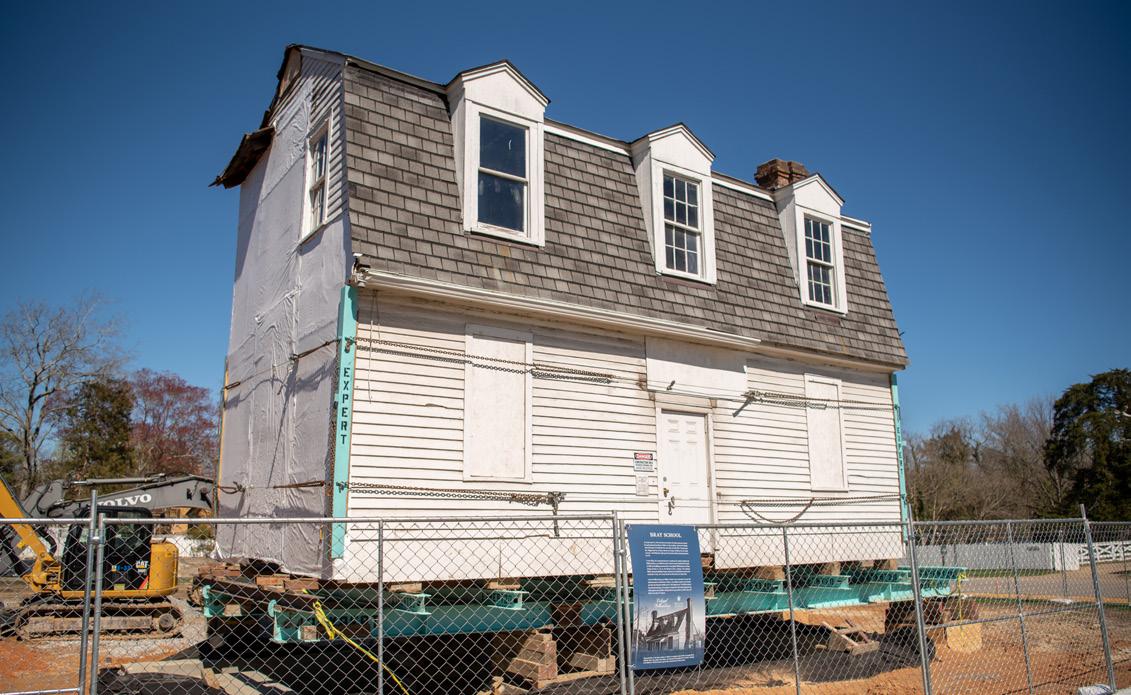
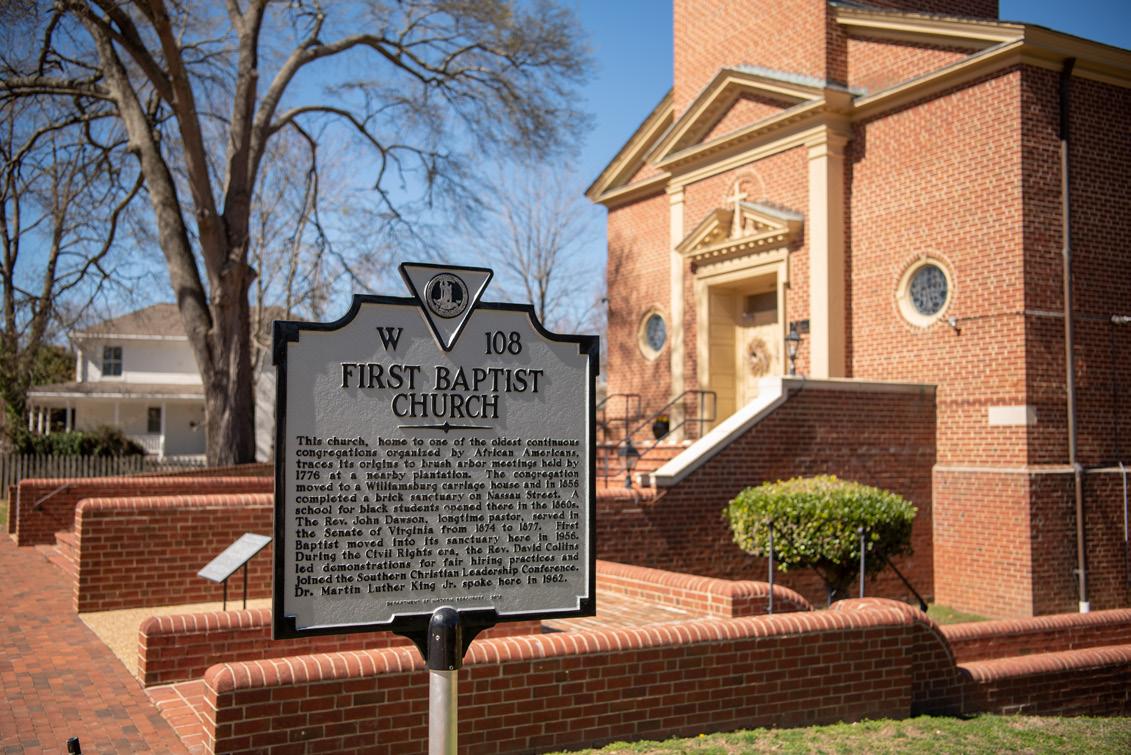
In Boyd’s initial report, he identified 25 Williamsburg sites within walking distance, including the First Baptist Church, MLK Jr. Memorial in the Triangle, the Bray School,

“It gets students to talk to people and encourages them to understand research as not only ‘text’ or ‘material’ or ‘data’ based,” Knight wrote in an email to The Flat Hat. “Oral history is socio-culturalhistorical research where the ‘subject’ (a word that often gets used in research, but not oral history!) profoundly shapes the research, not just the researcher. And oral history is an important way of enriching the historical record — of getting information and ideas about the past that are not available in print materials and conventional, official archives.”
Knight is also the former director of the Williamsburg Documentary Project, which was founded through the College’s American studies program. This project allows students to interact with the local community and get practical research experience. Knight discussed the importance of recording Williamsburg’s post-colonial history.
housing until Aug 1.
Thursday, Feb. 16, 548
upperclassmen who applied for on-campus housing received notice from Residence Life that the College of William and Mary could not guarantee them a room for the 2023-2024 academic year. While the College guarantees housing for freshmen and sophomores because they must live on campus, many juniors and seniors are on a waitlist hoping for a spot.
As the College moves forward with its 10 year comprehensive plan to renew campus facilities, on-campus housing capacity will fluctuate, particularly in the initial years of the project. These fluctuations, as well as recent increases in enrollment, have placed a strain on Residence Life’s ability to meet student demand.
After a decade of consistently low numbers of wait-listed students, Residence Life placed more than 500 upperclassmen on the wait list in each of the past two years.
“While we cannot guarantee that all students initially placed on the housing waitlist will eventually be offered on-campus housing, in past years we have been able to house all students who actively remained on the waitlist,” Director of Housing and Residence Life Harriet Kandell said. Students have the option to either withdraw from the waitlist, or remain in a lottery to receive
In 2019, Residence Life announced that, beginning with the class of 2023, incoming firstyear students would be required to live on campus for their freshman and sophomore year. Only firstyear students were required to live on campus prior to this mandate. Residence Life hoped this change would provide more support to students during their transition from freshman year to sophomore year.
Last April, the College unveiled its 10-year plan to renovate or replace current student housing and dining facilities. Over three phases, the plan will demolish 45% of student housing. Additionally, 35% of residence buildings will undergo some degree of renovation. The plan does not expect to change the total capacity of on-campus housing, which is around 5,000 beds.
Phase One includes the demolition of Yates Hall, Green and Gold Village and Commons Dining Hall. Yates is scheduled to be demolished in summer 2023. The first phase also includes major renovations to Old Dominion Hall and Monroe Hall. To accommodate for the loss in beds from Yates and Monroe for the class of 2027, DuPont Hall (which currently houses primarily sophomores) will become a freshman dorm starting in fall 2023.
Phase One includes plans for West Campus Dining hall, which will replace Commons. The Campus Center site is also set to close for new construction.
The housing updates aim to provide every
Rotten, Rancid, Ruinous Apples
Lauren Meyer ’ 24 argues that, while apples are a favorite snack, they have one fatal flaw: mealiness

student with a fully air conditioned and ventilated bedroom. The average age of housing buildings across campus will reduce from 54 years to 10 years. Upon completion of the plan, 50% of housing at the College will be new, and another 30% will be recently renovated.
In the past year, the College has adjusted and delayed its housing projects to accommodate for the number of students who want to live on campus. December 2021, residents of One Tribe Place, an upperclassmen residence hall with four floors of single and double rooms, received notification that the building was to close for the 2022-2023 academic year due to structural deterioration and a planned demolition of unused space in the building. The College subsequently reversed its decision due to higher than expected demand for housing.
Increased undergraduate enrollment over the last two years may contribute to the imbalance between housing capacity and demand for oncampus housing.
Many students have expressed frustration and disappointment with the College’s handling of the waitlist. Paola Gonzalez ’25 is one of over 500 students on the waitlist for on-campus housing next year.
“I think the waiting list definitely needs to be restructured to take into consideration FGLI [First Generation Low Income] and out-of-state students,” Gonzalez said.
Currently, the College is offering students on the waitlist a chance to enter a random drawing for housing as it becomes available. The waitlist does not take financial need into consideration.
“I sent [Residence Life] an email voicing my concerns about being able to afford off-campus housing, and they sent me back an automated response that did not give me any clear answer,” Gonzalez said. “In fact, the email said that if I was anxious about the uncertainty of getting on campus housing, I should cancel my housing contract and try to find off-campus housing, despite me clearly stating in the email that I could not afford it.”
While some financial aid refunds are available for students living off campus, these refunds are not available to students who do not have financial aid packages which cover full tuition and fees. The refunds also only cover nine months, while many off-campus apartments require a full 12 month lease.
The Residence Life website currently directs students to a number of off-campus housing resources, including wmoffcampus.com, a website specifically created for student accommodations. It also recommends accessing the “College of William and Mary Housing, Sublets and Roommates” Facebook Group, a private group where members can offer and request housing options.
Inside Variety
- Professor Dan Cristol
page 6 INDEX Pro le News Opinion Variety Sports 2 3-4 5-6 7-8 9-10
Inside Opinions
LISA COLEMAN FLAT HAT DATA EDITOR HOUSING Inside Sports Foam Filled Feuds Club presidents battle one another in President’s Day Tournament hosted by Nerf Club, Climbing Club takes victory page 7 Tribe Athletics committed to student-athlete mental wellness Athletics department staff, athletes prioritize mental health conversations page 9 The College of William and Maryʼs 10-year comprehensive plan has put strains on Residence Lifeʼs near-term
demand EMMA
548 upperclassmen placed on waitlist, second year in a row with 500+ waitlisted students PHOTOS OF HERITAGE TRAIL LANDMARKS BY JUSTIN SHERLOCK / THE FLAT HAT T HE F LAT H AT Vol. 113, Iss. 2 | Wednesday, March 8, 2023 The Weekly Student Newspaper of The College of William and Mary flathatnews.com | @theflathat
ability to satisfy
LULU DAWES / FLAT HAT EDITOR-IN-CHIEF “ ” They are going to a ect thousands, maybe eventually millions of visitor experiences. And lots of almost forgotten people and places will now be better known. That’s a big deal for a student researcher.”
Bray-Diggs House
First Baptist Church
READ MORE AT FLATHATNEWS.COM READ MORE AT FLATHATNEWS.COM
Hearth: Memorial to the Enslaved
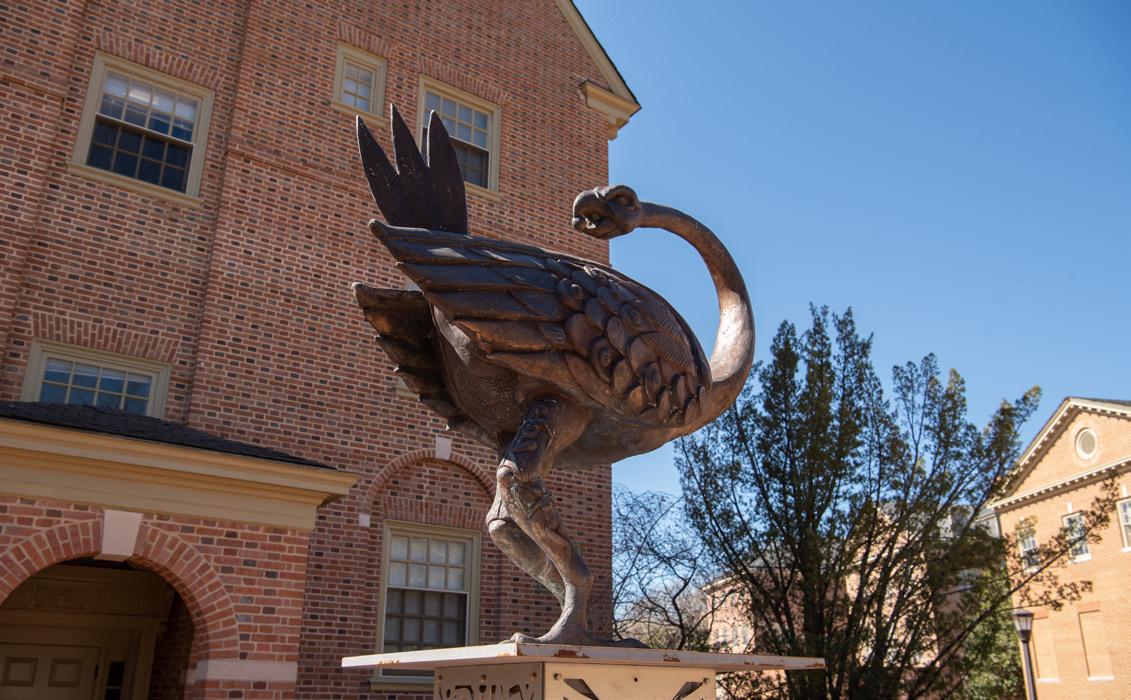
Sankofa Seed Statue
College extends test-optional policy indefinitely
Wednesday, Mar. 1, the College of William and Mary announced it will be indefinitely continuing its test-optional admissions policy for undergraduate applicants. This decision follows the conclusion of a three-year pilot program that first went into effect in 2020 during the COVID-19 pandemic, which prevented some students from taking in-person standardized tests.
The Collegeʼs Office of Institutional Research reviewed data on academic success and retention of College applicants and found no significant difference between the cohort of students providing standardized test scores and those who did not. The latter cohort made up 34% of the latest class of applicants according to the Collegeʼs announcement.
The Admission Policy Advisory Committee, chaired by Professor Michael R. Halleran, also reviewed the data and supported Associate Vice President for Enrollment and Dean of Admission Tim Wolfeʼs recommendation to indefinitely continue the policy.
“As we found through the pilot, we continue to enroll highly qualified students ‒ with or without a standardized test score ‒ capable of succeeding academically and in contributing to the William and Mary community,” Wolfe said, addressing the Collegeʼs public announcement regarding the change.
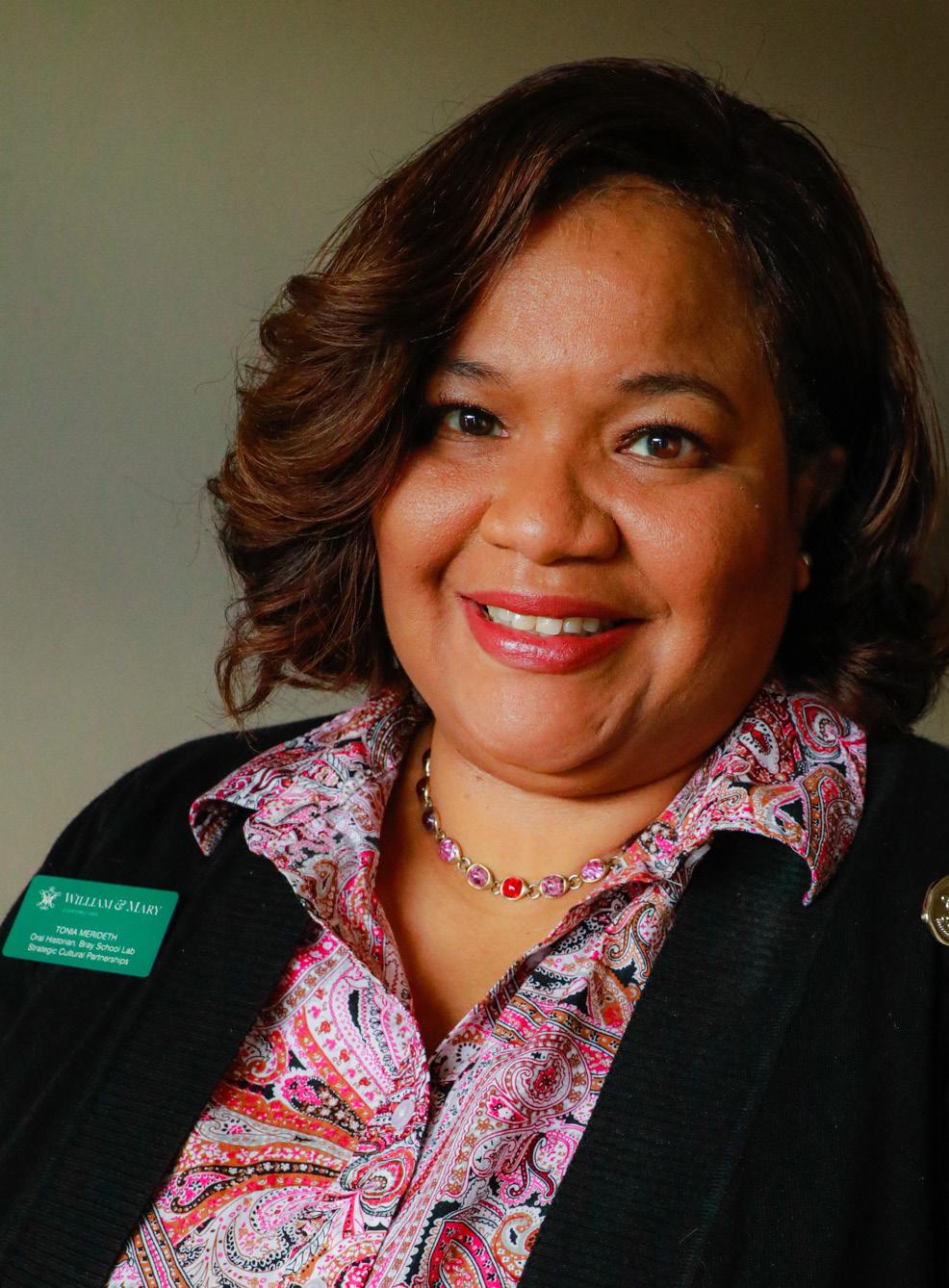
e Associates of Dr. Bray, a philanthropic Anglican organization, established the Williamsburg Bray School to educate free and enslaved African American children between 1760 and 1774. e school’s complicated legacy is one that Oral Historian Tonia Merideth investigates in the College of William and Mary Bray School Lab. e purpose of the school was to educate the enslaved and indigenous in the teachings of the Church of England,” Merideth said. “But the other purpose of the school was to indoctrinate into the enslaved children that their life was meant to be a life of slavery, and that hopefully the school would help them to accept that station and not rebel against the practice of slavery.
Working with the College’s Bray School Lab, Merideth talks to descendants of original Bray attendees to track the students’ histories. She rst learned about the Bray School on a trip to Williamsburg. Her discovery of the school led her to challenge notions she had previously learned regarding the education of enslaved people
“I was taught that slaves were not taught to read and write, they were illiterate,” Merideth said. “I have a picture of it that I took 10 years ago of the school and posted it on Facebook like, ‘I found the Bray!’ because what that school represented to me was a complete reversal of everything that I had been taught about my ancestors.”
Merideth’s research holds a personal connection to the Bray School; her fourth great grandfather was Ellison Armistead, who sent one of his enslaved children, Locust, to study at the Bray School in 1762. Finding this link to the research material strengthened her resolve to study the history of the Bray School.
“Even before I knew that I was descended, descended from the families, I still felt a part of the descendant community — I felt like my ancestors were in that building,” Merideth said. “Getting the a rmation that I was a descendant community because I was descended from the line of those families made me want to participate even more, not just for myself, but also to encourage other descended community members to take advantage of participating in the project, and getting a chance to honor our ancestors.”
As Oral Historian, Merideth often nds it di cult to follow the
stories of enslaved people, as they were not usually in records by a traceable name prior to 1870.
“The challenge for the Bray students is that it’s just a first name,” Merideth said. “Many times when slaves were sold to other enslavers, that newest owner would change their name, so it’s a possibility that some of these slaves, if they were sold, they may not have the same name they had on that school list.”
Despite these di culties with tracking relatives, Merideth describes her overall experience with the Bray School as positive and rewarding. “ ere is still work to be done, because some descendants are hesitant to engage in a project that reminds them that their ancestors were slaves,” Merideth said. “ at’s where we have to approach them with the thought that this isn’t really about trying to remind you of a painful event, but hopefully that you’ll engage in a project that can honor your ancestors.
Outside of her work at the Bray School, Merideth is an avid traveler, visiting locations around the United States and Italy. She plans to tour Africa soon to visit important landmarks in the history of the slave trade.

“I’m hoping to go to Ghana — that is where the largest slave trading castle was, the Elmina Castle,” Merideth said. “I know it will probably be a very emotional trip. I’m hoping to go to Ghana, Nigeria, the Congo — that is the area where the majority of slaves were brought from.”
Merideth hopes that her work illuminates the history and experiences of the Bray School scholars for future generations.
“We want people to understand what those scholars’ lives were like,” Merideth said. “As they sat in that school room and looked out the rear window, they saw the Wren building in the back. Just think about the fact that there’s no way they could have known that one day that building that was restricted to them would include their descendants.… you may have noticed in my email signature it says, ‘I am my ancestors’ wildest dreams.’ Because they could have never imagined in their wildest dreams that their descendants would be attending William and Mary and doing some of the wonderful things that their descendants are doing. So that’s the takeaway I want people to have about this story.”
begins, contributes to goals of Vision 2026
Monday, Feb. 13, workers erected the construction fence marking the grounds of the Integrated Science Center Phase IV construction area. e area between Earl Gregg Swem Library and the existing Integrated Science Complex is expected to be closed to pedestrians until Aug. 1, 2025 as ISC IV undergoes its $94,300,000 construction project.
Phase IV of the Integrated Science Complex will accommodate several STEM academic disciplines, including Mathematics, Computer Science, Kinesiology, Design and Engineering.
College Provost Peggy Agouris wrote in an email to e Flat Hat that the ISC IV project contributes to all three of the College’s goals of Vision 2026: expanding the College’s reach, educating for impact and evolving to excel.
“Vision 2026 includes e orts to o er students expanded options in computing and information sciences, applied science and engineering and to modernize campus so that our people thrive,” Agouris wrote in an email to e Flat Hat. “ is project helps to further that work by bringing
computer science, math, applied science and design/engineering courses under one roof where they can collaborate and o er new opportunities for learning and research in computational sciences in general. is is an entire ISC complex designed to promote collaboration and fresh connections.”
ISC IV initially entered the preplanning stage of the College of William and Mary Board of Visitors Committee on Administration, Buildings and Grounds in November 2017. Building committee meetings and initial designs for ISC IV began in October 2018. e construction of ISC IV began nearly 15 years after the 2008 ribbon cutting ceremony of Phase I of ISC.
Agouris spoke on how the various phases of the Integrated Science Complex have helped improve the STEM program and overall education at the College.
“ e existing phases and integration have replaced outdated facilities and promote the cross-pollination of ideas and disciplines for students and faculty both in the sciences and in other areas,” Agouris wrote. “ISC has elevated the university’s ability to educate for impact in the modern world, and it has helped William & Mary continue to attract the best students from around the world.”
Architectural rms Goody Clancy and Baskervill are collaborating to lead the architectural design of ISC IV, along with Senior Project Manager Adam Witkowski. Witkowski noted how the new building is expected to be seamlessly integrated into the architectural design of the College’s campus.
“ e architects took many di erent aspects from di erent types of buildings on campus,” Witkowski said. “ ey took inspiration from 1920s buildings and the details around the Sunken Garden, as well as the di erent parts of ISC I, II and III. So from a visual and architectural standpoint, we want ISC IV to look like it belongs with ISC I, II and III and make it a complex of buildings instead of individual buildings.”
Witkowski also described the rooms and spaces that students should expect when the building opens in 2025, including large makerspaces, server rooms, computer labs, lecture halls, classrooms, study spaces, theaters and an outdoor courtyard.
“You’re going to have outdoor spaces, you’re going to have indoor private and public spaces. It’s going to be a vast range of di erent types of areas where students can learn and congregate and just enjoy the building,” Witkowski said.
“ “ THE BUZZ THE FLAT HAT | Wednesday, March 8, 2023 | Page 2 News Editor Abigail Connelly News Editor Emma Henry News Editor Daniel Kalish fhnews@gmail.com CORRECTIONS e Flat Hat wishes to correct any fact printed incorrectly. Corrections may be submitted in email to the editor of the section in which the incorrect information was printed. Requests for corrections will be accepted at any time. news insight
Weʼre the ones that call the police because weʼre uncomfortable with unhoused people... Weʼre uncomfortable with disorder. Weʼre the ones basically criminalizing poverty, criminalizing disorder, criminalizing race. Itʼs all on us.
̶ Brandon Hasbrouck, Associate Professor of Law at Washington and Lee University
Oral Historian Tonia Merideth works with Bray School Lab, unravels schoolʼs complicated legacy
COURTESY PHOTO / RYAN GOODMAN
“We want people to undesrtand what those scholars’ lives were like”
FLAT HAT NEWS BRIEF
AAFREEN ALI // FLAT HAT NEWS ASSOC. EDITOR
COURTESY PHOTO / TONIA MERIDETH
Zach Lutzky Photos Assoc. Editor
The Bray School was founded in 1760 and edcuated free and enslaved schoolchildren.
Construction project estimated to finish fall of 2025, complex to house several STEM disciplines ISC IV Project
MOLLY PARKS FLAT HAT EDITOR-IN-CHIEF Molly Parks Editor-in-Chief Jake Forbes Managing Editor Vivian Hoang Executive Editor Adam Jutt Digital Media Editor T HE F LAT H AT ʻSTABILITAS ET FIDESʼ | ESTABLISHED OCT. 3, 1911 200 Stadium Drive, The College of William and Mary, Williamsburg, Va. 23185 Abigail Connelly News Editor Emma Henry News Editor Daniel Kalish News Editor Miles Mortimer Variety Editor Agavni Mehrabi Variety Editor Ethan Qin Sports Editor Max Grill Sports Editor Avi Joshi Opinons Editor Mollie Shifflet Opinions Editor Chris Schneider Videos Editor Lisa Coleman Data Editor Camila Anderson Social Media Editor Karis Koutsourelakis Social Media Editor Yelena Fleming Graphics, Podcast Editor Ryan Goodman Photos Editor Crystal Wang Copy Chief Hannah Ray Chief Staff Writer Betsy Mahoney Chief Staff Writer Editor flathat.editor@gmail.com Managing flathat.managing@gmail.com Executive flathat.executive@gmail.com Magazine editor@flathatmagazine.com News fhnews@gmail.com Sports flathatsports@gmail.com Copy flathatcopy@gmail.com Opinions fhopinions@gmail.com Variety flathat.variety@gmail.com Photos flathatphotos@gmail.com Online flathatonline@gmail.com Advertising flathatads@gmail.com Graphics flathat.art@gmail.com Ombudsman flathat.ombuds@gmail.com Veronica Bondi Copy Editor Anu Desai Copy Editor Anastasia Rubis Copy Editor Annabelle Glassman Copy Editor Maddie Harris Copy Editor Caitlin Noe Copy Editor Joe Wehmeyer News Assoc. Editor Aafreen Ali News Assoc. Editor Sonia Samantaroy News Assoc. Editor Ian Harmon News Assoc. Editor Peerawut Ruangsawasdi News Assoc. Editor Grace Martin News Assoc. Editor Grace Saunders Variety Assoc. Editor Summer King Variety Assoc. Editor Lindi Li Variery Assoc. Editor Phebe Fahmy Variety Assoc. Editor Emma Halman Variety Assoc. Editor Ava Edwards Variety Assoc. Editor Ashley Cohen Variety Assoc. Editor Gabriel Black-Planas Chief Features Writer John Powers Opinions Assoc. Editor Ellie Kurlander Opinions Assoc. Editor Lauren Meyer Opinions Assoc. Editor Bushra Bablu Opinions Assoc. Editor Damien Kanner-Bitetti Opinions Assoc. Editor Samuel Li Photos Assoc. Editor Justin Sherlock Photos Assoc. Editor Elliott Lee Chief Sports Writer, Photos Assoc. Editor Ryan Cody Sports Assoc. Editor Catherine Storke Graphics Assoc. Editor Jonah Randell Ombuds Assoc. Editor Nora Keely Ombuds Assoc. Editor Shradha Dinesh Data Assoc. Editor Abhayprad Jha Data Assoc. Editor Jenine Samara Podcast Assoc. Editor Maddie Cassidy Fact Checker Alisha Khodabocus Fact Checker Jana Smith-Perry Fact Checker Myles Rescher Business Manager Sarah Devendorf Standards Editor Anna Arnsberger Operations Coordinator Ryan Leventhal Webmaster CAMPUS READ MORE AT FLATHATNEWS.COM A THOUSAND WORDS READ MORE AT FLATHATNEWS.COM DANIEL KALISH // FLAT HAT NEWS EDITOR
VOX hosts sex re-education event in Sadler, celebrates student turnout
Planned Parenthood Generation Action hosts annual event featuring student speakers, youth activists
and myths surrounding sexual experiences.
“Virginity is a myth itself, it’s a construct, and traditionally it’s someone who has never had penetrative sex,” Cressy said. “It’s just up to you, and there’s no inherent shame in either being a
Content warning: this article discusses sexual assault
Tuesday, Feb. 28, the College of William and Mary’s VOX: Planned Parenthood Generation Action hosted their annual sex reeducation event in Sadler Tidewater A. VOX is a student-run organization that emphasizes pro-abortion and intersectional feminist viewpoints. The organization is a branch of Planned Parenthood’s youth activists that vouches for reproductive rights and accurate sexual education across the country. The event featured multiple student speakers and in cluded audience participation.
VOX President Becca Gaylin ’23 introduced the event and began with an overview of the presentation’s topics, which included the state of sexual education in the United States, consent, myths surrounding sexual education, sex and pleasure, contraceptives and intimacy after nonconsensual experiences.
Moderators asked the audience about their own experiences with sexual education, with many stating they had received abstinence-only education or had never learned about non-heterosexual sex.
VOX Marketing Co-chair Megan Cressy ’25 presented on the state of sex education in the United States and said that only 29 states in the country require sex education in schools, with 35 states requiring an emphasis on abstinence-only curricula.


Cressy added that 15 states do not require sexual education to be medically accurate.
Sarah Herrera ’25 led a discussion on consent, and mentioned the FRIES acronym for sexual consent which stands for Freely Given, Reversible, Informed, Enthusiastic, and Specific.
“Anyone can change their mind about what they feel like doing at any time,” Herrera said. “You must know if you have consent, you can never assume you have consent. It is your responsibility to know that you have consent.”
Gaylin entered into a conversation about how the consumption of pornography impacts people’s sexual experiences, stating that it often shapes expectations about sex. Gaylin emphasized that rather than shaming people for porn consumption, people should be more aware of the content they are consuming and educate themselves on what may be harmful within the industry.
“This statistic is from the top selling porn on PornHub and 80% of it depicts violence and aggression, usually towards women coming from a man,” Gaylin said. “If you want to have sexual aggression consensually in sex, that’s fine. But presenting that as the normal perspective of what should be done is incredibly harmful.”
Gaylin mentioned that pornography often depicts people’s bodies in ways that are not the reality of most sexual experiences. She said that irresponsible consumption of pornography can lead to desensitization and negative implications such as isolation and lower self-esteem.
VOX’s presentation also delved deeper into anatomy, pleasure
virgin or not being a virgin.”
Cressy highlighted the importance of destigmatizing masturbation, particularly for women. She mentioned that though some medical conditions can make sexual experiences more painful, sex in general should not be a painful or shameful experience.
VOX Vice President Kara Mueller ’23 discussed the importance of being knowledgeable about pregnancy, STIs and STDs. Cressy then laid out various contraception options such as birth control
pills, IUDs, Plan B, contraceptive injections and condoms.
Mueller mentioned several pregnancy myths to be aware of, including the falsehoods that pregnancy tests work immediately after sex and that tracking a menstrual cycle is a dependable birth control method. Mueller also noted that emergency contraceptives, such as Plan B, are not a form of abortion.
“It is basically a super strong version of birth control,” Mueller said. “It stops ovulation from occurring which means fertilization can’t happen. That’s different from an abortion which is what happens when the egg is already fertilized and implanted. So Plan B does not end a pregnancy.”
Later in the event, Kaylin Brown ’24 discussed queer sex and various relationship dynamics, including polyamory and open relationships. He mentioned that there are a diverse array of relationship structures, and that exploring these dynamics and communicating are the best tools for navigating relationships.
Brown said that assuming what people en joy based on how they present themselves is not bene cial, and that communication can be gender-a rming and can make an experience more comfortable.
“When your partner’s transitioning or when you’re transitioning or when you’re on hormones or starting new hormones, your body is changing,” Brown said. “You’re basically going through a second puberty, so it’s important to re-explore your body.”
Brown also emphasized the importance of getting tested for STIs and STDs, as an earlier statistic in the presentation mentioned that around 25% of college students have an STI/STD at any time. Brown stated that getting tested is the most important step in being proactive against infections, and that infections often do not show up on tests until two weeks after exposure. Other options for preventing infections include using condoms and dental dams.
VOX Secretary Terra Sloane ‘25 and Mueller ended the event with a conversation on nonconsensual sexual experiences and campus sexual health resources.
“It’s going to take time, and everyone’s experience is di erent depending on the situation,” Sloane said. “ at just needs to be communicated so that you don’t step over any boundaries.”
In terms of campus resources, Mueller mentioned that VOX has placed bins with condoms around campus and that Plan B, pregnancy tests and exams are available at the Student Health Center. Mueller highlighted e Haven, a con dential peer support group for survivors of sexual and dating abuse, as another resource on campus.
“I think these events are so necessary because sex is fun and is a natural thing that people this age are doing, and when you’re told from the age of seven to 18 that it’s shameful, that you’re going to get pregnant or an STI or anything like that, it’s not realistic,” Gaylin said. “I think it’s just great to have a space where people feel comfortable hearing people talk about it.”
Mila Stern ’25 attended the event and stated she had a positive experience and learned a lot.
“I just think sex ed is important, because how can you have informed consent about something you don’t know about?” Stern said. “It’s like a public health initiative and I think that knowledge is power.”
Sen. Tim Kaine visits campus, meets with Global Research Institute
Kaine offers input to undergraduate researchers on topics such as national relations, domestic conflict
Friday, March 4, Senator Tim Kaine visited the College of William and Mary’s Global Research Institute to speak with a group of undergraduate researchers and answer their questions. Kaine, a member of the Senate Foreign Relations Committee, spoke about his career and answered questions ranging from US-China relations to domestic social unrest.
The visit is Kaine’s latest to the College since Sept . 1, 2020, when he talked to students over Zoom and met with College President Katherine Rowe.
“There’s this center of excellence at William and Mary,” Kaine said during the press pool after the event.
“I could go to UVA and talk to foreign relations students, I could go to any college and do that, but there’s a center of excellence here in these global labs where it’s not just about studying, but it actually is, as Mike said, about the creation of knowledge and the creation of usable data that can help us make policy,” Kaine said, referring to Director of the GRI and George and Mary Hylton Professor of International Relations Michael Tierney.
Kaine discussed his background before answering questions from students. After graduating from Harvard Law School, Kaine wrote to Jesuit missionaries he knew from attending a Jesuit high school to find volunteer work.
“I grew up in the Midwest and went to Mizzou and raced through in three years and went right to Harvard Law School, and when
I was there, I was the youngest person in my class of about 550 because most people take time off before they start law school and they have done interesting things,” Kaine said. “And I got in with this group of people and I really liked it, but it made me ask, ‘why am I rushing? Why am I rushing? And do I even know what I want to do with my life?’ And the answer to that was no.”
Kaine found volunteer work with Jesuit missionaries in Honduras in 1980. Kaine’s year in Honduras was tumultuous, as the country was ruled by a military dictatorship and some of the people he knew were killed by the military. Despite these hardships, the Spanish fluency he gained during his time in Honduras has been a significant resource he has often used, especially when talking to leaders in Central and South America as chairman of the Western Hemisphere Subcommittee.
In Honduras, Kaine also learned about the nature of authoritarian impulses and spoke briefly about how he sees echoes of it in the modern era.
“It was a very tumultuous time, and I learned some powerful lessons, but I will say I was somewhat naive because I was assuming that this dictatorial authoritarian impulse, it’s not going to be an issue in the United States,” Kaine said. “But we are really living in a struggle between a small ‘d’ democratic impulse and an authoritarian impulse.”
Government major Junie Park ’25 told Kaine that he has noticed some college students losing faith in the American experiment, either as a result of increasing political polarization, racial con ict,
gridlock in Washington, D.C. or otherwise.
“How would you persuade a rapidly disillusioning and cynical generation into believing in our form of governance?” Park said.
Kaine responded by informing Park that there are more instances of bipartisanship occurring than what is broadcast in the news. He also affirmed his trust in young people to help bring the United States out of today’s “tailspin.” Kaine then described his life as a child in the ’60s, referencing the tumultuous nature of this historical period.
“I came home at age five. My mother was crying in front of the TV because John F. Kennedy had been killed. We’re an Irish Catholic family, I mean, I’d never seen my mother cry before, and it was so traumatic,” Kain said. “Bobby Kennedy was killed. Martin Luther King was killed. The Vietnam War was going on. Vietnam War protests, civil rights protests. You turn on the news, you see people your age getting hosed down. And you know, because they were civil rights protesters, a president who had to resign because he was saying get impeached. This was my life between five and 14. And it seemed so tumultuous and turbulent.”
Kaine continued by addressing the range of cynicism and skepticism of young people in the ‘60s, especially in reference to the notion of the American dream.
“I think a lot of young people were facing a similar sense of cynicism and skepticism about, ‘Is the American experiment or dream worthwhile?’” Kaine said. “But then, what I noticed is that young people really got engaged and involved. They were the ones that
protested against the Vietnam War. They were the ones that pushed for the 26th Amendment that dropped the voting age from 21 to 18. They were the ones doing the civil rights protests. And when young people got involved, things got better.”
Students continued to ask Kaine questions on topics ranging from truth commissions to sanctions on Iran. Kaine told the press pool after the event how impressed he was with the students in attendance.
“When I talk to the students here, it’s not like they’re in a class and they’re asking about the reading from last week, they’re more sharing either of the results of their own research or asking questions that are rooted in the projects that they’re working on, so that’s why doing this at William and Mary is particularly fun for me,” Kaine said.
He recognized the sense of professionalism exuded by attendants, particularly in reference to the questions that were asked during the event.
“This is more like me talking to staffers than me talking to a class,” Kaine said. “It tells me that some percentage of them, when they finish here at William and Mary, they’re going to be doing this work and they are going to be staffers on the Hill, they’re going to be working at the State Department or USAID, they’re going to be working at NGOs like the World Food Programme or others where we want to we want to invest, but we want to invest the right way, in ways that will really make a difference in people’s lives. And that’s the kind of ethos under which these William and Mary students are trained from day one.”
THE FLAT HAT Tuesday, March 8, 2023 Page 3
CAMPUS CAMPUS EMMA HENRY FLAT HAT NEWS EDITOR
JUSTIN SHERLOCK / THE FLAT HAT
FLAT HAT NEWS
VOX student leaders educated attendants on the topic of queer sex a nd diverse relationship dynamics, such as polyamory.
DANIEL KALISH
EDITOR
JUSTIN SHERLOCK / THE FLAT HAT
Attendants were informed on resources for relationship safety a nd wellness at the Haven and the Student Health Center.
Office of Community Engagement hosts roundtable discussion on democracy
Public officials, community members attend installment of Daily Work of Justice speaker series

ursday, March 2, the College of William and Mary O ce of Community Engagement facilitated a community discussion about democracy as part of the Daily Work of Justice conversation series in, Sadler Tidewater A.
Colonial Williamsburg Foundation Supervisor Janice Canaday opened the event with introductory remarks and laid out ground rules for conversations.
“Tonight we come together to talk about justice and democracy and how it impacts our daily lives,” Canaday said. “Even if we don’t know each other, we’re here for the same opportunities.”
She encouraged truthful and honest discussions as well as recognition of each individual’s unique experiences.
“We have an intention to go back and do something in our community,” Canaday said. “To create a better system of justice that incorporates everyone. A better system of democracy that protects everyone.”
Speakers, faculty and students shared everyday experiences of democracy in small groups moderated by conversation facilitators.
e series started in 2017 and has continued annually with intermissions in 2018 and 2021.
Professor John McGlennon participated for the rst time this year after receiving an invitation from the O ce of Community Engagement. McGlennon serves on the James City County Board of Supervisors.
“I think it should have a lot of excitement and a lot of interest stimulated by the folks,” McGlennon said. “Nobody’s quite sure exactly how this operates. So I guess we’ll play it by ear.”
After 90 minutes of conversation, OCE Director Melody Porter and OCE Associate Director Elizabeth Miller closed out the event.
Porter emphasized the importance of taking small steps to create e ective change.
“I heard about the distance between democracy and justice, and how those can be intertwined and yet so far apart from each other at the same time,” Miller said.
Porter and Miller thanked faculty and
students, as well as invited speakers, which included journalists, elected o cials, lawyers, doctors and residents.
Virginia Del. Amanda Batten, R-James City, shared her thoughts after the event.
not necessarily one that is going to grab nationwide headlines,” Batten said. “But it’s still a controversial one.”
Student Assembly Secretary of Outreach
Abby Varricchio ’23, a student in the McGlennon
“I’m very hopeful that there’s this force of change on campus to bring these conversations, in a genuine way, into the forefront,” Varricchio said. “I’m also just pleasantly surprised at how many faculty members I saw come to this, how many administrators, students and just people from the community…especially seeing some elected officials, too. That was really awesome.”
Varricchio noted that to foster civil discourse, the community should engage in interpersonal conversations on a smaller scale than the event.
“I think the only way that we can be successful in achieving [that is by] … reining back in the norms of democracy and that feeling of community, that I think the campus craved during COVID,” she said.
The Administrator for the James City County Neighborhood Development Office Vaughn Poller, a facilitator at the event, shared lessons he learned from students.
“[My group] was so diverse and from so many different backgrounds,” Poller said. “What was really interesting to me was some of the issues on the College of William and Mary’s campus that I never would have thought about, [including] issues around being able to express oneself.”
“I enjoyed it. It’s always interesting when it’s something that’s really structured. It was a little bit stilted, I think, at times. But I think the longer we sat there, the more natural it was to have a bit of back and forth,” Batten said. Batten said she appreciated that the issue of housing was brought up during the conversation. at’s a hot issue around here, but it’s
Scholars Program, said she is hopeful about the culture of discourse in academia.
As a former intern for the Foundation for Individual Rights and Expression, Varricchio also conducted research on free speech and civil discourse on campus under McGlennon and Weingartner associate professor John Lombardini.
He also reflected upon the conversation in relation to his role in local government.
“There was a discussion about people being afraid to say what they feel for fear of any backlash,” Poller said. “Being mindful of that when I’m working with the public. That’s very important.”
Law school hosts discussion on U.S. incarceration, criminal justice reform
William and Mary Law Review organizes two days of panelists for Spring 2023 journal issue
ABIGAIL CONNELLY AND EMMA HENRY FLAT HAT NEWS EDITORS
Friday, Feb. 24 and Saturday, Feb. 25, the College of William and Mary Law School hosted a symposium titled “Mass Incarceration Nation: How the United States Became Addicted to Prisons and Jails and How it Can Recover.” The William and Mary Law Review, the College’s law journal, organized the panel which featured two days of discussions with various speakers.
Cabell Research professor and Mills E. Godwin, Jr., professor of Law Jeffrey Bellin’s book, “Mass Incarceration Nation: How the United States Became Addicted to Prisons and Jails and How it Can Recover,” served as the inspiration for the symposium.
Law school Dean A. Benjamin Spencer introduced the symposium on Friday afternoon.
Bellin acknowledged that his work aims to cover multiple topics, such as both federal and local prosecution, rather than focusing completely on a singular topic. With this method, he believes that it provides effective knowledge in the potential formation of a solution to mass incarceration.
Professor of Law Margaret Hu moderated Panel One. The panel featured former Attorney General of Virginia Mark Herring, R. Hugh and Nolie Haynes professor of Law and Director of the College’s Center for Criminal Justice Policy and Reform Kami Chavis, Anne Shea Ransdell and William Garland “Buck” Ransdell, Jr. Distinguished professor of Law at the University of North Carolina Carissa Byrne Hessick and affiliate professor of Criminology and Criminal Justice at University of South Carolina School of Law Seth Stoughton.
Herring began the conversation by addressing the interconnected systems behind mass incarceration and called for investments in poverty relief, health care, education and job training. Through these investments, Herring believes that substantial benefits and increased safety in communities can be achieved.
“We still have a lot of work to do, but we cannot let ourselves give in to cynicism,” Herring said. “Throwing up our hands and walking away is not an option. While it is a large problem and it’s going to take a lot of effort, reform can at times be transformative.”
Chavis followed by introducing the topic of the duality, or double consciousness, of Black police officers and the concept of police reform. She mentioned that systemic biases and disproportionate violence against Black communities cannot be addressed until bias within police departments is confronted.
“We really need to think about how we are
going to reflect the realities of modern policing, how we are going to address the code of silence,” Chavis said. “Until we address that, we are really not going to be able to make a dent.”
Hessick continued the conversation by recognizing that through her work, she has recognized a frequency of generalizations regarding differences between local and state systems.
“When people try to generalize, to speak about crime in the criminal justice system in America, they tend to overgeneralize and they tend to say things that actually aren’t true or are only partially descriptive of what’s true,” Hessick said.
Chavis continued her speech by assessing the different types of groups invested in crime in America, specifically in reference to those who encourage frequent conviction for misdemeanor crimes and those who push for more serious policing in the country.
“Police forces will go out and engage in law enforcement, but what does that law enforcement look like?” Chavis said. “Is it solving the crimes people are really scared about, or is it sweeping people up in the streets because they’re doing something visibly that is easy for an officer to see and do something about?”
Chavis prompted the attendants to think about the number of resources put towards the legal system and to consider what would occur if these resources were instead shifted to the justice system.
Stoughton concluded the conversation by discussing the issue of oversimplification in relation to mass incarceration.
“We’re talking about complex problems that exist both within the system, that is, problems within policing or problems within the criminal justice system or criminal legal system, but we’re also talking about problems that exist outside of those systems in the society that those systems have to exist in,” Stoughton said.
As an example, Stoughton mentioned that the lack of diversity in the police force can be attributed to a lack of diversity in American society.
Stoughton also encouraged attendants to think critically when considering mass incarceration and issues in the police force.
“As we think of how to address issues within policing or within the criminal justice or criminal legal system, I want to urge you to not just think of it in terms of broad social policy,” Stoughton said. “Be involved in those conversations, but think about specific legal mechanisms. That is our special competency as lawyers.”
Hu concluded the first session by opening the floor to questions for the panelists from online participants.
On Saturday morning, Chavis moderated the second panel. Panelists included Federal Public
Defender for the Eastern District of Virginia Nia Vidal, S.D. Roberts and Sandra Moore professor of Law at the University of Richmond School of Law Corinna Lain, associate professor of Law at Washington and Lee University Brandon Hasbrouck J.D. and assistant professor of History at the College Brianna Nofil.
Vidal first introduced the impacts and effects of mass incarceration from her perspective as a public defender.
“Congress must recognize that imprisonment is not a means of promoting correction and rehabilitation, and that is actually in the United States Constitution,” Vidal said.
Rather than solely focusing on incarceration as a resolution tactic, Vidal noted the importance of putting things back into the community, such as healthcare resources and substance abuse treatment.
“In terms of the impact on the community and the impact on my clients, it just takes people out of the community without putting anything back into the community,” Vidal said.
Nofil continued the discussion by addressing immigration and border control in relation to mass incarceration. She noted that Immigration and Customs Enforcement detain an average of 54,000 migrants each day, each distinguished as administrative detainees, which has often separated them from discussions of mass incarceration.
“This distinction has all sorts of consequences for people in removal proceedings. The biggest consequence and one of the most obvious consequences is a distancing of people in removal proceedings from access to legal representation and due process rights,” Nofil said.
Nofil discussed the infrastructure of mass incarceration in relation to immigration detention sites.
“Today, when we think of an immigration detention site, you might think of a site run by the federal government and those pop up for the first time in the 1980s,” Nofil said. “Lurking beneath or behind these slightly more visible sites of detention is a network, currently, of over 600 city and county jails that maintain contracts with ICE to hold people in deportation proceedings in the local jail.”
ICE detainees imprisoned in city or county jails face issues of visibility, especially in relation to crossing custodial lines between private and public and local and federal immigration courts in the case of a singular removal proceeding.
Nofil additionally noted that governments often used migrants as a way to gain revenue from jail systems, since local jails form contracts with the Immigration Service.
In the contemporary scene, Nofil concluded
by noting that the vast majority of new criminal cases filed in federal courts on a nationwide scale target people with immigration charges. Migrant incarceration isn’t just an outgrowth of criminal incarceration,” Nofil said. “Migrants share the same physical spaces of incarceration, they often endure deportation proceedings via interactions with local law enforcement and they are similarly affected by racist over policing in communities and financial incentives to keep jails full.”
Lain continued the conversation discussing the perception of “disorder” in relation to crime. Lain circled back to Stoughton’s comments on solving problems of mass incarceration in relation to problems outside the system.
“What I want to talk about is that in the 1970s and beyond — something else happened too,” Lain said. “It foisted upon the criminal justice system a vexing problem that policymakers never intended the criminal justice system to solve, and that is what to do with the severely mentally ill.”
Lain discussed the creation of psychiatric hospitals, dating back to the 1840s, when a schoolteacher, Dorothea Dix, entered a jail and witnessed the sight of a great number of mentally ill individuals suffering in jail settings. Dix pushed for those diagnosed with severe mental illnesses to be placed in psychiatric hospitals rather than prisons.
“She, with other people, succeeded, because 40 years later, in the 1880s, there were over 100 psychiatric hospitals for the severely mentally ill, and slightly less than 1% of mentally ill people actually being jailed,” Lain said.
Though psychiatric hospitals were originally intended to serve as a place for therapeutic care and refuge from subjection, they were not properly funded. Lack of resources led to the release of mentally ill individuals back into the community without proper treatment.
Lain closed her speech by proposing that the road to recovery must also address mental health.
Hasbrouck concluded the panel discussion by focusing on the conclusion of Bellin’s book. Rather than relying on prisons as a solution, Hasbrouck suggested it may be useful to instead focus on provisions of community resources.
“Abolition is also a project of construction. It’s a project of creating better schools, providing supply to housing and access to jobs. It’s a project of creating access to healthcare, including mental health care,” Hasbrouck said.
Hasbrouck noted that it is vital to address the underlying inequalities behind incarceration and pointed out that individuals in the United States have been comfortable with criminalization.
THE FLAT HAT Wednesday, March 8, 2023 Page 4
CAMPUS
LAW SCHOOL
JOSEPH WEHMEYER AND PEERAWUT RUANGSAWASDI FLAT HAT NEWS ASSOC. EDITORS
PEERAWUT RUANGASAWASDI / THE FLAT HAT
The Daily Work of Justice conversation series started in 2017 and invites speakers to shared their personal experiences with the semesterʼs theme.
READ MORE AT FLATHATNEWS.COM
Hot Take: Pens are better than pencils
Crystal Wang
up your stationary with each letter like you would with a pencil. “But what if I mess up and need to erase something?” Just cross it out.
And what’s faster, turning your pencil to erase or just crossing out your mistakes? If you’re insistent on erasing rather than crossing out, get an erasable pen. You won’t even have to deal with the eraser shavings or faint remains of your mistakes. The only downside in terms of speed is that a pen may skip, but that’s entirely dependent on what kind of pen you get. Spend $3 on two decent pens, and you’ll be sliding through your exam.

Pens
How to solve password sharing? Not like this.
Imagine this: it’s 9 a.m, and you just walked into your class to take your midterm. The professor passes out the exam sheet, face down, in front of you. The clock ticks down, your heart slows and speeds at the same time and you flip the page. You start and, immediately, you’re on a roll. You’re in the zone, and nothing can distract you now. You’re an academic weapon. But then, you hear this grating, screeching, scratching sound next to you. Someone’s taking their exam with a pencil, and they’ve decided now is the best time to test out whether they can carve their answer into the desk through the paper.
This anecdote was based on a true story of my experience taking an exam last week. And it prompted this opinion: pens are superior to pencils when taking a written exam. Not only is it better for the test taker, but it’s also more considerate for everyone else as well.
First, pens flow better than pencils. When you’re spending hours writing furiously, you want something that will flow smoothly because it’ll allow you to write faster. You flow from one word to the next, not needing to pick
You’ll also be in less physical pain if you write with a pen because a pen uses ink. A pencil, on the other hand, is made of graphite, which always creates more friction than ink. Not only will you write faster with a pen, but it also takes less effort, and the pressure you need to push down with is lighter. Wonder why your fingers and forearms hurt after an exam? It’s because you’ve been pressing down on a thin object nonstop for the past four pages. If you were to press lighter with a pen instead, it would hurt less.
Now to get to the whole reason I wrote this article: consideration for others. A pen is quieter; because you don’t need to press down as hard, you won’t create that scratching sound that a pencil does. Even if you aren’t writing so aggressively that it sounds like you’re trying to carve into your desk, there will still be a faint scratching sound with a pencil, so a pen remains quieter.
As for those who push down hard on their pens even though they don’t need to, it’s still not as loud as a pencil because you don’t need to rub graphite off to write. As for the pen clickers, the clicking is periodical, not constant like the scratching; you can’t click your pen if you’re writing, which you’ll be doing almost constantly during an exam. Not to mention, the Venn diagram for pen clickers and pencil tappers is a circle — the people clicking their pens are the same ones fidgeting with their pencils enough to be just as noisy. A pen at its worst is just as loud as a pencil and, at its best, absolutely silent.
A pen’s ink also won’t smudge or fade over time. If any of you have written notes in pencil, you know the notes smudge when pages rub together. If you’re writing for an exam, you will be using more than one page, so by the time your professor gets to grading, the graphite would have already made a mess of your exam.
“But ink smudges all the time,” you say. No, it doesn’t — not if you get the right pen.
Pen ink comes in a variety of formulas, including ones that dry incredibly quickly. Once again, spend a few dollars on a pen designed for the way you write (note that pens also have so many more options than pencils) and write without the smudging.
Do yourself and everyone else a favor:
Fuzzy 33: The Fuzzy Revolution of 1789
 COMIC BY ARIANNA STEWART / THE FLAT HAT

What’s in a streaming service? To put it most plainly: access. My generation, or myself at the very least, likes streaming services because they provide better access to movies and TV shows that are hard to find on cable and allow you to take your viewing on the go. Streaming services like Netflix are better developed and more widespread than cable TV apps, and they are an altogether superior experience with their curated lists of endless new shows and movies to fit our taste.
However, we’ve had it too good for too long. Over a month ago, Netflix mistakenly published an announcement for United States viewers that said that they would be introducing a program to crack down on password sharing. This new method would require every person on a given Netflix account to log into Netflix from their home Wi-Fi (let’s put aside the scariness of a large for-profit company tracking your IP address for the moment) to stay a part of that account.
If users on a shared plan are found to be in different locations rather than in one household, Netflix will direct the account holders to create sub-accounts (for additional charge) to continue sharing an account with those profiles that don’t make their monthly return to home Wi-Fi. This plan has been laid out as a pilot program in several Latin American countries.
Not only has this tightening of password sharing created widespread backlash among Netflix subscribers, but I also feel like this should be of special concern to college students like those of us at the College of William and Mary. While most of us are in-state students, we still can’t go home every month to make sure we don’t get kicked out of our Netflix accounts.
As college students, we don’t always have the most to look forward to, but it was always nice to be able to fall back into bed and turn on my comfort episode of the “Great British Baking Show.” However, the simple fact of the matter is that this may no longer be feasible. I do not know whether or not Netflix has considered the
strange purgatorial existence that is not really living in any one place that is part of attending any college, but if it has, it hasn’t done it well, and if they haven’t, they should.
Netflix doesn’t even offer a student discount right now, so us college students must either wait for one of our creature comforts to be taken away, open our non-existent pockets to pay for an additional Netflix account or hope our parents will be willing to pay extra for us — in addition to the $30,000 or so they already spend on us every year. The third option may, of course, be the most likely, but it seems unfair that this rule will affect students who are away from their hometowns for their education but not so disconnected from home life that they could or should be forced to create their own account.
From a profit perspective, one could understand why Netflix is considering implementing this new rule. After all, while Netflix used to dominate the streaming industry, it is now only one in a huge deck of different options, and one could make the case that they aren’t even the best option anymore. However, this policy change comes at the cost of alienating an entire subset of their subscribers who probably use their service more than the parents whose names are on the account. Unless Netflix creates some sort of exception for college students, the policy it plans to institute will be unfair, either creating a punishment for students merely attending a college away from their native zip code or forcing parents to pay more for people who are (for all intents and purposes) still their dependents and housemates despite temporarily being miles away.
Mollie Shiflett ’26 is an undecided major who will probably end up majoring in History. She plays on the Gold Women’s Club Soccer team for the College of William and Mary and is an avid fan of most sports, except golf.

opinions THE F L AT HAT Opinions Editor Mollie Shiflett Opinions Editor Avi Joshi fhopinions@gmail.com // @theflathat | Wednesday, March 8, 2023 | Page 5
STAFF COLUMN
FLAT HAT COPY CHIEF
are superior to pencils when taking a written exam. Not only is it better for the test taker, but itʼs also more considerate for everyone else as well.
Mollie at mrshiflett@wm.edu
Email
STAFF COLUMN
FLAT HAT OPINIONS EDITOR
Bits & Pieces: All in Favor?
Mollie Shi ett
COMIC BY ARIANNA STEWART / THE FLAT HAT COMICS
write your exams with a pen. Crystal Wang ’25 is an English major and intended History major. In addition to being Copy Chief for the Flat Hat, she writes for the DoGStreet Journal and is a member of The Gallery and William & Mary Review. Email Crystal at cwang28@ wm.edu
GRAPHIC BY VIVIAN HOANG / THE FLAT HAT
GRAPHIC BY VIVIAN HOANG / THE FLAT HAT
ChatGPT: The destruction of scholarship
John Powers FLAT HAT OPINIONS ASSOC.
Last semester, I completed an intense group project in which we needed to produce a policy memo. For weeks, our group researched, wrote and edited. We even met through Zoom multiple times over Thanksgiving break. It was quite the effort.
A few weeks after we submitted the memo, one group member sent a text joking that ChatGPT, an Artificial Intelligence chatbot developed by OpenAI, could have done the whole project for us. Attached was a photo of its responses to the prompt. They were eerily similar to what we had worked so hard on.

I had never heard of ChatGPT before I saw that text since it only came out after we submitted the memo. So, I made an account and started playing around. I asked it questions and made it generate fictional stories. I was impressed at its conversational tone and ability to remember previous prompts.
Of course, ChatGPT has its limitations. The website’s interface informs users that ChatGPT has limited knowledge after 2021 and may occasionally generate inaccurate responses. Others have pointed out that ChatGPT has political bias. ChatGPT has been programmed to avoid controversial political topics and to be sensitive about how it responds to prompts concerning marginalized groups, which some claim make it have a liberal bias.
Once again, I have another group project this semester. In light of ChatGPT’s prominence, my professor introduced a policy that allows students to use ChatGPT, so long as it’s only used as a starting point in the way that one would use Wikipedia. If used, the raw generated responses must be attached to the assignment, and all sources must be independently verified. Those who choose not to use it must attach a statement noting this decision.
This professor is not alone in responding to ChatGPT. Some public school systems have banned it entirely while many colleges seem to avoid completely excluding it from curricula, believing doing so would be ineffective. Instead, many professors are working towards redesigning their courses to include more oral exams and in-class essays. Plagiarism detector solutions are on the rise as well.
These responses are all well-intentioned, but the most impactful solution to this problem won’t come from rules, but rather from a culture shift in the minds of students. We can try to outpace the growth of technology with all the policies we want, but a real conversation about AI and learning will have to take place. We can try to look at ChatGPT as a helpful tool, but reality tells us it is something completely different.
There are those, like the professors integrating ChatGPT into their classes, that would liken it to a knife. A knife doesn’t hurt you so long as you use it responsibly. However, this is the most fundamental fault of AI supporters. ChatGPT is not a tool. It is the barrier that will prevent people from writing better and learning from mistakes. It is the slab which crushes efforts to be self-responsible and have your own voice. It is the weapon which contributes to a sense of worthlessness because a machine could do the work that took you hours in just a few seconds. It is the beginning of the road to more AI, less human creativity and more outsourcing.
In saying that it could be a helpful starting point like
Wikipedia, we ignore that Wikipedia has hurt us by perpetuating a single narrative that gets repeated over and over again on the internet and suppressing nuance. In downplaying fears by saying that math wasn’t destroyed by the existence of Photomath, we ignore that math scores fell in Photomath’s wake. It makes sense: copying down the machine’s answers doesn’t help a student in the way that learning from mistakes and going to office hours helps.
Make no mistake, though, ChatGPT poses far greater of a threat than Wikipedia or Photomath. Unlike Wikipedia, ChatGPT produces unique, almost human-like responses every time. With its conversational tone, ChatGPT has the capacity to plant the seed in our minds that sentient AI is acceptable and puts us on the path to interpersonal relationships with machines.
Unlike Photomath, ChatGPT threatens the very foundation of humanity. Sorry math majors, but mathematics does not have the power to unite people in the way that literature and writing do. Much more pressing is the possibility of the replacement of writers that ChatGPT opens up. Sure, replacing mathematicians with calculators that solve equations is upsetting. But when we replace the people who write books and speeches with AI, we forfeit our individuality and originality.
In that reality, humans no longer become the controllers of our destiny, nor do we unleash the ideas that change the course of history. We cannot avoid that reality with handbooks and addendums. We cannot avoid that reality by playing into the legitimacy of ChatGPT. We can only avoid it by waking up to the dangerous and disquieting effects it could have on academia and our world.
We need more collaboration, more seeking of feedback, more learning from mistakes. Not the introduction of ondemand writing services that will demonstrably harm us. I end this article where I began. Writing and critical thinking take quite an effort, but only we can keep it that way. JohnPowers'26isaprospectivePublicPolicymajorwho hailsfromBrooklyn,NY.HeisaproudmemberoftheWilliam andMarydebatesociety.Contactatjdpowers@wm.edu.
Rotten, Rancid, Ruinous Apples
Lauren Meyer FLAT HAT OPINIONS ASSOC.
For those who don’t know, a mealy apple is one that has that weird, awful texture: too soft and almost crumbly. A mealy apple tastes bad and is overall terrible. Even if you don’t know the word, you know what I’m talking about. We all do. Because they’re terrible.
What makes it even worse is an apple could feel and look fine on the outside but reveal an absolutely awful inside on first bite. You can sometimes try to press gently on the skin to see if it gives — if it does, run. That apple will NOT be good.

But this is not a foolproof test. Mealy apples are everywhere. You have been warned.
And that’s just what makes them so irritating. When I eat an apple, I want it crisp; I want it clean.
And so, when I bite into an apple thinking I’m going to have a delicious treat but am instead met with what feels like wet cat food disintegrating in my mouth, I get angry. What am I going to do? Go get another apple, just for it to be mealy, too? I’d just keep getting apples, piling them on my plate, taking one bite into each and spitting them out, with my rage and a mealy apple fortress building around me. I wouldn’t want that. No one would.
March Madness is the best sporting event of all time. It’s the only sporting event that brings together households, offices and schools. 40 million Americans fill out a bracket each year, and more people join in yearly. The third Thursday of each March, the world stops: at noon until past midnight, there is nonstop basketball, constant action and unforgettable moments. And the next day, it repeats all over again. Over the weekend, there’s eight more games a day until there’s finally a break. No other event will have a combined 48 games in four days and still make them all fun to watch.
But my favorite part of March Madness is the hunt for the perfect bracket. Correctly predicting every single game of March Madness seems like an impossible feat, but every year people think someone will finally do it. The chances are astronomically low — 1 in 9.2 quintillion — but everyone believes one year it will finally happen. It is a testament to the perseverance of the human spirit. We will watch each game until, eventually, the last perfect bracket is gone. And next year it will all repeat. We get another chance, and that is the beauty of it all.
But why is it so hard to get a perfect bracket? It’s all about the upsets. Every year one team that was flawless throughout the regular season will get upset, yet the upset still catches the whole basketball community off guard every single time. Last year, it was No. 15 seed Saint Peter’s beating No. 2 seed Kentucky, then later No. 3 seed Purdue. A few years before that, it was Oral Roberts, Florida Gulf Coast and Middle Tennessee. No one predicts these tiny mid-major schools upsetting some of the biggest in the nation. It’s the ultimate David versus Goliath story. It gives hope to smaller schools across the country that one day they will be the ones who achieve the biggest upset in college basketball history.
It is a testament to the perseverance of the human spirit. We will watch each game until, eventually, the last perfect bracket is gone. And next year it will all repeat. We get another chance, and that is the beauty of it all.
March Madness is also incredible because it features, in my opinion, the greatest single game upset of all time in any sport. Late at night during the first day of March Madness in 2018, No. 1 seed Virginia played No. 16 seed Maryland, Baltimore County. Normally UVA would be destroying UMBC, but something was in the air that night. The guards at UMBC destroyed UVA, and it wasn't even close throughout the game. They were the only No. 16 seed to ever beat, no, destroy a No. 1 seed.

But overall, March Madness is so great because of the memories. Everyone who watches remembers at least one game or play. Everyone fondly recalls filling out one bracket as a kid or watching the games in the middle of a class. It’s special to tens of millions of Americans, and every one of these people can tell you a story about it. Very few events unite a country like the tipoff of the first game of the tournament, and the experience is unmatched. In life, there are very few certainties, but every March I find myself faced with two: I will always watch March Madness, and I will always think I have the perfect bracket.
NelsonWuchner'26isbusinessmajorandamember oftheMasonInvestmentClub.Hespendhistime listeningtomusic,workingoutatthegymandplayingin intramurals.Contacthimatnjwuchner@wm.edu.
Apples are, in almost any situation, the perfect snack. Want to eat something moderately filling? Apple. Want it to be more savory? Add peanut butter. Want to feel like a child in the countryside? Apple and cheese. Want something sweet? Caramel apple. Feel like eating fruit after only consuming fries at the dining hall because the entrees were unappealing? Have an apple! And we can’t forget that an apple a day keeps the doctor away.
Unlike other fruits (cough, bananas, cough), apples are safe on the go because they don’t pose a threat to your bag by exploding and oozing everywhere. They bruise less than softer fruits, and they also smell less strongly, so you and your belongings are less likely to smell because of an apple than something like an orange. And honestly, they just taste better than most fruits. Plus, they come in all different shapes and tastes to fit your desired appley needs.
Except apples come with one terrible, terrible flaw. One thing keeps them from being truly perfect: their mealiness.
Most of the time I eat apples, I’m getting them to eat later (because of their extreme portability as mentioned previously). So, there isn’t an opportunity to get a new apple and I’m stuck either eating, what is on all accounts, a disgusting orb or being hungry. Usually, I force myself to eat at least three to four bites so as to not feel wasteful, the whole time wishing my apple was crunchy.
Perhaps there is a lesson in all of this. One, I really should not be putting so much stock into the characteristics of my desired fruit. And two, maybe the mealy apples are what make the good ones even better. The knowledge of a mealy apple’s existence is enough to make me truly appreciate the blessing of a good one. Every time I eat an apple and it’s as crisp as can be, I’ll remember it could have been mealy and never take it for granted again.
Ah, what a nice thought. I’d still prefer that mealy apples be wiped off of the face of the planet, though.
Lauren Meyer ’24 is anAnthropology major and a History minor from Richmond, VA. In addition to writing opinions for the Flat Hat, Lauren is a member of Club Swimming and Club Field Hockey. Her favorite beverage is a Strawberry Kiwi Capri Sun. Contact her at lemeyer@wm.edu.
THE FLAT HAT Wednesday, March 8, 2023
Page 6
GUEST COLUMN STAFF COLUMN
STAFF COLUMN
Nelson
Wuchner THE FLAT HAT
March Madness: The greatest sporting event of all time
GRAPHIC BY VIVIAN HOANG / THE FLAT HAT
GRAPHIC BY VIVIAN HOANG / THE FLAT HAT
GRAPHIC BY VIVIAN HOANG / THE FLAT HAT
FOAM FILLED FEUDS
Club
presidents battle one another in Presidentʼs Day Tournament hosted by Nerf Club, Climbing Club takes victory
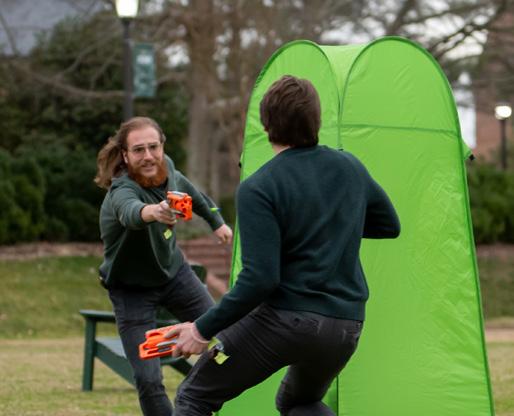
Monday, Feb. 20, the presidents of approximately 30 different clubs and organizations at the College of William and Mary gathered on the Sunken Garden to compete in the Nerf Club’s first (and potentially annual) President’s Day Tournament. With spectators consisting of supportive fellow club members, intrigued tour groups and student passersby, the event created a larger crowd with every dart shot through the air.
Nerf Club President Nathan Mo ’24 came up with the idea for Monday’s event after looking at the club’s calendar and noticing a lack of special events in February.


“I saw that Monday just so happened to be President’s Day,” Mo said. “So I got into my head, ‘Why don’t we invite [club] presidents to come out to Sunken Garden and do a little friendly duel, like kind of showcase what William and Mary is?’”
Indeed, the event was a quintessential representation of the student body’s quirks, showcasing both friendly yet intense competition and student pride in their clubs.
The rules of the competition were relatively straightforward: each duelist began with one Nerf blaster that had two reloads of darts and a foam knife. Any blaster could be used in the duel as long as both duelists agreed to use the same one. With the knife, three hits above the wrist counted as a “tag,” causing a duelist to be “out.” The duelists started on opposite ends of the “arena” and began competing after “three, two, one, game on” was called.
Additionally, while the Nerf Club usually plays inside of an academic building at its weekly meetings, the nature of this specific tournament required an open arena style that seemed to come straight out of an action movie like “The Hunger Games.”


“I think it’s a really balanced game mode, so it should be really fun to watch,” Mo said. “Honestly, I think it’s anyone’s game.”
For every round other than the semi-finals and finals, there were two duels occurring simultaneously. Nerf Club member Jake Poppiti ’24 kept the growing crowd of spectators informed with his humorous play-by-play while also keeping careful watch for and calling out tags.

“I’d like to see [College President Katherine] Rowe be available and come over and duel us,” Poppti said. “We did

invite her, but she was away, unfortunately.”
Kate Balint ’24, who represented the College’s Harry Potter fan club Wizards and Muggles in the tournament, decided to participate in the event after learning about it through an email sent out by the organization through TribeLink.

“I’ve always just thought the club was cool, and I’ve been kind of watching for things to participate in,” Balint said.
As for how she expected to perform in the duel, Balint tried to keep her outlook grounded in realism but didn’t shy away from optimism as well.
“It has been years since I shot a Nerf gun, but, you know, I see two ways this goes,” Balint said. “Either I fall in the mud on my face and get out immediately, which is just hilarious, or I win, and I have defended the honor of the nerdiest club on campus.”

Balint ended up getting out in the first round to Jack Weisgerber ’25, who represented the Gentlemen of the College, the oldest a cappella group on campus. Zero points to Gryffindor, unfortunately.

Cara Davis ’23, another player in the competition, represented WCWM 90.9 FM, the College’s student-run radio station. Competing with a broken foot, Davis’ “duck and hide” technique allowed her to make it to the second round, farther than much of the competition.
After nearly an hour of fierce competition among the participants, there were only two presidents left standing: Jude Bedessem ’23, the president of the Society of Physics Students, and Patrick Doyal ’24, the president of the Climbing Club.

Although both played well and fought hard, Doyal eventually became the winner of the tournament after winning two rounds against Bedessem. When asked by Poppiti how he felt about his victory, Doyal could only describe it as “glorious.”
Doyal expressed confidence in his Nerf skills from the beginning, even anticipating making it as far in the duel as he did.
“I’ve been playing with Nerf Gun since probably kindergarten or preschool,” Doyal said. “So, I was going in feeling strong in my abilities. And, you know, I think they served me well.
For his strategy, Doyal made sure to play to his strengths, a strategy which evidently paid off well for him considering his placement.
“Every time I ran left because I’m stronger in my right hand,” Doyal said. “Then if they got close, I used the knife to finish my opponent — that worked pretty well.”
The crowd’s ecstatic reaction to the outcome of the final duel was an authentic reflection of the overall enthusiasm that was present from the beginning of the event.
“I think just the general bloodlust of the crowd was quite a memorable part,” Poppiti said. “I’m glad to see that so many nerds at William and Mary — students who are usually diplomats — gave in to the need for violence.”


Poppiti also conveyed how impressed he was with the high intensity of the event, which defied his expectations going into the event.
“I thought it was a bit more epic than I would have expected. I thought people were just going to walk ten paces and then shoot each other,” Poppiti said. “I’m very glad people were getting creative, dynamic, sliding in mud and hiding behind tents and things, really getting into it.”
In the eyes of not only the spectators, but also the Nerf Club, the tournament was seen as a resounding success that, as expressed by Mo, would do well to become an annual Nerf Club tradition for years to come.

“I think this event went really well,” Mo said. “I think everyone had a lot of fun. I think this is really good for engagement for a lot of clubs. Hopefully this is going to foster a lot more interconnectedness on campus because I don’t know of any other event where you could bring such a diverse number of clubs together.”
Priding itself on its inclusivity and welcoming nature, the Nerf Club hopes that high-profile events such as the President’s Day Tournament will show the College their strong community and potentially serve as a way to connect with students interested in joining.


“Nerf Club is a very wonderful place accepting of all,” Poppiti said. “So long as you have the desire to blast somebody with darts, you’re more than welcome to join in.”

| Wednesday, March 8, 2023 | Page 7 variety THE FLAT HAT Variety Editor Miles Mortimer Variety Editor Agavni Mehrabi flathat.variety@gmail.com // @theflathat
EMMA HALMAN // FLAT HAT VARIETY ASSOC.
JUSTIN SHERLOCK // THE FLAT HAT
We speak for the guppies: Matoaka Bottom Feeders foster environmental appreciation
The College of William and Maryʼs fishing and conservation club promotes community, outdoor recreation, sustainability awareness
Come warmer days and gentler breezes, you will surely nd students hanging out at Lake Matoaka, a cherished spot for winding down and nding peace in nature. However, these waters may not be as still as before.
Matoaka Bottom Feeders President Xavier Starrs ’24 founded the campus shing and conservation club Matoaka Bottom Feeders two years ago. Promoting outdoor recreation and sustainability awareness, the Bottom Feeders ll up the lake with activity and, in the process of having fun and exploring, also keep Lake Matoaka cleaner and better maintained for future students.
Starrs said he set out with a simple intention when he founded the club: to create a safe and interactive space for students to gather during the stringent COVID-19 restrictions that de ned his freshman year.
ere were no activities, no events,” Starrs said. “So, I turned to my buddy Dudley in ROTC, and I was like, ‘Hey, let’s get people outdoors.
Let’s get people engaged in a safe way.’”
e members have ve core values: education, conservation, mental health, sustainability and inclusivity. ese core values ensure the members both nd greater signi cance in their shing adventures and give back to their community. Since members do not need to have prior experience to join, Starrs and his executive board members dedicate themselves to imparting their knowledge and skills to novices.
“Education [involves] showing and demonstrating [to] individuals how to sh properly [and] appropriately, and what are the best angling methods that are conducive to the longevity of the sh’s life, whether that’s using barbless hooks or practicing catch-and-release,” Starrs said.
e emphasis on conservation and sustainability is two-fold: rst, the members care about Lake Matoaka’s quality of wildlife, second, they adhere to a “leave no trace” policy so that future generations can enjoy all the lake o ers. Mary Reduzzi ’24, the club’s conservation coordinator, explained how they put these values in practice.
“We don’t want people to think that we’re just a tournament-based group or, you know, that we’re shing just for sport,” Reduzzi said. “We like to actually get out on the lake, the college woods, places like that, and we like to clean up. We like doing trash cleanups, things like that.”

e organization makes sure to de ne in its mission and actions that conservation and sustainability go hand-in-hand and that every
LINDA LI // FLAT HAT VARIETY ASSOC.
measure they take counts.
“I think the key distinction between conservation and sustainability is that conservation is focused on protecting what we have … and then sustainability is the training we do with the future generations with shing in mind,” Reduzzi said. “So you’re using tungsten weights instead of lead because they’re more sustainable and trying to avoid using terminal tackle and other angling methods that use live bait.”
Additionally, Starrs highlighted mental health and how it has been a major issue a ecting college
saltwater shed, now freshwater shing. We have y shermen now shing for both on Matoaka,” Reduzzi said. “And it’s really cool to see club members connect with each other and say, ‘Hey, are you going out? Let’s go cat shing together.’ And then that person teaches the other person how to cat sh — cause it’s a whole separate entity.”
Starrs agreed with the significance of members coming in with different skills and experience levels.
“In every interest meeting, we go around and introduce ourselves and talk about our shing
Once people become equipped with the skills to enjoy the activity, they often reap lessons that cannot be taught in a classroom. Member Alexander Ra etto ’25 explained that getting involved in shing and conservation has helped him hone the importance of promoting sustainable practices.
“It is easy to see how much society has impacted aquatic ecosystems as there are a lot of places where sh just aren’t as abundant as they once were,” Ra etto wrote in an email. “Especially in the Chesapeake Bay, it is a lot harder to nd sh. It’s discouraging as a sherman and as someone who appreciates the outdoors.”
Some of the bene ts one gains from being in the club may be unexpected. During a trash cleanup, Ra etto overcame one big obstacle to reach the trash: spiders.
“It was the beginning of the year, and the trees still had their summer foliage, and to get to the trash, we had to take the boats right through the underbrush,” Ra etto wrote. “ is was problematic because the branches were full of spiderwebs and large orb weaver spiders. I am afraid of spiders, so it was quite the experience, and I ended up having to face my fears.”
The other major component of the Bottom Feeders is their long-running relationship with the Keck Lab, the organization that oversees Lake Matoaka. On their outings, club members use ArcGIS software to monitor the water quality and collect data on fish species. Their data has proved to be instrumental in understanding the diversity of specimens in the lake and how the ecosystem functions.
students’ performance across the country, so he thought it was imperative to factor that into the club’s culture.
“It’s really restorative to the mind and body to take the time to get out there. You’re not thinking about anything. It’s great that you’re just focused on, you know, either hanging out with your buddies or on the task at hand, which is shing,” Starrs said.
While shing can be a solitary activity, the Bottom Feeders promote collaboration, with its over 100 members’ unique skill sets complementing and enriching the club’s knowledge and culture of enthusiasm.
“We’ve had people who’ve never shed before come out. We’ve had people who’ve only
experience,” Starrs said. “And, you know, there’s always one person who’s caught a huge sh, and then there’s somebody who’s never even been on the water before but likes the idea of it.”
Instead, what matters to the members of the club, regardless of experience level, is a willingness to learn and appreciate one another’s time and company.
“When I brought the [executive] o cers together, my idea was that I wanted them to be teachers — that [they] could be approachable and help,” Starrs said. “It didn’t matter that it was their personal gear that they were giving out to help [others] sh but that we were going to help these individuals connect with nature and nd a love for the sport.”
“Today, we have logged over 400 unique specimens, and we’re still nding new stu and reporting that back to [the Keck Lab] for further research, which is really cool because it gives the club an additional purpose,” Starrs said.
Outside the campus, the Bottom Feeders have struck over 30 partnerships with fishing and conservation organizations. In return for discounts on gear, merch and fishing advice, the club spreads the word about the organizations and their work. Toadfish Outfitters, a 501c non-profit that protects oyster reefs in the Chesapeake Bay, was highlighted as a particularly meaningful partnership.
“It really touches on all the aspects of what shing should be — their main idea is, you know, you get stu from shing that’s personally rewarding, but then you’re also giving it back, and that’s what’s important,” Starrs said.
parsing out paramore’s neW album
between behind the bandʼs latest release, “This is Why”
GABRIEL BLACK-PLANAS // CHIEF FEATURES WRITER
Nearly six years after its 2017 release of “After Laughter,” genre-hopping rock out t Paramore has returned with a new full-length album titled is is Why.” Featuring emotional descriptions of life during the COVID-19 pandemic, interpersonal con ict and the band’s own history, the record builds on the sound it forged in its previous album while also paying homage to the early-2000’s poppunk scene it emerged from.
e album opens with its title track, which features the band putting on a charismatic display.

Frontwoman Hayley Williams’ passionate vocals describing the fear of leaving one’s house during the pandemic, anxious percussion sections and a very catchy and sing-along worthy chorus all make for a thrilling opener.
e album as a whole is impressive in its ability to display exciting instrumentation.
Song openers’ fresh elements like the C-minor arpeggiated ostinato synthesizer on “Figure 8” or the whimsical, muted guitar on “Running Out Of Time” draw listeners in. Meanwhile, interesting song structures, such as the guitar melody that morphs into a soulful chorus on “Crave,” work to keep audiences engaged.
Longtime fans of Paramore easily recognize the band’s growth through the diverse sounds on the album that stem from earlier projects. Peppier tracks like “You First” and “ e News” could have been B-sides from Paramore’s earlier pop-punk albums like “Riot!” while slower, more somber tracks like “Liar” are reminiscent of Williams’ 2020 debut solo album, “Petals for Armor.” Most interesting, however, are tracks like “Running Out Of Time” and “C’est Comme Ça” that showcase the band’s ability to fuse the new wave sensibilities they developed in 2017’s “After Laughter” with spunky, overdriven guitars and syncopated percussion.
In addition to its dynamic song structures, Paramore has done well in making its lyrical content relatable to anyone in its audience who su ered from anxiety, bewilderment or anger during the pandemic. For instance, “ e News” discusses the overwhelming amount of negative news that many people consumed on a daily basis throughout the pandemic, leading Williams to shout, “Turn on, turn o the news!” during the song’s chorus.
Another part of the album’s charisma derives
from how it offers listeners the ability to see the band through its own two decades-long careers together. For example, Williams’ lyrics on how she isn’t able to make good on her good intentions in “Running Out Of Time” may as well be directly addressing anyone who feels like they struggle with meeting the demands of
daily life in just the 24 hours that they’re given every day.
that people would shit on me about, what if all those things were real?’” Williams said in an interview for Apple Music. “I’ve always been so afraid of what people said about me in the context of Paramore … to be indulgent in that and to say, ‘what if?’ was so freeing.”
Paramore being able to create such a solid sixth album is made all the more impressive when considering its somewhat tumultuous history. In 2010, founding lead guitarist and backing vocalist Josh Farro left the band, stating that Williams had acted as though she had been a solo artist, leaving her bandmates out of the spotlight as a result. Criticisms like these are what Williams is referring to in “ ick Skull;” she deftly faces her anxieties by miming the false picture of herself that her detractors paint. ough Farro’s brother Zac left the band alongside him, he rejoined in 2016, and the band went on to release 2017’s “After Laughter.” Featuring heavy synthpop in uences, this record was a marked departure from the band’s earlier poppunk and pop-rock sounds. Following a divorce, however, Williams entered therapy to treat her depression in 2020, during which time she released solo work.
Nearly three years later, “ is is Why” wears Paramore’s past and musical progression on its sleeve. Ultimately, the album’s most satisfying parts lay in its ability to cohesively combine the band’s di erent sounds and its introspective lyricism. e album’s only real weakness is a lack of consistency; while I don’t think there is a single bad song on the entire album, the bombastic opener and soul-crushing closer were my favorite parts, and as such, some of the parts in between fell a bit at by comparison. ough tracks like “You First” and “Crave” still have merit, they felt much more generic than the best of what the album had to o er, making them my least favorite tracks on the album. Instead, I recommend listening to “ is is Why,” “Running out of Time” and “ ick Skull,” which stood out as the best songs on the album to me.
undergone. A moodier song, this closing track builds infectiously to its impassioned ending, and it was the one I kept coming back to the most.
“I’m absolutely saying, ‘what if all those stories
Paramore does best when it innovates, and luckily for Paramore fans like myself, “ is is Why” (mostly) delivers. e band is inviting us to hear its growth for ourselves, and I think we all ought to lend an ear.
THE FLAT HAT Wednesday, March 8, 2023 Page 8
Taking a look at the
in
themes, beats plus everything
AND FLATS
GRAPH C BY MO N C A B A G N O L / T H E F L A T TAH
COURTESY IMAGE / XAVIER STARRS
SHARPS
sports
Tribe Athletics committed to student-athlete mental wellness
Athletics department staff, athletes prioritize mental health conversations
and it takes a toll on the mental health of many student-athletes.
College students have a lot on their plate. Be it classes and studying, navigating living alone and newfound independence or managing a busy social life, it is no easy task to balance the plethora of responsibilities. Add Division I athletics to this set of responsibilities and the list expands. The mental health of studentathletes has become increasingly prominent, with constant news coverage on the tragedies that occur within college athletics and a newfound focus by programs on supporting student-athletes across the country.
William and Mary has over 500 studentathletes who athletics department staff and professionals seek to aid and support as best as possible.
“Our students are not fragile, but they are vulnerable,” Director of Performance Psychology for Tribe Athletics Dr. Deidre Connelly said.

Women’s volleyball sophomore setter Amy Schwem is passionate about spreading awareness for athlete mental health at William and Mary. She is a Campus Captain for The Hidden Opponent, a national organization centered around breaking the stigma surrounding the discussion about mental health, specifically in athletics and sport culture.
“Just because you’re an athlete doesn’t mean that you aren’t allowed to struggle with your mental health,” Schwem said. “I think that in the athletic community, we are brought up to always be tough and that has translated to a lot of people struggling behind closed doors. Mental health and mental health challenges don’t discriminate. They apply to everyone. I think that a lot of people think that you have to go through some massive catastrophic trauma in order to struggle, and that’s not true. Life itself is stressful and challenging and there are going to be highs and lows that do cause you to struggle and that is perfectly okay.”
involvement in other organizations and making an intentional effort to spend time with friends to take breaks from soccer and academics.
William and Mary is active in implementing and strengthening efforts to support its studentathletes. It has implemented mindfulness sessions and mental wellness programming, and has encouraged communication between student-athletes, staff and professionals to cultivate an inclusive and accommodating environment for student athletes to be successful. On campus, there is a Suicide Prevention Coalition that offers resources for individuals in crisis. There are also trained professionals that student-athletes have access to, as well as programs that assess the mental and physical of student-athletes to best target their training plan and general treatment. Both William and Mary and the NCAA at large have worked hard to have the best possible support for their athletes.
“At the start, we were one of only four schools to have a sports psychologist, so we have always kind of been on the forefront of all of this,” Connelly said. “Athletes operate in pressure situations and try to be good in two different areas, sports and academics. You tend to get people who are pretty high achievers and driven, not unlike the rest of the students here. It’s a vulnerable population.”
Connelly feels that it is essential to meet the individual needs of each athlete and offer resources to them accordingly.
“Athletes go through clearance at the start of every year,” She said. “You have to be medically cleared to participate. So those are called clearances. At clearances, they come through my station, they fill out a very brief mental health form and at that point we give them resources, on campus, in their departments, in the community.”
be a part of it and help, this is a lot more than I think most students in a lot of programs say they have.”
Both Suchora and Schwem value their wellness surveys and check-ins that their teams conduct every day. The surveys seek to identify how student-athletes feel physically and mentally, as well as assess aspects like recovery and sleep to tailor their workouts and practices to align with their physical and mental wellbeing of the day. This personalized approach to athletics is one fundamental way to make every athlete feel seen and to ensure that despite their roles as both students and athletes, they are first and foremost treated as a person.
The average day-to-day responsibilities and expectations of student-athletes are so immense that managing one’s mental health can be challenging. It is far more than just the games that they play on the weekend. Many people may not understand the hours of commitment outside of the reports and final scores of games. Practices, early morning lifts, recovery, treatment, film, class, tutoring and so much more are all part of the daily life of student-athletes. Balancing this is no easy task
MENʼS BASKETBALL
Women’s soccer sophomore midfielder

Amelia Suchora has also felt firsthand the challenges of balancing athletics and academics, and understands the importance of being mindful of her mental health.
“As a student-athlete, it’s hard to not base yourself on your performance on the field,” Suchora said. “It’s easy to have a bad game or practice and feel your confidence go down.”
Suchora stresses the importance of having outlets outside of her sport, such as her
Connelly stressed the importance of accessibility, confidentiality and comfort in creating an environment where athletes feel comfortable asking for help and utilizing the resources that William and Mary has to offer.
Schwem is grateful for the resources of Tribe Athletics and the staff who support each student-athlete individually, as well as those who encourage systemic change and progress to be made regarding mental health, such as their adoption of The Hidden Opponent organization on campus.
“I have had nothing but positive things to say as far as support,” Schwem said. “The fact that we have an administration that is willing to
The conversation surrounding mental health is progressing. With individuals like Suchora and Schwem advocating for themselves as athletes and students, as well as staff members like Connelly supporting the student-athletes, mental health will continue to be a chief issue for all those involved in Tribe Athletics.
Athletes and staff alike are optimistic about future efforts regarding mental health. It is now commonly accepted that mental health is just as important as physical health, so William and Mary and Tribe Athletics are working hard to share and support that ideal.

Schwem encourages all people to be open about their mental health and ask for help when needed.
“Being able to speak up, even if it’s just in a small way or if it affects just one person, goes a long way,” Schwem said.
Tribe season ends with CAA tournament loss to No. 1 Hofstra
Nelson records team best 15 points in 94-46 season ending defeat
Sunday, March 5, William and Mary (13-20, 7-11 CAA) suffered a blowout loss to Hofstra (24-8, 16-2 CAA) 94-46, ending its season in the Colonial Athletic Association (CAA) tournament quarterfinals at the Entertainment and Sports Arena in Washington, D.C.

The Tribe entered the CAA tournament with momentum from the regular season with backto-back double-digit wins against Elon on Feb. 23 and Monmouth on Feb. 25. Despite falling short in tight games multiple times this season, the Tribe made sure to close out against Monmouth with conference tournament seeding on the line. With its win against Monmouth, the Tribe clinched the No. 8 seed and bypassed the play-in round. This marks the 10th time the Tribe has been the No. 8 seed and the second straight season.
The Tribe opened its CAA tournament run in Saturday’s second round against No. 9 Elon. That game marked the fourth time in Elon’s nine years in the CAA that the two teams have met in the conference championship tournament, with the Tribe leading the matchup history 2-1 in the postseason.
William and Mary picked up right where it left off in the regular season, putting on a shooting and defensive clinic against Elon. The Tribe converted a school tournament record 14 three-pointers, spearheaded by senior guard Miguel Ayesa’s stellar performance from beyond the arc. Ayesa connected on seven of 14 shots from three, setting a program record for threepointers in a CAA tournament game and falling one short of the overall tournament mark. He finished with a career-high of 23 points.
The Tribe also relied on its stellar defense, limiting Elon to only 51 points, the secondbest defensive performance for a Tribe in CAA tournament history. Graduate student guard Chris Mullins shined on defense, guarding
Elon’s CAA Rookie of the Year Max Mackinnon to a season-low two points on one of four shooting. Coalescing its superb shooting and hardnosed defense, the Tribe handily defeated Elon, 73-51. The 22-point margin of victory was the largest in Tribe history in a CAA tournament game, and moved the Tribe onto the quarterfinals in a bout against No. 1 seed Hofstra.
holding the Tribe to only two points in the first five minutes of the half. Hofstra’s scoring contributions varied with multiple players recording points.
Hofstra converted nine of its first 12 shots, shooting 65% in the first half on five of nine shots from outside the perimeter. Most impressively, Hofstra only turned the ball over one time in the first half. The Tribe continued to be unsuccessful on offense, only managing to put up 14 points in the first half in comparison to Hofstra’s 51.
“Obviously, it’s never fun to start a game down 20-4, I think we can all say that,” graduate student guard Anders Nelson said. “Not a spot you want to find yourself in, especially in the playoffs.”
Coming out of the locker room, the Tribe found some success offensively from Ayesa and Nelson. Despite some of its shots falling, the second half was more of the same domination by Hofstra on both sides of the court. According to head coach Dane Fischer, it was easier for his team to get good looks against Elon’s zone defense as opposed to Hofstra’s defense.
“We certainly didn’t get the same quality of looks as we got yesterday,” Fischer said. “When you’re playing against a zone, you’re going to get more open looks from 3. Hofstra did a great job today of limiting those opportunities.”
impressive late-season run from the Tribe, winning three consecutive games by double digits. Nelson led the Tribe in points with 15 on six of 10 shooting. The entire team struggled shooting from beyond the arc, only converting six of 25 three pointers.
In its history, the Tribe has only defeated a No. 1 seed once in a 56-54 win over Virginia Commonwealth in the 2008 semifinals. The Tribe last played a No. 1 seed in 2018 in a semi finals matchup against Charleston.
This year, Hofstra was the regular-season champion, and to the Tribe’s dismay, the No. 1 seed played like it on Sunday. The Tribe were unable to stop Hofstra’s highly-efficient shooting, which overcame the Tribe’s defense with ease.

Hofstra started the first half on an 18-2 run,
Hofstra outscored the Tribe 43-32 in the second half in a dominating win that resulted in a 94-46 scoreline. Hofstra shot a superior 59% from the field and connected on 13 of 19 shots from behind the arc. Hofstra held the Tribe to its lowest point total of the season.
“We just couldn’t get into a rhythm offensively, and a lot of that had to do with the way they played,” Fischer said. “I was really proud of the way our team stuck together and battled in that second half on a day where we clearly weren’t playing as well as we needed to and as we’re capable of.”
Sunday’s loss signified the end of an
Although this blowout loss ended the Tribe’s season, there remains a lot to celebrate for this team. Mainly, the team’s graduating class of players Ayesa, junior forward Ben Wight, Mullins and Nelson.
“This has been a really, really fun group to coach, and you want to win this one for a variety of reasons,” Fischer said. “One of them was to get to coach these guys one more day. I’m really proud of this group.”
The Tribe will look to restart next school year and relish the opportunity to compete for the CAA championship once again.
FEATURE
| Wednesday, March 8, 2023 | Page 9 THE FLAT HAT LACI MILLER FLAT HAT SPORTS ASSOC.
COURTESY IMAGE / TRIBE ATHLETICS
Womenʼs volleyball sophomore setter Amy Schwem serves as a Campus Captain for The Hidden Opponent organization.
COURTESY IMAGE / TRIBE ATHLETICS
Dr. Deidre Connelly is Director of Performance Pyschology for Tribe Athletics and supports student-athlete mental wellness.
COURTESY IMAGE / TRIBE ATHLETICS
Womenʼs soccer sophomore forward Mia Suchora is a strong advocate for having outlets like clubs outside of her sport.
ETHAN QIN FLAT HAT SPORTS EDITOR
COURTESY IMAGE / TRIBE ATHLETICS
Junior forward Ben Wight attacks the basket to score in a 73-51 second round win against Elon on Saturday, March 4.
COURTESY IMAGE / TRIBE ATHLETICS
Graduate student guard Anders Nelson absorbs the contact while driving in a 94-46 loss to Hofstra on Sunday, March 5.
sports
Tribe keep late season momentum rolling with dominant win on Senior Day William and Mary beat Hofstra, clinch fourth seed
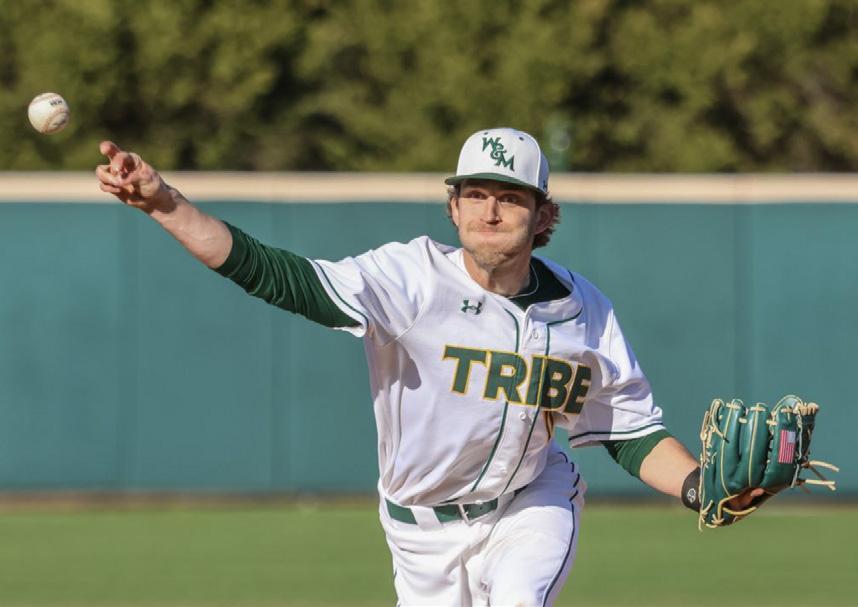
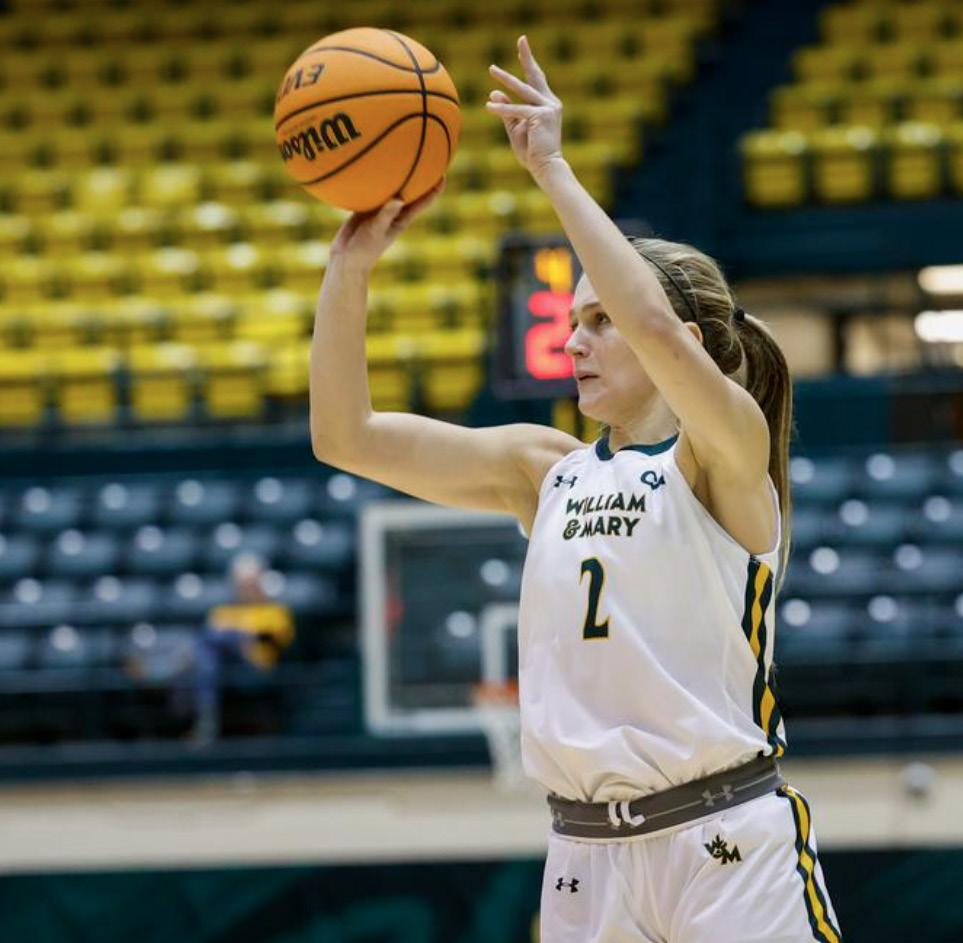 QIN FLAT HAT SPORTS EDITOR
Saturday, March 4, William and Mary (17-12, 12-6 CAA) defeated Hofstra (10-19, 4-14 CAA) 69-50 at Kaplan Arena in Williamsburg, Virginia. Saturday marks the last regular season game for the Tribe, which clinched the No. 4 seed in the 2023 Colonial Athletic Association (CAA) Championship.
Saturday’s game, designated as Senior Day, honored graduate students Riley Casey and Sydney Wagner, as well as seniors Bre Bellamy and Chaniqwa Gilliam to celebrate their achievements on and off the court.
“We can’t believe this is our last time playing in Kaplan,” Casey said. “We want to leave with the underclassmen this idea of making William and Mary a team you cannot underestimate.”
This win cements the Tribe’s conference record at 12-6, matching the program’s all-time best. This achievement is impressive on its own, but with this year being head coach Erin Dickerson Davis’ first year with the team, it becomes even more special.
“I’m so thankful for this opportunity to coach these women,” Dickerson Davis said. “I’m proud to be here and coach the Tribe. I’m proud of their pride for William and Mary because I don’t know if they always had it, but they have found it and they haven’t let it go.”
The Tribe started the game with efficient scoring from the field, going on a 8-0 run in the first two minutes of the quarter. Wagner exemplified lights-out shooting, knocking down her first four consecutive shots from the field. The graduate student guard contributed 11 of the 21 total Tribe points in the first period.
This hot start continued throughout the rest of the first quarter with William and Mary dominantly outscoring Hofstra 21-5 by the end of the period. The second quarter, however, proved to be a different story for the Tribe, who came back on to the floor cold.
The Tribe’s go-to scorers, Casey and Wagner, shot a combined zero for nine from the field in the second quarter. The team was able to put up only two points throughout the entire period from a pair of free throws by junior forward Rebekah Frisby-Smith.
Hofstra capitalized on the Tribe’s poor shooting and brought the Green and Gold lead down to only four points, primarily scoring through graduate student guard Brandy Thomas and junior center Zyheima Swint. Thomas and Swint combined for 12 points in the second quarter. The Tribe led Hofstra 23-19 as both teams headed into halftime.
“I talked to my coaches, and we did not really know what to say,” Dickerson Davis said. “Whatever we say, let’s just be positive. They’re beating themselves up enough right now, there’s no point in us going in there and adding to that.”
Showing shades of their first quarter performance, William and Mary emerged out of the locker room with a hot hand. Casey bounced back from her rough second quarter shooting performance, sinking four of five shots from behind the arc. Wagner also put up seven points in the period, marking another commanding quarter for the Tribe. The team outscored Hofstra 29-14, extending their lead to 5233 entering the fourth.
The fourth quarter was more of the same for the Tribe, scoring 17 points in this last period. Notable scoring contributions came from Bellamy, Casey and freshman guard Alexa Mikeska. Though Hofstra matched William and Mary in scoring during the fourth quarter, the 19-point deficit proved to be too much for the Pride to overcome. The final score resulted in a 69-50 win for the Tribe.
Casey and Wagner led the Tribe in scoring, each with 18 points. Wagner’s performance on Saturday moved the graduate guard into No. 10 on the Tribe’s all-time scoring list.
“Today was the last day of our season and now we’re into a whole new season. 0-0,” Dickerson Davis said. “It does not matter who we’re
matched up against, we have to play Tribe basketball. We have worked so hard to get to this moment. It’s a win or go home, and we’re trying to win by all means necessary.”
Tribe falls in weekend opener against Fair eld at Plumeri Park
Late inning push falls just short as Green and Gold lose second home game of season
MAX GRILL FLAT HAT SPORTS EDITOR
Saturday, March 4, William and Mary (7-5, 0-0 CAA) lost 8-4 against Fairfield (4-3, 0-0 MAAC) at Plumeri Park in Williamsburg, Virginia.
The Tribe entered Saturday’s game determined to continue their success at home after beginning the season 5-1 in Plumeri Park. After Friday’s game against West Virginia was postponed due to rain, the Tribe were ready to begin their weekend homestand against Fairfield, followed by Canisius on Sunday.
Sophomore pitcher Nate Knowles started strong for the Tribe, setting down all three Stags he faced in the first. Knowles entered the game with a 1-0 record and an earned run average of zero, giving the Tribe three strong innings on the mound.
After stranding two runners in the bottom half of the first inning, a William and Mary defensive error in the top of the second led to a bases-loaded walk to Fairfield designated hitter Nick Sturino. This resulted in the first run of the game, giving Fairfield an early 1-0 lead.
The Tribe retaliated in the bottom half of the second inning after freshman infielder Corey Adams singled and sophomore infielder Luca
SPOTLIGHT
Danos walked after being hit by a pitch. This put two runners on for the Green and Gold’s lead-off hitter, sophomore outfielder Lucas Carmichael. Fairfield pitcher Jake Noviello was able to escape the inning after forcing Charmichael to ground out to second, ending the inning scoreless and preserving the Stag’s lead at 1-0.
Noviello had a much-needed strong performance against the Tribe. In his previous two starts, the Fairfield starter let up 13 earned runs in
just 7.1 innings of work, but finished Saturday with a mere one earned run over 5.2 innings.
The offense of both teams stalled out in the middle innings, even after the Tribe went to the bullpen in the fourth. Sophomore pitcher Mike Weidinger gave the Tribe three strong innings of relief pitching, finishing with four strikeouts and only allowing two hits.
Both offenses found their stride in the sixth.
The Stags strung together two singles from third baseman Charlie Pagliarini and right fielder Mike Handal, putting runners in scoring position for the first time since the second inning. Weidinger quickly escaped the threat, getting Sturino to fly out to center which allowed the Tribe the chance to get back to the plate and erase the lead.
Senior outfielder Joe Delossantos gave the Green and Gold the spark they needed to get on the board in the sixth inning. After a groundout to start the bottom of the inning, Delossantos ripped a single up the middle and got to work on the base paths. Delossantos stole second and third base over the course of five pitches, putting a Tribe player on third with only one out. Later in his at bat, senior catcher Max Winters cracked a sacrifice fly into right field, allowing Delossantos to tag up and score the game-
tying run with ease.
Fairfield fired back immediately in the seventh. After another Tribe pitching change, the Stags found themselves with a runner on third with the help of some smart situational hitting. Another hit batter put a second runner on base, giving Fairfield second baseman Mike Becchetti the perfect opportunity to take the lead back from the Tribe. However, an erroneous defensive play from the Green and Gold began the scoring without the Stags even needing to swing. A passed ball allowed Fairfield to score the leading run and gave the runner on first the chance to advance to second. The Stags and Becchetti immediately took advantage of the runner on second, with a run-scoring single up the middle later in the inning that extended the lead to 3-1.
The Tribe’s offense failed to produce any runs in the bottom half of the seventh, opening the door for Fairfield to grow their lead. The eighth inning began with a single and another hit batter, giving the Stags two more baserunners that advanced after a nearly a perfect bunt from graduate student graduate student shortstop Noah Lucier.
Colby Sorsdal drafted by USFL’s Stallions, sights still set on NFL
All-CAA offensive linemen hopes the USFL is just the start of his new professional career
From a program-high 10-win regular season to a tournament fifth seed in the Football Championship Subdivision (FCS) playoffs, the 2022-2023 William and Mary football season was one to remember.
Senior offensive lineman and team captain Colby Sorsdal played a pivotal role in the team’s success last season. Throughout the year, his play not only garnered attention from teammates, coaches and fans, but from USFL and NFL draft scouts, too.
After the end of the season, Sorsdal was named a member of the All-CAA First Team, a consensus All-American selection and selected for five AllAmerican First Teams. Above the rest, Sorsdal was also an Associated Press First Team All-American and the Walter-Camp First Team All-American.
Sorsdal was a key contributor to the Tribe’s offensive success as a whole, leading an offensive line unit that ranked fourth nationwide in sacks allowed (.77 per game) and third in rushing yards, with 265.8 per game.
Before discovering a love for football in middle school, Sorsdal spent his time on the rink playing hockey. Looking back, he credits his dad for pushing him in the right direction towards the football field.
“I was massive on skates,” Sorsdal said. “My dad was like, you know, you can really be physical here. You can use your talents on the football field and just kind of let it all out.”
After a successful high school career, Sorsdal chose to play college football at the College in 2018, becoming just the second true freshman since 1983 to start at offensive line for the Tribe.
For Sorsdal, his most memorable moment on the field came last fall when the team beat Richmond to secure a bid to the FCS playoffs. However, above any on-field accomplishment, Sorsdal’s favorite part of William and Mary is the people.

“You meet some of the greatest people you could ever meet,” Sorsdal said. “People that will lead the world one day and people that are so smart and brilliant. It was a great time, and it was because of the people down there.”
In his final season with the Tribe, Sorsdal credits much of the team’s success to veteran leadership that worked to create the right mentality.
“That veteran leadership really brought everybody else along,” he said. “There was no expectation that we would lose. We would win and anything short of that was just kind of not accepted.”
Sorsdal’s mindset has helped him succeed where others have failed, crediting a moment in a 2019 game against James Madison University as a major turning point in his career. After playing a mediocre game against future NFL talents, Sorsdal understood that he had to focus on refining his technique.
“Some people settle for good when you can be great,” Sorsdal said. “I needed to get elite, not just good.”
In preparation for the draft, Sorsdal maintains
the same mentality. His NFL dreams don’t stem from fame or money — he trains because he wants to be the best player he can be.
“I have this fire in my system that’s like, you need to do this and you need to be the best at it,” Sorsdal said. “When I go train at 6 a.m, I’m in there and I’m just like, ‘Okay, this is the path to greatness.’”
Sophomore inside linebacker Alex Washington specifically mentioned the power of Sorsdal’s first step, patience and inside punch as parts of his game that make it difficult to beat him.
“We would go pass rush against Colby and he would teach us how to beat it,” Washington said. “He knew he could win, but if he could help us beat him, then we’re going to be better as a team.”
Sorsdal’s commitment to the team and his leadership did not wane when he stepped off the field.
“The same energy he was giving in the locker room would be the same energy he was giving on a Saturday night,” Washington said.
On Tuesday, Feb. 21, Sorsdal was drafted in the sixth round by the Birmingham Stallions of the USFL. According to Sorsdal, he is both honored and excited for the opportunity to play in the USFL, but he is still set on a future in the NFL.
Since January, Sorsdal has been in Dallas training for his Pro Day on March 23rd, where he hopes to further impress and prove himself to NFL draft scouts.
“Colby is one of the best talents I’ve seen,” Washington said. “He’s an NFL guy. He’s going to be an NFL guy.”
WOMENʼS BASKETBALL
| Wednesday, March 8, 2023 | Page 10 THE FLAT HAT
ETHAN
BASEBALL
RYAN CODY FLAT HAT SPORTS ASSOC.
COURTESY IMAGE / TRIBE ATHLETICS
MORE AT FLATHATNEWS.COM
Graduate student guard Riley Casey finds an opening and shoots during the Tribeʼs Mar. 4 win against Hofstra. Casey was one of the four seniors honored on Senior Day.
READ
COURTESY IMAGE/ TRIBE ATHLETICS
Sorsdal was recognized as a member of the All-CAA First team and was named an Associated Press First Team All-American.
COURTESY IMAGE/ TRIBE ATHLETICS
MORE AT FLATHATNEWS.COM
Sophomore pitcher Carter Lovasz delivers a pitch during his relief outing in the Tribeʼs March 4 loss to Fairfield.
READ
