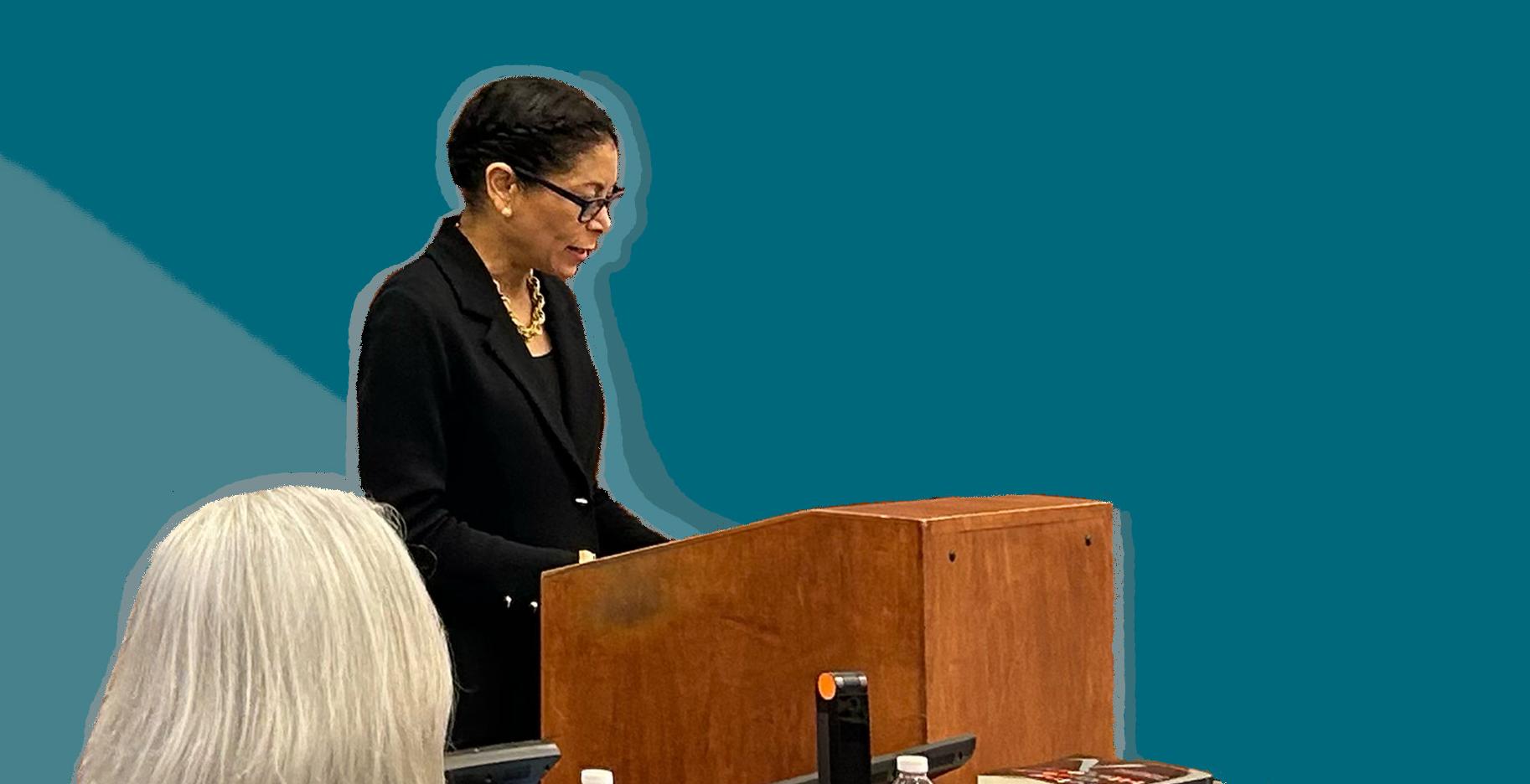
Friday, Feb. 17, the John Boswell Initiative sponsored a panel discussion titled “Trans Youth: Pasts, Presents, and Futures.” The event featured Shannon McKay, the Executive Director and co-founder of He She Ze and We, Vivian Hamilton, Professor of Law and Founding Director of the Center for Racial and Social Justice at the College of William and Mary and Dr. Samantha Rosenthal, Associate Professor of History at Roanoke College and co-founder of the Southwest Virginia LGBTQ+ History Project.
Senior Lecturer in history Dr. Jerry “Jay” Watkins III introduced the panel and discussed his current biographical study of John Boswell ’69.
“First, I want to thank some of the folks who have been involved in this,” Watkins said. “There’s of course the Boswell Initiative, the GSWS, and Outlaw and Center for Racial and Social Justice, as well as the National Lawyers Guild and all of the other folks who have contributed their time to putting this event on and organizing it.”
After Boswell graduated from the College in 1969 and obtained his Ph.D. from Harvard in 1975, he took a teaching position at Yale University. Boswell’s first book, “Christianity, Social Tolerance and Homosexuality,” was published in 1980 and left a lasting impact on the literary world.
“This book was really quite monumental,” Watkins said. “The heart of the book is of course that Christianity has not always been so hostile to homosexuality and that homophobia is more socially constructed than divinely ordered.”
Boswell’s book has been reprinted multiple times and has recently celebrated its 35th year anniversary of publication with a 2015 reprint. By 1986, Boswell was one of the first openly gay professors and department chairs on a national scale. He also founded the Lesbian and Gay Studies Center at Yale in 1987, which became the Research Fund for Lesbian and Gay Studies by the 1990s.
“He wanted to be remembered most for his faith, but I think few have had such an impact on the field and have so profoundly shaped how we understand sexuality in the world,” Watkins said. “His memory is commemorated in a variety of ways across campus and across the world.
Boswell Initiative hosts panel at Law School discussing issues facing transgender youth

Panelists address state efforts targeting transgender students, highlight recent legislation meant to restrict students in school settings
One of the accomplishments I am most proud of is getting a building named after him.”
Hamilton began the panel discussion by addressing statistical data on transgender individuals in the United States and legislation surrounding transgender policies nationwide. According to the data shown, 1.5 million people ages 13 and older in the United States currently identify as transgender. About 300000 of these people are transgender youth from ages 13-17.
“Overall, from data collected between 2016 and now, the number of trans adults has remained fairly steady, but better data collection on youths’ gender identity has given researchers better information than what was previously available for estimating the youth population and now they know that youth comprise a larger share of the trans identity population than previously estimated. Now, they comprise about 18% of trans identifying people in the U.S.,” Hamilton said.
Hamilton discussed issues facing the transgender community in the current day, including bans on gender-affirming medical care and laws and legislation limiting discussion of sexuality and gender such as the “Don’t Say Gay” bill in Florida.
Additionally, efforts are underway to limit transgender youth participation in school sports and the frequent banning and censorship of books containing topics such as gender, sexuality or individuals of color.

“Young people have a right to see themselves reflected in their classrooms and in the books that they’re reading,” Hamilton said.
Hamilton noted a report from the American Library Association, which found challenges against 1597 individual books last year, which is the highest number since we began tracking book bans 20 years ago. She added that a PEN America report found that of these books that have been banned, 379 have had LGBTQ+ characters or themes, 84 centered on transgender characters and 460 had BIPOC protagonists.
“So, students and their parents are facing these censorship efforts that restrict their First Amendment rights. Their First Amendment protects
educators and students’ rights to exchange information. It also protects students rights’ to learn free from viewpoint based discrimination,” Hamilton said.
In the Virginia Senate, two bills targeting transgender students failed on Feb. 16. The bills would have restricted the participation of transgender students in school athletics and required school officials to inform parents if a child presents themselves as transgender in a school environment. The bills passed in the State House but did not receive sufficient support in the Democraticcontrolled State Senate.
“It’s really just kind of stunning how much time, resource and political capital is being expended on this issue,” Hamilton said. “The Virginia High School League has already implemented rules that were implemented in 2014 that allowed trans student athletes to participate with certain provisions.”
McKay then introduced herself and described her work as the executive director and founder of the He She Ze and We program.

“What He She Ze and We does is really work to empower families on this journey of gender identity,” McKay said. “And we work to support them, to educate them so that they know how to be accepting and supportive to their kids of all ages. And we also advocate for the rights of transgender individuals.”
As the mother of a transgender child, McKay mentioned her personal connection to the issues discussed, as well as to families that may be grappling with their child’s gender identity or hostile environments for transgender youth.
“Your ego, your belief system, your biases, leave it all there and come on in and open your door so that you can meet the person in front of you and help them with whatever it is they need help with,” McKay said.
Chief Cheesebro and WMPD host open forum to discuss campus safety
Arrest statistics, Good Griffin policy, general safety covered in presentation, officers share thoughts on emergency management
Thursday, Feb. 16, the College of William and Mary Police Department hosted an open forum in Sadler Tidewater A. Associate Vice President for Public Safety, co-chair of the Emergency Management Team and Chief of Police Deborah Cheesebro, Deputy Chief of Police Major D on Butler and other WMPD officers gave a presentation on general safety, the Good Griffin policy, the mass notification system and WMPD statistics.
After a round of introductions, Cheesebro and Butler started the forum with a discussion of WMPD statistics on arrests and traffic stops in recent months.
“Because what you can see in that time period, which is just short of two years, we’ve made 31 arrests,” Butler said. “Now, we’ve certainly apprehended more people committing crimes than 31, but as Chief Cheesebro mentioned, we have other ways of dealing with them other than arrest. And, you know, there’s some cases, [like] a felony case, we’re required to make an arrest, so we do so.”
Butler emphasized the department’s collaboration with the Dean of Students Office.
“The vast majority of our cases are referred to the Dean of Students Office, [and the
Department of] Community Values and Restorative Practices, so that you’re not going to court,” Butler added. “We’re not spending a lot of time in court. You’re getting educational materials from the Dean’s Office, and you’re not living with being arrested or jailed or locked up for the rest of your life.”
Sergeant Carlos Moran, who supervises the WMPD day shift, said students should not be afraid to reach out to WMPD for assistance.
“If something happens on campus, don’t feel as if you’re about to walk away in handcuffs or get a ticket or anything like that,” Moran said. “Don’t ever be afraid to call us if a friend had too many to drink. We’d rather get you first fast and get them to the hospital right away so they can get taken care of.”
Butler then discussed the College’s Good Griffin policy. The policy provides academic and conduct protections for students and witnesses if medical assistance is sought for the consumption of alcohol or other substances.
He noted that a similar policy has been enacted statewide and addresses situations that require bystander intervention policies.
“Good Griffin, it’s not called that, of course, but there are laws now in Virginia where if you’ve got basically bystander intervention and trying to get someone life saving help and that
includes alcohol overdoses, drug overdoses, etc., the commonwealth exempts those folks from prosecution.” Butler said. “William and Mary has been doing that for a long time.”
Butler was referring to a section of the Code of Virginia that mandates legal protections for individuals who seek out medical assistance for individuals experiencing an overdose of alcohol or marijuana and remain on the scene.
Butler then laid out how WMPD has been navigating both the state and College policies.
“We used to put out, and this was many years ago, just to clarify with students, that Good Griffin didn’t apply to the police department,” Butler said. ”And now we can’t say that anymore because the commonwealth of Virginia requires that and our folks support it and always have. So we’ve been doing it longer than most agencies. Good Griffin applies administratively for criminal charges for us and administratively the university.”
As part of an effort to tackle substance usage issues, Butler said WMPD officers carry NARCAN nasal spray, which can be used to treat overdose emergencies. Butler said they have not had to administer the medication so far.
Cheesebro then discussed the mass notification system, which the WMPD utilizes to relay crucial information to the College community.
“What happens when we have something
that we think is an emergency, and we have a very specific idea of what that means: What that means is there has to be some sort of threat that we think is imminent on campus. And then, the timing of giving that out is going to vary a little bit because we have to make sure that the information we send to you is accurate,” Cheesebro said.
Under the Clery Act, federal law requires the College to notify the community of certain incidents through timely warnings. According to Deputy Chief Butler, crimes covered by the law are called “Clery crimes.” These include generally serious offenses such as criminal homicide, sexual assault, robbery, arson, motor vehicle theft, aggravated assault and others.
For a timely warning to be issued, the crime has to have occurred on campus.
“The last thing we want to do is constantly be putting out stuff and then have to retract it and say, ‘Oh, that wasn’t real,’” Butler said. “You know, you get the cry wolf thing where people think it’s probably not real anyway. We want it to be when you see it, it’s real. You know it’s real.”
Cheesebro emphasized the need to be careful and not tamper with any ongoing investigation that other jurisdictions are handling.
READ MORE AT FLATHATNEWS.COM
Inside Variety Outgoing editor-inchief bids farewell Former Editor-in-Chief Lulu Dawes shares final thoughts on her time at the Flat Hat. page 5 INDEX Pro le News Opinions Variety Sports 2 3-4 5-6 7-8 9-10 Inside Opinions PEERAWUT RUANGSAWASDI FLAT HAT NEWS ASSOC. EDITOR CAMPUS Inside Sports Unpacking the past Committee for Contextualizing Landmarks and Iconography investigates College’s early histories. page 7 Organization Spotlight: Black Student Athlete Alliance Kayla Beckworth founds new club dedicated to Black student athletes. page 9
ABIGAIL CONNELLY AND EMMA HENRY // FLAT HAT NEWS EDITORS T HE F LAT H AT Vol. 113, Iss. 1 | Wednesday, February 22, 2023 The Weekly Student Newspaper of The College of William and Mary flathatnews.com | @theflathat
See PANEL on page 3
GRAPHIC BY ABIGAIL CONNELLY / FLAT HAT NEWS EDITOR
Your
Fire in ISC lab room promptly extinguished
Tuesday, Jan. 14 at approximately 7:29 p.m. a small fire occurred and was promptly extinguished in the Integrated Science Center. According to the Collegeʼs Emergency Management Team, the exact cause of the fire is still under investigation. The Collegeʼs police department, the Williamsburg Fire Department and the York County and Newport News Hazmat Material Response Team units all responded to the incident.

“ISC 1 is all clear this morning except for room 2070 following a small fire in there last evening,” the Emergency Management Team wrote in an email to the College community. “The cause of the fire is still under investigation. Though there was minor damage [to] the lab space, we are thankful no one was injured.”
Emergency Management Team Co-Chairs Ginger Ambler and Deb Cheesebro sent two emails.
Lemon Project Director Jody Allen re ects on career
EMMA HENRY // FLAT HAT NEWS EDITOR
Dr. Jody Allen Ph.D. ‘07 originally thought she was on her way to a career in social work when she received her undergraduate degrees in criminal justice and political science at the University of Delaware and her masters degree in criminal justice from Michigan State University. What she did not expect, however, was to end up as an assistant professor of history and Robert Francis Engs Director of the Lemon Project: A Journey of Reconciliation at the College of William and Mary.
“I realized that I’d always wanted to study history, but I had been guided away from it by my high school guidance counselor because, at the time, I didn’t want to be a teacher,” Allen said. “She said, well, if you don’t want to be a teacher, that’s all you can do with a history degree, which now, of course, I know you can do many more things.”
Originally from Hampton, Virginia, Allen moved out of the state for her undergraduate and graduate studies and later took a job at Stony Brook University in New York. As time went on, she found herself ready to return to Virginia. Allen began working at Virginia Commonwealth University in their Residence Life department then took on the role of Acting Director of Minority A airs. Following her career at VCU, Allen attended the College to pursue a Ph.D.
In 2007, the College hired Allen as an assistant professor. In 2010, she became the rst director of the Lemon Project, an initiative which began a year earlier after students and faculty demanded that the College reckon with its past, speci cally its involvement with slave labor and segregation. e Lemon Project is part of the Universities Studying Slavery Consortium, which includes nearly 100 educational institutions across North America, Europe and the West Indies. e Lemon Project is named after a man who was enslaved by William and Mary in the late 18th, early 19th century,” Allen said. “ e idea was for it to be a kind of archival research project. But we gured out early on that it needed to actually not just be in the archives, but we also needed to get out into the community and work in the community and do some research.”
To Allen, the Lemon Project is an opportunity for the College to improve its relationship with the broader African American community within Williamsburg, as well as a chance to begin to answer questions about the College’s past.

“There’s this understanding that slavery is really at the foundation of this country,” Allen said. “A lot of institutions, even if they never owned or enslaved people as an institution, most institutions in this country have somehow benefitted from that labor source. So Lemon is William and Mary’s answer to this question.”
Allen also highlighted the Lemon Project’s genealogical initiative under the direction of Postdoctoral Research Associate Jajuan Johnson. Allen mentioned that the Lemon Project has received an extremely positive response from the student body and Williamsburg community.
“One of the things that we heard from a lot of people was this one phrase, that if you were Black you couldn’t be on the William and Mary campus unless you were pushing a broom,” Allen said. “And that was true. You know, you couldn’t, the campus was segregated. And so now you see all kinds of people from the community walking across campus with their dogs or just taking a walk or whatever. And Black people couldn’t do that.”
Allen mentioned that though she believes the College is developing a better reputation within the community, she recalled moments when she heard from students that guidance counselors would not encourage Black students to attend the College due to a concern that they would have an uncomfortable experience.

“What we’re responsible for now is what we do moving forward,” Allen said. “And I do think there’s a genuine desire to repair those breaks, those feelings, and to replace them or add on better experiences, positive experiences.”
Outside of the Lemon Project, Allen is working on her first book, as well as teaching a graduate course titled “The Miseducation of America.” Her inspiration for the course came from a t-shirt she saw in 2015 when local officials took down the Confederate flag outside the capitol building in South Carolina. The phrase on the shirt stated: “If you think this is hate, you don’t know your history.”
Health and Wellness Center launches new platforms
WeBe and TimelyCare are recently added resources the Center will offer to College students
Starting this semester, the College of William and Mary announced new partnerships with mental health resources WeBe and TimelyCare as a means to expand mental health services and promote wellbeing across campus.
TimelyCare is a free, on-demand teletherapy service available at all times to the student body. The platform is meant to complement the counseling and psychiatry services already available at the College’s Counseling Center.
The College also launched a pilot program with WeBe, a health promotion app that allows students to track their wellness, check in on friends and access resources to maintain healthy living.
This is the first university that the app has partnered with, and it has been working closely with administration and students to develop unique features for the College community.
These partnerships come after the height of the COVID-19 pandemic, which
increased demand for mental health services, especially online resources.
They join and enhance existing resources available through the Student Health Center focused on helping students at all stages of their wellness journey.
Associate Vice President for Health and Wellness and Director of the Center for Mindfulness and Authentic Excellence Dr. Kelly Crace spoke about TimelyCare and WeBe with The Flat Hat following his presentation on wellness at the February Board of Visitors meeting.
“Students can come in with what is most important to them and engage in the modality that is most important for them, that they’re likely to be more open, more vulnerable and engaged in the work,” Crace said.
Students seeking non-emergency sessions at the Counseling Center often face long wait times at the College’s Counseling Center. The introduction of TimelyCare allows them the option to speak with a mental health professional online while waiting for an appointment at the Counseling Center.
“It provides us the opportunity to work more with students at a deeper level, quicker, and be able to work with them in a way that most fits their needs,” Crace said.
While TimelyCare is a resource for mental health intervention and treatment, WeBe focuses more on health promotion as a way of fostering resilience against crises.
“WeBe is kind of that preventative health promotion, keeping you tuned in to what’s well, tuned into what’s healthy for me, keeping me intentional about it, because the noise of our relentless world is going to pull you away from taking care of yourself,” Crace said.
Chief Executive Officer Dr. Barbara Van Dehlen and Chief Clinical and Science Officer Dr. Randy Phelps co-founded WeBe alongside Chief Operating Officer Michael Akinyele. The app allows users to track their own day-to-day wellbeing as well as keep up with the wellbeing of their trusted family and friends by creating and joining affinity groups or “Pods.”
“ “ THE BUZZ THE FLAT HAT | Wednesday, February 22, 2023 | Page 2 News Editor Abigail Connelly News Editor Emma Henry News Editor Daniel Kalish fhnews@gmail.com CORRECTIONS e Flat Hat wishes to correct any fact printed incorrectly. Corrections may be submitted in email to the editor of the section in which the incorrect information was printed. Requests for corrections will be accepted at any time. news insight
ego, your belief system, your biases, leave it all there and come on in and open your door so that you can meet the person in front of you and help them with whatever it is they need help with.
̶ Shannon McKay, Executive Director and Co-Founder of He, She, Ze and We
“The good, the bad and the ugly”: Allen tackles Collegeʼs past and discusses her achievements
A THOUSAND WORDS COURTESY PHOTO / PEERAWUT RUANGSAWASDI
FLAT HAT NEWS BRIEF
Zach Lutzky Photos Assoc. Editor COURTESY PHOTO / JODY ALLEN
Jody Allen, a professor at the College of William and Mary for the past 15 years, discusses her vision for the Lemon Project and its impact with the WIlliamsburg community.
READ MORE AT FLATHATNEWS.COM
HANNAH RAY CHIEF STAFF WRITER Molly Parks Editor-in-Chief Jake Forbes Managing Editor Vivian Hoang Executive Editor Adam Jutt Digital Media Editor T HE F LAT H AT ʻSTABILITAS ET FIDESʼ | ESTABLISHED OCT. 3, 1911 200 Stadium Drive, The College of William and Mary, Williamsburg, Va. 23185 Abigail Connelly News Editor Emma Henry News Editor Daniel Kalish News Editor Miles Mortimer Variety Editor Agavni Mehrabi Variety Editor Ethan Qin Sports Editor Max Grill Sports Editor Avi Joshi Opinons Editor Mollie Shifflet Opinions Editor Chris Schneider Videos Editor Lisa Coleman Data Editor Camila Anderson Social Media Editor Karis Koutsourelakis Social Media Editor Yelena Fleming Graphics, Podcast Editor Ryan Goodman Photos Editor Crystal Wang Copy Chief Hannah Ray Chief Staff Writer Betsy Mahoney Chief Staff Writer Editor flathat.editor@gmail.com Managing flathat.managing@gmail.com Executive flathat.executive@gmail.com Magazine editor@flathatmagazine.com News fhnews@gmail.com Sports flathatsports@gmail.com Copy flathatcopy@gmail.com Opinions fhopinions@gmail.com Variety flathat.variety@gmail.com Photos flathatphotos@gmail.com Online flathatonline@gmail.com Advertising flathatads@gmail.com Graphics flathat.art@gmail.com Ombudsman flathat.ombuds@gmail.com Veronica Bondi Copy Editor Anu Desai Copy Editor Anastasia Rubis Copy Editor Annabelle Glassman Copy Editor Maddie Harris Copy Editor Caitlin Noe Copy Editor Joe Wehmeyer News Assoc. Editor Aafreen Ali News Assoc. Editor Sonia Samantaroy News Assoc. Editor Ian Harmon News Assoc. Editor Peerawut Ruangsawasdi News Assoc. Editor Grace Martin News Assoc. Editor Grace Saunders Variety Assoc. Editor Summer King Variety Assoc. Editor Lindi Li Variery Assoc. Editor Phebe Fahmy Variety Assoc. Editor Emma Halman Variety Assoc. Editor Ava Edwards Variety Assoc. Editor Ashley Cohen Variety Assoc. Editor Gabriel Black-Planas Chief Features Writer John Powers Opinions Assoc. Editor Ellie Kurlander Opinions Assoc. Editor Lauren Meyer Opinions Assoc. Editor Bushra Bablu Opinions Assoc. Editor Damien Kanner-Bitetti Opinions Assoc. Editor Samuel Li Photos Assoc. Editor Justin Sherlock Photos Assoc. Editor Elliott Lee Chief Sports Writer, Photos Assoc. Editor Ryan Cody Sports Assoc. Editor Catherine Storke Graphics Assoc. Editor Jonah Randell Ombuds Assoc. Editor Nora Keely Ombuds Assoc. Editor Shradha Dinesh Data Assoc. Editor Abhayprad Jha Data Assoc. Editor Jenine Samara Podcast Assoc. Editor Myles Rescher Business Manager Sarah Devendorf Standards Editor Anna Arnsberger Operations Coordinator Ryan Leventhal Webmaster WELLNESS MOLLY PARKS // FLAT HAT EDITOR-IN-CHIEF READ MORE AT FLATHATNEWS.COM
Pathways
on
Alex Park ʼ24, Diana Kim ʼ25 research first women of Asian descent to attend College
At the very front of Earl Gregg Swem Library, a display of historical images tells the story of the rst Asian American women who attended the College of William and Mary.
Created by Diana Kim ’25 and Alex Park ’24, the Charting Diverse Pathways exhibit aims to promote visibility for the Asian Paci c Islander and Middle Eastern community at the College. e exhibit tracks the lives of the rst three Asian American women to attend the College: Hatsuye Yamasaki Kajiwara ’37, Margaret Lee Masters ’45 and Beatrice Fujiwara Sakai ’53. Kim and Park follow the research started in the 202122 academic year during the College’s Asian Centennial. e Asian Centennial celebrated the 100th anniversary of the rst student of Asian ancestry to attend the College, P.K. Chen, Class of 1923. Park noted the signi cance of its celebration to her as an Asian American student.

“As an Asian American person on campus, it felt like a very big deal because it was the rst time that any of these communities that I’ve been in, especially in predominantly white spaces, we got to see ourselves represented and people like us honored in that way,” Park said.
Sumie Yotsukura ’22 and Brian Zhao ’23 led the research focused on P.K. Chen, and Director of the College’s Asian Paci c Islander American department Professor Deenesh Sohoni supervised their work. For Sohoni, the Asian Centennial boosted visibility that helped create the College’s Asian Paci c Islander and Middle Eastern Research Project, under which Kim and Park’s project falls.
“One of the big things that both [Professor Francis Tanglao-Aguas] and I wanted to do was not just some big celebratory events, but also to create something
that’s more sustainable,” Sohoni said. “And so right now we have this kind of nebulous entity, the APM Research Project, where it’s the sustainable part of the centennial. e centennial was one year, but we want to create opportunities for students to conduct research about Asian-American experiences. And that’s what Diane and Alex did over the summer.”
Using funding from the Charles Center and the Braitmayer Foundation fellowship, Park and Kim began their research. ey started in Swem Special Collections, looking at historical views of Asian Americans with
archivist Jennie Davy. eir goal was to understand the social and racial environment and attitudes at the College during Yamasaki Kajiwara, Lee Masters and Fujiwara Sakai’s respective decades. “[ ese women] each had di erent experiences at William and Mary,” Park said. “Something of note is how far spaced apart they are. ere’s almost a decade in between the entrance of each woman….contrary to when we talked about the rst…women to be accepted to
changes happening within the community. And it really takes looking at a larger time period and all three of those women to start to understand why that would happen.”
From there, Park and Kim conducted oral history interviews. Reaching out to Lee Masters’ family and Fujiwara Sakai’s family, they were able to speak to Katherine Masters, Lee Masters’ daughter, and get an account from Fujiwara Sakai herself.
“Getting that history and hearing Beatrice’s life and story through her words, not the words of government records and all of that stu , was so cool, because it’s little things,” Park said. “She talks about how much she loves Virginia ham. It’s little things like that that ended up not making it into the exhibit just because of space and everything, but as the researcher and having spent so much of my time looking into their lives is cool.”
For Kim and Park, their work was highly collaborative.
“We’re always geeking out in some way of the new information that we learned about our people,” Kim said. “When we had a moment of like, ‘oh my goodness, we found something,’ it’d be like we share it on email, we texted to each other, like ‘I found something’…. It’s always collaborative. It’s almost like you’re private investigating partners, trying to gure out a person’s life.”
Inadditiontotheirteamcollaboration,ParkandKimalso worked with external agencies to expand their audience. Working with groups such as the 1882 Foundation and School of Education Professor Dr. Esther Kim, the team plans to convert their research into educational materials. The K-12 Asian American Studies Education Initiative will provide educators with more resources about Asian American history and representation.
William and Mary, there wasn’t a huge change. You didn’t see a ood of Asian students coming in. You didn’t see any notable
READ MORE AT FLATHATNEWS.COM
Moving History: Williamsburg Bray School finds new home in CW
The building will permanently rest near lawn of the Art Museums of Colonial Williamsburg
DANIEL KALISH AND JOSEPH WEHMEYER FLAT HAT NEWS EDITOR AND FLAT HAT NEWS ASSOC.
Friday, Feb. 10, the Williamsburg Bray School, the oldest surviving school for free and enslaved Black children in the United States, paraded 0.4 miles over the course of two hours to its new location on the corner of Nassau and Francis Street.
This historic move is a result of 20 years of research that started with College of William and Mary Chancellor Professor Emeritus of English Dr. Terry L. Meyers and her discovery of the school’s original site in 2002. Other scholars confirmed her discovery using dendrochronology, the scientific method of dating, in 2021. The building moved from its original location in 1930, and most recently housed offices for the College’s Department of Military Science.
“This could only happen in Williamsburg,” Mayor Doug Pons said at the launch event.
On the recommendation of Benjamin Franklin, the Associates of Dr. Bray--an English philanthropic organization which funded the religious education of enslaved African Americans -- financed the founding of the school. Its sole teacher, Ann Wager, taught 300 to 400 Black children reading, writing, arithmetic and Anglican teachings between 1760 and 1774.
The Bray School, resting in a truck bed on steel beams, made its way to the launch ceremony, passing members from the College, Williamsburg and broader communities. Students from Matthew Whaley Elementary School held signs containing the names of former Bray School students. The building arrived at its new permanent location in the morning. By 2 p.m., hundreds of
Williamsburg residents and curious onlookers had arrived to celebrate the occasion at the Williamsburg Bray School Preservation Launch Ceremony across the street on the lawn of the Art Museums of Colonial Williamsburg.
Colonial Williamsburg interpreter John Ingram Jr.--who portrays the pastor and founder of the First Baptist Church, Reverend Gowan Pamphlet –discussed the discovery’s contradiction to the notion that all enslaved Americans were uneducated.
“This is an incredible story that very few know about,” Ingram Jr. said. “This is going to change the teaching in our education system and our curriculum in the United States of America because we have always said that it was illegal for slaves to be taught how to read and write… [Colonial] cities are where these schools were because city slaves had a need to understand the basic rudiments of reading, writing, ciphering, basically to do their city jobs.”
The move is the result of a historic partnership between the College, Colonial Williamsburg and the City to research and teach a more inclusive American history.
“We talk about making the whole greater than the sum of its parts,” College President Katherine Rowe said. “That is what is happening around the Bray School. That is what it looks like and feels like when a city and the world’s largest living museum and one of our oldest and greatest universities and a community of descendants and community of faith come together in a new discovery.”
The Bray School Preservation Launch highlighted histories long neglected by the public,
specifically that of African Americans and the First Baptist Church. The school’s history is deeply entwined with the Church, which met secretly beginning in 1776.
“[The school’s students] would become the pillars of the community of the First Baptist Church,” Ingram Jr. said.
He discussed the Bray School’s move in the context of Colonial Williamsburg’s plans to reconstruct a model of the 19th-century wooden First Baptist Church by 2026, the 250th anniversary of American independence. The restoration plans came after Colonial Williamsburg bought the plot of land in 1958, demolished the church and turned it into a parking lot.
“ is is literally my 25-year-old dream that I did not think I would ever see,” Ingram Jr. said. “ is is something that’s come to fruition that not only this building, but the First Baptist Church building, which I never thought I would see either, has come true.”
Numerous political, cultural and educational leaders attended the launch event, in addition to Bray School descendants, friends and the local community. Guests included U.S. Ambassador to the United Nations Linda Thomas-Greenfield, College Chancellor Robert M. Gates ’65, L.H.D ’98, Virginia tribal leaders, members of the CW and College boards, Mayor Doug Pons, Congressman Rob Wittman (VA--01) and Virginia Governor Glenn Youngkin.
“This building…offers us an opportunity to study the intersection of race and religion in education and what it meant to the development of our society,” Colonial Williamsburg President and CEO Cliff Fleet said. “But it also offers us the
opportunity to lift up voices that for too long have been unheard. The children educated in this building contributed to the birth and the growth of this nation, And we need to elevate those voices and explore those histories to understand the contributions that they had to the formation and growth of Williamsburg, the Commonwealth and the nation.”
Youngkin struck a religious tone in his speech.
“As I personally reflect on our history, on Virginia’s history, on our nation’s history, I see more clearly the mighty role the church and the classroom played in the progress toward the goal of all people being equal,” Youngkin said. “In the face of the grave, unconscionable injustice of chattel slavery, the children attending the Bray School learned to read. They learned to write. And in the small classroom that we honor today, these children, God’s children, learn to read His word, the Bible.”
He also spoke about his view on the dynamic nature of history.
We have to remind ourselves frequently that our understanding of our collective history is constantly growing in truth and clarity,” Youngkin said.
Although the instructors at the Bray School provided an education to children who would not have otherwise received one, they also taught the enslaved children of the school that slavery was God’s will. Two enslaved people owned by the College are known to have attended.
“We must teach all of our history, all of it, the good and the bad,” Youngkin said. “We must expand. We must expand our understanding of our rich heritage and forge together a better future through education.”
Fleet placed the Bray School and the First Baptist Church in the context of Williamsburg and colonial America.
“So many seminal events that shaped us as a nation happened within blocks of where I sit today,” Fleet said. “The economic, social and political fabric of our nation was created here, right here in Williamsburg. And that is why we exist.”
Mayor Pons spoke about the recently created Truth and Reconciliation Committee, which aims to study the impact of racism and racial injustice in Williamsburg. Future plans include the creation of an African American Heritage trail that will weave through downtown Williamsburg, the College and Colonial Williamsburg, undoubtedly stopping by the Bray School.
Director of the William and Mary Bray School Lab Maureen Elgersman Lee read a history of the school during the ceremony. Adam Canady, Tonia Cansler Meredith and Robert “Bobby” Braxton, (descendents of Bray School students) along with Colonial Williamsburg’s Wager interpreter Nicole Brown, read the 86 known names of the school’s students.
“I am so humbled by the past,” Youngkin said to conclude his speech. “I am ever more optimistic about our future. I’m so grateful for all of your presence. And I am truly overwhelmed by the names of the 86 children that were spoken today. My dear friends, I am so confident that together with God as our witness, we will lock arms and we will unite for our brightest days ahead.”
First Baptist Church Director of Music Reginald Fox closed out the ceremony leading a hymn called “Unity.” Audience members and dignitaries alike held hands and sang along.
on transgender youth discusses school policy, free expression, acceptance Speakers
Panel
She also discussed He She Ze and We’s impact on a broader scale, mentioning that she has presented in front of the Virginia General Assembly to advocate for the rights of transgender youth and share her child’s story.
“Isn’t that more of what we’re trying to do?” McKay said. “Basic respect, making people feel comfortable and welcome no matter how different they are from us. And if we’re all the same, it would be so boring, it would be so boring for all of us. But that is what we’re up against. Our families are struggling. Our kids are struggling in school.”
Rosenthal then introduced herself and began by reading an excerpt from her book, “Living Queer History: Remembrance and Belonging in a Southern City.”
The excerpt discussed Rosenthal’s time hosting workshops for transgender youth in Southwest Virginia. The excerpt later described the challenges and importance of discussing queer and transgender history. Many of the youth Rosenthal has worked
with identified with some aspects of the stories they were exposed to.
“We had created a space in which young, queer trans people can act out not just the historical trans experience, but also the words and lived experiences of older trans people to inspire them to explore their own teenage, transgender lives,” Rosenthal read.
“This was a powerful demonstration of just how transgender history matters to young people today. Young queer people, young trans people, are able to see themselves in relation to that history in a way that allows them to bravely tackle the issues that they themselves face.”
The panel then opened up to previously submitted questions and questions from audience members. The first question was in regard to the importance of legislation and how it can protect transgender youth.
“Unfortunately, usually kids are doing okay with their level of acceptance,” McKay said. “They get it, if they would allow us to have representation in schools. It’s the parents and the messaging they’re sending to school with their kids. That is
the problem.”
Hamilton followed with a comment on how representation matters within politics.
“We need affirmative policy,” she said. “We need policies where teachers and counselors do receive education and are given guidance on in-classroom best practices and how to support students. And in terms of curriculum development, developing a curriculum that is inclusive and educates all kids.”
Hamilton then asked her fellow panelists about the history of transgender medicine and the growing public fear regarding puberty blockers for youth. Rosenthal responded with her personal experience as a transgender woman who transitioned in her thirties and discussed the importance of hormone replacement therapy and validating medical care.
“We also have a history of prescribing hormones and puberty blockers with cis kids long before this became an issue,” Rosenthal said. “You may not be aware of this, but it has been in practice and medical ethicists and parents and everybody thought
it was a fine idea that if a young boy was growing up and was too short, that they would prescribe a hormone to that kid to be taller because it’s more socially acceptable.”
Rosenthal discussed how the historical use of hormones and puberty blockers strongly correlated with typical societal gender norms, often prescribed to allow a child to conform to normative standards.
“It’s perfectly fine to do hormones and surgeries on kids to make them conform with our weird cultural ideas about the right way to be a boy, the right way to be a girl,” Rosenthal said. “But if a young, trans kid was to use these same tried and tested procedures to make their body not conform with the idea of girl or boy based on outside sex, then this is why we’re so scared.”
Later in the discussion, Hamilton answered a question regarding student and teacher rights in and out of the classroom. She emphasized the importance of freedom of expression and the panelists discussed the intricacies of teacher rights.
Hamilton cited the 1969 Tinker v. Des Moines Independent Community School
District case during the Vietnam War, in which the Supreme Court ruled that students were entitled to wear black armbands to protest the war because they were exercising their freedom of expression.
“Students don’t shed their right to free expression at the door,” Hamilton said. “So long as students’ expression does not unduly interfere with what is otherwise the educational mission of the school or the educational daily practice, then students have a constitutional right to engage in that expression.”
Since teachers are employees, Hamilton highlighted some of the complications regarding school policy, such as not being able to speak out against certain policies inside the classroom.
“They can do it when they’re speaking in the context of being a citizen as opposed to being a teacher because they’re required to teach whatever the curriculum is, whether it’s their favored curriculum or not,” she said. “So there are all sorts of things that limit teachers.”
McKay mentioned that many teachers
fear losing their contractual benefits due to speaking out against school policy, and Rosenthal emphasized the importance of making pedagogical resources to create trans-affirming educational opportunities both inside and outside the classroom.
“I think it’d be great to be creative,” McKay said. “There’s so many states now that are limiting what teachers can say, but it’s still so important that we have that content in U.S. history classes or oral histories, social studies classes, and English. So I think it would be great for people to work on creating pedagogical resources to get that queer content in there in a way that feels safe for everyone.”
Watkins concluded the conversation by introducing upcoming GSWS events at the College. On Feb. 21, GSWS will be offering an event on “Performing Queerness in Singapore Beyond Illiberal Pragmatism and Cane” with a Zoom guest speaker Zihan Loo. Additionally, on Feb. 24, the “A Home for My Heart” event will address film screening around trans experiences in South Asia.
The Flat Hat Page 3 Wednesday, February 22, 2023 Charting
AAFREEN ALI FLAT HAT NEWS ASSOC. NEWS
Diverse
exhibit
display in Swem
WILLIAMSBURG
BRAY SCHOOL
emphasize varying rights of teachers, students inside and outside of the classroom
ANEL from page 1
P
THE FLAT HAT / JUSTIN SHERLOCK Park and Kimʼs display on the first three women of Asian descent at the College can be found on the first floor of Swem library.
College students in O ce of Sustainability work to foster more
sustainable campus
College delayed in announcing new Director of Sustainability following administrative departures
EDITOR-IN-CHIEF AND FLAT HAT NEWS ASSOC.
For the past three months, student employees in the College of William and Mary O ce of Sustainability have continued their commitment to integrative sustainability in the face of several administrative vacancies in the O ce.
In Aug. 2022, former Director of Sustainability Calandra Waters Lake left the o ce after serving as director for over eight years. Following Waters Lake’s departure, the two other non-undergraduate, full-time employees — Graduate Assistant Maddie Saul and Data Analyst Anusha Komati — also left the O ce of Sustainability in Fall 2022. ese three vacancies have yet to be o cially lled.
“Calandra Waters Lake was instrumental in the success of the rst years of the O ce of Sustainability, and William and Mary owes her a debt for her great work in building many of our programs from the ground up,” Sean Hughes, the College’s Interim Associate Vice President for Business Services and Organizational Excellence, wrote in an email statement to e Flat Hat.
Co-Chair of the Committee of Sustainability, biology professor and Faculty Director of the Institute for Integrative Conservation John Swaddle helps advise student employees of the O ce of Sustainability on the College’s environmental matters. Swaddle explained that the delay in hiring a new director of sustainability is tied to several other openings and movements within the broader College administration.
“As the COO and VP for Strategy and Innovation left, those two positions had to be lled rst before we could ll the Director of Sustainability,” Swaddle said. “So that delayed things. It wasn’t really anybody’s fault. e university is not downplaying the role of sustainability. It’s sort of a con uence of unfortunate events.”
Hughes currently oversees the O ce of Sustainability in his role as Interim Associate Vice President for Business Services and Organizational Excellence. Hughes explained the hiring process for Director of Sustainability and noted William and Mary Sustainability’s switch to University Operations.
“A search is currently underway for a new director of sustainability, and we will announce when it is complete,” Hughes wrote. “ e o ce shifted from the former O ce of Strategic Initiatives and Public A airs (now Strategy and Innovation) to Business Services and Organizational Excellence within Operations, at the same time that Sustainability was transitioning its leadership. I am leading the search and overseeing operations in Sustainability in the interim. e Green Fee fund is
still intact, and the regular funding process will continue once a full-time director is hired.”
Sophie Pittaluga ’23 is the marketing student manager and most senior member of the O ce of Sustainability. She explained that the shift could be a contributing factor to the hiring delay.
“I think the idea with that shift was, we’re trying to meet the 2030 carbon neutrality goal with UVA, and so I think the idea was to move us to operations so that we could cut down on our carbon emissions,” Pittaluga said. “Which, I think, is really awesome. So, when they’re hiring the new director, they’re looking for someone to do both sustainability and energy management, which has been another shift and a reason why the hiring of the director has been so delayed.”
Hughes echoed Pittaluga in reference to the move.
“Ultimately, having the O ce of Sustainability working in closer daily collaboration with key units that perform infrastructure upgrades and other projects supported by the O ce o ers signi cant e ciencies and bene ts,” Hughes wrote. “It made sense to establish the o ce in Strategic Initiatives; due in no small part to Calandra’s leadership, the o ce has matured and now meshes best within Operations.”
Swaddle anticipates that the hiring committee will choose the new Director of Sustainability soon.
“We are currently in the nal stages of searching for the replacement person,” Swaddle said. “We should have a nal candidate very soon, like within the next couple of weeks.”
e O ce of Sustainability is currently made up of 14 student employees and interns. e O ce of Sustainability and the Committee on Sustainability are the two sub-groups that make up William and Mary Sustainability.
Sydney ayer ’24 serves as a student committee member for the Committee on Sustainability and is the Secretary for Sustainability of Student Assembly. As Secretary for Sustainability, ayer also sits in on the weekly meetings of the O ce of Sustainability. ayer voiced concern about the pace of the hiring process for the Director of Sustainability.
“I think that when Calandra left at the end of last year, she seemed to think that by the fall, pretty much they would hire a new director over the summer,” ayer said. “And by the time we got back in the fall, the o ce would continue operating as normally. And it’s February now.”
While speci cally praising the work of professors like Swaddle and students like Pittaluga, ayer said that this slower hiring process could have broader
implications on the priority of sustainability within the College administration.
“In my background of sustainability at William and Mary, every sustainability initiative that I have ever seen empowered is 100% backed by students, not backed by administrators,” ayer said. “And if students weren’t pushing sustainability initiatives forward, nothing would be happening, at least in my view.”
ayer mentioned that she appreciates the administration making sustainability a core pillar, but still thinks there is further progress to be made.
Swaddle has been a professor at the College for 23 years and said that even though the O ce of Sustainability is experiencing this sta ng hiatus, the College is prioritizing sustainability now more than ever.
“ e consequence of sustainability being a core component of the strategic plan for the university is that there will be more sta ng in the o ce after all of this,” Swaddle said. Given the Oct. 2022 proposal for a housing development project in the College Woods area, students and faculty alike have been vocal about sustainability concerns surrounding the College.
Swaddle noted that student frustrations are being heard.
“I think it’s good for the administration to know that there is frustration from the students,” Swaddle said. “I think that it’s an indication of a hunger and desire to achieve things together. I think that it will encourage the administration to further invest in what the students want and a sustainable future.”
Pittaluga noted that the interim period without a Director of Sustainability has been di cult for the student employees of the O ce of Sustainability, but that it has also forced them to realize their individual potential.
“It’s de nitely harder because in my rst two years it was very much Calandra [Waters Lake] giving me tasks and then I did them, and I think that was very similar with the other students,” Pittaluga said. “We had more of an agenda of what to do and a timeline. She was really on top of her stu and she was also super knowledgeable about everything that we did. And I think what we started to realize now is that a lot of us are very knowledgeable in our areas of sustainability and what we do.”
Pittaluga also noted that as a senior at the College, she feels very con dent in the new generations of interns for the O ce.
“I think we’ve shown how resilient we can be despite the circumstances,” Pittaluga said. “And again, with the hiring of the new interns in the fall, I think that came at a really perfect time because it gave us a lot of hope.”
United Nations Ambassador meets with Global Scholars Program
Linda Thomas-Greenfield discusses her life of service, offers dip lomacy advice to students
Friday, Feb. 17, U.S. Ambassador to the United Nations Linda omas-Green eld HON ’23 met with students in the Global Scholars program, a collaboration between the Washington Center and the Global Research Institute. George and Mary Hylton Professor of International Relations and Director of GRI Michael Tierney led the delegation. e students are currently enrolled in Tierney’s course, “Politics and Policy of International Organizations.”
e meeting took place in the basement of Kaplan Arena after omas-Green eld received an honorary degree from the College of William and Mary and gave a keynote address at the annual Charter Day ceremony.

“You know, I’m from Virginia,” omçen eld said to e Flat Hat. “I say I’m from Louisiana. I grew up in Louisiana, but I retired in Virginia before I came back to government service. My family lives here. My kids live in Virginia. And I’m just honored that this state, my state, would honor me with an honorary doctorate. So when I was asked, I was elated and had no doubts that I would say yes.”
During her Charter Day speech, omas-Green eld emphasized the moral and collective responsibilities we have towards the world’s most poverty-stricken communities. Noor Scavotto ’24 asked her what moment in her diplomatic career changed her thought process and made her reconsider her moral bearings.
“My life has changed in 1994, during the Rwandan genocide,” omas-Green eld said. “I fortunately or unfortunately, was there and was a witness to the genocide. I saw the power of our voice and I saw us not using that power. And 800,000 people were killed. And so I changed my entire approach to diplomacy. I came away from that feeling very, very strongly that when you’re in crisis, you need a leader who’s going to make a
CAMPUS
Understanding
decision and make a decision quickly. You don’t — you can’t wait to check all the boxes. You can’t wait to get all the information you need. You’ve got to make decisions. You’ve got to make them quickly. And sometimes you’ll be wrong. But wrong is better than nothing.”
omas-Green eld also highlighted the importance
her career.
“Challenge your doubts, just challenge them,” omas-Green eld said. “I challenge my fears, my team knows I’m afraid to y all the time. Big planes, little planes, whatever. I’m absolutely afraid to y. I’m on a plane almost every other day. But doubts can hold
what I need to respond to.”
Some questions focused more on pressing international a airs. Bennett Hawley ’23 asked her about the role of the U.S. military and humanitarian forces in responding to the recent earthquake in Turkey and Syria. e military is there, you just don’t see it,” omasGreen eld said. “I mean, this kind of crisis, it does take a while to mobilize… the rst stage is just to rescue people and to try to save lives and get those who are injured to a place where they can be assisted. But when I talk to the NGOs, when I talk to the U.N., what they want is money. at’s what they need to get money in people’s hands so they can buy blankets, they can get shelter, they can get food.”
In response to a question from e Flat Hat about potential Security Council reforms, omas-Green eld described her e orts and ideas to make the Council more representative of its member states.
“We think the Security Council doesn’t represent what the world looks like now,” omas-Green eld said. “When the Security Council was created … [there were] maybe 40 countries. We have 193 countries in the U.N. [today], and the Security Council is not representative of the 193.” omas-Green eld explained that she is currently on a listening tour across the U.N. to come up with a comprehensive reform and discussed potential reforms to the P5’s veto power.
of compassion and nding common ground to promote a healthier and more impactful dialogue.
“My approach to negotiation is I always get to know the person I’m going to negotiate with, you know, and it always takes them o guard,” omas-Green eld said.
“I might spend the rst 10 minutes of a conversation just shooting the bull, but once I get a piece of information I want, then I move into what I need.”
Students also asked the Ambassador questions that hit closer to home for most college students. Elijah Tsai ’25 asked omas-Green eld how she overcame doubts about her future and made di cult decisions throughout
you back. And so you need to challenge your doubts, Question your doubts. Why are you doubting? Why are you thinking something di erent?”
Katherine Walter ’25 asked omas-Green eld for advice on how to get out of your own head and think of things spontaneously.
“When I’m sitting at the [Security] Council table and the Russians say something really stupid that I have to respond to, I’m writing notes to myself, texting my team, I need to respond to this,” omas-Green eld said. “I’m constantly writing what other people are saying. So if I need to respond, I got in my head what they’re saying and
“We’ve also announced we’re not willing to give up the veto power and we don’t think others should have the veto power,” omas-Green eld continued. “So nobody agrees with us on that. But what we have said is we will limit our use of the veto power and we supported a resolution put forward by Liechtenstein as co-sponsor that requires the P5 when they use their veto power, we have to come and explain to the entire U.N. membership why we felt necessary to use the veto power.”
READ MORE AT FLATHATNEWS.COM
others through conversation: Arts and Sciences speaker series
Author Colum McCann gives lecture in Commonwealth Auditorium, discusses important of oral history, diversity
BETSY MAHONEY CHIEF STAFF WRITER
ursday, Feb. 16, acclaimed
author Colum McCann spoke at the Commonwealth Auditorium in the Sadler Center for the inaugural Arts and Sciences Diversity, Equity and Inclusion 2023 Spring Speaker Series. In his lecture titled “How Storytelling Can Heal the World,” McCann spoke about the importance of sharing stories and how it can help bridge di erences between people.
According to his webpage, McCann is an Irish writer of literary ction who has seven novels, three collections of stories and two works of non ction to his name. Born and raised in Dublin, Ireland, McCann is the recipient of numerous international awards, including the U.S. National Book Award, several European awards and an Oscar nomination. In addition to his various accolades, McCann was elected to the American Academy of Arts in 2017.
Colum McCann is the President and cofounder of Narrative 4, a nonpro t global story exchange organization. According to the organization’s webpage, it o ers educators creative tools to teach empathy and develop strong student leaders in the classroom and community.
“When we tell our stories, it seems sometimes we are increasingly putting parameters on ourselves, putting down borders and then we handcu the stories somehow that they have to win a battle that, you know, you’re wrong, I’m right,” McCann said. “Don’t step into my world and I’ll stay away from my truth. And the more and more we see this sort of narcissistic need for us to be correct.”
McCann also pointed out that people are too guarded to connect with one another, resulting in a lack of trust and understanding.
Still, McCann believes that sharing our stories might be one of the few things that can actually help us as storytelling can exhibit the possibility of emergence.
“And then our idea of stories and storytelling might be crimped by our politics, by the disease, as I say, of this certainty that the lungs of the world get increasingly sort of walled o and shrunken,” McCann said.
“And by our lack of ability to get outside of ourselves, that our empathetic possibility gets walled o and we are in danger. Maybe we always were becoming so atomized, so small, and lack of a ection for others becomes astounding.”
Students and faculty attended McCann’s talk. Blaze Banks ’25 learned about the event from his government professor, who emphasized the power of storytelling as an important democratic teaching practice.
“ ere was one quote that he had that was something like, ‘You can hate each other and you can go to war with each other, but you’re doomed if you don’t understand each other,’” Banks said. “And this related all to what he was talking about storytelling and how sometimes the bounds of certainty aren’t something that
you need to have in order to have e ective arguments or e ective conversations because there’s a lot of nuance to things in how people perceive things. So as long as you understand where people are coming from and how people come about their stories and opinions, you can e ectively facilitate conversations and change.”
Owen Wooliever ’26 also attended the event. He believed that McCann’s lecture was an informative experience that called attention to the significance of unity and compassion.
“Something that stood out to me was when he was talking about mystery and how mystery brings us all together,” Wooliver said. “I think that’s de nitely the case with bringing people together through storytelling. I liked how he drew the parallels to our current political state.”
e importance of listening is another important point that McCann emphasized, as it enhances people’s ability to empathize with one another and make people better
communicators. McCann believes that listening can lessen the divide of severance.
“Yet what we now have to tell stories about in order to look at our truest and darkest part of ourselves has no need for a history lesson here,” McCann said. “But so much, it seems, times have changed but so little has changed. We like to think we’re binding our imaginations together in some vast global e ort. But so much of the time, it seems to me, that we’re closing down the curtains and locking down the GPS coordinates on our imaginations.”
Through storytelling, McCann believes that barriers can be broken, especially when people listen and converse with one another.
“Empathy is a muscle, and it’s a muscle that needs to be exercised and reexercised,” McCann said. “What happens if the simple act of listening and talking becomes the thing that bolsters our very notion of peace, equality, democracy and understanding?”
THE FLAT HAT Wednesday, February 22, 2023 Page 4
CAMPUS DANIEL KALISH FLAT HAT NEWS EDITOR
SUSTAINABILITY
MOLLY PARKS
SAMANTAROY FLAT HAT
AND SONIA
COURTESY IMAGE / S. DOUGLAS BUNCH
Ambassador Linda Thomas-Greenfield HON ʼ23 spoke at the annual Charter Day ceremony. She then met with students in the Global Scholars Program.
Outgoing Editor-in-Chief bids farewell
Lulu Dawes
Where did all the good commercials go?
Avi Joshi and Mollie Shi ett
bringing in the star power, you best not miss. A misused celebrity is sometimes worse than not having one at all.
For example, there was an ad this year with Miles Teller in it. Instead of giving him a script with something memorable to say, all he did was dance. And we love Miles Teller, but it felt like a waste of an ad.
During my term as Editor-in-Chief, I had often thought about what I would write in my farewell piece; but now that the time is here, I am unsure how to close this chapter of my life in one short article. My term as the 112th Editor-in-Chief of The Flat Hat, like many other editors before me, was filled with changes that will carry into the newspaper’s foreseeable future. For one, the iconic Campus Center office was moved to the new Sadler expansion, marking a new start for the paper. There were decades worth of memories (and trash) in that office, and some of my fondest college experiences occurred in that moldy campus center room as a freshman, sophomore and junior. And it makes me sad to think the new staff will never know what it was like down there. (Editor’s Note: spending my summer in 2022 cleaning out that office was one of my lesser fond memories.)
That’s a theme that has come up a lot for my term as Editor-in-Chief: as the last editor to serve on the Flat Hat before the COVID-19 pandemic, I often worried if the paper was changing too much and if I would ever be able to recreate what my time was like as a freshman for the newer staff members. Becoming a news editor in January 2020, I am the only person on staff who can remember what it was like having to print every week on a ten-page paper (instead of every other week with eight pages as we do now). I worried that the culture of The Flat Hat had been irrevocably changed with the pandemic, and I simply did not even know what special traditions or moments I forgot to bring back. As I am sure many other institutions and organizations at the College of William and Mary can relate to, COVID-19 had consequences (some negative but some positive) on The Flat Hat, and after my fellow seniors and I graduate, things may never return to how they were.
But that’s just one over-dramatic and morbid part of my year as the 2022-2023 Editor-in-Chief. This year has been amazing, and I was very proud of the work my staff and I were able to accomplish. I am extremely sad to be stepping down, and not only because I thought I was getting the hang of it right as I was ending my term. I genuinely enjoyed our long print nights — mostly because of the wonderful people that were there — and remain proud of the incredible articles we published.
There were times in which I thought I could have done some things better and a few small moments that I wish I could go back and change. But luckily, these moments did not define my time as Editor-in-Chief, but rather provided invaluable learning opportunities that I hope I used to better the paper and myself as a leader. I am fortunate to have created lasting bonds with my staff, written interesting stories about the incredible students that go here and did not even have any issues with admin (never too late I guess)?
The Flat Hat has defined my time at the College in the most positive way possible. I genuinely cannot think of how to sum up how much I loved this paper and people. As a student newspaper, it’s a difficult position to report and write about a community everyone is so deeply intertwined with.
Former Editor-in-Chief Claire Hogan ’22 said it best in her farewell piece: “Since we’re largely left to fend for ourselves at The Flat Hat, the Editor must play both offense and defense at any given time, from any given side, on any given day. It’s exhausting, but I loved every minute of it.”
The past Editor-in-Chiefs I served under, Claire Hogan ’22 and Ethan Brown ’21, showed me what amazing leadership looks like. They exemplified how to be kind and understanding in difficult situations but being tough and prioritizing the paper’s best interest when it matters. They are both amazing people who will go on to do much more amazing things than I can dream of — but everyone
must read each of their farewell pieces because they say even nicer and cooler things about me than I did about them (no really, please read them to boost my ego).
As an outgoing Editor-in-Chief, I leave the paper in the most incredible hands. Molly Parks ’24 will follow in my footsteps as the new Editor-in-Chief of The Flat Hat. Molly decided as a freshman to literally hold all the same positions in the same order as me. Despite her unoriginality in that aspect, Molly’s ideas for how to expand and improve the paper leave me in awe. She is determined and creative, and she knows exactly what needs reporting on. It makes me sad to think I will not have the opportunity to serve under her and see her flourish as a leader.

In Molly’s executive staff is Managing Editor Jake Forbes ’24, Executive Editor Vivian Hoang ’24, Operations Manager Anna Arnsberger ’25 and Digital Media Editor Adam Jutt ’25.
Jake will no doubt bring his positive energy to this new role, taking this paper to its highest level. As the former sports editor, Jake proved to be the type of person you always want around. Managing his two ridiculously talented associate editors, Jason Tukker ’23 and Kelsi Putnam ’23 (who I will not miss editing their weird sports jargon and metaphors), Jake is a strong leader who knows how to bring others up to his level. And as one of my close friends and forever intramural teammate, I know our news, data and sports sections are in good hands.
Vivian — who suggested I make this article “a staff roast”— is one of our strongest writers on staff. She knows how to swiftly deal with any arising issues and will be a reliable force for the opinions and variety section. Though we constantly disagreed about fonts, her creativity shines through every project she undertakes. Also serving as Flat Hat Magazine’s chief of staff, Vivian is a hard worker who will answer any text even at 3 a.m. (I always loved yours and Maddie’s pages, and my favorite part of production nights was looking at what insane fonts you two decided to use.)
Representing the sophomore class, Adam and Anna will excel in their new positions. Adam’s lighthearted energy and nuanced takes will bring a new approach to the digital section. Though currently studying abroad, Anna follows through on any project and will bring her wittiness and friendlessness to this new challenge as operations manager. On a side note, these two hid that they were 1693 Scholars for almost an entire year until they were exposed one print night by Molly Parks. I hope you two use all the free laundry you can get.
For the news section, Emma Henry ’25, Daniel Kalish ’25 and Abigail Connelly ’25 are a force no one wants to reckon with. All brilliantly talented writers and editors, I am excited for how they will elevate the news section. Becoming the first news editors since me as a freshman to work with four news pages, I know they are going to bring high-quality and important content.
Chief of staff writers Hannah Ray ’25 and Betsy Mahoney ’24 will take the helm of news writing. Two both incredible writers, I wish them all the best as they investigate and report.
Our two new intern editors Ethan Qin ’26 and Max Grill ’26 will help revitalize the sports section from one page to two. Both editors have already proved to be passionate and hardworking, and I wish them all the best as they navigate new challenges and adventures.
Lisa Coleman ’26 will lead the data section. Also coming straight from the intern program, Lisa once had to listen to me explain how to incorrectly write a data article (something I have never done) for approximately 30 minutes. Lisa, I apologize you had to listen to someone who had no idea what they were talking about. I hope by our next intern program, you’ll be there to guide the data way.
Miles Mortimer ’25 and Agavni Mehrabi ’26 enter as our new variety editors. Miles currently holds the record of having written my favorite article. Agavni has also proved to be a strong writer, and I hope she will enjoy the creativity that comes with being a variety editor.
New Opinion Editors Avi Joshi ’26 and Mollie Shiflett ’26 will lead a section I have always been wary of. The opinion section is sometimes tricky to navigate, and it comes down to the editors to decide what voices of our community are to be heard. While some may find this
It is said that what goes up must come down, which was certainly the case for the Super Bowl ads this year. While the Super Bowl itself was an incredible game of football — no matter your opinion on the last call — the ads were extremely subpar, especially for a game that has produced some of the best ads in years past. In previous Super Bowls, the ads have been exciting and interesting — from the Doritos time machine ad to culturally iconic ads like the Budweiser Clydesdales ad (noticeably absent this year), the “Wassup” ad of 2000 or even the Samsung ad of Seth Rogan and Paul Rudd bickering over Samsung devices.
Just like the halftime show and the actual game of football itself, Super Bowl commercials are necessary to the Super Bowl experience; it’s a trinity that works in unison to create a night of pure joy. The commercials are like everything else about the game. They are designed for the game — they aren’t normal commercials. However, that is sadly what we viewers got this year: normal ads in what should be the Holy Grail of the advertising market. The problem with the ads this year was many of them were just dry and boring, often just showing the C.E.O. of some company talking to the camera behind some scenery.
So what would have made a good Super Bowl ad? Well, it should take a direction: is it going to be funny, sad or informative? Whatever direction it takes, it needs to be attention-grabbing. In normal TV, ads don’t need to try and entertain — they’re often just informative. But when you have an event like the Super Bowl, the ads need to keep viewers locked in. If all else fails — bring in a celebrity. But if you’re

intimidating, Mollie and Avi approached their roles with confidence. I wish them luck for their terms and know they will do an absolutely incredible job.
Chris Schneider ’24 and Greta Bach ’25 will continue to kill it on the video team. Working harder than possibly any other staff member last semester, both Schneider and Bach bring more fun to college journalism than any other section.
Our new social media editors, Camila Anderson ’26 and Karis Koutsourelakis ’26, may have one of the more overlooked jobs in difficulty. Running the social media is constant; it’s receiving texts every day about a new issue or idea. Camila and Karis will do a fantastic job in bringing new ideas to the table!
Yelena Fleming ’25 will return as our graphics and podcast editor. Yelena is one of the kindest people on staff, and she has done an incredible job managing more work than anyone else. She has created some of the most beautiful graphics, and her amazing work will forever be remembered around the office.
Ryan Goodman ’25 is already filling big shoes as our new photos editor. Though editors ask for photos multiple times a day (sometimes less than an hour before an event), Ryan is always there ready to help. He has taken some amazing photos over the last year, and I can’t even imagine what amazing things lie in his future.
Conor Downey, Julia Patronik and Myles Rescher will take over as business managers. Starting completely new roles, this year’s staff will have with a business manager, an external business manager and an internal business manager. I am excited for this change and hope they will follow in their very gifted predecessor’s footsteps, Taylor Robertson ‘23.
Copy Chief Crystal Wang ’25 will lead the team of copy editors and fact checkers. Crystal provides an ever-calm energy, and as I just learned, is also on the archery team, which is pretty cool. Returning copy editors, Ian Ha ’24, Veronica Bondi ’25 and Anu Desai ’23, are some of the people who made me laugh the most during print nights. Even though our new Sadler expansion separated them to a different office, I will never forget the crazy funny conversations they had during production nights.
Our returning Standards and Practice Editor, Sarah Devendorf ’25, is instrumental in the workings of this paper. She was someone I could not imagine my term without. She is there in an emergency and is someone who always had an answer when I was at a loss. Now leading our largest ombuds team to date, I wish her the best as navigates this still very new role.
To my staff, the ones who will not be returning to their editor roles, I loved being on a team with you all. Each staff member taught me something new and made me into a better leader and person.
Ashanti Jones ’23, as most people on this campus will agree, is one of the most amazing people you will meet at the College. Forever over-involved, Ashanti always brought her positive energy to the variety and opinions section as well to the other various organizations she’s involved in.
However, there were a few standouts — namely, a Breaking Bad-themed Popcorners ad in which the stars of the show, Walter White and Jesse Pinkman, make a deal with a drug lord not to sell him meth, but Popcorners. This ad was not only nostalgic for fans of the show, but also entertaining and interesting. The Blue Moon ad, which depicted a Miller Lite fan and a Coors Light fan fight over which is better before a pint of Blue Moon is placed before them as an alternative, was a simple but clever and funny commercial. It was also surprising, which is an achievement for something that only lasts 30 seconds. It followed the same tactic as one of the other better ad spots on the night: the Tubi commercial. Opening with the game’s commentators seemingly beginning a new segment before cutting to a TV home screen like those of most smart TVs today, Tubi commercial broke the fourth wall and was so convincing that it left viewers honestly believing that their TV was on the fritz. The panic that set in as the commercial began was intense as everyone rushed to find the remote and yelled at whoever was closest for being the reason the channel changed. It was a brilliant ad that did exactly what a Super Bowl commercial should: engage its audience. Though stale messages addressing the audience have made breaking the fourth wall in ads less successful, the Tubi commercial completely soared.
Overall, this year’s Super Bowl ads were lacking in entertainment value. There were a couple diamonds, but most of the commercials were dry and lacked personality. Hopefully, next year’s ads will return to their roots — or learn from this year’s diamonds — and give us something to cheer for again.
AviJoshi‘26isanEnglishmajorandisanactive memberofPhiMuAlphaandbigsupporterofMetal Club.Heplaysthedrumsandlikestoread.Contactat asjoshi@wm.edu MollieShiflett’26isanundecidedmajorwhowill probablyendupmajoringinHistory.Sheplaysonthe GoldWomen’sClubSoccerteamfortheCollegeof WilliamandMaryandisanavidfanofmostsports, exceptgolf.EmailMollieatmrshiflett@wm.edu
Continuing to lead as the media council chair, Ashanti’s presence cannot be replaced, and I truly feel lucky to have been on staff with her.
Alexandra Byrne ’23 has been described as an overachiever and even that is an understatement. Probably the most talented journalist and writer at the College, Bryne is a fearless reporter and confident force to be reckoned with. Spearheading this year’s internship program, Byrne’s impact can not be overstated; she mentored over 60 students, most of which have permanently joined our staff.
Leading our digital team, Erica Smedley ’23 and Justin Sherlock ’23 helped the paper flourish. Erica created a stable foundation for those in the digital media section, promoting growth for her team. As both social media and photos editors, Justin spent more time responding to Slack requests than any other staff member. I will forever appreciate his photoshopped graphics and the photo wall him and Ryan constructed in our office. His work ethic inspires me, and I wish him the best as he continues to quietly still be on staff.
Print editors Callie Booth ’24, Caitlin Noe ’24 and Madeleine Harris ’24 are diligent team players who I was lucky to have worked with. I only wish them the best as they pursue new goals and adventures, with Caitlin and Madeleine transitioning into the role of copy editor.
Ellie Kurlander ’24 and Linda Li ’24 served relentlessly as the Flat Hat Magazine’s Editors-in-Chief. They, along with their incredible staff, produce two beautiful issues that literally make parents stop to look during activities fair, and I look forward to seeing what they do as opinions and variety associate editors, respectively. Incoming Editor-in-Chief JR Herman ’24 will follow in their footsteps to make the magazine like “The Flat Hat but artsy.”
I have already gone over my word count, so even though I could keep going on and on about how much I love The Flat Hat, I guess I’ll close it out here.
The Flat Hat’s role in the College’s community is complex and sometimes confusing. We report on the good, the bad, the unnecessary and sometimes the groundbreaking. We are unpaid, and most of the time overworked. But what we create lasts for years and decades after we graduate.
I hope in the future that a Flat Hat staff member who never met or worked with me comes across my author profile. I hope they think it was cool that I was a news editor when the pandemic hit or that I was Editor-in-Chief when we moved to Sadler. I hope, in years to come, they continue to feel that The Flat Hat is a family like no other.
But if my memory on this paper is short lived and quickly forgotten, at least it was fun wasn’t it?
Stabilitas et Fides.
LuluDawes’23istheoutgoing112thEditor-inChiefofTheFlatHat.Sherefusestoletanyonecut thisarticle,despitethesad,nostalgicrambling.

opinions THE F L AT HAT Opinions Editor Mollie Shiflett Opinions Editor Avi Joshi fhopinions@gmail.com // @theflathat | Wednesday, February 22 , 2023 | Page 5
STAFF COLUMN
STAFF COLUMN OPINIONS EDITORS
THE FLAT HAT
JUSTIN SHERLOCK // THE FLAT HAT
GRAPHIC BY ISABEL LI // THE FLAT HAT
I Stay Up Late, and I Feel Great
Vivian Hoang FLAT HAT EXECUTIVE EDITOR
Recently, while scrolling through Facebook reels (yes, there are Facebook users under the age of 45; we exist, damn it), I stumbled across a short video showing the nighttime routine of a young stay-athome mom. To my surprise, her sleep schedule, the primary selling point of her videos, was quite unorthodox as she put her toddler to bed at 12:00 a.m. and did an array of household tasks such as buying groceries (New York City never sleeps, luckily), cleaning her house, preparing meals and doing yoga until her bedtime at 5:00 a.m..
For most people, 5:00 a.m. seems utterly insane for a bedtime. But for me, a lifelong night owl, the sight of that time blinking at me by my alarm clock before I close my eyes for the night is nothing but familiar. So I was pleasantly surprised and almost comforted to not only see someone’s sleep schedule resemble mine, but also that the person was a high-functioning mother taking care of two, healthy happy children — the very antithesis of who society deems to be a night owl.
However, the comments section greatly diverged from my positive reaction to the short video; it was littered with angry comments from other parents across the worldwide web scolding her for allowing her toddler to be up so late (How will she ever adjust when it’s time to go to school at 6 a.m?!?!) or being such an irresponsible mother for staying up into the wee hours of the morning (What kind of example are you setting for your kids?!?!?).
But I found these comments to be overly judgmental and grossly misguided. What I saw, above all else, was a hardworking and productive mother. To me, the hour of the day shouldn’t dictate when an action can be considered ‘productive.’ She was still caring for her child and her home all the same as a traditional, early-rising mom. Why should it matter what time of the day she completes her chores?
Too often, those who prefer late bed and wake-up times are seen as lazy, unmotivated and irresponsible. We are seen as habitual mismanagers of time who are only staying up because we so stupidly procrastinated or goofed around during the day. To say that we slept at 3 a.m. last night evokes mental images of us scrolling on YouTube or playing video games with other teenage miscreants disobeying their ‘natural’ sleep cycles.
Even worse, society constantly bombards us with the narrative that “the early bird gets the worm” and pressures us into feeling guilty if we sleep in because we already feel like the day has started on the wrong foot if we’re not up early. To further reinforce this sentiment, society structures itself around the cookie-cutter nine-to-five model in which most working adults are expected to be up by 7 a.m. — maybe 8 a.m. if you’re lucky — to get themselves (and often their children) ready and commute to work. However, this model completely disregards those with delayed circadian rhythms or other personal circumstances that may not be conducive to an early wake-up time.
Let’s use me as an example. No matter how hard I’ve tried — and I’ve been trying since middle school — I simply cannot be an early riser. I’ve tried taking sleeping aids, doing cognitive behavioral therapy, moving my bedtime up thirty minutes each day and more — you name it, I’ve done it. Even if I have early commitments in the day, whether it be doctor’s appointments or classes, I will always stay up late and sacrifice a full night of 8 hours of sleep.
Why, you may ask? Call me crazy, but I genuinely feel more awake past midnight and can cognitively process information much faster than I do during the day, which is when I almost always experience a constant head fog and drowsiness. I swear once the sun goes down I feel like a shot of preworkout is injected in my veins, and I’m roaring on all four cylinders. There’s no chance I’d fall asleep at 11 p.m. all hopped up on energy and wired to tackle my homework and daily chores.
But there might be a logical reason for my flip-flopped internal clock. I once read that naturally delayed sleep rhythms can be traced back to the evolutionary past. Back in prehistoric times, certain tribe members were assigned to keep watch for predators and intruders all throughout the night, likely because this tactic yielded higher survival rates than tribes who did not undertake this venture. I like to think that I hail from a line of formidable overnight sentinels who protected their village through the daunting, pitch-black night until the crack of dawn when they would then hit the hay (literally).
However, this prehistoric model obviously does not translate well in contemporary American society, which is why the nine-to-five working model does not and will not ever probably work for me.
And now’s probably a good time to mention that my ‘late’ sleep schedule is exacerbated by chronic insomnia. And, no, my insomnia is not from ‘mismanaging’ my time by scrolling on my phone or studying too much — it has been diagnosed by many professionals. For as long as I can remember, I’ve always slept terribly; I’ll regularly wake up wide awake after 3 hours of sleep, be desperately counting sheep until 9:30 a.m waiting for a tide of sleepiness to finally wash over me or erratically wake up dozens of times in the night.
Therefore, having my commitments in the late afternoon and evening gives me a much more room to squeeze in a full seven to eight hours of shut eye in broken up chunks before I need to be publicly perceived, and it allows me to work the most productively at the hours most suited for me: between 12-3 a.m. The traditional nine-to-five working model, however, fails to take into account the differences in people’s internal clocks and invisible conditions like insomnia or delayed sleep phase disorder that so many people like me must deal with on a daily basis. I’m tired of being punished and perceived negatively for things beyond my control — for genetic and physiological factors that I cannot change.
Will I always be relegated to working overnight shifts at 24-hour gyms or hardware stores? Am I really spending my undergraduate days at one of the best universities in the state only to become an overnight Wawa worker serving starved, drunken teens the same chicken bacon ranch quesadillas I would eat after late nights out? Why should my options be so limited because I deviate from society’s norms of an ‘early riser?’ Because one of my ancestors stood outside of a cave at 3 in the morning and, somewhere along the line, the Hoang family DNA inherited a strain of sleeplessness that I now have? Seriously?
Besides, as I alluded to in the beginning of this piece, time does not exist and is quite literally a manmade construction. Hours and minutes and seconds are only real because we choose to believe in them; there is no ‘right’ hour to eat dinner or exercise or, most importantly, go to bed. Any and all perceptions we have of a given hour in the day have been decided and perpetuated by ourselves.
So that means that we also have the power to change these perceptions. Folks, it’s time to end this heinous stigmatization of night owls because there’s more underneath our feathers than you realize — we’re a diverse bunch. Contrary to popular belief, nighttime can double as a time for sleep and productivity. Like the aforementioned mother of two, I’m a living example that not all night owls are simply unwise with their time. In the past few weeks, I’ve marinated chicken, cleaned the bathroom, made Valentine’s day cards, wrote cover letters and folded laundry around 2-3 a.m. when most of my peers were sound asleep because I was able to perfectly tailor my class schedule to my needs so that my day starts after 12 p.m.. I wasn’t half-asleep or forced to stay up because of prior procrastination; I willingly chose to do these things when I felt the most functional and mentally present. This is the model I wish society would better understand and open itself up to.
And, of course, society should also strive to be more inclusive of those who are predisposed to this nocturnal disposition and can’t help it as much as we try.
So start treating us with more grace and sensitivity. Catch yourself before you ask, “Why the hell were you up so late last night?!” Let us night owls spread our wings and soar into the night sky because I promise, we get the worm just fine on our own.
VivianHoang’24isahistorymajorandisworkingtowardsselfdesigningasecondjournalism&masscommunicationsmajor.On campus,sheservesastheexecutiveeditorofTheFlatHat,Chief-of-Staff ofFlatHatMagazine,apeerconsultantattheWritingResourcesCenter andateachingassistantintheSpeechDepartment.Youcancontact Vivianatvvhoang@wm.edu—justdon’tbesurprisedifyougeta responseat3a.m.

Why I'm Locked in with LinkedIn
John Powers FLAT HAT OPINIONS ASSOC.
I’ll be honest — when I joined The Flat Hat as an associate opinions editor in January, I went to LinkedIn, edited my job history and started connecting with people who work here.
I’m not alone. LinkedIn is popular with college students, especially among very motivated students like us. 50% percent of people with a bachelor’s or an advanced degree use the platform in the United States, and we can expect it to become more popular in the coming years. It’s a phenomenal way to find new jobs, build relationships and maintain your list of contacts.
As conversations of what your summer plans are ramp up as the internship search reaches its peak, we’re reminded of how valuable tools like LinkedIn and networking are. But, I would be remiss to say there is no cause for concern over our ubiquitous networking culture.
Sometimes, scrolling through LinkedIn feels like a dog and pony show in which people race to flaunt their new positions or highlight perfectly crafted posts to give future employers and their connections a taste of who they are. Others connect with people just to get to the coveted “500+ connections” distinction or endorse someone’s skills hoping the favor is returned.
This is how our world works: we live in an era dominated by social media and technology. We’re incentivized to connect with those we don’t even know to unlock other connections. We have an interest in building a brand and promoting ourselves. But I do not fault anyone who participates in that dog and pony show — after all, I’m guilty as charged.
Yet one can’t help but think that most of the LinkedIn and networking culture is rather conceited. The structure of it is rooted in pride rather than service. Scrolling through the dog and pony show often has the effect of making you feel inferior and unqualified, and since showing off accomplishments is the norm on LinkedIn, you might even feel envy.
With the nuanced reality of LinkedIn and networking in mind, I did not think that Linda Thomas-Greenfield, the U.S. Ambassador to the United Nations, would offer any insights into this discourse.
“[F]ind a way to serve,” Thomas-Greenfield said, encouraging students to spend at least two years in public service. “Service will make the world better, but it will also make you better. It will enrich your life. And trust me on that, because I feel I have such a rich life. You will find, as I have, that nothing is more rewarding than a life of service to others. And regardless of the field you go into — whether it’s business or academia or engineering — know this: your responsibility to the world is not defined by your title."
Indeed, serving others is good for one’s mental health, which can lead to more productivity at work. It is also a way to gain fulfillment and avoid quiet quitting, in which employees feel so discontent at work that they only perform the bare minimum duties of their jobs.
As many of us arrange our career plans for the summer, I would encourage my peers to use LinkedIn for networking. Write posts celebrating a new job. Hit the connect button. Always be sure to like and comment on your friends’ positive “career update” posts.
Do not, though, forget about the idea of service to others and fulfillment in your life. Seek out opportunities not only for their prestige or influence, but also for the impact that they will have on your life and the lives of others. Don’t just apply to jobs that will look good on your resume. Instead, use your skills and knowledge in a productive way. Ultimately, that matters more than just a title.
JohnPowers'26isaprospectivePublicPolicymajorwhohailsfrom Brooklyn,NewYork.HeisaproudmemberoftheWilliamandMary DebateSociety.Contactatjdpowers@wm.edu.
Ellie Kurlander FLAT HAT OPINIONS ASSOC.
It's a rainy Monday morning. You accidentally set your alarm for 7:30 p.m. instead of 7:30 a.m. You open your eyes, ready to take on the day blissfully unaware of your error. You roll over and check your phone only to be sucker-punched with the reality that it is 7:50 a.m. and you have ten minutes to make it to class. You sprint out of bed, throw on whatever clothes are lying on the top of your hamper, grab your backpack, pray to the backpack gods you packed all of your school supplies and you're off. It's 7:53 a.m. Your dorm is approximately a 6-minute and 20-second walk to Small Hall. It's a close call but doable. Everything is going well. You see the end in sight. Then suddenly, you see them — the person standing between you and your professor's strict attendance policy. In the morning haze, the screen's glow is so close to their face that it creates the illusion of a cyborg-like creature. Man and machine have become one. Their walk toes the line of looking robotic and like someone trying to pass a sobriety test — one foot slowly in front of the other, calculated, rhythmic and so unbearably slow. The sidewalk is too small. There is no way you'll be able to walk around them. You're presented with two options: you could walk behind them and hope time magically stops long enough to make it to your destination, or you could walk through the swamp that used to be the grass outside Swem. However, no matter what you choose, you are now late for class. The immediate conclusion might be that the person who set the wrong alarm is at fault. However, the real antagonist of the story is the student on their phone. The first student left their dorm with enough leeway to make it to class with one minute to spare. Without the distracted student, they would have made it to their class on time. I also implore readers to view this situation through a lens of empathy. How would you feel knowing your class tardiness was due to someone reading about Machine Gun Kelly and Megan Fox's alleged breakup on Daily Mail?
The frustration of being stuck behind a distracted walker is a daily occurrence for most students on campus. If you haven't experienced the pure, unadulterated rage of being in this position, I hate to break it to you, but you are likely the offender.

This occurrence is so common there is now an official name for it: "twalking." Twalking isn't only annoying, but it can also quickly become hazardous for the texter and those around them. There's a reason we have an improv group called Trippin' on Brix. The name is true to what happens daily to unsuspecting students — typically those distracted by their phones. The same goes for crossing the street. I've learned the hard way that bikers on campus stop for no one. To avoid fresh tire marks on your clothes, I recommend eliminating the common thread linking these accidents: phones.
To really drive the point home, I'll offer a final analogy. Imagine deciding to drive 40 mph in the leftmost lane of an interstate highway with a posted 70 mph speed limit. Not only are you a nuisance to the cars behind you, but you're also obstructing the flow of traffic, likely distracted and at an increased risk of collision with other cars. While you don't have to act like you're playing Mario Kart or training for a professional speed walking competition, if you see more than ten people in your periphery sacrificing the cleanliness of their shoes or walking on grass to pass you, it might be time to look up.
A technology-free walk to class can be unrealistic for some. I know I have been guilty of compulsively checking my phone on the way to class. Maybe your Spotify Daily Mix played the most heinous song you've ever heard in your entire life, and you need to skip it immediately or else your day will be ruined. Totally get it. Or worse, you're about to walk by someone you ghosted on Tinder. Obviously, you have to pretend to be busy responding to something important on your phone to avoid any interaction with them.
However, if you find yourself incapable of getting between point A and point B without checking your phone, it may be time to reconsider your relationship with technology. Start slow. Begin by being mindful of your daily screen time. Can you reduce your time by ten minutes? Thirty minutes?
To point you in the right direction (literally), here are some questions to consider before picking up your phone.
Considerate: Are there others around you? Are you conscious of your pace slowing down as you walk? Will this require others behind you to alter their pace?
Urgent: Did you receive a notification that needs your immediate attention? Maybe you got an SOS text from a friend, your parents sent a cryptic text or your professor decided to switch classrooms for the day and sent a last-minute email. These may be understandable reasons to quickly read the message or respond with a brief text or phone call.
Timely: Are you in a rush? If you are, why are you on your phone at all? If you aren't, be courteous, step aside and let the rest of the students running late do their awkward walk or jog to class.
Environment: Are you in an area with limited sidewalk space? Is this a high-traffic time of day? Do you have to cross the street? If you answer yes to any of these questions, maybe now is not a great time to be on your phone.
It is tough to be left alone with your thoughts for the five to ten minutes it takes to reach your final destination. More than that, we have conditioned ourselves to move through life while flipping from one source of intellectual, social or comedic enrichment to another. A smartphone allows you to be a tap away from all three. However, by making the conscious effort to go phone-free during your walk, you may discover that you have the mental fortitude to get to where you need to go without needing a distraction.
The New York Times article, the Instagram story, the half-written text, even this article will still be there when you arrive at your destination. Filling every gap in time with a distraction is a slippery slope toward an unhealthy relationship with technology. Putting down your screen is an exercise of mindfulness and an expression of kindness towards yourself and those around you.
EllieKurlander'24isaGovernmentandArtHistorydouble majorfromAtlanta,Georgia.SheformerlyservedasFlatHat Magazine'sEditor-in-ChiefandisamemberofPhiSigmaPi. WhileshecurrentlyresidesinFlorence,Italy,Elliemissesher dailyattemptstodomesticatecampussquirrels.Contactat eikurlander@wm.edu.
THE FLAT HAT Wednesday, February 22, 2023
Page 6
STAFF COLUMN STAFF COLUMN
STAFF COLUMN
I'm Walkin' Here!
GRAPHIC BY ISABEL LI // THE FLAT HAT
GRAPHIC BY MONICA BAGNOLI // THE FLAT HAT
UNPACKING THE PAST
Committee for Contextualizing Landmarks and Iconography
investigates the Collegeʼs early histories
VIVIAN HOANG // FLAT HAT EXECUTIVE EDITOR
Walking around the College of William and Mary’s storied campus, it’s hard to miss the abundance of statues and uniquelynamed buildings. The College’s history is an unmistakable pull factor for many prospective students who dream of walking the same brick steps as one of America’s founding fathers or participating in centuries-old traditions in Colonial Williamsburg. To come to the College is to step back into a distinctly American past — or as close as one can get.
However, this past, which continues to pervade the physical landscape of the College through various monuments, is not always welcoming and inclusive to all who come to the College, particularly students who are Black, Indigenous or People of Color. Especially in recent years, there has been much public discourse about how the College can better reckon with its history of enslavement and who it chooses to commemorate in its statues and buildings.
Leading this discourse from a student-facing perspective is the Committee for Contextualizing Landmarks and Iconography, an undergraduate-run committee housed under Student Assembly and spearheaded by Co-Chairs Lorielle Bouldin ’23 and Fatoumata Sissoko ’24, Public Relations Chair Julian Allison ’23 and Research Chair Annabelle Midden ’24. CCL&I aims to change the historical narratives surrounding the figures commemorated by the College by detailing both their accomplishments and their complicity in enslavement — both the good and the bad — through meticulous research.
“We’re committed to conducting thorough research — specifically research on campus landmarks and iconography, as it says in the title — and communicating that,” Sissoko said. “But most of it is to basically better understand these monuments, people on campus and what they signify within a historical context and also contemporarily what their purposes are.”
CCL&I’s executive board, along with several other dedicated committee members, continue a mission initially begun by Shane Moran ’21 in the spring of 2020.
“[Moran] wanted to create an organization focused on providing context to all of these statues, especially as protests were happening and a lot of conversations were being had about who is being represented and celebrated on this campus,” Bouldin said about Moran’s aspirations in starting CCL&I.
To carry on Moran’s legacy, current CCL&I members seek to raise awareness of the lesser known history of the College that has not fully been contended with.
“I think most people briefly know our campus’ history and William and Mary’s involvement in slavery, but … I don’t think many people realize that William and Mary quite literally was involved in the genocide of indigenous peoples, like the very foundings of this school is imbued within some of the most horrendous actions known to humankind,” Sissoko said.
However, executive board members make clear that the work they do is not meant to be oppositional or unduly critical of the College, noting that their efforts are marked by duality as they strive to create a more holistic understanding of the people that the College commemorates and pay homage to the lives that were taken or brutalized by systems that the College supported.
“Something I talked about in my Blair piece was that he gets a lot of credit for founding William and Mary — which he did, he used his power to found William and Mary — but like, William and Mary was built brick by brick by black people, by enslaved people,” Allison said in reference to a research essay he authored about James Blair. “Black people have been here this whole time. Native American people have been here this whole time. People of color, women of color — they’ve been here, but because they weren’t students, they weren’t academics, technically speaking, we don’t highlight that.”
In fact, Allison said that it is not spite for the College that motivates CCL&I members to stay involved with the committee, but rather love for the institution and its potential for improvement.
“This is information we should know because not to the detriment of the community, but to the benefit of the community,” Allison continued. “It may seem like we’re negative about William and Mary because of what we put out, but I think it’s not. I honestly think that this is a labor of love. We’re doing this because we want the community to be better. We want everyone to have this knowledge so that we can appreciate where we’ve been, where we’ve come and where we want to go.”
As a part of this labor of love, CCL&I conducts thorough research on the historical figures commemorated on campus through various statues, building names and iconography, and members expressed that this work is not an easy undertaking by any means. Sissoko spent an entire year researching James Monroe and his statue, and Allison similarly spent the same amount of time on Blair and his statue.
“We tried to shorten it to do research in one semester, but we realized that’s too much and we think it’s really like a yearlong thing,” Sissoko said. “It’s a small committee, and because the research takes so long, we don’t have as much output as we wish that we had. And so that’s something that more people could definitely help with.”
To compile the year-long essay that is eventually made publicly available on their website about the relevant figure each person researches, committee members often utilize Swem’s Special Collections and online databases to find information, especially
focusing on gathering primary sources. With such a wealth of information to pull from, Sissoko described how easy it is for committee members to fall into online rabbit holes as they spend long hours chasing endless references.
“A lot of it is just finding something online, going to the reference, clicking that reference, clicking another reference, clicking another reference, until, you all of a sudden have like fifty tabs open, and you have to go to class,” Sissoko said with a chuckle.
Allison further emphasized the sheer amount of time, effort and dedication that goes into CCL&I’s research that many would not readily realize.
“The output that you see is the last step in our process,” Allison said. “There’s a lot that goes on behind the scenes in terms of the research… and deciding what information we want to highlight, what information we don’t talk about because, you know, when you’re doing Thomas Jefferson, I mean, books upon books upon books have been written about him, and you can’t say everything. So we want to focus on specific things that have specifically to do with William and Mary. It looks like a lot when you just look at the website. But then when you go back and go through all our documents, it is so much more than what it looks like — it really is very labor-intensive.”
Because CCL&I is a grassroots student organization without institutional backing, its members also undertake their own independent fact-checking and peer review process. This exercise is further legitimized by a graduate student, who assists the CCL&I team in their work, and Midden, whose primary responsibility as CCL&I’s research chair is to finalize all of their research.
“We go through revisions and rewrites of the final essay [on our website],” Allison said. “We do annotated bibliographies so that way we can kind of prove why we’re using these sources and why they’re reputable — or if they’re not necessarily reputable, then what they mean in terms of the narrative that’s been portrayed. Like I had a source of James Blair from 1901 that was a commissioned history by a specific historian that was horrible in terms of accuracy, but in terms of narrative, it was amazing.”
The weight of being some of the first bearers of the information about the male historical figures central to the College’s past is not lost on CCL&I members. Bouldin explained that the intensity of CCL&I’s review process is meant to eliminate factual inaccuracies in their research so that they can build a basis of legitimacy and trust with their readers, many of whom will be seeing this information for the first time.
“It’s detail-oriented because we want to make sure that we’re putting the right information out there because we know… we’re putting out information that not a lot of people know about, and we don’t want to put out the wrong information,” Bouldin said. “We want to make sure it’s right, we want to make sure it’s correct.”
However, with the research being so time-intensive, it was often difficult to stay on track since it relied on personal accountability and passion rather than a structured system based on institutional credit. Thus, the executive board of CCL&I created a syllabus for their own course, Memorials and Icons, which is now offered at the College under the advisorship of Professor Robyn Schroeder, a professor of history who has served as a crucial mentor and resource for CCL&I.
“It was kind of a mutual coming together where Professor Schroeder saw the research we were doing, and she went, ‘I would love to be someone who can guide and help, but also learn from you all as well,’” Bouldin said. “And this was a great opportunity for us to also get credit applied to the work that we’re doing. So we started meeting with her, sharing about what our goals were, what we do, sharing our research with her. She was sharing about all of her past work that she’s done on other campuses and how they go about contextualizing all of their statues, memorials and monuments. And so we worked with her to get readings, to plan trips to other universities.”
Dr. Schroeder will also be assisting the students that are enrolled in the course with compiling a final report for Student Assembly that details how they want their research to be used in order to enact positive change and sets goals for the College moving forward.
Currently, the course is intentionally only open to those in CCL&I as the executive board hopes that assigning institutional credit to their research will draw more students into joining the committee. Allison explained how the class not only provides much-needed recognition for their laborious efforts, but also allows them to better organize their work and incentivizes interested students to join.
“Hopefully this will continue to be an option for people in the committee and allow them to get credit for the work … so that we can get a lot more people because this is really important work,” Allison said. “It’s very labor intensive, and it’s a lot to juggle with all our other classes, so this is a good way to actually get it done and done well.”
In addition to Dr. Schroeder, CCL&I receives significant support from the Lemon Project, with Dr. Sarah Thomas and Dr. Jodi Allen always making themselves available to help out with whatever it may need.
“Dr. Thomas has given us multiple Wren tours just for us to talk about the history of Wren itself and how our work plays into that,” Allison said.
Because of CCL&I’s close relationship with the Lemon Project, executive board members have participated in a Lemon’s Legacies
Porch Talk, in which they showcased their research in a roundtable discussion that garnered positive feedback from the student body and professors of the College. The two organizations also joined forces to take a trip to Monroe’s Highland.

“The Lemon Project also brought us along with them in November 2021 where we went and visited Monroe’s plantation that William & Mary also owns, which was also something very controversial a few years ago when a wave of students found out about it — it was sort of a campus talking point,” Sissoko said. “We visited there, and we talked to the descendants of the people that Monroe enslaved. They have a committee there. And so that was a really interesting venture that we did, considering also the fact that I at the time was researching Monroe.”
Collaborations between CCL&I and the Lemon Project will only continue, with their next major venture being the Lemon Project Symposium, a national research symposium that spotlights scholarship relating to the relationship between African Americans and William & Mary. CCL&I will be paneling at the symposium, which will take place on March 24, 25 and 26, 2023.
Another initiative that CCL&I plans to begin in the upcoming semester is increasing their social media presence. The committee plans to release street-interview-style TikToks in which board members approach student passersby and ask them what they know about prominent historical figures associated with the College, such as Blair or Jefferson. While the committee has spent years dedicating themselves to research, it is now thinking about how to best disseminate the information to the student body, most of whom are not knowledgeable about the full history of the College.
However, much like conducting research, trying to reach the student body presents its own set of unique challenges.
“Students have a vested interest as well in maintaining that the school has a certain ranking, has a certain level of distinction,” Sissoko said. “And so that is also something that we have to contend with — thinking about this research and the reason why students wouldn’t be necessarily invested or interested in seeing this research be put out, because it really does criticize the very foundings of this institution and also what it chooses to stand for today.”
Another factor that complicates how CCL&I spreads its message is the limited confines in which they can operate as CCL&I must remain keenly aware of how what it says is perceived by administration.
“It’s a very fine line to walk on — trying to share this information without getting too much pushback or any silence,” Bouldin said. “We don’t want to get shut down. So we’re really trying to figure out how we can share this information with students — with anybody who wants to know it — but without getting pushback.”
Despite the hardship they may face and the often thankless work that they do, CCL&I members remain steadfastly dedicated to their cause, choosing to focus on the meaningful benefits produced by their advocacy and work.
“I think a positive is honestly feeling like you’re bringing some semblance of justice in a way or feeling like at least you’re doing something along those lines,” Sissoko said. “Because, out of the thousands of enslaved people, most were not given a narrative. A lot of the brutal things that happened to them by these men that the school commemorates [aren’t] talked about.”
By shedding light on the enslaved individuals integral to the founding of the College, CCL&I functions as an important safe space for Black, Indigenous and People of Color. For Bouldin, who expressed that she did not feel as though she was celebrated as a Black woman upon coming to the College, CCL&I allowed her to finally feel seen and empowered knowing that she could help other Black students know that they have a history at the College that is also worth celebrating.
“My freshman year, when I first came to this campus, I had a complete culture shock,” Bouldin said. “Every time I walked around, I only saw these statues and commemorations of people who did not look like me — who in fact owned people who looked like me. So I remember always going to the Lemon Project and talking to Professor Jodi Allen, like, what could I do, like where can I help? And then it was through the Lemon Project that I found out about CCL&I in my sophomore year, and that’s how I joined. When I heard that they were creating it, I was like, ‘I really want to be part of this, I want to help provide context for the men that are celebrated so often.’”
Bouldin ultimately spoke about how being in CCL&I is a bittersweet endeavor. For Bouldin, and echoed by the other executive board members, reconciling with the College’s participation in systems of enslavement and brutality is mentally, emotionally and physically taxing, but holding widely commemorated figures accountable for their actions and furthering a much-needed public discourse around the College’s history is nothing short of rewarding. It is ultimately the hope for a better future that dulls the pain of the past.
“I think that there is hope, and I think that’s what drives a lot of us — the hope that things will change,” Bouldin said. “Because if we didn’t think William and Mary would change, we wouldn’t do it. So we know that W&M has the opportunity to do better, to have these conversations, to have difficult conversations. We know W&M is a great school with a lot of intellectuals here. We know that these conversations are hard, but they’re going to be had.”
| Wednesday, February 22, 2023 | Page 7 variety THE FLAT HAT Variety Editor Agavni Mehrabi Variety Editor Miles Mortimer flathat.variety@gmail.com // @theflathat
COURTESY PHOTO // FATOUMATA SISSOKO
The CCL&I Executive Board strives to continue the mission initially begun by Shame Moran ʻ21 in the spring of 2020.
Penne for your thoughts: A daily buffet with Everyday
Revamped dining app gives students more options, details about food stations
ASHLEY COHEN // FLAT HAT VARIETY ASSOC.
Picture this scenario: It’s 6 p.m., and your stomach is growling. You definitely need to eat something, but there’s a problem. You have no idea what you want. Rather than taking time out of your day to walk all the way to Sadler, the College of William and Mary has recently gifted students with a new virtual tool to ease their dining experience: The Everyday App.
Although the Everyday App existed prior to this academic year, this semester the College expanded the app as a way to enhance the school’s dining services. It’s very easy to access too, as all you need to do is download the app off the App Store, sign up for an account and then select the College as your university.

Within the app, there is a variety of menu options for all of the major dining spots on campus, such as Commons Dining Hall, Marketplace and Center Court at Sadler. And with the menus, one of their main benefits is that they include nutritional facts about the majority of items that are on these menus. The app lists the ingredients, calories, protein content, common allergens and more. In other words, if you are someone with a severe nutritional allergy or intolerance, this app is perfect for you.
Students can now be confident in choosing what they are going to eat. An important feature is that you can browse through the menus by the different stations at each dining hall.
Additionally, the menus include the operating hours for each of these locations so that if you ever forget what time a dining hall or cafe closes, for example, you can simply just open the Everyday app and the information is all there for you.
In addition to these familiar dining halls
though, the app also provides ways to order from some food collaborations with Buddy V’s Cake Slices, Pardon My Cheesesteak and, most notoriously, the Mr. Beast Burger. These new options provide something new and exciting to the community — all at the fingertips of any student with Dining Dollars to spare. The Mr. Beast Burger selection includes burgers named after all of the influencer’s friends, in addition to chicken
sandwiches, fries and even chocolate chip cookies. The Pardon My Cheesesteak offers a variety of cheesesteak options, as well as fries and brownie bites. Buddy V’s serves as a good dessert option to offer some delectable cakes for those with a night-time sweet tooth. The menu includes cake flavors like red velvet, fudge and confetti. With these new dining alternatives, students at the College are very intrigued. Because dining
often feels limited here, introducing new meal options is always something to strive for. However, something to note about these new opwtions is that they are more targeted towards those who dine later in the night, as they are only open for ordering between the hours of 8:00 p.m. and 12:00 a.m. For these folks, the later operating hours mean that if you feel that late night at Sadler isn’t what you’re in the mood for, the Everyday App has you covered.
When it comes to these specialized food options though, one of the best things about them is that they give the option for virtual takeout. If you are crammed with work, don’t have the time or energy to wait in long lines for your food or just aren’t in the mood to eat in a public setting, you can pick up their food at a time of your choosing. Eating no longer has to be a burden on a full-time student’s schedule.
The Everyday App is an exciting development for students. The concept of virtual dining, personally, is something that I feel will definitely be an overall improvement to the school’s dining experience. However, I definitely feel there are some things that could be improved within the app, such as the glitches that occasionally hinder how effective it can be. Additionally, takeout is only offered at certain locations and specific times, which can sometimes defeat the easy dining experience that the app is meant to provide. I also feel that it would be ideal if the app could also include a delivery service in the future, similar to Doordash or UberEats. For now, I encourage all students at the College to download the app and take advantage of the instant access to all need-to-know information about dining at the College.
Penne for your thoughts: The dirty truth behind clean eating
Seemingly benign social media trend has dark side, promotes artificial taste of a healthy lifestyle
Chances are that if you are a college student who has been on almost any form of social media in the past few years, you’ve been a witness to the rise of health, fitness and lifestyle influencers. From Instagram creators pushing the next three-week shred workout to social media stars whisking green powders or chlorophyll drops into water to kick off their day, there’s an overabundance of people on the Internet telling us about the next thing that will change our lives. In most cases, I feel like I can really get behind these influencers — if a health and fitness movement on social media is what it takes to get people to take their health seriously, then so be it. If there’s one thing I have trouble supporting though, it’s definitely diet fads and, in particular, the “clean eating” fad that became a pillar of the health and fitness communities in recent years.
On principle, “clean eating” is based on a sound idea — increasing your intake of whole and natural food groups has been proven to have positive mental and physical health effects. In my experience, increasing consumption of things like greens, whole grains and fresh produce can also leave you feeling more energized, satisfied and nourished.
However, the “clean eating” fad we’ve seen on social media in recent years approaches this diet from an entirely wrong angle: taking an exclusionary standpoint. Influencers preach to their audiences to cut out whole groups of food based on the premise that consuming even a little bit of it will have negative effects on your health. To many “clean eating” gurus, this diet means almost entirely cutting out prepackaged, processed or convenience foods — things like chips, processed bread, takeout, etc. Some even go so far as to cut out dairy and gluten based food groups on the idea that
GRACE SAUNDERS // FLAT HAT VARIETY ASSOC.
excluding them will lead to improved health, even though many human bodies are fully equipped to handle these forms of nutrients (and can even benefit from their inclusion in a day-to-day diet). This image is then curated on their accounts, in which influencers are only ever shown eating bowls of greens, whole grains or fresh produce.
However, the ʻclean eatingʼ fad weʼve seen on social media in recent years approaches this diet from an entirely wrong angle: taking an exclusionary standpoint.
- Grace Saunders ʻ26
This is a whole other problem — the way these influencers portray their day-to-day lives (and meals) has become some sort of aesthetic phenomenon. “Clean eating” has grown from a diet fad into an entire aesthetically healthy lifestyle, with exercise routines, clothing styles and even home décor styles now thrown into the mix. There’s nothing wrong with wanting to lead a comfortable, healthy life, but there is something wrong with pursuing this change purely for aesthetic reasons.
Clean eating and lifestyle influencers often reach their audiences through carefully curated, aesthetically pleasing social media images, which their audience then seeks to emulate in every possible way (I speak from experience here). To me, though, making a lifestyle or diet change based entirely on aesthetic value and wanting to copy media influencers is the entirely wrong way to go about making a helpful and lasting impact on your health and lifestyle. The goal in making a change should not be to live a shadow of the life you see shown through their Instagram account, but to tailor your life to your personal health needs.
It’s also important to realize that the images you see on these in uential social media accounts are just that — images. ey’re a carefully selected collection of images taken during speci c moments in the account owner’s daily life with the speci c intention to support the image that they have created for themself through social media. ese parts only represent a small fraction of the whole; not every moment of that in uencer’s every day is entirely perfect.
Despite all that I’ve said, I’m not an opponent of “clean eating” as a principle, I just dislike how it’s been portrayed in social media in recent years. Instead, I believe clean eating should encourage eating what feels good in your body and what makes you feel whole, satisfied and nourished — not excluding entire food groups on the premise that they will impede any progress you feel like you’re making in your health journey or encouraging a lifestyle change based purely on aesthetic value.
I’ve fallen for influencers’ posts before, trying to make lifestyle changes to reflect the images that make me think, “Wow, I want to be like her.” But I’ve learned to not live in the extremes
I see on social media and that doing things in moderation will usually feel more comfortable and often leave you feeling much happier. Get takeout if you want it, eat a whole grain bowl if that sounds good. Listen to what your body and mind want; they won’t lead you astray.
While I don’t seek to influence anyone and just want to help those who want to hear from someone with experience in wrestling with health trends on social media, I have some advice I’d like to impart: If you’re thinking about making a change, do it for you and only you. And do it the way you want to. There’s no rulebook that says you must live your life according to that one beautifully aesthetic Instagram account — so don’t! The way you live your life and the changes you choose to make are entirely up to you and what feels good to your mind and body. Your first priority should always be making sure you feel whole, healthy and happy.

THE FLAT HAT Wednesday, February 22, 2023 Page 8
GRAPHIC BY CATHERINE STORKE // THE FLAT HAT
“ ” GRAPHIC BY YELENA FLEMING // THE FLAT HAT
sports
Kayla Beckwith founds new club dedicated to Black student-athletes Organization Spotlight: Black Student-Athlete Alliance
two Black student-athletes on the lacrosse team.
Sunday, Jan. 29, William and Mary women’s basketball suffered a two point loss to Delaware after failing to convert on its final four shot attempts. After the game, members of the Girls Sports Academy lined up to meet the Tribe players as part of National Girls and Women in Sports Days.
Though the loss snapped a four game winning streak for the Tribe, this post-game affair served as a “coming to reality” moment for many of the team’s players, especially junior center Kayla Beckwith. The event reminded Beckwith and the rest of the team that their role is far greater than the game itself.
“A lot of us were upset because we lost, and it was a tough game,” Beckwith said. “But, we had these little girls excited for us to sign posters and meet us. That’s when you kind of realize it’s bigger than you. So, it’s nice to give back to them.”
For Beckwith, this event further reaffirmed her passion for community outreach, a primary tenet of her recently-founded organization, William and Mary’s Black Student-Athlete Alliance (BSAA).
According to the club’s mission statement, The BSAA is an organization dedicated to creating a strong, safe and unified community for African American varsity athletes, and continuing to empower their community through outreach, social and cultural events. The BSAA is also committed to creating a space to elevate and discuss challenges faced by its members, as well as promote connection with similar groups at local institutions. Furthermore, the BSAA is devoted to producing future leaders and promoting Black culture in all aspects of life.
high 10 points against N.C. A&T on Feb. 12.
Last fall, Beckwith and her friends, including junior inside linebackers Quinn Osborne and Alex Washington from the football team, began engaging in conversations about injustices across collegiate sports. One issue they discussed was the NCAA’s basketball gender inequities during the March Madness tournament in 2021. Notable disparities in the COVID-19 era bubble included
“I did wish there was more of a support system and resources for Black student-athletes, because obviously everyone is in their own separate teams,” Perkins said. “It’s like you see each other in the cafeteria, but we’re not really friends because our schedules are conflicting. So, I do think that played a large role in creating that space on my campus at Bryant.”
Perkins founded WOKE Athletes in 2017-18 and earned a bachelor’s degree in communications from Bryant in 2019. Before coming to William and Mary, she worked as part of the athletic departments at Georgetown and Wake Forest.
Perkins is currently the faculty advisor for BSAA. In this role, she assists Beckwith with the logistical side of running the organization. While she is excited to help the club mature, she wants Beckwith and other club members to lead the charge.
“I think it’s really critical for the student-athletes to lead,” Perkins said. “It’s important to create a space in which they can be free of a coach or administrator being in the room to brainstorm ideas as to how they can build the Black StudentAthlete Alliance here. I’m just assisting and I think that’s how it should be.”
quality of the weight rooms, food and gift bags.
“Regardless of race and gender, I just wanted to know how people felt about it,” Beckwith said.
What began as casual conversations with her friends blossomed into the realization that she could create a community to discuss these topics on a bigger platform. Despite dedicating much of her time to academics and athletics, Beckwith wanted to make the creation of BSAA a priority this year.
Beckwith began to gauge interest from her teammates and student-athletes on other teams at the College. Around the same time, one of her friends from University of Virginia told Beckwith about the Black Student-Athlete Summit, a national event dedicated to the development of the Black student-athletes that features guest speakers, career-building workshops and more.
After discovering similar clubs at other schools, Beckwith wanted to create a chapter of BSAA at William and Mary.
“I think the root of it is, as with anything in life, that you have to be the change you want to see in the world,” Beckwith said. “If I want the Black student-athlete experience to change, I have to do something about it. It’s definitely something in my identity, and just how I was brought up to be.”
Born in Laurel, Maryland, Beckwith attended the Bullis School as a two-sport athlete. Beckwith made her collegiate debut for the Green and Gold on Dec. 3, 2020, registering a block and a rebound against Old Dominion. Beckwith played a total of five games her freshman season.

In her sophomore year, Beckwith averaged 16 minutes off the bench in 28 games. She finished second on the team with 14 blocked shots and 98 total rebounds on the year. Beckwith also led the team with a .579 shooting percentage from the field during the 2021-22 season.
As of Feb. 18, Beckwith is averaging 16.8 minutes per game. She recorded a season-high nine rebounds against Navy on Nov. 7 and a season-
MENʼS BASKETBALL
“I was like, ‘Why is William and Mary not involved with events like the Black Student-Athlete Summit?’” Beckwith said. “My thinking was that if we can get to the event that would be cool, but if we cannot, I want to at least start something on campus of our own that does something similar to help elevate this group of people.”
While setting up BSAA, Beckwith received support from staff members of the Tribe Athletics Administration, including Associate Athletics Director for Academic Services Jason Simms and Director of Basketball Operations for women’s basketball Jasmine Perkins. As a member of the women’s lacrosse team at Bryant University, Perkins founded a similar organization called Words of Knowledge Empower (WOKE) Athletes, which is dedicated to creating a network of student-athletes committed to the enhancement of diversity and inclusion.
“I met Kayla Beckwith when I was interviewing and knew that she was passionate about developing a Black Student-Athlete Alliance here,” Perkins said. “That was something I just gravitated towards since I founded a similar organization at Bryant University.”
During her time as a student-athlete, Perkins observed the struggles of being a Black studentathlete on a predominately white team at a predominantly white institution. She was one of
On the executive board, Beckwith serves as President, Washington is Vice President and Osborne is the Treasurer. Junior middle distance runner Mackenzie Joiner from track and field serves as Secretary. Additionally, the club’s Marketing Directors are sophomore forward/center Dani McTeer from women’s basketball and junior short distance runner Lizzy Gregroy from track and field.
To date, BSAA has held two meetings. According to Beckwith, these initial meetings focused on organizing the club and brainstorming projects for the organization to pursue this semester. One prospective event for the club includes a collaboration with the House of Mercy, a local
student-athletes to this year’s Black StudentAthlete Summit in May at the University of Southern California.
“I’m hoping that at least one member from our group is going to join the conference, and be able to network with different professionals and professors,” Perkins said.
Beckwith is applying for one of the three spots to represent William and Mary at the conference.
Outside of community outreach, BSAA is interested in affecting change on the campus of William and Mary. While BSAA is dedicated for Black student-athletes, Beckwith and Perkins believe that there are aligned common interests with the rest of the student-athlete population.

“I’ve discussed with Kayla, you can host events for all the student-athletes to spread knowledge about activism and racism for the entire athletic community,” Perkins said. “I think this group will only continue to grow.”
According to Washington, the organization wants to work with members of the William and Mary community outside of Tribe Athletics.
“I feel like it’s a great opportunity to partner up with other organizations on campus,” Washington said. “A lot of groups on campus are kind of segmented and everyone cliques up. We want to help change that and co-run events with other organizations here on campus to create a more interactive environment.”
Though BSAA is still young, both Beckwith and Perkins agree that the eventual legacy of the organization is bigger than they can currently envision.
“I think the biggest thing might be the excitement from those alumni that are hearing about it,” Beckwith said. “They want to talk and work with us. And then I’ll say, even from the people that were at the first meeting, I think everybody left excited and ready to see what this semester has in store.”
Beckwith expressed a desire for further growing the club’s size and representation across the varsity
community service organization located near the William and Mary football facilities.
“We are discussing partnering with them and helping them out with food distribution and clothing drives for the homeless,” Washington said. “It’s important that we keep reaching out to the people around the Williamsburg community.”
BSAA discussed visiting local schools to mentor students and spend time with them. The group talked about visiting high schools as guest speakers to explain the process of moving from high school to collegiate level sports, as well.
Additionally, this semester Tribe Athletics introduced a program to send William and Mary
sports teams. Moreover, Beckwith wants members of the organization to develop professional skills such as resume-building, as well as honing in on being the best versions of themselves on and off the court.
“My mom always taught me that you have a voice and you should use it for good,” Beckwith said. “I just want to make a positive impact on my environment, and simply be the change you wish to see in the world.”
The Black Student-Athlete Alliance meets biweekly on Wednesdays at 7 p.m. in the Green and Gold Room at Kaplan Arena. Their next meeting is March 1.

Tribe unable to close deficit in loss to Northeastern, 69-57
Wight records team-leading 15 points, Collier, Dorsey unavailable
Saturday, Feb. 18, William and Mary (10-19, 5-11 CAA) fell to Northeastern (10-17, 6-10 CAA) 69-57 at Matthews Arena in Boston, Massachusetts.
Following a minute of scoreless basketball, Northeastern junior guard Jahmyl Telfort put the first points on the board with a deep three-pointer. The Tribe had no answer for Telfort throughout the game, and he finished with 28 points on 12-23 shooting, going 4-6 from deep.
The Tribe was finally able to answer with an inside jumper from junior forward Ben Wight. However, Telfort recorded a steal on the ensuing Tribe possession, leading to an easy bucket on the other end and extending the Huskies’ lead to 9-2.
The Tribe took a timeout, hoping to spark their offense. Head coach Dane Fischer sent senior guard Miguel Ayesa, sophomore guard Tyler Rice
and freshman guard Chase Lowe into the game. However, another seven-point run by the Huskies put the Tribe in a 16-2 deficit with 14 minutes, 18 seconds left in the half.
A three pointer from sophomore guard Matteus Case brought the Tribe within 11 points. On the next Tribe offensive possession, Northeastern redshirt senior forward Chris Doherty fouled freshman forward Jack Karasinski. The freshman made both foul shots to pull the Tribe within single digits of the Huskies.
Northeastern quickly crushed any hopes of a comeback, going on a 9-2 run capped off by a jumper from Telfort that ballooned the Tribe deficit to 18 points with nine minutes, 34 seconds left in the half.
With 59 seconds left in the half, Case knocked down a three, leaving the Tribe with a 20-point deficit heading into the second. William and Mary shot 33.33% from the
field in the first half compared to 54.84% from Northeastern. Part of the Tribe’s shooting struggles can be attributed to the absence of key contributor sophomore guard Gabe Dorsey. The sophomore has been battling an injury and missed the Tribe’s last four games, in which the Green and Gold are 1-3.
To open the second half, the Tribe started the scoring with a three-pointer from Karasinski. Similar to the first half, the Huskies wasted no time responding, this time in the form of a quick jumper in the paint by redshirt junior guard Joe Pridgen.
Despite a stronger second half performance for the Tribe, Northeastern’s lead grew to as many as 23 points after a layup by Doherty with 12 minutes, 20 seconds left in the second half.
With 11 minutes, 30 seconds left in the second half, the Huskies went cold, missing their next five shots and two of their three free throw attempts,
leaving the door open for a Tribe comeback.
In a team effort with contributions from Rice, Case, Wight, Lowe and graduate student guard Anders Nelson, the Green and Gold scored on five of their next eight shots and gained serious momentum in one final push to win the game.
The Tribe cut the lead to 11 points, making the score 60-49 with six minutes, 39 seconds left in the game.
Northeastern freshman guard Masai Troutman ensured that the comeback would fall short. After a quick jumper followed by a made free throw, the Huskies pushed the lead to 14 points and slammed the Tribe run to a halt.
In the final six minutes of the game, the Huskies and Tribe went back and forth, but as time expired, the game ended with a 69-57 Tribe defeat.
SPOTLIGHT
| Wednesday, February 22, 2023 | Page 9 THE FLAT HAT ETHAN QIN FLAT HAT SPORTS EDITOR COURTESY IMAGE / BLACK STUDENT ATHLETE ALLIANCE INSTAGRAM The Black Student-Athlete Alliance held their first meeting on Feb. 1 in the Green and Gold room in Kaplan Arena. The organization meets bi-weekly on Wednesdays at 7 p.m. Black student-athletes from multiple sports attend.
When not working on BSAA or academics,
Beckwith plays an integral
on
COURTESY IMAGE / TRIBE
ATHLETICS
junior Kayla
role
womenʼs basketball team.
READ MORE AT FLATHATNEWS.COM
RYAN CODY FLAT HAT SPORTS ASSOC.
COURTESY IMAGE / BLACK STUDENT-ATHLETE ALLIANCE
sports
Gabe Dorsey shines in first year with Tribe basketball
Sophomore guardʼs three-point shooting ranked ninth nationally, first in CAA
This season has been a rollercoaster for the William and Mary men’s basketball team. Despite big wins against Richmond and Army early on, the Tribe is struggling in the second half of the season, in part due to injuries to multiple players in the Green and Gold’s starting five.
Amongst the highs of this season, one Tribe player established himself as not only one of the elite shooters in the CAA, but in all of college basketball — sophomore guard/ forward Gabe Dorsey.
This season, Dorsey is one of the Tribe’s most consistent players, starting every game he has played. In 25 appearances, Dorsey is averaging nearly 11 points per game, enough for secondmost on the team. Much of Dorsey’s scoring success is due to his outstanding shot-making ability. He is shooting 44% from the three point line, putting him ninth in the country and first in the CAA in that category.
When asked about his recent success on the court, Dorsey attributed his upbringing. Growing up in Westminster, Maryland, Dorsey was born into a basketball family.
“My dad grew up under very tough circumstances in Baltimore City, Maryland and basketball became an outlet for him, as well as a way to pay for his education,” Dorsey said. “He passed down his love for the game to my brothers and I from the time we were very young.”
Before arriving in Williamsburg, Dorsey was a four-star recruit out of The Hill School, one of the top high school athletics programs on the east coast. After graduating, Dorsey spent his freshman year at Vanderbilt, appearing in 22 games for the Commodores and averaging less than one point per game.
After his freshman year, Dorsey entered the transfer portal. Shortly thereafter, head coach Dane Fischer and assistant coach Nate Bollinger reached out.
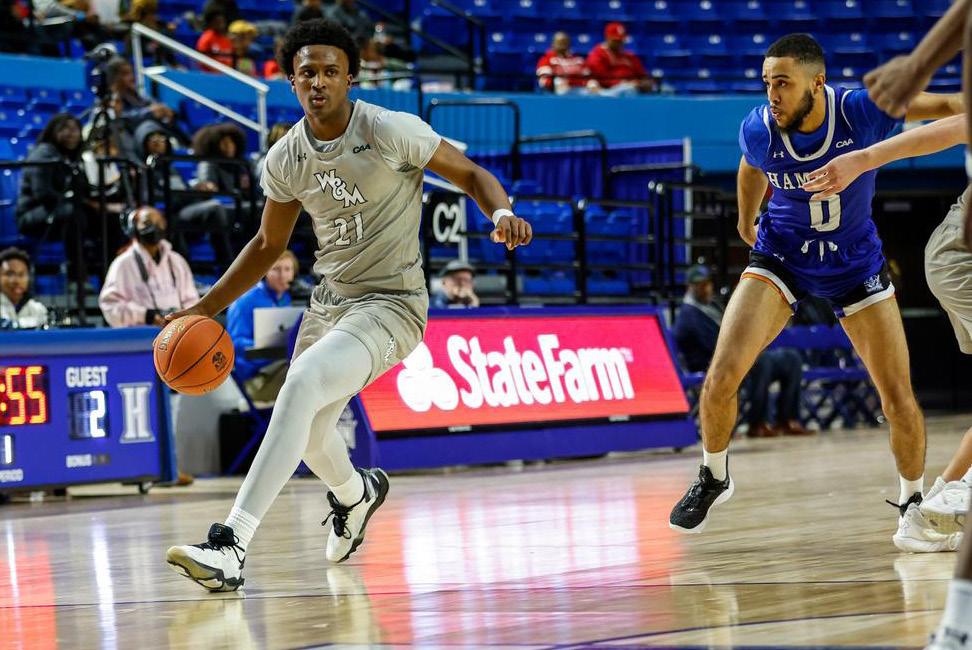
“Coach Fischer and Coach Bollinger were the very first coaches to call me as soon as I entered the transfer portal,” Dorsey said. “And, not only did they make me feel that I was a priority, but I felt an immediate connection with them as well.”
While the coaches made Williamsburg an attractive landing spot for Dorsey, William and Mary’s academics ultimately convinced him to attend the College.
“A William and Mary degree can do a lot of positive things for my future,” Dorsey said. “I know that I can form meaningful relationships here that can set me up for the long run.”
After completing his transfer to William and Mary for his sophomore season, Dorsey immediately got to work in the gym.
“Anyone that knows me knows that I live in the gym, and after the year I had shooting the basketball as a freshman, I was very determined to flip the script this year as a sophomore,” Dorsey said.
This season, Dorsey let his hard work speak for itself. On Jan. 7, Dorsey scored a season high 21 points against Hofstra, shooting seven of 15 from the field with all seven of his baskets coming from behind the arc. He also matched that season high two weeks later against N.C. A&T on Jan. 21, adding five more threes to his already impressive season total.
WOMENʼS BASKETBALL
Towson sneaks by worn-down Tribe
Tigersʼ
size outmatches Green and Gold
Friday, Feb. 17, William and Mary (14-11, 9-5 CAA) lost a hard-fought battle against Towson 66-59 at Kaplan Arena in Williamsburg, Virginia.
“You know, we’re battling a lot of fatigue, battling people fighting through injury and sickness,” head coach Erin Dickerson Davis said. “We gave everything we had but just came up short today.”
Graduate student guards Riley Casey and Sydney Wagner facilitated a majority of the Tribe’s offensive production, continuing their impressive seasons with 16 and 20 points, respectively.
Towson redshirt junior guard Kylie Kornegay-Lucas, sophomore guard Patricia Anumgba and sophomore forward Quinzia Fulmore each scored double-digit points for the Tigers, proving to be too overpowering for the Green and Gold’s defense to contain.
The first quarter started hot for the Tribe, largely due to its temporarily impenetrable full court trap. After a solid first defensive possession, Wagner put the Green and Gold on the board
with an acrobatic finish in the paint. Towson initially responded, but the Tribe’s defense quickly became impossible to break.
With the game tied 6-6, senior forward Bre Bellamy forced a Tiger turnover, leading directly to a Casey three-pointer at the other end. After multiple baskets from junior center Kayla Beckwith, the momentum was completely in the Tribe’s favor, capped off with a Casey last-second runner to extend the lead to 24-13 going into the second quarter.
The Tigers came out a different team after the break. After a Fulmore and-one, Wagner scored two quick buckets on back-toback possessions, stretching the lead to 29-16 with eight minutes, two seconds left in the quarter. However, Wagner’s points were the last of the Tribe’s scoring in the half.
Towson then began a 17-0 run, with baskets coming from almost every Tiger on the floor.
Junior guard Alexia Nelson wreaked havoc on both sides of the ball, following a basket with an immediate steal that forced a Tribe foul. Fulmore relentlessly attacked the paint, forcing the Green and Gold to leave senior guard Anissa Rivera open for an easy Towson three.
Kornegay-Lucas tied the game with just under two minutes left in the half. After two Tiger free throws and an Anumgba layup with six seconds left, the Tribe found itself down 33-29 going into half.
“When we went down at halftime, I just said it’s not about Towson, it is not about N.C. A&T, it’s not about Elon,” Dickerson Davis said. “It’s not about anybody that we’ve played. It’s about us and how we do things, how we play basketball, and we just took a second to regroup.”
The Tribe came back with a new energy and quickly worked to erase the deficit. Freshman guard Alexa Mikeska revamped the Green and Gold’s offense with a fast break layup, only for Towson’s Anumgba to knock down a jumper in response on the
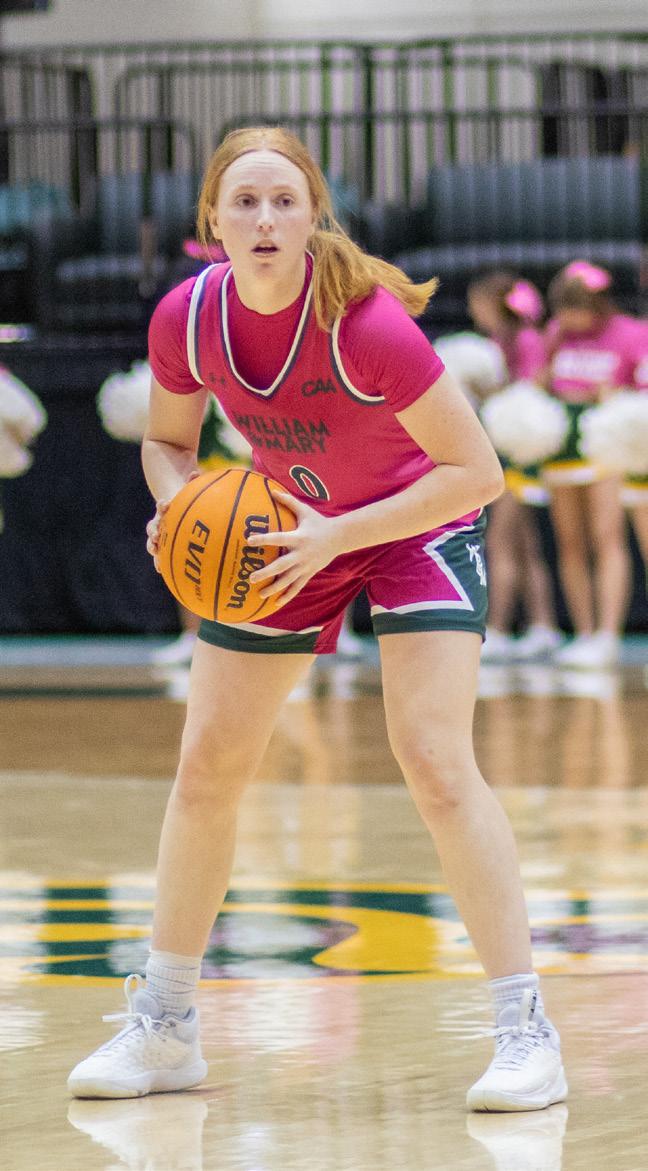
other end.
After a missed shot from the Tigers, Wagner went coast to coast, finishing a tough layup at the basket to cut the Towson lead to two with just under eight minutes left in the quarter. On the next Tribe offensive possession, Casey scored a game-tying jumper, getting the crowd in Kaplan Arena up on their feet.
The game continued back-andforth throughout the majority of the quarter, but with four and a half minutes left, the Tribe slowly began pulling away. After a pair of Riley free throws and another Wagner basket, William and Mary cemented the momentum shift with a three from junior forward Rebekah FrisbySmith, forcing a Towson timeout and extending the Tribe’s lead to 44-37. The Tigers clawed back, and as the third quarter ended, Towson had brought itself back within two points.
The fourth period started with yet another Towson run. The Tigers relentlessly attacked the paint, starting with an early layup from Rivera to tie the game at 49-49. After a Nelson three and layup on back to back offensive possessions, Fulmore finished two consecutive tough shots in the paint to give Towson a 58-49 lead with five minutes, 55 seconds left. The Tribe were not ready to roll over and quit, though. Wagner, Beckwith and freshman forward Kayla Rolph all scored on consecutive Tribe possessions, cutting the lead to 60-58. However, the Tiger’s size and crafty guard play made it impossible to erase the deficit completely. After multiple late missed three pointers, the Tribe had to foul, but late free throws from Towson sealed the deal.
“I think people wanted to win so badly that they wanted to do it on their own, and that happens sometimes,” Dickerson Davis said. “But we’ll learn from it, we’ll watch it and we’ll use it going into the next game.”
The Tribe look to bounce back against CAA conference opponent Elon (8-18, 4-11CAA) on Friday, Feb. 24 at home in Kaplan Arena in Williamsburg, Virginia.
According to Fischer, Dorsey’s success on the court can be attributed to his tremendous work ethic and training over the past year.
“I think the first thing with him is his incredible work ethic that he has. He’s constantly getting in the gym and shooting the ball whether it’s before practice, after practice, coming in at night,” Fischer said. “He really takes a lot of pride in working on his shots and on his craft, and it’s one of the reasons why he’s been able to shoot the ball at such a high level.”
Besides his stellar scoring and shooting ability, Fischer described Dorsey as an excellent leader and locker room presence.
“He’s a tremendous teammate,” Fischer said. “Guys love being around him.”
According to Dorsey, his mentality off the court is centered around going with the flow.
“I think that my biggest strength is my ability to adapt to different situations, and my openness to understanding people and ways of living that are different from mine,” Dorsey said.
Dorsey is currently sidelined with an injury, but hopes to return to the court soon.
As the Tribe wraps up the regular season within the next week, Dorsey believes it is most crucial to the team’s success moving forward to play unselfish basketball.
“The biggest key for us is to continue to share the ball like we have as of late,” Dorsey said. “We are a team that thrives off of ball movement and unselfishness, and I believe the sky’s the limit for us if we continue to do that like we’ve been doing.”
According to Fischer, Dorsey has potential to play basketball at a higher level.
“I think it’s going to be continuing to just build his offense off of his ability to shoot the ball and become more of a threat to put the ball on the floor,” Fischer said. “We also talk a lot about him being a more vocal leader for us because he is such a smart player that he can add more to our team with his poise.”
Dorsey is an integral piece of the Green and Gold’s young core of players. With Dorsey, junior forwards Noah Collier and Ben Wight, sophomore guard Tyler Rice and freshman guard Jack Karasinski, the future of Tribe basketball is bright.
WOMENʼS LACROSSE
Tribe falls to Spiders
No. 19 Richmond erupts for 20 goals
Wednesday, Feb. 15, William and Mary (0-2) lost to No. 19 Richmond (2-0) 20-4 at Martin Family Stadium in Williamsburg, Virginia.
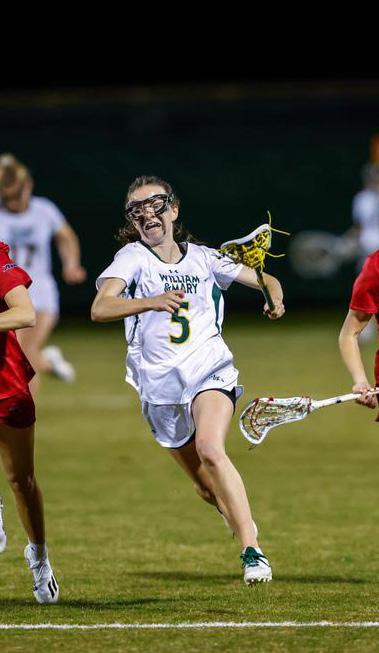
“We have a lot of things to work on, it’s game two of the season and this group does not give up,” head coach Colleen Dawson said. “They are ready to fight and compete and will continue to get better.”
The Spiders dominated in the first quarter, scoring 11 goals and shutting out the Tribe.
“[In] the first quarter there was not a lot happening for us across the board — not the Tribe Lacrosse standard, and we acknowledged that,” Dawson said.
“We played a top 25 opponent early in the season and we do that because we play a really tough conference. Richmond has been and continues to be a very strong program, and the CAA will throw a lot on our plate so it is good to see early on where we need to improve.”
The Tribe got on the board with nine minutes, seven seconds left in the second period with a goal from sophomore attack Delaney Roth. The Spiders tacked on two more goals, bringing the score to 13-1 at halftime.
The third quarter marked a
stronger showing for the Tribe. The Spiders started off the scoring in the second half with a quick goal, but the Tribe responded with an offensive attack of its own. Freshman midfielder Maresa Moyer scored the first goal of her collegiate career with eight minutes, 21 seconds remaining in the period. Richmond junior attack Marymargaret Quinn scored next, bringing the score to 152. The Tribe was able to build some momentum with two goals towards the end of the third period from senior midfielder Sarah Cipolla and sophomore midfielder Serena Jacobs. Despite outscoring the Spiders in the third, the Tribe still entered the fourth quarter down 15-4.
“We had a lot of people off the bench come in and step up,” Dawson said.
In the fourth quarter, Richmond’s junior attack Ali Susskind continued her dominant offensive attack with two more goals, bringing her to three goals in the game. The visiting team scored five more goals in the final quarter to finish with a 20-4 win over the Tribe.
The Spiders took 35 shots compared to the Tribe’s 10 and dominated draw controls 20-7. The Tribe had 12 ground balls recovered against the Spiders’ 23 recoveries. Junior defender Caroline Hertzberg led the Tribe in draw controls, caused turnovers and ground balls.
“‘Me. You. Us.’ is our team motto for the year. That propels us to come together as a team and be unified. The girls love each other so the chemistry is there and we continue to push ourselves to get better,” Dawson said.
Dawson, who is entering her fourth season as head coach for the Tribe, is optimistic for the rest of the season.
“Our objective is to win games but our purpose is much greater than that,” Dawson said. “These girls are people before they are studentathletes, and we push them on and off the field to be great teammates, sisters, daughters and friends. I am very excited for this group to continue to come together, learn and grow from our past few games and continue to push forward.”
The Tribe will travel to Old Dominion (2-1) on Wednesday, Feb. 22 at L.R. Hill Sports Complex in Norfolk, Virginia.
SPOTLIGHT
| Wednesday, February 22, 2023 | Page 10 THE FLAT HAT MAX GRILL FLAT HAT SPORTS EDITOR COURTESY PHOTO / TRIBE ATHLETICS Sophomore Gabe Dorsey looks for an open shot against Hampon dur ing the Tribeʼs Feb. 2 loss. Dorsey finished the game 10 points and four rebounds.
MAX GRILL FLAT HAT SPORTS EDITOR
LACI MILLER FLAT HAT SPORTS WRITER
RYAN GOODMAN / /THE FLAT HAT Freshman guard Alexa Mikeska looks to pass during the Tribeʼs Feb. 16 loss to Towson.
COURTESY PHOTO //TRIBE ATHLETICS
Freshman midfielder Kate Draddy hustles up field during the Tribeʼs Feb. 15 loss to Richmond.
