PEERAWUT RUANGSAWASDI / THE FLAT HAT
Report suggests city of Williamsburg should engage with various organizations, including the College.

Committee recommendations, community call for increased racial reconciliation, equity efforts in Williamsburg
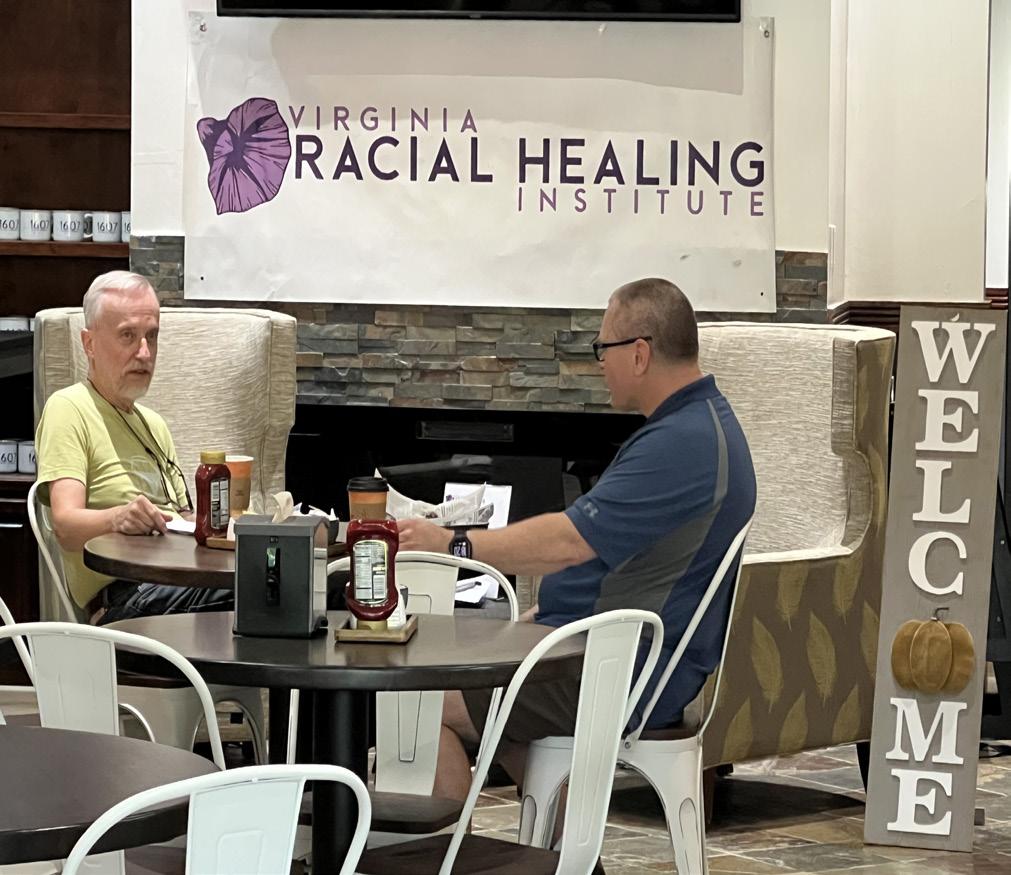
Tuesday, Sept. 19, members of the Williamsburg Truth and Reconciliation Committee Laura Hill and Helen Casey-Rutland discussed the committee’s report at the 1607 Coffee Company. Committee members and individuals from the Williamsburg community attended the event.
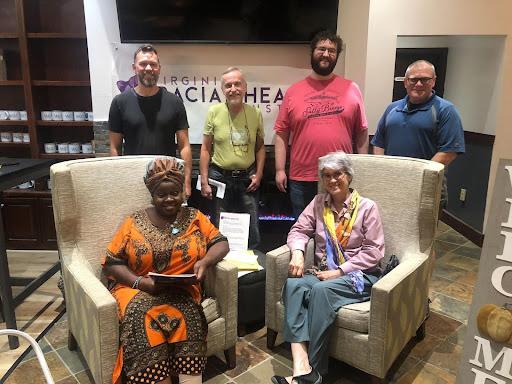
The Historic Triangle chapter of the nonprofit organization Coming to the Table and the Virginia Racial Healing Institute hosted the event. Hill leads both organizations.
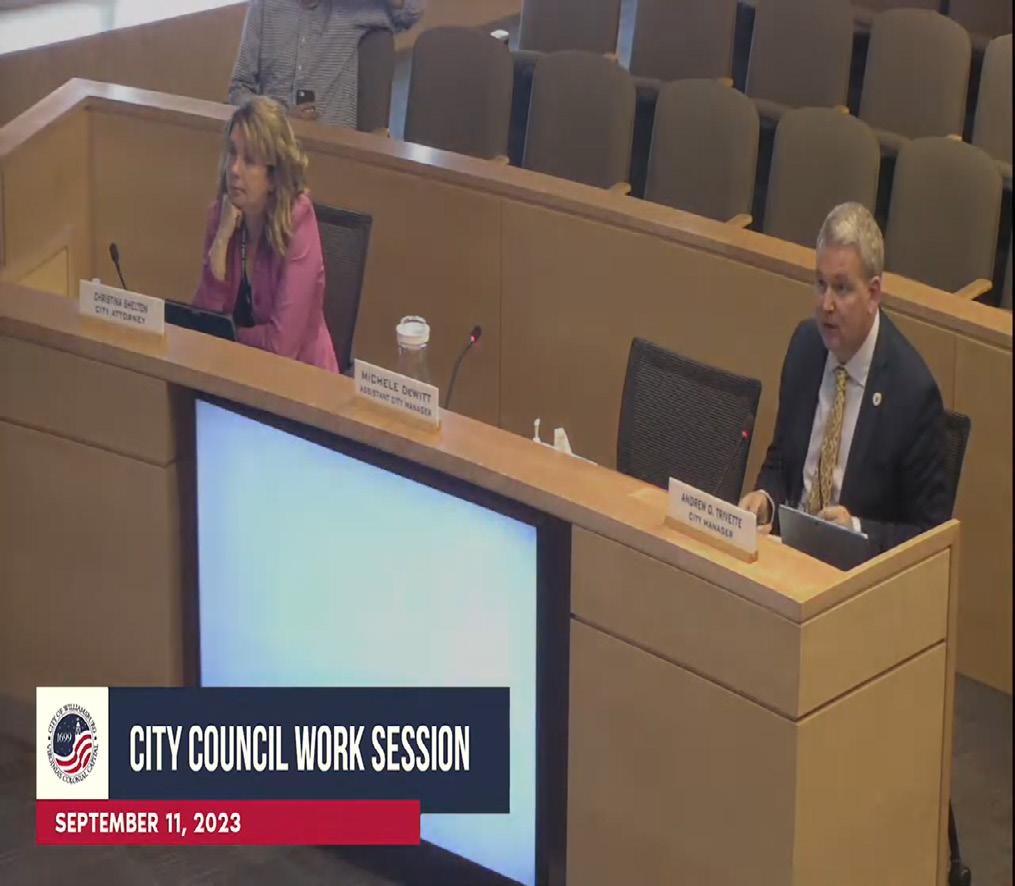
Williamsburg City Manager Andrew Trivette presented the report to the Williamsburg City Council Monday, Sept. 11. Trivette and Williamsburg Mayor Doug Pons headed the effort to form the committee after the council passed Resolution #21-05 in 2021.
The committee’s report to the council identifies five broad recommendations with more specific action items. The categories are listed as “Build a 21st Century Triangle,” “Speak the Truth,” “Do the Work,” “Foster a Welcoming Community,” “Create & Support a Healthy Community” and “Name It. Claim It. Fix It.”
“You’ll notice that for every recommendation there are actions, areas of focus, you’ll see agencies,” Hill said. “These are agencies that we’re recommending that the City work with, and then there are also outcomes, this is what we anticipate happen as a result of taking these actions, working with these agencies.”
The report lists dozens of organizations the committee thinks the city should engage, including the College of William and Mary, the College’s School of Education’s Community and Action Research Engagement lab, the College’s Office of Diversity and Inclusion, the College’s School of Education’s New Horizons Family Counseling Center and the Lemon Project.
“This process really began in December of 2020 when this initially included the idea of studying equity in the City was included in the Goals, Initiatives and Outcomes for that year,” Trivette said. “In July of 2021 the council took the important and impressive step of forming the Truth and Reconciliation committee.”
Methodist pastor Helen Casey-Rutland ‘83 laid out the basic goal of the committee.
Members
Friday, Sept. 15 marked the beginning of National Latinx Heritage Month. Throughout the month, student organizations are celebrating with a diverse array of events for members of the College of William and Mary community.
According to Emiko O’Cadiz ’24, historian for the Latin American Student Union, Latinx Heritage Month, which lasts from Sept. 15 to Oct. 15, honors Latinx, Hispanic and crosscultural identities.
“[Latinx Heritage Month] is a time to celebrate our cultural achievements and contributions,” O’Cadiz wrote in an email to The Flat Hat.
In celebration of the month, LASU has held several events, including “History of Empanadas” and “Taste of Latinx” celebrations, a picnic and an “Around the World Craft Night” with WMFIRE, another student organization that advocates for immigrant rights. In the next three weeks, LASU plans to host other events, including an international mini market popup with the South Asian Student Association, a karaoke night and a mock quinceañera with Political Latinxs United for Movement and Hermandad de Sigma Iota Alpha, the College’s Latinx fraternity.
During the “Around the World Craft Night” event, participants painted flags of their respective countries and discussed the importance of flags in identity and history.
“One of our pillars is education and learning service,” LASU president Ashley Carranza-Lopez ’24 said.
LASU also values connection, with many members referring to the community as a “familia”, or family.
“What we really preach on is family,” CarranzaLopez said. “Everything that we do is together, we don’t use ‘I’, we use ‘we.’”
Carranza-Lopez described the LASU community as a second home, especially for members who feel isolated or far from their families.
Traditions such as bigs and littles — where all new members are paired with an older member — ensure community members feel welcomed while providing a source of mentorship.
In addition to fostering family among its members, LASU strives to connect with other Latinx organizations on campus through presentations and mixers.
“Our exec group this year was really focused on unification with the Latinx orgs on campus,” Carranza-Lopez said. “We’ve always felt like there was a disconnect with them just because they’re so different, but I think the differences is what’s really important.”
These efforts are visible through several joint Latinx Heritage Month events this fall, such as the “Around the World Craft Night,” the international mini market pop-up, the mock quinceañera, a dance social with Queer People of Color and a carne asada with SASA.
“I feel like we’ve been making more connections with the other [multicultural organizations] on campus, and that is one of the main things that I want to see continue in the future,” O’Cadiz said.
Another of LASU’s core values is inclusivity,
“So, we wanted to hear the truth that people in the community had to share with us and then try to project some direction for the City to go in,” Casey-Rutland said. “And we were limited, of course, because we could only recommend that. The City has the power to do.” Hill and Casey-Rutland said the committee heard from a diverse group of people, including individuals as young as 19 and as old as 92.
The committee consists of five Williamsburg residents, two at-large members and Williamsburg Vice Mayor Pat Dent, who serves as an ex-officio member. Trivette and three other City staff members support the committee and attend the meetings monthly.
Committee members include former Councilmember Bobby Braxton, who serves as chair, and Vice Chair Adam Canaday. Both are descendants of Williamsburg Bray School students and participated in the school’s moving ceremony in February 2023.
Associate professor of ESL/bilingual education Katherine Barko-Alva and former Councilmember Benny Zhang ’16 J.D. ’20 also serve on the committee.
This year, the council aims to implement two of the committee’s recommendation actions.
“We’re primarily focused on completing the GIO for this period, which essentially gives us about a year to accomplish two of the action items related to the TRC report,” Trivette said.
“So the staff thought that the City Council would take some time, perhaps over the next month, and come back to the City with direction on two of the ones that we’ve recommended or a different direction that you’ve thought of on your own.”
Trivette also said the term “advancement” was deliberately chosen to denote completing an action item because it does not solidify or complete a process, but rather, indicates an initial step.
“Hiring a DEI consultant, helping us to understand the organization, and do the work in terms of how we engage with the community, strikes me as a great opportunity,” Pons said. “And then of course, the African-American Heritage Trail, which is a project that’s underway.”
Councilmember and director of Clinical Programs, director of the Immigration Clinic and clinical associate professor of Law Stacy Kern-Scheerer emphasized the long-term nature of the goals.
“It really isn’t about like checking the box,” Kern-Scheerer said. “I look at many of these things and they are not something that we’re just going to do in a year and be like we accomplished that one and moving on to the next but really thinking about longer term and thinking about how these things may grow and develop and transform over time.”
Councilmembers Caleb Rogers ’20 and Barbara Ramsey ’75 emphasized the benefits of a student scholarship program, stating its potentially large impact on students.
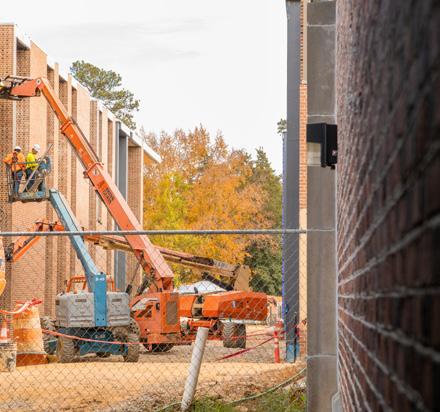
This year, the African American Heritage Trail program received $357,000 in federal funding.
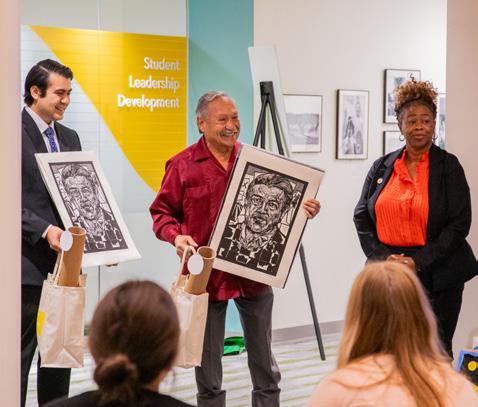
“You know, soon to come, hopefully. That’ll let us do the stage one of that trail would also be a very good, and, I think, quicker opportunity for investment,” Rogers said.
Assistant professor Aaron Griffith, who attended the Coming to the Table event, appreciated the conversation.
“I thought it was really informative,” Griffith wrote in an email to The Flat Hat. “The recommendations from the committee were excellent and look to really address many of the concerns of the descendent community in Williamsburg. I just hope the city takes these recommendations seriously and commits the resources to getting them started.”
Griffith also gave recommendations to students at the College.
“I think students at William and Mary can first make themselves knowledgeable about the history of race in Williamsburg and William and Mary,” Griffith added. “I would, second, recommend that they get involved in the local work on racial reconciliation, which may just be attending the Coming to the Table and the Village Initiative meetings to listen to what’s going on in town. Students can also attend events and be aware of the work that the Lemon Project on campus is doing.”
Latin American Student Union discusses importance of Latinx Heritage Month Vol. 113, Iss. 9 | Wednesday, September 27, 2023 The Weekly Student Newspaper of The College of William and Mary flathatnews.com | @theflathat
facilitating significant growth of diversity on
particularly in terms of cultural representation.
“A general issue in the Latino community is that a lot of people sometimes feel they aren’t ‘Latino enough’ due to not being able to speak Spanish,” O’Cadiz said. “Recognizing that we come from so many different experiences is really, really important to us and to make our members feel really comfortable with us as well.”
Bella Martinez ’27, a new member of LASU, appreciates how the organization stresses belonging.
“I was kind of nervous going to the first meeting, but ever since then I’ve definitely felt welcomed,” Martinez said. “Everyone is super friendly and introduces themselves and it’s really nice.”
Martinez looks forward to her next four years with LASU.
“I hope to get more involved with the club and meet some more people,” Martinez said. “I would also like to maybe get a position on the exec board or something, but just fostering this community and promoting people’s cultures.”
LASU has further emphasized its commitment to inclusivity through its Diversity, Equity and Inclusion efforts. The organization created the DEI chair and committee last fall, with the goal of amplifying unheard voices within the Latinx community.
According to Carranza-Lopez, at the beginning of the year, new members added their names and respective countries to a spreadsheet. This allows the executive team to organize celebrations tailored to members’ cultures, such as national holidays and festivities.
“Recognizing and celebrating those important holidays are essential to do,” O’Cadiz said.
In the past, LASU has also hosted food-related presentations to spotlight different countries.
Last year, the organization held a “History of Arroz” event, which highlighted Mexico, Puerto Rico, Peru and El Salvador. This year’s “History of Empanadas” featured Mexico, Haiti, Ecuador and Guatemala.
“Through that whole event, we had cooking groups,” Carranza-Lopez said. “You come in as strangers, you leave out as family, as friends.”
Carranza-Lopez and O’Cadiz acknowledged Latinx students’ many contributions at the College, both inside and outside of LASU.
“Our unique experiences bring different perspectives in classrooms, especially in classes that are white-dominated,” O’Cadiz said. “All Latinx students on this campus bring unique cultural perspectives and unique political and educational experiences that some others may not have.”
To further support Latinx students at the College, Carranza-Lopez stressed the importance of increasing accessibility for nonEnglish speakers through signs and brochures in Spanish.
“The biggest step in what the school could do is provide more resources and become more inclusive, not just with our actions but with our voice,” Carranza-Lopez said. “It’s not even just for Latinx, it’s for every other multicultural organization.”
READ MORE AT FLATHATNEWS.COM
Inside Sports
Inside Variety Give me sidewalks or give me death!
out about the tidal wave of construction and its effect on the student body page 5 INDEX Pro le News Opinion Variety Sports 2 3-4 5-6 7-8 9-10 Inside Opinions
Ellie Kurlander ’24 speaks
MADDIE MOHAMADI THE FLAT HAT STUDENT LIFE
for Student
hosts art exhibition
photographs of famous labor activist Cesar Chavez, celebrates legacy, Latinx heritage month page 7
Snap shots of Chavez Center
Diversity
with
of LASU emphasize celebrating culture, connecting with community,
Tribe football overpowers Maine 28-3, improves to 4-0 record Yoder propels team with 163 rushing yards, sustains serious injury page 10 campus
PEERAWUT RUANGSAWASDI // FLAT HAT NEWS ASSOC.
T HE F LAT H AT
TRUTH AND RECONCILIATION COMMITTEE PRESENTS REPORT TO CITY COUNCIL
COURTESY IMAGES / WILLIAMSBURG CITY COUNCIL
City Manager Andrew Trivette presents recommendations from the TRC to the city council.
COURTESY IMAGE / COMING TO THE TABLE
Coming to the Table Facilitator Bill Sizemore and James City Assistant Police Chief Anthony Dallman.
news insight
College falls 12 spots in USNWR rankings to No. 53
Monday, Sept. 18, The College of William and Mary fell 12 spots in the U.S. News and World Report (USNWR) 2023-24 Best National University Rankings, dropping to No. 53 from No. 41. This marks the Collegeʼs largest single-year position change in the rankings since 1996. Since 2018, the College has dropped 21 spots.
This yearʼs rankings used a new methodology, marking the most significant change in the rankingsʼ four decades of existence. According to USNWR, the new rankings formula accounts for graduate salaries, first-generation student enrollment and graduation and faculty research productivity, while no longer incorporating alumni giving rate, class size, the high school class standing of new entrants, the proportion of graduates with debt and the proportion of faculty with terminal degrees.
The release follows discussions between the board of visitors and senior administration members in recent months regarding the Collegeʼs future participation in such rankings, including USNWR. In August, President Katherine Rowe announced a working group to assess the Collegeʼs options.
JOSEPH WEHMEYER AND PEERAWUT RUANGSAWASDI // FLAT HAT NEWS
Celebrating 24 years of local outreach, leadership building
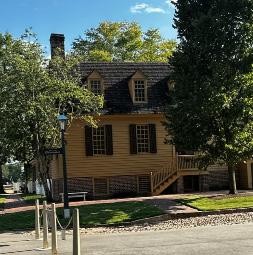
Rich Thompson has worked to improve, leadership, civic qualities of College students since 1999
EMMA HENRY // FLAT HAT NEWS EDITOR
e College of William and Mary’s O ce of Community Engagement (OCE) has been in action for over 20 years, with goals to inspire students to become better leaders and to create strong relationships within the Williamsburg community. e OCE operates programs including Branch Out alternative breaks, partnerships with Williamsburg Engagement and educational programs for pre-K-12 children in the Williamsburg community. e OCE wears a lot of hats, and so does its associate director Rich ompson, who started the role in 2019 after working at the College since 1999.
“I really saw it as an opportunity to enhance the student experience and how to potentially bring more students in to be involved, and to be leaders, to be civic leaders,” ompson said. “ at was such a huge draw to me, and I kind of jumped in blind.”
ompson grew up outside of Richmond and received a degree in Parks and Recreation Management from Western Carolina University in North Carolina as a rst-generation college student. Following his graduation, ompson worked for Residence Life at the University of Tennessee, Chattanooga, and later in Student A airs at Bridgewater College in the Shenandoah Valley. After some encouragement from the Bridgewater College dean of students, ompson received his master’s degree in Student Union Administration from Western Illinois University and nished his professional study at the University of Richmond. Ultimately, ompson ended up working for the College in 1999, and has not left since.
“Each of my mentors spoke so highly of William and Mary,” ompson said. “ e biggest thing, which I remember and has proven to be so true, they both said it’s the students. ey said the students will challenge you in the best way possible to bring your best every day.”
When ompson rst arrived at the College, he joined the faculty as the associate director of the Sadler Center, continuing in that role for 19 years. In July 2019, ompson transitioned into his current role at the OCE.
THE F LAT H AT
ʻSTABILITAS
Currently, the OCE works with six community partners, including the House of Mercy, Williamsburg Community Growers, Dream Catchers erapeutic Riding Center, Heritage Humane Society, Grove Christian Outreach Center and the Habitat for Humanity ReStore. ompson emphasized the importance of connecting with students while in his role at the OCE and his passion in helping them cultivate their leadership skills, including through the OCE Team Leader program.
To ompson, engagement within the community would not be as successful without a student-centered perspective.
“The Team Leader program explored, ‘What does it mean to be an empathetic leader in society? What does it mean to be an ethical leader in society? What does it mean to be a steward?’ Leaders are all these different little pillars. Buy-in occurs through role modeling and constant awareness of your strengths and weaknesses, and capitalizing on your strengths but also acknowledging you have weaknesses,” he said.
Thompson believes that working with the greater Williamsburg community has allowed students to recognize various disparities in the community and to observe that space in a different light.
“It gives a chance to see something di erent, or a chance just to get beyond the boundaries of campus itself and learn in the community di erently,” he said. “ ey get to work hand in hand with volunteers, they learn their stories and they motivate them to bring their best, just like the students motivate me to bring my best.”
ompson encourages students to break outside of their comfort zones and to surround themselves with people who are di erent from themselves.
“I think it’s important to push our boundaries, because [if not] we really don’t grow, and we really don’t develop understanding,” ompson said. “Try to build teams of people that are not like you. You don’t want everyone to be a cookie cutter. I think that’s an inherent human quality, we want to be around people that are like me and think like me all the time. But that’s not what really great teams are made of.”
Outside of the OCE, ompson also works as an advisor for the College’s Voter Engagement Program, which aims to boost student voter registration and turnout.
“All of our work is nonpartisan, and that’s one of my roles to make sure we stay on that track,” ompson said. “But once again, the work I do is for the students, and the students make it happen. I’m just a sounding board or a guidepost.”
Along with this role, ompson serves as committee chair for two awards presented by the College, including the President’s Award for Service to the Community which is granted to both students and faculty and recognized at convocation, and the James Monroe Prize in Civic Leadership, awarded on the College’s Charter Day. ompson was a recipient of the President’s Award in 2011.
“It gives me great moments of pride when I let someone know that they are this year’s recipient, because the excitement, enthusiasm and just their applications are just amazing when you see all the depth that is from the community, from our faculty, staff and our students,” Thompson said. “We are the alma mater of the nation, we set standards, we are leaders now and in the future.”
ompson also acts as co-administrator for the College Bike Alliance and was appointed by the President’s O ce as the College’s representative for the Historic Triangle Bicycle Advisory Committee in 2007. ompson mentioned that he began taking cycling more seriously when he started working for the College, often riding his bike multiple miles to work.
“Really it’s a means to connect with the community,” ompson said. “Some students in that program have gone on to careers in active transportation and it just blows me away.”
rough cycling, ompson felt a stronger bond with the community around him, as well as the health and wellness bene ts.
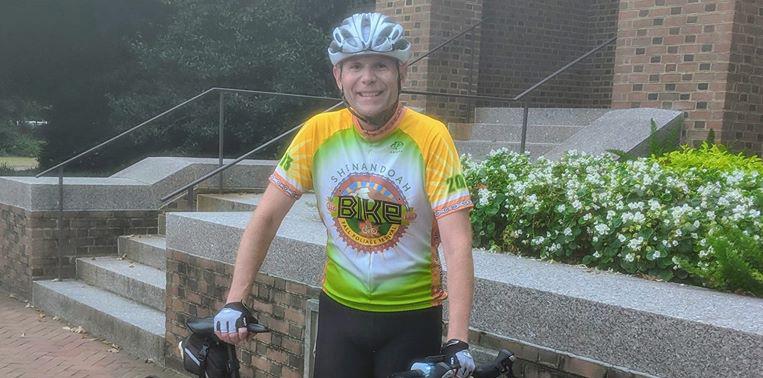
“I was getting tter and stronger, and I realized I was getting more positive,” ompson said. “I’m not separated by glass and metal, and it created more connectivity to people. And I got to explore the community and learn di erent things. I see things that most people don’t know when I’m on the bike, and I started sharing with some students who wanted to start this initiative, and they got into it too.”
Philadelphia-based Movement Theater International until retiring in 2016. He has since settled in Williamsburg and authored nine books.
Wednesday, Sept. 20, the College of William and Mary’s Reves Center for International Studies welcomed Michael Pedretti, a seasoned performer and scholar with over 50 years of experience as a clown, to speak on the evolution of modern mime art and his contributions to the art form.
Pedretti, who initially worked as a theater professor, later founded and acted as the artistic director of the
In the Reves Room, Pedretti initiated his 45-minute presentation by reading an excerpt from his 2022 book, “The Inside Story of Movement Theater International’s Mime and Clowns Festival.”
“Mime is the ultimate in simplicity, and the purest of art forms,” Pedretti said. “ ere’s no medium or material, just an actor and a bare stage. Mime is the art form underneath all other art forms.”
Pedretti acknowledged the complexity of his work as a clown, especially in regard to the performative arts. “I have been performing as a clown for almost 50 years, and I still don’t have a definition of what a clown is,” Pedretti said. “What clowning definitely is not is a costume and makeup. For me, clowning is a verb. It is a series of attitudes and techniques that lead the performer into a relationship building rapport with the audience.”
“ “ THE BUZZ THE FLAT HAT | Wednesday, September 27, 2023 | Page 2 News Editor Abigail Connelly News Editor Emma Henry News Editor Daniel Kalish fhnews@gmail.com CORRECTIONS e Flat Hat wishes to correct any fact printed incorrectly. Corrections may be submitted in email to the editor of the section in which the incorrect information was printed. Requests for corrections will be accepted at any time.
I go back to this uniqueness about William and Mary and the cul ture here. I get challenged, I feel valued, I have a family in a way. I donʼt have any living family, but I have family here. ̶ Rich Thompson
A THOUSAND WORDS COURTESY PHOTO / ISABEL ROSE
FLAT HAT NEWS BRIEF
COURTESY IMAGE / RICH THOMPSON
Rich Thompson is the co-administrator of the Bike Alliance, where he encourages recreational cycling and exploring Southeastern Virginia by bike.
ET FIDESʼ | ESTABLISHED OCT. 3, 1911 Org #101 P.O. Box 8795, Williamsburg, VA 23187 Editor flathat.editor@gmail.com Managing flathat.managing@gmail.com Executive flathat.executive@gmail.com Magazine editor@flathatmagazine.com News fhnews@gmail.com Sports flathatsports@gmail.com Copy flathatcopy@gmail.com Opinions fhopinions@gmail.com Variety flathat.variety@gmail.com Photos flathatphotos@gmail.com Online flathatonline@gmail.com Advertising flathatads@gmail.com Graphics flathat.art@gmail.com Ombudsman flathat.ombuds@gmail.com Molly Parks Editor-in-Chief Jake Forbes Managing Editor Vivian Hoang Executive Editor Adam Jutt Digital Media Editor Anna Arnsberger Operations Coordinator Conor Downey Business Manager Myles Rescher Business Manager Abigail Connelly News Editor Emma Henry News Editor Daniel Kalish News Editor Miles Mortimer Variety Editor Agavni Mehrabi Variety Editor Ethan Qin Sports Editor Max Grill Sports Editor Avi Joshi Opinons Editor Chris Schneider Videos Editor Lisa Coleman Data Editor Camila Anderson Social Media Editor Karis Koutsourelakis Social Media Editor Yelena Fleming Graphics, Podcast Editor Ryan Goodman Photos Editor Crystal Wang Copy Chief Betsy Mahoney Chief Staff Writer Anu Desai Copy Editor Veronica Bondi Copy Editor Annabelle Glassman Copy Editor Maddie Harris Copy Editor Caitlin Noe Copy Editor Joe Wehmeyer News Assoc. Editor Aafreen Ali News Assoc. Editor Sonia Samantaroy News Assoc. Editor Ian Harman News Assoc. Editor Peerawut Ruangsawasdi News Assoc. Editor Grace Martin News Assoc. Editor Grace Saunders Variety Assoc. Editor Summer King Variety Assoc. Editor Lindi Li Variery Assoc. Editor Phebe Fahmy Variety Assoc. Editor Emma Halman Variety Assoc. Editor Ava Edwards Variety Assoc. Editor Ashley Cohen Variety Assoc. Editor Gabriel Black-Planas Chief Features Writer John Powers Opinions Assoc. Editor Ellie Kurlander Opinions Assoc. Editor Lauren Meyer Opinions Assoc. Editor Bushra Bablu Opinions Assoc. Editor Damien Kanner-Bitetti Opinions Assoc. Editor Elizabeth Brady Opinions Assoc. Editor Samuel Li Photos Assoc. Editor Elliott Lee Chief Sports Writer, Photos Assoc. Editor Laci Miller Sports Assoc. Editor Catherine Storke Graphics Assoc. Editor Jonah Randell Ombuds Assoc. Editor Nora Keely Ombuds Assoc. Editor Shradha Dinesh Data Assoc. Editor Abhayprad Jha Data Assoc. Editor Jenine Samara Podcast Assoc. Editor Maddie Cassidy Fact Checker Alisha Khodabocus Fact Checker Jana Smith-Perry Fact Checker Mollie Shiflett Opinions Editor Reves Center speaker argues mime is transnational artform Michael Pedretti discusses history of mime as artform, bridge across national borders CLAIRE GIFFORD FLAT HAT NEWS READ MORE AT FLATHATNEWS.COM READ MORE AT FLATHATNEWS.COM
Former Virginia attorney general gives talk at Law School
Dunn lecture event covers Mark Herringʼs experiences during time in office
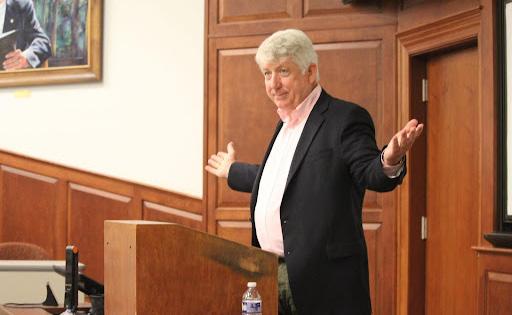
Monday, Sept. 18, former Virginia Attorney General Mark Herring participated in a Dunn Lecture event hosted by Sandra Day O’Connor Professor of Law and professor of government Neal E. Devins at the College of William and Mary Law School.
Virginia is one of 43 states that popularly elects its attorney general, who serves as the chief legal o cer for the state. In seven states, the attorney general is an appointed position. A Democrat, Herring was rst elected in 2013. In 2019, Herring appointed the University Counsel Carrie Nee.
During the talk, Herring detailed his experience as Virginia attorney general, as well as attempts to remove him from the position, which began during the rst month of his tenure.
As the state’s chief legal o cer, Herring laid out his vision on the role of the job.
“I think part of the job is to provide good, objective, timely legal advice,” Herring said. “Every department, agency, board, commission, a public college or university in the state, almost all have some criminal jurisdiction, especially in criminal appeals. ey all handle civil litigation in a very centralized fashion where the state, they represent the public interest in a kind of a public advocacy role. Remember, going back to tradition of independence, being the guardians of the public interest.”
Herring then shared some of his accomplishments in o ce, including civil rights issues. He spoke about one of his earliest cases as attorney general, where he opposed Virginia’s ban on same-sex marriage.
“I’m trying to analyze this as an attorney general, and here were some of those considerations,” Herring said. “First, it was a fundamental right, the right to marry. It impacts a lot of people. at’s number one. Number two, I strongly felt Virginia needed a course correction. We had lost so many landmark civil rights cases. I was like, ‘We are not making this mistake.’”
In Bostic v. Rainey, the case resulted in a victory for the plainti s, who were married same-sex couples. e ruling was further upheld by the Fourth Circuit
CAMPUS
Court of Appeals.
“It was time to show Virginia, Virginians and the rest of the country that we were on the right side of this civil rights issue,” Herring said. “ We were going to take up the side of the plainti s and stop ghting against people’s rights and start ghting for them.”
At the time, then-governor Terry McAuli e, a
United States as children to avoid deportation and be eligible for a work permit.
“I knew kids who were probably undocumented when they were growing up in my community — I coached their soccer teams,” Herring said. “ ey went to school side by side with my kids, but mine and others had other opportunities and many of them did not. And out-of-state tuition was beyond reach.”
Democrat, supported Herring’s decision.
“So that’s what we did, not without a fair amount of blowback, an attempt by the state bar to disbar me, others to impeach me,” Herring said. “But the response, while they’re from a predictable corner, happened, but so many other people, the support was amazing.”
Herring also detailed his e orts in securing in-state college tuition rates for recipients of the Deferred Action for Childhood Arrivals program, which allows undocumented immigrants who were brought to the
Herring then recalled when a young girl he met at a Virginia Girls State event informed him of her immigration status as a member of the DACA program. She told Herring that she had wanted to attend the University of Virginia but could not have done so without Herring’s work to secure in-state tuition for DACA recipients. Herring said he met the student again years later at UVA.
“Trump was elected in 2016, and at the time he was threatening to eliminate the DACA program,”
Herring said. “She asked me and she was like, ‘You’re not going to let that happen, right?’ You know, I’ll do what I can, no guarantees, but it’s the real impact these cases, these principles, have on people’s lives.”
However, Herring’s tenure was riddled with controversy. He resigned as a co-chair of the Democratic Attorneys General Association in 2019 after admitting to wearing blackface to a party while an undergraduate student at UVA. After two terms in o ce, he lost his bid for a third term in 2021 to Republican Jason Miyares J.D. ’05. McAuli e, who sought a non-consecutive second term, also lost to Republican Glenn Youngkin HON ’23 in the same year. Herring still said during the event that he enjoyed his experience as Va. attorney general.
“If you’re a lawyer, it is a great job,” he said. “I was fond of telling people at the time that I love public policy, I love practicing law. Most of all, I love helping people. When you’re the attorney general, you get to do all three of those things every minute you’re awake.”
Margaret Dupree J.D. ‘24 noted her appreciation for the event.
“I thought it was good. He clearly has a lot of experience to talk about, and I think taking the time to come talk to our students is really helpful because the current AG, who’s a Republican also went here. So it’s interesting having both perspectives coming to William and Mary and talk to us. And I also think that a lot of us take classes in these subjects. And so it’s great to hear first-hand experience,” Dupree said.
Connor O’Neill J.D. ‘25, a Student Assembly senator, also attended the event and shared a similar sentiment.
“He was an interesting individual – the work that occurred during his term of o ce that he described was quite impressive,” O’Neill wrote in an email to e Flat Hat. “ e way he contrasted his e orts with the work of previous AG’s was well framed, he certainly sold the human rights work of his o ce quite well. I enjoyed the conversation and I was glad to hear from Virginia’s previous AG.”
Earl Gregg Swem Library hosts Fall undergraduate student research symposium
Students showcase summer research on topics in Arts, Sciences with posters, digital media
KYLE KOPKO
THE FLAT HAT
Friday, Sept. 22, the College of William and Mary hosted a research symposium in Earl Gregg Swem Library for students who participated in undergraduate research over the summer. Students presenting their research displayed tri-folds and digital media during two time slots. The symposium was open to visitors for a fourhour period.
Students crafted interactive displays, prompting engagement with visitors. Projects covered a broad range of topics in the arts and sciences fields.
As viewers walked by the tables, researchers encouraged active participation and openly answered questions about their research. After researchers presented their projects and gave a general overview of their research process and findings, viewers had the opportunity to discuss topics, ask questions and engage in presenting further ideas and perspectives to the research field.
Director of the Roy R. Charles Center
Elizabeth J. Harbron described the array of benefits that stem from undergraduate research, acknowledging the differences between a typical classroom experience and an in-depth research project.
“Research is so different because the answer isn’t known,” Harbron said. “Your advisor doesn’t know the answer. You don’t know the answer. You’re out there figuring it out or doing some kind of analysis that no one’s ever done before, and when you experience challenges in that process, sometimes it’s a little different to process that, and so I think students often find that they have a stubbornness or some perseverance that maybe they didn’t know they had.”
Harborn is currently in her third year as director of the Charles Center and recognizes the importance of undergraduate research for career discernment.
“They may also find that that kind of interaction with the world is not their favorite thing, and I think that can still be the hallmark of a successful experience because part of college is figuring out
what you’re about, what skills and talents you have, what things you love to do, what things you [don’t] love to do,” Harborn said.
Many projects presented in this year’s symposium were funded by the Charles Center in the form of summer research grants. The Center offers awards of $3000 to assist students with seven weeks of research. Rising sophomores, juniors or seniors can apply for a research grant in a variety of areas.
Harbron encourages students considering an undergraduate research project to pursue a research grant and communicate with the Charles Center.
“I would say they should absolutely do it, and if they need any help in figuring out what that is or how they can receive mentorship support or financial support, then they should come talk to us at the Charles Center,” Harbron said.
Karalyn Timmes ’24, a Monroe Scholar and accounting student, described a personal connection with her research project. Timmes expressed interest in learning about the different perspectives of
the controversies concerning Confederate culture and its influence on Lexington, Va, where she had previously lived.
“Ultimately, it was just to build a body of knowledge for myself to participate in these conversations and discussions about this topic and have appropriate knowledge about the background because so much of this is fueled from propaganda that has lasted for generations,” Timmes said.
Timmes encouraged students to undertake undergraduate research on topics they feel inclined to explore.
“Do something really interesting,” Timmes said. “It doesn’t have to be part of your major. It doesn’t have to be something that directly advances your career.”
Allyson Lowe ’24, an English major and creative writing minor, described her research on the economies of slavery and narratives of enslaved individuals.
“My project focuses on the different economies of slavery and the slave narrative, ‘Incidents in the Life of a Slave Girl’ by Harriet Jacobs,” Lowe said. “Even
though we just read excerpts in my early Black literature class, I had never encountered slavery from a female perspective.”
Lowe expressed her desire to expand upon this research and incorporate it into a larger project in the future.
“I’m just really excited about it,” Lowe said. “It’s really like I’m doing my own research. I’m doing something I’m proud to be doing.”
Lowe also gave some encouragement to students who are considering an undergraduate research project.
“Do it, you won’t have any regrets,” Lowe said. “It’s worth all the effort and time and energy you’re going to invest in it. There were some nights when I was researching, you know, reading till I felt like my eyes were going to melt out of my brain, and I was like, ‘This is never going to get done. Like, what am I really doing? Like, have I lost sight of my project?’ and it all comes back. Just find something you’re passionate about and really go for it.”
Public policy program addresses rami cations of gun policy, country’s history of violence
Conversation addresses colonial history of gun legislation, compares historical record to modern data
Thursday, Sept. 21, the College of William and Mary’s Public Policy Program hosted Dr. Robert Spitzer in Tucker Hall for a discussion on the United States’ history with gun laws and violence.
Spitzer is an adjunct professor at the College of William and Mary Law School, as well as a professor emeritus at the State University of New York College at Cortland.
Paul Manna, director of Public Policy at the College, moderated the event alongside associate teaching professor Alan Kennedy.
Spitzer began with a lecture on America’s history of gun violence and the current state of dispute over the issue.
“Disputes over gun policy today are seen as zero-sum for the two sides–gun rights and gun control,” Spitzer said. “But that’s not how gun policy has always operated over the years.”
Spitzer described how the
original 13 colonies implemented a variety of gun laws.
“In many respects, guns were more strictly regulated in the first 300 years than the last 30 years,” he said. “These gun laws applied to everyone, from Native Americans to Protestants, and new owners to the experienced. Weapons were often confiscated if these laws were violated and, in many instances, if guns were fired after dark, near cemeteries and near towns.”
In the same segment, Spitzer continued reflecting on the uses and views of guns in the past decade. He referenced key court cases, such as the monumental 2008 Supreme Court decision in District of Columbia v. Heller.
“This was the first time a federal court overturned a violation of the Second Amendment, and it was an individualist view of the Second Amendment,” he said. Then, Spitzer raised New York
State Rifle and Pistol Association Inc. v. Bruen (2022).
“The case determined that the Second Amendment protects an individual’s right to a handgun outside the home,” Spitzer said. “Specifically, the case allowed for the concealed-carry of a firearm for ordinary self-defense purposes in daily, public life.”
He explained how this more recent case added a new framework for evaluating the legality of gun laws.
“This case established a new history-based test for establishing gun laws,” Spitzer said. “Other amendments are not so subject to its history.”
Ultimately, Spitzer believes the Supreme Court’s ruling in NYSRPA v. Bruen relates to constitutional originalism, the notion that judges should interpret the Constitution as its original intent from the time of its founding in the 18th century, filtering out new interpretations.
Spitzer then elaborated on his research of the fallacies of originalism as it relates to the interpretation of the Second Amendment.
A gun owner himself, Spitzer said he enjoys using his ri e in a safe and controlled environment and supports increased gun legislation.
Kennedy and Spitzer then had a 30-minute moderated discussion, building upon Spitzer’s lecture.
Kennedy asked Spitzer about his involvement in shaping gun policies. Spitzer shared that he has been invited to serve as an advisor to the state attorney general in drafting gun laws.
“I was asked by the state to prepare documents of old gun laws,” he said. “I treat these documents as quantitative data, even if I don’t specialize in that.”
Nearing the end of the event, the audience had the opportunity to ask Spitzer questions.
One student asked Spitzer about the ramifications of
stricter gun laws, citing a possible increase in gun sales on the black market.
In response, Spitzer explained that law enforcement would be able to suppress illegal gun trafficking more easily with increased legislative restrictions.
Kennedy also shared his view on the issue.
“The number one source state for guns in New York is Georgia, and it’s not a coincidence. There’s a patchwork of gun laws within the country,” he said.
Kennedy believes inadequate and varying legislation across the country makes the illegal sale of guns easier.
Another attendee asked Spitzer about legislating ghost guns, which are difficult to trace.
He explained that ghost guns are the parts of a gun that anyone can purchase on the internet with no serial numbers.
Using these parts, people build their own guns with no
serial numbers. According to Spitzer, the solution is to make sure serial numbers appear on the parts as well as the nal rearm product.
“There’s nothing about serial numbers that restricts guns themselves. Any law-abiding citizen should want a serial number so that guns can be tracked,” Spitzer said.
The event followed with a reception in Chancellors Hall. Madison Scalf ’24 shared her thoughts on Spitzer’s talk.
“He seemed to really be knowledgeable of what he was talking about,” she said.
Scalf appreciated the talk as a public policy student herself.
“As someone who’s going into public policy, it gave me a lot of tools, not only when it comes to advocacy, but also when it comes to argument for certain policies and making me overall more of a passion to look at gun control laws,” Scalf said.
THE FLAT HAT Page 3 Wednesday, September 27, 2023
PEERAWUT RUANGSAWASDI FLAT HAT NEWS ASSOC.
LAW SCHOOL
PEERAWUT RUANGSAWASDI / THE FLAT HAT
MONA GARIMELLA THE FLAT HAT CAMPUS
Herring shared experiences from his time in office, specifically referencing his opposition to Virginiaʼs previous ban on same-sex marriage.
College hosts 'Sci-Fri' event, displays STEM projects in ISC
Student interactive displays encourage participation, showcase research from various science departments
Friday, Sept. 22, the College of William and Mary’s Integrated Science Center held an open event titled “Sci-Fri: an open night of science for the community” to highlight its many STEM projects. The different science departments of the College each organized hands-on activities, appealing to audiences of all ages.
ISC is one of the most recently renovated academic buildings on campus and is home to several science departments, including applied science, biology, chemistry, data science, neuroscience, physics and psychological science.
e psychological science department showcased various activities, including an EKG machine to show the e ect of emotions and physical activities on a child’s heartbeat.
Ansley Crutchfield ’25, a student in the College’s Master of Science in Psychology program, reflected on her initial interest in the College’s approach to intensive research and collaboration.
Master’s degree students in the psychological sciences department engage in a two-year, highly selective research-oriented program in a small group of eight to nine graduate students.
“My master’s program that I am involved in here is research based and so what really attracted me to the program was their emphasis on psychology as a science and Dr. Madelyn Labella’s research profile regarding emotional regulation,” Crutchfield said. Stephanie Kent ’24 re ected on her time a liated with the Psychology department.
“I joined professor Madelyn Labella’s lab the spring of my sophomore year,” Kent said. “I’m really interested in clinical psychology, and she does a lot of developmental and clinical research.”
The psychological science department also included information about the reading of brain waves and a comparison of a human and sheep brain.
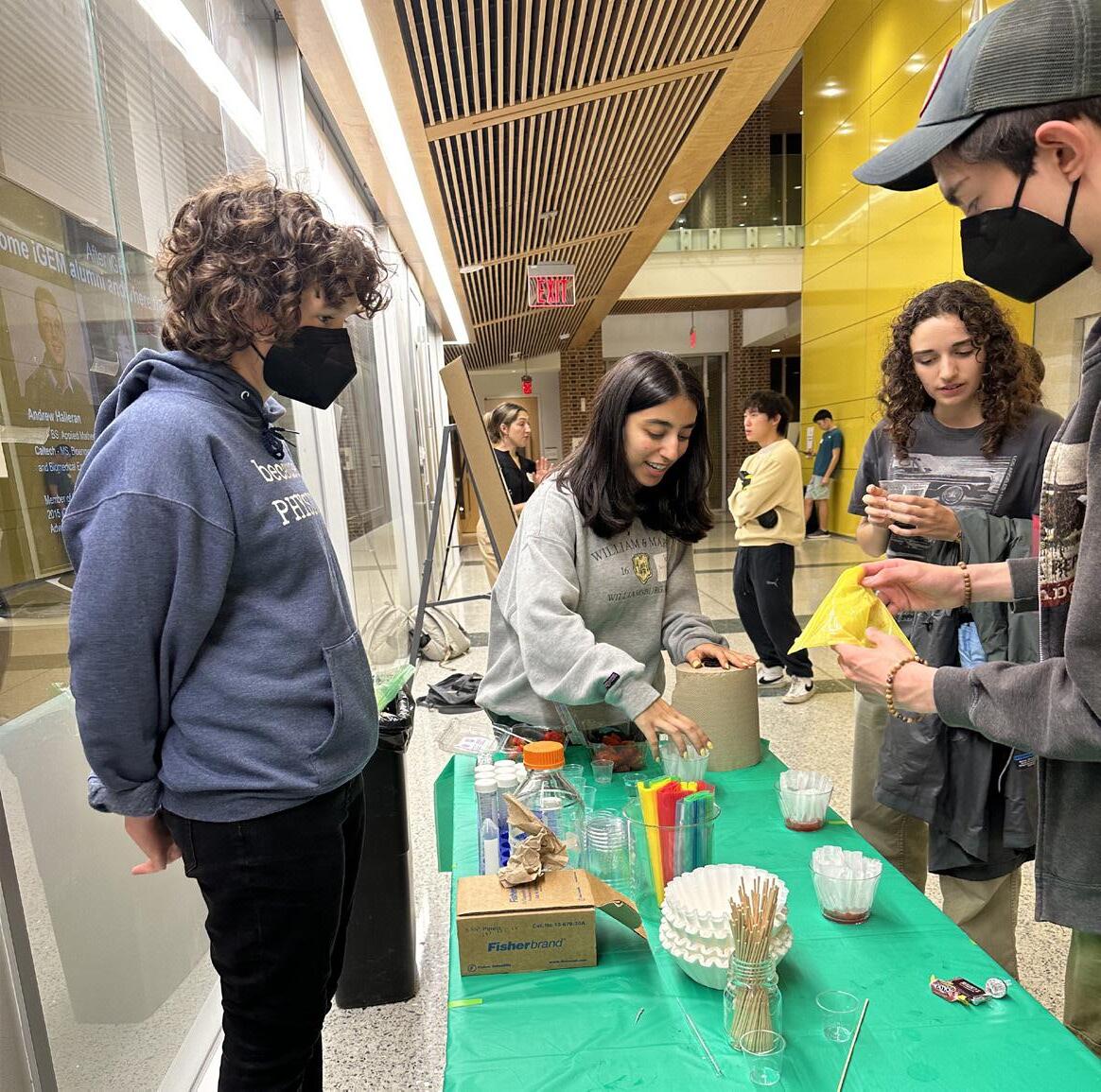
Within the bioengineering department, the International Genetically Engineered Machine team also offered a series of activities. One activity included the extraction of strawberry DNA using a solution consisting of mashed strawberries, water, salt, soap and rubbing alcohol.
Undergraduate researcher and the College’s iGEM team leader Megan Fleeharty ’24 first joined the iGEM team after seeing an advertisement.
“I was in a research lab before I joined the iGEM team, but I saw posters around and I just thought it was really cool that it’s very
CAMPUS
student driven research,” Fleeharty said.
Every year, the iGEM competition fosters student collaboration, requiring students to design and improve situations via methods involving synthetic biology. e rst competition took place in 2004 and has garnered widespread global attention, prompting over 300 teams to take part in these projects.
is year, the iGEM team’s main focus is addressing global soil problems by engineering bacteria.
Morandi Zerpa said. “It’s going to revolutionize food production, it’s going to revolutionize the technologies that we pursue for climate change, so I just think synthetic biology is a revolutionary eld. at’s a really good reason to join the lab.”
At the event, the biology department o ered a live marine invertebrate touch tank. e tank included live sea animals such as sand dollars, sea cucumbers, star sh and coral.
e live sea animals were contained in small tubs, allowing the public an opportunity to touch and feel them.
Associate professor of biology Jonathan Allen noted that his love for biology sprouted from his childhood memories. “ ere were creeks and ponds and things near my house that I would go ip rocks in and nd cray sh and others like salamanders and newts and things like that,” Allen said. “I would bring them back to my house and put them in bowls and tanks and try to study them to the degree that I could. I still basically go out, except in the ocean instead of the stream next to my house and I ip over rocks and look at the animals that live underneath them.”
Many of the other departments, including the geology department, shared its display of research ndings with colorful posters throughout the ISC lobby.
Manya Kaladi ’27 shared what she thought was particularly intriguing about the department’s GeoLab presentation.
“What I thought was really interesting was the uorescent microscopy,” Kaladi said. “I was very interested to see how one person, one undergraduate student, was like kind of quantifying the uorescence of bacteria, and I thought it was very interesting how it was like a lot of trial and error, but it would also have a very positive result because it would allow a lot of undergraduate students and universities across America to have a base point.”
Kaladi expressed her satisfaction in viewing and interacting with the experiments and exhibits at the event.
“So I’m a senior, so I have been in a lab for two years, but ultimately what interested me in synthetic biology is its quantitative, thoroughly quantitative approach to biology,” Diego Morandi Zerpa ’24 said. “ at quantitative approach is what I think allows us to understand more of the complicated biological systems in a much more thorough way.
Morandi Zerpa also emphasized the importance of synthetic biology for future global developments.
“I think synthetic biology is going to revolutionize medicine,”
“I thought it was really amazing,” Kaladi said. “I really enjoyed the little experiments, seeing the glow-in-the-dark bacteria and seeing the elephant toothpaste experiments. I thought it was a great way of introducing science to introductory students or people who aren’t that acquainted with it, and I also really loved touring the greenhouse.” rough interactive activities, engaging presentations and hands-on experiments, the Sci-Fri event brought the Williamsburg community together and exposed innovative research and scienti c discovery to the attendees of all ages, inspiring the past, present and future scientists.
Social impact lecture prompts discussion of 1921 Tulsa race massacre
Speakers share work with “Justice for Greenwood,” emphasize importance of accountability, restitution
Thursday, Sept. 21, the College of William and Mary hosted its 2023 Social Impact Lecture at the Raymond A. Mason School of Business. The event featured speakers Damario SolomonSimmons and Sara Solfanelli ’99, who shared their work advocating for justice for the 1921 Tulsa Race Massacre victims.
According to Solomon-Simmons and Solfanelli, the 1921 massacre saw the destruction of almost 40 city blocks, leaving approximately 300 people dead, 3,000 missing and 8,000 homeless in a predominantly Black neighborhood in North Tulsa, Oklahoma, known as Greenwood.
No one was held accountable for their crimes and the Black neighborhood was devastated, with little left to rebuild.
Solomon-Simmons is the founder, executive director and chairman of the board of Justice for Greenwood, an organization advocating for the Greenwood community, which fell victim to racially motivated violence during the Tulsa Race Massacre in 1921. He grew up in Tulsa in the same neighborhood where the massacre took place.
Solomon-Simmons and Solfanelli’s work centers around a current lawsuit attempting
CAREER CENTER
Cohen Career Center,
to seek justice for the three known remaining survivors of the massacre, 109-year-old Viola Fletcher, 108-year-old Lessie Benningfield Randle and 102-year-old Hughes Van Ellis.
According to the Justice for Greenwood website, the lawsuit was filed Sept. 1, 2020, against the City of Tulsa and seven other defendants. It demands accountability and restitution for the 1921 massacre and the continued harm over the past 100 years.
During the lecture, Solomon-Simmons noted that he was unaware of the massacre until attending college, even though he lived amongst people back home in Tulsa who survived the massacre. From that point forward, SolomonSimmons explained, he wanted to dedicate his life to bringing justice and awareness to the victims of the massacre.
Solfanelli, Special Counsel for Pro Bono Initiative at Schulte Roth and Zabel and a graduate of the College’s class of 1999, had a similar experience.
As an American Studies major at the College, Solfanelli mentioned that she did not remember learning about the Tulsa Race Massacre in her classes.
She was first exposed to the tragedy during the COVID-19 pandemic and the 2020 Black Lives Matter protests, when she believes many
Entrepreneurship
people across the country began to reckon with the United States’ racist past.
“When there are visitors, when there are classes that are talking about things that you might not actually know about and that seem like they might be kind of tough to learn about — do it,” Solfanelli said. “Show up and have the tough conversations and learn about things that you might wish you didn’t know existed in this world, because once you know they exist, you can’t unknow that.”
Over 100 students attended the lecture, which followed with a question-and-answer session. Several student questions touched on the impact of new laws limiting instruction of AfricanAmerican history in states like Florida on the goals that Solomon-Simmons, Solfanelli and their team are trying to accomplish.
Janeé omas ’24, who attended the event, mentioned the value of interdisciplinary and diverse learning.
“William and Mary is privileged to be a liberal arts university, so every student should take that as an opportunity to learn as much as they can and diversify their education because a knowledgeable citizen is a helpful citizen,” Thomas said.
Solomon-Simmons and Solfanelli noted that Solfanelli’s law firm, Schulte Roth and Zabel, has contributed significantly to the work of Justice
for Greenwood.
The large corporate firm is not typically known for its work in civil rights law but jumped at the opportunity to participate in this project.
Solfanelli mentioned that many people in her firm view it as a professional and personal responsibility to use the firm’s vast resources to fight for civil rights.
Currently, Solomon-Simmons, Sofanelli and their team are pursuing three avenues for justice. First, as mentioned above, they are filing a lawsuit to seek legal justice through the court system. Second, they are advocating for community awareness by speaking at events, like the one hosted at the College, and to the press to gain national support. Third, the team has petitioned the U.S. Department of Justice to open an investigation into the massacre.
“I think I’m most proud that I haven’t quit,” Solomon-Simmons said. “I mean, honestly, because we’ve taken a lot of losses along the way in courtrooms and the legislative halls and losing clients and different folks. So, I’m just proud that I still have a community that wants justice and to keep moving. I’m proud of continuing the legacy and those who fought starting on June 1, 1921. I stand on the shoulders of so many warriors.”
Hub hosts alumni guest speaker Matthew Heist
Heist discusses years of experience leading finance business ope rations, acknowledges value of adapting to career changes
Friday, Sept. 15, the College of William and Mary Cohen Career Center hosted Matthew Heist ’91, former Vice President of Finance and Business Operations for Slack, on Zoom for the rst session of a monthly guest speaker series through the Alan B. Miller Entrepreneurship Hub.
Student partner at the Entrepreneurship Hub Sara Curtiss ’24 introduced Heist.
“I’m excited to introduce Matt Heist to our entrepreneurship community today,” Curtiss said. “Matt is a finance professional with over 25 years of experience leading finance business operations teams in a variety of roles in the consumer, internet and software industries.”
During his time at the College, Heist majored in government and minored in economics. He was also a member of the College’s swim and dive team. His initial interests prompted him to attend law school after completing his
undergraduate education.
“I thought I’d be a lawyer,” Heist said. “I thought I would be at some law firm doing law. During college, when you have that, it makes you somewhat complacent. I wish I had actually done that a little differently. Like I said earlier, I wish I had gotten out there a little bit and looked around on the career side of things.”
Heist attended e George Washington University Law School and eventually served as an associate attorney at Cacace, Tusch and Santagata in Stamford, Ct., focusing on commercial litigation. Despite achieving his initial goal of becoming an attorney, Heist decided to pursue nance and entrepreneurship instead.
“I mean, some of it was just, quite frankly, anxiety,” Heist said. “I was sitting there as a lawyer, and I was like, ‘ is is just not what I want to do.’ And there wasn’t some 20-year path ahead of me. It just was, I gotta get the hell out of the law, not because the law itself is bad or my rm was bad. It’s just for me, I
wanted to try something di erent.”
To pursue his interests in nance and entrepreneurship, Heist received his Master of Business Administration from the University of Southern California’s Marshall School of Business, later beginning his new career at Yahoo as a Business Development Director in 2000. After his work at Yahoo from 2000 to 2007, Heist worked as the president and CEO of automotive publisher High Gear Media.
“ e person who founded [High Gear Media], as often happens, was great at raising money,” Heist said. “He was great at putting out a vision, but he just did not love operating. And so very soon after the company was founded, I came in to run it.”
After joining the team at High Gear Media, Heist recalls a series of di culties related to the nancial crisis from 2008 to 2009 and the evolution of the cell phone.
“For six years, we had so many headwinds,” Heist said. “ e company was founded right about the time when
Lehman happened, which was this nancial crisis in ’08, ’09, which was just brutal and made it really hard to sell advertising, particularly as a small player on Google. It was also the time where, quite frankly, the phone really took o , versus the desktop, and that had a profound in uence on advertising on the Internet.”
Despite the di culties associated with his position at High Gear Media, Heist re ects fondly on the skills gained from his time with the company.
“I would say, whereas Slack wasn’t easy, but it was a really successful thing, this one was successful, but my gosh, the grind was pretty brutal,” Heist said. “I would say it was de nitely the most worthwhile thing I did as far as improving as a manager and, you know, quite frankly, as just a professional.”
As he took note of his diverse experiences in business and entrepreneurship, Heist acknowledged the pillars of the Entrepreneurship Hub, highlighting re ections of previous decisions from throughout his career.
“I will tell you, with a pivot on product strategy, with the reorganization of a team and perhaps sometimes even parted ways with a team member where the t just wasn’t right. I never once said, ‘Gosh, I wish I had waited to do that longer,’” Heist said. “You always look back and kind of say, ‘Gosh, I kind of knew we needed to do that, and I wish I had done it a little sooner.”
Director of the Hub Brandon Hennessey commented on the importance of the Alumni Guest Speaker series.
“Ultimately, the stories of the Alumni Guest Speaker Series encompass venture launches, failures, successes and trials along the journey in a way that is accessible to the audience,” Hennessey wrote in an email to the Flat Hat. “We encourage questions and engage with our speakers to discern commonalities and insights for progressing their own entrepreneurial thinking path.”
THE FLAT HAT Wednesday, September 27, 2023 Page 4
CAMPUS
KIM THE FLAT HAT
LAUREN
MOLLY MARTIN THE FLAT HAT
READ MORE AT FLATHATNEWS.COM
ABIGAIL CONNELLY FLAT HAT NEWS EDITOR
LAUREN KIM / THE FLAT HAT
Visitors to the biology department interacted with live invertebrate touch tank.
Holistic admissions more important following end of affirmative action
John Powers
Nestled at the end of one of the most controversial U.S. Supreme Court decisions in recent memory lies an intriguing remark by majority opinion author, Chief Justice John Roberts.
“At the same time, as all parties agree, nothing in this opin -

ion should be construed as prohibiting universities from considering an applicant’s discussion of how race affected his or her life, be it through discrimination, inspiration, or otherwise,” Roberts wrote. “ … Universities may not simply establish through application essays or other means the regime we hold unlawful today … A benefit to a student who overcame
racial discrimination, for example, must be tied to that student’s courage and determination…In other words, the student must be treated based on his or her experiences as an individual — not on the basis of race.”
Your takeaway from Robert’s statement might be that Students for Fair Admissions v. Harvard leaves some wiggle room for affir -
Give me sidewalks, or give me death!
Ellie Kurlander
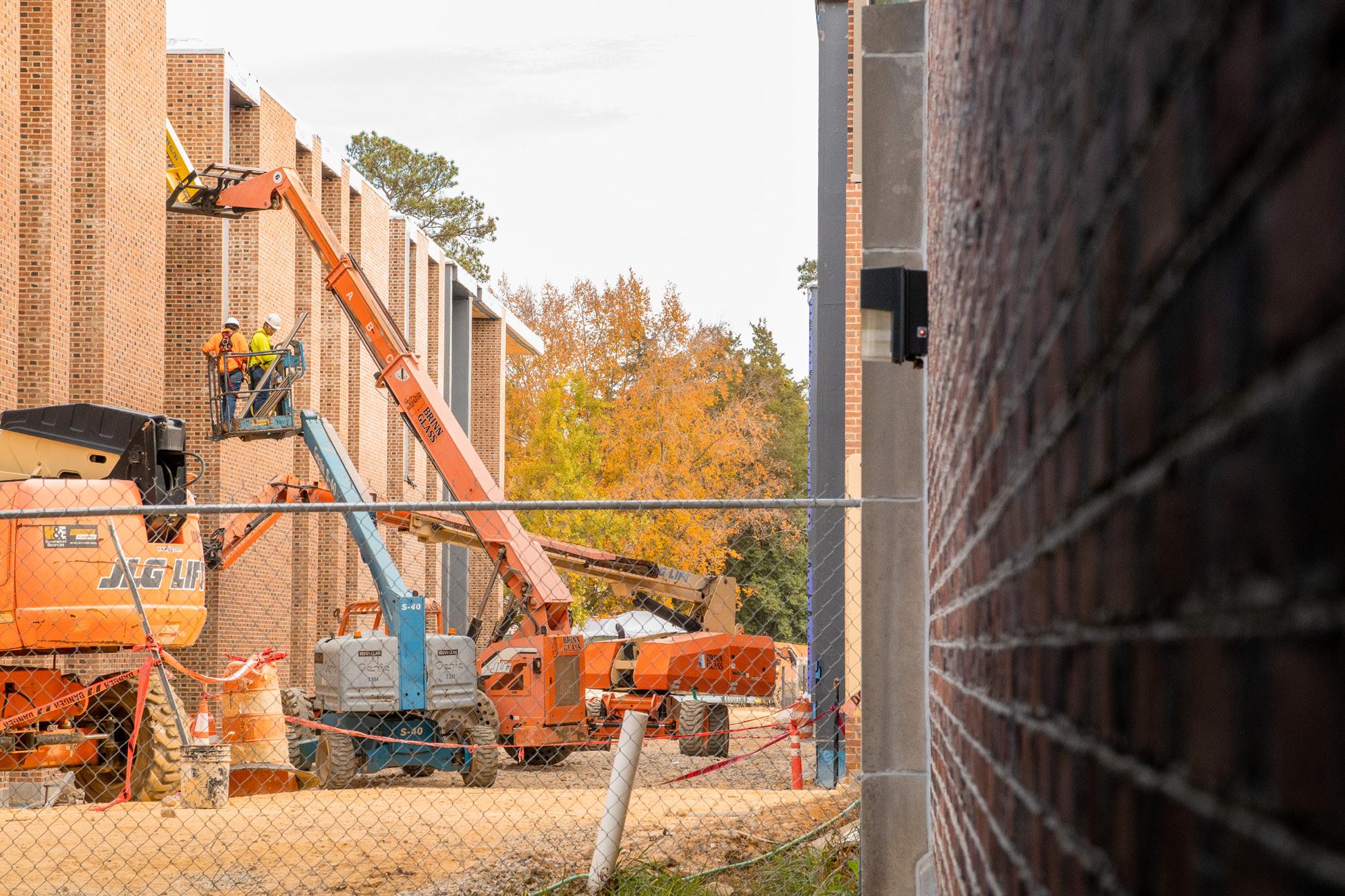
I gave very little thought to the College of William and Mary’s plans to complete a construction overhaul of campus housing and dining facilities when the news broke in April 2022. In my four years at the College, some kind of construction project has always been underway. It’s an old institution, so I assumed the occasional repair or beautification effort was par for the course. However, as I arrived on campus for my final year of college, full of excitement and anticipation, I was welcomed by an active construction zone cosplaying as the College.
Like many students, I spent the first week of classes navigating makeshift gravel paths and calculating how many minutes the new detours added to my class commute. The realization that this would be the reality for the remainder of my college career was disappointing, to say the least.
However, fencing off the field between Lemon and Hardy halls was the final nail in the coffin. As an off-campus student, that field was a key access point to campus and critical to my daily commute — the lack of courtesy to give notice or leave so much as a sidewalk felt like a slap in the face. As I navigated yet another detour, I grappled with an unsavory, enduring truth: the current student body, especially the class of 2024, will never catch a break.
Though my first instinct was to mourn the “normal” college experience that would never be, my wallowing self-pity soon turned to anger. I am exhausted by the administration’s chronic inability to provide even a moment of undisrupted college life to students whose entire higher education journeys have been defined by uncertainty, fear and restriction. The administration often acknowledges the lousy hand dealt to the class of 2024 but offers no recourse to the collective mental toll the past three years have taken. Instead, the administration is happy to parade the class of 2024 off the graduation stage with the cacophonic symphony of jackhammers, excavators and nailguns as our “Pomp and Circumstance.”
Moreover, the cost-benefit analysis of campus construction does not swing in the favor of current students. Though the quality of education remains steadfast, the other key selling point of the College is its natural beauty and timeless architecture. However, New Campus is now nothing short of an inaccessible, unnavigable eyesore. In short, students are no longer allowed access to the campus we’re paying to have access to.
The best example of denied space is the Earl Gregg Swem Library Patio. The College spent a year hyping up the construction of a new outdoor study space for students, only to promptly deny access to said space after less than a year in favor of a new construction project. Limiting outdoor
spaces for students, particularly near an academic hub like Swem, again places an unfair burden on students who are just seeking to exist and enjoy their time on campus.
Complaining about something as simple as fewer places to hang out outside may seem like I’m making a mountain out of a molehill, but with the ever-rising tuition costs, we are quite literally not getting what we pay for. With so much talk about the good that the construction will do for the campus and students for generations to come, I struggle to see how the College is making efforts to improve the lives of students currently enrolled. A Starbucks that doesn’t take Dining Dollars and a new hipster coffee shop that sells $8 lattes don’t feel like fair trades (R.I.P. to Drips and Sips). I don’t want your Starbucks; I just want my sidewalk privileges back.
I understand that campus construction will have a net positive impact on future student life once completed. I root for the day when all dorms have air conditioning, and there’s no denying that some buildings are overdue for a facelift. However, the all-at-once approach to demolition and construction comes at the detriment of the current student body. Frustrations could have been avoided by increasing transparency and communication between project coordinators and students. We want to know what’s happening and how campus construction will impact our daily lives before being thrown into the deep end.
Additionally, the administration should have had the proper foresight to know that the number of projects currently in development is incompatible with daily student life. Easing into the construction process and being more realistic about the timeline could have added a semblance of normalcy to a period of heightened stress among post-pandemic students.
No student could have anticipated how much construction would dominate campus life. And after finally achieving some sense of routine and recovery following the pandemic, taking a yearlong breather would have been nice.
Instead, the administration’s urgency to begin construction as soon as possible demonstrates little regard for the time, money and mental wellbeing of currently enrolled students. By focusing so heavily on the students to come, the College neglects the students they have.
Ellie Kurlander ’24 is a Government and Art History double major from Atlanta, Ga. She formerly served as Flat Hat Magazine’s Editor-inChief and is a member of Phi Sigma Pi National Honor Fraternity. Her favorite activities include Wordle and talking about how study abroad “changed her.” Contact her at eikurlander@wm. edu.
mative action supporters. However, the remark is also a hint of what the future of the college admissions debate will look like. Litigation now will not be focused on the constitutionality of race-based admissions, but whether new admissions processes are facades for prohibited ones. The new debates will concern not race, but the discussion of one’s race or a personality judgment.
Consider the principal organization behind the lawsuit: Students for Fair Admissions. In the lead-up to the Supreme Court case, the organization released a nine-minute mini-documentary arguing against the admissions policies of Harvard University.
“We could fill our classes with the very smartest, best performers, but we choose not to,” John Yoo, a former Bush administration attorney and current Berkeley law professor, said in the mini-doc.
SFFA’s brief before the Supreme Court alleged that Harvard’s evaluation of personality created an “antiAsian penalty.” It noted that Asians perform very well on standardized testing, grade point average and extracurriculars but scored lower than any other group on personal qualities.
Indeed, the video took aim at holistic admissions processes, which evaluate a student’s academic performance in addition to other factors like personal experiences and supplemental essays.
“They’ve invented these new admissions schemes called holistic admissions as a Trojan Horse for discrimination,” journalist Asra Nomani argued in the mini-doc.
The growing hostility towards holistic admissions in this new political climate calls for a defense of using personal experiences and qualities in admissions decisions. This is especially true as colleges begin to roll out new essay questions giving applicants the opportunity to opine about these characteristics and experiences.
For one thing, the number of college applications have seen a stark rise. A March report by the Common Application found a 30% increase in total applications in the current cycle compared to the 2019-2020 cycle. In the past 20 years, total applications have been increasing while high school graduating classes have remained relatively fixed. While some of this may be attributed to testoptional admissions encouraging more students to apply, the trend of increasing applications predates this.
Simply put, a singular focus on metrics does little to help admissions officers distinguish between a growing number of equally qualified applicants. So, it is logical to use at least some aspects of a holistic process to avoid basing admission decisions on statistically insignificant numerical differences. To understand why personal experiences and qualities play a role in this, we turn to the question of what the college community is.
In her short primer “Is Affirmative Action Fair? The Myth of Equity in College Admissions,” sociologist Natasha Warikoo makes the argument that colleges select students, in part, to fulfill their institutional needs. Her point makes sense. Colleges have to select not only qualified applicants, but also those who, for example, can play on the sports teams, provide sufficient financial support and maintain the university’s future existence.
In other words, education is not the singular role of a college. If that were true, then maybe only GPAs and test scores should be given consideration. Colleges have other roles too, though, like churning out successful alumni, promoting social mobility or producing researchers. Here, holistic elements may provide additional context to admit those who will meet these goals.
As an example, let’s say a university already has a strong population of pre-medical students but is weaker in the humanities one year. Is it really a loss to meritocracy when it admits a competitive debater with a 1450 SAT score and 3.95 GPA over a 1500 SAT scorer who was a member of her high school’s pre-med club with a 3.98
GPA? Even if it is a loss to meritocracy, isn’t this decision justified?
After all, there is a college for everybody, and those institutional needs are different for each college. The vast majority of U.S. colleges admit most who apply, per the Pew Research Center. Even SFFA’s very own student spokesperson, Calvin Yang, is a junior at (drumroll please) University of California, Berkeley. Not too shabby.
Still, those on the other side would charge that personal ratings open up the possibility of bias. The appellants in SFFA would certainly agree, but it is important to note that presenting evidence of unequal ratings between Asian applicants and others does not necessarily mean discrimination. Ironically, the conservatives here arguably conflate correlation with causation in a way that they have criticized liberals for doing in other contexts.
Personal qualities are important to an admissions decision. Colleges can and should use essays, recommendation letters and/or interviews to see how students would collaborate with others in a team on campus. Furthermore, examining personal qualities helps to find those with leadership potential in a way that hard data points may not.
Of course, holistic admissions should comprise a diverse set of evaluative factors. As such, axing standardized tests in perpetuity is suspect. As The Flat Hat’s former Editor-in-Chief Ethan Brown argued in a 2021 opinions piece, standardized test scores may be affected by income, but then again, so are extracurricular activities and other factors. Lotteries or capstone projects Warikoo proposes as alternative admissions solutions in the primer mentioned above are also insufficient. All of these ineffective solutions underscore the importance of charting a moderate course of action.
It is reasonable to conclude that SFFA and similar stakeholders wouldn’t chart that moderate course considering their deep hostility to personal qualities, lambasting them as subjective. I predict future lawsuits alleging that essays allowing applicants to showcase their “courage” or “determination,” as Roberts wrote, are also unconstitutional. Where does it end?

While it seems plausible at first that colleges should admit the “best performers,” as Yoo says, it is clear that colleges have reason to look for more than that.
Students for Fair Admissions v. Harvard was without doubt, a landmark ruling with sweeping impacts for our country. While it eliminated race-based admissions processes, it kept in tact and even endorsed holistic ones. Holistic admissions will be the new target in this shifted political landscape even though it makes sense as a matter of logistics and institutional needs, but we ought to keep it.
John Powers ’26 is an intended Public Policy major hailing from Brooklyn, NY. He is a Resident Assistant in Hardy Hall, a member of the Undergraduate Moot Court competition team and a member of the Sigma Alpha Epsilon fraternity.
John is a huge Adele fan. Email him at jdpowers@wm.edu.
opinions THE F L AT HAT Opinions Editor Mollie Shiflett Opinions Editor Avi Joshi fhopinions@gmail.com // @theflathat | Wednesday, September 27, 2023 | Page 5
STAFF COLUMN
FLAT HAT OPINIONS
STAFF COLUMN
ASSOC.
FLAT HAT OPINIONS ASSOC.
GRAPHIC BY YELENA FLEMING / THE FLAT HAT
RYAN GOODMAN / THE FLAT HAT
The Snyder Situation
Mollie Shi ett FLAT HAT OPINIONS EDITOR
GUEST COLUMN
The Barbie movie made me cry
Rachel Bartz THE FLAT HAT
I was a little late, but I saw “Barbie.” I went with my mom, which was serendipitous.
So much of it was exactly what I expected and wanted: Margot Robbie looking gorgeous in perfectly tailored outfits, witty takedowns of the patriarchy, catchy music and Ken (played by Ryan Gosling) obsessing over Barbie. But what I didn’t expect, and what I imagine most other viewers didn’t, was the strong thread of raw emotion throughout.
The first emotional punch I felt was Barbie’s abrupt question during her regular, fully-coordinated dance party attended by all the other Barbies. She suddenly pauses and asks, “Does anyone ever think about dying?”
I couldn’t believe what I was watching: Barbie having an intrusive thought. The scene was fleeting and played for laughs, with Barbie skillfully twisting her outburst into saying she was actually dying to dance, but the intrusive thought lingered.

If you are like me, then you have been suffering for the past 24 years. For all of you that are good at math, you’ll notice that number is beyond my 19 years of life, but still. What could have had me suffering for five years before I was actually born, you may ask? Well, technically, nothing, but I like to think that I’m a member of a community, and that community was suffering for the full 24. What made my community suffer for 24 years? Three words: Daniel Marc Snyder.
Now, there will be a large number of you who have absolutely no idea who that is and those of you that do have probably been suffering along with me.
A proviso before we go any further: first, this article was written largely with the purpose of self-healing from a traumatic past. I will bring it back to a larger argument — because that’s how we make an opinion — but I might take a minute to get there, and I hope you all will bear with me since I believe that when I get there, my argument will be a good one. Second, anyone that spends too much time on The Flat Hat’s Opinions page will notice that I spend almost half of my opinions talking about sports. I could claim a purer motive for focusing my writing so heavily on sports, like that I want to talk about sports because they, in some form or another, reach everyone (I will come back to that point), but mostly my motive is a selfish one. I write about sports because I love them and, in return, they hurt me. And writing is how I heal.
Now, back to the action. For the past 24 years, Snyder held the once-proud title of owner of the Washington Commanders, my hometown team. Snyder bought the team following the death of the previous owner, Jack Kent Cooke. He inherited a team that, even though it had won the Super Bowl eight years previously, was coming off a losing season in 1998 and a mediocre existence in general. Snyder promised to bring a new energy to what was then known (problematically) as “Redskins Park.”
Maybe he did at the beginning, but what he did afterwards was unforgivable, no matter what he promised.
Primarily, he lost.
The Commanders, in his entire tenure, won exactly two playoff games. But plenty of owners lose; it’s enough to make him disliked, but not detested. What makes him detested is his almost systematic incompetence and disregard for a fanbase that was the heart of Washington, D.C. football.
In 2006, Snyder and the organization decided to sell expired packages of peanuts intended for an airline that had gone out of business in January. They called it an “inventory mistake.”
He threw money at players like Donovan McNabb, who was benched one month after signing an $88 million extension — players who never lived up to their potential or the amount Snyder paid to sign them.
But what was worse, he turned what was once a great team, full of legends of the game like Sonny Jurgensen, Joe Theismann, John Riggins and Darrell Green into a sideshow attraction of inappropriate behavior.
In February 2022, former cheerleader Tiffani Johnston alleged that Snyder had harassed her at a team dinner, placing his hand on her thigh and later allegedly attempting to force her into his limousine. Then came the investigation from the U.S. Congress. Congress investigating an NFL team, can you imagine how bad it had to be to make Congress do anything? According to the Washington Post, that congressional investigation revealed that for at least 10 years, the Commanders franchise did not return security deposits totaling over $1.9 million to its season plan holders. That amount was in addition to the approximately $11 million in revenue that was supposed to be shared with the NFL. The investigator for the House Oversight Committee, Mary Jo White, found Snyder to be “personally engaged” in withholding this money from the NFL. Witnesses heard Snyder say that he sought “profit, profit.”
We went from being a team of Hall of Famers to criminals — at least from an ownership standpoint.
Now for the larger point that I had said we were always going to get to. We, as either the owners and the fans, are part of a huge sport for profit enterprise. It’s a business now. Owners are in it for their own bottom line, not out of any loyalty to the time or desire to win. Sports teams are owned by financiers, more often than not, and winning to them is money. It’s not titles, it’s not pride, it’s not performance — it’s not even dignity. It’s money.
What the Snyder era amounts to is a failure of leadership and, more specifically, a lack of understanding for what leadership means. To be owner of a sports team is a stewardship role, not a money-making one. You serve at the leisure of a community that has been there before you and will be there after you. When Josh Harris bought the Washington Commanders, one of the first things he did was buy a beer for 1,000 fans that came to a live radio broadcast. That’s what leadership is about: understanding that the people at the base — the supporters and observers — are just as important as the owner at the top.

At the College of William and Mary, we pride ourselves on our community; take our motto, “who comes here belongs here.” As we move on past this campus and into our next chapters, whether that will be in four years or this winter, keep the lesson of Dan Snyder in mind. College builds leaders — if they’re doing their jobs right — so be the right one.
Snyder is every wrong way to lead that has become all too common in our economic system: a focus on money, disregard for history and selfish self-importance. Be better. We don’t know how the Harris era will go, and it will most certainly be ugly at the beginning — the Commanders still aren’t very good — but there will always be hope with a leader who understands leadership, whether that’s in a sports team or anywhere else.
Be a leader who builds community and respects it. Snyder offers a perfect example of what happens when you don’t.
MollieShiflett’26isanundecidedmajorwhowillprobablyendup majoringinHistory.SheplaysontheGoldWomen’sClubSoccerteam fortheCollegeofWilliamandMaryandisanavidfanofmostsports— exceptgolf.EmailMollieatmrshiflett@wm.edu.
Later, Barbie suddenly awakens from her night’s slumber, and there it is again: the thought of death. It ruins her entire morning; her shower is freezing, her food is expired or burnt and she falls while floating down into her convertible.
Intrusive thoughts have made the rounds on the internet. I’m sure the term has come up before, usually when people have a goofy, random notion like eating a banana with the peel on. But sometimes intrusive thoughts venture into territory that isn’t so humorous.
According to the Anxiety and Depression Association of America, “some unwanted intrusive thoughts consist of repetitive doubts about relationships, decisions small and large, sexual orientation or identity, intrusions of thoughts about safety, religion, death or worries about questions that cannot be answered with certainty.” They clash with who you believe you are and what you think should constitute your thoughts.
We see Barbie attempt to banish the thoughts away repeatedly, with no success. After being humiliated at a middle school, which I imagine is a relatable experience for many of us, Barbie sits on a park bench and does what I can only describe as meditation. She allows her emotions to pass without attempts to control them, focuses on the repetitive sounds of rustling leaves and cries it out.
There certainly is something satisfying about seeing a character like Barbie be successful in everything she does. It’s reminiscent of other girl power movies like “Legally Blonde,” in which another thin, conventionally attractive white woman is beloved by many and triumphant in various endeavors beyond just the romantic.
But as someone who has struggled with intrusive thoughts and a general reshaping of her conception of mental illness after coming to college, seeing Barbie have an intrusive thought and then feel isolated and unlike herself as a result was relatable in a way that was emotionally raw. It was also relatable to see her dress up and dance the
STAFF COLUMN
Raise your hand if you’ve ever been personally victimized by Olivia Rodrigo.
Olivia Rodrigo’s new album “GUTS”, released on Sept. 8, had some crazy-big shoes to fill. Her debut album “SOUR” was an insane success, with four songs off the album at over a billion streams each.
SOUR was very much an album of its time. It came out towards the middle to end of the COVID-19 pandemic and spoke to the frenzied anxiety and intense loneliness that almost every girl was coping with, trapped in the walls of their childhood bedrooms. “drivers license” infected every vein of culture, from TikTok to SNL.

One of the main reasons for the album’s success is that it feels intensely personal. Like Patsy Cline in the ‘60s, The Cranberries in the ‘90s and Florence and the Machine in the 2000s, Rodrigo feels like she’s in the room with you. Her ability to capture the soft, impossibly invisible ache of girlhood carried her to success.
It is impossible to talk about her new album without talking about her old one, and impossible to talk about her old one without talking about the love triangle that inspired it. Rodrigo and her “High School Musical: The Musical: The Series” co-star Joshua Bassett dated and subsequently broke up mostly out of the public eye. Regardless, Bassett’s soon-following relationship to singer and fellow child star Sabrina Carpenter is thought to be the subject of every song on the album (“you’re probably with that blonde girl” is not a very veiled reference). The perfect story to go with the perfect album: Rodrigo, the jilted lover; Bassett, the abusive semi-cheater; and Carpenter, the blonde-haired, blue-eyed nemesis.
The internet loved it and subjected its players to a wide variety of criticism and speculation, pulling the story apart and generally concluding that Rodrigo, with her successful album and publicly won vengeance, the victor. Whether this narrative has stood the test of time is a matter of opinion. Carpenter’s song “because i liked a boy” as well as Bassett’s revelation of being a survivor of abuse and the content of his subsequent music all put the situation into muchneeded perspective. But back to “GUTS.”
The album still has the same quippy, ranty, scarily personal touch of “SOUR” and some uncontested bangers. Single “bad idea right?” is no doubt one of the strongest songs on the album and feels fresh and cheeky without being tiresome. Unfortunately, it’s also one of the only songs on the album that takes any big musical risks. We get a little bit more of a rock sound out of her on a couple tracks, but that’s pretty much it.
Looking at it from a purely objective perspective, GUTS is very similar to SOUR; the vocals, rhyme schemes, themes and subject matter are all things we’ve heard hashed out by Rodrigo before. “logical” is “favorite crime,” and “get him back” is “good for you.” For her sopho-
night away, but not in quite the same manner.
Then came the scene that really got the tears flowing. Having been objectified by construction workers and chased by Mattel’s CEO (played by Will Ferrell), Barbie then rescues Barbieland from the patriarchy and is approached by her creator, Ruth Handler. After everything she’s been through to return to her perfected, manicured self, Barbie asks to be made human. Handler is understandably apprehensive. She tells Barbie that she’d like to show her something before agreeing to send her out into the real world, and then the emotional gut punch hits: a montage of girls becoming women, of mothers with their children, of milestones and accomplishments and of all the things in between.
Barbie cries again watching the montage, and in the theater, I did too. It is a compilation of many beautiful aspects of life as a woman, and it’s touching that Barbie wants to carve out her own path in a similar vein. But I think the more extraordinary realization — the one that was behind my tears — was that Barbie came to the real world, saw so many of its flaws and loved it anyway.
There must be something special about our world and worth living in it to the fullest, then, if Barbie, as her gorgeous, charming and well-dressed self, decided that this was where she wanted to be.
RachelBartz‘25isanInternationalRelationsmajorand EconomicsminorfromSanJose,CA.Sheisamemberof theLutheranStudentAssociationandDebateSociety oncampus.YoucanfindherwalkingthroughColonial WilliamsburgortakingaclassattheRec.Contactherat ribartz@wm.edu.
more album, I would have loved to see a little bit more growth. From an objective perspective, the album is good, but it’s very similar to her other work.
And yet.
And yet…
Objectively speaking, the album is okay, but since when have we lived objective lives? From a review perspective, the album is decent, but I didn’t first listen to it as a reviewer. I listened to it as a person who’s had her fair share of breakups, who sometimes feels so painfully awkward that leaving the house does feel like social suicide and who has finally realized that love is sometimes impossibly and stupidly embarrassing. On my first listen I wasn’t thinking about her projected versus actual artistic growth, I was thinking, “Wow, this painful experience is also a shared experience.” The same feeling from her first album persists and appears even to have been honed slightly. Even if she may be losing momentum, she’s surely not losing her relatability.
The unfortunate fact about being human is that as we move through life, collecting beautiful and painful experiences in equal measure, the art and media that best convey these experiences is not always a Pitchfork 10/10. Maybe “GUTS” is not a critical darling, but its ability to speak to so many people’s experiences should not be discounted. The idea that art which appeals to the masses should be perceived as less valuable is the most basic and least interesting form of snobbery. And the notion that art that appeals to girls should be treated as less than is nothing more than misogyny.
Is “GUTS” a groundbreaking piece of media? Is it a boundary-pushing exploration of musicality and girlhood? Is it adventurous or new? No. But it doesn’t really need to be in order to serve a purpose. Girls are relating to it, and they are singing along. I can’t in good faith discount something that has brought girls and women comfort, so I won’t. I’ll say that while “GUTS” isn’t incredible, it’s still good enough.
ElizabethBrady’25isapublicpolicymajorandanEnglishminor, andsheisamemberofAlphaChiOmega.Shelovesart,musicand movies.Emailherateabrady@wm.edu.
THE FLAT HAT Wedneday, September 27, 2023 Page 6
GRAPHIC BY EMNET ABRAHAM / THE FLAT HAT
Elizabeth Brady FLAT HAT OPINIONS ASSOC.
GRAPHIC BY CATHERINE STORKE / THE FLAT HAT
STAFF COLUMN
GRAPHIC BY GEORGIA WESTBROOK / THE FLAT HAT
Rodrigo’s latest album: not gutsy enough but still good
Caitlin McGill commits to telling honest stories, resisting silence
New associate professor of creative writing strives to build authenticity, bridge gaps in memory through storytelling
This semester, the College of William and Mary’s creative writing faculty gained its newest member: associate professor Caitlin McGill.
McGill, currently based in Richmond, arrived at the College after spending nearly a decade in Boston where she primarily taught creative writing courses at Emerson College. While in Boston, she was also heavily involved in Writers Without Margins, a local organization that hosts free creative writing workshops for different, often underserved communities who may not have access to the academic spaces in which creative writing is traditionally taught.
Held in places such as a day shelter, public library and a men’s post-incarceration and addiction recovery center, these workshops gave attendees a safe space to complete writing exercises, share their writing and discuss other pieces of writing that McGill would bring to the workshop. In addition to facilitating workshops, McGill and other leaders would often provide other resources such as typing up or making copies of members’ writing if they were unable to do so themselves.
Writers Without Margins would also publish an annual journal that compiled all the writing done by writers during the workshops. Free copies of the journal were then distributed to anyone involved with the organization.
“That’s a really memorable moment when we get to celebrate the work that the writers have done, and they get to see their work published in print,” McGill said.
Though McGill says there was increased pressure during Writers Without Margins workshops due to the personal struggles many of the attendees were experiencing, these raised stakes are also what made the experience especially rewarding when she saw firsthand the positive impact the workshops had on people’s day-to-day lives. To this day, McGill recounts her experience in Writers Without Margins to be
VIVIAN HOANG // FLAT HAT EXECUTIVE EDITOR
one of the most impactful aspects of her time in Boston and her journey as a writer.
“It’s a particular balance to strike between making space for people to tell their stories and also making sure other people in the room are doing okay, which is why we have community norms and all that stuff,” McGill said. “But I think it’s really powerful to be able to witness people’s stories and to help them tell their stories.”
Now, as an educator at the College, McGill continues to encourage others to find their voices through writing and express their honest, authentic selves.
“I think that when we are open to discovery in our writing, we can often find the most interesting and authentic spaces,” McGill said. “I also feel like I really try to be my whole, authentic self with students, and building those relationships with students and creating community in the classroom and being authentic—it feels like the core of [my teaching].”
McGill currently teaches several creative writing classes primarily in nonfiction and poetry and plans to introduce a new course next spring titled “Imagining the Gaps in Nonfiction.” According to McGill, the course explores what is left unsaid and memories that may have been suppressed or forgotten, leaving behind gaps.
“Sometimes the gaps are there because there’s been a family need or habit to be silent about a story, or perhaps society has silenced their stories or even erased them from the archives, or memory is simply fallible, and we can’t remember everything from the past,” McGill said. “…So ‘Imagining the Gaps in Nonfiction’ allows us to resist the silence and still tell our stories, even if we can’t remember, even if we don’t have all the facts or even if someone else sort of [tries] to erase our story. It’s a way to push against that erasure.”
This theme of resisting silence is one that traces throughout McGill’s work, such as her personal
memoir, which she is currently in the process of finalizing. Her Miami-based memoir, “When They Wondered Where I Went,” retells her experience escaping a six-year abusive relationship with a 22-year-old drug addict that began at the age of 16, according to her website.
“[My memoir] is a coming-of-age story about being silenced for many years as a young person and…getting out of an abusive situation and then also coming to see over many, many years the truth of what had happened,” McGill said. “It’s thematically about resisting those silences and about the human desire to believe in the unseen and how that desire, paired with abuse and silencing, was the perfect storm, if you will, of what made it impossible to see the truth of what was happening.”
McGill’s memoir first began as a collection of essays that she had no intention of turning into a book, she says, and it was only after years of writing into uncertainty that she was able to piece together her own story and reclaim her memories.
“I started writing this book without knowing that I was writing a book,” McGill said. “I had no idea I even had a story to tell. I had no idea that I had been silenced out of telling this story. And it was through the act of writing — and of course, taking care of myself with mental health resources — that I started to see the story.”
The piecemeal process through which McGill discovered and came to terms with her story exemplifies the nonlinear, messy ways in which memories resurface, she says. One of the most difficult parts in putting together this memoir was figuring out the best way to tell her story because she says she was telling her story “out of order” for the longest time.
“I definitely struggled over the years to figure out, how do I honor and preserve the manner in which I remembered this and the sort of fragmented, non-linear nature of it while also crafting a story that readers can follow?” McGill said. “And that’s a
balance that’s hard to find for a lot of writers. How do we keep our authentic, instinctual style and voice without [losing it] when we cater to an audience?”
Another challenge that McGill says she — and other female writers — often face is earning proper recognition for the art, technique and craft of their writing as readers tend to focus more on the content of their memoirs rather than the labor that female writers pour into meticulously building each sentence and scene.
“I know a lot of women writers who write about their lives and get asked more about the content of their story more than the art and that can be frustrating for them,” McGill said. “I think that we are artists who are working really hard technically, and so sometimes we want to emphasize the hard, technical work that we do without erasing the power of telling our own stories.”
As she now wraps up her first book and prepares to send it off to publishers, McGill says she will turn her attention to writing about other themes that are deeply personal for her. In terms of her next major project, she plans to write about topics such as food and sexuality.
“I’m imagining the next book being an essay collection about desire in terms of food, sexuality, particularly bisexuality, and how we see ourselves through external lenses and what happens when we try to remove those,” McGill said. “How do we kind of understand our hungers and our desires if we try our best to think of them through our authentic inner voices? If we try to clear the external noise, what’s there? And how does society often influence or dictate our desires?”
Though difficult, this process of interrogating her past and her identity through writing is not one that McGill plans to pause any time soon.
“By writing about my past, I come to know myself better, and I think when we come to know ourselves better, in some ways, we become more free in the present,” McGill said.
Snapshots of Chavez
Center for Student Diversity hosts art exhibition with photogra phs of famous labor activist Cesar Chavez to celebrate his legacy, Latinx Heritage Month
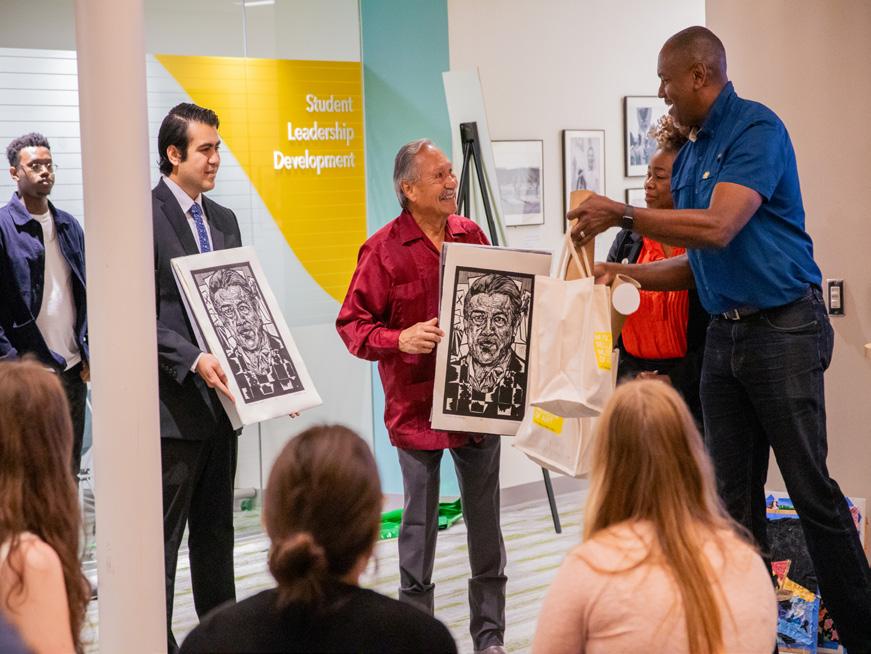
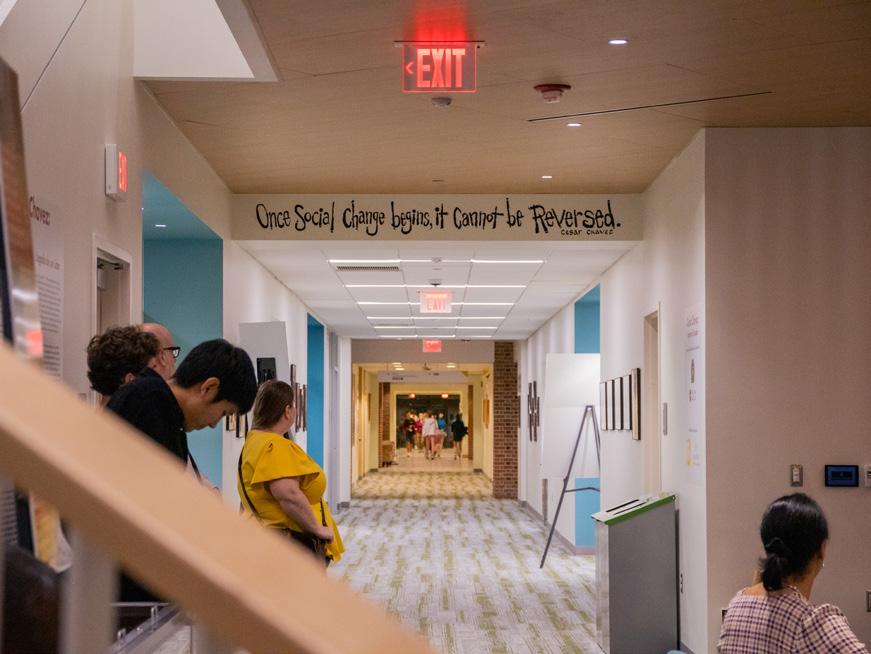
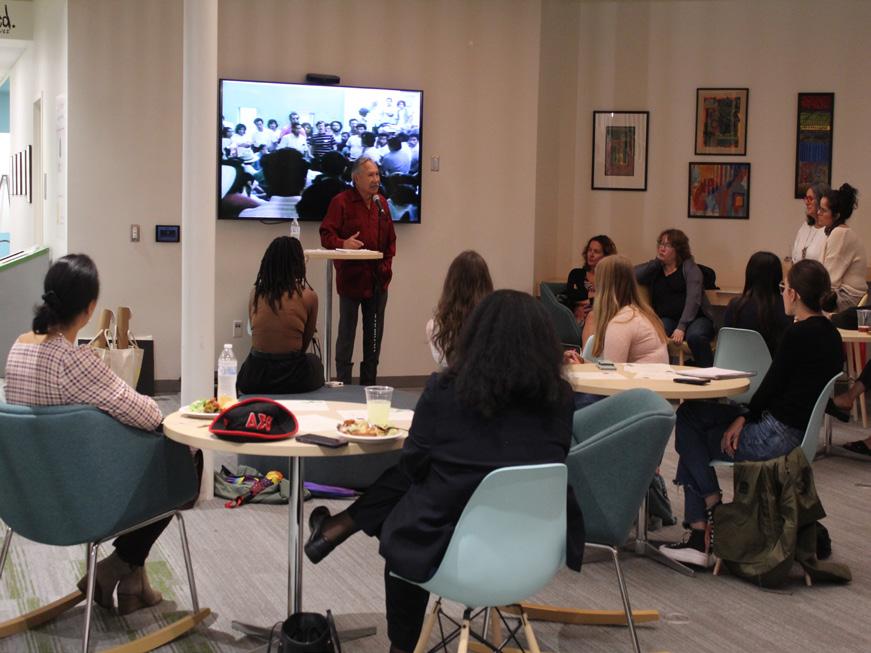
Friday, Sept. 22, the Center for Student Diversity hosted the grand opening of a photography exhibition documenting the life of Cesar Chavez using photos from the National Chavez Center. The exhibit will be open and available to members of the College of William and Mary community at the Slice in Sadler Center from Sept. 22 until Oct. 30.
Chavez, a Mexican-American civil rights activist who fought for the rights of farm workers and other marginalized groups and improved working conditions, established the United Farm Workers, or UFW, in 1962 to better advocate for these rights. As a civil rights advocate, he also represented the Latinx population, tying in with the College’s celebration of Latinx Heritage Month, which started on Sept. 15 and will continue until Oct. 15.
“By bringing the exhibit from the National Chavez Center in California, this is an opportunity to celebrate and look at the history of a civil rights giant, so that’s why we’re so excited to have this event here with us to October 30,” Assistant Dean and Director of the Center for Student Diversity Kimberly Weatherly said.
At the exhibit, former President of the UFW Arturo Rodriguez, who joined the union in 1973, discussed Chavez’s work and the values the organization holds. As farmers suffered precarious working conditions, such as no bathrooms, no minimum wage rights and no determined work hours, Chavez, saw this firsthand and began to organize boycotts and created the motto, ¡Si Se Puede! (Yes, It’s Possible)!
“I think what’s important for people to know is that Cesar Chavez was just a common person, just like any of us, but he had deep beliefs, he had strong beliefs that any of us could be Cesar Chavezes, man or woman, that we can do the unthinkable and we could do the unexpected if we really are determined and committed and willing to put in the energy that’s required to make it happen,” Rodriguez said. “All of us have the capacity to do that, and I think that’s the biggest thing to remember about Caesar. He was just a common person who went to the eighth grade but had a tremendous amount of determination and will to be able to change a system that systematically discriminated and abused people and exploited people for generations.”
The photographs catalog the series
of events that led to the eventual unionization of farm workers, and they communicate the UFW’s perseverance, which led the group gaining the rights they deserved. In 1966, farmers led by Chavez marched 340 miles from Delano to Sacramento in California to protest their deplorable working conditions. With 10,000 people waiting to greet them at the end, this march created immense awareness across the country in support of the union. Another of the many events portrayed in the exhibit is the first ever boycott of grapes that Chavez led in 1975. In this strike, Chavez and his supporters showed that it was only by hurting the economic bottom line of the growers that change could be enacted.
This is exactly what occurred; about 17 million consumers stopped buying grapes to demonstrate their support, finally forcing new laws and contracts to be drawn up to improve the conditions in the fields.
“Those images are going to show and demonstrate that this is what workers are willing to go through because of the fact that they had this strong belief in ¡Si Se Puede!” Rodriguez said.
Rodriguez contextualized the
internal debate surrounding these types of sacrifices for the workers on strike.
“You see the sacrifice that the workers made in the strike lines and the fact that they decided this was the right thing to do even though it was going to have a real negative impact on their families,” Rodriguez said.
The exhibition itself was curated by Director of Engagement and Distinguished Artist in Residence Steve Prince, who used various photographs to document Chavez’s lifelong dedication to the movement.
Prince noted that these black-andwhite pictures emphasize both the arduous struggles and incredible achievements of the farm workers.
“So much has happened with this particular movement, many people have forgotten or don’t know about it,” Prince said. “So this is a wonderful opportunity for us to enlighten people about what took place back in the ‘60s and ‘70s and right here in our nation, but also what is continuing, what is still going on in our nation on multiple levels.”
Prince, who says he focuses on the idea of remembering in his art, further elaborated on the importance of using art to fill in gaps of memory and think more critically.
“Too often we get caught up in the space of just having fun and having a good time and living in a kind of peaceful bubble, and the visual arts help us to see,” Prince said. “I think the artist’s role is to help us not only to remember. The artist’s role is to challenge us to see deeper.”
Several students also attended the event, enthusiastic to celebrate the work of the famous civil rights activist and to reflect on the welcoming culture present at the College.
“William and Mary is a community of inclusive individuals who are excited to learn about other cultures, and I think this presentation is a wonderful way to show respect to those who come before us,” Camille Coughlan ’27 said.
As the College continues to celebrate Latinx Heritage Month with this exhibition alongside other programming, it will continue to highlight and memorialize the contributions that Latinx individuals like Chavez have made throughout history.
“Latinx Heritage Month is a celebration of all the contributions that Latinx heritage people have made throughout the decades,” Weatherly said. “It’s an opportunity for us to learn culturally about another culture.”
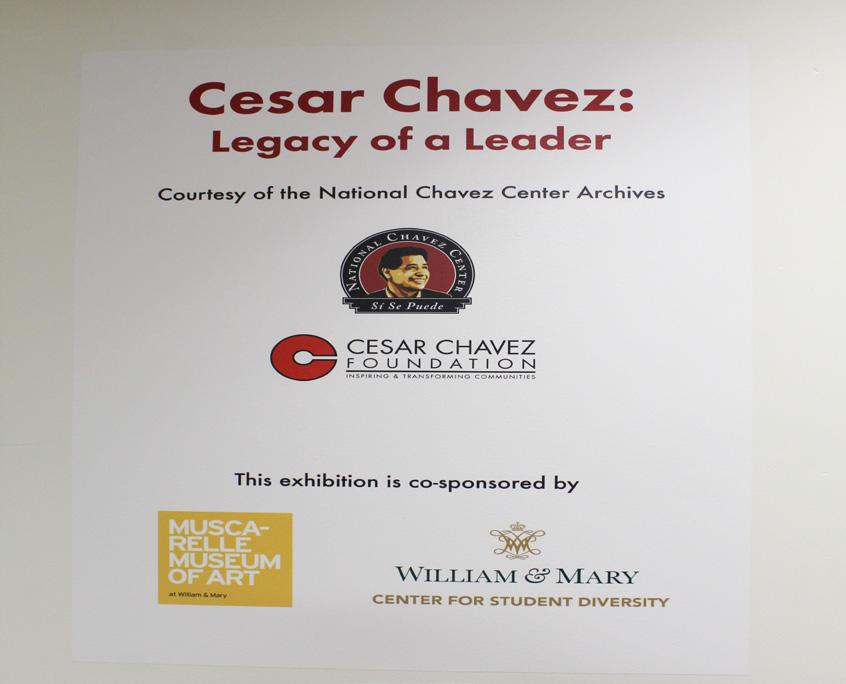
| Wednesday, September 27, 2023 | Page 7 variety THE FLAT HAT Variety Editor Miles Mortimer Variety Editor Agavni Mehrabi flathat.variety@gmail.com // @theflathat
RYAN GOODMAN / THE FLAT HAT CYNTHIA WU / THE FLAT HAT RYAN GOODMAN / THE FLAT HAT CYNTHIA WU / THE FLAT HAT
CATALINA CAMPOS AND SKYLAR HARTGERINK // THE FLAT HAT
From ’burg to ’burg
AGAVNI MEHRABI AND SOLYANA FESEHA // THE FLAT HAT
e sun is setting on the Duke of Gloucester St., leaving the crevices of the cobblestoned street crowned only by the gentle glimmer of the neighboring light posts. Gone is the noise of horse-drawn carriages clattering merrily down the roads and the chatter of crowds has chilled to a low drone. Between the aged eaves of battered brick buildings escapes a certain chill as though there prowls a supernatural presence. However, not all is as idle as it seems — arising from the shadows is the ourish of a ame, ickering from within a lamp. Following behind its mesmerizing ember is a trail of students. Spearheading the ock is a larger-than-life gure: Vladimir Sokolov, the illustrious guide at the Original Ghost Tours of Williamsburg, laughing heartily as he regales tales of Williamsburg past.
As the group drags its feet down Nicholson St., it comes to a halt by the infamous Peyton Randolph House. e sinister facade carries an air of restless fury, almost taunting the group from behind its white fence. Randolph’s brother, Sokolov shares, was shipped from London to the United States in a barrel of liquor.
“I suppose you could say he arrived home in good spirits,” Sokolov said. ese kinds of quips are typical of Sokolov’s tours. He was rst attracted to the entertainment aspect of being a tour guide; his a nity for making others laugh is what led him to apply for the position on the employment website Indeed.
“I found this opportunity, and I decided to give it a shot because I like entertaining people,” Sokolov said. “I like telling stories. I’ve never done that in English. But I decided to try.”
Sokolov made others laugh for a living even before he emigrated from St. Petersburg, Russia two years ago. Although medical school is where he met his wife, who is an ophthalmologist, he pushed onto his path as a professional crowd-pleaser through standup comedy and then improv theater. His specialty by far was as a Master of Ceremonies for weddings, parties and other social events.
“I know that I can do my job very well,” Sokolov said. “I can entertain everybody, really. Give me people, give me a microphone, give me a cheat sheet, and I’ll do it. Even now, even in English, without any preparation, I can entertain everybody.”
Despite this, Sokolov explained that he faced signi cant trouble nding a similar job in the U.S. He explained that securing the same niche in an unfamiliar country had been a particularly di cult hurdle for him to overcome.
“Usually you have DJs or musical bands during events,” Sokolov said. “And it’s so frustrating for me because I can’t nd my way here. at’s why I decided to become a tour guide because it’s something similar to what I was doing in Russia.”
Working a crowd as an entertainer was where Sokolov said he felt truly in his element, but the dissatisfaction he expressed with his job search was born of emergency circumstances. He recalled that
he had no choice but to ee Russia after President Vladimir Putin rst announced mobilization against Ukraine in September 2022.
“Russia began the war with Ukraine, and when it happened, we were shocked,” Sokolov said. “My family was shocked about that, and I couldn’t accept that. It’s very hard to believe that your motherland began war with our closest neighbors, and we began nding out what we could do.”
As Sokolov recalled, he faced only one option: to move away from all that he and his family had ever known. One of the rst challenges he countered after making the decision was the urgent preparations necessary to make the relocation, he said.
“It’s really hard because you have to understand very quickly what you need and what you don’t need,” Sokolov recounted. “‘Do you see this stu ? Can we take it now? You can leave it here?’ or ‘Yes, we have to take this’ because we have about four big luggages. We couldn’t t everything. It’s hard because you are saying goodbye to your previous life in this time.”
After his family’s struggle to pack only their most essential items in order to leave as quickly and e ciently as possible, Sokolov said that his family rst came to Connecticut in order to temporarily stay with family there. After two months or so, he, his wife and his three kids took advice to settle down in Williamsburg, Va.
“Oh, it’s an interesting story,” Sokolov said. “I have a small blog on my Instagram, and one of my followers invited us over [to Williamsburg], and we decided to move because it’s hard to live with a big family in a relative’s house.”
Sokolov elaborated that the stay with relatives was never meant to be long-term as his family would eventually need to independently forge their own path and set down their roots. He recalled that part of establishinganewlifeintheU.S.meantassimilatingtoacertaindegree, but doing so came with another set of challenges. Despite attending a school where English was taught seriously, he came face-to-face with a language barrier once he began living long-term in the states.
From St. Petersburg to Williamsburg, tour guide Vladimir Sokolov shares his story ‘ Holmes ’ Run HITTER
“I feel frustrated when I can’t understand everything, and I can’t tell everything the same way I could in my own language,” Sokolov said. “ at makes me sick, really.”
Sokolov emphasized that while immigrating to the U.S. was a necessary decision, he does miss the friends, job, home, family and car he left behind upon switching continents. He described that starting from scratch creates a di cult divide between one’s current situation and the lifestyle one desires to reclaim from the past.
“It’s hard because you remember how you lived before,” Sokolov said. “Now you have to reach this level as soon as possible, but it’s impossible because it’s more di cult here.”
Despite the obstacles along the way, though, Sokolov recognized how helpful the people of Williamsburg have been throughout his transition.
“Everybody is so nice and kind and everybody tries to help, to support, to do something to improve our life here,” Sokolov said. “So I appreciate that, I appreciate Americans.”
Besides his work experience as a tour guide, another legacy of Sokolov’s is his large social media following. In May 2019, shortly after the birth of his rst son, he started an Instagram account in which he wrote funny posts about his daily life as a father. From there, he developed a movement called Humor of Fun as well as a course on how to write comically. While he still updates his page, the frequency and tone with which he does so have changed as he adjusts to his new surroundings, and the war between Russia and Ukraine continues to rage on.
“You are here, and you know that your friends, your followers, they are there in Russia,” Sokolov said. “It’s very hard to nd an appropriate way for making jokes now because they are living in di erent circumstances, and it’s hard.”
In order to stay in touch with his heritage, Sokolov shared that he is making an e ort to not only raise his sons to be good people in general but also to be bilingual with a uency in both English and Russian. He taught his eldest son the Russian alphabet over the summer, and he and his wife plan to continue speaking their native tongue inside the home for frequent practice.
“Now, I’m trying to teach [my oldest son] how to read his letters,” Sokolov said. “Because if I don’t do this, who will? Nobody here.” e di culty in maintaining a connection between his life in the U.S. and the people and culture he left behind in Russia has not stopped Sokolov from moving forward with his social life and career. Beyond keeping tradition alive within his household, Sokolov expressed his hope for establishing a secure life for his family and achieving his own career ful llment in the process in the years to come.
“For now, I want to earn enough money for my family and to do my favorite job,” Sokolov said. “And if I reach to this far, I will be the happiest guy. I don’t want to earn millions of dollars or have millions of followers on Instagram. No, I want to earn enough and do what I’m good at. at’s my purpose here.”
Professor Marcus Holmes prepares for his latest project on baseball diplomacy
Marcus Holmes, chair of the College of William and Mary’s government department, has dedicated his career to studying and understanding the psychological aspects of diplomacy and international relations. In the midst of his career researching how human interaction a ects countries’ and citizens’ perceptions of one another, Holmes is entering a new, exciting epoch. He is organizing an international Little League baseball game and an upcoming symposium at the College to examine Japan-United States relations through baseball.
Holmes’ interest in the psychology behind international relations began during his time in college, when the socioeconomic inequality he had witnessed as a child during a family vacation in India intertwined with his love for politically charged Russian literature. Together, the combination pushed him towards international studies, a master’s degree at Georgetown University and then a Ph.D. at Ohio State University. However, while in graduate school, Holmes’ skepticism for what he says are the rigid conventions of scholarly diplomacy led him to an avant-garde interdisciplinary approach to international studies after entering academia, drawing from the elds of government, international relations and psychology.
A key part of Holmes’ focus is examining the universal applications of international relations; he seeks to analyze how seemingly commonplace and mundane interactions between di erent nations have the ability to alter states’ perceptions of one another, he says.
“I naturally got led into diplomacy because that’s where the rubber meets the road, so to speak, with respect to actual humans doing international politics,” Holmes said.
Holmes described a key part of his theory regarding the importance of interpersonal interaction in diplomacy to be applying principles that guide conventional, state-level diplomacy to any level of international relations. is theory necessitates looking at the eld of diplomacy as extending far beyond conventional interactions between heads of states and the diplomatic arms of their respective governments.
Holmes cited University of Pennsylvania sociologist Dr. Randall Collins, who is known for researching how emotional forces and interpersonal antagonisms shape society, as support for the idea
GABRIEL BLACK-PLANAS // CHIEF FEATURES WRITER
that even miniscule international encounters can have a broader e ect on societies at large. Holmes speci cally pointed to Collins’ conception of how positive or negative interactions can radiate throughout societies, leaving a lasting impact in their wake. Taking this concept and broadening its scope, Holmes posits that the same holds true of any citizen-to-citizen interaction between countries.
“Whenever a tourist goes to India, a Little League team comes from Japan to the United States or a businessperson goes and does business in China, that’s interaction, too,” Holmes said.
positive small-scale international interactions — the opposite of Holmes’ own theory. As he still lacks a way of applying his ndings on the individual level to whole countries’ levels, Holmes notes that causation is still elusive. ough a common method of gaining insights into how international interactions occur is to simply survey travelers on their perceptions of other countries’ inhabitants before and after visiting these countries, he elaborated that it is not yet possible to reliably apply these types of personal interviews to prove large-scale causation.
between the U.S. and Japan, noting especially the positive e ects that playing baseball — a highly popular sport in both countries — has had for their relationship. is shift was precipitated by a grant funded by the U.S. embassy in Japan celebrating 150 years of U.S.Japan baseball diplomacy. In collaboration with Dr. Hiroshi Kitamura, a professor of history at the College with a special focus on Japanese culture, Holmes began building a project focused on the relations between the two states.
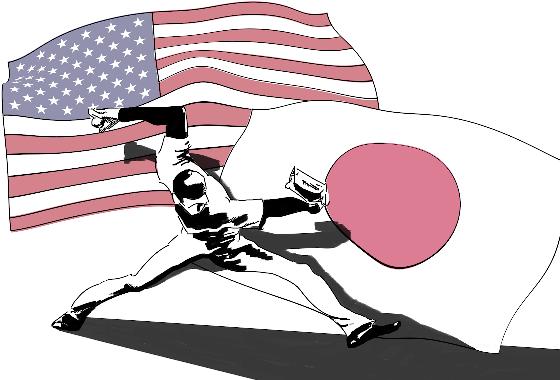
Kitamura elaborated on the importance of baseball in Japan. Although the sport originated in America, Japanese baseball fans have shifted baseball’s conventions to transform into a cultural activity that is accepted as mainstream and has been a uniting force for the two countries.
“Overall, I believe baseball, despite the di erent ways in which it may be played, is a force that has helped bring Japan and the US closer together,” Kitamura wrote. “If there’s no baseball, there’s a void between the two countries.” e project will use the grant to invite a group of Little League baseball players to Japan in order to test changes in international relations at the interpersonal level. Holmes explained that the grant allows for a controlled environment in which to conduct the data collection that he has been lacking, making the opportunity a rare one.
“We said, ‘Let’s bring a group of Little Leaguers from Williamsburg to Japan, let’s practice what we preach and do it in a way that we can do it in a scholarly perspective,’” Holmes, who will also host a symposium at the College Oct. 27 prior to the trip to Japan in Aug. 2024, said.
“I thought, ‘what parts of my theory on face-toface diplomacy on the higher levels can apply on the lower levels?’ I think most of it can.”
Holmes explained that a signi cant roadblock in gaining recognition for his eld of study is the di culty that comes from data collection. He pointed to the case of the colloquially named “ping-pong” U.S.-China diplomacy (referring to the use of ping-pong matches to ease tensions between the two nations during the 1970’s) as being a notable case in which detractors could argue that positive geopolitical climates cause
Nevertheless, surveys measuring travelers’ perceptions before and after trips do indeed prove an increase in positive international relations at the individual level, he says.
“Ultimately, from an empirical perspective, a lot of this boils down to looking at the micro level as much as you can and trying to make the argument that, at the very least, I can show you that there’s change happening,” Holmes said ough he began his career with an academic interest in post-Soviet diplomacy, Holmes has expanded his purview to study the relationship
Holmes emphasized a belief in the impressive power of sports in international relations, both on a larger-scale and in the e ects that they could have at the interpersonal level. After the mutually traumatic breakdown of U.S.-Japan relations during World War II, he cited the importance of sports in allowing members of both countries to repair their perceptions of one another, respectively, and begin to recognize each other’s humanity.
“It could be something as simple as having a baseball team travel to Japan or South America to have interactions and play games together?” Holmes said. “Could it be possible that at some level, that is even at a very minute level contributing to this aggregation of goodwill?”
THE FLAT HAT Wednesday, September 27, 2023 Page 8
GRAPHIC BY ZOE DAVIS THE FLAT HAT COURTESY IMAGES / VLADIMIR SOKOLOV
sports
Tribe splits opening matches against CAA opponents
After starting 2-0 against Charleston, Green and Gold drop both to Campbell
Saturday, Sept. 16, William and Mary volleyball (7-7, 2-2 CAA) began its conference play against Coastal Athletic Association opponent Charleston (4-11, 1-3 CAA) at Kaplan Arena in Williamsburg, Va.
Saturday’s game marked the beginning of the non-invitational portion of the Tribe’s schedule, which involves playing two match series every weekend until the regular season concludes in Nov.
The Tribe looked to bounce back from a disappointing 0-3 weekend at the Bobcat Invitational earlier this month, and with a home series to begin CAA play, the Tribe had no intention of letting Saturday’s match slip through its fingers.
The first set immediately showed how tightly-contested the rest of the weekend would be. After pulling ahead to a quick 4-1 lead due to a pair of Charleston errors and kills from graduate hitter Taylor Burrell and senior blocker Sabrina Malcolm, the Cougars clawed its way back to even the match at 4-4. For the next four points, the two teams went score for score, leading to an 8-8 contest after a kill from freshman right side Katherine Arnason.
The Tribe started heating up in the back half of the first set, recording four consecutive points courtesy of three Tribe kills. The Cougars again fought its way back, and as the set reached the 17-point mark, both teams were tied once again. After a 4-0 Charleston run off of four Tribe errors, William and Mary went on the defensive. Five kills later – including three from Burrell – the Green and Gold and the Cougars again found themselves locked at 24-24. Despite its effort, the Tribe let up two unanswered kills by Charleston graduate hitter Lexi Wierzbicki and dropped the first set 26-24.
Both teams picked up in the second set where they left off in the first.The beginning of the set was dead equal, and as both teams scored its 13th points, the score was again knotted at an even 13-13. However, after another 4-0 run, the Tribe never let its lead slip away. Burell and Arnason continued their offensive production for the Tribe, which also saw kills from graduate setter Emma Minnick and sophomore outside hitter Sarah Callender. After a late-set stutter, the Tribe pulled ahead to secure the second set win by a score of 25-22.
After an impressive 12-point win in the third set and a quick 25-16 loss in the fourth, the Tribe found itself fighting for its first CAA win going into the tie-breaking 15-point fifth set. The Green and Gold put up six unanswered points to start the fifth, and despite its best effort, the Cougars could never fully recover. William and Mary took the final set 15-10 and walked away with a much-needed first win of the week.
Sunday’s match started off ice cold for the Green and Gold. The Cougars came out firing, and after 25-18 and 25-17 wins in the first two sets, the visitors from Charleston found itself just 25 points away from splitting the weekend series in three consecutive sets. The Tribe dug in to prevent a sweep.
After falling behind 12-7 to start, the Tribe slowly closed the Cougar lead, finally tying the set at 19-19 after two timely kills from Callender and two Charleston errors. The Cougars pushed ahead again, taking a 24-22 lead. For match point, a timely service error by Wierzbicki opened the door for a 4-0 Tribe run. Thanks to another Charleston error and two clutch kills from Burrell, the Green and Gold escaped set three with a sneaky 26-24 win.
The fourth set was a battle of runs for the two teams. After being tied 12-12, Charleston went on a 5-0 run, in part because of three Tribe errors. After letting one point slip, the Cougars went on yet another run, this time scoring three straight points to extend its late-set lead to six. The Tribe, no longer strangers to coming from behind late in sets, responded with the match’s largest run of the day. Seven scores later, William and Mary found themselves ahead of Charleston once again, this time by a score of 21-20. After going point for point to 24-24, another Burrell kill and Cougar error ended the fourth set with another 26-24 win for the Tribe.
With only 15 points between William and Mary and a comeback win for the weekend series sweep, the home team went into set number five determined to earn the win. Identically to Saturday’s fifth set, the Green and Gold started the tie-breaker with six unanswered points. This time, however, the Cougars responded. After a six-point run of its own, both teams were tied again with only five points left.
At this point, the Tribe had come too far to let the match slip away. After kills from Callender and freshman hitter Audrey Brcka, the Green and Gold took the fifth set again, this time by a score of 15-13 to start its CAA season at an impressive 2-0.
Looking to keep its streak rolling into the next series, the Tribe traveled to Gore Arena in Buies Creek, NC to take on Campbell on Saturday, Sept. 23.
The Camels wasted no time shutting down William and Mary. Saturday’s match lasted only three sets, all of which resulted in Camel wins. After dropping the first set 25-16 and the second 25-20, it seemed like the Green and Gold had finally figured out Campbell in the third. After leading for most of the set going into the 21st point, William and Mary let up five points in just seven plays, costing the team the set and the match.
The Camels beat the Tribe in almost every category during Saturday’s match, leading in points (48 to 34), kills (41 to 29), aces (five to three), assists (38 to 27) and digs (57 to 51).
Sunday, the Tribe looked to finish on the right foot and leave Buies Creek with a win.
In the first set, however, things looked more and more like a replay of the day before. After a six point Campbell run midway through the first set, the Green and Gold found itself down 157. William and Mary slowly pulled its way back into the match, pulling the score within two at 20-18 after a serve ace from Burrell to cap off a three point Tribe swing. Despite the late run, the Camels successfully closed out the set, taking a fourth consecutive set from the Tribe.
The second set saw a Tribe team that looked more similar to the weekend prior against Charleston. The Green and Gold capitalized on every Campbell error and won the set 25-20, evening the match at one set apiece.
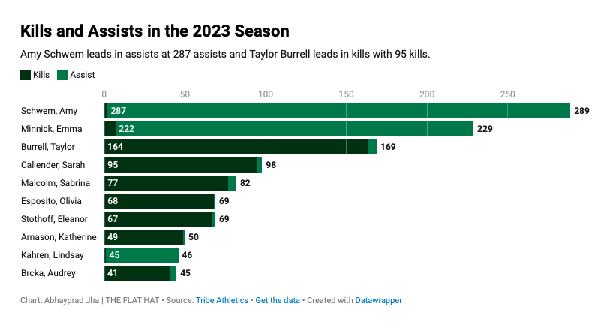
The third set led William and Mary into familiar territory — a late set tiebreaker. After a back-and-forth race to 25, the Camels and Tribe struggled to pull ahead by the needed two points and finish the set off. After taking a one point lead at 26-25, the Tribe’s two self-inflicted errors allowed a kill from Campbell senior hitter Chloe Cook to win the set for the Camels.
After rallying back and winning set four 25-20 again, the Tribe needed to take one more fifth set to secure its first conference win on the road. However, Campbell proved to be too tough to overcome, and after a hot start, the Camels finished off business with a resounding 15-9 win.
The Tribe will look to right the ship on Saturday, Sept. 30 when it travels to Hampton (0-6, 0-4 CAA) to take on the Pirates in Hampton, Va at 1 p.m.
Green and Gold win over Northeastern at home in CAA matchup
Accuarate shooting catapults Tribe past CAA opponent before losing to Old
Friday, Sept. 22, William and Mary (3-4, 2-0 CAA) defeated Northeastern (4-5, 0-1 CAA) at Busch Field in Williamsburg, Va.
For the Tribe, graduate defender Audrey Domovich scored a pair of goals in under a three-minute span to secure the victory. Domovich’s first goal came in the ninth minute of play with a shot from the top of the circle. Just two minutes later, she scored her second of the day off a corner.
While the Tribe offense dominated the first half of play, the team’s defensive effort was equally commendable. Senior goalkeeper Maddie George saved one of the two shots on goal from Northeastern and held the Huskies scoreless until the third quarter. While the Tribe outscored Northeastern, the visiting Huskies shot two more times than the Tribe offense, emphasizing the greater shooting accuracy of the Tribe.
The Huskies’ offense started off slow, scratching across only one shot attempt in the first half. However, its production picked up rapidly in the second half with nine shots and one successful goal. The Tribe managed
just one shot attempt in the second half.
The solo goal for the Huskies came from graduate student midfield Lauren Rowe, who leads Northeastern in scoring this season.
Up to this point, Rowe has seven goals and two assists to her name, leading the team by five points.
After the hard-fought victory against Northeastern, the Tribe came into its match against rival Old Dominion (4-5, 1-1 Big East) with confidence on Sunday, Sept. 24. Unfortunately, this match resulted in a 4-0 loss for the Tribe and broke its even season record.
Old Dominion’s goals came from senior forward graduate student back Nicole Fredricks, senior forward Marlon de Bruijne, sophomore attack Sanci Molkenboer and freshman midfield Nicolette Saccomandi.
The Tribe failed to match Old Dominion in several stat categories, including shots on goal, shots and fouls. While an unfortunate loss for the Tribe, this game may serve as a motivating factor for its upcoming difficult schedule in the remainder of the season.
Following the double header this past weekend, the Tribe will travel north to face Delaware on Friday, Sept. 29 at 5 p.m.
Dominion
VOLLEYBALL
| Wednesday, September 27, 2023 | Page 9 THE FLAT HAT MAX GRILL FLAT HAT SPORTS EDITOR
FIELD HOCKEY
SYDNEY WITWER FLAT HAT SPORTS WRITER
RYAN GOODMAN / THE FLAT HAT
The Tribe has played some of its best field hockey against CAA opponents this year, and through two interconference matches, has gone 2-0. The teamʼs upcoming schedule includes th ree conference games in its next five games.
RYAN GOODMAN / THE FLAT HAT
Graduate student outside hitter/opposite Taylor Burrell has been a dominant scorer for the Tribe this season, leading the team with 163 kills in 2023 alone.
sports
Yoder propels team with 163 rushing yards, sustains serious injury Tribe football overpowers Maine 28-3, improves to 4-0 record
Saturday, Sept. 23, No. 5 William and Mary football (4-0, 2-0 CAA) defeated Maine (0-4, 0-2 CAA) 28-3 at Walter J. Zable Stadium in Williamsburg, Va.
Coming off of a 15-7 away win against Charleston Southern, a game in which the Tribe held CSU to just 77 total yards, head coach Mike London described the importance of staying focused ahead of the Tribe’s match-up against Maine.
“Maine is a tough football team that’s going to come here on Saturday,” London said. “We got to make sure that we are prepared for them and minimize the things they do that could cause us to lose.”
The Tribe entered the matchup as one of the best defensive teams in the nation. Not only leading the country in total defense (187.7) and third down defense (.133), William and Mary ranked fourth in passing defense (112.0), fifth in scoring defense (12.3) and sixth in rushing defense (75.7) heading into Saturday’s contest.
With unfavorable conditions due to tropical storm Ophelia, William and Mary relied on its defense and run game heading into the first interconference game of the season.
Both teams failed to put points on the board in the first quarter, punting the ball back-and-forth to each other on six consecutive drives. Due to the weather conditions, both teams found difficulty with the passing game, forcing the offenses to rely on the run game.
It was not until the start of the second quarter that the Tribe was able to string together a touchdown drive. Following a 65 yard punt from Maine graduate student punter Aidan Cadogan, William and Mary began its drive from the seven-yard line. The Tribe started the drive with several hand-offs to senior
running back Bronson Yoder. On a third and four situation after two small gains, Yoder burst through the Maine defense for a 45 yard rush, putting William and Mary at the Maine 42-yard line.
The Tribe handed the ball off three consecutive times to Yoder for a gain of 18 more yards, before giving a nod to junior wide receiver DreSean Kendrick for a one yard rushing gain.
London returned toYoder, and junior quarterback Darius Wilson fed him the ball four more times. On his 11th rush of the drive, Yoder propelled himself into the endzone for a one yard rush to score a touchdown with 13 minutes, three seconds left in the second quarter. Senior kicker Caden Bonoffski converted the extra point, giving the Tribe a 7-0 lead.
After receiving the ball back, Maine went threeand-out on two short rushes and an incomplete pass, forcing the team to punt the ball away.
The Tribe failed to capitalize on its defensive success, also going three-and-out after a pair of unsuccessful runs from junior running back Malachi Imoh and a five yard completion from Wilson to Imoh that ended short of the first down marker.
On the next drive, Maine finally managed to put points on the board, stringing together a well-balanced drive with a mix of runs and pass completions that resulted in a fourth and goal situation at the William and Mary two-yard line. The Bears chose not to go for it, electing to convert the 20 yard field goal by Maine graduate student kicker Cody Williams with four minutes, 39 seconds left in the first half, cutting the Tribe lead to 7-3.
Both teams failed to tack on more points in the last few minutes of the first half, with William and Mary entering the locker room up 7-3 at halftime.
Maine received the ball at the start of the second half, starting its drive with a three yard rush by Maine freshman running back Tristen Kenan. On the next play, Maine senior quarterback Derek Robertson threw an interception to Tribe senior cornerback Ryan Poole, ending the Bears’ opening drive of the second half. Poole’s 17 yard return off of
WOMENʼS SOCCER
the interception set William and Mary up in good field position to score at the Maine 12-yard line.
With 14 minutes, six seconds left in the third quarter, the Tribe offense took the field, looking to convert its second touchdown of the game. Returning to the recipe for success from its first touchdown, William and Mary fed the ball to Yoder for five consecutive rushes, until Wilson punched the ball into the endzone for a one-yard rushing touchdown with just over 11 minutes remaining in the third period. Bonoffski converted the extra point, extending the Tribe lead to 14-3.
Maine looked to respond with a score of its own, but was forced to punt the ball away again after six plays. Cadogan punted the ball 43 yards, setting the William and Mary offense at its own 14 yard line.
The Tribe started its offensive drive with a 22 yard completion from Wilson to junior wide receiver JT Mayo, putting the ball at the William and Mary 36yard line. The Tribe followed that play with a 10 yard rush by Imoh. On the ensuing play, Imoh exploded for a 47 yard run, eventually getting knocked down at the Maine seven-yard line. After another rush by Imoh, the Tribe found itself in a second and goal situation at the Maine two-yard line.
Wilson failed to connect on a pass with Mayo, triggering the coaching staff to take a timeout for the upcoming third and goal situation. Wilson then tried again to connect with Mayo, this time successfully scoring a touchdown with four minutes, 32 seconds left in the third quarter. Bonoffski converted his third extra point of the day, increasing the Tribe lead to 21-3.
Both teams struggled to score until the fourth quarter, with William and Mary’s final touchdown drive beginning at 12 minutes, three seconds in the fourth quarter. After a touchback from Cadogan’s punt, the Tribe offense looked to put away Maine with another touchdown score.
Although the drive suffered an initial setback on a false start penalty by Yoder, a 20 yard run by Wilson on the next play set the offense back on track. An
Women’s soccer draws Campbell, 2-2
Tribe continues historic undefeated season
Thursday, Sept. 21, William and Mary women’s soccer (6-0-5, 3-0-2 CAA) tied Campbell (2-5-4, 0-3-3 CAA) 2-2 at Martin Family Stadium in Williamsburg, Va.
Over 1000 spectators turned up for a wild match in which the two teams exchanged the lead all night.
The visiting Camels started the game on the offensive, maintaining possession for the first few minutes before opening the scoring in the fourth minute via a corner kick. Redshirt senior forward Amber Liston delivered a cross to the head of redshirt senior defender Laney Peabody, who redirected the ball onto the far post and into the net for her second goal of the season.
William and Mary responded quickly, dominating the rest of the half and squeezing off four shots over the next 30 minutes. Campbell redshirt sophomore goalkeeper JLo Varada completed two saves during this period, but fell short on the Tribe’s equalizing goal in the 35th minute.
After several minutes of offensive attack, the Tribe started pressuring the Campbell defense. Camels senior midfielder Cazzi Norgren attempted to stop a Tribe cross, but in the process, she caught a William and Mary attacker’s legs, leaving the referee with no choice but to point to the penalty spot. Senior midfielder Kenna Zier buried the penalty kick into the right side
of the net despite Varada diving the correct direction. Two off-target Tribe shots in the remaining 10 minutes brought the half to a close, and after 45 minutes of play, the two teams remained locked at 1-1.
The Green and Gold resumed its offensive push following the break, with a 52nd minute lob by junior forward Leah Iglesias onto the top right corner that forced Varada into a full-stretch dive to tip the shot over the bar. Later that same minute, junior forward Mia Suchora launched a strike off her right-foot from outside the box, but Varada palmed away the ball yet again. The shots marked two of six unanswered shots in the opening 15 minutes of the second half for the Tribe, as the home side continued to push for its second goal.
William and Mary was rewarded for its persistent pressure in the 69th minute, when fifth-year goalkeeper Zoe Doughty started an attack with a cleared back-pass that found its way to Suchora. She executed a flawless Cruyff turn that sent her defender to the ground before passing the ball to sophomore forward Madison Moon on the near sideline. Moon floated a first time cross into the box, where senior forward Elaina Longjohn volleyed in from close range for a 2-1 Tribe lead.
Up until this point, Campbell had only attempted three shots with two on frame. However, the visitors struck gold with its next shot. Against the run of play, Camel senior defender Olivia Neal received the ball on the near side and dribbled past sophomore
MENʼS SOCCER
Tribe defender Nora Green-Orset. Neal delivered an aerial cross to Norgren, who met the ball with a volley from close range. Having given away the first-half penalty, her finish to the right side of the net completed her redemption as the Camels equalized the score in the 80th minute.
Both sides attempted to find a winner, but the score remained locked at 2-2 when the referee blew the whistle for full time. Campbell was most likely the happier team at the conclusion of the game, scoring twice off of six total shots and earning an away draw against undefeated opponents.
Goalkeeper Varada earned a shout-out with her six saves, which undoubtedly kept her side in the contest. The Tribe bombarded the Camels’ net with 17 shots on the night, with eight finding the target.
On Sunday, Sept. 24, William and Mary faced Coastal Athletic Association (CAA) inter-conference opponent Elon (1-5-3, 0-3-1 CAA) in its next matchup on Sept. 24 in Williamsburg, Va. The Tribe emerged as 2-0 victors, maintaining a third place spot in the CAA standings.
Through 11 games, the Tribe remains undefeated, marking the best start in program history.
William and Mary will now look to challenge Hofstra (7-2-1, 4-0-1 CAA) in a crucial clash on Thursday, Sept. 28 at Hofstra Soccer Stadium in Hempstead, NY. A win could potentially push the Tribe up to first place in the CAA.
onslaught of runs from Yoder, Wilson and Imoh wore down the Maine defense. However, an unnecessary roughness and offensive holding penalty would stunt William and Mary’s momentum. The offense responded with an 11-yard shot from Wilson to sophomore tight end Trey McDonald, putting the Tribe at the Maine 45-yard line.
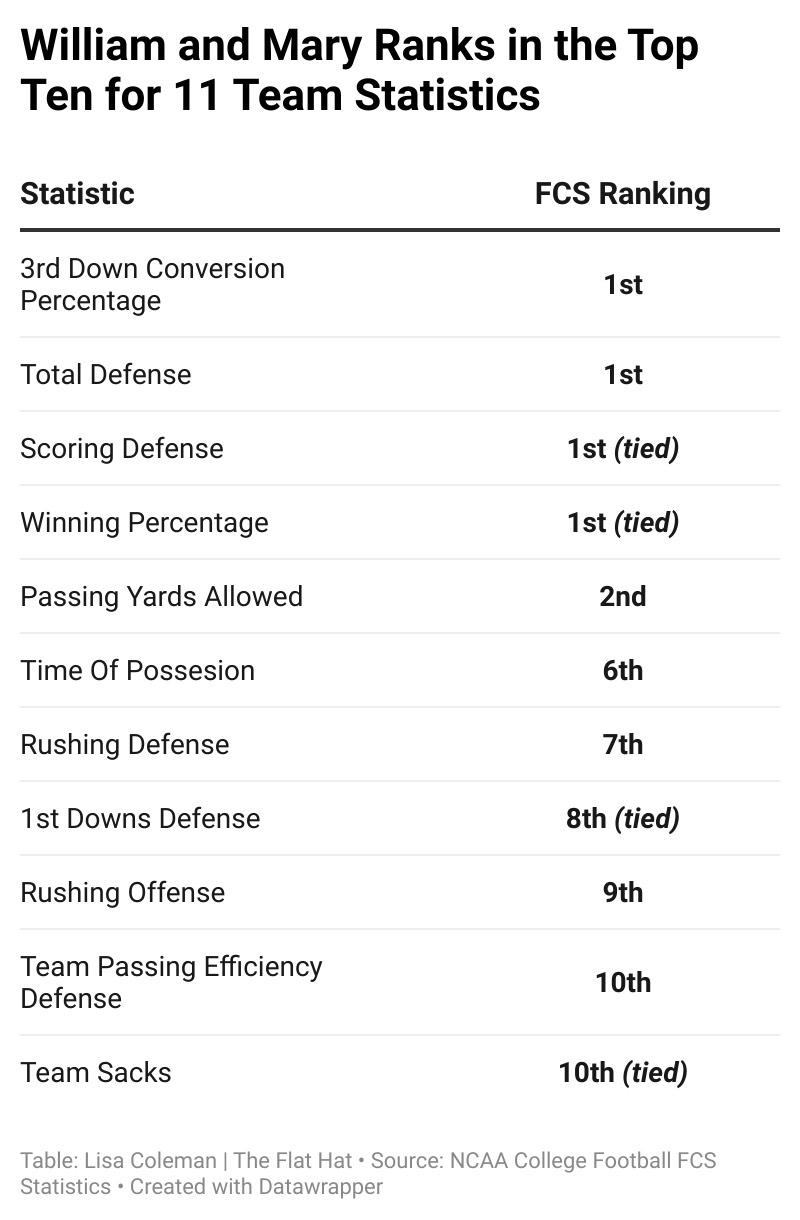
William and Mary continued to leverage its run game to chip away yards. With runs from Yoder, Imoh and sophomore running back Martin Lucas, the Tribe offense continued to wear down the Maine defense.
With nine minutes, nine seconds left in the fourth quarter, Yoder sustained an injury on his 25th carry of the game. On his eight yard carry, Yoder took a hard hit up the middle and was taken away by the medical team in an ambulance.
The extent of Yoder’s injury is still unknown at this time, with London specifying it as an upperbody injury.
After the 10 minute delay, the Tribe looked to Lucas to carry the rushing workload, continuing to run down the clock and march down the field. Lucas scored the final Tribe touchdown of the game with just over three minutes remaining in the game. Bonoffski converted his fourth and final extra point of the contest, pushing the William and Mary lead to 28-3.
With the game all but finished, Maine once again punted the ball away on its last drive after another solid defensive effort from the Tribe. At the end of regulation, William and Mary walked away winners by a score of 28-3, improving its undefeated record to 4-0 on the season.
The Tribe’s steadfast defense once again proved why it’s one of the best in the country, holding Maine to only 138 total yards and a field goal. This game is the third consecutive match-up in which William and Mary’s defense did not concede a touchdown.
William and Mary’s run game continued to dominate with 331 rushing yards, and three touchdowns on the ground. This win marks the first time since 2009 that the Tribe has started a season with four consecutive wins.
Yoder was a particular standout, leading the offense with a career-high 163 rushing yards on 25 carries and a touchdown.
Though the offense has several unknowns following Yoder’s injury, London emphasized the next-man-up mentality in the running back room.
“Malachi Imoh has done a really, really good job, and then Martin Lucas has had a chance to go in and is now showing he’s capable as well,” London said. “We’ve got a group of running backs that do a really good job, and we’ve got a good offensive line that does a great job of providing those holes and opportunities.”
Imoh finished with 103 rushing yards on 12 carries, marking the first time since 2019 that two William and Mary players recorded more than 100 rushing yards in the same game.
William and Mary will look to continue its dominant undefeated season against Coastal Athletic Association opponent Elon Saturday, Sept. 30 at Rhodes Stadium in Elon, NC.
Team surrenders late goal Tribe falls to High Point
Tuesday, Sept. 19, William and Mary men’s soccer (2-6-1, 1-2 CAA) lost 1-0 to High Point (3-1-2, 0-0 Big South) at Martin Family Stadium’s Albert-Daly Field in Williamsburg, Va. A goal in the 86th minute from the visiting Panthers broke the game-long stalemate, giving High Point its third win of the season and ending William and Mary’s three game homestand.
A physical approach from both teams led to an intense back and forth through the first half, though neither team managed to convert. In the 10th minute of the match, freshman back Evan Rabush had a shot that missed high. Twenty-eight minutes later, coming off a corner kick from senior midfielder Ian Krajna, graduate student forward Merlin Luke-Miny had a look of his own that also missed off target. Despite offensive efforts, the Tribe only recorded three shots in the first half, while High Point recorded five. Tribe graduate student goalkeeper Cole McNally had one save in the first 45 minutes. The first half ended 0-0.
Entering the second half, William and Mary had the first real scoring chance. In the 62nd minute, freshman midfielder Gabe Ruitenberg recorded a shot on goal saved by High Point
sophomore goalkeeper Josh Caron. High Point’s attack continued to prove effective, forcing McNally to make two pivotal saves in the 72nd and the 75th minute. Both defenses remained vigilant in the back half of the game, as the score remained 0-0. High Point rattled off 10 shots in the second half, while the Tribe took just four.
The stalemate continued until 85 minutes, 42 seconds into the match, when High Point senior forward Kaya Ignacio received a pass from graduate student midfielder Seth Antwi and found an open look, converting the goal into the bottom of the net. The first and only goal of the game was enough to give the Panthers the win. Despite last-ditch efforts from the Tribe, with shots from Luke-Miny and sophomore midfielder Ethan Prawidlo failing to find the back of the net, the game ended with High Point on top, 1-0.
The Tribe lost to Hofstra (6-1-2, 1-0-2 CAA) 2-1 in a Coastal Athletic Association matchup on Saturday, Sept. 23 at David S. Mack Sports and Exhibition Complex in Hempstead, NY. William and Mary will look to bounce back against another CAA foe in Drexel (4-1-2, 2-1-1 CAA) on Saturday, Sept. 30 Martin Family Stadium at Albert-Daly Field in Williamsburg, Va.
FOOTBALL
| Wednesday, September 27, 2023 | Page 10 THE FLAT HAT
RYAN GOODMAN / THE FLAT HAT
Senior running back Bronson Yoder led William and Mary football to a 28-3 win against Maine with his career-high 163 rushing yards on 25 carries and a touchdown on Saturday, Sept. 23 at Zable Stadium in Williamsburg, Va.
ELLIOTT LEE
CHIEF SPORTS WRITER
LACI MILLER FLAT HAT SPORTS ASSOC.
ETHAN QIN FLAT HAT SPORTS EDITOR
