Three candidates strive for dean of faculty of Arts and Sciences
On March 22 and April 4-5, the final three candidates for the dean of Arts and Sciences position at the College of William and Mary each gave presentations and answered questions from faculty members during hour-long town halls. The candidates are acting Dean of Arts and Sciences of the College Suzanne Raitt, Divisional Dean for Social Sciences in the College of Arts and Sciences at the University of Cincinnati Sarah Jackson and Associate Dean for Research and Graduate Education at the University of Nebraska-Lincoln William Thomas. The three candidates met with student leaders and other campus representatives during their visit to the College.
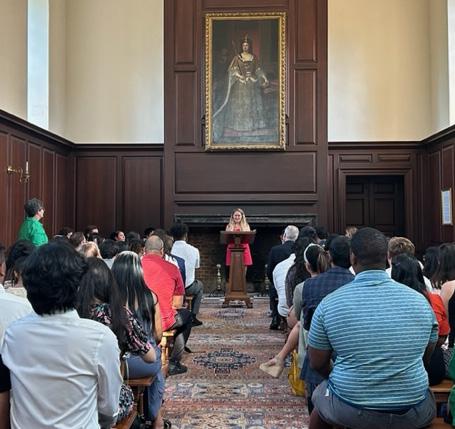
The dean of Arts and Sciences position has been vacant since August 2022, when Maria Donoghue Velleca stepped down two years after taking the role. Raitt, who has served in the role since Jan. 1, 2023, held the first town hall on March 22. Approximately 30 faculty, staff and administration members attended the event inperson and over 70 joined via Zoom.
“We’re funny, we’re smart, we’re erudite, we’re eclectic. But we don’t have a structure right now that articulates and dramatizes all our strengths and all our differences,” Raitt said.
Raitt, a co-chair of the Steering Committee for Computing, Data Science and Applied Science Initiative, proposed an umbrella structure in which five schools – computing, data and applied sciences; creative and performing arts; humanities; social sciences and natural and lab sciences – would all fit under Arts and Sciences.
Raitt emphasized her deep institutional knowledge during the town hall. Since arriving at the College in 2000, she has served in a number of positions, including chair of the English department, faculty representative to the Board of Visitors and vice dean for Arts, Humanities and Interdisciplinary Studies.
“I’ve been here for a really long time,” Raitt said. “I really like working here, and I know that we can transform ourselves and move forward in a way that we want to do if we can build the right kind of culture with the right kind of leader.”
Jackson held the second town hall on April 4. According to Jackson, her interest in working at the College stems from her undergraduate experience at Harvard University, where she enjoyed being challenged and stretched across disciplines.
“[William and Mary] is one of those really extraordinary places that combines a student-centered liberal arts experience, a real commitment to the transformations that happen during that experience, with the energy and vitality of a research institution,” Jackson said.

I hope to be able to make an announcement by the end of April, after I receive the search committeeʼs report, review the community feedback and make the final decision.
As an archeologist and anthropologist, Jackson argued that this combination of a liberal arts and a research oriented education produces empathetic students who are well-suited for analyzing data. She also said that the key strengths she would like to build upon and advance as dean include fostering an environment that promotes creative thinking and building and furthering an inclusive community.


“I am good at moving us from a space of talking consulting to starting to pull out threads, pull out big ideas, start to bring them
together and say, ‘Hey, let’s start to think about what actions are going to come out of this, how we’re going to make decisions about what will come next,’” Jackson said.
Jackson also explained some of her ideas on how to build on the goals of Vision 2026, prompting a faculty member to point out that the plan is a sore subject for some members. The faculty member cited an open letter that over 200 members signed, which explained their concerns with the administration over being excluded from major decision making at the College.
Thomas held the final town hall on April 5. Prior to his time at the University of Nebraska-Lincoln, Thomas served as a professor of history at the University of Virginia. Throughout his career, he has led efforts to promote digital humanities.

“I’m here today because in my view, William and Mary is the leading public university committed to the arts and sciences, to the liberal arts in teaching and research,” Thomas said.

Thomas described his experience working on an interdisciplinary project that brought together leaders from across the University of Nebraska-Lincoln system, culminating in the creation of an animated film chronicling the largest attempted slave escape in United States history, “The Bell Affair.”

“What I’ve learned from that experience is how working together across disciplines and across colleges, bringing different expertise to the table, including working in and with communities involving graduate and undergraduate students at the heart of that project … changes everything,” Thomas said.
During each town hall, faculty asked the candidates questions about building morale, their leadership style and future plans for the College, including Vision 2026 and the potential school for computer, data and applied science. Faculty also asked Jackson and Thomas about their relevant experiences in anticipation of the potential new school of computer, data and applied sciences at the College.
First Baptist Church Excavation project reveals genetic link to church community
are closely associated with.”
Thursday, April 6, archaeologists working on the First Baptist Church Excavation project in Colonial Williamsburg presented their findings on burial sites and human remains found on the grounds of the original First Baptist Church in 2021 at the Williamsburg Stryker Center.
Colonial Williamsburg, the First Baptist Church and Let Freedom Ring Foundation partnered with the Jamestown Rediscovery Foundation in May of 2020 to “conduct ground-penetrating radar,” according to the project’s website. Initial results concluded that the original First Baptist Church site, founded by free and enslaved Black men and women at the start of the American Revolution, had been covered by a parking lot on South Nassau Street in Colonial Williamsburg.
Over the next few years, an excavation project revealed the original foundation of the church as well as evidence of burial sites on the property. In February 2021, members of the First Baptist Church congregation met to agree on the next phase of the project, ultimately deciding to excavate the deceased in order to learn about their identities and properly honor their memory. In July 2022, archaeologists began their excavation of the burial sites and presented their findings to the community at the start of April.
“The First Baptist Church was organized in 1776 by enslaved and free Black people in defiance of laws of the day forbidding the congregation of African Americans,” the Colonial Williamsburg Foundation said a press release.
The physical church site, built in 1856, was purchased by Colonial Williamsburg in 1956 and torn down, with the payment for the land then used to construct the second iteration of the First Baptist Church on Scotland Street.
Member of the First Baptist Church and President of the Let Freedom Ring Foundation Connie Matthews Harshaw spoke about the initial goals of the excavation project.
“The Let Freedom Ring Foundation is a 501(c)(3) nonprofit, we are associated with the historic First Baptist Church, and we are directly responsible for protecting and preserving the historic building and landscape and collecting and preserving artifacts,” Harshaw said. “I say that because we were looking for artifacts on the original site of the First Baptist Church when we met with CW in March of 2020, and we thought if we could just find some of the artifacts on the original site, that would be great.”
Since the initial excavation began, experts from the College of William and Mary, the University of Connecticut and Colonial Williamsburg have completed DNA, osteological and archeological studies of the bodies buried on the site of the original church. Their findings have now proven
I Love Every Aspect of my Semester Abroad
Ellie Kurlander ‘24 argues that studying abroad is best when you go into it with an open mind and realistic expectations page 5

that the individuals buried on the site are of African descent and many are believed to have constructed the original 1856 church building. Out of 63 confirmed burials, Colonial Williamsburg decided to test the extent of preservation on three deceased individuals.
National Science Foundation postdoctoral fellow at the University of Connecticut Raquel Fleskes aided with the osteological and DNA analysis of the exhumed remains.
“The Virginia area has very high clay soils that are very acidic and very wet, and so those three factors usually lead to poor preservation of human remains,” Fleskes said. “We wanted to make sure that we weren’t going to be uncovering these graves unnecessarily.”
According to Fleskes, out of the three burials tested, burial No. 26 was the best preserved, potentially due to the location of his body which excavators found underneath the foundation of one of the church buildings.
“With burial No. 26, we were able to generate really good DNA data — this individual is male, he has an X and Y chromosome and he is of African descent,” Fleskes said. “These findings are really important because it provides the only definitive estimation of the ancestry of these burials. Because the osteological remains were very poor, they could only very tangentially estimate ancestry affiliation. So the DNA provides that concrete estimate of what population [these individuals]
Harshaw emphasized the importance of the input from descendent community members, and the significance of the accomplishments on the property since 2020.
“America has heard the story told by others for a very long time,” Harshaw said. “This is the descendants’ story, and they must have a voice. They must make the decisions about what happens on that site, they must make a decision about anything that’s found on that site. And this was before we knew about intact burials – we needed to make sure we had 100% community and descendent engagement.”
Harshaw mentioned that the team working on this project and partners at the College’s Institute of Historic Biology will be recognized this fall as one of the most successful community engagement efforts currently going on in the United States.
“It is, right now, considered to be the most historically significant archaeological project in the country,” Harshaw said. “It was a challenge at first because we had to rebuild trust in the community in Colonial Williamsburg and also the other partners in the community because of the treatment they received during the Jim Crow era. A lot of the descendants that were here then are still alive, so I have to tell you that we have made remarkable progress in improving those relations.”
Inside Variety
INDEX Pro le News Opinions Variety Sports 2 3-4 5-6 7-8 9-10
Inside Opinions
EMMA HENRY FLAT HAT NEWS EDITOR WILLIAMSBURG Inside Sports Everybody loves Tyler James Williams Award-winning American actor comes to the College, talks about career, acting history, life advice page 7 Weekend of walk-offs Baseball improves conference record with stalwart pitching performances page 10 The Colonial Williamsburg project finds bodies at site of original First Baptist Church are of African descent, possibly original church members
DANIEL KALISH // FLAT HAT NEWS EDITOR
T
Vol. 113, Iss. 5 | Wednesday, April 19, 2023 The Weekly Student Newspaper of The College of William and Mary flathatnews.com | @theflathat
HE F LAT H AT
See ACADEMICS page 2 Questions during three town halls highlight faculty concerns over future of humanities, faculty role in administrative decision-making COURTESY
See WILLIAMSBURG page 4 COURTESY
RYAN
PHOTO / SARAH JACKSON
PHOTO / OFFICE OF UNIVERSITY COMMUNICATION, NEBRASKA-LINCOLN
GOODMAN / THE FLAT HAT
” “
- Provost Peggy Agouris
FLAT
College releases Class of 2027 decisions, reports 32% acceptance rate
Friday, March 24, the College of William and Mary released regular decision results to prospective studentsʼ applicant portals. The College received over 17,500 applications this year with an 18% increase in Early Decision applicants, making for a total of over 1,400 applications across Early Decision I and II. Admission for Early Decision applicants increased 10% from last yearʼs class, with over 600 students offered admission through this process.
Compared to a 33% overall admission rate for the Class of 2026, 32% of applicants gained acceptance into the Class of 2027. The College expects to welcome around 1,650 students this fall, 40% of which identify as students of color and 6% of which are international students. After the College announced on March 2, 2023 that it would extend its testoptional admission process indefinitely, around 30% of this yearʼs applicants applied without standardized test scores.
Student Assembly president Sydney Thayer ʼ24 expressed her excitement following the admissions decisions in March.
“With each new class of W&M students brings a whole new set of diverse experiences, interests and perspectives that allow our community to learn and grow,” Thayer wrote in an email. “We are so excited to hear their fresh perspectives and hope to do everything we can to support them as they find their community, explore their passions, and kick off their time here at W&M!”
The College hosted its You Belong event on April 14 and Day for Admitted Students (DFAS) on April 15, 2023.
College alumni S. Douglas Bunch ʼ02, J.D. ʼ06 emphasizes education, professional achievements
JOSEPH WEHMEYER // FLAT HAT NEWS ASSOC.
After graduating from the College of William and Mary, Board of Visitors member S. Douglas Bunch ’02, J.D. ’06 still centers education within his career. Whether working as a partner at Cohen Milstein Sellers and Toll PLLC or as a U.S. representative at the United Nations, Bunch continues to emphasize the importance of learning.
“I think education may be the number one factor in advancement and mobility, socially, economically, in terms of the progress of humankind in general,” Bunch said. “I think it’s the way that we can do the most to improve our own ability to help the rest of the world and advance our common interests as human beings.”
Bunch’s desire to improve opportunities for others is rooted in his personal experiences.
“I grew up in Augusta County, Virginia,” he said. “My dad drove a UPS truck and my mom was a public school teacher. I was the first person on my dad’s side of the family to graduate from college. For me, William and Mary was truly transformative. It inspired me to think critically, creatively and globally.”
When investing in the education of others, Bunch thinks big and does not shy away from ambitious projects.
As a Monroe Scholar in 2000, he founded Ascanius: The Youth Classics Institute, a nonprofit organization which teaches classical studies to elementary and middle school students. In 2006, Bunch co-founded Global Playground, a nonprofit which has built educational infrastructure in 11 underdeveloped and developing countries.
“We run Global Playground on less than $75,000 per year,” Bunch said. “That allows us to build roughly a project a year. Normally classrooms or sometimes an entire school, sometimes a community center or a library… We’ve had a huge impact with a very small investment, and that’s been really fulfilling to see.”
Global Playground hosts students from the College participating in Freeman Intern Fellowships in East Asia. Starting in 2018, the Charles Center for Academic Excellence began sponsoring unpaid internships in the region.
“Both last summer and this coming summer there will be Freeman Fellows from William and Mary who are residents at our school in Northern Thailand,” Bunch said. “That alone has a significant impact.”
In 2022, President Joe Biden appointed Bunch as a public delegate of the United States to the 77th session
ACADEMICS
of the U.N. General Assembly. In this role, he has made several statements in the UNGA Third Committee, which addresses social, humanitarian and cultural issues.

In this role, Bunch organized a consortium of colleges and universities to regularly engage with the U.S. mission at the U.N. According to Bunch, the U.N. hosts monthly briefings on “significant issues of mutual interest,” such as climate change, the one year anniversary of Russia’s aggression in Ukraine, water and food insecurity.
“It’s been a privilege to be at the table and in the room when we advance U.S. policy interests, which very often are the policy interests across many other member states,” Bunch said.
Governor Terry McAuliffe appointed Bunch to the College’s BOV in 2016, and he was reappointed by Governor Ralph Northam in 2020. As a member of the BOV, Bunch has a say in critical decisions at the College, including choices regarding tuition rates, granting tenure and hiring the College’s president.
“We also set the vision and mission of the institution,” Bunch said. “We’re a constant sounding board for the president a nd other senior staff as they make important decisions.”
Bunch’s engagement with the College is extensive. As an undergraduate, he was an aide to former College President Timothy J. Sullivan. Bunch also received the inaugural W. Taylor Reveley Award in 2011, recognizing his commitment to public service, and spoke at the College’s first Lavender Graduation ceremony in 2018, celebrating the achievements of its LGBTQ+ graduates.
“The institution has progressed far beyond where it was when I arrived in 1998 but also when I graduated in 2002,” Bunch said. “We’re far more diverse, inclusive, [and] forward looking… [We’re] demonstrating to the rest of the world what a special place we are. A place that truly values undergraduate research. Where community means something. Where people have each other’s backs. Where the alumni community is strong and loyal. Where there’s a focus on development of your entire self as an undergraduate.”
Bunch attributes his experiences and perspective gained as an undergraduate at the College for his achievements as a lawyer and diplomat. He spoke optimistically about the College’s current state and its future.
“We’re in a really special place as an institution,” Bunch said. “President Rowe has been fearless in her leadership and bold in all the ways we needed. Entrepreneurial in ways that we asked her to be. She’s truly taken us to the next level and then some. We’re heading towards an exciting place.”
Faculty members ask candidates about College’s future
ACADEMICS from page 1
Faculty and sta morale was another focal point of discussion during the town halls. Raitt discussed a time where she met with some sta members and the expressed their concerns as she was putting together a white paper on the strategic plan.
ere’s a group of housekeepers who used to always have breakfast in the lunchroom in Tucker Hall where the English department lives,” Raitt said. “I went and I had breakfast with them. I mean, you know I asked if I could, obviously. And we had a long conversation about the strategic plan. And I said to them, What do you enjoy about coming to work? And you know what they said? ey said, ‘going home.’”
A faculty member at the town hall told Raitt that it felt like faculty and sta morale was at an all time low and added that it felt low in ways that may have a ripple e ect across campus.
Raitt said that low morale is a di cult issue and may stem from the COVID-19 pandemic and the signi cant number of transitions in the dean of Arts and Sciences o ce.
Another faculty member highlighted his concern over the future of humanities programs at the College. He noted his concern for whether the administration’s decisions will bene t the College in the long run. He also pushed back on the notion that morale issues stem from the COVID-19 pandemic, and instead said that they are more linked to administrative overreach, such as hiring decisions without consultation from the faculty.
The faculty member highlighted other issues such as research funding being taken from their department and bureaucratic issues in interdisciplinary studies.
“ ere is a narrative out there that the humanities are dying and that nobody is signing up for the humanities majors,” Raitt
said. “I’ve looked at the numbers across the nation. It’s not true. It’s just not true. At William and Mary, we’ve seen an increasing number of STEM majors and we’ve seen a decrease in the number of arts and humanities majors. What we have not seen is a decrease in the number of students who are desperate to get into the arts and humanities courses. And to me, majors are nice and all, but what really matters is that students can take courses outside of their major, and most students who are STEM majors or econ majors, whatever it might be, are still really eager to take arts and humanities courses.”
Raitt emphasized the importance of investing in the arts and humanities.
“I would see it as my responsibility to our students, and to a concept of the liberal arts and sciences education that is really expansive, to invest in the arts and humanities,” Raitt said.
“ “ THE BUZZ THE FLAT HAT | Wednesday, April 19, 2023 | Page 2 News Editor Abigail Connelly News Editor Emma Henry News Editor Daniel Kalish fhnews@gmail.com CORRECTIONS e Flat Hat wishes to correct any fact printed incorrectly. Corrections may be submitted in email to the editor of the section in which the incorrect information was printed. Requests for corrections will be accepted at any time. news insight
I think there is such a beautiful opportunity to learn outside of the classroom. Travel, obviously, is a great way, but I think the other thing is just realizing that all of us are going to have different experiences.
̶ Jessica Nabongo
A THOUSAND WORDS EMMA HENRY / FLAT HAT NEWS EDITOR
“It’s been a privilege to be at the table”
HAT NEWS BRIEF
COURTESY PHOTO / S. DOUGLAS BUNCH
Bunch currently serves on the Collegeʼs Board of Visitors and was appointed as a public delegate for the U.S. to the U.N. General Assembly by President Joe Biden in 2022.
EMMA HENRY / FLAT HAT NEWS EDITOR T
ʻSTABILITAS ET FIDESʼ | ESTABLISHED OCT. 3, 1911 Org #101 P.O. Box 8795, Williamsburg, VA 23187 Editor flathat.editor@gmail.com Managing flathat.managing@gmail.com Executive flathat.executive@gmail.com Magazine editor@flathatmagazine.com News fhnews@gmail.com Sports flathatsports@gmail.com Copy flathatcopy@gmail.com Opinions fhopinions@gmail.com Variety flathat.variety@gmail.com Photos flathatphotos@gmail.com Online flathatonline@gmail.com Advertising flathatads@gmail.com Graphics flathat.art@gmail.com Ombudsman flathat.ombuds@gmail.com Molly Parks Editor-in-Chief Jake Forbes Managing Editor Vivian Hoang Executive Editor Adam Jutt Digital Media Editor Myles Rescher Business Manager Sarah Devendorf Standards Editor Anna Arnsberger Operations Coordinator Ryan Leventhal Webmaster Abigail Connelly News Editor Emma Henry News Editor Daniel Kalish News Editor Miles Mortimer Variety Editor Agavni Mehrabi Variety Editor Ethan Qin Sports Editor Max Grill Sports Editor Avi Joshi Opinons Editor Mollie Shiflett Opinions Editor Chris Schneider Videos Editor Lisa Coleman Data Editor Camila Anderson Social Media Editor Karis Koutsourelakis Social Media Editor Yelena Fleming Graphics, Podcast Editor Ryan Goodman Photos Editor Crystal Wang Copy Chief Hannah Ray Chief Staff Writer Betsy Mahoney Chief Staff Writer Veronica Bondi Copy Editor Anu Desai Copy Editor Anastasia Rubis Copy Editor Annabelle Glassman Copy Editor Maddie Harris Copy Editor Caitlin Noe Copy Editor Joe Wehmeyer News Assoc. Editor Aafreen Ali News Assoc. Editor Sonia Samantaroy News Assoc. Editor Ian Harman News Assoc. Editor Peerawut Ruangsawasdi News Assoc. Editor Grace Martin News Assoc. Editor Grace Saunders Variety Assoc. Editor Summer King Variety Assoc. Editor Lindi Li Variery Assoc. Editor Phebe Fahmy Variety Assoc. Editor Emma Halman Variety Assoc. Editor Ava Edwards Variety Assoc. Editor Ashley Cohen Variety Assoc. Editor Gabriel Black-Planas Chief Features Writer John Powers Opinions Assoc. Editor Ellie Kurlander Opinions Assoc. Editor Lauren Meyer Opinions Assoc. Editor Bushra Bablu Opinions Assoc. Editor Damien Kanner-Bitetti Opinions Assoc. Editor Samuel Li Photos Assoc. Editor Justin Sherlock Photos Assoc. Editor Elliott Lee Chief Sports Writer, Photos Assoc. Editor Ryan Cody Sports Assoc. Editor Catherine Storke Graphics Assoc. Editor Jonah Randell Ombuds Assoc. Editor Nora Keely Ombuds Assoc. Editor Shradha Dinesh Data Assoc. Editor Abhayprad Jha Data Assoc. Editor Jenine Samara Podcast Assoc. Editor Maddie Cassidy Fact Checker Alisha Khodabocus Fact Checker Jana Smith-Perry Fact Checker
HE F LAT H AT
Raitt, Jackson, Thomas vie for dean of Arts and Sciences position at campus town halls
READ MORE AT FLATHATNEWS.COM READ MORE AT FLATHATNEWS.COM
CAMPUS
Reves Center hosts Jessica Nabongo as part of McSwain-Walker lecture series
Nabongo shares her experiences with navigating jobs, travel, identifies three key elements for a fulfilling life
Tuesday, April 11, the College of William and Mary’s Reves Center hosted writer, travel expert, photographer and entrepreneur Jessica Nabongo as part of the annual McSwain-Walker lecture series.
e series strives to host speakers across a wide array of disciplines to discuss the ways in which other countries and cultures interact with the United States.
Past speakers include author Viet anh Nguyen, Cuban lmmaker Orlando Rojas and Swedish Ambassador to the United States Karin Olofsdotter. Nabongo joined this distinguished list as the rst Black woman to travel to all 195 United Nations-recognized countries, using her story to educate the audience about the many emotional and mental strategies she has used throughout her life.
Nabongo’s talk, titled “Intentional Travel: How Education, Empathy and Con dence Will Help You Create the Life You Want to Live,” was held in Tucker Hall’s theater. College students and members of the Williamsburg community attended the event.
Nabongo discussed her life, career and personal travel tips before opening the talk up to questions from the audience.
“ e most important thing to see here is that life is not linear, right? It’s not a straight line. is thing is a wild roller coaster, and I’m so grateful for the ups. Also for the downs, because they taught me so much,” Nabongo said.
Born to Ugandan immigrant parents and growing up in Detroit, Michigan, Nabongo mentioned that her parents were the rst people to introduce her to travel. Later, Nabongo received her bachelor’s degree at St. John’s University in English literature with a double minor in advertising communications and Africana studies, a minor that Nabongo herself helped create.
Following graduation, she quickly decided to take a job at P zer, a pharmaceutical company, until she realized that a corporate job was not the right decision for her.
“In 2007, it was bonus day. I remember it like it was yesterday and my bonus was so sad — it was three digits. I was so angry because I was raised to believe the world is a meritocracy. I graduated on the dean’s list from college, I graduated magna cum laude, all of that, but my hard work in that role wasn’t being acknowledged because of external factors like the market was changing, generic drugs, etc. And I remember, that day something in me broke,” Nabongo said.
After quitting her job at P zer, Nabongo moved to Japan for a year to teach English and started her travel blog, “ e Catch Me If You Can,” before applying to earn her master’s degree in development with a focus on agriculture at the London School of Economics.
“It was just such an incredible experience to be in a place with people from all across the globe,” Nabongo said. “My worldview expanded greatly because I’m hearing from other people what their experiences were and also getting to share some of mine.”
After graduating with her master’s in 2010, Nabongo moved to rural Benin with her then-boyfriend before moving back to Europe in 2011 to take a job at the U.N. Food and Agriculture Organization for a year and a half.
Her job in Rome eventually allowed her to become a “digital nomad,” or remote employee. Nabongo took this opportunity to travel to Buenos Aires, taking six weeks to explore Brazil and Argentina.

“ at time that I spent in South America, it was just so incredible,”
ACADEMICS
Nabongo said. “Again, staying in hostels and meeting people from all over the world. Just meeting people who were living very free lives and lives that I think were full of possibility. And that’s really what gave me the con dence and sort of bolstered me to think di erently about what was possible in terms of my life and ultimately my career.”
In the fall of 2014, Nabongo decided to quit her job in Rome and return to the United States, feeling a bit melancholic for the many birthdays, weddings and major life events she had missed.
“Seven years abroad — the return hit me like a ton of bricks,” Nabongo said. “Reverse culture shock is very real because when you’re born in a country, you don’t realize what is happening to you, right? Because everything is normal. But when you go abroad, in particular as a Black woman, what I hadn’t realized was the weight of
She detailed her recent experiences as a writer, traveler and entrepreneur, such as going on talk shows like Good Morning America and interviewing Vice President Kamala Harris on Apr. 5, 2023 during a conversation about Harris’s recent trip to the African continent.
Nabongo then launched into a discussion of the three elements of her life that she believes made her successful — education, empathy and con dence.
“Education comes in many forms, both inside and outside of the classroom. And I think, obviously, practical education is great. I love education. I’m a super nerd. I would like to get ve more master’s degrees if I had the time. But I think there is such a beautiful opportunity to learn outside of the classroom. Travel, obviously, is a great way, but I think the other thing is just realizing that all of us are going to have di erent experiences,” Nabongo said.
Nabongo emphasized the power of kindness, the magic involved with travel, the importance of reading and the power of pivoting to di erent jobs and hobbies. She then discussed the importance of empathy, and recognizing the beauty of strangers while traveling globally.
To Nabongo, the experience of traveling has allowed her to recognize that she often does not have negative experiences with other people while approaching life with a more positive mindset.
“I think that we have to stop walking around with this heaviness of the fear of the stranger because it’s unfounded,” Nabongo said. “Of course, terrible things happen. I’ve had horrible things happen to me both domestically and abroad, but I’ve never allowed those things to deter me from my belief that most people are good. I think that’s really important to remember, just human kindness. And I think right now we’re living in a world and a country that really wants us to hate each other. But those aren’t our natural inclinations.”
Isabel Rose ’25 discussed how Nabongo’s talk inspired her as she navigates a transition out of the pre-med pre-professional program.
racism living in America. Every day almost, I’m being made aware of my race. at was something I wasn’t experiencing very often at all. Certainly not on a daily basis. Of course, sometimes things happen, but just not on the same level as in the U.S.”
After deciding that this path was not for her, Nabongo launched her boutique travel agency, Jet Black, in 2015.
Two years later, Nabongo had an epiphany while traveling to Bali after hearing about an American woman who had earned the Guiness World Record for visiting every country in the world the fastest.
“After that, I found out there is this whole community of weirdos like me that are country counters,” Nabongo said. “And I also found out, at that time, less than 150 people in the world had been to every country, and one black person. en I was like, okay, I’m going to be the rst Black woman to go to every country in the world. And then I did it. I visited 135 new countries in two and a half years.”
In 2020, National Geographic contacted Nabongo with an idea for a book after seeing her comments in a Washington Post article. Two years later, Nabongo published “ e Catch Me If You Can: One Woman’s Journey to Every Country in the World.”
“I found it interesting how many jobs that she started and she quit,” Rose said. “I know that I’m not the only person that has stopped being premed. But seeing someone do it so many times and still be as successful as she is is kind of eye opening. I really like how she doesn’t focus on the yeses that she said she thinks of the nos and how many opportunities that it’s led her to. I think that’s really interesting because I feel like we have a tendency to think about all the negatives instead of all the positives.”
Lastly, Nabongo discussed the importance of having the con dence to nd passions, travel and express personal needs.
She mentioned that she has found power in the ability to say “no” and prioritizing her own values and time. Finding her passion, Nabongo said, helped her nd who she truly was and the life she wanted to live.
“When you nd that frequency, you nd other people who are on that same frequency. You know, I meet a lot of people now and it feels like we’ve known each other forever in the rst ve minutes because we’re all on that same frequency,” Nabongo said.
Nabongo ended her talk with a brief question and answer session from the audience. Molly Ga ney ’23 attended the talk and discussed the inspiration she drew from Nabongo.
“I just like the energy that she has and the approach that she has that I’m sure gets informed by all the travel she does,” Ga ney said. “ at was super empowering. Sometimes I think ‘Oh my gosh, I’m 22, I’m running out of time to see the world,’ but that’s clearly not the case for her.”
Discontinuation of German major attributed to inability to meet SCHEV guidelines
Academic programs do not meet State Council requirements, administration cuts German major
In Feb. 2023, the College of William and Mary announced the discontinuance of its German major. Acting Dean of Faculty for Arts and Sciences Suzanne Raitt cited the program’s inability to meet productivity targets set by the State Council of Higher Education for Virginia as a reason for the major’s ending.
“Discontinuing the major has been under discussion for years and in moving forward, we are being responsive to national and global changes in student demand, as well the increased need to meet external requirements set by the State Council of Higher Education for Virginia,” Raitt wrote in an email to College faculty in February.
Following the move, Raitt assuaged concerns about further action on other majors.
“There are no plans to discontinue any other majors,” Raitt wrote in an email. “The AMST program also has Master’s and PhD students, and the undergraduate major supports the graduate programs. Student demand is the primary driver of decisions both to discontinue degree programs, and to create new ones. Over the past few years we have created new majors in Linguistics, Japanese Studies, Integrative Conservation and Data Science.”
According to data from SCHEV, the statewide coordinating agency for higher education which evaluates academic programs through their enrollment and degree production, seven undergraduate academic programs offered at the College do not satisfy productivity targets set by the Council. Those programs are American Studies, Chinese Language and Culture, Religion, Elementary Education, French and Francophone Studies, German and Theatre and Speech.
According to the Code of Virginia, SCHEV has to file a report to the governor of Virginia and the General Assembly notifying them of the
discontinuance of an academic program.
“No such discontinuance shall become effective until 30 days after the adjournment of the session of the General Assembly next following the filing of such report,” the Code reads.
Raitt descr ibed the state of the major discontinuation in March.
“The process of discontinuing the German major is underway, but it takes some time for it to be completed, as you saw. Right now the major is still active,” she said.
While students who have already declared would be able to still graduate with a German degree, German Studies Program Director and associate professor Jennifer Taylor said students are no longer able to declare a major in German.
“When we discussed canceling the program, I was not aware that they were going to close down the process of applying to be a German major immediately, but they did,” Taylor said. “Students are not at this point, if they thought they were gonna get a German major, if they had enough courses, they can’t now do that. But everybody who is already in the pipeline has been kept in the pipeline and will be allowed to get their degree in German.”
Taylor said that while the administration cited the program’s failure to meet SCHEV’s targets as a reason for discontinuance, no one provided her with paperwork or information regarding the previously-cited section of the Code of Virginia.
“They told [the German Studies faculty] when they canceled the German major last month, that it was because of not meeting SCHEV compliance,” she said. “I never saw any paperwork. The deans and people in the dean’s office said it was very unclear. It’s just very unclear. But we never saw any paperwork. So I believe the deans when they say that we’re out of compliance, but I don’t know what that means.”
Board of Visitors member Kendrick Ashton ’98, who serves on the Committee on Academic
Affairs, said that declining demand for the German major was the driving force behind the decision.
“To support a m ajor has, you know, certain requirements. And I think we’ve seen consistent trends in a number of areas that suggest to us that, you know, you need to perhaps offer some of those courses, but not necessarily for a major,” Ashton said.
While nancial reasons factored into every decision the College makes, Ashton said budgeting was not the main issue this time around.
The decision comes amidst financial challenges for the College. April 11, in a Student Assembly Senate meeting, Interim Chief Operating Officer Jackie Ferree mentioned a potential increase of tuition in relation to the need to comply with an inflationary environment and budget proposals from the General Assembly mandating salary increases for public employees.
“We’ve seen the CPI growth of about 17.5% o ver those five years. And as we move into FY24, the state budget right now is calling for a 7% increase in wages, which, for us, the portion that is unfunded is close to 10 million dollars,” Ferree said.
The Virginia Commonwealth University administration presented similar plans to its Board of Visitors in March, citing similar reasons.
Ashton responded to questions regarding the reinstatement of the German major if it gained more popularity in the future.
“Oh, I think so,” Ashton said.
In response, Raitt laid out a potential start to the scenario.
“If significant numbers of students declare a self-designed German major, and we are confident that trend will continue, it is possible that the major could be reinstated,” Raitt said. “However, given the numbers over the past thirty years, I have to say that scenario seems
unlikely. But I would never say never.”
President of the Graduate Student Association of the Arts and Sciences Justin Cammarota, a fourth year physics graduate student who studied German at Lebanon Valley College, disapproved of the administration’s reason for discontinuing the German major.
“I feel those are just dumb reasons in general, because enrollment numbers — the fact that the languages, it enriches every liberal arts school — enriching the general academic and social well-being of a student is more important than simple numbers in a classroom,” Cammarota said. “Because if you don’t have the numbers this year doesn’t mean that there won’t be a future wave who are interested.”
According to data from SCHEV, the German Language and Literature major at the University of Virginia also fails to meet productivity. However, UVA has not announced any plans to discontinue its German major.
Despite the stark difference in enrollment size of each institution, SCHEV evaluates the programs by the same productivity targets.
Student Assembly Chief of Staff and senior representative to SCHEV Owen Williams ’23 said that while he was not involved in the discussion leading to the German major’s ending, it is a possibility that the College could discontinue other majors.
However, Williams is certain that the College would attempt to make those programs satisfy SCHEV targets.
“[It] is important that William and Mary be in compliance with their policies and regulations to maintain our accreditation,” Williams said. “So yes, it is a possibility, although I have confidence that the University would take all possible steps to ensure a program reaches SCHEV standards and SCHEV would provide flexibility there as well before discontinuance were to happen.”
THE FLAT HAT Wednesday, April 19, 2023 Page 3
PEERAWUT RUANGSAWASDI FLAT HAT NEWS ASSOC.
COURTESY PHOTO / JESSICA NABONGO
After seven years of traveling abroad, Nabongo returned to America and described her experience of rever se culture shock, especiall y in regard to race.
EMMA HENRY FLAT HAT NEWS EDITOR
Mobile app to replace Blue Light campus safety kiosks
Emergency Management Team announces transition to Rave Guardian app for campus emergency response
Wednesday, April 12, the College of William and Mary’s Emergency Management Team sent an email to the campus community regarding an update to its Emergency Notification System.
The administration will replace the former Blue Light (e-phone) system with the Rave Guardian app and nine emergency sirens by the fall semester.
“One of the duties of the university’s Emergency Management Team is to continually evaluate the functionality of system components and run full-system tests three times per year (each semester and once over the summer),” William and Mary Police Chief Deb Cheesebro and Vice President for Student Affairs Ginger Ambler wrote in the email.
The Emergency Management Team, led by Cheesebro and Ambler, tests the emergency systems’ functionality to ensure effective communication with the campus community in regard to emergency events on campus, ranging from active threats to hazardous weather.
“The technology used in the Blue Light kiosks is aging, and we recognized that ultimately the systems would be unrepairable or
too costly to repair,” said Cheesebro.
“We took the step then to identify an appropriate alternative.
The transition from the ninety Blue Light kiosks to the Rave Guardian app for emergency notifications began in August 2014.
Food for All organization aims to combat food
A key advantage of the free app is its functionality. Its design is tailored for easier student access, live geolocation, and a photo feature to send to the police. In areas of low cell service, the physical kiosks will remain active.
Installation of emergency sirens began in March 2023.
The College will install six new sirens with updated technology in addition to the existing three for better coverage on campus and increased compatibility.

A new public address system for voice messages will be incorporated as well. All nine sirens are expected to be operational by the summer.
Out-of-order Blue Light kiosks will be fully removed by the summer. In the meantime, there are visual reminders to use the Rave Guardian attached to the Blue Light kiosks.
In case of an emergency, there is still the option for members of the campus community to to dial 911 or the William and Mary Police Department directly at 757221-4595.
insecurity on campus
Student organization opens food exchange in Sadler, provides for all campus community members
EMMA HENRY FLAT HAT NEWS EDITOR
Friday, April 14, the College of William and Mary’s Food for All student organization held the grand opening of its second food exchange in Sadler Room 157. Food for All hopes to combat food insecurity for College students, faculty and staff.

“Food for All was established in 2022, incorporating various pre-existing resources on campus, including the Campus Food Exchange (formerly the Campus Food Pantry), swipe drives and COVID-19 quarantine food deliveries. It continues and expands these resources to serve students, faculty and sta who may face issues of food access,” says the Food for All website.
Students founded the rst Campus Food Exchange at the College in the lower level of the Wesley Foundation in 2019, acting as a con dential resource for members of the College community. After Food for All’s o cial founding, the organization now manages both food exchange locations as the only food-based organization on campus.
President of Food for All Allisyn Lam ’25 introduced the recent opening of Sadler’s satellite location.
“We’re going to be open any time that the Sadler building is open,” Lam said. “ e background is that we are on a trial period right now with Sadler to prove that this is a necessity on campus. Basically, the campus has not run any o cial surveys for, I think, a few years prior to COVID and obviously with in ation and food prices going up, our services have become a lot more essential on campus. So now Sadler is asking for that data, but the only way we get data is if students ll out the QR code on the back of the door.”
Lam and Food Rescue and Outreach Chair Bridget O’Keefe ’24 collectively cut the ribbon to the food exchange and made nal comments before inviting attendees inside.
“We’re ghting the stigma that surrounds this type of work because food access is very di erent on college campuses than it is anywhere else,” Lam said. “ e students who are relying on this
WILLIAMSBURG
service truly rely on it, so that’s why this is super important that we were able to get this space to keep working on making this a little bit more accessible for everybody on campus.”
Food for All is currently working with Sodexo, Campus Catering and various community partners to help reduce food waste on campus and share excess food with the broader Williamsburg
“We knew we wanted an on-campus location, and we also knew, just working with Max [Blalock] from Wesley that that was going to be a really big roadblock for us, because in the past we haven’t had that support,” O’Keefe said. “One of our main contacts was [Associate Vice President for Student Engagement and Leadership] Drew Stelljes, and he got us in contact with a lot of the Sadler
“If we graduate, no one’s going to be lling this gap,” Howell said. “We’re really advocating for the university to take a more aggressive response to making sure this need is met.”
Howell, Lam and O’Keefe all emphasize the importance of their partnerships within the campus community, including Rev. Max Blalock, a minister for Wesley Campus Ministries, Drew Stelljes and Director of Student Unions and Engagement Eric Margiotta. Lam discussed her role on the executive board and how she became involved with Food for All.
“I kind of wanted to work on something that would last even after I graduated,” Lam said. “This is something I want to see grow and expand and a collective dream for us as a group is that in 15, 20 years we come back and Food for All has not only led to systemic changes o n campus in the way that things are run, but that this isn’t an issue as much anymore.”
Member of Food for All Rowan Carpenter ’26 was excited to work with Food for All after working with food-based organizations throughout high school.
“My parents got me started volunteering, making lunches for the homeless,” Carpenter said. “In high school, I started my own project, which collected food for senior citizens for Meals on Wheels and other stu for them. So I was looking for volunteer opportunities and I saw this ts in with what I’ve done over time, so I decided to continue it.”
Lam, O’Keefe and other executive board members hope that Food for All can increase their reach on campus, and that more people acknowledge the realities of food insecurity on campuses and beyond.
community. Food for All does not receive any funding from the College, and instead relies on grants, donations and pro t shares with aid from the Wesley Foundation in order to maintain its operations. O’Keefe mentioned that it has been a long process to fund and get approval for the Sadler location.
building sta .” e organization’s Student Assembly Liaison Jack Howell ’24 discussed the importance of a more holistic approach to combating food insecurity among College students and urged future students to ll similar roles to battle this issue long-term.
“My big takeaway is that food insecurity does exist on this campus, and that’s a storyline that often gets written out,” Lam said. “It’s not something that we acknowledge, but it’s here and we know it’s here because our resources are being used, and with in ation and food costs rising, as I also mentioned, it’s become an even bigger problem. Food insecurity exists here and we’re trying to do something about it. is is a resource that’s increasing awareness and our accessibility.”
Recent results of excavation project confirm ancestral ties to First
Baptist Church
Excavation, DNA analysis of bodies reveals identities of individuals of African descent buried in original Church building site
WILLIAMSBURG from page 1
Colonial Williamsburg Director of Archaeology Jack Gary noted that professor of anthropology Dr. Joseph Jones and NEH professor of anthropology and American studies Dr. Michael Blakey are currently examining some of the bones removed from the site at the IBH. Gary also discussed the significance of this project and the extent of community engagement during his career.
“This is the way that archeology is going right now and others have been championing an approach like this and doing an approach like this, but this is really the first truly community engaged project that we’ve undertaken here at Colonial Williamsburg,” Gary said. “We’re able to build off of others’ work, and it’s
one of the reasons why it’s been as successful as it has been. We really do hope to be a model for how this type of work can be done in the future.”
Harshaw, Fleskes and Gary emphasized an overwhelmingly positive response from the descendent community and other partners within Williamsburg and across the nation.
“Everyone understands why we need to be doing this,” Gary said. “We were concerned when we first started the project that we would get a lot of pushback or backlash for doing this, for telling the story, and we really haven’t seen it. It doesn’t really pop up. I think it’s very heartening that the regular person that’s coming to Williamsburg walking down the street has the same reaction to this project that we have to this project, that’s a great feeling.”
Harshaw discussed the next steps
for the excavation and community engagement project, and mentioned that many communities across the country are now attempting to begin similar ventures.
“The nation is watching what we’re doing, and we’re getting calls from Montpelier descendents, we’re getting calls from just about every other group, all of these people calling, saying, ‘Wait a minute, how are you guys doing this?’” Harshaw said. “[They say] ‘Tell us what the magic is, how can we follow your example and get this done and bring a community together when the nation, right now, is facing states and governors saying this history is not important?’ Our answer is simply that we’ve got all the right people in the right place at the right time doing good work. Not to oversimplify it, but we always say God
is in the mix. This is around faith.”
Gary considers it a privilege to work with community members and archaeologists in Colonial Williamsburg on this project. He speci cally discussed the signi cance of these partnerships within Colonial Williamsburg.
“To see that level of trust with the members of the community is one of the nice things about this project because it’s no secret here in Williamsburg that the relationship between Colonial Williamsburg and particularly the African-American community has not always been good,” Gary said. “When you add in the descendents perspective, it adds a layer of emotion and humanity to the site.”
Harshaw also emphasized the importance of engaging descendent voices, and mentioned that through this project, excavators have
collected thousands of artifacts with plans to display them to the greater community in the next phase of the project. Colonial Williamsburg will not display any human remains or show any images of the deceased out of respect. Plans to reconstruct the First Baptist Church building are in place for 2026, a year that marks the 250th anniversary of both the church and the nation.
“There will be interpreters there, Colonial Williamsburg has gotten two grants which total more than $6 million dollars, we will have programs there on the site,” Harshaw said. “What’s really important is that the graves will not be disturbed. The graves will remain there, the intact burials will remain there. What we have to do now is we have to figure out a way to commemorate those graves.”
THE FLAT HAT Wednesday, April 19, 2023 Page 4
CAMPUS CAMPUS
CLARE GIFFORD THE FLAT HAT
RYAN GOODMAN / THE FLAT HAT
Food for All partners with Sodexo to address food waste and provide necessary nourishment to reduce food insecurity for the entire campus community.
RYAN GOODMAN / THE FLAT HAT
The transition from Blue Light kiosks on the campus began in August 2014 and has led to the gradual transition to the Rave Guardian app.
STAFF COLUMN FLAT HAT OPINIONS ASSOC. Ellie Kurlander
Before traveling abroad, check your expectations and mindset
give this one to her; there is some truth to the claim that living with many people, especially randomly assigned strangers, is not easy. Not everyone will have the same living habits and, as the author puts it, “values” as you, which can be a learning curve. Living and traveling with the same people can cause tensions to arise and, at times, boil over. However, these moments can serve as a great opportunity for growth. Living with strangers presents opportunities to seek common ground, make compromises when necessary and communicate openly whenever tense moments occur.
The author also used a large portion of the article to complain about her roommates using the study abroad experience as an "exhausting form of escapism." To that, I answer: yeah, of course. After making it through online learning freshman year and the trenches of sophomore year, the opportunity to study in a new place with new experiences sounded like a wonderful way to escape from the stressors of everyday life. Apart from "exhausting escapism," studying abroad has been enriching for my future academic and career ambitions. As an art history and government double major, I have broadened my perspective on both subjects in a way I wouldn't have been able to back in the States.
As much as studying abroad can be a nice, temporary break from reality, it is important to consider that life back home does not stop. On many occasions, I’ve had to set aside fun to work on summer job applications, academic proposals and, more generally, maintain obligations that may have followed me overseas. While it may be frustrating not to be able to escape responsibilities entirely, it in no way impacted my enjoyment abroad. Bucket lists are still checked, and there is still fun to be had.
While the occasional cat-call can feel off-putting, nearly every local I’ve interacted with was gracious and hospitable. Most shopkeepers and waiters were patient with my botched pronunciations and rudimentary grammatical structures. I quickly found that if you express the willingness to learn about cultures different from your own, the reception tends to be positive.
My main takeaway from the author’s and my contrasting experiences is that studying abroad is what you make of it. I came into the program with very few expectations and with the understanding that no study abroad experience is perfect. It is natural to imagine what your life in another country will look like. Still, it is just as important to understand that the mental image you created may be drastically different from reality. If you come in with idealized expectations, you automatically set yourself up for disappointment. Unfortunately, life isn't like “Roman Holiday,” in which you ride off into the sunset on a vespa with Gregory Peck. Instead, you should remain open to opportunities that come along as you go.
GRAPHIC BY GEORGIA WESTBROOK / THE FLAT HAT
In early March, Insider published an op-ed by a New York University student who recounted her miserable experience studying abroad in Florence, Italy. The article quickly took the internet by storm, with many criticizing the author’s out-of-touch and entitled criticisms. As someone currently studying abroad in Florence, I received about a dozen “this u?” texts from friends and family who were curious if her experience rang true to my own. Upon reading the article, I was left with an inexplicable pit in my stomach. I proceeded to read the article three more times to distinguish if it was satire or not. To my disappointment, I concluded that it was, in fact, not satire.
The article, aptly titled "I'm an NYU student who studied abroad in Florence. I hated every aspect of my semester abroad," is a 1000-word compilation of complaints from a nineteen-yearold grappling with how anyone could want to live differently than her. Moreover, this article also displays the all-too-familiar reality of setting certain expectations before making a big life change.

Readers quickly get an idea of the author's mindset at the beginning of her journey as she
paints a cinematic, albeit caricatured, picture of her future Italian life.
"I imagined fun potluck dinners with my roommates, summer flings with people who called me ‘bella,’ gelato that dripped down my fingers in the heat and natural wine that paired effortlessly with good conversation and better prosciutto," the op-ed article reads.
However, the author's bubble quickly burst, as expressed through this frank follow-up statement.
"...When my semester in Florence came to an end, I grew to despise the sights, hated the people and couldn't wait to get back home to my campus in New York,” she continues.
While it is easy to laugh and poke fun at some of the sweeping generalizations and hyperbolic language used in the article, I also believe there is potential for discussion regarding the study abroad experience. More specifically, I want to discuss the author's criticisms and compare them to my own experience abroad with the hope that it will offer helpful insight for anyone considering going abroad.
The author’s first complaint centered around her discomfort living with seven other roommates. I will
Another topic the article addresses is the exhausting pressure to travel on the weekends. I couldn't help but let out a laugh when the author criticized her roommates for traveling to typical study abroad destinations, then proceeded to list five popular study abroad destinations she herself traveled to. Part of the appeal of studying abroad is the ability to travel to nearby countries on the weekend. I agree that there is pressure to make the most of your three-day weekends by traveling to as many countries as possible. Traveling for cheap around Europe is possible, but doing so every weekend adds up. While you may get FOMO seeing friends post themselves paragliding in Interlaken, Switzerland, or tanning on the beaches of Southern France, it is helpful to find a balance between making the most of your time in your home city and traveling to your bucket-list destinations.
A final aspect of the article I wanted to address was the author’s resentment towards locals. According to the author, she came in with the impression that Italians were “soulful, charming and overflowing with hospitality, but I could provide concrete examples of them being hostile, inconsiderate, and preposterous.”
She then explained how she felt personally victimized by Florentines who rolled their eyes as she walked past in her leggings and Nike Air Max sneakers.
As my study abroad experience winds to a close, I'm already looking back on my time with fond nostalgia. I can't wait to regale stories of the frequent bouts of exhaustion-induced delirium my travel companions and I would experience after traveling for twenty hours straight; I’m excited to share tales of the frequent WiFi outages that resulted in hours of card games with my roommates. As well as forging new friendships, I took time to appreciate the city in solitude by going on long walks, journaling or reading in a piazza. These memories are what make going abroad really special.
The expectations of laughter-filled dinners with friends, wine and prosciutto are possible. However, no study abroad experience is all rainbows and daisies. Exams, papers and tight deadlines are still stressors. Sometimes, you second-guess if you made the right decision to go abroad. One of the most important factors of study abroad is finding moments that bring you peace, whether in the form of a park, a friend or a good meal.
While I believe the author's negative feelings towards Italy are genuine, I never want to be invited to that pity party. There will always be some semblance of good in the bad and bad in the good; however, to the extent you have control over your situation, why opt for the latter?
In the words of my Florence roommates, "Don't yuck someone's yum."
EllieKurlander’24isaGovernmentandArt HistorydoublemajorfromAtlanta,Georgia.She formerlyservedasFlatHatMagazine’sEditor-inChiefandisamemberofPhiSigmaPi.Whileshe currentlyresidesinFlorence,Italy,Elliemissesher dailyattemptstodomesticatecampussquirrels. Contactherateikurlander@wm.edu.
The Lemon Exchange Program: a chance for a great equalizer
This is fairly well-covered territory, but I have a solution to the widespread resentment for the students that had the chance to be housed in Lemon Hall during their freshman year. This resentment is not because they're better looking or that we're really jealous of the extra amount of money they have to pay in housing costs. This resentment has to do with the fact that they get to live in one of the newest buildings on campus, with AC and hardwood floors, while the rest of us freshmen, by and large, exist in dorms that are far from those standards. What's worse is, because Lemon is for freshmen, they don't have previous experience to let them know how good they have it.
It also may be hard for you to understand or believe that this is widespread, but here's the deal. Freshmen that live in Lemon make up a small fraction of those that are in their first year, but their dorm is head and shoulders above all the other freshman dorms. It has AC, unlike Botetourt, the Green and Gold Village and Monroe (shoutout industrial hallway fans), its rooms are nicer than those in Randolph, it's closer to most of campus than Willis and it’s just newer than Yates. Everyone who lives in any dorm has at least one reason to have a little bit of that green monster peek out when Lemon comes up in conversation. The solution to one of the greatest problems plaguing this campus is simple: implement the Lemon Exchange Program.
What is this program, you might ask?
It’s exactly what it sounds like. I believe that for a period of at least a week, freshmen in Lemon Hall should switch places
with a student living in another residence hall, such as the GGV. This may seem fairly impractical, but to be brutally honest, that’s not my problem; it would be Residence Life’s problem.
Before I really get into this, let me preface one thing. I recognize that there are many residents who have been placed in Lemon because they need to be there for medical or other personal reasons. This suggestion is not aimed towards those that need to be there in any way, but towards those (looking at some kids from my high school) that got placed there for no reason other than luck. Whenever a person talks about resenting kids who lived in Lemon, these lucky people are the ones they’re talking about.
But to get back into it, this plan really serves no practical purpose besides eliminating the mystique on both ends. People who live in other residence halls seem to assume that Lemon is some magical place with no problems, and people in Lemon no doubt have only received a caricature of life in other residence halls.
Fundamentally, it is important for everyone to be appreciative of what they have, and I’m not exactly sure that Lemon residents are completely appreciative of what they have — they probably take it for granted, if anything.
Maybe, all they need is to sit in a room with no air conditioning and a possible ant infestation for a week. Or maybe that’s a bit of an oversimplification. Maybe there’s no point in all this, and we just want to continue resenting Lemon kids for what they have but don't appreciate — which is totally fine; I can get behind that. But if we
genuinely want to come to some unified community at the College of William and Mary, we all must become part of the most venerated tradition on campus: genuinely unpleasant freshmen dorms.

That’s the problem with Lemon. It’s not unpleasant. The shower heads don’t explode when you’re showering. The toilets don’t leave puddles on the stall floors. It doesn’t have cockroach killing escapades during orientation. And it doesn’t have ant traps laid out every 15 feet. Most would argue that’s a good thing, but I would argue that Lemon residents missed out on a critical part of character development.
After all, their first apartment might end up being a hole in the wall, meaning they’re now missing out on the opportunity to prepare themselves for it. So you see, what I propose is actually a public service — a learning opportunity, if you will. Also, I’m not going to lie to you, I’d like a break from the ants, linoleum tile and cinder blocks, and I want a lounge where the AC works.
So, we all get to see how the other half lives, and then we all get to go home. That sounds pretty good to me. And I will admit that after a week I’d probably start to miss my cinder blocks and tiny bathroom stalls (that could be the Stockholm Syndrome talking, I can’t know for sure), and Lemon kids would definitely miss their former surroundings, so we would all go back to normal a little bit better off for the experience. We’d all learn that there are things about our situations that
we appreciate and prefer over the other. Maybe that would be location, AC (definitely AC) or general vibe.
But I’m getting sidetracked. The primary benefit of this program would undoubtedly be that Lemonites would finally be brought down to where the rest of us live — literally. Maybe that’s petty of me (it definitely is), but I think it’s important for all of us to have holistic perspectives. They will never fully appreciate what they have until they walk a mile in our shoes, or in this case spend a week in our dorm rooms.
And time is of the essence. There isn’t an exact equivalent to GGV or Botetourt in the sophomore dorms — as far as I’m
aware — so we need to get a move on. Especially since GGV will be gone after next year, we should ensure they have the maximum amount of “character development” that is possible.
If nothing else, it will provide all of us mere mortals who don’t have the privilege of living in Lemon the chance for a little bit of Schadenfreude.
Mollie Shiflett ’26 is an undecidedmajorwhowillprobablyendup majoringinHistory.Sheplaysonthe Gold Women’s Club Soccer team for theCollegeofWilliamandMaryand isanavidfanofmostsports—except golf.EmailMollieatmrshiflett@ wm.edu.
opinions THE F L AT HAT Opinions Editor Mollie Shiflett Opinions Editor Avi Joshi fhopinions@gmail.com // @theflathat | Wednesday, April 19, 2023 | Page 5
FLAT HAT OPINIONS EDITOR Mollie Shi ett
JAMIE HOLT / THE FLAT HAT
STAFF COLUMN
A Swift breakup Carb controversy: best free restaurant bread
this is served with beautifully whipped butter. Both types of bread are delicious and crunchy. It might seem like I am giving the award to the Factory but, surprisingly, this free bread will never be the best. It wins points for presentation, and it wins points for taste, but it loses points for ambition. It simply is not unique enough to be considered for the title. Let’s talk about Cracker Barrel. Now I know that Cracker Barrel is more of a Southeast thing, but I am considering it in the running for best free bread because, well, I’m from the Southeast. Say whatever you want about Cracker Barrel — how the food is honestly pretty mid or how there are always so many old people there — but one thing is true: the free bread is fantastic. Cornbread and biscuits are offered, and they are accompanied by blackberry jam and soft butter. The biscuits are flaky and fluffy; the cornbread is sweet and delicious yet dry. The competition is close, but the dryness of the cornbread can catch up to me and leave my mouth feeling too dry.
GRAPHIC BY ZOE DAVIS / THE FLAT HAT
Unfortunately for the college student budget, nothing in life is free except for hugs, hotel soap and using your friend’s HBO Max password. Well, actually, there is one other thing that’s not only free, but also readily available and undeniably delicious: free restaurant bread. Free bread is the cornerstone for most chain sit-down restaurants. Olive Garden propagates the idea of unlimited breadsticks; Red Lobster reels people in with the Cheddar Bay Biscuits. But I am here to discuss the best of the best: who comes out on top with the best free restaurant bread?
But before I reveal my answer, I would like to talk about what simply cannot be classified as the best free restaurant breads. Now, the quick answer to this question might be the obvious Olive Garden. That might surprise some of you because, I mean, the commercials make it look so good. But that's the thing — while the commercials make it look good, they don’t guarantee it will actually be good. The Olive Garden breadsticks are nowhere close to the best bread. They are boring, lack flavor and have no unique quality. It feels like I’m eating a stick of Play-doh most of the time.
Well, what about Outback Steakhouse? My knowledge on this specific bread is quite limited as I have only been there once. When I had it, it gave me the impression of a worse version of Cheesecake Factory’s free bread. It was dryer, less flavorful and did not have the oats sticking on the outside — a key feature of the Cheesecake Factory brown bread. Unfortunately, Outback also does not come close to being the best free restaurant bread.
I am here to discuss the best of the best: who comes out on top with the best free restaurant bread?
Speaking of Cheesecake Factory, how is its bread? Well, it’s pretty damn good. A bonus that Cheesecake Factory adds is the addition of two types of free bread. Not only does the customer receive the famous brown bread, but also small pieces of baguette to accompany it, and all of

What could possibly be the restaurant that beats out all of the above? It's a restaurant very close to my heart and a restaurant with a lot of spirit.
But if none of these restaurants have the best free bread, then who does? I know the anticipation is building, but there is one more restaurant I need to talk about before we get to my personal favorite: Red Lobster. Unfortunately, it too does not have the best free bread. Some of you may think that isn’t surprising if you have never been to Red Lobster. Others who have been there will note that the statement I made will be hard to prove. Cheddar Bay Biscuits are incredible; they’re intensely buttery and the best kind of flaky. The flavor is unmatched and, in combination with the menu, they are close to the best. However, the reason I cannot allow myself to crown Red Lobster as the best is because I think there is a restaurant who does it just a bit better. Before I talk about that restaurant, let me just say how close of a battle it is between the number one and Red Lobster’s Cheddar Bay Biscuits. What could possibly be the restaurant that beats out all of the above? It’s a restaurant very close to my heart and a restaurant with a lot of spirit.
After much anticipation, I must declare Texas Roadhouse as the chain sit-down establishment with the best free bread. The rolls at Texas Roadhouse are perfect — baked to perfection and slathered in honey cinnamon butter. Then when the basket is placed in front of you, you also get extra honey butter to dip into. It perfectly accomplishes what the rest of the breads mentioned before couldn’t, featuring the ability to perfectly complement your meal while also being perfect to eat by itself. Yes, the other breads can be eaten by themselves, but they do not compare to the flavortown that is the Texas Roadhouse rolls. Texas Roadhouse rolls are carbs at their finest. Avi Joshi ‘26 is a prospective English major and an active member of Metal Club and the Alpha Tau Omega Fraternity. He loves to play drums and cook. Contact him at asjoshi@ wm.edu.
Give me intramural ultimate frisbee!
Adam Jutt FLAT HAT DIGITAL MEDIA EDITOR
Frankly, that title could be the whole article. It shouldn’t require any qualifications, concessions, philosophical expositions or evidence to resonate with you as an intrinsically true sentiment. That said, I know from experience that the opinions editors at The Flat Hat struggle to make five articles span two full pages in the paper as it is, so a seven word article, six-hundred-and-ninety-three (I’ve never had a good grasp of how to hyphenate numbers written-out in word form, so I tend to err on the side of overhyphenating) short of the minimum, would certainly introduce additional difficulties. So, with all that in mind, I will go ahead and try to provide lengthier support for my position.
I am a lover of almost every sport under the sun (the one sport responsible for the word “almost” in that sentence knows exactly what it is). It should come as no surprise, then, that I have participated in quite a few intramural sports here. Last I counted—which was just now—I have been on an IM volleyball team, soccer team, flag football team, basketball team and handball team, in addition to many of the more niche pop-up tournaments that take place in the span of a day or evening instead of over several weeks. They have all been super fun. I haven’t yet participated in anything hockey- or softball-related, but hopefully my slate of involvements is thorough enough to lend me at least some credibility in the IM sports department. Although, as I hope the last paragraph made clear, I don’t think any credibility is necessary to make as obvious an observation as this: it’s weird that ultimate frisbee is not a sport I can add to my IM resume.
Why did I use the term “weird” to describe the omission? It correctly implies not just that I think the
IM pantheon could be bettered by its inclusion, but also that the IM pantheon as it stands is incomplete. I used the word “weird,” but “inexplicable,” “troubling,” “shocking,” “suspicious” and “off-putting” would have all done an equally solid job of conveying my impression of the current state of IM. This is because ultimate frisbee is the quintessential intramural sport. Think about it. What are the ideals of intramurals? Friendship, community, fun and sportsmanship. What are the ideals of ultimate frisbee? Nearly identical. That might sound like a reductive or condescending view of ultimate because it’s a real sport with a growing fan base and incredibly talented athletes, and I’m over here acting as if there is an emphasis on upholding the “spirit of the game.” Well, plot twist, there is. It’s a sport that aligns with exactly what one looks for in good, clean IM fun better than any other sport possibly could. Plus, both are deeply entwined with the concepts of “college” and more specifically “the classic college experience.”
I call it the quintessential IM sport, but I’ll admit there are others which are right up there with it. Flag football, volleyball and soccer all come to mind as sports which carry with them the same sort of tacit assumption that you could join a casual team at your college at a moment’s notice. If we only offered those three, perhaps the omission of frisbee would be slightly more understandable. However, we offer … a lot. I don’t know who is in charge of organizing them all, but those people work really, really hard.
I mentioned a good deal already, and there’s a good few, like handball and floor hockey, that are definitely much more niche than the A-listers. However, the list doesn’t stop there. There is spikeball, table tennis, pickleball, dodgeball, cornhole, racquetball and even canoe battleship (which was a lot of fun, even though my team got screwed over by being pushed to the middle — and thus incurring the wrath of all other boats — immediately). All that to say, ultimate frisbee players have to stare at the list of IM sports every day and contemplate the fact that we are prioritized beneath the likes of cornhole despite the widespread popularity of our sport. If thinking about that doesn’t bring you close to tears, then you have no heart.
And I’m not some crazy ultimate frisbee guy, either. I like it a lot as a sport, but I don’t play it regularly or anything. I’m at the level of commitment where I think I own a frisbee, but it’s very possible I wouldn’t be able to find it if I wanted to. I’m just a guy. A guy who likes intramural sports. A guy who notices things. And, most importantly, a guy who was asked to write an article for The Flat Hat’s opinions section this week. AdamJutt'25isamathandeconomicsmajorfrom Cincinnati,Ohio.Asidefromservingasdigitalmediaeditorof TheFlatHat,heisontheclubtennisteamandlovesIMsports. Emailhimatadjutt@wm.edu.

If you’ve been anywhere, read anything or talked to anyone between the ages of 13 and 23 in the last week, you know that Taylor Swift and her longtime boyfriend Joe Alwyn allegedly broke up. The news started as a rumor that grew into a story that grew into a globally circulating headline. Now her millions of fans are collectively screamcrying and rolling around on the floor in agony. Celebrity drama is many things, but it is definitely not new. Since the silent film era, us common folk have loved to voyeur in upon the lives (and especially the love lives) of the rich and famous. Taylor Swift’s relationship drama isn’t even new; the endless jokes about her rolodex of ex-boyfriends are as true as they are unfunny. But the reason this particular breakup seems to have people in shambles is what it means in relation to a lot of Swift’s most recent work. Swift’s style of songwriting is personal, autobiographical and full of thinly veiled real-life anecdotes. Even songs that aren’t about her life are about her life. “The Last Great American Dynasty,” a song about the famous divorcee and socialite Rebekah Harnkess, is also about Swift’s experiences dealing with the “old money” crowd and the criticism that comes from being a “loud” woman who benefits from her hard-earned success. “Dear John” is thought to be an obvious jab at John Mayer. “All Too Well” is universally acknowledged as the sickest and most devastating dunk on Jake Gyllenhaal (“so casually cruel in the name of being honest”— come ON Blondie, you’re killing me here!!!), and her entire album “Lover” is thought to be a love letter to Alwyn, with “Lover,” “London Boy” and “False God” being the exhibits A, B and C. Because her personal and artistic lives are so closely connected, a fracture in one causes a shift in the other. A common sentiment among Swifties is that Swift’s last few albums, largely speculated to be inspired by Alwyn, “won’t be the same anymore” now that they’ve ended things. Separating the art from the artists is a finicky and sometimes morally sticky attitude to have, but now is the right time to have it. The “Taylor Swift and Joe Alwyn broke up, so love isn’t real, and I can never listen to ‘Invisible String’ again,” mindset is so bleak. Even if they’re not in love anymore, they were at one point, and that’s cool enough as is; the purpose of a relationship is not always to last forever, it’s to be good while it lasts. Love is still real, and the song still bangs. The intensity with which the news hit the Swiftie community raises enough questions on its own. Swift has been known to drop smirking, self-referential details to send hints to her fans, and this has sent Swifties into a flurry of clue-hunting for signs that they are (or aren’t) for sure broken up. Swift has cultivated a secret language for her hyper-fanatical in-crowd, turning outfit choices and the wording of tweets into a puzzle for them to solve. Her personal songwriting and relational closeness fostered by shared inside jokes makes her fans feel like they know her. Oftentimes, listening to her music feels like you and her are swapping stories at a sleepover long after the lights have gone out.
However, this feeling of intimacy is a doubleedged sword. On one hand, it’s helped her create a rabid, protective ready-to-pay fanbase; on the other hand, it affords her very little privacy. Details have been misconstrued in the past, causing fans to hope for albums that aren’t coming and to encroach and speculate on her personal life, including constructing stories about a relationship between her and Karlie Kloss.
The internet created an easy way for people to find others who share the same interests, but fan communities on the internet have become a different beast entirely. Parasocial relationships are not an advent of the digital age. However, they are one of its primary features, and their strength and prevalence is only exacerbated by the social structures that comprise fan communities online. The kind of fans we have now are different; they feel like they personally know their celebrity of choice. It’s not enough to just like a celebrity — you have to know them and what they like.
Swift’s most recent breakup doesn’t hit her fans close to home because it’s especially fascinating or because they were especially invested in the health and longevity of her relationship. The reason it stings is that to them, Swift is not a distant figure, but someone they know intimately. They’ve been there through 17 years, 10 albums and 12 boyfriends. Her stories are their stories, her exes are their exes and now they’ve got one more. ElizabethBrady’25isapublicpolicymajorand anEnglishminor,andsheisamemberofAlphaChi Omega.Shelovesart,musicandmovies.Emailherat eabrady@wm.edu.

THE FLAT HAT Wednesday, April 19, 2023
Page 6
GUEST COLUMN STAFF COLUMN
COLUMN
OPINIONS
STAFF
Elizabeth Brady THE FLAT HAT Avi Joshi FLAT HAT
EDITOR
GRAPHIC BY YELENA FLEMING / THE FLAT HAT
GRAPHIC BY YELENA FLEMING / THE FLAT HAT
Everybody loves Tyler James Williams
Award-winning actor comes to campus, talks about career, acting history, life advice
Tuesday, April 4, the Sadler Center Commonwealth Auditorium filled with cheers and applause as students welcomed Golden Globe award-winning actor Tyler James Williams to the stage. For some audience members, Williams’s appearance as the Atwater Lecture Speaker was a nostalgic ode to their days of watching him as Chris on “Everybody Hates Chris.” For others, Williams’s appearance offered an insight into the new hit show “Abbott Elementary” and a chance to feel like they were chatting with Gregory Eddie in the Abbott teachers’ lounge.
“I grew up watching Tyler on ‘Everybody Hates Chris,’ Disney Channel, ‘Lab Rats,’ ‘Let It Shine’ [and] ‘Abbott Elementary’ now,” Sarah Ibrahim ’25, an audience member and longtime fan of Williams, gushed.
Ibrahim further expressed her awe at the College of William and Mary being able to attain a visit from a celebrity like Williams.
“I thought it was really cool,” Ibrahim said. “I feel like a school like William and Mary is kind of small, so you wouldn’t expect somebody like a big artist or actor that’s up and coming or was part of our childhood to come here. I mean, at least I didn’t.”
However, Williams did well bridging the gap between actor and audience. He quickly set an approachable tone by responding to the star-struck student cheers with a relaxed “hey,” easygoing wave and excited smile.
“It’s a pleasure to be here,” Williams said. “I’ve liked seeing everybody, it’s a beautiful campus as well.”
Williams thanked Alma Mater Productions and the AMP student moderators Ashanti Jones ’23 and Kyle Lewis-Johnson ’25 for having him. Jones and Lewis-Johnson asked Williams questions about his career, his childhood and advice he has for students looking into a career in acting. The two also notified the crowd that there would be time for audience questions at the end.
Lewis-Johnson and Jones began by asking Williams about his reflections on beginning in the film industry as a childhood actor at the age of four and what advice he now would give to his
MOLLY PARKS // FLAT HAT EDITOR-IN-CHIEF
younger self. Williams noted that starting so young made him even more focused in his expedited career. He further added that it is important to understand the context of time, especially as a young adult.
“When you’re young, it feels like you have to do everything right now. You don’t. Just take your time and enjoy the journey. I know people say it all the time, but it’s not about the destination, and it sounds cliche, but really, destination-oriented working and thinking sucks the joy out of everything. If you’re just here to have a good time and see where the journey takes you, it’s much more enjoyable,” Williams said.
Williams shared his experience taking a brief pause after pursuing many projects early into his career because he wanted to refocus on the type of acting he is most passionate about doing.
“The majority of the beginning of my career that I think people know about felt really out of control, felt really unstable,” Williams said. “I knew what I was doing in front of the camera, but I wasn’t really sure what I was doing behind it.”
Jones noted that a lot of students in the room could probably relate to that feeling of instability in their early twenties, earning an affirming laugh from the audience.
“I empathize with that a lot,” Williams said.
“Whenever I see people in that part of their lives and their journey, I remember the pressure and how much weight it felt like. You had to do everything right, and you had to figure out your entire life right now. What most people won’t tell you is that you don’t. And you’ll be fine.”
Williams next discussed the craft of comedy compared to other genres of film and television acting. He named Eddie Murphy as his role model in comedy and acting, describing Murphy as the “blueprint.” Williams further noted how comedy can often be overlooked in how difficult it is to master, as there is a clear litmus test of how well you are performing.
“If you didn’t laugh, it wasn’t good,” Williams said.
“That’s just it.”
Mika Taylor ’23, AMP’s director of marketing who made Williams’ introduction video for the event, noted how his relatability and craft in his comedic and non-comedic roles helped connect her to American culture while growing up abroad.
“His roles bring me a lot closer to the U.S. because even though I’m an American citizen, my dad was in the military, so I’ve lived overseas my whole life,” Taylor said. “So all of the roles that he’s played … really encapsulate the American experience in a lot of different sectors.”
Williams further spoke to this notion of the
average American experience. He said that the message he tries hardest to convey through his characters is that the average is beautiful.
“I never wanted to romanticize something that people could not obtain,” Williams said. “Going into Abbott, the thing that pulled me in the most when Quinta and I talked about it, was that we wanted to romanticize the average Black male experience. I didn’t see enough of that when I came up. I think it’s telling the stories of people who look like me, your brother, your cousin, the guy from church, the guy who works at the corner store — telling those stories and showing how beautiful those can be.”
Williams circled back to discuss the break he took in his acting career after he finished filming “Everybody Hates Chris.” Williams took the opportunity to give career and life advice to the students in the audience.
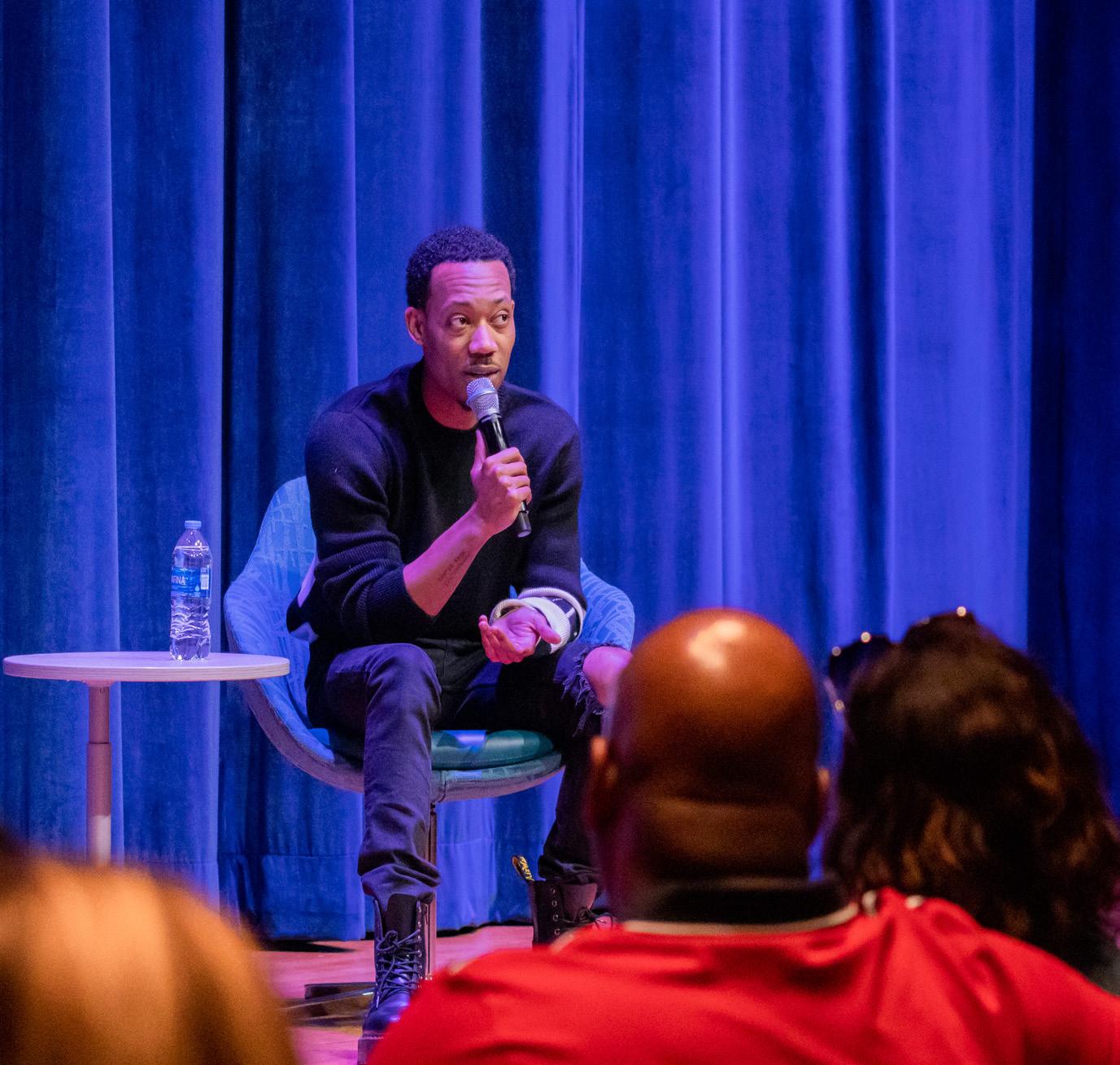
“Just because you’re on a road, it doesn’t mean you have to proceed down that road,” Williams said. “If you don’t like it, get off, adjust and then come back.”
When the floor was opened to audience members to ask questions, one student asked about Williams’s role as Gregory Eddie in “Abbott Elementary” and what he hopes the show will demonstrate to Americans about the U.S. public education system.
“I’ve always said that if this show does anything, hopefully it, one, inspires more people to teach and, two, changes the way the country looks at teachers in the grander sense and also in the smaller sense,” Williams said. “When people approach their teacher, or they drop their kids off to the teacher, you treat them just a little bit nicer because now you understand what they go through on a daily basis.”
In the hour-long event, Williams also revealed that he has a playlist he listens to for each of the characters he plays. He also spoke about how gratifying it is for him to know that audience members can see the characters he plays in themselves. To this point, Williams noted the importance of upholding creative integrity in acting and selecting roles you truly believe in.
“Never follow the money and always remember that the audience needs you to maintain a sense of integrity,” Williams said.
Bridging gaps in medicine
Students of color, first-generation and low-income undergraduates and those from marginalized backgrounds applying to medical school often face uniquely difficult and strenuous challenges due to systemic inequalities in the healthcare and education systems. These barriers can include limited resources and mentorship, financial barriers and implicit biases in the admissions processes.
However, at the College of William and Mary, Minorities in Medicine is making strides in overcoming these structural hurdles and supporting underrepresented students pursuing a medical career. The organization is dedicated to increasing diversity in the field of medicine by providing resources, mentorship and a community for minority pre-medical students. With their commitment to creating a more inclusive and equitable healthcare system, MiM is making a positive impact on the lives of students and the future of healthcare as a whole.
Claire Aminuddin ’24, who will serve as president of the organization next semester, noted that the group came about precisely because the College did not have a group specifically for minority students on the pre-medical track.
“The best things come from finding resources that are lacking,” Aminuddin said. “The Health Careers Club has been here for years, but there wasn’t a targeted group aiming to help minority students in the pre-health field find a community and find support.”

MiM is affiliated with a nationwide network of college organizations providing guidance for medical careers. It is a National Minority Association of Pre-Medical Students, or MAPS, chapter of the Student National Medical Association. SNMA provides additional support for MiM’s regular functions.
“They’ll send us various scholarships and programs that would be of interest to our members, as well as help us with connections with other medical schools,” Aminuddin said in reference to SNMA.
“For example, we just had EVMS [Eastern Virginia Medical School] come and talk to us.”
For MiM, fostering an atmosphere of learning, sharing and uplifting each other remains the top priority of the organization; this atmosphere is the basis for all endeavors they undertake.
MiM launched a mentorship program so that students, especially freshmen, have a reliable support system throughout their academic careers. One of these mentors, Ruth Hailemeskel ’23, found it an invaluable experience.
“I started my junior year, and I really enjoyed it because I was able to connect with students that were starting this journey,” Hailemeskel, an executive board member of MiM, said.
“From my experience, I’ve learned that there are a lot of trials and tribulations that I hope other people don’t have to experience. And so, that’s why being a mentor is important to me, and I want to pass that on.”
As the desired result of the mentorship program, maximizing access to learning tools and resources is a chief goal for MiM. Contrasting the many success stories of College graduates transitioning into top medical schools is the stark reality that many other students with fewer resources struggle to stay on the proper course.
“I think that if you’re just not gaining exposure, and it’s hard to get clinical experience, how are you able to actually envision yourself doing this for the rest of your life — for the rest of your career?”
Hailemeskel said. “If you’re not able to easily access research opportunities, or all these things you need to do in order
to apply for medical school, I think that you just lose interest. So there’s a lot of barriers that are present for minority students on this campus.”
For example, the lack of pre-med advisors has been a major obstacle for afflicted students. Up until very recently, one person — Dr. Beverly Sher — was in charge of meeting all prospective medical students and helping them plan and organize their future after university. Naturally, this placed a strain on Sher and especially posed a problem for graduating students who needed a letter of recommendation. While many other schools have a pre-health advising board that allows a designated team of professionals to distribute the workload of managing pre-health advisees, the College’s small size means that all of this workload was put onto only Sher. Solely having Sher also puts undue pressure on students to establish strong working relationships with her even though they only have limited time to spend with her or have personal differences that would not make them the best fit as Sher’s advisee.
“If you didn’t necessarily click with Dr. Sher or weren’t able to really find rapport with her, what are you supposed to do when it comes to getting your pre-med advisor letter written for med schools if she doesn’t even really know you?” Aminuddin said.
Despite any institutional challenges it may face, MiM remains committed to remedying unequal access. The organization hosts workshops and career panels to help bolster members’ academic preparedness and knowledge. Through these interactions with outside professionals and alumni, current members of MiM have gained new insight into the process. For Corresponding Secretary Kellsey Carter ’23, that has given her a mantra
of “keep going.”
“For students who are underrepresented or minorities in medicine, it is very easy to feel isolated because it’s just the environment you’re in,” Carter said. “And I would definitely say, keep going. Don’t allow yourself to let those pressures deter you from pursuing medicine.”
Outside of standard meetings and aims relating to the field of medicine, members also participate in service projects and community outreach. For April, MiM is raising money for the Avalon Center, a non-profit organization that supports victims of domestic violence and sexual assault. As students who may go on to serve other minority communities, participating in these projects also helps them better match their personal missions with the missions of medical schools.
“I come from Danville, Virginia, a small rural city located near the border of Virginia,” Carter said. “And my experiences with health care and that population definitely instilled a passion in me for wanting to give back to disadvantaged populations.
So, I am definitely more aligned with schools that are serving disadvantaged populations or have a primary focus on trying to give back to those populations.”
Hailemeskel echoed these sentiments when describing the often taxing search process for the right school, as one can only apply to a maximum of fifteen schools.
“For me, it was important what communities are nearby the schools because that’s the population you’re going to be working when you’re doing your clinicals,” Hailemeskel said. “I think that was my main focus because I want to be working with marginalized groups, and I want to be, again, advocating for them in the school.”
Applying to medical school is an arduous and deeply personal endeavor, with not just the process but the steps to get there being rooted in many systemic challenges. By banding together and finding a common goal, Minorities in Medicine is not only a professionoriented networking group, but also an alliance through all ups and downs.
| Wednesday, April 19, 2023 | Page 7
THE FLAT HAT Variety Editor Miles Mortimer Variety Editor Agavni Mehrabi flathat.variety@gmail.com // @theflathat
variety
Minorities in Medicine club works to combat systemic inequaliti es, support members
COURTESY IMAGE CLAIRE AMINUDDIN
RYAN GOODMAN / THE FLAT HAT
LINDA LI // FLAT HAT VARIETY ASSOC.
The Eras Tour
A rundown of the first month of Taylor Swiftʼs latest stadium tour
Throughout time, the students at the College of William and Mary have been endearingly referred to as TWAMPs, but recently, the title of “Swifties” has emerged as a rival descriptor, considering just how many students adore Taylor Swift. Swift’s “The Eras Tour” has been the primary subject of student chatter this semester, with students anxiously awaiting long digital lines to purchase tickets for exorbitant prices and planning to travel all across the country just to see Swift perform.
e tour kicked o on March 18 in Glendale, Arizona, or “Swift City,” and will continue through early August in arenas across the United States. Swift is rightfully ambitious, performing stadium shows that are a testament to her extensive musical career. Performing almost four dozen songs over a three-hour period, Swift takes fans on an immersive journey through time at each venue and has held audiences rapt by her commanding stage presence. ose lucky enough to have gotten tickets are witnessing a historical moment made by a woman who is fully stepping into her power and using it to reach and inspire others.
I have thoroughly enjoyed following the event and tracking its surprises and highlights in order to prepare myself for when I attend her concert in Philadelphia, Pennsylvania, so I wanted to weigh in on the almost indescribable feeling of watching Swift embrace her own art. is is the much-deserved win we all needed, and seeing it come together so beautifully is incredibly exciting.
e Eras Tour” marks Swift’s rst major tour since her “Reputation Stadium Tour” in 2018, encompassing songs from each of her 10 albums while heavily focusing on her four latest releases: “Lover,” “Folklore,” “Evermore” and “Midnights.” Each album varies signi cantly in terms of genre, mood and theme, and each segment of the concert devotes special attention to each era. In many ways, this tour has been a long time coming, and Swift has not failed to deliver, once again defying expectations and proving herself to be a creative visionary. Although it would be quite easy to write a full-length novel on the intricacies of this tour, I will restrain myself and instead narrow in on the highlights that have shaped the tour so far, along with some personal anecdotes.
Swift started the tour o strong, delivering quite the spectacle as she dove head rst under the stage in a owy red dress. She then “swam” across and emerged on the other side in a shimmering jumpsuit before disappearing into a cloud. e
TARA GODDIN // THE FLAT HAT
dive was the perfect notion, symbolic of her enthusiasm and excitement for the tour while also teasing the multitude of surprises that were prepared for us. In line with the theme of surprises, Swift announced she would be performing two surprise acoustic songs at each venue, much to the delight of the 70,000 fans gathered to see her.
I must admit that I have been anxiously awaiting each venue with a list of surprise songs that I want to hear, anticipating that I will have to cross them off each time. Some of my favorites have already been sacrificed, but I’m trying to remain hopeful. She has so far performed a wide variety of tracks across her discography, making it virtually impossible for me to predict what will come next despite searching through the endless theories constructed by devoted fans.
However, I still nd myself hoping for a Swift-unplugged moment because her acoustic pieces are some of my favorites. I nally narrowed my top two choices down to “Getaway Car” and “Sparks Fly,” two songs which undoubtedly shaped a large part of my childhood and teenage years. I can practically smell the Wonderstruck perfume every time I hear the opening chords of “Sparks Fly,” a nostalgic feeling that I gladly welcome. I remember the heartbreak I felt when I learned that the scent would be discontinued, so I saved the bottle and now keep it on my nightstand to preserve the memories of childhood summers.
e tour further serves as a spectacle of sheer athleticism and aestheticism. Swift performs threehour sets consisting of various costume changes and choreography for multiple nights in a row. She handles the event well, running and dancing around the stage until the very end and proving that her mic is, in fact, on. Her costumes and out ts delivered each night, including bejeweled Versace one-pieces, sparkly blazers, owy dresses, ball gowns and snake-encrusted bodysuits. Each out t pays a beautiful homage to each
of her eras, and the e ortless integration of her old looks with her newer ones is something to be admired.
Many of the pieces worn by Swift were handmade by designers, making her even more eye-catching than she already is. e sparkles and jewels were the perfect addition as Swift sauntered across the stage and participated in the “Bejeweled” TikTok dance, reminding us that she herself is an avid TikTok user.
Swift’s intricate outfits, combined with stunning visuals and dance choreographies, make for a transcendent night full of excitement and anticipation. The choreography for “Vigilante Shit” left me speechless; while this song initially did not resonate with me, after seeing the performance, I found myself wishing I had appreciated it sooner.
“Reputation” performances werealsopersonal favorites, as she effortlessly transitions “Don’t Blame Me” into “Look What You Made Me Do” with a gorgeous blend of angst and passion, proving just how expertly her songs adapt to the stadium setting.
Fans have matched her energy with custom out ts and intricate makeup looks. In a way, Swift’s tour has become a fashion runway for many of her fans, who have created creative ensembles based on niche Swift references, such as Swift receiving her honorary degree from NYU in a cap and gown or even the “Fuck the Patriarchy” keychain from “All Too Well.” Even Selena Gomez and her younger sister joined in on the costume contest at the Arlington venue. Selena dressed up in a “Folklore” inspired cardigan while her sister dressed in her best “Speak Now” inspired purple halter dress. Swift was clearly thrilled to have the support of her friends, as she took her “22” hat o in the middle of the performance and gave it to Selena’s sister, prompting feral screams from the audience. In return, Selena’s sister gave Swift a friendship bracelet, completing an adorably equitable exchange that fans loved.
Fans’ willingness to dedicate hours to crafting
complex out ts and shared excitement for surprises during performances exempli es how the tour has brought together thousands of fans from all walks of life. e tour has united fans through the universal experience of nostalgia and wonder that Swift’s music evokes; many people can recall exactly where they were when they rst heard many of her hits, nodding to the power and in uence of her music. In fact, I have vivid memories associated with “Out of the Woods,” a song that shaped many of my summers, largely thanks to an explosive bridge that hit way too close to home. “White Horse” is another personal favorite, mainly because it was one of the only songs I ever downloaded on my iPod (this was in 2009), subjecting my friends to it on a near daily basis and singing painfully okey covers with my neighbor. And there’s “Ivy,” the song that I associate with walks in the woods behind my house and the scent of pine needles.
Swift’s music is disorienting in the best way possible as it grips the listener and lives rent-free in the mind as a welcome earworm. It is quite easy to see why her music attracts such a broad audience, ranging from ecstatic children to awestruck adults. ere is no dispute regarding Swift’s creative vision, and despite her experimentation and ow between genres, she has created a signature sound that is undeniably hers. She has de ned herself as a formidable threat to the conventionality of the music world, and I am left in awe as she continuously pushes the limits and distinguishes herself from her contemporaries. Her music truly has stood the test of time, and this tour is giving her the chance to prove it while also highlighting just how far she has strayed from her acoustic roots.

Indeed, each performance in the “Eras Tour” works in tandem with the next to display her evolution as an artist and ultimately create a masterful work of art. She blends the di erent categories of her repertoire into a gorgeous medley that serves as a notso-subtle nod to her growth over the years, and she demonstrates her incredible musicality and devotion to her craft. e e ort she puts into each individual moment makes the tour that much more special.
“ e Eras Tour” is making history with each passing venue, and Swift clearly has not lost an ounce of her passion. Her vocal abilities and stage presence are unparalleled, and I am incredibly excited to see it all in person. From the young girl that burst onto the music scene in 2006 to the versatile artist she is today, Swift has come a long way, and this tour is the perfect opportunity to celebrate the woman that has so sel essly shared her world with us.
LASU LASSOS LISTENERS
Cultural showcase showers Commonwealth Auditorium with wealth of performances
Sunday, April 2, the College of William and Mary’s Latin American Student Union hosted its LASU Spring Event: a showcase titled “El Chisme Caliente” (“The Hot Gossip”), followed by a banquet named “Con Amor” (“With Love”). The showcase, taking place in the Sadler Center’s Commonwealth Auditorium, presented several student performances ranging from skits to spoken word poetry, and the banquet, located in Sadler’s Tidewater room, presented a range of traditional Latin American dishes accompanied by a slideshow presentation. Both halves of the event were meant to come together to create a unified festive celebration of Latin American culture.

“The purpose of the LASU spring event is to celebrate the diverse and rich Latinx culture, featuring both a showcase and a banquet,” former LASU Vice President Michelle Lopez ’23 said.


Lopez, the primary organizer of the event, opened the showcase speaking in both English and Spanish, as did all of the other presenters. She took to the stage to express LASU’s gratitude for those who helped bring the event to life and explain the rationale behind the themes chosen for the event.
“ e theme was chosen to create an entertaining atmosphere where attendees can witness the chisme [gossip] that has been happening in LASU,” Lopez said. “And the banquet theme, ‘Con Amor,’ was inspired by the theme of love. e theme is based on creating a warm and welcoming atmosphere for the attendees, emphasizing the importance of love and kindness toward one another and, at the end of the day, what’s better than eating a meal and creating meals with those you love?”
Next to enter the stage were the lively and comedic emcees for the night: Mike Martinez ’26 and Tomas Torterola ’26. e pair came out between each act to lighten the mood and entertain with their witty banter, natural chemistry and audience interaction. During their opening remarks, Martinez highlighted a unique aspect of their annual showcase: each and every act in “El Chisme Caliente” exclusively featured LASU members, a deviation from the organization’s tradition of hosting showcases only consisting of guest performances by other student organizations. “ is is actually the very rst time in a long time that LASU has been able to host a showcase all independently,” Martinez said. “We’ve got our own people out here performing, but these people have been practicing for months — Michelle’s been behind the scenes since August. So, we’re just super excited that we have a crowd this size coming out to watch us tonight.”
Martinez and Torterola then introduced the electric
VIVIAN HOANG // FLAT HAT EXECUTIVE EDITOR
rst act of the night, “A Celebration of Latin Style.”
Small groups of LASU members paraded onto the stage in traditional out ts from the di erent and distinctive Latin American countries they represented, with some also performing short dances native to their designated region. After each group enjoyed their moment in the spotlight, everyone re-entered the stage carrying the ag of the country they represented, pausing at the center of the stage to proudly scream out the name of their country. Shouts of “Bolivia!” and “El Salvador!” echoed across the auditorium to thunderous applause and cheering. As attendees rejoiced, the smiling performers walked through the
ough Mohammed expressed how nervous he felt leading up to his performance, especially after his voice started becoming hoarse and throaty after loudly cheering for Mexico during the opening act, only his con dence shone through as he delivered his two-pronged emotional exploration of his identity as a Mexican American.
“Home is the phone call / where her resonance / whistles through the rustle of corn,” Mohammed said about his grandmother in “Abuela’s Song.”
While Mohammed’s spoken word performance brought with it a distinct mood shift, Martinez and Torterola returned to the stage to keep the
them.“Brayan told me that Chris took my biddie!” one of the group members said after being asked why he jumped Christian. “Me, personally? I wouldn’t let that slide.”
However, the twist at the end revealed that Brayan wrongly defamed Christian’s character and misled his friends into believing a series of lies about him, illustrating the dangers of acting upon unveri ed rumors.
“So, yeah, basically, I lied about everything,” Brayan said as attendees gasped and laughed along with the confession. “Everything.” e audience’s delight with the show continued into the next act, which stood out from the rest with its surprise element of audience participation. e act began with a voiced-over portion that asked audience members to imagine themselves in a tropical beach dream sequence, the voice-over reminiscent of Luis’ fast-paced, hilarious monologues in the 2015 movie “Ant-Man.” However, audience members were soon not only imagining, but also doing; after they watched two beachgoers partake in a simple three-step salsa dance lesson as part of the fantasy sequence, the act suddenly shifted, as everyone on stage began shouting for the audience to get up and try the dance out for themselves. is short salsa dance preluded the nal act for the night, “Ritmo Vivo and Latin Dance Party Mix,” in which dozens of LASU members ooded the stage to dance in a variety of styles: reggaeton, merengue, salsa and bachata.
Remixes of more modern songs like “Gasolina” by Daddy Yankee and “Después de La Playa” by Bad Bunny excited audience members, who sang and screamed along with the lyrics as LASU members danced on stage. No other descriptor would be more appropriate to say than that the showcase truly ended on a high note.
crowd, waving and high- ving spectators sitting in aisle seats before exiting through the back of the auditorium.
This enthusiasm and energy from the audience remained impressively high throughout the entirety of the forty-five-minute event, which performer Aamir Mohammed ’23 credited as one of the main reasons he was able to get through his nerves and share two of his poems, “On Footprints of Self-Love” and “Abuela’s Song,” as the third act of the show.
“ e audience was so energetic, and it just kind of made me so excited to just perform and get on,” Mohammed said. “And then when I got to performing, at that point I just like, ‘Okay, it’s just the words on the page, and all I have to do is read them.’”

showcase lighthearted. At one point, Torterola even comedically asked the audience what its interpretations of the show’s theme were, o ering the microphone to those sitting nearby.
“I can’t really answer, but you look very caliente [hot] today,” a member of LASU jokingly irted in response, calling back to the name of the showcase and sparking a boisterous uproar from the audience.
is staged bit set the humorous tone for the next act, a short, pre- lmed skit titled, “ e Truth Behind the Lie.”

e skit began with one of the main characters, Christian, getting beaten up by a group of his so-called ‘friends’ who heard from the other main character, Brayan, that Christian was doing a myriad of terrible things to

At the conclusion of the showcase, the attendees moved upstairs to Tidewater to feast on a cultural banquet of dishes, such as Spanish rice, tamales, churros, black beans and sweet fried plantains. During the dinner, a slideshow presentation introduced LASU’s new executive board for the upcoming 202324 academic year, o ering a more intimate look at the organization and its members after the showcase’s more general presentation of Latin American culture.
Together, “El Chisme Caliente” and “Con Amor” provided LASU members a platform to express and share their cultural pride with the College community through performance, laughter and cuisine.
“ e opportunity to contribute to so much cultural unity was just such an amazing, rewarding feeling,” Mohammed said. “... It was such an inclusive event, I was just so impressed by the work that was put in and that made me want to contribute.”
THE FLAT HAT Wednesday, April 19, 2023 Page 8
SAMUEL LI / THE FLAT HAT
GRAPHIC BY YELENA FLEMING THE FLAT HAT
SHARPS AND FLATS
OUTDOOR TRACK AND FIELD
Womenʼs Track and Field 4x100m quartet notches sub-46 second finish Meet of Champions sparks individual brilliance from Tribe
Saturday, April 15, William and Mary track and field competed at High Point University’s Meet of Champions in High Point, North Carolina. The men’s team finished in last place, while the women’s team finished fifth of seven teams.

The Tribe returned to North Carolina for the second straight week following its participation at the Duke Invitational in Durham, North Carolina.
On the men’s side, junior sprinter Jackson Cooley headlined William and Mary’s performance in the sprint events, setting school and meet records in both the 100m and 200m events.
Cooley recorded a time of 10.49 seconds in the 100m, breaking his own mark from the Colonial Relays earlier this season. He then posted a 21.12 second performance in the 200m event, breaking the record set in 1985.
In the 400m event, senior middle-distance runner Stephen Larson notched a personal record of his own, finishing with a 50.38 second result to place 11th in the race. In the 800m event, freshman distance runner Jonathan Kumer placed sixth with a personal record of 1:52.50, with fellow freshman distance runner Matthias Oettl also notching a personal record of 1:54.91. In the 1500m event, senior distance runner Evan Goodell ran a seasonbest 3:50.92 to claim a team-best sixth place.
William and Mary’s men’s performance at Meet of Champions was full of personal records and season-bests, but the Tribe struggled overall as a team. George Mason finished the meet in first, followed by Charlotte and High Point taking second and third, respectively.
In the women’s events, the Tribe bested multiple schools and set personal and seasonal records. The 4x100m relay squad of senior sprinter Amaya Johnson, junior sprinter Lizzy Gregory and sophomore sprinters Anna Kessler and Melissa Cunningham continued their successful season in the event, breaking their own program record. Their 45.97 second performance was the first-ever sub-46 second finish, surpassing their 46.18 time previously set earlier at the Colonial Relays this year.
Sophomore sprinter Emily Ervin continued William and Mary’s record-breaking day, topping her own 200m dash record with a 23.91 second performance. She now owns all top three 200m times in William and Mary history. Ervin continued her dominant day in the 400m event, posting a time of 54.36 seconds – the fastest time by a Tribe athlete in the event. She now owns four of the top five performances in the 400m event in school history.
Following her incredible performance in the 4x100m relays, Kessler recorded a personal record in the 100m event with a 12.03 second finish, enough for ninth overall. This performance also put Kessler into the top three 100m times in William and Mary history. Cunningham shined in the event as well, finishing top 15 with a 12.12 performance.
In the 200m event, Johnson notched a top 10 all-time finish with a 24.40 second performance. Kessler added to her stellar day with another personal record of 24.89 seconds, while Cunningham finished at 24.94 seconds. Both of these times rank among William and Mary’s top all-time performers.
As a team, William and Mary finished fifth in the overall women’s rankings. Elon placed first, while High Point took second and Charlotte third.
William and Mary will continue its season at the Wake Forest Invitational on Friday, April 21 in Winston-Salem, North Carolina.
Weekend of walk-o s: Tribe wins exhilarating series over Elon
Baseball improves conference record with stalwart pitching performances
Friday, April 14 - Sunday, April 16, William and Mary baseball (24-13, 9-6 CAA) hosted Elon (2312, 12-5 CAA) for a conference weekend series at Plumeri Park in Williamsburg, Virginia.
The Tribe looked to improve from its fourth place spot in the CAA standings with three solid performances against the Phoenix.
After the fifth inning, both teams’ bats went silent. From the sixth inning through the bottom half of the ninth, the Tribe and the Phoenix combined for zero hits and seven strikeouts.
However, with the game on the line in the ninth, William and Mary found a much needed spark in the batter’s box. With two outs, Danos singled through the second base hole. Carmichael then doubled, driving Danos in and tying the game 5-5.
With this newfound momentum, graduate
shutout fashion. Although the team combined for six hits and three walks, the Tribe’s offense could not score any runs off of Elon sophomore pitcher Shea Sprague. He struck out a season-high nine batters against the Tribe, continuing his strong season for the Phoenix and improving to a 5-2 record while carrying an impressive 2.45 ERA.
The Phoenix scored often and in bunches, capped off by a three-run home run in the fifth by sophomore outfielder Adam Berry and a threerun double in the ninth by redshirt junior catcher Parker Haskin.
Now with the series tied 1-1, Sunday’s game became even more crucial for the Tribe in order to secure another series win against a CAA opponent. Game three started slowly for both offenses, largely because of stellar pitching performances from both teams’ starters. Sophomore pitcher Nate Knowles dominated on the mound for the Tribe, striking out eight of the nine hitters he retired over three scoreless innings of work. Freshman Ryan Sprock got the ball for the Phoenix and went 6.1 innings while allowing just two Tribe runs.
In the bottom half of the fourth inning, Goranson drilled a home run over the left center wall, breaking the scoreless tie and giving William and Mary a 1-0 lead.
In the top half of the next inning, redshirt junior infielder Tanner Holliman hit a home run of his own, bringing Elon even with the Tribe at 1-1.
ninth, still trailing 3-2.
Winters started the offensive half of the ninth for the Tribe with a flyout, which Goranson followed with a lineout to third. With two outs, William and Mary dug deep to rally with only its final out remaining.
On Friday night, William and Mary won after a late ninth inning rally that extended the game into extra innings.


The Tribe jumped out to an early lead against Elon freshman pitcher Justin Mitrovich, scoring one run in the first after an RBI single from senior catcher Max Winters.
The Phoenix eventually pulled ahead in the third, scratching across three unearned runs after a quick error and a series of timely hits.
Freshman pitcher Owen Pierce was solid for the Tribe in his 12th appearance of the year, throwing three innings while letting up zero earned runs and striking out four batters. Though he did not receive credit for the win, Pierce still carries a 4-2 record this season with a 4.54 ERA.
After falling behind 3-1, the Tribe bats came alive in the top of the third. Senior third baseman Ben Williamson tied the game with a two-run home run over the right-centerfield wall, driving in sophomore outfielder Lucas Carmichael to tie the game at 3-3. Carmichael, who had walked to start the inning, finished the day going 1-3 while scoring twice for the Tribe.
Going into the bottom half of the fourth, the William and Mary bats stayed active. Freshman outfielder Tank Yaghoubi started off the inning with a single, and eventually advanced to second after freshman first baseman Jerry Barnes III was hit by a pitch. With two outs, sophomore shortstop Luca Danos singled, driving in Yaghoubi and giving the Tribe a 4-3 lead.
In the top half of the fifth, the Phoenix retaliated. After a leadoff triple from freshman infielder Ryan Sprock and timely singles by fifth-year catcher Luke Stephenson and junior first baseman Cole Reynolds, Elon recaptured the lead at 5-4.
student pitcher Rojo Prarie shut down the Phoenix in the top half of the tenth. Prairie, who earned the win on Friday, threw four innings of no-hit baseball in relief and struck out five Elon batters while allowing just one walk.
The Tribe’s pitching staff as a whole has shut down numerous opponents’ offenses this season, ranking 16th in the country in team ERA in NCAA Division I. When asked about what elevated the team to this level, sophomore pitcher Carter Lovasz cited the group’s resilient mindset.
“I believe we have a very special pitching staff this year and… one of the aspects that makes it so special is the ability to go out on the mound and just compete,” Lovasz said. “The chips aren’t always going to fall your way but no matter what we go out there and we compete and we make it tough for opponents to get runs.”
Lovasz also emphasized the importance of pitchers trusting their teammates.
“Our pitchers don’t normally go more than three to four innings a game,” Lovasz said. “And, we all have the trust and confidence that when my three innings are done, that the next guy is gonna go out and compete at the same level.”
In the bottom half of the 10th, the Phoenix became their own worst enemy. After Winters reached on an error to start the inning, Yaghoubi grounded out into a fielder’s choice and took Winter’s spot at first. With two outs, junior catcher Nate Goranson put the ball in play, and with some Tribe luck, Elon’s third baseman made an untimely error that allowed Yaghoubi to come around and score the game-winning run.
Despite going up 1–0 in the series, William and Mary was unable to translate its success in game one to Saturday’s matchup, losing the game 8-0 in

Strong pitching continued to control the game until the top half of the seventh, where Stephenson hit his sixth home run of the year and gave the Phoenix a 3-1 lead going into the final three innings of the series.
Determined to fight back like they did in game one, the Tribe’s offense retaliated in the bottom half of the seventh with a run of their own. After Goranson began the inning with a walk, Yaghoubi singled into right for his second of three hits in the game. Both runners advanced after a sacrifice bunt from graduate student infielder Cole Ragone, putting William and Mary runners on second and third with one out. Freshman infielder Corey Adams then hit a deep fly ball to center field, allowing Goranson to come home and cut the lead to one going into the eighth.
Yaghoubi kept the line moving, singling into right field for his third hit of the game and fifth of the series. The energy at Plumeri Park picked up as the fans in Williamsburg hoped to see a repeat of Friday’s walkoff ending. In the very next at-bat, Ragone doubled into the right-center gap, advancing Yaghoubi to third and bringing the tying run 90 feet closer to home plate.
The suspense at Plumeri was at an all-time high as Adams stepped up to the plate. Adams, who was hitless in five at-bats against the Phoenix on Friday, was one swing away from being the hero of Sunday’s game and securing a series win for the Tribe.
On the 1-1 pitch, Adams ripped a single into right field, scoring Yaghoubi and Ragone for the Tribe’s second walk-off win of the weekend.
In two games this series, the Tribe walked away winners after being down going into the ninth.
“Both Friday and Sunday we were down to our last strike of the game and managed to pull through and get the win,” Lovasz said. “Our team is never out of the fight.”
Lovasz explained how the team works on staying focused through the end of every game.
“That is something we have put a lot of focus and emphasis on is just competing every pitch of the game for the guys next to you,” Lovasz said. “And when we do that, we see great results.”
The Tribe will look to keep its surging month going as they approach the back half of the season in the coming weeks.
“I think our mindset is about staying committed to our approach as a team and making every game count,” Lovasz said. “At this point in the year, every single game matters for conference standings. There is no day where we can just ‘lay off the gas’. We have to be ready and willing to go out every game and compete for our spot in the conference tournament.”
| Wednesday, April 19, 2023 | Page 9 THE FLAT HAT
sports
After two strong innings from Lovasz, the Tribe had just three outs to play in the bottom half of the
The
Tribe will travel to Durham, North Carolina to play Duke (23-12, 9-8 ACC) on Tuesday, April 18 at Jack Coombs Field. BASEBALL
MAX GRILL FLAT HAT SPORTS EDITOR
COURTESY PHOTO / TRIBE ATHLETICS
Freshman infielder Corey Adams hit a single into right field to score two, winning the series for the Tribe in walk-off fashion.
COURTESY PHOTO / TRIBE ATHLETICS
Sophomore Carter Lovasz cites the stellar pitching staff for the Tribeʼs continued success the past several weeks.
COURTESY PHOTO / TRIBE ATHLETICS
William and Mary baseball edged out Elon in Friday night thriller to win game one of a three-game series. Freshman outfielder Tank Yaghoubi scored the decisive winning run in the bottom of the 10th inning on Friday, April 14 at Plumeri Park.
ETHAN QIN FLAT HAT SPORTS EDITOR
COURTESY PHOTO / TRIBE ATHLETICS
The 4x100m relay squad of senior Amaya Johnson, junior Lizzy Gregory and sophomores Anna Kessler and Melissa Cunningham broke their own Tribe record.
sports
Beckwith, Osborne, Locke will represent College at conference at USC in May Three students to attend Black Sudent Athlete Summit
SYDNEY WITWER FLAT HAT SPORTS WRITER
May 21-24, Southern California will host the Black Student Athlete Summit, an event that combines professionals in the athletics industry with Black student-athletes from around the world.

and continue to lead the charge in creating spaces and initiatives to support the work of our Black student athletes on and off the field of competition.”
In past years, students traveled to this summit to connect with industry leaders, learn about career opportunities and how their participation in athletics can benefit them in the future and discuss disparities with like-minded individuals. Through the guidance of industry leaders, Black student-athletes gain skills that will help them impact the social environment of their college campuses.
While the students will learn valuable skills, the summit leaders also hope to learn from the student-athlete attendees. The professionals hope to learn how to maximize their impact in respective athletic communities, as well as learn about the most pressing issues for Black student-athletes throughout the country.
William and Mary has the privilege of sending three student-athletes to attend the summit. The school will send juniors Kayla Beckwith and Quinn Osborne and freshman Jaylin Locke.
Beckwith is a center on the William and Mary women’s basketball team. She has


played in every game since her sophomore year, when she finished with a .579 shooting percentage and second on the team in blocked shots. Her junior year, Beckwith had 66 points on the season, and was named to the College Sports Communicators 2022-23 Academic All-District Women’s Basketball Team, along with two of her teammates.
other Black student-athletes and to see their viewpoints on what activism is,” Locke said. “And, how they choose to spread activism in their communities, as well as being able to learn from these student-athletes.”
Osborne is a linebacker for William and Mary’s football team. Osborne saw action in all 13 games of his sophomore season and finished the year with 43 tackles and two pass breakouts. According to Osborne, he chose to attend William and Mary out of his eight D-I scholarships because of the school’s academic prestige.
“I decided to apply for the Black Student Athlete Summit because it’s a great opportunity to network with my peers from different colleges and universities around the country,” Osborne said. “I can learn meaningful tools to boost my career athletically and professionally in the right direction.”
Osborne is also excited to apply the information he learns to the teams and organizations he is a member of to further spread awareness across the campus.
These three student-athletes will use this opportunity to improve their own knowledge, as well as benefit the William and Mary campus as a whole by promoting inclusivity, diversity and representation.
The four day summit consists of numerous experiences and activities. Athletes will attend multiple talks and career combines and have opportunities to share their opinions and voices.
Leonard N. Moore, founder and executive director of the event, discussed why USC was the optimal location to host the summit.
“Since arriving at USC in 2019, Athletics Director Mike Bohn has made a significant investment and commitment to empowering Black student-athletes,” Moore said. “We can’t think of a better institution to partner with for our 2023 summit.”
Bohn emphasized the honor of hosting such an important conference, reflecting on how much his program can learn and gain after the event.
“We are grateful for the continued efforts provided by the United Black Student-Athlete Association,” Bohn said. “Their efforts ignite
WOMENʼS LACROSSE
Beckwith is interested in applying her experiences from the summit to her endeavors back on campus.
“I want to make connections with other Black student-athletes around the country and learn from all the different speakers and workshops,” Beckwith said. “I also hope to help William and Mary with continual innovation and enhancement of the student-athlete experience that will enable us to not only play at a higher level, but recover, learn and ultimately enable us to be our best selves on the court, field and in the classroom.”
Locke is a member of the women’s lacrosse team at William and Mary. She started her rookie season and plays a critical role in the Tribe’s defensive unit.
“I’m looking forward to connecting with
Overpowered Green and Gold defense lets up 20 goals in CAA matchup Tribe outmatched on the road, falls to No. 7 Stony Brook

Saturday April 15, William and Mary (7-7, 2-3 CAA) lost against Stony Brook (10-3, 5-0 CAA) 20-6 at Kenneth P. LaValle Stadium in Stony Brook, New York.

Stony Brook got on the board first with an early goal from senior attacker Morgan Mitchell. William and Mary responded quickly with a goal of its own from sophomore attacker Sam Van Gieson, with the assist coming from senior midfielder Sarah Cipolla. With nine minutes and 19 seconds remaining in the first quarter, freshman attacker
Sydney Witwer scored her 14th
goal of the season to give the Tribe a 2-1 lead. That would be the Tribe’s first and only lead of the afternoon, as Stony Brook scored three more times before the first quarter came to an end. Stony Brook dominated the second period, scoring nine straight goals before William and Mary’s sophomore midfielder Miranda Bate snuck one past the goalie to bring the score to 13-3. With 21 seconds remaining in the half, Stony Brook’s senior midfielder Charlotte Verhulst scored her third goal of the game, expanding the lead to 11 as the teams went into halftime.
Junior midfielder Ellie Masera scored first in the second half,
extending Stony Brook’s lead to 12 before Witwer scored again for the Tribe, her second of the day. However, the Tribe was unable to gain any momentum as the dominant offense from Stony Brook continued, with junior midfielder Jaden Hampel and Verhulst scoring two more goals. Cipolla scored for William and Mary with just eight seconds remaining in the third period, closing the quarter with a score of 17-5.
Both defenses were solid in the final quarter, but Masera was able to score her fourth goal of the game for Stony Brook. Freshman midfielder Maresa Moyer then scored an unassisted goal for the
Tribe with 10:28 left in the game.
Graduate student attacker Kelsi LoNigro scored two back-toback goals to seal Stony Brook’s emphatic victory, 20-6.
Stony Brook outshot William and Mary 38-10 and allowed just 10 turnovers, whereas the Tribe gave up 20. Stony Brook recovered 16 ground balls, with William and Mary recovering only nine. Stony Brook was more dominant in draw controls, controlling 18 to the Tribe’s 10.
William and Mary hopes to improve their 2-3 conference record as they take on Monmouth on April 22nd at 11 a.m. at Kessler Stadium in West Long Branch, New Jersey.

ATHLETE FEATURE
| Wednesday, April 19, 2023 | Page 10 THE FLAT HAT
COURTESY PHOTO / TRIBE ATHLETICS As a freshman, Jaylin Locke looks forward to applying what she learns at USC to make postitive changes at the College. RYAN GOODMAN / THE FLAT HAT Junior Kayla Beckwith hopes to connect with other athletes and aims to bring back what she learns to Williamsburg.
LACI MILLER FLAT HAT SPORTS WRITER COURTESY IMAGE / TRIBE ATHLETICS
a
the f ield
12.
Freshman midfielder Maresa Moyer cuts and makes
move up
during the Tribeʼs 10-9 win against George Washington on April
COURTESY PHOTO / TRIBE ATHLETICS
Junior linebacker Quinn Osborne shines on and off the field and looks to improve his leadership skills at the conference.
COURTESY PHOTO / BSASUMMIT.ORG
The Black Student Athlete Summit, which will be hosted at USC in May, includes workshops and speakers aimed to help athletes expand their leadership roles off the field.
DATA SPOTLIGHT
Lacrosse: Who’s doing the scoring?
ABHAYPRAD JHA / THE FLAT HAT
Van Gieson leads team with 22 points, followed closely by Cipolla with 21
