The sun has yet to peek over the eastern horizon and cast its rays upon all and sundry. Before it went west last night it gifted some of its heat to this montane landscape - it’s warmth still radiates from exposed boulders and rock outcrops. There is no dew nor cooling downdraft.
A red stag sings his song down in the Never Never. It is mournful, more lament than love song. As yet, the hinds are not receptive. His romantic overtures are shunned. His seed is unsown. It’s hot and his wallow is dry.
High on the boundary a billy goat is having more luck. His guttural cries progress from howdy-do to full rapture. He doesn’t know it yet, but, if I can find him, this will be his last pajama party.
The light is poor. The distance is far and the cover heavy. I cannot see the billy, nor his concubine, but now they’ve given me a shout-out I know they’re ‘out there’. A fleeting thought flashes through the grey murk in my skull – ‘should I go back to my ute and grab my day bag and more ammo?’.
Yeah, nah – there’s four bullets in my magazine, five in a clip in my pocket and another five in my camera bag. ‘Surely’, I muse to myself, ‘there can’t be that many goats. Billy goats being billy goats, the party for two would have been a rootin’ tootin good time with a lot more song and dance if there were others in the vicinity’.
The far distance I mentioned, it is of the ‘up’ variety. Rocky mountain high.
But there are goats out there and this is a conservation area – gotta gettum.
Boulders and rocky outcrops – warm. Ambient temperaturewarm. Rising sun - warm. All too soon – height accruing me – hot! I have lived a full life. Laugh lines and frown lines criss-cross my
Blood, Sweat and Tears
Kim Swan
face like a series of hashtags. Age lines so deep they’re canyons, each channelling the sweat that gravitates downward from my scalp. Trickles of moisture slide down my jawline, detour around my double chin, then soak into my clothing. Trust me, it’s so hot that my shadow is sweating and it's doing nothing but follow me.
Matagouri spines prick and puncture. Lawyer vines tear skin. Spots and trails of bright blood merge with the sheen of sweat on my arms. I look like a one-manwarzone, and I still haven’t located the goat’s hideout. Not yet.
A kid cries for Mama. Just a couple of quiet bleats but enough. Enough that my roving eye, bloodshot with dehydration, spies a distant target. And another. And another.
Amidst the matagouri thickets, shingle screes and rock outcrops
I see at least half a dozen black goats. And better still, if I remain stealthy and cunning, I can close
The Fishing Paper & Hunting News
Sub-Editor:
Printer: Inkwise
Advertising
021 242 4202
the gap between us to within easy shooting range.
I drop out of sight, shu e into a gutter, pick a big rock as a landmark and go for gold. In the zone, I no longer feel the heat, nor the dried sweat crusted white upon my skin. I smell the reek of billy goat and see their marks in the dust. I hear their quiet conversations and a rolling stone or snapping tauhinau branch, but I do not pause nor reconsider my options.
To the boulder then. Unseen. Rifle pre-readied. The clip of bullets from my pocket freed and ready to feed into my magazine. Camera bag o my shoulder and perched in a safe place. I ease myself forward and drape myself over the rock, it is perfect and provides both elevated rifle rest and hiding place.
Unbidden thought bubbles begin to make their way up through the grey murk in my skull. Bubbles with ‘doh’ and ‘damn’ and ‘holy macaroni Batman’.
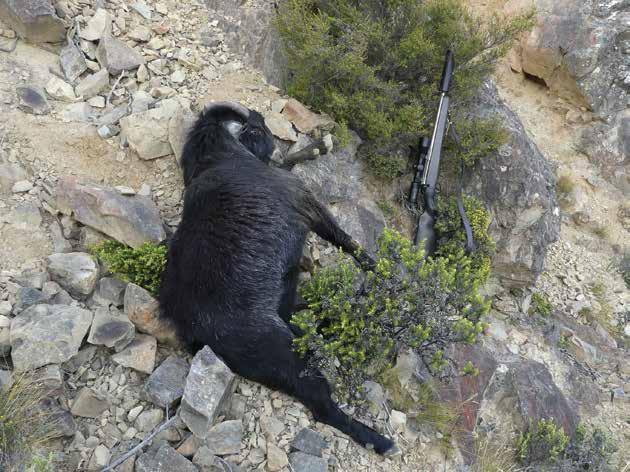
Why? Well, there are a lot of goats. Feeding. Fighting. Sleeping. Sunbathing. All watched over by observant sentries. Not one of them is aware of me but, by golly, I am aware of them. All of them.
‘Should have taken the second clip out and readied it’ – another uninvited brain belch reckons.
I’d still be short of ammo anyways. Dammit, I should have bought my day bag, a drink, more ammo. But I’d wanted to travel fast and lightor perhaps I was just lazy.
Too late now - a sentry has his yellow eyes locked on me. He is curious, not alarmed. Not yet.
I quickly decide on a plan, which, if it works, will enable me to kill as many goats as I can. A: shoot a couple of top goats. B: shoot a couple of far side goats. C: confuse the mob and give myself time to refill my mag. Ready, set, go. The plan works. The rifle barrel is sizzling hot as I lay it down to invert the camera bag and frantically locate the second clip. Precious moments slip by and the bulk of the mob flee. But all is not lost, my carefully chosen rock proves its worth as fresh targets emerge in ones and twos.
I’m no mathematician but when the mob unexpectedly wheel about and trot directly back towards me, I know the numbers don’t stack up. It’s an absolute gift being handed to me but there’s nothing I can do – without bullets my little gun won’t go bang any longer!
Here they come - billies first, no chivalry nor family responsibility, they don’t look back - each trittrots right past me all horns and horny and pissy-bearded stench. In their wake the mothers and children, udders and potbellies all asway as they utter little bleats of reassurance.
‘Well, wouldn’t that make you cry’ one final thought bubble, lingering longtime before it finally crests the ridge along with the tail end of the departing mob.
The walk of shame then. The long mountain descent. Hot. Thirsty. Dehydrated. A dozen goats removed from the conservation area but a hundred what-ifs circling relentlessly in the grey murk.
Good Company, Great Yarns and New PBs
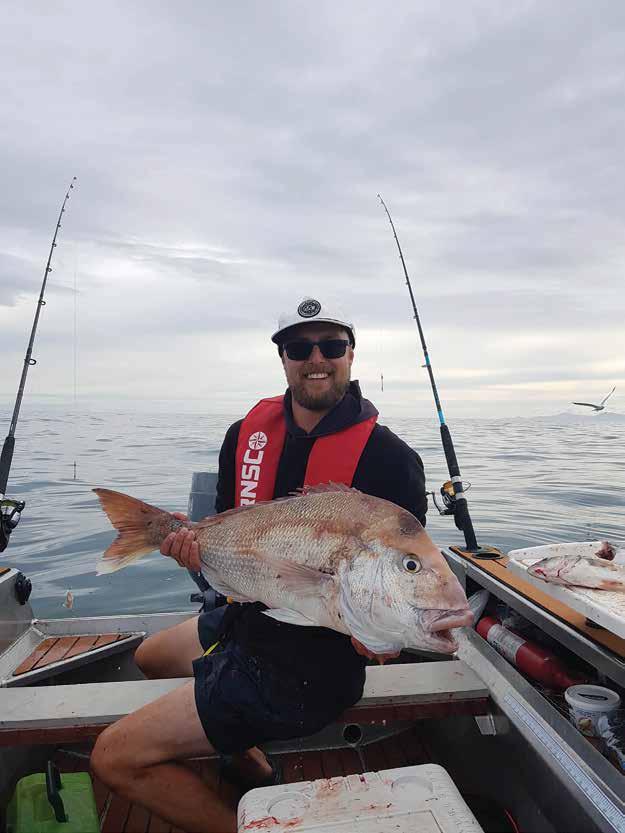
We launched just after first light at Cable Bay, the sky still holding onto that soft grey-blue that comes before the sun properly wakes up. The sea was calm, barely a ripple, and Loachy’s new Frewza sat beautifully in the water—solid, tidy, and ready for a proper christening. You could tell he was proud of it, and fair enough too. Nothing quite like a new boat and a full day ahead
The plan was simple: get out early, find some sign, and put a few decent snapper on ice. But as it goes sometimes, the fish didn’t exactly get the memo. The first couple of hours were slow. Lines down, baits fresh, but not much
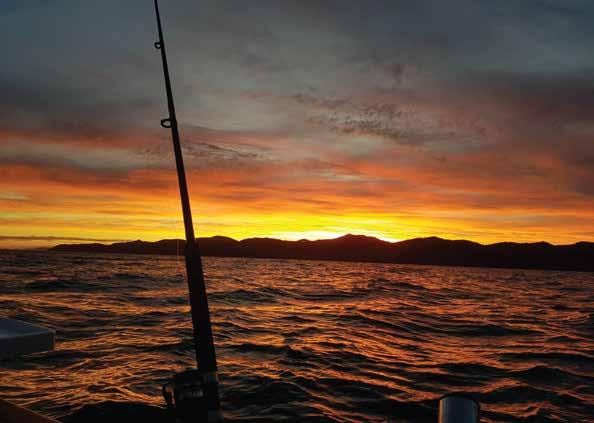
happening apart from the odd nibble. Still, no complaints—good company, good yarns, and a sunrise that lit the hills up behind us in gold and orange.
Then it happened.
Loachy’s rod gave that proper, solid bend—no mistaking it. He grabbed it quick, and you could tell straight away this wasn’t just
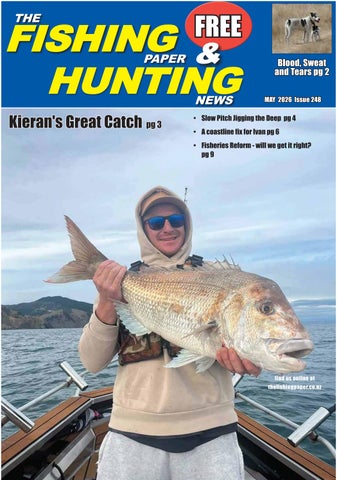
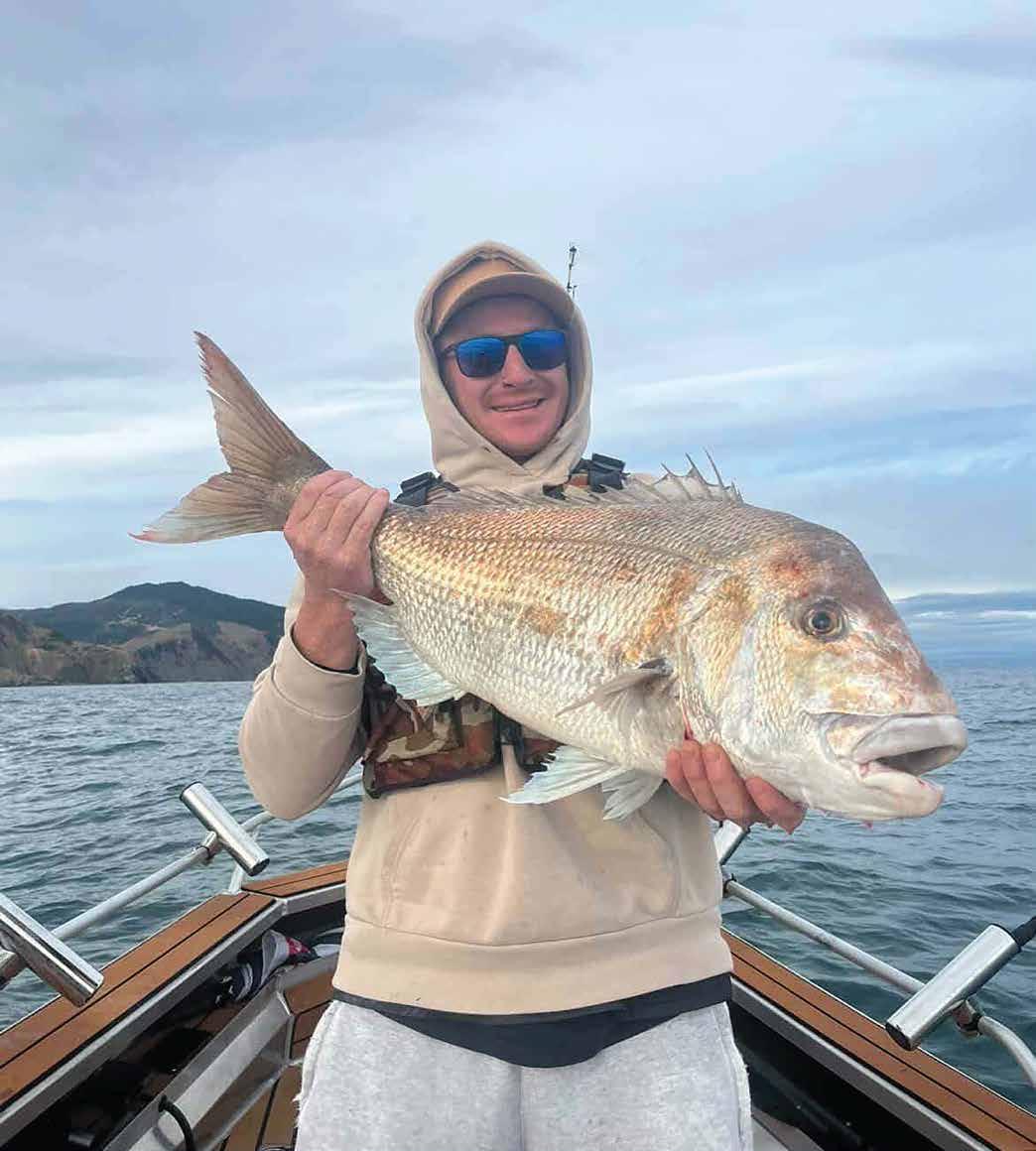
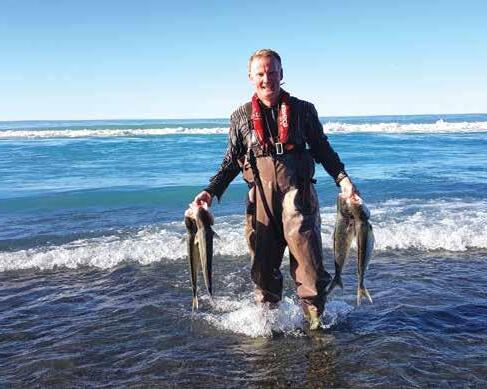
another small fish. A few tense moments later, up came a solid snapper, thick across the shoulders and shining in the morning light. We measured it—74cm. His personal best. Absolute stoke. The grin on his face said it all. That fish alone made the trip worth it. We barely had time to reset before things kicked o again—this time it was my turn. Technically, it was Loachy’s rod (since I’d already managed to break mine… classic), but I wasn’t complaining. The rod loaded up hard, line peeling just enough to get the heart going. I leaned into it, feeling that weight thumping back through the line. It was a proper scrap.
When it finally came into view, we both knew—it was bigger. We got it on board and measured it out: 77cm. My new personal best. Unreal. That moment, standing there holding that fish, is one you don’t forget in a hurry. Just pure buzz.
After that double hit, things went quiet again. The ocean settled back into one of those slow, patient rhythms. We still managed to pick away at a few more fish—a decent snapper, a nice gurnard, and even a solid rig to round things out. Not a bad haul by any means, especially considering how the morning started.
By late morning, we decided to head back in, timing it nicely to get ashore before the high tide made things tricky. The Frewza handled it all like a champ—easy ride, no stress.
Back home, as I was prepping the big snapper—gutted and ready for filleting and smoking—I had a bit of a laugh to myself. I picked up my daughter, who’s 21 pounds, just to get a rough feel for weight. No scales, unfortunately, but I can tell you this—the snapper was definitely heavier. Still, without proof, it’s just one of those stories.
• And maybe that’s part of it.
• A perfect morning, a couple of PBs, good mates, and a new boat that proved itself straight away. Not every detail needs to be o cial. Until next time—tight lines.
Kieran Mason
Slow Pitch Jigging the Deep!
There are days when everything lines up weather, current, timing and then there are days when you earn it.
This one sat somewhere right in the middle… but the result?
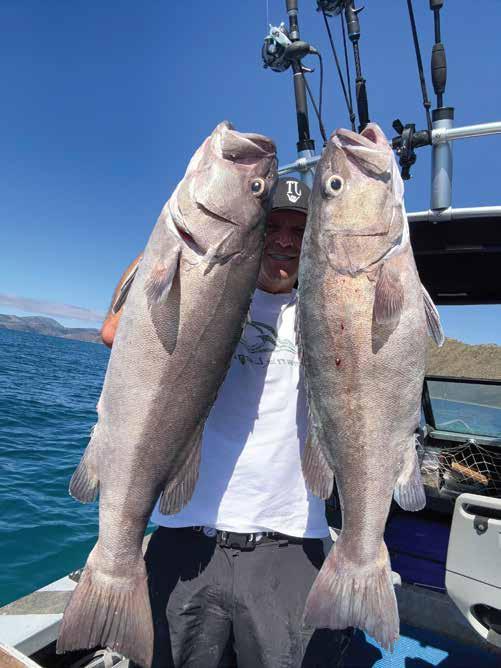
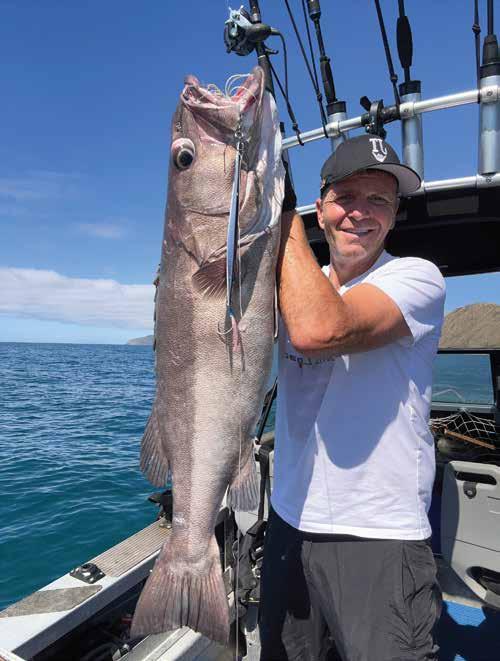
Two proper hapuka and a solid gemfish pulled from the deep o Mana Island’s west coast.
Working the deeper pins and subtle rises, the mission was simple: find structure, stay vertical, and let the jig do the talking.
The technique is where it all comes together.
Slow pitch jigging isn’t about ripping gear like a madman. Its controlled, deliberate, and almost hypnotic when you get it right.
Long, slow lifts of the rod followed by six short, sharp tweaks… lift again, then let it drop.
Repeat over and over until something inhales it.
And when they hit you know about it!
The key on the day was boat control.
Keeping that line straight up and down is non-negotiable.
With a bit of current pushing through, the motor spent plenty of time in reverse just to stay on top of the zone. Anyone who’s done this properly knows if your line angles out, you’re wasting time.
Down deep, visibility drops o fast, so getting the jig noticed matters.
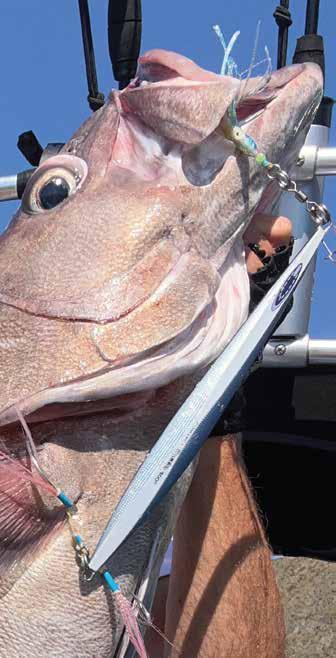
The weapon of choice was a 400g Oceans Legacy Deep Contact jig, properly charged in the sun before each drop to maximise that luminous glow.
Matched with PE3 braid, the setup had enough finesse to work the jig properly, but still enough grunt to turn big fish when it mattered. And it mattered!
The first hapuka came up slow and heavy. That classic dead weight that suddenly starts nodding and running. Not a sprint, just pure stubborn power!
The second wasn’t far behind, confirming the spot was holding quality fish.
Then to round it out, a big gemfish! Aggressive, toothy, and always a welcome bonus from the depths.
It’s a style of fishing that rewards patience and precision over chaos. No shortcuts, no luck, just method, consistency, and time on the water.
And when it all clicks… this is what you get!
Tight lines.
Johnny Tightlines
Marlborough Bow
Hunters Ben Dick
Suppressor range 222 through to 30-06 41mm diameter 9” Hybrid “Cleanable” Spartan
• The first is suitable for 22 Hornet through to 243 including, 222, 223, 22-250, 243.
• The second suppressor is suitable for 6.5 through to 30-06 including 6.5 prc, 270, 7mm-08, 284, 280, 308, 7.62 x 39 etc (not including 300 PRC or belted magnums).
• 9” in length (230mm), sits 4” forward & 5” back over the barrel (this is a “fixed” length and cannot be changed or added to)
See our extensive range of projectiles, scope mounts, brass, live ammunition etc Shop online with GUNWORKS www.GUNWORKS.co.nz
The 41mm 9” suppressor is most suited for those who like to clean their suppressor.
Note the new numbers 0276421001 or 0276421002
P 03 342 1001
9am - 5pm Monday - Friday, late night Tuesday til 6pm gunsmith@gunworks.co.nz
9am - 5pm Monday - Friday, late night Tuesday til 6pm gunsmith@gunworks.co.nz Introductory offer
We have two multi calibre suppressors available in the hybrid model and this is possible because the hybrid ba e system has tight tolerances allowing the small ranges of calibre. The hybrid ba e system also lowers the risk of stray bullets and bullet strike www.GUNWORKS.co.nz
We deliver nationwide
We deliver nationwide
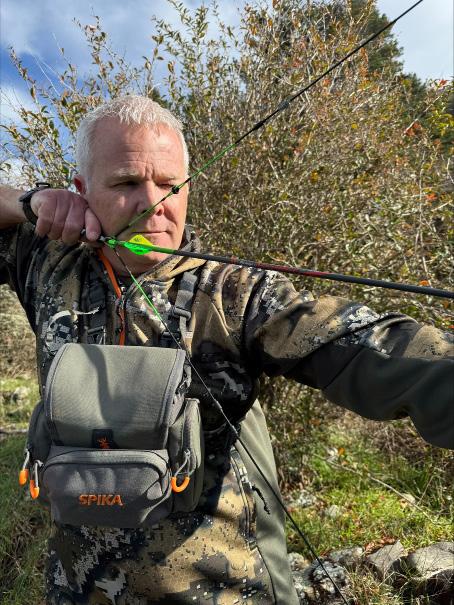
After a well earned break the Marlborough bow hunters club are back up and running for 2026. The 3rd weekend of every month the club will be hosting a club day up the Waihopai Valley. Any one is welcome to come along and join the shoot, and new comers are encouraged. The members have also been busy collecting meat and have got Andrew Large from ASL home kill meat processing to process some sausage and patties for us to enjoy on the BBQ after the shoot. For further information please refer to our facebook and instagram for more details.
I wanted my fix, thought I’d kicked the habit, but it was still there and as it’d been a long time, I really felt the need. My bro in law was supposed to join me because he felt the need as well, but sadly it was just not going to be. I put the blame on the orange guy in the States contriving to have the straits of Hormuz closed. Either that or B. in L.’s home o ce decided against it for him. But it had been a long time since I’d enjoyed a day out on the water and a fishing fix, as the weather had been, well, rotten. Being a man of some leisure, I decided to keep o ce hours for the day and as my old mentor Freddy the Fisherman used to say “Don’t go out there until the sun’s on the water.” The AWD was pointed eastwards at 9.15 and while it was foggy up the valley, there was sun on the water lakeside around 10am, when I watched and was entertained by some people trying to launch their large
The Fix Coastlines
boat, with one guy even stripping o and immersing himself in the water at the back of the boat. Then Silver Frog was slipped in, but the motor was reluctant to start....very reluctant. However after a time of trying di erent ways and means it was coaxed into life, so I gurgled out past the 5 knot buoy & then let the 15 horses gallop, it was time to look for fish.
Pulling into a first favourite spot, fish #1 drifted into sight, but a sudden, untimely line tangle meant I didn’t get the cast away, however that was sorted, then lo and behold it came back past, looking beautiful and light brown in the morning sun. A nymph was dropped ahead and to it’s left whereupon it suddenly accelerated onto the fly. Woo Hoo hookup time, then Boo Hoo snap o time. Stole the fly it did, but maybe it was lack of practice on my part. Moments later a 2nd fish was spotted, sitting immobile in the sunshiny shallows, so I lined
it! Lack of practice again. A 3rd swirled right by the boat, but saw me and stealthed o , then a 4th one took o before I even knew it was there. Meanwhile the “Parrys” were providing an incessant backing track of squarks and whines, while flotillas of swan took o when they saw the boat - must be duck shooting soon. Fish #5 was in very good condition and sitting doing nothing, so to keep up the tradition I lined it. Best I go to casting school methinks, or get out here more often. In my defence the water was very skinny, the trout wary and the sun was behind me, plus I was upwind! I scared a 6th or maybe it was the same one as it was in the same area.
It was great sighting all these fish, then I saw #7 but it was a stick, yeah nah, yeah NAH! Oops too late its gone now. Then 3 came slowly into view at once, however not one was keen on a small hair n copper, so my thinking was a pheasant’ tail should do the trick.
After the fly change #11 appeared but a mu ed cast (again) led to a wind knot. By now you’ll be thinking this guy’s not great as a fisherman and that was what I was beginning to think as well, but I was having a very nice time around
Ivan Wilson
the sunny margins, so put any negative thoughts aside and.......... had lunch. As often happens when you breakout the sandwiches it’s the cue for another trout to appear, #12. At this point a drone came snarling around to disturb the peace and it’s not the first time I’ve had one overhead while fishing out here - the lake environment is changing.
I switched to an old favourite fly I call Lady in Red and thought it would do the trick and it did. Lucky fish #13 was a little ahead of the boat, so out went the fly and there was a hookup, a brief hookup, because the fly was barbless, so I performed a strategic mid lake release!
Sticking to this fly, it went out over the stern as I tried some harling on the way to the next spot and hit a very enthusiastic fish, enthusiastic about escaping, which it did, so bye bye #14.
What a funny old day it was, but as the adage goes, the worst day fishing is better than the best day working. I’d seen heaps of fish, enjoyed glorious sunshine, had several takes albeit brief and some favourite spots to myself, plus it was a workday. Not exactly a “worst” day and I’d had my fix.
Licence holders often get a hard time from politicians and the media, begging the question why?
Much of it comes down to a lack of understanding about what actually happens on shooting ranges, and the benefits that clubs freely provide to the community. I say “freely” because very few clubs receive any meaningful support from the councils whose area they operate within. Clubs are run by volunteers who are passionate about both their sport and their community. Many of these people have years, often decades, of experience. They use that knowledge to train and guide anyone who comes along, particularly in safe firearm handling.
Selling recreationally caught fish, too much pāua and obstructing Fishery O cers earns fines and community work
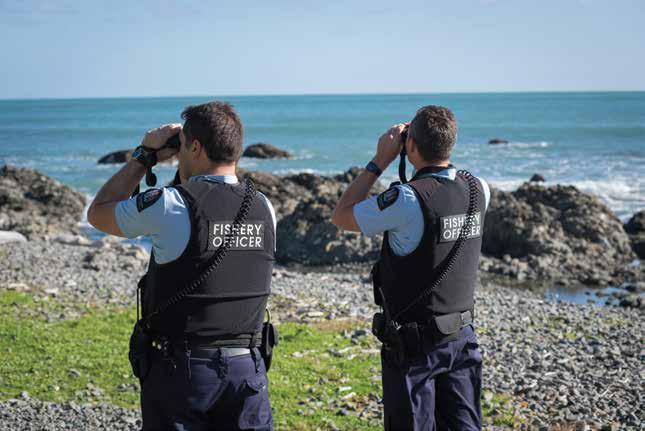
A number of recreational fishers have been fined for selling fish illegally and taking too much pāua. Some also obstructed fishery o cers from carrying out their work which resulted in separate fines and community work.
“People who choose to ignore the fishing rules need to know there will be consequences. Our job is to protect fishing resources so that everyone can enjoy the opportunity to put fresh kaimoana on the dinner the table.
“Those who try to obstruct us in this work should know there will be consequences,” says Fisheries New Zealand’s Director of Fisheries Compliance, Steve Ham. These were some of the main cases before the courts over the past month.
A 45-year-old Waikato man was fined $1000 in the Manukau District Court for the illegal sale of kina online, including through a ra e during 2023 and 2024. It is illegal to sell recreationally caught seafood. A recreational fisher can legally take a daily limit of 50 kina in Waikato.
Shooting Sports PISTOL
Becoming competent with a firearm takes practice, and a lot of it. One or two days a year simply isn’t enough, and every serious shooter knows that. Once good habits are learned and ingrained, they become second nature. Starting young can help, but one of the great things about shooting is that age isn’t a barrier. It comes down to the individual finding a discipline that holds their interest. For me, that’s IPSC and pistol shooting. I used to compete in 3-Gun, but the 2019 confiscation took much of the enjoyment out of it. While we still do some shooting with mini rifle (.22) or PCC (pistolcalibre carbine), they don’t quite compare to an AR-15 in .223. There are plenty of options depending on your interests. Speed Steel is great if you want
something fast-paced, and you can often enter with multiple firearms.
If you prefer something more relaxed, there’s small-bore rifle, or you can go all-in with full-bore and long-range shooting.
I have started exploring longrange myself, although I’m not sure I have the time, or the budget to fully commit.
Shooting sports are a bit like motor racing: they cost as much as you are willing to spend. You can keep it relatively a ordable or go all-in and empty your bank account. Either way, it demands time, focus, and commitment.
Clubs are funded by their members and users. Some also host police training, which provides some financial support. It is important that police have access to proper training facilities, and
Prosecutions Round-up
clubs play a key role in making that possible. Despite this, very few clubs receive recognition or support from local councils. To be fair, many clubs do not even ask, as they already believe they know the answer.
Brian Bishop
Shooting teaches personal responsibility. Safety is taken seriously at all times, and anyone who doesn’t respect that won’t be invited back. It’s a disciplined, skill-based activity that rewards focus and accountability.
A 41-year-old South Taranaki man has been fined $1600 in the Hawera District Court for being in possession of 29 pāua. The man was stopped by Fishery O cers in November last year at Opunake.
While all pāua were legal size, the daily legal limit per person is five pāua. The minimum size in that area is 85mm.
A 70-year-old Hawkes Bay man was ordered to do 80 hours community work by the Hawkes Bay District Court, for obstructing a Fishery O cer during their catch inspection work.
The man and two divers were fishing in September last year at Cape Kidnappers and when Fishery
O cers attempted to go alongside his fishing boat to inspect his catch, the man moved his boat to prevent them boarding, telling them they had no jurisdiction and that he would not cooperate.
In a similar case, a 60-year-old Northland man was fined $2000 in the Kaikohe District Court for obstructing a fishery o cer during their catch inspection work. Fishery O cers were conducting a vehicle check point at Waimamaku Beach in May last year and the man, who was on a quad bike with what appeared to be a sack of pāua, failed to stop when signaled by o cers. Eventually, Fishery O cers stopped the man when he became
stuck in rocks. As the man had a history of fisheries o ending – he was also prohibited from fishing for three years.
“If you’re unsure of the fishing rules in the area you plan to fish, get the most up-to-date fishing rules by downloading the free NZ Fishing Rules mobile app. It will also work if you are fishing in an area with limited mobile coverage,” says Mr Ham. We encourage people to report any suspected illegal activity through the Ministry for Primary Industries’ 0800 4 POACHER line (0800 476 224).
Exceptional Ute & Station Wagon Fit-outs
Whether you’re a skilled tradesperson, a DIY enthusiast, or just a fan of utes, our custom fit-outs are tailor-made to elevate your road transport experience. Our fit-outs not only meet but often exceed expectations in terms of quality and aesthetics.
We take pride in collaborating with you to design the perfect deck or canopy, whether it’s transforming your hand-drawn vision into reality or utilising our cutting-edge SolidWorks design system to bring your ideas to life.
Our fit-out solutions include toolboxes, fold-down sides,
hydraulic lifts, H-frames, slide out drawers and more to make the most of the space in your vehicle. We’re your one-stop solution for all your transportation needs.
Precise fit-outs, even before your Ute Arrives
If you haven’t taken delivery of your ute yet, we can still get to work. With just the make and model information, we can now digitally import the specifications and design the perfect canopy in consultation with you. Our advanced technology allows us to create a vivid image, o ering you a clear preview of the final result. We meticulously check
tolerances to ensure a seamless fit between the body and cab while optimising wheel travel. When your ute finally arrives, we can e ortlessly install the canopy, making your vehicle road-ready in no time.
Rely on Aluminium Excellence
Our fit-outs are crafted from premium aluminium, the ideal material for utes. We utilise heavygauge aluminium to withstand the toughest challenges and work life. Lightweight yet incredibly robust, our fit-outs are built to last and engineered for their intended purpose. Moreover, aluminium is corrosion-resistant, ensuring that your fit-out remains impervious to various loads.
Wagons
If a custom high quality sliding drawer for your wagon is what you’re after, we can do this for a side or back opening door. We use sturdy, customised parts so your drawer glides with ease, to make the most of hard to reach places. Game changer.
An example we’re very proud of is the drawers in a fleet of ambulance First-Responder utes to make access to key materials easier for paramedics.
Choose our fit-outs to enhance the functionality and durability of your ute. Contact us today to discuss your specific requirements and take your road transport to the next level.
More heat than light on Fisheries Reform
Retired Fisherman Norm Hawler comments on the current Fisheries Act and Reform Bill
If you believed the loudest campaign lines, you’d think the Government was about to repeal sustainability and sell the ocean to the highest bidder.
The Fisheries Amendment Bill has been labeled a “scam”, “rotten to the core”, a “bonfire” of safeguards and a “fatal weakening” of the law. The picture painted is simple: big quota owners win, everyone else— fish, environment, recreational and small commercial operators—loses.
For people who actually depend on fisheries, that story is both unsatisfying and misleading.
The law hasn’t disappeared Start with what isn’t changing.
The Fisheries Act 1996 still has the same core purpose: to provide for utilisation of fisheries resources while ensuring sustainability.
“Ensuring sustainability” still means maintaining the resource for future generations and dealing with adverse e ects of fishing on the aquatic environment.
The environmental principles— associated and dependent species, key habitats, biodiversity—are still there. The information principles— best available information, explicit treatment of uncertainty, precaution when information is weak—are still there.
In other words, the Act’s spine remains. The Bill does not rip out sections 8, 9 or 10. It doesn’t abolish the Minister’s duty to manage sustainably. It doesn’t remove powers to cut TAC and TACC when the science or common sense demands it.
So what does it do?
TACs as outputs, not politics by other means
A lot of the criticism treats TACs (Total Allowable Catches) as if they are simply political numbers dreamed up to please big companies. In reality, TAC and TACC are outputs of a process that has grown over decades: stock assessments, harvest strategy standards, application of purpose and principles, submissions and, at times, court scrutiny.
That process isn’t perfect. But pretending TAC is pure politics ignores the machinery many of us spent years working in and with.
Opponents of the Bill rarely acknowledge that machinery. That makes for strong slogans, but weak
analysis.
What really shifts: tests, tools and leverage
In plain language, the Bill makes three big moves.
First, it changes how TAC decisions must be justified. The law will require Ministers to consider a checklist of “standard factors” when setting TAC, and to take environmental principles and adverse e ects into account only “to the extent that they are relevant” to those factors. That does not delete the environmental principles. It does make it easier for a Minister to say: “For this stock, the relevant issues are biomass, productivity and utilisation; broader ecosystem concerns will be addressed elsewhere.” It moves environmental considerations down a notch in TAC setting, from front-row to supporting role.
Second, it introduces or formalises multi-year TAC decisions and management procedures. A management procedure is essentially a harvest rule: if index X goes up or down, TAC moves according to a preset formula. Multi-year TACs apply these rules over several years instead of relitigating everything annually.
Used well, these tools are sensible. They can:
respond faster to data than sporadic full stock assessments
reduce political tinkering with TACs
provide more certainty for planning.
Critics who scream “five-year set and forget” are wrong. Properly designed management procedures are updated with new data every year. But supporters who present
them as neutral housekeeping are also overstating it.
The crucial questions are: what objectives are baked into the rules, and how easy is it to revisit them when reality diverges from the model? A rule tuned to maximise long-term yield at relatively low biomass is very di erent from one tuned to rebuild quickly to high biomass and protect key habitats. Third, it tightens process levers: shortening timeframes to challenge decisions in court; and gives stricter control over who can access and publish monitoring footage. O cially, this is about certainty, e ciency, privacy and commercial sensitivity.
In practice, it also makes life harder for the same community, Iwi, recreational and environmental groups that have used the Act’s principles—and the courts—to pull Ministers back toward sustainability. Anyone who remembers the battles over CRA 2, kina barrens, tarakihi, or closures in the inner Hauraki Gulf will understand the value of that leverage, even if they disagreed with a particular case.
CRA 2: where theory meets reef
One case study shows why the nuance matters more than the noise.
CRA 2 is often held up as proof that commercial fishing “functionally extincted” crayfish and caused kina barrens from Northland to East Cape. The reality is messier. Parts of the inner Hauraki Gulf have long been lightly fished commercially because recreational fleets, pot interference and boat tra c made it di cult to work. At the same time, there’s evidence that predator depletion is only one factor behind kina barrens in some locations, mixed up with sediment, storms and warming.
A TAC is a blunt instrument in that soup. Cutting TACC alone won’t magically regrow kelp where land-based impacts dominate. Equally, pretending fishing has nothing to do with it is just as flimsy.
The Bill doesn’t suddenly make TAC a precise habitat-management knob. It does, however, give a Minister more room to treat those ecosystem warnings as “not relevant” when deciding how much lobster can be taken overall, and to rely on other, less certain measures to sort out the reefs. That’s the subtle, but real, environmental risk.
A better critique than “scam” None of this is an apology for the Bill. There is a legitimate debate to be had about: how strongly environmental principles should bite in TAC decisions how management procedures are designed and reviewed what kind of oversight and access the public should have to the information the system is built on.
The problem is that “scam” politics and “privatisation” rhetoric do almost nothing to help that debate. They flatten a complex set of changes into a morality play: industry villains, Minister as stooge, everyone else as victim.
For those who live with this law, that isn’t good enough.
You can recognise that the Fisheries Act already hard-wires sustainability and precaution into its purpose. You can support modern tools like management procedures. You can still insist that Parliament: keeps environmental principles as more than a box-ticking exercise embeds ecosystem and precautionary criteria into any long-term TAC rules protects meaningful avenues for independent challenge when the sea tells a di erent story than the model.
That’s a harder sell than “kill the Bill”. It’s also a more honest one— and ultimately, more useful for anyone who wants both fish in the water and a fishing industry worth working in.
us at the Boatshow
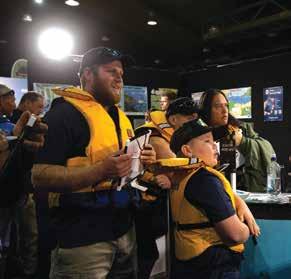
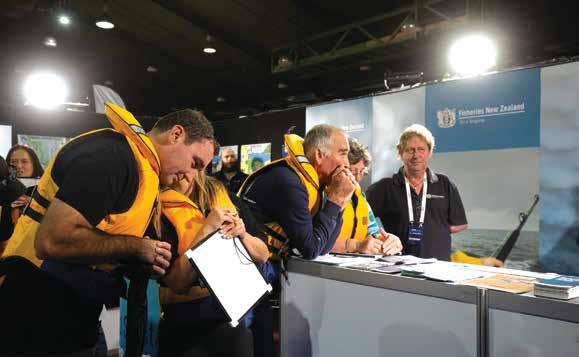
Every May, large crowds of people gather at the Auckland Show Grounds in Epsom all with a common interest –everything marine. Yes, it’s that time of the year again – the 2026 Hutchwilco Boatshow runs from 14 to 17 May.
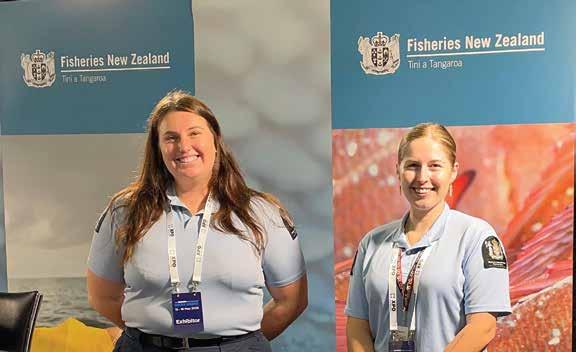
Fisheries New Zealand has attended the show for many years now and we’ll be there again this year. So, if you’re in Auckland or heading there to go to the Boatshow look for us at stand number 540.
Have a chat with our local Fishery O cers and Fisheries New Zealand sta about fishing rules for your area, current fisheries consultations, and much more.
If you can’t make it to the show, follow us on social media. We have regional Facebook pages where you can find out what’s happening in your local fisheries.
If social media isn’t your thing, sign up to our mailing list for recreational fishing updates and news.
HUNT LIKE A PRO
Made in Europe
Chosen by professionals
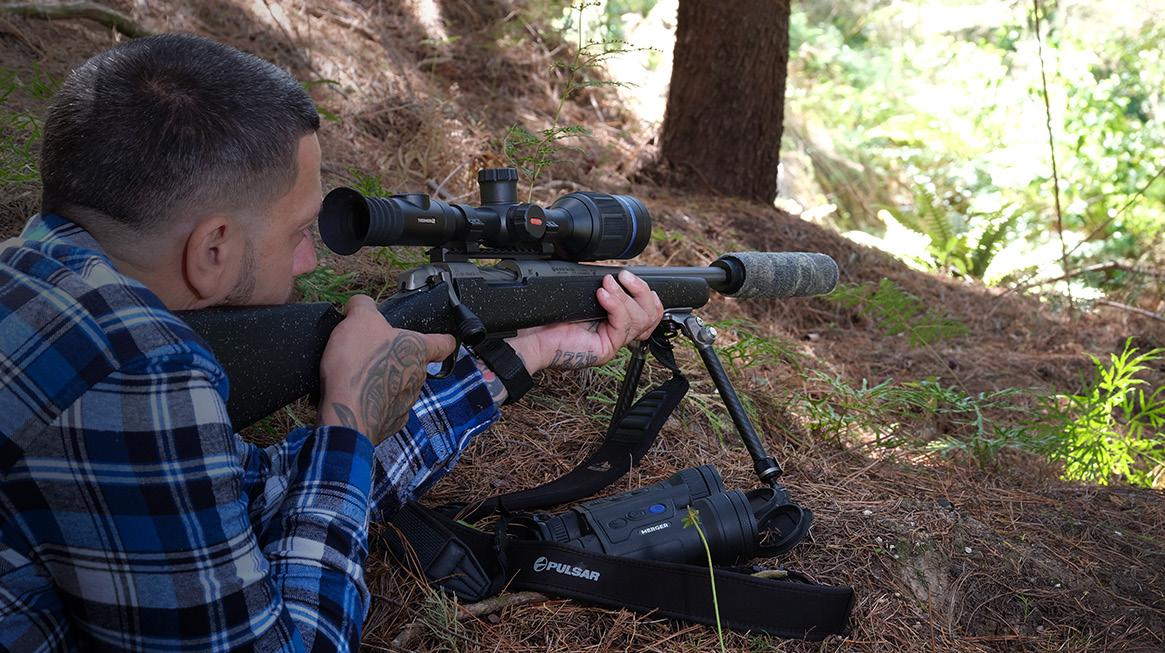
Pulsar thermals are the first choice amongst professionals.
Our great range starts at $2599, representing great value for high quality, proven, European made thermal optics with advanced Lynred sensors.
HAND-HELD THERMALS
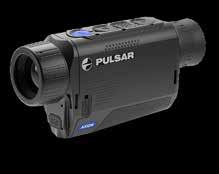
PULSAR AXION COMPACT
Lightweight, quick-change battery, robust and outstanding performance. Perfect for bush-stalking, forestry and general use. Great value.
Choice of 384x288 or 640x480 sensors.
From $2599.00
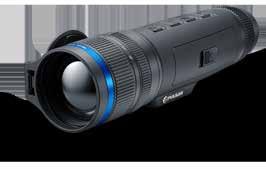
PULSAR TELOS
Outstanding performance at long and short distance.
High capacity quick-change battery very lightweight. Available with 1000m laser rangefinder.
Choice of 384x288, 640x480 or 1024x768 sensors.
From $3999.00
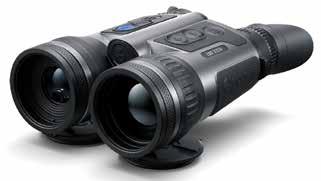
PULSAR MERGER LRF
Immersive, comfortable viewing experience, up to 1500m laser rangefinder, high capacity quick-change battery with internal back-up, delivers the very best performance.
Choice of 640x480 or 1280x1024 sensors.
From $6799.00
THERMALS RIFLESCOPES
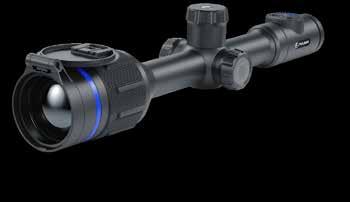
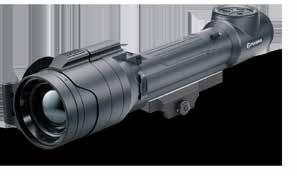
PULSAR THERMION
Professionals favourite. Quick-change battery with internal back-up, 30mm tube and integrates with Stream Vision Ballistics for reliable shot placement. Available with 1000m laser rangefinder.
Choice of 384x288, 640x480 or 1024x768 sensors.
From $5399.00
PULSAR TALION
Compact, quick-change battery, QD mount and integrates with Stream Vision Ballistics for reliable shot placement.