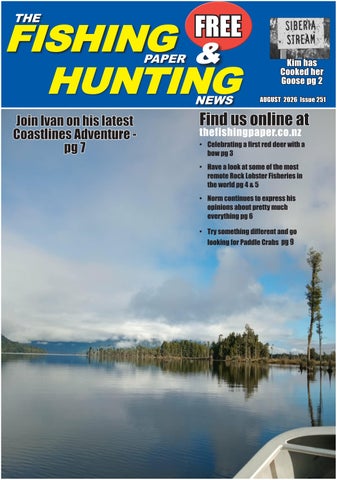
August 2026 - 251 The Fishing Paper and Hunting News
•
•
•
•
‘Tis a Siberian-styled wintery morn outdoors. So bitterly cold that my nose leaks and my extremities turn blue. There is not a whisper of wind, and the weak July sun has yet to perform its dawn rituals.
Freed from the confines of the travel box the pig dog’s strut. He’s cock’a’leg, she’s squat. Urine streams, steams, then freezes yellow. The proverbial piss holes in the snow.
I’ve dressed appropriately. Layers begin with merino wool against my skin and progress until I’m swaddled in canvas chaps and an oilskin vest.
I fill my pockets with dog leads, ammunition and a cotton bandana which might multitask as emergency tourniquet, scope wiper or hair keeper upper. Add camera gear, tracking gear, rifle and hi-viz beanie and I’m hung like a donkey. One of those knock-kneed donkeys which lug obese beachgoers - head down, overladen and unhappy. We get cracking. I work hard. The dogs work hard. The day brightens and Sol shows us his love.
I know the pigs will be camped up high. They’ll be on a ridge where the sun strikes early and the breeze, of which there’s none yet, will tip them o about the presence of danger. They’ll be hunkered down, piled one atop the other, farting and grunting as they doze.
We climb and climb. We hunt and hunt. We investigate every lead. The canine’s labour. I perspire. That perspiration trickles and seeps. It is absorbed by my layered clothing. I have pocketed the beanie, pulled up my sleeves and unzipped my oilskin but my body heat is not dissipating. Like the little donkey I cannot ditch my load. This is a one-way route, and my clothing and gear must accompany me every step of the way - the most e cient way to
Cooked my Goose
Kim Swan
carry said clothing and gear is to wear it.
We cannot find the pigs. They have roamed far and wide. They have left clues like upended thistles, shiny baubles of dung, rubbed trees - but we are tired and our well of enthusiasm is running dry.
My ute, parked afar, looks tiny, like a matchbox diecast. The distance between us wobbles ever so slightly as Sol’s heat distorts the air. I plod on, weary like a dumb ass and stubborn like a mule, extending our random route time and again in the hope of a win.
Out of the blue, just fifty metres ahead, Kola barks.
Old Chop finds her and lends a hand. I load the rifle and push closer, chaps scratching loud against the porcupine shrubs. Reek of boar assailing my nostrils, heart rate elevating.
The boar rockets from his hideout when my rifle barrel is pushed close to his ear. He sprints from cover to cover, honking and sco ng indignantly. Kola and Chop zig and zag in hot pursuit till fang connects with ham and close
The Fishing Paper & Hunting News
Editor: editor@thefishingpaper.co.nz
Sub-Editor: Mike Brown
All Enquiries: Nicola Morris
0224 503 403 admin@thefishingpaper.co.nz
Printer: Inkwise
Advertising Enquiries:
Lynda Balfour North Island
Lynda@thefishingpaper.co.nz
027 710 1510
Phil Claude South Island
Phil@thefishingpaper.co.nz
021 242 4202
quarters combat begins. Its all in and all on. 110 per cent physical expenditure by all parties, lots of heavy breathing and dirt and blood till the young boar expires with a squeal and a shudder.
I am short one dog and the tracker reveals he has stopped far away. I climb a nearby knoll, look and listen. Down towards a neighbouring house and outbuildings I can hear his storyhis pig is squealing, held firmly on the ear, while geese at the cattle yards are kicking up a heck of a fuss. A motorbike is leaving the house and closing on the scene.
The tracker reveals something else too. The two dogs which had been lying beside the deceased boar are now rapidly heading southwards. Damn.
The pair extend the distance between us, climbing another ridge before Kola starts to bark. Wait – wait – a few minutes later the old boy catches up and joins in, uncertainly at first, then warming to the task. They have something well bailed in tight cover. Double damn. Alone, exhausted and overheated I stand with ‘piggyin-the-middle’. One dog far north. Two dogs far south.
I can’t be everywhere; I can’t do everything.
I suspect the northern dog down amongst the gaggle of geese is going to have his pig taken from him by a stranger. The other two need my help asap.
I amble o , picking a pathway down the steep and overgrown face - knees failing, I stumble often.
At the bottom I’d love to shuck my excess clothing and gear as it’s
literally killing me. But, if the pig breaks and the bail relocates, I risk misplacing the lot.
Mule-mode – an untracked climb ahead, warm sun shining, no air circulating – I stew in my own juices. The missing dog appears and disappears, he joins his mates and they begin to hold their quarry.
Steep. Dragging or pushing myself upwards, vegetation resisting – I stop every half dozen strides to prop a foot forward, lean onto my knee and breath deep. I’m cooked. Waves of nausea surge, my ears ring and my balance is gone.
Still, I cannot stop as the dogs are holding hard and they are as exhausted as I am. The only reprieve they’ll get is when I put an end to this silly game. I stutter on but it is a mammoth struggle to maintain forward momentum of any kind.
The young boar breaks when I eventually arrive. The dogs’ reserves are spent, their tanks empty - they struggle to dominate. As one we bounce and stagger downwards till, finally, we win the battle down in the gully.
There is a pond just metres awayhere the dogs wade - eyes glazed, tongues lolling and muscles a’tremble. I don’t dare join them. My vision goes, casting everything in blurry shades of grey. The ground is my friend; I hold it close and dear.
Heat stroke in July, who would believe it.
That ute of mine, it’s still kilometres away. The donkey which is me gets there ever-soslowly – and with the salt-laden and soggy load still worn upon my dumb ass.
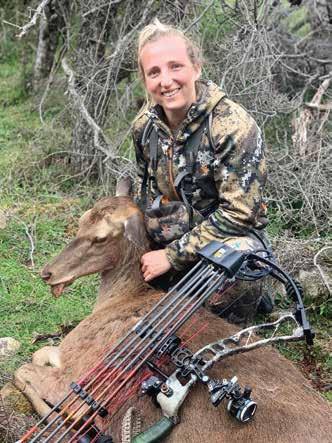
I was almost one year into my bow hunting journey when I finally got the chance to shoot my first red deer with the bow. I’d had plenty of practice on goats, wallabies and the odd pig so I was feeling confident. We loaded up our old retired pig dogs Fern (12) and Sky (11) and everything we needed for a weekend away at our favourite hunting spot. We also threw in the trusty .223 to get a couple of handy dog tucker goats on the ground for the girls.
We arrived at the hut nice and early and set out for the day. The early sign was promising, seeing pig and deer tracks just across the river from the hut along with a recently shot goat. After a short while of walking up the side creek, we stumbled across our first deer, well it was actually three deer feeding up on a flat just above the creek bed. I knocked an arrow and started to slowly sneak in. As I was still pretty new to bow hunting I had Ben with me to help me range the target so I had one less thing to focus on in the lead up to the shot. With Ben right behind me, we were slowly creeping in, one baby step at a time when a fourth deer we hadn’t seen busted us, barking and letting the others know they weren’t alone. All eyes on us and we knew our stalk was over! Blast!
We laughed it o and begun walking up the creek knowing there were more good spots still to come. We were getting close to an area where I had shot a few deer with the rifle in the past; so we slowed down and were surprised to see a mob of six deer feeding in what we called the ‘sheep paddock’ which never had sheep in, and really wasn’t much of a paddock at all! Again arrow on, and again, a sneaky seventh deer spots us as were crawling on our tummies to get in closer for a shot. With numbers this good we were beginning to realise finding deer wasn’t going to be the problem, getting close without getting spotted was going to prove a little more tricky. We trekked on a bit further, got busted a few more times, alongside a brief side quest to shoot some goats that were too handy to pass up and finally, my chance presented itself. We were feeling a little dejected after being busted yet again and Ben was leading the way out
First Red Deer
Ben Dick
back to the hut, when low and behold out on ‘sheep paddock’ was a hind, and better still she was on her own! After a couple of panicked psssts, psssts and an oi, Ben stopped and straight away understood why I was desperately trying to get his attention.
Arrow on.
Very slowly we stalked our way in with our heads on a swivel just in case any extra eyes were to spot us. We inched closer and closer, finally getting into 37 yards. Back then this was getting close to my upper limit for distance when shooting animals (I was very confident shooting targets out much further) but had shot goats in the low 40s before and knew I just had to back myself. When the slight quartering away shot presented itself I felt ready and let my arrow rip, hitting her right where I was aiming! Phew! She took o downhill on a dead run and Ben having seen the shot placement said “watch her, watch her!” during this time I had knocked a second arrow that wasn’t needed, because she was down 30 meters away amongst some scrub. After a couple of high fives and some photos for the ‘gram’ we boned her out and restarted our walk back towards the hut.
The rest of the walk out was uneventful, likely due to the amount of excited chat that was going on between us. We arrived back to the truck and spotted some handy goats while Fern and Sky were mucking around in the creek. Ben knocked them over with the .223 and set o to go
process them for dog tucker while I put the girls away and started unloading our gear for the evening. During this process
along the truck to retrieve the rifle, mag, and bolt and waited for the boar to make his way to the goat. Once he was tucking in, I quickly snuck over and got myself ready. At this stage Ben was still safely at his goats watching it all unfold. I placed my cross hairs between the boars ears, took a breath and slowly squeezed the trigger.
Bang!
The pig dropped on the spot and rolled down the hill. Thinking I’d nailed it, I made the gun safe but when I stood up, so did the boar! Sensing my girls deserved some action, I raced over to the truck to let them go, and all three of us tore o into the creek. Ben hit the water at the same time and the girls started what was going to be a steady bail. When Fern realised the cavalry (Ben) had arrived she
Fern started whining in the dog box, they knew to be quiet in the box, but our Ferny often liked to test the rules just in case we’d changed our minds. A quick “come on Fern you’ve been o all day” confirmed to her that nope, dog boxes are still for quiet time; It wasn’t until Sky our little ‘goodie two shoes’ started pawing at the gate that I knew something was up. A second later I hear a rock topple behind me and I instantly catch on to what the girls were trying to tell me. The boar who left his mark in the creek was behind me and heading for the dead goat on the other side.
At this point I had already made the rifle safe and it had been put away, so I slowly slinked my way
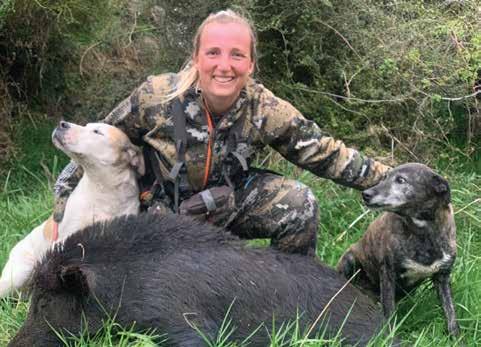
launched in for a hold. It was at this point to all of our surprises the pig fell over. He must have been dead on his feet! And I tell you if a dog’s looks mean anything, I was in deep trouble for cutting short Fern’s fun by shooting the boar first!
Thankfully, Fern forgave me quickly and posed for some photos before I committed to the short carry back to the hut. This was my first boar with the rifle and the perfect bonus to a ripper of a day.
Sadly, we had to put our Fern down in March of this year at the ripe old age of 16 having lived out her retirement licking pots and being spoilt.
RIP Ferny girl, we hope you’re up there slaying the big boars x
NZ rock lobster industry commentator Daryl Sykes highlights some of the most remote
Spiny rock lobster fisheries in remote locations are often easy to overlook on the global production charts usually dominated by Australia, South Africa, New Zealand, Cuba and the Caribbean. However in isolated archipelagos and around sparsely populated coasts, lobster fishing is not just a premium seafood activity; it is often the industry that anchors local employment, freight links, processing, and public revenue.
What makes these remote fisheries distinctive is the combination of distance, exposure, and dependence. Vessels work around rough weather, narrow seasonal windows, limited port infrastructure, and high freight costs, while communities rely on lobster income to support social services and maintain a viable local economy.
Remote settings
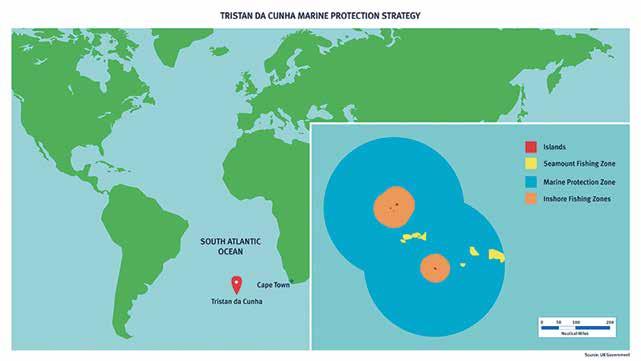
The clearest modern example is Tristan da Cunha, widely described as the world’s most remote inhabited archipelago. It has no airport, access is by sea, and the inshore rock lobster fishery is the main commercial lifeline for a resident population of roughly 245 people. The Jasus tristani fishery accounts for more than three-quarters of the island’s economic activity and about 80% of island revenue, which makes stock health and fishing opportunity central to the territory’s economic resilience.
Saint Paul and Amsterdam, in the southern Indian Ocean, are remote in a di erent way: they are not community fisheries in the same sense as Tristan, but they are logistically extreme industrial outposts. The Jasus paulensis lobster season runs from 1 December to 30 April, with trips staged from Réunion Island by a mothership that deploys smaller craft to work coastal and deep grounds around the islands.
Scale and productivity
Around Tristan da Cunha, annual landings are about 400 tonnes and catches are managed
under TACs first introduced in 1991 after earlier overfishing and subsequent stock rebuilding e orts. The limited number of fishing days each season means that weather can influence annual production almost as much as stock size, a common feature of oceanic lobster fisheries.
The Saint Paul and Amsterdam fishery is larger and more explicitly structured by scienceled quotas. For 2022–23, the total TAC was 420 tonnes, commercial landings reached 415.48 tonnes, and the stock assessments concluded that biomass at both islands was above target levels consistent with maximum sustainable yield.
Average CPUE in recent seasons has remained well above the fishery’s target reference levels at both Amsterdam and Saint Paul, indicating a productive and currently healthy stock base under present controls.
Fishing methods and gear
Gear tends to reflect two realities of remote lobster fisheries: the need to fish selectively, and the need to handle rough coasts with limited shore infrastructure. Pot and trap fisheries dominate because they are e cient, species-targeted, and comparatively compatible with live release of undersize animals.
At Tristan da Cunha, fishers use box traps, larger “monster” traps, and hoop nets from a local fleet of 12 powerboats. Each licensed boat works a defined number of traps and hoop nets, and the catch is landed to the island factory for processing and export, mainly via South Africa.
This is a compact island system in which harvesting, handling, and processing are closely integrated.
At Saint Paul and Amsterdam, the gear is split between a shallow coastal fishery and a deeper o shore fishery. Wooden pots are used in the coastal kelp zone to about 70 m, while steel pots are used in deeper water from about 70 m to 350 m, with a larger vessel acting as mothership for smaller “canots” and “caseyeurs”. That arrangement is typical of truly remote grounds: it spreads risk, extends range, and allows operators to work several habitats without needing a permanent shore base.
The rock lobster species Jasus frontalis, occurs only around the Juan Fernández and Desventuradas Islands about 400 miles (≈640 km) west of mainland Chile, with fewer than 1,000 residents on two islands and a local economy that depends heavily—roughly 70% by some estimates—on lobster income.
The fishery is artisanal but highly organised. Only licensed island residents may fish and licences are limited. In the early 2010s there were about 57 active boats and roughly 150 fishing families, a number that has stayed in the range of 40–50 boats over many decades. Commercial exploitation dates back to the 1890s, and islanders themselves pressed Chilean authorities as early as 1894 to create formal rules, including extraction limits and seasonal closures.
The broader lobster literature shows that remote fisheries have often evolved from hand
collection or simple traps into highly structured pot fisheries. Once refrigeration, freezing, and long-distance transport improved, lobster shifted from subsistence and local trade into export production, and gear modernised accordingly. In many places, that history also explains why management now emphasises size limits, TACs, seasonal windows, and restrictions on gear numbers or soak times.
Economic contribution
The strongest case for the importance of remote lobster fisheries is economic concentration. On Tristan da Cunha, lobster underwrites most of the territory’s cash economy, helps sustain the island processing plant, and e ectively supports the outward export connection on which the community depends. That means the value of the fishery is larger than its landed tonnage alone; it also sustains jobs, logistics, local government income, and the confidence needed for people to remain on the island.
Even where no resident community is based directly on the fishing ground, remote lobster fisheries still have substantial national value. The Saint Paul and Amsterdam fishery supports vessel operations, processing, monitoring, science, and quotabased management within the French Southern and Antarctic Territories system. Those features make it a high-value fishery whose economic contribution is amplified by product quality, export orientation, and strong compliance systems.
Daryl Sykes
NZ rock lobster industry commentator Daryl Sykes highlights some of the most remote
Saint Paul/Amsterdam management is strongly expert driven, built around quantitative models, formal harvest control rules (HCRs), and centralised administration, with industry stakeholders consulted but not embedded as a resident community.
Juan Fernández management has been shaped by fishers themselves for over a century, with formal regulations emerging from local initiatives and now informed by scientific studies.
The wider history of lobster use reinforces the same lesson. Lobsters have repeatedly become a premium trading commodity because they combine high unit value with strong market demand, making them especially suitable for peripheral places that cannot easily compete in bulk commodities. For remote regions, a relatively modest volume of lobster can therefore generate a disproportionately large economic return. Remote lobster fisheries are best understood as strategic fisheries rather than merely niche ones. Their future depends on keeping a di cult balance between productivity, logistics, and conservation: stocks must stay strong, gear must remain selective, and management
The Cable Bay Pistol Club has made the move to an electronic sign-in system. I had been looking into electronic sign-in systems for a while, as the demands placed on clubs by the Firearms Safety Authority just keep getting bigger. The time and pressures on our club secretary have continued to build. While we had been using a paper-based system, it was becoming increasingly di cult to manage. In the past, we only had to report the 12 shoots that every pistol endorsement holder must complete each year to maintain their endorsement. That has changed. Every year they seem to want more and more information. I don’t know what they use it for, and they don’t explain why they need it. To make sure Charles, our club secretary, doesn’t decide to quit, because I certainly don’t want the job, and with one financial year ending and another beginning, it was the right time to make the change.
I had spoken with a couple of clubs that have their own electronic systems, but their situations are di erent from ours because we don’t have power on site. Craig, from Wellington, has been working on this system for the last couple of years or more, and I’d been talking with him about it for quite some time. I’d seen how it worked, and he had also met with Pistol NZ and
must absorb weather shocks, freight constraints, and environmental change. That is why these fisheries attract such close attention from industry and managers. In remote settings, lobster is rarely “just another species”; it is often the backbone of
Electronic Sign In
given a presentation at our AGM. I have shot with Craig at a number of matches over the years, and computers are both his passion and his profession, so he knows what he’s doing.
My problem is that when people start talking about computers, it all sounds like “blah, blah, blah” to me, so damn boring! I would much rather talk about guns and how a shoot is going or how it went.
Still, change can be a good thing, and this system works. It’s easy, even for me.
It’s simple. Just scan the QR code and enter the usual details, your name, firearms licence number, PNZ number, and so on. The system is also geotagged to the club, providing proof that you were actually there. The QR code can be a printed copy, or Craig has an electronic version in a small rechargeable unit that changes the code automatically.
Once I had entered my details, I haven’t had to enter them again. The system keeps a running total of your visits, and, more importantly, when the end of the year comes around, all the information is there and ready to send in.
At this stage, this is mainly a pistol club issue because of the requirement to record how many times members attend their own club and visit other clubs. What the future holds, no one knows.
a local economy or a flagship export fishery, and when it is managed well, it proves that small, isolated fisheries can deliver both commercial value and long-term resilience.
No other sporting group in New Zealand is treated like this. We are vetted more thoroughly than anyone else, and our clubs have more oversight and compliance requirements than most. It’s not as though our members have a poor safety record or regularly cause problems, so I’m not sure what we’ve done to be treated this way.
PISTOL SHOOTING
Brian Bishop
From the July 2026 issue we will be ONLINE ONLY during the winter months - so there will not be a paper available at your local supplier - the only way to access the Fishing Paper will be online.
The July, August and September issues will be online only.
We will use those month to continue seeking out new advertisers su cient to allow us to return to an "in print" paper.
If we can't secure su cient advertising revenue then we will make a call on staying online, or on closing down the paper.
I can assure you that closing down the paper will be the absolutely last option and is not one I want to have to take.
Please reach out if you have ideas as to who we can approach for additional support through advertising or sponsorship.
Thanks for your ongoing support
Nicola admin@thefishingpaper.co.nz
Norm Hawler gives us a Squeeze - or Someone Does
Winter rolls on relentlessly here in the Bay although we have had three days respite from gale force winds, torrential rain, and excessive damage to roads and infrastructure. Today is not even cold – sunshine streaming down and just a gentle breeze – which serves only to lull us into a state of unpreparedness for the next burst of wicked weather.
The Bay has been isolated for weeks at a time since May this year. Road washed away, a bridge collapse and some all-time slips that were just too large and deep to push through in the vintage Rodeo 4wd which is my escape capsule of choice. Isolation in itself is not too bad but gets a bit testing when it is accompanied by long power outages, of which we have had more than a few. I am slowly working through the wood pile in an e ort to keep the place warm and I am still catching up on my reading.
I used to be a full-on bookworm when I was at sea but over the last ten years or so my interest has been more towards technical articles, fisheries management discussions and some political commentary. I am old enough and still smart enough to know how to vote when the time comes so we can put that aside for now. But the fisheries scene sure is getting more interesting almost by the day.
In previous articles I have drawn attention to the loss of fishing opportunity that is being doled out by various Government agencies, whether by way of the
proposed Otago coastal marine reserve network, the Hauraki Gulf protection zones, or the allegedly ‘temporary’ two-year S.186 closures to fishing at various locations, or the declaration of mataitai reserves. There is a bit of everything around at the moment and if I was an active recreational fisherman/ food gatherer I would be paying more attention than I see others closer to the action doing.
I studied the original Otago marine reserve proposals very carefully because if implemented they were going to put colleagues of mine out of business. It was a vanity project from the get-go, furiously driven by a previous Minister of Conservation, notably Eugenie Sage and her Green Party eco-cultist mates. The case for marine protection was grossly misrepresented and opposition was strong locally. Or so many of the locals thought. But somehow DOC managed to do a deal with local Maori and boomfa, the reserve network is a done deal.
Five new marine reserves along the Otago coastline, named Te Au Roa o Te Rakihouia, o cially came into force on 01 July 2026. These fully protected “no-take” zones cover 308 square kilometres (about 4% of the region’s coastal marine area) and prohibit all fishing, harvesting, and mineral extraction to safeguard vulnerable local wildlife.
A purpose which interestingly enough is not consistent with the purposes and principles of the Marine Reserves Act.
This is the wording of the Act – “It is hereby declared that
the provisions of this Act shall have e ect for the purpose of preserving, as marine reserves for the scientific study of marine life, areas of New Zealand that contain underwater scenery, natural features, or marine life, of such distinctive quality, or so typical, or beautiful, or unique, that their continued preservation is in the national interest”.
To preserve – for the purposes of scientific study. Yeh, right.
Community reaction to the Otago marine reserves is deeply polarized. Conservationists and Kāi Tahu celebrate the protections as vital for species like the hoiho (yellow-eyed penguin). Conversely, recreational and commercial fishers are outraged, citing closed-door negotiations and the displacement of fishing pressure to fewer open areas. I stand with them.
And there are now many instances of fishing being displaced; of e ort being squeezed into adjacent fishing grounds, exacerbating the rates of decline of fishing opportunities and fishing success. If you are interested you should check out current applications for two mātaitai reserves at Whangārei Harbour and Bream Bay, Northland; (the applications cite long-term declines in local pipi, kōkota, and kūtai populations, seeking to replace temporary twoyear rāhui closures with a more permanent, adaptive management structure). There are current applications for two mātaitai reserves at Banks Peninsula, Canterbury; the proposed extension of a temporary closure of Ōhiwa Harbour in the Bay of Plenty to harvesting mussels; Proposed temporary fishery closures in the Hauraki Gulf (submissions are closed for this one);
There has been some discussion
amongst recreational fishing interests in Whangarei and their social media analysis concludes that – “The primary “risk” or change for recreational fishermen lies in how the fishery is managed over time.
Once the reserve is established, the local tāngata tiaki (customary managers) gain the statutory authority to propose specific bylaws to manage the fishery sustainably.
What bylaws can do: They can restrict/stop recreational take. For example, tāngata tiaki could propose lowering the daily bag limit for certain shellfish, increasing the minimum size for a specific finfish, or banning a particular fishing method (like dredging) within the reserve boundaries. The check and balance: Bylaws cannot be implemented overnight or arbitrarily. They must be proposed for the purpose of sustainable management, undergo a separate public consultation process, and ultimately require signo from the Minister for Oceans and Fisheries.
Your reference for those arrangements is here: https://www.mpi.govt.nz/ consultations/proposed-bylawsfor-rapaki-whakaraupo-andwhakaraupo-extension-mataitaireserves-around-lyttelton
Last Minute Decision Coastlines
Ivan Wilson
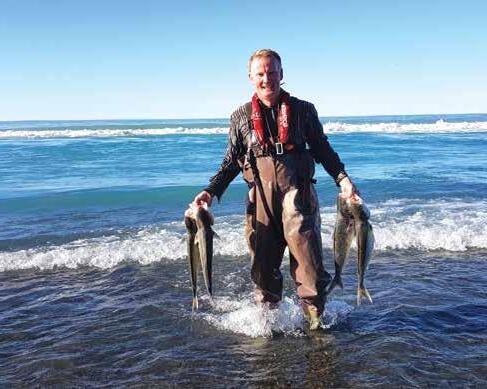
It was a last minute decision to go fishing.
I’d been keeping half an eye on the forecasts and noted some settled stu coming through, so o I went, although at gentlemen’s hours as befits a retired chap.
Hit fog on the way up the valley and then fell in behind several vehicles and a tractor towing a trailer and a ute. We trailed this thing for quite a time at 40-50 Kph before it finally turned o .
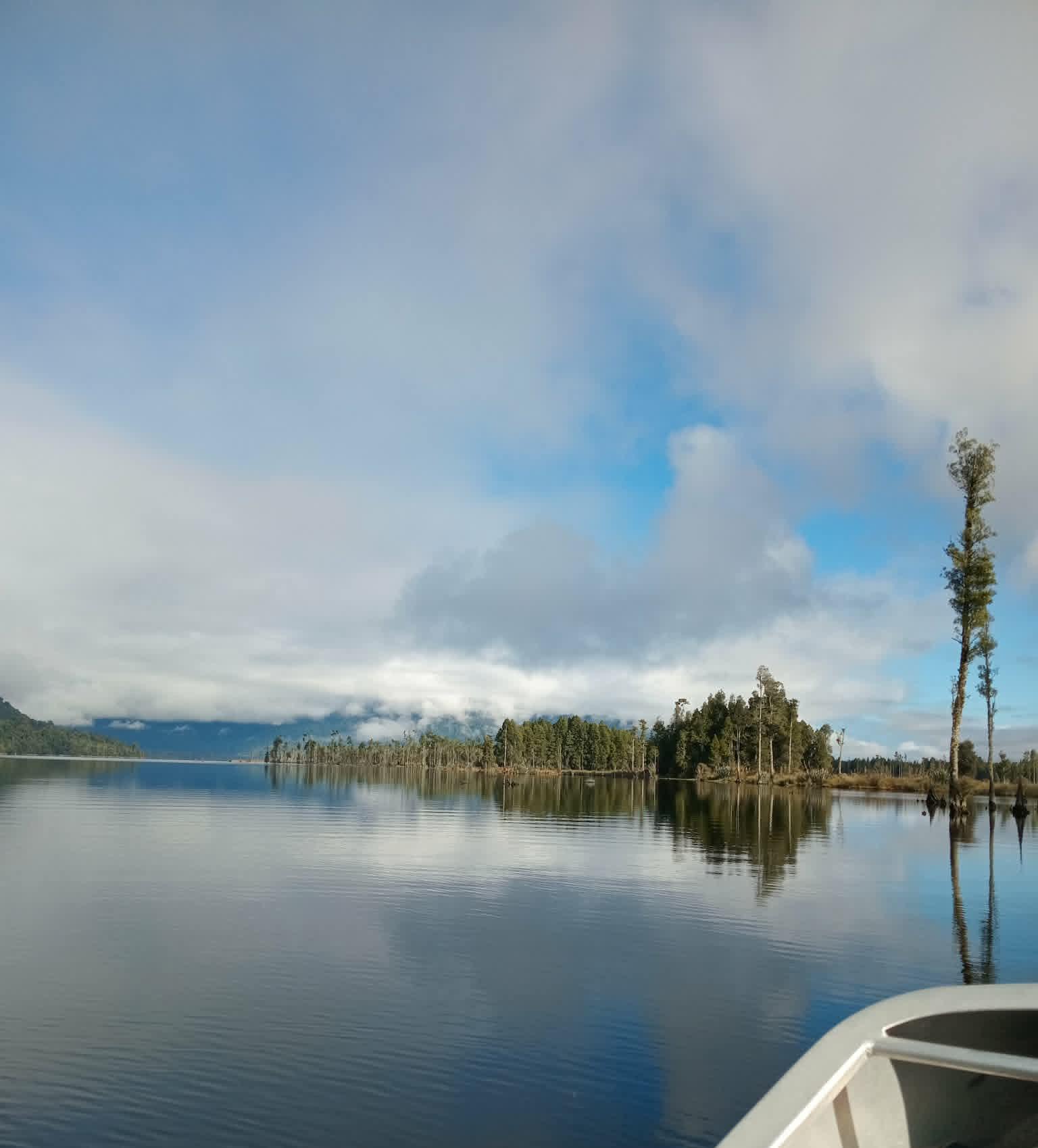
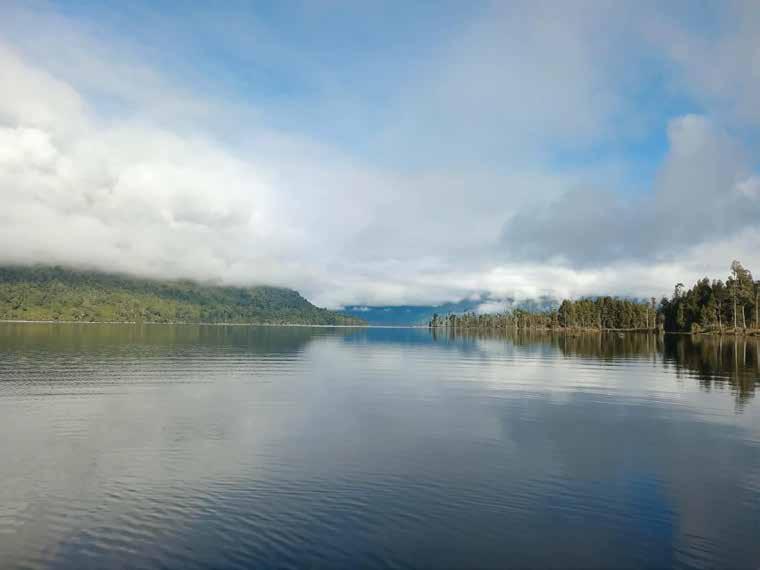
For a while it felt like I was back in Ireland where this sort of thing was an everyday occurrence. On one particular day we came across 23 tractors on the narrow country roads and we developed a saying of “ABC,” (another b----tractor) The fog was left behind by the time the lake was reached and the water was absolutely still, while the parking area had only 2 other vehicles with trailers, which augured well for a peaceful day of well-being enhancing, fishing. Five bucks in the honesty box at the ramp, then it was time to chug quietly out past the 5 knot buoys and onto a still, flat expanse of water with only the 2 other boats visible on the far distant shoreline of the bay.
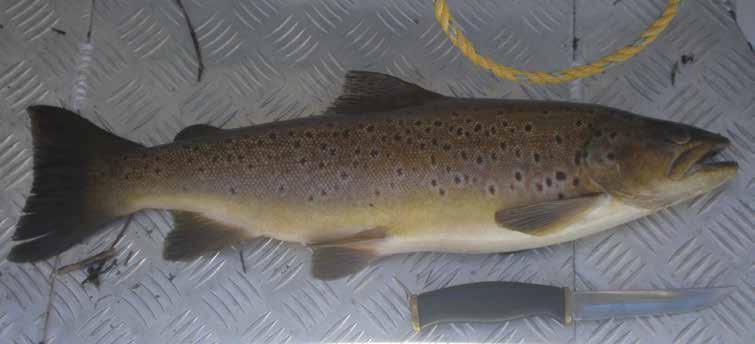
It was a very nice West Coast Winters day and I began with a gaudy red and yellow streamer, but after a while got that feeling you sometimes get, that it was not going to be the goods, so I lost confidence in it and changed to a smallish Mrs Simpson. I rowed along for a bit, with the fly out the back harling, until I reached another favourite spot, where I found Mrs Simpson to be reluctant to immerse herself properly below the surface, however persistence paid o and she began to do what was required. Working along the edges and casting ahead of the boat brought a swirl and suddenly it was fish on, with a very lively Brunner brownie making determined runs and performing aerial displays, but it was eventually tamed, netted and successfully released. Shortly after that I lined a fish that was possibly the same one resting in the shallows, then still along the shallow edges, another rose to the fly close to the boat but scarpered away without eating the Mrs
Simpson. Another swirl indication and I thought I would be in again, but during the process of getting the fly out it somehow wedged
a little surprised to experience it in Winter. However it gave an opportunity to drift back with it, along a section of the edges
it’s good to have a pleasant chat about this and that, which is yet another positive aspect of being out there and doing it.
in the bow rope and before I could extricate it the fish moved elsewhere. I rowed quietly into a side channel where 2 trout finned rapidly away to deeper water, but it was heartening to know fish were about. A slight breeze began to ripple the water and with a check on the time I saw it was just on 1pm, which is the usual time for the sou-westerly to spring up on Brunner in Summer, so I was
I had yet to try that day. A few casts brought a subtle take and a vigorous fight followed, then it was netted, but then it leapt clear of the net and was played out again. The fly was too far down to extract so I decided it was a catch and keep fish, which pleased my Wife as she often asks if I’d brought a fish home. Back at the ramp I met a visitor from over the hill putting his boat back on the trailer, so when fishermen meet
So how long was I out there? Didn’t watch the clock too closely but it would only have been around 3 hours and for a last minute decision to go fishing it was not a bad piscatorial experience. As I said to the visiting fisho’ at the ramp,”It doesn’t take all day to catch a fish.”
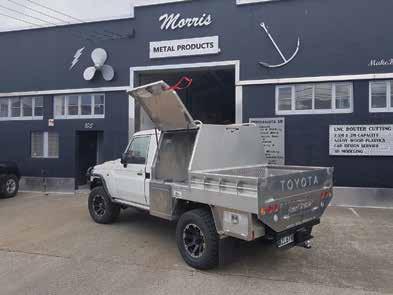
Exceptional Ute & Station Wagon Fit-outs
Whether you’re a skilled tradesperson, a DIY enthusiast, or just a fan of utes, our custom fit-outs are tailor-made to elevate your road transport experience. Our fit-outs not only meet but often exceed expectations in terms of quality and aesthetics.
We take pride in collaborating with you to design the perfect deck or canopy, whether it’s transforming your hand-drawn vision into reality or utilising our cutting-edge SolidWorks design system to bring your ideas to life.
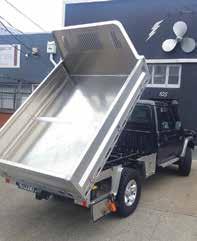
Our fit-out solutions include toolboxes, fold-down sides,
hydraulic lifts, H-frames, slide out drawers and more to make the most of the space in your vehicle. We’re your one-stop solution for all your transportation needs.
Precise fit-outs, even before your Ute Arrives
If you haven’t taken delivery of your ute yet, we can still get to work. With just the make and model information, we can now digitally import the specifications and design the perfect canopy in consultation with you. Our advanced technology allows us to create a vivid image, o ering you a clear preview of the final result. We meticulously check
tolerances to ensure a seamless fit between the body and cab while optimising wheel travel. When your ute finally arrives, we can e ortlessly install the canopy, making your vehicle road-ready in no time.
Rely on Aluminium Excellence
Our fit-outs are crafted from premium aluminium, the ideal material for utes. We utilise heavygauge aluminium to withstand the toughest challenges and work life. Lightweight yet incredibly robust, our fit-outs are built to last and engineered for their intended purpose. Moreover, aluminium is corrosion-resistant, ensuring that your fit-out remains impervious to various loads.
Wagons
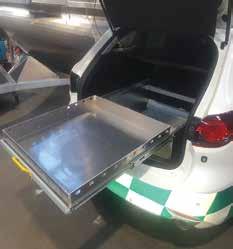
If a custom high quality sliding drawer for your wagon is what you’re after, we can do this for a side or back opening door. We use sturdy, customised parts so your drawer glides with ease, to make the most of hard to reach places. Game changer.
An example we’re very proud of is the drawers in a fleet of ambulance First-Responder utes to make access to key materials easier for paramedics.
Choose our fit-outs to enhance the functionality and durability of your ute. Contact us today to discuss your specific requirements and take your road transport to the next level.
Paddle Crab Adventures
I have spent many hours catching (and eating) Paddle Crabs (Ovalipes catharus) when staying ar my house in Stephens Bay. Over the years I perfected techniques in catching and cooking these. Here are the details for catching and cooking the beasts as there are few of them left now following the proliferation of snapper who also enjoy eating them.
I looked up catching and cooking them on the internet and saw some very poor techniques used. Using a drag net or spear is hopeless. When fishing close to the coast crabs sometimes take the bait. When pulling them up to the boat, they let go of the bait when they break the surface of the water. If you give them a flick as they approach the boat they fly into the lap of boat passengers as the crab lets go the bait. Very amusing. Catching a net full in a net is not very good as they are di cult to get out of the net and they are still very active. They are best removed from the net by driving a tractor over them to crush the shells.
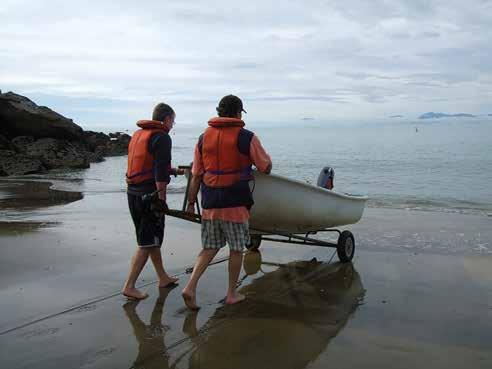
I performed my crab harvest from my dinghy (named Dinghy McDingface) powered by an outboard motor. Initially I had an engine with a reverse gear and neutral t but it was later replaced with a 2hp with only a forward gear. The bigger engine with gears was much better for crab fishing allowing me to get directly over the ring net. I went crab fishing at the edge of the estuary beyond the outlet of the Riwaka River at Big Rock, I would catch them at the top of the tide when there is little water flow into the estuary.
Comercial fishermen set cage pots along a line of the estuary edge from the outlets of the Motueka to the Riwaka Rivers. I caught mine using a pair of ring nets / pull pots. These are made by lashing used trawler netting to a circular ring made from steel reinforcing rod. Initially the netting was lashed on with twine but nylon cable ties can be used. Bait is put into a bag made of “gutter guard” tied to the center of the net, Oily fish is good bait, especially salmon. Dog saus and squid bait is not ‘good bait. The ring nets need no raised edges. The crabs stay on the net by it’s speed when pulled up. The ring is held by three ropes around its perimeter and then a rope to a float at the surface, Two nets are usually enough –one attracts the crabs while the second is pulled up. The dinghy is manoeuvred directly above the nes which is then pulled up. The large crabs are kept while the
John Ryder
smaller ones are released. After this I shift to the second net and repeat the process. In the plentiful days I would catch a fish case of crabs in a hour.
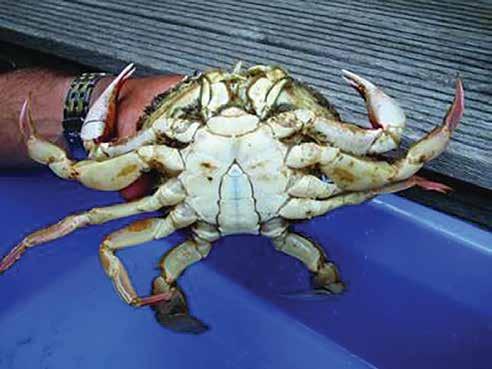
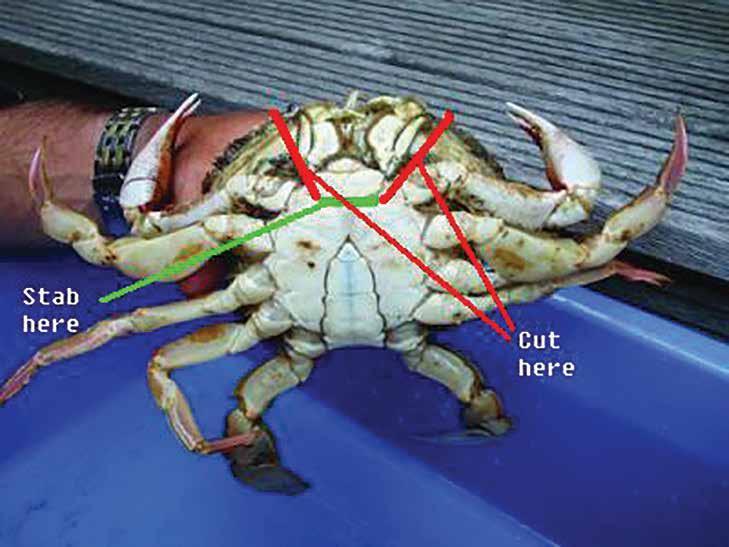
spines) but is much tastier. About October each year they moult. The moulted crabs look very clean, Those prior to moulting have dirty looking shells. The dirty ones are much nicer to eat than the newly moulted ones. These clean ones have soft tasteless flesh. If you are o ered crab at this time of year, always choose the dirty shelled ones. There are a few tricks in cleaning Paddle Crabs. Firstly, only take the large beasts. The smaller ones yield much less flesh for the same amount of work and they are more active with their pinchers. I like to bleed crabs. Live crabs die much quicker and can then be handled. Bleeding them is performed with a thin pointed knife through the belly. Clear liquid escapes. This (probably) is blood. If this is not done stored crab flesh develops black bits the following day. This does not a ect the taste but the product looks better without black bits. The next step is to remove the top shell. This is a harder task on uncooked crab. Lift the shell from the back edge. Take o the mouth parts and the gills. Scratch out the gut. The meat in the crab legs is thin and di cult to extract. Cut the legs o with secateurs and discard them. However the pincers have a decent sized meat portion which is very tasty so they can be left on However the shell over them is thick and strong. I have a special pair of pliers to crack them open. The crabs can now be broken in two down the middle. The crab is now ready for cooking.
are
to eat. A large paddle crab has about as much meat on it as a minimum legal crayfish (60mm across the tail
I have tried cooking crab in the microwave and by steaming. Neither of these methods are worthwhile. Boiling in salted water is the preferred method. Whole crab stinks when boiled but cleaned crab does not and can be cooked inside without complaints. A large container of water is brought to the boil and the crab portions are put in. Double the amount of crabs can be put in if the legs are removed, Another reason for removing them. The container (with lid on) is then brought back to boiling and boiled for about two minutes (even if the internet says 10 or 15 minutes) and the boiling water is tipped out and the crab cooled in cold water. The crab is dried out before chilling it in the refrigerator. Remember these instructions if paddle crabs become plentiful again. I gave up catching them some ten years ago when it took me 1½ hours to catch a measly six crabs of a size that I would previously not have kept. I don’t think there are any commercial crab fishermen left.
Cooking Paddle Crabs Paddle Crabs
delicious
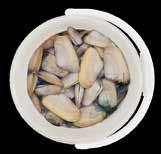
Fishers who took too many or undersize pāua, too many tuatua and cockles have earned thousands of dollars in fines, along with community work.
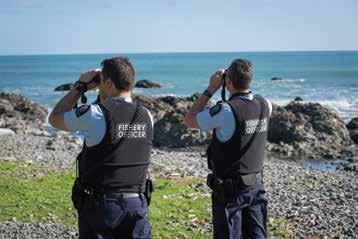
“People who choose to ignore the fishing rules need to know there will be consequences. Our job is to protect fishing resources so that everyone can enjoy the opportunity to put fresh kaimoana on the dinner the table,” says Fisheries New Zealand’s Director of Fisheries Compliance, Steve Ham. The following cases were before the courts over the past month.
A 35-year-old Napier man was ordered to do 100 hours of community work by the Hastings District Court. The man took 43 pāua of which 38 were undersize. He had his catch inspected by Fishery O cers in January this year. The daily limit per person for taking pāua is five at a minimum size of 125mm.
A 46-year-old Balclutha man was fined $1050 in the Dunedin District Court for taking 56 pāua from Kaka Point in November last year.45 of the shellfish were undersize. The man had his catch inspected by Fishery O cers. The daily legal limit per person for taking pāua in this area is 10 at a minimum legal size of 125mm.
A Northland couple, aged 70 and 64 have been fined $1000 in the Kaitaia District Court for taking 915 tuatua. The couple were gathering tuatua in January this year at 90 Mile Beach and had their catch inspected by Fishery O cers. The daily limit for taking tuatua per person is 150.
Two Waitara men aged 37 and 44 have each been ordered to do 100 hours community work by the New Plymouth District Court. The men were gathering pāua in November last year from a reef at Rahotu in Taranaki. Fishery O cers were alerted to their fishing activities through the 0800 4 POACHER hot line. The men had 338 pāua and 199 were undersize. The daily limit per person in this area is five per person at a minimum length of 85mm.
A 25-year-old Auckland man was fined $1100 in the Manukau District Court for his part in taking 542 mussels from 90 Mile Beach. Two other men involved are still before the court. They were stopped by Fishery O cers in February this year. The daily limit per person for taking mussels in the area is 50. The 392 mussels they were not entitled to, were returned to the sea.
A 51-year-old Wellington man has been fined $1250 in the Wellington District Court for taking 32
undersize pāua from Breaker Bay. The man had his catch inspected by Fishery O cers in February this year. The daily limit per person for taking pāua in this area is five at a minimum size of 125mm.
Two Aucklanders aged 34 and 35 were each fined $750 in the Papakura District Court for jointly taking 715 cockles from a closed area. The pair were stopped by Honorary Fishery O cers in December last year at Umupuia Beach. The closure to taking cockles has been in place since 2008.
Three people from Northland and Auckland, aged 46, 28 and 25 have each been fined $1100 in the Dargaville District Court for their part in taking 200 undersize pāua from Kawerua in October 2024. They had their catch inspected by Fishery O cers. The daily limit per person at the time was 10 pāua at a
minimum size of 125mm.
A 47-year-old Taranaki man has been fined $2500 in the Hawera District Court for taking 55 pāua with 40 of the shellfish undersize. Fishery O cers responded to a call from a member of the public in November last year and inspected the man’s catch, taken from a reef at Pihama. The daily limit per person in this area is five pāua at a minimum legal size of 85mm.
“If you’re unsure of the fishing rules in the area you plan to fish, get the most up-to-date fishing rules by downloading the free NZ Fishing Rules mobile app. It will also work if you are fishing in an area with limited mobile coverage,” says Mr Ham.
We encourage people to report any suspected illegal activity through the Ministry for Primary Industries’ 0800 4 POACHER line (0800 476 224).
HUNT LIKE A PRO
Made in Europe
Chosen by professionals
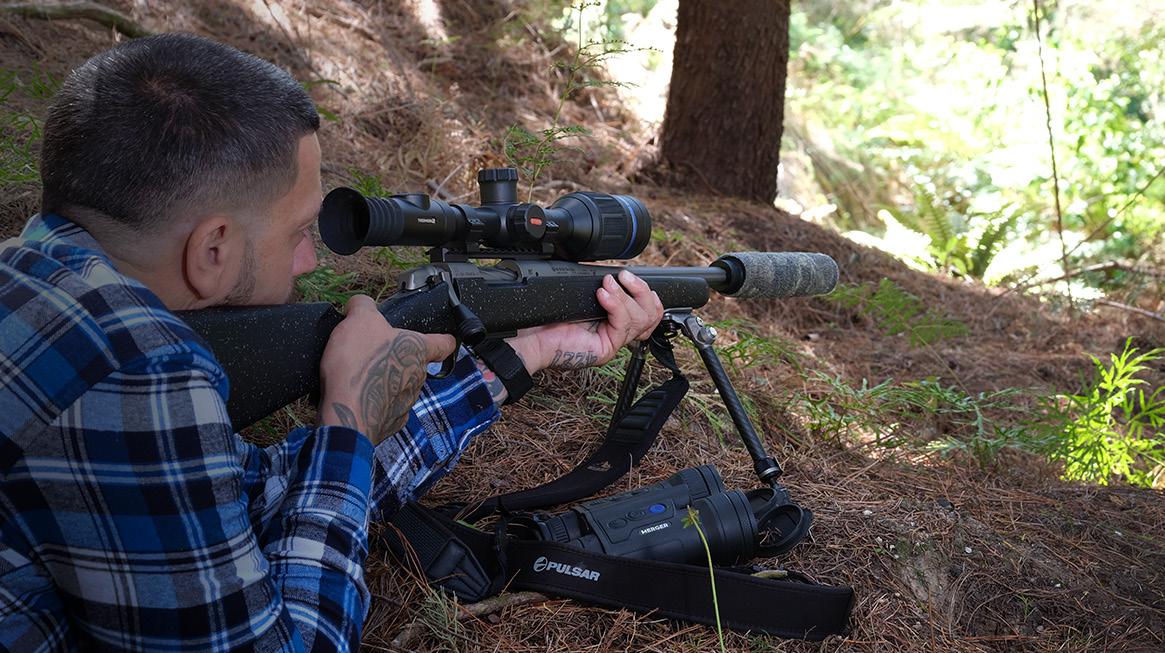
Pulsar thermals are the first choice amongst professionals.
Our great range starts at $2599, representing great value for high quality, proven, European made thermal optics with advanced Lynred sensors.
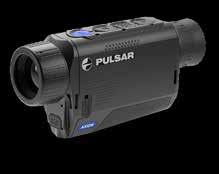
HAND-HELD THERMALS
PULSAR AXION COMPACT
Lightweight, quick-change battery, robust and outstanding performance. Perfect for bush-stalking, forestry and general use. Great value.
Choice of 384x288 or 640x480 sensors.
From $2599.00
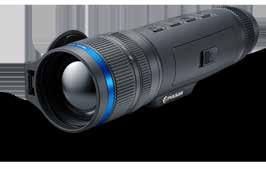
PULSAR TELOS
Outstanding performance at long and short distance.
High capacity quick-change battery very lightweight. Available with 1000m laser rangefinder.
Choice of 384x288, 640x480 or 1024x768 sensors.
From $3999.00
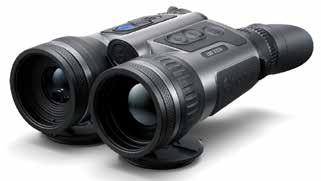
PULSAR MERGER LRF
Immersive, comfortable viewing experience, up to 1500m laser rangefinder, high capacity quick-change battery with internal back-up, delivers the very best performance.
Choice of 640x480 or 1280x1024 sensors.
From $6799.00
THERMALS RIFLESCOPES
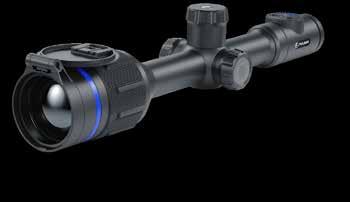
PULSAR THERMION
Professionals favourite. Quick-change battery with internal back-up, 30mm tube and integrates with Stream Vision Ballistics for reliable shot placement. Available with 1000m laser rangefinder.
Choice of 384x288, 640x480 or 1024x768 sensors.
From $5399.00
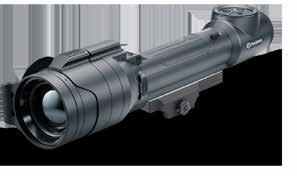
PULSAR TALION
Compact, quick-change battery, QD mount and integrates with Stream Vision Ballistics for reliable shot placement.