


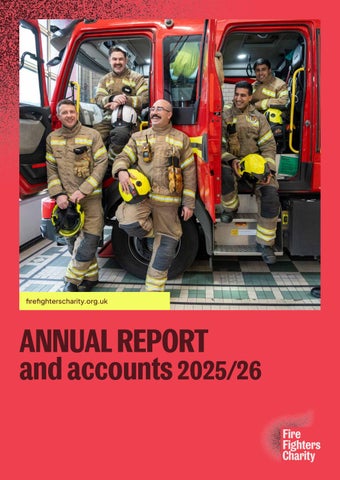
Demand is rising faster than ever. We’ve responded by growing at pace while protecting quality. Now we’re moving from being a charity that responds to need to becoming the UK’s leading specialist health and wellbeing partner for the fire services community.

Sherine Wheeler, Chief Executive
Every day, people across the fire services community face situations most of us hope never to encounter. In protecting others, they are exposed to experiences that can have lasting consequences for their health, wellbeing and family life. Some impacts are immediate; others emerge years later, long after a career has ended. Behind every uniform is a person, a family and a life beyond work, and our role is to help them navigate the physical, emotional and social challenges that service can bring.
For nearly 85 years, Fire Fighters Charity has stood alongside those who serve, providing independent, confidential and specialist support to serving and retired personnel and their families. Our purpose is clear: to provide tailored, independent and timely care and support to everyone in the fire services community.
Thanks to the generosity of our supporters, we helped 13,507 people during 2025/26 - an increase of 31% on the previous year. Behind that figure are thousands of individuals and families who received the care, advice and practical assistance they needed to navigate some of life’s most difficult challenges. It was a landmark year for the charity. We reached more people than ever before and achieved our strongest year for income to date.
These achievements are encouraging, but they must be viewed in context. Demand continues to rise, the needs of those seeking our support are becoming increasingly complex, and the wider operating environment remains challenging for both the fire sector and charities across the UK.
Against this backdrop, we continued to strengthen our foundations. Building on the
We helped 13,507 people during 2025/26 AN INCREASE OF 31% on the previous year.
investment made in 2024/25, we increased our capacity to extend our reach while maintaining the quality of support on which our reputation is built. Expanding our impact while progressing towards greater financial resilience and sustainability remains one of our key priorities.
Throughout the year, I have seen first-hand the difference that timely, tailored intervention can make. Whether helping someone recover from injury or illness, supporting them through trauma, strengthening their wellbeing before problems escalate, or enabling a smoother transition into retirement, the outcomes can be life-changing. We regularly hear from people who tell us that the care and support they received restored their confidence, renewed their hope and helped them feel better equipped to move forward through periods of uncertainty.
While we remain committed to supporting people through injury, illness and crisis, we are increasingly focused on prevention and early intervention. Helping people maintain their physical and psychological wellbeing, build resilience and access support sooner improves outcomes and reduces the longterm impact of the challenges they encounter throughout their careers.
Looking ahead, our ambition is clear. We will continue to expand our reach, strengthen our income base and make our services more accessible, including through digital channels that enable people to access support wherever and whenever they need it.
Summer 2026 marks an important milestone as we launch our new Strategy 2026–2030 and refreshed brand. Together, they provide a clear framework for extending our reach, increasing our impact and ensuring more
people across the fire services community can access the support they need to live well.
As the sector evolves, our strategy sets out how we will build on our strong foundations to deliver relevant, timely and effective services. Our refreshed brand will help us communicate our purpose more clearly, raise awareness of the support available and strengthen engagement with both those we serve and those who support our work. This investment has been made possible through a transformational legacy gift received in the previous year, enabling us to position the charity for even greater impact in the years ahead.
Our ambitions extend beyond the services we deliver. We also see an opportunity to contribute more broadly to the future of workforce wellbeing across the fire sector. By sharing insight and evidence, championing best practice, and building on our expertise in rehabilitation, trauma recovery and family support, we can help advance a more consistent and effective approach to wellbeing and post-incident recovery nationwide. Realising this ambition will require investment and collaboration, but it is closely aligned with both our purpose and the evolving needs of the community we serve.
I am confident that Fire Fighters Charity can play an even greater role in the years ahead - not only by responding to need, but by helping shape a future in which wellbeing, recovery and resilience are recognised as fundamental to operational effectiveness, leadership and public service. Those who dedicate their lives to protecting others deserve access to the care and support they need to thrive, throughout their service and beyond. With a clear sense of purpose, strong partnerships and the continued support of our stakeholders, we can help build a stronger, healthier and more resilient fire services community for generations to come.
My sincere thanks go to our supporters, staff, volunteers, partners and colleagues across the fire services community. Your commitment, expertise, generosity and belief in our purpose make this work possible. The pages that follow demonstrate the difference you make every day.

Sherine Wheeler Chief Executive

John Baines, Chair of the Board of Trustees
This has been a year of continued growth, development and impact for the charity. Demand for our services has increased across many areas of our work, reflecting both the challenges faced by members of the fire services community and the growing awareness of the support available to them. In response, we have remained focused on ensuring that our services continue to evolve, expand and deliver the highest standards of care.
The charity has continually evolved to meet changing needs since it was founded, combining expert clinical care, practical assistance and wellbeing services with an increasingly accessible digital offer that enables more people to access support in ways that work for them.
As Chair, I am proud of the difference the charity continues to make. Demand for our services continues to grow, and throughout the year our focus has been on ensuring we can meet more of that need while preserving the quality, independence and compassion that define our support. The progress we have made reflects the dedication of our staff and volunteers, the strength of our leadership, and the trust placed in us by service users, supporters and partners.
These achievements are underpinned by careful stewardship. The Board remains firmly focused on ensuring the charity is financially resilient, operationally effective and well positioned for the future. As the fire sector evolves, so too must the support available to
I am proud of the difference the charity continues to make.
those who serve within it. Our new Strategy 2026-2030 provides a clear framework for building on our strong foundations, extending our reach and ensuring that more members of the fire services community can access relevant, timely and effective support. Alongside this, our refreshed brand will help raise awareness of the charity, strengthen engagement with those who may benefit from our services and inspire support from those who make our work possible.
Throughout the year, I have been reminded that every request for support represents an individual story: a person, a family and a set of circumstances that deserve care, dignity and understanding. It is this human impact that lies at the heart of our purpose and continues to inspire everyone involved in the charity's work.
What continues to inspire me most is the resilience of those we support and the dedication of those who make that support possible. Together, we are helping to ensure that no member of the fire services community faces life's challenges alone.
Our success is rooted in the commitment and expertise of our colleagues across the UK, led by our Chief Executive, Sherine Wheeler, and the Senior Leadership Team. From our clinicians and wellbeing specialists to colleagues working across fundraising, finance, operations and support services, every person plays a vital role in delivering the care upon which our community relies. I would also like to thank our volunteers, whose
generosity of time and experience extends our reach and strengthens our connection with the fire services community.
My sincere thanks also go to our supporters, Company Members, Life Patrons and fellow Trustees. Your generosity, guidance and commitment continue to strengthen the charity and enable us to look to the future with confidence.
This year also provided an opportunity to celebrate important milestones in our history. It was a privilege to mark the 30th anniversary of Jubilee House and the launch of The Graham Gash Wing, made possible through an extraordinary legacy gift. We also celebrated the 60th anniversary of Marine Court, with both occasions bringing together representatives from across the UK fire services community. These milestones were a reminder not only of our rich heritage, but also of our responsibility to steward this remarkable charity for future generations.
Together, we remain committed to ensuring that everyone who dedicates their lives to protecting others has access to the care and support they need to live well, throughout their service and beyond.

John Baines Chair of the Board of Trustees
Every number in this report represents a person, a family or a life changed. Thanks to the generosity of our supporters and the dedication of our staff and volunteers, we were able to help more people than ever before.
During 2025/26, 13,507 people received our care and support – 31% more than the previous year. Behind that growth are thousands of individuals who accessed the healthcare, wellbeing and practical support they needed to be fit and well, recover from injury or illness, build resilience and move forward.
Demand for our services continues to grow, but so does our determination to be there for everyone who needs us. The figures on this page demonstrate both the increasing need across the fire services community and the growing impact of the support we provide together.
Over the past year, we saw:
49%
growth in wellbeing support through visits to our centres and attendance at community-based programmes.
25% increase in practical support provided, including financial assistance.
64% increase in personal wellbeing resources accessed online.
10% increase in demand for psychological care, alongside increasingly complex needs.
13,507 people received our care and support – 31% more than the previous year.
2,164 individuals benefitted from physical care and support.
1,478 individuals received psychological care and support.
151 individuals were supported by our nursing team at Jubilee House.
242 individuals contacted our Crisis Line.
1,422 individuals accessed our online suicide prevention and postvention resources.
204 individuals are registered on our Service User Experience Panel, helping shape and improve our services through their lived experience.
1,192 individuals attended a Rest and Recharge stay.
495 individuals took part in one of our 23 Living Well Groups.
18 individuals received a total of 587 telephone befriending calls.
1,556 individuals attended 303 Wellness Workshops delivered across the UK.
1,612 individuals used our Mental Health SelfAssessment Tool.
404 individuals participated in our HOPE Programme.
1,260 individuals received information, advice and signposting.

Our two-year Strategic Plan, launched in 2024/25, set out four strategic priorities to strengthen the charity, extend our reach and help more people access timely, tailored and independent care and support. Over the past two years – and particularly throughout 2025/26 – we have made significant progress against those ambitions, creating a strong foundation for our Strategy 2026-2030.
Since 2024/25 we have:
Increased the number of individuals we supported by 31%, reflecting rising demand, increasingly complex need and how we have successfully scaled our services to meet it.
Grown our gross fundraising income by 12%, enabling us to support more people while investing in specialist care, services and digital tools.
Increased gross earned income by more than 13%, strengthening and diversifying our income while supporting future service development.
Maintained a highly engaged workforce, with 93% of colleagues who took part in our staff survey saying they are proud to work for Fire Fighters Charity - an essential foundation for delivering consistent, compassionate care.
Together, these achievements have strengthened the charity and provided the platform for our Strategy 2026-2030, setting out an ambitious vision for the future health and wellbeing of the fire services community.
Our Strategy 2026-2030
Fire Fighters Charity is the UK’s national, independent healthcare and wellbeing provider for the fire services community. We support serving and retired personnel, together with their families, across all four nations and every one of the UK’s 52 Fire and Rescue Services. Our care is confidential, free of charge and delivered without judgement - always.
Today, we are here for around 360,000 people across the UK. We estimate that almost 88,000 of them are likely to need healthcare or wellbeing support in any given year.
In 2025/26, we supported 13,507 people - around 15% of that estimated need. We are growing rapidly, but the gap remains significant. Existing routes to care cannot always provide the timely, tailored and trusted support our community needs.
Our strategy sets out three clear commitments.
Double our reach
By 2030, we will support more than 27,000 people every year - around 30% of estimated annual need.

Building on the progress of recent years, we will continue to grow both voluntary and earned income, improve productivity and bring our cost base into balance with income so that future growth is sustainable.
Build the evidence that improves practice
We will strengthen how we measure our reach and impact, work in partnership on research, and share what we learn to help shape good practice across the fire sector.
To deliver these commitments, we have identified five strategy goals:
Putting the fire services community at the heart of everything we do.
Becoming more evidence-led.
Transforming healthcare and wellbeing support.
Preventing poor health and wellbeing.
Achieving financial sustainability.
By the end of this strategy, more people across the fire services community will be receiving faster, more tailored and more accessible care, while the charity stands on a stronger and more sustainable financial footing.
93%
of colleagues who took part in our staff survey saying they are proud to work for Fire Fighters Charity

Our income
Commercial and trading activities
£1,686,163
Investments
£506,021
Charitable activities
£244,115
Donations and legacies
£8,333,679
Our expenditure
Fundraising
£2,957,728
Investments
£94,151
Clinical care
£5,405,377
Trading activities
£716,910
Information and advice
£461,418
Practical support
£732,258
Wellbeing support
£2,424,994
Even the bravest among us need support – especially when the demands of life in the fire service begin to take their toll. Throughout this year, we have seen a continued rise in complex mental health and wellbeing needs across our community.
Across society, people are living through increasingly challenging times. For those in the fire services community, those pressures are compounded by the unique demands of the job: long and unpredictable shifts, exposure to traumatic incidents, and the lasting physical and psychological impact of what they see and do.
The nature of operational work is changing too. Fire and rescue personnel are responding to more climate-related incidents, including floods and wildfires, alongside increasing numbers of medical emergencies and suicides as pressure on statutory services continues to grow. Every incident brings its own physical, emotional and psychological demands.
Historically, the mental health, fatigue, trauma and rehabilitation needs of fire and rescue personnel have too often been viewed as welfare issues. As the sector continues to evolve, we believe they should increasingly be recognised as matters of operational effectiveness, leadership, workforce sustainability and public protection. Fire Fighters Charity is uniquely placed to support that shift through our sector expertise, national reach, trusted relationships and specialist infrastructure.
That is why our role has never been more important. As the UK’s only charity dedicated exclusively to supporting the health and wellbeing of the fire services community and their families, we provide expert, independent and trusted care whenever it is needed.
1. Need is rising - and becoming more complex
People serving in fire and rescue face growing physical, psychological and social challenges throughout their careers and into retirement. Emerging evidence - including research into occupational exposure to carcinogens - is changing our understanding of the support people need. Retirement can bring additional risks of isolation, depression and relationship pressures, while wider economic uncertainty and cost-of-living pressures continue to affect individuals and families across the UK.
2. Existing provision cannot meet every need
For some people, the workplace will never feel like the right place to seek help, however strong employer support may be. At the same time, NHS services continue to face rising demand, higher referral thresholds and longer waiting times. As a result, many people struggle to access timely, confidential and trusted support. Working alongside employers and statutory services, an independent charity has a unique role in helping to close those gaps.
3. Prevention remains under-developed
Much of the support available across the sector remains reactive. Greater investment in prevention, early intervention and helping people navigate available support would improve outcomes and reduce the long-term impact of physical and psychological ill health.
4. The evidence base needs to grow
There remains limited shared evidence about who is accessing support, who is missing out and which approaches deliver the greatest impact. Strengthening that evidence base will improve services across the sector while helping increase understanding of the personal impact that serving in the fire service can have on individuals and families.
5. Demand continues to outpace capacity
During 2025/26, we supported 13,507 people - around 15% of that estimated need. While this represents growth of around 40% over the past two years, demand for timely, trusted and independent support continues to grow faster than any single organisation can meet alone.
Three external factors shape both our work today and the assumptions underpinning our Strategy 2026-2030.
1. Fire and rescue sector
The sector continues to operate under sustained pressure. Workforce numbers are reducing while costs rise and operational responsibilities continue to expand, including climate-related emergencies and medical co-responding. Together, these pressures increase both the scale and complexity of health and wellbeing needs.
2. The wider healthcare system
We are part of a wider system of care. Statutory healthcare continues to experience workforce shortages, rising thresholds for treatment and long waiting times. As those pressures increase, more people seek timely, specialist support beyond traditional routes. Advances in genomics, research and artificial

intelligence offer significant long-term opportunities, but their benefits will take time to be realised and are unlikely to be felt equally across every community.
3. Funding
Around 80% of our income comes from the generosity of supporters, many of whom are themselves part of the fire services community. Their loyalty is one of our greatest strengths, but it also creates risk. Fundraising is becoming increasingly competitive, supporters rightly expect stronger evidence of impact, and wider economic conditions continue to place pressure on charitable giving.
The remaining 20% of our income is earned through trading activity. Growing this income is central to building a broader, more resilient financial base that enables us to meet increasing demand.
We have planned on the assumption that these pressures will continue throughout the life of our strategy. That is why efficiency, innovation, sustainable growth and income diversification are built into our plans, ensuring every pound delivers the greatest possible impact while bringing our cost base into balance with income by 2030.
Navigating financial pressures in 2025/26
These growing demands come at a time when many of the people we support - and many of those who support us - are facing significant financial pressures. Rising living costs and economic uncertainty continue to affect households across the UK.
At the same time, the cost of delivering specialist healthcare and wellbeing services continues to rise. Strengthening fundraising, building long-term partnerships and diversifying our income remain essential if we are to protect our services and meet growing demand.
Three principles will shape the decisions we make throughout our Strategy 2026-2030.
Prevention alongside treatment. We will continue shifting our focus towards early intervention, helping people access support before physical or psychological conditions become more severe.
Digital and blended delivery alongside residential centres. Our residential centres remain fundamental to our offer. Future growth, however, will increasingly come through digital services and local community delivery, enabling us to support more people wherever they are.

Partnership-first delivery. We will continue working alongside Fire and Rescue Services, occupational health providers and sector partners to complement - not duplicate - the support already available.
Our unique contribution
Our independence is one of our greatest strengths. Because we are separate from individual Fire and Rescue Services, people can access confidential support without judgement, alongside employer and NHS provision.
We are the only organisation providing healthcare and wellbeing support specifically designed for the UK fire services community across all four nations and all 52 Fire and Rescue Services.
Through our three residential centres in Devon, West Sussex and Cumbria, together with an integrated digital offer, our registered psychological therapists, nurses, physiotherapists, exercise therapists and wellbeing coaches deliver clinically expert care grounded in a genuine understanding of fire service life.
Nearly 200 employees and thousands of volunteers make that support possible across the UK.
Our Service User Experience Panel, established in 2024, ensures that the lived experience of those we support continues to shape our decisions, services and priorities. Service users often tell us that our care represented the difference between darkness and light.
Our purpose remains unchanged: to stand alongside those who serve - and those who have served - with expert, compassionate support at every stage of life. We also know that the impact of service extends beyond the individual to the people closest to them.
That is why, this year, we launched new research exploring the experiences of partners and loved ones through our Thriving Relationships project, helping us better understand and respond to the needs of the whole fire family. You can read more about our Thriving Relationships project on page 27.
The impact of serving in the fire service can take its toll – sometimes immediately, sometimes many years later. Throughout 2025/26, demand for our specialist healthcare services continued to grow, particularly for psychological support, reflecting both rising need and increasing complexity.

As more people turned to us for help, we continued to develop our clinical services to ensure support remained timely, accessible and centred around individual need. Drawing on more than 30 years of experience in rehabilitation and recovery, we combine clinical expertise with a deep understanding of the realities of fire service life.
Psychological care and support:
Demand for psychological support continued to rise throughout the year, placing increasing pressure on our services. We have continued to prioritise those with the greatest clinical need through robust triage, while increasing capacity and streamlining referral pathways to reduce waiting times further during 2026/27.
Our average wait for an initial assessment with one of our psychological therapists was 19 days. Many of those who come to us tell us they have faced significantly longer waits elsewhere, particularly for specialist trauma-focused support.
During the year:
242 people contacted our Crisis Line, demonstrating the importance of having immediate, compassionate support available when it matters most.
1,478 individuals received specialist psychological care and support, reflecting both increasing demand and the vital role we play in providing accessible mental healthcare tailored to the fire services community.
446 individuals attended one of our residential psychological wellbeing programmes, including our Reset Programme, targeted weeks and Transitions into Retirement Programme, helping them build resilience, strengthen their wellbeing and return to everyday life with greater confidence.
Physical care and support:
Demand for physiotherapy and rehabilitation also remained high throughout 2025/26. As more people sought support, waiting times increased. In response, we have continued improving scheduling, strengthening clinical pathways and expanding digital appointments where appropriate, helping us increase access while maintaining safe, high-quality care.
During the year:
2,164 individuals received physical care and support.
1,289 individuals engaged in physical rehabilitation at one of our residential centres.
This included 54 people attending one of our Kickstart programmes, designed to improve physical fitness, confidence and long-term wellbeing.
By offering multiple pathways into rehabilitation, we are able to tailor support to individual circumstances while helping people recover more quickly and return to healthy, active lives.
Nursing care:
Our nursing team continues to provide compassionate, specialist care for people living with complex health conditions.
During 2025/26:
151 individuals received nursing care at Jubilee House, supporting them with their quality of life.
We delivered 7 residential Falls Management Exercise (FaME) programmes for 24 individuals, helping improve strength, balance and confidence while creating valuable peer support and lasting friendships.
Across every area of our clinical work, our focus remains the same: delivering expert, person-centred care that helps people recover, rebuild confidence and live wellthroughout their service and beyond.


2,164 individuals received physical care and support

The job we do is hard – it’s stressful – and I think it’s just so important to keep an eye on your mental health. It’s quite easy just to say, ‘I’m fine’. But I think we need to step away from that and, if you do need help, get it. The charity is there for us. It’s done me the world of good. I’m better at home, I’ll be better going forward and I’ll be better for my daughter.
From joining the fire service as a cadet or a new recruit, through to retirement and the years that follow, we’re there every step of the way – with tailored care and support.

Whether it’s a new recruit adapting to long shifts, a firefighter or control officer facing the demands of the role, retired personnel adjusting to life beyond service, or a family member standing behind them throughout, we continue to develop our support for each of them - meeting them where they are.
And that support starts from the moment they join the fire services community.
This year, we launched a ‘Developing Resilience’ workshop for new starters in the fire service, offering 439 new recruits wellbeing support and guidance to help them navigate their careers from day one.
We also continued to receive excellent feedback from families supported through targeted weeks at our centres.
And thanks to the continued support of the Wimbledon Foundation, we offered a range of support to people navigating retirement - from the transition into service exit through to later life.
Promoting wellness from the start: 1,556 individuals attended one or more Wellness Coaching workshops throughout the year, a 26% increase on the year before.
303 wellness workshops were delivered across the UK, including 283 delivered directly to 36 Fire and Rescue Services, alongside 20 open access workshops. Delivering sessions in the workplace means people can access support aligned to their shifts.
increase in number of attendees at one or more Wellness
workshops, on the year before

439 individuals attended our New Recruits workshops, gaining tools to manage their wellbeing from day one and helping to prevent challenges later on.
Here for the whole family:
This year, 5 Families Weeks were held outside of the summer months, including dedicated sessions for single-parent families. A total of 36 families (57 adults and 74 children) attended. In addition, family-specific Rest and Recharge breaks were offered in August, with dedicated activities included.
1,192 individuals, including family members and carers, attended a Rest and Recharge stay at one of our centres – a chance to step away from routine in a relaxed environment.
Adapting to and embracing retirement:
We hosted 6 Transitions into Retirement Programmes at our centres, with 37 attendees. We recognise that life in the fire service is more than a job and leaving can
feel unsettling. These programmes are designed to support that transition with confidence.
We hosted 15 pre-retirement wellbeing workshops, attended by 88 individuals, offering tailored guidance to reduce anxiety and support a smoother transition.
We now host 23 Living Well Groups (online and face-to-face), supporting 495 individuals. Two new groups launched this year, with 244 meetings held in total. These sessions help rebuild connection and routine, reduce loneliness and support healthier retirement.
We now have 15 volunteer telephone befrienders who made 587 calls in 2025/26 to 18 individuals, offering regular contact from someone who understands fire service life and helping to prevent isolation.
The FaME Programme really built my confidence and continues to push me. It’s been marvellous to build lasting friendships along the way.

Shirley Armitt, wife of Staffordshire firefighter
As part of the rise in demand across our healthcare and wellbeing services, we’ve seen an increase in the number of individuals self-directing to our resources, tools and support which can be accessed online.
Practical support and information & advice
This year, 7,529 people reached out to our Support Line and spoke to our independent, confidential and free-of-charge Intake and Navigation team - an 8% increase on the year before. Of these, 1,260 people received healthcare and wellbeing advice and information, reflecting the relevance and accessibility of our specialist knowledge for those affected by the physical, psychological and social impacts of fire service life.
For those needing longer-term support, our Welfare Team provided advice, information, signposting and practical assistance to 565 individuals and families, ensuring no one is left to cope alone. As financial pressures continue to rise across our community, this included supporting 107 people with financial solutions totalling £179K, including £124K in hardship support, £39K in adaptations and disabilityrelated equipment, and £16K in housingrelated solutions. This financial assistance helps individuals and families regain stability and move forward positively.


Demand for our digital resources also increased. Our website recorded over 156K visits, while 1,612 people used our mental health self-assessment tool - a 38% increase - with many reporting moderate to severe symptoms of anxiety and depression. This growing need led 1,179 people to access our Online Wellbeing Hub courses and bite-sized resources, with anxiety, low mood, workrelated stress and sleep among the most requested topics.
This wrap-around approach is what enables us to meet rising demand and deliver meaningful, lasting impact.
1,260
£179K
156K
individuals received personalised information and advice.
distributed in financial support to 107 people.
1,612
website visits, with 17K accessing wellbeing information (excluding Online Wellbeing Hub courses).
mental health selfassessments completed (a 38% increase on last year), with 20% reporting symptoms of both anxiety and depression.
1,179
404
565
online wellbeing courses and bite-sized resources accessed.
people took part in a HOPE Programme, including 82 in retirementfocused courses.
individuals and families supported by our Welfare Team with advice, information, signposting and practical assistance with everything from finances to home adaptations.
Our research partnerships help uncover how fire service life shapes wellbeing, relationships and recovery – ensuring our support continues to meet people where they are.

We’ve continued to expand our partnerships with academic and charity organisations to strengthen our research and expertise across the sector. These collaborations keep our work grounded in real-world need, with every project shaped by questions that matter to fire personnel, their families and the wider system.
This year, our flagship study on relationships within the fire community moved into its final stages, with a phased launch planned for 2026/27. A separate project exploring immersive simulation as a resilience training tool also progressed. Alongside these, partnerships with several universities continued to advance work ranging from return-to-duty pathways for injured firefighters to wellbeing in on-call and control room roles. A new Research Strategy, due for completion in the year ahead, will provide the framework for prioritising this work and translating findings into improved services.

We continued our Thriving Relationships project this year, the first UK study to look directly at how fire and rescue work shapes relationships and family life.
More than 500 people took part - serving and retired personnel, partners, and those who’ve lived both sides of the role - representing almost every UK Fire and Rescue Service. Their message was consistent: relationships in the fire community are loving, strong and proud, but they also carry a measurable strain.
Shift patterns, disturbed sleep, emotional carryover and the quiet accumulation of missed family moments all take their toll and key takeaways included: Four in five (79%) said family life often comes second to the job.
Nearly three in four (73%) in a fire role reported that disturbed sleep leaves them tired and irritable at home.
Almost half avoid talking about certain incidents with their partner.
The strongest predictor of relationship difficulty was communication, as the demands of the role make being open at home challenging.
The research highlights two areas where change is needed:
Fire service training and assessment emerged as a hidden pressure point: when it affects someone’s relationship, it does so significantly, yet partners’ understanding of training stress is one of the biggest protective factors.
And while people lean most on partners, friends and colleagues for support, formal support routes didn’t show the same pattern.
Our insight and proximity to the fire service means we are uniquely placed to act. In the year ahead, these findings will shape new resources for families and personnel, and guide how we evolve our support pathways to match.
It’s not easy to admit you need help – especially when it’s financial – but talking to someone who isn’t directly connected to you is really good. You’ve since helped us access a therapy dog for my autistic son… we’re so grateful.

James McCall, Crew Manager, Cheshire FRS


From challenge events to fundraisers – every mile, every moment, and every donation has helped us support more of those who dedicate their lives to protecting their communities.
Thanks to the passion and generosity of our supporters - who ran, walked, climbed, cycled, washed cars and more - our community fundraising income exceeded £2.4 million in 2025/26. These funds ensure we are there whenever help is needed.
Every act of generosity fuels the care that the courage of those in the fire service deserves - ensuring they and their families are never left to face crisis alone.
Our supporters went above and beyond in challenge events this year, from the London Marathon to the Great North Run, raising £178K – incredibly, £59K higher than last year. In the 2025 London Marathon alone, runners raised £91 per person per mile - an outstanding achievement.
Firefighters help us in our hour of need - who’s helping them? That’s what I see your charity’s role as being.
Hannah Binns, 2025 London Marathon runner


Across the UK, Fire and Rescue Services stepped up their fundraising like never before.
Some kicked off the year in style, marking 12 months of brilliant events and challenges to mark their 50th anniversaries.
And London Fire Brigade pulled out all the stops too with a huge increase in their fundraising events this year - including a team of 18 firefighters who completed the National Three Peaks Challenge, and the Big Brigade Bike Ride, which saw 18 firefighters and support staff cycle to Marine Court, as well as every neighbouring Fire and Rescue Service, both of which raised thousands.
LFB’s Commissioner, Jonathan Smith, said:
“Over the past year, London Fire Brigade colleagues have more than doubled their fundraising for Fire Fighters Charity compared with the previous year - an outstanding achievement. This reflects not only their deep commitment and passion for Fire Fighters Charity, but also the creativity and community spirit across the Brigade.
Working closely with Fire Fighters Charity over the last year has been both rewarding and impactful, enabling us to raise vital funds, while increasing awareness of the support available, and the impact it has.”
Fire stations once again brought communities together through car washes - even with hosepipe bans and wildfires making conditions tougher than usual.
Despite these challenges, 542 car washes still went ahead, raising an amazing £417K
Meanwhile, supporters organised 753 Fire Family Fundraisers, raising £891K - almost 30% more than last year.


Christmas spirit was stronger than ever, with festive events raising £284K, including a standout £34K from Lincolnshire FRS alone.
Alongside outstanding team efforts, individuals across the UK also rose to the challenge. West Yorkshire Firefighter Nicola Leah completed a staggering 8,501 chestto-floor burpees in 24 hours, breaking a world record and raising over £5K.
Suffolk FRS personnel, joined by their Chief Fire Officer, completed a half marathon while carrying a 14kg stretcher, raising over £1K and showing that teamwork truly does carry you further. Nottinghamshire CFO Craig Parkin also led from the front, cycling 528 miles along Scotland’s northern coastline in just seven days, raising £1.5K to support his fire family.
Elsewhere, DMD Installations in Norwich raised an incredible £40K at their summer golf daytheir highest total yet - shared between four charities, including ours.
These are just a few examples of the many extraordinary efforts from thousands of supporters.

This year also saw deeply moving in memory fundraising.
Following the tragic loss of firefighters Jennie Logan and Martyn Sadler, and father of two Dave Chester, communities across the UK came together in an extraordinary show of compassion and solidarity. From individuals and families to local businesses and community groups, so many chose to honour their memory by organising events, and raised a staggering £128K. On top of that, almost £23K was donated in their memory through one-off donations –an incredible tribute.
We are deeply touched that people felt moved to support us in Jennie and Martyn’s memory. We have taken the deliberate decision to set aside these funds and designate them in our financial statements so that this money can be spent in ways chosen by Jennie and Martyn’s families. With their guidance and input as to how Jennie and Martyn may have wished us to direct this money, we will launch two campaigns in 2026/27 - one that focuses on the voice of women in the fire service and helps to remove barriers to women considering working in Fire and Rescue Services and another campaign focused on the mental health of men working in operational fire and rescue roles, delivered outside of clinical settings and in the community where male firefighters can come together and feel a sense of kinship and understanding, sharing their experiences of and improving their mental wellbeing.
Every fundraiser, every event, every act of kindness to honour and remember Jennie and Martyn and so very many others, has helped us provide lifelong care and support to people working in the fire service and their families.
Central to our work are the corporate supporters, Trusts and Foundations who each year donate vital funds to help people in the fire service and their loved ones recover, stay well, and continue serving their communities.

In 2025/26 we:
Increased our Corporate Partners from 8 to 22
Received £112K from corporate supporters
Increased the number of Trusts supporting our work from 41 to 49
Received £188,286 from Trusts
Sent two small trust mailings, raising £26K – up £4,570 (20%) on 2024/25
Highlights included our first Firefighter Experience Day in April 2025, where three corporate teams stepped into the role of a firefighter, raising £4,000.
We also received support from two Programme Week Supporters, each donating £10,000 towards residential programmes that support thousands of people every year with tailored care.
We thank every corporate supporter and Trust who has supported our work this year. A full list can be found at www.firefighterscharity.org. uk/corporates-trusts-2026.
Below, you can hear what it means to four of them to support us:
XPS Group sponsored our 2025 Christmas fundraising campaign, marking the beginning of a three-year partnership, with a value of £75,000.
David Watkins, Managing Director of XPS Administration, said:
“At XPS, we’re incredibly proud to support those who dedicate their lives to keeping our communities safe. Partnering with Fire Fighters Charity is a way to assist in the vital support the charity provides to firefighters and their families – not just in times of crisis, but throughout their lives.”
UK manufacturer MEIKO supported us this year by sponsoring one of our Reset Programme weeks at Harcombe House, in October 2025.
Paul Anderson, Managing Director of MEIKO UK Ltd, said:
“Supporting Fire Fighters Charity is something that resonates deeply with me, both on a personal level and through leading Meiko UK. It represents far more than a charitable contribution - it’s a commitment to standing behind the people who dedicate their lives to protecting others, often at great personal cost.”
Serve and Protect Credit Union Financial cooperative, Serve and Protect Credit Union, sponsored one of our Kickstart Programmes, as well as taking part in our Firefighter Experience Day in April 2025.
Rob Lovesey, Business Development Manager at Serve and Protect Credit Union, said:
“As a Credit Union our focus is on community, family and resilience. This aligns perfectly with the values of Fire Fighters Charity. We want to play our part, working together to help support colleagues and their families within the service when they need it most.”
Lyme Green Trust
Lyme Green Trust provides grants to people with severe disabilities who have served the country in the emergency services, and they generously provided them to some of our service users this year. One of those was Ray Hancock, who was confined downstairs after his mobility prevented him from climbing


stairs. Thanks to support from the Trust, he was able to have a stair lift fitted – opening his home up again.
“Having the stairlift now has completely changed my living situation, I have double the space accessible again,” he said.
Pat McMillan, Chair of Lyme Green Trust, said:
“Lyme Green Trust [LGT] has been delighted to fund vital disability equipment during the last year for UK fire and rescue service personnel, some of whom have ex Armed Forces connections which directly corresponds with LGT’s 80 years of heritage. Both LGT and Fire Fighters Charity are committed to supporting those who have selflessly served others in society when they need help.”

The impact of our supporters can last beyond a lifetime, and this year we were privileged to receive £1.3 million through generous legacy donations.
Every day, people in the fire services community face extraordinary physical and emotional challenges to protect othersand they do so with courage and unwavering compassion. That’s why we are here: to provide the care their courage deserves.
Much of that care is made possible through the generosity of legacy donors, helping ensure support is there for generations to come.
In 2025/26, we received over £1.3 million from 29 legacy donations, which has gone directly into supporting more members of our fire services community.
One donation funded the refurbishment of a Wing at Jubilee House, thanks to an incredibly generous gift from Graham Gash, who you can read about here: www.firefighterscharity. org.uk/graham-gash.
We also received a generous donation from Heather Rowe. You can hear more about her story from her close friend Colin here:

“Our friend’s legacy will ensure more people have somewhere to turn”
Heather Rowe’s decision to leave a legacy gift to Fire Fighters Charity began with something simple: she saw what it meant to the people she cared about.
Her close friend Colin Miller spent 31 years with Essex Fire and Rescue Service and had long supported us. His wife, Susan, received help at Marine Court in the 1980s after the loss of her mother, and Heather watched Colin’s commitment as a Station Rep and regular donor for years.
Although she had no connection to the fire service herself, Heather was inspired to join them because of this, and chose to start supporting us too. Over time, that support grew into a major decision: Heather added Fire Fighters Charity to her will.
When she passed away in December 2024, Colin and Susan - her powers of attorney and executors - ensured her wishes were carried out.
Her generous gift will now fund a series of important upgrades across our three centres, supporting the ongoing improvement of our facilities and environments. This includes key infrastructure works, enabling improvements to accessibility, and supporting enhancements to the pond, fishing lakes and woodland walks at Harcombe House. In recognition of her lifelong love of running, we also hope to name one of the woodland walks in her honour.
Colin describes Heather as private, loyal and full of character. Their friendship spanned six decades, and he says Harcombe House in particular would have been a special place for her.
We thank each of them, wholeheartedly.

Our fire family is made up of so many amazing people – those serving in Fire and Rescue Services, retired colleagues, and their loved ones. Your commitment makes our life-changing support possible.
Key highlights from 2025/26:
Total individual giving for the year: over £4.2 million - up £53K on 2024/25.
£160K raised from 4,608 one-off donations made by 3,005 individuals
£2.1 million raised from 276K regular donations made by 23,811 regular donors
21,903 lottery players, raising £1.4 million. Our Lottery Superdraw raised £41.7K from 2,155 players.
1,690 gifts made in memory of a loved one, totalling more than £135K
6,330 new donors supported members of our fire services community.
We’re incredibly grateful to have so many long-standing supporters, some of whom have been with us for decades. But demand for our services continues to grow, and so must our fundraising.
To meet this demand, we’re focusing on creating better, more personal experiences for new and existing donors. We want people to feel valued, understand the impact of their support, and stay connected with us longterm. Key achievements this year included:
Diversifying our fundraising activities to reduce risk and meet donor needs. Payroll giving and our lottery remain strong, but we also tested new ways to reach people, including face-to-face regular giving. We expanded our audience through earned, owned and paid channels, working with partners such as Hynt, Sterling, Smile and Ethicall. Our digital lottery campaign (which ran 4 Nov 2025 - 24 Feb 2026), for example, brought in 1,553 new players through social media adverts which centred on real-life impact stories.
We strengthened our focus on loyalty and supporter experience, using data to guide decisions and build a more reliable income pipeline. Working with Sequoia and Dataro, we improved forecasting, identified growth opportunities, reviewed the return on our Winter Appeal, and highlighted areas to improve in future years. We also moved our customer care team into fundraising to create a dedicated supporter care team, who then helped to launch our first ‘Thankathon’ to recognise donors personally.
We partnered with Thread Fundraising to learn from best practice across the charity sector and improve our supporter journeys, including payroll giving and digital communications. In 2026–27, we plan to launch an in-memory tribute page, strengthen regular giving communications, and deepen our connection with retired colleagues.
152
In December, volunteers and senior leaders wrote 152 handwritten cards and spoke to 114 supporters, to personally thank them for their support. Many people told us how much the gesture meant. One person increased their donation, and another made a one-off gift. As one supporter said: “It is so refreshing just to get a call to say thank you.”
£17,319
Our 2025/26 Winter Appeal raised £17,319 and showed how your support helps people across the fire family.
Assistant Chief Fire Officer, Rich Welch, shared how the charity supported him after the Grenfell Tower tragedy, and how it reassures him to know help is there for his son, Jack, a London firefighter. He told us:
“It’s not a weakness to ask for help – it’s a strength.”
Read their full story at www. firefighterscharity.org.uk/rich-welch

Our earned income growth this year has created vital income that directly strengthens the support we provide to our fire services community.
The last year has seen significant progress in our trading activities, generating £1.69 million of income - with a £903K pre-tax profit going directly back into the services that protect the health and wellbeing of our fire services community. Every pound raised helps ensure that when someone behind the uniform needs support, it’s there without delay or judgment. Our holiday lets grew by 31% year on year, creating a vital and sustainable income stream, while we also collected 15.7% more textiles through our clothing banks across the UK.
Events also played a key role in promoting our centres, including a series of wedding fairs designed to showcase our facilities to a wider audience. And progress continued with our new postal locker initiative. Two trial lockers were installed, with 14 Fire and Rescue Services engaging in the development phase. When the first parcel lockers are placed in Q1 of 2026/27, they will create a new, long-term income stream - one that strengthens our ability to offer independent, confidential support to thousands every year. We have great ambitions for this area of income and are moving to increase it much further going forwards.
16
external clients accessed our programmes.
£39K of income generated from this.
£121K
£56K
£160K
income from venue hire at our centres.
income from food and drinks sales through our bars at our centres.
raised from shorthold tenancy agreements at our centres.
Portsmouth City Council hired a conference room at Marine Court, had lunch at the centre, and took part in a stress workshop delivered by our team. Shakira Cadman, Staying Close Manager at the Council, said:
“I was very impressed with the facilities, the programme, and the staff, who supported us in such a meticulous and professional way. We particularly valued the opportunity to focus on developing our business while also supporting firefighter personnel, both current and retired.”
4,553 guests holidayed with us at one of our centres, generating £478K in income across 2025/26.
Of those, 689 breaks were booked at Harcombe House, 315 at Jubilee House and 341 at Marine Court.
33,031 meals were prepared by our in-house chefs across the year.
Textile recycling and merchandise:
We raised £704K in income from 1,187 clothing banks after 5,881 tonnes of textiles were collected – 800 tonnes more than last year.
We also received £190K in income through shop sales thanks to 2,912 orders placed.


Behind every programme we offer, telephone call we make, financial solution we arrange and listening ear we offer are a team of dedicated volunteers offering their time and energy to help others.


Our volunteers continue to be an essential part of our charity, contributing their time and skills to help us deliver high quality services and strengthen our connection with the communities we serve.
We are deeply grateful to the thousands of volunteers who have given their time, energy and heart to our organisation. Every day, they help fire service personnel and their families cope with the impact of their work.
We have had an increase in Visitor Service Volunteers who help in our centres and are integral to supporting our service users at the beginning of their stay. We also welcomed our first Estates Volunteer at Marine Court, who helps to maintain our beautiful grounds – and it’s an area we will continue to focus on in the year ahead.
Their contribution strengthens our culture, extends our reach and improves the lives of the people and communities we serve. Because of them, we are more connected, more resilient and better equipped to provide our care and support.
1,167
82
92

volunteers, across 1,396 positions, with 1,119 of those volunteering as Station Reps and 16 based at one of our Centres.
new Station Reps were recruited this year.
volunteers supported the delivery of our services (Living Well Groups, befrienders, and HOPE Programme).

My role is a great opportunity to contribute and raise funds for a charity that provides support to our colleagues and their families when they need it most. Knowing the money raised can make a real difference, while having fun and bringing people together along the way, makes it incredibly rewarding!
Over the last year, our incredible team across Fire Fighters Charity have continued to work collaboratively to ensure we grow, adapt and develop to meet the needs of our service users.


Everything we achieve is rooted in the skill, knowledge and experience of our talented employees, be they registered psychological therapists, nurses, physiotherapists, exercise therapists and wellbeing coaches or financial accountants and IT professionals. Our kind and welcoming colleagues across our three residential centres in Devon, West Sussex and Cumbria – ranging from housekeepers and catering assistants to groundskeepers – make sure we provide spaces and services to be proud of. Everyone plays their role in making Fire Fighters Charity happen.
It’s a privilege to spend time with people in my role. Everyone I’ve worked with at Harcombe House is so motivated, which really inspires all of us to give back and support them in any way we can. I’ve met some truly inspirational people, the facilities are great, and being able to make full use of them is really rewarding.

Meryl Maunder, Lead Practitioner at Harcombe House
The trustees are pleased to submit their Annual Report and audited financial statements for the year ended 31 March 2026.
Note: The trustees are also the registered directors of the charitable company.

Legal and Administrative Information
Legal and administrative contact information is given on page 91.
Fire Fighters Charity is a company limited by guarantee and a registered charity, incorporated in England and Wales. The guarantee requires each member to contribute an amount not exceeding £1 in the event of the charity being wound up. The charity is governed by its Articles of Association dated 8 November 2018.
The trustees have carefully considered the Aims of the charity and how it measures up to the Public Benefit test. The charity provides a range of services to the fire services community and the trustees are satisfied that there are identifiable benefits that meet the Public Benefit Summary Guidance from the Charity Commission.
Fire Fighters Charity is a national charity providing assistance to serving and retired members of the fire services community, including eligible dependants. The charity works to improve the health and wellbeing
of its service users, so they can have access to the timely health care and wellbeing support they need, during and after service.
The charity supports its service users through online, telephone, community-based and residential services. Support is personalised to meet each service user’s unique psychological health, physical health and social needs and is accessed through a confidential helpline on a self-referral basis.
Defined criteria are in place for all the charity’s health care and wellbeing support services to ensure there is equity in access to the provision of services and charitable funds are used in line with need. The charity’s services are articulated in a service delivery document and all service delivery is underpinned by a Clinical and Social Care Governance framework ensuring continuous improvement and high standards of care are maintained. Systems and processes underpin the wider clinical and social care governance framework to ensure quality in service provision. All services, and research activity are organised around a single definition of quality. This definition of quality is that the charity provides:
Care and support that is effective, is safe and gives as positive an experience as possible by being caring, responsive and personalised.
Our services are well-led, sustainable, and equitable, and achieved through working together and in partnership with our service users.
The support provided to service users by the charity is free of charge for identified need. This enables access to services for all prospective service users, irrespective of financial circumstances. Financial support to access the mainland for residential services can be provided to service users who reside on the UK islands.
Trustees receive data and research, against which the effectiveness of service provision can be measured (and to identify where future service development may be required). The charity commissions or undertakes research to understand the health and wellbeing needs
of the fire community, and this evidence informs service delivery.
Online and telephone support
The charity provides digital support using a variety of apps and a secure remote consultation platform that allows confidential consultation and the provision of physiotherapy and exercise therapy in support of primarily physical problems. Alongside this the charity provides access to a wide variety of selfservice web-based information and resources, webinars alongside direct online and telephone counselling for those service users needing mental health support. The charity also arranges quality assured face-to-face and online mental health support from external sources, providing easier access to support for service users in geographically and socially varied groups.
Residential services
The charity has three residential centres which offer a range of activities and programmes of support led by a multi professional team which includes Chartered Physiotherapists, Exercise Therapists and Psychological Therapists. Residential support is available for service users recovering from injury or illness, for those encountering challenges with their mental health, and those who present with long term and degenerative conditions. Our centres also provide support for individuals, couples and families, who simply need the opportunity to take ‘time out’ and benefit from a period of rest. Facilities within each centre include a gymnasium / fitness room, leisure pool and hydrotherapy pool. Harcombe House also has specialist facilities for families and children. Residential stays are short term; service users spend an average of 4-7 days at a centre, however there is some flexibility in the length of a stay depending on individual need.
Residential support is underpinned by a philosophy of empowerment and recovery and is tailored to meet the needs of individuals, couples and families with the multi professional team working in partnership with service users to identify solutions to meet their mental health, physical health, and social wellbeing needs. Service users may engage in different levels of activity, ranging from a residential stay that focuses on rest and relaxation to participation
in a programme of structured activity. Health and wellness coaching is embedded within the support provided at the centres, providing service users with up-to-date, evidencebased information to enable them to make informed choices around their wellbeing. Residential support may be ‘front-ended’ with online support which may also be in place to support sustained change following a residential stay.
Access to the most appropriate support is agreed in partnership with the service user following assessment of need and desired outcome. Admission criteria support decision making to ensure that access to support is equitable and inclusive, and the charity values are upheld. All support provided by the multi professional team is evidence based and adheres to best practice.
Nursing services are available at Jubilee House for service users with more complex needs who may require nursing or personal care.
The charity’s nursing services are regulated by the Care Quality Commission and delivered by a team of Registered Nurses and Clinical Assistants. A Nursing Services Lead (Registered Manager) oversees the delivery of this service. Currently the nursing provision continues to be rated as Outstanding.
Fire Fighters Charity also offers structured family programmes at Harcombe House at specific times during the year. These programmes support the family unit to manage challenges they are facing in life and provide families with the opportunity to relax, enjoy quality family time and meet other families who experience similar challenges. A range of appropriate activities is also available as part of these programmes, seeking to encourage greater social interaction, communication, increased confidence and improve wellbeing.
Practical support
The charity recognises that some service users may require support at home or when accessing services in their local communities. A small team of Welfare Caseworkers offer confidential, impartial advice and information on a wide range of issues that affect and impact upon everyday life. The team carry
out face-to-face and telephone assessments to identify solutions to meet individual need.
Needs are assessed within a structured framework and against financial criteria. Statutory entitlements are fully considered and match funding opportunities with other organisations explored. Solutions can include the provision of equipment, assistance with home adaptations, or financial solutions to relieve crisis such as food poverty. Solutions provided in this way are largely short-term; long term support is only provided in exceptional circumstances and is subject to annual review. The team also provide telephone advice, signposting to other providers, or support to access local community groups or health / social care services.
Community-based and peer-led support
The charity also runs ‘Living Well Groups’. These are community-based peer-led volunteer groups that focus on providing a longer term and sustainable way of keeping in touch and connected after service.
The charity also provides a telephone befriending service that involves fully trained volunteers engaging in regular ‘telephone chats’ with a matched service user with a view to reducing loneliness and social isolation.
Support provided directly to Fire and Rescue Services
Acknowledging the power of prevention and with the focus on improving the population health of our community, the charity also provides wellness and behaviour change coaching directly to members of the UK Fire and Rescue Services (UKFRS), through both digital and face-to-face delivery, supporting members of the workforce in the provision of health information and behaviour change to support mental, physical, and social health and wellbeing.
Trustee recruitment, appointment and training
The charity recruits trustees nationally in line with its Articles of Association, role description, and person specification. Board-approved procedures govern recruitment, selection, and induction.
When appointing a trustee, the process includes:
Reviewing the skills audit to identify Board gaps and define recruitment needs.
Advertising the vacancy and issuing application documents.
Shortlisting candidates against role requirements.
Interviewing shortlisted candidates before a panel comprising the Chair or Deputy Chair, one trustee, and two Company Members.
Procedures are regularly reviewed to ensure transparency, consistency, legal compliance, and effective skills assessment. New trustees receive a structured induction, and ongoing training is based on Board and individual needs. Vacancies arising outside the annual cycle may be filled until the next AGM.
All trustees give their time voluntarily and receive no financial benefits from the charity. Any expenses reclaimed are in line with Board approved policies and are set out in note 6 to the accounts.
The trustees (who are also directors of the Fire Fighters Charity for the purposes of company law) are responsible for preparing the Trustees’ Report and the financial statements in accordance with applicable law and United Kingdom Accounting Standards (United Kingdom Generally Accepted Accounting Practice).
Company law requires the trustees to prepare financial statements for each financial year, which give a true and fair view of the state of affairs of the charitable company and the group and of the incoming resources and application of resources, including the income and expenditure, of the charitable group for that period. In preparing these financial statements, the trustees are required to:
select suitable accounting policies and then apply them consistently
observe the methods and principles in the Charities Statement of Recommended Practice (SORP)
make judgements and estimates that are reasonable and prudent state whether applicable UK Accounting Standards have been followed, subject to any material departures disclosed and explained in the financial statements prepare the financial statements on the going concern basis unless it is inappropriate to presume that the charitable company will continue in business.
The trustees are responsible for keeping proper accounting records that disclose with reasonable accuracy at any time the financial position of the charitable company and enable them to ensure that the financial statements comply with the Companies Act 2006 and the Charities and Trustee Investment (Scotland) Act 2005 and the Charities Accounts (Scotland) Regulations 2006 (as amended). They are also responsible for safeguarding the assets of the charitable company and the group and hence for taking reasonable steps for the prevention and detection of fraud and other irregularities.
The trustees who were in office on the date of approval of these financial statements have confirmed, as far as they are aware, that there is no relevant audit information of which the auditor is unaware. Each of the trustees has confirmed that they have taken all the steps that they ought to have taken as a trustee to make him or herself aware of any relevant audit information and to establish that it has been communicated to the auditor.
Fire Fighters Charity is a company limited by guarantee and is a charity registered in England, Wales and Scotland. The charity also became registered as a charity in the Isle of Man on 13 May 2024 and is also registered as a company under the Isle of Man foreign companies act. We are governed by our Articles of Association which were last reviewed in 2025. The Articles permit up to 48 Company Members to be appointed from those who have a direct association with the fire services community. Trustees are also company members and are in addition to the 48 Company Members appointed from the fire services community.
Our Company Members elect our Board of Trustees at our Annual General Meeting. Our trustees are also the legal directors of the company.
Our Board of Trustees consists of between 8 and 15 individuals, the majority of whom have a direct association with the fire services community. Trustees may serve for four years. One quarter retire at each AGM and are eligible for re-election for a further term of three years until they have served a maximum of seven years, in all but exceptional cases where some of the seven-year term is served as the Chair or Deputy Chair of the Board of Trustees. Where the Chair or Deputy Chair is appointed at the time of being a Trustee, they can be re-elected for a further consecutive term until they have served ten years or their total time as Chair or Deputy Chair is seven years, whichever limit comes first.
The Board of Trustees met five times for scheduled Board meetings in 2025/26 and two times for strategy development meetings. In addition, to support effective governance and our work, five Board Sub-Committees, with the remit of Beneficiary Services, Finance and Audit, Staff and Governance, Engagement and Fundraising and Remuneration, operated during the year within a documented framework which includes where a delegated decision can be made.
The Board of Trustees has control over the charity and its property and funds. It directs the charity’s operations and ensures compliance with our Articles of Association. Trustees agree and regularly review plans for achieving the charity’s aims and the finances needed to support them.
Trustees appoint a Chief Executive who has full authority for the implementation of approved strategic plans and the daily running of the charity. The daily operations are being run with a Senior Leadership Team comprising the Chief Executive and seven Directors covering all areas of the organisation’s work and the commercial and trading activities of the active trading subsidiary.
The charity wholly owns two subsidiary companies; Fire Fighters Trading Limited -
which operates our successful textile recycling scheme, the sale of merchandise, holiday lettings, facility hire, centre-based B2B sales, and commercial rehabilitation services - and FSNBF Limited, a dormant company. The accounts of Fire Fighters Trading Limited are consolidated with the charity within the Group financial statements.
An annual pay review has been conducted for all employees that considers inflation, external benchmarking data and affordability. The results of the review are considered by the Remuneration Sub-Committee and a recommendation is made to the Board of Trustees.
The Chief Executive’s salary is decided by the Board of Trustees prior to a vacancy being advertised and thereafter awarded in line with the outcome of the annual pay review. A decision to increase the Chief Executive’s salary, must be recommended by the Remuneration Sub-Committee and then approved by the Board of Trustees. Any changes to the management structure at the level reporting directly to the Chief Executive requires the consideration and approval of the Staff and Governance Sub-Committee.
The Board of Trustees puts on record heartfelt gratitude to every member of staff across the charity, whose hard work, compassion, and resilience make a profound difference to the lives of those we are here to support every single day.
The charity’s activities are supported by a large number of talented and enthusiastic volunteers who do so much, often behind the scenes, to help the charity and its service users. While there is no mechanism available to formally calculate the value of their contribution it is undoubtedly of great value to the charity. The charity’s trustees wish to record their gratitude for the passion, professionalism and care that these individuals bring to their volunteering roles and activities.

Activities and performance against objectives
The charity’s primary role continues to be the provision of healthcare and wellbeing support to those who serve and who have served in the fire services community. This includes service personnel, former service personnel, works firefighters, former works firefighters, volunteers in a Fire and Rescue Service, personnel in Fire Services Youth Schemes and any dependant of any of these categories (with the exception of volunteers in a Fire and Rescue Service).
Within the Articles of Association, the trustees are given the powers to deposit or invest the monies of the charity not immediately required for its operations, in any manner as may be thought fit. The trustees may also delegate the management of investments to a financial expert.
Recognised for our caring, professional and proactive approach, and for blending faceto-face expertise with digital, community and
workplace-based services, we help people in the fire services community to live well and feel valued and recognised for their contribution during and after service.
Delivery, evidence and a strategy in transition 2025/26 was the final year of the two-year Strategic Plan introduced in 2023/24, and the year in which we built the foundations for Strategy 2026-2030. Reach grew significantly: 13,507 individuals received care and support through our services, a 31% increase on 2024/25. Presentations were increasingly complex, and external pressures on Fire and Rescue Services continued to shape demand.
During the year, four strategic priorities guided our work: delivering outstanding services; growing our engagement and influence; increasing and diversifying income; and improving our ways of working. The sections below reflect on what we set out to do and what we delivered.
Delivering outstanding services
We committed to revising our service model, improving intake and assessment, upgrading systems and workflows, launching selfdirected digital services, reviewing our Crisis Line, rolling out an impact measurement framework, growing research collaborations and further embedding service user involvement.
Demand grew across our service offer.
Our Support Line received 7,529 enquiries, an 8% increase on the year before. Thousands more used self-directed digital support and accessed healthcare and wellbeing information and advice.
2,164 individuals benefitted from physical care and support
1,478 individuals received psychological care and support
151 individuals were supported by our nursing team at Jubilee House
5,287 clinical consultations were delivered online
242 individuals called our Crisis Line
1,422 people visited our suicide prevention and postvention online materials
Demand for psychological care increased by 10% year on year. The average waiting time for an initial assessment with a psychological therapist was 19 days. This compares favourably with NHS counselling waiting times in many parts of the UK; however, further reduction remains a priority for the year ahead.
Our new impact measurement framework moved from concept to foundation. We established a baseline service user profile and designed the outcome measures that will sit alongside it. This work will become more visible as the new strategy progresses. Our Service User Experience Panel grew to 204 members and shaped decisions including the development of our new online enquiry form.
Research collaborations advanced. Our Thriving Relationships project drew more than 500 participants from almost every UK Fire and Rescue Service, with findings due for
phased launch in 2026/27. A separate project exploring immersive simulation as a resilience training tool progressed, alongside university partnerships on return-to-duty rehabilitation and on-call wellbeing. A new Research Strategy will be finalised in the year ahead to guide how we prioritise this work.
Our work to revise the service model is continuing. End-to-end mapping informed early design decisions, and the substantive changes to pathways, navigation and the operational foundations of a more joined-up model are scheduled for 2026/27.
Growing our engagement and influence
We committed to launching a new communications strategy, improving our website and social channels, deepening audience insight, developing our brand and championing our work across the blue light community and media.
The website received over 156,000 visits in 2025/26, with around 17,000 users accessing wellbeing information directly. Work progressed on the development of a new brand, with implementation scheduled in 2026/27. Internal communications and engagement were strengthened through the Senior Managers Group, which brings together colleagues from across the charity to align strategy with operational delivery.
Increasing and diversifying income
We set out to launch fundraising campaigns, strengthen corporate partnerships and high-value relationships, use data and insight more effectively in supporter engagement, explore earned income from our centres and services, and expand our customer base, including through our textile recycling programme.
Total income for the year exceeded £10.7m, with underlying growth (excluding legacy donations) of 12% compared to 2024/25. Community fundraising income sustained over £2.4 million, carried by 542 car washes, 753 Fire Family Fundraisers and a challenge event programme that raised £178,000 - up £59,000 on the previous year. We received over £1.3 million from 29 legacy donations, including transformative gifts that funded the
refurbishment of a wing at Jubilee House and improvements to physical therapy equipment across all three centres.
Corporate partnerships grew from 8 to 22, and the number of trusts supporting our work rose from 41 to 49. We secured a three-year, £75,000 partnership with XPS Group as our 2025 Christmas campaign sponsor, alongside two new Programme Week sponsors and a first Firefighter Experience Day that introduced corporate teams to our centres and our cause.
Our trading activity generated £1.7 million in income. Holiday lets at our centres grew by 31% year on year, supporting 4,553 guests. Textile collection rose by 15.7% and generated £704,000 from 5,881 tonnes across 1,187 clothing banks. Our postal locker initiative moved into trial, with two lockers installed and 14 Fire and Rescue Services engaged - a foundation for scaled rollout in 2026/27.
We also strengthened the data and insight that informs fundraising. Working with external partners, we improved forecasting, reviewed the return on our Winter Appeal and identified opportunities for growth. We moved our customer care team into fundraising to create a dedicated supporter care function and ran our first Thankathon to recognise donors personally.
Improving our ways of working We committed in 2025/26 to continuing our digital transformation, building stronger data foundations, strengthening cyber security and data governance, embedding a new risk management framework, refreshing procurement, launching Diversity, Equity, Inclusion and Belonging and Volunteering strategies, investing in staff learning and development, and tracking centre occupancy more effectively.
We ended the year with 184 colleagues. We invested in learning and development that strengthens safe and ethical practice, including updated data protection training, work on professional boundaries and new training for managers on holding difficult conversations. We began preparing for the
changes coming under the Employment Rights Act 2025, with a phased plan to roll out updates and a comprehensive policy review.
Our annual staff engagement survey gave us a rich and honest picture of the experience of working here. 74% of colleagues took part and 93% of colleagues told us they are proud to work for the charity. The survey also pointed clearly to where we need to do more: communication and transparency, leadership visibility, development and progression, and continued focus on diversity, inclusion and fair opportunity. Those themes shape our priorities for 2026/27.
Several commitments from 2025/26 have moved into delivery in 2026/27 rather than completing within the year. These include the new Volunteering Strategy, our Diversity, Equity, Inclusion and Belonging strategy, independent reviews of clinical governance and safeguarding, and our cyber security uplift. In each case, foundational work was completed in 2025/26, with formal launch and embedding sitting within the new strategy.
The transition to a new strategy
Progress in 2025/26 has shaped a new three-year strategy for 2026-2030, organised around five goals: putting the fire services community at the heart of everything we do; becoming more evidence-led; transforming healthcare and wellbeing support; preventing poor health and wellbeing; and achieving financial sustainability. The strategy carries forward the ambition of the previous plan while sharpening our focus on the changes that will most benefit those we are here to serve, alongside the financial discipline needed to keep delivering for them.
2026/27 – The year ahead
2026/27 is the first full year of delivery against the new strategy. Each of the five goals carries specific commitments for the year, summarised here and set out in full in the supporting operational plan.
Fire services community at the heart
We will deepen our understanding of the fire services community and how we engage with
them. We will implement our new brand across channels, materials and campaigns; deliver integrated awareness campaigns including Thriving Relationships and women’s health; improve the website so individuals can find what they need quickly; develop and roll out a new volunteering model; explore regional structures to support fundraising and service delivery; and strengthen how we manage and report on relationships with individual Fire and Rescue Services.
We will build the foundations to demonstrate, with real data, whether and how our support is making a difference. We will deliver our first impact measurement framework and a baseline profile of the individuals we support; build an organisation-wide performance and insight framework with consistent dashboards and reporting; finalise our Research Strategy; stabilise data architecture, flows and governance; and continue to develop our CRM so it meets the needs of teams across the charity. We will also continue priority research partnerships with academia.
Transforming healthcare and wellbeing support
We will reach more of the fire services community, deepen our clinical and therapeutic competence and improve how individuals experience support. We will redesign and embed a new Crisis Line model with the right clinical governance and pathway integration; commission independent reviews of clinical governance and safeguarding and apply their findings; redesign service pathways and their operational foundations; develop our model for deploying psychological expertise to manage rising demand sustainably; pilot community and peer-led mental health support; develop a new service for those experiencing online harms; and refresh eligibility criteria with the supporting policies, procedures and guidance.
We will provide better access to information, advice and early support so individuals can find help before issues escalate. We will build a digital support finder for the website; review and rationalise existing digital platforms and
apps; and evaluate our digital service offer to understand what is reaching individuals and how to scale delivery efficiently.
We will grow income, reduce the underlying run rate relative to that income, and invest in the people, governance and infrastructure that make everything else possible. We are aiming to raise more than £8.8 million through voluntary income and more than £2.1 million through trading activity. We will recruit new public supporters through face-to-face fundraising and launch giving products including In Memory and Regular Giving; improve the supporter experience for In Memory donors, Lottery players and Regular Givers; build a pipeline of major donors and new trust and foundation relationships; grow regional fundraising, including in Northern Ireland; roll out 215 parcel lockers across fire stations as a scalable earned income stream; expand our textiles operation; refresh our retail strategy; develop venue hire packages and pricing for our centres; pursue commissioned and contracted services growth; and review the strategic use of our estate.
We will also strengthen IT infrastructure, support and telephony, review and uplift cyber security, deliver a new Learning and Development strategy and Management Development Programme, and review our employee benefits and pensions offer.
2026/27 will focus on delivery, improved measurement and financial management, in support of the charity’s purpose of providing expert, compassionate support to the UK’s fire services community.
The consolidated accounts for the year are set out on pages 66 to 89 and should be read in conjunction with this section of the Trustees’ report. A summary of the financial results and the work of the charity are set out below.
The net movement in funds for the year amounted to a decrease of £400k. This is represented by:
Actuarial
The investment in capital expenditure during the year amounted to £908k.
Income
The total incoming resources in 2025/26 totalled £10,770k; a decrease of £450k on the amount achieved in 2024/25.
Donations decreased by £563k to £8,334k, with legacy income decreasing by £886k, due to the receipt of a substantial one-off legacy of £1,145k in 2024/25. Non-legacy donations increased by £323k, with Community & Events fundraising accounting for £252k of that increase.
Trading income increased by £96k, to £1,686k in 2025/26, with recycling activities and holiday rental income generating the greatest share of this income.
There has been good progress on growing and diversifying our income this year, and we expect this growth to be sustained as we seek to grow our reach, and achieve our ambitious targets for the future.
Total expenditure for the year was £12,793k compared with £12,319k for the year before, a £474k increase.
The growth in expenditure was driven by an increase of £415k in expenditure used to generate funds while charitable activities expenditure increased by £59k. The amount of income (excl legacies) achieved from each £1 spent on raising funds has decreased slightly from £2.68 in 2024/25 to £2.50, as we have invested in long term fundraising and acquisition activities, and in diversifying our commercial income streams. The increase in charitable activities expenditure resulted in 71p of every pound spent in 2025/26 supporting service users, a marginal decrease from 73p in 2024/25. The £9,024k spent on charitable activities funded a 31% increase in the number of service users supported during the year.
The value of our total investments held at 31 March 2026 was £13,001k. In addition, cash
balances of £945k were held to support normal cash flow requirements and planned cash outflows.
Investments are made up of investment property and investment funds. The investment property relates to 12 flats contained within the Marine Court complex in Littlehampton, and 2 houses contained within the Jubilee House complex in Cumbria. These are classified as investment property due to no longer being needed for charitable activities and are commercially let outside of the charity’s beneficiary base.
Listed investment funds achieved unrealised gains of £913k during the year, resulting in the total value of investments funds as of 31 March being £10,131k. The investment fund is focused on total return and growth. Income received from listed investments was £365k. The fund incurs a tiered management charge of 0.75% to 0.35%, which equates to £75k in 2025/26 (£82k 2024/25)
During the year our listed investments were moved to Rathbones Greenbank, The Investment Policy communicated to our investment managers remained unchanged from the previous year and focused on providing revenue for current operations and enhancing capital growth and income over the longer term, thereby enabling the charity to meet current and future objectives in accordance with the objects of the charity. The funds are invested in socially responsible investments and managed in accordance with the charity’s ethical policy.
Our approach to fundraising Fire Fighters Charity sets out to fundraise in an open, honest, and respectful manner. We use multiple channels to fundraise from various audiences. When developing our fundraising campaigns, we assess the impact our fundraising could have on an individual and take actions to mitigate any negative impact. When running fundraising campaigns, we welcome feedback and use this to help shape future fundraising campaigns. We always treat donor data responsibly and are compliant with all UK data protection laws, including the UK GDPR and the Data
Protection Act 2018. Our privacy policy is published on our website and gives details of the information we hold and how and why we process it.
We are registered with the Fundraising Regulator. When fundraising, the charity adheres to the Code of Fundraising Practice as set by The Fundraising Regulator. For our lottery and raffles, we are also licensed by the Gambling Commission. We routinely monitor and review our fundraising activities to ensure that we comply with regulations. Our fundraising team managers regularly monitor and review performance by attending our fundraising events and talks, providing feedback to our fundraisers. For the 2025/26 financial year, when conducting telephone fundraising the majority of calls were recorded and where they were, a sample of calls for each campaign were listened to in order to ensure quality. In respect of complying with the Code of Fundraising Practice, we have had no adjudications and have had no significant failures.
We record and investigate all fundraising complaints received and use this information to inform our fundraising strategy. For the financial year 2025/26 we received 8 complaints related to our fundraising activity compared to 11 the previous year.
We ensure that our fundraisers follow the Fundraising Regulator’s policy on vulnerable people. We listen to our donors and take on board their feedback and change our behaviour accordingly. For example, we do not use telephone fundraising after 8pm as our supporters told us that they did not want to be called after this time. We also work in line with the best practice guidance from Institute of Fundraising, documented in their Guide “Treating donors fairly - fundraising with people in vulnerable circumstances”. When working with an external agency we ensure that they have a vulnerable person policy in place and do not work with agencies that do not have this.
For our lottery and raffles, we also have a Social Responsibility Policy which is published on our website and regularly reviewed and
updated as necessary. All fundraisers (internal and external) have a training session to understand this policy before they promote our lottery, and they have regular refresher sessions. We work with an External Lottery Manager who is independently audited for compliance with ISO/IEC 27001 for information security.
Without the generous support of donors, the charity could not provide the mental, physical, and social support to thousands of service users every year. We will therefore always set out to fundraise in an open, honest, and respectful manner.
Fire Fighters Trading Limited 2025/26 was a successful year for Fire Fighters Trading Limited, with income increasing by 6%, and operating profit up by 9%. This strong performance was despite challenging economic conditions and reflects the strength of core income streams such as holiday rentals and recycling.
Strong leadership throughout the year enable improvements in operational management, asset optimisation, and improved occupancy. These changes saw Holiday Rentals grow 31% year on year, from effective pricing, marketing and operational delivery. Recycling income was challenged by geopolitical instability and depressed onward sales prices but was able to grow 9% year on year through yield improvement and additional bank placements.
Income growth converted strongly to profit, with cost discipline being maintained whilst retaining investment in capacity and capability for future growth.
The economic climate remains challenging, and we expect some income pressure in the year ahead, but these results provide a strong foundation for continued good performance in 2026/27.
All the profits of the company are donated each year to the Fire Fighters Charity.
The charity holds three categories of reserves:
Unrestricted reserves comprising: General funds – these are the accumulated unrestricted funds of the charity, which can be used for any purpose in line with our Articles of Association; these are also known as free reserves.
Designated funds - these are created by ringfencing a certain value from unrestricted funds for specific purposes intended by the Board of Trustees. Funds are released once the purpose has been fulfilled or when the Board of Trustees is of the opinion that circumstances no longer warrant or benefit from the designation of those funds.
We have four designated funds at this time:
Fixed asset fund – this fund represents our long-term assets such as our three centres.
Revaluation reserve – this fund is the component of equity that represents unrealised gains or losses from revaluing our fixed assets to their current market value at each year end (rather than holding them at historic cost).
Investment property – this fund represents the component of equity that relates to the property held by the charity to generate income for our charitable purpose.
Bicester Motion Tragedy Fund – this fund represents donations received from the public following the tragic fire at Bicester Motion on 16 May 2025. The charity has designated these funds to be spent in ways that honour the memory of Jennie Logan and Martyn Sadler who sadly lost their lives in that fire, and in furtherance of the health and wellbeing of operational firefighters.
Restricted reserves comprising: Restricted funds – these are donations received which have been gifted based on the charity using the funds for a specific purpose as outlined by the donor.
Fire Fighters Charity’s reserve policy specifies the principal risks which may require use of reserves and the level of free reserves that
should be set aside to ensure they can be dealt with appropriately.
The Reserves Policy aims to ensure that where setbacks may occur, the charity holds sufficient free reserves to ensure the continuity of service delivery and core operations.
Trustees review the Reserves Policy each year. To enable the charity to maintain services to service users the Board has identified that an amount equivalent to between 6 and 12 months of normal operating expenditure will be held as free reserves to protect against any unforeseen loss of income or increase in costs, or both. At present the level of free reserves is £11,707k, equivalent to approximately 10 months of planned expenditure for 2026/27, this is closer to the higher threshold of the range indicated by the Reserves Policy. With continued deficits likely in the short to medium term as we strive to increase our reach through the provision of our health and wellbeing services, holding this level of free reserves enables the necessary investment to take place, whilst retaining sufficient free reserves should any of the principal risks materialise.
At 31 March 2026 the reserves totalled £49,356k. This is represented by:
As at 31 March 2026 the charity has a defined benefit pension scheme, with a net asset of £731k. The balance in our accounts remains at £181k, to accurately reflect the likely realisable value of the pension asset were the fund to be closed in future. These funds are allocated to general funds.
Fire Fighters Charity is a highly regulated organisation that operates in a health and social care landscape that has increasingly been subject to material changes in recent years, and the charity engages in activities to
generate funds in increasingly unpredictable and changeable economic conditions.
The Board of Trustees has ultimate responsibility for risk management within Fire Fighters Charity. The trustees do not seek to eliminate all risk but instead have set in place a management system for controlling risks and having appropriate and proportional governance oversight such that significant risks can be identified, assessed, mitigated and monitored.
The trustees are satisfied that appropriate internal control systems are in place. The following framework provides the trustees with assurance that systems are in place to manage risks:
The Board of Trustees receives a quarterly Corporate Risk Register that is reviewed by them alongside regular reports on performance against the board-approved Strategic Plan, the annual directorate-level operating plans, the annual performance measures and targets, and agreed budgets. The Corporate Risk Register contemplates all significant compliance, financial, reputational, operational, governance and people-related risks and assesses them in accordance with the risk appetite that has been agreed.
The Corporate Risk Register and movement in risks are presented at each Finance & Audit Committee meeting (at least quarterly) where acceptable and tolerable levels of risk exposure are subjected to regular monitoring, and mitigation measures and actions may be agreed to reduce emerging risks depending on scale, nature and proximity.
Trustees also review the work of the Senior Leadership Team on the oversight and management of significant risks.
The Senior Leadership Team itself meets monthly to review key strategic and operational risks and the Corporate Risk Register and to conduct horizon scanning to assess emerging and diminishing risks and to ensure that mitigating actions and controls agreed to be in place are on track and effective.
Our most significant risks are set out below:
Principal risk
Failure to achieve long-term financial sustainability.
Service users we are caring for or supporting or have previously cared for or supported:
– come to harm because of our action or inaction.
– cause harm to other service users, staff, volunteers or members of the public as a result of our action or inaction.
Staff and/or volunteers come to harm due to a significant health and safety and/or fire risk event arising due to our action or inaction.
Risk management (controls and actions)
We have exercised significant cost controls, improved our financial planning and put in place both an invest-to-grow and invest-tosave medium-term financial approach so that we can increase our income relative to our costs, even as we work to scale our reach. Financial performance is monitored monthly by the management team and Senior Leadership Team, quarterly by the Finance and Audit Committee and trustees, and a half-year review exercise is undertaken to reforecast progress against our intended changes to the underlying funding model. A refreshed fundraising strategy from January 2025 is delivering results in line with our plan.
Risk assessments, policies, standard operating procedures, protocols for disease outbreak, clinical governance and standards are in place and staff receive regular training in support of upholding these. The Beneficiary Services Committee reviews our work to manage this risk quarterly and the Board of Trustees receives an update in this respect quarterly.
Failure to comply with laws, regulations and standards.
Risk assessments, policies, standard operating procedures, protocols for disease outbreak, clinical governance and standards are in place and staff receive regular training in support of upholding these. The Staff and Governance Committee reviews our work to manage this risk quarterly and the Board of Trustees receives an update in this respect quarterly. Regular monitoring, reviews, training and maintenance of facilities is overseen by the management team to ensure we continue to safeguard our staff and volunteers from harms due to our action or inaction, and business continuity protocols are in place.
The charity’s activity is regulated by a number of organisations. Policies, procedures, guidance and training are in place to complement internal systems of control to ensure we continue to comply with the laws, regulations and standards we are subject to. Adherence is regularly reviewed and monitored by management and policies, procedures and guidance are updated periodically, most notably during the preceding year when a number of policies and controls were strengthened.
Failure to anticipate, respond to and remain resilient to major external shocks and change.
The trustees and management team recognise the charity is operating in an increasingly volatile external context, with geo-political, economic and societal challenges. The charity needs to be able to adapt rapidly and appropriately to potential shocks, and ensure it can support our service users through sudden increases in demand. Trustees and management regularly observe and review our capacity and capability to respond to external shocks, and to observe and maintain the wellbeing of our staff. Remedial action is taken in year to adjust planning where required, and horizon scanning and scenario planning is considered regularly. A new enterprise-level Business Continuity Plan will be developed to further support management of this risk.
We do not tolerate the abuse of anyone in any of its forms and we are committed to safeguarding adults and children with care and support needs and ensuring that all our services are delivered within a safe and effective framework.
We respect the rights of all service users to live their chosen life with privacy, dignity, independence, choice and fulfilment. Responsibility for working preventatively, safeguarding and protecting service users’ privacy, dignity and respect does not lie with one individual or group but with all our employees at every level. Safeguarding and respect are not additional elements of our service / care provision, but integral to the delivery of high-quality and safe and effective services.
We are committed to working collaboratively and in partnership with other agencies to ensure service users access their human right to live a life that is free from harm, neglect and exploitation.
We recognise our responsibility to protect and enhance the environment and are committed to minimising the environmental impact of all our activities. We understand the importance of sustainable environmental management and remain dedicated to operating responsibly, ethically, and in full compliance with all applicable environmental legislation and requirements within our control.
During 2025/26, we continued to strengthen our approach to environmental sustainability and made further progress in reducing our environmental impact across the charity.
To support this commitment, we have: Continued the operational implementation of our Environmental Policy and Environmental Statement.
Adopted the internationally recognised ISO 14001 environmental management framework to measure, manage, and monitor the environmental impacts of key areas of our work.
Continued to document, assess, and monitor environmental impacts using the Plan–Do–Check–Act methodology.
Maintained a “zero to landfill” waste management approach across all centres.
Applied environmentally responsible and sustainable principles to capital refurbishment projects, ensuring materials are sustainably sourced and installations are energy efficient.
Continued programmes aimed at reducing energy and water consumption.
Promoted the use of reusable, renewable, and recyclable materials wherever possible.
Strengthened links with external organisations, including the Environment Agency, Forestry Commission, and RSPCA, to support positive environmental outcomes within and around our sites.
Improved operational processes to meet or exceed environmental legislation and recognised best-practice standards.
Engaged suppliers, visitors, and other stakeholders to help reduce environmental impacts and encourage sustainable behaviours.
This year, we further improved the collection and analysis of environmental data to better understand our impacts and identify opportunities for continued improvement. However, it should be noted that increased service user numbers and higher rental activity resulted in greater demand for services across all three sites, which is reflected in the 2025/26 figures.
Our gross carbon footprint for 2025/26 was 1,106.53 tonnes of carbon dioxide equivalent (tCO₂e), compared with 955.62 tCO₂e in 2024/25. Following carbon reduction initiatives, including renewable energy procurement and on-site energy generation, our net carbon footprint was reduced to 485.18 tCO₂e, representing a 37% increase compared with 2024/25, largely attributable to increased operational activity.
During the year, our centres welcomed 9,798 guests, an increase of 38% on the previous year. This resulted in an intensity metric of 0.05 tCO₂e per guest, which has remained stable for the past two years. The intensity metric per service user supported has also remained stable at 0.036 tCO₂e per service user.
We remain committed to identifying further opportunities to reduce emissions and enhance environmental performance across all areas of our operations
Future plans
2026/27 is the first year of delivery against our new strategy for 2026–2030, building on the foundational work completed in 2025/26. Our focus over the year is on five strategy goals.
1. Fire services community at the heart:
Understanding and meeting FRS needs
Ensuring effective engagement with FRS
Developing our advocacy model
Developing regional volunteering structures
Becoming more relevant and accessible to key audiences
Raising awareness and understanding of our cause
2. Becoming more evidence led:
Measuring our impact
Understanding our reach and unmet need
Collaborating on research to influence good practice
Transforming data capture, analysis and insight
3. Transforming healthcare and wellbeing support:
Scaling our reach
Deepening our competence
Improving service user experience
4. Preventing poor health and wellbeing:
Early access to care and support
Information, advice and navigation
5. Achieving financial sustainability:
Growing net voluntary income
Growing net commercial and trading income
Reducing underlying run rate
Effective governance
Organisational development
Target capacity and capability
Auditors
A resolution to reappoint Haysmac LLP as auditor will be put to the Members at the Annual General Meeting.
On behalf of the Trustees

John Baines Chair of the Board
Company Registration Number: 4480058, Charity Registration Number: 1093387, Scottish Charity Registration Number: SC040096, Isle of Man Charity Registration Number: 1363, Isle of Man Company Registration Number: 006421F
Independent Auditor’s report to the Trustees and Members of Fire Fighters Charity
We have audited the financial statements of the Fire Fighters Charity for the year ended 31 March 2026 which comprise the Consolidated Statement of Financial Activities, the Consolidated Balance Sheet, the Consolidated Statement of Cash Flows, the Charity Balance Sheet, the Charity Statement of Financial Activities and the Charity Statement of Cash Flows and notes to the financial statements, including a summary of significant accounting policies. The financial reporting framework that has been applied in their preparation is applicable law and United Kingdom Accounting Standards, including Financial Reporting Standard 102 The Financial Reporting Standard applicable in the UK and Republic of Ireland (United Kingdom Generally Accepted Accounting Practice).
In our opinion, the financial statements: give a true and fair view of the state of the group’s and of the parent charitable company’s affairs as at 31 March 2026 and of the group’s and parent charitable company’s net movement in funds, including the income and expenditure, for the year then ended; have been properly prepared in accordance with United Kingdom Generally Accepted Accounting Practice; and have been prepared in accordance with the requirements of the Companies Act 2006 and the Charities and Trustee Investment (Scotland) Act 2005 and regulation 8 of the Charities Accounts (Scotland) Regulations 2006.
Basis for opinion
We conducted our audit in accordance with International Standards on Auditing (UK) (ISAs (UK)) and applicable law. Our responsibilities under those standards are further described in the Auditor’s responsibilities for the audit of the financial statements section of our report. We are independent of the group in accordance with the ethical requirements
that are relevant to our audit of the financial statements in the UK, including the FRC’s Ethical Standard, and we have fulfilled our other ethical responsibilities in accordance with these requirements. We believe that the audit evidence we have obtained is sufficient and appropriate to provide a basis for our opinion.
In auditing the financial statements, we have concluded that the trustees’ use of the going concern basis of accounting in the preparation of the financial statements is appropriate.
Based on the work we have performed, we have not identified any material uncertainties relating to events or conditions that, individually or collectively, may cast significant doubt on the group’s ability to continue as a going concern for a period of at least twelve months from when the financial statements are authorised for issue.
Our responsibilities and the responsibilities of the trustees with respect to going concern are described in the relevant sections of this report.
The trustees are responsible for the other information. The other information comprises the information included in the Trustees’ Annual Report, the Chair’s message and the Chief Executive’s message. Our opinion on the financial statements does not cover the other information and, except to the extent otherwise explicitly stated in our report, we do not express any form of assurance conclusion thereon.
In connection with our audit of the financial statements, our responsibility is to read the other information and, in doing so, consider whether the other information is materially inconsistent with the financial statements or our knowledge obtained in the audit or otherwise appears to be materially misstated. If we identify such material inconsistencies or apparent material misstatements, we are required to determine whether there is a material misstatement in the financial statements or a material misstatement of the other information. If, based on the work we have performed, we conclude that there is a material misstatement of this other
information, we are required to report that fact. We have nothing to report in this regard.
Opinion on other matters prescribed by the Companies Act 2006
In our opinion, based on the work undertaken in the course of the audit:
the information given in the Trustees’ Annual Report (which includes the strategic report and the directors’ report prepared for the purposes of company law) for the financial year for which the financial statements are prepared is consistent with the financial statements; and
the strategic report and the directors’ report included within the Trustees’ Annual Report have been prepared in accordance with applicable legal requirements.
Matters on which we are required to report by exception
In the light of the knowledge and understanding of the group and the parent charitable company and its environment obtained in the course of the audit, we have not identified material misstatements in the Trustees’ Annual Report (which incorporates the strategic report and the directors’ report).
We have nothing to report in respect of the following matters in relation to which the Companies Act 2006 and the Charity Accounts (Scotland) Regulations (as amended) require us to report to you if, in our opinion:
the parent charitable company has not kept adequate and sufficient accounting records, or returns adequate for our audit have not been received from branches not visited by us; or
the parent charitable company financial statements are not in agreement with the accounting records and returns; or
certain disclosures of trustees’ remuneration specified by law are not made; or we have not received all the information and explanations we require for our audit.
As explained more fully in the trustees’ responsibilities statement set out on page
50 the trustees (who are also the directors of the charitable company for the purposes of company law) are responsible for the preparation of the financial statements and for being satisfied that they give a true and fair view, and for such internal control as the trustees determine is necessary to enable the preparation of financial statements that are free from material misstatement, whether due to fraud or error.
In preparing the financial statements, the trustees are responsible for assessing the group’s and the parent charitable company’s ability to continue as a going concern, disclosing, as applicable, matters related to going concern and using the going concern basis of accounting unless the trustees either intend to liquidate the group or the parent charitable company or to cease operations, or have no realistic alternative but to do so.
Auditor’s responsibilities for the audit of the financial statements
Our objectives are to obtain reasonable assurance about whether the financial statements as a whole are free from material misstatement, whether due to fraud or error, and to issue an auditor’s report that includes our opinion. Reasonable assurance is a high level of assurance, but is not a guarantee that an audit conducted in accordance with ISAs (UK) will always detect a material misstatement when it exists. Misstatements can arise from fraud or error and are considered material if, individually or in the aggregate, they could reasonably be expected to influence the economic decisions of users taken on the basis of these financial statements.
Irregularities, including fraud, are instances of non-compliance with laws and regulations. We design procedures in line with our responsibilities, outlined above, to detect material misstatements in respect of irregularities, including fraud. The extent to which our procedures are capable of detecting irregularities, including fraud is detailed below:
Based on our understanding of the group and the environment in which it operates, we identified that the principal risks of non-
compliance with laws and regulations related to the legislative and regulatory framework governing charitable companies in England and Wales and, where applicable, the additional requirements of Scottish charity law. We considered the extent to which non-compliance might have a material effect on the financial statements. We also considered those laws and regulations that have a direct impact on the preparation of the financial statements such as the Companies Act 2006, Charities Act 2011, Scottish charity law, payroll tax and sales tax.
We evaluated management’s incentives and opportunities for fraudulent manipulation of the financial statements (including the risk of override of controls), and determined that the principal risks were related to recognition of legacy income, particularly where significant judgement is required regarding valuation of residuary legacies, together with the risk of management override of controls through inappropriate journal postings, and bias in significant accounting estimates.
Audit procedures performed by the engagement team included:
Inspecting correspondence with regulators and tax authorities;
Discussions with management including consideration of known or suspected instances of non-compliance with laws and regulation and fraud;
Evaluating management’s controls designed to prevent and detect irregularities;
Identifying and testing journals, in particular journal entries posted with unusual account combinations, postings by unusual users or with unusual descriptions; and
Challenging assumptions and judgements made by management in their accounting estimates
Because of the inherent limitations of an audit, there is a risk that we will not detect all irregularities, including those leading to a material misstatement in the financial statements or non-compliance with
regulation. This risk increases the more that compliance with a law or regulation is removed from the events and transactions reflected in the financial statements, as we will be less likely to become aware of instances of non-compliance. The risk is also greater regarding irregularities occurring due to fraud rather than error, as fraud involves intentional concealment, forgery, collusion, omission or misrepresentation.
A further description of our responsibilities for the audit of the financial statements is located on the Financial Reporting Council’s website at: www.frc.org.uk/auditorsresponsibilities. This description forms part of our auditor’s report.
This report is made solely to the charitable company’s members, as a body, in accordance with Chapter 3 of Part 16 of the Companies Act 2006, section 44(1)(c) of the Charities and Trustee Investment (Scotland) Act 2005 and regulation 10 of the Charities Accounts (Scotland) Regulations 2006. Our audit work has been undertaken so that we might state to the charitable company’s members those matters we are required to state to them in an Auditor’s report and for no other purpose. To the fullest extent permitted by law, we do not accept or assume responsibility to anyone other than the charitable company and the charitable company’s members as a body, for our audit work, for this report, or for the opinions we have formed.

30 July 2026
For and on behalf of HaysMac LLP, Statutory Auditors 10 Queen Street Place London EC4R 1AG
Baines
are
The
These financial statements have been prepared in accordance with UK Generally Accepted Accounting Practice, comprising the Statement of Recommended Practice (SORP) ‘Accounting and Reporting by Charities issued in 2019; applicable to charities preparing their accounts in accordance with financial Reporting Standards applicable in the UK and Republic of Ireland (FRS 102) and the Companies Act 2006. The Charity constitutes a public benefit entity as defined by FRS 102.
The financial statements have been prepared under the historical cost convention, except as otherwise described in the accounting policies.
The consolidated financial statements incorporate the results of the charity and its subsidiary undertakings as detailed in note 4. The consolidated entity is referred to as ‘the Group’. The group accounts consolidate the accounts of the charitable company and its subsidiary companies. Intra-group balances and transactions are eliminated on consolidation. The results of the subsidiary companies are consolidated on a line-byline basis.
As required by the Charities Statement of Recommended Practice (FRS 102), we assess whether there are any uncertainties that may cast doubt over our ability to continue as a going concern. For this assessment, we have considered the projections within our MediumTerm Financial Plan, to 29/30, which more than covers the minimum recommended period as required. Based on the financial modelling undertaken using base date from this financial plan, the trustees are of the opinion that there are no material uncertainties about the charity’s ability to continue as a going concern.
Donations and gifts are recognised in the Statements of Financial Activities as soon as there is entitlement, probability of receipt and an ability to measure the value.
Income from legacies is recognised when the legacy has been received or when the charity has been notified of entitlement of the legacy prior to the year end and it is probable that the legacy will be received, defined when: there has been grant of probate, the executors have established that there are sufficient assets in the estate, after settling any liabilities, to pay the legacy; and any conditions attached to the legacy either are within the control of the charity or have been met.
Lottery income is recognised based on the number of tickets included in each monthly draw. Any tickets purchased for future draws are deferred until that draw takes place.
Grant income is recognised on a receivable basis. Grant income with performancerelated conditions received in advance of delivering specified goods and services, or income with a time restriction placed on it by the donor, is deferred until the grant conditions have been met. Income is also deferred if is it probable it could become refundable. Income from performance related grants are included under income from charitable activities. This policy applies to both non-government and government grants.
Gift Aid on donations is recognised when there is a valid Gift Aid declaration and the donation has been received.
Gifts in kind are included in the Statements of Financial Activities when they are seen as having a value in excess of £1,000. Assets that would ordinarily be capitalised by us, which are given for use by the charity, are recognised as income and within the relevant fixed asset category of the Balance Sheet when received. An amount equal to the donation’s income recognised on gifts in kind and goods or services received free of charge is included within the most relevant category of expenditure to which the donation relates.
Deferred income represents income received in advance of the charity being entitled to recognise it in the Statements of Financial
Activities. Income is deferred where the charity has received funds but has not yet met the conditions attached to the income, or where the income relates to future periods or activities. Deferred income is recognised as income in the period in which the charity becomes entitled to the funds, the related conditions are met, or the related activities take place.
Income from investments, including bank interest and dividend income, is recognised in the Statements of Financial Activities when receivable.
Income from trading activities
Income generated by properties held for investment is included in the Statement of Financial Activities in line with tenancy agreements.
Trading income is recognised as services or goods provided or despatched.
Expenditure, inclusive of any irrecoverable VAT, and the related liability are recognised when the charity has a present legal or constructive obligation as a result of past events.
Where the amount of the obligation can be measured reliably and relates to goods or services received, the liability is recognised as an accrual. Accruals include invoiced amounts unpaid at the year end and estimates of costs incurred but not yet invoiced.
Where expenditure is paid in advance and gives rise to a right to future economic benefit, it is recognised as a prepayment and expensed in the period to which it relates.
The value of purchase invoices not paid until after the year-end but relating to the year has been included in the Statements of Financial Activities and Balance Sheets.
Charitable expenditure is allocated against the core beneficiary need areas supported by the charity.
Irrecoverable VAT is not separately analysed and is charged to the Statements of Financial Activities and Balance Sheets when the
expenditure to which it relates is incurred and is allocated as part of the expenditure to which it relates.
Grant expenditure is recognised when the charity has a legal or constructive obligation to make a payment. A constructive obligation arises when a grant has been authorised in accordance with the charity’s governance procedures, and the recipient has been notified of the award. Grant expenditure is only deferred if a multi-year commitment has been entered into or if the grant is subject to performance or other conditions.
Expenditure is apportioned under the guidance of Financial Reporting Standard 102 and analysed between costs of generating funds, charitable activities, and governance costs:
The method of apportionment is as follows:
Costs attributable solely to one activity are allocated to that activity
Costs that contribute directly to the output of more than one activity are apportioned on a reasonable, justifiable, and consistent basis,
Support and governance costs are apportioned on either a time allocated or employee number basis.
Governance costs include audit fees, trustee expenses, the costs of hosting trustee meetings and our AGM, SLT preparation for and attendance at trustee meetings, and the costs of preparing the statutory accounts.
Amounts due under operating leases are charged to the Statements of Financial Activities and Balance Sheets on a straightline basis over the term of the lease.
Equipment purchased under finance leases is capitalised as if purchased outright with depreciation charged to the Statements of Financial Activities, interest is charged equally over the length of the lease.
Tangible fixed assets are depreciated over their useful lives taking into account residual
values, where appropriate. The actual lives of the assets and residual values are assessed annually and may vary depending on a number of factors. Residual value assessments consider issues such as the remaining life of the asset and projected disposal values.
Freehold land and buildings are stated at valuation. Land is not depreciated. Buildings are not depreciated where, in the opinion of the trustees, the residual value is sufficiently high that any depreciation would not be material, supported by a policy of regular revaluation and ongoing maintenance of the asset base.
Freehold property valuations are performed by independent professionally qualified valuers on an open market value basis annually. The residual value is reassessed annually by management and agreed with trustees, with consideration given to any indicators of impairment.
Expenditure on tangible fixed assets is capitalised if the cost of the asset, or a group of related assets, is £5,000 or more. The cost of tangible fixed assets is their purchase cost together with any incidental expenses of acquisition. Tangible fixed assets are stated at cost net of depreciation. Land is not depreciated. Buildings are not depreciated where, in the opinion of the trustees, the residual value is sufficiently high that any depreciation would not be material, supported by a policy of regular revaluation and ongoing maintenance of the asset base. Assets in progress are not depreciated. All other tangible fixed assets are depreciated using the straight-line method over their estimated useful lives as follows:
Other buildings
Building improvements
Furniture and equipment
Plant and machinery
Motor vehicles
30-50 years
5-25 years
3-10 years
5-7 years
4-7 years
Assets in the course of construction are not depreciated until brought into operational use.
At each balance sheet date, the charity reviews the carrying amounts of its tangible fixed assets to determine whether there is any indication of impairment. Where such indicators exist, the recoverable amount of the asset is estimated. The recoverable amount is the higher of an asset’s value in use and its fair value less costs of disposal. An impairment loss is recognised where the carrying amount of an asset exceeds its recoverable amount.
Stocks are stated at the lower of cost and net realisable value. Net realisable value of stocks for re-sale is derived from the estimated selling prices of the stock less direct selling costs. Consumable stocks are valued at cost, unless it is anticipated that the stocks will not be used in the foreseeable future. In the latter case, the stocks are not valued.
Stocks and shares quoted on the London Stock Exchange are included in the Balance Sheets at their market value as at the yearend date.
Investment income is recognised gross in the Statements of Financial Activities. Investment management fees are recognised as expenditure in the period to which they relate.
Investment properties are included in the Balance Sheets at their market value as at the year-end date. Any gains or losses on revaluation are recognised in the Statements of Financial Activities.
Cash at bank and in hand includes cash and short term highly liquid investments with a short maturity of three months or less from the date of acquisition or opening of the deposit or similar account.
The charity enters into financial instruments in order to manage liquidity and to invest its funds in accordance with its investment policy.
The charity’s basic financial instruments comprise cash and bank balances, trade and other debtors and creditors, and loans to and from third parties.
The charity also holds investments in pooled investment funds and listed equities and bonds, which are not basic financial instruments. These investments are recognised at fair value at the balance sheet date, with movements in fair value recognised in the Statements of Financial Activities.
Restricted funds are those funds received which have been donated based on the charity using those funds for a specific purpose as outlined by the donor.
Designated funds are amounts set aside by the Trustees from the charity’s unrestricted general funds, to fund specific future purposes. Funds are released once the purposes have been fulfilled or when the trustees are of the opinion that circumstances no longer warrant the designation of funds. The value and purpose of each designated fund can be found in note 16 to the accounts. Designated funds are presented within unrestricted funds on the balance sheet and in the Statement of Financial Activities.
General funds are the accumulated unrestricted funds of the charity, which have not been designated for a specific purpose. There is a specific minimum amount the trustees require to be held as general funds; this is outlined in the reserves policy on page 59.
Liquid resources are represented by monies held by the charity’s investment managers for investment purposes. These funds are held as cash deposits.
For defined benefit scheme the amount charged to resources expended in respect of pension costs and other post-retirement benefits is the estimated regular cost of providing the benefits accrued in the year, adjusted to reflect variations from that cost. The amount charged to expenditure in respect of the defined benefit pension
scheme comprises the current service cost, past service costs and any net interest on the net defined benefit liability or asset. Net interest is calculated by applying the discount rate used to measure the pension liabilities at the beginning of the period to the net defined benefit position.
Actuarial gains and losses arising from new valuations and from updating valuations to the Balance Sheet date are recognised in the Statements of Financial Activities and Balance Sheets as actuarial gains and losses on defined benefit pension scheme.
The defined benefit scheme is funded, with the assets held separately from the group in separate trustee administered funds. Full actuarial valuations, by a professionally qualified actuary, are obtained at least every three years, and updated to reflect current conditions at each Balance Sheet date. The pension scheme assets are measured at fair value. The pension scheme liabilities are measured using the projected unit method and discounted at the current rate of return on a high-quality corporate bond of equivalent term and currency. A pension scheme asset is recognised on the Balance Sheets only to the extent that the surplus may be recovered by reduced future contributions or to the extent that the trustees have agreed a refund from the scheme at the Balance Sheet date.
A pension scheme liability is recognised to the extent that the group has a legal or constructive obligation to settle the liability.
For the defined pension contribution scheme the amount charged to Statements of Financial Activities in respect of pension costs and other post-retirement benefits is the contributions payable in the year. Differences between contributions payable in the year and contributions actually paid are shown as either accruals or prepayments in the Balance Sheet.
The preparation of the financial statements requires management to make judgements, estimates and assumptions that affect the amounts reported for assets and liabilities as at the balance sheet date and the amounts reported for revenues and expenses during the year. However, the nature of estimation means that actual outcomes could differ from those estimates. The following judgements (apart from those involving estimates) have had the most significant effect on amounts recognised in the financial statements.
The charity’s defined benefit pension scheme asset is subject to significant estimation uncertainty. The valuation relies on actuarial assumptions including discount rates, inflation, future salary increases and life expectancy. These assumptions are set by reference to market conditions and actuarial advice at the balance sheet date and may differ from actual outcomes. Changes in key assumptions could materially affect the pension liability recognised in the balance sheet.
Judgement is required in determining when the charity is entitled to recognise legacy income. Legacy income is recognised when the charity has sufficient certainty over entitlement, receipt is probable and the amount can be measured reliably. In exercising this judgement, management consider the status of probate, the likelihood of settlement, the reliability of information provided by executors, and any potential disputes or claims on the estate. Changes in these factors can result in material adjustments to the timing and amount of legacy income recognised.
The charity’s properties are revalued annually and included in the balance sheet at fair value. The valuation of property involves estimation uncertainty and is based on assumptions relating to market conditions at the balance sheet date. Key assumptions include yields, market rents, and capital values, which are influenced by prevailing economic conditions. Small changes in these assumptions could result in a material change
to the carrying value of the properties. The valuations are carried out by professionally qualified external valuers using recognised valuation techniques.
Judgement has been applied in determining the depreciation policy for freehold buildings measured at revalued amounts. Management has concluded that no depreciation charge is required in the current year. This judgement is based on an assessment that the residual value of the properties is high relative to their carrying value, such that the depreciable amount is not material. In forming this view, management has considered the results of annual external valuations, the condition of the properties, and the ongoing programme of maintenance which supports the preservation of asset values. As a result, any consumption of economic benefit is considered to be minimal, and changes in value are reflected through the revaluation process. This represents a significant judgement and is reviewed annually.
Donations from individuals includes lottery income of £1,479,603 (2024/25: £1,465,402) and aggregated unconditional donations from 2 trustees (2024/25: 3 trustees) totaling £112 (2024/25: £151).
Included in the above amounts is grant income of £148,184 (2024/25: £183,091).
The 2024/25 figures have been restated to include further information regarding the different types of income included to present a more meaningful picture.
We are grateful to volunteers who assist our charity in a variety of roles including co-ordinating fundraising activities, raising awareness of our services, helping us maintain our estate, and supporting service users, such as through the provision of Living Well Groups, and telephone befriending, The aggregate time given by all volunteers in 2025/26 was more than 76,000 hours and such activity provides a significant contribution to the success of our charity. In accordance with FRS 102 and the Charities SORP (FRS 102), the economic contribution of these volunteers is not recognised in the accounts.
Included with the costs above are governance costs of £105,798 (2024/25: £97,628) and auditors remuneration of £28,425 (2024/25: £27,000), of which the charity costs are £24,425 (2024/25: £23,000).
Analysis of support costs
2,958,299
Support costs, including governance costs, are allocated between activities on the basis set out on page 71
The number of employees whose emoluments amounted to over £60,000 in the year was as follows:
The key management personnel of the Group are the Chief Executive and the Senior Leadership Team of the charity. They are also the key management personnel for Fire Fighters Trading Limited. The Senior Leadership Team are detailed on page 91. The total employee benefits of the key management personnel of the Group and the charity were £867,254 (2024/25: £589,650).
During 2025/26 there has been a temporary increase in the number of individuals comprising the Senior Leadership Team in order to provide the capability and capacity required to deliver the Medium Term Strategic Plan to 2027/28.
The trustees were not paid or did not receive any other benefits from employment with the charity or its subsidiary in the year
(2024/25: Nil). Travel, accommodation, and subsistence expenses totalling £1,834 (2024/25: £3,558) were reimbursed to 8 trustees (2024/25: 9).
There were 5 redundancy payments made in the year totaling £20,228 (2024/25: Nil). 3 ex gratia payments were made during the year totalling £30,629 (2024/25: 2 - £28,467).
The average number of staff employed during the year was 202 (2024/25: 211).
Numbers employed, calculated on a full-time equivalent basis, analysed by function were:
In the previous financial year, the charity reviewed it’s accounting policies with regard to the Defined Benefit Pension Scheme and as such now recognises an asset only to the extent that the valuation surplus may be recovered by reduced future contributions or to the extent that the
have
a
from the scheme at the Balance Sheet date.
The major categories of plan assets as a percentage of total are as follows:
Principal actuarial assumptions
As at the date of the most recent valuation, the duration of the Employer’s funded liabilities is 13 years.
Mortality:
Life expectancy is based on the Fund’s VitaCurves with improvements in line with the CMI 2025 model, with core parameterisation, initial adjustment of 0.25% and a long term rate of improvement of 1.5% p.a. for both males and females. Based on these assumptions, the average future life expectancies at age 65 for the Employer are summarised below:
* Figures assume members aged 45 as at the last formal valuation date.
Commutation:
An allowance is included for future retirements to elect to take 50% of the maximum additional tax-free cash up to HMRC limits. The charity operates a defined contribution scheme for which the charge in the year was £567k (2024/25: £562k). £48k was unpaid at the year end (2024/25: nil).
There was no taxation charge for the period. Taxable profits are dependent on the extent to which subsidiary company profits are distributed to the charity by way of Gift Aid.
9 Tangible assets
Cost:
The charity has adopted a policy of revaluation for land and property and no depreciation is charged during the year on the Land & property assets, as noted in the accounting policies.
During the year assets were reclassified from Equipment to Land & property to better reflect their true nature.
10 Investments
The previous year's deferred income was released in 2025/26.
Lottery deferred income relates to payments made in advance of future lottery draws, which will be released when those draws occur.
Facility hire deferred income relates to invoices for facility hire that have been generated in advance of the facility hire occurring.
Charitable activities deferred income relates to money received in advance for activities that will take place in future years.
Rental leases deferred income relates to tenants at the investment properties who have paid rent in advance.
Statement of funds At 31 March 2026
At 31 March 2026 the charity had funds analysed as follows:
Expenditure includes movements on investments and gains/(losses) on revaluations during the year.
The tangible fixed assets, which are used to achieve the goals of the charity, plus the investment properties that are held for income generation purposes, are designated to recognise that these funds are not freely or easily available for any other purpose.
To enable the charity to maintain services to beneficiaries the Board have identified that an amount equivalent to between 6 and 12 months of normal operating expenditure will be held as free reserves to protect against any unforeseen loss of income or increase in costs, this reserves also ensure that trustees can allocate additional appropriate funds when needed to support urgent beneficiary need.
As at 31 March 2026 there were £11.7m of free reserves, which represented an amount approximately equivalent to 10 months of the budgeted expenditure for 2026/27.
Restricted funds:
The restricted funds reported represent the consolidation of a number of individual funds that relate to specific charitable programmes and may be further restricted either by region or specific activity.
Clinical Care: funding received from trusts, individuals, and other organisations to fund physical and psychological services including a 24/7 support line for those experiencing suicidal crisis.
Wellbeing support: funding received from trusts to support wellbeing activities, such as our Child & Family Programme and Telephone Befriending.
Practical support: funding received from trusts and individuals to support activities such as our Welfare Services. Included within this amount is a legacy relating to the estate of Ms Robinson, which the charity is currently undertaking consultation activities for to ensure that it can make the most appropriate use of the funds.
Fixed asset fund:
This represents the net book value of fixed assets. Transfers represent fixed asset activity relating to other funds held.
Investment property fund:
This fund represents property held by the charity which is being used for investment purposes.
Bicester Motion Tragedy Fund:
This fund represents donations received from the public following the tragic fire at Bicester Motion on 16 May 2025. The charity has designated these funds to be spent in ways that honour the memory of Jennie Logan and Martyn Sadler who sadly lost their lives in that fire, and in furtherance of the health and wellbeing of operational firefighters.
At 31 March 2025 the Group had funds analysed as follows:
At 31 March 2025 the charity had funds analysed as follows:
At 31 March 2026 the Group had funds analysed as follows:
31 March 2026 the charity had funds analysed as follows:
31 March 2025 the Group had funds analysed as follows:
At 31 March 2026 the Group was committed to total payments in respect of operating leases which expire: At 31 March 2026 the charity had no capital commitments (2024/25: £60,171).
Donations totalling £112 have been received from 2 trustees (2024/25: £151 - 3 trustees).
During the year 2025/26 Fire Fighters Trading Limited made donations of £898,584 (2024/25: £884,836) to Fire Fighters Charity, in addition recharges of £233,892 (2024/25: £263,298) and management charges of £315,320 (2024/25: £300,983) were paid from Fire Fighters Trading Limited to Fire Fighters Charity. At 31 March 2026, there was a debtor balance of £40,564 in Fire Fighters Charity relating to Fire Fighters Trading
(2024/25: a
We extend sincere thanks to our Company Members for their continued support and engagement throughout 2025/26.
We also thank our Life Patrons, for their exceptional dedication, commitment and service to the charity and its development over many years:
Andrew Best
Jim Connor
Chris Deverill
Graham Meldrum
Barry Sadler
George Almond
Tommy Thom
Arwel Fowler
John Craig
Keith MacGillivray
Ken Seager
Alan Holmes
Peter Davies OBE

I was blown away by the support – why don’t more of us think to get in touch?
Helen Rea, Control Officer with London Fire Brigade
Patron:
His Majesty The King
Trustees:
John Baines
Neil Gibbins
Aidan Jennings – appointed 10 November 2025
Anne Weatherill – appointed 29 April 2026
Chris Bilby – resigned 10 November 2025
Deborah Christie – appointed 31 July 2025
George Wood
John Buckley – appointed 10 November 2025
Karen McHugh – appointed 31 July 2025
Michael Graham – resigned 10 November 2025
Pete Connolly
Roger Thomas
Ross Haggart
Sarah O’Donnell – appointed 10 November 2025
Shantha Dickinson – resigned 10 November 2025
Simon Routh-Jones
Steve Jamieson – appointed 31 July 2025
Steve Tolan
Fire Fighters Charity is a company limited by guarantee.
Registered in England Number: 4480058
Charity Registration Number: 1093387
Scottish Charity Registration Number: SC040096
Isle of Man Charity Registration Number: 1363
Isle of Man Company Registration Number: 006421F
Senior Leadership Team:
Chief Executive
Sherine Wheeler
Director of Services
Sharon Bailey
Director of Fundraising & Engagement
Ellie Rocks
Director of Impact, Insight & Service Partnerships
Joss Gaynor
Director of Business Development, Estate, Facilities & IT
Richard Jenkins
Director of Finance
Lizzie McGilveray (to 16 October 2025)
Director of Finance, Risk & Compliance
Kay D’Cruz (from 5 January 2026)
Director of People, Governance & Compliance
Christine Goonan (to 19 September 2025)
Director of People & Learning
Jo Gouldthorpe (from 8 September 2025)
Director of Engagement
Ashley Fryer (to 26 June 2026)
Director of Digital, Data & Technology
Mike Robinson (to 10 March 2026)
Company Secretary Christine Goonan
Registered office: Fire Fighters Charity Marine Court, Fitzalan Road, Littlehampton, BN17 5NF
www.firefighterscharity.org.uk
Our centres: Marine Court, Fitzalan Road, Littlehampton, West Sussex, BN17 5NF
Jubilee House, Eamont Park, Eamont Bridge, Penrith, Cumbria, CA10 2BN
Harcombe House, Chudleigh, Devon, TQ13 0DG
Investment properties: Marine Court Flats, Fitzalan Road, Littlehampton, West Sussex, BN17 5NF
Eamont Park Retirement Homes, Eamont Bridge, Penrith, Cumbria, CA10 2BN
Auditor: HaysMac LLP, 10 Queen Street Place, London, EC4R 1AG
Investment Managers: Rathbones Greenbank, 30 Gresham Street, London, EC2V 7QN
Bankers: Barclays Bank PLC, 4th Floor, Apex Plaza, Forbury Road, Reading, RG1 1AX
Custodians: Bank of New York, 1 Canada Square, London, E14 5AL
