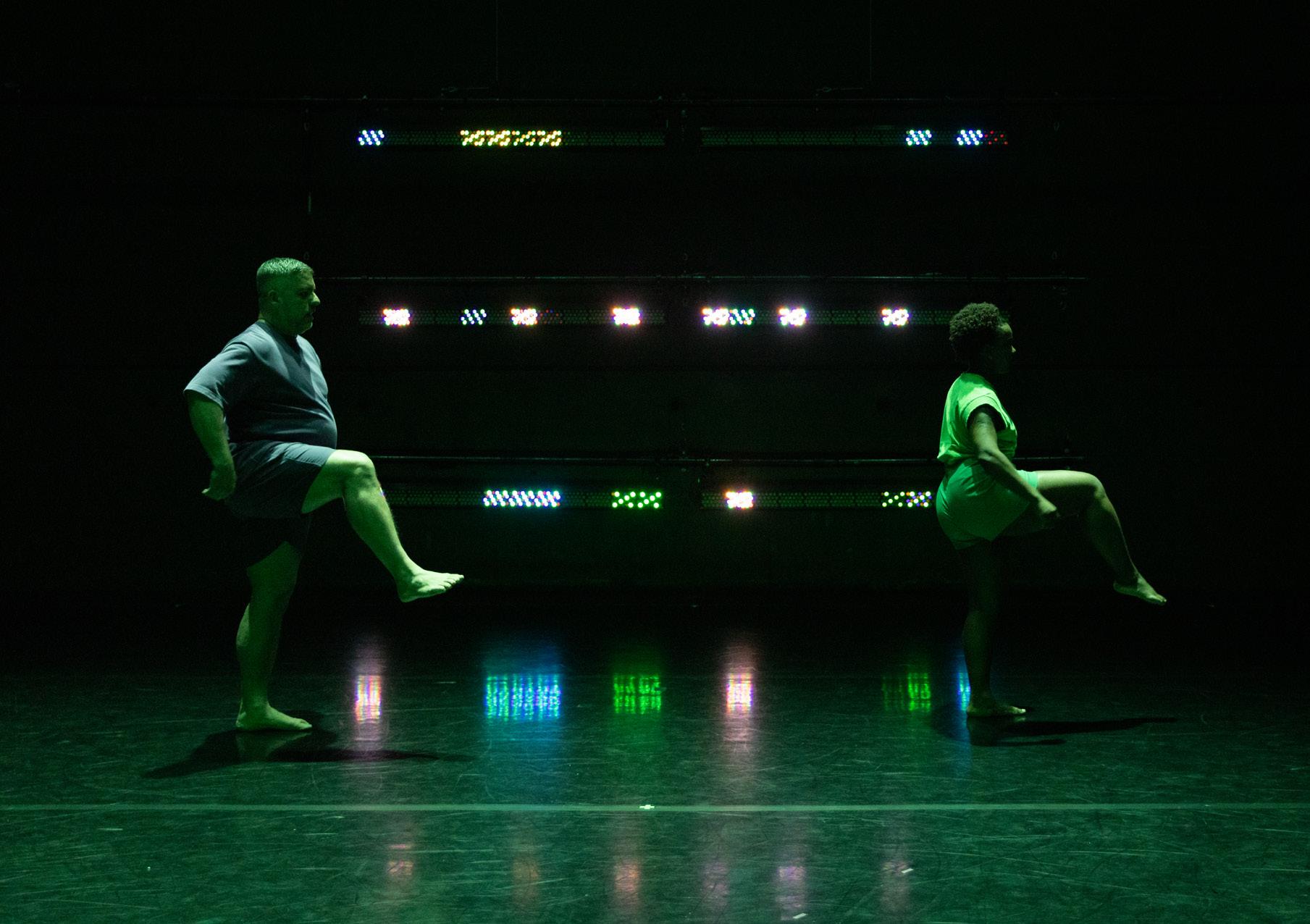
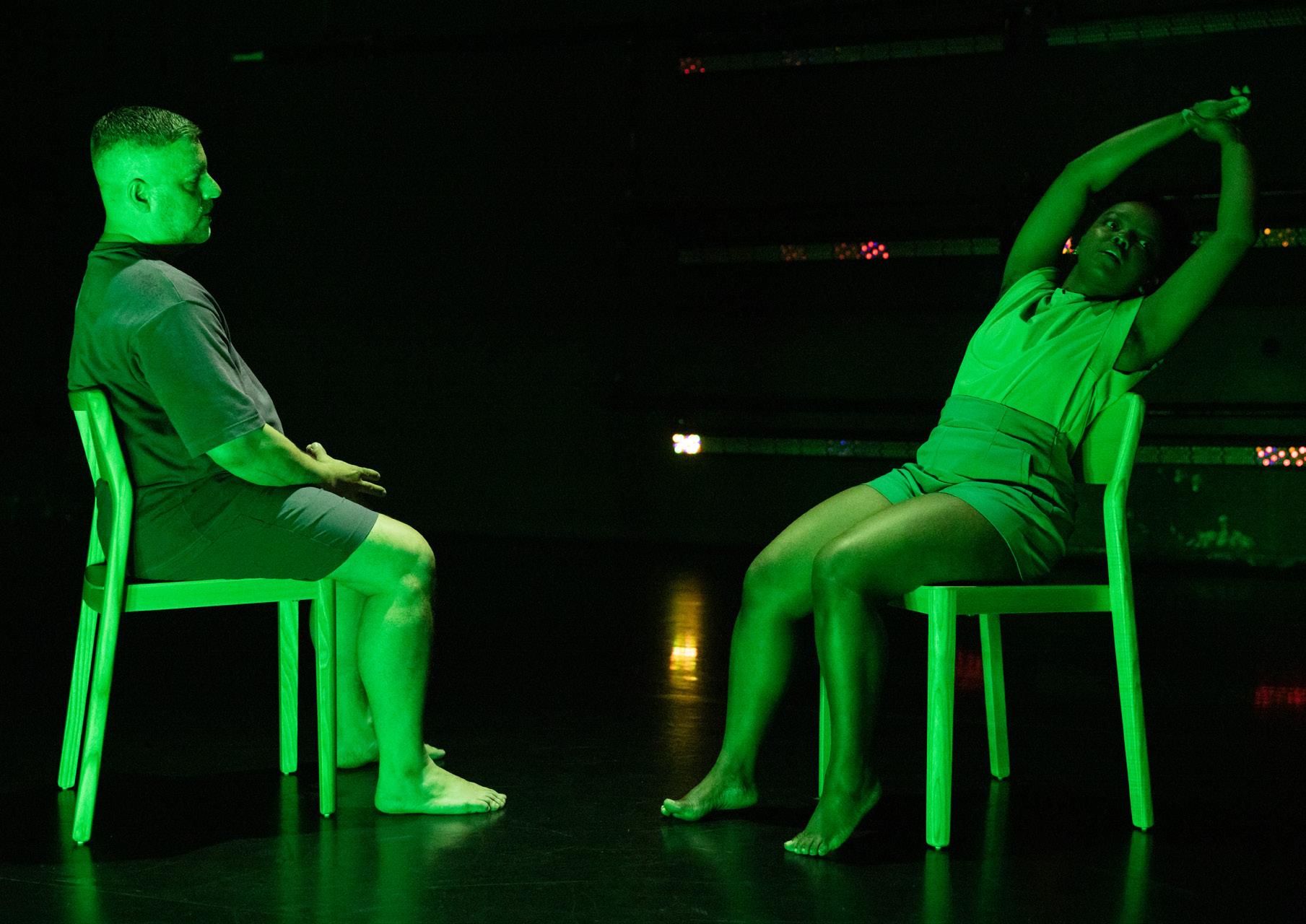
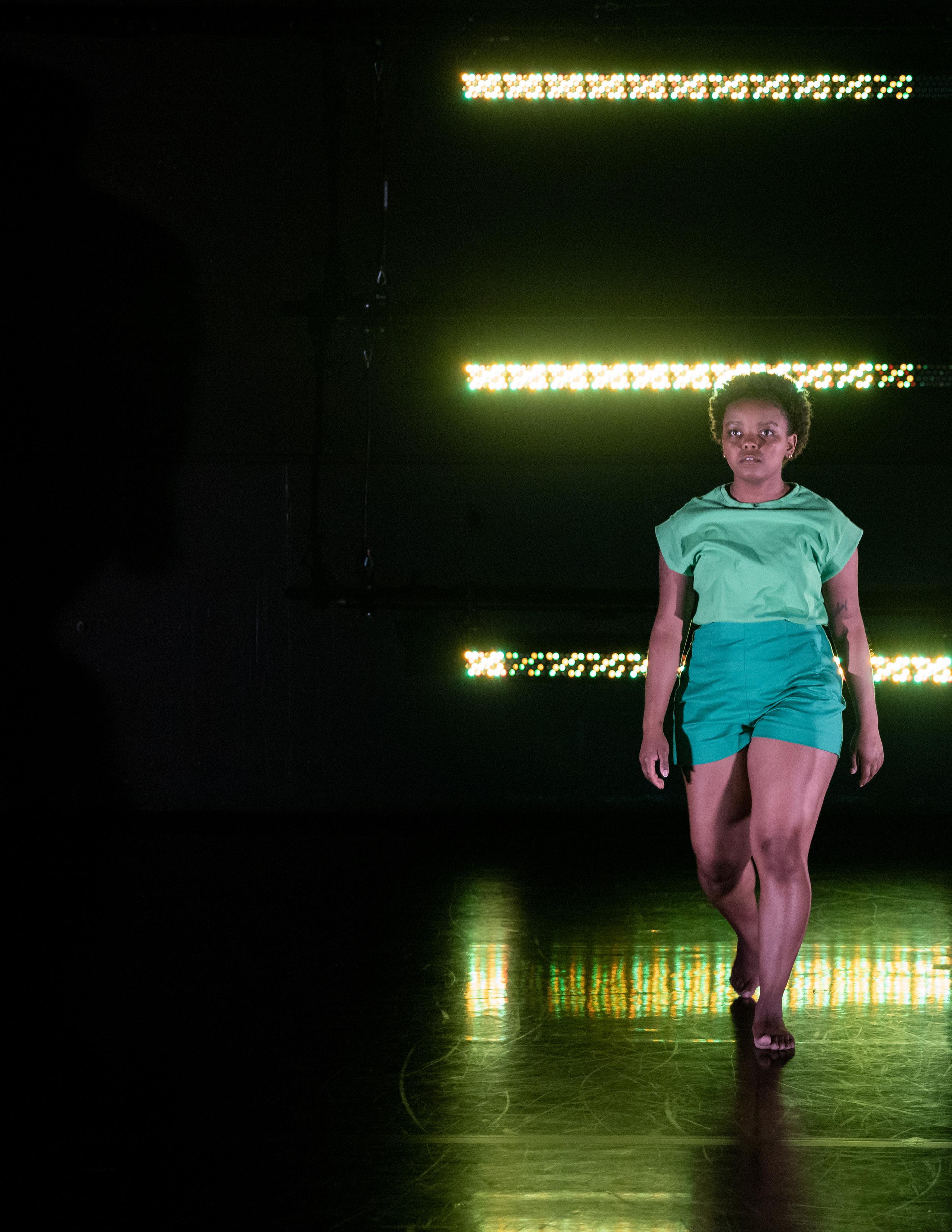
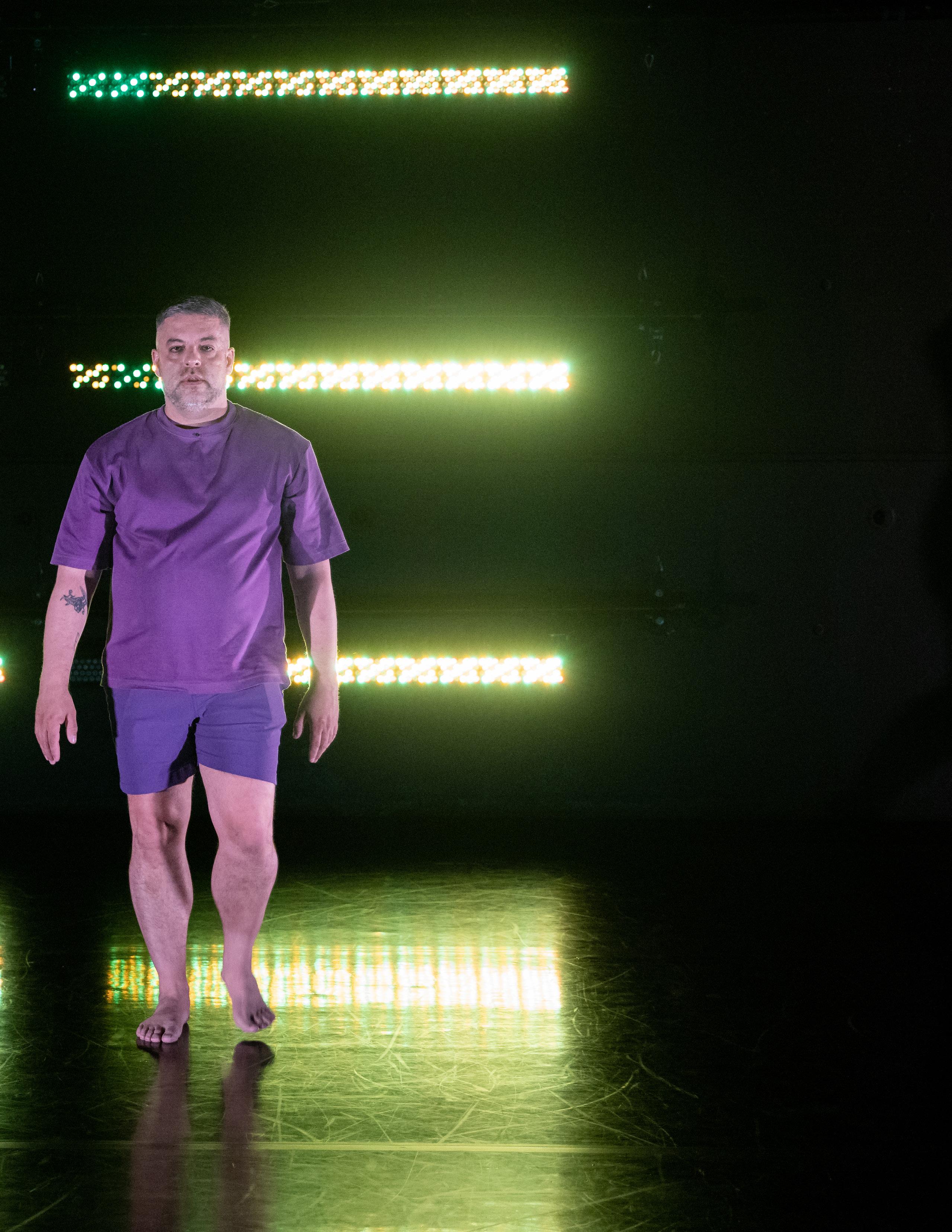
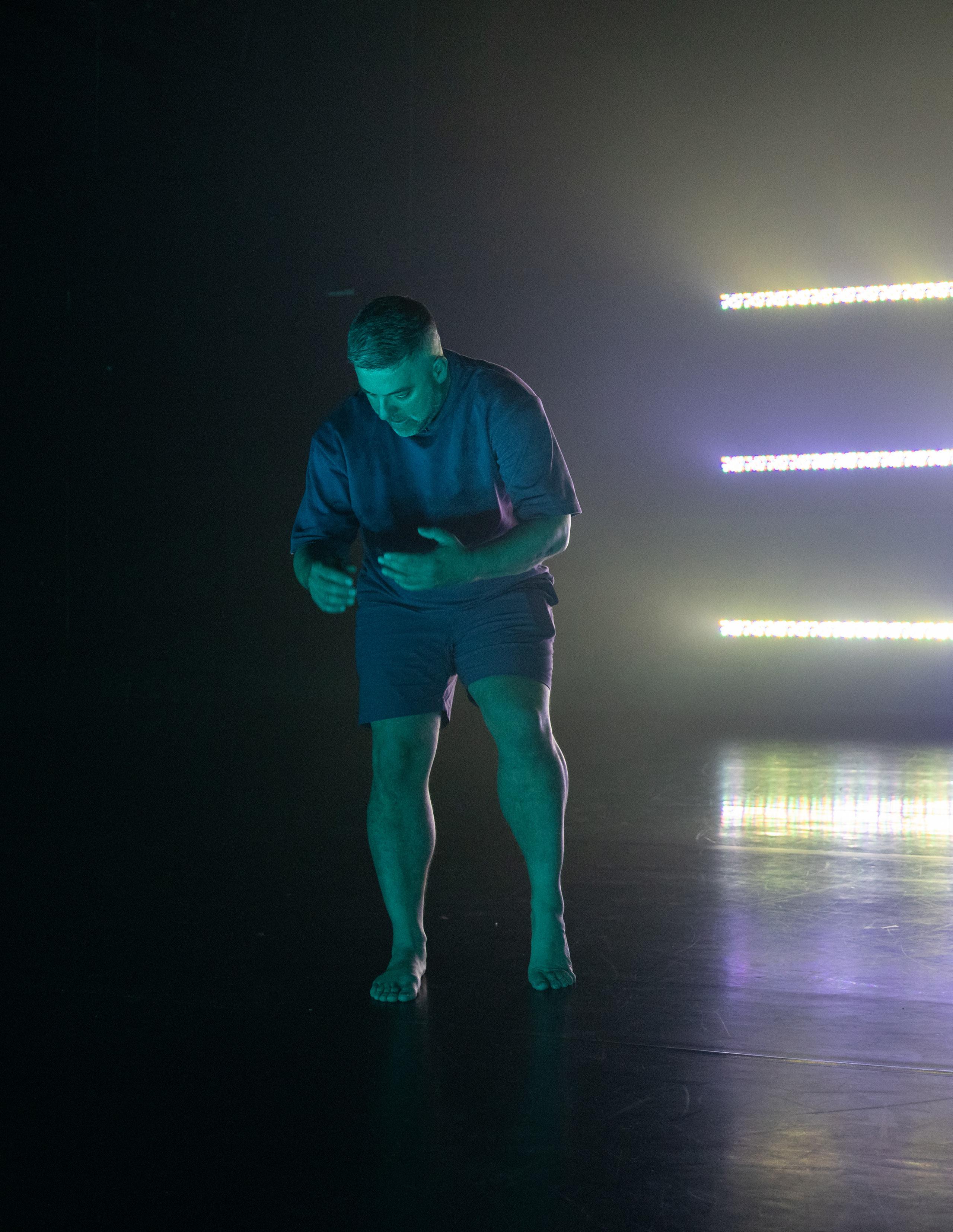
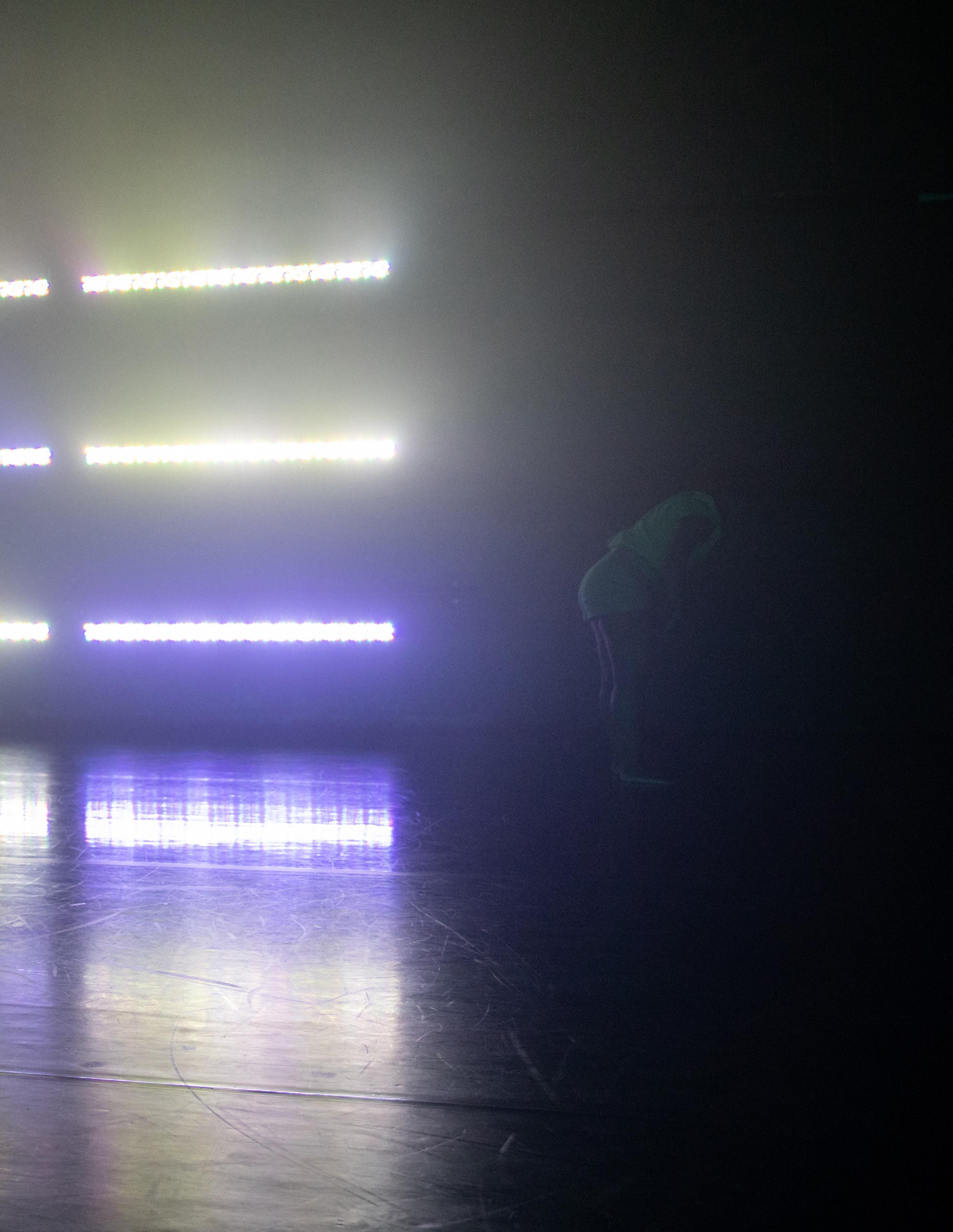
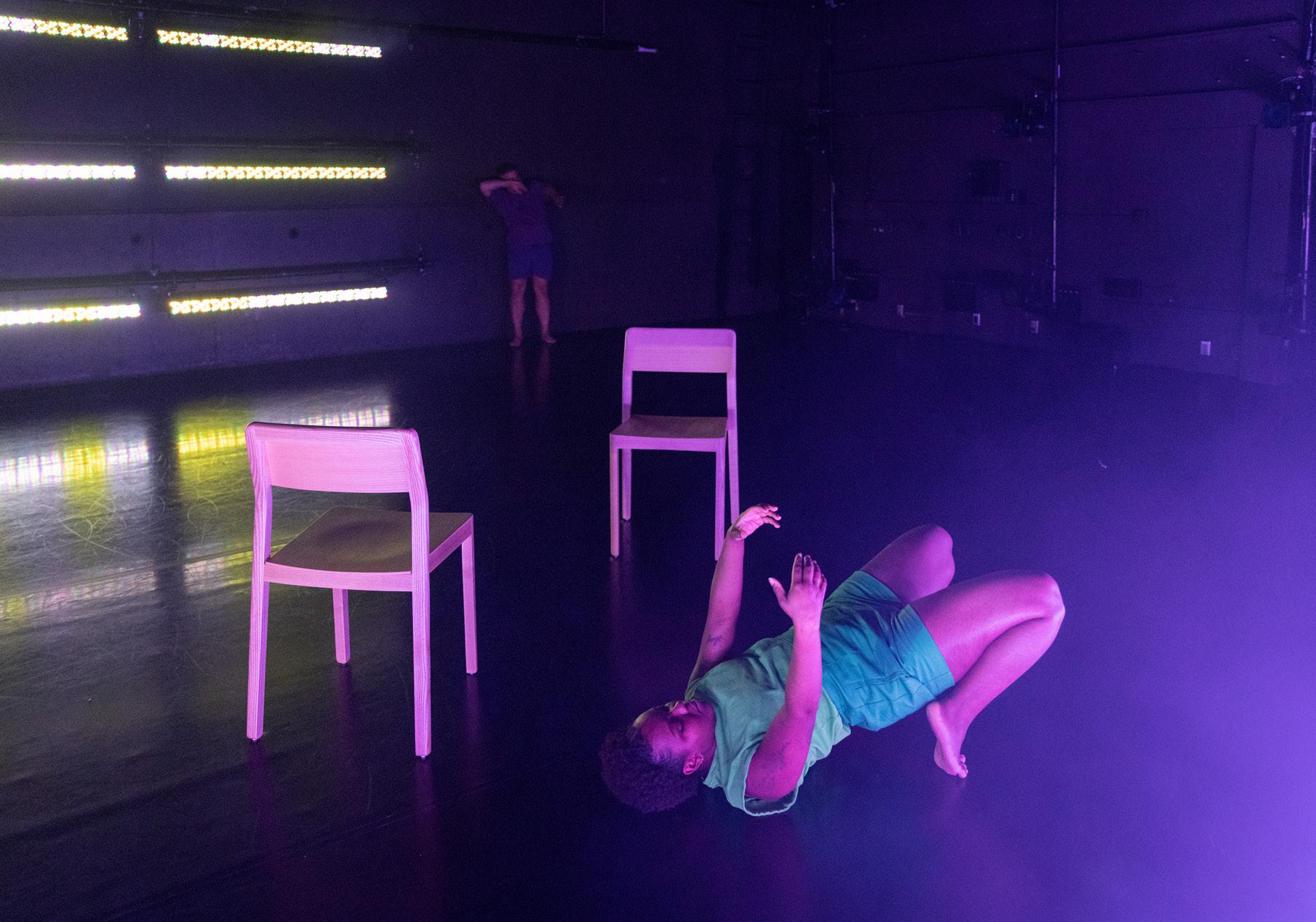
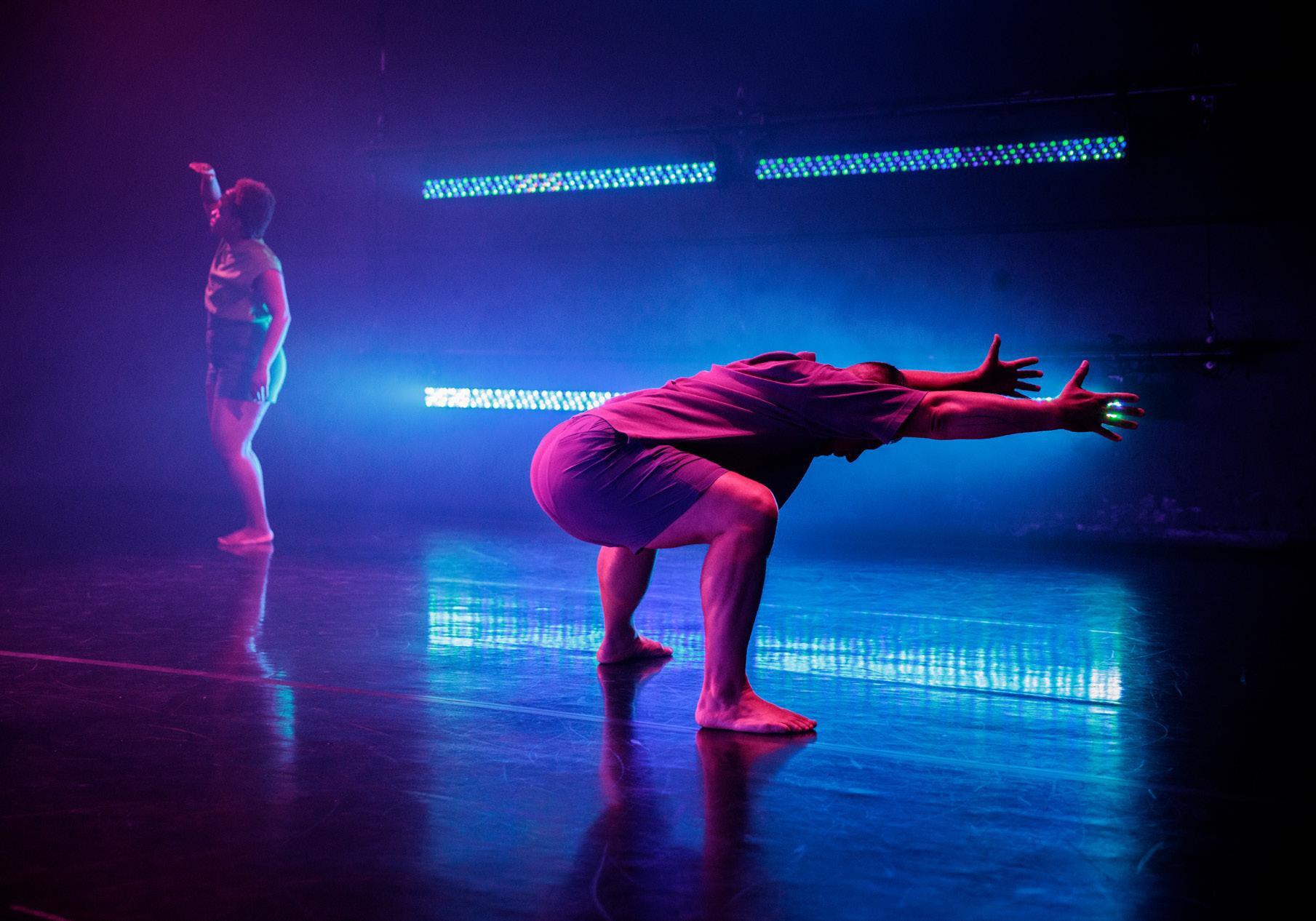
I as another photographed at Baryshnikov Arts by Walter Wlodarczyk
I as another
I as another is a duet created by Miguel Gutierrez and performed with Laila Franklin. The piece takes place in a future/present dystopia and explores the virtual architecture of memory, what it means to be alongside one another, and how existential despair has come into public view. Drawing inspiration from Martinican philosopher Édouard Glissant and his conceptions of Relation and opacity I as another examines what it means for difference to come into contact and how unknowable we can be.
I as another premiered August 2022 at Bates Dance Festival
Choreographer, Performer, Sound, Text, Costumes: Miguel Gutierrez
I as another is supported by a Caroline A. Hearst commission from Princeton University and contributions from individual donors. It has been developed through an Artist Residency at Movement Research in New York and residencies at the School of the Art Institute of Chicago and the Department of World Arts and Cultures/Dance at UCLA.
Edited
Donata Schoeller, Sigridur Thorgeirsdottir, and Greg Walkerden Dr. Thomas Kampe
Contributor Bios
Letter from the Editor
Each article in Issue 34 of The Feldenkrais Journal explores a new way of thinking. As broad as that may sound, the forms of thinking discussed in the following pages demonstrate the value of attending to one of the least noticeable of human activities—“thinking”—and the difference it can make when we do.
In our opening article, “The Future of Awareness Through Movement (ATM) Teacher Training and Research,” Dr. Zoi Dorit Eliou and Amparo Denney share their experiences of a new training format focused on learning to teach ATM lessons. They stress the extent to which this new training afforded them the opportunity to think through the “principles and philosophy” underlying ATM lessons in ways that traditional training had not.
“The Esalen Tapestry” by Dr. Dmitri Popolov is a veritable illustration of Dr. Eliou and Denney’s vision. His proposal for how to teach ATM lessons is both fresh and historical, offering a timely spin on the cherished Esalen Workshop. Dr. Popolov's analytical method and his work with Dr. Jessica Pink, a formidable Journal editor, provides us with an impressive and highly adaptable model.
“Movement Quality and Music-Making Practice: On the Relationship between the Feldenkrais Method and Musical Improvisation” by Corrina Eikmeier is systematic while remaining sensitive. We are thankful to Cliff Smyth, Editor of the International Feldenkrais Federation’s Feldenkrais Research Journal, for allowing us to republish Eikmeier’s detailed accounts of musicians improvising, which are filled with experiences— such as that of a “neutral position” or “dynamic balance”—that all Feldenkrais practitioners will recognize.
In “Marketing and the Feldenkrais Method of Somatic Education,” Adam Cole, our endlessly thoughtful Assistant Editor, thinks differently about one of our thornier shared experiences. With characteristic candor, he offers us many insights. Dr. Thomas Kampe, in a thorough review of Practicing Embodied Thinking in Research and Learning (2025), takes us through an abundance of new thinking on Feldenkrais-related academic study. Cole and Dr. Kampe both leave us with not only new understandings of thinking but also a lot to think about.
As different as the articles in Issue 34 of the Journal are—we open with a robust reflection on ATM pedagogy and conclude with a state of
1 Moshe Feldenkrais, Embodied Wisdom: The Collected Papers of Moshe Feldenkrais with E. Beringer (ed), (Berkeley: North Atlantic Books, 2010), 88.
the art review of embodied learning—they are mutually reinforcing. Dr. Popolov's application of coding skills to the exploration of ATM lessons echoes Dr. Eliou and Denney’s call for such research, and illustrates its value. The conversations among authors and articles are serendipitous because, as with the last issue, we didn’t identify a theme beforehand. We discovered that people were thinking about related things, including the very nature of thought itself.
Each way of thinking discussed in this issue is open-ended and inspires further inquiry. How might we conceive of ATM teacher training and research going forward? How might we prepare to teach a lesson or a series of lessons? How might we articulate or express an idea or inclination that isn’t immediately available to us in language—a thought about how to play an instrument, how to market the Method, how to comunicate across social divides?
The last thing to be incorporated into this Journal is also the first thing that you will encounter. Walter Wlodarczyk’s vivid photo documentation of I as another, a duet choreographed by Miguel Gutierrez and performed with Laila Franklin, graces our cover and informs yet another keen Journal design by Peter Ahlberg and Dandelion.
The following excerpt from the introduction to Dr. Kampe’s review could describe Gutierrez's art:
Dr. Feldenkrais articulated an approach to working and learning through non-verbal thinking through movement, as a “thinking with the elements of thinking […] without words, with images, patterns and connections. That sort of thinking always leads to a new way of action.”
Feldenkrais' words also recall those in Dr. Eliou's ATM training notebook:
I felt that my creativity bloomed on the floor, and expanded into mysterious spaces of ideas and images and inner connections. I floated, and still do. I practice “Feldenkrais thinking” in all I do.
Our Editorial Board and dedicated members of the Feldenkrais Guild of North America thought long and hard to bring you Issue 34 of The Feldenkrais Journal. We can’t wait to hear your thoughts.
—Helen Miller
The Future of Awareness
Through Movement (ATM) Teacher Training and Research
A Perspective of Two Graduates on the ATM Teacher Training Pilot Program, San Diego
Dr. Zoi Dorit Eliou Amparo Denney
ATM teacher training and the Feldenkrais Method
Key Words
• Awareness through Movement (ATM) Teacher Training Pilot Program
• Online ATM Class Teaching
• Zoom and ATM Lessons
• COVID-19 Global Pandemic and The Feldenkrais Method of Somatic Education
• Feldenkrais Method Research
• Mental Health and ATM Teacher Training
In 2020, in the midst of a global pandemic, the Feldenkrais Guild of North America (FGNA) announced the inception of Awareness Through Movement (ATM) teacher training pilot programs. This was probably the most significant change in the format of a training that the Guild leaders approved since its inception as a professional society in 1977.
Feldenkrais professional training up until 2021 was available only within a four-year practitioner training course, integrating ATM teacher training with Functional Integration (FI) training. Within that context,
training excludes trainees who are interested and attracted to the deep study of teaching ATM lessons without the desire to work hands-on with clients.
Backgrounds and personal journeys
Amparo Denney was first told about the Feldenkrais Method by her son’s physical therapist in 1996. However, she couldn’t find anyone offering it in the area, so she took the yoga path to ease the difficulties she had with her disabled son. She got certified as a yoga instructor and continued her philosophical studies at Loyola Marymount University. She had a private yoga practice and taught yoga at a local hospital.
Amparo’s son David was born with glutaric aciduria/acidemia Type I, a rare genetic disease. In addition, he suffers from the seizure disorder Lennox-Gastaut syndrome. As a young mother, stressed with the onslaught of this unimaginable journey to come, Amparo dug into medical journals, armed with a medical dictionary to gather information to help manage all of the ramifications of David’s neurological insult. David was unable to suck and swallow, thus a gastrostomy tube had to be put in place, along with a full fundoplication to prevent the projectile vomiting that interfered with an accurate count for his nutrition. He also lost his head control and his movement went from hypertonic to hypotonic. Dystonia and chorea athetosis controlled his muscular movement. The damage to the basal ganglia was irreparable. David functions at about a 3.5 to 9 month old developmental stage. He is now 29 years old.
In an effort to alleviate the many issues he had, Amparo dove into physical therapy, occupational therapy, speech therapy, horseback therapy, assisted technology, water therapy, and in addition, used a standing frame at home. She added carnitine to his medical formula and tried multiple medications to help control the dystonia, vomiting, and lack of sleep. Once he became school age the therapies continued as needed. The lack of “progress” slashed down the time and frequency of said therapies. In 2017 he had to have a tracheostomy tube (or trach) inserted, and since requires 24/7 Licensed Vocational Nurse (LVN) care. David improved very little as a result of the many therapies. However, one treatment stood out above all others: One of the physical therapists Amparo hired was also a Feldenkrais practitioner. The therapist referred to David as a “clever boy,” and Amparo looked forward to her sessions, as they were uplifting and encouraging. She felt that the therapist’s work rebalanced her son’s nervous system as well as her own!
The years of constant stress and management of David’s care
eventually took a toll on Amparo’s body and mind. She suffered a slipped disc at L5-S1 and was in constant pain. She received two epidurals, continued with yoga, physical therapy, and osteopathic treatments. In 2018, she finally found a physical therapist who offered FI sessions and ATM lessons. She felt she had come home to her body!
Amparo decided to attend a workshop with Ruthy Alon in 2018 in San Diego and “that was it!” She embarked on her Feldenkrais training at a four-year practitioner training program at the Institute for the Study of Somatic Education, San Francisco, in January of 2019. She transferred to the ATM teacher training pilot program in San Diego in May of 2020. The first segment was offered online, and once the pandemic eased, she attended live. The two-year intense immersion in the study and practice of teaching ATM lessons gave her a much deeper and richer understanding of the Method and opened her life in ways she could not have anticipated.
Dr. Zoi Dorit Eliou is a psychologist and works with people with severe mental illness often concomitant with chronic medical issues. Her first interest was with patients diagnosed with schizophrenia and related disorders, and later with patients with depressive spectrum disorders, bipolar spectrum disorders, borderline personality disorder and patients with chronic suicidal struggles and medical comorbidities. Her orientation is cognitive-behavioral therapy and she uses dialectical behavioral therapy in her approach. In addition, she trained and worked as an expressive arts therapist in art and dance modalities (MA), prior to transferring to psychology. She was very much interested in non-verbal language and the language of Schizophrenia. In her studies, she explored how to bridge communication with patients through non-verbal expressive arts, specifically art and dance.
Zoi is a second generation Holocaust survivor and a secondgeneration Nakba survivor. Her parents, both refugees from different cultures and backgrounds, met in Jerusalem and eloped to Greece, where she was born.
Zoi’s mother and her family lost everything except their lives in Europe in the Second World War. Her father and his family lost their estate and dignity in Jerusalem during the 1948 Israeli independence war. They became refugees in East Jerusalem. Then her parents lost each other in their marriage. Zoi was raised in Greece as a Greek Orthodox, and at 13 years old, she moved to Israel with her mother and sister a month before the Yom Kippur War. In 1998, Zoi’s sister died by suicide.
With her sister’s loss, Zoi’s world collapsed, and her body went into shock. She got rheumatoid arthritis, a parotid gland tumor, and Crohn’s disease. It is hard to describe the level of confusion, depression, and anxiety that came along with all that, as well as the consequences of years of medications and steroids to treat the inflammation in her body.
Previously she had two discectomies on her lower back and neck— as a result of being an athlete, a soldier in the army, and using herself physically in absurd ways.
She came to the Feldenkrais Method as a young person in her twenties, thirties, and forties. It didn’t stick. She was impatient, ambitious, competitive, active, restless, and mostly oriented to the outdoors.
The ethos of growing up in Israel ran deep in her body and soul. She hiked the deserts and mountains of Israel, worked as a farmer in a kibbutz, was in pre-military service and then served as a soldier in the Israeli Defense Forces. She was a journalist, a peace activist, a labor party employee, and an assistant director of a community center in a marginalized area of Tel Aviv at the time.
Throughout, she was very involved in her academic training. She was forceful and determined to achieve her goals, including a Ph.D. in Psychology. The field became her sanctuary, intellectually and professionally. However, she never forgot her roots in her early career as a dance and art therapist and her own explorations in movement. Movement was always at her core and she felt that she needed to expand the language from dance and art into a more coherent vocabulary. Psychology provided a grand foundation for that purpose. The Feldenkrais Method gave her a movement language that was coherent and aligned with cognitive and psychological processes.
In 2018, in her fifties, ATM classes at last hit a home run for her. On a rooftop in Tel Aviv, Dorit Landers was giving a lesson in her sturdy and calm voice, and at the end Zoi could finally breathe.
Zoi had accompanied her mother, who was 82 years old at the time, to Landers’ in-person class. She especially enjoyed Landers’ teaching, which mindfully connected ATM lessons to wider social and psychological processes. Her approach spoke to Zoi deeply, as it connected the lessons to the transformation of self-image and our ability to connect to ourselves and others in a more soft, effortless, efficient, fluid, and fully engaged way. Further, she realized that the lessons were providing her with a language that can be learned and practiced individually. She felt a physical need to learn the language of ATM lessons, its grammar, its vocabulary, and the stories each lesson’s choreography (1500 and more) had to tell.
She believes that her mother’s recovery as a Holocaust survivor and her resilience through all the wars of Israel, as well as her ability to be an exemplary educator, are intimately connected to her forty-year practice of experiencing ATM lessons and to her connection with Dorit Landers and the other students in her class. While studying with Landers, Zoi decided to embark on the training and write a paper on integrating ATM lessons with psychological treatment (Eliou, 2023).
The ATM teacher training track
We were each already enrolled in a four-year Feldenkrais practitioner training program in San Francisco when the pilot program led by Elizabeth Beringer and Arlyn Zones was announced. As this was the only possible way to focus on ATM teacher training at the time, we decided to apply and transfer programs.
We graduated from the pilot training program in 2022 and 2023. Based on our experience this paper discusses the advantages of having an ATM teacher training program independent of the classic four-year practitioner training program. We arrived at the four-year training mainly for two reasons: Both of us were interested in personal development first and foremost. Further, from our experience, we found yoga and meditation incomplete in addressing the whole person (Eliou, 2023).
In addition, the limitations of mindfulness meditation for a subset of psychiatric patients has emerged in the mind-body literature in psychology research (Eliou, 2023). Yoga has been studied as an alternative option to reach patients on a physiological level with some benefits (Eliou, 2023). Except for one study on eating disorders, ATM workshops have not been examined using comparative and outcome research methodology, and the absence of the Method from the mind-body literature, despite the enormous benefits it has to offer to psychological research, is problematic.
We both found that ATM lessons bypass the limitations we saw in yoga and meditation and offer a distinct movement language aligned with cognitive-behavioral thinking and an encompassing theory of facilitating change to one’s self-image. Most importantly, they are useful in addressing physical pain and emotional trauma (Eliou, 2023).
Finally, our experience in the four-year practitioner training program was complex in part because it was halted in 2021 due to the global pandemic. Regardless, neither one of us was drawn to providing or studying FI lessons, nor had the intention of working “hands-on” with clients. We were more interested in the theory and practice of providing ATM lessons. While we experienced ATM lessons twice a day during the part of the program that we attended, as the training program progressed, much of the focus shifted to learning to provide FI sessions.
The COVID-19 pandemic and the ATM teacher training pilot program online segments
The inception of the ATM teacher training pilot program during the COVID pandemic was an answer to our prayers and we decided to transfer. We were excited about the curriculum and its complete
focus on ATM lessons, integrated with neuroscience, psychology, and anatomy. We were also excited to continue our studies and use Zoom as a new technological application to disseminate and study the Method. While the technology proved to have advantages and disadvantages, we ultimately adapted it for learning and teaching purposes.
We met many Feldenkrais Method scholars whom we probably would have never met without the pandemic and the Zoom technology integrated with the training. Practitioners from Australia, London, and Vermont including Susan Hillier, Scott Clark, Elizabeth Beringer, Carol Kress, and Karen Zindars, to name a few of the excellent educational staff. We were impressed with the caliber of Trainers in each segment. We had exposure to people we wouldn’t otherwise have gotten to work with due to the expense of flying Trainers from London or Australia. The exposure to Trainers from other countries and cultures was in itself informative.
Most importantly, using Zoom organized the time much better, and some of the presenters had incredible PowerPoint presentations on various subjects like anatomy and neuroscience. The Zoom option expanded numerous possibilities for students to be exposed to superb training within and between each segment.
For people with medical issues, Zoom also provided an exceptional opportunity to continue with their rigorous training throughout the pandemic. In addition, and separate from the training, David Zemach-Bersin, Arlyn Zones, Elizabeth Beringer, and Carol Kress offered online workshops that were an incredible gift during the COVID-19 pandemic. No longer bound to a studio, we could join from everywhere and practice on our own, or in a group, as well as gain exposure to the teaching philosophies of leading master teachers.
Meeting in-person, in between more frequent online segments, provided us with a more detailed exploration of ATM lessons and guidance from our Trainers. Also, it made it possible to enhance our relationships with each other and further work online in study groups to practice our skills and complete our assignments.
In the ATM teacher training program, we were immersed in working with ourselves, and on ourselves, throughout the day. Being on the floor and being exposed to such a vast number of lessons, understanding how they are organized and to what purpose, was a pure joy.
We also practiced how to teach in the class in small groups, for which many had tremendous anxiety. This issue of how to manage one’s own anxiety in teaching and increase confidence was also discussed at length in class and in groups. Further, it was addressed by offering pre-practicums, and working in small groups teaching parts of lessons to each other.
Our first practicum teaching a lesson was at the four-year training program. But not until we got to the ATM teacher training program did we actually get the fundamentals of ATM lessons systematically. This study of ATM lessons had a huge effect on our teaching and our own
personal exploration of the lessons. We ended up doing additional pre-practicums and practicums in San Diego, and one presenter provided a thorough PowerPoint presentation on what an ATM lesson is and how it relates to her field. The presentations focused around ATM lessons that we were each assigned enhanced our knowledge and perspective. Some were elaborate, incredibly dynamic, well-informed, and informative.
Our collective experience was that the directors of the ATM teacher training program had a different approach to adult learners. The class had young people who are beginning their careers, and people like us who already had a career and were looking for something new to dive into. As a result, there was more flexibility in understanding a student’s background and needs and supporting them and their ultimate goal. We mainly had the mission to learn and understand ATM lessons, develop confidence as teachers, and to change our way of thinking in everyday life. For us, that was plenty as an educational goal. After all, ATM lessons are like learning a foreign language. Also we were not necessarily looking for a new career. We wanted to integrate and enhance the skills we already came with.
In that sense, the functional integration of ATM class philosophy and movement within one’s life is as important, in a different way, as the Functional Integration “hands-on” sessions. Thus, through the lessons one learns how to observe, compare, rest, regulate, breathe, imagine, slow down, experiment with tempo, force, direction, roll, elongate, widen, rock, or do absolutely nothing. Just listen. That is a language one must learn. A language to sense one’s self and similarly to tune into others. Through this movement meditation and inquiry lab, one learns about habits, compulsions, frustrations, limitations real and imagined, fears, and how to work with ambition. One learns how to self-organize, be efficient, and how to problem solve. One becomes aware of the right timing to back off, or to restart, how to ease into shifting and changing, and into transforming and expanding one’s self-narrative psychophysiologically. The ability to move from the lesson and facilitate the integration of the kinesthetically-felt concepts in everyday thinking and action is what we learned to teach.
ATM lessons and self-image: Training to be a student-teacher
One of the most appealing promises of Awareness Through Movement lessons is the offering of psycho-physical skills to enhance and broaden one’s self-image and evolve psychologically and emotionally as a human being (Eliou, 2023). The principles underlying ATM lessons (Eliou, 2023), and the principles of Learn to Learn (Feldenkrais, 1980), along with the lessons provide us with a philosophy of life: How to be open to inquiry
and experimentation. The lessons are the language within which we discover who we are. The ATM teacher training program offered this approach—comparing and connecting ATM lessons to mindfulness approaches and the study of emotion, brain function, and neuroplasticity.
According to Feldenkrais (1972), the “correction of movement is the best means of self-improvement” (p. 33); and since movement is essential to a person’s self-value and is present in everything from breathing to all muscular activity, we begin the process from there (pp. 33 – 39). Most importantly, through the motor cortex we have access to the nervous system and reparative work can begin, i.e. the shift from habit and compulsion to ease and fluidity, and the integration of new patterns of moving, thinking, feeling, and sensing.
Our impressions of the program
In the first year we focused on self-image and the fundamentals of movement followed by a deep dive into child development, neuroscience and neuropsychology, and incredible segments on anatomy, as well as the study of emotions, emotion regulation, and state shifts. The lessons were anchored on the lectures we received and thus made more sense. The second year was more focused on teaching. We learned how to approach the breakdown and understanding of a lesson, and we practiced teaching each other in class. We also had segments on voice and movement analysis. The bibliography reading assignments and discussions that accompanied the segments and the lessons were rich and engaging.
The focus of the program, elaborated in Dr. Eliou’s article from the last issue of the Journal (Eliou, 2023), was learning how to teach ATM lessons through its principles. This learning process involved understanding the parallels between the steps of a lesson’s choreography and the meta language in which Dr. Moshe Feldenkrais lays out the intention of the lesson, whether it relates to self-image directly, or the use of imagination in movement, the concepts of organizing movement, or the role of breath to direct movement. Arlyn and Elizabeth’s approach was exactly that: They taught the Method through its principles and philosophy. This integration was the cornerstone of their program.
Further emphasis was placed on the use of voice and tempo, and on one’s own presence while teaching. We each ended up leading over 50 full and partial lessons through the two years, both to each other and to our groups in the community. We did two practicums and elaborate presentations on integrating ATM lessons with other fields. On a typical training day we would have two to four lessons, either full or partial. Thus, we had a very rich and focused experience of ATM lessons, with much time to discuss, analyze, and understand a lesson or a series of lessons. We had the opportunity to teach each other parts of lessons
or whole lessons, each time emphasizing a different set of skills. Most importantly, because of this intense exposure to ATM lessons, we could sense how a shift was taking place within us. The rhythm of the lessons became a foil for our transformation.
Reflections from our notebooks
Below are some of our reflections on the shifts in self-image and action as they emerged for each of us during the training:
“I felt again like a dancer—lighter, expansive, levitating. Pain disappeared. I learned to sense myself better and be less critical of myself. More compassionate towards my own being. I learned to lie on the floor, tune in from the inside out. I felt that my creativity bloomed on the floor, and expanded into mysterious spaces of ideas and images and inner connections. I floated, and still do. I practice "Feldenkrais thinking" in all I do. As best I can.”—Zoi
“I barely use pain medications, and visits to acupuncture, massage, or chiropractors are not really needed.”
—Amparo and Zoi
“Most importantly, I learned how to become a professional ATM practitioner. I learned a new movement language and expanded my integrative way of thinking. I learned how to design presentations, series, and workshops. The incredible amount of homework we received in the program was remarkable and exciting to do, and helped each of us find their voice. We designed presentations on what ATM is and how it blends with other health practices, we did multiple reports on lessons, designed series and workshops, and of course did our practicums and taught our groups.”—Zoi
“I am now walking and hiking for miles pain free. My quality of life has improved, and my ability to regulate my activity level and live a joyous, full life expanded. This new found quality of life has allowed me to enjoy deeper relationships and participate fully with body, mind, and emotional balance in the world.”—Amparo
The future of ATM teacher training and research opportunities and challenges
Our hope is that the ATM teacher training program will continue to be offered through FGNA and will expand to collaborations with community colleges and universities. For professionals who are not focused on “hands-on” sessions, ATM lessons are an exceptional tool to integrate into various fields of study. Particularly in psychology and mental health treatment, it can be an essential tool to assist various patient populations (Eliou, 2023).
We think that designing a flexible ATM teacher training program for such allied professions would be a significant opportunity for certified Feldenkrais practitioners to develop and deploy within the FGNA’s training structure. We also believe that disseminating ATM teacher training in a two-year program will attract more trainees who otherwise cannot commit to a four-year program. The two-year program provides an exceptional theoretical foundation in teaching ATM lessons, should students wish to continue thereafter to a “stage two” training program focused on preparing to become a Feldenkrais practitioner, and also provide FI lessons. Such a program did indeed begin after the pilot program ended. In addition, if most of the ATM teacher training program could be accommodated by online digital technology, it would afford exceptional flexibility to future trainees.
For clients and future students of the Feldenkrais Method, particularly with people who have accessibility challenges, the availability of online options for ATM lessons opens up the Method to all who have digital access, and at all times. Empowering people to self-care through ATM lessons online, on their own or within a Zoom group, is a cost effective and incredible tool to have as teachers and a society.
We believe that many mental health clinicians (social workers, psychologists, art, dance, and music therapists, and counselors) who are interested in mind-body approaches such as mindfulness and yoga can be drawn to the sophisticated language that ATM lessons offer and engaged in the two-year training. Studying the Method offers advantages in understanding patients psycho-physiologically on a much deeper level than the mindfulness or yoga which mental health clinicians use, train in, or refer to.
In addition, much research should and can be done on the nuances of the language used when teaching ATM lessons. The study and analysis of the lessons presents a significant research opportunity. As we have the transcripts of Feldenkrais' recorded lessons, those can be standardized and analyzed with multiple movement notations in order to
identify patterns with the assistance of Artificial Intelligence or through traditional coding methods. From there we can study and infer how and why the compositions work. Therefore, attracting teachers and practitioners with skills that can assist that process is vital (e.g., dance, computer science, neuroscience, and psychology). As such, a focused and shorter ATM teacher training program can facilitate a deeper study of the language used when teaching ATM lessons and draw in many more fields of academic study into the field.
Further, specific series of ATM lessons can be standardized and studied across varied populations and compared with other movement methods and mindfulness tools, thus bringing the Feldenkrais Method into a better scientific focus and analyzability. Therefore, its inclusion in academic programs is important. It would also be wonderful to hear and read more about where such integration is already happening.
Finally, as neuroscience evolves, and the concept of neuroplasticity becomes more mainstream, ATM lessons can also be studied through that lens, much like yoga and mindfulness, with advanced technologies and the use of functional magnetic resonance imaging (fMRI) along with traditional comparative research designs. An open-source Journal could support integrative studies as such, and Feldenkrais ATM teachers and practitioners could be part of research committees in various academic endeavors led by faculty and graduate students.
We hope the ATM two-year teacher training program continues to be offered as a hybrid (mainly online) to allow for many more participants from allied disciplines to be trained in the language used when teaching ATM lessons. In addition, we believe scholarships or sliding-scale fees could be offered on a larger scale to attract more diversity and thereby capture a larger audience.
Our hope is that the Method can go mainstream and be offered in community colleges, universities, and hospitals through FGNA and as part of academic study for credit, such as the partnership established at The Tamalpa Institute in California.
ATM class peer consultation group study—an essential tool
In 2020, during the pandemic, we formed a Zoom ATM study group. Within that context and during her practicum, Dr. Eliou began teaching ATM lessons to patients and colleagues, as well as other professionals to ease the stress and isolation of the pandemic lock-downs. We began a systematic study of the lessons and continued the group when we transferred to the San Diego ATM teacher training program. We also built an extensive library to assist us.
The use of group study during the San Diego program was
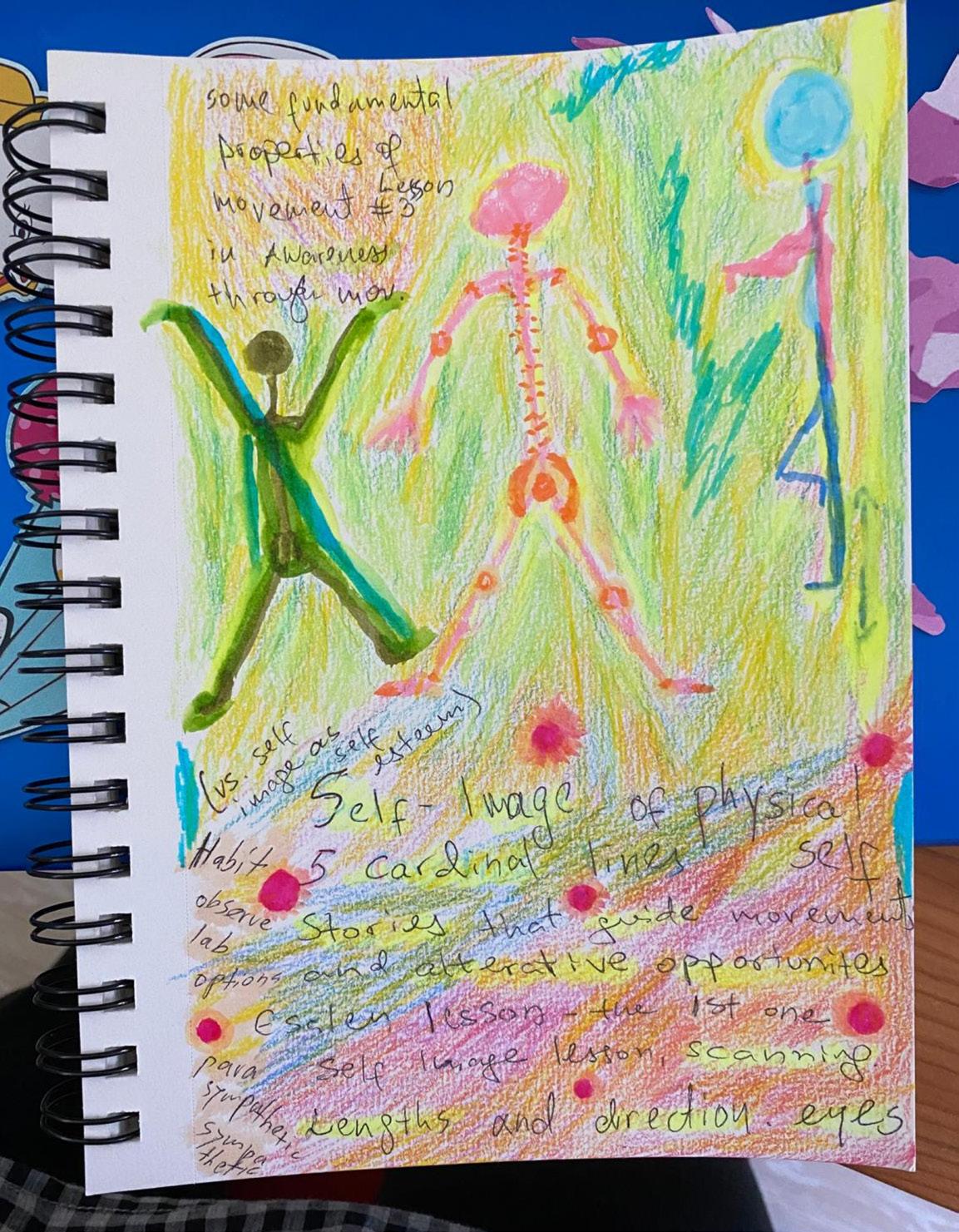
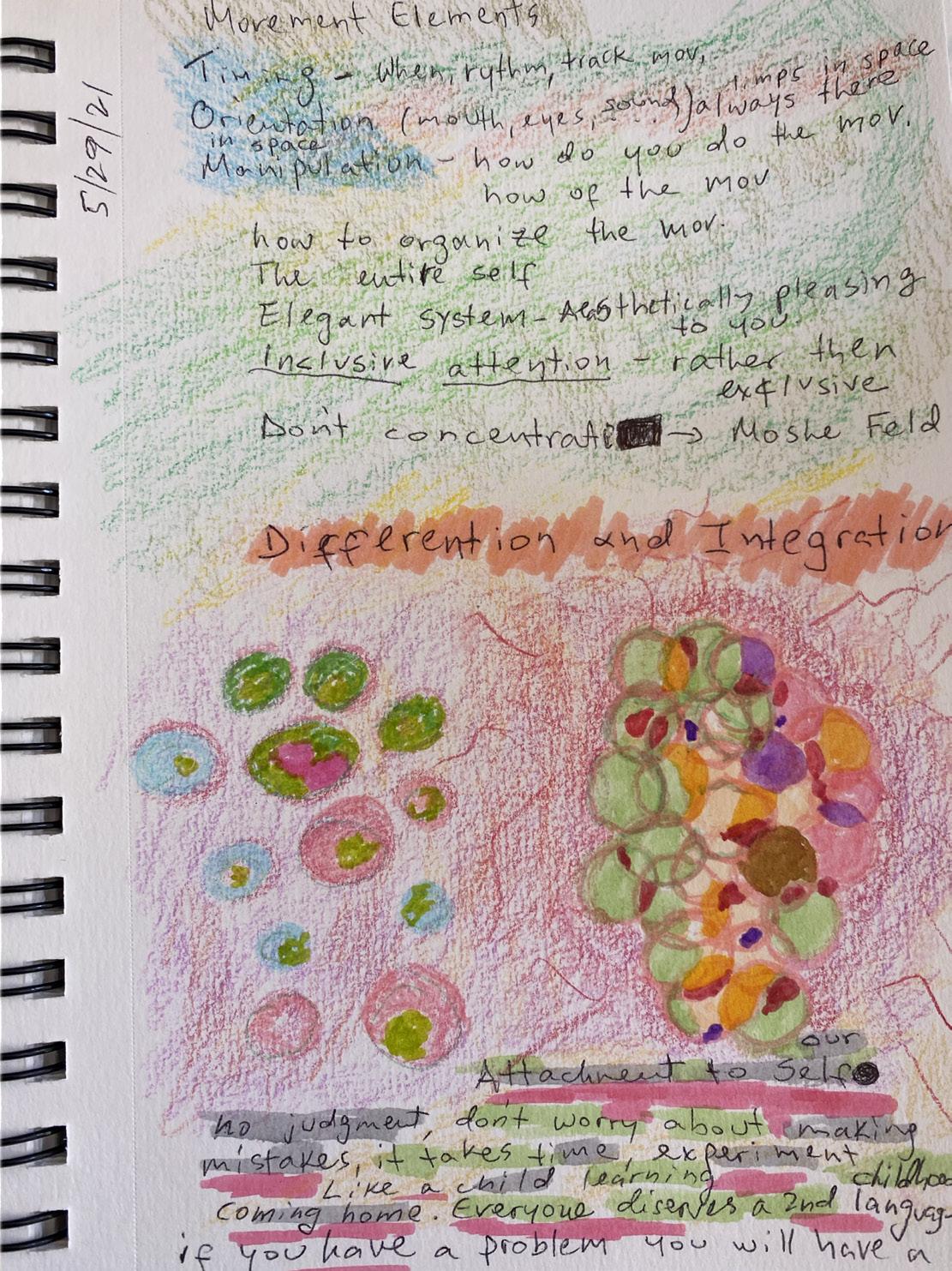
Figure 1: Pages from Dr. Zoi Dorit Eliou's notebooks
extraordinarily beneficial in deepening our commitment to analyzing ATM lessons, preparing lessons, writing papers, and preparing presentations both in the program and after graduation. Currently our peer-consultation group continues to meet to develop and plot our work. In 2023, Dr. Eliou was able to complete and publish a paper on the integration of Dialectical Behavior Therapy and ATM lessons (Eliou, 2023), a journey that began in 2018 in Tel Aviv, a few blocks away from Moshe Feldenkrais’ apartment. We are submitting this present paper on our training experience in the ATM pilot teacher training program, in hopes that we can see the program repeat and continue to thrive. We are teaching ATM lessons to peers and are planning a workshop for a group of psychologists. Moshes Feldenkrais' dream was that he would have a radio station in Israel teaching ATM lessons every day. We could only imagine how happy he would be to know that we were Zooming during the pandemic and beyond!
It is our hope that the magical world of ATM lessons will continue to be taught to all who seek to study it and that the program will be offered again with as much flexibility as possible. We also hope that our paper will invite many more to write and comment on their own experience of being a student or a Trainer in this ATM-focused program, which ran both in San Diego and Vermont. We are looking forward to a lively and fruitful discussion of our experience and being a small part of something so new and precious.
References
Eliou, Zoi Dorit, “Alternative Paths to Mindfulness: an Integration of Dialectical Behavior Therapy (DBT) with Feldenkrais Method Awareness Through Movement (ATM),” Feldenkrais Journal (5) 56–77, 2023.
Feldenkrais, Moshe, Learn to Learn (booklet to accompany a series of ATM lessons), Feldenkrais Resources, 1980.
Feldenkrais, Moshe, Awareness through Movement, HarperOne, 1972.
Acknowledgments
We want to thank Arlyn Zones and Elizabeth Beringer for the inception of the ATM pilot teacher training program. Also we would like to thank David Bryan Wexler, MD and Jeffrey Seals, MD for believing in the work and cheerleading us to write and evolve. Our gratitude to Randy Howard Katz, Ph.D. for his unyielding support of the Feldenkrais Method. Additional gratitude to our teacher Carol Kress, who inspires; each lesson we have with her opens our world. And of course gratitude goes to “Little David,” Amparo Denney’s son, who is our teacher of patience and unconditional love.
The Esalen Tapestry
Dr. Dimitri Popolov
“The threads that were spun are gather’d, the weft crosses the warp, the pattern is systematic.”—Walt Whitman1
Introduction
1 Walt Whitman, “To Think of Time,” in Leaves of Grass (1881-1882), ed. Matt Cohen, Ed Folsom, & Kenneth M. Price. The Walt Whitman Archive. https:// whitmanarchive.org/item/ ppp.01663_01905
2 Mia Segal & Gaby Yaron, Evening Class Notes, 1977–1978. Edited by Richard Ehrman. (Feldenkrais Resources 2011).
3 All references to Esalen in this article are from the same following source: Moshe Feldenkrais, Awareness Through Movement Lessons: Esalen 1972 Workshop (Feldenkrais Resources 2012).
4 David Zemach-Bersin. “Introduction,” in Awareness Through Movement Lessons: Esalen 1972 Workshop, Moshe Feldenkrais (Feldenkrais Resources, 2012), i-iv.
5 Larry Goldfarb, “A bridge to the future,” Mind in Motion (blog), Oct 2, 2023. https:// mindinmotion-online.com/ post/a-bridge-to-the-future
As a beginner Awareness Through Movement (ATM) teacher I faced the problem shared by everyone else in my situation: how to select ATM lessons to teach in my regular classes? I started with teaching some classes that I liked from my own training, then I taught all of San Francisco evening classes for the general public by Mia Segal and Gaby Yaron.2 After this my attention focused on the so-called ‘Esalen Workshop.’ Dr. Feldenkrais taught this extended workshop in 1972 over a period of several weeks at the Esalen Institute in Big Sur, California. A complete set of 43 ATM lessons from this workshop is available through notes by Judith Stransky published by Feldenkrais Resources in 2012.3
In the “Introduction” to the workshop notes, David Zemach-Bersin mentions that “both the participants and Dr. Feldenkrais considered the course as a ‘Teacher Training’ in Awareness Through Movement.”4 I hoped that teaching the entire set of lessons would give me a comprehensive map of the territory I needed to cover in order to be a competent ATM teacher. I was also hoping that following the original sequence of lessons would reduce my mental load while ensuring the best teaching results. Going by lesson numbers, I would not have to invent my own sequence of lessons, but rather follow the one established by Feldenkrais himself. This would give me another opportunity to learn directly from Feldenkrais. His decisions on sequencing would be the most informed ones on the subject. However, despite the clarity of the Esalen Workshop notes, even the very first ATM lesson proved to be a challenge. The opening Esalen lessons are described as “a bit long and rambling,” 5 and with each subsequent lesson the volume of material grows quite rapidly. Very soon just navigating this very large set of instructions about movements, emotions, and ideas became a challenge, let alone making sense of Feldenkrais’ seemingly off-hand comments and long detours in small
6 Zemach-Bersin, “Introduction,” iv.
7 Judith Stransky, “Judith Stransky: Moshe Feldenkrais, the Esalen Institute, and more…,” interview by Larry Goldfarb, Mind in Motion, May 21, 2017, audio, 59:59. https:// mindinmotion-online.com/ post/judith-stransky
8 Moshe Feldenkrais, “Day 1,”in The South Bend Workshop 1980 DVD Set (Feldenkrais Resources.) https:// feldenkraisresources.com/ products/south-bend
9 Amherst training. AH FPTP 08/07/1980.
10 Whitman, “To Think of Time.”
11 I am especially grateful to my fellow trainee Sonia Vaswani for moving through the lesson with me and providing encouragement at the very start.
print in the workshop notes. Even the original Esalen students who were present there could not follow the logic behind the sequence of ATM lessons during the workshop.6
Undoubtedly, Feldenkrais loved to talk. In an interview with Larry Goldfarb, Judith Stransky recalls how in Esalen the students had to ask Feldenkrais to stop lecturing and start teaching movements already.7 In another workshop he taught in South Bend in 1980, he told the audience to lie down for an ATM lesson at least three times, and yet every time kept lecturing about general ideas underlying his Method.8 I did not feel, however, that his wordiness resulted in random blurbs and meanderings. There was usually a particular point or a set of points he wanted to convey to his students, both intellectually and as a “feeling in your gut.” 9 In this case evocation of this gut feeling highlights students’ immediate intuitive reaction to his teaching rather than intellectual understanding.
Starting with my belief in the rhyme and reason behind Feldenkrais’ voluminous verbiage, I set out to carefully examine the very first ATM lesson in the Esalen Workshop. In doing so I concentrated on finding systematic patterns. Thus Whitman’s expression from the epigraph can be taken quite literally—“The threads that were spun are gather'd, the weft crosses the warp,/ the pattern is systematic.” 10 I have a technical background and have previously applied Artificial Intelligence methods and tools to search for patterns and connections in complex texts, such as contracts, medical notes, and crime reports. In the technical arena finding patterns in the text is a tested, tried, and very powerful approach. Having this approach as well as appropriate technical tools at my disposal, I applied them to the first Esalen ATM lesson.
I realized that when approached with the attention to systematic patterns, the first lesson reveals an intricate tapestry; Feldenkrais skillfully interweaves several main threads of his teaching into a single lesson with movements and instructions quite logically following one another. These several threads then continue throughout the entire Esalen Workshop revealing the same systematic pattern of interwoven threads.
To test out my initial findings I taught this first lesson to my fellow trainees several times and the reactions were overall positive. Those familiar with the Esalen Workshop remarked that the lesson now made more sense to them. Their interest in it and the Workshop in general was reignited.11 My regular students, adults or seniors (with none of them being professional movers), did not find the lesson either boring or overly complex.
Eventually my efforts to make sense of this very first lesson revealed a more general approach, which I called the tapestry approach and applied to subsequent Esalen ATM lessons. Tapestry started out as a useful metaphor to help my personal efforts to cope with the volume and complexity of Feldenkrais’ original Esalen lessons. Through repetition, the process I went through got articulated into an approach that can hopefully be creatively applied by others.
12 Zemach-Bersin, “Introduction,” iii.
13 Feldenkrais, Esalen 1972 Workshop
14 Stransky, “Judith Stransky: Moshe Feldenkrais, the Esalen Institute, and more…,” 59:59.
15 Feldenkrais, Esalen 1972 Workshop, 1.
This article follows my own progress developing this approach. It starts out by describing in detail the threads that jumped at me in the text of the first lesson of the Esalen Workshop, and how the threads are woven together into coherent and meaningful patterns within that single lesson. Then, to expand the scope of this approach, I trace one of the threads through the entire tapestry of the Esalen Workshop. I conclude by explaining how a reader might identify their own personally meaningful threads and use those threads to create their own lesson sequences.
I hope that at a minimum this article will help readers visit or revisit the Esalen Workshop, a “veritable tour de force [original italics]” of Feldenkrais’ own ATM class teaching, as Zemach-Bersin characterizes it.12 The reader’s interest, supported by the tapestry approach, would allow them to develop their own ATM lessons as well as sequences of lessons in fulfillment of their own objectives.
Threads
I am aware that through this tapestry approach, I am proposing a novel interpretation of the text of the Esalen workshop, so will support as much as possible my reasoning and conclusions with references to Feldenkrais himself. Judith Stransky’s notes are a great source: comprehensive, clear, and well structured.13 In her interview she shares that Feldenkrais saw her notes during the Workshop in 1972, liked them, and asked for a copy.14 We could treat this as a de facto encouragement to use them, if authorization is too strong a word.
Before diving in, a brief intro on paragraph references is in order. Unless otherwise stated, all references in this section are to “Lesson 1: Scanning,” utilizing the original number of the paragraph in the text of the Esalen Workshop.15 In the Workshop notes each paragraph has a number; the numbering is hierarchical and has two levels. The main-level paragraphs are numbered sequentially and introduce a new movement or request to sense/think. If that movement or sensing request is followed by variations, the subsequent paragraphs describing them retain the main paragraph number, with the addition of a lowercase letter after it. For example:
4. Now switch the two fingers over and go down the spine to the bottom of the spine. Do this three or four times.
4a. Now continue doing the same thing, and this time try to see what you are doing with your eyes when you think of the anal region, and what you are doing with your eyes when you think of the head where it lies on the floor, or for that matter any of the cervical vertebrae. …
16 Feldenkrais, Esalen 1972 Workshop, 2.
17 Feldenkrais calls them “five cardinal lines” emphasizing their importance. In this article we will be referring to them simply as “five lines” for brevity.
4b. Now, while you continue to do that, think of the width of the shoulders from that big cervical vertebra, through the width of the shoulders, down to the tips of the fingers. Include the shoulder blades, the shoulders themselves, elbows, wrists, to the bulk of the hands, and include the arms.…
5. Now for a moment think of the five lines and see if you can perceive them, even if roughly, all the five together.16
The main paragraph with only the number 4 describes a theme (movement/sensing/thinking), while the following two paragraphs add a slightly different focus to that same theme. Consequently those paragraphs keep the same number and are referenced by adding letters (4a and 4b). Paragraph 5 moves to a new theme and as such is placed on the main level and referenced with the next sequential number. This decision to make a particular paragraph the main one or place it on the second level is not always clear-cut but this is immaterial for our purpose. In this article it suffices to follow the original references.
Let us start by going through the lesson paragraph by paragraph denoting the main threads that I identified. The four threads I separated out are:
A. Complete body image through five lines, connecting five lines into a stick-person.17
B. Breathing, disconnecting breathing from the movement.
C. Change in attention changes tonification of muscles, leading up to a movement.
D. Using the speed to optimally organize the movement and differentiate it from strain-engendering “rushing.”
These threads are the ones that I formulated for myself based on my personal knowledge and needs at that particular moment. The following sections explore identification of threads in the text, and how threads will be very different for different readers. For now let us take these four threads as a given.
For each of these threads I made short labels, similar to marker tabs for paper documents or folders:
A—Five lines
B—Breath
C—Attention
D—Speed
18 I coded this example myself in python as a Jupyter notebook using spaCy Displacy library to display color highlights around spans of text.
We likely all have experience of highlighting parts of a text as we review or study a document. I did the same here and marked the threads both with colors and with letters. I used both letters and colors because some readers might have a preference for colors, and others for letters or numbers. Some like using highlighters while others use just a pen or pencil as they work through texts. Colors are nice and catchy, but letters will work in ‘monochrome’ situations (and for the color-blind). The order of the list and use of particular colors is not important here.
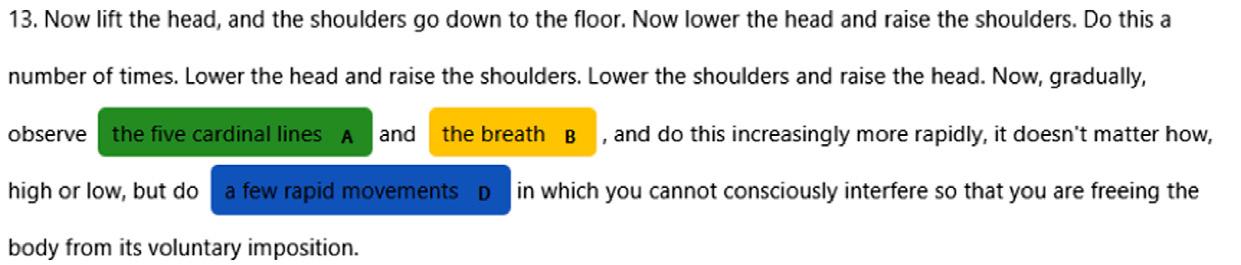
Once I had the list of threads and labels, I went through Lesson 1 paragraph by paragraph marking up parts of text as belonging to a particular thread. To illustrate this, I created a small program to visualize the threads markup.18 Using paragraph 13 as an example, the threads in it would look as follows after highlighting:
1: Example of threads in the text
This image clearly revealed all threads for that particular paragraph. At this point I could move on from voluminous text of a paragraph to focusing on the markups representing the threads. To continue with the same example, the threads emerging from paragraph 13 would be A , B, D. In a sense, the voluminous paragraph got reduced to these three thread markers.
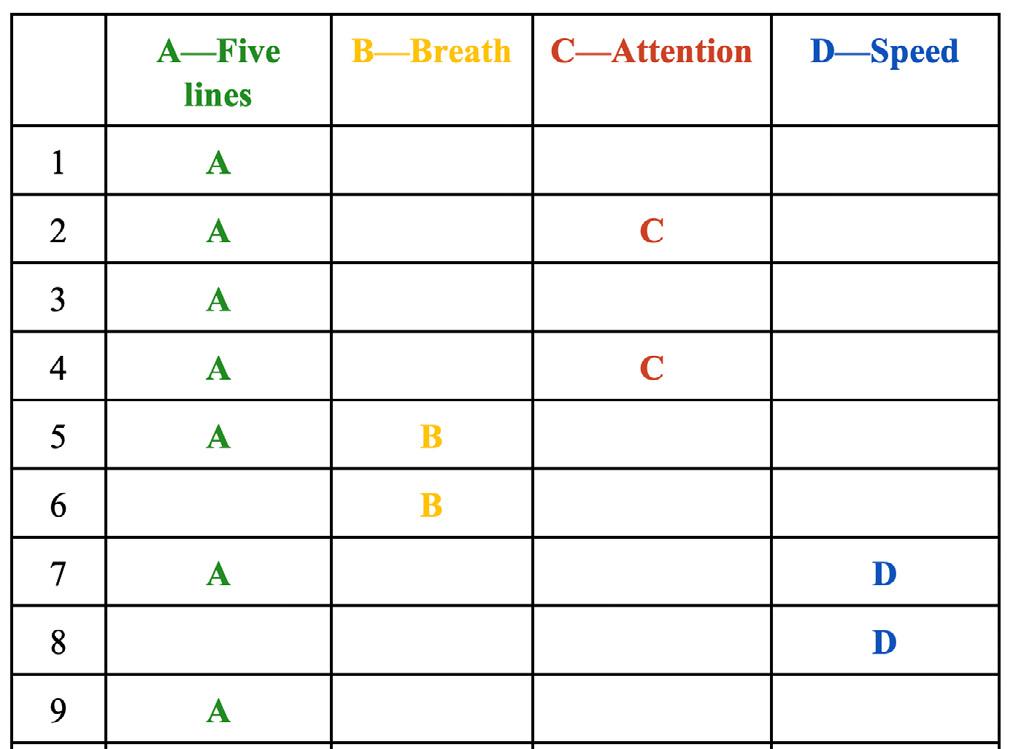
In this way I went through every paragraph of Lesson 1 summarizing results in a table. Each thread has its own column, and the leftmost column refers to main-level paragraph numbers in the text of the workshop:
Table 1: Threads in Lesson 1.
Figure
19 Whitman, “To Think of Time.”
Table 1 (continued): Threads in Lesson 1.
This table lays all the threads out on a surface, the way a tapestry could be hung on a wall. To recall Whitman’s epigraph, the table can be likened in its structure to a woven textile tapestry. The columns form the basis for weaving (the warp), going throughout the entire lesson, while rows can be compared to weft going around the warp. Placing letters into the table cells creates coloured threads representing the metaphorical intersections of weft and warp. This visual guide helps to convey to the reader the regularity of the lesson’s pattern, even though at a first glance it might appear rather meandering.
Now that the entire lesson is visible at a glance, a clear pattern emerges with thread A—Five lines being the main thread going throughout the entire lesson. In the very beginning, the pattern is quite regular. There is A as the main thread with two additions of C woven onto it, and every time there is a return back to A . Then Feldenkrais is building on thread A further by adding a new thread B and again coming back to A . Then he adds D but every time there is a return to A . It is this pattern that initially prompted the birth of the tapestry metaphor—“the weft crosses the warp, the pattern is systematic.” 19
Tracing the threads in this way helps us discover the rhyme and reason behind Feldenkrais’ development of the lesson. It reveals logical connections in places of the lesson where the flow seems to break down. For example, let us look at what happens in paragraphs 15, 16, and 17. The quotation starts with paragraph 14 to provide a better lead-in to the sequence of movements:
20 Feldenkrais, Esalen 1972 Workshop.
21 Feldenkrais, Esalen 1972 Workshop, 1.
22 Zemach-Bersin, “Introduction,” i.
14. … Lower the shoulders and lift the head. Lower the head and lift the shoulders ….
15. Now lift the right shoulder and lower the left; and the other way around. [...]
16. Now lift the right hip off the floor slowly a number of times. You can lift by pressing the right heel against the floor. Do not turn sideways, only a little bit.
17. Now see if you can do the same thing with the right hip without leaning on the heel at all.” 20
On the initial reading, the logic in these paragraphs is not immediately apparent. Moving from shoulders to hips and especially the instruction to press the heel against the floor in paragraph 16 comes as a non sequitur after extensive work with head and shoulders and breathing. However, by examining the threads we can see that Feldenkrais methodically draws with his instructions a complete image of a stick person made out of five lines “with the little circle on top.” 21
In the first and second paragraphs of the lesson he introduces the five lines and then goes along the spine, adding arms and legs to the picture in the subsequent paragraphs. The full sequence indeed results in a complete stick person:
1–2: Five lines explained
3–4: Spine
4b–4c: Arms as connected to spine
4d–4e: Hips and legs
These paragraphs are all part of the scanning; there are no movements as such but they are all within the thread A—The five lines , so we colored them accordingly in Table 1. Colored letters A in corresponding cells connect them visually into a thread running vertically.
It is worth mentioning that students in the Esalen Workshop were leaders in the field of human development rather than skilled movers.22 Thus Feldenkrais assumed a low initial level of awareness and was building the lesson in a very systematic way (cf. ‘systematic’ in Whitman’s epigraph), coming back to the same ideas with some new twist or details. Later in this particular lesson Feldenkrais revisits the lines thread (A) but with the addition of movement to augment the restful scanning in the first pass. He focuses students’ awareness on the connections between the line of the spine with lines of the individual limbs, so the parts of the body he is asking to move are as follows:
7–9: Right shoulder
10–11: Left shoulder
12: Both shoulders
13–15: Head and shoulders
16–20: Hips
All these movements are also happening within A—Five lines thread, so in the table we color them with the green A. This once again creates an image of a vertical thread running in the table.
Looking at the first and second pass we can now see this logical and gradual build-up of awareness throughout the entire stick person. Crucially, in both passes he is still within the line A—Five lines. This "sticking to the line" gives Feldenkrais the discipline to teach a complex topic that requires multiple passes during a lesson or even a set of lessons.
For me as a beginner ATM teacher, identification of the threads and how Feldenkrais sometimes stuck to them and sometimes alternated them in various patterns greatly clarified Feldenkrais’ own manner for building this ATM lesson. The overall purpose of Lesson 1 along with every transition between movements started to make sense to me. This understanding and clarity naturally gave focus for my own guidance to students, both with regards to both moving and sensing.
Longer threads, bigger tapestry
Sticking to my initial intent to study Esalen lessons sequentially, I moved on to subsequent lessons. I have not traced all four threads, but rather concentrated on A—Five lines. From the table we can now clearly see that it is the most significant thread in Lesson 1, so I focused on going more in-depth on it.
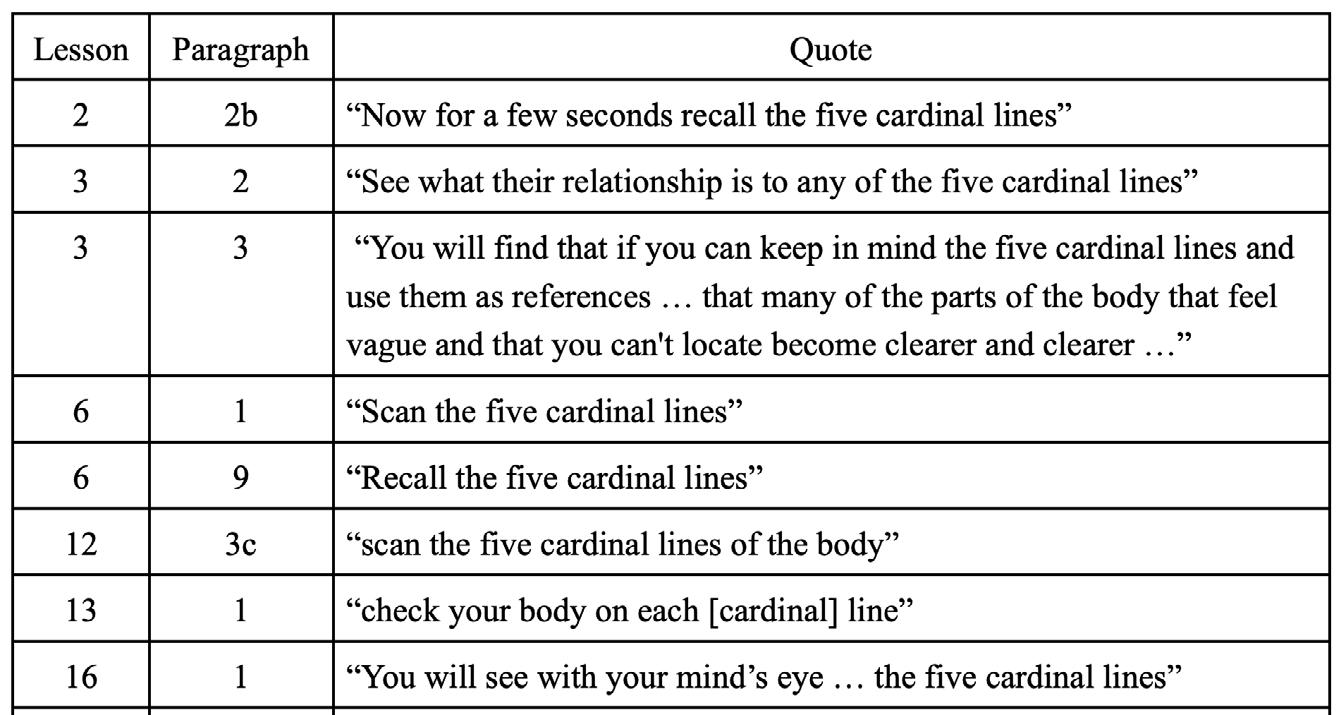
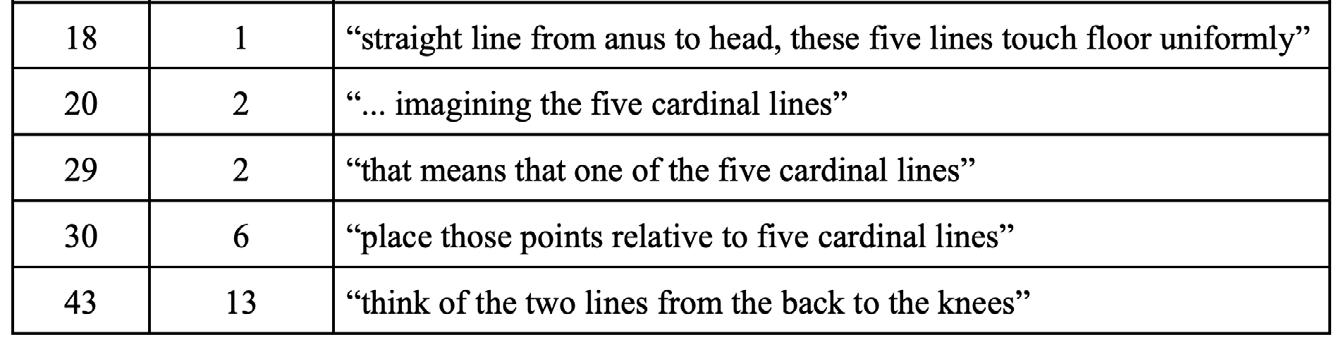
Following the same method of highlighting threads in the text and summarizing them in a tabular fashion, I have made a table for tracing specifically thread A . The table listed lessons and paragraphs of the Esalen Workshop where Feldenkrais mentions thread A—Five lines . For convenience, I also added a column with corresponding quotes from the text:
Table 2: Thread A—Five lines throughout the full Esalen Workshop.
23 Feldenkrais, Esalen 1972 Workshop
24 Zemach-Bersin, “Introduction.”
Table 2 (continued): Thread A—Five lines throughout the full Esalen Workshop.
Once this thread is presented in this way it becomes clear how it is woven into the fabric of the entire workshop. Feldenkrais introduces this thread in Lesson 1 with insistence on its importance in every situation: “have [the five lines] always in the background of your awareness. You will see that any correction should be considered as a detail, as a part of the whole picture. We do not try to make the details perfect … to change the whole at once, but at least the cardinal lines, the cardinal structure, should become affected by any change.” 23
Lesson 1 in the Esalen Workshop is where Feldenkrais lays down the groundwork for the entire workshop and his teaching method, so he dedicates significant time to introducing this thread. Then he revisits this thread multiple times in subsequent lessons.
Looking at paragraph numbers, it becomes evident that typically Feldenkrais revisits thread A—Five lines in the beginning of lessons and then continues with the main topic of that lesson. This reveals yet another of his teaching devices—when Feldenkrais feels that a certain concept or theme needs to be well internalized based on first-hand experience, he leads in with short reminders to connect that concept with more and more varied movements.
Introductory series
One truly fascinating feature of the Esalen Workshop is the so-called “introductory series” within the workshop. This set of eight lessons starts at Lesson 18 and continues until lesson 26. Both Zemach-Bersin and Stransky recount how Esalen students rebelled against the apparent lack of logic in the sequence of lessons Feldenkrais was teaching them, and demanded that he create a sequence of lessons that they could teach to their own future students. Naturally, as prospective ATM teachers they were also concerned with selecting which ATM lessons to teach to their future students. The premise was that if the teachers themselves cannot get that sequence of ATM lessons, there would be no way they could transmit it to their students.
Following this request to start from a clean slate, Feldenkrais once again begins his new introductory lesson (Lesson 18) with the inevitable thread A—Five lines 24 His point of departure is the same, but Lesson 18 is teaching very different material and the focus on the lines is less
strong than in Lesson 1. Still, it is the same thread A . This does not only prove the importance of five lines as a concept but more generally shows how Feldenkrais uses them to create sets and sequences of lessons.
For example, the previous Feldenkrais quote from Lesson 1 about the role of five lines in change is found in small print in Stransky’s notes; but with the new focus on thread A—Five lines it would merit ‘main-size font’ or even become the main theme for a new series of lessons. Once a thread is identified in one lesson, we can recognise it in other ones and consciously use it to connect them. Having several lessons linked by the same thread would allow us to freely navigate between them outside of the sequence of the Esalen Workshop. In the language of the threads and tapestry metaphor, one can pull at different threads and pull out different pieces of the tapestry.
This reorganization of the same material along a new thread is precisely what Feldenkrais did with the Introductory series. From the same point of departure, he has developed a totally different but still coherent sequence of ATM lessons. This teaching device from Feldenkrais himself can definitely be adopted and adapted for our own teaching of ATM lessons. I feel that tracing the threads as part of the tapestry approach equips us as ATM teachers to navigate Feldenkrais’ immense textual heritage with greater understanding and increased levels of freedom.
To illustrate that point, recalling all the lesson numbers mentioning the five lines we will get this sequence: Lessons 2, 3, 6, 12, 13, 16, 18, 20, 29, 30, 43. These eleven lessons are now connected into a workshop of its own which could be taught in that sequence. We could call it “The Five Lines Workshop.” Similarly, we could take thread B—Breath as a theme for a series of lessons exploring this very critical for life activity. And exactly this has been done by other practitioners, for example Alan Questel has an entire weekend-long workshop called "Breathe …".25
How interesting!
I have focussed on thread A—Five lines and demonstrated how it can be used to connect lessons (or even blocks of lessons) in the workshop. The same tracing exercise can be repeated with other threads from Lesson 1, and I would encourage the interested reader to do so.
Interested is not a random word here. The question I left unanswered in the prior sections was: Why did I choose those four particular threads? In this section I would like to share some ideas on how readers might identify their own threads based on personal interest.
One simple guideline for identification of threads is the frequency of something being mentioned. Simply put, if Feldenkrais mentioned something often, then it must be important. In the tapestry approach, this would be equivalent to noticing the most frequent colors and
26 Alexander Piatigorsky, Thinking and observation. Four lectures on observational philosophy 2016, 14.
elements of the overall pattern.
However this purely frequency-based outlook could be overly mechanistic and not necessarily useful. To reduce it to absurd, one can almost imagine a PhD thesis entitled, “Use of a definite article by Moshe Feldenkrais in Esalen workshop.” Of course “the” is one of the most frequent words, but that dissertation would totally miss the point in spite of being very objective and completely grounded in the text and facts.
The problem with only looking at frequencies is that they do not take into account active interpretation of text by an individual reader. This interpretation is absolutely fundamental, especially during our personal journey through texts which we read in order to change something in ourselves and our lives. A single phrase or word has the power to turn our world upside down. The question is how to find it.
One guideline for finding that intimately personal threadengendering phrase or word is a feeling of interest. It is a subjective feeling of course; what one person finds interesting or even fascinating leaves another person totally unmoved. However, I believe it may be the best personal guideline for finding one’s own path through the texts.
Alexander Pyatogorsky—in my personal opinion one of the deepest and most original thinkers spanning the 20th and 21st centuries— declined to define his philosophy and instead started with the definition of interesting:
Interesting is what stimulates the thought—your thought, mine, right here and now—instead of arresting thinking …. Interesting makes a listener, a viewer, or a reader oblivious to one’s beliefs ….
Interesting for me is what changes the tendency of thinking in relation to the objects of this very thinking: an object A that has just been thought of as A is now thought of as B. And not only that. How interesting! contains a tendency of thinking to move not only from one object to another, but to a kind of movement in whose limit all the objects of thinking will entirely disappear from it. Only how? will remain. [emphasis in original]26
Following this definition of interesting, my recommendation for uncovering one’s own threads is this: If there is something in an ATM lesson that is interesting and stimulating for you, then mark it up right there and then and see if it could be a thread that resurfaces somewhere else. You is meant in Feldenkraisian terms, meaning engagement of the entire self and inclusion of all modalities of sensing, feeling, thinking, and moving.
For example, the threads that jumped at me are all ideas and images. This is a reflection of my own way of perception, being, and personal history. For those who feel comfortable in other modalities those threads could be a particular movement, or indeed a kinesthetic sensation, or a particular emotion that intrigues and stimulates. And of course
27 Feldenkrais, Moshe. The Elusive Obvious, 1981, 135.
28 Piatigorsky, Thinking and Observation, 14.
29 http://www. semiophysics.com/ SemioPhysics_Dennis_Leri. html
30 https://semiophysics. com/EsalenNotes.pdf
as Feldenkrais practitioners we are all taught to recognise and use a particular movement function as a guiding thread in our studies and explorations.
In the Feldenkrais Method of somatic education this principle of effecting the change through following what is individually interesting has quite a practical and embodied application. For example, Feldenkrais’ own description of principles of Functional Integration lessons mentions interest:
The helped person should feel a friendly hand and attitude rather than any sensation of being pushed or manipulated. At each meeting something new, unforeseen, and unexpected will be used. The person’s system will be alert, curious, and interested all the time, otherwise there will be stagnation and boredom, with no learning worth the trouble.27
Here interest is a reaction of a nervous system requisite for effective learning (synonymous to change). Importantly, it is contrasted to being pushed or manipulated. A reminder that as practitioners we cannot change anyone, but can only instigate our shared interest with a student, and it is this interest that will engender change. It is important to note that regardless of the modality of our initial interest, be it an emotion, a particular movement, or sensation, in the following steps we articulate them verbally. To be able to develop our interest and communicate it to others through ATM lessons we have to verbalize. In this situation one practical step for finding threads can be as simple as searching for a word or phrase in various electronic documents and websites. This search will hopefully yield some lessons or passages in Feldenkrais’ books where we exclaim to ourselves: How interesting!
There you go, that is a new thread for the “right here and now.” 28 This thread could be short, or it could go through many lessons as we search in them for keywords of interest. Then of course these (parts of or sequence of) lessons would need to be experienced, not just read and thought and talked about. We go through iterations of experiencing, recognising this experience in texts, and then generating new experiences following our natural curiosity. As we go through these iterations we inevitably create our own personal thread of movements and lessons. We follow it for as long as it is natural while being aware that the thread could change in an instant as we ourselves change.
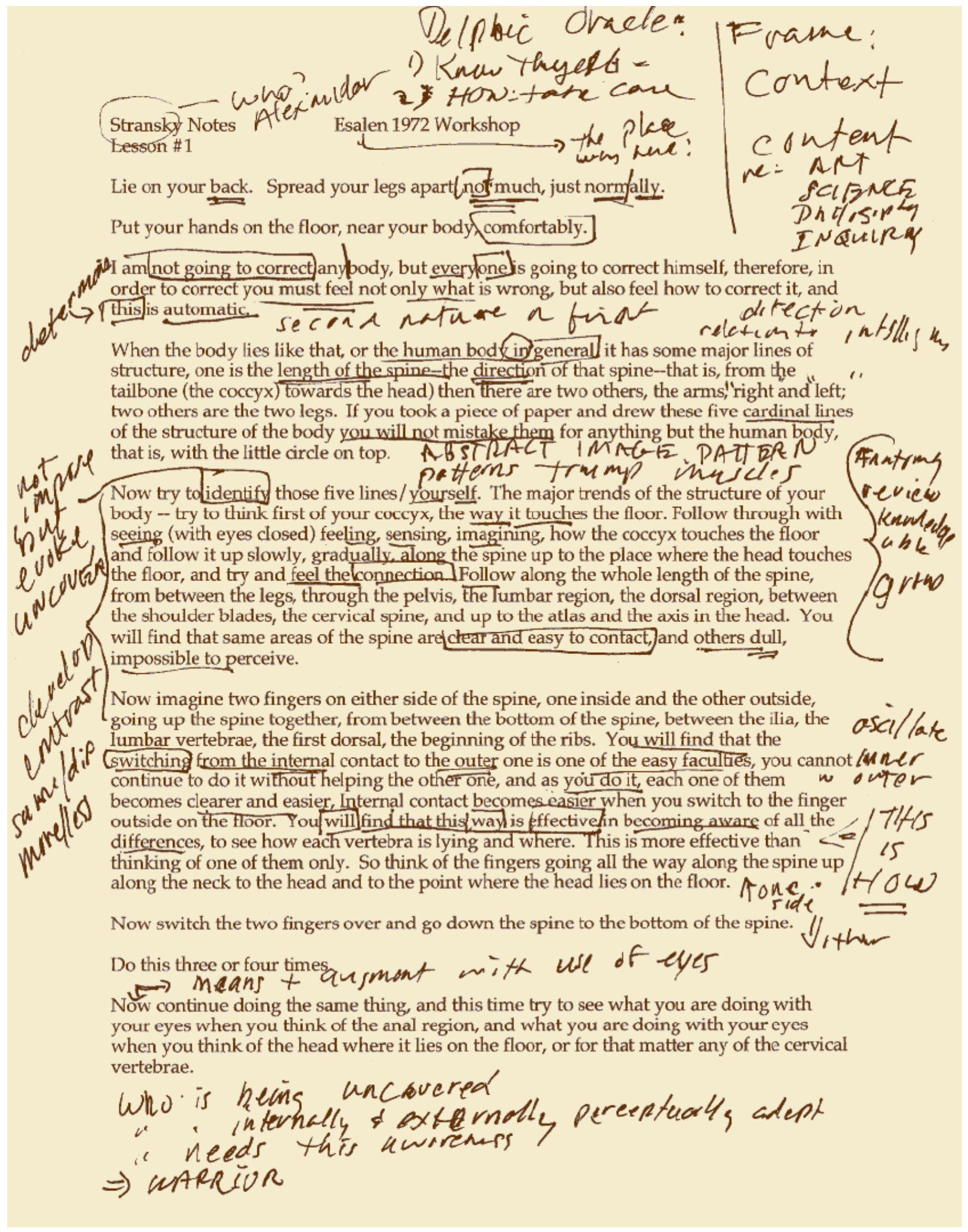
A great example of how another reader of the Esalen Workshop text could arrive at totally different threads is Dennis Leri’s handwritten notes. Leri was a respected Feldenkrais practitioner and Trainer, a direct student of Feldenkrais known for his depth of understanding of the Method.29 He wrote his notes literally on the margins of his printed copy of the Esalen Workshop.30 Only the first page is in the public domain, but even that is more than plenty:
Figure 2: Dennis Leri’s handwritten comments on page 1 of The Esalen Workshop notes
31 Leri, Dennis. An Introduction to the Primitives, 2012, Chapter 3.
32 Whitman, “To Think of Time.”
How could Leri possibly be thinking of Delphic Oracle and Socrates’ most famous maxim “Know thyself” while reading this page? This is clearly something that was interesting for him at that particular moment but it is significantly further down the line of his individual thought and quite remote from Feldenkrais’ text. Tellingly it is a scribbling on an invitingly blank top margin rather than a highlight alongside the text as there is no clear anchor in the text to which this note can be tied. In other blank spaces there are beginnings of the threads that will become prominent in Leri’s later thinking and practice. For example, in the middle of the page he writes, “patterns trump muscles.” Some years later he will repeat this expression verbatim in his own Introduction to Primitives workshop.31
Exactly the same transcription text of a Feldenkrais ATM Class interpreted by different readers can develop in very different ways. Approached through a personal interest this process is inevitable and in fact desirable. As a beginner ATM teacher I was staying close to the text and only trying to make sense of the instructions. I was happy to be able to teach this ATM lesson while understanding what it’s about. Leri’s thoughts were going way beyond the text into reflections on the Method, human personality, and being. They were finding their expression in his articles, workshops, and training programs.
Conclusions
We can come back to Whitman’s epigraph to “think of time—of all that retrospection!” 32 There is now more than half a century separating us from the events at the Esalen Workshop. Most new trainees and practitioners had not even been born at that time. Dennis Leri died in 2016. Fortunately there are notes and the audio recordings so that anyone interested in the Esalen Workshop has the benefit of unrushed retrospective analysis without two daily ATM lessons piling up on them for weeks (like they were piling on the Esalen students).
Coming back to my initial intent to reduce the mental load by going through the lessons sequentially—it has not worked quite as planned. Indeed I did not have to decide on what to teach, but the challenge of going through even the first lesson was a bit unexpected. However, this added sensemaking effort of finding my personal threads to connect paragraphs and entire lessons into a coherent whole was very beneficial. For me the benefits are already extending beyond the Esalen Workshop. Recently I was invited to teach a small series of ATM lessons to beginners. I was asked to provide focus on awareness of some specific joints and their functions in daily life. I am using Lesson 1 as the starting point and then consciously developing threads of teaching. The threads are different from the ones analyzed in this article because my purpose is different, but articulating them helps to connect the five classes I was asked to teach as a coherent whole.
In retrospect, it is a balance between freedom and coherence that makes the metaphor of threads and tapestry useful in teaching ATM classes. The ability to identify one’s own threads and weave them into an endless variety of patterns provides practically unlimited freedom. At the same time, being aware of inner logic and having a discipline to follow the consistency of threads eliminates poorly connected instructions and disjointed lessons in workshops. I wish readers the best of luck spinning their own threads and gathering them into their very own totally unique but nevertheless systematic patterns of ATM teaching.
References
Feldenkrais, Moshe. “Lecture: Introduction to the Feldenkrais Method: Life is a Process,” in The South Bend Workshop, 1980. DVD Set. Feldenkrais Resources.
Feldenkrais, Moshe. Amherst training 1980, 1981. International Feldenkrais Federation.
Feldenkrais, Moshe. The Elusive Obvious or Basic Feldenkrais. Meta Publications, 1981.
Feldenkrais, Moshe. Awareness Through Movement Lessons: Esalen 1972 Workshop. Feldenkrais Resources, 2012.
Goldfarb, Larry. “A bridge to the future,” Mind in Motion (blog), Oct 2, 2023. https://mindinmotiononline.com/a-bridge-to-the-future
Leri, Dennis. An Introduction to the Primitives, 2012. Feldenkrais Access, 2019.
Leri, Dennis. Hand-written comments on page 1 of The Esalen Workshop notes, accessed October 26, 2024, https:// semiophysics.com/EsalenNotes. pdf.
Piatigorsky, Alexander. Thinking and observation. Four lectures on observational philosophy. St. Petersburg: Azbuka, 2016.
Stransky, Judith. “Judith Stransky: Moshe Feldenkrais, the Esalen Institute, and more…,” interview by Larry Goldfarb, Mind in Motion (blog), May 21, 2017, audio, 59:59. https://mindinmotion-online.com/ judith-stransky/
Whitman, Walt. “To Think of Time,” in Leaves of Grass (1881-1882), ed. Matt Cohen, Ed Folsom, & Kenneth M. Price. The Walt Whitman Archive. https://whitmanarchive. org/item/ppp.01663_01905
Zemach-Bersin, David. “Introduction,” in Awareness Through Movement Lessons: Esalen 1972 Workshop, Moshe Feldenkrais, i-iv. Feldenkrais Resources, 2012.
Movement Quality and Music-Making Practice: On between the and Musical the Relationship Feldenkrais Method Improvisation
Corinna Eikmeier Anna Katharina Sanner (Translator)
Introduction
1 Corinna Eikmeier, Movement Quality and Music-Making Practice: On the Relationship between the Feldenkrais Method and Musical Improvisation (Fernwald: Musikautorenverlag Burkard Muth, 2016).
This article is a summary of a longer, more detailed research report published with the same title in 2016.1 (An abridged version of the original research is also available.2) The summary was first published in German in the Feldenkrais Research Journal Volume 6 (2022) by the International Feldenkrais Federation (IFF).3 Eikmeier and Sanner, author and translator, have kindly granted us permission to republish the English version, first published in the Feldenkrais Research Journal Volume 7 (2023–2025), in this issue of The Feldenkrais Journal ™.4 (A Spanish translation is also available, thanks again to the IFF.5)
2 Corinna Eikmeier, “Improvising with an Improvising Body,” in Exploring Improvisation— Improvising Research: Essays about the Exploration of Musical Improvisation, ed. Reinhard Gagel and Matthias Schwabe (Bielefeld: Transcript, 2016).
3 Corinna Eikmeier, “Bewegungsqualität und Musizierpraxis: Zum Verhältnis von Feldenkrais-Methode ® und musikalischer Improvisation,” Feldenkrais Research Journal 6, (2018-2019). https:// feldenkraisresearchjournal. org/index.php/journal/%20 article/view/15/10
4 Corinna Eikmeier, “Movement Quality and Music-Making Practice: On the Relationship between the Feldenkrais Method® and Musical Improvisation,” Feldenkrais Research Journal 7, (2023), trans. Anna Katharina Sanner. https:// feldenkraisresearchjournal. org/index.php/journal/%20 article/view/143/94
5 Corinna Eikmeier, “La Calidad del Movimiento y el Hacer Música: Sobre la Relación entre el Método Feldenkrais® y la improvisación musical,” Feldenkrais Research Journal 7, (2023), trans. Amelia Febles Diaz and María Clara Reussi.
Basic observations
This research project was carried out in the context of a classical western music education specializing in vocal and instrumental pedagogy, which places great emphasis on interpretation.6 A considerable percentage of professional musicians experience problems concerning the musculoskeletal system.7 As a preventive measure doctors specializing in the treatment of professional musicians recommend the supplementary use of somatic techniques. Practitioners of somatic learning methods specialize in working with musicians. While teaching the Feldenkrais Method of somatic education at a music conservatory, I observed that many classically trained musicians were unable to apply their experiences from Feldenkrais Method lessons to their instrumental play.8 In Feldenkrais Method lessons, students explore an “improvisational quality of movement.” 9 When practicing an instrument, changing rigidly rehearsed movement patterns seems difficult. People’s descriptions of their physical sensations when improvising resemble those given after Feldenkrais lessons.10 The same people tend to describe negative emotions concerning their physical movements while interpreting music. This cannot be solely due to playing technique, which differs only marginally when improvising and when interpreting music (playing the violin remains playing the violin). Obviously, the musicians’ mindset, perception, way of listening, and willingness to fully engage in the present moment contribute to the way they feel about making music in each particular instance.
Questions
Many relevant medical publications on music physiology and treatments for musicians neglect to discuss the role of different approaches to making music.11
For this research project, differences in the subjects’ approach and musical practice, as well as idiosyncrasies in their improvisational play were considered relevant from the beginning. This made improvisation a vital part of the study. Improvisation requires skills or modes of action that are equally important for any other type of music-making practice, but indispensable for improvisation. In this study, I defined the term “improvisational mode of action” as a mode of action that can also be applied when interpreting composed works. My initial observations led to the following central research questions:
• What specific modes of action are important for improvisation?
• How do these modes of action interrelate with movement quality in music-making?
6 A comparison to other musical cultures where learning has traditionally been through improvisation and oral transmission was not a topic of the research and therefore not addressed. The creative areas such as improvisation and composition are often integrated in instrumental and vocal pedagogy as a means to an end in order to better perform interpretations. See, among others, Barbara Busch and Barbara Metzger, “Contents of Instrumental Teaching,” in Grundwissen Instrumentalpädagogik. Ein Wegweiser für Studium und Beruf, 232–253. and Anselm Ernst, Lehren und Lernen im Instrumentalunterricht. A Pedagogical Handbook for Practice, (Mainz: Schott, 1991), 44–69.
7 See overview of statistics in: Hildebrandt Horst, Music Study and Health. Structure and Effectiveness of a Preventive Teaching Program (Zurich Music Studies, Vol. 1) (Bern: et al: Lang, 2002), 16.
8 Ongoing course in group lessons, Awareness through Movement®, and in individual lessons, Functional Integration®, for students of all courses of study at the University of Music, Drama and Media, Hannover.
9 The term does not exist in the literature on the Feldenkrais Method in this form. It was coined by the author in this research project through the analogy between the Feldenkrais Method and improvisation.
10 Within the framework of the Dorothea Erxleben Fellowship, the author has already carried out a project on the subject of the Feldenkrais Method and improvisation from 2007–2009. In this context, improvising musicians were asked by means of
a questionnaire about their body awareness when improvising and interpreting. From today’s point of view, the questionnaire does not meet scientific standards. It only gave the author food for thought for the present project.
11 Eckart Altenmüller, Neurological Diseases in Musicians (Heidelberg: Springer, 2006). Hans G. Bastian, ed., “Preventing and Avoiding Diseases. Instrumental Playing from a Physiological, Technical and Curative Pedagogical Point of View,” [2nd Paderborn IBFF Symposium], (Mainz: Schott, 1995); Jochen Blum, ed., Medical Problems in Musicians With a foreword by Sir Georg Solti (Stuttgart et al: Thieme, 1995); Martin Gellrich, “On the Construction of Motor Schemata in Instrumental Playing,” in Unused Potentials: Ways to Constructive Practicing (=congress report 1997 of the Forschungsinstitut für Instrumental- und Gesangspädagogik e. V. in cooperation with the Hochschule für Musik und Darstellende Kunst Frankfurt am Main), ed. Gerhard Mantel (Mainz: Schott, 1998), 131–151; Horst Hildebrandt, Music Study and Health. Structure and Effectiveness of a Preventive Teaching Program (= Zurich Music Studies, Vol. 1) (Bern et al: Lang, 2002); Horst Hildebrandt, “Practicing and Health. Selected Music Physiological Aspects of Practicing and Their Special Significance for Everyday Training and Professional Life,” in Handbook of Practicing. Fundamentals—Methods— Concepts, ed. Ulrich Mahlert (Wiesbaden et al: Breitkopf & Härtel, 2006), 67–97; Susanne Klein-Vogelbach, Albrecht Lahme, Irene Spirgi-Gantert, Musical
Instrument and Posture. A Challenge for Musicians, Music Educators, Therapists and Physicians Healthy and Fit in Everyday Life as a Musician (Berlin et al: Springer, 2000). Renate Klöppel, The Health Book for Musicians. Anatomy, Occupational Diseases, Prevention and Therapy (Kassel: Bärenreiter, 1999); Hartmut Puls, Experiences from Body Work with Music Students. Prophylaxis as a Teaching Subject at the Hochschule für Musik “Hanns Eisler” Berlin (Üben & Musizieren, 17th Jg. No. 5, 2000) 27-33; Gerd Schnack, Health Strategies in Music Making—Exercises for Prevention and Therapy of Playing Injuries (Munich et al: Urban & Fischer, 2000); Gerd Schnack, Preparing Fertile Ground. On the Implementation of Musician Health in Higher Education (Üben & Musizieren, 27th Jg. No. 1, 2010) 22–27; Claudia Spahn, Musician’s Medicine. Diagnosis, Therapy, and Prevention of Musician-specific Diseases. With the collaboration of Jochen Blum (Stuttgart: Schattauer, 2011); Christoph Wagner, “Physiological and Pathophysiological Foundations of Music Making,” in Medical Problems in Musicians. With a preface by Sir Georg Solti, ed. Jochen Blum (Stuttgart/New York: Thieme, 1995), 2–29.
12 Gerhard Kleining, “Openness as a Characteristic of Exploratory Research,” in Methodology of Qualitative Social Research (= Kontrapunkt, Vol. 1), eds. Claudia Hoock and Jan M Böhm (Münster: Kontrapunkt, 2001) 27–36.
13 Ernst Mach, “Erkenntnis und Irrtum. Sketches on the Psychology of Research,” (Darmstadt: Wissenschaftliche Buchgesellschaft, 1968), 261. [Reprographic reprint of 1926]
14 See Gerhard Kleining, “Umriss zu einer Methodologie Qualitativer Sozialforschung,” Kölner Zeitschrift für Soziologie und Sozialpsychologie, 34 (1982): Jg. Nr. 2, S. 224–253, S. 224 f.
15 Gerhard Kleining and Harald Witt, “Qualitative Heuristic Research as a Discovery Methodology for Psychology and the Social Sciences: Rediscovering the Method of Introspection as an Example,” Forum Qualitative Sozialforschung, 1. jg. no. 1, (2000).
Questions concerning the Feldenkrais Method:
• What improvisational modes of action are implicitly addressed through the Feldenkrais Method?
• What comparisons can be made between learning strategies employed in the Feldenkrais Method and improvisational modes of action?
The research process
Due to their extremely high complexity, neither improvisation nor the Feldenkrais Method can be examined to a satisfactory degree simply by using scientific or quantitative measurement methods. The research design for this study was developed in an improvisational manner throughout the research process. The research methodology used was based on principles borrowed from qualitative heuristics, which I have described in the following section. Variations on this basic methodological approach also used in this study were: research interviews, introspection, and, most importantly, the qualitative experiment.
Qualitative heuristics
“Discovery is the process of replacing or expanding on what we know by adding something new—basically, it is change.” 12 Children’s way of discovering the world makes them living examples of heuristic research. They look at everyday facts and explore them for their own understanding. “Once again, it becomes apparent that the intellectual activity of the researcher and inventor is not essentially different from that of the common man. The latter does it by instinct, the scientist turns it into method.” 13 Heuristic or discovery research with qualitative methods is based on a methodology developed at the University of Hamburg and applied in many fields.14 The research process is “conceived as a form of dialog, as applied dialectics.” 15
The basic rules of qualitative heuristics
The method of qualitative heuristics follows the basic rules listed below.
Rule 1: “Researchers should be open to new concepts and change their preconceptions if they are contradicted by the data available.” 16 When executing a research project, this rule means a researcher needs to be flexible and be prepared to change their line of inquiry if their findings are not as expected. External factors like funding and timelines can inconveniently stand in the way of unexpected
20 See Hans-Jost Frey, “Attempt on the Unforeseen,” in Improvisation 6 [13 papers; 6th International Conference on Improvisation, Lucerne 2005, ed. Walter Fähndrich (Winterthur: Amadeus), 107–129.
21 See Kurt Ronald (2011): Improvisation as a Method of Empirical Social Research. in The Discovery of the New. Qualitative Social Research as Hermeneutic Sociology of Knowledge, eds. Norbert Schröer and Oliver Bidlo (Wiesbaden: VS Verlag), 69–84.
22 Kleining, “Openness as a Characteristic,” 27 f.
findings. This can be mentally challenging for the researchers involved. Hypotheses made by the researchers at the outset may change throughout the research process.17 Also, researchers must be open to unexpected new findings. As early as 1905, Ernst Mach noted that “we must not shrink back from unfamiliar conceptions if they rest on secure foundations. For the possibility of encountering fundamentally new facts has not only existed in earlier stages of research, it continues to exist and has never ceased to exist for a single day.” 18 He noted that coincidences often make incongruities between ideas and facts visible and palpable, and that it is exactly this process that often leads to the solution of our problems.19 Finally, it should be noted that any effort to engage in research and conduct experiments would not make sense if the researcher already knew the result of the experiments in advance.20 Researchers must be open to coincidences, relate them to their prior understanding, and derive the next steps from these new findings. This mindset can basically be described as an improvisational approach.21 Rule 1 has some parallels to the Grounded Theory proposed by Glaser and Strauss (1967). It suggests a flexible use of research data so that, rather than setting down a preconceived hypothesis at the beginning of the research process, researchers let it emerge from the data as the process unfolds.22
Rule 2: “Flexible research object” 23
This rule is closely related to Rule 1 and states that “The research object may change in the course of the study, and researchers should go along with the change.” 24
Rule 3: “Research data should show the research object from maximally structurally different perspectives.”25
This means that the data should be examined from as many different perspectives as possible, thus expanding the content of the research object as much as possible. One example is variation in research methods or test subjects.
Rule 4: While Rule 3 expands the content, Rule 4 sets meaningful limits. The latter states: “The various data are analyzed for what they have in common.” 26
In this context, analogies also fall under this category. Aspects that cannot be integrated into the structure because they seem too far removed from the research questions in terms of content are placed outside the research area. The result follows the so-called 100% rule.27 All data contribute to the result. All deviations in individual examples are taken into account, which may change the result. The maximum structural extension of the content (rule 3) becomes possible by changing methods. In this project, research interviews with experts, introspection, and qualitative experiments were used as methodological
25 Kleining, “Openness as a Characteristic”
26 Kleining, “Openness as a Characteristic”
27 See Gerhard Kleining, “Qualitative Heuristics. Survey Analysis and Reports,” 3rd Berlin Method Meeting Qualitative Research, June 29-30, 2007. https://www.yumpu. com/de/document/ view/25619788/ gerhard-kleining-2007pdf-qualitative-forschung, accessed April 25, 2015.
28 Thomas Burkart, “Qualitatives Experiment,” in Qualitative Research in Psychology, ed. Günter Mey and Katja Mruck (Wiesbaden: VS-Verlag), 252–262.
29 Philipp Mayring, Introduction to Qualitative Social Research. A Guide to Qualitative Thinking, (Weinheim: Beltz, 2002 [1990]), 60.
variations. Since the qualitative experiment was especially significant to the research process of this study, its most important basic principles are described below.28
The qualitative experiment
The research process is determined through dialogue, as research subjects ask their research objects questions to be answered by the findings. In terms of the qualitative experiment, this means that the questions addressed to the object are transformed into experiments. The answers (in the form of experimental findings) and their analysis can lead to new questions and result in further experiments, and so on. This results in an adaptive research design, in which the analysis of the first available data set can already lead to an adaptation of the way data are collected.
In a qualitative experiment, researchers ideally follow these steps:
1. Describing the object: This step is important because without an accurate description of the object, a qualitative experiment can hardly yield meaningful results about its structure;
2. Experimental intervention;
3. Describing the object after the intervention;
4. Drawing conclusions concerning its structure.29
Experimental intervention refers to changing a component of the object under investigation. In this study, the principle was applied by changing individual aspects of musicians’ movements and observing the effects on their improvisations or improvisational mode of action.
Experimental techniques can be designed according to the following rules:
Reduction—Attenuation: Essential characteristics of an item are identified by removing or attenuating its individual elements/ functions and checking whether the item remains unchanged.
Adjection—Intensification: Something is added to the object, its elements are intensified to explore its structure.
Substitution: Object elements are replaced with others to explore their structural significance.
Transformation: The object is transformed to explore its structure. Interesting transformations are negations (opposites, inversions, mirror images).30
The following section describes my research process for this study in more detail.
Phase 1
My first step was to interview experts on improvisation. My theoretical sampling was based on the following considerations: The first research interview took place at a very early stage with a Feldenkrais Method colleague and professional musician who had previously done some of my exercises and had little improvisational experience. The second research interview was conducted as much as ten months later. Even before we started, the second interviewee said she saw certain analogies between the Feldenkrais Method and improvisation. She was also a Feldenkrais colleague and a professional musician with improvisation experience.
The evaluation of these two interviews made it seem more appropriate for my study to find people who did not view the topic from the perspective of a Feldenkrais Method professional. This was followed by two interviews with female music students who had gained several semesters of improvisation experience in a course called “Elementary Improvisation” and described significant changes in their music making practice during feedback sessions.
When selecting interviewees for Research Interview 5, I took two aspects into account:
1. I wanted to include a man’s opinion.
2. I was interested to hear what a highly experienced expert on improvisation had to say on the subject.
When choosing a person for Research Interview 6, I was motivated by expanding my spectrum of information by two further aspects:
1. This time, my interviewee played a lot of jazz.
2. Since there had been no wind player among the first five interviewees, when I interviewed him, I was hoping for hints on breathing.
After interviewing six professional musicians, I interviewed a violist who had started playing her instrument only recently as an adult, and improvised on it from the beginning. She had not undergone a traditional music education and, consequently, had not adopted any habits that might go along with it. This time I was curious to see whether this would add new aspects to my data set.
The opportunity for Research Interview 8 arose very spontaneously. My interviewee was a professional musician who had developed a
special improvisation method. He told me informally that he often invited a Feldenkrais Practitioner to his seminars because in his opinion, the method was so conducive to improvisation. This provided me with an outside view of the Feldenkrais Method.
Interviewee 9 also saw an analogy between the Feldenkrais Method and improvisation. She had been trained by Moshe Feldenkrais himself and was combining Feldenkrais Method interventions with improvisation tasks when teaching actors.
Research Interview 10 was a conversation during a car ride. My interviewee was a professional musician with a great deal of improvisational experience. She told me that firewalking had taught her some crucial skills needed in improvisation.
Rather than systematically following a rigid structure, I used the following topics as a rough guide and took each conversation partner on a custom-tailored tour of it.
1. Improvisation as a self-organizing process
Can performers actively control the outcome of an improvisation? By what means do they take control? Is there an inner attitude that allows them to relinquish control to the improvisational process? To what extent is this a desire or goal concerning one’s inner attitude in improvisation? Systems theory and chaos research have proposed the phenomenon of strange attractors. These represent the final state of a dynamic process that has a fractal dimension. Does this phenomenon play a role in improvisation? If so, what influence does it have on improvisational modes of action? Is it perceived as a particular stimulus or challenge? Is there a need to control possible uncertainties through artistic intervention? Is there a physical equivalent? What significance does one’s own expectation have in the course of an improvisation?
2. Perception
What kind of awareness do we need to keep track of the emerging artwork and our own actions in the present moment? What constitutes concentration when improvising? Are there certain areas in which improvising musicians need to pay extra attention? Do they pay more attention to their own actions and state of mind, or to the musical events unfolding around them? What are the characteristics of a musician’s inner attitude when improvising?
3. Dealing with habits
Are musicians aware of their habits? What habits seem useful? In what cases can habits become obstacles? How can we work with habits in a meaningful and constructive way—how can we outsmart them?
30 Burkart, “Qualitatives Experiment,” 252 f.
31 Siehe die Ausführungen in Abschnitt 5.
32 Burkart, “Qualitatives Experiment,” 252–262.
4. Movement quality in improvisation
What connection is there between impulses coming from the body and musical ideas? How does people’s basic improvisational attitude affect the quality of their movements?
Examples: Is the body ready to move? Do movements start from absolute stillness, or from a specific neutral position? Does the body feel heavy or light? Does the musician find it easy to shift her weight while playing her instrument? Can the musician change the quality and tempo of his movements at will whenever he chooses to? Is this related to his musical expression? Does the player make active use of muscle tension? Is the way she uses muscle tension appropriate to the quality of her musical expression? How flexible is the player in his breathing? Is his breathing connected to what happens musically?
As a result of my research interviews, I came up with the term ‘improvisational mode of action’ and defined it for further use.31
It turned out that my interviewees could only make very general statements about the connection between their improvisational behavior and their movement sensations. Movements are not planned but simply executed—yet they work surprisingly well.
Phase 2
Drawing an analogy between the Feldenkrais Method and improvisation led to the definition of the term ‘improvisational quality of movement’, and it was demonstrated that in the Feldenkrais Method, improvisational skills are practiced on a meta-level.
Phase 3
In a third step, improvisation and movement were combined in so-called qualitative experiments using a total of 16 different experimental arrangements. The experimental interventions concerned individual aspects of movement. The qualitative experiment, like other qualitative research approaches, deliberately avoids randomized, controlled conditions.32 This made it possible to make intuitive decisions concerning interventions and modify them in individual cases. Phase 1 of the experiments involved a free improvisation. In most cases, players did not prepare for this by taking a Feldenkrais Method lesson. After this part I decided, based on participants’ interests and my curiosity, which of the 16 experimental setups would serve as a starting point. The changes were introduced in the form of movement coordination tasks. These changes could then be observed in participants’ improvisations. The evaluation of the experiments clearly showed the limitations of language. Individuals were often so involved in their play that they
33 See on principles of artistic research Julian Klein, “What is Artistic Research?” in Science Meets Art, ed. Günter Stock (Berlin: Akademie-Verlag, 2010), 25–28.
34 The introspection diary can be viewed in its entirety at https://www.corinnaeikmeier.de/content/ forschung/index.html.
35 On the definition of initial and subsequent actions, see Georg W. Bertram, “Improvisation and Normativity,” in Paradoxes of the Unpredictable. Art— Media—Practice, ed. Hans-Friedrich Bormann, Gabriele Brandstetter, and Annemarie Matzke, (Bielefeld: Transcript, 2010), 21–40.
were unable to express themselves verbally. At this point, I incorporated aspects of artistic research. Audio recordings of the experiments were used as data and became part of the research itself.33
The researcher’s role
The role of the researcher must be carefully reflected upon. My motivation to carry out this project arose from personal experience in the field. Due to my prior knowledge and personal involvement, it seemed difficult to remain objective. This made me decide to consciously assume different perspectives and reflect upon my experience: I documented the experiments I conducted in a diary,34 I participated in them at eye level with the subjects, I intentionally evaluated some of the data after a certain amount of time had passed, and I took account of the implicit influence of my artistic and pedagogical activities that indirectly shaped the documentation process of the project.
Phase 1: The improvisational mode of action
Based on the data gathered in ten research interviews, I developed the following definition of the term ‘improvisational mode of action’: The improvisational mode of action, here described in the context of purposely chosen situations in musical improvisation processes, differs from conventional modes of action in the following ways: the action does not pursue a predetermined goal. Of course, improvising musicians have the goal of playing good quality music. As they aim for this, however, they willingly risk that the result is open-ended and place the emphasis on the development process instead. For an improvisational process to emerge, musicians need situations that challenge them to take creative action. They then start looking for a solution as they start playing. Constraints are helpful challenges. They can be intentionally set or arise from the improvisation process itself. During the improvisation process a constant interplay ensues between initial and follow-up actions.35 An initial action must be played openly enough for a follow-up action to ensue. There are various strategies and questions to stimulate follow-up actions that can address communication in the ensemble, the musical material, and the way it is processed, as well as modification, or interruption. As I have learned in conversations after improvisations, these questions are present on participants’ minds. When improvising, however, decisions must be made in an instant. An improvisation is an entity that constantly changes and leaves no room for expansive
36 Eikmeier, “Movement Quality,” 101.
37 Heinrich Jacoby, “Beyond ‘Musical’ and ‘Unmusical,” in Die Befreiung der Schöpferischen Kräfte Dargestellt am Beispiel der Musik, ed. Sophie Ludwig (Hamburg: Christians), 55.
38 Sergiu Celibidache, “On Musical Phenomenology. A Lecture and Other Materials, Celibidachiana. An Edition of the Sergiu Celibidache Foundation” in Werke und Schriften, vol. 1., ed. Patrick Lang and Mark Mast (Augsburg: Wißner), 10.
39 See Reinhard Gagel, Improvisation as Social Art. Reflections on the Artistic and Didactic Handling of Improvisational Creativity (Mainz: Schott, 2010).
40 This term is taken from a research interview. The interlocutor uses it throughout the conversation to describe her actions in the present.
reflections or creative breaks. The magic moments in improvisation are those in which musicians and music merge so perfectly that the unpredictability of the improvisation surprises the players themselves. Intuitive action can lead to a tremendous sense of clarity when impulses for action are implemented without hesitation.
For this to happen, players need a neutral attitude that enables them to initiate action at any point in time. Then, no reflection separates the player and the execution of an impulse. Structures and logics immanent to music also shape the improvisation process, and participants’ actions take turns with these factors in taking the lead to produce musical results. From this scenario, a concept of action emerges that exists between reason and intuition and is difficult to categorize. To effectively explore my central research question, I will therefore leave it as it is, including all these facets.36
Approaching the music
In musical improvisation, the principles governing music play a central role. As this study did not favor any particular style of music, I decided to elucidate the general criteria of musical principles.
The musical principles used by musicians in improvisation place a stronger emphasis on tension—both between individual notes and within larger formal developments—than those at play when interpreting composed works. Both Heinrich Jacoby (1984) and Sergiu Celibidache (2008) emphasized the tension between notes and sounds, the invisible, the hidden messages between the lines. Jacoby described the analyzable aspects of music as architecture, while he referred to the developments of tension between sounds as energetic movements. To him, sounds are not yet music. They can become music if energy flows through them.37 In his lecture “On Musical Phenomenology,” Celibidache agrees with Jacoby, noting that “it takes more than the simple existence of a sound to make music…. Music is not something. Something can become music under certain unique conditions. And this ‘something’ is sound. So: sound is not music; sound can become music.” 38 Improvising musicians develop music from the message “between the lines,” since they cannot fall back on a set architecture devised by the composer, while musicians playing composed works must sense the music within the existing structures of each piece. The currents of energetic progression are always headed a certain way, marking principles that are present in all music, regardless of style. Within the framework of these principles, improvising musicians can play with listeners’ expectations and change the course of tension throughout the music. Through emergence, improvisation produces new structures, which is particularly evident at turning points or conclusions. For these structures to emerge, the players immerse themselves in magic moments 40 They
41 I have tried in many attempts to get improvisation groups to play completely individually. The need to play together, especially in a common meter, seems so strong that it is impossible to resist it.
42 See on the various organizational forms of an improvisation ensemble Eikmeier, “Movement Quality,” 120–124.
43 Jacoby, “Beyond,” 64–67.
connect so strongly with the music that they themselves are surprised by the results of emergence. It takes a lot of strength to counteract emerging structures and act completely individually.41
Deciding whether to opt for completely isolated play as an extreme form of intervention, follow the organic developments of the music, or disturb it at certain points, is a question of aesthetics. All these options are different ways of changing the way tension develops throughout the music, or emphasizing the aspect of unpredictability in improvisation.
Communication in improvisation
As soon as we leave the area of solo improvisation and more than one musician is involved, the ensemble’s communication becomes a vital element. The participants communicate nonverbally or agree on certain forms of communication in advance to map out and control the logic of the music together. While classical composers create their own works individually, an ensemble improvisation is always created through communication, and in context. In a way, an ensemble of improvising musicians can be compared to a living organism that changes and organizes itself. It is marked by a process-oriented approach that develops through improvising, but also through rehearsing and discussing the quality of musical output. Improvising in fixed groups can be beneficial because it gives members an opportunity to take time and experiment with different approaches. By the same token, it can also have negative effects, because always playing with the same people facilitates the involuntary establishment of stereotypical mechanisms and fixed roles.
For an improvisation ensemble to remain flexible like a living organism, its members must be able to work with different forms of organization.42 Important factors in this context are the distribution of roles, clarity when it comes to ways of leading and following, forms of individual play, and collective development. Only if these aspects are in tune can an ensemble truly merge into a group and meet the demands of the music at each given moment without having to talk about it.
The importance of perception
“No man ever steps in the same river twice.”—Heraclitus
Each sensory impression in the context of improvisation is unique. In auditory perception, the same is true for daily life and spoken language: each sound is unique and can be heard only once.
The basic tuning (“recording device”43) can be used for other dimensions of perception, too. Only if a sensory impression touches a musician’s soul, however, can it become an effective component of his improvisational play. If a sound impression is distorted by preconception, this can be a major obstacle to improvisation.
44 The clarification of the framework conditions was important for the experiments of this project. In reality they are not always clarified before an improvisation.
Only a true impulse enables nonverbal communication. A true impulse is one implemented immediately, without hesitation. A sensory impression that is truly felt transforms into an impulse as, rather than remaining external, it actually touches another player. This gives it the same honest immediacy as if it was the player’s own internal impulse. Senders and recipients of impulses, sound impressions, energetic processions, and the connection between players all merge into one. Authentic perception in the present moment is the glue that makes all the components involved in improvisation stick together. At the same time, it is also the driving force of the creative development process in improvisation.
Improvisation as “autopoiesis” in the present moment—a model
In the following, based on the elements discussed above, improvisation will be defined as a self-evolving process tied to the present moment. The term “autopoiesis” is used metaphorically and put in quotation marks throughout, because adopting the term directly from the neurobiologists Humberto Maturana and Francisco Varela would not meet scientific standards.
Instead, the following simplified definition serves as a foundation of the model described below.
An “autopoietic” system produces itself out of itself as long as it has access to sufficient nourishment. It must have boundaries and be distinguishable from other systems. It consists of different components clearly distinguishable from each other that constantly influence each other and depend on each other. The system allows substances to pass through its boundaries for the purpose of metabolism. It can be affected by perturbations from the outside, by which it may be attacked and destroyed.
Since this model has a lot in common with the improvisation process, the aspects described above will be applied to it and summarized. Last but not least, since the red thread running through the previous explanations has been the connection of the improvisational mode of action to the present moment, this aspect will receive additional attention in the following section.
Frameworks of improvisation
A specific type of situation is determined. Possible examples are: a concert, a rehearsal, or a teaching situation. It is clarified whether the improvisation is to be based on concepts or instructions.44
The following components are interconnected and have an impact on the artistic development process of improvisation:
45 Eikmeier, “Movement Quality,” 167–180.
• the musician (including her instrument or voice) that has consciously chosen improvisation as an art form
• the music and its inherent principles (independent of style)
• the other players in the ensemble, if it is not a solo improvisation
• the performance venue, if it is incorporated in the improvisation process.
Indirect components of improvisation
• The presence of an audience
• Unplanned sounds
Unplanned sounds intruding from the outside and integrated into the improvisation by the players (such as birds chirping or an intrusive cell phone ringing). Such acoustic inspirations are considered part of the improvisation only if they are taken in and developed by the players—not simply because they exist.
• Perturbations
Just like an organism in nature, improvisation as “autopoiesis” is also at the mercy of disturbances and dangers. Disturbances— such as trying to avoid errors, planning and controlling things, being afraid of difficulties, or wanting to repeat a successful experience—mentally remove players from the present moment. Wanting to reproduce a sense of achievement takes them to the past. Error prevention and technical control take them to the future.
• Perception as glue
The authentic perception of the present moment holds together the components of improvisation like glue. Any disturbance weakens a player’s perception and makes him less able to relate to the moment with what he does.
• The present moment as a habitat
In the present moment, all components of improvisation are connected. Only this environment allows the unpredictable to emerge. Only something that is unique to a specific moment can be unpredictable. Under such conditions, improvisation becomes a game without an external purpose. Time, then, belongs to the improvisational process alone.45
Phase 2: The improvisational quality of movement
The topics used in my qualitative experiments were developed based on the following criteria for optimum movement. Above all, the question of
46 Moshe Feldenkrais, The Potent Self. A Guide to Spontaneity, trans. Franz Wurm (Frankfurt am Main: Insel, 1989), 242.
49 See, among others, Moshe Feldenkrais, The Elusive Obvious, trans. Franz Wurm (Frankfurt am Main: Insel, 1985), 86; Moshe Feldenkrais, Body and Mature Behavior: A Study of Anxiety, Sex, Gravitation and Learning, trans. unknown (Paderborn: Junfermann, 1994), 128.
50 Feldenkrais, The Elusive Obvious, 74; Hilde Langer-Rühl and Franz Muhar, Atemführung und Körperhaltung beim Musizieren, directed by Hilde Langer-Rühl (1980; Vienna: Austrian Federal Institute for Scientific Film); Wolfgang Rüdiger, The Musical Breath. Breath Training and Expression in Music. With texts by Heinz Holliger and Nicolaus A. Huber (Aarau: Nepomuk, 1995).
how players can constantly be ready to start moving or change the way they are moving at any given moment is interesting for improvisational action.
Readiness to move is favored by an initial position from which as many movements as possible can be executed without preparation. For example, someone sitting on the front edge of a chair is ready for action if they can stand up without needing additional actions. If their feet are under the chair or stretched out, however, they have to make an additional movement before they can get up. For them, getting up requires two steps because their starting position cannot be left in only one move.
Neutral position
The principle of the neutral position can be applied to the position of the entire body, or to that of individual body parts. From a neutral position, movements and actions can be made immediately, and in any direction. This is because, “In a neutral state, we are largely indifferent and motivated neither in one direction nor the other.”46 Moreover, body weight can be shifted in whatever way. “Any movement learned in a way that a preparatory re-arrangement must precede it to perform it means, the system is badly organized.”47 The advantage of a neutral position is that it enables players to make considerably more different movements without preparation.
Dynamic balance
Feldenkrais emphasized that dynamic balance is always preferable to static balance.48 He concluded that there cannot be only one correct posture. Rather, what makes a posture good is that any action can be performed from it at any moment without effort.49 Furthermore, a posture is “good if it can regain its balance after a major disturbance.” 50 In relation to the research questions of this project, the following sub-questions emerged, which were addressed experimentally: Are dynamic positions preferred, especially when improvising? Does a musician’s instrumental play change when assuming even more dynamic positions or keeping his or her position artificially stable?
Motor and telescope
Every correct action begins with a movement of the pelvic bone, which shifts to move spine and head into the new position, without interfering with the head’s range of movement. Control of the head and pelvis are therefore indispensable to any correct action, and neither can be given precedence: Both must be properly directed if a correct action is to occur. In some actions,
51 Feldenkrais, The Potent Self, 191.
52 See Eikmeier, "Movement Quality” for data documentation of these experiments. Available at forschung. corinna-eikmeier.de, im Onlinebereich die Versuchsanordnungen 9-11
53 Moshe Feldenkrais, The Feldenkrais Method in Action: A Holistic Theory of Movement, trans. Thomas Kirschner (Paderborn: Junfermann, 1990), 54 f.
54 Moshe Feldenkrais, “Feldenkrais Professional Training Program Amherst Massachusetts, Woche 1 Jahr 1, 9–13 Juni 1980” (Paris: International Feldenkrais Federation, 2007), 20.
55 Hilde Langer-Rühl, Franz Muhar, and Horst Coblenzer, Diaphragmatic Dynamics in Breathing, Singing and Making Music, directed by Hilde Langer-Rühl (1970; Vienna: Austrian Federal Institute for Scientific Film).
56 Wolfgang Rüdiger, The Musical Body. An Exercise and Pleasure Book for Players, Listeners and Teachers (Mainz: Schott, 2007), 15.
the head’s position may be more striking and expressive, it may even be the vital component, but without proper control of the pelvis it could not be accomplished.51
It was the question of where movement begins, or from where it is controlled, that inspired me to use experiments in the next part of the project.52
The ability to continuously make slight neck movements is vital for both humans and animals to react to their environment. Animals in the jungle constantly move their heads, enabling them to react immediately if danger strikes.53 Humans need a mobile neck for the same purpose but also, a fixed head would make it impossible to explore our environment.54
In musical improvisation, contact with the external world is of vital importance. Perception takes place in the present moment, and ideally, the improviser responds immediately to her sensory impressions. This leads to the question of whether an exploratory, improvisational mode of action has a positive effect on the mobility of the eyes and the neck muscles. This question was addressed experimentally.
Breathing
It is not unusual for the subject of breathing to become the main focus of a Feldenkrais Method lesson. Strictly speaking, however, breathing is always part of the lesson because rather than simply being one of many components, it is often the decisive factor that determines movement quality. Therefore, breathing can be used to check whether movements and actions are coherent.
Excessive concentration, effort, fixation on a specific goal, or lack of interest in the quality of the path interfere with free, unimpaired breathing. Conversely, every improvement in movement quality has a positive impact on breathing. It is part of a musician’s professional experience that breathing is not simply enjoyed or taken for granted, but constitutes an essential driving force of expression.55 Wolfgang Rüdiger described this connection as follows:
Conscious breathing in tune with the music draws attention to the body, sensitizes it, and intensifies the emotional expression that goes into the production of single notes, initial chords, musical gestures, and large-scale developments of musical tension. In this way, musical and physical, physical and musical aspects intertwine.56
He regarded breathing as an
integral bridge between body and music and a musical phenomenon in which the principles and parameters of musical
57 Rüdiger, The Musical Body, 15.
58 Rüdiger, The Musical Breath, 161.
59 Rüdiger, The Musical Breath, 161.
60 Feldenkrais, The Potent Self, 217.
61 Feldenkrais, The Potent Self, 159.
62 Feldenkrais, The Potent Self, 244.
design, such as tension and release, tempo, meter, rhythm, dynamics, phrasing, articulation, and timbre are reflected in a meaningful way. This makes music the best method to “find one’s breath” both in an artistic and in a physical sense.57
Essentially, he described the “fundamental contribution” of breathing “to the fusion of physical, mental, and artistic expressive content in musical performance.” 58
In this sense, breathing supports:
• oneness of instrument and player
• identification between man and music
• unity within the musical work (synthesis in coherent interpretation)
• sensory oneness of performers and listeners
• oneness of body and soul59
Reversibility
In addition to breathing, Moshe Feldenkrais named reversibility as a key component of optimum movement. This means that the movement can be stopped and reversed at any time. Reversibility also implies that it should be possible to switch from one movement to another at any given moment.
Reversibility is another vital component of the improvisational mode of action. It is only possible in the case of optimum movements. To check whether a movement is reversible, it must be executed very slowly. Feldenkrais pointed out that reversibility is not so much a matter of understanding, but one of experience.60
Reversibility is a feature of all correct actions, even sleep. People who are well coordinated and mature—like many of those who do what they love for a living—can fall asleep whenever they want and wake up whenever they need to. Healthy animals and humans do not mind being woken up because they can effortlessly stop and start sleeping any time they want. The ability to stop an action, a process, restart it, reverse it, or drop it altogether is one of the most important markers of right action and right posture.61
A movement can be reversed only if it is performed with minimum effort. In the case of movements, reversibility corresponds to a dynamic or unstable equilibrium. No energy input from the outside is required to execute the movement.62
Relevance to the research question: Reversibility is a central component of the improvisational mode of action. While it is impossible to reverse an improvisation, it is possible for participants to adopt a neutral, reversible basic position enabling them to react seamlessly to the conditions of the present moment. Such a body- and mindset
benefits from the ability to stop and drop or reverse an action at any given moment, which, according to Moshe Feldenkrais, is an inherent characteristic of reversibility.
Movement quality as a component of the improvisational mode of action
I have formulated a provisional definition of movement quality, the central feature of my research question, based on the criteria described by Moshe Feldenkrais. The improvising musician, who maintains a constant connection to the music, his fellow players and, of course, himself, must convert everything that arises in his mind into a highly differentiated form of movement. Unfortunately, the characteristic of reversibility cannot be experimentally verified in music making. As soon as a musician slows down her movement sufficiently for experimental evaluation, the action itself changes and digresses too much from the original action to be examined. What we can examine in this context, however, is whether a musician perceives her action as reversible or not. Also, we can observe or artificially change the factors enabling reversibility (dynamic balance, control of the pelvis and head, breathing). Musicians perceive the reversal of a movement as effortless if they manage to avoid superfluous muscular activity. In the world of optimum movement, players are spontaneous in their movements and ready to join the “autopoietic” process of improvisation.
The connection between player, music, fellow players, and improvisational process is a highly intense and challenging experience. This led to the question whether, in the face of this challenge, the requirements of optimum movement for improvisation can be met. Taking into account that the spontaneous behavior associated with improvisational thinking and responding is easier if the body is always ready to move, that when improvising, the players’ movements become one with the music, and that the way an ensemble merges so completely in the improvisation process that movements are automatically integrated into the group process, I thought it a good idea to take a closer look at the musicians’ movements as they improvised together. This in turn led to the exploration of movement quality in relation to the other components of improvisation through qualitative experiments.
Analogy between the Feldenkrais Method and the improvisational mode of action
• The activity is marked by an explorative spirit.
• The situation requires creative problem solving.
• To make progress, participants must be free of judgment.
• The quality of one’s actions is more important than the goal.
• Authentic perception is the foundation of all processes.
63 In the qualitative laboratory, 49 experiments with 16 experimental setups took place, which were divided into four thematic blocks, so-called laboratory rooms.
64 The selection of topics has emerged from the findings of the criteria for improvisational movement quality.
• Sensitivity to minor differences enables quality.
• Critically examining one’s habits is important so that one’s actions and learning process can address the present situation.
• Accepting limitations is the prerequisite for a creative process within each given framework.
• The problem with language within creative processes is that the present cannot be captured by it. Language either reproduces previous thoughts or refers to the past from a distance. This often leads to generalizing statements that do not accurately reflect the present situation.
• ‘Mistakes’ should be perceived with a neutral mindset so they can become new impulses.
• Mental blocks caused by fear, error avoidance, planning, and solely cognitive thought processes obstruct participants’ connection to the present moment.
• Actions can relate best to the present moment if they are reversible, meaning that they can be stopped, taken back, or transformed into other actions.
• Readiness to move in any direction at any given moment enables decisions in the present moment and their immediate transformation into action.
• Organic learning must never be controlled from the outside. It is extremely susceptible to disturbances and are interrupted every time the learners’ connection with the present moment is broken—this connection is what allows them to operate without the fetters of specific targets.
Phase 3: From the qualitative laboratory 63
In the qualitative laboratory, aspects of improvisational movement quality were contrasted and compared with the improvisational mode of action. I created four fictional lab rooms under the following headings:64
1. Muscle tension
2. Dynamic balance
3. Impulses
4. Breathing
In the following, I will present one example of my experimental work for each laboratory.
65 See experiment 12 phase 4 and 5. audio examples: E12 phase 4 and E12 phase 5 under https://forschung.corinnaeikmeier.de/
66 See experiment 24 phase 2, audio sample E24 phase 2 at https:// forschung.corinnaeikmeier.de/
Lab room 1
Experimental arrangement—beetle/boat: The subject was to observe an imaginary beetle or boat on the horizon while moving head and eyes steadily. He was to continue this movement regardless of musical expression.
Example: The test subject was a twelve-year-old boy. Being unable to express himself verbally, the sole conveyor of what happened was his music.
Listening to the recording makes it clear how movement and musical expression merged into one. The resulting piece resembles a slow funeral march. In my experiments, I frequently observed this synchronization of expression and movement. In the free improvisation following the initial task, the subject used experimental timbres much more boldly than before.65 The courage to try new things was another thing I observed in all my experimental arrangements.
Lab room 2
Experimental setup—dynamic and stable equilibrium: The experimental arrangement in this lab room was comparatively simple. Subjects were asked to change their regular playing position and improvise freely in this new position.
Example: Immediate magic moments occurred strikingly often in this laboratory space. Apparently due to the changed position, subjects’ readiness to react without delay increased, helping them create sudden inflection points in individual sequences and sudden conclusions. No thought processes seemed to stand between action, reaction, and the unpredictability of magic moments. The subject in this example was my oldest participant. At the time of the experiment she was 83 years old and very energetic. In this example, she sat on a chair with one butt cheek. Her improvisation clearly showed a tendency towards sudden phrasal inflections and conclusions. I observed this phenomenon particularly often in lab room 2. In addition, the subject described a feeling she had not expected or foreseen:
This was the first time I could feel my heartbeat. [...] this probably led me towards certain places I love on my Cello. I love certain parts of the sound they produce. This feels very special and exciting. [...] Emotionally, I was closer to these parts of my Cello. The sound parts. The sound parts, that I love the most.66
67 See experiment 1 phase 3 audio sample E1 phase 3.4 under https:// forschung.corinnaeikmeier.de/
Lab room 3
Experimental arrangement—the engine: In this series of experiments, subjects were asked to choose certain body parts from which they controlled their movements. Sometimes we asked them to choose proximal parts like pelvis, belly button or lumbar spine. In other cases, they were asked to choose distal body parts that were more difficult to access—like an earlobe or a little toe.
The musical task was as follows: Impulses for musical actions were to be derived from the subjects’ particular sense of the chosen body part and the resulting range of movements.
Example: This time, the subject was a professional opera singer. She had no previous experience in improvisation. At the beginning of the experiment, she expressed feeling nervous and stressed about improvising. In the two-hour experiment that followed, step by step she discovered her improvisational skills. The experiments conducted in this lab room were part of the discovery process. One particular improvisation, for example, was examined in detail. The subject was asked to derive all impulses from her belly button. She realized that, usually, she took several steps to prepare for singing. In this case, she unexpectedly felt that the singing just took care of itself. She was surprised to effortlessly succeed when tackling a technical challenge she had not anticipated seconds before. Moreover, she did not need to exert herself; instead, she felt the power of her voice without the effort to produce it. In the audio example, we can hear how effortlessly she sang long, drawn out notes.67
This example showed the following aspect of the relationship between physical sensation and improvisation: the task directed the perception to a physical sensation. This reinforced the action taking place in the present moment. The singer digressed from her habit of controlling her technique, which allowed her to be fully present and expressive in her music making.
Lab room 4
Experimental arrangement—paradoxical breathing: This experimental arrangement was based on the well-known Feldenkrais Method lesson of “Paradoxical Breathing,” in which the breathing movements of the lower abdomen and the chest are explored as a rocking motion independent of breathing.
Example: At the time of the experiment, the subject had an overuse injury (tennis elbow). She settled into the experimental arrangement with plenty of time. The rocking motion between abdomen and chest felt very
68 See experiment 26 under https://forschung. corinna-eikmeier.de/
foreign to her at first, and in the beginning, she could only perform it very slowly. As the experiment went on, however, she became increasingly interested in finding the correct movement. After spending more than an hour without her cello, experimenting instead with this motion and her voice, she could hardly stop herself trying the movement again and again.
After a short break, I suggested that she use the movement while playing her cello. Then I asked her to use her voice too, and, for the time being, leave artistic ambition aside. Several wild, powerful episodes emerged. The subject, initially cautious because of the pain in her elbow, allowed more and more power to flow through her. As she became fully engaged in the experiment, her elbow no longer hurt. She verbalized her sensation saying:
I feel like I’m on drugs. (laughter) Plus, it was nice to see that my body remembered how to play the cello. I’ve been feeling so strained by this injury, and whenever I’ve been playing the cello, I felt off. But the flow and power I just experienced here brought me back to a point where I could remember what I’m capable of.68
Her implicit knowledge allowed her to play without fearing her injury. She no longer needed the excessive control she had built up as a mechanism to protect herself. The strength she suddenly discovered that allowed her to improvise wildly and loudly clearly had nothing to do with muscular effort—with her injury, no such thing would have been possible at the time.
Results: Overview
My evaluation of all 49 qualitative experiments, four of which I just presented as examples, revealed that reinforcing individual aspects of improvisational movement quality made certain features of the improvisational mode of action stronger. Where subjects could not produce coherent verbal data to convey the changes, auditory samples were included in the evaluation process instead. Subjects displayed major differences between their initial improvisations and the style and expression that marked their artistic performances later in the experimental process.
In summary, I observed the following tendencies: The boundaries between players, music, and communication among ensemble players merged. This led to the state of dissolution that improvising musicians often describe in general reflections, and that they experienced more strongly during these experiments. Control has
no place in a system that works best when its individual components dissolve.
In a state of dissolution, players are immediately ready for action. This was demonstrated by the fact that impulses were immediately implemented into the music that was being created.
These undelayed, immediate actions yielded many unexpected turning points, while beat and rhythm remained highly precise.
As for musical parameters, a differentiated approach could be observed, especially in the case of secondary parameters such as timbre, articulation and/or agogics.
Where the respective improvisations provided the necessary challenges, familiar musical vocabulary was frequently expanded by new timbres and playing techniques.
Leading melodious elements became increasingly self-sufficient. The synchronization of movement tasks with each respective mood and tempo of the music created homophony between expression and movement quality.
Polyphony between music and movement was a challenge that gave players more freedom as the experiment unfolded.
Due to the sometimes unfamiliar and confusing experimental arrangements, they could no longer control their playing technique “properly.” Often, it was precisely this loss of control that had a positive effect on their playing technique.
Marketing and the Feldenkrais Method of Somatic Education
Adam Cole
On a podcast called Moving Into the Unknown, Feldenkrais practitioner Andrew Gibbons said that our mistake in marketing the Feldenkrais Method is trying to get our clients to love it as much as we do.1 This comment hit me at a very personal level. I wondered if other practitioners would find this sentiment challenging as well. I am in the middle of an in-depth study of marketing, a discipline which I have put off for decades out of fear—fear of limiting myself and misrepresenting myself and my work. My development as a member of the Feldenkrais community, doing weekly ATM lessons and editing for The Feldenkrais Journal, has increased my compassion for myself and my belief in my capacities. My new commitment to marketing, to knowing what I want and acting accordingly through the most efficient means possible, is the result—and even part of the process of—that very personal growth inspired by the Feldenkrais Method. It’s no secret that many practitioners have trouble making a living with the Method, and that some of that difficulty comes from an unwillingness or inability to market it. The question is whether Gibbons’ insightful comment—about our mistaken concern with getting clients to love the Method as much as we do—is true for more of us than we’d like to admit. This brief article is meant to address the subject of marketing the Feldenkrais Method, whether the work is inherently difficult to market, or whether we as practitioners have a blind spot around marketing it.
1 Feldenkrais:
Of course, there are a number of practitioners who have embraced their own vision for marketing their work that is based on the teachings of Dr. Feldenkrais and have been able to sustain vibrant practices as a result. In some cases, people use their own name to describe what they are doing, with Feldenkrais’ work and name presented as a foundation.
Moving Into the Unknown, with Heidi Carrol, Kym McGregor and Libby Murray. “Andrew Gibbons Enthuses Rigour…” November 30, 2022.
2 Moshe Feldenkrais, Awareness Through Movement (New York: Harper and Row, 1972), 172–3.
Given the difficulties of making a living in any enterprise, much less one centered around something as complex as the Feldenkrais Method, we can expect that the question of marketing would arouse powerful feelings. I’d like to discuss what I suspect is the collective unease around marketing among certain segments of our population and, if possible, suggest a path that allows us to market our Method and love it too.
How Moshe’s legacy may limit us
I would suspect that if Feldenkrais himself had a weakness, then Gibbons has uncovered it. Beyond being able to help people with his Method, he wanted them to know how they were being helped because he sought a fundamental shift in the human condition. This is reflected in the words he uses at the end of his book, Awareness Through Movement.
The improvement of awareness is preferable to any attempt to overcome instinctive drives. For the more nearly complete a man’s awareness becomes, the more he will be able to satisfy his passions without infringing on the supremacy of awareness. And every action will have become more human.
In the present century the younger generations have liberated themselves from the conventions of their predecessors in the fields of morals, sex, and aesthetics. Only in a few areas such as science and the creation of material goods can these generations continue in the footsteps of their elders without doing violence to their own feelings. In these two fields they tread the established road; in all other aspects of life they are either in open rebellion or simple confusion.
Increase of awareness will help them to find a way out of confusion and free their energies for creative work.2
Feldenkrais wanted better humans, not only humans who could bowl with a pain-free shoulder. Perhaps he also wanted to be acknowledged for the depth of his thinking, for creating a workable solution to fundamental human difficulties that ties so many disparate areas of thought together. It is ironic that his brilliance may not only have made his process hard to follow, it may have prevented him from being satisfied with the level at which the public would use his work.
Feldenkrais may have implanted this desire to explain the Method into his training. We listen to his lectures, absorb and discuss his ideas, and strive to know how as well as what we are doing. We are not applied movement therapists. We are challenged to the core with the transformations we are first asked to undergo, and then to learn how to bring
about in others. To some extent we need to know how we do what we do, even if we are unlikely to encompass the depth of knowledge we would need to understand Feldenkrais’ work in its entirety. For better or worse, we need a community of experts coming at the work from different angles to do that.
Also for better or worse (I think for better), practitioners like Andrew Gibbons offer us a perspective on selling the work to the public, which again may have been one of the few areas outside of Feldenkrais’ expertise. And because it was outside of his expertise, we may be tempted to see it as a nuisance at best, an impurity at worst. We may see it as a necessary evil that should be discarded once it’s no longer necessary, once the work becomes ensconced in the minds of the public as the great social good it is.
Talking to the client about the client, rather than the Method
I’ll freely admit that my own failure to make a living practicing the Method is a result of my ongoing struggle to learn how to market myself. I’ve seen my colleagues successfully market themselves and I know it’s possible to do so. The question for me was always why I had so much trouble, and it may be the same question for you.
Once I discovered I wasn’t going to be able to make a living at the Method straight out of my training, I set about becoming an advocate for it, seeking to understand it well enough that I could clarify it for other practitioners, give them language to talk about it, make sure that they could express, in as simple terms as possible, what they are doing. Ironically, the longer I have been at this task, the more astounded I am that I have difficulty answering the question, “What is the Feldenkrais Method?” If someone asks me, “What is orchestration?”—or “What is science fiction?”—an answer springs readily to mind. Not so with, “What is the Method?”
Is this because the Method defies description? Certainly not. Answers to the question abound, from the sublime musings of the trainers who studied with Moshe, to the inane inaccuracies in the current Wikipedia article.
Wrong-headed descriptions aside, I have always found it unsatisfying to adopt someone else’s explanation of what the Method is. My sense has always been that a concise, universal definition could be crafted, which would instantly clarify in the mind of a newcomer what the Method does and how it works, putting any suspicions that I am a cult-practitioner of a new-age pseudoscience quackery to rest. It was this commitment to a universal definition that wavered when I heard Gibbons’ descriptions in the podcast.
3 Seth Godin, This Is Marketing (United States of America: Penguin Random House UK, 2018), 32–33.
Not that his descriptions were wrong. Far from it. Gibbons is eloquent, knowledgeable, and thoroughly accurate. However, Gibbons was willing to do the one thing I was never willing to do: Focus on the client’s needs.
Gibbons was quite comfortable suggesting that we leave our desire to foster a love for the Method out of our marketing efforts. He said he would segment his marketing population, ignoring 95% of the world, and focusing on one population he’d really like to help, such as concert pianists. His description of how the Feldenkrais Method can help everyone would be relegated to a secondary message, rather than the primary one.
In This Is Marketing, Seth Godin explains this kind of approach:
The relentless pursuit of mass will make you boring, because mass means average, it means the center of the curve, it requires you to offend no one and satisfy everyone. It will lead to compromise and generalizations. Begin instead with the smallest viable market. What’s the minimum number of people you would need to influence to make it worth the effort?
The smallest viable market is the focus that, ironically and delightfully, leads to your growth.
Specific means accountable. It worked or it didn’t.3
This is marketing, putting the needs of clients above the needs of the work. A client has a problem, we are offering the solution to that problem, and our solution will be desirable to a client only to the extent that they recognize it as a solution that might work for them. If the solution we present is a mysterious Method that can help “anyone,” a potential client may not see themselves as being addressed, and they will move on to something else.
Furthermore, our credibility with the client is a deciding factor. They will look at testimonials, of course, and read what they can find online, but unless they have done the work themselves and gotten excited about it, they will only work with a practitioner that they sense is knowledgeable about their problem. Not about The Method.
In A Coaching Business in a Book, author Sarah Short seeks to educate prospective life coaches about the basics of marketing. She admonishes us that too many coaches use “coach-speak” to sell themselves, telling clients about their qualifications, their certifications, and the lofty processes they will use to help the client change their lives.
In the section “Marketing Isn’t About You,” she describes this potential trap.
4 Sarah Short, A Coaching Business in a Book (United Kingdom: The Coaching Revolution, 2024), 138–9.
If you ask a coach what they do… they may tell you—in detail— what a coaching session entails and how they’ll help you to set goals, break them down into milestones and then support you to overcome mental barriers or limiting beliefs…. Coaches are constantly astonished that the person they’re talking to doesn’t get excited about what they’re saying…. Coaches don’t seem to realize that marketing their coaching business doesn’t involve talking about either the process of coaching, or themselves… people do not buy processes or qualification. They buy results.4
How do we promote the Method?
At this point you may be having the same reaction I had upon listening to Gibbons’ interview. I’m an “expert” on how the Method works, and you’re telling me nobody cares? That not only is my expertise not effective for getting clients, it’s not even relevant? On the other hand, if you feel yourself aligned with Gibbons, you may feel a certain amount of impatience for people like me that hesitate to use established marketing practices to make a living.
Once my reaction to Gibbons subsided (after a couple of months!), I was able to begin to differentiate my feeling of vulnerability from the information he had offered. It may be helpful to clarify how I have overcome some of my initial objections to marketing the Feldenkrais Method by changing the focus of my marketing efforts.
I’ve already suggested that Feldenkrais might have been averse to describing his own work in anything less than the most accurate of terms. We do not wish our work to be described as therapy, because it isn’t. Nor is it exercise, or even the teaching of learning.
The Method is a means for integrating difficult learning at the most basic bodily level, whether learning to ride the tractor with a hurt shoulder, seeing the horizon more clearly, or doing mathematics with greater ease.
All of that being said, the Method can have therapeutic benefits, can provide some level of exercise, and can teach us how to better learn. The question is whether we can make a distinction between what the Method is and what it can do. How do we describe what the Method can do in a way that is accurate and honest without getting into the details of how it works?
I would never make a marketing claim that the Method can “restore your vision.” That suggests the Method has a direct mechanism for improving some aspect of visual acuity. Nevertheless, I believe my own vision has improved as a result of my work with the Method because I have been able to eliminate some kind of interference with my visual accommodation system whose muscles are linked with other muscles
5 Ron Tite, Think, Do, Say (Canada: Raincoast Books, 2019), 83.
such as those around my cervical spine.
The temptation to target the Method to people with vision problems creates the dilemma we must all face, to some extent, when thinking about this question of marketing. Are we deceiving the public, or equally bad, deceiving ourselves, by claiming consistent results for a Method not designed to provide them? Worse, do we cheapen the Method when we find success in a niche, or discredit it when we fail to find such success?
By this measure, marketing the Method is no different from marketing any product or service: We must make reliable claims about what we are selling. We best do this when we explain the purpose of the Method, rather than describe the product. The Method is a means of problemsolving, rather than a product that solves a problem.
To cite a parallel example, toothpaste is a means of cleaning your teeth. But the purpose of cleaning your teeth may involve social acceptance or even finding a mate. Just because you may attract a date by means of keeping your teeth clean doesn’t mean that you should go so far as to claim toothpaste will secure you the product of a soul mate.
On the other hand, the public by-and-large doesn’t care how toothpaste cleans your teeth. They care about the consequences of having dirty teeth in terms of dental bills and social acceptance. It is up to the marketer to use what they know about their clients’ needs ethically in order to sell, and so good marketers will take advantage of the connection between what they are selling and a particular result without claiming causality. “Jack was insecure about the way his breath smelled. Our toothpaste solved that problem and—then he found his soul mate!” The toothpaste solved the breath problem, and then Jack was able to solve the relationship problem. As Ron Tite says in Think, Do, Say:
Great organizations and great leaders get people to pay attention to them, they get people to trust them, and they align the actions of all those around them to generate momentum and growth. They don’t do this based on some perfectly written mission statement or some hollow buzz-words, or by chasing the latest tactic.
They do it with these three pillars:
1. What they think
2. What they do
3. What they say
When people and companies move from being product-focused to being purpose-focused, they elevate the conversation to something people actually care about.5
As Feldenkrais Method marketers we can tell a farmer what we think: that the Method offers the potential for him to ride his tractor longer
with less aches and pains. We can show the pianist what we do: play in a way that is more efficient and graceful. This will attract their attention because it taps into the purpose to which they have dedicated themselves. The farmer or pianist will then want to know exactly how we expect to help them, at which point we can decide what level of detail to provide about our methodology, what we say
It’s worth mentioning that the successful Feldenkrais marketer will want to present their take on the work either to pianists or farmers (or someone else with a problem), but not to both. Even though we may be able to address everyone’s problem, we can only attract a client’s attention if we are focused on their purpose. This requires us to speak their exact language and present ourselves as credibly being in their world.
We know the Feldenkrais practitioner working with pianists can work with any flute player or brick layer that asks for help, and we know all of these clients can see helpful results. The question is not who we might turn down, but who we can most easily attract given our history and expertise. Attempting to appeal to everyone will create the impression that our purpose is to promote ourselves rather than to be attentive to the person in front of us.
Protecting the magic of the Method
I once made another practitioner uncomfortable when I attempted in a presentation to clarify the “magic” of the Method. She felt that it was important to respect the mystery and wonder of what happens in a lesson. As someone who loves the Method, I agree that we should be careful about reducing our work to some easily digestible system, because the Method’s very profound effects are a result of complex human processes.
However, our struggle to look at the Method through the marketing lens must wrestle with this temptation of the “magic” of the Method: the potential to not only solve a person’s problem, but to solve all of their problems, in an unexplainable, pain-free transaction on a table. By selling this as magic, we risk not only our credibility among people who lack the background, scientific or otherwise, to recognize the Method’s modalities. We also pass the opportunity to think about the specific gifts we as one type of practitioner can offer a subset of humanity, leaving another set of gifts for other practitioners and other populations.
You might well be wary of a market-approach that removes the Method’s magical universality. By marketing to a niche, do we not only limit the problems we get to deal with, but also convince ourselves that we can only help a small group of people, losing our global
understanding of what we do? If we start with the idea that we are only going to help one type of client, will this also limit the client’s sense of what’s possible at some level? By failing to follow through with the notion of deeper learning in our marketing, do we also hamper our capacity to do the work, providing the shallower version of the Method that we seem to have advertised?
These scenarios are possible, but not inevitable. The clients we see can never be more than the clients we attract and keep. The quality of the work we do with our clients has less to do with how we market it, and more with the level of study to which we commit outside of our marketing efforts.
Marketing is about getting the client in the door. Once they are in the door, we cease marketing to them and begin serving them. We must have confidence in our training at that point, and the deeper and richer our training, the happier the client will be as a result.
There are many ways to practice the Method. Some practitioners prefer to explain the workings of the skeleton in detail as clients move through the ATM classes, making sure everyone knows what is happening to improve their functionality. Others prefer giving open-ended instructions without much explanation, allowing the client their own process without getting in the way.
The merits of various approaches to the work have been discussed in many articles in the The Feldenkrais Journal and other places. No matter what our approach, we can probably agree that serving the client is our primary goal. As long as we are working towards a solution of their problem, and not focusing on the solution of our problem of making a living, or the solution of the Method’s problem of gaining credibility, we are prioritizing optimally.
Yes, we can be concerned with our living, and with the reputation of the Method. And no, we do not want to be so hypnotized by our client’s stated problem that we fail to see the underlying pattern which will bring the person to a greater state of awareness and self-love. Again, we must trust our training to enable us to find the neutrality and presence in the moment to be with the client and participate in what is most necessary in that moment.
In fact, an approach to marketing can be consistent with our tenets as practitioners. Seeking the smallest viable market is akin to the Weber Fechner law as we apply it to creating the smallest viable change in a client for maximum effect. Focusing on the quality of our “touch” with potential clients through our marketing is an extension of the relationship we are going to create with them when they are on the floor or table: We remain attentive and available to them as we look for a way to connect in order to mutually increase our awareness of ways to move and grow.
I recognize the dangers I face in looking at the world solely through the lens of money, not the least of which is that the view is so compelling
when times are tough. I will have to rely on a certain amount of trust in myself, and also will require of myself the accountability to stay present as I work through the challenges of making a living using the tools I have learned and developed since my graduation in 2000. I believe that we’re all capable of trusting our training, and of holding ourselves accountable, as individuals and as a community.
If we do so, I think our living and the reputation of the Method will be in good hands.
Practicing Embodied Thinking in Research and Learning
Open access link to the book: https://doi org/10.4324/9781003 397939
1 Donata Scholler, Sigridur Thorgeirsdottir, and Greg Walkerden, Practicing Embodied Thinking in Research and Learning (London: Routledge, 2025), 9.
Edited by Donata Schoeller, Sigridur Thorgeirsdottir, and Greg Walkerden
Routledge International Studies in the Philosophy of Education 2025
Dr. Thomas Kampe (PhD/London)
This book emerged from the establishment of a new European Union student exchange Erasmus+ research initiative and training program called Embodied Critical Thinking and Understanding (ECTU) by the authors in 2019. This interesting open access resource explores the potential of Embodied Critical Thinking (ECT) in research and learning, going beyond contemporary theoretical discussions to focus on practical applications. It emphasizes the importance of engaging the felt, experiential, and inter-relational dimensions of cognition in inquiry and learning. The book, which at times is not an easy read, provides a compelling and timely argument for the importance of embodied thinking in the 21st Century. It offers an exploration of distinct methods and potential practical applications. While the book primarily focuses on academic contexts, the concepts and methods presented have broader implications for personal, social, and professional development.
2 Moshe Feldenkrais, Embodied Wisdom: The Collected Papers of Moshe Feldenkrais with E. Beringer (ed), (Berkeley: North Atlantic Books, 2010), 88.
3 Scholler, Thorgeirsdottir, and Walkerden, Practicing embodied thinking, 9.
4 Feldenkrais, Embodied Wisdom, 88.
5 Gendlin, 1991, cited in 2025:6). The reader itself does not give page numbers for the Gendlin reference but here is the article: Gendlin, Eugene T. 1991. “Thinking Beyond Patterns: Body Language and Situation.” In The Presence of Feeling in Thought, edited by Bernard den Ouden and Marcia Moen, 25–151. New York: Lang. [Revisioning Philosophy; 7]
The book offers a critique on “the epistemological, political and environmental consequences of a disembodied understanding of cognition.” 1 It advocates for a shift from theoretical discussions about the embodied mind to actively practicing embodied thinking in research and learning.
The book resonates with propositions made by Moshe Feldenkrais on the embodied, experiential, and environmentally embedded foundations of cognition, creativity, self, and learning. Dr. Feldenkrais articulated an approach to working and learning through non-verbal thinking through movement, as a “thinking with the elements of thinking […] without words, with images, patterns and connections. That sort of thinking always leads to a new way of action.” 2 The authors put forward a need for “a radical transformation” of critical thinking and “critique” towards re-embodiment in the face of “rapid growth of artificial intelligence and its calculative forms of thinking,” and in the face of ecological and post-truth crises in our diverse and globalized social spheres.3 They argue that “while a great deal of grant money is available for boosting digital skills, very little is provided to boost attention to, and care for, organic, non-linear movements of unfolding of human understanding.”4
The edited volume explores and promotes embodied thinking methods rooted in phenomenology, pragmatism, and the enactive strands of cognitive science, as developed by Francesco Varela and his team, which led to the practice of micro-phenomenology, and even more so Eugene Gendlin’s process philosophy and the practices of Focusing & Thinking at the Edge (TAE) concerned with accessing a felt sense —a bodily awareness—as organic resource for world-making, ideation, and conceptualisation.
This work provides practical guidance for heeding how thinking feels (meaning by ‘feels’ thinking’s somatic aspects, e.g. the play of atmospheres, “Befindlichkeiten,” shifting inner landscapes, relaxing and tensing), in a conscious sustained way. Gendlin’s work shows how heeding felt understanding can contribute to problem-solving, theory-building, and creative work generally.5
The authors challenge the traditional view of critical thinking as solely a rational and argumentative process, suggesting that it is deeply intertwined with our felt sense and the ways in which our bodies understand and interact with the world. They argue that embodied thinking can strengthen critical thinking by supporting sustained and sensitive exploration of the embodied grounds of thought, and are calling for and uncovering a deeper level of understanding that precedes rational argumentation. The editors and contributors believe that ECT methods offer transformative and liberating possibilities for both individual researchers and students, and for society as a whole.
The edited volume Practicing Embodied Thinking in Research and Learning is structured in five sections.
Introduction: “The Leap”—The creative and liberatory potential of embodied thinking
Part 1: “Foundations,” with three essays on philosophical and socio-cultural dimensions of ECT practices
Part 2: “Thinking at the Edge, and Focusing,” with three essays on applications of practices developed by philosopher and Psycho-therapist Eugene Gendlin (1926–2017)
Part 3: “Micro-phenomenology and meditation,” with three contributions on applications of micro-phenomenology as an embodied research approach
Part 4: “Emancipations,” with five pieces of writing, including a concluding chapter by the editors.
Chapter discussions— Introduction
The introductory chapter “The Leap” sets the stage for the book by speculating about the transformative potential of embracing embodied thinking practices in research and education. The introduction emphasizes the need to recognize and engage with the embodied, felt, experiential dimensions of thinking, acknowledging the tacit, often unnoticed ways in which our bodies shape our understanding and interactions with the world. The authors stress the importance of reflexive care emerging from first person perspectives, a mindful attention to one’s own embodied experience as a foundation for embodied thinking practices. This involves cultivating an awareness of the somatic dimensions that influence our thinking, recognizing the intertwined nature of experience and cognition “while learning to care— for oneself, for others, for a world.” 6
The introduction connects the need for embodied thinking to urgent societal challenges, such as environmental crises, polarization, and the rise of artificial intelligence. It argues that cultivating embodied critical thinking can empower individuals to become more aware and responsible citizens, capable of understanding themselves, others, and the complexities of the world. The authors propose a relational and intersubjective and “intra-active” perspective on embodiment, akin to Feldenkrais’ understanding of “Self” as an emergent “functional unity between body, mind and environment.” 7 In their thinking, they
share a conception of the human body in terms of interaction and, to borrow a term from New Materialism, of intra-action. Every-body is, enacts, manifests, and implies interactions and
intertwined relations that are constitutive of all dimensions of their physiological, personal, social, ecological and political existence. Every-body is, lives, breathes, eats, develops, and has developed, by interacting with natural environments. And every-body is also environment herself.8
The authors highlight the importance of creating intersubjective spaces where individuals can explore their embodied experiences without the pressure to be prematurely clear. This involves cultivating listening practices that allow for tentative articulations of vague ideas, fostering a sense of safety and openness in the inquiry process. The authors consistently refer to Focusing, TAE, and micro-phenomenology as reference processes.
The introduction concludes with a series of invitations to the reader to engage in simple embodied awareness practices. These invitations which encourage the reader to focus on bodily sensations, breath and connection to ground and environment serve as a prelude to the more in-depth explorations of embodied thinking methods presented in the subsequent chapters. The authors propose that the fostering of awareness, implicit in the leap into embodied methods of thinking and research, generates a space “for us as vibrant organisms” within “discursive academic systems” and forms a necessary “act of resistance.” 9
Part 1: Foundations
This section entails three chapters. In this overview the authors propose a dynamic and fluid understanding of academic foundations, contrasting the traditional notion of stability and theory underpinning the notion of foundations. Instead of relying on fixed theoretical frameworks, they emphasize that foundations are deeply intertwined with embodied, experiential processes. They argue that theoretical concepts are always situated within the lived experiences of researchers, teachers, and learners. Rather than simply acknowledging the limitations of theory, the authors advocate for a practice of attentiveness to how concepts engage with our embodied responses. This practice involves continuous reflection, understanding, and adjustment, making the foundation fluid and responsive to lived experience.
Chapter 2: Donata Schoeller—Transformative and responsive Power: Potentials of Embodied Thinking . Schoeller’s chapter begins with a discussion of the embodied foundations of speech production and traces the roots of embodied thinking to cognitive science and Western philosophy, including pragmatism and phenomenology. She emphasizes Gendlin's concept of responsive order, where experience and language are understood as dynamically interacting to create meaning in thought
Drawing on Gendlin’s ideas, Schoeller argues for a creativecritical thinking that integrates embodied self-reflection with creativity, highlighting the challenges of navigating complex, lived experiences versus habitual and static thinking patterns. She suggests that “by making explicit pre-reflective habits of thinking, immersed in practices and entanglements of a lifeworld, we can say and think more, and in this way think beyond their limitations and transform lifeworlds.” 10 She advocates for reflexive care as a set of listening skills, essential for embodied thinking, involving an openness to uncertainty and the messy process of inquiry.
Chapter 3: Thorgeirsdottir and Haraldsdóttir—Vitalizing Critical Thinking: Embodied Critical Thinking in a Philosophical Context . This chapter focuses on the concept of ECT, situating it within the broader philosophical context of critical thinking. The authors argue that critical thinking is not solely a rational and argumentative process but is deeply intertwined with our embodied experiences and emotional intelligence. They suggest that acknowledging this embodied dimension can enrich and expand the ways in which we understand and practice critical thinking.
The chapter presents three facets of critical thinking: rational argumentation, social critical thinking, and ECT. The authors emphasize that these facets are interconnected and should be viewed as complementary rather than hierarchical.
The chapter highlights the significance of listening, both to oneself and to others, as a foundation for ECT. They argue that cultivating attentive listening practices can help us access the nuanced and complex dimensions of our experiences and those of others.
The authors argue that ECT
is a form of critical thinking that not only entails awareness of the social conditions of thought but is also based on the idea that the body, with its emotions, sensations, and movements, is actively involved in thought. The concept of embodied thinking is based on a radical reconsideration of the subjective self, and thus, the concept of situatedness is enriched by incorporating perception and experience of objects and phenomena into the idea of cognitive processes. Embodiment involves ‘knowing’ our social and biophysical situations in all kinds of ways that are not apparent to us (at least at first) consciously.11
The authors argue that skills required for ECT “are analytical, perceptive, and logically oriented as well as those focused on receptivity, listening, and sensory orientation and that these need to be learned, trained, and cultivated in.” 12 The text provides a brief introduction to a method of such
cultivation, which involves several stages of knowledge acquisition— from simple processes of gathering, via complex processes of analytical combining, self-reflexive positioning, perturbation-like disorienting, towards an ultimate liberating —a “learning to think from one’s own universe of experience with empathy, courage, and precision.” 13
Chapter 4: Guðbjörg R. Jóhannesdóttir—Sensing and Thinking from Within: Aesthetic Perception and Embodied Thinking. Jóhannesdóttir explores the link between embodied thinking and aesthetics, drawing on Gendlin’s Focusing and TAE practices. She argues that embodied thinking is inherently aesthetic, allowing us to access beauty and joy through bodily responses. Here, the author briefly refers to Richard Shusterman’s writings (2006) on aesthetics and sensory perception Her chapter emphasizes making implicit, silent bodily processes explicit, and understanding how our experiences continually push thought forward.
Aesthetic perception refers to those moments when we open our senses to receive meaning or allow meaning to unfold in a situation. In this receptive state, we pay attention to our sensations and feelings as we are affected by our environment— our sense for how this artwork, this landscape, this sound, this colour, or this word makes us feel in the moment.14
Jóhannesdóttir argues that embodied thinking has an inherent aesthetic dimension, suggesting that attending to our felt sense can open pathways to beauty and joy in philosophical thinking. Her chapter emphasises the importance of listening to bodily responses as a way to deepen understanding and guide inquiry. Her chapter is concerned with understanding the relation between the felt and aesthetic dimensions of embodied thinking, as well as understanding
the transformative power of making an implicit and silent process explicit and heard. This implicit and silent process I am referring to here is something we all share as living organisms, it is that moving, pulsating, vibrating pull, urge, attraction-repulsion response in our bodies that we share with plants and animals; that guiding voice from within that we are sometimes fortunate enough to follow.15
Jóhannesdóttir explores the possibility of “rooting your thought/your process in your own personal experience” 16 and highlights “the forwardmoving character” 17 of experiencing and thinking, suggesting that thought always implies the next step and involves a continuous process of carrying forward meaning. This emphasizes the dynamic and evolving nature of embodied thinking. Her work leans on a similar expanded body-mind-environment
unity-of-self imaginary that Feldenkrais proposes—“The Gendlinian (Gendlin 2017) concept of the organism-person-environment process and the Merleau-Pontian concept of the flesh of the world” to articulate her position as a sentient and environmentally entwined artist-philosopher.18
Part 2: Thinking at the Edge and Focusing
This section explores the application of Gendlin’s practices, emphasizing how TAE and Focusing help practitioners engage deeply with embodiedexperiential knowledge, as unpacked in the individual chapters. The editors introduce this section with a conversational, semi-poetic text to suggest that TAE and Focusing can serve as a poetic guiding process that supports an embodied thinking beyond words, “like a stick helping you feel the terrain in murky water, darkness, or fog. You learn to move like a jazz player, improvising, resonating, to evolving music.” 19 They propose that the organic sense-making moves of TAE and Focusing imbue practitioners with a sense of “what it is like to think more fully, with their embodied-experiential richness, and to understand better the potentials, pitfalls, biases, and blessings of their own grounds of thinking.” 20 The following chapters aim to give a more detailed insight into emerging practices rooted in Gendlin’s processes.
Chapter 5: Kevin C. Krycka—Thinking at the Edge and the Production of Knowledge. Krycka focuses on TAE’s role in knowledge creation, discussing Gendlin’s felt sense in knowledge production. He describes his use of TAE to design a course on Theory Construction and Embodied Thinking, outlining his attempts to expand traditional academic pedagogical practices through experiential knowledge formation processes. The chapter gives an accessible overview on Gendlin’s writings and philosophical contexts, stating that
Gendlin created a system of knowledge-making that prioritises interior embodied space that is most clearly articulated in A Process Model (1997/2017). For Gendlin, intentionally centering embodied knowledge is the starting point in the creation of new knowledge where what is already known can be exceeded.21
The author gives examples of Gendlin’s practice during a workshop attended during the year 2000, to elaborate on the use of TAE in scientific problem solving. Krycka describes how he used TAE to access and articulate Gendlin’s concept of the felt sense, guiding the creation of a course called Theory Construction and Embodied Thinking. He
puts forward possible ways into activating embodied thinking methods to inform and shape pedagogical practices, in a quest that researchers, teachers and students “will find new life in their thinking,” suggesting that “this, in turn, is generative of new forms of knowledge that will be meaningful to those who encounter it.”22
Krycka provides a detailed and useful account of the TAE steps and movements involved in developing the course. He proposes Focusing and TAE processes as “caring practices that sustain a caring discourse for the researcher and student. With these two tools, we are given ways to expand the taxonomies of our work, be it in the realm of research or teaching.” 23
Chapter 6: Katrin Heimann and Dorothe Bach—In Search of Relational Imagination. This chapter, written in a semi-conversational style, explores the authors’ experiences with embodied thinking methods during a summer school program. The chapter emphasizes the transformative and relational aspects of these practices. One author describes a micro-phenomenological interview as a “love affair,” highlighting the intimacy and vulnerability involved in sharing and exploring lived experiences. This challenges the traditional notion of the researcher as a detached and neutral observer. The chapter discusses the application of ECT in research arguing that they can transform the way researchers collaborate and question the boundaries between the researcher and the researched subject. The researchers discuss the research method of micro-phenomenology as expanding the field of cognitive science, through attending to and exploring subjective experience. “It originates in and by admitting a person’s remembered stream of consciousness as valid scientific data.” 24
The authors emphasize the importance of being fully present and making use of our human capacity to feel and relate in research and learning. This suggests that embodied thinking practices can foster a more humane and meaningful approach to inquiry.
Chapter 7: Magali Ollagnier-Beldame and Véronique Servais— Refreshing and Expanding the Meaning of Research. This case-study chapter explores the application of TAE in a micro-phenomenological research project investigating the experience of connection to nature. The authors discuss how using TAE helped them refresh and revitalize their relationship with their research project, leading to new insights and a deeper understanding of the data. The chapter emphasizes the significance of attending to the “still unspoken,” the pre-reflective dimensions of experience that often remain unarticulated.25 They suggest that this involves a willingness to listen to the subtle nuances and complexities of experience that may not be readily apparent.
The authors put forward an interesting list of research-protocols they developed based on Gendlin’s practices. They discuss the issue of
accountability in research, suggesting that researchers are accountable not only to themselves and the academic community but also to the participants and the subject of their research. This rather complex piece of writing highlights the ethical dimensions of embodied research practices.
Part 3: Micro-phenomenology and meditation
This section presents three essays on the possibilities and limitations of micro-phenomenology, an embodied research approach pioneered by cognitive scientist Claire Petitmengin concerned with “fine-grained exploration of lived experience” and micro-events within a person’s mental and perceptual processes.26 In their situational, story-like introduction the editors propose that a “turning to how one actually experiences something, in detail, even the most unspectacular little thing, like the noise of a rattle, changes many implications in the bigger picture, like how we understand the mind or the body, conduct research, teach, or learn.” 27
Chapter 8: Claire Petitmengin—Micro-Phenomenology as Coming into Contact with Experience. In an interview, Petitmengin explains that the goal of micro-phenomenology is to make people aware of their unrecognized, lived experiences through detailed descriptions of specific events. This process refines understanding by focusing on how experiences unfold, rather than on the content. She compares micro-phenomenology to meditation, both involving concrete exploration of experiences, moment by moment, suggesting that this method can challenge philosophical dualisms and offer liberating insights which are complex to cultivate.
Petitmengin suggests that the process of becoming aware of experience through micro-phenomenology leads to a “subtilisation of experience,” a refinement and deepening of our understanding.28 This involves a shift from a focus on the content of experience to an awareness of the how of experiencing. The interviewers ask whether micro-phenomenology has the potential to transform philosophical thinking by challenging traditional dualisms and opening up new ways of understanding the relationship between the self and the world.
Chapter 9: Toma Strle and Urban Kordeš—Experiencing as an Ethically Sensitive Gesture. This chapter explores how micro-phenomenology challenges traditional distinctions between subject and object, proposing that experience is co-constructed through observation. They advocate for noticing the felt sense of thinking and being, asserting that this self-observation is vital for understanding
29 Francisco J. Varela, “Neurophenomenology: A Methodological Remedy for the Hard Problem,” Journal of Consciousness Studies 3, no. 4, (1996), 335.
The authors discuss the possible impact of micro-phenomenology on philosophical thinking, discussing its ontological implications and its ability to challenge traditional subject-object distinctions. The chapter reiterates Varela’s thoughts on the primacy of experience in phenomenology, emphasizing the importance of investigating consciousness as the foundational source of knowing and knowledge.29
The authors are interested in “how any experience comes about— be it attended to for research purposes or within everyday life” 30 and how observing experience is “not an innocent transmission (extraction) of information” but an active process of co-construction.31 They provide an interesting discussion on “horizons of observing experience,” which is rooted in self-observation.32
Referring to Varela, Thompson, and Rosch’s (1993) notion of enaction to explain perception and cognition, the authors extend their idea to the realm of experience as “enacted, brought forth as an interplay between the act of observation and the observed.” 33 They suggest that every observational act is a creative process and conclude that “to practise noticing the felt sense of thinking, experiencing, and being, to practise observing horizons from within which we enact our experience (and actions), is essential to our knowledge about and understanding of ourselves, the world and others.” 34
Chapter 10: Mike Sandbothe, Reyk Albrecht, and Thomas Corrinth— Multidimensional Mindfulness Trainings in Universities. This interesting chapter focuses on Otto Scharmer’s cultural transformation competence concept of vertical literacy, and how embodied thinking practices can contribute to its development in higher education.35 It discusses vertical literacy as the ability to access and integrate different levels of knowing and understanding. This includes moving beyond purely cognitive and rational modes of thinking to embrace embodied, emotional, and intuitive ways of knowing. “In short, vertical literacy is about leading transformation by shifting consciousness from ego-system awareness to eco-system awareness.” 36 The writers present Scharmer’s dynamic systems understandings on examples of vertical literacy capabilities:
seeing yourself—that is self-awareness—both individually and collectively; accessing your curiosity, compassion, and courage; deepening the space for listening and conversation; reshaping the type of organising from centralised to ecosystem; cultivating governance mechanisms that operate by seeing the whole; holding the space for profound transformation: letting go and letting come.37
The authors advocate for multidimensional mindfulness trainings that go beyond one-dimensional approaches focused solely on
attentional regulation. They suggest that incorporating practices that engage the body, emotions, and imagination can foster a more holistic and transformative learning experience. The chapter proposes that embodied thinking methods, such as Focusing and TAE, can serve as bridging programs to facilitate the transition from horizontal to vertical literacy in university education. This involves creating learning environments that support students in developing their capacity for embodied awareness and critical reflection, as tools for personal and social transformation.
Final section—Part IV: Emancipations
The editors introduce the final section of this book with a discussion on how an “embodied-experiential approach into practice in research, teaching, and learning” touches upon “emancipatory motivations” forming the “heart of democratic education.” 38 The editors identify the “element of discovery” in the practising and experiencing embodiedexperiential approaches offers pathway to emancipatory dimensions of being and thinking within academic practices:
a finding one’s voice, finding how to be more fully oneself and present in an academic context, finding what it is like to think-forthemselves, finding a new kind of respect for the potentials of what is closest to hand: the surprising richness of lived experience, if attended to with proper means and skills; the gratifying spaces of listening, when this is mutual; the subtlety and expansiveness of languaging, if one slows down and learns to attend to how words are landing and how words are emerging.39
The editors suggest that an “attending to embodiment” opens up questions towards the nature of our understanding of the “socially loaded” concept of emancipation as freeing individuals or groups from societal constraints.40 They suggest that “the emancipatory dimension of embodied thinking practices does not just concern humans, but humans opening up to the more-than-human world they are and are in.”41 The final section offers writings by teachers and researchers reflecting on their experience of “teaching and thinking in more experientialembodied ways.”42
Chapter 11: Ole Martin Sandberg—Focusing on Emotions in Climate Education . Sandberg’s chapter focuses on the application of embodied thinking practices in environmental education contexts. He
used this chapter to describe some of his experiences with using the methodologies of embodied thinking in education, and the results as seen through his own perspective and those of his students.
Sandberg uses a course called “Coping with Climate Change” taught in the summer of 2021, as a case study in which to refer. This philosophy course extended its content to texts from humanities and social science on aspects of the climate crisis and students were asked to take note of their emotional states during the course to track and reflect upon how the texts affected them, their well-being, and their outlook on the future. Sandberg describes a journey from apathy to a possible activism, from despair to the joy of action.
Posing the problem as one of civilisational collapse does not provide me with a feeling of what to do. It is a problem to be stuck in. But the problem now posed in new terms does feel better, although it looks worse, because I know that to change the trajectory of the future I need to act in the present to change the structural features of this civilisation. That is still a daunting task but at least it gives me purpose and motivation.43
Sandberg asks pertinent questions how an embodied critical education can lead students to attend to and wrestle with relevant societal problems
Chapter 12: Anne Sauka—Embodied Critical Thinking and Environmental Embeddedness.
Sauka’s chapter explores the use of ECT in Environmental Humanities research, focusing on the role of the felt sense and the challenges of articulating embodied knowing within academic discourse. She contextualises her work with current philosophical and somatic approaches which illuminate the significance of recognising and revitalising human-environment relations on an experiential level. That also includes the nature within oneself “within the grasp of our embodied experience.”44
The chapter outlines the application of TAE steps in environmental philosophy research, emphasizing the importance of attending to the felt sense as a source of insight and understanding. Sauka discusses the TAE practices of instancing and crossing, highlighting their value in bringing forth the implicit knowledge embedded in our experiences.
The chapter acknowledges the awkwardness and discomfort that can arise when incorporating the felt sensing of the researcher into academic research. This reflects the challenges of integrating embodied practices into traditional research paradigms that prioritize objectivity and detachment. In her concluding thoughts she proposes ECT processes in research as “a significantly nature cultured space, from (rather than “about”) which to speak, being an essential tool
for environmental inquiry in phenomenology […] and as meta-tool for embodied and felt self-reflection and creativity.” Sauka proposes ECT as an emancipatory thinking practice “for getting in touch with nature, ourselves, and each other, and envisioning new practices that facilitate human-nature closeness in design, experience, and ways of life.”45
Chapter 13: Ramio Eisenberg—Focusing in the School of Architecture. Eisenberg reflects on integrating Focusing into architectural education, highlighting its positive effects on student learning and communication. The chapter illustrates how Focusing encourages students to connect with their felt sense, supporting a design process that values emergent exploration over rigid product outcomes.
Eisenberg’s chapter reflects on her experiences integrating Focusing and embodied thinking practices into architectural education, highlighting the positive impact on student learning and the development of a shared language for embodied design. The chapter describes how Focusing skills were integrated into the curriculum as an approach which encourages students to connect with their own felt sense while also developing the ability to communicate their ideas clearly. The chapter provides examples of embodied design practices, such as the “tribute to the place and the experience” and the “Depth Walk,” which encourage students to engage with the site and their own embodied responses in the design process.
The author articulates Focusing’s main contribution to architectural education as a pathway for students to find themselves as designers. She proposes that such embodied education offers access to self-experience as a resource for making, privileging emergent process over product, “counteracting pressures from academia’s productcentricity and the success-focused narratives of social networks.”46 The author suggests that using Focusing in architectural practice reveals the potential of felt sensing to support practices that are not languagecentric, but work through complex spatial and cultural systems of discursive and non-discursive language.
Chapter 14: Greg Walkerden—Learning to Catalyse Socio-Ecological
Change. Walkerden explores embodied thinking in sustainability and organizational change, drawing on experiential learning models. He shares participants’ experiences of emotional awareness and reflective practice. While he offers a critique of the concept of the felt sense, the overall focus of his research remains somewhat unclear.
Walkerden sets out his essay with the focus on political action, and poses that embodied thinking skills can make “important contributions to processes of catalysing change in socio-ecological dynamics.”47 His essay discusses the application of Focusing and TAE practices
in the context of the teaching of “Environmental Decision Making” to “environmental intrapreneurs: technical experts, politicians (or senior leadership attuned to political realities), and managers.”48
Walkerden draws on a broad range of experiential and reflective learning models including Kolb’s “active experimentation” (2015) approach and Schön’s (1987/1995) “reflective practice experiments.” He explores the application of embodied thinking practices in various professional contexts, specifically in the field of ecological sustainability and organizational change, which form the base for a pedagogical research project with 122 participants. He gives examples of researchparticipants’ experiences of attending to embodied and felt awareness. These included paying attention to emotional responses and choosing to pause rather than react in ways that might hinder progress during business negotiation processes, or listening to embodied senses and responses in weightlifting practice development. Interestingly enough, here the research participant set out to use a crossover of Schön’s and Gendlin’s methods with Feldenkrais’s Awareness Through Movement practices. The research participant noted that
Perhaps the greatest personal breakthrough of this exploratory experiment was the development of my understanding of body signals. . . . listening to my own senses allowed me to tune in to my interests and understand myself more than my standard logical way of doing things without considering emotions and feelings. Hence, I found this method to be useful in both decision making and everyday life.49
While the author meaningfully uses participant feedback to give an insight into his concerns and findings, he refers perhaps to too wide a range of theoretical frameworks. Thus, the overall focus of his own research stays slightly obscure to the reader. The author concludes with a subtle critique on Gendlin’s work. He proposes that while Gendlin developed processes to access and articulate felt understanding in therapy (Focusing) and theory building contexts (TAE), he does not provide a specific methodological framework for incorporating these practices into professional contexts. He proposes that Gendlin’s work has scope beyond therapy and self-help, envisioning its use in various fields, including those addressing socio-ecological challenges. Walkerden suggests a hybrid approach of using Schön’s model of “reflective practice experiments,” which emphasizes a systematic approach to exploration, experimentation, and hypothesis-testing, to provide a more structural approach to contemporise Gendlin’s work towards more effective and impactful practice. He suggests that this can lead to“the emergence of a substantial, distinctive, felt-sense-centred practice with a wide range of applications.” 50
Chapter 15: Emancipations—Schoeller, Walkerden and Thorgeirsdottir. The concluding chapter reflects on the key themes of the volume, emphasizing the transformative potential of embodied thinking for research and society. It advocates for creating supportive environments for these practices while recognizing the challenges existing in established educational and research systems. The authors encourage readers to engage with embodied thinking as a means of personal and collective transformation.
Conclusion
A community of scholars using these methods is emerging, as this book demonstrates. Their research understanding hopes to be anti-reductive, not just a critique: an attraction, an invitation, and a joint and more joyful venture. The benevolent paradox we touched on above is connected to another paradox. You might also have sensed it between the lines of the chapters. It has to do with the fact that the more personal a felt sense for an issue is, the more understandable and generalizable it can be.51
As an open access PDF resource this timely book offers a broad range of reflections on embodied thinking practices and their relationship to awareness, embodiment and lived experience, which as the authors argue for can potentially enhance critical thinking and understanding. The edited volume is not an easy read, and each section or chapter can stand on its own to be reflected on with care. As the book is concerned with writing from, through, and about lived and embodied experience, the writing styles developed and chosen are at times eclectic, messy, conversational and poetic, and sometimes still overloaded with theoretical reference which brilliantly impress but also jar in the context of the tacit non-verbal subject matter. At times, the practices proposed are not easy to access for the reader within the complexity of the academic writing culture from which the book emerges—but perhaps such difficulty in access is an appropriate beginning in the wrestling with translating felt experience into the written realm. The title Practicing Embodied Thinking in Research and Learning is perhaps slightly misleading, as the authors limit their inquiry and discourse on the application of selected approaches—Focusing, TAE and micro-phenomenology—throughout this series of at times complex and passionately written essays. As stated above, the writings presented are located within an emerging community of thinkers/practitioners/ scholars/educators, including the work of micro-phenomenology pioneer Claire Petitmengin, and as such represent a relatively new field of inquiry.
Yet, the cultural concerns articulated in the collected series of essays towards embodied, non-dualist approaches to thinking, inquiry,
52 Moshe Feldenkrais, Awareness Through Movement (New York: Harper & Collins, 1992), 44.
53 Feldenkrais, Embodied Wisdom, 68.
education and indeed intra-action with the world, are current concerns within a wider forum of embodied practices, be that dance- and performance studies or the expanding field of somatic practices— particularly the emerging field of critical somatics, where a wealth of experiential knowledge is situated, articulated and critiqued. Here, a crossover of discourses beyond the approaches discussed could be very interesting to explore further. Co-editor Greg Walkerden’s micro-critique on the need to contemporize Gendlin’s work towards a pathway from felt reflection to action, attempts to articulate a meaningful hybrid practice as a critical process in the making. The book certainly inspires further research into Gendlin’s organic philosophy, particularly with reference to a kinship to Moshe Feldenkrais’ thinking and practice.
The book revolves around feeling within an emerging practice of embodied thinking to humanize and liberate education and research practices. Feldenkrais’ proposal that “thought that is not connected to feeling at all is not connected to reality” 52 resonates with key themes found in this collection of writings. Much of the writings on the proposed embodied thinking practices are akin to a Feldenkrais-related quest towards constructing societies of “men and women with greater awareness of themselves,” as this book offers interesting articulations on efforts to integrate embodied awareness-forming practices into
Sources
Feldenkrais, Moshe. Awareness Through Movement: Health Exercises for Personal Growth, second edition. New York: Harper & Collins , 1992
________ Body and Mature Behaviour:A Study of Anxiety, Sex, Gravitation and Learning, second edition.. Madison, CT: International Universities Press, 2005.
Embodied Wisdom The Collected Papers of Moshe Feldenkrais with E. Beringer (ed), Berkeley: North Atlantic Books, 2010.
Scholler, Donata; Thorgeirsdottir, Sigridur; and Walkerden, Greg. Practicing Embodied Thinking in Research and Learning. London: Routledge, 2025. https://doi. org/10.4324/9781003397939
Varela, Francisco J. 1996. “Neurophenomenology: A Methodological Remedy for the Hard Problem.” Journal of Consciousness Studies 3, no. 4: 330–49.
Contributor Bios
Adam Cole is a performance and confidence coach in Atlanta, GA. The Director of Willow Music, he applies the Feldenkrais Method of somatic education to the study of piano as well as other types of performance. Through his public speaking, articles, and fiction, Adam addresses the use of the Method in less obvious realms of learning such as mathematics and creative writing. He has served as the Assistant Editor of The Feldenkrais Journal for two years. He graduated from the Atlanta Feldenkrais training program directed by Carl Ginsburg in 2000. acole.net
Amparo Denney was first told about the Feldenkrais Method of somatic education by her son David’s physical therapist in 1996. However, she couldn’t find anyone offering it in the area so she took the yoga path to ease the difficulties she had with her disabled son. She got certified as a yoga instructor and continued her philosophical studies at Loyola Marymount University in New York. Until completing the San Diego Awareness Through Movement teacher training program directed by Arlyn Zones in 2022, she had a private yoga practice and taught yoga at a local hospital.
Dr. Corinna Eikmeier (PhD) studied violoncello, contemporary music, and improvisation. She graduated from the Wien 1 Feldenkrais training program in 1995. Her main interests are improvisation, pedagogy, and her own art practice. From 2007–2009 she was a Dorothea Erxleben scholar, working on a project about Feldenkrais and improvisation in which she developed several improvisation exercises. Corinna did her PhD at Universität für Musik und darstellende Kunst Wien from 2010–2016 on movement quality and improvisation. From 2017–2018 she was a guest professor for music pedagogy at BTU Cottbus/senftenberg. Since 2020 she is professor for instrumental and singing pedagogy at Musikhochschule Lübeck. corinna-eikmeier.de
Dr. Zoi Dorit Eliou is a psychologist based in the San Francisco Bay Area. She began her career in mental health as a dance and art therapist and graduated with a degree in psychology in 1994. Her orientation is cognitive-behavioral psychotherapy (CBT) and dialectical behavior informed therapy (DBT). Zoi began her studies in the Feldenkrais Method of somatic education in 2019 at the Institute for the Study of Somatic Education (ISSE) in San Francisco with Paul and Julie Rubin, and graduated from the Awareness Through Movement teacher training program in San Diego under the directorship of Arlyn Zones in 2022.
During the Covid pandemic Zoi taught ATM classes to a group of her therapy patients to address stress, social isolation, emotion regulation, and distress tolerance. Currently she maintains a small private practice and runs a psychology peer consultation group. dreliou.com
Miguel Gutierrez is a multi-disciplinary dance artist and Feldenkrais Method practitioner living between Lenapehoking/Brooklyn, NY and Tovaangar/Los Angeles. His work continues and expands the legacy of experimental QTPOC artists and creates empathetic, irreverent, and reflective spaces that prioritize attention as a means to unravel normative belief systems. His work has been presented internationally for over twenty years at venues including the Brooklyn Academy of Music, Walker Art Center, Wexner Center for the Arts, Festival D’Automne in Paris, Festival Universitario in Colombia and the 2014 Whitney Biennial. He is a Guggenheim Fellow, a United States Artists Fellow, and has received four New York Dance and Performance “Bessie” Awards, among others. He is an Associate Professor of Choreography and Vice Chair of the MFA in Choreographic Inquiry in the Department of World Arts and Cultures/Dance at UCLA. miguelgutierrez.org
Dr. Thomas Kampe (PhD) has worked as a performing artist, researcher, and somatic educator across the globe. Between 2012 and 2022 he was Professor of Somatic Performance and Education at Bath Spa University, UK. Thomas is a Feldenkrais practitioner, graduated from the Lewes Feldenkrais training program in 2003 and was guest-editor of the International Feldenkrais Federation (IFF) Research Journal Vol. 6 (2019): Practices of Freedom: The Feldenkrais Method and Creativity. He has published numerous articles and chapters on somatic practices and Modern Dance heritage and recently co-edited Journal for Dance and Somatic Practices (JDSP) Vol. 13.1 & 2 (2022): Embodying Eco-Consciousness: Somatics, Aesthetic Practice and Social Action.
Dr. Dimitri Popolov graduated in 2024 from a training program in Lisbon, Portugal with Paul Newton as Educational Director. He has practiced and taught Ki Aikido for over 20 years with the Ki Federation of Great Britain under Sensei Ken Williams. Dimitri lives with his family in London, Ontario, Canada, where he offers Functional Integration sessions and in-person and online Awareness Through Movement classes. He is greatly enjoying moments when his teaching is making a positive impact on his students' daily lives.
Inquiries regarding the publication of The Feldenkrais Journal can be directed to: The Feldenkrais Guild of North America, membership@feldenkraisguild.com.
If you have an article, image, or letter to submit to the Journal, please email journal@feldenkraisguild.com for submission guidelines. The deadline for all submissions is February 1, 2026.
Back Issues
Journal
Journal
Journal
Editor
Helen Miller
Assistant Editor Adam Cole
Editorial Board
Eve Boltax
Adam Cole
Mercedes von Deck Belinda He
Jacki Katzman
Abigail Kelly
Helen Miller
Jessica Pink
Design Dandelion
Special Thanks
Sharon Knieper
Brandon Calleja Shaw
Image Credits
Front and back covers I as another photographed at Baryshnikov Arts by Walter Wlodarczyk
Pages 2, 3, 86, 87 I as another photographed at Baryshnikov Arts by Walter Wlodarczyk
Page 18
Feldenkrais training notebook pages by Dr. Zoi Dorit Eliou
Page 32
Dennis Leri’s handwritten comments on page 1 of the Esalen Workshop— notes are available at semiophysics.com
The following are service marks, trademarks, collective, or certification marks of the Feldenkrais Guild® of North America in the US: Feldenkrais Guild®, Feldenkrais®, Feldenkrais Method®, Functional Integration®, FI®, Awareness Through Movement®, ATM®, Guild Certified Feldenkrais Teacher®, GCFTCM, Guild Certified Feldenkrais PractitionerCM, GCFPCM, Certified Feldenkrais Awareness Through Movement TeacherCM, CFATMTCM, Feldenkrais JournalTM, Friends of FeldenkraisSM, and FGNA Feldenkrais Method Logo.
Back Cover I as another photographed at Baryshnikov Arts by Walter Wlodarczyk