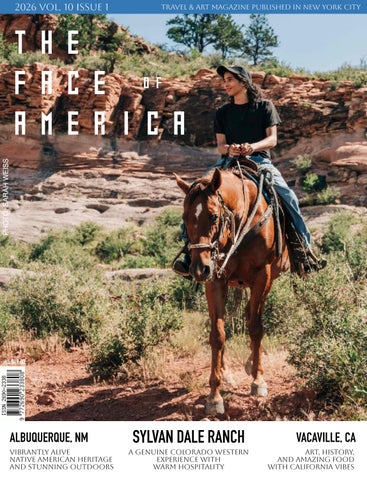
2026 vol. 10 issue 1
travel & art magazine published in new York city
PHOTO: SARAH WEISS
THE OF FACE AMERICA
US $19.00
ALBUQUERQUE, NM
SYLVAN DALE RANCH
VACAVILLE, CA
VIBRANTLY ALIVE NATIVE AMERICAN HERITAGE AND STUNNING OUTDOORS
A GENUINE COLORADO WESTERN EXPERIENCE WITH WARM HOSPITALITY
ART, HISTORY, AND AMAZING FOOD WITH CALIFORNIA VIBES
Pierre Pierre Gervois Gervois
Super
Leftist Super Leftist
poETRY
poETRY
A new poetry book by Pierre Gervois Available at Barnes & Noble
WWF
300 teens attempted suicide in the last 24 hours as a direct result of cyberbullying. Was your kid one of them? Would you even know?
Download The Proactive Parent's Cyberbullying Handbook standforthesilent.org stopcyberbullying
THE FACE OF AMERICA MAGAZINE PUBLISHED BY CHINA ELITE FOCUS MAGAZINES LLC, DBA LEGIT PRODUCTIONS BROOKLYN, NY FOUNDER AND PUBLISHER: PIERRE GERVOIS CHIEF PHOTOGRAPHER: CHRISTELLE BOIS EDITORIAL ADVISOR: STANNIBOI COVER DESIGN: PIERRE GERVOIS PHOTOGRAPHER: JASON BERGER PHOTOGRAPHER: DEBBIE-JEAN LEMONTE PHOTOGRAPHER: HUGH APPLEWHAITE MEN’S FASHION EDITOR: TYRON M.CUTNER WEBMASTER: SIV SKOV SENIOR TRAVEL ADVISOR (SHANGHAI): ELAINE KE FOOD EDITOR: CONSTANCE’S CUPCAKES LOS ANGELES EDITOR: ANGELINA FREITAS
ISSN 2690-2338 PUBLISHED IN THE UNITED STATES OF AMERICA
THE FACE OF AMERICA MAGAZINE CONTENT TO THE HOLY SEPULCHER - THE FRICK COLLECTION
9
GRACIELA ITURBIDE EXHIBITION - ICP
20
A RANCH YEAR, BOOK BY ISABELLE ARNON
27
THE PRESIDENTIAL LIBRARY AT THE WALDORF ASTORIA
34
SYLVAN DALE GUEST RANCH, COLORADO
41
VACAVILLE, CALIFORNIA
77
ALBUQUERQUE, NEW MEXICO
115
The Face of America Magazine
TO THE HOLY SEPULCHER
The Face of America Magazine
At the Frick Collection Oct 2, 2025 - Jan 5, 2026 The Face of America Magazine
The Frick Collection presents a stunning exhibition of more than forty objects on loan from the Terra Sancta Museum. Ranging from liturgical objects in gem-encrusted gold and silver to richly decorated vestments in velvet, damask, and other fine materials, the works were created for the Church of the Holy Sepulcher in Jerusalem and were largely unknown until their rediscovery by scholars in the 1980s. They represent the pinnacle of European craftsmanship in these fields during the seventeenth and eighteenth centuries, and many have no parallel anywhere in the world. To the Holy Sepulcher: Treasures from the Terra Sancta Museum offers visitors the opportunity to view these objects for the first time in North America.
The Face of America Magazine
The exhibition features a selection from the Treasure of the Custody of the Holy Land, established in 1309 by the Franciscan order to oversee Christian holy sites in Jerusalem and the Middle East. One of the major sites that the Custody oversees (alongside other Christian denominations) is the Church of the Holy Sepulcher— the holiest place in Christianity, believed to be the site of Jesus Christ’s crucifixion, burial, and resurrection.
The Face of America Magazine
The Face of America Magazine
Over the centuries, European Catholic monarchs and Holy Roman Emperors sent sumptuous gifts to the Franciscans in Jerusalem, often in the form of liturgical objects and vestments. The golden age of this gift-giving occurred from the early 1600s to the late 1700s, the range represented in the exhibition. The Franciscans have safeguarded the works ever since, using them in Mass and other religious ceremonies to the present day.
The Face of America Magazine
The Face of America Magazine
The Face of America Magazine
Ahead of the opening of the Custody’s new Terra Sancta Museum at Jerusalem’s St. Savior Monastery, objects from its incredible collection have been traveling to institutions in Europe and now North America. A 2013 exhibition showcased loans from the Holy Sepulcher at the Palace of Versailles, and more recent presentations have been held at the Calouste Gulbenkian Museum, Lisbon; the Gaiás Centre Museum, Santiago de Compostela; and the Museo Marino Marini, Florence. After the Frick debuts its unique U.S. exhibition in New York, Treasures from the Terra Sancta Museum will travel to the Kimbell Art Museum in Fort Worth, Texas (March 15 through June 28, 2026).
The Face of America Magazine
GRACIELA ITURBIDE EXHIBITION INTERNATIONAL CENTER OF PHOTOGRAPHY NYC
The Face of America Magazine
The Face of America Magazine
The Face of America Magazine
PHOTO: GRACIELA ITURBIDE / COURTESY OF INTERNATIONAL CENTER OF PHOTOGRAPHY
The International Center of Photography (New York City) is proud to present the first-ever retrospective of Graciela Iturbide’s work in New York, affirming her status as one of the most significant and influential photographers of the 20th- and 21stcenturies. This landmark exhibition, organized in collaboration with Fundación MAPFRE and curated by Carlos Gollonet, Chief Curator of Photography at Fundación MAPFRE, features nearly 200 photographs spanning five decades of her groundbreaking career.
The Face of America Magazine
PHOTO: GRACIELA ITURBIDE / COURTESY OF INTERNATIONAL CENTER OF PHOTOGRAPHY
“Graciela Iturbide has constructed a unique world of images that, based on both documentary narrative and poetic imagination, integrates lived experience and dreams into a surprising web of historical, social and cultural references,” said Gollonet. “Beginning with participatory observation and then evolving into a continuous exploration of life, Iturbide’s photography is fundamentally a pretext for learning about the world.”
The Face of America Magazine
PHOTO: GRACIELA ITURBIDE / COURTESY OF INTERNATIONAL CENTER OF PHOTOGRAPHY
The Face of America Magazine
PHOTO: GRACIELA ITURBIDE / COURTESY OF INTERNATIONAL CENTER OF PHOTOGRAPHY
The Face of America Magazine
PHOTO: GRACIELA ITURBIDE / COURTESY OF INTERNATIONAL CENTER OF PHOTOGRAPHY
Born in 1942 in Mexico City, in 1969, at the age of 27, Iturbide enrolled at the Centro de Estudios Cinematográficos at the Universidad Nacional Autónama de México to become a film director. Soon after enrolling she was drawn to photography then being taught by the Mexican modernist Manuel Álvarez Bravo. From 1970–71 she worked as Bravo’s assistant, accompanying him on various photographic journeys throughout Mexico. Iturbide has since traveled extensively as well—within and beyond Mexico—using her camera as a tool to better understand the native cultures of Mexico, the quality and character of modernity and the intimacies of her own life.
Stay Exquisite Experience exemplary hospitality in an iconic setting in the heart of Midtown Manhattan. With refined accommodations, locally inspired dining and signature service, The St. Regis New York combines classic elegance with a modern sensibility
©2018 Marriott International, Inc. All Rights Reserved. Preferred Guest, SPG, St. Regis and their logos are the trademarks of Marriott International, Inc., or its affiliates.
The St. Regis New York 2 East 55th Street New York, New York t. +1 212 753 4500 stregis.com/newyork
Stay exquisite at more than 40 St. Regis hotels and resorts worldwide. @stregishotels
PHOTO: ISABELLE ARNON / COURTESY OF TENEUES
A RANCH YEAR ISABELLE ARNON
The Face of America Magazine
A Ranch Year – Cowboys of the West by Isabelle Arnon isn't merely a glimpse into a year on modern ranches; it's a deeply emotional and elegantly captured immersion into a vanishing way of life, perfect for discerning lifestyle media. Arnon’s breathtaking photography invites readers to step away from the urban bustle and into the vast, untouched landscapes of Wyoming and Montana. Discover the profound, unspoken bonds between cowboys, cowgirls, their cherished animals, and the rugged land they call home. This book reveals the enduring spirit of independence, honor, and quiet resilience that defines these remarkable individuals. Published by teNeues
The Face of America Magazine
The Face of America Magazine
PHOTO: ISABELLE ARNON / COURTESY OF TENEUES
The Face of America Magazine
PHOTO: ISABELLE ARNON / COURTESY OF TENEUES
The Face of America Magazine
PHOTO: ISABELLE ARNON / COURTESY OF TENEUES
A Ranch Year is an ode to a living heritage, celebrating the men and women who embody the idealized vision of America—a world where hard work is a testament to character, and connection to the land is a spiritual wealth. It's an invitation to pause, reflect, and find beauty in the authentic, the wild, and the truly self-sufficient. This elegant volume offers a rare, intimate look at a lifestyle that is both mythical and profoundly real. It’s an essential addition for anyone seeking inspiration, a deeper connection to nature, or simply a moment of quiet awe.
THE PRESIDENTIAL LIBRARY AT THE WALDORF ASTORIA RESIDENCIES
The Face of America Magazine
As Waldorf Astoria Residences New York celebrates one year since welcoming residents to the exclusive private residences above the iconic Waldorf Astoria New York hotel, the property is introducing a new milestone: the debut of the Presidential Library amenities for residents, created in partnership with the White House Historical Association. This collaboration brings together two institutions long intertwined with the legacy of the American presidency and ushers in a new chapter for residents of the historic address.
The Face of America Magazine
For more than nine decades on Park Avenue, Waldorf Astoria New York has stood at the crossroads of global affairs, welcoming every U.S. president from Herbert Hoover through Barack Obama, along with distinguished diplomats and world leaders. Now, the White House Historical Association, a nonprofit devoted to safeguarding and sharing the history of the White House, expands that legacy by shaping its first curated residential library.
The Face of America Magazine
“We are delighted to share the depth of White House history with the residents of the newly restored Waldorf Astoria,” said Stewart McLaurin, President of the White House Historical Association. “The hotel has long played a meaningful role in the story of the American presidency, and this collaboration allows us to bring that legacy to life in a setting that has welcomed so many national and global leaders. We look forward to offering residents and guests an engaging connection to this remarkable history.”
The Face of America Magazine
The Face of America Magazine
WWF
THE FACE OF OF AMERICA Complimentary distribution in selected airlines
SYLVAN DALE GUEST RANCH COLORADO The Face of America Magazine
The Face of America Magazine
Nestled in the foothills of the Rocky Mountains just west of Loveland, Colorado, Sylvan Dale Guest Ranch represents something increasingly rare in our modern world—an authentic portal to the Old West that hasn't been diluted by time or commercialization. This historic working horse and cattle ranch has been in operation since the 1920's, and under the stewardship of the Jessup family since 1946, it has evolved into what they aptly call "the New West—a lot like the Old West, but a whole lot more comfortable." Sprawling across 3,200 acres along the banks of the Big Thompson River, this isn't a theme park recreation of cowboy life; it's the genuine article, where guests don't just observe ranch life—they live it.
The Face of America Magazine
The Face of America Magazine
The Face of America Magazine
The Face of America Magazine
The heart of the Sylvan Dale experience beats in rhythm with hoofbeats. The ranch's riding program is designed to offer a challenge to every rider, whether experienced or a firsttimer, and guests quickly discover that the quality of the ranch-raised quarter horses and the expertise of the wranglers set this operation apart from typical tourist attractions. Each guest receives a horse assignment for their stay, forging a partnership that transforms novices into confident riders and allows experienced equestrians to push their abilities. The trails wind through terrain that seems lifted from a John Wayne film—crossing creeks, climbing rocky slopes, and opening onto ridge-top vistas that stretch endlessly across the Colorado landscape. From gentle rides through cottonwood-shaded Sulzer Gulch to the breathtaking panoramas of the Rim Ride, every excursion reinforces the feeling that this is how the West was truly experienced by those who settled it.
The Face of America Magazine
The Face of America Magazine
The Face of America Magazine
The Face of America Magazine
For those seeking the ultimate authentic experience, Sylvan Dale offers something that few guest ranches can: cattle drives and cattle roundups, trail rides, and overnight pack trips, where guests become working cowboys. These aren't choreographed demonstrations but real ranch work, where the cattle need moving and the guests provide the labor. The day drives take riders six hours in the saddle with packed lunches, moving herds from the main ranch to distant pastures. Overnight pack trips push the experience even further, with guests camping under the stars after a long day's work. It's physically demanding, occasionally uncomfortable, and utterly transformative—the kind of experience that separates authentic ranch vacations from mere horseback riding excursions.
The Face of America Magazine
The Face of America Magazine
The Face of America Magazine
The Face of America Magazine
Yet what truly distinguishes Sylvan Dale isn't just the activities or the stunning setting, but the warmth of its welcome. The ranch offers warm hospitality, time to disconnect from phones and wifi, and an inclusive atmosphere that creates an instant sense of community among guests. Visitors consistently describe an old-fashioned sense of camaraderie where children make friends across age differences, adults relax into genuine conversation, and the staff treats everyone like family returning home. The Jessup family's personal touch permeates every aspect of the operation, from Susan Jessup and her husband playing guitar and sharing the ranch's history around the campfire to the thoughtful details that guests discover throughout their stay. One visitor captured it perfectly in describing the combination of southern hospitality met with western values—a blend that makes every guest feel simultaneously welcomed and respected.
The Face of America Magazine
The Face of America Magazine
The Face of America Magazine
The Face of America Magazine
The accommodations reflect this philosophy of authentic comfort. Cabins cluster beneath towering cottonwoods and blue spruce in the main yard, decorated with comfortable country furnishings and antique accents that nod to the ranch's heritage without sacrificing modern amenities. Each features private baths, porches perfect for morning coffee or evening contemplation, and the kind of rustic elegance that makes guests feel they've stepped into a simpler time without giving up creature comforts. The meals—hearty, home-style, and plentiful—fuel the days' adventures with specialties like the welcome dinner's fried chicken and meatloaf, outdoor steak fries, and satisfying ranch breakfasts that prepare riders for long days in the saddle.
The Face of America Magazine
The Face of America Magazine
The Face of America Magazine
The Face of America Magazine
The Face of America Magazine
The Face of America Magazine
The Face of America Magazine
The Face of America Magazine
The Face of America Magazine
Named "Best Family Vacation" by Frommer's Colorado guidebook and rated among the "Top Ten Colorado Dude Ranches" by True West Magazine, Sylvan Dale has earned its accolades not through marketing savvy but through decades of delivering on a promise: to provide guests with an experience of the Old West that's as authentic as it is unforgettable. In an age of manufactured experiences and Instagram-ready facades, this working ranch stands as a testament to the enduring appeal of the real thing—genuine hospitality, honest work, magnificent horses, and the kind of connection to land and tradition that can only be found where cowboys still ride and the West still lives in more than memory.
The Face of America Magazine
The Face of America Magazine
The Face of America Magazine
The Face of America Magazine
The Face of America Magazine
The Face of America Magazine
The Face of America Magazine
THE FACE OF OF AMERICA Complimentary distribution in selected hotels Worldwide
VACAVILLE CALIFORNIA
The Face of America Magazine
Positioned in the fertile heart of Solano County, Vacaville stands as a testament to California's layered history—a place where centuries of human story converge in a city that has grown from Native American villages to Mexican land grants to a thriving modern community of over 100,000 residents. Located strategically between Sacramento and San Francisco, this city has evolved far beyond its agricultural roots, yet it has never forgotten the generations who first called this valley home. Today, Vacaville invites visitors to explore a heritage that begins thousands of years before European contact and continues to shape the community's identity.
The Face of America Magazine
The Face of America Magazine
The Face of America Magazine
The Face of America Magazine
The Face of America Magazine
The Face of America Magazine
For those seeking to understand Vacaville's complete story, the Vacaville Museum on Buck Avenue serves as the only institution dedicated to cultural and historical preservation for all of Solano County. Since opening its doors in 1984, this intimate museum has produced over 40 exhibits exploring everything from the area's agricultural heritage and the legendary Nut Tree restaurant to the contributions of local figures like Willis Jepson himself. The museum's collections include Native American items, agricultural equipment still used on county farms, and rotating exhibitions by local artists, all housed in a Victorian-era building that reflects the architectural charm of Vacaville's past. Meanwhile, throughout the city's streets, public murals tell contemporary stories—from the comic book-inspired works at Brenden Theatres to the eightpanel series at Security Public Storage depicting downtown Vacaville, the Nut Tree, Lagoon Valley Park, and the city's founders. These vibrant artworks transform ordinary walls into storytelling canvases that celebrate both heritage and imagination.
The Face of America Magazine
The Face of America Magazine
The Face of America Magazine
Amazing cocktails and food at The Library
The Face of America Magazine
The Face of America Magazine
The bouldering in Vacaville is somewhat of a local secret but is worth a trip for any climber traveling through the area. In the hills above the town is a field of primo basalt boulders with more than 50 bouldering routes. Most of the climbing here is on the easy to moderate side, with the most difficult problems in the V7-V9 range. The boulders are easy to get to and on a clear day you can see the Sierra Nevada mountains in the distance.
The Face of America Magazine
The Face of America Magazine
The Face of America Magazine
Long before Spanish explorers mapped the region, the area that would become Vacaville thrived as home to the Patwin people, a southern branch of the Wintun tribe whose villages dotted the landscape along streams and springs throughout Northern California. The Ulatis tribelet, named for the creek that still flows through modern Vacaville, established settlements along what is now Solano Avenue, using their strategic position near the waterway for trade and sustenance. By 1821, when Spanish expeditions first encountered them, the Liwai village maintained a population of approximately 400 inhabitants. Tragically, the Native American population was decimated by disease in the decades that followed, with estimates suggesting a 75 percent reduction during the 1830s alone. The Peña Adobe Historical Society, working with Native American cultural leaders and tribal members, now honors this indigenous heritage through educational programs and the Indian Council Ground at Peña Adobe Park, ensuring that the stories of the Patwin people and their descendants remain central to Vacaville's historical narrative.
The Face of America Magazine
The Face of America Magazine
The Face of America Magazine
The European chapter of Vacaville's story began in 1843 when the Mexican government granted 12,230 acres to Juan Manuel Vaca and Juan Felipe Peña, establishing Rancho Los Putos. By 1851, Vaca had acquired the entire rancho for grazing cattle, and in 1855, when a group of developers approached him to name their planned town, he generously agreed to the name "Vacaville." The physical embodiment of this era stands magnificently preserved at the Peña Adobe, California Historical Landmark No. 534 and the oldest fully restored structure in Solano County. Built in 1842 with two-foot-thick walls of sun-dried adobe bricks, crafted by 25 Mission-trained Indians and featuring hand-hewn redwood timbers from the Napa hills, this remarkable building offers visitors an intimate glimpse into California's Mexican period. Adjacent to the adobe stands the Mowers-Goheen Museum, which houses a rich collection of Native American artifacts and cultural materials that deepen understanding of the region's first inhabitants.
The Face of America Magazine
The Face of America Magazine
The Face of America Magazine
The Face of America Magazine
The Face of America Magazine
The Face of America Magazine
Among the adobe's grounds lies a living tribute to one of Vacaville's most distinguished native sons: the Willis Linn Jepson Memorial Garden. Born at Little Oak Ranch near Vacaville in 1867, Jepson became California's most eminent early botanist, a co-founder of the Sierra Club in 1892, and a professor at UC Berkeley for four decades. The garden bearing his name showcases native plants of the region and represents a collaboration between the Peña Adobe Historical Society and the California Native Plant Society's Willis Linn Jepson Chapter, which serves Solano County. Recently restored after years of neglect, the garden underwent rededication ceremonies led by Miwok tribal elder Marge Grow Eppard, symbolizing the connection between indigenous plant knowledge and modern conservation efforts.
The Face of America Magazine
The Face of America Magazine
Yet perhaps the most hands-on connection to Vacaville's living traditions can be found at Meridian Jacobs, a working farm and fiber arts center where visitors can learn the ancient craft of weaving sheep wool. Owner Robin Lynde maintains a flock of over 70 Jacob sheep on her farm north of Vacaville, producing unique spotted wool that she transforms into yarn and handwoven blankets, scarves, and shawls. Through small, personalized classes in weaving, spinning, and dyeing, Meridian Jacobs offers something increasingly rare in modern life: the opportunity to connect directly with the process of creating textiles from raw fleece, just as generations of Californians have done for centuries. The farm's shop carries spinning wheels, looms, and locally grown wool, while Farm Club memberships allow enthusiasts to participate in shearing days and other seasonal activities. In a city that honors its agricultural past while embracing contemporary growth, Meridian Jacobs represents the enduring value of traditional skills and sustainable farming practices—a living bridge between Vacaville's history and its future.
The Face of America Magazine
The Face of America Magazine
The Face of America Magazine
Vacaville's agricultural innovation extends beyond traditional crafts to contemporary farm-to-glass experiences at Ruhstaller Farm in nearby Dixon, just minutes from Vacaville. This nearly 40acre estate brewery represents a pioneering approach to craft beer, where proprietor Jan-Erik Paino has realized a decade-long dream of creating terroirdriven brews using ingredients grown directly on the property. The farm's open-air taproom invites guests to settle onto hay bales or vintage sofas scattered across the grounds, where chickens wander freely and the golden carpet of flowering mustard stretches beneath bare walnut branches. With live music filling weekend afternoons and farm tours revealing the beer-making process from soil to glass, Ruhstaller Farm offers a uniquely Californian experience that combines agricultural heritage with contemporary craft culture —a fitting complement to Vacaville's celebration of its farming roots.
The Face of America Magazine
The Face of America Magazine
The Face of America Magazine
The Face of America Magazine
Cajun Crackin is a wonderful seafood restaurant with ultra fresh seafood and outstanding service. Highly recommended!
The Face of America Magazine
Alyssa Pardini, President & CEO of Visit Vacaville
The Face of America Magazine
ALBUQUERQUE NEW MEXICO
The Face of America Magazine
For discerning cultural travelers, Albuquerque offers immersion in vibrantly alive heritage rather than preserved museum pieces. The Indian Pueblo Cultural Center provides comprehensive introduction to pueblo life with regular dance performances and exhibitions of pottery, weaving, and jewelry representing living artistic traditions. The Maxwell Museum of Anthropology traces how ancient Southwestern lifestyles continue influencing today's pueblo communities, while Petroglyph National Monument invites contemplation of images ancestral Puebloans etched onto volcanic rock centuries ago.
The Face of America Magazine
In Old Town, galleries offer authentic Native American silver and turquoise jewelry, while restaurants serve New Mexican cuisine distinguished by red and green chile that defines regional identity as surely as adobe defines its architecture. Perhaps most compelling is the opportunity to venture to nearby pueblos like Sandia, Isleta, or Jemez, where visitors observing proper cultural etiquette can witness feast day celebrations blending Catholic and indigenous traditions. In Albuquerque, history is not something that happened; it is something that continues, woven into the landscape, architecture, and daily life of a city where three centuries converge under the vast New Mexico sky.
The Face of America Magazine
PHOTO:CHRISTELLE BOIS
Perched atop the architecturally striking Hotel Chaco in Albuquerque's revitalized Sawmill District, Level 5 redefines rooftop dining with panoramic vistas encompassing the Sandia Mountains, downtown skyline, and historic Old Town. Executive Chef Goran Basarov crafts a sophisticated menu blending regional ingredients with global inspiration, creating vibrant interpretations of New Mexican cuisine that honor tradition while embracing innovation. The refined, contemporary space transitions seamlessly from intimate indoor seating around a gleaming bar to an expansive outdoor terrace where sunset transforms the Sandias into their namesake reddishpurple hues. Whether sampling the acclaimed mushroom bruschetta or savoring perfectly prepared smoked beef ribs, diners experience cuisine worthy of the spectacular setting—a marriage of culinary artistry and breathtaking elevation that captures Albuquerque's sophisticated, cultural spirit.
The Face of America Magazine
PHOTO:CHRISTELLE BOIS
The Face of America Magazine
PHOTO:CHRISTELLE BOIS
The Face of America Magazine
PHOTO:CHRISTELLE BOIS
The Face of America Magazine
PHOTO:CHRISTELLE BOIS
The Face of America Magazine
The Face of America Magazine
PHOTO:CHRISTELLE BOIS
Since 1972, Air Force veteran Pratt Morales has transformed Golden Crown Panaderia into an Albuquerque institution, named among Food & Wine's "100 Best Bakeries in America." Now partnering with son Chris in the historic adobe building near Old Town, the 85-year-old baker crafts anise-scented biscochitos and innovative blue corn variations alongside spectacular bread sculptures that earned Guy Fieri's attention. Their New Mexicostyle pizzas rank among the nation's top fifty.
PHOTO:CHRISTELLE BOIS
The Face of America Magazine
PHOTO:CHRISTELLE BOIS
The Face of America Magazine
PHOTO:CHRISTELLE BOIS
The Face of America Magazine
PHOTO:CHRISTELLE BOIS
The Face of America Magazine
PHOTO:CHRISTELLE BOIS
The Face of America Magazine
The Face of America Magazine
PHOTO:CHRISTELLE BOIS
Nestled in the heart of Old Town Albuquerque, Lapis Room elevates contemporary Southwestern art beyond tourist clichés. This vibrant gallery showcases diverse works from New Mexico artists and those inspired by the region, from Beedallo's surreal folk art illustrations to Reyes Padilla's installations featured in permanent museum collections. Thoughtfully curated exhibitions blend painting, sculpture, jewelry, and handmade goods, inviting cultural travelers to discover authentic artistic voices.
PHOTO:CHRISTELLE BOIS
The Face of America Magazine
The Face of America Magazine
PHOTO:CHRISTELLE BOIS
Luis Contreras Self-taught artist, he has learn by himself the art of sculpting using everyday tools like his own oven.
The Face of America Magazine
PHOTO:CHRISTELLE BOIS
La Caterina, celebrating Dias de los Muertos
PHOTO:CHRISTELLE BOIS
Owned and operated by New Mexico's nineteen Pueblos, Indian Pueblo Kitchen offers authentic indigenous dining within the Indian Pueblo Cultural Center. Executive Chef Ray Naranjo brings ancestral Tewa perspective to contemporary cuisine, crafting dishes from pre-contact ingredients including blue corn, native squash, and chile. Signature items like Indian tacos on housemade fry bread and innovative dishes such as cedarsmoked salmon showcase what Chef Ray calls "contemporary indigenous gastronomy"—honoring ancient techniques while demonstrating their relevance to modern palates.
The Face of America Magazine
The Face of America Magazine
PHOTO:CHRISTELLE BOIS
Channing Conch, Supervisor
The Face of America Magazine
PHOTO:CHRISTELLE BOIS
Founded in 1976 and jointly owned by New Mexico's nineteen Pueblos, the Indian Pueblo Cultural Center stands as the only institution in North America where Pueblo people tell their own story in their own voices. The permanent exhibition celebrates the Pueblo legacy of resilience through generations-old traditions honoring the land. More than twenty vibrant murals by Pueblo artists adorn the walls, depicting the role of seasons, dance, harvest, and animals in Pueblo life.
The Face of America Magazine
PHOTO:CHRISTELLE BOIS
Anthony, Guide
PHOTO:CHRISTELLE BOIS
The Face of America Magazine
The Face of America Magazine
PHOTO:CHRISTELLE BOIS
Weekend cultural dances invite participation, while rotating exhibitions, artist workshops, and the acclaimed Indian Pueblo Kitchen offer immersive experiences. The Shumakolowa Native Arts shop provides direct access to authentic pottery, jewelry, and textiles from award-winning artists, making this architectural gem—inspired by traditional Pueblo structures around a central courtyard—the essential gateway to understanding contemporary Pueblo culture.
The Face of America Magazine
PHOTO:CHRISTELLE BOIS
Founded in 1706, Old Town remains Albuquerque's cultural heart, its narrow streets radiating from the historic plaza where life has centered for over three centuries. The San Felipe de Neri Church, built in 1793, anchors a district where traditional adobe architecture houses galleries showcasing Native American jewelry and art, authentic New Mexican restaurants, and shops offering regional crafts—a living testament to the convergence of Spanish colonial and indigenous heritage.
PHOTO:CHRISTELLE BOIS
The Face of America Magazine
PHOTO:CHRISTELLE BOIS
Black Stone is another art gallery presenting artists like Jackie Black, a Navajo artist, and Sahmie Nampeyo, a Hopi artist.
The Face of America Magazine
PHOTO:CHRISTELLE BOIS
The Face of America Magazine
PHOTO:CHRISTELLE BOIS
The Face of America Magazine
PHOTO:CHRISTELLE BOIS
The Face of America Magazine
The Face of America Magazine
PHOTO:CHRISTELLE BOIS
New Mexico’s first artisan food hall with mix of local eateries, bars, and artisanal vendors.
The Face of America Magazine
PHOTO:CHRISTELLE BOIS
Perched at 10,300 feet atop Sandia Peak, TEN 3 transforms dining into a transcendent experience accessible only via the breathtaking fifteen-minute Sandia Peak Tramway ride. This fine dining destination crafts thoughtfully prepared dishes from scratch using locally sourced ingredients, emphasizing regional flavors while guests savor spectacular panoramic views of Albuquerque's city lights below and the distant Sangre de Cristo Mountains. Available by reservation, the intimate dining room offers refined New American cuisine perfect for special occasions, while the casual lounge provides first-come seating for those seeking elevated cocktails and sunset vistas after mountain hikes.
PHOTO:CHRISTELLE BOIS
The Face of America Magazine
PHOTO:CHRISTELLE BOIS
The Face of America Magazine
PHOTO:CHRISTELLE BOIS
The Face of America Magazine
PHOTO:CHRISTELLE BOIS
This landmark heritage hotel blends historic grandeur with contemporary luxury just one block from the 1706 plaza. Drawing inspiration from the region's Hispanic heritage, the property features carved wooden furnishings, Southwestern textiles, and an Olympic-size pool amid manicured gardens. Garduño's offers exceptional patio dining, while Tablao Flamenco presents authentic performances with prix fixe dinners.
The Face of America Magazine
PHOTO:CHRISTELLE BOIS
Rising dramatically from Albuquerque's eastern edge, the Sandia Mountains derive their name from the Spanish word for watermelon, inspired by the crimson-purple glow that illuminates their granite peaks at sunset. Accessible via North America's longest aerial tramway—a fifteenminute engineering marvel ascending 3,819 feet —the 10,378-foot summit offers panoramic views spanning 11,000 square miles of New Mexico landscape, from ancient volcanic fields to the distant Sangre de Cristo range.
The Face of America Magazine
DISCOVER HASIDIC BROOKLYN
Welcome! I’m a New York City tour guide with a passion for understanding societies. I specialize in the Hasidic world of my roots. Join me for an unforgettable walking tour and learn about NYC’s Jewish Hasidic community.
friedavizel.com
THE FACE OF OF AMERICA Complimentary distribution in selected cruise ships
Complimentary distribution in official organizations