A monthly update covering people, events, research, and key developments
Editor’s Note:
This month you'll find we have turned our attention to topics that are making the rounds in the media while we all suffer through the summer doldrums. Cyclospora is the first topic and in addition to the primary article you'll find more content on this topic in What We're Reading. We've also provided a piece on a surprisingly contentious topic - clock changes. A piece on failures in measuring our health rounds out our top topics this month.
In addition to those pieces, we've brought back another AI related article from our archives and, in light of the start of the fall recruitment season, you'll find another piece on formatting your job ad to ensure it gets noticed and brings in the applicants you want.
We have received several inquiries about our free program designed to rehome the excess books in your existing library. Many individuals faced with a long distance move or retirement are interested in finding a new home for some or all of their books to make sure they don't end up in a landfill. Because we get so many inquiries about this program we have taken this opportunity to fully outline the operational details for you.
A year ago we highlighted the fact that CDC was shutting down support for Epi Info. That program has now been removed from their website and the existing users are actively searching for another organization to host it so it will be available for all interested parties ongoing. The users have provided us with a profile of the type of organization that would make an ideal host. Please take a look and share this with others so this resource will remain available into the future.
Jobs are starting to open up again and you'll find many in this month's issue - including close to 100 public health positions shared by our friends at Public Health Hiring Help that range from internships to mid-career positions.
As always, we continue to provide you with our popular monthly word game feature, Notes on People, an overview of what we are reading from the public media, and a listing of near term upcoming events. Ask us about the sponsorship opportunities for these standard monthly featuresit offers you great exposure for your event, institution, book or other item of interest to our readers!
Until next month - stay safe and busy!
In This Issue
-3- Top 10 Cyclospora Questions -8- We Track Stocks By The Second - But Can't Measure Our Health -12- Ending Clock Changes - The Science Says Congress is Getting it Wrong
From the Archives - AI Predicts Outbreaks of Diarrheal Illness -18- Job Hunt: How to Get Your Job Opening Noticed
Top 10 Cyclospora Questions
Author: Katelyn Jetelina, PhD, MPH
Editor's Note: This article was originally printed in Your Local Epidemiologist on July 15, 2026. To read more content from this source subscribe to Your Local Epidemiologist (YLE): https://tinyurl.com/32pd2a8r
immunocompromised).
Stick to produce you can peel or cook. (If you have frozen berries from January, you should be in the clear as this outbreak likely started in May.)
2. How long do I need to cook produce for? Does freezing work?
Note: This post builds on a previous YLE post that explained what’s going on. If you missed that, start here.
1. Can you just tell me what not to eat?
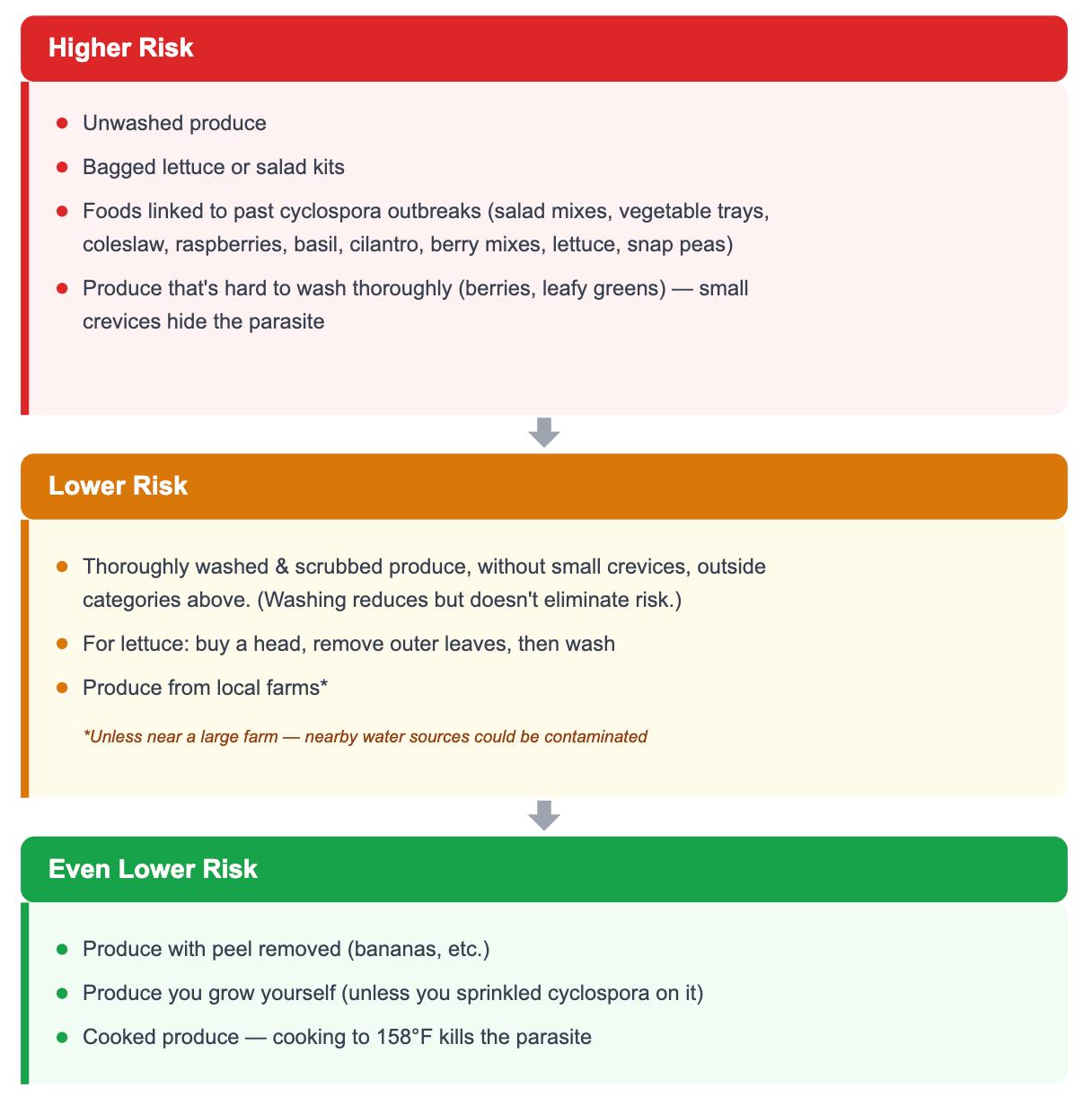
Unfortunately, it’s not that easy, because a source hasn’t been confirmed. So risk falls on a spectrum and risk tolerance varies.
This is how I’m thinking about it:
Skip bagged salads, salad kits, and boxed salads from the grocery store, and avoid them at restaurants and fast food places, too. Michigan’s warning on Monday (unusual to go public before the FDA) is a strong signal of what they’re seeing. Whole heads of lettuce are fine if you strip the outer 2-3 layers, since that’s where contamination is most likely to sit.
Michigan’s investigation has yet to pinpoint a company or rule out other foods. Two dozen other states are still under active investigation. So avoiding other foods is reasonable. In previous outbreaks, the culprits were raspberries, fresh herbs (basil, cilantro), onions, and snap/snow peas. I would still avoid these, especially if you’re high risk (pregnant, older, or
Cooking food to an internal temperature of 158°F is the only thing known to kill Cyclospora. This means sautéing raw spinach for about 1.5 minutes. (Turn your salad into a stir fry!)
Microwaving doesn’t work as well because heat spreads unevenly; research shows 45 seconds wasn’t enough to kill Cyclospora, so go longer and check that every part, not just the surface, is steaming hot.
Freezing isn’t reliable because a typical home freezer isn’t cold enough to kill the parasite. Research shows you’d need -20°C (-4°F) for at least 2 days, or a commercial deep freeze at70°C for an hour, well below what most kitchen freezers hit.
Washing helps a little, but not entirely, because these microscopic parasites love to hide in the grooves and crevices. They also hide from home remedies people suggest, like lemon juice.
- Cyclospora cont'd on page 4
3. Is local produce better than big distributors?
The risk is much lower. In fact, there has never been a documented cyclosporiasis outbreak linked to a local farm.
That said, Cyclospora lives in soil and contaminated water, so a local farm could be
affected if it shares a water source with a large commercial farm. Cyclospora can also enter the food supply at a packing, processing, or distribution facility, where outbreaks get amplified a local farm would be safer on this front, too. My hunch is that the real culprit here isn't the farm itself, but distribution, but we don't yet know yet.
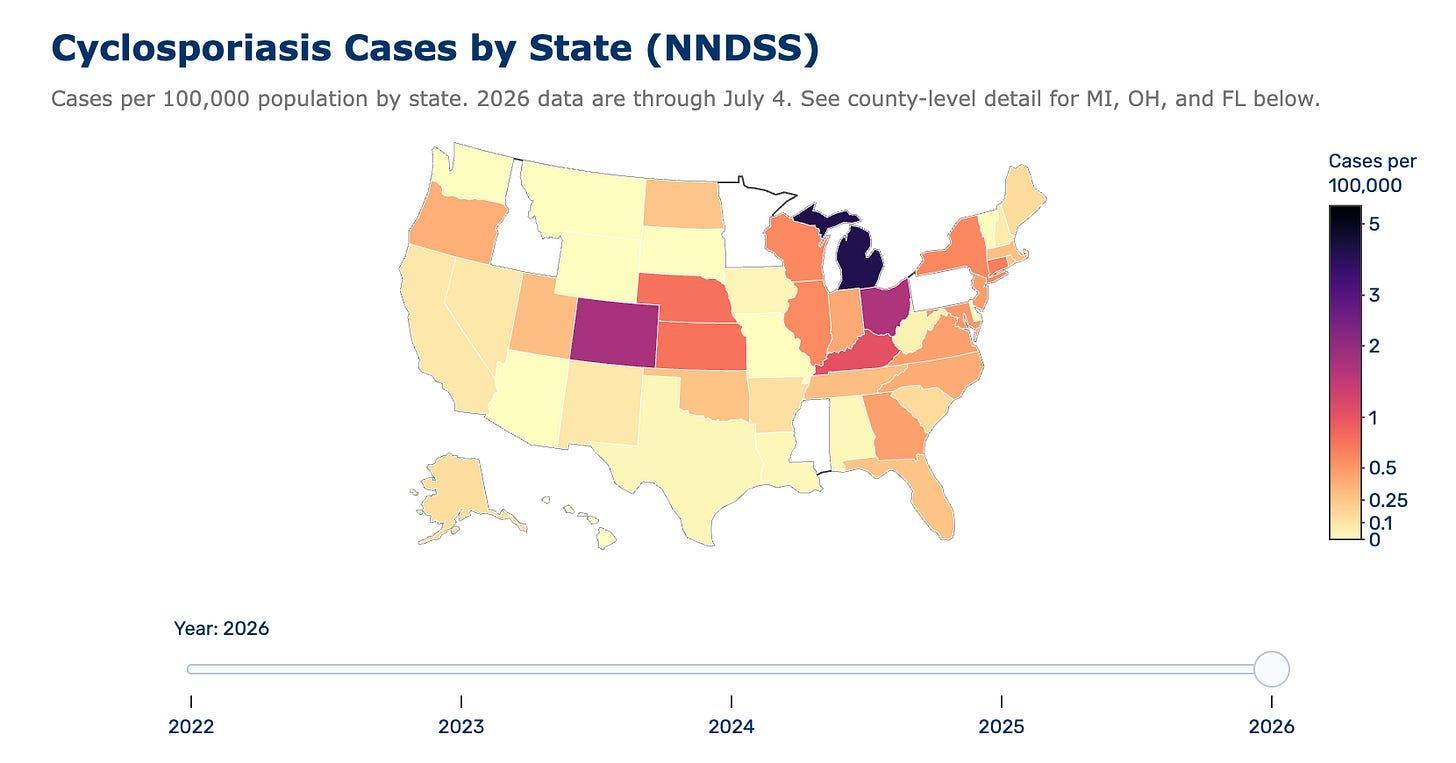
- Cyclospora
Figure by Your Local Epidemiologist, adapted from Dr. Kristen Panthagani at You Can Know Things
4. How much precaution should we be taking in California (or other states), where very few cases have been reported?
Distribution networks are complex, but all states are now actively looking for cases. That makes me more confident that states with low case counts (that stay low) aren’t linked to whatever is driving the outbreaks in Michigan, Ohio, New York, and elsewhere.
All states have some cyclosporiasis cases, but that’s expected: it reflects multiple outbreaks
happening at once. California, for example, has cases, but not more than in past years actually fewer. About 95% of California’s cases have involved people who picked up the parasite while traveling outside the U.S.
For what it’s worth, I live in California, and I’m not eating lettuce but being liberal with the other foods. I don’t have time for weeks of exploding diarrhea, but my guard is a little more down than it would be if I lived in Michigan or New York.
Source: PopHIVE
5. How do I know what bug I have?
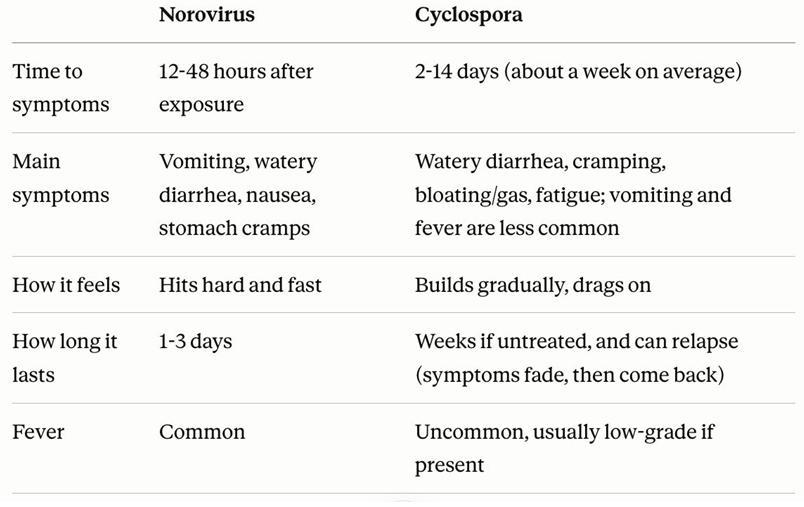
Many bugs can cause diarrhea. Norovirus is a common virus that spreads year-round and causes similar symptoms, but is highly contagious, while Cyclospora is a parasite that is not contagious from person to person.
To differentiate between the two at home, it really comes down to symptoms and timing. If
symptoms show up within a day or two and pass quickly, think norovirus. If it lasts more than a week and then it comes and goes for weeks, that’s likely cyclosporiasis. Antibiotics help with cyclosporiasis, so it’s worth getting tested (although I hear the test is expensive).
- Cyclospora cont'd on page 6
Table by Your Local Epidemiologist.
6. How does this end?
Once the product is out of circulation. That can happen naturally (e.g., clean salad gradually replaces infected salad), through intervention (stores pull it), or as the season shifts toward fall, since cooler, drier conditions make it harder for the parasite to mature.
I don’t know how long it will take to end. No one does. But the Cyclo season typically ends in September when the parasites can no longer mature as efficiently.
7. There is no federal guidance for us physicians. When am I supposed to test and how?
It’s absolutely insane how long the federal Health Alert Network (HAN) notice was delayed,
but it finally came out yesterday. Michigan’s provider bulletin is absolutely fantastic. If you’re a clinician, read that.
8. Can our animals get this?
No. Cyclospora only infects humans and spreads solely through the fecal-oral route. Researchers have tried to infect chickens, dogs, mice, rabbits, monkeys, and several other species in lab studies, and it hasn’t taken. So feeding your salad to your chickens is fine.
- Cyclospora cont'd on page 7
9. How easily is it transferred within a restaurant kitchen, like if a cook has unknowingly handled contaminated lettuce or something for someone else’s order and then touches your food? Or via cooking utensils/equipment/shared prep surfaces?
If the produce arrives at a restaurant already contaminated and is infectious (which takes about 2 weeks on a head of lettuce, for example), and then that lettuce touches a cutting board, knife, or bin used for other food, the parasite can be transferred. It was great news to see Taco Bell move quickly last week.
10. Is there any hope of CDC or any of our government agencies tracking down the source of this outbreak? Does the EIS have the resources to find the source?
I’m confident that the federal scientists are doing the best job they can do with what they have. Cyclo is difficult to investigate because it takes so long to cause symptoms (do you remember what you ate 10 days ago), it takes an enormous amount of resources to pinpoint; some foods, like at Mexican restaurants, have many ingredients; making it challenging to pinpoint a single ingredient; and testing options are limited. There were definitely outbreaks
in the past where no source was found.
Local and state public health departments are also working their tails off. But public health, and specifically parasitic teams, have been chronically underfunded. They are holding on by scotch tape, and now, with the largest cyclosporiasis outbreak in history, they are overwhelmed. While resources can be pulled from elsewhere, public health departments are also dealing with record cases of measles and whooping cough on top of travel-related Ebola and the World Cup, and everything else. It’s a lot.
Communication, guidance, timeliness, and transparency are what the federal government is falling short on. There has been very little communication, and what has been said is that these outbreaks happen all the time. This is not normal, and saying so without communicating what the public should actually do is unhelpful to the point of gaslighting.
Bottom line
There are steps you can take to reduce your risk during this big foodborne outbreak while the systems around us catch up. I will be back when we know more. ■
YLE can be found here: https://yourlocalepidemiologist.substack.com/
Your Local Epidemiologist (YLE) is founded and operated by Dr. Katelyn Jetelina, MPH PhD an epidemiologist, wife, and mom of two little girls. YLE reaches more than 305,000 people in over 132 countries with one goal: “Translate” the ever-evolving public health science so that people will be well-equipped to make evidence-based decisions. This newsletter is free to everyone, thanks to the generous support of fellow YLE community members.
To support the effort, subscribe or upgrade your existing subscription: https://yourlocalepidemiologist.substack.com/
We Track Stocks by the Second But Can’t Measure Our Health
Author: Bruce Lanphear, MD, MPH
NOTE: This article was originally published on April 7, 2026 by Plagues, Pollution & Poverty on Substack.
We can watch markets move in milliseconds but when it comes to our health, we often don’t know what’s changing until years later.
I find it striking that we can track stock prices second by second, watching markets flicker in real time. A trader in New York or Singapore can see the value of a company change in milliseconds. Algorithms respond instantly. Billions of dollars move in response to tiny shifts in information.
Yet when it comes to major health conditions from autism to colon cancer our surveillance systems are often so weak that we cannot even agree on whether the problem is rising or falling. Sometimes the uncertainty persists for years. Sometimes for decades.
The contrast is not just technological. It is temporal. Markets generate immediate signals. Health unfolds slowly, often with long delays between cause and effect.
Counting Death, Missing Causes
Few documents seem as definitive as a death certificate. As Kathryn Schulz shows in a New Yorker essay, that certainty is often an illusion. She traces their origins not to scientific discovery, but to necessity.
During the Great Plague of London in 1665, officials compiled “Bills of Mortality” to track the spread of disease counting the dead and, eventually, assigning causes. The causes were often imaginative “grief,” “teething,” “falling from a horse” but the goal was not precision. It was order.
Over time, this crude system evolved into the modern death certificate, with its tidy lines and standardized codes. The form suggests clarity: a single cause of death, written down, coded, counted. But that clarity is often an illusion. Physicians are asked to compress a complex chain of events into a linear narrative—one underlying cause, a few contributing factors often with incomplete information. Training is uneven. Judgment varies. Sometimes the cause is inferred; sometimes it is guessed.
In practice, death certificates record the final event the heart that stops, the lungs that fail rather than the deeper forces that set those events in motion.
That limitation is easy to miss until you see it in a single life. Ella Kissi-Debrah, a nine-year-old girl in London, died after a severe asthma attack. For years, her death was attributed simply to asthma. Only after a seven-year inquiry did a coroner conclude that air pollution had made a material contribution—the first time this had been formally recognized on a death certificate. The underlying cause had been there all along. It simply wasn’t counted.
- Track cont'd on page 9
What we are left with is a paradox. Death certificates tell us how many people die with remarkable precision. But when it comes to why, they are far less certain.
And that uncertainty follows a pattern. We are good at counting the final events the diseases, the organ failures, the last link in the chain. We are far less consistent at measuring the upstream causes—the exposures and conditions that shape who gets sick in the first place.
Autism and the Limits of Data
Autism offers a telling example of how fragile our measurements can be much like other common conditions, where even basic trends are hard to measure.
Over the past three decades, rates of autism spectrum disorder have risen dramatically. Some researchers argue that the increase reflects broader diagnostic criteria and better recognition. Others suspect that environmental factors are contributing to a real rise in prevalence. Both explanations likely contribute.
But the uncomfortable reality is that our surveillance systems are not strong enough to settle the debate.
Data come from fragmented sources school records, clinical diagnoses, insurance claims. Definitions change. Reporting practices evolve. Even in the case of autism, where the CDC has built a more rigorous surveillance system over the past two decades, important uncertainties remain. Differences in ascertainment, diagnostic practices, and data sources still make it difficult to determine how much of the observed increase reflects a true rise.
Scientists often spend as much time debating
the data as interpreting it. Beneath the disagreement lies a simpler problem: we are trying to answer large questions with incomplete information.
This is not just a problem of autism. It reflects a broader limitation in how we measure health.
We tend to think of surveillance as a technical exercise—collecting data, building systems, improving efficiency. At its core, it is about seeing where disease is emerging, how exposures are shifting, and whether health is improving or deteriorating. Without connected, continuous data, even a modern healthcare system can become surprisingly blind rich in information, but poor in awareness.
Surveillance is not just a public health tool. It is a form of national security. A country that cannot see what is happening to its population cannot protect it.
What Other Countries Do Differently
Other countries have made that investment.
Denmark and Finland, for example, maintain national registries that track health conditions across entire populations. Researchers can examine decades of data on schizophrenia, autism, or congenital anomalies. Because these records are systematic and continuous, they allow scientists to detect slow-moving changes the kind that accumulate over years and only become visible at the population level.
Some of these systems are extraordinary. The UK Biobank has enrolled hundreds of thousands of participants, collecting detailed data on genetics, clinical biomarkers, and disease outcomes. Nordic registries link health,
education, and social data with a level of precision that was unimaginable a generation ago.
These systems have transformed our ability to measure disease.
But they were not designed to capture the environmental conditions that give rise to it. Information on chemical exposures and other environmental risks remains sparse, inconsistent, and often entirely missing. We can track diagnoses, hospitalizations, and deaths with increasing accuracy, yet we often lack comparable data on the exposures that precede them.
We can see the outlines of an epidemic, but its causes often remain just out of view.
A Patchwork of Surveillance
The United States faces a different problem.
We do not have a single, unified system. Instead, we rely on a patchwork of surveys, insurance claims, hospital records, and regional registries. Each provides a partial view. Together they offer useful information, but rarely the continuity needed to detect subtle change across an entire population.
There is one notable exception.
The National Health and Nutrition Examination Survey NHANES does something few other systems even attempt. It measures not just disease, but exposure. It collects data on toxic chemicals in blood and urine, along with detailed information on nutrition and other risk factors. In that sense, it comes closer than most systems to capturing the environmental conditions that shape health.
But NHANES has its own limitations.
It is conducted continuously, but still captures only a small slice of the population at any given time. Its sample, while representative, is not large enough to track trends for many conditions with precision. And for some of the most important health outcomes, it lacks the longitudinal depth needed to detect slow, population-wide changes.
We are left with a paradox.
Some countries can see disease clearly, but not its causes. The United States can measure exposures but struggles to track their consequences over time. Nowhere do we do both well.
What We Value
The result is an imbalance. We have exquisitely sensitive instruments for measuring the pulse of the economy, yet remarkably blunt ones for tracking the health of our population.
That imbalance reflects our priorities.
Markets demand immediacy. Investors want to know, instantly, whether a company’s value has changed by a fraction of a percent. Governments and corporations have built enormous systems to satisfy that demand.
Public health operates on a different clock. Diseases unfold over years or decades. Exposures accumulate quietly. The signals are faint, often buried in the noise of everyday life.
Detecting those signals requires patience, continuity, and a tolerance for delayed answers.
Political systems are not especially good at that.
- Track cont'd on page 11
When Signals Are Hard to See
The consequences become apparent whenever a new condition emerges.
Recent studies have reported rising cancer rates among younger adults. The increases are modest for many cancers but striking for a few, including colorectal cancer. Researchers are now scrambling to understand whether the pattern reflects changes in lifestyle, environmental exposures, screening practices, or something else entirely.
But the first question remains: Is the increase real?
Even in a country with advanced medical systems, the answer is not always clear. Surveillance systems take time to detect trends and even longer to confirm them. By the time the signal becomes unmistakable, the underlying causes may already have been shaping health for decades.
This pattern repeats across public health. The signal is there but it is spread thin, across millions of people, where it is easy to overlook. We miss these problems not because they aren’t there, but because we look for large effects in individuals instead of small shifts across populations.
A Different Kind of Attention
We have built systems that can measure some aspects of disease with increasing precision, and others that can measure exposure. But we have not built systems that can do both consistently, continuously, and at scale.
What we measure becomes visible; what we fail to measure remains obscured. And that gap shapes how we understand health.
The most important threats today chronic diseases and mental health conditions driven by subtle shifts in risk develop slowly across entire populations, with effects that appear in individuals at the extremes but are often explained away as genetic or behavioral.
Markets fluctuate by the second, and we have built systems to capture every movement. But the health of a population unfolds over years and decades, demanding a different kind of attention one that values long-term observation as much as real-time reaction.
Our systems are precise but not complete.
Until we make that shift, we may continue to know the price of everything in our economy while remaining uncertain about the forces that shape our health.
■
To read more content like this please subscribe to Plagues, Pollution & Poverty on Substack.
Ending Clock Changes
But which direction should we reset the clock?
The science says Congress is getting it wrong
Authors: Katie Sharkey, MD, PhD
Katrine Wallace, PhD
Editor's Note: This article was originally printed in Your Local Epidemiologist on July 22, 2026. To read more content from this source subscribe to Your Local Epidemiologist (YLE): https://tinyurl.com/32pd2a8r
Unlike the clock on your wall, it keeps time using light.
Every morning, light hits your eyes and signals to the SCN that a new day has begun. Morning sunlight is the single strongest signal for regulating when you feel alert and is far more powerful than indoor light.
Congress has gotten as far as it ever has in ending twice-a-year clock changes. The House passed the Sunshine Protection Act, which would make daylight saving time (DST) permanent. It now heads to the Senate. If that passes, your mornings will stay darker for longer. But if it doesn’t go through, another bill is coming right behind it that would stabilize clock time in the opposite direction, enacting permanent standard time.
Ending the clock switch is extremely popular, and science agrees stopping this madness is what’s best for our health. But nearly every major sleep-medicine and circadian-biology organization recommends permanent standard time, not permanent daylight saving time (DST), which the House just approved.
The science about why the direction of the clock switch matters starts with your body.
You run on light, not the wall clock
Humans, like nearly every living organism, have an internal biological clock. Deep in the brain, a tiny cluster of cells called the suprachiasmatic nucleus (SCN) controls these circadian rhythms.
Darkness at night also has an important job. As evening falls, your brain begins releasing melatonin the hormone that signals the beginning of the night but melatonin is released only if the environment is dim. Bright light at night suppresses melatonin, which can delay sleep and push your wake time later the next day.
Even small shifts in clock time can set up chronic misalignment within your brain. Sustained across millions of people, this can have measurable health consequences for Americans.
Is changing clocks harmful to health?
Yes, and the evidence is very consistent, particularly after we spring forward, but fortunately the impact is transient.
When we spring forward, we lose critical morning light. On average, people lose roughly 40 minutes of sleep that first night. The week that follows brings about 6% more fatal car crashes and nearly 6% more workplace injuries, concentrated in the dark morning hours and mostly gone after a week as people readjust. This may be a small percentage, but summed across 330 million Americans, harm can add up.
- Time cont'd on page 13
The fall transition doesn’t seem to be as harmful to our health and safety: evening crashes rise, but morning crashes drop, and the week nets out flat. “Falling back” is also easier on the body: because our internal clock runs slightly longer than 24 hours, shifting later (what we do in fall) comes more naturally than shifting earlier (what we do in spring)—the same reason flying west is easier than flying east.
If we stop changing the clocks, what is healthier: standard time or DST?
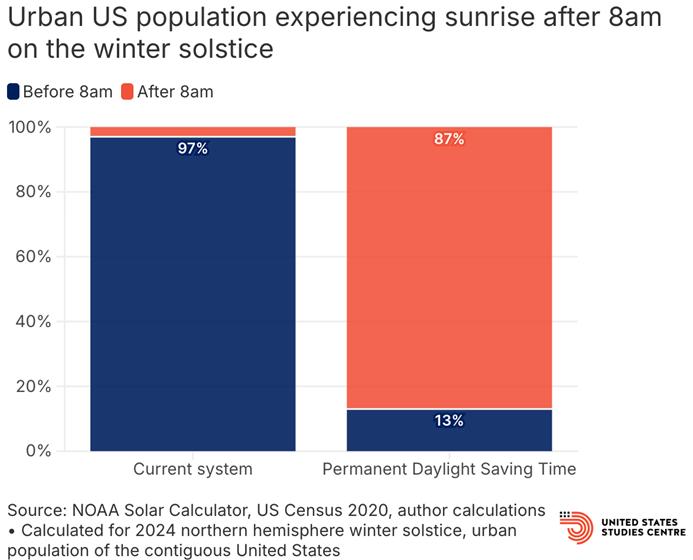
With permanent DST, more than 200 million Americans would receive morning light an hour later by the clock, with winter sunrises after 8:15 a.m. in cities including New York, Chicago, Philadelphia, Washington, D.C., Denver, San Francisco, and Tampa. -Time cont'd from page 12
Source: https://tinyurl.com/4vtmpy9x
- Time cont'd on page 14
We can’t run the cleanest experiment here. But permanent DST is essentially a milder, permanent version of the circadian strain that makes shift work unhealthy. Shift work is one of the most heavily studied health exposures we have, and it’s repeatedly tied to negative metabolic, cardiovascular, and even cancer risk. The catch is dose: an hour is gentle compared to working overnight, so we know the direction of the harm better than its size.
Circadian biology, laboratory research, epidemiologic studies, and natural experiments indicate that permanent standard time is more closely aligned with human biology:
Circadian biology and laboratory research: Many studies link circadian misalignment to cardiometabolic risk. In a healthy-volunteer study, deliberately shifting people’s body clocks worsened blood sugar levels and raised blood pressure, though the experiment induced far greater misalignment than one hour.
Epidemiologic studies: Across populations, greater circadian misalignment is associated with higher obesity risk. On the western edge of a time zone where sunrise and sunset both fall later by the clock but work and school schedules stay fixed people sleep about 19 minutes less a night. The same populations show associations with several adverse health outcomes, including metabolic disease and some cancers, though these observational findings should be read cautiously.
Natural experiment (1974): Congress made DST permanent in January 1974 and repealed it within ten months after
parents reported concerns about children walking to school in the dark. Public support fell from 79% to 42% in the first two months. No one systematically tracked health outcomes it was judged unpopular based on public opinion and energy use alone.
But, as we know, policy is not always determined based on health or science. Supporters of permanent DST point to upsides of lighter evenings, including more after-work daylight for recreation and businesses, which is also important.
You might ask: if the switching is the problem, isn’t any permanent clock better than none? Not necessarily. Under today’s system, at least we’re on standard time all winter, when that light matters most.
What’s next and what it means for you
There is congressional momentum we haven’t seen since the 1970s. The House passed the Sunshine Protection Act, 308 to 117. If it becomes law, the bill would end the twice-ayear clock changes that impact 48 U.S. states and make daylight saving time (DST) permanent. It now heads to the Senate, but following closely on its heels is another bill that would stop semiannual clock switching by repealing daylight saving time and enacting permanent standard time (H.R.9638 - Sunshine for Our Kids Act of 2026).
- Time cont'd on page 15
What this means for you:
1. Lawmakers are now weighing two different approaches: permanent daylight saving time and permanent standard time. There is still time for public input before Congress makes a final decision. Contact your representatives to share your perspective.
2. The physiology points to things you can use today: get outside into daylight early, keep your evenings dimmer, and hold a steady sleep schedule.
1. Prioritize morning light. Get outside in the morning, especially when clocks change, or you change time zones. Sunlight is the strongest signal to reset and stabilize your circadian clock.
2. Go easy on evening screens (all the time, regardless of time changes). Extra evening light delays melatonin. Screens make it worse, and if you must use screens, also utilize the evening light functions that can mitigate the effects of light at night.
Bottom line
The evidence that changing the clocks twice a year causes short-lived harm is strong, which is why there is broad agreement that the semiannual seasonal switch should end. And Congress has made an important move towards this goal, but in the wrong direction. ■
For more content like this please find YLE on Substack: https://tinyurl.com/vhmbuyka
YLE can be found here: https://yourlocalepidemiologist.substack.com/
Your Local Epidemiologist (YLE) is founded and operated by Dr. Katelyn Jetelina, MPH PhD an epidemiologist, wife, and mom of two little girls. YLE reaches more than 305,000 people in over 132 countries with one goal: “Translate” the ever-evolving public health science so that people will be well-equipped to make evidence-based decisions. This newsletter is free to everyone, thanks to the generous support of fellow YLE community members.
To support the effort, subscribe or upgrade your existing subscription: https://yourlocalepidemiologist.substack.com/
AI Predicts Outbreaks of Diarrheal Illness Using Weather Patterns and Disease Data
Interviewer: Madeline Roberts, PhD, MPH
A multinational early warning system developed from machine-learning models performs well in predicting diarrheal illness outbreaks precipitated by extreme weather in Nepal, Taiwan, and Vietnam. The rise of climate variability and extreme weather events carries its own set of health threats, and applying AI modeling to outbreak prediction could be a substantial asset in offsetting the burden of disease.
The recent study noted cyclical patterns in historical diarrheal disease data, meaning certain months exhibited patterns of consistently higher disease rates. This information alone is helpful for epidemiologists; when paired with weather data, model accuracy improved. The authors withheld the 12 most recent months of data, then tested neural network-based model performance for disease rate prediction over that time period. The model with the best predictive performance included:
♦ weather data (precipitation, miniminum and maxiumum temperatures, and El Niño Southern Oscillation phases),
♦ historical diarrheal disease data (data from the same month for the previous two years)
♦ most recent diarrheal disease data (i.e., from the preceding month data which is not always available in lower-resourced areas).
Seasonal-to-subseasonal (S2S) research has origins in weather prediction, where it can provide researchers with two weeks to two months and up to two years advance indication of adverse weather events. Decision-makers can utilize this information to prepare and mobilize resources for predicted events. Environmental epidemiologists can build models which include climate forecast data and disease data and apply S2S methods to predict health threats ranging from malaria to heatwave morbidity and mortality. It amounts to a powerful prediction tool to improve preparation and response times.
The authors underscore the value of leaders having three to six months lead time for resource allocation and understanding how near-term future disease threats compare to historical averages. “NN-based S2S early warning systems can be developed to reliably predict [diarrheal] disease risk for various regions with diverse characteristics…Such systems will enable communities to anticipate climate change–related health threats ahead of time, adequately prepare for them, and respond when necessary rather than simply reacting to them.” When accompanied by rapid mobilization, early warning systems for diarrheal illness have high-impact potential in low and middle-income countries where diarrheal disease is a leading cause of mortality.
We reached out to Dr. Amir Sapkota, one of the paper's senior authors, with a few questions regarding his recent publication and his
- Outbreaks cont'd on page 16
broader research program, which explores the intersection of climate change and human health.
EpiMonitor: A publicly disseminated weekly/monthly disease forecast, as suggested in your study, is such a powerful tool. Are there diseases or health effects within the US that you think would be well-suited for this kind of forecasting?
Sapkota: There are many, ranging from seasonal flu, diarrheal diseases to heat stroke and asthma exacerbations. These tools are designed to enhance public health preparedness and community resilience.
EpiMonitor: Seasonal-to-subseasonal (S2S) prediction can range from two weeks to two years. Was there a time span in mind for the predictive models developed in your study? (Perhaps you can speak to any evidence on timing aimed toward optimal public health mobilization)
Sapkota: It takes time to mobilize public health resources. So knowing how things are going to be tomorrow or the day after does not give public health practitioners enough time to prepare. Disease outlooks with lead times from a few weeks to a few months are ideal.
EpiMonitor: Based on your research experience, are there any policy changes or public health interventions you would like to see that could potentially mitigate some of the health effects of extreme weather events (either within the US or globally)?
Sapkota: We need a forward-looking public health system, where we can anticipate these threats ahead of time, prepare for them, and respond to them when the time comes, instead of simply reacting after the fact.
EpiMonitor: Less related to your recent publication, your research team partners with the Maryland Public Health Department. Can you talk a bit about your work in that area?
Sapkota: As the flagship university in the state of Maryland, we are constantly partnering with our state agencies to address pressing public health issues in Maryland. We are working very closely with the Maryland Department of Health to understand how ongoing climate change is impacting the health of Marylanders and identify the most vulnerable communities.
The Job Hunt How to Get Your Job Opening Noticed
Editor's Note:
The annual fall recruitment season is upon us and over the next 120 days we'll see more jobs listed than we will during the entire rest of the year. While this column is normally devoted to the employee side of the job hunt equation,
this month we are turning our attention to the employers among our readers. This article will focus on tips to get your open job the notice it deserves - from the kind of employee you want to hire.
Today's STEM employment market has the kind of problems other market segments could only wish for. Today's graduates are well qualified for these open positions and anxious to find their next job.
The question for employers is how to get candidates to notice their openings and how to encourage them to apply. The "apply now" button isn't sufficient to attract the candidate you really want. At the same time, finding the candidate who fits well into your organization and is going to stay for a reasonable amount of time is even more important today than it was a decade ago.
Today's applicants have different motivations than those of a decade ago. Today's newly minted graduates look a lot like mid-career graduates of a decade ago when you consider what motivates them to seriously look at an open position.
After the great recession and the Covid years, applicants of all ages value job stability, room for growth within the organization, and the feeling that their value is appreciated by their employer.
Two years ago the EpiMonitor surveyed its readers to see what was most important to
them when evaluating job opportunities. The most important issues were, as expected, salary and benefits. But there were other key points that surfaced as being extremely important to today's job searcher. To make your job listing more attractive you should consider highlight at least some of these in your job listings:
A. Job opportunities / search support for their partners
B. Quality ranking of the local K-12 school systems
C. Local tax picture (both property & income)
D. Local housing prices and availability
E. Length of commute - housing picture near your organization
F. Time off / flexibility (more about this later)
G. Recreational opportunities in your area
H. A sense of the local community
J. Tuition reimbursement / PSLF eligibility
In some ways, looking for a job is like looking for a house - there are a lot of them available but finding the right one takes good marketing by the seller. Pictures help a lot and your local Chamber of Commerce may be able to provide you with a couple that you can use in your ad. They should be evocative of your local community so that at a glance the searcher will say "that looks like a place I'd feel comfortable."
A good realtor can normaly guide you to information about the local school system. While you don't want to include more than a brief paragraph about it in your ad, you should be able to include a link to more detailed information for the applicant to whom this is important.
One place you shouldn't skip, because it will be important to all applicants, is a list of benefits. You won't be able to include all of them but a bulletized list will draw the reader's eye and will help them easily compare & contrast your opening to others on the market.
Make sure you include contact information wherever possible. People don't feel valued when the only point of contact that you provide is a form that sends their information into a black hole.
As important as it is to attract applicants, attracting the right applicant is even more important. It is expensive to recruit & onboard new hires and you want to find an applicant who is a good fit so they'll stick around.
Employers today are complaining about culture shock when hiring. The value applicants place on personal time and daily schedules is frustrating to older hiring managers who came up in a different cultural environment. Your ad needs to provide sufficient information that it
attracts the type of applicant who will be a good fit. Your interview process is going to surface information about their future plans and their prior job history but you want to tailor your ad so the people you interview are the ones who will really fit.
One of the things we notice is employers who have multiple simultaneous job openings and make that clear in their ad will attract more attention than those who appear to have a single opening. For example a job listing that says "Multiple Faculty Positions" or "2 Research Scientists" will get many more clicks than job ads without the "Multiple" or "2" in the header even if the text of the ad indicates that there are multiple openings.
How you lay your text out is equally important. Endless paragraphs of dense text is much less likely to attract an applicant than ads with clear lists that uses bolding, italics, and color to draw the reader's eye to the things you want them to notice. This combined with a few color images can draw the reader's eye through your ad and ensure that they see all the important points you wanted to highlight.
After a brutal 12 months in this market segment, it appears that fall 2026 is going to be a robust job market. That means you'll have a lot of competition for the same applicants. Advertising is expensive and following these tips will help you compete on a solid footing.
Need help building your ad? Contact our office and we'll work with you to craft a winning solicitation.
This month we have a request - Epi Info is looking for a new host as it has been removed from the CDC website. If you're interested, all the necessary information is on the next page.
We are hoping to present more lists of free books in the coming months. Several individuals have contacted us and are doing the preparatory work so we can list them. If you are cleaning out your bookshelves please let us know so we can help you direct the excess to someone who the books. Listing your excess books with us is free to you. You'll need to provide us this information:
A. Title of each book including edition numbers where available
B. Names of the author(s)
C. Name of the publisher
D. Year of publication
E. ISBN number
All of this information should be emailed to us in a Word document or Excel spreadsheet. Please try to avoid using a PDF document as it causes formatting issues for us. After you send the list to us and we publish it, all further communications will be between you and the individuals who are requesting the book. It is our suggestion that you create a separate email address for this function as some books generate a lot of inquiries. You will also need an easy way to accept payment for shipping & handling. Most people use platforms like Venmo and Zelle although there are other options available that you may prefer.
You will need to establish a shipping & handling price. We recommend setting one or two standard prices (for single or multiple books). Most people find using USPS Priority Mail works well for this purpose. USPS includes a free, self sealing box as part of their pricing. Additionally, prices are based on box size - not on the weight of the shipment. You'll be able to provide a price for a medium size carton (typical for single books) and a large size box (good for 2-4 books ).
Once you receive a request and determine that the book is still on your shelf all you need to do is tell the reader what it will cost for shipping, accept their payment, box the book(s) up, and then either take the boxes to your local post office or hand them to your letter carrier.
Many of the older books in your library are in big demand. This is a method to ensure they continue to be of use and it avoids the unsettling task of throwing them away or shredding them. The book that is of no value to you any longer is of big use to someone else.
Resources
Epi Info Needs a Host
Seeking an Organization to Host the Project
For more than 35 years, Epi Info has been one of the world's most widely used free software packages for epidemiology and public health. It has supported disease surveillance, outbreak investigations, research, and teaching in thousands of organizations across the globe. The CDC has ended support for Epi Info, and the software has now been removed from the CDC website. While many epidemiologists and public health professionals continue to rely on Epi Info, its long-term future is uncertain.
We are looking for an organization that would be interested in becoming the new home for Epi Info.
An ideal host might be:
A university or school of public health
A nonprofit organization
A professional epidemiology or public health association
An international health organization
Another institution committed to advancing public health through freely available software
The goal would be to preserve Epi Info as a free resource for the global public health community while providing a sustainable framework for future maintenance, updates, and community involvement.
If your organization may be interested or if you know of an institution that should be part of this conversation we would greatly appreciate hearing from you. Please help by sharing this announcement with colleagues who have used or benefited from Epi Info.
The global epidemiology community has invested decades in Epi Info. With the right institutional partner, this valuable resource can continue serving public health professionals, researchers, and students for many years to come.
For additional information or to discuss potential opportunities, please contact us at :save.epi.info@gmail.com.
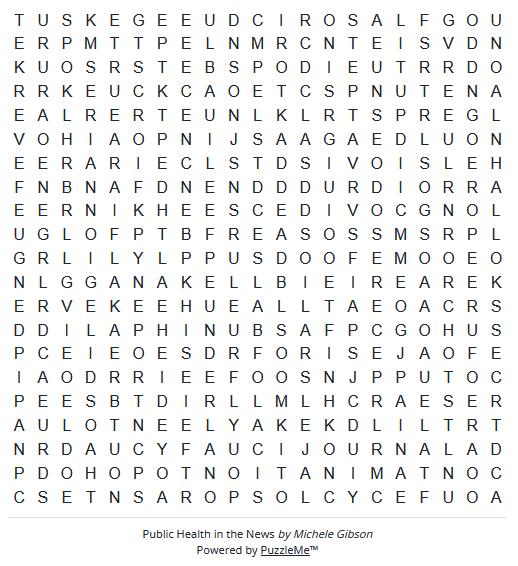
This month's puzzle spotlights words from What We're Reading in this month's issue That should make it easy for you to work the puzzle. Good luck - don't let the puzzle frustrate you!
For an interactive online version go to: https://tinyurl.com/3k645mar
Words to find: 1. Contamination 2. Cyclospora 3. Dengue Fever 4. DRC 5. Ebola
6. Fauci Journal
7. Food Supply
8. Health Dept
9. Legionnaires
10. Long Covid
11. Outbreak
12. Peptides
13. Research
14. Taylor Farms
15. Ticks
16. Tuskegee
17. USAID
What We're Reading This Month
Editor's Note: All of us are confronted with more material than we can possibly hope to digest each month. However, that doesn't mean that we should miss some of the articles that appear in the public media on topics of interest to the epi community. The EpiMonitor curates a monthly list of some of the best articles we've encountered in the past month. See something you think others would like to read? Please send us a link at info@epimonitor.net and we'll include it in the next month
Ebola
♦ There's no treatment designed for the Ebola strain ravaging DRC. But now there's hope (NPR)
https://tinyurl.com/5hykphnm
♦ Volunteers Are Risking Their Lives to Stop Ebola. They Aren’t Always Welcome. (NYT) https://tinyurl.com/mr2zkpus
Lyme Disease - Ticks
♦ Ticks Are on the Move. Here Are the Risks in Your Region. (NYT) https://tinyurl.com/y6av29rd
♦ All 4 Siblings Develop the Same Disease - Then They Test the Dog (Newsweek) https://tinyurl.com/35vxh7an
Fauci
♦ Fauci, in Private Diary, Reflected on Covid’s Origins and His Own Fame (NYT - Gift Article) https://tinyurl.com/z453ky46
♦ Opinion | The Revealing Diaries of Dr. Fauci (WSJ via AppleNews) https://tinyurl.com/bdxdjkf6
♦ The Doctor and His Diary: What Fauci’s Innermost Musings Reveal (NYT - Gift Article) https://tinyurl.com/mrdefhy2
♦ 4 takeaways from Fauci's journals ahead of his Senate testimony (ABC News) https://tinyurl.com/3nadyfwc
- Reading cont'd on page 24
What We're Reading This Month -
[Type a quote from the document or the summary of an interesting point. You can position the text box anywhere in the document. Use the Text Box Tools tab to change the formatting of the pull quote text box.]
con't from page 23
Legionnaires Disease
♦ Legionnaire's disease outbreak in 2 NYC neighborhoods (NY Post)
https://tinyurl.com/33edfrtp
♦ How Mamdani’s Health Department failed New York in deadly Legionnaires’ outbreak (NY Post)
https://tinyurl.com/mu5pejje
Public Health Topics
♦ A Proposed Rule Would Politicize Medical Research. Scientists Are Not Happy. (NYT)
https://tinyurl.com/548c5y82
♦ The Truth About Long Covid (Wired)
https://tinyurl.com/yckm3xz
♦ Trump's team says 'no children' died from USAID cuts. Consider these 3 cases (NPR)
https://tinyurl.com/4masp6mr
♦ Abdul El-Sayed Is an Epidemiologist Running for Senate. His State Is a Public Health Disaster (Wired)
https://tinyurl.com/erxh3j25
♦ Yemen's health workers race to halt latest outbreak of deadly dengue fever (Al Jazerra)
https://tinyurl.com/mry6j6b4
♦ FDA advisory panel narrowly votes to allow compounding of unapproved peptides (STAT) https://tinyurl.com/yfsx7nk2
♦ Have We Learned Anything from the Tuskegee Experiment? (National Review via AppleNews)
https://tinyurl.com/h363tez7
♦ There may finally be a breakthrough for treating long COVID but it's controversial (Wired via AppleNews)
https://tinyurl.com/ycy8ccbh
What We're
Cyclospora
♦ Cyclospora Spreads Through Human Feces. How Did It Get Into Our Food Supply? (NYT)
https://tinyurl.com/3we54hy2
♦ Previous large scale food contamination issues (PBS)
https://tinyurl.com/yz8css3w
♦ FDA Reports Taylor Farms Lettuce Test Was Actually a False Positive (Yahoo)
https://tinyurl.com/3z77h24z
♦ Taylor Farms Called White House to Try to Delay Cyclospora Recall (WSJ via AppleNews)
https://tinyurl.com/yvzyz5c2
♦ Trump health staffing, funding cuts slow cyclospora response (The Hill via AppleNews)
https://tinyurl.com/42w5d879
♦ The FDA is investigating new cyclospora outbreak but hasn't identified source (WSJ via AppleNews)
https://tinyurl.com/55eth3sn
♦ I'm a gastroenterologist. Here's how my family is eating during the cyclospora outbreak. (Business Insider via AppleNews)
https://tinyurl.com/3rpu9rdx
♦ The part of the cyclosporiasis outbreak no one is talking about (USA Today)
https://tinyurl.com/yzvhhfdw
♦ Explosive Diarrhea Outbreak Continues to Grow as Authorities Race to Find Source (WSJ via AppleNews)
https://tinyurl.com/5n8a8987
♦ CDC expands largest known U.S. cyclospora outbreak to 9 states (WAPO via AppleNews)
https://tinyurl.com/4y662pju
Notes on People
Do you have news about yourself, a colleague, or a student?
Please help The Epidemiology Monitor keep the community informed by sending relevant news to us at this address for inclusion in our next issue. michele@epimonitor.net
Honored: Lucile Adams-Campbell, PhD, a cancer epidemiologist, is the recipient of AACI's Cancer Health Equity Award. She is the founding director of the Ralph Lauren Center for Cancer Prevention, associate director for minority health and health disparities research, senior associate dean for community outreach and engagement, and distinguished university professor at Georgetown Lombardi Comprehensive Cancer Center. Dr. Adams-Campbell's research focuses on clinical trials and cancers that disproportionately impact minority and underserved populations, particularly African Americans, in the areas of obesity, metabolic syndrome, and energy balance.
Honored: Former ASA President, Ji-Hyun Lee, has been named the 2026 Scientist of the Year by the Korean-American Scientists and Engineers Association and the Korean Federation of Science and Technology Societies.
A professor of biostatistics at the University of Florida and associate director for cancer quantitative sciences at the UF Health Cancer Institute, Lee has made significant contributions to cancer research, statistical science, and scientific leadership.
Honored: University of Pennsylvania professor, Yong Chen, PhD, has been selected as one of the 2026 Top 10 Clinical Research Achievement Awards by the Clinical Research Forum. The study, Long COVID associated with SARSCoV-2 reinfection among children and adolescents in the Omicron era (RECOVEREHR, was also spotlighted in Penn Medicine News as one of the nation's top clinical research advances.
Honored: The National Foundation for Infectious Diseases has announced that Richard J. Hatchett, MD, of the Coalition for Epidemic Preparedness Innovations (CEPI), will receive the 2026 NFID Jimmy and Rosalynn Carter Humanitarian Award in recognition of his extraordinary leadership in advancing global health security and pandemic preparedness. The award will be presented in DC in October.
Notes on People,
Do you have news about yourself, a colleague, or a student?
Please help The Epidemiology Monitor keep the community informed by sending relevant news to us at this address for inclusion in our next issue. michele@epimonitor.net
Honored: The National Foundation for Infectious Diseases has announced that Shabir A. Madhi, MMed, PhD, of University of the Witswatersrand, Johannesburg, South Africa, will receive the 2026 NFID Maxwell Finland Award for Scientific Achievement, recognizing his lasting contributions and influential career in vaccine research and global disease prevention. Professor Madhi’s work has generated definitive evidence for vaccines in high-burden African settings, reshaping both scientific understanding and global health policy.
Honored: The National Foundation for Infectious Diseases has announced that Kathleen M. Neuzil, MD, MPH, will receive the 2026 John P. Utz Leadership Award, which recognizes individuals who exemplify leadership through service to NFID and the field of infectious diseases. Dr. Neuzil is director of Polio at the Gates Foundation, where she leads efforts to eradicate polio and strengthen immunization and disease surveillance systems globally. In addition to her scientific contributions, Dr. Neuzil is widely recognized for her mentorship, advocacy for women in science, and commitment to training the next generation of public health leaders.
Appointed: Dr. Michele Guindani, professor in the UCLA Fielding School of Public Health’s Department of Biostatistics, has been named interim chair of the department.
Guindani is internationally renowned for his work in Bayesian statistics, biostatistics, and data science. His research focuses on the analysis of complex, high-dimensional biomedical data, with particular emphasis on neuroimaging, radiomics, integrative genomics, microbiome data, clustering, and Bayesian nonparametric modeling.
Appointed: University of Hawaiʻi at Mānoa Assistant Professor Shiwen “Sherlock” Li of the Thompson School of Social Work & Public Health was appointed the next recipient of the Chin Sik and Hyun Sook Chung Endowed Chair, effective September 1, 2026. An environmental epidemiologist in the Department of Public Health Sciences, Li investigates the impact of environmental contaminants on human health. His research centers on chemical pollutants, such as per- and polyfluoroalkyl substances (PFAS), often referred to as “forever chemicals.”
Do you have news about yourself, a colleague, or a student?
Please help The Epidemiology Monitor keep the community informed by sending relevant news to us at this address for inclusion in our next issue. michele@epimonitor.net
Appointed: Mulugeta Gebregziabher, Ph.D., a nationally and internationally recognized public health leader, researcher and educator, has been named a professor and the endowed chair of the Department of Biostatistics and Epidemiology at the University of Oklahoma Hudson College of Public Health. Gebregziabher has built a distinguished career at the intersection of data science, clinical research and population health. He brings more than two decades of experience advancing innovative research methods, strengthening public health systems and mentoring the next generation of public health researchers.
Passed: Dr. Joseph F. Fraumeni Jr., who helped discover one of the first examples of a cancer linked to a human gene, paving the way for a field that has so far seen the discovery of more than 120 genes that predispose people to cancer, died on June 22 in McLean, Va.
Besides his pioneering research on hereditary links to cancer, Dr. Fraumeni did groundbreaking work in identifying environmental and lifestyle risks for cancer. For decades, he led the world’s top cancer epidemiology program, at the National Cancer Institute in Bethesda, Md.
Dr. Fraumeni recognized that the technology capable of exploring biology at the molecular level, developed starting in the 1970s and ’80s, could be used to hunt for causes of cancer in population- and family-based studies. As a leader at the cancer institute, he directed grants to do so, and is recognized as the founder of molecular epidemiology. https://tinyurl.com/2sx8zz2f https://tinyurl.com/mmnhebtu
Passed: Dr. Weihua Guan, age 52, a resident of Maple Grove, Minnesota, passed away on July 12, 2026, after a courageous battle with cancer. Dr. Guan received his bachelor’s degree in Chemistry from Peking University in 1997, his master’s degree in Statistics from Texas A&M University in 2001, and his doctoral degree in Biostatistics from the University of Michigan in 2010. He joined the University of Minnesota the same year and served as a Professor in the Division of Biostatistics & Health Data Science at the School of Public Health. Throughout his academic career, he was deeply committed to research, teaching excellence, and student mentorship. He was widely respected by colleagues and cherished by students for his patience, knowledge, and humility. https://tinyurl.com/34fxdbj2
Near Term Epidemiology Event Calendar
Every December The Epidemiology Monitor dedicates that issue to a calendar of events for the upcoming year. However that often means we don't have full information for events later in the upcoming year. Thus an online copy exists on our website that is updated regularly. To view the full year please go to: http://www.epimonitor.net/Events The events that we are aware of for the next month follow below.
August 1-6
Type: Conference
Title: JSM 2026 (Joint Statistics Meeting)
August 2026
Web: https://tinyurl.com/yvfw99x5
Sponsor: American Statistical Association Location: Boston, MA
The list below has been compiled by Public Health Hiring Help the new Substack column that has been created to help individuals in the public health community find positions in the midst of the chaos that is now impacting governmental agencies and grant recipients. This list represents the most current positions PHHH has been able to identify. We thank PHHH for their permission to reprint these listings.
NC Dept of Health, Rural Health Transformation Outreach Coordinator (Raleigh, NC)
Emory Univ, Sr. HIV Epidemiology Program Associate (Atlanta, GA)
Not listed + benefits, Master’s min
Emory Univ, HIV Epidemiology Data Analyst (Atlanta, GA)
Not listed + benefits, Bachelor’s min, Master’s preferred
Open Public Health Intern Positions
Friends of the Global Fight Against AIDS, TB, and Malaria, Policy Intern (Multiple Locations)
Public Health Alignment: GH, HPM Eligibility: Undergraduate, Graduate
What it means and why it matters
Friends of the Global Fight Against AIDS, TB, and Malaria, Communications Intern (Multiple Locations) Public Health Alignment: GH, HPM, BSHES Eligibility: Undergraduate, Graduate
American Kidney Fund, Public Education Intern (Rockville, MD)
Public Health Alignment: BSHES, GH Eligibility: Undergraduate, Graduate
Bipartisan Policy Center, Health Policy Intern (Washington, DC)
Public Health Alignment: HPM, BSHES Eligibility: Undergraduate, Graduate, Bachelor’s, Master’s
Truth Initiative, Research Intern (Washington, DC)
Public Health Alignment: EPI, BSHES Eligibility: Graduate
Truth Initiative, Partnerships and Development Intern (Washington, DC)
Public Health Alignment: BSHES, HPM Eligibility: Undergraduate, Graduate
Truth Initiative, Public Policy Intern (Washington, DC)
Public Health Alignment: HPM, BSHES Eligibility: Undergraduate, Graduate
ASPPH, Research and Program Innovation Intern (Washington, DC)
Public Health Alignment: GH, BSHES, HPM Eligibility: Graduate
Public Health Alignment: EPI Eligibility: Master’s
Mass General Brigham, Research Assistant II (PT) (Boston, MA)
Public Health Alignment: EPI Eligibility: Bachelor’s, Graduate, Master’s
VA Commonwealth Univ, Data Analyst I (PT) (Richmond, VA)
Public Health Alignment: EPI, BIOS Eligibility: Master’s
Kaiser Permanente, Research Specialist III (PT) (Multiple Locations)
Public Health Alignment: EPI, BSHES Eligibility: Bachelor’s, Graduate, Master’s
Univ of CA Los Angeles, Project Coordinator (PT) (Los Angeles, CA)
Public Health Alignment: BSHES, EPI, BIOS Eligibility: Bachelor’s, Master’s
Univ of Chicago, Research Coordinator (PT) (Chicago, IL)
Public Health Alignment: RMACH, BSHES, EPI Eligibility: Bachelor’s, Graduate, Master’s
Children’s Hospital of Philadelphia, Clinical Research Assistant I (PT) (Philadelphia, PA)
Public Health Alignment: EPI Eligibility: Bachelor’s, Graduate, Master’s
Michael Page, Global Health Preparedness Consultant (CT) (Geneva, Switzerland)
Public Health Alignment: EPI Eligibility: Master’s
National Laboratory of the Rockies, Community Air Quality Monitoring Intern (Remote)
Public Health Alignment: EH, BIOS Eligibility: Undergrad, Bachelor’s, Grad
For Full Information on jobs: http://www.epimonitor.net/JobBank
The EpiMonitor offers a variety of plans for you to advertise your job opening, event or other item of interest to our readers. The basic advertising options are:
Web Only
This provides you with a full page on our website along with banner ads in appropriate places for what you are advertising (e.g. our Job Bank or Events pages). In addition, these ads are also featured in our monthly email blast. Web ads normally appear on our site within 2-3 hours of your order.
Web + Digital Print
This option provides either a full or half page digital print ad in this publication monthly along with all of the services included in the "Web Only" option.
Social Media
We also have social media add-on options for our web and print advertising programs.
Your Ad Should Be Here
Do you have a job, course, conference, book or other resource of interest to the epidemiology community? Advertise with The Epidemiology Monitor and reach 35,000 epidemiologists, biostatisticians, and public health professionals monthly.
Advertising opportunities exist in this digital publication, on our website and social media pages, and in our Epi-Gram emails.
For more information please contact: Michele Gibson / 770.309.7937 / michele@epimonitor.net
NIH Stadtman Investigator Program
NIH Stadtman Investigator Program
Deadline: September 30, 2026 (11:59 PM ET)
The National Institutes of Health (NIH) is pleased to offer the annual Stadtman Investigator Program for researchers seeking a tenure-track (assistant professor equivalent) position within its Intramural Research Program (IRP). The program is open to applicants conducting research in any area of biomedical science supported by the NIH. Each year, 10 or more new investigators may be hired through the program. More information about the program can be found at https://irp.nih.gov/careers/trans-nih-scientificrecruitments/stadtman-tenure-track-investigators
Who we are: The IRP is a research institution whose hallmarks are stable funding, intellectual freedom, shared resources, and access to a wide range of scientific expertise and the world’s largest hospital dedicated to clinical research. It is home for around 1,000 principal investigators, nearly 2,000 other clinical and research faculty members, and more than 4,000 trainees and fellows from the undergraduate to the postdoctoral level. IRP research is conducted in several campuses across the U.S. More information about the IRP is at https://irp.nih.gov
Whom we seek: The program is intended for applicants interested in being a principal investigator of a research group advancing the knowledge of living systems and its application to enhance human health while mentoring the next generation of scientists. We seek creative thinkers eager to take on innovative high-impact research.
Qualifications: Applicants must have a doctoral degree (M.D., Ph.D., or equivalent); have a robust record of research accomplishments as evidenced by high quality publications in peer-reviewed journals; and be a U.S. citizen, resident alien, or non-resident alien with, or eligible to obtain, a valid employment-authorization visa.
How to apply: The complete application consists of cover letter, curriculum vitae, research statement, and three letters of reference.
The application system is accessible at the Stadtman Investigator Program website: https://irp.nih.gov/careers/trans-nih-scientific-recruitments/stadtman-tenure-track-investigators. It will open on August 1, 2026 and close on September 30, 2026 (11:59 p.m. EDT).
Applicants should arrange for 3 reference letters to be submitted on their behalf by the September 30 deadline. After uploading their application and entering the names and email addresses of the 3 references into the application system, the applicant will be able to initiate the sending of an automated email to the references soliciting their reference letters.
Please note that the request for reference letters can only be sent after application submission. Thus, we strongly recommend that applicants submit their application substantially in advance of the September 30 deadline to ensure that their references have ample time to submit their letters by the deadline. If necessary, applicants may preliminarily submit a draft “placeholder” application, replacing it with the final application later but before the deadline.
MORE INFORMATION: https://www.epimonitor.net/2026-4044-Epidemiology-Job-Opening.htm
Assistant / Associate / Full Professor - Pharmacoepidemiology
The Department of Epidemiology & Population Health and the Department of Anesthesiology, Perioperative & Pain Medicine at Stanford University School of Medicine invite applications for a joint faculty position in pharmacoepidemiology at the rank of Assistant, Associate, or Full Professor, in the University Tenure Line, University Medical Line, or Non-Tenure Research Line, commensurate with qualifications and experience. We are particularly interested in candidates with expertise in pharmacoepidemiology and real world evidence to study the safety, effectiveness, and utilization of medications across a range of clinical and population settings.
For more information about the position, including required qualifications and application materials, go to: http://facultypositions.stanford.edu/cw/en-us/job/494983.
For questions, please contact bsc-academicaffairs@lists.stanford.edu
Stanford is an equal employment opportunity and affirmative action employer. All qualified applicants will receive consideration for employment without regard to race, color, religion, sex, sexual orientation, gender identity, national origin, disability, protected veteran status, or any other characteristic protected by law. Stanford welcomes applications from all who would bring additional dimensions to the University’s research, teaching and clinical missions.
Consistent with its obligations under the law, the University will provide reasonable accommodations to applicants and employees with disabilities. Applicants requiring a reasonable accommodation for any part of the application or hiring process should contact disability.access@stanford.edu
Tenure-Track Investigator
The Epidemiology Branch (EB) within the Division of Intramural Research (DIR) of the National Institute of Environmental Health Sciences (NIEHS), part of the National Institutes of Health (NIH), is recruiting a Tenure-Track Investigator to develop an independent research program on environment and chronic diseases of aging. Scientists within the EB (https://www.niehs.nih.gov/research/atniehs/labs/epi) address the mission of NIEHS by carrying out research on the effects of the environment on human health. EB research covers a wide range of conditions with potential links to environmental exposures and includes studies that address health across the lifespan from pregnancy and child development to chronic diseases of aging.
Qualifications:
Applicants should have a Ph.D., M.D. and/or equivalent doctoral degree with apreferenceforat least 3 years of postdoctoral research experience in their field and an outstanding publication record. The emphasis will be on identifying an exceptional scientist with an innovative and productive research program. Appointees may be U.S. citizens, U.S. permanent residents, or non-residents of the U.S. with, or eligible to obtain, a valid employment-authorization visa.
Salary/Benefits:
The successful candidate for this position will be appointed at a salary commensurate with experience and accomplishments. Full Federal benefits will be provided, including retirement, health and life insurance, leave, and a savings plan (401(k) equivalent). Please read the following guidance on Selective Service (https://help.usajobs.gov/working-in-government/fair-andtransparent/selective-service) requirements.
How to Apply:
Review of applications will begin on September 15, 2026. Interested candidates should submit materials as one combined PDF via email to Intramural Applications at int-appls@niehs.nih.gov. All emails should include vacancy number AC1639 in the subject line.
YLE can be found here: https://yourlocalepidemiologist.substack.com/
Your Local Epidemiologist (YLE) is founded and operated by Dr. Katelyn Jetelina, MPH PhD—an epidemiologist, wife, and mom of two little girls. YLE reaches more than 305,000 people in over 132 countries with one goal: “Translate” the ever-evolving public health science so that people will be well-equipped to make evidence-based decisions. This newsletter is free to everyone, thanks to the generous support of fellow YLE community members.
To support the effort, subscribe or upgrade your existing subscription: https://yourlocalepidemiologist.substack.com/
The Epidemiology Monitor ISSN (2833-1710) is published monthly by Monitor Publishing & Communications, Inc.
All material in this publication is subject to copyright. For possible reprint permission please contact us at michele@epimonitor.net
Advertising options include but are not limited to:
Website only ads or website ads combined with digital print ads in this publication. Sponsorship for features in this newsletter or for the newsletter issue itself
Ads are accepted for open positions, events, programs, books, merchandise and other items of interest to our readers.
Subscriptions to this publication are free. Go to http://epimonitor.net/Subscribe.htm