Two years later, planters return with vibrant greenery pg. 4
Anti-ICE walkout sets a powerful example for student activism pg. 5
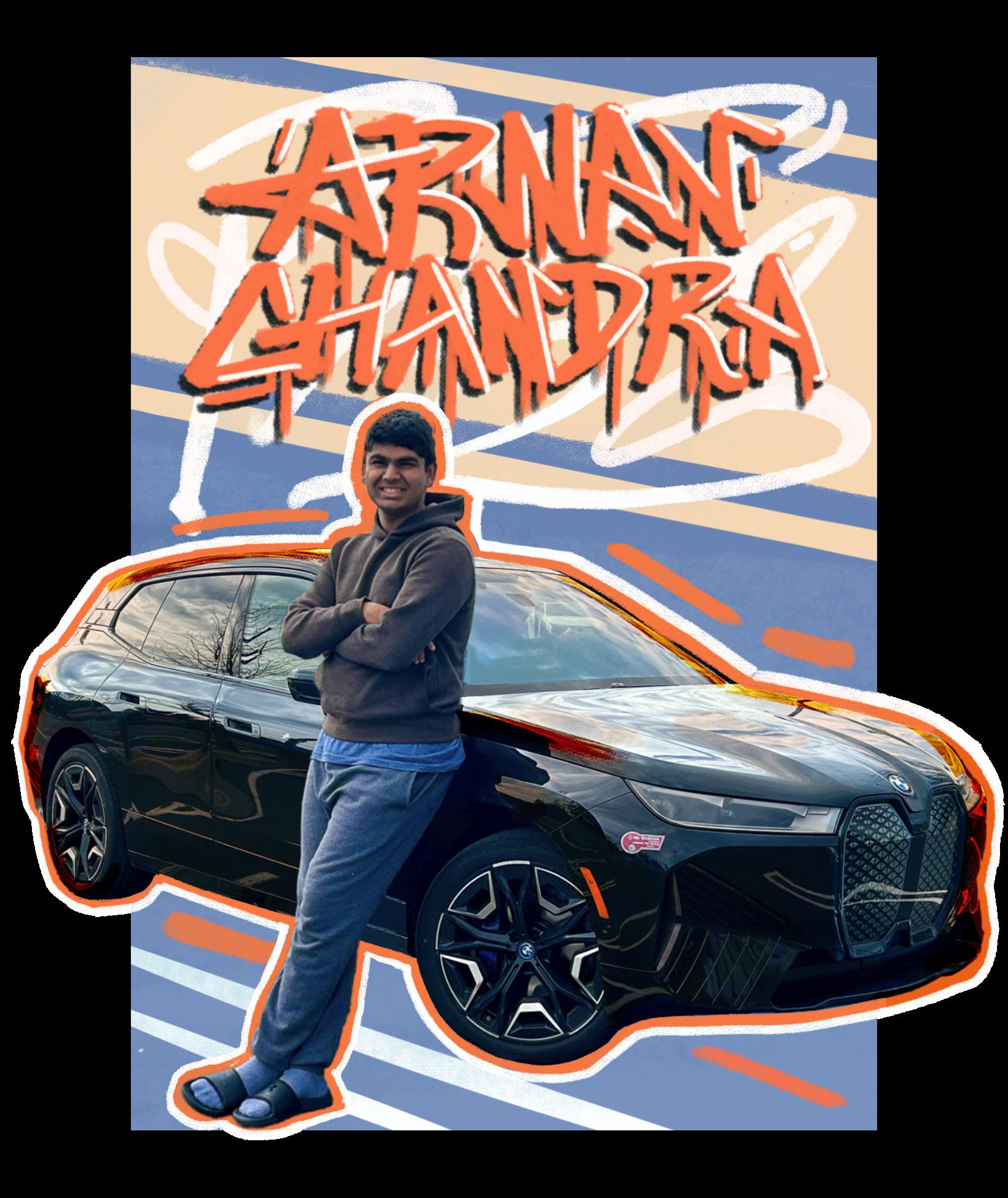
Arnav Chandra and Lucas Hsu step on the gas pg. 8
Stars and cultures connect across time pg. 11
Lauren Chen rows forward into Rutgers College pg. 14
Anti-ICE walkout sets a powerful example for student activism
At Lynbrook, missing class is rarely a casual decision. Between tests, projects and the constant pressure to stay ahead, taking even a single day off can feel like a setback for students driven by academic performance. Yet on Feb. 2, many students chose to miss their second and third periods to walk out for immigrant rights. In doing so, they established a muchneeded blueprint for how Lynbrook students can exercise civic power in the years ahead. As immigration enforcement continues to evolve and new policies emerge, students at academically-focused schools show that they are not apolitical. By organizing, they set precedents that shape how future classes will respond to issues that matter to them.
On that day, approximately 200 Lynbrook students participated in a walkout against United States Immigration and Customs Enforcement. Homestead High School, Fremont High School and Monta Vista High School followed suit on Feb. 4. In fact, throughout the Bay Area, over 1,000 students participated in anti-ICE walkouts. The scale of these demonstrations suggests a generation ready to civically engage with the critical issues affecting their communities.
“I believe because students aren’t allowed to vote yet, it’s so important for us to use our voice to be heard,” junior and Lynbrook walkout organizer Yaebin Kim said.
Story continued on page 5.
Page by Amanda Jin and Rohan Kakhandiki
Letter from the Editors Hey Vikings!
Spring unfurls with flower buds, green leaves, blue skies — and Issue 5 of the Epic!
Read about the campus trees’ return along with new plant buddies in News, while the impact of student activism takes the wheel in Opinion. Shift gears into two students’ passion for driving and filming cars in Features before turning to the history of our fascination with the night sky in In-Depth. Sports highlights Lauren Chen’s commitment to Rutgers College for rowing and in Web, test the waters of comradery with friendship quizzes and find other exclusive content on our Youtube and at lhsepic.com.
Finally, if you’re interested in joining our staff next school year, applications are open now at bit.ly/epicapp2026 and due by 4 p.m. on March 17. We look forward to reading your submissions!
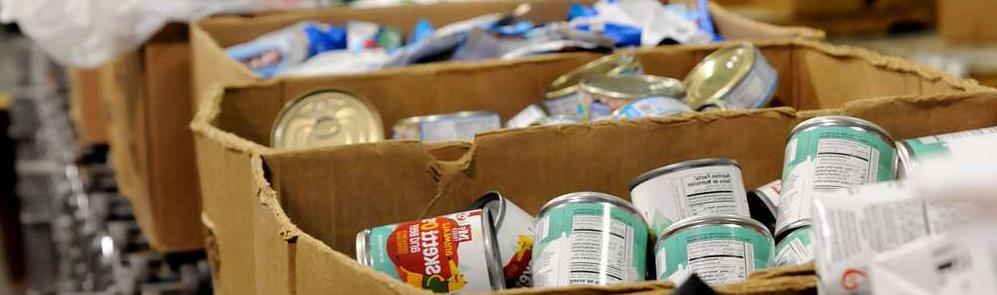
In a continuation of their annual donation drives, Octagon Club is organizing their first-ever food donation drive from March 1 to March 23. Previously, the club gathered items such as clothing; this year, they decided to swap to collecting non-perishable food items after an officer-wide vote. Promotional efforts have included social media posts and announcements in club meetings. Club members will gather and drop off canned food and boxed goods such as pasta and crackers at the officers’ homes. All donations will go toward a food bank of members’ choosing after a club vote in midMarch.
School Community National International
The Environmental Protection Agency repealed its power to regulate greenhouse gas emissions on Feb. 12: the largest deregulatory action in United States history, erasing the 2009 Obama-era Greenhouse Gas Endangerment finding — a scientific cornerstone establishing that greenhouse gases contribute to climate change. The finding was a prerequisite for vehicle emission standards, so the repeal removes legal requirements to limit emissions. Americans will save an estimate of $1.3 trillion in regulation of motor vehicles and associated fields. However, scientists warn that the repeal will increase the negative impacts of the climate crisis.
On Feb. 3, Cupertino’s Mary Avenue Villas housing project was approved by city council vote. The affordable 40-unit development includes 19 units designed for individuals with intellectual and developmental disabilities. Critics and skeptics from the nearby Garden Gate neighborhood have hired an attorney to ensure the city meets legal requirements for pedestrian and environmental safety. Meanwhile, the development and transfer of public land from Cupertino to builder Charities Housing requires a final council approval before the assessment moves to the city’s planning commission.
Violence erupted following the Feb. 22 death of Nemesio Oseguera Cervantes, the most-wanted cartel boss in Mexico. Known as “El Mencho” and the leader of the narcoterrorist Jalisco New Generation Cartel, he was captured in Tapalpa and died during transport to Mexico City. In response, cartel bosses have set building fires and used burning vehicles to block roads across Mexico. The unrest has led to “shelter in place” issues from U.S. and Canadian embassies, a statewide “Code Red” declaration from the Jalisco’s governor, suspension of public transportation and arrests of those suspected to be involved in cartel operations.
FUHSD updates policies to address cyberbullying
BY ETHAN WONG
At its Feb. 10 meeting, the FUHSD board of trustees unanimously approved updates to the district’s bullying policy, Board Policy 5131.2, to now include protections for cyberbullying both on and off campus. The policy change included clarifications on where and how cyberbullying occurs and aims to help students and staff identify it from other forms of bullying.
Monta Vista High School senior Ria Sethi advocated for the addition of a cyberbullying rule. As a victim of cyberbullying, she felt the need to work with
denied help by both law enforcement and school on the grounds that the issue was out of their jurisdiction. The board’s policy change was driven both by routine revisions from the California School Boards Association and Sethi’s advocacy.
‘‘“I slowly realized that our experiences weren’t the actual problem, but rather the lack of a reaction,” Sethi said. “That’s really what motivated me to advocate for these changes and reach out to the district.”
Continued education is a key part of the policy’s implementation. In April, teen-led initiative Cyber for Youth is scheduled to lead discussions around cyberbullying during an advisory period by centering it around students and their own stories.
I slowly realized that our experiences weren’t the actual problem, but rather the lack of a reaction. That’s really what motivated me to advocate for these changes and reach out to the district.
After the new updates, Board Policy 5131.2 now clearly defines cyberbullying to include direct messages, group chats, impersonation and other forms of digital misuse, rather than limiting the definition to public posts. The revisions also included specific steps that schools can take to report and follow up on incidents, including parent notifications.
“The differentiation between bullying and cyberbullying is that cyberbullying often occurs outside of school, outside of the school day,” Associate Superintendent Trudy Gross said. “We want to know about it because then our responsibility is to determine the impact it’s having on the school, students at school and their progress in education.”
‘‘
One of the biggest challenges in enforcing the updated policy is ensuring that students feel comfortable reporting incidents, as bullying can be a sensitive topic. Even with clear definitions and available channels of communication, incidents can go unreported due to social stigma or fear of retaliation. To help address this barrier, the district has implemented an anonymous reporting called the Say Something Anonymous Reporting System. According to Gross, the district hopes this measure will encourage students to seek support so staff can be more aware of bullying incidents and respond appropriately.
“Anonymous polling is a very important tool and should be used actively throughout the school, especially between students and trusted adults,” junior and Equity Task Force lead Benjamin Zhang said. “In order to truly achieve the full potential of these polling systems, students themselves need to share and promote their experiences with the system.”
The new policy change reflects the district’s mission to reinforce accountability around bullying, both on or off campus.
“I really hope that people don’t utilize social media as a way to express concerns that they have,” Gross said “There are consequences to that type of action. I would just remind people not to do it in the first place.”
Photo from Benjamin Crane/Wikimedia Commons
Photo from Dreamyshade/Wikimedia Commons
Photo from Emmanuel Kwizera/Wikimedia Commons
Photo from La Prensa Gráfica Noticias de El Salvador
Graphic illustrations by Emily Cheah and Katie Shang
Ria Sethi Monta Vista senior and cyberbullying policy advocate
New ChatGPT subscription to assist teachers
BY VANESSA YAP
N‘‘
I encourage students to use AI to brainstorm the procedure and process for a particular task. I want AI to be a thought partner with them in developing a process or getting to a particular value or ratio.
Lester Leung Chemistry teacher
ovember 2025, FUHSD obtained a new ChatGPT subscription named ChatGPT for Teachers as part of OpenAI’s efforts to extend subscriptions to all verified K-12 teachers in the United States until June 2027. With the new subscription, premium perks like unlimited messages and large document uploads are available to teachers who choose to utilize the tool.
“We had been using Gemini, which was included in our Google apps,” FUHSD technology lead Menko Johnson said. “But a lot of teachers were using ChatGPT and paying for a monthly subscription. Since OpenAI offered it for free and it was also contained in our ecosystem, we went ahead and took them up on the offer.”
The district is still working to provide all FUHSD teachers a subscription. Some have only recently received their subscriptions, and some are still testing its new capabilities.
“Just last month, I was able to get my subscription activated,” computer science teacher Brad Fulk said. “But even prior to that, I used it all the time on my own. Last year, I utilized my own API key for my AP Computer Science Principles class to allow them to integrate OpenAI into an app they created.”
Artificial intelligence use in classrooms has long been a topic of debate. According to the National Education Association, 83% of K-12 teachers used generative AI in 2024, an 32% increase from the 2022-23 school year. Some teachers say that it reduces the hassle of basic tasks like creating essay prompts or coming up with example questions. However, others may choose to not use AI in order to exemplify originality.
‘‘
Currently, OpenAI’s upgraded chatbots are used by almost
instructors to draft lesson plans and simplify directions for students.
conversations I’ve had with teachers, AI enables them to do things that they
couldn’t do quickly or effectively before,” Johnson said. “We had a professional development meeting, and teachers were talking about how they could use it for texts that are hard for EL students to understand. They put them into AI and leveled them down to be more comprehensible.”
Overall, while the potential of AI in the classroom is up for discussion, the district’s implementation of ChatGPT for Teachers is a testament to AI’s increasing influence on education.
“We just want to show teachers what those tools are good at, and let them explore and come up with different methods,” Johnson said. “I don’t think that any of us can say we’re going to put AI back in the bottle.”
Upcoming Viking Events
Safer Choices Assembly, March 2 Speaker Mike Domirtz is back for the fifth year to deliver a presentation on helping kids navigate healthy relationships, sexual decisionmaking and personal safety. The event will be at the theater at 7 p.m.
CAASP Testing, March 3-5
Senior Games, March 9-27 Seniors will have the chance to win a free prom ticket by competing in a series of games during lunch at the quad.
Orchestra and Band Spring Concert, March 11 Spring into the season with an evening of music with the music department in the theater.
Silsilay, March 14
The American-Indo Student Association’s annual performance showcase will feature dance groups from numerous schools.
Junior Prom, March 21 Juniors, enjoy an unforgettable evening at Los Altos History Museum!
Charged Hearts project spreads heart health awareness
BY ANUSHKA DESHMUKH
As part of a yearly initiative
Caroline
and
Amber
sophomore
Kristy Zhu and Ivy Zan and
and project lead Alexis Cheng founded the service project Charged Hearts at the beginning of the school year to spread awareness about cardiovascular health. The team pushed for cardiovascular education in school clubs and PE classes, as well as on Instagram, spotlighting neglected issues
that could potentially harm students, such as sudden cardiac
FBLA members have the freedom to create community service projects to address a local issue. After learning about the dangers of sudden cardiac arrest, a medical emergency in which one’s heartbeat abruptly stops, Cheng founded Charged Hearts to educate others about the medical condition.
“As an athlete, when I first heard about sudden cardiac arrest, I was so surprised, because I was wondering how someone healthy would have their heart stopped in
A. Charged Hearts members pose after drawing hearts on
B. A member helps decorate a bookmark to be given away. C. Members present heart health information to PE classes.
D. Members create chalk art, spelling out “Heart Health
Photos used with permission from FBLA Graphic illustrations by Katie Shang
people need to know about this, because I didn’t know about this until I was specifically looking for it.”
Cheng and her team presented to students
during the first 20 minutes of every PE class on Thursdays and Fridays in late November on the symptoms of sudden cardiac arrest and the necessary response.
“It’s hard to connect with the student body often,” Cheng said. “I thought that bringing education to the classes would be a great way to reach more people and ensure that they’re actually participating.”
On Jan. 27, Charged Hearts collaborated with Interact Club in an event where students could make bookmarks for patients going through rehabilitation from cardiac arrest.
“I really love how this activity
reminded us that not only does physical support for heart health matter, but emotional support matters too,” junior and Interact Club member Trishna Sinha said.
In another collaboration with Public Art Club, volunteers worked to create a colorful chalk art mural saying “Heart Health Matters” with heart illustrations on the concrete outside the gym.
Outside of school, Charged Hearts have worked with local nonprofits such as Mended Hearts to distribute cards to heart disease patients. In the future, Cheng and her team are planning to create recipe cards for heart-healthy meals for the South Valley FISH Food Pantry.
Currently, Cheng and her team is submitting a report for the pre-judged portion of the FBLA Community Service Project competition in hopes of qualifying for the state-level round. Though Cheng will be graduating in June, the team hopes to continue the project at Lynbrook next year.
“This is my first time in an interactive event within FBLA and getting involved in my community,” Lai said. “It was just a really fun opportunity to work with others and help organize events.”
Photo by Emily Cheah. Reporting by Olivia Tu.
by FBLA, freshmen
Feng
Kesshavan Kirubaharan;
Eva Sharma; juniors
Lai,
senior
Computer science teacher Brad Fulk uses ChatGPT to generate an example solution.
A.
B.
Photo by Vanessa Yap Graphic illustrations by Brian Lee and Vanessa Yap
C. D.
Planters return with vibrant greenery two years later
BY ISABELLA CHIU
During the 2023-24 school year, trees near the 300s wing were cut down in preparation for campus renovations. Two years later, new trees have returned to campus as part of ongoing construction.
Utility work necessitated the trees’ removal: in consultations with an arborist, administrators learned that the construction would permanently damage the tree roots and potentially result in falling trees. To preserve campus safety, they made the decision to cut down the trees. The removal allowed Lynbrook’s fire line and domestic waterway to be redone, changing it from one pipe to two separate systems.
“The administration asked, ‘Can we save the trees and what would it look like if we tried to save them?’” Assistant Principal Tara Grande said. “We pushed back to make sure that there were no alternative solutions. Once we were told that there’s no other possibility, we had to go with it.”
To mourn the loss of the familiar greenery, some students left sentimental notes at the base of the trees and duct-taped posters of the Lorax on remaining
the trees’ memorials to grieve the removal along with the Lynbrook community.
“Two things can be true: we can miss the trees, but they had to go,” Grande said. “We weren’t trying to be disrespectful; we just didn’t have a choice. It was very hard for us to take them down, especially when you see that our new trees are going to take a while to get that big.”
In the 2025-26 school year, trees have arrived back on campus. Following renovations of the 100s, 200s and 300s wings, the construction crew replaced the previously square-shaped planters near the 300s wing with fewer but longer planters.
“Keeping a similar kind of layout was nice,” junior Jaclyn Chiu said. “Since the planters are shorter now, I’ve noticed that sometimes they get in the way
‘‘People walk along the bushes or the plants and may happen to step on them.”
The plants were chosen to create a green campus with drought resistance. The kangaroo paw, a drought-tolerant Australian perennial, along with shrubs of Chinese fringe flowers, are set to add pops of red and pink among the green trees.
Two things can be true: we can miss the trees, but they had to go. We weren’t trying to be disrespectful; we just didn’t have a choice. It was very hard for us to take them down, especially when you see that our new trees are going to take a while to get that big.
Tara Grande Assistant principal
‘‘With most of the trees still young, the benefits of the previously towering greenery have yet to return. The new saplings do not provide the same level of cover, shelter or shade on a hot day. Some are still supported by wooden poles, their planters protected by caution tape to prevent students from trampling the mulch and disturbing their growth.
While the new trees still have a long journey ahead of them, they are a step forward in restoring vibrant foliage on campus.
Muhly Grass
Muhly grass is drought-tolerant and naturally found in coastal areas. It is commonly planted in large groups to create a stunning visual effect.
Kangaroo Paws
Native to Australia, the plant’s striking tubular flowers sit atop stalks that resemble kangaroo paws. It flowers spring through fall, thriving in sunny climates and dry soil.
Chinese Pistache Tree
The tree is native to East Asia, being heat-, pest- and drought-tolerant. It reaches 25 to 35 feet at maturity, featuring green pinnate leaves and red berries.
Graphic illustrations by Rebecca Cai, Emily Cheah and Katie Shang
OPINION
Anti-ICE walkout sets a powerful example for student activism
Staff Editorial // The voice of the Epic
Story continued from front page.
L‘‘
ynbrook students are often criticized as more likely to repost an infographic than to take meaningful action. But at a school known more for STEM innovation than civic engagement, students defied expectations. The protesters who walked out are a testament to a rare sense of unity among different grade levels and backgrounds. It is true not all behavior during the march reflected the values the protest aimed to promote. When students arrived at Cupertino City Hall, some banged on windows, pressed signs against the glass and shouted at city hall workers. These actions crossed a line
were real: Even though Immigration and Customs Enforcement raids have not directly targeted the Lynbrook community, the Bay Area is home to thousands of immigrant families living in fear of deportation, including families in Cupertino and San José. International students at Lynbrook face uncertainty about their own futures. When students walked out to protest ICE, they spoke up for neighbors, classmates and community members whose lives hang in the balance.
When you’re making a political decision, there has to be some degree of sacrifice to make it worthwhile. If there is no consequence at all, then I wonder what the value is.
Jeffrey Bale Social studies teacher
“Everyone has their own reasons to protest,” senior and protester Dave Elango said. “Instead of making this a political protest, it was a walkout to make humanity better for all.”
‘‘
At the same time, students shouldn’t expect teachers
be some degree of sacrifice to make it worthwhile,” social studies teacher Jeffrey Bale said. “If there is no consequence at all, then I wonder what the value is.”
History shows that student-led movements have long driven change. The 1960s saw student walkouts contribute to the Civil Rights Movement and oppose the Vietnam War. In 2018, students across the country walked out to demand stricter gun control regulations after the Parkland school shooting, leading to tangible policy discussions and around 50 legislative changes in states across the country.
“There’s also protests that happen in college,” assistant principal and walkout supervisor Yukari Salazar said. “So always keep your eyes out, keep your ears open, know and be prepared.”
The Feb. 2 walkout demonstrated that the potential for meaningful activism exists. The willingness to show up pushes back against the preconception that students today avoid taking action outside the classroom. Despite packed schedules and worries around grades, students cared
enough to walk six miles in the middle of a school day. They made signs. They chanted. They showed up. That matters. However, walking out is only the first step.
“Students are using their voice and they seem more equipped to use their voice,” principal and walkout supervisor Janice Chen said. “They’re more empowered to stand up for what they believe in.”
The challenge now is to channel that energy into sustained action rather than letting it fade into just another story students tell about that one time they skipped class. That could mean partnering with local organizations to provide translation services for immigrant communities, hosting forums where students and families can share their experiences, donating to immigrant advocacy organizations, fundraising for legal defense funds and volunteering with groups that support immigrant families. Through small efforts, students can prove that civic engagement isn’t just a one-day gesture, but a long-term commitment involving empathy and collective care.
“Protests are like exercise,” Bale said.
editors-in-chief — olivia yuan, crystal zhu
news editor — brian lee
opinion editors — maddy chang, saavan saraf
staffers
samanvi bandugula
audrey cabaltica
anushka deshmukh
nicolas cheng
david dai
alyssa lin
tristan lo
rachel martin
sunnie wu
catherine yang
vanessa yap
managing editor design editors
— claire guo
copy editor — david zhu
— amanda jin, rohan kakhandiki
adviser
— josh miller
web editors in-depth editor
sports editor business/pr manager features editor — isabella chiu
— alexandra wu
— anna cen
— akash anand, cecilia wu
— jenny suh
social media manager — ethan wong
rebecca cai
emily cheah
joanna chen
ashley hein
stuti jain
eunice leung
prisha pulastya
katie shang
olivia tu
amy yuan
Photos and graphic illustration by Joanna Chen
The sounds of the bustling lunch line fade as a student checks their notification. A message replying to their LinkedIn post reads, “Hello! I saw your interest and experience in computer science on your profile. Are you available for a quick coffee chat?”
According to the Pew Research Center, only about 9% of high school students use LinkedIn. This represents a missed opportunity: LinkedIn allows high schoolers to make a solid first step into the professional world to build relationships and uncover opportunities. More students should take advantage of LinkedIn to get a head start in building a successful career.
LinkedIn’s professional atmosphere can feel alienating to high schoolers who are used to casual social media platforms like TikTok and Instagram. However, this professionalism trains students for the job market, where the ability to showcase your skills is needed. It is important to note that the people viewing
a student’s profile will know that they are looking to learn. This is not a weakness, but a strength that shows that a young mind is willing to soak up knowledge.
“People can be afraid to go out of their boundaries, but when you push yourself to become uncomfortable, that’s when the most growth happens,” Class of 2025 alumna and LinkedIn user Anusha Shringi said.
During job and internship recruitment, employers often search for a candidate’s LinkedIn to gain a solid understanding of them as people beyond their resumes. Having a detailed profile, no matter a student’s achievements, highlights their initiative and sets them apart from peers who lack a professional presence.
“In sophomore year, I was part of the Business Entrepreneurship Encouragement Program where I had to reach out to a venture capitalist who had over 20,000 connections,” junior Shreshta Ramji said. “I was scared to contact him, but he ended up being very excited to help out. This is what LinkedIn is about: meeting new people and exposing yourself to the industry before you set foot
in it.”
Many people underestimate the power of connections. Having a two-way link comes in handy when seeking information about a role or to simply stay in touch.
“Networking is the No. 1 skill you can learn and develop, and you’ll use it no matter where you are in your life, whether professional or personal,” college and career counselor Shveta Bagade said. “LinkedIn is a great way to start creating that network to find opportunities.”
Many students feel overwhelmed when they reach high school because of how much they do not know. Students may wonder, “Should I apply to this summer program? Take this course? Participate in this competition?”
Class of 2025 alumnus Taek
Kim also found it difficult to decide where he wanted to dedicate his time in high school.
Scan for the full story.
Respect starts with retiring the R-word
BY EUNICE LEUNG
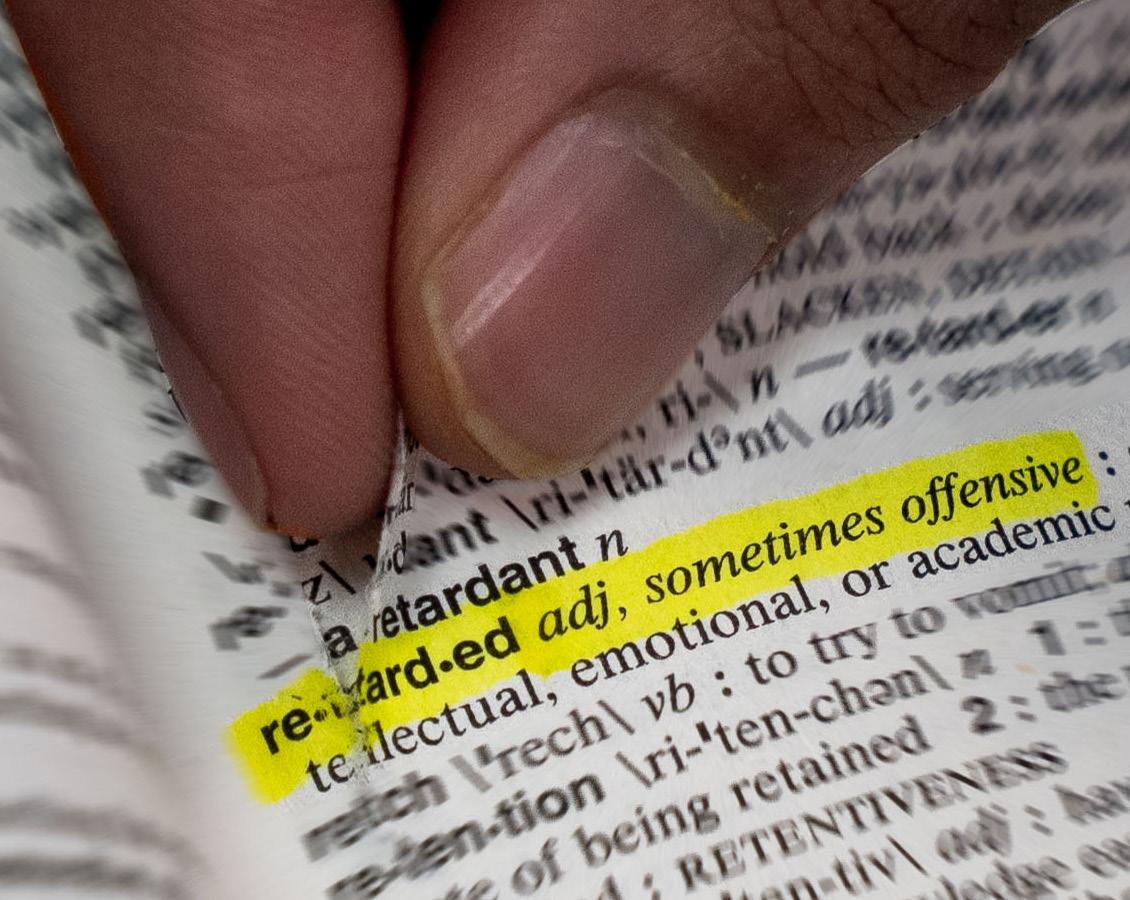
“Seriously retarded,” President Donald Trump wrote in reference to Minnesota Gov. Tim Walz in November 2025. Although originally a medical term, the “R-word” has been distorted into a slur used against people with intellectual and developmental disabilities. The recent resurgence of the slur in public discourse, including on high school campuses, is a sign that our society is once again normalizing ableism. As the R-word continues seeping into everyday conversations, we need to be more intentional in rejecting dehumanizing language and holding others — as well as ourselves — accountable for the words we use.
‘‘follow suit. Thus, people in power need to exercise better judgment, while students should thoughtfully assess the impact their words have in their own communities before speaking.
Even at Lynbrook, the slur can sometimes be heard in casual conversation. Some students may lack knowledge of its harm to marginalized groups. Other times, it is used to ostracize or mock special education students: a scheme intended to stir up reactions. Either way, students should be aware that using derogatory language is never okay.
People need to actively look for opportunities to connect with the special education community. We need to reach outward and be open-minded.
Lucia Liu
“Mental retardation” was introduced as a medical term in 1845, meant as a neutral replacement for “idiot,” “moron” and “imbecile”: all IQ classifications that society twisted into insults. However, as the term became mainstream, systemic abuse and prejudice gave the R-word a lasting negative connotation. This irony exposes societal efforts to confine those with intellectual disabilities to a single label signifying inferiority. Historic acts further convey how they have been treated unfairly as inferior: they were chained and abused in institutions and forcibly sterilized. This history makes today’s use of the word even more harmful.
Senior and Viking Buddies Club co-president
The recent increase of the slur is evident everywhere, especially on social media. Harmeet K. Dhillon, the assistant attorney general who oversees the Justice Department’s Civil Rights Division, posted a caption on X under an image of a hat she had knitted: “This hat is an hour behind schedule thanks to influencer retards.” Part of the division’s work is protecting Americans with disabilities, making the comment even more jarring. Supposed role models using degrading language can influence students to
‘‘
“I hear people our age use the word a lot,” senior and Viking Buddies Club co-president Shelby Kim said. “It comes off as really insensitive because they use it as an insult similar to ‘dumb’ or ‘stupid,’ which promotes the stereotype that all people with intellectual disabilities are unintelligent.”
Saying a word emblematic of past — and often present — hatred shapes a discriminatory society. Beyond stopping its use, students must foster inclusivity.
“A lot of our students are anxious about going on the main campus,” special education teacher James Lohmeier said. “To promote inclusivity, Lynbrook students can recognize that they probably have more in common than what distinguishes them. My mother’s standard line was, ‘if you don’t have anything nice to say, don’t say anything at all.’ Even if you’re having a conflict, don’t call each other names.”
On X, the R-word is used more than 46,000 times daily — an increase of over 2,000% from 2020, proving that ignorance and hatred run rampant in our society. It is common to follow the crowd on social media; it can be difficult to take a stand against derogatory language. Despite this, drawing these lines is important in limiting the spread of hostility.
“When you don’t spend a lot of time
with special education students, it’s easy to view them as different from you,” Kim said. “But when you’re actually interacting with them, it becomes a lot easier to realize that they’re just like you. They love doing the same activities and find the same things fun.”
Not only does the resurgence of the R-word perpetuate trends of persecution, it also hampers efforts to stop its use. The Spread the Word campaign began in 2009; now, more than 900,000 people have pledged to stop the R-word’s use. In October 2010, President Barack Obama signed Rosa’s Law, requiring “intellectual disability” to replace “mental retardation” in legislation. Such efforts show change is possible, yet they are being undermined as use of the R-word continues. We must confront this by educating ourselves on the word’s history, raising awareness of its detrimental impact and treating people with disabilities with respect.
“People need to actively look for opportunities to connect with the special education community,” senior and Viking Buddies Club secretary Lucia Liu said. “You don’t have to join any special program or club. You can just walk by and say hi to them, or strike up a conversation: introduce yourself and learn more about them. We need to reach outward and be openminded.”
Words hold so much power. The R-word dehumanizes those with disabilities. Silencing the slur is not enough to stop its spread: we must actively speak out against those who use it. By ensuring the word has no place in society, we form a future where no one has to doubt their worth.
Graphic illustration by Saavan Saraf
Photo by Joanna Chen
Graphic illustrations by Maddy Chang and Nicolas Cheng Photos by Maddy Chang
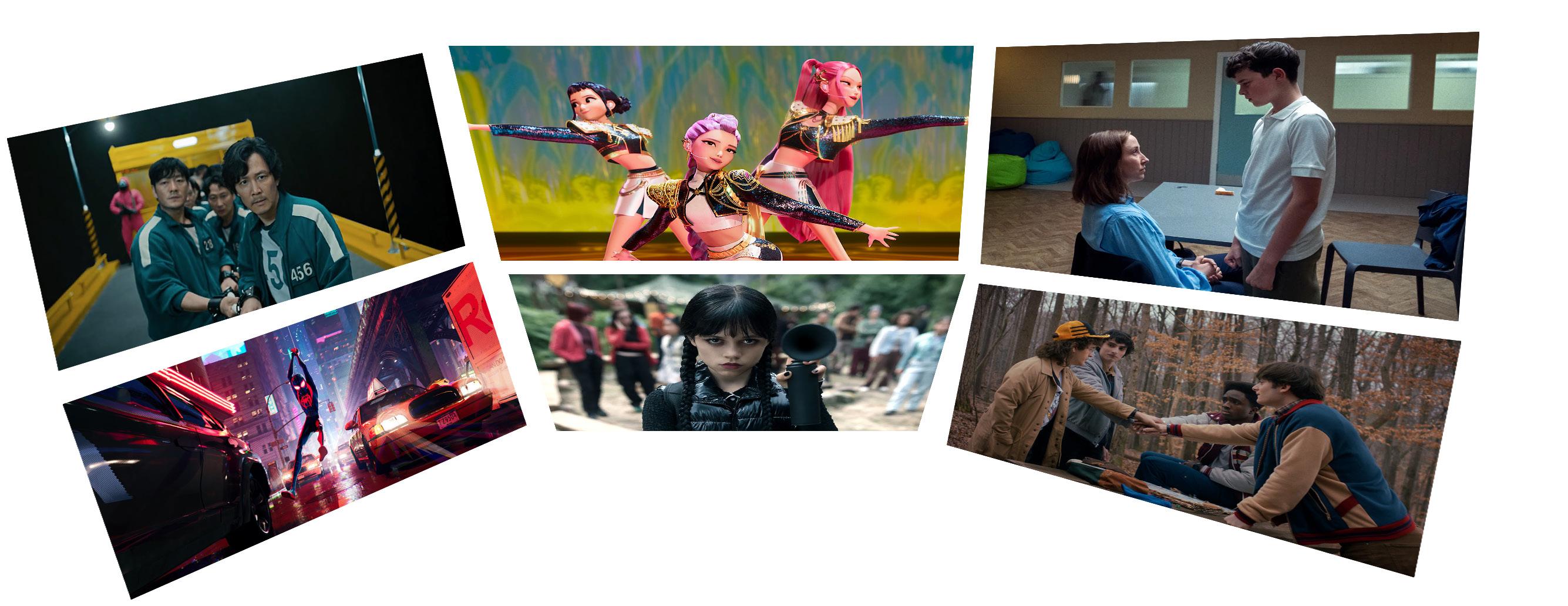
The newest season of “Stranger Things” received heavy backlash for its dull script, in which characters constantly overexplain the same conflict that has driven the past four seasons. Rather than trusting the audience to follow the stakes, the show spells them out again and again.
The best movies have always been those with captivating storylines that audiences can personally connect with. However, recent content published by large streaming services, specifically Netflix, has catered more and more to lowering attention spans, rather than aiming for true connection with an engaged audience.
Streaming companies need to return to developing more nuanced storytelling — shifting their focus away from doomscrollers and back toward audiences who genuinely want to sit down and watch.
than upholding high cinematic standards, Netflix has allowed writers to dumb down their dialogue and have actors explain exactly what they are doing in a scene, ensuring that viewers who second-screen can still follow along. As this principle has found its way into mainstream media, it has come at a terrible cost to quality: instead of artfully intertwining key plot points, writers have begun to blatantly spoonfeed audiences, demonstrating how the shift from theater to streaming has impacted how we consume entertainment.
‘‘ ‘‘
More passion is driven behind smaller-name productions. I think that’s where the medium of film should be pushed forward the most. It’s got the most passion behind it, and it’s not obfuscated by greed and any other social interests.
Lee Senior
The lack of depth in many recent Netflix series points to an attempt to please the modern audience. With the exponential rise of doomscrolling and short-form content on social media, viewers often concurrently watch television and scroll on their phone, a habit dubbed “second-screening.” According to the New York Times, human attention spans have dropped from 12 seconds to a measly eight seconds in the last 25 years.
Rather
Cinema is most effective as a storytelling medium built on nuance and emotional payoff. Several television shows have followed this blueprint when crafting their plotlines. Consider the contrast between “Stranger Things” and more tightlyconstructed projects like the BBC’s 2021 film “Boiling Point,” which was shot in one continuous take across a little over an hour and a half. The film effectively establishes its central conflict of a chef in East London attempting to prevent his personal and professional struggles from ruining his career, allowing it to unfold organically without constantly restating its themes of workplace
stress and mental health — themes that audiences can grasp early in the film and hold on to throughout the series.
in,” junior Isaac Herrera said. “Rather than focusing on the actual story itself, they take away from the substance of the shows.”
‘‘
“More passion is driven behind smaller-name productions,” senior Jinhyo Lee said. “I think that’s where the medium of film should be pushed forward the most. It’s got the most passion behind it, and it’s not obfuscated by greed and any other social interests.”
It’s just all about business now, and about how much money is pouring. Rather than focusing on the actual story itself, they take away from the substance of the shows.
In addition to the declining quality of script writing, Netflix shows have been criticized for a slew of low-effort habits that target profit over quality, such as cancelling low-profit shows early and milking lucrative ones well past their expiration date. Many of its shows have lazy cinematography that seems overly polished and lacks depth. Not only does “Netflix lighting” — dull, overly bright or dark and made specifically for the purpose of streaming — take away from aesthetic enjoyment, it diminishes a scene’s ability to intentionally communicate emotions that relate to the audience. When crafting TV shows and movies, Netflix no longer values the artistic qualities that make them worth watching.
“It’s just all about business now, and about how much money is pouring
‘‘
Netflix’s unimaginative approach to new productions is motivated by profit, an unavoidable aspect of the film industry that essentially fuels all creation. If Netflix does not adapt to shifts of consumer interests, it risks generating a financial deficit and falling behind in trends. This creates a loselose situation, where Netflix is forced to both cater to a growing audience while sacrificing creativity in their work.
Even as Netflix is compelled to choose profit over quality, the company is still willingly sacrificing the art of film to appease a new wave of doomscrollers. Not only does this show that big-name corporations are attempting to please and take advantage of younger audiences, but it also displays how modern individuals are over-consuming social media content. Although Netflix should undoubtedly improve the quality of its products, future generations must also realize the addictive dangers of short-form content in aspects of everyday life. Instead of delving deep into mindless scrolling, future generations should prioritize instilling healthy digital habits while upholding their mental well-being.
Jinhyo
Isaac Herrera Junior
Arnav Chandra and Lucas Hsu step on the gas
BY SAAVAN SARAF
Juniors Arnav Chandra and Lucas Hsu zig-zag down the highway, cutting through thick fog and towering redwood trees. The two friends are test-driving a 2011 Lotus Elise sports car. Their destination is the top of San José’s Mount Hamilton, where Chandra will photograph the car for his Instagram account. Chandra and Hsu, both avid car enthusiasts, spend their free time driving, filming, posting and working on luxury and vintage cars.
Before Hsu ever looked twice at cars, a passion for them lived in his father, Danny Hsu. When Hsu was young, they would travel to exhibitions of the latest car models. His father even boasted his own collection: a Corvette C2, a Porsche 928 and a Mercedes 500.
In eighth grade, Hsu came across the Netflix show “Car Masters: Rust to Riches” a series in which a team restores old cars. In one episode, the hosts traveled to Puebla, Mexico, where they remodeled a beat-up 1973 Volkswagen Beetle into a rugged, off-road racecar. He was hooked — eager for the same mastery that could allow him to take something completely ordinary and transform it into something beautiful.
“I spent the rest of that vacation doing tons of research on fixing and modifying cars,” Hsu said. “My
tutorials to wrap the Nissan in modern silver vinyl over its previously brown exterior.
Because the car is old, Hsu has also faced challenges with its engine breaking down several times, most recently in February. Once, he had to call a tow truck to return it to his house due to a faulty slave cylinder, a hydraulic component responsible for switching gears.
“There’s lots of problemsolving,” Hsu said. “It can take days to diagnose the issue, get the parts and then actually fix it.”
All of this maintenance has brought Hsu and his father closer
inspiring his love for photography. His passion for cars bloomed from a common childhood captivation: trucks, planes and other vehicles. For Chandra, that obsession has endured throughout his life. Merged with his passion for photography, he began filming cars.
“I would take scenic photos of mountains and always see people taking car photos there,” Chandra said. “I was doing the same thing, except without the cars, so I decided to change that.”
In sophomore year, he began going to car meets, where car enthusiasts gather to showcase exotic vehicles. There, he photographed supercars and connected with the car community. At Club Sportiva, a luxury car club, he assembled his first Instagram post, featuring a photoshoot of a Ferrari F12.
Soon after starting his channel, Chandra was invited to a Fourth of July event in Livermore, where an entire airport became a playground for more than 1,600 attendees and their “supercars.” Chandra took this opportunity to hop in a Pagani Utopia, a supercar often characterized as a fighter jet on wheels, and floored it.
the car, and how it was held under pressure, rather than just seeing them,” Chandra said. “I completely stopped going to meets after that.”
While some car enthusiasts obsess over a car’s appearance and power, Chandra places greater importance in the handling of the car. The experience of feeling every bump, twist and turn on the road is what makes him feel alive.
It was his first time drag racing.
“It felt like a level up from previous events,” Chandra said. “It was also kind of surreal to see the true depth of the car community.
Something on a completely different level than I had ever experienced before.”
Getting his license on his 16th birthday was the final piece of the puzzle for Chandra. His friends introduced him to the scenic Skyline Boulevard in the
“It’s really hard to enjoy driving if you don’t feel connected to the road,” Chandra said. “When you can feel everything on the road, like in a car with no power steering, it’s a very raw and enjoyable experience.”
Shortly after Hsu got his Nissan, Chandra introduced him to Highway 9, a popular place for car meets, which Chandra frequents due to the proximity to his home. The highway’s twisty roads enabled Hsu’s less powerful Nissan to provide an exhilarating ride for him.
“Driving there was definitely something I’ve never done before,” Hsu said. “It almost feels like you’re driving through clouds. It’s very adrenaline-inducing.”
This year, Chandra and Hsu submitted an application for an automotive interest club at Lynbrook. The club would feature hands-on activities, like learning how to change a tire, as well as lessons about car culture.
“We want to teach what the car cultures of the world have to offer,” Hsu said. “It’s a good experience for Arnav and I to teach others and learn for ourselves.”
Photos used with permission from Arnav Chandra and Lucas Hsu
Shifa Bashir launches modest clothing line
BY REBECCA CAI
The summer before first grade, junior Shifa Bashir stood back and admired her first-day-of-school outfit: a romper that she picked out herself. But when she showed it to her mom, she wasn’t met with the excitement that she had hoped for. Displeased with how the romper exposed Bashir’s legs, her mom advised her to wear leggings underneath to maintain modesty.
Even today, Bashir constantly sees pieces that appeal to her but do not cover her shoulders and legs, which is required for modesty in her Muslim faith.
After years of searching for a modest wardrobe that also fits her fashion style, Bashir decided to create her own clothing line: Shifashion, a clever combination of her first name and the clothing she designs.
‘‘
tops and tube tops need readjustment to fit Bashir’s vision of modesty for Shifashion.
For example, Bashir crafted a pink long-sleeve shirt with a halter-style undershirt that peeks through the neckline, inspired by layering a tube top over a halter top. While similar in design, Bashir’s version of the top is tailored for those who prefer more coverage in their clothing.
Bashir starts her design process by pasting designs into Canva, where she notes the adjustments necessary to make each piece truly suitable for modest individuals. She uses ChatGPT to assist with creating a 3D rendering model of her design.
There’s some things in life you really just can’t process. I still haven’t processed this because it’s just so exciting. I was on the verge of tears.
Shifa Bashir Junior
“Being in love with fashion and wanting to express myself but also being Muslim is like loving to bake, but only being able to make things that are gluten-free, keto and dairy-free,” Bashir said. “Obviously, you can still bake something, but how do you create something that follows all those restrictions and tastes good? In the same way, it’s hard to make outfits that follow my faith and stay somewhat true to my personal style at the same time.”
Starting Shifashion was no easy task. After competing in FUHSD’s Business Entrepreneurship and Encouragement Program in 2024 and winning first place for her Shifashion pitch, she invested her $1,000 cash prize into producing her first clothing samples. Bashir contacted hundreds of clothing manufacturers via the Chinese e-commerce platform Alibaba, engaging in difficult virtual negotiations across language barriers.
Bashir starts her design process by hunting for inspiration on Pinterest, where she picks out clothing designs that appeal to her. Styles like halter tops, tank
‘‘
After weeks of design, refinement and communication with vendors, Bashir received her first samples in October 2025. Although she immediately saw many areas that needed to be adjusted, she loved seeing her brand come to life through the prototypes she held in her hands. Bashir says it felt like a resolution to her childhood struggles to find modest attire.
Shifa goes.”
In honor of her support system of Muslim teens, Bashir named her first collection “The Sisterhood Collection,” with each piece named after an impactful Muslim woman in her life.
Bashir hopes to sell online and at local craft fairs after launching the collection in April with one starting piece, which she has stocked 100 units of. She promotes her business through word of mouth and social media platforms such as TikTok and Instagram.
In the future, Bashir hopes to expand her brand in size and breadth, potentially designing a swimwear line. For now, she’ll keep refining her samples and building up her business before launch day.
“I opened the package and saw my neck tag on it that said ‘Shifashion,’” Bashir said. “There’s some things in life you really just can’t process. I still haven’t processed this because it’s just so exciting. I was on the verge of tears.”
Throughout her business journey, Bashir has also gotten help from fellow Muslims at Lynbrook, such as junior Xara Aman, who modeled for the brand, and Class of 2025 alumna Inaaya Yousuf, who designed the logo and conducted a photo shoot for Shifashion.
“This brand, overall, is something that I’ve been wanting to see for a long time,” Yousuf said. “It is so hard to find affordable clothing that follows the guidelines of a lot of religious or more modest styles. I think this is a really great adventure and I’m really excited to see where
Torsia Xu brings tales to life through her art
BY AUDREY CABALTICA
man wields an axe above his head.
AThe screen flashes, revealing another man sitting on a throne. These frames of hand-drawn animation depict an executioner tasked with murdering his friend. Though exhausted from six hours of work, junior Torsia Xu looks fondly at her finished
popular artists such as Korean cartoonist Kim Jung Gi.
Xu took multiple art classes over the span of 10 years, but she found herself drawing more outside of them. Her classes enforced strict rules such as always using the rule of thirds. Yet Xu preferred to innovate.
“The essence of art is finding your own style and way of doing things through experimentation,” Xu said. “Art classes aren’t conducive to that.”
art assignment, Reed asked her to make a school mural. Xu’s mural included a platter of desserts, spools of thread and a dressed-up mannequin to represent Reed’s classes.
“Her art style has a certain kind of natural quality to it,” Reed said. “There’s not a lot of hard lines, the strokes are organic and the way she blends color gives off a watercolor effect.”
Starting with basic illustration, Xu explored several mediums from painting to sculpture, but favored traditional illustration and animation.
“Animation combines two of my favorite things, writing and arts,” Xu said. “When painting, I go in completely free of any planning, and I just start painting from one corner. Most of the time I don’t even know how it’s going to turn out.”
Xu has participated in the Scholastic Art & Writing Awards every year since 2022. In 2025, Xu was a twotime national winner, winning silver for her colored pencil piece “The Forgotten New Year” and gold for her oil painting “Rabbit Cosmetic.” However, Xu doesn’t find much meaning in her awards and finds the process of making her pieces more important than the things she gets out of it.
Art invites Xu to take her mind off draining matters. She often finds herself getting lost in her work anywhere from the familiarity of her bedroom to bustling Santana Row.
“For me, art is a form of escapism,” Xu said. “Sometimes I get so into it that I even forget to eat or sleep.”
In eighth grade, Xu took on her biggest project: a mural at Miller Middle School, outside fashion design and crafts teacher Ana Reed’s classroom.
Noticing Xu’s artistic talent through an
Xu wants to continue exploring animation and eventually create her own animated movies. She hopes to put her work out there, gain exposure and encourage others who want to do the same.
“To someone who wants to become an artist, you shouldn’t worry so much about your career,” Xu said. “You should
just focus on having fun, and then the ideas will come to you.”
Graphic illustrations by Vanessa Yap Phioto used with permission from Shifa Bashir
Graphic illustrations by Tristan Lo and Vanessa Yap Photos used with permission from Torsia Xu
long sleeves high neckline
A.
B.
C.
A. “The Forgotten New Year,” a color pencil painting by Xu.
B. Xu’s hand-drawn animation.
C. “Rabbit Cosmetic,” an oil painting by Xu.
BY: MADDY CHANG AND STUTI JAIN
With the pressure of college applications, grades and expectations for one’s future, senior year can feel like a sprint to the finish line. But for many Lynbrook seniors, second semester offers something entirely different: a space
Building bonds in the kitchen
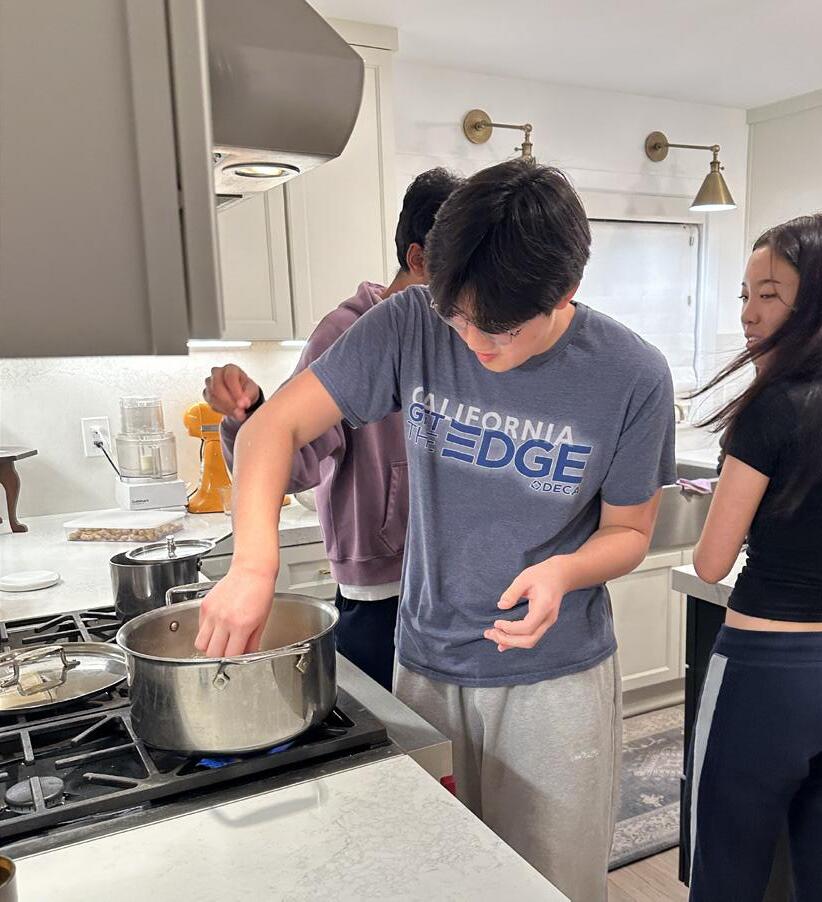
or senior Juno Hong, comfort took the form of a kitchen. Between school and preparation for college life, Hong has found himself chopping vegetables, experimenting with foods like pasta and steak with friends and learning recipes passed along by his Korean mother.
“It feels better knowing where the food comes from and actually putting everything together ourselves,” Hong said.
Whether shopping for ingredients at Trader Joe’s or using produce from a friend’s backyard garden, Hong and his friends treat meals as a collaborative process, documenting their dishes and mishaps with photos.
Pedaling to inner peace
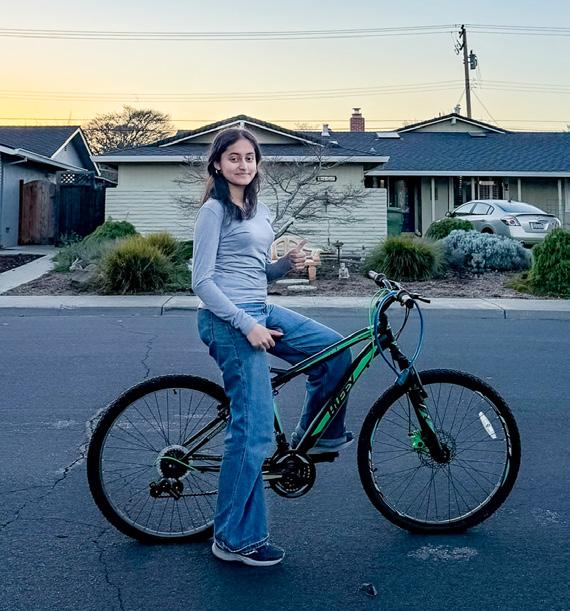
Senior Sanika Vaidya finds solace in long bike rides. After moving from an apartment complex to a house in fourth grade, biking became a way to familiarize herself with her new neighborhood. However, over the past three years, schoolwork and time-consuming extracurricular activities left little room to zoom through streets on her Huffy Nighthawk mountain bike.
Riding through her neighborhood, she pairs the experience with slow music. As she often bikes in the evenings, her favorite memories
Senior Ashwath Anoop has also been spending more time in the kitchen, turning baking into a chance to bond with his dad. The two began experimenting with recipes together and recently attempted to make banana bread, despite their first try going wrong.
Hong cooks with a pot.
“The second time went way better,” Anoop said. “Adding blueberries made it more unique, and it actually tasted really good.”
Through trial, error and small creative risks, cooking has become a way for seniors to build confidence, share time with family and experience the simple joy that food can bring.
Crocheting connections
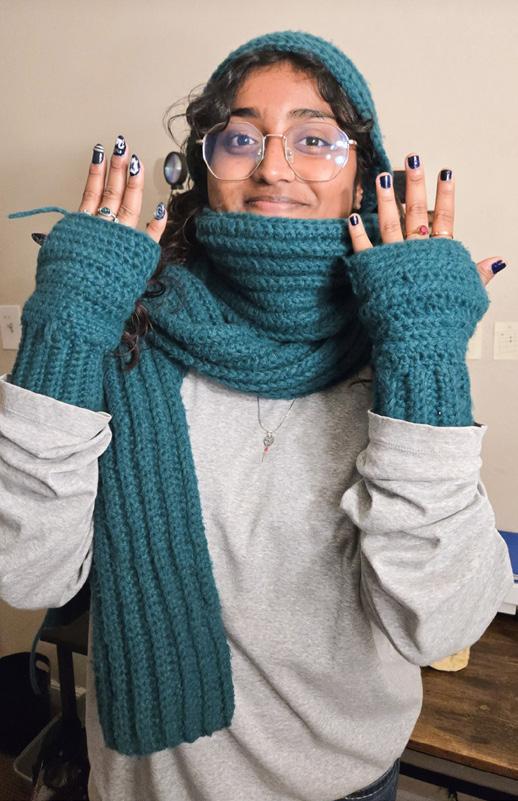
With time and a broken sewing machine, senior Mary Sarah Philip is revisiting crocheting. Previously, rough patches during high school made it difficult for Philip to pursue the interest in depth. This semester, having gone through college applications, she’s changed her mindset: instead of focusing on challenges posed by school or worrying over factors she can’t control, she has resolved to prioritize what she loves.
Initially inspired by a friend, Philip began crocheting in sophomore year as a way to make clothes without a sewing machine or fabric and connect with her community. Her recent pieces include a vibrant blue scarf for her mother and fingerless gloves for her older brother.
The craft has become a way to destress: scrolling on Pinterest for free patterns, she lights a candle and plays EDM tracks as she completes a piece. Although she sometimes finds big projects frustrating, having a clear purpose keeps her motivated.
“I don’t have less work; it’s just that I have an attitude of doing the best I can instead of being super stressed about the results,” Philip said. “You just have to make time for what you want to do.”
Sfrom her grandfather. Now with more time in second semester, she has now begun taking on freelance work, including photographing the vow renewal ceremony of a friend’s parents. She hopes to spend more time chasing shots, rather than waiting for moments to present themselves.
What began as simple snapshots of neighborhood scenery has turned into a desire to capture school events, such as the upcoming junior and senior proms. Her photos have become part of her portfolio, marking the first time photography intersected with her academic life.
“It’s my way of documenting memories,” Khubchandani said.
Philip shows off her crocheted blue scarf.
Returning to the stage
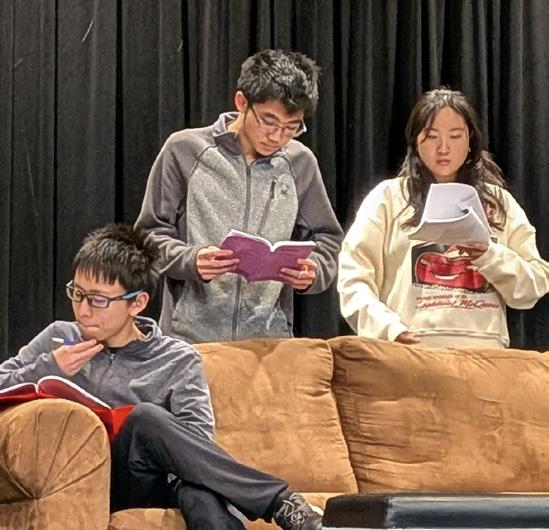
After years of robotics and debate from freshman to junior year, senior Justin Huang finally has the freedom to revisit an old middle school interest: acting. Now, Huang spends late nights practicing his role as Ken Gorman in Studio 74’s spring comedy “Rumors.”
“There’s something in me that really liked the idea of filling in the image of what a character is and how it fits into the rest of the play,” Huang said. “Filling in those gaps makes the whole play feel alive. “
Huang adds personality to his character with moments of creativity. Collaboration, exploration and experimentation have shaped his journey as an actor.
“I have a lot of moments where I come up with something for the character that I think really fits,” Huang said. “That part of acting is really satisfying to me.”
Huang practices his lines for “Rumors.”
Khubchandani takes a photo.
Vaidya poses with her bike.
Graphic illustrations by Isabella Chiu, Alyssa Lin and Tristan Lo Photos used with permission from Juno Hong, Justin Huang, Susanna Khubchandani, Mary Sarah Philip and Sanika Vaidya
IN-DEPTH the Epic |
Stars and cultures connect across time
BY DAVID DAI AND SUNNIE WU
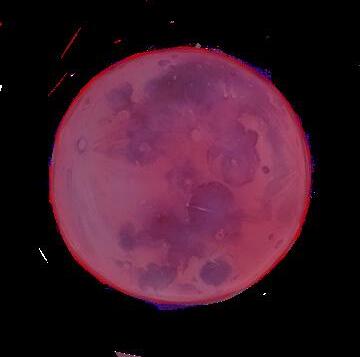
On March 3, millions of people across Asia, North America and Australia will step outside, tilting their heads toward the sky as the moon slips into Earth’s shadow for a total lunar eclipse — an event that takes place roughly every two and a half years. For an hour, the moon will appear fully red, a phenomenon called a “blood moon,” as sunlight filters through Earth’s atmosphere and casts a coppery glow across its surface.
While the spectacle may feel distinctly modern as it is shared through social media videos, livestreams and photos, humanity has been making sense of the world through the vast night sky for thousands of years. Long before telescopes and space agencies, the movements of the sun, moon and stars shaped how civilizations tracked time, navigated oceans and interpreted their place in the natural world.
solstice. Many cultures around the world built large structures, like Stonehenge in modern-day England, to mark key solar events.
As societies grew more complex, timekeeping became more structured. Cultures developed solar, lunar, stellar and lunisolar calendars based on their unique needs. In ancient Egypt, priests timed the heliacal rising of Sirius, the “Dog Star,” to predict the Nile River’s annual flooding. Farther west in Mesoamerica, the Maya created dual calendar systems: the vigesimal 260-day Tzolkin calendar was used for ritual purposes, while the solar 365-day Haab calendar was used for civil timekeeping.
“In the ancient world, the sky was there at night,” De Anza College astronomy professor Eric Peterson said. “People tried to make sense of it, tried to understand it and told stories about it. It’s been a part of everyone’s culture throughout history.”
For early societies, understanding the movements of celestial bodies was essential for survival. Knowing when spring would arrive determined when crops could be planted, while predicting the first frost determined when to harvest them. Even without modern forecasts, ancient civilizations learned that constellations appeared slightly earlier each night and returned to the same position after a full year. The sun’s path was a seasonal marker, reaching its highest point in the sky during the summer solstice and its lowest during the winter
Consistent star patterns made the sky an essential tool for navigation, allowing travelers to orient themselves across land and seas without any instruments. To maintain direction, Norse seafarers from Scandinavia relied on the sun’s position during the day, and the star Polaris, located near Earth’s northern rotational axis, at night. Across the Pacific Ocean, Polynesian navigators developed equally sophisticated star-based orientation systems: master navigators often memorized the rising and setting positions of hundreds of stars, giving them the ability to pinpoint their location.
By the 18th century, European and American sailors were using tools such as the sextant, which measured the angle between a celestial object and the horizon to calculate latitude. Combined with star charts and accurate timekeeping devices like marine
chronometers, celestial navigations remained central to long-distance maritime travel.
“The understanding of what’s happening in the sky was one of the first significant scientific achievements of the world,” Peterson said. “To understand that the sun was at the center of the solar system and that we’re on a ball of rock in space, hurtling around the sun, really transformed humanity.”
The sky also carried profound symbolic meaning for civilizations across the globe. Hausa-speaking communities in West Africa understood the solar eclipse as the sun catching the moon, prompting drumming and prayer. In ancient Mesopotamia, Babylonian priests observed and recorded the movements of celestial bodies in the Enūma Anu Enlil tablets, used to guide kings.
Later, Babylonian astronomers divided the sky into 12 sections, laying the groundwork for what would later become the zodiac.
can still use Polaris to identify the North Pole like the Vikings did. Constellations can be identified and their stories shared, in the same way the Greeks did.
“When I look up, I feel connected to my ancestors because we’ve been looking at the same stars all these years,” sophomore Jason Zhang said. “We see the same night sky as people across the world.”
For most of human history, clear access to the sky was often limited. Telescopes were expensive and astronomy was the domain of professionals. Today, apps like Stellarium and SkySafari allow anyone with a smartphone to identify stars. Astrophotography has exploded as a hobby: images of nebulae that once required professional equipment can now be produced with a DSLR camera and free stacking software. Social media has made space exploration more popular than ever, bringing worldwide attention and anticipation to rare celestial activities.
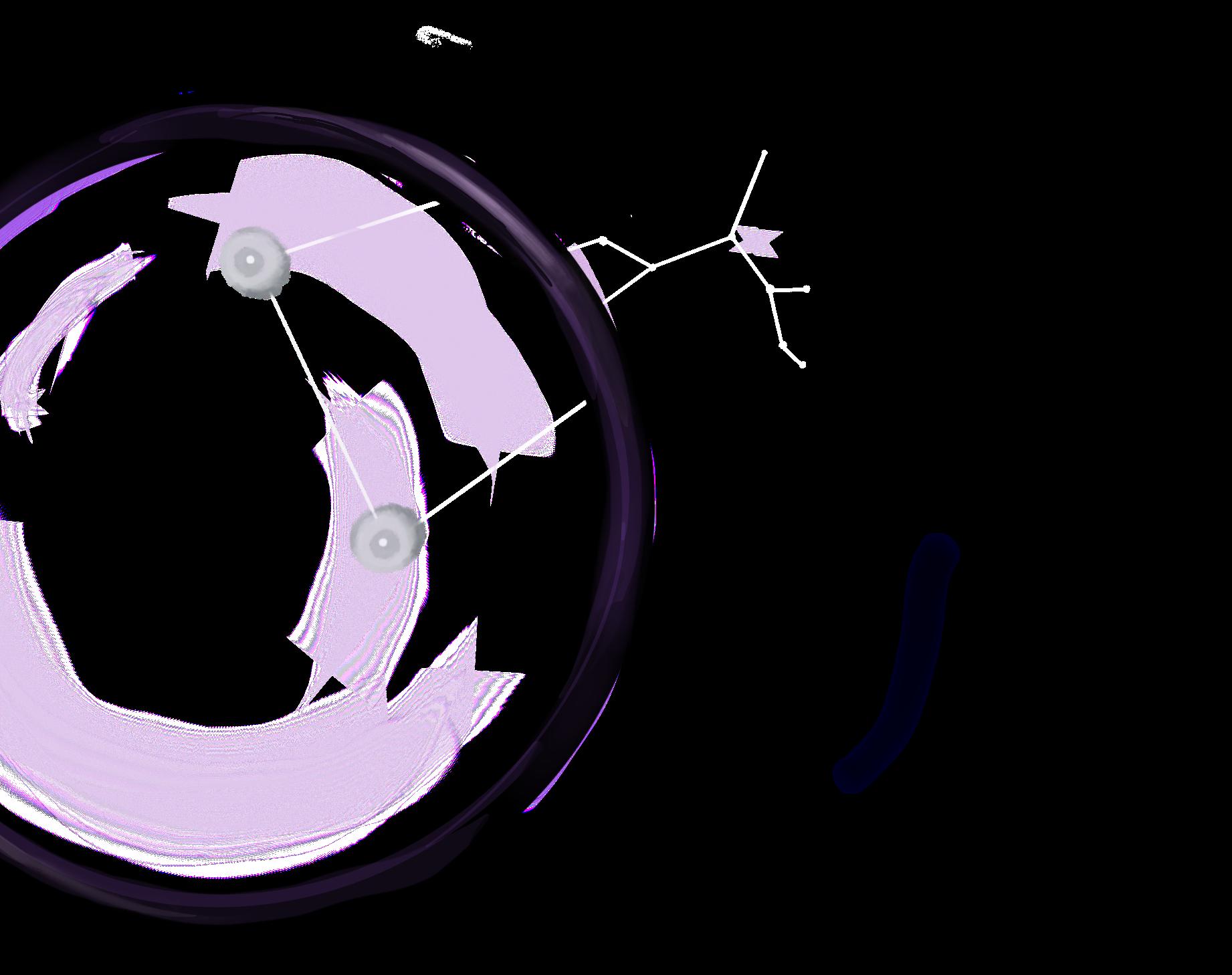
Sagittarius is the ninth astrological sign representing the Archer. The constellation can be best seen in July and August.
The ancient Greeks then named the zodiac signs after constellations and linking them to specific times of year. By the second century, scholars like Claudius Ptolemy created personal horoscopes, arguing that celestial patterns at the time of birth could predict destiny. During the Middle Ages and Renaissance, monarchs routinely consulted astrologers before making major political decisions. Though today, astrology is often viewed as entertainment or pseudoscience, it continues to attract younger generations searching for clarity. Despite drastic changes in human civilizations and technology over the course of history, the night sky has remained relatively unchanged. Modern stargazers
“You can get something better than Galileo’s telescope for less than $100,” Foothill College astronomy professor Geoff Mathews said, “It’s possible to get a close view of nebulae and globular clusters without much investment.”
The drive to make sense of the sky has never stopped accelerating. Commercial spaceflight has made spacefaring more tangible, with NASA’s Artemis program aiming to return humans to the moon as a stepping stone to Mars.
At the same time, the long-lasting tradition of reaching for the stars is slowly becoming lost in the midst of urbanization. With an estimated 80% of the world population affected by light pollution, the stars that once guided calendars, ships and myths are becoming harder to see. Not only do they lose a window into nature, studies have shown that the loss of opportunity to see the starry night sky has a direct impact on scientific curiosity.
No matter how advanced society becomes, the same stars are still shared. The eclipse can now be explained through celestial mechanics and atmospheric physics, but it will also inspire the same awe that moved civilizations to build monuments, chart oceans and record omens.
Graphic illustrations by David Dai, Prisha Pulastya and Alexandra Wu
Hacking our bodies from the inside out
BY RACHEL MARTIN AND ALEXANDRA WU
You wake up and check your phone. It’s 7:58 a.m. and you have just over two hours before your 16-hour intermittent fasting window ends — part of a structured eating schedule aimed at improving metabolic health. This is just one example of biohacking, a set of health practices that influence how the body functions through intentional habit and environment adjustments. Biohacking raises an essential question: what does it mean to actually take control of human biology?
Boosting a better-functioning brain
Essential to bodily functions, the brain is one of the primary organs that biohackers seek to optimize. Several practices targeted toward the brain include sleep enhancement, meditation and breathwork. These so-called “neurohackers” opt to consume nootropics — compounds like caffeine or racetams that boost focus and memory. They may also use electrical brain stimulation and devices that monitor brain activity to diagnose neurological conditions. Key goals for neurohackers include treating chronic pain and depression, improving memory and understanding the brain. With more intensive forms of neurohacking like electrical brain stimulation, some associated dangers include the risk of stroke and brain hemorrhages. Nootropics, as with any drug, also carry the risk of overdose.
ALaser focusing in on long term health
steady dynamic between biology and one’s lifestyle habits shapes aging and recovery. High-quality sleep supports hormone regulation and cellular repair, which forms a foundation for long-term health.
Biohackers also use physical training, such as calisthenics and pilates, to build resilience across body systems. Incorporating stressors like heat from saunas or exposure to cold can activate adaptive responses that enhance blood circulation.
Along with these traditional strategies, researchers are exploring the potential of newer interventions in injury recovery and tissue health. Red light therapy, which exposes users to near-infrared wavelengths to stimulate mitochondria, is gaining attention for its promising ability to support collagen synthesis and reduce inflammation. Other lessimmersive methods to achieve the same goals include special skincare treatments like salmon sperm extract.
Fasting through low energy and slow metabolism
Metabolic biohacking focuses on maintaining the body’s energy balance and understanding how it gets fueled. For example, intermittent fasting entails structured eating windows meant to help lose weight and prevent diabetes and obesity. Similarly, time-restricted eating involves scheduling mealtimes around internal body clocks, known as circadian rhythms. Optimizing macronutrients is a crucial component of this type of biohacking.
Most metabolism-focused biohackers have specific goals in mind, ranging from stabilizing blood sugar to simply sustaining energy throughout the day. These personalized goals often appeal to many, but intermittent fasting has potentially severe drawbacks, including an increased risk of cardiovascular disease. Furthermore, it poses health risks for those who are pregnant or have eating disorders, Type 1 diabetes or are under 18. Bodily responses to these metabolic hacks vary depending on the individual, with self-observation taking priority over rigid dietary rules.
“We sometimes lose sight of what biohacking is trying to achieve,” biology teacher Jason Lee said. “There’s a lot of information on social media, but we need to modify our lifestyle to fit our unique systems. Everyone should try to research what they’re getting into and understand, like, ‘What is the reason behind it? How should it work?’”
Measuring personal data with wearables
Acommon form of monitoring the body is the use of wearables like smartwatches, rings and biometric sensors. These devices can collect information on sleep, physical activity, heart rate and recovery, helping individuals understand where lifestyle adjustments may be needed.
“I can track my progress and use that information to adjust my decisions, like when to sleep and if I’m over-exerting myself when exercising,” sophomore and Apple watch user Judy Yu said.
However, while the data can enhance individual health with personalized resources, concerns surrounding its privacy have risen: critics point out that information stored on the internet could be subject to data breaches.
“I usually use technology as kind of a data point for where my body might be at,” Lee said. “It’s not a decision-maker, but a data point to help reach a conclusion. These should all be data points to give you the ability to make the best informed decision about yourself.”
Graphic illustrations by Ashley Hein and Alexandra Wu
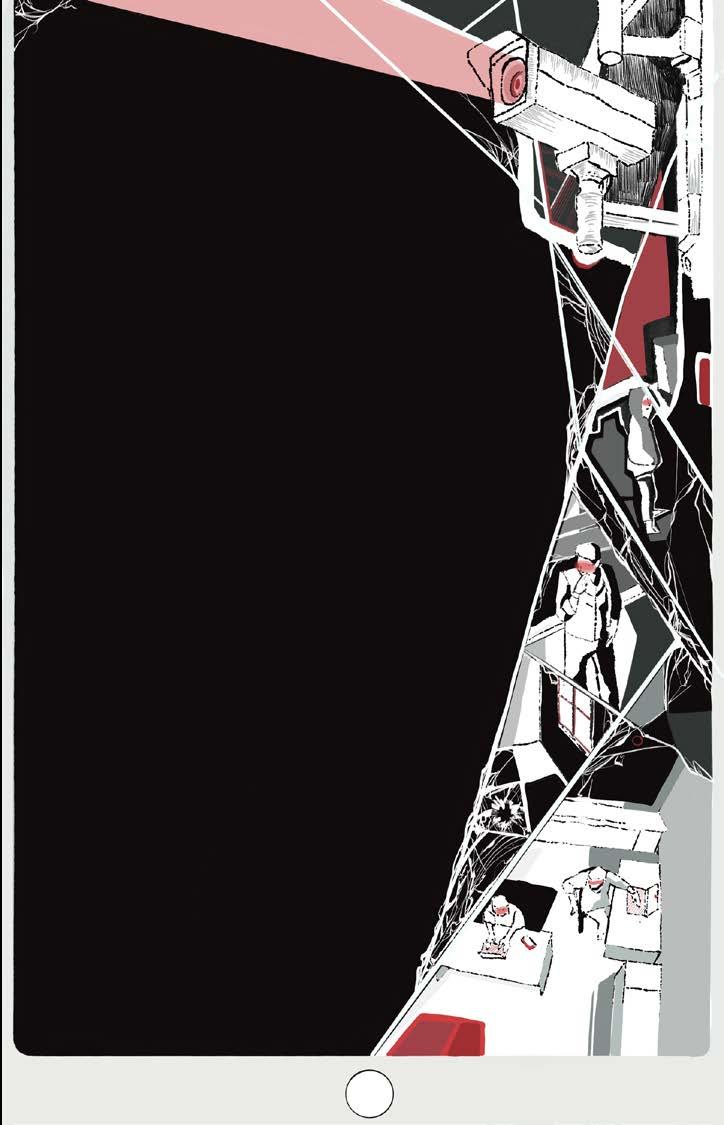
Under the eye of a modern surveillance age
BY ASHLEY HEIN AND CATHERINE YANG
It’s nearly impossible to move through a modern city without encountering surveillance technology. Security cameras line storefronts, while traffic systems log vehicle movements. Perhaps you open your phone with face ID, then scroll past ads that are eerily similar to your interests. We become desensitized to these aspects of surveillance, but they generate detailed records of where people go, what they search and who they interact with. What was once exclusively associated with national emergencies is now quietly integrated into our everyday lives.
Today, surveillance can be observed in both physical and digital environments. The average American is recorded by security cameras around 34 times a day.
Automated license plate readers can scan up to 1,800 plates per minute, and about 50% of American adults are in a facial recognition network. This data is fed into a database, where it is permanently stored, detailing one’s daily habits. This reality has contributed to discussion around a “surveillance state,” or a society where governments and infrastructure routinely monitor civilian activities.
Government surveillance in the United States has long existed since before the internet era. In the late 19th century, police departments adopted fingerprinting to track suspects. Large-scale surveillance expanded after World War I and especially during the Cold War, as federal authorities monitored suspected political radicals through wiretaps, mail interception and investigative programs.
“Since the World Wars, we’ve always been kind of a surveillance state,” freshman Yuelin Xiong said. “We’ve just shifted our focus to more ambient and digital kinds of surveillance instead of group level surveillance.”
The FBI was founded in 1908 to track criminal activity across state lines. During the Cold War, it began conducting extensive surveillance of civil rights leaders and antiwar activists, along with
the CIA. Public exposure of these practices in the 1970s sparked controversy and new legislation, such as the 1966 Freedom of Information Act and 1970 Fair Credit Reporting Act, which gives citizens access to records to monitor government and corporate data handling, such as contracts and consumer reports.
Nowadays, mass surveillance is widespread in social media and online data tracking. For example, most browser cookies — small text files that store data in your internet browser — are completely safe and enhance user experience, but third-party advertising cookies raise questions of data privacy. These cookies create ads that are catered to user interests by collecting information about their browsing habits. Every Google search or like on an Instagram post prompts tracking cookies to show related advertisements on different websites without user permission.
“People who are careful about being private and not using social media could still have a fingerprint on the internet,” junior Rhea Susarla said. “It’s concerning that the sites you visit and things you click on are just stored by websites.”
This does not equate to the identification of the user, as it simply creates an anonymous ID associated with your browser. Still, with how much information people are providing to the internet in their daily lives, cookies have been shown to indirectly contribute to identification.
Social media profiling is a form of internet surveillance. By tracking social media behavior and account information, such as interests, date of birth and education, companies create targeted algorithms that tailor content in user feeds to maximize engagement.
“Those suggested stories or websites get really specific,” computer science teacher Mark Kwong said. “Your whole experience is the way they make revenue – by giving you things that will keep you on the site.”
Federal law agencies have invested $2.8 billion in surveillance technology such as facial recognition systems, mobile
location-tracking and automated license plate readers. Supporters argue these tools are necessary for security, while critics argue that they expand monitoring beyond targeted investigations, raising concerns about oversight.
For example, the Trump administration has implemented AI-supported surveillance over social media posts of visa applicants, visa holders, foreign visitors and permanent residents. Agencies like the Department of Homeland Security also have contracts with tech companies for immigration enforcement, further contributing to perceptions of America as a surveillance state.
“Intelligence agencies get that semblance of control over the population using surveillance,” Xiong said. “When people know they’re under surveillance, they tend to act more in line with what the government wants.”
Surveillance today rarely takes the form of micromanaging, a practice done in the past as a result of drastic events. It operates through systems embedded in our daily routines and mobile devices.
Graphic illustrations by Ashley Hein and Alexandra Wu
Shining light on an unspoken athletic struggle
BY OLIVIA TU
Arunner misses her period for one month. Then three. Then six. While she brushes this abnormality off as being normal or even convenient, it shouldn’t be taken lightly. Absent menstrual cycles are a key symptom of Relative Energy Deficiency in Sport, or RED-S, a largely invisible condition that poses dangerous health consequences. Increasing awareness of RED-S, creating healthy training environments and promoting proper nutrition are critical measures to ensure long-term well-being.
stretch far beyond poor performance. Inadequate nutrition and — in the case of female athletes — a lack of periods lead to low bone density, increasing the risk of fractures and osteoporosis. This is especially devastating for student athletes, who are in a critical period for bone development. RED-S can also cause fatigue and depression, impair hormonal glands and weaken the immune system.
‘‘ ‘‘
When athletes are not replenishing properly, the body uses up all the glycogen, causing exhaustion, and begins slowing down its metabolism.
RED-S arises when overtraining and underfueling makes an athlete’s dietary intake insufficient for their energy expenditure. It’s estimated that RED-S impacts 15% to 80% of athletes and is primarily seen in women.
“This season in football, we had a student who felt extremely tired all the time, but didn’t know why,” football coach and PE teacher Joseph Luo said. “It turned out to be low energy availability, as his body started to shut down from not having enough calories. He had to get enough rest, rehydrate and take proper care to recover.”
The long-term consequences of RED-S
“When athletes don’t replenish properly, the body uses up all the glycogen, causing exhaustion, and begins slowing down its metabolism,” said Toni Gist, clinical assistant professor of food science and nutrition at University of Illinois Urbana-Champaign.
“After prolonged restriction, it’s vital to see a clinical registered dietician.”
Certain sports carry higher risks of developing RED-S. Artistry-based sports like figure skating or gymnastics often create unrealistic body standards by tying lean physiques with athletic success. Similarly, sports with weight classifications, such as wrestling, subject athletes to weigh-ins that can incentivize rapid weight loss. Endurance athletes experience a higher risk of underfueling due to their intense training.
“During my junior year games, I’d be so tired due to underfueling, as it was a stressful year and I had less time to eat before and after games,” senior and water
polo captain Michael Lee said. “It hurt my performance and when I got injured or sore, it was hard for me to recover.”
Athletic culture plays a major role in RED-S development. Youth sports have become increasingly competitive, with athletes training harder and restricting food intake under the pressure to succeed. Team environments can also reinforce this harmful cycle through body-shaming and pressuring athletes to work beyond their limits.
“I used to put pressure on myself to gain weight, but now people encourage me to do my best,” senior and water polo player Andrew Wu said. “In my team, we’re supportive in helping each other out because we know nutrition matters.”
Social media only adds fire to the fuel, exposing youth to a flood of fitness and diet content — from physique transformations to “what I eat in a day” videos — promoting unhealthy comparison.
“I definitely have seen a lot of stuff promoting being skinnier and not eating enough,” senior Xiaoya Gao said. “It’s a social standard that paints a toxic image of what we should be and affects our relationship with food.”
need extra calories, as well as ample rest and hydration, to support their energy expenditure and long-term health.
“I always tell my athletes to make sure they’re eating enough calories, hydrating and getting ample sleep,” Luo said. “In my classes, I go over things like micronutrients, macronutrients, how they’re processed in the body and calorie tracking.”
Athlete health can be supported through expanding nutritional education, allowing students to be more informed on their bodies and needs. Furthermore, normalizing nonjudgmental conversations around nutrition can help athletes recognize warning signs before they pose serious risk.
To prevent RED-S, it’s important for sports culture to shift the focus from athlete weight to nutrition and proper fueling. Student athletes
Emily Peng finds her thrill in skis and snow
BY ANNA CEN
Sophomore Emily Peng builds speed, bracing for takeoff, and with the swish of snow underneath her skis, lifts off the ground. Suspended in the air, cold wind whipping her face and adrenaline rushing through her body, she completes a 360-degree spin. After nine years of skiing, the sport has become one of Peng’s favorite sources of accomplishment and enjoyment.
“I feel like it’s nerve-racking, but it’s really rewarding after you land the trick you want to land, even though you were really scared in the beginning,” Peng said. “Once you get over the fear, it’s great.”
Peng began skiing at the age of 6, when her father enrolled her in
ski school. Although she was initially reluctant to attend, Peng stayed consistent with practice.
“I think in the beginning, I didn’t want to do it because I was small and cold and I didn’t want to be there,” Peng said. “But I feel like once I got good and it felt easier, then I enjoyed it more because I wasn’t on the ground so much.”
As Peng became a more proficient skier, she began to notice other skiers practicing advanced tricks and spins. Captivated, she began trying out some of the tricks for herself.
Although Peng had no coach, she managed to develop her skills by imitating other skiers.
‘‘
One of the biggest challenges she faced was her fear of trying a new skill. Yet with persistence, despite fall after fall, Peng was able to overcome this mental block.
“I just tell myself to go for it,” Peng said. “If I fall, I fall. Because falling is low-key not that bad.”
I didn’t really start tricks until last year, but I found it really interesting, so I decided to give it a try. I just watch other people, and I try by myself.
“I didn’t really start tricks until last year, but I found it really interesting, so I decided to give it a try,” Peng said. ”I just watch other people, and I try by myself.”
Peng’s improvement wasn’t smooth.
In order to make it to ski resorts on time, Peng wakes up at 5-6 a.m. on Saturdays, where her parents then drive for four hours to a ski resort. After a day packed with skiing, Peng and her family start the return journey home at 4 p.m. While the schedule can be exhausting, she finds ways to balance skiing with school by scheduling her homework for Sundays.
‘‘
Peng loves skiing for its excitement and freedom. Her favorite trick is the 360, which requires her to take off in the air and complete a full circle before landing.
“The better I get, the more enjoyable it is,” Peng said. “And it’s just really nice being in the mountains.”
Peng plans to continue skiing throughout high school, honing her skiing skills and enjoying every moment in the mountains with her family.
Emily Peng Sophomore
Graphic illustration by Stuti Jain
Toni Gist
Clinical assistant professor of food science and human nutrition at University of Illinois Urbana-Champaign
Graphic illustration by Anna Cen
Photo from Emily Peng
Lauren Chen rows forward into Rutgers College
l
BY CLAIRE GUO AND PRISHA PULASTYA
Senior Lauren Chen grips the paddle firmly with both hands. Surrounded by the cheers of the crowd and the shouts of the coxswain, she slices through the water, propelling the boat forward. Chen has been rowing since the end of sophomore year, and will continue her rowing journey at Rutgers College.
“I’m excited to continue being on a team and continuing my athletic career at Rutgers,” Chen said. “It’s a big part of my identity.”
Chen began her athletic career as a gymnast, competing in the sport for over a decade. She progressed quickly through the lower levels before joining the elite Talent Opportunity Program, where she often trained for over 20 hours a week. At the end of sophomore year, Chen’s injuries, which included a herniated disc and issues with her back, forced her to rethink continuing her childhood sport.
“It was definitely really difficult, and I felt that I wasn’t progressing because my injuries held me back,” Chen said. “It weighed on me mentally and it was a big reason why I quit.”
junior year, she began to consider other sports. Chen was introduced to rowing through an old gymnastics teammate in 2022, who mentioned a summer camp called Learn to Row that she attended and enjoyed.
“I tried rowing and it was really great,” Chen said. “I knew I wanted to continue being athletic, because it was just such a big part of my life and I think I would have been lost without any athletics.”
Chen learned to balance rowing with her academics. Currently, she has practice six days a week, often for two to three hours a day. After practice, she has dinner and jumps straight into doing homework. She rows with the Los Gatos Rowing Club, which practices at the Lexington Reservoir. She feels a particular affinity for the sport’s collaborative nature.
“In gymnastics, you have a team but you’re often
As Chen entered
competing against each other, whereas in rowing, we row with each other,” Chen said. “Doing it with them and doing it for them is totally different. There isn’t much of the unhealthy competition within the team.”
One of her favorite memories of rowing was the 2025 Nationals Competition in Florida, where, as the alternate, Chen trained solo in her own boat for a whole month leading up to the competition. Ultimately, Chen’s team won fourth place in the Women’s Youth 2V Quad division.
“It was really difficult being on my own, but at the last minute, one of the girls had to pull out and I raced at nationals as a novice and we ended up doing really well,” Chen said. “So we were surprised and happy about that.”
Through rowing, Chen has learned the importance of hard work and dedication, but also of being in a team. As a result, another aspect of Chen’s journey is her desire to share rowing with others.
“A really important part about why I’m sharing my story is to get rowing out there because our women’s team is very small — maybe half or a quarter of the size of what it could be,” Chen said. “I want to highlight and bring people to this sport. It’s a really great sport for athletes as high schoolers or even in college, because there are many opportunities to walk on to a Division I program.”
In college, Chen plans to continue dedicating her time and energy to rowing.
“I think having the team there would be really great especially for such a big transition,” Chen said. “As an incoming freshman, I’m just excited to be a part of it all.”
Graphic illustrations by Samanvi Bandugula
Photo from Lauren Chen
BY KATIE SHANG AND AMY YUAN
On Jan. 20, professional tennis player Naomi Osaka walked onto the court at the Australian Open in a flowing turquoise top and pleated trousers, complete with a dazzling veil and parasol. Custom designed by Robert Wun, Osaka’s ensemble — which sported translucent ruffles that bounced throughout the match to create an illusion of jellyfish tentacles — split the internet. Some called it beautiful, while others accused it of stealing the spotlight from the sport.
Yet Osaka’s Australian Open look and other athletes’ iconic attire prove how fashion is an outlet for all to freely express their personalities, culture and beliefs. By uplifting sports, brands and communities, it gives observers confidence, too.
Historically, athletes have worn simple uniforms adorned with team or country colors, making traditional sports fashion generally unexpressive and often unmemorable. When an athlete does decide to explore their creativity, they often face backlash that labels them as overdramatic or distracting. However, in an era where fashion is a core medium of expression, limiting clothing choices diminishes athletes as people with tastes and personalities.
flag instead of standard black uniforms. While initially deemed unprofessional and clown-like, it led the manufacturer of the pants to experience a 300% surge in sales for two weeks after the games and drew enthusiasm for the sport.
What you wear is an extension of yourself, and it’s the first thing that someone will see. Instead of just how you perform, someone can also see your personal views.
This commercial benefit of fashion reflects across all sports, as brand deals and commercials build a public artistic presence for the athlete. Most famously, former NBA star Michael Jordan collaborated with Nike to debut basketball shoes: the Air Jordans. They became such a sensation that even 40 years later, Air Jordans are some of the most iconic shoes in the world.
‘‘
“What you wear is an extension of yourself, and it’s the first thing that someone will see,” senior and Indesign co-president Audrey Zhu said. “Instead of just how you perform, someone can also see your personal views.”
Clothing is an easy way for athletes to connect with the audience. At the 2010 Winter Olympics in Vancouver, the
As more viewers are drawn to these advertisements of fashion in sports, both the athlete and brand build recognizable reputations. Fashion and sports can be mutually beneficial, neither outshining the other and both grabbing the attention of the general public.
Adding a creative spin to fashion can be an expression of culture for athletes as well. At the 2025 WNBA Draft, Washington Mystics forward Kiki Irafin represented her Nigerian culture with a custom gown by designer Nneka Alexander and traditional bracelets. Osaka, who is half-Japanese, has featured many looks inspired by Tokyo’s
with Japan-based womenswear company Adeam and her goth lolita look at the 2024 U.S. Open by designer Yoon Ahn and Nike.
“You should be able to express what you wear,” junior and tennis player Natalie Tan said. “I think it is cool when people wear unique clothing, especially on TV.”
Expression through fashion is also a way for athletes to share their beliefs and bring awareness to important issues, especially as figures in the public eye.
Ukrainian skeleton racer Vladyslav Heraskevych was disqualified from the 2026 Winter Olympics for his “helmet of remembrance,” which honored Ukrainian athletes killed in the Russia-Ukraine war but violated the International Olympic Committee’s guidelines. However, his choice was met with immense praise from fellow athletes and Ukrainian President Volodymyr Zelenskyy. Formula 1 Ferrari driver Lewis Hamilton also wears a rainbow-striped helmet when he races, spotlighting LGBTQ+ awareness across the world. By going beyond the scope of their sport using their freedom of fashion expression, athletes can unite communities to raise support for key causes.
Regulations often limit athletes’ clothing choices during competition. In these cases, it’s common for them to use pre-game attire and red carpet looks to display creativity and connect with their fans. NBA, WNBA and Formula 1 stars all regularly go viral for their fashion, from tunnel looks to streetwear. For example, Chicago Sky forward Angel Reese is known as a fashion icon, so much so that she walked the Victoria’s Secret runway in 2025.
At Lynbrook, student athletes use fashion to illustrate their personalities and foster mutual encouragement. Field hockey players accessorize with fun socks and unique hair clips, while swimmers wear colorful sunscreen across their faces. Cross country runners tie each others’ hair into intricate braids before running. Beyond bringing a colorful flair to the sport, these accessories strengthen team bonds and spirit.
“Our hair really does make us more confident,” sophomore and cross country runner Pallavi Rangan said. “It’s also a team-bonding exercise, especially for cross where we all sit together and braid each other’s hair. We really just hype each other up.”
Fashion covers all types of styles and identities. As such, it is important for athletes to have ways of showing their cultures, personalities and values through their clothing. In professions that are so focused on physical demands, adding creative expression is not just personally and commercially beneficial to athletes but also inspiring for fans — even if it’s something as simple as decorating a uniform or wearing matching shoes.
Audrey Zhu Senior and Indesign co-president
Graphic illustrations
by Samanvi Bandugula, Audrey Cabaltica, Anna Cen and Amy Yuan