Social media paints a false picture of protein pg. 5
Joanne Luo nurtures a unique menagerie of pets pg. 6
The hidden price behind “free” pg. 14
The Super Bowl halftime show Trump doesn’t want you to see pg. 15
AGE &
Gen Z’s American Dream // The high school relationship age gap // Formal etiquette // A seven-year sisterhood rift // Coming-of-age
Pain passed on through generations
BY ASHLEY HEIN AND EUNICE LEUNG
For its survivors, trauma becomes an ever-present force shaping thoughts, emotions and choices, as tangible as a physical birthmark. Yet its effects extend beyond the people who originally lived through the experience: it can also be passed
down through family lines. Intergenerational trauma is defned by the American Psychological Association as the “transmission of trauma or its legacy” from those who underwent the trauma to succeeding generations. Descendants of trauma survivors can inherit reactions to stressors that began before they were
born — unspoken wounds that become detrimental to their ability to navigate the world. For example, adults who have been abused or neglected in their youth are 1.3 to 2 times more likely to have diffculty controlling their anger, which often manifests as harshness toward their children.
The causes of intergenerational
trauma include historical tragedies such as slavery, genocide and systemic oppression of other kinds.
Story continued on page 8.
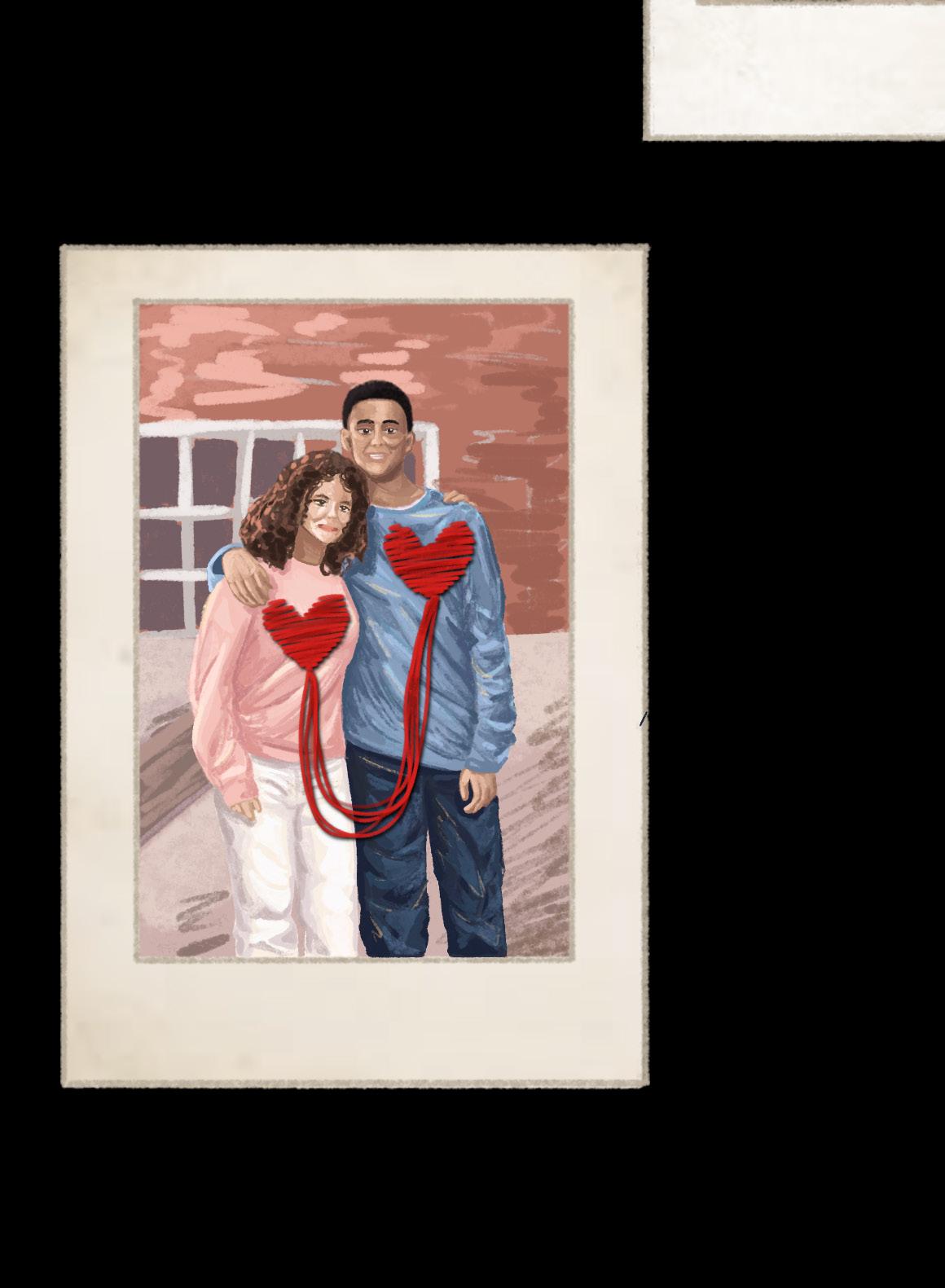
Intergenerational trauma leaves lasting emotional, psychological and biological legacies in families.
Le er from the Editors
Hey Vikings,
Love is in the air, and so is Issue 4 of the Epic — featuring our frst centerspread of the year! Flip through stories that explore gaps between generations and age groups, including contrasting viewpoints on etiquette, the controversy of dating among different grades and your own perspectives on coming of age.
In addition, dive into our standard six sections. In News, learn about the new Stage Craft elective coming to campus next school year, then discover in Opinion why protein might not be the health miracle that social media and popular food franchises would have you believe. Meet freshman Joanne Luo’s unusual assortment of pets in Features, and investigate the hidden psychology behind free items in In-Depth. Lastly, examine the implications of the Super Bowl halftime show in Sports before checking out our review of ASAP Rocky’s album “Don’t Be Dumb” at lhsepic.com.
With all our love, Olivia Yuan & Crystal Zhu
Campus, community and world events
BY CECILIA WU
Music for Community Club partnered with Rythconnections, a nonproft organization of young musicians, to host a cultural music and arts event at the Calabazas Library on Jan. 16. The program featured a presentation on Chinese New Year traditions, complete with trivia questions and a bookmark-making activity for children.
Members also performed pieces such as Frédéric Chopin’s “Fantaisie-Impromptu” and Tchaikovsky’s Symphony No. 5, showcasing instruments like the piano, guzheng and violin. The event concluded with Chinese paper cutting and origami, allowing young attendees to create their own festive crafts.
School Community National International
About 15,000 New York City nurses went on strike the morning of Jan. 12 after contract negotiations stalled between the New York State Nurses Association and three private, nonproft hospital systems: Mount Sinai, Montefore and NewYork-Presbyterian. Nurses say they seek to protect their health care benefts and address concerns over staffng levels and workplace safety. Negotiations broke down amid complex, hospital-specifc disputes, with staffng emerging as a key point of contention. As of Jan. 26, Mount Sinai and NewYork-Presbyterian have agreed to maintain the nurses’ health benefts plan.
The Santa Clara Valley Transportation Authority opened its frst transit-oriented apartment complex in 20 years on Jan. 23 near the Tamien light rail station. The development includes 135 affordable housing units, a childcare center and an improved transit plaza. It is part of a broader countywide effort to build housing near public transit stations to boost ridership. VTA plans to break ground later this year with two additional apartment complexes near the Berryessa Bay Area Rapid Transit station and the Capitol light rail station. Developments are open to those earning less than 60% of the area median income.
On Jan. 3, the United States carried out a special forces raid on Venezuela, capturing its former president Nicolas Maduro and frst lady Cilia Flores. Transported to New York, the two faced charges of federal drug traffcking and narco-terrorism. U.S. offcials said the mission was a culmination of months of planning and aimed to suppress narco-traffcking and corruption by targeting Maduro’s leadership. In the weeks since, the Department of State has appointed veteran diplomat Laura Dogu as chargé d’affaires to the Venezuela Affairs Unit, based in Bogotá, Colombia, to stabilize regional relations with the U.S.
Curtain rises on new Stage Cra elective
BY AUDREY CABALTICA
Stage Craft will join the drama department as a new elective in the 2026-27 school year. Taught by drama teacher Larry Wenner, it will cover stage production fundamentals such as set design and building, lighting and sound control, marketing, hair and makeup, costume making and stage management.
Wenner hopes this elective will expand Lynbrook’s current offerings of Drama, Advanced Drama and Advanced Drama Honors. Students with technical skills are essential in producing plays, Wenner says, but not
want to do this as a career, it’s something they could pursue after the class.”
In FUHSD, the process of implementing electives is lengthy. The school and the district hold discussions on why the class is needed and whether students would be interested.
“We’ve had students taking time outside of school to help Mr. Wenner create props and manage the lighting for shows,” Assistant Principal Yukari Salazar said. “We want to give them proper credit for that, and Stage Craft will be a way for students to be able to have it on their transcript and say they did something unique on our campus.”
Fremont High School, Homestead High School and Monta Vista High School already offer Stage Craft, making the approval process for Lynbrook simpler.
enough students will be involved by then to assist in leading the class if necessary.
“Whoever takes over probably won’t have the same experiences I have, so I don’t know if the class will be able to continue,” Wenner said. “I hope it will be able to, because it’ll help get more students involved.”
Students currently involved with the drama department say they are excited to have more people involved in the backstage production of Studio 74 shows.
“We defnitely need more people doing tech for our shows,” junior and stage manager Anvitha Krishnan said. “With the current amount of people we have, the workload is pretty high, so getting more people involved is a good idea.”
by
by
Photo used with permission from Shannon Zhang
Photo from Wikimedia Commons
Photo from ReelNews/Wikimedia Commons
Photo from The Courier/Creative Common License
Photos
illustrations
Bank of America Student Leaders shi s to undergraduates
BY REBECCA CAI
After 21 years, the Bank of America Student Leaders program, a paid summer internship experience known for partnerships with local nonprofts, has shifted its focus from high school students to college undergraduates.
“I think that was quite sad,” junior and aspiring applicant Rohin Saharoy said. “I feel like it was probably a better opportunity for high schoolers. College students can get these opportunities. It’s a lot harder for those our age to obtain these experiences.”
The program was a unique gateway for students of all backgrounds to gain experience in a real working environment. It lasted eight weeks, concluding in a weeklong Student Leaders Summit in Washington, D.C. that brought together attendees to learn from nonproft leaders
and collaborate on future community solutions. Now, the program is six weeks long, with the Summit shortened to three days. In prior years, applicants had to be rising high school juniors and seniors in participating Bank of America regions, but now they must be college undergraduates. This year’s application will open in early February and close in early March.
The program’s application was accessible for a wide variety of applicants due to its emphasis on community impact. In the past, grades and test scores were excluded altogether. For the 2026 cycle, the program will be looking at college transcripts to verify grade eligibility as well as the student’s standing with their institution.
“It was such a great opportunity for me and those pre-college who are trying to get more professional business
experience,” alumna Dhruti Halambi said. “It was one of my favorite things I did in high school, and I feel like it helped me get a good foundation for the type of person I want to be here at UCLA.”
Previously, 315 student leaders were selected every year to participate. It is currently unclear as to how many students will be selected this year and if there will be fewer qualifying regions than in previous years.
“I think it was really unique to have this opportunity for high school students because it opened their eyes and introduced them to public policy before they made decisions about their career choice,” alumna Kendall Nord said. “If someone’s exploring this as a senior in college, they might not get as much out of it because they might’ve already decided what they want to do with their life.”
This change has left many aspiring applicants’ excitement for the program on a hiatus as they turn to other summer opportunities.
While there are other fully funded programs, Bank of America Student Leaders educates students of any interest, building a class of leaders that range from poets to scientists due to the lack of specifc disciplinebased program cohorts.
“It was a great experience, and I’m so grateful to have been included in it this past year,” Nord said. “I’m sad for all the other high school students who aren’t going to be able to do it anymore. I’m glad it’s still available to some extent, even if it’s a couple years later.”
Upcoming Viking Events
Club Food Day, Feb. 6
Come to the hallways during lunch to support your favorite clubs by purchasing food from their vendors!
Interclass Event, Feb. 9-13
Throughout lunch this week, watch the classes “battle” each other. Representatives from each class will compete in games such as Jeopardy and Dodgeball.
Valentines Day, Feb. 14
Coffee House Talentshow, Feb. 13
Head to the cafeteria to watch students showcase their talent from 7-9:30 pm. There will be free food and snacks like Buldak, ice cream and mac and cheese!
Lunar New Year Event, Feb. 11-13
The world language department’s Chinese program will be hosting a Lunar New Year event at the den during lunch.
President’s Week, Feb. 16-20
There will be no school this week! Rest well, Vikings!
New California laws to go into effect
BY STUTI JAIN
Assembly Bill 1825
Under AB 1825, public libraries are prohibited from banning books, including materials that include sexual content or a diverse character cast, unless considered legally obscene. Amid a national movement to ban certain books, with proponents disproportionately targeting literature with colored and LGBTQ+ communities, Assemblymember Al Muratsuchi introduced the bill to encourage open access to varied viewpoints.
“Libraries provide a special place in the public’s civic education and the free exchange of diverse ideas and information,” Muratsuchi said in a press release for the Assembly Democratic Caucus. “We need to fght this movement to ensure that Californians have access to books that offer diverse perspectives from people of all backgrounds, ideas and beliefs.”
Senate Bill 1053
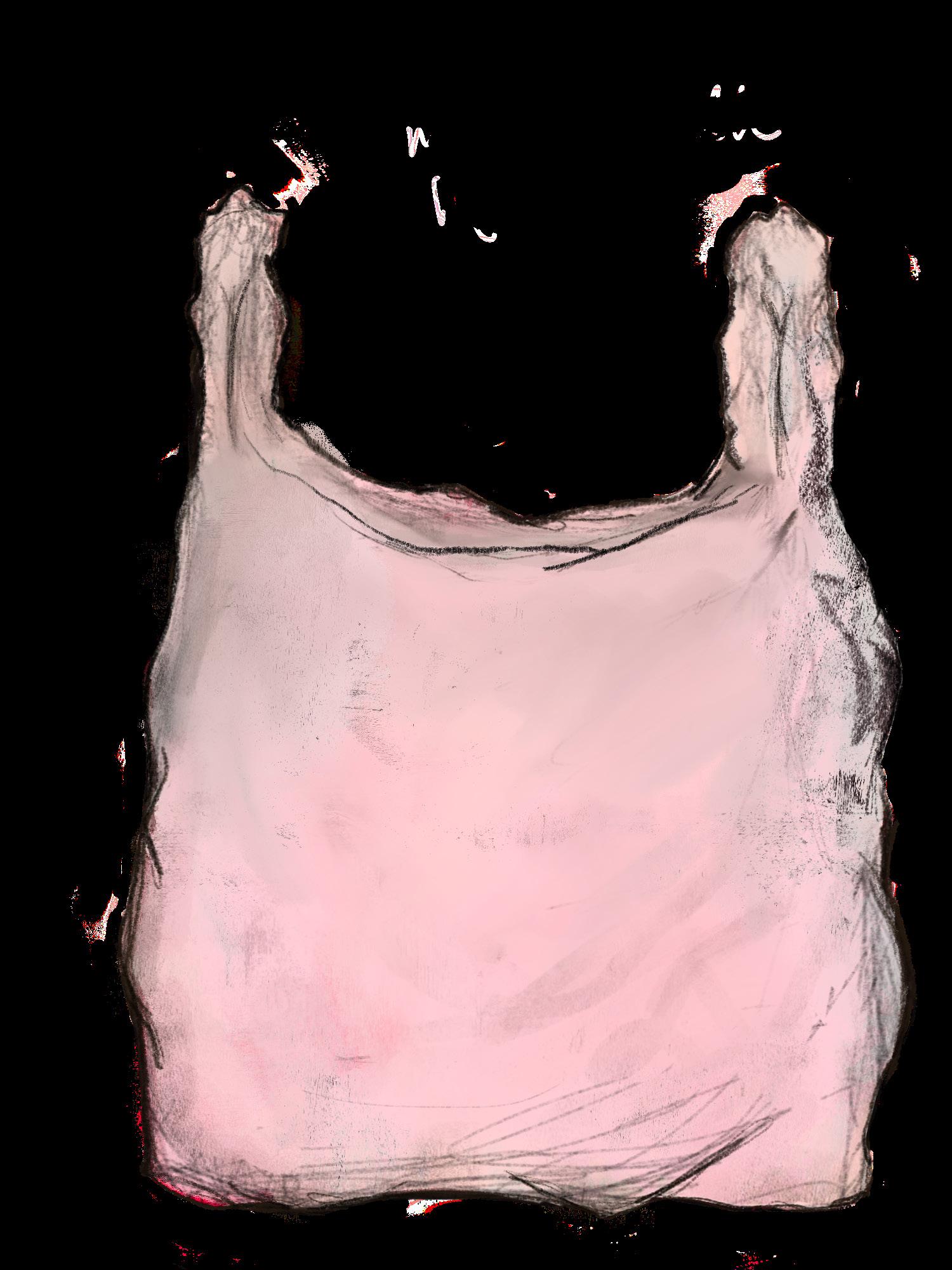
Doubling down on efforts to eliminate plastic waste, SB 1053 requires food and retail stores to provide only recyclable paper bags at the point of sale. Previously, California law prohibited stores from providing any single-use bag — defned as bags made of any material not recyclable or reusable — to customers. However, even as stores switched to reusable plastic bags, most consumers continued to use the bags once, prompting Sen. Catherine Blakespear and Assemblymember Rebecca Bauer-Kahan to coauthor the bill and close the loophole.
illustrations
Senate Bill 760
Authored by Sen. Josh Newman, SB 760 requires all schools to have at least one gender-neutral restroom by July 1. With transgender and gender-nonconforming individuals disproportionately reporting avoidance of public spaces due to lack of accessible restrooms, supporters say the bill will further commitment to inclusion. Although opponents have emphasized the increased spending required for schools to enforce this bill, SB 760 determines that costs shall be reimbursed.
“It’ll make students feel safer at school because non-binary identities are real and scientifcally backed,” senior Ishana Subrahmanyan said. “In the current administration, people are essentially being erased on all sorts of White House records, so this bill will do a lot for validating non-binary and trans identities.”
Assembly Bill 489
AB 489 prohibits artifcial intelligence platforms from labeling themselves as licensed health practitioners.
Assemblymember Mia Bonta says she authored AB 489 to protect Californians’ health privacy and warn the public that chatbots are not professionals. The bill passed with nearly unanimous support, with a single member abstaining in both the Senate and Assembly. It gives state health boards the authority to pursue injunctions or restraining orders when an AI platform falsely claims to be a nurse, doctor or any other health professional.
Assembly Bill 461
The current state Compulsory Education Law requires everyone between the age of six and 18 to receive a full-time education, unless exempted under certain conditions. Under California Penal Code 270.1, if an elementary or middle school student is found to be a chronic truant — failing to attend 10% or more of the academic year — their parent or guardian was guilty of a misdemeanor punishable by a fne of up to $2,000, imprisonment in a county jail or both. Authored by Assemblymember Patrick Ahrens, AB 461 repeals these criminal penalties. Passed on Oct. 1, 2025, the bill aims to recognize the reasons behind truancy and meet families with support instead of punishment. However, opponents have argued it will remove student accountability and discourage parents’ engagement in student lives.
Photo by Prisha Pulastya. Reporting by Alyssa Lin, Prisha Pulastya and Vanessa Yap.
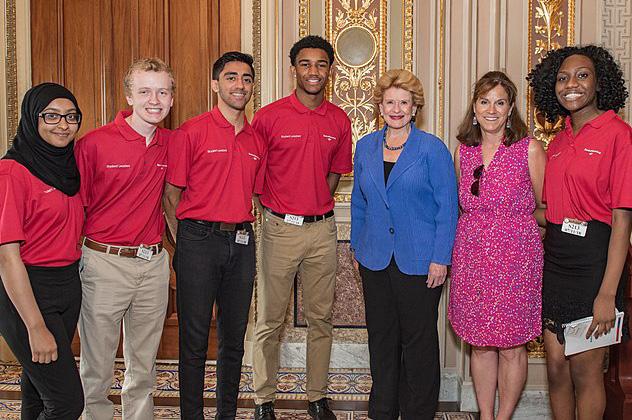
Student leaders with former Sen. Debbie Stabenow during the Summit.
Photo from ofce of U.S. Senator Debbie Stabenow.
Graphic
by Vanessa Yap
9,000 students deserve more than one seat on the board
In the FUHSD boardroom, trustees deliberate over policies that shape the daily lives of more than 9,000 students. One student sits among them, tasked with informing the board of the perspectives of all fve high schools. The student board representative is a role many students are unfamiliar with: the path runs almost exclusively through ASB, making it hard for thousands of student voices to reach the board. To bring more views to this platform, the district should add additional student board representative seats, and make the current selection process more inclusive.
For three years, the district has debated adding another student board representative, an FUHSD student appointed to attend district board meetings and represent student viewpoints. While they present biweekly reports on student activities and participate in meetings, they have no voting power. The position is a bridge between the board and students.
“At the end of the day, we all want to do what’s best for students,” Assistant Superintendent Paula Robinson said. “The more we hear from students and their various perspectives the more that is going to help guide decisions.”
With two or more student board representatives, the district would beneft from more nuanced opinions. Each school has unique needs and challenges. No matter how diligent they are, one student cannot adequately represent all of them.
A Lynbrook student, for instance, may lack frsthand knowledge of student demonstrations against Immigration and Customs Enforcement at Fremont High School or controversies surrounding antisemitism at another school.
“The reason we are talking about having more than one student board rep is because we want to better understand students’ perspectives,” board vice president Rosa Kim said. “I believe the students know their own school sites better. It’s all about hearing from our students and better implementing their ideas. As we look at this option, I hope to continue exploring the most effective ways to make it work logistically and realistically for everyone involved.”
‘‘other’s absences and share the workload of gathering feedback from hundreds of groups across the fve campuses.
“There’s a lot of groups that as a student board rep, I try to connect with but just don’t have the time for,” senior and student board representative Amy Tang said. “Having two student board reps could help with reaching out to different groups.”
The more we hear from students and their various perspectives the more that is going to help guide decisions.
Paula Robinson FUHSD Assistant Superintendent
Beyond individual school concerns, the board needs to hear from a variety of student groups. A student athlete could offer a valuable perspective on sports equity policies that an arts-focused student might miss, just as a student with disabilities could point out accessibility issues that their able-bodied peers might overlook. With multiple student representatives to fll in knowledge gaps, the board is more likely to hear diverse experiences when discussing policy changes.
Having two representatives also makes the job easier, allowing them to cover each
editors-in-chief — olivia yuan, crystal zhu
managing editor
— claire guo
copy editor — david zhu
design editors
— amanda jin, rohan kakhandiki
adviser
— josh miller
news editor — brian lee
opinion editors — maddy chang, saavan saraf
sports editor
web editors in-depth editor
business/pr manager features editor — isabella chiu
— alexandra wu
— anna cen
— akash anand, cecilia wu
— jenny suh
social media manager — ethan wong
‘‘The lack of student representation highlights another core issue: currently, the student board representative role is only formally introduced during the ASB informational meeting, potentially discouraging students outside those circles from applying. Tang is exploring changes, such as involving administrators unaffliated with ASB in the selection committee and holding open information sessions for the role.
“I think the problem with kids who aren’t in leadership is they don’t see the options that are available for them,” senior and Monta Vista High School ASB president Elaine Chen said. “They don’t understand that we can actually bring up issues to the board, because it’s not really advertised.”
District administrators echoed these concerns, emphasizing the need for broader exposure to the role.
stafers
samanvi bandugula
audrey cabaltica
rebecca cai
emily cheah
joanna chen
anushka deshmukh
nicolas cheng
david dai
ashley hein
stuti jain
eunice leung
The district’s concerns about another student representative are largely logistical: the boardroom dais has limited space with strict seating arrangements mandated by board policy, meaning that adding a second student would likely mean rotating who sits on the dais each meeting. This could make it challenging for representatives to maintain synergy.
“If a topic gets brought up in one meeting, I try to address it in the next one,” Tang said. “If it were a handoff between representatives, there could be an issue where one of them isn’t up to date with information.”
However, logistical challenges will not outweigh the benefts. Other districts have navigated similar constraints, offering potential models for how FUHSD could approach this new system. In San José’s East Side Union High School District, student representatives from each school make up a Student Governing Board that meets before school board meetings and holds a singular voting position within the school board.
As the debate moves forward, it should also re-examine how the role itself is introduced. A selection process that reaches students across all fve campuses would refect more accurate demographics. Paired with more consistent outreach, student voices would be amplifed, refecting a wider range of perspectives in district decision-making.
the Epic staff voted 36-0 in favor of this stance with 1 abstaining.
alyssa lin
tristan lo
rachel martin
prisha pulastya
katie shang
olivia tu
sunnie wu
catherine yang
vanessa yap amy yuan
Photo by Ethan Wong Graphic illustration by Maddy Chang
CSU Direct Admissions bypasses uncertainty of college applica
BY ALYSSA LIN
Starting in the fall 2027 application cycle, Senate Bill 640 will simplify the admissions process for in-state applicants to the California State University system through the new CSU Direct Admission Program, which allows students who fnish their A-G course requirements and have at least a 2.5 GPA to be automatically admitted to 16 out of 22 CSUs. While these schools may not be typical picks at Lynbrook, the program will encourage more students across the state to attend college and reduce the stress around college admissions.
“A lot of students are applying to so many colleges because they have a fear of not being accepted to any campuses,” school college and career adviser Kathy Tang said. “This program might help in terms of relieving stress levels.”
Direct Admissions will be benefcial to all California students, including Lynbrook students. Without the burden of components like essays, recommendations or portfolios, students can dedicate more time for other tasks, such as studying for AP courses or even applications to other universities. Automatic admissions will also reduce total application costs, as students would only need to pay application fees for the campus they plan to attend.
“On top of all the writing for college applications, there’s also an application fee for each school, which can be quite expensive,” senior Lucas Li said. “Automatic admissions would help students save money and make applications more fnancially accessible.”
Campuses in the program include San Francisco State University, CSU Los Angeles and CSU Sacramento. Campuses with high enrollment, such as Cal Poly San Luis Obispo and San Diego State University, are not participating due to capacity constraints. Although participating campuses aren’t as popular as larger campuses, they still offer unique opportunities and resources that prepare students for future careers.
“This is just guaranteeing one option,” school counselor Nikki Dang said. “When we think about our community, our students like lots of options. I don’t think that this is going to necessarily impact Lynbrook students in a great way, because most of the
schools that are on the CSU direct admit list are not schools that our students are excited to apply to.”
However, automatic admissions may make higher education more accessible for students who had not initially planned on attending college. By simplifying the admissions process, students may feel less intimidated by the stress, demands and costs of college applications. In Riverside County, the pilot program resulted in a 6% increase in CSU enrollment from the previous year among participating high schools. Similarly, the fully implemented program could substantially raise the number of enrolled students across the whole state.
“The program offers a little more transparency into the college admissions process,” Tang said. “It makes the process simpler and more accessible for students who might not otherwise feel eligible for college, and increases awareness of what the eligibility requirements are.”
Direct Admissions opens up a variety of new opportunities that students may not have previously considered. Students should take advantage of the program by researching individual CSUs that align with personal goals or interests, rather than writing them off because they are less popular.
Social media paints a false picture of protein
BY DAVID DAI
Fueled by Chipotle’s high-protein menu, protein popcorn and the general “proteinifcation” of almost every popular food, protein has become a hot dietary trend. However, protein isn’t as benefcial as it seems. The belief that foods labeled with high protein are automatically healthy is a common misunderstanding that can lead to poor dietary choices and health issues. Instead, students should be more cautious of online diet trends and educate themselves on healthy, balanced nutrition.
“What’s been blasted at students is one kind of diet that fts all,” FUHSD nutrition services manager Divya Puri said. “Social media is so enticing and misleading to students that they forget that most of this information is not evidencebased.”
‘‘
Moreover, aggressive marketing has sensationalized “high protein,” misleading customers about the actual nutritional value behind the buzzword. Foods with this label can contain high amounts of carbohydrates, sugars and unhealthy fats, as well as heavily processed ingredients. This marketing tactic can trick the untrained eye, resulting in unknowing consumption of a less-thanideal snack.
Social media is so enticing and misleading to students that they forget that most of this information is not evidence based.
Divya Puri FUHSD nutrition serices manager
Protein will always be an essential part of the human diet. Its importance as a macromolecule for basic bodily functions is undisputed. Yet protein has recently been advertised and celebrated more than ever. Social media creators increasingly promote it as the key to weight loss and muscle gain, two goals that are often especially desirable for teenagers. Eager to embrace the fad, food franchises have fooded the scene with protein-related products as a result: popular chains such as Dunkin’, Subway, Chipotle and Starbucks have all come out with new protein menu items. In the ftness industry, protein powder has also experienced explosive growth, with the global protein supplements market projected to reach $32.6 billion in 2027. Protein is being marketed as the holy grail of healthy living, promoting a more-is-better mindset with few limitations.
However, students aspiring to become stronger and healthier can unknowingly harm their bodies with improper diets that are hyper-focused on protein. While it can support weight loss, muscle gain and immune function, overconsumption may lead to dehydration, digestive issues and weight gain.
“Some protein products can be useful, but others are pretty obvious money grabs,” sophomore Yashraj Choudhary said.
The fxation on protein is also changing the American diet: a 2024 survey by the International Food Information Council found that 71% of Americans want to increase their protein intake. But while social media has promoted protein as the be-all and end-all of healthy eating, other nutrients just as crucial for overall health have suffered from inattention. For example, a 2016 analysis in the American Journal of Lifestyle Medicine concluded that 95% of adults and children consume less than the recommended amount of fber. In a world full of social media trends, where processed foods are easy to access and unhealthy choices are easy to make, a holistic diet is more important than ever.
“Students can talk to medical providers or reach out to registered dietitians in hospitals and get advice that fts their lifestyle, is not based on a trend and has a scientifc basis,” Puri said.
advice. Unrealistic expectations have drawn students to prioritize protein disproportionately in an effort to emulate online standards. Yet everyone’s body and lifestyle goals are different, meaning that the same amount of protein that works for an infuencer might be unhealthy for others. All social media advice should be taken with a grain of salt, encouraging students to
The online narrative surrounding protein and other non-evidencebased diet trends highlight the need for students to do their own research rather than blindly following
PhotosbyDavidDai
Graphic illustration by Sunnie Wu According
Scan
Joanne Luo nurtures a unique menagerie of pets
BY ANUSHKA DESHMUKH
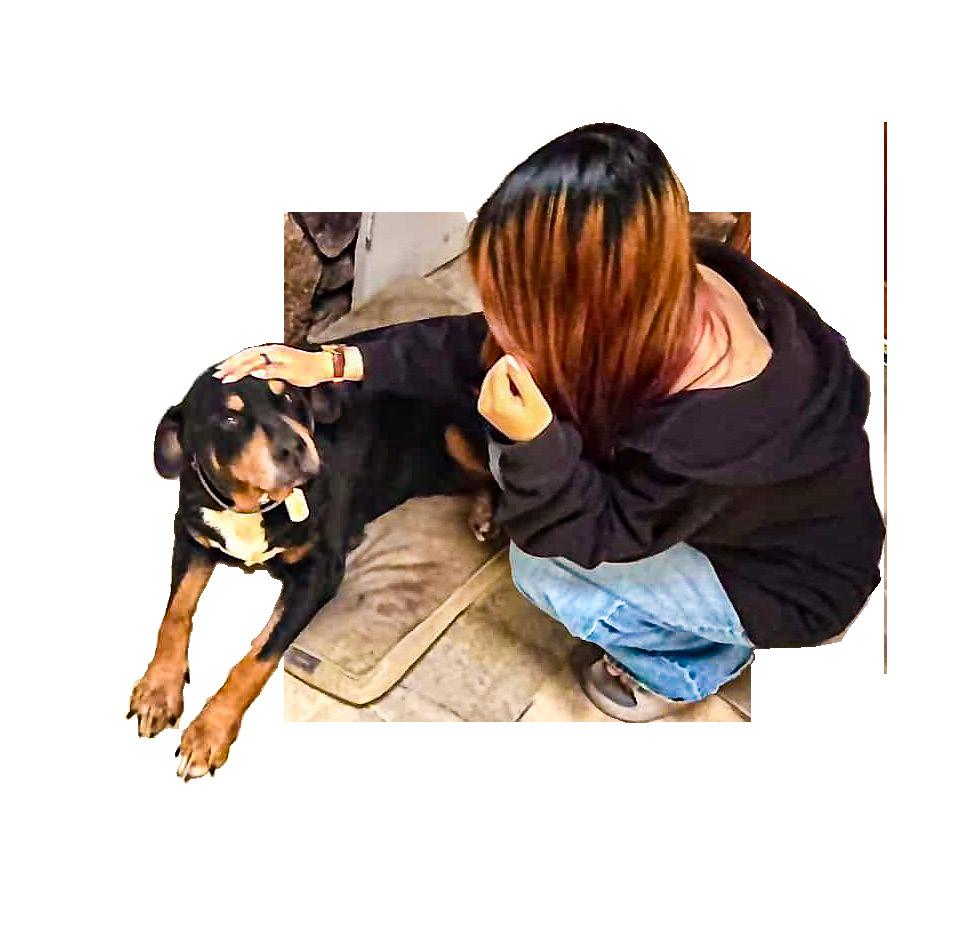
Walking through freshman Joanne Luo’s front door, you may frst notice Winter, Luo’s affectionate Rottweiler-pitbull mix, running to greet her. Or perhaps you’ll see her bearded dragon, Mochi, sunbathing lazily in his cage. Though it sounds like the beginning of a fanciful children’s book, this is everyday life for Luo, the proud owner of a dog, a cat, seven fsh and a bearded dragon.
Luo has always loved animals, even the more unconventional ones. One evening, a 9-yearold Luo got out of bed to see that her dad had come home with their frst-ever pet, a 3-monthold bearded dragon that she named Mochi.
‘‘
feeding and playing with him, Winter and Luo have developed a close bond.
“He’s been there for everything that’s happened in the family,” Luo said. “He’s just always there in the corner for everything.”
As the years passed, Luo’s family gained new pets, some of whom even bonded with each other. When Luo’s sister found a lizard outside, the family placed it in the same tank as Mochi in the hopes they’d get along.
“I think they liked each other,” Luo said. “We always see the lizard sitting on top of the bearded dragon’s head.”
It was like a zoo in the house back then. I remember one time, one of the guinea pigs got territorial and started fghting.
Joanne
Luo Freshman
In addition to her current pets, she has previously owned lizards, three parrots, a rabbit and several incredibly territorial guinea pigs.
“I think that the randomness of getting pets defnitely empowered my love for animals,” Luo said. “I got to learn a lot about them.”
Since Luo was in elementary school when she frst got Mochi, she didn’t initially play a large role in caring for him. That changed when she was surprised with Winter. Over seven years of walking,
‘‘
However, with more pets came more chaos.
Though the animals generally coexisted peacefully, the family had trouble wrangling the guinea pigs. Initially overwhelmed, Luo’s family banded together to share the responsibilities of caring for them.
“It was like a zoo in the house back then,” Luo said. “I remember one time, one of the guinea pigs got territorial and they started fghting. We had to separate them and get different cages.”
A few months ago, a kitten named Kirin joined the family. Though Kirin typically stays at her brother’s house, Luo takes care of him when the kitten is at her home. Kirin brought a playful change of pace compared to Winter and Mochi, who
have both calmed over the years.
“Because he’s still a kitten, he causes a lot of trouble and knocks stuff over,” Luo said. “For Winter, if he’s alone, he won’t make any messes.”
Over the years, tending to animals and meeting different species has led Luo to become more cognizant of injustices toward animals across the world.
“It made me feel more empathetic towards what happens to animals, like traffcking,” Luo said. “It makes you feel even worse because you have one of those pets at your house. It makes you wonder, ‘What if that was my dog?’”
Chaotic, playful and full of love, Luo’s pets have brought not only excitement into her life, but also lessons in understanding and accountability.
Age: 9 years
“She’s had a lot of pets as she’s grown up, so that brings a lot of responsibility to try and take care of them all,” freshman and Luo’s friend Madeline Siripoke said.
Aahaan Jain’s advocacy plants a greener FUHSD
BY TRISTAN LO
Freshman Aahaan Jain took in the surroundings of Bangalore, India. The familiar chaos of motorcycles revving and cars honking accompanied a grey, unsettling layer of smoky pollution that flled the air. A year ago, Jain returned to his hometown for an ordinary trip, only to fall ill due to the pollution. The air of Bangalore left a mark on him that he’d never forget. From then on, the place he calls his home city has sparked his resolve to advocate for environmental sustainability.
“Getting seriously ill was a turning point for me,” Jain said. “I became curious about what caused the pollution, as it was something personal to me and my background.”
After returning from Bangalore, Jain started researching sustainability and how he could make an impact. Miller Middle School social studies teacher Nicole Gasparik and Monta Vista High School science teacher Kavita Gupta, the program’s adviser, invited Jain to apply for the California Climate Youth Policy Program, where he learned to write policies regarding environmental matters.
Now equipped
with policy-writing skills, Jain explored sustainability in his community. After discovering how FUHSD’s current climate policies weren’t aligned with many state regulations, Jain was determined to write a resolution to improve the district’s green initiatives.
As Jain had never written offcial policies for the district, he looked to climate resolutions written in the past for inspiration. With guidance from climate organizations, such as the Sierra Club, Citizens Climate Lobby and the Silicon Valley Youth Climate Action, as well as district members, such as Gasparik and FUHSD Superintendent Graham Clark, Jain extensively revised the resolution policy.
mandate climate literacy and education, create a compost program and implement a yearly sustainability report.
However, the journey to the fnalized resolution was a bumpy road. Miscommunications with district leadership, diffculties with scheduling a board meeting and a tight schedule for the resolution draft complicated the process for planning and presenting the resolution. Constant communication with board members such as FUHSD Board Trustee Pat Carpio-Aguilar allowed Jain to overcome these challenges, shaping him into a better speaker and communicator.
Sustainability is so important because it helps the environment. You’re doing what you’re able to do for people around you.
“The amount of organization and networking Aahaan did was really impressive,” Gasparik said. “It’s beautiful to see all these great skills that he has applied to larger issues that impact his fellow students in the district.”
‘‘ ‘‘
After hours of drafting, networking and revising, Jain built off a previous sustainability resolution in 2021. He fnalized the three major components of his resolution, all in line with recently passed California state laws. The resolution consists of district-wide initiatives to
“The experience was really important for me, as it allowed me to connect with my community and be more outspoken,” Jain said.
“I constantly communicated with the superintendent, even learning the specifcs of a board meeting.”
Even after writing an entire resolution regarding sustainability, Jain looks to continue working with the many organizations he’s a part of.
“Sustainability relates to other parts of my life, as it allows me to be involved with my community,” Jain said. “It’s important to be the best person you can be, and sustainability is so important because it helps the environment. You’re doing what you’re able to do for people around you.”
Breed:
Rott-weiler pitbull mix
Graphic illustrations by Rebecca Cai, Katie Shang and Jenny Suh Photo by Tristan Lo
Aahaan Jain Freshman
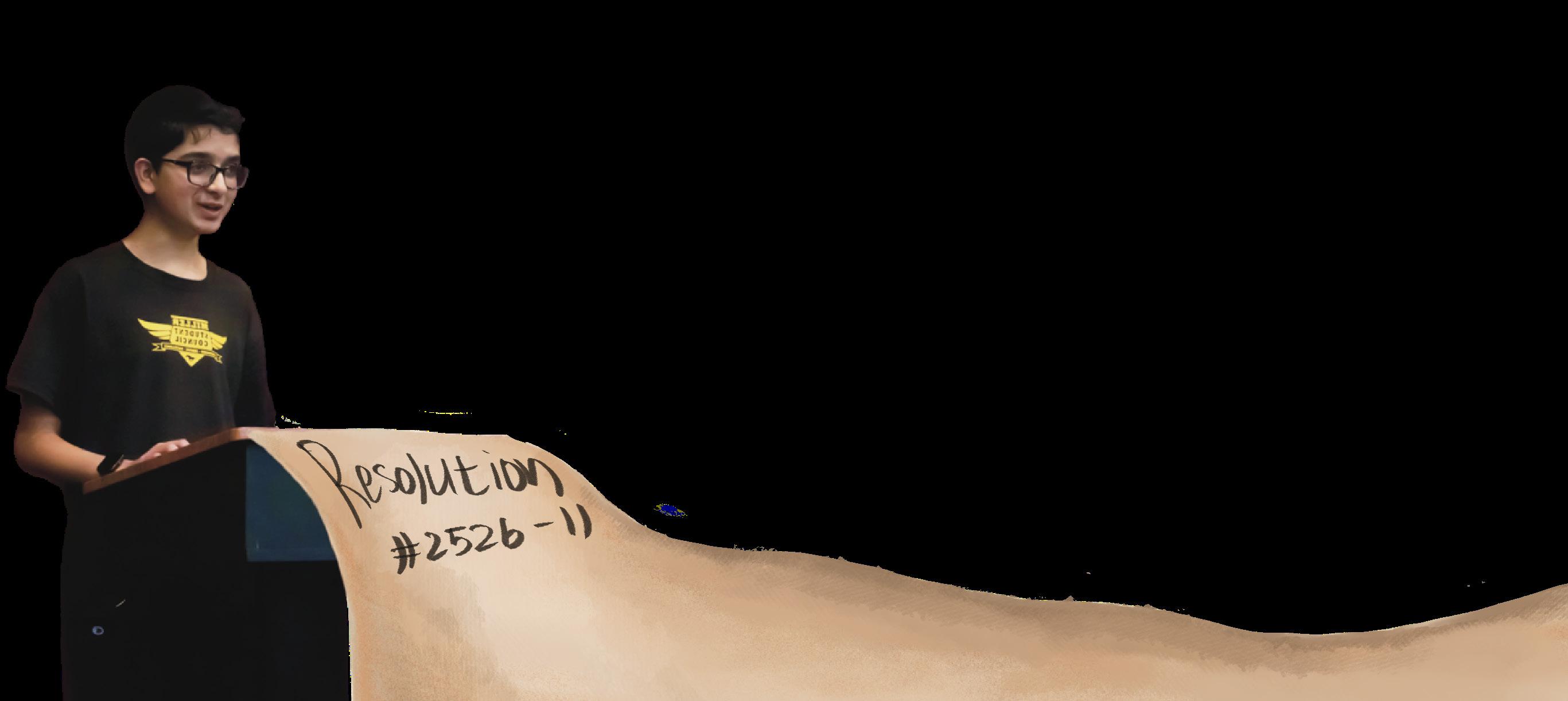
Aahaan Jain pitches his climate action resolution, Resolution #2526-11, to the FUHSD board.
Graphic illustration by Samanvi Bandugula and Isabella Chiu Photos by Joanne Luo
Black stiletto heels tapping the foor, sophomore Chanel Li arrives at school adorned with a row of bowties in her braided updo, a pink striped bag instead of a backpack and a pastel pink-and-white dress with ruffed sleeves. She is not dressed for a special occasion, but instead inspired by her love for Y2K and coquette fashion.
Having a deep appreciation for different clothing, Li wears fancy outfts daily, standing out from the casual T-shirts and hoodies of her peers. She began trying out different styles in eighth grade with the few clothes she had, which expanded into a plethora of black leather heels, pearl bowtie necklaces and mini bejeweled crowns.
On a regular weekday, Li wakes up at 7 a.m. to get ready for school. She doesn’t spend a lot of time choosing her outft. Instead, using experience from playing Dress to Impress in middle school, she selects items on the spot that match each other. She often sets rules for herself, like not wearing the
tendency toward romantic hyperfeminine styles.
“I have to look good because I love to look good,” Li said. “I just like coming off as feminine.”
Li’s love for fashion is deeply refective of her assertive personality. One of her initial reasons for dressing up was the desire to protest wardrobe items that were targeted towards conventionally attractive girls with certain curves and body types. Now, Li’s main motivation has developed into a more free-spirited expression of her femininity, though she maintains her strong-willed nature.
“Once Chanel knows what she wants, she fnds a method to accomplish it,” her sister Shirley Li said. “Her fashion is a commitment to being her most unapologetic self.”
Embracing her own appearance and expressing herself through fashion also comes with accepting societal biases toward conventional attractiveness.
“Pretty privilege is everywhere,” Li said. “People perceive and treat you differently based on your appearance, so I feel the need to draw upon that.”
Li’s attire is heavily inspired by subcultures and American TV shows and movies. As a tribute to the 2004 blockbuster hit “Mean Girls,” she dresses in pink every Wednesday. “Gossip Girl” character Blair Waldorf’s headbands, capes and bow ties inspire her preference for the early-2000s-inspired feminine Y2K fashion. Li’s love for Japanese substyles manifests in pastel-colored sweet lolita and hime gyaru, a princess-like and hyper-feminine look. Both styles include accessories, ribbons, ruffed sleeved dresses and high heels.
Her astrological moon sign, Pisces, infuenced her
Although Li never fails to shine with her uniquely curated attire, her favorite part about fashion doesn’t focus on the validation of others, but only of herself. One day, Li wishes to try couture, the practice of creating exclusive, custom and high-end fashion for others and herself.
“The best part is looking good,” Li said. “Looking in the mirror and seeing how good my outft looks with my hair and makeup is so rewarding.”
Graphic illustrations by Samanvi Bandugula, Rebecca Cai
Chanel Li poses in a pink lacy dress with accessories.
Pain passed on through generations
BY ASHLEY HEIN AND EUNICE LEUNG
Story continued from front page.
A2025 study found that Holocaust descendants had a 20.9% probability rate of developing PTSD — considerably higher than the 11.5% in those who did not share this family history. Similarly, increased rates of depression and substance abuse was demonstrated in the children of Rwandan genocide survivors.
intergenerational trauma is that these hardships still come out, like in the negative way parents react to seemingly small things or the pressures they put on your life.”
can lead to isolation and hesitation to seek help.
“People think it must be really bad to have to go to therapy,” therapist Wonbin Jung said. “They really focus on saving face and worry about their image. Therapy is also for people who want to better their relationships and their families, or go deeper into the issues that affect them on a day-to-day basis.”
Children from immigrant families are also at a high risk of suffering from intergenerational trauma. Immigrant families often leave their home countries due to a desire for a better life. Sometimes, they are escaping confict, like Syrian civil war refugees, over 70% of whom live in poverty, with limited access to basic services and job opportunities.
Emerging research suggests that traumatic experiences may even be biological. They may induce epigenetic changes that may be passed down to children, creating DNA methylation patterns associated with increased vulnerability to stress and anxiety disorders.
‘‘
My mom does have a lot of trauma. Her dad got angry at her a lot, and she’s had bad experiences as a kid. Her trauma affects our relationship because she gets mad so often. I know my dad has trauma, too, but he doesn’t talk about it. I wish he would talk more about it because then he would be less emotionally unavailable to me.
Other prominent diffculties that immigrants face include struggling to integrate into society or to fnd a job. Thus, older generations shaped by poverty, discrimination and fears of deportation may hope for a life of increased stability for their children, leading to strict expectations.
“My parents used to put a lot of pressure on me to succeed, but they stopped when my mental health started declining,” junior Torsia Xu said. “I believe as parents, your job should not be to only provide for your kid’s education and survival, but also be emotionally supportive and willing
Children can notice and inherit the emotional instability and trauma responses their parents display. For instance, in a household with a parent experiencing hypervigilance, which is sometimes a symptom of PTSD, children may exhibit increased sensitivity to perceived threats and heightened anxiety. A parent who struggles to display vulnerability
‘‘
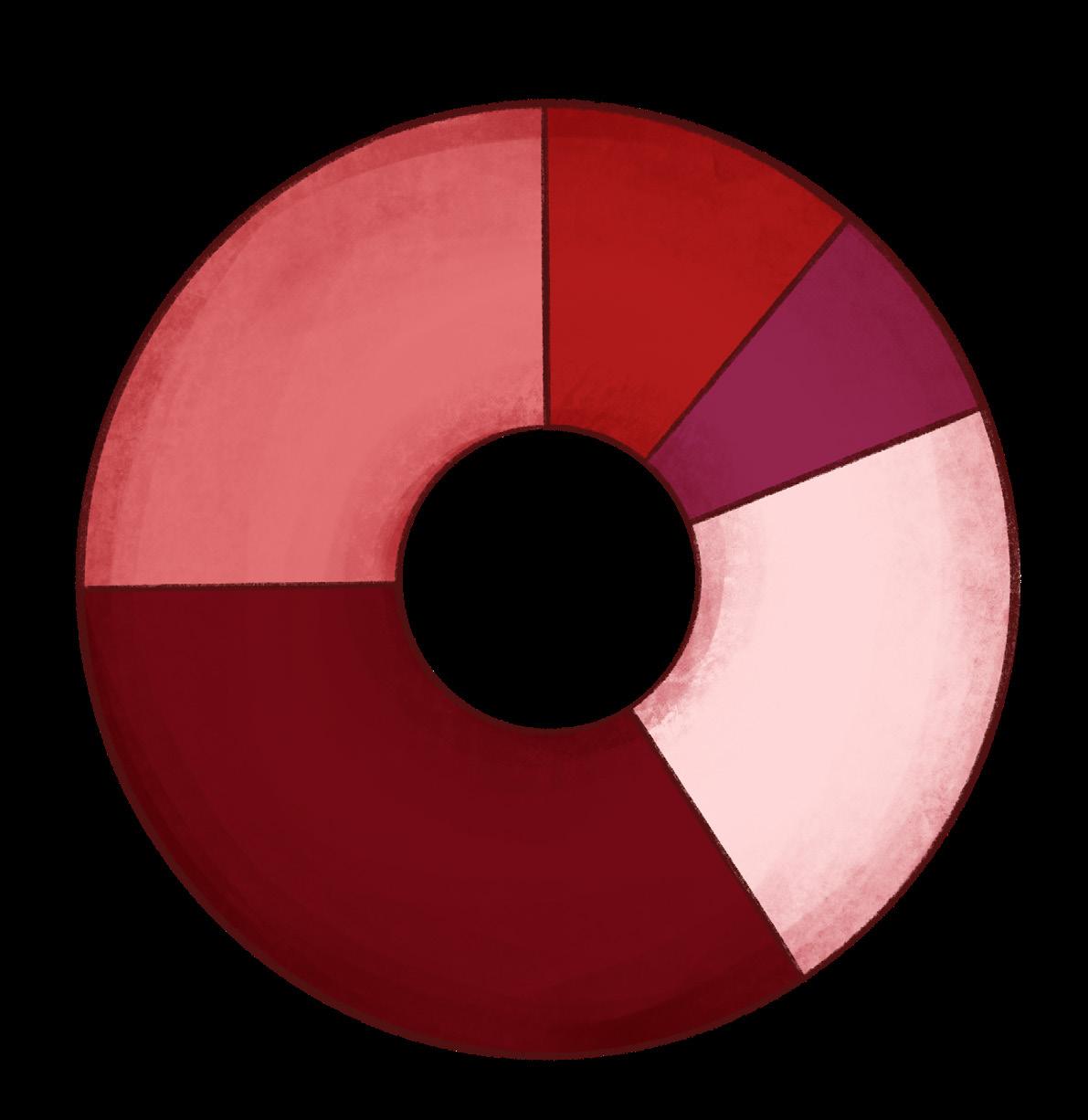
While 27.4% of survey respondents said they were “somewhat uncomfortable,” 15.4% said they were “extremely uncomfortable” discussing mental health with parents. Rather than avoiding diffcult conversations, learning to normalize mental health discussions can foster greater understanding for both students and parents.
“We have really great book recommendations and I’m always sending parents links to articles to explore,” school therapist Jenna Starnes said. “There are so many resources available, but parents must listen and take their child’s experiences seriously.”
One method to healing intergenerational trauma is the idea of “repair”: going back to face — and hopefully fx — past mistakes. This can strengthen family bonds strained by the scars of trauma.
“The concept of repair has been something that’s been quite powerful for
Torsia Xu Junior
Graphic illustrations by Emily Cheah and Amanda Jin
How comfortable are you with discussing mental health struggles with your family?
With love, the high school relationship age gap
BY VANESSA
he word was out: “Did you hear…?” “I heard she was a freshman…” A new couple has just formed at Lynbrook. Interest in the lovebirds spike, and gossipers talk about how unexpected the pairing is. However, one question lingers: how old are they? While sometimes controversial, mixed-grade dating usually isn’t as toxic as rumors make it to be. Rather than point fngers and immediately view such relationships negatively, it is better to approach the concept with an open mind.
“We have to account for the fact that there’s just natural attraction, which doesn’t make logical sense sometimes,” school psychologist Brittany Stevens said. “That is something that doesn’t necessarily know an age.”
With high school dating comes unspoken rules. For example, if the grades are adjacent to each other, like a freshman and a sophomore, it is usually acceptable to date. The
“divide age in half, add 7” saying also allows for a two-year age gap. Generally, these standards provide guidelines for acceptable high school relationships, but can lead to negative misconceptions when interpreted differently. This is especially the case in California, which lacks formal Romeo and Juliet laws that legalize consensual sexual relationships between minors and young adults close in age.
“I think it’s mainly because there’s so much publicity of celebrities that date with large age gaps,” sophomore
Lucina Huang said. “And since everybody’s on social media, they hear this idea, interpret it their own way and
‘‘
There has to be a lot of introspection along the line of, ‘Is what I am giving to this relationship flling me back up, or am I feeling drained? Really evaluate whether you’re still nurturing other relationships in your life with your family and friends.
Brittany Stevens School psychologist
own thinking. So when it comes to judging age gap relationships, when they hear the words ‘age gap,’ they automatically associate it with something negative.”
It is true that relationships with
age gaps can pose obstacles, as students’ maturity levels often differ. For example, freshmen are still under the jurisdiction of their parents and tend to have less experience taking on responsibility or major decisions. On the other hand, most seniors are close to being adults, often making them more self-suffcient. When combined, these factors could create gaps in judgement and risky grounds for a relationship. High school students are still developing and maturing emotionally, so a relationship spanning several grades should be approached carefully.
“They would have to be good at communicating,” Huang said. “They would have to talk everything out and maybe take extra caution compared to same-age couples when they’re trying to do something related to relationships, like hand-holding or going out on dates.”
‘‘
This mix in priorities can make it diffcult for students across grades and ages to fnd interests in common with one another. Though they may be able to bond over the same clubs or other activities, they often do not share classes. The
outside one’s own grade makes age gap relationships a boundary that most do not cross. According to a schoolwide survey of 117 students and staff, 63.2% of respondents noted a preferred age gap of less than one year.
“If you’re, for example, two grades apart, there’s a lot of difference in your life experiences,” junior Ian Chen said. “It’s hard to like someone romantically if your lives are so different, and if someone does, they have to be cautious about it.”
While not the case universally, age is often correlated with wisdom or experience. When these biases are present in a relationship with an age gap, the younger person’s opinions may be drowned out, causing a power imbalance.
“There has to be a lot of introspection along the line of, ‘Is what I am giving to this relationship flling me back up, or am I feeling drained?’” Stevens said. “Really evaluate whether you’re still nurturing other relationships in your life with your family and friends.”
AGE & GENERATIONS
YAP
Graphic illustrations by Catherine Yang and Amy Yuan
Formal etique e may die, but manners must live on
New manners reflect social change
BY ISABELLA CHIU
The Generation Z barista doesn’t make small talk. She doesn’t smile at the kid playing by the window, nor laugh with the old man over a misspelled name. The discomfort many feel around a “no manners” attitude isn’t really about politeness at all, but rather the loss of familiar social routines. As social norms evolve, younger generations trade performative courtesy for boundaries and authenticity.
“As a child, I was taught that etiquette is the unbending law in the social world,” human resources vice president Nadezhda Montclair said. “I recall it feeling like control, and for the longest time, I associated manners with suppression and social performance.”
The pressure to suppress personal expression often leads to a quiet buildup of bitterness dressed in obedience. Instead, communicating boundaries clarifes expectations of what a person can take on. Gen Z sends the message that it’s okay to not be overly polished, but rather have the courage to be authentic.
Modern language illustrates a shift in intergenerational mindsets. Older generations often
revere titles of seniority such as “sir” or “madam,” which reinforces strict social hierarchies. Conversely, being on a frstname basis with authority fgures has become increasingly common among younger generations, creating familiarity in previously rigid spaces. With formal titles on the decline, increased awareness of identity has changed etiquette today for the better. For instance, the small act of respecting a person’s preference conveys consideration through inclusion.
“Using someone’s correct pronouns is similar to pronouncing someone’s name correctly,” senior and Society of Psychology and Sociology president Tanishi Bhushan said. “Both exhibit general respect toward a person.”
Growing up in a world of rising poverty, violence and climate degradation, nearly 32% of Gen Z regularly participates in social work and advocacy, compared to 24% of older generations. Advocacy may prompt discomfort, but it shows the impact of speaking one’s mind, even against traditional norms.
Etique e is the baseline of connection
BY ALEXANDRA WU
You instinctively ask a question that seems harmless — “How’s your day going?” — and are met with the infamous Gen Z stare, that blank and unreadable expression. While younger generations often frame this behavior as “protecting one’s peace,” this erosion of shared etiquette feels more like emotional negligence. When respect for others crumbles, social connections deteriorate.
Etiquette functions as a shared social language that encompasses everyday interactions. It doesn’t require much emotional investment, yet serves as a sign of consideration for others. When those signals disappear, interactions become harder to interpret.
keeping connections possible, even when we don’t know one another well.”
“I don’t think standing up for yourself is rude,” Bhushan said. “I can see how it may be perceived as rude. But the goal with having that conficting view isn’t to show disrespect or to question authority. It’s just advocating for yourself in a polite manner.”
The lack of traditional etiquette does not leave behind a lawless society. Consideration and thoughtfulness still retain their importance in younger generations.
The Gen Z barista may not laugh at a joke that she doesn’t fnd funny, but she will remake your drink when you spill it and write a note on your coffee cup when you appear down. Beyond her seeming callousness is a heart forged by honesty, self awareness and respect rooted in tangible action rather than performance.
Bridging a 7-year sisterhood ri
BY EMILY CHEAH // IN MY OPINION
Velvet, plaid and ruffes whirl around me as I step in and out of my father’s closet to the beat of Ariana Grande. My sister crouches beside her bright aqua iPod, straightening a strand of my hair, her mind on the next outft change. I strike three grand poses, my Dora-style haircut swinging sharply against my rosy cheeks.
“Perfect,” she says, her voice full of a certainty that
For example, ignoring a peer’s greeting in the hallway can feel like a cold shoulder to the person on the receiving end. While no one is obligated to respond, acknowledgment often prevents unnecessary social tension.
“Everyone has their own moral compass, which plays into how they act,” Bhushan said. “You could think that you’re being direct, but others can perceive it as rude, and vice versa.”
The rise of individuality does not signal the erosion of etiquette, but it challenges traditional expectations. Social media has propagated a hyper-individualistic mindset, which often prioritizes self-protection over social connection. While setting boundaries is necessary and healthy, it cannot justify social disengagement.
This shift is becoming more apparent in educational spaces. Some teachers note that students raised during the COVID-19 era of remote learning struggle with face-to-face social cues. This is not a generational faw, but a refection of how rapidly social norms are changing without clear replacements. At the same time, it is important to avoid broad generalizations. This criticism is not directed at an entire generation, as many still practice courtesy with others.
“Thankyous” and acknowledgements signal effort and care. The challenge is to fnd the balance between adapting to modern values and maintaining consideration for those around us. Without a common language of courtesy, interactions risk being reduced to indifference, which erodes the social fabric that allows our communities to function.
“We need a common baseline, where we can all meet in the middle,” Montclair said. “When there is no baseline at all, people will be left constantly trying to interpret each other. Etiquette is about
terrifes and excites me. “Again!”
Our makeshift fashion shows were my earliest memories with my older sister. When I was 5 years old, she was 12. Too young to communicate with words, I built our relationship on following her instructions.
Soon, her interests in playing dress-up faded into a world that felt impossibly adult. In the room above me, her adolescence was only starting: frst crushes, driving lessons and the looming future. Blissfully absorbed in my own playground drama, we had nothing in common. Our interactions often frustrated us as she didn’t understand why I struggled with multiplication or other things kids her age already knew.
With maturity came more instructions as she became more self-aware: a tug at my sleeve or a warning look when I was being dramatic — reminders of how to hold myself in front of others. In my eyes, my sister only saw the parts of me that needed straightening in ways that made her feel like a third parent.
Yet my resentment waned when she came home from college full of stories, opening windows to a world bigger than middle school. Exposed to the heartbreak, insecurity and rejection she had faced, I learned to hold conversations to comfort and support her. Through gossip and secrets we couldn’t tell Mom, we worked to bridge
the 7-year gap that separated us. In these feeting moments, age was meaningless.
However, carrying her experiences and my newfound maturity left me isolated as I navigated feelings too large for my youth. Friends my age weren’t ready for those conversations, so I turned to my sister for everything, earning myself a place in her room for late-night talks.
Through her quiet regrets of quitting art and music in high school, she encouraged me to continue creating and suggested that I should try journalism in high school. She’s the reason I’ve made writing and drawing a part of my daily routine through clubs and classes, knowing that seven years ago, she walked this campus too.
Everywhere I’ve been, my sister’s outline is already waiting for me. She’s my model and I follow her lead, trusting her to show me which risks are worth taking and which steps lead to joy. However, I’m still learning that there is no formula for life. There is no way to predict mistakes or match someone else’s pace. I will always be her younger sister frst, but her guidance can only take me so far — the rest of my path is my own to discover.
Photo by Amanda Jin
Graphic illustrations by Catherine Yang
Gen Z’s American Dream falls with political polarization
BY ANNA CEN AND BRIAN LEE
Younger generations are perceived to be beaming with ideas, loudly progressive and wildly liberal.
Older generations are thought to be the opposite: risk-averse and conservative. While statistics show that this is generally the case — younger generations lean more liberal, while older generations lean more conservative — these generational differences don’t necessarily capture the full picture of modern American politics. Instead, they squash out the nuances.
America is the most partisan it has ever been, and rising polarization among youth means increasing investment in the change they want to see. The political activism of young people today is not just an extension of their ideological views, but an attempt to reclaim their share of the American Dream. Yet this backfres. While unrelenting, the youth’s grip on American politics can hinder progress more than foster it.
“I think the country is seeing the dream, the promise of America, slipping away from them a little bit,” social science teacher Luca Signore said. “That’s pushing people
This disillusionment becomes clear when looking at the distribution of political views within generations. Historically, people within one generation have distinct leanings toward a certain political ideology. But in younger generations, this trend has begun to slip toward polarization and uncertainty instead. In a 2025 Yale University poll of 4,100 respondents, voters aged 18 to 21 preferred Republican candidates, while voters aged 22 to 29 preferred Democratic candidates in the 2026 congressional elections.
A comparison between polls conducted by the New York Times and Siena in 2025 and 2026 show a 10% rise in youth who responded “don’t know/
‘‘their kids to college, whereas nowadays, going to college not only doesn’t guarantee you a house, but also not even a job.”
awareness. The “Red Pill” community, spearheaded by social media infuencers like Andrew Tate, is an example of a far-right youth movement. On the other end of the political spectrum, the No Kings protests that took place in fall 2025 and mobilized millions of protestors across the country were primarily promoted through social media.
I think the country is seeing the dream, the promise of America, slipping away from them a little bit.
Luca Signore Social studies teacher
often through social media and other digital forms of activism. Social media acts as the primary medium for communication among this generation, and studies show that 75% of Gen Z receive news daily from social media. Additionally, in a schoolwide survey sent out to students and staff, 84.6% of 117 respondents reported receiving news from social media, among other sources. With the ease of distribution provided by social media, information spreads quickly and effciently.
Do you have different political
“As younger people, we tend to get information from short-form content with Shorts or Reels,” senior and Students for Literacy Club offcer Ankita Ramabadran said. “That’s a place where ideas spread quickly and personal stories are emphasized, which could make the issue feel more immediate and emotionally engaging.”
This makes social media ideal for political activism. In recent years, activists have taken to platforms like Instagram and X in order to mobilize followers and raise
“The No Kings protest defnitely would not have gotten the traction that it got if it wasn’t for social media being able to mobilize people,” senior and Politics Club co-president Chelsea Guo said. “It doesn’t matter whether you disagree or agree with the point of the protests, but it’s really important to be able to reach people, and for people to be able to go out knowing where you’re meeting and take a stance for these causes.”
‘‘
However, the advantages of social media don’t come without its costs. Programmed to optimize user engagement, its algorithms quickly become a polarizing machine. For example, the “manosphere,” which encompasses ideologies focused on hypermasculinity and conservative values, has spread on social media and pushed Gen Z men toward the far right. When your understanding of the political landscape comes from your feed, the content you consume becomes a refection of your own opinions.
“On social media, the way that algorithms work, it feeds you what you’d like,” Signore said. “So if you start liking conservative things, it will keep sending you more and more conservative things. It fnds your limit, and then it keeps you there.”
With partisanship dominating Gen Z’s politics, younger generations face the risk of a gridlock in which irreconcilable divisions halt progress in a stalemate. Gen Z is uniquely vocal about their political beliefs. While vocal activism is important, Americans must also reconcile ideological differences, both within their generation and with older generations. Amid the breakdown of a promised American Dream, young people must not be blinded by their opinions in their search for the ideal future.
“It’s not hopeless,” sophomore Wendi Sun said. “I feel like people can understand each other in one way or another, because we’re all working toward the same goal of having good living conditions.”
Graphic illustration by Rohan Kakhandiki and Amy Yuan
What does coming-of-age mean to you?
117 students and staff responded to an anonymous survey from the Epic.
“Coming more to understand who you are and what you stand for.”
“Takingresponsibilityfor your acti o n .s”
“Freedom & fear. Coming of age means I would be free to make choices but no longer sheltered and taken care of.”
“More responsibility.”
“The transition from wishing one was older to treasuring current moments.”
“Self-discovery . ”
“Learning to do paperwork, drive, cook and other IADLs by oneself.”
“Time to do big things. ”
“When I was in ffth grade, my parents took me to see the middle school I was attending the next year. I remember asking my mother where the playground was. I think I ‘came-of-age’ when I stopped asking that question.”
“
Puberty and deciding whattype ofperson you ant to be.”
Listen to coming-of-age tales from staff and students
BY OLIVIA TU AND CRYSTAL ZHU
Connie Leung, chemistry teacher
“G
rowing up, I felt a lot of unspoken pressure from my family to pursue STEM. That was the only thing that I knew — my parents were in STEM, all of my siblings are in STEM. That’s just what we did, and I can see why, from their perspective: in order to leave Taiwan, the easiest way was to get a PhD, study at an American university, try to get a job that’ll sponsor you for a green card.
But once you’re here in America, the system is so different that sometimes the advice that my parents gave me, I’m realizing now, doesn’t apply. You take one college entrance exam in Asia and it dictates the rest of your life. That’s not the way it is here. You can reinvent yourself.”
Stanley Tan, junior
“My family was always really nice and lenient. We were pretty carefree when I was in middle school. Then when my older brother got into high school, they were being really strict on him. And then when I got into high school, they had an idea of what I should have been doing. I think that’s when they started to get more strict.”
Yuyao Wen, senior
“I
f I could give my past self advice, I would say to try new things. Don’t be afraid to start and don’t be afraid of failure. Don’t be afraid to struggle a little bit, because even if you mess up, it’s just proof that you’re trying.”
Nhat Nguyen, social studies teacher
“I
n high school, my decision was between dropping out to train for the Olympics or continue going to school. After several conversations, I realized that I didn’t think carefully enough: as an only child, if I failed, I would not have been able to take care of my mom. It defnitely changed how I operate because we all tend to be so blinded by what we want at the moment that we’re not really thinking about the long-term impact.”
Scan for the full story.
scrutiny from a scandal. Recent United States military actions abroad have led some to ask: Is this happening right now?
“When actions are taken without suffcient explanation or context, they can be perceived as attempts to distract,” social studies teacher Mike Williams said.
One term to describe political distractions is “wagging the dog,” coined in the late 1800s. With this approach, political leaders engage in diversion tactics, such as war, to control public reaction. The tail, an unimportant event, captures the attention of the dog, which represents the public. The term rose to prominence in the 1997 movie “Wag the Dog,” in which a fabricated foreign confict is used to distract voters from a presidential scandal shortly before an election. Following the flm’s release, observers drew comparisons between its storyline and real world political events, including the Clinton-Lewinsky scandal.
However, timing alone cannot prove biased intentions. Major political
House of Representatives voted to begin an impeachment inquiry, which was later considered by the Senate.
On Dec. 19, days after the House accused Clinton of committing “high crimes and misdemeanors,” he ordered airstrikes against Iraq, citing its refusal to cooperate with the United Nations’ weapons inspectors as the motivation. The timing drew criticism from several members of Congress, who accused Clinton of using the air strikes to distract from impeachment proceedings. Others defended his decision as justifed to ensure national security.
“Some people argued those actions were meant to distract from impeachment, but that interpretation has always been contested,” Williams said.
Another related concept is the “rally ’round the fag” effect, where public support for political leaders increases during periods of national crisis. During these moments, citizens often unite behind their government, driven by the risk of external threat and prioritizing
Sept. 10 to 90% Sept. 22, according to a poll conducted by Gallup. Although the surge gradually declined, Bush’s approval rating remained elevated at 60% in November 2002.
“The population is being distracted away from the domestic crisis,” Ovetz said. “What is the issue that now gets dropped? That’s no longer being reported on. That conversation changes, and the focus changes.”
In midDecember 2025, the Department of Justice released an initial set of documents related to convicted sex offender Jeffrey Epstein under the Epstein Files Transparency Act. However,
‘‘ ‘‘
War brings out a feeling of patriotism, even if you don’t like what the government is doing, because you don’t want to seem unpatriotic and not supporting the troops. It’s part of the reason why every military funding bill passes with overwhelming support.
Robert Ovetz Senior Lecturer of Political Science at SJSU
on Jan. 3, the U.S. launched a large-scale military operation against Venezuela, codenamed Operation Absolute Resolve, that resulted in the capture of thenVenezuelan president Nicolás Maduro and frst lady Cilia Flores on narcoterrorism and drug traffcking charges, according to U.S. offcials. The timing prompted some observers to question whether the decision was an attempt to defect public attention. Some critics even argue that the Venezuela operation may have been a deliberate attempt to redirect media coverage of the Epstein fles.
“Before the Venezuela operation,
Graphic illustrations by Audrey Cabaltica, Anushka Deshmukh, Rachel Martin and Alexandra Wu
The hidden price behind "free"
BY JOANNA CHEN AND ETHAN WONG
From streaming music to downloading a video game at no cost, free trials and subscriptions can feel like a win. However, across digital platforms and in-person services, “free” is often a carefully-designed business model built to generate proft over time and has become one of the most powerful marketing tools in the modern economy. In reality, many free products serve as an entry point for businesses to gain money, attention, personal data or long-term user commitment.
Freebies in the Bay Area
Subscribing to Free Trials
Free trial and subscription models give users temporary access to a service’s full features before payment is required. Rather than receiving permanent free access, users can only experience the product at its highest quality for a limited time, creating a sense of urgency. Streaming platforms and online retailers like Amazon often use this strategy before asking users to commit to recurring payments, such as monthly or yearly fees.
Free, ad-supported platforms are becoming a staple in the digital landscape. Many turn to services like Spotify or YouTube because they offer full access without requiring payment. To make these platforms proftable, companies collect user data to deliver targeted ads. As a result, rather than paying with money, users exchange their tim, attention and privacy while repeated or personalized advertisements interrupt their experience on
“I think there's a certain kind of allure to free,” Foothill College philosophy professor Brian Tapia said. “You're getting a deal; you're having a hookup of some
Despite the inconvenience of frequent ads, many continue using ad-supported platforms rather than upgrading to paid versions. This trend is largely driven by the zeroprice effect, where users tolerate lower quality or inconvenience to avoid monetary cost. Over time, however, continued exposure to these ads may encourage a portion of users to upgrade to paid plans because of their frustrations, ultimately
“If we think about effciency in an economic context, it's about getting the most for the least,” Tapia said. “We're conditioned to spend as little as possible, to get as much as
Despite offering temporary free access, subscription-based businesses proft from converting trial users to long-term paying customers. During the trial period, companies may track the users' preferences and behavior to determine what features are most valuable to them. By showcasing the full functionality of the service, users may become used to the higher standard, often driven to pay and retain what they have. Extended engagement during the trial also raises the probability that users will subscribe once payment is required.
However, free models also present challenges. If users do not perceive enough quality during the trial period, they may cancel the service early.
“If you just offer it free and not enough people actually join on, that can be very problematic, because people get used to free,” economics teacher Jeffrey Bale said.
Users may also exploit the system by repeatedly signing up with different accounts. To counter this, businesses carefully balance trial length and feature demonstration of the service in order to retain long-term users. Subscription models prioritize this retention for sustained proftability, since recurring revenue depends on users continuing their subscriptions over time.
Freemium models offer users a choice between free and paid premium models. Businesses gamble that the more time a customer spends on the free model, the more trust they will have in the product; subsequently, the chances of users upgrading increase. Overall, the conversion rate from free to paid is around 3.7% of all users, though the smaller fraction of premium users make up most of the business revenue.
Having a free model allows users to explore the basics of an app. However, in some cases, free users are satisfed with the product despite restrictions and choose not to seek an upgrade. Ultimately, businesses focus on retaining users. Freemium models are able to beneft off of both free and paying users, rendering neither of the experiences completely “free.”
“A free edition of a program is a bet that people will become interested enough in the product, then ultimately frustrated with their version of the product and willing to pay more for it,” economics teacher Jeffrey Bale said. “Businesses see it as nothing more than an investment.”
Graphic illustrations by Audrey Cabaltica, Anushka Deshmukh, Rachel Martin and Alexandra Wu
Video will play after ad
Free access, powered by ads
THE SUPER B WL HALFTIME TRUMP DOESN’T WANT YOU TO SEE
BY
Super Bowl LIX has the chance to be a breakthrough moment — the frst halftime show performed entirely in Spanish, headlined by reggaeton superstar Bad Bunny. But what should be a celebration of Puerto Rican and bilingual culture is being weaponized by President Donald Trump’s Administration, which plans to deploy Immigration and Customs Enforcement to the stadium. The move, which was announced right after Bad Bunny was chosen, is an intimidation tactic toward him and the Latino community that will endanger thousands of football fans. It turns a national moment of unity into a disaster waiting to happen.
Since Bad Bunny was headlined to perform at the Super Bowl in September 2025, backlash against his identity has been relentless. Conservative critics, including MAGA commentator Robby Starbuck, have questioned the selection for its “un-American quality,” asking on X, “Does this guy really scream American football to anyone?” But Spanish is the second most common language in the United States, and there are more Spanish speakers here than in Spain. Let’s not forget that Puerto Rico — and its 3 million Spanish speakers — is a territory of the U.S. The culture Bad Bunny brings to the stage is as American as any other. Besides, being bilingual should be a plus, not cause for controversy. Linguistic diversity is present all over the world. Only in America would journalists, commentators and the president himself be so upset
singing in Spanish. Those dismayed should open their minds to experience a culture they might not be familiar with, but that is central to this country’s character.
‘‘
“Latinos have a deeply embedded history in the United States,” University of San Francisco political science professor Marco Durazo said. “Bad Bunny sends a message that it’s okay to speak Spanish and that Latinos are part of America.”
Everything is political. The fact that people like Bad Bunny are being told not to speak on certain issues because of ramifcations is political.
Marco Durazo San Francisco University political science professor
‘‘
is also entangled in politics. Bad Bunny has been critical of ICE and Trump. In his “Debí Tirar Más Fotos” tour, he cut out stops in the U.S. out of fear that ICE would target his Latino fanbase. The history of activism he brings to the Super Bowl is not surface level, but a direct response to the policies that have harmed the people he represents.
In the Super Bowl’s 60-year history, the halftime show has been much more about cultural relevance than football itself. Bad Bunny, who made history as Spotify’s moststreamed artist globally for four consecutive years and was the platform’s top global artist
“Bad Bunny being a celebrity puts him in a spotlight to be able to voice his opinions,” senior and Spanish Honor Society president Alessandra Wong said. “He wouldn’t be talking about politics if there wasn’t so much controversy around ICE to begin with.”
Trump’s threats to deploy ICE agents target not just but also sow fear among legal Super Bowl who worry about being profled
poses a danger to both detainees and protestors. We’ve all seen what happened in Minneapolis.
On Jan. 7, Renee Good, a 37-yearold American citizen and mother of three, was shot and killed by an ICE agent during a federal immigration operation. Alex Pretti, an American citizen who worked as an ICU nurse at the Minneapolis Veteran Affairs hospital was shot and killed on Jan. 24 by Border Patrol agents. By inviting this same volatility into a crowd of 70,000 fans, the Trump administration is favoring a politically motivated show of force over the safety of attendees.
“The objective of sending ICE to the Super Bowl is pure terror,” Durazo said. “It’s to terrorize blue states, and to terrorize Latino communities.”
Ultimately, the Super Bowl will be a test of whether our country can still share moments of collective celebration, or whether Trump’s attack on Latino culture and rule of fear through ICE has penetrated even our biggest national events.
“People go to the Super Bowl to be entertained, and we should keep it that way,” math teacher Christopher Baugh said. “I don’t understand why immigration enforcement can’t be done somewhere else.”
The answer matters not just for this eventful Sunday, but for what it says about our national ability to coexist in shared public spaces. As a country that has always named sports as a common ground for unifying diverse groups of fans, we should be deeply troubled that the Super Bowl now requires weighing not which team to root for or whether the halftime show will deliver, but whether simply showing up might
NICOLAS CHENG AND SAAVAN SARAF
Graphic illustrations by Anna Cen, Eunice Leung and Tristan Lo
Seniors Noah Bowers, Calia Lim and Ryan Liu commit for sports
BY SAMANVI BANDUGULA
Senior Noah Bowers pitches his next baseball at Thomas College
aseball has always been a fundamental part of Bower’s life, not only as an extracurricular but also as a connection to his family — he learned the sport from his grandfather and father in his childhood. Bowers began playing club baseball in seventh grade.
“When I was younger, I played baseball mainly to hang out with my friends,” Bowers said. “But once I started playing club, I really enjoyed the grind, and it brought out my competitiveness.”
Bowers currently plays for the South Bay Silverbacks and Lynbrook’s varsity team.
While his club is more laid-back, Bowers said varsity baseball can be stressful because of the time crunch and pressure to qualify for playoffs.
“Although my experiences with my teams contrast, I have a strong community of teammates in both because we bond through working hard together,” Bowers said.
As a pitcher, Bowers’s shoulder injury halfway through the 2024-25 season was a major setback. Unable to play for six months, Bowers felt discouraged, as junior year is usually a prime time for athletes to showcase their skills. Although it was challenging, Bowers used the time to refect on how he could improve.
“Even when Noah has a rough game, he knows how to channel his emotions into motivation, and that helps with our team chemistry,”
senior and varsity teammate Cameron Chao said.
Due to his injury, when Bowers began reaching out to colleges, he was unable to send them recent clips of him pitching. He received an email from Thomas in April 2025 expressing their interest in him. After updating them on his progress and fying out to the campus, he received a formal offer to play Division 3 baseball on June 13, 2025. Although Bowers considered other schools, Thomas drew his attention because of their unique three-plus-one program, where students receive a bachelor’s and master’s degree in only four years.
“I’m grateful that I have the chance to continue playing baseball in college,” Bowers said. “I really hope to take my playing to the next level.”
Senior Ryan Liu kicks his way into Harvey Mudd College
Soccer began as one of many sports that Liu’s father encouraged him to try when Liu was 5 years old. Since then, Liu has found comfort in meeting new people and developed the singleminded determination needed to achieve his goals in the sport.
“As the captain of the Silicon Valley Soccer Academy team, I would say the hardest challenge is calming everyone's nerves,” Liu said. “But learning how to talk to and support each player is valuable.”
In the national MLS Next Flex tournament in Liu’s sophomore year, he led his team to victory against Inter Miami’s Academy, one of the highest-ranking junior teams in the country, in the qualifcation match for playoffs. Although the opposing team scored the frst goal,
Silicon Valley secured the win with a score of 2-1.
“There's moments when after the opponent scores, you get stunned or you lose morale, but for some reason, this feeling didn't hit me in this game,” Liu said. “I think what contributed to us winning the most was our desire and teamwork. Whenever we play strong teams, our team is able to fnd another gear. We stay positive, motivating each other.”
Liu began emailing colleges as a sophomore, but Division 1 schools are not allowed to contact student athletes until their junior year.
“Even when I didn’t get responses, I knew that they were probably reading my emails, and the important thing was to stay consistent and continue reaching out,” Liu said.
The summer before junior year, Liu attended a soccer camp at Harvey Mudd College, where he caught the attention of the coach. They remained in touch, and Liu met the team and looked into the school’s academics. The engineering program stuck out to him because of his interest in computer science, though he hopes to explore more courses next year before he decides his major.
“As a college freshman, it might be diffcult to get playing time on the team, but I hope to bring my mentality of working hard and showcase my leadership skills,” Liu said.
As Lim patiently corrects a student’s stubborn grip on the bat, she refects on her own challenges through her softball journey. The sport has given Lim a community of friends, coaches and students.
Senior Calia Lim scores her next home run at Ithaca College
a lefty slapper, a player who runs while hitting the ball into the left side of the feld. Before this, Lim had been hitting exclusively from the right, and the shift required her to relearn her technique.
While she initially felt dejected as younger players surpassed her, with the support of her coaches and teammates, she developed a drive to improve.
Lim began playing softball recreationally at the age of fve. However, higher expectations and a desire for more structure pushed her to join a travel team to participate in a competitive setting.
“I love how fast-paced the game is,” Lim said. “It’s something that I can easily immerse myself in.”
At age 12, Lim
when her coach made her
“Because so much of softball is mental, I learned to reset mentally and regain confdence,” Lim said. “This helped me grow not only as an athlete but also as a person.”
Lim currently plays on Lynbrook's varsity team and in clubs, including the Titans Martin 18U Premier Team. For the past four years, she has also played on Team Philippines at the Triple Crown International Challenge, a competition where United States
players represent their heritage countries.
“Calia has always put the team frst, even on days she didn't want to,” varsity softball coach Colleen Fleming said. “I have tried to take away some of that pressure by building the team up around her.”
Lim knew that she wanted to attend a Division 3 school in order to pursue her academic interests. Ithaca College wasn’t originally on Lim’s radar, but she was quickly drawn to its health science program, as she hopes to become a physical or occupational therapist in the future.
“Over the last few years, I’ve developed my patience, adaptability and communication skills,” Lim said. “Ithaca will be a big adjustment, but I’m excited for a change in scenery and a chance to hone my abilities with the team.”