When the bell rang on Apr. 29, more than half of the students in Sara Neevel’s AP English Language class were missing. The same was true for other teachers like Sara-Beth Badalamente’s yearbook class where only 5 out of 29 students were on time.
In response to ongoing concerns, Neevel sent an email to students and families emphasizing the importance of showing up to class, especially during the final stretch of the year and ahead of AP exams.
“When I decided to send the email, 17 out of 31 students were tardy or unverified,” Neevel said. “So over 50% of the class, which just makes it really hard to start on time or get things going.” Neevel mentioned that the email was not meant to criticize students, but rather to showcase how frequent absences and tardiness affect the classroom environment. On the day she referenced, many of her students arrived 20-30 minutes late on that day, missing large chunks of instruction.
“I’ll have students arrive all hour, but I still won’t have perfect attendance,” Badalamente said.
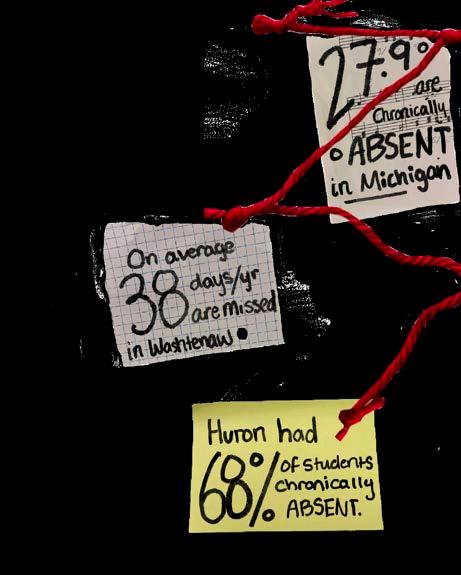
A recent report by the AnnArborObserver. com found that 68.6% of students at Huron High School have missed at least 10% of the school year, placing Huron among the high schools with the highest absenteeism rates in the Michigan. Statewide, Michigan’s chronic absenteeism rates, or the percentage of students that miss 10% - or 18 out of 180 daysof school, sits at 27.9% in 2024-25, according to the Michigan Department of Education, making Ann
Arbor Public Schools significantly higher than the state average.
Attendance data from surrounding districts highlights how unusual Ann Arbor’s numbers are. Huron’s chronic absenteeism rate of 68.6% exceeds both Pioneer High School at 63.7% and Skyline High School at 61.6%.
By comparison, nearby Saline High had a rate of 14.7% and Dexter only 10%. Statewide, 27.9% of students were chronically absent in 2024-25. Only 11 of Michigan’s 138 large high schools had rates above 60%, and all three Ann Arbor high schools are on that list.
The numbers also represent a sharp increase compared to before the pandemic.
During the 2018-19 school year, Huron’s chronic absenteeism rate was 19.7%, while Pioneer and Skyline reported rates of 17.2% and 21.0%, respectively.
The consistency across the district suggests the issue may reflect greater shifts in school culture after the pandemic, including changes in how students and families view the importance of physically being present at school and participating in classroom communities.
“I have asked students directly about attendance,” Badalamente said. “They told me parents are not as strict about attendance as long as they are passing classes.”
For some students, the decision to stay home isn’t always academic.
“If I’m actually sick, I’ll stay home,” junior Caleb Lee said. “Other times it’s stuff like who’s driving me, if there’s a test or something important, or if I’m just
BPA travels to Nashville for Nationals
MIA LIN WEBSITE EDITOR-IN-CHIEF
Upbeat music blasted from around the entire auditorium, reverberating through the plastic chairs along with the purple and blue lights shining from the ceiling. The award ceremony was bustling, filled with discussion and laughter.
On Wednesday, May 6, at 7 a.m., ten members of Huron’s Business Professionals of America (BPA) club drove through Ohio and Kentucky to Nashville, Tennessee for BPA’s National Leadership Conference. Members who qualified during state competitions in March were eligible to go.
“Before the trip, I was both nervous and excited,” junior Sridevi Kurisetty said. “I’ve never been to the southern states, and I get homesick pretty easily, but it was also my first time making it to nationals.”
The events started the next day on Thursday, May 7. Some had presentations, while others had testing events instead. Sophomore Kanishka Gupta had Personal Financial Management, a testing event, as well as Economic Research Individual, a presentation event.
second place for Economic Research Individual.
“Honestly, it felt really rewarding,” he said. “A top three plaque was what I was really hoping for, so placing first in Personal Financial Management and second in Economic Research Individual was kind of surreal. When they called my name, I was mostly just relieved and grateful, since all my prep finally paid off.”
In addition to Gupta, junior Lakshya Jaiganesh received a fifth place medal for Advanced Interview Skills, and freshman YuanXi Zhao got ninth in Health Administration Procedures.
“It was really cool to meet so many new people from across the country that were all competing to achieve the same goal,” Jaiganesh said. “I didn’t do great at the state level and only qualified for the national tournament after two people dropped out, so it was really validating to do good at the national level. We had a small group of kids, and it was fun to explore
“The few days before nationals were really just review,” Gupta said. “The bulk of my prep happened in the lead up to regionals and states. I wasn’t thinking about winning during the actual events; I was just trying to execute what I’d practiced.”
At the awards ceremony downtown, Gupta won first place in Personal Finance Management and
The robotics team at Huron High School spent the season building and improving robots, testing and competing at robotics competitions. Team members have dedicated long hours to designing robots and solving problems. While this season hasn’t been their best, finishing in the semifinals of their latest competitions and not qualifying for states, they are ready to make the jump to the next level.
Junior John Paulo Pimentel-Walker has been an essential part of the team during his three years as a member of the robotics club.
Nashville with them.”
Throughout their visit, the team toured Nashville, shopping at the nearby mall, visiting Dave and Busters and walking the streets.
“Besides our events, there [were] a ton of other things to do,” Kurisetty said. “The resort was huge, so we spent a lot of time roaming around. Our chaperones also scheduled trips where they’d drive us downtown for the afternoon to get lunch and explore.”
On the way back on Sunday, May 10, they went to the Mammoth Cave national park in Kentucky, which they weren’t able to go into the first
time on the way to Nashville.
“It was very big on the inside, like a cavern,” said junior Nandinshagai (Nandia) Erdenebat, describing the self-guided tour. “It was pretty cool.”
This BPA trip was during a major spring testing week, which caused some frustration for students who had to miss AP or DP exams or study for them during the trip. For Gupta, he took two APs before the conference but missed AP Macroeconomics and AP Statistics.
“It was definitely tough,” Gupta said. “I had to study for and take AP Microeconomics and AP Chemistry before leaving [...] which was a lot to juggle. The timing isn’t ideal, but it’s worth it to be able to compete at nationals.”
Traveling to Nashville was the last BPA trip of this year, the end of a long journey from regionals to states to nationals.
“It’s bittersweet,” Gupta said. “Nationals is generally always the high point of the year, and it’s sad knowing the season is wrapping up and the seniors are graduating. But I’m really proud of what Huron BPA accomplished this year. We’ve got a really strong group, and I think we’ve set a strong standard for next year.”
NEWS
briefs
BEZAS PLACES FIRST IN NATIONAL PHOTOGRAPHERS OF AMERICA
JOSEPH
SUNG NEWS EDITOR
This past month, senior Ryan Bezas took on a competition called the National Photographers of America. The competition was centered around sports photography, however Bezas decided to take a separate approach.
“The series focused on real emotion and intensity in sports rather than just action shots,” Bezas said. “I wanted the photos to feel authentic and tell a story.”
Focusing on the emotional and immaterial aspects of the shot, Bezas also came with hours of practice. To prepare for the competition, students had to prepare extensively in photography, editing, and videography.
“I spent a lot of time planning angles… and the type of moments I wanted to capture,” Bezas said, “But I also stayed ready for unexpected moments during games.”
Beyond the preparations, the actual competition came with its own set of challenges.
“One challenge was shooting in fastpaced environments with difficult lighting,” Bezas said. “Editing was also hard because narrowing down the best photos is never easy.”
However, despite the comprehensive and intense preparation and competition, Bezas came out victorious with a first place finish.
“Our season was fun but a little disappointing,” Walker said. “I would like to make states next season, and I think we can do it with all the talented members on our team.”
Leadership is also a big part of the robotics team. New members are
introduced to plenty of new topics consisting of testing, improving, and building robots. Walker is trying to step up as a leader on the team.
“I try to set a good example for younger members by showing up to every
practice,” Walker said. “I also try to help new members learn about robots.”
The robotics team is always looking for new members and is willing to take anybody that goes to Huron. You don’t need to know about robots or have any engineering skills. If you are interested in joining, email PimentelWalker and tell him you are interested.
“It felt really rewarding because of how much time and work goes into photography behind the scenes,” Bezas said. “It motivated me to keep improving.”
Junior Pimentel-Walker reflects on the robotics club season
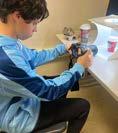
Bezas taking a picture of a Starbucks drink for a yearbook feature page.
PHOTO COURTESY OF SARABETH BADALAMENTE
Huron’s robotics team, RatPack830, at the 2026 FIM District Livonia Event in April COURTESY OF RATPACK830
EDIN LINIC STAFF WRITER
Junior Lakshya Jaiganesh, sophomore Kanishka Gupta, and freshman Yuan-Xi Zhao bite their medals from the BPA National Leadership Conference. COURTESY OF JONATHAN COOK
Juniors Eva Wang, Nandia Erdenebat, and Sridevi Kurisetty pose in Mammoth Cave. COURTESY OF COOK
Huron’s Business Professionals of America club takes a team picture at nationals. COURTESY OF JONATHAN COOK
Ten things you did not know about OpenAI’s terms of service
JAEWON LEE PRODUCTION MANAGER
Let us be honest, we all click “I agree” when we sign up for a new web application without actually reading the terms of service (ToS). But do not feel bad. Over 90% of consumers accept the ToS without actually reading them (Business Insider). That practically means we get an F in digital security.
You might wonder, would not this “lack of reading terms” affect how companies treat our data? Well, you are correct. Over 800 million people have an OpenAI account
(Medium), and you can bet that not even a fraction of those people read the 3,315word ToS. That is a big concern, and many people break the ToS without even realizing it.
So today, we are going over 10 different things that you would not have known about OpenAI’s ToS before reading this article.
1. Minimum age OpenAI requires users to “be at least 13 years old or the minimum age required in your country to consent to use the Services” (OpenAI). Persons below the age of 18 also need to get parent or guardian permission before using the Services. This rule is because of the Children’s Online Privacy Protection Rule (COPPA). COPPA protects users under the age of 13 from harmful websites. While
OpenAI is not harmful, children under 13 are callow, and they can’t form a legally binding agreement with companies without parental supervision. However, 26% of US teens use OpenAI for homework (Pew Research Center), and you can also bet more than a fraction of that population did not get their parent’s permission before using OpenAI.
2. User requirement to verify accuracy
Accuracy is important in this world. However, the word “accuracy” might as well be the antonym of what AI is. Users are warned by the message “ChatGPT can make mistakes. Check important info.” Users are also mandated to verify the information OpenAI says (OpenAI), while many students just mundanely copy-paste AI responses into their assignments.
3. Restriction of access to account
Many students use their school accounts ending in aaps.k12.mi.us instead of a Gmail account. However, an aaps.k12.mi.us email is a workspace-managed email, meaning that a workspace administrator can manage your account. When signing up to OpenAI with an
aaps.k12.mi.us email, that means that “the organization’s administrator will be able to control your account” (OpenAI). This also suggests that AAPS administrators can ban your OpenAI account any time.
4. AI honesty
Many students use ChatGPT to help write their essays. However, they rarely disclose that artificial intelligence was used in the creation of the process. This is a direct violation of OpenAI’s ToS (OpenAI).
5. Input Rights
Many people upload images or content that are not theirs into the ChatGPT interface. While they might feel like it is fine, it is another direct violation of OpenAI’s ToS (“You represent and warrant that you have all rights, licenses, and permissions needed to provide Input to our Services,” OpenAI).
6. Sole account
Many students share their OpenAI accounts with their friends and classmates, helping each other use AI in a beneficial way. While this is a generous act, it is directly against the OpenAI ToS. Its ToS explicitly says that “You may not share your account credentials or make your account available to anyone
Biology and Physics students travel to Cedar Point
On Apr. 18, Huron students got on the bus and traveled to Cedar Point in Sandusky, Ohio for their AP Biology, AP Physics and DP Physics classes.
else” (OpenAI). So technically, sharing your account with your friends can get your OpenAI account suspended.
7. Deletion of risk accounts
You might believe that you can keep your OpenAI account as long as you do not breach the ToS. That is not true. OpenAI can delete any account as long as they have minimal suspicion that it will become a problem to the public or the company (OpenAI).
8. Deletion of inactive accounts
Most people think their data is stored forever and they can access it whenever they want. That is not true in OpenAI’s case. OpenAI can “terminate your account if it has been inactive for over a year and you do not have a paid account” (OpenAI). While OpenAI will provide you with an email saying that your account is being deleted, many students do not check their emails, leading to the issue that inactive accounts will be deleted.
9. Updating of TOS OpenAI also may update their
GRAPHIC BY JOHNATHAN PRYOR-MCADAM
JOHNATHAN PRYORMCADAM SOCIAL MEDIA EDITOR-IN-CHIEF
1. Juniors Sophia Pham and Allison Kwan walk through the busy streets of Cedar Point.
2. Seniors Averil Xu, Jessica Wu, Tanishka Tewari and Angelys Ramirez pose with their ice cream at the dining pavilions.
3. Juniors Sarah Xu and Caleb Lee ride the Midway Carousel.
4. Juniors Charles Cools, Aarav Dalal, Benjamin Tarnutzer and Johan Kim pose in front of the Cedar
Setting the standard of excellence
Huron student places top 50 in the United States National Chemistry Olympiad
Huron High School has many exceptional students who have received national recognition for their abilities. One way for students to distinguish themselves is national olympiads. One of
in the top 50 nationally.” Anonymous said.
The Huron senior describes their studying experience and the steps they took to succeed in the olympiad.
“I spent a few months preparing for the exam,” Anonymous said. “Mainly, I
spending time reading the content and doing practice problems. The olympiad itself was difficult, especially the lab portion, because it’s hard to get experience for those types of questions.”
The senior believes that olympiads are a good way for students to progress academically and personally.
“I would recommend that other students commit time to national olympiads, given that they have the time,”
Anonymous said. “It really helps to have a
goal to work towards, and most students will find that studying for the olympiad is more rigorous than normal school requires.”
Anonymous also expresses their belief that schools should attempt to promote olympiads by increasing the student exposure. They also expressed their concerns over the complexity of the system for national olympiads.
“I do think schools should promote olympiads,” Anonymous said. “However, one of the issues is that there are so many of them that it’s hard to keep track of. I believe school could simply help make it more known that there is an olympiad that relates to topics students
Experiencing living in America: leaving the comfort zone
My name is Marina. I am from Rio de Janeiro, Brazil. I came here after my mom was approved to complete her doctorate at University of Michigan. First of all, it is important to know that being an exchange student is not easy. I still remember the exact moment I arrived at the airport, holding my heavy suitcase and feeling my heart beat fast with a mix of excitement and absolute fear. Moving to a different country and speaking a different language in a place where you don’t know anyone was very difficult in the beginning.
I left behind my family, my friends, my house and my country to follow my dreams. I miss them every single day. On
the other hand, I am having so much fun here. I made some really good friends who take me to the best places and make me feel so beloved. For instance, my friends Jules Heskia and Anjali welcomed me from day one, and helped me navigate the school when I felt completely lost.
My first reality shock was the temperature, which was 40 degrees colder than Brazil. Back home in Brazil, the weather is usually very hot and sunny all year round. When I first arrived in Detroit I was scared, but I knew I had a world of possibilities around me and I just needed to be myself.
At Huron I was very lost at first. I looked around and I didn’t know anyone. I was late for classes because I didn’t know my way around. Over time. things got better. I was already
I am Shamila, a student at Huron High School. This is my final year of school, and I will graduate in two weeks. I am 19 years old. I arrived in the U.S. in August of 2021, so this is my 6th year in the U.S.
First, let’s talk about the thorns of life in the U.S. Life in America is not the same for everyone, because the circumstances are different for each person. For me it was very,
more familiar with the school. Nowadays I know how to get where I need to.
From my point of view, people who move from abroad are very strong. Sometimes they just need to be. Experiencing a new culture is something that can be wonderful or terrible. This is due to the fact that you need to be open minded to new experiences and new people. Nevertheless, sometimes we need to overcome fears. After fear comes the world, and I think my experience is a good example.
I am sure that when I return to Brazil I will be a stronger person. I will be someone who experienced wonderful things after stepping out of their comfort zone, one who adapts to a completely different culture, and one who can communicate in a new language.
very difficult because when I came here I was alone, without family, very young, and I knew nothing about life here or how to speak English. For example, I struggled a lot in school because I was not able to express myself in English, even though I may understand the content in Persian. I experienced many difficult things in the first few days and it was not easy for me at all. I spent the first six months with all the fear and heartache of my family. However, I did not give up. I was taking medicine for depression while at the same time communicating with JFS to help my family move from Afghanistan to the U.S. Everything was turning towards a better direction two years after moving to the U.S. Having gone through hard times, I started to
might be interested in, especially since a lot of students that would take them don’t know they exist.”
According to the Huron senior, Olympiads are a way for a school to improve their students’ personal and academic growth while also raising the school’s standard of excellence. Olympiads are also a resource for students to learn more about fields they are interested in at a high level, and also distinguish themselves for their exceptional accomplishments. In the future, students may see olympiads as a meritbased way for them to distinguish themselves in an ever-increasingly competitive school system.
enjoy life here. One of the shining points in the U.S. is that both men and women could have opportunities for work, education here is for everyone, and there are many opportunities to improve the quality of life and personal growth. I worked at Panera Bread in 2026. I was there because one of my friends was working there as well and she referred me to work there. I enjoyed working at Panera because I can learn new skills of making burgers and soup. Of course, it requires a lot of effort, perseverance, and perseverance. Nothing comes easily or for free. You have to work for your goals. But the beauty of America is that you come to a conclusion after trying. For example, in my country, trying is useless through education because we
do not have a good government. In America, there is a lot of respect for the beliefs and colors of all the people who live here. Here, race is not the criterion, but talent.
The year of 2026 is a milestone for my life. Having struggled at school for a few years, I will finally graduate with a high school diploma. I will attend Washtenaw Community College and pursue a career as a dental nursing assistant. At the same time, I am also looking for a part time job to provide financial support for my family. And I want to keep trying for the dreams I’ve always wanted to live. This year was one of the best years for me, and I am happy for myself that I did not stop trying, hoping for greater success for myself.
MARINA TRINTENARO STAFF WRITER
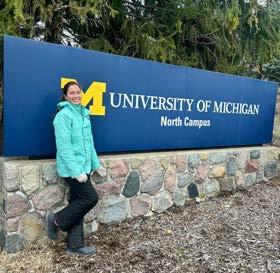
Trintenaro posing in front of University of Michigan sign. PHOTO COURTESY OF TRINTENARO
SHAMILA WAKILEEY STAFF WRITER
Wakileey in the HHS library. PHOTO COURTESY OF WAKILEEY
WILL YE FEATURE EDITOR
Behind the mask: Kenzie Lin’s fencing journey
AMY YANG MANAGING EDITOR
The fateful period of the COVID-19 pandemic was what began sophomore Kenzie Lin’s journey of fencing. Like many others who were forced to stay indoors, Lin started fencing as a way to simply stay active. But unlike COVID quarantining, fencing would remain a large part of Lin’s life for a long time.
Standing out as one of the oldest Olympic sports, fencing is the modern version of dueling, requiring a demanding blend of speed and mental strategy culminating in intricate footwork and explosive energy. This type of uniqueness was one of the key factors in Lin choosing to continue to play the sport.
“I learned to love the
sport and continue it because of how unique the sport was,” Lin said. “Fencing was unlike a lot of other sports I’d done previously, and I thought it was fun hitting people with metal sticks. Although I didn’t [initially] choose this sport, I am very happy I did, and hope to continue it for a while.”
Fencing is a large part of Lin’s extracurricular activities with its extensive training efforts and competitions throughout the year. However, besides the large amount of time and energy spent, fencing also allows Lin to experience a sense of accomplishment in everyday life—through setting tangible short and long term goals that differ from typical academic goals.
“Unlike goals in academics, or goals in other activities like music, the
goals I set for fencing felt more measurable,” Lin said, “[They] seem more achievable because they are more objective, and create a clear path for me to work toward.”
In fencing, Lin was able to form friendships, confidence and physical strength. Additionally, the pressure for success during competitions offers valuable opportunities for notable life lessons. Lin recalls a memory of a regional competition where she had gone against a skilled opponent. She was down about 7-2 as the final period approached.
“I decided to keep trying no matter what, and even though I was very behind, I was able to slowly tie up the score to 9-9 when we went into overtime,” Lin said. “Although I was nervous, I was able to stay calm, and score the last touch
“
ADVISER
Sara-Beth Badalamente
EDITORIAL BOARD:
Annabella Mi 403008@aaps. k12.mi.us
Ishaan Kamat 435293@aaps. k12.mi.us
Kayla Fu 321984@aaps.k12. mi.us
Amy Yang 325286@aaps.k12. mi.us
EDITORS:
Lakshya Jaiganesh, Mia Lin
Website Editors-in-Chief
Johnathan Pryor-Mcadam Social Media Editor-in-Chief
Amelia Bai Chief Content Editor
Jenny Zhang Copy Editor
winning the bout. It isn’t just about the actions you can do and your physical strength, but also your mental strength and your ability to keep going, even when you feel you’re losing.”
Fencing was never just a sport, and since she had first tentatively tried out the sport in her mom’s friend’s fencing club, Lin has grown to love the game. For beginners and others looking to begin fencing, Lin offers advice for the necessary mentality facing loss required of the sport.
“It’s okay to lose,” Lin said. “By practicing against stronger people, you will learn to become stronger. By losing, you learn more on how to improve. Learning a sport isn’t just about winning vs. losing. There are other aspects, such as being brave enough to try new things, and being brave enough to fail.”
“Learning a sport isn’t just about winning or losing. There are other aspects such as being brave enough to try new things, and being brave enough to fail.”
SALEM DINH SOCIAL MEDIA EDITOR-IN-CHIEF
On May 4, 2026, Ann Arbor Public Schools (AAPS) Board of Education Trustee Don Wilckerson resigned from his position as Treasurer. Elected in 2024, his time on the board was cut short due to personal reasons.
“I understand and respect his decision to prioritize his family at this time,” AAPS Board President Torchio Feaster said.
The AAPS Board has now decided to continue putting their efforts into finding a replacement for Wilckerson’s position.
“I am personally committed to ensuring that the process is thorough and open, and that it reflects the trust our community has placed in us,” Feaster said.
THE EMERY STAFF
Jaewon Lee Production Manager
Sung, Andrew Etchell News Editors
Ye, Saanvi Kulkarni Feature
Salinas
Wilkerson (far left) with other board members.
PHOTO COURTESY OF FRANCIS BADALAMENTE
KENZIE LIN
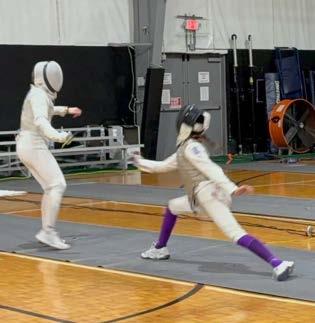
Sophomore Kenzie Lin fencing. PHOTO COURTESY OF KENZIE LIN
A language of dance -- Bharatanatyam
AMY YANG MANAGING EDITOR
Originating in the Hindu temples of Tamil Nadu, in southern India, Bharatanatyam (pronounced bah-ruh-tuh-NAH-dee-uhm) is a style of Indian classical dance. The history of the dance dates back to the text Natya Shastra (a foundational ancient Indian treatise on the performing arts) and grew roots in religious temples. From there on, it resurged as a dance style that is witness to the history of South Indian tradition, culture and religion.
For many, like sophomore Sakshi Sivakumar, Bharatanatyam is a way to stay connected to cultural roots despite geographical distance, a way to relive the experiences of generations before and connect to the larger picture that shapes who they are.
“I love being a part of something like this because it shows me an activity that goes bigger than me to create a larger mosaic of our culture,” Sivakumar said. “Where each person plays a vital role in its construction.”
The Bharatanatyam style of dance is noted for its fixed upper torso, bent legs, and flexed knees, combined
with extensive footwork.
Through the gestures of hands, eyes, and face muscles, the physical movements are translated into storytelling and the conveyance of emotion. During the COVID pandemic, when Sivakumar had just begun learning the dance and when the comprehensive movements and expressions of the
dance faced confinement, motivation became a struggle for Sivakumar.
“At first it was a big adjustment for both me and my teacher,” Sivakumar said. “It felt much harder to stay motivated and more like a chore than an art. Eventually, meeting up with my friends to practice helped me begin to enjoy it more.”
Retiring Huron teachers and staff of 2026
Since then, Sivakumar has had to learn to balance schoolwork and other aspects of life alongside the time that needed to be allotted for Bharatanatyam. However, she notes to importances of staying “present,” despite facing a demanding schedule.
“Once I got to high school, it became hard to separate everything that happens before dance class with everything that happens after,” Sivakumar said. “But learning to unplug from all my responsibilities each week and fully devote myself to dance regardless of if I practiced or how I think I’m doing is really important.”
To others looking to immerse themselves into the rich culture of Bharatanatyam as well as similar activities, Sivakumar offers advice, emphasizing the importance of consistent practice.
“I would recommend making a practice schedule that fits with your daily life and schoolwork and trying to stick to it as much as possible,” Sivakumar said. “Practice is the only way to get better and more confident and I wish I started a schedule earlier so I could get into the habit of practicing.”
ABSENTEEISM | FROM PAGE 1
exhausted.”
Junior Sounak Debnath agreed.
“A lot of stuff’s online so missing a day isn’t the end of the world,” Debnath said. Huron librarian Bruce Popejoy said he also noticed a shift in how students view attendance compared to previous years.
“For some reason kids don’t think they need to come to school as much as they used to,” Popejoy said. “Which is a shame, because you still got to meet the requirements for graduation, and if you miss too much school, that will also affect your grades.”
Part of that shift may also be tied to changes with schools using more onlinelearning platforms like Schoology.
“I think Schoology is a bit of a double-edged sword,” Neevel explained. “It’s great that things are accessible and available for students at any time. But it makes it easier for students to miss because they think, ‘Oh, I can just get it later.’”
She added that students who miss class will often lose more than just instructional time.
“I think emotionally and socially, students miss out on creating a community within the classroom,” Neevel said. “You miss out on not just the work, but the conversations and the classroom bonding moments.”
Jeremy Singer, an education researcher at Wayne State University who studies chronic absenteeism in Michigan schools, has focused on how attendance is connected not just to academics, but also to larger factors such as student engagement, school culture and access to resources.
Although graduation rates in Ann Arbor remain relatively high, researchers say chronic absenteeism can still have long-term effects. Research on Michigan schools has connected frequent absences to lower grades, weaker classroom engagement and disruption to instruction.
Neevel, the issue goes beyond attendance records or grades.
a different kind of learning that happens when people are actually there,” she said. “You can post assignments online, but you can’t completely recreate discussions, collaboration or the feeling of being part of a class.”
Sivakumar dancing Bharatanatyam, a classical Indian dance. COURTESY OF SIVAKUMAR
Michigan breakdown
Indian: 125,000
Chinese: 70,000
Filipino: 50,000
Korean: 35,000
Vietnamese: 23,000
Japanese: 22,000
Asian Americans are the largest minority group in Ann Arbor, making up around 15% of the total population
On
the topic of ABGs and fetishization
now popular aesthetic, its history and significance in minority communities seem to have been obscured.
Reflections on AAPI Month
On becoming “Asian-American”
KAYLA FU PRINT EDITOR-IN-CHIEF
May is a bittersweet month for me. As a ChineseAmerican living in Ann Arbor, a city with a relatively strong Chinese community, Asian American Pacific Islander (AAPI) month is a symbol of community, of a collective shared experience and a reminder that our “otherness” is a celebration in and of itself. In the same breath, it is also a firm reminder that I was not made to fit into America. The Asian American community in particular is deeply flawed, a reality that I face when I think of people who look like me, talk like me and think like me.
Oftentimes, it feels as if much of my past Asian American experience was trying to find proximity to whiteness instead of being okay with staying “in the middle,” caught in a crossroads of
identity that is actually not a crossroads at all. I belong to no side.
Sometimes, I find myself feeling as if I do not belong at all. For most of my life, I thought that being Asian American meant straying far from the label of Asian, sticking as close as possible to what white peers expected of me, leaning into the model minority myth and oftentimes not even counting myself as a person of color. Asian people, however, are as far from whiteness as every other people of color. We are not separate from other minorities and attempts to be white will never make us anything but AsianAmerican. We are nowhere near whiteness, and attempts to get closer towards white expectations are a betrayal to our identity as people of color.
I’ve spent so much of my life allowing myself to submit to what white people want of me. I’ve dressed like them, talked like them, sold them parts of my culture on an appetizing plate while hiding the parts that would be less “palatable.” I have spent so much of my life curating this dish. I have plucked and preened, shaved down the sharp and seasoned the bland. I have wanted for so long to be what the white gaze expects of me. In turn, I gave away my label as a person of color, a price I realized far too late also gave away part of my agency. I am so ashamed, and yet, growing away from this has made my faith in my identity grow as well. Asian people, especially East Asian people, must know before anything that they are not white. Before we are a “model minority,” we are a minority. And being a “model minority” indicates we are a weapon. We are one of the “good ones,” the quiet ones who stand back when other people of color are brutalized and shunned.
We say nothing and keep our heads down. We climb the corporate ladder and excel in academics. We are willing participants in capitalistic exploitation. We turn our heads to other people of color.
We say nothing, believing that upholding our model minority status will protect us when we are no longer perfect. But has it ever saved us? Has our complacency ever proved to be useful for anything besides stripping us of solidarity? Has being their model ever achieved anything besides reaffirming racism against other people of color? May is bittersweet. It is a reminder of my personal shortcomings, but also a reminder that there is so much beauty in finding yourself through a label you’ve never been sure of.
We are a nuanced, confusing, beautiful community, each of us. Today, I am proud of who I am. I represent an intricate intersection of identity, one that has become an identity of its own. I hold traditional Chinese values while also believing in firm American ones. I gossip with my friends in Chinese and write essays in the English language I have been perfecting since I was born. In the morning, I eat rice noodles for breakfast. At lunch, I eat chicken nuggets. I know little about the country in which my parents were born, but whenever I visit, it still feels like home. Today, I feel no shame for being “too American” or “too Chinese,” but one thing is for certain: my Asian-Americanness is not defined by proximity to whiteness.
The term ABG stands for “Asian Baby Girl” (or “Asian Baby Gangster”). Originally referring to East or Southeast Asian women involved in streetgangs, across social media platforms and other media outlets, ABGs are now seen with dramatic eyelashes, nude and brown lip tones, and arched brows. Outfit-wise, streetwear and figure hugging pieces are typical. Yet beneath the
To be able to define the true meaning of the term “ABG” is to be able to trace back to its history and roots. Although the aesthetic is now commonly associated with East Asian influencers on social media, the term originally emerged within Southeast Asian and Asian American communities in the 1990s, where young women used fashion, nightlife, tattoos and makeup as forms of rebellion against stereotypes that portrayed Asian women as passive and submissive. Resistance to the constant restrictive gender expectations shaped modern Asian female identities.
In one aspect, the ABG subculture heavily intertwines with those of the Latinx and Black community, yet this history is often disregarded. In the urban setting where the subculture emerged, the close proximity between the different ethnic groups led to both direct and indirect influence. For example, the signature thick, arched brow feature of ABGs was inspired by the Black and “Chicana” women. Both
had originally used dramatic makeup and bold styles as a form of resistance as a form of defiance to white standards that excluded minority groups from the definition of beauty, and the dramatic brow was no exception. Cultural influence goes both ways, and is clearly seen through Asian influence in the nail and hair industry. In doing so, minority groups formed solidarity in the face of discrimination and subversion, creating a unique common language of resistance. However as the ABG subculture gradually becomes part of the mainstream, its Black and Latinx roots are forgotten and lost to new generations. This not only leads to the erasure of the identity of the style that is unique to resistance, but continues to enforce the marginalization of the very groups that inspired and created this subculture. While the ABG style is considered trendy and attractive on East Asian women, capturing the spotlight on major social media platforms and fashion trends, similar fashion choices on Latina and Black women are deemed as “trashy,” or “ghetto.” It seems ironic that the ABG subculture, created in collective resistance to subversion, is used as its own form of marginalization while simultaneously praised for cultural recognition.
How do you honor your heritage?
“Keeping family traditions alive and respecting the values passed down through generations helps me stay connected to my heritage.”
- Ahmad El-Yaman (11)
I generally feel really disconnected from my heritage. My parents haven’t really forced many beliefs or rules from Vietnam, besides the food my dad cooks for me.” - Sophia Pham (11)
“I go visit every year to honor my heritage. It’s cool to be Asian, especially being Sri Lankan because it’s not the most ‘popular’ Asian country out there. It makes me unique.” - Sahan
Many people loved Emma Chamberlain’s look at this year’s Met Gala. I have to agree, this one is definitely unique and I absolutely love the colors on the dress. The bottom of the dress opens up
Who else was shocked by Bad Bunny’s look at this year’s Met Gala? I definitely was. His look was intended to show what he would look like 50 years from now. He is currently 32, so his look shows himself as an 82 year old. The makeup is very hyper-realistic, and I enjoyed the creativity of this look.
I gotta say, I think Jisoo’s look is the best out of the Blackpink members at this year’s gala. Made by Dior, her glittering pink gown immediately caught my eye. I especially love the flower bouquets added on the dress; it really elevates the whole look. Her hairstylist also did an incredible job of styling the hair in a way that matched the vibe of the dress while also
For her first at the Met Gala, Alysa Liu did not disappoint with her look. She looks absolutely stunning in this deep red dress. I love the intricate detail in the front of the dress, and the matching red shoes. However, I don’t know how I feel about the dress sticking out so much out at the front.
The new Saline data center: AI’s role in Michigan’s future
TAVANE SHIVAKUMAR BROADCAST EDITOR
intelligence (AI) infrastructure sites in the country. A massive OpenAI and Oracle-backed data center is projected to cost billions of
nation’s largest AI data center campuses. Still, the project also exposes a growing problem in the modern economy: technological progress is often celebrated long before communities know whether they will truly benefit from it.
Governor Gretchen Whitmer has framed the proposal as a transformational moment for the state’s economy. In an October press release, accounting for the project. Whitmer called it “the largest economic development project in Michigan history.” She added that the facility would “cement Michigan as a global leader in the future of AI and advanced computing.” In many ways, state officials are right. Michigan cannot rely forever on the industries
Staff Editorial: Fighting senioritis
Ready, set, go.
It’s a race when we’re inside these hallways -- the teacher who is blurting attendance, the student who is refreshing Quizlet, the bell that tells us there is another place to go. We’re always moving and feeling our lives in between the seconds.
With summer barely out of reach, Huron is eagerly transitioning out of these subtle competitions. Seniors are looking beyond high school, juniors are finishing standardized tests, and underclassmen are planning for these events. Throughout all grades, there is a commonality: everyone is
tired.
Senioritis is the pseudoscientific term for when one suffers this insistent burnout, because it is a visceral exhaustion.
And although “senior” is the combining form, senioritis can truly occur in any grade. The symptoms can include extreme fatigue and the inability to focus. As energy decreases, stress increases inversely.
The secret to “curing” senioritis is understanding how it happens. Burnout, for many, is the result of rushing into the school year guns ablaze, tearing apart extracurriculars and
assignments as if everything is infinite. But as to-do lists lengthen, we only have so much to give. Putting the breaks on and acknowledging to slow down can alleviate senioritis. Some students, knowing certain years are more extracurricular heavy, schedule lighter classes to balance the scale. Other students, who need quality time with friends to ease the stress of school, plan consistent hangouts with loved ones. Many students reduce extracurriculars or let go of certain responsibilities to compromise for the more tenuous seasons.
This look by Heidi Klum definitely surprised me when I first saw it. I’ve never seen anything like this. While the Met Gala is known for some exotic outfits, this was not what I was expecting. The look reminded me a little of the Statue of LIberty, with the detailing on the crown and all. Personally, I am not a fan of this outfit as the colors are dull, and there really isn’t anything eye-catching about it besides from being erratic and out of the ordinary.
that defined the 20th century. If the state wants to remain economically competitive, it will need to compete for the infrastructure powering artificial intelligence. Supports see the project as Michigan’s opportunity to reinvent itself for a technological era increasingly defined not by hardware but by computing power. Reuters reported that the facility would form part of OpenAI and Oracle’s broader “Stargate” initiative, a national effort to rapidly expand AI infrastructure across the United States amid rising global competition. But economic relevance alone does not automatically make a project beneficial for the communities expected to host it.
State officials have emphasized the economic scale of the proposal. Whitmer’s office projected the development would create 2,500 union construction jobs and more than 460 permanent positions once operational. The numbers sound transformative at first glance, but they also reveal one of the central contradictions of AI infrastructure: Unlike the manufacturing plants that once defined Michigan’s economy, data centers require enormous resources while employing relatively few people once construction ends.
But in Saline Township,
And all of these actions are the one-step further for your end-of-school burnout. If you don’t, the possibility of falling apart is nearly inevitable. There is no prize for burning yourself out before the finish line. School will keep moving whether we stop to take a breath or not, so maybe the best thing we can do is stop pretending that this exhaustion is supposed to be normal. Let yourself slow down. Let yourself care less about perfection. The school year is ending either way, and no grade, meeting, or deadline is worth losing yourself to stay afloat.`
Saline Township, just
HEMANTH
Graphics by Jessica Milner
85-92% of students report using generative AI tools like ChatGPT in their studies PHOTO BY ISHAAN KAMAT
Finding the best pho in Ann Arbor
they specialized their pho in contemporary, fusion or authentic styles.
EDITOR-IN-CHIEF
Over the course of April, we visited four Vietnamese restaurants in Ann Arbor to determine where the best pho is. Pho is a Vietnamese dish of slow-simmered broth that is typically prepared with beef bones, served with rice noodles, protein (historically chicken, but includes beef as well) and toppings. Sriracha and hoisin sauce are often served on the side.
We went to Ginger Deli for the first week, One Bowl for the second, Saigon Kitchen for the third, and Dalat Restaurant for the fourth. Out of these establishments,
Ginger Deli -
203 E Liberty St
Located in downtown Ann Arbor, Ginger Deli is a casual, dip-and-go eatery. It has a quaint menu of Bánh Mi and a vegetarian or beef pho, which we ordered in addition to a Chrysanthemum boxed tea and mango juice. The pho met our requirements of a tender meat, cooked in the broth. However, the broth to noodle ratio was greatly imbalanced, although the flavor was not bothered by this.
The vegetable pho had a more contemporary array of fermented toppings, while the beef pho did not arrive with the traditional toppings as well. While the meat created softness to the texture, a crunch was absent. Ginger Deli is a contemporary and accessible place for those passing by and wanting a twist on Vietnamese welfare
One Bowl -
Ann Arbor Plaza, 1220 S University Ave
Described as an authentic restaurant that serves Asian cuisine, One Bowl is also located in downtown Ann Arbor. While the menu offers dishes from Vietnam, China, Korea and more, we decided to focus on Vietnamese food and ordered pho (both chicken and beef), as well as agedashi tofu, a
Tomodachi life: living the dream
Tomodachi Life: Living the Dream is going to be the game of the year, but what is this game even about?
With similar game mechanics
classic Japanese appetizer. While the meat seemed to be low quality, the pho consisted of a flavorful broth and was served with sides such as bean sprouts and limes. Both bowls of pho were large and worth the price of around 13 dollars. We noticed that the sriracha and hoisin sauces that got served were diluted, so they did not add to the flavor as we had hoped.
Despite being labeled as authentic, the agedashi tofu seemed to be on the American side and did not come with typical toppings of benito flakes and scallions. Though this did not affect the quality of the pho, it negatively impacted our overall experience.
Saigon
Kitchen - 521 E Liberty St
Saigon Kitchen is snugged inside of downtown, and is lined with photos of Vietnam in the night. There are colorful lanterns on top of each table. The server immediately showed us the depository for utensils, as well as the QR-code menu. This is definitely one of the more convenient phos we’ve
had. When you order, you pay
instantaneously. As usual, we had the beef and chicken pho, with a coconut panna cotta. The chicken pho was extremely flavorful and with a fair portion size. However, the beef pho did shy from as much potency and the chicken was not the best quality.
As a sugary finale, there is also a joint Vietnamese cafe called Block and Brew next door. It shares the menu items of Saigon Kitchen as well as serving Vietnamese coffees and memorable strawberry matchas. Saigon Kitchen seems to have a consistent serving of true Vietnamese food in a prominent location.
Dalat
Restaurant - 2216 S Main St
A small Vietnamese family restaurant, Dalat Restaurant is located in a strip mall in Ann Arbor. The menu offers a variety of authentic dishes, with sections like appetizers, noodle soups, rice plates and more.
Similar to the previous places we visited, we ordered chicken and beef pho, as well as chili
popularity online that many people have been persuaded to purchase it. Huron juniors Elinor McLane and Ellie Young share their opinions on what they enjoy about the game as people who own and play it themselves.
“The way that you can make any person or character that you want, there are no limitations,” McLane said.
“The island customization is so cool, like, you can reshape the whole island to make it whatever shape or design you want,” Young said. “Like a sun and a moon, for example.”
But like with any game that gains popularity, there are always downsides.
“I wish it were easier to make custom items or clothing,” McLane said. “Like, why does it take forever to design and color in something as simple as a bottle of water?”
“When it comes to
shading, some of the blending tools dont really work properly with some colors,” Young said. “Not to mention it’s kind of difficult to draw, but granted, it’s just hard to do pixel art on a Nintendo Switch.”
At the end of the day, is this game really worth paying 60 dollars?
“I would say so,” McLane said. “I’d recommend this to people who like the creative freedom in making things from their favorite shows and movies.”
“For sure! There’s so much you can do in the game with the characters that you make and the relationships they can have with others on the island,” Young said. “The cut-scenes that characters have throughout the gameplay are fun. It’s kind of like an infinite source of entertainment
because there is no definitive end.”
Games of this quality and popularity don’t come out as often these days, so if someone were to find this game, it could be used as an outlet for story building with full creative liberties, even being able to customize characters’ personalities. The game can become whatever the user wants it to be.
ANDREA PEREZBERMUDEZ STAFF WRITER
ANNABELLA
Pho from Ginger Deli PHOTO COURTESY OF ANNABELLA MI
Pho from Dalat Restaurant PHOTO COURTESY OF ANNABELLA MI
Pho from Saigon Kitchen PHOTO COURTESY OF LAKSHYA JAIGANESH
Pho from One Bowl PHOTO COURTESY OF LAKSHYA JAIGANESH
Music is one of the most concentrated forms of expression there is. Listening to someone’s music is like looking into their soul,
understanding it holds a mirror up to your own.
Music is fundamentally connective, and in my sophomore year, I created the Sound of the River Zine with this idea in mind.
My main goal with the Zine was to build and be a part of a tangible community. I was inspired by the Riot Grrrl movement and their use of DIY press, how it connected them in a way that mainstream press could not.
In talking to local artists, getting to work with my incredibly talented peers and presenting on the zine
at conferences, I’ve been able to create relationships and make communities in places I didn’t know existed two years prior. Over this time, the Zine became more than just a side project; it became a way for me to learn what it means to be a person.
The biggest part of being a person, to me, is learning about and knowing the people around you. In writing and talking to people about music, the Zine gave me the invaluable opportunity to do this, and I could not be more grateful.
The
Sound
of the River Zine
The Sound of the River Zine was created by Isha Savi in her sophomore year. It is a dedicated column to local and relevant music. From a student-led section in a student-led publication, the Sound of the River Zine has a digital and physical edition.
To the Sound of the River Zine, we will always hear you.
The Bends album reflection
AVA BRYAN STAFF WRITER
31 years ago, 90’s art rock experimental band Radiohead released their landmark second album: The Bends. While it’s tough competition to be named the best technical album of theirs,
The Bends is certainly the most accessible. It’s a hard hitting, cathartic listen that reflects the alternative rock genre conventions of its time while giving the listener a preview of their later more electronic sound.
There’s a strong Pixies influence
The strings of jazz
ANNABELLA MI PRINT EDITOR-IN-CHIEF
Jazz is a genre known for its betweenthe-beat rhythms and oblique chords. It is a shriek from a trombone, a pulse from the bass, the blare of a trumpet. It can also be the curtain of
strings on the harp. Jazz harp is not the conventional chromatic coloring that the Duke Ellington Orchestra or Count Basie will drape. It can even be assumingly extracted from the jazz scene because of its implicit heritage and sheer
Summer party music by girls
ISHA SAVI CREATOR OF THE ZINE
As the weather warms up, our joints thaw out, and movement becomes necessary. Dancing, whether that be alone in your room or in a venue full of people, is one of the rawest forms
of expression there is. Music is dance’s muse, of course, and no one knows how to inspire like a female DJ. Below are some female-fronted electronic duos to get you ready for summer.
Fcukers is an electronic duo led by Shanny Wise and Jackson
Sarah Kinsley and ‘Fleeting’
AMELIA BAI CHIEF CONTENT EDITOR
In “Fleeting,” indie artist Sarah Kinsley paints an ethereal and transcendent landscape of dream pop. White gossamer and tinted blue hues, the album is a testament to yearning,
desire, and inevitable change. The album draws inspiration from synth pop and the indie dream pop scenes of the 80s and 90s.
In recent years, the act of yearning has successfully entered the mainstream. From books like “Normal People” to artists like Matt
Isha Savi created The Sound of the River Zine in her sophomore year. She is currently a graduating senior. PHOTO COURTESY OF ISHA SAVI.
A breakdown of the Huron JV Women’s soccer game
IZZY YIP STAFF WRITER
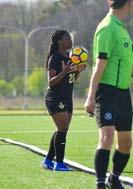
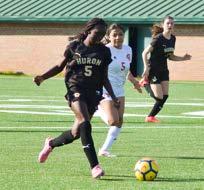
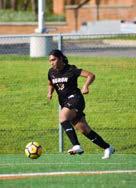
1. As a Monroe player advances toward Huron’s goal, freshman Iminosa Obaseki steps in to defend.
2. Freshman Iminosa Obaseki dribbles the ball down the field.
3. Scanning the field, Obaseki contemplates who to pass the ball to. “I was just looking for somebody to give the ball to,” she said. “I was just like waiting for people to open up so I could give them the ball.”
4. Racing towards the opposing team’s goal, freshman Jaz’lynn Browning dribbles the ball.
5. On a sunny afternoon in May, sophomore Emily Dasine dribbles the ball down the field toward Monroe’s goal. “[I was trying to be] a role model to my younger cousins,” Dasine said. “And maybe be a starter next time, and I also wanted to make a goal for the season.”
6. Evading Monroe players, junior Fanta Kaba maneuvers the ball.
7. After scoring the second goal of the game for Huron, freshman Claudia Schneider throws her hands up in celebration.
8. As the last half starts, freshman Savannah Fonville puts her hand in for the team chant.
SOFIA REYES
A&E EDITOR
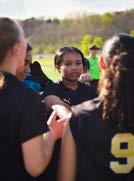
What started as rebuilding and growth as a team quickly became one of Huron’s best seasons in six years, one under first-year coach Anna Kauffman.
At the start of the season, the team “started off with a lot of work to do,” according to Kauffman. However, they improved and working with each oth-
er instead of alone. By the end of the season, they had six wins and built a stronger program than in years.
“They just needed someone to believe in them and give them space to be themselves,” Kauffman said.
Kauffman focused on building a positive culture and safe place for the players to be have fun while still advancing.
“They had the talent, and they had the ability,” she said. “I really trusted in them a lot, and I think letting the players lead themselves showed how much they wanted to be successful all along.”
Practices before and throughout the season
focused mostly on fundamental skills.
“But they’ve been the difference for us in some of those wins,” Kauffman said. She had felt the excitement of the season as they started winning games.
“That was really amazing, seeing the players get so excited and believe in themselves and just get hit after hit,” Kauffman said. “Once that confidence came up, we were unstoppable.”
PHOTOS BY IZZY YIP
Huron women’s softball has the greatest season in six years
At Father Gabriel Richard High School on May 12, senior Isabelle Ledezma strikes the ball PHOTO COURTESY OF MIKE HULSEBUS
Sit back and... RELAX
Huron men’s lacrosse cleans up their season
players say the team’s energy and chemistry kept them alive and everyone motivated. Matisse Fields said “strong.” A lot of the teams they play are very good and usually go to states like Pioneer, Dexter, Lincoln and others in the AAPS district.
To get ready before their season, most players focused on staying healthy and constantly working out. Matisse Fields, who has been playing lacrosse for two years, said the team continues to grow closer as the season goes on.
Fields said even during difficult moments in games, the team has stayed together and continued to support each other.
“We all have up and down thoughts, but together as a team we feel great working and playing
players.
“The brotherhood and the ability to have fun but also stay attribution.” In class, they love talking about the game the day after learning how they can get better and what went well or wrong.
Practices usually begin with warm-ups and joking around before the team gets serious about improving parts of their fixtures. Player Ethan Davies believes that the team’s pride separates themselves from other programs.
“The team never loses their motivation, no matter who we play or how a game ends,” Davies said.
Before big games (like Pioneer), Davies’ team’s mindset is as he says “locked in.”
He also says that’s the team’s mindset, and that’s the way they win games with
teamwork and their locked-in mentality. Even though this has been a rough year for the
Three years of lacrosse with Nathalie Cho
ELLA YIP PRINT EDITOR-IN-CHIEF
What holds a team together is never the individual, but the mindset and determination of one certainly make a difference to the team.
“My favorite part of this team is our chemistry.” senior and women’s lacross captain Nathalie Cho said. “I find myself befriending people I wouldn’t otherwise see at school, and I always have fun with the team, even on bad days.” It’s a space that truly feels like everybody wants to be here and be better.”
To keep this team strength going, she is creating memories that stand out. Starting her sophomore year in 2024, two years later, Cho is playing her last year of lacrosse. She’s been able to make a plethora of memories with the team.
“A more recent notable team moment was during our game against Salem,” Cho said. “It was our third game in a row, so we started off pretty slow. I could feel that the majority of us were stuck in our heads, which was affecting how we were playing. At
halftime, our coach suggested we do five-star jumps, and almost immediately, our energy flipped, lasting for the rest of the game.”
The energy of the game is based on the people who make up a team, so getting to learn the importance of a reset and revitalization for the dedicated players is something players truly value.
“I was really proud of the team for being able to turn around like that so early in the
season,” Cho said.
This type of perseverance and teamwork pushes Cho and the team to keep going, but also brings these aspects of problemsolving and teamwork to the next chapter of their lives.
“I love women’s lacrosse, I owe so much to the program for these past three years,” Cho said.
Huron lacrosse team and they have many losses, they’re out there having fun with their
friends, and some others are making new friendships. They continue to keep practicing hard and play like it’s their last for each and every game.
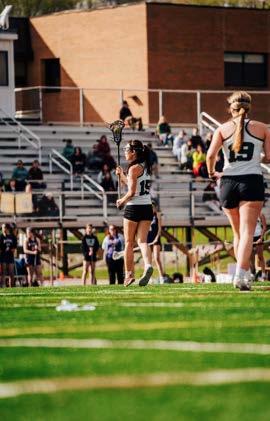
Senior Nathalie Cho during a Huron women’s lacrosse game. PHOTO BY BRODY TURNER
Senior Nathalie Cho playing on the field during a Huron women’s lacrosse match. PHOTO BY BRODY TURNER
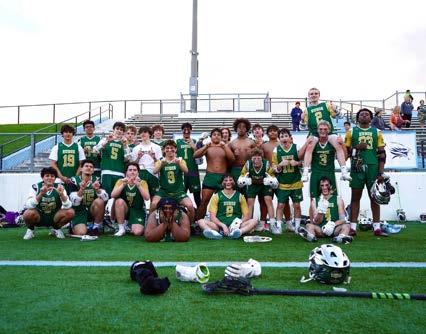
The Huron men’s lacrosse team poses after a win. PHOTO BY BRODY TURNER
A four year journey: Olivia Riegle’s experience in water polo
EMILY HU
WEBSITE EDITOR-IN-CHIEF
Score!
The crowd erupts as the ball flies into the net, and senior Olivia Riegle pumps her fist into the air in celebration
Throughout her four years in high school, water polo has been an integral part of Riegle’s life. The water polo team is her home
Riegle didn’t always picture herself as a water polo player. Like many athletes, she was initially drawn to the water through swimming. But after just a week of playing it in her freshman year, she knew it was something she would continue for the rest of her high school career.
“Swimming is about racing yourself,” Riegle said. “But water polo is about working with a team. Every play depends on everyone else.”
Much of her reasoning for loving the team so much is due to the team itself. That team dynamic is what has kept her committed through four demanding years. Practices are long and often physically exhausting, but with her teammates’ support, she was always able to push through.
“It’s definitely one of the hardest sports out there,” she said. “You’re thinking, reacting, and pushing your body at the same time.
But that’s also what makes it rewarding.”
As the years went on, Riegle’s role on the team also began to shift. From an underclassman trying to find her place, she slowly stepped
into her senior season as a leader and someone that the younger classmen could rely on both in and out of the pool
From her past experiences, Riegle understands the pressure of close games and the frustration that comes from mistakes, which is why she always tries to use those moments to lift others up.
As she said, even just a small word of encouragement can
really go a long way.
“She’s always there for us,” freshman Jayani Shivakumar from the water polo team said. “She knows what to say, and she keeps everyone going.”
Outside of the pool, Riegle has to also balance her sport, school, extracurriculars, and job. Early practices, game days, and school often overlap, but Riegle has found a way to stay organized through all of this.
Particularly by using her Google calendar which makes sure
everything done.
“You have to stay organized,” she said. “There’s not a lot of time to waste, but it teaches you how to prioritize what matters.”
But even amongst the busy schedules, it is in the moments she spent with her team that makes it so unforgettable.
“You spend so much time together, it really does feel like a family,” Riegle said. “That’s what I’m going to miss the most.”
As her final season comes to a close, Riegle reflects on how much water polo has shaped her high school experience. It’s given her confidence and a sense of belonging that extends far beyond the pool deck.
“It’s bittersweet,” she said. “I’m excited for what’s next, but I know this is something I’ll always carry with me.”
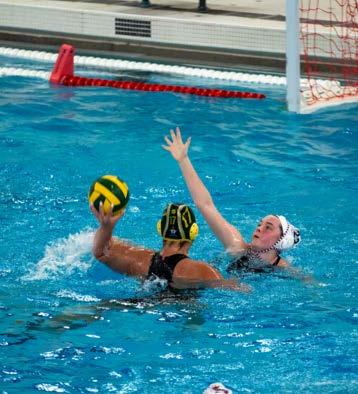
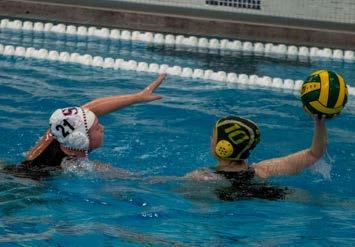
Huron’s water polo team faces off against Seahold High School
Huron High School water polo went against Seahold High School and, through a hard-fought battle, unfortunately, lost 6-11.
1. Breaking through the defenders, senior Luciana Vanini Benitez scores a goal for Huron.
2. Senior Shayna Weiner rises out of the water, locked in and ready to fire the next shot.
3. Weiner comes up clutch with a huge save, shutting down the shot at the cage.
4. Battling through contact, junior Lilia Wadhwa fights for control of the ball in a heated high school water polo clash.
5. Senior Dimitra Kasotakis creates space under pressure, facing against a Seahold opponent.
Riegle diving through the water with the ball COURTESY OF RIEGLE
GRAPHIC BY MIA LIN
“It’simportant to listen to other takepeople’sopinionsand advice when you need it, but also trust your gut and trust your instinct.”
“I think the best way to lead is by example. You can say as much as you want but if you don’t show it, it’s not going to do as much”
“Everything I did, I tried to think about how it could help the Emery in the future, not just the present.”
“Being on staff has meant so much to me and has helped me reach my next goals at Michigan State” “Work together, build a community,strongerdon’t rely on one person to do everything and communicate efficiently!”
Before they leave, seniors on the Emery’s staff reflect on the memories they’ve made and advice they leave behind.
“Being an editor was a lot of responsibility but it taught me the value of teamwork and how to lead a group to produce one of the nation’s best newspapers.”
“To the next generation of leaders, I would advise them to be good listeners and to take into account the full story in any complications.”
“Passing the torch means I am passing my knowledge on what I learned to the next generation of students.”
“Passing
the torch means handing the role to others while continuing the Emery’slegacy.”
“Dowhatyouenjoy.Ifyou’re doingitforcollege,you’re notgoingto have fun.”
“Don’t just huddle in a group -- you learn so much from talking to people.”
“Stay curious, do your part well and never lose passion for the work you’re creating.”