THE @THEHURONEMERY
HURON EMERY HURON HIGH SCHOOL, 2727 FULLER RD., ANN ARBOR MI 48105
DEC 2025 VOL. 11, ISSUE 3
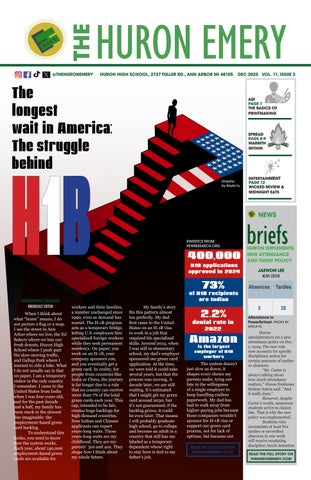
The longest wait in America: The struggle behind
ASF PAGE 7 THE BASICS OF PRINTMAKING
SPREAD PAGE 8-9 WARMTH WITHIN
H1B HEMANTH TAVANE BROADCAST EDITOR When I think about what “home” means, I do not picture a flag or a map. I see the street in Ann Arbor where we live, the DJ Bakery where we buy our fresh donuts, Huron High School where I push past the slow-moving traffic, and Gallup Park where I learned to ride a bike. What I do not usually say is that on paper, I am a temporary visitor in the only country I remember. I came to the United States from India when I was four years old, and for the past decade and a half, my family has been stuck in the slowest line imaginable: the employment-based green card backlog. To understand this limbo, you need to know how the system works. Each year, about 140,000 employment-based green cards are available for
Graphic by Kayla Fu
ENTERTAINMENT PAGE 12 WICKED REVIEW & MIDNIGHT EATS
NEWS
STATISTICS FROM PEWRESEARCH.ORG
400,000 H1B applications approved in 2024
73%
briefs
HURON IMPLEMENTS NEW ATTENDANCE AND TARDY POLICY JAEWON LEE NEWS EDITOR
of H1B recipients are Indian workers and their families, a number unchanged since 1990, even as demand has soared. The H-1B program acts as a temporary bridge, letting U.S. employers hire specialized foreign workers while they seek permanent residency. On paper, you work on an H-1B, your company sponsors you, and you eventually get a green card. In reality, for people from countries like India or China, the journey is far longer due to a rule that no country can receive more than 7% of the total green cards each year. This cap, intended to be fair, creates huge backlogs for high-demand countries. New Indian and Chinese applicants can expect years-long waits. Those years-long waits are my childhood. They are my parents’ 30s and 40s. They shape how I think about my whole future.
My family’s story fits this pattern almost too perfectly. My dad first came to the United States on an H-1B visa to work in a job that required his specialized skills. Around 2014, when I was still in elementary school, my dad’s employer sponsored our green card application. At the time, we were told it could take several years, but that the process was moving. A decade later, we are still waiting. It’s estimated that I might get my green card around 2030, but it’s not guaranteed; if the backlog grows, it could be even later. That means I will probably graduate high school, go to college, and become an adult in a country that still has me labeled as a temporary dependent whose right to stay here is tied to my father’s job.
2.2%
denial rate in 2022
Amazon is the largest employer of H1B workers
The system doesn’t just slow us down; it shapes every choice my parents make, tying our fate to the willingness of a single employer to keep handling endless paperwork. My dad has had to walk away from higher-paying jobs because those companies wouldn’t sponsor his H-1B visa or support our green card process, not for lack of options, but because our READ THE FULL STORY ON THEHURONEMERY.COM
Attendance in PowerSchool. PHOTO BY KAYLA FU
Huron administrators set a new attendance policy on Dec. 1, 2025. The new rule now accounts for specific disciplinary action for certain amounts of tardies or absences. “Mr. Carter is always talking about how much attendance matters,” Huron freshman Sydney Anton said. “And it really does.” However, despite Carter’s words, numerous students arrive to classes late. That is why the new policy was implemented. Students who accumulate at least five tardies or unverified absences in one week will receive escalating discipline: lunch detention READ THE FULL STORY ON THEHURONEMERY.COM
THE HURON EMERY | ISSUE 3: DECEMBER
2 | NEWS
Recent ICE raids on the UM campus calls students to action SALEM DINH SOCIAL MEDIA EDITOR-IN-CHIEF
Immigration and Customs Enforcement raids. “I’ve gotten a sit While school at the down from my parents being University of Michigan may like, if you’re going to protest, stand as many students’ wear a mask and please don’t first times away from home, make it known that it’s you,” there is still the said Jane Doe, a current inevitable call Korean from parents. international Although Ann Arbor Every week, student seems like a very libmundane at UM. conversations eral place, the people “Situations from “how are like that, if that are in charge still you” to “how are something clearly don’t have the classes.” happens to well-being of students For me and I get in mind. international deported, my students, though, family lives AMATULLAH HAKIM this isn’t just in Korea, but time away from it affects my home; it’s oceans education. away. And the mundane So, it affects my family.” conversations aren’t about Doe, like many campus life; it’s filled with international students on concerns about recent campus, has been personally American feeling the impacts of the rise in recent ICE activity. After President Trump’s reinstatement into office earlier this year, there has been a clearly stated mission for the mass deportation of undocumented immigrants. This increase in
“
43.9%
56.1%
Number of students from Asia out of University of Michigan International students GRAPHICS BY ELLA YIP
activity has reached many community. colleges and universities “Any time I come across America alike, across another international including the University student the only thing to talk of Michigan, which has about is how do we avoid and recently fired and detailed stay out of trouble,” Doe said. three3 different Chinese “There’s definitely a sense international of danger and anxiety with scholars. international “We students, I think the university strongly condemn but also needs to give them any actions that with nonsome support in how seek to cause international harm, threaten students as to address yourself national security well.” in a new country, like or undermine In some life support, the university’s the center financial support and critical public of this mental health support. mission,” the UM uneasiness Public Affairs amongst ANONYMOUS website said. “We campus is have and will a pattern of continue to cooperate with vagueness and the unknown federal law enforcement in for UM administration. For its ongoing investigation and international and domestic prosecution.” students alike, there is With 12,547 an ambiguity that creates international students, anxiety. scholars, and faculty at “At the beginning UM according to the 2025 of this year, the university UM International Center released [like] very useless statistical report, these recent statements about how they statements and actions have would react to the ICE caused concerns amongst detainments happening on the UM student and faculty campus,” said UM student Amatullah Hakim, who International Student enrollment out of student body currently serves as the United Asian American Organizations (UAAO)
15.12%
“
84.88%
All statistics from University of Michigan’s 2025 Annual report on international students
READ THE FULL STORY ON THEHURONEMERY.COM
China
#1 3,641
students enrolled
India
#2 1,173 students enrolled
Korea
#3 519
students enrolled
Canada
#4 419
students enrolled
Lit and lang students participate in a dystopian activity ASHLEY BRADSHAW STAFF WRITER Walking through the halls, fearful of being watched and afraid to break even the slightest rules, is what seniors in the DP Literature and Language Year Two class had to experience for a week. After reading dystopian literature, including “1984” by George Orwell and “The Handmaid’s Tale” by Margaret Atwood, the classes participated in a week-long experiment from Nov. 17 to Nov. 21 that gave them a glimpse of what it’s like to live in dystopian societies, such as the ones depicted in their books. The following week, students in AP English Language and Composition completed the same activity while reading “1984.” “The goal was to give students, in a very, very different, low stakes way, a sense of what it feels like to have somebody watching your moves and having your actions controlled by these little arbitrary rules that don’t really have a reason behind
them, but they’re just forced on you,” DP Literature and Language teacher Kris Zager said. In order to execute this, students were assigned roles: a Comrade/citizen or a member of the Thought Police/an “Eye.” Comrades and citizens must go about their daily lives while abiding by the strict rules, while the Thought Police and “Eyes” must report any infractions to “Big Zager,” who served as the tyrannical government. “I was very on edge and paranoid during the game because you didn’t know who
to greet peers with “Good morning, Comrade” and teachers with “I am eager to learn today,” which led to increased interactions within the community. “I noticed that I started to greet my teachers more and actually have conversations with them,” senior Sofia Shah said. “I’ve also seen more people talking in class in general about the activity. It’s made for more interest in school and having conversations.” Although teachers are not official participants, several have included themselves in the “I noticed that I started to greet activity. my teachers more and actually have conversations with them, I’ve also seen more people talking in class in general.”
“Sometimes teachers will email me and say that students didn’t greet Senior taking Huron’s Diploma them, and Programs, Language and that’s kind Literature of funny,” Zager said. were Eyes,” senior Hailey Sell Many teachers said. “I personally was testing also value the respect and people, and I wouldn’t follow communication the activity a rule in front of someone and requires. see if I was reported the next “I’ve had teachers day, but I didn’t catch any email me saying, ‘I really like spies.” my students actually greeting Some of the rules me and saying they’re eager being enforced include having to learn, even if it’s not really
Sofia Shah
Shah reading George Orwell’s 1984. PHOTO BY ASHLEY BRADSHAW Yet, despite some of true,’” Zager said. “I think it these positives, the activity creates a little bit of novelty has also caused previous and shakes things up.” However, many of the connections to weaken. “Because there’s this positive effects were not longconstant suspicion, you can’t lasting and came to an end really trust each other,” Zager after the activity concluded. said. “Through that erosion “I have always talked to my teachers,” Sell said. “However, of trust, you can’t have these meaningful connections that I wished everyone realized make us human.” how nice this was and All in all, however, the continued even though the large majority of participating game stopped.” Additional rules of the students enjoyed the activity and are grateful for the game include picking up any litter seen on the school floors experience that it gave them. “I had fun and walking only on the right participating in it,” Sell said. side of the hallway. While no “I thought it was a great one has admitted to seeing representation of how people any of these rules in effect, in the books Handmaid Tales they could have potentially and 1984 lived life.” contributed to increased cleanliness and order in the building.
THE HURON EMERY | ISSUE 3: DECEMBER
3 | NEWS
Multi-Culti preparations ramp up as the show approaches 1
2
3
4 SATVIKA RAMANATHAN PRINT EDITOR-IN-CHIEF 1. APEX, or the Asian Pacific Educational Exchange, performs every year at the multi culti. Their events include yo-yo, glow sticking, staffing and multiple types of dance. Pictured is Victoria Dang twirling her glow sticks. “I’m hoping our hard work will pay off,” said senior Lydia Kim, who is part of glow sticking along with Dang. 2. Mid-toss, junior Mia Lin looks up at the height she anticipates her yo-yo will reach. 3. Latino Student Union, or LSU, is also a key multi-
culti player. They do a choreographed dance every year. “I’m excited to see how it looks all put together,” said senior Liahni Quijada, who helped choreograph this year. 4. Seniors Gabe Ortiz and Bella Hooker during dance practice. They began practicing in November, but preparations started with choosing music in October. 5. Senior Camelot Fonseca-Hidalgo claps after the choreographers demonstrated LSU’s final piece to learn. 6. Freshman Sean Park tosses his yo-yo up into the air.
6
5
PHOTOS BY SATVIKA RAMANATHAN
AAPS receives grant for 10 new electric school buses LAKSHYA JAIGANESH AND SAANVI KULKARNI COPY EDITOR AND OPINION EDITOR The Michigan Department of Education (MDE) has recently collaborated with the Michigan Department of Environment, Great Lakes and Energy (EGLE) and Michigan Association of Pupil Transportation (MAPT) in order to provide the Clean Bus Energy Grant, a program assisting Michigan school districts with their mission to reduce carbon emissions and protect students’ health. Ann Arbor Public Schools (AAPS) has received $4.09 million dollars, enabling the district to purchase 10 additional electric school buses (ESBs), bringing the district’s total electric school bus count to 24. “It is common knowledge that diesel exhaust, from buses, trucks or cars, is harmful to the environment and exposure to people,” AAPS Executive
Director of Student & School Safety Liz Margolis and AAPS Capital Programs Manager Moe Nagpal said. “Investing in ESBs helps protect student health by cutting the emissions from typical gas or diesel vehicles.” Investing in ESBs is part of the district’s commitment to lowering carbon emissions and providing sustainable learning environments. This program is especially important, as diesel school buses produce exhaust that can be detrimental to students’ health. “[It] can lead to physical symptoms, missed school days, and negative impacts on academic performance and cognitive development,” Margolis and Nagpal said. “The health effects are especially pronounced in children because their lungs are still developing, and they breathe at faster rates than adults.” Along with contributing to cleaner air, ESBs contain strong safety
precautions, including additional technologies like regenerative braking and improved visibility. Drivers are trained with local fire departments to handle emergencies, and extra alerts have been added to ensure children’s safety when getting on board. “The logistical impacts are managed with reliable overnight charging, well-planned routes, and clear backup plans in case of power outages and bad weather days,” Margolis and Nagpal said. Additionally, it is ensured by MDE that rural, urban, and lower-income districts have equitable access to these funds. The wording in legislation prioritized these types of school districts. “We had criteria that gave districts that fall under criteria items
such as these higher indexes of funding compared to districts that did not,” MDE Spokesman Kenneth Coleman said. AAPS was one of the first districts in Michigan to invest in electric vehicles and believes that its effect has been beneficial for students and the community. “We had a rocky start originally due to some battery charging issues, but that has been solved,” Margolis and Nagpal
said. “So far, both students and drivers appreciate the riding experience.” AAPS will continue purchasing ESBs as part of their annual bus replacement plan and 2022 Environmental Sustainability Plan. “We will continue to look for grant funding as well as local funding sources to meet our goals for our community and students,” Margolis and Nagpal said.
AAPS has received $4.09M, enabling the district to purchase 10 additional ESBs. GRAPHIC BY ANJALI NADARAJAH
THE HURON EMERY | ISSUE 3: DECEMBER
4 | FEATURE
A close look inside: the role of our local food pantries GRACE HENLEY CHIEF CONTENT EDITOR In Ann Arbor, the local food pantries are busier than ever with the government challenging Supplemental Nutrition Assistance Program (SNAP) benefits all around the country. While SNAP is working in stores, the participants are now faced with new requirements in order to get government assistance. Now, more than ever, people are reaching out to their communities to ask for help and the food pantries are all hands on board. At Packard Health Clinic, a large food pantry is open to the public. Anybody in Washtenaw County can come, though the majority of the people who go are already established patients at the clinic. The Packard food pantry does have some guidelines for things like the amount of supplies you can take per family. Along with that, if they are new to the food pantry, they will need to fill out a form, which is used for giving consent to the Packard employees to take the people to the back of the pantry. All that’s needed is to fill out is your first and last name, they do not require any ID. Elizabeth Lara, who is the Community Resource Coordinator for Packard Health, runs two food pantries in Ann Arbor. This one on Carpenter Road and another on the West side. “Our food pantry has been around for 17
Q&A with the new Community Assistant: Benjamin Tepfer TYMYA THOMPSON STAFF WRITER
The latest collection of Huron Donations for Ann Arbor’s local food pantries. PHOTO BY GRACE HENLEY years and has grown bigger over time,”Lara said. The pantry is supplied by the nonprofit organization ‘Food Gatherers’, but we typically take donations, which can be food or money.” The Packard pantry gets weekly deliveries on different days. The pantry offers things like canned items, non perishable items, hygiene products, fruits, vegetables, milk, eggs, meat, and any dairy. Packard has a large refrigerator where they keep these cold items fresh for the taking. Though it truly does matter on what the pantry receives that week for food options. “For a household visiting you have access to
a gallon of milk, a carton of eggs, and then one or two meat products, depending on what we have,” Lara said. Recently, Packard has received donations from local churches and even their own workers have pitched in too. It really takes a community to make a food pantry work and now, with some being denied SNAP benefits, these pantries turn into the main source where those can get their food. “Food is a need and often people’s money are going to other things that they have to pay for at home, they don’t have much room for groceries,” Lara said. “They can save a few bucks by
coming here and a lot of the things we have are really good stuff. We have been busy and even now some benefits are not getting cut, we still are busy.” Another local food pantry near is actually at our very own Huron Highschool. Run by Emily Mashal, one of our counselors here at Huron, the food pantry is located in the main office in the far back to the right. Mashal started funding the pantry back in 2022 and it has been going strong for the past five years. “We have so much food insecurity in our community READ THE FULL STORY ON THEHURONEMERY.COM
Q: Tell me a little bit about yourself. A: Okay. I’m 24 years old. I grew up in a small town, so Ann Arbor, to me, is huge. I love sports. I like having fun, joking around, so I’m pretty loose. I let kids be kids and just have a good time. Q: Why did you decide to come to Huron? A: I originally lived in Kalamazoo. I worked for the Kalamazoo Public Schools when I was living over there, and I saw a job opportunity to work here. I thought it’d be a cool opportunity, and I enjoy working with children. Q: How are you liking your school so far? A: I like it. It’s cool. Good kids. No problems.
Tepfer is the new Community Assistant at Huron High School. PHOTO BY TYMYA THOMPSON
A recipe for passion: Charlotte Mohlman’s path to the kitchen YARA AL QAHWAJI STAFF WRITER Culinary teacher Charlotte Mohlman’s love for cooking didn’t start in a professional kitchen; it began long before that, in the heart of her family home. “Since I was a kid, I came from a family of five,” Mohlman said. “And everybody always had to do something. So it might have just been peeling potatoes.” Mohlman’s early kitchen
experiences weren’t just chores; they were about learning from the people around her. Her older sister, Karen, encouraged her to explore cooking. “There’s an 11-year difference between us, so she wasn’t just a mom, but also an oldest sister,” Mohlman said. “On Fridays, before she would go out, we would always make pizza and chocolate chip cookies. It was something we did every single week. I learned so much from her.” Beyond the daily joys of cooking, Mohlman loves the way food brings people together during big gatherings like Thanksgiving. When talking about the
holidays, she lit up and shared her favorite part of Thanksgiving. “I love hosting it,” Mohlman says. “I have 15 nieces and nephews, and even though they don’t all come for Thanksgiving, it’s still a big gathering. I get a fresh turkey from a farm near my house, we make our own stuffing, and everyone brings something to share. It’s hard to choose a favorite dish, but I’d probably say the pies or maybe one of the Polish dishes I grew up with.” As the conversation shifted from family traditions to her own career path, Mohlman reflected
on cooking and teaching, which then became something she wanted to take more seriously. “I’ve always loved being with kids,” Mohlman explains. “Before I became a teacher, I was a construction manager at Wayne State, but I realized how much I enjoyed helping kids reach that ‘aha’ moment. Cooking is fun, and it’s a life skill everyone needs to learn how to take care of themselves, but it can also be something you really enjoy.” Even with all her experience, Mohlman admits that
GRAPHICS BY ISHAAN KAMAT
Christmas cookies created by the culinary students. PHOTO BY KAYLA FU
cooking isn’t perfect. Mistakes happen, but for her, that’s part of the joy of being in the kitchen. “Nobody’s ever perfect, so there’s always a time that you might mess something up,” she said. “That’s the beauty of cooking, you can always try and fix something. Food is love.”
THE HURON EMERY | ISSUE 3: DECEMBER
Exchanging
cultures,
5 | FEATURE
experiences
and
The culture of Huron’s exchange students and exchange program AMELIA BAI AND ANNABELLA MI WEBSITE EDITOR-IN-CHIEF AND MANAGING EDITOR After a plane ride from Washington and Taiwan, junior Ivan Wu had arms full with a passport and luggage in Michigan. It was only as he was having his passport checked by customs officers when Wu finally saw a light, fluffy snow confetti flurrying outside. “At first, I didn’t feel anything. It was just amazement,” Wu said. “But then when we got out of the airport and me and my dad got into a van, I was actually like, ‘the snow was touching me.’” Wu had seen — touched — snow before. Before he transitioned from summer Taiwan to winter Michigan, he had been skiing in northern Japan with his mom on the mountains
at least five times. But in America, the snow meant something more significant to Wu. “It’s the country I’ve been seeing in movies and on social media,” Wu said. “It’s like I’m actually here.” Anna Helming is a junior exchange student from Munich, Germany. In 2022, Helming’s school in Munich had a partnership with another school in which they exchange students in Oxford, England for a week. Helming enjoyed her time there, but felt that one week wasn’t enough. “So I got the idea, why not just do one year abroad?” Helming said. Senior Kotaro Hiroe, from the Gifu Prefecture in Japan, with the Rotary Youth Exchange program and is also doing one year abroad. When he arrived in Ann Arbor on Sept. 18, 2025, the only words he knew were “probably” and
“definitely.” “When I came here, I couldn’t speak English well,” Hiroe said. “I have a passion to study English to speak with other people. When I speak English well, I’m so happy. I could go to [a] new place, I’m so happy. I can play basketball here, I’m so happy. A lot of things make me happy.” Hiroe’s host family, Nick and Mary Avrakotos, joined the Ann Arbor Rotary Club 14 years ago when they moved to Ann Arbor. Rotary is an international organization that helps to act on worldwide issues, with Huron even having a dormant Rotaract Club itself. Ann Arbor Public Schools (AAPS) has designated a list of suggested exchange programs students can personally research and decide from. “Look at the different programs and look at what’s going to be right for the
student,” counselor Nina Perko said. “The Ann Arbor Schools does have a long list of suggestions, because it’s really on the students.” The significance of an exchange program is the communication between cultures. The squeak of sneakers between Hiroe’s love of basketball in Japan and gym class at Huron. The sound of Helming having a conversation with her classmates on the first day of school. It’s the sound of flipping a passport’s pages and learning a new word. It’s the sound of snow falling around Wu. “Programs like this are really important in fostering cross-cultural understanding and communication. And we don’t have enough of that in our world,” Mary Avrakotos said. “It’s life-changing.”
moments
Scan for extended story
Hiroe showing the back of his Rotary hoodie.
PHOTOS AND GRAPHICS BY ANNABELLA MI
THE EMERY STAFF ADVISOR Sara-Beth Badalamente EDITORIAL BOARD: Satvika Ramanathan 405293@ aaps.k12.mi.us Anjali Nadarajah 424587@aaps. k12.mi.us Ella Yip 316340@aaps.k12.mi.us Annabella Mi 403008@aaps.k12. mi.us Grace Henley 403008@aaps.k12. mi.us EDITORS: Amelia Bai, Emily Hu, Ishaan Kamat, Isha Savi Website Editors-in-Chief Salem Dinh & Kasia Phan Social Media Editors-in-Chief Jules Heskia Sports Website Editorin-Chief Lakshya Jaiganesh Copy Editor Kayla Fu Design Editor Ryan Bezas Sports Editor Hemanth Tavane Shivakumar
Broadcast Editor Jaewon Lee News Editor Andrew Etchill Feature Editor Saanvi Kulkarni Opinion Editor Amy Yang Arts and Entertainment Editor STAFF WRITERS: Ali Abufarha Staff Writer Yara Al Qahwaji Staff Writer Christopher Albright Staff Writer Jayden Bearance Staff Writer Jacquie Boketsubolanga Staff Writer Ava Bryan Staff Writer Austin Busby Staff Writer Jefferson Castellon-Lazo Staff Writer Feiyun Chen Staff Writer Zilan Chen Staff Writer Elizabeth Christopher Staff Writer Aliyah Collins Staff Writer Emily Cools Staff Writer Maberick Cruz Martinez Staff Writer Emmalia Dines Staff Writer Larissa Eddins Staff Writer
LaMarr Eddins Staff Writer Mayte Espinoza Pereira Staff Writer Liam Flaherty Staff Writer Camelot Fonseca-Hidalgo Staff Writer Ian Forbes Staff Writer Marvin Fox Staff Writer Elijah Franks Staff Writer Alyna Gonzalez-Arias Staff Writer Amy Funes Staff Writer Edward Gao Staff Writer Alexander Gebhardt Staff Writer Stone Goniea Staff Writer Luis Gonzales-Contreras Staff Writer Amadou Guindo Staff Writer Aiden Hathaway Staff Writer Vatour Hayes Staff Writer Anna Helming Staff Writer Karley Hinkle Staff Writer Jayden Homes Staff Writer Demarius Hudson Staff Writer Natalie Hummel Staff Writer Cheree James Staff Writer
Grace Johnson Staff Writer Ezra Kasara Staff Writer Brian Leiva Staff Writer Edin Linic Staff Writer Josep Lopez Staff Writer Ana Matute Staff Writer Easton Molnar Staff Writer Kamaya Morton Staff Writer Andrea Perez-Bermudez Staff Writer Justin Phelps Staff Writer Johnathan Pryor-Mcadam Staff Writer Aditri Rajendiran Staff Writer Omar Reyes-Galindo Staff Writer Jordan Rhone Staff Writer Annika Richards Staff Writer Sophia Rustia Staff Writer Sansita Sachin Staff Writer Esmie Salinas Staff Writer Ryder Sancho Staff Writer Asia Shi Staff Writer Nathaniel Sidney Staff Writer ShaMari Singleton Staff Writer
TayKwon Smith Staff Writer Sebastien Spelman Staff Writer Dakota Suire Staff Writer Joseph Sung Staff Writer Jennifer Tang Staff Writer Selina Tang Staff Writer Tymya Thompson Staff Writer Jelani Thompson Staff Writer Sara Tunison Staff Writer Brody Turner Staff Writer Jonah Wagner Staff Writer Shamila Wakileey Staff Writer Keenan Waller Staff Writer Natalya Weatherspoon Staff Writer Leon Williams Staff Writer Vance Wilson Staff Writer I-Hsuan Wu Staff Writer William Ye Staff Writer Anika Zaman Staff Writer Faheeb Zaman Staff Writer Jenny Zhang Staff Writer
THE HURON EMERY | ISSUE 3: DECEMBER
6 | ADS
press freedom. a joint fundraiser between The Huron Emery and The Communicator. This fundraiser is a collaboration between two high school newspapers in Ann Arbor: The Huron Emery, based out of Huron High School, and The Communicator, based out of Community High School. The goal of this effort is to share the importance of local
student journalism while raising funds to allow us to continue our work. We posted stories the first three Mondays of December, all related to why press freedom matters. Here is a glimpse of what we posted from our end. If you are interested
in donating, the QR code on the right links to the website. The funds raised will help us to print our newspaper six times a year, post daily on the website and social media and to continue to provide timely, relevant coverage to our local community. Thank you for your support!
Filling the gap: How Washtenaw County student journalism helps keep the community informed SATVIKA RAMANATHAN AND ISHAAN KAMAT PRINT AND WEBSITE EDITORS-IN-CHIEF
Collaboration over censorship for community An administrative perspective of student press SALEM DINH SOCIAL MEDIA EDITOR-IN-CHIEF
The history of the Huron Emery: unwavering student journalism since 1968 ANJALI NADARAJAH PRINT EDITOR-IN-CHIEF
THE HURON EMERY | ISSUE 3: DECEMBER
7 | FEATURE
Carving away: Print making basics AVA BRYAN STAFF WRITER
What is relief printing? Linoleum carving is one of the most fun and accessible ways of printmaking. You can create intricate designs by carving into a block of linoleum, lightly coating the block in ink using a brayer, and finally stamping onto your desired
area. You can print on all kinds of surfaces; paper is the most common, but, in the past, I’ve made clothing items like shirts and hats as well. Its versatility is one of my favorite things about the medium.
What materials do I need? You don’t need fancy supplies to start. One of my first ever prints was made using a pink eraser I had carved a tined fish design into. If you’re making small prints, just a stamp pad is fine to ink it, and you can pick those up at any office store. However, larger
prints are where things get a little more complicated—but still very accessible! You will need to buy your choice of linoleum, some cutters, ink, and a brayer. You can typically find this stuff online. Personally, I like to look at Blick for art supplies. Your linoleum choice depends on what you’re looking to make and your prior experience. Mainly, you will see golden, battleship, and easy-cut linoleum. The type of lino depends on its texture and
how firm it is. The firmer a piece of lino is, the harder it will be to cut, but this allows you to get way finer details. I would recommend learning on easy-cut because it’s the simplest to work with.
I have my tools. How do I plan a design? When you design your print, keep in mind that everything you carve out will be white, and everything you leave behind will print in your choice of ink. It’s also important to remember that your whole design will be inverted when you print it,
because you flip the block upside down to press it into the paper. Short, straight lines will be the simplest to work with at first. Think of what techniques would be useful to create your design. At Blick for art supplies. PRINTS BY AVA BRYAN
THE HURON EMERY | ISSUE 3: DECEMBER 8 | WARMTH
Opening the door: SAWC offers shelter from cold SATVIKA RAMANATHAN come through their space, 650 to 700 PRINT EDITOR-IN-CHIEF
33,200
Michiganders experience homelessness
4%
increase in homelessness 2024 to 2023 700 Americans die from hypothermia yearly
Kate D’Alessio, program director of the Shelter Association of Washtenaw County, goes to work with the mindset that every day, there is an impact made. “Our society and our political climate does not allow people a chance for stabilizing,” D’Alessio said. “We’re the safety net for individuals, and we try to build them up and work through those barriers and search out for resources.” The SAWC has numerous programs and multiple sites designed to help combat homelessness in the Ann Arbor area. The main one is the Delonis center downtown. They serve single adults, and in one year, they usually have 1300 people
being overnight. They typically offer 53 beds year round. During the winter, between November and April, they have a warming center that is an emergency shelter for people to get out from the freezing air. At the Delonis center, they try to bring anyone coming to the door in, which is between 60 to 80 people a night. There is also a site in Ypsilanti that can support up to 25 people co-ed, and a rotating shelter between congregations that hosts up to 25 men. In addition to this, SAWC increases their staffing by about double the number during the winter to
have seasonal operation specialists who can make this happen. In the mornings, they have a hot breakfast option at the St. Andrews church. D’Alessio said she learns something from her clients every day. “They’re very resilient and they have very powerful stories of their strengths,” she said. “What they’ve been through is amazing to get where they are today, and it just reminds you that people can be strong and people can go through
Statistics from the US Department of Housing and Urban Development
Huron Holiday Traditions Kwanzaa ANJALI NADARAJAH PRINT EDITOR-IN-CHIEF Kenyatta Tucker, an economics teacher at Huron, is an avid celebrator of Kwanzaa. He started practicing the African American holiday in his sophomore year at Western Michigan University. “I remember going to the Charles H. Wright Museum of African American History in Detroit,” he said. “I didn’t grow up celebrating it, and I wanted to learn more about it. And when I got into the space and I saw my peers, I saw elders, I saw children, and it was just amazing.” Kwanzaa is an African American holiday inspired by many traditional cultures, particularly in regards to festive traditions from cultures in Africa. The cultural
holiday was founded by Mulana Karanga in 1966. Celebrated from Dec. 26 through Jan. 1, Kwanzaa commemorates seven principles– Unity, self determination, collective work and responsibility, cooperative economics, purpose, creativity and faith– each day representing a value. “Kwanzaa has to be something that’s more than just a holiday,” he said. “It’s really something that can cause a positive ripple effect in the world, and I want to make sure that I’m a part of that thrust to cause that positive change in the world.”
adversity and still find meaning and a positive outcome in the end.” Other services that SAWC offers include things like doing laundry, meeting with a case manager, going to the Packard Health Medical Clinic on site, having meals provided by Food Gatherers, accessing storage, mail or phones. Currently, the average stay in their residential program is over 140 days, which D’Alessio said is a challenge they are working on. “That major impact of locating permanent housing is life changing,” she said, “so it’s definitely worth it.”
THE HURON EMERY | ISSUE 3: DECEMBER 9 | WARMTH GRAPHICS BY SALEM DINH
According to UM Public Health
5%
of students experience seasonal affective symptoms
Christmas Addison Bjurman, a senior at Huron, celebrates the candy cane and ornament adorned holiday, Christmas. Arguably the most widely celebrated holiday in December, Bjurman describes Dec. 25 as “time to be with family and friends”. Bjurman spends Christmas Eve with her paternal grandparents, and Christmas day with her maternal grandparents, opening presents with her immediate family in between. The days leading to the 25th are never without traditions. “My friend, my brother and I always make gingerbread houses and watch the new Grinch movie,” she said. “And my brother and I are very specific about what
tree we get. We always prefer one from Home Depot.” Something unique about Bjurman’s Christmas celebrations is her TikToks. With over 14,000 followers and over 6,000,000 combined likes, many of her videos centered around Christmas reached every corner of the app. “I made Christmas TikToks because it’s relatable and a very commonly celebrated holiday that people get excited about,” she said. “I made one about being over with fall, and being excited for Christmas because I’m quick to go all out for the holidays.”
of Michiganders report experiencing some degree of symptoms related to seasonal affective changes during the winter According to MSU Today
12.1
inches of snow were reported for Ann Arbor monthly totals
According to the American Psychiatric Association (APA)
According to MLive
41%
of Americans and a higher share in the Midwest say their moods worsen in winter
40%
Hanukkah
Shayna Weiner, a senior at Huron, celebrates Hanukkah– the Jewish festival that commemorates the recovery of Jerusalem and re-dedication of the Second temple at the beginning of the Maccabean Revolt. “To me, Hanukkah is a holiday where my family spends time together and celebrates our culture and tradition with the lighting of candles,” she said. Some nights, she eats latkes, which are traditional potato pancakes. They symbolize the miracle of the oil in the Jewish Temple. “My mom makes them and they smell and taste nostalgic,” Weiner said. “They feel special to me because we only really eat them during
the holiday, so I connect them with good memories of my family and I.” Next to the fried, golden and crispy cakes, her family plays dreidel. The Dreidel is a traditional Hanukkah game played with a four-sided spinning top. Each face is marked with a Hebrew letter, each signifying how many tokens they receive from the pot. The game ends when all the latkes gone, the sun comes up, or when her family decides to head to bed. “Being from an athletic family, we get very competitive,” Weiner said. “After we light the nine candles on the menorah, we get to my favorite part of the night. I love the game because I’ve gotten really good at it.”
THE HURON EMERY | ISSUE 3: DECEMBER
10 | OPINION
Has the internet made me a bad person? AMELIA BAI WEBSITE EDITOR-IN-CHIEF Almost every time I scroll on social media, I come across a short video of someone begging for help. Oftentimes, it’s someone in the throes of war, or a starving artist or a family member of a cancer patient, but the message is mostly the same: “We need your help, and it doesn’t cost anything.” That is, except for a like,
GRAPHIC BY KAYLA FU
comment or share — a minuscule request that it seems impossible to deny. So we interact; a small action in exchange for feeling like you helped someone today. But then the inevitable happens: the algorithm catches on. It sees a repeated pattern of behavior towards certain content and begins to push out more similar content. And soon, your page is flooded. Social media should act as a tool for spreading awareness and speaking on important topics, but at its core, the incentive for scrolling is escapism. When someone is hoping for a quick escape through doom scrolling, the last thing they’ll want to see is a plethora of people begging for help, a dire reminder of our current society. Many are faced with an ultimatum: continue to interact and be a good person, or scroll past for your own sanity and be faced with the reality that you might be a bad person. The truth is, most ordinary people cannot be defined by “good” or “bad,” much less by a singular action in an almost impossible situation. The system that traps many people in this exact situation is broken; neither the creators nor the consumers are at fault. It’s created
Staff editorial: The power in our joy Resistance has many faces: an activist lens, a personal fight, or a consciousness. Often undervalued is the power that an individual holds in the larger message of resistance. Mindset is key to the growth and consciousness many of us thrive on, the ability to stay engaged, excited, and conscious with the world. Yet behind this mindset — as a fuel of it all — is joy. As of now, we are centered in the darkest month of the year, and the change of the last 11 months is starting to dawn. The next year, the daunting task of a new beginning is something of a weight or a relief. The NPR article ‘Is Joy Resistance?’ approaches the idea that joy, as an act of self-preservation, is substance enough to create larger ripples of change. This emphasis on the strength of an individual in creating change is nothing new; we’ve witnessed this time and time again. Within the evermore political time we live in,
members of our community, importantly, your families, and individuals all resistance. To create carry the weight of changing an avenue of change, immigration policies, job through your friends, shifts, aid failure, and a family, and community, promise of an uncertain future. and to not lose hope, as How do we pop the collective we enter a new chapter. bubble we live in but not drown in its retreat. Ignorance, as in the act of ignoring the multitude of problems that face our community, will not make these issues go away. We at The Huron Emery believe in the importance of facilitating GRAPHIC BY KAYLA FU a personal space where finding joy and prioritizing joy in your everyday life is an avenue to fuel oneself, to fuel your mindset, and most
a dystopian circumstance in which creators are using viral brainrot clips just to stop our dopamine addicted brains from scrolling past a fivesecond clip. It’s extremely difficult to pinpoint how much social media platforms are actually giving the creators in exchange for the amount of interaction they receive. While macro-influencers can receive thousands, most of the creators that post this type of content only rack up to a few thousand followers. A better alternative that is both sustainable and stable would be to donate to foundations and organizations that are transparent about how people in need are receiving the help that they need. None of this is to say that creators should stop using social media as a platform to receive the help they need, nor should consumers stop interacting. But no one should feel the need to interact with every piece of content that they come across, and expecting to do so is an impossibly unsustainable standard. Scrolling past doesn’t make you a bad person; it makes you human.
THE HURON EMERY | ISSUE 3: DECEMBER
Huron smells egg-stra wrong
11 | OPINION
ANJALI NADARAJAH PRINT EDITOR-IN-CHIEF
Just for laughs! Not based on true events.
The Misfits
JUSTIN PHELPS STAFF WRITER
You shouldn’t constantly follow politics ANDREW ETCHILL FEATURE EDITOR It seems like everyone thinks society is collapsing nowadays. The fear of school shooters, crime, wars halfway across the world and President Trump are all top of mind in America’s young people. But these fears can turn into unhealthy anxieties, and students can get to a point where politics control their lives. These obsessions with current events and politics is contributing to the uptick in mental illness and America’s hostile political climate. The obsession of constantly following politics is a chief contributor to this rising problem. We live in an age of unprecedented access to information and news. Before the modern internet, you may have had to wait days to learn that something in Washington D.C. has occurred. Now, social
media allows people to find information about an event that happened minutes ago. The problem with this is that news and social media companies profit by getting the most engagement with their content, and the easiest way for them to do this is to post content that makes people angry. Examples of such content include children dying in wars, brutal murders committed by those with long criminal histories, or President Trump separating families and deporting individuals from the country. Readers of such information are likely to feel fear, anger and frustration. However, the information on the news and social media isn’t representative of daily life. The reality is that the chances of being murdered, dying in a war or getting deported
if you’re legally in the United States are very, very slim. Issues such as dying in a car accident or the Ann Arbor Public Schools having budget problems are much more serious — but less talked about. It’s important for people to remember that what they see on social media and in the news is a carefully crafted narrative that is designed to garner maximum engagement rather than represent reality. Many people forget this fact, though, and end up focusing too much of their attention on political news. This warped view
GRAPHICS BY ANNABELLA MI
of reality by constantly thinking about politics can lead to serious consequences for a person’s mental health. According to an article written by Lauren Love from Michigan Medicine’s Health Lab, part of the University of Michigan, a poll found that young people experienced heightened anxiety around the 2016 presidential election and lost sleep or had difficulty concentrating. While being concerned about a presidential election is understandable, losing sleep or having difficulty concentrating is abnormal and unhealthy. Anxiety in the United States has increased dramatically over the last decade, and the coinciding increase in access to constant news through cell phones and social media — particularly political news — is
undoubtedly a contributor. I remember sitting in one of my classes the day after Trump won the 2024 election, and one of my classmates said that she hoped Trump gets shot. If you’re so obsessed with presidential politics that you wish death on another person over it, that is unhealthy and you should rethink how you interact with political news. While it is important to be an informed American and know what your government is doing, it’s also important to be mindful of how much time you spend thinking about politics. By being careful in how much political content we consume, staying aware of our biases, and being open to learning other points of view, we can maintain good mental health and be happy while also staying informed.
THE HURON EMERY | ISSUE 3: DECEMBER
12 | ENTERTAINMENT
We have been changed for good, and so should you SALEM DINH AND ISHAAN KAMAT SOCIAL MEDIA EDITOR-IN-CHIEF AND WEBSITE EDITOR-IN-CHIEF One year after Cynthia Erivo and Ariana Grande “defied gravity” together for the first Wicked movie, they have both come back with a “wonderful” sequel for Act Two of the original music. But it is not met with the same love and
popularity of the first movie; instead, audiences are spending their time “loathing” the press tour. Memes online have been circulating across Oz about the seemingly concerning relationship between Erivo and Grande. No interviews have been left tearless, and their intimately close distance towards each other has been the question of every person watching. At this point, fans are less focused on Act Two and more focused on whether the duo is about to pledge friendship “for good” right there in the interview chairs. While it may seem like “no good,” we cannot help but understand some of their reactions. The movie and musical itself have left both this theatre and nontheatre kid down in tears. The iconic show starts with a flashback of Elphaba and Glinda’s time together in Oz. Through the first act, we are able to see the beautiful
friendship between the two women blossom. It almost feels like we get to be involved in the friendship ourselves, like we’re right there in Shiz watching their chaos unfold. Wicked: For Good goes through the events and songs of act two in the musical, starting with “Thank Goodness”, a song about Glinda’s own mixed emotions about experiencing her true happiness but without her best friend. As it progresses, we see Elphaba try to return back to Oz, but realize that she could never support the fake facade and propaganda of the Wizard. The story continues and ends with “For Good”, a song of bidding farewell between the two. But even with all the emotional weight of the story itself, audiences seem far more invested in the drama happening off-screen, and honestly, I get it. The press tour feels less like two stars promoting a multimilliondollar blockbuster and more like two best friends (and failing) to not fall apart at brunch. Watching them together, you feel like the story didn’t end when the cameras cut: it just shifted offscreen. To be fair, though, Wicked does something to people. The bond between Elphaba and Glinda isn’t just a subplot, but the heartbeat of the entire story. It grows, falls apart, repairs itself, and forces both women to figure out who they want to be. Filming
something with that kind of emotional pull would leave anyone feeling a little fragile, even two performers who are used to keeping it together in front of cameras. Looking at the history of Wicked, Glinda and Elphaba pairs often experience this same phenomonen. And, from two close friends, we would too. Some fans think the press tour reactions are just clever marketing, while others are convinced the emotions are a genuine leftover from filming the second half of the story. Either way, the interviews have taken a life of their own. In a way, the press tour mirrors the themes of Act Two. There is the pressure to appear perfect, the struggle to stay true to yourself, and the complicated reality of loving someone while the world tries to label your relationship for you. It is messy, but it is also exactly the kind of emotional honesty that has kept Wicked relevant for so long. And yes, the movie still brings all the magic and heart that fans expect. The songs land, the emotions rise, and the storyline reminds us why this
show has lasted more than twenty years. But the offscreen reactions have added something unexpected. They show that the themes of the musical do not stay locked in Oz. They stick with you. So even if audiences are “loathing” the press tour a little, the sincerity behind it feels real. And after watching Act Two unfold, you understand why it leaves people changed, for better, and for good.
GRAPHICS BY KAYLA FU
Midnights eats in downtown Ann Arbor ESMIE SALINAS STAFF WRITER This 24-Hour american diner is located on the Southwest corner of Liberty and Ashley. Known for their classic diner breakfasts and burgers, this location is easily recgonizable by their bright sign and stickercovered walls. One of their most popular dishes, the “Hippe Hash” is a great example of one of their signature options that reflects Ann Arbor’s fun college town atmosphere.
GRAPHICS BY SALEM DINH
Joe’s pizza located right next to the Diag, and is a great place to visit if you want a fresh slice of New York style pizza. From classics and new creative flavors, Joe’s Pizza has a diversity of different types for everyone. With plenty of outdoor benches, and indoor seating, this late night pizza joint is a great option for some good quality late-night eats.
Burritos, quesadillas, nachos, and more are all available at BTB. Located at the corner of S University Ave and Church St, this graband-go window shop is great for any lunch, dinner, or late night snack. Also, their website includes a contact from incase someone wants to suggest a new flavor combo.
THE HURON EMERY | ISSUE 3: DECEMBER
13 | ADS
SPARK JOY. SPREAD CHEER. SHARE MEMORIES. DESPIERTA ALEGRÍA. DIFUNDE ALEGRÍA. COMPARTE RECUERDOS.
The 2025-2026 yearbook is a gift worth waiting for. El anuario 2025-2026 es un regalo que valió la pena esperar.
Scan to send a text to order, or go to: Escanea para enviar un mensaje de texto para pedirlo o visita:
jostens.com/ybkgift SHARE THE SPECIAL MOMENTS YOU’VE CAPTURED COMPARTE LOS MOMENTOS ESPECIALES QUE HAS CAPTURADO
Upload your holiday photos today! ¡Sube tus fotos navideñas hoy mismo! photos.jostens.com/hshare
©2025 Jostens, Inc. 252564
FINE COFFEES AND TEAS IN NICKELS ARCADE
THE HURON EMERY | ISSUE 3: DECEMBER
Huron
varsity
LIAM FLAHERTY STAFF WRITER The Huron Baseball program has had a pretty crazy past three years. In those years, the program has had three coaches, and every year, the teams failed to achieve a record above .500. With a new coach at the lead, things are looking better. Huron Baseball’s new head coach, Eamon Horwedel, was hired in the middle of February last year. He is currently the Head Varsity Baseball Coach at Huron High School, Pitching Coach of the Kalamazoo Growlers, and Science Teacher at Clague Middle School. Horwedel played division one baseball at Ohio University for four years, as well as playing two years at the University of Michigan. Huron baseball is looking to turn things around,
baseball’s
starting this offseason. “The baseball team is currently embarking on a very intensive offseason lifting program,” Horwedel said. “There are two phases(to the program), each being six weeks long, and together, the entire lifting program will last until winter break.” In the past years, the Huron Baseball
program hasn’t had an offseason development program. Joey Knudsen and Ryan King, class of 2025 graduates that played for Huron last year, are helping coach this year.
14 | SPORTS
off-season
“This year, we have an offseason development program, which is a lot different than the last two years. We have a coach that puts in a lot of dedication,” Knudsen said, “ even though he’s not allowed to be here all the time. We have the guys here that really worked through the same philosophies that he instills in the program.” The MHSAA rules on fall baseball prevent the head varsity baseball coach from working with more than four players at a time in a baseball activity, so fall baseball really takes a lot of cooperation from the families of the program. The strength program will have many big benefits for the way the team performs this season, as strength plays a part in modern baseball. Not only will the program make the players stronger, but it will also decrease the chances of injury and make the players healthier. As, baseball is a sport that deals with a lot of acute injuries that can be mitigated by strengthening
development
neighboring muscle groups. “The overall goal of the lifting program is to get stronger, faster, and healthier. I want to emphasize that last one on getting healthier,” Horwedel said. “This Huron baseball program has dealt with a lot of injuries in my first year as a coach, and I want to do my very best to make sure that every player is maximizing their opportunities to play, whether that means they have more power output, they’re faster, or simply that they’re healthy and able to play.” The lifting program that Horwedel has put together is similar to the program that he did in the offseason when playing at Michigan. Which just shows that this lifting program is no joke and will really make huge gains in the players strength development. Senior Thayer Wallace shared his thoughts on the lifting program compared to the past years. “I would compare it to something else, but we really haven’t done anything in the off-season in the past,” Wallace said. “We just had practices on Monday and Wednesday but these lifts, I feel like it’s really beneficial for the team. It’s making a big difference.” In between the two
phase program, the team will engage in the “road to East Lansing week.” This is very similar to the Omaha challenges that college baseball programs do. It is a series of challenges that the players will be participating in that push mental and physical limits, create good team building, and promote teamwork. This challenge week really grows the program, and is another example of the college baseball type atmosphere that Horwedel is bringing to the program. “Having participated in these ‘Omaha Challenges’ myself when I was in college, I found it to be an incredibly rewarding and unforgettable experience, which is why I want to introduce it to the Huron program.” Horwedel said, “It is an excellent way to build program comradery. Players will be pushing physical and mental limits, all while having a ton of fun.” This D1 college baseball-like offseason development program is really going to change the Huron Baseball program. With a 25 year old coach at the front of it, this program is turning around.
Under the radar: the world and culture of underground winter sports at Huron doing synchro, which I really enjoy,” Mose-Newman said. Similarly to MoseNewman, junior Rebekah Muthyala deals with a similar environment as a figure skater. However, the team is much larger than the synchronized swimming team due to the fact that many of the skaters don’t come from Huron. The small community is an advantage nevertheless. “I feel like the people that actually do it, we’re all closely connected, because there’s not many people that do it,” Muthyala said. “So when you meet someone that actually does do it, there’s so much to talk about and like, it’s just a community.” Additionally, the Muthyala poses on the podium after finishing first place in one sport has some advantages to being more underground. of her competitions. PHOTO COURTESY OF MUTHYALA It’s a benefit for college take immense skill and years JULES HESKIA applications, bringing the of practice to perfect. SPORTS WEBSITE EDITOR IN CHIEF uniqueness that many other Senior Jessa Moseapplicants don’t have. In Flipping through Newman has been on the competitions too, where there the water in perfectly team for four years now and are less skaters, and a greater synchronized form, with has gotten the full experience chance to score better. On the pointed toes waving through of being part of a small sports other hand, the niche status the air; slicing through the team community. This was brings disadvantages to these ice with knives for shoes, a change from her usual big sports, especially when it balancing a triple twirl on one sports culture of being on the comes to misconceptions. foot—synchronized swimming swim team. “I wish people and figure skating are some “I’ve done swim most understood the effort it takes of the least popular winter of my life but wanted to do to perform our routines and sports at Huron. Not for good something else water related figures,” Mose-Newman reason, though. Both sports - so in middle school I started
said. “Routines are like more figure skating, this could than three minute swimming come from making it more sprints that involve being accessible. Buying ice time, upside down, pointed toes, hiring a coach, costumes, and and typically hybrids or the ice skates all make up for the splits. Our goal is to make it expenses of the sport, which look like it’s not challenging, totals over $2000 per year. when in reality it definitely For synchronized swimming, is.” it’s more about the lack of Similarly to these willingness to take a risk from misconceptions, there are a new swimmers. lot of behind “I the scenes think people that many might think people that it’s a don’t know hard sport about. For to begin example, in doing, or synchronized that there’s A synchronized swimswimming, hostility ming routine lasts some of the within over three minutes of swimmers the sport maneuvering in water. put Knox for new They include being (unflavored swimmers,” upside down, pointed gelatin) in Mosetoes, and hybrids or the their hair to Newman get a slick said. “This back that isn’t the case GRAPHIC BY JULES HESKIA stays in the for our team water. Figure skating also has though, it’s not expected that its unknown facts. people come in with skills, “I guess all the only that they’re ready to injuries. I think I pull at least learn.” one or two muscles a month, along with lots of bruises,” Muthyala said. Regarding the future, both sports have yet a lot of room to grow in the realm of sports in high school. In
3+ minutes
THE HURON EMERY | ISSUE 3: DECEMBER
Huron boys hockey loses 6-3 to Saline
15 | SPORTS
1
ANJALI NADARAJAH PRINT EDITOR-IN-CHIEF
2
3
1. Senior Keagan Dunn awaits the flying puck, guarding the net as one of Huron’s goaltenders. The Rats took on The Hornets early in their season at The Cube in Ann Arbor. 2. Sophomore Granger Conley, junior Andrew Lee and freshman Paxton Haller race for the puck amongst Saline High School players as Huron’s forwards. 3. Junior Benjamin Tarnautzer focuses on the game as a defenseman. 4. Forward and senior Carson Randall sets up for the faceoff against rival Saline High School. 5. Conley carries the puck with Hornet players on his tail. “I felt discouraged when we gave up our two goal lead, but throughout the game I was hopeful we would win,” Conley said.
5
4
PHOTOS BY BRODY TURNER
Girls basketball secures first win of the season against Royal Oak AYA BAALOUCHE, BRODY TURNER AND MALIC KASHAM STAFF WRITERS
On Monday, Dec. 8 Varsity Women’s Basketball went to Royal Oak for an away game. They were locking in tight and pushing through a tough start. The River Rats earned their first win of the season on the road. Earlier in the season, they struggled in their early games. At the beginning, it was rough. They lost many matches. This team put in the work, battled through every challenge, and grew together every step of the way. “I was excited because I know we’ve been working really good,” senior Arie Hesterly said. Their hard work showed during their hardest games. Sophomore Sansita Sachin got really focused by paying attention to passing
and teamwork. The three players moved up the court, their flow was smooth, getting into the zone where they felt they could do more, naturally balancing by following their pass. “I was kind of prepared for the game,” freshman Brookyln Bennett said. At this moment, she had prepared well for the game from training hard beforehand and knew exactly what to do once the game started moving. Bennett said she scored three points. Her focus paid off in the moments that followed, when she stepped up and made plays that kept the team moving. It was a reminder to always shoot, forget the fear, get ready, aim at the target and then take her shot. “It was just like most of my team was locked in,” Sachin said. By the middle of the game, half the team
Huron’s varsity women’s basketball team ready for an exciting season, pictured on their media day. PHOTOS BY BRODY TURNER was locking in and staying focused, helping each other stay strong, while the other half was starting to feel exhausted. A great team
always needs a scorer and a teammate who’s ready to assist, and Huron was trying to find that balance on the court.
“Yes, we did win the game,” Hesterly said. The River Rats have defeated the Royal Oaks with a final score of 49-46.
THE HURON EMERY | ISSUE 3: DECEMBER
16 | ENTERTAINMENT
Exploring the cultural significance behind drinks from around the world SATVIKA RAMANATHAN PRINT EDITOR-IN-CHIEF
Chè Hoa Cau: Vietnam
Falooda: India
Mate: Uruguay
For social worker Bhavani Chakravarthy, falooda represents unity. The drink came to India from Persians who brought it with them. Originally, it was just a little bit of lime in rose water, consumed for its cooling effects. Over time, Indians adopted and transformed it into the drink that is now consumed across the northern part of the country with many variations. Chakravarthy was originally exposed to falooda through a friend, and it quickly became a family favorite. Falooda involves layering elements including the vermicelli noodles that give the drink its name, basil seeds, rose milk and sometimes ice cream. The layers and culture fusion of falooda remind Chakravarthy of the importance of being inclusive, regardless of differences. “In this age, we need falooda to bring everyone together,” she said. Senior Emily Ngo’s mother, Tuyen Le, prepares chè hoa cau. She usually only makes it a few times a year, especially for significant holidays such as Lunar New Year or to honor loved ones who have passed.
Giancarlo Vanini prepares mate, a specific process that requires the right materials. PHOTOS BY
PHOTOS COURTESY OF EMILY NGO
A thick, gooey sweetness, soft spheres and a cooling coconutty flavor meld together into chè hoa cau, a mung bean pudding that falls under the broader category of chè, a collection of drinks and desserts from Vietnam. Senior Emily Ngo’s family makes chè a few times throughout the year for special holidays and celebrations. Chè hoa cau reminds Ngo’s mother, Tuyen Le, of childhood memories. Le grew up buying chè from vendors and eating it when she was young. Ngo said Vietnamese culture places a heavy emphasis on sharing through food. She had seven more cups of chè in her car to give to friends when her mom made it. To Ngo, chè connects her with her family heritage. “It’s rare to make,” she said. “I think of it as a tie back to my culture.”
SATVIKA RAMANATHAN
Bhavani Chakravarthy prepares falooda in her home kitchen. This involves getting each individual component of the drink ready and then layering it all together in a glass. PHOTOS BY SATVIKA RAMANATHAN
Senior Luciana Vanini-Benitez grew up drinking mate, or yerba mate, a tea-like drink, when she would visit her family in Uruguay. In Uruguay, where Vanini’s dad, Giancarlo Vanini, grew up, kids would start drinking mate around age 13. It has a stimulant similar to caffeine, and many people carry their mate around all day. Most people have their own set of a cup and straw, or bombilla, that is used to make the drink and many also have a flask to hold hot water as well. Mate is made by pouring the leaves into the cup, compressing it in and pouring water into the side. The bombilla is then pressed in for people to drink out of, and it filters the leaves out. It is characterized by its slightly bitter taste. Now, Giancarlo Vanini has switched to coffee, but whenever he wants a taste of home, he pulls out his set and makes mate.