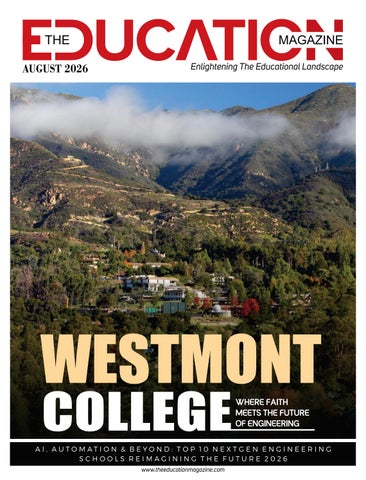
THE AUGUST 2026
UC TI
MAGAZINE
Enlightening The Educational Landscape
WESTMONT COLLEGE
WHERE FAITH MEETS THE FUTURE OF ENGINEERING
A I , A U TO M AT I O N & B E YO N D : T O P 1 0 N E X T G E N E N G I N E E R I N G SCHOOLS REIMAGINING THE FUTURE 2026 www.theeducationmagazine.com
The Future Isn’t Coming. These Schools Are Building It. Dear Reader, Artificial intelligence no longer waits at the edge of the engineering classroom; it has walked in and pulled up a chair. Algorithms now inform how bridges are modelled, how prosthetics are fitted, and how a whole generation of engineers learns to think. Yet the sharpest programmes are proving that automation sharpens judgement rather than replacing it. This issue, “AI, Automation & Beyond: Top 10 NextGen Engineering Schools Reimagining the Future, 2026,” looks inside the institutions where that balance is being built, one tested idea at a time. On the cover, this issue is Westmont College in Santa Barbara, California, where a Tuesday afternoon in the maker space might find students debating the spring tension on a catapult built for children in Quito, Ecuador. Founded in 1937 on the vision of Ruth Kerr, Westmont has grown a newer engineering programme into one of only three ABET-accredited Christian college programmes in California, with 89 percent of students graduating in four years and a 94 percent job placement rate among employers including Northrop Grumman and the Department of Energy. Under Dr. Daniel Jensen, the programme rests on three pillars: a Christian liberal arts foundation, hands-on technical training, and design innovation woven through every course. Students have tested tools such as ChatGPT for engineering ideation, built wearable biometric sensors with the Air Force Research Laboratory, and designed capsules bound for the edge of space with Northrop Grumman, guided by the question of who their work is meant to serve. Joining Westmont College on this list of next-gen trailblazers are the College of Engineering, Technology and Management at Oregon Institute of Technology, Georgia Institute of Technology, MIT School of Engineering, and Carnegie Mellon University, each reshaping what engineering education can achieve in an automated age. Together, these institutions suggest that the future of engineering will not be decided by machines alone. It will be shaped by students taught to question, to build with purpose, and to weigh consequence alongside code. As automation accelerates and artificial intelligence reshapes every discipline it touches, these five schools prove that the most valuable engineering skill remains human: the wisdom to know what is worth building, and why it matters. Sincerely,
Simran Khan
Managing Editor
Publisher: Archana Ghule Editor–in–Chief: Vikram Suryawanshi
Art Director: Priyanka Patil Graphic Designer: Chaitanya Kulkarni
Managing Editor: Simran Khan
Marketing Head: Robert Smith
Project Editor: Shadab Mestri
Research Team: Daisy, Rahul,
Sales & Marketing
Maranda, Rocky
Project Head: Aakash Mahajan Sales Co-ordinators: Maria Smith Swati Kumari Project Manager: Ritesh Fating Nehal Nagpure Christopher Scott The Education Magazine is published by Pericles Ventures Pvt Ltd. This magazine contains material protected under International and Federal Copyright Laws and Treaties. You may not publish, display, disclose, rent, lease, modify, loan, distribute, or create derivative works based on the magazine contents or any part thereof, whether by yourself or as a consultant, employee, partner or in any other role unless authorised in writing by the creator/publisher of the article/, video, audio or any content contained herein. We, the team of The Education Magazine put all the efforts to keep up with the content accuracy. The publisher assumes no responsibility of any part of the content of any advertisement in this publication, including any errors or omissions therein. All rights reserved by Pericles Ventures Pvt Ltd.
10 Westmont College
PROFILES
20. Oregon Institute of Technology 30. Carnegie Mellon University 40. Georgia Institute of Technology 54. MIT School of Engineering articles 5 MUST-READ Digital Literacy Books 26. for Modern Learners AI Governance in Higher Education: 34. The 2026 Framework for Policy & Risk AI in the Classroom: 46. More Than a Trend, a Revolution
Westmont College
Oregon Institute Of Technology
www.westmont.edu
www.oit.edu
Carnegie Mellon University
Georgia Institute Of Technology
www.cmu.edu
www.gatech.edu
MIT School Of Engineering
Purdue University College Of Engineering
www.engineering.mit.edu
www.engineering.purdue.edu
Texas A&M University College Of Engineering
UC Berkeley College Of Engineering
www.engineering.tamu.edu
www.engineering.berkeley.edu
Urbana-Champaign Grainger College Of Engineering
University of Michigan College of Engineering
www.grainger.illinois.edu
www.engin.umich.edu
WESTMONT COLLEGE WHERE FAITH MEETS THE FUTURE OF ENGINEERING
10 I AUGUST 2026
Y R O T S R E V CO
THE EDUCATION MAGAZINE I 11
S
omewhere in a maker space above the Pacific coast, in a room that smells of warm resin and the steady hum of machines at work, a small group of engineering students is arguing pleasantly about a catapult. Not a metaphorical catapult. A real one, spring-loaded, aimed at a miniature soccer goal, designed from scratch to be assembled by children in Quito, Ecuador, using only the kit these students are building for them. One student wants to adjust the tension. Another is holding an Arduino controller and doing the math quietly. A third is thinking about how to explain the spring force to a twelve-year-old who does not speak English. This is Tuesday afternoon at Westmont College in Santa Barbara, California. This is also, it turns out, what the future of engineering education looks like. A College Built for the Long Game Westmont was founded in 1937 as a liberal arts college on the vision of Ruth Kerr, the principal founder and business owner of the Kerr mason jar. Her vision, coupled with the leadership of esteemed scholar Wallace Emerson, Westmont’s first President, exemplified from the start that intellectual excellence and deep Christian faith were not competing ambitions but a single, unified one. That conviction has aged well. Westmont today ranks among the leading liberal arts colleges in California, earns a prominent place on Forbes’ List of America’s Top Colleges 2025, and has been spotlighted as a “Hidden Gem” in College Raptor’s 10th year of ranking the nation’s best-kept-secret colleges and universities. The campus itself sits in a striking coastal setting, framed by the foothills of the Santa Ynez Mountains and minutes from the Pacific Ocean. In Santa Barbara, California, students enjoy year-round wonderful weather, easy ocean access, and a variety of outdoor activities that have a way of reminding even the most focused engineer that the world is larger than whatever problem is currently on the whiteboard. While the college offers nearly 100 academic programs, the engineering program is newer. But it has wasted no time. 12 I AUGUST 2026
Built on Three Pillars, Proven by Numbers Dr. Daniel Jensen, who directs Westmont’s engineering program and holds the Allder Chair position, describes the program’s foundation with the kind of calm precision that suggests he has tested every word of it against reality. The program rests on three pillars: The first is a solid Christian liberal arts foundation. The second is excellence in technical engineering training, delivered in small classes through hands-on, active learning with professors personally engaged with each student. The third is the integration of engineering design and innovation throughout the entire curriculum, from the earliest courses to the final semester. “Great engineering programs begin with superb technical education,” Dr. Jensen has said, “this is necessary, but not sufficient. Our other pillars provide true distinction” The program earned full ABET accreditation, making Westmont one of only three Christian colleges in California to hold that distinction. The outcomes this model produces are difficult to dismiss. 89 percent of Westmont engineering students graduate in four years, against a national average hovering between 40 and 50 percent. Over 70 percent complete internships and/or funded research experience before they graduate. The four-month job placement rate stands at 94 percent, with employers including Northrop Grumman, Lockheed, Raytheon, the Department of Energy, and the U.S. Army, among others. Engineering students have also been admitted into graduate programs at institutions including the University of Michigan and Rensselaer Polytechnic Institute. All engineering faculty carry external research and/or consulting funding, and all are active in scholarly publishing. Over the last four years, Westmont engineering students have accumulated 45 co-authorships on peer-reviewed publications, a figure that would be notable at programs ten times this size.
COVER STORY Artificial Intelligence, Investigated Honestly The present moment in engineering cannot be understood without artificial intelligence, and Westmont has not pretended otherwise. The department maintains a significant AI focus in its research work and has published three recent peer-reviewed papers in that area. Grounded in a user-centered design framework called Design Innovation (DI), the Westmont research team has been testing with methodical care which AI tools genuinely improve engineering methods and which ones do not. In a 2025 paper presented at the American Society for Engineering Education Annual Conference, co-authored with the Air Force Research Laboratory, the team evaluated tools like ChatGPT and Viscom against traditional design methods. The findings were reported without inflation: while AI proved highly effective for rapid mind mapping and specific functional decomposition, it struggled with complex CAD generation and image sketching. A second paper, accepted for the ASEE Annual Conference in 2026, went further. A team of Westmont undergraduates developed a custom AI tool built on OpenAI’s GPT-4o model that generates bio-inspired mind maps for engineering design ideation. In a controlled experiment, designers using the AI tool produced more than double the number of ideas than those without it, yielding a significant leap in productivity. Four courses in the engineering curriculum focus extensively on design. The Design Innovation methodology also threads through every other course in the program, embedded as mini design experiences that give students repeated, hands-on opportunities to apply technical content to real design challenges. One of the featured projects is the annual remote-controlled vehicle challenge that reflects the program’s Design Innovation approach. Student teams design, build, test, and refine remote-controlled cars before presenting them in a design competition, where performance, creativity, and engineering decisions are evaluated. THE EDUCATION MAGAZINE I 13
COVER STORY The competition gives students an opportunity to apply classroom concepts in a realistic design environment while strengthening teamwork, problem-solving, and iterative engineering skills before sharing those experiences with students in Ecuador. The Course That Goes to Ecuador The Junior Design course asks students to design and manufacture STEM educational kits for children in developing countries, and then to travel there and use them. In May 2026, fifteen students from the engineering department flew to Quito, Ecuador, to deploy their kits in an after-school program run by Academia Matices, an Ecuadorian organization working in cooperation with Compassion International to serve under-resourced children. The students added a design competition for older students, sponsored by The Alliance Academy International, a school in Quito. Approximately 200 Ecuadorian students and family members attended an open house to see the students’ final robotics projects. The program has since grown significantly enough to produce Westmont’s first application from an Ecuadorian student who participated in the after-school program. Dr. Jensen described the ambition of the work in terms that were, at once, modest and vast. “We are obviously a very small cog in the overall gear system here,” he said, “but if God chooses to bless this project, we can change a slice of the world. We can pilot this in Ecuador and determine ways that it works well. Then, if we can expand it to places all over the world, we can scale this and multiply the impact for children across the world.” To the Edge of Space and Back The two-semester Senior Capstone Design course operates at a different altitude. 14 I AUGUST 2026
In the 2024-2025 academic year, one senior team partnered with the Air Force Research Laboratory to design a wearable biometric measurement system for monitoring mental stress and its effect on physical performance. The students built devices measuring heart rate variability, respiration rate, and body temperature, and developed a student-built app that received the raw data and recommended appropriate responses based on a user’s overall mental state. Senior Maya Pablos described the experience directly. “The value is that we’re able to design something that’s very real-world. Being able to do that through Westmont Engineering is vital. How many people can say that they’ve worked with the Air Force in college?” A second team worked with Northrop Grumman Corporation to design a capsule protecting equipment as it traveled to the “edge of space” and returned, engineered to survive parachute failure during descent and temperatures reaching negative 40 degrees Celsius during the ascent and descent cycle. Senior Noah Shen reflected: “I think it’s really awesome to work on a project that is impacting actual researchers. Researchers who work with Northrop Grumman will actually use the product, or at least the ideas that we bring to them, to get information and data about the edge of space.” For 2025-2026, three new capstone projects are underway. Mission Darkness is sponsoring a project to limit radio frequency communication in drones that could be used for harmful purposes, with recent Westmont graduate Maria Judy serving as the student team's industry mentor. Northrop Grumman has tasked a second team with developing powering capabilities for underwater drones. The Department of Energy is sponsoring a third team to create a system for sensing airborne particles in a way that has never been accomplished before. THE EDUCATION MAGAZINE I 15
COVER STORY Faculty Who Build and Serve Faculty research at Westmont is as purposeful as its curriculum, and often inseparable from it. Will Allison, Lab Manager and Instructor of both Engineering and Physics, is working to characterize the mechanical properties of 3d printed materials. This work was just presented at an American Society of Mechanical Engineers technical conference. Dr. Adam Goodworth, Professor of Engineering, is examining the use of 3D printed lower extremity prosthetic sockets for amputees. The need is acute: only 10 to 15 percent of people worldwide who need a prosthesis currently have one. “The socket is the most time-consuming part of making a prosthesis internationally,” Dr. Goodworth has said. “If we can successfully integrate 3D printing methods into current service trips, many more children in need of prostheses can be fit.” Dr. Goodworth’s sabbatical has taken him to Africa to work within a local hospital system and NGO, collecting pilot data, using portable rehabilitation equipment, and working with an orthopedic department to establish the foundation for future student research projects. He has a number of Westmont Engineering students joining him in Africa this summer.
Senior Zach Yates described what the seminar gave him: They have so many nuggets of advice from their own personal faith walks and their own epiphanies. It’s really cool to have professors who really care about your personal development and want to help you fast forward that process of learning things the hard way.” Three new scholarships, named for Roy G. Johnston, Naomi Johnston-Catherine Barsotti, and a designated leadership scholarship, have been established exclusively for engineering students through generous gifts. An Engineering Design Innovation Summer Camp Experience, a week-long program and residential campus experience for high school students, is an annual event perfect for high school students. This offers participants a meaningful introduction to innovative engineering product development alongside a genuine taste of Westmont campus life. What Employers Know and the Numbers Confirm What industry has made increasingly clear is that technical competence, while essential, is not enough on its own. Employers are looking for professionals who can demonstrate leadership, teamwork, conflict management, interpersonal skills, empathy, negotiation, and both written and oral communication. These are precisely the qualities that a Christian liberal arts education has been cultivating for generations.
The Question Behind the Degree The final semester brings engineering and physics students together in the Senior Seminar, co-taught by Dr. Jensen and Dr. Robert Haring-Kaye. The course explores how an understanding of technology, science, and design interfaces with faith, engaging questions about ethics in defense work, cosmology, and the weight carried by engineers whose decisions affect how people live. Westmont has also embraced the challenge set by the National Science Foundation to prepare adaptive engineers who can blend science, engineering, and the arts, treating that challenge not as an external mandate but as an extension of what the program has always believed. 16 I AUGUST 2026
Westmont’s engineers graduate with technical depth, with research experience, and with a formed capacity to ask not only whether something works but whether it should be built and for whom. They leave having worn Air Force sensors, designed kits that children assembled on the other side of the world, and tested the limits of AI tools reshaping their field in real time. Since 1937, Westmont has been building people for a world that rewards precision and demands wisdom. Today, that combination has never been more relevant. The program’s engineers are carrying it forward, one carefully designed solution at a time. The question is no longer just what engineers can build. It is whether they understand the consequences of building it and who they are building it for.
“
My hope is that our engineering graduates are equipped with a thoughtful appreciation of the relevant questions of true, meaningful design. And I hope they come out as well with an understanding of how smart people think well, but may think di erently, about the answers to some of those questions that change lives. THE EDUCATION MAGAZINE I 17
20 I AUGUST 2026
COLLEGE OF ENGINEERING, TECHNOLOGY AND MANAGEMENT AT
A Legacy of Applied Learning Meets the Age of AI
THE EDUCATION MAGAZINE I 21
IN
the high desert of southern Oregon, where the winters are long and the sky feels impossibly wide, a group of returning soldiers once needed something practical: a place to learn a trade, rebuild a life, and put their hands back to work. That was 1947. Nearly eighty years later, the campus they built their futures on has become something far larger than anyone in that first classroom could have imagined, a polytechnic university that now trains people not just to fix machines, but to build the artificial minds behind them.
This is the story of the College of Engineering, Technology and Management at Oregon Institute of Technology, a place where the founding instinct, education tethered tightly to real work, has never really changed. What has changed is the scale of the ambition. A Philosophy That Refuses to Stay in the Classroom Ask anyone at Oregon Tech what makes the college different, and the answer arrives quickly: it is applied, and it is polytechnic, two words the college treats less as branding and more as a promise. Learning here is not meant to be done quietly in a lecture hall. It is meant to be active, relevant, and grounded in the kind of work students will actually do once they leave. That philosophy shows up in the numbers, in labs, in applied projects, and in classrooms designed to mirror the professional world rather than imitate it from a distance. Many instructors bring firsthand industry experience into their teaching, and employers have a direct hand in shaping what gets taught. It is a loop, not a lecture. Nowhere is that philosophy more visible than in the college’s newest and most ambitious offering, a Bachelor of Science in Artificial Intelligence, where students begin building, deploying, and managing AI systems from Day 1, filtered always through an ethical, human-centered lens. The goal, as the college describes it, is for graduates to leave already practicing their profession, not simply prepared to start learning it. 22 I AUGUST 2026
“
Education has the power to change lives, and people do their best work when they feel valued, supported, and inspired.
The New Frontier: Oregon’s First Applied AI Degree The headline achievement, and the one that seems to animate nearly every conversation on campus these days, is the launch of Oregon’s first Bachelor of Science in Artificial Intelligence at a public university. The program received NWCCU approval in March 2026, and its first cohort will enroll in Fall 2026 across three settings: Klamath Falls, Portland-Metro, and online. The degree lives within the college’s Applied Computing & Geomatics Department, alongside Cybersecurity, Information Technology, and Data Science. The AI curriculum itself unfolds in a deliberate arc, opening with an accessible course called AI for Everyone before advancing into applied machine learning, natural language processing, computer vision, large language models, agentic AI, and ethics, culminating in a two-term industry capstone. Assistant Professor of Cybersecurity & IT
Dr. Praveen Kumar Guraja
Paired with the college’s other offerings—Cybersecurity, Information Technology, Computer Systems Engineering Technology, Construction Management, and the broader engineering and management programs—the AI degree is designed to feed directly into roles the market is already hungry for: AI engineer, machine learning engineer, data analyst, systems integration specialist, and automation engineer. Opening the Door Wider For a college built on the idea of access, the admissions process is designed to remove friction rather than add it. Direct admissions and a growing dual credit program allow high school students to earn Oregon Tech credit before they even arrive on campus, easing the leap into a full degree. Articulation agreements with Klamath Community College and Rogue Community College create clear, well-marked transfer pathways, while need-based financial aid, scholarships, and advising continue well past the first day of enrollment. For first-generation and low-income students, that support is formalized through dedicated programming, and both in-person and online formats widen the door further for learners in rural and regional communities who might otherwise be shut out. THE EDUCATION MAGAZINE I 23
Where Learning Meets the Machine Step into the Applied Computing Lab or the Applied Computing Learning Lab, and the abstraction of “technology integration” becomes something you can touch: cloud platforms, data and business intelligence tools, and live AI and machine learning systems that students work with directly rather than merely read about. Perhaps the most distinctive space on campus is the Oregon Tech Cybersecurity Community Clinic, known as OTC³, Oregon’s first member of the national Consortium of Cybersecurity Clinics, an initiative born out of UC Berkeley and MIT with support from Google. The clinic is AI-infused, meaning students are not simply learning cybersecurity theory but applying AI tools to real security assessments for local organizations, working with actual stakes attached. Behind the scenes, the college is also expanding its High-Performance Computing capacity for AI workloads. Through the NSF—supported NAIRR Pilot, faculty such as Dr. Guraja have gained access to national supercomputing and GPU resources typically reserved for far larger research institutions, a meaningful advantage for a college of this size. From Classroom to Career, Without the Gap The bridge between theory and the working world is not incidental here; it is engineered into the curriculum itself. Employers help shape what is taught, and students move through internships, project-based courses, cooperative learning, and capstones tied to problems that actually exist outside the classroom. That bridge extends beyond current students, too. The college’s Applied Computing Workforce Readiness initiative, funded by a Future Ready Oregon Workforce Grant from the Higher Education Coordinating Commission, offers upskilling and reskilling to working professionals who need to catch up to where the technology has moved. Partnerships range from regional employers to federal agencies, along with collaborations with major cloud and hardware providers, and national competitions give students a chance to measure themselves against peers from across the country. 24 I AUGUST 2026
Measuring What Doesn’t Show Up on a Transcript Grades tell only part of the story, and the college seems to know it. Innovation and problem-solving find their outlet each year at IDEAfest, the college’s undergraduate research symposium, and increasingly, on the national competition stage. At the 2026 AITCC National Conference, students mentored by Dr. Guraja and Professor Nalluri brought home six awards, including first and third place in the Analyze IT challenge, a fourth-place national finish in PC troubleshooting, and recognition in the Cyber Sentinel Challenge. In a separate but telling data point, a Coursera micro-credentials pilot found students logging learning time 195 percent above the benchmark, a statistic that suggests something beyond compliance is driving them. Portfolio development, internship placement, and direct employer feedback round out the picture, alongside the more traditional markers of retention, graduation, and career outcomes. The People Behind the Progress Every strong institution eventually comes down to its people, and Oregon Tech’s engineering college is no exception. At the top sits Dean Neslihan Alp, P.E., an ASME Fellow whose leadership style is described, notably, as people-first, with an emphasis on student success, faculty development, and industry partnership. One name comes up repeatedly in conversations about the new AI program: Dr. Praveen Kumar Guraja, who helped develop the B.S. in Artificial Intelligence and directs OTC³. His credentials are substantial: recipient of the AAAI/ACM SIGAI Innovative AI Education Award, IEEE Senior Member status, recognition as a Google Gemini Certified Educator, and more than $3.1 million in funded and pending grants. Alongside colleague Professor Manish Nalluri, he has represented Oregon Tech on the national stage in AI education, a partnership visible again in the students they have mentored to award-winning results.
A Year Worth Marking
Looking Toward the Horizon
Even set against nearly eight decades of history, this has been a standout stretch for the college. The launch of the AI degree anchors the list, but it is joined by the six AITCC awards, a new collaboration with Google Public Sector on AI research and skills development, and Oregon Tech’s largest freshman class in more than forty years.
What comes next, understandably, centers on the AI program’s first cohort arriving in Fall 2026, alongside continued expansion of High-Performance Computing and NAIRR resources that make advanced AI learning possible.
External funding has followed the momentum: the Future Ready Oregon workforce grant, federal digital-connectivity funding, and a pending NSF scholarship proposal worth nearly $2 million, with faculty actively engaged in the national NAIRR AI Pilot throughout.
The college is also deepening interdisciplinary pathways, pairing AI and cybersecurity with fields like healthcare, including new work on telehealth and digital-health systems aimed at expanding rural care. Underneath all of it sits a consistent thread: widening access to emerging technologies for students in rural and regional communities, and for first-generation and low-income learners who might not otherwise get the chance.
More Than a Classroom
A DEAN’S CLOSING WORD Academics are only one layer of what the college offers. From their first term, students have access to academic advising, tutoring through the Applied Computing Learning Lab, counseling and health services, and a college-wide Freshman Seminar meant to ease the transition into college life. Career services help with resumes, internship placement, and job searches, backed by employer relationships built over years, while student organizations like the AI Club and TechSec Club offer space for competition, research, and leadership outside formal coursework. IDEAfest, stackable micro-credentials, dedicated TRiO support for first-generation and low-income students, and a course specifically built around AI prototyping and entrepreneurship round out a support system designed to help students not just survive college, but build something while they are there.
For Dean Neslihan Alp, the mission comes back, always, to people. Her approach to leadership is built less on certainty and more on listening, on the belief that people do their best work when they feel supported rather than simply managed. Her message to the next generation of engineers is less about mastering a syllabus and more about ownership, using every resource and mentor available, and remembering that a career, done well, is also a form of service to the communities it touches. Nearly eighty years after a group of veterans first walked onto that Klamath Falls campus looking for a practical education, the instinct hasn’t changed. What has changed is the scale of the tools now in students’ hands and the size of the future they are being asked to help build.
“
Pursue not just a career but a sense of purpose and contribution to the communities you will serve. THE EDUCATION MAGAZINE I 25
26 I AUGUST 2026
H
ello, future of the world. Have you had any sneak peek in the past? Any conversation about those black-andwhite days when the greats studied through books in the light of a candle, not a bulb. It sounds like your father is talking to you about his time, during which you have absolutely ZERO interest, right? Well, I am asking all this just to tell you how quickly we are moving ahead. And being digital nowadays, (including this blog), we can understand how much we are into this digital world than a real one. But have you heard about Digital Literacy? Sounds boring? Don’t worry, you can read this whole blog as I am not going to discuss the theory of it. Instead, I will be telling you some paperwork you need to get your hands on to understand how a piece of paper can enlighten your digital life. Here are the 5 best picks on Digital Literacy 1. Algorithms of Oppression: How Search Engines Reinforce Racism ● Ratings: 4.7/5 ● Author: Safiya Umoja Noble ● Published: 2018 Algorithms of Oppression the book, it reveals the insidious ways algorithms duplicate and amplify systemic racism in fact, specifically targeting Black women. It exposes the hidden biases deep inside these algorithms that further marginalize already vulnerable communities. Moreover, the book argues against results where available information is used to strengthen stereotypes. The more this is done, the fewer choices most people have when considering contradicting information that could upset the power balance. As a result, Noble finds more into the hurts these problems have on the individual, community, and society at large. She shows how technology can at once be an empowerment tool or a mechanism of oppression.
Noble thus challenges the notion of an objective internet. She argues that this vision serves instead to define public discourse and supports the inequities that already exist there. In doing so, she effectively shows the complexities and nuances to which these issues lend themselves. She argues for more transparency and accountability in the design of algorithms and champions a more equitable, fairer digital landscape. Algorithms of Oppression is an essential read for those looking to understand the intricate relationship between technology and social justice. The book reveals how algorithms, which are often thought of as neutral, actually are paths of reinforcement of already existing inequalities. This book is invaluable in encouraging digital literacy-challenging readers to question biases within everyday tools. Being aware of these biases would aid readers in evolving into more knowledgeable digital citizens in an effort to push for a fairer online world. 2. The Age Of Surveillance Capitalism ● Ratings: 4.5/5 ● Author: Shoshana Zuboff ● Published: 2018 That is, The Age of Surveillance Capitalism, Shoshana Zuboff, reveals the digital economy-led mainstream corporations like Google and THE EDUCATION MAGAZINE I 27
The author writes a new capitalism, which she calls “surveillance capitalism.” This system extracts data of the owner without permission from the owner. Furthermore, it makes this data available to the market for sale, which raises major ethical questions concerning privacy and autonomy.
Each of the techniques is discussed with proper emphasis on their practical applications, which means that readers can easily get concepts. Further, all very important topics such as data structures and the analysis of algorithms are discussed in detail for better comprehension of the subject.
Zuboff explores how such companies benefit from our digital lives. She tracks how algorithms predict and control our actions. And thus, serious issues arise with this degree of capability. On her watch list are the possibilities: erosion of privacy, manipulation of opinion, and now, a threat to democracy itself. She calls for better regulation and greater awareness to protect these freedoms and the future that technology may take.
The second half, titled The Hitchhiker’s Guide to Algorithms, is a reference manual; it catalogues an enormous number of the most significant algorithmic problems, along with their solutions and applicable resources. There are also “war stories” that will give life to the practice of algorithms in real-life situations. In a nutshell, The Algorithm Design Manual is an outstanding source for anyone eager to delve into the world of algorithms and their multiple uses. It provides a well-understood and accessible introduction to the topic and practical guidance for solving complex problems.
The Age of Surveillance Capitalism is an important read for students of digital literacy: It offers profound insights into the foundational mechanisms and ethical ramifications of the digital economy. In precise detail Zuboff illuminates the subtle machinations by which companies extract, analyze, and monetize personal data. That knowledge empowers digital citizens to be aware of their online actions. This helps protect their privacy and critically evaluate the role of technology in society. Third, it informs readers that through digital literacy, more just and democratic digital worlds might be nurtured. 3. The Algorithm Design Manual ● Ratings: 4.5/5 ● Author: Steven S Skiena ● Published: 1997 The Algorithm Design Manual by Steven S. Skiena, an intensive guide to the details of algorithm design and analysis. It is practical in nature. Such clarification of understanding and application of algorithmic methods is useful for all, whether students or professionals. It provides insight into the effective use of these methods to solve real-life problems. The book is basically divided into two parts. The first part is “Practical Algorithm Design.” Here, the most pertinent techniques in algorithms are dealt with. It consists of a few very important topics: divide-and-conquer, dynamic programming, greedy algorithms, and graph algorithms. 28 I AUGUST 2026
The Algorithm Design Manual is unavoidable reading when it comes to digital literacy, because one gets a basic understanding of many of the algorithms that form the backbone of many digital technologies. It is by understanding algorithms that peoples become savvy consumers of digital content and services. Understanding allows the individual to make wise decisions about what they do on the internet. It enables them to critically evaluate the validity of information and hence protect themselves appropriately from online threats. Additionally, a better understanding of algorithms is particularly helpful to a student who is serious about studying computer science, data science, or any other technological discipline. They are both better decision-makers and better prepared for future academic and professional studies. 4. Digital Minimalism ● Ratings: 4.4/5 ● Author: Cal Newport ● Published: 2019 In “Digital Minimalism,” Cal Newport invites readers to embrace a philosophy of technology centered on intentional engagement with digital tools, which emphasizes the importance of selecting a few personally meaningful activities.
By concentrating on these chosen pursuits, people effectively regain their focus. This shift in focus not only redirects attention but contributes to an overall improvement in one’s well-being. In this regard, Newport portrays that digital minimalism is rather something instead of merely taking away a source of distrainment in order to lead a more fulfilled life. The book offers a 30-day challenge with the intent of helping readers disconnect from unnecessary technology. This digital declutter pushes them out of the distraction zone. As the author puts it, this period of intentional disconnection gives one a greater capacity to know what part it plays in one’s life—to whether it is adding value or detracting from life’s richer moments. Solitude and mindfulness are considered an important feature of building a life that’s meaningful and centered, he believes. “Digital Minimalism” is an absolute must-read for anyone who has a passion for digital literacy. In other words, it challenges the assumption that a constant digital presence must be maintained. Instead, it challenges individuals to interact more deliberately with their digital devices. It encourages you to think about it, weigh your pros and cons, and develop effective strategies for managing your own digital behaviors. This way, readers achieve a greater level of control, becoming a more discriminating and knowledgeable consumer of technology. The process, ultimately, leads to a richer and more meaningful digital experience. 5. Shallows ● Ratings: 4.4/5 ● Author: Nicholas Carr ● Published: 2010 Nicholas Carr’s The Shallows offers a strong argument that the internet is fundamentally changing our cognitive capacities. Relying on a mix of historical examples and scientific studies, Carr argues that the constant stream of information and distractions provided by the internet creates a breakdown in deep thinking and concentration. According to his argument, the very architecture of the internet breeds superficial engagement and quick information absorption, making it difficult for individuals to sustain attentive attention.
While recognizing the advantages that technology brings, Carr underscores the necessity of being aware of the possible detrimental effects stemming from excessive internet usage. His book stands as a thought-provoking exploration of how technology influences our minds and prompts us to reflect on the significance of maintaining a balance between our online engagements and offline pursuits. An absolute must-read within the spectrum of digital literacy, The Shallows facilitates a thoughtful exploration of how the internet influences our capacities for cognition. As Carr delves into the potential negative consequences of overindulging in online activities, he urges his readers to take a more mindful approach to the reception of digital information. The book emphasizes the development of a range of digital literacy skills into critical thinking, assessment of information, and proficient online communication. Awareness of the potential risks involved with the use of digital technology helps readers understand what is at stake when using and engaging with the internet; thus, this allows for a more reflective and active attitude towards digital citizenship. Closing Chapter In today’s rapidly advancing digital age, understanding digital literacy is crucial for navigating the online world. From how algorithms shape our experiences to the importance of mindful technology use, digital literacy empowers us to critically engage with the digital landscape. The books discussed above provide invaluable insights into the ethical, social, and cognitive implications of digital tools. By becoming more informed and intentional users of technology, students can protect their privacy, foster deep thinking, and contribute to a more equitable and thoughtful digital future. THE EDUCATION MAGAZINE I 29
30 I AUGUST 2026
CARNEGIE MELLON UNIVERSITY The Campus Where AI Was Born, and Keeps Being Reborn
P
ittsburgh once made steel. Today, on the site of a former steel mill at Hazelwood Green, it is helping build something closer to intelligence. That is where Carnegie Mellon University’s Robotics Innovation Center now stands, symbolizing both the city’s industrial legacy and its transformation into one of the world’s leading centers for robotics and artificial intelligence. Few places illustrate that evolution more clearly than Carnegie Mellon itself, an institution that continues to reinvent engineering while remaining firmly rooted in the spirit of invention that first shaped Pittsburgh. Founded in 1900 by industrialist Andrew Carnegie as the Carnegie Technical Schools, the university has grown into a globally recognized research institution comprising seven schools and colleges, including the College of Engineering and the School of Computer Science. Its main campus sits at 5000 Forbes Avenue in Pittsburgh, while its educational and research footprint extends internationally through campuses and partnerships in locations including Qatar and academic collaborations across multiple continents.
The University That Helped Define Artificial Intelligence During Carnegie Mellon’s 2026 Commencement, NVIDIA founder and CEO Jensen Huang reflected on the university’s unique place in computing history. “AI started right here at Carnegie Mellon,” he told graduates, pointing to the pioneering work surrounding the Logic Theorist, widely recognized as one of the earliest artificial intelligence programs, and to Carnegie Mellon’s decades-long leadership in robotics and computer science. Huang received an honorary Doctor of Science and Technology degree from President Farnam Jahanian before encouraging graduates to embrace the university’s enduring philosophy: “My heart is in the work.” At Carnegie Mellon, that history is not treated as nostalgia. It is treated as a foundation for continual reinvention.
THE EDUCATION MAGAZINE I 31
The School of Computer Science now offers undergraduate degrees in Computer Science, Artificial Intelligence, Human-Computer Interaction, Robotics, and Computational Biology, with the Bachelor of Science in Robotics, introduced in 2023, reflecting the growing convergence of software, hardware, and intelligent systems. Students enter an ecosystem anchored by the internationally renowned Robotics Institute, one of the world’s largest and most influential academic robotics research organizations. A President Who Says the Moment Was Built for This School In his 2026 State of the University Address, President Farnam Jahanian argued that Carnegie Mellon’s greatest strength lies at the intersection of disciplines rather than within traditional academic boundaries. 32 I AUGUST 2026
Among the strongest examples is the AI Science Foundry, an initiative integrating artificial intelligence, robotics, automation, advanced computing, and experimental science. Selected by the National Science Foundation as part of its effort to accelerate AI-enabled scientific discovery, the Foundry connects more than 80 robotically controlled scientific instruments across biology, chemistry, and materials science through cloud-enabled laboratories operating on a secure computational platform. Its ambition is straightforward: dramatically reduce the time required for scientific discovery by allowing experiments to be designed, executed, analyzed, and refined with unprecedented speed. Carnegie Mellon has also strengthened its national leadership in defense-related AI through the Artificial Intelligence and Innovation Center (AI2C), developed in partnership with the U.S. Department of Defense to advance AI education, workforce development, and national security research.
Rankings That Reflect Sustained Excellence Recognition tends to arrive at Carnegie Mellon in clusters. In the 2026 U.S. News & World Report Best Graduate Schools Rankings, the university tied for No. 1 in graduate Computer Science alongside MIT and Stanford. Individual specialties including Artificial Intelligence, Programming Languages, and Systems also earned top national rankings, while Theory ranked among the nation’s very best. Carnegie Mellon’s Information Systems program tied for first nationally, and its Information Technology Management program also secured the top position. The College of Engineering continued its longstanding reputation for excellence, ranking among the top engineering schools in the United States, reflecting the university’s ability to combine foundational engineering disciplines with rapidly evolving fields such as robotics, machine learning, autonomous systems, and intelligent manufacturing. Where Autonomous Laboratories Mirror the Institution One of the university’s most ambitious research efforts is being led by Herman Herman, director of Carnegie Mellon’s National Robotics Engineering Center (NREC). Supported through the U.S. Department of Energy’s Genesis Mission, the project is developing AI-driven tools that enable autonomous laboratories with entirely different scientific equipment to operate as a coordinated research ecosystem. Working alongside Argonne National Laboratory and Lawrence Livermore National Laboratory, the initiative aims to allow geographically distributed laboratories to collaborate intelligently while sharing experimental knowledge and accelerating discovery. In many ways, the project mirrors Carnegie Mellon itself. Its colleges, institutes, and research centers remain distinct in expertise yet increasingly interconnected through artificial intelligence, robotics, engineering, and computational science. Rather than erasing disciplinary boundaries, the university encourages collaboration across them, creating an environment where ideas move as freely as the people developing them. That philosophy has defined Carnegie Mellon for generations. From pioneering artificial intelligence research to advancing autonomous robotics and AI-powered scientific discovery, the university continues to demonstrate that innovation is rarely a single breakthrough. More often, it is the result of disciplines learning to think together—and of engineers willing to imagine what comes next.
THE EDUCATION MAGAZINE I 33
AI GOVERNANCE
IN HIGHER EDUCATION The 2026 Framework for Policy & Risk AI
governance in higher education is the structured system of policies, oversight committees, ethical standards, and risk controls universities use to manage AI across teaching, research, and administration, going beyond IT policy to address accountability, data privacy, and academic integrity.
Three forces are making AI governance in higher education urgent in 2026.
Artificial intelligence is advancing in higher education faster than institutional policy can keep pace. Faculty are experimenting with generative AI tools, students are submitting AI-assisted work, and administrative departments are automating everything from admissions to advising.
The EU AI Act, which came into force in August 2024, classifies several AI applications common in universities, including AI-assisted admissions systems and student performance analytics, as “high-risk.” European universities must now demonstrate compliance or face penalties.
Yet most universities are facing a governance gap. According to EDUCAUSE’s 2024 AI Landscape Study, 80% of faculty and staff use AI tools, yet fewer than one in four are aware of a formal institutional policy. The result is rapidly growing shadow AI unsanctioned tools operating entirely outside institutional oversight. For university leaders, the question is no longer whether AI will shape higher education; it is whether institutions will govern it responsibly before a data breach, regulatory violation, or integrity crisis forces their hand. That is precisely what AI governance in higher education is designed to prevent. Why AI Governance Is Becoming Critical for Universities Universities are inherently open environments built for experimentation and academic freedom. These values drive innovation, but they also create governance blind spots when powerful technologies enter the ecosystem without structure. a tension explored in depth in our look at how AI is already reshaping university teaching, research, and governance. 34 I AUGUST 2026
1. Regulatory Pressure is Accelerating
In the United States, the Department of Education’s 2023 guidance on AI explicitly calls on institutions to develop ethical frameworks for AI use in student services and assessment. FERPA, meanwhile, imposes strict constraints on how student data can be processed by third-party AI systems. 2. Adoption has Outpaced Policy Generative AI platforms are now embedded across research workflows, automated grading, tutoring systems, and administrative automation. Without governance, practices become inconsistent and unauditable across departments, creating compliance risks that institutions may not discover until audited.
THE EDUCATION MAGAZINE I 35
3. Public Trust is at Stake
Core Pillars of an AI Governance Framework
UNESCO’s Recommendation on the Ethics of AI warns that institutions failing to govern AI transparently risk eroding the public legitimacy that universities depend on. That trust, once lost in a high-profile AI incident, is difficult to recover.
Effective AI governance in higher education is not an IT function; it is an institutional one. Guidance from UNESCO, the OECD’s AI Principles, and the UK’s Higher Education Policy Institute (HEPI) consistently identifies four pillars that distinguish mature governance frameworks from ad hoc policy responses.
The “Shadow AI” Problem on Campus 1. Institutional AI Steering Committees Shadow AI–AI tools adopted by faculty, staff, or students without institutional approval represent one of the most underestimated risk vectors in higher education today. EDUCAUSE research consistently finds that universities have far more AI tools operating across their campuses than IT departments are aware of. These include AI writing assistants, research automation tools, coding copilots, data analysis platforms, and AI tutoring systems, many of which operate entirely outside the university’s data governance perimeter.
Governance must begin at the leadership level. Universities, including the University of Edinburgh, published one of the first comprehensive institutional AI governance frameworks in UK higher education in 2024. Structured oversight around cross-functional committees composed of academic leadership, IT, legal, research ethics, and faculty representatives. These committees are responsible for defining acceptable use policies, reviewing AI vendors, monitoring emerging risks, and advising senior leadership. Critically, they prevent AI decisions from defaulting entirely to IT departments, ensuring academic values remain central to governance.
The risks are concrete: 2. Ethical AI Principles in Practice ● Data Leakage: When a professor uploads an unpublished research dataset to a commercial AI platform, that data may be stored, logged, or used for model training. The university loses control of its intellectual property with no audit trail. ● FERPA Violations: If student performance records are processed by an unapproved AI system, the institution may violate federal privacy law even if the faculty member had no intent to breach compliance. ● Cybersecurity Exposure: AI tools connected informally to campus systems bypass the security reviews that approved enterprise software undergoes. The governance lesson is clear: awareness campaigns alone are insufficient. Institutions need active monitoring, not just policy documents. 36 I AUGUST 2026
Ethical governance goes beyond publishing principles; it operationalises them: A. Transparency Students and faculty must know when AI is involved in academic or administrative decisions. AI-assisted grading, automated feedback, and algorithmic admissions screening should be disclosed. The EU AI Act makes transparency mandatory for high-risk AI applications; institutions operating in Europe have no choice. B. Fairness and Bias Auditing AI systems trained on historical datasets can reproduce structural inequalities. Arizona State University’s AI Task Force, established in 2023, requires bias testing before any AI tool is deployed in student-facing applications, a model that other institutions are beginning to adopt.
C. Accountability Final decisions involving students or staff must remain under human authority. AI informs; humans decide. This principle is embedded in most leading governance frameworks and is a baseline requirement under EU AI Act provisions for high-risk systems.
This is one of the most visible places where AI governance in higher education directly shapes the student experience. Traditional plagiarism detection looked for copied text. AI-generated content is original by definition, rendering tools like Turnitin insufficient as standalone solutions.
3. Human-in-the-Loop (HITL) Oversight Rather than permitting AI systems to operate autonomously, HITL governance requires human review at every critical decision point.
The University of Oxford’s Academic Integrity Framework, revised in 2024, explicitly acknowledges this, pivoting from detection-first approaches toward assessment redesign and transparent disclosure policies.
An AI system might analyse student engagement patterns and flag students at risk of dropping out, but advisors retain full decision-making authority over any intervention.
Leading institutions are responding across three fronts: 1. Assessment Redesign
MIT’s published AI Policy Principles identify HITL oversight as a foundational standard for AI systems that affect student outcomes, a position reflected in the broader governance frameworks many research universities are now formalising. This approach allows institutions to gain AI-driven insights while preserving academic accountability and legal defensibility. 4. Continuous Monitoring Over Static Policy Traditional IT policies are approved once and periodically reviewed. AI governance cannot work this way. AI models are updated, training data changes, and new capabilities emerge on timelines that annual policy reviews cannot match. The OECD’s Framework for the Classification of AI Systems recommends “continuous assurance” models, ongoing monitoring of AI behaviour rather than onetime approval. Universities adopting this approach build audit mechanisms directly into their AI procurement contracts.
Oral examinations, project-based work, and in-class analytical tasks evaluate understanding that AI cannot simulate. Stanford’s Hasso Plattner Institute of Design has piloted process documentation approaches in select courses, where students submit drafts, annotations, and reflective journals that demonstrate the thinking behind outputs, not just the outputs themselves. 2. Disclosure-Based Policies Rather than attempting blanket bans, which EDUCAUSE notes are largely unenforceable, institutions like University College London now require students to declare when and how AI tools were used, treating transparency as an academic skill in itself. 3. Faculty Development Separate EDUCAUSE faculty readiness findings indicate that fewer than 30% of faculty feel confident designing AI-resilient assessments.
AI Governance and Academic Integrity Generative AI has transformed academic integrity from a plagiarism problem into an authorship problem, and the two require fundamentally different responses.
Governance frameworks that invest in faculty training, not just student-facing policies, produce more consistent and defensible integrity standards. THE EDUCATION MAGAZINE I 37
The EU AI Act: What Universities Cannot Ignore
Stage 1: AI Inventory
The EU AI Act introduces the most significant regulatory change for universities operating in or with European institutions since GDPR.
Map every AI tool currently in use across teaching, research, administration, and student services. Most universities discover significantly more tools than anticipated.
Key implications for higher education: ● High-risk classification: AI systems used for student assessment, admissions screening, and performance monitoring fall under the Act’s high-risk category. These systems require conformity assessments, bias testing, human oversight mechanisms, and full auditability before deployment. ● Prohibited practices: AI systems that use subliminal techniques or exploit student vulnerabilities relevant in the context of adaptive learning platforms are prohibited outright. ● Extraterritorial reach: Universities outside the EU that process data from EU-based students or partner with EU institutions may still fall under the Act’s scope.
This inventory process is typically when the full scale of unsanctioned AI adoption becomes visible for the first time. Stage 2: Policy Development Draft acceptable use policies, research ethics guidelines, procurement standards, and data governance rules. Policies should define what is permitted, what requires approval, and what is prohibited, with clarity on consequences. Stage 3: Governance Structures Establish the AI steering committee, data governance board, and ethics review panel. Define decision rights clearly: who approves new AI tools, who monitors deployed systems, and who escalates concerns. Stage 4: AI Literacy Programs
Institutions that have not begun EU AI Act compliance assessments are already behind. The Act’s high-risk provisions apply from August 2026 for most use cases.
Governance fails if faculty and staff lack the knowledge to apply it. Training should cover responsible AI use in teaching, algorithmic bias recognition, and the practical implications of institutional policy, not just the existence of that policy.
AI Vendor Risk: A Governance Checklist
Stage 5: Continuous Monitoring
Every AI tool adopted by a university carries institutional risk. A structured vendor assessment protects against shadow AI entering through procurement channels.
Build review cycles into governance from day one. AI systems change. Regulations change. Institutional risk profiles change.
Universities increasingly apply zero-trust security principles to AI vendor evaluation, treating every external system as a potential risk until verified, rather than trusted by default.
Annual audits of deployed AI systems, quarterly vendor reviews, and real-time monitoring of high-risk applications should be standard by the time a university reaches governance maturity.
Building an Institutional AI Governance Roadmap
Preparing for Agentic AI: The Next Governance Frontier
Policy without implementation is a document, not a governance framework. Institutions building AI governance in higher education from the ground up should move through five stages sequentially rather than simultaneously.
Generative AI is already a governance challenge. Agentic AI systems capable of taking autonomous actions across research databases, scheduling systems, administrative workflows, and communication platforms will be substantially harder to govern.
38 I AUGUST 2026
Multi-agent architectures, where multiple AI systems collaborate and delegate tasks to one another, are moving from research labs to enterprise software. Several major edtech vendors are already piloting agentic tools for student advising and course personalisation. For universities, this raises governance questions that current frameworks are not designed to answer. Early guidance from the World Economic Forum’s AI Governance Alliance and emerging institutional practice points toward three priority areas: 1. Accountability chains When an autonomous AI agent makes a decision that harms a student, current frameworks built around individual human decision-makers do not map cleanly onto multi-step automated pipelines. Leading institutions are beginning to designate a named human “AI accountability owner” for each deployed agentic system, ensuring that every automated workflow traces back to an identifiable individual with review authority.
Universities building agentic governance policies are prioritising end-to-end logging requirements, mandating that every agent action, handoff, and decision point is recorded in an immutable audit trail that human reviewers can interrogate after the fact. The World Economic Forum’s AI Governance Alliance recommends that institutions begin developing agentic AI governance policies now, before deployment pressure forces universities into reactive policymaking. The Future of Responsible AI in Higher Education AI will reshape every function of the modern university, learning, research, operations, and student support, but the shape it takes will not be determined by the technology alone. It will be determined by the choices institutions make now about accountability, oversight, and whose interests governance is designed to protect. Strong AI governance in higher education is not a constraint on innovation. It is the condition that makes innovation defensible: to students whose data is at stake, to regulators who are watching, and to the public that grants universities their social license to operate. The universities that will define the next era of higher education are not necessarily the earliest adopters. They are the ones building the institutional infrastructure to ensure that every AI system they deploy can be explained, audited, and, if necessary, stopped. If you found this insight valuable, share it with academic leaders and colleagues who are shaping the future of responsible AI in higher education.
2. Access governance. Agentic systems require dynamic, scoped permissions rather than static access grants. The emerging best practice aligned with zero-trust principles already applied to vendor evaluation is to grant agentic AI the minimum permissions required for a specific task, with automatic expiration and human-triggered re-authorisation for sensitive data environments, including student records and research repositories. 3. Pipeline auditability Multi-agent systems can obscure the origin of individual decisions across layers of automated delegation. THE EDUCATION MAGAZINE I 39
GEORGIA Institute of Technology THE FACTORY THAT TEACHES ITSELF
IN
Midtown Atlanta, inside a facility that Georgia Tech describes as the nation’s first university-based, AI-driven autonomous manufacturing laboratory, robots move between machines with a confidence that would have seemed like science fiction only a decade ago. Researchers can ask the system questions in natural language, have it generate manufacturing plans, instruct robotic equipment, and oversee complex production workflows without needing expertise in every individual machine. It is, in many ways, a factory capable of teaching itself—and it stands at the center of what the university calls the Georgia AI Manufacturing (GA-AIM) Corridor, a statewide initiative supported by a $65 million grant from the U.S. Economic Development Administration. “We’re going to accelerate the adoption of AI across Georgia’s manufacturing sectors,” said Georgia Tech President Ángel Cabrera, describing an effort designed to extend well beyond metropolitan Atlanta into rural and underserved communities, pairing advanced manufacturing technologies with workforce development so the benefits of automation are shared across the state. A University Built for Scale Founded in 1885, the Georgia Institute of Technology has evolved from a technical school into one of the world’s leading public research universities, serving more than 56,000 students across seven colleges. Its College of Engineering remains the largest engineering college in the United States, educating more than 21,000 students through eight schools, nearly 500 faculty members, and more than 50 degree programs. Consistently ranked among the nation’s top engineering schools, the College’s undergraduate program continues to rank among the country’s best according to U.S. News & World Report, while all eleven engineering disciplines remain nationally recognized for academic excellence and research impact.
40 I AUGUST 2026
THE EDUCATION MAGAZINE I 41
The College is also entering a new chapter of leadership. After serving as dean since 2021, Raheem Beyah became Georgia Tech’s provost in November 2025 following a tenure that strengthened both the College’s national reputation and its leadership among public engineering programs. He was succeeded by Mitchell L. R. Walker II, a longtime faculty member in the Daniel Guggenheim School of Aerospace Engineering and an internationally recognized expert in plasma propulsion, who assumed the deanship on June 15, 2026, after Doug Williams served as interim dean during the transition. Walker has already helped shape Georgia Tech’s interdisciplinary approach to artificial intelligence, contributing to the development of the Minor in Applications of Artificial Intelligence and Machine Learning while supporting major investments in aerospace engineering infrastructure, including funding for a new Aerospace Engineering Building. The Intelligence Behind the Machines If the College of Engineering designs intelligent machines, the College of Computing develops the intelligence that powers them.
An AI Manufacturing Laboratory With a Broader Mission The autonomous manufacturing laboratory did not emerge in isolation. It evolved from Georgia Tech’s Advanced Manufacturing Pilot Facility, which expanded in 2026 under the leadership of Aaron Stebner, Professor in the School of Materials Science and Engineering. The facility enables startups and manufacturers without access to industrial-scale production equipment to develop, validate, and refine AI-powered manufacturing systems before deploying them in commercial environments. Stebner has described an ambitious long-term vision in which entrepreneurs, manufacturers, and researchers could interact with the facility through intuitive digital interfaces, specifying what they want to produce while AI recommends appropriate materials, manufacturing methods, and production workflows. Equally notable is the university’s emphasis on responsible innovation. Every proposed AI project submitted to the facility includes an evaluation of its anticipated societal impact, reflecting Georgia Tech’s commitment to ensuring that technological advancement is accompanied by ethical consideration rather than treated as an afterthought. Elsewhere on campus, the H. Milton Stewart School of Industrial and Systems Engineering advances its own AI research initiative, applying machine learning to production optimization, asset management, logistics, and human-centered manufacturing systems. The emphasis remains consistent across the university: automation should enhance human capability, not simply replace it. Building Intelligent Factories That Still Need Intelligent People
In the 2026 U.S. News & World Report rankings, Georgia Tech’s graduate Computer Science program ranked No. 5 nationally, including No. 5 in Artificial Intelligence, No. 6 in Systems, and No. 13 in Theory. Its undergraduate computer science program also ranked among the nation’s elite, earning No. 5 overall, while leading individual specialties including Mobile and Web Applications, Cybersecurity, and Software Engineering. Together, the two colleges have created one of the country's strongest ecosystems for integrating engineering, computing, robotics, and artificial intelligence.
42 I AUGUST 2026
What distinguishes Georgia Tech is not simply its investment in artificial intelligence or robotics. It is the recognition that intelligent factories ultimately depend on intelligent people. From GA-AIM’s statewide workforce development initiatives to the Advanced Manufacturing Pilot Facility’s emphasis on ethical AI deployment, the university approaches automation as both a technological and societal transformation. Rather than viewing AI as a replacement for human expertise, Georgia Tech continues to position it as a tool that expands what engineers, manufacturers, and communities can achieve together. In doing so, the Institute is helping redefine manufacturing for the next generation—one where the smartest machines are built alongside an equally prepared workforce capable of guiding them.
THE EDUCATION MAGAZINE I 43
● A. Personalized Learning at Scale: ○ Adaptive Learning Paths AI tools now adjust the way lessons are taught based on how each student performs. The system changes speed, content, and teaching methods to fit individual needs. This helps every learner move at their own pace, without feeling left behind. ● Students learn better because the content matches their level. ● It fills knowledge gaps and supports strengths at the same time.
A
rtificial Intelligence is no longer just a futuristic idea—it’s already reshaping how students learn and how teachers teach. From lesson planning to adaptive tools, AI in the classroom is now part of everyday education. But beyond the buzzwords, this shift is more than just using a chatbot or grading software. It’s about building smart, responsive systems that help educators save time, support every learner’s needs, and improve outcomes at scale. However, the real power of AI depends on how wisely we use it. Responsible use means clear rules, strong ethics, and thoughtful planning. In this blog, you’ll explore how AI is transforming learning, how schools can use it effectively, what ethical challenges lie ahead, and why educators—not algorithms—must stay at the center of it all. The goal isn’t just smarter classrooms. It’s more inclusive, efficient, and human-centered education through the right use of AI in the classroom.
The Transformative Power of AI in the Classroom
● 25% of educators say personalized learning is the biggest benefit of AI in the classroom. ○ Addressing Diverse Needs AI tools now support students with different challenges. For example: ● Text-to-speech helps struggling readers ● Live translation supports non-English speakers ● Simplified content makes tough topics easier to understand These tools promote inclusion. According to UNESCO, AI must ensure equal learning chances for all. With AI in the classroom, education becomes more fair and accessible. ● B. Empowering Educators: Streamlining Tasks and Enhancing Instruction: ○ Automated Administrative Support AI saves time by handling common classroom tasks: ● Grading
Artificial Intelligence is no longer just a buzzword in education—it’s now part of everyday learning. From simplifying tasks to personalizing learning, AI in the classroom is helping both students and teachers in real, practical ways. As of 2025, almost every student interacts with AI tools daily, while many teachers depend on them for planning, grading, and instruction. 46 I AUGUST 2026
● Feedback ● Attendance ● Timetables 42% of teachers say this is the most helpful part of using AI. It allows them to focus more on teaching, not paperwork.
THE EDUCATION MAGAZINE I 47
○ Intelligent Content Creation
○ Fostering 21st-Century Skills
Teachers now use AI to:
AI prepares students for the future by building:
● Build lesson plans
● Problem-solving
● Create quizzes and assignments
● Creativity
● Design classroom activities
● Digital literacy
In 2023:
● Critical thinking
● 38% of teachers used AI to plan lessons
58% of high school teachers noticed students became more confident.
● 37% created classroom materials using AI ● 44% said AI made their jobs easier by reducing workload
49% of college professors saw students learn faster with AI’s help. ○ Research and Revision Aids
○ Data-Driven Insights Students now use AI to: AI helps track and analyze student performance. It identifies who’s at risk, what’s working, and how to improve.
● Research topics ● Write drafts
● Teachers get clear data for smarter teaching choices ● Fix grammar and structure ● They can support each student with the right plan ● 47% of education leaders now use AI daily to make better decisions This is how AI in the classroom empowers teachers while improving outcomes. ● C. Boosting Student Engagement and Skill Development:
73.6% of students and researchers say AI makes writing and reviewing faster and easier. It acts like a smart guide that helps without doing the work for them. Navigating the Challenges and Ethical Landscape AI’s integration into classrooms brings transformative benefits, but also raises complex challenges around academic integrity, data privacy, fairness, equity, and the preservation of human-centered learning.
○ Interactive Learning Experiences ● A. Academic Integrity and the Challenge of Misuse: More than 51% of educators now use: 1. The Plagiarism Dilemma ● AI chatbots for Q&A, debates, and storytelling ● Games powered by AI to make lessons fun ● VR and AR tools to help students “experience” learning These tools increase attention and make learning more active. 48 I AUGUST 2026
AI tools like ChatGPT are now used by 89% of students for homework. This change is reshaping academic honesty. At the same time, 68% of teachers rely on AI to catch plagiarism. Interestingly, while AI-generated content rose 76%, plagiarism rates dropped 51%. That shift suggests students are using AI in new ways.
Still, most teachers believe using AI for homework counts as cheating. As a result, discipline cases for dishonesty increased—from 48% to 64% this year.
This builds trust while staying compliant with privacy laws. ● C. Algorithmic Bias and Fairness:
2. Cultivating Originality 1. Understanding Inherent Biases Traditional plagiarism detectors can’t catch everything AI produces. So, many educators now encourage students to critically engage with AI outputs. They’re assigning: ● Personal reflections
AI systems can repeat the biases they learn from data. This can unfairly affect students, especially those from marginalized backgrounds. That’s why ongoing review of data sets and results is critical in classrooms using AI.
● Process journals 2. Promoting Equity ● Oral presentations Schools are adopting these fairness strategies: These assignments make it harder to depend only on AI in the classroom. Students learn to think for themselves while still using tech as a support tool.
● Diverse teams in AI design ● Regular audits for bias
● B. Data Privacy and Security Concerns: 1. Safeguarding Sensitive Information Schools have become major targets for cybercrime. In 2025, weekly cyberattacks on schools rose by 75%. Ransomware demands now average $6.6 million in lower education and $4.4 million in higher education.
● Clear, explainable recommendations from AI These practices help AI in the classroom serve every student fairly. ● D. The Digital Divide: Ensuring Equitable Access:
Educators are worried: 1. Bridging the Gap ● 51% feel uneasy about personal data safety Many students still lack access to: ● 63% are very concerned about AI-driven attacks ● AI tools AI in the classroom must include strict privacy protections for everyone involved.
● Reliable internet
2. Compliance and Transparency
● Personal learning devices
In 2025, 53% of schools have a cybersecurity plan—up from 34% in 2022. They now:
This gap creates deeper learning inequalities.
● Run regular security checks
Governments now fund:
● Encrypt student data
● Low-cost devices
● Explain how that data is used
● Subsidized connectivity
2. Policy and Infrastructure
THE EDUCATION MAGAZINE I 49
● Targeted help for underserved communities
● Define how students and teachers can use AI Set standards for honesty and fairness
These steps aim to bring the full benefits of AI in the classroom to all learners, not just a privileged few.
● Explain consequences for misuse
● E. Over-reliance and Preserving the Human Element:
In fact, many schools with strong AI policies report fewer cheating cases.
1. Maintaining Critical Thinking
2. Stakeholder Collaboration
If students depend too much on AI, their creativity may suffer. Teachers are now focusing on:
Great policies come from listening to everyone—students, parents, teachers, and staff.
● Open-ended questions
● Include all voices in discussions
● Projects with real-world applications
● Update rules often as AI tools evolve
● Personal storytelling
● Build trust and make everyone feel heard
This helps students build skills, not shortcuts.
This creates stronger support for AI in the classroom.
2. The Irreplaceable Role of the Educator
● B. Empowering Educators Through Professional Development:
AI can help with teaching. But it can’t replace a teacher’s: 1. Beyond Basic Training ● Empathy ● Motivation
Teachers need more than a quick guide. They need real, hands-on training with experts and peers.
● Judgment
● Offer regular workshops
The best schools in 2025 don’t replace teachers with AI. Instead, they use AI in the classroom to support deeper, more human-centered learning.
● Build peer learning groups
Strategic Implementation: Best Practices for Schools
Even in 2025, more than 50% of teachers say they don’t get enough AI training.
Successfully leveraging AI in education requires more than just adopting new technologies—it demands thoughtful planning, inclusive policy-making, and a commitment to continuous improvement. Here's a roadmap for schools to ensure responsible, impactful, and equitable AI integration. ● A. Developing Comprehensive AI Policies and Guidelines:
● Invite guest educators for demos
2. Cultivating AI Literacy Teachers must know what AI can and cannot do. This helps them use it the right way in class. ● Teach AI strengths and limits ● Show how to blend AI with real teaching
1. Clear Expectations ● Encourage thoughtful use, not overuse Schools must set clear rules for using AI in learning. These rules should explain what is allowed and what is not. 50 I AUGUST 2026
This builds confidence in using AI in the classroom the right way.
● C. Fostering Student AI Literacy and Agency:
That’s how schools keep AI in the classroom effective and meaningful.
1. Critical Evaluation Skills Students should learn how to think about what AI gives them—not just accept it.
● E. Engaging Parents and the Wider Community: 1. Transparent Communication
● Question AI answers ● Compare with trusted sources
Tell parents what’s happening. Be honest and clear about goals and safety steps.
● Spot bias and errors ● Share updates on school websites Many students in AI-literate schools are better at evaluating sources.
● Show real classroom examples
2. Responsible Creation
● Explain how data stays private
Encourage students to use AI to build new ideas, not just copy.
2. Addressing Concerns
● Let them create AI tools or apps
Open the door for questions. Let parents feel involved.
● Use AI in projects and presentations ● Host Q&A sessions ● Teach them to design with ethics in mind ● Share guides or videos This makes AI in the classroom a tool for thinking, not just clicking. ● D. Measuring Impact and Iterative Improvement: 1. Assessing Effectiveness Schools should track what works and what doesn't. Use numbers and stories to get a full picture.
● Listen to their worries More than half of the parents say they support AI more when they feel included. The Future of AI in Education 1. Emerging Trends
● Monitor test scores and attendance ● Collect teacher and student feedback ● Watch how often AI is used
AI tools now customize lessons to match every student’s pace, interest, and skill level. This ensures no learner falls behind.
2. Continuous Adaptation Stay open to change. Review and revise your strategies often. ● Hold review meetings
● Students get lessons based on how they learn best ● Progress becomes faster, smoother, and more confident
● Ask for input from all users ● Improve based on real feedback
● Everyone learns at their own pace without pressure. THE EDUCATION MAGAZINE I 51
This shift shows how AI in the classroom is making education more personal and student-focused.
3. Continuous Adaptation
AI-Driven Collaborative Learning
Schools must stay flexible. As AI changes, so should policies and teaching tools.
Classrooms are becoming more interactive thanks to AI.
● Update training for teachers regularly
● AI forms study groups based on student strengths
● Ask for feedback from students and parents
● It suggests group projects and moderates online chats
● Keep improving based on what works
● Teamwork and sharing ideas become easier and more fun
By doing this, schools can use AI wisely, safely, and fairly. The future of AI in the classroom is not just about tools—it’s about smarter, kinder, and more effective learning for all.
This helps students connect, both in-person and online. Predictive Analytics
Key Takeaways AI now spots trends in how students perform. It predicts: ● Who may need extra help ● What topics are harder for certain students ● When to offer support before problems grow These tools let teachers take action early. That’s another smart use of AI in the classroom. 2. AI as a Collaborative Partner In the future, AI and teachers will work side by side. AI handles:
What’s clear is that we’ve already stepped into a world where AI is part of how we learn—and there’s no turning back. But that doesn’t mean we treat it like magic. It means we understand what’s at stake. AI in the classroom is powerful, but only when it’s used with intent. It can bring efficiency, personalization, and creativity. But if left unchecked, it can also create dependence, bias, and even widen existing gaps.
● Giving custom content
What really matters is the mindset. Schools that treat AI as a partner—not a shortcut—are already seeing better engagement and deeper learning. Teachers who see AI as an assistant, not a threat, are reclaiming time to do what machines never will—build trust, inspire, and connect.
This frees teachers to focus on what matters most—talking to students, understanding emotions, and building thinking skills. With AI in the classroom, learning becomes deeper and more human.
This shift isn’t just technical. It’s cultural. It’s about rethinking what great education looks like in a world that’s evolving fast—and making sure every learner benefits from it.
● Planning lessons ● Tracking progress
52 I AUGUST 2026
54 I AUGUST 2026
MIT
SCHOOL OF ENGINEERING
WHERE THE FUTURE LEARNS TO BUILD ITSELF
T
here is a particular kind of quiet that settles over 77 Massachusetts Avenue in Cambridge, the address that anchors the MIT School of Engineering, a quiet that has nothing to do with the absence of activity and everything to do with its concentration. Inside, something is always being built, tested, dismantled, and built again. The School is organized into eight academic departments and one interdisciplinary division, a structure that looks tidy on an organizational chart and feels, on the ground, like eight separate rivers feeding one very determined ocean. Roughly 5,900 students and more than 370 faculty members move through that ocean, and by the Institute’s own accounting, roughly half of MIT students are enrolled in engineering programs. Numbers like that can feel abstract until you notice what they produce. During the 2023–2024 academic year, the School awarded 802 bachelor’s degrees, 850 master’s degrees, and 381 doctoral degrees. Its undergraduate engineering population included 2,467 students, among them 1,199 women and 254 international students, while its graduate community totaled 3,435 students, including 1,298 women and 1,167 international students. The figures reflect not only scale but also the breadth and global reach of one of the world’s largest engineering communities.
The Dean Who Starts With Conversations Every institution has a season of transition, and MIT’s School of Engineering is in the middle of one. Paula T. Hammond, SB ‘84, PhD ‘93, Institute Professor and former Executive Vice Provost, became dean of the School of Engineering on January 16, 2024, succeeding Anantha Chandrakasan, who became MIT’s provost. Hammond is the first woman to serve as dean of the School in its history, and she has been direct about how she intends to lead. “I like to start with conversations,” she has said, describing her plan to visit every department and understand what faculty members need most. Before assuming the deanship, Hammond led MIT’s Department of Chemical Engineering from 2015 to 2023, an experience that shaped one of her central priorities: breaking down disciplinary barriers by encouraging faculty to co-teach, collaborate across departments, and rethink curricula around increasingly interdisciplinary challenges. It is a fitting ambition for a school whose defining strength lies in how naturally those boundaries are already disappearing. THE EDUCATION MAGAZINE I 55
Its graduate engineering programs continue to rank among the nation's best, with specialties including aerospace engineering, chemical engineering, computer engineering, electrical engineering, materials engineering, and mechanical engineering consistently holding the top position, while biomedical engineering, nuclear engineering, civil engineering, and environmental engineering remain among the country’s highest-ranked programs.
Where Hammers Meet Algorithms Ask Faez Ahmed, the Doherty Chair in Ocean Utilization and Associate Professor of Mechanical Engineering, what his field looks like today, and he will gently correct your assumptions. Mechanical engineering, in the popular imagination, still conjures images of hammers, cranes, and automobiles. Inside MIT’s Department of Mechanical Engineering, however, Ahmed points out that machine learning, artificial intelligence, and optimization have become integral to how engineers design, simulate, and improve physical systems, from accelerating structural modeling to enabling predictive maintenance that identifies failures before they occur. The transformation extends well beyond a single department. Researchers at MIT’s Computer Science and Artificial Intelligence Laboratory (CSAIL) have developed generative AI techniques that allow robots to learn more effectively by combining data collected from multiple robotic platforms. They have also \created advanced tactile sensing systems embedded within robotic hands and fingers, bringing robotic dexterity closer to human capability while advancing next-generation prosthetics and intelligent \manipulation systems. The Numbers That Still Say Number One Rankings are an imperfect measure, but MIT’s engineering leadership has remained remarkably consistent. U.S. News & World Report has ranked MIT’s undergraduate engineering program No. 1 in the United States every year since the rankings began in 1983. 56 I AUGUST 2026
Globally, the QS World University Rankings by Subject 2026 placed MIT No. 1 in the world for Data Science & Artificial Intelligence, while the Institute also achieved first place in twelve academic subjects and ranked second in seven others, reinforcing its position as one of the world’s leading centers for engineering, computing, and scientific research. An Engineering School That Cannot Sit Still What is easy to miss amid the rankings, statistics, and departmental structure is the remarkable restlessness of the place. This is a school where a varsity athlete, a robotics researcher, and a student designing regenerative water systems for an Arkansas fish farm can occupy the same laboratory, the same semester, and often the same conversation about what engineering should accomplish. Across campus, more than 40 makerspaces spanning over 130,000 square feet exist not as showcases but as working environments where ideas are expected to fail, evolve, and improve before they succeed. Artificial intelligence and automation have not replaced that philosophy. They have simply become another set of tools on the engineer’s workbench, standing alongside the physical tools that continue to shape the discipline. There is an easy version of this story that presents artificial intelligence as a sharp break from everything engineering once was. MIT offers a more persuasive view. Here, AI is treated not as a departure from engineering’s history but as its latest instrument, extending a tradition of experimentation, invention, and problem-solving that has defined the Institute for generations. The technologies may change, but the underlying mission remains remarkably constant: to build what comes next, and to understand why it matters.