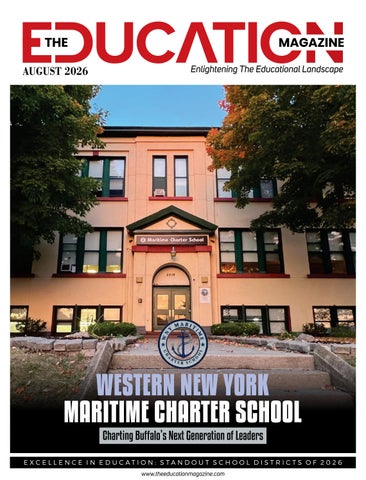
THE AUGUST 2026
UC TI
MAGAZINE
Enlightening The Educational Landscape
WESTERN NEW YORK MARITIME CHARTER SCHOOL Charting Buffalo’s Next Generation of Leaders E XC E L L E N C E I N E D U CAT I O N : S TA N DO U T S C H OO L D I S T R I C T S O F 2 0 2 6 www.theeducationmagazine.com
Excellence Is Not a Grade. It Is a Habit, Practised Daily.
Dear Reader, Some schools chase excellence for a single season and call it an achievement. Others build it into their architecture, decision by decision, until it becomes the only way they operate. This issue, “Excellence in Education: Standout School Districts of 2026,” gathers five institutions that have chosen the harder, quieter path. None of them are chasing a headline. They are building systems, cultures, and habits sturdy enough to outlast any one graduating class, proof that real excellence in education is never a single moment. It is a method, repeated until it becomes identity. That method finds its clearest expression at Western New York Maritime Charter School, this issue’s cover feature. Spread across two Buffalo campuses, the tuition-free school runs on a whole-school Naval Junior Reserve Officers Training Corps model, one that transforms twelve-year-old Candidates into eighteen-year-old Cadets through structure rather than spectacle. Its mission rests on four cornerstones: Academic Excellence, Character Development, Physical Development, and Leadership Development, all pointed toward a vision stated plainly across its halls: Leaders Made Here. In the 2025-2026 school year alone, its Cadets logged 9,444 hours of community service, a figure that says more about the school’s character than any test score could. Under the leadership of Commandant and Superintendent Dr. Ami L. Alderman, whose own record includes service in the United States Air Force, the school treats the uniform as a starting point rather than a finished product, insisting that what matters is what happens to the young person wearing it. Alongside this cover feature, the issue also recognises Oyster Bay-East Norwich Central School District, Eastpointe High School, Jersey City Global Charter School and Mendham Township School District, each honoured for its own distinct path toward the same destination. Together, these five standout districts and schools remind us that excellence in education rarely announces itself. It shows up in attendance figures that quietly improve, in a counsellor who stays late, in a Board that reads the data instead of merely praising the average. This issue is a small tribute to that unglamorous, essential work, and a reminder that every standout district began as a decision, made and then made again, to expect more of itself. Sincerely,
Simran Khan Managing Editor
From The Editor’s Desk People Behind This Issue Publisher: Archana Ghule Editor–in–Chief: Vikram Suryawanshi
Art Director: Priyanka Patil Graphic Designer: Omkar Uravane
Managing Editor: Simran Khan
Marketing Head: Robert Smith
Project Editor: Shadab Mestri
Research Team: Daisy, Rahul,
Sales & Marketing
Maranda, Rocky
Project Head: Aakash Mahajan Sales Co-ordinators: Maria Smith Swati Kumari Project Manager: Pravin Shinde, Nehal Nagpure, Chris Mills The Education Magazine is published by Pericles Ventures Pvt Ltd. This magazine contains material protected under International and Federal Copyright Laws and Treaties. You may not publish, display, disclose, rent, lease, modify, loan, distribute, or create derivative works based on the magazine contents or any part thereof, whether by yourself or as a consultant, employee, partner or in any other role unless authorised in writing by the creator/publisher of the article/, video, audio or any content contained herein. We, the team of The Education Magazine put all the efforts to keep up with the content accuracy. The publisher assumes no responsibility of any part of the content of any advertisement in this publication, including any errors or omissions therein. All rights reserved by Pericles Ventures Pvt Ltd.
Cover Story 10 Western New York Maritime Charter School
CONTENT PROFILES
20. Eastpointe High School 34. Jersey City Global Charter School 50. Mendham Township School District 64. Oyster Bay–East Norwich Central School District articles Best College AI Tools Students 28. Actually Use in 2026 Learning by Gaming: The Science Behind 42. Smarter Classrooms Why Teamwork Is Important: Benefits 58. in School and Work
Western New York Maritime Charter School
Eastpointe High School
Jersey City Global Charter School
Mendham Township School District
www.wnymcs.com
www.jcgcs.org
www.eastpointehs.com
www.mendhamtwp.org
Oyster Bay–East Norwich Central School District Oyster Bay–East Norwich Central School District (Linkedin)
COVER STORY
WESTERN NEW YORK MARITIME CHARTER SCHOOL Charting Buffalo’s Next Generation of Leaders
10 I AUGUST 2026
“
We will hold students accountable, support them relentlessly, and give them authentic opportunities to discover their strength. – Dr. Ami L. Alderman, Commandant and Superintendent, Western New York Maritime Charter School
THE EDUCATION MAGAZINE I 11
COVER STORY
B
uffalo winters do not forgive hesitation. Neither does the school split across two campuses on the city’s east and south sides, where twelve-year-olds answer to the title Candidate, eighteen-year-olds answer to Cadet, and the gap between those two words is not measured in age so much as in what several years of relentless structure can do to a young person. Walk the halls and a rhythm becomes obvious: uniforms pressed, shoulders squared, sentences that start with “yes” and end with a plan. It is the sound of an institution that decided, more than two decades ago, that discipline and opportunity were not opposites but partners. What makes the place worth a longer look is not the uniforms themselves, but what they are asked to represent. A charter school built around a naval training model could easily lean on spectacle, on the visual drama of formation and salute. Instead, the school’s own account of itself keeps circling back to something quieter: a disciplined environment that supports growth rather than display, and leadership as a habit built one small decision at a time. A Charter Built on Four Cornerstones In 2004, the New York State Board of Regents chartered a public high school in Buffalo that would eventually grow into something broader than its founding paperwork suggested. Today, Western New York Maritime Charter School operates as a tuition-free program serving grades 5 through 12, its mission resting on four cornerstones: Academic Excellence, Character Development, Physical Development, and Leadership Development. Underneath all four sits a whole-school Naval Junior Reserve Officers Training Corps model, deployed not to recruit sailors but to build graduates who leave with knowledge, discipline, confidence, and, just as important, a clear plan for what comes after graduation. The school’s vision, stated on paperwork and repeated in its hallways, is captured in three words: Leaders Made Here. No student is required to pursue military service. What is required, in the school’s own telling, is that students learn to lead themselves before anyone asks them to lead others.
The school draws its enrollment from Buffalo and the surrounding Western New York communities, positioning itself for families searching for a structured, safe, mission-driven alternative. The naming convention is deliberate: middle schoolers are Candidates, high schoolers are Cadets, a distinction meant to track their progression through the school's NJROTC leadership structure. That vocabulary shift carries practical weight. A twelve-year-old arriving as a Candidate is introduced from day one to a culture that expects steady growth into leadership, reinforcing the progression the school intends throughout grades 5 through 12. Academics Under Sail Maritime offers no elementary program. In grades 5 through 8, Candidates receive standards-aligned instruction in English language arts, mathematics, science, social studies, physical education, the arts, and leadership development. By high school, Cadets work through New York State Regents coursework alongside Naval Science I through IV, plus an additional Leadership in Action course centered on service learning, whether inside the school or the broader community. College and career preparation runs alongside credit recovery for students who need it, and targeted academic intervention for those falling behind. The school also builds hands-on STEM and maritime experiences into its curriculum through partnerships that connect classroom lessons to boatbuilding, navigation, teamwork, and regional maritime history. Guidance programming, meanwhile, covers senior portfolios, resumes, financial-aid support, college applications, military exploration, workforce training, and other industry-connected options. Defining Excellence by More Than a Score
Two Campuses, One Chain of Command Despite its name, Maritime is not a sprawling district of separate schools. It is a single public charter school operating across two Buffalo addresses. The Middle School campus, home to grades 5 through 8, sits at 102 Buffum Street. The High School campus, serving grades 9 through 12, is located at 2219 South Park Avenue. 12 I AUGUST 2026
Ask the school what educational excellence means, and the answer resists the shorthand of a standardized test. Excellence, in Maritime's own framing, means measurable academic growth, graduation readiness, personal accountability, strong attendance, physical wellness, ethical leadership, and a viable plan for life after graduation.
Strategic planning follows what the school calls a Mastery Mindset: stabilize students first, re-engage them, then accelerate their achievement. The stated priorities are specific: improve Regents and middle school outcomes, maintain a graduation rate above 94 percent, strengthen teacher certification and instructional consistency, reduce chronic absenteeism, expand postsecondary pathways, and monitor performance through frequent data cycles rather than waiting on annual results. Meeting Every Student Where They Stand High expectations, on their own, do not account for how differently students arrive at a classroom door. Maritime pairs its expectations with differentiated support: small-group instruction, intervention blocks, academic review cycles, tutoring, study halls, and ongoing progress monitoring. An Academic Review Board identifies students at risk, assigns interventions, and revisits the results, treating the process as a cycle rather than a single event. Special education, English as a New Language services, counseling, health, and family supports are coordinated rather than left to operate in isolation. Staff draws on culturally responsive materials, working from the understanding that many students arrive having faced interrupted learning, trauma, or significant credit deficits. Structure, the school insists, is never meant as a substitute for support. Instead, it provides the consistency that allows individualized interventions to succeed.
A Web of Partners Beyond the Gate Families hear from the school often, through conferences, digital platforms, events, recruitment activities, and direct outreach whenever attendance or academic concerns arise. That same instinct toward connection extends outward, into partnerships that include SUNY Erie, Niagara University, Canisius University, Say Yes Buffalo, Northland Workforce Training Center, the Buffalo Employment and Training Center, military branches, veterans’ organizations, employers, and civic partners. These relationships contribute admissions access, financial-aid guidance, career exposure, mentorship, and service opportunities. Cadets, in turn, give something back to the region through ceremonies, parades, veteran recognition events, blood drives, and community projects, a reciprocal arrangement the school treats as central rather than incidental. Drills, Diamonds, and Nearly Ten Thousand Hours of Service Student life at Maritime is, by design, active and visible. Cadets compete in varsity and modified athletics, including football, basketball, track and field, girls flag football, and cheerleading. NJROTC activity fills out the rest of the calendar: drill, color guard, air rifle, orienteering, physical training, leadership academies, and ceremonial teams. THE EDUCATION MAGAZINE I 13
COVER STORY
14 I AUGUST 2026
Student government, National Honor Society, arts, yearbook, college visits, and maritime STEM projects round out the experience. And then there is the number that anchors the whole picture: in the 2025-2026 school year, Cadets logged 9,444 hours of community service, evidence, the school notes, that service is not an occasional event on the calendar but part of its identity. The Chain of Command Running a school built on military structure requires its own clear hierarchy. The Commandant serves as Head of Schools and chief executive, aligning academics, operations, culture, compliance, and community strategy under one line of authority. Campus administrators oversee daily instruction and climate at each site. Curriculum and Instruction supports teaching quality and assessment. Student Services coordinates special education, English as a New Language programming, and related services. Guidance leads academic and postsecondary planning. NJROTC instructors work specifically on leadership, citizenship, and military bearing. Operations, Finance, Human Resources, Technology, Safety, Health, Food Service, and Athletics sustain the daily systems students rely on without necessarily noticing. A Board of Trustees sits above it all, providing governance, fiscal oversight, and strategic accountability. Equity as an Open Door Equity at Maritime, as the school frames it, means access plus the support required to make use of that access. The school is tuition-free, offers an inclusive grades 5 through 12 pathway, and does not require prior military interest or experience of anyone who enrolls. Students with disabilities, multilingual learners, economically disadvantaged students, and those entering behind grade level receive targeted services, but they are not separated from leadership opportunities as a result. Uniform standards, leadership positions, college access, career exploration, and extracurricular participation remain available across backgrounds. Data are reviewed by subgroup deliberately, so that apparent school-wide progress cannot quietly conceal gaps that persist underneath it.
“
Maritime may not have been your first choice, but we intend to become your right choice. Guidance Beyond Graduation
Support at Maritime does not end with academics. Students receive individualized academic and postsecondary planning, regular meetings with counselors, college fairs, instant-admission opportunities, FAFSA and TAP assistance, ASVAB preparation, access to military recruiters, workforce referrals, and help building a senior portfolio. Partnerships with higher education institutions, Say Yes Buffalo, Northland, the Buffalo Employment and Training Center, and other community organizations expose students to college, skilled trades, certifications, military service, and employment, without funneling everyone toward the same destination. Mentorship also happens inside the cadet chain of command itself, where older students coach younger peers and learn to accept responsibility for how their team performs. Scaling to Excellence The school’s next phase carries its own name: Scaling to Excellence. It calls for deepening standards-aligned instruction, intervention and assessment cycles, attendance systems, leadership development, and Board-level performance monitoring, alongside an expansion of career-connected learning, maritime STEM, and credential and workforce pathways. Success, going forward, will be measured through student growth, proficiency, credit accumulation, graduation, attendance, discipline, enrollment stability, teacher certification, postsecondary placement, and something harder to quantify: evidence that students are increasingly leading with competence and integrity. THE EDUCATION MAGAZINE I 15
COVER STORY
The Woman at the Helm At the center of all of it stands Dr. Ami L. Alderman, Commandant and Superintendent, who brings more than 24 years in K-12 education to the role. Her own record includes military service in the United States Air Force Security Forces and the rank of Major and a Squadron Commander in the Civil Air Patrol, along with a Ph.D. in Curriculum and Instruction and Leadership. She is known for a direct, systems-focused approach rooted in service, qualities that closely reflect the school she leads. Her message to current and prospective families is not soft, and it is not vague. It promises accountability, relentless support, and the kind of authentic opportunity that lets a student discover exactly what they are capable of, framed around a simple idea: the uniform is never the finished product. It is what happens to the person wearing it that matters. It is a fitting note to end on, because it captures what makes Maritime harder to categorize than either “charter school” or “military program” suggests on their own. The Regents coursework, the Academic Review Board, the FAFSA workshops, the drill teams, the blood drives, the nearly ten thousand hours logged in a single year: none of it is separate from the mission. Together, these elements give tangible form to the school’s purpose, worked out in the particulars, one Candidate and one Cadet at a time. “The uniform is not the outcome; the disciplined, capable, service-minded young adult inside it is.” – Dr. Ami L. Alderman, Commandant and Superintendent
16 I AUGUST 2026
THE EDUCATION MAGAZINE I 17
EASTPOINTE HIGH SCHOOL Rewriting the Path to Graduation 20 I AUGUST 2026
N
ot every student’s story fits neatly into a traditional classroom. Some fall behind. Others lose confidence. A few begin to believe that school simply is not meant for them. Yet, in many communities, these are the very students who need the most thoughtful support and a reason to start again. Founded in 1998, Eastpointe High School grew out of that need. What began as a small alternative school has steadily developed into a focused effort to bring students back into the fold of education. The idea was simple but deliberate. Meet students where they are, not where the system expects them to be. Over the years, the school has shaped its approach around that belief. Its mission centers on guiding students who have struggled elsewhere toward graduation and a future they can take pride in. The vision is equally grounded. Every student, no matter their past, deserves access to an education that rebuilds confidence and creates real opportunities.
“
Success is not where you start, it’s the moment you decide to move forward.
As the years passed, the model expanded without losing its core. Programs became more flexible, support systems grew stronger, and new methods found their way into the classroom. Through it all, the focus remained personal. Each student mattered, and each story deserved another chance to move forward. Learning That Adapts to the Student By the time many students arrive here, the gap is not just academic. It often includes missed credits, broken confidence, and a sense that time has run out. The school’s academic design responds directly to that reality, with a structure that adjusts to the student rather than forcing the student to adjust to it. At the center of this approach are credit recovery and dropout recovery programs. These give students a clear path to make up lost ground without feeling overwhelmed. Progress is steady and visible, which helps rebuild momentum. Alongside this, a blended learning model brings together classroom teaching and technology-supported instruction. This mix allows students to move at a pace that fits their learning style while still staying connected to teachers and peers. THE EDUCATION MAGAZINE I 21
Preparation for life after graduation is treated as part of everyday learning. Guidance around college, trades, and employment is woven into the experience so that students can see where their efforts are leading. While the institution does not run elementary or middle schools, its program is built to address gaps that may have started years earlier. The goal is not only to help students finish high school, but to help them move forward with clarity and direction. A Focused Model Serving a Wider Community Not every education system is built around a network of schools. Some are designed with a narrower structure and a sharper purpose. That is the case here. Instead of operating as a traditional district with multiple campuses, the model centers on a single charter high school with a clear role. From that one point, the reach extends across communities in Arizona, including cities like Phoenix and Tucson. The student population reflects a wide range of backgrounds and circumstances. Many arrive carrying academic gaps, while others return after stepping away from school altogether. Some are balancing jobs or family responsibilities alongside their studies. The program focuses on grades 9 through 12, but the experience is far from standard. Flexibility is built into the structure so students can manage both school and life. Schedules, pacing, and support systems are shaped to fit real-world demands rather than ignore them. This approach allows the school to stay intentional. Without the complexity of multiple campuses, attention remains on the students who need it most. The result is a learning environment that feels both personal and practical, designed to meet students where they are and help them move forward with purpose.
The focus begins with graduation and completion rates, but those figures tell only part of the story. Equal weight is given to student engagement and persistence. Showing up, staying committed, and continuing despite setbacks are seen as meaningful indicators of growth. These are often the first signs that a student is beginning to believe in their own potential again. Planning and decision-making follow this same line of thinking. Every program, every support system, and every adjustment is guided by a simple question. Is this helping students move forward in a real and lasting way? Readiness for life after high school remains a steady priority, whether that path leads to college, skilled trades, or the workforce. Excellence, in this setting, takes shape when a student who once felt disconnected begins to find direction. Confidence returns. Goals become clearer. Graduation is not just an endpoint. It marks the moment when a student is prepared to step into the next phase of life with purpose. Leadership That Stays Close to the Work Leadership in the school is less about titles and more about what students experience each day. Decisions are expected to show up in classrooms, in conversations, and in the small moments where a student decides whether to keep going or give up. That responsibility is carried by James Meehan, Chief Executive Officer, and Chris Meehan, Chief Operating Officer, along with a team that stays closely involved in both planning and execution. Their role is not to stand apart from the process, but to remain part of it, ensuring that the original purpose does not get diluted as the school grows.
Measuring Success by Transformation
When they speak to students and families, the message does not come dressed in polished language. It is straightforward. What has happened before does not close the door on what comes next. That idea carries weight because it is backed by how the system works. Support is steady. Expectations are clear. Progress, even when slow, is taken seriously.
In many schools, excellence is tied to numbers alone. Test scores, rankings, and benchmarks often take center stage. At Eastpointe High, the measure runs deeper. Progress is not judged only by where students finish, but by how far they have come.
Students are guided without being rushed. Families are kept in the loop, not at the margins. Over time, this builds something that cannot be forced. A sense of trust that grows through consistency, where words and actions begin to match in ways that students can recognize.
22 I AUGUST 2026
Building Around Each Student’s Reality Walk into any classroom on campus, and you will quickly notice that no two students are working in quite the same way. Some move faster, others take their time. A few are balancing jobs. Others are carrying responsibilities at home that rarely show up on a report card. The approach adjusts to these differences rather than smoothing them over. Individualized learning plans sit at the center of this effort. Each student works toward goals that match their current level, not an assumed standard. This keeps progress realistic and visible. Flexible scheduling supports that structure. Students can attend in ways that fit around work shifts or family duties, which makes consistency easier to maintain over time. Teaching practices also reflect the backgrounds students bring with them. Lessons are shaped to connect with real experiences, not just textbooks. Cultural context is not treated as an add-on. It becomes part of how subjects are introduced and understood. What ties all of this together is a steady focus on relationships. Teachers and staff take time to know who their students are beyond academics. That familiarity changes how support is offered. It becomes more personal, more precise. Over time, students begin to feel that they belong here, and that belief often becomes the starting point for real progress. THE EDUCATION MAGAZINE I 23
Extending Learning Beyond the Classroom For many students, progress depends on what happens outside the classroom just as much as what happens inside it. That is why building strong connections with families and the wider community remains an ongoing effort at Eastpointe High and not an occasional initiative. Families and guardians are treated as active participants in a student’s journey. Regular communication keeps them informed and involved, making it easier to address challenges early. Alongside this, partnerships with community organizations bring in additional layers of support that schools alone often cannot provide. Connections with the local workforce and training programs open up practical pathways. Students gain exposure to realworld environments, where learning begins to feel relevant and immediate. Mentorship opportunities grow out of these relationships, offering guidance from people who understand the demands beyond graduation. These efforts create a network around each student. It is not just about finishing school, but about stepping into the next phase with experience, direction, and a stronger sense of possibility. A Different Kind of Student Life Student life at Eastpointe High does not follow the usual script of packed sports calendars or long lists of clubs. Many students arrive with responsibilities that extend well beyond school hours, so the experience is shaped with that reality in mind. The focus shifts toward creating a space where students feel supported the moment they walk in. Small wins are noticed. Milestones that might go unrecognized elsewhere are acknowledged and celebrated. That could mean completing a difficult course, returning after time away, or simply staying consistent over weeks that test their resolve. Opportunities for growth take a more practical form. Students step into leadership roles within the campus, mentor peers who are earlier in their journey, and learn to take ownership of their progress. These moments may not always carry formal titles, but they leave a lasting impact. The result is a student life built on connection and confidence. It prepares students not just to participate in school, but to handle the responsibilities waiting for them beyond it. 24 I AUGUST 2026
Roles That Keep Everything Moving A setup like this relies on clarity in roles and steady coordination behind the scenes, supported by Elevated Education. School leadership, including the principal and assistant principal, focuses on direction and consistency. They ensure that what happens in classrooms aligns with the larger purpose. Academic leaders work alongside teachers, shaping lessons and refining instruction so it meets students where they are. Student support staff bring a more personal layer to the system. Success coaches and advisors stay connected with students, helping them manage both academic and personal challenges. At the same time, operational and compliance teams handle the systems that keep everything running smoothly. Together, these roles create an environment where structure and support work side by side. THE EDUCATION MAGAZINE I 25
Designing for Fair Outcomes, Not Just Access
Support That Extends Beyond Academics
At Eastpointe High, equity shapes how the entire system functions. Many students arrive after struggling in environments that could not support their needs, so the focus turns to removing those barriers early.
Many students need guidance that touches different parts of their lives, which is why the school provides support that is built as a continuous presence rather than a separate service. Student success coaching plays a central role. Coaches stay in regular contact, helping students set goals, track progress, and stay accountable during difficult phases. Alongside this, career and postsecondary planning gives direction to their efforts. Students begin to see how present work connects to future options, whether that leads to college, training, or employment.
Flexible learning options allow students to progress at a pace that fits their situation. This makes consistency more achievable, especially for those balancing responsibilities outside school. Personalized academic pathways ensure that goals are realistic and clearly defined, helping students see steady progress. Support services and mentorship add another layer of stability. Students receive guidance that extends beyond academics, helping them stay on track during difficult periods. The intention is not limited to equal access. It is about creating conditions where students, regardless of their starting point, can reach outcomes that reflect their effort and potential. 26 I AUGUST 2026
Mentorship adds a more personal layer. Students have access to people who can guide, listen, and share perspectives drawn from experience. Social-emotional support works alongside this, addressing challenges that often affect consistency and focus. These elements create a system where students are supported as individuals. The aim is not just to help them pass courses, but to help them move forward with clarity and stability.
Looking Ahead with Clear Intent The next phase for Eastpointe High School builds on what has already taken shape, with a focus on reaching more students without losing the personal approach that defines its work. One priority is to expand dropout recovery efforts so that more students who have stepped away from school can find a structured way back. At the same time, there is a push to strengthen career readiness through deeper connections with workforce partners. These relationships are expected to open clearer pathways beyond graduation. Technology will also play a larger role. The aim is not simply to add new tools, but to use them in ways that make learning more responsive to individual needs. Each of these steps points in the same direction. To extend access, improve outcomes, and continue shaping an approach where students are given a real chance to change their trajectory.
THE EDUCATION MAGAZINE I 27
Best
College AI Tools Students Actually Use in 2026
28 I AUGUST 2026
inding the best college AI tools has become a priority for students trying to keep up with modern academic demands. From understanding complex subjects to managing research papers and writing assignments, college today requires more than traditional study methods.
F
Finally, the best college AI tools enhance thinking instead of bypassing it. When used responsibly, AI can help students ask better questions, understand complex material faster, and manage academic workloads more effectively without compromising integrity.
AI tools are now part of how students learn, but not all tools are designed for academic use. Many popular apps promise productivity, yet universities and academic libraries consistently emphasize that the most effective AI tools are those that support learning, research, and clear thinking, rather than replace them.
This lens is important because it separates genuinely useful college AI tools from short-term trends.
This guide explores the best college AI tools students actually use, based on university recommendations, library resources, and real academic workflows. Instead of generic lists or marketing-driven suggestions, the focus here is on tools that help students study efficiently, conduct credible research, improve academic writing, and stay organized throughout the semester.
Best College AI Tools by Academic Task 1. AI Tools for Studying and Concept Understanding Studying is often where students first experience the value of AI. Universities increasingly recognize best college AI tools as learning companions that help explain difficult ideas, review material, and reinforce understanding. The most effective AI tools for studying focus on:
Whether you’re navigating coursework, preparing research papers, or balancing multiple deadlines, this article is designed to help you choose AI tools with clarity, confidence, and academic responsibility.
● Breaking down complex concepts into simple explanations ● Answering follow-up questions in context
What Makes an AI Tool Useful for College Students? ● Supporting revision without replacing learning Not every AI tool belongs in an academic setting. The best college AI tools that genuinely help college students share a few clear qualities that are repeatedly emphasized by universities and academic libraries. First, academic relevance matters more than popularity. A useful AI tool should support studying, research, or writing tasks that students are already required to do. Tools designed mainly for marketing, social media, or automation rarely translate well into coursework. Second, alignment with university guidelines is essential. Many institutions now allow AI use, but only when it supports learning rather than replacing original thinking. Tools that summarize research, explain concepts, or improve clarity are far more acceptable than tools that generate full assignments without understanding, a position also reflected in global discussions around responsible AI use in education.
Academic libraries frequently highlight general AI assistants that allow students to ask questions, explore topics interactively, and clarify doubts while studying. When used alongside textbooks and lectures, these tools help students engage more deeply with course material rather than passively memorizing it, especially when paired with AI tutors designed to support guided learning rather than answer generation What matters here is how students use the tool. Universities consistently advise using AI to support comprehension, not to skip reading or avoid coursework. Used this way, AI becomes a study aid, not a shortcut. Best used for: clarifying concepts, revision, guided learning
THE EDUCATION MAGAZINE I 29
Commonly used tools:
● Understand research papers more efficiently
● ChatGPT (educational use): Explaining complex topics, asking follow-up questions, revising concepts
● Identify connections between studies and authors
● Perplexity AI: Exploring topics with cited sources and structured explanations
University library guides often point students toward AI-assisted research tools that work with scholarly databases rather than replacing them. These tools don’t write research papers, but they help students navigate academic literature faster and with more clarity, similar to the academic library AI tool resources curated specifically for higher education.
Why universities allow them: When used as a study companion, these tools help students engage with material more deeply, rather than skipping learning. 2. AI Tools for Research and Literature Review Research is one of the most time-intensive parts of college, especially in higher-level courses. This is where AI tools recommended by university libraries offer the most measurable benefit.
● Summarize complex academic texts
For students handling research assignments, capstone projects, or literature reviews, AI tools in this category function as research accelerators, allowing more time for analysis, critical thinking, and original insight.Using best college AI tools responsibly ensures students maintain academic integrity while gaining efficiency in research workflows.
Credible academic AI tools help students: ● Discover relevant scholarly articles
30 I AUGUST 2026
Best used for: discovering papers, summarizing research, understanding scholarly work
Commonly used tools:
Commonly used tools:
● Elicit: Finding relevant research papers and extracting key findings
● Grammarly: Editing for clarity, grammar, and academic tone
● Scite: Understanding how studies are cited and supported in academic literature
● QuillBot: Responsible paraphrasing and sentence restructuring
● Connected Papers: Visualizing relationships between research studies
● Microsoft Copilot (Word): Draft refinement and readability support
Why universities recommend them: These tools work with academic databases and help students navigate literature efficiently without writing papers on their behalf.
University guidance: Students remain responsible for ideas and citations. AI assists with expression, not authorship.
3. AI Tools for Academic Writing and Editing
Staying organized is one of the biggest challenges in college, especially when lectures, readings, assignments, and deadlines overlap. This is where best college AI tools built around documents and notes provide practical value.
Writing is one of the most sensitive areas where students use AI, and universities are especially clear about how it should be approached. The most effective college AI tools for writing are not designed to replace a student’s voice, but to improve clarity, structure, and precision.
4. AI Tools for Note-Taking and Academic Organization
Universities increasingly point students toward AI tools that: ● Summarize lecture notes and reading materials
Academic libraries consistently recommend AI tools that help students: ● Refine grammar and sentence structure
● Help organize large volumes of academic content ● Allow students to ask questions directly from their own documents
● Improve clarity and flow in academic writing ● Support revision by highlighting key ideas and themes ● Paraphrase text responsibly while preserving meaning ● Review drafts for tone and readability Used correctly, these tools act like a second set of eyes on a draft. They support revision, not authorship. Universities often emphasize that students remain responsible for ideas, arguments, and citations, while AI assists with expression and polish.
These tools are particularly useful for students managing dense readings or recorded lectures. Instead of replacing note-taking, AI helps students make sense of their notes, identify gaps in understanding, and prepare more efficiently for exams. When integrated thoughtfully, AI-driven organization tools reduce cognitive overload and allow students to focus on learning rather than information management.
For essays, reports, and research papers, AI writing tools are most valuable in the editing and refinement stage, helping students communicate their thinking more clearly without compromising originality.
Best used for: summarizing lectures, organizing documents, and revision
Best used for: grammar refinement, clarity, tone improvement
● Notion AI: Organizing coursework, summarizing notes, managing projects
Commonly used tools:
THE EDUCATION MAGAZINE I 31
● Readwise Reader: Extracting key ideas from readings and notes ● Otter.ai: Transcribing and summarizing lectures responsibly
● Symbolab: Guided math problem solving Important note: Universities advise using these tools after attempting problems independently to reinforce learning. Quick Comparison: Best College AI Tools at a Glance
Why students rely on them: These tools reduce cognitive overload and help students manage large volumes of academic material. 5. AI Tools for Math and Problem-Solving For subjects like mathematics, statistics, and quantitative courses, AI tools can support learning by focusing on the process rather than just answers. Universities that reference AI problem-solving tools emphasize their value when they: ● Show step-by-step solutions ● Help students understand where mistakes occur
These best college AI tools give students reliable ways to manage academic work efficiently while following university guidelines.
● Reinforce problem-solving methods
Free vs Paid AI Tools for College Students
These tools are most effective when students use them after attempting problems on their own. In this role, AI tools becomes a guided tutor helping students learn how to solve problems, not simply providing results.
Universities and academic libraries consistently note that the difference between free and paid AI tools is not about intelligence, but depth, scale, and access. The table below explains this clearly, without marketing bias.
Academic guidance consistently warns against using AI to bypass practice. Instead, problem-solving AI tools work best as a way to review, correct, and strengthen understanding in quantitative subjects. Best used for: understanding processes, reviewing mistakes Commonly used tools: ● Wolfram Alpha: Step-by-step solutions and concept explanations 32 I AUGUST 2026
What matters most is not whether a tool is free or paid, but whether it fits the academic task and follows university guidelines. Many students are surprised to learn that their institution already provides access to advanced AI tools, making paid plans unnecessary out of pocket.
This responsible-use framework is what separates productive AI adoption in college from misuse, and it's a distinction every student should understand. Choosing the Right AI Tools for Your Major
How Universities Recommend Students Use AI Tools
Not all academic work looks the same, and the most effective AI tools are those that align with how a subject is taught and assessed.
Universities are no longer debating whether students will use AI; they are focused on how AI should be used responsibly. Across academic institutions, guidance around AI use is remarkably consistent.
For humanities and social sciences, students benefit most from AI tools that support reading comprehension, research exploration, and writing clarity. These tools help analyze arguments, summarize dense texts, and refine essays without replacing original interpretation.
Universities encourage students to use AI tools to:
For STEM and computer science disciplines, AI tools are most useful when they assist with problem-solving processes, code explanation, data understanding, and concept clarification. Universities emphasize using these tools to understand how solutions work, not just what the answer is.
● Understand difficult concepts ● Explore topics during early research ● Improve clarity and structure in writing ● Organize notes and study materials Many institutions now publish guidance through their libraries on responsible AI use, including university library guidance on using AI tools that emphasizes transparency, skill development, and ethical application. This approach closely aligns with how AI is being introduced in the classroom to enhance learning outcomes without replacing student effort. At the same time, institutions clearly state that AI should not:
For business, management, and law, AI tools that support document review, structured writing, research synthesis, and organization are particularly valuable. These disciplines often involve case analysis and reports, where clarity and structure matter as much as content. The goal across all majors is the same: choose best college AI tools that strengthen academic skills already required by the curriculum. A Practical Way Forward for Students Navigating AI AI tools are now part of the academic landscape, but their value depends entirely on how students choose to use them. The best college AI tools are not shortcuts to grades; they are tools that support deeper understanding, clearer thinking, and more confident academic work.
● Replace original thinking or analysis ● Generate complete assignments submitted as a student’s own work
When students approach AI with intention and responsibility, these tools become allies in learning rather than risks to integrity. The future of college education will belong to those who know how to work with intelligent tools while thinking independently.
● Used to bypass learning or assessment Academic libraries often describe AI as a learning amplifier, not a shortcut. When students use AI transparently and thoughtfully, it can deepen understanding, save time on repetitive tasks, and support stronger academic outcomes.
If this guide helped clarify how AI tools can fit into college life, consider sharing it with classmates, study groups, or educators who are navigating the same questions. Thoughtful use spreads faster when knowledge is shared.
THE EDUCATION MAGAZINE I 33
JERSEY CITY GLOBAL CHARTER SCHOOL Learning to Navigate a Connected World 34 I AUGUST 2026
THE EDUCATION MAGAZINE I 35
In I
a city shaped by movement, culture, and constant change, education carries a different kind of responsibility. Schools are not just places for instruction. They are training grounds for real life, where students begin to understand how they fit into a wider, fast-moving world. In Jersey City, where global influences meet everyday life, that responsibility becomes even more visible.
Founded in 2013, Jersey City Global Charter School grew out of a clear idea. Students need more than textbooks to succeed. They need to think, question, and adapt. From the beginning, the school set out to build an environment where academic learning connects directly to the world outside the classroom. The goal has remained steady over the years: prepare young people to take on complex challenges with confidence and awareness. Inside the school, learning rarely stays confined to theory. Programs like MicroSociety and project-based learning give students a chance to test ideas in real situations. They run systems, solve problems, and see how decisions play out. Community engagement further grounds their experience, helping them understand the people and structures around them. The approach is practical, but it never loses sight of strong academic foundations. Growth has been steady and deliberate. What began as a focused vision has developed into a full, active school community serving hundreds of families. Along the way, the school has expanded its academic offerings, strengthened support systems, and built a culture where students feel both challenged and supported. That balance has not come by accident. It reflects years of refinement and clear leadership. Recognition followed, but it did not define the work. Being named a Tier 1 charter school in New Jersey and Hudson County reflects consistent performance and accountability. More importantly, it signals that the model works. Students are not just keeping up. They are learning how to move forward with purpose in a world that rarely stands still.
One program stands out early in a student’s journey. MicroSociety turns the school into a working model of the real world. Students step into roles where they run businesses, manage money, and take part in governance. It is not treated as an extra activity but as an extension of academic learning, where ideas from textbooks begin to make sense in practice. By middle school, expectations shift. Students take on more ownership of their work while diving deeper into English Language Arts, mathematics, science, and social studies. They learn to question, research, and form independent views. Leadership opportunities and culturally responsive teaching methods keep learning relevant, while technology supports collaboration and prepares them for more complex challenges ahead. A Close-Knit Structure with a Broad Reach The structure of the school remains intentionally focused, built around a single K–8 charter school that serves about 400 students. This scale shapes the daily experience in subtle but important ways. Classrooms feel connected, staff know students by name, and decisions can be made without layers of delay. It allows the school to stay attentive, adjusting quickly when student needs shift rather than waiting for systems to catch up. Families come from across Jersey City and nearby neighborhoods, bringing with them a mix of languages, cultures, and life experiences. That diversity is not treated as a background detail. It actively shapes how the school operates. Lessons, interactions, and community events reflect the varied perspectives students carry with them, making inclusion part of everyday learning rather than a separate initiative.
Building Strong Foundations Across Every Stage A clear academic structure shapes how students grow here, but it does not feel rigid or mechanical. The design moves with the student, adjusting as their curiosity, confidence, and responsibility begin to take form. At the elementary level, the focus stays grounded in literacy and mathematics, guided by the New Jersey Student Learning Standards. Classrooms are active spaces where lessons often take shape through projects, group work, and discussion rather than passive instruction. 36 I AUGUST 2026
Operating as a charter school also gives the flexibility to move differently. Programs can be introduced, refined, or expanded with fewer constraints. This responsiveness shows up in both academics and social-emotional support, where the school works to meet students where they are. The result is a structure that feels both grounded and adaptable, small enough to stay personal yet broad enough to reflect the city it serves.
Planning does not happen in isolation. It evolves through constant review and conversation. Teachers collaborate, data is examined closely, and families contribute their perspective on what is working and what needs attention. Community partnerships further strengthen this process, connecting the school’s goals with real-world needs. This ongoing cycle keeps the system responsive, allowing it to improve steadily without losing sight of its core purpose. Meeting Students Where They Are
Redefining What Excellence Looks Like
Walk into a classroom, and no two students are learning in quite the same way. That reality shapes how teaching is approached across the school. Lessons are built with flexibility in mind, allowing students to engage through different paths rather than forcing a single method on everyone. Some work best through discussion, others through hands-on tasks, and many through a mix of both. Teachers adjust in real time, using small-group instruction and differentiated strategies to keep each student involved and progressing.
Excellence at Jersey City is measured in ways that go beyond numbers on a report. Academic performance matters, but it is only one part of a larger picture. Equal weight is given to how students think, how they handle challenges, and how they engage with the people around them. The goal is to shape individuals who are curious, steady under pressure, and aware of their role in a broader community. Three priorities guide this approach. Strong academic achievement remains the foundation, ensuring students build the knowledge and discipline needed for future study. Alongside that, leadership and real-world learning take center stage, giving students space to apply what they know in meaningful ways. Equity forms the third pillar, with a clear effort to make opportunities accessible to every student, regardless of background. THE EDUCATION MAGAZINE I 37
Culture also plays a visible role in how learning unfolds. Classrooms reflect the backgrounds students bring with them, not as a token gesture but as part of everyday instruction. Reading materials, projects, and conversations often draw from a wide range of perspectives, helping students see themselves in what they study while also understanding others. This approach builds both confidence and awareness without making either feel forced. Support systems run alongside this work. Students who need extra help receive targeted instruction, including English language development and individualized plans tailored to their pace. The aim is steady progress, not quick fixes, ensuring that every student has a fair chance to keep up, contribute, and feel part of the learning process. Building Strong Ties Beyond the Classroom Learning here does not stop at the school doors. It extends into homes, neighborhoods, and the wider community, where relationships play a steady role in shaping each student’s experience. Families are not treated as observers but as active participants. Through regular events, workshops, and celebrations, parents step into the rhythm of the school, gaining a clear view of how their children learn and grow. There is also space for deeper involvement. Parents contribute through volunteering, academic support, and participation in school governance, creating a sense of shared responsibility rather than distant oversight. This connection strengthens trust and keeps communication open. Beyond families, partnerships with local organizations, businesses, and civic leaders add another layer. These connections bring mentorship, career exposure, and hands-on learning opportunities into the mix. Students begin to see how their education links to the world outside, making their learning feel relevant and grounded in real experiences. A Campus Life That Extends Beyond Academics The rhythm of student life carries well beyond class hours, adding energy and variety to each day. Students are not limited to academic routines. They move between clubs, arts programs, and group activities that give them space to explore what interests them. These moments often reveal talents that do not always show up in traditional lessons. 38 I AUGUST 2026
Cultural celebrations bring another layer to campus life, reflecting the backgrounds and traditions students represent. Participation feels natural rather than staged, helping students connect with one another in ways that go beyond coursework. Leadership opportunities also take shape through everyday experiences. Student government and MicroSociety activities allow students to take initiative, make decisions, and see the results of their actions. Project-based competitions add a sense of challenge and collaboration, pushing students to work as teams. These experiences build confidence and strengthen relationships. Students begin to see themselves not just as learners, but as active contributors within a community that values both effort and expression.
Structure That Keeps the School Moving Behind the day-to-day flow of the school sits a structure built on coordination rather than hierarchy. Leadership is shared across roles that stay closely connected, ensuring that decisions are not made in isolation. The Chief School Administrator works alongside a broader leadership team, instructional leads, and operational staff, each responsible for a different part of the school’s functioning. On the academic side, instructional leaders focus on what happens inside the classroom. They guide curriculum planning, support teachers, and track student progress to keep learning on course. Their work stays closely tied to outcomes, with regular collaboration shaping how teaching evolves over time. Operational teams handle the systems that keep everything running smoothly. From finance and compliance to enrollment and facilities, their role is less visible but just as critical. Together, these groups maintain alignment across the school, ensuring that both instruction and operations move in the same direction without friction. THE EDUCATION MAGAZINE I 39
Leadership with a Clear Sense of Purpose At the center of the school's direction is a leadership approach shaped by intention and consistency. Under the guidance of Dr. Jack, decisions are grounded in a simple but steady belief: students learn best when they feel seen, challenged, and supported at the same time. This mindset carries through classrooms, programs, and daily interactions. Leadership here does not operate at a distance. It stays connected to both students and families, shaping an environment where individual strengths are recognized and encouraged. The focus is not only on academic growth but also on helping students understand who they are and what they can become. The message shared with the community reflects this clarity. Every student’s voice holds value, and every path forward carries possibility. Families are seen as partners in that journey, working alongside the school to create opportunities that feel both real and within reach. Creating Fair Access for Every Student Equity and inclusion are not treated as abstract goals. They show up in everyday decisions, shaping how students are supported and how opportunities are shared. The aim is clear. Every student should have access to strong instruction, meaningful resources, and a learning environment where they feel they belong.
“
Your voice matters, your potential is limitless, and together we can build a future filled with opportunity and possibility.
40 I AUGUST 2026
Progress is closely tracked to make this possible. When gaps appear, the response is deliberate. Targeted interventions and additional support help students stay on track rather than fall behind. Access to academic programs is also reviewed carefully, ensuring that participation does not depend on background or circumstance. Classrooms reflect this approach through culturally responsive teaching. Lessons connect with students’ experiences, making learning more relatable and engaging. At the same time, educators continue to refine their practice through ongoing training focused on equity-centered methods. The result is a system that works to stay fair in practice, not just in intent. Students move forward with the confidence that they are seen, supported, and given a real chance to succeed. Supporting the Whole Student Academic growth is only part of the picture. Equal attention is given to how students manage challenges, build relationships, and understand themselves. Support systems are woven into the school day, offering steady guidance rather than occasional intervention. Students have access to counseling services that provide a space to talk through concerns, whether they are academic or personal. These conversations often help students find direction when things feel uncertain. Academic intervention programs run alongside this, giving extra support to those who need help catching up or strengthening key skills.
Mentorship adds another layer, connecting students with guidance that goes beyond the classroom. These relationships often shape confidence and decision-making over time. Social-emotional learning remains a consistent thread throughout. It is not treated as a separate subject but as part of daily interactions. Students learn to manage emotions, understand others, and respond thoughtfully. This balance helps them move forward with both competence and a sense of stability. Expanding Possibilities for the Future The next phase of growth for Jersey City Global Charter School is shaped by a steady focus on relevance. As the world shifts, the school continues to adjust its approach, ensuring students are prepared for what lies ahead, not just what exists today. Plans are already taking form. STEM learning is set to expand, giving students deeper exposure to science, technology, engineering, and mathematics through more applied and exploratory work. At the same time, global learning experiences will grow stronger, helping students understand perspectives beyond their immediate surroundings. Partnerships will also play a larger role. Connections with community organizations and higher education institutions are expected to open new pathways for mentorship, exposure, and continued learning. Alongside these efforts, the school remains committed to refining its instructional methods. The focus stays on building creative thinkers and capable problem solvers, students who can adapt, question, and contribute with confidence in an increasingly complex world.
THE EDUCATION MAGAZINE I 41
LEARNING BY GAMING The Science Behind Smarter Classrooms
F
or decades, classrooms treated games as distractions. Teachers asked students to close apps, silence devices, and focus on textbooks and lectures.
The assumption was simple: learning required discipline, not play. Today, that belief is being challenged by a growing body of educational research and classroom experience. Learning by gaming is an approach that uses the structure of game challenges, progress, exploration, and feedback to support learning outcomes. Instead of passively absorbing information, students interact with problems, test ideas, and adapt their strategies as they play. The process turns learning into an active experience rather than a one-way transfer of information. Across schools and universities, educators are beginning to recognize that well-designed educational games can strengthen engagement, deepen understanding, and build skills such as critical thinking and collaboration. The shift reflects a broader change in education: moving from memorization toward meaningful participation in the learning process. What Is Learning by Gaming? Learning by gaming refers to an educational approach where games are used as tools to help students understand concepts, practice skills, and develop problem-solving abilities. The idea is not to replace lessons with entertainment. Instead, it is to use game structures to create meaningful learning experiences. Games naturally encourage curiosity. Players explore environments, make decisions, and learn through consequences. When these elements are applied to education, they allow students to engage with knowledge in a more active way. Rather than memorizing facts, learners interact with challenges and discover solutions through experimentation. 42 I AUGUST 2026
THE EDUCATION MAGAZINE I 43
Educational games also provide immediate feedback, allowing learners to adjust their thinking and improve with each attempt, something that traditional classrooms, where results may take days to arrive, rarely offer. As digital technologies evolve, learning by gaming is becoming an important part of modern educational practice. It combines the motivation of play with the structure of academic learning, creating environments where progress and understanding develop together. Game-Based Learning vs Gamification in Education Two concepts often appear in discussions about learning through games: game-based learning and gamification. While they are related, they serve different purposes in education. Game-based learning uses actual games as the primary teaching tool. In this model, the game itself delivers the lesson. Students learn concepts by playing, experimenting, and solving challenges within the game environment. Gamification, on the other hand, introduces game elements into traditional learning activities. Teachers might add points, badges, levels, or leaderboards to motivate participation. The lesson remains the same, but the experience becomes more interactive and rewarding. Both approaches can increase engagement, but they work in different ways. Game-based learning immerses students directly in a learning experience, while gamification enhances existing teaching methods by making them more dynamic. Understanding this distinction helps educators choose the right strategy for their classrooms. In many cases, combining both approaches can create a balanced learning environment that keeps students motivated while maintaining clear educational goals. How Educational Games Have Evolved Educational games have changed dramatically over the past few decades. Early learning games on computers were simple programs designed to help students practice basic skills such as spelling or arithmetic. While useful, they often felt repetitive and limited in scope.
44 I AUGUST 2026
As technology advanced, educational games began to include richer graphics, interactive storytelling, and complex problem-solving scenarios. These improvements allowed games to simulate real-world situations, giving students opportunities to apply knowledge in practical contexts. Today, digital learning games are part of a larger educational ecosystem. Interactive simulations allow students to explore scientific experiments, historical events, or engineering challenges in ways that traditional textbooks cannot replicate. Online platforms also enable collaborative gameplay, where students work together to solve problems and complete missions. This evolution reflects a broader transformation in education. Instead of focusing only on memorization, modern learning environments emphasize exploration, creativity, and critical thinking. Educational games fit naturally into this approach, offering experiences that combine curiosity with structured learning. The Cognitive Science Behind Learning Through Games At its core, learning by gaming works because it mirrors how people naturally learn. Students engage in tasks that require decision-making, exploration, and adaptation processes that activate deeper cognitive functions than passive instruction alone. Research in educational psychology shows that active learning improves knowledge retention and understanding. When learners interact with challenges rather than simply reading about them, the brain processes information more effectively. Games create this environment by encouraging players to experiment, test strategies, and refine their thinking. Another important factor is feedback. In a traditional classroom, feedback may arrive after assignments are graded. Games provide immediate responses to a player’s actions. If a strategy fails, the player sees the result instantly and can try again. This rapid feedback cycle strengthens learning by helping students connect actions with outcomes.
THE EDUCATION MAGAZINE I 45
Game environments also encourage persistence. The visibility of forward movement keeps students motivated to continue solving problems, with each small success reinforcing confidence and building momentum in the learning process. This is why well-chosen classroom games can make such a measurable difference to how students experience a lesson.
Simulation-based games are particularly effective in this context. They allow students to practice real-world skills such as scientific experimentation, resource management, or historical decision-making within controlled digital environments. Through these simulations, abstract ideas become practical experiences.
1. Strengthening Problem-Solving and Critical Thinking
3. The Cognitive Learning Loop
One of the most valuable outcomes of learning by gaming is the development of strong problem-solving skills. Games rarely present information straightforwardly. Instead, they place players in situations that require analysis, planning, and decision-making.
One reason games are powerful learning tools is the continuous cycle of action and feedback they create. Every step a player takes leads to a response from the game environment. This interaction forms a loop that reinforces understanding.
For example, strategy-based educational games often ask students to evaluate multiple options before choosing a solution. Players must consider available resources, predict consequences, and adjust their approach when circumstances change. These steps closely resemble the critical thinking processes used in real-world problem solving.
The process typically follows four stages:
Students are not simply recalling facts; they are applying knowledge in dynamic situations. As they encounter obstacles and revise their strategies, they develop stronger cognitive skills and the ability to think both logically and creatively. Over time, repeated exposure to these challenges strengthens analytical thinking. Students learn to break down complex problems into manageable steps, a skill that supports learning across many subjects. 2. Experiential Learning in Action Learning by gaming also reflects the principles of experiential learning. This theory suggests that people understand ideas more deeply when they experience them directly rather than only reading or hearing about them. Games create safe environments where students can explore ideas without fear of real-world consequences. A player may attempt a solution, discover that it does not work, and try again with a different strategy. Each attempt provides new information that helps refine understanding. This process encourages a spirit of inquiry and experimentation. Instead of avoiding mistakes, students begin to see them as part of learning. Games normalize trial and error, which allows learners to develop resilience and persistence.
46 I AUGUST 2026
●
Action: The player attempts a solution or makes a decision.
●
Feedback: The game responds immediately, showing the outcome of that choice.
●
Adaptation: The player analyzes the feedback and adjusts the strategy.
●
Learning: Over time, these adjustments lead to deeper understanding and mastery.
This cycle repeats throughout the game, allowing students to refine their thinking with each attempt. Unlike traditional instruction, where progress may feel slow or uncertain, the gaming environment makes improvement visible and immediate. The result is a learning process that feels engaging while quietly building important cognitive skills. Students remain focused because they are not just completing tasks; they are discovering solutions through interaction and reflection. Why Learning by Gaming Improves Student Engagement One of the most noticeable effects of learning by gaming is the level of attention it creates in the classroom. Students who may struggle to remain focused during long lectures often become deeply involved when lessons include interactive challenges. The reason is simple: games are designed to keep participants engaged.
1. Building Collaboration Through Multiplayer Learning Many educational games include collaborative elements that encourage students to work together. In these environments, players often share responsibilities, exchange ideas, and develop strategies as a team. This collaborative aspect introduces an important dimension to learning. Students learn how to communicate clearly, listen to different perspectives, and coordinate actions with others. These skills are valuable not only in academic settings but also in professional environments. Group-based gameplay also strengthens social interaction in the classroom. Students who might hesitate to speak during traditional lessons often become more comfortable contributing when they are solving challenges together. The shared objective helps create a supportive atmosphere where ideas can be explored openly. As teams work toward a common goal, they practice negotiation, planning, and collective problemsolving. Games introduce a sense of progress. Players see their advancement through levels, scores, or completed missions. This visible movement toward a goal encourages students to stay involved because every step forward feels meaningful. Another important element is challenge. Well-designed games balance difficulty and progress so that tasks feel achievable but not easy. When students overcome these challenges, they experience a sense of accomplishment that strengthens their motivation to continue learning.
2. Supporting Different Learning Styles Every classroom contains students who absorb information in different ways. Some respond more readily to visual explanations, others to listening or discussion, and still others to direct, hands-on engagement. Traditional teaching methods often struggle to address all of these preferences within a single lesson.
The structure of games also promotes active participation. Instead of listening to information, students must respond to situations, make choices, and adapt to outcomes.
Game-based learning naturally supports multiple learning styles. Visual learners benefit from graphics, animations, and simulated environments that help illustrate complex ideas. Auditory learners engage with narration, dialogue, and sound cues that reinforce important concepts.
This level of involvement transforms learning from a passive activity into a dynamic process where motivation and effort drive progress. Student engagement deepens further when this approach is combined with strong classroom teaching habits.
Students who prefer physical interaction also find value in game environments. Even though the activity takes place digitally, the act of making decisions, navigating spaces, and responding to challenges creates a sense of movement and participation.
THE EDUCATION MAGAZINE I 47
Because games combine visuals, sound, and interaction, they provide a richer multimodal learning experience that can reach a wider range of students. This inclusivity allows more learners to connect with the subject matter in ways that feel intuitive and meaningful. 3. EdTech Tools That Support Game-Based Learning The growth of educational technology has made learning by gaming more accessible than ever before. Teachers no longer need specialized programming skills to introduce interactive learning experiences in their classrooms. Many platforms now offer readyto-use tools that combine curriculum content with engaging gameplay. Interactive quiz platforms are among the most widely used tools. These systems turn traditional quizzes into fast-paced competitions where students answer questions in real time. The format encourages participation and creates an energetic learning atmosphere. Simulation platforms represent another powerful category. In science and engineering courses, simulations allow students to experiment with complex systems that would be difficult to replicate in a physical classroom. Learners can observe outcomes, adjust variables, and explore scenarios that deepen their understanding. Collaborative digital learning games are also gaining popularity. These environments enable students to work together on shared challenges, combining problem-solving with teamwork. As participants exchange ideas and coordinate strategies, they strengthen both academic and communication skills. By integrating these tools into their teaching strategies, educators can create learning environments that feel both structured and engaging. The goal is not to replace traditional instruction, but to expand it with interactive experiences that bring knowledge to life. 48 I AUGUST 2026
How Educators Can Introduce Learning by Gaming Adopting learning by gaming does not require a complete redesign of the curriculum. In most cases, it begins with small adjustments that integrate interactive elements into existing lessons. The goal is to ensure that games support educational objectives rather than distract from them. When implemented thoughtfully, game-based learning can enhance traditional teaching methods by encouraging participation, exploration, and problemsolving. Educators who approach this method strategically often find that students respond with greater curiosity and commitment. The following framework offers a practical starting point for teachers who want to incorporate games into their classrooms. Step 1: Define the Learning Objective Every educational activity should begin with a clear objective. Before selecting a game, teachers must identify what students should understand or achieve by the end of the lesson. For example, a history lesson might aim to help students analyze historical decisions, while a science class might focus on understanding cause-and-effect relationships in experiments. Once the objective is clear, it becomes easier to choose a game that reinforces the desired learning outcome. This step ensures that gameplay remains connected to meaningful academic goals. When students understand the purpose behind an activity, they become more actively engaged learners, a finding consistently supported by education research. Step 2: Choose the Right Game or Platform Not every game is suitable for educational purposes. The most effective learning games are those that align closely with the subject being taught. Educators should look for platforms that encourage exploration, decision-making, and problem-solving rather than simple repetition. Games that simulate realworld scenarios or present strategic challenges often provide the greatest educational value.
When the gameplay reflects the structure of the lesson, students are more likely to connect the experience with the knowledge they are expected to develop. Many teachers begin with classroom management games as a low-pressure way to introduce structured play before moving to more subject-specific tools.
When Learning Feels Like Discovery The conversation around games in education has changed dramatically. What was once dismissed as entertainment is now recognized as a powerful tool for exploration and understanding. Learning by gaming demonstrates that curiosity and structure can coexist within the same educational environment.
Step 3: Measure the Learning Outcomes Like any teaching method, learning by gaming should include clear evaluation. Teachers can measure outcomes by observing how students apply concepts during gameplay or by assessing their understanding after the activity. Participation levels, problem-solving approaches, and collaborative interactions can all provide insights into how effectively students are learning through the experience. Reflection activities are also useful. Encouraging students to discuss what they learned from the game helps connect the experience to broader academic concepts. Through thoughtful assessment, educators can ensure that game-based learning strengthens both engagement and understanding.
When students interact with ideas rather than simply receiving them, learning becomes more meaningful. Challenges encourage persistence, feedback supports improvement, and collaboration builds communication skills that extend beyond the classroom. For educators, the opportunity lies in using these experiences to complement traditional instruction. Thoughtfully designed gamebased activities can transform lessons into environments where students experiment, analyze, and discover knowledge for themselves. As education continues to evolve, approaches that combine technology with active learning will play an increasingly important role in shaping modern classrooms. If you found this perspective valuable, share it with fellow educators and continue the conversation about the future of learning.
THE EDUCATION MAGAZINE I 49
Mendham Township School District A Tradition That Continues to Evolve
50 I AUGUST 2026
THE EDUCATION MAGAZINE I 51
n many towns, schools carry a sense of continuity that stretches across generations. Families return to the same classrooms, and over time, those spaces begin to reflect not just learning, but the character of the community itself.
I
This transition is not abrupt. Expectations increase in a way that allows students to adjust while still feeling supported. Teachers across both schools remain aligned in their approach, which helps create consistency in how students experience learning.
That sense of continuity is clear in Mendham Township School District, where a long-standing tradition of academic strength is closely tied to community pride. The district has served generations of students, gradually shaping an environment that feels both familiar and responsive to change.
Families play an active role throughout these years, staying closely connected to school life and reinforcing that sense of continuity. Because of this, students often move forward with a clear understanding of both expectations and support systems. The structure itself is simple, but it creates a steady path where each stage builds on the one before it.
Over time, its approach has shifted from a strong foundational model to one that places equal importance on academic rigor and the development of the whole child. Classrooms are designed to challenge students, but also to support curiosity, collaboration, and personal growth. At the center of this work is a simple but steady focus: “Every Student, Every Day.” This idea reflects a commitment to ensuring that each student is seen, supported, and encouraged to reach their potential. It is not treated as a slogan, but as a guiding principle that shapes daily decisions. The district’s direction continues to evolve with changing expectations in education, while holding on to the close-knit values that define the community. Innovation, engagement, and a strong sense of connection remain central, creating a learning environment that prepares students not only for academic success but for the world beyond school. A Two-School Structure with a Clear Path Forward Students here move through a system that stays familiar from the early years into middle school. The district serves Pre-K through Grade 8 across two schools. Mendham Township Elementary School builds early academic and social foundations, where students develop core skills and begin to understand how they learn best. As they move into middle school, the focus gradually shifts toward independence, stronger study habits, and a greater sense of responsibility. 52 I AUGUST 2026
A Curriculum That Builds Depth Over Time What students experience in the classroom changes as they grow, but the expectations remain steady. In the elementary years, the focus stays on building strong skills in reading, writing, mathematics, science, and social studies. Instruction is adjusted to meet individual needs, giving students the time and support to understand concepts before moving ahead. Within the district, that foundation gradually expands in the middle school years. Students take on more advanced coursework and work across subjects through interdisciplinary projects. Lessons begin to ask more from them, not just answers, but reasoning, connections, and independent thought. Technology supports this process, but does not lead it. Teachers use it where it adds value, while keeping attention on how students think and engage. The shift from one stage to the next feels gradual, allowing students to take on more responsibility without losing the support they have come to rely on. Classrooms across the district are also beginning to reflect a thoughtful integration of emerging technologies, including artificial intelligence. Rather than replacing instruction, these tools are used to deepen learning, allowing students to receive immediate feedback, revise their thinking, and engage more actively in the learning process. In some classrooms, students interact with historical figures through AI-supported simulations or refine their writing through real-time feedback, creating a more personalized and engaging academic experience.
THE EDUCATION MAGAZINE I 53
Leadership Focused on Students and Community
“
Every Student, Every Day is more than a statement; it is our commitment to ensuring each learner is seen, supported, and prepared for success.
54 I AUGUST 2026
In a district this size, leadership is noticed in how schools feel day to day. That direction is guided by Salvatore M. Constantino, Superintendent of the district. His work stays closely connected to classrooms, staff, and families, with a clear emphasis on communication and consistency. Salvatore places importance on working with people rather than around them. Teachers, staff, and families are part of the conversation, which helps keep decisions grounded in what students actually need. His message is straightforward. Schools should be places where students are known, supported, and challenged. That idea carries into everyday practice, shaping both classroom expectations and long-term planning. The approach remains steady. Focus on students, stay connected to the community, and keep improving without losing what already works. Defining Excellence in Everyday Practice What counts as strong education is not limited to test scores. It shows up in how students grow over time, both academically and personally. Within Mendham Township, that balance is built into how classrooms operate. Academic expectations remain high, with a clear focus on mastering core subjects, but equal attention is given to student well-being and development. Learning is designed to challenge students while also helping them build confidence and resilience. Strategic planning reflects that same approach. Priorities include maintaining strong instructional standards, supporting social-emotional learning, and creating space for continuous improvement in teaching practices. Rather than making broad changes, the district focuses on refining what works and adjusting where needed. There is also a steady effort to bring thoughtful innovation into classrooms. New methods and tools are introduced carefully, ensuring they support learning without replacing strong foundational practices. The goal remains consistent. Prepare students with the knowledge and skills they need, while also helping them grow into capable, well-rounded individuals. The district has also placed a growing emphasis on mental health awareness and support, recognizing the increasing complexity of student needs.
This includes proactive counseling services, structured social-emotional learning, and a focus on helping students develop coping strategies, self-awareness, and strong interpersonal skills. The district is also emerging as a leader in the thoughtful use of innovation. Initiatives such as the launch of its AI assistant, “Spike,” and continued exploration of technology-supported learning reflect a commitment to preparing students for a rapidly evolving world while maintaining strong instructional foundations. Supporting Different Ways of Learning Classrooms are planned with the understanding that students learn in different ways and at different paces. The district approaches this through a mix of differentiated instruction, small-group support, and enrichment opportunities. Teachers adjust how lessons are delivered so students can engage with the material in ways that suit them, whether that means more guidance, more practice, or more challenge.
A School Experience Beyond the Classroom Student life at Mendham Township stays active well beyond academic hours. Students take part in a wide range of activities, from athletics and clubs to enrichment programs that reflect different interests. Some are drawn to sports and team competition, while others find their space in student-led clubs or smaller group activities. The arts hold a strong place as well. Music and visual arts programs give students the chance to create, perform, and work together, often becoming a regular part of school life rather than an occasional activity. These experiences add another layer to the school day. They give students room to explore what they enjoy, build confidence, and connect with others outside the classroom. It creates an environment that feels active, varied, and connected. How the District Operates Behind the Scenes
Support does not stop at academics. There is a clear effort to make classrooms feel inclusive and reflective of different backgrounds and experiences. This helps students feel comfortable participating and expressing themselves. What stands out is the flexibility. Teachers are not locked into a single method. They observe, adjust, and respond as students progress. The goal is simple. Make sure every student has what they need to learn well and move forward with confidence. Building Strong Community Connections Strong relationships with families do not happen by accident. They are built through regular, honest communication. The district keeps parents involved through consistent updates, school events, and opportunities to participate in what students are doing. Parent groups are not just supportive, they are active, helping organize programs and contributing to school life in visible ways. Connections also extend beyond families. Local organizations and community partners work with schools to add experiences that students would not get in a classroom alone. What makes this work is continuity. These relationships are maintained over time, not just during major events. It creates a sense that everyone is working toward the same goal, supporting students in a way that feels shared rather than separate.
Keeping schools running smoothly depends on how well different roles stay connected in their work. The district is organized around a mix of building leaders, instructional teams, and support staff who work closely with one another. Principals take the lead within each school, focusing on instruction, daily operations, and the overall student experience. Their role keeps classrooms aligned and ensures that expectations remain consistent. Beyond the school level, district leadership supports areas such as curriculum development, student services, and operational planning. This allows schools to stay focused on teaching, while larger systems and resources are managed in the background. What makes the structure effective is the coordination between these roles. Communication is ongoing, and decisions are made with a shared understanding of priorities. Teams are not working separately, but in step with one another. This alignment helps maintain consistency across both schools. Academic goals, student support, and day-to-day operations are all connected, allowing the district to function in a way that feels organized, steady, and responsive to student needs. THE EDUCATION MAGAZINE I 55
Creating Access and Inclusion in Practice Equity at Mendham Township is approached through everyday decisions, not separate programs. The district works to ensure that all students have access to the same level of opportunity, while also recognizing that support may look different for each individual. Instruction is shaped through inclusive curriculum design, allowing students to see different perspectives reflected in what they learn. Teachers and staff continue to build their approach through ongoing professional development, strengthening how they respond to varied learning needs and backgrounds. When gaps appear, targeted supports are put in place to help students stay on track. The work is not treated as finished. It continues to evolve as the student population and expectations change. What remains consistent is the focus on belonging. Classrooms are designed to feel inclusive, where students are comfortable participating, expressing themselves, and taking part in the learning process. The goal is to create an environment where access, support, and opportunity are part of the daily experience for every student. Support That Extends Beyond Academics Students often need support that goes beyond what happens in the classroom, and that support is built into the school experience. The district provides a range of services that focus on both academic progress and personal development. School counselors work closely with students over time, helping with academic planning, organization, and decision-making, while also offering guidance through personal challenges that may affect learning. Social-emotional learning programs are part of this approach, giving students practical ways to manage stress, build relationships, and stay engaged in school. When additional help is needed, targeted academic support and small-group interventions are available, allowing staff to respond based on individual situations rather than a fixed system. What makes this effective is the consistency. Students are not expected to figure things out on their own. There is a structure in place that allows them to ask for help and receive it in a timely way. The goal is to make sure students are not only keeping up academically, but also developing the skills and confidence needed to handle challenges inside and outside of school. 56 I AUGUST 2026
Looking Ahead with a Clear Direction Planning for what comes next often builds on what is already working, rather than starting from scratch. Mendham Township School District is focused on strengthening instructional practices while continuing to expand how students engage with learning. This includes refining teaching methods, introducing new approaches where they add value, and making sure classrooms remain responsive to changing needs. There is also a continued effort to make learning more personalized. Students are given opportunities to work at a pace and level that suits them, with technology used as a support rather than a replacement for strong instruction. At the same time, socialemotional learning remains a priority, helping students manage challenges and stay connected to their work. Inclusive practices continue to develop alongside these efforts, ensuring that classrooms remain accessible and supportive for all students. The direction is clear. Build on a strong foundation, remain responsive to change, and continue to prioritize both academic excellence and student wellbeing. In doing so, Mendham Township is not only sustaining its tradition of success but redefining what that success can look like for the next generation of learners.
THE EDUCATION MAGAZINE I 57
Why
TEAMWORK Is Impor tant
58 I AUGUST 2026
Benefits in School and Work
F
rom classrooms to boardrooms, why is teamwork important? is a question educators and managers often ask. Teamwork shapes how we learn, innovate, and achieve goals together. Have you ever wondered why some teams succeed effortlessly while others struggle? The answer often lies in how well members collaborate, communicate, and support each other. Research shows that teamwork isn’t just a nice-to-have skill; it’s a critical factor for success in both education and the workplace. For instance, a study by Atlassian found that teams with strong collaboration are 20% more productive, while university research shows that students working in groups retain information up to 50% more effectively than when studying alone. In this article, we’ll answer why teamwork is important, explore its research-backed benefits, show real-life examples from schools and workplaces, and provide strategies to overcome common teamwork challenges. By the end, you’ll understand how teamwork can boost learning, performance, and personal growth. What Is Teamwork and Why Does It Matter
2. Enhances Communication Skills ● Teamwork encourages people to listen, share ideas, and resolve conflicts. ● In workplaces, effective communication within teams reduces errors and increases efficiency. ● According to a Google re:Work study, teams with open communication channels reported 25% higher project success rates. 3. Encourages Creativity and Problem Solving ● Teams bring different perspectives, which sparks innovation and creative solutions. ● In classrooms, brainstorming in groups leads to more ideas than individual work. ● Workplace research from Nulab shows that cross-functional teams generate 30% more innovative ideas compared to solo contributors.
Teamwork is when a group of people works together toward a common goal, sharing ideas, skills, and responsibilities. Understanding why teamwork is important is essential because it affects learning, productivity, and success in both school and work.
4. Builds Leadership and Social Skills
Experts agree that collaboration helps individuals perform better than when working alone, and it develops skills like communication, problem-solving, and leadership. According to research from Atlassian, effective teams are 20% more productive than poorly coordinated ones. In education, studies show that students working in groups retain information up to 50% more effectively than those studying solo.
● Collaboration also strengthens social skills, such as empathy, patience, and active listening, which are considered essential life skills for students.
● Teamwork provides opportunities for members to take initiative and lead tasks, helping develop leadership skills.
● Evidence: According to Atlassian, employees who actively participate in teams report 30% higher confidence in leadership abilities compared to those who rarely collaborate.
1. Boosts Learning and Retention (Education Focus) ● Working in teams allows students to explain concepts to each other, reinforcing understanding through collaborative learning. ● Group projects promote active learning, which improves long-term memory retention. ● Statistical insight: A peer-learning study published in Frontiers in Education found that students in collaborative groups scored 30% higher on comprehension tests than individual learners.
● In schools, teachers report that students in collaborative projects show improved peer interaction and conflict resolution skills. 5. Increases Productivity and Efficiency (Workplace Focus) ● Teams allow tasks to be divided according to individual strengths, making projects more efficient. ● Shared responsibility ensures that deadlines are met and quality is maintained. THE EDUCATION MAGAZINE I 59
● Statistic: A study by Google re: Work found that teams with strong collaboration completed projects 20% faster than teams with poor coordination.
4. Open Communication: Effective teams maintain open channels to share progress, ask questions, and provide feedback. Teams with strong communication are 25% more likely to meet deadlines and project goals.
● Group problem-solving also reduces repetitive work and mistakes, saving time and resources.
5. Collaborative Problem Solving: Teams combine diverse perspectives to tackle challenges creatively, often achieving solutions no individual could generate alone.
6. Reduces Stress and Improves Well-Being Teamwork in Action: Real-Life Examples ● Working together means sharing the workload, which can reduce stress and prevent burnout. ● Team members provide emotional support, encouragement, and motivation.
Seeing teamwork in action helps understand why teamwork is important and how it makes a real difference in schools and workplaces. (Mini-Infographic)
● Research insight: According to Atlassian, employees in supportive teams report 15–20% higher job satisfaction and feel less stressed than those working alone. ● In education, students collaborating on projects report lower anxiety levels and more confidence in completing assignments. How Teamwork Works: Key Principles Understanding why teamwork is important is one thing, but knowing how it works helps teams function efficiently. Here are the key principles backed by research: 1. Psychological Safety: Team members must feel safe to share ideas without fear of judgment. Google’s Project Aristotle found that psychological safety is the number one predictor of high-performing teams. 2. Clear Roles and Responsibilities: Everyone should understand their tasks and contributions to avoid confusion and duplication. Studies show that clear role definition increases team efficiency by up to 25%. 3. Trust and Accountability: Trust ensures that team members rely on each other, while accountability keeps the team focused and committed. Teams with high trust levels report up to 33% better performance outcomes (Nulab study).
60 I AUGUST 2026
Aspect
Education
Workplace
Goal
Learning & Retention
Productivity & Innovation
Benefits Example
Peer Learning, Social Efficiency, Creativity Skills Group Projects
Cross-functional Teams
1. Classroom Collaboration (Education Focus) ● Group projects, peer tutoring, and team-based tasks like interactive assignments encourage active participation and knowledge sharing. ● Statistic: Research from Frontiers in Education shows students in collaborative learning groups retain 50% more information and perform 30% better on problem-solving tasks. ● Collaboration helps students develop social skills, leadership, and communication abilities, which are essential for lifelong learning. 2. Workplace Collaboration (Professional Focus) ● Cross-functional teams tackle complex projects, combining expertise from different departments, which helps in preparing students for future careers. ● Example: Atlassian reports that companies with strong teamwork practices see 20% higher productivity and faster project completion.
● Teams also foster innovation; a study by Nulab shows that collaborative teams generate 30% more creative solutions than individuals working alone.
1. Conflicts and Miscommunication ● Teams may face disagreements or unclear communication.
3. Youth Soft Skills Programs ● Programs that encourage teamwork, like youth leadership or volunteer groups, help students develop soft skills, including emotional intelligence, problem-solving, and accountability. ● According to the U.S. Department of Labor, teens who participate in team-based programs are more likely to succeed academically and professionally. Challenges in Teamwork and How to Overcome Them
● Solution: Establish open communication channels, active listening, and conflict resolution practices. 2. Unequal Participation ● Some members may contribute less, leading to frustration. ● Solution: Define clear roles and responsibilities and ensure accountability. 3. Lack of Trust
While teamwork is highly beneficial, it comes with challenges. Understanding these can help teams work more effectively.
● Without trust, team members hesitate to share ideas.
THE EDUCATION MAGAZINE I 61
● Solution: Build psychological safety and encourage transparency and respect.
Key Takeaway: Even the best teams face challenges, but by following research-backed strategies, teams can stay productive, innovative, and supportive.
4. Overlapping Work or Confusion My Perspective on Why Teamwork Shapes Success ● Duplicate tasks waste time and reduce efficiency. ● Solution: Use project management tools and assign clear tasks to each team member. 5. Cultural or Personality Differences ● Diverse teams may face misunderstandings. ● Solution: Promote inclusivity, respect, and empathy to leverage diversity as a strength. 62 I AUGUST 2026
Teamwork is more than just working together; it’s a powerful tool for learning, problem-solving, and achieving goals. From classrooms to workplaces, collaborating effectively leads to higher productivity, more creativity, and stronger personal growth. Understanding why teamwork is important and applying research-backed principles like open communication, trust, and clearly defined roles can help anyone unlock the full potential of their team. Share this article with your classmates, colleagues, or team, and start harnessing the power of teamwork today. When we collaborate thoughtfully, we can achieve more, learn faster, and grow stronger together.
A Quiet Transformation with Measurable Results
64 I AUGUST 2026
THE EDUCATION MAGAZINE I 65
P
ublic school districts rarely change overnight. Most evolve slowly, shaped by leadership, community expectations, and an ability to respond to what students actually need. In recent years, districts across the country have been challenged to do more with less while maintaining academic standards and public trust. Against this backdrop, the Oyster Bay–East Norwich Central School District offers a clear example of what focused leadership and a shared vision can accomplish in a relatively short period of time. Oyster Bay–East Norwich is a small educational community, but its recent trajectory tells a larger story. The district entered a period of renewal beginning in January 2021, when Dr. Francesco Ianni assumed the role of superintendent. Since then, the district has experienced what many within the community describe as a renaissance. Anchored by a simple and direct vision to empower all students to achieve excellence, the district has aligned its academic goals, student support systems, and college readiness efforts around measurable outcomes rather than broad promises. The results of this shift are tangible. Graduation rates increased from 89 percent to a historic 100 percent by 2024. College planning strengthened, with four-year college applications rising from 82 percent to 97 percent and acceptance rates reaching 89 percent. Academic rigor expanded as well. Oyster Bay earned AP Gold Recognition and the AP Access Award, while the share of students scoring a 3 or higher on Advanced Placement exams climbed from 62 percent to 84 percent. Independent evaluations reflect the same progress. According to Niche, the district now ranks among the top 3 percent of schools in America, placing forty-first in New York State and two hundred eighty-sixth nationally. Oyster Bay High School’s GreatSchools rating also rose sharply, moving from 4 out of 10 to 8 out of 10 during this period. Together, these outcomes mark a district that has not only evolved since its establishment, but has done so with intention, clarity, and an emphasis on results that matter to students and families alike. 66 I AUGUST 2026
THE EDUCATION MAGAZINE I 67
District Structure and Community Reach Oyster Bay–East Norwich serves a clearly defined yet diverse region along the North Shore of Long Island. Spanning approximately 13.1 square miles, the district reflects the character of the coastal and residential communities it supports. Its geographic footprint is compact, but it includes a mix of hamlets and incorporated villages that contribute to a strong sense of local identity and shared responsibility for public education. The district serves the hamlets of Oyster Bay and East Norwich, as well as the incorporated villages of Centre Island, Cove Neck, and Oyster Bay Cove. In addition, portions of Laurel Hollow, Mill Neck, Muttontown, and Upper Brookville fall within district boundaries. Families across these communities are connected by a common school system that prioritizes continuity, accessibility, and a close relationship between schools and residents. Oyster Bay–East Norwich operates three schools, each designed to support students at key stages of their academic development. Theodore Roosevelt Elementary School serves children in pre-kindergarten through second grade, focusing on early learning and foundational skills. James H. Vernon School enrolls students in grades three through six, building academic independence and critical thinking. Oyster Bay High School brings students together from grades seven through twelve, offering a comprehensive middle and high school experience under one roof. This structure allows the district to maintain consistent educational standards while supporting students as they move from early childhood through graduation. Academic Programs across the District Academic programming in the Oyster Bay–East Norwich is designed to build depth over time, beginning in early childhood and extending through high school graduation. The district offers a full-day, state-funded Universal Pre-Kindergarten program that emphasizes early literacy, social development, and readiness for structured learning. 68 I AUGUST 2026
At the elementary level, students in kindergarten through grade six are introduced to a broad and increasingly rigorous curriculum. Coding and robotics begin as early as kindergarten, establishing early exposure to problem-solving and logical thinking. World language instruction includes Spanish and French, with Mandarin recently introduced in grade five to strengthen cognitive development and global awareness. The district also supports high-achieving learners through a talented and gifted program. In grades seven through twelve, academic options expand significantly. Students have access to a full range of Advanced Placement courses alongside specialized offerings in business, computer science, and a state-approved career and technical education program in TV production and multimedia journalism. A strong science research program, a New York State–approved arts graduation pathway, and opportunities to earn Seals of Civic Readiness and Biliteracy further define the district’s academic profile. Leadership and Educational Philosophy Leadership within the Oyster Bay–East Norwich is shaped by clarity of purpose and a strong belief in student potential. The district is led by Superintendent Dr. Francesco Ianni, whose approach centers on access, opportunity, and high expectations for every learner. Since assuming the role, his leadership has emphasized listening to the community while setting clear academic and cultural priorities for the schools. Dr. Ianni often shares a simple message with students and families: if a student has a dream, the district will find a way to help make it happen. That belief guides decisions at every level, from course offerings to student support systems. He describes the district as a place where students receive a private education within the walls of a public school building, combining personalized attention with the resources of a public institution. For families considering Oyster Bay–East Norwich, the message is direct. Students are known, supported, and challenged, and their goals are taken seriously from the moment they enter the district.
Superintendent Dr. Francesco Ianni
THE EDUCATION MAGAZINE I 69
Defining Educational Excellence and Strategic Focus
Community Partnerships and Engagement
Educational excellence in the Oyster Bay–East Norwich is grounded in clear principles rather than abstract ideals. The district defines excellence through transparency, accountability, honesty, and integrity, values that shape both academic decision-making and day-to-day operations. These principles provide a consistent framework for evaluating progress and setting priorities.
Strong relationships with the community are central to how the Oyster Bay–East Norwich advances its goals. The district places a high value on transparency and active engagement, viewing families and community partners as essential contributors to student success rather than outside stakeholders.
Academic rigor remains a central focus of the district’s strategic planning. Efforts to expand Advanced Placement participation and improve outcomes have produced measurable results, with 84 percent of AP students earning scores of 3 or higher. This emphasis reflects a belief that students should be challenged while receiving the support needed to succeed in demanding coursework. Fiscal stewardship is another key priority. Over a five-year period, the district identified several million dollars in savings and new revenue, allowing resources to be directed where they matter most, into classrooms and student programs. At the same time, the district maintains a strong focus on future readiness. First-in-district initiatives, including Universal Pre-Kindergarten, are designed to prepare students not only for college, but for responsible citizenship in a rapidly changing world. Supporting Diverse Learners Oyster Bay–East Norwich approaches student success with the understanding that no two learners are the same. Students arrive with different strengths, learning styles, and cultural experiences, and the district designs its classrooms to reflect that reality rather than work around it. This philosophy shapes how instruction is delivered across all grade levels. Small class sizes play an important role in this approach. Teachers are able to know their students well, identify learning patterns early, and adjust instruction to meet individual needs. This close attention allows students to ask questions, take academic risks, and engage more fully in their learning environment. Differentiated instruction is a consistent practice throughout the district. Lessons are designed with flexibility, offering multiple ways for students to access content, demonstrate understanding, and progress at an appropriate pace. By combining personalized attention with intentional instructional strategies, the district creates learning spaces where students feel supported and challenged. These practices help ensure that every student has the opportunity to thrive academically and socially, regardless of background or learning style. 70 I AUGUST 2026
District leaders regularly meet with local realtors, business owners, and legislators to share updates, listen to concerns, and align efforts that support the schools. These conversations help maintain trust and ensure that the district remains responsive to the needs of the broader community. Partnerships with civic and local organizations further strengthen this connection, creating shared ownership in the district’s progress. Communication also plays a key role in community engagement. Student-led media initiatives such as Bay News Now provide timely updates on school events and achievements, while live-streamed athletic competitions allow families and residents to stay connected to student life. Together, these efforts create an informed and engaged community that actively supports the district and its students.
‘‘
Student Life and Enrichment Opportunities Student life at Oyster Bay–East Norwich is shaped by choice, exploration, and participation. The district offers a wide variety of opportunities that encourage students to discover interests beyond the classroom and develop confidence, teamwork, and leadership skills. At the high school level, students can choose from more than thirty extracurricular clubs. Options range from academic and competitive groups such as Science Olympiad and Model United Nations to creative and technical programs, including robotics, broadcasting, and 3D printing. These activities allow students to pursue personal interests while building real-world skills.
Athletics are a major part of campus life as well. The district supports one of the most comprehensive sports programs in Nassau County, with thirty-two teams available to high school students. In addition to traditional sports like football, students can participate in distinctive offerings such as sailing and fencing, reflecting the district’s commitment to inclusive and diverse athletic opportunities. The arts also play a prominent role. A well-regarded performing arts program showcases student talent through biannual productions held at the high school’s state-of-the-art Performance Center. THE EDUCATION MAGAZINE I 71
72 I AUGUST 2026
Leadership Structure and District Operations The Oyster Bay–East Norwich Central School District operates through a clear leadership structure designed to support both academic excellence and operational stability. At the helm, the superintendent sets the district’s strategic direction and ensures strong alignment between educational priorities and business operations. This role serves as the connective thread across all departments and schools. The district office team supports this vision by managing day-to-day operations, coordinating services, and maintaining consistent communication across the system. Building principals play a critical role at each school, providing instructional leadership, supporting staff, and fostering positive school cultures that reflect district values. Governance and oversight are strengthened through collaboration with the Board of Education. Working closely with district leadership, the board provides guidance on capital planning and fiscal decision-making, helping to ensure long-term sustainability. The Business Office contributes behind the scenes by modernizing workflows for hourly staff and improving financial practices. Through optimized debt management and careful oversight, the office protects the district’s credit rating and ensures that resources are managed responsibly in support of students and classrooms. Equity, Inclusion, and Opportunity Equity in the Oyster Bay–East Norwich is measured by outcomes, not intentions. The district has focused on ensuring that every student, regardless of background, has access to opportunity and encouragement to pursue ambitious goals. One clear result has been the elimination of what district leaders describe as the ambition gap. Today, 97 percent of students apply to four-year colleges, including many who are the first in their families to do so. Support systems for students with disabilities reflect the same commitment. Students with Disabilities served within the district saw graduation rates rise from 60 percent in 2021 to 100 percent in both 2024 and 2025. This progress points to targeted support, high expectations, and inclusive practices that keep students engaged through graduation. The district also emphasizes recognition and representation. Programs that acknowledge civic engagement and academic achievement provide formal recognition for students from diverse backgrounds. Together, these efforts reinforce a school culture where inclusion is embedded in practice, and every student is encouraged to see a future filled with possibilities.
Student Support and Career Readiness Student support at Oyster Bay–East Norwich extends well beyond academics. The district offers structured programs that help students explore careers and prepare for life after graduation. The PAES Lab, part of the World of Work program, provides vocational assessments that support students with disabilities as they transition to employment. At the high school, the Business Department offers state-aligned courses in marketing, entrepreneurship, and accounting. Another unique opportunity is the annual Breakfast of Engineers for engineering, computer science and robotics students, where engineers including alumni, parents and local professionals guide students through a real-world exercise in engineering and design. Looking Ahead Looking to the future, Superintendent Dr. Francesco Ianni believes the best is yet to come. The district’s focus remains on delivering an elite educational experience through disciplined leadership and a sustained commitment to every student’s potential. Fiscal responsibility continues to be viewed as a tool for expanding academic opportunity, not limiting it. Two new innovation labs have opened within the high school library to support collaboration and creative work. In the years ahead, interdisciplinary design-thinking units will be introduced across all grade levels, alongside the transformation of libraries and labs into innovation hubs equipped for coding, robotics, multimedia, and emerging technologies, including artificial intelligence. THE EDUCATION MAGAZINE I 73