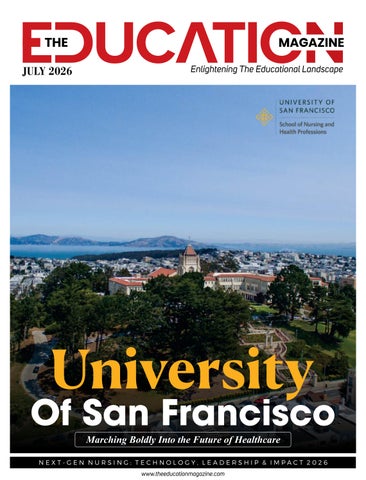
JULY 2026
University
Of San Francisco Marching Boldly Into the Future of Healthcare NEXT-GEN NURSING: TECHNOLOGY, LEADERSHIP & IMPACT 2026 www.theeducationmagazine.com
Where Compassion Meets Code Nursing’s Next Chapter Begins Here Dear Reader, Healthcare stands at a rare crossroads, one where human empathy and digital intelligence are learning to work side by side rather than in competition. Nursing, the profession closest to the patient bedside, is being asked to lead that convergence rather than simply adapt to it. This issue of “Next-Gen Nursing: Technology, Leadership & Impact 2026” turns its attention to the institutions shaping that leadership, training clinicians who can hold a stethoscope and a data dashboard with equal confidence, and who understand that care now depends as much on policy literacy as it does on clinical skill. At the centre of this issue is the University of San Francisco School of Nursing and Health Professions, our cover feature. Under Dean Eileen Fry-Bowers, the school has built its identity around a simple but demanding idea: that clinical excellence and social justice are not separate pursuits. Its Nurse Health Equity Scholars Initiative places prelicensure students directly inside public safety-net hospitals, ensuring graduates understand care from every angle of society, not just the comfortable ones. The school has also moved early into artificial intelligence, piloting an agentic AI platform to prepare students for tools they will meet in real practice, while insisting that judgement, presence and compassion remain irreplaceably human. Through its policy scholars programme, USF is sending nursing students to Washington to advocate directly for the communities they serve. Seventy years after its founding, the school continues to treat nursing as both a clinical discipline and a form of public duty. Alongside this cover feature, the issue also highlights Bossier Parish Community College, the School of Nursing and Health Professions at Colorado Christian University, the Dennis R. DePerro School of Health Professions at St. Bonaventure University, and Queens University of Charlotte. Together, these institutions represent a wider shift taking place across nursing education, one that treats technology as a tool for deeper human connection rather than a replacement for it. Their graduates will enter a healthcare system under real strain, and the leadership, curiosity, and conscience instilled in them now will shape how that system responds for years to come. This issue stands as a tribute to the educators making that preparation possible. Sincerely,
From The Editor’s Desk People Behind This Issue
The Education Magazine is published by Pericles Ventures Pvt Ltd. This magazine contains material protected under International and Federal Copyright Laws and Treaties. You may not publish, display, disclose, rent, lease, modify, loan, distribute, or create derivative works based on the magazine contents or any part thereof, whether by yourself or as a consultant, employee, partner or in any other role unless authorised in writing by the creator/publisher of the article/, video, audio or any content contained herein. We, the team of The Education Magazine put all the efforts to keep up with the content accuracy. The publisher assumes no responsibility of any part of the content of any advertisement in this publication, including any errors or omissions therein. All rights reserved by Pericles Ventures Pvt Ltd.
10 University of San Francisco School of Nursing
CONTENT PROFILES
18. Bossier Parish Community College 30. Dennis R. DePerro School of Health Professions 44. Queens University of Charlotte 54. School of Nursing and Health Professions articles Aesthetic Nurse Practitioner: 26. The Impactful Role Transforming Cosmetic Medicine
38
AI Governance in Higher Education: The 2026 Framework for Policy & Risk
50
Top 10 Highest IQ in the World: Beyond the Score
Marching Boldly Into the Future of Healthcare
T
here is something quietly arresting about the moment: a nursing school dean, standing before an audience at San Francisco’s Commonwealth Club, holds up a newspaper headline from the nineteenth century. “A community suffers significant Health Inequity.” The year beneath it could belong to any era. Dean Eileen Fry-Bowers, PhD, JD, CPNP, of the School of Nursing and Health Professions at the University of San Francisco, chose that headline deliberately. Her point was not about nostalgia. It was a reckoning. More than a century of medical expansion and specialization later, the questions of who receives care and who pays for it remain profoundly unresolved. Maternal and infant mortality rates are unacceptably high. The working poor face impossible barriers. Immigrant populations are left behind. Infectious diseases continue to create significant morbidity. These are not abstractions. They are the daily reality of communities that medicine has long promised to serve. A Mission for Every Era The school that Fry-Bowers leads was founded in 1954, rooted in the traditions of the Sisters of Mercy and the Jesuit Catholic values of the University of San Francisco. Its mission, to improve the health of all populations through equitable and compassionate service, value-driven research, and innovative education, was not written for a specific moment in time. It was written for all of them, including this one.
10 I JULY 2026
Two Latin principles animate the school’s culture and give that mission its texture. Cura personalis, care for the whole person, and cura apostolica, care for the whole project, shape everything here: how curricula are designed, how clinical partnerships are built, and how the school’s faculty and leadership are asked to think about their responsibilities to the world beyond the classroom. Against the Current For decades, nursing education has largely been organized around hospital-based, acute-care frameworks. Licensure structures reinforce the pattern, requiring limited coursework in community health and orienting nearly 80 percent of nursing curricula toward inpatient settings. USF SONHP argues that this pattern is failing the communities nurses are meant to serve. The school is deliberately moving against that current. It envisions a fundamental shift: away from what it calls the sick-care industrial complex, toward a genuine health-development model. Public health, social determinants of health, and population-level thinking are not electives here. They are core competencies expected of every graduate. Learning Where It Matters Most The Nurse Health Equity Scholars Initiative, known as NHESI and funded by a federal HRSA Workforce Expansion Grant, is where that philosophy becomes lived practice.
COVER STORY
THE EDUCATION MAGAZINE I 11
Pre-licensure BSN students are immersed, for all their direct-care clinical education, in a single comprehensive public safety-net health system: either Zuckerberg San Francisco General Hospital and Trauma Center in San Francisco, or Alameda Health System in Oakland. The logic is grounded in evidence. Students who learn in safety-net environments, alongside patients across the full spectrum of social and economic experience, are more likely to choose to practice in those environments as professionals. They develop not just clinical skill but something harder to teach: the professional commitment to stay. BSN student Paul Uong, a NHESI scholar, described the experience plainly: “Caring for patients across all socioeconomic backgrounds has taught me that nursing is about more than treating illness. It is about meeting people where they are, understanding their stories, and showing up with compassion in moments of vulnerability.” There is a particular kind of knowledge that comes only from being present in those rooms. SONHP is making sure its graduates carry it before they enter the profession. The Intelligence Question Few conversations in healthcare feel more contested right now than the one about artificial intelligence. SONHP has chosen to engage it deliberately and early. In partnership with Drive Health, the school piloted the Avery agentic AI caregiver platform in simulated learning environments, introducing pre-licensure students to a tool designed to support clinical communication, documentation, patient education, and low-acuity care tasks.
The framing of this initiative matters. The school is not suggesting that AI can replace nursing judgment. Values, intuition, clinical reasoning, and therapeutic presence are irreducibly human. But nurses who enter practice without fluency in AI-enabled workflows will be underprepared for the environments they will actually work in. SONHP is now integrating AI literacy systematically across both nursing and public health curricula, building graduates who can engage these tools ethically, critically, and effectively. Nurses at the Policy Table One of the most consequential, and least-discussed, gaps in nursing education is policy literacy. Nurses hold a position of unmatched proximity to patients. They witness, every shift, the real consequences of insurance denials, food insecurity, housing instability, and inadequate access to preventive care. Yet they are rarely equipped to translate that frontline knowledge into policy action. SONHP considers that gap unacceptable. Since 2023, Dean Fry-Bowers has brought undergraduate, graduate, and doctoral nursing students to the annual American Association of Colleges of Nursing (AACN) Student Policy Summit in Washington, D.C., held alongside the AACN Dean’s Meeting, where participants engage directly with federal policymakers and develop skills in translating scientific evidence and patient experience into legislative advocacy.
12 I JULY 2026
Cover Story Leveraging the Student Policy Summit, USF has developed a “policy scholars” program for attendees that is scaffolded with pre- and post-summit mentorship, creating a sustained arc of leadership development rather than a single isolated event. The goal is to produce nursing advocacy ambassadors: science-informed, policy-literate, and ready to represent the profession where health policy is actually shaped. Recognition and Reach The school’s momentum has drawn national attention. Dean Fry-Bowers was selected for the inaugural cohort of the Bedford Falls Foundation Academic Nursing Innovation Fellows (ANI Fellows), a highly selective two-year program that brings together deans, curriculum architects, and clinical partnership leaders from across a deliberate cross-section of American nursing education. The program is designed not for incremental improvement but for systemslevel transformation: reducing early-career attrition, building practice-ready graduates, and strengthening the nursing workforce that communities depend on.
The Invitation The future of healthcare, SONHP argues, belongs to professionals willing to hold complexity without retreating from it: those who understand that clinical excellence and social justice are not competing values but expressions of the same calling. USF SONHP is preparing those professionals. For more than seventy years, USF SONHP has occupied a distinctive place in American nursing education. It is not tiptoeing into that future. It is marching boldly, carrying that history as fuel and led by a mission that has never been more necessary.
The school’s alumni already embody that ambition. Jian Zhang, DNP ’12, recently retired CEO of San Francisco Chinese Hospital, developed a bilingual community outreach program during COVID-19 that helped Chinatown achieve one of the nation’s lowest infection and death rates, a model later adopted by the San Francisco Department of Public Health. Jim D’Alfonso, DNP ’17, Executive Director of Professional Excellence at Kaiser Permanente Northern California, cites USF’s Ignatian values and Caring Science framework as foundational to his life of service. Joyce Nortey, MPH, MSBH ’18, Senior Director of Clinical Research and Digital Health Initiatives at Evidation Health, traces her professional commitment to equity-centered innovation back to her years at USF.
THE EDUCATION MAGAZINE I 13
Cover Story
‘‘
The world needs your hearts, your minds, your souls, and your courage. Come change health from here. 14 I JULY 2026
THE EDUCATION MAGAZINE I 15
Training the Next Generation of Healthcare Professionals 18 I JULY 2026
I
n Northwest Louisiana, the demand for skilled healthcare workers continues to grow. Hospitals need dependable nurses. Clinics rely on trained technicians. Long-term care facilities depend on professionals who understand both compassion and clinical precision. Meeting that demand requires more than classrooms. It requires institutions that can prepare students for the realities of healthcare work. One such place is the Division of Nursing and Allied Health at Bossier Parish Community College, where healthcare education is closely tied to the needs of the surrounding community. The division was established with a clear purpose: to open pathways into healthcare careers while strengthening the region’s medical workforce.
Its mission is direct and practical. The division seeks to provide quality educational opportunities in nursing and allied health through strong classroom teaching, hands-on laboratory instruction, and meaningful clinical training. Just as important, it aims to serve the citizens of Northwest Louisiana by preparing graduates who can step into healthcare roles with confidence and skill. That commitment has shaped a wide range of programs. Today, the division offers 29 academic pathways designed to meet different career goals and entry points into the healthcare field. These include 12 associate degree programs, 7 certificates of technical studies, 4 technical diplomas, and 6 career and technical certificates. THE EDUCATION MAGAZINE I 19
Each program follows the same guiding principle. Students should leave not only with academic knowledge, but with practical training that reflects the demands of real healthcare settings. Through this balance of theory and experience, the Division of Nursing and Allied Health continues to expand opportunities for students while supporting the healthcare systems that serve Northwest Louisiana. Programs Designed for Exploration and Workforce Readiness Healthcare education often asks students to make early decisions about their careers. Many arrive with a strong interest in healthcare but only a vague sense of where they belong. The Division of Nursing and Allied Health at BPCC approaches this reality with flexibility and range. The college focuses entirely on undergraduate training through two-year or shorter programs designed to move students into the workforce quickly. Students can pursue associate degrees in fields such as diagnostic medical sonography, respiratory therapy, surgical technology, occupational therapy assistant, paramedic care, fire science, and practical nursing. Nursing students may also enroll in the Associate of Science program through either the traditional pathway or the LPN-to-RN transition track. Beyond these degrees, the division offers technical diplomas and certificates in areas including medical assisting, phlebotomy, pharmacy technology, and emergency medical services. What sets the model apart is its advising structure. Every student selects both a Plan A and a Plan B. This approach encourages exploration across healthcare roles while improving retention and long-term success. Training That Mirrors the Real World For students preparing to enter healthcare, practice matters just as much as theory. The ability to handle equipment, respond to emergencies, and work inside clinical settings cannot be learned from lectures alone. It requires spaces where students can rehearse real situations before they encounter them in hospitals or clinics. The Nursing and Allied Health building at the college was designed with that idea in mind. Several programs operate from this facility, including paramedic training, pharmacy technology, phlebotomy, anatomy and physiology, and nursing. Each space is built to resemble the environments students will eventually work in. 20 I JULY 2026
Inside the paramedic lab, students train using a full-size ambulance simulator along with a mock apartment where emergency scenarios can unfold. The nursing lab houses nineteen human simulators, including adult, infant, pediatric, and birthing models. Nearby rooms replicate hospital units such as ICU, obstetrics, pediatrics, and medical-surgical care. In another section, the pharmacy technician lab resembles a working retail pharmacy, complete with prescription software, pill counting stations, and sterile preparation areas. Clinical Partnerships That Extend Learning beyond Campus Hands-on training is built into every healthcare program at BPCC. To make that possible, the college works closely with hospitals and care facilities across the region. Students complete clinical rotations at healthcare institutions such as Willis-Knighton Health System, CHRISTUS Shreveport–Bossier Health System, and Ochsner LSU Health Shreveport, along with several regional hospitals and specialty clinics. These rotations place students directly inside working healthcare environments, where they learn to navigate patient care, team coordination, and the daily pace of clinical practice. The college has also experimented with new training models. BPCC recently launched Louisiana’s first LPN-to-RN nursing apprenticeship pilot. The program allows working nurses to complete their clinical requirements at their current workplace while continuing their education and moving toward RN licensure. A Message Rooted in Student Success Student outcomes remain the guiding measure of success for the Division of Nursing and Allied Health. That philosophy is shaped by Michael Whitaker, Dean of Nursing and Allied Health, who keeps the division's priorities firmly tied to student achievement. Michael approaches the role with a simple principle in mind. Programs must help students graduate, secure meaningful employment, and feel confident stepping into healthcare careers. “Our success will always be defined by the academic and professional success of our students,” he says. THE EDUCATION MAGAZINE I 21
22 I JULY 2026
That focus extends beyond coursework. Michael emphasizes a supportive learning environment where students receive personal guidance while developing the practical skills healthcare employers expect. At the same time, he encourages constant improvement within the division, regularly seeking feedback from faculty, students, and healthcare partners to strengthen both curriculum and training experiences.
Whether through sports, student organizations, or service initiatives, these activities help students build confidence, expand their professional networks, and develop a sense of belonging within the campus community.
A Snapshot of Student Reach and Outcomes
Healthcare careers require more than technical training. Professionals must be able to think quickly, adapt to new technologies, and work effectively in fast-moving clinical settings. The Division of Nursing and Allied Health structures its programs with these expectations in mind.
More than 6,000 students enroll each year at BPCC, attending classes across multiple campuses as well as through online programs. The student body reflects the varied communities of Northwest Louisiana, bringing together learners with different career goals, life experiences, and paths into higher education. Within the healthcare programs, the results have been especially strong. Students in nursing have recorded a 98.72 percent pass rate on the NCLEX, the highest among both two-year and four-year nursing programs in Louisiana. The exam serves as the national licensing requirement for nurses entering professional practice.
Preparing Students for the Demands of Modern Healthcare
The division offers a broad range of programs that prepare students for high-demand healthcare roles. These include nursing, respiratory therapy, surgical technology, paramedic care, physical therapist assistant, occupational therapy assistant, and diagnostic medical sonography. Each program is designed to address specific workforce needs while giving students a clear pathway into professional practice.
These outcomes point to a program that places equal weight on academic rigor and practical preparation. Graduates leave not only with credentials but also with the confidence and clinical readiness needed to enter healthcare roles across the region. A Campus Community That Extends Beyond Academics Student life at BPCC moves well beyond lectures and clinical rotations. Across campus, students find opportunities to get involved, take on leadership roles, and connect with peers outside their programs. Clubs and academic organizations play an important role in that experience. Groups such as Phi Theta Kappa give students a chance to pursue academic recognition while participating in service projects and leadership activities that complement their studies. Athletics add another layer to campus life. The college's Cavalier teams compete in intercollegiate sports, with baseball and softball programs that have earned strong national recognition. THE EDUCATION MAGAZINE I 23
Training follows an integrated model. Students move between classroom instruction, simulation-based labs, and clinical placements with regional healthcare providers. This combination allows them to develop technical proficiency while strengthening the critical thinking and decision-making skills required in today’s healthcare environment.
Support Systems That Carry Students Forward Students rarely move through healthcare programs alone. Along the way, they rely on guidance, mentorship, and practical advice that help them stay on course. At BPCC, that support begins early and continues throughout a student’s academic journey.
Opening Doors to Healthcare Careers Many students who pursue healthcare education are balancing work, family responsibilities, and financial pressures. At BPCC, the goal is to make sure those realities do not stand in the way of opportunity. The college keeps its pathways into healthcare programs accessible through open admissions, financial aid options, and flexible program structures that support working adults and first-generation college students. These pathways allow students to begin their training without needing a traditional academic background or a full-time schedule. Support also extends beyond academics. Through the Cavalier Care Center, students can access services that address everyday challenges, including food insecurity and emergency financial needs. By offering these forms of support, the college helps students stay focused on their studies and continue progressing toward graduation.
24 I JULY 2026
Academic advisors work closely with students to plan their coursework and keep them progressing through their programs. When students need additional help with challenging subjects, tutoring services provide structured academic support. These resources help many students maintain momentum, particularly in demanding healthcare courses that require both theoretical understanding and technical skill. Faculty members also play an important role as mentors. Many instructors come from clinical backgrounds and bring real-world insights into the classroom. Their guidance often extends beyond lectures, helping students understand workplace expectations, professional standards, and the responsibilities that come with patient care.
Career preparation is woven into this support system. Through counseling services, students receive help with resumes, interview preparation, and career planning. Clinical placements further expand those opportunities, allowing students to build professional relationships with hospitals, clinics, and healthcare providers across the region, connections that often lead directly to employment after graduation. Expanding New Pathways in Healthcare Training Healthcare systems continue to face workforce shortages, and education providers are being asked to respond with new training models. Several recent initiatives within the Nursing and Allied Health division reflect that shift. One of the most notable developments is the LPN-to-RN Nursing Apprenticeship Program at BPCC. The program allows licensed practical nurses to continue working while completing the clinical training required to earn their RN credentials. Instead of stepping away from their jobs, nurses are able to advance their education within the same healthcare settings where they already practice. The program has recently grown through partnerships with additional hospitals across the region. These collaborations expand the number of clinical placements available while giving healthcare employers a practical way to support the professional growth of their staff. The initiative reflects a broader shift toward workforce-aligned education, where learning and employment move forward together. For many working nurses, it creates a practical route to career advancement while helping regional healthcare providers strengthen their clinical teams.
THE EDUCATION MAGAZINE I 25
T
he world of beauty is shifting rapidly toward clinical precision. Most people today seek subtle, safe, and effective ways to rejuvenate their appearance. People want to enhance their natural beauty without undergoing invasive surgery. But have you ever wondered who performs those seamless facial enhancements you see today? Many people assume only surgeons handle these tasks, but a new leader has emerged in the cosmetic industry. One of them is an aesthetic nurse practitioner. They provide ideal medical expertise combined with an artistic eye. Well, this article will answer these questions. In this guide, you will discover the vital role of the aesthetic nurse practitioner. These experts bridge the gap between traditional medicine and elective beauty treatments, consequently, ensuring you receive the safest care possible. Let’s Know More About The Aesthetic Nurse Practitioner What Is An Aesthetic Nurse Practitioner? An aesthetic nurse practitioner is a highly trained Advanced Practice Registered Nurse (APRN) who specializes in cosmetic medical services. These professionals combine deep clinical knowledge with an artistic eye to enhance a patient’s appearance. Unlike general practitioners, they focus specifically on aesthetic nursing and skin health. Furthermore, they operate with a high level of medical authority. They do not just follow orders; instead, they assess patients, diagnose skin concerns, and create comprehensive treatment plans. 26 I JULY 2026
THE EDUCATION MAGAZINE I 27
Their core role centers on helping patients achieve their aesthetic goals while maintaining the highest levels of safety and medical ethics.
● Injectables: They expertly administer Botox to smooth wrinkles and dermal fillers to restore facial volume.
What Training Does An Aesthetic Nurse Practitioner Get?
● Skin Rejuvenation: This includes chemical peels and microneedling to improve skin texture.
Becoming a nurse practising aesthetic treatment requires a rigorous academic journey. First, an individual must earn a Bachelor of Science in Nursing (BSN) and pass the nursing licensing exam, such as the NCLEX-RN. After gaining clinical experience, they must complete a Master's or Doctorate in nursing. During this graduate phase, they choose between various nurse practitioner specialties. Specialized training often includes: ● Advanced human anatomy and physiology. ● Pharmacology of cosmetic injectables such as Botox and dermal fillers. ● Advanced skin science and wound healing. ● Clinical rotations in dermatology or plastic surgery. This extensive background allows them to handle complex cosmetic procedures with precision. Where Do Aesthetic Nurse Practitioners Work? You can find an aesthetic nurse in various professional settings. Their versatility allows them to thrive in diverse environments, including: 1. Medical Aesthetic Clinics: Dedicated centers for non-surgical enhancements. 2. Medical Spas: Wellness centers operating under the supervision of Plastic Surgeons or Dermatologists. 3. Private Practices: Working alongside specialists in dermatology or plastic surgery. 4. Health Resorts: Luxury destinations offering clinical skin treatments.
● Energy-Based Therapies: They utilize lasers for hair removal, vein treatment, and skin tightening. ● Medical Grade Skincare: They prescribe customized regimens to treat acne, hyperpigmentation, and aging. Furthermore, they provide essential pre- and post-procedure counseling. This ensures patients understand the recovery process and maintain their results effectively. How Aesthetic Nurses Focus On Patient Safety And Natural Results Safety remains the top priority for every nurse practitioner. Because they understand facial anatomy deeply, they avoid critical structures like nerves and blood vessels during injections. This expertise minimizes the risk of complications such as bruising or vascular occlusion. Additionally, these providers champion the “natural look.” They use their clinical judgment to recommend conservative treatments. Rather than over-filling, they aim for subtle enhancements that respect the patient's unique features. Consequently, patients feel more confident and refreshed without looking “overdone.”
What Procedures Can An ANP Perform?
Aesthetic Nurse Practitioner vs. Registered Nurse vs. Nurse Practitioner
An aesthetic nurse practitioner performs a wide array of cosmetic medicine treatments designed to rejuvenate the skin and face. They focus primarily on non-surgical interventions that yield impactful results. Common procedures include:
Understanding the hierarchy of care helps patients make informed decisions. While all these roles are vital, their scope of practice varies significantly.
28 I JULY 2026
The Growing Role of Aesthetic Nurse Practitioners in Modern Cosmetic Medicine The demand for the aesthetic nurse practitioner is skyrocketing. Currently, patients prefer minimally invasive treatments over traditional surgery due to shorter recovery times. Since these practitioners provide expert care at a lower cost than surgery, they make aesthetic treatments more accessible. Not only that, but patients increasingly trust medically trained providers. The presence of an aesthetic nurse practitioner ensures that a “beauty” treatment is actually a safe medical procedure. As a result, they have become the backbone of the modern cosmetic industry. Looking ahead, the role of the aesthetic nurse practitioner will continue to expand. As technology evolves, these professionals will lead the way in adopting new, safer modalities of specialized nursing in aesthetics.
End Note An aesthetic nurse practitioner is a highly skilled medical professional. They blend the rigors of nursing with the artistry of cosmetic medicine. By prioritizing safety and natural results, they provide a reliable path for anyone seeking to enhance their appearance. If you are considering a cosmetic treatment, explore these professional recommendations and choose a qualified practitioner for safe and effective beauty. If you liked this guide, share it with your friends and family to help them understand and choose the right aesthetic provider!
- Sanskruti Jadhav
Eventually, they will play an even larger part in holistic wellness. By combining skin health with overall physical confidence, they contribute to the mental and emotional well-being of their patients worldwide. THE EDUCATION MAGAZINE I 29
30 I JULY 2026
THE EDUCATION MAGAZINE I 31
32 I JULY 2026
THE EDUCATION MAGAZINE I 33
34 I JULY 2026
THE EDUCATION MAGAZINE I 35
36 I JULY 2026
THE EDUCATION MAGAZINE I 37
AI GOVERNANCE
IN HIGHER EDUCATION The 2026 Framework for Policy & Risk AI
governance in higher education is the structured system of policies, oversight committees, ethical standards, and risk controls universities use to manage AI across teaching, research, and administration, going beyond IT policy to address accountability, data privacy, and academic integrity.
Three forces are making AI governance in higher education urgent in 2026.
Artificial intelligence is advancing in higher education faster than institutional policy can keep pace. Faculty are experimenting with generative AI tools, students are submitting AI-assisted work, and administrative departments are automating everything from admissions to advising.
The EU AI Act, which came into force in August 2024, classifies several AI applications common in universities, including AI-assisted admissions systems and student performance analytics, as “high-risk.” European universities must now demonstrate compliance or face penalties.
Yet most universities are facing a governance gap. According to EDUCAUSE’s 2024 AI Landscape Study, 80% of faculty and staff use AI tools, yet fewer than one in four are aware of a formal institutional policy. The result is rapidly growing shadow AI unsanctioned tools operating entirely outside institutional oversight. For university leaders, the question is no longer whether AI will shape higher education; it is whether institutions will govern it responsibly before a data breach, regulatory violation, or integrity crisis forces their hand. That is precisely what AI governance in higher education is designed to prevent. Why AI Governance Is Becoming Critical for Universities Universities are inherently open environments built for experimentation and academic freedom. These values drive innovation, but they also create governance blind spots when powerful technologies enter the ecosystem without structure. a tension explored in depth in our look at how AI is already reshaping university teaching, research, and governance. 38 I JULY 2026
1. Regulatory Pressure is Accelerating
In the United States, the Department of Education’s 2023 guidance on AI explicitly calls on institutions to develop ethical frameworks for AI use in student services and assessment. FERPA, meanwhile, imposes strict constraints on how student data can be processed by third-party AI systems. 2. Adoption has Outpaced Policy Generative AI platforms are now embedded across research workflows, automated grading, tutoring systems, and administrative automation. Without governance, practices become inconsistent and unauditable across departments, creating compliance risks that institutions may not discover until audited.
THE EDUCATION MAGAZINE I 39
3. Public Trust is at Stake
Core Pillars of an AI Governance Framework
UNESCO’s Recommendation on the Ethics of AI warns that institutions failing to govern AI transparently risk eroding the public legitimacy that universities depend on. That trust, once lost in a high-profile AI incident, is difficult to recover.
Effective AI governance in higher education is not an IT function; it is an institutional one. Guidance from UNESCO, the OECD’s AI Principles, and the UK’s Higher Education Policy Institute (HEPI) consistently identifies four pillars that distinguish mature governance frameworks from ad hoc policy responses.
The “Shadow AI” Problem on Campus 1. Institutional AI Steering Committees Shadow AI–AI tools adopted by faculty, staff, or students without institutional approval represent one of the most underestimated risk vectors in higher education today. EDUCAUSE research consistently finds that universities have far more AI tools operating across their campuses than IT departments are aware of. These include AI writing assistants, research automation tools, coding copilots, data analysis platforms, and AI tutoring systems, many of which operate entirely outside the university’s data governance perimeter.
Governance must begin at the leadership level. Universities, including the University of Edinburgh, published one of the first comprehensive institutional AI governance frameworks in UK higher education in 2024. Structured oversight around cross-functional committees composed of academic leadership, IT, legal, research ethics, and faculty representatives. These committees are responsible for defining acceptable use policies, reviewing AI vendors, monitoring emerging risks, and advising senior leadership. Critically, they prevent AI decisions from defaulting entirely to IT departments, ensuring academic values remain central to governance.
The risks are concrete: 2. Ethical AI Principles in Practice ● Data Leakage: When a professor uploads an unpublished research dataset to a commercial AI platform, that data may be stored, logged, or used for model training. The university loses control of its intellectual property with no audit trail. ● FERPA Violations: If student performance records are processed by an unapproved AI system, the institution may violate federal privacy law even if the faculty member had no intent to breach compliance. ● Cybersecurity Exposure: AI tools connected informally to campus systems bypass the security reviews that approved enterprise software undergoes. The governance lesson is clear: awareness campaigns alone are insufficient. Institutions need active monitoring, not just policy documents. 40 I JULY 2026
Ethical governance goes beyond publishing principles; it operationalises them: A. Transparency Students and faculty must know when AI is involved in academic or administrative decisions. AI-assisted grading, automated feedback, and algorithmic admissions screening should be disclosed. The EU AI Act makes transparency mandatory for high-risk AI applications; institutions operating in Europe have no choice. B. Fairness and Bias Auditing AI systems trained on historical datasets can reproduce structural inequalities. Arizona State University’s AI Task Force, established in 2023, requires bias testing before any AI tool is deployed in student-facing applications, a model that other institutions are beginning to adopt.
C. Accountability Final decisions involving students or staff must remain under human authority. AI informs; humans decide. This principle is embedded in most leading governance frameworks and is a baseline requirement under EU AI Act provisions for high-risk systems.
This is one of the most visible places where AI governance in higher education directly shapes the student experience. Traditional plagiarism detection looked for copied text. AI-generated content is original by definition, rendering tools like Turnitin insufficient as standalone solutions.
3. Human-in-the-Loop (HITL) Oversight Rather than permitting AI systems to operate autonomously, HITL governance requires human review at every critical decision point.
The University of Oxford’s Academic Integrity Framework, revised in 2024, explicitly acknowledges this, pivoting from detection-first approaches toward assessment redesign and transparent disclosure policies.
An AI system might analyse student engagement patterns and flag students at risk of dropping out, but advisors retain full decision-making authority over any intervention.
Leading institutions are responding across three fronts: 1. Assessment Redesign
MIT’s published AI Policy Principles identify HITL oversight as a foundational standard for AI systems that affect student outcomes, a position reflected in the broader governance frameworks many research universities are now formalising. This approach allows institutions to gain AI-driven insights while preserving academic accountability and legal defensibility. 4. Continuous Monitoring Over Static Policy Traditional IT policies are approved once and periodically reviewed. AI governance cannot work this way. AI models are updated, training data changes, and new capabilities emerge on timelines that annual policy reviews cannot match. The OECD’s Framework for the Classification of AI Systems recommends “continuous assurance” models, ongoing monitoring of AI behaviour rather than onetime approval. Universities adopting this approach build audit mechanisms directly into their AI procurement contracts.
Oral examinations, project-based work, and in-class analytical tasks evaluate understanding that AI cannot simulate. Stanford’s Hasso Plattner Institute of Design has piloted process documentation approaches in select courses, where students submit drafts, annotations, and reflective journals that demonstrate the thinking behind outputs, not just the outputs themselves. 2. Disclosure-Based Policies Rather than attempting blanket bans, which EDUCAUSE notes are largely unenforceable, institutions like University College London now require students to declare when and how AI tools were used, treating transparency as an academic skill in itself. 3. Faculty Development Separate EDUCAUSE faculty readiness findings indicate that fewer than 30% of faculty feel confident designing AI-resilient assessments.
AI Governance and Academic Integrity Generative AI has transformed academic integrity from a plagiarism problem into an authorship problem, and the two require fundamentally different responses.
Governance frameworks that invest in faculty training, not just student-facing policies, produce more consistent and defensible integrity standards. THE EDUCATION MAGAZINE I 41
The EU AI Act: What Universities Cannot Ignore
Stage 1: AI Inventory
The EU AI Act introduces the most significant regulatory change for universities operating in or with European institutions since GDPR.
Map every AI tool currently in use across teaching, research, administration, and student services. Most universities discover significantly more tools than anticipated.
Key implications for higher education: ● High-risk classification: AI systems used for student assessment, admissions screening, and performance monitoring fall under the Act’s high-risk category. These systems require conformity assessments, bias testing, human oversight mechanisms, and full auditability before deployment. ● Prohibited practices: AI systems that use subliminal techniques or exploit student vulnerabilities relevant in the context of adaptive learning platforms are prohibited outright. ● Extraterritorial reach: Universities outside the EU that process data from EU-based students or partner with EU institutions may still fall under the Act’s scope.
This inventory process is typically when the full scale of unsanctioned AI adoption becomes visible for the first time. Stage 2: Policy Development Draft acceptable use policies, research ethics guidelines, procurement standards, and data governance rules. Policies should define what is permitted, what requires approval, and what is prohibited, with clarity on consequences. Stage 3: Governance Structures Establish the AI steering committee, data governance board, and ethics review panel. Define decision rights clearly: who approves new AI tools, who monitors deployed systems, and who escalates concerns. Stage 4: AI Literacy Programs
Institutions that have not begun EU AI Act compliance assessments are already behind. The Act’s high-risk provisions apply from August 2026 for most use cases.
Governance fails if faculty and staff lack the knowledge to apply it. Training should cover responsible AI use in teaching, algorithmic bias recognition, and the practical implications of institutional policy, not just the existence of that policy.
AI Vendor Risk: A Governance Checklist
Stage 5: Continuous Monitoring
Every AI tool adopted by a university carries institutional risk. A structured vendor assessment protects against shadow AI entering through procurement channels.
Build review cycles into governance from day one. AI systems change. Regulations change. Institutional risk profiles change.
Universities increasingly apply zero-trust security principles to AI vendor evaluation, treating every external system as a potential risk until verified, rather than trusted by default.
Annual audits of deployed AI systems, quarterly vendor reviews, and real-time monitoring of high-risk applications should be standard by the time a university reaches governance maturity.
Building an Institutional AI Governance Roadmap
Preparing for Agentic AI: The Next Governance Frontier
Policy without implementation is a document, not a governance framework. Institutions building AI governance in higher education from the ground up should move through five stages sequentially rather than simultaneously.
Generative AI is already a governance challenge. Agentic AI systems capable of taking autonomous actions across research databases, scheduling systems, administrative workflows, and communication platforms will be substantially harder to govern.
42 I JULY 2026
Multi-agent architectures, where multiple AI systems collaborate and delegate tasks to one another, are moving from research labs to enterprise software. Several major edtech vendors are already piloting agentic tools for student advising and course personalisation. For universities, this raises governance questions that current frameworks are not designed to answer. Early guidance from the World Economic Forum’s AI Governance Alliance and emerging institutional practice points toward three priority areas: 1. Accountability chains When an autonomous AI agent makes a decision that harms a student, current frameworks built around individual human decision-makers do not map cleanly onto multi-step automated pipelines. Leading institutions are beginning to designate a named human “AI accountability owner” for each deployed agentic system, ensuring that every automated workflow traces back to an identifiable individual with review authority. 2. Access governance.
Universities building agentic governance policies are prioritising end-to-end logging requirements, mandating that every agent action, handoff, and decision point is recorded in an immutable audit trail that human reviewers can interrogate after the fact. The World Economic Forum’s AI Governance Alliance recommends that institutions begin developing agentic AI governance policies now, before deployment pressure forces universities into reactive policymaking. The Future of Responsible AI in Higher Education AI will reshape every function of the modern university, learning, research, operations, and student support, but the shape it takes will not be determined by the technology alone. It will be determined by the choices institutions make now about accountability, oversight, and whose interests governance is designed to protect. Strong AI governance in higher education is not a constraint on innovation. It is the condition that makes innovation defensible: to students whose data is at stake, to regulators who are watching, and to the public that grants universities their social license to operate. The universities that will define the next era of higher education are not necessarily the earliest adopters. They are the ones building the institutional infrastructure to ensure that every AI system they deploy can be explained, audited, and, if necessary, stopped. If you found this insight valuable, share it with academic leaders and colleagues who are shaping the future of responsible AI in higher education.
Shadab Mestri
Agentic systems require dynamic, scoped permissions rather than static access grants. The emerging best practice aligned with zero-trust principles already applied to vendor evaluation is to grant agentic AI the minimum permissions required for a specific task, with automatic expiration and human-triggered re-authorisation for sensitive data environments, including student records and research repositories. 3. Pipeline auditability Multi-agent systems can obscure the origin of individual decisions across layers of automated delegation. THE EDUCATION MAGAZINE I 43
Queens University of Charlo e Where the Science of Healing Meets the Art of Care
T
he world of healthcare has a unique cadence, a rhythm that is both frantic and deeply human. It can be heard in the beeping of a vitals monitor in a simulation lab, the shuffle of sneakers on a hospital floor during a twelve-hour clinical rotation, and the scratching of pens on paper as students develop healthcare administration strategies. In Charlotte, North Carolina, a city rapidly evolving into the healthcare and sports sciences hub of the Carolinas, that rhythm serves as the background noise of daily life. At the center of this bustle, striving to find harmony amid the chaos, are the Blair College of Health and the Presbyterian School of Nursing at Queens University of Charlotte. It is easy to view a university as merely brick and mortar, consisting of lecture halls and a syllabus. However, a closer look reveals an institution grappling with a significant modern reality: the health sciences industry is technologically intensive and doubles in size every eighteen months. This staggering statistic highlights that the world a freshman enters is vastly different from the one they will graduate into four years later. Therefore, the challenge is not just to teach students what is known today, but to prepare them for what will be discovered tomorrow. At Queens, the solution to this challenge lies not in chasing trends, but in grounding students in something timeless: the service of others. This institution understands that while the technology of medicine may change, the core values of care, compassion, and competence, the fundamental human need for care and connection, remain constant.
44 I JULY 2026
‘‘
Students should be exposed to their chosen profession early and often, gaining confidence and competence through meaningful experiences. Jullet “Jaye” Davis Weaver, Ph.D., MHA, dean of the Blair College of Health and Presbyterian School of Nursing
THE EDUCATION MAGAZINE I 45
The Architecture of Care The lineage of healing at Queens dates back to 1963, when the university began offering a bachelor’s degree completion program for graduates of the Presbyterian Hospital’s School of Nursing. This pragmatic initiative arose from the need to professionalize and elevate the nursing workforce. By 1979, the university established its own Bachelor of Science in Nursing (BSN) program, which gained national accreditation and graduated its first class in 1984. The modern era of the institution began to take shape in 2004 with the formal merger of the Queens nursing program and the Presbyterian Hospital’s program, resulting in the creation of the Presbyterian School of Nursing. In 2010, recognizing the growing demand for options in the healthcare field, the university established the Andrew Blair College of Health. Today, the mission is expansive. The goal is not only to graduate nurses but also to “prepare dynamic practitioners and leaders” who contribute to the wellness of the region and beyond. The vision is to “transform the lives of its students” through evidence-based initiatives that encompass health, human performance, and leadership. This vision acknowledges a fundamental truth: one cannot heal a community without understanding it. The Engine Room of Empathy: Blair College of Health If you walk through the halls of the Blair College of Health, you will encounter a diverse range of ambitions. The curriculum is designed to be adaptable, featuring four comprehensive healthcare programs outside of nursing that focus on the mechanics of human performance and health systems. For undergraduate students interested in understanding the body in motion or the systems that support health, the college offers a robust selection of degrees: ● Bachelor of Science in Exercise and Sport Sciences ● Bachelor of Science in Health Sciences ● Bachelor of Science in Sport Management For those aiming to lead at a systemic level, the college provides a graduate pathway with the Master of Health Administration. Moreover, the university is preparing to launch a new Master of Sport Management program, with the first cohort scheduled to begin in the fall of 2026. 46 I JULY 2026
The Heart of the Hospital: Presbyterian School of Nursing The heart of the college is the Presbyterian School of Nursing, where the educational philosophy is evident. It attracts ambitious undergraduates and graduate students who are preparing to advance in the healthcare field. The school provides various options tailored to meet students’ needs. For undergraduates, the path to becoming a licensed Registered Nurse (RN) is through two main tracks: ● Bachelor of Science in Nursing (BSN) ● Accelerated Bachelor of Science in Nursing (ABSN) For professionals seeking to enhance their expertise, the school offers an online Master of Science in Nursing (MSN). This program includes an RN-MSN entry option for those with an associate degree, allowing them to pursue a cost-effective, accelerated path. In addition to the master’s degree, the school offers specialized Post-Master’s Certificates for those looking to deepen their leadership skills: ● Clinical Nurse Leader Post-Master’s Certificate (CNL) ● Nurse Administrator Post-Master’s Certificate ● Nurse Educator Post-Master’s Certificate ● Nursing Informatics Post-Master’s Certificate The training for these programs takes place at The Hunt Nursing Simulation Center, an award-winning facility where simulated scenarios create realistic pressure situations. Here, students don’t just learn about cardiac arrest; they experience it firsthand. They train on advanced manikins designed to replicate a wide range of emergencies and participate in immersive virtual reality simulations. This setting exemplifies the university’s commitment to servant leadership. Students are not only learning technical skills, like inserting IVs or interpreting charts; they are also being taught how to handle challenging patient interactions, calm anxious individuals, and support families throughout complex care processes. The City as a Classroom One of Queens’ significant advantages is its geography. It is located “nearly next door” to the state’s leading healthcare systems, a proximity that is highly beneficial.
The university has established strong, mutual partnerships with Atrium Health, Novant Health, CaroMont Health, and other community partners. These partnerships extend beyond mere logos on a website; they serve as essential training grounds where students gain hands-on experience. Through inpatient clinical rotations, students engage in the collaborative, team-based approach that characterizes modern healthcare. The outcome is a continuous flow of talent from the campus to the clinic. These experiences provide clear career pathways, and it is common for students to graduate with one or more job offers already secured. Major employers like Atrium Health, Novant Health, and Duke Energy regularly hire Queens graduates, recognizing that they come not only with knowledge but also with the professional skills that realworld experience fosters.
Athletics also play a significant role at Queens. As a leading NCAA Division I competitor and a member of the ASUN Conference, the athletic program has built a strong reputation over its 35 years. With a roster that includes athletes from nearly 50 countries, Queens teams have achieved 28 team national championships and 144 individual national titles. This spirit of excellence and global competition is evident throughout the campus, emphasizing that high performance, whether on the track or in a clinical setting, is a habit cultivated at Queens. The university’s global perspective is further enhanced by the Myrta Pulliam Center for International Education, which offers study abroad opportunities aimed at developing global citizens. In a world where pandemics and health crises transcend borders, this global awareness is an essential clinical skill.
The Full Human Experience The Safety Net The university believes that a burnout-proof practitioner is a well-rounded individual, and its campus culture is designed to nurture the whole person. Queens is a special place where students can explore their academic interests as well as participate in extracurricular activities. There are over 35 clubs and organizations available, covering a wide range of interests from psychology to dance and music therapy. Traditions such as Casino Night and Exam Break Breakfast help to strengthen the community ties.
Queens University is ambitious yet firmly committed to the importance of support. The university recognizes that pursuing a career in healthcare can be challenging. The Vandiver Center for Career Development (VCCD) adopts a holistic approach, guiding students from exploring career options to planning for graduate school. This comprehensive support is evident in one impressive statistic: 100% of Queens undergraduate students complete an internship. THE EDUCATION MAGAZINE I 47
48 I JULY 2026
However, support extends beyond career preparation. The Center for Student Success integrates academic advising, accessibility services, and peer tutoring, all offered free of charge. For students with disabilities, the Student Accessibility Services team ensures compliance with the ADA, working individually with students to help them reach their full potential. Additionally, the Office of Diversity, Equity, and Inclusion aims to create a “community of care,” encouraging students to engage with individuals from various cultural, ethnic, and religious backgrounds. This commitment is not merely a social benefit; it is essential for professional success. Healthcare professionals, such as nurses and health administrators, who struggle to navigate cultural differences, may find themselves at a significant disadvantage in their careers. The Road Ahead Recently, the university announced its intention to merge with Elon University. This move aims to combine their complementary strengths and reinforce a deep commitment to Charlotte. The merger is expected to enhance opportunities for students by providing access to a wider range of academic programs and improved services on both campuses. At the same time, the Blair College of Health continues to innovate. The forthcoming Master of Sport Management program acknowledges the growing intersection of health, business, and athletics. The Guardian of the Mission Behind the statistics and strategic plans, there is a human voice guiding the institution. The dean of the college has a clear vision for the college’s role in the industry. She envisions a “student-centric environment” where future professionals feel “supported and empowered.” “We want our students to feel comfortable sharing their needs and to know that we are here to support them,” said Jullet “Jaye” Davis Weaver, Ph.D, MHA, dean of the Blair College of Health and Presbyterian School of Nursing This message serves as reassurance to families, emphasizing that the college’s priority is to ensure that students are fully prepared to pass their licensure exam on the first attempt. More than that, it demonstrates a commitment to care. “Families should know that we care deeply about our students and are dedicated to their success,” Weaver said. In a world where healthcare can often feel mechanical, Queens University of Charlotte is proving that the best way to build a better system is to develop better people. It is an environment where the science is rigorous, the training is tough, but the heart is always in the right place. They are dedicated to serving the students so that the students can serve the world. In the end, that is the only metric that truly matters. THE EDUCATION MAGAZINE I 49
W
hat does it truly mean to be a genius? Is it merely about a high score, or something far deeper? We often marvel at extraordinary minds. IQ, or Intelligence Quotient, offers one way to measure this. It gives us a score for how well our brains think. This includes problem-solving and learning new things. These cognitive abilities are key. This blog explores remarkable individuals. They possess some of the highest IQs in the world ever recorded. We will look at their amazing contributions. We also shed light on what makes intelligence truly exceptional. This topic deeply fascinates many people. Exceptional minds powerfully impact our society. They drive innovation and change. Their stories inspire us all. Let’s unlock these brilliant narratives. Understanding IQ: More Than Just a Number What is IQ? Imagine your brain as a super-powerful computer. IQ, or Intelligence Quotient, is simply a score. This score comes from a special test. It measures how well your brain works. Think of it like a report card for your thinking skills. These tests look at various abilities. They check your reasoning, problem-solving, and learning speed. For instance, the Stanford-Binet and Wechsler tests are very common. They help us understand different cognitive domains. The Nuance of IQ Scores Now, let’s talk about IQ scores themselves. 100 is considered an average IQ score. This is the center point for most people. However, scores are quite relative. Different tests can give slightly different results. Test methods also play a role. It's not a single, fixed number for life. 50 I JULY 2026
While a high IQ is truly impressive, it's not the only key to success. Consider this: a brilliant mind also needs creativity. Perseverance, or never giving up, is crucial. Emotional intelligence, understanding feelings, matters deeply. Practical application, using what you know, is vital too. These elements build trust and show real expertise. The highest IQ in the world might be fascinating, but it's just one piece of a larger puzzle. Debate & Limitations of IQ So, is IQ a perfect measure? Not quite. IQ tests have certain limits. They don’t measure all types of intelligence. For example, they might not assess musical talent. They also miss artistic brilliance. Consider a great musician or a gifted artist. Their genius might not show up on an IQ test. This understanding adds balance. It shows a nuanced view of intelligence. We always seek a complete picture. It's truly more than just a number. Here's a list of the people with the highest IQs in the world currently, as per the USIA 1. YoungHoon Kim YoungHoon Kim founded the United Sigma Intelligence Association (USIA). This non-profit organization gathers the world's brightest minds. It proudly includes seven Nobel Prize winners. Renowned intellectuals like Noam Chomsky also join the ranks. Furthermore, he holds an official world record for intellectual prowess. Various international bodies have verified this achievement. Kim is a truly remarkable polymath. He showcased his extraordinary memory on television. He flawlessly memorized 104 poker cards in just over 10 minutes.
Simultaneously, he serves as a Tony Buzan Honorary Professor. He also holds black belts in many disciplines. This demonstrates his diverse skills and deep mental capacity. 2. Terence Tao Terence Tao is a true giant, like an elephant with a sharp mind in mathematics. And this has not gone unnoticed which is seen as he has also been awarded the Fields Medal in 2006. This award recognized his deep work on complex equations. He also contributed greatly to prime number patterns. Specifically, with Ben Green, he showed that primes can form long chains. This theorem changed how mathematicians view numbers.
3. Marilyn Vos Savant Marilyn vos Savant held the Guinness World Record. Her IQ of 228 was the highest IQ in the world recorded then. The category retired in 1990. Since 1986, she writes “Ask Marilyn” for Parade magazine. She answers millions of readers’ tough questions. She is a brilliant logician. She became famous for solving complex puzzles. Her columns made advanced reasoning simple. She explained paradoxes to the public. Her clear explanations show her remarkable mind. She helps everyday people grasp big ideas. 4. Christopher Hirata
They often call him the “Mozart of Math.” He won the International Mathematical Olympiad very young, at 13. By 24, UCLA appointed him their youngest full professor. He believes mathematics clarifies our world. It makes things logical, not confusing. His work truly showcases what the highest IQ in the world can achieve. He reveals hidden structures in numbers.
Christopher Hirata won a gold medal at age 13. He achieved this at the International Physics Olympiad. He became the youngest American to do so. Later, he earned the Helen B. Warner Prize. This celebrated his work on gravitational lensing and cosmology. He truly pushes the boundaries of physics. THE EDUCATION MAGAZINE I 51
He was a phenomenal child prodigy. At 16, he worked for NASA. His research focused on colonizing Mars. He even wrote complex general relativity equations. He scribbled them on McDonald’s napkins during high school camp. This shows his natural, effortless brilliance. Many might consider his to be among the highest IQ in the world for theoretical physics. 5. Sho Yano Sho Yano became the youngest M.D. from the University of Chicago. He earned this degree at just 21 years old. Simultaneously, he gained a Ph.D. in cell biology. He also graduated summa cum laude from Loyola University at 12. This remarkable academic speed stands out. He is an exceptionally multi-talented individual. He read at age two and wrote by three. At five, he composed music. Furthermore, he is an accomplished pianist. He even holds a black belt in taekwondo. His diverse talents truly reflect a mind often associated with the highest IQ in the world. He truly excels across many fields. 6. Evangelos Katsioulis Evangelos Katsioulis achieved top scores in global intelligence contests. He also founded multiple high-IQ societies. These include the World Intelligence Network. As a psychiatrist, he greatly advanced psychopharmacology research. His work on antipsychotic medication is notable. He is a remarkable Greek polymath. He holds degrees in medicine and philosophy. He also excels in psychopharmacology. He showed the best physics performance among over 11,000 examinees. This happened in the Greek National Final Examinations. He belongs to over 60 high-IQ societies. This highlights a mind often associated with the highest IQ in the world. 7. Christopher Harding Christopher Harding founded the International Society. This Australian organization supports high-IQ individuals. He is also a recognized member. He belongs to many elite intellectual groups. His work fosters global intellectual communities. As a philosopher, he dedicates his efforts. He understands and nurtures gifted minds. He builds connections among them. He helps the world’s most intelligent people. His focus on community is unique. He brings together those with the highest IQ in the world. 52 I JULY 2026
8. Christopher Langan Christopher Langan developed the Cognitive-Theoretic Model of the Universe (CTMU). He claims this work is a “Theory of Everything.” It uses logic to prove God’s existence. He achieved this without a formal degree. His work still gained scholarly attention. Academic journals published his ideas. He is a truly self-taught intellectual. He created his profound theory. Notably, he worked as a nightclub bouncer. This happened on Long Island. His story proves deep thought can emerge from surprising places. He represents a unique kind of highest IQ in the world application. 9. Rick Rosner Rick Rosner is an Emmy-nominated television writer. He also works as a producer. He is famous for “Jimmy Kimmel Live!” Moreover, he contributed to game shows. These include “Who Wants to Be a Millionaire.” He wrote for many comedy specials. He is a very versatile entertainment professional. He uses his high intelligence creatively. He brings smart ideas to popular TV. He truly connects deep thinking with mass entertainment. His career shows a unique path. It proves that the highest IQ in the world can succeed in unexpected places. 10. Garry Kasparov Garry Kasparov redefined chess mastery. He reigned as World Chess Champion for 15 years. His FIDE rating of 2851 set a record. He held the world’s top rank for an incredible 255 months. Indeed, he became the youngest world champion at 22. He also amassed 11 Chess Oscars. He possesses a legendary strategic mind. He made history against IBM’s Deep Blue in 1997. This human versus machine battle captivated the globe. Moreover, he transitioned into political activism. He also became an influential author. This demonstrates intelligence far beyond the chessboard. His unique journey shows the expansive reach of a mind often cited among the highest IQ in the world. He truly impacted both games and governance. MIRRORREVIEW.COM l 52
Beyond the Score: Traits of High-IQ Individuals
Why do these stories matter to us?
What do smart people do?
These stories truly inspire everyone. They show us what’s possible. They motivate us to learn more. Moreover, they encourage innovation. We see how one big idea can change everything. Their journeys remind us of vast human potential. We feel a drive to pursue knowledge. We want to solve our own big problems. This collective pursuit leads to a smarter future.
High IQ individuals often share special strengths. First, they solve problems very well. They tackle tough puzzles with ease. Next, they learn new things fast. They also remember information quickly. Think of them as super sponges. Furthermore, their thinking is sharp and logical. They see patterns others might miss. They also have huge curiosity. They always want to know more. Moreover, they often see the world uniquely. They think outside the box. These characteristics go beyond just a number. They show real mental agility. Is intelligence just born? Many wonder about intelligence’s roots. Yes, genes play a part. Some smartness you inherit. However, your surroundings are also very important. Education helps brains grow. Learning new things builds strong connections. Opportunities also matter a lot. They give a chance to use your brain. Imagine a plant. It needs good soil and sunshine. Your brain also needs good nurture. Learning from great teachers makes a difference. Access to books helps too. The highest IQ in the world isn’t just about birth. It also involves what happens next. Consider a talented young cricketer in Pimpri-Chinchwad. Their natural talent shines. Yet, coaching and practice are vital. These elements truly develop their potential. Environment and hard work unlock full potential. This blend develops true intellectual strength.
Does genius happen everywhere? Absolutely. Genius knows no borders. It thrives in every corner of the globe. You find it in big cities and small towns. PimpriChinchwad, right here in Maharashtra, holds incredible talent. India as a whole boasts brilliant minds. They contribute to every field. These stories remind us. Every person possesses unique potential. We must nurture this talent. Investing in education helps everyone grow. Therefore, brilliance can blossom anywhere. It truly transcends all geographical limits. Key Takeaways So, what did we learn about these super brains? First, understand IQ as a valuable metric. It offers a snapshot of cognitive power. However, it’s merely a starting point. Think of it like a raw material investment. The real value comes from its application. This means high IQ is a significant asset. Second, genius extends far beyond numbers. These individuals built, discovered, and created. Their impact offers tangible returns. They solved enormous problems. They shaped our science, tech, and even art. This shows true intellectual dividends. The highest IQ in the world becomes truly meaningful through its output. It’s about what you do with that brainpower.
The Enduring Legacy of Genius How do smart people change the world? Brilliant minds leave lasting impacts. They shape our entire world. For instance, they push science forward. They invent new technologies. Also, they create amazing art. They even challenge old ideas in philosophy. Think of great inventions. They make our lives easier. Consider medicines that save lives. Geniuses often bring these ideas to life. Their work becomes a rich investment in human progress. It yields incredible returns for society. The highest IQ in the world is not just a personal achievement. It sparks global advancement.
Third, potential needs cultivation. Genes provide a blueprint. Yet, environment and education are critical factors. Nurture your mind like a valuable portfolio. Invest in learning and curiosity. Provide opportunities for growth. For example, local initiatives in Pimpri-Chinchwad supporting STEM education directly contribute. Finally, intelligence is diverse. It shines in many forms. It inspires innovation globally. Their stories remind us of our collective potential. Embrace your unique strengths. Apply your own intellect purposefully. That is the real legacy of genius.
Tejas Tamhankar THE EDUCATION MAGAZINE I 53
54 I JULY 2026
School of Nursing & Health Professions Shaping Nurses Through Faith and Calling
H
ospitals are often defined by urgency. Decisions are made quickly, care is delivered under pressure, and outcomes matter in real time. Yet beneath that pace, another layer of care exists, one that cannot be measured as easily. It shows how a nurse listens, responds, and remains present in moments that are often difficult for patients and families. That understanding of care sits at the foundation of the School of Nursing and Health Professions at Colorado Christian University (CCU). When Dr. Barbara White, founding Dean and Dean Emeritus, introduced the idea of “Nursing as Ministry,” she was not proposing a new course or program. She was defining how nursing itself could be taught and understood within the university. Over the years, that idea has shaped the school’s growth. Programs now include the Bachelor of Science in Nursing, the RN to BSN pathway, and a recently introduced BSN to Doctor of Nursing Practice with specialized tracks.
Programs Designed for Flexibility and Purpose Training pathways in nursing rarely follow a single route. Some students begin their journey straight out of school, while others return to advance their qualifications alongside work and family commitments. The university has structured its programs to reflect that range. At the undergraduate level, students can pursue a Bachelor of Science in Nursing or an RN to BSN pathway. The BSN program is largely delivered in person, with hybrid courses that offer some flexibility. For working professionals, the RN-BSN and the BSN to Doctor of Nursing Practice programs are offered fully online, with limited in-person requirements such as a weekend intensive for nurse practitioner students. What distinguishes these programs is not only how they are delivered, but how they are taught. Coursework is shaped by a framework that integrates academic study with faith, encouraging students to think critically while remaining grounded in biblical principles. The aim is to prepare nurses who are both professionally capable and guided by a clear sense of purpose in their work. Training Through Practice and Real-World Exposure
Across each program, learning takes place within a Christ-centered academic environment where clinical training and spiritual formation move together. The goal is to prepare nurses who combine professional competence with a deeper sense of responsibility in how they serve others.
Hands-on training plays a central role in how nursing students develop confidence before entering clinical settings. At CCU-Nursing, this preparation begins in a simulation environment designed to reflect the realities of patient care.
THE EDUCATION MAGAZINE I 55
The BSN program includes a modern clinical laboratory where students practice essential skills and health assessments. Within the facility, four dedicated simulation rooms recreate acute care scenarios using hospital-grade equipment along with medium- and high-fidelity mannequins. These settings allow students to work through complex situations in a controlled space before encountering them in real hospitals. Beyond campus, partnerships extend that learning into broader contexts. Through collaboration with Samaritan’s Purse, a select group of nursing students each year attends a medical missions conference focused on serving vulnerable populations. The experience introduces students to global healthcare challenges while reinforcing the school’s emphasis on service and practical readiness. A Message Grounded in Growth and Purpose Advice in nursing education often comes from experience, but it carries more weight when it reflects both the demands of the profession and the journey students are about to begin. That perspective shapes the message shared by Dr. Christine Lepianka, Professor and Dean of the School of Nursing and Health Professions at CCU.
Learning Across Real Clinical Settings Clinical experience forms a significant part of nursing education at the university. To support that training, the School works with a wide network of hospitals, clinics, and healthcare agencies across the Front Range. These partnerships place students directly into active care environments where they work with patients under the guidance of experienced professionals. Over time, students gain exposure to individuals across the lifespan while encountering a broad range of diagnoses and treatment plans. The experience allows them to move beyond theory and begin developing clinical judgment, communication skills, and confidence in patient care. By the time they complete the program, BSN students complete over 750 hours of clinical time in simulated, outpatient, and acute healthcare settings, which includes a 120-hour Capstone experience in an acute care setting, giving them a clearer sense of the responsibilities and expectations that come with the profession. A Changing Student Body and Program Growth Enrollment within the School at CCU has shifted in recent years, reflecting changes in program offerings and long-term planning. Student numbers reached a high of ninety-one in 2022 before declining to fifty-seven in 2025. The adjustment followed the phase-out of the Master of Science in Nursing program as the school prepared to introduce the BSN to Doctor of Nursing Practice pathway.
She speaks to students with clarity about what lies ahead. The path, she notes, will not be easy. It will require discipline, patience, and a willingness to grow beyond familiar limits. At the same time, it offers something equally significant. “The journey will stretch you beyond what once seemed possible, and you will emerge stronger, more capable, and prepared to make a meaningful difference in the lives of others,” she says.
The student population itself spans a wide range of experiences. Some begin their studies soon after high school, while others return to nursing education later in life, including individuals in their forties and beyond. Around ten percent of the student body is male.
Her message also extends to families, whose support often steadies students through demanding moments. Looking ahead, she encourages graduates to keep learning, pursue growth with intention, and shape their careers around purpose rather than pressure.
In terms of demographics, the school draws students from diverse backgrounds, with the largest groups identifying as White, Mexican American, and Black. This mix contributes to a learning environment shaped by varied perspectives and life experiences.
56 I JULY 2026
Student Life Shaped by Community and Service
Athletics and Enrichment Beyond the Classroom
Life outside the classroom plays an important role in how students grow during their time at the university. Daily experiences often extend beyond coursework into areas that encourage connection, service, and personal development.
Opportunities for growth extend well beyond academic programs at CCU-Nursing. Athletics, in particular, play a visible role in shaping student experience across campus.
Students take part in discipleship groups, community engagement initiatives, and ministry opportunities that bring them into closer contact with both peers and the wider community. Athletics also contribute to this experience, helping students build discipline and resilience that carry into other areas of life. Within CCU-Nursing, several student-led and professional organizations add another layer to campus life. Groups such as the Student Nurse Organization, along with partnerships with Friends of Nursing and the Nurses Christian Fellowship, create spaces where students can engage with their field outside formal instruction. These experiences allow them to build relationships, explore their professional interests, and take part in service-oriented activities connected to their future careers.
The university’s athletic program includes sports such as cross country, track and field, baseball, softball, basketball, golf, hockey, volleyball, and soccer. More than 240 student-athletes compete across 15 NCAA Division II teams within the Rocky Mountain Athletic Conference, balancing competition with academic commitments. Coaching at CCU focuses not only on performance but also on development. Student-athletes are encouraged to grow spiritually, mentally, and emotionally through structured mentoring and team experiences. The results reflect that balance. The program has produced 43 All-Americans while maintaining an average departmental GPA of 3.443. For many students, athletics becomes another setting where discipline, teamwork, and leadership take shape, reinforcing lessons that carry beyond competition and into everyday life. THE EDUCATION MAGAZINE I 57
Academic Focus and Preparing Future-Ready Professionals The structure of the nursing school at the university reflects a clear academic focus supported by complementary disciplines. Alongside nursing, the Department of Biology plays an important role, offering a range of physical science courses across roughly forty sections each semester. These courses provide the scientific foundation students need before entering clinical training. Nursing remains the central program within the school. The curriculum is designed to be both rigorous and practical, delivered by faculty who bring diverse clinical experience into the classroom. Students are trained to care for patients across the lifespan while working within the framework of nursing as ministry. Program outcomes reflect this approach. Graduates consistently perform above both state and national benchmarks, indicating a level of preparation that extends beyond basic requirements. The combination of strong academic grounding and applied training helps students enter the healthcare field with both competence and confidence. A Perspective on Diversity and Inclusion Approaches to diversity often reflect the values an institution chooses to uphold. Within CCU, that perspective is shaped by a biblical understanding of human dignity. The school affirms that every individual is created in the image of God and therefore carries inherent worth. This belief informs how students are taught to view those they serve. Regardless of background, ethnicity, or personal experience, each patient is approached with respect and compassion. That same perspective extends into the learning environment. Students from different backgrounds are encouraged to engage, contribute, and grow within a community that values both shared purpose and individual experience. Faculty integrate these principles into coursework and clinical preparation, ensuring that future healthcare professionals are equipped to care for diverse populations. 58 I JULY 2026
In practice, this approach emphasizes not only inclusion within the classroom but also a broader responsibility. Graduates are prepared to enter healthcare settings with an understanding of dignity, empathy, and service grounded in their training. Support That Extends Beyond the Classroom Decisions about a future career often begin while students are still in the classroom. At CCU, that process is supported through a combination of structured guidance and personal mentorship. The Life Directions Center and Career Services work with students as they consider next steps, helping them connect their education with a sense of vocation. Career-focused events bring employers and graduate program representatives onto campus, giving students a clearer view of the opportunities available beyond their degree. Within CCU-Nursing, support becomes more personal. Faculty invest time in building relationships with students, offering guidance that reflects both academic expectations and the realities of healthcare practice. The school also hosts networking events with local healthcare agencies, where students can engage directly with professionals and explore potential career paths. These experiences help students move forward with both preparation and perspective, entering the workforce with a stronger sense of direction and connection. Where Learning Turns Into Service The true measure of a program appears in how its work reaches beyond campus. In recent years, that impact has taken shape through both faculty-led initiatives and the choices graduates make once they leave. Within the school, two faculty members lead virtual dementia simulations, a nationally recognized training that places participants in the position of those living with dementia. The sessions are designed not to teach clinical steps, but to build understanding. Caregivers leave with a clearer sense of what patients experience day to day.
The same emphasis on service can be seen in student paths. One recent BSN graduate chose to spend a year working in an underserved region, providing care to vulnerable populations where resources remain limited. Faculty contributions extend even further. Director of Graduate Nursing Programs, Dr. Kristen Goree, founded the Center for World Impact, an organization focused on adolescent health. Through its WE THRIVE program, middle school students and families are equipped with tools that strengthen relationships and support long-term well-being. Taken together, these efforts show how learning here often moves outward, shaping both communities and the people who serve them.
Expanding Leadership Pathways The next phase of development is already taking shape with the introduction of a new BSN to Doctor of Nursing Practice program at CCU. Scheduled to begin in Winter 2027, the program is designed to prepare nurses for roles that extend beyond bedside care. Students will have the option to pursue one of three tracks: Family Nurse Practitioner, Adult-Gerontological Primary Care Nurse Practitioner, or Nurse Educator. Each pathway is paired with a focus on transformational leadership, reflecting a broader goal of preparing graduates to guide teams, influence practice, and contribute to the direction of healthcare. For those already holding a master’s degree in nursing, a post-master’s Doctor of Nursing Practice in Transformational Leadership will also be available. The expansion signals a clear direction. Training is not limited to clinical expertise alone. Equal attention is given to leadership, teaching, and the ability to shape healthcare systems in the years ahead. THE EDUCATION MAGAZINE I 59
“A career in nursing is both challenging and deeply rewarding. The academic journey will be rigorous, but it will also be profoundly fulfilling as you discover strengths you may not have known you possessed. Along the way, you will be stretched beyond what once seemed possible—and you will emerge stronger, more capable, and prepared to make a meaningful difference in the lives of others.” – Dr. Christine Lepianka, PhD, RN, SANE, Professor and Dean, School of Nursing and Health Professions
60 I JULY 2026