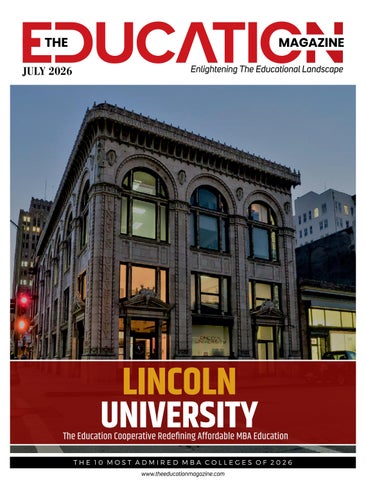
THE JULY 2026
UC TI
MAGAZINE
Enlightening The Educational Landscape
LINCOLN UNIVERSITY
The Education Cooperative Redefining Affordable MBA Education THE 10 MOST ADMIRED MBA COLLEGES OF 2026 www.theeducationmagazine.com
Where Ambition Meets Access: Educating the Business Minds of Tomorrow
Dear Readers. Every generation of business leaders is shaped somewhere before it ever reaches a boardroom, and that beginning is rarely as visible as the results it produces. Behind every confident entrepreneur and every founder who turns an idea into a livelihood, there is usually a classroom and an institution willing to invest in potential long before the world takes notice. This issue, “The 10 Most Admired MBA Colleges of 2026,” sets out to honour those institutions, the ones that choose substance over spectacle and access over exclusivity, proving that admired business education is measured not by prestige alone but by the doors it opens. Our cover feature this issue belongs to Lincoln University, a modest yet remarkable institution just three minutes from a subway station in downtown Oakland. For more than a century, Lincoln has shown that academic quality and affordability need not compete. Founded in 1919 to educate soldiers returning from war, it has since grown into a global institution shaped by a cooperative governance model inspired by Renaissance universities, where faculty, administrators, students and alumni all share responsibility for its success. Guided by president Dr Mikhail Brodsky, whose background in statistics shaped a philosophy built around measurable results, Lincoln offers a lean, practical approach to business education across undergraduate, MBA, master’s and doctoral programmes. Its tuition has stayed a fraction of comparable institutions, without compromising faculty calibre or graduate ambition, many of whom now lead businesses across Silicon Valley. Lincoln’s story proves that access and excellence can share the same address. Joining Lincoln University in this year’s list of admired institutions are Keiser University, the University of North Alabama’s Sanders College of Business and Technology, MCI – The Entrepreneurial School, and the School of Business at McKendree University. Together, these institutions represent something larger than any single ranking can capture: a shared belief that business education should build people, not just résumés. They remind us that the most admired colleges are not always the loudest names, but the ones quietly producing graduates who create jobs and strengthen communities. As the business world evolves, these institutions stand as reminders that thoughtful, accessible education remains one of the most powerful investments a person can make. Sincerely,
Simran Khan Managing Editor
From The Editor’s Desk People Behind This Issue Publisher: Archana Ghule Editor–in–Chief: Vikram Suryawanshi
Art Director: Priyanka Patil Graphic Designer: Omkar Uravane
Managing Editor: Simran Khan
Marketing Head: Robert Smith
Project Editor: Shadab Mestri
Research Team: Daisy, Rahul,
Sales & Marketing
Maranda, Rocky
Project Head: Aakash Mahajan Sales Co-ordinators: Maria Smith Swati Kumari Project Manager: Pravin Shinde, Nehal Nagpure, Francis Dummini The Education Magazine is published by Pericles Ventures Pvt Ltd. This magazine contains material protected under International and Federal Copyright Laws and Treaties. You may not publish, display, disclose, rent, lease, modify, loan, distribute, or create derivative works based on the magazine contents or any part thereof, whether by yourself or as a consultant, employee, partner or in any other role unless authorised in writing by the creator/publisher of the article/, video, audio or any content contained herein. We, the team of The Education Magazine put all the efforts to keep up with the content accuracy. The publisher assumes no responsibility of any part of the content of any advertisement in this publication, including any errors or omissions therein. All rights reserved by Pericles Ventures Pvt Ltd.
Cover Story 10 Lincoln University
CONTENT PROFILES
18. Keiser University 32. MCI –The Entrepreneurial School® 48. School of Business – McKendree University University of North Alabama’s Sanders 60. College of Business and Technology
articles Classroom Management Strategies: 26. Your Ultimate Teacher’s Guide Classroom Relay: Active Learning Meets 42. Digital Control (2026 Complete Guide) Top 10 Highest IQ in the World: 56. Beyond the Score
Lincoln University www.lincolnuca.edu
Keiser University www.keiseruniversity.edu
MCI – The Entrepreneurial School www.mci.edu
Boston University Questrom School of Business www.bu.edu/questrom
Kelley School of Business www.kelley.iu.edu
Northeastern University’s D’Amore-McKim School of Business www.damore-mckim.northeastern.edu
Rice University Jones Graduate School of Business
School of Business McKendree University
Tepper School of Business
University of North Alabama’s Sanders College of Business and Technology
www.business.rice.edu
www.cmu.edu
www.mckendree.edu
www.una.edu
Cover Story
LINCOLN UNIVERSITY
The Education Cooperative Redefining Affordable MBA Education
J
ust three minutes from the nearest subway station in the heart of downtown Oakland stands a university that has quietly demonstrated for more than a century that academic excellence and affordability can go hand in hand.
Lincoln University does not have a sprawling campus or the fame associated with many household names. Instead, it offers something distinctive: a century-old educational mission, a cooperative model inspired by Renaissance universities, and a 74-year-old president who still plays soccer on weekends and maintains an open-door policy, welcoming every student who wishes to meet with him. That accessibility reflects the university's culture and defines much of its identity. The Idea That Would Not Stay the Same Lincoln University was founded in 1919, in the uneasy months following the First World War. Its earliest purpose was a straightforward act of civic generosity: to give education to American soldiers returning from the front, men who had survived something incomprehensible and needed somewhere to begin again. It was a specific idea for a specific moment. But ideas, as anyone at Lincoln will tell you, do not stay the way they begin. Over time, Lincoln evolved alongside the city that first welcomed it. As San Francisco emerged as a gateway between the United States and Asia, the university expanded beyond its original mission of educating returning veterans to serve working professionals and an increasingly diverse international student community seeking new opportunities. By 2017, the university had enrolled about 850 students from 62 countries and had cultivated a faculty that was equally international. What had started as a postwar American project had quietly become something far more global, far more layered, and far more interesting. A Renaissance Model, Reimagined for Today To understand Lincoln University, you have to understand the structure it calls the Global Entrepreneurial Cooperative, a governance model inspired by the earliest European universities. 10 I JULY 2026
THE EDUCATION MAGAZINE I 11
Cover Story During the Renaissance, universities were largely governed by professors, with administrators serving in support roles. Over time, that balance shifted. Administrative structures grew; faculty became employees instead of owners; decision-making became increasingly centralized; and the original spirit of shared ownership dissolved into hierarchy. Lincoln has spent decades reversing that arrangement. Quality at Lincoln is not managed from the top down. Faculty maintain governance roles while teaching. Administrators continue to engage with students in the classroom. Students participate directly in university operations, gaining practical exposure to institutional management and collaborative problem-solving. Alumni return as staff and mentors, feeding what the university describes as multiple streams of value from every dollar invested. The result is an institution that runs leaner than almost any comparable educational program without sacrificing what matters. This cooperative structure is, practically speaking, why Lincoln can charge what it charges. Rather than pouring funds into expansive facilities or oversized administrations, the university invests in people and relationships. Administrators teach. Faculty advise beyond their courses. Students contribute to the institution that educates them. Every stakeholder plays an important role in maintaining and improving the university experience. Quantitative Business and Why the Difference Matters Lincoln University’s emphasis on measurable results reflects the background of its president. Before joining Lincoln, Dr. Mikhail Brodsky spent a decade as a research professor in the Department of Statistics at UC Berkeley after arriving in the United States in 1989 with two doctoral degrees earned in the former Soviet Union. His mathematical training continues to shape the university's philosophy of business education. He is fond of quoting Lord Kelvin, the British physicist, who argued that nothing can be measured unless it is defined, and nothing can be improved unless it is measured. “Business is not just about doing something,” the president says. “Business is about getting results, positive or negative, that always have to be measured.” 12 I JULY 2026
This philosophy distinguishes Lincoln’s approach to business education. While others often focus on theory, Lincoln emphasizes practical application: managing organizations, marketing products, making informed decisions, analyzing data, and creating value in the marketplace. “You need to know how to sell,” the president explains. “Business is about creating something people need and bringing it successfully to the market.” His own family reflects a lifelong commitment to higher education. A third-generation professor, he comes from a lineage of academics that includes both his son and grandson. He recalls his father, a professor of chemistry at the University of Washington who never really understood the economics of his own profession, once asking a deceptively naive question: “If you're the president paying everybody, who is paying you?” Answering the question illustrates the practical business thinking that Lincoln encourages its students to develop. The university's academic offerings reflect that philosophy. Lincoln offers a Bachelor of Arts in Business Administration with five concentrations, an MBA with ten concentrations, two Master of Science programs in business disciplines, and a Doctor of Business Administration with three concentrations.
Affordable by Design, Not by Accident Between 2014 and 2018, Lincoln University maintained one of the largest MBA enrollments in Northern California outside UC Berkeley and Stanford. Yet its tuition was dramatically lower. During that period, a Stanford MBA cost approximately $120,000, while Lincoln’s MBA cost about $20,000. The difference was not a reflection of lower ambitions or lower quality. It was the result of Lincoln’s cooperative model, lean administration, and a deliberate commitment to making graduate business education affordable. Today, Lincoln’s alumni network includes approximately 1,500 graduates working throughout Silicon Valley. Many hold leadership positions as executives, managers, entrepreneurs, and business owners. The university measures success differently from many institutions. “If somebody starts a restaurant and hires four people, that's a success,” the president says. For Lincoln, success is measured not only by graduates' salaries but also by the businesses they create, the jobs they generate, and the value they bring to their communities. THE EDUCATION MAGAZINE I 13
‘‘
The result is not what you deliver. The result is what students learn and apply.
14 I JULY 2026
Cover Story The university primarily serves students pursuing business careers rather than simply earning credentials. Flexible schedules allow students to attend classes one or two days each week while balancing professional and personal responsibilities. Most courses are offered in person, with the option to take some courses online. Located in downtown Oakland, just a three-minute walk from the BART station and connected by buses and rail throughout the Bay Area, the campus is accessible to students commuting from across the region, including Silicon Valley. The People at the Front of the Room Lincoln’s cooperative philosophy comes to life through its faculty. The university intentionally recruits experienced scholars and professionals, many of whom have held distinguished careers at major universities before joining Lincoln. With a lighter teaching load than at many larger institutions, faculty members can devote more time to mentoring students and delivering highly interactive classes. Most instructors hold doctoral degrees and combine academic scholarship with significant industry experience. The faculty reflects the university’s international character, with professors from the United States, China, Russia, Greece, Latin America, and many other regions. Their diverse backgrounds enrich classroom discussions. Some bring strong quantitative training rooted in the Soviet academic tradition, while others contribute decades of executive leadership and professional practice. Students learn not only from scholars but also from professionals who have successfully applied business principles in the real world, and that makes the classroom feel less like a seminar and more like a conversation with someone who walks the walk.
THE EDUCATION MAGAZINE I 15
Cover Story When the World Stopped Moving Before the pandemic, Lincoln had never offered online education. The president was, by his own admission, opposed to it. Lincoln was a traditional school, one that attracted students specifically because of its lectures, its direct faculty engagement, and its structured academic rigor. “I would never do online because Lincoln was not online.” Then COVID-19 closed everything, and Lincoln adapted. Today, the university teaches through synchronous online learning: live sessions where students can see their instructors, ask questions in real time, and engage meaningfully with faculty and peers through the internet. It is not identical to sitting in a room together, the president acknowledges, but it has opened Lincoln to cohort groups across Asia, the Middle East, and Africa, coordinated carefully across time zones. The pandemic, however, imposed costs that Lincoln is still working through. Enrollment dropped sharply. Today, Lincoln enrolls approximately 400 students. The university identifies immigration and visa-processing challenges as one of its primary enrollment obstacles. The university still receives roughly 900 international applications per semester, approximately 2,000 across the full academic year, but ultimately enrolls only around 150 of these students. The barrier is not academic qualification. It is visa access. Students from countries like Nigeria, where English is widely spoken and academic preparation is strong, cannot get through consulate lines. In Spain, the president notes, the wait for an interview alone stretched to nearly a year. To strengthen campus life and attract more domestic students, Lincoln has also expanded its athletic offerings. The university now fields men’s and women's soccer and basketball teams, creating new opportunities for student engagement and broadening its appeal within the local community. 16 I JULY 2026
The Open Door Lincoln University’s campus occupies two buildings in the heart of downtown Oakland, a city known for its mild climate and central location within the San Francisco Bay Area. Student housing is located about ten minutes away in Alameda, where the university leases furnished two-bedroom apartments shared by four students. The accommodations are practical, affordable, and designed to support students throughout their studies. Yet Lincoln’s unique feature is not its campus or tuition. It is its accessibility. The president maintains regular office hours and encourages every student to meet with him personally. “I don’t believe there is another university in the United States where the president is available to every student,” he says.
The institutional vision for Lincoln's future is equally distinctive. Rather than pursuing unlimited growth, the president believes the university’s greatest strength lies in retaining its close-knit collegial culture. His goal is to rebuild enrollment to approximately 800 to 900 carefully selected students, large enough to sustain a vibrant academic community, yet small enough to preserve close relationships between students, faculty, and university leadership. He hopes future improvements in immigration and visa processing will once again allow qualified international students to study in the United States. His advice to prospective students is straightforward: pursue higher education because you believe in learning and creating value, not just because you want a degree. For international students, his message is equally clear. “American business education is distinguished by its focus on innovation, entrepreneurship, and the practical skills needed to transform ideas into successful enterprises.” For more than a century, Lincoln University has pursued that mission. From educating veterans after World War I to preparing students from around the world, the university continues to demonstrate that academic quality, affordability, and personal attention can coexist. THE EDUCATION MAGAZINE I 17
Institutions that put student learning, professional, and personal needs first can help unlock the potential of qualified, motivated, and disciplined students. 18 I JULY 2026
KEISER UNIVERSITY Balancing Academic Rigor with Real-World Success
THE EDUCATION MAGAZINE I 19
“We are accountable to our students by offering an innovative, proven educational approach with small class sizes, highly personalized teaching, hands-on practical training, and flexible scheduling.”
R
obert M. Keiser, Ph.D., Vice Chancellor of the Graduate School at Keiser University, emphasizes that prioritizing both student learning and their professional and personal needs helps unlock the potential of qualified, motivated, and disciplined students. He believes that post-secondary education and access to high-quality graduate programs should not be reserved for a privileged few. “Students, regardless of their socioeconomic status, have the internal potential to make a significant impact not only within their professional field but also in the broader community and society at large,” asserts Dr. Keiser. When asked why prospective students should consider Keiser University’s MBA program, Dr. Keiser highlighted its independent learning, intellectual contributions to the business field, advanced business strategies, and rigorous research methods. In addition, the university’s Seahawk Tank Pitch Contest allows MBA students to pitch their ideas in a format similar to the popular show Shark Tank. Dr. Keiser invites prospective students and their families to explore Keiser University and its MBA program. If they find it aligns with their goals, he encourages them to consider joining the Seahawk family. Built on a ‘Students Come First’ Philosophy Founded in 1977 by Dr. Keiser’s father and grandmother, Arthur Keiser, Ph.D., and Evelyn Keiser, Keiser University has grown into one of Florida's largest private, non-profit universities. Dr. Keiser recalls, “When our family started our first school in Fort Lauderdale in 1977, with one student and several classrooms, I could never have imagined at that time that we would have campuses throughout the state of Florida, cooperative agreements with university systems across the globe, and a campus in Nicaragua to serve international students.” Today, Keiser University serves nearly 20,000 students, employs around 3,800 staff, and has a network of approximately 100,000 alumni at 19 locations in Florida, online, and abroad. As the university celebrates 45 years of 20 I JULY 2026
educational excellence, it continues to lead in talent development for various industries, contributing to a robust global economy. Recently, Keiser University expanded its global footprint by opening learning centers in eight new locations across South America, Asia, and Europe. Since 2019, U.S. News & World Report has consistently ranked Keiser University among the top institutions in the U.S. for helping graduates experience upward, social mobility. In 2023, it earned the number-one ranking in the Best College's Social Mobility ranking of universities. “This dramatic growth can be traced directly back to our original commitment to our philosophy that students come first,” states Dr. Keiser. “Simply put, they are the reason we exist.” The Keiser University MBA Program: Launchpad for Ambitious Students The Keiser University MBA program offers practical skills, strategic direction, and comprehensive insights for navigating today’s business landscape. Students can choose from online, hybrid, or on-campus options to effectively balance their careers and other priorities. Instruction and educational services for the MBA program are available in English, Spanish, and Mandarin, making the program highly accessible and globally focused. To apply, candidates need a four-year baccalaureate degree or its equivalent from an accredited institution. Additional requirements are available on the university’s website. The program’s rigorous curriculum and hands-on learning develop administrative knowledge, leadership capabilities, and expertise in critical areas like accounting, marketing, finance, and international business. Graduates gain a deep understanding of business dynamics, strong communication skills, and the strategies needed for leadership roles in global organizations. Unlike some online providers, Keiser University caps MBA cohorts at 25 students, ensuring personalized education occurs in a small setting. The program offers both synchronous and asynchronous online classes, allowing distance learners to engage live with faculty while enjoying flexible scheduling.
Moreover, Keiser University provides 24/7 access to its writing lab, statistics lab, math lab, online database, research center, academic advising, professional development, and career placement department. These resources help students develop the skills needed to compete in a multicultural, global business environment. Fair and Consistent Financial Aid The Financial Aid Department at Keiser University is available to assist students with all their financial aid needs and to answer the many questions students may have as they navigate the complex process. To begin the process, prospective students seeking financial assistance must first complete the Free Application for Federal Student Aid (FAFSA). After submitting the FAFSA, they schedule an appointment with a Financial Aid Administrator. Furthermore, Keiser University offers need-based financial aid and scholarships to eligible students.
The university accommodates a broad range of students, including traditional and adult learners. Women make up 73% of the student population, while 20% are veterans, active-duty military members, and their families. Many students come to Keiser after struggling at other institutions, and a significant number of graduates are the first in their families to earn a college degree. Notably, about 83% of Keiser graduates stay in Florida, contributing to the state’s economy. The Multilingual and Multidisciplinary Faculty
Minority-Majority-Serving Institution
Keiser University’s faculty prepares students for careers with a program that develops skilled and responsible practitioners. The faculty members hold advanced degrees and bring real-world experience to their teaching. They collaborate with community leaders each year to align the curriculum with industry standards and workforce needs.
Keiser University serves a diverse student body and focuses on building an inclusive learning community. It is a proud Hispanic-serving institution, designated by the Department of Education, and is a member of the Hispanic Association of Colleges and Universities.
In addition to teaching, many faculty members actively practice in their professional fields. They also serve as researchers and scholars, advising students in English, Spanish, and Mandarin based on students’ preferences and program options. THE EDUCATION MAGAZINE I 21
Welcomes Students from More than 45 States and 50 Nations Keiser University operates campuses in China and Nicaragua and maintains educational centers in Bolivia, Ecuador, Peru, Vietnam, India, Sri Lanka, Spain, and Indonesia. American students can study abroad at these locations. Meanwhile, international students can choose to study at Keiser University's residential Flagship campus in West Palm Beach, Florida.
The campus also hosts 26 NAIA athletic teams, three club sports, and various intramural activities. Additionally, students benefit from support services, including academic advising, math and writing labs, and mental health and wellness experts. Comprehensive Student Services and the $10,000 Seahawk Tank Pitch
Flagship Residential Campus
At Keiser University, students benefit from the Department of Student Services, which helps prepare students for job opportunities by offering resume preparation, interviewing skills, and mock interviews. The department also provides professional development workshops, guidance on professional social media, and job postings through the university’s online career center.
Keiser University’s Flagship Residential Campus sits on 100 acres in West Palm Beach, Florida. The campus features athletic, residential, student life, and academic facilities totalling 263,968 square feet. Students live in modern, suite-style residence halls with meal plans and amenities like 24-hour security, Wi-Fi, and cable access.
The department emphasizes both career skills and leadership development, which are essential for job searches. The staff engages students with workshops and activities that positively impact both the campus and the community. Additionally, students can participate in the Student Government Association and explore clubs and organizations suited to Keiser’s diverse student body.
Furthermore, The International Affairs Department offers specialized services to help international students navigate social, cultural, and language challenges.
22 I JULY 2026
Robert M. Keiser (Ph.D.) Vice Chancellor | Keiser University
THE EDUCATION MAGAZINE I 23
Students also gain practical experience through case studies and real-world collaborations with industry partners, which simulate business environments and encourage innovative thinking. For example, the Keiser University Seahawk Tank Pitch contest allows undergraduate and graduate students to present their business ideas to a panel of industry judges. The top eight finalists compete for cash prizes totalling around $10,000, which serves as seed money for their startups. Generational Leadership Robert M. Keiser, Ph.D., M.B.A., serves as Vice Chancellor of the Graduate School at Keiser University. As Vice Chancellor, Dr. Keiser manages all operations for the university’s graduate and international programs. His leadership has led to significant growth in graduate and international enrolment, multiple national recognitions for academic excellence, and the successful launch of new master’s and doctoral programs. He has also secured new grants, and programmatic accreditations, and expanded the university’s reach with educational centers in Spain, Bolivia, Ecuador, Peru, Indonesia, India, Sri Lanka, and Vietnam. 24 I JULY 2026
Beyond his professional role, Dr. Keiser volunteers as a gubernatorial appointee to the Florida Center for Nursing (FCN), where he helps research and recommend strategies to address Florida's nursing workforce needs. He actively contributes to the Florida Association of Postsecondary Schools and Colleges (FAPSC), having previously served as its President. Dr. Keiser has also supported the Florida Department of Education through his service on the Rules and Accreditation Committees for the Commission of Independent Education (CIE). His contributions have earned him recognition as a leading figure in post-secondary education in South Florida and nationally. He has spoken at many national conferences and testified before the Florida State Legislature and the House and Education Labor Committee. In 2022, Career Education Review named Dr. Keiser one of the top 20 career-education leaders in the U.S. He has received several honors, including the 40 Under 40 award from the Cystic Fibrosis Foundation of Fort Lauderdale and the South Florida Business Journal.
CLASSROOM MANAGEMENT STRATEGIES Your Ultimate Teacher’s Guide What if I told you that the secret to a magical classroom isn’t about control, but connection? Step inside any thriving classroom today, and you’ll notice something remarkable: it’s not just about rules, grades, or discipline anymore—it’s about strategy, innovation, and connection. Welcome to the era of classroom management strategies that go beyond keeping order and instead transform learning into a dynamic, future-ready experience. Picture routines so seamless they feel like second nature, praise so intentional it sparks confidence, and layouts so purposeful they quietly guide focus and collaboration. These aren’t old-school tricks; they’re powerful, research-backed approaches shaping how modern teachers inspire growth and resilience. The truth is simple: when classrooms are managed with foresight and creativity, students don’t just learn—they thrive. They gain lifelong skills in empathy, responsibility, and problem-solving, while teachers reclaim joy in teaching. This isn’t management; it’s empowerment. And in today’s ever-changing world, the right strategies don’t just prepare students for tests—they prepare them for life. And, this blog? Think of it as your ultimate resource—packed with foundational ideas, things you can do tomorrow, and frameworks that will reshape your teaching journey, making it so much more rewarding. 26 I JULY 2026
THE EDUCATION MAGAZINE I 27
Let’s Explore Everything About Classroom Management Strategies
2. Proactive Strategies: Building a Positive Classroom from Day One
1. The Foundation: What Are Classroom Management Strategies and Why Are They Crucial?
The real magic happens before any problems even start. It’s all about being proactive, and it all begins on day one.
Let’s get one thing straight: ‘Classroom management’ is so much more than just discipline. It’s the entire universe of actions you take to build an environment where learning can actually happen. ● It’s the art of creating clear routines and procedures that run like clockwork. ● It’s the science behind designing your physical space for maximum learning and minimum chaos.
● The 2x10 Strategy: This is pure gold. For two minutes a day, for ten consecutive days, chat with a student about anything but school. This tiny investment builds mountains of trust and connection. It makes students feel seen. ● Routines are Your Best Friend: From the moment they walk in, students should know exactly what to do. Think about: ○ A consistent entry routine (backpacks here, pencils sharpened, start bell work). ○ Clear signals for transitions (a simple chime works wonders!). ○ A standardized way to turn in homework.
● It’s the heart you put into fostering real, positive relationships with and among your students. ● It’s the brainpower behind implementing teaching methods that truly engage. So, why is this all so incredibly crucial? Oh, let me count the ways! ● Academic Gold: A well-managed classroom is directly tied to higher academic achievement. When the environment is predictable, students can finally focus on what matters: learning. ● A Safe Harbor: It creates a psychologically safe space. We’re talking about fulfilling those fundamental needs for belonging and safety, just like Abraham Maslow pointed out in his famous Hierarchy of Needs. It’s that important!
● We Make the Rules: Involve your students in creating classroom expectations. When they help build the rules, they own them. A key tip? Always phrase them positively. Instead of ‘Don’t interrupt,’ try ‘We respect each other’s turns.’ So much more powerful! ● Design with Purpose: Your classroom layout is a silent partner in management. Think about seating arrangements that encourage collaboration or focus. Ensure there are clear pathways and easy access to materials. It’s amazing how this reduces disruptions. ● The Power of Praise: Don’t just say “Good job.” Get specific! Try this: “I noticed how you helped Sarah with that difficult problem; that shows great teamwork and empathy.” Wow! See the difference? This pinpoints the exact behavior you want to see more of and builds an incredible culture of positivity.
● Skills for Life: You’re not just teaching algebra; you’re teaching self-regulation, responsibility, and how to communicate with respect. These are the skills that build successful futures.
Okay, even in the best-run classrooms, things happen. Having a toolkit for those ‘in-the-moment’ situations is essential.
● Saving Your Sanity: Let’s be real. A well-oiled classroom dramatically reduces teacher burnout by cutting down daily stress and giving you more time to actually teach. What a game-changer, right?
● The Silent Signals: Never underestimate the power of non-verbal cues. Sometimes, just moving closer to a student (proximity control) or making direct eye contact with a subtle gesture is all it takes to redirect behavior without stopping your lesson. It’s a teacher superpower!
28 I JULY 2026
3. In-the-Moment Strategies: Addressing Behavior Effectively
● Redirect Respectfully: When you do need to intervene, keep it private and respectful. A quiet word with the student, away from their friends, is far more effective than a public showdown. ● The Magic of Choice: This is a brilliant de-escalation technique. For example: “You can choose to complete your work now, or you can complete it during recess. Which choice works for you?” It empowers the student while still guiding them to the right path. ● Restorative Conversations: Instead of just punishing, let’s repair. Ask questions like: “What happened? Who was affected by this? How can we make things right?” This shifts the focus from punishment to resolution and, most importantly, empathy. ● Be a Behavior Detective with ABC: To truly get to the root of a behavior, use the ABC model. It’s a lifesaver. ○ A - Antecedent: What happened right before the behavior? (e.g., “Teacher announced group work.”) ○ B - Behavior: What exactly did the student do? (e.g., “Student put head on desk and refused to participate.”) ○ C - Consequence: What happened right after? (e.g., “Student was sent to the quiet corner, avoided group work.”) By analyzing this pattern, you can spot the triggers. You might even realize the consequence—like avoiding group work—is accidentally reinforcing the behavior! Mind-blowing, isn’t it? 4. Foundational Frameworks: Key Models & Mnemonics Behind every great classroom is a solid framework. Understanding these models can help you build a consistent and comprehensive approach that just makes sense. ● The Four Pillars of Management (The 4 Cs): ○ Community: Creating that “we’re all in this together” feeling. ○ Consistency: Being fair and predictable with rules. It builds trust. ○ Communication: Keeping an open, clear dialogue with students and parents. ○ Consequences: Using logical responses—both positive and negative.
● The 4 Components of Success: ○ Rules: Clear, simple, and created together. ○ Proactive Discipline: Stopping misbehavior before it even starts with things like engaging lessons. ○ Positive Reinforcement: Catching them being good and celebrating it! ○ Student Engagement: Designing lessons that are too interesting to ignore. ● The 4 Types of Management Styles: ○ Authoritarian: High demands, low warmth. Think of a strict ruler. ○ Permissive: Low demands, high warmth. More of a friend than a teacher. ○ Uninvolved: Low demands, low warmth. Disengaged and distant. ○ Authoritative: High demands, high warmth. The sweet spot! Clear expectations delivered with support and respect. And the research is clear: the Authoritative style is the undisputed champion for creating successful, well-adjusted students. (Imagine a 2x2 grid here, with “Demands” on one axis and “Responsiveness” on the other—it perfectly shows why Authoritative wins!). ● The Five Principles of a Thriving Classroom (The 5 Ps & 5 Rs): ○ The 5 Ps (For Students): Prompt, Prepared, Productive, Patient, Persistent. These are the behaviors that spell success. ○ The 5 Rs (For Teachers): Routines, Relationships, Relevance, Rigor, Respect. These are the foundations you build. 5. Differentiating Your Approach: Management for All Learners One size never fits all, especially in a classroom buzzing with diverse minds. Truly effective classroom management means tailoring your approach. THE EDUCATION MAGAZINE I 29
30 I JULY 2026
● For Kinesthetic Learners: Let them move! Give them chances to stand, use fidget tools, or do handson tasks. It helps them channel that energy for good. ● For Students with ADHD: Clarity is kindness. They thrive on concise instructions, frequent checkins, visual schedules, and brain breaks. ● For English Language Learners (ELLs): Bridge the language gap with visual aids, gestures, and simplified language. Pairing them with a supportive peer can work wonders for their confidence and understanding. ● For Gifted Students: Boredom can be a huge trigger for misbehavior. Keep them challenged with independent projects, advanced materials, and leadership roles to keep their brilliant minds engaged. 6. Which Classroom Management Style is Best? Finding Your Authentic Approach So, which style is the absolute best? The evidence points overwhelmingly to the Authoritative style. Why? Because it’s the perfect blend of high expectations and genuine warmth. ● Authoritative teachers set clear boundaries but also explain the “why” behind the rules.
1. Obsess Over Procedures: Seriously. Define, teach, and practice every single routine until it’s second nature. From walking in the door to turning in a quiz, predictability is your superpower. 2. Find Your Mentor: You are not alone. Lean on those veteran teachers down the hall. They have seen it all and can offer the practical tips and emotional support that will save you time and again. 3. Be Relentlessly Consistent: This is how you build trust. Your students need to know that your expectations and consequences are fair and predictable. Consistency makes you the calm, reliable leader they need. My Opinion Well, I’ve witnessed how classroom management strategies are no longer just about keeping order—they are the blueprint for shaping tomorrow’s leaders. Mastering classroom management strategies isn’t just a skill; it’s the heart of great teaching, creating a space where every student can truly soar.
● Ultimately, this style fosters self-regulation and motivation that comes from within.
A well-managed classroom functions like a micro-society where students practice empathy, collaboration, and innovation daily. Teachers who adapt modern strategies not only reduce burnout but also elevate their classrooms into hubs of possibility.
But here’s the secret: the very “best” approach is the one that is authentic to you. It’s about finding your own authoritative voice—one that is flexible, right for your students’ age, and true to your personality. That’s how you nurture independence and create lasting success.
The Authoritative approach, balancing warmth with structure—remains the most impactful, yet it is the authenticity of each teacher’s style that creates lasting results. The future of education will belong to those who view classroom management not as a checklist but as an evolving ecosystem.
7. For the New Teacher: Your First-Year Survival Kit
And as digital transformation, cultural diversity, and new teaching technologies redefine education, these strategies will continue to expand their influence far beyond the walls of a single classroom. In short, classroom management is no longer background work—it is the stage on which student futures are built.
● They listen to their students’ perspectives, creating an environment of mutual respect.
Hey, new teacher! Welcome! Your first year is a whirlwind. To not just survive but thrive, laser-focus your classroom management strategies on these three pillars.
THE EDUCATION MAGAZINE I 31
32 I JULY 2026
THE EDUCATION MAGAZINE I 33
34 I JULY 2026
THE EDUCATION MAGAZINE I 35
36 I JULY 2026
THE EDUCATION MAGAZINE I 37
38 I JULY 2026
THE EDUCATION MAGAZINE I 39
40 I JULY 2026
THE EDUCATION MAGAZINE I 41
CLASSROOM RELAY Active Learning Meets Digital Control 42 I JULY 2026
W
alk into any modern classroom, and you will notice two competing forces. On one side, students need movement, interaction, and collaboration to learn truly. On the other hand, devices demand structure, supervision, and digital focus.
This is where the idea of the classroom relay becomes powerful and often misunderstood. For some educators, a classroom relay is a high-energy learning strategy that turns academic concepts into team-based challenges. For others, it refers to digital classroom management tools once branded under “Relay.” The confusion is real, and so is the opportunity. In 2026 classrooms, the most effective schools are not choosing between movement and monitoring. They are blending both. This guide brings clarity. We will explore the research behind movement-integrated instruction, examine inclusive relay models across grade levels, and explain how digital tools support structured, active learning environments. Let’s begin by defining what a classroom relay truly is. What Is a Classroom Relay? A classroom relay is a structured, team-based instructional strategy where students physically move between designated stations to complete academic tasks, reinforcing content and collaboration before passing responsibility to a peer. In education, this model is used to: ● Reinforce academic content ● Encourage collaboration ● Increase physical engagement ● Improve focus through structured movement The format can vary. In elementary classrooms, it may involve vocabulary cards placed at stations. In high school settings, it could mean rotating through complex case-study checkpoints. The structure remains consistent: movement, accountability, and shared responsibility. Much like other classroom management games, the relay transforms routine tasks into high-engagement opportunities. However, the term “classroom relay” also appears in digital education contexts. The edtech company Lightspeed Systems previously used “Relay” in its product branding for classroom device management. Today, the company’s tools focus on filtering, monitoring, and real-time student visibility in 1:1 environments. THE EDUCATION MAGAZINE I 43
Understanding this distinction is important. One refers to pedagogy. The other refers to digital oversight.
Types of Classroom Relay Activities Across Grade Levels
This article addresses both because modern classrooms require both.
A classroom relay is not limited to elementary school. When designed intentionally, it scales across age groups and subject areas. The key is aligning movement with cognitive demand.
Why Movement Improves Learning The effectiveness of relay-style learning is not based on enthusiasm alone. It is grounded in research on movement-integrated instruction. Recent studies published in peer-reviewed journals such as Frontiers in Psychology and indexed in the National Center for Biotechnology Information (PMC) show that structured physical activity during instruction improves: ● Executive function ● Selective attention ● Working memory ● Cognitive flexibility Executive function is especially critical in K–12 education. It governs planning, focus, and impulse control. When students move with purpose during learning tasks, the brain increases oxygen flow and neural activation patterns linked to memory retention. Instructional coaches consistently report that swapping passive reading for physical relays actively lowers behavioral disruptions. Research on neuroplasticity further supports this. Movement stimulates neural pathway development, strengthening the brain’s ability to encode and retrieve information. In practical terms, students are more likely to remember what they learn when the body is engaged alongside the mind. Movement also reduces cognitive fatigue. Instead of sitting passively, students alternate between physical activation and mental processing. This pattern sustains attention over longer instructional periods. A classroom relay is not simply a game. It is a structured cognitive strategy aligned with how the brain processes information. This mirrors the broader shift from passively receiving information to actively exploring it that defines modern active learning approaches. 44 I JULY 2026
1. Elementary School Relays At the elementary level, relays focus on foundational skill reinforcement and gross motor engagement. Common formats include: ● Vocabulary Relays: Students run to retrieve word cards and match them with definitions. ● Math Fact Stations: Teams rotate through quick problem-solving checkpoints. ● Spelling Board Runs: One student writes a letter at a time before tagging the next teammate. ● Sensory Path Relays: Integrated movement paths that support focus before answering academic prompts. For younger learners, structured movement supports attention regulation. Studies on movement-integrated instruction show improvements in selective attention and on-task behavior when physical activity is embedded into academic routines. The emphasis at this level is rhythm: move, think, return, repeat. Suggested Time: 15–20 minutes | Group Size: 3–5 students | Materials: Task cards, timer, answer sheets 2. Middle School Relays In middle school, the relay format shifts from recall to reasoning.
Examples include: ● Science Concept Circuits: Students rotate between experiment summaries and analysis questions. ● History Timeline Relays: Teams assemble chronological sequences at stations. ● Problem-Solving Relays: Multi-step math problems completed collaboratively.
When designed well, high school relays reduce passive note-taking and increase accountability within peer groups. Suggested Time: 25–35 minutes | Group Size: 4–6 students | Materials: Case study packets, analytical rubrics, digital submission tools Designing an Inclusive Classroom Relay
● Brain Break Relays: Short movement tasks followed by reflection prompts.
Movement-based learning must be adaptable. Not every student experiences stimulation in the same way.
Adolescents benefit from collaborative movement because it activates executive function while maintaining social engagement. Research in cognitive development highlights that structured peer interaction strengthens working memory and cognitive flexibility.
Research on ADHD and sensory processing emphasizes that students with ADHD or sensory sensitivities benefit from structured movement but only when predictability and choice are built into the environment.
At this stage, relays should include strategic thinking, not just speed.
Similarly, reporting from Education Week highlights the importance of flexibility in movement-based instruction.
Suggested Time: 20–25 minutes | Group Size: 4–6 students | Materials: Station folders, reflection cards, optional QR codes 3. High School and Higher Education Relays
Practical inclusion strategies include: ● Choice Boards: Allow students to select between movement intensity levels.
This is where most competitors fail to provide guidance. Relay learning at advanced levels focuses on complex reasoning, debate, and synthesis. Effective models include:
● Sensory Walk Options: Provide calm movement pathways instead of competitive sprints. ● Timed Transitions: Clear auditory or visual cues for station shifts.
● Case Study Rotations: Teams analyze different components of a real-world scenario before presenting integrated findings.
● Defined Roles: Timekeeper, recorder, presenter, so not every student is required to run.
● STEM Challenge Relays: Each station adds a layer of complexity to an engineering or data-analysis task.
Inclusion is not about slowing the relay. It is about designing structured access points.
● Literary Analysis Rotations: Students build interpretive arguments across checkpoints.
When thoughtfully implemented, relay activities can improve executive function while supporting emotional regulation.
● AP Review Circuits: Timed concept reinforcement aligned with exam standards.
The Rise of the “Phygital” Classroom Relay
Older students do not need simplified games. They need structured collaboration with intellectual depth. Movement remains purposeful but secondary to analytical rigor.
The modern classroom operates in a 1:1 device environment. Movement does not replace technology; it coexists with it. THE EDUCATION MAGAZINE I 45
Educational leaders are increasingly describing this blended environment as “phygital,” where physical learning experiences are supported by digital infrastructure.
For example, AI-assisted features such as SmartPlay filtering allow schools to manage YouTube content dynamically, while structured policy systems enable differentiated permissions by grade or role.
In practical terms, this may look like: ● QR codes at relay stations linking to problem sets
In a relay-based classroom, these tools serve a supporting function. They allow teachers to maintain digital focus while students rotate physically between learning stations.
● Chromebook submissions at each checkpoint ● Real-time digital quizzes embedded into movement cycles
The goal is not surveillance. It is instructional alignment. Managing Movement Without Losing Digital Focus
● AI-generated prompts adjusting task difficulty between rounds
Movement energizes learning. Devices can either support that energy or disrupt it.
The difference in 2026 is not just movement. It is visibility. The challenge in modern classrooms is balance. Teachers are now able to combine active learning with structured digital oversight. This ensures that devices enhance instruction rather than distract from it. Classroom Relay Software Explained As classroom relays evolve in 1:1 environments, digital management becomes part of the conversation.
When students rotate between relay stations with devices in hand, teachers need clear guardrails. Research on attention shows that divided focus reduces task performance. This means digital boundaries must be defined before movement begins. Practical strategies include:
Some educators encounter the term “classroom relay” through legacy product branding from Lightspeed Systems, a company known for K–12 filtering and classroom management tools.
● Pre-setting approved sites before the relay starts
While the company’s flagship product today is Lightspeed Filter, earlier branding included “Relay,” which still appears in search behavior.
● Assigning a digital monitor role within each team
It is important to clarify the distinction. A classroom relay activity refers to a movement-based instructional model. Classroom management software refers to tools that provide:
● Locking devices into a single-task mode during timed rounds
● Using timed submission windows for accountability Real-time visibility tools allow teachers to intervene quickly if students drift off task. But structure should not replace trust. Students must understand why digital expectations exist.
● Real-time student screen visibility
A classroom relay works best when autonomy and accountability coexist.
● Website filtering
Measuring Impact: Assessment in Relay Models
● AI-supported video monitoring
Many relay activities fail for one reason: they measure excitement instead of learning.
● Policy-based access control ● Hierarchical management across schools and districts 46 I JULY 2026
To align relays with academic outcomes, assessment must be embedded into the structure.
Effective relay-based assessment strategies include: ● Formative Checkpoints: Quick-response prompts at each station ● Cumulative Problem Chains: Each team builds on the previous group’s answer ● Peer Explanation Rounds: Students explain reasoning before moving forward ● Digital Exit Submissions: Short reflective responses submitted at the end Research on executive function shows that structured retrieval strengthens memory consolidation. When relays include reflective checkpoints, they move beyond activity and become cognitive reinforcement systems. Data collected during relays can inform: ● Instructional pacing ● Misconception patterns ● Group collaboration dynamics
The Future of Classroom Relays Starts With You The classroom relay is no longer just a game. It is a strategic response to a changing educational landscape.
● Differentiation needs A well-designed classroom relay is measurable, not chaotic. Quick-Start Classroom Relay Template Not sure where to begin? Use this simple framework to build your first relay this week. 1. Pick your content: Choose 4–6 concepts, questions, or problems from your current unit. 2. Set up your stations: Place one task at each station. Label them clearly. Include a timer at each point. 3. Assign roles: Every student gets a role: runner, recorder, timekeeper, or presenter. 4. Set digital expectations: If devices are in use, define which sites or tools are approved before the relay begins. 5. Run and reflect: After the relay, spend 5 minutes on a whole-class debrief or digital exit slip. That’s it. Your first relay does not need to be perfect. It needs to happen.
In 2026, students need movement to strengthen attention, collaboration to build reasoning, and digital structure to protect focus. Schools that succeed are not choosing between physical engagement and technological oversight. They are integrating both with intention. Whether you are a classroom teacher designing your next lesson or a school leader evaluating digital infrastructure, the opportunity is clear. Movement and management are not opposing forces. They are complementary tools in a welldesigned learning ecosystem. If this guide clarified the modern classroom relay for you, share it with a colleague who is rethinking engagement in today’s classrooms. Conversations like this shape better schools. THE EDUCATION MAGAZINE I 47
48 I JULY 2026
THE EDUCATION MAGAZINE I 49
50 I JULY 2026
THE EDUCATION MAGAZINE I 51
52 I JULY 2026
THE EDUCATION MAGAZINE I 53
54 I JULY 2026
THE EDUCATION MAGAZINE I 55
Top 10 Highest
IQ IN THE WORLD Beyond the Score
W
hat does it truly mean to be a genius? Is it merely about a high score, or something far deeper? We often marvel at extraordinary minds. IQ, or Intelligence Quotient, offers one way to measure this. It gives us a score for how well our brains think. This includes problem-solving and learning new things. These cognitive abilities are key. This blog explores remarkable individuals. They possess some of the highest IQs in the world ever recorded. We will look at their amazing contributions. We also shed light on what makes intelligence truly exceptional. This topic deeply fascinates many people. Exceptional minds powerfully impact our society. They drive innovation and change. Their stories inspire us all. Let’s unlock these brilliant narratives. Understanding IQ: More Than Just a Number What is IQ? Imagine your brain as a super-powerful computer. IQ, or Intelligence Quotient, is simply a score. This score comes from a special test. It measures how well your brain works. Think of it like a report card for your thinking skills. These tests look at various abilities. They check your reasoning, problem-solving, and learning speed. For instance, the Stanford-Binet and Wechsler tests are very common. They help us understand different cognitive domains. The Nuance of IQ Scores Now, let’s talk about IQ scores themselves. 100 is considered an average IQ score. This is the center point for most people. However, scores are quite relative. Different tests can give slightly different results. Test methods also play a role. It’s not a single, fixed number for life. 56 I JULY 2026
While a high IQ is truly impressive, it’s not the only key to success. Consider this: a brilliant mind also needs creativity. Perseverance, or never giving up, is crucial. Emotional intelligence, understanding feelings, matters deeply. Practical application, using what you know, is vital too. These elements build trust and show real expertise. The highest IQ in the world might be fascinating, but it’s just one piece of a larger puzzle. Debate & Limitations of IQ So, is IQ a perfect measure? Not quite. IQ tests have certain limits. They don’t measure all types of intelligence. For example, they might not assess musical talent. They also miss artistic brilliance. Consider a great musician or a gifted artist. Their genius might not show up on an IQ test. This understanding adds balance. It shows a nuanced view of intelligence. We always seek a complete picture. It’s truly more than just a number. Here’s a list of the people with the highest IQs in the world currently, as per the USIA 1. YoungHoon Kim YoungHoon Kim founded the United Sigma Intelligence Association (USIA). This non-profit organization gathers the world’s brightest minds. It proudly includes seven Nobel Prize winners. Renowned intellectuals like Noam Chomsky also join the ranks. Furthermore, he holds an official world record for intellectual prowess. Various international bodies have verified this achievement. Kim is a truly remarkable polymath. He showcased his extraordinary memory on television. He flawlessly memorized 104 poker cards in just over 10 minutes.
Simultaneously, he serves as a Tony Buzan Honorary Professor. He also holds black belts in many disciplines. This demonstrates his diverse skills and deep mental capacity. 2. Terence Tao Terence Tao is a true giant, like an elephant with a sharp mind in mathematics. And this has not gone unnoticed which is seen as he has also been awarded the Fields Medal in 2006. This award recognized his deep work on complex equations. He also contributed greatly to prime number patterns. Specifically, with Ben Green, he showed that primes can form long chains. This theorem changed how mathematicians view numbers.
3. Marilyn Vos Savant Marilyn vos Savant held the Guinness World Record. Her IQ of 228 was the highest IQ in the world recorded then. The category retired in 1990. Since 1986, she writes “Ask Marilyn” for Parade magazine. She answers millions of readers’ tough questions. She is a brilliant logician. She became famous for solving complex puzzles. Her columns made advanced reasoning simple. She explained paradoxes to the public. Her clear explanations show her remarkable mind. She helps everyday people grasp big ideas. 4. Christopher Hirata
They often call him the “Mozart of Math.” He won the International Mathematical Olympiad very young, at 13. By 24, UCLA appointed him their youngest full professor. He believes mathematics clarifies our world. It makes things logical, not confusing. His work truly showcases what the highest IQ in the world can achieve. He reveals hidden structures in numbers.
Christopher Hirata won a gold medal at age 13. He achieved this at the International Physics Olympiad. He became the youngest American to do so. Later, he earned the Helen B. Warner Prize. This celebrated his work on gravitational lensing and cosmology. He truly pushes the boundaries of physics. THE EDUCATION MAGAZINE I 57
He was a phenomenal child prodigy. At 16, he worked for NASA. His research focused on colonizing Mars. He even wrote complex general relativity equations. He scribbled them on McDonald’s napkins during high school camp. This shows his natural, effortless brilliance. Many might consider his to be among the highest IQ in the world for theoretical physics. 5. Sho Yano Sho Yano became the youngest M.D. from the University of Chicago. He earned this degree at just 21 years old. Simultaneously, he gained a Ph.D. in cell biology. He also graduated summa cum laude from Loyola University at 12. This remarkable academic speed stands out. He is an exceptionally multi-talented individual. He read at age two and wrote by three. At five, he composed music. Furthermore, he is an accomplished pianist. He even holds a black belt in taekwondo. His diverse talents truly reflect a mind often associated with the highest IQ in the world. He truly excels across many fields. 6. Evangelos Katsioulis Evangelos Katsioulis achieved top scores in global intelligence contests. He also founded multiple high-IQ societies. These include the World Intelligence Network. As a psychiatrist, he greatly advanced psychopharmacology research. His work on antipsychotic medication is notable. He is a remarkable Greek polymath. He holds degrees in medicine and philosophy. He also excels in psychopharmacology. He showed the best physics performance among over 11,000 examinees. This happened in the Greek National Final Examinations. He belongs to over 60 high-IQ societies. This highlights a mind often associated with the highest IQ in the world. 7. Christopher Harding Christopher Harding founded the International Society. This Australian organization supports high-IQ individuals. He is also a recognized member. He belongs to many elite intellectual groups. His work fosters global intellectual communities. As a philosopher, he dedicates his efforts. He understands and nurtures gifted minds. He builds connections among them. He helps the world’s most intelligent people. His focus on community is unique. He brings together those with the highest IQ in the world. 58 I JULY 2026
8. Christopher Langan Christopher Langan developed the Cognitive-Theoretic Model of the Universe (CTMU). He claims this work is a “Theory of Everything.” It uses logic to prove God’s existence. He achieved this without a formal degree. His work still gained scholarly attention. Academic journals published his ideas. He is a truly self-taught intellectual. He created his profound theory. Notably, he worked as a nightclub bouncer. This happened on Long Island. His story proves deep thought can emerge from surprising places. He represents a unique kind of highest IQ in the world application. 9. Rick Rosner Rick Rosner is an Emmy-nominated television writer. He also works as a producer. He is famous for “Jimmy Kimmel Live!” Moreover, he contributed to game shows. These include “Who Wants to Be a Millionaire.” He wrote for many comedy specials. He is a very versatile entertainment professional. He uses his high intelligence creatively. He brings smart ideas to popular TV. He truly connects deep thinking with mass entertainment. His career shows a unique path. It proves that the highest IQ in the world can succeed in unexpected places. 10. Garry Kasparov Garry Kasparov redefined chess mastery. He reigned as World Chess Champion for 15 years. His FIDE rating of 2851 set a record. He held the world’s top rank for an incredible 255 months. Indeed, he became the youngest world champion at 22. He also amassed 11 Chess Oscars. He possesses a legendary strategic mind. He made history against IBM’s Deep Blue in 1997. This human versus machine battle captivated the globe. Moreover, he transitioned into political activism. He also became an influential author. This demonstrates intelligence far beyond the chessboard. His unique journey shows the expansive reach of a mind often cited among the highest IQ in the world. He truly impacted both games and governance.
Beyond the Score: Traits of High-IQ Individuals
Why do these stories matter to us?
What do smart people do?
These stories truly inspire everyone. They show us what’s possible. They motivate us to learn more. Moreover, they encourage innovation. We see how one big idea can change everything. Their journeys remind us of vast human potential. We feel a drive to pursue knowledge. We want to solve our own big problems. This collective pursuit leads to a smarter future.
High IQ individuals often share special strengths. First, they solve problems very well. They tackle tough puzzles with ease. Next, they learn new things fast. They also remember information quickly. Think of them as super sponges. Furthermore, their thinking is sharp and logical. They see patterns others might miss. They also have huge curiosity. They always want to know more. Moreover, they often see the world uniquely. They think outside the box. These characteristics go beyond just a number. They show real mental agility. Is intelligence just born? Many wonder about intelligence’s roots. Yes, genes play a part. Some smartness you inherit. However, your surroundings are also very important. Education helps brains grow. Learning new things builds strong connections. Opportunities also matter a lot. They give a chance to use your brain. Imagine a plant. It needs good soil and sunshine. Your brain also needs good nurture. Learning from great teachers makes a difference. Access to books helps too. The highest IQ in the world isn’t just about birth. It also involves what happens next. Consider a talented young cricketer in Pimpri-Chinchwad. Their natural talent shines. Yet, coaching and practice are vital. These elements truly develop their potential. Environment and hard work unlock full potential. This blend develops true intellectual strength. The Enduring Legacy of Genius
Does genius happen everywhere? Absolutely. Genius knows no borders. It thrives in every corner of the globe. You find it in big cities and small towns. Pimpri-Chinchwad, right here in Maharashtra, holds incredible talent. India as a whole boasts brilliant minds. They contribute to every field. These stories remind us. Every person possesses unique potential. We must nurture this talent. Investing in education helps everyone grow. Therefore, brilliance can blossom anywhere. It truly transcends all geographical limits. Key Takeaways So, what did we learn about these super brains? First, understand IQ as a valuable metric. It offers a snapshot of cognitive power. However, it’s merely a starting point. Think of it like a raw material investment. The real value comes from its application. This means high IQ is a significant asset. Second, genius extends far beyond numbers. These individuals built, discovered, and created. Their impact offers tangible returns. They solved enormous problems. They shaped our science, tech, and even art. This shows true intellectual dividends. The highest IQ in the world becomes truly meaningful through its output. It’s about what you do with that brainpower.
How do smart people change the world? Brilliant minds leave lasting impacts. They shape our entire world. For instance, they push science forward. They invent new technologies. Also, they create amazing art. They even challenge old ideas in philosophy. Think of great inventions. They make our lives easier. Consider medicines that save lives. Geniuses often bring these ideas to life. Their work becomes a rich investment in human progress. It yields incredible returns for society. The highest IQ in the world is not just a personal achievement. It sparks global advancement.
Third, potential needs cultivation. Genes provide a blueprint. Yet, environment and education are critical factors. Nurture your mind like a valuable portfolio. Invest in learning and curiosity. Provide opportunities for growth. For example, local initiatives in Pimpri-Chinchwad supporting STEM education directly contribute. Finally, intelligence is diverse. It shines in many forms. It inspires innovation globally. Their stories remind us of our collective potential. Embrace your unique strengths. Apply your own intellect purposefully. That is the real legacy of genius. THE EDUCATION MAGAZINE I 59
University of NORTH ALABAMA’S
SANDERS COLLEGE OF BUSINESS AND TECHNOLOGY
Fostering Academic Excellence and Global Leadership in Business Education 60 I JULY 2026
THE EDUCATION MAGAZINE I 61
T
he University of North Alabama’s Sanders College of Business and Technology offers a diverse range of online and on-campus degree programs in business education. The College, renowned nationally for its top-ranked MBA concentrations, empowers undergraduates and working professionals to achieve their educational aspirations. It delivers high-quality education that is accessible and affordable for the dynamic needs of working adults. In 2004, the College launched the online MBA program, a transformative initiative that aligned with the institution’s commitment to leadership in business education. This forward-looking approach made the UNA MBA program the largest MBA program in Alabama for seven consecutive years. This achievement reflects the institution’s academic excellence and its pledge to provide quality education at an affordable scale, equipping students to navigate the ever-evolving business landscape. The College provides experiential learning opportunities that go beyond the traditional classroom setting. It helps students build practical knowledge and skills. The academic programs offered by the Sanders College of Business and Technology ensure a vibrant and engaging learning experience. The College shapes future leaders and fosters success and innovation in business and technology.
In addition, , the College focuses on the needs of working adults. It delivers a program that meets high academic standards and the practical requirements of the real world. Consequently, the college stays responsive to market dynamics and student needs, making it a leader in providing quality business education. Transformative Leadership in Business Education Dr. Gregory Carnes, a nationally recognized Accounting Professor, has been the Dean of the Sanders College for eleven years. He leads with assurance and pride in the college’s programs, especially the MBA program. Under his guidance, the MBA program at UNA has transformed the careers of thousands of alumni by facilitating career advancements and transitions. He emphasizes flexibility through online programs and delivers significant value to students, showing his commitment to adaptability and excellence. As a result, the alumni are highly satisfied with the College’s dedication to prioritizing students. Dr. Carnes ensures that the college provides the knowledge and skills essential for success in an everevolving business landscape. He is committed to individual student growth, a dedicated faculty, and a robust curriculum, exemplifying his vision for preparing graduates to excel in their professional journeys, whether online or on campus. Commitment to Individualized Learning
A Commitment to Excellence in Business Education Sanders College of Business and Technology offers a diverse range of online and on-campus undergraduate and graduate programs. The online MBA program, which has ten concentrations, including the new options of Data Analytics and Sales/New Business Development, is especially noteworthy. This flexibility allows individuals to tailor their education to their career goals. Moreover, the college has AACSB Accreditation, which puts it in the top 5% of global business schools. This prestigious accreditation demonstrates the institution’s commitment to academic excellence and sets it apart in the competitive educational landscape. 62 I JULY 2026
Sanders College is committed to individualized attention, as shown by a notable student-teacher ratio. Full-time faculties, who have expertise and dedication, lead most online courses. Additionally, most professors have teaching assistants who all have MBA degrees. This collaborative model helps faculty members lead and teach courses effectively. It also ensures that teaching assistants foster communication and address student queries promptly. Furthermore, the institute provides personalized attention with full-time faculty and teaching assistants. This dual approach creates a learning environment where each student can receive individualized assistance. It fosters a more engaging and supportive educational experience.
THE EDUCATION MAGAZINE I 63
“
Part of our mission is to provide a high-quality education that is accessible and affordable to working adults
64 I JULY 2026
Inclusive Admissions Criteria and Streamlined Process The institute’s MBA admissions criteria are accessible. They require a bachelor’s degree or its equivalent with a minimum GPA of 2.50 on a 4.0 scale. There is no GMAT requirement, which streamlines the application process and makes it more inclusive for diverse candidates. Moreover, the institute offers numerous financial aid opportunities beyond traditional admissions. These include various scholarships, such as the New Start Scholarship, which gives newly enrolled online students their first course for free. Also, multiple Endowed Scholarships, the Alumni Scholarship, and the Military Heroes Scholarship show the institute’s commitment to supporting graduate students. Specifically, the Military Heroes Scholarship provides a 33% tuition discount for active duty or veterans of the U.S. Military and their spouses. It shows the institute’s dedication to recognizing and honoring military personnel. Enriching Education through Experiential Learning and Global Opportunities Sanders College emphasizes experiential learning, offering a rich array of extra-curricular activities and resources. These include study abroad trips, which give students a global perspective. Student organizations and networking events help students make valuable connections and engage with the community, creating a well-rounded educational experience. The College has a student incubator and makerspace, showing its commitment to innovation and hands-on learning. Additionally, two computing labs improve practical skills in a technology-driven environment. Remarkably, online students have the same opportunities as on-campus students, with many MBA students joining annual study abroad trips, enriching their educational journey. Commitment to Diversity and Inclusion for International Students The institute values diversity and inclusion, as shown by a dedicated faculty member who leads the College DEI
THE EDUCATION MAGAZINE I 65
66 I JULY 2026
Committee. The committee works to create a holistic and inclusive campus environment. Students from over 27 countries feel welcomed and supported as they join a community that provides networking opportunities to help them adjust to the new environment. The institute also helps international students beyond academics. It offers support services, mentorship programs, and cultural integration activities to help them acclimate. Networking opportunities connect international students with peers, faculty, and professionals, creating a comfortable and inclusive atmosphere that improves their educational experience. Proactive Curriculum Evolution and Dedicated Career Support The institute prepares students for the dynamic job market by refining its curriculum continuously based on evolving industry demands. This curriculum refinement equips students with the latest knowledge and skills for success in the ever-changing professional landscape. Additionally, the institute has a dedicated Career Development Manager who guides students. This professional helps students develop crucial skills to meet real-world challenges in the job market. The Career Development Manager involves students in activities such as resume building, interview preparation, and networking opportunities, matching them with current employer expectations. Therefore, the institute stays current and provides dedicated career support, ensuring that students gain not only theoretical knowledge but also practical skills and insights for contemporary industry needs. This approach prepares graduates to face challenges confidently and thrive in the evolving professional landscape. Empowering Entrepreneurial Excellence at Sanders College Aspiring entrepreneurs can find a wealth of resources and support at the Sanders College of Business and Technology. The College has recently launched the Joel R. Anderson BBA in Innovation and Entrepreneurship, a program that reflects its commitment to fostering entrepreneurial spirit. The program is affiliated with the Joel R. Anderson Center for Innovation and Entrepreneurial Studies, which offers various opportunities for students to develop and showcase their business ideas. The Center’s flagship initiative is The Generator, a 6,000-squarefoot makerspace that boasts over $300,000 worth of cutting-edge technology and equipment. In this secure and enriching environment, students can explore and test their business ideas THE EDUCATION MAGAZINE I 67
before bringing them to the market. The Generator also provides hands-on experience, teaching participants fiscal responsibility and guiding them through developing and implementing a viable business model. Nurturing Alumni Connections at UNA The institute strongly emphasizes fostering a robust and supportive relationship with its alumni at UNA. Various initiatives demonstrate this commitment, such as maintaining a strong connection with former students. The institution has an active social media presence, which serves as a dynamic platform for alumni to connect and current students. This online community offers a space for sharing experiences, networking, and staying updated on college developments. The comprehensive annual report also shows the institute’s dedication to keeping alumni informed about the college’s progress, achievements, and strategic direction. The annual report is more than just an informational tool; it celebrates successes and reinforces a sense of pride among the alumni community. The engagement continues as many alumni contribute to shaping the College’s future by serving on the Executive Business Council. Their involvement in this capacity enables 68 I JULY 2026
them to influence the mission and strategic vision of the college. Importance of MBA Education in Navigating Diverse Career Paths
Vision for Future Excellence Sanders College of Business and Technology envisions a future of innovation, academic excellence, and commitment to meeting the evolving needs of students and the professional landscape. Therefore, the institute plans to expand and enhance its programs, embrace emerging technologies, and stay ahead of educational trends.
The institute understands that MBA graduates today pursue diverse career paths, including roles in accounting, management, entrepreneurship, finance, human resources, marketing, and other fields. As businesses evolve rapidly, adaptability and agility are essential attributes that make MBA graduates well-suited for leadership positions across sectors.
Moreover, the College aims to deepen its global impact by fostering collaborations, attracting diverse talents, and offering more opportunities for international engagement. It will maintain its commitment to diversity, inclusion, and experiential learning, creating a dynamic and supportive environment for students.
Therefore, the choice of the right MBA program is crucial in the dynamic landscape of modern business. Graduates need adaptable skills to cope with rapid changes in the business environment, and a high-quality MBA program equips students with successful careers.
Additionally, the institute’s future plans include strategic partnerships with industries, alumni, and research institutions, ensuring relevance and real-world applicability in its programs. As technology and business dynamics change, the institute will refine its curriculum, preparing graduates for the challenges and opportunities of tomorrow’s professional landscape.
Moreover, such a program offers more than theoretical knowledge; it provides a relevant curriculum that aligns with industry needs, connects students with key players in various sectors, and creates a conducive learning environment that fosters both academic and practical skills.
VISIT US
www.una.edu/mba
THE EDUCATION MAGAZINE I 69