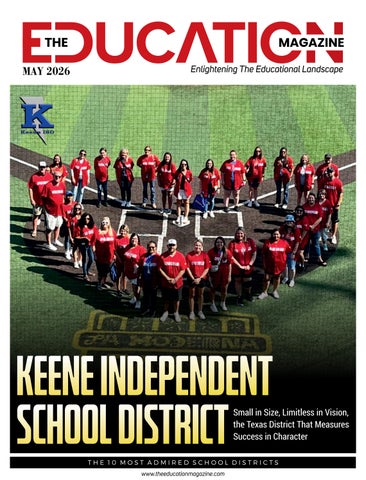
MAY 2026
KEENE INDEPENDENT SCHOOL DISTRICT
Small in Size, Limitless in Vision, the Texas District That Measures Success in Character
THE 10 MOST ADMIRED SCHOOL DISTRICTS www.theeducationmagazine.com
Where Local Heartbeats Power The Horizons Of Tomorrow. Dear Reader, Education is much more than textbooks, classrooms, and standardized test scores. It is the living, breathing foundation of our society. When we look across the nation, we see remarkable places where daily learning transforms into a deeply shared, vibrant community experience. We constantly seek out those rare environments where students are not just educated but are truly seen, heard, and known. This brings us to our newest issue, “The 10 Most Admired School Districts.” In these pages, we explore the extraordinary places that have completely redefined what excellence looks like in modern education. They prove that genuine success is measured by human character, authentic connection, and the unwavering belief that every single child matters. These schools are beacons of hope, showing us exactly what happens when a town wraps its arms around its youth. Our cover story takes us to Texas, where the Keene Independent School District stands out in a state famous for its vast, sprawling spaces. Occupying just over four square miles, Keene operates without a single school bus. Students walk or are dropped off by parents who know the waiting teachers by their first names. In this unique place, proximity is a deeply cherished value. Rather than focusing solely on high-stakes diagnostic testing, Keene measures its true excellence by the quality of a graduate’s character. The district proudly nurtures the whole learner, expanding amazing programs from fine arts to practical agriculture, all while maintaining a wonderfully close village feel. Through powerful initiatives like their highly inclusive House System and the unified vision of their dedicated leadership team, Keene proves that a small geographic footprint can leave a massive, positive impact on the world. Beyond our inspiring cover feature, we proudly highlight several other remarkable educational systems that share this exact same commitment to student growth and community integration. This month, our spotlight also shines brightly on Indian Valley Local Schools, Reading Community City School District, Elkins School District, and Selma Unified School District. Each of these outstanding institutions brings its own unique strengths to the table, cultivating safe environments where young minds can explore, innovate, and thrive. Welcome to the issue. Sincerely,
Simran Khan
Managing Editor
Publisher: Archana Ghule Editor–in–Chief: Vikram Suryawanshi
Art Director: Priyanka Patil Graphic Designer: Chaitanya Kulkarni
Managing Editor: Simran Khan
Marketing Head: Robert Smith
Project Editor: Shadab Mestri
Research Team: Daisy, Rahul,
Sales & Marketing
Maranda, Rocky
Project Head: Aakash Mahajan Sales Co-ordinators: Maria Smith Swati Kumari Project Manager: Pravin Shinde Nehal Nagpure Rachel Mendes The Education Magazine is published by Pericles Ventures Pvt Ltd. This magazine contains material protected under International and Federal Copyright Laws and Treaties. You may not publish, display, disclose, rent, lease, modify, loan, distribute, or create derivative works based on the magazine contents or any part thereof, whether by yourself or as a consultant, employee, partner or in any other role unless authorised in writing by the creator/publisher of the article/, video, audio or any content contained herein. We, the team of The Education Magazine put all the efforts to keep up with the content accuracy. The publisher assumes no responsibility of any part of the content of any advertisement in this publication, including any errors or omissions therein. All rights reserved by Pericles Ventures Pvt Ltd.
10 Keene Independent School District
CONTENT PROFILES
20. Elkins School District 36. Indian Valley Local Schools 52. Reading Community City School District 72. Selma Unified School District articles AI in the Classroom: 28. More Than a Trend, a Revolution Classroom Management Strategies: 46. Your Ultimate Teacher’s Guide Online Schools K-12 Texas: 64. How Virtual Learning Really Works
Keene Independent School District
Cypress-Fairbanks Independent School District
www.keeneisd.org
www.cfisd.net
Davis School District
Deane Bozeman School
www.davis.k12.ut.us
www.bozemanbucks.net
Elkins School District
Hawthorne High School
www.elkinsdistrict.org
www.hhscougars.org
Indian Valley Local Schools
Newport News Public Schools
www.ivschools.org
www.sbo.nn.k12.va.us
Reading Community City School District
Selma Unified School District
www.readingschools.org
www.selmausd.org
Cover Story
KEENE INDEPENDENT SCHOOL DISTRICT Small in Size, Limitless in Vision, the Texas District That Measures Success in Character
10 I MAY 2026
THE EDUCATION MAGAZINE | 11
Cover Story
T
here are no school buses in Keene, Texas. In a state where school districts routinely span hundreds of square miles, where morning buses are as expected as the sunrise, that single fact about the Keene Independent School District has a way of stopping you mid-thought. The district occupies just 4.2 square miles of Johnson County, earning it the distinction of being the third-smallest school district in Texas by land mass. Its students do not board buses in the early dark. They walk. They are driven by parents who, more often than not, know the teachers waiting at the door by name. They arrive every morning, as members of a community compact enough to know itself. In most places, the absence of buses would be a logistical footnote. In Keene, it is an opening sentence, and it tells you nearly everything you need to know about the kind of place this is. It tells you that this is a district where proximity is a value, not a coincidence. Where the school does not sit apart from the life of the community, but lives directly inside it. And once you understand that, the rest of Keene ISD begins to make a particular kind of sense. A Legacy Built Slowly, on Purpose Keene was not always the district it is today. For many decades, it operated as a K-8 institution, a quiet, focused enterprise serving the children of a close-knit Johnson County community through the foundational years. Then came the late 1980s, and with them, a pivotal decision: the district added a high school. It was not a flashy move. It was a committed one. Adding a high school was a structural declaration, Keene’s way of saying, in the most binding terms available, that it intended to see its students all the way through. Growth has come steadily in the years since. While neighboring Johnson County districts have expanded with suburban speed, Keene has grown at a pace that feels measured and intentional. Approximately 300 students have joined the district over the last decade alone. With new residential developments already on the horizon, the district is now preparing to welcome roughly 240 additional students in the coming years. This is a district with a multi-decade mission of growth guiding its every decision, moving forward at its own considered pace, in its own particular way. Two Campuses, One Heartbeat Stand on the grounds of Keene ISD, and what strikes you immediately is the nearness of everything. Two campuses are spread across roughly 30 acres, positioned within 50 yards of one another. It is less like a conventional school system and more like a compact, purposeful village, where everything is close enough to matter. 12 I MAY 2026
THE EDUCATION MAGAZINE | 13
The first campus houses the Elementary and Summit Leadership Academy, where PreK through 2nd-grade students share a building with the 3rd through 5th-grade Summit Leadership Academy. The second, the Secondary Campus, brings together the Junior High (grades 6 through 8) and the High School, the two connected physically by a shared cafeteria. Every school day, the older and younger students of Keene converge in that same room. They eat together. They talk. They see one another. This is architecture as philosophy. In Keene, even the floor plan carries an argument, and the argument is always the same: no one here is invisible. The Measure of a Graduate Ask most American school districts to define “excellence,” and they will reach for numbers almost immediately. Test scores. Percentile rankings. State accountability ratings. It is the common grammar of education today, and most districts have organized themselves, with varying degrees of comfort, around speaking it fluently. 14 I MAY 2026
Keene ISD has made a different choice. Here, “educational excellence” is measured by the quality of character, not the outcome of any state-mandated test. The district uses diagnostic testing as a practical, necessary tool. But it firmly, and deliberately, rejects what it calls the “forensic” use of high-stakes testing, the practice of treating data as the final, binding verdict on a student’s worth or a school’s value. Its focus, instead, rests on the development of the “whole learner,” an individual cultivated toward critical thinking, genuine confidence, and empathy for the world and the people around them. In the daily life of the school, it looks specific and concrete. It is a student pausing to hold a door open for a peer without being asked.
Cover Story It is a young person looking an adult in the eyes and offering a warm greeting without prompting. It is a group of teenagers who can sit across from an idea they find wrong or uncomfortable and engage with it using intelligence rather than anger. The goal, stated without apology, is to produce good humans. “At Keene ISD, we don’t pretend to be perfect, just different. Different in our walk, different in our talk, and different in our ability to impact the world, one Keene Charger graduate at a time.” It is not a modest declaration. It is not meant to be. And in a national conversation about schools so often dominated by what they lack, it is something rarer than it should be: a statement of conviction. Big School Opportunities in a Small School Environment There is a persistent assumption in conversations about small school districts that small means limited. Fewer programs. Fewer opportunities. A narrower horizon for the students inside. Keene ISD has spent years dismantling that assumption, methodically and program by program. The district proudly offers what it calls “Big School Opportunities in a Small School Environment,” and the evidence is specific. Its Career and Technical Education (CTE) programs are actively expanding, anchored by a growing agriculture department and the introduction of wildlife management classes at the junior high level. These are not electives tacked on as afterthoughts. They are deliberate investments in real-world, practical learning that connects students to professional pathways and to the land they inhabit. The fine arts tell a story of genuine transformation. Three years ago, the marching band had just 12 members. Today, it stands at 53. That is not incremental change. That is a cultural shift in what students believe is possible for them within these 4.2 square miles. The choir travels to perform annually at the Myerson in Fort Worth, one of the region’s most celebrated concert venues, a stage that demands and rewards excellence. The One-Act Play program reached a new milestone recently, advancing three rounds deep into statewide competition. In athletics, the district fields standard 3A sports alongside a deliberate emphasis on what it calls “lifetime sports,” among them cross country, golf, and tennis. The thinking here is long-range and patient. These are not just activities for a high school resume. They are skills a student will carry for decades, long after the competitive seasons have ended and the team jersey has been folded away. To call this a “small school experience” would be technically accurate and spiritually misleading. The Community Is the School Keene ISD does not see itself as a separate institution that happens to share a zip code with its community. It sees itself as the community’s living room, its most active and visible expression. The guiding philosophy here is captured plainly and without ceremony in four words: “our stuff is your stuff.” In practice, this means an open-door policy that welcomes the broader city, a local university, homeschool organizations, and community groups onto campus throughout the year. It means events like “Starfest,” the city’s warmly regarded Halloween alternative, that pull families and neighbors together in something more lasting than a single school program. It means community-wide hotdog suppers that have nothing to do with curriculum and everything to do with connection. THE EDUCATION MAGAZINE | 15
Cover Story
“
We’ve found that by teaching our kids to be ‘different,’ by focusing on being good humans, we aren’t just creating graduates; we’re preparing them to be truly globally competitive.
16 I MAY 2026
In 2018, the district introduced what may be its most quietly powerful initiative: the House System. Students are placed into Houses that become a core part of their identity within the school. These Houses are built with real care to transcend race, gender, socio-economic status, and academic performance. Within their House, students are encouraged to find success models who look like them and come from where they come from, people whose paths make a future feel genuinely attainable. The House System is designed to answer a question that every student carries, often silently, through every school hallway they walk: Is there a place here for someone like me? In Keene, the answer is built into the structure of the school itself. A Support System That Means It Keene ISD is honest about the realities its students carry through the door each morning, and it has built a support network that takes that honesty seriously. A dedicated mental health counselor serves the student community, alongside a part-time counselor specifically for seniors, an acknowledgment that the final year of high school carries its own distinct emotional weight and requires its own kind of attention. A formal mentorship program connects students with community mentors, creating sustained relationships that extend well beyond the school building and the school day. And then there is STAC, the Student Advisory Council, open to students in grades 3 through 12. STAC meets with the Superintendent four times a year to discuss district growth and student needs. Consider what that means in practice: a third grader at Keene ISD has a guaranteed, structured opportunity to speak directly with the district’s top leader about what is and is not working. This is not ceremonial. It is functional. It is a binding commitment to the idea that the students most directly shaped by a school’s decisions deserve a voice in making them. That commitment is not common. In Keene, it has been kept.
The Core Four and the Vision They Carry Leadership at Keene ISD moves through what the district calls the “Core Four,” the group of campus principals who come together every single week to keep the district’s vision unified and alive across every campus, every classroom, and every grade. The vision itself is six words: every child, every need, every day. Six words with no exceptions written in. No “most children.” No “when resources allow.” No “average days.” Every. It is a standard the district holds itself to, week after week, through the discipline of those weekly meetings. The district draws a consistent and meaningful distinction between “makers of learning” and “takers of learning,” between students who are active architects of their own education and those who receive it passively. Every program, every initiative, and every structural choice at Keene ISD points deliberately in the same direction: toward producing makers. Underlying it all is a unique third-party technology partnership and a curriculum department that drives professional development entirely in-house, ensuring that the teachers and staff carrying this vision into their classrooms are continuously growing alongside the students they serve. Different, By Design and By Choice What Keene Independent School District has built, across its 4.2 square miles and its decades of deliberate work, is not easily reduced to a category. It is a school district, yes. It is also something rarer: a community that has chosen, consciously and with full conviction, to be different. Different in what it measures. Different in what it values. Different in the depth of belonging it constructs for every student who walks through its doors. It does not claim perfection. It claims intention. And in that intention, it makes a case, quietly and persistently, that character is not a detour from academic rigor. It is, for Keene ISD, the destination. Rooted in Johnson County, reaching well beyond it, one Charger at a time. THE EDUCATION MAGAZINE | 17
Rooted in Rural Ground, Growing Toward a Global Future
P
ublic school districts often begin as small promises. A few buildings. A handful of teachers. Families who believe education can change the direction of a child’s life. Over time, some districts remain small and steady. Others grow with the communities around them. The story of Elkins School District belongs to the second group. Founded in 1919, the Elkins School District began as a small, entirely rural district. In its early years, it served families whose lives centered around farmland, close neighbors, and a tight sense of community. Classrooms were modest. Resources were limited. But the purpose was clear from the start. The district existed to educate local children and prepare them for whatever work and life would demand of them. Much has changed since those early days. Over the past twenty-five years in particular, the district has experienced remarkable growth. Its student population has nearly tripled, reaching an enrollment of approximately 1,400 students today. That growth reflects more than rising numbers. It signals a community that continues to place its trust in its public schools. Through each stage of expansion, the district has held firmly to its mission. Elkins School District exists to enrich students’ lives and equip them to become lifelong learners who can achieve excellence in an ever-changing global society. The words are intentional. Enrich. Equip. Achieve. The focus is not only on academic performance but also on preparing students to think, adapt, and contribute beyond graduation. That mission comes to life each day through its educators. The district’s teachers and staff form a dedicated team that works to maximize the learning experience for every student. Their work shapes classrooms where growth is expected and supported. As the district continues to evolve, it carries forward both its rural roots and its commitment to preparing students for a wider world. A Four-Campus System Serving City and Countryside Structure often reveals what a district values. In the Elkins School District, the design is simple and intentional. The district operates four campuses, each focused on a specific stage of learning. Elkins Primary School serves students from prekindergarten through second grade. Elkins Elementary School guides students in grades three through five. Elkins Middle School supports grades six through eight. Elkins High School prepares students in grades nine through twelve. This clear progression allows each campus to concentrate on age-appropriate growth while remaining connected to a shared mission. Most students come from the city of Elkins, yet the district also serves families from surrounding rural areas. 20 I MAY 2026
THE EDUCATION MAGAZINE | 21
In addition, many non-resident families choose to enroll through school choice. That steady enrollment reflects a district that attracts trust beyond its immediate boundaries. Academic Pathways from Foundations to Futures Strong districts build their academic programs with intention. At Elkins School District, learning begins with a firm grasp of the fundamentals. Across every campus, students engage in core subjects such as literacy, mathematics, science, and social studies. In the early grades, the district places special emphasis on literacy, math, and science. Leaders understand that confidence in reading and number sense shapes everything that follows. As students move into Elkins Middle School and later Elkins High School, their options expand. The district offers a wide range of electives and career pathways designed to match varied interests and ambitions. Students explore vocal and instrumental music, visual arts, and business and management courses. They study computer science, including coding and cybersecurity. Career-focused programs include agricultural studies with animal science and welding, preconstruction pathways, medical preparation courses, and future educator programs. Each pathway gives students direction while keeping doors open for what comes next. Defining Excellence Through Results and Relentless Focus At Elkins School District, excellence is not a slogan posted on a wall. It is a daily expectation. Leaders define educational excellence as steady growth, strong outcomes, and shared accountability at every level of the system. The results show commitment in action. In the most recent report from the Arkansas Department of Education, the district earned an overall letter grade of “A.” Only 23 public school systems in the state, placing Elkins in the top 8 percent, received that distinction. Elkins Primary School, Elkins Elementary School, and Elkins Middle School each earned an “A,” while Elkins High School received a “B.” The district’s 3.75 GPA ranked third statewide among public schools. Behind those numbers stands a focused team of educators and students who take ownership of learning. Staff members regularly review data, refine instruction, and concentrate on the academic growth of every individual student. Leadership with Conviction and Community at Heart Leadership sets the tone for any school system, and at Elkins School District, that tone begins with Superintendent Jeremy Mangrum. He has led the district for the past eight years, guiding it through growth while holding firm to its core values. 22 I MAY 2026
THE EDUCATION MAGAZINE | 23
Mangrum describes Elkins as a phenomenal place to live, work, and raise a family. He speaks with confidence about the district’s educators, noting that they genuinely care for each student and work to provide every possible tool and opportunity for success. He takes pride in serving what he considers one of the strongest school systems in Arkansas. Under his leadership, students receive what he calls a world-class education grounded in small-town values. Hard work, mutual respect, integrity, and innovation are not abstract ideas. Staff members model these principles daily, and students are expected to carry them forward in their own lives. Meeting Students Where They Are No two students walk into a classroom with the same strengths, challenges, or experiences. Elkins School District plans with that reality in mind. Educators understand that learning styles differ and that each child brings distinct academic needs shaped by background and ability. One consistent strategy across the district, especially in grades K through 5, is small group instruction. Teachers break students into focused groups so they can target specific skills, close gaps, and extend learning where needed. This approach allows teachers to observe closely, adjust quickly, and build stronger relationships with students. Technology also plays a central role. Elkins operates as a one-to-one district, meaning every student has access to a personal device. Teachers use these tools daily to tailor instruction, assign differentiated work, and provide immediate feedback. The goal remains clear: create an environment where every student has the support and structure necessary to grow with confidence. Strengthening the School–Community Partnership Public schools do not succeed in isolation. They rely on trust, shared effort, and consistent communication with the families and communities they serve. Elkins School District has invested intentional energy into building those connections. Over time, the district has developed strong relationships with parents, community members, and local partners. That bond did not happen by accident. Leaders and staff have made a deliberate effort to strengthen collaboration and invite families into the life of the schools. Each campus, along with the district as a whole, operates a parent-community engagement committee. These groups regularly plan events that bring families into school spaces and keep community ties active. 24 I MAY 2026
Clear communication remains a central priority. Teachers and administrators work to keep parents informed about their child’s progress and learning experience. Through steady outreach and open dialogue, the district reinforces a simple belief: student success grows stronger when schools and families move forward together. Student Life That Extends Beyond the Classroom Learning at Elkins School District does not stop when the final bell rings. Student life on campus reflects the same energy and commitment found in the classroom. From an early age, students have opportunities to join extracurricular activities that build confidence, teamwork, and school pride. Activity groups help students form connections that grow stronger through shared practice, performance, and competition. Options include marching band, choir, Esports, archery, and a wide range of athletic programs such as football, basketball, softball, baseball, volleyball, bowling, golf, and tennis. These programs invite students to explore interests while representing their school. Athletics, in particular, have seen consistent success. Many teams regularly advance to state tournaments. In 2025, Elkins High School reached a milestone moment when its football team captured the Arkansas 4A state championship for the first time in school history. That victory reflected years of discipline, teamwork, and belief. Leadership Structure That Keeps the District Moving A district of Elkins’ size depends on clear leadership and shared responsibility. Each department head and campus principal carries defined duties, yet they work in close coordination to keep the system running smoothly. Superintendent Jeremy Mangrum provides overall direction and accountability. Director of Curriculum Paula Wheeler guides instructional strategy and academic alignment. Director of Federal Programs David Stepp oversees compliance and funding programs that support student services.
As an Elkins Elk, our students get a world-class education in an environment that has a small-town, family-friendly feel. THE EDUCATION MAGAZINE | 25
26 I MAY 2026
Director of Technology Debbie Kunz manages the district’s one-to-one infrastructure. Director of Operations Hunter Corbell ensures that facilities and logistics function efficiently. Campus leadership includes Angie Kichline at Elkins High School, Amy Evans at Elkins Elementary, Nicky Anderson at Elkins Primary, and David Yates at Elkins Middle School. Steven Fein leads athletics. Together, these leaders set high standards and model professional excellence across the district. Advancing Equity Through Relationships and Responsive Teaching Equity at Elkins School District begins with awareness. Educators recognize that students arrive with varied life experiences, family situations, and learning needs. That understanding shapes how teachers approach their work each day. Staff members place strong emphasis on knowing their students beyond test scores and report cards. They invest time in building positive, respectful relationships. When students feel seen and valued, they are more likely to engage in learning and take academic risks. Relationship-building is not treated as an extra task. It is part of the instructional foundation. Flexibility in the classroom supports that commitment. Teachers adjust strategies, pacing, and support to meet students where they are. They modify lessons, provide targeted assistance, and use varied instructional methods to ensure access to learning. The focus remains consistent across campuses: every student, regardless of background, deserves meaningful opportunity and the support necessary to succeed. Preparing Students for Life After Graduation Academic preparation remains central at Elkins School District, yet leaders also recognize that students need direction beyond coursework. In recent years, Elkins High School has expanded its focus on career readiness and real-world exposure.
The district also invites representatives from major regional employers to speak directly with students about post-graduation opportunities. These conversations provide clarity about career paths and hiring needs across industries. Students hear what companies value and what preparation matters most. The response has been positive. Participation has grown, and students leave with stronger networks, clearer goals, and a more confident view of their future prospects. Looking Ahead with Purpose Sustaining success requires forward thinking. At Elkins School District, leaders do not view strong performance as a finish line. They see it as a responsibility to maintain and improve. The district’s academic goal remains clear: continue ranking among the top-performing school systems in Arkansas for student achievement and academic growth. That objective demands steady evaluation of instructional practices, data review, and professional development. Leaders understand that excellence requires consistency, not complacency. At the same time, the district looks closely at student engagement. Leadership continues to explore ways to make learning more meaningful, especially for students who struggle to connect with traditional instruction. By refining classroom strategies and expanding innovative approaches, the district aims to reach reluctant learners without lowering expectations. The focus remains balanced. Elkins seeks high performance while ensuring that every student finds a reason to stay invested in the learning process.
The district added a full-time career counselor to the high school staff. That role centers on connecting students with work-based learning opportunities before graduation. Through internships and apprenticeships, students gain firsthand experience in professional settings. These placements allow them to explore interests, build skills, and understand workplace expectations while still in school. THE EDUCATION MAGAZINE | 27
AI in the Classroom More Than a Trend, a
● A. Personalized Learning at Scale: ○ Adaptive Learning Paths AI tools now adjust the way lessons are taught based on how each student performs. The system changes speed, content, and teaching methods to fit individual needs. This helps every learner move at their own pace, without feeling left behind. ● Students learn better because the content matches their level. ● It fills knowledge gaps and supports strengths at the same time.
A
rtificial Intelligence is no longer just a futuristic idea—it’s already reshaping how students learn and how teachers teach. From lesson planning to adaptive tools, AI in the classroom is now part of everyday education. But beyond the buzzwords, this shift is more than just using a chatbot or grading software. It’s about building smart, responsive systems that help educators save time, support every learner’s needs, and improve outcomes at scale. However, the real power of AI depends on how wisely we use it. Responsible use means clear rules, strong ethics, and thoughtful planning. In this blog, you’ll explore how AI is transforming learning, how schools can use it effectively, what ethical challenges lie ahead, and why educators—not algorithms—must stay at the center of it all. The goal isn’t just smarter classrooms. It’s more inclusive, efficient, and human-centered education through the right use of AI in the classroom.
The Transformative Power of AI in the Classroom
● 25% of educators say personalized learning is the biggest benefit of AI in the classroom. ○ Addressing Diverse Needs AI tools now support students with different challenges. For example: ● Text-to-speech helps struggling readers ● Live translation supports non-English speakers ● Simplified content makes tough topics easier to understand These tools promote inclusion. According to UNESCO, AI must ensure equal learning chances for all. With AI in the classroom, education becomes more fair and accessible. ● B. Empowering Educators: Streamlining Tasks and Enhancing Instruction: ○ Automated Administrative Support AI saves time by handling common classroom tasks: ● Grading
Artificial Intelligence is no longer just a buzzword in education—it’s now part of everyday learning. From simplifying tasks to personalizing learning, AI in the classroom is helping both students and teachers in real, practical ways. As of 2025, almost every student interacts with AI tools daily, while many teachers depend on them for planning, grading, and instruction. 28 I JUNE 2024 MAY 2026
● Feedback ● Attendance ● Timetables 42% of teachers say this is the most helpful part of using AI. It allows them to focus more on teaching, not paperwork.
THE EDUCATION MAGAZINE | 29
○ Intelligent Content Creation
○ Fostering 21st-Century Skills
Teachers now use AI to:
AI prepares students for the future by building:
● Build lesson plans
● Problem-solving
● Create quizzes and assignments
● Creativity
● Design classroom activities
● Digital literacy
In 2023:
● Critical thinking
● 38% of teachers used AI to plan lessons
58% of high school teachers noticed students became more confident.
● 37% created classroom materials using AI ● 44% said AI made their jobs easier by reducing workload
49% of college professors saw students learn faster with AI’s help. ○ Research and Revision Aids
○ Data-Driven Insights Students now use AI to: AI helps track and analyze student performance. It identifies who’s at risk, what’s working, and how to improve.
● Research topics ● Write drafts
● Teachers get clear data for smarter teaching choices ● Fix grammar and structure ● They can support each student with the right plan ● 47% of education leaders now use AI daily to make better decisions This is how AI in the classroom empowers teachers while improving outcomes. ● C. Boosting Student Engagement and Skill Development:
73.6% of students and researchers say AI makes writing and reviewing faster and easier. It acts like a smart guide that helps without doing the work for them. Navigating the Challenges and Ethical Landscape AI’s integration into classrooms brings transformative benefits, but also raises complex challenges around academic integrity, data privacy, fairness, equity, and the preservation of human-centered learning.
○ Interactive Learning Experiences ● A. Academic Integrity and the Challenge of Misuse: More than 51% of educators now use: 1. The Plagiarism Dilemma ● AI chatbots for Q&A, debates, and storytelling ● Games powered by AI to make lessons fun ● VR and AR tools to help students “experience” learning These tools increase attention and make learning more active. 30 I JUNE 2024 MAY 2026
AI tools like ChatGPT are now used by 89% of students for homework. This change is reshaping academic honesty. At the same time, 68% of teachers rely on AI to catch plagiarism. Interestingly, while AI-generated content rose 76%, plagiarism rates dropped 51%. That shift suggests students are using AI in new ways.
Still, most teachers believe using AI for homework counts as cheating. As a result, discipline cases for dishonesty increased—from 48% to 64% this year.
This builds trust while staying compliant with privacy laws. ● C. Algorithmic Bias and Fairness:
2. Cultivating Originality 1. Understanding Inherent Biases Traditional plagiarism detectors can’t catch everything AI produces. So, many educators now encourage students to critically engage with AI outputs. They’re assigning: ● Personal reflections
AI systems can repeat the biases they learn from data. This can unfairly affect students, especially those from marginalized backgrounds. That’s why ongoing review of data sets and results is critical in classrooms using AI.
● Process journals 2. Promoting Equity ● Oral presentations Schools are adopting these fairness strategies: These assignments make it harder to depend only on AI in the classroom. Students learn to think for themselves while still using tech as a support tool.
● Diverse teams in AI design ● Regular audits for bias
● B. Data Privacy and Security Concerns: 1. Safeguarding Sensitive Information Schools have become major targets for cybercrime. In 2025, weekly cyberattacks on schools rose by 75%. Ransomware demands now average $6.6 million in lower education and $4.4 million in higher education.
● Clear, explainable recommendations from AI These practices help AI in the classroom serve every student fairly. ● D. The Digital Divide: Ensuring Equitable Access:
Educators are worried: 1. Bridging the Gap ● 51% feel uneasy about personal data safety Many students still lack access to: ● 63% are very concerned about AI-driven attacks ● AI tools AI in the classroom must include strict privacy protections for everyone involved.
● Reliable internet
2. Compliance and Transparency
● Personal learning devices
In 2025, 53% of schools have a cybersecurity plan—up from 34% in 2022. They now:
This gap creates deeper learning inequalities.
● Run regular security checks
Governments now fund:
● Encrypt student data
● Low-cost devices
● Explain how that data is used
● Subsidized connectivity
2. Policy and Infrastructure
THE EDUCATION MAGAZINE | 31
● Targeted help for underserved communities
● Define how students and teachers can use AI Set standards for honesty and fairness
These steps aim to bring the full benefits of AI in the classroom to all learners, not just a privileged few.
● Explain consequences for misuse
● E. Over-reliance and Preserving the Human Element:
In fact, many schools with strong AI policies report fewer cheating cases.
1. Maintaining Critical Thinking
2. Stakeholder Collaboration
If students depend too much on AI, their creativity may suffer. Teachers are now focusing on:
Great policies come from listening to everyone—students, parents, teachers, and staff.
● Open-ended questions
● Include all voices in discussions
● Projects with real-world applications
● Update rules often as AI tools evolve
● Personal storytelling
● Build trust and make everyone feel heard
This helps students build skills, not shortcuts.
This creates stronger support for AI in the classroom.
2. The Irreplaceable Role of the Educator
● B. Empowering Educators Through Professional Development:
AI can help with teaching. But it can’t replace a teacher’s: 1. Beyond Basic Training ● Empathy ● Motivation
Teachers need more than a quick guide. They need real, hands-on training with experts and peers.
● Judgment
● Offer regular workshops
The best schools in 2025 don’t replace teachers with AI. Instead, they use AI in the classroom to support deeper, more human-centered learning.
● Build peer learning groups
Strategic Implementation: Best Practices for Schools
Even in 2025, more than 50% of teachers say they don’t get enough AI training.
Successfully leveraging AI in education requires more than just adopting new technologies—it demands thoughtful planning, inclusive policy-making, and a commitment to continuous improvement. Here's a roadmap for schools to ensure responsible, impactful, and equitable AI integration. ● A. Developing Comprehensive AI Policies and Guidelines:
● Invite guest educators for demos
2. Cultivating AI Literacy Teachers must know what AI can and cannot do. This helps them use it the right way in class. ● Teach AI strengths and limits ● Show how to blend AI with real teaching
1. Clear Expectations ● Encourage thoughtful use, not overuse Schools must set clear rules for using AI in learning. These rules should explain what is allowed and what is not. 32 I MAY 2026
This builds confidence in using AI in the classroom the right way.
● C. Fostering Student AI Literacy and Agency:
That’s how schools keep AI in the classroom effective and meaningful.
1. Critical Evaluation Skills Students should learn how to think about what AI gives them—not just accept it.
● E. Engaging Parents and the Wider Community: 1. Transparent Communication
● Question AI answers ● Compare with trusted sources
Tell parents what’s happening. Be honest and clear about goals and safety steps.
● Spot bias and errors ● Share updates on school websites Many students in AI-literate schools are better at evaluating sources.
● Show real classroom examples
2. Responsible Creation
● Explain how data stays private
Encourage students to use AI to build new ideas, not just copy.
2. Addressing Concerns
● Let them create AI tools or apps
Open the door for questions. Let parents feel involved.
● Use AI in projects and presentations ● Host Q&A sessions ● Teach them to design with ethics in mind ● Share guides or videos This makes AI in the classroom a tool for thinking, not just clicking. ● D. Measuring Impact and Iterative Improvement: 1. Assessing Effectiveness Schools should track what works and what doesn't. Use numbers and stories to get a full picture.
● Listen to their worries More than half of the parents say they support AI more when they feel included. The Future of AI in Education 1. Emerging Trends
● Monitor test scores and attendance ● Collect teacher and student feedback ● Watch how often AI is used
AI tools now customize lessons to match every student’s pace, interest, and skill level. This ensures no learner falls behind.
2. Continuous Adaptation Stay open to change. Review and revise your strategies often. ● Hold review meetings
● Students get lessons based on how they learn best ● Progress becomes faster, smoother, and more confident
● Ask for input from all users ● Improve based on real feedback
● Everyone learns at their own pace without pressure. THE EDUCATION MAGAZINE | 33
This shift shows how AI in the classroom is making education more personal and student-focused.
3. Continuous Adaptation
AI-Driven Collaborative Learning
Schools must stay flexible. As AI changes, so should policies and teaching tools.
Classrooms are becoming more interactive thanks to AI.
● Update training for teachers regularly
● AI forms study groups based on student strengths
● Ask for feedback from students and parents
● It suggests group projects and moderates online chats
● Keep improving based on what works
● Teamwork and sharing ideas become easier and more fun
By doing this, schools can use AI wisely, safely, and fairly. The future of AI in the classroom is not just about tools—it’s about smarter, kinder, and more effective learning for all.
This helps students connect, both in-person and online. Predictive Analytics
Key Takeaways AI now spots trends in how students perform. It predicts: ● Who may need extra help ● What topics are harder for certain students ● When to offer support before problems grow These tools let teachers take action early. That’s another smart use of AI in the classroom. 2. AI as a Collaborative Partner In the future, AI and teachers will work side by side. AI handles:
What’s clear is that we’ve already stepped into a world where AI is part of how we learn—and there’s no turning back. But that doesn’t mean we treat it like magic. It means we understand what’s at stake. AI in the classroom is powerful, but only when it’s used with intent. It can bring efficiency, personalization, and creativity. But if left unchecked, it can also create dependence, bias, and even widen existing gaps.
● Giving custom content
What really matters is the mindset. Schools that treat AI as a partner—not a shortcut—are already seeing better engagement and deeper learning. Teachers who see AI as an assistant, not a threat, are reclaiming time to do what machines never will—build trust, inspire, and connect.
This frees teachers to focus on what matters most—talking to students, understanding emotions, and building thinking skills. With AI in the classroom, learning becomes deeper and more human.
This shift isn’t just technical. It’s cultural. It’s about rethinking what great education looks like in a world that’s evolving fast—and making sure every learner benefits from it.
● Planning lessons ● Tracking progress
34 I MAY 2026
THE EDUCATION MAGAZINE | 35
36 I MAY 2026
I
n many rural corners of America, a school district is more than a system of buildings. It is the town square, the Friday night lights, the place where generations return as parents after once sitting in the same classrooms. In the hills of rural Appalachia, that role belongs to Indian Valley Local Schools.
The district began in 1968, when the communities of Gnadenhutten, Port Washington, Tuscarawas, and Midvale came together and formed one unified school system. The consolidation was not just administrative. It brought families, traditions, and expectations under a shared banner. That decision still shapes the district’s identity today. Indian Valley operates with a clear mission: to work together to personalize a rigorous, standards-based learning experience. The goal is practical and direct. The district aims to prepare students to become persistent academic and social problem solvers who can step confidently into the career pathway they choose. Classrooms are structured around that idea. Expectations are steady. Support is intentional.
THE EDUCATION MAGAZINE | 37
Over the past three decades, Indian Valley has continued to refine and strengthen its approach. The district now holds a 4.5-star rating, reflecting consistent academic growth and stable performance. Yet numbers tell only part of the story. What stands out more is the sense of ownership within the community. Families follow the schools closely. Alumni return for events. Staff members speak of long tenures, not short stops. Indian Valley Local Schools did not transform overnight. It evolved through steady improvement, community trust, and a belief that every student deserves both challenge and support. In a region shaped by tradition, the district has found a way to honor its past while preparing its students for what comes next. A Unified K–12 System across Four Communities Indian Valley Local Schools serves about 1,700 students across four buildings in Tuscarawas County, each one grounded in the community it represents. The district operates as a complete K–12 system, designed to guide students from their first day of kindergarten through high school graduation without losing continuity or connection along the way. Indian Valley High School, located in Gnadenhutten, serves students in grades nine through twelve. Indian Valley Middle School in Tuscarawas supports grades six through eight, creating a focused bridge between elementary learning and high school expectations. At the elementary level, Midvale Elementary and Port Washington Elementary welcome students in kindergarten through fifth grade, keeping early education close to home. The district also offers Indian Valley Digital Academy, a blended in-person and online option that still provides full access to district programs and an Indian Valley diploma. Together, these schools serve Gnadenhutten, Tuscarawas, Midvale, and Port Washington as one connected educational community. Academic Programs That Grow with the Student Indian Valley Local Schools has built its academic program as one continuous path from kindergarten through graduation. Each level connects to the next, so students do not start over every few years. Instead, they build on what they have already mastered. 38 I MAY 2026
THE EDUCATION MAGAZINE | 39
In the elementary schools, the focus stays on strong foundations. Teachers use clear, standards-based instruction in reading, writing, mathematics, science, and social studies. Structured literacy practices guide early readers, and staff members rely on student data to adjust instruction when needed. Beyond core subjects, students take part in STEAM lessons, music, physical education, library, and technology classes that broaden their skills and interests. In middle school, expectations rise. Core classes grow more demanding, and students explore electives that introduce leadership and early career awareness. By high school, choice becomes central. Students follow personalized pathways that include Advanced Placement, College Credit Plus, agriculture, engineering, skilled trades, fine arts, athletics, and industry certifications.
High standards matter, but so do strong relationships. Teachers work closely with one another, review their practices, and adjust instruction when students need something different. That collaboration shapes the district’s strategic planning. The focus remains steady: to provide learning experiences that meet rigorous academic standards and connect to real life. Advanced coursework, career pathways, and hands-on opportunities support that aim. In the end, the district wants every Brave to graduate ready to achieve and ready to serve with integrity and resilience. Leadership with Clarity and Conviction Strong systems require steady leadership. At Indian Valley Local Schools, that responsibility rests with Superintendent Dr. Ira Wentworth, whose approach centers on service rather than spotlight. He leads with the belief that results follow relationships. Students, families, and staff sit at the core of every major decision. Dr. Wentworth sets clear district goals and then trusts building leaders and Professional Learning Teams to carry that work forward. He meets regularly with administrators and teachers, encouraging open dialogue and shared accountability. The expectation is simple: everyone owns student success.
Defining Excellence with Purpose At Indian Valley Local Schools, educational excellence shows up in everyday moments. It appears in the way students tackle difficult assignments, speak with confidence, and set goals for what comes next. It also appears outside the classroom, in the way they represent their schools and contribute to their communities. District leaders define excellence through growth and direction. They expect students to improve each year, not just maintain performance. They expect classrooms to challenge students while still offering support. 40 I MAY 2026
His leadership reflects the district’s mission of working together to personalize a rigorous, standards-based learning experience. He speaks often about preparing students to think critically, solve problems, and choose their own path with confidence. To families considering Indian Valley, his message remains direct. This is a place where relationships matter, opportunities are real, and every Brave receives both challenge and support. Meeting Students Where They Are Indian Valley Local Schools recognizes that no two students learn in the same way. Some thrive through hands-on projects. Others respond to discussion, structure, or creative expression. The district plans with that reality in mind, shaping classrooms that engage the whole learner rather than relying on one method.
Across grade levels, students encounter technology-rich lessons, fine arts, agriculture, engineering, and career exploration programs that speak to different interests and strengths. These opportunities allow students to connect learning to something tangible and personal. Behind the scenes, educators meet in Professional Learning Teams to review student data and adjust instruction. They identify who needs added support, who needs enrichment, and how to shift lessons so every student moves forward. The focus stays on mastery. Teachers aim beyond basic proficiency and challenge students to reach higher levels of understanding. This steady attention to individual growth ensures that every Brave receives guidance, experiences challenges, and finds space to succeed.
A Community Invested in Its Schools Indian Valley treats partnership as a daily practice, not a seasonal effort. The district keeps families informed through regular communication and Community Connection publications that spotlight student achievement and highlight shared projects. That steady outreach builds trust and keeps district goals visible. Local agricultural leaders work closely with FFA students, offering guidance that reflects real industry practice. Business and manufacturing partners help shape career pathways in engineering, supply chain management, and FAA drone certification, giving students exposure to skills that matter beyond graduation. Through College Credit Plus partnerships, students earn college credits while still in high school, widening their academic options. THE EDUCATION MAGAZINE | 41
Civic organizations also play a steady role. They support service initiatives, sponsor scholarships, and create opportunities for students to contribute to their towns. By aligning each partnership with clear district priorities, Indian Valley strengthens its schools and reinforces a sense of shared ownership in every student’s success.
Athletics hold a special place in district culture. The Braves claimed the 2024 OHSAA Division IV State Football Championship and followed with a 12–1 season in 2025. Senior Grady Kinsey earned Ohio Mr. Football honors. Across programs, coaches stress character, teamwork, and resilience alongside competition.
A Campus Life Defined by Energy and Pride Student life at Indian Valley Local Schools carries the same focus and drive found in its classrooms. Walk through the halls after school, and you will hear music rehearsals, team meetings, and students preparing for competitions. The atmosphere feels active and purposeful. Academic teams give students a stage to test their skills. Robotics, Scholar Challenge, Power of the Pen, Envirothon, middle school math tournaments, and honor societies push students to think critically and work as a team. In the arts, marching band, concert band, choir, drama, visual arts, and media production offer creative outlets that build discipline and confidence.
42 I MAY 2026
Leadership and Structure That Keep the District Moving Behind the daily rhythm of Indian Valley Local Schools stands a leadership structure built for clarity and coordination. The Superintendent works alongside the Board of Education to set direction and protect the district’s long-term vision. Together, they establish priorities that guide every school and department. The Treasurer’s Office supports that work by managing finances with care, ensuring resources remain stable and aligned with district goals.
Instructional leadership plays a central role in academic consistency. The Director of Teaching and Learning, the Director of Continuous Improvement, and building principals oversee curriculum alignment, assessment practices, and classroom standards. Their collaboration keeps expectations high and instruction consistent from one building to the next. Student Services teams coordinate counseling, specialized instruction, health services, and compliance efforts so every learner receives equitable support. Operational departments, including Transportation, Building and Grounds, Food Services, and Technology, maintain the systems that allow classrooms to function without interruption. Together, these teams create a steady, focused organization. Creating Access and Belonging for Every Student At Indian Valley Local Schools, equity begins with a simple belief: every child deserves to be seen, supported, and challenged. District leaders treat inclusion as daily work, not a slogan. Decisions about instruction, scheduling, and student services reflect that commitment. Teachers use a multi-tiered system of supports to identify learning needs early. When students struggle in literacy or mathematics, staff members provide targeted interventions before gaps widen. The goal is prevention rather than reaction. Counselors, intervention specialists, and classroom teachers coordinate their efforts so no student moves quietly through the system without support. At the same time, opportunity remains open to all. Students are encouraged to enroll in Advanced Placement courses, College Credit Plus, career-technical programs, STEM initiatives, fine arts, athletics, and leadership roles. Staff members work closely with families to remove barriers and promote participation. THE EDUCATION MAGAZINE | 43
By pairing early support with open access to advanced experiences, Indian Valley creates schools where students feel they belong and where ambition has room to grow. Guidance That Extends Beyond Graduation At Indian Valley Local Schools, preparation for life after high school begins long before senior year. Counselors, the College and Career Navigator, and building principals meet regularly with students and families to map out next steps. Those conversations help students connect their interests to course selections, whether that includes Advanced Placement classes, College Credit Plus, or career-technical programs. Guidance continues outside formal meetings. Advisors for National Honor Society, Student Council, and class leadership groups mentor students in service, responsibility, and professional conduct. These organizations give students a chance to practice leadership while contributing to their schools and communities. Experiential learning also plays a role. STEM initiatives and the district’s S.T.E.A.M. Showcase brings students into contact with community professionals and practical problem-solving. Through steady counseling, mentorship, and hands-on experiences, students leave Indian Valley not only with a diploma, but with direction and confidence in their chosen path. Looking Ahead with Intention Indian Valley approaches the future with the same steady focus that shaped its growth over the past several decades. District leaders plan with clarity. Their goal is to ensure every student experiences learning that is rigorous, relevant, and aligned with the Ohio Learning Standards. In the coming years, the district will continue refining curriculum, instruction, and assessment so standards are taught to full mastery. That includes pushing students toward accomplished and advanced levels, not settling for minimum benchmarks. Leaders also plan to widen access to advanced coursework and career pathways, giving more students the chance to pursue specialized interests. Professional development will center on instructional rigor, effective scaffolding, and high-impact teaching strategies. At the same time, staff members will strengthen vertical alignment so skills are built intentionally from one grade to the next. While performance data matters, the broader aim remains clear: to graduate confident learners prepared to contribute meaningfully beyond Indian Valley’s walls. 44 I MAY 2026
THE EDUCATION MAGAZINE | 45
CLASSROOM MANAGEMENT STRATEGIES What if I told you that the secret to a magical classroom isn’t about control, but connection? Step inside any thriving classroom today, and you’ll notice something remarkable: it’s not just about rules, grades, or discipline anymore—it’s about strategy, innovation, and connection. Welcome to the era of classroom management strategies that go beyond keeping order and instead transform learning into a dynamic, future-ready experience. Picture routines so seamless they feel like second nature, praise so intentional it sparks confidence, and layouts so purposeful they quietly guide focus and collaboration. These aren’t old-school tricks; they’re powerful, research-backed approaches shaping how modern teachers inspire growth and resilience. The truth is simple: when classrooms are managed with foresight and creativity, students don’t just learn—they thrive. They gain lifelong skills in empathy, responsibility, and problem-solving, while teachers reclaim joy in teaching. This isn’t management; it’s empowerment. And in today’s ever-changing world, the right strategies don’t just prepare students for tests—they prepare them for life. And, this blog? Think of it as your ultimate resource—packed with foundational ideas, things you can do tomorrow, and frameworks that will reshape your teaching journey, making it so much more rewarding. 46 I MAY 2026
THE THEEDUCATION EDUCATIONMAGAZINE MAGAZINE| |47 47
Let’s Explore Everything About Classroom Management Strategies
2. Proactive Strategies: Building a Positive Classroom from Day One
1. The Foundation: What Are Classroom Management Strategies and Why Are They Crucial?
The real magic happens before any problems even start. It’s all about being proactive, and it all begins on day one.
Let’s get one thing straight: ‘Classroom management’ is so much more than just discipline. It’s the entire universe of actions you take to build an environment where learning can actually happen. ● It’s the art of creating clear routines and procedures that run like clockwork. ● It’s the science behind designing your physical space for maximum learning and minimum chaos.
● The 2x10 Strategy: This is pure gold. For two minutes a day, for ten consecutive days, chat with a student about anything but school. This tiny investment builds mountains of trust and connection. It makes students feel seen. ● Routines are Your Best Friend: From the moment they walk in, students should know exactly what to do. Think about: ○ A consistent entry routine (backpacks here, pencils sharpened, start bell work). ○ Clear signals for transitions (a simple chime works wonders!). ○ A standardized way to turn in homework.
● It’s the heart you put into fostering real, positive relationships with and among your students. ● It’s the brainpower behind implementing teaching methods that truly engage. So, why is this all so incredibly crucial? Oh, let me count the ways! ● Academic Gold: A well-managed classroom is directly tied to higher academic achievement. When the environment is predictable, students can finally focus on what matters: learning. ● A Safe Harbor: It creates a psychologically safe space. We’re talking about fulfilling those fundamental needs for belonging and safety, just like Abraham Maslow pointed out in his famous Hierarchy of Needs. It’s that important!
● We Make the Rules: Involve your students in creating classroom expectations. When they help build the rules, they own them. A key tip? Always phrase them positively. Instead of ‘Don’t interrupt,’ try ‘We respect each other’s turns.’ So much more powerful! ● Design with Purpose: Your classroom layout is a silent partner in management. Think about seating arrangements that encourage collaboration or focus. Ensure there are clear pathways and easy access to materials. It’s amazing how this reduces disruptions. ● The Power of Praise: Don’t just say “Good job.” Get specific! Try this: “I noticed how you helped Sarah with that difficult problem; that shows great teamwork and empathy.” Wow! See the difference? This pinpoints the exact behavior you want to see more of and builds an incredible culture of positivity.
● Skills for Life: You’re not just teaching algebra; you’re teaching self-regulation, responsibility, and how to communicate with respect. These are the skills that build successful futures.
Okay, even in the best-run classrooms, things happen. Having a toolkit for those ‘in-the-moment’ situations is essential.
● Saving Your Sanity: Let’s be real. A well-oiled classroom dramatically reduces teacher burnout by cutting down daily stress and giving you more time to actually teach. What a game-changer, right?
● The Silent Signals: Never underestimate the power of non-verbal cues. Sometimes, just moving closer to a student (proximity control) or making direct eye contact with a subtle gesture is all it takes to redirect behavior without stopping your lesson. It’s a teacher superpower!
48 I MAY 2026
3. In-the-Moment Strategies: Addressing Behavior Effectively
● Redirect Respectfully: When you do need to intervene, keep it private and respectful. A quiet word with the student, away from their friends, is far more effective than a public showdown. ● The Magic of Choice: This is a brilliant de-escalation technique. For example: “You can choose to complete your work now, or you can complete it during recess. Which choice works for you?” It empowers the student while still guiding them to the right path. ● Restorative Conversations: Instead of just punishing, let’s repair. Ask questions like: “What happened? Who was affected by this? How can we make things right?” This shifts the focus from punishment to resolution and, most importantly, empathy. ● Be a Behavior Detective with ABC: To truly get to the root of a behavior, use the ABC model. It’s a lifesaver. ○ A - Antecedent: What happened right before the behavior? (e.g., “Teacher announced group work.”) ○ B - Behavior: What exactly did the student do? (e.g., “Student put head on desk and refused to participate.”) ○ C - Consequence: What happened right after? (e.g., “Student was sent to the quiet corner, avoided group work.”) By analyzing this pattern, you can spot the triggers. You might even realize the consequence—like avoiding group work—is accidentally reinforcing the behavior! Mind-blowing, isn’t it? 4. Foundational Frameworks: Key Models & Mnemonics Behind every great classroom is a solid framework. Understanding these models can help you build a consistent and comprehensive approach that just makes sense. ● The Four Pillars of Management (The 4 Cs): ○ Community: Creating that “we’re all in this together” feeling. ○ Consistency: Being fair and predictable with rules. It builds trust. ○ Communication: Keeping an open, clear dialogue with students and parents. ○ Consequences: Using logical responses—both positive and negative.
● The 4 Components of Success: ○ Rules: Clear, simple, and created together. ○ Proactive Discipline: Stopping misbehavior before it even starts with things like engaging lessons. ○ Positive Reinforcement: Catching them being good and celebrating it! ○ Student Engagement: Designing lessons that are too interesting to ignore. ● The 4 Types of Management Styles: ○ Authoritarian: High demands, low warmth. Think of a strict ruler. ○ Permissive: Low demands, high warmth. More of a friend than a teacher. ○ Uninvolved: Low demands, low warmth. Disengaged and distant. ○ Authoritative: High demands, high warmth. The sweet spot! Clear expectations delivered with support and respect. And the research is clear: the Authoritative style is the undisputed champion for creating successful, well-adjusted students. (Imagine a 2x2 grid here, with “Demands” on one axis and “Responsiveness” on the other—it perfectly shows why Authoritative wins!). ● The Five Principles of a Thriving Classroom (The 5 Ps & 5 Rs): ○ The 5 Ps (For Students): Prompt, Prepared, Productive, Patient, Persistent. These are the behaviors that spell success. ○ The 5 Rs (For Teachers): Routines, Relationships, Relevance, Rigor, Respect. These are the foundations you build. 5. Differentiating Your Approach: Management for All Learners One size never fits all, especially in a classroom buzzing with diverse minds. Truly effective classroom management means tailoring your approach. THE EDUCATION MAGAZINE | 49
50 I MAY 2026
● For Kinesthetic Learners: Let them move! Give them chances to stand, use fidget tools, or do hands-on tasks. It helps them channel that energy for good. ● For Students with ADHD: Clarity is kindness. They thrive on concise instructions, frequent check-ins, visual schedules, and brain breaks. ● For English Language Learners (ELLs): Bridge the language gap with visual aids, gestures, and simplified language. Pairing them with a supportive peer can work wonders for their confidence and understanding. ● For Gifted Students: Boredom can be a huge trigger for misbehavior. Keep them challenged with independent projects, advanced materials, and leadership roles to keep their brilliant minds engaged. 6. Which Classroom Management Style is Best? Finding Your Authentic Approach So, which style is the absolute best? The evidence points overwhelmingly to the Authoritative style. Why? Because it’s the perfect blend of high expectations and genuine warmth. ● Authoritative teachers set clear boundaries but also explain the “why” behind the rules. ● They listen to their students’ perspectives, creating an environment of mutual respect. ● Ultimately, this style fosters self-regulation and motivation that comes from within. But here’s the secret: the very “best” approach is the one that is authentic to you. It’s about finding your own authoritative voice—one that is flexible, right for your students’ age, and true to your personality. That’s how you nurture independence and create lasting success. 7. For the New Teacher: Your First-Year Survival Kit Hey, new teacher! Welcome! Your first year is a whirlwind. To not just survive but thrive, laser-focus your classroom management strategies on these three pillars.
1. Obsess Over Procedures: Seriously. Define, teach, and practice every single routine until it’s second nature. From walking in the door to turning in a quiz, predictability is your superpower. 2. Find Your Mentor: You are not alone. Lean on those veteran teachers down the hall. They have seen it all and can offer the practical tips and emotional support that will save you time and again. 3. Be Relentlessly Consistent: This is how you build trust. Your students need to know that your expectations and consequences are fair and predictable. Consistency makes you the calm, reliable leader they need. My Opinion Well, I’ve witnessed how classroom management strategies are no longer just about keeping order—they are the blueprint for shaping tomorrow’s leaders. Mastering classroom management strategies isn’t just a skill; it’s the heart of great teaching, creating a space where every student can truly soar. A well-managed classroom functions like a micro-society where students practice empathy, collaboration, and innovation daily. Teachers who adapt modern strategies not only reduce burnout but also elevate their classrooms into hubs of possibility. The Authoritative approach, balancing warmth with structure—remains the most impactful, yet it is the authenticity of each teacher’s style that creates lasting results. The future of education will belong to those who view classroom management not as a checklist but as an evolving ecosystem. And as digital transformation, cultural diversity, and new teaching technologies redefine education, these strategies will continue to expand their influence far beyond the walls of a single classroom. In short, classroom management is no longer background work—it is the stage on which student futures are built. THE EDUCATION MAGAZINE | 51
READING COMMUNITY
City School District A Century of Purpose in the Heart of Reading,Ohio
52 I MAY 2026
“
Reading Schools is a place where students are known, challenged, and supported to become leaders of tomorrow.
THE EDUCATION MAGAZINE | 53
n many small American cities, the public school district does more than educate children. It shapes civic pride, fuels local leadership, and quietly reflects the character of the community it serves. In the City of Reading, Ohio, that role belongs to the Reading Community City School District.
I
The campus structure removes the usual gaps between buildings and grade bands. Teachers collaborate across levels because they can walk down the hall and do it. Curriculum builds with intention. Support systems stay consistent. Students move forward without feeling like they are starting over every few years.
For more than 200 years, the district has grown alongside the city itself. As Reading changed through new industries, shifting neighborhoods, and new expectations for education, its schools adjusted with it. Leaders did not simply follow trends. They studied what students needed, listened to families, and made careful shifts that strengthened learning while protecting the district’s core values.
The district’s size strengthens its connection to the City of Reading. Families remain close to decision-makers. Local businesses and civic leaders stay engaged. When needs arise, the district responds quickly. When students succeed, the community notices. In a setting like this, relationships are not an afterthought. They are the foundation.
Today, Reading Community City School District carries forward a clear mission: “Inspiring the leaders of tomorrow with engaging opportunities today, The Blue Devil Way.” The statement is not a slogan placed on a wall. It guides daily decisions, from classroom instruction to long-term planning. The district has moved beyond a one-size-fits-all model and now focuses on student growth, personalized learning, and experiences that connect academics to real life.
Building Futures from the First Bell to Graduation
Its vision is practical and direct. The district works to create pathways that link what students learn now to who they can become later. Graduates leave not only with credits and diplomas, but with the confidence, skills, and awareness needed to step into college, careers, and community life. In Reading, education is not treated as a phase of childhood. It is treated as preparation for leadership.
Academic planning in Reading begins with a simple question: Where could this student go next? The district builds its programs with that question in view from the earliest grades through graduation. At the elementary level, students receive strong core instruction in reading, math, science, and social studies. Alongside those subjects, they take part in specials that introduce technology, career themes, and hands-on problem-solving. These experiences do more than fill a schedule. They spark curiosity. A student might discover an interest in engineering through a design challenge or begin thinking about healthcare through a classroom project. Exploration starts early.
One Campus, One Community Reading Community City School District educates roughly 1,400 students from prekindergarten through twelfth grade, all on a single campus. That design shapes more than logistics. It shapes culture. A kindergartner and a senior share the same grounds, the same traditions, and often the same familiar faces over the years. Growth feels visible here.
54 I MAY 2026
By middle and high school, that exploration becomes more defined. The district offers nine distinct career pathways aligned with workforce needs and student interests. High school students can also pursue dual-credit courses, with some earning an associate degree before graduation. These options lower financial barriers and give students a measurable head start.
THE EDUCATION MAGAZINE | 55
“
We believe in growth, opportunity, and connection—and we are committed to ensuring that every student leaves our campus ready for what's next, confident in who they are, and prepared to make a meaningful impact.
56 I MAY 2026
Measuring What Matters At Reading Community City School District, excellence does not rest on a single test score or headline number. Leaders define it through growth. The expectation is clear. Every student should achieve more than a year’s worth of academic progress each year, no matter where they begin. That belief shapes daily practice. Teachers study student data, adjust instruction, and track progress with care. They do not wait for the end of the year to react. They respond in real time. When something works, they build on it. When it does not, they revise. Improvement is not a slogan here. It is a routine. The district also views growth as broader than academics. Staff members encourage resilience, responsibility, and professional habits. Success means students advance in skill and in confidence. By the time they leave Reading Schools, they stand ready for the next step, equipped not just with knowledge, but with direction. A Message from District Leadership Leadership at Reading Community City School District speaks with clarity about its purpose. The message begins with belief: Every student holds potential, and it is the district’s responsibility to help that potential take shape. Administrators tell families that Reading Schools is a place where students are known by name and by story. Teachers challenge them to aim higher. Counselors and staff support them when the work feels difficult. Expectations remain steady, but so does encouragement.
THE EDUCATION MAGAZINE | 57
The leadership team centers its work on three commitments: growth, opportunity, and connection. Growth means pushing each student forward from their starting point. Opportunity means opening doors to experiences that expand choice. Connection means building relationships strong enough to sustain students through setbacks and successes alike. When students walk across the stage at graduation, district leaders want more than academic readiness. They want young adults who understand their strengths, trust their preparation, and feel prepared to contribute in meaningful ways beyond the campus. The Portrait in Practice To support different learning styles and backgrounds, Reading Community City School District relies on a shared framework known as the Portrait of a Blue Devil. The portrait outlines four defining traits of a graduate: Accountable Contributor, Collaborative Communicator, Critical Thinker, and Resilient Achiever. These are not abstract ideals. They shape daily instruction and student expectations across grade levels. Because the district uses a common language, students hear the same messages from elementary through high school. Teachers design lessons that invite discussion, teamwork, and thoughtful problem-solving. Students show understanding in varied ways, whether through presentations, projects, or written work. Reflection remains central. Learners assess their progress, set goals, and adjust when needed. The framework also informs behavioral supports and school culture. Students receive guidance on how to manage setbacks and take responsibility for their growth. Rather than fit students into a single mold, the district builds an environment where each learner feels capable, included, and prepared to contribute beyond the classroom.
58 I MAY 2026
THE EDUCATION MAGAZINE | 59
Partnerships That Extend the Classroom Reading Community City School District treats community collaboration as essential work, not an added feature. The district maintains an active Business Advisory Committee connected to the Greater Cincinnati Business Advisory Council. Through that connection, school leaders stay informed about regional workforce needs and emerging industry trends. Members of the district’s administrative team also serve on the leadership team of the Greater Cincinnati Business Advisory Council. Their involvement keeps Reading at the table where education and business intersect. Conversations move beyond theory and into practical alignment. These partnerships open doors for students. Local employers provide work-based learning opportunities, internships, mentorships, and career exploration experiences. Students step into real settings, ask questions, and test their interests before graduation. Employers, in turn, meet students who may one day join their workforce. The result is a bridge between classroom learning and professional environments. Students see how their studies translate into tangible skills, and the community invests directly in their future.
Clubs and service organizations add another layer of opportunity. Students explore shared interests, organize events, and contribute to causes that matter to them. These experiences often become the place where quiet leaders find their voice. The unified campus strengthens participation. Younger students attend games and performances, imagining their own future involvement. Older students serve as role models. The result is a connected school community where belonging feels visible and earned. Lean by Design, Focused on Impact Reading Community City School District operates with intention. As a smaller district, it maintains a lean staffing model that prioritizes impact over layers of bureaucracy. Every role connects directly to student experience. District leaders and departments work in close coordination. Instructional decisions, student services, and operational planning do not happen in isolation. Teams meet regularly, review priorities, and adjust when needed. Because the structure remains compact, communication moves quickly and clearly.
Life at Reading Community City School District does not pause when classes end. The district offers a wide range of extracurricular activities, athletics, clubs, and enrichment programs that give students space to grow in different ways.
Administrators and staff often carry more than one responsibility. A leader might oversee curriculum while also supporting student programs. That overlap creates alignment rather than confusion. Decisions reflect a full understanding of classroom realities and student needs.
Athletic programs build discipline, teamwork, and pride in representing the Blue Devils. Fine arts programs invite students to perform, create, and express ideas with confidence. Whether on the field, on stage, or in rehearsal rooms, students learn how preparation and persistence shape results.
This approach fosters shared ownership. When outcomes improve, the success belongs to the whole team. When challenges arise, solutions come from collaboration rather than hierarchy. In Reading, efficiency supports innovation, and operations remain grounded in one central question: How does this serve students?
Beyond the Bell
60 I MAY 2026
THE EDUCATION MAGAZINE | 61
Access That Opens Doors Reading Community City School District defines equity in practical terms. It begins with access. For many students, the district represents the most influential network they will encounter in their early lives. Leaders understand that responsibility and treat it with care. That network extends well beyond the classroom. Business partners, alumni, community leaders, and civic organizations stay connected to the schools. The district does not allow those relationships to sit idle. Staff members actively link students to internships, scholarships, service opportunities, and professional guidance. Equity, in this context, means ensuring that every student benefits from those connections. Background should not determine exposure to opportunity. The goal remains direct. Each graduate leaves Reading Schools connected to a next step. That path may lead to college, a career, military service, or entrepreneurship. What matters most is that students step forward, informed, supported, and positioned to succeed. Support That Stays with the Student Reading Community City School District understands that preparation for adulthood requires more than coursework. Alongside academics, the district provides structured support systems that guide students as they clarify goals and plan next steps. Career counseling begins early and grows more focused over time. Students explore interests, examine strengths, and learn how different paths align with their abilities. A dedicated Career-Based Learning Coordinator leads this effort. The coordinator connects students to job shadowing, internships, mentorships, and other real-world learning experiences that bring career possibilities into focus.
62 I MAY 2026
These programs help students practice professional skills such as communication, time management, and problem-solving. They also build confidence. When students step into workplaces or speak with mentors, they begin to see themselves as capable contributors. By graduation, students do not simply hold a diploma. They carry experience, direction, and the assurance that they can navigate what comes next with purpose. Preparing for What Comes Next Reading Community City School District approaches the future with steady focus. Leaders continue to study how emerging tools and trends can strengthen instruction without losing the human connection that defines the district. One area of growth involves expanding AI-driven instructional practices. The goal is not to replace teachers, but to equip them with tools that personalize learning, analyze progress more precisely, and respond to student needs in real time. At the same time, the district plans to broaden work-based learning experiences so that more students gain hands-on exposure before graduation. Increasing access to postsecondary credentials also remains a priority. Leaders want more students to leave high school with college credits, industry certifications, or clear pathways already in motion. Through each initiative, the district holds a simple balance. Innovation must serve relationships. Technology must support purpose. Every step forward should prepare students for a world that continues to evolve.
THE EDUCATION MAGAZINE | 63
64 I MAY 2026
A
cross Texas, more families are searching for K-12 online schools in Texas that they can rely on, as parents seek flexible alternatives to traditional classrooms. What began as a limited option for credit recovery or remote learners has developed into a structured ecosystem of public virtual schools, university-run programs, and accredited private academies.
Understanding Online K–12 Education in Texas Online education in Texas is not a single program but a network of virtual learning models that allow students to complete coursework outside a traditional school building. These programs combine digital curriculum platforms, certified teachers, and structured schedules to deliver full academic instruction remotely.
Today, students can complete their entire K–12 education online while still meeting state academic standards. Public virtual programs operate under the oversight of the Texas Education Agency, ensuring that students follow the same curriculum expectations as those in physical classrooms.
The system is overseen by the Texas Education Agency (TEA), which ensures that public virtual schools meet the same accountability standards as brick-and-mortar campuses.
This includes attendance tracking through instructional minutes and participation in statewide assessments.
● Texas-aligned curriculum standards ● Certified teachers ● Graded coursework and progress monitoring ● State testing requirements
Major statewide programs such as Texas Virtual Academy at Hallsville, Texas Connections Academy at Houston ISD, and iUniversity Prep have made full-time virtual learning accessible to thousands of students. Yet choosing the right option can be complex. Programs differ in accreditation, teaching format, enrollment rules, and cost. For parents beginning this research, understanding these differences is the first step toward finding a program that truly fits their child’s learning needs.
For families, this means online schooling can still provide:
What differs is how learning is delivered. Most online programs use a mix of two instructional formats: 1. Synchronous learning Students attend live online classes where teachers deliver lessons in real time. These sessions allow interaction, discussion, and direct instruction similar to a physical classroom. THE EDUCATION MAGAZINE | 65
2. Asynchronous learning Students complete lessons at their own pace through recorded lectures, assignments, and digital learning modules. Teachers monitor progress and provide feedback through the learning platform. Many programs blend both approaches to balance flexibility with academic structure. Texas Laws Governing Virtual Schools Online K–12 education in Texas operates within a defined legal and policy framework designed to maintain academic accountability while expanding digital learning opportunities. The central regulatory authority is the TEA, which oversees public virtual school operations, funding eligibility, and academic performance requirements. Virtual programs must follow state standards related to: ● Curriculum alignment with Texas Essential Knowledge and Skills (TEKS) ● Certified teacher instruction ● Attendance verification through instructional minutes ● Participation in statewide assessments This framework ensures that students enrolled in online programs receive an education comparable to that of traditional public schools. 1. The Role of the Texas Education Agency The TEA is responsible for: ● Approving virtual campus operations ● Monitoring academic outcomes ● Verifying accreditation status ● Ensuring compliance with state testing requirements For parents evaluating online schools in Texas, TEA oversight is an important indicator of program legitimacy and quality. 66 I MAY 2026
2. Transition to Chapter 30B Virtual Education Texas has recently modernized its approach to digital learning through updated legislation governing full-time virtual campuses. The new framework expands the authorization process for school districts to operate virtual programs while clarifying expectations around funding, attendance, and instructional delivery. Under this model, virtual schools must document student engagement through instructional minutes and coursework completion, which are used to calculate Average Daily Attendance (ADA) for funding purposes. Accredited Online K–12 Schools in Texas When parents search for Texas K-12 online schools, the most important factor to verify is accreditation, which ensures that the school follows state academic standards, hires qualified teachers, and issues diplomas recognized by colleges and employers.
Operated through the Hallsville Independent School District and powered by the digital curriculum provider Stride Inc., the academy serves students from kindergarten through high school across Texas. Key features include: ● Tuition-free public enrollment for Texas residents ● State-certified teachers ● Structured live and self-paced learning sessions ● College and career readiness pathways The program follows Texas curriculum standards and requires participation in state assessments administered under the supervision of the Texas Education Agency. For many families, this program offers the closest experience to a traditional public school delivered virtually. 2. Texas Connections Academy at Houston ISD Another major tuition-free option is Texas Connections Academy at Houston ISD. This program operates through the Houston Independent School District and uses digital learning systems developed by Pearson. The academy serves students in grades K-12 and focuses on a structured schedule of live classes combined with independent coursework. Public virtual programs in Texas operate under the oversight of the Texas Education Agency, while some private or independent programs hold accreditation through organizations such as Cognia or the Texas Private School Accreditation Commission. For families, this means that not every online school is equal. Some are tuition-free public programs, while others operate as private academies with separate tuition structures.
Students benefit from: ● Real-time teacher instruction ● Interactive digital curriculum ● College preparation pathways ● Student clubs and virtual extracurriculars Programs like this highlight how Texas districts are expanding access to full-time virtual public education. 3. iUniversity Prep
Below are some of the most recognized accredited online programs available to Texas students.
For academically driven students seeking advanced coursework, iUniversity Prep is widely recognized as one of the most rigorous virtual schools in Texas.
1. Texas Virtual Academy at Hallsville One of the largest public online schools in the state is Texas Virtual Academy at Hallsville.
Operated by the Grapevine-Colleyville Independent School District, the program serves grades 5–12 and emphasizes college readiness. THE EDUCATION MAGAZINE | 67
Distinctive features include:
1. Tuition-Free Public Virtual Schools
● Extensive Advanced Placement (AP) course offerings ● Dual-credit opportunities with universities ● Competitive academic admissions criteria
These schools operate through public school districts and are funded by the state. Texas residents generally do not pay tuition, though enrollment may be limited by capacity and eligibility requirements.
4. Texas Tech K-12 2. Private or Independent Online Schools University-based online programs are another pathway for Texas students. Texas Tech K-12, operated by Texas Tech University, offers flexible online instruction for students worldwide, including Texas residents. Unlike district-run virtual schools, this program allows students to: ● Enroll at any time of year ● Work through courses at their own pace ● Recover credits or accelerate graduation The program is accredited through Cognia and provides a fully recognized high school diploma.
Private programs operate independently from the public school system. Examples include: ● Texas Tech K-12 ● UT High School These schools typically charge tuition but offer advantages such as: ● flexible enrollment schedules ● individualized pacing ● global student access How Online K–12 School Works in Texas
This flexibility makes it popular among students balancing academics with athletics, performing arts, or travel schedules.
For many parents researching K-12 online schools in Texas, the biggest question is simple:
5. UT High School Online
What does a normal school day actually look like?
Another university-operated option is UT High School, part of The University of Texas at Austin.
While every virtual program has its own structure, most follow a predictable routine that combines live instruction, independent learning, and teacher interaction. Public programs operating under the oversight of the Texas Education Agency must still meet the academic expectations required of traditional schools.
UT High School provides full-time online diploma programs as well as individual course enrollments. Students benefit from: ● Accredited online curriculum ● Certified teachers ● Flexible pacing options ● College preparatory courses Tuition-Free vs Private Online Schools in Texas A common misconception among families researching online schools in K–12 Texas is that all programs require tuition. In reality, Texas offers two primary categories of virtual schools. 68 I MAY 2026
Students complete their coursework through secure digital learning platforms where teachers assign lessons, track attendance, and monitor academic progress. A typical virtual school day usually includes three components. 1. Live Virtual Classes Many online schools schedule real-time classes with certified teachers several times per week. These sessions function similarly to traditional classroom instruction.
Students log in to: ● Attend lectures ● Participate in discussions ● Ask questions ● Collaborate with classmates Programs such as Texas Connections Academy at Houston ISD and Texas Virtual Academy at Hallsville rely heavily on this format to maintain structured learning. 2. Independent Coursework Outside of scheduled classes, students complete assignments independently. Lessons typically include: ● Recorded lectures ● Digital reading materials ● Quizzes and assessments ● Project-based assignments
For parents who want a deeper comparison between virtual school and a fully parent-led approach, our guide on how to homeschool outlines the key differences in structure, cost, and daily commitment. Most virtual schools ask parents to support their children by: ● Ensuring students attend live classes ● Monitoring assignment completion ● Helping maintain daily learning schedules ● Communicating with teachers when needed For younger students in elementary grades, the Learning Coach role can require more involvement, while older students in high school generally manage their schedules more independently. Most programs provide orientation resources and onboarding sessions to help parents understand this responsibility before the academic year begins. STAAR Testing for Online Students
This asynchronous learning model allows students to work at their own pace while still meeting weekly academic expectations.
Even though instruction happens remotely, online students in Texas must still participate in statewide assessments.
3. Teacher Support and Feedback Although instruction takes place online, teacher interaction remains central to the learning process. Teachers provide support through: ● Virtual office hours ● Discussion boards ● Email communication ● One-on-one tutoring sessions Programs such as iUniversity Prep emphasize regular teacher interaction to ensure students remain academically engaged. The Role of Parents as Learning Coaches One of the defining characteristics of online K–12 education is the role of parents or guardians as Learning Coaches. A Learning Coach is not the primary instructor. Instead, they help students stay organized, motivated, and accountable throughout the school day. THE EDUCATION MAGAZINE | 69
The primary testing program is the State of Texas Assessments of Academic Readiness (STAAR) administered under the supervision of the Texas Education Agency. Students enrolled in public virtual schools are typically required to complete STAAR exams at approved testing locations or designated school campuses. These assessments measure progress in subjects such as: ● Mathematics ● Reading and writing ● Science ● Social studies
The enrollment process usually includes the following steps. Step 1: Verify Eligibility Public virtual programs generally require students to be Texas residents. Families must submit proof of residency and previous academic transcripts. Schools may also request: ● Birth certificate or student identification ● Immunization records ● Previous report cards or transcripts Programs with competitive admissions, such as iUniversity Prep, may also review academic performance before accepting applicants. Step 2: Submit the Online Application
This requirement ensures that virtual school students are held to identical academic standards as their peers in traditional campuses. Comparison of Top Online K–12 Schools in Texas Parents comparing online schools often struggle to evaluate programs side by side. The table below highlights key differences among some of the most recognized virtual schools available to Texas students. Each of these schools offers a different learning environment, which is why parents should evaluate options based on their child’s academic goals, schedule needs, and learning style. How to Enroll in Online K–12 Schools in Texas Enrollment procedures vary depending on the type of program, but most K-12 online schools in Texas follow a structured application process. Public virtual schools operate through school districts and must follow enrollment policies established by the Texas Education Agency. This means families must verify residency, submit academic records, and confirm eligibility before a student can begin classes. 70 I MAY 2026
Families complete an online application through the school’s enrollment portal. Large programs such as Texas Virtual Academy at Hallsville and Texas Connections Academy at Houston ISD allow parents to upload documents, select grade levels, and track application progress digitally. Step 3: Attend Orientation Once accepted, families typically participate in a virtual orientation session. These sessions introduce students and parents to: ● The learning platform ● Daily schedules ● Teacher communication systems ● The responsibilities of the Learning Coach Orientation ensures that both students and parents understand how the virtual school environment works before the academic year begins. Enrollment Windows Parents Should Know Many Texas virtual programs open applications for the upcoming school year in the spring, though timelines vary by district. Because many programs have limited seats, early application is strongly recommended. University-based programs such as Texas Tech K-12 and UT High School often provide more flexible enrollment schedules, allowing students to begin courses at multiple points throughout the year.
Parents researching online schools should always confirm: ● Application opening dates ● Grade-level availability ● Documentation requirements Planning early significantly increases the chances of securing a seat in high-demand programs.
Programs like iUniversity Prep are known for advanced academic offerings, while university-based programs like Texas Tech K-12 focus on flexible pacing. 4. Student Support Services Virtual schools increasingly provide support systems similar to traditional campuses, including:
How to Choose the Right Online School in Texas
● Academic counseling ● Tutoring services ● Virtual clubs and activities
Selecting the right virtual school is not just about convenience. The best choice depends on how well a program aligns with a student’s academic needs and learning style.
These services help ensure students remain engaged and socially connected while learning online. The Future of Virtual Education in Texas
Parents evaluating options should focus on several key factors. 1. Accreditation and State Oversight Always confirm that the program is recognized by the Texas Education Agency or accredited through reputable organizations such as Cognia. For parents also weighing traditional options, our guide to the best public schools in the USA outlines what strong academic benchmarks look like across school types. Accreditation ensures that diplomas are recognized by colleges and employers. 2. Teaching Format Different schools balance live instruction and independent learning differently. Some programs emphasize daily live classes, while others allow students to work at a more flexible pace. Understanding this structure helps families choose a format that matches their child’s learning preferences. 3. Academic Pathways Many online schools now offer specialized programs such as: ● Advanced Placement courses ● Dual-credit college classes ● Career and technical education pathways
Online learning has moved far beyond its early role as a niche option for credit recovery or remote learners. Today, it represents an expanding segment of Texas education policy and innovation. State oversight from the Texas Education Agency continues to shape how virtual campuses operate, while school districts and universities are investing in digital learning platforms that provide greater flexibility for students. As technology evolves, virtual education will likely play an even greater role in expanding access to personalized learning pathways across Texas. A Smarter Way to Explore Online Schools in Texas The virtual learning landscape in Texas is broad, well-regulated, and growing. For families navigating the K-12 online schools in Texas, the options have never been more structured or accessible. Whether a family is drawn to the structure of a district-run public program or the flexibility of a university-affiliated school, there is a verified, accredited option to fit nearly every student’s goals. The key is to evaluate programs based on accreditation, instructional format, and support services and to apply early, as seats in high-demand programs fill quickly. If you found this guide helpful, share it with other parents exploring online education in Texas and help them make confident, informed decisions.
THE EDUCATION MAGAZINE | 71
D
rive through Selma, and you begin to understand why its schools matter so much. This is a Central Valley community built on work ethic, family ties, and the steady rhythm of agriculture. Generations have grown up here. Many still live within miles of the classrooms they once sat in. In a place like this, a school district does not stand apart from the community. It grows with it. Selma Unified School District (SUSD) began serving local students in 1877. At the time, Selma was still taking shape. Over the decades, as farms expanded, neighborhoods filled in, and families planted deeper roots, the district expanded alongside them. It added schools, strengthened programs, and adjusted expectations to meet the changing realities of each new generation. The work was never static. Leaders paid attention to what students needed academically and personally, and they responded with intention. Today, the district anchors its efforts in a clear mission: to deliver a student-centered instructional program that enables every student to reach his or her highest potential as a contributing member of society. That language does not sit framed on a wall. It drives how instruction is planned, how resources are allocated, and how success is measured.
72 I MAY 2026
THE EDUCATION MAGAZINE | 73
74 I MAY 2026
The vision reaches even further. Selma Unified seeks to become one of California’s premier school districts by offering challenging, rigorous, and relevant instruction while ensuring equitable access to modern learning environments. The goal is not prestige for its own sake. It is preparation. The district works to provide students with meaningful pathways to college and career, recognizing that opportunity looks different for each learner. Nearly 150 years after its founding, Selma Unified continues to evolve, honoring its agricultural roots as the Raisin Capital of the World and its history as a major railroad stop for travelers in the late 1800s. Today, Selma remains an important stopping point along the Highway 99 corridor. Selma Unified honors and listens to its community, adjusting course when necessary. In doing so, the district reflects the same steady resilience that defines the city it proudly serves. A System Designed Around Its Community Selma Unified serves roughly 6,000 students from transitional kindergarten through twelfth grade. Its structure feels compact, yet comprehensive. The district operates seven elementary schools, one middle school, and one comprehensive high school. It also runs alternative education programs, including a continuation high school, an independent study option, and an adult school. Soon, it will open its first district-operated preschool program, expanding access to early learning for local families. The district serves the City of Selma and nearby rural communities. Many students come from multilingual households, and that cultural richness shapes how schools operate. Central leadership provides clear systems and direction, while individual campuses retain flexibility to respond to their students’ needs. Support extends beyond academics. Through Community School Grant funding, the district funds community school liaisons and operates a Family Resource Center. The center connects families with services, partnerships, and direct support, strengthening trust between schools and the community.
Schools provide targeted interventions and English language development to ensure students stay on track. The district also offers a Dual Language Immersion program from kindergarten through sixth grade. Through instruction in English and Spanish, students develop bilingualism, biliteracy, and cultural awareness that strengthen both academic performance and confidence. At the middle school level, rigorous core classes anchor the day, supported by electives, leadership opportunities, and wellness programs. Staff closely monitor progress and provide timely academic support. At Selma High School, students access Advanced Placement courses, dual enrollment, and Career Technical Education pathways offered in partnership with the Valley Regional Occupation Program. Heartland Continuation High School, a California Distinguished Model School, offers flexible, personalized routes to graduation for students who need a different path forward. Defining Excellence with Results That Matter In Selma Unified, educational excellence does not rest on a single test score. Leaders define it through growth, access, and what happens after graduation. The district’s Strategic Plan centers on three priorities: strong academic skills, personal development, and lifelong success. Schools aim to graduate students who are prepared for college or career and who carry confidence and resilience into adulthood. The district tracks progress through clear indicators. Staff reviews academic growth, graduation rates, attendance, student engagement, school climate, and postsecondary readiness. Professional learning communities meet regularly to study data and adjust instruction. Site leaders reflect on results and refine their approach rather than waiting for problems to surface. The focus has produced measurable outcomes. In recent years, Selma Unified recorded its highest graduation rates to date. State assessment data also show steady academic growth compared with similar districts in Fresno County following the pandemic recovery period.
Academic Pathways That Build Year by Year Leadership with High Expectations and Open Doors Across its campuses, Selma Unified runs a vertically aligned academic program that builds with intention from one grade level to the next. In the early years, teachers focus on literacy, numeracy, language development, and social-emotional growth.
The current superintendent of Selma Unified is Edward Gomes, whose leadership centers on clarity, consistency, and belief in students’ potential. He speaks often about high expectations, not as a slogan, but as a daily standard. THE EDUCATION MAGAZINE | 75
Edward Gomes
Superintendent
Selma Unified School District
76 I MAY 2026
“
Ultimately, our work is grounded in purpose. Education changed my life, and the lives of those that serve our students along with the students and families themselves.
THE EDUCATION MAGAZINE | 77
In his view, expectations rise when adults build strong relationships first. When students feel known and supported, they are more willing to challenge themselves. District leaders work closely with principals to keep schools focused on instruction while maintaining open lines of communication with families. They visit campuses, attend community events, and remain visible. That presence signals accountability and approachability. The message Superintendent Gomes shares with families is straightforward. Selma Unified will stand beside your child from the first day of school through graduation. The district will celebrate achievement, provide support when needed, and partner with families at every step. Success, he emphasizes, belongs to the entire community.
Beyond school walls, the district works closely with community organizations, local businesses, and civic leaders to expand opportunities for students. Partnerships support enrichment programs, career exploration, and real-world learning experiences that connect classroom lessons to the wider community. One distinctive initiative sets Selma Unified apart. Each month, the district publishes the Selma Unified Insider, a newspaper delivered to every resident in Selma. The publication highlights student achievements, staff milestones, and district initiatives while explaining key decisions. By placing information directly into homes, the district reinforces transparency and builds trust. Over time, the newspaper has strengthened community pride and unified residents around a common goal: student success.
Meeting Students Where They Are Student Life That Extends Beyond the Bell Walk into any Selma Unified campus, and you will hear more than one language spoken in the hallways. The district serves English Learners, migrant students, newcomers to the United States, students with disabilities, and many from economically disadvantaged households. That diversity shapes how instruction is delivered and how support systems operate. For highly mobile families, the Migrant Education Program provides steady academic assistance, enrichment, and direct outreach. Staff members track student progress closely to maintain continuity when families move for seasonal work. The district also operates a Newcomers Program that has earned statewide recognition. It helps recently arrived students build language skills while receiving culturally responsive instruction and wraparound support that fosters belonging.
Across Selma Unified campuses, the school day rarely ends when the final bell rings. Students fill gyms, stages, fields, and classrooms long after dismissal, building a campus culture that feels active and inclusive. Athletics draw strong participation, but the arts hold equal distinction. Selma High School’s percussion band recently earned first place at the Winter Guard International World Championship Band Competition, a milestone that brought national recognition to the district. Agricultural education also stands out. Through a working ag farm, students gain hands-on experience that connects science, leadership, and career pathways rooted in the Valley’s economy.
Partnership as a Daily Practice
Programs such as MCJROTC, AVID, academic clubs, and student government cultivate leadership and discipline. New initiatives, including culturally responsive clubs like Selma High School’s Punjabi Club, reflect the community’s evolving identity. Selma became one of the earliest areas of Sikh settlement in the United States from Punjab, India and is currently Selma Unified's second-largest student population.
Selma Unified treats community engagement as a shared responsibility, not occasional outreach. District leaders invite parents into advisory committees, host workshops on academic and social topics, and create meaningful volunteer opportunities on campuses. These efforts give families a voice in decision-making and keep communication direct.
After school, the Expanded Learning Opportunities Program offers tutoring, STEM, boxing, and African drumming. Meanwhile, the district’s Therapy Dog Program supports student wellness, reinforcing that growth includes both achievement and emotional health.
Leaders view equity as practical work, not abstract language. They remove barriers, strengthen targeted services, and design clear pathways so each student can advance with confidence. In Selma Unified, thriving begins with access and sustained support.
78 I MAY 2026
THE EDUCATION MAGAZINE | 79
The System That Keeps Schools Moving
Support Systems That Extend Beyond the Classroom
While classrooms often receive the spotlight, Selma Unified relies on a coordinated network of departments that keep the district running smoothly each day. Teams oversee curriculum and instruction, student services, mental health, migrant education, and special education. Other departments manage human resources, fiscal services, facilities, maintenance, communications, and technology. Each plays a distinct role, yet none operates in isolation.
Academic instruction forms the core of Selma Unified’s work, but student success depends on more than coursework alone. Across campuses, students have access to counseling, academic advising, and structured college and career guidance. Counselors help students map out graduation plans, explore postsecondary options, and navigate applications for college, financial aid, or workforce training programs.
District leaders meet regularly with site administrators to ensure alignment between policy and practice. When instructional priorities shift or new challenges arise, departments adjust quickly and communicate clearly. Fiscal teams safeguard resources. Facilities and maintenance crews keep campuses safe and functional. Technology staff maintain the digital systems that support instruction and operations.
Mentorship plays an important role as well. Staff members guide students through goal setting and decision making, offering steady encouragement during pivotal moments in high school. Mental health professionals remain available to address emotional needs that may affect academic progress.
What ties these moving parts together are clear expectations and shared leadership. Responsibilities are defined, communication remains open, and accountability is consistent. That structure allows schools to focus on what matters most: teaching and learning.
The district also uses summer and winter intersession programs to keep students on track. These sessions provide credit recovery, targeted intervention, and enrichment opportunities that prevent learning loss and accelerate progress. By extending support throughout the calendar year, Selma Unified ensures students receive consistent guidance from enrollment through graduation.
Equity as Daily Practice
Looking Forward with Clear Priorities
At Selma Unified, equity is not a separate initiative. It shapes daily decisions, from how resources are allocated to how programs are designed. Leaders focus on one guiding principle: every student deserves access to strong instruction, meaningful enrichment, and the support needed to graduate prepared for what comes next.
As Selma Unified plans for the years ahead, its focus remains steady and deliberate. Leaders are expanding early learning opportunities, beginning with the launch of the district’s preschool program. The goal is simple: give students a stronger start before they enter kindergarten and build academic habits early.
That commitment begins early and continues through high school. Career Technical Education pathways open doors to industry certifications and workforce experience. Migrant education and newcomer services provide stability and language development for students adjusting to change. Independent study and continuation programs offer flexible routes for those who need a different structure. The Family Resource Center connects families with essential services that strengthen learning at home.
District leaders also continue to strengthen literacy and numeracy across grade levels. Staff members refine instructional practices, study student data, and invest in professional development that supports measurable growth. At the secondary level, the district plans to expand career pathways that align with regional workforce needs, ensuring students graduate with practical skills and clear options.
Rather than expecting students to fit a single mold, the district builds multiple pathways to achievement. By reducing barriers and widening access, Selma Unified creates opportunity that feels practical and attainable for every learner it serves.
80 I MAY 2026
Family engagement will deepen as well, with schools building stronger communication systems and community partnerships. At the same time, Selma Unified will continue to innovate in student wellness initiatives, reinforcing the idea that academic success and well-being move forward together.
THE EDUCATION MAGAZINE | 81