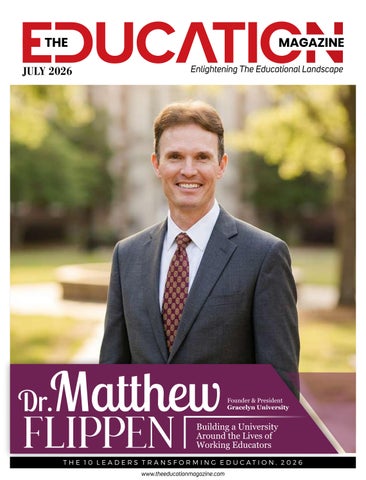
THE JULY 2026
UC TI
MAGAZINE
Enlightening The Educational Landscape
Matthew FLIPPEN
Dr.
Founder & President Gracelyn University
Building a University Around the Lives of Working Educators
T H E 1 0 L E A D E R S T R A N S F O R M I N G E D U CAT I O N , 2 0 2 6 www.theeducationmagazine.com
Where Vision Meets the Classroom: Building the Educators the World Still Needs Dear Readers, Education has always been rebuilt from the inside, by people who refuse to accept that a broken system is a permanent one. “The 10 Leaders Transforming Education, 2026” gathers a group of such people: heads of schools, districts, and universities who are proving, in real classrooms and real communities, that ambition and accessibility do not have to compete. Some are reshaping how children learn within one building. Others are reimagining who gets to become a teacher. Together, they offer a compelling portrait of a sector in genuine motion, driven not by slogans but by outcomes that hold up under close scrutiny. At the centre of this issue stands Dr. Matthew Flippen, Founder and President of Gracelyn University, whose path to education ran through a construction materials business in Haiti, where he watched single mothers and underserved communities go without real educational opportunity. That experience convinced him the strongest way to transform a community is to train the educators already living inside it. Founded in 2021, Gracelyn was built around working adults, many already serving as paraprofessionals, offering fully online, biblically grounded degrees at roughly £111 a month. The results speak plainly: around 95 per cent satisfaction, 96 per cent retention, over 80 per cent graduation, and certification and job placement rates nearing 100 per cent. His ambitions now stretch globally, towards a projected shortage of 44 million teachers by 2030, with technology used to remove friction, never humanity, from becoming a great teacher. Alongside him, this issue also recognises James Meehan, CEO of Eastpointe High School; Anthony (T.J.) Salutari, Principal of Daniel Hand High School; Dr. Anne Clark, Chief School Administrator at Westinghouse Arts Academy Charter School; and Dr. Marnisha Brown, Superintendent of Richmond Heights Local Schools. What unites every leader featured here is a refusal to treat access and excellence as opposing goals. Each has built something durable: a school culture, a district reform, a university model that puts students first and lets results follow. Their work reminds us that transformation in education rarely arrives as one dramatic gesture. It arrives through patient, deliberate leadership, sustained over years, by people who never once stopped believing every learner deserves better. Sincerely,
Simran Khan
Managing Editor
From The Editor’s Desk People Behind This Issue Publisher: Archana Ghule Editor–in–Chief: Vikram Suryawanshi
Art Director: Priyanka Patil Graphic Designer: Omkar Uravane
Managing Editor: Simran Khan
Marketing Head: Robert Smith
Project Editor: Shadab Mestri
Research Team: Daisy, Rahul,
Sales & Marketing
Maranda, Rocky
Project Head: Aakash Mahajan Sales Co-ordinators: Maria Smith Swati Kumari Project Manager: Shubham Chandankhede, Nehal Nagpure, Elias Morgan The Education Magazine is published by Pericles Ventures Pvt Ltd. This magazine contains material protected under International and Federal Copyright Laws and Treaties. You may not publish, display, disclose, rent, lease, modify, loan, distribute, or create derivative works based on the magazine contents or any part thereof, whether by yourself or as a consultant, employee, partner or in any other role unless authorised in writing by the creator/publisher of the article/, video, audio or any content contained herein. We, the team of The Education Magazine put all the efforts to keep up with the content accuracy. The publisher assumes no responsibility of any part of the content of any advertisement in this publication, including any errors or omissions therein. All rights reserved by Pericles Ventures Pvt Ltd.
10 Dr. Matthew Flippen
CONTENT PROFILES
18. Anthony (T.J.) Salutari 24. Dr. Anne Clark 28. Dr. Henry Pettiegrew II 34. Dr. Marnisha Brown 42. Dr. Neslihan Alp 46. Fr. Phillip J. Brown 56. James F. Eckler 62. James Meehan 66. Tommy Gregory
Dr. Matthew Flippen www.gracelyn.edu
Dr. Anne Clark
Anthony (T.J.) Salutari www.madison.k12.ct.us
Dr. Henry Pettiegrew II
www.westinghousearts.org
www.eastclevelandschools.org
Dr. Marnisha Brown
Dr. Neslihan Alp
Fr. Phillip J. Brown
James F Eckler
www.richmondheightsschools.org
www.oit.edu
www.stmarys.edu
www.marywood.edu
James Meehan
Tommy Gregory
www.eastpointehs.com
www.scf.edu
Dr.
Matthew FLIPPEN Building a University Around the Lives of Working Educators
“
I believe leadership is stewardship. I also believe many of the solutions to our educational challenges already exist inside our communities. 10 I JULY 2026
Cove
r Sto
r
Founder & President
Gracelyn University
THE EDUCATION MAGAZINE I 11
here is a certain kind of clarity that only arrives after a long period of discomfort, and Dr. Matthew Flippen found his in Haiti. He had gone there not as an educator, not yet, but as an entrepreneur, founding and leading a construction materials company in one of the most economically strained places on earth.
Gracelyn’s students are working adults. Many are working full-time and raising children. A significant number are already employed inside the school systems they hope to eventually serve at a higher level, doing the indispensable, underpaid work of paraprofessionals while the sun is up, and then opening a laptop to complete coursework after the kids are in bed.
The work was demanding and practical in the most literal sense. But it was what he witnessed off the job sites that stayed with him. He watched single mothers navigating lives of extraordinary difficulty, holding together households and futures with very little infrastructure to support them. He watched communities where the absence of real educational opportunity was not an abstract policy problem but a daily, grinding reality.
Dr. Flippen built Gracelyn around the realities of their lives. The university offers fully online degree programs taught from a biblical worldview. The programs are practical by design, focused on preparation that translates directly into stronger classrooms and stronger communities.
He watched, and he could not stop watching.
That is what most Gracelyn students pay in tuition, without financial aid. In a higher education landscape where student debt has become a generational wound, Gracelyn charges roughly the cost of a weekly grocery run and asks only that students show up ready to become the kinds of educators children deserve.
“That experience reshaped how I viewed leadership and education,” Dr. Flippen reflects. Today, as the Founder and President of Gracelyn University, he leads an institution marked at every turn by that particular kind of knowledge. It is the kind you absorb not from a seminar, but from years of standing in the middle of something that matters. What he came to believe in Port-au-Prince, and what he has built his entire subsequent career upon, is deceptively simple. One of the most durable ways to transform a community is to prepare strong educators from within that community. The future teachers that schools desperately need are already there. They are working as paraprofessionals, as teacher assistants, and as childcare workers. They know the children by name. What they often lack is a pathway affordable and flexible enough to actually fit a life already full to the edges. A University Built Around Real Lives Gracelyn University was founded in 2021, and from the very beginning, it was designed to look different from virtually every other institution of higher learning in the United States. Most universities, he points out, were designed around a central assumption that a student’s primary responsibility is school. For the traditional student arriving at a residential campus with a meal plan, that assumption holds. For most of the students at Gracelyn University, it is almost comically disconnected from reality. 12 I JULY 2026
And then there is the number that stops nearly everyone when they hear it: approximately $111 per month.
The Numbers That Refuse to Apologize In higher education, it is broadly assumed that you get what you pay for. Prestige costs money, outcomes cost money, and affordability has become a euphemism for lower standards. Dr. Flippen has spent his presidency systematically dismantling that assumption, and he has the data to prove it. Gracelyn University has achieved approximately 95 percent student satisfaction among its predominantly low-income, working-adult student body. The institution boasts a student retention rate of approximately 96 percent. Furthermore, graduation rates have surpassed 80 percent, a figure that outperforms many traditional institutions whose students face a fraction of the competing obligations Gracelyn’s students carry. When it comes to post-graduation success, the outcomes are equally striking. Teacher certification exam pass rates are nearly 100 percent, and job placement rates for graduates pursuing educator roles are likewise approaching 100 percent. “Those outcomes matter far more to me than growth alone,” he notes. Gracelyn has managed to remain financially self-sustaining while charging what it charges, serving whom it serves, and producing outcomes that would satisfy any serious evaluator.
Cover
Stor
THE EDUCATION MAGAZINE I 13
To understand how Dr. Flippen arrived at this moment, it helps to understand that Gracelyn University is not the first time he has oriented a professional life around expanding opportunity. Over 25 years of entrepreneurial work, his pursuits evolved into impact-focused efforts. He completed a doctorate in transformational leadership, which functions in his story as a formal articulation of what he had already been doing intuitively. He became the host of the Transformational Educators Podcast, engaging with leaders driving measurable change in schools across the country. He also authored the number one bestselling book ‘Win With Your Talent Pipeline,’ which serves as a practical playbook for school and district leaders. Building a university is not for the faint of heart. Building one while pursuing accreditation and scaling rapidly created significant pressure. There were moments when the operational complexity and the weight of responsibility felt genuinely overwhelming. What he learned in those difficult seasons was the importance of staying anchored to the mission. “When leadership remains focused on purpose, difficult decisions become clearer,” he observes. Technology That Removes Friction Among the priorities Dr. Flippen has articulated for 2026 and beyond, one philosophy stands out with particular precision. The university believes technology should remove friction, not humanity. At Gracelyn, artificial intelligence and digital systems are deployed to increase responsiveness and improve operational efficiency. Administrative processes are streamlined so the team can spend more time doing what technology cannot do, encouraging students who have spent years doubting whether higher education was realistic for them. “Technology alone cannot solve that,” he asserts. “Students need people who believe in them and help them persist through challenges.” 14 I JULY 2026
Cover Stor
The Shape of a Leader
The Vision Is Planetary UNESCO estimates that the world will need approximately 44 million additional teachers by 2030. Dr. Flippen’s strategic vision for Gracelyn extends far beyond the United States to meet this staggering need. By 2026 and in the years that follow, the university is focused on expanding graduate programs, strengthening district partnerships, and growing internationally in underserved regions. If resources were unlimited, he explains that he would focus on building affordable, technology-enabled educator preparation programs available in every tongue possible. The goal is to drastically reduce the barriers preventing capable people around the world from becoming highly effective educators. When he talks about how he evaluates success, he begins with the standard metrics of retention and job placement. But he ends somewhere else entirely. The true measure of Gracelyn’s impact is whether students leave with expanded opportunities and the ability to positively impact children. Education should create both personal transformation and economic mobility. Because strong educators influence thousands of lives over the course of a career, the downstream math of Gracelyn’s outcomes compounds for generations. Every classroom they enter is a community that benefits. For Dr. Matthew Flippen, the mission has never simply been to build another university. It has been to create pathways for people already serving children to step fully into leadership and opportunity. In many ways, Gracelyn University is built on a belief that traditional higher education often overlooks: the future of education may already be standing inside today’s classrooms.
ANTHONY
(T.J.) SALUTARI Leading with Purpose at Daniel Hand High School
IN
Long before he became Principal of Daniel Hand High School, T.J. planned to pursue mathematics education. That changed during high school, when a personal weight-loss journey reshaped how he viewed health and wellness. The experience pushed him toward Health Education and sparked a lasting interest in helping students make informed decisions about their lives. His career began in classrooms that demanded patience and adaptability. He worked as a paraeducator in a high-needs setting, spent time as a chemistry substitute teacher, and later taught health education for nearly a decade. Along the way, he earned a master’s degree in Comprehensive Special Education before moving into school leadership, a transition that began with what he describes as a simple “tap on the shoulder” from a colleague. Building a School Community That Feels Supported Inside the school, T.J. approaches leadership much like customer service. His focus stays on creating the best possible experience for students while giving teachers the support they need to succeed in the classroom. The role demands constant balance between staff evaluations, budgeting, hiring, and communication with families and the community. Several honors have marked that work, including statewide recognition as the 2026 Connecticut Association of Schools High School Principal of the Year. Still, the moment that stands above the rest is Daniel Hand High School earning National Blue Ribbon School status in 2024, an achievement he credits to the entire school community. 18 I JULY 2026
“
Always do what is best for students. Everything else follows from there.
“
public education, the path to leadership rarely follows a straight line. Some educators spend years carefully planning each next step. Others arrive there through experience, timing, and a growing sense of responsibility. Anthony (T.J.) Salutari belongs to the second group.
PRINCIPAL Daniel Hand High School, T.J. THE EDUCATION MAGAZINE I 19
Creating a Culture Where Students Feel Seen Rather than relying on one sweeping reform, T.J. focused on steady cultural shifts inside Daniel Hand High School. Personal Alert Locators, A.L.I.C.E. safety training, wellness initiatives, and a four-year Advisory model helped strengthen relationships between students and faculty. He also expanded opportunities for student leadership and backed every student-led club proposal. “Students perform better when they feel connected, supported, and challenged,” he says. The results reflect that approach. School data now shows that 82% of students understand how to access social-emotional support services, while 93% report a clear understanding of academic expectations. New curriculum changes also aim to widen access to rigorous coursework for all learners. Preparing Students for a Changing World The next chapter at Daniel Hand High School is centered on adaptability. T.J. wants classrooms to move beyond memorization and toward hands-on, project-based learning that reflects real-world problem solving. His long-term strategy focuses on four areas: academics, school climate, talent development, and operational systems. AI literacy, STEM expansion, and community-connected learning all play a role in that vision. Success, he believes, cannot be measured by test scores alone. “We want students to graduate with the confidence and character to navigate a world that keeps changing,” he says.
20 I JULY 2026
Removing Barriers Through Practical Leadership T.J. approaches equity as a daily responsibility rather than a policy statement. Much of his work centers on identifying barriers that quietly limit student participation and then finding practical ways to remove them. Conversations with student-led groups, including diversity-focused organizations, often shape the initiatives he pursues across the school community. He has also pushed for structural academic changes, including the removal of restrictive prerequisites and lower-level math tracks. Financial support systems for events, AP exams, and field trips help students participate without embarrassment or public attention. For T.J., access matters most when students no longer have to ask for permission to belong. Turning Data Into Better Decisions Inside T.J.’s leadership approach, data serves as a guide rather than a scoreboard. He relies on regular faculty discussions, student portfolios, classroom assessments, and post-graduation feedback to understand whether students are truly prepared for life after high school. Evaluation meetings and academic screenings also help staff identify students who may need support earlier. T.J. pays close attention to growth beyond grades, including critical thinking, adaptability, and student confidence. “The best feedback comes from graduates,” he says. “When they return and tell us they felt ready for what came next, that tells us we’re doing the right work.” Learning the Weight of Leadership One of the most difficult moments of T.J.’s career came during his first year as a high school principal, when a serious issue involving a faculty member quickly became public. With students, parents, and staff searching for answers, he had to respond carefully and quickly while working within legal limits. He met directly with faculty, communicated with families, and spoke to students grade by grade about available support and next steps. The experience reshaped how he viewed leadership under pressure. “In a crisis, people pay attention to your presence before they process your words,” he says. THE EDUCATION MAGAZINE I 21
Rethinking What Students Need Before Adulthood T.J. often thinks about how much pressure high school seniors face while making life changing decisions at 17 or 18 years old. Given unlimited resources, he would create a free fifth year of high school focused entirely on exploration. Students could experience college living, test career interests, or spend time in real workplace settings before committing to a path. He would also invest heavily in educators. He believes compensation across public education rarely reflects the importance of the work. Modern facilities, stronger staff support, and more real-world preparation for students would all become part of that larger vision. Advocating for the People Behind Public Education T.J. speaks about education with the protectiveness of someone who has spent years inside classrooms and school hallways. He worries about the growing criticism surrounding public education and the number of educators leaving the profession, but he remains deeply optimistic about its future. Much of his work now focuses on supporting teachers and administrators, so they feel valued, prepared, and capable of succeeding long term. “Teaching is the most important profession in the world,” he says. That belief recently extended beyond his own school through a statewide mentoring initiative designed to help new administrators navigate one of education’s most demanding leadership roles.
22 I JULY 2026
Finding Space Outside the Principal’s Office T.J. admits that true work-life balance can feel unrealistic in a high school leadership role. The responsibilities rarely stay inside school walls. Still, he has built small routines that help him separate work from home, including a simple reminder to leave the day’s stress in the car before walking into his house. Early morning workouts have become part of that rhythm, giving him quiet time before the day begins. Outside school, he values simple moments most: fishing, golf, and time with family. He also credits his wife, Kari, for supporting a career that often demands far more than standard work hours. Leading Through Trust and Relationships After years in school leadership, T.J. still speaks about the role with genuine energy. What keeps him motivated is not authority or recognition, but the chance to shape an environment where teachers can teach well, and students feel supported enough to grow. Much of his work happens quietly behind the scenes, resolving issues before they disrupt classrooms or damage relationships. He believes the strongest schools are built on trust, consistency, and clear expectations. “Students respect high standards when they know those standards come from a place of care,” he says. That balance between accountability and approachability has become one of the defining traits of his leadership style. THE EDUCATION MAGAZINE I 23
Chief School Administrator Westinghouse Arts Academy Charter School
24 I JULY 2026
THE EDUCATION MAGAZINE I 25
26 I JULY 2026
THE EDUCATION MAGAZINE I 27
DR. HENRY PETTIEGREW II EAST CLEVELAND CITY SCHOOLS SUPERINTENDENT & CEO
28 I JULY 2026
BUILDING SYSTEMS THAT SERVE EVERY CHILD
P
ublic education often changes because one person decides that routine is not good enough. Communities grow when leaders treat schools as living places rather than office charts. In many cities, families have learned to expect promises that fade after a few years. East Cleveland needed something steadier, a plan that could outlast any single administrator. Dr. Henry Pettiegrew II arrived with that mindset. He began his career in classrooms, learning the daily rhythm of students and teachers before stepping into leadership roles at schools and districts. He carried one clear belief with him: systems should guarantee meaningful, grade-level learning for every child. Early mentors shaped that belief. They showed him how to pair high expectations with team-based problem solving, and he kept that approach as he moved into larger challenges. His work in turnaround efforts, including Maple Heights, tested those ideas in real conditions. In 2018, he accepted the appointment as CEO and Superintendent of East Cleveland City Schools. The district needed quick action, but it also needed a structure that could last. Dr. Pettiegrew focused on marrying urgency with systems design so improvements were durable and measurable. He often says, “Change only counts if families can feel it in the classroom.” That practical view continues to guide how he leads today.
Leading with Purpose At the center of East Cleveland City Schools, Dr. Henry Pettiegrew II wears many hats. As Superintendent and CEO, he sets the district’s overarching strategy, known internally as the Flight Path. He aligns leadership through Empowerment Zones, ensuring every administrator understands their role in translating goals into classroom results. Beyond guiding strategy, he protects the district’s fiscal health and serves as its public advocate, representing the schools to families, government officials, and the broader community. Dr. Pettiegrew’s tenure has been marked by tangible accomplishments. He led the Revitalization Plan and Flight Path, which produced system-level gains, meeting sixteen of the twenty key performance metrics by the third year. Recognizing that data drives decisions, he built transparent reporting systems and introduced a Turnaround Scorecard to track progress openly. He also expanded opportunities for students, launching virtual academies and credit-recovery pathways to keep learners on track. Equally important, he shifted the district’s approach to discipline, favoring restorative practices that preserve connections between students and adults. “Growth isn’t just numbers on a page,” he observes. “It’s the relationships, routines, and opportunities we build that make a difference.” Under his guidance, these initiatives have delivered measurable improvements across academics, engagement, and student support, reflecting a leadership style grounded in accountability and vision.
THE EDUCATION MAGAZINE I 29
Driving Change through Focused Reforms When Dr. Pettiegrew stepped into leadership, he knew lasting improvement required more than quick fixes. He launched three simultaneous reforms to strengthen both outcomes and engagement across East Cleveland City Schools. First, he reorganized the district’s structure, creating Empowerment Zones and establishing a clear leadership cadence that made accountability tangible at every level. Second, he focused on instructional coherence. Early literacy in pre-kindergarten through third grade became a top priority, paired with a rigorous, grade-level math agenda. Classrooms now operate with explicit routines designed to support consistent learning, ensuring students encounter clear expectations day after day. Third, he embedded a culture of continuous improvement. Data rooms, coaching cycles, and fidelity checks now guide teaching and leadership decisions, making progress visible and actionable. These initiatives are not abstract; they are anchored to a 20-metric Turnaround Scorecard, which measures and governs implementation at every level. Beyond these core reforms, Dr. Pettiegrew scaled virtual academies, expanded credit-recovery pathways, introduced career and technical education programs, and emphasized restorative discipline practices. Each change reflects his belief that measurable systems, when combined with human connection, can transform both student achievement and school culture. Academic Progress and a New Chapter Under Dr. Pettiegrew’s leadership, the district recorded clear systemwide gains. By Year 3 of the Revitalization Plan, East Cleveland met sixteen of twenty metrics, raised its Performance Index by more than twelve points, and earned a three-star overall state rating with a four-star Progress rating, up from two stars the year before. Early literacy also surged, with third-grade proficiency climbing roughly ten points. Reflecting on the milestone, he notes, “Being released from state oversight shows our work is not temporary, it’s real growth that families can see.” A Test of Leadership and the Path Forward When Dr. Pettiegrew was appointed under the Academic Distress Commission in 2018, the district faced skepticism and high stakes. He met the challenge with clear plans, early operational wins, and relentless transparency, turning doubt into collaboration and laying the groundwork for lasting improvement. Reflecting on that period, he says, “Credibility is earned not through words, but through visible action that families and staff can trust.” Looking ahead, his focus is on embedding systems that ensure progress continues beyond any single leader, creating a resilient district where gains are sustainable, and students remain at the center of every decision.
30 I JULY 2026
“
Vision without measurement is hope; measurement without vision is directionless.
“
THE EDUCATION MAGAZINE I 31
32 I JULY 2026
Equity in Action For Dr. Pettiegrew, equity is not a concept but a daily practice. Resources and staffing are deliberately directed to schools facing the greatest gaps, ensuring every student has access to support where it matters most. Progress is tracked through interim benchmarks, MAP growth, state growth percentiles, proficiency, graduation and credit accumulation, chronic absenteeism, and discipline trends. School-level fidelity measures, including professional development completion, walkthrough evidence, and intervention cycles, provide insight into classroom implementation. All of these metrics feed into the Turnaround Scorecard, offering a transparent, public-facing snapshot of progress. He notes, “Equity isn’t about equal treatment, it’s about targeted action that meets every student where they are.” Grounded in Family, Driven by Impact For Dr. Pettiegrew, family is the anchor that keeps him grounded. Time with his spouse and five children, reading, and brief creative escapes provide balance amid the demands of leading a district. He believes that leadership that matters changes systems so they change lives. Reflecting on East Cleveland’s journey, he notes, “Being released from state oversight shows that disciplined systems, combined with genuine community partnership, can lift student outcomes at scale.” This philosophy continues to guide his work, ensuring that every decision, whether it is strategic or daily, serves students, strengthens staff, and builds a lasting foundation for the community he serves. A Vision beyond the Nest Dr. Pettiegrew’s vision for 2026 and beyond, called Beyond the Nest, charts a PK–12 path designed to launch every student toward post-secondary success. Four guiding goals shape this journey: accelerate early literacy, ensure grade-level math mastery, boost graduation and career readiness, and foster a restorative culture where every student feels a sense of belonging. Progress is tracked rigorously using state report card indicators, graduation and credit accumulation rates, chronic absenteeism, and discipline and climate metrics. Fidelity of implementation is monitored through coaching, professional learning communities, and MTSS practices, all aggregated on the Turnaround Scorecard. He emphasizes, “Vision without measurement is hope; measurement without vision is directionless.” THE EDUCATION MAGAZINE I 33
34 I JULY 2026
THE EDUCATION MAGAZINE I 35
public education, real progress rarely comes from quick fixes. It takes steady direction, clear priorities, and leadership that stays grounded in what matters most. At Richmond Heights Local Schools, that kind of progress is not accidental. It reflects a system shaped with care and a leader who pays close attention to both people and process.
In
Dr. Marnisha Brown leads the district with a focus that feels both practical and personal. “Every student deserves to be seen, supported, and challenged,” she often says, a belief that shows up not just in vision statements but in daily decisions. Her path to this role began with a love for language, earning her undergraduate degree in literature from Wilberforce University. That early training shaped how she listens, teaches, and communicates. She went on to earn a master’s in educational administration from Cleveland State University and later completed her doctorate in educational leadership at Youngstown State University. Each step added a layer to her understanding of schools, from classroom dynamics to district-wide systems. Her career reflects that same steady build. Starting as a high school English teacher, she learned the value of strong relationships and clear expectations. As she moved through roles as dean, principal, and assistant superintendent, her focus widened, but her core approach did not change. Today, as Superintendent, she brings that same clarity to leading an entire district, while also mentoring future educators as a part-time professor and continuing her own learning alongside peers across Ohio.
36 I JULY 2026
THE EDUCATION MAGAZINE I 37
Where Excellence Becomes the Standard Under the leadership of Dr. Brown, Richmond Heights is steadily emerging as a district defined by intention, progress, and rising expectations. The outcomes reflect this shift. The high school has earned a 4.5-star overall rating, alongside perfect 5-star scores in Graduation and Progress on Ohio’s State Report Card. These achievements are not accidental. They are the result of a focused effort to strengthen literacy across all grade levels while placing student engagement and school culture at the core of everyday learning. Dr. Brown’s approach extends beyond academics into meaningful student experiences. The elementary campus now features an outdoor learning environment that includes a butterfly garden, a modern playground, Safety Town, and expanded Wi-Fi access. These additions are designed to make learning more interactive, connected, and relevant.
38 I JULY 2026
The future is being shaped with equal clarity. The district is set to relaunch an Aviation pathway in partnership with Excel TECC in the 2026 to 2027 school year. Middle school career pathways are also in development, creating earlier exposure to real-world skills. Each initiative reflects a larger goal. To build a district where students belong, families believe, and educators lead with purpose. Steadfast Leadership in Defining Moments When Dr. Brown stepped into the superintendency, she entered at a time that demanded immediate clarity and resolve. Taking on the role mid-year, she faced layered challenges that tested both strategy and endurance. Facilities concerns required urgent attention. Financial pressures created difficult trade-offs. Three unsuccessful levy attempts added to the complexity. Through each setback, her direction remained consistent. Dr. Brown leads with a commitment to transparency and shared ownership. Rather than centralizing authority, she works in close partnership with the Board of Education and her leadership team, ensuring that decisions are aligned and purposeful. At the center of this approach is a unifying principle that guides the district forward: One Vision. One Mission. One Richmond.
THE EDUCATION MAGAZINE I 39
That approach continues to shape both culture and outcomes. When priorities remain clear and grounded in student needs, momentum builds in a way that is sustainable. Recognition as one of 2025’s most inspiring education leaders reflects what the community has already experienced. A superintendent who leads with conviction, remains steady through challenge, and stays deeply committed to the students and families she serves. Looking Ahead with Purpose The next phase of growth in Richmond Heights is already taking shape, guided by a clear and steady vision. For Dr. Brown, the focus is on preparing students not just for graduation, but for what comes after. Efforts are centered on strengthening pathways that support college, career, and life readiness while maintaining fiscal discipline. Facilities improvements remain a priority, alongside continued investment in leadership development and expanded enrichment opportunities that give students broader exposure and experience. Beyond programs and planning, there is a clear emphasis on people. Time is being invested in identifying and mentoring future leaders within the district. The idea is simple. Strong systems last longer when leadership is grown from within, not brought in by chance. There is also a practical understanding of what students need to truly thrive. Smaller class sizes would allow for more attention. Stronger mental health support would ensure students are not left to navigate challenges alone. Early childhood programs would build a stronger start. Career pathways would feel more real and accessible. Each of these priorities connects back to one belief. When schools support the whole child, outcomes improve in ways that go far beyond the classroom.
40 I JULY 2026
Dr. Neslihan Alp ENGINEERING LEADERSHIP WITH A GLOBAL LENS
U
niversities that leave a mark on their students are often shaped by leaders who understand both systems and people. At the Oregon Institute of Technology, that perspective is reflected in the work of Dr. Neslihan Alp, Dean of the College of Engineering, Technology, and Management. Dr. Alp’s academic path began in Turkey at Istanbul Technical University, where she earned her bachelor’s and master’s degrees in Engineering Management and Industrial Engineering. Those early years sparked a lasting interest in how technical systems connect with decision-making, leadership, and real-world outcomes. “I was always drawn to the intersection of engineering and leadership,” she says, “and to the role education plays in shaping communities.” She later completed her Ph.D. in Engineering Management in the United States, deepening her focus on applied learning and institutional impact. Her career unfolded in higher education, first as a faculty member immersed in teaching, research, and collaboration with industry partners. Leadership roles followed, including department head, associate dean, dean, and provost. Each step expanded her ability to influence student success and faculty growth. Oregon Tech’s polytechnic mission drew her in. As dean, Dr. Alp leads with a clear purpose: to strengthen hands-on programs, build industry partnerships, and prepare students for meaningful, career-ready futures.
42 I JULY 2026
Leading with Purpose and Accountability As Dean of the College of Engineering, Technology, and Management, Dr. Alp oversees both the academic direction and day-to-day operations of the College. Her role spans program oversight, faculty hiring and development, accreditation, budgeting, and long-term planning, all while keeping student success at the center. She works closely with university leadership, industry partners, alumni, and donors to ensure programs stay aligned with workforce needs. Among her proudest accomplishments are launching high-impact programs such as Construction Management, securing external funding for students and labs, and expanding industry partnerships. She also values building a collaborative culture where students, faculty, and staff feel supported and invested. Building Engagement through Applied Learning Dr. Alp has focused her efforts on initiatives that connect academic rigor with real-world relevance. She has led the launch of workforce-aligned programs such as Artificial Intelligence and Construction Management, designed to give students hands-on experience tied directly to industry needs. To strengthen engagement and retention, she introduced a college-wide Freshman Seminar and expanded undergraduate research through platforms like IDEAfest. Experiential learning has also grown through deeper industry partnerships, internships, and project-based courses.
Dean I the College of Engineering, Technology, and Management at Oregon Institute of Technology.
THE EDUCATION MAGAZINE I 43
For faculty, she established mentoring, research dialogues, and collaboration initiatives that support both teaching and scholarship. Together, these efforts have shaped a learning environment where students take an active role in their education and graduate better prepared for professional life.
She also reviews program assessments, accreditation results, student engagement, and faculty effectiveness in teaching and research. Student and faculty input, advising outcomes, and equity indicators play an equally important role, helping guide informed decisions and continuous improvement.
A Measured Vision for What Comes Next Steady Leadership under Pressure Dr. Alp’s vision centers on strengthening Oregon Tech’s identity as a leading polytechnic institution grounded in applied learning and workforce relevance. “The goal is not growth for its own sake,” she explains, “but growth that improves outcomes for students and communities.” Her priorities include expanding interdisciplinary programs, improving enrollment and graduation rates, and deepening industry and community partnerships. She is equally focused on applied research and faculty development. Progress, she notes, must be measurable, tracked through student success metrics, career placement, external funding, accreditation outcomes, and ongoing feedback from those the university serves. Equity Grounded in Intentional Action For Dr. Alp, equity begins with close attention to data and daily practice. She regularly reviews enrollment, retention, and success trends to identify where students need additional support and directs resources accordingly. “Equity means meeting students where they are,” she says, “and giving them what they need to move forward.” That approach shapes decisions around advising, academic support, scholarships, and access to experiential learning. She works closely with faculty and student support teams to design inclusive programs and curricula. Industry and donor partnerships further expand internships, research roles, and funding, helping ensure opportunity is not limited by background. Measuring What Matters Dr. Alp relies on a balance of data and lived experience to understand how students and the institution are progressing. Enrollment trends, retention and graduation rates, course success, and post-graduation outcomes form the foundation of that assessment. “Numbers tell us where to look,” she notes, “but feedback tells us what to change.” 44 I JULY 2026
One of the true tests of Dr. Alp’s leadership came during a period of rapid change, when new programs had to be launched amid tight resources and competing demands. The challenge was not just speed, but balance. “People needed clarity, not pressure,” she recalls. Her response centered on transparency and collaboration. She created space for faculty and staff to voice concerns, involved them in setting priorities, and broke complex goals into manageable steps. That steady, people-first approach helped the team move forward and strengthened trust. For Dr. Alp, the experience affirmed that leadership succeeds when listening and adaptability guide action. Reimagining Public Education at Scale With unlimited resources, Dr. Alp would redesign public education around equity and readiness for the future. She would begin by investing in early preparation and sustained support, from K–12 through higher education. “Access alone is not enough,” she says. “Students need mentoring, preparation, and consistent academic support.”
“
Education changes lives, and people do their best work when they feel valued, supported, and inspired.
She would embed experiential learning into every stage of education, linking classrooms with industry, research, and real-world problem solving. Equally important is supporting educators through fair compensation, professional development, and time to innovate. Stronger pathways between education, workforce, and communities would ensure learning leads to opportunity. Looking Ahead with Purpose Dr. Alp sees the next phase of her journey rooted in helping institutions navigate change without losing sight of their mission. She is drawn to roles that allow for broader impact, from shaping academic vision to advancing research and strengthening partnerships. “Growth, for me, means expanding access and opportunity,” she says, “while staying anchored in student success.” Her larger ambition is a higher education ecosystem that is inclusive, agile, and connected to the communities it serves. In that system, applied learning and public impact move together, preparing students not just for careers, but for leadership with purpose. Finding Balance beyond Leadership For Dr. Alp, balance is not a fixed achievement but a daily practice. She is deliberate about priorities, sets boundaries where possible, and protects time for reflection and family. “Being present makes me a better leader,” she says, “and a more compassionate one.” Outside the office, she values time with her family, travel, and staying connected to her Turkish roots. Long walks, reading, and time in nature offer space to recharge. These quieter moments provide perspective and help her return to work with clarity and renewed focus.
A Closing Reflection on Leadership At the core of Dr. Alp’s leadership is a simple belief: education has the power to change lives. She approaches her work with empathy, integrity, and a clear sense of purpose, keeping students at the center of every decision. “Leadership is not about having all the answers,” she reflects. “It is about listening, building trust, and helping others succeed.” That philosophy shapes how she works with students, faculty, and staff alike. By investing in people and creating spaces where they feel valued, she believes institutions become more resilient and capable of lasting impact.
“
Leadership is not about having all the answers, but about listening, building trust, and empowering others to succeed.
THE EDUCATION MAGAZINE I 45
46 I JULY 2026
A Journey of Faith, Education, and Purpose
THE EDUCATION MAGAZINE I 47
E
ducation often finds its truest form in the lives of those who never stop learning. Some people begin their journeys with clear direction, while others discover their purpose through exploration and change. Fr. Phillip J. Brown, President-Rector of St. Mary’s Seminary & University in Baltimore, belongs to the latter group. His path has been shaped by curiosity, reflection, and a steady commitment to service and a growing sense of vocation rooted in his Catholic faith. What began as a love for music at the University of Michigan gradually turned into a deeper calling. After earning his degree in music and teaching piano privately, Father Brown entered law school and spent six years in legal practice. Yet, the pull toward something more meaningful led him to the sacred ministry. Serving as a pastor and high school chaplain opened his eyes to the needs and potential of young people and a life of service in the Church and its educational mission. This commitment to education aligns with his identity as a Sulpician priest (P.S.S.), a society dedicated to seminary formation. Those years transformed his outlook and ignited a lifelong devotion to education. Later, his work in canon law, seminary formation, and leadership at St. Mary’s further strengthened that purpose. Inspired by the mentors who shaped his own growth, Fr. Brown continues to guide students with the same integrity, empathy, and dedication that once inspired him. Leading with Faith and Purpose Fr. Brown’s role today bridges leadership and mentorship in equal measure. Serving as both CEO and pastor of the seminary community, he balances the demands of administration with the heart of a teacher. “It’s a challenging role with many diverse responsibilities,” he shares, reflecting on the depth of his work.
48 I JULY 2026
His journey reached two defining moments when he was appointed Rector of Theological College in Washington, where he once studied, and later as President-Rector of St. Mary’s Seminary in Baltimore. Founded in 1791, the first Catholic seminary in the United States, St. Mary’s holds a historic place in American Catholic education, a legacy Fr. Brown continues to uphold with pride and purpose. Shaping the Next Generation of Servant Leaders The longest-serving seminary rector in the country, Fr. Brown’s leadership centers on forming priests who combine intellectual depth with genuine compassion. His focus has been on shaping pastors who can guide their communities with wisdom, empathy, and strength. “Our goal is to prepare men who are not only well educated, but who also bring real pastoral sensitivity to their ministry,” he explains. To support this vision, he has developed initiatives that foster emotional maturity, character formation, and selfless service. Each program encourages seminarians to grow as men of integrity who understand both the privilege and responsibility that come with serving others through priestly life. A Vision Focused on the Future Fr. Brown’s vision for St. Mary’s looks firmly ahead, grounded in the realities of today and the possibilities of tomorrow. He believes the strength of a seminary lies not in its numbers but in the depth of its formation. “We are focusing on quality, not quantity,” he says. His strategy is to “right-size” the program, creating a model that reflects the Church’s current needs rather than longing for a past era. With this approach, Fr. Brown aims to prepare priests equipped for the challenges of modern ministry, ready to serve communities with purpose, and confident they have made a lasting difference.
THE EDUCATION MAGAZINE I 49
“
Show your appreciation; provide people with what they need to succeed; make it your job to remove the obstacles to other peoples’ success.
50 I JULY 2026
THE EDUCATION MAGAZINE I 51
Forming the Whole Person For Fr. Brown, genuine preparation for priestly life begins with human formation, the foundation upon which all other aspects of ministry rest. He believes that before a man can serve others, he must understand himself, cultivate emotional maturity, and develop habits that sustain both his spirit and his work. “Human formation is key to our goals,” he explains. “It’s where character, balance, and purpose take shape.” At St. Mary’s, this formation integrates the human, spiritual, intellectual, and pastoral dimensions of a priest’s life. Seminarians are encouraged to build steady, healthy routines, nurture a deep prayer life, and remain lifelong learners. The program helps them temper enthusiasm with realism, learning to embrace the joys and challenges of ministry with humility and self-awareness.
52 I JULY 2026
Ultimately, the goal is not only to prepare capable priests but to form whole persons: men of integrity who serve freely, joyfully, and with lasting balance. Bridging Tradition and Practice Fr. Brown places strong emphasis on ecumenism in his teaching, seeing it as both a duty and a necessity. “The divisions among Christians are a scandal to the world and hinder the mission Christ entrusted to us,” he says. He encourages students to approach one another with respect and love, regardless of differing perspectives. In his canon law courses, Fr. Brown goes beyond the technical details. He connects the principles to real-world ministry, helping future priests understand how Church law shapes their daily responsibilities and interactions, and preparing them to serve their communities with wisdom and practical insight. Balancing Scholarship and Service Fr. Brown’s scholarship focuses on applying Church law in ways that are both thoughtful and pastorally sensitive. He explores the relationship between Church and civil law and has worked extensively on structuring Catholic institutions, particularly schools, to strengthen their educational mission. “The most important work is finding ways to support these institutions so they can continue serving their communities,” he explains.
Alongside his academic work, Fr. Brown has faced personal challenges, including discerning God’s call amid significant responsibilities and navigating the difficulties the Church has encountered in recent decades. These experiences have shaped his resilience and commitment to service. Envisioning a Balanced Education If Fr. Brown had unlimited resources to influence public education, he would focus on creating a more balanced curriculum. “Arts and humanities need equal weight alongside science and career preparation,” he says. His vision includes developing students as well-rounded individuals rather than solely emphasizing achievement. He also seeks to address the disproportionate role of athletics in schools, aiming to cultivate environments where intellectual, artistic, and personal growth are valued equally alongside physical accomplishments.
THE EDUCATION MAGAZINE I 53
“
Be sure to inwardly recognize and celebrate your own successes, even when they’re not evident to others.
Looking Ahead to Retirement
Leading with Patience and Respect
Fr. Brown plans to begin semi-retirement in 2026, shifting his focus toward scholarship, writing, and personal pursuits. “I hope to explore academic and popular writing on priestly formation and key issues in canon and civil law,” he explains. He also looks forward to dedicating more time to music and composition, reading, and enjoying hobbies like golf, swimming, and outdoor activities. This next chapter promises a balance of intellectual engagement and personal fulfillment after decades of leadership and service.
Fr. Brown’s leadership rests on disciplined patience and genuine respect for others. “Most problems solve themselves if you give them time,” he explains. He believes that everyone is trying their best and that a leader’s role is to provide support, remove obstacles, and create the conditions for others to succeed. Success as a leader often shows up as the accomplishments of those you guide. Fr. Brown emphasizes the importance of acknowledging these achievements while quietly celebrating one’s own contributions, which will foster a culture of appreciation, growth, and lasting impact.
Finding Balance amid Demands Fr. Brown acknowledges that work-life balance can be difficult, especially for educators and administrators. He emphasizes focus and knowing when to step back. “If a task comes at the expense of your health, it's not worth it,” he explains. He also follows a simple philosophy: “If there’s a solution, solve it; if not, why worry? Stop worrying and get a good night's sleep.” These principles help him maintain clarity, energy, and well-being while managing a demanding role.
54 I JULY 2026
Dean | Reap College of Creative and Professional Studies at Marywood University
56 I JULY 2026
F. Eckler Building a College from the Ground Up n higher education, titles often tell only the last chapter of a much longer story. The word dean suggests arrival. It rarely reveals the years of risk, doubt, and steady construction that come before it.
I
Today, he leads Reap College of Creative and Professional Studies, where Architecture sits alongside Business, Visual and Performing Arts, Education, the Humanities, and a PhD in Strategic Leadership. He has not simply joined institutions. He has built them.
James Eckler’s path to becoming Dean of the Reap College of Creative and Professional Studies at Marywood University began with a first. He was the first person in his immediate family to complete a college degree. That achievement did not come with a roadmap. It came with resolve.
Leading with Vision and Measured Growth
He earned both his undergraduate degree and two graduate degrees at the University of Florida, including a Master of Architecture and a Master of Science in Architectural Studies: Pedagogy. By his sophomore year, he had already begun asking questions that stretched beyond studio walls. “The broader questions of academia and architecture we experimented with were always fascinating to me,” he says. He did not want to design buildings alone. He wanted to shape the way architecture was taught and understood. That decision led him into the pedagogy program and into the classroom. He taught at the University of Florida and later at the University of Cincinnati before arriving at Marywood with a rare assignment: build something new. He helped launch the School of Architecture, serving first as Program Coordinator and then as Director.
As dean, Mr. Eckler manages budgets, faculty, strategy, and long-term planning, but he speaks most about momentum. He works closely with each program to develop new initiatives, refine curriculum, and expand academic reach. “What I find truly rewarding,” he says, “is leading programs to author new ideas and innovate academically and pedagogically.” One milestone stands above the rest. Under his direction, Marywood’s School of Architecture earned its first full accreditation. For him, that recognition marked more than compliance. It affirmed years of groundwork, faculty trust, and belief in a young program finding its footing. An Interdisciplinary Framework with Purpose Mr. Eckler leads Reap College with a structure that balances oversight and collaboration. He works alongside assistant deans who manage international compliance and key administrative functions, while directors guide their respective schools and ensure academic offerings stay aligned with student needs. The leadership team meets often and works toward shared outcomes rather than isolated goals.
THE EDUCATION MAGAZINE I 57
“
The fundamental mission of education has more to do with empowerment than knowledge.
58 I JULY 2026
The college advances Marywood University’s broader mission by preparing students to apply their expertise within real communities. Its interdisciplinary design allows Architecture, Business, Visual and Performing Arts, Education, and the Humanities to intersect, giving students room to shape paths that reflect both skill and curiosity. Expanding Across Disciplines and Borders Looking toward 2026 and beyond, Mr. Eckler has set a clear direction for Reap College: deepen interdisciplinary work and extend Marywood’s reach internationally. He believes professional programs, the arts, and the humanities should not operate in isolation. Instead, he encourages them to inform one another, creating academic models that differ from institutions that separate fields too strictly. International growth remains a central priority. Through global partnerships, study abroad programs, and expanded degree offerings overseas, he aims to position Marywood for a workforce that operates across borders. He measures progress through hybrid programs, new certifications, and the growing presence of Marywood degrees beyond the United States. Aligning Priorities with Practice For Mr. Eckler, equity begins with process, not slogans. He relies on consistent and transparent program reviews to assess where resources flow and why. “Budgets are boring,” he admits, “but the budget indicates the priorities of the institution.” For him, spreadsheets tell a story. They reveal what the college values in action. Allocation decisions are never made alone. He works with his leadership team to evaluate needs, assess impact, and ensure initiatives reflect shared goals. This collaborative approach keeps funding aligned with strategy and helps distribute opportunities in ways that support students across programs and backgrounds. THE EDUCATION MAGAZINE I 59
Measuring What Truly Matters Assessment at Reap College does not follow a single formula. Mr. Eckler understands that each discipline carries distinct learning outcomes shaped by accrediting bodies and professional standards. Architecture does not measure success the same way as business or education might. His role is to ensure each program stays current and delivers an education that holds value in today’s market. Yet numbers alone do not satisfy him. Retention rates and grades offer data, but he looks deeper. He pays close attention to student feedback and asks whether students see the relevance of their work. Are they connecting ideas across courses? Do they recognize growth beyond transcripts? Those questions guide his evaluation of institutional effectiveness. Leadership in Motion
A Commitment to Access
Mr. Eckler does not view leadership tests as rare events. He sees them as steady, often quiet pressures that surface in daily decisions. The most demanding moments, he explains, come not from crisis but from priority. When the college advances certain initiatives, others must wait. That reality can unsettle even committed faculty and staff.
When asked what he would change about higher education with unlimited resources, Mr. Eckler does not outline grand architectural plans or sweeping reforms. His answer is direct. He believes education should be broadly accessible.
His response centers on communication. He makes space for conversation, explains the reasoning behind decisions, and reinforces that deferred ideas are not dismissed ones. Helping colleagues feel heard and valued, even when timing differs, requires patience. “Sometimes,” he acknowledges, “just communicating that people need to wait is the biggest challenge.”
For him, access is not a slogan. It shapes how institutions think about tuition, outreach, program design, and support systems. If given the means, he would remove as many barriers as possible so that opportunity does not depend on background or circumstance. Expanding accessibility, in his view, strengthens not only individuals but the communities they will one day serve. Building Without a Finish Line Mr. Eckler does not describe the future as a fixed destination. He speaks of expansion and renewal as ongoing work. A major focus remains on international growth. He wants Marywood’s presence to extend further through global partnerships and broader academic reach. At the same time, he concentrates on the curriculum. Integrating current content and emerging technologies into every discipline is not a one-time upgrade. It requires constant review and adjustment. There is no final version of a program, only its next iteration. For Eckler, progress lies in staying responsive to a world that refuses to stand still.
60 I JULY 2026
Beyond the Office Outside the demands of leadership, Mr. Eckler protects time for family, travel, and the kitchen. He enjoys cooking as a creative reset. When schedules allow, he still designs and builds. Making things, even now, keeps him connected to the craft that first shaped his career. A Philosophy of Empowerment Mr. Eckler believes education extends beyond information. Its deeper purpose, he says, lies in empowerment. A strong education equips people to seek knowledge independently and make informed decisions. In doing so, it serves not only personal growth but also the well-being of communities they influence.
THE EDUCATION MAGAZINE I 61
James Meehan Building Schools That Bring Students Back to Themselves
A
second chance is not something a system can claim. It has to be built, often for students who were never meant to fit into standard models in the first place. Many of them are capable and aware, yet find themselves pushed to the margins for reasons that have little to do with their ability. That disconnect is what stayed with James Meehan. His early career unfolded in the supply chain and logistics industry, where he built and operated companies that demanded precision and scale. The work brought clarity and results, but it did not offer the kind of impact that lingers.
Carrying the Weight of Outcomes Leading a school system requires more than oversight. For James, the role sits at the intersection of strategy and responsibility that feels personal. He sets direction, builds leadership teams, and keeps operations tight, but the real measure remains student outcomes. “I see my role as a steward of culture,” he says, pointing to decisions that reflect a belief in second chances. At Elevated Education, that belief has translated into stronger graduation rates and structured support systems. The work is not just about diplomas, but about shifting life paths in ways that last.
The turning point came when he saw how many students were being left behind by systems that could not adjust to their realities. “I saw students who weren’t failing because they couldn’t learn,” Meehan says. “They were failing because the system wasn’t built for them.”
Reworking the System from Within
Today, as CEO of Eastpointe High School and Elevated Education, he is focused on building schools that do more than deliver lessons. The aim is to restore belief and create a path forward that feels real to the students who need it most.
The first was a move toward personalized learning, replacing rigid instruction with pathways that adjust to individual pace and context. Alongside that came wraparound support, where academic work is backed by social and life services.
62 I JULY 2026
Change did not come through a single overhaul. It took a set of deliberate shifts led by James, each aimed at making the system respond to the student, not the other way around.
CEO Eastpointe High School
THE EDUCATION MAGAZINE I 63
The third pillar focused on real-time data, allowing teams to track progress and act early. Together, these changes have led to stronger engagement and more students completing their path to graduation. Looking Beyond Graduation James is not building for scale alone. The effort is aimed at shaping a model that others can study and replicate. At Eastpointe High, his direction is clear: to become a leading example of alternative education and dropout recovery in the country. That goal is supported by a few focused priorities. Expanding access to reach more students across Arizona and beyond. Strengthening career readiness. Creating pathways that extend into college, training, or work. Technology and personalized learning continue to play a central role. The measure of success goes further than graduation. It shows up in what students do next, and how steadily they are able to move forward. Designing for Fair Access Equity is not treated as a policy line item in James’s approach. It shapes how the system is built from the ground up, especially for students whose circumstances rarely align with rigid structures. That thinking shows up in the school in practical ways. Flexible schedules allow students to balance work or family demands. Academic plans are tailored, not assigned. Support extends beyond the classroom through mentors, coaches, and dedicated staff. The idea is simple but deliberate. Equal treatment is not enough. What matters is whether each student receives what they actually need to move forward. Reading the Story Behind the Numbers Numbers guide decisions, but they are never taken at face value. Under James’s leadership, data is treated as a starting point, not the conclusion. Progress is tracked through credit completion, attendance, engagement, and graduation rates. Post-secondary outcomes also matter, offering a view of what happens after students leave. 64 I JULY 2026
Yet the deeper signals often come from what data cannot fully capture. Changes in confidence, resilience, and mindset are watched closely. These shifts, though less visible on a dashboard, often reveal whether the system is truly working.
Building What Can Travel James is now focused on taking what works and extending it beyond a single network. The next step involves expanding dropout recovery programs into more states and working closely with school districts and local communities.
When Growth Tests the Core As enrollment increased across programs at Elevated Education, the pace of expansion began to test more than just operations. New campuses, larger teams, and rising student numbers brought pressure that was not immediately visible.
Partnerships play a key role here. The aim is to build models that can be adopted and sustained without losing their effectiveness. At its core, his vision is direct. No student should be written off, and every learner should have access to a path that leads to something tangible. What Makes the Work Matter
James recognized the risk early. The culture that had made the model effective could easily thin out if growth moved unchecked. Addressing it meant making difficult decisions. Teams were restructured, systems were clarified, and leadership development became a priority. It was a defining stretch. The takeaway was clear. Scaling reach is one part of the work. Protecting the culture that drives impact requires just as much intent. Rethinking the System Itself Given the chance to rebuild, James Meehan would start with flexibility. The current model, in his view, asks students to adjust to systems that rarely reflect real life. His approach would center on competencybased learning, stronger career pathways, and access to health and support services. Technology would enable personalized instruction at scale. The shift is simple in principle. Design schools around students’ realities, not the other way around. Grounded Beyond the Role Outside the demands of leadership, James builds his routine around what keeps him steady. Family sits at the center. As a husband and father of three, time at home is not treated as leftover space, but as a priority.
James often recalls students who walked in needing dozens of credits to graduate, some juggling full-time jobs, others returning after dropping out more than once. On paper, their chances looked slim. With structured plans, consistent support, and time, many of them finished. They graduated, some moved into jobs, others into further education. “I’ve seen students who were counted out go on to build real futures,” he says. That pattern drives his approach. The work is not just academic. It is about rebuilding belief in students who had almost given up on themselves.
“
A system works when it adapts to students, not when students are forced to adapt to it.
He also stays committed to his health, while making room for reflection and faith. These choices are not separate from his work. They shape it. Staying grounded, in his view, is what allows him to lead with clarity and consistency. THE EDUCATION MAGAZINE I 65
66 I JULY 2026
President | State College of Florida, Manatee-Sarasota (SCF)
TOMMY GREGORY The Strategist Shaping State College of Florida’s Future
Leaders don’t get to choose their problems. THE EDUCATION MAGAZINE I 67
A
After a decorated career in the military and law, President Tommy Gregory has taken on his most complex and meaningful mission yet: leading the State College of Florida, Manatee-Sarasota. His approach is a unique blend of battlefield discipline, courtroom logic, and a profound commitment to the community he now serves. There is a certain kind of person who is drawn not to the path of least resistance, but to its opposite. They are compelled by the allure of a difficult problem, the kind of intricate, high-stakes challenge that demands not just intellect, but resilience and an unwavering sense of purpose. Tommy Gregory is one of these people. His career has been a deliberate progression of seeking out such challenges. As a young man in the military, he was advised to pursue the tough, complex assignments, and that advice became the guiding principle of his professional life. He applied this principle as an officer in the United States Air Force, where he defended national security interests. He put it into practice as a trial lawyer, advocating for clients in high-stakes legal environments, handling everything from prosecution to complex commercial litigation. He also applied it in his role as a legislator. Although the missions in each arena were different, the underlying drive remained consistent: to engage in meaningful work where dedication and discipline could yield tangible, impactful results. Now, Gregory has taken on a new mission, one that brings him from the courtroom and the statehouse to the campus green. As the new President of the State College of Florida, Manatee-Sarasota (SCF), he has found what he describes as a new kind of fulfillment. The fundamental drive remains unchanged. “Whether serving a country, a client, or a community, I’ve always been drawn to roles where hard work leads to meaningful results and personal satisfaction” he says. At SCF, that meaningful result is the success of his students and the prosperity of his community. A Pillar of the Community To understand President Gregory’s new mission is to understand the institution he now leads. The State College of Florida, Manatee-Sarasota is not a newcomer to the region; it is its longest-standing educational institution. Founded in 1957, with its first class graduating in 1959, SCF has spent over six decades weaving itself into the fabric of the community. It has grown from a small junior college into a vital hub for higher education, a place that proudly calls itself “Everyone’s College.” 68 I JULY 2026
Every day is an opportunity to push forward. Whether you succeed or face setbacks, keep moving forward with relentless e ort.
THE EDUCATION MAGAZINE I 69
The scale of its impact is significant. The college serves over 10,000 college-credit students annually, offering in-person courses across its campuses in Bradenton, Lakewood Ranch, and Venice, alongside a robust selection of online programs. Its academic offerings are broad and designed to meet the diverse needs of its student body, with rigorous programs in Arts & Humanities, Business, STEM, and Health Care. In addition to its associate degrees, SCF offers several bachelor’s degrees in high-demand fields like nursing and public safety, as well as a variety of workforce certificates that equip students with the technical skills needed to enter the workforce quickly. Beyond its traditional credit programs, SCF provides professional development and personal enrichment programs to more than 11,000 individuals each year. Since its founding, the college has graduated over 63,000 students, a testament to its enduring role as a primary engine for workforce development and community growth in the region. President Gregory has inherited not just a college, but a legacy of public service.
The Immediate Mission: Building and Funding the Future Upon taking the helm, President Gregory identified two immediate and critical priorities that reflect his pragmatic, actionoriented leadership style. The first is the completion of the transformational Parrish campus project. Located in one of the fastest-growing areas in the country, the new campus is a direct response to the increasing demand for higher education in the region. The mission is clear and time-sensitive. “Our goal is to secure final state funding and complete private fundraising to break ground before Thanksgiving this year (2025), aiming to open in 2027,” he says. It is a project that represents the physical expansion of SCF’s commitment to meeting the community where it is. The second priority is more complex and speaks to the financial realities of public education. President Gregory is focused on addressing SCF’s recurring operational funding. “While capital investments like the Parrish campus are well-supported,” he explains, “our ongoing funding remains insufficient, affecting course availability and employee compensation.” This is the classic challenge of any large organization: it is often easier to find money to build something new than to find the resources to maintain and improve what you already have. For Gregory, ensuring fair and adequate operational funding is essential for investing in his people—the faculty and staff—and for allowing SCF to continue meeting the evolving needs of its community effectively. His long-term strategic vision is just as clear and focused. It is centered on two key goals: increasing graduation rates and accelerating the time-to-degree. The objective is to help every student complete their degree and to help them do so within three years. Progress toward these goals will be measured meticulously through graduation and retention rates, employment outcomes, and student engagement.
70 I JULY 2026
To achieve this, President Gregory is already implementing data-driven strategies. He is working with experts like Dr. Tylisha Johnson and Dr. Ryan Hale to develop a comprehensive plan that leverages AI and data analytics to study successful models from other institutions and tailor their best practices to SCF’s unique student population. The strategy involves offering personalized advising, early interventions for at-risk students, flexible scheduling, and career-readiness programs developed in close partnership with local employers to provide internships and real-world learning opportunities.
This approach fosters a dynamic, solution-driven organization. He uses cross-functional teams to tackle specific operational challenges. He offers a recent example: a team was assembled to streamline the cumbersome travel voucher process. They were empowered to find a solution, and their work significantly boosted operational speed. This is his philosophy in action: breaking down large strategic goals into actionable steps and empowering his staff to implement immediate, impactful changes.
The Philosophy of Command and Collaboration
His career has also taught him valuable lessons about navigating adversity. “One of the consistent challenges throughout my career has been dealing with difficult people, whether as a young officer, trial lawyer, or legislator,” Gregory admits. From this, he learned one of his most enduring lessons: “Leaders don’t get to choose their problems.” We cannot control the challenges that arise, he explains, but we can always control how we respond. For him, resilience, patience, and adaptability are the key tools for overcoming any obstacle.
President Gregory’s approach to leadership is deeply informed by his past experiences, particularly his time in the military. His decision-making philosophy centers on a principle he describes as “delegating authority while retaining responsibility.” He believes in empowering individuals at all levels of the organization to make decisions, a practice that removes bureaucracy and encourages innovation. “While I trust my team, I remain accountable for the overall success of the College,” he says.
THE EDUCATION MAGAZINE I 71
He carries this same philosophy into his personal life. He confesses that achieving work-life balance was a challenge early in his career, where the mission was always the primary focus. Over time, with the support of his wife and mentors, he learned the importance of balance. Now, he prioritizes family time and fitness in the mornings before his workday begins. He makes a point to take his vacation time and actively encourages his team to do the same, fostering a culture where well-being is valued. Outside of work, he is a passionate scuba diver, a hobby he has enjoyed for over 30 years, and an avid hunter, especially in the mountains. These activities, he says, are what help him recharge and maintain a healthy balance. The Ultimate Measure of Success When asked about his proudest career accomplishments, Gregory speaks of his graduation from the United States Air Force Academy, an institution that shaped him academically, physically, and as a leader. He speaks of the pride he felt leading legal teams in the military. But when he speaks of his time at SCF, his tone shifts. “My time at State College of Florida has brought me unparalleled pride,” he says. “Watching our students walk across the graduation stage, celebrating their joy and success, is truly fulfilling. Those moments of seeing others achieve their dreams, knowing I played a part in it, are the most rewarding of my career.” This is the human core of his mission, the profound satisfaction that comes from empowering others to succeed. He is guided by two personal mantras that encapsulate his leadership philosophy. The first comes from a Vietnam veteran who, despite suffering severe injuries, lived by the acronym P.R.I.D.E. – Personal Responsibility In Daily Effort. For Gregory, this means taking ownership of one’s actions, performance, and happiness. “We can’t always control circumstances, but we always control our response,” he says. The second mantra is simple and direct: “Keep Attacking.” It is a mindset of relentless forward momentum. “Every day is an opportunity to push forward,” he explains. “Whether you succeed or face setbacks, keep moving forward with relentless effort. Success isn’t about avoiding failure; it’s about rising every time you fall.” This is the philosophy that President Tommy Gregory brings to the State College of Florida. It is a unique combination of a soldier’s discipline, a lawyer’s logic, and an educator’s heart. His mission at SCF is the culmination of a life spent in service to larger causes. Now, he is applying his considerable experience to the vital work of leading a community institution, ensuring that every student who walks onto its campuses has the opportunity to build a better future for themselves, their families, and the region they call home. 72 I JULY 2026
SCF Student Services Center with Flags THE EDUCATION MAGAZINE I 73