THE
UC TI
NOVEMBER 2025
MAGAZINE
Enlightening The Educational Landscape
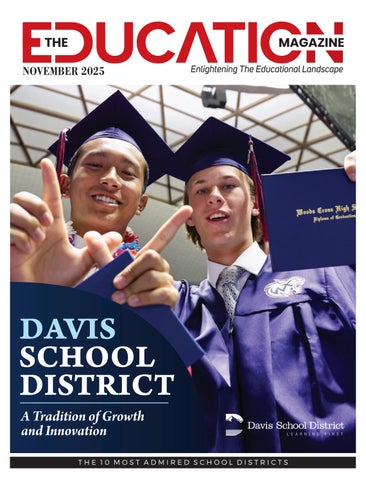
DAVIS SCHOOL DISTRICT A Tradition of Growth and Innovation THE 10 MOST ADMIRED SCHOOL DISTRICTS
Where Innovation Meets Impact in Education! Dear Readers, In an era defined by rapid technological shifts, global interconnection, and an ever-evolving job market, education stands at a decisive crossroads. Today’s learners must be prepared for a world where adaptability is as essential as knowledge, and where creativity, digital fluency, and emotional intelligence are fundamental to future success. School districts across the nation are being challenged not only to improve academic outcomes but to cultivate environments where students can thrive holistically—intellectually, socially, and personally. This edition of The Education Magazine, “The 10 Most Admired School Districts,” celebrates the institutions that are meeting this moment with purpose and innovation. These districts are not merely teaching students; they are shaping future-ready citizens through progressive programs, inclusive policies, and community-centered visions. Their dedication to bridging classroom learning with real-world relevance stands as a benchmark for educational excellence in the modern era. Our cover story spotlights a district whose journey captures the true essence of educational transformation: Davis School District. Established in 1911 with a modest enrollment of just 2,700 students, Davis began as a small, hopeful promise of structured public education. Over the decades, that promise grew—steadily, intentionally—into one of the state’s most influential academic ecosystems. Today, Davis serves nearly 70,000 students across 93 schools, but its story is not defined by scale alone. What makes Davis remarkable is its commitment to its guiding philosophy: Learning First. Behind every milestone lies a focus on nurturing the whole child—academically, emotionally, and socially. From its High Reliability Schools framework to the creation of Teen Centers supporting student well-being, and from an Office of Equal Opportunity championing equity to community-driven initiatives that uplift every learner, Davis has consistently adapted to the changing dynamics of society and education. Its journey reflects a district not only growing with time, but growing for its students. This edition also features inspiring profiles of other forward-thinking districts—Lenape Valley Regional High School District, Bradley Union School District, Syosset Central School District, and Ladue School District—each demonstrating excellence in leadership, innovation, and student empowerment. Happy Reading!
Parag Ahire Project Editor
From The Editor’s Desk People Behind This Issue Publisher: Archana Ghule Editor–in–Chief: Vikram Suryawanshi
Art Director: Priyanka Patil Graphic Designer: Harshada Mali
Managing Editor: Pankaj Gholap
Marketing Head: Robert Smith
Project Editor: Parag Ahire
Research Team: Daisy, Rahul,
Sales & Marketing
Maranda, Rocky
Project Head: Aakash Mahajan Sales Co-ordinators: Maria Smith Swati Kumari Project Manager: Dallas Hansen Rakesh Yadav Nehal Nagpure The Education Magazine is published by Pericles Ventures Pvt Ltd. This magazine contains material protected under International and Federal Copyright Laws and Treaties. You may not publish, display, disclose, rent, lease, modify, loan, distribute, or create derivative works based on the magazine contents or any part thereof, whether by yourself or as a consultant, employee, partner or in any other role unless authorised in writing by the creator/publisher of the article/, video, audio or any content contained herein. We, the team of The Education Magazine put all the efforts to keep up with the content accuracy. The publisher assumes no responsibility of any part of the content of any advertisement in this publication, including any errors or omissions therein. All rights reserved by Pericles Ventures Pvt Ltd.
Cover Story
10 DAVIS SCHOOL DISTRICT
CONTENT PROFILES 20
Bradley Union School District
34
Lenape Valley Regional High School District
50 58
Ladue School District Syosset Central School District
ARTICLES 26
AI in the Classroom: More Than a Trend, a Revolution
42
Is the Google IT Support Professional Certificate Worth It?
54
Top 10 Highest IQ in the World: Beyond the Score
Davis School District www.davis.k12.ut.us
Bradley Union School District www.bradleyusd.org
Lenape Valley Regional High School District
Delaware Valley School District
Eanes Independent School District
East Williston Union Free School District
www.eanesisd.net
www.ewsdonline.org
Glenbrook High School District
Ladue School District
Radnor Township School District
Syosset Central School District
www.lvhs.org
www.glenbrook225.org
www.rtsd.org
www.dvsd.org
www.ladueschools.net
www.syossetschools.org
DAVIS SCHOOL DISTRICT A Tradition of Growth and Innovation
Educators, parents, and community members work together to create a successful educational experience for each student.
10 I NOVEMBER 2025
Cover Story
THE EDUCATION MAGAZINE I 11
Education
has always been more than classrooms and textbooks. It is the way a community invests in its future, shaping generations who will carry forward its values and ambitions. In Utah, one school district has carried that responsibility for well over a century, quietly growing in both size and influence while staying true to a simple idea: Learning First.
The Davis School District opened its doors in 1911 with just over 2,700 students. What began as a modest effort to organize and elevate public education has transformed into the state’s second-largest district, now serving nearly 70,000 students across 93 schools. Its expansion mirrors the growth of the region itself, but the story is not only about numbers. It is also about how the district has kept pace with change, both in society and in education. Guided by the motto “Learning First,” the district has built its mission around student-centered education. This includes nurturing academic growth while also caring for emotional well-being and preparing young people for the world ahead. The vision that drives its work emphasizes dignity, evidence-based instruction, and strong community ties. Over the years, this has translated into tangible initiatives such as the High Reliability Schools framework, Teen Centers in each of its nine high schools, and the establishment of the Office of Equal Opportunity. Each step reflects an evolving focus on equity, safety, and inclusion. Today, Davis School District continues to be a leader in Utah’s education landscape. Personalized learning, ongoing professional development for educators, and active engagement with families have all become part of its foundation. The district’s evolution tells a clear story: while its roots are over a hundred years deep, its eyes are firmly fixed on the future. Academic Programs that Grow with Students Strong schools meet students where they are, then open doors to what comes next. At Davis School District, the academic journey is designed to expand with each stage of learning, from the first steps in elementary classrooms to the more specialized paths of high school. 12 I NOVEMBER 2025
Cover Story
THE EDUCATION MAGAZINE I 13
Cover Story In the elementary years, students gain a firm foundation in literacy, math, science, and social studies. The district also believes that learning is richer when it includes creativity and movement, so fine arts, physical education, and early exposure to STEM are built into the experience. These early opportunities set the stage for curiosity and confidence that carry into later grades. By middle school, coursework broadens to match students’ growing interests. World languages, computer science, and a variety of elective rotations allow them to explore new areas while continuing to strengthen core academic skills. This balance of structure and choice helps students discover where their talents and passions lie. High school introduces even more opportunities. Students can challenge themselves through Advanced Placement courses, earn college credit with Concurrent Enrollment, or prepare for the workforce through Career and Technical Education pathways. Programs like the Davis Catalyst CTE magnet school highlight the district’s commitment to career readiness, while online learning options provide flexibility for different learning styles and life circumstances. Across all grade levels, one theme remains constant: instruction is personalized, evidence-based, and aligned with Utah’s core standards. The result is a system that not only teaches but adapts, giving students the tools to succeed in school and beyond. A Changing Student Body Numbers tell part of the story, but in Davis School District, statistics also reveal how the community itself is changing. As of 2024, the district serves 69,602 students, holding its place as Utah’s second-largest. While enrollment has dipped slightly from 71,564 students in 2022, the district’s classrooms reflect a broader range of backgrounds and experiences than ever before. 14 I NOVEMBER 2025
Diversity is one of the most notable shifts. Students in the district now speak 76 different languages at home, with English, Spanish, and Marshallese among the most common. The Hispanic student population has grown from 11.5 percent in 2022 to 13.1 percent in 2024, while the Caucasian student population has declined slightly to 79.2 percent. These changes show a district that mirrors the evolving demographics of the region it serves.
Equity also lives in the curriculum. Culturally responsive materials and inclusive teaching practices are prioritized, reflecting the diversity of the student body. Educators themselves receive professional learning that mirrors these values, giving them the skills to create classrooms where all students feel seen and supported.
Economic conditions also shape the student experience. In 2022, 15.7 percent of students qualified for free or reduced lunch. By 2024, that number rose to 21.4 percent, signaling the district’s increasing responsibility to support families facing financial challenges. Alongside these shifts, 13 percent of students receive special education services, and 4.7 percent are identified as multilingual learners.
Education is not only about what happens during the school day. For Davis School District, supporting students means recognizing that learning is deeply tied to family life, health, and community stability. Through a wide network of services, the district works to meet those needs so that students can focus on their growth.
Together, these statistics point to a clear reality: the district is serving a student body that is more diverse and more complex than in the past. Rather than viewing this as a challenge alone, Davis School District approaches it as an opportunity to strengthen its mission of inclusive, personalized education. Every number represents a story, and the district’s work is to ensure each story has the chance to thrive. Meeting Students Where They Are Every student learns differently, and Davis School District has built its approach around that truth. The district’s Personalized and Competency-Based Learning (PCBL) model makes sure instruction is not a one-sizefits-all experience. Instead, it adapts to academic needs, learning styles, and even non-academic factors that shape how students grow. To make this possible, the district leans on data-driven tools. Systems like Power BI and the Harassment and Discrimination Reporting System (HDRS) allow educators to respond to student needs in real time. These tools help identify patterns, track progress, and guide decisions that keep learning on track for each individual. Support extends beyond academics. Teen Centers provide safe spaces in high schools, mental health services offer critical care, and translation assistance ensures families can fully participate in their child’s education. By wrapping these resources around the classroom experience, the district makes learning accessible for everyone, no matter the challenge.
Community Services That Go Beyond the Classroom
The Student & Family Resources Department anchors much of this work. Families can access mental health services, food and clothing assistance, and advocates who help them navigate challenges. Military-connected students receive dedicated support through a Military Support Team, ensuring that frequent moves or deployments do not interrupt their sense of belonging at school. The Davis Community Schools initiative adds another layer by connecting schools with wraparound services such as housing support, adult education, and health resources. The Davis Education Foundation also plays a central role in removing barriers to learning. Its Teen Centers in every high school provide safe spaces for students experiencing homelessness, while programs such as hygiene kits, food support, and hardship grants address immediate needs. The Foundation also funds innovative classroom projects, full-day kindergarten, STEM, arts programs, and scholarships. Community support is vital to this effort, with annual events like a gala and golf tournament raising funds to sustain these initiatives. The Foundation’s Teen Center model has been so effective that it inspired the Utah Legislature to dedicate millions of dollars for similar centers across the state. Innovation in career readiness is another hallmark of the district. The Catalyst Center, a magnet high school, offers profession-based learning in 17 different Career and Technical Education programs. Students earn certifications and concurrent enrollment credits while gaining real-world skills. The center currently serves 784 students, with another 375 on a waitlist. Its success has drawn statewide attention, leading the Utah Legislature to pass a grant program in 2024 to help other districts build their own catalyst centers and strengthen high-demand career pathways. THE EDUCATION MAGAZINE I 15
Cover Story
16 I NOVEMBER 2025
Partnerships extend into athletics as well. By working with Utah Special Olympics, the district has established Unified Sports teams in every high school, now expanding into junior highs. These teams ensure students with disabilities can compete, connect, and thrive alongside their peers.
Here, emerging leaders learn directly from experienced mentors, with a focus on mindset, vision, duty to develop, interconnection, and introspection. This cycle of growth ensures that leadership is not just sustained but continually renewed.
Beyond the Classroom: Athletics and Enrichment
Recognition has followed these efforts. For 41 consecutive years, the district has received the Certificate of Achievement for Excellence in Financial Reporting, a national award that highlights the highest standards of transparency and accountability in government reporting. More recently, Davis School District earned 13 Best of State Medals in Utah’s 2025 competition, adding to a total of 47 medals since 2019, which is more than any other district in the state. Superintendent Dr. Dan Linford also leads beyond the district, serving as President of the Utah Superintendents Association.
For many students, the lessons that last a lifetime happen after the final bell. Davis School District has built a tradition of excellence in athletics and enrichment that allows young people to grow as leaders, teammates, and community members. Across its high schools, the district offers a wide spectrum of athletic programs that give students the chance to compete, develop discipline, and build school pride. Over the years, its teams have made their mark at the state level, bringing home championships in sports as varied as cross country, golf, swimming, football, and basketball. Volleyball, baseball, softball, soccer, wrestling, and tennis have also added to that record of achievement, creating a legacy that current athletes continue to carry forward. These programs do more than fill trophy cases. They give students an outlet to channel their energy, a platform to test their resilience, and a community that celebrates teamwork. For the district, athletics are not a side note to education but an extension of it, another arena where students can learn, grow, and succeed.
A Commitment to Belonging and Inclusion For Davis School District, belonging and inclusion are not abstract goals but daily responsibilities. The district believes that safety and belonging form the foundation of both emotional and academic growth. Administrators, teachers, and staff stand united in rejecting any form of harassment or discrimination, holding firm to the principle that even one negative experience is unacceptable.
Leadership That Sets the Standard Running a district that serves nearly 70,000 students requires more than strong schools. It takes coordinated leadership, clear vision, and structures that keep every part of the system working together. At Davis School District, this responsibility rests with the Superintendent’s Executive Staff, a team that includes the superintendent, school directors, and 17 department heads. Meeting every other week, they focus on the ongoing needs of students, ensuring that decisions remain aligned with the district’s mission of putting learning first. Training plays an equally important role in keeping the district strong. Monthly meetings bring together school leaders, department heads, office managers, and the Student Advisory Council to share insights and build skills. Leadership development is also nurtured from within through the district’s own Lead in Davis program.
To protect this standard, the district has created clear processes and systems to respond when issues arise. Central to this effort is the Harassment and Discrimination Reporting System, which allows students, families, staff, and community members to raise concerns quickly and securely. Each report is investigated immediately, with oversight provided by the Office of Equal Opportunity to ensure fairness and transparency. Families also have the right to appeal if they feel the process or outcome is incomplete.This work extends across all aspects of school life, affirming the district’s promise to address discrimination tied to race, color, national origin, sex, sexual orientation, gender identity, religion, or disability. THE EDUCATION MAGAZINE I 17
BRADLEY UNION SCHOOL DISTRICT Where History Meets Tomorrow
20 I NOVEMBER 2025
B
radley, California, is a town built on tracks and trails. In 1886, when the Southern Pacific Railroad laid its line across the land of Bradley V. Sargent, a community began to take shape around the station. Later, Highway 101 brought more families and businesses, weaving the town tightly into the fabric of the region. At the center of this growing community, Bradley Union School District has quietly guided generations of students, helping them find their own paths forward. The district has always reached beyond the classroom. For more than 30 years, the annual AIDS LifeCycle ride from San Francisco to Los Angeles has passed through Bradley on Day 3. Students prepare lunch, craft postcards, and create buttons for the cyclists.The donations collected in return fund field trips, sports programs, and new technology, giving students a hands-on lesson in service and community engagement. Each year, students in the Middle School attend Science Camp — an immersive experience that provides hands-on learning, boosts academic performance, develops critical thinking and problem-solving skills, and fosters independence and confidence. Students also improve social skills through teamwork and collaboration, disconnect from technology, and gain a deeper appreciation for nature. This enriching opportunity is made possible by the generous donations from AIDS LifeCycle participants. Bradley Union School District carries a clear vision: “Pathway to the Future.” It blends respect for the town’s past with programs that prepare students for an unpredictable world. Here, history and innovation meet, giving students the tools, confidence, and curiosity to step into whatever comes next. Building Skills and Exploring Passions Bradley Union School District serves students from TK through eighth grade, following Common Core standards with carefully aligned curriculum and resources. Beyond core academics, students explore creativity and athletics through partnerships with Sol Treasures for bi-monthly Art lessons and First Tee for weekly Golf instruction. After school, opportunities abound in Guitar, Spanish, Sports, and Math support.
To guide students toward their futures, grades 2 through 8 use the Beable Career Development Platform, exploring career pathways while improving Reading skills. This approach has contributed to measurable growth in students’ Reading levels, connecting learning with personal interests. Additionally, the district’s classrooms undergo “Room Transformations” throughout the year — immersive learning experiences that increase engagement and motivation through themed lessons. These transformations make learning more memorable and enjoyable, boost student buy-in, encourage collaboration, and foster a sense of ownership, while also reducing anxiety and helping students connect with the content on a deeper level. Welcoming Every Student The school district prides itself on being inclusive, welcoming students from within the community as well as neighboring districts. The admissions process is open and straightforward, ensuring that every child has the opportunity to join the school. The district also focuses on accessibility for families from all economic backgrounds, providing programs and support to help students thrive regardless of income. The district’s growth reflects this commitment. Over the past two years, enrollment has surged nearly 50 percent, with a remarkable 38 percent increase last year alone. Serving primarily Hispanic and Caucasian students, the Bradley Union School District stands out as one of the few districts in California experiencing such rapid growth, underscoring its reputation as a welcoming and high-performing educational community. People at the Heart of Education Superintendent and Principal Josh Van Norman leads the Bradley Union School District with a focus on people. He ensures students have the support and resources they need to succeed while trusting staff to make decisions that serve students’ best interests. THE EDUCATION MAGAZINE I 21
Van Norman also emphasizes the importance of keeping families informed and engaged. “My focus is always on people, supporting students, staff, and families, and keeping clear communication about both our present work and future goals,” he says. Under his leadership, the district has built a culture of trust and collaboration, where students, staff, and families feel valued and empowered. Fostering Belonging and Personalized Learning The Bradley Union School District places a strong emphasis on creating an environment where every student feels welcomed, safe, and part of the community. One unique initiative is the creation of “Houses,” where students and staff are grouped into teams that compete in activities like relay races or Ultimate Frisbee. Creating “Houses”helps foster a stronger sense of community and belonging, building better relationships between students and staff, and providing opportunities for leadership and healthy competition. This system creates more connected groups, which improves school culture, student engagement, and overall school pride. These gatherings build pride, belonging, and school spirit. Students also explore their interests through electives offered by staff volunteers, ranging from Jewelry making and Roping to Chess and Guitar. Meeting with different staff members fosters new relationships and engagement. Classrooms include both a teacher and an instructional assistant, allowing for differentiated instruction in a multi-grade environment. Additional blocks of time are dedicated to Reading and Math support, using programs such as Read Naturally and supplemental resources to address learning gaps. During the 2024-25 school year, the district was selected to attend an international summit in Helsinki, Finland, reflecting its commitment to innovative learning and global collaboration. 22 I NOVEMBER 2025
The Bradley Union School District is also a proud member of the League of Innovative Schools — a prestigious national network, formed by Congress, that recognizes forward-thinking districts driving innovation in education and improving outcomes through technology and collaboration. This recognition highlights Bradley’s commitment to excellence, creativity, and preparing students for the future. Supporting Students and Families Bradley Union partners with Care Solace to provide students, staff, and families 24/7 access to resources for mental health, substance use, food insecurity, shelter, and affordable medical and dental care, ensuring support is available whenever it is needed. Each week, the Monterey County Free Libraries Book Mobile visits the district, allowing students, staff, and community members to borrow books and engage with literature. The district, along with Monterey County, is also planning a permanent Bradley Library Branch that will double as a Resiliency Center, offering essential support during challenging times while promoting learning and growth.The new Library will also create a space where students can borrow books, conduct research, and access the latest technology just steps from campus.
“
At Bradley, we are committed to seeing our students develop their ‘Pathway to the Future.’
THE EDUCATION MAGAZINE I 23
24 I NOVEMBER 2025
Local Partnerships and Pathways Bradley students benefit from direct access to local employers and higher-education institutions that provide internships, job-shadowing, field trips, mentorships, and career exposure. Key partners include: ● Chevron ● California Resources Corporation ● Taylor Farms ● Union Pacific ● Joby Aviation Local universities and colleges that have the opportunity to collaborate with Bradley include: ● Cal Poly San Luis Obispo ● Cal State Monterey Bay ● Hartnell College ● Cuesta College These partnerships expand student opportunities—connecting classroom learning to local industry and higher education.
Each year, the Bradley Union School District also holds the annual Bulldog Fun Run — an event created in memory of Marjorie Vicente, a beloved former student of the district. The run raises funds for the Marjorie Vicente Memorial Scholarship Fund, which provides college tuition assistance to students who have graduated from the Bradley Union School District. This cherished tradition not only honors Marjorie’s legacy but also inspires students to pursue their educational dreams. Enrichment extends beyond Sports. In addition to after school enrichment opportunities, students also participate in field trips to sites like the Monterey Bay Aquarium, Hearst Castle, and Aviation facilities, which broaden learning and spark curiosity. Collaboration at Every Level In the Bradley Union School District, staff take on multiple roles to ensure smooth operations. This collaborative approach allows every team member to support one another, creating a tightly connected environment where responsibilities are shared, and the focus remains on providing the best possible experience for students.
Student Life: Exploring, Competing, and Creating Student life at Bradley Union is filled with opportunities to explore interests, develop skills, and build community. The district hosted its first Regional Career Fair last year, connecting local schools, industry partners, and sponsors from Monterey and San Luis Obispo Counties. With over 250 attendees, the event introduced students to potential career paths and linked classroom learning to real-world experiences. Athletics play a key role in student life. The annual Bulldog Basketball Tournament brings together co-ed teams from 4th through 8th grade for a day-long competition, supported by local sponsors. Students also participate in Cross Country, Volleyball, Soccer, and Basketball against schools from across Monterey and San Luis Obispo Counties. THE EDUCATION MAGAZINE I 25
AI in the Classroom More Than a Trend, a
● A. Personalized Learning at Scale: ○ Adaptive Learning Paths AI tools now adjust the way lessons are taught based on how each student performs. The system changes speed, content, and teaching methods to fit individual needs. This helps every learner move at their own pace, without feeling left behind. ● Students learn better because the content matches their level. ● It fills knowledge gaps and supports strengths at the same time.
A
rtificial Intelligence is no longer just a futuristic idea—it’s already reshaping how students learn and how teachers teach. From lesson planning to adaptive tools, AI in the classroom is now part of everyday education. But beyond the buzzwords, this shift is more than just using a chatbot or grading software. It’s about building smart, responsive systems that help educators save time, support every learner’s needs, and improve outcomes at scale. However, the real power of AI depends on how wisely we use it. Responsible use means clear rules, strong ethics, and thoughtful planning. In this blog, you’ll explore how AI is transforming learning, how schools can use it effectively, what ethical challenges lie ahead, and why educators—not algorithms—must stay at the center of it all. The goal isn’t just smarter classrooms. It’s more inclusive, efficient, and human-centered education through the right use of AI in the classroom.
The Transformative Power of AI in the Classroom
● 25% of educators say personalized learning is the biggest benefit of AI in the classroom. ○ Addressing Diverse Needs AI tools now support students with different challenges. For example: ● Text-to-speech helps struggling readers ● Live translation supports non-English speakers ● Simplified content makes tough topics easier to understand These tools promote inclusion. According to UNESCO, AI must ensure equal learning chances for all. With AI in the classroom, education becomes more fair and accessible. ● B. Empowering Educators: Streamlining Tasks and Enhancing Instruction: ○ Automated Administrative Support AI saves time by handling common classroom tasks: ● Grading
Artificial Intelligence is no longer just a buzzword in education—it’s now part of everyday learning. From simplifying tasks to personalizing learning, AI in the classroom is helping both students and teachers in real, practical ways. As of 2025, almost every student interacts with AI tools daily, while many teachers depend on them for planning, grading, and instruction. 26 2024 2025 26 II JUNE NOVEMBER
● Feedback ● Attendance ● Timetables 42% of teachers say this is the most helpful part of using AI. It allows them to focus more on teaching, not paperwork.
THE EDUCATION MAGAZINE I 27
○ Intelligent Content Creation
○ Fostering 21st-Century Skills
Teachers now use AI to:
AI prepares students for the future by building:
● Build lesson plans
● Problem-solving
● Create quizzes and assignments
● Creativity
● Design classroom activities
● Digital literacy
In 2023:
● Critical thinking
● 38% of teachers used AI to plan lessons
58% of high school teachers noticed students became more confident.
● 37% created classroom materials using AI ● 44% said AI made their jobs easier by reducing workload
49% of college professors saw students learn faster with AI’s help. ○ Research and Revision Aids
○ Data-Driven Insights Students now use AI to: AI helps track and analyze student performance. It identifies who’s at risk, what’s working, and how to improve.
● Research topics ● Write drafts
● Teachers get clear data for smarter teaching choices ● Fix grammar and structure ● They can support each student with the right plan ● 47% of education leaders now use AI daily to make better decisions This is how AI in the classroom empowers teachers while improving outcomes. ● C. Boosting Student Engagement and Skill Development:
73.6% of students and researchers say AI makes writing and reviewing faster and easier. It acts like a smart guide that helps without doing the work for them. Navigating the Challenges and Ethical Landscape AI’s integration into classrooms brings transformative benefits, but also raises complex challenges around academic integrity, data privacy, fairness, equity, and the preservation of human-centered learning.
○ Interactive Learning Experiences ● A. Academic Integrity and the Challenge of Misuse: More than 51% of educators now use: 1. The Plagiarism Dilemma ● AI chatbots for Q&A, debates, and storytelling ● Games powered by AI to make lessons fun ● VR and AR tools to help students “experience” learning These tools increase attention and make learning more active. 28 2024 2025 28 II JUNE NOVEMBER
AI tools like ChatGPT are now used by 89% of students for homework. This change is reshaping academic honesty. At the same time, 68% of teachers rely on AI to catch plagiarism. Interestingly, while AI-generated content rose 76%, plagiarism rates dropped 51%. That shift suggests students are using AI in new ways.
Still, most teachers believe using AI for homework counts as cheating. As a result, discipline cases for dishonesty increased—from 48% to 64% this year.
This builds trust while staying compliant with privacy laws. ● C. Algorithmic Bias and Fairness:
2. Cultivating Originality 1. Understanding Inherent Biases Traditional plagiarism detectors can’t catch everything AI produces. So, many educators now encourage students to critically engage with AI outputs. They’re assigning: ● Personal reflections
AI systems can repeat the biases they learn from data. This can unfairly affect students, especially those from marginalized backgrounds. That’s why ongoing review of data sets and results is critical in classrooms using AI.
● Process journals 2. Promoting Equity ● Oral presentations Schools are adopting these fairness strategies: These assignments make it harder to depend only on AI in the classroom. Students learn to think for themselves while still using tech as a support tool.
● Diverse teams in AI design ● Regular audits for bias
● B. Data Privacy and Security Concerns: 1. Safeguarding Sensitive Information Schools have become major targets for cybercrime. In 2025, weekly cyberattacks on schools rose by 75%. Ransomware demands now average $6.6 million in lower education and $4.4 million in higher education.
● Clear, explainable recommendations from AI These practices help AI in the classroom serve every student fairly. ● D. The Digital Divide: Ensuring Equitable Access:
Educators are worried: 1. Bridging the Gap ● 51% feel uneasy about personal data safety Many students still lack access to: ● 63% are very concerned about AI-driven attacks ● AI tools AI in the classroom must include strict privacy protections for everyone involved.
● Reliable internet
2. Compliance and Transparency
● Personal learning devices
In 2025, 53% of schools have a cybersecurity plan—up from 34% in 2022. They now:
This gap creates deeper learning inequalities.
● Run regular security checks
Governments now fund:
● Encrypt student data
● Low-cost devices
● Explain how that data is used
● Subsidized connectivity
2. Policy and Infrastructure
THE EDUCATION MAGAZINE I 29
● Targeted help for underserved communities
● Define how students and teachers can use AI Set standards for honesty and fairness
These steps aim to bring the full benefits of AI in the classroom to all learners, not just a privileged few.
● Explain consequences for misuse
● E. Over-reliance and Preserving the Human Element:
In fact, many schools with strong AI policies report fewer cheating cases..
1. Maintaining Critical Thinking
2. Stakeholder Collaboration
If students depend too much on AI, their creativity may suffer. Teachers are now focusing on:
Great policies come from listening to everyone—students, parents, teachers, and staff.
● Open-ended questions
● Include all voices in discussions
● Projects with real-world applications
● Update rules often as AI tools evolve
● Personal storytelling
● Build trust and make everyone feel heard
This helps students build skills, not shortcuts.
This creates stronger support for AI in the classroom.
2. The Irreplaceable Role of the Educator
● B. Empowering Educators Through Professional Development:
AI can help with teaching. But it can’t replace a teacher’s: 1. Beyond Basic Training ● Empathy ● Motivation
Teachers need more than a quick guide. They need real, hands-on training with experts and peers.
● Judgment
● Offer regular workshops
The best schools in 2025 don’t replace teachers with AI. Instead, they use AI in the classroom to support deeper, more human-centered learning.
● Build peer learning groups
Strategic Implementation: Best Practices for Schools
Even in 2025, more than 50% of teachers say they don’t get enough AI training.
Successfully leveraging AI in education requires more than just adopting new technologies—it demands thoughtful planning, inclusive policy-making, and a commitment to continuous improvement. Here's a roadmap for schools to ensure responsible, impactful, and equitable AI integration. ● A. Developing Comprehensive AI Policies and Guidelines:
● Invite guest educators for demos
2. Cultivating AI Literacy Teachers must know what AI can and cannot do. This helps them use it the right way in class. ● Teach AI strengths and limits ● Show how to blend AI with real teaching
1. Clear Expectations ● Encourage thoughtful use, not overuse Schools must set clear rules for using AI in learning. These rules should explain what is allowed and what is not. 30 I NOVEMBER 2025
This builds confidence in using AI in the classroom the right way.
● C. Fostering Student AI Literacy and Agency:
That’s how schools keep AI in the classroom effective and meaningful.
1. Critical Evaluation Skills Students should learn how to think about what AI gives them—not just accept it.
● E. Engaging Parents and the Wider Community: 1. Transparent Communication
● Question AI answers ● Compare with trusted sources
Tell parents what's happening. Be honest and clear about goals and safety steps.
● Spot bias and errors ● Share updates on school websites Many students in AI-literate schools are better at evaluating sources.
● Show real classroom examples
2. Responsible Creation
● Explain how data stays private
Encourage students to use AI to build new ideas, not just copy.
2. Addressing Concerns
● Let them create AI tools or apps
Open the door for questions. Let parents feel involved.
● Use AI in projects and presentations ● Host Q&A sessions ● Teach them to design with ethics in mind ● Share guides or videos This makes AI in the classroom a tool for thinking, not just clicking. ● D. Measuring Impact and Iterative Improvement: 1. Assessing Effectiveness Schools should track what works and what doesn't. Use numbers and stories to get a full picture.
● Listen to their worries More than half of the parents say they support AI more when they feel included. The Future of AI in Education 1. Emerging Trends
● Monitor test scores and attendance ● Collect teacher and student feedback ● Watch how often AI is used
AI tools now customize lessons to match every student’s pace, interest, and skill level. This ensures no learner falls behind.
2. Continuous Adaptation Stay open to change. Review and revise your strategies often. ● Hold review meetings
● Students get lessons based on how they learn best ● Progress becomes faster, smoother, and more confident
● Ask for input from all users ● Improve based on real feedback
● Everyone learns at their own pace without pressure. THE EDUCATION MAGAZINE I 31
This shift shows how AI in the classroom is making education more personal and student-focused.
3. Continuous Adaptation
AI-Driven Collaborative Learning
Schools must stay flexible. As AI changes, so should policies and teaching tools.
Classrooms are becoming more interactive thanks to AI.
● Update training for teachers regularly
● AI forms study groups based on student strengths
● Ask for feedback from students and parents
● It suggests group projects and moderates online chats
● Keep improving based on what works
● Teamwork and sharing ideas become easier and more fun
By doing this, schools can use AI wisely, safely, and fairly. The future of AI in the classroom is not just about tools—it’s about smarter, kinder, and more effective learning for all.
This helps students connect, both in-person and online. Predictive Analytics
Key Takeaways AI now spots trends in how students perform. It predicts: ● Who may need extra help ● What topics are harder for certain students ● When to offer support before problems grow These tools let teachers take action early. That’s another smart use of AI in the classroom. 2. AI as a Collaborative Partner In the future, AI and teachers will work side by side. AI handles:
What’s clear is that we’ve already stepped into a world where AI is part of how we learn—and there’s no turning back. But that doesn’t mean we treat it like magic. It means we understand what’s at stake. AI in the classroom is powerful, but only when it’s used with intent. It can bring efficiency, personalization, and creativity. But if left unchecked, it can also create dependence, bias, and even widen existing gaps.
● Giving custom content
What really matters is the mindset. Schools that treat AI as a partner—not a shortcut—are already seeing better engagement and deeper learning. Teachers who see AI as an assistant, not a threat, are reclaiming time to do what machines never will—build trust, inspire, and connect.
This frees teachers to focus on what matters most—talking to students, understanding emotions, and building thinking skills. With AI in the classroom, learning becomes deeper and more human.
This shift isn’t just technical. It’s cultural. It’s about rethinking what great education looks like in a world that’s evolving fast—and making sure every learner benefits from it.
● Planning lessons ● Tracking progress
32 I NOVEMBER 2025
THE EDUCATION MAGAZINE I 33
LENAPE VALLEY REGIONAL HIGH SCHOOL DISTRICT Building a Legacy of Learning and Community
34 I NOVEMBER 2025
THE EDUCATION MAGAZINE I 35
E
ducation has long been the heartbeat of a thriving community, and in northwestern New Jersey, that heartbeat found its rhythm in 1974. When Byram Township, Stanhope, and Netcong joined together to form a single regional district, their shared goal was clear and ambitious: to create a unified school that could offer every student a strong, well-rounded education close to home. That vision gave rise to the Lenape Valley Regional High School District, a place where learning continues to grow through connection, curiosity, and care. From its earliest days, the district has upheld values of intellectual curiosity, confidence, and respect. What began as a collaboration among small towns has evolved into a vibrant educational community serving about 673 students today. Over the decades, Lenape Valley has expanded its academic and co-curricular programs, keeping pace with new ideas and priorities while remaining grounded in its core mission. Modern facilities, evolving course options, and a strong emphasis on STEM education reflect a district that never stops improving. At its heart, Lenape Valley is dedicated to preparing students to become thoughtful, independent learners and active contributors to the world beyond its classrooms. Academic Excellence Rooted in Opportunity At LVR, academics are built on both purpose and possibility. The district goes beyond meeting state requirements to create an environment where students are challenged, inspired, and supported. For a school of its size, the breadth of courses is remarkable, with sixteen AP and seventeen honors options setting a strong academic foundation. Students also benefit from College Prep, CTE programs with real-world connections, Option 2 opportunities, and independent studies through local college partnerships. Every course is brought to life by dedicated teachers whose passion for learning is reflected in the district’s consistent academic achievements and student success. School for Every Student LVR welcomes students from Byram Township, Netcong Borough, and Stanhope Borough, creating a diverse and inclusive learning community. Admission is based on residency, ensuring that every student within the district has access to quality education without selective barriers.
36 I NOVEMBER 2025
Through New Jersey’s Interdistrict Public School Choice Program, students from outside the district can also join through a lottery-based process. The school remains deeply committed to supporting families in need, offering free and reduced meal programs, guidance for navigating state and local resources, and financial aid support for those pursuing higher education. A Diverse and Steady Community During the 2023–2024 school year, LVR enrolled around 663 students in grades nine through twelve. The student body reflects the character of its surrounding communities, with approximately 79 percent identifying as White, 13 percent as Hispanic, 4 percent as Asian, and 2 percent as Black or African American, while others identify as multiracial or from different backgrounds. About one in five students qualified for free or reduced-price lunch, highlighting the district’s awareness of economic diversity. Enrollment has remained steady over time, a sign of consistent community trust and engagement across its three municipalities. Leadership with Purpose and Vision LVR thrives under the guidance of Superintendent Dr. Michael A. Rossi, Jr. and Principal Douglas Reynolds. Both leaders share a deep commitment to creating a supportive yet challenging environment where students can reach their fullest potential. Dr. Rossi draws on decades of experience as a teacher, coach, and administrator, while Mr. Reynolds provides hands-on leadership within the school community each day. Together, they champion academic excellence, innovation, and student well-being. Their shared message centers on partnership, inclusion, and opportunity. These are values that make Lenape Valley a safe, respectful, and empowering place for all students. Supporting Every Learner, Every Day At Lenape Valley, meeting students’ needs starts with strong teacher-student connections. Educators take time to understand each learner, reviewing academic data, collaborating with families, and guiding students through both classroom and extracurricular experiences. Close coordination with sending districts ensures smooth transitions into high school, while early intervention and after-school tutoring help struggling students succeed. THE EDUCATION MAGAZINE I 37
“
Our fundamental premise is to teach students how to think, not what to think.
38 I NOVEMBER 2025
The district also provides targeted support for multilingual learners and plans to introduce real-time translation tools to strengthen communication. With a dedicated counseling team and ongoing professional development, LVR ensures that every student feels seen, supported, and set up for lasting success. Connecting School and Community
A Vibrant Student Experience Life at LVR is lively, inclusive, and rich with opportunity. The district offers twenty athletic teams across Varsity, JV, and freshman levels, supported by well-maintained facilities and multiple turf fields. Nearly two-thirds of students participate in at least one sport, a testament to the strong school spirit that defines the Lenape Valley experience.
The school district believes education thrives when families and communities are part of the journey. The district offers several programs and partnerships designed to strengthen that connection. Through the Special Education Parent Advisory Group, families gain valuable insight into services and resources that support the transition to adulthood.
Beyond athletics, more than thirty clubs and activities invite students to explore their passions, connect with peers, and develop leadership skills. Whether on the field, on stage, or in the classroom, Lenape Valley students find countless ways to belong and thrive.
College Fairs, FAFSA workshops, and career readiness programs guide students as they plan their futures. Meanwhile, the Interact Club nurtures leadership and civic responsibility, giving students opportunities to serve and make a difference in their local community. At Lenape Valley, learning extends well beyond the classroom.
The leadership team at Lenape Valley Regional High School leads with purpose and example, creating a welcoming and safe environment where learning feels engaging and meaningful. Their philosophy is clear and enduring: teach students how to think, not what to think. With the future job market evolving rapidly, the district emphasizes skills that hold value in any context.
Learning for Today and Tomorrow
THE EDUCATION MAGAZINE I 39
Collaboration, creativity, problem-solving, and self-reflection are central to every classroom experience. Along with teamwork, citizenship, and effective communication, these values form the foundation of Lenape Valley’s culture and guide the smooth operation of its daily programs. Creating an Inclusive and Respectful Culture Lenape Valley Regional High School lives by New Jersey’s vision of schools as safe, welcoming, and inclusive spaces for every student. This belief is reflected in its programs, curriculum, and daily interactions. Courses such as Bias, Discrimination, and Prejudice and World Literature invite students to explore diverse perspectives, while the Unified Physical Education program brings special education and mainstream students together in meaningful ways. Clubs like the Gay/Straight Alliance and Interact encourage acceptance and understanding. With SEI training, UDL-based instruction, and AI-supported teaching, staff create equitable learning environments where every student’s voice is valued and heard.
Guiding Every Step of the Way Lenape Valley’s Guidance Department provides personalized support in academics, college planning, and career readiness. Students benefit from college fairs, financial aid workshops, and Option II programs that allow independent study, online learning, and CTE pathways in business, technology, and education. With full-time counseling and mental health services, the district prioritizes emotional well-being. These programs help students grow as confident, well-rounded individuals ready to lead and succeed beyond graduation. Looking Ahead Lenape Valley Regional High School continues to strengthen its partnership with the local community college, giving students the opportunity to earn dual credits and begin higher education as sophomores or juniors. The district is also expanding its Career and Technical Education pathways while deepening relationships with local businesses. Its long-term goal is to create a personalized learning experience for every student throughout their four years at Lenape Valley.
40 I NOVEMBER 2025
IT SUPPORT PROFESSIONAL CERTIFICATE
F
eeling stuck in your current job or unsure how to break into tech without a degree? You’re not alone. The tech industry may seem intimidating, but the Google IT Support Professional Certificate changes that. Designed by Google and hosted on Coursera, this beginner-friendly course teaches real-world IT skills—no prior experience needed. With millions already enrolled and jobready content that now includes AI integration (as of 2025), it’s become a go-to launchpad for those starting their IT career. This isn’t just another course review. What follows is a grounded, real-world analysis based on direct experience—what actually works, what doesn’t, and how to make the most of it. If you’re wondering whether it’s “worth it in 2025,” how long it takes to find a job, or if it truly fits beginners, you’ll find honest answers here, along with actionable tips to get started. What Exactly is the Google IT Support Professional Certificate? The Google IT Support Professional Certificate is a beginner-friendly course designed to help you enter the tech world fast. Created by Google experts and hosted on Coursera, the course requires no prior experience. That’s right—even if you’re new to tech, you can start. 42 I NOVEMBER 2025
THE EDUCATION MAGAZINE I 43
It’s self-paced and fits around your schedule. You can finish it in just 3 to 6 months.
The motivation behind choosing this course often revolves around career shifts, skill-building, or simply breaking into tech without a degree.
You’ll learn real-world, job-ready skills like: ● Troubleshooting and problem-solving ● Networking and operating systems (Windows and Linux) ● IT security and system administration ● Customer support and basic Python Google recently added AI-focused content in 2025. This helps learners understand how tools like Gemini power modern IT support.
The learning experience is well-structured. Hands-on labs simulate actual work environments. Configuring a Linux system or setting up networks offers real engagement, not just theory. Among the most rewarding parts were those challenging assignments, like fixing simulated network errors or managing OS-level admin tasks. These weren’t easy, but they built real confidence. That said, there were learning challenges too. The Networking module and Python basics required full focus. These topics, especially for non-tech learners, demand patience and repeated practice.
The course includes five modules: ● Technical Support Fundamentals
In terms of time, Coursera recommends 10 hours a week. But for deeper understanding, around 12–14 hours weekly felt more realistic.
● The Bits and Bytes of Computer Networking ● Operating Systems and You: Becoming a Power User ● System Administration and IT Infrastructure Services ● IT Security: Defense Against the Digital Dark Arts Imagine your Wi-Fi breaks. You won’t just restart the router. You’ll diagnose, resolve, and explain the fix, like a pro. Here’s the value: Over 2.5 million learners enrolled by 2025. According to Coursera, 75% saw career improvements in 6 months.
The content remained highly interactive. Video lessons, quick quizzes, and active community forums kept the learning process from feeling dry or robotic. One surprise was how much emphasis the course places on customer service skills alongside technical support. That blend of soft and hard skills prepares learners for real helpdesk roles. Another standout moment was realizing how early exposure to automation and scripting adds long-term value. In short, this certificate delivers practical skills, structured support, and a career-ready mindset—ideal for anyone entering IT with zero background. Is the Google IT Support Certificate Still Worth It in 2025?
The average U.S. salary after completion is $52,000/year. So, if you’re looking to launch a career in tech with low risk and high return, this certificate makes real sense. Inside the Google IT Support Certificate The Google IT Support Certificate stands out as a flexible, beginner-friendly course designed for real-world tech readiness. 44 I NOVEMBER 2025
Yes, the Google IT Support Certificate is still worth it in 2025—but only with the right expectations. Let’s look at the current landscape. The IT career outlook in 2025 remains strong. Roles in help desk support, systems management, and cloud-based troubleshooting continue to grow. At the same time, AI is automating routine tasks, but it’s also creating new hybrid roles that need both tech and soft skills.
Google has responded by adding AI-powered modules to the certificate. Learners now gain exposure to automation tools like Google Gemini, giving this course a modern edge.
When writing your IT support resume, focus on results. Use phrases like: ● “Resolved simulated network issues during hands-on labs.”
Here’s why it holds value today: ● Google’s brand recognition strengthens resumes.
● “Configured Linux systems in a lab environment.”
● The Employer Consortium opens doors to 150+ top companies.
● “Completed IT security training covering phishing, malware, and firewall setup.”
● It provides a solid base for advanced certifications like Google Cybersecurity or Data Analytics.
These reflect your actual experience from the course. Always tailor your resume to entry-level IT job descriptions, mirroring the language they use.
● Skills taught are practical and job-ready, from troubleshooting to Python scripting.
Next, prep for interviews with real IT support interview questions. Expect things like:
However, it’s important to know what it’s not. This certificate is entry-level. It won’t replace a degree or hands-on job experience. It’s not a ticket to instant high pay, but it’s a great foundation. When comparing CompTIA A+ vs Google IT Support Certificate, the A+ has broader industry recognition, while Google’s is more modern and learner-friendly. Many combine both for a stronger start. Looking ahead, this certificate will likely stay relevant and credible through at least 2028, especially as more companies embrace AI-driven IT support. For beginners, it remains a smart, future-proof way to launch a tech career, with low risk and strong upside. Landing Your First IT Support Job: Actionable Strategies Completing the Google IT Support Certificate is a strong first step. But landing the job? That takes strategy. Start with the Google Employer Consortium. This connects learners to over 150 hiring companies. Create a complete Coursera profile, highlight your course progress, and ensure keywords like troubleshooting, ticketing systems, and Python scripting are present.
● “How would you troubleshoot a printer that won’t connect?” ● “What’s the difference between RAM and ROM?” ● “Explain a time you solved a technical problem.” Use your course labs as real examples of problem-solving. For broader reach, optimize your LinkedIn profile with a clear headline like Aspiring IT Support Specialist | Google IT Certificate. Join local tech meetups, Discord groups, or alumni circles. Finally, pairing this certificate with CompTIA A+ boosts your credibility across the industry. It’s widely accepted and covers hardware, networking, and OS fundamentals, making your resume stronger. When it comes to how to get an IT job, this layered approach—skills + certification + smart outreach—is your best formula. Beyond the First Job: Your IT Career Pathway The Google IT Support Certificate gets your foot in the door—but it’s only the beginning of your IT career progression. THE EDUCATION MAGAZINE I 45
Most learners start with roles like Help Desk Specialist, IT Support Technician, or Desktop Support Analyst. These jobs build real-world experience handling tickets, troubleshooting, and supporting users across devices and systems.
Recruiters now focus on what candidates can troubleshoot, not what they studied years ago. The Google IT Support Certificate is built to be industry-recognized, especially by employers who are part of the Google Employer Consortium.
But where do you go next? “Is it too basic?” If networking sparks your interest, moving toward Network+ certification sets the stage for a Networking Specialist role. For those leaning into security, the Google Cybersecurity Certificate or CompTIA Security+ can pave the way to becoming a Cybersecurity Analyst—a field in high demand. Interested in infrastructure? Aim for System Administrator roles next. These often require deeper knowledge of servers, OS management, and access controls. The cloud path is growing fast. Cloud Administrator roles are accessible after earning certs like AWS Certified Cloud Practitioner, Google Cloud Digital Leader, or Azure Fundamentals. If automation is your strength, the Google IT Automation with Python Certificate is an ideal next step. It focuses on scripting and automating routine tasks—skills that are becoming essential across IT teams. And no matter the path, continuous learning is the real key. The tech world never stands still. Staying current with tools, platforms, and certifications keeps your skills sharp and future-ready. So when asking “What are the next steps after Google IT Support?” — the roadmap is full of opportunity. Choose a direction, learn constantly, and keep building. Debunking Myths “Do I need a college degree for IT support with this certificate?” That’s still one of the most searched questions in 2025. The truth is, no. Most entry-level IT roles today prioritize hands-on skills over a degree. 46 I NOVEMBER 2025
At first, yes—but that’s intentional. It introduces foundational concepts like operating systems, system administration, and networking in a way that’s digestible for newcomers. What’s overlooked is how those basics create the perfect launchpad for higher certifications like CompTIA A+ or Google’s own Python-based automation course. The certificate is credible and continues to be accepted by major employers even in 2025. “How long does it really take to find a job?” That depends—but on average, learners land their first IT support role within 3 to 6 months after completing the course. It varies based on location, effort, and whether you supplement the certificate with networking or additional skills. “Can I truly learn IT without prior experience?” Absolutely. The entire course is built for learners with zero background. You’re not expected to be a tech wizard to begin with. Projects, labs, and simulations guide you through real-world tasks. “Is it self-paced to the point where I’ll procrastinate?” That risk exists, yes. But those who stick to a weekly routine and engage with peers through forums or study groups usually complete the course on time. Self-discipline is key, but the structure is solid enough to keep motivated learners on track. Bottom line is this certificate works when used right: It clears the beginner barrier—but it won’t replace deep experience or a degree if those become necessary later.
Key Takeaways The Google IT Support Certificate isn’t just about landing a job—it’s about building momentum. In 2025 and beyond, IT support roles are evolving fast, especially with AI entering the picture. That means employers are no longer just looking for textbook answers—they want candidates who can think critically, solve problems, and adapt. This certificate gives you that mindset if you take it seriously. But here’s the truth: credentials alone won’t carry you. The students who actually break into IT use this course as a launchpad, not a destination. They build real labs, join LinkedIn conversations, tailor their resumes with the right keywords, and stay curious after the course ends. Want to stand out even more? Pair it with a CompTIA A+ or follow it up with Google’s Python or Cybersecurity certificates. You don’t need a degree, but you do need consistency. Ultimately, your growth in IT won’t be about how fast you complete a course. It’ll be about how often you apply what you’ve learned—and how well you keep learning. Use the certificate to get your foot in the door. But your career? That’s built one intentional step at a time. THE EDUCATION MAGAZINE I 47
I
n the intricate weave of St. Louis County, Missouri, where tradition and progress engage in a quiet dialogue, the Ladue School District stands as a testament to sustained educational distinction. It is not a monolithic entity sprung from a single blueprint, but rather a confluence of purpose drawing strength from ten distinct, self-governed communities—Ladue itself, Creve Coeur, Crystal Lake Park, Frontenac, Huntleigh, Olivette, Richmond Heights, Town and Country, Westwood, and parts of Unincorporated St. Louis County. Across these 19 square miles, home to over 27,000 residents, the district operates as a focal point of shared aspiration, even though currently, only about a quarter of these households have children walking its school halls. This broad base of community engagement, extending beyond immediate parenthood, speaks volumes about the perceived value and integral role of Ladue Schools.
50 I NOVEMBER 2025
The district’s architecture reflects a thoughtful progression of learning: an early childhood center that welcomes the youngest minds, four K-4 elementary schools laying foundational stones, a dedicated Fifth Grade Center designed to navigate a pivotal transition, a dynamic middle school fostering adolescent growth, and a high school that serves as a launchpad to future endeavors. More than 4,300 students populate these institutions on any given school day, a figure that has steadily climbed, surpassing 4,000 in the 2013-14 school year for the first time since 1978 and reaching 4,367 by the official 2024 count. This growth, a 23% surge over a decade, signals a district not just maintaining, but attracting—a beacon for families seeking educational substance.
Within these student numbers lies a vibrant diversity often unseen by the casual observer. Sixty-five primary languages echo in the homes of its families, with Chinese, Spanish, and Russian painting part of this rich linguistic landscape. This is not merely a demographic statistic; it is an active ingredient in the educational experience, preparing students for a genuinely global society. The physical environment keeps pace with its pedagogical ambitions. A community that trusts its educational stewards affirmed this by passing a significant $126 million bond referendum in April 2021. This commitment, the largest in the district’s history and passed with the second-highest approval rating even amidst a global pandemic, funded the recently completed renovations of its four elementary schools and the middle school, ensuring that Ladue’s facilities are not just current, but future-ready.
The Ladue School District was first organized in 1939, shortly after the City of Ladue’s incorporation in 1936. Early pillars like Spoede Elementary and Ross Elementary, built in the 1930s, marked its foundational years. Like many American institutions, its history includes periods of societal reckoning. A 1978 case, U.S. v Ladue School District, saw the federal government address discrimination in faculty and staff hiring. Later, in 1999, Ladue exited the Voluntary Interdistrict Choice Corporation (VICC), a city-county desegregation program. These moments, part of its complex past, underscore the ongoing journey of any enduring public institution striving for equity and excellence. Today, the district’s mission is unequivocal: “We are a community that believes in the limitless possibilities of learning.” This belief translates into fostering the highest academic achievement and personal responsibility, recognizing and respecting all cultures, challenging students to excel according to their individual talents, and inspiring them to become responsible, contributing global citizens. The vision is equally clear: “Together, we will empower every student to become a passionate learner and achieve their highest potential,” thereby setting a standard for academic excellence that serves as a foundation for productive, happy lives.
THE EDUCATION MAGAZINE I 51
The Superintendent: A Steward of Trust and Transformation At the helm of this endeavor since 2019 stands Dr. Jim Wipke, a man whose 32-year career in education is a narrative of steadfast commitment. His journey began with a Bachelor of Science in Education from Harris-Stowe State University, followed by two Master’s degrees from Southwest Baptist University, and culminating in a Doctorate in Education from Maryville University in 2008. It is a point of quiet pride for Dr. Wipke that Dr. Dan Deschamp, who handed him his Lafayette High School diploma, also conferred his doctoral degree years later—a subtle continuity in a life dedicated to learning. Dr. Wipke’s leadership philosophy is not one of edicts from on high, but of building strong, collaborative relationships with every stakeholder—students, educators, families, and the wider community. His core belief is in opening doors, in providing opportunities for all students to find the tools for success. This ethos directly fueled the passage of the historic $126 million bond issue. Leading such an initiative to overwhelming success, particularly during the uncertainty of the COVID pandemic, speaks to a deep reservoir of community trust—trust in his vision and his stewardship. The tangible results are major construction projects in five of the eight school buildings, creating learning environments designed for the future. In 2022, Dr. Wipke and his leadership team meticulously crafted a Five-year Strategic Plan, a document that continues to guide the district through its “Collective Commitments.” He views the district’s diversity not as a challenge to be managed, but as a profound strength, and has actively worked within the strategic plan to bolster these diversity efforts. This commitment is reflected in the district’s recent accolades: Niche, the education research company, ranked the Ladue School District 6th nationwide in its latest assessment, an improvement from 8th the previous year—a powerful external validation of the internal dedication. 52 I NOVEMBER 2025
One does not find Dr. Wipke confined to his office. He is a visible, approachable presence throughout the district, a familiar face at student athletics and activities. He extends his connection through a regularly updated blog and a podcast, modern tools for an age-old practice: building rapport. This hands-on engagement is not a departure from his duties but an integral part of them. His path to Ladue was paved with significant achievements elsewhere. As Superintendent of the Fox C-6 School District, he skillfully navigated financial challenges, rebuilt community relationships, and implemented programs that demonstrably improved student achievement, including increased ACT composite scores and greater participation in PSAT and advanced placement courses. Earlier, as Executive Director of Secondary Education for the Rockwood School District, and as Principal of Eureka High School and Crestview Middle School, he was known for his collaborative style, his unwavering focus on studentcentered practices, and, anecdotally, a rather effective jump shot during lunch recess basketball games at Crestview—a small detail that speaks to a leader comfortable in all facets of school life. Numerous awards punctuate his career, including the NSPRA Superintendent to Watch in 2020 and Maryville University’s 2024 Alumni School of Education Dean’s Award. Yet, Dr. Wipke is quick to attribute much of his success to the constant support of his wife, Jennifer, and the grounding influence of his family. He has coached all four of his children in soccer, a role he believes has made him a better father and a more effective educator through the daily, direct work with young people. “Our future is incredibly bright,” Dr. Wipke often remarks, “because of the amazing students at Ladue Schools.” It is a simple statement, yet it carries the weight of profound conviction. An Ecosystem of Learning and Achievement The academic heart of the district, Ladue Horton Watkins High School, consistently demonstrates the fruits of this comprehensive K-12 approach. With a graduation rate that consistently surpasses 90% (89% of 2024 graduates matriculating to college), the high school is a powerful engine of opportunity. Standardized testing results consistently place Ladue students above both state and national averages. Newsweek recognized its standing, ranking it 166th best in the nation in 2013, a significant climb from 188th just a year prior, and first in Missouri.
Ladue Middle School, formerly East Ladue Junior High, provides a crucial bridge for students in sixth through eighth grades. Its recognition as a National School of Character in May 2014 highlights an emphasis on holistic development beyond mere academics. The innovative Ladue Fifth Grade Center, established in 2013 on property re-purchased and redeveloped by the district, offers a specialized environment tailored to the unique needs of this age group. The four elementary schools—Conway, Old Bonhomme, Reed, and Spoede—each serve as nurturing grounds where foundational skills and a love for learning are cultivated. They are integral parts of their local neighborhoods, yet share the district-wide commitment to excellence. Conway Elementary, for instance, enrolled its first Black students in 1965, a historical marker in the district’s ongoing journey towards inclusivity.
The story of the Ladue School District is not one of effortless ascendance, but of deliberate cultivation. It is a narrative authored by dedicated educators, an engaged and trusting community, and a leadership that understands that true excellence is a dynamic state, requiring constant attention, adaptation, and an unwavering belief in the potential housed within every student. In an era where public education faces myriad pressures, Ladue offers a compelling model of what can be achieved when a community and its schools work in concert, guided by a clear vision and an unshakeable commitment to the future. It is, by any measure, a district to be admired.
The district’s total operating revenue is reported at $49.9 million, with operating expenses at $50.2 million. Ladue invests $11,903 per student, with teacher salaries averaging $62,697, a range that reflects a commitment to attracting and retaining qualified educators. The student-teacher ratio of approximately 13.05 allows for a degree of personalized attention often sought but not always achieved in public education. THE EDUCATION MAGAZINE I 53
Top 10 Highest
IQ IN THE WORLD Beyond the Score
W
hat does it truly mean to be a genius? Is it merely about a high score, or something far deeper? We often marvel at extraordinary minds. IQ, or Intelligence Quotient, offers one way to measure this. It gives us a score for how well our brains think. This includes problem-solving and learning new things. These cognitive abilities are key. This blog explores remarkable individuals. They possess some of the highest IQs in the world ever recorded. We will look at their amazing contributions. We also shed light on what makes intelligence truly exceptional. This topic deeply fascinates many people. Exceptional minds powerfully impact our society. They drive innovation and change. Their stories inspire us all. Let’s unlock these brilliant narratives. Understanding IQ: More Than Just a Number What is IQ? Imagine your brain as a super-powerful computer. IQ, or Intelligence Quotient, is simply a score. This score comes from a special test. It measures how well your brain works. Think of it like a report card for your thinking skills. These tests look at various abilities. They check your reasoning, problem-solving, and learning speed. For instance, the Stanford-Binet and Wechsler tests are very common. They help us understand different cognitive domains. The Nuance of IQ Scores Now, let’s talk about IQ scores themselves. 100 is considered an average IQ score. This is the center point for most people. However, scores are quite relative. Different tests can give slightly different results. Test methods also play a role. It’s not a single, fixed number for life. 54 I NOVEMBER 2025
While a high IQ is truly impressive, it’s not the only key to success. Consider this: a brilliant mind also needs creativity. Perseverance, or never giving up, is crucial. Emotional intelligence, understanding feelings, matters deeply. Practical application, using what you know, is vital too. These elements build trust and show real expertise. The highest IQ in the world might be fascinating, but it’s just one piece of a larger puzzle. Debate & Limitations of IQ So, is IQ a perfect measure? Not quite. IQ tests have certain limits. They don’t measure all types of intelligence. For example, they might not assess musical talent. They also miss artistic brilliance. Consider a great musician or a gifted artist. Their genius might not show up on an IQ test. This understanding adds balance. It shows a nuanced view of intelligence. We always seek a complete picture. It’s truly more than just a number. Here’s a list of the people with the highest IQs in the world currently, as per the USIA 1. YoungHoon Kim YoungHoon Kim founded the United Sigma Intelligence Association (USIA). This non-profit organization gathers the world’s brightest minds. It proudly includes seven Nobel Prize winners. Renowned intellectuals like Noam Chomsky also join the ranks. Furthermore, he holds an official world record for intellectual prowess. Various international bodies have verified this achievement. Kim is a truly remarkable polymath. He showcased his extraordinary memory on television. He flawlessly memorized 104 poker cards in just over 10 minutes.
Simultaneously, he serves as a Tony Buzan Honorary Professor. He also holds black belts in many disciplines. This demonstrates his diverse skills and deep mental capacity. 2. Terence Tao Terence Tao is a true giant, like an elephant with a sharp mind in mathematics. And this has not gone unnoticed which is seen as he has also been awarded the Fields Medal in 2006. This award recognized his deep work on complex equations. He also contributed greatly to prime number patterns. Specifically, with Ben Green, he showed that primes can form long chains. This theorem changed how mathematicians view numbers.
3. Marilyn Vos Savant Marilyn vos Savant held the Guinness World Record. Her IQ of 228 was the highest IQ in the world recorded then. The category retired in 1990. Since 1986, she writes “Ask Marilyn” for Parade magazine. She answers millions of readers’ tough questions. She is a brilliant logician. She became famous for solving complex puzzles. Her columns made advanced reasoning simple. She explained paradoxes to the public. Her clear explanations show her remarkable mind. She helps everyday people grasp big ideas. 4. Christopher Hirata
They often call him the “Mozart of Math.” He won the International Mathematical Olympiad very young, at 13. By 24, UCLA appointed him their youngest full professor. He believes mathematics clarifies our world. It makes things logical, not confusing. His work truly showcases what the highest IQ in the world can achieve. He reveals hidden structures in numbers.
Christopher Hirata won a gold medal at age 13. He achieved this at the International Physics Olympiad. He became the youngest American to do so. Later, he earned the Helen B. Warner Prize. This celebrated his work on gravitational lensing and cosmology. He truly pushes the boundaries of physics. THE EDUCATION MAGAZINE I 55
He was a phenomenal child prodigy. At 16, he worked for NASA. His research focused on colonizing Mars. He even wrote complex general relativity equations. He scribbled them on McDonald’s napkins during high school camp. This shows his natural, effortless brilliance. Many might consider his to be among the highest IQ in the world for theoretical physics. 5. Sho Yano Sho Yano became the youngest M.D. from the University of Chicago. He earned this degree at just 21 years old. Simultaneously, he gained a Ph.D. in cell biology. He also graduated summa cum laude from Loyola University at 12. This remarkable academic speed stands out. He is an exceptionally multi-talented individual. He read at age two and wrote by three. At five, he composed music. Furthermore, he is an accomplished pianist. He even holds a black belt in taekwondo. His diverse talents truly reflect a mind often associated with the highest IQ in the world. He truly excels across many fields. 6. Evangelos Katsioulis Evangelos Katsioulis achieved top scores in global intelligence contests. He also founded multiple high-IQ societies. These include the World Intelligence Network. As a psychiatrist, he greatly advanced psychopharmacology research. His work on antipsychotic medication is notable. He is a remarkable Greek polymath. He holds degrees in medicine and philosophy. He also excels in psychopharmacology. He showed the best physics performance among over 11,000 examinees. This happened in the Greek National Final Examinations. He belongs to over 60 high-IQ societies. This highlights a mind often associated with the highest IQ in the world. 7. Christopher Harding Christopher Harding founded the International Society. This Australian organization supports high-IQ individuals. He is also a recognized member. He belongs to many elite intellectual groups. His work fosters global intellectual communities. As a philosopher, he dedicates his efforts. He understands and nurtures gifted minds. He builds connections among them. He helps the world’s most intelligent people. His focus on community is unique. He brings together those with the highest IQ in the world. 56 I NOVEMBER 2025
8. Christopher Langan Christopher Langan developed the Cognitive-Theoretic Model of the Universe (CTMU). He claims this work is a “Theory of Everything.” It uses logic to prove God’s existence. He achieved this without a formal degree. His work still gained scholarly attention. Academic journals published his ideas. He is a truly self-taught intellectual. He created his profound theory. Notably, he worked as a nightclub bouncer. This happened on Long Island. His story proves deep thought can emerge from surprising places. He represents a unique kind of highest IQ in the world application. 9. Rick Rosner Rick Rosner is an Emmy-nominated television writer. He also works as a producer. He is famous for “Jimmy Kimmel Live!” Moreover, he contributed to game shows. These include “Who Wants to Be a Millionaire.” He wrote for many comedy specials. He is a very versatile entertainment professional. He uses his high intelligence creatively. He brings smart ideas to popular TV. He truly connects deep thinking with mass entertainment. His career shows a unique path. It proves that the highest IQ in the world can succeed in unexpected places. 10. Garry Kasparov Garry Kasparov redefined chess mastery. He reigned as World Chess Champion for 15 years. His FIDE rating of 2851 set a record. He held the world’s top rank for an incredible 255 months. Indeed, he became the youngest world champion at 22. He also amassed 11 Chess Oscars. He possesses a legendary strategic mind. He made history against IBM’s Deep Blue in 1997. This human versus machine battle captivated the globe. Moreover, he transitioned into political activism. He also became an influential author. This demonstrates intelligence far beyond the chessboard. His unique journey shows the expansive reach of a mind often cited among the highest IQ in the world. He truly impacted both games and governance.
Beyond the Score: Traits of High-IQ Individuals
Why do these stories matter to us?
What do smart people do?
These stories truly inspire everyone. They show us what’s possible. They motivate us to learn more. Moreover, they encourage innovation. We see how one big idea can change everything. Their journeys remind us of vast human potential. We feel a drive to pursue knowledge. We want to solve our own big problems. This collective pursuit leads to a smarter future.
High IQ individuals often share special strengths. First, they solve problems very well. They tackle tough puzzles with ease. Next, they learn new things fast. They also remember information quickly. Think of them as super sponges. Furthermore, their thinking is sharp and logical. They see patterns others might miss. They also have huge curiosity. They always want to know more. Moreover, they often see the world uniquely. They think outside the box. These characteristics go beyond just a number. They show real mental agility. Is intelligence just born? Many wonder about intelligence’s roots. Yes, genes play a part. Some smartness you inherit. However, your surroundings are also very important. Education helps brains grow. Learning new things builds strong connections. Opportunities also matter a lot. They give a chance to use your brain. Imagine a plant. It needs good soil and sunshine. Your brain also needs good nurture. Learning from great teachers makes a difference. Access to books helps too. The highest IQ in the world isn’t just about birth. It also involves what happens next. Consider a talented young cricketer in Pimpri-Chinchwad. Their natural talent shines. Yet, coaching and practice are vital. These elements truly develop their potential. Environment and hard work unlock full potential. This blend develops true intellectual strength. The Enduring Legacy of Genius
Does genius happen everywhere? Absolutely. Genius knows no borders. It thrives in every corner of the globe. You find it in big cities and small towns. Pimpri-Chinchwad, right here in Maharashtra, holds incredible talent. India as a whole boasts brilliant minds. They contribute to every field. These stories remind us. Every person possesses unique potential. We must nurture this talent. Investing in education helps everyone grow. Therefore, brilliance can blossom anywhere. It truly transcends all geographical limits. Key Takeaways So, what did we learn about these super brains? First, understand IQ as a valuable metric. It offers a snapshot of cognitive power. However, it’s merely a starting point. Think of it like a raw material investment. The real value comes from its application. This means high IQ is a significant asset. Second, genius extends far beyond numbers. These individuals built, discovered, and created. Their impact offers tangible returns. They solved enormous problems. They shaped our science, tech, and even art. This shows true intellectual dividends. The highest IQ in the world becomes truly meaningful through its output. It’s about what you do with that brainpower.
How do smart people change the world? Brilliant minds leave lasting impacts. They shape our entire world. For instance, they push science forward. They invent new technologies. Also, they create amazing art. They even challenge old ideas in philosophy. Think of great inventions. They make our lives easier. Consider medicines that save lives. Geniuses often bring these ideas to life. Their work becomes a rich investment in human progress. It yields incredible returns for society. The highest IQ in the world is not just a personal achievement. It sparks global advancement.
Third, potential needs cultivation. Genes provide a blueprint. Yet, environment and education are critical factors. Nurture your mind like a valuable portfolio. Invest in learning and curiosity. Provide opportunities for growth. For example, local initiatives in Pimpri-Chinchwad supporting STEM education directly contribute. Finally, intelligence is diverse. It shines in many forms. It inspires innovation globally. Their stories remind us of our collective potential. Embrace your unique strengths. Apply your own intellect purposefully. That is the real legacy of genius. THE EDUCATION MAGAZINE I 57
Engineering Excellence for an Unknowable Future
58 I NOVEMBER 2025
I
n the high-stakes game of public education, where results are king and national rankings can make or break a community’s reputation, Long Island’s Syosset Central School District is not just playing; it consistently resides near the top of the leaderboard. The real question transcends if Syosset is good. The deeper inquiry is how a district of this size sustains such a ferocious, multi-faceted level of excellence. Walk through Syosset, or its neighboring communities like Woodbury, and you’ll notice the houses. They carry a premium, a tangible marker of what it means to live within the boundaries of the Syosset Central School District (NCES District ID: 3628560).
For the 2024-2025 school year, Niche.com ranked Syosset the #2 best school district in New York and a staggering #5 in the entire United States. This kind of consistency is no accident; it’s a pattern. With roughly 6,578 students across ten schools and a student-teacher ratio of around 9.7:1 – excellent for its scale – Syosset operates as a powerhouse. Under the leadership of Superintendent Dr. Thomas Rogers, the district’s mission is suitably ambitious: “to prepare students to thrive in both the future we imagine and one which may evolve in ways yet to be envisioned.” The focus extends beyond merely acing tests; it centers on building adaptable, critical thinkers. The Syosset System: A Decade-Long Ascent The journey through Syosset’s educational landscape is meticulously structured, designed to build capacity and passion from the earliest age: · Universal Pre-Kindergarten (UPK): Here, learning is play-based but purposeful, guided by New York State Prekindergarten Learning Standards. It’s about discovery, self-regulation, and early literacy and math skills in a “richly diverse and engaging environment.” · A Constellation of Elementary Schools: Seven elementary schools (A.P. Willits, J. Irving Baylis, Berry Hill, Robbins Lane, South Grove, Village, and Walt Whitman) each foster a unique community feel, yet all align with the district’s broader goals. Common threads in their individual missions emphasize nurturing environments, home/school partnerships, respect, responsibility, and a love for learning. South Grove, for instance, was recognized as a National Blue Ribbon School as recently as 2025, a testament to ongoing excellence. · Middle School: The Pivotal Transition: H.B. Thompson and South Woods Middle Schools are designed to address the “continual emotional, physical, intellectual, and social changes” of emerging adolescence. They focus on individual growth, well-being, and stimulating intellectual and social development, preparing students for the rigors ahead. Both have earned the prestigious U.S. Department of Education Blue Ribbon School of Excellence award (Thompson in 1996-97, South Woods in 1999-2000). THE EDUCATION MAGAZINE I 59
· Syosset High School: The Apex Institution: This is where the district’s comprehensive vision truly culminates. Recognized as a Blue Ribbon School itself (1992-93), Syosset High is dedicated to preparing students for an ever-evolving world. The academic arsenal is formidable: 31 Advanced Placement courses, nine world languages, and specialized programs across major subjects. The innovative SYO+ Pathways Program even offers micro-credentials for specific career fields. Beyond the classroom, nearly 100 clubs, competitive athletics, extensive community service initiatives, an FM radio station, a podcasting lab, and a video production studio offer boundless avenues for exploration. More Than Numbers: A Culture of Achievement and PRIDE The statistics speak volumes: 78% proficiency in Reading/Writing, 87% in Mathematics, a 99% graduation rate. The average SAT score hovers around 1390, with an ACT average of 31 – metrics that consistently dwarf national averages. Students here often take Regents Exams for Algebra 1 and Earth Science in 8th grade, a strategic move allowing for more advanced coursework in high school. But Syosset’s success does not derive solely from academic pressure. The district’s vision explicitly targets “Culture, Climate and Character.” Students, staff, and parents are encouraged to exemplify “PRIDE”: Patience, Respect, Integrity, Dignity, and Empathy. There’s a deep commitment to supporting mental and physical wellness, fostering a sense of safety and belonging, and inspiring altruism. As Dr. Rogers highlighted in a recent community message, initiatives like a Bob Ross-inspired “The Joy of Painting” event at the high school aim to reduce stress and promote well-being, demonstrating a holistic approach. The arts are far from an afterthought here; they are a specialty. The district won the Kennedy Center Alliance for Arts Education Network Award (2002), and Syosset High was named a Grammy Signature school (2004) for its music programs. The mandatory foreign language program is uniquely intensive, starting with Russian in Kindergarten, Chinese in 1st grade, then choices like Italian, Spanish, or French in grades 2-4, and Latin in 5th. 60 I NOVEMBER 2025
Middle and high school offerings expand to include Korean, Japanese, and American Sign Language, reflecting the district’s diverse student body (45% Asian, 46.9% White, 4.9% Hispanic as of 2024). An Admired Model: The Syosset Proposition Why is Syosset so admired? It’s a compelling blend of ambitious vision, meticulous execution, and a community that clearly values educational excellence. Here is a district that does not shy away from setting the bar incredibly high, providing students with a vast array of opportunities, and systematically supporting them to reach their potential. From its youngest learners making discoveries in UPK to high school seniors performing at Lincoln Center, Syosset CSD demonstrates a relentless pursuit of what’s possible. The district aims to do more than prepare students for college; it endeavors to equip them with the intellectual agility, critical thinking skills, strength of character, and diverse experiences needed to navigate and contribute to a future that, as their mission states, is still unfolding. For families seeking that comprehensive, high-octane, and consistently lauded educational journey, Syosset makes a very powerful case. It’s a district that has embraced the challenge of achieving sustained excellence at scale, and the results speak for themselves.