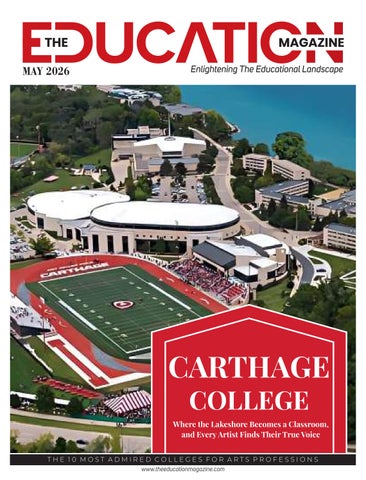
THE MAY 2026
UC TI
MAGAZINE
Enlightening The Educational Landscape
CARTHAGE COLLEGE
Where the Lakeshore Becomes a Classroom, and Every Artist Finds Their True Voice THE 10 MOST ADMIRED COLLEGES FOR ARTS PROFESSIONS www.theeducationmagazine.com
Where Talent Finds Its True Craft! Dear Readers, In a world constantly redefining what it means to be creative, some institutions do more than teach art. They shape the artists who will go on to shape culture itself. This spirit lies at the heart of “The 10 Most Admired Colleges for Arts Professions,” a celebration of the colleges quietly building the next generation of visual artists, musicians, designers and performers with purpose, patience and genuine care. Leading this celebration on the cover is Carthage College, an institution whose story began in 1847, long before most names on this list existed. What makes Carthage genuinely remarkable is not just its long age but how consistently it has stayed true to its founding belief that education should shape character as much as skill. Since relocating to its lakeshore campus in Kenosha, Wisconsin, in 1962, the College has grown into a hub for nearly 3,000 students across Art and Design, Music and Theatre. Its Aspire Program gives students structured career support from their very first year, while faculty mentorship remains deeply personal rather than procedural. Under President John Swallow and Dean Corinne Ness, Carthage continues to prove that a liberal arts foundation and serious creative training can thrive side by side, producing graduates who are thoughtful, adaptable, and genuinely prepared for professional creative life. Joining Carthage College on this list of admired institutions are Ringling College of Art and Design, Otis College of Art and Design, Berklee College of Music, and Savannah College of Art and Design, each recognised for its own distinct contribution to arts education. Together, these institutions remind us that arts education is not a single path but many, shaped by geography, discipline and philosophy, yet united by a shared belief in nurturing talent with rigour and heart. What stands out across every featured college is a refusal to separate craft from character, technique from thoughtfulness. As industries evolve and creative careers grow more complex, these colleges are not simply keeping pace. They are actively preparing students to lead. This issue is a tribute to that quiet, steady work, the kind that rarely makes headlines but shapes lives, portfolios and, eventually, entire creative industries for years to come. Sincerely,
Simran Khan
Managing Editor
Publisher: Archana Ghule Editor–in–Chief: Vikram Suryawanshi
Art Director: Priyanka Patil Graphic Designer: Tejaswini Tandale
Managing Editor: Simran Khan
Marketing Head: Robert Smith
Project Editor: Shadab Mestri
Research Team: Daisy, Rahul, Maranda, Rocky
Sales & Marketing Project Head: Aakash Mahajan Sales Co-ordinators: Maria Smith Swati Kumari Project Manager: Ritesh Fating, Nehal Nagpure, Christopher Scott
The Education Magazine is published by Pericles Ventures Pvt Ltd. This magazine contains material protected under International and Federal Copyright Laws and Treaties. You may not publish, display, disclose, rent, lease, modify, loan, distribute, or create derivative works based on the magazine contents or any part thereof, whether by yourself or as a consultant, employee, partner or in any other role unless authorised in writing by the creator/publisher of the article/, video, audio or any content contained herein. We, the team of The Education Magazine put all the efforts to keep up with the content accuracy. The publisher assumes no responsibility of any part of the content of any advertisement in this publication, including any errors or omissions therein. All rights reserved by Pericles Ventures Pvt Ltd.
10 Carthage College
PROFILES
20. Berklee College of Music 32. Otis College of Art and Design 40. Ringling College of Art and Design 52. Savannah College of Art and Design articles Best Self Development Books: 24. Power Up Your Mind With These The Unpolished Story That Builds 36. Your Influence Why Community Involvement Is 46. Key to a Better Society?
Carthage College
Berklee College of Music
www.carthage.edu
www.berklee.edu
California Institute of the Arts
Carnegie Mellon University College of Fine Arts
www.calarts.edu
www.cfa.cmu.edu
Otis College of Art and Design
Pratt Institute
www.otis.edu/index.html
www.pratt.edu
Rhode Island School of Design
Ringling College of Art and Design
www.risd.edu
www.ringling.edu
Savannah College of Art and Design
School of the Art Institute of Chicago
www.scad.edu
www.saic.edu
COVER STORY
10 I MAY 2026
CARTHAGE COLLEGE
Where the Lakeshore Becomes a Classroom, and Every Artist Finds Their True Voice
THE EDUCATION MAGAZINE | 11
T
here is something almost improbable about the fact that Carthage College has been around since 1847. That is older than the telephone, older than the light bulb, and older than almost every institution most people could name without thinking too hard. When Carthage was founded, the country was still very much deciding what it wanted to be, a frontier nation figuring out its edges, moral and geographic alike.
And yet, from its earliest days, Carthage appeared to know exactly what it wanted to be. A place of learning. A place rooted in values. A place that believed education was not simply about the accumulation of knowledge, but about the shaping of character. It is worth pausing on a particular historical footnote: President Abraham Lincoln served as an early trustee of the institution. That association is not merely trivia. It says something about the kind of institution Carthage was, even in its infancy: serious, purposeful, and connected to the broader moral ambitions of the nation. The Move That Changed Everything For over a century, Carthage did what many small colleges do. It built a tradition quietly and steadily. Then, in 1962, everything shifted. The College relocated to its current campus on the shores of Lake Michigan in Kenosha, Wisconsin. It was not merely a change of address. It was a declaration of a new kind of intent.
What Carthage Actually Believes Every college has a mission statement. Not every college has a philosophy that you can actually feel when you walk through the door. At Carthage, the foundational belief is that a liberal arts education should be integrated, experiential, and purpose-driven. The goal is not to produce students who can execute a skill on command. It is to develop the whole artist. This distinction matters more than it might first appear. There are training programs everywhere that teach technique. What Carthage is interested in is something harder to teach and far harder to measure: the ability to think critically, create boldly, and collaborate across disciplines with genuine fluency. The curriculum reflects this belief in four specific, deliberate ways. First, a liberal arts core ensures students develop a broad intellectual context, connecting their creative work to history, culture, and global perspectives. Second, experiential learning places students inside rehearsals, studios, performances, and exhibitions from the very beginning of their studies, not after they have spent years earning the right to do so. Third, collaboration is treated as a skill in itself, with students regularly working across disciplines in ways that mirror professional creative environments. Fourth, the curriculum is genuinely career-focused without sacrificing liberal arts depth, preparing students for both immediate professional success and the kind of long-term creative adaptability that sustains a life in the arts. That last point is where many arts programs stumble. Carthage appears to have found a way to hold both things at once. The Programs Themselves
From that lakeshore campus, a period of growth and transformation began that has not really stopped since. Today, Carthage College serves nearly 3,000 students and has invested more than $250 million in its academic, residential, and arts facilities over recent decades. The numbers are impressive, but what they represent is more interesting than the numbers themselves: a consistent, institutional commitment to building something durable and meaningful. 12 I MAY 2026
The breadth of what Carthage offers across the Visual and Performing Arts is worth pausing on carefully. In Art and Design, students may pursue Animation and Film, Studio Art, Graphic Design, Photography, and Art Education for grades K through 12. Under the leadership of Art and Design Chair Jojin Van Winkle, the department has deliberately expanded into Animation, Film, and New Media, a recognition that the visual arts landscape is changing and that students deserve to be prepared for where the industry is actually going.
COVER STORY
THE EDUCATION MAGAZINE | 13
COVER STORY
14 I MAY 2026
In Music, the offerings include Music, Composition, Music Education (K–12), Performance, Piano Pedagogy, Piano Performance, and Musical Theatre, available as both a BA and a BM. Music Chair Matthew Hougland oversees curriculum, ensembles, and academic quality across these programs. The College also offers a Master of Music in Music Theatre Vocal Pedagogy, a level of specialization not commonly found at institutions of this size, and a signal of how seriously the institution takes the depth of its graduate offerings. Theatre at Carthage is, by any measure, remarkable. Under the guidance of Herschel Kruger, the theatre program has earned more than 40 national awards. Students can pursue Theatre Arts (BFA), Theatre Performance, Technical Theatre, Stage Management, Playwriting, and Theatre Education for grades K through 12. What distinguishes Carthage from comparable institutions is not simply the breadth of these offerings. It is the integration. Small class sizes, close faculty mentorship, and frequent real-world performance opportunities create an environment where the distance between learning and doing is very short indeed. The People Who Make It Work Institutions, in the end, are made of people. And at Carthage, the people are worth knowing. President John Swallow sets the institutional tone, with a focused commitment to experiential learning that shapes priorities from the top down. His message to students, parents, and educators across the country reflects the ethos of the entire institution. “Carthage is a place where students are known, supported, and challenged. Students are encouraged to grow artistically, discover their voice, and use their work to make a meaningful impact in the world.” Dean Corinne Ness provides strategic oversight across all Visual and Performing Arts disciplines, leading with a focus on mentorship, rigor, and student development. Her approach reflects the broader institutional philosophy that the best arts education is not transactional but deeply relational.
Leadership here feels less like an administrative structure and more like a sustained, collective commitment to doing things exceptionally well. Getting In and Getting Support Admission to the Visual and Performing Arts programs begins with acceptance to Carthage College, followed by a program-specific audition or portfolio review. Auditions typically include prepared material, technical components, and faculty interviews. Visual arts applicants submit portfolios demonstrating range, creativity, and technical growth. What faculty are looking for is not perfection. They are looking for potential, curiosity, and the genuine capacity for growth, a distinction that says a great deal about what the institution values in its students. The admissions process is holistic by design. What the faculty want, ultimately, are students who will thrive in a mentorship-driven, immersive environment built around creative accountability. Access is taken seriously. Renewable talent-based scholarships are awarded through auditions and portfolio reviews, and the College offers multiple audition dates, virtual audition options, and transparent requirements. The commitment is to ensure that financial circumstances do not determine whether a talented student gets a chance to be seen and considered. Inside the Learning Environment At Carthage, the classroom is one part of a larger, more dynamic whole. Students participate in rehearsals, productions, studio work, exhibitions, and performances from the beginning of their time at the College. Facilities like Wartburg Theatre, Johnson Gallery of Art, and Siebert Chapel function not as passive spaces but as active learning environments where the actual work of becoming an artist happens. Low student-to-faculty ratios allow for genuinely individualized instruction. Courses are scaffolded to support skill development from foundational to advanced levels, meeting students where they are while holding them to consistent professional expectations. Transparent evaluation systems ensure equity and clarity in how student progress is assessed and communicated. THE EDUCATION MAGAZINE | 15
“
Rather than separating theory and practice, Carthage blends academic study, creative work, and real-world application.
16 I MAY 2026
COVER STORY Faculty serve as mentors in the truest sense, present in rehearsals, studios, and critiques, shaping learning through ongoing dialogue rather than periodic, isolated evaluation. Public performances and exhibitions add a dimension of professional accountability that classroom-based programs alone cannot replicate. Students are also regularly placed in multiple roles. A student might be a performer in one context, a designer in another, and a technician or leader in a third. This versatility is not accidental. It reflects the reality of professional creative life, where adaptability is often as important as virtuosity. A Program Built Around Career, Not Just Craft Supporting all of this is the Aspire Program, a nationally recognized initiative that provides structured four-year career development for students. Through Aspire, students receive mentorship from faculty and alumni networks, participate in career fairs, pursue internships, and connect with industry professionals through networking events. The result is that students graduate not only with artistic skill but with professional experience, real-world exposure, and portfolios that speak to meaningful engagement beyond the campus. The institution measures student success broadly and intentionally. Artistic growth over time, process-based learning, collaboration, professional behavior, and engagement in real-world experiences all matter. Reflective practice is central, with students regularly invited to articulate their own development and name what they have learned along the way. Post-graduate outcomes, including employment and graduate school placement, are considered, but they are not treated as the only measure of whether a student has succeeded.
What Is Coming Next Carthage is not standing still. Programs across disciplines are expanding to reflect the realities of evolving professional creative industries. In the visual arts, digital media, animation, and hybrid studio practices are being integrated into the curriculum. A new BFA in Theatre Arts is set to launch in 2026-27, with expanded concentrations in performance, design, and playwriting. The Music Department is developing new partnerships centered on integrating Estill Voice into its curriculum. Recent milestones also include the New Play Initiative, student and faculty-led dance concerts, national recognition across performance and arts competitions, and targeted facility investments of nearly $3 million. These are not cosmetic additions. They reflect a genuine effort to ensure that Carthage students are prepared for creative careers that will look significantly different in the years ahead than they do today. A Place Where Students Are Known There is a phrase that surfaces in conversations about Carthage that deserves to be sat with for a moment: a place where students are known. Not known in the abstract, administrative sense of being enrolled and accounted for. Known in the way that actually changes a person by faculty who track their development across years, by peers who collaborate with them in ensembles and casts and studio groups, by an institution that has built itself around the conviction that education, at its best, is a relationship. Since 1847, Carthage College has been refining what it means to offer that kind of education. Originally offering only the Bachelor of Arts, it has grown to include the Bachelor of Music, Bachelor of Fine Arts, and Master of Music, reflecting an evolution that is as much philosophical as it is structural. On a lakeshore campus in Kenosha, Wisconsin, that work continues with nearly 3,000 students, a faculty of uncommon dedication, and a mission that has remained, through nearly 180 years and all the change those years contain, essentially the same: to develop well-rounded individuals committed to truth, strength, and service. It is, when you think about it carefully, a beautiful thing to have been doing for that long. THE EDUCATION MAGAZINE | 17
Where Sound Becomes a Language for the Future 20 I MAY 2026
THE EDUCATION MAGAZINE | 21
M
usic schools often carry a mythology about them. There is usually a practice room somewhere with a light glowing at two in the morning. A hallway filled with scales drifting through closed doors. A piano slightly out of tune from being played too often by too many hopeful people. At Berklee College of Music, the mythology exists, but it feels less romanticized and more alive. A jazz pianist rehearses in one room while an electronic producer experiments with layered digital textures nearby. Down another hallway, a songwriter quietly revises a lyric that may eventually travel around the world through headphones and stadium speakers. There are students discussing film scoring over coffee, vocalists warming up before class, and aspiring composers carrying laptops instead of sheet music. The atmosphere at Berklee is not built around preserving music as it once was. It is built around understanding what music is becoming. Founded in 1945 by Lawrence Berk, Berklee began as the Schillinger House of Music in Boston, Massachusetts. The institution was established with an idea that felt radical for its era: music education should reflect the realities of contemporary music rather than remain tied exclusively to classical traditions. That philosophy transformed Berklee into one of the world’s most influential contemporary music institutions. Today, the college enrolls students from more than 100 countries and offers programs spanning performance, songwriting, music production, film scoring, music business, electronic production and design, and music therapy, among many others, but statistics alone do not explain Berklee’s significance. Its influence is more cultural than numerical. The school has helped redefine what modern music education can look like. A Campus That Sounds Like the World Walking through Berklee’s Boston campus can feel strangely cinematic. The city itself contributes to the rhythm of the experience. Students move between rehearsal spaces and performance venues, carrying instruments through crowded streets, often stopping to debate arrangements, collaborations, or recordings already underway. Music spills outward from classrooms into sidewalks and cafés. 22 I MAY 2026
The campus does not feel separated from professional life. It feels threaded directly into it. This closeness to industry has long been part of Berklee’s identity. The college has emphasized practical, evolving musicianship over rigid tradition. Students are encouraged to collaborate constantly, perform frequently, and adapt quickly to changing creative environments. That flexibility matters because the music industry itself has changed dramatically over the past two decades. Careers now stretch across streaming platforms, gaming, film, live performance, digital production, social media, and independent entrepreneurship. Berklee’s curriculum has expanded alongside those realities. Programs in music business and production now sit comfortably beside jazz composition and orchestration. Students often graduate not with a single specialty, but with multiple creative competencies. The institution’s merger with the Boston Conservatory in 2016 further widened that ecosystem, bringing together music, dance, theater, and performance education under one creative umbrella. The result is an environment where artistic disciplines intersect naturally. Teaching the Modern Musician There is a practical realism to Berklee’s educational philosophy that feels unusually honest. The school does not pretend that the creative industries are easy. Instead, it trains students to navigate uncertainty with adaptability, technical skill, and collaboration. Berklee’s approach centers heavily on experiential learning. Students perform constantly, work on live projects, compose for real productions, and participate in professional recording environments throughout their education. This immersion becomes especially visible in programs like film scoring, where students compose for visual narratives in ways that mirror actual studio processes. The same is true in songwriting and music production, where collaboration often resembles professional industry workflows rather than isolated classroom exercises. There is also a striking openness to technological evolution. Berklee has embraced areas such as electronic music production, immersive audio, game audio, and music technology with the understanding that creativity increasingly exists alongside digital innovation.
The institution appears less interested in protecting old definitions of musicianship than in expanding them. That perspective has helped shape generations of graduates who now influence nearly every corner of the music and entertainment industries. More than 120 Berklee alumni have received Grammy Awards, collectively earning hundreds of Grammy recognitions over the decades. Alumni include artists, producers, composers, and songwriters whose work stretches across jazz, pop, film, Latin music, classical composition, hip-hop, and global music traditions. Yet Berklee’s success is not simply measured by celebrity. What matters equally is the culture of experimentation the school sustains. Creativity Without Borders Berklee’s student body reflects the increasingly international nature of music itself. Students arrive from around the world carrying different rhythms, scales, traditions, and sonic influences. A rehearsal room may contain jazz improvisation shaped by Latin percussion, West African rhythm structures, electronic synthesis, and classical harmony all at once. That diversity is not treated as supplementary. It is central to the institution’s creative identity. The college’s programs in Valencia, Spain, along with global partnerships and international initiatives, reinforce the idea that music education must now operate across borders and cultures. There is something deeply contemporary about this approach. Music today moves globally in seconds. Genres blend constantly. Audiences discover artists across continents through algorithms and streaming platforms rather than geography alone.
Berklee appears to understand that preparing musicians for the future means preparing them for interconnectedness, and still, beneath all the technology, networking, and professional preparation, there remains something profoundly human at the center of the institution. Students come to Berklee because they are trying to articulate something difficult to explain. Sometimes it is emotion. Sometimes identity. Sometimes memory. Music often begins as an instinct before it becomes a craft. Berklee’s role has been to create an environment where those instincts can become disciplined, sustainable, and expansive without losing their individuality. That balance may be the institution’s greatest achievement. Inside practice rooms and recording studios, on performance stages and editing screens, students are not merely learning how to succeed in music. They are learning how to shape sound into connection, and in a world increasingly crowded with noise, that ability has become its own kind of artistry. THE EDUCATION MAGAZINE | 23
24 I MAY 2026
THE EDUCATION MAGAZINE | 25
26 I MAY 2026
THE EDUCATION MAGAZINE | 27
28 I MAY 2026
THE EDUCATION MAGAZINE | 29
30 I MAY 2026
THE EDUCATION MAGAZINE | 31
Where Creativity Learns to Reflect the World Around It 32 I MAY 2026
Los Angeles has a particular kind of light. It stretches across freeways and film sets, over warehouses converted into studios, through neighborhoods layered with murals, architecture, fashion, music, and reinvention. The city is restless with creativity. Ideas appear here quickly, collide unexpectedly, and disappear just as fast. Otis College of Art and Design exists inside that motion. The college does not feel isolated from the city surrounding it. Instead, it seems to absorb Los Angeles directly into its identity. Students move between classrooms and industries almost seamlessly. Fashion intersects with entertainment. Graphic design brushes against activism. Product design lives beside digital storytelling. Creativity at Otis feels tied not only to self-expression, but to observation, culture, and lived experience. Founded in 1918, Otis College of Art and Design is the first independent professional school of art and design in Los Angeles. The institution began through a bequest from Harrison Gray Otis, the publisher of the Los Angeles Times, who believed Los Angeles needed a dedicated place for artistic education during a period when the city itself was still defining its cultural identity. More than a century later, the college has evolved into one of the most respected art and design institutions on the West Coast, offering programs in areas including fine arts, graphic design, fashion design, toy design, architecture and landscape interiors, animation, product design, and game and entertainment design. But Otis is not simply preparing students to participate in creative industries. It is asking them to examine how creativity influences everyday life. THE EDUCATION MAGAZINE | 33
The Influence of Los Angeles At Otis, Los Angeles functions almost like an additional instructor. The college’s campus sits near the city’s creative and entertainment corridors, placing students close to industries that continue to shape global visual culture. Fashion houses, production studios, animation companies, galleries, design firms, and technology startups exist within reach of the classroom experience. That proximity creates an educational environment that feels unusually immediate. Students are not imagining distant creative futures. They are often already participating in them through internships, collaborations, exhibitions, and industry partnerships. There is also a distinctly observational quality to the Otis experience. Los Angeles is a city constantly negotiating identity, reinvention, inequality, innovation, and cultural influence. Otis students absorb those tensions into their work. The institution encourages artists and designers to think critically about the world around them rather than simply producing aesthetically polished outcomes. Questions of sustainability, social impact, representation, technology, and public engagement frequently appear across disciplines. That intellectual curiosity has become central to the college’s reputation. Creativity Connected to Industry Otis has long maintained a close relationship with the industries surrounding it, but it approaches professional preparation with a careful balance. The goal is not to rush students toward commercial outcomes at the expense of experimentation. Instead, the college creates opportunities for students to understand how creative practice operates within real economic and cultural systems. One of the clearest examples of this approach is the college’s annual Otis College Report on the Creative Economy, a widely recognized publication analyzing the impact of creative industries in California. The report reflects something essential about Otis itself: the institution views creativity not as a peripheral activity, but as a significant economic and social force. That philosophy carries into the classroom. Students work with faculty members who remain active professionals in their respective industries, allowing instruction to remain responsive to contemporary changes in design, technology, entertainment, and visual culture. 34 I MAY 2026
Programs such as toy design, which is notably rare in higher education, demonstrate Otis’ willingness to recognize specialized creative fields often overlooked elsewhere. The college’s connections to the entertainment and product industries have helped graduates move into companies tied to animation, gaming, apparel, and consumer design. Still, the atmosphere at Otis remains deeply personal. There is an emphasis on helping students discover not just what they can create, but why they create it. An Education Built Around Individual Voice Art education often involves a gradual process of removing imitation. Students arrive influenced by admired artists, cultural trends, visual habits, and expectations. Over time, strong creative institutions help them uncover something more individual underneath those influences. Otis appears deeply committed to that process. Class sizes remain relatively intimate, allowing students to develop close mentorship relationships with faculty and peers. Critique and dialogue become central parts of the educational experience, encouraging students to articulate the thinking behind their work as carefully as the work itself. There is also a notable emphasis on diversity of perspective. The student community at Otis reflects the multicultural character of Los Angeles, bringing together artists and designers from varied backgrounds, experiences, and creative traditions. That diversity shapes the conversations happening inside studios and classrooms, often expanding the range of stories students choose to tell, and perhaps that is what makes Otis particularly compelling within contemporary art and design education. The institution understands that creativity today is not only about aesthetics. It is about interpretation. It is about responsibility. It is about understanding how images, products, spaces, and narratives influence the way people experience the world around them. Inside its studios, students sketch, prototype, animate, photograph, edit, sew, render, and revise. But beneath all those technical processes is something quieter taking place. They are learning how to pay attention. And for artists, designers, and storytellers, that may be one of the most valuable skills of all. THE EDUCATION MAGAZINE | 35
ounders spend millions trying to craft “the perfect story.” They hire agencies, shoot cinematic videos, polish every line until it shines.
F
Why We Hide the Part People Need Most
Then they wonder why it doesn’t connect.
· Grew revenue by 300%. · Expanded to three continents. · Featured in Forbes.
Here’s the truth most PR decks won’t tell you: the story that earns influence is rarely the one you’ve polished. It’s the one you’ve lived. The Boardroom Lesson Nobody Prepares You For A few weeks ago, I sat in a room with fifteen high-performing founders. We were there for strategy, not therapy. Yet one person—without a slide deck, without the “approved” brand narrative—told a raw, unscripted account of the moment her business almost folded.
Most leaders know their résumé version of their story—the LinkedIn-approved bullet points:
But they cut the sentences that matter: · Spent six weeks sleeping on a friend’s couch to save the business. · Spent four years selling a service no one wanted before finding product-market fit. · Nearly quit the night before the big break. We cut them because they’re messy. We cut them because they’re not “on-brand.” The irony? Those are the exact lines that make you believable. The Strategic Risk of Staying Polished
She didn’t “present.” She talked. She described the week she had to choose between making payroll and paying her mortgage. She explained exactly how she called her supplier and negotiated terms to buy herself 48 hours. It wasn’t pretty. But the table went silent.
Here’s the cost of staying “safe” with your story: 1. You sound like everyone else. Polished founder bios are interchangeable. 2. You create distance. People can admire perfection, but they rarely trust it. 3. You lose leverage. Investors, clients, and partners lean in when they believe you’ve been tested and survived.
That’s when it hit me: your influence starts where your polish ends.
Every CEO I respect uses story as a tool—not as a highlight reel.
36 I MAY 2026
How to Find the Part of Your Story That Moves People Forget “crafting” for a minute. Go straight to the events that felt risky to say out loud at the time. Ask yourself: · What happened that changed the way I run my business? · When did I have to make a decision that cost me more than money? · What mistake taught me something no spreadsheet could? Those are the points of connection. That’s the material people repeat when they talk about you in rooms you’re not in. The Real Role of Vulnerability We misuse the word “vulnerability” in business.
It’s not about oversharing or emotional catharsis. It’s about strategic transparency—sharing enough of the truth to make the lesson undeniable. Here’s the filter: If the person across the table can apply what you learned to avoid a mistake, or take a calculated risk faster, it’s worth telling. If it’s just for shock value, save it for the memoir. Community Isn’t Just Comfort—It’s Currency One founder in that room said something that stayed with me: “I didn’t come here to be inspired. I came here to remember I’m not the only one in the fight.” That’s why peer communities matter. Not because you “feel seen,” but because you get operating intel from people who’ve survived what you’re in right now.
THE EDUCATION MAGAZINE | 37
When you tell the true version of your story inside a trusted circle, two things happen: 1. You get the strategies that aren’t in books. 2. You build alliances that turn into deal flow, partnerships, and backchannel introductions. This is why every serious founder I know invests in getting in the right rooms—not just for visibility, but for survival. The Business Case for Telling the Real Story I’ve watched leaders triple their speaking fees, close seven-figure contracts, and land media features—not by adding more success stats, but by revealing the turning points behind them. The mechanics are simple: · Raw detail makes it memorable. “I was down to my last $412” sticks longer than “we were struggling financially.” · Specificity signals truth. People instinctively trust stories with dates, numbers, and real stakes. · Struggle signals credibility. If you’ve been through it, you can help others navigate it. Your story is not PR fluff. It’s an asset with a measurable ROI.
38 I MAY 2026
If You’ve Been Editing Yourself Down Consider this your push to stop sanding off the edges. You don’t need a dramatic overhaul. You need to reintroduce the human stakes into your origin, your turning points, and your current play. Try this: · Identify one story you’ve been avoiding because it feels too raw. · Write it in bullet points—just the facts, no adjectives. · Decide which parts connect to the value you deliver now. · Share it in a room where the return could be real—whether that’s a sales meeting, investor pitch, or strategic peer group. Final Word Your polished story may get polite nods. Your real one will get remembered, repeated, and relayed to decision-makers you’ll never meet. In business, being known isn’t about telling people what you’ve achieved—it’s about showing them what you've survived, and how that shapes the way you lead. Don’t wait for permission. Don’t wait for the “right” moment. The right moment is the one you decide to stop hiding the part that makes you credible. Lift the filter. Tell the truth. That’s how influence starts.
RINGLING Where Storytelling Becomes a Way of Seeing the World
T
here is a particular intensity to places built around imagination. You notice it first in the small things. A student balancing a sketchbook and a laptop while crossing campus at sunrise. Someone is editing animation frames long after midnight. A classroom wall layered with concept art, unfinished ideas, color studies, and visual experiments that may eventually evolve into films, games, advertisements, illustrations, or experiences seen by millions of people. At Ringling College of Art and Design, storytelling seems to exist everywhere. Not only in the formal sense of animation or filmmaking, but in the broader understanding that design itself tells stories. So does illustration. So does game art, motion design, photography, architecture, and visual development. Every creative decision communicates something about how people see the world and how they move through it. Founded in 1931 by Dr. Ludd M. Spivey, with support from circus entrepreneur John Ringling, the college began during a period when Sarasota, Florida, was emerging as a cultural destination connected to performance, art, and spectacle.
40 I MAY 2026
Originally established as a small art school, Ringling College has grown into one of the most respected creative institutions in the United States, particularly recognized for its strength in animation, illustration, game art, and entertainment design. Today, the college offers degree programs across disciplines, including computer animation, film, motion design, graphic design, fine arts, virtual reality development, illustration, game art, photography and imaging, and business of art and design. Yet what distinguishes Ringling is not simply the range of programs. It is the atmosphere of immersion surrounding them. A Campus Built Around Creative Momentum Some colleges separate academic life from professional ambition. Ringling seems designed to collapse the distance between the two. The campus itself reflects this philosophy. Studios remain active late into the night. Collaborative projects move constantly between disciplines.
THE EDUCATION MAGAZINE | 41
Students critique one another’s work with a seriousness that resembles professional creative environments more than traditional classroom routines.
Creativity and Technology in Conversation
There is a noticeable sense that students here are preparing not only for graduation, but for industries that demand adaptability, resilience, and continuous innovation. That preparation becomes especially visible in Ringling’s nationally recognized computer animation program. For years, the program has earned international attention for producing graduates who move directly into leading animation and entertainment studios.
Ringling’s evolution mirrors the changing nature of creative industries themselves. The college has embraced emerging technologies while maintaining a strong emphasis on foundational artistic skill. Students learn drawing, composition, narrative structure, and visual communication alongside digital tools, virtual production technologies, and immersive media platforms.
The annual student thesis films created within the department have become a defining part of the college’s identity. These films are not treated as classroom exercises. They are developed with the level of technical precision, collaborative workflow, and storytelling discipline expected in professional studio environments.
This balance matters because technology alone rarely sustains meaningful creative work. Ringling appears deeply aware that strong storytelling still depends on observation, empathy, timing, and emotional clarity.
Watching them, one senses the intensity behind the process: months of rendering, editing, revising, animating, scoring, and problem-solving compressed into a few minutes of emotional storytelling. That experience shapes students long before they enter the workforce.
Programs such as virtual reality development and game art reflect the institution’s understanding that storytelling now unfolds across interactive environments as much as traditional media.
42 I MAY 2026
At the same time, the college maintains a strong focus on entrepreneurship and career preparation through initiatives tied to portfolio development, internships, networking, and industry engagement.
Ringling creates an environment where those instincts are taken seriously. Faculty mentorship plays an important role in that process. Students work closely with instructors who help refine not only technical execution, but also conceptual thinking and personal direction.
There is a practical realism embedded in the educational experience. Creative careers can be exhilarating, but they are also demanding. Ringling prepares students for that intensity while encouraging them to preserve individuality within highly competitive industries. That tension between artistic voice and professional expectation is something many creative institutions struggle to navigate. Ringling handles it with notable clarity.
The result is a campus culture where creative identity develops gradually through experimentation, critique, collaboration, and persistence. There is also an unmistakable emotional investment students place in their work. Walk through exhibitions or student showcases, and the projects rarely feel detached or purely commercial. They carry traces of vulnerability, humor, curiosity, memory, and ambition.
The Human Side of Visual Storytelling Despite its technological sophistication and industry reputation, Ringling remains deeply centered on human connection. The college attracts students who are often trying to communicate experiences difficult to express through ordinary language. Some arrive fascinated by animation because it allowed them to imagine different worlds as children. Others are drawn to illustration, photography, or game design because visual storytelling gave shape to emotions they could not yet articulate.
Perhaps that is why Ringling continues to resonate so strongly within arts education. The institution understands that modern visual storytelling is not merely about software proficiency or technical polish. It is about building experiences that people remember. It is about helping audiences feel wonder, empathy, excitement, nostalgia, or connection through images and narratives. Inside Ringling’s studios and labs, students are learning how to construct those experiences frame by frame, sketch by sketch, scene by scene, and somewhere between the technical precision and the emotional risk required to create meaningful art, they begin shaping not only stories, but themselves.
THE EDUCATION MAGAZINE | 43
46 I MAY 2026
E
ver get that feeling where you look around at your town, your neighborhood, and you just think, “Hmm, I wonder if I could contribute somehow?” It’s not always a booming thought, more like a quiet little nudge, right? And that, in a nutshell, is often the starting point for what we call community involvement. It’s not about having to join a million committees or anything like that (unless you want to!), but it’s more about those moments where you decide to actively participate in making the place you live a little bit better, a little more connected. Think about it – maybe it’s helping out at a local food bank, or just offering a hand to a neighbor who’s struggling with their groceries. Those small things? They really add up. And you know, in a world where we’re often glued to our screens, actually engaging with the people and places around us can be surprisingly fulfilling. So, in this blog post, we’re going to kind of wander through this whole idea of community involvement. We’ll look at why it’s actually important (beyond just feeling good), explore a whole bunch of different ways you can get involved, no matter how much time you have, and yeah, we’ll even touch on some of the things that might make you go, “Ugh, I don’t know about that.” Ready to explore how you can be a more active part of your community?
So let’s unpack the power of community involement. The “Why” beyond the feel-good: Benefits of community involvement You ever just kinda feel like connecting with folks around you, right? It’s not always gotta be some big organized thing, just a little feeling you wanna be more part of things. That’s often where community involvement sort of pops up, you know? It ain’t always about joining tons of committees (unless that’s your thing!), but more about those everyday moments you decide to be part of what’s happening in your neck of the woods. Think of it: your community? Like a big old potluck, and community involvement is you bringing your dish.
THE EDUCATION MAGAZINE | 47
Why bother, though? Well, solid reasons beyond just feeling good. For you: ● You Get Good at Stuff! Seriously. Community projects teach unexpected skills logistics, listening, teamwork. And get this: a 2013 study actually found that volunteering is associated with a 27% higher odds of employment. That’s pretty significant, right? The study looked at data from 2002-2012 and found this was statistically significant. Interestingly, for folks without a high school diploma, that increase jumped to 51%, and for those in rural areas, it was a whopping 55%! So, yeah, it’s not just about helping out; it can really help your career too.
● Helps Fix Real Problems. Got an issue in town? Food bank low? Park rough? Community involvement is where folks band together to act. ● Can Even Help Local Businesses, Believe It Or Not. Community where folks care and are engaged? Tends to be a more attractive place, helps local shops thrive, benefits everyone. So, yeah, that warm fuzzy feeling? Definitely a plus. But the real power of community involvement? Stronger individuals, more connected, resilient communities.
● It Lifts Your Spirits, For Real. Explore the different levels and types of community involvement
Feeling down? Getting involved can be a great pick-me-up. Research indicates that social support can benefit symptoms of depression in 83% of studies involving non-pregnant women. Plus, studies have found that volunteering has significant positive effects on mental health overall. Volunteers often report better physical health and lower rates of depression compared to those who don’t volunteer. In fact, one study showed that an additional participation in voluntary services resulted in an 8.54% increase in mental health and a 4.30% decrease in depression. And get this: 93% of volunteers reported an improved mood, and 79% reported lower stress!
You know, it’s funny, the way people get involved in their communities. It’s never just one thing, is it? Like, you see some folks who are just naturally drawn to the big, organized stuff, the committees and the official meetings. And then you’ve got others who, you know, they just quietly do their thing, helping out a neighbor or picking up litter in the park. That whole spectrum, that’s community involvement, really. It’s this big, sprawling thing with all sorts of ways to jump in, depending on what clicks with you.
● You Just Grow, You Know?
1. Formal Volunteering
Stepping outside your usual routine, meeting different people, seeing their viewpoints it changes you, makes you more understanding. Kinda like travel, no jet lag.
This is what most people probably picture, right? Signing up with a real-deal organization the local animal shelter, the food bank that’s always hustling, those folks trying to save the planet. You give ‘em your time, maybe your skills, whatever you’ve got. It’s a solid way to feel like you’re contributing something tangible, you know?
And for the community: It’s the glue holding it together: ● Makes Things Stronger, No Lie. When people get involved, they connect. The metric for social capital, which includes participation in community organizations, shows this. A cross-sectional study even looked at how economic connectedness, social cohesion, and civic engagement relate to health across all US states. Plus, the 2024 American Social Capital Survey highlights the importance of these connections, even noting racial and class divisions in how social capital is formed. It really underscores how community involvement is key to building those vital community bonds. 48 I MAY 2026
2. Civic Engagement Ever feel like things could be better in your town? Well, this is where you can actually try to do something about it. Voting, obviously, that’s key. But it’s also about reaching out to your representatives, showing up at those sometimes-kinda-boring local government meetings, and just generally being aware and participating in how your community is run. It’s your place, after all.
3. Philanthropy
Addressing Potential Challenges and Difficulties
This doesn’t mean you have to be rolling in dough, by any means. It’s about giving what you can, whether it’s a few bucks to a cause you believe in, donating clothes you don’t wear anymore, or even organizing a little bake sale to raise money. Every little bit, as they say.
Alright, so getting involved in your community? Sounds great, but real life happens, right? Time can feel impossible to find. The thing is, it doesn’t have to be huge. Think small even 15-30 minutes a week helps. Micro-volunteering online or short projects can work. Find those little pockets of time.
4. Informal Community Building You know, I sometimes think this is the most underrated part of community involvement. It’s the little things helping your elderly neighbor with their mail, starting a neighborhood garden, just being friendly and saying hi to people you see around. It’s those small connections that really make a community feel like… well, a community.
Then there’s the “Where do I even start?” feeling. Overwhelming, right? Think about what you care about animals, environment, kids? Google local groups doing that. Their websites usually list needs. Don’t hesitate to reach out and ask what help they need. Working with different people? Can be interesting. Different views, personalities. Sometimes you clash. Remember the shared goal. Patience and good communication are key. Feeling like a tiny cog? Especially in big organizations, impact can feel small. Try smaller, local groups where you see the difference more directly. Or ask the organization how your help contributes.
5. Skills-Based Volunteering What are you good at? Seriously, think about it. Got a knack for fixing computers? Maybe the local library could use your help. Good at writing? Non-profits always need help with that kind of thing. It’s a cool way to use your specific talents to make a real difference. 6. Digital Involvement These days, you can even get involved without leaving your couch (though maybe get up and stretch sometimes!). Online petitions, social media campaigns for good causes, even virtual volunteering gigs – there are tons of ways to contribute using the internet. It’s pretty wild, actually. Honestly, when you look at all these different ways to get involved, it kind of hits you that there’s something out there for pretty much everyone. It’s just a matter of figuring out what makes you tick, what you care about, and how you can best use your time and talents. And trust me on this one, even the smallest bit of community involvement can have a bigger impact than you might think. THE EDUCATION MAGAZINE | 49
The cool surprise? The folks you bump into. Seriously, at the shelter, I’ve met some of the most awesome people, all into the same kinda stuff. Makes showing up way easier when you know your buddies’ll be there. And don’t forget to praise yourself! Although it may seem like a small thing, as they say, “A stitch in time saves nine.” Realize that, and maybe then you can give yourself a break or get some good night’s sleep knowing what you deserved! Making community involvement a thing you stick with is really about finding your own rhythm and, yeah, enjoying the ride. It’s those small, regular actions that end up meaning the most, ya know? Key Takeaways
Is what I’m doing even mattering? You don’t want to waste time. When looking at opportunities, understand their mission and how volunteers help. Ask about past impact. This helps you feel your involvement is valuable. Look, community involvement isn’t always easy. There can be hiccups. But by being smart about it and trying different things, you can find ways to contribute that work for you and make a real difference, even if it feels a little awkward sometimes. Making community involvement a sustainable part of your life So, you wanna make this community involvement thing a real, lasting thing, right? Here’s how it kinda works for folks, and you know, for me too, a little bit: What really gets you going? Like, what do you actually care about? Whenever you step out, it should feel like something you’re doing for your own happiness. Any activity you’ll be doing should not feel like a burden or a job to you. And that could be anything like feeding stray animals, birds or even going to the park and meeting people and doing some activity with them and being engaged with them. Totally up to you. Don’t think you gotta be a superhero right off the bat. I remember when I first started, I just offered to walk the dogs once a week. Tiny thing, but it was consistent. That’s the secret sauce, I reckon – little bits, regularly. 50 I MAY 2026
In the winding down of our community involvement series, here are some key concepts to take away and actually move the dial with however that looks on the volunteer end/rendezvous. These are the threads that run through all the different lives of engagement you can participate in. ● Every time you step up, however small, create a chain of positive impact. ● Identifying your area of interest is a must if you want that level of involvement in order for it to be sustainable and enjoyable in your life. ● The relationships you build while working inthe community are frequently as important to you, if not more so, than the work. Be sure to credit the work you put in, every little bit creates a big impact towards a stronger community. In the end, community involvement is about seeing that we all have a duty together and just how amazing collective action is. A lifelong adventure that enhances not only the person but also the entire community.
Where Creativity Learns to Speak to the World
T
here are certain campuses that announce themselves immediately. They rise from the landscape with stadiums, marble entrances, and the unmistakable rhythm of institutional certainty. Savannah College of Art and Design does something else entirely. It unfolds slowly.
And yet, what makes SCAD remarkable is not simply its scale. It is the way the university has managed to make art education feel deeply connected to the real world without stripping it of imagination.
A student turns a corner in Savannah and walks past a restored historic building glowing amber in the late afternoon light. Another steps into a studio where fashion sketches are pinned beside digital animation sequences. A filmmaker carries camera equipment across a cobblestone street while architecture students gather around a model that looks impossibly delicate and impossibly ambitious at once.
Savannah itself feels inseparable from the SCAD experience.
At SCAD, creativity is not tucked into a department. It is the atmosphere itself. Founded in 1978 by Richard G. Rowan, Paula Wallace, May L. Poetter, and Paul E. Poetter, SCAD began with a vision that felt unusually specific for its time. The institution was created to provide degree programs that were not available in the Southeast and to establish a professional university devoted entirely to art and design. Nearly five decades later, that idea has expanded into one of the most recognized creative institutions in the world. Today, SCAD enrolls more than 18,500 students from all 50 states and more than 100 countries, offering over 100 degree programs across a broad spectrum of creative disciplines. 52 I MAY 2026
The City as Classroom
The university’s Savannah location stretches through nearly 70 restored historic facilities, woven into one of the largest National Historic Landmark districts in the United States. The city becomes part of the curriculum. Students do not merely attend classes here. They move through a living environment shaped by architecture, texture, preservation, and visual storytelling. There is something quietly persuasive about that setting. Creativity at SCAD does not happen in isolation from daily life. It happens among cafés, galleries, restored theaters, and streets lined with centuries-old oak trees. The result is an education that feels immersive rather than segmented. “The whole city is your main campus,” fashion designer Wes Gordon once observed about SCAD Savannah. The statement captures something essential about the institution’s philosophy.
THE EDUCATION MAGAZINE | 53
SCAD also operates locations in Atlanta and Lacoste, France, along with SCADnow online, allowing students to move fluidly between environments and perspectives without interrupting their studies. Creativity With Professional Intention Art schools are often imagined as places of beautiful chaos. SCAD has always seemed more intentional than that. From the beginning, the university approached creative education with an unusually practical understanding of industry. Students are encouraged not only to master artistic technique but also to understand collaboration, communication, branding, technology, and professional readiness. That philosophy appears most clearly in initiatives like SCADpro, where students collaborate directly with major global brands and organizations on real-world projects. The experience resembles a professional creative studio more than a classroom exercise. The university’s programs stretch across disciplines that mirror the evolving creative economy: animation, industrial design, visual effects, fashion, game development, film, user experience design, architecture, and immersive media, among many others. This interdisciplinary structure matters because modern creative industries rarely operate inside neat boundaries anymore. Designers work alongside technologists. Animators collaborate with writers. Fashion intersects with digital media. SCAD appears to understand that contemporary creativity is increasingly collaborative, fluid, and technologically sophisticated. That understanding has helped position the university as a consistent presence in international rankings and design recognition. In 2025, SCAD was ranked the No. 1 design university in the Americas and Europe in the Red Dot Design Award Rankings and placed among the top five universities globally. Still, rankings alone rarely explain the emotional pull of a school like SCAD. The real measure often appears in the work students create. 54 I MAY 2026
Preparing Artists for an Uncertain Future Creative careers have always carried a certain unpredictability. Every generation of artists eventually confronts the same quiet question: Can imagination become a sustainable life? SCAD’s answer has been to make professional preparation inseparable from creative exploration. The university invests heavily in technology, industry partnerships, career resources, and experiential learning. Across its campuses, students work with professionallevel equipment and facilities that mirror the environments they may eventually enter after graduation. In disciplines like interior design, the university has emphasized what faculty members describe as producing graduates who are “practice-ready.” Programs integrate business knowledge, communication skills, emerging technologies, and interdisciplinary thinking into studio education. That balance between artistic identity and professional confidence has become central to SCAD’s reputation. The university’s influence is especially visible in the entertainment and media industries. SCAD alumni have contributed to Emmy- and Oscar-nominated productions, major fashion houses, game studios, animation companies, and global design firms. What emerges from SCAD is not one singular artistic style. It is something more adaptable: creators who understand how to move between imagination and execution.
THE EDUCATION MAGAZINE | 55
A Global Creative Community Walk through SCAD today, and the diversity of perspectives is immediately visible. Students arrive from more than 100 countries, bringing with them different visual traditions, cultural references, artistic languages, and ambitions. In many ways, this international atmosphere mirrors the industries students hope to enter. Creative work has become increasingly global, collaborative, and digitally connected. SCAD’s president and founder, Paula Wallace, has often framed the institution as a place where creativity can become a form of influence and service. That idea extends beyond commercial success. Programs like SCAD SERVE demonstrate how design education can address issues such as sustainability, housing, community development, and social impact. Students work on projects tied to food access, urban equity, environmental design, and nonprofit partnerships throughout the South. It is one of the more interesting dimensions of SCAD’s identity. The university does not present creativity merely as personal expression. It presents it as infrastructure for modern life, and perhaps that is why the institution continues to resonate with aspiring artists who want more than technical instruction. They want momentum. They want immersion. They want the feeling that creativity belongs not at the edges of society, but near its center. SCAD seems built around that belief. Inside its studios and theaters, across historic buildings and digital labs, among students sketching, editing, designing, prototyping, and imagining, there is a persistent sense that art here is treated not as decoration, but as possibility. And possibility, once taken seriously, has a way of changing entire lives. 56 I MAY 2026