175 YEARS AT THE SUMMIT CELEBRATE MOUNT DIABLO’S INITIAL POINT
By Traci Wyss
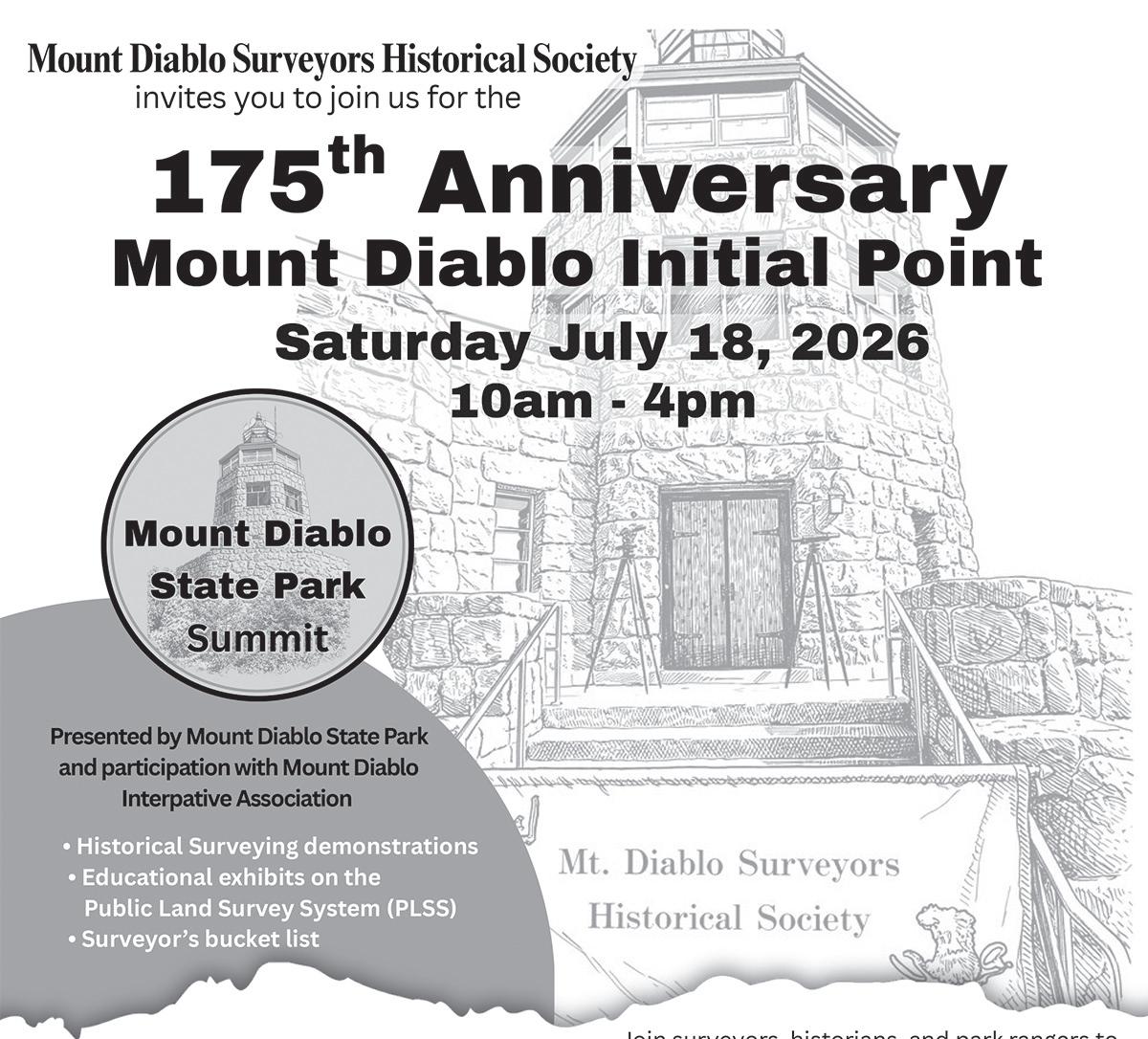
A mountain with geological roots dating back four million years might not seem a likely subject for a 175th anniversary celebration, but that is just what will take place on July 18, 2026, on our very own Mount Diablo. This event atop the mountain, sponsored by Mount Diablo State Park, the Mount Diablo Interpretive Association, and the Mount Diablo Surveyors Historical Society, will celebrate the date in 1851 when the Mount Diablo Initial Point was established. The Initial Point served as the primary survey reference point for mapping most of Northern California and all of Nevada.
Let’s understand a bit more about why, when, and how the Initial Point was set, and find out how you can celebrate this moment in history by packing up the family and heading to the top of Mount Diablo on July 18th!
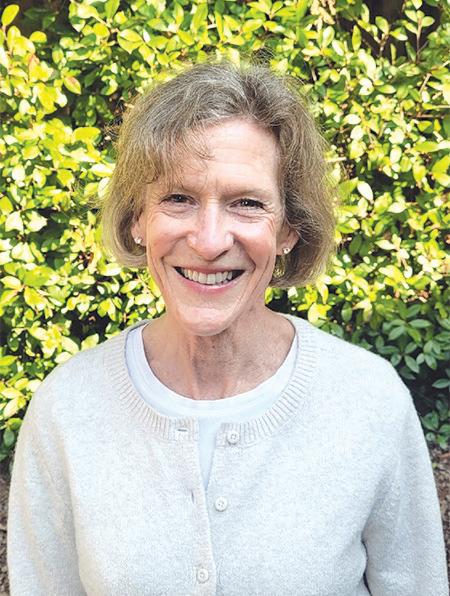
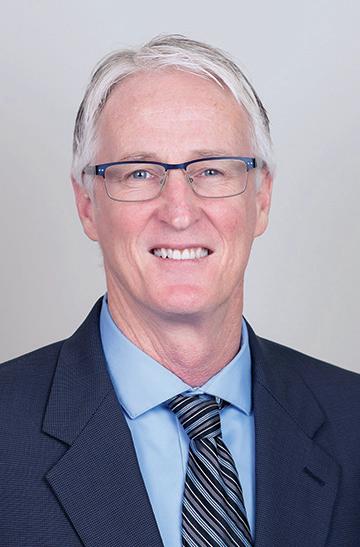
John Pettley of the Mount Diablo Surveyors Historical Society and Stephen Smith, President of Mount Diablo Interpretive Association, shared in a joint interview about both the historical context of the moment in 1851 and how the Initial Point laid the groundwork for land surveys in Northern California and Nevada.
The California Gold Rush began in 1848 as many people came out to California hoping to strike it rich. Many found themselves in need of another plan when they fell short of success and life proved to be harder than anticipated in the West. People began leaving their gold mining dreams behind in search of rich farmland and other forms of work. As people squatted on land and began setting up their own homesteads and farmlands, land disputes grew common and challenging to resolve.
While the Public Land Survey System (PLSS) had been established in 1785 to divide land into square-mile sections for settlers, California at the time of the Gold Rush didn’t have clear boundaries set. The federal government needed a way to subdivide land using the U.S. survey system to avoid conflicts. U.S.
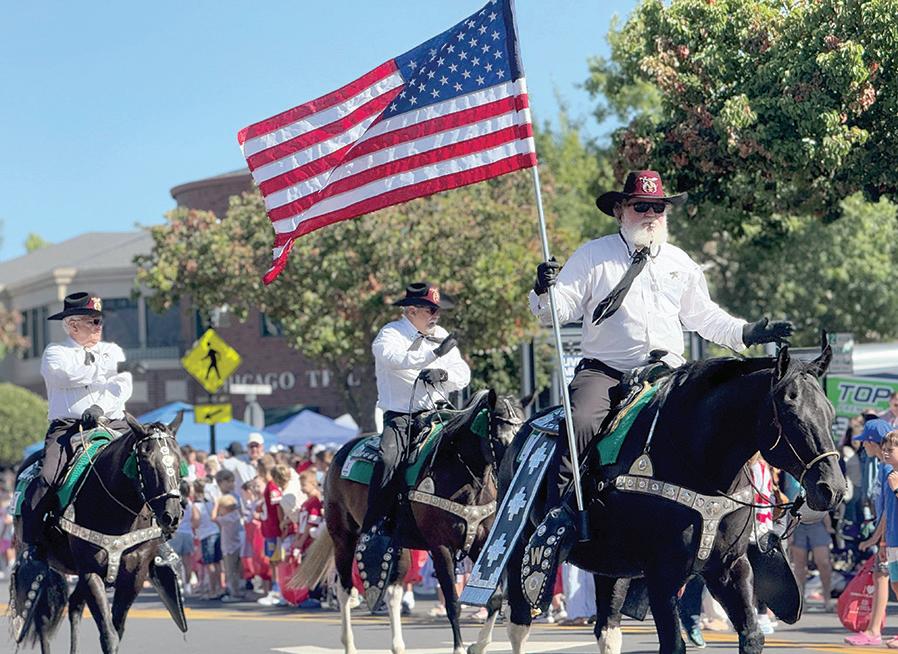
SAVE THE DATE
July 4th ~ 9AM Downtown Danville
THE GREEN SCENE A QUIET CURRENT OF LIFE: DISCOVERING SAN RAMON CREEK
By John-Noah Chang
In the rush of everyday life, it’s easy to overlook a tranquil stream peacefully weaving its way through our community. San Ramon Creek does exactly that, slipping past roads, neighborhoods, and backyards, often unnoticed. But pause for a moment and take a closer look, and it reveals something remarkable. This narrow ribbon of water holds a rare and vibrant ecosystem thriving right in the middle of suburban Alamo and Danville.
The San Ramon Creek stretches roughly 19 miles, running north from Alamo through Danville before joining with the Walnut Creek watershed. From there, its waters continue on a much longer journey, draining nearly 54 square miles and eventually flowing into the Carquinez Strait and San Francisco Bay. Its headwaters begin high in the hills, fed by springs and streams from Las Trampas Wilderness and Mount Diablo.
Despite its hidden nature, there are places where the creek reveals itself. The Iron Horse Trail runs alongside it in several stretches, offering glimpses of water and wildlife. The Stone Valley Road bridge provides one of the clearest vantage points, where you can stop, look down, and hear the steady, calming flow of water beneath you. Some of us have the creek running through our properties.
BIODIVERSITY
At first glance, it might not seem like San Ramon Creek supports much life. But it is a biologically active system, functioning as a vital wildlife corridor that supports both land and aquatic species. Along its banks and within its waters, you can find birds, bats, insects, and dragonflies, all playing roles in a complex ecosystem. Beneath the surface, species such
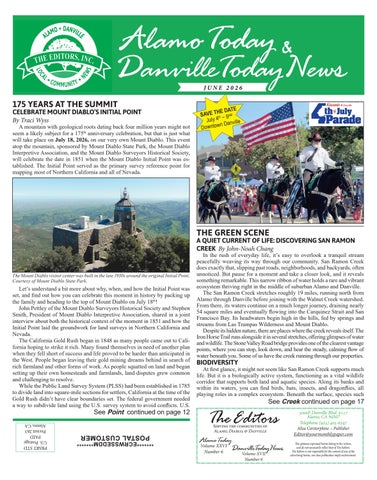
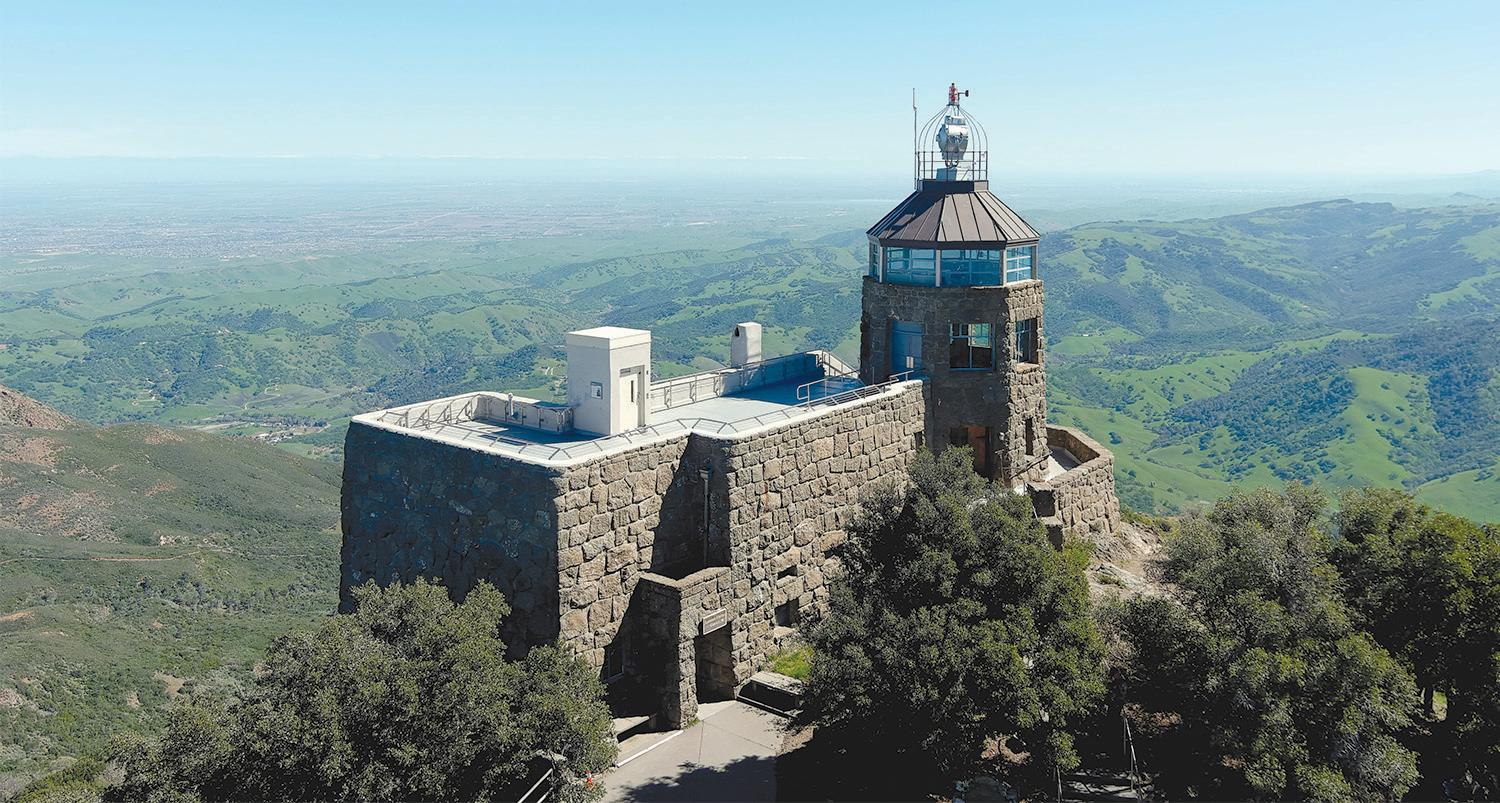
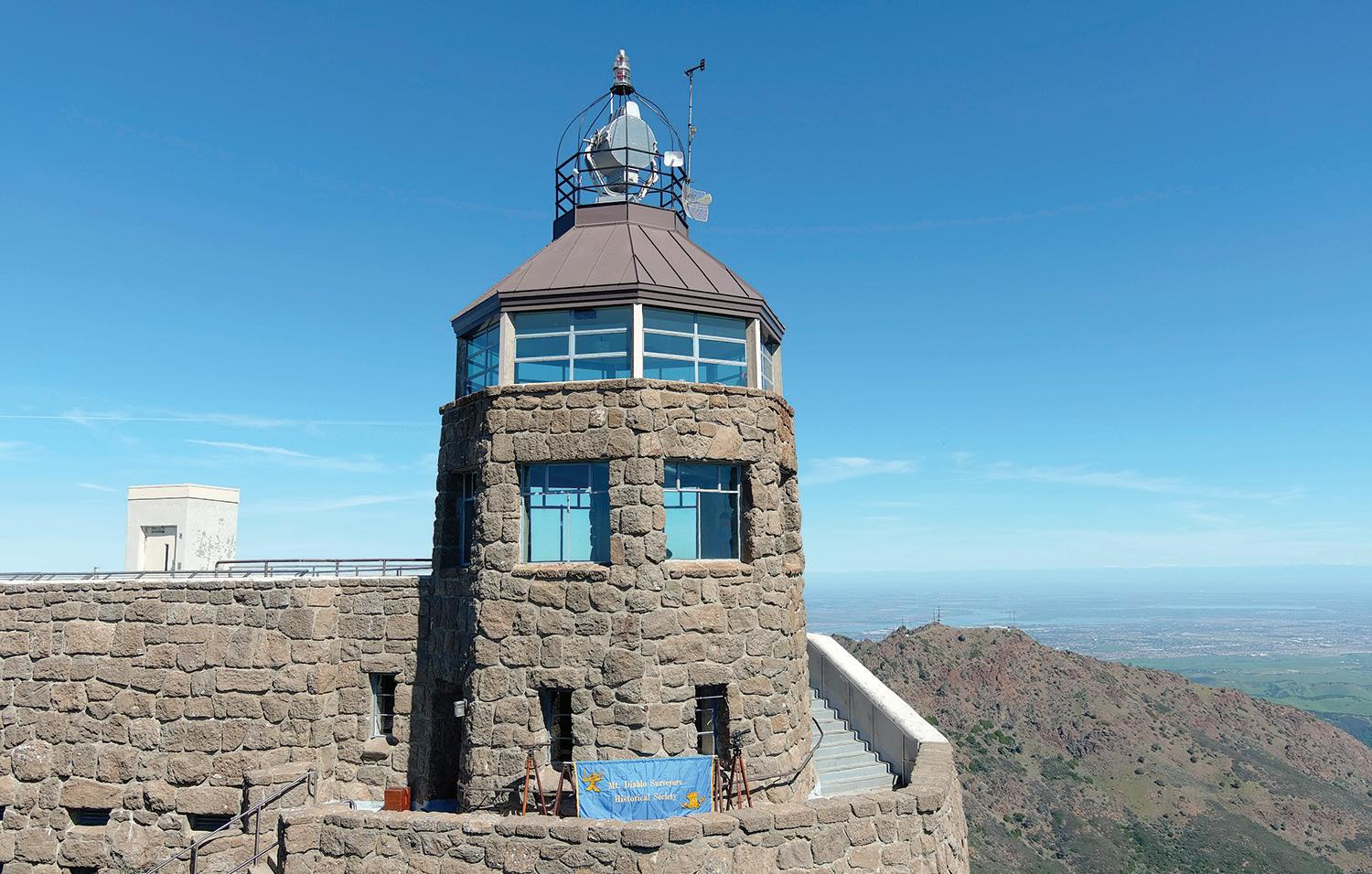
The Mount Diablo visitor center was built in the late 1930s around the original Initial Point. Courtesy of Mount Diablo State Park.
BOULEVARD VIEW
By Alisa Corstorphine, Editor and Publisher
Growing up, before the days of on-demand TV or video recorders, shows were watched when they were aired. TV Guide or the local newspaper would print a list of the upcoming shows on the 7 or 8 major network channels that were accessible in the Bay Area. In a household of five children, all girls, we all looked forward to the weekly broadcast of the Little House on the Prairie series. Over nine seasons we followed the lives of the Ingalls family who lived in Minnesota in the late 1800s. The show was loosely based on the book series by the same name. To us, we loved being a part of their world and playing dress-up to reenact the attire of the time. Our play was very similar to spending a day at the local One Room School program which many of our local third-graders participate in (museumsrv. org/one-room-school-program).
When my friend recently recommended I read the book Prairie Fires: The American Dreams of Laura Ingalls Wilder by Caroline Fraser, she warned me that it wasn’t all “fluffy” like the TV show. The author digs deep, gathers unpublished manuscripts, letters, diaries, and land and financial records, and puts together a 600+ page biography of Laura’s life. I’m only at page 225, but the hard times which included fires, extreme weather events experienced in drafty log cabins, thin-walled shanties, and their dugout/sod home on Plum Creek, makes me grateful for the creature-comforts of the 21st century.
The section describing the locust swarm of 1875 showed how quickly things can change. When the locusts descended on the Ingalls farm (and many other properties), it was the largest swarm in human history. Known as the “Albert swarm,” it was estimated to be 110 miles wide, 1,800 miles long, and a quarter to a half mile deep. An estimated 3.5 trillion insects destroyed everything in their path, including crops the family and others depended on for food and income. With our mild winter, and changing climate, it will be interesting to see what our summer brings. Reports of ants, ticks, and cockroaches, as well as gophers, moles, and rats are being mentioned more frequently in local social media groups. Different strategies to address them are being discussed and awareness of these renewed threats is heightened.
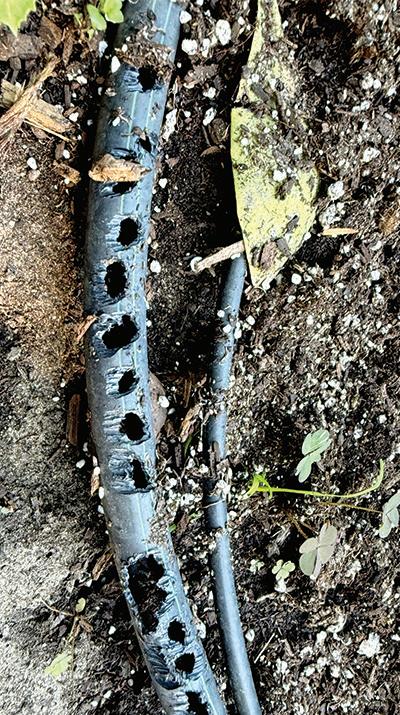
Recently, I was away for a week. Upon returning home and checking my freshly planted garden, I was horrified to find my drip irrigation in shambles. Resembling Swiss cheese, my piping had been punctured and perforated by some varmint. My automatic watering is ruined. As of yet, I have not identified the “enemy” and am drafting a plan to move forward. Having lived here for almost 30 years, this is a first. In the past, some of my bounty has been enjoyed by gnawing teeth, but nothing of this magnitude has threatened my crops.
Local pioneers experienced hardships of their own. I encourage you to spend time this summer learning about them at the Museum of the San Ramon Valley in downtown Danville. Or, visit the final resting place of some at the Alamo Cemetery which was established in the 1850s. Many folks important to valley history are buried there – including the Jones, Wood, Stone, Bollinger, Baldwin families and more. The cemetery is located at the bend of El Portal just off of Danville Blvd. on the border of Alamo and Danville. It is open daily from 8AM to 6PM .
I encourage you to dig deeper into the history of our area and its pioneers via books which have been written. In the 1970s, Virgie Jones (who married into the pioneering Jones family), wrote Alamo...and Other things Along the Way, as well as Historical Persons and Places...in the San Ramon Valley, as well as Be It Ever So Humble... Her books can be found on eBay.
Former mayor of Danville, and longtime historical columnist, Beverly Lane (see her Valley Vignette column on page 14), has also written many local books. They include Historic Tales of Alamo (with co-author Sharon Burke); Danville: Heart of the San Ramon Valley; Vintage Danville: 150 Years of Memories; San Ramon Chronicles: Stories of Bygone Days; as well as San Ramon Valley: Alamo, Danville, and San Ramon (with Ralph Cozine and part of the Images of America series). Her titles can be obtained at the Museum of the San Ramon Valley, online, and other local book retailers.
Reading about our past gives insight to where we are now. What can we learn from others experiences? How can we better prepare for challenges ahead?
My husband just purchased a t-shirt at the Portland, Oregon Historical Society, it reads: “Don’t Make Me Repeat Myself ~ History.” Wise words I think.
Sisters Jennifer and Laura in their “prairie” attire.
My drip irrigation is going to need a new strategy moving forward.
here in town. It’s never too late to learn something new, meet someone new, or feel more connected to your neighbors.
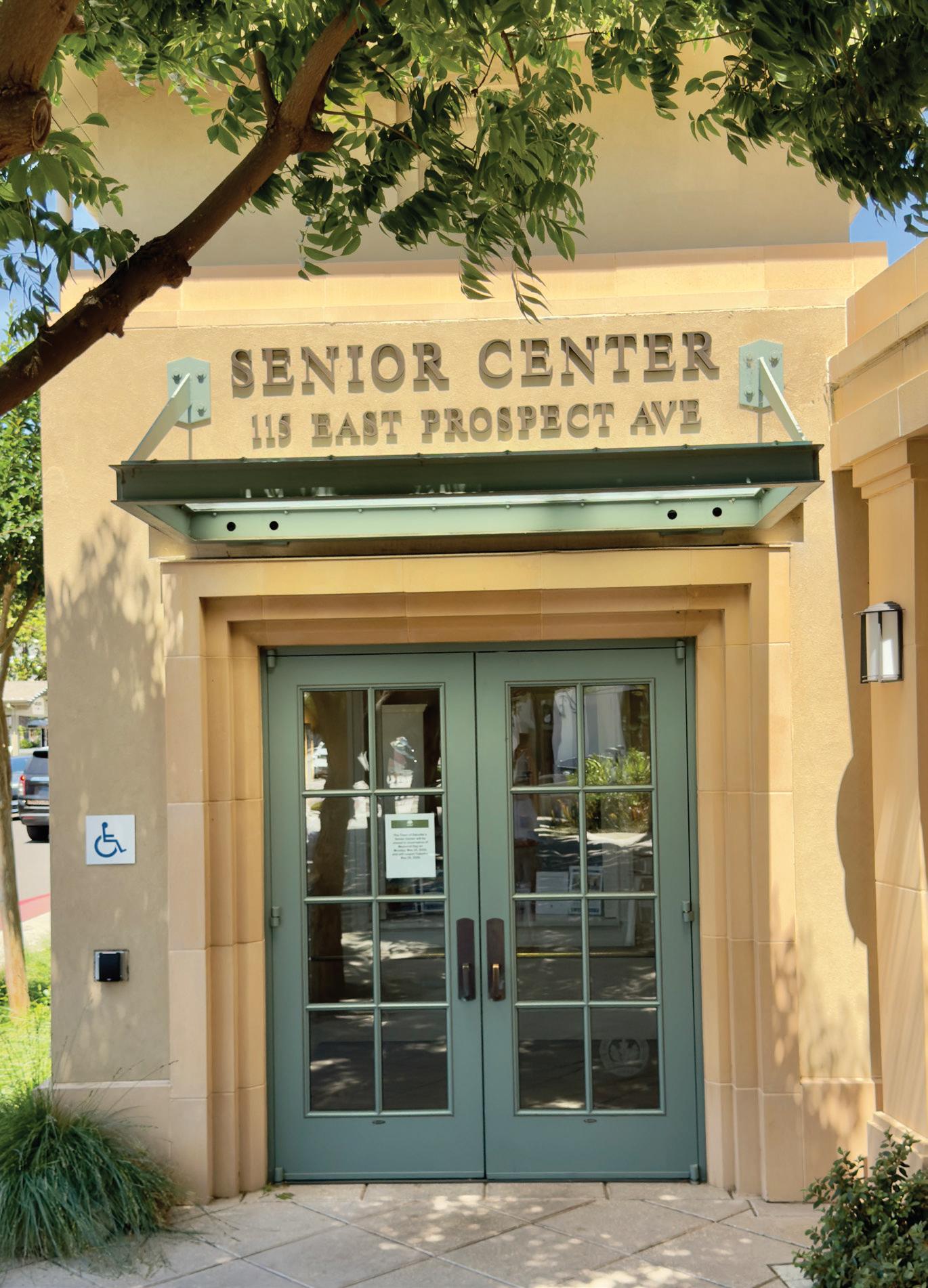
For more information, contact the Danville Center Center: (925) 314 3430 or www.danville.ca.gov/seniors
I
FREE GENEALOGY RESEARCH ASSISTANCE
Are you looking for your ancestors? Do you want to do a little genealogy research or start your family tree? Could you use some help or direction?
Bring your questions and any information you have to get started to the Danville Library, located at 400 Front St., Danville on Tuesday, June 9th from 10am-1pm. Genealogy docents from the San Ramon Valley Genealogical Society will be available to help you take your research further with print resources from the library’s genealogy collection or online material.
The free genealogy research assistance is provided by the San Ramon Valley Genealogical Society in partnership with the Danville Library. For questions, call 925-314-3750 or visit srvgensoc.org
MOONLIGHT MOVIES IN DANVILLE
Moonlight Movies returns to the Danville Town Green with its season premiere on Friday, June 19, featuring Cool Runnings (1993, PG). This family-friendly evening invites the community to enjoy a movie under the stars, with kids’ activities beginning at 6:30PM and the movie starting at 8PM, or when lighting permits. Bring blankets, lawn chairs, and movie snacks for a fun night on the Town Green.
• June 19: Cool Runnings (1993, PG)
• July 3: Captain America: The First Avenger (2011, PG-13)
• July 17: Lilo and Stitch (Live Action) (2025, PG)
• July 31: Princess Bride (1987, PG)
The Town Green is located at 420 Front St. in Danville.
WHAT'S HAPPENING AT MSRV IN JUNE
Mark your calendars, “Totally Trains” returns to Museum of the San Ramon Valley (MSRV) starting on June 20th. The theme this year is a celebration of the 250th Anniversary of the United States. Take advantage of the “Family Pass.” Purchase one and come as often as you want!
The main layout of the train exhibit, will feature a village scene with models of Danville, San Ramon, and Alamo showcasing present and past buildings. Trains will travel over trestles, bridges, and through a mountain. The miniature Town of Danville’s main street will be decorated for the occasion. Look carefully as you may see fireworks! Children will also be able to load coal into the steam locomotive.
In the waiting room, The Danville Depot: Creating Change, Preserving History explores the historic significance, and colorful past of this founding structure in Old Town Danville. The exhibit highlights how the Depot’s use changed with the times.
The “Third Thursday” virtual program will be held on June 18th at 11:30AM
The speaker will be Linus Eukel, Executive Director of the John Muir Land Trust. The program is free, but registration is required. To attend, visit museumsrv. org, select “What’s On,” and then “Virtual Programs.”
The Museum is located at 205 Railroad Ave in Danville. Summer hours are Tuesday - Saturday 10AM-1PM and Sunday noon-3PM
For more information, visit museumsrv.org or call 925-837-3750.
SRV GENEALOGICAL SOCIETY
Join with the San Ramon Valley Genealogical Society (SRVGS) for a free Zoom meeting on Tuesday, June 16th, at 10AM. The keynote speaker will be Scott Norrick presenting: America at 250 years! Researching Your Revolutionary War Ancestors. To attend this meeting, please email president@srvgensoc.org for the Zoom link.
Scott’s areas of expertise include research in the American Midwest along with the immigration to the Midwest from Britain, Ireland, and Germanic countries. He also does significant research into Civil War records.
SRVGS was organized in 1985 to provide its members with resources, assistance, and educational opportunities that help them successfully research their ancestry. The group publishes a monthly newsletter, has a dedicated website, and offers monthly special interest group (SIG) meetings. The society also provides monthly general meetings featuring nationally known professional speakers.
To learn more, or become a member of SRVGS, visit srvgensoc.org or email president@srvgensoc.org
HOUSEHOLD HAZARDOUS WASTE COLLECTION
Have you done some home cleaning and find yourself with paints and paint thinners, cleaning supplies, pesticides and garden-care items, batteries, motor oil and other automotive products, solvents, fluorescent tubes, personal care products, or unknown rusty containers that need safe disposal?
The Household Hazardous Waste (HHW) collection facility operated by the Central Contra Costa Sanitary District offers this free service to residents. Drop-off is available at 4797 Imhoff Place in Martinez from Monday-Saturday from 7AM until 2PM with no appointment needed.
Learn more at www.centralsan.org/household-hazardous-waste-collection-facility
MUSIC IN THE PARK
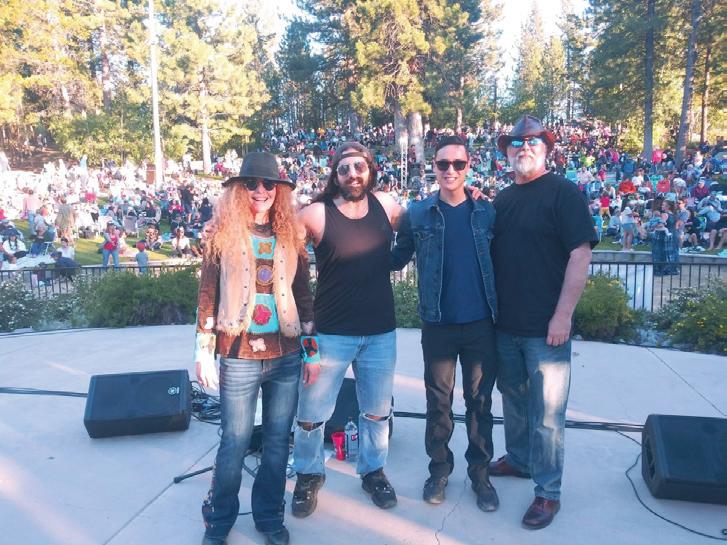
The Danville Town Green (420 Front St.) is a great place to enjoy live music on summer evenings, and Music in the Park returns with fun, family-friendly nights of music and dancing from 6 to 8PM. Bring your blankets, lawn chairs, hats, and snacks and enjoy the beautiful downtown setting.
• June 13 – The Bell Brothers - Country
• June 27 – New Moon on Monday – Duran Duran tribute band
• July 11 – Mercy and the Heartbeats – Pop hits from the 70s to today
• July 25 – Dream Like Taylor – Taylor Swift tribute band
RAISE A PUPPY. CHANGE A LIFE.
Guide Dogs for the Blind Puppy Raising Club brings together volunteers who raise, sit, and socialize future guide dogs. The Club meets at the Danville Women’s Club, located at 242 W. Linda Mesa Ave., on the second and fourth Tuesday of each month from 6:30–7:30PM. All aspiring puppy raisers and sitters are welcome. Learn more at www.guidedogs.com or contact group leader, Maureen Balogh at mbaylog@comcast.net.
31st: Fog City Swampers
10th: The Sun Kings
MEN’S RETIREE SOCIAL GROUP - SIR 146
STAY ACTIVE, HAVE FUN & LIVE LONGER!
WATER FEATURE FUN
Beat the heat with splashy fun at two Danville parks!
SIR Branch 146 is a vibrant social group for retired and semi-retired men in Central Contra Costa County, offering a friendly community to help you make the most of retirement. With over 250 members, SIR146 features more than 25 activity groups, including golf, hiking, travel, dining, cards, photography, and cooking. Most activities are co-ed, welcoming spouses and partners. Members enjoy a monthly luncheon with guest speakers and plenty of camaraderie. It’s a great opportunity to connect with other men who share similar interests and enjoy an active lifestyle. Founded in 1988, SIR146 helps men build friendships, stay mentally and physically active, and even live longer—members average a six year longer lifespan than other men in the county. Guests are always welcome. Learn more at sir146. com or email sir146inquiries@gmail.com
SONS IN RETIREMENT (SIR)
SAN RAMON VALLEY BRANCH #128
Are you a man over 50 in the San Ramon Valley looking for friendship and plenty of fun? SIR 128 might be just the place for you.
We’re a welcoming community where men come together to enjoy life to the fullest. Our members take part in all kinds of activities walking, wine tasting, book clubs, poker groups, cooking, biking, and golf (both 9 and 18 holes) and lots more. We also enjoy monthly Bay Area outings, there’s always something new to look forward to.
The best part is the people. You’ll form friendships with men who share this stage of life and are eager to make the most of it.
Our monthly luncheons are a highlight, featuring great food and interesting speakers. Coming for the first time on your own? No problem we reserve a special table just for newcomers and guests attending solo. You’ll feel comfortable from the moment you arrive.
Interested in joining us? We’d love to welcome you at our next gathering. To learn more or reserve your spot at an upcoming luncheon, email membership@sir128.com or visit www.SIR128.com
Join us and discover what makes SIR 128 such a great group!
VOLUNTEERS NEEDED
Now more than ever, many of our neighbors cannot afford to feed and clothe themselves or their families. Volunteer opportunities for individuals, families, and groups to serve the community are available at White Pony Express (WPE).
WPE, founded in 2013 and now headquartered in Concord, is a nonprofit that rescues fresh surplus food from supermarkets, restaurants, and farmers markets. This food is then delivered free to organizations that feed the hungry free of charge. Hundreds of volunteers make WPE possible. If you are interested in volunteering, please visit whiteponyexpress.org/volunteer or call Mandy Nakaya, Volunteer Services Coordinator, at 925-818-6361 or email Mandy@whiteponyexpress.org
CAN YOU HELP?
Do you have a heart for helping others? Do you have a few hours a week to help provide household essentials to those moving from transitional to permanent housing in Contra Costa County?
Contra Costa Interfaith Coalition is a local non-profit that works with independent and county social service providers to help match people in need to resources needed to live a positive and productive life. The group is currently is looking for additional volunteers to meet the increased needs.
The Linen Team desperately needs help to sort, size, wash, and bundle linens that have been donated. This work can be done at your leisure, in your own home, or in the group “Linen Garage.”
The Driver/Lifter Team is looking for additional help with picking up donations, as well as delivering essentials to clients.
Time commitment varies based on your availability. Join like-minded volunteers who enjoy doing something that makes such a big difference. To sign-up or for more information, contact volunteer@ccichope.org, or call Susan Sheridan at 925-895-4423.
Water features are open at Hap Magee Ranch Park (1025 La Gonda Way) and Sycamore Valley Park (2101 Holbrook Drive) through October 1. The splash pads offer a fun and easy way for kids and families to cool off during warm days.
Stop by on weekdays from noon to 6PM or weekends from 10AM to 6PM
VOLUNTEERS NEEDED FOR ADULT DAY CARE
Valley Oak Respite Center, located at 989 San Ramon Valley Blvd. in Danville has provided adult day care for local memory-impaired adults for more than 30 years. Caring for loved ones with dementia is a 24/7 responsibility. Respite care allows caregivers freedom for four hours a day that they would not otherwise enjoy. The program helps adults with dementia to be more social and outgoing. Activities include games, crafts, painting, drawing, exercise,
sing-along music, daily facts and memory joggers.
Volunteers assist staff in providing conversation, companionship, and assistance in activities. To volunteer, you must be at least 18 years old. Occasionally, children of volunteers come in with them to experience helping seniors. Volunteers should have a genuine love for older adults.
For more information, or to become a volunteer, please visit valleyoakrespite. org or call 925-915-0095.
Danville Dementia Day Care team.
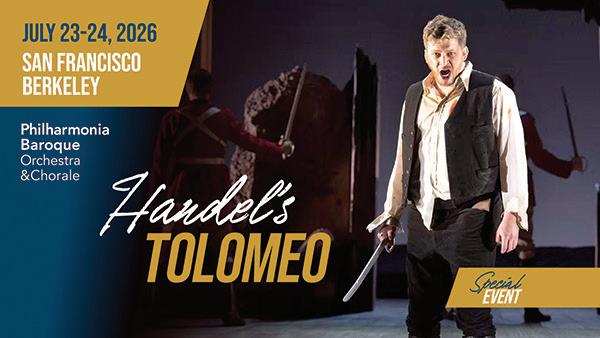
HANDEL’S TOLOMEO
A BAROQUE OPERA IN THE BAY AREA THIS JULY
What happens when a king loses everything—his crown, his name, even his place in the world?
This July, Philharmonia Baroque Orchestra and a star-studded cast led by countertenor Aryeh Nussbaum Cohen bring the drama to Bay Area audiences in Handel’s Tolomeo, marking the start of Peter Whelan’s tenure as Music Director.
Written in 1728, Tolomeo, re d’Egitto follows an exiled ruler living under a false identity as loyalties shift around him. Identities unravel, and love proves more complicated—and more resilient—than expected. Handel captures it all in arias that shift quickly from quiet introspection to full-blown drama.
Performed on period instruments, the orchestra creates a clear, vivid sound that brings you closer to how this music would have been heard nearly 300 years ago, while the semi-staged production keeps the focus on the performers.
Whether you’re new to opera or already a fan, Tolomeo lands as a human story—about identity, survival, and what remains when everything else falls away.
• San Francisco: Thursday, July 23 at 7:30pm | Herbst Theatre
• Berkeley: Friday, July 24 at 7:30pm | First Congregational Church of Berkeley Tickets from $40; $20 for under 30s. Details at philharmonia.org. Sung in Italian, with English supertitles.
LIVE MUSIC AT THE PLAZA SUMMER SERIES
Mark your calenders, live music returns to Prospect Park Plaza located at 396 Hartz Ave! Come enjoy music on select Saturdays this summer, bringing a free and fun way to enjoy downtown Danville.
• June 6, 4–6PM ~ Patrick Noel Russ
• June 20, 4–6PM ~ Mischelle Lambert
• July 4, 1–3PM ~ Loren O.
• July 18, 4–6PM ~ Jesse Brewster
• August 8, 4–6PM ~ Monica da Silva
• August 22, 4–6PM ~ Jeff Tamelie
• September 5, 4–6PM ~ Rolando Morales
Note: All performances are subject to change at any time.
VALLEY PRIDE EVENT
By San Ramon Valley PRIDE
As the observance of PRIDE Month is here, we prepare to celebrate the presence of our LGBTQIA+ neighbors—those who identify as lesbian, gay, bisexual, transgender, queer or questioning, intersex, asexual, or another identity or orientation.
LGBTQIA+ people are valued members of our communities. They are our children, neighbors, relatives, colleagues, and friends. They come from all backgrounds and ethnicities and are part of families of all configurations. They are part of the populations of our schools, faith communities, and neighborhoods.
FRESH LOOK
DISCOVER THE ORCHESTRA IN A WHOLE NEW WAY
Whether you’re rediscovering a lifelong love of music or simply curious about classical music, California Symphony’s Fresh Look: The Symphony Exposed offers a welcoming introduction to classical music.
This July in Lafayette and San Ramon, award-winning instructor Scott Foglesong leads this four-part course exploring how orchestras work, what to listen for in concert, and the stories behind the music in a lively, approachable atmosphere. Gain fresh insights into California Symphony’s 40th anniversary season, a deeper understanding of orchestral music, and more confidence enjoying concerts. The course concludes with a live performance by California Symphony musicians.
Registration is only $40 per person, or $32 for San Ramon residents at the Thursday evening classes—only $10 or less per class session!
Fresh Look: Wednesdays, July 8-29, 6:30-8PM at Lafayette Library, 3491 Mount Diablo Blvd., Lafayette; and Thursdays, July 9-30, 6:30-8PM at Dougherty Station Community Arts Center, 17011 Bollinger Canyon Rd., San Ramon. Register at californiasymphony.org
Fresh Look is sponsored by San Ramon Academy of Music, Community Foundation of Lafayette, Kiwanis Club of San Ramon Valley, and the Contra Costa County District 2 Community Impact Fund.
2026 ALAMO SUMMER CONCERT SERIES
Contra Costa County Public Works, Alamo Parks and Recreation, with support from the Alamo Municipal Advisory Council, present the 2026 “Alamo Summer Concert Series” at Livorna Park in Alamo. Livorna Park is located at the intersection of Livorna Road and Miranda Avenue. This four-concert series features live music from a variety of genres, and food trucks should be available. Concerts will take place on Friday evenings from 6:30-8:30PM, and feature a schedule full of dynamic bands, including:
• July 10 — The Sun Kings
• July 17 — Forejour
• July 24 — Highway Vagabonds
• July 31 — Fog City Swampers
*Please note: Due to scheduled park renovations, there will NOT be a Summer Movie Series this year.
Bring family, friends, chairs, blankets, a picnic dinner, and enjoy music in the park. Parking is limited, so please plan accordingly. If a special accommodation is required to participate in this event, please contact the Public Works Department, Alamo Recreation Staff, at least 72 hours before the event date. You can reach the Alamo Recreation Staff at 925-313-2181, or visit www.cccounty.us/alamoparksandrecreation.
Yet all too often, they are misunderstood, excluded, and discriminated against. And tragically many LGBTQIA+ people—especially for our youth—experience violence against their bodies or spirits through bullying in school; discrimination in the workplace or religious spaces; by other community members and officials; or through the healthcare system.
But a strong community values all its members and engages in goodwill for all people, lifting up LGBTQIA+ people with compassion and affirmation. That is the sole reason for PRIDE.
This belief undergirds the third annual VALLEY PRIDE (www.srvalleypride.org) being held on Saturday, June 6th from 10am–4pm in Danville. Bringing together LGBTQIA+ people and their allies from across the San Ramon Valley, this free event serves as part education, part community building, and part celebration. This event is provided at no cost to the public and is supported by a coalition of organizations, including the Town of Danville, Discovery Counseling Center, PFLAG Danville-San Ramon Valley, the SRV Diversity Coalition, and Danville Congregational Church.
Through the inspiring stories of LGBTQIA+ people, their loved ones, and allies along with lessons shared by folx who provide support to our neighbors and their families, we gather to lift up and proudly celebrate the dignity of these members of our San Ramon Valley communities. Because when we value all our neighbors—regardless of their sexual orientation or gender identity or expression—our communities become stronger, safer for our children and all community members, more joyful, and a better place to live.
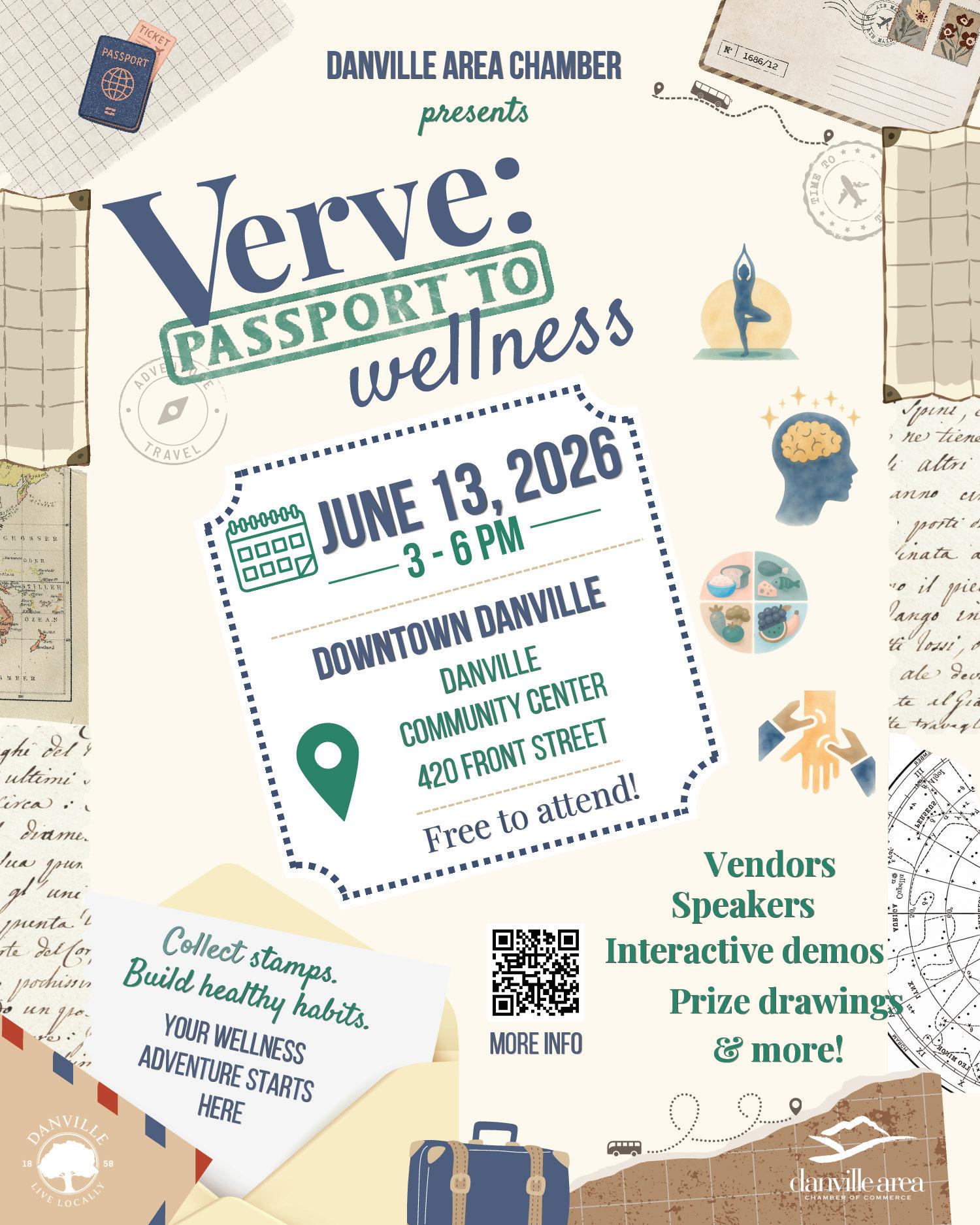
We hope you will join us on June 6th at the Danville Community Center on Front Street.
The Rev. Todd Atkins-Whitley, Senior Pastor, Danville Congregational Church, an open and affirming church of the United Church of Christ. ( danvillechurch.org ; ucc.org ), Anuradha Gupta, President, PFLAG Danville-San Ramon Valley ( srvpflag. org ), Krista Glaser, Steering Committee Member, SRV Diversity Coalition, Sumita Bhandari, Executive Director, Discovery Counseling Center, www.discoveryctr.net .
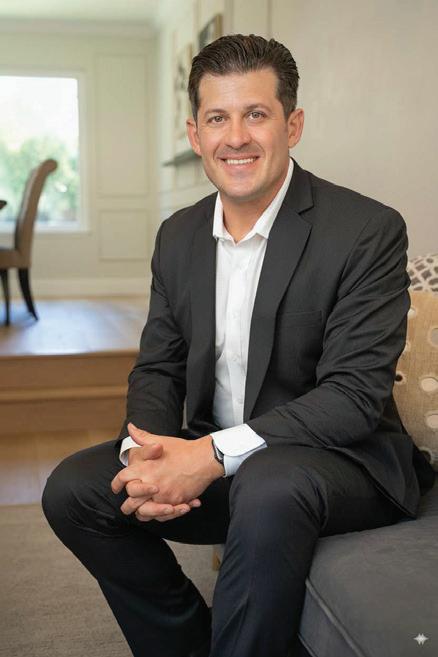
THE GATTI REPORT: YOUR GREATER DANVILLE AREA REAL ESTATE UPDATE
By Joseph Gatti
As we head into summer with America’s 250th anniversary on the horizon, the spring housing market weathered notable volatility tied to the conflict in Iran and the oil disruptions that followed. Locally, inventory and sales activity have tracked closely with last year, the numbers are nearly identical, even if the experience on the ground feels much different. Inventory has been rising as anticipated, and the key variable to watch remains interest rates, which are affecting some market segments significantly while others move largely independent of them. The question now is whether summer will deliver the momentum spring held back. For those considering selling or buying, the Gatti Team, powered by Compass, the nation’s #1 brokerage, is here to provide clarity, strategy, and confidence in an evolving landscape.
Understanding why the experience feels so different from last year requires a look at the broader rate environment. Perhaps the most consequential, and underreported, development of the moment: the 30-year Treasury yield has pushed past pre-2008 levels, signaling that mortgage rates will remain elevated this summer. Buyer purchasing power continues to feel the pressure, keeping transaction volume measured and serious buyers selective. Sellers still pricing to last year’s expectations will be disappointed, the rate-driven demand surge isn’t coming. Concessions, buy-downs, and realistic pricing will separate the transactions that close from the listings that stagnate.
That dynamic is playing out clearly in our own backyard. Here in the Greater Danville Area, encompassing Alamo, Danville, Diablo, and San Ramon, the parallels to last year are striking. Active detached listings stand at 248, virtually unchanged from 249 a year ago. Days-on-market have actually improved, averaging 32 days compared
5
AWC AWARDS 14 STUDENT SCHOLARSHIPS
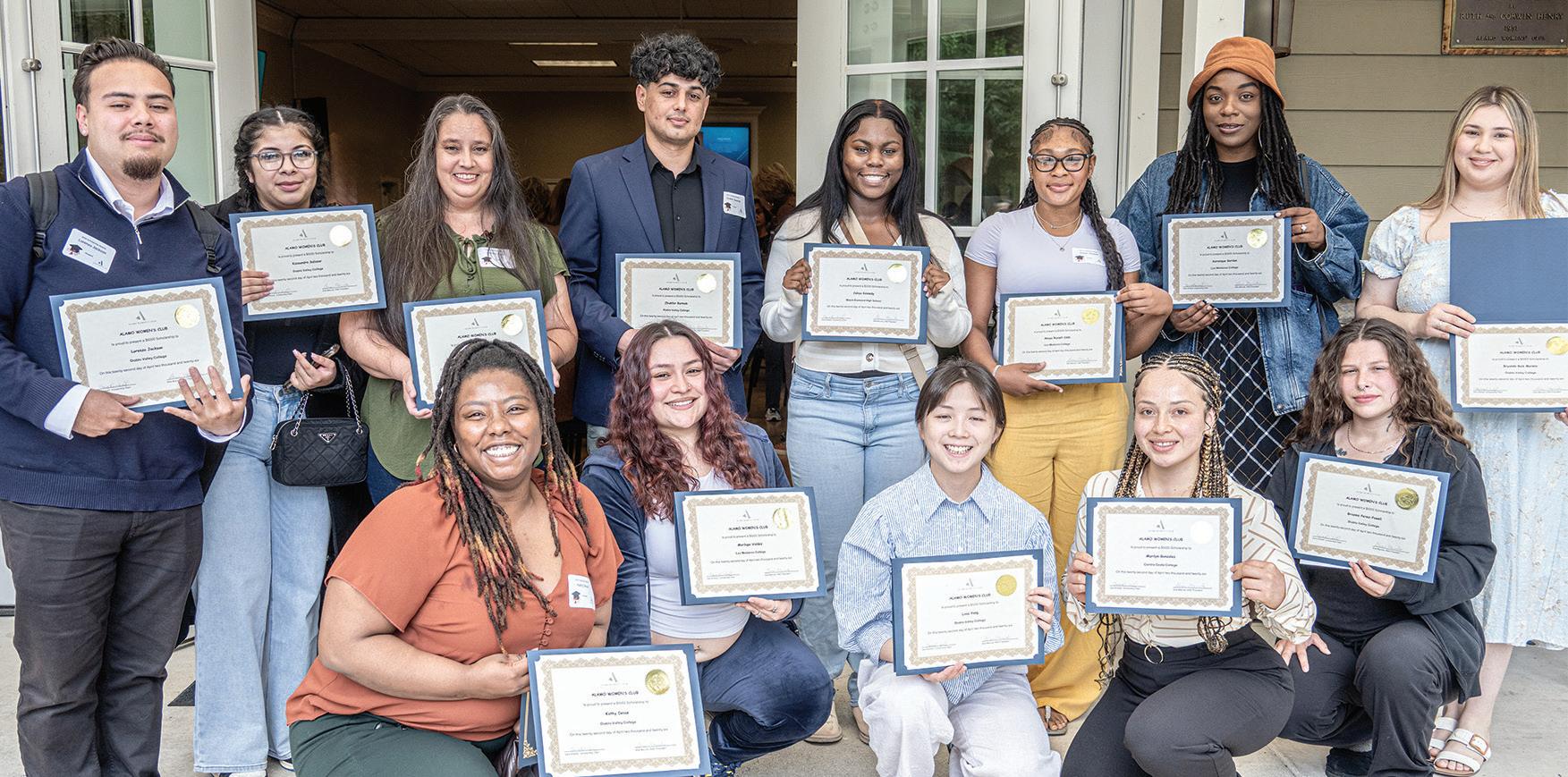
Congratulations to the 14 amazing student scholarship winners from the Alamo Women’s Club (AWC). The AWC is very proud of their accomplishments!
The recipients are: Zhakfer Barmak, Leesha Davis, Kathy Desse, Bethany Helton, Lorenzo Jackson, Brianna Perez-Powell, Bryanda Ruiz Moreno, Kassandra Salazar, Livia Yang – Diablo Valley College students; Aaronique Gordon, Anaya Russell Cobb, Marilupe Valdez from Los Medanos College; Kaitlin Leung from Dougherty Valley High School; and Caliya Kennedy from Black Diamond Continuation School.
The financial need-based scholarships provide funds for tuition, school supplies, and living expenses. Many recipients are single parents or foster youth, who are struggling to continue their education, while managing complicated lives. AWC recognizes the effort and strength it takes to pursue an education with other life responsibilities. At the luncheon to honor these remarkable students, many remarked that it was such a joy to have “someone recognize my hard work and my goals for the future.”
Since its establishment in 1916, the AWC has awarded scholarships for over 80 years. Fundraising efforts, including the Author’s Faire, jewelry sale, and other events throughout the year, provided $70,000 for scholarships in 2026. For more information about AWC, visit www.alamowomensclub.org
where students can watch movies, play video games, and even enjoy entertainment such as hypnotist performances late into the night.
By Margot Schultz,
senior
SAN RAMON VALLEY HIGH SCHOOL
The final week of school in June serves as a closing chapter for all students at San Ramon Valley High School (SRVHS), especially our graduating Class of 2026. Though the week itself lasts only a few days, SRVHS fills it with traditions, celebrations, and milestones to give seniors a bittersweet goodbye. Meanwhile, the rest of the student body moves forward, one year older, wiser, and even more connected as Wolves.
Of course, the last week of school also signifies the start of final exams. In preparation, our SRVHS staff stress the importance of both studying and self-care by offering “Learning and Lemonade” in the library as an extra support resource for students. During finals week, students take two finals per day, giving them an opportunity to focus on specific subjects while balancing their workload in a more manageable way.
On June 4th, students will celebrate the last day of school. For the seniors, however, that chapter does not close just yet. That evening, the Class of 2026 will gather on the Auxiliary field for Senior Sunset, a tradition that mirrors Senior Sunrise on the first day of school. This time, seniors will wear clothing representing their future plans and college decisions. From California to Mississippi, to London and beyond, our Wolves will soon scatter across the globe, each beginning a new chapter of their own.
The following evening, at 6PM on June 5th, families and friends will come together to celebrate the graduating Class of 2026. Featuring student speeches and musical performances, the ceremony highlights the achievements of our senior class and the strength of our SRVHS community. One especially memorable tradition is decorating graduation caps, with many seniors showcasing symbols of future plans and aspirations. As graduates cross the stage, families and friends can look out for these personal touches while cheering on every student reaching this moment.
After the ceremony concludes, many seniors will remain on campus for SRVHS Grad Night, a tradition organized each year by dedicated parent volunteers with generous donations from families and the community. Running from graduation night until early the following morning, the school is transformed into a wonderland
Grad Night tradition has been part of our school community for nearly 50 years. Originally created as a safe and sober celebration, it remains one of SRVHS’s longest-running senior traditions and reflects our community’s care for its students.
As this school year comes to a close, it is important to recognize the staff, administrators, volunteers, and parents who helped make this year possible. What makes San Ramon so special is not the traditions, but the people behind them. Being a Wolf isn’t just about attending a school; it’s about being part of a community that celebrates, supports, and grows together. Best of luck to the graduating Class of 2026 on their next adventures, and wishing the rest of the student body a wonderful summer!
Stay connected by following @srvhswolfpack and your class Instagrams (@srvclassof2026, 2027, 2028, or 2029), and visit srvhs.srvusd.net for the school calendar and latest updates.
And, as always, go Wolves!
SOCIAL HOSTING By The Town of Danville Police Department
THINK BEFORE YOU LET TEENS DRINK
As we proceed into the celebratory months of graduations and the start of summer, event planning becomes important to many families. Events take place each month that bring teens together “to party.”
The teens in our community want to have fun and they sometimes use alcohol to enjoy themselves. When teens gather socially, it is far too common that alcohol is consumed. Unfortunately, where there is alcohol, there is a high risk of teen tragedy.
The Town of Danville Police Department wants you to be aware of the responsibilities that come with being a social host. Known as the Social Host Ordinance, adults can be held criminally and/or civically liable if they are caught hosting a party with alcohol.
The Ordinance (4-6.1 a-c) places direct liability on adults who passively allow people under age 21 to consume alcohol in their homes and at facilities they
See Host continued on page 18
MONTE VISTA HIGH SCHOOL
By Dr. Kevin Ahern, Principal
As the Spring Semester comes to a close, Monte Vista (MV) students and staff are enjoying their final opportunities to showcase their incredible talents and achievements. The end of every school year is always bittersweet as we say goodbye to another graduating class by celebrating their many accomplishments and successes.
MV Baseball battled their way through a tough EBAL schedule and emerged as the Valley Division Champions! Congratulations to our amazing scholar-athletes and their coach, Mateo Miramontes. This group has worked incredibly hard for this achievement and they have a lot to be proud of.
May is always a special month for the arts at MV, giving many of our graduating seniors the chance to perform on the MV stage one final time. MV Dance presented three exceptional performances. The student-created choreography, music selection, and physical precision truly displayed the growth and professionalism of our students and the MV program led by Dance Director Ryane Siegel. MV Choir followed with their annual Pops Concert. The hard work of our vocalists showed with each polished and professional performance. Kudos to MV Choir Director Rosalind Neisinger and our amazing vocal students. The Instrumental Music Program performed over two incredible evenings. Our Orchestra, Wind Ensemble, Concert Bands, and Jazz Showcase concerts were top-tier, and our community truly turned out to see our musicians perform at such a high level. Congrats to Ed Cloyd (Music Director), Sarah Dasovich (Orchestra Director), and our many talented musicians. The Visual Art Program had a throng of visitors view a stunning variety of artwork—including oil painting, watercolor, textural pieces, photography, and ceramics at their annual Art Open House. It was impossible not to leave deeply impressed by the talent on display. Congrats to Art Teachers Annie McElhatton, Brandy Gardner, and Tim Soucy for their dedication to supporting our student artists. Recently, MV hosted its annual Capstone Symposium, which was our largest to date! Over the course of the evening, more than 150 AP Seminar and 18 AP Research students presented their projects to a record audience of students, staff,
HEALTH TIPS
FOR TEENS
ANXIETY
By Serena Hicks, MVHS sophomore
“Anxiety disorders are the most common mental health disorder in the United States, and anywhere from 1 in 10 to 1 in 13 people suffer from anxiety, with about 8% of children and teenagers experiencing an anxiety disorder,” says Jennifer Katzenstein, Ph.D., a Pediatric Neuropsychologist. Anxiety has been a pressing matter among adolescents throughout the years, especially since the COVID-19 pandemic. Not only do teenagers have to face the academic challenges of the competitive environment surrounding college applications, but also the social stress of conflicting friendships, and the balance between these, as well as other activities.
Anxiety triggers the body’s sympathetic nervous system, which prepares the body to react to danger, stress, or high-energy situations by boosting adrenaline, increasing heart rate to pump more oxygen to muscles, dilating airways, or pausing non-essential processes such as digestion or excretion. While this reaction can be helpful for immediate danger, chronic anxiety damages physical health by causing high heart rates, tense muscles, weakened immune function, and digestive distress.
While anxiety plays a role in negative physical effects, the main identifier is through a plethora of mental processes. Anxiety mentally causes excessive, uncontrollable worry, racing thoughts, and a sense of impending danger. This state of worry can severely impact an individual’s ability to focus and process information effectively by adding difficulties in managing tasks due to the mind becoming preoccupied with fears and uncertainties. This phenomenon is especially present in teenagers, who are constantly navigating through significant life changes, which can allow anxiety symptoms to manifest as heightened stress levels, irritability, sleep disturbances, and/or withdrawal from social interactions. Furthermore, due to academic competition and expectations, fear of failure or rejection can hinder a teenager’s ability to fully engage with peers and resources that could offer support, creating complications when they try to reach emotional well-being while facing these challenges.
parents, and community members. It was awesome to see and hear the deep levels of learning that our students demonstrate in this program. We are grateful to Stephen Brooks, our Capstone Teacher, for his leadership in supporting MV’s students with this program.
On Tuesday, May 26th, MV Seniors began their final week of high school with a trip to Santa Cruz where they had the chance to enjoy the beach and the Boardwalk. The next day, our Seniors attended the Senior Awards Ceremony, where our community gets the chance to honor the graduating class with accolades and awards. The ceremony was followed by our Senior Barbecue, hosted by our Senior class parents. That evening, the Classes of 2026 and 2027 faced off in our annual Powder Puff Game
Our soon to be graduates finished out their week and gathered together one last time for the Senior Sunset.
Finals Week for all students kicks off on Monday, June 1st and concludes Thursday, June 4th. It is a stressful time for students as they complete the semester, but it is also a time for joy as with the year ending and the Summer Break beckoning. The end of this school year also marks a new phase for many of our MV staff as 13 of our colleagues move into retirement. With a collective 285 years in education, many of these individuals have spent their entire careers at MV teaching and inspiring generations of students. They will all be sorely missed. We wish them the absolute best in the next stage of their lives.
On behalf of MV’s students and faculty, I would like to extend a huge thank you to all of the students, staff, parents, and community members who did so much to support not only these end-of-the-year events, but the many performances, productions, and projects throughout the entire school year. None of this would be possible without your time, commitment, and generosity. Whether you attended an event as a spectator, volunteered to serve on a committee, taught a class, coached a sport, or donated to one of our Booster Organizations—it all makes a profound difference for our students.
I wish you all a restful, safe, and restorative summer break!
For a full list of what’s happening on campus, visit mvhs.srvusd.net.
Due to all these mental effects, teenagers must make an effort to maintain a sound mind and body despite the challenges. By practicing grounding exercises, limiting social media use, and engaging in regular physical activity, they can gradually progress in their mental health journey. When facing a challenge such as anxiety, it is especially important to regulate your breathing. Regulating one’s breathing during anxiety activates the parasympathetic nervous system, stimulating a lower heart rate, decreased stress hormones, and allowing the body to be in a resting and calm state.
If you are currently facing feelings of anxiety, panic, or you just want to be grounded/mindful of yourself, and/or your surroundings, here are some common yet effective breathing exercises:
The 3-3-3 Rule:
1. Identify 3 things you see
2. Identify 3 things you hear
3. Move 3 body parts
Box Breathing:
1. Inhale slowly for 4 seconds
2. Hold for 4 seconds
3. Exhale for 4 seconds
4. Hold empty for 4 Seconds
5. Repeat.
By managing your breathing, reducing stress, and offering accessible help for those who are dealing with issues like these, we can help individuals overcome these feelings of anxiety. It is important to recognize these hardships as they are happening all around us. Anxiety is common and has immense negative effects on both one’s physical and mental health, so let’s not be afraid to lend a hand to those in need, and let’s make sure to keep ourselves mindful of our own feelings.
Serena Hicks is a sophomore at Monte Vista High School (MVHS) and Teen Health Advocate hoping to improve the health of her community one column at a time.
WRITING MATTERS
By Linda Hora
“Hapitu, mama, hapitu,” squealed my son as he pointed to the helicopter. Yippee, my boy was learning to talk and loving everything automotive. We were at the San Ramon Wind Festival waiting for the helicopter to touch down. As the helicopter began to land, my son’s squeals of delight quickly turned into shrieks of terror, accompanied by tears and a loud, “M-a-a-m-a-a.” I quickly carried him to a calmer spot and sat us both down. He looked up at me, said, “Hapitu,” and then placed his hands over his ears, shaking his head left to right, making a loud “whrrrrrrrrr” sound and frowning. “Oh, the helicopter startled you,” I comforted him. Smiling through his tears, he said, “Hapitu stawtulled.” With those two words, my son had spoken his first sentence.
A sentence must be a complete thought with a verb and a subject. ~ Insert yesterday, today, and tomorrow: the verb is the word that changes two times. ~ Ask “who” or “what” verb to find the subject (sometimes it’s the “implied you”).
Verb +Subject Sentence
With those two words, he relayed information. Not only was I informed, I was fascinated. I had taught writing to high schoolers for years, yet watching my son begin to communicate reminded me of the actual process. Identification of something (a noun) comes first but doesn’t really exchange information; only a connection between a noun and an action or “state of being” (a verb) does. As kids attempting communication, we informally learn this. In grade school grammar, we are formally taught that a complete thought gets called a sentence. And somewhere along the line, we forget that. Think of a sentence this way: if you walk up to some random person on the street and say it, and they respond, “oh,” it’s a sentence. If, on the other hand, that stranger is left wholly confused, you probably haven’t spoken a sentence or delivered a complete thought. Just as my son learned, a complete thought needs a subject paired with a verb.
So how does one identify a verb in a sentence? Do the trick: insert yesterday, today, tomorrow in front of your sentence. The word that changes two times is the verb. If no word changes, you do not have a sentence. Let’s use this sentence: Beginning to land, the helicopter startled my son.
The trick:
Yesterday, beginning to land, the helicopter startled my son. (Nothing changes. Okay. Keep going.)
Today, beginning to land, the helicopter startles my son. (One change. We’re on our way.)
Tomorrow, beginning to land, the helicopter will startle my son. (Another change. Found the verb.)
Since we have a verb (startled), we may have a sentence. Now, we must identify the subject by asking “who or what” verb.
Who or what startled? Helicopter. (“Helicopter startled” conveys a complete thought.)
Recognizing the verb and subject in a sentence not only forces writers to focus on their message before adding details but also allows readers to ignore the details when trying to understand the basic thought. As ideas — and sentences — become more complex, they may have multiple verb-subject pairings; the trick still works, ensuring focus for the writer and comprehension for the reader.
Beginning a phone call, my son startled me. The call, during his freshman year in college, began with a one-word sentence: “Help!” Obviously, the verb was “help” and the subject — the “who or what help?” — was “you,” as in “YOU, Mom, help!” (The “implied you” is used in times of celebration, desperation, frustration, or emergency.) For this emergency, I was all ears as he presented his problem: he’d been assigned an essay to write yet couldn’t determine the actual question in the lengthy prompt. I responded, “Do the trick.” He did. Eliminating the details by focusing solely on the verbs and their subjects allowed him to distill the question to “(You) explain why . . . the economy grew. . .” The trick worked. He thanked me, and we never had a conversation like that again. I’m really not one of those “hapitu” moms. But I am hapi-tu-help! Feel free to send me any complete thoughts or concerns you have regarding writing at thewritinggoal@gmail.com
QUICK TRIPS By Linda Summers Pirkle OCEAN PHOTOGRAPHER OF THE YEAR
The newly released film Pressure , starring Brendon Fraser as General Dwight Eisenhower, is based on the true story of the meteorologists whose forecasts shaped the timing of the decisive D-Day landings in June 1944.
A similarly compelling (though not yet filmed) story from the Pacific theater appears in Catherine Musemech’s book Lethal Tides: Mary Sears and the Marine Scientists Who Helped Win World War II. Musemech writes that Mary Sears “had a dramatic effect on the U.S. Navy’s success against Japan in WWII,” and describes how mastering the oceans fell largely to the Joint Chiefs of Staff Committee on Meteorology’s new oceanography subcommittee and “particularly to an untested, diminutive marine biologist named Mary Sears.”
Sears held degrees in biology and zoology, including a doctorate, and specialized in plankton, the microscopic and vividly colored organisms that form the foundation of the marine food web. At Woods Hole Oceanographic Institution (WHOI), she worked alongside leading scientists from around the world. Yet despite her expertise, she was barred from commercial and military vessels for decades due to superstitions about women angering sea gods. Musemech notes that Sears, who had a dry sense of humor, likely would have appreciated the irony that although she was restricted from research ships for thirty years, the U.S. Navy named a hydraulic vessel in her honor in 1997, three years after her death at age ninety-two.
Despite the misogyny that constrained women scientists of her era, Sears was chosen to lead a small, makeshift team, an “intelligence-gathering juggernaut” built on the emerging science of oceanography. As D. James Baker Point continued from front page
wrote in his review, “They were under constant pressure and time constraints and faced with limited data availability, [yet] the team, thanks to Mary Sears’ knowledge and leadership, was able to provide the necessary critical information for the conduct of the war.”
I recently visited a remarkable exhibition hosted inside a historic WWII aircraft hangar Alameda Point: Ocean Photographer of the Year (OPY), the World’s Greatest Marine Photography. The collection, which has toured the globe, was extraordinary. As the organizers describe it, the show presents “a stunning selection of images that capture both the beauty of the sea and the urgent need to protect it,” drawn from more than 15,000 submissions worldwide.
The exhibition features winning and finalist images in categories such as Wildlife, Fine Art, Adventure, Conservation, Human Connection, Young Photographer of the Year, the Ocean Portfolio Award, and the prestigious Female Fifty Fathoms Award, which honors excellence by women in ocean photography.
In a wonderful stroke of synchronicity, the winner of this year’s Female Fifty Fathoms Award is Jiling Cai, an underwater photographer and marine science communicator based in Chongqing, China, and, like Mary Sears in the book I was reading at the time, a plankton expert. “While charismatic megafauna dominate public imagery, plankton form the foundation of ocean ecosystems, fueling food webs, regulating climate, and sustaining biodiversity,” Cai explains. “Yet they remain all but absent from the public imagination. My mission is simple: to make the invisible ocean life visible.”
The West Coast exhibition of OPY in Alameda closed May 17, 2026, but you can still see the wondrous photos on the website oceanographicmagazine.com
.
Mary Sears would be happy to know that along with the £10,000 in prize money, the Female Fifty Fathoms winner, Jiling Cai, was asked to join an Ocean Census expedition as a commissioned photographer.
Ocean Photographer of the Year competition is open for submissions for the 2026 OPY competition. Underwater, from the air, on the coast, or out to sea, each category is open to all ocean photographers. Ocean photographers of all disciplines and experience levels-amateurs and professionals alikeare invited to submit their most impactful imagery. A total of 118 ocean images are recognized each year. Entry period for 2026 photography ends on June 30, 2026. For more information, visit oceanographicmagazine.com
Linda Summers Pirkle is a travel writer and long-term Danville resident.
Surveyor General Samuel D. King tasked Colonel Leander Ransom with establishing the initial reference point at the summit of Mount Diablo, from which the Mount Diablo Principal Meridian and Base Line were run north-south and east-west.
Stephen shared that on that hot July day in 1851, Colonel Leander Ransom hacked his way through thick chaparral to reach the highest point of the mountain to start his survey of the land.
Once Ransom reached the summit of Mount Diablo, he found they didn’t have the proper pole they needed and had to go down to get the right equipment. According to John, early notes say that they went back to camp at Bishop’s Ranch to obtain the necessary 30-foot-long flagpole and scaled the mountain once again.
Once at the top, they had to etch out a 6-inch square that was 9 inches deep to set the pole and tethered it down to three or four anchor spots around the pole. Once complete, Col. Ransom and his team traveled nine miles south to the Pleasanton area to begin their survey, citing Mount Diablo as they went.
With the towering beacon atop the 3,849-foot summit, surveyors from the Public Land Survey System could literally get the lay of the land across Northern California and Nevada. This is why looking at USGS maps, township and range numbering (the grid system used to map and divide land) begins with Mount Diablo at Range 1, Township 1. Stephen shared why Mount Diablo was the place that started it all, “From the summit, you can see 35 counties and since the terrain around is relatively flat, it makes Mount Diablo visible at great distances. Even on the John Muir Trail and the PCT (Pacific Crest Trail), there are trail markers referencing Mount Diablo.”
Following the establishment of the Mount Diablo initial point, two other mountains were used to do the same: Mount San Bernardino in Southern California (1852) and Mount Pierce in Humboldt County (1853). John noted, “From these points, survey lines ran north–south and east–west to create the square mile sections of the Public Land Survey System.” He went on to share that as a surveyor he reads many deeds that reference the survey lines that
Photo by Brooke Pyke.
Photo by Romain Barats.
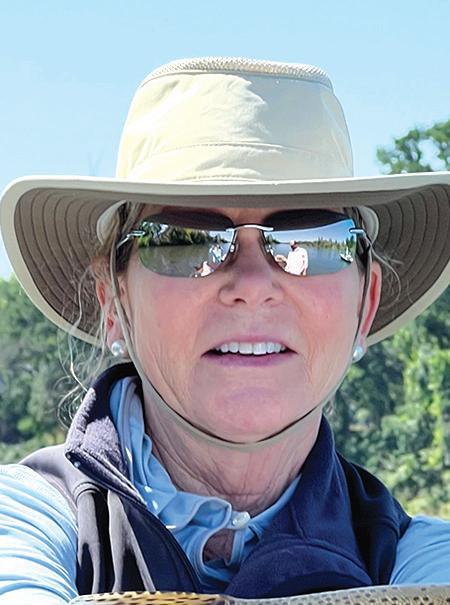
Photo by Jialing Cai.
CREEK MAINTENANCE & SAFETY
By County Supervisor Candace Andersen
Seasonal rainfall across the area this spring brought renewed attention to who is supposed to maintain creeks, storm drains, and neighborhood infrastructure. While many residents frequently observe natural creeks winding through public and private lands, it’s not always obvious who is responsible for the maintenance of these waterways.
The primary public agency handling large-scale waterway infrastructure is the Contra Costa County Flood Control and Water Conservation District (FCD). Established by the California Legislature in 1951, the district operates under the county’s Public Works Department. It was originally designed to mitigate urban flooding risks associated with rapid post-war development by routing storm water quickly into the Delta and San Francisco Bay.
Today, the District’s operational mandate has evolved to balance flood control with strict environmental stewardship, including habitat restoration, erosion control, and water quality protection. The district’s physical maintenance authority is restricted to the 79 miles of channels, regional concrete networks, and 30 major detention basins that it explicitly owns or, those which it has accepted easements over.
The remaining network of creeks and waterways fall under the jurisdiction of local municipalities or private landowners and homeowner associations. When a creek flows through public property inside incorporated city limits, the maintenance responsibility belongs to that specific city’s Public Works department.
A significant portion of the county’s creek mileage is located on private land, meaning that any resident or homeowner’s association whose property borders a natural stream legally owns the channel up to the top of the creek bank. Creek maintenance is their responsibility.
Sometimes when a neighborhood or subdivision is built, the builder might agree in a development agreement to dedicate a creek or waterway to the FCD. However, unless the district affirmatively accepts the offer of dedication, it remains the responsibility of the individual property owners or homeowner’s association. Typically, the FCD will only accept a dedication of waterways and drainage facilities for maintenance when specific conditions are completed which meet the district’s standards.
Under county and state guidelines, private property owners are legally responsible for keeping the watercourse clear of man-made debris, such as trash and plastic, even if the material originated upstream.
Conversely, natural woody debris, including fallen tree limbs, are treated differently under environmental regulations. Property owners are advised to leave natural wood in place to prevent bank erosion and preserve aquatic habitats, unless the debris forms a severe obstruction that creates an immediate flood hazard. Landowners are also tasked with managing invasive vegetation, such as arundo, bamboo, and giant reeds, though they must preserve low native ground cover to maintain soil stability along the banks.
It should be noted that owning a section of a creek does not grant a resident the authority to alter it at will. Conducting structural alterations, such as widening a channel, dredging silt, or building concrete or boulder retaining walls without authorization is illegal. Any physical modification requires permitting from regulatory agencies, specifically Contra Costa County Public Works, the California Department of Fish and Wildlife, and the U.S. Army Corps of Engineers. Unapproved bank adjustments can result in substantial environmental fines and create civil liability if the alterations cause downstream flooding.
For blockages or structural concerns within unincorporated areas of the county, residents should contact the County Public Works Maintenance division. For issues impacting waterways within incorporated municipal boundaries, residents must contact their respective city hall’s public works department.
The FCD and local law enforcement urge residents to stay completely out of creeks and drainage channels during storm events. These facilities are designed solely for vital flood control—routing storm water safely out to sea—and should never be used for recreation. There have been tragic consequences, including the loss of life, when people have chosen to go into the waterways in rafts or tubes when water is flowing. When storm water levels rise, conditions inside these channels become rapidly fatal. Water currents can move as fast as 20mph, temperatures are often frigid, and the water is heavily filled with rushing debris. Furthermore, because concrete channel walls can reach heights of up to 30 feet, individuals who enter the water are often trapped. Officials warn that these extreme conditions make rescue operations nearly impossible, even for emergency teams.
For more information about the County’s Flood Control District, visit www. contracosta.ca.gov/5586/Flood-Control-District
My office is here to serve the residents of Contra Costa County District 2, which includes Alamo, Blackhawk, Canyon, Danville, Diablo, Lafayette, Moraga, Orinda, Rossmoor, San Ramon, Tassajara Valley, and parts of unincorporated Walnut Creek. Please contact us if we can provide you with additional information on this topic or on other County issues. I can be reached at SupervisorAndersen@bos.cccounty.us or 925-655-2300.
HIGH SCHOOL GRADUATES HONORED AT MILITARY SWEARING-IN CEREMONY
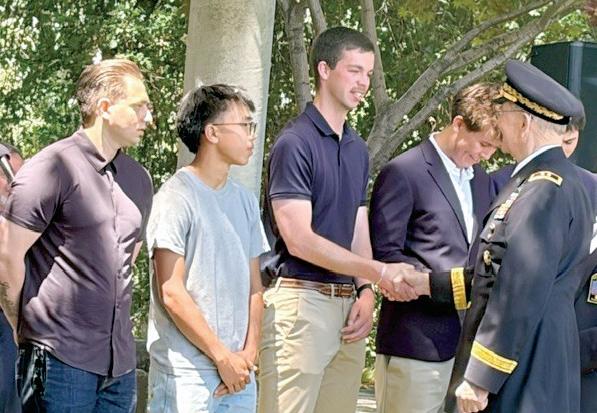
High school graduates from the greater San Ramon Valley area who will be entering military service were recognized and honored at a special “Swearing-In” ceremony sponsored by the Veterans Memorial Building of San Ramon Valley. They were welcomed by Master of Ceremonies, Councilmember Mark Belotz. San Ramon Mayor Mark Armstrong provided civic remarks and Lt. Cody Litman provided an encouraging keynote speech noting it was an honor to recognize these young men and women who have volunteered to serve their country in the branches of the military that they have chosen.
Enlistees entering the US Navy: Austin Bugaj, Jackie Frankera, Matt Daniel Morejon, Tessa Loucia Dowhan, and Matthew Racela. Enlistees entering the US Army: Tyler Dadej, Max Wang, Enrique Rodriguez, and Suhyeon Kim. Enlistees entering the US Coast Guard: Ethan Martinez, and Julian Lehto. Six graduates who are entering US Military Academies were also recognized: Christian Egli and Dylan Ziegenfus joining the US Naval Academy, Samuel John entering the US Military Academy, and Anthony Griffin-Yeh and Markos Matsis joining the US Air Force Academy.
To conclude the ceremony, Major General Ronald Lowe, US Army (ret.) and Dennis Giacovelli, President of the Vietnam Veterans of Diablo Valley, presented each enlistee with a Veterans Memorial Building challenge coin. The recruits also received Certificates of Appreciation from local civic leaders.
The “Swearing-in Ceremony” was organized by a committee headed by Mary O’Donnell, American Legion Post 246 and Dennis Giacovelli, Vietnam Veterans of Diablo Valley.
To learn more about the Veterans Memorial Building, and services offered, visit www.vmbsrv.org
The National Charity League Vista Oak Chapter recently honored its graduating high school seniors who contributed more than 2,494 hours of volunteer service to local nonprofits.
Pictured L to R: Avery Bush, Gracie Cooper, Patsy Babby, Claire Thrasher, Marley Kovacovich, Mackenzie Geddis, Anna Gustafson, Claire Sullivan, Grace Gagnon, Maren Durkee, Samantha Gustafson, and Julia Christensen.
DISCOVER MOUNT DIABLO
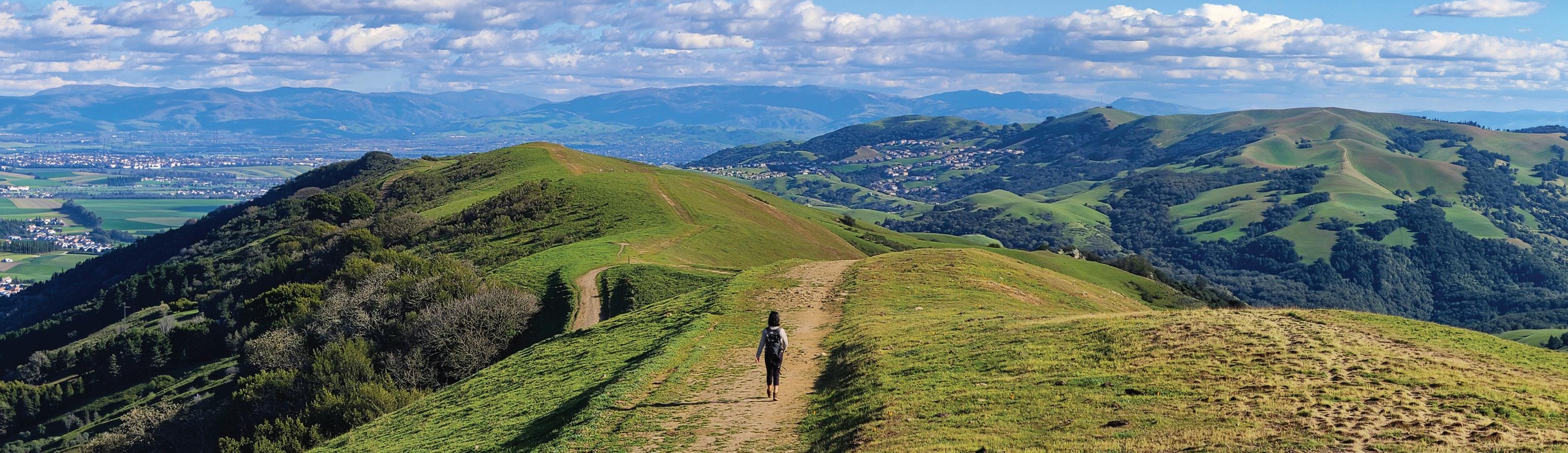
Come enjoy some new adventures on and around Mount Diablo and up and down the Diablo Range! Explore some of the East Bay’s premiere hiking and natural areas with Save Mount Diablo, including places normally closed to the public through Discover Diablo hikes and outings.
Discover Diablo offers a wide variety of FREE adventures including guided hikes, themed walks, and other outdoor activities: mountain biking, rock climbing, meditation in nature, plein air painting events, and property tours.
Discover Diablo hikes are guided by experts steeped in the natural history and lore of the region, who both educate and entertain while emphasizing the breathtaking beauty that the Diablo Range has to offer.
Check out the schedule, learn more, and reserve your spot for an upcoming event at https://tinyurl.com/5u55hpm2
VALLEY VIGNETTE By Beverly Lane MOUNT DIABLO: THE HISTORY OF ITS NAME, PART 1
Looming over the San Ramon Valley is the area’s dominant physical feature, Mount Diablo – the Devil Mountain. No name in the Bay Area has as interesting and imaginative a history as that of Mount Diablo. This column (which initially appeared in The Valley Pioneer) will be the first of several which will examine facts and fancies about the mountain and its name.
Diablo is not a volcano, contrary to some early historical speculations, but is sort of a “geologic freak.”
As described by Oliver Bowen in the Geologic Guidebook of the San Francisco Bay Counties: “The core of the twin-peaked mountain consists of jumbled massive rocks of the Franciscan formation which literally have been punched through the once overlying Cretaceous and Miocene formations from below.” It was formed in close to its present configuration about 10 million years ago in the late Cenozoic age. Since it stands alone at a height of 3,849 feet above sea level, it can provide a view which is extraordinary. Yosemite’s Half Dome, Mount Lassen, and the Farallon Islands can be seen on a clear day from the summit.
In 1769, the first European explorers to see the mountain were members of the Spanish Gaspar de Portola/Junipero Serra expedition of Alta California. A 1772 expedition, headed by Lt. Pedro Fages and recorded by Franciscan Father Juan Crespi, first stepped on its foothills in 1772. It was also the first Spanish excursion through the San Ramon Valley.
Climbing Willow Pass, these explorers were among the first Europeans to view the Delta and the great Central Valley. Father Crespi wrote: “We set out from this valley and entered some medium-sized hills of pure earth and pasture. We ascended a pass to its highest point in order to make observations, and we saw that the land opened into a great plain as level as the palm of the hand… all level land as far as the eye could reach. Below the pass we beheld the estuary that we were following and saw that it was formed by two large rivers.”
The first geologic investigation of the Bay Area included a measurement of the mountain. This mapping was done by Englishmen from the ship “Blossom,” who sailed into the Bay on November 6, 1826. Capt. Frederick W. Beechey asked the acting San Francisco Presidio commander, Ignacio Martinez, for permission to map the Bay.
With that permission and the requirement that a copy of the chart be made for Martinez, three men spent 54 days mapping the bays of San Francisco and San Pablo, and most of the Carquinez Strait. The mountain appears on their map with the name “Sierra Bolbones” at a measurement of 3,770 feet high. This was the name recognized the Bay Miwok Volvon Indians who lived on the mountain. Historians think that the men climbed to the top and measured it with a mercurial barometer. Because of the immensity of the view, the summit was established by the General Land Office Deputy Surveyor Col. Leander Ransome in 1851. It became the initial point of the Mount Diablo Base Line and Meridian from which about two-thirds of California and all of Nevada are measured.
For thousands of years, Indians in Northern California were the first people to live on, and within sight of, the mountain. To them the peak was sacred. The next Valley Vignette will feature the Indian perspective.
Sources: F. W. Beechey, Narrative of a Voyage to the Pacific and Beerings’ Strait, 1831; Henry Bolton, Missionary Explorer on the Pacific Coast (Juan Crespi); Oliver Bowen and V. L. Vanderhoof in Geologic Guidebook of the SF Bay Counties, 1951; Beverly Ortiz, personal communication; Randall Milliken, An Ethnographic Study of the Clayton Area, Keller Ranch Cultural Resource Evaluation, 1982. First published in The Valley Pioneer on July 15, 1987.
THE SMARTEST MOVE FAMILIES CAN MAKE THIS SUMMER A MID-YEAR FINANCIAL CHECK-IN
By Waldron Partners
Between family vacations, community events, and keeping pace with busy careers, summer in this community has a way of moving quickly. For many hardworking families, the first half of the year disappears before there’s been a chance to pause and evaluate whether financial goals are still aligned with real life. That’s why June is an ideal time for a mid-year financial review. Not because something is wrong, but because successful families know that staying proactive matters. Markets shift, priorities evolve, and opportunities emerge throughout the year. A thoughtful financial check-in can help ensure the decisions you’re making today continue supporting the life you want tomorrow.
Here are six smart reasons families should revisit their financial plan before the second half of the year begins.
1. YOUR GOALS MAY HAVE CHANGED
What felt important in January may look different now.
Perhaps your family is considering a home renovation, helping a child prepare for college, purchasing a vacation property, increasing charitable giving, or planning more meaningful travel experiences together. A mid-year review gives you the opportunity to make sure your financial strategy still reflects your current priorities and values.
2.
MARKETS CHANGE…YOUR STRATEGY SHOULD TOO
Even disciplined investors can benefit from recalibrating throughout the year. The market rarely moves in a straight line, and portfolios can drift away from their intended balance over time. Mid-year is a good opportunity to revisit your investment allocation, assess risk exposure, and determine whether adjustments are appropriate based on current market conditions and long-term objectives. Small strategic adjustments today can have a meaningful long-term impact.
3. SUMMER IS THE PERFECT TIME FOR TAX PLANNING
Many people think about taxes only during filing season. In reality, some
of the most effective tax strategies happen months before year-end. With half the year remaining, there’s still time to evaluate opportunities such as:
• Maximizing retirement contributions
• Reviewing capital gains exposure
• Strategic charitable giving
• Adjusting tax withholdings
• Exploring donor-advised funds or gifting strategies
Proactive tax planning can help families preserve more of what they’ve worked hard to build.
4. YOUR SPENDING HABITS DESERVE A REFRESH
Summer tends to bring more dining out, travel, entertainment, and social events. That’s part of enjoying life, but it’s still important to ensure spending remains aligned with long-term goals.
A mid-year budget review isn’t about restriction. It’s about intentionality. Many higher-income families are surprised by how quickly discretionary expenses can expand when life gets busy. Taking time to review cash flow, recurring expenses, and savings habits can create clarity and confidence moving forward.
5. MAJOR LIFE CHANGES REQUIRE FINANCIAL UPDATES
Life evolves quickly.
Career changes, growing families, aging parents, real estate purchases, or business transitions can all impact your financial picture. Even positive milestones can create gaps if planning documents and strategies haven’t been updated accordingly.
Mid-year is an excellent time to revisit:
• Insurance coverage
• Emergency savings
• Education funding plans
• Estate planning documents
• Beneficiary designations
• Long-term retirement projections
Families who stay ahead of these updates are often better positioned to navigate change with confidence.
6. IT HELPS YOU FINISH THE YEAR STRONG
There’s something powerful about taking a moment to pause and reset.
A mid-year financial review isn’t simply about numbers on a spreadsheet. It’s about reconnecting your financial decisions with the life you’re building for your family and your future.
It’s an opportunity to celebrate progress, identify areas for improvement, and move into the second half of the year with greater focus and intention.
Bay Area Indians, 1816, by Louis Choris.
ADDING A LOVED ONE TO YOUR HOME TITLE – SIMPLE, RIGHT?
By Robert J. Silverman, Esq. (left), Silverman & Jaffe
In the course of my estate planning law practice, I’ve often been told: “I want to add [fill in the blank with a loved one, e.g. a child] to the title of my home,” followed by the question, “That’s simple, right?”
On the surface, yes. The paperwork under which a property owner (“donor”) adds a loved one (“donee”) to the title of a property – typically as a “joint tenant” – is relatively straightforward for an experienced attorney. Many property owners believe this is a terrific succession plan; an effective short-cut to conventional estate planning due to the “right of survivorship” associated with joint tenancy. If two or more joint tenants co-own a home and one dies, the remaining joint tenant(s) become the “automatic” owner(s) of the deceased joint tenant’s interest – without being subject to probate.
Unfortunately, drilling down further reveals it is anything but simple and the potential risks and consequences are many and far-reaching. Further, the alternative of comprehensive estate planning, including a living trust, can nearly always accomplish a donor’s objectives efficiently, while avoiding the myriad of potential problems.
Some of the more consequential potential problems associated with the well-intentioned, but often ill-advised, addition of someone to a home title are:
I. Property Tax Reassessment. Generally, any transfer of CA real estate will trigger a reassessment unless a specific exemption applies. Proposition 19 rules eliminated most formerly attractive parent-child transfer exemptions. Now, adding a donee to your title will almost certainly result in a property tax increase – regardless of whether it’s done out of “convenience,” for succession purposes.
II. Income (Capital Gains) Tax. Given “carryover basis” for lifetime gifts and “stepped-up basis” for inherited assets, it’s generally much more income tax-favorable to inherit. The essence of these tax rules is that following a gift, a substantial amount of capital gains tax might be due upon the future sale of the property whereas the tax could be avoided or minimized upon a sale if the donee instead receives the property via inheritance.
III. Gift/Estate Tax. Such transfers are considered gifts, requiring that the donor file a federal gift tax return. Also, the donor uses some federal gift/estate tax exemption in the process (a more robust discussion of federal gift/estate tax law is well beyond the scope of this article).
IV. Control. One or more of these very important control risks will almost certainly be present: 1) an otherwise unnecessary probate might be triggered (and will almost always be triggered unless the last surviving joint tenant establishes a living trust); 2) the donor’s equity may be vulnerable to current and future judgments against the donee; 3) the donee may have enforceable occupancy rights that the donor didn’t intend or want; 4) the donee has a right to his/ her portion of rents generated by the property; 5) major complications can arise if the donee becomes incapacitated and the donor wants to sell or refinance the property; 6) the donee can force the sale of the property and disbursement to the donee of his/her share of the sale proceeds – even if doing so is contrary to the donor’s intentions; 7) if the donee was added as a “joint tenant,” the donee can (unilaterally and against the donor’s wishes) “sever the joint tenancy,” enabling the donee to will his/her interest to someone other than the donor, and leaving the donor’s interest vulnerable to probate if the donor dies first. These many and serious cautionary issues emphasize the importance of obtaining legal and tax advice before deciding on whether to “simply” add a loved one to the title to your property.
Estate Planning | Trust Administration & Probate | Real Estate
Please contact me to request a complimentary: i) Estate Planning Primer, ii) Real Estate titling brochure, and/or iii) an introductory meeting. I am an attorney with Silverman & Jaffe, 1910 Olympic Blvd., Suite 330, Walnut Creek, CA 94596; (925) 705-4474; rsilverman@silvermanjaffe.com. This article is intended to provide information of a general nature, and should not be relied upon as legal, tax and/ or business advice. Readers should obtain specific advice
Smart continued from page 14
Because financial success rarely happens by accident. It comes from consistent, thoughtful planning over time.
If you’d like to revisit your financial strategy before the second half of the year begins, our team is here to help. Together, we can evaluate where things stand today and ensure your plan continues supporting the goals that matter most to you and your family. Email us at team@waldronpartners.com.
Disclosure: Osaic Wealth, Inc. and its representatives do not provide legal or tax advice. You should consult a legal or tax advisor regarding any legal or tax information as it relates to your personal circumstances.
Peter Waldron CA Insurance License #0E47827. Securities and investment advisory services offered through Osaic Wealth, Inc. member FINRA/SIPC. Osaic Wealth is separately owned and other entities and/or marketing names, products or services referenced here are independent of Osaic Wealth. Advertorial
Point continued from page 12
originated from Mount Diablo or specifically reference Mount Diablo Base and Meridian to help establish property boundaries. This piece of history lives on today in those properties. John shared that the organization that continues to share history and information about land surveying is the Mount Diablo Surveyors Historical Society. Founded in the early 1990s with the goal of educating the public about land surveying, the group continues to thrive being so close to the central character in California surveying: Mount Diablo. This is why the group is excited to share this celebration with the public.
Fun fact: There are eight different ways to say 175th anniversary, but the most common seems to be dodransbicentennial, though some prefer the slightly more modern version, quartoseptcentennial. No matter what you call it, the Mount Diablo Surveyors Historical Society is looking forward to welcoming everyone to the top of Mount Diablo on Saturday, July 18th from 10am – 4pm. Park entrance is $10 per vehicle, but there is no additional charge for the event. Allow 45 minutes to drive from the park entrance to the summit parking lot for the event.
Visitors will experience historical surveying demonstrations (some with the same equipment that Colonel Ransom would have used as he set the initial point), educational exhibits, and interactive surveying games. Mount Diablo Surveyors Historical Society will also share how surveying has evolved over the years, now with the use of technology such as drones, it is an entirely different landscape so to speak.
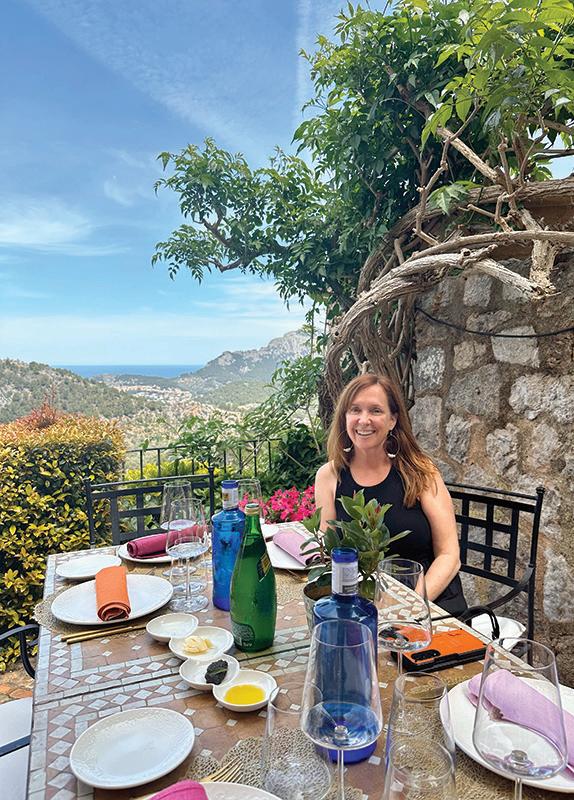
Mallorca, Spain
The Mount Diablo visitor center was built in the late 1930s around the original Initial Point. Courtesy of Mount Diablo State Park.
POSTCARDS FROM THE HEDGE
By Jill Appenzeller
I went to the nursery last week, and I was delight ed and overwhelmed by the flats and flats of lovely delphinium and digitalis, fragrant sweet William and sweet peas. Dahlias in so many luscious colors, from knee high to tree high. Cleome and cosmos, tall blue iris, weird starry allium and agapanthus in shades from pale blue to deep purple. I used to come home this time of year with flats and flats of plants, and spend many happy hours tucking my new treasures in next to roses and grasses and geraniums. And of course there was the aching back and the dirt under my fingernails that could not be scrubbed out.
Point continued from page 15
Be sure to head inside the building to see the actual highest point of the mountain—it’s the only way to stand atop the peak. Guided tours will point out the location of the Initial Point along with a second location of historical interest placed in 1852, just one year after the Initial Point, by R.D. Cutts of the U.S. Coast and Geodetic Survey agency. Cutts placed a triangulation station on Mount Diablo to map California’s waterways and topography, but set it about three feet away to not interfere with the Initial Point. According to Stephen, at just the right angle on your hands and knees you can still see the copper bolt placed by Cutts.
You can also head up to the observation deck of the visitor’s center to see the sweeping 360-degree view and imagine what it must have looked like in 1851 in the years just before Alamo incorporated, when the population of settlers in the entirety of Contra Costa County was estimated to be several hundred to a thousand. Without roads and property lines cutting up the valley, it must have felt like a vast land of opportunity just waiting to be discovered. Discover a little piece of history for yourself at the 175th anniversary of the Mount Diablo Initial Point.
To learn more, visit mdshs.org.
CAN YOU GIVE RIDES TO SENIORS & VETERANS, OR DO YOU NEED A RIDE?
Are you an ambulatory senior or veteran who needs a ride to medical appointments, the grocery story, or other essential services? Or, are you aged 25-75 and able to volunteer just three hours a month to help provide a ride?
Mobility Matters (MM) is a nonprofit agency that has been serving otherwise homebound residents trying to age in place in Contra Costa County since 2004. MM provides free, door-through-door, one-on-one, escorted rides for seniors and disabled veterans with volunteer driver programs, and they match riders to accessible transportation providers through their Transportation Information and Referrals Helpline. If you need a ride, call 925-284-6161. For volunteer opportunities, call 925-284-2215. For more details, visit www.mobilitymatterscc.com
But I am out of room. I never lived in one garden for 25 years before this house, the house Wally and I built for the view, for the north facing outdoors. I have gardened just steps from the beach, in sandy soil. I have gardened on a flat acre next to a creek with rich black sticky clay that opened big cracks in summer when it dried out, but grew huge vegetables. Now I live on a small hill with two huge oaks, one ancient buckeye, and a lot of real estate I don’t
I had space in the front, for many of the things I planted could not take the baking summer heat. So I planted more things that could not take the baking summer heat, until I started planting calandrina spectablilis and iris, boxwood and rosemary and yucca (I know, I know, but it works). Lemons
There have been many deaths. The lady’s mantle and lungwort that grew in the shade outside our bedroom have disappeared. I miss them. But the spider plant Karyn gave me has spread into patches of white variegated grass, and despite its reputation as a houseplant it seems happy as a ground cover. Hellebores are not supposed to reseed. They are not supposed to grow in full sun. But mine have reseeded in the cracks in the stone steps, along with a fern from an errant spore, and down the hill onto the dry hillside where the
The hollyhocks, started from seed given by an old friend, have also traveled down the hill. They remind me of her. They started out in the front, in full sun, hot pink and taller than my husband. They have spread into the back, into the shade, helped by birds and squirrels, and they throw up tall towers of silky hot pink flowers in summer. And the occasional pale pink, for they are, as an old plant identification teacher said of oaks, “promiscuous.” I’ve never looked at oaks quite the same way. I have some raised beds, and I started with the idea that I’d alternate beds between flowers and vegetables. But then I planted a Moorpark apricot in the artichoke bed, and the artichokes had to move. They are living with peonies and lilies. We will see.
The Santa Rosa plum, planted just across from the apricot so they could hold hands and form a tunnel, evicted the asparagus, which is now living
I came home from the nursery with a modest amount of lobelia and sweet alyssum (actually lobularia maritima and so fragrant!) and some tall pink cosmos and bronze foliaged lobelia, to fill some pots that had held tulips and narcissus, over planted with pansies, now all tucked into the garden.
I love alyssum and lobelia, but the true alyssum I grow, whose botanical name used to be alyssum saxatile, has yellow flowers and loves sun. Alas, now it’s not an alyssum either – it’s aurinia saxatillis. I wish they’d stop having international conferences on botanical nomenclature. It’s confusing.
Jill Appenzeller has lived and gardened in Danville for longer than she
THE WILLOWS
By Joe Lamb, Brende & Lamb Tree and Shrub Care
Long before the first cities emerged along the rivers of Mesopotamia, the willow family was making human culture possible. Its flexible shoots were woven into baskets, fish traps, and the wattle walls of dwellings. Its bark, rich in salicin, was chewed to relieve pain — a folk remedy that eventually gave the world aspirin. Native peoples across North America prized the straight young shoots for arrow shafts, a use that required exactly the kind of clean, even growth that coppicing naturally produces. As Charles Watkins documents in Trees, Woods, and Forests, willows were intensively coppiced in the ancient landscape. The practice of cutting a tree to its base to stimulate new shoots has been utilized for thousands of years. Coppicing yields a renewable harvest of straight, supple rods for weaving artifacts that make a culture. A coppiced willow is nearly immortal. The stool — the gnarled base and root system left after cutting, from which all new growth springs — can survive for thousands of years. I envy willows ability to create from their wounds. Our relationship with willows is older than writing, older than the wheel.
Here in the East Bay, willows are native to the riparian corridors threading through our hills and valleys. The arroyo willow, Salix lasiolepis, lines the seasonal creeks of Orinda, Lafayette, and Moraga, its narrow leaves catching the light in the quick, shimmering way that gave the whole family its poetic reputation. The red willow, Salix laevigata, grows along the more permanent watercourses, its reddish stems glowing in winter light. Riparian willows are not ornamental trees in the conventional sense. They are nature’s engineers. Willow roots stabilize stream banks and filter runoff. Their canopies shade waterways, keeping temperatures cool enough for baby trout and salmon. They fix nitrogen, enrich soil, and provide critical early-season nectar and pollen for native bees emerging in late winter when little else is blooming. The naturalist’s term for trees like these is foundational species — remove them, and much of what depends on them unravels.
For the homeowner, a mature willow is a gift: fast growing, generous with shade, alive with birds and insects, and with a natural affinity for dance. Willows move in a breeze the way few other trees do, every leaf independent, the whole canopy in conversation with the air.
But willows in the East Bay hills require attentive stewardship, and in our current climate that stewardship carries an urgency that goes beyond aesthetics or even individual property safety. We live now in an era of weather whiplash. The generous rains of a wet winter produce an extraordinary flush of new growth, in grasses and in willows. It is beautiful. It is also, when the dry years follow, a serious fire hazard. Daniel Swain, climate scientist at UCLA and UC Agriculture and Natural Resources, has put it plainly: “This whiplash sequence in California has increased fire risk twofold: First, by greatly increasing the growth of flammable grass and brush in the months leading up to fire season, and then by drying it out to exceptionally high levels.” Willows along unmanaged drainages become corridors of continuous biomass connecting one property to the next. In a fire, they do not merely burn — they carry fire, rapidly, from one garden into another.
The answer is not to remove willows, but to manage them. Thinning dense stands to reduce fuel load, removing dead wood, and cutting back overgrown shoots so that regrowth remains vigorous but manageable
Cleaning of windows, gutters, and solar panels, power washing of driveways and courtyards. Licensed and insured. 510-331-3988
rangelwindows@yahoo.com are all practices that reduce fire risk dramatically while preserving the ecological value of the trees. In this sense, coppicing remains entirely relevant. A well-managed willow is safer, healthier, and often more beautiful than a neglected one.
There is a broader argument here, and it is worth making plainly. In a community as fire-vulnerable as ours, the care you give your trees is not only an investment in your own property. It is a contribution to the safety of your neighbors, your street, your watershed. Good tree care, practiced thoughtfully and regularly, is a mitzvah to the community — an act of responsibility that quietly protects people you may never meet.
At Brende & Lamb, our certified arborists understand the native trees of the East Bay, their ecology, their vulnerabilities, and their beauty. We would welcome the chance to walk your property and offer a free estimate for whatever your trees need. Call us at 510-486-8733, or visit www.brendelamb.com to see before-and-after photos, client testimonials, and work in your neighborhood.
Advertorial
Creek continued from front page
as green sunfish, largemouth bass, bluegill, and crayfish move through the current. Dick Heron, co-chair of Friends of San Ramon Creek, a volunteer organization that works to maintain a healthy creek and watershed, confirmed the presence of otters near Hap Magee Park using wildlife camera footage.
As part of the broader watershed, the creek connects inland habitats to the Bay, supporting a much larger ecological network. Mammals including deer, raccoons, foxes, and coyotes rely on the creek for water, movement, and survival.
San Ramon Creek reminds us that abundance does not require vast wilderness. Even in a suburban setting, it sustains a richness of life that persists quietly: fish navigating currents, insects forming the base of unseen food chains, and animals using the creek as a lifeline through developed land. The creek’s vitality shows us that nature exists not just in distant landscapes, but right here, woven into our daily lives.
CONSERVATION CHALLENGES
Protecting the creek begins with awareness of both its value and its vulnerabilities. One ongoing challenge is maintaining water quality, including
Photo by John-Noah Chang
ALAMO IMPROVEMENT ASSOCIATION (AIA)
By Roger Smith, President
EAST BAY REGIONAL PARK DISTRICT
The East Bay Regional Park District (EBRPD) manages 73 parks and over 126,000 acres of open space across Alameda and Contra Costa counties. For residents in Alamo there are several regional parks and trails located right outside your door or a short drive away. These include:
• Iron Horse Regional Trail: This multi-use paved trail runs directly through Alamo, providing an excellent, accessible route for biking, walking, and commuting directly to adjacent cities.
• Green Valley Trailhead: Located on Green Valley Rd. in Alamo, this is a popular access point for rugged, scenic hiking and walking along the lower slopes of Mount Diablo.
• Diablo Foothills Regional Park: Located at 1700 Castle Rock Rd. in nearby Walnut Creek, this park offers 1,060 acres of dramatic rocky ridges, scenic trails, and is highly popular for hiking, horseback riding, and nature viewing. Please join us for a presentation about our East Bay Regional Parks via Zoom at 6PM, Thursday, June 18th. The Zoom link will be posted at www. AlamoCA.org on June 12th.
ALAMO
FARMERS MARKET
Come meet the folks from Resendiz Family Farm and J&J Ramos Farm they will have an amazing selection of cherries, melons, stone fruit and vine-ripened tomatoes, just in time for the 4th of July! Alpine Blue with their luscious, large, and juicy blueberries and several varieties of cherries will also be there.
J&M Ibarra & Vasquez Organic Farm will have organic and conventional veggies. Farmers Daughter CB and Bakery Squirrel alternate weeks as our fresh bread vendor. Fresh fish, as well as meat and cheeses, will be available too! Hot food vendor Los Tamales, Taza Pan Asian, and Yuri’s Peruvian will be available for your takeout enjoyment. If you wish to make vendor/ market suggestions or are interested in being a musician or vendor, call or text Heather Harlow (Manager) at 669-237-5564.
The Market complies with all Contra Costa County Health Departments requirements, and is sponsored by AIA. It is open rain or shine on Sundays from 9AM – 2PM in Alamo Plaza, off of Danville Blvd., near Bank of America. Please look for updated information about the Market on nextdoor.com
WHAT IS SMART 911?
Smart 911 is free and allows you to provide valuable information about yourself and your family to 9-1-1 call takers and first responders in the event of an emergency call. If a disaster strikes, first responders can have vital information such as home access notes, utility shut off directions, bedroom locations, and pet instructions. At a time when seconds count, being able to provide 9-1-1 with details that could impact response when an emergency call is placed could be the difference between life and death. You can add the key information you choose. You can also receive targeted community and weather alerts based on your location.
Now is the time to Create a Safety Profile for your family at www.smart911. com and/or register with the Smart 911 app from the App Store.
AIA IN THE COMMUNITY
Now celebrating its 71st year, AIA, a non-profit 501(c)(3) organization, has an outstanding history of serving our community and helping shape it into “Alamo - the place where we love to live”!
Visit www.AlamoCA.org and www.AlamoVision2040.org for information on AIA, articles of interest to Alamo residents, membership and more!
Don’t be left out, now is the time to renew or become a new member of AIA!
TECHNOLOGY MATTERS
By Evan Corstorphine,
Portable CIO SOLVING IPHONE TO PC SYNC ISSUES
Recently, a client called me. She wanted to get her iPhone and PC syncing again so her calendar, contacts, and notes would show up in both places. Before she finished describing the problem, I already knew what was on her computer, iCloud for Windows. And, I knew it had stopped working. I get this same call several times a year, and the answer is always the same. iCloud for Windows is the wrong tool for this job, and I will not install it on a client machine.
Here is the trouble. iCloud for Windows promises to keep your Outlook calendar and contacts in sync with your iPhone. In practice, the sync is generally flaky and random. It needs to be reset and reauthenticated more often than any working software should. When it does sync, it tends to push from the PC to the phone reliably enough, but the return trip from phone to PC is unreliable, slow, and sometimes simply does not happen for hours. Add an appointment on the phone at lunch and it may not appear on your desktop by dinner. The photos piece has the same illness. Inconsistent, slow, occasionally just stuck. It is a lousy implementation start to finish.
Why is it so bad? Apple has very little incentive to make their Windows software work well. They want you on a Mac. The iCloud connector exists mostly so they can say it exists, not because anyone at Apple is losing sleep over how reliably it talks to your three year old PC.
Then, there is the duplicate problem. Once iCloud for Windows gets confused, and it does get confused, it can create duplicate calendar entries and duplicate contacts. Now you have two of every birthday, two of every doctor appointment, and two phone numbers for your sister where one of them is three years out of date. Cleaning it up by hand is miserable. Restoring from a backup, if you have one, often brings the duplicates right back the next time it syncs.
There is a much better answer for users who have an iPhone, a Windows PC, and no company email account behind them. Create a free Outlook.com email account. Add it to your iPhone in Settings, Mail, Accounts. Add it to Outlook on your PC. Set Outlook.com as the default for new calendar entries and new contacts on both devices.
What you get is the next best thing to a private Microsoft 365 domain, for free. The iPhone talks to Outlook.com using a protocol called Exchange ActiveSync, the same technology businesses have used for years to keep corporate calendars and contacts in sync on phones. It is fast, two-way, and reliable. The PC side just works because Outlook was built to talk to Outlook.com.
Migrating your existing calendar and contacts over takes a little patience the first time, and yes, it is mildly clunky. But once it is set up, you stop thinking about it. That is the whole point. Sync should be boring.
If you are fighting iCloud for Windows and losing, send us a text or call 925-552-7953, or email support@pcioit.com. Advertorial
Host continued from page 8
rent. It also specifically relates to the consumption of alcoholic beverages by people ages 20 and under at social gatherings.
There are 7 key points to the ordinance parents should understand:
• There is liability on both the juvenile/young adult consuming alcohol and separately on the adult who controls, owns, or possesses the place where the party occurs (this includes adult siblings or friends while parents are not present, and parents themselves when juveniles are unsupervised)
• The location can be public or private. Examples are private homes, rented public buildings, and rented hotel rooms (liability rests with any adults present or the adults who rented the location)
• There must be a minimum of five people at the location under the age 21
• Even if only one of the juveniles or young adults is simply holding an alcoholic beverage; that is considered a violation
• Violations of the Social Host Law carry a monetary fine (current California law allows up to $1,000) and are considered either an infraction or misdemeanor offense
• Juveniles under the age of 18 are subject to a citation to appear with a parent or guardian at the Danville Juvenile Diversion Program in addition to the criminal citation for possession and/or consumption of alcohol
• Each juvenile/young adult in possession of, or consuming alcohol is considered a separate violation of this law; these violations are also separate from the adult’s citation for controlling, owning, or possessing the location where the party occurs
THE HIDDEN RISK OF “SHADOW AI” IN SMALL BUSINESSES
By Jeremy Davis, CloudMinders
Most business owners think they have not adopted artificial intelligence yet. In reality, many already have. They just do not realize it.
Across nearly every industry, employees are quietly using tools like ChatGPT, Claude, and Google Gemini to help with daily work. They are drafting emails, summarizing meetings, analyzing spreadsheets, writing marketing content, researching answers, and brainstorming ideas. Often, this is happening without leadership approval, IT oversight, or any formal company policy.
This growing trend is known as “Shadow AI.”
The term is similar to “shadow IT,” where employees use unauthorized software or services outside the visibility of the business. The difference is that AI tools are being adopted much faster because they are incredibly easy to access and immediately useful.
In many cases, employees are not trying to break rules or create security risks. They are simply trying to work more efficiently. If someone discovers they can complete a task in 10 minutes instead of an hour using AI, most people are going to use it.
That creates both an opportunity and a risk.
The opportunity is obvious. AI can dramatically improve productivity, reduce repetitive work, and help small teams accomplish more than ever before. Businesses that learn how to use AI effectively are gaining a real competitive advantage. A small business with the right systems and processes can now operate at a level that previously required a much larger team. Employees can spend less time on repetitive tasks and more time focusing on customers, strategy, and growth.
The problem is that unmanaged AI adoption can expose sensitive business information in ways most companies have not considered.
Imagine an employee copying client data into a public AI chatbot to summarize a report. Or, pasting confidential financial information into an AI tool to help write a presentation. Or, uploading internal company documents to generate meeting notes. Even if the employee has good intentions, many public AI tools were not designed with business governance and compliance in mind.
Most small businesses currently have no visibility into how employees are using AI, what information is being shared, or which platforms are being used. That lack of visibility is where the real risk begins.
Many business owners assume AI usage would be obvious, but it often happens quietly in everyday workflows. An employee uses AI to improve an email. A manager uses it to summarize a meeting. A salesperson asks it to draft a proposal. Before long, AI becomes embedded into daily operations without leadership ever formally approving it.
The challenge is not necessarily the technology itself. The challenge is the lack of guardrails. Without clear policies, employees are left to make judgment calls on their own about what information is appropriate to share with AI tools. Some may assume that because a tool is popular, it must also be secure. Others may not realize that entering sensitive business information into public AI systems could create compliance, confidentiality, or legal concerns.
For industries like law, healthcare, finance, construction, and professional services, the stakes can be especially high. Client records, financial data, contracts, intellectual property, and internal business strategies are all information that should be handled carefully.
What makes Shadow AI particularly challenging is that banning it usually does not work. Employees will still use AI tools if they believe it helps them perform their jobs more effectively. In fact, trying to completely prohibit AI may put businesses at an even greater disadvantage as competitors continue adopting it.
The better approach is to acknowledge that AI is here and create safe ways for employees to use it responsibly.
That starts with leadership. Businesses need clear conversations around acceptable AI usage, data privacy, and what types of information should never be entered into public tools. Employees should understand both the benefits and the risks.
It also means businesses should evaluate secure AI platforms designed specifically for organizational use. Enterprise-focused AI solutions can provide centralized management, security controls, user accountability, and better protection for sensitive information while still allowing employees to benefit from AI’s capabilities.
At the same time, business owners should recognize that AI adoption is moving incredibly fast. This is not a trend that will fade away in a year or two. AI is quickly becoming part of the modern workplace, much like email, cloud computing, and smartphones did before it.
The companies that navigate this transition successfully will not be the ones that avoid AI entirely. They will be the ones that embrace it thoughtfully and strategically. We are entering a new era where AI is becoming part of everyday business operations whether leadership realizes it or not. The question is no longer whether employees are using AI. In many cases, they already are.
The real question is whether your business is leading that adoption or simply hoping it is happening safely behind the scenes.
Jeremy Davis is a technology strategist who helps businesses use cybersecurity, modern IT, and artificial intelligence as engines of growth. As founder and president of CloudMinders, he advises organizations on turning complex technology challenges into lasting competitive advantages. To learn more, email info@cloudminders.com, visit www.CloudMinders.com, or call 925-269-9966. Advertorial
Host continued from page 8
In addition to the Social Host Ordinance, older youth over the age of 21 who buy alcohol for their younger sibling, cousin, or friend can also be held liable if something happens to the youth whom the alcohol was purchased for. If you have children or family members in this age bracket, please remind them of the potential risks of purchasing for minors. When planning your event, educate and communicate with your teen. Even if you have had the conversation before about alcohol and the dangers associated with underage drinking, have it again to reinforce the importance for their safety, the safety of others and you; their parent/guardian. Our officers need your help to educate the youth in our community and hold them accountable for poor choices. We are here to enforce the law, and the law exists to ensure public safety. Your actions can make a difference to deter teens from drinking. Help us as we look to celebrate safely through the remainder of 2026!
Dentist • Dental Implants
Advanced Periodontal Therapy • Porcelain Veneers
Custom Teeth Whitening • Digital X-Rays
Invisalign Clear Braces
220 Alamo Plaza, Suite E, Alamo Next to Safeway
Open Monday - Thursday and the first two Saturdays of each month.
Meet Dr. Yvonne Hyland & Her Family
Dr. Hyland has been in private practice since 2000. She received a DDS degree from Baylor College of Dentistry in Dallas, Texas. Following dental school, she pursued a hospital-based General Practice Residency at the Veteran’s Medical Center in West Los Angeles for two years. Realizing this was not the end of her formal education, she completed a successful three-year post-graduate surgical residency in periodontics. Dr. Hyland’s experience and professional skills excel in every aspect of dentistry from general cosmetic procedures to complex surgical cases. She has placed thousands of successful dental implants and is highly trained in all phases of gum disease therapy, tissue and bone grafting procedures, and wisdom teeth extraction.
Dr. Hyland understands the desire to provide the very best care for the entire family. As a resident of Alamo, she strives to meet community needs by providing unparalleled services for those seeking the finest complete dental care in one location. In her spare time, Dr. Hyland enjoys spending time with her husband Terry, two sets of twin boys, and their three rescue dogs adopted from ARF. 925-831-8310
THE EYE OPENER SUMMER AND ULTRAVIOLET LIGHT
By Gregory Kraskowsky, O.D., Alamo Optometry
Summer is approaching, which means the sunlight we receive will be stronger. Many of us will be outside in the sun for longer hours, so we need to discuss UV protection. The harmful ultraviolet rays from the sun can have several ocular consequences in addition to other body and skin conditions. I will address some of the potential eye issues here. First, ocular UV protection should be a priority year-round. Even though we receive more ultraviolet radiation in the summer months than in winter, we are exposed every day, regardless of weather and temperature. Ultraviolet exposure is cumulative throughout life, and approximately 75% is accumulated by the age of eighteen. UV light is part of the non-visible radiation we receive from the sun and has both good and bad attributes. It makes black-light posters glow. It also helps the body produce vitamin D, so a little time in the sun is a good thing. However, too much exposure causes sunburn and increases the risk of skin cancer.
Exposure to UV has ocular complications such as premature cataracts and pingueculas. Cataracts form later in life and are a normal part of the aging process. However, long-term UV exposure can expedite the process. Studies have shown that people that live on or near the equator get cataracts about 10 years earlier than people who live closer to the poles; this is because those people receive the most daily UV radiation throughout the year. A pinguecula is the common yellowish looking bump on the white part of the eye. Many people have these, and they are completely benign. Over time these tend to become red and irritated in dry and/or allergic conditions; prolonged contact lens wear can cause more irritation. The more inflamed the eye gets, the quicker these pingueculas tend to grow. Keeping the eye lubricated and having UV-blocking lenses are your best defense against further complications. For eye protection, the best thing you can do is have UV-blocking lenses
in your glasses. Fortunately, there are several ways this can be accomplished. The first thing to remember is that your lenses do not have to be tinted to be UV-protected. Conversely, all tinted lenses do not block ultraviolet light. Simply having tinted plastic lenses in your glasses will not block any of the harmful rays from the sun; plastic lenses do not inherently have any UV protection. To obtain the necessary protection, a UV filter must be present in the lenses. This is a clear filter, and it does not alter the appearance or color of the lenses in any way. For those of you who enjoy wearing sunglasses, the most common way to get this is to have polarized lenses. In addition to blocking the sun’s harmful rays, these lenses eliminate glare, which makes vision sharper and more comfortable. The effects are especially noticeable in high-glare situations such as driving, skiing, and water sports. For those that want tinted lenses and clear lenses without two separate glasses, then transitions lenses might be an option. These lenses come inherent with UV protection and are clear indoors and dark outdoors. Like polarized lenses, transitions lenses are available in single vision, bifocals, and progressive lenses.
Some people just do not like to wear sunglasses. As was mentioned before, the lenses do not need to be tinted to block UV. Patients that are uncomfortable with tinted lenses can have their clear glasses made from trivex or other high index materials. These lenses have a UV filter and are thinner, lighter, and are impact-resistant compared to plastic lenses.
Patients of all ages should wear some form of UV protection outdoors. Whether they are inexpensive over-the-counter sunglasses for your children or higher quality polarized lenses for adults, this protection is like “suntan lotion for the eyes,” and will reduce the ocular consequences of UV radiation. You are welcome to come into the office anytime if you have any questions and we can demonstrate the improved vision and contrast with our polarized sunglasses.
Dr. K. at Alamo Optometry is your hometown eye doctor for outstanding service, vision care, and designer eyewear. He can be reached at (925) 820-6622, or visit his office at 3201 Danville Blvd., Suite 165, in Alamo. For more information, visit www. alamooptometry.com, or follow on Facebook and Instagram @Alamo Optometry. Advertorial
YOUR PERSONAL NUTRITIONISTS
NUTRITION FOR PRE-DIABETES AND DIABETES
By Linda Michaelis RD, MS and Jackie Peterson RD CDCES
Close to 25 million Americans over 65 years old have Type 2 diabetes, while another 90 million 20 years or older, have been diagnosed with pre-diabetes. Your physician will confirm a diabetes diagnosis by looking at results of an A1C test. This test tells what your average glucose level has been over the past three months.
We work with many clients that have not been to their doctor in at least a year and are shocked to find out that they have been diagnosed with Type 2 diabetes. They did not take a previous prediabetes diagnosis seriously. Minor changes in your diet and lifestyle will bring your blood sugar levels down to normal range in a very short time and may avoid needing to take extra medication.
The first reaction to a Type 2 diabetes diagnosis can be shock, fear, and even depression. Most people will start taking 500-1,000 mg of Metformin twice a day. Clients report that for a couple of months they have diarrhea, gas, stomach pain, and flu-like symptoms until their body adjusts. You do not have to live with these side effects if you work closely with us and follow the dietary regimen we recommend to get rid of diabetes.
FIVE MEAL A DAY PLAN
It is important to eat five small meals a day to prevent the blood sugar from spiking. These five meals do not have to be huge. You can take your lunch and divide it into two meals. You need to learn how to balance the correct amounts of protein, carbohydrate, and fat in each meal or snack. For the first four meals, I recommend a large amount of protein (the size of your palm), a carbohydrate, and some vegetables. The evening meal can include a smaller amount of protein (harder to digest at night) to be enjoyed with a cup of whole grains and 2 cups of vegetables. We find our clients enjoy the variety of smaller, meals, and larger snacks. Clients easily improve glucose levels and report higher levels of energy during the day! This is due to the fact that their body is not going through roller coaster blood sugar spikes and dips.
Some clients cannot eat five meals a day because of their work schedule. I have created a meal plan that can work for them. I am working with a physician that can only have lunch and takes no breaks during the day. She now keeps some turkey jerky and nuts in her coat pocket. Her lunch has become the largest meal of her day and often includes 6 oz. of protein, 1 cup of vegetables, and ½ cup of quinoa. She finds that this is helping her get through the day. Previously, she was hungry all day only eating the fruit available in the kitchen. She would come home late, was ravenous and was eating her large meal at night, along with several servings of dessert. Her blood sugars were out of control. She listened to all of our advice and is no longer on metformin.
EXERCISE
We talk about the importance of exercise, and recommend splitting up walking into 15 minute increments which can have a large impact on blood sugar levels. It does not have to all be done at once if you have a hectic work schedule. It is quite common to see a 50 point reduction of blood sugar after a 15-30 minute brisk walk. It’s the best “pill” in town.
DESSERT
You can have dessert as long as it is eaten after a meal, and not on an empty stomach. We can talk about combining fruit or dessert with a protein or healthy fat to help prevent blood sugar spikes.
This all may sound too good to be true, but it can be done if you choose to take the time to start taking charge of your health! Health is wealth, and we can help you see how easy it can be.
The good news is that most insurance companies pay for nutritional counseling including ABMG, Aetna, Blue Cross, Blue Shield, CCHP, Cigna, Hill, Sutter, UHC, and others. We are happy to call on your behalf and see what your plan offers. Please visit www.LindaRD.com to learn more about our services. Email us at lifeweight1@yahoo.com, or 925-855-0150 to tell us about your nutritional concerns and see how we can help you. Advertorial
Michael Tomcik, M.D.,
Board Certified Dermatologist
•
•
Laser (red vein treatment)
• Botox/Dysport
• Fillers
• Pharmaceutical Grade Skin Care Products
Medical Dermatology
• Skin Cancer Treatments
• Mole Removal
• Rashes
• Skin Tags
• We accept Medicare and most PPO insurances
Creek continued from page 17
managing algae growth. Arundo, a tall, bamboo-like, non-native, perennial grass that can grow up to 30 feet, is an invasive species that can be damaging for the creek. Arunda crowds out native plants, increases erosions during storms, increases fire risk, and lowers water level due high consumption of water. Volunteers with the Friends of San Ramon Creek have worked extensively to remove arundo, identifying San Ramon Creek as the largest sub-watershed and one of the most impacted in the area.
SIMPLE ACTIONS FOR BIG IMPACT
Many of the conservation challenges stem from human activities, including runoff from lawns, debris entering storm drains, and development near waterways. The good news is that protecting the creek does not require large-scale efforts. The most effective conservation work happens through small, consistent actions.
One of the easiest actions is to grow native plants such as willows and sedges, which stabilize the banks and support local wildlife. Equally important is reducing water and fertilizer runoff from homes. Over-watering lawns, using excess fertilizer, or allowing water to flow off driveways can carry pollutants directly into storm drains, which feed into the creek. Simple changes such as drought-tolerant landscaping or installing permeable surfaces, can significantly reduce this impact. Keeping pollutants out of the system is critical. Picking up pet waste, avoiding dumping into drains, and properly disposing of household chemicals all help maintain water quality. Some things to keep out of creeks include soil, chemicals (e.g. fertilizer, pesticide, herbicide, chlorinated water), trash and debris, green waste and mulch.
Community involvement also plays a major role. Consider participating in cleanups or restoration efforts with local groups or high schools, or gather your friends and family to help. Protecting San Ramon Creek requires thinking beyond the waterway itself and recognizing it as part of a larger watershed that connects to San Francisco Bay and the Pacific Ocean. Individual actions may seem small, but collectively we can sustain the ecological health of the entire system.
To learn more about Friends of San Ramon Creek, visit www.wcwatershed. org/friends-of-san-ramon-creek.html
John-Noah Chang is a resident of Alamo, and a student at Head-Royce School who explores environmental and sustainability issues in his community, showing how small actions can lead to meaningful impact.
Voted
Sources: Dick Heron, Co-chair of Friends of San Ramon Creek, Walnut Creek Watershed Council website, Contra Costa County Flood Control and Conservation website, Fishbrain website, Friends of San Ramon Creek brochures.
SKINtheNEWS By Jerome Potozkin,
MD
STUBBORN FAT THAT WON’T BUDGE? YOU’RE NOT ALONE.
As summer approaches, many people become more focused on looking and feeling their best. Whether it’s travel, time outdoors, or simply wearing lighter clothing, this season tends to highlight areas of the body that don’t always respond to our best efforts.
If you’re like many of my patients, and frankly, like me, diet and exercise can only take you so far. You may be doing everything right and still notice stubborn pockets of fat that just won’t go away. Common areas include the abdomen, love handles, thighs, and under the chin. These are incredibly common and often resistant to even the most disciplined routines.
The good news is that modern technology offers effective solutions.
COOLSCULPTING ® : NON-SURGICAL FAT REDUCTION
CoolSculpting® remains one of the most popular and well-studied non-invasive fat reduction treatments available today. It’s important to note that this treatment is not just for women, we see many men seeking treatment as well.
CoolSculpting works through a process called cryolipolysis, which freezes fat cells beneath the skin. These cells are more sensitive to cold than surrounding tissues, allowing us to selectively destroy them without harming the skin. Over time, the body naturally eliminates the treated fat cells.
One of the biggest advantages is that there is no surgery and little to no downtime. Most patients return to normal activities the same day.
EFFICIENT TREATMENT, COMFORTABLE EXPERIENCE
At our practice, we use the latest CoolSculpting Elite technology, which allows for more efficient treatments. With multiple devices, we can often treat more than one area at a time, what we call “dual sculpting,” reducing overall treatment time.
We also incorporate technologies such as ZWave Pro, which may enhance results and support skin quality after treatment.
Equally important, we focus on patient comfort. Treatments are performed in a relaxed setting where you can watch TV, catch up on emails, or simply unwind. For busy schedules, we offer flexible appointment options, including select weekends.
SAFETY AND EXPECTATIONS
CoolSculpting has an excellent safety profile, but as with any medical procedure, there are risks. A rare side effect called paradoxical adipose hyperplasia (PAH), where fat enlarges rather than shrinks, occurs in well under 1% of patients. In our experience, we have seen this only once and were able to successfully correct it with liposuction.
It’s also important to understand that CoolSculpting is not a weight-loss procedure. It is designed for body contouring and treating localized fat deposits that persist despite a healthy lifestyle.
ANOTHER OPTION: TUMESCENT LIPOSUCTION
For those seeking a more immediate or more dramatic result, tumescent liposuction is another excellent option. This technique, pioneered by Jeffrey Klein, allows fat removal under local anesthesia without general anesthesia, reducing risk and recovery time.
THE BOTTOM LINE
A healthy diet and regular exercise remain essential. But if you have areas that simply won’t respond, you’re not alone, and you do have options. Dr. Jerome Potozkin is a Board Certified Dermatologist and Board Certified Micrographic Dermatologic Surgeon specializing in minimally and non-invasive cosmetic procedures. He is the author of “Botox and Beyond: Your Guide to Safe Non-Surgical Cosmetic Procedures.” The practice is accepting new patients and can be reached at (925) 838-4900 and www.potozkinellis.com. Advertorial
TIRED OF BEING TOLD YOU’RE FINE, WHEN YOU KNOW YOU’RE NOT?
By Dr. Niele Maimone, DC
If you’ve typed something like, “Why am I always tired,” or “Why can’t I lose weight” into a search bar recently, you’re in good company. These are among the most-searched health questions in the country right now, and they point to something many people in our community are quietly living with: the feeling that something is off and that conventional medicine hasn’t quite gotten to the bottom of it.
I’ve been in practice in Danville for over 25 years. And if there’s one thing I hear more than anything else in my exam room, it’s this: “I’ve been told my labs are normal, but I don’t feel normal.”
That gap between what the tests say and how you actually feel is exactly where integrative and regenerative medicine lives.
WHAT YOUR BODY MAY BE TELLING YOU
Fatigue, brain fog, joint pain, weight that won’t move no matter what you try, disrupted sleep, no libido, and low mood. These aren’t just signs of getting older. They’re often signs of something upstream: hormonal shifts, inflammation, nutrient depletion, or a nervous system stuck in high gear for too long.
The standard workup doesn’t always catch these things. Optimal ranges and functional ranges are different, and that difference matters. When we look at the full picture, including hormones, inflammatory markers, metabolic function, and micronutrients, we often find patterns that explain everything. Not as separate problems, but as one story the body has been trying to tell.
WHAT’S ACTUALLY CHANGING IN HEALTHCARE RIGHT NOW
There’s a quiet shift happening in how people approach their health. Rather than waiting for a crisis, more people are asking better questions earlier. They want to understand the why behind their symptoms, not just manage them. They’re done with “watch and wait.”
We see this every week at Align. Patients come in after years of being passed from specialist to specialist, each one looking at a single piece of the puzzle. What they needed was someone willing to look at the whole picture. That’s the conversation we’re built for.
WHAT WE DO DIFFERENTLY
Most people who come to us have already seen multiple providers. They’ve had the appointments, the referrals, the standard tests. What they haven’t had is someone sit with them long enough to connect the dots.
That’s where we start.
Before we recommend anything, we listen. We want to know how you’re sleeping, how you’re feeling by 3pm, what your energy looked like five years ago versus today, and what you’ve already tried. We look at your labs through a functional lens. Not just whether your numbers fall inside a reference range, but whether they reflect a body that is truly thriving.
From there, we build a plan that is yours. Not a protocol pulled off a shelf. Some patients need help with pain and mobility. Some are dealing with hormonal shifts that are affecting everything from their weight, to their mood, to their drive. Some are healthy on paper, but know something is missing. Each program looks different because each person is different.
What stays the same is the goal: find the root cause, support the body’s ability to heal, and help you feel like yourself again or better than you have in years.
YOU DON’T HAVE TO KEEP SEARCHING
If you’re in that space right now, researching options, wondering if there’s something better, tired of answers that don’t quite fit, I’d love for you to come in for a conversation. Not a sales pitch. Just a real conversation about what’s going on and what might actually help.
We’re at 125 Railroad Ave, Suite G, right here in Danville. You can reach us at 925-362-8283 or visit alignhealingcenter.com.
Your story isn’t over. It may just be getting to the good part.
Dr. Niele Maimone, DC, is the founder of Align Healing Center and Align Regenerative Medicine in Danville. She has served the Tri-Valley community since 1999. Advertorial
ANYONE CAN PRESCRIBE GLP-1S
ALMOST NOBODY KNOWS HOW TO PROTECT YOUR GUT, MUSCLE, AND METABOLISM WHILE YOU’RE ON THEM
By Dr. Jeffrey Mark, M.D & Dr. Frances Mark, Pharm.D., The Real Gut Doctor
There is no question that GLP-1 medications have changed the conversation around weight loss. For many people struggling with stubborn weight gain, cravings, metabolic slowdown, and belly fat that no longer responds to traditional dieting, these medications can be remarkably effective. Patients often experience reduced appetite, improved portion control, and meaningful movement on the scale, sometimes for the first time in years.
However, there is a growing problem almost nobody is talking about. Losing weight while your gut falls apart is not a health program.
At The Real Gut Doctor™, we are seeing a rapidly increasing number of patients who begin GLP-1 therapy elsewhere only to develop worsening constipation, severe bloating, nausea after only a few bites of food, abdominal pressure, excessive gas, sulfur burps, and the uncomfortable sensation that food is simply sitting in the stomach for hours. Some patients describe looking six months pregnant by evening despite eating far less than before. Unfortunately, many are told this is simply “part of the process.”
We strongly disagree. Common does not mean normal.
This is where The Real Gut Doctor™ has quietly created an entirely different category of care that simply does not exist in most traditional weight loss clinics, med spas, or injection-based programs. Most providers focus almost exclusively on appetite suppression and the number on the scale. Very few are truly trained to understand the downstream effects GLP-1 medications can have on gut motility, digestive function, microbiome balance, nutritional status, muscle preservation, or the long-term metabolic resilience of the patient.
In other words, many clinics know how to prescribe GLP-1 medications. Very few know how to comprehensively manage the body while the patient is taking them.
That distinction matters enormously.
Dr. Jeffrey Mark, M.D., founder of The Real Gut Doctor™, is a 5X board certified physician with more than three decades of clinical experience in gastroenterology, internal medicine, obesity and metabolic medicine, healthy aging medicine, and functional and regenerative medicine. Together with Dr. Frances Mark, Pharm.D., a UCSF-trained drug-free treatment specialist with extensive expertise in regenerative and longevity medicine, they have developed a far more sophisticated physician-guided approach to metabolic transformation.
The philosophy at The Real Gut Doctor™ is simple.
The goal is not merely to help patients become smaller.
The goal is to help patients become healthier, stronger, more energized, more metabolically resilient, and biologically more youthful while losing fat intelligently.
That requires a much deeper understanding of the gut and metabolism connection.
GLP-1 medications can significantly slow stomach emptying and intestinal motility. For some individuals, particularly those with prior IBS, constipation tendencies, microbiome imbalance, chronic stress, prior antibiotic exposure, sluggish digestion, or underlying SIBO risk, this slowdown can create the perfect environment for digestive dysfunction to worsen. As food remains in the digestive tract longer, fermentation increases, gas production rises, bloating worsens, and constipation can become severe and painful.
At the same time, many patients dramatically reduce their food intake but unknowingly fail to consume enough protein to preserve lean muscle mass. Over time, this may contribute to fatigue, weakness, reduced metabolic rate, and the prematurely aged appearance many people now refer to as “Ozempic face.”
This is precisely why a prescription alone is not enough.
At The Real Gut Doctor™, patients may receive comprehensive physician-guided support that evaluates gut motility, digestive function, microbiome balance, protein tolerance, muscle preservation strategies, metabolic health, inflammation, and long-term sustainability. The focus is not simply short-term weight loss. It is whole body optimization.
That is why patients frequently tell us they are not only losing weight, but also feeling lighter, clearer, less inflamed, more energetic, and more confident than they have felt in years.
This is not traditional weight loss medicine.
It is not a med spa.
It is not a one size fits all injection clinic.
The Real Gut Doctor™ has created a completely different class of physician-guided metabolic, gut, functional, regenerative, and longevity-focused care for discerning patients who want to lose weight intelligently without sacrificing their digestion, energy, muscle, microbiome, or quality of life in the process. Because true health is not measured only by the scale.
It is measured by how vibrantly your body continues to function while achieving the transformation you desire.
Call The Real Gut Doctor today at 925-736-9828, visit www. TheRealGutDoctor.com . Advertorial
TELECARE CONNECTS WITH THE HOMEBOUND
Since 1971, member volunteers of TeleCare, a philanthropic program of Assistance League ® of Diablo Valley, have been making weekday reassurance calls to seniors and the homebound in our community. Clients can anticipate a friendly exchange of ideas with trained volunteers who provide high quality, consistent communications. If a client cannot be reached, family members will be notified.
This service is free! Make that call to get you or someone you know connected! For more information, call 925-934-0901. To learn about Assistance League of Diablo Valley’s other philanthropic programs, please visit www. assistanceleague.org/diablo-valley.