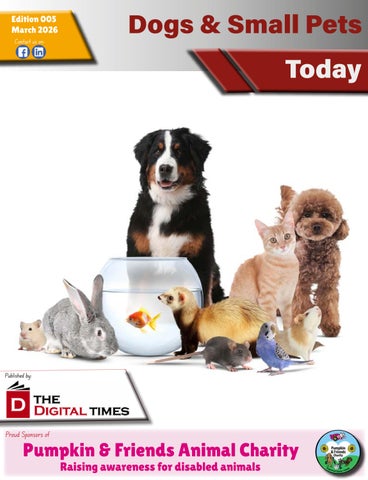
Edition 005 March 2026 Contact us on:
Dogs & Small Pets Today
Published by:
Proud Sponsors of
Pumpkin & Friends Animal Charity Raising awareness for disabled animals
🐾
ur latest o o t e e d m itio o c l e n !🐾 W
Grab a coffee (or tea!), a treat for your pawsome pet sitting next to you and a comfy seat... Inside our March edition you will find: Pumpkin and Friends Charity Who They Are...
Show Your Support This March
Pumpkin and Friends Charity Not Just A Charity Shop
Products, Services & Events Something To Look Into To...
Pumpkin and Friends Charity Training Courses
Dogs & Puppies Man’s Best Friend
Pumpkin and Friends Charity March’s Wheelie Warriors
Cats & Kittens The Magic of Cats
Pumpkin and Friends Charity
Rabbits & Bunnies The essentials of great rabbit care
Page 4
Page 12
Page 14
Page 18
Disability Dog Walk 2026 Page 22
Pumpkin and Friends Charity Special Mentions Page 26
Pumpkin and Friends Charity Behind The Scenes: Incontinent Animals Page 34
Pumpkin and Friends Charity
Page 42
Page 66
Page 76
Page 88
Page 102
Guinea Pigs The Tiny Companions With Giant Hearts Page 108
Hamsters Small Pets With Big Personalities Page 118
Behind The Scenes: Preventing a UTI
Birds Our Feathered Companions
Pumpkin and Friends Charity
Smallholder Poultry
What Is Degenerative Myelopathy
Practical, Sustainable, Rewarding
Page 38
Page 40
Page 124
Page 130
Proud Sponsors of
Pumpkin & Cha
Registered Ch 1199
& Friends arity
harity Number 9484
Raising awareness for disabled animals. Where it all began... Click here to watch the video
y Pumpkin’s Stor We adopted Pumpkin when she was 8 weeks old, we as a family instantly fell in love with her. Pumpkin couldn’t use her back legs and had no control of her bladder or bowels. The specialist said Pumpkin would never walk again. Her story went viral and people donated thousands of pounds for her treatment. Unfortunately, an MRI scan revealed her spine and legs had been broken, and her spinal cord severed. We were devastated. The specialist said Pumpkin would never walk again. Pumpkin isn’t in pain; she is paralysed from the waist down and double incontinent. Pumpkin is loved by us, her family, so much and we will do anything for her. Pumpkin also needs weekly hydrotherapy, physiotherapy, and red laser treatments. This is to keep her front limbs strong and help her with any injuries or pain. www.pumpkinandfriendscharity.org
Pumpkin became a therapy dog when she was 9 months old. We visit care homes, schools, universities and work places. Educating the public about disabled animals and kindness to animals. In June 2022, we set up a registered charity called Pumpkin and Friends 1199484. Slowly we are changing the world. Desperately raising the awareness and the importance of disabled animals. Also supporting and helping families of disabled animals. We provide disabled animals with the equipment they need to give them their motibility & freedom back, including Wheelchairs, Harnesses and Strollers.
Raising awareness for disabled animals. Having a disability isn’t a death sentence. It’s the beginning of a new adventure. Become a Wheelie Good Friend Does your animal need a wheelchair? Are they struggling with their mobility? We can help you, we can provide a Free loan of a wheelchair or stroller and give your animal its freedom and confidence back. We are based in Lincolnshire but can help animals anywhere in the UK. We also offer wheelchair fittings with a member of our team. This is a free service, but what we do ask is that you provide our charity with 1 weekly update regarding your animals adventures. Also so we can show our supporters where their money is being spent. The equipment belongs to Pumpkin & Friends Charity and can be asked to be returned, especially if we feel it isn’t being used or we don’t receive weekly updates. www.pumpkinandfriendscharity.org
We are just months into 2026 and already we’ve been asked to save, rehome, or take in so many dogs and cats... Every time we have to say no, our hearts break.
💔
Not because we don’t care, but because right now, we simply don’t have the space. So many families aren’t giving up. They’re exhausted. They’re overwhelmed. They just need a break, a rest, a reset... and somewhere safe for their beloved animals while they breathe.
As we step into 2026, our wish, our fight, is for something truly life-changing:
🐾
treat & Respite Centre e R l a m i n A n A
A calm, safe haven where disabled animals can stay when their families need support. A place filled with love, care, patience, and kindness Where every animal is cherished, understood, and safe, while their humans take a moment to recover. Because no animal should ever lose their life simply because their family needs help. Because love should never come with conditions. And because disabled animals deserve more, more time, more care, and more compassion. Caring for a paralysed or disabled animal is a 24/7 commitment.
❤
🐾
Our dream for 2026 is to offer: • • • • • • •
Respite stays Day care Specialist care Accommodation for owners A place to rest. A place to recharge. A place where people feel understood — not jud
💖 This is what we’re fighting for. And we will never
Families give everything, and they deserve support too.
🌟 As we begin this new year, your support has already shown what’s possible 🌟
Our charity single “A Wheelie Good Christmas” reached No. 28 in the UK Charts, spreading one powerful message f
Having a disability isn’t a death sentence.
If you’d like to help us turn this 2026 dream into reality: Donate here by clicking the buttons below Go Fund Me
⬇ PayPal
Online
Natwest PayIt
Thank you for believing. Thank you for caring. Thank you for standing with us.
❤ We are changing lives — wheel by wheel ♿ Disabled animals are NOT broken ❤
dged.
r stop.
💖
far and wide:
❤
Not Just a Charity Shop! Pumpkin & Friends Charity Shop; Lincoln’s Most Pawsome Community Hub
Step inside Pumpkin & Friends Charity Shop and you’ll soon realise this isn’t your average charity shop, it’s a community hub, a safe place, and a haven for animal lovers! Nestled in the heart of Lincoln, our shop is more than racks of clothes and shelves of treasures. It’s a space filled with warmth, wagging tails, laughter, and a whole lot of Pumpkin Power! Here, everyone is welcome, especially your furry friends. We’re proudly dog friendly, and you might even be greeted by one of our famous wheelie warriors or resident therapy dogs.
Therapy Tuesdays: Cuddle Pumpkin! Every Tuesday from 10am – 12.30pm, come and meet Pumpkin the Wheelie Westie Warrior herself. Therapy Tuesdays are all about cuddles, smiles, and learning more about life with disabled animals. It’s a heartwarming experience you won’t forget!
A Safe Place for All Whether you’re popping in for a chat, need advice, or just want to be part of something kind and caring, our doors are open. We believe in community, compassion, and connection. Every cuppa, conversation, and purchase helps us support disabled animals and their families across the UK.
Opening Times: Monday: 10am – 3pm Tuesday: 10am – 2pm Wednesday: 10am – 4pm Thursday: 10am – 2pm Friday: 10am – 3pm Saturday: 9am – 12.30pm Sunday: CLOSED .
Wheelchair Fitting & Training Centre We’re proud to be an official Wheelchair Fitting and Training Centre for disabled animals.. Owners can book appointments to get the right wheelchair or stroller, learn how to fit and use them safely, and receive ongoing support, advice, and guidance from our experienced team. We know how overwhelming it can feel when your pet becomes disabled, that’s why we’re here to help every step of the way.
Donations Are Always Needed We rely on the kindness of our supporters to keep helping disabled animals. We’re always grateful for donations of: • Clothes • Homeware • Shoes • Toiletries & Gift Sets • Pet Accessories Every item donated helps raise vital funds for the animals who need us most.
Come for the bargains, stay for the community, and leave with a smile. Because at Pumpkin & Friends Charity, we’re not just a charity shop, we’re a family. Pumpkin & Friends Charity Shop The Coach House, Firth Road, Lincoln, LN5 7PA
01522 642512
Upcoming Training Course: Saturday 11th April Our next confirmed Wheelchair Training Course is taking place on Saturday 11th April 2026 at 10am - 2pm at the Pumpkin and Friends Training Centre in Lincoln city centre. This educational session is ideal for both professionals and members of the public who wish to gain a deeper understanding of Walkin’ Pets wheelchairs and how they support disabled animals. Whether you’re looking to expand your knowledge or are interested in becoming a volunteer with Pumpkin and Friends Charity, this course offers valuable, hands-on training.
Delivered by our experienced and qualified team, the course is completely free and covers all types of Walkin’ Pets wheelchair equipment.
PLEASE NOTE: Participants must be physically able to sit on the floor and assist with lifting dogs into wheelchairs.
To register your interest or find out more, please email our team on:
hello@pumpkinandfriendscharity.org Or visit our website:
www.pumpkinandfriendscharity.org
Wheelie Warriors of the Month Our Wheels help change lives: here are our March’s Warriors!
“
Lily-Mae joined our family in August 2025, she was purchased from a farm in Belper, we fell in love with her straight away. Lady and Pearl accepted her so she became part of our gang. Lily-Mae settled in quite well but about three weeks later we noticed that her back legs didn’t seem to be working right, her right leg seemed to be affected the worse, we thought that maybe it was hip dysplasia so we made an appointment at the vets to get them checked out. The vet confirmed that her hips were ok but couldn’t put a finger on what was wrong so we got referred to Paragon Referrals in Wakefield. There Lily-Mae underwent a CT and MRI scan, X-rays and bloods these all came back inconclusive. The vets then wanted to run more tests, however, we were unable to afford anymore (that still possibly wouldn’t give us the answers) so we decided to try LilyMae on steroids to see if they would help. Unfortunately, these just increased her appetite and thirst and after a few weeks the vet advised us to reduce her tablets to one every other day.
Lily-Mae’s legs were not getting any better and luckily, we had been following Pumpkin for quite some time so we decided to get in touch to see if the charity could help. Richard thankfully came out to our home and fitted Lily-Mae with her first set of wheels. Needless to say Lily-Mae was not impressed at first. We tried lots of treats but she wouldn’t budge. We were put in touch with our support worker Tracey who has been brilliant with lots of encouragement. We were also invited to go to the charity shop in November when Central News were coming to do a feature on the charity, we turned up with Lily-Mae in a push chair and had her wheels with us as well. We put her in her wheels and when she saw other dogs with wheels it gave her the courage to try hers out, this was the break we needed to get Lily-Mae rolling. On the same day Lily-Mae also had a second set of wheels fitted as she had outgrown her first set which was amazing. As time has gone on Lily-Mae’s legs have got steadily worse to the extent that she cannot feel anything in her back legs until you get nearer her hips. I bandage her legs every day to try and give them some protection as she runs around with the other two dogs, she is now also in doggy nappies as she is now incontinent. Sadly Lily-Mae is now also starting to knuckle on her front legs but this doesn’t seem to phase her she just keeps going. We have started Physio and Hydrotherapy she’s had five sessions and she does really well in the water. We don’t know how long Lily-Mae will be with us but as long as she’s happy eating well and not in pain we will do the best we can for her. Her favourite pastime is playing with the metal food bowls and making a lot of noise!
Lovel
y Lily -Mae
Wheelie Warriors of the Month
Happ y
“
Harol d
His story, written by his amazing mummy: A Little Dog with a Superhero Spirit Harold is a five-year-old Dachshund with a huge personality. I’ve had him since he was 16 weeks old, and he’s always been full of life. In December 2024, Harold suddenly became unwell and was rushed to the emergency vet in severe pain. Overnight, he lost movement in his back legs and was transferred to Pride Veterinary Centre in Derby for emergency spinal surgery. An MRI confirmed a herniated disc and severe spinal cord damage, a condition Dachshunds are sadly prone to. Harold was graded a “Grade 5,” the most severe category, and recovery was uncertain. The surgery was successful and, most importantly, Harold was no longer in pain. What followed was an intense period of rehabilitation, including physiotherapy and hydrotherapy. Throughout it all, Harold remained happy, resilient, and determined to enjoy life. Through the wonderful team at Pride, we were introduced to Pumpkin & Friends, whose support completely changed Harold’s future. Within a week, his magic wheels arrived. After a brief moment of confusion, Harold spotted a squirrel, and off he went. From that moment on, there was no stopping him.
Just over a year on, Harold is living a full and joyful life. He’s back at doggy daycare, racing around at home, playing catch, and chasing squirrels he never quite catches. On his wheels, he’s recently (mostly thanks to me!) developed a love of dressing up as superheroes, zooming around his favourite park like Superman or Batman on a mission. I’m endlessly grateful to my family, the team at Pride Veterinary Centre, and Pumpkin & Friends for helping Harold be the happiest little sausage there is, and, more importantly, to Harold himself for being an absolute superstar and never letting anything slow him down. You can follow Harold’s superhero adventures on @thewheellifeofharold
🐾
Disability Dog Walk 2026 Hosted by Pumpkin and Friends Charity
Stallholders wanted for Disability Dog Walk 2026 Inspirational Wheelies & A Day You’ll Never Forget Would you like to be part of the BIGGEST Disability Dog Walk in the UK? Date: 24th May 2026
Time: 11am-5pm
Location: Lincolnshire Showground, LN2 2NA £50 Stallholder Fee Other Charities & Rescues Welcome | Coffee Venders already booked
Free Family Fun Day hosted by Pumpkin & Friends Charity What’s On: Inclusive Dog Walk Dog Show | Races & Displays | Live Music & Entertainment Water Splash Fun Zone | Bouncy Castles & Family Games | Face Painting & Bubbles Food Stalls, Cakes & Treats | Gin & Beer | Tents | Dog First Aid & Physio Demos Wheelchair Fitting Centre | Indoor & Outdoor Craft & Trade Stalls Mr Twists Balloon Modelling | Bouncy castle
Bring your dogs, bring your friends, bring the whole family Help us make 2026 our biggest and best walk yet!
Special Mentions
Who is Ernie? From Car Park to Cuddles Let’s talk about this wonderfully weird little soul... Ernie’s story started in the saddest way — living alone in a car park in Romania in March 2023. Cold, starving, crawling with fleas and ticks, claws grown into his pads... completely broken, and still somehow fighting to survive. But fate stepped in — in the form of Safe Rescue for dogs. Ernie was ready for love the moment they scooped him up. He just needed a chance. Then came that photo. One little post on their socials and boom, I was smitten. It was the teeth. That gloriously awkward little smile got me right in the heart. We knew. He was our dog.
He also became reactive around other dogs. We tried training, gentle intros... but his fear runs deep. Whatever happened to him out there left invisible scars we’re still gently mending. So we adapted. We slowed down. We built his little world around calm. He has quiet, off-lead walks behind our house with Smiggle and Richard — his safe space, his freedom. Then, in April 2025, we added Bear to our family. Another rescue. Another challenge. A big bouncy whirlwind of limbs and enthusiasm. He came crashing into our lives — literally. We held our breath, not knowing how Ernie would react. And then... magic! Ernie adores him. They are completely inseparable, and they truly bring out the best in each other. The oddest little duo — but somehow, they just work. Bear brings out Ernie’s playfulness, his cheeky side, his bravery. He’s got a best mate now. And it’s beautiful to watch. We even did a DNA test on Ernie — turns out he’s made of 24 breeds. TWENTY-FOUR! He’s basically a canine cocktail. That explains a lot, really. The quirks, the genius, the occasional nervous breakdown over a mop or crutch... But oh, how we love him!
So we packed up the car and drove all the way to South Shields to collect him. Pumpkin and Smiggle in tow, like furry quality control officers. And honestly? It was love at first sniff. He slotted into our chaos like he’d always been here. He instantly bonded with Pumpkin and Smiggle, and day by day his confidence blossomed. We discovered he’s a massive cuddle bug, a total mummy’s boy, and has a secret PhD in Emotional Intelligence. Seriously, he just gets feelings. But trauma doesn’t disappear overnight. As he settled, his fears began to surface. Loud noises. Sudden movements. Sticks (especially ones that might be brooms). And cars? Nope. Big, terrifying monsters.
❤❤
He’s a work in progress, sure. He still hasn’t made it to a proper social event. But we’ll never give up on him. Ever. Because rescue dogs like Ernie? They don’t just need time — they deserve it. So please: • Adopt, don’t shop. • Say no to backyard breeding. • Be the person a scared soul needs. Because they depend on us. And Ernie? He reminds us every day how worth it it all is. From a car park to cuddles. From scared and silent to silly, snuggly, and so loved. What a difference two years can make.
By Tammie Pumpkin & Friends Charity
Who is Bear? Not just another rescue dog... At Pumpkin & Friends Charity, we’re often asked, “Who’s Bear?” Bear isn’t just another rescue dog. Bear is a German Shepherd cross Rottweiler, and every bit as gentle and devoted as that mix suggests. In September, Bear was surrendered into our care. Still just a puppy, he had already been diagnosed with severe double hip dysplasia, a painful and debilitating condition. He needed two total hip replacements. The cost? £20,000.
But life changed, and they could no longer keep him.
We couldn’t turn away from a young dog facing a lifetime of pain.
A new placement sadly didn’t work out, and Bear found himself returned, confused and heartbroken.
So we launched a fundraiser that many of you will remember:
After everything he’d endured, we knew one thing for certain:
Show Bear You Care
Bear didn’t just need a home. He needed forever.
And just like always, our community came together. Donations poured in. Fundraisers were held. Raffles were organised. And yes, Richard even endured his now-infamous charity back wax! Together, you raised the full £20,000 Bear needed for surgery. Since Bear came into our care, the charity has now spent over £27,000 supporting his journey, including: • • • • • • • •
Two complex hip replacement surgeries Medication and pain management Physiotherapy and rehabilitation Specialist recovery equipment Behavioural support and training And we can say this with absolute certainty: He has been worth every single penny. Recovery, Setbacks & Second Chances
Bear’s first hip replacement took place on 12th March 2025, followed by six weeks of strict crate rest with a wonderful foster family who helped him through those early stages of recovery.
So we brought him into our own family. Since then, Bear has blossomed. He’s attended charity events, met hundreds of dogs, started training again, and even enjoyed his first holiday. He still asks for reassurance sometimes, but he’s learning he’s safe, loved, and here to stay. Even Ernie Boo welcomed him with open paws! Bear later underwent his second hip surgery, which came with complications including nerve damage and a fractured femur. What followed were months of careful management, crate rest, and rehabilitation. Then came the moment we’d been waiting for... His CT scan confirmed it: Both hips are perfect. For the first time in his life, Bear is pain-free. He celebrated with his first ever off-lead run, pure joy, pure freedom.
16 Months Later - A Different Dog It’s now been 16 months since Bear came into the care of Pumpkin & Friends Charity — and he is a completely changed dog. Today, Bear is: Pain free Happy Calm Content But it hasn’t been an easy journey to get here. Before his surgeries, Bear was living in constant pain, and that pain led to serious behavioural struggles. He wasn’t “naughty”, he was hurting. Frightened. Overwhelmed. Once his pain was treated and he felt safe, the real Bear began to shine through. And what a beautiful soul he is. Bear is one of the most loving dogs you could ever meet. Gentle. Affectionate. Loyal beyond words. We truly can’t imagine our lives without him now. When Bear had no one else, we stood up for him. And today, watching him live the happy, pain-free life he deserves, we know we’d do it all again in a heartbeat! Bear’s Story Continues Bear is now a permanent member of our charity family. His journey hasn’t been easy, but thanks to your support, his future is bright. Thank you for standing beside us. Thank you for believing in him. And thank you for helping us give this beautiful boy the future he always deserved. His story is still being written — and you’re a part of every chapter
❤❤
By Tammie Pumpkin & Friends Charity
The Healing Power of a Little Dog on Wheels: Pumpkin the Wheelie Westie Warrior By Tammie Pumpkin & Friends Charity
In hospitals, care homes, schools and community spaces, therapy dogs bring comfort in a way no medicine ever could. And sometimes, the most powerful healers are the ones who have faced their own challenges like Pumpkin the Wheelie Westie Warrior. Pumpkin isn’t just a small white Westie with a wagging tail. She’s a disabled dog who uses a wheelchair, and she’s become a shining example of resilience, joy, and unconditional love. As a therapy dog, Pumpkin proves that ability isn’t defined by legs that work, it’s defined by heart. When Pumpkin rolls into a room, faces light up instantly. Children are drawn to her wheels and curious about how she moves. Elderly residents smile as they stroke her soft fur. People going through difficult times often find comfort simply sitting beside her, feeling her calm presence. She has a special way of making people forget their worries, even if just for a little while. Therapy dogs like Pumpkin help reduce stress, ease loneliness, and encourage communication. A quiet child might start talking while asking questions about her wheelchair. Someone living with dementia may recall memories of pets they once loved. In emotional or clinical settings, a dog’s gentle presence can make the environment feel safer and more human. But Pumpkin brings something extra. Because she is disabled herself, she offers a powerful unspoken message: life doesn’t end when mobility changes. Her wheels don’t hold her back, they set her free. For people adjusting to illness, disability, or trauma, seeing Pumpkin zoom around happily can be deeply inspiring. She doesn’t see herself as different. She just sees new friends to meet. Behind Pumpkin is a devoted handler who ensures every visit is safe, positive, and tailored to the people she meets. Together, they are a team spreading what her supporters lovingly call “Pumpkin Power”, courage, kindness, and a reminder that love comes in all forms - sometimes on four paws and two wheels. In a world that can feel overwhelming, Pumpkin the Wheelie Westie Warrior shows us that healing can start with a gentle nuzzle, a wagging tail, and the soft whirr of tiny wheels bringing hope through the door.
Pumpkin Power! We are beyond excited to share some amazing news! I am now the OFFICIAL therapy dog for The Willows School! I’ll be attending regularly, spreading calm, love and reassurance, and helping the children feel safe, supported and understood
❤
Behind the Scenes The bits you don’t know, until you need to know...
Let’s talk about incontinent animals... By Tammie Pumpkin & Friends Charity
Ok, so some people may feel awkward by this section... But it’s educational and extremely important, Everyone Poos, it’s nothing to be embarrassed about. I personally have cared for Pumpkin for 3 years. She is double incontinent and is manually expressed every 3-4 hours. In my experience diet is an extremely important part of bowel incontinence. Pumpkin has always eaten wheat and grain free. Last year we changed her diet to fresh, we chose Butternut Box There’s lots of fresh dog food companies available. All Pumpkins food has been made to her weight, breed and tastes. Before we went fresh, Pumpkin on average would Poo 5 times a day, big stinky poos. Now her poo is small, firm and less smelly. Twice a day is now her normal. Our lives are definitely easier and Pumpkin is happier. Obviously, yes we still get the occasional accident. Normally if she’s eaten something she shouldn’t have!! But as a whole- Fresh eating has completely changed our life’s! Here is a little advice regarding expressing a paralysed animals bladder Urinary incontinence in dogs is a scary diagnosis. It means your pet has lost control over their bladder and, as their guardian, you have to manage the condition with nappies or learning how to express your dog’s bladder. Most pet parents have no problem diapering a dog, but they can’t imagine manually emptying the bladder. If your veterinarian thinks your pup is a good candidate, let me reassure you that you will be able to master the technique. Manually expressing a dog is the best option to keep an incontinent dog healthy. It decreases the risk of urinary tract infections (UTI) and urine scald. For some dogs, it’s critical to their health because expressing their bladder is the only way to empty urine. The technique looks strange at first, but with a little practice most pet parents quickly become pros. Why dogs become incontinent Many conditions contribute to urinary incontinence. They include: old age, Cushing’s Disease, Diabetes and injuries. The number one reason dogs become incontinent is paralysis. If your dog is paralyzed in their hind end, the likelihood of losing bladder control is almost guaranteed. The problem lies in the central nervous system, which houses the spine and coordinates communication to the bladder. Paralysis turns off the system.
The cause of a dog’s mobility problem also plays a big role in their incontinence. For instance, victims of Pug Myelopathy develop an “upper motor neuron bladder.” That means the muscles which release urine, are closed tight. Without manually expressing their bladders, these pups are in big trouble. Their bladders retain urine and stretch to an unhealthy size, causing permanent damage and a breeding ground for bacteria to grow. Expressing the bladders of these dogs isn’t a choice. It’s critical to their health.The first part of learning how to express your dog begins with finding your pet’s bladder. It can be a bit tricky. Of course, you know the bladder is located by your dog’s belly, underneath the hind legs, but it shifts slightly as it fills. To find the bladder of a male dog, place your hands above the middle of the penis. The bladder of a female dog is located further back, above a dog’s hind legs. My vet told me to feel for a furry tennis ball in the lower belly of my dog Sophie. It painted a clear picture in my mind of what I was supposed to look for, but that’s not exactly the shape most people find. The bladder is more oval than ball shaped and has the consistency of a balloon vs. a tennis ball. It also grows larger as urine accumulates so the size of the balloon varies. The bladder is generally about the size of a lemon for small dogs and can be as big as a grapefruit for big dogs. You’ll find the bladder between the rib and hip of a small dog and closer to the hips of a large dog. If you have problems locating the bladder, enlist the help of your vet. A hands-on lesson can be extremely helpful. Every pet owner and dog need to work out the best location for expressing. The perfect spot for Sophie and me was on the lawn in our backyard. It was the same spot Sophie “did her business” before she was paralyzed so she didn’t have anxiety about being expressed there. Here are other bathroom sites pet parents use: • • • • •
Lying the dog on their side over a pee pad in a quiet room Expressing in the shower or tub Holding the dog upright, over a waterproof blanket Raising your pup to a level that’s comfortable for you, like on a table or sofa. Expressing over the toilet
Wherever you choose, make sure there are plenty of baby wipes to clean your dog’s belly afterward. Urine that’s left on sensitive skin can cause burns and scalding.
Keep the potty location you choose. It’ll go a long way fostering trust between you and your pup and alleviating fears your dog has about the procedure. Remember, expressing your dog’s bladder is a new experience for your pet too. Here’s one final tip a pet parent told me, “Always praise your dog after expressing them. They need to know you’re proud of their effort.” Create a bathroom schedule It’s important to create and stick to a strict bathroom schedule. Your dog will appreciate the routine and it’ll prevent the bladder from stretching and retaining urine. Incontinent dogs are prone to recurring urinary tract infections. A solid bladder expressing schedule will keep this to a minimum. Most dogs need to be manually expressed 3-4 times a day or 4-6 times a day for small breeds. To give you an idea of a bathroom schedule, here’s what Sophie’s looked like: • • • •
Morning – As soon as she woke up, I took her to the lawn to be expressed. Afternoon – Another potty break was scheduled for early afternoon. Dinner – I took her outside about 30 minutes after her dinner. Bedtime – Sophie’s bladder was expressed one final time before she went to sleep.
“Express your dog before feeding. It’s easier to locate the bladder and it reduces the risk of your dog vomiting after your pet has eaten.” The two-handed method: • • • • • •
Start by placing your dog in the position where they are most comfortable for expressing. That can be in a standing or lying down position. Place your hands on each side of the bladder. Push slow and steady on the bladder by bringing your hands together until you get a stream of urine. Continue to push until the stream becomes a trickle or stops. Release your hands for 30 seconds. Then try again. This will get the remaining urine out of bladder. The goal is to completely empty your dog’s bladder. Clean the skin around the lower belly with baby wipes and a fluffy soft towel. Over the arm or sling method:
• • • • • •
Place your dog in an upright position while supporting the rear limbs. Feel for the bladder at the midpoint of the lower belly. Slip one hand for small dogs or one arm for large dogs under the lower belly for support. Use your free hand to put pressure on the bladder and slowly pull your arm upward. Put pressure on the bladder until a steady stream of urine flows. When the stream becomes a dribble. Stop, wait 30 seconds and push again to be sure the bladder is empty. Watch for a strong ammonia smell. It could mean a urinary tract infection is brewing.
It’s okay to improvise Some dogs feel secure in a standing position, supported with your arms, and others prefer to lie on their side. No single position is correct as long as it doesn’t endanger your pet’s health or cause anxiety. Learning how to express your dog’s bladder takes time. Be patient and kind to yourself while you’re learning. Before you know it, you’ll be an expert. Expressing the Bowel It’s quite common for paralyzed dogs to struggle to have normal bowel movement. It goes beyond constipation, and sometimes a paralyzed dog needs your help to poop. Bowel expression and making your dog poop is a much more hands on approach to helping your paralyzed dog poop. Expressing your dog’s bowel means controlling when they go and ensuring that your dog has regular, healthy bowel movements. According to Dr. Pagett, “It is important the owner provides the incontinent animal with frequent opportunities to defecate. This will avoid overflow of stool and build up of stool.” Here are a few ways you can help your dog express their bowel: Help Your Dog to Poop on Demand This may be a subject that makes some people squeamish. If so, do NOT read on... There are techniques to help your constipated dog poop through manual expression of the bowel. Expressing the bowel is form of conditioning your dog’s body to evacuate itself on command in a controlled way and allow your pup to “poop on demand”. There are a few different methods to successfully express the bowel and make your dog poop. Regardless of the method you choose, always wear disposable gloves that are thrown away after each use. Hold your dog tightly in the crook over your arm over the open lidded toilet with his backside facing the wall behind the toilet. If your pet has a long tail, make sure to move it out of the way to avoid an unwanted mess. With your gloved hand feel around the anus, if there is nothing there the skin should be soft, if you feel a solid mass it’s time to express. Using your dominant hand, form your fingers as if picking up a penny. Grasping the anus, pull in an outward motion to stimulate the appearance of feces/aka “poop”. Within 3 -5 grasping motions, they will present feces and they plop into the toilet. Neat, clean, no messy hands, and NO more unwanted messes! Spray Solution With a light spray bottle, mix chlorhexidine solution (disinfectant) with water, and spray the butt with it. For best results, the water should be cool. Your pet will begin to repeatedly pucker up the anus, and repeat. Spraying, along with some very gentle stroking of the area with a moist soft baby wipe, will encourage your pet to poop. Make sure to lay out a clean newspaper or paper towel out for easy clean up. It’s not fun, but a lot better than picking up after an accident.
Squirting Water
Rubbing the Abdomen
With this method, the stimulation technique involves squirting cool water directly on the anus, you may need to spray several times to get the poop to pop out. As the cool water sprays it will stimulate the anus to contract encouraging the bowel movement. The water in the squirt bottle should be cold (not out of the fridge, but not warmed) so it shocks the tush enough to make it pucker. Only use this technique when you know the pet is “full”.
Belly Rub to Express your dogs bowel - You can also encourage pooping by rubbing your dog’s abdomen.
Ice Cube The ice cube method is the simplest option to encourage your dog to “go”. Lift your pet’s tail up and place an ice cube directly on the sphincter and hold it there. When the ice cube gets pushed out of the way, he’s going. Cotton Swab As far as the bowel movements, a bit of Vaseline on the tip of a cotton swab and inserted just a little in the anus will stimulate your dog to have a bowel movement if it is needed. Choose a time that is similar to when they would have done this like after a meal or in the morning etc., so you can partially control when it happens and start to take care of accidents. Baby Wipe Another way to stimulate a bowel movement is to gently rub around the anus in small circular motion with a baby wipe, which will encourage your pet to poop “on demand”. Gently rubbing their anus in a circular pattern you stimulate the bowel movement to help your dog to poop. Lotion and Glove A tried and true method to express the bowel is to stimulate the bowel movement by hand. Wearing a glove on your dominant hand, put lotion on your fingers to be used for lubricant. Place your dog over a paper or bring them outside and begin stimulating the anus. With your gloved hand rub around the butt hole and pull at it gently. It usually takes less than 2-3 minutes for your dog to finish eliminating. Once you’re finished. you can wrap up the poop and throw it away. Inserting a Finger Still unable to elicit stool through the lotion and glove method? You may want to try this technique. Apply additional lubricant to your gloved pinky finger and very gently insert it into the rectum. Even in completely paralyzed animals, this should stimulate a bowel movement. If your baby is very impacted with stool, you may have to “dig” some out at first, but then it will come out on its own.
Start by placing your dog in an upright position and rub behind the back leg. Your dog may begin to kick the rear leg, continue to rub until the tail begins to rise. Then, place your dog on their back and rub their left side vigorously for several minutes. As your rub the vent begins to open so your dog can poop. Once you see this encouraging sign, vigorously rub the abdomen in a downward motion. If your pet seems particularly constipated, move the back legs as you stimulate the belly. When done correctly, your dog should experience a healthy bowel movement. Squeezing Method Use your fingertips to gently press and feel the soft tissue in a circular area around the anus. By pressing on the soft tissue, you may feel something firm inside the rectum. Spread your thumb and forefinger about half a inch apart, lay them on either side of the rectum, press inward on the soft tissue a little, and grip the stool right through the skin. Now you’ve got a good amount of skin and soft tissue pinched between your fingers and in the center of it is a piece of stool. If you pinch harder, the stool will break off within the rectum and the anus will open at the same time, and it naturally begins to come out. The beauty of this is that usually the remaining stool moves forward into position and you can repeat the procedure. Repeat until there is nothing inside and the tissue is soft to touch. Be careful not to pinch too hard, as this could lead to damaging the mucosa lining the colon or prolapsing the rectum. Keep a box of tissues on the expressing station, and each time a piece of stool drops, drop a tissue over it to reduce the odor. You may go through a lot of tissues this way, but it makes for a more pleasant experience.
How To Prevent A UTI In A Paralysed Dog Keeping their bladder happy, healthy, and infection-free... By Tammie Pumpkin & Friends Charity
Express Their Bladder Regularly
Monitor Urine and Behaviour
• We express Pumpkin every 3–4 hours throughout the day — yes, even on busy days!
Check for signs: cloudy urine, strong smell, blood, or discomfort during expressing.
• This ensures her bladder is fully emptied and prevents urine build-up (which bacteria love).
Weekly urine test strips can help catch early signs (but vet confirmation is essential).
Keep Them Clean & Dry
Regular Vet Checks
• Gently clean the area after each expression or accident with pet-safe wipes or warm water.
Have your vet do a urinalysis every 3–6 months, especially if your dog is prone to UTI’s.
• Pat dry to prevent moisture and irritation. • Use barrier cream if needed. • In the summer, Pumpkin goes nappy-free as much as possible to let her skin breathe! Hydration is Key • Keep fresh water available at all times. • Add water or broth to food. • A pet water fountain may help encourage drinking. Use Preventative Supplements • Pumpkin takes Cystopro (protein supplement) daily with breakfast. • She also has a sprinkle of cranberry powder to support bladder health. • Always check with your vet before adding supplements.
Success Story Pumpkin has been UTI-free for over 3.5 years, thanks to these daily practices, a bit of cranberry sparkle, and lots of love.
What is Degenerative Myelopathy (DM)? By Tammie Pumpkin & Friends Charity
Degenerative myelopathy (DM) attacks the spinal cord, gradually destroying the nerves that allow dogs to walk. It usually appears in dogs around 8 years or older, right when they should be enjoying their golden years. There is no cure, but there is hope for comfort, dignity, and mobility. Early Signs You Should Never Ignore DM can look subtle at first. Many families think it’s “just old age.” Watch for: • • • • • • •
Loss of coordination in the back legs Wobbling or swaying when walking Dragging toes / worn-down nails Weakness in the hind limbs Struggling to stand up Crossing of the back legs Knuckling over on the paws
As the disease progresses: • • • •
Paralysis of the hind limbs Urinary and fecal incontinence Muscle wasting Difficulty swallowing (in later stages)
What Causes DM? The exact cause is still being studied, but a genetic mutation is strongly linked. DNA testing can show if a dog is: • Clear • A Carrier • At Risk Responsible breeding and testing are crucial to reduce future suffering. How is DM Diagnosed? There is no single test for DM. Vets diagnose it by ruling out other spinal diseases.
Tests may include: • • • • •
Blood tests Spinal X-rays Spinal fluid analysis CT scan MRI scan
Treatment & Support While DM cannot be cured, intensive physiotherapy and hydrotherapy can slow muscle loss and help maintain strength for longer. But when walking becomes too hard... A Wheelchair Can Change Everything A wheelchair is not the end, it’s a new beginning. For a dog with DM, a wheelchair can: • • • • • • •
Restore mobility Prevent painful pressure sores Support weak hind limbs Allow continued walks and adventures Reduce frustration and depression Maintain muscle tone in the front legs Give them independence again
Most importantly... it gives them their joy back. Dogs don’t measure life in years. They measure it in walks, smells, sunshine, and time with you. A wheelchair lets them keep living — not just existing. DM Steals Movement. It Doesn’t Steal Love. A dog with Degenerative Myelopathy is still the same loyal, loving soul. They still want cuddles. They still want to go outside. They still want to be part of the family. Mobility aids, therapy, and support can turn a devastating diagnosis into months, sometimes years of happy, quality life. Never assume it’s the end. Sometimes it’s just a different way of moving forward.
Watc h tiona an lv DM ideo on clicki by ng he re
educa
Show Your Support This March Photo by Vicky, Photographer at The Puparazzi Booth
Who are
Dogs for Good? Those of us with dogs know the difference they can make to our lives. But for some, dogs can actually make life possible. At Dogs for Good, we see every day how the human-dog bond helps people to feel more confident, independent and connected – bringing joy to individuals, families and entire communities. Across the UK, millions of people are living with diverse health and social care needs. Evidence shows that these people – and their carers – are vulnerable to challenges including stress, anxiety and isolation. Our work goes to the heart of these problems. We work with individuals, families and groups, including those affected by disability, autism, dementia and mental ill health - helping people to live healthier, happier and more independent lives through connections with a dog. Whether through partnerships and interactions with Dogs for Good’s own highly trained dogs, or by helping others make the most of their relationship with a family dog, our ambition is to unlock the potential for change these connections can bring about – for thousands of individuals, families and communities each year.
For Carol, who has a dementia diagnosis and had a knee replacement in 2023, visits from our specially trained Community Dog Georgie and expert handler Julia have helped her to find the motivation to engage with physio. With Georgie and Julia’s support, Carol achieved her goal of walking to the pond near the back of her house – something she hadn’t done for 25 years.
“
“I miss having dogs so it’s lovely when Georgie comes in and makes a fuss of me. I can give her a cuddle, play a few games with her and things. It’s so much better than just sitting indoors watching television. I feel so much better after I’ve seen her. She gets me up, gets me out, into the garden and up to the pond to see the birds. I feel better in myself and seeing her gives me something to look forward to.” Carol, who has been working with our Community Dog team following a dementia diagnosis and knee replacement surgery
For Sarah and Tom, who do everything to support their son Jenson, autism assistance dog Reco has enabled Jenson to reach extraordinary milestones: walking to school, saying hello to others, and joining family outings.
“
“Jenson is a cheeky little boy with a huge personality and lots of energy and Reco is just as cheeky, so they are a perfect match for each other.” Sarah, mum to Jenson who is partnered with autism assistance dog Reco
Dogs like Georgie and Reco can open doors, build connections and bring families and communities together, enabling people to better access the world.
Our dogs are given the best start in life... Our team of colleagues and volunteers raise them from when they’re born – putting their health and wellbeing at the forefront of everything. If you’d like to support our pups as they start their journey to become life-changing dogs, why not sponsor a Dogs for Good puppy? You’ll get to choose the pup you’d like to sponsor and follow them from tiny puppy all the way through to when their expert training begins. You’ll also receive a welcome pack and regular updates on their journey. Sponsor a puppy for yourself or give the gift of puppy love to someone else. Either way, you’ll be helping to make life possible for the people we support.
Head to our website or scan the QR code to sponsor a puppy.
our f o e n o Watch s by o e d i v e YouTub here clicking
Olivia Attwood joins Battersea to speak out against cruel animal ear cropping practice Television personality and animal rights advocate, Olivia Attwood, joined animal welfare charity, Battersea, outside the Houses of Parliament to mark a major milestone in the fight to end ear cropping on animals. New legislation has banned the import of dogs with cropped ears and other illegal mutilations, finally closing a loophole that has allowed the practice to continue in the UK under the false claim it was ‘done abroad’. The Animal Welfare (Import of Dogs, Cats, and Ferrets) Act has also introduced new safeguards to prevent puppy smuggling and protect young or pregnant animals. Olivia Attwood said: “This law change has been a long time coming. Too many people still think that ear cropping is a trend worth sacrificing their pets’ welfare for. Aesthetics never justify animals’ suffering. “It’s thanks to the work of charities like Battersea that we’re finally seeing a major legal loophole closed. Pet owners will no longer be able to hide behind claims that their cropped-eared dogs were imported from abroad, when the procedure was done illegally at home. Together, we’re putting a stop to dogs being mutilated for a statement.” Social media has played a significant role in ‘glamorising’ cropped ears dogs with new research carried out by Battersea revealing that nearly a third of people (28%) have seen dogs with cropped ears online – making it the main way the public are exposed to the mutilation in the UK. The research also found that exposure to cropped eared dogs online can fuel demand for a ‘certain look’, with almost half of those polled (44%) who had seen dogs with cropped ears on social media, agreeing that this has influenced more people to get their dogs ears cropped.
Olivia’s presence today, alongside Dr Danny Chambers MP, Dr Neil Hudson MP, and The Lord Trees, who have been key players in pushing the Bill through Parliament, highlights a growing demand to end the brutal practice once and for all. Peter Laurie, Chief Executive of Battersea, said: “This Bill represents a significant step forward for animal welfare in the UK. Battersea has campaigned for years to close this regulatory loophole and end the emotional and physical suffering that many animals who come into our care have previously been subjected to. “We are grateful to everyone who has championed this legislation and welcome the long overdue protections it will provide for vulnerable animals.” Danny Chambers, MP for Winchester (Lib Dem), said: “As a trained vet, I’ve treated many dogs with cruelly cropped ears or docked tails, leaving them physically scarred and emotionally traumatised. Knowing this Bill will have a bigger impact on animal welfare than I could possibly have achieved in a lifetime treating individual animals, demonstrates how important this legislation will prove to be. “Thanks to the support of organisations like Battersea and other animal welfare charities, we got the Animal Welfare Bill through the Commons, through the Lords, and it’s now on course to become law.” The Lord Trees said: “This new legislation will markedly improve the welfare of dogs and cats in the UK. It will close loopholes that have enabled the large-scale, commercial smuggling of dogs under the guise of the pet travel scheme, dogs which have frequently been kept in poor conditions, are not socialised and are vulnerable to ill health.”
Call for foster carers:
Dogs and Cats at Battersea need YOU! Leading animal welfare charity Battersea is appealing to kind-hearted locals to consider becoming Foster Carers for dogs and cats who are waiting to find their new loving homes. The much-loved charity is looking for compassionate volunteers who can offer a temporary home to dogs and cats in need, providing a supportive environment whilst they wait for their loving new home.
Speaking about his experience as a volunteer Foster Carer at Battersea, Theo Silverson said:
Foster Carers play a vital role in an animal’s journey at Battersea, helping them adapt to life in a home environment, such as six-year-old Domestic Short-hair, Appletini.
“I work from home so don’t get out much so decided to foster dogs, so I have to leave the house and walk the dogs I foster, it’s a win win for me and the dog.
When she first arrived, Appletini was initially quite shy and found life in the cattery a little stressful, so she was matched with one of Battersea’s dedicated Foster Carers. With time, Appletini began to settle into her foster home, and her confidence grew. This sweet girl came on leaps and bounds, gradually coming out of her shell and showing off her friendly nature, approaching her Foster Carers for affection on her own terms. She loved to play, especially chasing after her string toys, and had even developed the endearing habit of fetching apples from the tree in her foster home and proudly presenting them as gifts to her Foster Carers. Sweet Appletini is now flourishing in her loving home.
“
“I love the company, I live alone so it’s lovely to have a dog with you. I feel less lonely as I get to have a companion, it also feels fantastic when the dog is sent to their forever home. Knowing you were a part of that dog’s journey.” Fostering Manager, Liz Moss, said:
“
“Foster Carers are vital in helping our dogs and cats by providing a calm and quiet home environment, giving them time to settle and build confidence outside of their pens and kennels. Fostering helps us learn more about the animals, giving them the space to let their true personalities shine, as we support them on their journey toward a loving home. Becoming a Foster Carer can be the perfect opportunity for people who love animals but aren’t in the position, for one reason or another, to have one full-time. We ensure that our Foster Carers receive ongoing training and support, as well as providing everything the foster animal will need. Fostering is a truly rewarding experience that helps ensure that every animal in our care has the best chance of finding a loving home that is just right for them.”
For more information or if you are interested in becoming a Foster Carer for Battersea, please visit:
www.battersea.org.uk/support-us/fostering
Battersea is currently looking for applicants that live near one of its three centres in Brands Hatch, Old Windsor and London, and do not have other pets at home. Applicants will also need access to a car in case the animal they are looking after needs veterinary attention. All Foster Carers will receive animal behaviour training and ongoing support from Battersea, as well as everything needed to look after the animals including food and equipment.
What Parliament Means for Disabled Animals By Tammie, Pumpkin & Friends Charity
What Parliament Means for Disabled Animals By Tammie, Pumpkin & Friends Charity
Disabled animals sat in Parliament. Let that sink in. For years, disabled pets have been the ones quietly euthanised... The ones labelled “too complex”... The ones families are told are “better off not here.” And yet this month, at the “State of UK Rescue” meeting hosted by the All-Party Parliamentary Dog Advisory Welfare Group, disabled animals were not hidden.
They were represented. From “Not Worth Living” to Westminster Pumpkin, our little Westie once told her life was “not worth living” , sat in Parliament as a symbol of what happens when you choose support instead of surrender. She was incontinent. She couldn’t walk. We were advised euthanasia was the kindest option. Instead, we chose wheels. We chose rehabilitation. We chose to learn. Today she runs. She works. She inspires. To see her in the Houses of Parliament was more than a proud moment. It was proof that disability does not equal hopelessness. It was proof that the narrative can change.
The Mental Health Crisis Within Rescue One of the most powerful, and honest, parts of the discussion was something we don’t talk about enough. Rescue is exhausted. Speakers openly addressed: • • • •
Burnout Compassion fatigue Volunteer exhaustion Online harassment
Behind every rescue logo is a human being carrying heartbreak most people never see. The emotional weight of constant life-or-death decisions is immense. It is unsustainable without structural change.
That truth was acknowledged in Parliament. And that matters.
Collaboration Is the Only Way Forward Despite the heavy themes, the atmosphere was not hopeless. There was strong agreement that: • • • • • • •
Rescues must work together, not compete Transparency strengthens the sector Education prevents unnecessary suffering Prevention and early support reduce surrender rates Education. Kindness. Collaboration.
Disabled animals don’t need competition between rescues. They need shared knowledge. Shared responsibility. Shared heart. Parliament does not magically fix the rescue crisis overnight. But it does something powerful: It listens. It acknowledges that: • • • •
There is no structured national support framework for families caring for disabled pets. Owners are requesting euthanasia because of cost. Education around long-term disability management is inconsistent. The rescue sector is under immense strain.
And when something is acknowledged at that level, it becomes harder to ignore. Disabled animals are not broken. They are not disposable. They are not a burden. With the right equipment, education and support, they thrive.
Four Photos. One Emotional Rollercoaster. Four photos captured the emotional journey of speaking in Parliament: • • • •
Terrified. Finding my confidence. Holding back the emotion. Then finally... relieved and incredibly proud.
A moment I will never, ever forget. I am incredibly grateful to Marc Abraham MBE and Irene Campbell MP for giving me this opportunity and believing in me. It was also incredibly special to hear from families like Hugo’s, a little dachshund who became paralysed and, with the right wheels and support, found his freedom again. Stories like his are why over 4,000 dogs have now been helped back to mobility. What Parliament means for disabled animals is; They were seen. They were heard. And their lives were valued. And that is something no one can take away.
Photography by Sarah Louise Bardsley Instagram: @sarahlouisebardsley Facebook: @11elevenuk LinkedIn: linkedin.com/in/sarahbardsley
It takes a real special person to care for a disabled animal...
By Tammie Pumpkin & Friends Charity
Not everyone can do it. Not everyone will do it. Because loving a disabled animal means saying yes to the hard days as well as the happy ones. It means: • Lifting when they can’t stand • Cleaning up when their body lets them down • Sleepless nights when pain flares or wheels need adjusting • Extra vet trips, extra costs, extra worry It means your life doesn’t run on convenience anymore. It runs on commitment. Because a pet is for their life. Not just when they’re easy. Not just when they’re healthy. Not just when it suits. You don’t get the “easy dog.” You get the one with the wobbly legs. The one with wheels. The one others walked past. And still... you stay. You choose unconditional love. You choose not giving up. You choose to fight for a life that others might have written off. The truth? Some people still don’t understand: Disability is not a death sentence. Disabled animals don’t wake up feeling sorry for themselves. They wake up ready to love, ready to try, ready to live. They don’t measure their worth by what they can’t do. They measure it by who shows up. And when someone does show up, really show up, something incredible happens. You get the moment they realise they can move again. You get the tail wag when the wheelchair goes on. You get the look that says, “You didn’t give up on me.”
Their world may be smaller physically... but it becomes bigger with trust, safety, and love. So when you see someone caring for a disabled animal, know this:
That person is patient. That person is strong. That person has a heart big enough to choose love over ease, every single day.
And that kind of love? That’s not ordinary. That’s extraordinary.
Who is The Wonkiest Frog? By Amy, Frog’s Mummy Frog is a 4 year old beagle who was born with Hydrocephalus and Dwarfism, both caused by a tumour on his brain which we believe has been there since birth. This has left him with a lot of physical challenges including hip and elbow dysplasia, intevertebral disc disease, luxating patella and cruciate disease, and neurological challenges such as epilepsy, muscle tremors and uncoordination, he takes medication 5 times a day to try and keep his seizures and muscle tremors under control. He also has laser therapy once a week to help keep his pain and inflammation to a minimum, his joints can become very swollen if not properly looked after, or if he goes a bit too crazy doing zoomies! Due to all of this, he mainly goes for short walks, but if he needs to be out longer (his medication times dictates whether he comes with us usually), he’s usually seen out and about in his stroller, or as we call it the frogmobile! He also has a rear wheelchair for the days when he still needs to exercise but he may be having trouble with his hips or his knees, he has had surgery to fix his knee once but has since been diagnosed with cruciate disease in both knees so occasionally will get flare ups. Despite his long list of medical issues, Frog is a very happy, playful little beagle, always up to mischief and always ready for a day out if that means puppacinos! We have to stop somewhere with him while we’re out or he sulks, so of course we give in and let him have one! He loves playing with our two other dogs, Pup who is Frogs older brother and Baloo my sisters Labradoodle, who is only about 4 months older than frog. He has very specific tastes in toys and you’ll often find him rooting through the toy box looking for that special toy - he likes anything that crinkles, he goes crazy for them!
Fac Find us on
ebook by clicking here
We are in the process of publishing a book about me, it’s called A Leap Of Faith: Tiny Paws, Tenacious Spirit. It details my life from the day I came home as a tiny little puppy up until this present year... and believe me, I’ve been through enough to write a book or two! It’s not all about the difficult parts, I’ve had some wonderful moments that are included in this book too! Keep an eye on our social media channels for the exact date!
From Frog’s Mummy, Amy
Frog has changed my life in so many ways, he’s me to not take the small things for granted. He me out and about more so than before and I’ve so many friends I never would have met if it was him! He’s there for me when I need him just as m I’m there when he needs me
❤
s taught e’s got e made sn’t for much as
Products & Services Photo by Vicky, Photographer at The Puparazzi Booth
Follow us on Facebook and Instagram:
Our Studio
By Vicky, Photographer at The Puparazzi Booth
At our Lincoln-based dog photography studio, we believe every dog deserves photos that truly celebrate their personality. Our sessions are completely relaxed, stress-free, and fun, giving your dog the time and space to settle, explore, and be themselves. With eight bright, colourful backdrops to choose from and plenty of playful props, we create a vibrant setting that allows your dog’s character to shine. Our sessions are off-lead, so your pup can roam, sniff, and enjoy the studio environment without any pressure or restrictions.
Instead of asking dogs to sit still or hold stiff, boring poses, we capture them in motion, at play, and full of joy—the way you see them every day. Whether they’re cheeky, shy, bouncy, or bold, we work with each dog’s natural personality to create images that feel genuine and full of life. We offer three simple packages, all clearly priced on our website with no hidden costs or surprises, making it easy to choose the perfect option for you. If you’re looking for colourful, personality-packed portraits that feel honest and joyful, we’d love to welcome you and your dog to the studio. Browse our website to see our work, packages and availability The Puparazzi Booth and check out our google reviews to see what customers truly feel about their experience with us.
www.thepuparazzibooth.mypixieset.com
www.thepuparazzibooth.mypixieset.com
Telling Your Dog’s Story Through Photography By Vicky, Photographer at The Puparazzi Booth Every dog has a story to tell. From muddy adventures and sofa snuggles to cheeky grins and soulful eyes, our dogs fill our lives with moments that deserve to be remembered. Photography is a wonderful way to capture those memories and to turn them into lasting keepsakes. While a quick phone snap can freeze a moment in time, thoughtful pet photography can capture something deeper; your dog’s personality. A great dog portrait is about more than just getting them to sit still for a second. It’s about capturing who they are. Is your dog the energetic explorer who can’t resist a muddy field? Or the gentle soul who prefers curling up beside you on the sofa? The way a dog tilts their head, the sparkle in their eyes when they see a favourite toy, or the proud stance of a confident pup, can all tell part of their unique story. Storytelling through photography often includes a mix of moments. Some images might show playful energy; a wagging tail, ears flying mid-zoomie, or an excited leap for a toy. Others might focus on quieter moments, such as a thoughtful expression or a gentle cuddle with their human. Together, these photographs build a picture of your dog’s life and character. For many owners, professional photography becomes especially meaningful at key stages in their dog’s life. Puppy photos capture that fleeting stage when paws seem too big for their bodies and curiosity rules the day. Adult dogs often show confidence and character, while senior dogs carry a wisdom and softness that photographs beautifully. Each stage is worth celebrating and remembering. In Lincoln, one way owners are choosing to tell their dog’s story is through fun and colourful studio sessions. At The Puparazzi Booth, we specialise in vibrant pet photography that celebrates personality. Our studio sessions are designed to be relaxed and playful, allowing dogs to be themselves while we capture their quirks, expressions and those irresistible moments that make owners smile every time they see the photo. Ultimately, the best photographs are the ones that make you feel something. Years from now, a single image can bring back memories of your dog’s favourite toy, their playful mischief, or the comfort they brought to everyday life. Telling your dog’s story through photography is about preserving those moments. The big, the small, and everything in between. After all, our dogs may only be part of our lives for a while, but to them, we are their whole world.
The Barket Lincoln’s only twilight market for dogs and their families, in collaboration with Southside Lincoln and The Puparazzi Booth! Southside Lincoln was buzzing with wagging tails and happy faces on 15th February as the latest Barket event proved to be a fantastic success. Despite the chilly and wet weather, more than 100 people and their four-legged companions came together for the event, dedicated to celebrating dogs, community and all things pet-friendly. The atmosphere was full of excitement from the very start, as dog lovers from across the area gathered with their pups to take part in the festivities. The event began with a group walk around South Common. Led by our experienced dog trainers, the walk gave dogs the chance to explore, socialise and enjoy the fresh air while their humans connected with fellow dog lovers. A huge thank you goes to everyone who braved the weather and joined us for the walk – seeing so many happy, wagging tails was the perfect way to kick off the event.
Back at Southside Lincoln, the event continued with a selection of stalls offering treats, accessories and services for dogs and their owners. Visitors also enjoyed the doggy yoga sessions, which brought plenty of smiles and laughter! Our pop-up photography studio was another highlight, where we had the pleasure of photographing 27 wonderful dogs, each with their own personality shining through the lens. Of course, no great event is complete without fantastic food, and the food trucks kept everyone well fuelled as they explored everything The Barket had to offer. A huge thank you goes out to every dog and human who came along and made the day so special. With such an incredible turnout and so many memorable moments, we’re already busy planning the next event and can’t wait to do it all again.
🐾
Dogs & Puppies Photo by Vicky, Photographer at The Puparazzi Booth
About Dogs Trust
Founded in 1891, Dogs Trust is the UK’s largest dog welfare charity, caring for over 11,000 dogs every year across its nationwide network of rehoming centres. Dedicated to improving the lives of dogs everywhere and finding them their paw-fect homes, the charity works to ensure every canine companion has the opportunity to enjoy a happy, healthy life in their forever home.
with service providers to increase the availability of petfriendly services, including day centres and hostels, so no one has to choose between their dog and somewhere safe to sleep. Last Christmas, the team delivered more than 2,600 parcels filled with warm coats, balls, and tasty treats to owners experiencing homelessness, spreading comfort and joy to both people and pups.
Adoption lies at the heart of Dogs Trust’s work. Every time someone chooses to adopt, they change a dog’s life forever and create space for another dog in need. Adoption helps each dog get a second chance to experience love, safety, and a whole lot of tail wags.
Dogs Trust also campaigns on key welfare issues, including tackling puppy smuggling, , fighting to increase the rights of pet owning renters, and improving dog breeding standards. By working closely with governments, policymakers, and other welfare organisations, the charity aims to create lasting change so that every pooch can enjoy the care, respect, and love they deserve.
Dogs Trust’s rehoming centres are designed to give dogs the best possible start in their next chapter, with dedicated staff providing daily walks, enrichment, training and plenty of love as they wait for their forever families. From January to September 2025, the charity helped an impressive 7,660 dogs to find their forever homes. The support provided by the charity doesn’t end once a dog is rehomed. The Post Adoption Support Team stays in touch with new owners, offering expert guidance to help with training, settling in, or any behavioural challenges that may pop up. And, the free to access Behaviour Support Line is there for all dog owners, whether they have adopted from the charity or not, helping owners to navigate any behavioural issues their dog may have. By helping to prevent the problems that can lead to dogs being given up for adoption, they can stay at home, where they belong. In 2024 alone, the charity received 5,448 enquiries from owners considering rehoming their dogs for financial reasons. That’s why Dogs Trust has set up dog food banks in some of its rehoming centres across the nation to help struggling owners and to make sure no dog goes hungry. It’s a completely anonymous service, with no questions asked. To find your nearest food bank or to make a donation, visit www.dogstrust.org.uk/food-bank The charity also runs Freedom, a scheme which is a lifeline to people fleeing domestic abuse by providing free, temporary foster care for their dogs. It means survivors can seek safety knowing their four-legged friends are being lovingly cared for until they can be reunited with them. Meanwhile, the Together Through Homelessness initiative lends a helping hand to people experiencing homelessness and their dogs, offering free vet treatments and working
Maria Murray, Behaviour and Community Services Director, says:
“
“Across Dogs Trust, more than 800 enquiries are received each week from owners forced to make the heartbreaking decision to rehome their beloved dogs. The good news is that we also hear from lots of people every week looking to adopt from us, and we help to find new homes for thousands of dogs each year. “Our services extend far beyond rehoming, however, and Dogs Trust is here to support all dogs and their owners, whether it is by helping dogs to find a new home, through our free dog food banks, or sharing our expert advice via our Behaviour Support Line.”
With a lifelong commitment to never putting a healthy dog to sleep, Dogs Trust provides care, advocacy, and education to make the world a better place for our four-legged friends. As Dogs Trust looks to the future, its mission remains the same: to ensure every dog, regardless of its background, has the chance to live a safe, happy life with its tail wagging and heart full in a home. To find your nearest Dogs Trust rehoming centre, visit:
www.dogstrust.org.uk
The four puppies and their mum recently came into Dogs Trust Salisbury’s care after being handed over from a local dog pound. With little known about their backstory, the Dogs Trust team has given them a fresh start, fittingly naming them after the main characters from Netflix’s hit series Bridgerton. They are believed to be eight-week-old Staffordshire Bull Terrier x Labrador crossbreeds.
The puppies’ mum, Violet, is now proudly caring for her pups, Daphne, Eloise, Penelope and Hyacinth. Since arriving at the centre, the puppies have been thriving under the dedicated care of the Dogs Trust team. While they are not yet ready to go to their forever homes, there are already many hopeful adopters waiting patiently on the charity’s puppy waiting list.
“
Abigail Tate, Rehoming Centre Man at Dogs Trust Salisbury, said:
“Violet and her puppies have comple stolen our hearts since arriving with u Despite their uncertain start in life, th are all doing incredibly well and grow confidence every day.
We look forward to matching each pu with the perfect home when the time right, and we can’t wait for their happ ever-after to begin.”
Meet the
BRIDGERTON PUPPIES
at Dogs Trust
Dearest gentle reader, Love is in the air at Dogs Trust Salisbury, where the most eligible litter of puppies and their mother have been causing quite a stir since arriving in the charity’s care last week. In a tale worthy of Lady Whistledown’s society papers, these adorable pups are quickly becoming ‘diamonds of the season’ while waiting to meet their suitable match in the ton.
nager
etely us. hey wing in
uppy is pily-
Dogs Trust Salisbury is open to the public five days a week. You don’t need an appointment to visit, see the dogs looking for homes, get advice or apply to adopt. As every dog is unique, finding the perfect match can take some time, several months in some cases. Applications to adopt last three months, and the team will do everything they can to find the right dog for you, however long it takes. For more information, please visit:
www.dogstrust.org.uk/salisbury
An Egg-cellent Easter for Dogs: Treats, Games & Tail-Wagging Fun Easter is a wonderful time for family celebrations, sweet treats, and fun activities—and that includes our four-legged friends too. With a little creativity and care, you can make the holiday enjoyable and safe for your dog or puppy. From dog-friendly treats to playful Easter games, there are plenty of ways to include pets in the festivities. One of the easiest ways to treat your dog at Easter is by preparing special dog-safe snacks. While traditional Easter chocolate is dangerous for dogs and must always be kept out of reach, there are many pet-friendly alternatives. Homemade treats made with ingredients like peanut butter (xylitol-free), pumpkin puree, banana, or plain yogurt can be both healthy and delicious. You can bake these into fun Easter shapes such as eggs, bunnies, or carrots using cookie cutters. Another simple idea is freezing yogurt with small pieces of fruit in silicone molds to create refreshing Easter treats for warmer spring days. If you prefer ready-made options, many pet shops sell dog-friendly “Easter eggs” or biscuit treats specifically designed for dogs. These are a safe way for pets to enjoy the excitement without any harmful ingredients. Activities are another great way to celebrate Easter with your dog. One popular idea is a doggy Easter egg hunt. Instead of chocolate eggs, hide small dog biscuits or treats around your garden or home. Encourage your dog to sniff them out using their natural scenting abilities. This game is especially fun because it provides both mental stimulation and exercise. For puppies, keep hiding spots simple so they can easily succeed and build confidence. You can also create an Easter-themed obstacle course in your garden using everyday household items. Small jumps made from broom handles, tunnels made from cardboard boxes, or weaving around garden cones can turn into an exciting challenge for energetic dogs. Always ensure the course is safe and suitable for your dog’s size and age, especially for young puppies whose joints are still developing. Another lovely Easter activity is a spring walk or mini adventure. As flowers bloom and the weather improves, Easter weekend is the perfect opportunity to explore a new walking route, park, or countryside trail with your dog. Bring along a few treats, a favourite toy, and plenty of water. The fresh air and new smells provide fantastic enrichment for dogs of all ages. Finally, consider a festive photo session. A soft pastel bandana, bunny-ear headband, or floral collar can make adorable Easter photos. Keep the session short and reward your dog with treats and praise so the experience stays positive. By choosing safe treats and engaging activities, Easter can become a joyful occasion for both pets and their families. With a bit of planning, your dog or puppy can be just as much a part of the celebration as everyone else—tail wags guaranteed!
Fascinating Facts About Dogs and Puppies Dogs have been called “man’s best friend” for centuries – and for good reason. Loyal, intelligent, and endlessly loving, these remarkable animals have shared our homes, our work, and even our hearts for thousands of years. From ancient hunting companions to modern-day therapy animals, dogs play an extraordinary role in human life. Here are some fascinating facts about dogs and puppies that highlight just how special they truly are. A Long and Loyal History Dogs were the first animals ever domesticated by humans. Archaeological evidence suggests that the partnership began between 20,000 and 40,000 years ago, when wolves started living alongside humans in return for food and shelter. Over time, these early wolves evolved into the many dog breeds we know today. In the UK alone, the Kennel Club recognises more than 200 breeds, from tiny Chihuahuas to towering Great Danes. A World of Senses A dog’s sense of smell is one of the most powerful in the animal kingdom. It’s estimated that a dog’s nose can be 10,000 to 100,000 times more sensitive than a human’s. This extraordinary ability allows dogs to detect medical conditions such as diabetes or seizures, and to locate missing people. Police and rescue dogs use their noses to track scents that are days or even weeks old. Their hearing is equally impressive. Dogs can detect sounds at frequencies up to 65,000 Hz, far beyond the human range of around 20,000 Hz. This means your dog might hear things like a highpitched whistle or even the hum of an electronic device that you can’t.
Communication and Emotion Dogs communicate through body language, facial expressions, and vocal sounds. The position of their ears, the wag of their tails, and even the tilt of their heads can reveal what they’re thinking or feeling. Studies have shown that dogs can recognise human emotions, often responding with affection when their owners appear sad or anxious. A wagging tail doesn’t always mean happiness, though. The direction and speed of the wag can indicate different moods — a loose, sweeping wag usually signals friendliness, while a stiff, slow wag may suggest uncertainty. Puppy Power Few things are as irresistible as a puppy. Puppies are born blind, deaf, and toothless, relying entirely on their mother for warmth and nourishment. Their eyes and ears open after about two weeks, and by the time they’re eight weeks old, most puppies are ready to explore the world and move to their new homes. Early socialisation is vital. Puppies that meet a variety of people, animals, and environments during their first few months tend to grow into confident, well-adjusted adults. Working and Service Dogs Beyond being pets, dogs serve important roles in society. Guide dogs help visually impaired people navigate safely, while hearing dogs alert their owners to important sounds. Assistance dogs support individuals with physical disabilities, performing tasks such as opening doors or fetching dropped items. Dogs are also used in the police, military, and customs services to detect drugs, explosives, and even digital devices used in criminal activity. In healthcare, therapy dogs bring comfort to hospital patients and care home residents, reducing stress and loneliness.
Incredible Intelligence
A Friend for Life
Dogs are far smarter than many people realise. They can learn hundreds of words and commands, solve simple problems, and understand basic arithmetic. Border Collies, Poodles, and German Shepherds are often ranked among the most intelligent breeds, but every dog has unique strengths depending on its training and environment.
Whether bounding through fields, curled up by the fire, or greeting you at the door with an excited tail wag, dogs have an extraordinary ability to make us feel loved. Their companionship offers comfort, laughter, and loyalty — qualities that have earned them their timeless title as our best friends.
Living With Dogs Owning a dog brings immense joy but also great responsibility. Dogs need daily exercise, mental stimulation, proper nutrition, and regular veterinary care. In the UK, it’s also a legal requirement that all dogs be microchipped and wear a collar with their owner’s contact details.
The UK’s Favourite Dog Breed In the tapestry of British life, the humble dog holds a cherished and almost sacred place. For many households across the United Kingdom, a dog isn’t just a pet — it’s a companion, a family member, and often a mirror of the nation’s own personality. According to the Dogs Trust National Dog Survey, the Labrador Retriever remains the UK’s favourite specific breed — a loyal, patient, and ever-smiling figure found in countless parks, homes and hearts across the country. With over 30,000 registered in the survey and estimations suggesting around a million Labs in the UK, it’s easy to see why they hold such esteem among Brits. The enduring appeal of the Labrador comes from its versatility. Traditionally bred as a working gundog, the Lab’s gentle temperament, trainability, and affectionate nature have made it equally at home as a service dog, walking partner, and family pet. Their signature eager-to-please personality resonates with owners of all ages and lifestyles — from city flats to rural cottages — making the Labrador not just popular but beloved. Yet there’s a broader story beneath this headline figure. Britain’s dog population is a mosaic of breeds and crossbreeds, reflecting the diversity of tastes and lifestyles among dog owners. Crossbreeds now account for around 42% of all dogs, with Cockapoos, Cavapoos, and Labradoodles among the most common. These “designer” mixes combine the charm of pedigree breeds with the often-noted resilience and low-maintenance coats of poodle-lineage dogs — appealing to many first-time owners.
Beyond Labradors and cockapoo hybrids, traditional British favourites like the Cocker Spaniel and Border Collie consistently rank highly in popularity. The former charms with its cheerful disposition and classic appearance, while the latter embodies the quintessential British working dog — intelligent, energetic, and deeply bonded to its owner. This varied favourite list speaks to a deeper national truth: the British love for dogs isn’t about a single perfect breed, but about the connection between human and canine. Whether it’s the friendly Lab greeting you at the door, the animated Spaniel on a country walk, or the lively doodle sprawled across the sofa, dogs in the UK are celebrated as loyal companions that enrich daily life. In every wagging tail, there’s a reflection of a society that prizes friendship, loyalty, and unconditional love.
Cats & Kittens
About Cats Protection We rehome cats, promote neutering, campaign for a better life for cats and provide advice and support for cat owners. We receive no government funding and are entirely dependent on the goodwill and generosity of the general public. Our dedicated teams work across the UK, providing hands-on support to cats and their owners who need it most. From hand-rearing kittens in foster homes and rescuing injured stray cats, to helping prevent unwanted feral colonies through our trap-neuter-return volunteers, we’re here to help. Our regional teams also fundraise and run microchipping schemes to keep cats safe. Alongside this, we advocate for cats by campaigning for positive change in both devolved and non-devolved nations, influencing policies that protect animal welfare. With teams based across England, Scotland, Northern Ireland, and Wales, cat owners and cat lovers can rely on us for expert advice and support. In 2024 we: Helped 191,000 cats or kittens (525 a day) Found homes for 29,000 cats and helped 850 cats remain with their owners by offering advice and support Microchipped 93,000 cats including owned cats and those in our care Reunited 1,600 lost cats with their owners Neutered 168,000 cats and kittens including 13,000 feral cats
Left Behind By Life This winter, Cats Protection is asking supporters to imagine what cats might say, if only they could. In the last 12 months, the charity has taken in more than 26,000 cats who were given up or abandoned, including over 3,000 from unwanted litters, more than 1,000 who lost their home when their owner sadly died, and over 1,000 given up due to the cost of caring for them. Some owners have no choice but to make the difficult decision to give up their cat, while other cats are found abandoned - hungry, scared, and far from home. Those cats can’t tell us how they’re feeling, but they still need someone to listen. Cats Protection believes that while cats can’t talk, you can be the one who listens. With support from people like you, the charity can give cats a safe place to stay until they find their forever home. Show cats you’re listening by visiting their website:
www.cats.org.uk/alfie
New report reveals changing face of cat ownership: young, affluent and pedigree-focused A new breed of young, affluent pedigree cat owner is replacing the “older cat lady with moggy” stereotype, reveals Cats Protection. According to the charity’s Cats and Their Stats Report 2025*, one in three 18–34-year-olds (31%) now own a cat, with nearly half (49%) choosing a pedigree breed. At the same time, cat ownership amongst 35–54-year-olds has dropped to 27%. The charity’s report reveals that younger pedigree owners are approaching cat care differently to older owners: Indoor Living: Pedigree cats are more likely (46%) to be kept indoors than moggies (32%) Breeding Intentions: Many younger owners want their cats to have kittens, contributing to an overall drop in neutering rates Microchipping: Pedigree cats are less likely (65%) to be microchipped than moggies (82%) Digital First Advice: young owners are more likely to use social media – and turn to their vet less – for information and advice about their cats Cats Protection believes this younger demographic is driving the shift from adoption to purchase. Over the last 12 months, 15% of cats were purchased from specialist breeders, an increase of 10%. Alarmingly, there was a corresponding decline in the number of cats being adopted – just 16% compared with 44% of cats that were bought. Sarah Elliott, Cats Protection Central Veterinary Officer, says: “In the UK cat acquisition is increasingly skewing towards pedigree cats and purchase over adoption. We therefore need to motivate cat owners to help reverse the increasing popularity of buying and become enthusiastic adopters by championing the moggy, as well as highlighting all the benefits of adoption – including the adoption of pedigree cats from rescue organisations, when they occasionally become available. “When adopting from Cats Protection, like many other rescue organisations, not only does your pet come neutered, vaccinated, microchipped and with a clean bill of health, but there is also the huge satisfaction of giving a home to a cat the really needs one.” To view the full report visit: www.cats.org.uk/stats
Purr-fect Easter: Treats & Activities for Cats and Kittens Easter is a joyful time filled with spring colours, sweet treats, and family fun. While the celebrations are often centred around people, there’s no reason our feline friends can’t join in too. With a few safe treats and some playful activities, cats and kittens can enjoy the excitement of the season in their own special way. When it comes to Easter treats for cats, safety is the most important thing to remember. Chocolate and many traditional Easter sweets are toxic to cats and should always be kept well out of reach. Instead, choose cat-safe treats that allow them to enjoy something special without any risk. Small portions of cooked chicken, turkey, or fish can make a delicious Easter snack for many cats. You could also serve their favourite store-bought cat treats in a fun Easter-themed bowl or hide them inside small puzzle feeders for added enrichment. If you enjoy making homemade treats, there are simple recipes designed specifically for cats. Tuna-based biscuits or small baked treats made with ingredients like tuna, egg, and oat flour can be a tasty option. Just make sure everything you use is safe for cats and avoid adding salt, onions, garlic, or seasonings. Activities are another fun way to celebrate Easter with your cat or kitten. One idea is a “cat treat hunt.” Hide a few treats around a room or inside cat toys and encourage your cat to sniff them out. Cats love using their natural hunting instincts, so this simple game can provide both mental stimulation and entertainment. For kittens, keep the hiding spots easy to find so they stay engaged and excited. You can also introduce some Easter-themed playtime. Lightweight toys shaped like chicks, bunnies, or eggs can make play sessions feel festive. Wand toys with feathers or ribbons are especially popular with cats because they mimic the movement of prey. Even a crinkly paper “egg” with a treat hidden inside can become an exciting toy for curious kittens. Another lovely Easter activity is creating a cosy spring relaxation spot for your cat. Place a soft blanket or cushion near a sunny window where they can enjoy the warmth and watch birds or butterflies outside. Cats love comfortable, quiet spaces, and a sunny spring perch can become their favourite Easter retreat. For those who enjoy capturing memories, you could even have a quick Easter photo session. A pastel blanket, floral toy, or simple decorative background can make adorable photos of your cat or kitten. Just keep things calm and reward them with treats or gentle play so the experience stays positive. By focusing on safe treats and playful activities, Easter can become a fun and enriching experience for cats as well as their humans. With a little imagination and plenty of love, your cat or kitten can join in the seasonal celebrations—complete with purrs, playtime, and a touch of springtime magic.
Never Give Up: Neddy’s Miracle Journey At Pumpkin & Friends Charity, we are privileged to witness courage every single day, but every so often, a story comes along that truly reminds us why we do what we do. This is the story of Ned the cat, lovingly known as Neddy, our little hero.
💖
Neddy is now 19 years old, and he has lived with osteoarthritis in all four legs, with his back legs being the most severely affected. His legs would click when he tried to move, and they simply weren’t strong enough to support his body. Every step was a struggle. On top of this, Neddy is also incontinent, yet through it all, he has faced life with quiet acceptance and incredible bravery, even wearing a puppy nappy without complaint. Despite the challenges, Neddy never gave up, and neither did his family. Every single day, his legs were gently massaged to encourage movement and keep him motivated. These moments weren’t just physical therapy; they were acts of love, patience, and belief. When it became clear that Neddy needed extra support to rebuild his strength, he was fitted with one of our quad wheelchairs — and that’s where the magic truly began. With the help of his wheelchair, Neddy went from having little to no use of all four limbs to gradually rediscovering movement, balance, and confidence. Day by day, he showed improvement, not just physically, but emotionally too. His world opened up again. His independence returned. His spark came back. For just over one year, Neddy used his quad wheelchair as part of his rehabilitation journey. Today, we are incredibly proud to say that he has regained full movement and freedom, and has now returned the wheelchair so it can help another animal in need.
💖
This didn’t happen by chance. It happened because of love. It happened because of determination. And it happened because Neddy had one very important motivation: Chicken.
🐔
His family built his strength using his favourite treat, and Neddy would do anything for chicken! Neddy’s story is living proof that:
🌟 Never give up 🌟 Miracles really do happen 🌟 Age is not a barrier to hope Neddy is a loving, gentle, and incredibly brave boy , and to us, he will always be a reminder that with the right support, belief, and care, even the most fragile lives can flourish again. From all of us at Pumpkin & Friends Charity — thank you, Neddy, for inspiring us and showing the world what true resilience looks like.
💖🐾
Captivating Facts About Cats and Kittens Cats have enchanted humans for thousands of years. Independent yet affectionate, playful yet mysterious, these graceful animals have found their way into our homes and hearts. Whether they’re prowling through the garden or curled up on the sofa, cats are among Britain’s favourite pets. Here are some fascinating facts about cats and kittens that show just how remarkable they really are.
A Language of Their Own
Ancient Companions
Tail movements can reveal a cat’s mood: a raised tail usually signals friendliness, while a twitching or puffed-up tail might indicate excitement or fear. Slow blinking is often a sign of trust — many cat owners return the gesture to show affection in return.
Domestic cats are thought to have been first tamed around 9,000 years ago in the Middle East. Unlike dogs, which were bred for work, cats most likely chose to live near humans on their own terms, attracted by the abundance of rodents around early farming settlements. Over time, people welcomed their help with pest control and began to see them as companions rather than just hunters. In ancient Egypt, cats were considered sacred and often associated with the goddess Bastet, who represented home, fertility, and protection. Harming a cat was even punishable by death. Today, cats still hold a special place in many cultures, symbolising luck, mystery, and independence. Sharp Senses and Silent Steps Cats are exceptional hunters. Their eyesight is finely tuned to detect movement, especially in dim light, which helps them stalk prey at dawn and dusk. While cats cannot see in total darkness, their large pupils and reflective eye layer — the tapetum lucidum — allow them to make the most of even the faintest light. Their sense of hearing is equally impressive. Cats can detect a wider range of frequencies than either dogs or humans, allowing them to hear the tiny squeaks of a mouse or the flutter of a bird’s wings. Their whiskers, or vibrissae, act as finely tuned sensors that help them judge distances and navigate tight spaces, even in the dark. Cats are also masters of stealth. Their soft paw pads and flexible bodies allow them to move silently, while their retractable claws stay sharp for climbing and catching prey.
Cats communicate through a fascinating mix of sounds, body language, and scent. They meow mainly to humans — not to other cats — using different tones and patterns to express needs or emotions. Purring is often associated with happiness and comfort, but cats may also purr when anxious or unwell as a way to self-soothe.
The Wonder of Kittens Kittens are born blind, deaf, and utterly dependent on their mother. Their eyes open at about ten days old, revealing the trademark blue colour that often changes as they grow. By three weeks, kittens begin to explore their surroundings, and by eight to ten weeks, they are ready to play, pounce, and learn social skills. Play is essential for kittens. It helps them develop coordination, confidence, and hunting instincts. String toys, feather wands, and climbing structures encourage physical and mental stimulation — and also strengthen the bond between kitten and owner. Independent but Affectionate Cats have a reputation for independence, but they form deep bonds with their human families. Many cats enjoy routines — from feeding times to favourite sleeping spots — and can become quite attached to their owners. Some will follow their humans from room to room, “help” with work by sitting on the keyboard, or greet them with soft chirps when they return home. While they appreciate affection, cats also value personal space. Understanding when your cat wants attention and when it prefers quiet time is key to a happy relationship.
Caring for Cats
The Magic of Cats
In the UK, responsible cat ownership includes ensuring cats are microchipped (a legal requirement from 2024), neutered, and vaccinated. Regular veterinary check-ups and a nutritious diet help them live long, healthy lives — often 15 years or more.
From ancient temples to modern homes, cats have remained symbols of grace, mystery, and companionship. Whether they’re chasing toys, dozing in the sunlight, or simply keeping you company, cats bring a quiet charm to everyday life. It’s no wonder that millions of people across the UK proudly call themselves cat lovers.
Cats also need enrichment to prevent boredom, especially indoor cats. Scratching posts, puzzle feeders, and window perches can keep them entertained and active.
The Importance of Neutering a Feral Cat Feral cats are an increasingly visible part of urban and rural landscapes around the world. Often born and raised without human contact, these cats live independently outdoors, relying on their instincts to survive. While they may appear selfsufficient, feral cats face many hardships—disease, malnutrition, injury, and harsh weather conditions. One of the most effective and humane ways to improve their welfare and reduce the challenges associated with feral cat populations is through neutering. Neutering, also known as spaying (for females) or castration (for males), is a surgical procedure that prevents cats from reproducing. Its importance extends beyond individual cats to the broader community and ecosystem. Breaking the Cycle of Overpopulation The most compelling reason to neuter feral cats is population control. A single unspayed female cat can produce up to three litters a year, with an average of four to six kittens per litter. Those offspring, if not sterilized, will reproduce within a few months, creating an exponential growth in numbers. In a short time, a single pair of unneutered cats can lead to thousands of descendants. Uncontrolled reproduction results in overpopulation, which leads to overcrowded colonies, increased competition for limited food, and higher mortality rates among kittens. By neutering feral cats, we can stabilize colony numbers and gradually reduce the population through natural attrition, ensuring fewer kittens are born into harsh outdoor conditions. Improving Health and Longevity Neutering offers significant health benefits for feral cats. For females, spaying eliminates the risk of uterine infections (such as pyometra) and drastically reduces the likelihood of developing mammary tumors, which are often malignant. For males, neutering decreases the risk of testicular cancer and lowers the incidence of injuries caused by fighting over territory or mates. Additionally, neutered cats are less likely to roam long distances or engage in aggressive behaviors, which means they are less prone to accidents, bites, and infections. Healthier, calmer cats live longer and suffer fewer injuries, which contributes to a more stable and manageable colony.
Reducing Nuisance Behaviors Many of the behaviors that make feral cats unwelcome in certain communities are directly linked to mating instincts. Unneutered males are known to mark their territory by spraying strong-smelling urine and engaging in loud fights. Females in heat attract tomcats with loud yowling and persistent calls. These behaviors can lead to complaints from residents and, in some cases, the inhumane removal or culling of colonies. When feral cats are neutered, these matingdriven behaviors are greatly reduced or eliminated altogether. Colonies become quieter, cleaner, and less disruptive, fostering greater community acceptance and coexistence. Supporting the Trap-Neuter-Return (TNR) Approach The most humane and effective method for managing feral cat populations is the Trap-NeuterReturn (TNR) program. In this approach, cats are humanely trapped, sterilized, vaccinated, and then returned to their original location. This strategy allows cats to continue living in their familiar environment while preventing further breeding. Over time, the population stabilizes and declines naturally. TNR also provides an opportunity to assess the health of individual cats, vaccinate them against common diseases such as rabies, and identify those who may be adoptable. Communities that adopt TNR programs often see a dramatic reduction in feral cat numbers and a more peaceful coexistence between humans and cats. Promoting Compassionate Coexistence Neutering feral cats is not only a practical solution—it’s an ethical one. These animals did not choose to be born or abandoned into a life on the streets. By neutering and providing minimal care, we show compassion and responsibility toward animals that share our environments. Reducing feral cat numbers humanely ensures that fewer cats suffer from starvation, disease, or exposure.
Neutering feral cats is a small act with farreaching benefits. It prevents suffering, curbs overpopulation, reduces community conflict, and supports the humane treatment of animals. Through collective efforts like TNR, individuals and communities can make a meaningful difference in managing feral cat populations while upholding kindness and respect for all living creatures.
Rabbits & Bunnies The essentials of great rabbit care
Caring for Pet Rabbits and Bunnies: A Guide to Happy, Healthy Companions Rabbits and bunnies are gentle, intelligent pets that can make wonderful companions when given the proper care and attention. Although they may seem low-maintenance at first glance, rabbits have specific needs when it comes to diet, housing, health, and social interaction. Understanding these needs will help ensure your rabbit lives a happy and healthy life. One of the most important aspects of rabbit care is their diet. Rabbits require a diet that is high in fibre to keep their digestive systems working properly. Fresh hay should make up the majority of their daily food intake and must always be available. Hay helps wear down a rabbit’s continuously growing teeth and supports healthy digestion. In addition to hay, rabbits can be fed a small amount of high-quality rabbit pellets each day, along with a variety of fresh leafy greens such as romaine lettuce, kale, parsley, and coriander. Fresh water should always be available in a clean bowl or bottle. Sugary treats like fruit or carrots should only be given occasionally and in small amounts. Housing and living space are also key factors in rabbit care. Rabbits need plenty of room to move around, stretch, and hop. A small hutch alone is not enough for most rabbits. Ideally, rabbits should have access to a secure run, a rabbit-proofed room, or a large enclosure where they can exercise daily. Their living area should include soft bedding, a sheltered sleeping space, and enrichment items like tunnels, cardboard boxes, and chew toys. These help keep rabbits mentally stimulated and prevent boredom. Rabbits are naturally social animals, and many thrive when they have a companion rabbit to interact with. If keeping more than one rabbit, they should be properly introduced and ideally neutered to prevent fighting and unwanted litters. Rabbits also enjoy gentle interaction with their owners and can form strong bonds with people who spend time with them regularly. Regular grooming and health checks are another important part of rabbit care. Long-haired breeds require more frequent brushing to prevent their fur from becoming tangled or matted. Even short-haired rabbits benefit from occasional grooming, especially during seasonal moulting periods. Owners should also check their rabbit’s eyes, ears, teeth, and nails regularly. If you notice any changes in appetite, behaviour, or droppings, it’s important to contact a veterinarian experienced with rabbits as soon as possible. Finally, rabbits need mental stimulation and enrichment to stay happy. Simple activities such as hiding food in hay, providing digging boxes, or offering safe wooden chew toys can encourage natural behaviours like foraging and exploring. With the right care, rabbits can live for eight to twelve years and become affectionate, entertaining members of the family. By providing a balanced diet, a spacious environment, regular health care, and plenty of love, you can ensure your rabbit enjoys a safe, comfortable, and fulfilling life
Hop Into Easter: Treats & Activities for Pet Rabbits Easter is often associated with bunnies, making it the perfect time to celebrate our real-life rabbit companions. With the arrival of spring, longer days, and fresh greens beginning to grow, Easter can be a wonderful opportunity to treat your rabbit to some extra enrichment. By offering safe treats and fun activities, you can create a festive celebration that keeps your bunny happy, healthy, and entertained. When choosing Easter treats for rabbits, it’s important to focus on foods that fit naturally into their diet. Rabbits should always have unlimited access to fresh hay, which is essential for their digestion and dental health. However, Easter is a lovely excuse to offer a few special extras in moderation. Fresh herbs such as parsley, basil, mint, and coriander can make excellent seasonal treats. Leafy greens like romaine lettuce, spring greens, and dandelion leaves are also popular with many rabbits. Small portions of rabbit-safe vegetables can add variety too. Thin slices of carrot, a piece of cucumber, or a little bell pepper can feel like a special Easter snack. Some rabbits also enjoy tiny amounts of fruit such as apple (without seeds), strawberry, or blueberry, but these should only be offered occasionally due to the natural sugar content. To make treats more exciting, try creating a rabbit-friendly Easter foraging game. Hide small pieces of vegetables or herbs inside cardboard tubes, paper bags, or among piles of hay. Rabbits naturally enjoy foraging and exploring for food, so this simple activity encourages both mental stimulation and natural behaviour. You could also create a spring-themed enrichment box. Fill a shallow box with hay, safe chew toys, untreated cardboard pieces, and a few hidden treats. Your rabbit will enjoy digging through the box and discovering surprises along the way. Chewing and exploring are important activities for rabbits, helping keep their teeth healthy and their minds engaged. Another lovely Easter idea is setting up a safe bunny play area. If the weather is mild and you have a secure garden, supervised outdoor time can be a fantastic treat. Allow your rabbit to hop around in a rabbitproofed area where they can explore grass and fresh air safely. Always ensure there are no toxic plants nearby and that the space is fully secure from potential predators. For indoor rabbits, consider adding a few tunnels, low platforms, or cardboard hideouts to encourage movement and exploration. Rabbits love spaces where they can run, hide, and hop freely. Finally, Easter is a great time to simply enjoy some quiet bonding time with your rabbit. Gentle grooming, calm interaction, and hand-feeding a few herbs can help strengthen the bond between you and your pet. With safe treats, enriching activities, and plenty of care, Easter can be a delightful celebration for rabbits and their owners alike. A little creativity goes a long way in making the season special for these curious and charming companions.
Guinea Pigs;
The Tiny Companions with Giant Hearts
By Tammie Pumpkin & Friends Charity
A Diet of Champions A healthy guinea pig diet revolves around hay, hay, and more hay! It keeps their teeth worn down and their digestion healthy. Alongside hay, they need: Fresh veggies daily (such as bell peppers, kale, spinach, and cucumber) When people think of pets, they often picture cats, dogs, or perhaps rabbits, but tucked away in homes and hutches across the UK are some of the most charming little souls of all...guinea pigs! Gentle, Social, and Full of Personality Guinea pigs (or “piggies” as we lovingly call them) are small in size but bursting with character. Each one has its own quirks, some are chatty and confident, others shy and cuddly, and many will happily ‘popcorn’ (jump and bounce around) when they’re excited or content. They’re herd animals by nature, meaning they thrive on companionship, ideally living in pairs or small groups of the same sex, or neutered combinations. A lonely guinea pig can quickly become depressed, so having a friend (or two!) is essential for their happiness. The Perfect Environment Guinea pigs need plenty of space to run, hide, and play. A roomy hutch or indoor cage is important, but they should also have time each day to explore safely. Outdoor runs on grass (in warm weather) or indoor playpens allow them to stretch their legs and enjoy a change of scenery. They love tunnels, hideouts, and chew toys, and soft hay underfoot makes them feel secure and cosy.
Pellets made specifically for guinea pigs (with added Vitamin C) Clean water available at all times Fun fact: guinea pigs can’t produce their own Vitamin C, so a daily source is vital to prevent illness and keep their immune systems strong. Teeth & Nails Guinea pigs’ teeth never stop growing, all 20 of them! Their front teeth (incisors) are the easiest to see, but their back molars are just as important. If their teeth grow too long, it can make eating painful and lead to serious health issues like abscesses or mouth injuries. That’s why constant chewing is vital, hay, wooden chew toys, and safe gnawing blocks keep their teeth naturally filed down. Signs of dental problems include drooling, dropping food, weight loss, or favouring soft foods. If you notice these, it’s time for a vet visit. Their nails also grow continuously and need trimming every few weeks. Overgrown nails can curl into their feet or make walking painful. If you’re nervous about trimming them, ask your vet or a groomer to show you how, or use small animal nail clippers with care. Pale nails make it easier to see the “quick,” the blood vessel inside the nail, but darker nails may need extra caution.
Health & Care Piggies are sensitive little creatures, so regular health checks are essential. Look out for changes in weight, appetite, or behaviour, and don’t forget nail trimming and grooming (especially for long-haired breeds). Guinea pigs communicate through adorable squeaks, chirps, and purrs, but they also use body language. If your piggie suddenly hides more than usual or seems quieter, it might be telling you something’s wrong.
Guinea pigs are gentle, loving, and surprisingly emotional companions. Many owners describe them as “little therapy pets” because of their calming presence and funny personalities. Whether it’s watching them munch happily on lettuce or hearing their excited squeaks when you rustle a treat bag, they never fail to make you smile.
Interesting Facts About Guinea Pigs Guinea pigs, also known as cavies, are one of the most beloved small pets in the UK. These gentle, sociable rodents have been keeping families company for centuries, and their charming squeaks and soft coats make them favourites among children and adults alike. Despite their popularity, there’s much more to guinea pigs than meets the eye. Here are some fascinating facts about these delightful creatures.
They Have Ancient Origins
They’re Not From Guinea – and They’re Not Pigs!
Communication Experts
The name “guinea pig” is a bit misleading. Guinea pigs actually originate from the Andes mountains in South America, not from Guinea in West Africa. They also aren’t related to pigs at all. Instead, they belong to the rodent family, along with animals like hamsters, chinchillas, and porcupines. It’s thought the name “guinea pig” may have come from the fact that they were once sold for a “guinea” (an old British coin) or possibly because they travelled to Europe via ships from the Guinea region.
One of the most charming things about guinea pigs is their wide range of vocalisations. They “wheek” loudly when they’re excited or expecting food, “purr” when they’re content, and sometimes make a low rumbling sound as a sign of dominance. Each guinea pig has its own personality and unique way of communicating with humans and other guinea pigs.
Guinea pigs were first domesticated around 5000 BC by the indigenous people of Peru and Bolivia. They were bred for food and often featured in traditional ceremonies. Today, in parts of South America, they are still kept for cultural and culinary reasons, but in most of the world – including the UK – they’re purely kept as pets.
They’re Highly Social Creatures
Vitamin C Is Vital
Guinea pigs are herd animals and should never be kept alone. In the wild, they live in groups for protection and companionship. In captivity, they thrive best in pairs or small groups of the same sex, unless neutered. The RSPCA recommends keeping at least two guinea pigs together so they can socialise, play, and groom each other. A lonely guinea pig can become depressed or anxious.
Unlike most animals, guinea pigs can’t produce their own vitamin C. This means they must get it from their diet every day. Without enough vitamin C, they can develop scurvy – a serious condition that causes weakness and swollen joints. Owners should feed guinea pigs a balanced diet of good-quality hay, fresh vegetables like peppers or kale, and guinea pig-specific pellets that are fortified with vitamin C.
They Need a Spacious, Enriched Home
Long-Lived and Loving
Although guinea pigs are small, they need plenty of room to exercise. A large indoor cage or outdoor hutch with a secure run is essential. They also love tunnels, hideouts, and platforms to explore. Because they don’t jump very high, ramps should be gentle and easy to climb. Fresh hay should always be available, as it keeps their digestive system healthy and helps wear down their constantly growing teeth.
With proper care, guinea pigs can live for five to eight years, and some even reach ten! They enjoy gentle handling and can form strong bonds with their owners, often recognising voices and routines. Many guinea pigs will run to the side of their cage when they hear their favourite person coming.
A Range of Breeds and Coats There are over a dozen recognised guinea pig breeds, from the short-haired American to the longhaired Peruvian and the distinctive Abyssinian with its rosettes of fur. Each breed has its own grooming needs – for instance, long-haired varieties require regular brushing to prevent tangles. Gentle Giants of the Rodent World Guinea pigs are larger than most small rodents, weighing between 700g and 1.2kg as adults. Despite their size, they’re remarkably gentle and rarely bite, making them ideal pets for families with children who are taught to handle them carefully. In summary, guinea pigs are intelligent, affectionate, and endlessly entertaining companions. Whether they’re squeaking for their dinner, cuddled up in a cosy hideout, or popcorning (jumping with joy), they bring warmth and happiness to any home. With the right diet, space, and companionship, these charming creatures will thrive – proving once again why they remain one of the UK’s favourite small pets.
Guinea Pig Lice & Mites: The Itchy Truth Every Owner Should Know By Tammie Pumpkin & Friends Charity
Guinea pigs may look like cuddly little potatoes with legs, but beneath all that fluff can lurk some seriously irritating uninvited guests — lice and mites. These tiny parasites are surprisingly common, and if left untreated, they can make your piggy miserable. The good news? With the right knowledge, they’re very treatable. Let’s break it down.
Important: Guinea pigs with mites can be in significant pain, even if they don’t show obvious wounds yet. Signs of Lice in Guinea Pigs
Mites vs Lice – What’s the Difference?
Lice tend to cause milder irritation but still need treatment.
Although both cause itching and skin problems, mites and lice are different parasites.
Look for:
Mites (the more serious troublemakers) • Microscopic , you usually can’t see them • Live in or on the skin • The most common type in guinea pigs is Trixacarus caviae • Can cause intense pain and distress Lice (visible crawlies) • • • •
Small, pale, rice-shaped insects You can sometimes see them moving in the fur Lay eggs (nits) attached to hair shafts Usually irritating but less severe than mites
Both are species-specific, which means: • You cannot catch them • Other pets like dogs and cats won’t catch them either Signs Your Guinea Pig May Have Mites Mites are often present in low numbers without symptoms, but stress, illness, or poor nutrition can allow them to multiply rapidly. Watch for: • Sudden intense scratching • Hair loss, especially around shoulders, sides, and back • Red, flaky, or thickened skin • Sores or scabs from scratching • Pain when touched • Seizure-like episodes (in severe infestations due to extreme discomfort)
• • • •
Constant scratching Rough or thinning coat Visible tiny insects moving in fur White specks attached to hairs (lice eggs)
Lice are more common in: • Young piggies • Elderly piggies • Guinea pigs kept in overcrowded or unclean conditions • (Though even well-cared-for piggies can get them!) Diagnosis: Why a Vet Visit Matters While lice can sometimes be spotted at home, mites usually require a vet diagnosis. Skin scrapings don’t always find mites, so vets often diagnose based on symptoms and response to treatment. Never assume it’s “just dry skin” — untreated mites can become extremely painful. Treatment – What Actually Works For Mites, the most common and effective treatment is: Ivermectin (oral, topical, or injection) or Selamectin (Revolution/Stronghold) These are prescription medications — your vet will calculate the correct dose based on your guinea pig’s weight. Treatment usually involves multiple doses over several weeks to kill newly hatched mites. For Lice, lice are easier to eliminate and respond well to: Ivermectin or Selamectin. Unlike mites, lice live on the surface of the skin, so treatment often works quickly.
Do You Need to Deep Clean the Cage? Yes — but don’t go overboard. While mites mostly live on the guinea pig, lice and eggs can be in bedding. Do this during treatment: • • • •
Replace all bedding Wash fleece and soft items on a hot wash Clean cage with pet-safe disinfectant Freeze wooden items for 24–48 hours (helps kill parasites)
What NOT to Do • Do NOT use dog or cat flea sprays • Do NOT use essential oils • Do NOT bathe a piggy with suspected mites unless your vet advises it (bathing can worsen skin pain) Some over-the-counter products are toxic to guinea pigs, especially those containing permethrin unless specifically prescribed in a safe formulation. Always check with a guinea pig-savvy vet. Can Other Guinea Pigs Catch It? Yes. Both mites and lice spread easily between guinea pigs. If one piggy is diagnosed: Treat all guinea pigs in the household. Monitor closely for scratching or hair loss. The Silver Lining Parasites sound scary, but the reality is: • They are common • They are treatable • Most guinea pigs make a full recovery with prompt care The key is spotting the signs early and acting quickly. If your normally happy pig suddenly becomes itchy, sensitive, or starts losing fur — trust your instincts and get them checked. Your little fluffball will thank you with happy wheeks and popcorns in no time.
Hamsters;
Small Pets with Big Personalities By Tammie Pumpkin & Friends Charity
H
Small Pets
Hamsters are among the most po small pets in the world, and it’s ea see why. With their round faces, t noses, and busy little paws, these mammals have huge charm.
Despite their small size, hamsters full of character and can be rewa companions when their needs ar understood and met.
Hamsters originate from parts of the Middle East, and Asia. In the live in dry environments and spen of their time underground in com burrow systems. This natural lifes explains many of their behaviours hoarding food in their cheek pouc being most active at dawn and du than during the day.
Several types of hamsters are com kept as pets, each with different t
• Syrian (Golden) hamsters – Th and most well-known type. The live alone and are often more t gentle handling. • Dwarf hamsters – Smaller and including Russian and Chinese Some may live in pairs if introd carefully. • Roborovski hamsters – The sm species. Extremely fast and en to watch, but usually less keen handled.
Choosing the right type depends experience level, space, and how interaction you want.
Hamsters;
with Big Personalities
opular asy to twitching e tiny
s are arding re properly
Europe, wild, they nd much mplex style s, such as ches and usk rather
mmonly traits:
he largest ey must tolerant of
d quicker, e varieties. duced
mallest ntertaining n on being
s on w much
Hamsters have surprisingly individual personalities. Some are confident and curious, while others are shy and cautious. With patience and calm handling, many hamsters learn to trust their owners. Because they are nocturnal or crepuscular, hamsters are most active in the evening and early morning, which makes them better suited to night owls than early risers. Good care is essential for a healthy and content hamster: • Housing: A spacious enclosure with good ventilation and deep bedding to allow natural burrowing behaviour. • Enrichment: Exercise wheels, tunnels, hides, and chew toys to keep them mentally and physically stimulated. • Diet: A high-quality hamster mix, supplemented with fresh vegetables and occasional treats. • Hygiene: Regular spot-cleaning and occasional full cleans to keep their environment clean without causing stress.
Hamsters have relatively short lifespans. Most live between 2 and 3 years, though some may live slightly longer with excellent care and good genetics. Smaller species often live a little longer than larger ones. As hamsters age, they may become less active, sleep more, and show reduced interest in exercise. Older hamsters benefit from a quiet environment, easily accessible food and water, and gentle handling. Although small, hamsters still need proper veterinary attention. Owners should register with a vet experienced in treating small mammals or exotic pets. A hamster should be seen by a vet if it shows signs such as weight loss, diarrhoea, breathing problems, overgrown teeth, lumps, wet fur around the tail, or sudden behaviour changes. Hamsters are very good at hiding illness, so noticing subtle changes early can make a big difference to their wellbeing. Hamsters are ideal pets for people with limited space and busy schedules. They are fascinating to watch, relatively quiet, and can be very endearing. Observing a hamster running on its wheel, rearranging bedding, or carefully storing food is both calming and entertaining. Hamsters may be small, but they have big personalities and complex needs. With proper care, patience, and respect for their natural behaviours, they can live happy, enriched lives and bring a great deal of joy to the people who care for them.
Interesting Facts About Hamsters Hamsters may be small, but these furry little rodents are full of fascinating traits and behaviors that make them unique pets and intriguing animals. Native to parts of Europe, the Middle East, and Asia, hamsters have adapted to survive in dry, harsh environments, which explains many of their unusual characteristics. One of the most well-known features of hamsters is their expandable cheek pouches. These pouches can stretch all the way back to the hamster’s shoulders and are used to carry food back to their burrows. In the wild, hamsters gather seeds, grains, and vegetation, storing them in underground chambers. Interestingly, these pouches are not connected to the stomach, meaning hamsters can transport food without eating it immediately. Mothers have even been known to use their pouches to carry their babies to safety. Hamsters are primarily nocturnal, meaning they are most active at night. Their eyesight is quite poor, but they make up for this with an excellent sense of smell and hearing. Hamsters use scent glands to mark their territory, helping them navigate and recognize familiar areas. This is one reason they can become stressed if their cage is rearranged too often. Another interesting fact is that most hamster species are solitary animals. Syrian hamsters, the most common pet variety, should always be housed alone, as they can become aggressive toward other hamsters. In the wild, they only seek out others during mating season. Dwarf hamster species can sometimes live in pairs or small groups, but even they may fight if space is limited.
Hamsters are also impressive engineers. In the wild, their burrow systems can be several feet deep and include separate chambers for sleeping, storing food, and even using the bathroom. This natural instinct explains why pet hamsters enjoy digging, tunneling, and rearranging their bedding. Despite their small size, hamsters are capable of learning and remembering routines. With gentle handling and patience, many hamsters can recognize their owners, respond to their voice or scent, and even learn simple tricks like running through tunnels or standing on command. They are also excellent runners—some hamsters can run several miles in a single night on an exercise wheel. Another surprising fact is that hamsters have teeth that never stop growing. To keep them at a healthy length, hamsters must constantly chew on hard objects like wooden toys or safe chew blocks. Without these, their teeth can become overgrown and cause serious health problems. Finally, hamsters have a relatively short lifespan, typically living between two and three years. While this may seem brief, it encourages owners to provide the best possible care and enrichment during their hamster’s life. These tiny creatures, with their quirky habits and big personalities, continue to charm people around the world..
Birds Our Feathered Companions
Fascinating Facts and Helpful Tips for Caring for Your Pet Bird Birds make wonderful companions – colourful, intelligent, and full of personality. Whether you share your home with a chatty parrot, a cheerful budgie, or a sweet canary, pet birds bring joy and liveliness to any household. However, looking after them properly requires knowledge, patience, and daily care. Here are some fascinating facts and practical tips for keeping your feathered friend happy and healthy in the UK. Brilliant and Beautiful Creatures There are more than 10,000 bird species worldwide, but only a few are commonly kept as pets. The most popular in the UK include budgerigars (budgies), cockatiels, lovebirds, canaries, and African grey parrots. Each species has its own temperament, needs, and lifespan. For instance, budgies often live between 8 and 12 years, while African greys can live 50 years or more with the right care. Birds are incredibly intelligent. Parrots, for example, can mimic speech, solve puzzles, and even recognise themselves in a mirror. Many birds also form strong emotional bonds with their owners, recognising voices, faces, and routines. Communication and Behaviour Birds are social animals that communicate through sound, movement, and body language. A chirping or singing bird is usually content, while silence or repetitive pacing might indicate boredom or stress. Parrots often “talk” or mimic sounds to get attention, while budgies enjoy chirping along to music or human conversation. Wing flapping, head bobbing, or gentle beak grinding are usually signs of happiness or excitement. However, raised feathers, hissing, or biting can signal fear or discomfort. Learning your bird’s body language helps you understand its mood and build a stronger bond.
Creating a Comfortable Home Your bird’s cage is its world, so it must be safe, spacious, and stimulating. Choose a large cage that allows your bird to stretch its wings fully and move around comfortably. Horizontal bars are ideal for climbing species like budgies and cockatiels. Place the cage in a well-lit room away from draughts, direct sunlight, and kitchen fumes (which can be harmful). Birds are sensitive to chemicals and odours, so avoid using aerosols or scented candles nearby. Perches of varying widths and textures help keep your bird’s feet healthy, while toys, mirrors, and swings provide entertainment and exercise. Rotate toys regularly to prevent boredom. Diet and Nutrition A balanced diet is crucial for your bird’s health. Many owners make the mistake of feeding only seed, but a varied diet is far better. Include specially formulated bird pellets, fresh fruit, and vegetables such as spinach, carrots, apples, and sweetcorn (avoid avocado, chocolate, and caffeine – all of which are toxic to birds). Clean, fresh water should be available at all times, and food bowls must be washed daily to prevent bacteria build-up. Social Interaction and Enrichment Most pet birds thrive on social interaction. Budgies and lovebirds, for example, are naturally flock animals and often enjoy the company of another bird. However, if you keep only one, you’ll need to spend time talking, playing, and bonding with it every day. Training sessions, foraging toys, and flight time outside the cage (in a safe, enclosed space) are great ways to provide mental stimulation. Birds can learn simple tricks such as stepping onto your finger, flying to you on command, or ringing a bell.
Health and Wellbeing A healthy bird will have bright eyes, smooth feathers, and an active, curious nature. Warning signs of illness include fluffed-up feathers, loss of appetite, wheezing, or sitting still for long periods. If you notice any of these, contact an avian vet – a specialist in bird care. Birds also need regular nail trimming and occasional baths or misting to keep their feathers clean. Bathing can be as simple as a shallow bowl of water or a gentle mist from a spray bottle. Legal and Ethical Considerations In the UK, it’s illegal to keep certain wild birds without a licence. Always buy from a reputable breeder or rescue organisation, and never capture wild birds. Make sure your pet bird’s wings are not clipped unless advised by a vet – flight is a natural and important part of their behaviour. A Rewarding Relationship Caring for a pet bird is a commitment, but it’s also incredibly rewarding. Their songs, colours, and personalities brighten any home, and their trust and affection are truly special. With love, attention, and proper care, your feathered friend can live a long, happy, and healthy life – and fill your days with cheerful chirps and companionship.
Britain’s Favourite Pet Bird:
The Brilliant Budgie
When it comes to Britain’s favourite pet bird, one species stands out above all others — the budgerigar, affectionately known as the budgie. Colourful, cheerful, and full of character, budgies have been brightening British homes for more than a century. Their charming chatter, playful nature, and easy-going temperament make them a perfect choice for both first-time bird owners and lifelong bird enthusiasts. A Little Bird With a Big History
Beautiful and Varied One of the most appealing things about budgerigars is their wide range of colours. While wild budgies are green and yellow, selective breeding has produced shades of blue, white, violet, and grey. Each budgie has unique markings and patterns, making every bird distinct. Males usually have a blue patch (called a cere) above their beak, while females’ ceres are typically brown or beige.
Budgerigars are native to the open grasslands of Australia, where they live in large flocks and travel long distances in search of food and water. They were first brought to Britain in the early 1800s and quickly captured the public’s imagination. By the late 19th century, budgies had become one of the most popular pets in the country, admired for their beauty and intelligence.
Caring for a Budgie
Today, the budgie remains the most commonly kept pet bird in the UK, loved by families, schools, and individuals alike. Their popularity endures because they are small, sociable, and relatively easy to care for — yet capable of forming strong, affectionate bonds with their owners.
A healthy budgie diet includes quality pellets, seed mix, and fresh fruit and vegetables such as apple, spinach, carrot, and broccoli. Avoid avocado, chocolate, and caffeine, as these are toxic to birds.
Personality and Intelligence Don’t be fooled by their size — budgies have big personalities. They are highly social birds that thrive on interaction. Many budgies enjoy sitting on their owner’s finger, exploring the room, or even learning to talk. In fact, budgies are among the most talented mimics in the animal kingdom. Some have been known to learn hundreds of words and phrases! Budgies also love music, mirrors, and toys. They enjoy chirping along to familiar sounds and can even recognise their owner’s voice. Because they are flock animals by nature, they do best when they have plenty of company — either from another budgie or from regular time spent with their human companions.
Budgies are relatively easy to care for, but they still require daily attention and a stimulating environment. Their cage should be spacious, allowing room to fly and stretch their wings. Provide perches of different sizes, a variety of toys, and access to fresh water and food every day.
Budgies also need time outside their cage for exercise and mental stimulation — but make sure the room is safe and windows are closed. Regular cleaning of their cage and food dishes helps prevent illness. A True British Favourite The budgerigar’s charm lies in its joyful spirit and ability to bring life to any home. They may be small, but they offer enormous companionship and amusement. Their gentle chirps, curious nature, and bright plumage have made them a beloved part of British pet culture for generations. Whether it’s a single talking budgie or a pair happily chirping together, these tiny parrots continue to prove that the best things really do come in small, feathered packages.
Smallholder Poultry: Practical, Sustainable, Rewarding
Keeping Poultry on a Smallholding: A Way of Life Smallholder poultry keeping plays a vital role in rural and semi-rural communities around the world. Whether managed on a small farm, smallholding, or even a large garden plot, poultry offers a practical, sustainable way to produce food, generate income, and support household resilience. From a handful of laying hens to mixed flocks of chickens, ducks, or turkeys, small-scale poultry systems are both accessible and adaptable. One of the primary benefits of smallholder poultry is food security. Chickens and other birds provide a regular supply of fresh eggs and, when appropriate, meat for the table. Eggs are a highly nutritious source of protein, vitamins, and minerals, making them a valuable dietary staple. For many households, a small flock can significantly reduce grocery bills while ensuring a reliable source of high-quality food. Beyond personal consumption, poultry can offer supplementary income. Surplus eggs, chicks, or table birds can be sold locally, often commanding a premium when marketed as free-range or home-reared. Value-added products such as salted eggs, baked goods, or dressed birds can further enhance profitability. Because poultry require relatively low start-up costs compared to larger livestock, they are often an entry point for those beginning their smallholding journey. Smallholder poultry systems are typically well suited to diversified farms. Birds can be integrated into vegetable plots or orchards, where they help control pests, reduce weed seeds, and contribute natural fertiliser through their manure. This creates a more circular, sustainable system that reduces reliance on chemical inputs. Managed carefully, poultry can improve soil health while benefiting from access to forage. Animal welfare is often a key priority for smallholders. With smaller flock sizes, keepers are able to monitor birds closely, respond quickly to health concerns, and provide enriched environments. Access to outdoor space, natural light, and varied diets supports both physical health and natural behaviours such as scratching, dust bathing, and foraging. Many smallscale keepers value the relationship they build with their birds, seeing them as more than just production animals. However, successful smallholder poultry keeping requires planning and commitment. Secure housing is essential to protect birds from predators and harsh weather. Biosecurity measures, including hygiene and controlled introductions of new birds, help prevent disease outbreaks. Regular health checks, appropriate vaccinations where recommended, and knowledge of common conditions are crucial for maintaining flock wellbeing. Time management is another important factor. Daily feeding, watering, egg collection, and cleaning routines must be consistent. While poultry are generally less labour-intensive than larger livestock, they still depend on reliable care. Overall, smallholder poultry offers a rewarding blend of practicality and purpose. It supports sustainable food production, encourages selfsufficiency, and fosters a close connection to the land. With thoughtful management and realistic expectations, keeping poultry on a small scale can be both economically beneficial and personally fulfilling.
The next edition of
Dogs & Small Pets Today
will be available on 10th April 2026 To subscribe for FREE, please click here or email: info@thedigitaltimes.co.uk
Published by
Photo by Vicky, Photographer at The Puparazzi Booth