
March 18, 2026 - Wellness & Connection Guide

Page 1


THE DIAMONDBACK

Wellness and Connection Guide

The University of Maryland’s Independent Student Newspaper Spring 2026

Founded 1910, independent since 1971.

LIZZY ALSPACH

Editor-in-Chief

3150 S. Campus Dining Hall, College Park, Md., 20742 (301) 314-8200 https://dbknews.com/contact-us/

FULLY UPDATED AND EDITED BY:

Stella Garner

ADVERTISING: ads@dbknews.com (301) 276-5770

ORIGINAL TEXT BY:

Hannah Chen

Patty Dongarra

Mylanie Ford

COPY EDITED BY:

Lizzy Alspach

Olivia Borgula

Stella Garner THE DIAMONDBACK: Job openings: https://dbknews.com/jobs/ Newsletter: https://ter.ps/DBKNL

Sam Gauntt

Natalie Jakubiak

Oliver Mack

Alexa Taylor

Amelia Zalubas

DESIGNED BY:

Rebecca Safra

Oliver Mack

Alexandra Burke

Surafel Gebreyes

Isabela Torkamboor

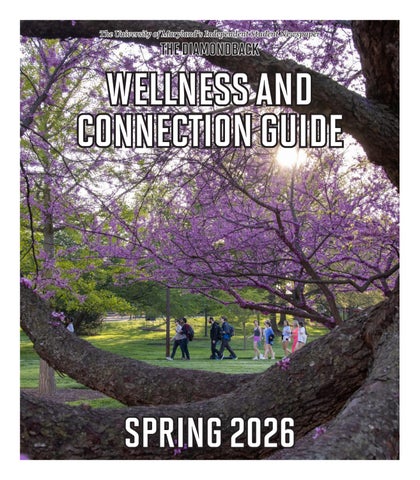
FRONT COVER PHOTO BY:

Sam Cohen

BACK COVER PHOTO BY: Will Swearingen

FIND US ON SOCIAL MEDIA:

letter from the editor

There’s a tempting routine I think we, as college students, tend to fall into.

Go to class, check your phone, go to the dining hall, watch something, go home, scroll social media. The convenience of cell phones and the inherent difficulty of connection can make college life an intensely isolating experience.

That’s why The Diamondback is publishing this year’s Wellness and Connection guide. I got the idea from a story written by Derek Thompson, titled “The Anti-Social Century.” Thompson argues that, by making ourselves uncomfortable and ignoring our brains’ constant crave for an instant dopamine hit, we can actually find deeper meaning and stronger connections with the people around us, even if it’s just small talk on our daily commute.

I’m not trying to be a finger-waving preacher who said “phone is bad,” but rather that a lot of us could, and would, be happier coupling our online connections with meaningful face-to-face interactions.

So I invite you to use the resources laid out in this guide to challenge yourself. Make a new connection this week, this month or this semester. Have a conversation with that person in your class who looks really cool but you haven’t built up the courage to speak to. Next time you see your friends, agree to put your phones away, if only for a couple of hours. Your eyes and your mind might thank you.

And as always, thanks for reading.

Two people enjoy warm weather on McKeldin Mall on April 17, 2025. (neelay sachdeva/The Diamondback)

do you belong to a campus club?

YES: 77% NO: 23%

how did you meet your friends on campus?

“Instagram.” - jo.lo444

“Professional frat” - albacostalara

“Orientation” - umdgymkana

“I met my college friends through my high school friends.”arnav.pundlik

“I live with one.” - annerong99

“Sports” - peyton_steinberg

“I ran into some people living on my floor and met all their friends.” - nikchuggie

“Through clubs and classes and lots and LOTS of mutual friends” - lina.inbloom

“Regular friends: classes and connections. Close friends: clubs/orgs” - hungtlai

“At an event for freshman and in clubs! Also sometimes through class” - tulalock

“[Clubs], friends of friends or friends of dormmates, clubs, classes” - umdcoffee

“Classes and dorm” - adaku.__

“Dorm friends” - ellanb_

“Clubs, classes, and friends of friends” - autumn.frank89

“Clubs, on campus jobs, hooping” - 301.manny

“Some I met through welcome week events, others through classes and other people!” - flyingfish2205

“Class” - jackson_daly.1

“Freshman year dorm” - nick___51

do you think phones should be banned in class?

14%

86%

UMD students dance the night away at Bridgerton-inspired ball

The University of Maryland’s SEE held its annual Bridgerton-themed ball on March 5, where students showed off their best regal attire in honor of the hit Netflix show.

This is the third year Student Entertainment Events has hosted the Bridgerton-themed ball. The night takes inspiration from the balls in the show, which are some of its most famous scenes.

“We want to just create a space where people who haven’t been able to experience these sort of things are able to,” SEE co-director Elle Burke, a senior information science and immersive media design major, said. “A ball isn’t something that we see a lot on campus, so we want to bring Terps together.”

Devoted Bridgerton fans and intrigued students excitedly rushed to wait in line for the doors to open to the Stamp Student Union Colony Ballroom. The atmosphere was vibrant as attendees chatted and classical, modern rap, and Bridgerton-themed songs filled the room.

Freshman information science major Kaylynn Flemons, had just watched the show’s fourth season. Seeing the flyer, she said she knew she immediately had to go.

Flemons donned the dress she originally wanted to wear for her parents’ wedding. Her purple-andblue gown was long and flowy. She completed her look with white pearls, earrings to match and a dazzling tiara.

“It’s really colorful and it kind of gives off a painting,” Flemons said. “I thought it would be perfect for the Bridgerton event.”

The evening included dancing, painting, crafts and enchanting formal attire from guests. The ballroom stage was elegantly decorated with a privy garden theme with gold lights hanging around it. Green, pink, purple and white balloons floated toward the back of the ballroom. Small candle lights hugged the tables people were sitting at.

The night started with classical songs. Guests

slowly began to flood the dance floor. Couples and friends held each other’s hands. Dresses flowed in the air.

Ayanna Curtis, a sophomore neuroscience and studio art major, wore black slacks, a black button-down suit vest and a pink and blue tie.

“Last week was stressful, so I was like, ‘Might as well go and find something fun to do on campus,’” Curtis said. “It was very fun, very well put together. I think that the music was well curated.”

The queen was escorted on stage while selected gems, who were attendants chosen because of their admirable attire, presented themselves. Sophomore Lakshmi Sangireddi, a computer science major, and Hadassah Marshall, a senior government and politics major, won “Diamond of the Season.”

Sangireddi wore a white corset, an orange chenille draped across her shoulders and a skirt. She topped off her outfit with gold accessories.

“I wanted to fuse my American identity with my South Indian identity,” Sangireddi said.

When she won “Diamond of the Season,” Sangireddi said it was a pleasant surprise.

“It kind of felt like we were princesses for the night, which was really pretty,” Sangireddi said.

To end the night, flashing lights blurred the room while attendees formed dancing circles and hyped each other up to modern rap music, including “Cupid Shuffle,” “Trap Queen” and more.

By the night’s end, Marshall said she considered the event a success.

“There were so many other beautiful, gorgeous and creative dresses and outfits, and so winning Diamond of the Season was pretty special,” Marshall said. “It was really nice to be noticed, especially in such a large school. It meant a lot to me.”

Students dance during the Bridgerton Ball in the Colony Ballroom at Stamp Student Union on March 5, 2026. (Mylanie Ford/The Diamondback)

UMD Professor Bans Cellphone Use In class

After noticing her students growing increasingly distracted by their cellphones each semester, University of Maryland professor Sara Herald decided to do something.

So the director of this university’s Southern Management Leadership Program implemented a cellphone ban in her entrepreneurship class this fall.

While Herald has previously discouraged personal electronic devices in her class, this is the first time she locked away phones and smartwatches in Yondr pouches. These pouches are designed to allow users to keep possession of their device, which remains locked in the pouch until they are allowed to unlock them.

Herald was inspired to purchase the pouches when she heard about its recent use in K-12 classrooms.

Initially, students said they were taken aback that their devices would be locked up, but Herald believes they have since adjusted positively.

Senior operations management and business analytics major Tonia Agwumezie has found her classmates and herself more focused in class when their cellphones are locked up.

“It’s out of sight, out of mind, so that allows us to really take into account what she’s saying and actually be present in the moment,” she said.

Another one of Herald’s students, Brandon Scott, who is a senior real estate and the built environment major, agreed the new policy helps him stay focused. He feels he is gaining more from his time in the classroom and walking away with a better education.

“It’s really impacted my retention of the stuff being taught,” Scott said.

The cellphone ban has also cultivated a stronger connection between classmates,

Herald said. During breaks, her students are no longer engrossed in their phones, she said. Instead, they talk to each other.

Scott said he has seen his cohort become more cohesive, which allows them to create stronger relationships that go beyond the classroom.

“We’re also more present with our peers,” Scott said. “Overall, we’re creating better connections that exist in other events.”

Agwumezie said that part of what helps Herald successfully implement this ban is the way she outwardly shows her intentions are for the betterment of her students.

Herald showed her class the statistical difference in focus between students who have access to their phones in class versus those who don’t.

According to a study done by Yondr, using the pouches in the classroom has increased student success by 6.27 percent and lowered behavioral referrals by 44 percent. This helped put the ban in perspective for students in Herald’s class.

“It’s not just taking it away for us not to have it,” Agwumezie said. “[There’s] actually a purpose behind the motivation and making sure that we are in the moment.”

Herald acknowledges that it may not be the right approach in every academic setting, but has been satisfied with the differences she has noticed in her own classroom.

She believes that there are many benefits for keeping technology put away in the classroom when it’s not functioning as an academic tool.

“I encourage anybody who’s curious about it to experiment with it,” Herald said.

A person holds their phone on Oct. 7, 2025. (Clare Roth/The Diamondback)

Opinion: Digital Availability is more precious than we treat it

“Just unplug!” But physical separation from our devices isn’t enough. We aren’t just addicted to our devices, we’re afraid of what will happen if we’re not around to answer them.

The sense of urgency cultivated by a constant flow of notifications and the adrenaline of immediately handling whatever they may be keeps us hooked and in a constant state of anxious expectance. Even when we are away, the expectation of constant availability keeps our notifications at the top of our minds.

Spending intentional time without screens is meant to give us a break from the intensity of the digital world. But if we don’t set boundaries around our availability, the anxiety that someone might be trying to reach us — and expecting a response — prevents us from enjoying the increasingly rare moments spent away from screens.

Every summer, I do unplug. For 8 weeks, while working at a summer camp, I spend the vast majority of my day away from my phone and other technology, often going

days without opening my phone or typing on a keyboard. I look forward to my inboxes, texts and social media notifications not even crossing my mind.

But during my first summer at camp, I remember rushing to my phone at the end of the day to ask my friends for updates, desperately trying to make up for the hours I was away. My frantic attempts to maintain communication left me stressed and made my friends and family feel confused and overlooked.

Once I was honest about what I could really make work, I was finally able to forget about my devices and make the most of my time outside. I wasn’t worried about letting anyone down because I was on the same page as the people I wanted to communicate with.

Time fully absent from technology can be enjoyable and restorative, so take those opportunities when you can. But even when you can’t, there are still plenty of ways to reclaim your availability and start giving it out on your own terms.

When immediate responses feel mandatory, think about how you would feel if someone responded to you a little later than usual. Would you feel affronted, disrespected or ignored? Or would you assume they were just busy or not online? Maybe you wouldn’t even notice the wait at all.

Replacing an entire culture of immediacy with one of compassion and patience can’t be done alone, but the culture you cultivate in your own circles is up to you. To get the most out of time spent away from devices, it is essential to set clear and realistic expectations with the people on the other side of our screens.

Make it known when you will not be reachable, resist the temptation to apologize for delayed responses, and build in-person norms to establish shared boundaries. It can feel like being harsh or encouraging distance to be upfront about eliminating reachability for a period of time, and it’s tempting to be vague to soften the blow. But offering an unrealistic picture in order to offer initial comfort can damage one’s image of reliability.

As students, our availability is more precious than we often treat it.. If we can have the courage to be unreachable, we reclaim not just our time, but our ability to truly enjoy and be present in it.

(Photo via Pexels)

Turn static files into dynamic content formats.
Create a flipbook