The
Davidsonian Independent student journalism since 1914
inside
davidsonian.com
2
Learn about the amendments that will appear on this year’s NC ballot
October 24, 2018 Community members react to Mobike’s dramatic departure from campus
4
Bimini Horstmann ‘21 climbs to new heights - literally - in her competitive sport
Volume 114, Issue 7
5
Charlotte-area Davidson Uncle enjoys (?) an underwhelming Parents’ Weekend
8
Collisions on Campus
O
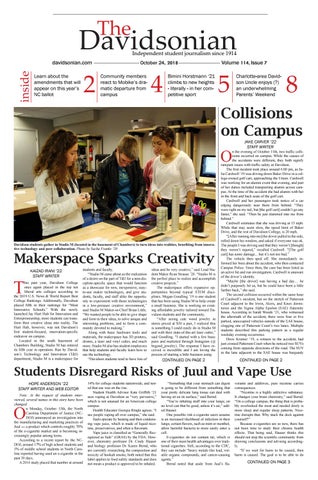
Davidson students gather in Studio M (located in the basement of Chambers) to turn ideas into realities, benefiting from innovative technology and peer collaboration. Photo by Sacha Franks ‘20
Makerspace Sparks Creativity
T
KAIZAD IRANI ‘22 STAFF WRITER
his past year, Davidson College once again placed in the top ten liberal arts colleges according to the 2019 U.S. News & World Report Best College Rankings. Additionally, Davidson placed fifth in their rankings for “Most Innovative Schools.” With the newly launched Jay Hurt Hub for Innovation and Entrepreneurship, more students can transform their creative ideas into reality. The Hurt Hub, however, was not Davidson’s first student-focused, innovation-specific endeavor on campus. Located in the south basement of Chambers Building, Studio M has entered its fifth year in operation. Run by Davidson’s Technology and Innovation (T&I) department, Studio M is a makerspace for
students and faculty. “Studio M came about as the realization of a desire on the part of T&I for a non-discipline-specific space that would function as a showcase for new, inexpensive, easyto-use maker technologies, and give students, faculty, and staff alike the opportunity to experiment with those technologies in a low-pressure creative environment,” said Studio M Maker-in-Chief Brian Little. “We wanted people to be able to give shape and form to their ideas, to solve unique and interesting problems, and to form a community devoted to making.” Along with basic hardware tools and materials, the makerspace has 3D printers, drones, a laser and vinyl cutter, and much more. Studio M also has student employees that help students and faculty learn how to use the technology. “Davidson students tend to have lots of
ideas and be very creative,” said Lead Student Maker Ryan Strauss ’20. “Studio M is the perfect place to realize and accomplish creative projects.” The makerspace offers expansive opportunities beyond typical STEM disciplines. Megan Goodling ’19 is one student that has been using Studio M to help create a small business. She is working on creating affordable jewelry tailored toward Davidson students and the community. “After seeing cute wood jewelry in stores priced at $30 a pair, I realized this is something I could easily do in Studio M and with their state-of-the-art laser cutter,” said Goodling. “I started with a few basic pairs and marketed through Instagram (@ begood_jewelry). The response I have received is incredible and I am loving the process of starting a little business using
JAKE CARVER ‘22 STAFF WRITER
n the evening of October 11th, two traffic collisions occurred on campus. While the causes of the accidents were different, they both signify rampant issues with traffic safety at Davidson. The first incident took place around 6:00 pm, as Julia Cardwell ‘19 was driving down Baker Drive in a college-owned golf cart, approaching the Union. Cardwell was working for an alumni event that evening, and part of her duties included transporting alumni across campus. At the time of the accident she had alumni with her in the front and back seats of the golf cart. Cardwell and her passengers took notice of a car edging dangerously near them from behind. “They were right on my tail, but [the golf cart] couldn’t go any faster,” she said. “Then he just slammed into me from behind.” Cardwell estimates that she was driving at 15 mph. While that may seem slow, the speed limit of Baker Drive, and the rest of Davidson College, is 20 mph. “[After running into me] the driver pulled to the side, rolled down his window, and asked if everyone was ok. The people I was driving said that they weren’t [though] they weren’t injured,” recalled Cardwell. “[The golf cart] has some damage... but it’s not too bad.” The vehicle then sped off. She immediately informed her boss about the accident, who then contacted Campus Police. Since then, the case has been listed as an active hit and run investigation. Cardwell is unaware of the driver’s identity. “Maybe [the driver] was having a bad day… he didn’t purposely hit us, but he could have been a little further back,” she said. The second collision occurred within the same hour of Cardwell’s incident, but on the stretch of Patterson Court adjacent to the Irwin, Akers, and Knox dormitories and the Sigma Alpha Epsilon (SAE) fraternity house. According to Sarah Woods ‘21, who witnessed the aftermath of the accident, there were four or five parked, unoccupied vehicles outside of the ΣAE house, clogging one of Patterson Court’s two lanes. Multiple students described this parking pattern as a regular weekday evening occurrence. Drew Kromer ‘19, a witness to the accident, had just crossed Patterson Court when he noticed two SUVs coming from opposite directions of the road. The SUV in the lane adjacent to the SAE house was burgundy
CONTINUED ON PAGE 2
CONTINUED ON PAGE 2
Students Disregard Risks of Juul and Vape Use HOPE ANDERSON ‘22 STAFF WRITER AND WEB EDITOR Note: At the request of students interviewed, several names in this story have been changed. n Monday, October 15th, the North Carolina Department of Justice (NCDOJ) announced an investigation into the manufacturing and marketing practices of Juul — a product which controls roughly 70% of the e-cigarette market and is becoming increasingly popular among teens. According to a recent report by the NCDOJ, around 17% of high school students and 5% of middle school students in North Carolina reported having used an e-cigarette in the past 30 days. A 2014 study placed that number at around
O
14% for college students nationwide, and noted that use was on the rise. Student Health Advisor Kate Griffith ‘21 sees vaping at Davidson as “very pervasive,” which is not unusual for an American college campus. Health Educator Georgia Ringle agrees. “I see people vaping all over campus,” she said. Juuls operate by heating and then condensing vape juice, which is made of liquid nicotine, preservatives, and often a flavorant. Vape juice is classified as “Generally Recognized as Safe” (GRAS) by the FDA. However, chemistry professor Dr. Cindy Hauser and biology professor Dr. Karen Bernd, who are currently researching the composition and toxicity of hookah smoke, both noted that this label applies to food safety standards and does not mean a product is approved to be inhaled.
“Something that your stomach can digest is going to be different from something that your pretty delicate lung tissue can deal with having sit on its surface,” said Bernd. “You’re inhaling stuff into your lungs; on no level can that be good, unless it’s air,” added Hauser. One possible risk e-cigarette users assume is an increased likelihood of infection in their lungs; certain flavors, such as mint or menthol, allow harmful bacteria to more easily enter a cell. E-cigarettes do not contain tar, which is one of their main health advantages over traditional cigarettes. Still, according to the CDC, they can include “heavy metals like lead, volatile organic compounds, and cancer-causing agents.” Bernd noted that aside from Juul’s fla-
vorants and additives, pure nicotine carries consequences. “Nicotine is a highly addictive substance. It changes your brain chemistry,” said Bernd. “On a college campus, the thing that is probably overlooked the most and needed direly is more sleep and regular sleep patterns. Nicotine disrupts that. Why stack the deck against yourself?” Because e-cigarettes are so new, there has not been time to study their chronic health effects. That being said, Hauser thinks this should not stop the scientific community from drawing conclusions and advising accordingly. “If we wait for harm to be caused, then harm is caused. The goal is to be able to do
CONTINUED ON PAGE 3
News
2
A Guide to the Midterm Amendments DREW EASTLAND ‘21 STAFF WRITER When students take to the polls this November, candidate seats will not be the only issues at stake. This midterm election, the North Carolina ballot features six state constitutional amendments: a 7% income tax cap, protections for victims of crime, the right to hunt and fish, the establishment of an ethics board, legislative judicial appointments, and photo ID voting laws. The Democratic Party is publicly opposing all six amendments, while the Republican Party supports all six. Because the Republicans currently hold a majority in the state legislature, many of the amendments push their party agenda forward. The amendment to judicial appointments focuses on shifting the executive power to the legislature. Democrats allege that these amendments are rooted in partisanship because the Republicans currently control the legislature and not the governorship. “A lot of them are partisan by nature,” College Democrats President Kate Bock ‘19 said. “I think some of these constitutional amendments are an attempt to consolidate legislative power before that legislative power is threatened.” Some groups on campus, such as College Libertarians, favor a shift of power from the executive to the legislative branch, but also note that this shift seems more partisan than textual.Traditionally, shifting power from the executive branch is viewed as more democratic as it moves power from an individual to a group; however, in this case the move is for political power. “In principle, yeah I support it,” commented Co-president of College Libertarians Andy Hoyle ‘21. “I don’t think any of the partisan problems are going to be fixed until…North
Carolina does something about its gerrymandering.” The amendment would not change how judges first join the bench. Judges would still be voted into office by North Carolina citizens; however, in the event of a vacancy, the nomination process would be placed in the hands of the legislature, not the executive branch. “It’s a little power grab there,” College Republicans Communication Director Alex Sizemore ‘20 remarked. “But it doesn’t affect elections as they are because right now we elect our judges and justices to the courts.” The amendment to create voter ID laws has also created some partisan controversy. In 2013, North Carolina established a law that required a photo ID to vote. In 2016, the state’s Supreme Court declared this law unconstitutional. The debate is rearing its head again in 2018. Republicans argue that voter ID laws would reduce voter fraud, while the Democrats contend that voter ID laws will limit minorities and affinity groups that do not have access to drivers’ licenses. “I think this is probably the most important one because it will have disproportionate impacts on voter turnout from affinity groups, specifically African Americans,” explained Bock. “Statistics...show voter fraud is very low; the need for this is not necessarily legitimate.” “You’d have to give everyone some type of identification,” added Co-president of College Libertarians Elliott Polin ‘21. “We tend to prioritize having everybody voting than having identified voters.” Republicans contend that maintaining accuracy in voting is crucial. “Theoretically you could walk in there, and say ‘my name is Geoffrey Sizemore, and I’m registered at 209 Ridge Road, Davidson, North Carolina 20835,’ and then you could go
Studio M Fosters Student Innovation CONTINUED FROM PAGE 1 the technology provided by Studio M.” This year, Studio M is launching a new initiative to help attract more people into the space and foster more creative experimentation. “Unfortunately, many people simply are not aware that Studio M exists, or if they are, they do not really understand how they can use the space,” said Strauss. “Our goals for this year are pretty much the same as always,” added Little. “We want to increase campus awareness of the makerspace and maker culture. We want to raise the profile of making as a valid path of academic inquiry.” Studio M is currently working on rebranding their social media presence and their web-
site. Student employee Emily Sirota ’20 is working on creating interactive lessons to help bring more awareness to the makerspace. “My current project aims to develop a Studio M class series that introduces Davidson community members to the different technologies offered in Studio M,” said Sirota. “Lessons include the instruction of the laser cutter, 3D printer, virtual reality set, and vinyl cutter.” “I think more people should use Studio M not just for our hardware or tools,” encouraged Little. “But for the access it gives to a brilliant community of talented makers who cannot wait to share what they know. That is really what we are about: the community of makers and the exchange of knowledge. That is what empowers our users to make cool things.”
Student employee Emily Sirota ’20 uses the 3D printer in the makerspace as a demonstration of its creative capabilities. Photo by Sacha Franks ‘20
vote as Geoffrey Sizemore,” Sizemore said. Of the six amendments on the ballot, the least partisan is the victim’s rights amendment also known as Marsy’s Law. In short, the amendment would ensure those convicted serve their full sentences, extend the time of parole, and provide restitution to families who suffer a loss. In the legislature’s vote to place the amendment on the ballot most Democrats and Republicans support the amendment. In the NC House, Democrats voted 35-8 in favor and Republicans voted 72-1 in favor. In the NC Senate, Democrats voted 12-1 in favor and Republicans voted 33-0 in favor. Ironically enough, the Democrats currently oppose the amendment. The reason why is not apparent; however, it could be because supporting only one amendment might confuse voters into voting for an amendment they oppose. The income tax rate won’t affect current taxation, but only change the government’s ability to change it in the future. The amendment would cap state income tax at 7%, as the cap currently sits at 10%; however, the current
North Carolina income tax rate is 5.25%. This amendment would not lower income tax in the short-term but could significantly limit the ability to raise taxes going forward. The other two amendments have sparked less discussion, but remain important. The right to hunt and fish would not change the way hunting is currently regulated, but would protect hunting and fishing as an established right. The amendment on the Ethics and Elections Board seeks to take a member off the current board. The Ethics and Elections board is charged with ensuring fair and legal election practices in the state. There are currently nine members of the board. This amendment would increase legislative power because the board is controlled by the government. For the political organizations on campus, the next steps are to inform voters about the amendments to ensure wise voting. “We have not talked very much about the amendments; we are…segmenting our efforts,” said Bock. “Now that we have people registered to vote…we need to give them information on how to be informed.”
Traffic Violations CONTINUED FROM PAGE 1 and occupied by two Davidson students. The other was white and occupied by an unidentified Davidson staff worker. According to Kromer, once the burgundy SUV approached the traffic congestion, it slowed down and swerved in the left lane. After making it halfway around the parked cars, the SUV stopped. “I think [the driver of the burgundy SUV] noticed the white SUV coming and thought that they didn’t have enough time to make it back [into the right hand lane]” says Kromer. “[The burgundy SUV] started honking to alert [the white SUV driver] but [the white SUV driver] was looking down and not paying attention.” The two vehicles collided head on, crushing the fronts of both. Fortunately, according to Sgt. Chris Bradbury of Campus Police, nobody was injured in the crash. Nonetheless, he is, at the time of publication, unable to release any more information regarding the victims of either the golf cart or SUV incident as both are still under investigation. Bradbury admitted that in general, there is a problem with illegal parking at Davidson. “A wide majority of our traffic accidents on campus are related to illegal parking,” he explained. “[Patterson Court] is a fire lane, so you can not park your car on it.” Following policy elsewhere on campus, an illegally parked vehicle alongside Patterson Court warrants a $50 fine. However, if possible, Bradbury usually prefers talking to the vehicle’s owner before resorting to a fine. “Sometimes we have to discuss [traffic safety with students]... for example, [Campus Police recently] encountered multiple vehicles outside a fraternity event, and had to ask [the vehicle owners] to move their cars and tell them that it causes a vision and traffic obstruction,” he explained.
While SAE President Matt Wellington ‘19 does not know any details concerning the collision or his fraternity’s implication in it, he does acknowledge that illegal parking on campus is commonly practiced by Patterson Court organizations. “Parking by Patterson Court houses is relatively limited, so you frequently see cars parked outside of houses for meetings and meals. PCC has had conversations with Campus Police in the past about how this creates a hazard and how we need to find alternatives to leaving cars parked with hazards on,” said Wellington. “I completely understand how this can create concerns and should be addressed for the future.”
There were four or five parked, unoccupied vehicles outside of the SAE house, clogging one of Patterson Court’s two lanes. Despite the accidents on October 11th, this has been a relatively safe traffic year for Davidson College so far. According to Bradbury, there have been an average of 24 traffic accidents on campus per year over the past three years; at the time of publishing, there have only been three reported instances of traffic accidents this semester. The third incident was a hit and run on September 22nd. Even so, there are still glaring issues with the way Davidson students follow traffic safety rules on campus. “When a student purchases a parking decal, they are expected to read and follow the rules and regulations,” added Bradbury. “Those rules are not always followed.”
3
October 24, 2018
E-Cigarettes Market to Youth NC Dept. of Justice to Investigate Juuls CONTINUED FROM PAGE 1
exhaust or electromagnetic radiation you get from cell phones,” agreed William Cook ‘19. Cook uses around a pod a day, which is enough modeling of ‘this looks like this’ or ‘here’s what we know about that’ to be able the nicotine equivalent to at least one pack of to say ‘here are the risks associated with it,’” cigarettes. Johnson compared juuling to other said Hauser. unhealthy habits, such as drinkOverall, Bernd and Hauser ing caffeine or eating McDonagree vaping is a healthiald’s. er alternative to smoking However, Bernd thinks but still poses significant the “anything in moderahealth risks. tion” argument does not “It’s not harmless. apply to vaping the same If you don’t vape, don’t way it may apply to other start,” said Bernd. unhealthy lifestyle choicSome students acAS MANY TEENAGE MEN es, such as eating fast food, knowledge the health USE E-CIGS AS TEENAGE since nicotine permanently risks juuling likely poses WOMEN alters brain chemistry and has but are not concerned enough such a strong potential for addicto stop. tion. “This sounds bad, but my lungs Mitchell remembers feeling shocked when can get f*cked up. I don’t really care. I’m 18 years old; I think it’ll be ok,” said Eve Mitch- a twelve year old child asked to hit her juul on a family vacation. ell ‘22. “Are you kidding me? This kid is twelve! Others think juuls’ risks are overemphaThat’s so bad for your brain, at twelve!” said sized. “People want to keep high school students Mitchell. However, the same concerns did not exfrom getting hooked on [vaping], so I think they exaggerate the health effects,” said Helen tend to her personal health. “My brain’s fine. Nicotine is not going to Johnson ‘19. “As far as health concerns, it’s mess with my brain anymore,” said Mitchell. not top of my list.” According to Bernd, the human brain con“Smoking is obviously very bad for you, but vaping is probably not worse than car tinues developing until the age of 25. E-cigarettes were first introduced as a way
2X
to help one quit smoking, though they are not mean they don’t pose risk, especially to indicurrently approved by the CDC to treat nic- viduals who otherwise would have never used otine addiction. In fact, research shows vap- nicotine based products. ing may actually lead to cigarette use. Teens “We get into conversations about somewho vape are seven times more likely to start thing being better than something out there, smoking later in life (NCDOJ). versus something being good for us overall,” Juul strikes a delicate balance between dis- said Schaffer. tancing itself from and comparing itself to a In general, students expressed more contraditional cigarette. One the one hand, a Juul cern for the financial, rather than physiologidoes not carry the same stigma as a cigarette. cal, effects of vaping. The NCDOJ reports that the product’s “The worst part is the pods are $4 a piece,” “sleek design, colorful cases, and kid-friend- said Cook. ly flavors” disproportionately attract “I wouldn’t be mad if they disyoung people. continued [the flavors]. They “They are so small, and honestly should; I’d save so they don’t look like a cigmuch money,” continued arette at all,” continued Mitchell. Bernd. As with smoking, vaStill, simply being ping is a lifestyle choice in the family of nicotine each student makes inhalers can invoke comfor themself. However, PERCENT OF E-CIG USERS WILL parisons to traditional Schaffer worries the risks START SMOKING CIGARETTES cigarettes (which are more associated with e-cigaWITHIN SIX MONTHS harmful than e-cigarettes), rettes may not be widely (DRUGABUSE.GOV) downplaying Juul’s negative understood. health effects. “Folks who are making de“Because the vapor dissipates so cisions that are going to affect their quickly and because the smells don’t linger, health or well-being long term — affect their there’s the perception that it doesn’t cause brain chemistry, affect their lungs, affect any harm,” said Bernd. of those things — should really be able to do Director of Residence Life Jason Schaffer so informed,” said Schaffer. “We may look agrees, saying just because e-cigarettes are back and say ‘I would have made better choichealthier than traditional cigarettes doesn’t es had I had that information.’”
30.7
Crime Log OCTOBER 18
87%
or
26 30
Takeaways
Absent: Kibriyaa Morgan ‘20 (Unexcused), Heidi Meyer ‘22 (Ex.), Tatianna Travieso ‘20 (Ex.), David Choi ‘21 (Ex.) Late: Kate Bock ‘19 (Ex.) and Andrew Coyner ‘20 (Ex.) SGA Retreat will be November 2nd. Director of Sustainability Yancey Fouché wants to implement student “Sustainable Transportation Directors” to help brainstorm ways to get students off campus in lieu of Mobikes. There are available buildings in front of the Cunningham Fine Arts Center that need to be repurposed. Possible campus publications could have offices in the spaces. Dean McCrae spoke about new administrative projects that need student involvement. Some of these initiatives concerned inclusivity on campus, international students, the future of student housing, and the commission on Davidson’s history of slavery and race relations. Davidson is considering adding a Public Policy major, and the SGA discussed the pros and cons. Mental health was a point on the official SGA agenda, but it was not discussed.
Agenda
Attendance
LIZZIE KANE ‘22 SGA CORRESPONDENT
1. Hurricane Damages & Physical Plant 2. Mental Health 3. Visit from Dean McCrae 4. Announcements
Time Reported
Description/Location
10/14/18 at 0230 hrs
Underage Consumption
10/17/18 at 1500 hrs
Larceny Misdemeanor
Richardson, Dean Referral
Union, Further Investigation
10/18/18 at 1130 hrs
Larceny Misdemeanor
10/19/18 at 1658 hrs
Poss. Controlled Substance
10/19/18 at 2030 hrs
Underage Consumption
10/19/18 at 2239 hrs
Underage Consumption x8
Belk, Further Investigation
Armfield, Dean Referral
Belk, Dean Referral
Belk, Dean Referral
10/21/18 at 0215 hrs
Underage Consumption
10/21/18 at 0250 hrs
Simple Assault
Belk, Dean Referral
Belk, Dean Referral
Perspectives
4
Students Respond to the End of Mobikes In the October 14, 2018, edition of The Crier sent at 7:23 p.m, students were alerted of the planned removal of Mobikes from the Davidson College campus. The statement in The Crier read, “On October 20, Mobike will pull all bikes and its operational support from Davidson.” The Davidsonian asked members of the community to comment on the removal of bikes and the lessons learned from experiences with the service. Isabelle Bradberry ‘21 As someone who was way behind on the Mobike trend and only started using them this year, I am truly heartbroken. I purchased a monthly subscription in August after a full semester of not taking advantage of the free bikes. I claimed I was intimidated by the complex app and didn’t want to set it up, more accurately I didn’t want to expose my poor bike riding skills as a freshman. But sophomore year, something within me changed, and when I first heard that sweet sweet sound of bike lock opening, I was hooked. Granted, I still didn’t understand how they worked and didn’t realize you had to lock the bikes after you were done, resulting in some hefty fines to Mobike for 2+ hour bike rides. But frankly I don’t think you’ve LIVED until you’ve awkwardly wobbled behind slow-walking students on the path to chambers, or skrrrted down the hill at alarming speeds toward Nummit. It is a truly gloomy day on campus without flashes of neon orange in your periphery at all times from bikes littered around the sidewalks, trees, and roofs. RIP Mobike — you were my Davidson Game Changer. Colin Vaida ‘16 The end of Mobike at Davidson isn’t surprising, but it shouldn’t deter students and alumni from getting excited about transit. Transit isn’t sexy, but if we want to build inclusive urban
spaces resilient to climate change, disrupting the transit market with bike-share and scooters is necessary. However, the companies running this disruption are treating a public good like an app startup. Flash sales and mass consumer expansion aren’t going to ensure equitable and effective options. The failure of Mobike at Davidson rests in a business model predicated on novelty rather than practical transit needs, where an increase in price saw their entire ridership disappear. Municipalities and urban areas must move towards public-private partnership where microtransit links underserved communities to broader publicly-funded transit service. Right now, cities like San Francisco are piloting said partnerships and its critical to find the space where microtransit can work to improve urban and community development. Jon White ‘20 Mobike came to solve a problem we never had, yet the rollout of dozens of mass-produced bikes created a commons which our laziness and drunken debauchery happily consumed and destroyed. Unsurprisingly, when this common good was privatized at the start of this semester, the already defunct Mobikes proved themselves to be the material pollution they always were. The shame of the Mobike-era is that the company carried out its profit-seeking exploits under the auspices of our own Sustainability Office, marketed as an egalitarian, sustainable, urban-utopian initiative. This wolf in sheep’s clothing has a name: neoliberal conservation. Put simply, it refers to the practices by which “nature is conserved in and through the expansion of capitalism.”(1) The latest fuel-efficient car, domestic solar panels, “eco-tourism,” and now mobikes–all bourgeois imaginations of increased production and consumption as the way out of environmental disaster. Consuming less is our only option.
(1) Bram Büscher, Sian Sullivan, Katja Neves, Jim Igoe & Dan Brockington (2012): Towards a Synthesized Critique of Neoliberal Biodiversity Conservation, Capitalism Nature Socialism, 23:2, 4-30 Lucy Walton ‘21 Eulogy to a Mobike They are a meme lost Victims of capitalism $5 a month? Too much. Wilson Goode ‘19 Mobikes are bad for biking. If you price it out, you’ll get more value from a half-decent used bike off Craigslist than the minimum $5/ month they charge. They aren’t designed to be comfortable to ride, nor are their components appropriate for a campus as dominated by hills as ours - too many times they were left halfway up the hill (in the street, on the sidewalk).
#Throwback
The community bike program Davidson had years ago had no student fees, no locks, and was upheld by the Honor Code and hard work to fix the ridiculous ways that students found to break the bikes. The program failed because we as students don’t care enough about common goods to protect each other’s ability to access them. Mobikes represented a for-profit company’s attempt to use our campus to make money by adding locks, having fees, and providing bikes for our community to use. We weren’t profitable enough for them to justify their expenses on our campus. Do we owe an outside corporate interest money to insure our ability to get around with a car? No. If you can afford to subscribe to Mobikes, you can afford to buy a used bike that will be cheaper, lighter, more comfortable, and more functional. Get a bike, get a lock, and take advantage of the joy of owning your own. Signed, A cynical cycling senior
From the November 12, 2003 Edition
Sports
5
From Competition to Community at Davidson
B
LILLY GREENE ‘21 SPORTS WRITER
imini Horstmann ‘21 has always been interested in climbing, but it wasn’t until she took a class at the YMCA with some friends that things started to get serious. “I tried a bunch of sports before that, and they were fun, but I wasn’t really committed to any of them,” she recalled. Climbing was different. After joining a team, she began to get competitive. At just twelve years old, Horstmann went to her first international competition in Chile, where she won second in the speed competition and the competition overall. Since then, she has traveled all over the world to climb. One of the things that Horstmann loves about her sport is that it takes her to places she would not normally go, “places where there aren’t a lot of tourists.” Some of Horstmann’s proudest accomplishments include winning Nationals at sixteen and then competing in the adult world championships in Paris. “I was the youngest person there so I didn’t do very well, but it was a big accomplishment just getting there,” she explained. This last summer Horstmann competed in her last youth nationals and was awarded the best overall in all three competitions: bouldering, speed, and sport. “It was nice. I was not expecting it at all.” But for Horstmann, climbing is not all about her success in competitions. Especially this year, the role it plays in her life has changed. She is more focused on growing Davidson’s climbing club and enjoying the sport for fun. “When I was little it used to be a lot about competition and doing well and trying to get all the hardest climbs,” she explained. But now her appreciation for the sport has changed. “It’s special to me because of the community and the people that I’ve been able to meet. All my best friends [are]from all over the country, but we can all connect over climbing.”
Bimini Horstmann ‘21 part of underlying Davidson athletic success. Photo courtesy of Bimini Horstmann ‘21 For Horstmann, climbing means sharing a connection with a group of very impressive and kind people and never having to worry about making friends in a new city; “No matter where I move after college, they will have a climbing community there already. There’s instantly people that I can connect with over something which is really cool.” Besides meeting new people, climbing has allowed Horstmann to share an important connection with her family. “[My sister] is fourteen, and she’s way better than I was when I was fourteen, so that’s really cool that we can share that.” Horstmann’s sister has already made the US team more times than she has, but that doesn’t bother Horstmann, who is just happy for her sister’s success. Even the sisters’ mom has started climbing, so now it has become a fun way for them all to spend time together. Horstmann is concerned about a shift in the attitude surrounding climbing. The sport has grown so much in the past few years, which she is really happy about, but she worries
about it getting really competitive. One of her favorite parts about participating in championships is that everyone roots for each other and helps each other out, unlike in other sports where you may cheer against your competitors. “I’m never rooting against my friends. I want them to do well; even if they do better than me. I’m still happy for them and I don’t want climbing to become like different sports,” she explained. This year at Nationals, she observed parents of the younger competitors putting pressure on them to win, something very different from the supportive environment she remembers. That said, due to its growing popularity, rock climbing will be included in the 2020 Olympics. Though this is certainly an exciting prospect for Horstmann, she has decided not to compete until she graduates from Davidson. “I want to have a normal college experience and be part of Davidson, and I try really hard to get a balance between climbing and being part of Davidson,” she stated. Training for the Olympics requires an immense time commitment, so if Horstmann decides to compete, she wants to give it her all. Though if she does train for the Olympics in the future, she will have a good chance of doing well because of her diverse skills. “Most people specialize in one or two [types of climbing], but I do all three,” she explained. Horstmann stated her commitment to life as a student and wants to continue pursuing her other interests and not let climbing take over her life. “It’s not going to be a career for me because I have other passions...but I love competing, and I want to keep doing it as long as I can.” She plans to continue climbing for the rest of her life. In the future she hopes to move away from competitive climbing and do more outdoor climbing. “I don’t know how big of a role [climbing is] going to have...but I’ll do it forever for sure.”
Despite Losses, Football Team Makes Strides to Success
T
JACOB MARGOLIS ‘20 FOOTBALL CORRESPONDENT
Weekly Sports Update
wo weekends past, Davidson suffered a disappointing loss to Morehead State at home, 28 to 35. The game was expected to be close as Davidson entered the contest as a five-and-a-half-point favorite. The game lived up to this prediction as the two teams were never separated by more than seven points. There were three ties and three lead changes, and the game was not decided until a late Morehead State touchdown with 3:22 left in the fourth quarter. The loss drops Davidson to 5-2 overall and 2-2 in conference; Morehead State improves to 2-4 overall and 1-2 in conference. As of the game’s end, the two teams were close in most of the important statistical categories, indicative of the tight final score. Davidson earned 24 first downs while Morehead State followed suit with a close 23 first downs. Davidson netted 368 total yards which was only 10 more than Morehead State’s 358 total yards. However, Morehead State’s offense is much more aerial based than Davidson’s, evidenced by the disparity in passing and rushing yards. Davidson rushed for 72 more yards than Morehead State but threw for 62 less yards. Besides that, the two teams were again close in most categories. Davidson ran 77 plays and Morehead State ran 73, Davidson gained 4.9 yards per play while Morehead gained 4.8 yards per play, and Morehead State controlled the ball for approximately only four more minutes than Davidson. There was not a lot to separate these teams on the field and in the scoresheet.
As for standout performers, it was the usual suspects for Davidson. Wesley Dugger ‘21, James Story ‘20, Will Wicks ‘20, and Tyler Phelps ‘21 accounted for all of Davidson’s touchdowns (one touchdown was a throw from Tyler Phelps to junior Hunter Louthan), and over 91% of the team’s yards. Phelps did struggle somewhat through the air, as he only completed 35% of his passes and threw an interception. This was surprising as Phelps had been on a hot streak since playing Guilford; excluding Saturday’s game he had a completion percentage of 73.33% in his past 4 games. His touchdown streak is still intact, however, as he has now thrown a touchdown in every game this season. Davidson lost on Saturday to Marist in a barn burner and eventual heartbreaker in double overtime, 48-41. However, from 2013 to 2017, Davidson lost to Marist by an average of almost four touchdowns per game. Last year, Davidson lost to Marist at home by 22. It is clear that Davidson has a better football team now than it has had in quite some time. On the field, the usual suspects for Davidson stood out. Yet again, Phelps, Duggar, Story and Wicks and accounted for the vast majority of Davidson’s offense. This quartet was responsible or played a hand in almost 90% of Davidson’s 486 total yards. This group also scored all six of Davidson’s touchdowns. Marist was led by their star quarterback and wide receiver combo, Austin Day and Juston Christian. Day threw for 440 yards and five touchdowns. Christian caught eight passes for 246 yards and three touchdowns. Christian and Day also teamed up for a particularly impressive stretch late in the third and early fourth quarters. First, Day hit Christian for a 68-yard
Words of Wisdom In what ways do you look to get the most out of yourself as a coach?
“As an assistant coach, you have to wear many hats. But ultimately, you want the players on your team to have to most fulfilling college experience imaginable. So while your day is often consumed in the office, watching film, making phone calls, and planning for the future, you always have to find ways to impact the lives of your current players and find ways to help them reach their potential both on and off the court.” Matt McKillop ‘06, Assistant Coach, Men’s Basketball
Davidson football off to historically good start under Head Coach Abell. Photos courtesy of Davidson Athletics touchdown pass that reduced Davidson’s lead from 17 to 11. Not done, Day found Christian for another touchdown pass on the very next drive. This time, the pass and catch went for 74 yards and brought Marist within three points. One area in which Davidson had a significant advantage was the turnover category. Davidson had a +2 turnover differential thanks to two interceptions, one by sophomore linebacker TJ Elliot and one by first-year safety Dreylan Hines. Marist’s win will also haunt Davidson for a while. Davidson held a 17-point lead late into the third quarter. This has been a troublesome trend for the team this season. In three games, Davidson has had multiple possession leads completely erased. In another game, Davidson had a 35 point lead reduced to just seven. Finishing games will certainly be an aspect that Coach Abell addresses.
Wildcat Standings: Soccer (M) Team VCU Davidson Rhode Island Fordham Saint Louis George Mason Saint Joseph’s Duquesne Dayton St. Bonaventure
W 5 4 4 3 2 3 2 2 2 2
L 0 1 2 2 1 3 2 2 3 4
T
Pts.
1 1 0 1 3 0 2 2 1 0
16 13 12 10 9 9 8 8 7 6
Arts and Culture
6
Davidson Reads: An Evening of Words and Music MARGO PARKER ‘21 HUMANITIES CORRESPONDENT
T
he acoustics in Tyler-Tallman are marvelous, but when Dr. Brenda Flanagan took the stage Tuesday night, everyone leaned in anyway. At “Davidson Reads” last Tuesday, Davidson’s resident “Renaissance woman” read from Mississippi, God Damn!, her forthcoming memoir about her time working for and with Nina Simone. In her Caribbean Literature and Creative Writing classes, Professor Flanagan is known for her passion and candor, withholding no insight about the language, her students’ interpretation, or her lived experience. Her presentation, “Nina Simone and the Civil Rights Movement,” promised a glimpse into the lives of two creative minds as they intertwined amidst the “conflagration of rage” of the late 1970s. She did not disappoint. Mississippi, God Damn!, as its title suggests, pays careful attention to considerations of place. The selection from which Dr. Flanagan read takes place in Nina’s hometown of Tryon, North Carolina, “nestled in the foothills of the Blue Ridge Mountains.” Here, Fred Counts recalls Nina Simone back when she was just his childhood friend Eunice: listening to his dreams of playing pro baseball; lamenting the racial discrimination at the local drugstore while “the rest of us kids just took it up as life.” We return to Tryon with an older, sicker Nina on the occasion of her mother’s funeral. Despite Fred’s reminders of “the good times, and how she had triumphed over the bad,” all we see of the world through Nina’s eyes are the ways it broke her heart. While Eunice and Fred were sipping sodas from Owens’ Drugstore, a young Brenda Flanagan was sorting peas in a Trinidadian cannery, saving up for a plane ticket to the U.S.. It’s hard not to read these two settings teleologically, as amalgams of condensed pressure and potential energy from which these two stars were born. For Flanagan, the journey to the U.S. wasn’t a straight line away from Trinidad. Mistreatment, exploitation, and doubt appear and reappear in the narrative, crashing
down on her young self like waves on a distant shore. When asked about her tendency toward autobiography in her creative work, Flanagan chuckles, recalling just how tempting it is to exact fictive revenge on those who have wronged you. “Sometimes it’s just not what’s right for the story,” she lamented. The caveat: that burgeoning writers should take note of where, or to whom, they keep coming back. For her, that’s Nina Simone. Tyler-Tallman itself is a space defined by, and defying, genre. As the main performance hall in the Sloan Music Building, the space showcases visiting musicians and lecturers alike, but rarely both at the same time. However, on Tuesday night, our audience enjoyed not just Flanagan’s prose, but the musical stylings of Gerard Benson and Judith Porter as well. The performance oscillated between genres just as Flanagan’s narrative transitions between characters and continents. In interstitices between—or maybe parallel to—moments of text, Benson and Porter locate the characters’ personal pain in a collective agony, articulated in their covers of Simone’s “Mississippi Goddam” and “Young, Gifted and Black.” It seems unfair to describe Benson and Porter’s renditions of these songs as “accompanying” the text (as the event advertisement does). Each act contextualizes and humanizes the other: the music characterizes the “goddam” treacherous world of creative opportunity in which Flanagan’s narrator comes of age, while the book illuminates just how much the remarkably “gifted” Simone was willing to give of herself. In his African-American Literature class, Dr. Garry Bertholf refers to passages of assigned reading as “gifts” for the class. It’s no coincidence that, in his introduction to “Davidson Reads,” he fondly recalls sitting in on Flanagan’s African-American Literature class, and describes her scholarly practice as “deeply inspired and disciplined.” After listening to but a brief selection of Mississippi, God Damn!, it feels irresponsible to consider creative work anything but a gift, offered to the listeners out of deep personal sacrifice. The work argues wholeheartedly for art as labor, and for a human (and humane) understanding
Nina Simone. Illustration by Richard Farrell ‘22. of the artist. In her office hours, Flanagan describes the autobiography in Mississippi, God Damn! as “painful,” and cites that pain as a major factor in the publishing timeline. Revisiting her first few years in the U.S.—her struggles to provide for a family back home, an abusive first marriage, and the realization that here, she was “black, before anything else”— is a fraught process, even decades later. She hasn’t read I Put a Spell on You, Simone’s posthumously-published memoir, nor has she watched Netflix’s What Happened, Miss Simone? Some things are hard to remember, she says. Others are hard to forget. Flanagan concluded her reading to thunderous applause and a standing ovation, before handing over the stage to Amanda Ottoway ‘12. Ottoway, a recent Davidson grad, read from The Rebounders, which details the unique experience of women student-athletes at Davidson. Flipping open a crisp copy of her first book (and, in doing so, intensifying the jealous admiration of every aspiring writer in the room), she blinked quickly under the stage lights and endorsed the room’s silent consensus: it was going to be really hard to follow that one. She did, though, sharing stories of triumph and heartbreak and the sociopolitical
context that exacerbates the two. She glanced occasionally at Flanagan, who taught her Creative Writing class years before, and who now sat smiling in the front row. It occurrs to me that what makes Flanagan such a good professor and what makes her such a good creative writer are probably the same thing: her steady, pedagogical love. The world’s hateful ears, into which Nina Simone poured her music, never appreciated her when she was alive, Mississippi, God Damn! tells us; but “now that she is dead, they honor her . . . sing to her loud praises, claim her as their own.” So Flanagan adores her for us, in the epistolary, achronological way that memoir makes possible, in a “love letter” to who Nina was when she wasn’t being Nina Simone. At “Davidson Reads,” Flanagan chose to share the stage: with her students, with the Trinidadian girl in the pea cannery, and with Eunice, who loved deeply and loudly and, despite the years, unforgettably. God damn. Margo Parker ‘21 is an English major from Gainesville, FL. She can be reached for comment at maparker@davidson.edu.
Restaurant Review: Hello, Sailor MICHAEL HALL ‘19 FOOD CORRESPONDENT
W
ith temperatures dropping and fake furs coming out of the closets, Hello, Sailor is fighting to maintain the popularity that placed it among Bon Appetit’s Top 50 New Restaurants of 2018. A menu featuring fried catfish, calabash shrimp, and a lobster roll builds on Joe Kindred’s childhood memories of what this building used to be: The Rusty Rudder, a shoes-off, fish-frying hangout for boaters. The décor reads like a retro Ikea collection—Boy Scouts at the beach—mixing pastels with pebbled plastic glasses and cafeteria food trays; but the near-empty dining room created an atmosphere closer to a hotel lobby. We moved outside to what felt like an entirely different restaurant: a windowed porch with wicker seats and heaters exaggerating a glam-camping, casual environment in a restaurant associated, for better or worse, with yacht-aspiring yuppies. We started with a round of drinks before moving on to a generous spread of dishes. After spending the first five minutes admiring the names of the cocktails rather than the contents— Backseat Bingo, Jungle Bird, Cave Diving, Airmail—I floundered under
the waitress’s gaze and chose a rum drink. Her warning on the drink’s stiffness was an understatemen: the apparently innocent brew of molasses and tropical acids decided I was done with work for the evening. The Thursday special—a weekly, five-dollar cocktail—was more popular. Though five seasonal platters offer one-course dinner options with southern undertones, Hello, Sailor’s main attractions are sandwiches, salads, and small plates. Before ordering a sandwich or platter each, my tablemates and I split orders of hushpuppies, sunchokes and caviar, cornbread oysters, and the crab louie salad. This being my third time trying Sailor’s hushpuppies, I already knew how divine they are. The contrast of the crisp exterior and delicate interior, bathed in a yuzukosho honey butter, was so intense it drew a whole-hearted sigh. The sunchokes and caviar tasted like a cross between earthy shitakes and starchy potatoes and rested atop a dill, onion schmaltz. Huitlacoche—a fungus that grows on corn—dusted on top added another layer of earthiness and subtle note of cheese that ultimately made this the table’s favorite. Note that the caviar, however, was lost under the deep layered flavors. The cornbread oysters were caked in a cornbread-bacon crumble that was cut by the spiciness of
‘nduja, a spreadable Italian salumi. The most expensive dish, the crab louie salad, was easily the most disappointing. Uncared-for citrus seemed designed to convince us that the “salad” wasn’t merely a vehicle for crab. Bellies mostly full and whistles wet, we ordered sandwiches and platters, as well as a second round of cocktails: either alcoholic smoothies or fancy excuses to binge drink. The calabash shrimp and peppery catfish both bore the dark fry antecedent to audible crunches. The fried bologna sandwich with a poppy-seed bun was adorned with the deli accoutrements that engage the nostrils but would be a feat to consume by oneself. A crispy chicken sandwich outdid Chick-fil-a—its edges canvased with dill dressing—and outshined a side salad of neglected iceberg and cheddar, which seemed lifted from the Harris Teeter deli. If we weren’t feeling indulgent enough, an oatmeal cookie, cinnamon ice-cream sandwich, streaked with apple compote and dipped in white chocolate, left all content; our only complaint was that Christmas morning wasn’t tomorrow. Michael Hall ‘19 is an Economics and Latin American Studies double major from Savannah, GA. He can be reached for comment at mihall@davidson.edu.
Top: crispy chicken sandwich and side sald. Bottom: cornbread oysters. Photos by Michael Hall ‘19
Et Cetera
7
THEY BELT IT OUT The [Sometimes]Weekly Judge BY JUDGE VICTOR FLEMING ‘73 Across 1 Wile E. Coyote’s brand of choice 5 Oahu garlands 9 Dangerous snake 14 Jack ___ (first host of “The Tonight Show”) 15 Best or Ferber 16 Not shoot straight with 17 *Theme explored in “The Crying Game” 19 “Look out ___!” 20 Old Chevy 21 “Law & Order: ___” 23 Election victors 24 Makes merry 25 Vegetable and mineral companion 27 Not loose-fitting 28 “Peek-___, I see you!” 29 Word following candy or sugar 32 Subway/ bus system for Hawks’ fans 34 Shaver’s foam 36 Movie director Lee 39 *Shades of difference 41 “What did I tell you?” 42 ___ Aires 44 “___ Right Thing” (1989 movie) 46 Tall Sicilian smoker 47 Art colony of the Southwest 49 Instrument with 47 strings 52 Coast Guard rank 54 Hawks’ homes 56 “Morning Edition” network
58 “___ bin ein Berliner” (1963 President John Kennedy statement) 59 Oversee 60 It might be false 62 How the answers to the starred clues sing at Davidson 65 Salk’s conquest 66 Hawk 67 “Leave in,” to editors 68 Hewlett-Packard competitor 69 A, B or O, to the Red Cross 70 Country between Ghana and Benin Down 1 Browning’s “briskly” 2 Erie and Panama, for two 3 Alfred E. Neuman? 4 Goof in print 5 Colorful construction toys 6 Ice cream maker Joseph 7 Rustic stopover 8 Doesn’t consent 9 Photo collection 10 Dot-covered cube 11 *Biblical haircutter and her namesakes 12 College near Windsor Castle 13 Does crew 18 Italian dressing spice 22 Purple shade or flower 25 Desert
26 Set of scenes 28 One ___ time (individually) 30 Bio word 31 Byron’s “before” 33 Backwoodsy 35 Fireplace pile 36 Prez on the penny 37 Pecan, for one 38 *Colonels’ superiors 40 NYSE members 43 One of the Bobbsey twins 45 Sincerely zealous
48 Speechless 50 Popular theater name 51 Stereotypical pirate feature 53 Late playwright Neil 54 Plentiful 55 Defense grp. from 1954-77 56 Mane site 57 Sound that accompanies a splash 61 South American resort city 63 1970s Dodgers 3rd-baseman Ron 64 Jungfrau or Eiger
Bailey Norman ‘20
Serena Sewell ‘19
Alpha Kappa Alpha Sorority, Inc. This is a special year for the Sigma Psi Chapter of Alpha Kappa Alpha Sorority, Inc. because we’re celebrating 10 years of being at Davidson! Even after almost 10 years, we are still fighting to ensure that people at Davidson know we are on campus and that our organization is committed to academic excellence, professional excellence, and being of service to all mankind. On Tuesdays, we wear our organization’s paraphernalia for visibility and every Wednesday we dress in business/business casual wear. We dress up not only for visibility but to prepare ourselves for professional life after Davidson. As members of Alpha Kappa Alpha, we always strive to be our best and looking our best is a part of that! ‘Work it Wednesdays’ are a chance for every member to express her sense of style in a way that most college students don’t regularly.
Taylor Burey ‘19
The
Davidsonian Staff
Editors in Chief News Editors Perspectives Editor Arts and Culture Editor Sports Editor Photography Editor Yowl Editors Design Editor Web Editor Art Editor Copy Editors
Laura Dunnagan ‘19, Olivia Daniels ‘19 AJ Naddaff ‘19, Emma Pettit ‘20 Kayla Edwards ‘20 Lucas Weals ‘19 Sam Thomas ‘20 Elayna Daniels ‘21 EJ Kelley ‘20, Katie Walsh ‘20 Sebastian Sola-Sole ‘21 Hope Anderson ‘22 Richard Farrell ‘22 Sarah Austin ‘21, Lindy Bustabad ‘21, Susannah Cate ‘20, Yashi Gunawardena ‘19
Bri’ana Odom ‘19
The
Yowl
inside
Irreverent student journalism since 2004. Castigat Ridendo Mores. davidsØnian. The Parenting Issue October 24, 2018 Local Acquaintanceship Hangs in Balance as Facebook Friend Request Remains Unanswered Page Poke
Davidson in Mooresville to Offer Immersive Abroad Experience, Potential for Internship Credit at Area Cookout Pages 11
Davidson Decides Orange and Blue Artform Pairs Perfectly with Red Brick Path Page Ert
BREAKING: Quillen’s New Policy to Prohibit Clothing that Isn’t a Well-Tailored Power Suit Page 45
Student with Highly Slappable Face Asks for Dash of Almond Milk in Coffee at Nummit Page 12
Uncle Dragged to Family Weekend Spends Entire Saturday Passed Out in Adirondack Chair
JUUUUUUUUUUUUUUUUUUUUUL
Armfield Residents Worry Stolen Juul Battery Just Start of Halloween Haunting We are excited to introduce a new weekly feature–– Armfield Living––in which our F Correspondent Lilly Nichols will be providing updates on the life and culture of Davidson’s most infamous residential complex. Readers may feel free to send any observations or story ideas to armfield@davidsonian.com. Members of the Class of 2019 were spooked and stupefied when an apartment resident’s Juul disappeared on Tuesday evening. Although initial blame was cast on “that one roommate we already regret living with” and “those goddamn freshman,” residents of Armfield 666 are becoming increasingly suspicious they have fallen prey to one of Davidson’s many untenable housing situations. When interviewed, the residents noted, “Our apartment always felt a little off from the beginning–– strange smells, persistent sounds of late night crying [previously blamed on that one roommate]. Then one day we realized that a fifth-year senior had been assigned to live in our utility closet and had been doing so secretly for months.”
At first, the F dwellers believed they could tolerate this uncomfortable situation. They disregarded the periodic mouth breathing, the mysteriously empty toilet paper rolls haunting the communal bathroom, and the intermittent growling about the decline of Davidson’s social scene. However, the theft of their precious apartment heirloom––a $30 Juul battery––was too much. An irreparable grievance had been committed, a cataclysmic line crossed. The residents stated that attempts to drive out the uninvited guest out are ongoing. Residents have been blasting Season 1 of Parks and Recreation (the not so great one), complaining about their theses loudly like they are special, and rhythmically chanting the Honor Code in an attempt to excise the apparition from its mysterious hovel. As Juul smoke begins to pour out in increasingly alarming quantities from beneath the door and strange flashes of light begin to emanate from the closet… the five friends wonder if it will, in fact, be they who must vacate the living space or face the consequences.
CHAMBERS LAWN — Uncle of Sarah Jenkins ’22 and longtime Charlotte resident Mike Jenkins, who made the reluctant drive up to campus for his niece’s Family Weekend after being nagged by his brother Dan for over a month, fell asleep in an Adirondack Chair for ten straight hours on Saturday. Mr. Jenkins (hereafter referred to as “Uncle Mike” so as not to be confused with Sarah’s father) told The Yowl that his brother had begged him to make the 30-minute trip to Davidson for his freshman niece’s first Family Weekend and he eventually agreed, feeling obligated to his family despite a busy work schedule. “Listen, I’ve had jam-packed month with the investor conference in Chicago, chiropractor appointments for my damn knee, dealing with the lawsuit after dad bit his bridge partner at the nursing home again, and everything else,” remarked Uncle Mike. “But Sarah is a good egg. I watched the kid take her first steps, so you bet I’m gonna come up for her Family Day in college, even though I finally had a weekend off to golf for the first time since July.” Despite his good intentions, however, Uncle Mike soon found himself quite lethargic, which was likely heightened by the fact that he deemed the Davis Café coffee to be “undrinkable.” After telling his brother and niece that he was going to “get some air” after the first quarter of the football game, Uncle Mike took a brief stroll around campus, ultimately settling comfortably into what he described as a “perfect” green Adirondack Chair in the middle of Chambers Lawn. Uncle Mike not only missed the rest of the football game, but also every single other activity planned for the day. When asked about her brother-in-law’s snooze out on the lawn, Marie Jenkins said she “wasn’t surprised,” explaining that the antics were “typical Mike,” who is “always such a mess.” A disgusted Sarah grumbled that there is “no way in hell [Mike] is getting a ‘Davidson Uncle’ mug.” A Yowl investigation revealed that the bookstore does not actually sell ‘Davidson Uncle’ mugs, though the sentiment of Jenkins’ comment was still made perfectly clear, and we actually suggest that the bookstore start manufacturing a line of mugs, New Balance shoes, Blue Label Scotch, and sand wedges branded for the ‘Davidson Uncle.’ At press time, eyewitnesses reported seeing Uncle Mike at Harris Teeter purchasing nine cases of Keystone for his niece and the rest of 3rd Belk, ostensibly in an attempt to make up for his extended slumber and regain the “cool uncle” moniker.
Overage Drinking to Spike as Baby Boomers Flood Parent’s Weekend DAVIDSON –– While marketed by administration as a wholesome and informative event, Family Weekend consistently sees spikes in Davidson College’s most prevalent health concern: overage drinking. According to college statistics, over the past five years, Davidson has averaged 42 alcohol transports a year, with 35 of those being for adults not attending the college. Over this five year time-frame, nearly every instance of overage alcohol transport has occurred on Family Weekend, save for one incident where a faculty member overdosed on adderall at Summit trivia night. In addition to transports, non-student adults
The
Yowl
are responsible for hundreds of thousands of dollars in damages every year to the college. These include destruction of property, clogging of pipes with vomit, setting off of fire alarms, and causing students to seek counseling after witnessing their parents DFMO in an F apartment. According to Sgt. Polito of Campus Police, Family Weekend is “Armageddon” not only for campus police but for North Carolina police officers in general. “We have to quadruple our numbers [on Family Weekend]” he said. “Every year we pull [officers] from the Charlotte area, and more often than not, the Raleigh-Durham area too. One year, ΣAE invited
Which Parent Weekender Are You? Barbara: wants to eat at Commons to “get the real collegiate experiences,” will gladly mom-dance at F, wants to know what “milf” means Jeff: dissatisfied by Toast’s pricing, wants to know why son’s roommate smells like “Mary Jane,” will spend Parent’s Weekend rubbing temples in car Dan: Class of 78’, former lineman on Davidson’s football team, can still throw ‘em back with the best of them, will wipe a nostalgic tear
parents to a fifth race, and we had to call the state troopers.” “Last year, I saw a 47 year old mother of three crash a Mobike into the side of F. Her blood toxicity was 0.875. Nothing spells a rise in campus injuries like a mid-life crisis and a recently emptied nest,” continued Polito. The state-wide strain on police has not been without consequences. The Pew Research Center has found that every year on Family Weekend, crime rates across North Carolina rise over 500% due to a lack of police presence. Many opponents of Family Weekend tactics believe that students should be responsible to tell their parents not to drink; however,
few students agree with this opinion. Alexa Smith ‘22, whose parents will fly into Charlotte from Oregon on Thursday, admitted that “I don’t like seeing my parents, not to mention talking to them.” Despite the extensive measures to control the chaos of Family Weekend, police have never arrested a visiting parent in the event’s history. Polito believes that this trend has resulted from logistics. “Davidson parents are usually lawyers, or at least really rich,” said Polito. “I’m not trying to lose my job over a box of Franzia.”
WRITERS
THE BOX
Nickles, Carved Turkey, Edgy Kelley
Quote of the Week: “Ted Bundy is my favorite serial killer.” - Psychotpath Groupie
Note: The Yowl is a satirical supplement to The Davidsonian. Hence, nothing in it should be taken as truth. We don’t make the news, we fake the news™.