Volume 41 / Issue 2
Dance Central A Dance Centre Publication
Content Moving Currents: A Review of Jeanette Kotowich's BOLT
Page 4
Toward a Sustainable Future for Critical Dance Writing in Canada Page 12
Editor's Note Dance Central, Volume 41, Issue 2
What a summer it has been in Vancouver! The FIFA World Cup has swept the city into celebration, transforming our iconic Science World into a giant football and filling the streets with avid fans from around the world. Beyond the matches themselves, I found myself captivated by the “Haaland fever” and how Norwegian supporters performed their now-iconic Viking Row. Watching this collective ritual reminded me of the power of movement to unite people beyond words. As dance practitioners, we recognize this instinctively. Dance writing extends that conversation, offering another way of witnessing movement and reflecting on why it matters. Our feature article is Peter Dickinson's review of Jeanette Kotowich's BOLT, presented at the 2026 Vancouver International Dance Festival. Peter needs little introduction to readers of Dance Central. A longtime supporter of The Dance Centre and a familiar presence within Vancouver's dance community, he is Professor and Director of the School for the Contemporary Arts at Simon Fraser University. His writing exemplifies what dance criticism can do at its best. Alongside Peter's review is an article that grew out of a roundtable held at the 2026 Canadian Association for Theatre Research conference. Drawing on a national survey and a conversation among dance writers, it asks what kinds of structures are needed to sustain dance writing in Canada. The discussion makes clear that while publications may come and go, there remains a strong appetite for thoughtful writing about dance and a shared commitment to ensuring that it continues. Dance writing is more than a record of performance. It is an act of witnessing and an invitation into deeper conversations about dance. As Canada's dance publishing landscape continues to evolve, we hope this issue contributes to those conversations and affirms the vital role that writing plays in sustaining our dance communities. We thank all the artists who have contributed, and we welcome new writing and project ideas at any time—keeping Dance Central a vital link to the community. Please send materials by email to editor@thedancecentre.ca. We look forward to many more conversations! Shanny Rann Editor
2
D a n c e C e n t r a l Vo l u m e 4 1 / I s s u e 2
Left to right: Jeanette Kotowich, Kate Franklin, Ahmed Khalil and Deanna Peters in BOLT © Luciana Freire D'Anunciação
D a n c e C e n t r a l Vo l u m e 4 1 / I s s u e 2
3
Left to right: Jeanette Kotowich, Deanna Peters and Kate Franklin in BOLT © Laurence Rosset 4
D a n c e C e n t r a l Vo l u m e 4 1 / I s s u e 2
Moving Currents: A Review of Jeanette Kotowich's BOLT by Peter Dickinson
I took it as an auspicious sign that, in taking my seat for the world premiere of Jeanette Kotowich’s BOLT, programmed as part of the 2026 Vancouver International Dance Festival
glow, encouraging conversation among an opening night audience filled with friends, family, and colleagues. And there, perched upstage on the open balcony that encircles the stage,
(VIDF), I found myself directly behind the artist’s mother and younger sister. Mrs. Kotowich had flown in from Saskatchewan for the event, bringing with her something of the land that is such an important part of her daughter’s work. Born on Treaty 4 territory, near what is colonially known as Regina, Kotowich (Nêhiyaw Métis) spent childhood summers surrounded by the big sky and rolling grasses of the Kahtep-was Valley. She honours this connection in every dance she makes, including Kisiskâciwan (2022), a solo in which Kotowich joyfully attunes to her place-based memories, including—as in BOLT—through evocative equine imagery.
are Kotowich and fellow dancer Kate Franklin, vibing to the room, offering occasional waves of hello, and checking in with the third member of their trio, Deanna Peters, who sits among us in the front row. (Full disclosure: Peters, the Artistic Director of VIDF, hails, like Kotowich, from Saskatchewan and is also a fellow graduate of the Dance program in the School for the Contemporary Arts at Simon Fraser University, where I teach).
For Kotowich, how we arrive in and to a place is important, especially when thinking about what it means to both host and be hosted on unceded Indigenous lands. It makes sense, then, that a reciprocal hospitality is centered in BOLT even before the piece officially begins. As audience members file into the theatre, we are greeted by the beats of musician Ahmed Khalil, working his groove box from a fringe-draped ironing board stage left. Lighting designer Gillian Hanemayer keeps the house lights at a warm
This porous exchange between performers and audience extends to how Kotowich, Peters and Franklin arrive on stage. There is no blackout, nor even any real separation between the end of the curtain speech, the initial drone-like thrum summoned by Khalil, and the dancers individually lining up on either side of his station, with Kotowich and Franklin separately emerging from the audience wings, and Peters simply arising from her front row seat. I mention this only to emphasize that BOLT is structured less like a strictly presentational dance performance and more like an invitation—and sometimes a direct challenge—to witness. There were lots of laughs and a few hoots (on stage and off) over D a n c e C e n t r a l Vo l u m e 4 1 / I s s u e 2
5
Dance Central Volume 41 / Issue 2 — August 2026 The Dance Centre Level 6, 677 Davie Street Vancouver BC V6B 2G6
T 604.606.6400 info@thedancecentre.ca www.thedancecentre.ca
Dance Central is published quarterly by The Dance Centre for its members and for the community. Opinions expressed are those of the authors and do not necessarily represent Dance Central or The Dance Centre. The editor reserves the right to edit for clarity or length, or to meet house requirements.
the course of this witnessing, and at one point the audience was so jazzed by what we were seeing and feeling that we spontaneously broke into collective finger-snapping. The first section of the piece primes us for this as we watch and absorb the dancers’ joyful
Editor, Art Director & Layout Shanny Rann
Dance Foundation Board Members:
movement, which is cued by Khalil’s transition
Copy Editor
Shaadi Faris, Dallas McMurtrie,
into what sounded to me like an EDM (Electronic
Kaia Shukin
Jason Wrobleski
Design Layout
Chair Linda Blankstein Vice-Chair Andrea Benzel Secretary Anndraya Luui Treasurer Samantha Luo
Becky Wu
Contributors to this issue: Peter Dickinson, Shanny Rann, Tessa Perkins Deneault, Em Pettet, Alana Gerecke, Carolina Bergonzoni
Dance Music)-inspired hook reminiscent of Rihanna’s dance-pop. As the beats build, and the dancers begin to sway in place, one can practically feel the shiny electrical bolts
Dance Centre Staff: Executive Director
adorning their clothing begin to pulse along with
Mirna Zagar
the tube lights that line either side of the stage.
Photo credits
Associate Programming Director
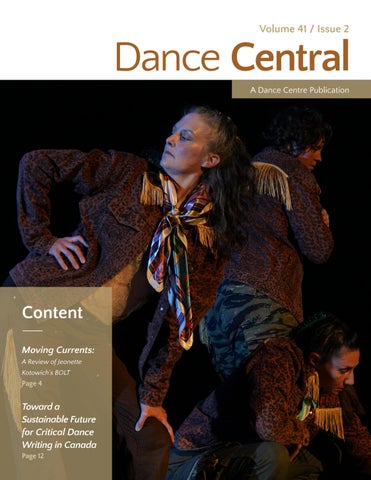
Front Cover: Left to right: Kate Franklin,
Raquel Alvaro
Deanna Peters and Jeannette
Associate Producer
Kotowich in BOLT © Laurence Rosset
Linda Blankstein
Back Cover: Past Issues of Dance
Marketing Coordinator
finally Franklin start to advance along their
Central © The Dance Centre
Jullianna Oke
horizontal corridors, dipping, grooving, swaying,
Digital Marketing Coordinator Dance Centre Board Members: Chair
Lindsay Curtis
Selim Hasan
Catherine Butler
Vice-Chair
Membership Coordinator
Linda Gordon
Kaia Shukin
Treasurer
Outreach Coordinator
Mark Weston
Yurie Kaneko
Directors
Comptroller
Rosario Ancer, Elaine Carol,
Elyn Dobbs
Yvonne Chartrand, Anndraya Luui,
Venue and Services Manager
Jordan Thomson, Sujit Vaidya,
Christopher David Gauthier
Development Manager
Wen Wei Wang
The energy building in the room is contagious and when first Peters, and then Kotowich, and
soaring, the release we feel in our own bodies is intoxicating. Focusing on each dancer separately and then together makes for fascinating study, not least because they have such distinctive movement vocabularies. Kotowich bends low to the ground in a succession of lunges, angling her arms diagonally from her torso like eagle wings. Peters takes smaller, more staccato steps, finding the downbeat and shimmying in place before stuttering forward in a series of graceful
Established in 1986 as a resource centre for dance in British Columbia, The Dance Centre is a multifaceted organization offering a range of activities which is unparalleled in Canadian dance. We present performances and events, building audiences and nurturing public awareness; invest in programs, resources and support for hundreds of dance professionals working in all genres; operate one of Canada’s flagship dance facilities which welcomes tens of thousands of visitors annually; and work to promote BC dance. Through programs, outreach and education, The Dance Centre is committed to sustaining a strong and vibrant community through dance.
hops. And Franklin, true to the piece’s title, launches herself across the stage, momentarily airborne before reversing course and flying low to the ground. Drawing in this way on her own and her collaborators’ movement histories and repertoires (including of social dance), Kotowich creates what she calls a “living archive” of how we are grounded, in real time, to land, lineage, other bodies.
6
D a n c e C e n t r a l Vo l u m e 4 1 / I s s u e 2
Left to right: Jeanette Kotowich, Kate Franklin, and Deanna Peters in BOLT © Luciana Freire D'Anunciação
The movement corridors glide back and forth, tempo and shape expanding and contracting as the music builds, until first one and then another of the dancers breaks out of their lane, now moving vertically or settling themselves in space, reveling in the surprising encounters and “productive instabilities” that come through shared proximity and spontaneous crossings and gleeful near misses. It’s almost as if, having tilled a field together, the trio is giving itself permission to sow a wild miscellany of crops, an abundance that will sustain them in the shared work ahead. And, indeed, this first section climaxes with the dancers gathering near Khalil, thrusting hands downwards
into an imaginary centre in a gesture that can be seen as complementary—that is, as both planting and harvesting. How, then, to read the grabbing and releasing of limbs that follows as the music cuts out? Perhaps as a phantom desire for the extension of another’s cooperation or assistance or touch. Which is precisely what we get in the second section when the dancers, coming to rest perpendicular to Khalil’s music station, close their eyes, take hold of each other’s hands and, together with Khalil, begin to recite a story. It’s a nonsense tale, really, the words each performer successively repeats D a n c e C e n t r a l Vo l u m e 4 1 / I s s u e 2
7
plucked randomly from a shared score, but cumulatively adding up to a kind of poetry, if only through the trust in what’s coming next being additive rather than subtractive. The same principle forms the core of the movement in this section. Still with their eyes closed, and never losing their grip on each other’s hands, the dancers begin an awkward step dance, with Kotowich’s long training in Métis jigging combining with other syncretic movement forms (a bit of tap, some hip hop, even quasi-pointe work) to propel the trio across the stage.
Jeanette Kotowich and Kate Franklin in BOLT © Laurence Rosset
8
D a n c e C e n t r a l Vo l u m e 4 1 / I s s u e 2
The rules of the game are as simple as they are thrilling to watch: the person in the centre leads the dance, with those on either side needing to feel the proffered rhythm and steps to stay upright and in time. Verbal check-ins are permitted and position swaps regular, often involving complex arm twirls and do-si-do’s. Finally, whenever the dancers veer too close to the audience, or to the lights stage right or his station stage left, Khalil hits a cowbell, indicating that the dancers should retreat. Physically demanding and requiring absolute conviction that your partners literally
have your back, this section manifests for the audience the structures of support that mitigate risk in both the making of a dance and the sustaining of a community. In this way, we are also reminded of another meaning of BOLT—to fasten or secure something in place. As if to reinforce how the performers are inextricably bound to each other (both inside and outside of the work), the piece’s third section begins with Kotowich retrieving and successively donning four matching leopardprint denim jackets, each with a gold fringe
along the back and at the lapels that matches those on the dancers’ pants pockets. These she then gifts in turn to Khalil, Franklin (busy building a fire underneath Khalil’s console with the glowing orange tube lights), and finally Peters, who rests against the upstage wall. Her posse thus suited up for an ersatz rodeo, Kotowich signals our transition into an irreverent exploration of historical tropes associated with the “wild west” by pulling a blood red curtain halfway across the upstage wall, onto which Hanemayer projects a spotlight. Lining up sideways in front of this spot, the dancers begin to move in silhouette, their undulating bodies responding to the lightly percussive music in ways that are suggestive of different parts or movements of a horse. The parts are combined into a whole when the dancers turn to face the front and begin building an architecture of horse. Franklin sinks into a deep plié at the front, her nostrils flaring and her head nodding and neighing. At the back, Kotowich kicks her heels to the right and left. And in the middle an unseen Peters uses her hands to form blinders and then ears for Franklin. Positions morph and new shapes form—Peters emerging at one point to straddle Franklin— until we are back to front, the horse’s tail waving in front of us and Kotowich holding her nose, signalling what Hollywood’s pastiche of cowboys and Indians really smells like. If the horse is what these two so-called “enemies” had in common, only one group considered the animal sacred and not merely a labour-saving mechanism for transportation and farming.
D a n c e C e n t r a l Vo l u m e 4 1 / I s s u e 2
9
Historically, when horses have exceeded their use-value in settler culture, they’ve been put out to pasture or, worse, sent to the glue factory. We see a version of this scenario unfolding in the aftermath of how Kotowich, Franklin and Peters break apart from the shared tableau of their show pony sequence, their movements becoming jerky and convulsive on the floor, the pain of separation from the herd registering in kinetic spasms and sonic tremors. But this genealogy of horse as a “companion species,” particularly on the Canadian Prairies, also provides Kotowich with an opportunity to reflect on both inherited and chosen families. To that end, the fourth and final section of the piece comprises a series of traveling portraits, in which the dancers, responding to the orchestral crescendos in Khalil’s anthemlike score, and while being tracked and trailed by Hanemayer’s follow spot, strike a succession of group poses where cheek and defiance and the stubbornness of survival and just plain perseverance abut in equal measure, and where the cultural mixing of Kotowich’s heritage feeds into and nourishes this Indigenous-led process with settler artist-collaborators (perfectly captured in a concluding soundscape that merges a version of the famous whistle from Ennio Moriconne’s score for The Good, The Bad, and The Ugly with an eagle call). Because as becomes clear from how the final family portrait transforms into a concluding group hug that extends to include Khalil, what Kotowich is gifting to 10
D a n c e C e n t r a l Vo l u m e 4 1 / I s s u e 2
her collaborators—and to her audience—are tools for how to live in relation: to the land, to history, to time, to other nonhuman life forms, and to each other. This is the charged arrow that Kotowich aims at us with BOLT, a work that together with KWÊ (2022) confirms the artist as an ensemble creator of uncommonly joyful, tender, loving, and generous dances. I have long thrilled to Kotowich’s power and presence as a solo performer. I have also enjoyed watching her as a mover in other choreographers’ works—including, most recently, Lara Kramer’s Remember that time we met in the future?, which premiered at the 2026 PuSh Festival, and alongside which BOLT was programmed at the most recent Festival TransAmériques. I look forward to how she continues to build her own repertoire.
Peter Dickinson is a professor in the School for the Contemporary Arts at Simon Fraser University. He is the author of My Vancouver Dance History: Story, Movement, Community (2020) and co-editor, with Jane Gabriels, of Conversations and Essays on Dance in British Columbia: A Dance West Network Anthology (2025).
what Kotowich is gifting to her collaborators [...] are tools for how to live in relation: to the land, to history, to time, to other nonhuman life forms, and to each other.
Left to right: Kate Franklin, Jeanette Kotowich, and Deanna Peters in BOLT © Laurence Rosset
D a n c e C e n t r a l Vo l u m e 4 1 / I s s u e 2
11
12
D a n c e C e n t r a l Vo l u m e 4 1 / I s s u e 2
Toward a Sustainable Future for Critical Dance Writing in Canada by Shanny Rann
Canada is in the midst of a quiet collapse in dance publishing. Over the past five years, the country has lost two of its longstanding platforms for dance writing. What remains is not simply a gap in dance coverage, but an erosion of the structures that sustain critical engagement with dance. In 2020, Dance International shifted from a quarterly print magazine to an online-only format before ceasing publication in 2024. The Dance Current, widely regarded as Canada's national dance magazine, paused operations in 2025 with little public communication about its future.
This period of contraction has nonetheless sparked new initiatives. In 2024, moveo launched as a French-language magazine dedicated to contemporary dance. Conceived by and for the dance community, the publication seeks to foster dialogue, amplify underrepresented voices, and engage with the artistic, social, and ecological questions shaping contemporary dance practice. Its emergence demonstrates an ongoing commitment to critical dance discourse, particularly within francophone communities. Other publications continue to serve vital functions within the ecosystem. Among them
Pictured left: Dance Central newsletter March 2005 © Dance Central
is our very own Dance Central, published three times a year by The Dance Centre in Vancouver. What began in 1986 as a member newsletter has evolved into a sustained commitment to centring artist voices across British Columbia. Meanwhile, Dance Collection Danse (DCD)—Canada’s only national dance archive—has spent four decades preserving the country’s choreographic history through physical and digital collections alongside its annual magazine. These initiatives highlight both the profound challenges and creative possibilities facing Canadian dance publishing. While national critical discourse has thinned with the loss of legacy publications, emerging and surviving platforms continue to experiment with new ways of documenting movement and connecting regional communities. D a n c e C e n t r a l Vo l u m e 4 1 / I s s u e 2
13
Issue 58, 2004
Issue 61, 2006
I s s u e 8 5 , Fa l l 2 0 2 5
DCD The Magazine © Dance Collection Danse
A Way of Knowing at Risk In January 2026, a collective of dance scholars and writers—Shanny Rann, Tessa Perkins Deneault, Em Pettet, Alana Gerecke, and Carolina Bergonzoni—convened to organize a roundtable for the Canadian Association for Theatre Research (CATR) online conference in June 2026. Their conversation quickly evolved into a broader reckoning: What does it truly take to sustain a dance ecology within a waning culture of dance writing? Dance writing is not ancillary to the art form; it is one of the primary portals through which dance enters the public record. Reviews, essays, interviews, and archival documentation collectively form a landscape that allows the field to trace its own evolution. Without this record, histories become fragmented, and future 14
D a n c e C e n t r a l Vo l u m e 4 1 / I s s u e 2
generations inherit gaps in their creative lineage. If dance is a distinct way of knowing, losing the literature surrounding it means forfeiting embodied knowledge itself. Perkins Deneault framed the issue in terms of national coherence:
“Without a shared site of publication, we lose the ability to see each other’s practices across distance. The field becomes harder to read as a whole.” —Tessa Perkins Deneault Gerecke extended this concern to pedagogy and training: “If students don’t encounter writing about dance, they lose access to critical frameworks. That has long-term implications for how the field thinks about itself.” The decline of national platforms further sharpens regional inequities. Bergonzoni’s reflections on Cape Breton Island illustrate how geography shapes artistic viability:
"Publishing has to reflect where dance is actually happening, not just where infrastructure is strongest." —Alana Gerecke
Access and Writing as Infrastructure When physical access to dance is uneven across a vast country, writing becomes a primary access point. For many, text is how they first encounter an artwork. Bergonzoni pointed to her experience producing the first audio-described
Self-portrait © Tessa Perkins Deneault
Self-portrait © Alana Gerecke
“Opportunities drop off after 18. People leave for Halifax or Montreal if they can. If they can’t, the scene becomes very insular.” Work created in rural or remote contexts is far less likely to be written about, limiting its reach and recognition. From Halifax, Pettet described a local scene fueled by grassroots experimentation, citing vibrant community events like Queer linedancing gatherings. “Without consistent coverage,” Pettet noted, “these practices don’t register beyond their immediate context.” Gerecke reinforced that this imbalance is structural: “If national coverage centers a few urban hubs, we reproduce inequity. Publishing has to reflect where dance is actually happening, not just where infrastructure is strongest.” D a n c e C e n t r a l Vo l u m e 4 1 / I s s u e 2
15
performance on Cape Breton Island to emphasize the labor required to broaden access. “It can be done,” she shared, “but it relies on limited resources and individual effort. That’s not sustainable.” Pettet linked this directly to audience development: “When people read about dance in relation to their own communities, they are more likely to engage. Writing can build audiences, not just document work.” A key thesis emerging from these
Toward Collective Models The CATR roundtable served as an active site of inquiry, bringing together participants nationwide to interrogate the present and imagine new futures for dance publishing. Core questions included:
What publication models are viable in the current economic landscape? How can platforms balance regional specificity with national scope?
conversations is the need to reconceptualize dance writing as essential infrastructure. “We
What governance and funding structures are
need to think of writing as something that
needed for long-term sustainability?
sustains the field over time,” Perkins Deneault argued. “It’s not just about producing content;
To inform the panel, organizers distributed a
it’s about maintaining a network of practices
national survey. Respondents were also invited
and relationships.”
to identify gaps in the current publishing landscape and imagine new models for the
This perspective shifts attention from individual
future. The findings revealed that interest in
publications to broader systems of support,
dance writing remains strikingly robust. Nearly
which foregrounds editorial labour, funding
all respondents expressed a deep desire to
structures, and the conditions under which dance writing is produced. Historically, dance publishing in Canada has been closely tied to academic institutions (Andrews, 2016). While this connection has provided continuity, it has also shaped whose voices were amplified. Gerecke emphasized the importance of inclusivity within this infrastructure: “We need to support multiple forms of knowledge, whether it is academic, artistic,
read about dance, regularly engaged with magazines in the past, and stated a willingness to subscribe to platforms that meet their needs. Even more promising was the eagerness to participate: a majority expressed interest in contributing writing or editorial support. The critical bottleneck is not a lack of invested voices, but a lack of infrastructure to bring those voices together.
and community-based, without privileging one over the other.” Expanding authorship is essential to creating a more diverse and equitable discourse. 16
D a n c e C e n t r a l Vo l u m e 4 1 / I s s u e 2
Pictured right: One of the first newsletters published by the Vancouver Dance Centre in 1986, which later became Dance Central © The Dance Centre
D a n c e C e n t r a l Vo l u m e 4 1 / I s s u e 2
17
Survey Insights: What the Community is Calling For [✓] Collaborative, artist-led, and multimedia platforms [✓] National connectivity paired with regional granularity [✓] Nuanced, accessible criticism beyond legacy urban hubs [✓] Mentorship and clear entry points for emerging writers The June 2026 roundtable expanded many of the themes that emerged from the survey while adding new dimensions to the conversation. Participants described dance writing as more than criticism or documentation, but an essential form of cultural infrastructure that connects artists across regions and makes dance legible to wider publics. Discussion repeatedly returned to the importance of national platforms, not as centralized authorities, but as spaces where diverse dance communities can encounter one another. Panelists also challenged narrow understandings of what counts as dance writing, calling for greater recognition of communitybased practices, social and folk dance, rural and remote dance communities, and writing by dancers themselves. Accessibility emerged as a recurring concern, extending beyond cost to include language, format, audience, and the recognition of multiple ways of documenting embodied knowledge. 18
D a n c e C e n t r a l Vo l u m e 4 1 / I s s u e 2
During the roundtable, discussions moved decisively from diagnosis to action. Panelists and audience members envisioned a networked ecosystem supporting writers, editors, artists, and readers across multiple formats. Proposed action items included:
1. Cross-Publication Collaborations: Partnering with existing scholarly journals and cultural outlets to co-publish and syndicate writing. 2. Editorial Mentorship Networks: Establishing structured pathways to train, mentor, and compensate emerging critics. 3. Institutional Partnerships: Building sustainable funding alliances between academic institutions, funding bodies, and dance organizations. While there may not be a single solution, participants concurred that there needs to be a shared responsibility to ensure that dance in Canada is documented and critically engaged with. What began as a roundtable unfolded as an ongoing dialogue grounded in collaboration and a commitment to sustaining dance writing for future generations.
Reimagining the Path Forward For Dance Central, this moment has clarified our purpose. As one of the few remaining dance publications in Canada, our mandate expands beyond documenting local performances at The Dance Centre to
actively cultivating critical dialogue across British Columbia and beyond.
Carolina Bergonzoni (PhD) is a dance artist and Assistant Professor in the School of Education at Cape Breton University. Her work focuses on
The loss of legacy publications is a profound cultural blow, but it also creates an invitation to rebuild purposefully. The appetite for dance writing has not vanished. What we lack is the bridge connecting readers to writers, communities to each other, and dance to the public consciousness.
embodied research, community engagement, and issues of access and inclusion in the arts. Em Pettet is an artist and writer based in kjipuktuk on the east coast. A former editor at The Dance Current, their work spans performance, gender studies, and communitybased practice. They are currently working on
The question facing Canadian dance is no longer if dance writing will continue, but what structures will sustain it and whose voices will define its future. How we answer will shape not only how dance is recorded, but how Canada's dance communities continue to reimagine themselves for generations to come.
a new work of fiction that deals with themes of trauma and connection as told through the eyes of a host of animal characters. Shanny Rann has been Editor of Dance Central since 2020 and is a PhD candidate in Gender, Sexuality and Women's Studies at Simon Fraser University. She is faculty in the School of Music, Dance and Theatre at Arizona State University, where she leads the CrossCultural Dance Resources Collections. Her research is guided by the enduring question of
Andrews, M. (2016). Midwifing Transitions: The Labour of Publishing in the History of Dance and Dance Studies in Canada. Performance Matters, 2(2), 132–139.
why humans dance, explored through dance anthropology and the preservation of dance knowledge across cultures. Tessa Perkins Deneault is a dance writer and PhD student in the Critical Media Arts Studio at Simon Fraser University. Her chapter, “Dancing
Alana Gerecke is a dance artist and instructor in the School of Humanities at Capilano University. Her work engages choreography, pedagogy, and critical inquiry into contemporary dance practices in Canada.
on the Mountain: The History and Legacy of SFU’s Dance Program” was published as part of A Magical Time: The Early Days of the Arts at Simon Fraser University (Harbour Publishing, 2025). She has contributed to The Dance Current, Dance International, and Dance Central, and her current research explores dance history via archives, oral histories, and arts criticism. D a n c e C e n t r a l Vo l u m e 4 1 / I s s u e 2
19
Past Issues of The Dance Current © Images downloaded from the Dance Current archive
moveo 02 - April 2025 and moveo 003 - May 2026 © moveo 20
D a n c e C e n t r a l Vo l u m e 4 1 / I s s u e 2
magazine sur les danses actuelles - numéro 003 - mai 2026
19$
Censure + Sérénité
20$
Critique + Effacement
magazine sur les danses actuelles - numéro 02 - avril 2025
Past Issues of Dance Central © The Dance Centre
Dance International Fall 2017 and Spring 2013 © Vancouver Ballet Society D a n c e C e n t r a l Vo l u m e 4 1 / I s s u e 2
21
Dance Central Volume 41 / Issue 2
Volume 41 / Issue 1
Dance Central A Dance Centre Publication
Content A Conversation with
Olivia Shaffer In Memory of Peter Bingham
Page 4
Tributes g>µÁtg Á¿µgÛgUÁ ¸¿ shared by artists who Ñ µ g_¿U ¸g Ó¿Ñ Á ¿ Peter Bingham
Page 10