Articles: Dance Central Volume 40 / Issue 3

Page 1


Dance Central

Editor's Note

As I am compiling this issue, it dawned on me that this marks my 20th issue as editor. Working with The Dance Centre has given me the privilege of engaging with artists whose work continues to shift the way we think about dance in British Columbia and beyond. Reaching this milestone reminds me how much the field has transformed since 2020 and how valuable this platform, initiated in 1986, continues to be as a place where conversations around dance can unfold.

This issue brings together two perspectives on contemporary dance in Vancouver that show how artists and practitioners are reshaping practice across the city. Our seasoned writers, Tessa Perkins Deneault and Rachel Silver Maddock, offer vivid portraits of individuals who expand the field while staying rooted in their communities. They remind us that dance moves forward through risk and collaboration, and that documenting these shifts is both a responsibility and a joy.

Maddock’s conversation with Deanna Peters, Artistic Director of the Vancouver International Dance Festival, examines a period of leadership transformation since they stepped into the role of Co-Director in 2024. This year, they became Artistic Director. The interview offers a close view of a festival shaped by an artist-led ethos and strengthened by renewed commitments to champion underrepresented dance forms. This feature holds personal meaning for me because I interviewed Barbara Bourget and her dancers at Kokoro Dance, including Peters, Salome Nieto, and Molly McDermott, for my first issue of Dance Central in 2020. Witnessing the baton passed from Bourget to Peters is a powerful reminder of how leadership can open new pathways for community and practice.

Perkins Deneault’s profile of Eric Cheung follows a multidisciplinary artist committed to exploration and movement as a site of curiosity. Cheung is a member of Ouro Collective, known for its inventive blend of street dance, experimental practice, and theatrical performance since 2014. Ouro will present its new work ECHOES at VIDF 2026. Be sure to explore the newly released VIDF 2026 program and get your tickets at vidf.ca.

We thank all the artists who have contributed, and we welcome new writing and project ideas at any time—keeping Dance Central a vital link to the community. Please send materials by email to editor@ thedancecentre.ca. We look forward to many more conversations.

Editor Dance Central, Volume 40, Issue 3

Contra rehearsal with performers Eric Cheung and Kinui Oiwa © Aidan Chin

A New Vision for VIDF

It was a historic year for Vancouver International Dance Festival (VIDF), marking the change of leadership from co-founders Barbara Bourget and Jay Hirabayashi to Deanna Peters/Mutable Subject and Victor Tran. The new directors blazed a new trail, presenting work that was “raw, kinetic, and experimental,” in a seismic shift that widened the scope of viewership. On a warm evening in October, I sat down with Peters—a longtime friend and mentor—to discuss her moving into the role of Artistic Director (in August, Tran stepped down as co-director). Over coffee and snacks, we reflected on the 2025 festival and discussed the upcoming one.

Rachel Silver Maddock: The 2025 VIDF festival had new leadership, a new format, and a new flavour—and from where I'm sitting, it was a huge success! Every show that I went to seemed to be packed. There was a lot of enthusiasm and energy around the shows, and in the community. Do you want to reflect on how it went?

Deanna Peters/Mutable Subject: I think it went wonderfully. I think we did a really good job. You know, it was a real privilege to be able to enact a larger vision than doing a lot of DIY indie projects. We definitely felt the abundance of coming into an organization that had a longstanding history, operating funding and a larger budget than we had ever seen before. My first impression was just like, wow, look at what we can do for the dance community. And leaning into things that were really familiar to me, like an open call to artists. Because six months to

produce a festival isn't the longest amount of time, and so we needed to be efficient.

RSM: Previously did Jay and Barbara not do an open call?

DP: I think maybe as an anomaly during the pandemic. But that was the only time. So, I think it was the first time in the organization's history that there was. It was a unique opportunity to make the call accessible to all dance artists in Canada, and we had a really great response. We had Michelle Olson join us as a guest artist on the selection committee. And we programmed the festival with people we knew, people we had never met before, and we had never heard of before. It was really exciting to encounter people through their work.

RSM: Yes, I love that. Many of the institutional resources in the dance community have

We All Fall Down © Jared David

The Dance Centre

Scotiabank Dance Centre

Level 6, 677 Davie Street

Vancouver BC V6B 2G6

T 604.606.6400

info@thedancecentre.ca www.thedancecentre.ca

Dance Central is published quarterly by The Dance Centre for its members and for the community. Opinions expressed are those of the authors and do not necessarily represent Dance Central or The Dance Centre. The editor reserves the right to edit for clarity or length, or to meet house requirements.

Editor, Art Director & Layout

Shanny Rann

Copy Editor

Kaia Shukin

Design Layout

Becky Wu

Contributors to this issue:

Rachel Silver Maddock,

Deanna Peters/Mutable Subject, Tessa Perkins Deneault, Eric Cheung

Photo credits

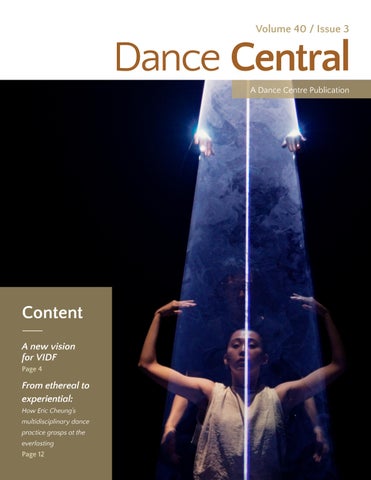
Front Cover: Contra with performers

Tegvaran Sooch, Eric Cheung, and Kinui Oiwa © Aidan Chin

Back Cover: VIDF-Mile Zero

Dance [Tia-Kushniruk] © Luciana D’Anunciação

Dance Centre Board Members: Chair

Linda Gordon

Vice-Chair

Selim Hasan Treasurer

Mark Weston

Directors

Yvonne Chartrand, Mique'l Dangeli, Mirjana Galovich, Anndraya Luui, Sujit Vaidya, Wen Wei Wang

Dance Foundation Board

Members:

Shaadi Faris, Samantha Luo, Dallas McMurtrie

Chair Linda Blankstein

Vice-Chair Andrea Benzel

Secretary Anndraya Luui

Treasurer Janice Wells

Dance Centre Staff:

Executive Director

Mirna Zagar

Associate Programming Director

Raquel Alvaro

Associate Producer

Linda Blankstein

Director of Marketing

Heather Bray

Digital Marketing Coordinator

Lindsay Curtis Development Manager

Catherine Butler

Membership Coordinator

Kaia Shukin

Outreach Coordinator

Yurie Kaneko

Comptroller

Elyn Dobbs

Venue and Services Manager

Christopher David Gauthier

Established in 1986 as a resource centre for dance in British Columbia, The Dance Centre is a multifaceted organization offering a range of activities which is unparalleled in Canadian dance. We present performances and events, building audiences and nurturing public awareness; invest in programs, resources and support for hundreds of dance professionals working in all genres; operate Scotiabank Dance Centre, a cultural hub and one of Canada’s flagship dance facilities which welcomes tens of thousands of visitors annually; and work to promote BC dance. Through programs, outreach and education, The Dance Centre is committed to sustaining a strong and vibrant community through dance.

historically gone towards concert dance and more western canonical forms—whereas experimental dance and street dance have been historically underfunded, underrepresented, overlooked and underserved.

DP: Those are all the words that we use!

RSM: I thought it was wonderful that you want to support those artists who have been working hard behind the scenes and not always recognized on the front lines. I’m curious, for you, what is the relationship between street dance and concert dance? How do they support each other or learn from each other?

DP: I guess I don't see them as separate in the sense that there are street dancers who are working for the stage—I see it as situational. We are a traditional festival in the sense that we are in theatre venues, primarily. But, also, as an artist-led festival, we're bringing a DIY grassroots ethos to a major international event. One thing I learned during the first year was VIDF's relevance to the dance community locally, nationally, and globally: we are actually the largest festival dedicated to dance in the country

RSM: Largest in terms of budget or shows?

DP: In the number of shows, and the number of artists that we're supporting. There are larger festivals, but they're broader performing arts festivals. We are the largest festival dedicated to dance.

RSM: I did not know that!

DP: And with that, we carry the historic underserving of dance as well. It's not necessarily a competition of who is the most underserved, but, you know, when we look at the greater arts landscape, dance is usually pretty low down in terms of the resources that we have to work with. But also, as practicing artists, we are empathetic to the situation of many artists who are working underground, independently, and outside of the dominant structures. So, I think our programming values were really strong

We had these words that we were putting the works up to, which was raw, kinetic, and experimental. And not all of the works had to be all of those things, but in general those are the values for the festival. And works rooted in lived experience were also very important to us. So that's why we came up with the battle as a way to bridge the audiences and spaces where dance is happening.

RSM: The festival was such a great mix of venues and styles. I appreciated the condensed timeline of shows (two weeks) and three shows per day. I actually found it quite fun to traipse from one venue to the next and have conversations with people along the way. It created this hub—this very energetic, short incubator where you run into the same people at different shows, and the networking felt very strong. Did you make any changes to the structure or the format of the festival?

DP: The format is pretty similar to before because there are long-standing venue partners with the Roundhouse and the Vancouver Civic Theatres. So, all of those venues were available and booked years in advance. That kind of stability was there. And there's always been the free show at the Roundhouse as well as a show in the performance centre and then the Annex. We did change the times, and put two artists in each venue per week, rather than one. So, we adopted more of a festival format as opposed to a stand-alone presentation format. And also, duration—the call was for 25 minutes and up. So, we're creating the opportunity for people to see three shows in one night by featuring shorter, smaller-scale works. But it was really out of a vision that the festival is a celebration of dance. There is no lack of amazing dance artists out there to program; so, it is really about that abundance.

There is no lack of amazing dance artists out there to program; so, it is really about that abundance.

Paper Dress © David Cooper

RSM: It did feel like that. It felt like there was an abundance of talent, an abundance of generosity, and an abundance of community. I particularly loved sitting in the round tables at the Roundhouse and every time sitting down, meeting someone new.

DP: One thing we did change was that all of the shows were ticketed. When we were starting out, we asked people: what's your experience of VIDF in the past? And we learned about how it was perceived and how local artists were feeling they were being presented. And so, we decided to get rid of

the hierarchy that this venue is the opener, this is the main stage, that kind of thing. We made it about what venue does a specific work need, and ticketed all the shows at an equal level. So, a local artist or visiting artist would be seen to represent the same value.

RSM: That's super important. Was there anything else that worked well or surprised you?

DP: We tried a repertory format, which means that we were doing a show Wednesday-Friday, and a show ThursdaySaturday. And that is a bit more stressful on

the budget and on the tech, but also creates that opportunity for visiting artists to come for a full week and see other shows. So, I think that repertory format had an added value that really surpassed the extra cost that we would put in for the hotels etc.

One thing that surprised me was that the first week of the festival was so amazing and going so well, and when week two came, it started to feel like Groundhog Day, just a teensy bit. And thankfully we had a disruptor that came in—one work that was way beyond the usual programming capacity, which was Mile Zero

Dance, and they did this giant installation in the exhibition hall. And so that idea of the disruptor is carrying through into the next year ; the second week needs disruption. And it allows for other works that might not be as conventional, to help serve artists that are working outside the box.

RSM: That was a particularly memorable show. And it gave a certain vibrancy to the festival as well—I could hear people talking about it while I was at other shows. Let’s touch on changes: can you talk about the team and how it’s going to shape up this year?

DP: I'm so proud of what Victor and I achieved by coming in and doing this giant push to put the festival on. Then when the dust was settling, it was like, how are we going to make this sustainable?

Now I'm the Artistic Director and it does feel quite exposed; there was something really comfortable about being able to represent the community as two people, and that's the way I'm used to working. Because I can't do it all and it's not appropriate for me to be doing everything— we need multiple voices to represent the community. And so, we have different programs and people taking on different roles and different aspects of the festival.

I also wanted to acknowledge that I'm in a really deep period of learning. After the push to put on the festival last year, we’re kind of doing things in reverse, organizing

the operations, getting on top of the day-today and thinking about long-term strategy... identifying roles, standard operating procedures, and all those things, but still keeping that DIY ethos. Currently, I’m fortunate to be learning from six mentors—I'm learning something one day and putting it into action the very next. It's super exciting to feel more confident in the role.

RSM: Earlier this year, I had the privilege of participating in Living Room, which is a new creative venue for response on VIDF’s website. Many people have expressed that we have a lack of critical discourse in Vancouver: sometimes it feels like a show happens and all these resources have been poured into it, and then there's just nothing. And especially as an artist, it is so valuable to have something to hang on to and receive and be nourished by as well, to know that your piece landed somewhere. What’s the plan for that this year?

DP: Yes, Living Room is going to be produced by Ileanna Cheladyn, who was a big part of it

last year. And it falls outside of our core budget, and so we’re trying hard to apply for project funding to support these new community engagement activities. The plan is to formalize it more through having a budget so we're not asking folks to write in exchange for tickets.

But going back a little bit, I do think that there's a lack of critical discourse everywhere. And also, because we are presenting underrepresented forms, those forms are also underrepresented in terms of dance writing. So, with the DIY ethos, we need to talk about doing it ourselves. Otherwise, I find that a lot of dance gets minimized and infantilized in media. And I feel very protective of that. It’s a resource for dance artists, and VIDF is reaching into communities beyond Vancouver because these artists are taking these artifacts back into their communities and using them to represent their work. So, I’m really looking forward to seeing what Ileanna is going to do with it.

Because I can't do it all and it's not appropriate for me to be doing everything—we need multiple voices to represent the community.

RSM: Me too! It feels like an opportunity taken. The last thing is just to ask what can we expect for 2026? Anything you're particularly excited about?

DP: I am so damn excited—this year we're presenting 12 artist groups from five continents. A mix of local, national, and international artists. Some collaborations are happening across great distances. There's a mini festival in the middle of VIDF this year, with a battle and street dance triple bill. And we're bringing back a lot of our programs to make the festival accessible to people of all sorts of economic brackets. Last year we had a really successful pay-it-forward program—we increased our audience and attendance a great deal and actually increased our box office numbers while also lowering ticket prices

RSM: That’s a pretty amazing accomplishment.

DP: A lot of that had to do with setting up a sliding scale—because as many people paid $25 for a ticket as paid $60 for a ticket. We learned that to provide that range, we can really increase the accessibility for the festival. So, we're actually lowering our ticket prices even more this year. And hopefully people will feel like they can buy a pass and come see multiple shows in a day or in a week. We are keeping our themes: one of them is International Women's Day. It always falls in the middle of the festival because it's on March 8th every year. Featuring women-led projects is important and also a natural step for us. It’s

RSM: Awesome. Last year, I remember being at BRKFST’s show STORMCLUTTER, and you know, I don't think I've ever experienced so much infectious energy as an audience member. We took that straight into dancing all night on the Annex stage with the DJ. It was pretty special to be a part of. Needless to say, I’m looking forward to round 2!

DP: Totally. Hooray!

Based on unceded Musqueam, Squamish and Tsleil-Waututh Territories, Deanna Peters/ Mutable Subject creates, performs and produces for the stage, club, gallery, web and print. Deanna uses the name ‘Mutable Subject’ because they’re always evolving in their 22 year career. As a creator of “eye-popping” and “deeply moving” dance works, Deanna’s known for pushing the boundaries of the form. A member of Gold Saucer Studio, DP focusses on supporting indie artists. From 2012–2022, Deanna worked at CADA/West, advocating for fairness in dance. From 2016–2024, they produced interplay_, which pivoted online in 2021. In 2024, Deanna was appointed CoDirector of the Vancouver International Dance Festival and in 2025 they became Artistic Director. really great to acknowledge and celebrate those projects, as well as the street dance on the stage and on the concrete, and a lot of dance productions that feature original and/or live music.

From Ethereal to Experiential:

How Eric Cheung’s multidisciplinary dance practice grasps at the everlasting

From dance battles to artistic installations, Eric Cheung’s creative practice is varied and grounded in a multidisciplinary, collaborative ethos. Speaking to me from his car between rehearsals, Cheung shared his journey from leaving business school to joining a street dance collective, choreographing his own works, and receiving both the Chrystal Dance Prize from Dance Victoria and the Iris Garland Emerging Choreographer Award from The Dance Centre.

I first saw Cheung perform with Ouro Collective in 2021 during an outdoor performance at the Firehall Arts Centre as part of the Dancing on the Edge Festival. It was the first in-person performance I attended as the pandemic was waning, and it was magical to see dance live on stage and to see the innovative and intricate choreography of Ouro.

Cheung’s hard work and dedication to dance is paying off. He is a 2025-2026 Artist in Residence at Dance Victoria and begins a new chapter with his first full-length work, Contra, presented through The Dance Centre’s Iris Garland Emerging Choreographer Award, that premiered at Scotiabank Dance Centre in November 2025. Cheung performs in the piece with Kinui Oiwa (also a member of Ouro) and Tegvaran Sooch.

His interest in integrating technology in his work is evident in Contra which involves laser projections. “I’m trying to build these

concepts to see how we can use technology in a vague way to help tell the story but not overtake the story.” Through the research process of creating the piece, the technology changed from projections and projection mapping to working with lasers. There is also a large bowl of water on stage that reacts and vibrates in relation to the movements.

Thematically, Contra aims to portray a journey of self-actualization by depicting opposing extremes of one identity.

Eight years ago, Cheung was a business student in Calgary, but he fell in love with street dance, specifically popping. “I wasn't aiming to become a dancer at any point, in any way, shape or form,” says Cheung. “I was in business school, but I was still dancing every day and training. I just loved it.” He battled at the 2017 Vancouver Street Dance Festival and says he wasn’t expecting to make it past the first round. He won the battle,

Contra night centre stage with performers Kinui Oiwa, Tegvaran Sooch, and Eric Cheung © Aidan Chin

which was a turning point for him. He decided to pursue his passion full-time. “It was just a validation. I feel like with anything in life, people just need to be validated at least once to believe in themselves.”

In 2018, Cheung moved to Vancouver to join Ouro Collective, first as an apprentice and then as a member. Cheung has built on his movement foundation of popping with selfdirected exploration of many other styles and during dance battles in Calgary, Vancouver, and internationally. It was years before he took a formal dance class. There was a time

that Cheung’s goal was to be an international street dance battler, but that has changed since he’s joined Ouro and been integrated into the theatrical dance world. He credits Ouro and specifically Cristina Bucci and Maiko Miyauchi, with teaching him how to be a professional dancer. His tweet at 18 years old, “My dream is to dance in a theatre” has been manifested.

It was during a residency with the Dance West Network that Cheung began to further develop his choreographic practice with some short solo pieces, and he choreographed his first group piece for Modus Operandi. Another

Contra rehearsal with performers Kinui Oiwa, Eric Cheung, and Tegvaran Sooch © Aidan Chin

turning point came during the COVID-19 pandemic. He was preparing to travel around the world to compete at dance battles, but when that was no longer possible, he had to rethink his plans. “That forced me to either quit or think about how I can change my practice in another direction.” During COVID-19, Cheung worked on some film projects and an interactive digital experience. Through these projects, he was exposed to new opportunities and expanded his artistic network.

Along with a busy creation and rehearsal schedule, Cheung takes on the occasional

teaching gig. This November he taught a few ‘Working Classes’ for The Training Society of Vancouver. He has been invited as a guest teacher in dance classes at the School for the Contemporary Arts, and Ouro Collective was a guest choreographer for the SCA’s Fall 2025 Repertory Dance Show, The Living Room. The first year of Ouro Fest in 2024 was held at the SFU Goldcorp Centre for the Arts, marking the collective’s 10th anniversary and providing a platform to showcase the many styles of street dance. The 2025 festival was held at Massey Theatre in New Westminster, and unlike the first year, didn’t include any battles. “There's always this debate about how to put street dance authentically into the theatre or on stage,” says Cheung. “Ouro Collective is big on bringing street dance more to the stage and thinking about how to honour the styles that you are doing on stage.”

Despite Cheung’s focus on theatrical creation, he still battles when he can. He participated in the street dance battle during the 2025 Vancouver International Dance Festival (VIDF). At VIDF 2026, Cheung will perform ECHOES with Ouro Collective, which he describes as a montage of some of their previous works.

Cheung’s self-directed dance practice has led him to collaborate with artists from other disciplines, which opened his mind to other mediums and how they might support his work. “It takes your brain outside of what

It takes your brain outside of what dance can be, where it can take you, or how you can approach it in a different way.

dance can be, where it can take you, or how you can approach it in a different way,” he says.

Aside from creating works to be shown in a theatre, Cheung is interested in dance on film and art installations. He has created five dance films and is working with a new multidisciplinary collective, Interim, that includes artists from diverse backgrounds in photography, design, film, visual art, and sound. The group presented a sound and laser installation as part of the Lumière Festival at the Vancouver Art Gallery.

“We are looking to create things that are not one discipline but can be multiple things,” says Cheung. “That’s something I’m really interested in, to keep pushing the envelope.” For example, explains Cheung, programming a laser projection can be seen as programming movement and it can be approached with his specific experience and background. He’s interested in how a dancer’s mind can approach work in different artistic realms such

as an art gallery and has presented installation work at the Polygon Gallery and VIVO Media Arts Centre. “I'm really interested in making work that may have a life without you physically dancing,” he says. “How can you create the ethereal experience of dance into something physical? Obviously, it will never be the same as watching live dance, but if you can get kind of close to it with something that lives forever, I think that’s a very fun thing to do.”

The Iris Garland Emerging Choreographer Award was founded in memory of the pioneering educator who developed Simon Fraser University’s dance program. The award supports and promotes innovative emerging choreographers in British Columbia. Established in 2002 by Iris Garland's husband, James Felter, with the support of The Dance Centre, this biennial award continues to honour her significant contribution to the development of contemporary dance.

Eric Cheung is a street dance and interdisciplinary artist based in so-called Vancouver, on the unceded territories of the xwməθkwəy̓əm, Skwxwú7mesh and Səl̓ílwətaʔ/

Selilwitulh Nations. Eric has cultivated a singular approach to movement with his base and specialization in Popping, incorporating outside influences and other dance styles recognised nationally and internationally.

Eric is a company member of Ouro Collective, a street dance contemporary company, partaking in the creation process of HAKO, SOTTO51, Fire06, and 7y98D (Stage / Film) in collaboration with RubberLegZ.

Eric explores different mediums to further expand the boundaries of street dance in film, theatre, new media, fashion, and Virtual Reality (VR). Projects include E_GO, I(n)finite, Re:1974, iye, iyeism, ALT, Diverge, Liminal, and Null. Eric has been featured on numerous platforms and festivals, such as Nowness, Booooooom, Vimeo Staff Pick, and AestheticaFestival. Eric has collaborated with Acronym, Ouro Collective ASUS, Montecristo Mag, Destroyers, Hermitude, CBC Arts, Spencer Badu, Lulu Lemon, Company 605, and RubberLegZ.

Contra rehearsal with performers Tegvaran Sooch and Eric Cheung © Aidan Chin

Turn static files into dynamic content formats.

Create a flipbook
Issuu converts static files into: digital portfolios, online yearbooks, online catalogs, digital photo albums and more. Sign up and create your flipbook.