Vo lum e 136 · N o. 6
E s t. 18 87
Mond ay, S e p t e m b e r 14 , 2 02 6
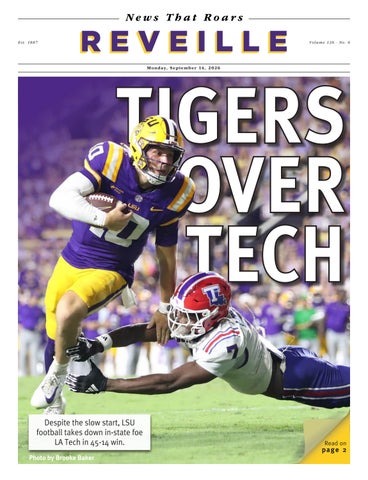
TIGERS OVER TECH Despite the slow start, LSU football takes down in-state foe LA Tech in 45-14 win. Photo by Brooke Baker
Read on
page 2
L SU Re ve i l le.co m @l s u r e ve i l le
page 2
DOGS GO DOWN
LSU football wakes up in second half, pulls past Louisiana Tech BY ADAM KIRSCHMAN Staff Writer LSU football secured its 18th straight win against Louisiana Tech, 45-14, on Saturday. An ugly first half for LSU was made up for by a 35-point second half off the back of a dominant rushing performance by quarterback Sam Leavitt. The Tigers’ offense looked like a shadow of themselves in the first half, putting up only 10 points, a total significantly worse than their 31-point firsthalf against Clemson in the previous week. Self-inflicted errors were the main cause of these issues, as the Tigers turned the ball over four times, throwing 3 interceptions and conceding a fumble. “Sam’s got to do a better job, taking care of the ball,” head coach Lane Kiffin said. “We made a lot of yards, and we were smooth through that at times, but obviously [in] the red zone we weren’t … you got to finish drives.” The contest proved to be a tale of two halves, though, as the Tigers followed up with 250 yards in the second half. This upturn was due in large part to the run game opening up for both Leavitt and running back Dilin Jones, and the offense’s ability to avoid turning the ball over. Excluding the interceptions, Leavitt had a strong performance. He threw for 344 yards and 1 touchdown while rushing for another 22 yards and 3 touchdowns. Tight end Trey’Dez Green also outproduced his Clemson stats significantly, totaling 104 yards and a touchdown off 6 receptions. “Now that I understand the [No.] 7 and what those guys talk about, when you need to play,” Kiffin said about Green being awarded the prestigious No. 7 for his role as a leader. “There’s going to be games that are rough and things aren’t going [your way], you got to find a way. And that’s what he did.” On the defensive side of the ball, LSU had a great night. It forced four turnovers while only allowing 140 yards of total offense. Impressively, LSU’s defense did not give up a single net offensive yard in the first half. Deuce Geralds and Princewill Umanmielen led the defense with extremely impressive nights, as the two combined for 4 sacks, 5 tackles for loss and 1 forced fumble. “The first team was really lights out, It’s almost like you felt like they were gonna get turnovers on every possession,” Kiffin said. “That was awesome. Really, really good job at them against an offense that put up
BROOKE BAKER / The Reveille
LSU football players celebrate after a sack on Sept. 12, during LSU’s game against LA Tech at Tiger Stadium. 80 points last week. LSU’s offensive challenges came as early as the first drive, where the Bulldogs picked up a tackle for loss on a third-down rush by Jones, resulting in a quick three-and-out. The Tigers’ defensive line made up for the offense’s disappointing opening drive with a statement. Geralds sacked Bulldog quarterback, Blake Baker, on third-and-5. This sack marked the freshman’s first in an LSU uniform. Leavitt and LSU found more success on their second try on offense but still couldn’t get in the endzone. The Tigers opened the scoring with a 29-yard field goal by Scott Starzyk, after a LA Tech sack on the 5-yard line resulted in fourth-and-long. LSU’s defense continued to dominate the first quarter as they forced a second three-andout after a big third-down sack by Umanmielen, his third of the season after an impressive Week 1 performance. Leavitt finally seemed to get his arm going on his third drive, as he connected with Jackson Harris on a 42-yard pass to set up a first-and-goal. Improvisation by Leavitt then posted LSU’s first touchdown, as he scrambled from one side of his backfield to the other under pressure and dove into the end zone. LA Tech looked like it was finally breaking through the LSU defense with an 11-yard reception by Eli Finley, but right as he crossed the first down marker linebacker TJ Dottery punched the ball out. The loose ball was recovered by the Tigers. The second quarter started with LA Tech’s Jordan McRae stripping the ball from LSU wide receiver Eugine Willson III, setting up a lengthy fumble recovery down the right sideline for 35 yards. This set up the Bulldogs’ first opportunity in the red zone, but another Umanmielen
sack forced a fourth-and-long. LA Tech attempted a 54-yard field goal, but the kick would fall well short of the goalposts, keeping the Bulldogs scoreless. The Bulldogs then stopped LSU’s offense on the following drive. Leavitt tried to force a pass to Green, which was overthrown and intercepted by Tech defensive back Kam Franklin. LSU’s defense refused to let the Bulldogs capitalize on this turnover, though, as it’d force Tech’s fifth three-and-out of the night. Two chunk plays to Green looked like they’d set up the Tigers second touchdown of the night after the offense advanced all the way to the 6-yard line, but Leavitt made a crucial mistake. He threw his second interception of the game at the goal line, again picked off by Franklin. Franklin weaved through defenders and quickly found the open field, leading to a footrace between him and Leavitt to the LSU end zone. Leavitt would lose this chase, as Franklin capped off a 99-yard pick-six for the first Bulldogs score of the night. Kiffin then forced the offense to respond, running at a fast pace. The tempo seemed to work, as with just under two minutes left in the half Leavitt led another drive to the LA Tech 16-yard line. The offense experienced a moment of deja vu, though, as Leavitt’s pass was deflected up into the air and intercepted on the 5-yard line. “They did a really good job with pressure down there,” Kiffin said about LA Tech’s red zone defense. “We didn’t execute on assignments, and then the turnovers eventually certainly didn’t help.” Though LSU led 10-3 at halftime, it was by no means a successful half. LSU seemed to snap back into it at the start of the second half. The run game finally got going
after a 46-yard rush by Jones ended at the Tech 2-yard line. The rushing success vanished at the goal line, though, as backto-back rushes were stopped at the line of scrimmage. Leavitt was then sacked for the fifth time, resulting in another successful field goal attempt. On LSU’s second possession of the half, Leavitt led a 60-yard touchdown drive, utilizing his arm and legs. Leavitt first connected with Green for a 24-yard reception, followed by two Jones rushes totaling 18 yards. Leavitt then secured his second rushing touchdown of the night as he beat defenders to the edge for a 9-yard score. LSU’s defense continued to not allow anything in the third quarter. Cornerback DJ Pickett intercepted a poorly thrown ball by Baker, which Pickett returned to the Tech 11-yard line. Another poor set of red zone play calls forced the Tigers to be stopped near the Bulldogs end zone again, ultimately setting up Starzyk’s third made field goal of the night. Leavitt followed that missed opportunity up with a quickhitting touchdown, set up by a 53-yard pass caught by Wilson. Leavitt then secured his third rushing touchdown of the night from 5 yards out. Another big turnover forced by the Tigers’ defense came early in the fourth quarter. Geralds made another big defensive play, forcing a fumble that LSU recovered. “I thought our guys really went after the ball,” Kiffin said. “It was a huge emphasis after last week, just having that one turnover. It was a huge emphasis this week and a huge emphasis today.” Leavitt and company then continued the dominant second half with another touchdown from 10 yards out, this time through the air and caught by Green. After the Green touchdown, the Bulldogs finally managed to respond. Baker found wide receiver Jalen Mickens streaking down the middle. Mickens would secure the ball and run it in for a 67-yard touchdown. Landen Clark got some playing time at quarterback late in the fourth quarter. Clark led a 45-yard touchdown drive on his second series under center. He would cap off the drive, and the game’s scoring, with a 7-yard touchdown run to push the score to 45-14 LSU now looks to its next game, where it’ll take on Ole Miss in a heated return to Oxford, Mississippi, for Kiffin. The Tigers hope to make it three straight wins to open the season as they face their first ranked opponent of the season.
B-16 Hodges Hall Louisiana State University Baton Rouge, La. 70803
NEWSROOM (225) 578-4811
Editor-in-Chief LAURA ALLEN Managing Editor GARRETT MCENTEE Digital Editor SAMANTHA SUNDBERG News Editor JORJA ETHRIDGE Deputy News Editor MADELYN LONG Sports Editor ALEX SHEESLEY Deputy Sports Editor RAMI BURKS Entertainment Editor MIA VIZZI Opinion Editor RILEY SANDERS Multimedia Editor EVAN TOUCHET Production Editor EMILY BOUDREAUX Chief Designer ALEXANDRA GERSTNER
ADVERTISING (225) 578-6090
Layout/Ad Design BELLA CHELETTE Layout/Ad Design TAIYE COLLINS Layout/Ad Design REESE PELLEGRIN Layout/Ad Design ALAYNA YOUNG
CORRECTIONS & CLARIFICATIONS The Reveille holds accuracy and objectivity at the highest priority and wants to reassure its readers the reporting and content of the paper meets these standards. This space is reserved to recognize and correct any mistakes that may have been printed in The Daily Reveille. If you would like something corrected or clarified, please contact the editor at (225) 578-4811 or email editor@lsu.edu.
ABOUT THE REVEILLE The Reveille is written, edited and produced solely by students of Louisiana State University. The Reveille is an independent entity of the Office of Student Media within the Manship School of Mass Communication. A single issue of The Reveille is free from multiple sites on campus and about 25 sites off campus. To obtain additional copies, please visit the Office of Student Media in B-39 Hodges Hall or email studentmedia@ lsu.edu. The Reveille is published biweekly during the fall, spring and summer semesters, except during holidays and final exams. The Reveille is funded through LSU students’ payments of the Student Media fee.
NEWS RECENT ROBBERIES
page 3
Theft is increasing on campus. Here’s what LSUPD and students have to say
BY GABRIELLA MARIN Staff Writer Unattended belongings can end up in the lost and found, but many LSU community members have not been as fortunate to reunite with their items. With rising theft incidents on campus, LSUPD and community members share tips on how to keep personal belongings safe. L SU Police have stated that theft is the most common crime on campus. According to the LSU Crime Log, LSUPD has responded to 32 reported thefts across campus since the first day of class three weeks ago. However, the number of re ported thefts does not cover every incident that occurs on campus. Many thefts go unreported, including the theft of Baton Rouge resident Eric Kimbrough’s e-bike during the LSUClemson football game. Kimbrough said he used the e-bike to help bring his children to other friends’ and businesses’ tailgates. He left the ebike unsecured on the bumper of a friend’s RV, as he had for previous football games, and returned after halftime to find it missing. “I believe the increased number of people, later night and poor weather contributed,” Kimbrough said. “Luckily, my ebike was not a super expensive
model. A mild calculated risk, but still an aggravating theft and disappointment.” To prevent theft, Kimbrough advises visitors attending future football games to plan, use a secure lock or simply avoid bringing unnecessary items. K imbrough’s experience with theft is not uncommon on LSU’s campus. Students also face challenges with belongings secured outside residence halls. Jessica Verdin, a junior ceramics major, had two e-bikes stolen during her freshman year while living at East Campus Apartments. Verdin said she relied on the e-bikes to help her get around campus because of a disability affecting her legs. Verdin’s first e-bike was stolen overnight despite being secured with a heavy-duty lock. The lock was cut and left lying near the bike rack. After reporting the theft to LSUPD, Verdin received updates from officers, but the e-bike was not recovered. A fter purchasing another e-bike, Verdin said her father engraved her license plate number onto the bike in multiple locations to potentially identify the e-bike in future instances. Later that same school year, the locked e-bike was stolen again from ECA. “It was the same thing, but it was during the day,” Verdin
said. “I had thought I was crazy, or I thought maybe I walked home that day. I walk out and it is gone. Bike lock and everything.” T he second e-bike was also not recovered, despite Verdin’s father taking additional measures. Verdin had to use student loans to purchase another ebike and began storing it in her car, covered by blankets, rather than leaving it locked outside. LSUPD Sergeant Marlon Hawkins noted similar ways to protect e-bikes from being easily stolen on campus. Hawkins said LSUPD recommends that students register their bicycles and use a hardened U-style lock when securing them to a bike rack. Theft has also affected LSU students living at off-campus apartments. Sophomore political science major KeyAnnia Thompson also shared her recent experience with theft at the Arlington Cottages and Townhomes. On Aug. 31, Thompson no ticed her wallet was missing after accidentally leaving her car door unlocked the night before. Thompson said she immediately froze her credit card account and reported the theft to the Baton Rouge Police Department after someone attempted to use the card. Thompson advises members of the LSU community to dou-
MATTHEW PERSCHALL / The Reveille
An LSU Police car sits parked on Aug. 31, 2022, outside of the LSU Police Station on South Stadium Drive. ble-check that their vehicles are locked to prevent any of their belongings from being stolen. “You never know it could happen to you until it happens to you,” Thompson said. “You could be the most cautious person ever and it could still happen to you. It’s unexpected, genuinely.” If students experience theft on campus, Hawkins advised they file a report through LSUPD. For incidents off campus, report the theft to the law enforcement agency in the jurisdiction where
the theft occurred. Hawkins also added to provide as much identification as possible, such as serial numbers, photographs and any unique markings on the stolen item. Multiple reported incidents can help identify patterns or connections that would not be as easily recognized from a single report, according to Hawkins. “Report it,” Hawkins said. “Even if you don’t believe your property will be recovered, reporting the theft is extremely important.”
FACULTY
LSU Board of Supervisors names three new Boyd Professors BY GEORGE DEBLANC Staff Writer LSU’s Board of Supervisors recently voted to promote three professors to Boyd Professors, which will raise their salary and provide a yearly stipend for research. The three professors are Aaron Sheehan-Dean, James Garand and Peter Katzmarzyk. The Boyd Professorship is the most distinguished professorial rank at LSU. The university’s colleges initiate nominations for Boyd Professorship, and then a committee reviews them before the chancellor and president’s consideration. Sheehan-Dean is a history professor, and he found out that he was named a Boyd Professor when the dean of the College of Humanities & Social Sciences, Troy Blanchard, ran to the Lockett Hall basement to tell him. “It was actually kind of fun to get that news that way from the dean, and sort of as I walked into a class,” Sheehan-Dean said.
Boyd Professors receive a salary that is “set at no less than the 95th percentile of full professors in comparable disciplines at peer public institutions across the southeastern United States,” and a yearly stipend for research, according to an LSU press release. Chancellor Jim Dalton said in the press release that the role represents one of the highest honors at LSU. There have only been 85 staff members since the role was founded in 1973, according to President Wade Rousse in the press release. Sheehan-Dean said that the additional research stipend could help with a trip to the United Kingdom for a conference later this semester. International travel is usually only done about once per year due to the financial cost, he said. He also said that it will help fund work with his graduate students. Some of his work includes the National Archives and Library of Congress. “There are some things you
can do online and there are newspapers that have been digitized,” Sheehan-Dean said. “But the kind of meat and potatoes of our work usually happens in archives.” Sheehan-Dean still plans to teach as much as he did before the promotion. Alumni of the history department have historically created positions within the department to help with funding for travel and research. “We should always be grateful as faculty for what our job is and what we’re able to do,” Sheehan-Dean said. “I mean, I think I’ve got the best job in the world.” Garand, a political science professor, said that he got a call last Friday from Dalton with no warning about the promotion. Garand also said that he wasn’t notified of the bonuses beforehand, but had heard of additional research funding. “I have been very active in my career mentoring students,” Garand said. “And because of that,
I share my resources with them.” Garand has published more than 60 papers and presented 100 conference papers with students. Students mostly will get credited as co-authors of the research they do with him. He is only the second ever political science professor at LSU to become a Boyd Professor. “Right now I have over 40 former students who I have mentored who are now professors at universities, where they’re deans or administrators,” Garand said. Katzmarzyk is the current Associate executive director of the Pennington Biomedical Research Center, where he researches obesity and its underlying factors to develop interventions. “It’s like Toys “R” Us for scientists,” Katzmarzyk said. “We have so much great equipment, some great resources, some great scientists. It’s the best place I could ever be.” Boyd Professors also have more contact with each other compared to other professors
with meetings every month, said Katzmarzyk. He added that this promotion could increase the visibility of the research center and also allow him to generate preliminary data, which is important for getting National Institute of Health grants. NIH grants typically require previous data or a “proof of concept” to be approved, according to Katzmarzyk. He said the stipend could help support the research fellows that he supervises. He also cited the recognition of obesity as a chronic disease, GLP-1 medications and bariatric surgery as recent products of his research area. These professors will retain the Boyd Professor title for life. Despite the lengthy nomination process, Katzmarzyk said they were completely unaware. “They go on and they get letters from people all around the country to support your nomination. And nobody told me anything. It was quite a surprise, I tell ya,” Katzmarzyk said.
Monday, September 14, 2026
page 4 CAMPUS LIFE
LSU students remember 9/11 victims by packing bags of food BY KALLIE ROMERO Staff Writer Hundreds of LSU students packed grocery bags of food Thursday to honor the victims of 9/11 as part of the LSU Food Pantry’s Serve to Remember event. The pantry organized the event for the 25th anniversary of the 9/11 attacks after it received a grant from 9/11 Day, a nonprofit that founded and leads the federally designated 9/11 National Day of Service and Remembrance. There were 2,977 bags to represent the people who lost their lives in the 9/11 attacks, and organizers hoped to recruit 441 volunteers to honor first responders who also died that day. Jennifer Cristina, manager of operations and food pantry for LSU Campus Life, said organizers wanted Serve to Remember to unify LSU’s 9/11 remembrance efforts and help students learn about the importance of the day. Volunteers worked throughout the day in hour-long shifts, stuffing bags with a bottle of water, pasta or ramen, a salty snack, a fruit item, a breakfast item and a granola bar. Volunteers handed the filled bags out to LSU students at tables spread across campus on Friday. Tables were located at the LSU Food Pantry, Memorial Tower, LSU William A. Brookshire Military & Veterans Student Center, Patrick F. Taylor Hall and Huey P. Long Field House.
TUCKER MANNING / The Reveille
A group of LSU student volunteers prepares bags for the food pantry Sept. 10 at the Student Union. Other organizations, including the Food Recovery Network, tabled at Serve to Remember to connect students with volunteer opportunities on campus. Chloe Hopkins, a sophomore biological sciences major and member of Food Recovery Network, said volunteering with the organization provides students an opportunity to give back to both LSU and the surrounding community. “[We] repackage perfectly fine surplus food that otherwise would have been wasted [and] we put it back in the hands of students and our
community completely free,” Hopkins said. Food Recovery Network also operates community fridges where members of the public can access recovered food. Hopkins said students should not feel like they have to dedicate their lives to volunteering. “It’s an hour out of your day every Friday, Wednesday and Monday. And honestly, it goes by so fast,” Hopkins said. “You feel like you are a part of a big family.” Cristina said planning for the event began about six weeks ago, as
soon as the pantry received funding. Funding consisted of $10,000 from 9/11 Day, $5,000 from the Popeyes Foundation and $1,500 from the LSU Student Sustainability Fund. While many of the organizations in attendance focused on the service portion of Serve to Remember, students also took time to reflect on why they were there. Kyndall Ellis, a freshman kinesiology major, learned about Serve to Remember through TigerLink. After recognizing the event was in commemoration of 9/11, Ellis wanted to help out.
Like many other LSU students, Ellis was not alive when the World Trade Center towers and the Pentagon were attacked on Sept. 11, 2001. “25 years later, and the fact that we’re still doing things like this every year for 9/11 kind of shows that it’s really, truly never going to be forgotten,” Ellis said. Paris Ally, a coastal environmental science senior and Campus Life student director, also volunteered with Serve to Remember on Thursday. Ally said the event was special to her after visiting the 9/11 Memorial in New York City. “Seeing the names, going to the wall and seeing the tribute they did there, and then seeing those names on everyone’s name tag,” Ally said. “It brought back those memories of this is something that’s really tragic, but important [too].” Each volunteer wore a name tag with the name of a first responder who died in the 9/11 attacks. Students were encouraged to research who their name belonged to on 911Memorial.org and learn about the people they were helping commemorate through the food packing event. Ally said she hopes younger generations can continue to remember events like 9/11, despite not experiencing it firsthand. “It was such a big event in our history,” Ally said. “And it’s important not to forget what happened and all those lives that were lost. We want to make sure that we just don’t forget that.”
STUDENT LIFE
LSU’s annual stairclimb honors 9/11 victims, first responders BY VIVIAN SARHAN Staff Writer Jerome Buller was a doctor at Walter Reed Army Medical Center on Sept. 11, 2001, where he saw the second plane hit the South Tower on the TV as he left the operating room. A few days later he was sent near the Pentagon, which was still smouldering at the time, to help recover victims and important documents with the Honor Guard from Arlington Cemetery. “I remember their eyes,” Buller
said. “I recognize the difficulty [the attack] must have played for the rest of their lives regarding their mental health.” Buller, now deputy secretary of Louisiana’s Department of Veterans Affairs, and more than a thousand people from the LSU and Baton Rouge community climbed over 2,000 stairs in Tiger Stadium on Wednesday to remember the victims of 9/11. Their climb symbolized the amount of steps the first responders took on the day of the attack, 25 years ago.
BROOKE BAKER / The Reveille
Kevin Sellers walks with an American flag on Sept. 9 for the annual LSU 9/11 stair climbing event at Tiger Stadium.
The LSU Corps of Cadets hosted the annual event, which has been going on for three years, according to Maj. Patrick Shanks, the education and recruiting officer with the corps. He said 9/11 changed his life when he was enrolled in the ROTC program at the University of Oklahoma, his alma mater. He did the stair climb in previous years, remembering it as a positive experience. The climb involved participants going around the entire stadium, including both west and east upper decks and ending near Section 106. Commander of the Corps of Cadets, Drew Bosker, a senior electrical and computer engineering major, said that the cadets hold the event primarily because they are a big military organization on campus. “We do the climb to honor the sacrifice that a lot of Americans made on that fateful day,” Bosker said. “This year, we’re excited for the event because it’s the 25th anniversary, so we’re hoping for the largest turnout we’ve ever had.” According to Bosker, the at tendance count for the climb was 1,090. Among the attendees was Gavin Landry, a Baton Rouge-area resident, who heard about the event through social media. “In the last few years, I’ve actually missed it. I always find out after the fact,” Landry said. “I think it’s just a great way to honor all
who have fallen or remember the lives that were lost on 9/11. They said ‘hashtag never forget,’ so I think it’s a cool way to honor that.” Many climbers were LSU stu dents, including junior sports administration major Christian Barreneche, who said he’s doing the climb for the firefighters who also had to climb thousands of stairs to rescue victims of the attacks. There were first responders at the climb, in full uniform. Wade Henson is a firefighter for the Baton Rouge Fire Department stationed in Scotlandville, who did the climb with other firefighters from his station and Baton Rouge. He said the climb is a good thing to do for Americans to honor the fallen. Some students not only see the memorial aspect of the climb, but also the benefits of the exercise. Andrew Kidd, a freshman business major, said he respects the cause of the climb, but he also did it because he values the benefits of the physical exercise on his overall health. While most attendees were from the Baton Rouge area, Kevin Sellers, volunteer chapter captain for Team Red, White & Blue, drove from Lafayette for the event. He said that since he supports veterans’ health and fitness, his chapter travels to local events for exercise. They have a Team RWB app for veterans and service mem-
bers to connect with each other and keep track of their fitness goals. The app offers users the ability to connect as well as join in virtual events and monthly challenges. “I meet a lot of active and veteran members, and a very common theme is that they struggle to get fit or to find time to get fit after their service,” Sellers said. During his ascent, Sellers held an American flag draped over his shoulder, flapping in the wind as he wound through the stadium up and down the stairs. Gavin Hebert, a renewable natural resources sophomore, climbed and finished the challenge with his friend, Dallen Dusset, a freshman mechanical engineering major. T he two recount the experience as rigorous, especially around the halfway point, but were able to push through, remembering the sacrifice of the first responders during the attack. Both of them heard about the event from a mutual friend, and they wanted to challenge themselves physically, but also to remember the lives taken on 9/11. “My legs started getting tired; I started getting a little dizzy. I’m like, well, those people before me went through it, so hey, they did it no problem and put their life on the line. No problem for me to do it too,” Dusset said.
ENTERTAINMENT
page 5
CAMPUS LIFE
Meet the viral LSU student who shredded the national anthem
BY PAIGE CHERAMIE Staff Writer From TikTok mystery to solo act, this LSU student has found a unique place on campus to jam out on his guitar and take a break from college stress. Ryan Monier, a junior construction management major, found himself at the center of a viral TikTok video posted on Aug. 22. However, the video didn’t feature Monier himself; instead the video centered around the sound of his guitar as he played “The Star-Spangled Banner” from a distance, nowhere to be seen. The original poster, freshman music education major Kaden Billiot, said he was filming the video so his mom could hear the LSU Memorial Tower bell chime when the sound of the guitar cut through the night. The unexpectedness of the situation was funny to Billiot, so he sent the video to his friend. That friend convinced him to post the video, but Billiot didn’t expect that it would go viral. He said he woke up the next morning and was shocked to see the video gained 10,000 likes and was still building engagement. The video may have gotten Billiot recognition on TikTok, but it
meant more to him than that, he said. “My dad, he’s a guitar player, so it kind of brought me back to my childhood,” Billiot said. According to Monier, he was with members of Garage Band LSU when the original video was filmed. He was playing the national anthem just to show that he knew how to. The guitarist discovered the video when his roommate showed it to him once he returned home that night. He said he was shocked at the number of views and likes that it had accumulated. Four days later, Monier decided to film and post a video of himself playing the song, officially revealing his identity to the thousands who had seen the original post. Monier began playing guitar at 16 years old when he received a guitar amp for his birthday. He practiced often, working to master the instrument. However, his transition to living in the dorms made playing a challenge: the walls were thin, and his amp could only get so quiet. While exploring campus, he stumbled upon an electrical outlet at the LSU Parade Ground flagpole and knew it was the perfect spot. “I would just go out there at
night sometimes and jam because I can crank it up very loud,” Monier said. Through his four years of playing, Monier said he has enjoyed the challenge of playing guitar, with his progress feeling like a reward. When he needs to pass the time, he can be found with the instrument in hand. “It’s not an easy instrument, in my opinion,” Monier said. “I mean, it takes a lot of persistence to get good at, and a lot of time and effort. So it’s not like you can just pick it up and automatically be amazing at it.” Monier said he does not plan to write music in the future. However, when he plays covers of songs, he enjoys adding what he calls his own pizzazz in the form of extra notes or strums, giving it a personalized sound. Although Monier has met up with Garage Band LSU members recently, he said he has no plans to join or form a band. “I’ve always been kind of a, I guess you could say, solo act,” Monier said. Monier occasionally posts on TikTok @ryan_monierii. His visits to the flagpole are spontaneous, but the sound of his guitar will signify his presence for those around.
PAIGE CHERAMIE / The Reveille
Ryan Monier plays the electric guitar at LSU War Memorial on Sept. 10.
CAMPUS LIFE
LSU opens game room for students to ‘relax and socialize’ BY MACI WILEY Staff Writer As academic stress returns, students may find it hard to decompress and ease the pressure. LSU’s new arcade room, Arcadia, seems to be the perfect spot for students to escape and have fun. Located next to the Information Desk, Arcadia is the newest addition to the second floor of the LSU Student Union. The space was previously occupied by various campus offices. “It was originally used as an art gallery space and was then the Student Success One Stop Shop for several years,” Auxiliary Services assistant vice chancellor Margot Caroll said. “Last fall, the Office of Retention & Student Success vacated the space.” Over the last several months, Auxiliary Services had to decide what to do with the space before the start of fall semester. “When the spring semester started and it was clear this space would no longer be utilized in that manner, we began the exploratory process of soliciting the top preferences for this space from students on campus,” Caroll said. Auxiliary Services had many ideas about what the room could be used for and sought feedback
ALEXIS PERSICKE / The Reveille
Students play the arcade games Sept. 10 in Arcadia at the LSU Student Union. from students. The team ultimately chose the arcade, planning to make it an inviting and enjoyable place for students to relax and unwind. “The space was repurposed with the goal of giving it back to the students,” Caroll said. “We worked closely with campus
partners and surveyed the LSU student community for ideas. A game room space was the top choice of students.” Having spaces dedicated to fun can provide the perfect balance to academic pressures. Freshman Methus Dixon agrees. “I feel like in college we have
a lot going on, a lot of stress,” Dixon said. “So we need somewhere we can go to wind down and just have fun. Take a break from all of the school stuff — the clubs, schoolwork and exams.” The ability to socialize played a significant role in the
decision process. “We hope it offers a space for students to connect with their friends — find and make new friends — while taking a break between classes,” Caroll said. “The space was intentionally designed with low lighting and lounge furniture to create a fun and welcoming space for students to relax and socialize with others.” The space is decorated with neon lightning, dim lamps and LSU-inspired furniture such as a purple couch and the tigerstriped rug. It is filled with a variety of games, including Uno, foosball and Just Dance, as well as different types of arcade machines like Fast & Furious and Pac-Man. Senior Cameron Young believes choosing to use the space for an arcade could help students step out of their comfort zone and talk to others. “I think it was one of the best decisions they made; as soon as they get on campus or they get out of class, they could just come here,” Young said. “They could chill, wind down and play video games. I feel like the main thing it helps for most people who don’t socialize. The game is another way for people to open up to each other and talk. Just looking around, seeing them laugh and have fun helps a lot.”
Freshman forward Berglind Hlynsdottir (10) concentrates on the play.
page 6
Monday, September 14, 2026
LSU soccer begins conference play with 1-3 loss to Tennessee at LSU Soccer Stadium Friday, Sept. 11 .
A group of ROTC recruits gaze at the sunset.
Redshirt sophomore forward Senai Roger (25) attacks the ball.
Redshirt sophomore forward Senai Rogers (25) celebrates
Sophomore forward Ryann Denecour (7) flags for the kick.
with fans.
LSU fan Jeffrey Williams waves the school flag.
5th-year senior forward Allie Fryer (23) hunts down the ball.
page 7
Photos by Tucker Manning | Design by James Miller
EARLY-SEASON STRUGGLES
Monday, September 14, 2026
5th-year senior forward Allie Fryer (23) stands after a play.
Monday, September 14, 2026
page 8 THEATER
Mid City Civic Theatre’s production of ‘Dear Evan Hansen’ inspires empathy BY SARAH WALTON Staff Writer High school is tough, but when anxiety-ridden 17-yearold Evan Hansen creates a national project based on a lie, it becomes much harder. “Dear Evan Hansen” is the current production for Mid City Civic Theatre, Baton Rouge’s newest theater company. Rising from the ashes of what was Theatre Baton Rouge, this will be the company’s second production. Mid City Civic Theatre opened its doors to the public in February, allowing other theater companies to use its facilities to encourage theater in the local community. Its first production was this summer, a Mardi Grasinspired performance of William Shakespeare’s “Much Ado About Nothing.” The second show choice was contemporary heavy-hitter “Dear Evan Hansen,” which took the theater world by storm with its opening on Broadway in 2016. Winning three Tony’s and a Grammy, the show explores themes of mental health, the pressures of school and modern adolescence. Xavier Haynes, a sophomore at Zachary High School, plays Evan Hansen. “I cannot believe I’m playing Evan Hansen at 15 years old. It’s crazy. But it’s also very, really stressful,” Haynes said. From long days at school to rehearsals that last until 11 p.m., it can be hard to find time to still be a teenager, especially working with seasoned actors that are quite older. The production team includes LSU alumni: Lily McGill, the director; Jonathan Thomas, the music director; and Rebecca Smith, the assistant director. Working with older cast members was not the biggest challenge for Haynes, but dealing with the material of the show does bring its challenges. “Dear Evan Hansen” focuses on mental health and interfamilial issues, and it isn’t always easy to break away from the emotions at the end of the night. “Trying to get out of the
PUZZLES FOR RELEASE SEPTEMBER 14, 2026
THE Daily Commuter Puzzle by Stella Zawistowski
PHOTO OF COURTESY OF MID CITY CIVIC THEATRE
Production photo from “Dear Evan Hansen.” headspace of being in that character is really tricky,” said Haynes. “Not letting yourself sit with it is really, really challenging.” Some of the actors spend time with their friends or blast fun music to decompress after a long show, but Haynes takes a more internal approach, opting to stay quiet and sit with himself to return to who he is outside of the character of Evan. Outside of these challenges, getting to work backstage is enjoyable for Haynes. “When we started doing full runs with the entire cast and everybody was there, it was just so much more fun,” said Haynes. Marion Bienvenu Mayfield plays Evan’s mom, Heidi Hansen. She’s been part of the Baton Rouge theater community for a long time and was impacted by the closure of Theatre Baton Rouge. “A little over a year ago, I never would have expected to be back on this stage. Our community lost a real theater staple, and now we’re coming together to build something new from the ground up,” said Mayfield. “It’s been incredibly special to be part of that process.” When it comes to producing a musical, it takes a village. Months of rehearsals, costume designing, music rehearsals and set building all require commitment from a lot of people. “This cast, crew and creative team have truly put their all
PHOTO OF COURTESY OF MID CITY CIVIC THEATRE
Production photo from “Dear Evan Hansen.”
into this production, and I think that makes being part of it even more meaningful. We’re all here doing something we love, but we’re also creating something our community needs. There’s a real sense of excitement and gratitude that comes with that,” said Mayfield. Though it is the darkest part of the show, Mayfield loves the second act. “Singing ‘Good for You’ alongside Xavier Haynes, Anthony Burton Jr. and Molly Donahue is definitely a highlight for me. It’s one of those moments where both the emotions and the vocals are at their highest, and it’s just a blast to perform,” said Mayfield. Having daily rehearsals that go into the night is not easy, especially when you’re a parent. Mayfield talked about how grateful she is to her husband and family for encouraging her to audition. “Playing a mom who is struggling to do her best definitely weighs on me. There are a lot of moments in the show that hit differently when you’re a parent yourself. But knowing I have that support at home has allowed me to really give myself over to the role and to this experience,” said Mayfield. “It’s a privilege to be able to step away from everyday life for a little while, tell this story and then come home to the people who make it all possible.” “Dear Evan Hansen,” often serves as a reminder that no matter how dark it gets, there are always people in your corner. “I think what our world needs most right now is a little more empathy and grace for one another,” Mayfield said. “If the show encourages people to lead with a little more compassion, then I think we’ve done something really worthwhile.” “Dear Evan Hansen” opened Sept. 10 and will run at Mid City Civic until Sept. 20. For more information regarding tickets for “Dear Evan Hansen,” the theater and future projects, visit the website.
ACROSS 1 Make a mess of 5 Makes a request 9 Chopped into cubes 14 “The Simpsons” sister 15 Ice cream holder 16 Battery terminal 17 Group UAE left in 2026: Abbr. 18 Included on an email: Abbr. 19 Tube for sipping 20 Function perfectly: 4 wds. 23 Possessed 24 Sibling’s daughter 25 Sticky candies 30 Painter’s classroom: 2 wds. 33 Biblical paradise 34 Person, place, or thing 36 Bitter beer 37 Heavy weight 38 Debate subject 40 Lots (of): 2 wds. 41 “Wipeout” network 42 List of choices 43 __ one’s way 44 Bring comfort 48 Lets go 50 Tiny Micronesian nation 52 Fluid in a pen 53 Whirling Looney Tunes toon: 2 wds. 59 Sweet braided bread 60 Molten rock 61 Pleasant 62 Actress Pompeo 63 Composer Stravinsky 64 GNP subject: Abbr. 65 Title documents 66 Theater award 67 Family rooms
9/14/26
Created by Stella Zawistowski
DOWN 1 Continuous movement 2 Fat-removing procedure, for short 3 Computer buyer 4 Tennis stroke 5 Unfortunate event 6 Foot covering 7 Leg joint 8 Family car 9 One of Santa’s reindeer 10 Undamaged 11 Is associated (with) 12 Dutch cheese 13 Morning moisture 21 On the __ 22 Tom Ellis show 25 Boston NBA players, for short 26 Filipino dish 27 Sensible 28 Weaving machine 29 “Excellent!”
Saturday’s Puzzle Solved
©2026 Tribune Content Agency, LLC All Rights Reserved.
31 By oneself 32 Is flexible 35 Three times three 39 Cooking-related 40 Roused from sleep 45 Assigned work to 46 People 47 Noteworthy time
9/14/26
49 Terminus 51 Pitch black 53 Story 54 “Othello” villain 55 Stratford-upon-__ 56 Immoral practice 57 Symbolic image 58 Microscope part 59 Place to sleep
SPORTS
page 9
FOOTBALL
SOCCER
Three takeaways from LSU football’s LSU soccer stumbles in second-half turnaround over LA Tech loss against Tennessee BY TRIPP BUHLER Staff Writer LSU made a 45-14 win look ugly against Louisiana Tech on Saturday, but head coach Lane Kiffin still sounded more positive than he did after last week’s domination of Clemson. “We’re in a good place, winning by 31 points and being really upset, you know, we got a good standard going,” Kiffin said. Turnovers looked like they
would kill an offense that took until the third quarter to be comfortable, while the defense showed it will have some staying power. Here are the biggest takeaways from LSU’s win. LSU’s complimentary defense is elite “I want to bring back that nasty mentality to an LSU defense. I think we’ve lacked that in my first three years here,” senior linebacker Whit Weeks said at SEC Media Days. “I truly do,
CHARLES CHRISTAINSEN / The Reveille
LSU head coach Lane Kiffin looks around on Sept. 12. during LSU’s game against LA Tech at Tiger Stadium.
and I take that personally on myself.” Weeks and his crew are making good on his promise. LSU only allowed 140 total yards to the Bulldogs, with most coming against the Tigers’ backups. The front seven for LSU tormented Louisiana Tech’s offensive line all night. LSU’s line had 7 sacks on Saturday: three from Princewill Umanmielen, Deuce Geralds and CJ Jimcoily’s first of their careers, one from Dashawn Spears and half a sack from Malik Blocton and Jordan Ross each. Umanmielen is shaping up to be one of the best pass-rushers in the SEC. “It’s proof of the work we put in,” Umanmielen said. “My teammates [are] pushing me to be the best version of me, and props to Coach Kiffin as well.” TJ Dottery and Weeks routinely caused havoc in pass and run defense, and the defensive line exacerbated the attack. Defensive coordinator Blake Baker made a point that LSU needed to force and recover more fumbles this year. Dottery forced 2 fumbles and Geralds added another. Two of those, LSU recovered. “To watch defensive tackles chase the ball and get it out, it
see TAKEAWAYS, page 10
BY DELANEY POTTHAST Staff Writer After a week of preparation, LSU soccer ran out in front of an excited home crowd looking to take down No. 8 Tennessee in its first SEC matchup of the season. Through 90 minutes of demanding play in the Baton Rouge humidity, the Tigers concluded the match with a final score of 3-1, bumping their record to 2-1 and handing them their first conference loss of 2026. “Tennessee is a good team,” head coach Sian Hudson said to ESPN. “You know, it’s going to take a big squad effort to get us over the line in this game.” Taking the spotlight outside of the night’s stat sheet were LSU’s Ava Galligan and Ava Amsden, both using proactive efforts to give the Tigers chances throughout the first half. Amsden, who saw multiple downfield rushes, dominated the midfield, controlling the ball in a majority of Tennessee’s zone. Alongside her, Galligan answered multiple crosses, putting up the Tigers’ only shot on goal in the half following a saved header after an LSU corner. “[We’ve] obviously got one of the best targets in the country in Ava Galligan,” Hudson said. “Give her some good service and
she’s going to get on the end of it. I think we’ve got a couple of corners that we’ve put into good zones, but our body shape as we’re attacking the ball hasn’t been good.” It wasn’t only Galligan and Amsden that propelled the offense through a stellar half against the Lady Vols either. Freshman forward Berglind Hlynnsdottir found her start in the lineup to be a proficient one, playing the ball up the right side on multiple occasions. The LSU defense had just as much of a presence against a persistent Tennessee offense as well. The Lady Vols, who had made it a point to take control of the game early on, wasted no time in applying pressure to LSU in the game’s opening minutes. Capitalizing on a few lackadaisical plays by the Tigers, the Lady Vols found their first ontarget shot just two minutes into play. Though LSU senior goalkeeper Audur Scheving made the save, the persistent Tennessee squad scored its first goal off the right foot of fifth-year senior Shae O’Rourke. Scoring within the first 10 minutes in every game they’ve played this season, the Lady Vols found their early lead on the
see LSU V. TENNESSEE, page 10
BASEBALL
Here’s what to know about LSU baseball’s 2026 calendar BY MARISSA REISS Staff Writer Coming back from a jading 2026 season, LSU baseball’s 2027 schedule was released on Sept. 8, featuring a few unfamiliar faces and tough conference opponents. For Tiger baseball fans, Feb. 19 is a date that can’t come soon enough. Opening day at Alex Box Stadium will be the chance to see what this new team can bring and the work that baseball head coach Jay Johnson has put in since missing the 2026 NCAA tournament. Johnson’s recruiting efforts from the transfer portal and new signing class are projected to be a threat, along with the substantial return of senior shortstop Steven Milam. Johnson added experienced pitching depth with transfers Landon Hood and Kaden Smith. Notre Dame transfer Bino Watters will be the biggest addition to LSU’s outfield. Texas State transfer shortstop Dawson Park is another addition to the roster, as the Tigers’ infield was reworked. The 2027 season opens up with a series against Long Island on Feb. 19-21. This will be the first time that they will face each other, and it will begin with a dou-
bleheader on Feb. 19. The Sharks finished 2026 with a 30-22 record backed by a 26-7 Northeast Conference slate. Remaining at home the following week, LSU will play The Citadel Feb. 26-28. The Tigers have only faced the opposing team once in program history — an 8-2 victory in the first round of the 1990 College World Series. Another team the Tigers have only played once is Cornell, which will travel back to Baton Rouge for a series beginning March 12-14. The previous time the two teams faced off dates back to April 1981. Cornell suffered a 12-9 loss in itsonly trip to Baton Rouge. The first road trip for LSU in 2027 is a midweek game against in-state foe Tulane. Last season, the Tigers defeated Tulane 13-6 at home and currently hold an alltime 73-57-2 edge when playing at Greer Field. Midweek matchups will be crucial to test this LSU roster before facing more aggressive conference opponents. Besides Tulane, the Tigers have 12 additional midweek matchups, 11 of them at home, including Milwaukee, LSU New Orleans, Southeastern, Southern, Grambling, Nicholls, UL-Lafayette,
McNeese, Louisiana Tech, ULM and South Alabama. The other road contest is versus the University of Nevada, Las Vegas. Out west, LSU heads to Las Vegas to participate in the fourth annual Live Like Lou Las Vegas Classic. In this tournament, the Tigers will face Oregon State, Arizona State and Iowa. The Tigers have faced Iowa once in a 12-4 loss at the 2023 Round Rock Classic. LSU holds a 6-3 advantage over OSU, and the last time the Tigers faced ASU, they took two games out of three in 2005. The most important topic on the schedule is SEC play. It won’t be an easy slate. The Tigers significantly struggled in conference play last season, ending at an unusual 9-21 record. It all begins with Texas on March 19 in Baton Rouge. The last time the two conference opponents met was in 2025 during a regular-season series at Austin, Texas. The Longhorns took a 2-1 series victory, backed by an 11-7 win in Game 2 of the series. LSU will also host Vanderbilt, Ole Miss, Georgia and Mississippi State at home. Besides Vanderbilt, which the Tigers suffered a series loss to despite a 16-9 series finale
win, they were notably swept by the three other opponents listed. For a team that is projected to be more promising on paper than its previous season, a tough conference slate at home still poses a potential threat to LSU. On the road, LSU faces five conference opponents: Florida, Arkansas, Texas A&M, Missouri and Kentucky. The Tigers played three out of the five opponents in 2026,
earning two series wins over the Gators and Wildcats but suffering an excruciating sweep by the Aggies in April 2026. With the days counting down until Feb. 19, only time will tell what the powerhouse of college baseball has been working on during its long offseason. If one thing’s for sure, Tiger fans are anxiously waiting to see what’s to come.
HINESLEY BRYANT / The Reveille
LSU baseball junior infielder Steven Milam (4) throws the ball during the Tigers’ 16-6 win over Southern March 31 at Alex Box Stadium.
Monday, September 14, 2026
page 10 FOOTBALL
Column: LSU football is nicknamed a wildcard. Here’s why BY BROOKE BENEDICT Sports Columnist It’s almost time for the thirdweek slate of the 2026 college football season, but there’s still much to talk about as far back as Week 1. At Tiger Stadium, now firmly with the claimed title of the real Death Valley and takedown of Louisiana Tech, the LSU Tigers put on a thrilling show with major stakes on the line. For the first two weeks, Baton Rouge has resembled more of a chaotic courthouse than a notorious football town. All eyes are on LSU head football coach Lane Kiffin and his program over roster eligibility for adding former NFL players. The SEC filed federal lawsuits putting LSU in all the major headlines going into the first game of the season —all headlines that aren’t talking about the football game, that is. Then came opening night. LSU essentially the Clemson Tigers in a 51-10 blowout win to keep the real Death Valley title and start the season 1-0. It then took care of business versus LA Tech in Week 2 in a 45-14 victory. The team didn’t just prove that they can deliver success in the middle of legal mayhem; they proved everyone else wrong. The highlight of the offseason didn’t just come from Kiffin’s dramatic switch from Ole Miss
TAKEAWAYS, from page 9 was awesome to see,” Kiffin said. “I thought our guys really went after the ball. It was a huge emphasis after last week, just having one turnover.” Spears, who is a listed as a safety, has taken up the star position, allowing him to be in pass and run coverage, as well as blitz the quarterback. He got a sack and caused a quarterback hurry that led to a DJ Pickett interception. Spears also had a clutch pass break up. LSU needs time it may not have to fix the passing game It took until the fourth quarter for LSU to have its first explosive play in the air this year — a 53yard heave to Eugene Wilson. “Maybe it was perfect for us; maybe we needed something like that because if we play good on offense and the game is 70-7 or something, we don’t have attention,” Kiffin said. “Maybe it’s what we needed.” LSU has some of its biggest games of the year coming over the next two Saturdays: Ole Miss and Texas A&M. To beat those playoffcaliber teams, the timing in the passing game has to come together this week. “We’ve got to execute better,” Kiffin said. “We made a lot of yards, and we were smooth through that at times, but obviously the red zone is where you’ve
to LSU, but also from the masterclass of transfer portal players he added to the program. With over 40 new players from the portal, matched with elite veterans and top-ranked freshman recruits, LSU was the ultimate talent puzzle. The only challenge would be putting it all together. Finding where to use each talented puzzle piece across both sides of the ball was one of the biggest topics surrounding the team. Clearly, LSU figured it out just in time to take the stage in Tiger Stadium, opening the first two weeks with home-field victories over two very different opponents. Any doubts about the quick turnaround of the program were put to rest in the debut of the team in the first two weeks, with immediate, raised expectations to follow all season. All of the questions this offseason about the entire roster pointed to one crucial player: Sam Leavitt. The quarterback was once referred to as one of the biggest wildcards in college football. Making the transition from desert heat to deep-south humidity, Leavitt came off the 2026 season at ASU suffering a season-ending ankle injury, putting him at limited ability upon arriving in Baton Rouge. After getting the green light just three months ago, Leavitt had the quickest turnaround of
anyone on the program, adapting to a brand new group of receivers before kickoff. That’s where the obvious questions arose, and the harsh wildcard allegations came from. In the wake of his LSU career in the game versus Clemson, Leavitt threw an interception on the second down of the first drive, giving Clemson an early lead after a made field goal. In Week 2, Leavitt ended the in-state matchup with three interceptions, with one returned for a 100-yard pick-six. Wildcard allegations: Proven It was a rough start to the Clemson game, especially with the entire nation watching and judging how every play is executed. Leavitt ended the Clemson game by putting up 230 passing yards, with the longest pass being a 32-yard touchdown to wide receiver Winston Watkins Jr. Leavitt also showcased his impressive run game, escaping the pocket and putting up 113 rushing yards and a pair of rushing touchdowns. Wildcard allegations: Debunked His debut couldn’t have gone better, with the rough start being the ultimate building block to prove himself the rest of the game, which he only needed two and a half quarters to do before being subbed out due to the lopsided score. It made for an overall good first impression on his new fan
base. He shined in the small spotlight that no football player wants to be in. But nobody’s spotlight was bigger than Kiffin’s. He had the biggest first impression of all, stepping into a new role in controversial fashion, breaking social media during game week over roster eligibility chaos. It was understood by both him and everyone watching that an ugly loss could have been the breaking point before the cracks even had time to form.
got to finish drives. Leavitt has been great with his legs, but his errors in the air overshadowed his ground game. He threw 3 interceptions, with one being returned 100 yards for a score. Quick slants and deep balls were the biggest problems for LSU. Tiger receivers were struggling to get separation, and Leavitt seldom put the ball in position for a receiver to make a contested catch. It was an unflattering combination. “I definitely think that [forcing plays] was one thing [that hurt us],” Leavitt said. “One of them, I just think [it] was a misthrow, but I did think that I was trying to force a lot, especially in the red zone.” The only plays that have been working for LSU are routes over the middle for pickups of about 20 yards. Eugene Wilson, Trey’Dez Green and Winston Watkins are taking advantage of those plays for big gains in LSU’s first two games. Jayce Brown and Jackson Harris are supposed to be Leavitt’s main deep threats, but Brown didn’t have any targets Saturday. Harris had 3 receptions for 80 yards, with only one of them traveling more than 2 yards in the air. LSU continues to hurt itself with penalties Through two games, LSU has had 16 penalties for 176 yards, 85
more than its opponents. LSU’s penalties took gains off the board and killed its momentum Saturday. “I think the penalties hurt us, you know,” Leavitt said. “We can’t do those things and obviously turn the ball over. We need to be way more efficient in the red zone.” Right guard Aliou Bah has had a holding penalty in each game, and is the only starting offensive lineman to be called for holding this season. The Tigers have also been called for roughing the passer once in each game. These issues should get cleaned up as the team gets more reps under its belt, but the numbers are worrisome. Against Louisiana Tech, LSU had 4 false starts after not being called for that penalty at all against Clemson. LSU’s receiving corps has also gotten itself in some trouble. Harris and Green were both flagged Saturday for blocks in the back, and Malik Elzy was called for holding against Clemson. Many of LSU’s penalties have been mindless mistakes, like Umanmielen’s roughing the passer against Louisiana Tech which came after Bulldogs quarterback Blake Baker threw the ball away. LSU has done a good job of silencing the outside noise of the season, but when the Tigers are between the lines, they need to keep their focus on playing clean football.
LSU V. TENNESSEE, from
But instead, Kiffin came out of the tunnel with his new team and put up a 41-point domination, which carried into his confidence outside of calling plays, telling the media, “imagine if we had pro players,” in a halftime interview. That’s the kind of confidence that can rub outsiders the wrong way, but that will also win over the fanbase. That’s why the outsiders are labeling LSU. The Tigers will keep proving them wrong.
JOHN HEFTI / The Reveille
Quarterback Sam Leavitt (10) practices on Sept. 5 ahead LSU’s 51-10 win against Clemson in their home opener at Tiger Stadium.
Tigers. Nevertheless, the purple and gold were eager to answer back. As the teams played deeper into the half, the Tigers began to match the intense pace of the Lady Vols. The answer-back finally came at the 38-minute mark. Senior Emma Alvord took a free kick from the Tigers’ zone, feeding the ball into Tennessee territory. On the receiving end was junior Linka Ono, who sent a cross to redshirt junior Brielyn Knowles, who took a left-foot shot that slipped past Tennessee keeper Cayden Norris in the top right corner of the net to tie the game at one each. The Tigers, who previously had only scored twice in the first half this season, upped the number to three as Knowles earned her first goal of the season and Ono gained her first assist of 2026. For the Lady Vols, Knowles’ score marked only the third goal allowed by Norris in 2026. “What a strike by Senai Rodgers,” Hudson said. “I think we struggled a little bit in the first ten minutes, just getting hold of the ball. But I think as the half went on we grew into the game, I think we’ve had a few box entries that have troubled them.” Returning from the locker room on an even playing field,
both teams began play eager to take the lead. For LSU, defensive efforts would hand set-piece opportunities that plagued the start of the half. Taking their second corner at minute 48, the Lady Vols sent in yet another on-target shot, but a header by Galligan cleared the ball. Not long after, Tennessee took a third and fourth corner, handing Scheving another save on the night as she corralled the ball. By the 54th minute, a fifth corner kick would finally prevail for Tennessee and would be headed in by senior Taylor Cheatham through the top-right corner of the Tigers’ net. Though the Tigers continued to push on, they found themselves with little time outside of their zone in an offensive position. In just a short while, a penalty called on Ono gave Tennessee a penalty kick that was converted by Ines Derrien to put the Lady Vols ahead by a 3-1 lead. Though the Tigers have closed the deficit in a handful of games this season, the clock would tick down with LSU trailing by two, granting Tennessee its sixth win of the season. Next up, the South Carolina Gamecocks will travel to Baton Rouge to face the Tigers, who will continue their search for their first conference win on Sept. 18, at 7 p.m.
OPINION
page 11
Gov. Jeff Landry is choosing data centers over Louisiana citizens JOHNSON’S JOURNAL LAUREN JOHNSON Columnist It’s not surprising that GovernJeff Landry is rapidly expanding artificial intelligence data centers in Louisiana. His support of these centers represents everything that’s wrong with him as our governor. Landry has hardly tried to pretend that he has the citizens of Louisiana in mind, and he’s proven it with the implementation of these data centers. Data centers are known to endanger populations via threats like air pollution and noise, destruction of the water supply, taking over land, raising energy costs and rupturing the well-being of communities. Landry’s response to these concerns has been to sign an executive order that does little to ensure we are protected as citizens of the state; the order states that the Secretary of Louisiana Economic Development Susan Bourgeois must to develop framework that keeps data center-based companies from harming Louisiana’s citizens and communities, while keeping Louisiana a frontrunner for data center development. The question is how, specifical-
ly, Louisiana’s government plans to protect its citizens and communities. There haven’t been many details mapping out the measures that will be taken to do so. It frankly seems as though Landry is ignoring the concerns of his people and pushing for more advancements to be made purely in the name of data centers. It may be easy for Landry to approve decisions that benefit him — “economic growth, infrastructure investment, workforce development, and community protection,” the order describes — but only because he ignores how these choices negatively affect the public. We are the ones being actively harmed by having data centers in Louisiana. Citizens could be at risk of losing safe water, the affordability of living, housing and even the state itself with environmental concerns like erosion, pollution and the loss of farmland. These data centers in Louisiana harness twice the amount of electricity used by the entire city of New Orleans on a hot summer day, both increasing fossil fuel emissions and raising utility bills. They use up to 5.6 million gallons of water every day from local sources in Louisiana. They are known to destructure ecosystems, leading to erosion and soil deterioration, something
Louisiana is already suffering with along our coasts. They require large amounts of land, covering hundreds of acres that will no longer be available for farmlands — or any other kind of land for that matter, including housing and nature. Additionally, in reference to arguments in support of data centers, they don’t provide as many jobs as implied. Just as well, these workers who do receive jobs have been studied not to see many benefits, with wages staying the same but home prices increasing. To actually ensure our safety, Landry should support legislation that highlights how exactly the rights of Louisiana citizens are being protected, depicts the initiatives that will be taken to keep data centers safe for Louisiana’s environment and ensures these higher powers are not prioritizing data centers over the state’s welfare. We are the ones who have to exist in the same space as these data centers and their consequences. If we can’t get rid of them, we deserve trustworthy promises that we can live alongside them. However, it doesn’t look as though this is what we are going to receive. Landry seems keen on continuing to damage our state instead. To name a few harmful moves
made outside of the burdensome data centers, Landry has signed orders that reverse the protection of our at-risk environment, uplifting the oil and gas industry and banning lawsuits over climate change, and would redistrict our state in a way that ruins diverse and democratic voting by eliminating one of Louisiana’s two majority-Black congressional districts. This redistricting move would also aid in securing a 5-to-1 Republican advantage in the state’s delegation; and harm our large community of people experiencing homelessness, making it a crime to sleep outside unauthorized and allows the creation of “homelessness courts.” This is also not to mention that we have, once again, been placed as the last state in the nation in the U.S. News & World Report Best States rankings. We have been ranked 50th in crime, 49th in education, 49th in economy, 46th in infrastructure and 45th in healthcare. These are all issues that could be solved,or at the very least helped, but it doesn’t feel as though we have anyone or any system that is working toward addressing these areas of concern. It’s sad, to say the least. If you live in Louisiana, you get to experience first-hand how full of love and life it is. Despite our flaws, we
are people of celebration, community and culture. Even New Orleans, the heart of our state, will be swallowed by the Gulf of Mexico because it has become too far gone to be saved. Louisiana deserves better than this. It should be governed by people who can highlight and uplift all of its good qualities while working to resolve the parts that need aid. The burden also falls on the citizens of Louisiana — to register to vote, to do research on every policy affecting us, to involve ourselves in the present and future of the state. Loving Louisiana also means learning about everything that could be done to improve it. Landry once said, “If you don’t like Louisiana’s laws or Louisiana’s constitution, you can go to another state.” Alternatively, Louisiana citizens who cherish this state should work to elect proper representation for ourselves. We don’t want to go to another state — it’s our governor who needs to go.If Landry does care about the people of Louisiana, he needs to do a better job of showing it. He ought to do what he was elected to do. We should be his first priority, not data centers. Lauren Johnson is a 20-year-old journalism major from New Orleans.
LSU should offer parking permits to on-campus student workers BOYNES’ BULLETIN SAVANNAH BOYNES Columnist You have just wasted the past hour circling a parking lot, and your on-campus job shift starts in 10 minutes. Only one question stands: Where are you going to park? LSU offers about 10 different types of student parking permits for purchase during the school year, though none of them take into account a different kind of student demographic — student workers. With thousands of these work opportunities offered to eligible individuals, the student employment hub known as Handshake isn’t the only place that takes on such an obscene amount of student traffic. LSU’s campus can only hold so many parking lots, and of those lots, many no longer have capacity or consideration for the many oncampus residents, faculty, student and non-student workers who also need to find a parking spot. Student workers apply for jobs not only because of monetary gain or financial aid advantage, but also to gain real-life work experience while in college. Many on-campus work positions include shifts that are scheduled during the open campus hours
between the typical 8 a.m. to 4:30 p.m. slot; some of these are shifts at more populated campus areas, such as the Student Union, University Recreation and other student service centers. LSU’s seemingly never-ending campus works as an organism. It includes the university’s many complex departments as the organ systems, individual department heads as the organs, faculty within said departments as the tissues and, finally, the student workers working behind-the-scenes of dayto-day tasks as the cells. Without these cells helping the larger body operate within all senses of normality, there would be a structural failure that causes the institution to collapse. Student workers are most likely coordinating with their GPS to figure out where the best parking is during the day. They are also having to leave an extra 30 minutes earlier to ensure their timeliness and maybe even heading an absurdly long distance because the spot they found was farther than desired. Given these circumstances, are these workers really in their best headspace to keep operations smooth and steady? As both a student journalist and a commuting student worker here at LSU, I am certain that student workers’ contributions to the university are not rewarded as such. That said, I am not trying to claim
some all-knowing authority over logistics or finances in my proposal. In reality, I’m just a student worker with a potential solution, and if LSU continues to take its sweet time in fulfilling its master plan envisioning a pedestrianfriendly future and seas of green covering the majority of campus, then I believe some officials may be able to think on this idea in the meantime. I’m proposing that since LSU offers a plethora of student permits already, it should add one more — student worker parking permits. The designation of where these permits on campus would be allowed to reside is simple; whichever building or area is the main operation hub for said student’s job, they will be able to park in the closest lot of that place. However, fear not of potential even more construction that would take place on campus to account for these lots as faculty and other staff members have been taken into consideration. Out of the entire lot, there will be only a certain number of designated spots for student workers. To account for these workers who may not be able to find their designated spots in these lots, the Union Square Parking Garage would allow any student worker with their parking permit to park in the space, with no extra charge. Even though it may not be as close
to one’s job as they would hope, it’s still an option for a relatively main area on campus. And what about the “when” and “how” student workers would receive their permits? For those already holding their student worker position before the school year begins, they would receive their permit in the mail automatically, just as any other permit is administered. If students are starting their job after the school year has begun, they will still receive a student worker parking permit, and they will be refunded for any other parking permit they may have purchased. And going even further with my half-accurate, hyper-imaginative hypotheticals, if a student is fired or quits their job, the parking permit will be invalid after the processed termination. Despite this unfortunate turn of events, the
student will be given the option to purchase whatever permit they need, and that still holds true even if the LSU Parking Portal states that none are available. Getting to the campus itself is already difficult enough, and LSU’s goal should be to lighten any student’s stress as much as it is capable; that should include doing what it can to alleviate the looming doom of parking on campus. It wouldn’t just lighten the stress either; it would also add just a little bit more incentive for students to apply to these open positions. The job market waiting for us grows more competitive year after year, so why not start early with such difficulty thanks to what LSU has to offer. Savannah Boynes is a 20-yearold journalism and screen arts double-major from Madisonville.
CARMEN RANDOLPH/ The Reveille
Monday, September 14, 2026
page 12
The One Big Beautiful Bill has been one big disaster for students CRAWFORD’S CORNER GORDON CRAWFORD Columnist In the 2024 election, President Donald Trump made historical inroads with young voters, with his performance amongst those aged 18 to 29 surging to over 40% and even tying with Kamala Harris in critical swing states. The main reason for the shift? Young voters, many attending costly universities and facing an increasingly bleak job market, are feeling the pain in their pocketbooks. As such, they yearned for the pre-COVID days when numbers on charts went up and wage growth outpaced inflation. Trump answered their calls with his proclaimed One Big Beautiful Bill, here referred to as the OBBB, a titanic piece of legislation rolling together dozens of tax, welfare and defense reforms, supposedly designed to boost the economy and achieve Trump’s other agenda goals in one fell swoop.
Now, many of those same voters are finding that the bill has incurred major consequences that weren’t previously disclosed in Trump’s pitch. The biggest change directly affecting students are the significant changes to federal loans and aid. First, Graduate PLUS Loans are being eliminated, and new caps on Parent PLUS Loans of $20,000 per year and $65,000 lifetime loans are being implemented. The administration claims that capping loans will over time lead to a decrease in tuition rates, holding that unlimited borrowing has led to colleges ballooning their costs. The data, however, doesn’t exactly support this claim. Various reforms have come and gone for federal loan policies, and average college tuition rates have not gone down since 1963. Just this year, as the OBBB went into effect, LSU raised tuition rates in line with a 2024 law that gave LSU administration unilateral authority to raise rates up to 10%. LSU President Wade Rousse and Chancellor Jim Dalton were just approved in December for
salary and benefits packages that could net them millions, a significant increase over former LSU President Tate’s already sizable compensation. Be perfectly honest. Do you expect university administrators to take pay cuts out of the goodness of their hearts? I can count on a single hand the past instances in which this has occurred. Other big changes aside from the marquee loan alterations include reductions in Pell Grant eligibility, the abolition of certain payment plan options, and proration of loans based upon full-time or part-time status. Yet again, the Trump administration has decided to govern by sledgehammer in a situation where delicacy is of grave necessity. Any number of life events or financial situations lead students to take out loans, and the federal government, instead of passing legislation that would address the root causes of increasing student debt, has decided to punish the students by nannying them and arbitrarily deciding which degrees are valuable, as well as what pro-
grams of study are legitimate. As per usual, Trump’s legislation also has a disproportionate impact on certain communities, including Black and Latino Families that predominantly rely on PLUS Loans to afford college. For many in these communities, which have been historically shut out of higher education, these loans have become lifelines to meet basic living expenses. This problem is particularly pronounced at historically Black colleges and universities, HBCUs, which have seen surging application numbers in the aftermath of anti-diversity initiatives pushed by the federal government. For Black students, these institutions provide a unique support system tailored to their needs that is often out of reach in massive state schools. However, HBCUs also have also struggled with low graduation rates, with first-time fouryear student rates hovering at 23.2%. One of the biggest factors in this is simply funding: HBCUs receive less on average, and their student body is primarily composed of students who require more.
Instead of pursuing policy solutions to enhance support for low-income students, President Trump, always happy to parade his proclaimed support of HBCUs in particular, decided instead that he knows best for their finances. The ramifications of regressive policies like this are clear and likely intentional: Low-income students are either pushed out of the system from sheer financial stress or they are forced into the frequently predatory private loan market. An educated society is one of the greatest resources a country can utilize. In an era where the United States is falling behind in technological and educational development, we desperately need more innovative thinkers and creatives. College should be a place where students have the opportunity to focus on their academic and personal development. They deserve better than to have the massive axe of debt looming over their necks. Gordon Crawford is a 20-yearold political science major from Gonzales.
In the race to be right, Gen Z has lost focus and sense of nuance MONTGOMERY MONOLOGUE KELSI MONTGOMERY Columnist Welcome to the morality race. It’s an imaginary race that we, Gen Z, don’t realize we’re running. With each stride, we’ve developed a new argument, further education and context that makes us seemingly “better” than the generation before — more forward motion toward a perfect, moral world. This race is one in which we’re all trying to be good … and we’re all losing. With the rise of social media and its ability to connect those within Gen Z to each other and other generations, there’s been a major call to action for accountability and morality, holding people to a higher standard than ever before. It’s allowed us to carve brand new politically correct views while becoming increasingly more progressive, more inclusive and more tolerant. I’ll admit that the idea is beautiful in theory. In execution, however, I think it’s a fair assessment that we’ve severely overcorrected
here, that we’ve thrown a thunderstorm over this great race which has only set us backward instead of propelling us forward. How have we done this? It’s very simple: We have too much access to each other, and we’ve therefore lost our nuance. While social media has given us opportunities to interact with each other and create beautiful connections, it has in some instances given us unrestricted access to others. And naturally, in the process, we as humans form opinions about brash and minuscule matters. Of course, when conversations arise regarding bold issues that could affect our futures, social media is a great host for discussion. However, it seems that we’re not always addressing the bold issues. In fact, it seems that we are often entertaining and criticizing mundane topics. What do I mean by mundane? The brand of someone’s toothpaste, someone’s blush placement compared to another, what someone likes to eat for dinner on Fridays. Mundane, unassuming topics. However, with so much access to each other, something so simple can turn into a think piece
that takes too much energy. More specifically, this continual access we have via social media has created this atmosphere of being able to comment on small things. Comments sections are breeding grounds for instant feedback and growing hive minds. All in the name of morality. This seems a little trivial in the grand scheme of things. I can hear you now: “So what? People make a big deal about little things. It’s been happening since the beginning of time.” You’re right reader, this isn’t a new problem. And as long as humans are humans, it’ll always be a problem. Unfortunately, social media has amplified both the good and the bad of humanity tenfold. And when social media platforms the growing majority of those who are seeking morality without the proper steps — we lose what’s the most beneficial in society. Nuance. Nuance, according to MerriamWebster, is “a subtle distinction or variation.” Nuance allows things to be different, to be contextual and to be individual. In this morality race, large debates often arise that almost seem to be life or death in the grand scheme of things. These
debates assume such social gravity that they can cause individuals to either be accepted or shunned by a community. While these discussions can be incredibly beautiful and thoughtful, they can just as easily cause us to detract from nuance the longer we entertain them. It is this lack of nuance that is causing us to lose the morality race and perhaps the plot as well. With a lack of nuance, there’s this unrealistic expectation of morality and inherent innocence that’s leading to quite the strict black-and-white culture. We’re moving from a more respectful or temporal way of communication that has shifted from “well maybe in this case … ” to “you’re either good or bad.” If the world was that simple, that strict, we wouldn’t be running this race in the first place. This may not affect everyone in small instances. But in larger instances where we’re having conversations in which opinions arise that are contrary to the popular one, we’re often dismissing and vilifying people before we can even try to understand the argument. Before we know it, we’re ostracizing our peers, and we’re losing racers instead of crossing the finish line together.
Editorial Policies and Procedures EDITORIAL BOARD Laura Allen Garrett McEntee Jorja Ethridge Alex Sheesley Riley Sanders Mia Vizzi
Editor-in-Chief Managing Editor News Editor Sports Editor Opinion Editor Entertainment Editor
The Reveille (USPS 145-800) is written, edited and produced solely by students of Louisiana State University. The Reveille is an independent entity of the Office of Student Media within the Manship School of Mass Communication. Signed opinions are those of the author and do not necessarily represent the views of the editor, The Reveille or the university. Letters submitted for publication should be sent via e-mail to editor@lsu.edu or delivered to B-39 Hodges Hall. They must be 400 words or less. Letters must provide a contact phone number for verification purposes, which will not be printed. The Reveille reserves the right to edit letters and guest columns for space consideration while preserving the original intent. The Reveille also reserves the right to reject any letter without notification of the author. Writers must include their full names and phone numbers. The Reveille’s editor in chief, hired every semester by the LSU Student Media Board, has final authority on all editorial decisions.
In a worst case scenario, there’s no longer a space for healthy debate and respectful disagreement. Growing up, I always heard and eventually adopted this tidbit of advice: If it doesn’t affect you spiritually, physically or emotionally, why do you care? It’s a simple question, but it holds so much weight. It made me realize that we’ve lost the art of minding our business. Sometimes, we need to let the little things be little and the big things be big. The question stands: Why do we care? If people who picked these fights and rushed to ostracize everyone in a healthy debate asked themselves this question, and answered it honestly, I’m almost certain that we would have room to let nuance flourish. We’d have room to speak without picking over words that give this false sense of “goodness” and a propensity for “morality.” We would achieve the unity that started this race in the first place. Until we start answering honestly, however, we’ll still be running behind — in a losing race Kelsi Montgomery is a 19-yearold journalism major from Baton Rouge.
Quote of the Week “The best way to solve problems and to fight against war is through dialogue.”
Malala Yousafzai Activist 1997— present