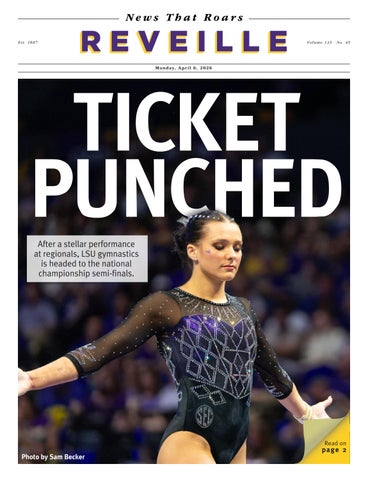

TICKET PUNCHED
After a stellar performance at regionals, LSU gymnastics is headed to the national championship semi-finals.



Photo by Sam Becker
Lincoln earns first perfect 10 of career
BY DELANEY POTTHAST Staff Writer
Saturday night in the PMAC saw highs and lows for every team competing in the NCAA regional final, but for sophomore Kaliya Lincoln, a career-defining moment came during the last routine of the night as she earned her first career perfect 10 on the floor exercise.
The Texas native found scores of 9.825 and 9.875 earlier in the night on vault and beam, respectively. But on floor, Lincoln would end LSU’s competition with its 13th perfect score of the year.
“I’m so happy for her,” Kailin Chio said. “It’s been a long time coming, and she’s done so many floor routines that deserved a 10. Just to be able to celebrate somebody else getting that perfect score and knowing what that feels like — it was so great to just be able to celebrate her and celebrate all of her hard work.”
As her teammate mentioned, Lincoln has been on the cusp of a perfect score at multiple points throughout the season, holding three 9.975s on the floor exercise. With an average of 9.942 on the event, Lincoln also finds herself tied at No. 2 in the National Qualifying Score floor rankings.
Just two weeks prior to Saturday’s regional round, Lincoln also



MOVING ON
Gym follows season best with home regional victory
BY DELANEY POTTHAST Staff Writer
After a shaky outing at the SEC Championships just two weeks prior, No. 2 LSU gymnastics found rebound after rebound during its home-hosted regional weekend to come out on top.
The Tigers posted a program record overall total in the second session of the regional on Thursday, and they came back just as strong in the regional final two days later for a first place finish of 197.825. The score was boosted by two perfect 10s from sophomores Kailin Chio and Kaliya Lincoln as LSU officially earned its spot in the Fort Worth semifinal.
“[It] was an interesting day to say the least,” head coach Jay Clark said. “We were good across the board, and as I’ve said before, this


make sure that we’re dialed in and be able to flip the switch more than one day out of two, and ultimately, that’s it.”
LSU competed in the Olympic order once again, but it was the balance beam where it really stood out from the rest of its competition, and not because of the scores.
On the rotation before, junior Konnor McClain suffered a fall on the uneven bars. Though the team led the competition at the halfway point, the Tigers headed into rotation three missing one of their strongest competitors. Filling in for McClain was Madison Ulrich, who stepped up with a 9.825 in the fifth spot.
“People forget Maddie Ulrich was a sixth-best all-arounder at the national championship last year,” Clark said. “We have a ton of confidence in her, no matter where we
Before Ulrich, lead-off junior Kylie Coen had begun the rotation by re-harnessing the team’s momentum by matching her seasonhigh 9.900. Not long after, junior Amari Drayton took the reins when she added another score of 9.825 following a hard-fought stuck landing.
“We circle up for every rotation, and I was just talking and I said, ‘We do this every single day, it doesn’t change whether we’re in the PMAC or in the gym,’” Coen said. “I just told them to breathe and believe, and I believe in this team. I know they’ve got my back.”
Once again in the anchor spot, Chio rounded out the rotation with her continued consistency for 9.975. Though that was only the second score above 9.900 on the event, the Tigers still maintained a strong





ADVERTISING (225) 578-6090
Layout/Ad Design ASHLEY KENNEDY
Layout/Ad Design
The Reveille holds accuracy and objectivity at the highest priority and wants to reassure its readers the reporting and content of the paper meets these standards. This space is reserved to recognize and correct any mistakes that may have been printed in The Daily Reveille. If you would like something corrected or clarified, please contact the editor at (225) 578-4811 or email editor@lsu.edu.
& CLARIFICATIONS ABOUT THE REVEILLE
The Reveille is written, edited and produced solely by students of Louisiana State University. The Reveille is an independent entity of the Office of Student Media within the Manship School of Mass Communication. A single issue of The Reveille is free from multiple sites on campus and about 25 sites off campus. To obtain additional copies, please visit the Office of Student Media in B-39 Hodges Hall or email studentmedia@ lsu.edu. The Reveille is published biweekly during the fall, spring and summer semesters, except during holidays and final exams. The Reveille is funded through LSU students’ payments of the Student Media fee.
ACADEMICS
RESULTS ARE IN
Home ticket elected in Student Government presidential race
BY ALAYNA FORD & MORGAN VANNOSDALL Staff Writers
Benjamin Barousse and Anna Katherine Harrell were elected to be LSU’s new student body president and vice president on Thursday.
Barousse will take office alongside Harrell in June, once current Student Body President Lavar Henderson’s term is over. Voter turnout for this election was 6,560.
“We just feel incredibly blessed and humble to be here … it’s been a long time coming,” Barousse said. “And we are just so proud of our ticket and everyone that we ran against.”
The Home ticket highlighted four areas they wish to focus on to improve the student body including opportunity and accessibility; mobility and support; experience and belonging; and health.
This would involve reforming the AI Taskforce, providing better mental health support and improving accessibility on campus for students. The campaign has reached out to Disability Services and hopes to work with them during their term.
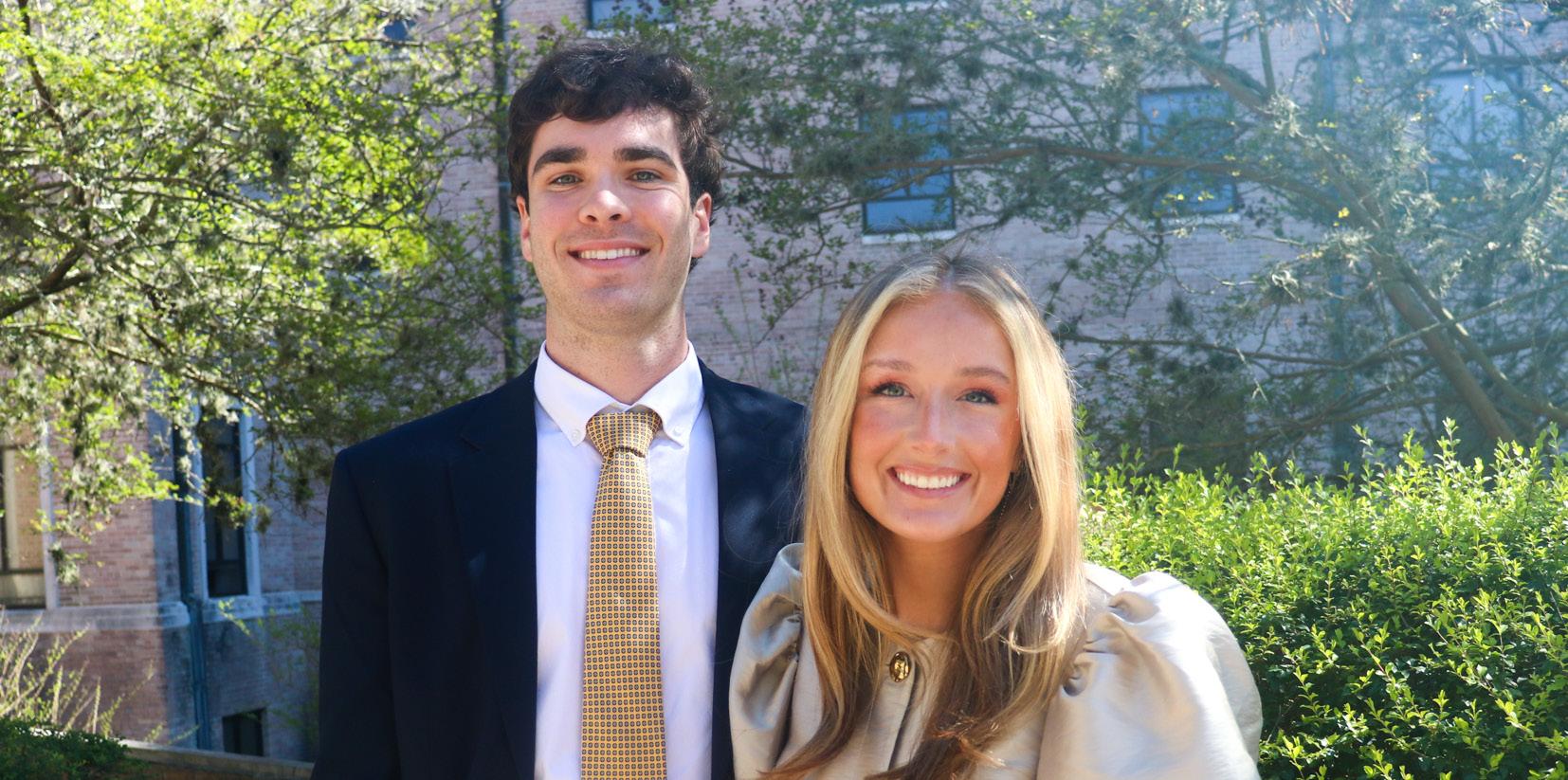
CHANDLER TROTTER / The Reveille Newly-named Student Body President and Vice President Ben Barousse and Anna Katherine Harrell on March 12 outside Hodges Hall.
Other potential initiatives include tailoring Moodle pages to student’s majors, a parking citation relief program, the expansion of the virtual supplemental instruction sessions system and the revival of the president’s cabinet.
“Just overall we are excited to get to work and truly make what we said was going to happen and listen to the students and advocate for our student seats,” Harrell said.
Henderson shared his support for the ticket and expressed his confidence in their ability to take over.
“I am extremely proud of all of
the campaigns that ran, and I am really excited for Ben and Anna Katherine,” Henderson said. “I think Abry and I left a pretty good foundation for them, and I am very confident that they will be able to take this organization and this student body to new heights.”
The Home campaign was one of five tickets running. When asked about the outcome of the election, Jack Miller, the Rooted ticket’s presidential candidate expressed gratitude for the strong support they received from the LSU community.
“While the outcome is not one
College of Agriculture: Full Seat
Salihah Daffin, Heart Everett Foard, Home
College of Agriculture
P: Rylie Hutchinson, Together
VP: Paige Durham, Together
T: Lauren Gillio, Together
College of Art & Design
P: Ann Harris, Home
VP: Kensli Brazzel, Together
T: Carlisle Quackenbos, Home
E. J. Ourso College of Business
P: Tommy Greene, Home
VP: Beau Gaspard, Home
T: Linley Clark, Home
College of the Coast & Environment
P: Jackson Jewel, Home
VP: Maya Bond, Home
T: Nia Sampson, Heart
College of Engineering
P: Tommy Greene, Home
VP: Beau Gaspard, Home
T: Linley Clark, Home
College of Humanities & Social Sciences
P: Ashley Subach, Heart
VP: Olivia Lopez, Heart
T: Anna Trainor, Home
College of Human Sciences & Education
P: Bella Cortez, Home
V: Lilia Vaughn, Home
T: Maya Faircloth, Rooted
College of Music & Dramatic Arts
P: Rory Nelor II, Heart
T: Dyllyn Scranton, Rooted
College of Science
P: Emilia Lombardo, Home
VP: Brooke Babin, Home
T: Vivian Nguyen, Heart
Manship School of Mass Communication
P: Mary Ammons, Home
VP: Ashtyn Sledge, Home
T: Caroline Schrieffer, Home
Pinkie Gordon Lane
Graduate School
P: Nicole Lovince
VP: Sanjida Mehrin, Home
Roger Hadfield Ogden Honors College
P: Titilope Tinubu, Heart
VP: Reagan Selman, Heart
T: Melanie Morris, Home
University College
P: Amaya Bryant, Home
VP: Ryann Dotson, Home
T: Jaela Purnell, Home
Veterinary Medicine
P: Spencer Slaton, Home
VP: Katherine Prentice, Home
T: Oliver Zimmer, Home
College of Art & Design: Full Seat
Russell Wells, Heart
Charleigh Travis, Home
E. J. Ourso College of Business: Full Seat
Michael Tenney, Rooted
Braewyn Arceneaux, Home
Lana Jackman, Home
College of Engineering: Full Seat
Austin South, Rooted
Diamond Lewis, Heart
Jacob Zimmer, Home
Malek Badawi, Home
Sebastian Flores, Heart
College of Humanities
& Social Sciences: Full Seat
N’Khia Zachery, Heart
Riley Fitzmorris, Home
Jamani Warren, Heart
Emily Brown, Home
Le’Ge Watts, Heart
College of Human Sciences & Education: Full Seat
Natalie Duczak, Together
Lila Badeaux, Home
Sarah Mosley, Home
College of Science: Full Seat
Ella Troup, Heart
Brian Broussard, Home
we desired, it’s very encouraging to see the increased engagement from the student body in this year’s election. We congratulate Ben and Anna Katherine and look forward to seeing them execute their policy agenda,” Miller said.
Gerald Lê, the crawFISH ticket’s presidential candidate, told the Reveille that his ticket could have spent more time tabling, spending on merch and campaigning in Free Speech Alley.
Lê said the Home ticket winning is “typical” results for LSU elections with a “frat bro” ticket winning.
“I hope they carry out their vision,” Lê said. “Most people just settle in and go about SG leadership without much of their stances intact, or spine, for lack of a more appropriate term.”
Both the Heart and Together tickets did not respond to comment on the election.
The win comes after the Heart ticket filed two lawsuits against the Home campaign; however, both suits were settled independently.
The campaign manager for the Home ticket, Nikhia Sims, said she is proud of the team and seeing the results reflect their work means a lot.
Manship School of Mass Communication: Full Seat
Margaret Moore, Home
Na’Vellah Njie, Together
Paul M. Hebert Law Center Full Seat:
James Mayronne, Home
Pinkie Gordon Lane Graduate School: Full Seat
Sania Akter, Heart
Calvin Feldt, Heart
Vivian Kretzschmar
Roger Hadfield Ogden Honors College
Full Seat: Ella Menard, Heart
Half Seat: Alexandra Hulse, Heart
University College: Full Seat
Grant Johnson, Home
Ava Hoffman, Home
Kaitlyn Herbert, Home
Kali Baker, Rooted
Anna Lindler, Home
Anna Camille deBlieux, Rooted
Isaac Watty, Heart
Lauryn Gross, Together
John Rabalais, Rooted
Mae Edel, Heart
Nitya Kandula, Heart
Grayton Daigle, Home
Niki Patel, Heart
Taylor David, Together
University College: Half Seat
Chloe Miller, Together
Here’s what LSU’s new AI degree entails
BY MAIA TYLER Staff Writer
LSU will begin offering a bachelor of science in artificial intelligence this fall, making the program the first of its kind in Louisiana.
The Louisiana Board of Regents approved the new three-year degree track during its meeting last month, and it is now listed in LSU’s 2025–2026 Academic Plan.
The new degree program, housed within the College of Engineering, aims to address the growing need for technical talent in Louisiana’s energy, healthcare and logistics sectors.
It plans to transform students from users of AI into engineers who create and implement it. The degree will use a hands-on approach including internships, research programs and a capstone project.
Dean of the College of Engineering Vicki Colvin said she and Ibrahim Baggili, chair of the Division of Computer Science and Engineering, started talking about AI when Colvin started 18 months ago.
“He and I immediately started talking about artificial intelligence because a lot of the guts of how you build AI systems is computer science,” Colvin said.
LSU officials say the curriculum will combine rigorous mathematical foundations with a particular focus on ethics and security, making LSU one of only a few national universities offering a stand-alone AI undergraduate major.
“We wanted to move early and fast to prepare students to create and use AI to drive growth and innovation in whatever field they choose,” Interim Provost Troy Blanchard said.
“We’ve built an excellent program that will help students create accurate, reliable, efficient and safe AI solutions.”
The new degree program is built on the same rigorous foundation as LSU’s computer engineering program. Its curriculum is uniquely focused on machine learning’s internal structure.
LSU is becoming a pioneer in the Gulf South by integrating this curriculum, which features 20 newly-developed courses covering specialized topics such as neuromorphic computing, AI security and a dedicated three-hour ethics requirement.
AI majors will be trained to become the architects who build the frameworks and security protocols that power modern AI systems, rather than just the programmers who use them.
By joining a select group of
College Council Winners
Each academic college elects a president (P), vice president (VP) and treasurer (T) to its council.
Senate Winners
See emergency, support resources for students
BY MADELYN LONG Staff Writer
At a university with over 30,000 students, accidents and emergencies are almost inevitable on LSU’s campus. This makes it important that LSU students remain informed about how to respond to an emergency incident.
Campus officials encourages students to break the “silent” culture of not reporting crimes and concerns and to actively use university resources to promote a safer environment.
Multiple options exist when it comes to reporting both emergency and non-emergency incidents and concerns, ensuring LSU students receive timely assistance when they are in need.
If students find themselves in an active emergency, LSUPD Sgt. Marlon Hawkins reminds students to always call 911. This is the quickest, most efficient way for students to get help from law enforcement and emergency services.
For non-emergency situations, students can contact the LSUPD call line at 225-578-3231 or visit LSUPD’s Public Safety Building on 204 South Stadium Drive to report crimes in-person.
“LSUPD wants students to report incidents as soon as possible and directly to police,” Hawkins said.
Hawkins urges students to report crimes firsthand if they were victims or witnesses because officers can respond more quickly when they have timely and accurate information.
LSUPD’s non-emergency line and building operates 24/7, allowing for students to report incidents at any time of day.
The LSU Shield App also allows students to report non-emergency incidents through their phone. The app has many features, including two-way messaging with police, anonymous tipping and the option to share, photos or videos of suspicious activity or
crimes. The app is meant to make reporting faster and easier on a cellular device, Hawkins said.
If students have concerns for themselves or their peers’ wellbeing that are not associated with crime, LSU also offers services to connect them with professionals to get assistance.
LSU Cares, a program through the Division of Student Affairs, connects students with resources when members of the LSU community, students and staff express concerns for their well-being.
Miranda Brown, assistant dean of LSU Cares, explained the office supports students who are experiencing any crisis, challenge or concern that may disrupt their academic journey.
“The top concerns have been wellness-related, which includes mostly mental health challenges,” Brown said. “Other challenges are students experiencing death in their families, injuries and other basic needs for insecurities.”
Each report, whether by a peer or the student themself, is assigned a case manager that provides each student with support and ways to get in contact if the student chooses to engage.
Aaliyah Wiggs, a junior mass communications major, utilized the LSU Cares program after a professor offered to submit a report on her behalf. She explained that the program gave her the support she needed to endure a high-workload semester.
She also added that LSU Cares gives professors a way to extend their care for students that they may not be able to help themselves.
Brown corroborated Wiggs’ experience, explaining that there are many campus resources for students.
“Students don’t have to suffer in silence,” she said. “We have a team of professionals ready to assist and provide resources and support to help students improve overall well-being and to be successful.”
AI DEGREE, from page 3
national institutions like Carnegie Mellon and Purdue that offer standalone AI majors, LSU aims to position its graduates at the forefront of economic development.
With an average starting salary of $69,500, LSU engineering graduates outperform the competition, surpassing the national average.
LSU-led energy, chemical initiative receives $45 million funding renewal
BY DREW SARHAN Staff Writer
Future Use of Energy in Louisiana has received a $45 million renewal in funding, allowing it to operate through 2029 for carbon reutilization and outreach programs at colleges and universities across the state.
On March 23, Gov. Jeff Landry announced the funding renewal of FUEL, a private-public partnership aimed at innovation and technology start-ups in Louisiana’s energy and chemical manufacturing sector.
Initially, the program was awarded the money from the National Science Foundation as one of 10 startup innovation engine awards out of 300 proposals.
According to the executive director of FUEL, Michael Mazzola, the organization helps fund startups in the oil and gas sector to put Louisiana at the forefront of petroleum production. The partnership is also heavily involved with carbon capture.
“The technical north star of FUEL is what’s called carbon capture and utilization,” Mazzola said. “We support carbon capture and underground storage when necessary, but right now, we’re a utilization place. That’s where innovation and the hot tech startups are.”
McGehee was releasing carbon dioxide during his beer production as a waste product.
Flake said he had an electrolysis machine that could convert carbon dioxide into ethanol, and after a conversation and note sharing between the two, they decided to start a company together.
Known as Encore CO2, their organization is a carbon reutilization startup.
“[FUEL] learned about them, and we made an investment in them through the proof of concept fund,” Mazzola said. “And they took up residence … in the Tin Roof Brewery that’s been repurposed, but there’ll be a microbrewery there as well.”
Jordan Losavio is an alumna of LSU and a co-founder of Encore CO2. She has a background in chemical engineering and said the company was started when they realized the overlap between brewing beer and carbon reutilization efforts.
“The original concept [was to] commercialize John’s CO2conversion technology and pair it with brewery operations— capture the CO2 emitted during fermentation, convert it into ethanol and use that ethanol to produce a hard seltzer,” Losavio said. “In other words, a circular, carbon-neutral beverage concept and the first hard seltzer made with CO2-derived alcohol.”
from Tulane and Xavier University in New Orleans, University of Louisiana at Lafayette and Southeastern Louisiana University in Hammond.
As a part of the next phase of its development, Mazzola said FUEL is kickstarting the Louisiana Activate program, a local chapter of a broader national program helping train the next generation of entrepreneurs and innovators in technology. LA Activate is aims to help college students consider starting their own carbon capture and reutilization companies.
Lacy McManus is the workforce development director at FUEL, and according to Mazzola, she is in charge of the LA Activate program.
“We started ideating around [the] basic premise of how do we do a better job in Louisiana, through the FUEL program, of cultivating and identifying founders within our higher education system before they graduate and take lucrative sixfigure jobs in the energy sector,” McManus said.
Within the next three years, McManus sees the Activate program building stronger outreach to current FUEL partnered universities, but also with Louisiana Tech and the community college systems in the state.
This earning potential is set to soar with the introduction of the AI degree program.
“As you start a degree program, you want students to be thinking about where they’re going,” Colvin said. “It’s a very technical degree and would be in huge demand because AI systems are powerful, but they’re really important to customize.”
Mazzola said that companies that FUEL funds can reuse the carbon capture technologies to convert the gas into usable ethanol by way of electricity, consuming carbon dioxide in a “reverse fermentation” process.
One of these new startups is at the former site of the Tin Roof Brewing company off Nicholson Drive, between LSU and downtown Baton Rouge. Mazzola said that Tin Roof Owner and LSU alumnus William McGehee was a gym partner with LSU chemical engineering professor John Flake.
Losavio said that, now, companies like hers can use the waste product from carbonbased chemical manufacturing plants, which can be reused as energy to power entire factories.
Besides the LSU connection to FUEL by way of Encore CO2, the public-private partnership between the government and corporations is also a collaboration among research universities in the state.
While led by LSU, there are contributions to the partnership
Mazzola said that FUEL is also interested in the economic development of Baton Rouge. The organization has partnered with local development groups such as the Baton Rouge Greater Economic Foundation and the Baton Rouge Area Foundation.
“The vision is to connect LSU down the Nicholson Drive corridor to downtown Baton Rouge and turn it into Cambridge, Massachusetts, and it’s way overdue,” Mazzola said. “You’ve got the state’s largest researchintensive university right down the road, and it aspires to do more than be great at football.”
LM OTERO / AP Photo
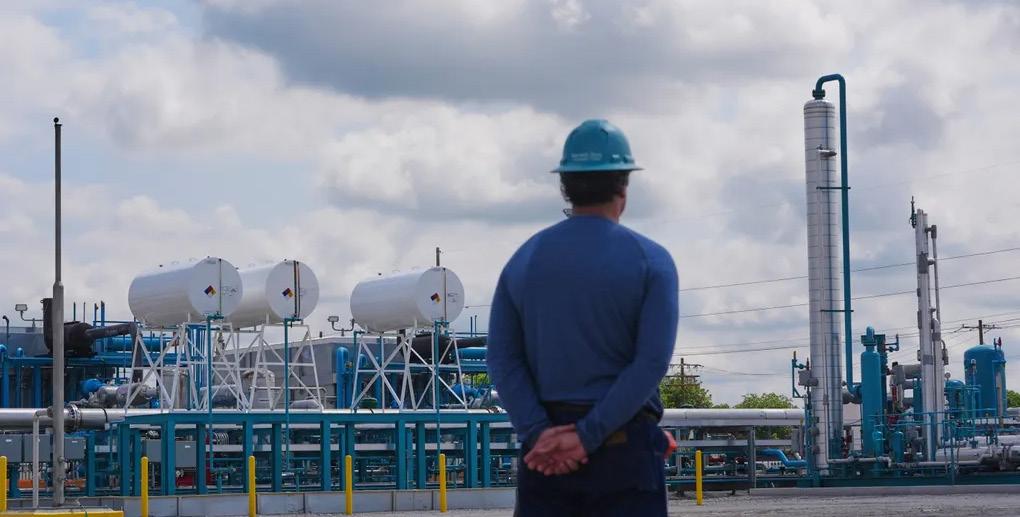
BKV Carbon Ventures health and safety advisor Adam Pope looks on at a compression station that is part of a carbon capture and sequestration process in Bridgeport, Texas on May 29.
REAGAN COTTEN / The Reveille
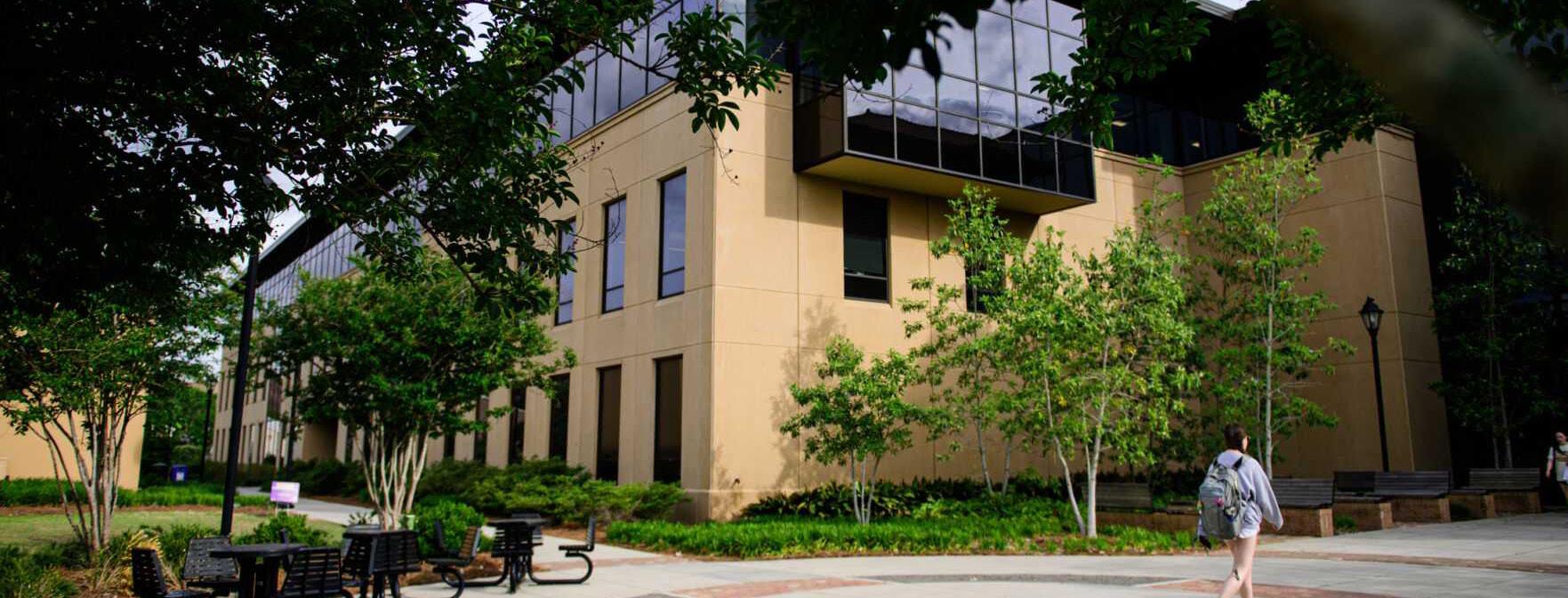
The Engineering Building sits on April 16, 2024.
ENTERTAINMENT
LSU Fashion Magazine redefines student style at spring showcase
BY CHARLOTTE TRENTALANGE Staff Writer
The Union Ballroom was transformed into a high-fashion space Thursday night, with music, lights and energy filling the room for the LSU Fashion Magazine’s annual show.
Models, student brands, makeup artists and members of the magazine collaborated to produce the show this year, making it entirely student-run and marking a shift from previous years.
Jayla Whitaker, president of the LSU Fashion Magazine, said the shift was both challenging and rewarding. Last year’s event was in collaboration with LSU Residential Life.
“We didn’t know how to do a lot of this stuff, but we made it work,” Whitaker said.
Planning and organizing the event began in January, and the organization hosted various promotional events in Free Speech Alley and posted on social media to spread the word.
Whitaker said the event’s goal was to prove that fashion on campus can be sustainable, collaborative and entirely unique.
The show featured themed walks like “Saturday Night Fever” and “Old Money/Mafia,” with outfits curated by the members of the organization and stu-

dent brands and a board showcase inspired by the magazine itself.
Student brands included Dripbyj Jewelry, Luxx Kloset, Beauty by Lexie and Denim Hills.
Junior digital marketing student Katie Glymph acted as a model during the show and dressed in theme with “Saturday Night Fever.” She said she pulled clothes from both her closet and Time Warp, a local thrift boutique, to complete the look. The final result: a flowy, floral look with bold makeup and jewelry channeling the disco era.
Glymph joined the club for a creative outlet after studying fashion and film abroad. Although it was her first time walking in a show as a model, she said she was not nervous.
“None of us have it perfect; we’re all just having fun,” Glymph said. “It’s more about the energy and making people want to know more.”
She was especially excited to walk the runway to “Judas” by Lady Gaga.
The event also spotlighted student designers like the creator behind Denim Hills, freshman Coren Hill, who taught himself to sew and design over the past year.
When he came to LSU in the fall, he started sewing game day outfits and T-shirt dresses for
friends before expanding into his collection centered around denim, flannels and oversized silhouettes.
He said that once he starts sewing, designs come to him pretty fast.
“A lot of it just comes to my mind when I’m doing it,” Hill said, “but I have to be in a creative mode for me to actually want to sew.”
His collection came together in one week.
One of the models wearing Denim Hills, senior landscape architecture student Simmi Auto, grew up with Hill and decided to participate in the show when he was asked to model the brand. Auto said he knew of the fashion magazine from his experience in photography on campus, but this experience allowed him to become part of the art rather than just capture it.
“This is me being actively involved in the art,” he said.
While wearing Denim Hills, Auto said he was still encouraged to bring his own style and creativity to the runway.
The event was a showcase of creativity and a perfectly cultivated space where students could freely experiment and express themselves. As the organization continues to grow, its student-led approach redefines what fashion on campus can look like.




CHANDLER TROTTER / The Reveille
An LSU student models a custom outfit during the LSU Fashion Magazine spring fashion show March 2 in the LSU Student Union Royal Cotillion.
SEMIS BOUND

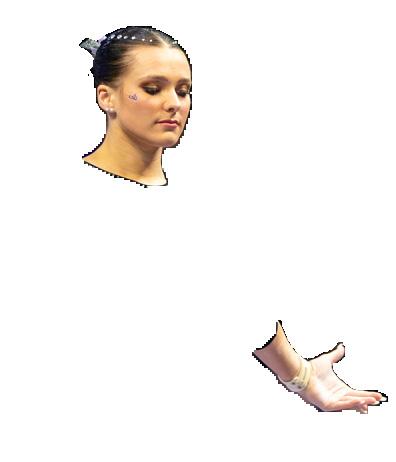

LSU gymnastics tops the Baton Rouge regional on April 4 with a 197.825 victory at the PMAC.


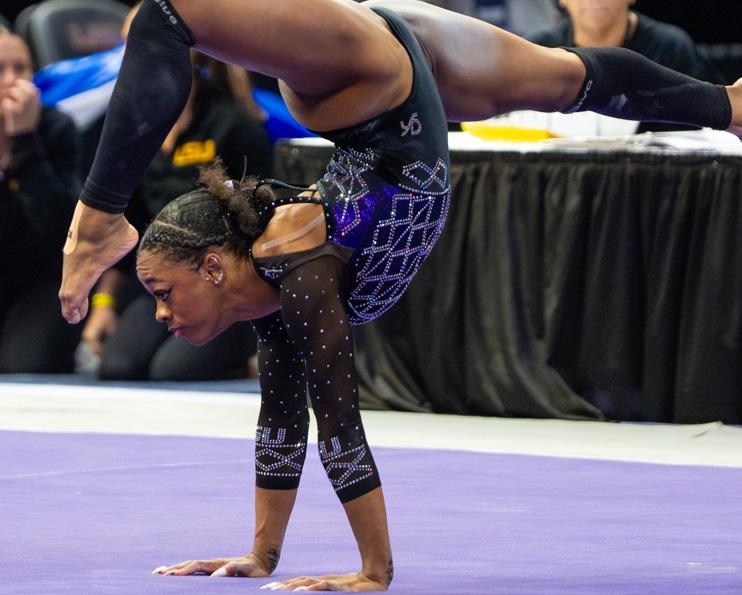


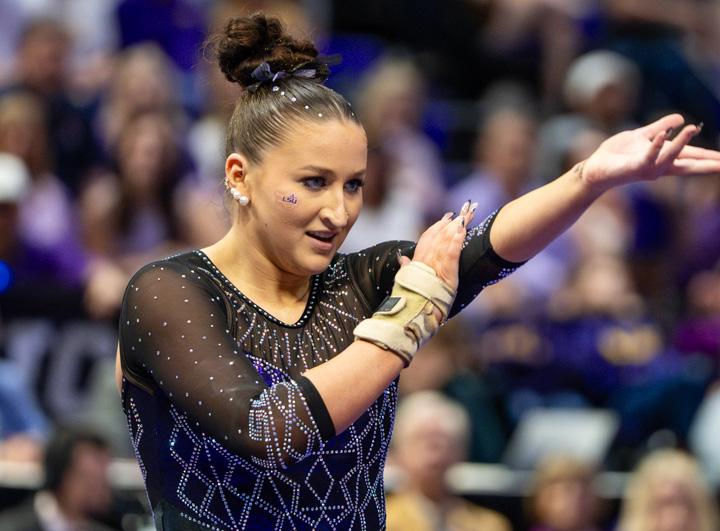


Photos by Sam Becker | Design by Riley White
All-around junior Madison Ulrich raises her hand in the air.
All-around sophomore
Kailin Chio performs her floor exercise routine.
All-around freshman Amari Drayton performs her floor exercise routine.
All-around junior
Amari Drayton performs her floor exercise routine.
junior
Kylie Coen performs her floor exercise routine.
All-around sophomore Lexi Zeiss performs her beam routine.
These unique Easter traditions honor Louisiana’s Cajun culture
BY PAIGE CHERAMIE Staff Writer
Louisiana is known for its rich mix of cultures, each with its own traditions and practices. Holidays are no different, and each town has its own traditions rooted in history to celebrate these special days.
One such holiday is Easter. The differences span all the way through the observance of Lent, a practice in many Christian denominations.
Lent is a fasting period that spans 40 days, ending on as Holy Thursday. During this time, those who participate fast in many different ways. Some people only give up meat on Fridays, while others give up meat altogether. Some even continue fasting into Good Friday.
According to Erin Segura, the LSU Louisiana French program director, one superstition that many people believed to be true on Good Friday was that they should abstain from any sort of labor, including cooking.
This meant that meals on Good Friday needed to be prepared ahead of time, a difficult feat before the advent of refrigerators. To solve this problem, pies entered the picture.
“People made pies because a sweet pie, like a fruit pie, has a lot of sugar in it,” Segura said. “So that would act as a preservative. It would stay good overnight on the counter.”
These pies also helped the people participate in their fast, since some believed only one meal was allowed each day through Lent.
“Their thought process was as long as they didn’t really stop eat-
ing pie, they could eat the pie as long as they wanted to over the course of the day, and it still counted as just one meal,” Segura said.
This led to the birth of Pie Day, a celebration that is most often observed in Scott and Catahoula, Louisiana.
In Scott, the tradition is upheld by the Begnaud family, which has hosted the event for over 15 years now. The family members bake every pie themselves on Holy Thursday, each slice eaten on tableware.
“They don’t eat on disposable stuff,” Segura said. “There’s constantly a few people in the kitchen washing dishes because people are just sort of in and out all day eating pie.”
Guests are welcome throughout the day, but any pie they bring as a gift is not served. The Begnaud family prides itself on its ability to serve the community.
In Catahoula, the tradition differs, with anyone who participates in the day welcome to bring a homemade pie to share with everyone. The pies there are sometimes not as sweet, with dishes like crawfish pie making their way into the mix. Although not as extravagant, it is still a showing of tradition surviving through the years.
Pies served at Pie Day events are typically sweet dough pies, a dessert that originates from southern Louisiana. Sweet dough pies vary from family to family, with recipes passed through generations. It is a cross between sugar cookies and pie crust, making for a soft and sweet casing for fruit or custard fillings.
Besides pie, many families throughout Louisiana celebrate the
ending of the fast with a final major seafood boil of the season, diving into crawfish, crabs and shrimp all through the day. In a way, these boils work in the same way as the pies, with trays filled throughout the day serving as one technical meal.
However, some families ensure that they catch their crawfish on Holy Thursday, as one superstition states that the ground should not be broken on Good Friday. This includes disturbing the bottom of ponds, stirring up silt and mud.
“There’s this superstition that blood can come out of the earth on Good Friday, and it’s like the blood of Jesus,” Segura said.
In some towns, this superstition is held highly, with some believing the breaking of ground will lead to themselves getting injured on Good Friday.
This superstition goes hand in hand with the abstinence of labor, meaning people cannot garden or farm for food. People must instead complete all preparations for Good Friday on Holy Thursday.
At the close of Good Friday begins the preparations for Easter Sunday, with meals to be prepped and eggs to be dyed.
A tradition that some still celebrate on Easter is the pâqueing, also known as pocking or knocking, of eggs. The game derives from French settlers, with the word Easter in French being Pâques.
People dye their eggs first hand, which was traditionally done with natural materials. Segura shared this with her class, dyeing the eggs for her students to try the game.
“I used purple cabbage, which makes blue eggs,” Segura said. “Tu-
meric makes yellow eggs, and then if you mix the two, you get green eggs. Onion skins make orange eggs… Somebody told me certain kinds of fabric when you boil it will bleed out dye, and so they would take old clothes and boil the clothes to get dye.”
Once the eggs are dyed a variety of colors, the game commences.
The rules are simple. Two players each take an egg, with the pointed end of the egg facing upward. One person then takes the point of their egg and taps it to the point of the other egg. After a couple brisk taps, one egg will break. The person’s egg that does not break wins.
With large groups, the game works in a tournament style, with winners continuing to play until their egg breaks. The last person left with an unbroken egg is the overall winner. This person either wins all the eggs or some other prize.
One town that still hosts a community egg knocking tournament is Marksville, Louisiana. The town holds the tournament annually, bringing the community together in a celebration of both Easter and sportsmanship.
Although other towns participate in this tradition as well, it is not seen in many places around the state that weren’t French settlements. Regardless of where a person is from, they are welcome to join in the game and have some fun.
The word “Pâques” is pronounced similarly to the word “park.” This similarity is rumored to be how the village of Parks, Louisiana, got its name.
Kyle Crosby, the creator of the history-focused Louisiana Dread social media channels, explained how a simple language barrier may have led to the complete renaming of an entire settlement.
“It was an American that had arrived via railroad and would have said, ‘Where are we? What stop is this?’” Crosby said. “And whoever heard them say that obviously didn’t understand English as much as they understood French. So they were like, ‘C’est Pâques,’ [meaning] ‘It’s Easter.’”
From then on, the town was called Parks, or so the story goes. Whether fact or fiction, this story shows how different cultures have changed Louisiana over time, turning it into the place we know today.
The biggest tradition seen on Easter is the breaking of Lenten fasts. Families get together and celebrate with meals filled with a variety of meats. In Louisiana, you can often find pig roasts serving up food for friends and family.
Although not Louisiana specific, you can find many families hosting Easter egg hunts, giving out Easter baskets and enjoying a day of celebration with their loved ones.
The traditions of Louisiana have survived through generations, passed down from loved ones. Without continued participation, they become history rather than a yearly affair. With so much of Louisiana’s Cajun French culture dying over the years, it is important to keep traditions alive.
If you are looking for a way to spice up your holiday, try one of these cultural customs. It might just become a family tradition.
Savannah’s Silver Screen: Spiral out of control with ‘The Drama’
BY SAVANNAH BOYNES Staff Writer
“The Drama” tells a tale about what it means to see past one’s biggest mistake and recognize who they are in the present.
A24 cordially invited all moviegoers to witness the wedding of the year with Friday’s premiere of Kristoffer Borgli’s “The Drama.”
Starring Zendaya as Emma and Robert Pattinson as Charlie, the film revolves around an engaged couple trying to get through the tumultuousness of wedding planning. As they’re tasting possible menu items for their big day with some friends, each person confesses the worst thing they have ever done.
After Emma admits her transgression, the room fills with resentful tension, and the audience sees just how people can spiral out of control over a bit of drama.
No matter if you would consider yourself a runaway bride or groom after hearing about the worst thing your fiancé has ever done, surely it could not be as dramatic as this film became.
Here are some of my favorite details behind the highly-anticipated romantic drama of the year. The invitation
The true invitations into the film’s world are the editing, the shots and the soundtrack.
Symbolism and dialogue are usually big for me, but the editing is the biggest of the three from above that had my eyes glued to the screen from start to finish. With quick panning shots from one character to another, the editing helps maintain a focus on the inner workings of the characters mind.
In addition to the panning cuts, there are simple, quick cuts from one thing Charlie is doing to the next, which shows his inner panic as he mulls over Emma’s confession. The cuts are also from him to his own imagination of what teenage Emma would be doing during that time in her life. These cuts visualize his imagination and it show how his perception of her changed almost immediately.
Charlie’s whole new perception of Emma shows how a lot of people do not truly believe in growth and how quickly people will jump to reduce a person to their worst quality.
Besides the editing cuts, I also enjoyed the use of wide shots and close-ups in the movie. Wide shots were more used for group
discussion scenes, which showed individual reactions and how the characters tend to follow a group-herd mindset. Meanwhile, close-ups were used to display realizations within the characters, especially in the group confession scene.
Finally, the soundtrack is also what sealed the deal for me, immersing me in the world of the film. The music was calm yet mysterious, and I was able to let the wedding drama sit and fester in my mind as if I was the one getting married that day.
Since composer Daniel Pemberton was behind the masterful sound, I was guaranteed to love the music. Pemberton also composed the soundtracks for “Materialists,” “Spider-Man: Across the Spider-Verse” and probably the most talked about at the moment, “Project Hail Mary.”
The bachelorette and bachelor I had no doubt in Zendaya and Pattinson’s ability to bounce off each other with chemistry and charisma. As almost always, I was right about that assumption.
Thetwo actors’ chemistry translates well into the flow of their performances, and the audience is able to really believe they
are head over heels for one another. Gentle whispers and their ability to goof off are what make their relationship flourish just before the drama sets in.
One scene in particular I’d like to point out is the scene where Charlie is speaking only into Emma’s right ear, which is deaf. Charlie says a few phrases that involve his love confession and how he wants to marry her, but he just doesn’t know how to say it quite yet.
I see this scene as one of the ultimate expressions of love; even though Emma cannot hear Charlie and he knows this, he still wants the universe to hear about his absolute infatuation with her. He isn’t ready for her to hear it, but he feels as if he needs to get it out.
It’s a scene so simple yet so clear in where the couple stands at the beginning of the film and where they could possibly still stand after the credits roll. They would just need to start over.
The reception
There was drama surrounding every aspect of the wedding and what led up to it, but most of the drama was reserved for the reception itself.
With a speech from Char-
lie’s dad that got a few awkward glances and whispers from listeners, as well as a confession of infidelity that ruffled everybody’s feathers, the reception took the film’s title to a whole different meaning. I don’t think I will ever forget the emotional gasps I heard while sitting in the movie theater as Charlie just couldn’t keep his mouth shut.
Now, I don’t wish to spoil too much with this review, but I think teenage Emma’s actions are evident of what it is like to be sucked in by the darkness of the internet and what can be aestheticized with just a desire for positive attention. As for the characters’ reactions, I think they perfectly encapsulate what it means to preach forgiveness, but not actually give it.
Compelling visuals and a stunning soundtrack tell the story just as much as the characters’ actions. Overall, I think the most comedic bit of the film is how Charlie constantly imagines Emma with blood on her clothes after her confession, but in the end, he is the one with blood on his tuxedo and unretractable guilt on his conscience.
SPORTS
‘FOUR’ THE WIN
Arrambide’s record-breaking hitting helps baseball secure Tennessee series
BY TRIPP BUHLER Staff Writer
For the first time ever, an LSU baseball player has scored four home runs in a single game.
It was Cade Arrambide who hit three solo shots and a dagger grand slam in the 12th inning to help pull LSU to a 16-6 comeback victory against Tennessee on Sunday.
His four home runs joined deep balls from John Pearson, Seth Dardar and Steven Milam to make it seven total homers for the Tigers, also tying a program record for most home runs hit in a game. Milam’s shot capped off a 10-run 12th inning that blew the game out of proportion.
The Tigers’ tendency to perform best in the late innings was once again present, from back-to-backto-back home runs in the seventh inning to their ninth-inning score
LINCOLN, from page 2
found herself splitting the SEC floor title with her score of 9.950, and later being named SEC Co-Specialist of the Year for her exceptional performance this season. Both of these are the first SEC awards and titles of her career.
The most impressive part of Lincoln’s accomplishments at the event is that she was absent from the floor lineup for a threemeet stint while nursing Achilles discomfort. Her success is evident as she hasn’t scored below a 9.925 since the Tigers’ second meet of the season.
As the Tigers look to take on the semi-final round in the na-
REGIONAL, from page 2
0.275 lead over the competition headed into their final event.
At the start of the competition, sophomore Lexi Zeiss had taken her dedicated lead-off spot at the front of the vault runway, beginning what would become a total of 49.450 with her score of 9.850. Third in the lineup was sophomore Victoria Roberts, who matched her career high of 9.900 with a nearly stuck front pike half.
Even with relatively strong scores, the Tigers still hadn’t found a stuck landing behind the table, and taking the last two spots in the lineup was Drayton and Chio.
An extra step following a Yurchenko one-and-a-half from Drayton produced a 9.850, but Chio, the reigning NCAA vault champion, found the only stick of the event.
Earning the cheers from her home crowd, Chio earned her 13th career perfect 10, five of which
to get it to extras.
Gavin Guidry came in to finish the seventh and stayed in through the offensive marathon to pitch 5.1 innings, where he only allowed two hits and one run. It was an elite showing.
In the ninth, Jake Brown came up with the bases loaded and delivered an RBI grounder up the middle that Jay Abernathy couldn’t get to in time, tying the game at five.
The Tigers had a chance to take the lead in the 10th when Derek Curiel missed home plate on his slide home by about an inch.
LSU had a rough third inning when a string of plays had a butterfly-effect on the score. Zach Yorke’s error allowed runners on the corners with one out, then a subsequent pop-fly caught by Brown allowed the runner from third to advance home.
Brown’s throw was in time at
tional championship next, Lincoln’s feat came at just the right time. A season that has been marked by career-firsts for the gymnast, with her last routine in the PMAC this season earning a perfect 10, only continues to prove how much of an asset she is to the program.
“It was amazing,” Lincoln said. “All I could think about before I went was just go out there and do what you need to do for this team. I feel like that’s exactly what I did, and after my routine, I didn’t really realize why everyone was screaming because I couldn’t see. I just had so much fun celebrating with this team, and it was a time like no other.”
have come from vault alone. Chio’s 10 capped off the first rotation for the Tigers, and it was just enough to push LSU into first place as they headed to the uneven bars.
While stuck landings were hard to come by on the first event for the Tigers, it was quite the opposite on the bars. Senior Ashley Cowan followed Zeiss with a stick for her third 9.900 of the season. Ulrich and Chio added scores of 9.850 and 9.800 respectively.
Though almost the entire uneven bars lineup was the same one as in the second round of the regional, LSU had swapped out senior Courtney Blackson for freshman Haley Mustari, who put up 9.875. Just after, however, an unfortunate fall from McClain in the anchor spot on her Church release move forced the junior to step away from the competition for the rest of the night.
“I went up to [McClain] after we did beam warm-up, and I saw her
home, but it took catcher Omar Serna up the line, where Wright collided with Serna’s head and knocked him out for a few moments. He exited the game.
The delay with getting Eddie Yamin IV in at catcher and an increased contact for Volunteer hitters in the second time through the lineup chased Grant Fontenot from the game.
Zac Cowan came in and forced a grounder to Milam, but the shortstop’s first error of the year kept the inning going.
Blaine Brown hit a grand slam on the next pitch, capping off a five-run inning.
The disastrous inning overshadowed a solid start from Fontenot, who went a season-high 2.2 innings where he struck out three while allowing two hits and two walks.
He was able to maneuver
around trouble until the lineup turned over, and is further establishing himself as a viable bullpen arm in big games.
Cowan helped breathe life into LSU as he continues to build on strong appearances after a slow start to the season. In relief, he went four innings and only allowed one hit to keep LSU within reach in the rubber match.
His day would end after LSU’s fourth error of the game came from Pearson with two outs in the seventh.
Tennessee’s workhorse Evan Blanco went 6.1 innings and threw 102 pitches to limit LSU to just two runs, which were both solo home runs.
LSU will travel back home to face Bethune-Cookman on Tuesday at 6:30 p.m. The Tigers then travel to Oxford to take on Ole Miss for a three-game weekend slate.

get a little bit teary-eyed, but I just told her, ‘We love you, we’re gonna finish this meet out for you,’” Chio said. “Just knowing that every single time we step up there, no matter the event, we always have her back.”
The floor exercise was theTigers’ final event of the night, and senior Emily Innes competed her last routine in the PMAC for a score of 9.850. Following suit, Nina Ballou built on the total with a matching score before Drayton stepped onto the mat in the fourth spot.
Finding the team’s first score of the event over 9.900, the junior matched both her season and career-high score of 9.950. In the following routine, Chio stuck both landings of her tumbling passes to earn her second 9.975 on the event this season.
The energy in the building was electric, and all eyes looked towards sophomore Lincoln. She put up a lights-out performance and
SOFTBALL
Softball player hits for programfirst cycle
BY MARISSA REISS Staff Writer
For the first time in the 46 years that the LSU softball program has competed, a player successfully produced the first ever Tigers’ cycle.
The name Kylee Edwards has been said across softball networks all season in relation to her performance. As one of LSU’s 11 newcomers this season, Edwards has displayed nothing short of dominance at the plate.
In LSU’s second game of its series versus Mizzou on Saturday, the junior shortstop came up big for the Tigers. Edwards hit for the first cycle in program history to contribute to the win.
Edwards wasn’t even aware that her cycle was the first time an LSU player had reached that accomplishment. When informed by Nate Gatter and Ashley Moore on the SEC Network broadcast postgame, Edwards laughed and said three words: “Really? That’s awesome.”
The cycle effort began in the third inning with a two-run home run that allowed the Tigers to comeback from a slight deficit and take a 4-3 lead. Later in the fifth, Edwards singled to complete the second step towards a potential cycle.
The next inning? A double through the left side to give Missouri some more trouble.
In the seventh and final inning of the game, Edwards needed to hit the hardest base total of the cycle: a triple.
closed out the night with her first career perfect 10.
“All I could think about before I went was just go out there and do what you need to do for this team,” Lincoln said. “I feel like that’s exactly what I did, and after my routine, I didn’t really realize why everyone was screaming.”
The sophomore’s best score came in the last PMAC outing of the 2026 season to put the Tigers at an overall score of 197.825. Lincoln’s was the team’s 13th perfect score this season.
With the first-place finish secured, both LSU and second-place Stanford earned spots on the next branch of the bracket for a ride to Fort Worth for the semi-final.
Looking to make its return to the championship final after an upset last season, LSU will next compete on April 16 at Dickies Arena, looking to hold on to the confidence it has regained this weekend.
Her at bat wasn’t guaranteed though, as seven batters stood between her and the chance at history.
But after Mizzou gave up three runs before Edwards stepped in the box, with two outs and two Tigers aboard, she got her chance.
On a 1-1 count, Edwards swung with hopes to keep the offense alive — despite LSU’s 14-4 lead.
“I hit the gap with the outside pitch and I took off around first base,” Edwards said. “I was like, ‘Oh shoot, this might be it.’ I took off as fast as I could.”
Edwards had knocked a tworun RBI triple to bring the Tigers up 16-4, making history in her first year in purple and gold as she completed the cycle.
“When I was up to bat, I didn’t realize that I was a triple away from a cycle,” Edwards said. “For some reason, I hit second base and I was like, ‘Oh my gosh, go, run, run,’ then I slid in [to third]. I looked over at the dugout and saw my teammates and the coaches. It was so surreal.”
ALEXIS PERSICKE / The Reveille
LSU gymnastics sophomore all-around Kaliya Lincoln poses April 2 during its 198.375 win at the PMAC.

OPINION
AI does not belong in classrooms. Keep our teachers human

RILEY’S REVIEW
RILEY SANDERS Columnist
On Wednesday at a global education summit held by the White House, First Lady Melania Trump strutted down the red carpet alongside a very unlikely presence — an AI humanoid robot dubbed Figure 3.
Figure 3 introduced itself to the crowd:
“I’m Figure 3, a humanoid built for the United States of America. I am grateful to be a part of this historic movement to empower children with technology and education. Welcome.”
After Figure 3 exited the room, Trump remarked that “the future of AI is personified. It will be formed in the shape of humans. Very soon, artificial intelligence will move from our mobile phones to humanoids that deliver utility. Since our environment is designed for people, AI humanoid systems are uniquely suited to navigate and operate within our world. They fit well.”
The next day during a press conference, President Donald
Trump referenced AI humanoids in education as helping to “provide a personalized experience, adaptive to the needs of each student” and helping “our children [to] develop deeper critical thinking and independent reasoning abilities.”
Do these statements make you uncomfortable? I certainly am.
The proposed emphasis on AI humanoids as primary figures in the future of American and even global education is extremely frightening for three reasons: the degradation of human communication, decentralization of human rights and needs and deconstruction of personal privacy.
Firstly, the use of humanoid robots to teach children is a major misstep for the United States in terms of developing the minds of the next generation of Americans. At present, American adults and children are facing a severe literacy crisis, as around 54% of American adults read below a sixth-grade level and 64% of fourth-grade students nationwide are not proficient in reading skills.
The role of human educators in priming young children for
lifelong literacy proficiency is vital on a multitude of levels, including but not limited, to sensory perception, phonemic awareness and visual and verbal cue comprehension.
The proposed replacement of some teachers with humanoid robots is a major risk in forming literacy and communication skills in the heavily underdeveloped minds of K-8 children, who desperately require human intervention to become truly literate academically and functionally.
These “humanoids” function based on artificial intelligence language models, systems that are coded by human communications but limited in interaction by the number and type of interactions experienced themselves along with those previously encoded internally.
This would greatly limit children taught by AI humanoids to a particular set of topics and proficiency levels already learned by AI “educators,” along with whatever is already introduced to the humanoids via their creators and the government personnel involved in their regulation.
The use of these “humanoids” as primary educators also
raises serious data and privacy concerns for American children and parents. These systems are informed by personal interactions and only learn by intake of specific data inputs. To have AI educators, presumably with cameras, audio-intake and output and even memory implies that a bounty of private information would be at the disposal of whatever powers regulate the “humanoids.”
These AI humanoids and their regulators would have access to the image, voice, likeness, personal information and conversations and personal files of all children under the watch of the robots — including information protected under the Family Educational Rights and Privacy Act.
Additionally, there’d be no guarantee of what is to be done with the retained information aside from contractual agreements signed by parents, school administrations and perhaps those who own the “humanoids,” though there’d be no means of vetting the upholding of such contracts. After all, AI systems are not necessarily morally bound by conscience or even
true recourse of punishment for violation of such contracts.
Finally, the replacement of human teachers with AI humanoids is extremely concerning due to its decentralization of human needs. American teachers are consistently and severely underpaid, to the point that current average salaries are less than 2009-level salaries and far behind the curve of current inflation levels.
AI humanoids would effectively allow the federal government to lay off large swaths of public educators and to pay the remaining educators even less than they’re being paid at present.
In short, the replacement of real educators with AI humanoids would limit the learning potential of the next American generations, put the private lives of Americans directly in the hands of the government and its corporate tech partners and cut the government a nice check, all while putting America’s future at serious risk.
Riley Sanders is a 19-year-old biology major from Denham Springs, La.
Louisiana’s Senate primary is full of spineless hypocrites
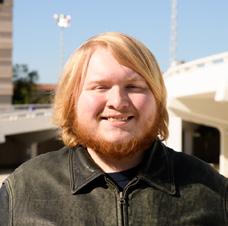
CRAWFORD’S CORNER
GORDON CRAWFORD Columnist
With primary party elections soon closing in, the circus of frontrunners in the Louisiana Republican primary for U.S. Senate has honed in on the latest, most important issue of the day: Julia Letlow’s past support of diversity, equity and inclusion programs at the University of Louisiana-Monroe.
Yes, you read that right, and you didn’t just wake from a coma from 2024. Citizens of Louisiana are breaking their backs just to fill their gas tanks in the name of a chaotic solo raid on another continent, our health care system is absolutely in the toilet, yet all campaigns have decided that this nothing-burger will occupy key time in the lead-up to this critical election.
Fox News initially broke the story on April 1, and despite the
comedy of a Trump endorsee being caught on camera describing themselves as a “strong and progressive leader,” it was not a joke.
The Bill Cassidy campaign seized on the comments immediately. Cassidy repeated his stock “liberal Letlow” catchphrase and touted his long record of working with President Trump to pass his agenda.
Letlow quickly hit back, accusing Cassidy of being the true DEI champion for voting on a number of pieces of legislation during the Biden presidency that established certain diversity offices. And of course, John Fleming had to chirp in with some nonsense about how DEI was Marxism.
Mr. Fleming, I know these may be new to you, but there are these things called “books,” and that guy, Karl Marx, you talk about so much actually wrote a couple of them. If you crack one open, please show the class where in the world he talked about DEI.
Honestly, despite that lunacy, I almost have the most respect for Fleming. Though his views are
detestable, he’s the only one of the three who seems to have any hint of core values upon which he stands.
I would generally advise Cassidy against throwing hypocrisy rocks through his very flimsy glass house. Every time he brings up another accusation, it is fundamentally impossible to juxtapose the man who voted to remove a President because he believed he incited a mob in the U.S. Capitol with the one happily smiling while rubberstamping at that same President’s command without seeing a flagrant flip-flopper.
However, Cassidy at least has one main thing going for him: while he personally beefed with Trump, he never truly attempted to stymie the conservative agenda. He has always been a solid, ardent conservative, barring the emergence of any secret clips where he randomly starts advocating for universal basic income or health care.
Letlow, on the other hand, didn’t just support DEI programs in the original UL Monroe inter-
view: she articulately and accurately defended them.
She cites her work with other universities and her personal observations of the effectiveness of DEI programs as the foundation of her support for the policies. The positives of DEI programs are many, and early studies show general perceived effectiveness, a fact she acknowledges.
She even specifically highlights the number of Black women professors as disproportionate with the student population as a specific issue she would like to address through effective DEI policies.
So, Rep. Letlow, how much did it cost for you to sell yourself to the culture warrior mob? I truly hope you were paid well, as I imagine that spine removal surgeries are fairly expensive.
The misinformed aren’t excused for their ignorance, but it certainly makes empathizing with them more compelling. When you articulate a sophisticated argument based on a combination of personal experience
and evidence, you can’t simply turn around and give a quick “whoops, my bad.”
This whole argument about DEI policies is fundamentally absurd. Louisiana is decaying by the day in almost every aspect of quality of life, and the airwaves and the candidates are in a screaming match over policies that have left almost no practical effect on our education system and were generally dismantled by Trump during his second term anyway.
Moments like these should be a wake-up call for the people of Louisiana. You are being proffered the illusion of choice through warring candidates who have essentially no real ideology beyond saving themselves first and their buyers second. You already know Cassidy will switch his loyalties on a dime. Now you have video proof that Letlow is just the same. Vote wisely.
Gordon Crawford is a 20-yearold political science major from Gonzales, La.
Editorial Policies and Procedures Quote of the Week
The Reveille (USPS 145-800) is written, edited and produced solely by students of Louisiana State University. The Reveille is an independent entity of the Office of Student Media within the Manship School of Mass Communication. Signed opinions are those of the author and do not necessarily represent the views of the editor, The Reveille or the university. Letters submitted for publication should be sent via e-mail to editor@lsu.edu or delivered to B-39 Hodges Hall. They must be 400 words or less. Letters must provide a contact phone number for verification purposes, which will not be printed. The Reveille reserves the right to edit letters and guest columns for space consideration while preserving the original intent. The Reveille also reserves the right to reject any letter without notification of the author. Writers must include their full names and phone numbers. The Reveille’s editor in chief, hired every semester by the LSU Student Media Board, has final authority on all editorial decisions.
“It always seems impossible until it’s done.”
Nelson Mandela 1918 - 2013 EDITORIAL BOARD
HEAD HEAD TO
The left wants too much out of one candidate, needs to settle
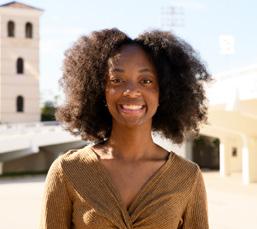
MICHAIAH’S MINUTES
MICHAIAH STEPHENS
Columnist
After this recent presidential election, the biggest question was: “How did we get here?”
We got here because the left wanted a candidate who was perfect. Because no such thing exists, the left couldn’t align with one candidate.
The U.S., though self-praising for being the land of “freedom” and “choices,” has a two-party system in elections. In the system, you are either a Democrat, typically aligned with leftist values, or a Republican, typically aligned with right-wing values, and you vote for who gets closest to your ideals.
In the 2024 presidential election, the Republican Party ran a right-wing campaign on immigration and the economy — harmful, yes, but united. Supporters of President Donald Trump said “fighting illegal immigration” and “fixing the economy” were the top reasons why they voted for him. They had a unified campaign with a central leader. Democrats, however, struggled in that regard.
The main problem this party faces is its values. Democrats were known for being advocates for economically disadvantaged Americans. Now, if you were to look at the Democratic Party’s website, it’s a laundry list of issues they advocate for: climate change, education, economy and jobs, gas prices, etc. They have no central ground, whereas Republicans knew what they were voting for and took action to make those two issues happen. They weren’t split, trying to appease every minute issue their voters had.
Democrats need to balance the views of progressives and working-class voters and work on creating concrete results instead of ideological correctness.
This was a major issue with former Vice President Kamala Harris’ campaign in 2024. Democrats campaigned without a streamlined set of policies and had a loss of identity, which created holes in their messaging to their voters.
Harris’ voters supported her for three main reasons: she would “stand in the way of a national abortion ban and fight to restore the protections of Roe v. Wade,” “make the wealthy and big corporations pay their fair share in taxes” and “protect the Affordable Care Act and preserve protections for those with pre-existing conditions.”
But when she lost, there was a big debate on whether she lost because some voters believed that she hadn’t been sufficiently responsive to the ongoing war in Gaza. These voters then turned to third-party candidates like Jill Stein.
Historically, Third parties haven’t been successful. Most find voting for them to be a waste but they usually find support for their movements due to addressing progressive causes that the two major parties haven’t addressed. Voting this way may not
advance your views, but it’s a way of making a statement.
Stein and the Green Party’s platform placed greater emphasis on social justice, foreign policy and “demilitarisation,” especially during the war in Gaza. She advocated for universal health care and a “Real Green New Deal” for a 100% clean energy transition. This seemingly more progressive candidate drew the votes of some voters, resulting in a loss of support for Harris, who was the only real left-leaning candidate with a chance.
Polling leading up to the election suggested a majority of voters felt the U.S. should demand a ceasefire during the war in Gaza, but the sentiment wasn’t reflected in their voting behavior. In fact, progressives expressed fears about the safety of women’s and LGBTQ+ rights under a Trump presidency, and with polls closing in, said “wasting a vote on a third party could cost them.”
Social media discourse surrounding the election placed a greater emphasis on trend-
ing issues such as: the war in Gaza, abortion, immigration and identity politics, but working and middleclass voters weren’t concerned with that.
How is a politician supposed to garner support when they don’t know the Americans voting for them?
Recent office wins have shown us that when Democrats center voters, they win. New York City Mayor and Democrat Zohran Mamdani’s campaign was successful by tying his pledges with a central issue on voters’ minds: costs. He made specific, memorable offers to voters rather than a long list of policy promises that tried to account for every specific endeavor voters wanted.
The left doesn’t want a perfect candidate, just a moral option

MIRIAM’S MUSINGS
MIRIAM EVELYN
REESON Columnist
Since the 2024 election, a common sentiment has been espoused by political pundits and moderate voters: the left is a bunch of spoilers. Former Vice President Kamala Harris’ loss isn’t because of poor outreach or out-of-touch policies, it’s because the left wing of the Democratic party demands perfection from its candidates.
Such rhetoric downplays the severity of the issues with Harris’ campaign, misunderstands basic democratic principles and ignores what voters actually want.
It’s exceedingly common for moderate members of the Democratic Party to describe their nominees as “the lesser evil” when compared to Republican candidates. On many issues, this may be true, but one has to question the legitimacy of a candi-

date who is still evil, no matter the degree. The State of Israel has credibly been accused of conducting a genocide against Palestinians in Gaza by some of the world’s leading human rights groups, and its prime minister is wanted for crimes against humanity. The Biden administration, knowing that Israel’s conduct was likely illegal, chose to arm and fund this genocide.
For her part, Harris said she stands by the choices her and Biden made during their term.
counted on to have morals in her domestic politics? It’s only natural that voters would have serious reservations about casting their ballots for Harris.
While critics of abstainers advocate for voting, they seem to neglect how democratic systems actually function. Unlike monarchies or dictatorships, support for a political figure isn’t a given in a democratic society. It is the responsibility of any candidate to earn popular support if they want to hold office.
Voters make demands, and candidates must either meet voters where they’re at or convince them to change their minds on a given issue. This is the most basic framework of an election. What people consider “purity tests” from the left wing of the Democratic Party is actually just normal electoral behavior.
It would be hard to argue that Harris worked to earn voters’ support.
Even beyond the issue of Gaza, Harris was wildly out of step with the demands of the larger party. Take the issues of Medicare for All or the Green New Deal. Both policies have more than 80% favorability among Democratic voters and enjoy majority support from the broader electorate. It is rare for policies to have such broad support, and endorsing them would certainly be a boon to any election campaign.
Yet no Democratic nominee has ever endorsed either one. Harris claimed to support Medicare for All during her brief presidential bid in 2020, but she later retracted that support once she had her party’s nomination in 2024. This is the closest that party elites have ever come to endorsing these incredibly popular positions.
The results of such electioneering are plain. Kamala Harris received $6 million fewer votes in 2024 than Joe Biden did in 2020. The Republican victory in 2024 wasn’t because of Trump’s dominance as a politician; it was because of Harris’ weakness. Her party didn’t turn out to support her because they couldn’t count on her to represent their interests. It is hard to seriously argue that a voter should endorse a candidate who commits atrocities, takes support for granted and who does not actually represent the voter’s desires. Instead of simply trying to paint the opposition as undesirable, Democrats need to put up candidates who actually make people excited to vote for them.
The left needs to figure out what is most important, and Democrats need to streamline and meet progressives and the working-class in the middle.
It is appropriate for voters to be skeptical of a candidate who aids in a genocide. Genocide is the gravest crime an individual or state can commit, and voters cannot reasonably be expected to support genocidaires, no matter how repulsive their opponent may be.
If Harris could help contribute to such a grave atrocity abroad, how could she be
This cannot happen if we simply settle for the lesser evil. To say we must accept evil candidates and anyone demanding more of their politicians is asking for perfection is to create a false dichotomy. There is an entire spectrum of morality between these extremes in which a politician can be good and decent but not perfect. We will never get such a candidate unless we demand better of those who wish to represent us.
Miriam Evelyn Reeson is a 27-yearold political theory student from Baton Rouge, La.
JACQUELYN MARTIN / AP Photo Democratic presidential nominee Vice President Kamala Harris speaks in Washington, Nov. 6, 2024.
Michaiah Stephens is a 22-year-old English major from Durham, N.C.