The Ten Commandments are coming to LSU classrooms, President Wade Rousse confirms.

The Ten Commandments are coming to LSU classrooms, President Wade Rousse confirms.
This LSU baseball transfer earned a starting spot for his home-state program.



LSUReveille.com
BY ALEX SHEESLEY Staff Writer
One look at the LSU baseball roster will reveal incredible depth.
LSU’s opening day lineup featured a trio of defending national champions in the outfield, including a projected top pick in the MLB Draft.
On the infield were more riches: a preseason top-10 infielder, a stalwart of the LSU middle infield, an incoming transfer that led his old program in home runs and another that powered his team to the College World Series in 2025.
Seventeen Tigers placed on Baseball America’s top 100 players by class lists at the start of the season. Breaking through and finding a spot in a lineup requires something special.
Seth Dardar produced just that.
“It’s like Christmas morning,” Dardar said in a preseason press conference. “I wake up, and my present is that I get to have a few at-bats in Alex Box Stadium playing for LSU.”
The senior infielder put on several hats before coming to LSU ahead of the 2026 season. He balanced playing baseball with earning an engineering degree at Columbia University for several seasons before heading to a different Manhattan, transferring to Kansas State in 2025.
A solid season with the Wildcats had Dardar swing to an OPS north of 1.000, guiding them to an NCAA Tournament berth. When he entered the transfer portal ahead of his senior year, he said it took him all of one hour to make his decision to come home.
“When I was going into the portal, I knew I wanted to come here,” Dardar said. “I wanted to come home and be close to family and come to LSU.”

SAM BECKER / The Reveille LSU baseball 5th-year senior infielder Seth Dardar (24) celebrates during the Tigers’ 15-5 victory vs Milwaukee Feb. 13 at Alex Box Stadium.
Dardar is a native of Covington, Louisiana, and attended Holy Cross High School. He grew up watching LSU play at Alex Box Stadium and said he was there for the 2023 Baton Rouge Super Regional just after wrapping up his season at Columbia.
“It was kind of LSU or nothing,” Dardar said. “I knew if LSU didn’t recruit me, I was probably going to be hanging up the cleats.”
A strong offseason from his peers in the infield meant that Dardar would be left out of this year’s opening day lineup. The jobs at second and third base would go to Brayden Simpson and Trent Caraway, respectively.
Though he failed to crack the
starting nine in the Tigers’ first game of the season, Dardar was presented with an opportunity to make an impact.
Trailing 5-2 against Milwaukee, he got called on to pinch hit for Simpson in the sixth inning. Dardar delivered, clubbing a two-run home run to put the Tigers right back in the ballgame. The next inning, LSU took the lead, and Dardar collected another extra-base hit and RBI.
“I don’t think I could have dreamed it up as good as that,” Dardar said after the game. “That was like, I’ve been dreaming of this moment.”
At the time, head coach Jay Johnson believed that moment to be the
start of something bigger for Dardar.
“I think it’s a sign of good things to come, I really do,” Johnson said.
That prediction would be proved correct later that weekend. Pinch hitting once again, Dardar belted a three-run home run to cap off an eight-run fourth inning during a rout against Milwaukee. During LSU’s win against Kent State, he failed to get on base just once across five plate appearances in his second start of the season.
He hasn’t left the starting lineup since. The step forward, in his words, can be attributed to the three letters adorning the front of his jersey.
“I think it’s the name across my chest,” Dardar said. “I’m not just playing for myself. It’s more for LSU.”
Johnson has praised Dardar’s progression towards becoming a better all-around player, saying that Dardar’s defense has improved tremendously, which is a major part of his value.
“He’s an old player, but he’s gotten better since he’s gotten here,” Johnson said. “That’s a credit to the work he’s put in.”
A second baseman in college himself, Johnson has worked with Dardar to improve his game at the position.
“If I do something good, he’ll be like, ‘You look like a young coach Johnson there,’ so I think that’s the best compliment I can get from him,” Dardar said.
For him, the work he’s put in is a part of his responsibility as a baseball player. Everything else that comes with putting the uniform on, he said, is being cherished.
“I’m here to do a job, kind of, so I try to focus on that every day,” Dardar said. “But at the same time, I try to take in every moment, really, so I can remember it for the rest of my life.”
BY MAIA TYLER Staff Writer
LSU Disability Services introduced a new policy this semester designed to increase flexibility and simplify how disability-related absences are reported and accommodated.
The Flexible Attendance and Deadlines accommodation gives students five disability-related absences and an opportunity to make up missed in-class participation points. Previously, the policy allowed for an unlimited amount of absences.
While five is the set number, students can work with their professors and Disability Services to accommodate the number of absences that best suits the class and their disability.
“If a student experiences a disability-related exacerbation during the semester, the plan allows for flexibility,” said Tracy Blanchard, the director of Disability Services, “[with]
the possibility of extending absences through faculty discretion or with support and advocacy from Disability Services, ensuring students have what they need to manage their disabilities and remain engaged in their coursework.”
Instead of students having to scramble for extensions during a health crisis, this plan sets up boundaries and expectations at the beginning of the semester, hoping to reduce student anxiety.
“In my experience at LSU, it is really up to the professor’s discretion on how much trouble it is successfully reaching your professor on top of getting an absence excused,” said Auryona Lomas, an information systems and analytics sophomore.
The plan aims to balance flexibility with rigor by ensuring that while flexibility is provided, it does not violate “core-curricular standards” or essential learning outcomes of the
course.
Lomas believes an automated portal would raise comfort levels when disclosing health information.
“It would make it easier for students to stay focused on what we are all here for, which is school,” Lomas said. “Instead of focusing on explaining every little detail about every absence to even try to get professors to work with you for it can sometimes be fruitless.”
According to the Flex Plan rubric, it suggests that students can miss 1520% of meetings. Instructors allowing fewer absences than the standard guidelines must justify this decision in the Flex Plan, linking their rationale directly to the course’s learning objectives specified in the syllabus.
While some students see the benefits of the new plan, others worry it would only complicate the process more.
“It is easier with already knowing


B-16 Hodges Hall

Louisiana State University
Baton Rouge, La. 70803
the limit and how much I need to do,” said Eowyn Dautrich, a coastal and environmental sciences senior. “The only other issue is that students have to submit [absences] two business days prior.”
Many chronic illnesses, mental health conditions or neurological disorders involve “flare-ups” that can occur without warning. Dautrich expressed that some people cannot predict when they are going to have to miss a lecture due to their disability.
While the plan was designed to reduce student anxiety, a strict twoday rule can increase it for those whose disabilities are inherently reactive rather than proactive.
“At least give around three to five business days for you to submit proper documentation in case you do need something from a doctor because it’s obviously not easy to get
see ABSENCES, page 4
ADVERTISING (225) 578-6090
Layout/Ad Design ASHLEY KENNEDY
Layout/Ad Design REESE PELLEGRIN
Layout/Ad
CORRECTIONS & CLARIFICATIONS
The Reveille holds accuracy and objectivity at the highest priority and wants to reassure its readers the reporting and content of the paper meets these standards. This space is reserved to recognize and correct any mistakes that may have been printed in The Daily Reveille. If you would like something corrected or clarified, please contact the editor at (225) 578-4811 or email editor@lsu.edu.
ABOUT THE REVEILLE
The Reveille is written, edited and produced solely by students of Louisiana State University. The Reveille is an independent entity of the Office of Student Media within the Manship School of Mass Communication. A single issue of The Reveille is free from multiple sites on campus and about 25 sites off campus. To obtain additional copies, please visit the Office of Student Media in B-39 Hodges Hall or email studentmedia@ lsu.edu. The Reveille is published biweekly during the fall, spring and summer semesters, except during holidays and final exams. The Reveille is funded through LSU students’ payments of the Student Media fee.
BY MAIA TYLER Staff Writer
The LSU Board of Supervisors agreed to reinstate the requirement that applying students must submit their standardized test scores during admissions and appointed a new chair during their meeting Friday.
Beginning summer 2027, applicants with a high school GPA below 3.5 must submit test scores. By summer 2028, all applicants will need to submit test scores regardless of GPA.
When discussing the proposal, the Board’s Academic Committee argued it would better align LSU with peer institutions and bolster academic performance.
However, board member James Williams argued it would skew admissions results based on access to testing help.
“My parents could not afford for me to go to a testing center, pay for a testing tutor and buy the extra ACT prep,” Williams said. “There are plenty of kids that we want at LSU who don’t come from households where they can afford to get that additional help on testing.”
Troy Blanchard, the interim provost senior vice chancellor for academic affairs, said that in the years following the COVID-19 pandemic, many universities eliminated standardized test requirements for undergraduate admissions.
“However, subsequent analysis … indicate[s] standardized scores continue to provide valuable information as one of several components in the admissions process,” Blanchard said. “From 2021-2024, average retention rates for students who were admitted as test-optional applicants were 4.3% lower than those of test-inclusive students.”
The Board was also presented with requests from different LSU campuses, including LSU Alexandria, Eunice and Shreveport.
LSUA requested to offer an accelerated baccalaureate degree in Information Technology and in Bioinformatics, LSUE requested to establish the Associate of Applied Science in Physical Therapy Assistant and LSUS requested to rename its Department of Kinesiology and Health Science to the Department of Public Health and Human Perfor -
BY REVEILLE STAFF
LSU President Wade Rousse said the university will be putting up the Ten Commandments in its classrooms, according to the Louisiana Illuminator’s Piper Hutchinson.
This is in compliance with Act 676 that was signed into law by Gov. Jeff Landry in 2024. The law requires a print of the Ten Commandments to be displayed in public classrooms from elementary to college level.
Rousse told reporters that he would start putting up the posters once the university received donated signs. According to the law, the display must be in a “large, easily readable font” that is at least 11 inches by 14 inches.
The commandments also must have an accompanying three-paragraph statement explaining their significance to American history.
“Personally, I think, shining a light on God is never a negative thing,” Rousse told reporters, according to Hutchinson.

BY GAVIN MCMANUS Staff Writer
Drums echoed throughout the Global Community Center on Thursday as lion dancers performed for students during the LSU Asian Student Union’s Lunar New Year celebration.
The event was open to all and featured food, entertainment and a prize raffle. ASU President An Tra said the
event was created with community in mind.
“I have gotten in touch with a lot of out-of-state students,” Tra said. “I hope that this event just brings the community together and makes it feel like a piece of home away from home.”
Upon entering, guests were given a raffle ticket and directed to tables before hearing opening words from

the ASU and GCC representatives. They were then called table by table to get food before performances began.
Tables full of foods and desserts welcomed guests at the entrance. Red decorations filled the building, creating a festive atmosphere for those in attendance.
The club partnered with local businesses for catering, including King Kong Milk Tea, as well as Japanese snack brand Calbee.
The first performance was done by Tiger Love, the dance team of KPop LSU. This was followed by a performance by Southern Lotus Lion Dancers.
After the performances, guests were invited to play Bau cua cá cop, a Vietnamese dice game in which players bet on animals appearing on the dice. Those who won were given a currency that would go into the raffle.
Lunar New Year marks the beginning of the year in the lunar calendar, and is celebrated across several Asian cultures. The event is traditionally celebrated with food, games and family gatherings.
The event was planned out as a way to both educate students who may not know much about the Lunar New Year, and to allow a way for those who already celebrate to come
BY CADE SAVOY Deputy News Editor
On Saturday, LSU’s On Geaux Run Club collaborated with prominent Black student organizations on campus to host their inaugural “Unity In Motion” run.
At 10 a.m., dozens of runners gathered at Unity Field to stretch, listen to music and socialize with members of On Geaux, representatives from Black student organizations and amateur runners looking to work up a sweat.
T’Senre Gray, the founder and president of On Geaux, this year’s Homecoming King and a construction management senior, said that the event was designed to give students of all races the opportunity to celebrate Black History Month with a bit of cardio.
“We wanted to create an impact and create something lasting for the last day of February,” he explained. “So me and my team of coaches wanted to reach out to some of the powerful organizations that also
BY MADDY SNYDER Staff Writer
An LSU alumna has created a new STEM curriculum designed to engage middle school girls in science through fashion dolls.
Chance Bennett, who graduated with a master’s degree from LSU this year, has been working on this project for the past 15 years. It started in 2011 at the University of Louisiana at Lafayette when she switched her major from nursing to fashion design.
Bennett came up with an idea to create her own line of iconic fashion dolls. In Bennett’s original designs, the dolls were five AfricanAmerican sisters, each with their own unique superpower and sense of style.
After being frustrated with fashion design, Bennett transferred to Our Lady of the Lake in Baton Rouge, where she fell in love with biology. She planned to continue her education and go to medical school, but after having her daughter, her plans changed.
She decided to go into teaching
RUN, from page 3
make a change at LSU.”
Among the student organizations represented at the run were the Black Student Union, the National Society of Black Engineers and several National Pan-Hellenic Council sororities and fraternities.
Gray was overjoyed by the turnout.
“We reached out to student organizations that weren’t even on the flyer,” he said with a smile. “I’m just very happy and proud to have such a big outcome like this and running for something that’s so positive.”
After leading a crowd of participants in group stretches, Gray and On Geaux’s other officers instructed runners to take their marks at the corner of Highland Road and South Stadium Drive.
In an effort to make the run accessible to students of all skill levels, On Geaux’s officers split into three groups. Gray led a “fast-pace” group, another officer led a “medium-pace” group and a third officer led participants who opted to walk
TESTING, from page 3
mance.
All three requests were approved.
Board members formally administered the oath of office to Chester “Lee” Mallett as the new chair of the LSU Board of Supervisors. Mallett formerly served as the board’s vice chair, and upon his new role, he will be replacing Scott Ballard, who will continue to serve on the board.
Louisiana Gov. Jeff Landry announced the appointment in a social media post on Feb. 12. Landry was the first governor to directly appoint the Board’s
instead so that she could have time to be with her daughter and still enjoy her love for biology. While she was training to become a teacher, she realized just how little her students actually knew about biology.
“They had a model of Luca, which is the oldest organism that [scientists] found that basically had all the requirements needed to sustain life, and they didn’t even know what it was,” Bennett said.
Her training allowed her to see first-hand how the education system was failing these children.
“They’re kind of being predisposed to failure because they have to take these standardized tests,” Bennett said, “That kind of stayed with me after that, and I think that’s one of the things that piqued my interest about education too.”
For financial reasons, Bennett took a seven-year hiatus from Our Lady of the Lake before continuing her education at LSU. While she was in graduate school, she was required to present a STEM program for a research assignment.
Her mind immediately went back to her fashion doll designs,
or jog.
All three groups followed the same route: they began at Unity Field, hooked right at Tiger Stadium, continued through the Quad, made the block around the Parade Grounds and finished back at Unity Field.
For some participants, the run felt like a perfect way to combine exercise with multicultural celebration.
“I’m not affiliated with any Black student organization, but I’m coming out because this is my fifth time in the Run Club and I really enjoy the community,” said Ingrid Francia, a mass communications sophomore. “We run every Saturday and I just think it’s a really good way to stay consistent.”
Despite participating in the run primarily to achieve her fitness goals, Francia emphasized the importance of supporting Black students.
“I think it’s important for everybody to honor and celebrate each other,” she continued. “We need to be uplifting each other, you know,
chair when he appointed Ballard following the 2024 legislation granting him extensive authority over state panel and commission leadership.
Previously, governors could only select board members who chose their own chairs.
“The governor has put a lot of trust in me, and I appreciate the honor he has given me to serve LSU,” Mallett said. “With all four governors I’ve served under, we’re all concerned about LSU. Some critics seem to think that’s not proper for a governor. I would say it’s a dereliction of duty not to be concerned about this great institution.”
and she began brainstorming how she could incorporate them into her project. Bennett adapted the story, giving each of the sisters a superpower that embodied the principles and concepts of Louisiana state science standards.
Seraphina’s power is enhanced cellular energy, which her character uses to teach about ATP production and bioenergies. Her sister Electra Blush practices bioelectrical manipulation, which connects to neutral networks and electricities.
Prismatica can manipulate light, which teaches girls about photosynthesis and optics. Radiance has the power to store energy and self-heal, which her character uses to teach about photosynthetic adaptation.
Finally, Fuchsia Flame has rapid adaptation powers, which connect to evolution and genetic flexibility. By creating characters that middle school girls could admire, Bennett was able to make complicated science concepts easier to understand. She believes that in order to get kids interested in a topic, they need to be able to connect with it first.
especially in today’s political climate.”
Other participants were more excited to socialize than to exercise.
Aria Wesley, a member of LSU’s African Student Organization and a sophomore philosophy major, treated the run as an opportunity to build community between and among Black student organizations.
“I don’t run that often,” Wesley said. “But I came out to see a lot of our other Black organizations and see different people around campus come together for a common goal.”
For Wesley, the choice to host the run at Unity Field felt particularly significant, given LSU’s decision to close down Unity Field last fall for safety concerns — a move that many students have decried as racially motivated.
“I think it’s important that despite things that are happening on campus, we’re still coming out and supporting each other,” she explained. “The fact that we’re coming together shows that we aren’t being stunted by LSU and the policies that they’ve implemented.”
NEW YEAR, from page 3
together as a community with their fellow students.
ASU Event Leader Alina Insyxiengmay spoke on the chance to teach others about the holiday through the event.
“We’re glad to share Asian culture,” Insyxiengmay said. “I hope everyone learns something new tonight and shares memories with a lot of people.”
According to Tra, the idea was a collective effort from club members. As Lunar New Year is celebrated across many Asian cultures, the club combined it into one big celebration.
This event was the second of its
“Eighth and ninth grade is the drop off rate for [many minority girls] as far as having interest,” Bennett said. “They lose interest because they can’t connect with it.”
On Sunday at New St. John Fellowship in Gonzales, La., Bennett was able to introduce her curriculum.
The curriculum is entirely online, where students can access a digital platform called “The Pink School of Stem” that allows them to interact with the five main characters and complete “missions” that each teach a different science lesson.
She has lessons for sixth through eighth graders, changing based on the state standards for each grade.
Through Bennett’s program, young girls are able to connect with science, helping them to understand complex concepts and stay motivated in their education.
“It seems weird right? Like they let us teach science with this? What is this? Barbie dolls?” Bennett said. “But it helps girls connect to it … I can’t wait to see how it impacts them.”
ABSENCES, from page 2
a doctor’s appointment right away,” Dautrich said. “Instead of having two business days to submit their absences, I would say it should be the day that you are missing … then you’re given a period if you need to prove your documentation.”
Dautrich emphasizes that a student’s primary focus during a health crisis should be recovery, not navigating administrative portals and deadlines while they are actively experiencing symptoms.
She argues that this shift could transform this plan from a rigid compliance check to a functional support system that accounts for the unpredictability that comes with disabilities.
By moving the deadline to the day of the absence, the university could acknowledge that equity requires flexibility for some conditions.
The plan acknowledges that not all disabilities are constant, catering to conditions that standard attendance policies fail to accommodate.
“There needs to be a better system put in place for people who don’t know when they are going to be unable to attend class,” Dautrich said.
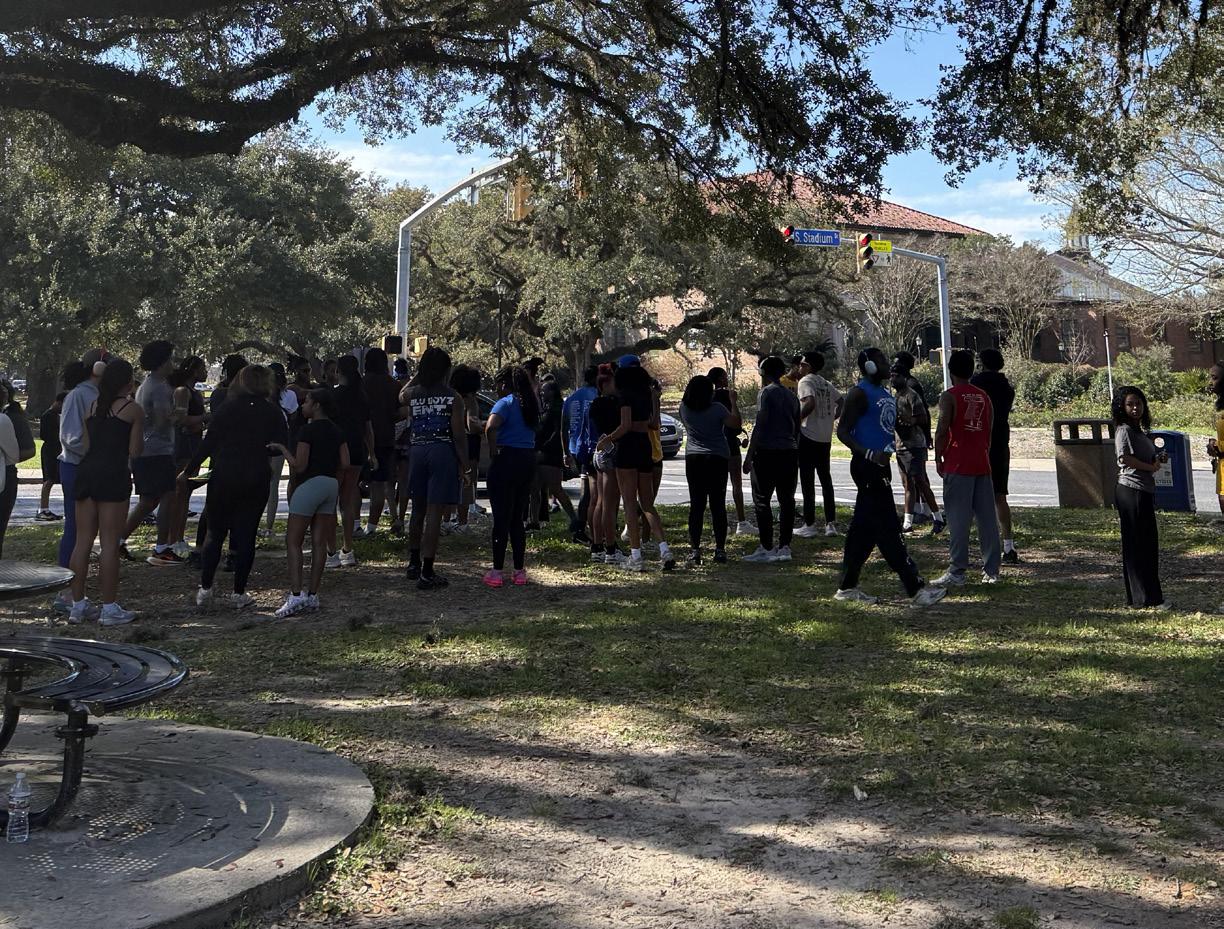
According to Gray, the choice to center the run around Unity Field was intentional.
“Starting at Unity, ending at Unity is everything — not only unity within our organization but unity
kind hosted by the ASU, but the first in partnership with the GCC. According to Kaitlyn Hearty, GCC’s international student engagement coordinator, the ASU was the obvious choice of partners when it came to celebrating Lunar New Year.
Hearty said that around 140 guests had come before the performance, with more likely to show up as the event went on. As the time passed, the event hall grew louder with the sound of people coming together to celebrate the new year as a community.
“We love doing cultural nights to bring different cultures to LSU’s campus,” Hearty said. “We love sharing community with students.”
here at LSU, despite everything that’s going on,” he said. “ I just love that we’re standing for a cause on a field where our people come together. Unity is so much more than a word.”

BY MIA HATTAWAY Staff Writer
Black history is more than just a calendar observance — it is memory, movement, might and merit. For chef Ciara Finley, this is a narrative most poignantly digested through food.
At her event A Love Letter to Black Food, cornbread and collards made savory appetizers for a main dish of culture, conversation and community.
Finley first began her catering business, Desiderata Kitchen, in 2016, prompted by her daughter’s need for allergen-friendly food after a lifetime of casually being in the kitchen.
“That’s how I developed a relationship for food. Before, I just cooked,” Finley said. “Food speaks, and there’s a feeling. You can do things: you can heal, you can make people happy.”
Once an off-site caterer, Finley has found a home for Desiderata in downtown Baton Rouge, where she meets with clients or hosts events, including her recent tribute to Black History Month.
Finley didn’t have this particular event in mind when she opened the space, though. The idea to host a night dedicated to the foods that raised her felt like a natural way to celebrate the month.
“I wanted it to be an experience for anyone,” Finley said. “My clients, anyone that loves me, anyone that loves food in general, I feel like would benefit from experiencing something like this.”
For the 40 attendees of A Love Letter to Black Food, Finley most certainly delivered an experience.
Under dimmed lighting, a long table hosted the majority of the guests, with some opting to sit alongside the main seating at smaller tables set for two. Decorating each of the tables were live flower bouquets and candles, adding to the soft, romantic scenery. The interior of Desiderata is lined entirely by mirrors, which were written on with notes, including “You were measured by spirit, not teaspoons” and “Black food is artistry.”
In between courses, these mini love letters seemed to call out to guests, often prompting conversations.
Finley shared that the writing was intended to be a subtle, grounding aspect of the night.
“If someone catches it, they will,” Finley said. “If there’s someone that doesn’t, that’s fine too. I just want little elements to kind of hit people at different moments.”
The night started with sweet potato cornbread topped with brown sugar and butter. For every six people, there were two plates of bread, making the practice of sharing a core part of the night. Each request to pass the rolls was followed by an introduction to one’s

tablemate. Soon enough, the event felt more like a family reunion than a formal dinner.
Finley’s first course, Butter Beans & Fire, was a velvety puree of butter beans topped with a crunchy fried okra chip and crisped andouille snips. Also included were pickled onions, which brought an unexpected vibrancy to the dish.
Served in a small cast-iron skillet, the mousse-like beans were dense and rich while maintaining a lightness that paced attendees well in the seven course meal.
Down the table, one group discussed their shock in liking the dish, agreeing that they usually avoid butter beans at all costs.
Evident through her true and thorough mastery of the foods featured, all of the dishes were inspired by pieces of Finley’s youth and heritage.
“It’s not a history lesson,” Finley said. “I’m thinking about childhood. I’m thinking about my mom. I’m thinking about the things my brother liked to eat. But I’m thinking about my clients too. I want to make sure that I’m introducing things that aren’t so far off that it alienates my clients that truly understand the brand as well.”
The second course, Collards, Before the Pot, was a bright salad, with shaved brussels and collard greens bedding thin sliced sweet potato, coated in cane vinegar and a mustard seed vinaigrette. Also decorating the plate were tart cranberries and crispy pecans. Though Finley introduced the dish as being bitter, the sharp taste undercut the sweetness of the dressing, making the plate well balanced. Placed over the greens was a thick slab of candied pork.
“I could get proposed to with that piece of bacon,” one attendee said in between bites.
The Velvet Red Bean Soup followed, which was the heartiest course of the night. A thick base, the soup was topped with cornbread croutons, which added a crumble that rounded out the sensory side of the dish splendidly. Finley topped it with a sharp scallion oil and smoky tasso lardons, taking the nutty profile to another
level.
Many of the courses, including the red bean soup, are popular in Creole tradition, echoing Finley’s experience being raised in New Orleans.
“New Orleans is so centered in culture,” Finley said. “Everything is music, food, dance, culture — and all of that is almost all the time. Every time there’s a festival, even if people aren’t actively going to those festivals, they’re celebrating them at their houses with food. Whenever we had family reunions and things like that, there was food. Growing up, it was always around us.”
When curating the menu for the event, she chose to showcase Black cuisine that relates to her own life.
“I wanted to make this personal to me, so it’s not quite Black global,” Finley said. “What some people call Black food might be totally different to me. All of this, to me, looks like art. A lot of what I want to do with this is really just showcase that there’s so much art in this, and there’s culture in this.”
Course four, Memory and Refinement, truly captured the essence of its name. Sitting on top of a buttery yet textured corn maque choux pudding was a gorgeously blackened Gulf fish. Surrounding this was a vegetable ragout, which brought a grounding quality to a quite layered plate. The contrast in flavors read as refined, yet still Southern.
Finley said growing up, her first experiences with cooking were in her mom’s kitchen, acting as her sous chef alongside her sister. This is the very memory she wanted to preserve going into A Love Letter to Black Food as she served her mother’s very own gumbo, which she labeled the Heart.
“Before the recipes were ever written, they were lived,” Finley said. “They lived in the heart, and they lived in the soul. That’s generally how I learned, and that’s how we do it here, too: it’s a pinch of this, a pinch of that.”
The mild chicken and sausage gumbo was presented on a wooden
see DESIDERATA, page 8







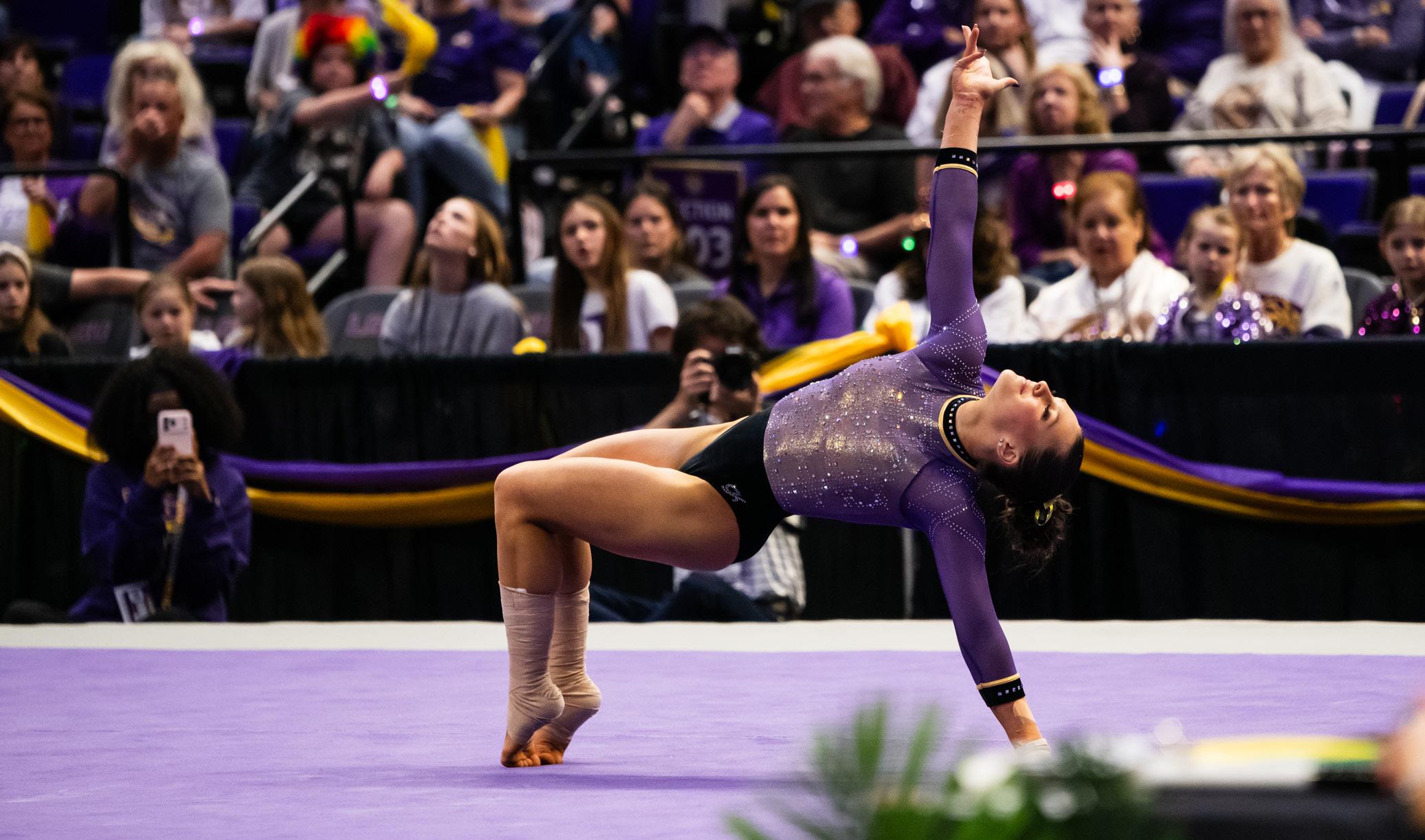
LSU gymnastics secured a 197.975197.600 win after a tough top-3 battle against Alabama on Feb. 27 at the PMAC.

BY MIA HATTAWAY Staff Writer
Hearing someone say L.A., you might think of Hollywood, In-N-Out and the Griffith Observatory. Maybe your mind even goes to Alo Gym and Rodeo Drive. But when it comes to luxury smoothies, the only L.A. you should have in mind is Louisiana, where Dr. FeelGood is serving up health and wellness in Instagram-worthy to-go cups.
Functional smoothies have become popular with Erewhon, a high-end organic grocery chain based out of Los Angeles. Though the upscale grocer is only located in southern California, Erewhon made waves on social media after partnering with Hailey Bieber to trademark her custom order in 2023, now the Strawberry Skin Glaze Smoothie. Coinciding with this menu item was the launch of Bieber’s skin care company Rhode.
The allure doesn’t end with the celebrities attached to the brand, though. Most of Erewhon’s viral power comes from its exclusivity, with the build-your-own smoothie starting at $10 and the signature flavors reaching up to $22 a cup.
Though Erewhon began shipping smoothie kits to select American cities, including New Orleans, it remains largely inaccessible to the general public. Luckily, Baton Rouge has its very own plant-based wellness bar, with a rate of just $11.75 a smoothie and a similar range in flavor profiles as the L.A.hot spot.
Having once been a CBD store, Dr. FeelGood rebranded to a superfood treat supplier in 2024, and it has been well-received by the community since its opening.
In June of its opening year, social media food critic Keith Lee posted a video about the store, which garnered two million views and over 180,000 likes. Less than two weeks later, Lee visited Erewhon, and when reviewing it, he
DESIDERATA, from page 5 serving board, making the course feel all the more nostalgic and homey. The accompanying potato salad instantly became a table favorite, the tang and seasoning proving to be a nice addition to the warm, steady mouthfeel of the gumbo.
Rounding out the main plates for the night was the Sea Ge Cream, a shrimp dish served over gouda grit cakes. The shrimp had a creeping heat to it that paired well with the smoky, savory base in the grits. The Creole garlic white wine sauce, though, made this sixth course pop – the enticingly light topping coated every bite, blending well with the freshness of the seared cherry tomatoes and brightness of the fresh spinach chiffonade.
said, “We just had a smoothie in Baton Rouge from Dr. FeelGood that was just as good and way less expensive.”
For Lee, who travels internationally, to spotlight a small business in Louisiana against such a powerful chain as Erewhon is quite the praise.
And while I haven’t tried any of the $20 smoothies from Erewhon, I can’t imagine it gets much better than Dr. FeelGood.
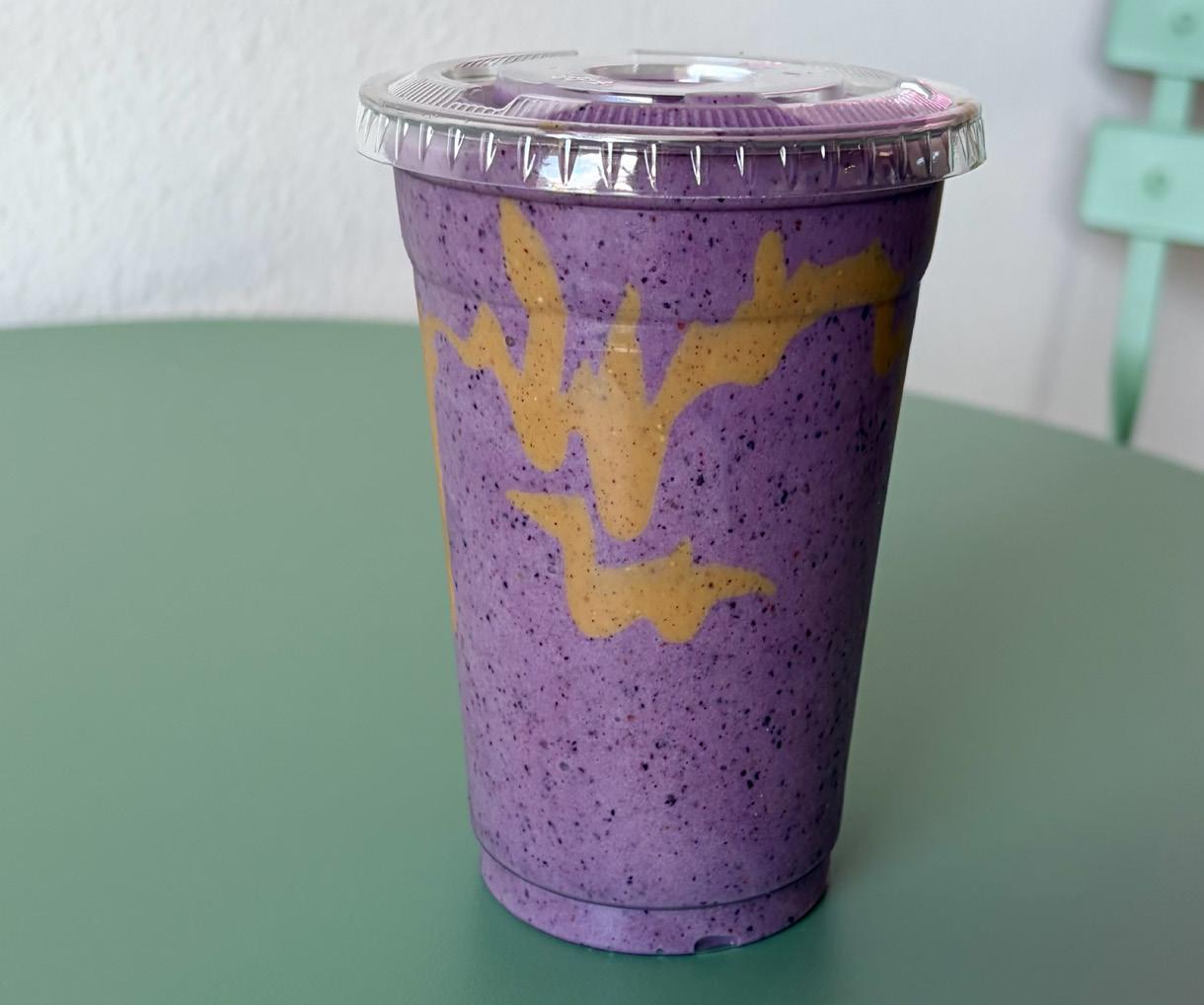
I got the Peanut Butter and Jelly Time smoothie, which has bananas, blueberries, dates and peanut butter, with oat milk as the online ordering recommends.
Knowing that my tolerance for super sweet sips runs low, this was the perfect pick for me.
The sweetness of the main jellyflavored smoothie was well balanced with the richness of the peanut butter, and the creamy texture of the drink had me hooked from start to finish.
Since Dr. FeelGood doesn’t use ice as a blending base, the drink didn’t melt at all, which made for a long-lasting, consistent experience. This consistency
Better yet, it was plated on a woven, burnt orange plate that furthered Finley’s callbacks to her own life. Across the table, a handful of guests remarked that it reminded them of dishware from a grandparent’s house.
Rounding out the night was the Sweet Legacy, a sweet potato custard bread pudding with vanilla bean ice cream, rum sauce, praline dust and orange zest. A perfect mix of comfort and art, the bread pudding was warm with a slight crisp, which created a silky juxtaposition with the melting ice cream and molten rum sauce.
“It’s like a hug or something,” dinner guest Maya Mingo said. “A warm hug.”
At the intersection of the bread pudding and praline dust, this felt like a true synthesis of Louisiana’s sweetest flavors, topping the night
BY PAIGE CHERAMIE Staff Writer
Spring is on the way, bringing with it a burst of greenery. Whether you’re an experienced gardener or looking to get into the hobby, there are many places in and around Baton Rouge that can help you delve further into the hobby of plant care.
The Plant Barn Baton Rouge
The Plant Barn Baton Rouge is a locally owned plant store that houses all your plant care essentials. The inside of the building is filled with gardening supplies, while the outdoor area is dedicated to a large variety of plants.
It offers a multitude of florals and outdoor plants for those looking to spruce up their yard, alongside a selection of indoor plants, perfect for bringing some greenery to your apartment or dorm.
is especially impressive when considering the smoothie was made with oat milk, an ingredient known for separating in most drinks.
Overall, it was an experience that I already can’t stop thinking of; as soon as I took my last sip, I immediately started planning my next visit.
Though this spot is more pricey than my average coffee order, I would say it definitely is worth the price. While it may not seem like the cost-effective option for a smoothie in Baton Rouge, Dr. FeelGood’s blends tend to be cheaper than any acai bowl close to campus, and they are being more versatile in flavor.
In a wellness culture driven by exclusivity and influencer marketing, Dr. FeelGood offers quality products at a fair price, proving that health isn’t just a fad in Baton Rouge — it’s a priority. Functional smoothies shouldn’t break the bank, and this local business is making sure that healthy foods can be accessible, aesthetic and authentic all at the same time.
off in a playful but satisfying way.
When reflecting on the night, Kimberly Moore said the food “appealed to every sense.” Finding out about the event through social media, she decided to invite her friends for an early birthday celebration, and it’s fair to say that the night lived up to her expectations.
“The experience was like none other,” Moore said.
While the night technically ended with a sweet treat, most guests lingered, taking pictures of the phrases on the mirrors, asking for to-go containers and trading contact information with the guests they spent the night with.
A Love Letter to Black Food wasn’t strictly about honoring tradition — it was a reminder that Black food as an artform continues to cook up community and legacy, one plate at a time.
The Baton Rouge Succulent Co. is home to a wide variety of succulents and air plants, with traditional house plants also in the mix. If you’re looking for a low-maintence plant, this is the place for you. The store offers workshops and classes, great for beginners to learn how to care for their plants.
The Baton Rouge Succulent Co. is located at 7276 Highland Road, and it is open Tuesday through Saturday from 10 a.m. to 5 p.m. and Sunday from 10 a.m. to 3 p.m.
The Plant Barn Baton Rouge is located at 2912 Valley St. Its spring hours are 8 a.m. to 5:30 p.m. every day of the week. The store has a pet-friendly policy, and customers are encouraged to bring their furry friends along for a visit.
Louisiana Nursery
Louisiana Nursery is great for beginner gardeners. It offers a diverse set of plants, from cacti to trees. The Louisiana Nursery prides itself on its workers, who are incredibly knowledgeable about the plants found in their store. If you have any questions about plant care, they are always willing to help you decide which plant is right for you.
The store houses a multitude of gardening supplies, from a variety of flower pots to any soil type you can think of. The nursery also carries decorative pieces of all sizes, perfect for bringing a flare of personality to your garden.
There are three Louisiana Nursery locations, with the closest to LSU being located at 8680 Perkins Road. They are open 9 a.m. to 5 p.m. daily.
Baton Rouge Succulent Co.
The Beavers Abundance Native Plant Nursery is dedicated to supplying people with native Louisiana plants, promoting conservation and deterring invasive species. These types of plants are great to keep on a balcony or patio, and they attract many native pollinators and insects.
Alongside plants, the store is home to an eco-boutique, which is filled with sustainably crafted products from community members. It also features many ecofriendly products that visitors can use in their everyday life.
The Beavers Abundance Native Plant Nursery is located at 17873 Old Jefferson Highway. They are open Wednesday through Saturday from 10 a.m. to 4 p.m. Since plant availability is dependent on the season, the nursery recommends that you call ahead when looking for a specific variety.
Clegg’s Nursery
Clegg’s Nursery is dedicated to keeping the art of gardening alive. It offers many gardening essentials, with major sections of florals, vegetables, shrubs, herbs and trees. It also offers house plants, along with any supplies you may need to care for them.
Clegg’s Nursery has many locations, with the 5696 Siegen Lane location being the closest to LSU. The store is open from 8 a.m. to 5 p.m. Monday through Saturday, and opens at 9 a.m. on Sundays.

BY RAMI BURKS Staff Writer
It was a sunny day in Alex Box Stadium as LSU baseball took on Dartmouth on Sunday, and the home-field advantage played well for the Tigers. The 3-0 contest was courtesy of a few sun balls.
The LSU offense was a bit stagnant throughout this weekend of baseball, but the cold bats were bailed out that afternoon. In the fourth inning, back-to-back fly balls lost by outfielders-in the sun allowed shortstop Steven Milam to hit a double and score.
The offense had several misses on fly balls that kept this game being a lopsided score. There were 14 balls hit in the air, and only four of them benefited the Tigers.
The third and fourth balls hit in the air that benefited them were courtesy of right fielder Jake Brown. He blasted his fifth home run of the season during the first inning and had another RBI in the eighth inning off a warning track line drive.
He’s had high expectations placed on him early this season, and head coach Jay Johnson said he could’ve played even better today.
“[Brown is] just so good,” Johnson said postgame. “He can overcome maybe not being at his best. I don’t think he’s at his best right now, and I’m just talking about a guy that’s probably an All-American if the season ended today.”
Those were the only hot swings of the game because LSU struck out nine times. This team had only struck out 16 times entering Sunday’s game.

Feb. 15 at Alex Box Stadium.
The sun might have helped for one of the runs, but the 10 other fly balls hit didn’t help LSU’s case. However, Johnson said on Saturday after the game against Northeastern that many of these fly balls should turn into line drives as the season progresses.
“It’s never as good as it seems, and it’s never as bad as it seems,” Johnson said after the game versus Northeastern. “Maybe you’re not running balls out of the park and hitting liners, but the guys that I know will do better are some guys
that can play better right now. That’s actually a really good thing to have.”
But the Tigers’ pitching has been downright dominant to help pick up the slack this weekend, and Sunday’s game was no exception. William Schmidt started on the mound, and he went 7.1 innings, and struck out nine batters. That ties a season high for the Tigers’ Sunday starter. Schmidt was straight dealing on his 95 pitches. He didn’t walk a single batter but hit one. This left the bullpen with plenty of
depth for later in the game.
“[Schmidt] absolutely suffocated the zone, and that’s hard to hit when guys land in that many pitches for strikes with that kind of stuff,” Johnson said postgame. “It’s strikes pressure, it’s pitch pressure, and what I mean by that is not only pitches, it’s execution.”
This game was the first this weekend in which LSU needed more than two pitchers to complete the contest, and the Tigers used
BY MARISSA REISS Staff Writer
To conclude its final tournament of the regular season, LSU softball extended its win streak to 10 with another immense display of mound command and a patient but explosive offense.
On a busy Saturday for LSU sports, the Tigers claimed a 5-3 victory over Iowa and a 4-0 win over Memphis to close out February 17-4 and find a groove ahead of conference play.
LSU’s offense took advantage of its opponents’ pitching, drawing a total of 15 walks throughout both games.
Game 1 against Iowa began with Jayden Heavener in the circle, seeking her sixth win. Heavener’s first inning was a quick 1-2-3 outing. She went on to allow only three runs and four hits with two strikeouts.
Iowa’s ace, Serayah Neiss, headed into the matchup 7-0 against opponents. With a fierce combination of Tigers in the lineup, especially in the first three spots, she faced some trouble in the first four innings that would ultimately result in her first loss.
Centerfielder Jalia Lassiter started off the offense, showing off her patience at the plate that’s often hidden behind her bat strength. Lassiter drew a walk to see BASEBALL, page 10 see SOFTBALL, page 10
BY DELANEY POTTHAST Staff Writer
A momentous weekend for LSU gymnastics saw a Sunday afternoon takedown at the Baton Rouge River Center.
After earning a win just 48 hours before, LSU gymnastics found another win at the Podium Challenge, where it took down Alabama, North Carolina and Arizona behind a final score of 198.200.
“Two meets in three days is a pretty daunting test,” head coach Jay Clark said. “You’re getting a little too close to the post season to be taking a hit to our confidence, we need to build it, so we did that.”
Given the traditional Olympic order rotation, one of the most exciting events of the evening for LSU was the balance beam, when it earned an overall score of 49.625, just a .025 behind the season-high for the team.
Performing as the leadoff was
Kylie Coen, who earned a solid 9.875; however, all eyes were on Amari Drayton, who suffered a fall on the event just two days prior against Alabama. Her story tonight was much different as she earned her fourth 9.925 this season.
Drayton’s score would soon be one-upped by both Konnor McClain and Kailin Chio.
McClain, who had found a breakthrough the meet before, kept the momentum as the junior went 9.925 on beam for the second time this season.
Chio followed up with her third consecutive perfect 10 on beam. With the flawless routine, she now sits at six career 10s, which is the most of any NCAA gymnast this season, to maintain her No. 1 national ranking on beam.
“That’s pretty much the way you want a double weekend to go,” Clark said. “To move some things in the lineup and have the level of performance we did today — we’re
really pleased with how that went.”
The reliable Lexi Zeiss started a big night on vault for LSU in the leadoff spot. She tied her season high 9.900 with a stick.
McClain followed Zeiss, carrying the momentum from Friday’s meet right through the weekend. A stuck vault saw a new season high on the event for McClain with a near-perfect score of 9.925 on the vault that only allowed a 9.950 start value.
Further down the lineup was runway staple Drayton, looking to make up for lost scores against Alabama. A perfect landing tied her season high of 9.950.
By the end of an energetic vault rotation, the Tigers found themselves leading all three of their competitors by a score of 49.475.
Despite being the usual leadoff, Zeiss took a break on the uneven bars and handed over the position to freshman Haley Mustari.
Mustari wasn’t the only lineup
tweak in the bar rotation as Ashley Cowan and Alexis Jeffrey returned.
Cowan put up a routine against Alabama on Friday where she found a season-high 9.925, and she tied it again tonight. From there, the remainder of the lineup saw sticks for almost every routine after.
As they dismounted the second event, Chio’s season-high 9.950
helped push the Tigers further into the lead.
By the end of the meet, LSU had set itself up for an exciting floor rotation.
Coen returned in the third spot of the lineup to quickly become the highlight of the event, where she

BY BROOKE BENEDICT Sports Columnist
LSU has elite athletes across all sports, but the attention is not always distributed equally.
The school is known for earning a new national championship banner every year, sending players to be firstround draft picks and producing Olympic stars at every turn. In all that success, talented Tigers in the smaller sports can easily get lost.
Notable athletes such as Haleigh Bryant and Angel Reese made their mark in their sports at LSU and were recognized for it by fans and media. We all know that story.
But do we know the story about the newest addition to Team USA’s women’s soccer team?
LSU’s soccer star athlete, Sariyah Bailey, has been called up to play with the USA Women’s U-19 National Team for training in Portugal. She becomes LSU’s first active player
Bailey, No. 13 in Top Drawer’s top-100 freshmen, earned All-SEC and SEC All-Freshman
BASEBALL, from page 9
four. One pitcher only threw two pitches, and the other only threw to one batter.
Sophomore Mavrick Rizy took the bump in relief, and he was just as electric as Schmidt. He threw 1.1 innings and had three strikeouts, but it was Jaden Noot who put the game away for the Tigers by slamming the door shut on Dartmouth with two outs in the ninth inning.
After sending nine pitchers to the bump during the Tigers’ midweek game versus McNeese, this weekend has been a dream for pitching coach Nate Yeskie. It sets LSU up great for the long week of baseball ahead.
LSU will face Northeastern again on Monday for a rematch after Saturday’s 3-1 ballgame. The first pitch will be at 6:30 p.m. at Alex Box Stadium.
GYMNASTICS, from page 9
danced her way to a 9.975, marking a career-high for the Tiger.
“It was just something I do every single day and I’m grateful that was the score that came out tonight,” Coen said. “I wouldn’t be able to do any of it without my team cheering me on and the fans here tonight. It was just a blast.”
Supporting performances from Drayton and Madison Ulrich would soon add to that, as the two gymnasts posted a pair of 9.900s.
By the last beat of music, the Tigers had settled in first, ahead of Alabama in second by 0.550 points to close out the weekend.
As the team heads into the final two weeks of the regular season, it prepares to take on the No. 4 Florida Gators on the road in hopes of yet another top-five takedown.
Team honors while at LSU this season. In her first season, she recorded 19 starts, nine goals and seven assists.
LSU soccer, while coming off a Sweet 16 appearance last season, is used to being overlooked.
In a school defined by baseball talent, football legacies, basketball atmospheres and gymnastic, dominance some excellence shines just outside of the main spotlight.
That’s where Bailey stands.
But she’s not alone.
Beach volleyball transfer
Zayna Meyer arrived in Baton Rouge as one of the nation’s top setters, joining a ranked beach volleyball program. But most LSU fans don’t know her.
Meyer came from UCLA, where she played her last indoor volleyball season. The 6-foot-1 setter came to LSU’s beach volleyball team in early December.
In her redshirt sophomore season back at Long Beach State, Meyer was named the 2023 Big West Setter of the Year and then became the sixth player in Long Beach State Women’s volleyball program history to reach the
SOFTBALL, from page 9
reach base in the first at-bat of the game, with second baseman Sierra Daniel walking right after.
Sophomore Char Lorenz hit a sacrifice fly to advance Lassiter and Daniel, with first baseman Tori Edwards up next to attempt to knock in a run. A throwing error by the Hawks’ shortstop allowed Lassiter to cross home and score the first run for the Tigers before a quiet second inning.
A diving play by Lorenz in left would be crucial in the third inning for Heavener and her defense to get out of a jam that advanced an Iowa runner to scoring position. Despite Lorenz’s efforts, a fielder’s choice to record an out stealing second allowed Iowa’s Kiyah Chavez to score before the inning ended.
In retaliation to the Hawks’ run in the top half of the inning, Daniel knocked a double to right to kickstart the bottom of the third. Lorenz then hit a double down the leftfield line to allow Daniel to come home for the second run, putting LSU up 2-1. The rest of the inning was quiet with three lengthy outs.
The bottom of the fourth was a big one for the Tigers’ offense. Utility Maddox McKee, designated hitter Destiny Harris and Daniel loaded the bases with Lorenz due up at the plate.
Lorenz clobbered a double to the wall, just inches short of a home run. Iowa’s left fielder initially caught the ball but dropped it out of her glove, allowing three Tigers to quickly hustle across the plate to take a 5-1 lead.
Iowa went on to score its second run in the top of the fifth after an RBI double by infielder Nailyn Marshall. On the other
3,000 career-assist milestone, in her redshirt junior season.
She’s a talented addition to an already sought-after team. The “Sandy Tigs” are ranked No. 12 in the AVCA Preseason Poll.
Any casual LSU fan just learned something new. A diehard is hearing the same story about Bailey and Meyer. I’m not here to judge who you are, but to simply just prove a point.
But here’s the thing. Right now, LSU has excellent athletes. But as we can see, excellence doesn’t guarantee attention.
The only difference in the athletes is how much they are celebrated. At this school, success isn’t the problem. Attention is.
That’s exactly what it boils down to: fan psychology.
When you look at the sports that are celebrated and known for their greatness at LSU, it’s easy to highlight athletes in those sports. Not because they are better, but because they are seen.
Bryant and Reese are perfect examples.
During her time at LSU, Bryant filled her trophy case with
five All-SEC championships, and the 2023 SEC Gymnast of the Year, award while drawing some of the biggest crowds LSU gymnastics has seen. Around the same time, Reese was named the 2024 SEC Player of the Year, drawing her own record-breaking crowds for women’s basketball.
While Bryant was becoming the first LSU gymnast to average scores over 9.900 across all four events on Friday nights, Reese was averaging 23.0 points and 15.4 rebounds on the other nights, all in the same arena.
Reese and Bryant both contributed to the first NCAA national championship titles for their programs, creating a new sense of national attention to them as athletes and to their teams.
Highly praised sports aren’t always the ones that end the season victorious. Sometimes they don’t have a Heisman winner or even a head coach. But they always have packed stands. Therefore, their athletes are recognized and celebrated all season long, which they deserve.

But those aren’t the only sports and athletes that are deserving.

end, the batters that stepped up to the plate for the Tigers’ offense in the fifth were quickly sent back by Neiss.
The top of the sixth caught Heavener in an unusual stall. The bases were loaded after the sophomore pitcher walked two of her first three batters faced.
Iowa’s catcher Leah McAnally hit a single to center, which scored a Hawks run, shortening LSU’s lead in the ballgame. Nonetheless, Heavener got herself out of the inning with a solid defense standing behind her to allow
only one run and one hit. Heavener came back in hopes of closing down the final inning, and that’s exactly what she did with the help of her outfielders.
Three quick flyouts handed the Tigers a 5-3 victory.
LSU entered Game 2 versus Memphis looking to extend its now nine-game win streak. The Tigers won their previous matchup against the program Friday night in an 11-2 run-rule victory, as well as a 3-1 victory over Nicholls.
Paytn Monticelli started on
The requirement isn’t to pack the LSU Beach Volleyball Stadium this weekend, but to recognize the elite athletes dressed in purple and gold, without Team USA having to do it first.
the mound this time around, looking to pick up her second win on the season. Monticelli closed out the first with two huge swinging strikeouts, not allowing a single hit. She went on to record seven more strikeouts in the game, good for a total of nine.
Taylor Caton started on the diamond for the Grizzlies to face the top of LSU’s batting order. Caton struggled with walks that consistently hurt the Grizzlies defensively, totaling four walks in her two innings pitched then Mya Clark came in to relieve Caton.
Kylee Edwards was the first Tiger to walk, with third base Ci’ella Pickett battling foul balls to drive in LSU’s first run on an RBI double. LSU scored once more as Pickett reached home on a throwing error by the Grizzlies catcher to advance the Tigers’ lead 2-0.
Clark’s time came to an end after three consecutive walks loaded the bases for the Tigers. Jericho Tate entered in relief, but she hit Alix Franklin with a pitch to bring Lorenz home. Bergeron scored one more run in the inning to make it a 4-0 game.
After a lull, Lassiter scored in the bottom of the sixth on a double play to advance the Tiger lead once more. Maci Bergeron then hammered a huge three-run home run for her first of the season, lifting the Tigers up 7-0.
Pitcher Ashlin Mowery closed out the seventh to relieve Monticelli. A leaping grab by Edwards at short recorded the final out to keep the Tigers undefeated at home this season.
LSU now focuses on conference play, as it starts in Knoxville against No. 1 Tennessee on March 6, facing a program that sits at 18-0.

MIRIAM EVELYN REESON Columist
When my father reminisces about his time at LSU way back in the ‘80s, he describes a campus which seems totally foreign to modern students.
During his undergrad years, LSU was in the middle of nowhere. The only development around campus was Tigerland and El Cid. Along the Burbank corridor between El Cid and Gardere, one could find nothing but forest.
In the last couple of decades, the areas surrounding campus have seen major development. In the eight years that I’ve lived near campus alone, the area has become almost unrecognizable. The Main Campus has become boxed in by all sorts of commercial enterprises designed to make money off the ever-growing student population.
The businesses investing in the local neighborhoods understand that they have a sort of captive audience. While students may graduate and leave Baton Rouge, there will always be a new class of freshmen for them
to make money off of. As LSU admits more and more students each year to cover costs, these businesses see an opportunity to make even more profit.
No consideration has been given to whether or not the area even needs some of these projects. Off of Burbank, 7Brew is located less than 1,500 feet from CC’s Coffeehouse, which itself is a mere 250 feet from the newly opened Dutch Bros Coffee. This is in addition to rumored plans to potentially open a Dunkin’ and maybe even a Starbucks practically next door. The drive to open new businesses is creating redundancies that are likely to hurt individual stores in the long run.
The problem extends to housing as well. Low-cost student apartments are a staple of the area and are generally seen as a blessing by broke students. The complexes, however, are notorious for often being of rather poor quality. I’ve heard horror stories from friends and colleagues of mold, leaky roofs and roach infestations.
Even now, more apartments are being built along Burbank by companies which promise to “promote academic excellence” through their quality of living.
This is a common promise. In
practice, corporate landlords buy up land, develop low-quality housing, and take advantage of their tenants. The fact that so many of these landlords are corporations gives them a degree of separation from their tenants, which makes it easier for them to commit such abuses.
While the city government has been happy to approve new commercial enterprises and reap the taxes such endeavors generate, it has completely neglected the things which actually make a city function.
Walkability is practically nonexistent due to a lack of sidewalks or crosswalks. While the Burbank area enjoys public transit, bus stops are left completely uncovered and oftentimes have no seating at all. There are no parks or other public recreation areas, and massive potholes litter every road.
The Metro Council needs to remember that this area is made up of more than just students who will leave in a few years. There are whole families here trying to carve out a life for themselves. Even those who don’t plan to stay long-term should have access to quality infrastructure and essential services.
For example, the Burbank corridor is lined with wooded areas which
would be prime real estate for new parks. Everyone should be able to enjoy the serenity of nature through BREC. With so much undeveloped land, the city-parish government has the opportunity to create a truly special urban environment near campus.
To do so, the Planning Commission and Metro Council must change their priorities. Projects need to be approved which actually improve residents’ quality of life. As it stands, they are too busy carrying out the whims of private business lobbying groups.
Groups like the Louisiana Association of Business and Industry pour millions of dollars into politicians up and down the state. They do so
in order to sway public policy away from the needs of the citizenry and towards the whims of private business. Their ability to capture our officials through donations is what leads to poorly developed areas like the Burbank corridor.
As long as corporations are allowed to dictate public policy, the situation won’t improve. We’ll continue to get new ways to spend our money and little else. Corporate influence must be rooted out of government if it is ever to work for the people it is meant to represent.




I was only 16 when my childhood friend Owen Tabor died by suicide. Owen was 15 — 15 years old and he felt like there was nowhere left to go.
I will never forget the day he passed. On April 29, 2023, while in the back of my aunt’s car returning from Lafayette’s Festival International, I opened Snapchat to find the image of a 33, Owen’s football jersey number, centered on a black ribbon on my friend Marianna Toney’s story. I remember a slow-creeping dread welling as I called her, and she answered in screams:
“Owen is dead. He shot himself.”
From then on, it felt as though everything was happening underwater: a slew of rosaries, butterfly releases, gatherings at an all-too-fresh grave, a funeral — and then nothing. It was summertime, and everyone was left alone to sit with what happened.
Owen and I had been best friends almost immediately after he transferred to my middle school; in high school, however, we weren’t as close. I loved him all the same.
When you grow up with someone, you carry pieces of them with you forever.
That was certainly true with Owen — I remember his nasally laugh, his indelibly enormous grin, his incredible sense of humor, self-awareness, kindness and especially the way he considered me when others were quick not to.
After his death, I developed severe depression and heightened anxiety. My grief consumed me, as it did all of us. I thought about returning to school and pretending as though things were normal. I thought about how life would go on without Owen.
He would never graduate high school, go to college, get married, have kids or grow old alongside us all.
I became very nihilistic — I kept wondering what the point of everything was. If someone so young and bright could feel so hopeless, where did it leave the rest of us?
I don’t think I was alone in wondering if dying would be easier.
There’s a reason why we so casually joke about killing our-
selves. Why we joke about jaywalking and seeing what happens afterward. Why death is such a quick, easy answer to our problems, even with half-formed intent.
As awful as it is, it is unsurprising as nearly 42% of Gen Z struggles with depression and hopelessness. Additionally, 3.8 million Americans in 2023 “made a plan for suicide.”
It’s not hard to understand why, either. We live in such a fast-paced society. One that has become increasingly focused on efficiency and productivity, particularly in America. One that treats people as replaceable and as statistics. One that has set incredibly high stakes for incredibly mentally and emotionally underprepared children.
Children sit in school for eight hours a day for 12 years of their lives, at the end of which they’re pushed into the worlWd and expected to know what to do with the rest of their lives.
Beginning in third grade, our youth undergo standardized testing that only intensifies each year. By eighth grade, schools are already rolling out career aptitude tests to 14-year-olds.
If you’re “gifted,” you are put in accelerated honors, dual enrollment and AP courses, often with incomprehensible workloads.
Additionally, if you are an athlete like Owen was, you have the added pressure of greatness on and off the field, along with further time commitments. Then students are sent home with multi-hour workloads in addition to extracurricular expectations, leaving no time for rest or recovery.
As children, we watch our parents work ad nauseam and struggle for it, even if they are successful. Nine-to-fives bleed into home life, and suddenly there is no time to understand ourselves or each other. It’s a bleak reality — “work to live” has essentially become “live to work.”
However, we live in a time when people are becoming increasingly aware of the importance of mental health, which you’d think is a good thing — schools and workplaces have invested heavily in counseling efforts, educational seminars and other resources — but these workloads continue to pile up, and providing resource access is now the bare minimum.
There is a fear of doing the actual legwork of supporting mental health recovery efforts:
actually having conversations and adjusting the systemic issues perpetuating hopelessness instead of simply virtue signaling.
All of this said, it’s hard not to understand the hopelessness Owen felt. In an interview with Owen’s father, Jordan Tabor, cofounder of the Rain Will Bring Flowers Foundation, and Shelly Mullenix, a senior associate director for health and wellness with LSU Athletics, both affirmed the above sentiment.
Mullenix insisted that there is an extreme “lack of balance” in the role work plays in the lives of Americans, particularly in the weight put on young people.
While discussing alternative workload strategies, particularly those adopted by Eastern Hemisphere institutions, such as lowhomework policies and shorter workweeks,
Mullenix insisted that balance “is clearly possible. You can have both. Productivity modification with higher retention and contentment rates [are possible] too.”
There is, unfortunately, an unwillingness to experiment with these ideas in America for fear of falling behind in progress.
And so we’ve developed this overtly positive and seemingly forward-facing culture of vulnerability. The now-common phrases of “check on your friends” and “it’s OK not to be OK” are wonderful and necessary, but
they also exist in part to relegate the responsibility of tending to mental health to an individual level instead of facing the overarching systemic issues on the systemic level.
Tabor said that before Owen’s passing, he “felt like suicide and mental health were things that never would have impacted [his] family.”
He likened mental health awareness to “white noise,” something that “wasn’t applicable until it was applicable.”
This is the tragedy of our culture today: Around one person every 11 minutes dies by suicide in America, and we are still unaware of our proximity to potential tragedy. We’re collectively convinced that it’s someone else’s problem until it becomes ours. The pace of our society has made us complacent in the loss of stillness required to understand each other.
This is the worst symptom of America’s disease, of a culture that prizes efficiency over empathy. The stigma around mental struggle, suicide in particular, has shifted from fear of hard conversation to fear of change beyond the hard conversation.
It’s made the mental health movement a monoculture that fronts awareness and yet lacks real aid — it has become a common good we all expect each other to handle, but none are comfortable in doing so.
We have to do better as indi-
viduals and as a country — we cannot afford to fear change, especially when it means saving lives.
It is heartbreaking to know that we will never get to speak to Owen face-to-face while on this earth again, never to say “I love you” or “I miss you” except to the sky. There is an unimaginable pain that his family faces far worse than I or any of our friends, but there is perhaps a light at the end of the tunnel.
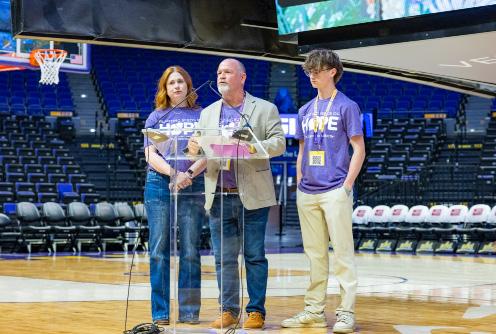
Events like ‘Rain Will Bring Flowers’ third annual “Planting Seeds of Hope” gathering for suicide and mental health awareness, started in Owen’s honor and held this past Tuesday at the PMAC, give me hope that we’ll collectively begin to fight to prevent the very real human cost of mental health struggle.
All it takes is one conversation to plant the seed of hope. Be the person who commits to that conversation and to the change that is required beyond it.
Know that you are not alone, that you are loved and that there is so much joy to be had by continuing to choose life.
This article is dedicated to O, his family, the St. Michael graduating class of 2025 and anyone who has struggled with or knows someone who struggles with suicidal ideation.
Riley Sanders is a 19-year-old biology major from Denham Springs, La.