


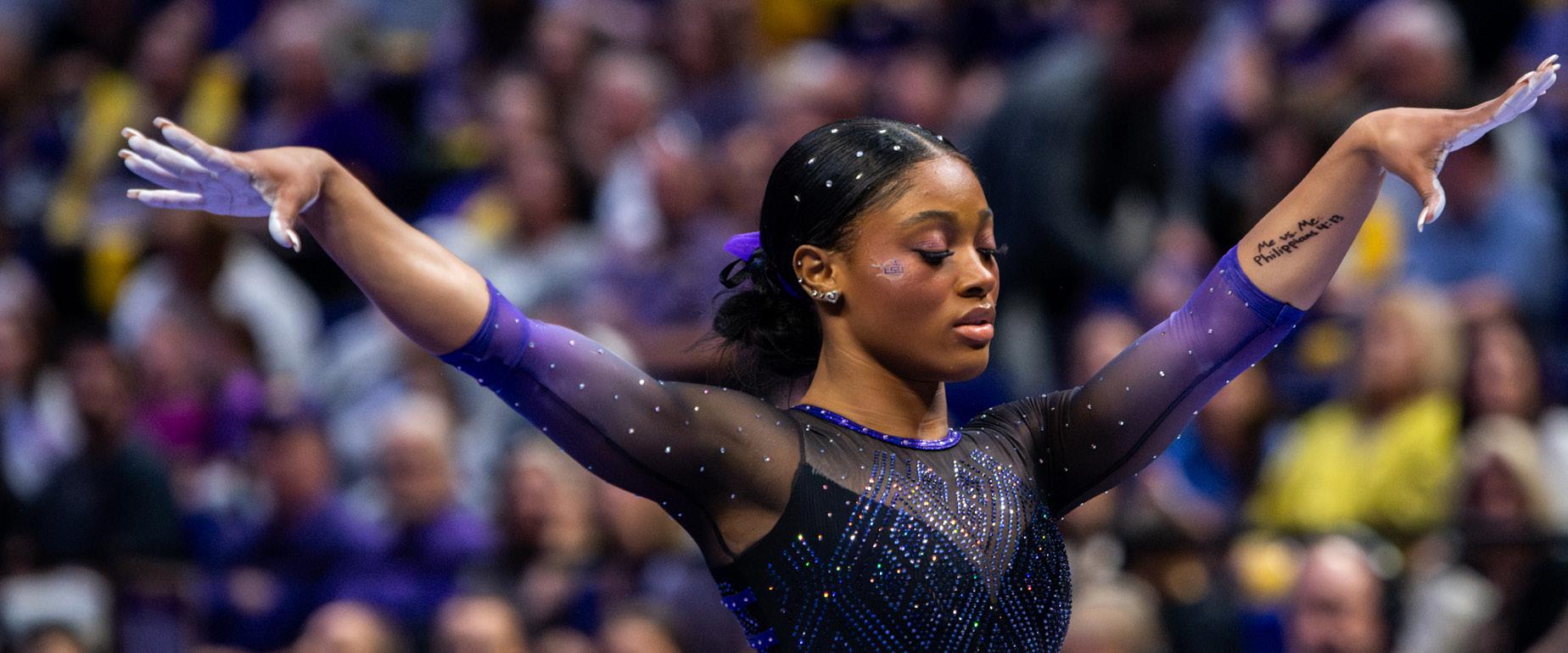
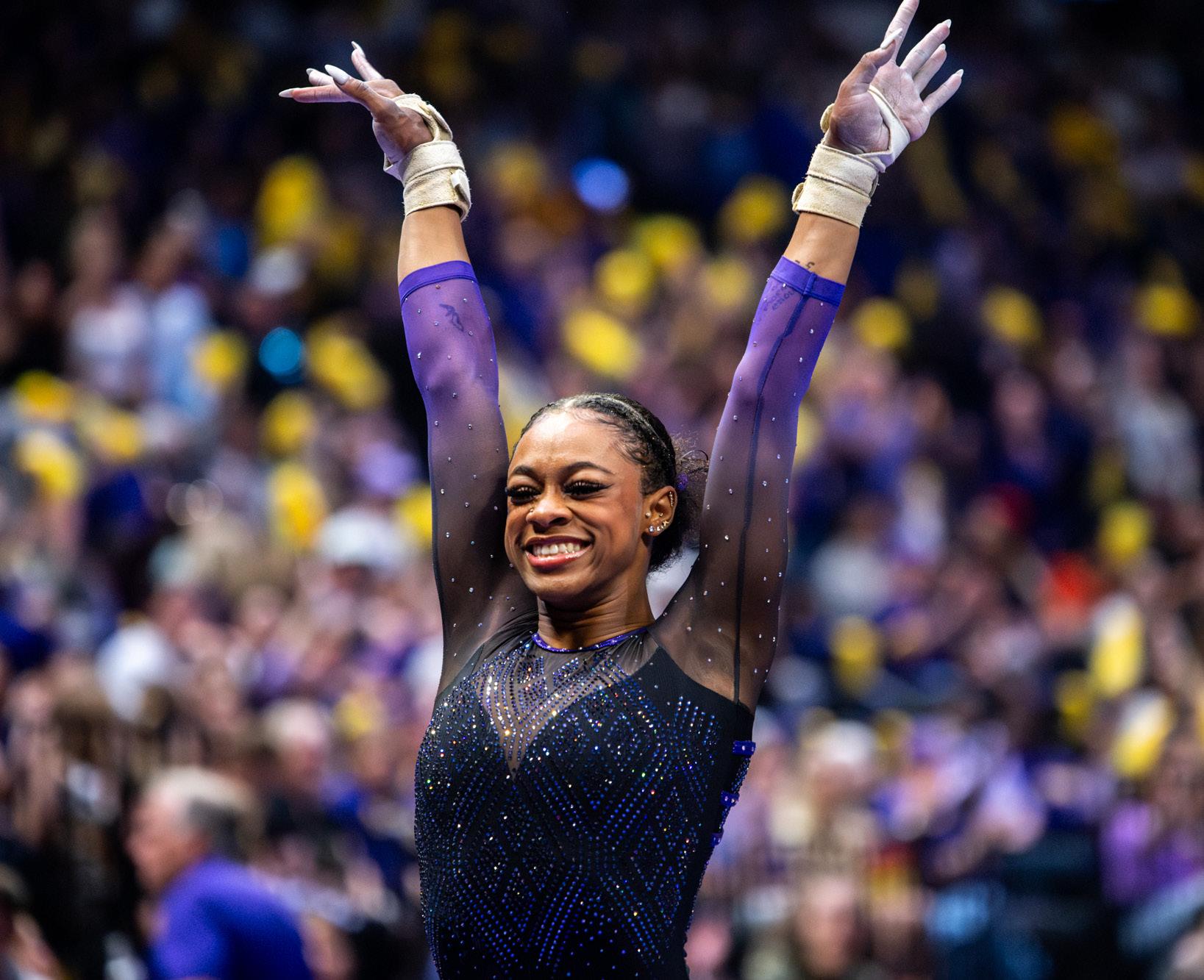
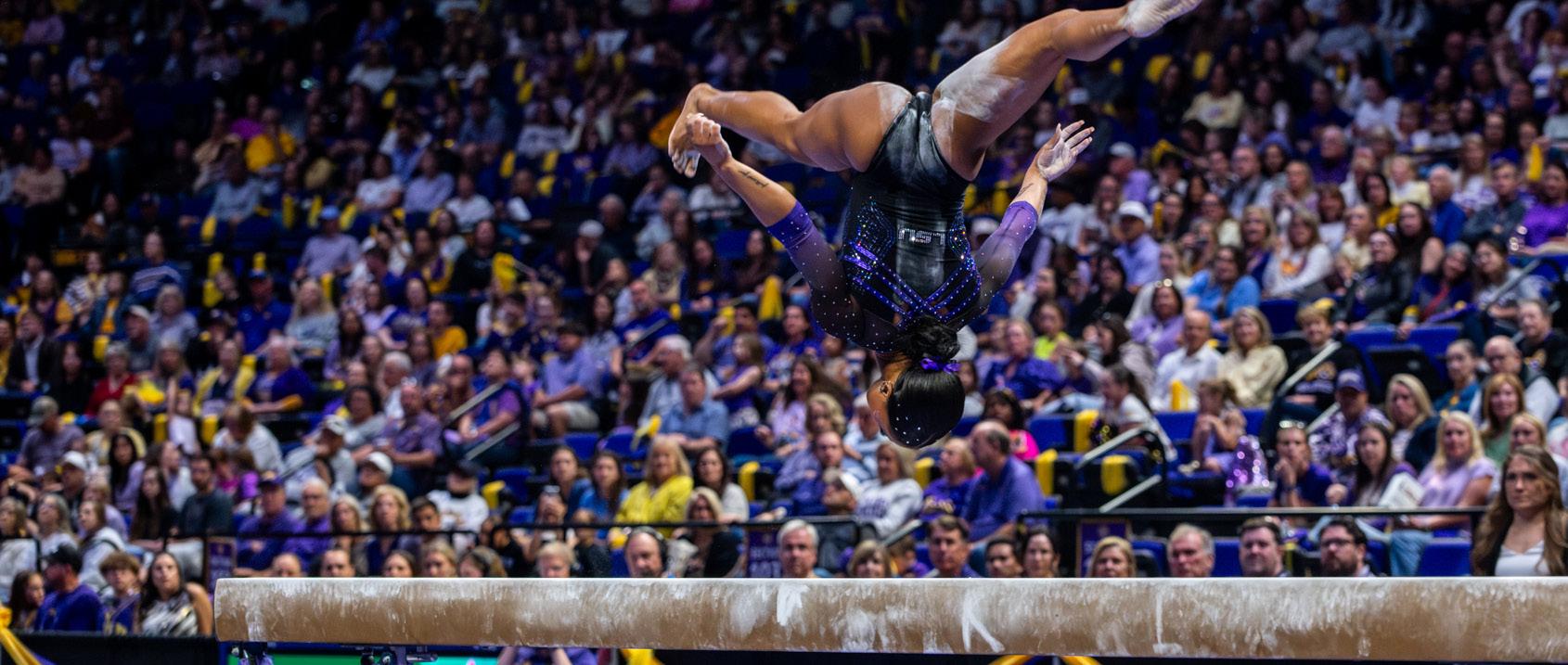
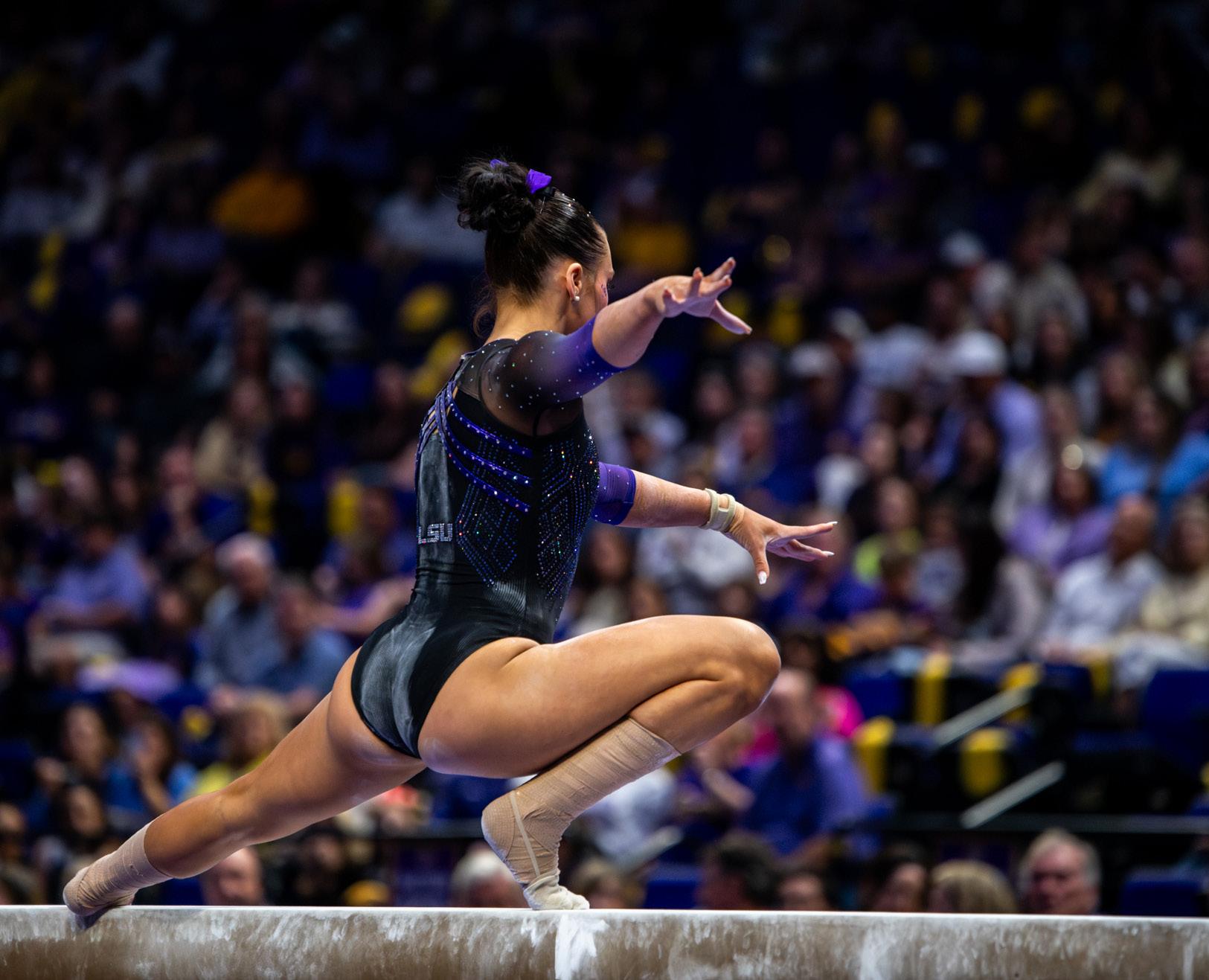
Kailin Chio becomes LSU’s second gymnast ever to earn three perfect scores in one night.

Read on page 2

BY GABBY GRAY Staff Writer
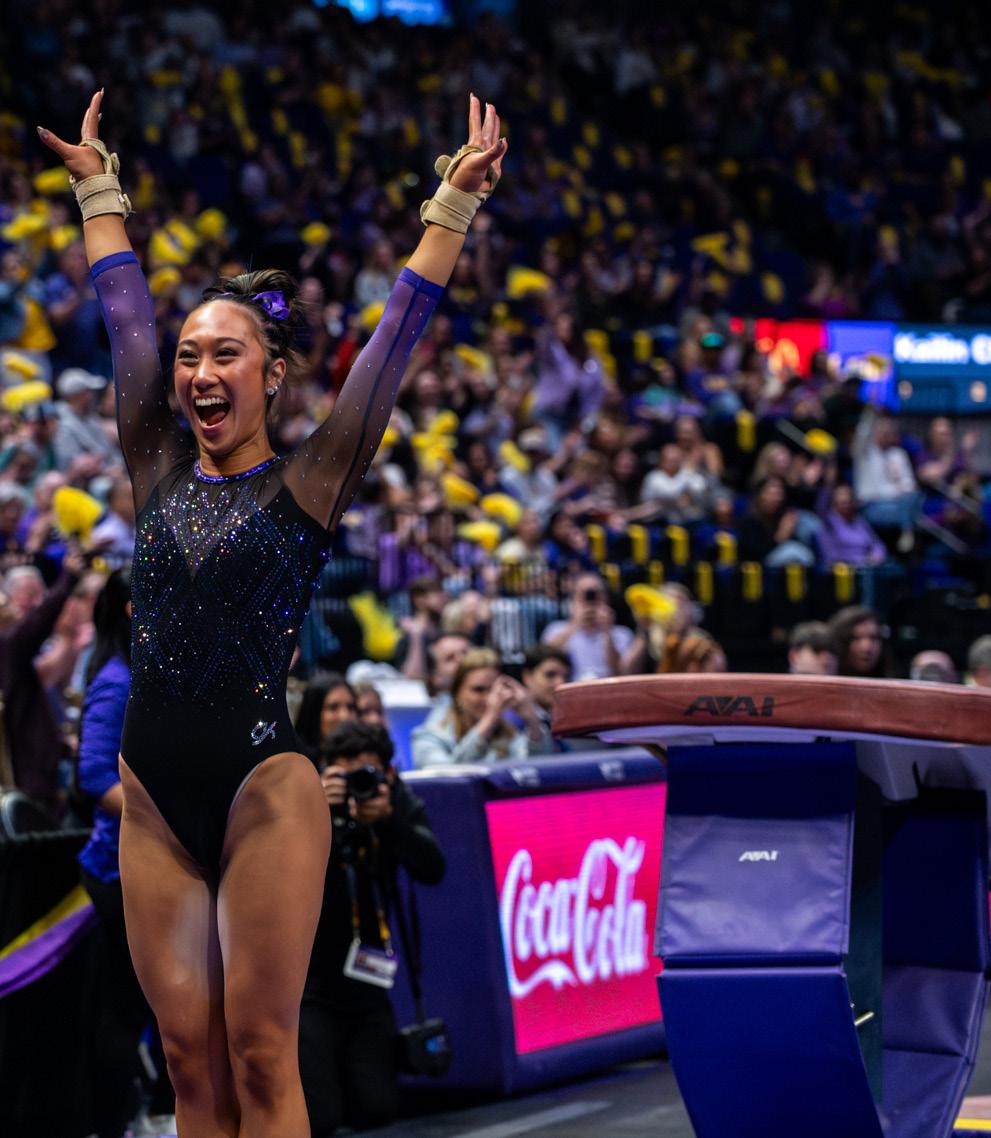
Sophomore Kailin Chio made history with three perfect scores for No. 2 LSU gymnastics in front of a packed PMAC crowd as the Tigers hosted their final regular season meet against No. 8 Arkansas.
The Tigers also celebrated their annual senior night and earned a 198.075-197.100 victory over the Razorbacks at the Friday meet.
Judges awarded Chio a perfect 10 on vault, balance beam and floor. With the three scores, Chio has found herself short one perfect score of a gym slam, a moment where a college gymnast earns a perfect 10 on each event; she just lacked a perfect performance on the uneven bars.
“It’s not the physical part as much as it is the mental, sort of emotional energy that goes into doing all four,” head coach Jay Clark said about why Chio doesn’t compete in a fourth rotation. “I thought it would just take a little weight off of her … but [associate head coach] Garrett [Griffeth] did say to me, ‘If you let her do bars, she would have got a 40,’ but we’ll never know.”
While we’ll truly never know if Chio would have secured a perfect 10 on bars Friday night, there’s one thing we do know, which is that three perfect scores in one meet have been achieved at LSU just once before. Those scores were earned on yet another senior night and were secured by LSU gymnastics legend Haleigh Bryant in March of 2023.
While Chio reached perfection on the vault, balance beam and floor, Bryant saw her historic night at home against West Virginia on the vault, uneven bars and floor. Bryant’s performance marked a night to remember, and the 33-time All-American gymnast would go on to set the LSU record for the most perfect scores earned in one season the next season, with eight 10s to her name.
This record has now, of


B-16 Hodges Hall Louisiana State University Baton Rouge, La. 70803
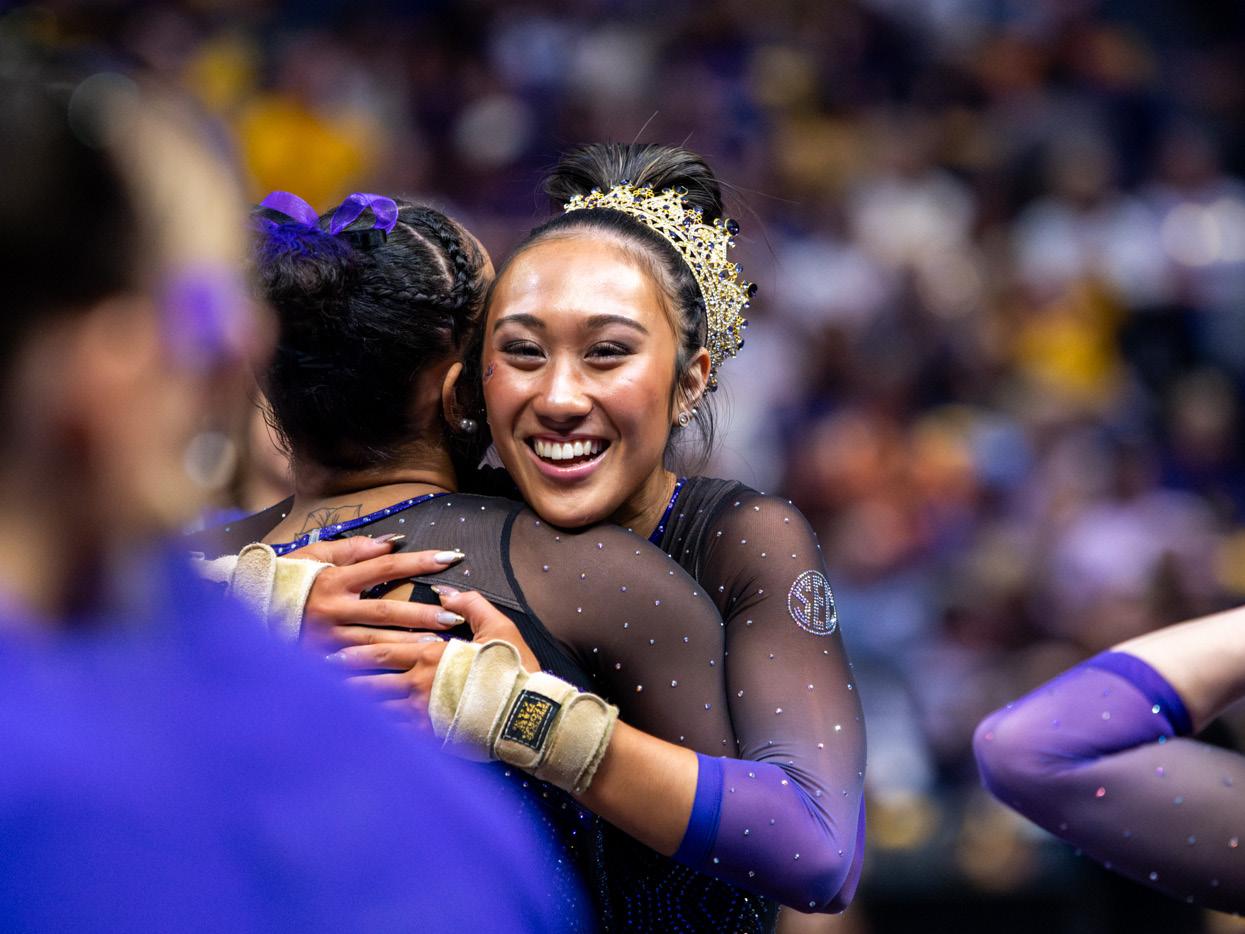
course, been blown out of the water. Chio secured her eighth, ninth and 10th perfect score of the season on Friday night, with Bryant watching as an LSU assistant coach.
LSU started the competition off strong with an overall 49.525 on the vault, marking this performance the third-highest vault score earned this season.
While the team as a whole delivered the rotation’s well-earned score, Chio, the nation’s No. 1 all-arounder, tipped the scales in the Tigers’ favor as she secured her first perfect 10 of the night.
However, as head coach Jay Clark would say, Chio’s hard work is only achievable following the path her teammates paved for her, so before she secured her perfect score, she looked to sophomores Victoria Roberts and Kaliya Lincoln’s respective 9.900 and 9.950, which served as statement performances that would go on to set the tone for the Tigers’ night.
“In the meeting earlier today, we just talked about honoring each other with our actions,” Chio said. “And that’s exactly what I thought about tonight, and just was free of mind. You know, I tell the team to compete freely. It works best for me, so
I’m hoping that for the rest of the team [it] clicks for them too.”
Following its victorious vault lineup, LSU took to the uneven bars with a 49.525, miles ahead of Arkansas’ 48.800. Like usual, sophomore Lexi Zeiss led the event, earning a 9.850.
Madison Ulrich followed suit with a 9.900, and just as things were looking up for the Tigers, graduate student Courtney Blackson was on the sour end of a deduction after she fell from the bars mid-routine. While the gymnast managed to get back up and stick a landing, she earned a 9.300 given her slip-up.
“ There’s still growth to be had,” Clark said. “We’re entering the postseason, but we can still improve. I think most of it [is not] physical. It’s just about trusting what they feel themselves do every single day, when the environment changes.”
With Blackson’s score being the lowest in the night’s lineup, it was dropped, and later followed by a 9.950 from Konnor McClain, who served as the event’s anchor.
The Tigers took the energy from McClain’s performance to the balance beam, where they saw a 9.900 from Lincoln and a 9.925 from McClain.
Those high-earning performances set the stage for Chio to mount the balance beam, where she delivered yet another perfect 10, her second of the night.
LSU then found its way to the floor with a 148.375, in the lead against Arkansas’ 147.600.
Emily Innes led off the event with a 9.850, trailed by an immediate 9.900 from Nina Ballou, or the “energizer bunny,” as Clark describes the sophomore. After that, it was nothing but 9.900s and above from juniors Kylie Coen and Amari Drayton.
Then, once again, it was all eyes on Chio, who managed yet another perfect performance in the fourth and final rotation of the night.
This was her tenth career 10, her ninth of this season and her second perfect score on the floor. For context, UCLA’s twotime Olympian Jordan Chiles has brought six perfect 10s to her name this year.
Chio’s performance laid the groundwork for Lincoln to close the meet with a 9.975 on the floor, giving LSU the win by a 0.975 difference.
Friday night was a special one for LSU as it honored both the program and its seven graduating seniors before a roaring crowd of over 10,000 Tiger fans.
“I really just think our senior class this year has been incredible leaders and just really showed us the way and gave us standards that we try and follow,” Lincoln said. “And I’m so grateful for them. I truly couldn’t have gotten through this year without them, and I just really wanted to go out there and do it for them this meet.”
While LSU closed out the regular season with a bang, it is set to begin the postseason at the SEC championships in Tulsa, Oklahoma, on March 21 at 7 p.m.
“I love meets like this coming up more than I do the ones that you go into where you’re supposed to win,” Clark said. “Because you’ve just got to go attack it with everything you’ve got and just let it fly. Those are the ones that are fun.”
BY TRE ALLEN Staff Writer
Let the madness begin.
The LSU women’s basketball team, along with hundreds of fans, packed the PMAC Sunday afternoon, awaiting what seeding and region the Tigers would receive during Selection Sunday.
Finishing the year 27-5, LSU earned the No. 2 seed in the Sac-
ramento Region 2 and will face No. 15-seeded Jacksonville Dolphins, the winner of the Atlantic Sun Conference, on Friday.
It’s the first time LSU has earned a No. 2 seed under head coach Kim Mulkey and the first time the program has done so since 2008.
The PMAC will be a host site in the first two rounds of the tournament due to LSU receiving
a top-four seed in its region.
The winner of the LSU-Jacksonville game will advance to the second round to face the winner of No. 7 seed Texas Tech and No. 10 seed Villanova.
Taking the title of the top team of the region is the UCLA Bruins, who earned the No. 1 seed and were ranked as the No. 2 overall seed in the entire tournament.
That’s just one of the obstacles that LSU will face if it wants to reach Phoenix. Also in LSU’s region are the No. 3 seed Duke Blue Devils, whom the Tigers beat earlier this season by 16 points on Dec. 4, and the Minnesota Gophers as the No. 4 seed.
An interesting team in LSU’s region is the No. 6 seed Baylor
ADVERTISING (225) 578-6090
Layout/Ad Design ASHLEY KENNEDY
Layout/Ad Design REESE PELLEGRIN
The Reveille holds accuracy and objectivity at the highest priority and wants to reassure its readers the reporting and content of the paper meets these standards. This space is reserved to recognize and correct any mistakes that may have been printed in The Daily Reveille. If you would like something corrected or clarified, please contact the editor at (225) 578-4811 or email editor@lsu.edu.
CORRECTIONS & CLARIFICATIONS ABOUT THE REVEILLE
The Reveille is written, edited and produced solely by students of Louisiana State University. The Reveille is an independent entity of the Office of Student Media within the Manship School of Mass Communication. A single issue of The Reveille is free from multiple sites on campus and about 25 sites off campus. To obtain additional copies, please visit the Office of Student Media in B-39 Hodges Hall or email studentmedia@ lsu.edu. The Reveille is published biweekly during the fall, spring and summer semesters, except during holidays and final exams. The Reveille is funded through LSU students’ payments of the Student Media fee.
BY MORGAN VANNOSDALL Staff Writer
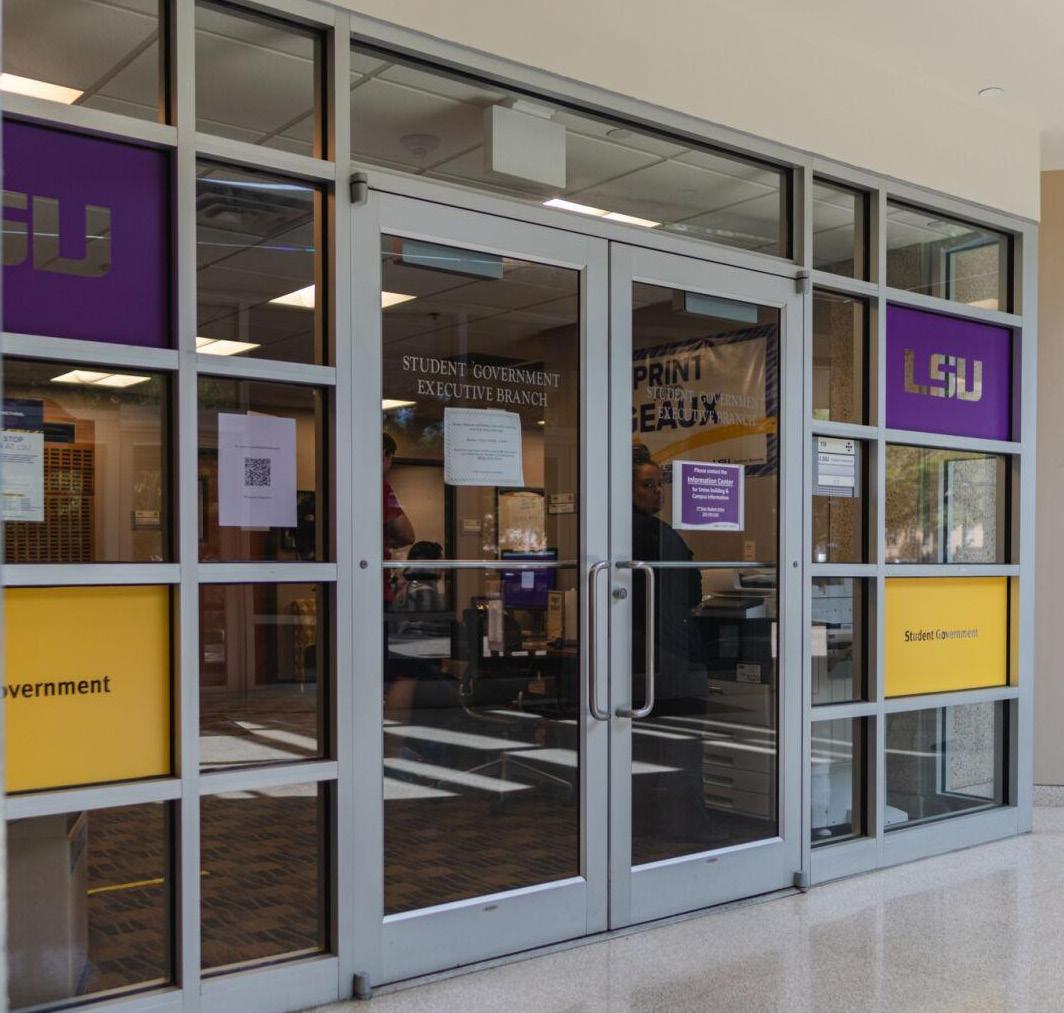
LSU Student Government will hold its annual election on Thursday and Friday. Here is everything students need to know.
In the election, students will be able to cast their vote for the 2026-2027 student body president and vice president.
On the first day of elections, all LSU students will get an email with the link to vote through TigerLink. It goes live at 7:30 p.m. on Thusday, and the link will close on Friday, March 20 at 4:30 p.m.
Ticket registration opened earlier this month, and there are five tickets registered: Barousse-Harrell, crawFISH, FRAZIER-MICELI: TOGETHER, Heart and Miller-Hebert.
The election will be run by the LSU Election Commission, an impartial body of five students that sets standards to ensure that SG elections are run fairly.
Per the Election Commission’s regulations, candidates will begin campaigning on Monday.
Presidential candidates will also participate in an open debate at 6:30 p.m. on Wednesday in Nicholson Hall. Candidates will field questions about their platforms and their plans for LSU.
They will also participate in a multicultural debate at 5 p.m. on Wednesday in Coates Hall. The multicultural debate gives candidates an opportunity to discuss how they plan to support LSU’s diverse student body.
The Election Commission is
BY DREW SARHAN Staff Writer
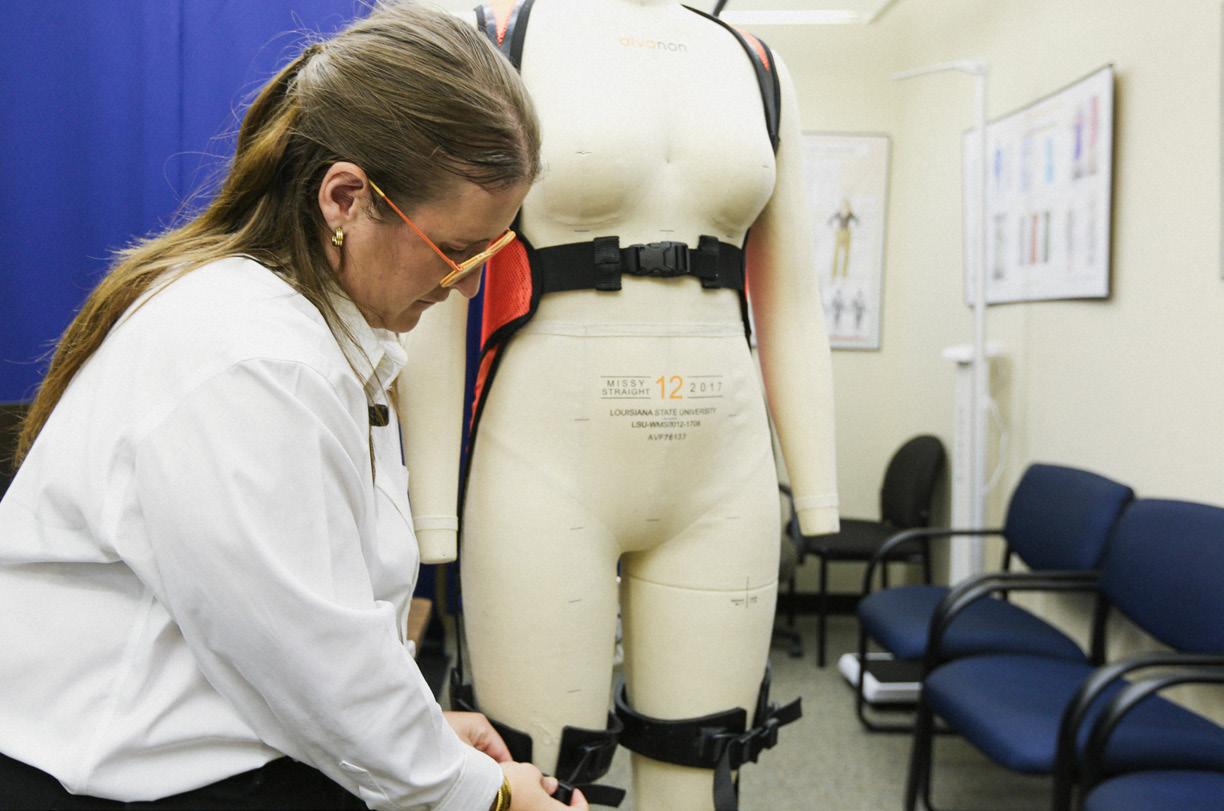
A third-year doctoral student at LSU has built an exoskeleton to help maximize safety and minimize fatigue for construction workers, especially women.
M.G. Taylor is a graduate research assistant in the textiles, apparel design and merchandising program at LSU. She has been working on this personal protective equipment project in collaboration with the construction engineering program.
The team was tasked with creating external PPE gear, or an exoskeleton. Taylor said that the exoskeleton was designed to support construction site workers. She also said that repeated stress injuries often cause workers to end their careers sooner than they would want to.
ing, and that’s important because why design something if it doesn’t work for its users?” Taylor said. “Sometimes, PPE doesn’t fit well, so we really want to be sure, and we also make comfortably fitting gear that people will actually want to use over the course of a working day.”
Taylor said that construction brands started creating pants for other body types — besides thin cisgender men — only around two years ago, with many users having to wear an extra belt to ensure they are in proper PPE.
“The belt anecdote is actually quite relevant because if you get it caught on something, you can get pulled by the machinery, you can fall, you can be quite severely injured just because you have pants that didn’t fit you,” Taylor said.
currently in the process of inviting representatives from different organizations on campus to ask the candidates about issues that are pertinent to them.
LSU Student Election Commissioner, Henry Hanks, spoke with The Reveille about the importance of participating in SG elections.
“I think especially right now, where we are, just like as a society, I think it’s important for students to be cognizant and just aware of what’s happening on their campus and to know and to trust who they’re electing into these roles,” Hanks said.
While acknowledging that SG election results have been
challenged in previous election cycles, Hanks said that the Election Commission hopes to announce the unofficial results at 5:30 p.m. on March 25 in the Magnolia Room.
“We’re hoping that that’s going to be the case, but sometimes there are things that happen outside of our control,” Hanks explained. “Last year was an unprecedented year for the Election Commission and Student Government as a whole. We’re hoping that it doesn’t happen again.”
The impeachment of presidential candidate Jack Miller presents a potential complication for the Election Commission.
Hanks said that Miller’s impeachment will not impact the election until the judicial branch rules on whether Miller will be removed from office. Once the judicial branch reaches a verdict, the Election Commission will communicate with the student body on any changes that need to be made.
Per the SG Code, presidential and vice presidential candidates have to be on the ballot together. So, if Miller is impeached and becomes ineligible to run, his running mate would also be removed from the ballot.
Since Miller is not being charged with an election code violation, the rest of his ticket would still be eligible to run if he is removed from office. They might be able to appoint a new ticket representative if needed.
Hanks encourages students with questions or concerns about the elections to reach out through the Election Commission’s email, sgelections@lsu. edu.
“The exoskeleton is a two-parter. On top, we have a harness that holds the exoskeleton in place,” Taylor said. “We had to figure out a way to distribute the weight of the lower body exoskeleton over the trunk and shoulders of the body.”
The team designed a backpacklike zipper pouch for the electronic motor in the lower half of the exoskeleton. Then, a few redesigns later, the team completed the lower part of the body, with breathing holes in the prototype made of polylactic acid filament that goes from thigh to ankle.
“We’re about to print [a prototype] in a carbon fiber integrated filament so that it is much stronger for its intended purpose: protection,” Taylor said.
According to Taylor, the researchers use a modeling software called CLO, which is similar to a computer-aided design software, but for fashion.
In CLO, she said they are able to model clothes in 3D and work through multiple designs before finally laser-cutting panels, heatbonding them and finally sewing them together.
“The next step is user test-
The exoskeleton can be used in multiple fields that require the usage of heavy machinery, like in petroleum engineering.
Blake Samson is a petroleum engineering freshman from Maumelle, Ark., and he thinks the design is great for his field. He said the motor function is a great idea, but he wants to see some sort of padding inside the legs for comfort.
“In petroleum engineering, it would be a godsend to alleviate fatigue and physical weakness, thus preventing accidents due to weakened muscles,” Samson said. “Heavy machinery is nothing to mess with, and someone struggling to walk after a long day is prone to have something potentially fatal happen to them near the bulky and powerful equipment.”
Taylor said that while the whole exoskeleton would be quite expensive, the idea is that the workers will own their own upper vest portion while the construction companies would provide the bottom half, including the motor.
“We’re able to bring construction, engineering and fashion together in a meaningful way. That is already a unique team that is poised to win,” Taylor said.
BY DREW SARHAN Staff Writer
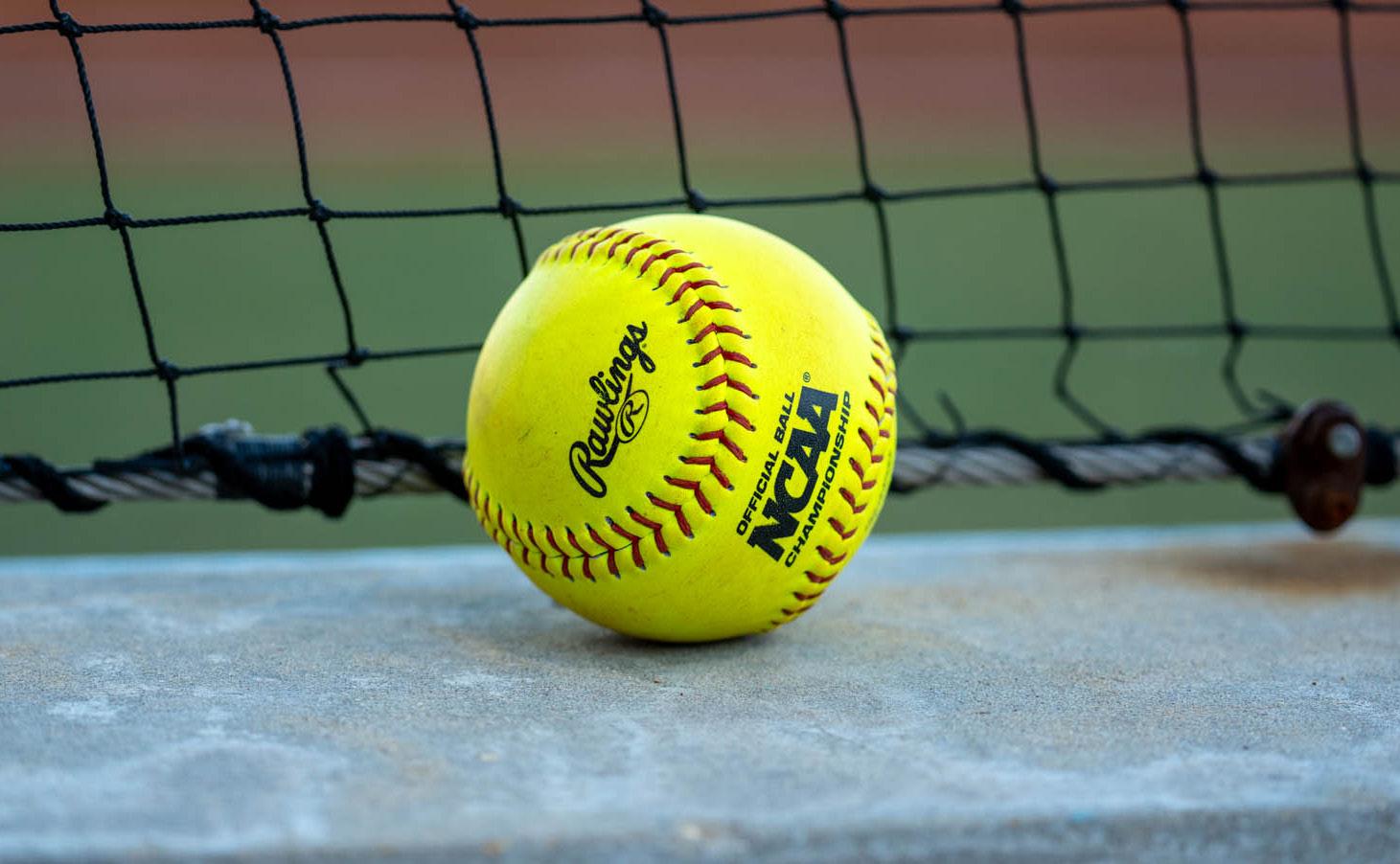
Meet Trackman, the software LSU math professors and students are using to help softball coaches build teams that win by combining probability with preparation.
Trackman is a doppler radar system that tracks every pitch and batted ball in 3D, capturing data about the ball such as velocity, spin rate and launch angle. Doppler radar systems are also known as “weather radar” because they are often used by meteorologists to track rainfall.
One researcher helping to launch Trackman is Nadia Drenska, an assistant professor in mathematics. Drenska is also a faculty advisor for the Math Consultation Clinic, a capstone project for seniors that helps units on campus make sense of their data, in collaboration with Zach Jermain and Beth Torina of LSU Softball.
“The data consists of information for every pitch thrown during a softball game here at Tiger Park,” Drenska said. “We record all sorts of metrics about it.”
Drenska sees this as a winwin for LSU Softball and the mathematics department: It’s an opportunity for mathematics students to build machine learning algorithms to analyze the probability of each ball thrown
and hit and an opportunity for softball players to learn where to hit and where to throw for the most consistent results.
“What we try to do is to help make sense of all this data,” Drenska said. “Each game has around 200 to 250 pitches, which is a lot to analyze.”
According to Matthew Lemoine, a graduate teaching assistant with the LSU College of Science, both graduate and un-
dergraduate students will be able to work with the data.
“The classes are structured to help undergraduate students work with graduate students to learn coding, machine learning, algorithms and things like that,” Lemoine said. “We’re using the softball data as a project to work on and to learn from.”
According to the researchers, Trackman is helpful at displaying a math model of a zero sum
BY TORI BONIN Staff Writer
An LSU microbiologist has discovered a way to fight human cancer cells using a notorious bacterium that kills nearly 20,000 people per year.
Dr. Chen Chen, an assistant professor of biological sciences at LSU, is an expert on Staphylococcus aureus and how it attacks the human body. Chen discovered that one of the 14 proteins staph produces could be used to attack cancer cells without harming healthy cells as much as other treatments.
Chen’s research found that a protein called SSLL11 targets cells that have a sugar structure on them known as glycan Sialyl Lewis X. Immune cells typically have these structures on them, but SLeX is also commonly found on cancer cells.
Chen said that she had a “crazy idea” to reengineer a protein from staph and take advantage of the protein’s ability to bind to a cancer marker and prevent cell migration to create a platform for cancer treatment.
“We actually have a platform where I can deliver cancer therapy to multiple different cancer
types because this marker is actually established in clinics as a cancer marker,” Chen said.
Last year, over 600,000 people died from cancer or cancerrelated illnesses, many of whom were diagnosed with cancer in the late stages of the disease when treatment is sometimes not feasible. Chen hopes that her innovation can give otherwise-hopeless patients a chance at recovery.
“At the end stages of cancer, many patients lost hope and were miserable and even lost the opportunity to have a surgery for the removal of the cancer because of certain things or because of massive metastasis,” Chen said. “I was thinking maybe using this because it’s more malignant, the mode of the marker will actually be more effective for our platform. Maybe this will allow those patients, especially in the end stage to regain those surgery opportunities or treatment.”
Gianluca Veggiani, an assistant professor in pathobiological sciences, believes this development is an example of how evolutionary distinctions can be used to fight cancer.
“The study illustrates how
evolutionary specificity can be rationally harnessed for therapeutic design and represents a promising direction for developing highly selective anticancer agents with reduced off-target effects,” Veggiani explained.
Emma Ebel, a junior studying biological sciences, found this discovery to be profound because of the way it can impact the future of cancer research.
“Who knew such a common bacteria that can cause harm in some could be used to benefit so many others?” she said. “I think that this research is important because this is just a new stepping stone in new innovations in finding cures for cancer, specifically targeting cancer cells.”
Chen plans to continue working on this research to develop it as a platform to help cancer patients in their fight against this deadly disease.
“I want to continue to work on this because I want to help find more tools against cancer because I always say nowadays almost everybody knows somebody directly or indirectly diagnosed with cancer one way or the other,” she said.
Trackman is going to work,” Sunkara said. “It’s going to work for statistics, like exit velocities, how the ball spins and where it is going to land. So with that data, yes, it can be used anywhere.”
Trackman has already been used in sports other than softball, like baseball and golf.
But as a math-doctorate director of Player Performance and Analytics for LSU Softball, Jermain was eager to use Trackman to help his team win games.
Lemoine helped to explain how the data can be applied to softball games.
game, where one side has the clear advantage over another. These models are particularly useful for students enrolled in Math 4997, a vertically-integrated research class.
According to Gowri Priya Sunkara, a doctoral student at LSU who worked on the project, Trackman data can be used in all sports, regardless of how the ball is hit, thrown or kicked.
“For any kind of sports,
“Whenever a batter goes up to home plate to hit the ball, if they’re left-handed or righthanded, they’re going to hit it in a certain way, and we want to analyze which way is it most likely to go,” he explained. “If they’re going to hit it more to left field, we need to move out outfielders towards left field so they’re more likely to catch the ball.”
Drenska says that Trackman helps LSU win in multiple ways — both through practical sports analysis and by providing crucial gametime statistics to help LSU softball form a winning team.
“I feel very proud of my students,” Drenska said. “I feel like everybody has done a really good job, and we’ve made some tangible progress to help our teams win.”
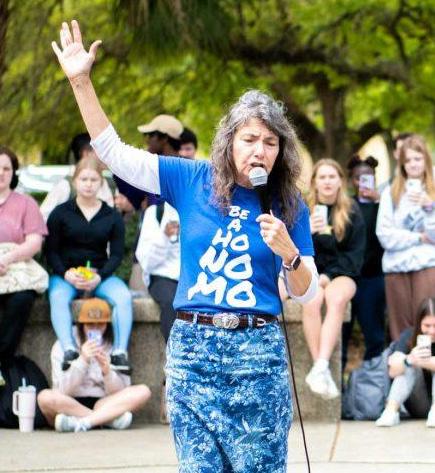
The Christian social media icon Sister Cindy is returning to LSU.
In a joint Instagram post with jesusprofessor314, Sister Cindy announced she will be coming to Free Speech Alley from Monday to Wednesday, from noon to 4 p.m.
Promising “Sl*t Shaming & HoNoMo Music,” the abstinence advocate lambasted the LSU student body’s lax moral standards.
“Louisiana Slut University, have you completely lost your mind?” she asked. “Here a ho, there a ho, everywhere a ho, ho, ho.”
The Sister also urged students to join the “HoNoMo Nation.”
“My friends are two graduates of Louisiana Slut University who have joined the HoNoMo nation,” she continued. “You are a chosen generation to join the HoNoMo Nation. It’s a revolution.”
Sister Cindy has visited Free Speech Alley several times since she went viral in 2021, each time mixing crude pop culture references with Evangelical Christianity. In a 2022 visit to LSU, she told an admiring crowd, “You’re princesses made in the image of God, yet you traded your crown to be a cocksucker.”
Despite her often-derisive messaging, Sister Cindy has gained a massive social media following, amassing over 38,000 Instagram followers.
Commenters on Sister Cindy’s video delighted in her crass preaching.
“Sister cindy how do i participate,” wrote Instagram user vvvampired.
Others tried to recruit their friends to hear Sister Cindy’s message.
“Who turning up to the slut shaming func,” asked mfmiller, an Instagram user who lists “LSU ‘28” in his bio.
BY PAUL TIBBETS Staff Writer
Film and television senior Megan Eisert clicked through set photos from her most recent film production “Tick,” reminiscing as if it was a family photo album. With ease, she named each crew member, their role and so on.
“I don’t want anybody to ever just feel like a number on a page. I don’t want you to think that I’m not going to know your name,” Eisert said. “I could also tell you everybody’s allergies. I could tell you what every single person on this crew is allergic to.”
Eisert is the producer for “Tick,” one of this year’s LSU Geaux Films. She takes the director’s vision and makes it happen through the resources of people, places and money. Her job is to organize crew, auditions, locations and budget; all the behindthe-scenes paperwork that makes a set run.
While she will do everything to have this vision to come to life, she ultimately does not care what the specifics are. The decision comes down to whatever makes the birthday boy happy.
“If a film is a child’s birthday party, the director is the child whose birthday it is, and they get to decide, ‘I want blue balloons or red balloons or whatever,’” explained Eisert. “But the producer is that child’s mom, and so I am purchasing the balloons. But ultimately, I do not care what they are.”
This birthday boy is fellow film and television senior Hill VanDuzee. He is both the writer and director of the short film, which he has been working on since June.
The story follows a troubled night guard, Kane, whose shift at a mysterious antique shop goes
awry when he is forced to confront his regrettable past. This idea came to VanDuzee when he visited an antique shop in Opelousas; however, he also says inspiration came from recent horror hits such as “Sinners,” “Weapons” and the “Scream” films.
“All these movies have come out and sort of revitalized the horror genre,” VanDuzee said.
“All of those films heavily utilize practical effects, and I really wanted to contribute to that and tell my piece of a story of something horror.”
Through this commitment to practical effects, the film produced a milestone for the program. “Tick” marks the very first set built by the students for an LSU Geaux Film, according to both Eisert and VanDuzee.
With the help of recent LSU graduate Abbie Lestrade, the “Tick” crew put together a storage room with flats from the Reilly Theatre on campus. Eisert pegged this as a necessity for the shoot to let VanDuzee’s vision shine.
“We had to do things to the walls, like put a hole in the wall we had to break a mirror against the wall and it was just one of those things where there’s way too much liability with actually doing that in a real location,” Eisert said. ”So we did it in something that it wouldn’t really matter too much if anything happened. We had full, complete creative control over the space.”
Another example of practical innovation was in an effort to create a bokeh effect for a shot. The bokeh effect is when an aesthetic soft blur is produced for the outof-focus parts of a frame. This is typically done through a setting in a specific lens, which Eisert unfortunately could not factor into the budget.
“We’re not necessarily in the
business of affording $1,000 lenses just yet,” Eisert joked.
Director of photography Nina Embaugh got creative and found a way to achieve the same effect by rubbing vaseline in a circle on an N.D., or, neutral density, filter.
These challenges that breed innovation and creative problem solving are what these programs are all about. VanDuzee believes everything came together to serve his vision in spades. If given the opportunity to do it over again, he would do it the exact same way.
“I wouldn’t really change a thing, to be honest, because I realized that if I didn’t learn that, I wouldn’t have learned anything,” VanDuzee said.
Both creatives credit the LSU film program with helping them get where they are today and the encouragement of professors and peers to go head first into roles and take advantage of state-ofthe-art equipment was invaluable.
In a setting such as college, mistakes are easier to make with less on the line. While Eisert agrees with the idea one does not need to go to film school to be a filmmaker, it also provides a safety net to explore. The filmmakers at LSU are always looking for more hands, and Eisert believes anyone can join in.
“Whether you are an engineer and you have interest in the lights; [if] you’re a medical student and you want to come and be set med; if you like cooking and you want to cater, it’s like its own little miniature city that needs people to run,” Eisert said. “So the more people that want to come and hang out with us, that’s what we want. We just need more people to come.”
To keep up to date on the status of “Tick,” follow VanDuzee and Eisert on Instagram.










BY PAIGE CHERAMIE Staff Writer
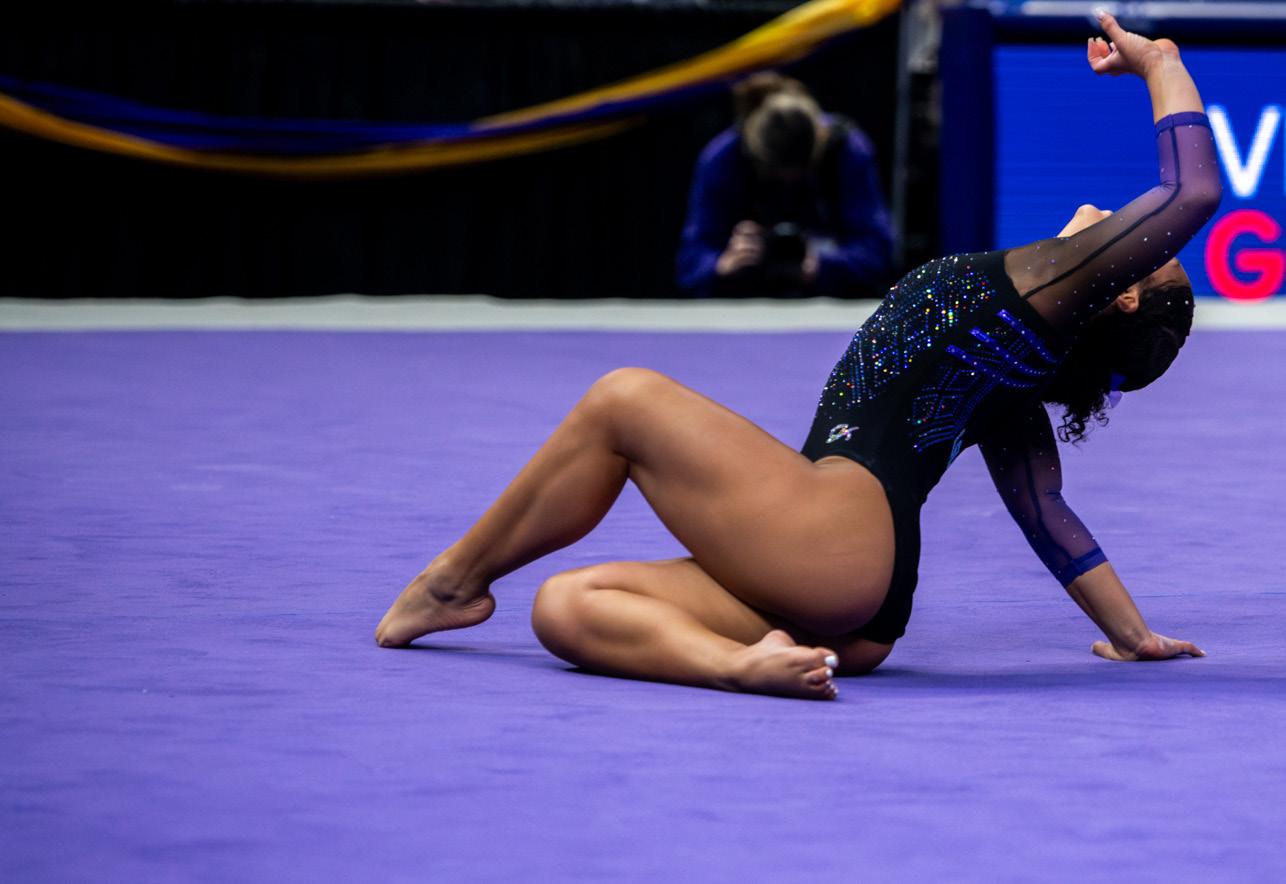
As LSU grew into the institution we know it as today, there were countless forerunners who challenged the status quo. Many of these trailblazers were women who worked hard to earn degrees, play sports and prove that women were just as capable as men.
One such pioneer was Rebecca Olivia Davis, the first female student to graduate from LSU. She applied to transfer from another institution in 1904, then finished her master’s degree and received her diploma in 1905.
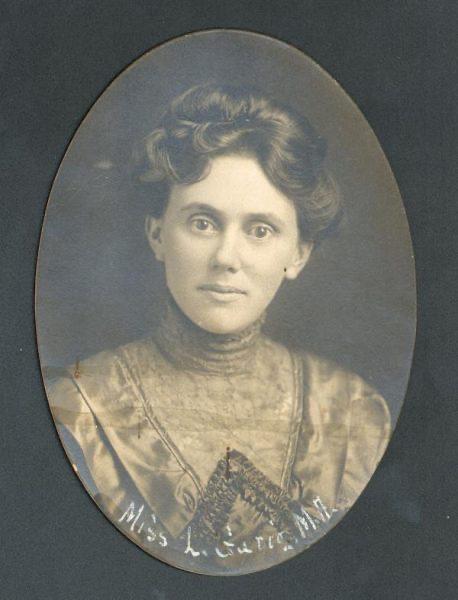
According to “Thomas Boyd’s Vision: The ‘Greater University,’” Davis was initially only allowed to attend since she was older and therefore not considered a distraction to male students. Still, Davis proved that women could reach the academic standards of the institution just the same as men.
Davis’ success paved the way for the first female freshman admits. In 1906, a group of 15 to 17 women approached the university president, Thomas Boyd, and asked for the ability to study at the institution. After considerable deliberation, the women were allowed to join the incoming freshman class, with the stipulation that they would be considered “special students.”
According to the “William Wallace Garig and Family Papers,” two of these women were sisters Mercedes and Louise Garig. Mercedes, the older of the two sisters, went on to become the first female faculty member of the university in 1909. Her sister soon followed in her footsteps, with both becoming professors in the English department.
The two sisters didn’t just teach, but also worked toward bettering the subject of English as a whole. During their time as professors, Mercedes wrote the textbook “Drill in English,” while Louise wrote the books “Grading and Promotion in the Elementary School” and “Geographic Influences in Southern History.”
Mercedes and Louise proved that women were capable of teaching at the university level, creating an opening for women in a space previously closed off. The university recognized the dedication from these sisters, especially that of Louise. Shortly after her death, LSU constructed the Louise Garig Hall in her honor.
Although women were allowed to attend the university, their status as “special students” prevented them from receiving the full college experience. In the 1916-1917 academic year, this would change with the creation of the dean of women role.
The first person to stand in this position was Mamie Lewis. In this role, she worked to integrate LSU and transform the university into a coeducational experience, ensuring women had access to housing and organizations on campus. This reflected the increasing population of female students, who deserved the same college experience as their male peers.
When women first began attending the university, many of them pursued a degree in home economics, where they were taught how to care for their families and homes or become good teachers. However, Peggy Laborde, a female student at LSU in the 1940s, decided to forge her own path.
Laborde was the only child of Louisiana farmers. She knew that one day it would be her job to care for her parents’ land, which led to her decision to pursue a degree in agronomy at the LSU College of Agriculture. In 1947, she became the first woman to graduate with this degree.
Laborde never ended up taking over her parents’ farm, but she still went on to lead a successful life alongside her LSU alumnus husband. The couple sponsored scholarships for the university and even set up a professorship. Their four children went on to earn their degrees from the university as well.
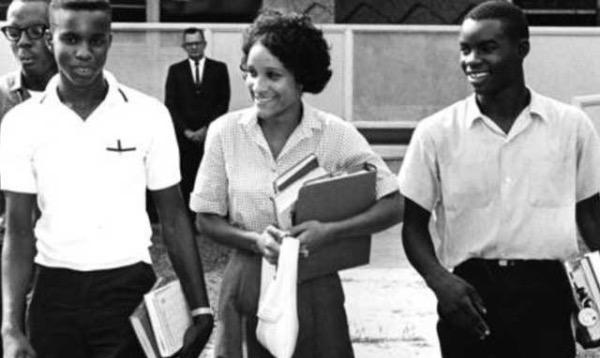
In 1953, Pearl Payne, wife of LSU alumnus Lutrill Payne, became one of the first Black women to graduate with a master’s degree from the university. This feat was met with many challenges, as Payne was fighting for admittance due to both her race and gender.
To attend her classes, Paynecommuted a seven hour round-trip from Natchitoches to Baton Rouge each week. She went on to earn her master’s of education from LSU, teaching for 37 years following her graduation. To honor the dedication of the Paynes, the Lutrill & Pearl Payne School of Education in the LSU College of Human Sciences and Education was named after them.
Although Payne pushed boundaries for Black women, the work was not done. To continue the battle for equal opportunities, civic activist Freya Anderson Rivers filed a lawsuit against the university to fight for the admittance of Black women into freshman classes, including herself.
Rivers gained admittance to LSU in 1964, becoming the first Black woman to enter a freshman class at the institution. During this time, she continued fighting for equality while simultaneously earning her degree. She was awarded a bachelor’s degree in general studies in 1971.
Although women were making headway in the area of academics, sports were still only open to the male students of the university until 1974, when the first female varsity team was formed. Under the coaching of Jinks Coleman, the women’s volleyball team set the standard for women’s athletics at LSU.
Coleman led her team to victory in their inaugural season. The hard work and dedication of the team’s players showed the university and viewers that women belonged in the sphere of college athletics, shaping the beginnings of LSU women’s sports as we know it today.
In the following year, women’s athletics expanded to include basketball, also under the coaching of Coleman. On this team was Joanette Boutte and Thelma “Pepper” McCoy, the first Black female varsity athletes at LSU. The team also had a fierce starting season, making sure people knew women’s athletics at LSU were a unit to fear.
Notably, McCoy went on to earn a doctorate at the University of Texas at Austin, becoming an adjunct professor at many universities and the founder of a nonprofit. She advocated for equality and inclusivity, ensuring women who followed in her footsteps would have equal or better opportunities than she had.
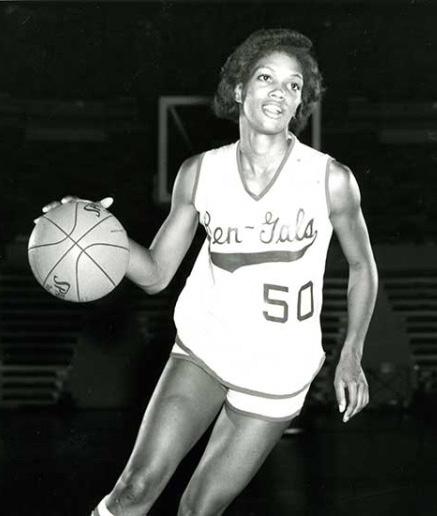
The dedication of these women to earn equal opportunities at the university level built LSU into what it is today. Currently, LSU is home to many notable women who are working to not only continue improving the university, but the world as a whole.
Of these women is College of Engineering Dean Vicki Colvin. Appointed to the position in 2024, Colvin is currently the first female dean of this senior college. In a field typically dominated by men, she is breaking boundaries and excelling
above her peers.
Colvin currently holds five patents and has published over 200 peer-reviewed articles. She has received many awards for her groundbreaking work.
In the world of sports, Kim Mulkey has created waves through her success as the head coach of the LSU women’s basketball team. Mulkey began as a player herself, taking her experience as a successful player and transforming it into a strong foundation for her leadership.
BY CHARLOTTE TRENTALANGE Staff Writer
On a typical fall Saturday at LSU, Tiger Stadium doubles as a fashion show. Sundresses, boots and button-downs fill tailgates and surrounding areas hours before kickoff, but when baseball season arrives in the spring, the crowd looks much different.
The question isn’t why students dress up for football — it’s why they don’t for anything else.
At the men’s baseball game against Sacramento State, students wore leggings, jerseys and LSU Tshirts. The look was noticeably relaxed, with some students coming straight from class or stopping by in between plans. The same campus that treats a Saturday in the fall like a runway, now turned casual.
According to Danielle Thomas, a professor of sociology at LSU, once a behavior becomes a campus norm, students often follow it simply because everyone else does.
“Once a norm of behavior like dressing a particular way is established, then everyone faces a certain amount of pressure to conform,” Thomas said. Thomas added that football events themselves create a larger social environment than other sports because tailgating culture creates an increased pressure of being seen and observed.
Greek Life on campus can also play a role in maintaining the fashion standard. With fraternity tailgates being a prevalent event in fall game day traditions, students can be unconsciously influenced by them. Thomas said that because
Greek organizations are often seen as the highest status group on campus, they become a reference group for others to look up to, including how they dress.
In Louisiana’s history, dressing up for sporting events was common regardless of the sport. A 1938 photograph from a New Orleans Pelicans minor league baseball game shows audience members in suits, ties and hats. The same year, a photograph of fans outside Tiger Stadium shows them in trench coats and suits. By today’s standards, people dress more casually in everyday life. Still, the tradition of dressing up has remained attached to football.
Also in LSU’s history, a tradition was created that highlighted how unusual casual dress was at football games. Known as the “pa-
jama game,” freshman men were expected to attend a fall game in pajamas, proving that when the expectations for dress change, people will comply. The last year the pajama game tradition took place was 1968, briefly returning in 2003.
Timing may also play a role. Football games are normally held on Saturdays, giving attendees more time to plan outfits and prepare for a day-long event. In contrast, baseball and basketball games often happen on weekday evenings after a long work or school day.
Another factor is the frequency of games, since football is relatively infrequent compared to other sports. The LSU Tigers football team played 13 games last season, whereas the baseball team is set to
play 56 games and men’s basketball plays at least 31 regular season games. Planning outfits for 13 games is far easier than planning them for 56.
Crowd size may also contribute to the differences we see. Tiger Stadium has an official capacity of 102,32, Alex Box Stadium seats 10,326 and the Pete Maravich Assembly Center holds 13,215. Larger crowds increase the sense of being seen, reinforcing the social pressures to look presentable.
All these conditions combined are the reason spring sports don’t get the same treatment as football from a fashion standpoint. Weekday games, smaller crowds, limited tailgating and a lack of it being a campus-wide spectacle causes the outfit planning to be an afterthought.
MENS BASKETBALL
BY TRIPP BUHLER Staff Writer
For the second time in head coach Matt McMa-
hon’s four seasons at LSU, men’s basketball finished dead last in the SEC.
His teams have gone a combined 60-70, with a 17-55 SEC mark, and have never been ranked. LSU has won just three conference games in each of the last two years.
But there is still a chance that he stays as head coach for the next season. Why is it even a discussion? Let’s see why he would remain as head coach despite the poor results.
To start, money can not just be thrown by the wayside in the discussion. McMahon’s buyout is $8 million, not even mentioning the cost it would take to hire a new coach and field a roster.
The Tigers reportedly spent about $8 million on the roster this year, a large increase from the previous year. That is LSU’s way of backing McMahon.
E.J. Kuiper, the president and CEO of FMOL Health, is a major donor for LSU and one of six who was on the committee to hire a new head football coach in the fall. He voiced his support for McMahon after the team’s win against Ole Miss.
“LSU MBB beats Ole Miss in Oxford!! Matt McMahon is a good coach. Took over a program that was in shambles and had to deal with key injuries all season long. He deserves another chance,” Kuiper said in an Instagram story.
Another problem that has consistently plagued men’s basketball during McMahon’s tenure is injuries. They have drastically derailed LSU’s last two years.
Forward Jalen Reed missed almost all of the 2024-25 season and once again only played a handful of games in this season before being injured. Star point guard Dedan Thomas Jr. also missed almost all of SEC play in this season with a foot injury.
But Kuiper isn’t the only person supporting McMahon; the players on his team have voiced support as well.
“I can’t thank this man next to me [enough],” shooting guard Max Mackinnon said after the
BY ALEX SHEESLEY Staff Writer
After a shambolic start to its weekend in Nashville, LSU baseball rebounded on Sunday to defeat Vanderbilt, 16-9, in a contest that ran over four hours.
The getaway day victory means that LSU avoided a sweep in its first SEC series of the season, ending a sour weekend on a positive note.
The win is a high in a weekend that the Tigers would like to forget. LSU fell way behind Friday before battling back to take a lead that would be for naught on a walk-off home run, then followed it up on Saturday with a dud performance to drop the game and the series.
LSU got out to a hot start on Sunday afternoon, finding itself on the positive end of things that dismantled them up to that point in the weekend. Vanderbilt starter Nate Taylor issued a walk to open the game, then hit two batters to load the bases, outcomes that had been signature from LSU pitching over the weekend.
Shortstop Steven Milam got the scoring underway, getting underneath a tag to score on a wild pitch from third. The next batter, catcher Cade Arrambide, also got underneath a ball that hopped high off the wall in right for a double that scored another run. Two productive outs later, and LSU led 4-0.
That lead would be pushed to six in the second inning. Left fielder Chris Stanfield smoked a ball into left field to score third baseman John Pearson, who

reached base on a walk, from second. Stanfield would tag up twice to score before the end of the inning.
After the Stanfield hit, Vanderbilt would make a change at pitcher. Brennan Seiber came on in relief and would stifle the LSU offense.
After Seiber came in, LSU generated a walk in the second inning but failed to get a runner on base after that until the seventh inning.
Concurrent with the LSU offensive stall was an awakening in the Vanderbilt offense. Com-

modore left fielder Mike Mancini led off the second with a solo home run to center that was helped by a drafty day in Nashville, where the National Weather Service had issued a wind advisory before the game.
LSU starter William Schmidt would settle in after the home run before another wind-assisted home run would lead off the Vanderbilt fifth, this time from designated hitter Tommy Goodin. He then allowed a four-pitch walk and displayed some signs of physical discomfort, which earned him the hook from head coach Jay Johnson.
Mavrick Rizy came in to try and hold the 6-2 lead, but he’d end up getting hit hard.
Vanderbilt roped a pair of doubles to score a run on him fresh out of the bullpen, complemented with a third double after a pair of strikeouts to make it a one-run game and end Rizy’s day. Santiago Garcia was called upon and got out of the inning.
Vanderbilt would tie the game an inning later in the sixth when Gooden hit his second and the Commodores’ third leadoff homer of the game.
LSU woke up after the game was tied. The Tigers broke through on Seiber, chasing him from the game on a five-run, four-hit inning that saw Vanderbilt exhaust three pitchers.
The exclamation point of the inning came from right fielder Jake Brown. The first batter that new pitcher Jakob Schulz faced after Seiber’s departure, Brown poked one over the fence in
center for a three-run homer to follow up a series of runners reaching that scored a run. It was Brown’s eleventh long ball of the year and gave LSU a 10-6 lead.
One more run would come in the inning, with center fielder Derek Curiel scoring on a sacrifice fly after a triple.
Vanderbilt fought back in its end of the inning. A pair of errors from the LSU defense set the table for pinch-hitting Braden Whitcomb. Whitcomb belted a homer to left to score those runners and make it an 11-9 game.
By the skin of his teeth, Brown kept a run off the board to end the inning. Ranging inward, he made an excellent diving grab. The ball, snowconed in his glove, popped out as he celebrated, initially invalidating the catch and allowing a run to score. A replay review overturned the call, giving Brown a web gem and giving the Tigers a break.
He’d stay hot in the eighth, hitting a bases-loaded double that scored two. It moved the LSU lead to 13-9 and gave Brown 6 RBIs in the afternoon. Three more would come home in the inning, casting aside any doubt that LSU’s lead would be surmounted.
LSU hopes that there are more days like Sunday and fewer days like Friday and Saturday ahead; The Tigers host Grambling on Tuesday and open their first home SEC series on Thursday against Oklahoma.
BY TRIPP BUHLER Staff Writer
LSU men’s basketball’s season ended with a first-round exit in the SEC Tournament, falling to Kentucky 87-82 on Wednesday.
Though the game was played in Nashville, a neutral site, it was essentially an away game as the crowd was at least 95% Kentucky fans. But LSU never backed down.
The game was elastic in the way that LSU kept falling victim to big scoring runs from Kentucky, but would eventually find its way back. It kept LSU in the game until the foundation started to crack with 10 minutes left.
Brandon Garrison came into the game having only made two 3-pointers all year for Kentucky, but he netted two in the second half to help his team pull away. He scored 11 of his 17 total points in the second half.
Otega Oweh was leading the charge for the Wildcats, scoring 23 over the course of the game. LSU was struggling to contain him and keep him from making field goals and getting to the line. Oweh made seven of his 10 free throws.
The only Tiger to match that energy in the later part of the game was Max Mackinnon, who was on fire. He moved freely with and without the ball to keep LSU competitive, despite being down for most of the game. He exploded for 28 points, with 18 of them being in the second half.
Outside of Mackinnon, the Tigers’ shooting and communication were falling apart when the game was reaching its final handful of minutes.
LSU went into this game needing to score at least 80 points to secure the win, given the state of its defense. It scored 82 points, but that still wasn’t enough, partially because the Tigers’ best defender wasn’t able to play in this
MCMAHON, from page 9
SEC tournament. “Everyone’s got an opinion, but we lost our two best players at the start of the year. We fought and [McMahon] never changed. Every day, he made me a better player.”
It is true that the team’s fight and determination never faltered no matter the record. The trust between McMahon and his players this year was never visibly shaken. Even after the Kentucky loss, McMahon praised their fight, saying that “lesser men would’ve folded up shop.”
From 0-0 to 12-1 to 15-17, LSU fought and played the same every game, continuing to keep its heads up no matter how hard the loss was. It’s hard to argue that a team that wasn’t in support of its coach would play that way.
Other coaches see it too.
“If [Thomas] didn’t get hurt before conference play or going into conference play, they were a top 25 team,” Texas A&M head
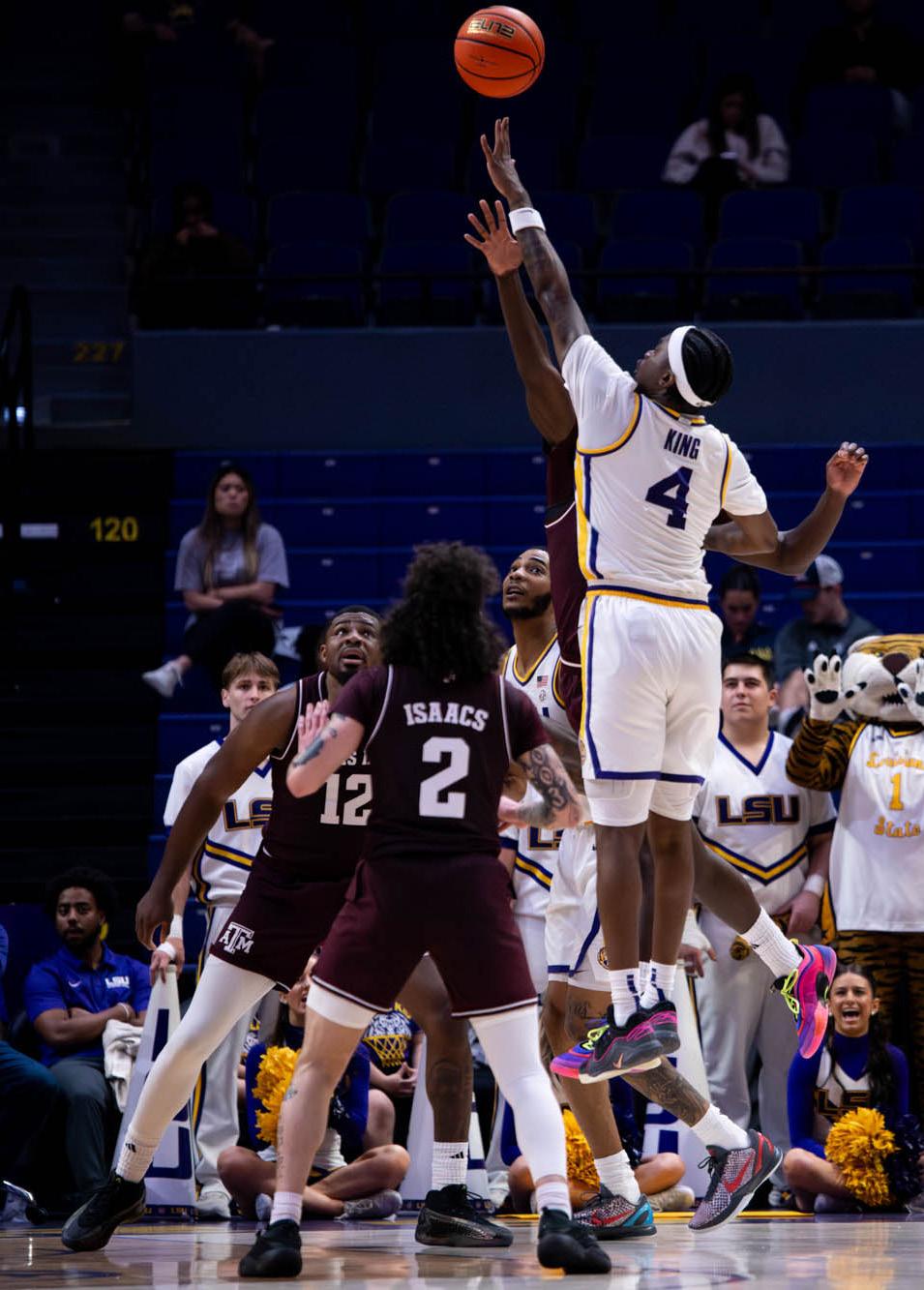
CHANDLER TROTTER / The Reveille LSU men’s basketball senior guard Rashad King (4) jumps the ball on March. 7 during the 94-91 triple overtime loss to Texas A&M at the PMAC.
game.
Robert Miller III was held out because of a violation of team rules, per the SEC Network broadcast. LSU’s defense has already been inefficient, and without its best defender, it was forced to rely even more on the foul-prone Mike Nwoko.
Nwoko had a great game and remained without a foul for the first 18 minutes of the game, and
coach Bucky McMillan said. “I think they could be right there with anybody in the league. I felt really bad for LSU because of that.”
Alabama head coach Nate Oats pointed it out after beating LSU by seven.
“First off, [I] wanted to say I got a lot of respect for LSU players and staff,” Oats said. “For them to play as hard as they’re currently playing, and keep fighting … You got to give them a lot of credit, because they could easily not do what they did tonight based on some of the tough [losses].”
Every time an opposing coach came in for their post game press conference after beating LSU, it sounded like they were surprised with the team yet sympathetic for the adversity the Tigers have faced. That could buy McMahon some favor with the administration.
Also, if McMahon gets fired, who do you go get to replace him? The right-in-your-face ob -
shooting from deep.
Mackinnon ended the first half with a last-second 3-pointer, his second of the game. LSU made 5-of-11 from downtown by the half, keeping them in the game.
The 3-pointer was a big help, but the team was still shooting 48.5% from the field in the first half to keep it within three as the final 20 minutes approached.
One issue facing the Tigers is that when they got to the line, they only made 13-20 free throws.
Kentucky’s fast play was different than LSU’s approach. Big Blue was often scoring in the first half of the shot clock while LSU took its time to set up plays and methodically get to the basket, with point guard Jalen Reece leading the offense.
Reece was on pace for a tripledouble at halftime, scoring four points but having five rebounds and assists. He would ultimately come up short, finishing with 11 points, six rebounds and seven assists.
There might not have been any single play that was more impressive than Pablo Tamba’s dunk, which was so aggressive that he got called for a Flagrant 1 foul.
The foul on Tamba was more of incidental contact, but still followed the rulebook of a Flagrant 1 for the contact against Malachi Moreno, the player who made the buzzer-beater against LSU back in January. Moreno was stuffed in this game, only scoring four points.
only finished with three. He not only stayed clean defensively, but he was the best Tiger on the offensive end as well. Nwoko’s 16 points and 12 rebounds earned him a double-double.
He and Mackinnon carried the team’s offensive pursuit like they had many times throughout conference play. They both ended the first half with four field goals, but Mackinnon led the team’s hot
vious option is NC State head coach Will Wade. He coached LSU for five years, leading the team to three NCAA tournaments including a Sweet 16 appearance in 2019.
The issue is that Wade is in his first season coaching and gave a statement Thursday about the rumors of him returning to LSU.
“Let me be very clear, I’m excited at NC State,” Wade said. “I was hired at NC State to do a job. This wasn’t gonna take one year. I’ve already met with our administration about next year and some of the changes that we need to make … to put this program where it deserves long-term.”
There aren’t really any bigname targets to grab that don’t run the risk of also winning only 17 SEC games in four years.
This offseason might not be the best time to fire McMahon unless you can pry Wade from his chair atop the NC State men’s basketball team.
SEEDING, from page 2 Bears, the program Mulkey coached before coming to LSU. The two teams would meet in the Sweet 16 if both teams make it that far.
At the five seed is another SEC team, the Ole Miss Rebels. The Tigers beat Ole Miss earlier in the year, and it took a 13-point comeback to secure the win on the road.
The Tigers ended their season having won five of their last six games before losing to South Carolina in the SEC Tournament semifinal eight days ago.
LSU will be leaning on its veterans to lead the way for this year’s tournament in Flau’jae Johnson, Mikaylah Williams and MiLaysia Fulwiley.
Johnson played poorly against the Gamecocks with only six points, but she will be relied on if the Tigers want to compete for a championship.
The former national champion has not missed an NCAA Tournament throughout her four-year tenure with LSU and is no stranger to the big games.
Through four tournament games last year, Johnson averaged 16.5 points while shooting 50% from the field and 46% from three, including a 28-point performance against UCLA in the Elite Eight.
Fulwiley ended the season leading LSU in scoring and averaged 21.3 points across the final six games, including a 24-point game against South Carolina in the semifinals.
Denzel Aberdeen was still an issue for LSU. In January, he scored all 17 of his points in the second half. He once again lit the Tigers up for 16.
Marquel Sutton added 11 points and seven rebounds in the upset effort.
LSU’s season is now over, and the fourth year of head coach Matt McMahon tenure ends with just three SEC wins.
It’ll be the first time that Fulwiley will enter the tournament as part of the Tigers team.
Williams comes in as the team’s third leading scorer, averaging 13.6 points per game, and it’ll be her third consecutive tournament appearance.
Last year in the tournament, Williams averaged 17.5 points, 5.3 rebounds and three assists while shooting 50% from the field and 46% from three.

RILEY’S REVIEW
RILEY SANDERS
Columnist
Each of the past few decades had its own fitness fads: The ‘80s had aerobics. The ‘90s had Tae Bo. The 2000s had CrossFit. The 2010s had Zumba. These, though fads, were all focused on actual physical activity — cardio, strength training and dynamic stretching.
The 2020s, however, seem to have adopted an anti-exercise fad counter to those of decades past, and it’s called looksmaxxing.
Surely you’ve seen it on TikTok — looksmaxxing, bonesmashing, thumbpulling and other seemingly made-up terms reminiscent of magical incantations.
These are just some of the slang terms used to describe a variety of faux-fitness practices under the umbrella of looksmaxxing, which are a series of
practices targeted at teenage boys claiming to help the “looksmaxxer” achieve peak physical attractiveness for the purpose of wooing others and flexing online to people they dub “chuds.”
At its most innocent, looksmaxxing masquerades as a fitness dogma aiming to make you the perfect man and help you to gain points on the perceived sexual market value scale, known as the PSL scale, by increasing features of manliness: jaw and cheekbone angularity, facial symmetry, harmony and sexual dimorphism. Sexual dimorphism refers to how feminine your facial features look in relation to your being a man.
At best, the processes involved in altering your PSL score are antithetical to proper growth during the teenage years and counter to appreciating correctly ordered fitness.
For example, bonesmashing, a looksmaxxing exercise, involves hammering blunt objects into the jaw and cheekbones repeatedly over time in an at-
tempt to reshape bone structure, especially if they are still growing and malleable during adolescence. Bonesmashing seeks to increase facial angularity by shaping the bones themselves instead of increasing bone appearance by losing body fat. To repeat, bonesmashing is when you hammer your face into another shape using blunt force trauma. Sit with that, perhaps.
Another practice encouraged in the looksmaxxing dogma is the use of peptides, which are short amino acid chains, often injectable, that allow for the acceleration of the metabolism and regular muscle-protein synthesis processes. Peptides are great for reducing body fat and increasing muscle mass when combined with strength training, but they have a multitude of side effects, particularly affecting cortisol and prolactin hormone production.
The major issue in undergoing bonesmashing and using peptides, aside from physical effects, lies in the way teenage
boys are being pushed via looksmaxxing content on TikTok, Instagram and other platforms to seek outward validation.
The anti-scientific dogma of looksmaxxing seeks to encourage focus on physical appearance, not physical fitness, and so its “exercises” run counter to those exercises we would understand to improve the cardiovascular system or to increase muscle mass or anything of the sort.
Despite this, most looksmaxxing content creators like Clavicular who are pushing this agenda have achieved their appearances by putting in real work — that is, strength training, cardio and serious dieting — but peddle the narrative that “you too can look like me” if you just bash your face in with a rock or inject yourself with hormone-altering drugs. What’s more, you must strike while the iron is hot and you’re still young and growing — alter yourself now, before it’s too late.
Even worse, looksmaxxing finds its roots in a misogynistic
and red-pill belief system, one that actually asserts that one’s value and destiny in life are determined directly by one’s perceived sexual value and attractiveness.
Looksmaxxing, unlike regular fitness programs, seeks immediate results for the sake of external vanity instead of internal fulfillment. It is based on performative beautification and surface-level physical improvement that intends to satisfy “insufficient” male ego in underdeveloped minds, young men that naturally have not even had a chance to grow into themselves, and prioritizes societal validation over personal satisfaction. It is targeting impressionable young minds and encouraging the young men of today to prize vanity and sexual “value” above all else, and that is a dangerous ideology to allow our children to absorb.
Riley Sanders is a 19-year-old biology major from Denham Springs, La.
In a copycat culture, it’s time for us to make something
MICHAIAH’S MINUTES
MICHAIAH STEPHENS
Columnist
If someone were to ask, “What is the 2020s culture?” we’d all have a hard time answering. Maybe we’d answer, but grimace because of it.
We could say “COVID-19,” or “AI” according to Time Magazine, but really, if we all sat down, what would be the answer?
I have seen countless comments from people stating, “The 2020s have no culture”— or at least not one worth rallying behind. We all have been burned under the spotlight of nostalgia, perfection and trying to be everything all at once. We need a renaissance.
If you’d turn your history books to chapter 15th century you’d find a historical event known as the Italian Renaissance: a cultural shift in Italy blending other cultures and focusing on human achievement and human expression. It was
Jason Willis Editor in Chief
Managing Editor Courtney Bell
Kaley Melancon News Editor
Ainsley Flood
Sports Editor
Garrett McEntee Opinion Editor
during this time that humanity had a boom in creating new arts and experiences.
Now though, we’ve lost the humanity of expression and achievement. Originality has faded into the background of the newer, shinier CTRL + C, CTRL + V and now creatives have been hovering over the hors d’oeuvres all night like someone who was only invited to the party because everyone forced the host to invite them.
Frankly, doing what we’ve always done has worked. Nostalgic remakes and adaptation movies still make money at the box office. For every “Sinners,” there are 20 more “Wuthering Heights,” “Moana” (2026) and “The Lion King” (2019).
Songs are only popular if you reference other popular songs or genres or if they’re made for TikTok transitions. Books are the same trope, written in the same font, with the same cover art. If you want romance, make it look like “The Love Hypothesis.”
What about the fantasy genre? Make it “A Court of Thorns and
Roses.” Do your readers want young adult titles? Meet Colleen Hoover.
Even the human language has been boiled down to the same phrases we all throw at each other. How many times have you heard “clock it,” “mother” or “gagged?”
These are just a few phrases tossed around the internet without any cultural knowledge put behind them. These phrases originated in the gay ballroom scene out of Black and Latinx queer and trans peoples’ necessity for self expression and freedom in the 1960s, ‘70s, and ‘80s New York City.
Language once rooted in identity affirmation of oppressed communities has now been plastered and commodified without restitution for these communities. They’ve now turned into “just something people say.”
Is it easier to parse through what we’ve already done instead of creating anything new? Yes. Why? Because we know it works. The issue with new is it always has a 50/50 chance of success, and instead of allowing
failure, we’d rather know what works and stick with that.
The core issue isn’t referencing old material; the issue is that the quality drops with the rehashing, but we continue to rehash it anyway, making it a trite, derivative, uninspired — and often pointless rehashing of the original.
To have a renaissance, we have to be willing to let in failure both privately and publicly. Many of the “greats” failed over and over in public before finding their stride — some died before seeing it.
If I may go back to my history book, how many renaissance artists do you actually know?
Maybe four, and that’s due to knowing the Ninja Turtles. We can acknowledge that not everybody can become famous — or infamous — but you should at least try to make your mark and break some new ground.
I urge you to fight the bystander effect. I know it is so much easier to allow yourself to offload the responsibility of creating onto others, but if you have ideas, you need to share
The Reveille (USPS 145-800) is written, edited and produced solely by students of Louisiana State University. The Reveille is an independent entity of the Office of Student Media within the Manship School of Mass Communication. Signed opinions are those of the author and do not necessarily represent the views of the editor, The Reveille or the university. Letters submitted for publication should be sent via e-mail to editor@lsu.edu or delivered to B-39 Hodges Hall. They must be 400 words or less. Letters must provide a contact phone number for verification purposes, which will not be printed. The Reveille reserves the right to edit letters and guest columns for space consideration while preserving the original intent. The Reveille also reserves the right to reject any letter without notification of the author. Writers must include their full names and phone numbers. The Reveille’s editor in chief, hired every semester by the LSU Student Media Board, has final authority on all editorial decisions.
them. The culture needs you. A poem I’ve found recently that encapsulates this feeling is “Where Is the Poet” by Yone Noguchi.
The speaker expounds on the world around them then asks “Ah, where is the man who lives out of himself? — the poet inspired often to chronicle these things?”
I interpret the speaker to be “the poet” they want to interpret the world around them, but they still choose to make the responsibility someone else’s. This is what it looks like in the world right now. Instead of taking the chance of being the thing you want in the world, we are all looking for outside sources to fill that void.
Will there be a spark of enlightenment amongst our peers? Will you start the renaissance? Nothing will get better if you don’t start. So sit down at your desk, brew a cup and simply start.
Michaiah Stephens is a 22-yearold English major from Durham, N.C.
Quote of the Week
“The magic is inside you. There ain’t no crystal ball.”

MIRIAM’S MUSINGS
MIRIAM EVELYN REESON Columnist
Anyone watching the news over the last two months has likely seen interviews with Reza Pahlavi. The former Prince of Iran, Pahlavi’s father was the last monarch to rule over the country. While Pahlavi regularly preaches against the evils of the Islamic Republic, he rarely talks about his own family’s role in the situation.
Iran under the Shah was despotic. The Shah wielded absolute authority and enforced his will through a brutal CIA-trained secret police force. Dissidents were snatched up and tortured as the Shah consolidated power. All the while, he gave more and more control over Iran’s oil reserves to Western corporations.
Such a system of constant repression and imperialism became untenable. It was only a matter of time before the Shah’s rule reached a breaking point and the Iranian people fought back. The Iranian Revolution of 1979 would mark the end of almost 3,000 years of monarchy in Iran.
When the Shah went into exile, he naturally took his family with him. His eldest son, Reza Pahlavi, was designated his heir. When the Shah died less than a year after the revolution, Pahlavi would proclaim himself king, styling himself as Reza Shah II.
In the immediate aftermath of the revolution, Pahlavi seemed to hold onto the hope that his father’s brutal dictatorship could be restored. He collaborated with former Iranian generals, Israeli intelligence officials and the CIA to plan a coup against the new Is -
lamic Republic.
Foreign nations began quickly withdrawing their support, however. The Israeli Prime Minister at the time resigned and the U.S. officially recognized the new regime. But Pahlavi was undeterred and began seeking new methods of deposing the Ayatollah.
His strategy since then has remained largely the same. Whenever there are tensions between Iran and the U.S. or Israel, Pahlavi puts out a call to action. He implores the Iranian people to take to the streets and topple the regime.
Oftentimes, he tries to co-opt existing movements such as the mass protests seen in December 2025. Protesters had already been on the streets for nearly two weeks, directly challenging the government’s handling of the economy, when Pahlavi put out a call for action.
It was well known, based on previous protests, that there was a high chance for state violence against demonstrators. Pahlavi was essentially calling on Iranians to put their lives at risk. Meanwhile, he lived in peace and security in his mansion in Virginia.
It’s easy to call for risk and sacrifice when you won’t have to face either.
Pahlavi has stated that his end goal in calling for protests is the collapse of the current regime. He claims he wants to see it replaced with a liberal democracy or perhaps a constitutional monarchy. He claims that he wants no power and will not hold office in the new Iran.
Despite these claims, he assumes that he will be the one to lead any transitional government. This lays bare a fundamental contradiction in Pahlavi’s rhetoric. He wants no power yet refuses to let go of his title of Prince. He

wants the clerical regime to be abolished, but he won’t purge the government of those carrying out current cruelties.
Pahlavi simply isn’t interested in liberal democracy or holding members of the regime accountable. While his rhetoric has changed to match the times, his goals remain unchanged from the ‘80s. Ultimately, what Pahlavi wants is to restore his father’s regime and to have members of Iran’s royalty be responsible for executive decisions and official policy.
This, however, seems to be something of a pipe dream.
In his 40 years in exile, Western leaders have never been willing to get close to him. They’ve never propped him up as a serious alternative to the Ayatollah. This is due to the fact that no matter what the U.S. and its allies say, their goal isn’t simply regime change.
The West knows that it cannot
institute regime change purely through an aerial bombardment campaign. Any soldiers or politicians killed will eventually be replaced. Airstrikes are useless if there is no ground army to occupy the territory they help clear out.
Any direct intervention against the Islamic Republic would require boots on the ground, something Western countries aren’t willing to commit to. Instead, the U.S. government is revisiting an old playbook by arming ethnic minorities. The hope is that by arming Iranian-Kurdish groups, they will have the means to take the fight to the government which represses them.
Fostering ethnic conflict does not lead to regime change. Kurdish fighters don’t want to rule Iran, they want to secede from it.
By arming ethnic minorities and aiding in their separatist movements, the U.S. seeks to fracture Iran. An Iran which has been balkanized could never again rise up
to challenge Western hegemony. So where does Pahlavi fit into these aims? His role is that of a sort of useful idiot. Pahlavi gets on programs like “60 Minutes” and argues in favor of regime change. He does the West’s dirty work by providing an Iranian voice to legitimize our military intervention. He does so in the hopes that one day he will be restored to a position of power and influence, something which the West has never actually expressed interest in.
Ultimately, Pahlavi will never sit on the Peacock Throne. He will continue to spew Western propaganda to the Western public and call on Iranians to sacrifice their lives for his ambition. History will not remember him as some liberator of Iran but as a Western puppet like his father.
Miriam Evelyn Reeson is a 27-year-old political theory student from Baton Rouge, La.

RILEY’S REVIEW
RILEY SANDERS Columnist
Two years ago, shortly after the frenzy of battling for Eras Tour tickets on Ticketmaster, millions of Americans were left disappointed by the extravagant fee rates and insufficient frameworks set forth by the ticketing conglomerate Live Nation. America’s frustration did not go unnoticed, and almost 40 state governments, along with the federal government, filed an antitrust lawsuit in a federal court in Manhattan on May 23, 2024.
Live Nation was accused of utilizing Ticketmaster to monopolize the ticketing industry across the country by forcing venues into multi-year, noncompete contracts after its 2010 merger — which the federal government originally allowed upon the stipulation that the company would not retaliate against venues for doing business with other ticketing companies.
During this trial, evidence recently came to light that a Ticketmaster employee was recorded touting that they were “robbing [people] blind” and that they “almost felt bad taking advantage [of them].”
This past week, Trump’s Department of Justice announced a tentative settlement in which Live Nation would agree that venues would be able to sell large portions of ticket stock through other choice sellers and that Live Nation would be allowed up to 50% of ticket stock to sell through any of its subcompanies, including Ticketmaster.
The administration touted this settlement as a “win-win” for consumers — 15% maximum fee caps, a divestment in venue ownership across four major cities and a $280 million settlement refund to repay all involved states.
But under no circumstances is a win for Live Nation’s monopoly a win for American consumers.
What was not advertised by the DOJ was that the proposed settlement would still allow Ticketmaster
to control half of ticket supplies at minimum and included no clause against retribution toward venues partnering with other sellers. The divestment required would also be a mere slap on the wrist to a conglomerate that owns 64% of top-grossing amphitheaters in the United States and 4% of music venues nationwide.
Such a deal not only fails to disband Live Nation and Ticketmaster but would also allow the corporation to continue domineering over the live event industry while paying dues worth merely four days’ worth of Ticketmaster revenue.
The Trump administration bent the knee to Live Nation and tried to save face with Americans. It failed.
Only seven of the almost 40 state participants in the antitrust lawsuit — Arkansas, Iowa, Mississippi, Nebraska, Oklahoma, South Carolina and South Dakota — decided to partner with the DOJ and back the settlement, notably all with Republican attorneys general. The remaining 32 states of the group refused to join the settlement and chose to continue on
with the antitrust suit.
The throughline of corporate corruption overriding the interests of everyday Americans in the justice system has long been evident, but it’s most transparent within this particular case for one reason: corruption. It’s worth noting that the CEO of Live Nation donated $500,000 to Trump’s inaugural committee in 2025, and to see such a substantial donation as anything other than a goodwill buy-off is delusional.
It’s also worth noting that head of the DOJ’s Antitrust Division, Abigail Slater, stepped down a month ago amidst the trial and the pressure of a firing scandal in which she dismissed two employees for fighting back on a settlement that would have prevented Hewlett Packard Enterprise, abbreviated as HPE, to acquire Juniper Networks for $14 billion. The deal made the corporation a newly-minted star player in the tech and artificial intelligence markets.
Upon Slater’s resignation, Ticketmaster stock shares rose by 2.5%. Interesting, isn’t it?
What’s more interesting, however, is that her replacement, Omeed Assefi, has a multi-year history with the Antitrust Division in criminal antitrust justice — specializing in cartel connections and the drug industry — but no recorded experience in directly handling corporate mergers, acquisitions or the prevention therein combatting monopolization.
The Antitrust Division of Trump’s DOJ is clearly infighting, and the recent ousting of Slater, along with the aforementioned HPE acquisition deal and subsequent attempted settlement with Live Nation, are clear signs of active decay in the Department of Justice.
That the DOJ celebrated a settlement that would allow Ticketmaster to continue squeezing out competition in the ticketing industry and Americans’ wallets begs the question: Is the current administration truly interested in doing justice by the American people?
Riley Sanders is a 19-year-old biology major from Denham Springs, La.