

LASTING LEGACY
The Coast & Environment dean recently retired. Here’s his impact.


DEAN DEPARTS
Coast & Environment dean transformed college over 16 years
BY JORJA ETHRIDGE Staff Writer
Christopher D’Elia, the former dean of LSU’s College of the Coast & Environment, retired last month after 16 years of dedication to LSU.
Before coming to LSU, D’Elia held faculty positions and administrative roles at several other universities. He began his 14-year tenure as the CCE dean in 2009 and also taught classes.
He stepped down from the dean position in 2023 but continued teaching until he retired last month.
D’Elia said he wasn’t even looking for a new job in 2009, but LSU recruiters were persistent.
“The firm they hired to help with recruiting just kept coming after me and finally said, ‘Why not go and see if you like it?’” D’Elia said.
He then visited Baton Rouge and loved it.
“I think the big reason that I came here is because Louisiana has more environmental problems than almost anybody,” D’Elia said.
Oil spills, land loss, nutrient pollution, harmful algal blooms and challenges with fisheries are only a few of Louisiana’s environmental concerns. D’Elia added that Louisiana has access to coral reefs, which he studied frequently in his earlier days.
“For somebody interested in environmental sciences, this is just a great place to be,” he said. “And that’s why I did it. Ultimately, I was hooked.”
D’Elia said that he was also impressed with the quality of the environmental sciences program and its faculty at the time. As dean, D’Elia grew the coastal environmental sciences major tremendously.
His impact
Clint Willson is the current dean of the CCE. In a press release, he said the CES major grew from 25 students to more than 200 during D’Elia’s tenure as dean.
D’Elia said one reason for the growth is that the program had just

started when he arrived at LSU. He said it was only a two-yearold program at the time.
D’Elia and his colleagues spent a lot of time advertising and recruiting. He mentioned opportunities the CES program offers like how certain out-of-state students qualify for in-state tuition because their home states do not offer the same CES major as LSU.
D’Elia said that CCE added multiple tracks and even law options, as well as opportunities like a master’s of public health and an undergraduate degree in public health.
He also attributes the college’s growth to his students’ talents.
“The other thing is that our students are such high caliber students. I think people became aware that this is a really good program with really good students to study with.”
D’Elia said the main class he taught was energy and the environment, but he also taught marine biology. In addition to teaching, he created a course called deltas of the world.
CCE has not only grown in size but also in diversity, D’Elia explained.
“I think diversity adds a little bit extra to the educational experience,” D’Elia said. “And geographical diversity because people come from all over the world and have very different experiences they can share with each other.”
At D’Elia’s retirement celebration, Willson said the college brought in more than $100 million dollars in research awards during D’Elia’s tenure as dean. CCE secured about $60 million just in the last five years.
Willson explained that securing research grants is a lengthy process that can take five or six years.
“So when I say ‘Oh, look how much money we brought in last fiscal year,’ that’s actually work that was done two, three, five, six years previously,” Willson said at the retirement celebration. “So I think that’s a testament to Chris really growing the college in terms of research and impact.”
Now, CCE has the most research funding per capita out of LSU’s academic colleges.
D’Elia said the Deepwater Horizon oil spill happened early in his tenure. He saw it as a funding opportunity; the oil spill brought millions of dollars of research money to LSU.
Another reason for CCE’s success with securing grants during D’Elia’s tenure was that he focused on hiring.
“We hired some really excellent people throughout the time I was the dean,” D’Elia said. “And good people get grants. That’s the secret to the whole thing.”
D’Elia also helped facilitate LSU’s new coastal meteorology program.
“We live in a state that is one of the most challenged states with respect to weather in the whole U.S., and amazingly enough, the major flagship university had no real programs in meteorology,” D’Elia said. Lasting connections
D’Elia said he assisted Robert Rohli and Paul Miller, two oceanography and coastal sciences professors, in creating the coastal meteorology degree.
Rohli said D’Elia prioritized creating this undergraduate degree at LSU, which officially launched in the fall.
Rohli has worked at LSU since 1999. He said he has known D’Elia for about 12 years and has worked closely with him since 2018.
“He had amazing vision and both depth and breadth of knowledge yet was always a great listener and was willing to adjust his way of thinking as new ideas and information emerged,” Rohli said.
Rohli added that D’Elia’s realization that Louisiana’s success is intricately tied to the health of its coastal environment has drawn increased investment and attention to LSU’s CES program.
D’Elia emphasized that out of all the positions he held, teaching was by far his favorite. He recalled that Ian Frick, a coastal environmental sciences junior, was an excellent student in his honors marine biology course several semesters ago.
Although that was the only course he took with D’Elia, Frick said it still stands out in his memory.
“Dr. D’Elia was the kind of teacher who you could tell he was


B-16 Hodges Hall

Louisiana State University Baton Rouge, La. 70803
passionate about what he taught simply by the way he spoke about it,” Frick said. “Decades into his career, he still spoke about marine ecosystems with reverence and wonder.”
Frick said that D’Elia infused his lectures with professional or personal anecdotes, which made marine science seem fulfilling and important.
Although D’Elia’s class was one he had to put significant effort toward, Frick said he is grateful for it and gained a lot from it.
“Natural science courses can easily become a game of memorizing organism names and traits,” Frick dais. “As a future educator, I want to emulate how his assignments and tests asked us to go beyond this and apply this knowledge.”
Despite all of his environmental accomplishments, D’Elia said his favorite part of being at LSU was attending productions by the university’s School of Music. He said he went to as many as he could.
“It almost doesn’t matter what they’re doing, whether it’s the LSU Symphony Orchestra, whether it’s a chamber music performance or whether it’s our fabulous LSU Opera or if it’s something to do with jazz or jazz fusion with classical,” D’Elia said. “I’m absolutely in love with the School of Music’s performances.”
D’Elia is not finished supporting LSU. At the end of his retirement celebration, D’Elia and his wife Jenny announced that they are endowing CCE with a $100,000 scholarship.
He also plans to occasionally guest lecture in classes.
“I think he was an effective teacher because he encouraged us to appreciate the organisms and environments we learned about,” Frick said. “I am grateful to have had a professor that blended appreciation with understanding.”
ADVERTISING (225) 578-6090
Layout/Ad Design ASHLEY KENNEDY
Layout/Ad Design REESE PELLEGRIN
CORRECTIONS & CLARIFICATIONS
The Reveille holds accuracy and objectivity at the highest priority and wants to reassure its readers the reporting and content of the paper meets these standards. This space is reserved to recognize and correct any mistakes that may have been printed in The Daily Reveille. If you would like something corrected or clarified, please contact the editor at (225) 578-4811 or email editor@lsu.edu.
ABOUT THE REVEILLE
The Reveille is written, edited and produced solely by students of Louisiana State University. The Reveille is an independent entity of the Office of Student Media within the Manship School of Mass Communication. A single issue of The Reveille is free from multiple sites on campus and about 25 sites off campus. To obtain additional copies, please visit the Office of Student Media in B-39 Hodges Hall or email studentmedia@ lsu.edu. The Reveille is published biweekly during the fall, spring and summer semesters, except during holidays and final exams. The Reveille is funded through LSU students’ payments of the Student Media fee.
COURTESY OF CHRISTOPHER D’ELIA
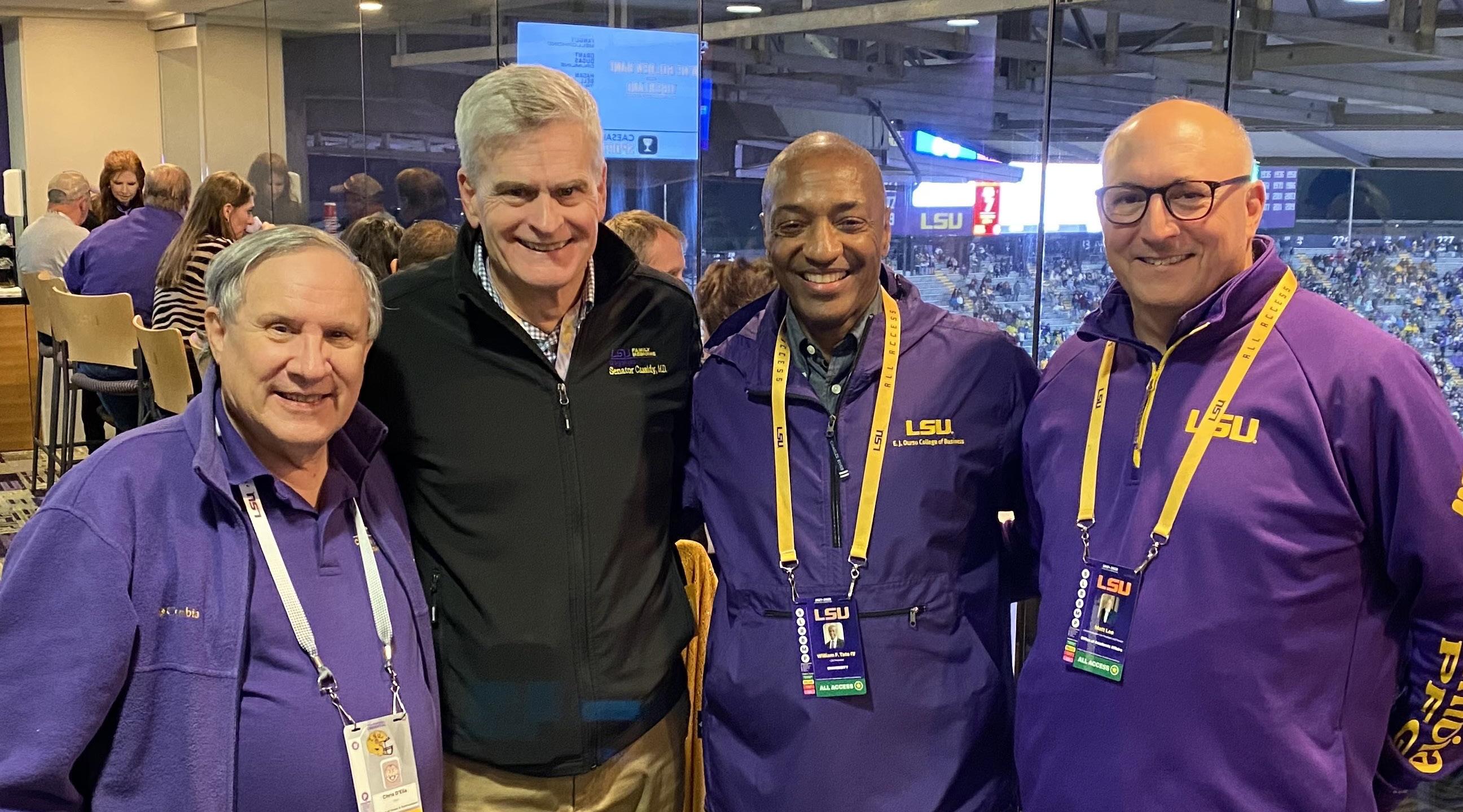
Former Dean of the CCE Christopher D’Elia with Sen. Bill Cassidy, former LSU President William Tate IV and then Provost Matt Lee at Tiger Stadium.
D’ELIA
NEWS DRUG DETECTION
LSU researcher, students develop method to track opioids
BY JORJA ETHRIDGE Staff Writer
An LSU professor developed a new method for tracking certain synthetic opioids through wastewater with the help of an undergraduate student and a graduate student.
Bikram Subedi, an assistant professor in environmental sciences, worked with Emilia Lomnicki and Ramesh Sapkota. Lomnicki is a senior chemistry major, and Sapkota is a secondyear graduate student studying environmental sciences.
Their detection method involves testing wastewater. Subedi said this process is ideal because wastewater testing is non-invasive and offers realtime data.
Nitazenes are Schedule 1 synthetic opioids that cause painrelieving effects even more potent than fentanyl. Subedi said nitazenes can be 10 to 50 times stronger than fentanyl.
Pharmaceutical laboratories first synthesized nitazenes in the 1950s in an attempt to create alternatives for morphine, Subedi explained. The U.S. Food and Drug Administration never approved the therapeutic use of these drugs because of their potential to cause overdoses.
Nitazenes emerged on the illegal drug market in the U.S. in 2019, according to the United Nations Office on Drugs and Crime Early Warning Advisory.
Subedi and the two students collected wastewater samples from New Orleans during the
TECHNOLOGY
Super Bowl and Mardi Gras celebrations in 2025. The team found seven of the nine types of nitazenes in the samples, indicating a substantial use of these drugs during those festivities.
“In the United States, our lab is a frontrunner in this area of research,” Subedi said. “This is the first time we’ve comprehensively analyzed all those nitazenes in wastewater and are able to detect those compounds.”
Subedi explained that public health officials and law enforcement should be made aware of this information. He said that nobody expected these drugs to resurface in 2019, and some forensic labs do not even have methods to detect these compounds.
Subedi studies how much
and what types of drugs people are using and trends in drug use over time. He said he has been working on this area of research since 2013.
Lomnicki and Sapkota said they did much of the hands-on work like extracting and analyzing the samples. Subedi and the two students published a paper on their findings earlier this month.
The team is now monitoring the use of these drugs all over Louisiana. Subedi said they have collected more samples this year that they have not yet analyzed.
Lomicki said she enjoys applying her chemistry knowledge to this kind of research.
“I would have never guessed that chemistry could be so heavily incorporated in something
this important,” Lomnicki said. “The general population would never guess that you can calculate drug consumption through wastewater. Who would have thought of that? There’s a lot of chemistry behind it, and I think that’s super interesting.”
The team pointed out that mass gatherings like the Super Bowl and Mardi Gras affect the data.
“Festive environments can create environments where people are actually encouraged to get into these drugs, and they can be more available,” Subedi said. “People’s behavior on using drugs during mass gatherings can be significantly different than in a typical day or week.”
Therefore, the data they obtained from New Orleans last year will probably not be consistent with future samples, so they are still monitoring this drug use there.
Sapkota said he plans to continue working on this research as well as other drug-related projects for the remainder of his time as a graduate student.
Lomnicki said the future of this drug project will heavily focus on comparison to past samples.
“It’s important to see how, you know, with the opioid crisis, how our state, our home is affected by it,” Lomnicki said.
“Just seeing, with the data that we’re getting this year from New Orleans, how, just within a year, it shows a difference in comparison.”
LSU professor, creatives explain the rise of AImade shorts and how they’re impacting artists
BY AIDAN ANTHAUME Staff Writer
AI-made shorts are multiplying on Instagram Reels and TikTok, flooding feeds with bizarre clips that creators can churn out in minutes at a pace traditional artists and animators say they can’t match.
That pressure falls hardest on people who build work by hand, frame by frame.
Hugo Zbor, a graphic designer and animator, said he can spend days polishing a single piece as he carefully crafts the world his work belongs in.
“The best aspects of worldbuilding are to keep things consistent in terms of emotions you get from viewing the piece,” Zbor said. “If your work consis -
tently conveys a specific emotion… and does that well, you feel like you’re in that world.”
Zbor said that kind of consistency — the tiny decisions that add up over time — is what makes his work feel handmade, even if most viewers don’t stop long enough to notice them.
But the feed does not reward patience.
Spend a few minutes scrolling, and the pattern becomes hard-to-miss: quick-cut shorts with simplistic animation, synthetic voices, images that look plausible until you stare at the hands, the lettering and the edges of faces. Critics have started calling it “AI slop.”
“Before, an artist needed a
AI, page 4

STUDENT LIFE
Panel talks Black women’s health
BY MADDY SNYDER Staff Writer
The LSU chapter of the National Council of Negro Women, collaborating with Black Girls Vote and Black Men in Medicine, hosted a Black Women’s Health and Justice panel.
On Tuesday evening, students had the opportunity to hear from three panelists about Black women’s health and the discrimination they face when receiving medical treatment.
One of the panelists, Latoya T. Paul, a professor of biology at LSU, said she has experienced discriminatory medical treatment several times throughout her five pregnancies.
When Paul was pregnant with her youngest child, she went to the emergency room for high blood pressure. Her concerns were disregarded for five hours before a doctor finally read her bloodwork and told her it came out clean, insinuating that he and his staff had assumed her medical concerns were not serious and that she was looking for a way to get drugs.
“It dawned on me that they didn’t care anything about me because they thought I was someone there looking for drugs,” Paul said.
Paul said she was stereotyped as a drug addict and denied adequate medical treatment because of her race. Serving as an example of the discriminatory medical care Black women receive during pregnancy.
During another pregnancy a few years ago, Paul experienced symptoms of an iron deficiency — trouble sleeping, panic attacks and little to no appetite — and she was rapidly losing weight. Doctors dismissed her concerns and told her that her iron levels were normal. However, when she went to a different hospital, she had her blood tested again and learned the truth: her iron was dangerously low.
The one thing Paul has learned from all this is to be wary of the medical advice given to her by doctors.
“You will be mistreated because of the color of your skin, because of historical biases, because of historical teachings that are embedded in our country,” Paul said.
Ifeyinwa F. Davis, an in -
MICHAEL DWYER / Associated Press
The TikTok logo is seen on a cell phone on Oct. 14, 2022 in Boston.
COURTESY OF BIKRAM SUBEDI
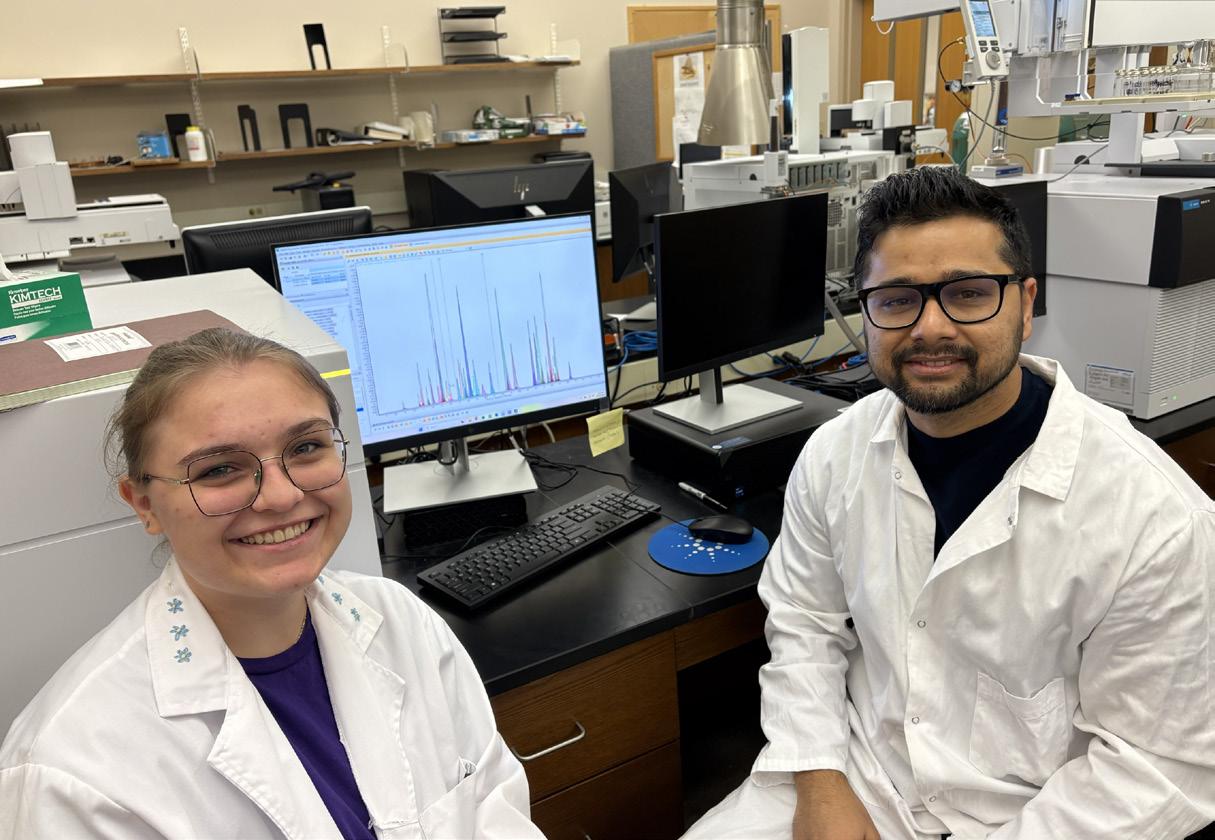
Students who worked with Bikram Subedi. From left to right: Emilia Lomnicki and Ramesh Sapkota.
PANEL, from page 3
structor of women’s, gender and sexuality studies and African and African American studies at LSU, said that the American medical system’s mistreatment of Black women undermines the “family values” it purports to uphold. Our country praises motherhood, but oftentimes Black mothers aren’t treated with care, respect or dignity at hospitals.
“Motherhood is supposed to be so beautiful, and women are supposed to enjoy their pregnancy,” Davis said, “But there’s a reality that what our society says they want for women … that does not apply to Black women.”
AI, from page 3
lot of creative skill, but also artistic skill. Now, all you need is prompting skills,” said LSU assistant professor Nihar Sreepada, who researches AI in public relations, journalism, advertising and political communication.
Sreepada pointed to a recurring format of fantastical “creatures,” such as Meowl, a cat with an owl’s body, that have resurfaced because AI tools now make it easy to animate them into lifelike motion.
It’s important for Black students to understand these discriminatory practices so that they can be aware of the treatment they are receiving and help to advocate for proper care for Black women.
Jiselle Piper, the membership coordinator of the National Council of Negro Women and an organizer of the panel, said that spreading information about these issues is one of the best ways to achieve social justice for Black people.
“We want to be able in the future to create initiatives to ensure that not only Black women but Black people overall are receiving that support and the necessary and proper care that they deserve,” Piper said.
“People in the comments talk about it as though it’s a real animal, even though they know it’s not. They have developed this parasocial relationship, like an identification with the Meowl, and it has become a wild trend.”
The upside, he said, is access. People with creative ideas but limited drawing, animation or editing skills can now produce visual worlds quickly. The downside is what gets washed out when art becomes inhuman.
“The flip side of it is that the whole concept and essence of
art is that it takes care,” Sreepada said. “It takes human creativity, human consciousness and human skill.”
Creators also have a financial incentive to post “AI slop.”
“AI is really superpowering spam,” 404 Media co-founder Jason Koebler told NPR in an August 2025 report about the rise of mass-produced AI videos.
“The whole point is to hit the algorithm in some way — to basically win the algorithmic lottery, get people to like, comment, share and, hopefully, go
very viral,” Koebler said.
The report followed a 21-year-old college student in the Philippines who posts one or two AI-made clips a day and earned $9,000 in one month through YouTube’s AdSense program.
For working artists, this expectation to stay visible online can affect promotion plans and release schedules.
Braxton Couvillion, a New Orleans rapper who releases music independently, said the pace of AI content has changed what it takes to hold the atten -
tion of new fans.
“It’s hard to drop new music because so many times the song’s potential gets wasted without the right promotion,” Couvillion said. “That doesn’t mean you shouldn’t post. Posting is part of the job, even when nothing blows up.”
Zbor said that is why “handmade” still matters, even if the algorithm does not always notice it right away: the work carries a consistent emotional logic that can’t be mass-produced, and the people who connect with it tend to stay.

MADDY SNYDER / The Reveille
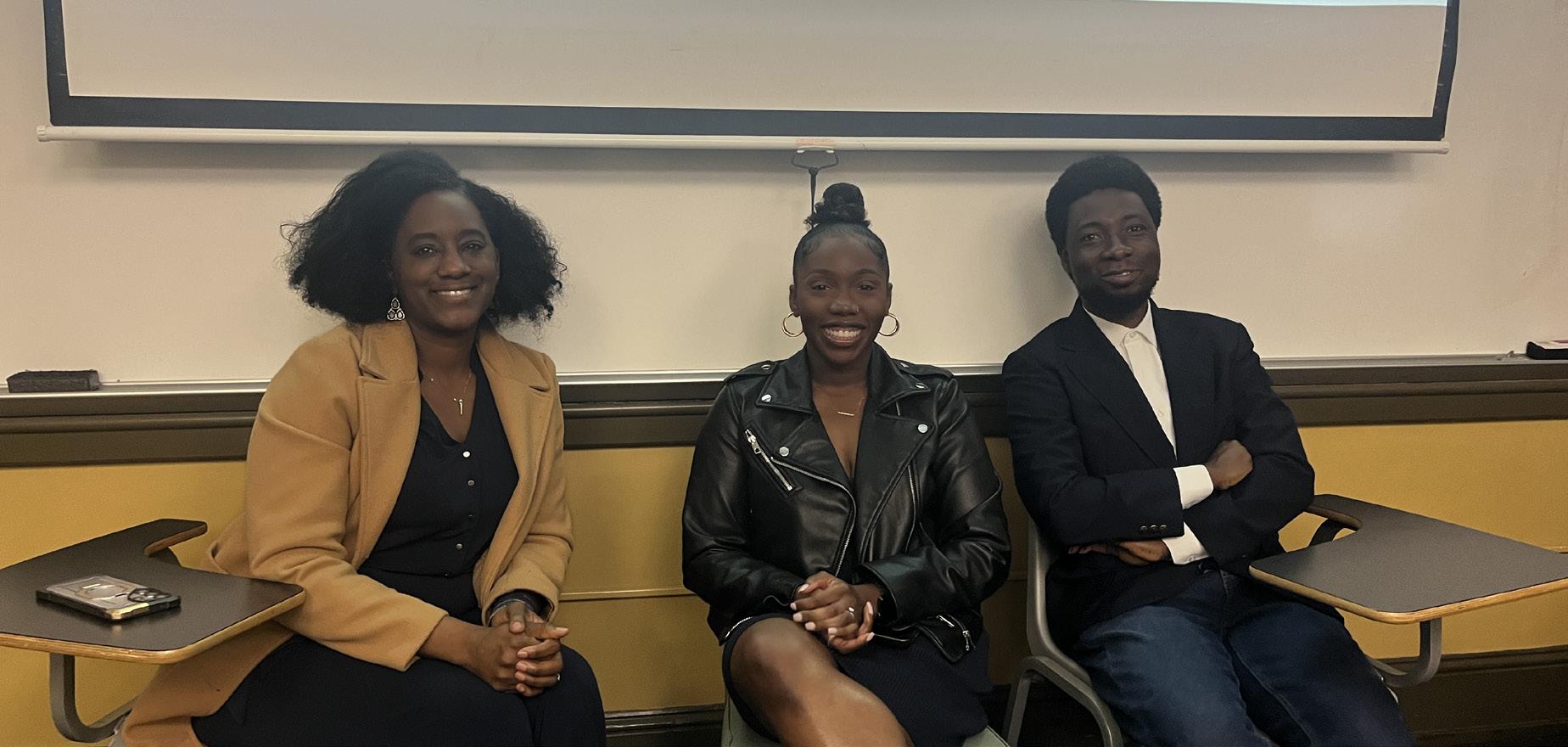
From left to right: Latoya T. Paul, Ifeyinwa F. Davis and Ibrahim Nurem
ENTERTAINMENT
This club is breaking down barriers for Black women going into medicine
BY CHARLOTTE TRENTALANGE Staff Writer
According to the Association of American Medical Colleges, Black women make up less than 3% of doctors in the U.S. The National Society of Black Women in Medicine’s goal is to change that number.
The organization, founded at Florida State University in 2017, was brought to LSU in 2023. Most members remember its modest beginnings with a much smaller pool of students. Now, nearly three years later, the club and the women within are striving toward careers as healthcare professionals.
The organization’s national goal is to increase the recruitment and retention of Black women in medical fields, one aspiring student at a time. For LSU NSBWM President Irisa Lincoln, her main mission is to support the organization’s members.
“The most comforting thing about entering the world of medicine, or any workforce really, is looking up to the likeminded women who did it before you,” Lincoln said.
NSBWM often organizes guest speakers composed of various physicians, doctors and dentists around Baton Rouge to visit the club. Lincoln said it’s a great way for members to ask specific questions based on the career they’re working toward, but also to see someone similar to them achieve the same goals.
The main support system comes from within the chapter, though. According to Lincoln, the upperclassmen who apply and are accepted into medical or graduate school offer guidance to the underclassmen. She said applying to medical school can be a grueling process, and there’s lots of details and dead-
lines students need to be aware of. Because of that, NSBWM offers workshops led by students in the organization who have been through that process.
“If a girl texts me and asks, ‘Can you get coffee with me on Saturday and help me go over my MCAT schedule?’ I’m like, ‘Yeah, sure, let’s go,’” Lincoln said.
While she said the support received from LSU’s academic advisors has been nothing short of amazing, there are some things advisors can’t help with, like showing minority representation in a difficult path.
Junior Peyton Dunn, the organization’s secretary, said that before she joined NSBWM, she didn’t think she’d be able to accomplish a career in medicine since it seemed so daunting. Through her time as a member, she gained confidence by being introduced to professionals who have accomplished the same path she desires.
“Hearing that not all of them have been a 4.0 student or knew since kindergarten they wanted to be a doctor made me feel like this is something I can do,” Dunn said.
For her, she finds the club necessary for women to diminish the doubts associated with the statistics for Black women entering healthcare.
“When you look at strictly statistics or numbers, it’s scary and it seems improbable that you could do that,” Dunn said. “Having this club for support as a minority is big.”
While she currently studies kinesiology, she hopes to one day become an optometrist.
The sentiment remains true for most members. Mahogany Leonard, a biomedical science student who hopes to become an obstetrician, said that as a
Black woman pursuing a career in medicine, she feels she has to work 10 times harder than anyone else. She said she knows it won’t be an easy career and it will only get more difficult, but having similar women around in the same field is comforting for her.
Leonard said attendance is encouraged within the club for maximum success. Going to the meetings is helpful because the executive board tries to plan events to benefit every student since its members are so diverse — from aspiring physicians, nurses, dentists and doctors, the goal is to help every woman get her foot in the door.
She said an emergency medicine doctor spoke to the club — a field that she wouldn’t have thought about prior, but is now interested in.
As for freshman Elise Lanier, an aspiring dermatologist or allergist, the organization is not only an opportunity to optimize her career, but a community of connections and friends.
“It’s a balance between work and social events,” Lanier said.
The organization offers everything from mock interviews and resume building practice to pumpkin painting and fitness classes. Another point of pride is the community outreach and public service they do, most recently with a women’s shelter clothing drive and a Boys & Girls Club food drive. They do events year-round, both collaboratively and individually.
For anyone hoping to become a member, Leonard said everyone is very welcoming and that if you’re even slightly curious, you should come to a meeting.
“Put yourself out there; the worst someone can say is no,” Leonard said. “But here, you wouldn’t get a no.”
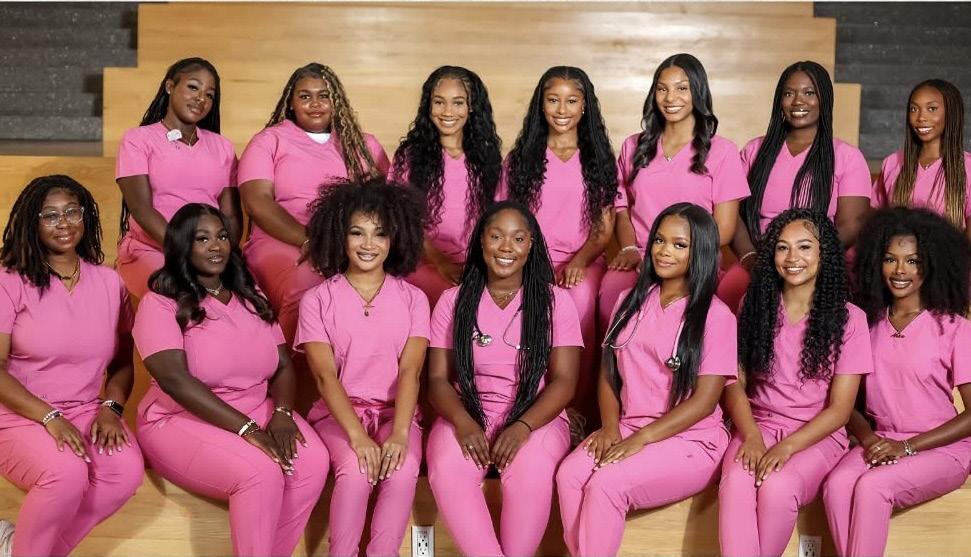

COURTESY OF THE NATIONAL SOCIETY OF BLACK WOMEN IN MEDICINE The National Society of Black Women in Medicine at LSU’s 2025-2026 executive board.
GET YOUR
DUCKS
IN A ROW
A variety of ducks around the Campus Lake on Saturday, Jan. 31 on LSU’s campus.




PHOTOS BY ERIN BARKER | DESIGN BY EMILY BOUDREAUX






A White Ibis stands on the edge.
Mallard ducks swim.
Muscovy duck swims.
swim together. A Muscovy duck flaps its wings.
Black-bellied Whistling ducks swim.
Muscovy duck feathers.
‘Hand to God’ questions who is really pulling the strings
BY SARAH WALTON Staff Writer
When thinking about grief and church ministries, puppets aren’t usually the next thing that comes to mind. But in LSU Theatre’s newest show, 17-year-old Jason uses his church’s puppet ministry to help cope with the loss of his father.
“Hand to God,” written by Robert Askins, is a show like no other.
Following Jason, his mother and others in their religious community, this play is a strangely dark and comedic exploration of religion, grief and community.
Morgane Campbell, a sophomore psychology major, plays Jessica in the show. She explained that in the show, Jason uses puppets to cope with the craziness around himPuppet from “Hand to God”
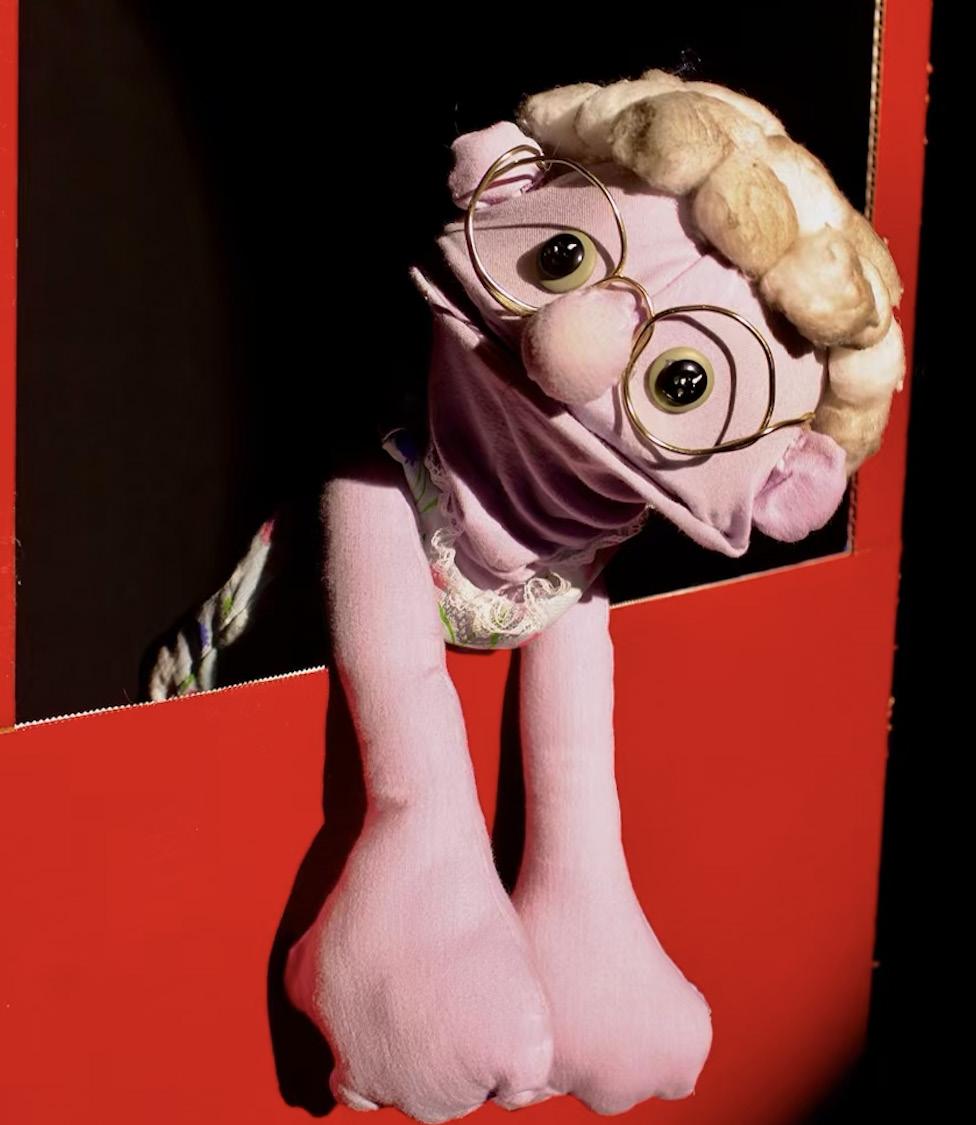
“[It’s] an escape from all of the things that he’s going through,” Campbell said. The character of Jessica is a reluctant participant in the puppet ministry in a highly religious town. Campbell mentioned that she grew up in a Christian family and went to Catholic school, so it was easy to pull from her experience when creating the character.
“The show is definitely a
little outrageous, a little out there, but I think the people who come to see it will definitely feel a little shock,” said Campbell.
Puppets are a truly rare occurrence in theatrical performances nowadays, and it has been a first for most of the cast and crew. This show has been a learning process for Campbell — at the beginning, it was a challenge to catch on, but now she’s having fun with it.
As a lab show, this production is fully led and run by students, which has allowed the actors and designers a lot of room to try different things. This is Campbell’s first lab show, and she has enjoyed being so collaborative with the team.
“I love when things are studentled,” said Campbell. “Being able to collaborate and make choices as a team rather than being told what to do like some directors.”
The cast and crew of “Hand to God” have become slightly infamous for their fun and odd posts all over Instagram, filled with posts using Charli XCX’s song “House” everything from polls on which team member has a bigger bald spot. Campbell uses the show’s social media to develop her character, thinking about what she would post and portray herself as.
Hunter Nastasi is a senior arts administration major, and he plays
the lead character of Jason. When describing his character, Nastasi called him a shy kid who is out of his element. Nastasi is incredibly excited for the show, noting that it interrogates religion by putting it on one side or the other.
“It’s also a very funny play, so there’s that,” Natasi said. “It really does make you ask questions about Jason and Tyrone [the puppet]. There’s a lot of pulling of the strings from each side. It makes you wonder, like, who’s actually in control. ‘Is this Jason saying this, or is this actually Tyrone saying this?’”
The cast and director were hush-hush about quite a few plot points, wanting to keep an element of surprise for the audience. But the really intriguing part about the play is the fact that Jason’s puppet Tyrone gets turned into something different. With the wild plot the show has, it takes a lot of work to bring people together and shape the story.
Ethan Hood is a senior technical theatre and film and television major at LSU, and he is the director of “Hand to God.” This is not his first time directing, but like most of the team, it is his first time working with puppets. For him, the puppet part of the show came together quite quickly. Hood mentioned that Brandy Ernst, the play’s
puppet designer, loves the Muppets and had the puppets ready to go by the second week of rehearsals.
This show has a lot of moving parts, some dark moments, so it was important for Hood to get outside help with intimacy coordination, fight choreography and more. For him, learning to allow others to help shape the show was something new he had to do.
“I’m hoping the audience takes away from the show that all emotions are valid,” Hood said. “The show has a lot of humanness in it; there’s a lot of human emotions. Even though there are puppets, it is a very human and very grounded show.”
Hood is most excited for the audience to see Act 2, which is the culmination of everything that is set up at the beginning of the play.
“It’s an enjoyable hecticness,” said Hood. “I want this to reflect life, and even though life can get hectic, you gotta slow down and enjoy it sometimes. Just enjoy the fun moments as much as you have to work through the harder moments.”
LSU Theatre’s fourth lab show of the year, “Hand to God,” opened Feb. 25 and runs until Mar. 1. More information and access to tickets are available on the Purple Pass website.
LSU Esports club hosts friendly Smash Bros competitions
BY PAIGE CHERAMIE Staff Writer
If you’re looking for a night of competitive gaming and a fun community, stop by the weekly Super Smash Bros. Ultimate tournament, also known as SALSA, hosted by a branch of Esports LSU.
On most Friday nights, you can visit room 1200 of Patrick F. Taylor Hall at 6 p.m. to join in on the fun. To guarantee a spot in the tournament, be sure to pre-register on TigerLink at least an hour before the games begin. Singles rounds begin at 6:30 p.m., giving players a 30 minute buffer to arrive and get set up.
Super Smash Bros. the ultimate is the fifth installment of the Nintendo fighter game. It features many characters from the Nintendo universe that players can select as their fighter. Each character has individualized speciality moves, keeping players on their toes. Once a player has been knocked out three times, the round is over and the winner is declared.
Esports LSU member Jayden Ho, a mechanical engineering major, is in charge of the tournament logistics. He makes sure the event is posted on TigerLink and the room is reserved. He also works alongside commu-
nity member David Ammons, who can be found at the front of the room setting the brackets and determining seeding for the tournament.
“We like to do tournaments to try to encourage more people to play the game,” Ho said.
“Because [David Ammons] here runs the entirety of the Baton Rouge Smash scene, we want to try to get more players into the game.”
The SALSA tournament is double elimination singles, meaning players have two chances to participate in one versus one rounds before they are out. If a player loses the first game they play, they enter the loser brackets, giving them the chance to climb back to the top.
The starting brackets are determined by seeding, which is the process of strategically placing players by their skill level to give players the best chance at success. Seeding allows games to last longer and players to participate in more rounds.
Ammons is prominent in the Baton Rouge Smash scene because he works tirelessly to get people interested in the game and ensures that everyone has a great time. He runs the Baton Rouge Smash Instagram account, where he posts tournament and event announcements.
“It gives an opportunity to
have fun, play games, get to know people and get to see people you haven’t seen in a while,” Ammons said. “To me, it’s really fun at times, especially since some people take it highly competitively. It can be a little stressful, and for some people it is that stressful, but it’s time to play the game you like and see the friends you enjoy.”
He is also the person who coined the nickname SALSA for the tournaments, which was the result of a failed acronym name.
“It was originally called SALSU, which stood for “Smash at LSU” but that name didn’t roll off the tongue as easy. So it became SALSA,” Ammons said.
To participate in the weekly tournament, all you need is a pair of original Nintendo Switch controllers. There is no fee to enter, as the organization is focused on getting more people involved and providing a space for people to gain experience in a
tournament environment.
Attendees are encouraged to bring their own setup — a Nintendo Switch and television, if possible — or collaborate with others to ensure everyone is able to focus on the game.
Jacob Rogers, a computer science software engineer graduate student, likes the setup of the SALSA tournaments because of how laid back and enjoyable they are. He always brings extra game setups if he can to give more people the opportunity to participate.
“I try to contribute as much as possible when I can,” Rogers
said. “It’s a really fun way to unwind after a school day, because Fridays are usually pretty difficult for me. Being able to come back here to enjoy games with my friends and fellow students, it’s a pretty good time.”
If you aren’t sure how to play the game or are intimidated by a tournament setup, Ammons invites everyone to drop in to watch or hang out with the people who attend.
“It can be a little daunting to get into at first,” Ammons said. “But I promise you if you jump in, it’s really easy to get along with everyone involved.”

COURTESY OF ALLIE SULLIVAN Puppet from “Hand to God.”
SPORTS
PERFECT NO MORE
LSU baseball upset by McNeese after ugly pitching performance
BY RAMI BURKS Staff Writer
The top of the second inning for LSU baseball was not pretty on Tuesday night against McNeese.
Walking the bases loaded, bringing runs in via a hit-bypitch and another walk, two pitchers looking poor on the mound and four runs gained by the Cowboys didn’t look good for the “powerhouse of college baseball” — and it only went downhill from there.
Pitching struggled for this team of loaded offensive talent.
Marcos Paz started on the mound for LSU on Tuesday night, and he was cruising through the first inning and into the second, but the wheels fell off with two outs in that frame. After he came out of the game, nine pitchers followed him in the contest.
The Tigers’ pitchers walked six batters, hit five batters and allowed seven hits in the 7-6 contest.
“I thought the guys at the end of the game did a good job,” LSU head coach Jay Johnson said postgame. “Probably should have reverse-engineered the game, in hindsight, should have gone to Deven [Sheerin] in the second inning to stop the bleeding.”
Sheerin ended up turning the Tigers’ pitching energy a bit in the game when he came in during the eighth inning. He posted two strikeouts in his five batters faced, but it was too late to make
WOMENS BASKETBALL


LSU baseball redshirt sophomore right-handed pitcher Deven Sheerin (45) pitches the ball during the Tigers’ 7-6 loss against McNeese on Feb. 24 at Alex Box Stadium.
as big an impact as his appearance could have.
What was supposed to be a courtesy game for the Tigers turned into a mighty struggle.
The bleeding never stopped, and the momentum never found its way back to the LSU dugout.
Even though the momentum never shifted, it doesn’t mean
the Tigers didn’t try. LSU put up a fight throughout the game with its bats, and several runs came from big swings.
Senior first baseman Zach Yorke hit his fourth home run of the season in the first inning. Junior right fielder Jake Brown pushed across his 17th RBI of the season in the fifth. Designat-
ed hitter John Pearson crushed a home run into the left field bleachers to bring the Tigers within one run in the eighth inning.
It was truly the pitching that gave it away for LSU, and the momentum just couldn’t come back
BASEBALL
Baseball without star outfielder
BY TRIPP BUHLER Staff Writer
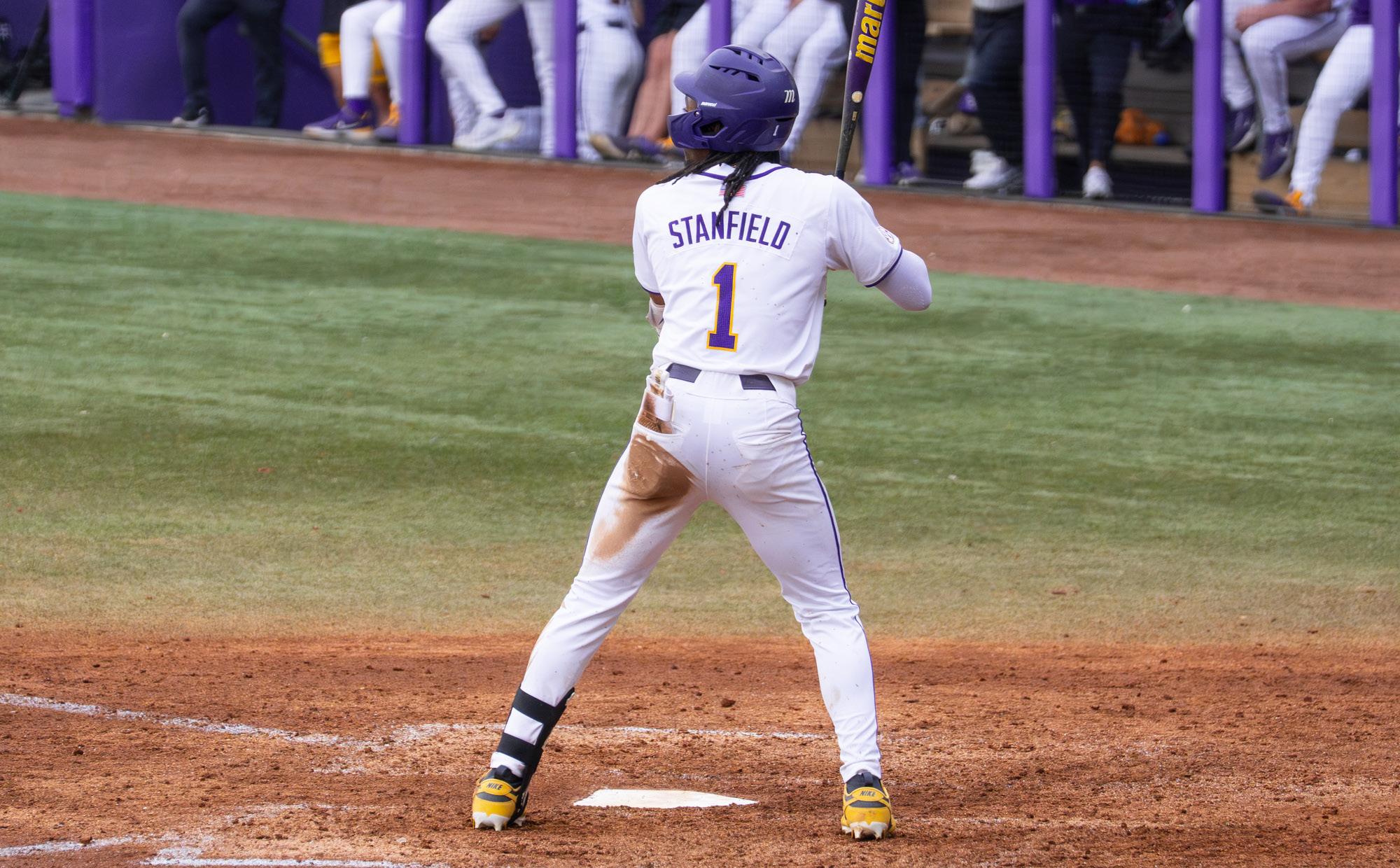
LSU baseball has been without left fielder Chris Stanfield for all but two games this year due to a hand injury, and there’s no clear date for his return to the lineup yet.
“We definitely need him,” head coach Jay Johnson said. “The swelling has gone down a lot. Now it’s a matter of getting some strength back … I feel much better than I did a week ago. I don’t know if that means he’ll be available to play this weekend.”
Stanfield, who withdrew his name from the MLB draft to come back to LSU and play left field for his senior season, is supposed to be an everyday starter. He started the first two games, batting first on opening day and ninth in the next game.
He bruised his hand on a play at the plate late in that second game against Milwaukee when he slid into the catcher’s foot. He was held out of the Sunday and Monday games of that opening series as a precaution. Johnson said after Monday’s game that the swelling just hadn’t gone down yet.
After last Wednesday’s game against Nicholls, Johnson said again that it was just a bruise and the swelling had gotten better.
“Won’t be long,” Johnson said,
Women’s basketball’s star transfer is heating up just in time
BY TRE ALLEN Staff Writer
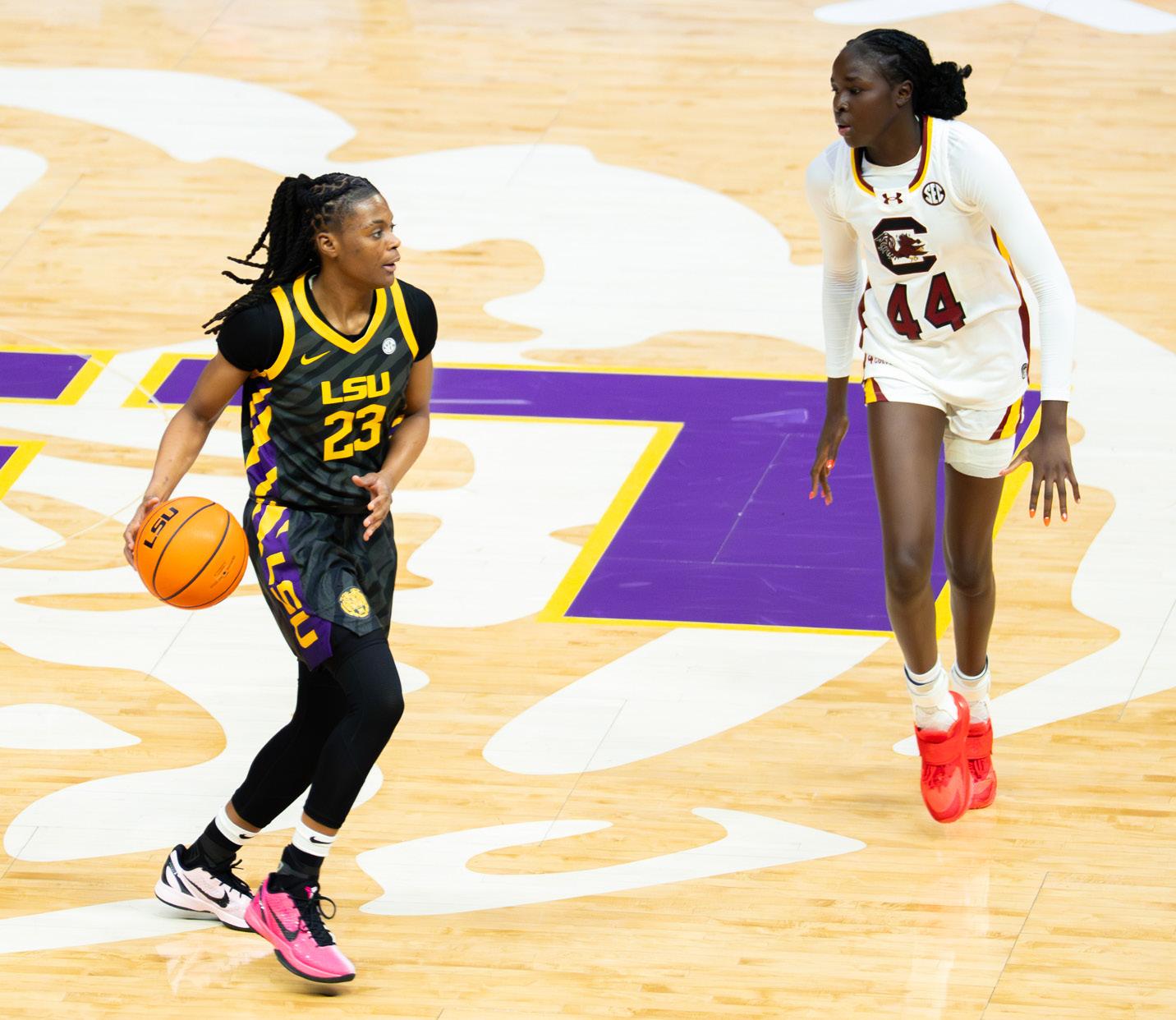
When LSU women’s basketball’s MiLaysia Fulwiley stepped onto the court against South Carolina two weeks ago, she was greeted with cheers from the home crowd.
It was the first time Fulwiley faced her former team after spending two seasons with the Gamecocks, where she averages 11.7 points, 2.9 rebounds and 1.6 steals.
After the 2024-25 season, she shocked the college basketball world by deciding to transfer from her hometown and sign with the LSU Tigers and head coach Kim Mulkey.
The ride for Fulwiley in Baton Rouge has been a rollercoaster with plenty of ups and downs. Through the first 21 games, Fulwiley was everything LSU imagined. During that stretch, she averaged 14.5 points, 3.4 re -
bounds, 3.4 steals and 1.1 blocks.
“She’s beaten me too many times for me not to have taken her into this program, “ Mulkey said after LSU’s first open practice. “Ballers want to play with ballers, and she’s going to be fun to watch. I think the fans already know how good she is and all the spectacular things she does on the floor. And now the LSU fans get to cheer for her instead of booing her.”
She was electric, a menace on defense and a perfect fit for an already talented roster, even though she came off the bench.
The game-breaking plays that Mulkey once saw as an opposing coach were now on her side, and for any hope of a national championship, Fulwiley would be a key part of the team.
However, with the highs came the lows. Fulwiley went through a five-game scoring slump starting at the end of January, averaging only seven points, 3.2 turnovers
and shooting 27.3% from the field.
While Mulkey understood that this was just a bump in the road, Fulwiley’s struggles to score efficiently and not taking care of the ball were still a concern.
“I think she’s come a long way,” Mulkey said. “Some of the things she does, you do live with, but not until you continue to make her better in certain areas. You don’t just look the other way and let it cost you a game.”
Of course, Gamecock fans were quick to laugh and say, “I told you so” when they heard what Mulkey said. It just added more fuel to the fire for the two teams’ rivalry game on Valentine’s Day.
For Fulwiley, she knew what type of game it was going to be, and it was something that she had been waiting all season for.
“Feb. 14 is gonna be the game that’s kinda circled on my calen-
HINSELEY BRYANT / The Reveille
HINESLEY BRYANT / The Reveille
LSU women’s basketball junior guard MiLaysia Fulwiley (23) looks down the court during the Tigers’ 79-72 loss against South Carolina Feb. 14 at the PMAC.
GYMNASTICS
Gymnastics remains confident about growth despite loss
BY DELANEY POTTHAST Staff Writer
Currently still No. 2 in the National Qualifying Score rankings, LSU gymnastics has proven time and time again how unified and team-driven it is. These qualities are even more evident following its hard-fought battle against No. 1 Oklahoma.
Despite ending the night with a loss, the team spoke positively about its performance, with gymnasts noting how proud they were of the momentum found on Friday night.
Not only did the Tigers come within 0.2 of the Sooners’ final score, but LSU all-around star Kailin Chio found two perfect 10s on the vault and beam events.
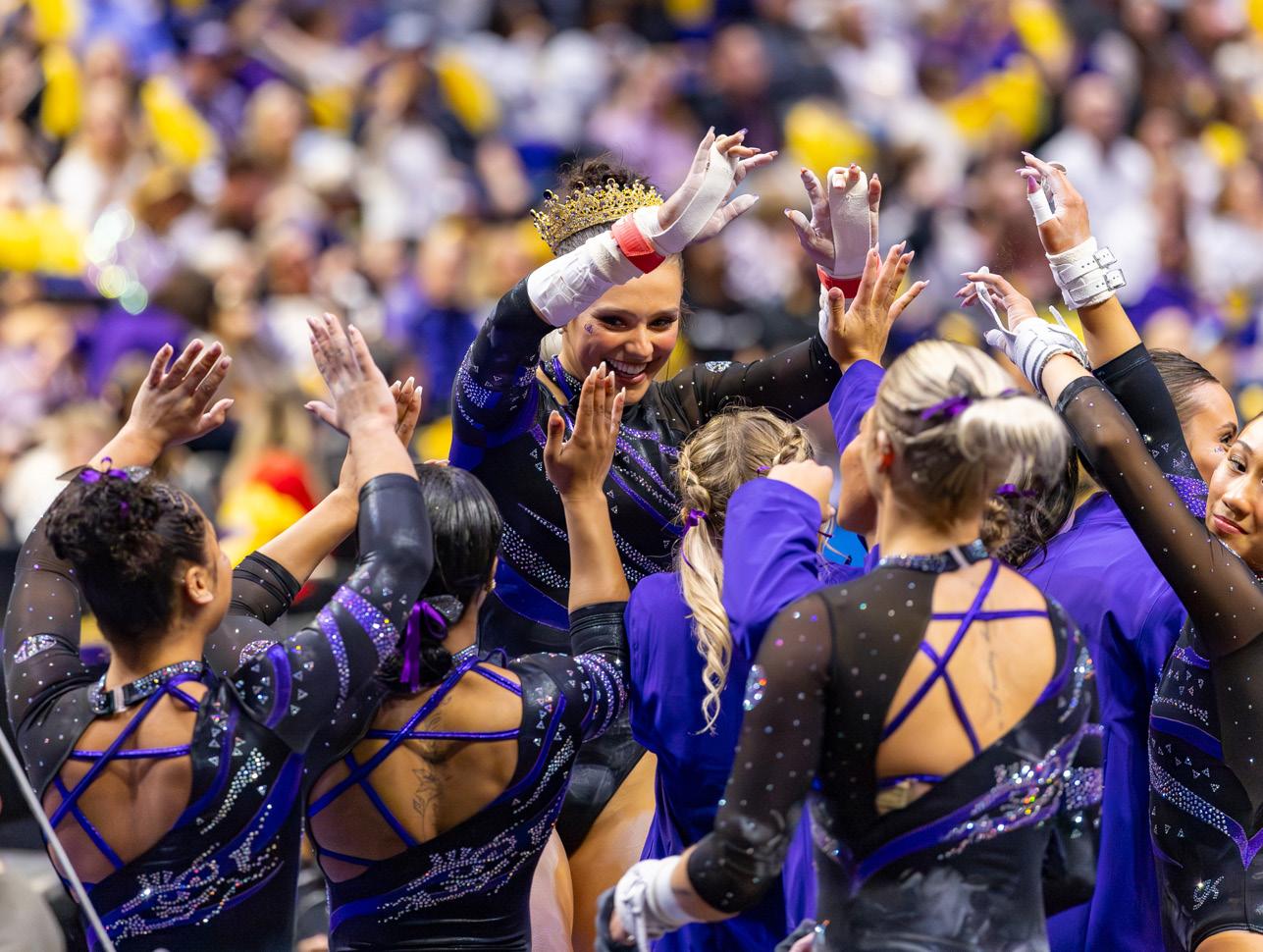
“It was just a boost of confidence for us competing on the road that strongly,” Chio said. “Whether or not we got the win, I think we’re just really proud of going on the road and putting up that score. Road meets are hard, especially in the SEC, so I think that just building our confidence going into the rest of the season, with SECs and nationals, is crucial.”
LOSS, from page 9 over to the home dugout. For most sports, this answer comes as an excuse, but in a game of streaks like baseball, momentum can make or break a game.
Every rally the Tigers started in the home halves was put to bed because they couldn’t string together enough hits at the right times.
However, McNeese didn’t beat the ball all over the ballpark. The Tigers outhit the Cowboys 8-7.
The difference-maker was the free passes they allowed throughout the contest. McNeese did what every team entering an expected lopsided battle would do: take a mile when you’re given an inch.
The Cowboys capitalized on each free base LSU allowed, which worked in their favor until the very end.
While the trouble began in the second inning, the Tigers continued to get into costly hot water with the free passes. It wasn’t until the fifth inning that an LSU pitcher settled in as expected.
That pitcher was Reagan Ricken, throwing 1.1 innings to settle the bullpen. But it wasn’t until Sheerin that LSU pitching truly dominated like it has so far this season. The bats just couldn’t pick it up enough to come back completely.
Despite it all, LSU fought until the very end. The final out came with senior Seth Dardar flying out on his last strike of the game to left field. The ball went all the way to the warning track.
The Bayou Bengals will try to start over on Friday as they take on Dartmouth. First pitch will be at 6:30 p.m. in Alex Box Stadium.
Sophomore Lexi Zeiss also spoke about the meet in Monday’s press conference, mentioning how valuable the experience was to the team as they near the postseason.
“I think we learned a lot about
HEATING UP, from page 9
dar,” Fulwiley said on the CBS Sports’ “We Need to Talk Now” podcast in November.
A packed house with both LSU and South Carolina fans, everyone was waiting for what “revenge” Fulwiley had stored for her former team.
Unfortunately for Fulwiley, it was a poor performance, finishing with six points, four steals and three turnovers while shooting 1-for-8 from the field. And to cap things off, South Carolina once again walked away with the road win, defeating the Tigers 7972.
Surely Fulwiley wanted a better performance, but with multi-
STANFIELD, from page 9
quoting Stanfield about his upcoming return.
Stanfield then didn’t play in any of the three games in the Jax College Baseball Classic.
The senior had a single, a double and a walk in his eight plate appearances in his two games this year, good for a .286 batting average. He has batted just below .300 over his career, primarily being a contact hitter with high-voltage speed.
While his experience helps the team on the field, Stanfield is also a star off the field. Last year, he won the inaugural Tony Gwynn Community Service Trophy for his contributions to the Baton Rouge and baseball communities. He was also named the Live Like Lou Fan Choice Community Impact Player award after the Jax Classic Monday.
LSU hopes to have Stanfield back in action this weekend as it hosts Dartmouth on Friday and Sunday and Northeastern on Saturday and Monday.
The Tigers’ overall score of 197.925 marked their highest score on the road this season.
As Zeiss mentioned, relying on the team has been one of the biggest factors for the Tigers in holding that top-three ranking in the NQS.
Gymnasts Konnor McClain and Kaliya Lincoln were originally listed to compete on bars and floor. However, late lineup changes were made after McClain sustained a minor forearm injury during bar warmups and Lincoln reported Achilles discomfort on floor.
LSU turning to Alexis Jeffrey and Zeiss was unexpected, but the two put up solid performances to step up for their team.
how we can handle ourselves at opposing places,” Zeiss said. “We were just really a team two days ago, and it was really fun to see our team feel it while not being at home. Taking that with us everywhere we go is going to be super crucial.”
ple big games still on the schedule, she couldn’t get too down on herself.
Ole Miss was next, a ranked opponent with home-court advantage on its side. The Tigers found themselves in a 13-point deficit halfway through the third quarter and were on the verge of losing back-to-back games.
It was Fulwiley who helped lead her team to a comeback, finishing with 26 points, seven rebounds, three steals and two blocks. Fulwiley set a new careerhigh in points, using her tremendous speed to beat defenders and attack downhill.
“God blessed this child with speed,” Mulkey said. “I wouldn’t want to be on that floor with her
“I wasn’t expecting to go in and got the call right after floor warmups,” Zeiss said. “I was ready to go and really excited, and my team had my back, so it was super cool.”
It was a similar story for the first event on bars, which set Zeiss and the team up for the strong floor rotation near the end of the night.
“We started off really strong
because when she takes off, you’d better put it in high gear because she’ll find you. And a lot of times, honestly, she looks to pass too much. She needs to get to the rim, finish and draw fouls.”
The cloud of doubt that brewed over her was starting to clear, but the biggest question mark was consistency. Fulwiley is a talented basketball player, but the more consistent she is, the more dangerous LSU is.
She followed up her 26-point game with 22 points, 11 rebounds, four assists, three blocks and two steals Sunday against Missouri. She also shot 7-for-11 from the field, 6-for-9 from the 3-point line and committed one turnover.
“She’s just a spark naturally,”
on bars, and I think that’s been our best bar performance on the road,” Chio said. “So I’m just super proud of them for just starting it off so strong and getting the momentum to keep going for all four events.”
Though it’s never a goal to have a loss added to the team’s record, wins haven’t defined success for the Tigers all season. What matters is resetting each week with a focus on putting their best performance on the floor.
The positivity the team left Norman with is something it’s looking to carry forward as they take on No. 3 Alabama Friday night at home and the Podium Challenge quad meet on Sunday afternoon.
“We competed hard and I knew we would go and compete hard,” head coach Jay Clark said. “We had to make some adjustments, but the kids that went in handled it. That’s the important part to the whole story. You go out there, you lose by two tenths, you get on a neutral floor, and we get all guns ablazing. We’ll be in a good spot, so I feel good about what we did.”
freshman forward ZaKiyah Johnson said following the win over Missouri. “She doesn’t need any shots. She’ll come in there, she’ll take the ball from you. She’s a very good defensive player, and it does fire everybody up from the crowd to our bench, our coaches when she’s scoring.”
With the NCAA Tournament right around the corner, there’s no better time for Fulwiley to start heating up. While she can impact the game on the defensive end and change the pace offensively, her scoring is contagious.
“I think today she had a good day, and it’s really exciting to see how far she’s going to go,” Johnson said.
LUKE RAY / The Reveille
LSU gymnastics sophomore all-around Lexi Zeiss celebrates with the team at LSU’s meet against Kentucky on Jan. 23 at the PMAC.
HINESLEY BRYANT / The Reveille
LSU baseball senior outfielder Chris Stanfield (1) stands at the plate during the Tigers’ 5-3 win over Milwaukee Feb. 14 at Alex Box Stadium.
OPINION
The Ten Commandments don’t belong in Louisiana classrooms

CRAWFORD’S CORNER
GORDON CRAWFORD Columnist
On Feb. 20, the U.S. Court of Appeals for the Fifth Circuit overruled a previous ruling that had placed a preliminary injunction on Louisiana’s infamous “Ten Commandments” law, or H.B. 71, which mandates that poster-sized displays of the Ten Commandments be displayed in every Louisiana public school.
The decision to shirk this case was cowardly and is an arbitrary measure that forces Louisiana citizens to have their rights violated before they are allowed to challenge the law.
The three-judge panel that originally issued the injunction put it best: H.B. 71 is simply “facially unconstitutional.”
The primary argument the court leaned on was that, because H.B. 71 had not gone into effect, it was premature to make any ruling on its implementation, as no examples of displays could be placed before the court.
This is a lazy cop-out excuse to punt this difficult case down the road for a while longer.
Long-standing precedent on this matter is rock solid, and the “lack of display” excuse falls flat when considering the actual substance of H.B. 71.
The 1980 case Stone v. Graham addressed a Kentucky statute passed in 1978, which, like H.B. 71, mandated the display of posters in public classrooms paid for by private donations.
The court held that the law was unconstitutional because the claim of “secular purpose” does not give the government blanket authority to override First Amendment protections, and the Ten Commandments are an inherently religious text due to its rules mandating specific religious practices.
In the almost 50 years since this decision, neither the Ten Commandments nor the First Amendment have been changed, and it makes little sense that H.B. 71 would be any less unconstitutional given its clear similarity to the Kentucky statute.
H.B. 71 is, in fact, more blatantly unconstitutional than that statute.
While Kentucky merely mandated the display of the Ten Commandments with no other guiding instructions, H.B. 71 specifically requires the display of the King James translation of the Ten Commandments.
This opens it up to even greater scrutiny. Dozens of Biblical translations are used across different churches, and the nuanced differences between texts can sometimes lead to crucial distinctions in doctrine.
For example, the translation of the commandment barring murder varies in different texts. Older translations like the King James use “kill,” while later translations tend to use “murder.” The commandment against the creation of false idols is also sometimes translated to be a blanket ban on graven images entirely.
These nuances are why different churches are incredibly specific about which versions of the Bible they use. Thus, this serves to not only impinge upon students from non-Christian backgrounds but also those from the exceptionally high non-Protestant population of the state.
Those defending the law’s constitutionality frequently echo the dissenting opinion of Justice William Rehnquist in the Stone case, arguing that the Commandments’ role in shaping Western society is significant enough that it serves a secular purpose.
However, simple display does not constitute a lesson into the

roots of American law. If there was a lesson delving into how specifically the Commandments influenced law, that would be one thing, but as is, children are simply being shown religious texts in a place they associate with authority and accuracy in information and being provided minimal additional context.
There’s nothing inherently wrong with trying to instill Biblical values in your children, and rules like “don’t murder” and “don’t steal” are generally pretty
good lifestyle decisions, but the issue isn’t with the Commandments themselves.
The issue is a government taking it upon itself to impose the values of a very specific religious tradition on every child in public school. H.B. 71 is a textbook violation of the First Amendment, and the Fifth Circuit’s decision to allow it to go into effect is shameful.
Gordon Crawford is a 20-yearold political science major from Gonzales, La.
Lent and Ramadan overlapping this year is an opportunity
BERGERON’S BRIEFINGS
THOMAS BERGERON Columnist
In a rare alignment of the calendar not seen in 83 years, the 40 day Christian season of Lent and the 29- or 30-day Muslim season of Ramadan have begun on the same day, Feb. 18.
For Christians, Lent is a time to prepare the mind, body and spirit to become closer to God in time for Easter, commemorating the resurrection of Jesus Christ. For Muslims, Ramadan is a time to prepare the mind, body and spirit to become closer to God in time for Laylat al-Qadr, commemorating when the Prophet Muhammad received the Qur’an.

While these regimens of fasting, prayer and almsgiving may appear very different in practice, the ultimate goal of these religious trials is to foster stronger faith, character and community.
EDITORIAL BOARD
Jason Willis Editor in Chief Managing Editor Courtney Bell Sports Editor Ainsley Flood
Now, when it comes to community, it’s possible many first think of growing in fellowship with their own congregation — with their own tribe. That is not at all a bad thing; we should seek to build better relationships with those closest to us. But this unique alignment of
sacred holidays should invite us to bridge the interfaith gap through shared struggle.
The idea that diverse peoples can be united through hardships is a concept many of us ought to be familiar with.
If you grew up playing youth sports like I did, you might cherish those times well beyond your competitive years. Those intense practices, hard-earned victories and crushing losses with your teammates often built bonds that felt different from relationships formed elsewhere. Many may joke about “trauma bonding,” but it wasn’t all about the trauma; it was about building respect, empathy and trust.
In military bootcamp, training follows a unique philosophy: break down the individual to build the unit. While at first glance, one might assume this is meant to replace the thinking human with a thoughtless orderly, but the success of a recruit class is contingent on one thing: working as a
team. This philosophy is instilled through months of intense hardship, testing the limits of physical, mental and emotional capacities.
The result? A cohesive unit of service members able to trust one another in the face of any oncoming challenge. This trust can be adamantine; research has found that warfighters develop familylike bonds when experiencing battle together.
While fasting may feel far removed from the field of competition or war, the underlying mechanisms are strikingly similar. Like athletic training or bootcamp, Lent and Ramadan invite participants to embrace self-imposed discomfort with millions of believers around the world. This year, Christians and Muslims should not view our matching calendars as parallel timelines, but as shared time to practice the discipline our faiths call us to merit.
Uniting in hardship will not change our theological differences, nor should it, but it can
Editorial Policies and Procedures
The Reveille (USPS 145-800) is written, edited and produced solely by students of Louisiana State University. The Reveille is an independent entity of the Office of Student Media within the Manship School of Mass Communication. Signed opinions are those of the author and do not necessarily represent the views of the editor, The Reveille or the university. Letters submitted for publication should be sent via e-mail to editor@lsu.edu or delivered to B-39 Hodges Hall. They must be 400 words or less. Letters must provide a contact phone number for verification purposes, which will not be printed. The Reveille reserves the right to edit letters and guest columns for space consideration while preserving the original intent. The Reveille also reserves the right to reject any letter without notification of the author. Writers must include their full names and phone numbers. The Reveille’s editor in chief, hired every semester by the LSU Student Media Board, has final authority on all editorial decisions.
allow us to cultivate greater empathy and fellowship between our two religions. Throughout all of human history, there have been many seeking to divide and fracture God’s children, but recall that those inclinations are of this world. Moments like this ought to remind us that this is not our final home; that we have a duty to turn strangers into friends, passersby into neighbors and enemies into beloved.
I think the ultimate blessing of this alignment is not having a unique calendar occurrence for me to write about, but to appreciate and undergo my quiet Lenten struggles along with many, many more brothers and sisters in faith than in other years.
In that spirit, I think the simplest bridge to cross is one that we overlook too often — to offer one another the sign of peace.
Thomas Bergeron is a 26-yearold graduate student from Baton Rouge.
“The more I wonder, the more I love.”
Kaley Melancon News Editor
Garrett McEntee Opinion Editor
JOHN BAZEMORE / AP Photo
A copy of the Ten Commandments is posted along with other historical documents in a hallway of the Georgia Capitol June 20, 2024 in Atlanta.
LEFTERIS PITARAKIS / AP Photo
The bell tower of St. Porphyrios Greek Orthodox church, left, and the minaret of the adjacent Kateb Welaya mosque, right, are seen in Gaza City Aug. 10, 2014.
Trump’s State of the Union was a record-breaking disaster
RILEY’S REVIEW
RILEY SANDERS
Columnist
On Tuesday evening, President Donald Trump delivered an hour and 47 minute State of the Union address to Congress and broke his previously held record for longest address to the legislative body..
It was also a record-breaking disappointment.
Historically, the State of the Union address has been utilized as a means of increasing morale, accounting for progress made and making suggestions to Congress for the improvement of the
country. Past presidents have certainly delivered on the qualifications: Roosevelt with his popularization of the Four Freedoms, Johnson’s “War on Poverty,” Reagan’s recession recovery strategy and Cold War reassurance, Bush’s post-9/11 commitment to fighting the “Axis of Evil,” Obama’s push for the Affordable Care Act and Trump’s introduction of “America First” as an imperial economic strategy.
Now, in Trump’s first State of the Union since his re-election, he has made a mockery of both the American people and the ceremony itself.
The entirety of the address was a vessel for embellishment of Trump’s first-term progress

KENNY HOLSTON / The New York Times via AP
President Donald Trump delivers the State of the Union address to a joint session of Congress in the House chamber at the U.S. Capitol in Washington Feb. 24, 2026.
in which he delivered a wide range of outright lies about the economy while also taking time to chastise the Supreme Court Democrats in Congress.
Trump began his address with a positive message of forward growth and a prospective look at the nation’s upcoming 250th birthday. Almost immediately after introductory niceties and a fiery assertion that America was entering its “golden age,” things went downhill.
Trump first claimed that, upon re-entering office, he “inherited a nation … with a stagnant economy.”
In actuality, the U.S. GDP had risen 2.8% just prior to his reelection, a 0.4% higher growth rate compared to this past year’s 2.4%. He also claimed that “incomes are rising fast and the economy is roaring like never before,” which is again untrue as incomes have risen a mere 0.9% in the last year compared to 2.2% in 2024.
He purported that his tariff revenues, recently struck down by the Supreme Court in a 6-3 decision, were “saving our country [with] the kind of money we’re taking in.”
This is certainly up for debate both economically and constitutionally.
A year’s worth of Liberation Day tariffs led to a 1.4% inflation in core goods costs, a typically static metric, by December. Trump asserted earlier in the year that foreign businesses and institutions would bear these costs as opposed to everyday Americans, but according to a study conducted by the Harvard Business School, American consumers have shouldered somewhere around 43% of these
costs thus far.
The Supreme Court, having recently struck many of these tariffs down in what Trump called an “unfortunate ruling,” declared the tariffs unconstitutional as they were not deemed qualified under the International Emergency Economic Powers Act.
In spite of this ruling, he signed an executive order extending a new 10% global tariff essentially eroding the check on his power by the court.
The president also mentioned that he’d managed to acquire commitments from other countries totaling “more than $18 trillion,” which is an unsubstantiated figure nearly double the $9.7 trillion total touted by the White House.
In short, he lied. Over and over again.
Even worse, he spent a large chunk of his time chastising the Democratic members who refused to stand and clap for him on a multitude of occasions. He told Reps. Mark Takano and Rashida Tlaib that they “should be ashamed” for criticizing him after they interrupted his speech and later said “these people are crazy,” referring to the Democratic side of the chamber.
The president also had Rep. Al Green removed from the room for holding a banner that read, “Black People Aren’t Apes!” which was a reference to Trump’s racist Truth Social post depicting the Obamas as apes, a post that he defended, saying “I didn’t make a mistake.”
Green had also been removed during Trump’s prior address for shaking his cane at Trump from his seat.
Both were silent protests. It’s
important to note that other silent protesters, such as Nancy Pelosi, whose protest consisted of a “Release the Files” pin, were not removed.
Interspersed with appearances by the U.S. Men’s Olympic Hockey team, a young survivor of the Texas floods, military heroes, four of nine Supreme Court justices, Epstein victims, and Erika Kirk, the president’s State of the Union speech was presented as a glistening recollection of events in the greatest chapter in American history — a recollection of events that did not happen in a chapter of America that is not even remotely great.
Trump sold many Americans on running the country as a business and the economy as a well-oiled machine, and in his first term, he delivered on these promises. Now, however, business is not booming, and though a once great salesman, his charm is virtually nonexistent.
It does not matter if the president can run the country like a business successfully — not only is Trump failing in this regard this term around, America is not merely a business.
If the president is a liar, a convicted felon, a racist, an egomaniac and is increasingly disapproved of by the public, with Fox News finding 76% of voters nationally disapprove of his economic policy, then maybe he shouldn’t be the leader of the free world.
What do I know, though? As Trump said, this “should be [his] third term.”
Riley Sanders is a 19-year-old biology major from Denham Springs, La.
Free yourself from the contortion of catering to everyone else
MICHAIAH’S MINUTES
MICHAIAH STEPHENS
Columnist
At the moment we live with the autonomy to not offend anyone by including everyone. If something isn’t for someone, you will make it fit instead of moving on.
If someone makes a list online of songs they like, the comments will be filled with “What about XYZ songs?” If someone takes a picture of their engagement ring, the comments are flooded with pictures of theirs too.
Everyone wants to be included.
In the 2007 television show “Gossip Girl,” Serena van der Woodsen once said, “Not everyone wants to be Blair Waldorf.”
Well, now everyone wants to be her, but as Blair responded, “Not everyone can be.”
I will even add that not everyone should be.
How did we get here? I bet you’re expecting the end-all-beall to be social media and though partly true, there are other factors involved in our self-involvement.
Our biology as humans does have something to do with it. Because inherently we are all selfish creatures who constantly want for ourselves, this sentiment has been heightened across all people, those accused of being “chronically online” and those not.
We do live in a society, and our society was built on individuality — American society, that is. You invent something on your own, become a “self-made man” and cut off relationships to make that dream a reality.
The dream is to be recognized and comforted, like a debutante ball in high society. Everyone sees you make your debut and you stay in your comfort zone, occasionally making strides to bless other people with your presence.
But only as long as the night never ends.
This independent yet attention-seeking archetype has made focusing on ourselves so easy. Leaving our houses and bursting our bubbles has never been more difficult.
In a previous article in which I talked about how living takes a village — that you cannot go about living alone — I introduced the idea that we isolate and call it self-care. That we expect transactions with every interaction that will further our own self-serving goals. But we can’t call that living.
And I think we all know who the culprit is behind this American dream gone feverish: social media and social norms.
Not only is your algorithm tailored to you, but it also stitches you to other people who think exactly like you. It’s easier to find a middle ground when you’re in front of others talking it out, but without that physical interaction, everyone will just agree with each other.
In another previous article, expanding on the growing sentiment that certain social media
platforms are better intellectually than others, I say, “How are we really any better if we all just tell each other, ‘Exactly?’”
Where do we go now? Well, if everyone isn’t actually a special snowflake, does that mean my grandma was wrong? No. You just might not be special in this circle because, in actuality, it has nothing to do with you. Look past yourself and understand that not every moment needs your input. Sometimes, you can just observe.
If you like blue and are in a circle of people that like red, you don’t make them change to like blue.
You move on.
Not everything is for you and it shouldn’t have to be. Let people have their space without making it about you. This is how looked-over voices are silenced by louder voices. Find what is meant for you and stick with that. Life is much easier that way.
Michaiah Stephens is a 22-yearold english major from Durham, N.C.