Vo lum e 136 · N o. 13
E s t. 18 87
Mond ay, O c t o b e r 12 , 2 02 6
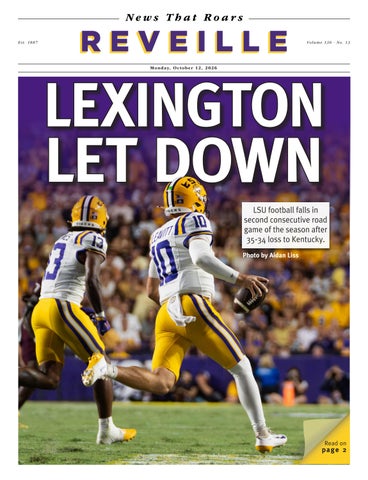
LEXINGTON LET DOWN LSU football falls in second consecutive road game of the season after 35-34 loss to Kentucky. Photo by Aidan Liss
Read on
page 2
L SU Re ve i l le.co m @l s u r e ve i l le
page 2
OVERTIME AGONY
LSU football stumbles to Kentucky, falls in upset loss on the road
B-16 Hodges Hall Louisiana State University Baton Rouge, La. 70803
NEWSROOM (225) 578-4811
BY DELANEY POTTHAST Staff Writer No. 10 LSU football couldn’t snap its seven-game SEC losing streak on the road, taking a 3534 loss in overtime against Kentucky under stormy skies inside Commonwealth Stadium on Saturday. With matching 4-1 records ahead of the Week 6 kickoff, the Wildcats accomplished their mission to upset the purple and gold in a back-and-forth battle against the Tigers. A demanding Kentucky defense gave the LSU offense a run for its money on the night’s lengthy opening drive, allowing the Tigers to reach first-and-goal but ultimately limiting the first points of the night to a Scott Starzyk 24-yard field goal. While LSU’s quarterback Sam Leavitt collected 162 passing yards in the first half, an undisciplined Tiger squad plagued LSU during the whole game on both sides of the ball. Defensively, LSU was challenged by the Wildcats. Kentucky scored a touchdown for a 7-3 lead in a 36-second opening drive. Running back CJ Baxter slipped through the Tiger defense and rushed for 77 yards before being stopped at the Tigers’ 3-yard line, highlighting the drive. Baxter wouldn’t be done yet. The very next play ended with an easy run into the end zone for the senior to put up his seventh touchdown of 2026. On offense, the Tigers gathered 5 penalties in the first 30 minutes, as the Wildcat defense put up 2 quarterback hurries and collected 1 sack alongside 5 tackles for loss. Needing to answer back quickly, LSU battled for its first touchdown on an 11-play drive, complimented by an improving Tiger run game. Running back Dilin Jones led the Tigers’ offense and was a major part in offensive coordinator Charlie Weis Jr.’s playbook, leading the team both rushing and receiving for 140 all-purpose yards on the night. The Tigers finished the drive thanks to tight end Zach Grace finding his first touchdown as a Tiger on the receiving end of a 22-yard pass from Leavitt. The Wildcats cut LSU’s celebrations short, though, regaining the lead on a 55-yard punt return from wide receiver Brock Coffman. Able to find a first down in the red zone, Leavitt took a chance on a pass to junior receiver Jackson Harris, who was smothered in the end zone. Perfectly placing the ball, a reception from Harris put LSU back in front, but a big hit briefly sent Harris to the medical tent.
Editor-in-Chief LAURA ALLEN Managing Editor GARRETT MCENTEE Digital Editor SAMANTHA SUNDBERG News Editor JORJA ETHRIDGE Deputy News Editor MADELYN LONG Sports Editor ALEX SHEESLEY Deputy Sports Editor RAMI BURKS Entertainment Editor MIA VIZZI Opinion Editor RILEY SANDERS Multimedia Editor EVAN TOUCHET Production Editor EMILY BOUDREAUX Chief Designer ALEXANDRA GERSTNER
ADVERTISING (225) 578-6090
CHARLES CHRISTIANSEN / The Reveille
LSU head coach Lane Kiffin watches from the sideline on Sept. 12. during LSU’s 45-14 win against LA Tech at Tiger Stadium. Down to 3 minutes in the half, former-LSU offensive coordinator Joe Sloan went to work. He exploited LSU’s difficulty in tackling by adding variety to the Wildcat run game to round out a total of 131 rushing yards in the first half. Soon, the Wildcats found themselves with their own fourth-and-goal inside the 1-yard line, and a successful push at the goal line would put Kentucky up 21-17 at the half. Having only thrown for 40 yards in the first half, Kentucky quarterback Kenny Minchey Jr. faced an awakened Tiger defense that remembered at the start of the quarter its status as one of the top run defenses in the country. LSU held the home team to only 21 yards on the ground in the second half. As the Tigers forced a Wildcat punt at the start of the half, Leavitt threw his eighth interception of the season, continuing a streak of giving up a pick in every game the Tigers have played this season. Though no damage was inflicted on the Tigers following the turnover, the scoreboard would stay stuck at 17-21 until late into the third quarter. LSU eventually found itself at firstand-goal on its seventh drive of the game, but only added 3
points after settling for a field goal on fourth down. For the Wildcats, the awakening of star receiver Kenny Darby reignited their game, as the freshman completed a chunk pass for 35 yards. After a quiet first half, the reception marked the first of his night, uncharacteristic for the 12.9 per game he usually averages. Even with the effort, the drive ended early in the final quarter with Kentucky’s own field goal, upping its lead to 24-20. Keeping up with the energy, Weis dug deeper into his bag of plays to set up a double pass that would end in the hands of tight end Roman Mothershed who carried the ball to the end zone for LSU’s first lead in the second half. The on-point throw came from Harris, who alongside Winston Watkins Jr., became some of the biggest difference-makers on the Tigers’ offense. Ending the night with a combined 12 receptions for 116 yards, Leavitt would add an additional 275 with 25 completions on 34 pass attempts. From there, it was a battle against complacency for the Tigers. The Wildcats closed in on a chance to tie the score, but a missed field goal from Adam Zouagui held the LSU lead at
27-24. Soon after, Kentucky had another shot at taking the game following a fumble on a sack by Leavitt. However, another 26yard attempt by Zouagui went wide again. It wouldn’t be Zouagui’s last appearance in regulation, however, as a forced punt for LSU handed possession back to Kentucky with just under two minutes of the game. Making 9 plays within the 2-minutes left to gain 67 yards, Zouagui converted a 33-yard field goal to tie the game at 27 points each, sending the game into overtime. Taking the first possession, the Tigers scored a touchdown from a rush by Leavitt and elected for the extra point with a good kick from Starzyk. As the ball went to the Wildcats, a touchdown for Baxter gave way for Kentucky to attempt a two-point conversion to end the game. Following timeouts from both teams, the Wildcats would find its second consecutive overtime win of 2026 on a quarterback draw. As the 400-plus day drought of conference wins on the road continues, LSU finished the game on the wrong side of a 3534 score. It heads back home for an 11 a.m. kickoff against Mississippi State on Oct. 17.
Layout/Ad Design BELLA CHELETTE Layout/Ad Design TAIYE COLLINS Layout/Ad Design REESE PELLEGRIN Layout/Ad Design ALAYNA YOUNG
CORRECTIONS & CLARIFICATIONS The Reveille holds accuracy and objectivity at the highest priority and wants to reassure its readers the reporting and content of the paper meets these standards. This space is reserved to recognize and correct any mistakes that may have been printed in The Daily Reveille. If you would like something corrected or clarified, please contact the editor at (225) 578-4811 or email editor@lsu.edu.
ABOUT THE REVEILLE The Reveille is written, edited and produced solely by students of Louisiana State University. The Reveille is an independent entity of the Office of Student Media within the Manship School of Mass Communication. A single issue of The Reveille is free from multiple sites on campus and about 25 sites off campus. To obtain additional copies, please visit the Office of Student Media in B-39 Hodges Hall or email studentmedia@ lsu.edu. The Reveille is published biweekly during the fall, spring and summer semesters, except during holidays and final exams. The Reveille is funded through LSU students’ payments of the Student Media fee.
NEWS TRACKING CRIME
page 3
LSUPD Annual Security and Fire Safety Report shows which crimes have increased
BY GABRIELLA MARIN Staff Writer LSU Police Department released its 2026 Annual Security and Fire Safety Report, providing the community with crime statistics from 2025 and previous years. The Clery Act requires all colleges and universities to disclose information about reported crime on and around their campuses each year by Oct. 1. The law is intended to provide students and the public with information about campus crime and safety. The act was passed following the rape and murder of Jeanne Clery in 1986 at Lehigh University. Her parents advocated for college campus crime statistics to be readily available for the community to access. LSU complies with this federal law by releasing its Annual Security and Fire Safety Report, which includes crime statistics from the previous three years as
well as information about campus safety policies and crime prevention. This allows the community to compare data, showing data up to two years prior. LSUPD Sgt Marlon Hawkins said the report gives students and the public a transparent look at reported crime on campus. Hawkins added the report helps the LSU community better understand the safety resources available and helps LSUPD identify areas where it can continue focusing on education, prevention and safety. One type of crime LSUPD is monitoring is motor vehicle theft. The report shows that motor vehicle theft has more than tripled this year since 2023. In 2025, 218 motor vehicle thefts were reported, compared with 121 incidents in 2024 and 68 incidents in 2023. Hawkins said that the motor vehicle theft category includes more than cars. Under Clery reporting, self-propelled and electric scooters are consid-
ered motor vehicles. As scooters have become more common on campus, Hawkins said securing them properly has become an important part of LSUPD’s crime prevention messaging. Additionally, liquor law arrests have also increased in 2025. The report shows 59 liquor law arrests in 2023, 31 in 2024 and 139 in 2025. A liquor law violation means the offender was in violation of any Louisiana law prohibiting the manufacture, sale or possession of intoxicating liquor. Violations can also be issued for maintaining unlawful drinking spaces, selling liquor to a minor or drinking in public conveyance, according to the 2025 report. Hawkins said liquor law violation arrests can be influenced by enforcement activity, special events and the types of contacts officers have throughout the year. An increase in offenses does not necessarily mean alcohol use increased at the same
rate, he said, but it does show that officers had significantly more liquor law enforcement activity in 2025. There was also a spike in oncampus drug law arrests, with 62 reported in 2025 compared to the 29 reported in 2024. The increase of these incidents has raised concerns about campus safety for some LSU families. LSU alumna Jenifer Leonard said the statistics in the report have made her weary about sending her son to her alma mater. “I’m disturbed at the increase of motor vehicle theft and liquor law arrests,” Leonard said. “What I’ve seen and heard about campus since last year has been eye opening, and not in a good way.” While motor vehicle theft and liquor law arrests on campus increased, burglary reports decreased from 53 in 2023 to 19 in 2025. According to the report, burglary is defined as the unlawful entry, or attempted
unlawful entry, of a structure to commit a felony or a theft. “We are encouraged by that decrease,” Hawkins said. “There’s rarely one single reason behind a change like that, but patrol presence, security measures, crime-prevention efforts and our community taking steps to secure their rooms and property all help reduce opportunities for burglary.” Dating violence, or battery of a dating partner, and stalking offenses also decreased from previous years. Dating violence decreased from 30 reports to 18, and stalking from 45 reports to 37, since 2024. LSUPD encourages students to report incidents by calling LSUPD at 225-578-3231 or using the LSU Shield mobile safety app. “The biggest takeaway should be awareness,” Hawkins said. “The statistics help us identify trends, but keeping campus safe is something we all play a role in.”
ACADEMICS
LSU named one of the nation’s Distinguished Military Colleges BY GEORGE DEBLANC Staff Writer Through America’s Corps of Cadets, LSU has been selected as one of the nation’s Distinguished Military Colleges, giving the university the Honor School status and its Corps of Cadets program more opportunities to grow. This designation will give LSU Corps of Cadets more ability to establish minor programs, leading to potential commission into governmental departments for students, according to retired Corps of Cadets Commandant and Colonel Joseph Musacchia. “One of those is the U.S. Coast Guard. Another one is the National Oceanic and Atmospheric Administration,” Musacchia said. “They can receive commissions in that organization, which actually falls under a completely different department.” He said that LSU was previously a Distinguished Military College in the 1920s but has gone semi-dormant since Corps of Cadets participation became voluntary in 1969. Additionally, LSU has been involved with the U.S. military since 1860, according to an LSU press release. Musacchia also said students in these selected colleges that are also in Corps of Cadets or-
ganizations are given more consideration over other students when competing for active duty slots. Musacchia specified that this is what “Honor School” meant in the memorandum. “LSU’s history has long been tied to service, leadership and preparing graduates to meet the needs of our state and nation,” LSU Chancellor Jim Dalton said in a statement. “This designation recognizes that long-standing commitment, and positions LSU to build on that legacy for the next generation of military and civilian leaders.” Musacchia also mentioned that LSU could provide potential scholarships, internships or more secure employment for students. He gave the hypothetical example of a student trying to work in cybersecurity, where he or she could get guaranteed employment and scholarship funds by applying to the U.S. Department of War’s CyberCorps. He also specified that some of these programs don’t require direct military service. “You get cutting-edge capabilities to be on the front line of cyber defense for the nation,” Musacchia said. “Or you can take that and then use it in the business world, or you could use it at the state level.” He said that the requirements for this status are for the university to reach out to
the Secretary of War, establish a four-year military or national security program, have a separate student body that reports to the chancellor or president and have all cadets wear a uniform during campus hours. LSU has completed three out of four of these requirements, with the uniforms being a work in progress, according to Musacchia. He said that each uniform can cost around $1,000. The in-progress uniforms are based on the original uniforms worn from 1860 to the early 1900s. Musacchia added that the LSU Board of Supervisors and alumni that were previously cadets have provided support for these uniforms. He also mentioned that a national security minor program is near approval for the university. Musacchia said that LSU is trying to fulfill all of the requirements by fall next year. However, he also said that 100 cadets in uniform plan to attend at the LSU versus Alabama football game in November. “The reason we chose 100 is because it was 100 years ago today that our Cadet Corps mustered on the Parade Ground in 1926,” Musacchia said. “Which was when our campus was moved from its old location by the state capital.” A new cadet building is also planned for construction next
to the LSU Digital Media Center, which Musacchia said the move-in is planned for spring of
next year. He also referred to it as the “newest cadet building in the nation.”
ALEXIS PERSICKE / The Reveille
The William A. Brookshire Military & Veterans Student Center sits Oct. 8.
Monday, October 12, 2026
page 4
Louisiana Parole Project awarded grant to aid former inmates BY MADDY SNYDER Staff Writer The Louisiana Parole Project received a $995,000 grant to help the previously incarcerated find secure, stable jobs. The grant was awarded by BlackRock Future Builders, a national philanthropic initiative funded by The BlackRock Foundation. The Louisiana Parole Project was one of 15 grant recipients nationwide, out of more than 1,000 applicants. These 15 organizations were awarded $13 million in total, which is expected to help over 5,400 individuals learn skills for future careers. Founded in 2016 by Andrew Hundley, Robert Lancaster and Keith Nordyke, the Louisiana Parole Project has spent a decade working to support formerly incarcerated people. The organization works closely with the LSU Law Parole and Reentry Clinic, representing incarcerated individuals on parole and helping them rebuild their lives after prison. Hundley, who serves as the executive director of Louisiana Parole Project, explained that rebuilding can look different for everyone, but the organization focuses on securing housing and employment for its clients.
“Different people have different challenges when they come home,” Hundley said. “But what we’ve learned is that we can affect the most people by giving them a safe roof over their head when they come home and then work to get them employed, so they can become self-sufficient in the long term.” BlackRock, founded in 1988, is an international organization whose goal is to help people experience financial well-being. Its newest initiative, BlackRock Future Builders, is a plan to train and support 50,000 Americans in technical jobs over the next five years. “America has enormous demand for skilled trades workers who can build and maintain what our country depends on, and these can be great jobs for millions of Americans,” said Larry Fink, chairman and CEO of BlackRock, in a statement. “With BlackRock Future Builders, we’re investing in organizations that know how to turn that opportunity into lasting careers: helping people get the training they need and connecting them with employers who need their skills,” Fink added. With the grant funds, the Louisiana Parole Project will launch Second Chance Path-
ways, an initiative that will focus on building careers for formerly incarcerated people. According to Hundley, this will include hiring employment specialists to make connections with employers, providing training to people coming home from prison and supplying them with anything else they may need to sustain a job. These options may include safe housing, transportation to and from work or work clothes. The Louisiana Parole Project believes that given the proper skills and training, formerly incarcerated people can be the next workforce for big infrastructure projects in Louisiana. Mentioning the new SpaceX spaceport and Hyundai steel plant coming up in Louisiana, Hundley said that Louisiana has a serious demand for a steady workforce to build and support these projects. “There are all these big projects, but who are the workers? Who’s the workforce?” Hundley asked. “There are people returning home from prison with skills and a real desire to work. At the same time, employers across Louisiana need qualified workers in the skilled trades. We are working to connect those two realities.”
The grant will help the organization achieve its ultimate goal of giving clients a second chance at success through financial and workforce support. “We believe a second chance is about more than simply leaving prison; it is about having meaningful opportunities to
reach your full potential and build a better future,” Hundley said. “Our goal is to provide the support and stability people need to move forward after incarceration. When our clients succeed, families and communities are stronger and public safety is served.”
CHARLES CHRISTIANSEN / The Reveille
LSU students listen to members of the Louisiana Parole Project on Oct. 4 in the LSU Student Union.
Follow us
@lsuthemag Meet you on Tower Drive...
OCT. 13 11am 11 am - 2pm 2pm
FOOD • GAMES • RESOURCES • SWAG
ENTERTAINMENT LSU alumnus’ novel explores possible disaster from dam system destruction PUZZLES
page 5
BY PAUL TIBBETS Staff Writer
LSU alumnus Rick Bahlinger sets a doomsday clock in the middle of Louisiana with his new book “Mother Nature Hates To Lose.” With hurricanes and rising sea levels, Louisiana citizens are no stranger to possible ecological disasters. Not many people would expect that danger would lie in eastern central Louisiana, where LSU alumnus and author Bahlinger set his debut novel. “There’s a lot of people in Louisiana who are not aware of what the Old River Control Structure is and how much of a disaster it could be if it failed,” Bahlinger said. The ORCS is a complex in central Louisiana that sits on the Mississippi River, designed to prevent the river from changing its course. It almost failed in 1973, and if it were to today, Bahlinger believes that the results could be catastrophic. Despite living now in Tulsa, Oklahoma, Bahlinger cannot quite escape his Louisiana roots. Born and raised in Baton Rouge, the Pelican State is where he experienced many milestones from marrying his high school sweetheart in 1973 to graduating LSU with an industrial engineering degree in 1975. Around the early 1970s, Bahlinger’s father-in-law showed him and his wife the ORCS in Concordia Parish. “Mother Nature Hates To Lose” has been brewing since learning about the structure. “If that structure were to fail, Baton Rouge and New Orleans would basically be high and dry,” said Bahlinger.
VIA “MOTHER NATURE HATES TO LOSE” WEBSITE
Rick Bahlinger’s headshot
FOR RELEASE OCTOBER 12, 2026
THE Daily Commuter Puzzle by Stella Zawistowski
COURTESY OF RICK BAHINGER
Rick Bahlinger’s book “Mother Nature Hates To Lose.” “There would still be water there, but it would be salt water as the Gulf approaches up the old river channel. You wouldn’t be able to have ship traffic going up and down the channel unless you dredged constantly.” This impending disaster is the backdrop for his new novel as a cast of characters race against time to stop it while dealing with conspiring politicians and run-ins with drug cartels. While Bahlinger provided the research and Louisiana flavoring, he was supported in the dramatization by ghostwriter Louise Harris. Harris is an established author in her own right, most notably with her five-book “1776” series. Similar to her love for freelance journalism, she enjoys ghostwriting since it gives her the opportunity to meet people and exchange ideas. With 15 years of experience covering the environment, Harris instantly understood and connected with Bahlinger’s ideas for his novel. “I knew nothing about the environment until I started writing about it all the time,” said Harris. “That’s one of the things I went into journalism for is to learn about other things and to talk to people and meet the experts in their field.” She also saw this opportunity to work with him as a bit of a challenge away from the usual genres she writes. “I liked Rick and I also liked the plot that he wanted to convey. Not just the canal system, but also he wanted to put in
the drug dealers and he wanted to have one other villain so that just gave me a challenge because I had to put all these components in there,” said Harris. After 50 years of conceptualizing the story, Bahlinger is happy that his book is finally on shelves. He credits his wife with finally giving him the push to get it done after talking about it for so long. “Every now and then I would say something, sitting at dinner with my wife, and say, ‘You know, I ought to write that book,’” said Bahlinger. “Finally, a couple years ago, I mentioned something, and she just looked at me and said, ‘Would you quit talking about it and just write the book?’ So I said, ‘Ok, I will.’” He hopes that readers might come away with an understanding of the ecological dangers that come along with a disaster like this. He wants readers to put down the book and think that this is a terrifyingly possible reality. “I hope it could be a little bit of an awakening,” said Bahlinger. “The Corps of Engineers has spent millions and millions of dollars and hired really good people to take care of this. But man … Mother Nature doesn’t like to lose. Something’s going to happen one of these days.” The book’s official website has further information about Bahlinger, as well as the site to buy the “Mother Nature Hates To Lose.” Those who are interested in the book can also find an excerpt on the website.
ACROSS 1 Violent conflicts 5 Summary 10 Baby doll’s word 14 Bohm of baseball 15 Greek marketplace 16 High-value cards 17 Toni Morrison novel 18 Back tooth 19 Concealing pattern, for short 20 Legendary ballerina of Osage descent: 2 wds. 23 “Boo-__!” 24 Debtor’s letters: Abbr. 25 Refrained from 29 Terrible 30 Car’s fuel 33 Hoppy beer: Abbr. 34 Sweet scent 36 Feeling of wonder 37 And the like: Abbr. 38 Buffalo NHL player 39 Cut the grass 40 Kathie __ Gifford 41 Quits a job 43 __ out a living 44 Dentist’s degree: Abbr. 45 Dubai’s nation: Abbr. 46 Supplied 48 Burnable data holder: Abbr. 49 “Tee-__!” 50 Chiefs’ QB: 2 wds. 58 Zone 59 __ couture 60 Large-scale story 62 Even scores 63 Sir __ John 64 Infamous emperor 65 Impertinence 66 Considers 67 Small rock band DOWN 1 Used to be 2 University grad
10/12/26
Created by Stella Zawistowski
3 Contests with batons: 2 wds. 4 Sacred beetle of Egypt 5 Hindu hero 6 Show-biz grand slam: Abbr. 7 Brown drink 8 __ Sea (dying Asian lake) 9 U.K. legislative body 10 __ Picchu 11 Purple berry 12 Viral image 13 Since: 2 wds. 21 Blue-roofed restaurant 22 Write a program 25 Agricultural plot 26 Made a choice 27 Gathered facts 28 Wipe clean, as a whiteboard 29 Fortified towns 30 Wildlife protector 31 Came to 32 Did some darning 35 DOJ group: Abbr.
Saturday’s Puzzle Solved
©2026 Tribune Content Agency, LLC All Rights Reserved.
41 Designer Gernreich 42 NYC neighborhood 47 Concrete component 48 Lacking good taste 50 Gentle touches
10/12/26
51 Opera song 52 Golf ball supports 53 Leafy green 54 Silent 55 Molecule part 56 Laying birds 57 iPhone’s voice 61 Bill and __
page 6
Monday, October 12, 2026
Monday, October 12, 2026
page 7
Fifth year guard Donovan Dent (3) drives down the court on a fast break.
Senior forward Mo Dioubate (10) goes up for a contested layup.
Senior guard Abdi Bashir Jr. (1) stumbles while dribbling the ball.
Head coach Will Wade talks to a referee.
Freshman center Michael Ruzic (23) readies himself before a free throw.
Junior guard Divine Ugochukwu (99) takes a free throw.
READY FOR TIP-OFF LSU men’s basketball begins exhibition play on Oct. 8 in the Townsley Law Arena in Lake Charles, La.
The LSU men’s basketball team huddles during a timeout.
Photos by Aidan Liss | Design by James Miller
The LSU men’s basketball team celebrate a dunk together during warmups.
Monday, October 12, 2026
page 8 LOCAL BUISNESS
Local library collects socks to donate to homeless shelters BY MACI WILEY Staff Writer East Baton Rouge Parish Library works with the Family Resource Group Foundation as a sponsored organization for the 11th consecutive Sock it to Me drive to give back to homeless shelters. The drive has been around for 22 years and continues to grow each year. Having collected over 51,000 pairs of socks last year, the EBRPL and FRG Foun-
VIA EAST BATON ROUGE PARISH LIBRARY WEBSITE
Exterior of East Baton Rouge Parish Library’s Main Library location.
dation aim to top it with a goal of 52,000 pairs this year. The library has been a sponsored partner for 11 years, along with various other organizations, such as Hollis Orthodontics, Cornerstone Youth and Family Services, CareSouth and Tel Our Vision, which each play an important role in making the drive successful. “We contact all library branches to set up donation dates, schedules and I report our collection totals — once all 15 library branches are combined — to the FRG office after the branches’ collections are sent to our main library,” Tara Dearing, children’s service coordinator, said. Staff members at each library branch work to ensure that the drive is being run productively. “Each branch calculates their collections, packs it up, then sends it to the Main Library,” Dearing said. “Our wonderful staff at the Main Library children’s room receive, consolidate and prepare the full collection to be delivered. We then deliver the socks to them for distribution to the various community organizations where the socks can reach those individuals in need.” The FRG’s marketing have worked with the community to make it accessible for participants to drop off socks. There
are 58 drop-off locations all over the community for people to participate in, including Arts Council of Greater Baton Rouge, Boy Scouts and Elevate Strength & Fitness. “We have partnered with them for many years in numerous outreach and community events,” Dearing said. “They do so much marketing across the parish for the SITM drive and inspire so many organizations to partner in this wonderful event that we simply could not do a sock drive without them. They are powerhouses of caring for our community.” The goal is to bring people together to serve a cause bigger than themselves and help add to the overall community. “I think large drives to help the community — whether it is socks, books, clothes, food or something else — bring us together as a community,” Tara Dearing said. “When you participate in a community drive, I like to think that we are saying that we want to help our neighbors regardless of their circumstance or their person. We truly get closer to becoming one community.” The drive along with many others are great opportunities for people who want to give back including food banks and donation of general clothing and
VIA OF FAMILY RESOURCE GROUP FOUNDATION WEBSITE
Staff members at Hollis Orthodontics pose next to last year’s Sock it to Me donation box. household items. “When I first heard about the need for socks at homeless shelters, nursing homes and other places that help those in need, I couldn’t believe that something so simple — an everyday item — was lacking,” Dearing said. What may seem like an everyday item to some can be very vital for others, and the East Baton Rouge Parish Library is working to address these gaps in commu-
nity wellness. “I think we have a huge community of caring, compassionate people, and many wish to help others in our community,” Dearing said. “We have children, teens and adults who do not have a pair of socks when their feet are cold. To some this may seem like a small donation, but to that individual who receives a pair of socks, it is a comfort and means so much.”
CAMPUS LIFE
This club teaches students about German culture, language
BY LILY CENTOLA Staff Writer The LSU German Club fosters a community of multiple different levels of German speakers and allows them to learn from one another. The German Club is a cultural organization that aims to be a resource for students interested in learning about German culture and the German language. The club’s Vice President Audrey Falgout said that everyone in the club has a unique reason to want to be a member of the club.
As the Vice President, Falgout, an international studies and political science junior, is in charge of managing TigerLink, booking spaces, contacting campus life and communicating with members about meeting times and events. Beyond helping people learn the language, the German Club serves as a resource for international students, ultimately giving them the space to speak German with other students who know the language “LSU’s German Club has really served as a community for
COURTESY OF THE GERMAN CLUB
Members of the German Club pose for a photo at Deutsches Haus in New Orleans.
me since my freshman year. The people I met at German Club are still my friends today,” Falgout said. Falgout’s favorite memories include movie nights where the club watches German language film from a variety of genres once a month. Later into the school year, the club also hosts end-of-the-semester parties with German snacks and karaoke. Falgout highlighted the fact that LSU offers more languages than just French and Spanish. For her, it’s important to recognize the influence and lasting culture of German settlers in Louisiana, even if lesser known. “One of the most beloved seafood restaurants in the area is Middendorf’s. The owner, chef Horst Pfeifer, is a native of Germany, and [Middendorf’s] hosts an Oktoberfest,” Falgout states. Every year at its Slidell and Manchac locations, Middendorf’s hosts an Oktoberfest, which will run every Wednesday and Thursday through Nov. 12, This festival includes traditional German meals along with appetizers such as pretzels, white sausage and potato pancakes. There is also a selection of premium German beers offered along with live music. Zachary Richoux, a junior
COURTESY OF THE GERMAN CLUB
Members of the German Club cook Apfelstrudel at a meeting. majoring in entrepreneurship, said that his favorite memory with the club was celebrating Oktoberfest at Deutsches Haus in New Orleans. With traditional German dances and merch booths with cultural items, Richoux got to experience German food for the first time and see the culture in action. Each Wednesday, the club hosts a language learning table where they practice speaking German together. From computer science to English literature, German Club members are from every corner of campus. While the club prioritizes
the language, any level of proficiency can join. “You do not need to learn German to join German Club,” Richoux said. He has been a member of the German Club for two years. For Richoux, the club has been especially helpful because of the faculty advisors, who have helped him a lot because he had never taken a German course before joining the club. Those who are interested can visit the club’s table at Fall Fest on Friday. For more information, visit the club’s TigerLink and Instagram.
SPORTS BLUE IT BIG
What LSU football needs to do better after upset loss
BY ALEX SHEESLEY Sports Editor LSU football failed to hang on in a game it was expected to win against Kentucky on Saturday, where the Tigers fell in overtime 35-34. The loss extends a losing skid on the road against SEC opponents dating back to October 2024 and puts LSU almost surely out of the SEC title race. Two losses is not disqualifying for the playoffs, but with major road tests ahead LSU must be better when playing outside of the Pelican State. Three things stood out about the Tigers’ outlook after the loss in Lexington. Discipline problems linger LSU’s lack of poise has been a theme throughout the first half of the season, especially in SEC play. The Tigers entered Week 6 averaging 7 penalties per game, 79th best in the 138-team Football Bowl Subdivision. Beyond errors that left laundry on the field, breakdowns in execution are haunting the Tigers this year. On Sept. 19, an overcommitted LSU defensive back rushed Ole Miss quarterback Trinidad Chambliss, freeing up a receiver to receive a desperation flip pass and turning a potential tackle for loss into a significant gain for the Rebels.
ALEXIS PERSICKE / The Reveille
LSU football redshirt junior quarterback Sam Leavitt (10) throws the ball Sept. 19 during LSU’s 24-32 loss to Ole Miss at Vaught-Hemingway Stadium in Oxford, Miss. Rushed reads and complacency with a lead that led to slips in earlier games was a source of frustration for Kiffin and led to results that looked less dominant on the scoresheet. When playing on the road, mistakes can’t be made. Unfortunately for the Tigers, they’ve been rattled into mistakes the most when away from home. That trend reared its ugly head on Saturday, especially in the first half. LSU won the possession battle
— the Tigers had the ball for over 20 minutes in the first half — and outgained Kentucky in total yards 162 to 40. Yet, Kentucky took the lead into the locker room. Letdowns in critical moments led to that score. Most notably, LSU broke down in punt coverage and allowed a touchdown on a 55-yard return to make it 14-10, Wildcats lead. Several Tigers failed to close down or take the correct angle to
see TAKEAWAYS, page 10
page 9 FOOTBALL
Where football’s playoff chances stand after loss BY ADAM KIRSCHMAN Staff Writer LSU’s 35-34 overtime loss to Kentucky on Saturday marked its second road loss of the season, dropping the Tigers down the SEC and national rankings. Despite the early hole LSU has dug itself this season, other upset losses throughout college football might have kept the Tigers’ playoff hopes alive. The rest of this season depends on whether LSU can win out. For LSU to do this, it needs to beat four more ranked teams — Mississippi State next week, Alabama, Texas and Tennessee. Before Saturday, this stretch of games seemed a lot more difficult than it does now. Texas fell from No. 1 to No. 7 in the AP Poll after losing to an unranked Oklahoma team that struggled through its first games of the season. Alabama held at No. 6 after it lost a one-score game to an undefeated Georgia team. If Ole Miss loses a second game this season, which looks likely with Missouri and Texas on the horizon, the committee could weigh the 24-point loss to Florida as worse than both of LSU’s onescore losses. LSU’s losses also shouldn’t be weighed as season-ending, as both came on the road in games that went down to the final play. Judging by the two losses, the
Tigers have a better chance to close out the season better than they started. LSU faces its hardest competition at home, something that has given them an upper hand in the past. This season, LSU is undefeated at home and winless on the road. Texas also just lost to Oklahoma in a neutral-site game, which could signal a weakness for the Longhorns. Other teams ranked above LSU also don’t have easy ways into the playoffs either. Alabama faces a tough Tennessee team on the road next week before facing LSU later in the year. It also has to play an explosive Auburn team in the Iron Bowl, a game played with so much emotion, it’s impossible to predict strictly off rankings. Texas might have the hardest road ahead, as it faces five more ranked opponents, including Florida, Ole Miss, Mississippi State and Missouri before LSU. The Longhorns also will have to travel to College Station to play rivals Texas A&M in the last game of the season. Although A&M has been a major disappointment this season, the same has been said for Oklahoma, who just upset Texas in a rivalry game. Ole Miss could also finish their season unranked with four losses, as it still has to play three top-15 teams in Missouri, Texas
see CFP CHANCES, page 10
MEN’S BASKETBALL
LSU men’s basketball tops McNeese in first exhibition match BY NATALIA MCKENZIE-DANCY Staff Writer LSU men’s basketball pulled through with a 63-60 win in a close exhibition match against McNeese on Oct. 8. Thursday marked the Tigers’ first preseason exhibition. They entered the contest under new leadership, marking head coach Will Wade’s return to a university he dedicated a lot of his success to in McNeese. His roster showed dominance, although it was limited. “It wasn’t pretty,” Wade said in his postgame news conference. “It wasn’t perfect.” The Tigers started the game with forward Mouhamed Dioubate, center Michael RužiĆ and guards Abdi Bashir Jr., Donovan Dent and Divine Ugochukwu. These players each played more than 34 minutes of the contest. RužiĆ was cleared to play at 3:30 p.m. on Thursday. He was waiting to get cleared after playing professionally overseas for Club Joventut Badalona in Spain. The rest of the roster is close to being finalized, as Wade wanted
to ensure that their paperwork was completed before playing them. Jordan Bender and Strake Pearson, two other players, played in the final minutes of the game. Wade said he would not have risked his players’ statuses, but the Tigers followed through because the game was sold out and raised money for McNeese’s program. He has a positive outlook on the rest of the season, assuring Tiger fans that they have talented players who are soon to be eligible but did not play in this match. The Cowboys opened with guard Dellquan Warren, guard Larry Johnson, center Jerrell Colbert, guard Elija Moore and forward Alier Maluk. Both teams had a fast start to the game, with solid players on offense and defense. Numerous threes, blocks and dunks were made in the contest. The Tigers showed great ball movement, with every player touching the ball almost every possession. Although the Cowboys had several fouls to start the game, they responded to every shot the Tigers made. Dioubate, RužiĆ and Ugochuk-
wu stood out early during the first half of the game, each scoring multiple times, making the majority of LSU’s points. The Tigers scored on a few defensive rebounds, with Dioubate scoring off of his previous blocked shot. Dioubate single-handedly changed the momentum of the game. Wade mentioned the struggles his players were having with defense in a press conference on Sept. 23. However, the team seems to be struggling with something else — free throws. LSU has only made 64.7% of free throws throughout the duration of the game. Wade clarified that the team struggled with free throws during the game, but made hundreds during practice. Bashir Jr. struggled, opening the game with a 3-pointer and then had consecutive misses. He had 6 points and was 1-for-12 on shooting. He made a 3-pointer out of 10 attempts. In the first half, LSU made 34.6% of their shots while McNeese made 35.5%, and the first quarter
ended tied at 31 points. Dioubate had 16 points on 6-for11 shooting. Ugochukwu had 18 points on 6-for-10 shooting. RužiĆ had 11 points on 3-for-9 shooting. The largest lead throughout the game was 6 points. The lead changed 14 times, and was tied 11 times. “This is a good team,” Wade said at the end of the presser. “[The Tigers] looked like they could play against anybody.” The Cowboys came out of halftime energized, scoring on con-
tested shots. The Tigers continued to have positive ball movement, leading a physical match. The contest included an excessive amount of fouls and players hitting the ground. Looking ahead, LSU is set to play its next and final exhibition against UCF at the Pete Maravich Assembly Center on Oct. 14. Wade believes this promising win will set the precedent for the upcoming season and will show how much work he and his team have put in during the offseason.
AIDAN LISS / The Reveille
LSU Men’s basketball senior forward Mo Dioubate goes up for a layup on Oct. 8th in the Townsley Law Arena in Lake Charles, La.
Monday, October 12, 2026
page 10 MEN’S BASKETBALL
LSU men’s basketball season overview after preseason win
guys who have played professionally overseas, a handful of transfers with years of collegiate experience and only four players under 20, all of which are freshmen. Considering how the team looked Thursday and how it will look once its roster gets filled out, the Tigers have a chance to make a deep run. LSU is going to get into shape in its non-conference
slate that comes with some daunting games. LSU plays Gonzaga in Spokane on Nov. 14, and faces off against Arizona State and SMU at the Acrisure Series a week and a half later. LSU then sees Wake Forest and Houston within the first two weeks of December. With some mid-major games thrown in amongst those power-
conference matchups, LSU will have the time to try out plenty of combinations of players against live opponents. All of LSU’s players have been practicing together for over a month, and still have two more exhibitions left. “We look good with the full group [in practice]. We look like a team that can compete with just about anybody when we got the full group,” Wade said. The Tigers have 14 non-conference games before its 18-game SEC schedule. In one of the best conferences in the country, nine conference wins should have LSU on the precipice of getting an at-large bid to the NCAA tournament. This team, at its full strength, can surely surpass 10 conference wins and give the selection committee a good argument for LSU’s inclusion. Against McNeese, LSU’s backcourt was missing guards RJ Luis and Skyy Clark, though Luis has a tough shot at becoming eligible. The Tiger guards still did enough to beat a solid McNeese defense, even with some poor play. Bashir, the team’s best 3-point shooter, went 1-of-10 from deep and Dent, the team’s prospective point guard, went 2-for-8 from the
first half, let Kentucky into the game in a way that LSU could never push the Wildcats out of. Procedural penalties bring concern, as they threaten the efficiency of the offense if they can’t be cleaned up. Kiffin not prioritizing preservation Injuries have thrashed LSU’s depth chart in the first half of the season, perhaps the biggest story for the Tigers in their opening six games. Leavitt, who sustained a hamstring injury in LSU’s Week 4 win over Texas A&M, had a longerthan-expected leash in the Tigers’ decisive win over McNeese. Though the dual-threat signal caller did not show his legs, he threw 23 times and played deep into the game. Kiffin said that there wasn’t a preset plan for starter deployment in Week 5’s game, and Leavitt’s deployment was similar to much of the starters, exposing LSU’s already-depleted starting corps to potential injuries.
Leavitt was cut loose in Saturday’s game against Kentucky, leaving his body vulnerable to some hard hits on runs and in the backfield. While his arm talent shined on some brilliantly-placed balls, some of those decisions resulted in massive hits on his receivers. A pair of hits shook up top receiving options Winston Watkins Jr. and Jackson Harris. Both players returned in the game, a fortunate break for LSU. Harris even threw for a touchdown to give LSU a 27-24 lead. Kiffin continued his unique player deployment, fanning Leavitt and second-string quarterback Landen Clark out wide in some situations. In all, the decisions from Leavitt, both on the ground and in the air, and the personnel choices from Kiffin proved that LSU has no interest in avoiding physical hits. Red zone inefficiencies are tangible In the late stages of their ten-
ures in Baton Rouge, LSU head coach Brian Kelly and then-LSU, now-Kentucky offensive coordinator Joe Sloan were lambasted for the offense’s failures inside of the 20-yard line. Under the new regime, some immobility in the scoring zone still remains. As a play-extender, Leavitt, and on occasion Clark, has been able to find pay dirt through scrambling out of broken plays, but poor reads inside the enemy 20yard line has led to points left on the board. Saturday, those letdowns came with a definite cost. LSU entered the red zone 3 times in regulation on Saturday. Though it scored on every trip, LSU only found the end zone once on the 10-yard pass from Leavitt to Harris that sent Harris off to be evaluated. Sunday-morning head coaches will pick at the typically ultra-aggressive Kiffin’s decision to punt the ball to Kentucky on a fourth-
BY TRIPP BUHLER Staff Writer No one could have stated it more confidently than LSU men’s basketball head coach Will Wade. “We’re damn good,” Wade said after LSU’s 63-60 exhibition win over McNeese on Thursday. The LSU team that the nearly 4,500 people inside McNeese’s Townsley Arena saw isn’t going to be the same squad that hits the court in its next exhibition on Oct. 14, let alone in the season opener on Nov. 3 against LSU New Orleans. LSU’s starters — guards Divine Ugochukwu, Abdi Bashir Jr. and Donovan Dent, power forward Mo Dioubate and center Michael Ruzic — each played at least 34 minutes. LSU showed it can contend with strong teams, even while fighting cramps and an imposing environment.a After ending its last two seasons in 15th and 16th in the 16team Southeastern Conference, LSU should no longer be basement-dwellers. Wade is a proven coach, having led LSU to a SEC regular-season championship and Sweet 16 in 2019. LSU’s team is a basketball melting pot. The Tigers have a few
TAKEAWAYS, from page 9 corral returner Brock Coffman on the play. LSU quarterback Sam Leavitt allowed a pair of turnovers — one in the air to continue his exclusive and dubious distinction as the only FBS quarterback to throw an interception in every game this season, and a fumble that let a trailing Kentucky dictate the pace of the game’s final minutes — the second coming from Leavitt attempting to be the hero. Penalties were a feature throughout the game, too. LSU’s offense picked up several pre-snap penalties, and multiple illegal procedure penalties, where Kiffin and offensive coordinator Charlie Weis Jr.’s scheme that often deploys preplay motion proved too complex for the ones executing in it. By game’s end, LSU fouls cost the Tigers 50 yards, 30 more than Kentucky. The slip-ups, especially in the
AIDAN LISS / The Reveille
The LSU basketball team runs onto the court Oct. 8th in the Townsley Law Arena in Lake Charles, La.
field with only 1 assist. Ugochukwu’s ability to pick the guards up on the offensive end showed that LSU can beat good opponents even when two of its best players have off nights. Dioubate and Ruzic made the game their own, combining for 25 points and 24 rebounds. Wade said the team found out Ruzic was eligible to play just three hours before the game, with a few more international players that should follow behind soon. “We have another couple kids who were cleared, but we were being extra cautious not to poke the bear,” Wade said after the game. “We got one guy that [the NCAA] asked for one more piece of paperwork that we turned in this afternoon.” Centers Brice Dessert and Gilad Levy, and forward Saliou Niang participated in team warmups and were on the bench during the game. Wade alluded to those three internationals specifically due to their positions in the frontcourt. “We’re about to be loaded up here down front,” Wade said. “Better watch out.” Once the roster is set in stone and LSU tips off on Nov. 3, LSU should look like a squad poised to make the NCAA tournament. and-short that would’ve sealed the game had LSU converted. Alarm bells should ring that Kiffin and Weis’ scheming scored 1 touchdown in the red zone, a number well below the duo’s 63.64% touchdown clip in that area in their final season at Ole Miss. Though LSU entered Saturday with a 62.5% conversion rate against FBS foes, LSU performed well below that mark in Lexington, proving costly. Two drives stalled inside the 10-yard line and left 8 points on the board by game’s end, points that would’ve made the late Kentucky drive that tied sent the game to overtime moot. LSU went 2-for-4 on finding touchdowns from red zone trips against Ole Miss, a rate where improved efficiency would’ve flipped the result in a road contest. As LSU battles more ranked foes in the near future, it must do better when in a position to score if it wants to be on the right end of a big-time ranked contest.
CFP CHANCES, from page 9 and Georgia. Week 6 of SEC football shook up the landscape of the College Football Playoffs drastically, making it impossible to predict where each team will finish. If LSU beats Kentucky, its chances of making the playoffs would have jumped drastically after all the other SEC losses, but instead, the loss makes LSU need to be perfect in the second half of the season. Although the loss looks to be a major burden the Tigers will have to carry, LSU fans can still be optimistic, as no playoff spot looks guaranteed right now.
TUCKER MANNING / The Reveille
LSU’s football erupts in Tiger Stadium Sept. 26, before LSU’s 35-6 win against Texas A&M at Tiger Stadium.
OPINION
page 11
The plus and minus grading scale is setting LSU students back BOYNES’ BULLETIN SAVANNAH BOYNES Columnist The past is in the past, but your grades can still be saved. Prior to August 2015, LSU used the standard 10-point grading scale for all course grades. According to the Office of the University Registrar, LSU decided to implement the additional plus and minus suffixes to letter grades to offer a more precise reflection of students’ overall academic performances. Pluses and minuses were a signal for change, not only in symbols, but also in the quality points that contribute to a student’s overall grade point average. With the scores ranging from an A-plus with 4.3 quality points as the highest down to an F with 0.0 quality points, it was seen as an opportunity for students to score even higher than the typical 4.0. Instead of an ideal opportunity, it became a looming detriment to academic success. Even though students who put significantly more effort toward a course could receive above 4.0 quality points thanks to that A-
plus, students who received an A-minus would receive 3.7 quality points, putting them more in the typical B grade range. Even though these students did not receive as high of a letter grade as others, it still shouldn’t demote their quality point levels to be on par with grade. The plus and minus grading scale identifies each distinct letter grade with quality points, and all of the quality points matched with the minus suffix grades follow that regimen of representing a student’s grade as lower than it may actually be under a standard system. A B-minus worth 2.7 quality points has a significant effect on overall GPA; maybe you had a bad week in the semester that brought you down to that grade, but it is still clear that effort was put into certain assignments, and scraping by with the B-minus shouldn’t reflect on your transcript as lower than what you probably fought for. This grading scale holds power over students and inflicts greater emotional stress that accompanies the concern over grades atop the pre-existing stress that comes with higher education in its entirety. Excessive emotional stress then hinders not just the academic performance of students, but also
affects students’ wishes to continue in their respective programs. In the Lumina Foundation and Gallup’s 2026 report regarding higher education student-oriented statistics, the foundations surveyed over 6,000 adults currently enrolled in higher education. The report indicated that one in three of these adults considered dropping out, highlighting emotional stress as a top reason for such considerations. Once emotional stress prevents student success, prompting low test scores and delaying one’s degree track, students will more likely only worry about the scores themselves rather than retaining any actual knowledge. With the plus and minus system, there’s an emphasis on ranking in terms of course scores and GPA, and a student hyper-focusing on the score itself rather than the actual education lends a student the loss of academic integrity, both by cultivating a disinterest in learning’s beauty and encouraging cheating on coursework. A 2010 journal article titled “Why Do College Students Cheat?” cited one possible cheating motivator as a “desire to succeed,” meaning that if “winning is everything,” some may not care how they achieve a grade. Besides these downsides on
individual students’ behalf, the grade scale differentiation can also be a positive, as a 2012 article titled “The Effect of Various Grading Scales on Student Grade Point Averages” compared the regular letter grade scale used in the University of Cincinnati in 2005 with the plus and minus scale in 2010. The article detailed how the plus and minus scale may be more fair due to a better ability to determine varying achievement levels as well as the ability to encourage motivation for students to try harder. Even though some students could see the grading system as a challenge ready to be met head on, the article also described how the system’s disadvantages include an increase in students’ desire to argue on behalf of a better final grade, most likely contributing to inaccurate grades no matter the scale’s purpose. LSU’s implementation of this grading scale in 2015 wasn’t met with indifference, as a fall 2014 Reveille article reported on the rumors leading up to the change’s confirmation. In the article, former reporter Kira Schuette cited how the past Student Senate passed a resolution voting against the change and even quoted a former sophomore who said it would just produce more hardship in
maintaining an ideal GPA. Another Reveille article by former reporter Ana Block from fall 2019 explained that the grading scale switch was determined as a way to “catch up” with the majority of other American universities, and the article cited finance professor Don Chance as saying LSU was “behind the times.” Despite LSU’s attempt to modernize its academic structure, the ranking differentiations reflect a distinct hierarchy.As quality points bear specific values, students view their on-paper intelligence as a status instead of a moldable gift. Savannah Boynes is a 20-yearold journalism and screen arts double-major from Madisonville.
GRAPHIC BY CAROLINE SIMONEAUX
The Protect College Sports Act fails to protect college sports CRAWFORD’S CORNER GORDON CRAWFORD Columnist On Sept. 28, the United States Senate passed the Protect College Sports Act, or PCSA, in a bipartisan 77-22 vote. The bill is sweeping, introducing reforms to transfer athletes, agents and eligibility rules just to name a few. There are a number of truly positive changes included in the bill. Institutions are now required to foot the bill for players medical expenses for five years past college, a significant win despite the fact that many injuries sustained in football can present life-long complications. Additional grants towards the improvement of broadcasting capabilities for historically Black colleges and universities also should hopefully amplify a truly dynamic
segment of sports often under-appreciated by major networks. However, once again, the NCAA and their congressional allies are utilizing the rhetoric appealing to the revered integrity of college sports to smokescreen what this legislation actually is — more anti-worker policy designed to push back against the progression of student-athletes’ bargaining power. This sloganeering, the direct appeal to the pathos of the general public, has been the primary tool in the NCAA’s back pocket to foster public support for this bill. The sentiment is that the college sports system is racked with chaos, and only the helping hand of the government can come in and restore order. This has been the narrative for months, and yet, now that we have entered into one of the biggest seasons of the year - football - it’s become increasingly clear that this so-called chaos has bred fairly normal play.
Stadiums are still selling out, ratings are high, and the conferences are continuing to rake in billions. The athletes who fought in court for their eligibility comprise a small number of overall players, and the games themselves haven’t presented any insane statistical deviations. College sports are booming in essentially every way. So what exactly needs to be protected? Both the SEC and the Big Ten brought in over a billion dollars last fiscal year. Money: That’s really what it’s always about, isn’t it? We have here a perfect, cookiecutter example of American capitalism here. Instead of focusing on the coaches and administrators whose paychecks sag the balance-sheets of our publicly-supported athletics programs, let’s villainize the players for wanting to be able to determine the best path for their own success in life. The biggest blow is that the bill sets a hard cap on how much
a player can receive in NIL funds. Further, it gives the NCAA and conferences broad oversight over athlete NIL deals, with no system for bargaining or negotiation. We need to get real as a fanbase with college sports. College fans want to have high quality games with stacked rosters. We mythologize the legendary super-teams, and universities are proud to proclaim any NFL alumni as their own successes. Yet, we also want to have this purified, moneyless, amateur sport. Every time a big star transfers, or a sizable NIL package is revealed, we inevitably find dozens lamenting that college is becoming too professional. You can’t have both. Talent generates value, and if you want the talent then money will always be a discussion. One of the main proposals that would significantly alleviate this situation and return college sports to that rugged amateurish spirit
Editorial Policies and Procedures EDITORIAL BOARD Laura Allen Garrett McEntee Jorja Ethridge Alex Sheesley Riley Sanders Mia Vizzi
Editor-in-Chief Managing Editor News Editor Sports Editor Opinion Editor Entertainment Editor
The Reveille (USPS 145-800) is written, edited and produced solely by students of Louisiana State University. The Reveille is an independent entity of the Office of Student Media within the Manship School of Mass Communication. Signed opinions are those of the author and do not necessarily represent the views of the editor, The Reveille or the university. Letters submitted for publication should be sent via e-mail to editor@lsu.edu or delivered to B-39 Hodges Hall. They must be 400 words or less. Letters must provide a contact phone number for verification purposes, which will not be printed. The Reveille reserves the right to edit letters and guest columns for space consideration while preserving the original intent. The Reveille also reserves the right to reject any letter without notification of the author. Writers must include their full names and phone numbers. The Reveille’s editor in chief, hired every semester by the LSU Student Media Board, has final authority on all editorial decisions.
would be a minor-league system as seen in most other sports. Feeder teams would give highskill, specialized players an avenue to return on their talent in their primes while opening up more opportunities for skilled but not professional tier players to receive scholarships. However, taking the future NFL stars out of college would hurt profits, and that won’t do. So, as usual, here comes the long arm of the federal government to stamp out those feisty athletes who think they should be fairly valued for the revenue they bring in. It’s yet another stark reminder that, while our congresspeople spend all day name-calling and arguing over culture-war nonsense, they’re happy to set aside partisan qualms in the protection of the almighty dollar. Gordon Crawford is a 20-year-old political science major from Gonzales.
Quote of the Week “October is a symphony of permanence and change.” Bonaro W. Overstreet American author and poet 1903 - 1985
10/21, 10 AM - 2 PM LSU STUDENT UNION
MERCHANDISE, GIVEAWAYS AND SO MUCH MORE!