
See latest update, estimated completion date for LSU’s new library as construction begins.

See latest update, estimated completion date for LSU’s new library as construction begins.
Three returning champion outfielders lead baseball’s defense.


BY ALEX SHEESLEY Staff Writer
In 2025, LSU baseball reached a new level of fielding prowess.
Head coach Jay Johnson referred to the 2025 Tigers as “the best defense in LSU history” during Friday’s preseason press conference. LSU’s outfield core was certainly no small part in earning the team that label.
The Tigers’ outfield trio in 2025, left fielder Derek Curiel, center fielder Chris Stanfield and right fielder Jake Brown, committed just two errors in a combined 200 games played.
Sure-handed fielding at the level displayed in 2025 typically comes with a sense of fleetingness: players get better at fielding as they understand their environment more, that understanding only comes with time and time is limited at the collegiate level.
Which is why all three of LSU’s outfielders returning in 2026 is such a godsend.
“We had the majority of last year all together,” Brown said. “So having that relationship, building confidence in each other and just going back out there and doing it again is something that I’m really looking forward to.”
Brown enters 2026 in an expanded role in several ways. He will feature as the everyday right fielder for the first time after he shared the position with Josh Pearson in his first two years.
More importantly, the Sulphur, Louisiana, native has the added expectation of being a leader for the Tigers.
“Stepping into more of a leadership role this year has definitely been something that’s not only challenged me, but I think also brought the best out of me,” Brown said.
While personnel remains the same, the outfield is navigating a change in alignment ahead of the season. Stanfield and Curiel


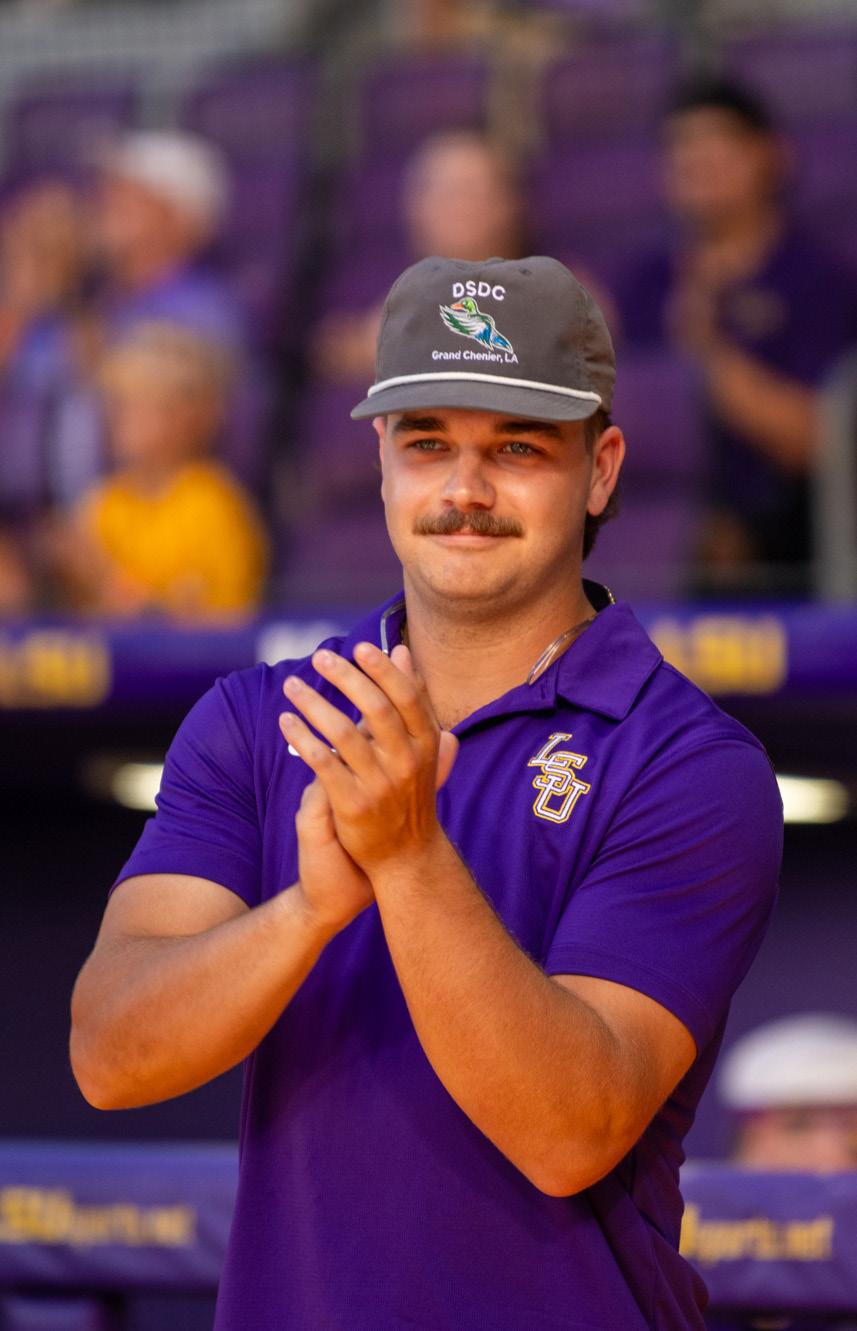
will switch posts in 2026, with Stanfield now in left and Curiel patrolling center.
Curiel’s move to the center signals yet another step forward for the reigning Freshman of the Year. He proved to be a reliable corner outfielder for the Tigers in 2025, complementing his excellent bat.
Now, he gets the added responsibility of ranging both gaps in the SEC’s biggest outfield. He says the move is something he’s built to take on.
“I played center my whole life — in middle school, high school,” Curiel said. “I’ve always wanted to come here and play center field like Dylan Crews. Now that I get to do that, it means a lot.”
Stanfield moves to left in reaction to Curiel’s move. His return to the Tigers in 2026 came as a welcome surprise.
Draft eligible in 2025, Stanfield had indicated to Johnson that he desired to turn pro after his junior season. After going undrafted, he altered those plans to include a return to Baton Rouge
for his senior year.
He described the decision to return to LSU as tough, and said that Johnson’s wanting him to return made him realize that another season at the Box was “the best option” for his career, even if a change in position was required.
“[Johnson] told me right away that I’d be in left,” Stanfield said. “And I told him, ‘No problem.’”
Stanfield is embracing the challenge of a new position with open arms.
“It’s a different perspective, and I feel like in the future, it can help me with a lot of versatility,” Stanfield said.
The camaraderie that has developed among the three wasn’t lost on any of them and will help the outfield, an area where communication is paramount, excel once again.
“I feel like we’ve definitely grown closer as a trio and just learned a lot about each other,” Stanfield said. “I learned a lot about [Curiel] and [Brown] I didn’t know last year.”
“We’re all very close friends, we hang out a lot,” Curiel said.
“They’re awesome people, first and foremost,” Brown said. “They’re great athletes, better people. Being able to have the pleasure of sharing the outfield with them every day is something that I try to not take for granted.”
The gratitude for the returning outfield is a sentiment shared between players and coaches. Johnson emphasized the amount of talent that is on display in the Tiger outfield when he spoke on Friday.
“I think we have three center fielders in the outfield,” Johnson said. “What a great thing to have, those guys.”
With the familiarity adding an extra edge to their already existing skill, confidence in the LSU outfield to put on an even greater defensive clinic in 2026 is sky high.
“I think we’re going to do a really good job this year,” Curiel said. “I think we’re going to track a lot of balls down.”


B-16 Hodges Hall Louisiana State University Baton Rouge, La. 70803
ADVERTISING (225) 578-6090
Layout/Ad Design ASHLEY KENNEDY
Layout/Ad Design REESE PELLEGRIN
BY DREW SARHAN Staff Writer at the LSU School of Veterinary Medicine,
While the long-term effects of e-cigarettes are still unknown, new research indicates vaping can cause a disruption to the biological functions in the lungs intended to fight diseases.
In a study published by the British Medical Journal, researchers found that exposure to e-cigarette aerosol, or vapor, can harm the proteins used in immune response along with the ability for the body to respond to xenobiotics, or foreign chemicals.
studies cardiopulmo
nary
diseases and how to inhaled environmental pollutants.
Noël explained the composition of e-cigarettes and how it can be harmful. She said she hopes that her lab can study other vaporizers and e-liquids on the market as they come out.
ing, but that is optional.”
The study was done using Juul Labs vapes. Juul is only one of the many brands of vaporizers on the market. The most common type of vape used is a disposable cart.
more of like cartridges that contained free base nicotine,” Noël said.
Many reusable vapes are made with nicotine salt, which is fastacting and high-concentration, or free base nicotine, used in Juul, which is meant for high wattage. Free-base nicotine hits the throat a lot harsher than nicotine salt.
The Reveille holds accuracy and objectivity at the highest priority and wants to reassure its readers the reporting and content of the paper meets these standards. This space is reserved to recognize and correct any mistakes that may have been printed in The Daily Reveille. If you would like something corrected or clarified, please contact the editor at (225) 578-4811 or email editor@lsu.edu.
CORRECTIONS & CLARIFICATIONS ABOUT THE
Alexandra Noël, director of the Inhalation
Research Facility
“E-liquid is the liquid found in an e-cigarette device that is used to create the aerosol– or the vapor– that the user will inhale,” Noël said. “Containing what we call the base humectant that is named propylene glycol, vegetable glycerin and most of the time, nicotine. It could contain flavor-
Usually packed with 20 mg/ mL of nicotine, propylene glycol and some heavy metals like nickel and lead, these vapes can contribute to greater ecological damage with their single-use lithium-ion batteries.
“The newer disposable devices we see currently on the market will have the presence of nicotine salt. Some also will have the presence of synthetic nicotine… going back five to six years, we had
Many current generation disposable e-cigarettes contain synthetic nicotine, which is made in a lab and is completely tobacco free, allowing for more purity.
The CDC says that secondhand smoke exposure increases the see VAPING, page 4
The Reveille is written, edited and produced solely by students of Louisiana State University. The Reveille is an independent entity of the Office of Student Media within the Manship School of Mass Communication. A single issue of The Reveille is free from multiple sites on campus and about 25 sites off campus. To obtain additional copies, please visit the Office of Student Media in B-39 Hodges Hall or email studentmedia@ lsu.edu. The Reveille is published biweekly during the fall, spring and summer semesters, except during holidays and final exams. The Reveille is funded through LSU students’ payments of the Student Media fee.

BY DREW SARHAN Staff Writer
In an era of AI and data centers, the struggle to power American industries will only intensify. Access to renewable energy, such as solar power, is looking less attractive to the American economy as carbon capture technology improves.
According to the Energy Information Administration, 2024 was a record year for energy consumption, largely driven by improvements to AI software such as OpenAI’s ChatGPT and X’s Grok. The EIA also projected that consumption would increase in 2025 and 2026 as more datacenters are built and AI technology improves.
Charlotte Jacobs is an assistant professor at LSU’s E.J. Ourso College of Business. She has been
ENVIRONMENT
studying the emergence of industries since she earned her doctorate eight years ago.
“The increase in demand for energy with AI data centers will also put a strain on the electric grid, which is outdated in many ways,” Jacobs said. “In addition, the fact that electric grids across states are not connected limits the potential as well. Hence, a redesign of energy distribution in the country is urgent.”
Jacobs said that during the 2000s, solar energy companies in Europe, America and Japan dominated the market. Chinese solar energy companies around 2010 overtook Western markets because of their unmatched scale of production.
In America, non-renewable resources continue to dominate the market. Recent executive actions
by President Donald Trump have bolstered the fossil fuel industry, including prioritizing oil and gas subsidies and cutting former President Joe Biden’s “Solar for All” program, a $7 billion grant.
“The oil and gas industry has been heavily subsidized for a long time now. Somehow, subsidies for renewables are more scrutinized,” Jacobs said. “Besides subsidies, we as customers might require more renewable sources of electricity and demonstrate a willingness to pay a bit more for that electricity then.”
While solar energy succeeds in places like Europe where electricity is expensive, Jacobs said that the future of renewables in America depends on the future of carbon capture technology.
“This is because electricity from gas fueled power plants
is more expensive compared to the US. As long as electricity remains relatively cheap, solar energy and renewables by extension will struggle to get a real footing,” Jacobs said. “It will depend on policy toward renewables as well as the advancement of some new technologies that are being developed.”
The Millenium Alliance for Humanity and Biosphere, based out of Stanford University, says that the world will run out of oil by 2052, gas by 2060 and coal by 2090. Jacobs said that these predictions have been made previously and never realized, and that technology in fracking and extraction help extend the global oil supply.
“The premium we pay for solar is somehow related to how cheap
BY JORJA ETHRIDGE Staff Writer
LSU sits on the edge of Cancer Alley, an 85-mile stretch of land between New Orleans and Baton Rouge that is home to more than 200 fossil fuel and petrochemical plants.
Due to the extreme air pollution from these plants, researchers and environmental groups have associated the area with higher rates of cancer, premature births and respiratory diseases.
The chemical company Air Products has been working towards putting a hydrogen plant in Sorrento, Louisiana, which is about 30 minutes from Baton Rouge and right in the middle of Cancer Alley.
Air Products is promoting this hydrogen plant as a green-energy solution, and it is part of the Louisiana Clean Energy Complex. This plant will process natural
gas and create hydrogen and ammonia that can be used for transportation or power generation.
The plant will also facilitate carbon capture and sequestration. Instead of emitting excess carbon dioxide into the air, a pipeline will transport it somewhere it can be safely stored underground.
According to Air Products, 95% of carbon emissions from the plant will be stored underground. Despite the argument that this project is a green-energy solution, it has still received criticism.
Sorrento residents’ main concern is the proposed location of this plant. It will be near Sorrento Primary School and the Orange Grove subdivision. Air Products owns another carbon dioxide pipeline near the school that is already active.
Patrick Courreges, spokesperson for the Louisiana Department of Conservation and Energy, said the number one concern with any
pipeline is a leak.
“So much of our regulations are aimed at leak prevention,” Courreges said.
Carbon dioxide pipeline leaks are rare, but if one does happen, it can be extremely detrimental to human health.
Brian Snyder, the director of undergraduate programs for the College of the Coast and Environment at LSU, said that storing carbon underground rather than polluting the air is an effective, green-energy solution, as long as it is done correctly.
Still, Snyder warned against the dangers of a pipeline rupture. He explained that carbon dioxide is non-toxic, but it is heavier than air and can be an asphyxiant.
A pipeline rupture could fill the air with carbon dioxide and displace the oxygen, leading to a suffocation hazard. Snyder added that it is important to make sure the pipeline is not located near
BY ALAYNA FORD Staff Writer
LSU has begun construction on a new library. The project marks the next phase in the university’s master plan — a series of planning efforts designed to accommodate the physical growth of campus for the next 20 years.
The library is set to be completed by fall 2029 and will be located on the corner of South Stadium Drive and Field House Drive.
According to the Executive Director of Planning, Design and Construction Paul Favaloro planning for the library began several years ago, with design starting in late 2023.
When developers built the current library in 1958, they placed it in the middle of the LSU Quad because, at the time, the location was at the center of campus. However, now that LSU’s campus has expanded to the South, the current library is no longer at the center of campus.
The new library is closer to the middle of campus, putting it in closer alignment with the master plan.
Favaloro noted that the new library would feature higher quality infrastructure than the current library.
“The library that’s here now was built in 1958, and it’s an obsolete building with a lot of deferred maintenance,” he said. “This is an opportunity to reposition our new library and modernize it to better support our mission.”
other pipelines that could also burst if the carbon dioxide one ruptures.
This risk is what concerns Sorrento parents the most since the plant would be near the school. However, Courreges said his department also ensures chemical facilities get properly inspected.
“We’re always checking the personnel,” Courreges said. “Are these folks properly trained and rated to do the work they’re doing? Do they have a drug and alcohol screening program to make sure the folks are working clean? Are the materials of the pipeline they’re building appropriate to what they’re trying to do?”
Courreges added that plants should have regular inspections to check for corrosion. Plants should also properly report their pressure.
Snyder explained that com-
see PIPELINE,
The new building is set to be 198,000 square feet and three stories. It will be able to hold approximately 2,400 student study seats and will include two general-use classrooms.
“LSU currently has study seats for about 5% of students versus peer averages of 14%,” Favaloro said. “The goal is to provide a modern library, strategically located, sized and equipped to better support our university’s mission as we evolve in teaching, learning and research.”
LSU is spending $154 million to complete the building. Funding was provided through private and state funds. The LSU Foundation is currently pursuing a $35 million fundraising goal to help with the cost.
Due to upcoming construction, Favaloro projected an increase in activity near South Stadium Drive and Fieldhouse Drive. Forestry Lane C will be unavailable for parking during this time. The electrical engineering lot will be designated for C parking to compensate for the construction.
BY MADELYN LONG Staff Writer
The Lighthouse Program at LSU specializes in advocacy and support for students experiencing sexual violence, interpersonal violence or stalking.
The program is a part of the Student Health Center, which provides a range of resources for students. It is a free, confidential place for survivors to learn about what options are available to them. This includes medical care, academic support, emotional support and help with reporting their experience. It also provides assistance for students who faced violence prior to their time at LSU.
Natalie Walton, associate director of the Lighthouse Program, emphasized that students do not have to be actively harmed to receive help from the program. Students should reach out to the program at any time they are ready to receive support.
“Students do not need to be in crisis, have all the answers or be interested in reporting to seek services,” Walton said. “The Lighthouse Program staff provides confidential, trauma-informed support that helps students explore options at their own pace as we recognize that healing looks different for every survivor.”
Walton understands that concerns over confidentiality may deter some survivors from seeking support. She assured students that the Lighthouse Program is not obligated to tell most of what students disclose, protecting their identity and privacy.
“There are limits to our confidentiality, such as danger to self or others, but we inform every student of our limitations when they come to receive services,” Walton said. “But, regarding the students sharing their experienc-
, from page 3
munities farther down the river that are closer to the industrial facilities are affected the most by chemical emissions. However, Baton Rouge’s air quality is still not ideal.
The areas in Baton Rouge that are the most affected by chemical emissions are near ExxonMobil’s oil refinery on Scenic Highway. This chemical plant is the sixthlargest oil refinery in the U.S.
“Air pollution actually drops off with distance pretty dramatically,” Snyder said.
For example, he explained that south Baton Rouge is 10-15 miles away from the ExxonMobil refinery, so communities there are not nearly as affected as in north Baton Rouge.
Air Products’ proposed pipeline would be a half mile from Sorrento Primary School. While the pipeline is intended to prevent air pollution, the short distance would still put many at risk

es and what led them to our program, that is kept confidential.”
The Lighthouse Program collaborates with other Baton Rouge organizations to provide support for survivors of sexual assault and domestic or relationship violence.
Sexual Trauma Awareness and Response, a group known as STAR, Iris Domestic Violence Center, The Butterfly Society and the Capital Area Family Justice Center are a few of the partnering groups that work to prevent violence and support survivors.
“These community resources can work alongside the LSU Lighthouse Program to ensure students have continuous, comprehensive support both on and off campus,” Walton said.
The program not only supports survivors, but it also educates students on how to prevent dangerous situations.
Lighthouse coordinators focus on awareness and support mechanisms to help students feel more secure in their environment. This
if a carbon dioxide leak were to happen.
To continue with the project, Air Products needs to obtain a coastal use permit from the Louisiana Department of Conservation and Energy and a Clean Water Act permit from the Army Corps of Engineers.
Courreges said that Air Products has submitted the application for the coastal use permit. He explained that it has gone to public hearing, but the department has not yet made a decision on whether the application is approved, denied or needs modification.
Courreges said that it takes several years to review chemical companies’ applications because of the concerns with storing the carbon dioxide underground. He explained how underground carbon storage should be done properly.
“What they’re looking for is zones with confining layers deep underground with shales or clay,
ENERGY, from page 3
fossil fueled electricity is. Their cheapness is partially related to the subsidies the industry receives. Solar and other renewables can be an important source of energy for all of us, but we have to help it scale to become an equal player in the energy field.”
Gale Mahe is a sophomore bioengineering major and believes that while oil and gas is a cheaper option, they would rather pay for energy produced by solar or wind farms.
“I’ve seen first hand the negative effects of the oil/gas industry as someone born in ‘Cancer Alley,’” Mahe said in an email. “Oil/ gas and coal plants do not have the proper regulations to prevent their particulates and waste products from entering the air, ground and water of our cities, destroying local ecosystems downstream and poisoning the populace.”
includes knowing their surroundings, trusting their instincts, using the buddy system and having a plan to get home safely.
“It is all of our responsibility to promote safe environments. Looking out for one another, stepping in when something doesn’t feel right and practicing bystander intervention are powerful ways students can reduce harm together,” Walton said.
It is important for students and the community to never place blame on survivors of violence. Although there are tactics that could possibly keep students out of dangerous situations, Walton said that responsibility for violent acts always lies with the offender.
“Survivors are not alone, and help is available both on campus and throughout the Baton Rouge community,” Walton said.
If a student is in need of Lighthouse Program support, they can contact the program at 225-5785718 or submit a self-report form on the website.
or something that is not going to allow any upward movement of whatever you’re injecting,” Courreges said.
Courreges said that the Department of Conservation and Energy has to check for any natural pathways upward and any fractures or faulting that would indicate there is a pathway for the carbon dioxide to move upward.
As for the Clean Water Act permit, the Army Corps of Engineers has also not made a decision about Air Products’ application.
Although many Sorrento residents are concerned about this project, Snyder said it is one of the only options to prevent air pollution.
“The bottom line is if we want to have an industrial type of economy, and we don’t want to have a lot of climate change, we’ve got to do something with that carbon dioxide,” Snyder said. “Carbon capture and storage is essentially the only real option.”
tant than the electric companies’ profit margins.
“The question will be in how far these technologies will be able to scale or amplify their applicability to integrate more smoothly in our day to day activities,” Jacobs said. “It will depend on a multitude of factors: technological advancement, scaling, consumer demand, and government policies.”
According to Jacobs, the renewable energy industry is projected to grow through 2030, especially with the rise of AI data centers — but not in America. Legislation passed in other countries such as Canada gives government subsidies to renewable forms of electricity rather than oil and gas companies.
Mahe believes that energy companies have a responsibility to consider the environmental impacts of their operations, noting that the quality of life and health of the community are more impor-
VAPING, from page 2
risk of asthma and respiratory infections like pneumonia and bronchitis in children, with the potential for them to develop behavioral and learning issues.
“There are some studies that look at what is found in the air before second-hand e-cigarette aerosol, and those studies have shown that there are still some levels of nicotine and other chemicals,” Noël said. “There’s definitely an exposure to second-hand e-cigarette aerosol that could impact the bystander, and that includes, you know, babies at home, children, etc.”
LSU sociology junior Leia Frazier got her first vape in high school. She started smoking because her friends did, and she said that she thought it made her look cool. She was given a free vape and continued until she dropped it on a whim one day.
“Sometimes I remember the sudden decision and I’m even
“The problem is that, due to the monopolizing power of the energy industry [in America], there are very limited ways in which I can utilize renewables,” Mahe said. “All of our grids are designed to be reliant on gas, oil or other petrol products. For most people, it’s simply more convenient to rely on these pre-established systems, even with the benefits of renewables.”
surprised by myself that I just gave up on a random day and never thought twice about it,” Frazier said. “But I mean that’s just how my brain works.”
Frazier said watching videos of collapsed lungs and a few people’s personal experiences with heart and lung issues made her more aware of some of the risks associated with chronic vaping.
“I just genuinely didn’t really care,” Frazier said. “I think that’s the case with a lot of people, it’s not that we don’t know the dangers of vaping. People just don’t care because they think it wouldn’t happen to them.”
She said in order to keep kids away from vaping, people within their social network need to warn them about the effects.
“The law can ban anything they want to but there’s always a loophole around it,” Frazier said. “They need to see the effects with their own eyes in order to stray away.”

BY SAVANNAH BOYNES Staff Writer
Mouthfuls of frosting, sprinkles, filling and more. What else could a sweet tooth ask for?
Mid City Bakery has a grand selection of desserts to choose from; customers will not walk away hungry. With a singular baker and owner creating and perfecting every recipe from scratch, there is a guarantee that these sweets are made with love.
Based in Baton Rouge, Kimberly Fansler is the owner and sole baker of Mid City Bakery, a private cottage bakery business. She handles every aspect of her business, from finances and customer service to product prep work and the baking from scratch itself. As it is a cottage bakery, she does not have a store location. Instead, she bakes in her own home.
Fansler begins her mornings in the kitchen, fixing the space to be best suited for the bakes of the day. Once she conquers the battle of beating doughs and mixing batters, she scribes invoices and polishes her social media pages. This all happens while her oven works its magic and fills the kitchen with the scent of homemade treats and hard work.
As the timer rings and the desserts come out of the oven to cool, Fansler moves to package, label and take inventory. She begins reviewing orders for the next day, as customers depend on the bakery day to day. She also handles the cleaning, and the dishes are a beast that she has to fight all day long.
With over 12 years of industry experience under her apron, she handles both sides of owning and running a business with a knowledgeable flair.
Mid City Bakery’s menu consists of cookies, pies, cakes and more, and Fansler emphasized how she’s confident in making just about anything. The bakery’s top sellers are Big Debs, which are homemade oatmeal cream pies, and the GF/Vegan Chocolate Cake.
Although Fansler stressed how customers rave about these top treats, she said that her personal favorite is the rainbow Sprinkle Sugar Cookie. The cookie’s recipe is drawn from her grandmother’s holiday sugar cookie recipe, and nostalgia seizes her every time she eats one.
“We use rich European butter and super high quality royal icing sprinkles. I can’t stand the waxy soft rainbow sprinkles, so we tried tons before we settled on our favorite,” said Fansler. “These cookies are baked until golden brown. They’re crisp around the edges, soft and chewy in the middle.”
Family is an important part of Fansler’s love for baking, as she watched her mother bake and decorate cakes to supplement income

while raising her and her two siblings.
“I spent a lot of time watching her make beautiful things. Our family is full of artists and creatives, so I guess it’s also just kind of in my blood,” Fansler said.
Fansler’s brother is a painter and a sculptor, and her sister runs a baking business on the side in North Carolina. Her mom, who is now happily retired, bakes only for leisure and crochets blankets for everyone she knows.
Fansler’s business’ presence in Baton Rouge has grown significantly since its opening on Jan. 2, 2024. Mid City won 225 Magazine’s Best of 225 Award for best cottage bakery. Mid City also has a few regulars who order weekly, and there are families that place cake orders for every event they hold.
Abbey Weselak, a records management specialist and two-time LSU graduate, is a regular customer of Mid City Bakery. She was introduced to the bakery when she attended a local festival and came across one of Fansler’s pop-ups. She purchased a few treats, and she instantly became hooked on the baked goods.
Weselak’s favorite dessert is The Big Deb. She always stocks up for herself and her fiancé when she sees Fansler, and she recommends trying the cookie to any first-time customers.
“My favorite thing about the desserts is that they have the perfect sweetness level. You know how a dessert can be too sweet? MCB desserts never feel like that,” said Weselak. “They’re always perfectly balanced in my opinion, and always satisfy my cravings for a treat.”
Weselak explains how the most enjoyable parts about Mid City Bakery are how personable Fansler is and how versatile her skill repertoire is.
“When a business owner is a good person and sells great stuff, how could I not want to support them?” said Weselak.
Weselak expanded on how she lived in the Mid-City area for a few
years up until recently, and she still keeps up with the hustle and bustle of local businesses. She’s seen many places sell Fansler’s baked goods.
“Between the pop-ups and festivals, I’d consider MCB a staple in Baton Rouge. When local businesses support independent creators like Kimberly, it really fosters a sense of community and fellowship,” said Weselak. “I love putting a name to a face and being able to support real people, and I know a lot of other people in the local scene feel the same way.”
Weselak adds how Fansler will be making her wedding cake. She explains how her and her fiancé held a meeting with Fansler to discuss what they envision for the cake and how Fansler will make their vision a reality.
With Mid City Bakery turning two, Fansler has already accomplished so much; from a fresh start in her home kitchen to winning the hearts of Baton Rouge residents, her business can only continue to flourish.
“Down the road, I’d love to specialize in something I call ‘unpretentious patisserie’ — high- end pastry that feels accessible, welcoming and down to earth,” said Fansler. “I also want to bring my fine arts background into my wedding cake work, creating designs that are both artistic and deeply personal.”
And just in time for the Mardi Gras season, Fansler recently announced on the official Mid City Bakery Instagram page that she now sells a special treat with a green, purple and gold spin: The King Cake Cheesecake. Bathed in gold and sprinkled with purple and green, the cheesecake appears ready to deliver a bite of Mardi Gras.
Mid City Bakery also has items available at Pelican to Mars, Red Stick Reads and Mid City Beer Garden. For a full roster of its sweet and savory delights, customers can go to the Mid City Bakery website to view the menu, prices and ordering information.




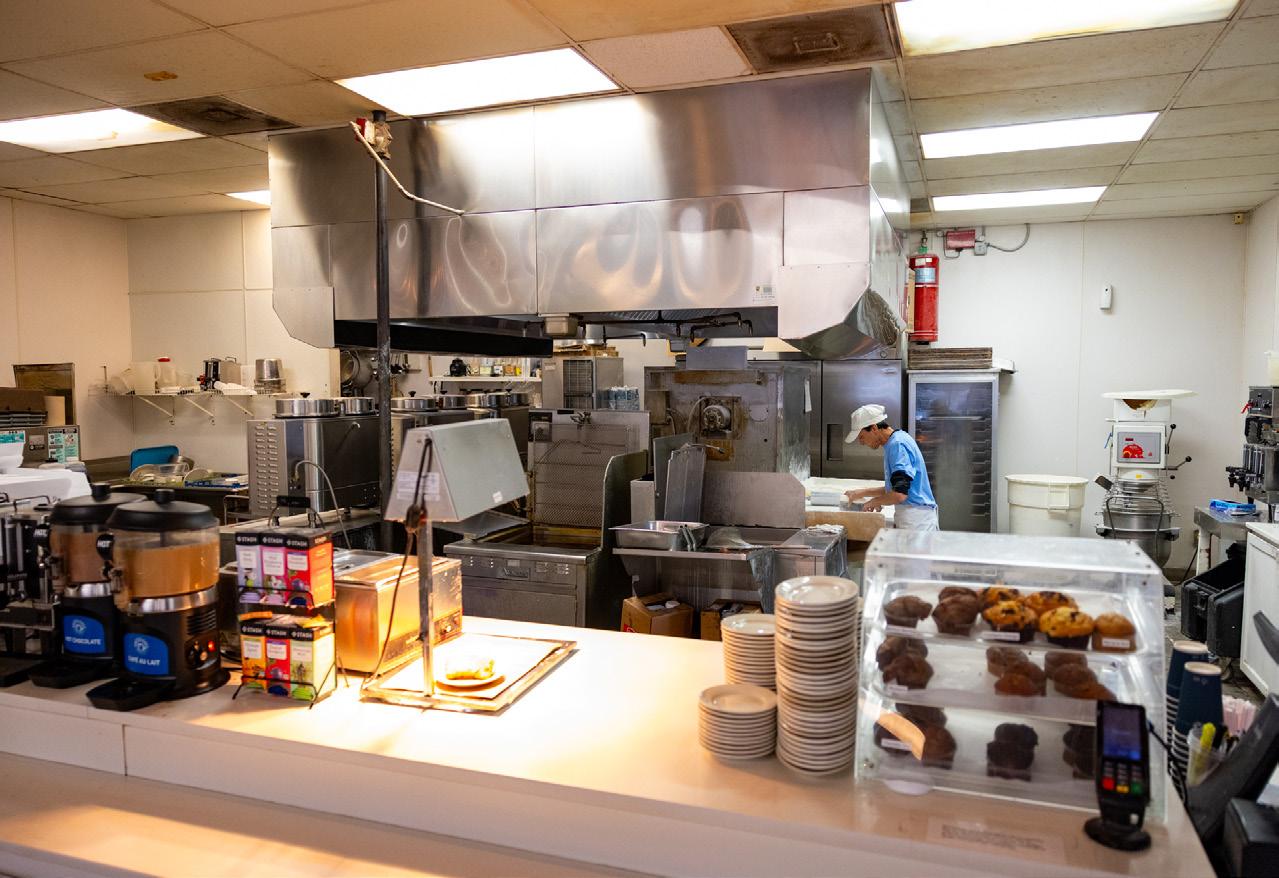





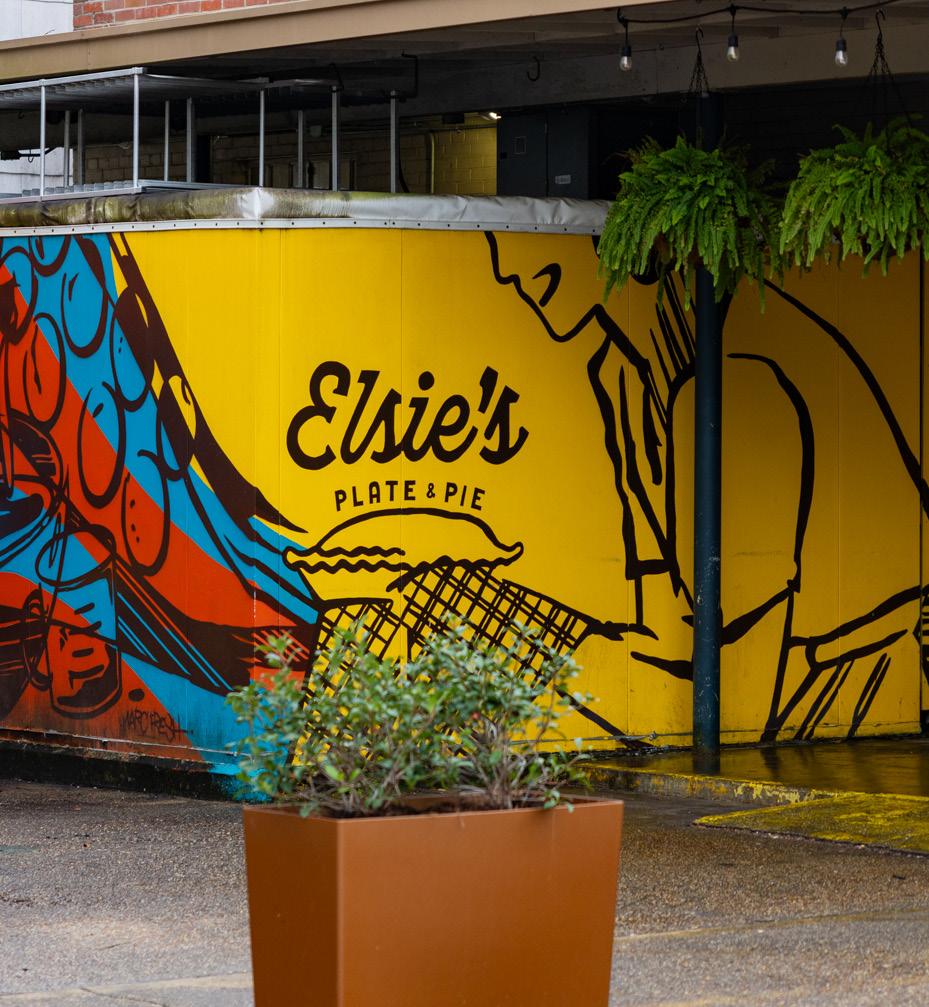





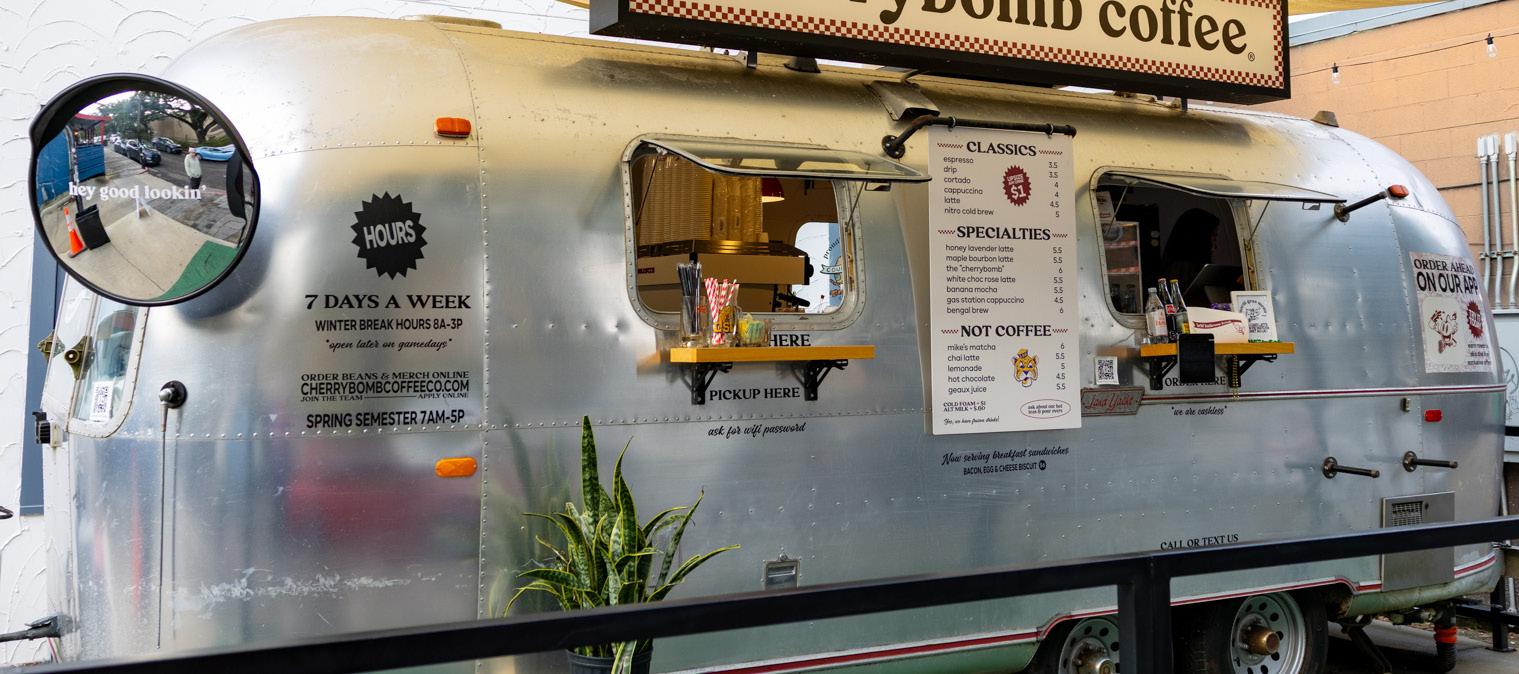
On Jan. 22, we visited LSU students’ favorite businesses in Baton Rouge. From thrifting at Good Choices Co. on Government Street to getting coffee on West Chimes, the city has a lot to offer.




BY MIA HATTAWAY Staff Writer
If you are looking for a noncommercial gym with an aesthetic appearance, exquisite equipment and an abundance of amenities, this LSU alumni-owned space could be just what you need.
Origin Gym, owned by Kirsten Willis and her husband Hayden, is Baton Rouge’s hottest luxury fitness space. The couple held Origin’s grand opening on Nov. 29.
The pair have been in the powerlifting and bodybuilding community for many years. As a high schooler, Hayden set the all-time Louisiana High School Athletic Association deadlift record at 730 pounds in May 2019. Kirsten has extensive experience as an athlete and bodybuilder, having won the true novice category at the 2023 National Physique Committee Southern Muscle competition.
After graduating from LSU, both Hayden and Kirsten became personal trainers, even offering coaching as one of the many amenities at Origin.
“During our time at LSU, we became integrated and deeply familiar with its fitness community,” Kirsten said. “This gave us direct insight into the desires and needs of serious fitness enthusiasts in our local community.”
The entire space was outfitted with the true gym rat in mind: the sleek and moody interior paired with high-contrast lighting creates the perfectly aesthetic look any fitness content creator would be drawn to.
The duo’s time spent in various gyms across the country directly informed many of the decisions they made when creating Origin.
“There’s a common thread of community, equipment quality and energy that we experienced in the nation’s premier gyms,” Kirsten said. “We wanted to bring that type of atmosphere and caliber of equipment to Baton Rouge.”
One of the most unique features of Origin is its versatile machinery, including equipment like calibrated plates, PRIME Fitness machines and an incline track. The space is organized by muscle group, with
the cardio machines, including a recumbent bike and curved treadmill, placed in a separate room from the powerlifting area.
“Making sure that our equipment feels great for all sizes and proportions was necessary,” Kirsten said. “We are accessible and welcoming to all, regardless of the more advanced equipment. We always make sure that we are around to assist people that are unsure about how a piece of equipment works.”
Included in both day passes and full memberships is access to red light therapy, massage chairs, cold plunge tubs, saunas and a posing room. Available for purchase is an assortment of pre-workouts, food and drinks.
The gym has already cultivated a community of regulars, especially from visitors who are in the powerlifting and bodybuilding spaces.
“It has truly been a blessing to see people embrace this place like we had dreamed of,” Kirsten said. “Seeing people in the community thrive and grow in their fitness journey means the world to us — it’s a huge part of why we wanted to make Origin. We would like to cultivate a community at Origin that facilitates this type of progress.”
In fact, the name of the gym was largely inspired by the two’s principle of empowering members’ individual paths toward growth.
“The word ‘origin’ signifies the start or the conception of a journey,” Kirsten explained. “For most people here, it’s more about the process than it is the end result.”
It seems that the couple views their business in a similar light; while they would love the opportunity to open a secondary location, the Willises are staying in the present at every step of the way.
“The goal is to make sure our current location and members are taken care of,” Kirsten said. “We plan to continually improve our current location to cater to the needs of our membership body.”
Origin Gym is located at 5830 McCann Drive and is open 24/7. For more information, visit Origin’s website.

Theatre presents a ‘microcosm for America’ with message of unity
BY SARAH WALTON Staff Writer
It is only week three of school and LSU theatre is already hot out the gates with its first performance of the year. The Swine Palace is opening the year with “The Totality of All Things.”
The play takes place in a small Indiana town in 2015 as tensions rise after the high school journalism classroom was vandalised with hateful messaging. Nicole Lovince is a master’s student in acting and plays Judith, the high school journalism teacher, in the show. Lovince described the play as a think piece that is supposed to start a conversation.
“[Judith] motivates and encourages students to find the truth and write about it and share about it,” Lovince said. “That is how we create the change that we want to see in the world. That’s how we make the world a better place. This play is essentially a microcosm for America.”
The decision to have the play set in Indiana wasn’t random. A different perspective from what theater usually presents is in the play. Lovince said she believes this is because the play represents the average American town instead of one of the major cities.
“We’re talking about the heart of this country, which is middle America,” she said.
The process of creating this play has been going on for quite some time. Rehearsals started in early December, but Lovince said she had read the play back in September.
“I’ve had quite some time with [the play], and I’m still really discovering,” she said. “I think that’s what’s brilliant about being a performer and working with any text really that becomes a performative piece. There are no bounds of limitation to what you will continue to discover and see inside of the text.”
Lovince said the process is always evolving, especially as the technical parts of the play are incorporated. Having a tangible world built around her — complete with costumes, lighting and a set — has allowed Lovince to continue discovering who the character of Judith is. She talked about the set, describing it as alive with moving pieces and cinematic media elements.
“There will be another deepening when the audience comes in and I’m hearing and feeling what the audience is reacting to. That then also informs my character,” Lovince said. “It’s such a symbiotic relationship the entire time until we inevitably put the show to sleep.”
Lovince hopes people take this show as an opportunity to be human and have conversations that bring people together instead of dividing them.
Kyrin Hardnett, a freshman double majoring in theatre performance and film and television, is

making his LSU Theatre debut as Micah. Starting out as the only undergrad in the cast was intimidating, but he also said working with the master’s students has been inspiring.
Though he might not be as experienced as his castmates, Hardnett is no stranger to the world of theater, having done theater in high school and at Theatre Baton Rouge. Still, this play has been a bit different for him.
“I don’t do dramatic plays a lot at all, so this one’s very serious and it hits topics that make people uncomfortable,” Hardnett said. “But I like the show a lot because it touches on everybody’s point of view. Allowing the idea of an opinion to be said rather than, ‘This person’s opinion is this, and I hate you.’”
For this production, LSU had a guest director come in to create the show. Keith Arthur Bolden is an actor and director from Atlanta, Georgia who has acted in shows like “Lovecraft Country,” “Cobra Kai” and “Black Lightning.” He also teaches at Spelman College in Atlanta.
Bolden came into directing this play with a strong vision, focusing on the division that especially comes in times of social change. There was mention of how different a play set a decade ago feels with how the political climate has changed.
“While the themes are serious and toned, there’s a lot of levity in the show as well. You see what the human process is of seeing someone and balancing personal views against views of morality,” Bolden said. “If you are listening, you can see and hear the truth. If you’re really listening. But that takes time.”
He said that Hardnett, as a young actor, has developed his character in an interesting and unexpected way. Bolden said that the graduate students have been great at guiding and helping the freshman as the rehearsal process has gone on. Hardnett mentioned what he hopes the audience will take away from the show.
“I just hope that the audience walks out with open minds. I want the world to be unseparated,” he said. “This play really touches on letting external things separate us. [We] should be [connected by] the fact that we both like ‘The Hunger Games,’ or the fact that we both enjoy musicals. You’re not the opinions.”
“The Totality of All Things” opens in the Shaver Theatre on Wednesday and runs through Feb. 8. There is a content warning for this show for visuals of hate speech, brief mentions of suicide, references to death of a child and an offstage act of extremist violence. Tickets for “The Totality of All Things” are available on PurplePass.com.

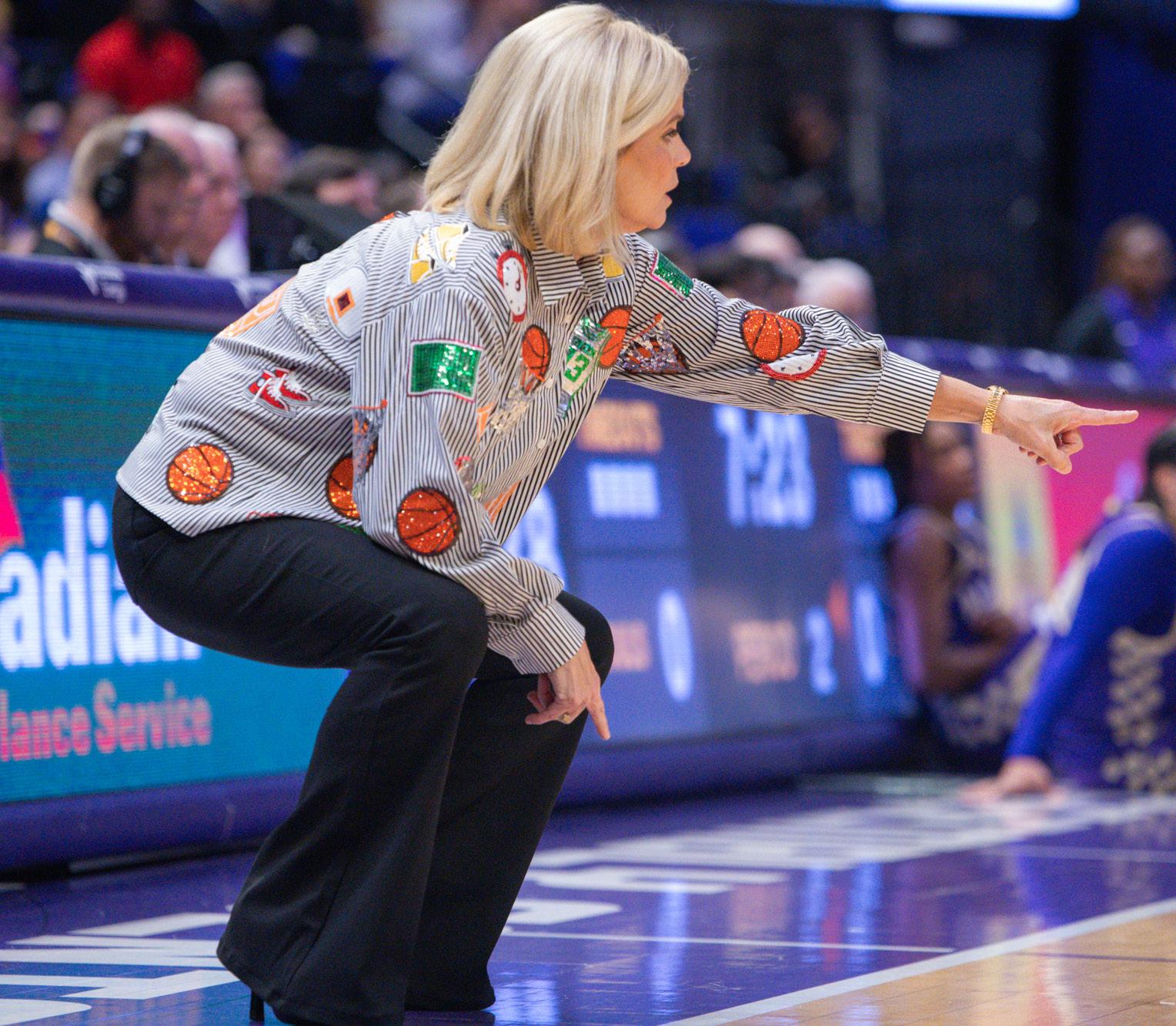
Kim Mulkey and women’s basketball are keeping the midrange alive
BY TRE ALLEN Staff Writer
Basketball is an ever-evolving sport.
Ever since James Naismith invented the game of basketball in 1891, using nothing but a peach basket and a leather ball, we’ve seen it take steps that Mr. Naismith would never have believed.
One of those evolutions that’s taken the game by storm is 3-point shooting. When the 3-point line was introduced in the 1940s, it added a new aspect to the game.
As time continued, so did the use of the 3-point line. Players like Ray Allen, Reggie Miller and the all-time 3-point leader himself, Stephen Curry, have changed the way the game is played.
If you want to blame Curry for 30-foot 3-pointers and passing up open layups, go ahead, but at the end of the day, three points are more than two.
Countless coaches orchestrate their teams to shoot more 3-pointers and force opponents to play catchup with a gameplan of simply shooting teams out of the gym.
One part of the game that has decreased is the midrange jump shot.
The midrange jumpshot has declined in recent years, as the emergence of the 3-pointer has led teams to get the ball into the paint or take
see MIDRANGE
BY DELANEY POTTHAST Staff Writer
After setting a home opener school record against Kentucky, No. 2 LSU gymnastics will travel to Columbia to take on No. 7 Missouri in a meet that serves as another major road test early this season. Historically, neither team has been the most consistent for the Tigers versus Tigers matchup. The teams have traded wins with a 3-2 record over the past five regular season matchups, and if the pattern holds, the odds are in favor of Missouri going into the weekend.
However, the Baton Rouge team may break the pattern due to the versatility it has shown so far this season, with its strong, solid lineups.
“If we have the opportunity to make lineup changes early in the season, we want to get as many looks as we can reasonably without putting ourselves in a position where we are sacrificing our ability to score well or get a win,” head coach Jay Clark said. “We want to have some variety out there.”
This flexibility LSU seems to have given itself may be exactly what gives the purple and gold a
BY RAMI BURKS Staff Writer
Players haven’t even reported for the 2026 MLB season, and college baseball has already grown in stock for the next several years.
The Los Angeles Dodgers have changed the world of professional baseball forever by signing star players on deferred contracts. This strategy isn’t new, but it does mean the game of college baseball will grow immensely throughout the next several years.
On Wednesday, the Dodgers signed Kyle Tucker for $240 million, and his contract states he will be paid $1 million in 2026, $55 million in 2027 and an optional $60 million in 2028 and 2029. Without a salary cap in MLB, contracts will only get larger by the year.
Since the Dodgers are pouring so much money into their top players, the minor league system will have less money to allocate to its players, which means more high school players will likely opt to enter college out of high school, betting on greater potential earnings.
Over the years, the debate of
whether to play college baseball or go straight into the minor league farm system has grown, and now MLB commissioner Robert Manfred’s lack of priority on the salary cap could settle it once and for all.
Former LSU center fielder Dylan Crews said the best thing he ever did was bet on himself and go to college, especially because COVID-19 cut his high school career short. After he signed his MLB contract with the Nationals, he admitted he didn’t think he would’ve made it without all the resources LSU gave him.
“At that time, I felt like I wasn’t the best player leading up to the draft,” Crews told an MLB reporter after being drafted. “I felt like there was still a lot to improve, and here at LSU, they had all the resources that I needed. So I just trusted my gut.”
If that were the case almost six years ago, the Dodgers’ contracts would eventually lead to more decisions like Crews’.
While Los Angeles is the only team making these changes right now, other teams are taking steps in the same direction to match the talent it has been able to garner over the last two seasons.
The Dodgers’ rosters have been packed to the brim with big name talent like Shohei Ohtani, Mookie Betts, Kiké Hernandez and many, many more. The talent gap will become too evident if other teams don’t catch up fast.
This leaves us where we are now, two weeks before pitchers and catchers report for 2026 Spring Training. Big contracts are being signed across the league just to close the gap. The days of overpaying one player might be over for good.
Former LSU shortstop Alex Bregman just signed a $175 million contract with the Chicago Cubs, and 40% of that total will be deferred throughout 2030. His deferred installments will be paid from 2034 to 2041 at $1,875,000.
Teams are abusing the ability to defer contracts, meaning their payroll is currently lower while they still gather as much talent as possible. Right now it doesn’t pose an issue, but as this problem increases, we could see a lockout before the 2027 season.
An MLB lockout before 2027 could solidify college baseball as the place to go after high school, espe-
cially to historically dominant programs like LSU, Vanderbilt and Texas.
If Crews decided to bet on himself because of a pandemic, several high school graduates will bet on themselves to try to jumpstart their placement in the minor leagues.
Now that NIL has been introduced in college athletics, playing baseball at the highest level might become a game for older ball players. It’s not common for the best ballplayers to finish their degrees, but we might see more redshirts and more utilization of eligibility rules in the near future.
If Manfred continues to allow the teams to pay out their players after their contracts end, college baseball as we know it will become the new minor league baseball, and at a lot more money than MiLB players make currently.
LSU head coach Jay Johnson said during preseason media that NIL is going to set their program apart from other schools.
“It’s important that LSU continues to make baseball a priority and continues to invest on that side of revenue sharing,” Johnson said. “It’s a little bit more
like the big leagues. Do you want to be the Dodgers, or do you want to be a small market team? Schools are going to decide the sports that they want to be good in relative to the NIL thing.”
If Johnson sees how the money game impacts college sports, imagine what could happen when MLB teams can’t afford to pay their minor league affiliates a livable wage because of how overpaid the big leaguers are.


BY TRE ALLEN Staff Writer
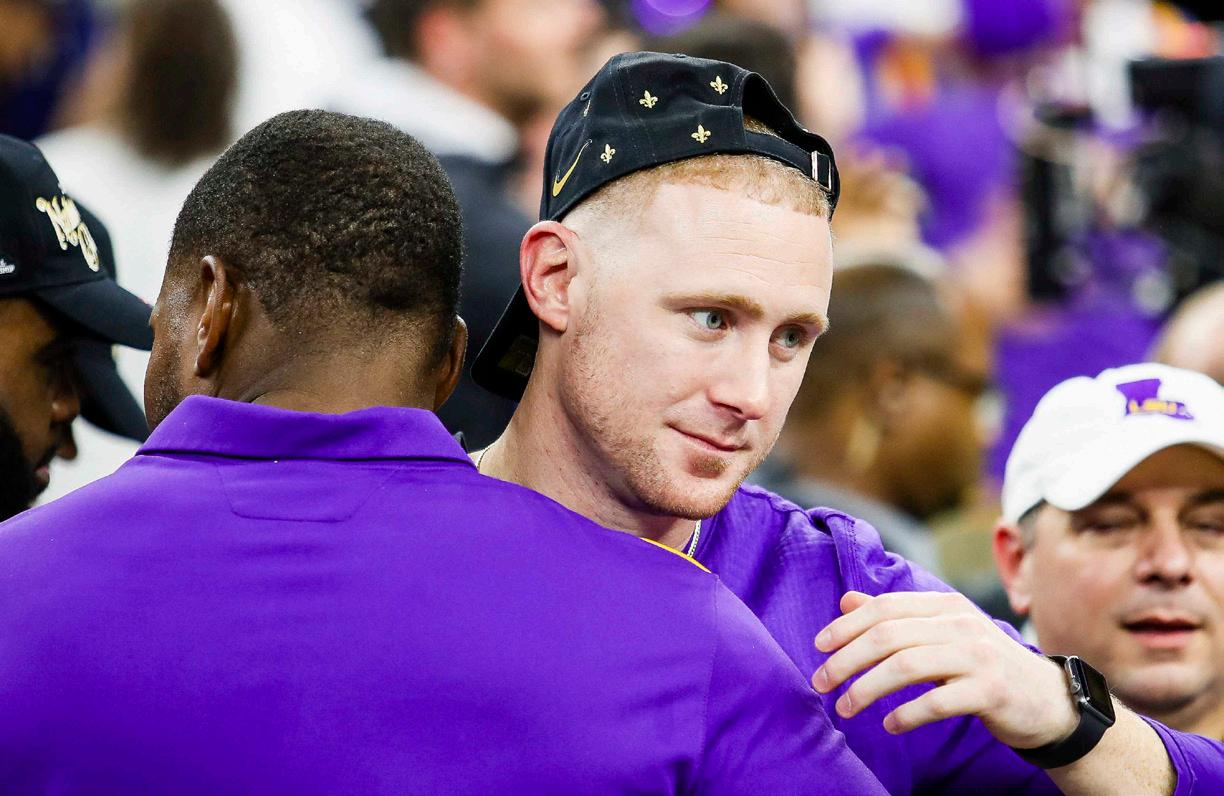
The Buffalo Bills are promoting a familiar face that many LSU fans would remember.
Following the playoff loss in the divisional round against the Denver Broncos, the Bills decided to move from head coach Sean McDermott after nine seasons.
There were numerous candidates the Bills could’ve gone for, but in the end, they decided to stay in-house by promoting offensive coordinator Joe Brady as their next coach, agreeing to a five-year deal.
Brady has immense ties to the state of Louisiana, as he started as the offensive assistant for the New Orleans Saints during the 2017-18 season. Brady would later join the LSU staff in 2019 as the passing game coordinator and the wide receivers coach.
Brady’s talents were recognized as he played a pivotal role for one of the greatest football teams of all time.
The Tigers would average the most points per game in college football that year (48.4), as well as producing Heisman trophy winner Joe Burrow, who threw for over
ON THE ROAD, from page 9
competitive edge. An event that is particularly flexible for LSU is its uneven bars rotation, where the team has been excelling since the beginning of competition.
“[Alexis Jeffery] is ready on bars,” Clark said. “I’ve just been trying to get her a few more numbers. She’s been in our intrasquad since December. It’s tough competition on that event and we’re doing really well on bars right now, so to break into that is something that I anticipate her doing.”
It’s hard to miss the breakout that has become of the LSU bar rotation, but Mizzou follows closely behind. With comparative average scores that only share a deficit of 0.109 points, LSU will have to be on its A-game come Friday night.
Even more so, Missouri is headed into the weekend matchup on a two-week losing streak. On the hunt for its first win in the SEC, the team will most definitely look to capitalize on its home crowd advantage.
Although Mizzou is expected to lean on its home crowd, LSU has since emphasized that it cannot tie its success to outside environments.
“It’s easy to find a different external motivation than 13,000 screaming Tiger fans,” Clark said. “We’ve got to get to where we don’t rely and then are not dependent on anything external, no matter what. Whether it’s circumstance, atmosphere, number of fans, none of it should matter.”
With the road loss against Georgia looming over fan expectations, a road win against Mizzou will help to prove that LSU can ex-
5,600 yards and 60 touchdowns. His role during that championshipwinning season earned him the Broyles Award, which is awarded to the best assistant coach in college football. He would return to the NFL as the offensive coordinator for the Carolina Panthers during the 2020-21 season and then join the Bills staff in 2022, where he was

all-around Lexi Zeiss holds a handstand position on the uneven bars during her performance at LSU’s meet against the University of Kentucky on Jan. 23 at the PMAC in Baton Rouge, La.
cel outside the PMAC.
Though the team has never been the type to let past performances define them, the purple and gold Tigers still hope to validate Friday’s result against Kentucky with the growth they hope to show against Missouri.
“We really want to make sure that Friday night only means what it means if we can continue to improve and not create unforced errors and setbacks for ourselves,” Clark said.
Even with an inconsistent history between the two teams, LSU is heading into Friday not focused on winning through scores, but rather on growth. A win prioritized by personal consistency will be what truly establishes the Baton Rouge Tigers as top title contenders.
MIDRANGE, from page 9
a step back and shoot from long distance.
Taking shots from 15 to 18 feet away has also been deemed inefficient, and if a team forces a jumper rather than a layup or 3-pointer, it’s a win in their eyes.
However, some teams still play the game “old school,” getting the ball inside, using the post and taking midrange jump shots.
One of those teams is LSU women’s basketball.
After Sunday’s win against Oklahoma, assistant coach Bob Starkey was asked about his team’s identity and how important it is for them to incorporate it into their play style.
“That’s coach Mulkey,” Starkey said. “It’s old school. She’s a big believer in the midrange. Now, she doesn’t have a problem giving the players the green light to shoot the three when they’re open. If you come to our practice, the first 15 minutes we’re shooting midrange jump shots, all sides, ball screens off relocation.”
quarterbacks coach before being permanently hired as the offensive coordinator for the 2024-25 season.
Under Brady, the Bills have produced the No. 4-ranked offense in yards (376.3) and points per game (28.3). While it does help to have a talent like MVP-winning quarterback Josh Allen, Brady’s offensive mindset is one of the most attractive in the NFL.
Out of their 68 shot attempts against the Sooners, 32 of them were midrange jump shots. Almost half of their shot attempts came from inside the 3-point line, compared to 3-pointers, which accounted for only nine.
With the defensive presence of someone like Oklahoma’s Raegan Beers guarding the paint, the pullup jumper is one of the more effi-
cient shots the offense is going to get.
“In this particular game, the midrange is huge because there’s really not much to get once you get past the midrange with Beers,” Starkey said. “She takes up a lot of room down there and blocks shots, so for us to get by the fitter and pull up and be able to knock those shots down, it was really crucial.”
Again, three is more than two, so if a team can consistently make the 3-point shot, it’ll have a better chance to win and put up a lot of points in doing so.
But that’s not always the case.
LSU is not a 3-point shooting team by any means, ranking No. 344 in the nation in 3-point attempts per game, but it still ranks No. 9 in the country in 3-point percentage.
However, just because the team doesn’t take a lot of them doesn’t mean it can’t still be successful in scoring the basketball.
Despite the low attempts, the Tigers rank No. 1 in both points per game (99.6) and field goal percentage (52.76%). The pull-up jumpers can open up the game to multiple levels, which is why LSU takes so many of them.
“What the midrange shot does, especially if you can knock down the three, is it really makes it difficult for defenders to close out properly,” Starkey said. “If they close out short, you hit the three, but if they try to get there, you can pull up and shoot the midrange.”
BY MARISSA REISS Staff Writer
For the first time in years, LSU softball unveiled a new leadership chapter, signaling what looks to be a new era at Tiger Park.
As a new implementation, head coach Beth Torina shared that the program will have permanent team captains for the 2026 season. Those captains will be seniors Maci Bergeron and Jalia Lassiter, as well as sophomore Tori Edwards.
LSU hasn’t had team captains at Tiger Park for a while. It’s uncertain what Torina’s reason for this was, but a new era will soon be underway. Now, captains are back, and that’s due to her special roster’s collective decision.
“They asked for it,” Torina said during the team’s media day. “They wanted the ability to have some leaders from within, to just help hold each other accountable in a different way.”
Bergeron, a Louisiana native, was born into the purple-and-gold lifestyle. She truly understands what LSU is about, and she understands herself at the same time, Torina said.
In Torina’s eyes, being a catcher is a premier position in softball, and Bergeron didn’t get enough credit for that last season. To have Bergeron’s talent in that position on this roster and to have someone like her to hold her teammates accountable makes the team really lucky, she said.
Edwards, in only her sophomore season, consistently receives recogni-
tion from her teammates and coaches for the leadership qualities she demonstrates in her approach to the game. Her composed mentality and ability to control the strike zone in not only regular-season games, but practice as well, make her different, Torina said.
With a bullseye on her back after a tremendous freshman season, Edwards’ ability to continue to be herself and improve her game is special, something that Torina has said time and time again. With both Edwards and Bergeron in leadership roles, the bar has been set for the program’s work ethic.
“[Maci] and Tori both just work like professionals,” Torina said. “They don’t get higher or low, they do their job, they come in, they know what it takes to make them great. They push the other people around them.”
Lassiter, a transfer from Ole Miss ahead of the 2024-2025 season, is the compassionate side of leadership out
of the three. Her teammates know that they can count on and trust her daily, while also knowing Lassiter will not back down in a fight.
“Jalia has the coolest combination of just being an incredible competitor, but being extremely compassionate,” Torina said. “I’ve rarely met someone like her in my life.”
When going about choosing captains, the decision purely came down to the team vote. The entire off-season at Tiger Park was spent improving and showing up every week to vote on which players represent LSU as a team. Torina said Bergeron, Edwards and Lassiter are exactly that representation.
“They voted every week of the entire fall,” Torina said. “[These were] the people that truly showed up every day for the fall — and there were some ebbs and flows. These were the three that were the most consistent. I think they did a great job of choosing.”

BERGERON’S BRIEFINGS
THOMAS BERGERON Columnist
Under the Trump Administration, there have been many cases for U.S. allies to question how much an American security guarantee is worth. Ukrainians questioned it at the opening of President Donald Trump’s second term, when his apparent “friendship” with Russian President Vladimir Putin seemed to overshadow maintaining support for Ukrainian sovereignty.
Taiwan felt similar unease as Trump waged a global tariff campaign and got into economic fisticuffs with China, raising quiet concerns that its statehood could become a bargaining chip.
European NATO members also questioned their historical standing with Washington as Trump threatened “Liberation Day” tariffs on longtime partners and pressed his confrontational desire for Greenland.
More recently, though, the Kurdish-led Syrian Democratic
Forces — a close U.S. partner instrumental in the mid-2010s war against ISIS — have experienced the sharpest edge of American “allyship.”
On Jan. 6, the armed forces of the Syrian Transitional Government, led by recently installed President Ahmed al-Sharaa, invaded Kurdish neighborhoods in Aleppo, alleging a drone attack by the SDF. This incursion was followed by a much broader offensive into SDF-controlled parts of Raqqa and Deir ez-Zor provinces, with opensource reporting indicating serious acts of violence against Kurdish fighters and civilians alike.
Although hostilities paused on Jan. 20 after Damascus granted a four-day ceasefire to allow Kurdish leadership to respond to alSharaa’s demand for full allegiance to the central government, the political message was unmistakably clear.
While Trump reportedly encouraged a temporary halt to hostilities, his special envoy, Tom Barrack, stated that the original U.S.-SDF partnership in defeating ISIS “has largely expired.” He suggested that Kurdish aspirations for autonomy were no longer aligned
with American priorities — as if they ever were.
This sentiment echoes other ugly parts of American history, such as when America withdrew from Vietnam, allowing the democratic South to be swallowed whole by the Communist North in the 1970s, or when a long chain of failures from negotiations to drawdown, allowed the Taliban to regain control of Afghanistan at lightning speed in 2021, replacing a fragile democracy with ironfisted authoritarianism. In each case, local partners bore the consequences of shifting American strategy.
Nor is this the first time that Kurdish allyship has proved conditional. In 1975, after the signing of the Algiers Agreement between Iran and Iraq, the U.S. abruptly cut support to the Iraqi Kurdish independence movement, leaving it vulnerable to attack from Baghdad.
In 2019, Trump ordered a large withdrawal of U.S. troops from the SDF-held territories in northern Syria, much to the dismay of his military advisors like former Defense Secretary James Mattis. This move led to immediate attacks on
Syrian Kurds by the Turkish military.
In 1917, President Woodrow Wilson implored Congress to declare war on Germany in World War I, urging that “the world must be made safe for democracy.”
Though at many times imperfect in its execution, this aspiration once framed American foreign policy as something larger than a short-lived transaction. Over time, however, this noble goal was eroded by strategic pragmatism, making the plight of the oppressed a grim reality.
Great powers are judged less by rhetoric than by their reliability; after three episodes of retrenchment from the people of Kurdistan, the U.S. has demonstrated that these partnerships are simply a means to an end. While the cost to Washington may be reputational, the cost to its abandoned allies — Saigon, Kabul and Rojava — is their land. Their people. Their blood.
The question moving forward is not if the U.S. will disregard its alliances — history suggests it will when interests diverge — but rather how many commitments can be abandoned before other nations stop believing in American
guarantees.
If budding and established democracies alike begin to doubt that the U.S. will hold the line when the going gets tough, they may be better off making friends elsewhere.




MICHAIAH STEPHENS Columnist
If you consider yourself techsavvy, you are aware of one thing: doomscrolling. Instead of horrible news headlines for me, it was the act of one social media post turning into two, then three, then five hours later, what was once fashion expertise videos turned into, “I wonder what wedding planners’ days are like?”
With this certain “doom” comes the rabbit hole. I made my way down the mental illness route based on one video that I felt spoke to my situation. I then went back and forth in my brain, indecisive on if I had ADHD based on selfproclaimed “experts” on the internet and comment sections going “Wait — I do that..”
After an hour, I became a selfproclaimed victim of ADHD. Then it dawned on me: so was everyone
else. Everyone that wanted something wrong with them had ADHD in these comment sections. I soon realized that under any videos pertaining to mental illnesses, this is what it looked like.
Anything that validated their otherness or perceived weird ways stayed, and anything that didn’t they discarded. But it wasn’t just validation; I soon learned that the comments only wanted to be associated with certain mental illnesses.
I consider these to be the “palatable” mental illnesses. The few that get the advocacy they need because having them isn’t too much of a nuisance on the rest of society. They are behavioral or mental hindrances that are looked over or self-diagnosed because they make you “smarter” or “funny” or make a good caption.
I have found that only five kinds of mental illness and disorders get this kind of treatment: ADHD, depression, anxiety, OCD and certain types of autism.
For these certain types of dis -
orders, it’s easy to attach your personality and assume you have them. This is due to:
Sanitizing real disorders
The sanitized version of events you get from people who only know the bare bones of the symptoms these disorders show. As a result, you end up with people inflating regular human emotions or unwanted tasks.
If you don’t want to engage in a conversation, you can blame it on social anxiety. If you’re sad but you want a little extra attention, blame depression. Forgetting someone’s name you met once? That’s actually ADHD. Do you like a clean house? Actually, that’s OCD.
Victim mentality
I believe some people need to be seen as a victim. If you are sick, then people aren’t able to hold you accountable for the things you do or say. Due to the more recent growth of studies of these behaviors, we are now coming around to see how these illnesses affect people’s lives. But the amount of misinformation is still extremely rampant.
You can take the examples I gave before and see just how easily this thinking can harm the people that are diagnosed and undiagnosed with these actual illnesses.
Small daily tasks and human nuances are then whittled down into these traits that are almost indistinguishable from the genuine issue.
‘Good’ symptoms
If society can benefit from them, then it’s not as bad. Autism awareness has spiked social platforms due to some people liking things a certain way and immediately being diagnosed in the comment section. Or the person has the “smart” autism, the one that makes you good at math or knowledgeable about certain topics that people can use.
If it’s just a hindrance, then it’s not worth parading around. I have seen countless TikTok’s with the same caption of “I have xyz autism, not the one that makes me smart,” as if people are lesser unless we can fully benefit from their existence.
With all of these factors, we walk amongst millions and mil-
lions of people that don’t know if they need to be treated because they don’t believe that their symptoms are severe enough and others that blame any sort of “quirky trait” as the result of their mental state to gain benefits from the already highly stigmatized resources available to actual victims, which therefore makes the illness seem better to live with than it is. We call this glamorizing.
This is why your own research is very important. Talk to a specialist in your area or a trusted source if you feel you may be experiencing any mental illness. Google is very handy, but it’s not fully knowledgeable on the nuances of the human brain.
And though saying you have a blanket-term illness feels right at the moment, there are real people with these real difficulties, and your problem may be more easily solved than you think.
Michaiah Stephens is a 22-yearold english major from Durham, N.C.
This LSU sports museum is fading and needs investment

CORNER GORDON CRAWFORD Columnist
On the western edge of University Lake lies the Jack and Priscilla Andonie Museum, an unassuming building you might miss if it weren’t for the metal tiger guarding its entrance.
If you peek inside, you’d see an empty room, possibly some tables and chairs. However, hidden behind its locked doors lies one of the greatest collections of LSU sports history anywhere in the state.
The Andonie Museum was established in 2004 to house the collection of Dr. Jack Andonie, a New Orleans physician and LSU sports aficionado. Amongst its vast treasures are a plethora of event programs, shoes worn by greats like Pete Maravich and Shaquille O’Neal, the trophy flag of the LSUTulane rivalry and much more.
However, the museum eventually faced hard times, the combined impacts of which led LSU Alumni Association President Joe Carvalhido to indefinitely shutter the museum. The loss of museum director and beloved LSU sports historian Bud Johnson in 2022 left a significant hole in operations that has yet to be filled.
Furthermore, years of neglect
meant the building had fallen into significant disrepair.
“We stripped everything down. We redid the carpets, had to fix the leaky air conditioning unit, repainted everything,” Carvalhido said.
Significant progress has been made, but there is still a long way to go. Without a new curator, much of the collection remains dispersed and uncatalogued.
“[Johnson] had a very calculated system of everything that was catalogued, but over the years things were donated to different organizations, such as the ‘Slats’ Hardin medals, which were originally loaned to us by the family and are now in the Louisiana Sports Hall of Fame. So some of the artifacts that were here became very transient,” Carvalhido said.
I think the loss of the Andonie Museum is a great tragedy for the students of LSU and the people of Louisiana as a whole, and represents a broader fundamental problem at LSU: it doesn’t celebrate its athletic history nearly as much as it should.
LSU has been trying to shift its image towards being an “everything” school for years. While many athletic programs are characterized by dominance in one particular sport, LSU has a staked out reputation as a producer of champions in all regards. However, where on campus can you really immerse yourself in that history?
Beyond some lovely plaques around Tiger Stadium and some bronze statues by the PMAC, the Tiger legends who gave their all to bring glory to the university remain buried in obscurity. Even the display celebrating the NFL Hall of Famers remains consistently out of order, its screen usually showing an error message or login screen.
The Andonie Museum truly has the potential to be something amazing that could draw visitors from miles out. LSU already has an established portfolio of high-quality museum experiences like the Museum of Art and the Rural Life Museum.
Picture it: a sunny Saturday, a nice walk by the lake, and take a stop at the Andonie to see the hats of the Chinese Bandits, icons in LSU’s history of hard-nosed, tough defenses or glimpse at a real football thrown by Billy Cannon before you enter the stadium where he dominated.
Furthermore, the Andonie Museum will only grow in necessity in the years to come. As LSU sports enters into a renaissance period, with new successes in women’s gymnastics and basketball, along with fielding arguably the greatest football team of all time, having a repository on campus for artifacts relating to that history is increasingly important.
One day, I want to be able to see Joe Burrow’s helmet, Mondo’s
pole, one of Flau’jae Johnson’s game balls or one of Haleigh Bryant’s sparkly leotards where they belong: at home. The future for the museum is optimistic. The Alumni Association has put an immense amount of care and dedication into renovating the space, and Carvalhido confirmed that a vision exists for the museum to open in the next few years, though he was unable to confirm a specific timeline. However, they can only do so much, and shouldering management of a collection in the thousands while prioritizing their foremost duties is an immense task.
I feel that this is an area where the Tiger Athletic Foundation should step up. TAF has a long history of successful construction and renovation projects. The beautification projects near Tiger Stadium have contributed immensely to the game-day experience, and the displays dedicated to the university’s award winners shows that the TAF does care in at least some regard about celebrating the history of success at LSU.
The original cost of the museum was $375,000, roughly $659,361 in 2025. With most of the renovation work already completed by the Alumni Association, it wouldn’t take a massive investment to get the museum in a truly amazing state.
While the lack of a curator remains an issue, I believe that once
The Reveille (USPS 145-800) is written, edited and produced solely by students of Louisiana State University. The Reveille is an independent entity of the Office of Student Media within the Manship School of Mass Communication. Signed opinions are those of the author and do not necessarily represent the views of the editor, The Reveille or the university. Letters submitted for publication should be sent via e-mail to editor@lsu.edu or delivered to B-39 Hodges Hall. They must be 400 words or less. Letters must provide a contact phone number for verification purposes, which will not be printed. The Reveille reserves the right to edit letters and guest columns for space consideration while preserving the original intent. The Reveille also reserves the right to reject any letter without notification of the author. Writers must include their full names and phone numbers. The Reveille’s editor in chief, hired every semester by the LSU Student Media Board, has final authority on all editorial decisions.
the museum is in good working order and in the same status as institutions like the Shaw or Rural Life Museum, it will attract a number of candidates.
While so much effort has been put towards building a new brand identity which emphasizes the legends upon which LSU’s glory has been built, the real artifacts and treasures those legends left us now sit in storage.
In that, the people of Louisiana have been deprived of the ability to experience and share in that legacy of greatness. One day, I hope that the Andonie Museum may not only be a mecca for fans of the Tigers, but one of the premiere destinations on any SEC campus.
Gordon Crawford is a 19-yearold political science major from Gonzales, La.