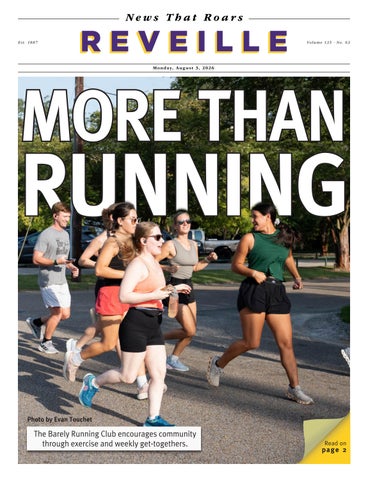

MORE THAN
The
Club encourages community through exercise and weekly get-togethers.

Barely Running
Photo by Evan Touchet
ONE STEP AT A TIME
Student-led running club invites participants to go at their own pace
BY PAUL TIBBETS Staff Writer
For beginners and long-time runners alike, the Baton Rougeborn Barely Running Club is a community that will meet you where you are.
Only five months ago, this running club was just an idea being thrown around on LSU finance senior Nick Fawley’s Instagram story. In December of last year, Fawley began creating social media content focusing on fitness and coaching.
Using this platform, he posted an Instagram story to see who might be interested, and people responded positively. The driving force behind creating this club came from Fawley’s own love for fitness and his desire to build a community. As a member of LSU’s chapter of Kappa Sigma, he noticed a large culture of partying, and he wanted a way to connect with people outside of that.
“I want to do something fun, but get to bed at a decent hour and not waste my entire next day,” Fawley said. “I figured I might as well start my own club, and here we are now.”
Barely Running Club’s first meeting was early on a Sunday morning in March. Even though the turnout was only 10 people, Fawley only knew some personally. This was enough motivation for him to keep it going, but to make some changes as well,
like moving the meeting date to be more convenient.
“A lot of people were excited for it, a lot of people reached out to me, but they went out the night before and weren’t making an 8 a.m. or 9 a.m. Sunday morning run,” explained Fawley. “Let’s do Wednesday night.
What goes on on a Wednesday night? Nothing. No excuse not to be there on a Wednesday night.”
That next Wednesday night, the attendance doubled. From that point forward, Fawley put together a marketing team, a professional logo, launched a website, introduced merch and secured brand deals — the whole nine yards.
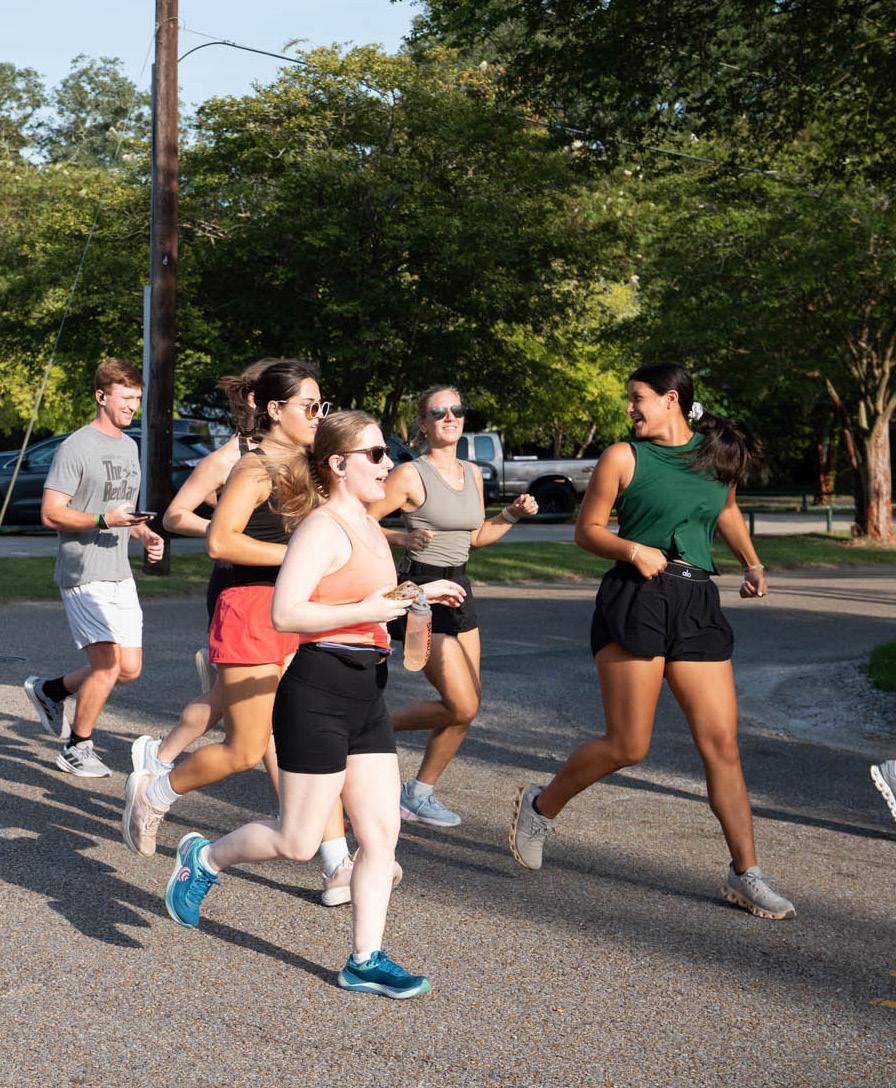
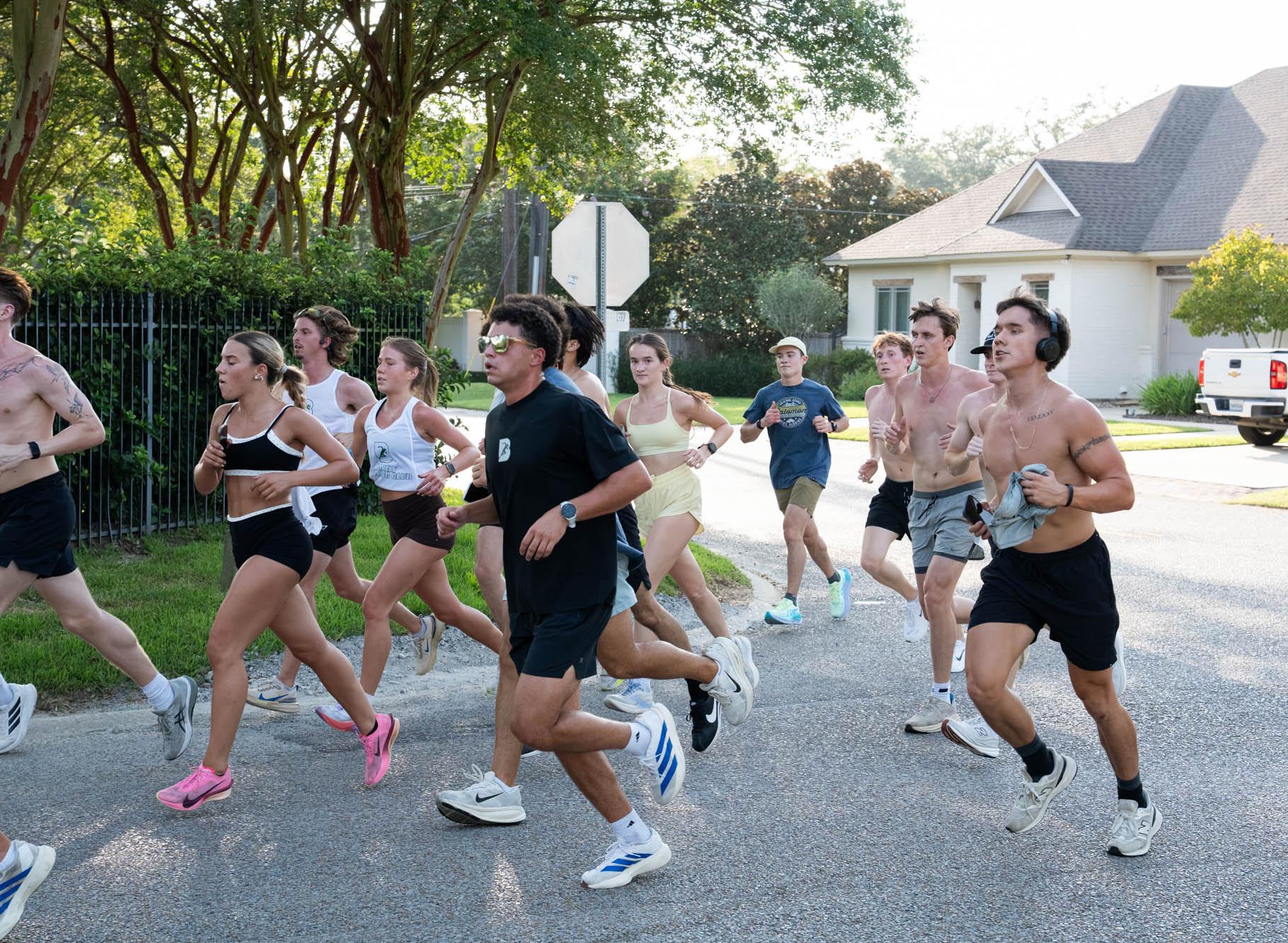
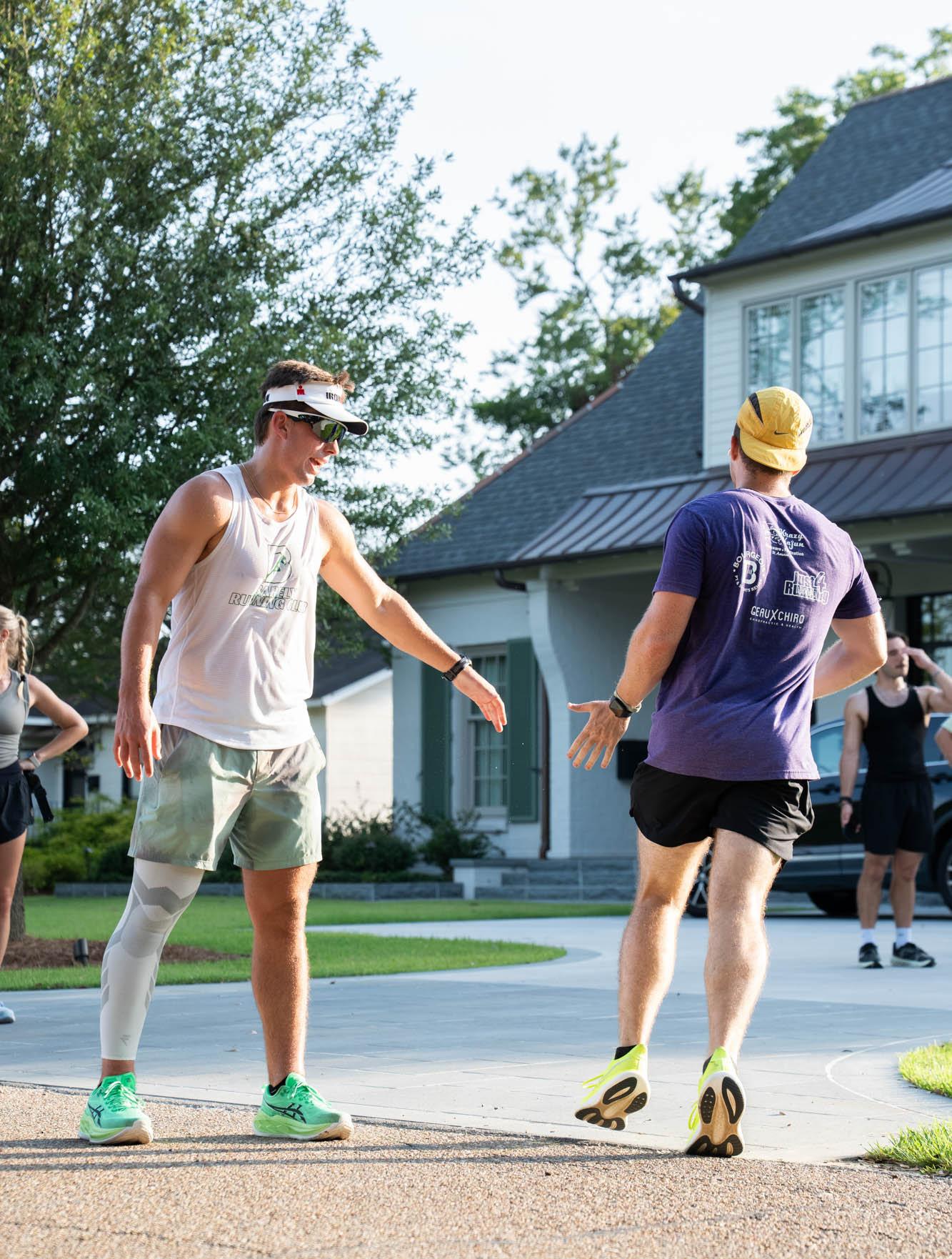
Now every Wednesday at 6 p.m. the Barely Running Club meets up at the Webb Park parking lot where members stretch, gather for a Fawley’s weekly speech and run two miles around the neighborhood. Each run ends in a get-together in Fawley’s backyard where everyone can indulge in an ice bath, free drinks and camaraderie.
More and more people join the club each week, and the club’s Instagram has reached close to 2,000 followers in only four months. A handful of runners also post about the club on social media.
One such runner is recent LSU fashion design graduate Julia DeJean, who has been coming to the club for just under two months now. DeJean often tags Barely Running Club in her Instagram posts and stories.
DeJean has found a real community in the run club, having made many great new friends she considers family.
“It’s not just running, it’s the people here. The vibes are so great. Since day one, you come here and you instantly make friends,” DeJean said. “There’s no, ‘Oh, are they going to like me?’ No, you jump right in, and it’s just history. Everybody loves each other.”


B-16 Hodges Hall
Accounting junior Mackenzie Green, a passionate runner and early attendee of the run club, agrees with Fawley’s vision that this club is much more than just running. For Green, it does not matter what skill level someone runs at as long as they come as they are.
“Everything he does is to make people feel as comfortable as possible. Run at your own pace. He even says, ‘It’s the Barely Running Club. You don’t have to be sprinting,’” Green said. “You don’t have to be the most in-shape person ever. Just show up, do your best.”
Green was an athlete for most of her life, but that had faltered in her time since graduation. Other than a friendly community, she credits the club with giving her that motivation to get back to being active. To her, it does not feel like working out when it is with her friends.
Fawley never imagined he would be in the position he is in today. He is grateful that he has the opportunity to both create content for social media and engage with a community of his own.
He recalled a moment in middle school when he was asked what his favorite thing to do was. The answer back then is the same as it is now: to make people laugh, smile and have a good time.
“It just makes me so happy to help other people and to see other people come and have fun doing something that I love doing,” said Fawley.
For information on future Barely Running Club events, check out the club’s Instagram.
Louisiana State University Baton Rouge, La. 70803 LSUReveille.com

ADVERTISING (225) 578-6090
Layout/Ad Design ASHLEY KENNEDY
Layout/Ad Design REESE PELLEGRIN
CORRECTIONS & CLARIFICATIONS
The Reveille holds accuracy and objectivity at the highest priority and wants to reassure its readers the reporting and content of the paper meets these standards. This space is reserved to recognize and correct any mistakes that may have been printed in The Daily Reveille. If you would like something corrected or clarified, please contact the editor at (225) 578-4811 or email editor@lsu.edu.
ABOUT THE REVEILLE
The Reveille is written, edited and produced solely by students of Louisiana State University. The Reveille is an independent entity of the Office of Student Media within the Manship School of Mass Communication. A single issue of The Reveille is free from multiple sites on campus and about 25 sites off campus. To obtain additional copies, please visit the Office of Student Media in B-39 Hodges Hall or email studentmedia@ lsu.edu. The Reveille is published biweekly during the fall, spring and summer semesters, except during holidays and final exams. The Reveille is funded through LSU students’ payments of the Student Media fee.
EVAN TOUCHET / The Reveille Barely Running Club members run July 29 on Broussard Street in Baton Rouge, La.
EVAN TOUCHET/ The Reveille
Barely Running Club founder Nick Fawley congratulates runner July 29 on Silliman Drive in Baton Rouge, La.
NEWS DECIPHERING DATA
These LSU teams explore ways to implement AI in nuclear, energy research
BY MADELYN LONG Staff Writer
Two LSU research teams will join the U.S. Department of Energy’s Genesis Mission, a national project using artificial intelligence in nuclear research. Working with Oak Ridge National Laboratory and Brookhaven National Laboratory, LSU professors and graduate students will help tackle challenges faced by modern physicists.
The research teams, led by department of physics and astronomy faculty members Jeffery Blackmon and Phillip Sprunger, were among 278 projects selected for funding nationwide. Other professors from LSU, the University of Kentucky and scientists in national labs collaborated and shared resources to create two substantial proposals submitted to the U.S. Department of Energy.
“This initiative has been compared to the Manhattan Project. So being part of it, it’s amazing,” said Kristina Launey, associate professor of physics. “It’s an amazing achievement from LSU, which means what we do, the research here, brings LSU to the national level.”
The Genesis Mission unites government, industry, academic and scientific leaders to continue the U.S. Department of Energy’s efforts to develop AI systems working to efficiently solve defense and energy problems faced by the U.S.
“The initiative aims to bring scientists from different areas together, and by doing this, it practically combines the expertise of various fields,” Launey said. “For example, one project combines nuclear experimental physics, data analysis and understanding the nucleus.”
Blackmon’s project focuses on

reducing the length of time data analysis takes after nuclear decay or collision. When a nuclear event occurs, data from emitted neutrons and gamma rays can be collected to learn more about important nuclear processes and apply new ideas to many real-world issues, like cancer treatment and defense tactics.
But deciphering the data collected after these events is a very tedious task and creates a delay between the experiment and utilizing the results.
“As humans, it can be hard for us to think in more than a few dimensions at a time,” said Blackmon in a statement. “We often see our graduate students struggle for months, even years, to analyze
data sets that might have been captured in a few hours.”
By implementing AI in organizing and understanding information collected after an experiment, it takes less time for results to make a difference. By utilizing Oak Ridge’s supply of more than a decade of measured data from nuclear events, Blackmon and his team at LSU can develop AI systems that decode the data into something that can be applied to innovations.
“We hope AI can help us use the correlations between the many measured parameters to greatly speed the pipeline of data analysis and provide new insights into the properties of nuclei,” Blackmon said in a statement.

Sprunger’s project also plans to utilize AI to develop more efficient energy processes for the nation. As interim director of the Louisiana Light Source, Sprunger is tasked with managing and supporting LSU’s synchrotron. The synchrotron, an electron accelerator, generates unmatched visible light, Xray and UV beams for scientists to use when experimenting.
“We use that light to then probe materials. It is that light source, or synchrotron, that produces the light that enables us to understand materials that you can’t otherwise do with any other kinds of probes,” said Sprunger.
Maintaining machines like a synchrotron is a difficult task, but Sprunger believes that AI can serve as a relieving tool. In partnership with Brookhaven National Laboratory, home of the National Synchrotron Light Source II, Sprunger’s team is researching ways to develop AI systems that can predict machine failures, investigate issues and serve many other roles to keep the synchrotron running smoothly.
Timur Shaftan, National Synchrotron Light Source II Accelerator Division director, explained that the collaboration between LSU and the national laboratory will pave the way for future projects in accelerator science and engineering.
“Rapidly-developing AI tools offer revolutionary opportunities to advance accelerator facility operations, such as those at NSLS-II or Louisiana Light Source, and for new insights into accelerator physics,” said Shaftan in a statement.
The use of AI to efficiently
organize data or maintain equipment proficiency does not only benefit scientists related to the Genesis Mission, Sprunger also explained.
“It doesn’t matter if we’re trying to understand where the electrons going at 100 times the speed of light are flying and how we can control those better, or if we’re counting fish out in the gulf,” Sprunger said. “The same ideas of how to explore different processes and how AI learns by itself are just fundamental. We’re using it for one specific thing, but it cascades to all different areas.”
He also admits that the use of AI in such large and impactful research may seem scary, but Sprunger believes that scientists should embrace the change because AI will undoubtedly be a part of the future.
Both research teams’ initiatives align not only with the US Department of Energy’s push to utilize AI in experimentation, but they also join LSU’s research goals to become one of the top 50 research institutions in the country.
“These projects capture exactly what LSU aspires to be as we drive toward the ranks of the nation’s Top 50 research universities— a place where our faculty work shoulder to shoulder with the national laboratories on the defining scientific challenges of our time,” said LSU Chancellor Jim Dalton in a statement.
“From our own synchrotron in Baton Rouge to the instruments developed by Oak Ridge and Brookhaven, LSU is bringing artificial intelligence to the front lines of discovery,” Dalton continued.
COURTESY OF PHILLIP SPRUNGER/ Louisiana Light Source
COURTESY OF PHILLIP SPRUNGER/ Louisiana Light Source







BATON ROUGE
MURALS





Several painted murals are captured in Baton
on July 31.




Rouge
Photos by Evan Touchet | Design by Alexandra Gerstner
Artist: Kayla Newman
Artist: Geeta Dave
Artist: Mr. Balloon Hands
Artist: Fried Skrimpz
Artists: Brandon Odums and Jacob Zumo
Artist: Marc Fresh
Artist: Marc Fresh
Artist: Eduardo Mendieta
Artist: John Zant
Artist: Rahmaan Statik
Artist: Ellen Ogden
ENTERTAINMENT
Rev Rank: ‘Spider-Man: Brand New Day’ is a web of aimless characters

BY PAUL TIBBETS Staff Writer
“Spider-Man: Brand New Day” swings into theaters with a new status quo for the titular hero who is one step forward and three steps back.
It has been nearly five years since the public has seen Tom Holland’s Spider-Man on the silver screen in 2021’s “SpiderMan: No Way Home.” The end of that film promised a return to form for the web-slinging wall crawler where he is alone, living in a shoddy apartment and sewing his own costume — a new low.
This film, brought to you by “Shang Chi” director Destin Daniel Cretton, mostly delivers on that front. However, it never feels as if Peter Parker is at the whims of an impoverished New York City lifestyle, more that he just downgraded a tad to less advanced tech in between movies.
His shockingly big apartment is lined with specialty machines which are all assisted by yet another head-up display artificial intelligence named EV.
On the flip side, there is a lot of fantastic drama in the realm of Peter’s approach to his relationships. He is more miserable than ever, since he has lost his only friends and family and is afraid to let anyone else in for fear of them suffering similar fates.
This is the driving force of the character arc facing SpiderMan, where his isolation and anxiety are manifesting in unpredictable bodily changes.
A story like this is one that is relatable to many people, particularly college students. Peter has to watch as the two most important people left in his life move on to better lives without him while he tries to make his
own way through a new era.
I commend the way the narrative tackles these ideas of loneliness and pushes back against the idea that a life of solitude and working yourself to death is in any way noble.
And yet, the film could not fully commit to moving on without Zendaya or Jacob Batalon for even one movie. The general audience would be mad if they did not see something they recognized, and Marvel Studios is not keen on taking even the most minor of risks.
It feels somewhat cheap to have Peter get Ned and MJ back in his life so quickly, even if it is in a different context now. Sure, he spent four years without them in his life, but we only truly get the first 15 minutes of the film without them before being caught up in their lives again.
Granted, this does lend itself to some rich interpersonal drama. The strongest emotional gut punches come in moments between Peter and MJ when they are discussing this lost life together. There is a level of restraint the movie takes in not instantly getting them back together, but it is obviously inevitable and swiftly approaching.
An aspect this film improves upon from the previous MCU Spidey outings is the visuals. It is so amazing to see a newer Spider-Man movie that actually looks like a real movie. It has a consistent visual style, shadows, depth of field — all things that sound like bare minimum additions but have been missing in the Jon Watts films of yore.
That is not to say it is perfect. A lot of the time, the swinging scenes feel a bit weightless in the way they are constructed, just a guy kind of looking real going up and down on a rope.
At its most egregious, there
is a scene where after seeing MJ kissing her new boyfriend, Peter swings home out of costume in the rain. Whenever it gets close up, you can tell they just slapped him in front of a green screen and called it a day.
With so many visual effects shots in a film like this, it is hard to make each and every one perfect.
That leads me to the biggest problem: this film is overstuffed. Not only is everything I mentioned given big focus, but it is also competing trying to fit in a certain red-heads entire storyline, a buddy-cop routine with Jon Bernthal’s Punisher, the Hulk, Peter’s cop friend and her kids, all the side villain cameos and Florence Pugh keeps showing up.
It would be nice for once to just have a Spider-Man film trust itself to not need to have so much going on and have the title superhero be the only character. That being said, I do enjoy the dynamic between Spidey and Punisher. They have a lot of really great banter, and Bernthal has surprising comedic timing.
You will notice I have not touched on the villain that much and that is because I am not a huge fan of that aspect at all. The casting choice was good, but her placement in this film baffles me. Marvel keeps trying to do this rug pull where characters with long and rich histories are marketed as twist big villains when they are ultimately just misunderstood.
Ultimately, this movie is a good time despite the numerous flaws all throughout. I cannot outright call it a bad film, but it is frustratingly middle of the road with some standout moments.
Overall: 6/10

COURTESY OF SONY PICTURES
Promotional image for “Spider-Man: Brand New Day.”
SPORTS
Promising high school pitching recruit confirms commitment to LSU baseball SEC and Big Ten change opinions, back PCSA bill
BY ALEX SHEESLEY Staff Writer
Logan Schmidt, one of the most prized pitchers in this year’s high school class, will play for LSU baseball in 2027. Schmidt announced his intention to join LSU through social media on Saturday afternoon, posting a graphic of himself in the Tigers’ uniform.
“Let’s Geaux,” Schmidt captioned the post.
Schmidt has been an LSU commit since August 2025. A dominant senior season in high school boosted him up draft boards for the 2026 MLB Draft, with Baseball America ranking him as the seventh best player available out of high school. MLB front offices concurred, and the Cleveland Guardians selected Schmidt in the second round.
The left-handed pitcher failed to come to terms with Cleveland in the weeks following the draft. He was one of just two players to be selected in the first 10 rounds of this year’s draft to not sign with the organization that drafted them.
That decision cleared a path for
Schmidt to head to college, but heading to LSU after turning down pro ball was not a sure thing.
With his early-round selection, speculation began surrounding Schmidt decommitting from LSU to play at a junior college. There, Schmidt would’ve been available to be selected after every season he played. At LSU, he will be ineligible to be selected until the 2029 draft.
Two major factors that may have motivated Schmidt’s decision to join the Tigers are LSU’s incredible topend pro production and the threat of a lockout ahead of the 2027 MLB season.
LSU has produced four top-five picks in the last four MLB drafts, and five top-six picks in the last five drafts. The selection of Kade Anderson, a highly touted lefty like Schmidt, third overall by the Seattle Mariners in 2025, may have stood out especially as a blueprint for Schmidt’s developmental aspirations.
The lack of progress between MLB and the MLB Players Association to agree on a new collective bargaining agreement ahead of the current one’s expiration at the end of this sea-
son could have also played a factor.
It appears that the two sides will not come to an agreement before then. If that’s the case, the league would effectively halt. That brings uncertainty about how the 2027 draft would operate, taking away one of the advantages Schmidt would have in electing junior college over LSU.
Getting Schmidt to campus is a huge win for LSU’s recruiting class. The confirmed acquisition of one of the country’s top talents for 2027 pushes them to the top of Baseball America’s recruiting rankings. The Tigers moved from second, over Vanderbilt, in the initial post-draft rankings.

BY ALEX SHEESLEY Staff Writer
The Protect College Sports Act, a piece of bipartisan federal legislation aiming to address areas of weakness in modern college athletics, has found new life. The SEC and Big Ten, the two most influential conferences in college sports, announced their support of the PCSA in a joint statement on Friday night.
“The Big Ten Conference and the Southeastern Conference support the Protect College Sports Act as it is currently drafted, following detailed and productive negotiations with Senators Cruz, Cantwell and Schmitt and their respective staffs,” the statement reads. “We appreciate the substantive work that has gone into this effort.”
The announcement comes after weeks of negotiations between lawmakers and universities, and is a reversal of several power conference schools’ opinions of the bill. LSU President Wade Rousse and Board of Supervisors Chairman Lee Mallett wrote a letter against the bill to legislators on July 13. LSU was the fifth SEC university to oppose the bill at the time.
For a conference to be officially in support of the PCSA, a majority of university heads from both 16-school conferences were in support of the bill. Efforts had been taken in the past few weeks by lawmakers to rewrite and make concessions in the bill that would appeal to universities.
“It’s time to get the bill through Congress and [onto] President Trump’s desk,” bill author Sen. Ted Cruz posted on X after the announcement. “Let’s save college sports.”
The endorsement of the bill by the two most powerful conferences in college athletics gives it steam in its most vital hour. The Senate recesses on Friday, and the agenda for the week leading up to the recess, which was set prior to the announcement, does not include the PCSA. Friday’s recess is viewed by many as the deadline for the bill’s life.
Even with the boost, the bill’s chances remain uncertain. The bill needs 60 votes in the Senate this week to get voted on ahead of the recess. If it passes, it will head to the House of Representatives for consideration.







HINESLEY BRYANT / The Reveille LSU baseball players gather on the mound during the Tigers’ 12-1 win over Nicholls on Feb. 18 at Alex Box Stadium.
Let’s face the music: Festivals are in, solo concerts are out

WARREN’S WAY
JEANNE
WARREN Columnist
Festivals like ULTRA, Lollapalooza and Coachella provide a more enjoyable experience than an individual concert and often for a better price. Fans are given the opportunity to see dozens of artists in one weekend for a lower price than if they bought individual concert tickets to see the same performers.
Recently, Lollapalooza wrapped up in Chicago’s Grant Park, running July 30 through Aug. 2. Headliners like Charli XCX, Zara Larsson, Tate McRae and The Smashing Pumpkins performed across eight stages with more than 170 acts.
This is the entire concert vs. festival argument in a nutshell: No individual concert is offering that kind of lineup for one ticket.
A concert gives you one lead artist or group, and there may be a small opener — that no one really came to see anyway — but that’s the whole show. A festival, however, gives you a plethora of acts and allows you to waltz into a music scene you might not have sought out on your own.
And if you’re really in it for the openers, festivals usually have indie acts opening for pop superstars. Similarly at ULTRA, an underground DJ may end up blowing the crowd away right before a main-stage headliner like John Summit.
With the rise of social media, exposure no longer stops when a festival ends. Festivals live well beyond the fairgrounds and often stream live on platforms like Hulu for weeks after closing night. Clips of fans’ favorite moments circulate online and cause the events to gain even more traction.
Since 2010, Lollapalooza has grown to be one of the most fa-
mous festivals in the world and generated around $3.6 billion. Last year it generated $480 million. Will this year top that number?
Even on a smaller scale, the difference is noticeable. If you’ve ever stood in the mud at the New Orleans Jazz and Heritage festival, you’ll understand. A festival is a weekend of fun that gives you the chance to discover new artists and enjoy older ones you may have forgotten about.
Growing up in Louisiana, Jazz Fest is almost like a second Mardi Gras. It shapes the state as a whole, not just the music scene. This can be applied to almost every other state that hosts festivals. It brings in more money, more crowds and more culture.
The money is where festivals really seem to pull ahead. A concert generates revenue for one artist, one venue and one night. A festival is normally multiple days and may boost the economy in the hosting area or city. Jazz
Fest alone generates around $350 million annually into the New Orleans economy.
Restaurants, hotel stays, rideshares, tourist attractions like Bourbon Street and vendors selling everything from jambalaya to festival merch largely impact these sales. The appeal is that the money isn’t just going to headliners, it’s flowing to local businesses.
Festivals create jobs in an economy where they’re badly needed, even if only for a limited time. Someone needing a little extra cash might be able to secure a spot as security or staff for the weekend.
Beyond the money, festivals bring people together, and not just in headcount. Concerts typically attract a certain niche of fans who already know and love that one artist. Festivals pull a more diverse crowd, be it tourists looking for a thrill or families looking to bond.
Thousands of different people
with different backgrounds who love different artists overlap in the same space for completely contrasting reasons. At ULTRA, fans fly in from all over the world for a few days of electronic music.
They party with Miami locals and probably learn a thing or two about the heavy Cuban culture that resides in places like Espanola Way and Little Havana. At Jazz Fest, tourists end up packed like sardines with generations of New Orleans families who’ve been going every year of their lives.
Next time you want to see your favorite artist, do a little digging first and see if they’re playing a festival instead. There’s a good chance they will be, and there’s an even better chance you’ll walk away with a new favorite artist you never knew you were looking for.
Jeanne Warren is a 20-year-old communications major from Baton Rouge.

EDITORIAL BOARD
Laura Allen Editor-in-Chief Managing Editor Garrett McEntee Sports Editor Rami Burks
Emily Boudreaux Production Editor
CARMEN RANDOLPH / The Reveille