
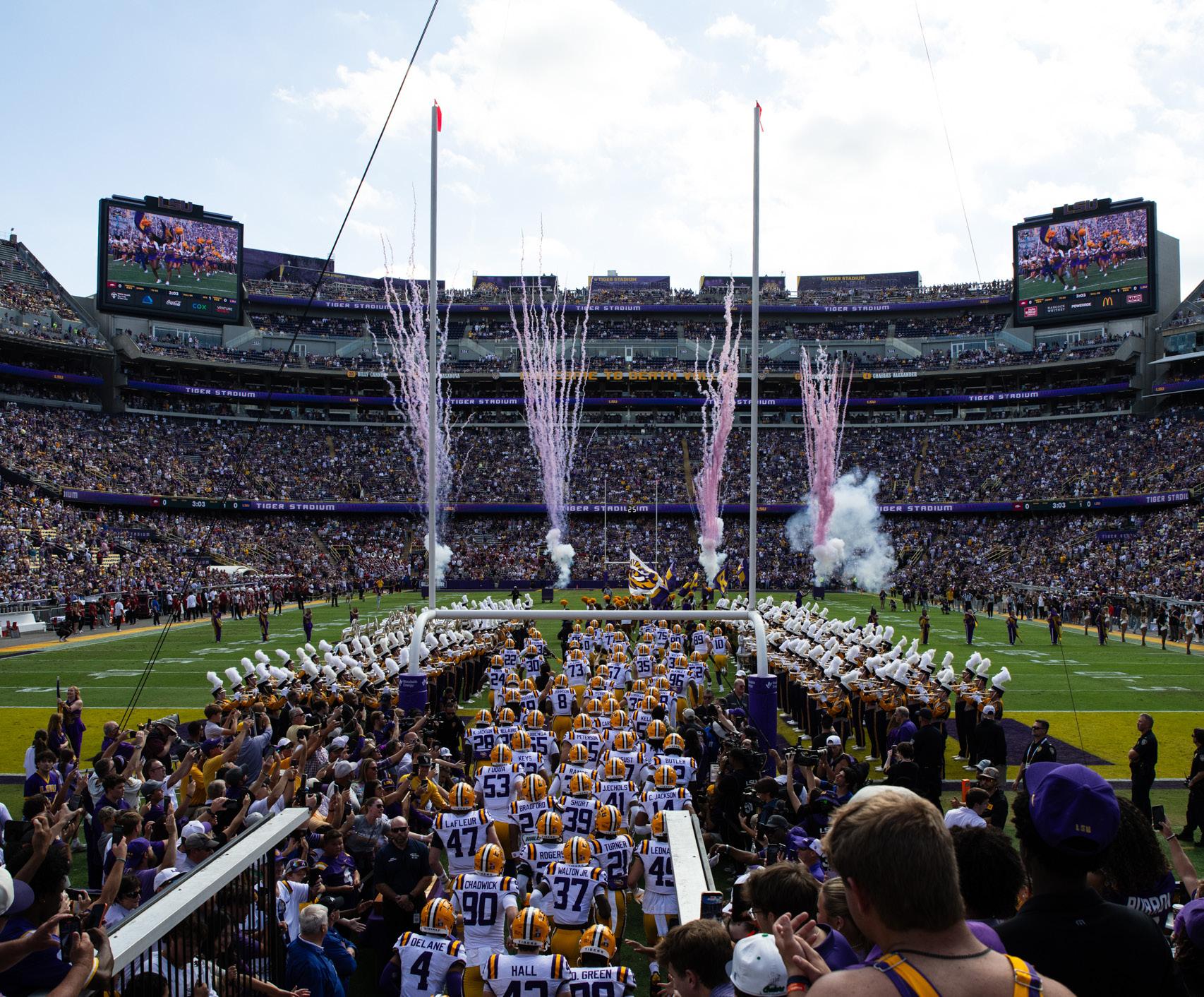
LSU football’s purple and gold games create a game-winning atmosphere, electrifying fans and motivating the team.
Read on page 2


Photo by Erin Barker



LSU football’s purple and gold games create a game-winning atmosphere, electrifying fans and motivating the team.
Read on page 2
LSU football has won most of its purple and gold games. Here’s why.
BY RAMI BURKS Sports Editor
LSU sports are known for the energetic atmosphere at its home stadiums, but few homefield advantages are as strong as Tiger Stadium. The history of the designated purple and gold games showcases this.
For one or two games each season, LSU football will have a designated game for the fans to wear purple or gold. These games bring a sense of energy and camaraderie among fans, and since LSU is an SEC school, Greek life has fun creating themed outfits and tailgates accordingly.
LSU Athletics announced the designated purple and gold football games for 2026. The Tigers will take on Louisiana Tech on Sept. 26 while donning purple, and Texas A&M on Sept. 26 while donning gold. This kicks fan engagement further into gear before the season even starts. But the Tigers’ history with designated games brings even more promising stats on top of what head coach Lane Kiffin has promoted heading into the 2026 football season.
According to previous LSU football schedules, the Tigers are 10-for-12 in gold games, and 5-for-6 in purple games. Both of these win percentages are 83%.
The tradition began in 2006 with the first gold game versus Mississippi State in which the Tigers beat the Bulldogs 48-17. In 2018, LSU’s first purple game was a 38-21 victory against Louisiana Tech.
The most recent designated purple and gold games were in 2025, and the Tigers won both games. The gold game was a 2010 victory over Florida, and the purple game was a 23-22 win over Arkansas.
While LSU football is known for crazy antics in the bleachers, the nearly annual color-coded games bring more energy to the stadium, aside from some of LSU’s biggest rivalry games.
“I’ll never forget the first time the gold wristbands lit up the stadium [versus Florida in 2025,]” LSU alumna Emily Gentry recalled about her senior year. “Those are the moments that define Death Valley and make it such an intimidating place for any opposing team.”
The camaraderie, along with the light-up wristbands and stadium lights, make the purple and gold games even more special than a regular game. The energy that these unique games generate make the already difficult venue of Death Valley even more intimidating for the opposing team. All of this is part of what makes LSU a tough opponent, beyond the team’s premier talent.

For the upcoming 2026 football season, fans are already excited with the addition of Kiffin and his staff, especially with the return of Ed Orgeron. Kiffin has made promises to bring LSU back to its golden years.
“I don’t know how fast it’s going to happen, [but] we’re going to win a national championship,” Kiffin said on former LSU player Tyrann Mathieu’s podcast. “We’re going to have the teams and the roster back to when they were playing when they were great.”
This already brings excitement to one of the rowdiest crowds in college football, and the energy will explode if his promises follow through with big victories over Texas A&M and Louisiana Tech while the purple and gold lights flash throughout Tiger Stadium.
While the uniform and energy in the stadium don’t secure a win, the stats behind the purple and gold games support the high chances of LSU taking one of its top SEC opponents and instate rivals that it faces in 2026.


ADVERTISING (225) 578-6090
Layout/Ad Design
Layout/Ad Design REESE PELLEGRIN
The Reveille holds accuracy and objectivity at the highest priority and wants to reassure its readers the reporting and content of the paper meets these standards. This space is reserved to recognize and correct any mistakes that may have been printed in The Daily Reveille. If you would like something corrected or clarified, please contact the editor at (225) 578-4811 or email editor@lsu.edu.
CORRECTIONS & CLARIFICATIONS ABOUT THE REVEILLE
The Reveille is written, edited and produced solely by students of Louisiana State University. The Reveille is an independent entity of the Office of Student Media within the Manship School of Mass Communication. A single issue of The Reveille is free from multiple sites on campus and about 25 sites off campus. To obtain additional copies, please visit the Office of Student Media in B-39 Hodges Hall or email studentmedia@ lsu.edu. The Reveille is published biweekly during the fall, spring and summer semesters, except during holidays and final exams. The Reveille is funded through LSU students’ payments of the Student Media fee.
Battle for the Rag, the intrastate football rivalry between LSU and Tulane, is back. LSU football announced on Friday that it is adding four new non-conference home games in three of the next five seasons, all against in-state opponents.
LSU announced that it will host Northwestern State in 2027, Louisiana-Monroe and Southern in 2028, and Tulane in 2030. The Tulane matchup will be the first time LSU and Tulane face off in its historic but dormant rivalry since 2009.
Tulane will come to Baton Rouge for the game on Aug. 31, 2030, for the 99th edition of Louisiana’s most notable rivalry. That date could line up with week one of LSU’s 2030 campaign.
The LSU-Tulane series dates back to 1893 and was a nearly annual fixture since its inception, chiefly due to the two schools being members of the same conference. Tulane, a founding member of the SEC, left to become independent in 1966, but the series continued for much of the remainder of the century until it stalled in the ‘90s.
Dubbed “Battle for the Rag,” the winner of the game receives a flag that is horizontally divided and features the logos and colors of the two schools on either side. Its return in 2030 will give LSU
three trophy games, which include the Magnolia Bowl against Ole Miss and the Golden Boot against Arkansas.
After a one-off in 2001, Battle for the Rag returned as an annual matchup in 2006 but only lasted until 2009 before once again being taken off of the calendar.
LSU, wanting to host every game of the series in Baton Rouge instead of alternating between the two teams’ home cities, paid Tulane to end the series after only four games of the 10 game agree -
ment. The two sides have not met on the gridiron since.
The Tigers currently lead the series with 69 wins, 22 losses and seven ties. They will enter the next edition of the rivalry as winners of its last 18 games against Tulane.
Tulane is LSU’s first confirmed opponent of the 2030 season, but it is not the furthest advanced appointment on LSU football’s schedule. LSU will play Utah in a home-and-home that wraps up in 2032.
LSU is formally opposing the Protect College Sports Act, a piece of federal legislation that aims to patch several flaws in modern college sports at the national level.
LSU President Wade Rousse and Board of Supervisors Chairman Lee Mallett authored the opposition in a statement to Sens. Ted Cruz and Maria Cantwell on July 13.
“For nearly a century, LSU has been at the forefront of college athletics, and we recognize that the important issues facing us today necessitate substantive reform,” part of the statement reads. “While we support all the efforts surrounding the Protect College Sports Act, we believe key issues remain with the legislation and we do not support the bill in its current form.”
The PCSA is a bill that advanced through the Senate Committee on Commerce with bi-
partisan support last month. It provides a set of solutions to issues that have emerged in the college game over the past half decade, primarily in the realms of NIL, transferring and eligibility.
The bill would change name, image and likeness rules, and though it would enshrine the right for athletes to earn through NIL, it would change reporting rules and could alter a landscape that LSU has dominated in recent years.
Impacts to eligibility rules won’t be as sweeping if the PCSA passes thanks to the NCAA’s recent adoption of the five-for-five rule, but the bill would ban any athlete from participating in college sports if they play professionally anywhere in the world. LSU men’s basketball has recruited out of Europe and will likely have former pro players on its 2027 roster.
Transfer rules also stand to change with the bill’s passing, critically limiting players to a single penalty-free transfer between
the players. So we’re kind of exploring all of that right now.”
A new chapter is being written in the chaotic saga between LSU and Ole Miss following the Lane Kiffin departure. Ole Miss athletic director Keith Carter is considering legal action relating to two former Ole Miss and current LSU football players over unfulfilled buyout payments.
The dispute centers on a pair of buyouts owed from Princewill Umanmielen and Devin Harper, current LSU football players who transferred from Ole Miss. These buyouts are estimated by On3 at $407,000 and $590,000, respectively.
The buyouts are owed because Umanmielen and Harper signed contracts to earn money from Ole Miss’ revenue sharing program for the 2026 season prior to transferring.
It is unclear whether Ole Miss will pursue litigation against the program or the individual athletes. In an interview with Mississippi’s The Clarion-Ledger, Carter suggested that Ole Miss was exploring all options to recoup the money owed.
“That would be an option, going and asking a court to get that money for you,” Carter said. “Contracts are with the players. LSU could pay that on behalf of
Umanmielen and Harper are expected to be in important roles for the Tigers in 2026. Umanmielen was the top edgerusher in the 2026 transfer class and tallied nine sacks, which was third most in the SEC. Harper will be in competition to start on LSU’s offensive line as it looks to improve a running game that held the Tigers back in 2025.
Both players are a part of a substantial transfer of talent between Oxford, Mississippi; and Baton Rouge that came with Kiffin following his change of employer. Ole Miss feels like it’s owed something for that loss.
“We’re going to continue to figure out how to collect,” Carter said. “We feel like based on the contract we deserve to collect.”
Suing over unpaid buyouts after a player who signed a revenue sharing agreement transfers is not unprecedented. Several cases, including a $1 million suit against then-Texas Tech quarterback Brandon Sorsby from Cincinnati, have been opened for the same thing.
A decision on whether or not Ole Miss will file suit is expected to come in the next few weeks.
colleges. The transfer limit would somewhat restrict LSU and other SEC schools’ ability to procure talent from the portal, a significant part of roster construction as it stands.
LSU joins Alabama, Auburn, Texas and Texas A&M as SEC members to formally oppose the bill. The bill has also received pushback from several schools in the Big Ten, another power conference in college athletics.
Rousse and Lee showed a desire to work with Congress and other college athletics programs to find alternate solutions to the problems covered in the PCSA.
“We look forward to working with the House, the Senate, and our fellow institutions in the Southeastern Conference to make the needed improvements to this legislation,” the statement said. “We are hopeful that together, we can support a bill that will truly help ensure college athletics is preserved for our students and all higher education institutes.”








on July 16 and 17.


BY MADELYN LONG Staff Writer
Integer Technologies, a national defense research company, expanded its current partnership with LSU to continue national security research on campus.
When the company partnered with LSU economic developer Greg Trahan in 2023, it received a $9.8 million award from the Office of Naval Research. Since 2023, Integer Technologies has consistently grown its presence on campus and involvement in LSU-based research projects.
Integer Technologies and LSU faculty are focused on building defense technology to assist in data analysis and the creation of automated naval systems.
The program taking place on campus, titled Intelligent Data Management for Distributed Naval Platforms, aligns with the U.S. Navy’s goal of transitioning from staffed missions to autonomous, or artificial-intelligence based, vessels for maritime operations by strengthening distributed operations and data management. Drs. Shuangqing Wei and Corina Barbalata, engineering professors at LSU, oversee LSU’s involvement in the partnership.
One of the main challenges facing the research partners is how to utilize these tools onboard the vehicles. Things like computational power are much more limited with onboard robots, and LSU and Integer Technologies are working to build tools that can work within those limitations.
Zachary Burchfield, program manager for Mission Solutions at Integer and LSU alumnus, explained that projects taking place on campus revolve around advancing com-

Autonomous Systems engineering manager Will Ard (second from
stone project that they built.
munication systems for unmanned underwater and surface vehicles, including submarines and boats.
“Over the past year in collaboration with LSU on [Intelligent Data Management], we’ve advanced research and capabilities in communications systems, data-driven modeling of vehicle states and much more,” said Burchfield. “We’ve put small robot boats on the water that talk to one another, make decisions on their own and drive themselves.”
Integer Technologies was initially attracted to partnering with LSU because of the strengths of LSU’s research enterprise in the defense and weapons industry.
As part of LSU’s Scholarship First Agenda, defense is one of six priorities for LSU campuses across the state. With more than $62 million in defense research grants held, LSU has become a leader in produc-
ing defense-related research.
William Ard, Autonomous Systems engineering manager for Integer, explained that LSU’s experience with defense research assists Integer in its projects within the same industry.
“We’re able to leverage the university’s deep domain expertise, so there are a lot of researchers at LSU who bring strong backgrounds in areas such as communications, autonomous systems, maritime systems and cybersecurity,” said Ard.
The partnership expansion brings on great excitement for Integer Technologies staff and LSU faculty alike. LSU President Wade Rousse remarked that LSU is leading the way in discoveries and talent development in national security research.
“We are thrilled to have Integer Technologies working directly with
our researchers, hiring our graduates, and building upon LSU’s legacy of supporting our national defense,” Rousse told Louisiana Economic Development.
“Integer Technologies’ Baton Rouge presence proves LSU’s research and talent are a powerful engine for recruitment and innovation, and we’re proud to work with them on next-generation technology for the nation,” Rousse continued.
Integer Technologies provides resources to enhance research potential at LSU as well. Integer staff work closely with LSU students to share their area of expertise before entering the workforce by sponsoring senior capstone projects and offering internships through the company.
In the past, Integer employees assisted LSU graduates in building a catamaran-style unmanned sur-
face vessel for their capstone project. Ard led a group of mechanical engineering students in creating a successful vessel in a real-world workplace environment, which staff agreed teaches students many skills needed to succeed in the workforce.
Burchfield is able to utilize skills and knowledge learned while at LSU in his job at Integer as well. He explained that serving as lead electrical engineer in his senior capstone project was an extremely valuable experience that directly prepared him for his job at Integer.
“We did everything from concept to delivery, doing tests, presentations, reports and demonstrations along the way,” Burchfield said. “I still reference the project management processes we learned in the capstone project in my job today.”
Louisiana Economic Development Secretary Susan Bourgeois agreed with Integer and LSU staff that the exposure students get when working with Integer employees as part of their coursework is crucial to developing strong workers in the weapons research industry.
“These are real jobs being built in Baton Rouge, tied to research, industry and national security needs,” Bourgeois said.
LSU’s expanded partnership with Integer Technology will also bring an estimated 23 jobs, which will have an average salary of $130,000. Bourgeois explained that these high-wage jobs created by Integer Technologies provide valuable opportunities for LSU graduates to stay close to home instead of traveling far for a high paying job.
“That is how we turn the strength of our universities into business growth, stronger career pathways and long-term economic impact for our state,” said Bourgeois.
BY MADELYN LONG Staff Writer
A Baton Rouge man was arrested after allegedly selling drugs to students near LSU’s campus.
Jordan Cole Langlois, 35, was booked into the East Baton Rouge Parish Prison on June 30 after a three-month-long investigation by the East Baton Rouge Sheriff’s Office. Deputies first learned about Langlois’ alleged drug dealing out of an apartment on East Magna Carta Place off Old Hammond Highway through an anonymous tip in March.
Langlois was previously identified as a cook for LSU’s Delta Chi fraternity house by police documents, but House Corporation President for Delta Chi John Dun-
lap said that Langlois was never employed by the fraternity or the catering company it uses.
Deputies also learned from the LSU Police Department that Langlois was allegedly distributing cocaine to LSU students, according to WAFB.
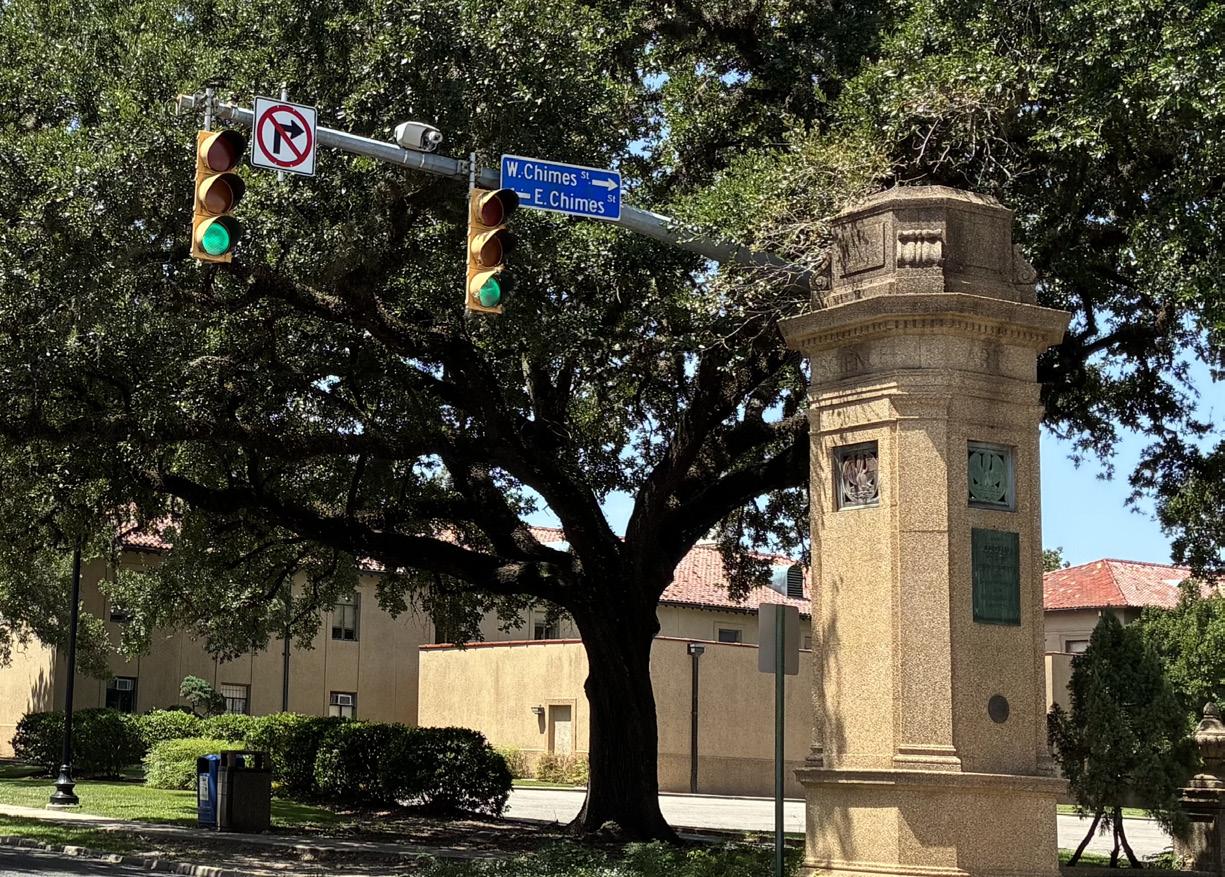
On June 30, deputies set up a drug sale between Langlois and an informant at a West Chimes Street apartment behind Cherrybomb Coffee Co. This arrangement gave deputies enough probable cause to arrest Langlois and co-defendant, James Cavalier. Deputies also obtained search warrants for three locations on Asoka Avenue, East Magna Carta Place and West Chimes Street.
When searching the properties, deputies seized 70 grams of
packaged cocaine, 21 grams of methamphetamine and MDMA pills. They also found multiple digital scales and other drug paraphernalia that tested positive for cocaine, according to arrest records.
According to WAFB, investigators said the quantity of cocaine recovered was consistent with street-level distribution, not personal use. Langlois admitted he was a narcotics user but insisted that he did not have intentions to sell the drugs.
Langlois was booked into the East Baton Rouge Prison on multiple counts of cocaine and meth possession with intent to distribute. His bond was set at $31,500, and he is due in court on Sept. 22 for a bond review hearing.
BY PAUL TIBBETS Staff Writer
“Tell me, O muse, of that ingenious hero who traveled far and wide after he had sacked the famous town of Troy.”
These words mark the opening of Homer’s “The Odyssey,” one of the most important stories of all time. Its emphasis on human resiliency, shift in heroic standards and introduction of a new style of narrative trope revolutionized Western storytelling from its inception nearly 3,000 years ago.
Naturally, with such a historic and influential story, there are bound to be innumerable adaptations, interpretations and translations that each bring something new to the table.From Virgil’s “Aeneid” framing Odysseus as a villain to Samuel Butler’s translation using 19th century prose, this timeless story has sparked endless reinventions in every era.
Nolan’s “The Odyssey” is not quite Homer’s ancient epic. Still, Nolan’s new film uses this story as a foundation to relay his own tale of the end of a world and deliver an adaptation worthy of its epic source material.
“A face, a fleet, a war, a man, a thought, a trick — a trick to break the walls of Troy and burn it screaming to the ground,” says Travis Scott’s bard in “The Odyssey.”
Though not remotely the same phrasing, these opening lines to Nolan’s film mirror those of Homer’s epic poem in their own unique way. In much the same way the original story was passed down through oral tradition, the bard recounts Odysseus’ war story in song fashion.
Scott being the one to present the songs of heroes in the film is an inspired idea. He has collaborated with Nolan in the past on his 2020 film “Tenet” for its soundtrack, but I love to see him as the oral storyteller, showing how rap musicians are the bards of our own generation, an idea supported by Nolan in his interview with Time Magazine.
Music plays a major role in the movie, whether it be through the tradition of hero songs or in the score itself. Swedish composer Ludwig Göransson creates a rich soundscape, combining ancient instruments with a few modern sounds. The soundtrack does a masterful job at elevating each scene so they hit that much harder.
Thundering drums and chants back the siege of Troy, battering every pounding heartbeat and sword slash right into your soul to make you feel like you are on the battlefield alongside the soldiers.
Intimate scenes between Odysseus and his wife Penelope have a gorgeous backtrack that features a melancholic and wistful sound — made all the more poignant when the motif is reused in the sirens scene.
One of the best bits of sound

Göransson implements is with Odysseus’ bow. Each time he plucks the string, the strum of a lyre works its way into the instrumentals. This choice is brilliant, driving home the Bronze Age sound and giving the character an exciting and recognizable leitmotif.
This score also works to make the horrifying scenes all the more harrowing. Two scenes in particular stand out to me as utterly bonechilling
First and foremost is meeting Polyphemus. Nolan captures the terror of a man-eating cyclops by keeping him mostly mute and shrouded in the dark of the cave. When you finally get a decent look at him, his face is creepily contorted as he mindlessly chews through Odysseus’ men in a visual akin to that of Francisco Goya’s “Saturn Devouring His Son.”
Another scene that evokes disgust and fear is when the seafaring Greeks reach Circe’s island. The slow buildup in which the witch is revealed is masterful work, and when her spell begins to take hold of Odysseus’ crew, I began to squirm in my seat.
Circe molds and pulls on these men, turning them into pigs as they cannot physically stop eating a stew she prepared. How their bodies distort as she transforms them is a sight that you must see to believe.
What makes Circe’s scenes so effective is due in no small part to Samantha Morton’s stellar performance; she embodies the pain and intensity required for Crice.
Most of the acting in the film is nothing short of fantastic. Robert Pattinson’s Antinous and Anne Hathaway’s Penelope are obvious standouts for their own reasons.
Pattinson brings a snaky frat boy personality to the conniving suitor that makes him, above all else, flat out fun to watch. On the flip side, Hathaway is astounding at masking her volatile emotions with a veil of dignified grace. When she has to let loose, boy, does she.
All of the supporting cast does
their thing with the little time they have: Benny Safdie has an unmatched presence as Agamemnon, Lupita Nyong’o is subtly intense as Helen and her twin sister Clytemnestra, and Elliot Page offers a moving role as young soldier Sinon.
I am mostly pleasantly surprised by both Matt Damon’s Odysseus and Tom Holland’s Telemachus. I do not blame Holland for being almost lost in the sea of phenomenal actors around him, because even in that context he plays the unimposing boy trying to be tough incredibly well.
Damon does an impressive job portraying this enduring hero as the regretful orchestrator of horrible tragedies. Damon’s Odysseus and Zendaya’s Athena have a pivotal moment near the end of the film that recontextualizes her character and the whole legend of the Trojan War as something ultimately fruitless and tragic.
The most interesting reinterpretation Nolan takes is turning the story into an anti-war tale. Much like the characters in “Oppenheimer,” Odysseus is reckoning with his role in setting off a chain of events to destroy people on a scale not seen before in support of the powers that be.
In the end, this is a tale of the importance of Zeus’ law, or xenia, which holds that even in horrible times, it is still prudent to treat strangers with kindness and respect.Nolan flips it to mean that using the Trojan Horse was a violation of this law, and this move by Odysseus has not only cursed his men, but left the world worse for wear.
Greek gods largely take a backseat in this film to tell a story that is bleakly human. Odysseus is left hoping that this darker age will fade and become one of hope and a recurrence of xenia.
This is a film that is absolutely meant to be seen on a large screen. Find your nearest IMAX, and prepare to cheer, laugh and cry along with a film of epic proportions.
Rating: 10/10


JEANNE
WARREN Columnist
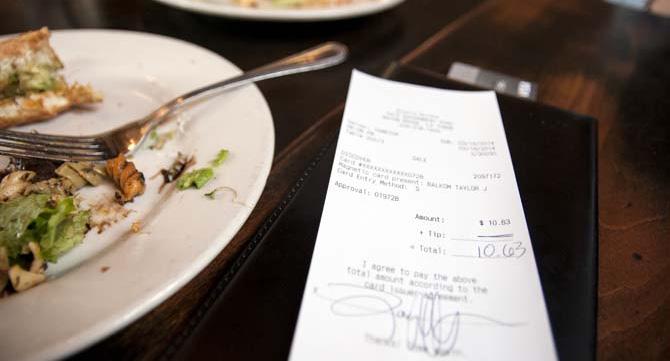
Dining out is a luxury. If you can’t afford to tip, don’t go out to eat. Eating out at a restaurant is often treated as a common activity, and for the most part, it is. People go out to eat for all sorts of reasons, from convenience to conventions.
However, the overlooked aspect regarding dining out is not only the food, but also the service. You pay for an experience where everything is for you and about you.
If this wasn’t the case, going out for birthdays and other special events wouldn’t be nearly as popular. People would pop a pizza in the oven and call it a day. There’s a level of status and formality that comes with dining out. It signals that something matters enough to go beyond the minimum.
When you sit down at a restaurant, you are choosing to be waited on. Your server is greeting you, taking your order, ensuring your food is correct, getting you refills and handling many other tedious, minuscule aspects of your experience. On a busy night, this is all occurring while your server simultaneously juggles four or five other tables.
This calls for notable attention to detail, specifically about you. Every table has different needs, preferences and expectations, and it is the server’s responsibility to manage all of them at once. Choosing to take up time in a server’s section and then not tip on top of this is an insult.
Many anti-tippers will say that other countries don’t really tip, but in truth, that is a poor argument. These other countries usually don’t tip because either gratuity is included in the bill or these restaurants charge more to pay their staff
more. If we followed this model, restaurants would increase the price of food or even a service charge to ensure that the gap in income is filled.
At its core, tipping culture in the U.S. comes down to a structural issue. As bad as prices currently are, the last thing anyone wants is to increase prices at restaurants. Not tipping because “the restaurant should pay more” is an extremely flawed argument and is just a poor excuse to not tip.
It literally does nothing to change the system. If no one tipped, servers would quit and restaurant success would decline. At best, restaurants would just implement an automatic gratuity on every table.
If you didn’t like tipping before, you really wouldn’t like it after. The cost would still exist, just in a more unavoidable form.
Additionally, when you don’t tip, your server may end up coming out of pocket to serve
you. Things such as alcohol sales may result in a tip-out the server has to pay the bartender. Moreover, other places with bussers or specialty chefs may also require tip-out, further rubbing salt in the wound after receiving no tip. The server is still required to share a percentage of their sales, whether you tip or not. In some cases, servers are quite literally losing money by serving a table that doesn’t tip. Customers may not be aware of this, but it directly impacts their income
If you don’t believe in tipping people when they’re already “getting paid” — $7.13 an hour, that is — then it is inconsistent to expect servers to take a financial loss just to serve you, and if fairness is your goal, that becomes a bit contradictory.
If you really don’t feel like you need to tip, avoid spending money at these businesses entirely instead of withholding a tip from the employee who has the least control over the system.
Stop going out to eat entirely. Refusing to participate in the system entirely sends a clearer message than continuing to use a given service while synchronously failing to compensate the person providing it. Taking a stand involves consistency and public awareness; it doesn’t involve selective participation that inconveniences people.
Dining out is an experience that comes with certain customer expectations, just like there are expectations for the server and the restaurant, whether people like it or not. If you choose to participate in that experience, do it fully, meet the expectations on your end, and tip your server properly. Otherwise, the more responsible decision would be to just stay home.
Jeanne Warren is a 20-year-old communications major from Baton Rouge.
EDITORIAL BOARD
Laura Allen Editor-in-Chief
Emily Boudreaux Production Editor