
Read on page 2



Photo by Evan Touchet

Read on page 2
BY MADELYN LONG Staff Writer
Since 1936, seven live tigers have called LSU’s campus home. From Mike I to current mascot Mike VII, each tiger has served as a live representation of LSU’s pride and spirit.
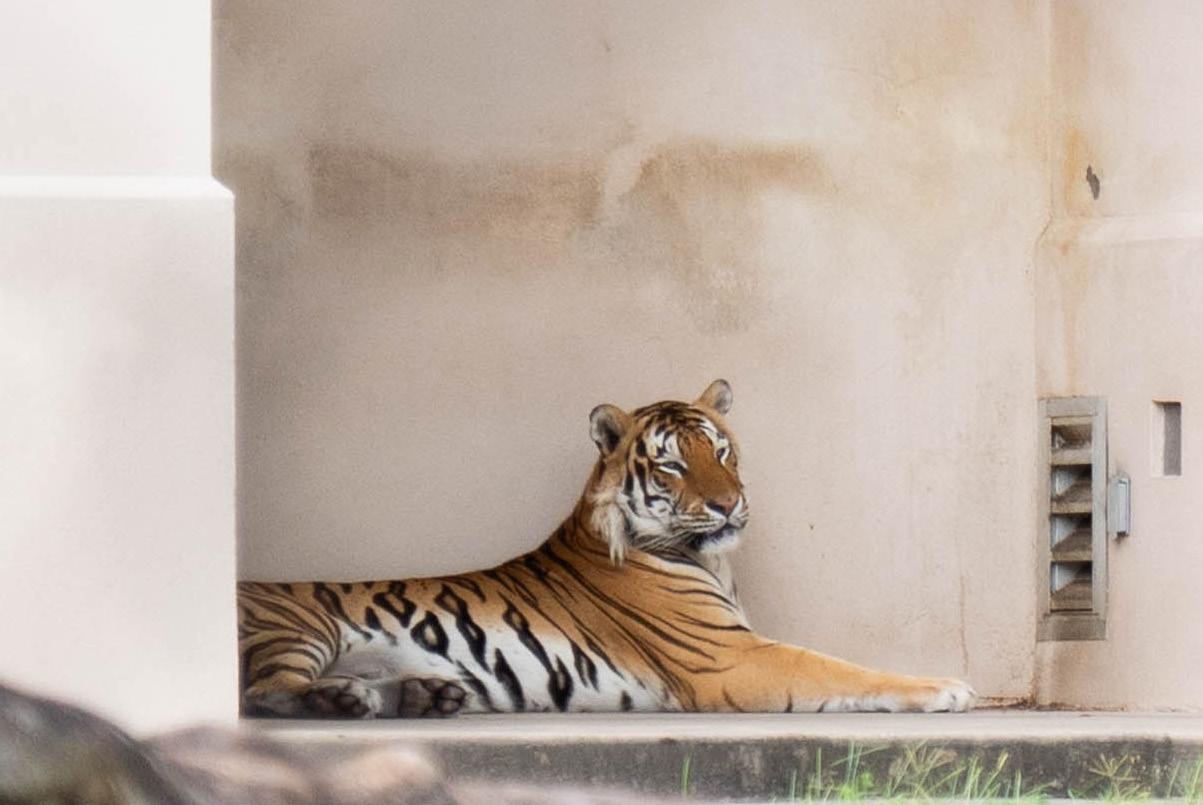
To ensure that Mike VII’s life on campus is one of comfort, his enclosure encompasses 14,010 square feet of outdoor space and a 1,000-square-foot nighthouse. Construction on this space was completed in 2005, and it has received many refurbishments over the years
In this space, Mike has two pools, a stream, grass, trees and foliage at his disposal. Ginger Guttner, spokesperson for Mike VII and assistant director of communications for LSU Veterinary Medicine, said that Mike’s favorite way to spend his time is in the pool, no matter the weather. He also enjoys walking around the perimeter of the enclosure and climbing on the rocks.
On top of a complete space to roam during the day and sleep at night, Mike also has access to his own veterinarian, Dr. Rhett Stout with LSU’s School of Veterinary Medicine, and two daily caretakers who are students in LSU Vet Med.
The daily caretaker positions are paid and highly valued among the veterinary community because of the time commitments made to provide Mike with the best care. Caretakers are chosen every other year from a pool of second-year veterinary students who apply for the position with their chosen partner.
The position requires two

months of training every day, then caretakers work seven days a week for the two years they spend with Mike.
The caretakers tend to do most of the daily tasks that keep things running smoothly, including waking Mike up for the day. They also ensure his enclosure is safe the day before he is let outside, and they even put out different scents using essential oils so he has something to hunt.
Mike and the caretaker’s routine looks the same day to day, Guttner explained.
“Mike VII walks around, checks out his space, gets in the pool and then he sleeps
for much of the day,” she said. “While he’s out, the caretakers clean the night house and get things ready for the rest of the day.”
This includes moving frozen food over to the refrigerator, taking an inventory of supplies and completing various other tasks. Although living in captivity, Mike VII and previous tigers on campus have received high levels of care that keep them happy and healthy. According to Guttner, tigers in the wild live an average of eight to 12 years, but in captivity, the average increases to 14.
“In addition to the habitat, his veterinarian and his caretak-
ers, Mike has all of the resources of LSU Vet Med at his disposal, so he gets the best daily and medical care possible,” said Guttner.
Even with previous mascots being diagnosed with cancer — like Mike VI — and other chronic illnesses, Guttner added that LSU has continued to provide an exceptional level of care.
“LSU is dedicated to providing a good home for a tiger that needs one, and I think that Mike VI’s cancer diagnosis and treatment are a testament to the level of care that LSU provides for its tigers,” said Guttner. “No tiger in captivity had ever been given radiation treatment for cancer in the world, as far as we could tell.”
But many others besides those who work with Mike directly are proud to have him on campus. Students and community members alike visit Mike regularly, as a source of campus entertainment and even good luck on game days.
As LSU is one of only 58 universities that have a live mascot, LSU parent Jill Thomas explained that Mike the Tiger is arguably one of the most famous and recognizable live college mascots.
“He is a living symbol of LSU’s spirit, traditions and strength,” said Thomas. “Visiting Mike, in his habitat, is a reminder of [the] impact one student, who is supported and loved by many, could have on the world.”
It is easy to keep up with Mike VII on multiple social media platforms, Instagram, Facebook and X, or visit him inperson at his enclosure nestled between the PMAC and Tiger Stadium.
LSUReveille.com


B-16 Hodges Hall

Louisiana State University
Baton Rouge, La. 70803
Editor-in-Chief
ADVERTISING (225) 578-6090
Layout/Ad Design ASHLEY KENNEDY
Layout/Ad Design REESE PELLEGRIN
Layout/Ad
The Reveille holds accuracy and objectivity at the highest priority and wants to reassure its readers the reporting and content of the paper meets these standards. This space is reserved to recognize and correct any mistakes that may have been printed in The Daily Reveille. If you would like something corrected or clarified, please contact the editor at (225) 578-4811 or email editor@lsu.edu.
The Reveille is written, edited and produced solely by students of Louisiana State University. The Reveille is an independent entity of the Office of Student Media within the Manship School of Mass Communication. A single issue of The Reveille is free from multiple sites on campus and about 25 sites off campus. To obtain additional copies, please visit the Office of Student Media in B-39 Hodges Hall or email studentmedia@ lsu.edu. The Reveille is published biweekly during the fall, spring and summer semesters, except during holidays and final exams. The Reveille is funded through LSU students’ payments of the Student Media fee.
BY PAUL TIBBETS Staff Writer
With the monthly Baton Rouge Arts Market, residents can support local creatives and hear the personal stories behind a wide variety of art pieces and styles.
For more than 20 years now, the Baton Rouge Arts Market has shared a space with the Red Stick Farmers Market on the first Saturday of each month. This month’s market was moved to the second Saturday of the month to avoid a conflict with the Fourth of July.
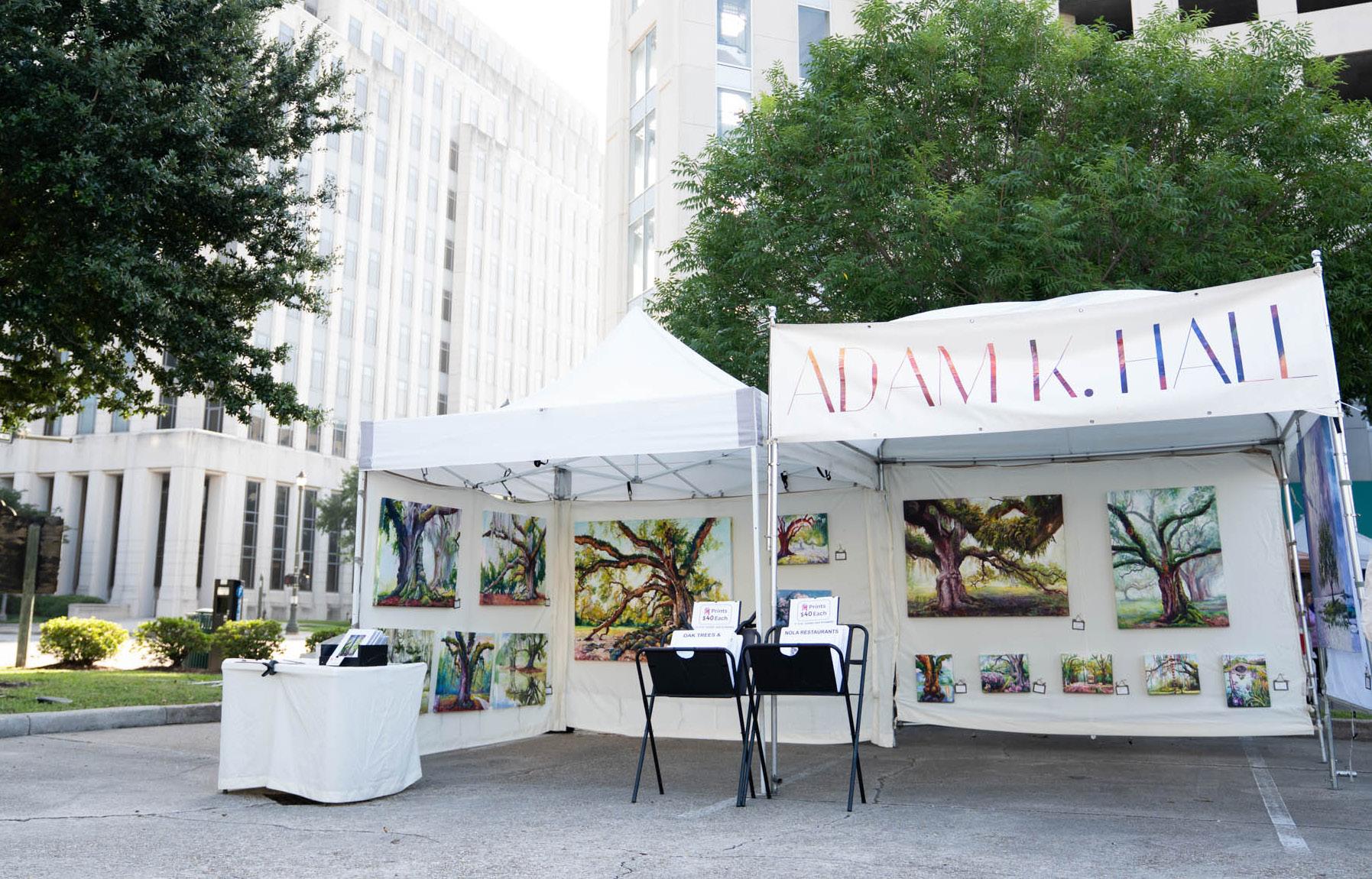
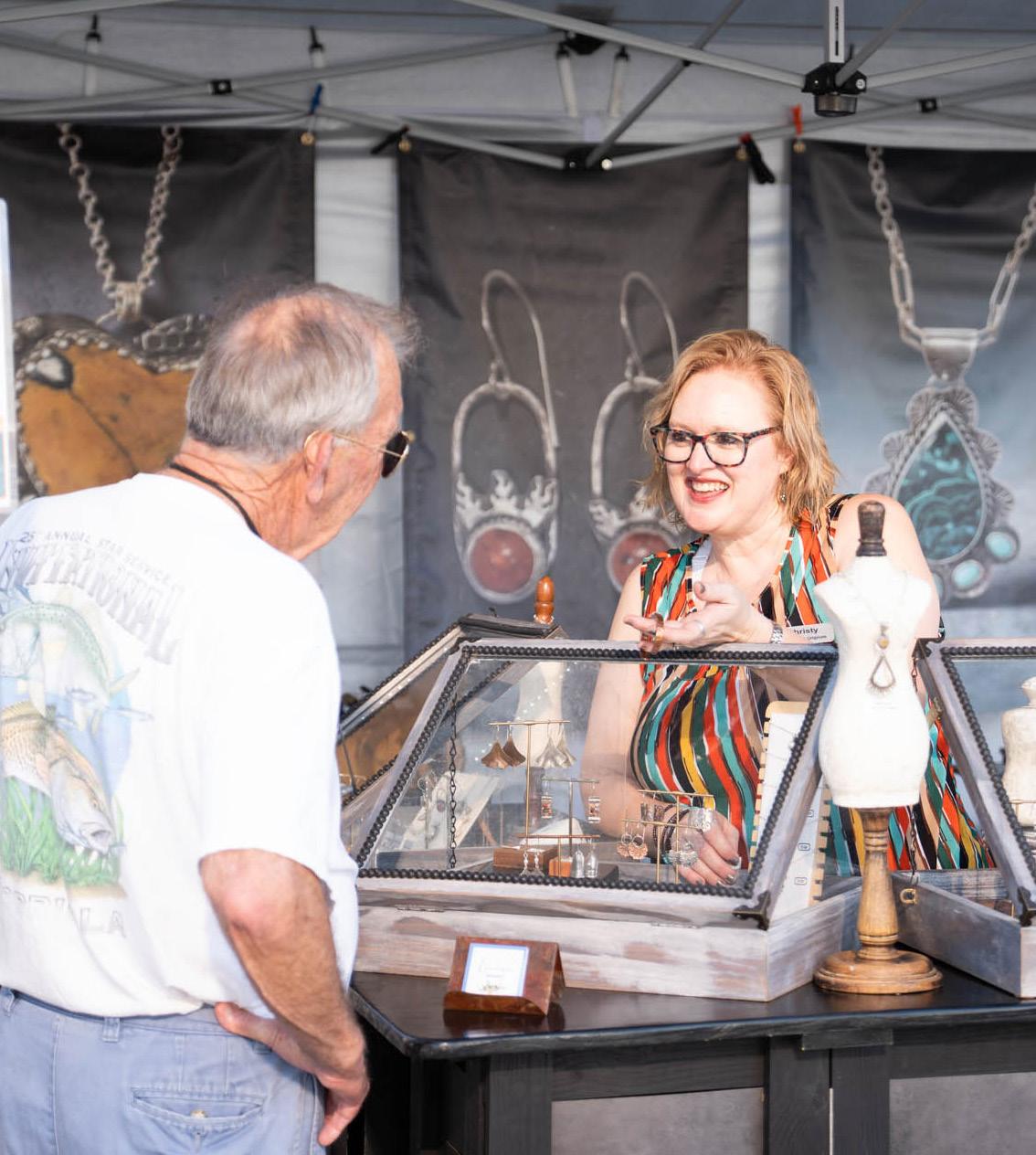
On 5th Street and Main Street from 8 a.m. to noon, patrons could browse through 27 unique art vendors selling candles, kitchen utensils, paintings, jewelry, ceramics, quilts and more.
Jeweler Ana Maria Andricain at Jewel of Havana just recently took over as the director of the Baton Rouge Arts Market this past October. Coming into the position ahead of the November art market.
What matters for Andricain is that the art market is not your run-of-the-mill pop-up; this is a space where customers and artists can meet face to face, as Andricain believes that it makes the art piece worth that much more.
“If they get to know the artists better, they’ll understand the work better. It means more when you take it home because you have the story behind what you’ve purchased,” said Andricain. “It’s not just some big box store that you’re walking in and they have 10 million of it. You’re
getting a one-of-a-kind or maybe a limited edition from the person who actually made it.”
Andricain herself creates a series of different jewelry pieces all inspired by her life and family. The Steel Magnolia collection relates back to one of the first plays she saw in New York and a symbol for feminine strength, the Draped In Love collection came from her cancer journey, and the Snow In Havana collection is inspired by her family’s Cuban heritage.
“When I was growing up, my mom had this little box of jewelry. And every time she took out

a piece to get ready to go out with dad and I’m hanging out, it would spark a memory for her,” explained Andricain. “Either a person or a place or a time. It connected her. I always joke that I learned about all of my relatives from pieces of jewelry.”
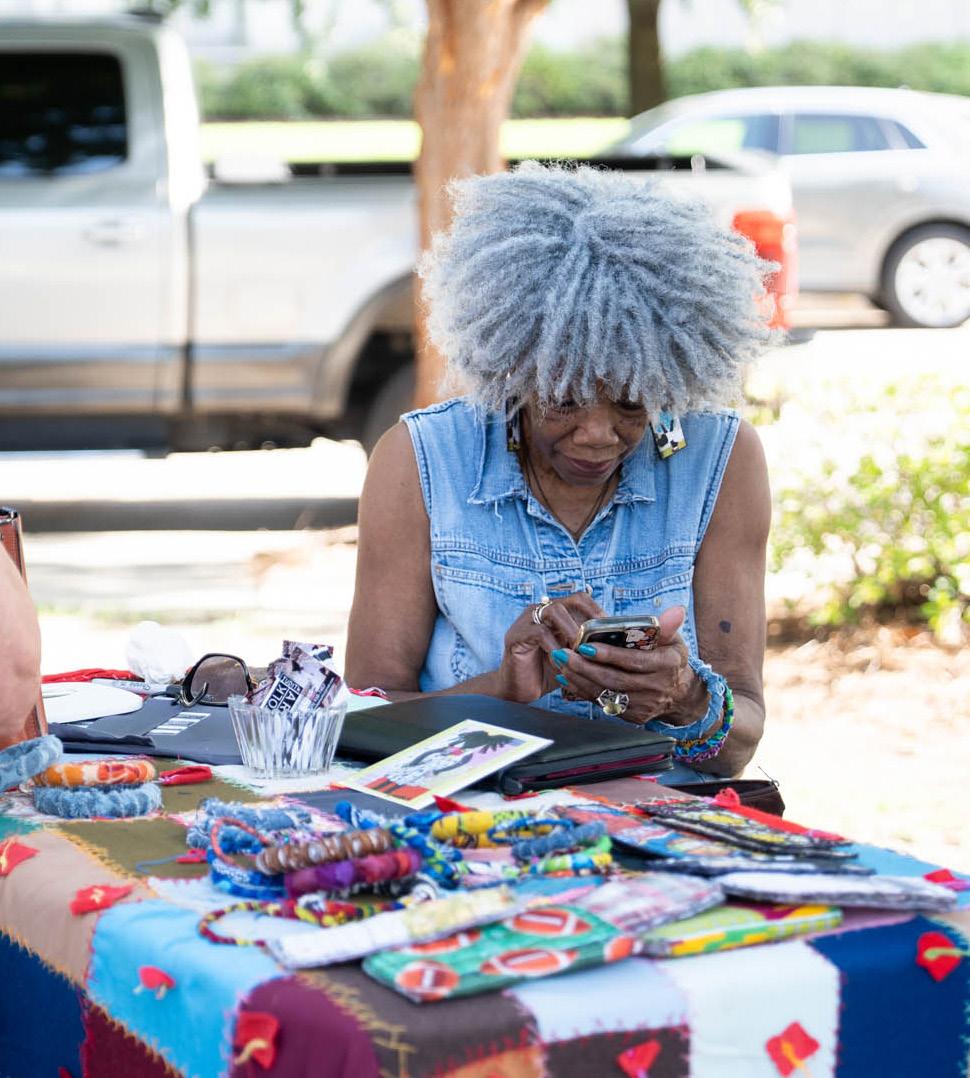
Another artist that exemplifies this idea of a memory in every distinctive piece is Judith Braggs, who was chosen by Andricain and her assistant, Christy Barrett, to be this month’s featured artist. Through her small business, Judith Folk Art, she creates quilts depicting people and moments from her childhood growing up in Cherie Quarters, Louisiana.
The characters in Braggs’ quilts are silhouettes of children she knew, all dressed up in church or play clothes and on swings or with slingshots. Yet none of these children have faces. Braggs says that she does this for two reasons: personal connection and a bit of tough love.
“People that buy my art, it reminds them of something back from their past. That’s one of the reasons why I don’t put faces,” said Braggs. “The other reason is I didn’t go to art school, so I don’t really know how to draw. The first time I tried to do a face was when I was making a quilt and it was my dad. I asked my sister, ‘what do you think about this?’ She said, ‘don’t do faces.’”
One vendor who was selling practical kitchenware items made out of recycled wood across Louisiana. Bubba Traxler, also known as the Cajun Carver,
LSU has fired its chief financial officer, vice president of engagement, and the diversity, equity and inclusion staff, according to the Louisiana Illuminator.
These layoffs, which include 25 total employees, were announced on July 2. The funds will be redirected toward research and hiring faculty, chasing LSU’s goal of becoming a top 50 research university.
“Louisiana deserves transformational change from LSU,” LSU President Wade Rousse said in a statement. “I committed to streamlining operations and finding efficiencies so the university can focus on, and afford, the faculty needed to become a top 50 research institution.”
runs his small business, The Red Stick Spoon Company, with his wife Paula Traxler.
Bubba Traxler emphasized how everything is hand-crafted, his carvings do not use any kind of artificial intelligence or computer-controlled machines. After all, the roux spoons they are most well-known for came to be both right and left-handed through sheer human mistake.
“I was cutting out a spoon and I accidentally cut it the wrong way. I looked at it and walked inside and told my wife, ‘I think I just made a left-handed spoon.’ And that’s how I got started. Unfortunately, I wasn’t the one to think of it. It just happened to me that way,” said Traxler.
This authenticity and individual creativity are what draw many customers such as Ascension Parish resident Rebecca Turner to the art market.
Turner took the drive from Gonzales to downtown to gather ingredients and utensils to help make her kitchen more handmade and less plastic. It is not just for her though; she comes out to buy a wooden spatula or homemade soap for the sake of the neighborhood.
“Supporting small business supports your community. Everyone out here, they’re trying to make a living, so I like to support the small businesses. It helps us thrive as a community,” said Turner.
For updates on the next Baton Rouge Arts Market and on new vendors, check out their Instagram and website.
Of the employees let go was CFO Tommy Smith, whose duties will be taken over by LSU System CFO Brandi Roberts, said spokeswoman Meg Sunstrom. Smith has held his position for a year.
Todd Manuel, former vice president of LSU’s Office of Engagement, Civil Rights and Title IX has also been let go. He was hired in 2022 under former LSU President William Tate, who merged the Title IX, civil rights and DEI programs into one department.
Seven positions in the Office of Engagement have been cut, including the director of institutional engagement and the director of learning development, according to nola.com. These positions were tied to DEI efforts, which LSU has been scaling back on.
The department’s name has also officially been changed to the Office of Civil Rights and Title IX, taking out mention of student engagement.
Additionally, the university eliminated 16 positions within its marketing and communications department, including writers, video producers and photographers.
Rousse said that the savings from these layoffs will be used to hire new faculty and fund LSU’s expanding research initiative. LSU has seen a massive restructuring since Rousse took office beside LSU Chancellor Jim Dalton.
Both Rousse and Dalton have emphasized LSU’s goal of becoming a top 50 research university.





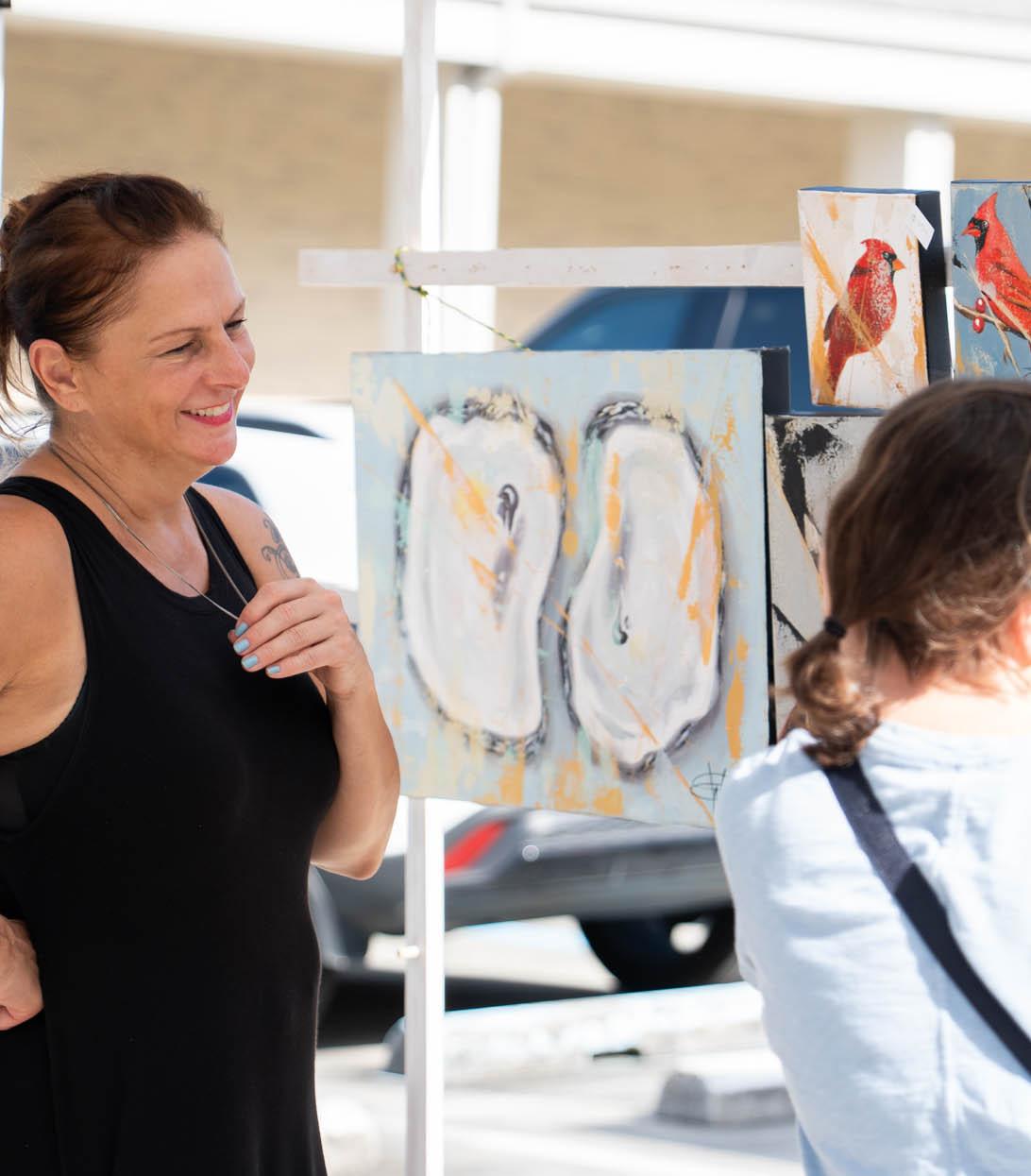
A look at the Baton Rouge Arts Market on Saturday, July 11 on 5th & Main Street in Baton Rouge, La.


BY PAUL TIBBETS Staff Writer
Local community performing arts venue the Sullivan Theater is inviting the whole family for a heartwarming musical rendition of “The Addams Family.”
The creepy, kooky and altogether ooky Addamses have been popular characters since their original New Yorker comic strips started in 1938. They further cemented themselves as cultural icons when they graced the silver screen in 1964 with their first-ever TV adaptation.
Throughout the decades since, the macabre family has been subject to reimaginings and adaptations into film, animation and books. In 2010, they made their stage debut with “The Addams Family” musical.
In this musical story, the eccentric and dark Addamses are confronted with a taste of normal life when Wednesday Addams brings her fiance, Lucas Beineke, and his family to dinner. Wednesday begs her father, Gomez Addams, to keep it a secret from family matriarch, Morticia Addams, for fear of her mother’s disapproval of her fiance’s normal Ohioan parents and lifestyle.
Through all of these warring personalities and miscommunications, many high jinks and chaotic musical numbers ensue. Despite all of this conflict, director Matt Miyagi said that the driving force behind this show is love and its power to bring people back together.
“Wednesday and Lucas are so different from each other
and come from so many different worlds,” said Miyagi. “They both fully embrace each other’s worlds in a really wonderful and fantastic way, and their love does conquer it all.”
Tyler Brian, the actor playing Lucas, expressed a similar sentiment.
“It really helps emphasize how complex and unique love can be to different people, and that different people accept love and see love in different lights,” Brian said. “There’s no specific definition of love or that connection that you feel with someone.”
Brian is in a special position for his community theater debut, as he is playing an all-new character to the franchise with a lot less history to draw from.
The community theater process has been much more efficient than high school theater, with a lot going on at once for Brian. In his high school career, he mostly worked with peers his age, so the culture shock of how this new world operates was something to get used to.
“There’s people who are as young as 12 or 14 and people who are all the way up in their 60s. It’s very different because you’re seeing these people who come from all walks of life — from all different ages,” he said. “I’ve come to cherish the uniqueness in community theater compared to my high school theater.”
Unique is a word that comes up in discussion with “The Addams Family.” A theme the crew speaks on a lot is how the family challenges ideas of normal-
ity while also trying to reconcile with a more standard life.
Michelle Willis, the actress playing Wednesday, finds that her own challenge coming into this role was making both Wednesday’s stoic nature and passionate feelings work in tandem. Not only that, but Willis finds the overall story deeply personal and important.
“I love how she is coming to terms with people’s perceptions of her choices and trying to appeal to her family, because she is an Addams first and foremost,” Willis said, “but she also has Lucas on the side, who she loves and adores.”
Everyone can find something to love in of “The Addams Family,” whether it be the Tim Burton-esque aesthetics, the powerful and hectic musical numbers or messages both broad and individual.
Miyagi wanted to emphasize that connection to the story’s acceptance of what is deemed abnormal.
There is a stark juxtaposition for both the Addamses and Beinekes of what normal is defined as, showing how relative that term truly is. Growing up as a gay man, Miyagi found a strong bond with this breaking down of what is normal and he hopes the audience will too.
“Normal is overrated,” Miyagi said. “Seeing a family that was so accepting of what’s, quoteunquote, ‘not normal’ was a really big thing for me.”
For updates on showtimes and where to buy tickets, visit the Sullivan Theater Instagram and website.


BY ALEX SHEESLEY Staff Writer
LSU baseball continued its recent knack for turning talent into professionals on Saturday. The Three players were taken from the program and three signees were selected to MLB clubs on the first day of the MLB Draft, headlined by center fielder Derek Curiel’s selection at fifth overall.
Curiel was the first of three to be taken out of Baton Rouge, followed by right fielder Jake Brown and pitcher Deven Sheerin.
The Pittsburgh Pirates selected Curiel with the fifth overall pick of the draft. He was the first outfielder to be selected in this year’s proceedings. LSU has now had four players go on to be top-five picks in the last four MLB Drafts: Kade Anderson was picked third overall last year and Paul Skenes and Dylan Crews went first and second in the 2023 draft.
Curiel’s selection places him in the same organization that picked Skenes and has familiarity with talent coming out of LSU. Skenes produced one of the best collegiate pitching seasons in 2023 before going first to the Pirates, and LSU commit Konnor Griffin was picked ninth out of high school the year after.
While none of the three

spent time as teammates at LSU, it’s clear a purple and gold pipeline has been identified in the Pirates’ organization.
The fifth selection, which some saw as early for the center fielder after Curiel’s ho-hum 2026, carries a $8.3 million valuation for a signing bonus at that pick. That figure will all but certainly cement Curiel’s decision
to turn pro, ending weeks-long speculation about a potential return to LSU for 2027.
Brown came off of the board a round later, being picked 65th overall by the Seattle Mariners. The Louisiana native entered Baton Rouge as a pitcher and is expected to turn pro as an outfielder after several great seasons in right field at Alex Box
Stadium.
Concerns lingered about Brown’s health entering the draft. He missed the last month of LSU’s unsuccessful 2026 season after breaking his right hamate. The shelving hurt Brown’s chances at breaking through into the first round of this year’s draft.
Similar to Curiel, Brown will
play alongside LSU royalty in his professional organization. Brown will be reunited with Anderson, his former teammate and third overall pick in 2024. Brown will hope to have a similarly strong start to his pro career as Anderson who was the American League’s starting pitcher in this Sunday’s MLB All-Star Futures Game.
Sheerin was the final player to come off of LSU’s 2026 roster on Saturday. The Philadelphia Phillies, hosts of this year’s draft, took him with the 128th overall pick.
The physically impressive right-hander was solid in 37 2/3 innings at LSU in 2026. He transferred into the program ahead of 2025 but missed his first year in Baton Rouge as he rehabbed from Tommy John surgery. The velocity on his fastball wowed scouts and earned him a selection ahead of his senior season with LSU.
Three high school prospects signed to LSU were taken as well: pitchers Logan Schmidt and Jensen Hirschkorn and outfielder Wessley Roberson. All three are anticipated to sign and turn pro.
High school pitcher and LSU signee Coleton Brady announced his withdrawal of his name from this year’s draft pool, solidifying his future plans in Baton Rouge.
BY ALEX SHEESLEY Staff Writer
As the calendar ticks into July, LSU baseball has remained busy in the transfer portal. The Tigers picked up a pair of recruits from the transfer portal in the past few weeks, bringing its portal pickups to eight as it starts to round out its 2027 roster.
LSU landed right-handed pitcher Kaden Smith on June 30. Smith announced the commitment on social media, marking the move to a third school for his third year of college baseball.
The Florida native began his career at TCU and is moving on from USF as he heads to Baton Rouge.
Smith was busy in his season with the Bulls. He made eight starts among 16 appearances, totaling 46 2/3 innings at a 4.24 ERA rate in his second collegiate year. Those numbers are a step up, both in usage and execution, from his time in Fort Worth, Texas. At TCU, he posted a 5.25 ERA in a far more limited 12 innings.
His skill set fits the bill of the high-power, bat-avoiding pitcher whom pitching coach Nate Yeskie and staff have fallen in love with at LSU. He racked up 52 strikeouts last season, but he also carries the control-based baggage that often comes with power pitchers. He issued 30 walks and plunked 17 batters in 2026.
The addition of Smith fills LSU baseball’s need for righty arms in its pitching staff. LSU is losing eight such pitchers for 2027, with Marcos Paz’s recent entry into the transfer portal further pushing that need. Smith brings upside and adaptability that head coach Jay Johnson and company hope will bridge the gap.
LSU also added sophomore Angel Laya. The former Oregon outfielder announced the move on July 3 and is the third outfielder to come to LSU through the portal this summer.
Laya was outstanding in his first collegiate season, starting 59 of 61 games in Oregon’s 2026
season that featured a regional victory. The then-freshman hit to a batting average four points short of .300, swatted 14 homers and drove in 47. He carried a .966 OPS, as well.
That production was complemented by an error-free season as the Ducks’ everyday right fielder. The transition to Baton Rouge is less steep for Laya than it would be for others, as he has already proven his ability to handle the responsibility of being the starting outfielder for a power school with Omaha aspirations.
Laya joins Tulane transfer Jason Wachs and Notre Dame transfer Bino Watters as outfielders who are a part of the 2026 portal recruiting class. The Tigers’ outfield corps was the biggest weakness for LSU’s 2027 roster at the beginning of the offseason, likely losing all three of its opening day starters from a year prior.
Laya’s addition serves as a very strong finishing touch on LSU’s potential outfield overhaul for 2027.

page 8

WARREN’S WAY
JEANNE WARREN Columnist
Reality TV franchises like “Love Island” profit off of emotional manipulation, toxic viewer culture and unrealistic expectations of love. Contestants’ mental sanity becomes a transaction for a good episode.
On the surface, it seems perfect — a two-month tropical getaway to Fiji would win the heart of anyone. Beautiful weather, massive pools and a group of people equally as interested to know you as you are to know them all sound perfect.
However, almost every aspect of the show is designed to maximize entertainment instead of building and showcasing healthy relationships among contestants. The show incorporates surprise bombshells, dramatic recouplings and challenges that are meant to create competition rather than connection.
Perhaps the most concerning factor is that viewers seem to for-
get that the contestants are real people with real, human emotions. These aren’t scripted characters; every emotional breakdown, every rejection and every argument is experienced in real time.
These shows thrive on drama because drama is what keeps viewers watching. Think about it — if you wanted to watch a classic love story, you could just turn on Disney. The more chaotic the season becomes, the more successful the show is.
If you described a show to someone where people lose all contact with outside society, participate in challenges where they watch the person they like kiss someone else right in front of them, have millions of strangers vote on whether they deserve to stay, and leave the show only to be embraced by thousands of hate comments online, they’d probably think you were describing a “Black Mirror” episode. This success comes at the cost of contestants’ mental health. They may leave the villa, but the internet never really allows them to leave the show. Every
mistake is forever preserved through video footage and commentary that circulates long after the season ends. Viewers may move on to the next season, but previous contestants are often left with a shattered sense of self-worth.
This isn’t just a hypothetical scenario, either. Three people connected to “Love Island UK” died by suicide between 2018 and 2020: Season 2’s Sophie Gradon in 2018, Season 3’s Mike Thalassitis in 2019 and long time host Caroline Flack in 2020. All of these individuals had also experienced intense public scrutiny.
Calls for the show to be taken off air entirely sparked online after Flack took her own life. This, of course, was quickly forgotten by the internet, with viewership incredibly high.
“Love Island” continues to dominate social media despite its tremendous downsides. Viewers move on to the next season, but previous contestants are often left with a shattered sense of dignity — in the worst cases, these innocent people don’t get
the chance to move on at all.
The show creates an unhealthy, parasocial dynamic between contestants and viewers. Producers condense hours and hours of footage into a single episode. They are the masterminds behind it all that decide exactly what the audience sees. Favoring certain islanders, villainizing others and taking one bad reaction or hidden kiss out of context are all ways they alter viewers’ perceptions. Moments of kindness or comradery end up wiped.
Viewers mistake this edited version for the real person, yet feel entitled to defend their favorites and attack anyone they perceive as the villain. During Season 7 of “Love Island USA,” contestant Huda Mustafa faced such intense online hostility that the father of her child publicly asked for fans to remember that she is a real person.
Fellow contestant Chelley Bissainthe had to disable comments on her social platforms after she was also flooded with hateful messages. Other social media platforms like Instagram,
X and TikTok suddenly become a breeding ground for insults, harassment and outright death threats from unforgiving strangers.
Yes, contestants do voluntarily sign up for the experience. However, most seem to have the mentality that they will be the fan favorite. No one would willingly sign up for a show if they knew they’d be made out to be the “villain” or be the most hated person on the show. Producers sell islanders a dream and ignore the nightmare that is a reality for most participants.
Reality TV isn’t inherently bad, and there’s nothing wrong with enjoying parts of it. The problem arises when entertainment is at the expense of someone else’s well-being and when they are essentially bullied inside and outside the villa. Exploitation will continue to be rewarded until audiences and producers start valuing people over money and ratings.
Jeanne Warren is a 20-year-old mass communications major from Baton Rouge, La.

EDITORIAL BOARD
Laura Allen Editor-in-Chief
Managing Editor Garrett McEntee
Sports Editor Rami Burks
Emily Boudreaux Production Editor
The Reveille (USPS 145-800) is written, edited and produced solely by students of Louisiana State University. The Reveille is an independent entity of the Office of Student Media within the Manship School of Mass Communication. Signed opinions are those of the author and do not necessarily represent the views of the editor, The Reveille or the university. Letters submitted for publication should be sent via e-mail to editor@lsu.edu or delivered to B-39 Hodges Hall. They must be 400 words or less. Letters must provide a contact phone number for verification purposes, which will not be printed. The Reveille reserves the right to edit letters and guest columns for space consideration while preserving the original intent. The Reveille also reserves the right to reject any letter without notification of the author. Writers must include their full names and phone numbers. The Reveille’s editor in chief, hired every semester by the LSU Student Media Board, has final authority on all editorial decisions.
“Be kind whenever possible. It is always possible.”
14th Dalai Lama Spiritual leader of Tibetan Buddhism 1935 — present