

This student empowers others by giving free haircuts in Free Speech Alley.
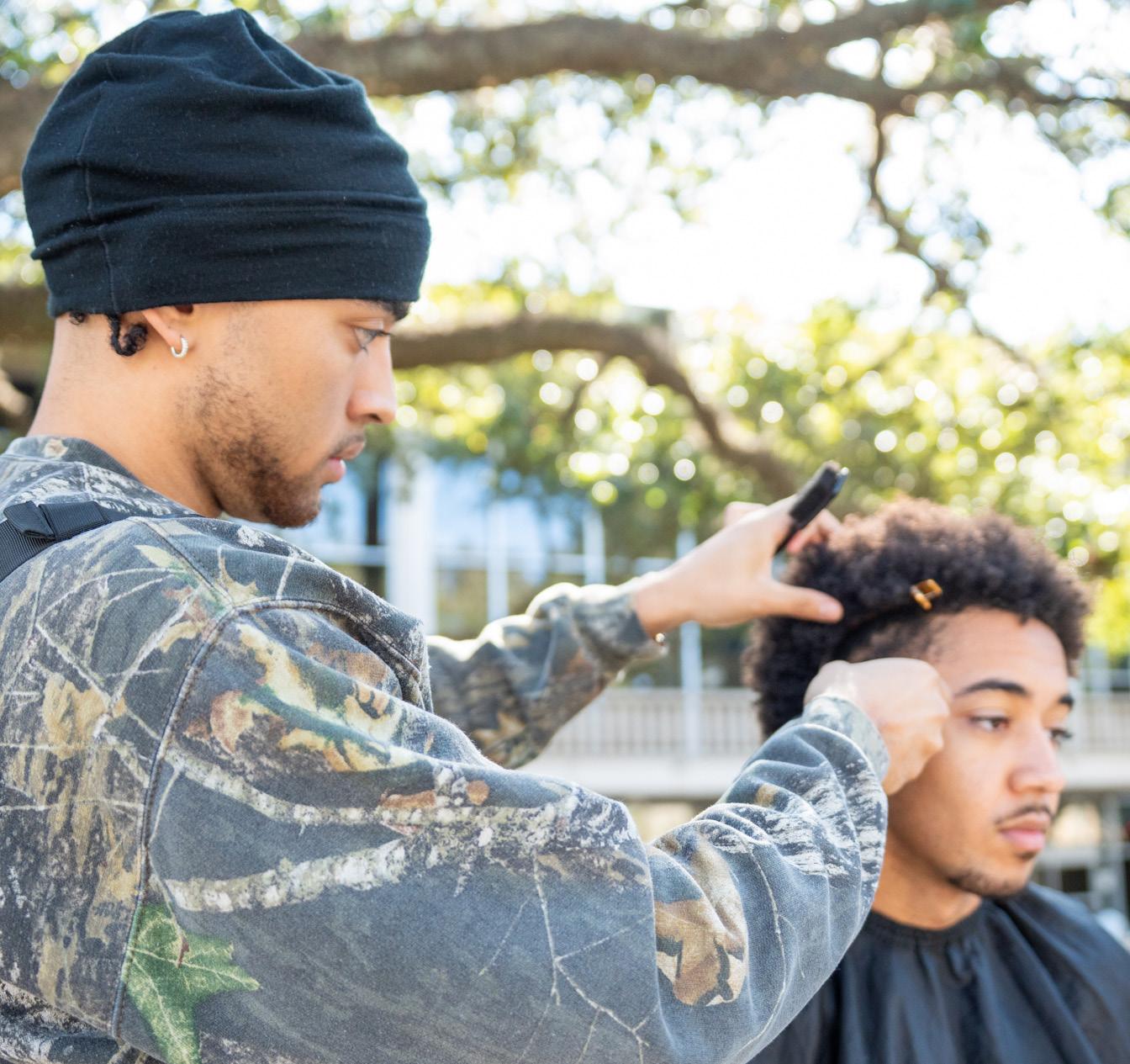



This student empowers others by giving free haircuts in Free Speech Alley.
BY MIA HATTAWAY Staff Writer
Got class at noon and work at 1 p.m.? Don’t worry — this LSU student is giving free fades in Free Speech Alley that will have you looking your best to take on the rest of your day.
Sophomore accounting major Larry Smith, 19, has started a bi-monthly barber pop-up in collaboration with the Culture Lens Collective, a group at LSU designed to uplift Black students, in front of LSU’s Student Union, offering free haircuts to anyone who wants an impromptu cleanup.
The New Orleans native started this operation on Monday, Jan. 12, the first day of the spring semester at LSU.
Though many students try to avoid passing through central campus when it gets busy, Smith knew this area would be his best shot at reaching as many people as possible.
“Everybody’s nice, everybody’s friendly,” Smith said. “You go out there with people wanting to talk; there’s nothing really to be scared about.”
Going into the very first iteration of his journey, Smith didn’t market his pop-up at all. Where many students would have asked their friends to tag along to acclimate to the busy pace in front of the Student Union, Smith decided to take the plunge and cold approach passers by with his offer.
“It was just people passing by with me saying, ‘Free haircuts, follow the Instagram,’” Smith said. “They trusted me to not mess them up.”
When Smith set out to provide this service, he knew how helpful it could be in other students’ lives, which is why he decided to make his services as accessible as possible.
“I just wanted to reach out: get more clients, get my name out there and also just help out, give back,” Smith said. “It’s hard for [students] — I know a lot of people don’t have

cars, can’t find a barber. It’s too expensive.”
Smith started cutting hair during his junior year of high school when he began noticing how pricey it was to regularly go to a barber.
“I just started practicing on myself,” Smith said. “And then one day, I got one of my friends to let me cut their hair. I messed him up bad, but he stuck with me. He trusted the process. So I’ve been getting better. Now he’s got free haircuts for life.”
Smith views this service side hustle as simply an opportunity to meet new students, express his creativity and, ultimately, network.
“People come up to you, talk to you and then you connect,” Smith said. “That’s why I was able to cut with the Culture Lens [Collective]... There’s other people who want to help out with stuff like that. I would rather start off using this as a platform and branch out into other avenues from cutting hair.”
Though Smith’s ventures started as a solo project, his hobby quickly
became part of something bigger. The Culture Lens Collective approached Smith to join the club and be in community with other student barbers.
“When I came out at the beginning of this semester, they reached out to me and we were able to work together on that,” Smith said.
Design studies major Bryce Fulton, 19, is also a member of the Culture Lens Collective, producing social media content for the group.
“It’s like a group of friends,” Fulton said. “It’s a collective and we’re all working towards something, obviously, but it’s also kind of like a family and a friendship at the same time. It’s very empowering.”
After seeing Smith’s posts about his pop-up, Fulton made sure to keep an eye out for the next time the barber set up shop.
“It’s an unconventional atmosphere, in a way,” Fulton said, “but it still gets the job done. It’s still a good cut, and it’s still a welcoming environment.”
Despite Smith already gaining traction by word of mouth and social media, he doesn’t currently plan on pursuing barbering professionally.
“I’ve always done a lot of things,” Smith said. “There’s a lot of things I like to do. I just learn how to do it and make money off of it: I cut hair, I detailed cars, I do things like that.”
Upon coming to LSU, Smith was initially a kinesiology major, planning on becoming a trainer. Accounting ultimately seemed like a better fit for his long-term financial goals.
“I feel like that aligns better with what I want to do,” Smith said. “I still have a love for sports, so I might try and find a way back into that.”
As Smith looks toward the shortterm future, he has his eyes set on expanding his positive influence on campus by eventually starting a club to help students connect directly with entrepreneurs, especially as it relates to cutting hair.
For more information and updates, visit Smith’s Instagram or TikTok.
BY ALAYNA FORD Staff Writer
As LSU continues to expand, university leaders say building a new library will help LSU to boost its national reputation — not by following tradition but by completely transforming the space as students know it. The new LSU library is set to serve as a modern academic hub. It will nearly double the current library’s capacity while prioritizing student study habits, accessibility and updated technology.
Stanley Wilder, the dean of LSU Libraries, said the new building will include flexible study spaces, recording studios and academic support services. The plan also provides for upgraded food and coffee areas with
design features that allow for extended hours and enhanced safety. New accommodations
One issue with the current LSU library is the lack of space. Students are required to reserve group study rooms days or weeks in advance against the other 41,000 students. Wilder confirmed that the new library will include more rooms to fix this issue.
“There are going to be oceans more group study rooms,” Wilder said. “Students essentially can’t get enough group study rooms … It won’t just be one type of group study room — there’ll be all sorts of them.”
University leaders hope the new building will increase student activity within the library. Traditional study spaces are good to have, but LSU is
constantly looking for ways to innovate. More creative spaces like soundproof rooms are in the works for the library.
Wilder said that the administration is working to get recording studios that will be multipurpose, includin music, podcast production or anything a student could think of within that area.
The new library will also include a food stall that will be double the size of the CC’s Coffee House in the current library. It was not confirmed if it will be another CC’s within the building, but there will be some sort of restaurant.
Wilder said some faculty from the current library will be moved over to the new building. He said the increase in space could bring job op-


B-16 Hodges Hall
portunities for more staff.
LSU Libraries has also recognized an issue in the lack of outlets within the current building. Many students have more than one piece of technology on them at a time that needs to be charged.
The new building will have better accessibility to outlets.
“There will be easy access to electricity at every place that a student can possibly sit down,” Wilder said. “We want to make sure the technologies in the library prepare students for the workplaces they’re going to enter. We’re trying to think more in terms of functions rather than specific technologies.”
The Center for Academic Success
Baton Rouge, La. 70803 LSUReveille.com

Louisiana State University
ADVERTISING (225) 578-6090
Layout/Ad Design ASHLEY KENNEDY
Layout/Ad Design REESE PELLEGRIN
CORRECTIONS & CLARIFICATIONS
The Reveille holds accuracy and objectivity at the highest priority and wants to reassure its readers the reporting and content of the paper meets these standards. This space is reserved to recognize and correct any mistakes that may have been printed in The Daily Reveille. If you would like something corrected or clarified, please contact the editor at (225) 578-4811 or email editor@lsu.edu.
The Reveille is written, edited and produced solely by students of Louisiana State University. The Reveille is an independent entity of the Office of Student Media within the Manship School of Mass Communication. A single issue of The Reveille is free from multiple sites on campus and about 25 sites off campus. To obtain additional copies, please visit the Office of Student Media in B-39 Hodges Hall or email studentmedia@ lsu.edu. The Reveille is published biweekly during the fall, spring and summer semesters, except during holidays and final exams. The Reveille is funded through LSU students’ payments of the Student Media fee.
BY DREW SARHAN Staff Writer
The LSU Vet School houses the Wildlife Hospital of Louisiana, a rehabilitation center operating nonstop that handled around 2,000 cases last year, seeing over 150 different species.
It is the only dedicated surgical facility for the care of wildlife in the state. But with cases increasing every year, Director Mark Mitchell is making an effort to expand beyond the current 350-square-foot room.
This new hospital, projected to be built in front of the current Vet School building, will be 14,000 square feet and will accept all species of animals.
Mitchell said wildlife is regulated by both state and federal governments, so the hospital has permits to take care of migratory birds, reptiles, mammals and other endangered species.
“But for the mammals, we’re restricted in our current facility … We cannot accept things like coyotes or raccoons or foxes,” Mitchell said. “We can’t receive bobcats or bats and those types of species because we don’t have the caging for them.”
He said in addition to seeing all
and LSU Information Technology Services desk will both be located within the new building to assist students.
Hours and parking
Administration is taking a new approach to how it wants the library to run. The new model is set to accommodate 24-hour access for students.
While that may seem unsafe with LSU being an open campus, there will be measures in place to assure students feel comfortable studying at the library at all hours of the night.
“The building will be built in such a way that we can control who’s entering, especially during 24-hour periods,” Wilder stated. “We want students to feel safe, and the building is going to give us a lot of flexibility.”
With the current library, there are not a lot of ways to park near the building. The new design will have some parking but not designated parking for commuters.
According to the Department of Planning, Design & Construction there will be a few spaces reserved for university vehicles and golf carts. As the year progresses, LSU plans to add a new Park & Geaux stop designated for the library.
Accessibility and inclusion
What Wilder is most proud of is the work that PDC has put into creating a more inclusive and accessible building. These additions were
kinds of native wildlife, the hospital sees a variety of reptiles like turtles and non-venomous snakes. Mitchell said that the hospital is important to the broader ecosystem.
The vast majority of cases at the hospital are a result of human injuries to animals, whether it be a vehicular injury or a gunshot wound.
Mitchell quoted Mahatma Gandhi, saying that you can tell how well a society is doing by how it treats its children and animals.
“People will see a hawk and say they don’t want them around their house, but those hawks hunt pests, like mice,” Mitchell said. “If there are no hawks and the mice continue to grow, then they get into our house, then there’s the potential risk of not only causing farming damage, but they also carry diseases, zoonotic diseases, meaning they can spread from animals to humans.”
The most common species seen at the hospital is the barred owl, a nocturnal bird that is common in the western part of Canada, the Midwest and the East Coast of the U.S.. The hospital also regularly treats the Virginia opossum, more commonly known as the possum, a marsupial native to North America.
“The barred owl is a fantastic
based on research and are intended to improve student experience.
This includes softer lights to help with those who have sensory issues and noise cancelling rooms.
“There’s been a lot of serious attention given to neurodiverse accommodations,” Wilder said. “There is solid research at this point that is changing the way buildings are being built in order to better accommodate people who are light sensitive or who are affected by ambient noise.”
Wilder has full trust in the team’s ability to execute this plan and is proud of their attention to detail.
“That consciousness of differences in ability is very much built into the design,” Wilder said. “If we messed up, it wouldn’t be because we didn’t care — it would be because we didn’t anticipate it … and I didn’t have to ask for this to happen. It was already on their minds.”
Looking ahead
The new building is trying to create an environment that promotes learning and community. Wilder is excited for students to utilize the new building and all the new updates.
Wilder is open to student input for the new building and is trying to make the place as student friendly as possible.
“We’re happy to show students the renderings and talk about how this is going to work,” Wilder said. “The academic hub of the university — that’s going to be the library.”
BY JORJA ETHRIDGE Staff Writer
species, very adapted to human environments. That’s why they’re thriving. But we see a lot of them injured, especially from vehicular collisions,” Mitchell said.
Currently, if an animal cannot be rehabilitated fully, it has to be euthanized. But Mitchell hopes that the new hospital can become a hub for future research, leading to discoveries that can improve both animal and human health.
The new facility plans to be more than just a hospital for wildlife, with Mitchell calling it an “incubator for education” at all levels and in all fields, from engineering to education to medicine.
“What we really want to do is to be able to bring students along from elementary schools … where we’re actually educating students at an early age about the concepts of biology and the idea of conservation and protecting the environment,” Mitchell said. “Then, to be able to offer opportunities for high school students to actually engage in the work.”
Mitchell hopes to generate enough funds within two years to build this space because it would
see WILDLIFE, page 4
LSU Campus Sustainability and Student Government held the first Keep LSU Beautiful cleanup of the year on Saturday.
Campus Sustainability is an affiliate of Keep Louisiana Beautiful, a statewide litter-removal effort.
SG assists in organizing monthly cleanups on campus. For this month’s cleanup, participants set out to tackle areas near the UREC and LSU Lakes.
Chemical engineering junior Gabreyela Gonzalez is the coordinator of Campus Affairs and Sustainability for SG. She said that SG decided to begin cleaning around the UREC, LSU Lakes and Sorority Row because Facility Services cleans those areas less frequently than places closer to the center of campus.
She added that the cleanup had a good turnout: 57 students came to participate.
Krishawndalyn Clark, a political science freshman, showed up early Saturday morning to clean up campus with her friends Parker Jackson and J’Kaira Claiborne. She said they started by the lakes but ended up venturing to Fraternity Row where there was a lot of trash.
Clark said she and her friends have hearts for service.
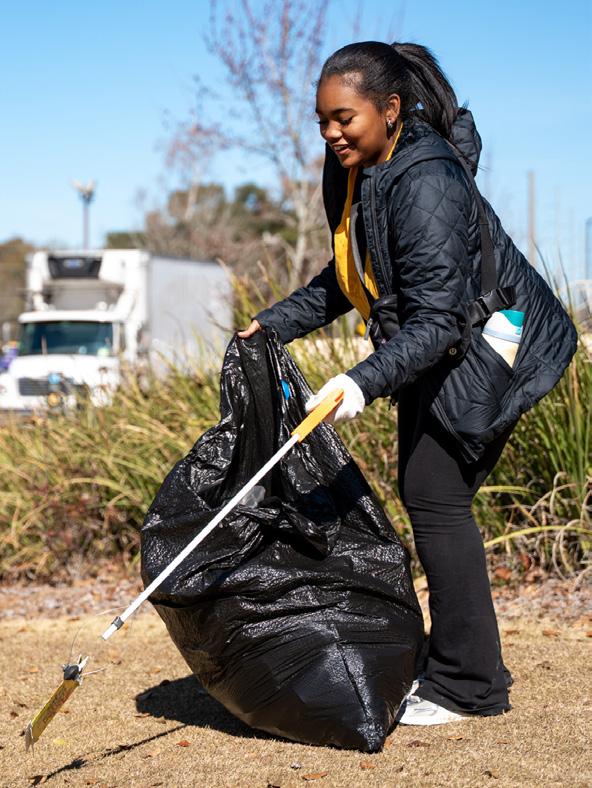
“Plus, we just really felt like we saw a problem on campus with a lot of littering and pollution,” she said. “So we wanted to go ahead and be the good that we want to see in the world and clean it up directly.”
Parker Jackson, a public relations freshman, said she and her friends have volunteered in multiple community service events but that this is their first time picking up trash.
“But this is our first of many,” Clark added. “We definitely want to
see CLEANUP, page 4
BY GAVIN MCMANUS Staff Writer
Walking by the Union Square Garage, one might be enticed by the sound of music coming from the roof. Students only have to climb to the top floor to find the source of the melody: the LSU Garage Band jamming away into the night.
Garage Band is a music club that hosts weekly jam sessions on the top floor of the Union Square Garage. Each session features a different genre. There are two sessions per
week, with the sessions being split between the Moon and Star Bands.
The bands are split by the type of genres they play to give people a greater chance to enjoy the type of music they prefer. The Moon Band tends to play heavier genres such as metal, while the Star Band tends to play lighter, more varied genres such as jazz, folk and indie rock.
The club also attracts quite a few skaters, with occasional joint events between Garage Band and Skate LSU. While band members play their instruments, many others skate
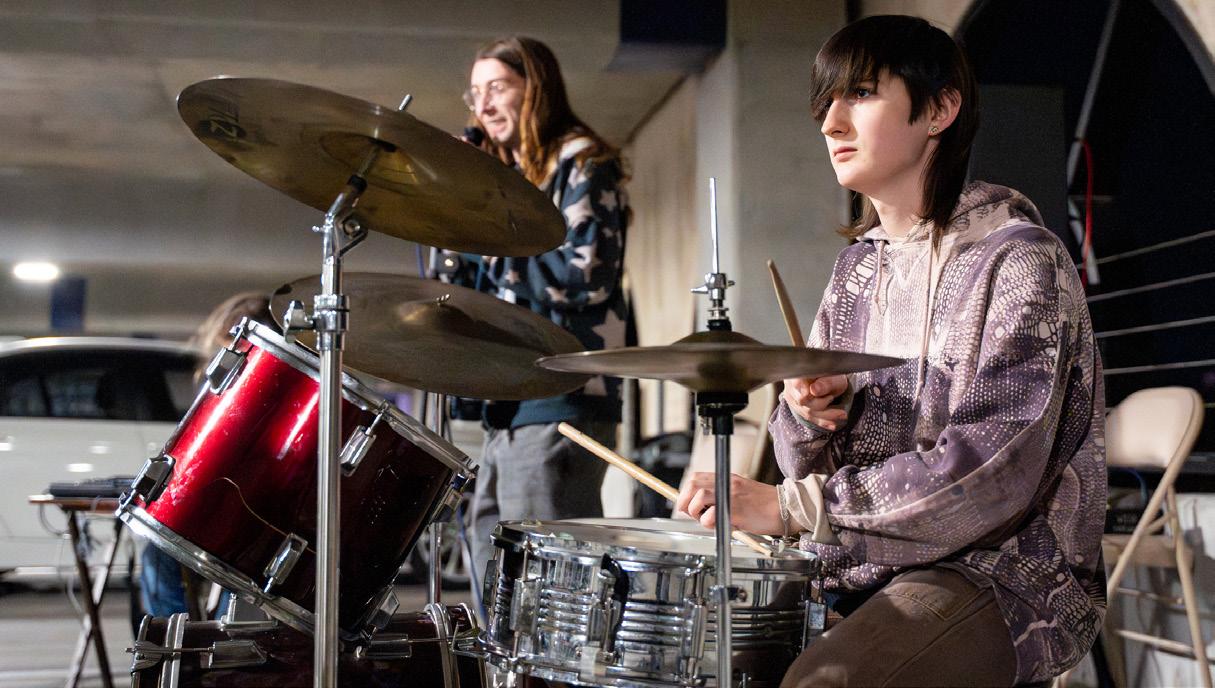
around the garage while enjoying the music.
The band was founded by Christain Wise, a senior communication studies major and the club’s current president. Wise and his friends used to play music in their dorm rooms and occasionally in the garage. But when his friends graduated, Wise wanted to keep the music going.
“I feel like if I really love this, just jamming with friends and playing music and just having fun, then there’s gotta be tons of other people on campus who love that too and want that,” Wise said. “So I decided I should start a club.”
The club has attracted all manners of musicians, from guitarists and drummers to trombone and saxophone players. The varied genres the club plays give a wide variety of people a chance to practice their music.
The club has also inspired many to get back into music after not playing for a time.
“Someone told me that there was a jam club, and I hadn’t played music since middle school,” said club Vice President Jace Daley. “But I started playing again last semester and abso-
GARAGE BAND, page 4
CAMPUS LIFE
BY MADELYN LONG Staff Writer
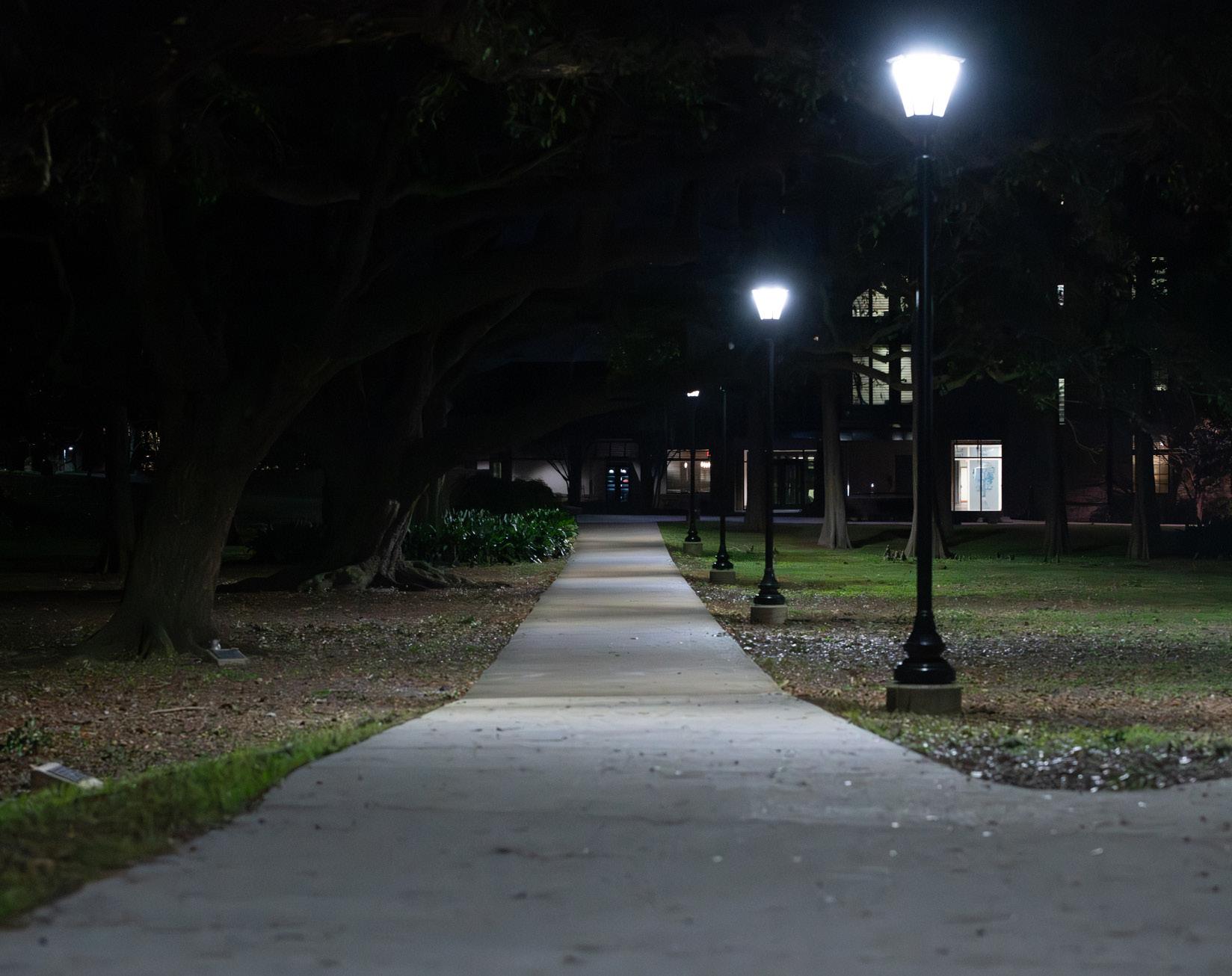
LSU’s campus lighting is a hot topic in the community, with many students blaming the university for not doing enough to address its seemingly insufficient lighting levels.
But LSU Facilities weighed in on how it works to combat darkness and what plans it has to keep campus well-lit.
Students have voiced complaints about low lighting on several areas on campus, including the Enchanted Garden, Highland Road area and academic buildings near the Union.
Sophomore nursing major, Kennedy Wakefield, said her weekly walk to Salt Church on Highland Road includes very dimly lit areas of campus that she cannot avoid.
“I am always having to look over my back and stay focused when walking to and from church,” she said.
Amid these concerns, the directors of LSU Facilities shared their efforts to promote safety on and around campus.
“I would say that the safety of our students, faculty and staff is always a concern for us. So, we look at lighting all the time, year-round,” said Facilities Executive Director Tammy Milican.
With safety as a main concern, LSU Facilities has long been working to increase the quality of lighting on campus.
The lighting system took a successful turn when Facilities went through with a large-scale project in 2020, spending $4 million on lighting renovations. They hired a consultant to complete a lighting analysis to identify the approximate lighting levels on campus, focusing on pedestrian corridors, student parking lots,
WILDLIFE, from page 3
serve a vital purpose at LSU — an opportunity to educate future generations about wildlife rehabilitation.
“There’ll be nothing really like this in the country,” Mitchell said. “Not the wildlife hospital component, but the way that we’ll be teaching veterinary students through this, and these grade school students [are given] the same opportunities.”
Mitchell said that while conservation work is altruistic in nature, it is vital for the state of Louisiana to support these efforts.
“We know in Louisiana, sometimes, we’re at the bottom of good lists — we want to be on top of a good list, and this will be an opportunity to show that,” Mitchell said.
CLEANUP, from page 3
come back.”
Claiborne, a pre-vet freshman, said participating in this cleanup was a good way to start her and her friends’ day.
“Start off the day serving the community,” Claiborne said. “Is that not the best way to start the day or what?”
Molly Bozell, a political com-
building entrances, the Quad and Parade Ground.
Facilities directors compared the findings to their lighting goals to identify areas that were lit properly, were deficient or that may have been overlit. Through their efforts, they created a new LSU standard for lighting.
This project brought many changes to campus, including intentional lighting around crosswalks.
“You’ll see we’ll have two lights on both sides of the crosswalk shining the way the traffic’s coming so they can see the person in the crosswalk. And that’s one of the things that got added about five years ago, and I think that’s really been a big plus for safety,” said Neal Pendleton, Director of Electrical Systems for LSU Facilities.
The project in 2020 brought relief to the community, as facilities
GARAGE BAND, from page 3
lutely loved it.”
The club gives LSU students a place to come together as a community to enjoy music after class.
“[The club] means a place for me to express myself, get better at my instrument, be around people who also play instruments in like a judgment-free zone where it’s, you know, people just wanting to get better and have a good time,” Daley said.
Musicians of all skill levels are welcomed to play with the club.
“It’s a non-judgmental place where people of all skill levels can just come to press a few things on their instrument and have fun with it. If it sounds good, then it sounds good. If it sounds bad, then it sounds bad,” the club’s event coordinator
munications freshman, also participated in the cleanup. She said she heard about the event from her sorority’s community service chair and thought it would be fun to help.
“I think that this campus provides us with so much, and the least we can do is give back to it in a small way like picking up trash,” Bozell said. “Plus, it’s just fun, and it’s so beautiful today. Get outside; go with your friends.”
create consistency in lighting color and fixtures that maximize efficiency and sustainability.
Dennis Mitchell, Campus Landscape Architect, adds that this process helped Facilities learn what type of lighting works best for the campus.
“We are specific about how we design and specify light on campus. We’ve chosen a fixture that is a classic design that looks like it lasts forever,” Mitchell said. “What’s nice about that fixture is that you see the light, it’s not glaring and it’s not overbearing. It’s the right amount of light that puts the right amount of light on the ground.”
Millican also claimed that achieving consistency would help campus look better.
noted fewer complaint calls coming in. But they recognize that work still has to be done to ensure that every area meets this new standard.
Facilities directors are using new technology to target these areas that may be lacking light, like thermographic aerial scans.
Upcoming projects include lighting up walkways near the LSU Parade Ground and installing new lighting for the renovations of the Library.
“Whenever we have major construction, it also gives us the ability to improve the lighting in an area. So with all of these efforts, it’s improving, whether that’s through new construction or lighting projects, all of that comes together to make the campus more well-lit and aesthetically planned,” Millican said.
Along with new construction projects, LSU Facilities is working to
Jake Lane said.
The club also gives a chance for people to enjoy music outside of an academic or professional setting.
“You get to go up here one or two nights a week and just have fun, and often it ends up sounding pretty nice,” said Chase McFarland, a thirdyear student and a member of the Garage Band. “You know, I’m not a music major or anything, so it’s nice to get to do music for fun.”
Music is something that runs deep within the members of Garage Band, with many of the members attesting to its importance in their lives.
“Music is my life. Music is magic to me,” Wise said. “I feel like there’s magic whenever people come together, and whenever you’re around other people, you sense a sort of presence, and music is a vessel for that magic.”
Gonzalez said that Student Government will hold another cleanup during Geaux Big Baton Rouge later this spring.
Keep Louisiana Beautiful has different chapters for most cities and universities. Gonzalez said she initiated Keep Zachary Beautiful when she was in high school about four years ago. Many Zachary High seniors participate in Keep Zachary Beautiful to earn community service
tions are unfounded.
According to the LSU Security and Fire Report, crimes like robbery and burglary on campus are down from 2022, with 65 burglary and robbery events combined occurring in 2022 compared to only 47 in 2024.
LSUPD’s findings indicate that LSU Facilities’ efforts may have been successful in deterring certain crimes on campus. But Facilities directors would like to remind the LSU community that lighting is not an easy fix to lowering crime rates on campus.
“Lighting is one tool to combat crime, but it’s just one tool,” Mitchell said.
“By having a design standard that says all of our lighting is going to look this way, and it’s all the same, then it’s also about the aesthetic of the campus,” Millican said . “Developing those design standards ensures that the campus is going to be looking better and better.”
LSU Facilities is not the only organization working to make LSU brighter. LSU’s Student Government puts on an annual lighting walk, where students come out and walk around campus at night, taking note of what areas need assistance from Facilities. LSUPD also works very closely with Facility Services to keep lights on in areas prone to crime and to make sure vegetation stays out of security camera view.
Although LSU Facilities and other groups have made a considerable effort to keep campus lit, the community still expresses concerns about darkness. Many blame the lack of lighting on campus for rising crime rates, but crime reports provided by LSUPD suggest that these accusa-
As LSU Facilities attempts to combat darkness on campus, they ask for the help of the community to report areas of their concern. Whether it be a broken light or an area that stays dark, they want to hear the community’s feedback.
“There’s nothing better than having a parent reach out and say, ‘I’m worried about this. Can you look into it?’ There are countless examples of that happening, and we’ll follow up and check into it,” Mitchell said.
The LSU Facilities Center has an active customer service center that takes concerns, by phone (255-5783186) or email (facilityservices@lsu. edu), seven days a week until 11 p.m. Facilities directors encourage the community to use their resources to their advantage and let them know what areas of campus need assistance.
“If there is an area of concern, the best thing that they can do is not to just talk about it, but to call someone, so that we can go out there and take a look at it and get it addressed,” Millican said. “That’s the only way you’re going to see change, is to report it to us.”

hours.
Gonzalez added that participating in Keep LSU Beautiful cleanups would benefit students pursuing LSU’s Engaged Citizen Program Medal, an award that honors LSU students who participate in outstanding community service.
She also explained that many of Keep Louisiana Beautiful’s chapters work together. For example, the organization’s Baker, Zachary and
Baton Rouge chapters will have a
Gonzalez encourages students to participate in these cleanups and get involved in something bigger than oneself.
“Even if it is not our trash, whether you are living on campus or off campus, it does not matter where you are,” she said. “You can always make a change somewhere.”
BY MIA HATTAWAY Staff Writer
From tailgating at LSU to getting travel advice in Target, Elin and Kenofi Terfa have discovered that the heart of Baton Rouge is truly in the people who call the city home.
Since moving to Baton Rouge from Sweden in June, the couple has documented every step of their new life in Louisiana, creating a digital space for locals to connect with one another while showcasing what makes Louisiana so special.
Elin and her husband Kenofi recently moved to Baton Rouge for his job at Bethany Church as a youth pastor, where he works fulltime offering support to children in fifth to 12th grade. Outside of posting content, Elin acts as a volunteer at Bethany.
“[Kids] come, they find community, they find faith, they find hope and purpose,” Kenofi said. “You know how it is when you’re a teenager — you go through a whole lot of stuff. To just come for a moment and lift up your eyes to the Lord and feel like someone else is in control and not you — I think that is so beautiful.”
When the pair got married in June 2024, they knew they wanted to be open-minded to opportunities that may lead them to America.
“We always dreamed of someday, sometime in a season of our life, we probably will be [in the U.S.], but we didn’t really know,” Kenofi said. “We prayed about it and we asked God. We said, ‘Hey, whatever you have in plan for us, we will submit to that. But right now, since we were in Sweden, we’re just gonna go all in here.’”
Once the opportunity in Baton Rouge came up, they had a hard time sifting through information about the city.
“We Googled a lot, like on YouTube before we got here, and it was a lot about crime,” Elin said. “We were like, ‘It must be more than just this, right?’”
Elin set out to change the narrative of the city she now lives in.
“We were surprised; it’s a lot of good things out there,” Kenofi said. “I think that’s what is driving [Elin] to make this content as well, just to show a different side of Baton Rouge.”
On nearly any post Elin has made about Louisiana, threads of comments about restaurant recommendations or personal stories are present. Already, Elin’s social media has created a space for locals to connect with each other about their city. This was Elin’s vision when she began making content.
“I hope it … spreads positivity,” Elin said. “I wanted to be a channel where people are going to come in and just find community as well.”
Elin knows that her view of Louisiana as a European is intriguing to Americans, especially to fol-

lowers who want to see the couple’s reactions to places they are personally familiar with. In fact, the couple ran into a follower in Target who helped them plan their New Year’s trip to Dallas, Texas. A Texas local, the fan knew a handful of great spots in the area for the expats to visit.
“Here, you can truly feel the hospitality,” Elin said.
The couple has also enjoyed seeing their faith reflected in dayto-day life in Baton Rouge. The spouses explained that because Sweden is more secular than the U.S., even bringing up faith in casual conversation can be awkward.
“You hear worship [music] blasting in Hobby Lobby and Altar’d State,” Elin said. “Like Walmart, you know, they sell Bibles. You open up the radio and all of a sudden it’s a full-on Christian channel. Stuff like that that you think is normal here just because you’re in the Bible Belt, right? All of that is not common in the rest of the world.”
Kenofi doesn’t view the importance of his job any differently across the Atlantic Ocean.
“Baton Rouge needs Jesus just the same way as Sweden needs Jesus,” Kenofi said. “We were like, ‘If we’re placed in this season of our life here, let’s just try to make as big an impact as we can.’ We’re just embracing it to the fullest.”
The couple, outside of the larger Baton Rouge area, has really enjoyed exploring LSU’s campus. Last fall, the two came to their first Tiger football game and were blown away by the tailgating culture, game day fits and stadium energy.
“Americans really know how to put on a show,” Elin said. “Not fake in that sense; more, just that they know how to make people excited and happy.”
Though neither of them know much about football, the spectacle of Tiger Stadium made it a special experience for them.
“People embrace it like crazy,” Kenofi said. “Once the game starts with the band, the fireworks, cheerleaders — even like the culture of the sport in itself. Whenever you score a touchdown, they celebrate as if they won World War II. The
whole crowd just goes so crazy.”
Elin and Kenofi are also exploring Baton Rouge food culture, from going to the original Raising Cane’s near campus to eating gumbo. In fact, they have started to see parallels between Southern cuisine and their native eateries.
When Elin and Kenofi attended a king cake baking class, they were immediately reminded of a Swedish cinnamon dessert called fika.
Aside from this, Kenofi has found comfort in being around Creole culture. Though he spent much of his adolescence and young adulthood in Sweden, he lived in Ethiopia until he was 12 years old.
“The culture shock I had from Ethiopia to Sweden was bigger than my culture shock from Sweden to here,” Kenofi said. “Ethiopian culture and American culture are much closer to each other than Swedish and American, especially Louisiana for sure. Africans, we are just very used to being outgoing, you know? Inclusive. You share what you have, cook a lot together, all that stuff.”
As a child, joining a church played a huge part in being able to call Sweden home — something that he believes has been applicable in Baton Rouge.
“We had a hard time finding community when we moved from Sweden — from Ethiopia to Sweden — until we found the church,” Kenofi said. “Us just directly being plugged into a church when we got here, it made a whole big difference.”
While the two have been enjoying their time in Baton Rouge, Kenofi is on a temporary work visa, which also allows Elin to temporarily reside in America as his spouse. Because of this impermanence, they are trying to soak up as much of Louisiana as possible.
“One of the reasons why we’re here is because we dared to take that step of faith,” Kenofi said. “We obviously post about all the fun stuff of being here, but there’s definitely sides to it where it’s gonna be costly. But you will always reap the benefits of what it means to go outside of the stuff that is normal to you.”








Softball dominates in games against N.C. State and Nevada on Feb. 6 as part of its Tiger Classic sweep.



BY ADAM KIRSCHMAN Staff Writer
After a steady three wins to open its season on Thursday and Friday, LSU softball dominated the competition across the final stretch of the Tiger Classic, recording a mercy rule in all three contests on Saturday and Sunday.
The wins came on the back of efficiency on both sides of the ball, scoring 25 runs while only giving up one across the three games.
LSU took home the second matchup against Nevada, 8-0 on Saturday after only six innings. This marked the second mercy rule of the home tournament and LSU’s first shutout of the season.
It gave the Tigers a 2-0 record against Nevada after the 6-2 win on Friday.
Despite the blowout, LSU took its time putting up the points, not recording a run until the fifth inning. From then on, the floodgates fully opened as LSU recorded three runs in the fifth inning and five in the sixth.
After outfielder Alix Franklin gave LSU its first hit of the contest, utility player Destiny Harris was subbed in to run bases and started off the scoring after a Sierra Daniel double advanced her home from second base. Senior outfielder Jalia Lassiter was then hit by a pitch, putting two runners on base before catcher Maci Begeron hammered a two-run double to right-center field, making the score 3-0 going into the sixth inning.
LSU maintained the momentum from the fifth inning, repeatedly loading the bases, which led to five more runs in the sixth inning, courtesy of three walks and two more on a fielder’s choice.
Before the runs came easy for LSU, the contest had been a tight
pitching duel. Sophomore Jayden Heavener recorded her sixth career shutout while logging seven strikeouts.
Heavener also came up clutch in holding onto LSU’s lead at the top of the sixth inning. After two Nevada runners advanced to second and third base, Heavner forced a flyout followed by a strikeout to end that half-inning still in control with a three-run lead.
Nevada pitcher Hailey McLean looked extremely impressive at the start as well, throwing a no-hitter throughout the first four innings along with four strikeouts. Despite the strong start, McLean ran out of gas in the fifth inning, eventually giving up all eight runs and spoiling a promising opening few innings.
After multiple innings of hitless softball, the Tigers were still able to find their footing and come away with a blowout 8-0 victory at home.
“They know they have a great offense and that they are never out of a fight,” head coach Beth Torina said. “There was never any panic, stress or concern in our dugout, honestly. Credit to Jayden Heavener and the defense for making it not feel that way tonight.”
LSU continued its undefeated Tiger Classic run against Illinois Sunday morning with a 9-1 mercy rule.
LSU filled up the bases early in the bottom of the first with a Jalia Lassiter single, followed by two walks for Sierra Daniel and Maci Bergeron. After a wild pitch advanced Lassiter home from third, a big single from Tori Edwards sent Daniel home, increasing the score to 2-0.
Newly transferred pitcher Paytn Monticelli was also put under some pressure in the second inning after
two Illinois batters found their way on base. The Tiger defense held its own, getting two straight outs before a Monticielli strikeout ended the top of the first, keeping the LSU advantage.
LSU’s offense then followed up the great defense with a Tori Edwards homer towards center field, sending Daniel and Avery Hodge home from first and third. Big hits and great base running from Franklin, Edwards and Lassiter kept up the scoring, making the game 7-0 to enter the fourth. With all these fireworks, another LSU mercy rule looked very likely.
Harris and Tori Edwards were able to record two runs in the bottom of the fourth, increasing the lead to nine before the beginning of the fifth.
Illinois was able to get its first run of the game after two doubles, but it was all too late. Great LSU fielding put the nail in the coffin on the contest, giving LSU its third mercy rule of the classic.
Despite a solid hitting performance by Illinois, LSU showed great composure and consistency this game, scoring in every inning and fielding well under pressure. Even when LSU’s backs were against the wall and Illinois had runners on base, the unit never seemed to lose control of the game. LSU’s base running was also the best we’ve seen all weekend, with the Tigers stealing six bases.
In the last matchup of the Tiger Classic against Lamar, senior pitcher Tatum Clopton got her second start of the season and started off hot with a quick 1-2-3 first inning, recording two strikeouts.
LSU then wasted no time on offense, with Lassiter recording a double on the first at-bat of the game. She later advanced home after a sacrifice flyout from Daniel,
BY RAMI BURKS Staff Writer
LSU men’s basketball failed to maintain its electrifying start on Saturday night against Georgia with an 83-71 loss.
The battle versus the Bulldogs first appeared to turn over a new leaf for the Tigers this season, as they played strong from the beginning. But old habits snuck in and the Tigers lost steam as the first half progressed, and couldn’t bring it back in the second half.
Head coach Matt McMahon said during his midweek press conference that the week off was going to be good for his guys on Saturday.
making the score 1-0 to end the first.
Lamar’s hard-hitting catcher, Mackenzie Wright, was able to get the Cardinals their first hit of the game off a double, but Clopton stayed composed and was able to force an end to the inning after a fly out was easily caught by Edwards to continue her big day.
After a scoreless second inning, LSU took back the momentum off a nuke from Tori Edwards, advancing two more runners home. That run marked Tori Edwards’ second of the day and made the score 4-0.
The Lassiter and Daniel hitting duo continued to show out in the fourth inning, with Lassiter getting walked and set up for a run home after a Daniel triple. Daniel was then later advanced home after Harris’ pop-up hit the ground just before the Lamar outfielder could get it. The inning would finish 6-0 after a Tori Edwards groundout and Hutchins flyout.
Clopton was replaced by freshman Ashlin Mowery to start off the fifth inning, but that did not slow the defense down. Mowery forced a groundout and a flyout before the first strikeout of her career ended the top of the fifth inning.
Char Lorenz smashed a double down left field to get LSU’s batting going in the fifth. Lassiter then stepped up to the plate needing one big hit to end the contest with another mercy rule. She’d do exactly that, getting a huge hit towards the wall, sending Lorenz and Rylie Johnson home for the 8-0 win.
This would end up giving LSU its second shutout and fourth mercy rule of the Classic.
The Tigers now look to follow up their perfect start on Thursday when they face off against Nebraska to start the Shriners Children’s Clearwater Invitational.
“You want to get everyone refreshed and recharged for the second half of league play,” McMahon said. “I think the guys have taken advantage of the week off.”
LSU couldn’t maintain its energy as the game progressed. Georgia continued to chip away at the lead in the second half.
McMahon was on a mission to cool his hot seat after an upsetting loss to Mississippi State a few games prior to Saturday’s matchup, but after falling to the
BY ISABELLE CALLAHAN Staff Writer
The LSU men’s tennis team is already rewriting history early in the season by returning to the ITA National Indoor Championship in Waco, Texas, for the first time since 2006.
With back-to-back home wins over Rice and in-state Tulane, the No. 17 Tigers have showcased depth across the lineup and an ability to rise in pivotal moments. These traits can potentially position LSU as one of the nation’s early standouts.
LSU pushed its unbeaten streak to six with a 5-2 victory
ITA, page 10 see GEORGIA,
BY DELANEY POTTHAST Staff Writer
Though gymnastics competitions are usually defined by leadoffs and anchors, No. 3 LSU had a rather different story against No. 14 Penn State on Friday.
LSU still found a 197.525196.125 win over the Lions in their return to the PMAC, but it was clear that the night’s difference maker were the midrunners of the Tiger lineups, and the electricity that opened and closed the meet in the first and last rotations.
Despite a rather solid start to the meet, LSU saw struggles through the middle stretch, something that’s uncommon for the team, as it saw its lowest season scores on both beam and uneven bars.
“I thought there were a lot of bright spots, a lot of good things, but I thought we were inconsistent,” head coach Jay Clark said. “We just never really gained any momentum.”
Bar is usually known as one of the Tigers’ strongest events since the start of the season, but that wasn’t exactly the case tonight for the Louisiana team when they took on the second rotation.
Early in this second rotation, the LSU bar lineup saw the longteased season debut of fifth-year senior Alexis Jeffrey. Despite an awkward landing, an otherwise flawless routine saw a score of 9.675.
“That girl is amazing,” said junior Kylie Coen. “She has been so excited this year, and she was so diligent with her rehab, and with how she was going to come back. She was foot on the gas all preseason. We are just super proud to watch her, and I’m super excited to see where she goes this year.”
It was clear that the home team was struggling to find its rhythm throughout this event, and it wasn’t until a season-high score for Madison Ulrich that the Tigers saw a slight momentum shift in the rotation.
Coen found herself leading the Tigers into a very consistent but still slightly uncharacteristic beam rotation. There wasn’t a score above a 9.875 until anchor Kailin Chio put up a 9.925 to close out the rotation, making for a season-low scoring beam rotation.
The Tigers still put up a solid performance on the event. Yet to see a fall on the beam thus far, they had managed to win the third rotation 49.225-49.175, ensuring a lead over the Lions.
LSU has shown strength it is across every rotation time and time again, but something about leg events, such as vault and floor, has proven slightly more difficult for the team to find consistency early in the season.

LSU gymnastics all-around sophomore Kailin Chio
routine during LSU’s win over Penn State
“We paced our kids differently on the leg events, and you can see that happening now, with vault and floor both coming up,” Clark said.
As of late, however, that trend has begun to change, as was the case on Friday night. Once again in her designated spot as leadoff was sophomore Lexi Zeiss, who found yet another stick on vault.
While the event only saw two scores above 9.875 in the first rotation, the high nine scores across the rotation allowed the Tigers to still find themselves ahead of the Lions by half a point. The rotation’s final score also saw the Tigers’ highest vault score of the season, with a final of 49.475, trumping the recently earned 49.425 against Mizzou.
LSU’s floor exercise has seemed to be strengthened under the lights of the PMAC. LSU previously set a season-high composite score of 49.600 on the event the last time it was at home against Kentucky, the Tigers posted another high-scor-
ITA, from page 9
over Rice in Baton Rouge at the Tennis Complex, leaning on its doubles strength and clutch singles play to fend off a resilient Owls squad. The Tigers struck first in the doubles as Erik Arutiunian and Matias Ponce De Leon continued a perfect season with a 6-3 win on court two.
Moments later, the tandem of Enzo Kohlmann and Olaf Pieczkowski clenched the doubles point with a convincing 6-2 victory, keeping LSU flawless in doubles play on the year with a dominating performance from the duo.
Carrying that momentum into singles, LSU jumped ahead quickly. Arutiunian delivered another composed performance on court two, earning a straightset win to put the Tigers up 2-0.
Sasa Markovic followed with a dominant showing on court six, stringing together long runs of games to give LSU a commanding 3-0 advantage.
Rice fought back with a win on court four, but Kohlmann answered when the Tigers needed him most. After the dropped second set on court three, the sophomore regrouped and closed the match emphatically, allowing just one game in the deciding set to clinch the team victory.
Ponce De Leon later added another singles win to cap the afternoon, while Pieczkowski battled in a three-set match against a ranked opponent on the top court.
With confidence built from the Rice win, LSU returned to the courts the following evening and delivered its most complete performance of the season, sweeping Tulane 7-0. The Tigers once again captured the doubles point, extending the streak to seven straight matches
GEORGIA, from page 9
ing floor rotation of 49.550 on the night.
Running the same floor lineup as in Mizzou, LSU has shown growth on the floor exercise since the start of the season.
Season-high scores from Koen and Amari Drayton really gave the Tigers the edge in the rotation, making the event the most heavy-hitting of the night to close the competition out with a bang.
“We know this is our house. The fans were giving us all the energy,” Coen said. “I just did what I did every single day in the gym.”
It was clear that opening and closing rotations were what gave the Tigers the competitive edge over the Lions, and the midrunners seemed to be a saving grace in spite of shaky leadoff scores on the night.
Leaving the PMAC with another win, LSU now looks towards its next meet, where it will take on the No. 12 Auburn Tigers once again in front of a home crowd at 7:45 p.m.
before rolling through singles in straight sets across the lineup.
The sweep featured breakthrough moments from LSU’s young newcomer players. Pieczkowski secured his first singles win of the season on the top court, closing out the match with authority. Rudy Ceccon remained unbeaten in singles play, while Markovic and Ponce De Leon continued the strong runs, each controlling matches from start to finish.
“Our energy and toughness were much better,” head coach Danny Bryan said after the Tulane win. “We challenged the guys to clean some things up, and they responded. Everyone stayed tough and closed out their matches.”
Beyond the scores, LSU’s early season success has been defined by balance. The Tigers have received contributions from every spot in the lineup, with freshmen making an immediate impact and veterans providing stability in high-pressure situations.
The team’s doubles consistency has allowed LSU to dictate matches early on, while its singles depth has prevented opponents from finding openings.
Now sitting at 7-0, LSU turns its attention to the ITA Championship, where the Tigers open play on Feb. 13. The appearance marks LSU’s first trip to the prestigious tournament in two decades and serves as a benchmark to how far the team has come under the leadership of Bryan.
For this LSU squad, the milestone is meaningful — but it’s not the finish line. With momentum, confidence and a young core playing fearless tennis, the Tigers head to the national stage ready to test themselves against the best in the country, carrying both history and expectation.
truly hit his stride as of late in that category.
Bulldogs, the seat has warmed back up significantly.
In addition to the lost momentum, the Tigers’ defense struggled to keep the Bulldogs at bay. Entering the matchup, McMahon said Georgia played a fast-paced game and that it would be a challenge to hold off its offense.
LSU began the game with the intent to overpower Georgia, but it couldn’t keep it up as the game continued.
Despite the upsetting night for the Tigers, senior guard Max MacKinnon continued to sink points for the Tigers. He led them in points with 26, going 7-for-16 from the field.
His strength of the season offensively has been sinking 3-point buckets, and he did his job well on Saturday. Of his 26 points, six of them came in the form of 3-point shots. He was 2-for-9 from behind the 3-point line.
McMahon has said repeatedly throughout the season that Mackinnon’s ability to sink threes would help the Tigers as the season progressed, and he’s
“[Mackinnon is] a really good screener, which I think when you have an elite shooter as Max is, over 40 percent from behind the 3-point line, a lot of teams are trying to take him away,” McMahon said. “If you can be a screener, it can really help free up your teammates. So those are a couple of things that maybe don’t get talked about enough that I think he does at a really high level.”
The one thing that sets LSU apart from other teams is the grit and fight to the final buzzer it possesses. This was definitely true for LSU on Saturday night.
Even though the 15-point lead vanished as the contest continued, LSU continued to fight until the buzzer sounded. As the clock ticked down, the team continued to put up a fight, leaving it all on the court.
Despite the fighting effort, it just wasn’t enough to regain the momentum lost. The Tigers will try to avoid another losing streak as they take on Arkansas on Tuesday at 8 p.m. in Baton Rouge.

MICHAIAH’S MINUTES
MICHAIAH STEPHENS
Columnist
I’m going to give you three “theories,” and you have to figure out if they’re real or if they came from TikTok: Hair theory, bird

theory and burnt toast theory.
Did you guess?
They are all from TikTok. And these theories are just the very tip of the iceberg of the sort of “intellectualism” found on this app.
Every day you watch a new video on some phenomenon that someone made up, and there are already people in the comments doing think pieces on it like it was always law. Romance and friendship appreciation videos have turned into “I know this person actually hates you because of my pseudo-expertise on body language, though I’m really just projecting”.
An app where random people would just share their thoughts with random people turned into 10-minute. video essays with no nuance. The takes are either entirely based on dunking on whatever you may not like or completely devoid of seeing any other side than their own. Then, they’ll tell you that you didn’t understand the material.
The worst perpetrator of this pseudo-intellectualism is the social media platform Substack. As a current peruser of the app, I have found that through the
many memes, the writers on this app consider themselves much more highbrow than other social media platforms.
In the early months of Substack, users were obsessed with flexing scrolling on Substack rather than TikTok, but aren’t you still consuming content?
For those that post, just because you took the time to write the “hot take” out instead of being mic’d up on TikTok doesn’t make the consumption “good.” It’s still social media.
Recently production and consumption as a vehicle for virtue signaling has been all the rage, making the benefits touted shallow or fallen on deaf ears.
You are a much better person for producing content that finds a way to poke holes in the most unnecessary topics, right? And surely you are a much better person for only consuming content that follows these guidelines.
The blog writing medium doesn’t automatically come with well-researched information or scholarly writers; anyone can write and anyone can speak. And especially with this app, the majority of agreeable opinions from
other social media get the most engagement, so how are we really any better if we all just tell each other, “Exactly.”
On June 11, Sabrina Carpenter released the announcement of her seventh album “Man’s Best Friend” on her Instagram with an accompanying photograph of the album cover. The singer is on all fours getting her hair pulled by an off-camera man. The storm that brewed from this picture on TikTok was something else.
Many commented that this photograph was “setting women back” and “dehumanizing women”, but did anyone stop to ask why we are looking at a photograph to save women? Why should one woman’s actions be the end-all, be-all for a movement that has been going on long before women had voting rights and bank accounts?
And if one movement can be toppled by one photograph and a few assumptions about how the art will be portrayed once delivered, then it’s a very flimsy movement.
I find Audre Lorde’s quote on feminism a great look into why moments like this wouldn’t set
women back. From her book titled “The Master’s Tools Will Never Dismantle The Master’s House,” she argues the system cannot be broken if you use the parts that helped build that system.
If you consider one woman’s actions to be the downfall or salvation of all women, you were never really interested in ending the patriarchy.
These types of sentiments run rampant on social media. If you use big words, halfway define your point and can get people to rally behind you, then you’re an intellectual. And no one takes two seconds to go against you, because then they can be lambasted for not going with the majority.
So, jargon is spread far and wide without any means to back up what anyone has said. I propose we all take a break. Take out a thesaurus and actually listen to what someone is saying before fully agreeing.
You may be on the side you swore was the wrong one.
Michaiah Stephens is a 22-yearold English major from Durham, N.C.

RILEY’S REVIEW
RILEY SANDERS
Columnist
For all of our flaws, there is one thing that I absolutely loathe about my generation — we’ve internalized the avoidant attachment style. Avoidant attachment is a subconscious emotional process in which individuals avoid intimacy in favor of isolation while simultaneously yearning for the former.
I find this often manifests as a prioritization of the self in relationships that masquerades as care for other people. It is the art of keeping people in your orbit while discreetly minimizing your responsibility to them out of fear of vulnerability.
Frankly, I think it is a disgusting habit many of us have acquired, and it all started with concision.
As we have embraced technology and acquired new ways to communicate, our language has adapt-
Jason Willis Editor in Chief
Managing Editor Courtney Bell
Kaley Melancon News Editor
Sports Editor Ainsley Flood
Garrett McEntee Opinion Editor
ed. We’ve become more blunt, brief and concise. It’s made for quick and efficient communication; that much is for certain.
It’s also certainly begun to rewrite vulnerability and accountability in human expression.
Think back to the last time someone told you that they love you — your mom or dad, brother, sister or friend. They told you, “I love you,” and you most likely felt it deeply enough to respond in kind.
Now, I want you to think back to the last time a friend casually dropped “love you” or “miss you” on the way out. It probably didn’t feel quite the same as hearing, “I love you” or “I miss you,” did it?
It may seem trivial — after all, it is certainly more efficient to remove the “I,” certainly quicker, and perhaps it even rolls off the tongue a little more easily. It not only physically takes less energy, but emotionally as well.
To make these “I” statements implies a devotion of self to another person, an accountability and responsibility to that relation-
ship that is innately uncomfortable. These statements literally require you to give yourself away to other people, and in including “I” in them, we give them meaning.
Unfortunately, it has become easy to remove the responsibility from these expressions in today’s world. We want everyone to perceive us as being truly invested in them, but we don’t want to do any of the work in actually investing ourselves in relationships — and so we remove the “I.”
Why tie yourself to someone in that way when you could take a shortcut to having a seemingly shiny and tended-to relationship?
This is not to say that all “love yous” and “miss yous” are inherently devoid of meaning, but they are often gateway remarks that lead to underdeveloped communication in relationships.
There is an emptiness that lies within these one-off statements. They’ve come to fall in the same vein of social nicety that “How are you” belongs to; that is, they have lost their meaning beyond being
said for personal gratification, that we’ve committed enough to our relationships.
We so casually throw these sayings out on a whim without really desiring serious answers or actually meaning what we say.
It’s so easy to fall into this habit of vapid communication, to speak without thought or genuine care,
but it is a nasty habit. With the loss of the “I,” with the loss of intentionality in our language, we are losing the vulnerability of worthwhile human expression — and ultimately each other.
Riley Sanders is a 19-year-old biology major from Denham Springs, La.

The Reveille (USPS 145-800) is written, edited and produced solely by students of Louisiana State University. The Reveille is an independent entity of the Office of Student Media within the Manship School of Mass Communication. Signed opinions are those of the author and do not necessarily represent the views of the editor, The Reveille or the university. Letters submitted for publication should be sent via e-mail to editor@lsu.edu or delivered to B-39 Hodges Hall. They must be 400 words or less. Letters must provide a contact phone number for verification purposes, which will not be printed. The Reveille reserves the right to edit letters and guest columns for space consideration while preserving the original intent. The Reveille also reserves the right to reject any letter without notification of the author. Writers must include their full names and phone numbers. The Reveille’s editor in chief, hired every semester by the LSU Student Media Board, has final authority on all editorial decisions.
“You must let suffering speak, if you want to hear the truth” Cornell West

AVA FRANCIS
Columnist
Maybe it’s just me, but these days I find myself choosing a night in versus one out on the town. This is saying a lot coming from a person who’s carried the title of social butterfly since my early days hosting sleepovers and sundae parties at the age of 6.
Fast forward, I’m 22, on the cusp of 23, gravitating more toward a night on my couch accompanied by a Hugh Grant flick. Sometimes I’ll ring a friend, other times I’m perfectly content with my own company and the charming wit of Bridget Jones.
This statement probably sounds bizarre coming from a college student, but I’m not the only 20-something whose party participation can be limited.
The other day my friend and I bounced from topic to topic exchanging our feelings about Sydney Sweeney’s out-oftouch Spring 2026 Cosmopolitan spread, to reminiscing about coming of age stories and somewhere in between we shared our thoughts regarding the importance of knowing how to read a
room in any situation.
This brings me to the point of this column: knowing how to read a room means you also know when to leave the party.
This concept applies to multiple things in life, one being actual parties, friendships and relationships. As the wise starlet and “philosopher” Nicole Richie once said, “I mean, you can go home if you’re not having fun.”
That’s become one of my life’s mottos.
This concept also applies to friend groups, because let’s be honest - sometimes that “party” can run its course. We’ve all been there, stepping out the door knowing we’re seconds away from freedom.
Either way, when the party is no longer enjoyable, when it no longer suits you, leave.
In life, you can either stick around until everyone is tired and over everything, or you can be 30 minutes ahead of them, already back at your place, changing out of your jeans into your cozy sweats — literally and metaphorically.
Sometimes you have to be the first one to do things a little differently.
A part of maturing and adulting is understanding the reality of establishing boundaries and
recognizing expiration patterns. Know when to make an exit.
Have you ever had fun the first hour out and then regretted venturing over to the next or next-next spot on the itinerary?
Have you ever wished you could freeze the moment of fun before things could possibly go left? Most things in life do indeed have an expiration.
You never want to bring the vibes down during an outing or special occasion, so the moment you feel like your social battery
is dying, you should look for the nearest exit. This works in personal and professional settings.
Before you deliver lackluster work or pointless conversation, go home, Roger.
Calling it a night doesn’t make you a bore; it just makes you a responsible person who values their time. Incidentally, everyone around you will also likely learn to value your time and presence more when you do.
It’s not about being rude, it’s
about showing your co-workers, friends and, most importantly, yourself respect. In these uncertain times, selfawareness as well as situational awareness are more important now than ever before.
Remember, the next time your gut or your discernment nudges you, listen and leave on your own terms.
Ava Francis is a 22-year-old journalism major from New Orleans.
BERGERON’S BRIEFINGS
THOMAS
BERGERON
Columnist
When I lived in Washington D.C., there was a common understanding that the District, Maryland and Virginia (DMV) area was neither walkable nor drivable. Walking from one place to the other would leave you drenched and aching in any season, while driving anywhere takes at least 30 minutes and will cost $30 minimum for an hour of parking.
Honestly, LSU feels much the same, with the same impossible parking situation to boot.
However, there is one thing that sets the DMV apart from Baton Rouge: public transportation. While Baton Rouge may be missing a train system that can zoom you across state lines in under an hour, both the Washington Metropolitan Area Transit Authority (WMATA) and LSU operate bus systems. However, not all bus systems are created equal.
With WMATA’s Metrobus, riders can hop on and off in places the Metro train cannot go, more than 10,000 stops across the DMV. Multiple buses often run along a single route, with a target arrival interval of roughly 20 minutes at a given stop. These intervals are both pre-planned via arrival tables and tracked in real time, making it possible to plan
your daily commute.
But LSU’s Tiger Trail buses on the other hand? That’s a very different story.
Students frequently describe buses as slow, inconsistent or unpredictable. While Baton Rouge is largely a car-friendly city, LSU attempts to promote itself as a pedestrian-friendly campus. To some degree, it is, if you’re willing to brave the summer heat that lasts till November, bumper-tobumper traffic on Highland, raceway-level speeds on Nicholson, the war-torn concrete infrastructure or the gaggles of suicidal escooter drivers hogging sidewalk real estate. But I digress.
For many, Tiger Trails is far less of a convenience and more of a dice roll.
Sure, the Transloc app allows riders to track the real-time location of buses, but there are no timetables, no communication regarding driver breaks and no consistency in arrival intervals - despite what the Transloc app may claim. A stated 23-minute estimated arrival time can easily turn into an hour, with no discernable reason as to why.
These delays are not minor 20-minute inconveniences like with Metrobus — they directly affect whether or not a student can make it to class on time or show up punctually to work. When missing the bus can be the difference between passing or failing a critical exam, the only rational choice for an off-campus student
is to invest in a car and an expensive parking pass.
But, to be sure, I timed many off-campus routes using Transloc. These observations tracked a single bus completing a single loop and do not account for geography, traffic or driver stoppages.
As such, the below figures reflect structural interval times, which is the minimum amount of time it could take a single bus to return to a single stop. For example, if you were to miss the Garden District bus at the South Stadium/Cheba Lane stop, it would take approximately 63 minutes to catch it again.
Garden District: one bus, 35 stops. Total route time: about 63 minutes. Average interval time: about 63 minutes.
Burbank-Ben Hur: two buses, 9 stops. Total route time: about 37 minutes. Average interval time: about 18.5 minutes.
Nicholson-Ben Hur: two buses, 11 stops. Total route time: about 41 minutes. Average interval time: about 20.5 minutes.
Nicholson River Road A and B: two buses, 9 stops. Total route time: about 45 minutes. Average interval time: about 22.5 minutes.
Tigerland A and B: two buses, 14 stops. Total route time: about 34 minutes. Average interval time: about 17 minutes.
Highland-Burbank: one bus, 10 stops. Total route time: about 22 minutes. Average interval time: about 22 minutes.
While some of these interval
times may appear mostly consistent with Metrobus intervals on paper, they were recorded at randomized moments throughout the day and were not always consistent. Some of these times remained the same, while some did not.
In some instances on multibus routes, buses would operate in close proximity, one behind the other, rather than maintaining even spacing — in theory, increasing the overall wait time for anticipatory riders.
In other instances, routes that would typically operate multiple buses were temporarily using one bus, significantly expanding interval times to total route times.
It is also worth noting many of these routes service the south side of campus, leaving many route options for those who live around the Nicholson Corridor. While much of student housing is south of campus, for those students living north of campus or within the slow-running Garden District’s service area, walking or driving may be the preferred or only option.
Yes, WMATA has a much larger budget to fund its operations, but there are some critical core values it adheres to that set it apart: dependability, predictability and efficiency. Prioritizing these three values is what makes Metrobus work, especially in a region well-known for its confusing streets and high-density urban areas.
Tiger Trails is just simply not where it needs to be in delivering the most dependable, predictable and efficient public transportation services to the LSU community.
These structural issues undermine confidence in public transportation in a time when LSU is reducing individual parking for construction projects and seeks to transition into becoming more pedestrian-friendly.
In order to effectively reduce the number of cars on campus, LSU needs to provide viable alternatives. This starts by adding more buses to existing routes, which will slash arrival intervals while providing predictable service windows.
This simple move to increase reliability not only makes campus more accessible to off-campus residents but may also have cascading effects to decrease the burden for on-campus housing facilities, support sustainability goals and improve student retention.
Buses are not a cheap investment, but neither is expanding parking garages or roads. A more dependable fleet could pay significant dividends in improving the quality of life for students and faculty, and it also may help solve many other interlinked challenges facing the university.
Thomas Bergeron is a 26-yearold graduate student from Baton Rouge, La.