

1001 S. Wright St., Champaign, IL 61820 || 217-337-8300
The Daily Illini is the independent student newspaper at the University of Illinois UrbanaChampaign. The newspaper is published by the Illini Media Company. The Daily Illini does not necessarily represent, in whole or in part, the views of the University of Illinois’ administration, faculty, staff or students.
All Illini Media Company and The Daily Illini’s articles, photos and graphics are the property of Illini Media Company and may not be reproduced or published without written permission from the publisher.
Visit us in the basement of the University YMCA at 1001 S. Wright St. from 9 a.m. to 5 p.m., Monday through Friday.
Front Desk: 217-337-8300
Advertising: 217-337-8382 Newsroom: 217-337-8345
Reporting: If you have a question about a story or notice an error, email our Managing Editor at reporting@dailyillini.com
Visuals: For questions about photos, graphics or The DI’s social media, email our Visual Director at visuals@dailyillini.com
Employment: The DI’s staff are current students at the University of Illinois. Visit dailyillini.com/applyto-the-di/ to learn more about our hiring process.
Tips: To submit a tip, email our News Editor at news@dailyillini.com or submit a confidential tip online at dailyillini.com/contact/
Corrections: When we make a mistake, we will acknowledge it with a correction. We strive for accuracy, so if you notice an error, please email our Editorin-Chief, Chloe Barbarise, at editor@dailyillini.com
Letters to the editor: Letters are limited to 800 words. Contributions must include the author’s name, address and phone number. University students must include their year in school and college. The DI reserves the right to edit or reject any contributions. To submit a letter, email opinions@dailyillini.com with the subject line: “Letter to the Editor.”
Placing an ad: If you would like to place an ad in our next print edition or on our website, call our advertising department at 217-337-8382 or email advertise@illinimedia.com.
EDITOR-IN-CHIEF CHLOE BARBARISE editor@dailyillini.com
Editor-in-Chief: Chloe Barbarise editor@dailyillini.com
Managing Editor: Annisyn Krebs-Carr reporting@dailyillini.com
Visual Director: Rikkie Gunawan visuals@dailyillini.com
Special Sections Editor: Anna Ceja specialsections@dailyillini.com
News Editor: Avery Paterson news@dailyillini.com
Arts & Entertainment Editor: Olivia Dvorak entertainment@dailyillini.com
Sports Editor: Evy York sports@dailyillini.com
Copy Chief Amartya Nalluri copy@dailyillini.com
Photo Editor: Sam Rink photo@dailyillini.com
Graphics Editor: Anjali Wadhwa graphics@dailyillini.com
Design Editor: Shannon Moser design@dailyillini.com
Audience Director: Maja Nawrocka social@dailyillini.com
Video Director: Josh Fine video@dailyillini.com


Follow on Instagram @thedailyillini | @thedailyillinisports
Follow on Facebook @thedailyillini
Follow on X @TheDailyIllini | @DI_Sports
Follow on TikTok @thedailyillini
Uprooting myself from my hometown felt unnerving at first. There, I knew just about everyone — it’s a smaller community. So when I arrived at the University, I entered an entirely different world.
I never ventured much outside Campustown’s boundaries in my first few years, instead choosing to visit our common campus grounds.
However, there’s so much more beyond the spaces we grow accustomed to as students — a world outside the bubbles we form. It’s called Champaign-Urbana.
Urbana was founded in 1833, followed by Champaign in 1855 and the University in 1867. Over the years, these communities have created a culture rooted in diversity, adaptability and personality.
This forms the meaning of town and gown: the relationship between a university and the surrounding area. Not only has the University characterized C-U, but the community has also shaped who we are and what we stand for as a student body.
With this being the first-ever edition of “Town & Gown,” The Daily Illini Editorial Board has worked to compile stories that feature this bond.
Page 6 highlights the Illinois Extension Master Gardeners and their extensive reach into community service. Pages 10 and 11 detail how University students enter C-U and volunteer in the education system.
If you want to read more about our athletic ties, Illinois softball player Karley Yergler’s hometown story awaits you on pages 24 and 25.
We cannot exist separately. After reading through this edition, we hope we’ve made this idea unmistakable to all.
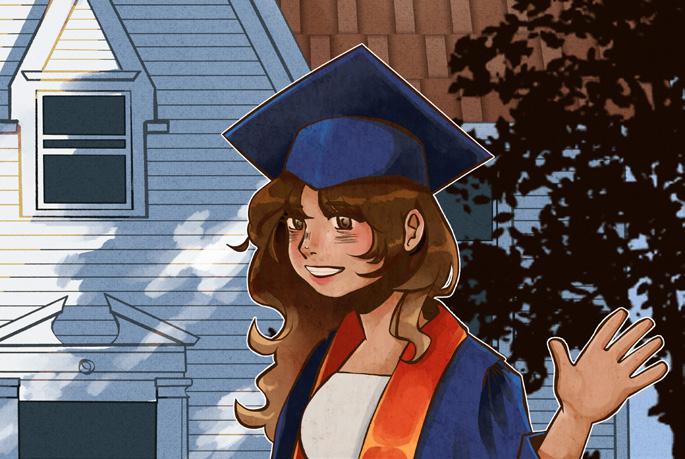
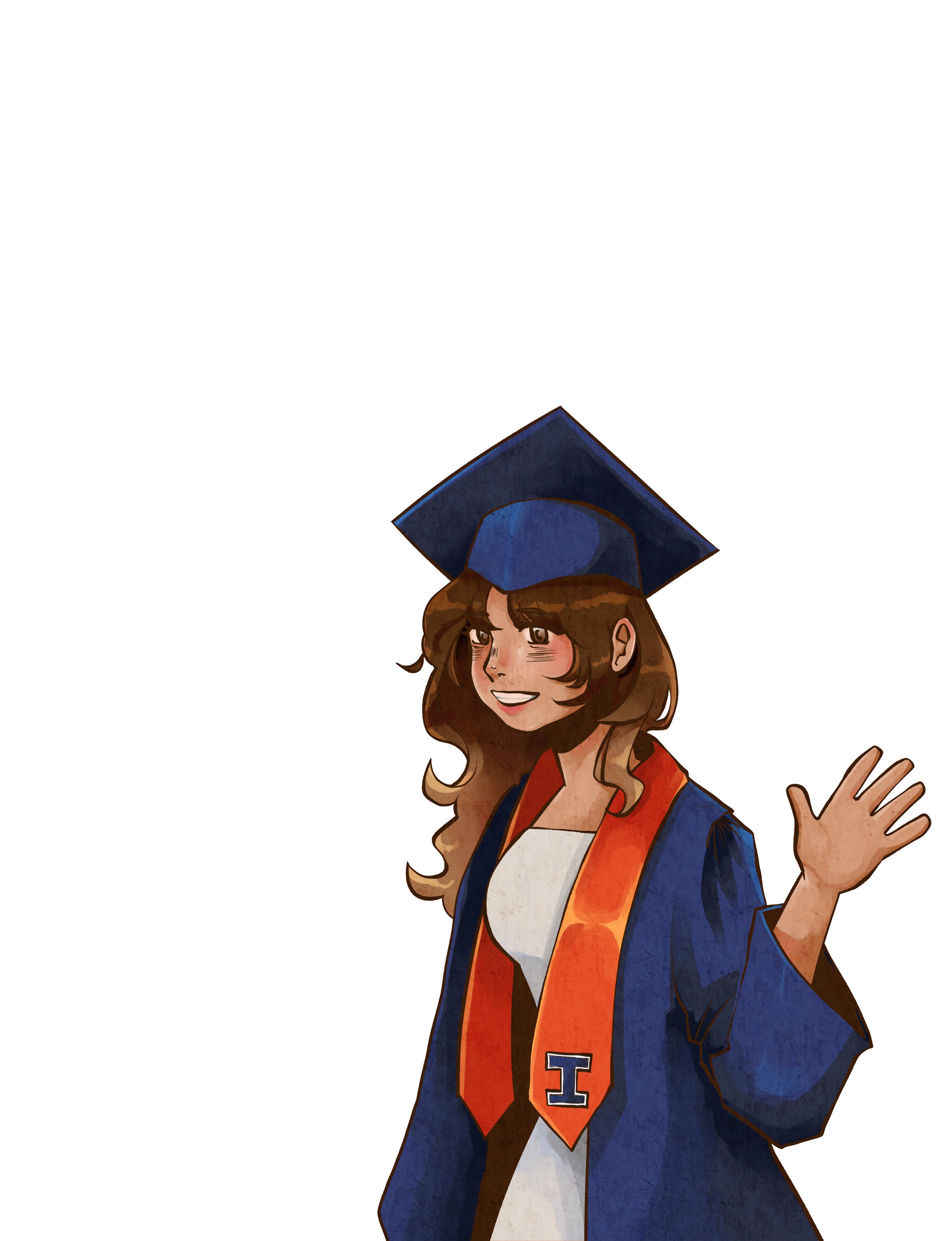
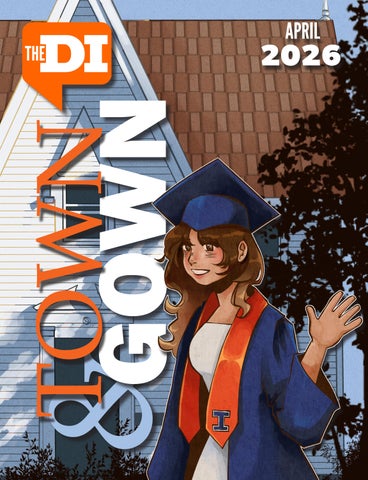
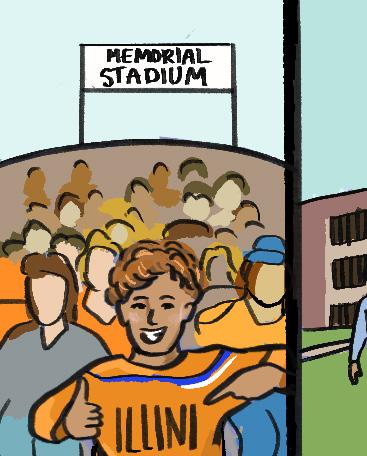
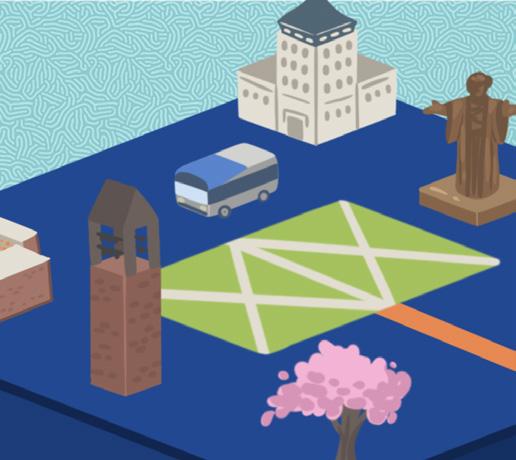
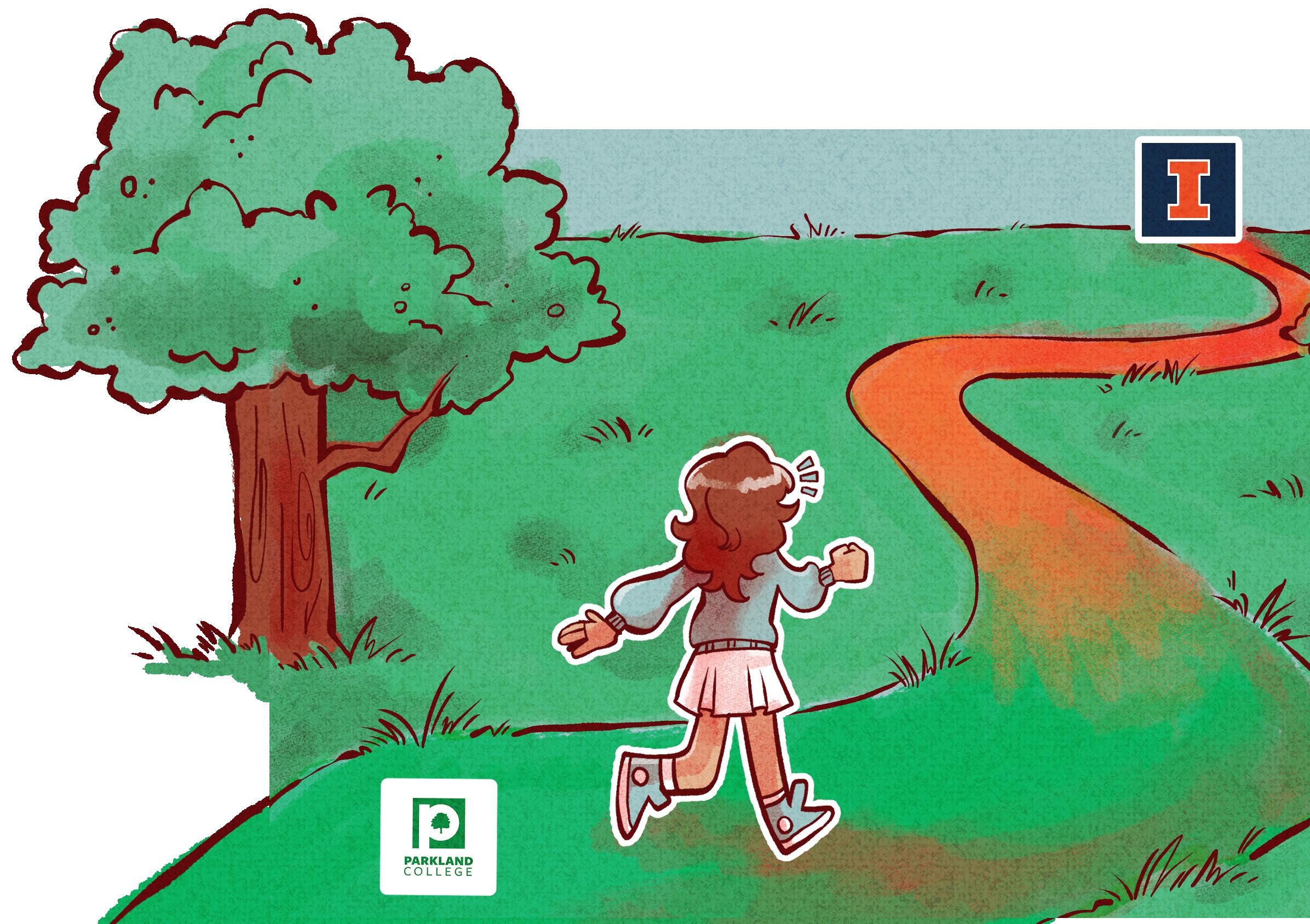
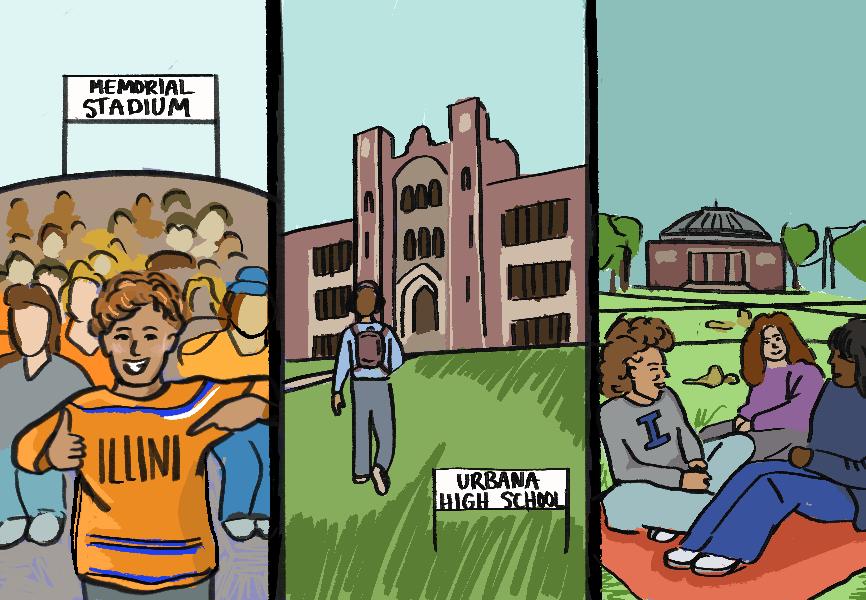
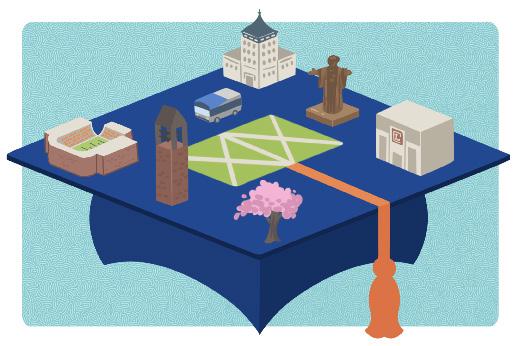
“Town and gown” refers to the relationship between the local community and a university. A major part of Champaign-Urbana’s culture is characterized by the University, and this illustration represents how students’ interaction and engagement is part of C-U history.
Shannon Moser
Aryan Aggarwal
Melody Smith
Kamilla Alimzhanova

Abby Jacobs
Allison Lee
Emma Qian
Aliana Arifi
Tanvee Athavale 18
8 12 14 27 24

MTD connects CU with MCORE project
Master Gardeners plant spaces for CU Campustown developments expose ‘winners and losers’ 4 5 6 7 8 10 12 14 18 20 22 23 24 27
Students become the teachers: UI students discuss teaching in CU Parkland Pathway presents financial, flexible opportunities for students CDL paves the way for future education
Townies work to balance family, friends, fundamentals
Familiarity, local job market lead UI alumni to stay in CU Gallery | Town & Gown: The intersection of community and campus
From meals to mentorship: How volunteers support CU
Seniors lead major RSOs, prepare for life after graduation
Running far, staying local: Mabry Bruhn speaks on being a homegrown athlete
Home is where the heart is: Mahomet’s impact on Karley Yergler
Opinion | A land-grant mission in name, not in practice

SPECIAL SECTIONS EDITOR
ANNA CEJA aceja4@dailyillini.com
It’s hard to imagine a time when the island bus stop on Green Street wasn’t conveniently situated in front of the Illini Union. But before the Multimodal Corridor Enhancement project reshaped the traffic lanes, the popular transit stop looked very different.
While the Champaign-Urbana Mass Transit District has been connecting residents between the twin cities for decades, C-U’s public transit system has been in place for far longer, with bus routes operating since 1901.
The transportation system became officially known as MTD in 1970 and has since been recognized for a number of feats related to accessibility.
In 1984, MTD was listed in the top 10 transportation systems in the country by USA Today. Just two years later, the bus system was deemed the first in the nation to become 100% lift-equipped and accessible to people with disabilities.
The public transportation became the University’s campus transit system in 1989 after students passed a referendum designating MTD as Illinois’ transportation provider for one year as a trial run — a role it has held ever since.
About 25 years after the vote, in 2014, MTD received a $15.7 million federal Transportation Investment Generating Economic Recovery grant from the United States Department of Transportation. It made the launch of the MCORE project possible.
The Daily Illini spoke with Jay Rank, operations director at MTD, who shared details about the MCORE project — an initiative to expand mobility choices for residents and increase access to employers, education and health care across the University district.
After evaluating community demand, Rank said that MTD project coordinators prioritized pedestrian

and bike lane accessibility over transit and auto needs, as the area experiences high pedestrian traffic.
“MTD (was) considered the third highest priority of the project, even though it was a transit project that we were doing,” Rank said. “It kind of goes to show that there’s a lot of collaboration and understanding about what the community needs and what the University needs.”
The project also created more opportunities for housing, Rank said. Since the construction of new bus stops and the adjustment of bus routes, Rank mentioned the increase in apartment buildings situated northwest of campus.
Several high-frequency routes, like 1/100 Yellow, 2/20 Red and 3/30 Lavender, run through the University District and extend to major retail and commercial areas. These include Market Place Shopping Center in north Champaign near stores like Macy’s and Target.
Routes also travel through downtown Champaign and Urbana, allowing access to local restaurants and entertainment venues. The bus lines are frequently used by residents and students alike, reinforcing MTD’s status as a go-to transportation system on campus and in the broader community.
“MTD plays a pretty interesting role in our community, in that we … interact with different planners,” Rank said, referring to the cities of Champaign and Urbana and the University. “I think (MCORE) was ultimately very positive, and I would say you can thank the community for that.”
In January, MTD received an $850,000 grant from U.S. Rep. Nikki Budzinski’s office, which the transit system plans on using to purchase two parcels of land adjacent to the Illinois Terminal in downtown Champaign.
“We want to make sure we have sufficient parking for the transportation users of the facility, as well as parking available for nearby restaurants and then the additional residential units as well,” said Ashlee McLaughlin, external affairs director of MTD, in an interview with WCIA.
According to MTD, the goal of the project is to increase access to the Terminal and encourage more residents to travel through the downtown area.
As MTD continues to expand, the system remains a pillar of the community and a central link between C-U and the University. The transportation system keeps connecting students with opportunities for employment, entertainment and outreach while providing residents with a nationally acclaimed transit system.
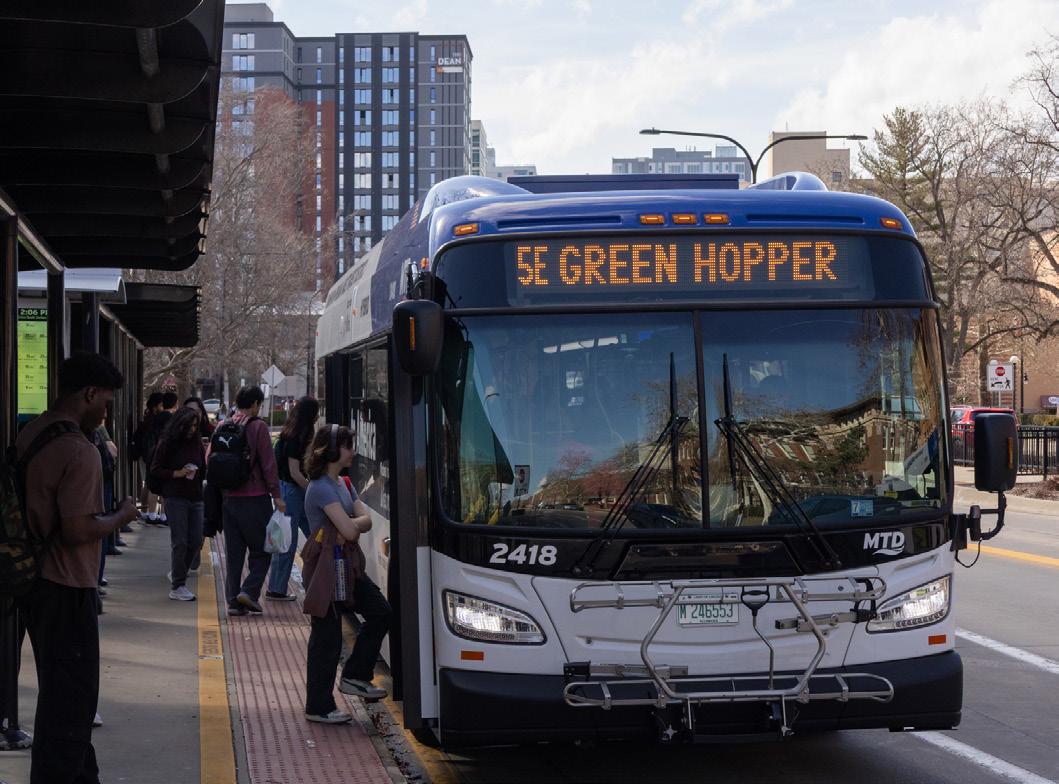
An MTD bus picks up passengers at the Illini Union bus stop on March 6. This stop was significantly overhauled as part of the MCORE project in the late 2010s, aimed at making public transit, bicycle and pedestrian infrastructure more accessible on campus.
HELEN MAURER
hmaurer2@dailyillini.com
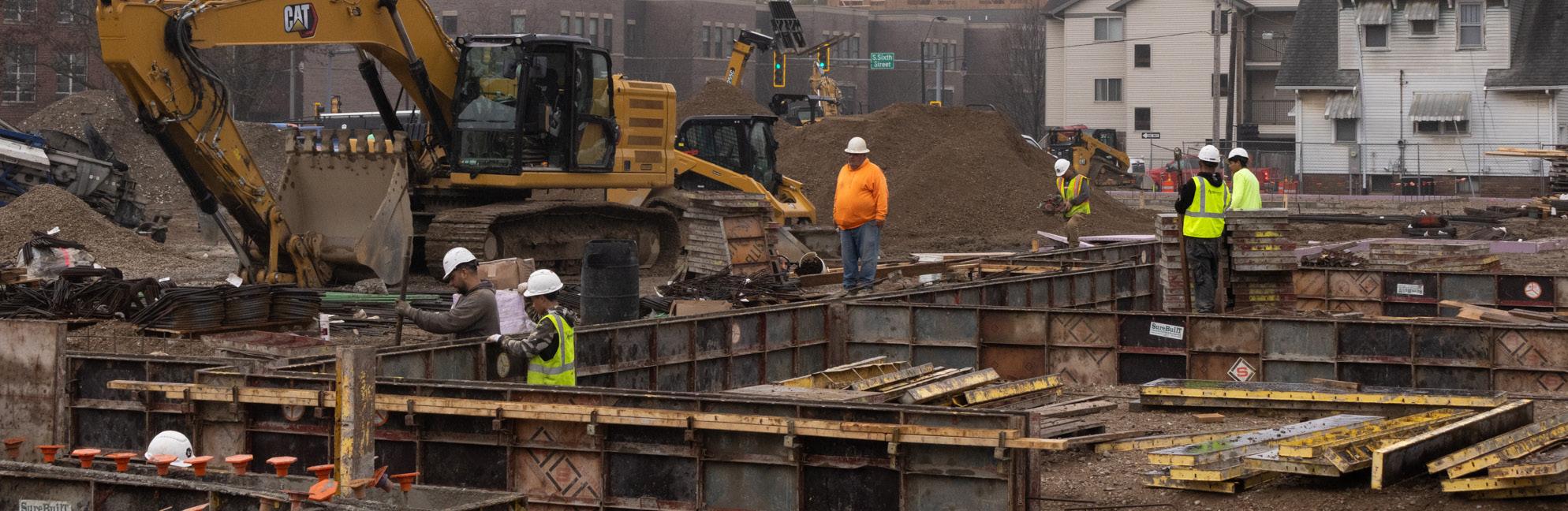
Campustown’s looming apartment complexes have attempted to alleviate the student housing crisis. However, they have also placed pressure on small businesses leasing properties in high-traffic areas at the same time.
For the first time in its history, over 60,000 students are currently enrolled at the University.
Small, family-owned businesses, like Maize Mexican Grill and Am-Ko Oriental Foods and Gifts, once resided on campus. Yet, they’ve since closed in the past five years due to developers demolishing the establishments to build highrise apartments.
In Maize’s case, the establishment was perpetually at risk due to its prime location on Green Street, which caused stress for the owners and workers.
“Since I opened, the first comment that somebody made sort of mentioned that (it) was the place where businesses came to die, and they were gonna tear it down,” said Armando Sandoval, owner of Maize, in an April 2024 interview with The Daily Illini. “Every year that I renewed my lease, I was scared that they were gonna tear it down. But I survived there, and it’s gonna be 13 years in June.”
Maize’s location on Green Street was demolished in June 2024.
The Mexican restaurant and Am-Ko intended to stay open but had their leases terminated due to developers with high offers buying them out.
Another local establishment, UniPlace Christian Church, was demol-
ished early last year by Fairlawn Real Estate to make way for a new residential complex.
While the church was willingly sold by its board, the community made efforts to turn UniPlace into a local landmark. The Champaign City Council denied the request.
While new residential buildings, like 608 Chalmers and 405 E. Stoughton, are deemed necessary to help fill the needs of a growing campus population, the influx of these properties on campus has led to small business closures and a perceived decline in the neighborhood culture of Campustown.
To explain this recent shift in developments, the student housing market on college campuses is extremely desirable for investors, according to McKinsey & Co. Housing shortages on college campuses are on the rise, and leasing companies can charge more per square foot in college towns.
Campustown’s housing within a 10-minute commute to campus held a 94.3% occupancy rate, as of early 2025. The rate is a strong percentage that indicates the increase in housing developments matched the increase in students at the University.
Not only can these new residential buildings help students find housing on campus, but they also assist the community off campus. There is less competition for affordable housing when locals don’t have to compete with students for off-campus housing.
“In housing, I think there really is a lot of evidence that building more hous-
ing of any type does actually lower rents across the board,” said Greg Howard, professor in LAS who focuses on the economics of urban development. “So maybe the average rent goes up, but the rent on any individual property might go down, right?”
Students benefit from both new residential complexes and small, local businesses in the Champaign-Urbana area. One of those students is Ethan Lopez, incoming Illinois Student Council vice president and junior in LAS, who also happens to live in a recently built, large residential complex on campus.
“I think we have to look at the bottom line, right?” Lopez said. “That’s the students … Having local businesses is important, and making sure there’s a thriving economy and a variety of choices for students and all of these things are really important. But it doesn’t matter if the students cannot live on campus, right?”
As described by Howard, there are “winners and losers” of the student housing crisis being remedied by large real estate companies and developers. The “winners,” according to Howard, are the developers and students, while the “losers” are the small businesses renting their storefronts.
While it’s not quite possible to have perfect harmony between new residential developments and supporting locally owned businesses, both establishments go hand-in-hand to create a livable and vibrant community for both the students of the University and the residents of C-U.

COPY CHIEF
AMARTYA NALLURI nalluri4@dailyillini.com
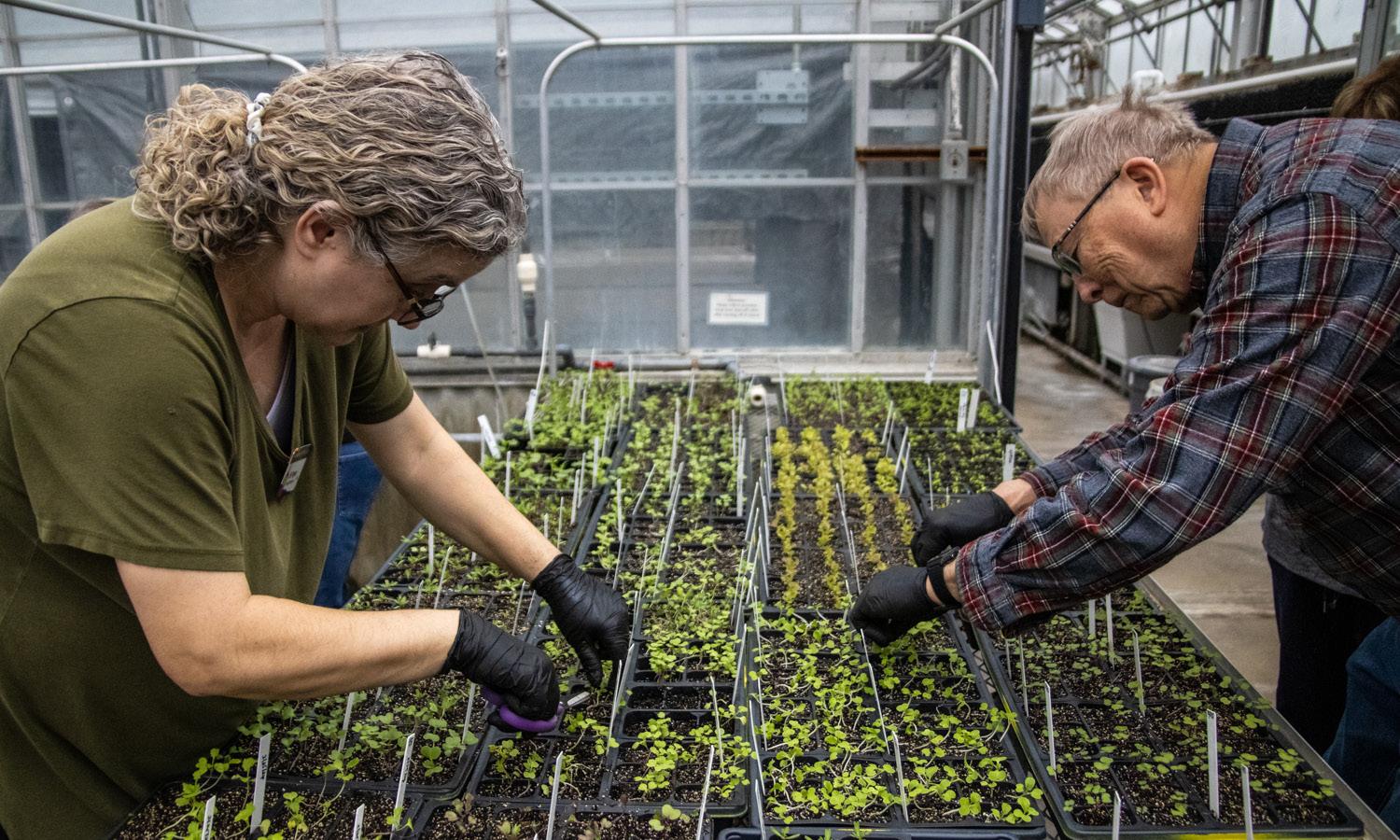
Being a gardener may seem simple — you just need a plot of land, some seeds and a lot of effort. But the Illinois Extension Master Gardeners go beyond the basics, not just in botanical skills but in community service as well.
The Master Gardeners are a statewide volunteer force organized by county and trained through the Extension office. Participants learn specialized gardening techniques from Extension educators and experts and give back to the community through volunteer work.
Public outreach for volunteers includes the creation and maintenance of a wide variety of gardens across Illinois, used for educational and recreational purposes.
One of the oldest of these is the Idea Garden. The garden, created in 1996 by Master Gardeners and maintained by them since, showcases various garden designs and native plants to inspire the public and their own gardens.
“I think one of my favorite things about being a Master Gardener … (is seeing) the community that comes there and (is) just blown away by how beautiful this little island is in the middle of the community,” said Laura Hayden, membership committee chair of the Champaign County Master Gardeners.
Hayden said the gardens create a public space that draws community members year-round, like for local students during homecoming dances and sporting events, or serving as a backdrop for wedding photos.
In Champaign County, prospective Master Gardeners must complete in-person or online training to gain important gardening skills and become familiar with volunteer projects.
The training is based on the Master Gardener Manual. According to Ryan Pankau, horticulture educator for Extension in Champaign, Ford, Iroquois and Vermilion
counties, chapters in the manual beyond the core set are chosen based on the needs and interests of the volunteers.
“My goal is to prepare our volunteers to be ready to do all those different things, whether it’s maintaining a garden, writing a social media post, writing an article … I’ll select from those other chapters what is most applicable in the county we’re teaching the course,” Pankau said.
The course is designed for even those with little gardening knowledge. Pankau said the variety of topics taught allows everyone to learn something new.
After the course, prospective Master Gardeners must complete 40 hours of volunteer work over two years to become certified active Master Gardeners.
Volunteer work is diverse across the county. Libraries and schools often request presentations or workshops from the Master Gardeners, allowing them to directly interact with the community.
The Champaign County Master Gardeners also host community events, including the Garden Walk in June, where the public can tour private gardens of community members and Master Gardeners alike. The tour also includes a marketplace that showcases local ven-

dors and garden-related products.
Mary Knight is a Champaign County Master Gardener and co-chair of the Garden Walk. She said that the Garden Walk is a massive undertaking, requiring volunteers across gardens who act as hosts and answer questions.
“We have over a hundred people (on) the day of the walk and leading up to it (who) volunteer their time to make this happen,” Knight said. “It’s a real group effort.”
Hayden also volunteers as part of the Garden Walk as a photographer and said it’s a particular highlight of her work.
“I get the absolute thrill and pleasure of being able to photograph other people’s gardens,” Hayden said. “It’s really fun to be able to capture that and then share those photos with homeowners.”
With a large volunteer force and a passion for plants, the Master Gardeners support communities across the state. But Pankau also emphasizes how the program not only supports a community but also creates its own.
“It’s that camaraderie, that social aspect of our program, that really brings people in and keeps them part of the program for a long time,” Pankau said.

STAFF WRITER
FELICITY ABBOTT fabbott2@dailyillini.com
What might seem like an oddly placed, brightly colored playground in the middle of campus is actually an integral part of the education of University students and children in the Champaign-Urbana community.
The Child Development Laboratory serves both University students interested in studying early education and child development, as well as families in C-U seeking early care and education for their children.
“I think it’s exciting to be part of such an amazing legacy,” said Hannah Kye, director of the CDL. “It’s exciting to be able to lead a space that serves so many different communities and brings them together.”
The CDL provides care and education for children ranging from 6 weeks to 5 years old, allowing for University research projects to sample from a wide variety of early life stages.
In addition to age variation, the CDL offers enrollment to the broad community in the area to ensure racial and socioeconomic diversity in its students.
“We see this diversity really as a strength,” Kye said. “It ensures that when students come and do help with a research project or do an internship in the classroom, they really have an authentic environment for studying how children develop.”
University students can apply for part-time employment or enroll in a course that uses the CDL for research projects. According to the CDL’s 2024-25 report, 26 University courses partner with the lab to provide students with different observational and research opportunities.
Some of these classes include HDFS 105: Intro to Human Development,
HK 262: Motor Develop, Growth & Form and PSYC 363: Developmental Child Psych Lab.
While the institution does offer student teaching placements, the opportunities offered at the CDL are not just for future educators. They are also for anyone else interested in learning more about child development and education.
“It’s been great welcoming in folks with different perspectives, anywhere from the (Gies College of) Business to health and kinesiology,

Spurlock Museum or Bevier Café, and visits from the Beckman Institute, 4 Paws for Ability and the Department of Entomology.
“Because we are within the University systems, we have a lot of unique resources / experiences that our children and families have access to that traditional child care centers may not,” Crain wrote in an email to The Daily Illini. “These partnerships often allow us to enrich their learning experiences and add to their interests.”
Because we are within the University systems, we have a lot of unique resources / experiences that our children and families have access to that traditional child care centers may not. These partnerships often allow us to enrich their learning experiences and add to their interests.
Molly Harmon Crain, CDL’s child development coordinator
speech and hearing science, where they will have opportunities to kind of develop their own projects based on what their professional goals are — the goals that they have for their own learning — and we work with them to guide them on how to complete these projects,” Kye said.
The institution’s connections across campus allow ample opportunities for both students and families.
According to Molly Harmon Crain, CDL’s child development coordinator, these opportunities include University athletes reading to children, field trips to campus hotspots like
The CDL offers a variety of experiences to students with different interests. It also prides itself on its ability to change alongside the field of education.
The program has been around since 1941, and it moved into its own building in 1955. The CDL has continued to grow and adapt ever since.
“CDL has a culture of learning and exploration,” wrote Meghan Elise Redeker, CDL’s associate director, in an email. “With our program being one of the most diverse early education programs in the state, we are constantly evolving for the better.”
EDITOR-IN-CHIEF
CHLOE BARBARISE
chloeb4@dailyillini.com
The United States Department of Education announced in March 2023 that the Free Application for Federal Student Aid forms wouldn’t be available until December. The department normally releases the forms on Oct. 1.
It resulted in chaos. Families experienced difficulties due to scheduling and technical issues, like incorrect calculations. This narrative wasn’t any different for Eleanor Klein, who turned to Parkland Pathway to Illinois as a result.
“(The FAFSA setbacks) caused a huge delay in, ‘OK, how much financial aid am I getting?’” Klein said. “They weren’t actually able to give me a financial aid package until after the decision deadline … I can’t commit (to the University) if I don’t know how much support I’m going to be getting.”
Parkland Pathway is a dual-enrollment program between the University and Parkland College designed to ease the transfer process at a junior level after two years. Despite having full-time status at Parkland, students can take up to five credit hours at the University each semes ter at Parkland’s tuition rate, join RSOs and live in the University’s provided housing, among other opportunities.
Klein, now a sophomore Parkland Pathway student, said it all worked out in the end. Being an Ur bana native, she’s known of the pro gram’s existence.
However, Klein slowly became more aware of what it could truly offer as her collegiate years began to close in. Besides just the cost, Parkland Pathway
provided course-selection stability.
“It’s really nice to be able to balance the smaller gen-eds at Parkland with the more niche classes at U of I,” Klein said. “(The program) gives a really good opportunity for that.”
“Niche classes” at the University for Klein include a psychology lab and even ice skating. Five credit hours might seem like a small amount, but Klein said it’s flexible and gives her the freedom to take a few random courses.
For Egan Franzen, senior in ACES, his path veered from its original course: The University waitlisted him. Still, he knew it was the place he wanted to be.
Franzen discovered Parkland Pathway from a family friend. He applied, was accepted and earned his associate degree from Parkland.
Although Parkland wasn’t Franzen’s first choice, financially speaking, it was the go-to option.
“You’re going to save a lot of money those first two years,” Franzen said. “If you take that extra step and you may stay at home — I stayed at home with my dad that first year (and) saved a ton of money.”
The average cost
postsecondary education institution is $38,270 per student per year in the United States. Included in this amount are books, supplies, housing, food and other expenses.
In-state students who attend a public four-year institution and reside on campus paid $27,146 in the 2022-23 academic year in total cost of attendance. That number increases by nearly $10,000 for Illinois residents enrolled at the University.
“Why I decided to (join Parkland Pathway) — a lot of it was honestly down to cost, just because it’s so much different,” Klein said. “Do you want to pay $19,000 a year or $4,000 a year (for tuition and fees)?”
Students can also apply elsewhere besides the University after completing the program. However, this wasn’t the case for Franzen, and for those wanting to attend the University, he said participation is what matters most.
“If your end goal is to go to U of I … I would just get involved at the U of I campus as soon as possible,” Franzen said. “That’s just going to open more doors for you, whether that’s joining an RSO, going to the career fairs here

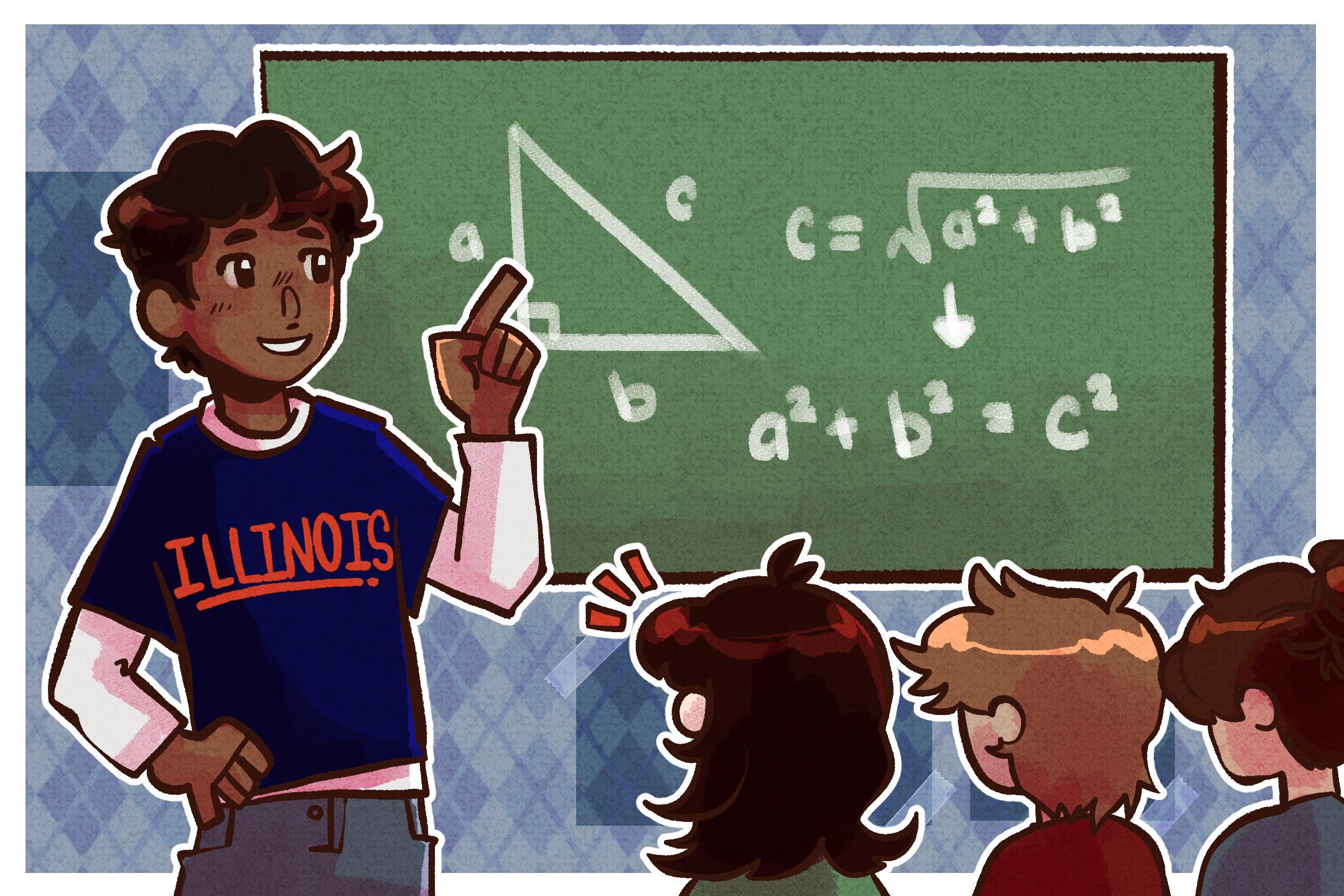
eighth-grade math class at Franklin STEAM Academy in Champaign. This year, Lim is working full seven-hour days, five days a week.
Every student attends classes. Whether giant lectures, grueling content at 8 a.m. or interesting discussion sections, we all have them. But some students are attending other classes — the ones they help teach.
Each year, numerous University students take their talents to student-teach at nearby elementary and middle schools across Champaign-Urbana. Along the way, they get a close look at the trials and triumphs of working in the education system.
In the College of Education, students often student-teach for multiple years but take on a more active role in their senior year. Olivia Lim, senior in Education, student teaches in an
“We’re working towards a onemonth instructional takeover, so that basically means for a month, we’re going to be in charge of all the planning, all the teaching, all the responsibilities,” Lim said. “Up until that point, we start with observing (and) getting acclimated to the classroom.”
Lim said she’s known she wanted to teach middle school math since she was in high school, and this experience has confirmed she’s on the right track.
Student teaching isn’t just limited to education majors, though. VisA-Vis, an RSO on campus, provides another pathway to working in C-U schools. The organization places volunteers into elementary schools and a
few high schools in the C-U area.
Minh Nguyen, membership director for Vis-A-Vis and sophomore in LAS, said volunteers can be placed as classroom aides or one-on-one tutors for underperforming students. Currently, Nguyen is not volunteering in a school, but she has worked with second graders, kindergarteners and sixth graders since she joined the organization her freshman year.
“Because kindergarten is so riled up, the teacher doesn’t really have the time to be cutting a bunch of things for an hour or refilling snacks,” Nguyen said. “So that was really great to know that I was saving her that time.”
Nguyen said the need for help is so high that, despite having over 45 members in Vis-A-Vis, it frequently can’t provide volunteers for each teacher who requests one.
Keira Petrusha, sophomore in AHS,
is a volunteer with Vis-A-Vis. For the past two semesters, she’s been placed as a classroom aide in a sixth-grade class at Edison Middle School in Champaign.
Petrusha hopes to pursue a career in speech-language pathology and said that volunteering has allowed her to explore one setting she may choose to work in. She said she’s been surprised by the influence of technology on the sixth graders she works with.
“I’ve been able to see how much the internet and (artificial intelligence have) influenced their learning
types,” Petrusha said. “They’re always like, ‘Why can’t I just use ChatGPT?’ or ‘ChatGPT will explain it to me,’ … It’s like, ‘Well, you need these foundational steps to be able to move forward in your education.’”
Lim said the eighth graders she teaches are allowed to have their phones in class, which has proven to be distracting.
“It’s definitely hard to keep students engaged in that sense or even get them to participate sometimes because it feels like they just want instant gratification, or they just want to
With teaching, it’s one thing to just read a bunch of things or sit in lectures and learn about it, but it’s completely another thing to actually be with the kids and (do) it.
be told how to do things,” Lim said. Nguyen, however, said technology use is limited in the classrooms she’s worked in.
“I think teachers are planning in a very meticulous way where students don’t have to be looking at screens too often,” Nguyen said. “But when I was working with middle school, especially with English learners … there were several days of lessons that they would have about internet safety, because they knew that (technology) was a lot more accessible to them now.”
It’s clear this job comes with challenges working long hours while being a student, wrangling rooms of rowdy kids and maintaining attention in the age of AI. But for these student teachers, the experience makes it all well worth it.
“With teaching, it’s one thing to just read a bunch of things or sit in lectures and learn about it, but it’s completely another thing to actually be with the kids and (do) it,” Lim said.
Olivia Lim, senior in Education
STAFF WRITER
ANIKA WADHWA anikaw2@dailyillini.com
College is often portrayed as a clean slate, but for some townies, it can feel like an already filled page. While other students are adjusting to a new environment, townies are balancing family and old friendships with new routines and faces.
At the University, the term “townie” refers to a student native to the broader Champaign-Urbana community. These students often grew up with great exposure to the University due to proximity and academic opportunities.
Many non-local students are interested in what being a townie means and looks like. Emily Ge, junior in Business, received stunned reactions after mentioning that she was a local.
“In my freshman year, whenever I told my classmates that I was from Champaign, they were so shocked and surprised,” Ge said. “They were like, ‘What do you even do here? There’s nothing to do.’”
Nicole Vozovoy, junior in LAS, grew up in the C-U area and attended Centennial High School. She recalls interacting with the University through summer programs, extracurriculars and using campus as a common hangout spot.
She said that the University’s culture is ingrained throughout the community. Engagement was often fostered through events and local school systems.
“I remember in third grade we had a raffle competition, and the winner got to take a limousine to the football game at U of I,” Vozovoy said. “I won that lottery and got to go to the game and get a football signed by the coach and everything. I don’t remember much of it, but they very much encouraged interaction (with the University).”
Some townies even have family members who are employed by the
University. Ge grew up visiting campus often, with her mother being employed by the University.
Not only do employed family members add another layer of connection to the University, but they also add an extra factor when deciding on a college. Children of eligible employees receive the Child of Employee Tuition Waiver for 50% of tuition, making staying in the C-U area cost-effective.
In addition, Parkland Pathway to
family, many of whom have attended the University. He now finds himself at a crossroads between his family, childhood friends and new University friends.
“It’s been really fun hanging out with lots of friends made here at U of I, but at the same time, I have been straying away from my family more and more,” Santos said. “I’ve been trying to find a good balance … Should I be staying with my University friends
ANJALI WADHWA THE DAILY ILLINI
Illinois is a program where townies can be students of Parkland College and the University at the same time, later becoming a University student solely. This program also relieves tuition costs and eases the transition to the University’s large campus.
These programs can portray the University as convenient and appealing to townies. Louie Santos, junior in Media, previously utilized Parkland Pathway. The financial advantages of the program contributed to his decision to attend the University.
In addition to the financial aspect, Santos wanted to stay close to his
or the people I grew up with?”
At a critical period in life, townies find themselves surrounded by both new and old memories, experiences and relationships. Balancing this alongside being a full-time student is an experience familiar to many townies.
“My roots have done so much for me, and now, to want to go away from them doesn’t feel right,” Santos said. “At the same time, I’m not indebted to them … I feel like it’s very much a culture war when it comes to me and my roots versus me and my friends at the University.”

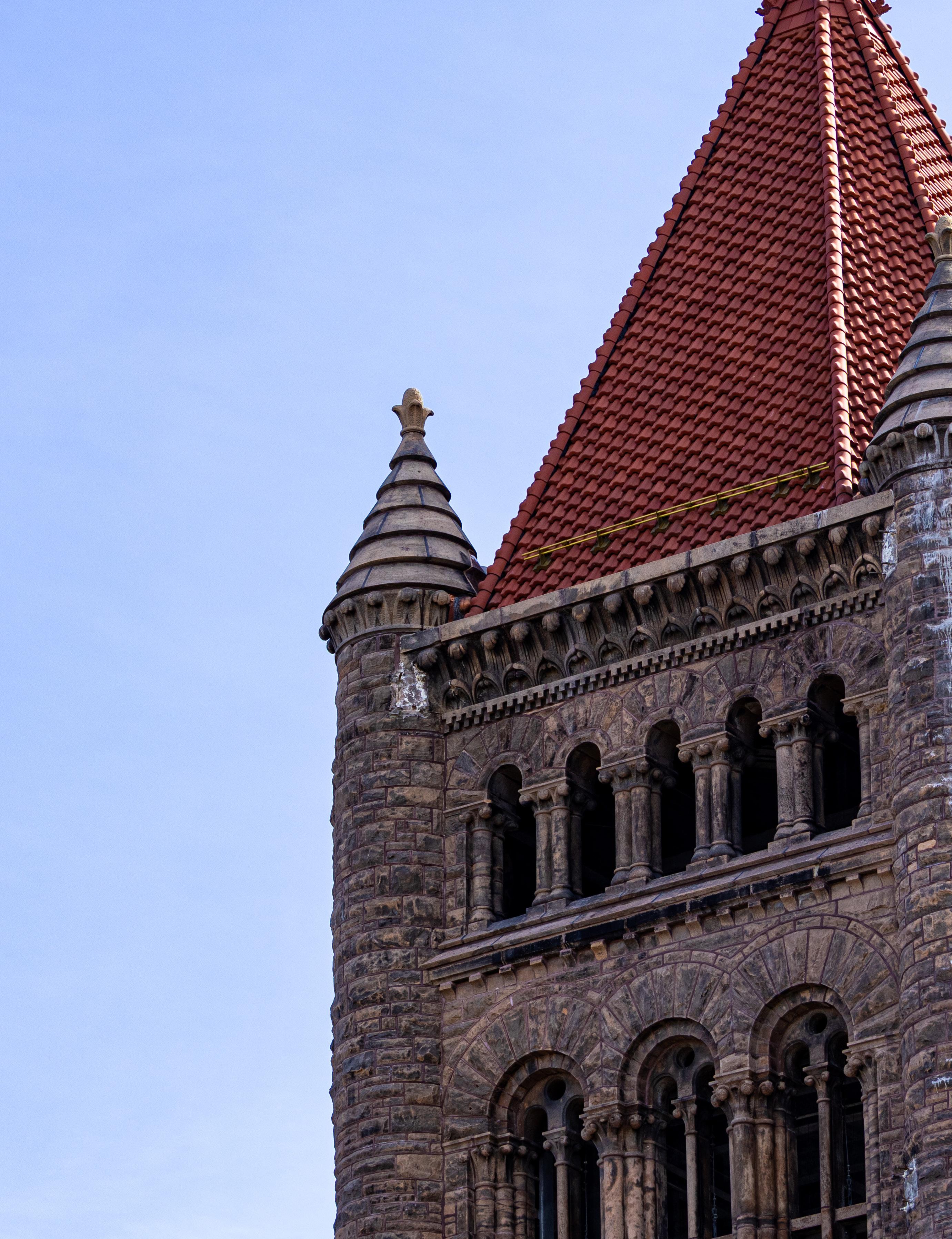
is located at 1409 W. Green St. in Urbana.
and
have been under renovation since Spring 2023 and is predicted to be finished by 2027.

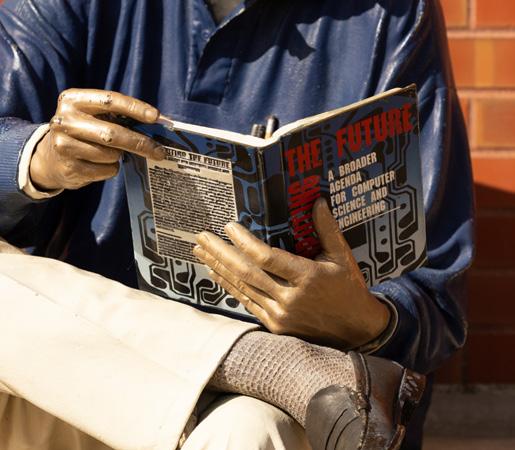
top – A statue of a man, referred to as “Grainger Bob” by the community, sits outside Grainger Engineering Library on March 12.
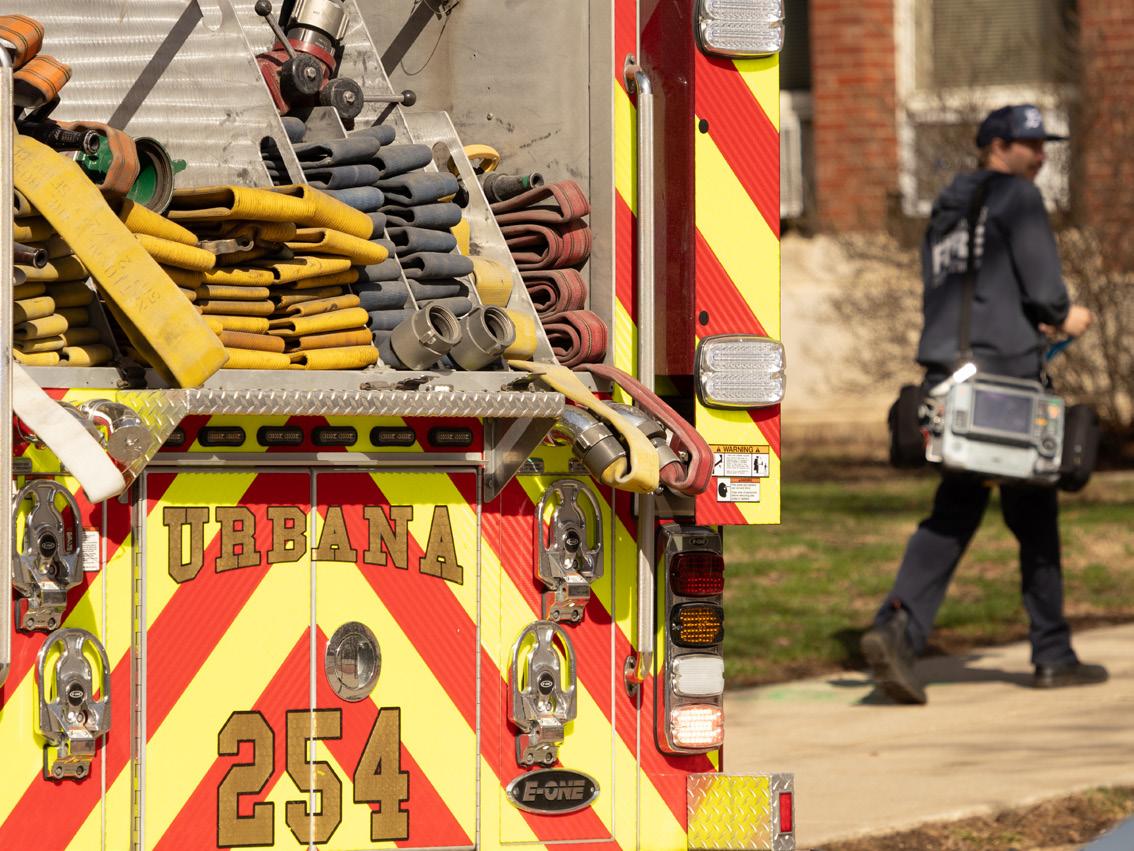
above – The Urbana Fire Department responds to a call at the Transportation Building on March 12.
inset – Black Violin performs at the Virginia Theatre on Nov. 12, 2025. The group made a stop in Champaign-Urbana during its “Full Circle Tour.”
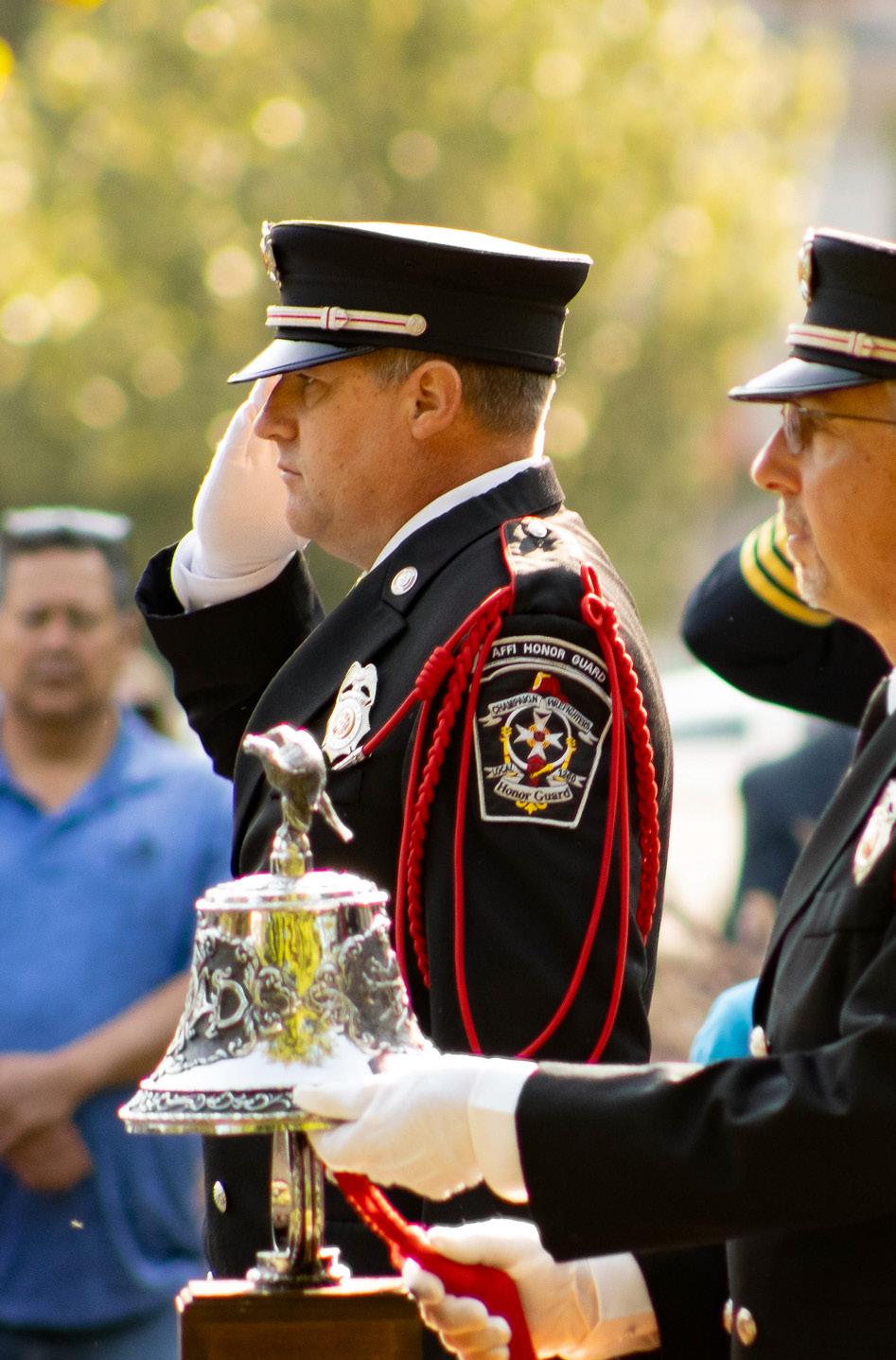
Firefighters salute as a bell is rung at the
Fire Department’s annual 9/11 Memorial at West Side
in
on Sept. 11, 2024.

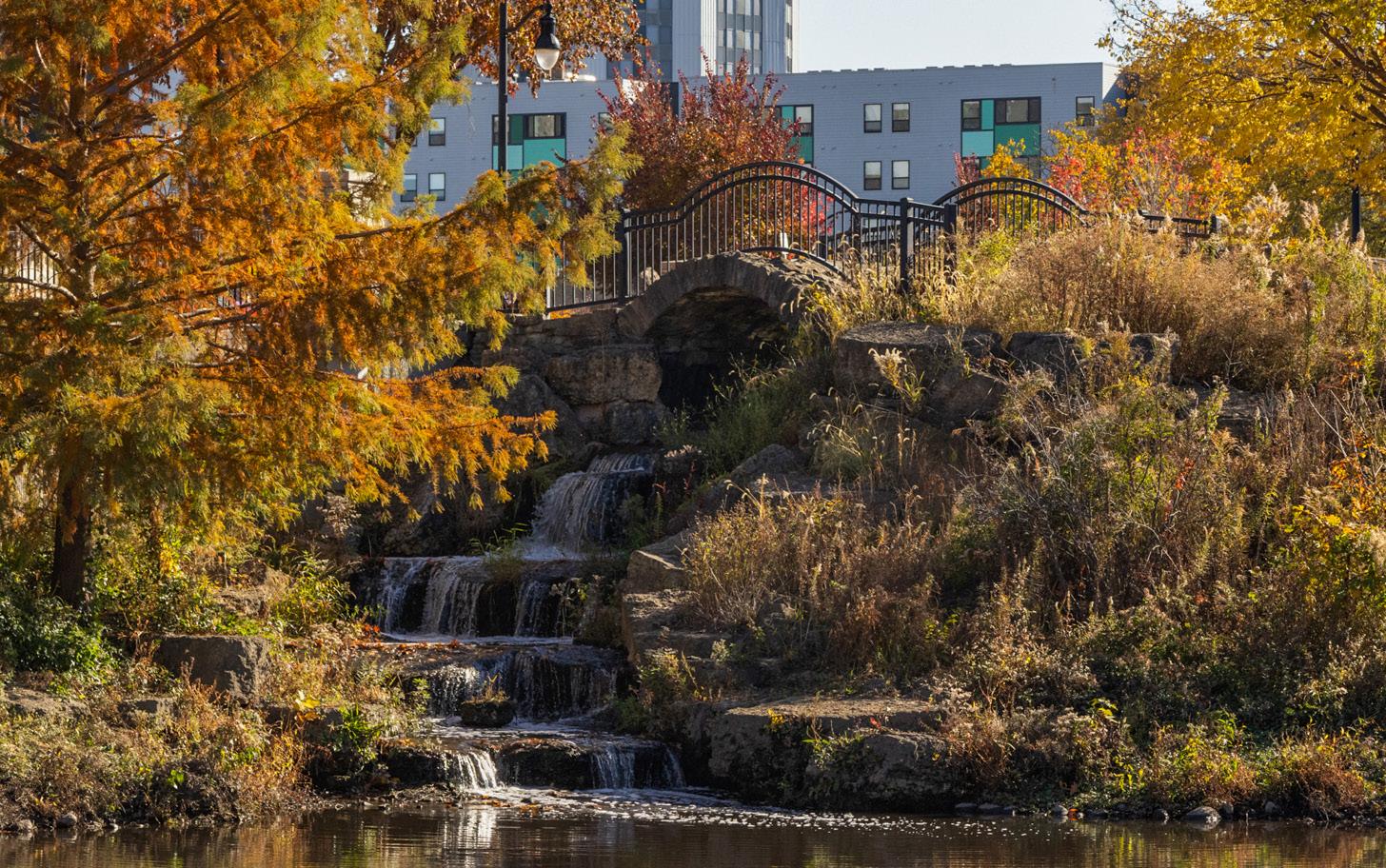
top – Late-afternoon sun illuminates the waterfall at Helms Park, located at the northeast corner of the Second Street Detention Basin in Champaign on Nov. 7, 2025.
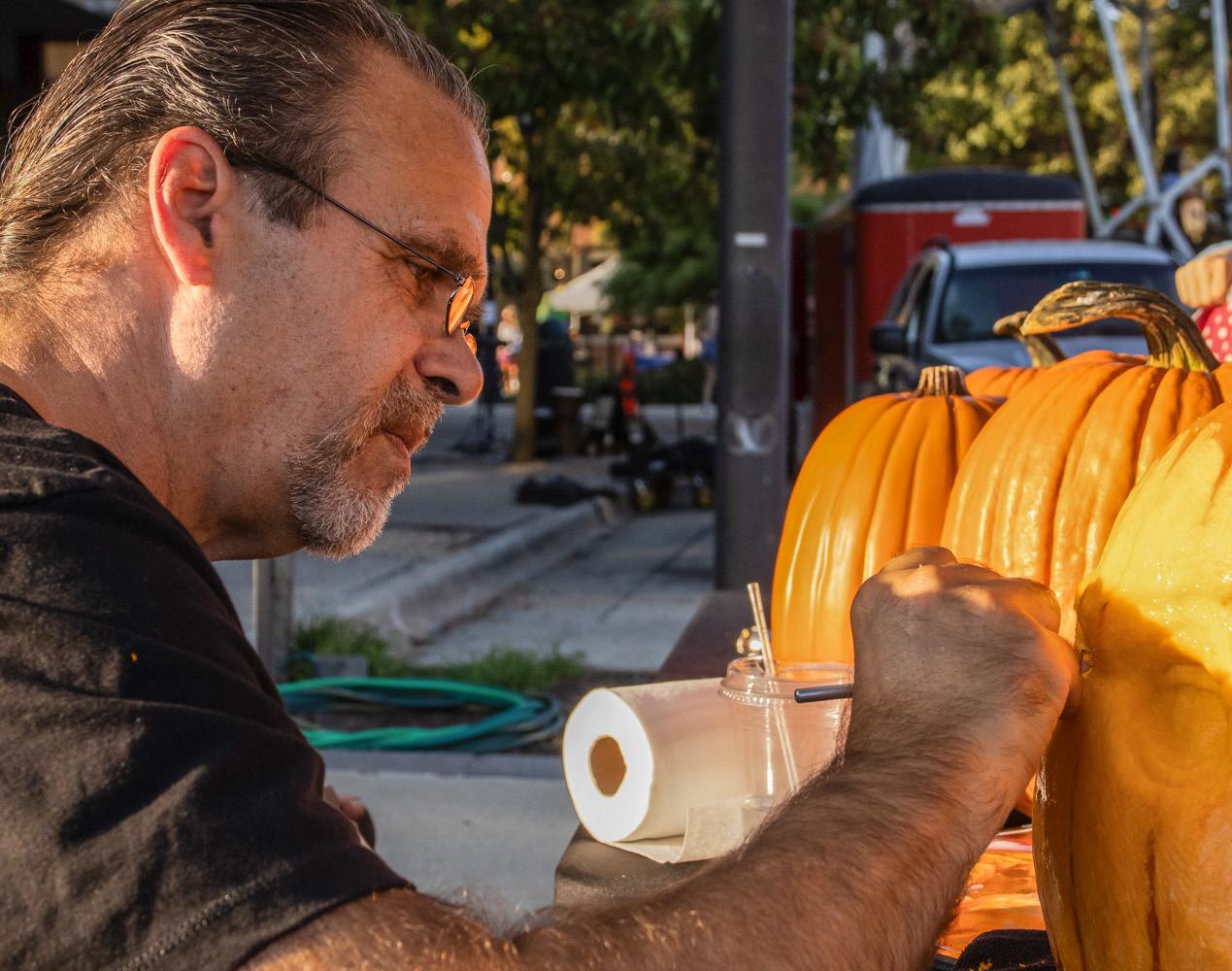
above – Professional artist and pumpkin carver Dennis Franzen presents a live pumpkin carving at 40 North’s Fall Fusion Festival in downtown Urbana on Oct. 5, 2024.
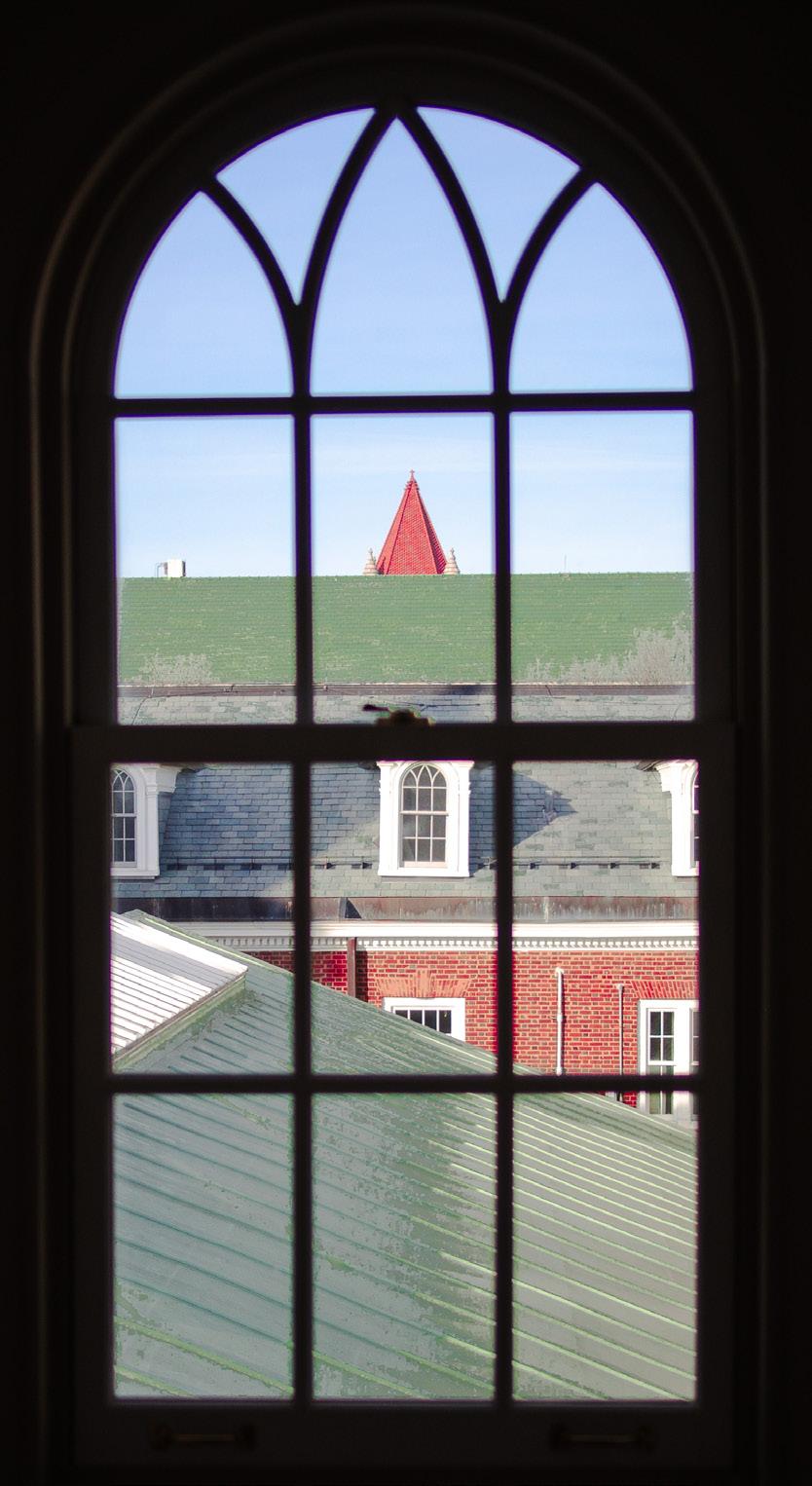
right – The top of Altgeld Hall is visible over the roof of the English Building from its fourth floor windows on March 26.
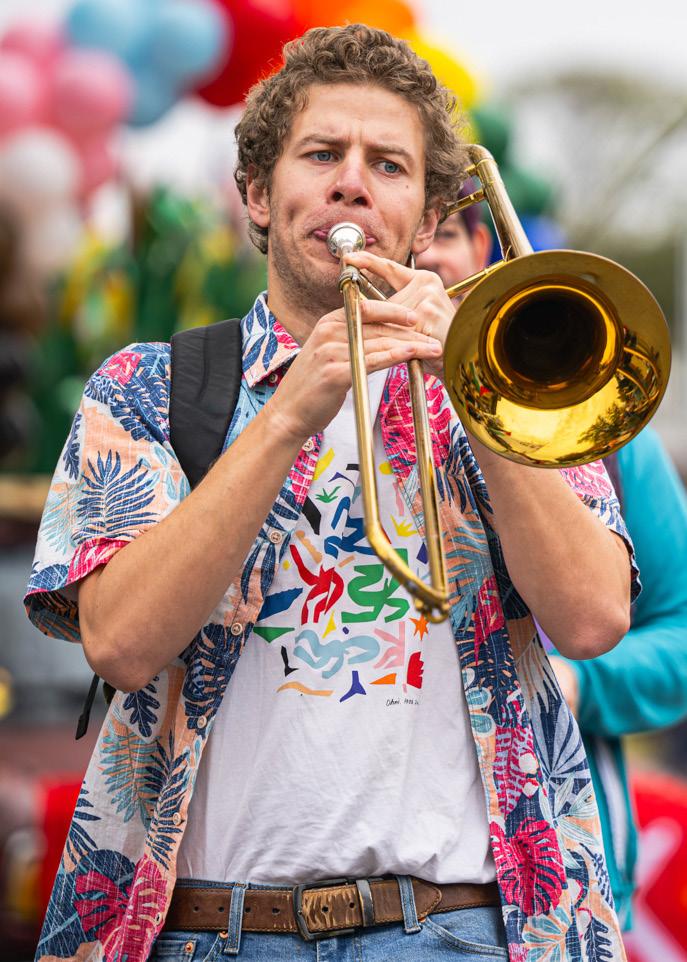
left – A participant in the 15th annual CU Pride Fest plays a trombone in the parade through downtown Urbana on Oct. 25, 2025.
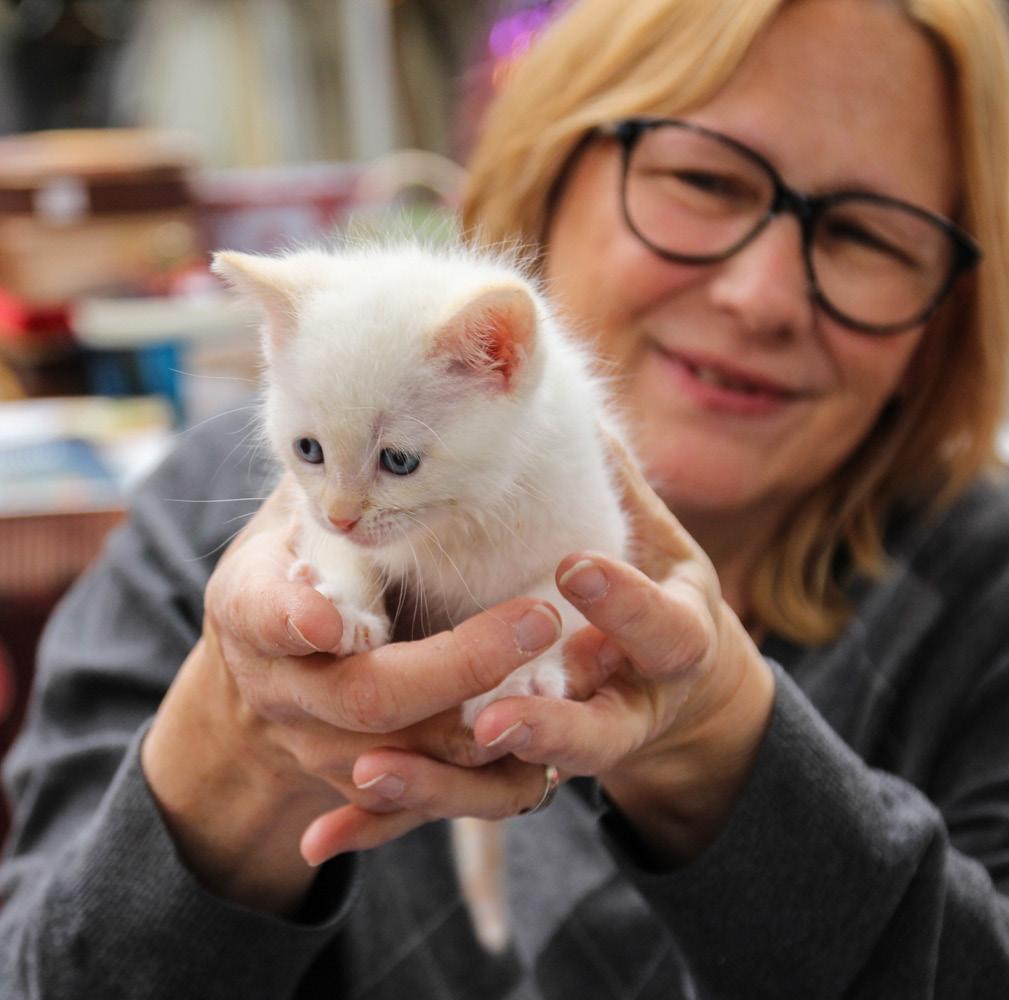
below – Susan Catt, owner of the vintage collectible shop Aunt Doris, holds up her foster kitten at her booth during the Middlefork Flea Market festival held in Lincoln Square Mall in Urbana on Oct. 25, 2025.
bottom – Audience memebrs watch the film “Touch” during Ebertfest at the Virginia Theatre in Champaign on April 26, 2025.

STAFF WRITER
KIRAN BOND
sbond21@dailyillini.com
Four out of five Illinois-resident University graduates secured their first postgraduate destination within Illinois, according to the 2023-24 Illini Success report.
Some of these students relocated to Chicago, others moved all over the state and some even stayed right here in Champaign-Urbana.
Kane Rubel grew up in C-U and graduated from the University in December of 2024 with a bachelor’s degree in information sciences. She now works as a network technician for the City of Champaign.
Rubel said that — along with receiving a job offer from the City of Champaign — finances, familiarity and genuinely liking the area also factored into her decision to stay.
“A lot of people are miserable and really hate their hometowns,” Rubel said. “There’s nothing to do, there’s nothing to see … but (C-U) is large enough to reinvent myself.”
C-U fosters growth, Rubel said, and is a town that people regularly choose to stay in after graduation.
Another University alum who stayed in the area, Cecilia Guerrero, is a therapist who graduated with a master’s degree in social work from the University in December of 2024.
Since moving to the area in 2018 to get her bachelor’s degree, Guerrero has spent most of her time in C-U.
Guerrero said that over time, she began to adopt the philosophy that people grow where they’re planted.
“I really like this community,” Guerrero said. “I’m from a smaller town, so for me, this area is kind of the perfect thing. It’s not too busy, but it’s also not too quiet.”
Guerrero said familiarity is something she appreciates.
“It’s nice to live in a place that I know so well,” Guerrero said. “I think there’s something that’s kind of comforting about it.”
Other University graduates choose to stay in the area to further their education. Caitlin Mamaril is a graduate student studying physics at the University. She moved to C-U at 14.
Mamaril completed her undergraduate degree in physics in May of 2025 and went directly into her doctoral program, though she said the decision to stay was difficult to make.
She received offers from both the University and another institution and had to decide whether to stay or leave.
“I value familiarity,” Mamaril said. “I talked about it at length with a lot of my friends, like, ‘I don’t know what to do.’”
Mamaril said much of her support system is located in C-U.
Weighing her options, Mamaril decided to stay at the University because it offered her more funding, she had strong support from her research adviser and because C-U felt like home. She said she knew parts of campus “like the back of her hand.”
Even though Mamaril values her choice, she said she has faced the thought of failing because she chose to stay in C-U instead of branching out.
Though no longer students, both Rubel and Guerrero remain connected to the University in different ways.
Rubel said she still feels semi-affiliated with hobbies that overlap with those of students, even if she’s less aware of campus events. Guerrero, who lives off campus, said she will occasionally walk on campus with her partner.
Beyond the University, each alum has found their own reasons to stay in C-U.
Mamaril said she enjoys the cozy feel of the area and appreciates the friendly nature and walkability of downtown Champaign. Rubel highlighted the lectures, touring musicians and artistic opportunities that the area has to offer.
For Guerrero, C-U is starting to feel like home.
“I’m starting to feel like I’ve put down roots here, and it’s a nice place to be,” Guerrero said.

STAFF WRITER
QAASIM JATOI qjato2@dailyillini.com
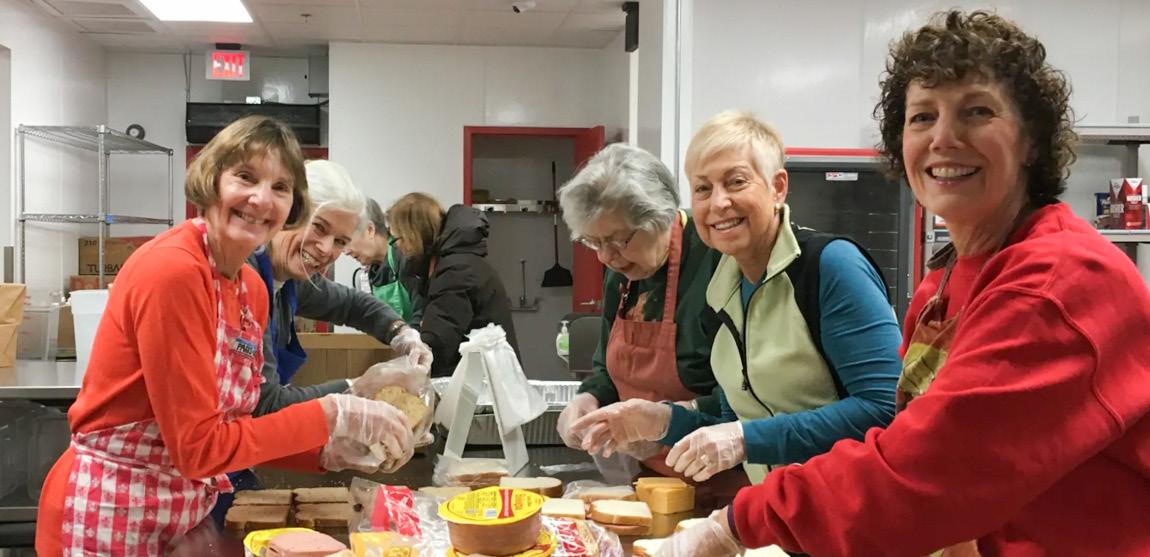
At Daily Bread Soup Kitchen, people do not always come in looking for just one thing. When one patron came in asking for help finding a room for the night, Beth Rogers, who has volunteered there for more than a decade, quickly opened a binder full of local resources.
Inside were pages with information on local shelters and other housing support, which Rogers copied for the patron to take before leaving.
“I’ve seen people go from living on the streets, to living in a shelter, to finding themselves a job, to getting their own place,” Rogers said. “It grows on you.”
Across Champaign-Urbana, volunteer work often looks like that: Stepping in where needed, sometimes in ways that stretch beyond an organization’s name or mission. At soup kitchens, food pantries and local schools, volunteers help meet people’s immediate needs while building relationships that tie the community closer together.
Organizations like DBSK, Wesley Food Pantry, Champaign Unit 4 School District and the Urbana School District 116 offer students and community members multiple ways to get involved, from sorting donations and serving meals to supporting teachers and students in the classroom.
At DBSK alone, that help reaches hundreds of people per day. The kitchen serves anywhere from 350-410 meals daily, according to Lynn Hall, DBSK’s volunteer coordinator. Each meal includes a hot lunch and a sweet treat, as well as a sandwich for guests to eat later.
DBSK often goes beyond serving people who are hungry or food insecure.
“We have guests that don’t necessarily go hungry,” Hall said. “They’re coming here for socialization. So psycholog-
ically speaking, how can you even put a dollar amount on what that’s worth? That’s precious.”
The guests, Rogers said, create their own communities. Often, when one person has a question, others will perk up to offer a helping hand.
“That’s better than me going and looking in the book,” Rogers said. “It makes it more personable than a lot of other volunteer jobs that I’ve had, where you just don’t get to know people that you’re helping.”
The benefits of volunteering often extend beyond the people receiving help. A March 2026 Gallup report found that young people who participate in service are more likely to report stronger community connection, resilience and career readiness.
“You build friendships that you wouldn’t ever, between the volunteers or between the guests,” Rogers said. “It’s a way to give back to a community.”
Another resource for community members and an opportunity for volunteers is the Wesley Food Pantry, where patrons can obtain up to a week’s worth of groceries. It’s been open for nearly 20 years.
Located in the basement of the Wesley United Methodist Church, the pantry is open every Thursday from 5-7 p.m. It also has satellite pantries at the Activities and Recreation Center’s Instructional Kitchen on Tuesdays and at Parkland College on Wednesdays and alternating Saturdays.
Dawn Longfellow, Wesley Food Pantry’s program director, said her mother was a lunch lady in Chicago Public Schools. That experience was the spark that eventually led Longfellow to a career in service.
“She would bring home stories of kids who couldn’t afford their lunch and helping students out — hearing the stories of the students that were struggling,” Longfellow said. “So it’s always been ingrained in me that we should go
out of our way to help them.”
Every week, around 10 volunteers — about half community members and half University students — work to supply the pantry’s shelves. The pantry obtains food from different vendors and the Eastern Illinois Food Bank; volunteers source fresh bread and locally grown produce weekly.
Similar to DBSK, the pantry has a resource room with flyers and informational resources, doing its best to refer community members to services they might need. Medical students also come in almost every week to provide free health screenings.
You build friendships that you wouldn’t ever, between the volunteers or between the guests. It’s a way to give back to a community.
Beth Rogers, DBSK volunteer
Longfellow said that volunteering at the pantry can offer new perspectives.
“We all come with this notion of who’s going to show up at the pantry, and whatever picture you have in your mind, there’s a hundred other people that are different from that picture that come,” Longfellow said. “Seeing that and having those interactions is really meaningful to students.”
For volunteers looking to serve in a different setting, local public schools in C-U offer another path into the community. There, the work is less about meals
or groceries and more about supporting students, teachers and classrooms.
At CUSD 4, more than 2,000 volunteers serve over 50,000 service hours each year. Community members who stay in the area for several years can serve as one-to-one mentors, while University students who might only be in the area for shorter periods can tutor or help with various tasks around the school.
The school district offers various initiatives to help students, like the iRead iCount program, where volunteers work with kindergartners and first-graders on reading and counting. It also partners with America Reads/ America Counts, a separate program seeking to improve education for youth.
“For students that are in the school, volunteers make a big difference that somebody besides a teacher is coming in to see them, to work with them once a week, and they really enjoy that,” said Lauren Smith, volunteer coordinator at CUSD 4. “The teachers really like it, too.”
Many of the teachers have 20-25 students in each class. A volunteer working with kids who need to catch up academically can “really make a difference.”
“We always love volunteers coming in,” Smith said.
Similarly, at USD 116, its one-to-one mentoring program is available for those who will stay in the area for the long haul. The program typically begins when a student is in third grade, and the goal is for the mentor to guide the student through graduation.
The program has been around for 31 years, according to Angie Armstrong, USD 116’s volunteer coordinator. For the students and mentors, a long-term friendship often develops by the time the student is in high school. Almost all the students who participated in the mentor program expressed positive feelings about their mentor’s support, according to statistics Armstrong shared.
“They just need a positive person in their life to support them and encourage them and, essentially, be their cheerleader to succeed,” Armstrong said.
For University students who may not be able to commit to such a long-term role, the school also offers tutoring and general volunteering. These roles can help take the burden off teachers in the school, who are very busy.
“(Teachers) appreciate it, and I do see improvements in their students, and sometimes they can’t get to all their stu-
dents because they’re dealing with so many other things,” Armstrong said.
Once a tutor is in the classroom, it can be a “blessing” to teachers to see the student performance improve. Whether it be helping students read, do math or just offering a hand, tutors can ease burdens for teachers who may not have the time to work with students individually.
Armstrong and Smith encourage University students interested in volunteering in local public schools to reach out directly or apply online. Smith said it’s a great opportunity to understand whether working with students is something they would like to pursue.
“I think more people would be pleasantly surprised, and they would enjoy the experience that they have in the public schools,” Armstrong said. “They might even create a friendship and a bond with some of our students.”
For those who choose to get involved, the work often goes both ways: Community members receive meals, groceries, guidance or classroom support, while volunteers leave with something, too — perspective, relationships and a deeper connection to the place they call home.
STAFF WRITER
SAM GREGERMAN sg94@dailyillini.com
Senior year is the grand finale of the college experience. Soaking in all the “lasts,” preparing for life after graduation and balancing academics call for practiced multitasking and time management skills.
However, some students take on the additional commitment of campus leadership. Executive positions in RSOs introduce a wide variety of responsibilities, but they also help seniors develop skills that prepare them for life post-graduation.
For Lauren Ravury, president of the Student Alumni Ambassadors and senior in Information Sciences and LAS, running an RSO with over 90 active members helped her understand the type of work environment she’s looking for after she goes to law school.
“I like being able to build something from the ground up, and I think that’s something that I really want to do in my post-grad,” Ravury said. “I want to be in a setting where I’m challenged to listen to people who have different opinions than me, where I have to work to create something that’s for the common good of other people.”
Ravury said SAA opened doors she never imagined, allowing her opportunities like meeting the chancellor and organizing the first-year welcome event, Sights & Sounds.
Illinois Student Council is another RSO deeply embedded in the University’s operations. As director of administration, Juliana Paruolo, senior in LAS, has worked to build camaraderie among her team.
“ISC has always been a ‘get your job done and leave’ type of thing,” Paruolo said. “That was a culture we were really trying to change, and I would love to say that we’ve succeeded in that.”
Change doesn’t happen overnight, though. Paruolo said she poured hours into her position while preparing to begin her doctorate in counseling
psychology, juggling schoolwork and focusing on self-growth.
“I feel like my involvement in (ISC) has made me a more confident person in my ability to advocate for myself,” Paruolo said. “I think in such a large organization, there are so many times where … you have to step up and do something on your own. It’s been so wonderful being able to see the impact that my actions have.”
After transferring to the University in her sophomore year, Jillian Fanning, senior in AHS, joined Habitat for Humanity on a whim. Now, she serves as vice president and directs the education committee.
Fanning discussed how growing involved in the organization allowed her to understand the importance of time management before attending graduate school for visual studies.
“It’s definitely taught me that when I do have downtime, I’ve learned how to use it the most efficiently to get everything done,” Fanning said. “I’m in charge of this club. I have my schooling. I have two dogs. I’ve definitely learned to prioritize my time efficiently.”
Greek life at the University pulls in thousands of eager students every year,
and the Illinois Panhellenic Council has over 3,200 members. Lauren Jenkins, senior in AHS, acted as president in 2025 and remained excited about her role due to the community around her.
“It definitely was a lot of my time, but (PHC) is a cause I really care about and something I really found a lot of joy and passion in,” Jenkins said. “I think it really added a lot to my senior year, and I felt so lucky to be in the position and chosen for the role.”
Jenkins said she strove to maintain diversity in PHC’s mission outside of the social aspect, pushing fundraisers for Circle of Sisterhood — the council’s philanthropy partner — and hosting monthly workshops on topics like sexual assault awareness and Narcan training.
Adding the weight of a student organization to their backs wasn’t easy, but all four women testified to the time and effort being worth every moment. Their unique experiences ultimately shaped the way they defined their senior year.
“Eye-opening,” Ravury said.
“Bittersweet,” Paruolo said.
“Rewarding,” Fanning said.
“Embracing every moment,” Jenkins said.
SENIOR NEWS REPORTER
MACY MEDENDORP
macym3@dailyillini.com
STAFF WRITER
KACPER RAJWA
krajwa2@dailyillini.com
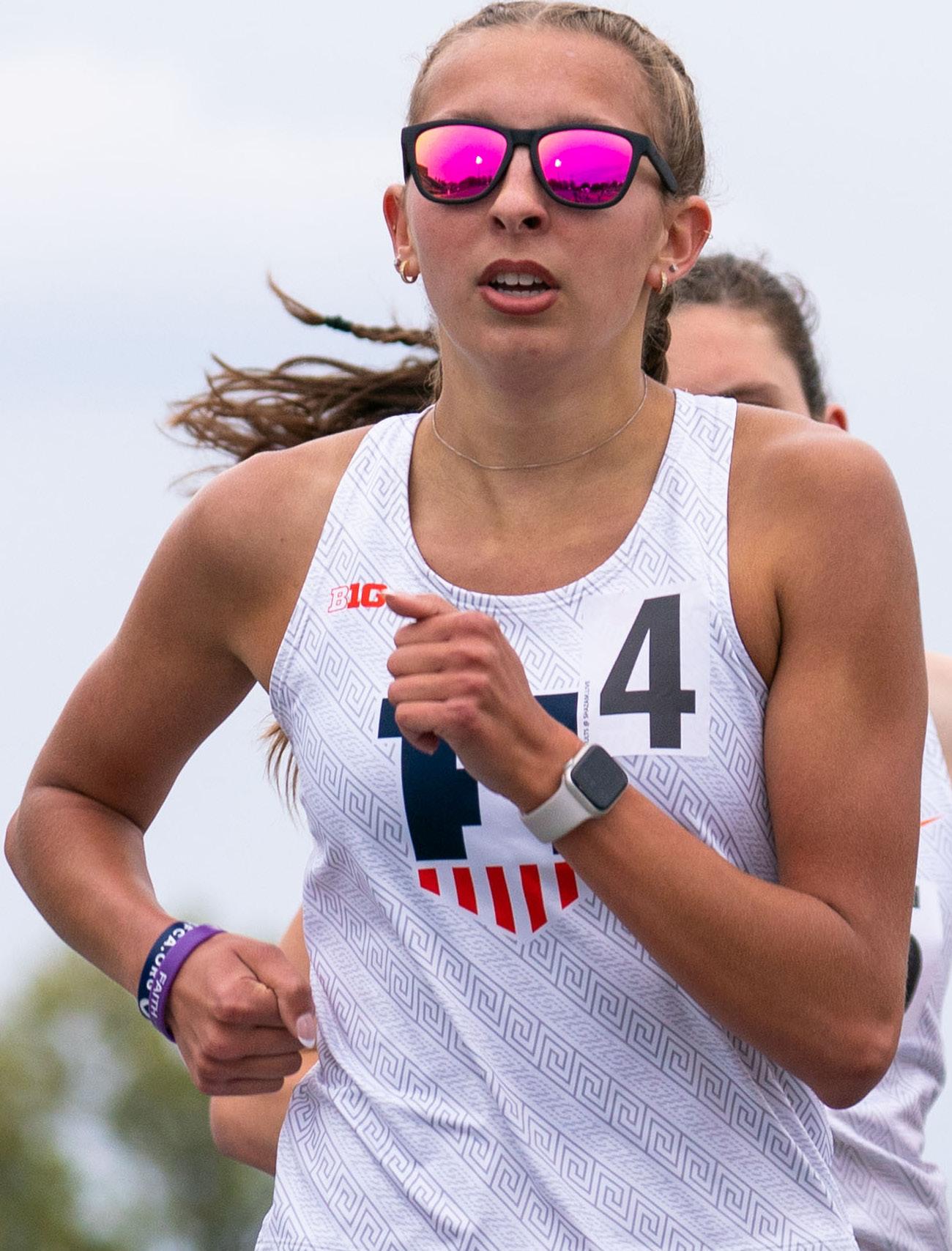
Mabry Bruhn, junior in ACES, spends most of her time on the track, where she runs long distance for the Illinois track & field team. Off the track, Bruhn can be found with friends and family or far south with some other campus stars: the cows.
As an animal sciences major, Bruhn interned with the Illinois Beef Experiential Learning and Industry Exposure Fellowship. There, she interacted directly with beef steer and researched how algae affect fermentation and gas production of the rumen, a part of a cow’s stomach that digests plant material.
As a student-athlete, though, Bruhn must balance her studies with her time on the track — a skill she first learned in high school.
Bruhn grew up in Monticello, Illinois, a 25-minute drive from Champaign. Having run long distance for Monticel lo High School, Bruhn said running for the Illini is a dream come true.
“It’s huge,” Bruhn said. “Growing up, following the happenings here at the University (and) being able to come and compete for a school at a high level that I grew up watching is so cool.”
As a member of the cross country, swim and golf teams in high school, Bruhn was a busy but successful stu dent-athlete. She finished first in the three-mile run at the 2022 Illinois High School Association Class 1A State Cross Country Championships.
Bruhn’s high school coach, David Remmert, described her as an in credible, competitive athlete and a kind-hearted, fun person.
“She’s the most talented runner I’ve ever coached,” Remmert said. “(She) was all about, ‘What can I do to make my teammates better?’ She adopted that mentality, and she be-
came a mentor for the other runners.”
To Bruhn, athletics come before academics, but she doesn’t neglect her studies. She prioritizes attending practices and reschedules meetings with professors when needed.
In addition to her athletic responsibilities, Bruhn said she appreciates spending time with her teammates and friends.
“We’re not just athletes,” Bruhn said. “We are real people. We have lives outside of athletics, and we enjoy doing a lot of the same things that most students do.”
Bruhn mentioned that she and her teammates attend $5 movie nights at the Savoy 16 + IMAX theater, have game nights and make crafts. The team recently made decorative keychains.
In high school, Bruhn had a creative venture: Bruhn started a flower business, MB Fresh Cut Flowers, for her Supervised Agricultural Experience through Future Farm-
added several new plots for the flowers to grow … I’ve thoroughly enjoyed the flowers and legacy that (Mabry Bruhn has) passed down to me.”
Flowers aren’t the only thing in bloom — the sisters’ relationship is, too.
Mylin Bruhn was one of the most influential factors in Mabry Bruhn’s decision to stay near home for college.
“I don’t have time to go home … super often, but I get to go, and I get to help (Mylin Bruhn) get ready for prom sometimes, or I’ll go help her with homecoming or just go say ‘Hey,’” Mabry Bruhn said.
According to Remmert, who coached the sisters in the same year, the two were very close. He said Mabry Bruhn often took on a mentorship role for Mylin Bruhn during practices.
For Mylin Bruhn, that mentorship has not stopped. She said she took Mabry Bruhn’s advice on where to attend university, too. Next year, Mylin Bruhn will join the University as a freshman while her sister will be a senior.
The sisters both shared their excitement for the upcoming year. Mylin Bruhn said she cannot wait to “grow a closer bond” with her sister while on the same campus. Mabry Bruhn agreed.
“I’m super pumped to have (Mylin Bruhn) around and show her campus and get to live my last year of school with her,” Mabry Bruhn said.
Junior Mabry Bruhn competes at the Gary Wieneke Memorial Meet in Urbana on May 2, 2025.
OF
MAYA BRITO
mpbrito2@dailyillini.com
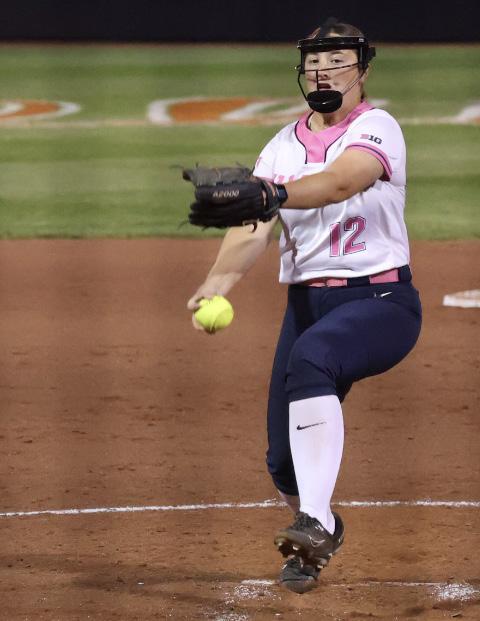
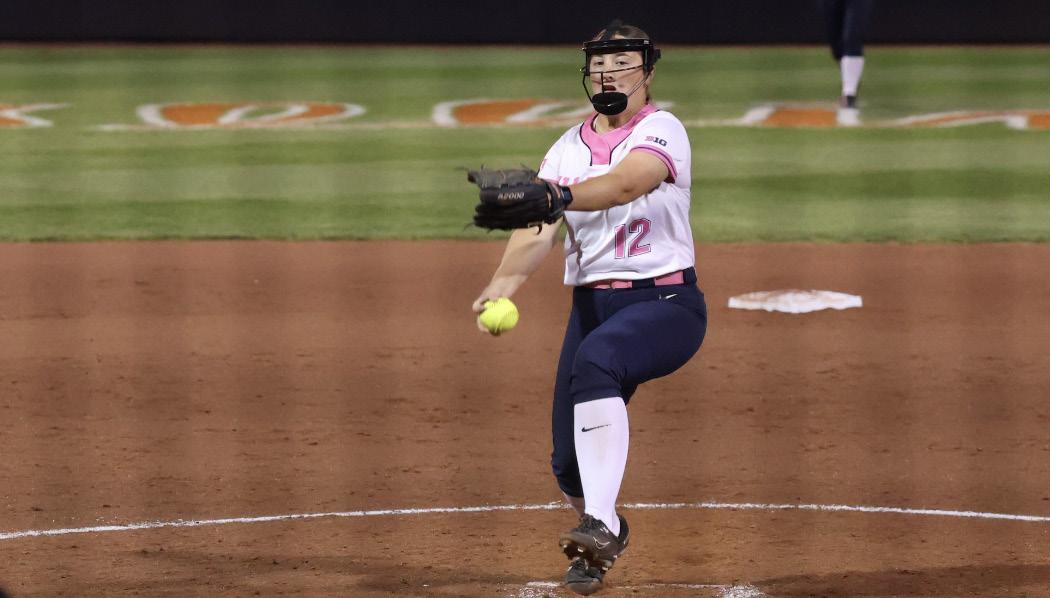
When senior right-handed pitcher Karley Yergler looks up into the stands at Eichelberger Field between innings, it reveals something personal for her. Not only does she see her family, but she also sees the faces of young, excited softball players.
These prospects aren’t just strangers; they’re familiar faces.
When Yergler isn’t in the circle, she gives softball lessons to local travel softball programs like the Champaign Dragons, Belltown Bombers and even Mahomet Matrix — the team her parents started.
“I don’t always realize how much they look up to me until I see them after my game, and they tell me they think I’m so cool,” Yergler said. “It’s cool that I know a lot of the girls that are coming to games and (have) a personal connection with them. It also means so much to me that I can be that influence for them.”
A decade ago, Yergler was one of those girls smiling in the stands, thinking the women representing the orange and blue were the coolest people on earth.
“I went to games for as long as I can remember,” Yergler said. “I just always looked up to those girls.”
Illinois softball always felt close to Yergler growing up. She sat in the stands often, attended the softball camps and even idolized players on the field, specifically former Illini Nicole Evans.
That childhood admiration turned into a full-circle moment during a recent alumni week. Yergler found herself faceto-face with Evans and confessed how much those days meant to her.
“It’s just so weird to think that now I’m that girl that girls are coming (to see) and watching the games, and they look up to me,” Yergler said. “It’s so crazy to think about. Time goes so fast.”
Yergler’s journey to Big Ten softball isn’t one of an average Division I player. It’s a local tale: Mahomet-Seymour High School to Parkland College to the University, just 14 miles from her hometown.
Her path was paved by the loyalty of her past teams, relationships with her family and a community that raised her — a program she loved before she put on the jersey.
“Champaign was just home, and that feeling never changed,” Yergler said.
Yergler fell in love with the game of softball at a young age. Her story started when she watched her older sister, Kourteney Shoemaker, pitch at Mahomet-Seymour. Yergler said she looked up to her sister and asked for pitching lessons. That’s when she knew she wanted to play softball.
Even at a young age, Yergler’s mom, Becky Yergler, saw her determination. She recalled watching her daughter jump into hitting drills with the older
culture, similar to what we have here at Illinois,” Karley Yergler said. “My love for softball continued to grow because of all of the support I received from the people in Mahomet.”
Karley Yergler chose the junior college route after graduation. She stayed close to home and played at Parkland under former coaches Kristi Paulson and Dan Paulson, longtime coaches from her travel team, Premier Fastpitch. Those two years were crucial to the growth of Karley Yergler’s softball career.
“There’s so much failure in softball, and, honestly, failure was really hard for me growing up,” Karley Yergler said. “At Parkland, I started to really learn how to handle failure in my sport.”
While Karley Yergler was dominating in her All-American seasons at Parkland, Illinois head coach Tyra Perry was watching. The Illini reached out to Yergler during her first JUCO season. As the conversation continued, Yergler said she realized she wasn’t
The love I have for others ... has really grown from just being from the Mahomet and Champaign area. That’s definitely a big part of why I am who I am today.
Karley Yergler, Illinois softball player
girls, a driven young player who took that persistence into her softball career.
“Karley has always been a go-getter,” Becky Yergler said. “She has always pushed herself.”
When it was finally her turn to attend high school, Karley Yergler said she felt the love from the sports community. There was a very strong sense of support, whether that be from athletes, friends or parents.
“The culture that we have in Mahomet sports is just like a family
quite ready to cut her time short as a Cobra; she loved her team too much.
Illinois remained patient. When assistant coach Kirsten Verdun joined the coaching staff in 2023 and called Karley Yergler, everything fell into place. The moment the two got on that phone call, they clicked instantly and built a strong relationship based on constant communication.
“I just remember that phone call felt so right,” Karley Yergler said. “Conversation was easy, and I could tell that I could
have a strong relationship with her as my pitching coach.”
The decision to commit to the University came after Karley Yergler and her mom, who never missed a visit, were walking out of the final recruitment tour to a different school.
“We walked out of that visit, and she said to me, ‘Looks like University of Illinois,’ and I was like, ‘Yes,’” Becky Yergler said. “So I was super excited.”
When Karley Yergler debuted as an Illini, she said the adjustment was difficult. As a pitcher, she said it was harder to face batters, each of them playing at an elite Division I level. However, the familiarity of the Champaign-Urbana community eased the transition.
“Being embraced by the Champaign-Urbana community is easy for Karley because she’s home,” Perry said. “Karley is a top-notch person of great character. She’s a highly competitive person, pitcher (and) player. She works all the time; she has a great work ethic.”
That work ethic has made Karley Yergler a leader in the Illini pitching rotation; she holds the best ERA. But according to Karley Yergler, the stats are secondary to
the relationships she has built with her team members.
She has taken on a leadership role among not only the pitchers, but the younger Illini. Karley Yergler has made it a point to take two JUCO transfers, one of them being a pitcher, under her wing this season. She said she wants to help them navigate the same adjustment she faced a year ago.
“I definitely try to help them out with having similar experiences,” Karley Yergler said. “Knowing where they’re coming from, how different it can be and the adjustments that you make. So I definitely try my best to be that leader for all those girls.”
For Karley Yergler, staying local wasn’t just about softball; it was about being present for the moments that matter most. She wanted to watch her nieces grow up and stay close to her sisters. Her family keeps her grounded, giving her the support she needs throughout her softball career.
As Karley Yergler’s time at the University comes to a close this spring, the interdisciplinary health sciences major is looking to attend graduate school, likely
at Logan University in Chesterfield, Missouri, to become a chiropractor. She might finally leave the 217 area for the first time in her life, but she carries the lessons from her family and her community with her.
“The love I have for others and the support I have for others has really grown from just being from the Mahomet and Champaign area,” Karley Yergler said. “That’s definitely a big part of why I am who I am today.”
As she finishes her senior year, Karley Yergler has learned that the stands at Eichelberger Field hold more than spectators. She’s reminded of her support system and the young athletes who may one day follow her path. She is now the girl on the field she once idolized many years ago.
Her mom recalls a comment from one of her former high school coaches that sums up her legacy in the community better than any stat could.
“One of her coaches said to me, ‘Karley’s probably one of the best softball players I have ever seen at Mahomet, but she’s an even better human being,’” Becky Yergler said.
SENIOR COLUMNIST
RAPHAEL RANOLA rrano2@dailyillini.com
Irelish the fact that I’m a product of Illinois public schooling. My education has been built almost entirely in institutions meant to serve the public. That’s what a land-grant university like ours is supposed to do: provide accessible education and the opportunity that comes with it. But I’m not the bright-eyed freshman I once was.
The University was one of 37 public land-grant institutions created under the Morrill Land-Grant Colleges Act of 1862. This granted states federal land that could be sold to fund colleges focused on practical, industrial education, with the broader goal of expanding higher education to be in the service of the public.
Their origins are bleak. Research by Robert Lee and Tristan Ahtone documented how land-grant universities were financed from roughly 10.7 million acres taken from nearly 250 Indigenous tribes through violence-backed land cessions. By design, the University’s continued existence relies on its ability to remain a durable institution — at all costs. It has never formally reckoned its bloody inheritance.
The state of the land-grant mission is tenuous in 2026; if that language means anything today, the University must be answerable to the public it claims to benefit. Does the University truly act as a steward of the public good, and does it see its inheritance — built on land forcibly taken from Indigenous communities — as a binding public obligation?
You don’t have to look very hard to see how that contradiction plays out here. You see it in the students organizing for a free Palestine, in the renewed demands to reckon with the Indigenous land the University was built upon and in the yearslong push for fossil-fuel divestment. Campus activism here is sprawling.
The problem isn’t that the University has no civic mission. The problem is more specific: The University has learned to absorb activism without being changed by it.
The analogy I’ve come to resonate with is this: Our campus is a sandbox for civic life. Students can petition, rally and pass resolutions to their heart’s content. Civic engagement is encouraged, only insofar as it can be made compatible with the institution’s own interests. In truth, activism is a great source of students’ skills development and, better yet, branding as a socially conscious campus.
The University is comfortable letting students name injustice. It’s far less comfortable when those demands threaten to bind the institution itself. I spent half my undergraduate career fighting for fossil-fuel divestment, and it gave me a front-row seat to how all of this works in practice.
Divestment targets endowments — the money that prolongs universities’ durability. They sit where student demands become materially real, asking the University to put its money where its mission is. That is precisely why it has always felt “too real” to be a serious option.
The University welcomes activism so long as it remains educational and, more importantly, manageable. What it resists is the moment activism becomes a claim on institutional power. It prefers activism as pedagogy, not governance.
I can acknowledge that universities do have real constraints that often bind their hands. But a land-grant institution should be more than a venue for public argument; it should be an institution meaningfully answerable to it.
A land-grant school should be one of the places where the public good is actually contested, negotiated and made real. If the University still wants to claim the land-grant tradition in 2026 — a tradition built on land that was never truly public — it has to decide whether its mission is merely to produce civically literate graduates or to be a public institution genuinely willing to answer to them.
I do not know what a public university that genuinely answers to its public looks like. I did not find it here. To thy happy children of the future, those of the past send greetings.
Raphael is a senior in ACES; he’s built quite a sandcastle with his time here. An aerial view shows cars and pedestrians traversing the intersection of Green and Sixth streets in Champaign on Sept. 2, 2024.