
1001 S. Wright St., Champaign, IL 61820 || 217-337-8300
The Daily Illini is the independent student newspaper at the University of Illinois UrbanaChampaign. The newspaper is published by the Illini Media Company. The Daily Illini does not necessarily represent, in whole or in part, the views of the University of Illinois’ administration, faculty, staff or students.
All Illini Media Company and The Daily Illini’s articles, photos and graphics are the property of Illini Media Company and may not be reproduced or published without written permission from the publisher.
Visit us in the basement of the University YMCA at 1001 S. Wright St. from 9 a.m. to 5 p.m., Monday through Friday.
Front Desk: 217-337-8300
Advertising: 217-337-8382
Newsroom: 217-337-8345
Reporting: If you have a question about a story or notice an error, email our Managing Editor at reporting@dailyillini.com
Visuals: For questions about photos, graphics or The DI’s social media, email our Visual Director at visuals@dailyillini.com
Employment: The DI’s sta are current students at the University of Illinois. Visit dailyillini.com/applyto-the-di/ to learn more about our hiring process.
Tips: To submit a tip, email our News Editor at news@dailyillini.com or submit a con dential tip online at dailyillini.com/contact/
Corrections: When we make a mistake, we will acknowledge it with a correction. We strive for accuracy, so if you notice an error, please email our Editorin-Chief, Chloe Barbarise, at editor@dailyillini.com
Letters to the editor: Letters are limited to 800 words. Contributions must include the author’s name, address and phone number. University students must include their year in school and college. The DI reserves the right to edit or reject any contributions. To submit a letter, email opinions@dailyillini.com with the subject line: “Letter to the Editor.”
Placing an ad: If you would like to place an ad in our next print edition or on our website, call our advertising department at 217-337-8382 or email advertise@illinimedia.com
EDITOR-IN-CHIEF
Editor-in-Chief: Chloe Barbarise editor@dailyillini.com
Managing Editor: Annisyn Krebs-Carr reporting@dailyillini.com
Visual Director: Rikkie Gunawan visuals@dailyillini.com
Special Sections Editor: Anna Ceja specialsections@dailyillini.com
News Editor: Avery Paterson news@dailyillini.com
Arts & Entertainment Editor: Olivia Dvorak entertainment@dailyillini.com
Sports Editor: Evy York sports@dailyillini.com
Copy Chief: Amartya Nalluri copy@dailyillini.com
Photo Editor: Sam Rink photo@dailyillini.com
Graphics Editor: Anjali Wadhwa graphics@dailyillini.com
Design Editor: Shannon Moser design@dailyillini.com
Audience Director: Maja Nawrocka social@dailyillini.com
Video Director: Josh Fine video@dailyillini.com


Follow on Instagram @thedailyillini | @thedailyillinisports
Follow on Facebook @thedailyillini
Follow on X
@TheDailyIllini | @DI_Sports
Follow on TikTok @thedailyillini
If you’re a new student, then this Daily Illini edition has landed in the right hands. After all, we made it just for you!
Welcome to the University — it’s a place you’ll soon refer to as “home” or maybe something closer to “home away from home.” Either way, you’ll eventually learn what it means to you, and the orange and blue will make their mark on you past your stay here.
The vast expanse that is our campus can be an intimidating sight to conquer, but you should know you’re not alone in this experience. The DI staff were once first-year students; there are plenty of others just like you in the same boat.
It’s why you’re now a recipient of the New Student Edition, which
The DI mails annually to first-year students to supply them with indispensable information. First bit of advice: Get to know The DI, the University’s independent student newspaper, for all community and on-campus news.
In this edition, you’ll discover how to maintain involvement by exploring registered student organizations on page 5 or by attending Illini Union events on page 15.
Interested in athletics? You’ll find the top Fall 2026 storylines to watch for on pages 34 and 35. Or if you want to prepare yourself for the upcoming football season, you can read about two pillars of the team on page 37.
Arriving at the University is the first part, but making this world into your own is another. One day, it won’t be all that scary. And that one day for you will come soon.
Good luck, Illini!
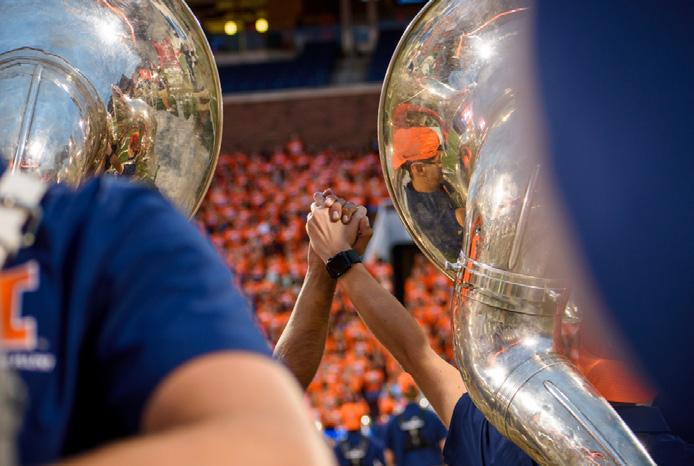
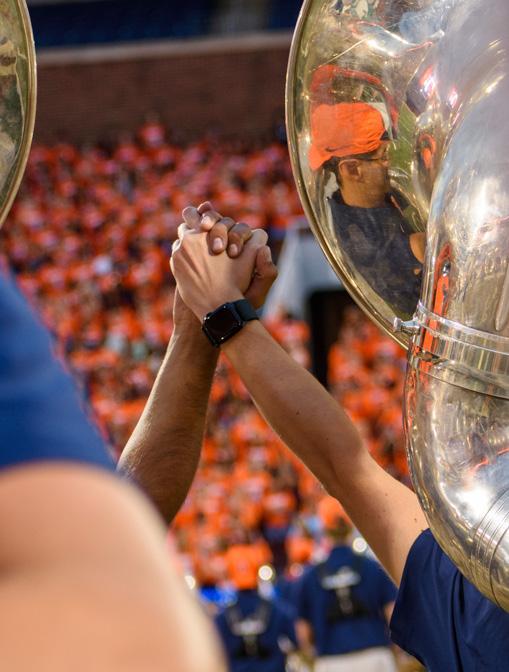
Two sousaphone players hold hands at the end of the Marching Illini’s performance of “Patriotic Medley” during Illinois Sights & Sounds on Aug. 21, 2025, at Gies Memorial Stadium. Sights & Sounds is one of several major events during the University’s Welcome Week.
1001 S. Wright St., Champaign, IL 61820 || 217-337-8300
The Daily Illini is the independent student newspaper at the University of Illinois UrbanaChampaign. The newspaper is published by the Illini Media Company. The Daily Illini does not necessarily represent, in whole or in part, the views of the University of Illinois’ administration, faculty, staff or students.
All Illini Media Company and The Daily Illini’s articles, photos and graphics are the property of Illini Media Company and may not be reproduced or published without written permission from the publisher.
Visit us in the basement of the University YMCA at 1001 S. Wright St. from 9 a.m. to 5 p.m., Monday through Friday.
Front Desk: 217-337-8300
Advertising: 217-337-8382
Newsroom: 217-337-8345
Reporting: If you have a question about a story or notice an error, email our Managing Editor at reporting@dailyillini.com
Visuals: For questions about photos, graphics or The DI’s social media, email our Visual Director at visuals@dailyillini.com
Employment: The DI’s sta are current students at the University of Illinois. Visit dailyillini.com/applyto-the-di/ to learn more about our hiring process.
Tips: To submit a tip, email our News Editor at news@dailyillini.com or submit a con dential tip online at dailyillini.com/contact/
Corrections: When we make a mistake, we will acknowledge it with a correction. We strive for accuracy, so if you notice an error, please email our Editorin-Chief, Chloe Barbarise, at editor@dailyillini.com
Letters to the editor: Letters are limited to 800 words. Contributions must include the author’s name, address and phone number. University students must include their year in school and college. The DI reserves the right to edit or reject any contributions. To submit a letter, email opinions@dailyillini.com with the subject line: “Letter to the Editor.”
Placing an ad: If you would like to place an ad in our next print edition or on our website, call our advertising department at 217-337-8382 or email advertise@illinimedia.com
EDITOR-IN-CHIEF
Editor-in-Chief: Chloe Barbarise editor@dailyillini.com
Managing Editor: Annisyn Krebs-Carr reporting@dailyillini.com
Visual Director: Rikkie Gunawan visuals@dailyillini.com
Special Sections Editor: Anna Ceja specialsections@dailyillini.com
News Editor: Avery Paterson news@dailyillini.com
Arts & Entertainment Editor: Olivia Dvorak entertainment@dailyillini.com
Sports Editor: Evy York sports@dailyillini.com
Copy Chief: Amartya Nalluri copy@dailyillini.com
Photo Editor: Sam Rink photo@dailyillini.com
Graphics Editor: Anjali Wadhwa graphics@dailyillini.com
Design Editor: Shannon Moser design@dailyillini.com
Audience Director: Maja Nawrocka social@dailyillini.com
Video Director: Josh Fine video@dailyillini.com
Follow on Instagram @thedailyillini | @thedailyillinisports
Follow on Facebook @thedailyillini
Follow on X
@TheDailyIllini | @DI_Sports
Follow on TikTok @thedailyillini
If you’re a new student, then this Daily Illini edition has landed in the right hands. After all, we made it just for you!
Welcome to the University — it’s a place you’ll soon refer to as “home” or maybe something closer to “home away from home.” Either way, you’ll eventually learn what it means to you, and the orange and blue will make their mark on you past your stay here.
The vast expanse that is our campus can be an intimidating sight to conquer, but you should know you’re not alone in this experience. The DI staff were once first-year students; there are plenty of others just like you in the same boat.
It’s why you’re now a recipient of the New Student Edition, which
The DI mails annually to first-year students to supply them with indispensable information. First bit of advice: Get to know The DI, the University’s independent student newspaper, for all community and on-campus news.
In this edition, you’ll discover how to maintain involvement by exploring registered student organizations on page 5 or by attending Illini Union events on page 15.
Interested in athletics? You’ll find the top Fall 2026 storylines to watch for on pages 34 and 35. Or if you want to prepare yourself for the upcoming football season, you can read about two pillars of the team on page 37.
Arriving at the University is the first part, but making this world into your own is another. One day, it won’t be all that scary. And that one day for you will come soon.
Good luck, Illini!
Two sousaphone players hold hands at the end of the Marching Illini’s performance of “Patriotic Medley” during Illinois Sights & Sounds on Aug. 21, 2025, at Gies Memorial Stadium. Sights & Sounds is one of several major events during the University’s Welcome Week.



DESIGNERS
Rikkie Gunawan
Shannon Moser
Discovering your niche: How students found their place at UI
RSOs define campus culture
Orientation leaders facilitate first-year events, offer advice
KCPA opens its doors to incoming Illini
Residence halls shape college life at UI
Campus 101: Free resources UI students should know
Illini Union events to go to throughout the year
The Undergraduate Research Symposium: A stepping stone to research
Financial security and free time: Can freshmen have both?
4 Illini sports storylines to watch this fall
‘It’s up to us’: Matthew Bailey, Xavier Scott step up amid new-look team
No place like home: Previewing Illinois football’s 2026 home schedule
Opinion | Should you really say ‘yes’ to everything?
Opinion |On college advice: Tread lightly
SUMMER EDITOR
KELSEY HOEVEL khoev2@dailyillini.com
At a university with over 60,000 students, guring out how you t into it all may feel daunting. That’s why these students shared their sto ries about how they found their place.


Sahil Sangani is a senior in LAS. As a rst-generation college student, he left his home country of India at 15 and came to the United States at 20 to attend the University. Three years later, he’s found a home in Illinois through his passion: data science.
When Sangani was rst accepted to the University, he wanted aerospace engineering, but his parents thought computer science would be a more practical choice. Unsure of what to do, he registered as un declared so he could take time to things out.
take his parents’ advice by majoring in mathemat ics with a minor in computer science. However, when he started taking com puter science classes, he quickly realized he wanted to pursue a dif ferent

about how to come up with good programs, but I didn’t enjoy writing code, and I didn’t want to do a job that was
just sitting at a computer,” Sangani said.
Later, Sangani joined his sister at her Society of Women Engineers conference, where he learned that data science is a newer, more business-oriented eld and less coding-based than computer science. It met all his desires.
Since the University doesn’t o er a data science major, Sangani switched from mathematics to statistics with a concentration in data science. He also joined the Illinois Data Science Club.
“As my school got more busy, I just stopped going to all the clubs, but Data Sci ence Club was much more relaxed, and I had time to socialize and work on projects at the same time, so there was something good,” Sangani said.
Members of the club go through an educational period of about 7-8 weeks be fore participating in an eight-week “hack athon,” during which teams decide what project to work on. The top three teams earn prize money, but all competitors use the hackathons to learn data and presentation skills, network and expand their resumes. Sangani enjoys the Illinois Data Science Club not only for the educational aspect but also for building team-
is what I want to do for sure,” Sangani said. “Everyone was very welcoming.”

Adeline Tse, sophomore in Engineering, created a jewelry store called Suki Jewels alongside her business partner, Isabel Yu, junior in Business. It all started when the two had a high school summer class together and decided to make beaded jewelry while the teacher played documentaries.
They named the store Suki Jewels because “suki” means “to be loved” in Japa-


“It was really great, and when I met all the people there and started working on projects and everything, that’s when I realized that this
Tse said the two made a name for themselves by selling their jewelry at markets, including the University’s Taiwanese American Students Club Night Market. Now, customers can place orders through the Google Form on their website or
Tse designs the company’s logos and jewelry photos and manages the nances. Yu, a marketing major, handles advertising and creating content for social media platforms. These include their TikTok page (@sukijewels) and their Instagram page (@suki.jewels).
“There’s a lot of research and design aspect that goes into it; that kind of leads to my major and why I decided on mechanical engineering,” Tse said. “There’s just so much choice in doing Suki Jewels and being your own business owner.”
These students represent the many possibilities that await you at Illinois. To nd your niche, learn from their experi ences: take the time ment with di or new interests and look for people with similar ones. You just might discover who you really are.

SENIOR ARTS & ENTERTAINMENT REPORTER
SONALI KHANNA sonalik4@dailyillini.com
Aregistered student organization is more than just a tidbit for students to add to their resumes — it can serve as a creative outlet, a professional network, a community of support and so much more.
The di erence is in what a student makes of it. With over 1,200 RSOs to choose from, the University o ers a chance at connection through a multitude of subject matters and niches.
For Julia Olson, cofounder of Film Score Orchestra and senior in FAA, her path to belonging came through music. Playing lm scores together is part of the club’s core, but it o ers much beyond that.
“The day-to-day of being in the group, too, has been a great way to get to know people from different sides of campus through a common interest, and we’ve also done a couple fun socials,” Olson said.
Through movie nights or board games, the social life of clubs like FSO extends far beyond the designated meeting times, according to Olson.
The social draw to an RSO need not only be artistic — it can also be professional. Joining a club related to a student’s major can build experience in associated elds and network with peers in similar areas of study.
The American Society of Mechanical Engineers is an RSO that provides its members with professional exposure through cooperative, hands-on engineering projects.
Sarina Shah, director of the sustainability committee for ASME and junior in Engineering, said the club has spent the past year working on multiple large-scale projects. One of her favorites came from Fall 2025, focused on recapturing heat emitted by data centers and new artificial intelligence systems.
The team proposed working on an idea to turn excess heat back into usable heat energy. Shah said their project
placed second at Reimagine Our Future, a competition focused on sustainable engineering solutions.
“(The best part of ASME has been) just getting to see all the cool projects come to life, because a lot of it is ideas that just come about by all the students,” Shah said. “So they’re really excited to build their project and make things that you necessarily wouldn’t think of. Maybe they’re not as practical; they’re really cool to see.”
RSOs can also provide students a platform for political expression, like Illini Democrats. According to Rylee Graves, communications director of Illini Democrats and junior in LAS, members have canvassed for governors, gone knocking door to door for nominated candidates and volunteered for important causes.
Graves said she’s seen students become more invested and immersed in local politics by taking part in the RSO.
“Getting involved in local, statewide, national politics is the best way for the younger generation to … have our voices heard, and especially when we can contribute to meaningful conversations
with candidates to give our feedback to them,” Graves said.
Although many clubs aim to help students improve professionally, some RSOs exist just to help students relax and promote self-care. These are often low-commitment and can be an avenue to form long-lasting connections.
Everett Obler, vice president of the Combating Screentime Club and junior in Business, said the club is an accessible way to hang out with others on campus while reducing one’s dependence on technology.
“Our goal is to get outside and talk to people — that’s kind of how we want our meetings to go,” Obler said. “As long as the weather is good, we’ll go outside, and we’ll do something, like we’ll play spike ball or do chalk or something else.”
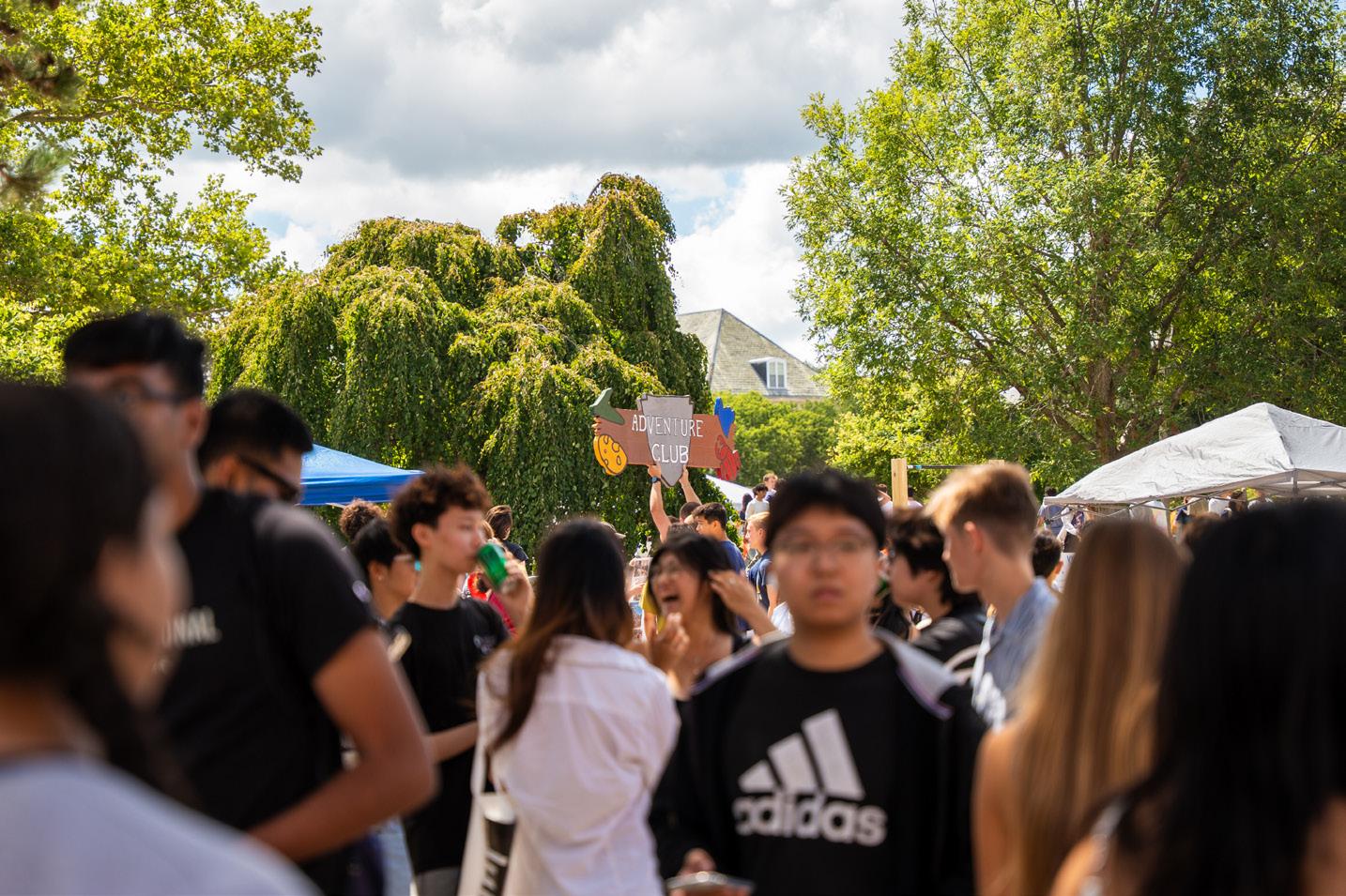
There is no shortage of RSOs at the University, and Quad Day is an opportune time to start looking for which ones may be a good fit. This year, Quad Day will be Aug. 23 from noon to 4 p.m. Getting involved can be a way to achieve personal goals like socialization, artistic expression, professional development, self-improvement and more.

EDITOR-IN-CHIEF
CHLOE BARBARISE
chloeb4@dailyillini.com
Victor Seyfritz, now-sophomore in Engineering, ventured to a career fair at the Illini Union during Spring 2026 in search of a job for the summer. He came across the New Student & Family Experiences booth, where he discovered the orientation leader position o ered by the o ce.
Seyfritz said it piqued his interest immediately, and he soon lled out the application, interviewed for the role and landed the job.
OLs handle various duties throughout the summer and fall, like assisting with New Student Registration, Welcome Week and International Student Orientation. Smaller tasks that comprise these events include preparation, check-in and set-up. OLs also act as a resource for rst-year students and families, whether by answering questions or leading class-scheduling tours, according to Seyfritz.
Despite initial self-doubt regarding his youthful experience, Seyfritz said his primary mission now is to ensure rst-year students have an “exciting and comfortable” start to college.
“I know what the general doubts are; I know what the general questions are, so I can answer them easily,” Seyfritz said. “Having nished the freshman year, just like a year ago … I understand ( rst-year students) because, getting into college, especially to U of I, it’s a very, very big school.”
Joey Kallal, senior in Engineering, became an OL after being encouraged by Gretchen Forman, now-director of NSFE. Forman was Kallal’s adviser for the Grainger First-Year Experience Global Sustainability Scholars program.
Kallal said he helped facilitate his rst Welcome Week as an OL during his sophomore year and has stuck with it since. He said it’s easy to want to work
for Forman, whom he described as “a very charismatic individual.”
Welcome Week consists of a multitude of activities, including Illinois Sights & Sounds and Quad Day. Sights & Sounds gathers the new students at Gies Memorial Stadium, where they’ll receive a matching T-shirt, learn the chants and dances and squeeze together for a Block I photo on the eld. At Quad Day, rst-year students can interact with the diverse RSOs that populate campus.
Attending opportunities like these is what Kallal advocates for. He said that students should push themselves out of their comfort zone to nd their small community in the big University community.
“It’s been a lesson to me that I should have gone out and done more stu like this freshman year,” Kallal said. “People come up to orientation leaders all the time, and they’re like, ‘Oh, I’ve met my best friends at this event.’
“I’ve loved seeing that happen for other people … and I’m glad that I get to kind of live that experience and not have that missed opportunity because I’m able to bond with the other orientation leaders doing these things.”
Seyfritz advises similarly. As an international student from Paris, Seyfritz said he wouldn’t allow himself to hunker down in his room — it’s one of the worst things to do.
“Yes, it can feel overwhelming,” Seyfritz said. “I went to the U.S. to meet new people, to connect with new people, to have some friends there. I met a lot of my friends during Welcome Week or the few days after Welcome Week, and it was a great experience … It was a way for me to get acclimated to college and to get used to campus.”
Students gain independence upon entering college, Seyfritz said, and they should use it to their advantage by asking for help early on and utilizing resources like Welcome Week wisely. Even if students decide to miss out on the abundance of activities during the week, there’s always the option to recapture those rst-year experiences the way Kallal did: by joining the team of OLs. If interested, students can find the application form on NSFE’s website when it opens and direct any questions or concerns to Forman at gforman@illinois.edu.

ARTS & ENTERTAINMENT EDITOR
OLIVIA DVORAK odvor2@dailyillini.com
Students don’t have to leave campus to !nd the nation’s premier university-based performing arts center. If you’re new to Champaign-Urbana, you’ll want to learn how to navigate it.
Since opening in 1969, the Krannert Center for the Performing Arts has served as a global hub for world-class performances, local musicians and student productions. From September through May, its 2026-27 performance season will bring together music, theater, dance and other cultural events from around the world.
“We like to think that we are the hub for all types of di erent performing arts: dance theater, music, all of that,” said Sean Kutzko, assistant communications director at KCPA. “We want to make sure that we bring in the best entertainment that we can in all of those areas, as well as perform a mission of education.”
Whether introducing audiences to unfamiliar art forms or giving University students a professional stage, Kutzko said KCPA wants to make performing arts accessible without requiring a trip to a major city.
The 57th performance season begins with a free Opening Night Party on Sept. 3. Titled “Celebrate Community!,” the event will !ll the lobby with food and drinks, along with special performances from an assortment of musicians.
According to an email from Mike Ross, director of KCPA, the event is designed to immerse new students in the C-U community while celebrating its diversity.
Throughout the school year, audiences can expect a wide variety of events. Kutzko said this season’s biggest attractions include Tony and Grammy Award-winning actress Audra McDonald on May 4, “Hamilton” star Renée Elise Goldsberry on March 25 and
Japanese taiko drumming ensemble KODO on March 2.
Kutzko said another highly anticipated act is “ONE PIECE” Music Symphony on Sept. 26. The Champaign-Urbana Symphony Orchestra will play music from the popular anime series while featuring clips from the show.
Other season highlights include the Chicago Symphony Orchestra and the annual PYGMALION Festival in September.
KCPA’s venues help accommodate every type of performance. Foellinger Great Hall typically hosts large orchestral concerts, while the Tryon Festival Theatre welcomes operas, ballets and smaller contemporary performances. The Colwell Playhouse serves as the primary home for Illinois Theatre, Dance at Illinois and other University arts programs. The Studio Theatre provides a $exible space for more intimate performances.
Aside from those, students can catch free performances through the Uncorked series at Stage 5 in the lobby or enjoy select outdoor events in the Amphitheatre. One of KCPA’s biggest perks for students is a ordability. Most performances are available to University students for just $10.
“The $10 ticket price for events like these is hard to beat anywhere, but far beyond that, the opportunity to explore the world and share moments of inspiration and hope and joy with others by coming together at Krannert Center is, in my view, the big one,” Ross wrote in an email to The Daily Illini.
Students interested in getting more involved beyond just attending events can also join the Krannert Center Student Association. Members can volunteer as ushers to see performances for free, attend behind-the-scenes tours and have guest presentations from performers. Students can also provide feedback through the Krannert Center Student Advisory Committee.
“KCSA is open to all UI students, and is a great way to get connected to all things Krannert Center,” wrote Emily Laugesen, director of community engagement at KCPA, in an email.
Kutzko said he encourages incoming students to take advantage of the discounted tickets and step outside their comfort zones. After all, college is the perfect time to try something new.
“I can’t tell you how many di erent experiences I’ve had, musically and nonmusically, where I just decided to give something a shot because it sounded interesting to me and I didn’t know anything about it,” Kutzko said. “Being curious and taking a chance on experiences can lead to some very unexpected bene!ts in your life.”


COPY EDITOR
SARAH JACOBSON sarahej5@dailyillini.com
Residence halls at the University offer more than just a place to sleep. From latenight study spaces to bonding with roommates, residence halls often shape the friendships and routines that students carry through their first years of college.
According to University Housing policy, all first-year students at the University are required to live in campus housing. There are some exceptions to this policy, one of which is undergraduates who have reached the age of 21 by Aug. 15 of the first term in which they are registered for classes. Another case where the policy doesn’t apply is if the undergraduate is living with a parent or legal guardian within 40 miles of the campus.
One benefit of campus living that students point out is the physical layout of the residence halls. Nurarfah Mohamed Ibrahim, junior in AHS, lived in FAR during her freshman year and said that having essential spaces helped with adjusting to the college experience.
lived in Busey-Evans Halls during his freshman year and said the building was a place for him and his friends to spend time together.
“It definitely helped me become closer with the friends I already had,” Bottcher said.
Bottcher described Busey-Evans’ study lounge and recreation room as easy, convenient places to meet up. He also mentioned the Espresso Royale across the street, where he would go with his friends to study. Although there was no dining hall in Busey-Evans, Bottcher said he appreciated that it encouraged him
Rylinn Harvey, junior in Education, spent her sophomore year working as a resident adviser at Bromley Hall. She said the most memorable part of the job was the relationships she formed with the other RAs and the residents.
“My residents became my best friends ever,” Harvey said.
Harvey organized monthly events at Bromley, which often included food, movies and group activities. She has hosted building-wide events like gingerbread decorating and flowerpot painting. She said these events helped residents feel comfortable spending time together and made the building feel lively.
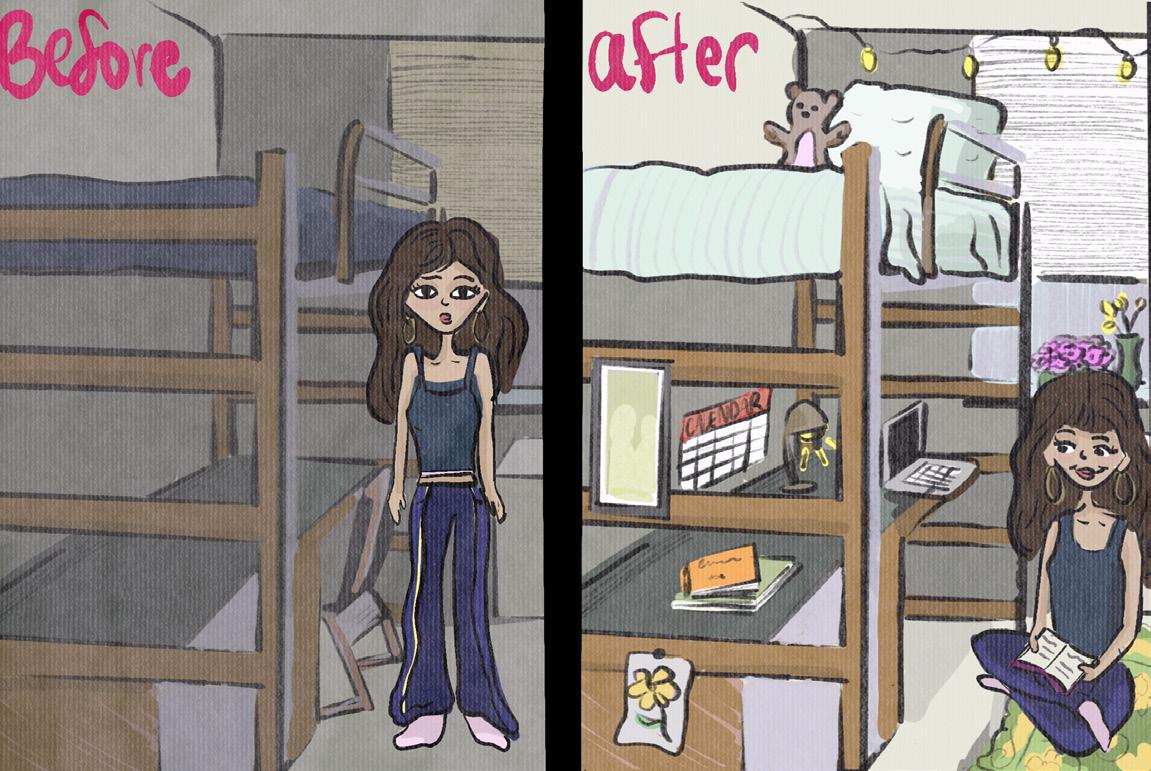
to get out of the building and maintain a routine, especially during the winter.
“Our dining hall was literally right across the street,” Ibrahim said, referring to the PAR dining hall. “It was in the perfect location.”
Ibrahim explained how the proximity of the facilities helped her settle into a routine and how her room’s location near common areas made daily tasks feel more manageable.
Experiences in other residence halls reflect that same sentiment. Brock Bottcher, junior in ACES,
According to Ibrahim, FAR’s basement was also a regular gathering place. It includes a study area, fitness room and dance and game room, and she said these spaces played a major role in her social life.
“Me and my friends would always be there — that was our go-to spot freshman year,” Ibrahim said.
Ibrahim said the lounge area in FAR was a great place to unwind after classes, whether to study, hang out or take a break from her room.
Other students experienced dorm life through leadership roles.
When asked what advice they would give to incoming freshmen who will live in the residence halls soon, all three students emphasized the value of putting in effort to get to know others in their respective spaces.
“I would say just be friendly,” Bottcher said. “Something that I do wish is that I made more of an e ort to be friends with the people I lived with.”
Harvey offered similar guidance. She encouraged students to introduce themselves widely during the first week of classes, stay open to new experiences and say “yes” when someone invites them to do something. She said being willing to talk to people made the transition easier.
For Ibriham, the biggest takeaway was giving the dorms a chance.
“It can be a scary experience at first, but give it a shot,” Ibriham said. “You have nothing to lose, and you don’t know if it will be the best experience of your life.”
STAFF WRITER
BLAKE NOBLE benoble2@dailyillini.com
Your time at the University is about more than earning a degree. It’s an opportunity to explore interests, build skills and take advantage of campus life, with many supportive services included in student fees.
Whether you need academic assistance, career planning, legal guidance or even a gaming console on short notice, there are a variety of resources available. You just need to know where to nd them.
The Je ries Center is the main hub for academic support on campus. Whether you need advising, tutoring, quiet study spaces or help connecting to other campus resources, it’s designed to meet you where you are and help plan your next step forward.
Vice Chancellor for Student A airs Domonic Cobb encourages students to seek help early rather than struggle alone.
“Don’t sit in silence,” Cobb said. “Always ask questions. You’ll nd this institution will rise up to meet you.”
The Career Center can also help make sense of your next steps — whether that’s next semester, next year or postgraduation. You might walk in for a resume review, sign up for a workshop, book
a career coaching appointment or just drop in with a quick question.
James Castree, senior assistant director of career education and outreach, recommends that students not only view The Career Center exclusively through the lens of securing internships or full-time employment but also for exploration.
“Maybe I am picking a major for the rst time, thinking of switching majors,” Castree said. “Maybe I love my major, but I’m not sure what I can do with it. You know, all of those are things that our coaches help with.”
There are also plenty of ways to nd community outside the classroom. The cultural centers host orientation programs, open houses and social events open to all students.
During the rst week of class, you’ll see signature annual events like the Paleta Social, the Welcome B(l)ack BBQ, Asiantation and We Are Dye-ing To Meet You.
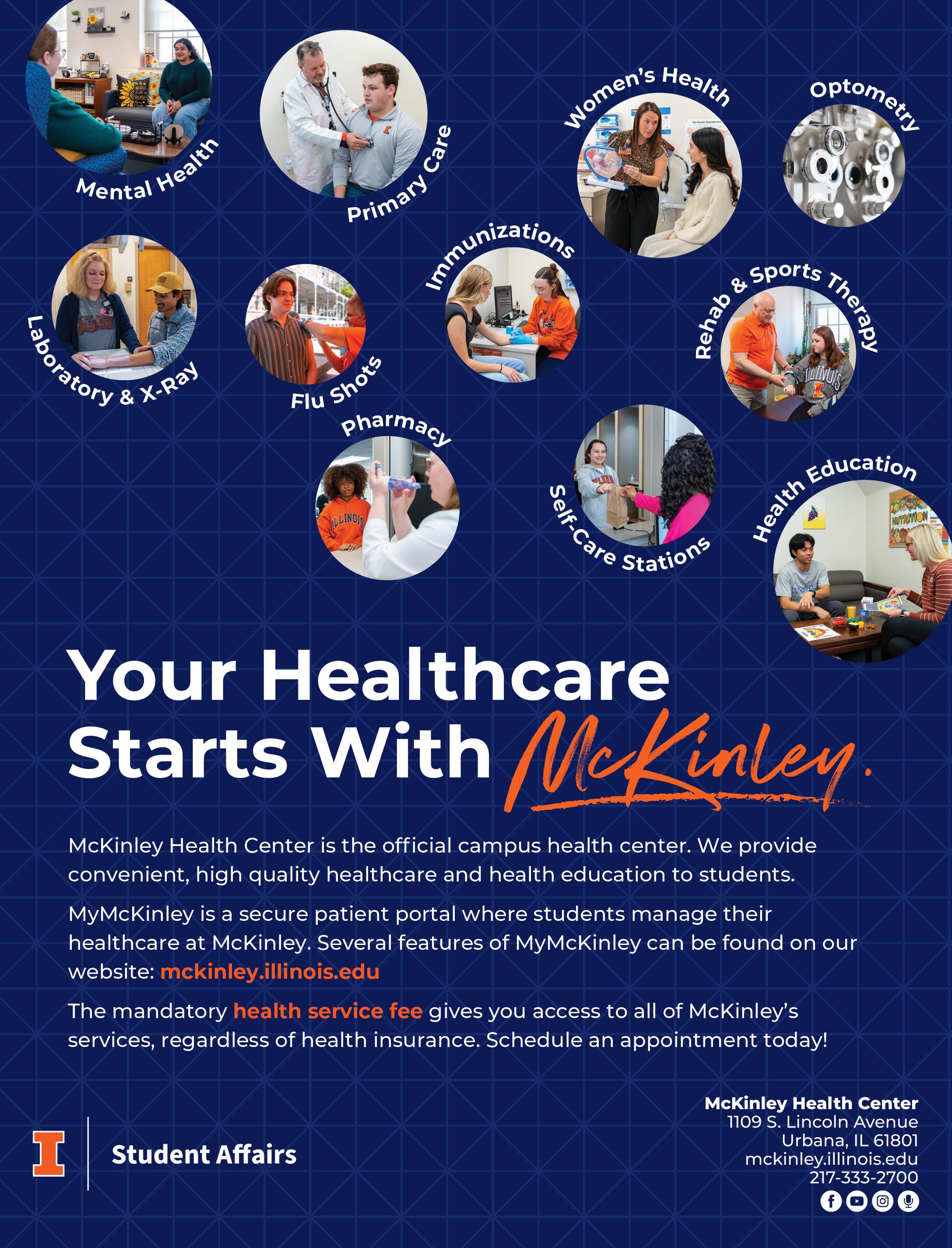
Sooner or later, most University students catch the sickness bug. When that happens, McKinley Health Center should be your rst stop.
Unlike many healthcare providers, McKinley does not require private health

insurance; students only need to pay the mandatory Health Service Fee to access care.
Students can also take advantage of self-care stations stocked with items like Band-Aids, pain relievers, eye drops, contraceptives and pregnancy tests.
Spanning multiple libraries on campus, the Media Commons provides access to a network of digital production spaces and loanable technology.
At Grainger Engineering Library, many of these resources are closely connected with the IDEA Lab, emphasizing experimentation with emerging technologies.
Media Commons Coordinator Eric Kurt said tools are used for everything from recording two-minute speeches to faculty conference videos and informal content like YouTube reaction videos.
“Just because it’s not directly class or course-related doesn’t mean that you’re not using your creativity and you’re not creating something new and sparking new ideas,” Kurt said.
At Student Legal Services, you can come in for advice or representation from a team of four attorneys who focus on landlord-tenant issues, tra c violations, property damage and certain criminal matters.
If your issue falls outside their scope, they can refer you to a local attorney for further guidance.
“This is probably the only time in your life that you have access to an attorney without having to pay a noble fee that you pay to go into the o ce,” said Directing Attorney Anthony Allegretti. “No one’s going to think that you’re asking unintelligent questions; the law ... can be dicult to understand.”
While this is not a complete list of everything available, you should keep these resources in mind as you navigate the semester. Welcome to the University community, and best of luck on the exciting journey ahead.




COPY EDITOR
SOPHIA VASILAKOPOULOS sophiav5@dailyillini.com
Are you new to the University and figuring out where events are on a regular basis? Go to the Illini Union.
The Union has been hosting events since 1942, after the Illini Union Student Activities, a subgroup of the Illini Union Board, was established.
Today, the Union’s events are run by the student-led Union Board, which houses eight committees and organizes over 160 events per year. Recent events have included Spring Jam, a speaking event with former YouTuber and face of the hit web series “Game Theory” Matthew Patrick and a Field Day in early September.
Here are six activities you can enjoy at the Union year-round.
Every Friday and Saturday starting at 7 p.m., the Union plays free movies in the Pine Lounge. It presented a variety of movies this past school year, including “Freakier Friday,” “28 Years Later,” “Wicked: For Good” and “Anaconda.”
The Union’s movies don’t just stop when the school year ends. Students who are on
campus for the summer can go to the Main Quad to watch a movie every Thursday at 8:30 p.m.
Before the screenings start, attendees can get popcorn and snacks at the Union’s Quad Shop to get the full movie experience.
Students can head to the Union’s Courtyard Café to listen to music every Monday at 7 p.m., performed by students, faculty and artists. The music the rotating performers play spans a variety of genres like indie, jazz and acoustic.
This past spring semester, musicians included local artist Jarrel Young, professor in FAA Charles (Chip) McNeill and junior in Engineering Lucas Ciocan.
If students want to test their trivia knowledge and win prizes, they can head on over to the Courtyard Café on Tuesdays at 6 p.m. for a fun-filled event. This past year featured collaborators like Urbana Mayor DeShawn Williams, the Siebel Center for Design, the James Scholar Student Advisory Board and UIPD.
Students not available at 6 p.m. on Tuesdays can also join in at the Union Underground for another trivia event from noon to 1 p.m. And yes, they can also win prizes here.
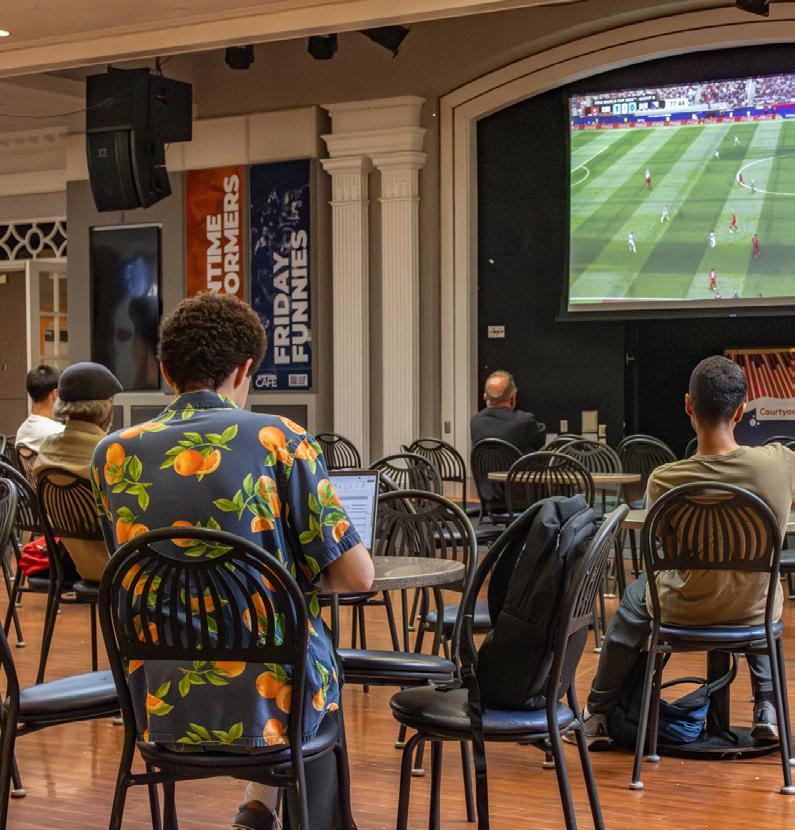
People sit and watch the World Cup match between Switzerland and Bosnia and Herzegovina at the Illini Union on June 18.
Students who need a laugh after an overwhelming week with class assignments or the upcoming midterm season
can go to the Courtyard Café for Friday Funnies.
Every Friday at 7 p.m., students are guaranteed to escape into a state of laughter with on-campus and national comedy groups, who show the comedic tricks they have up their sleeves.
The most recent Friday Funnies lineup featured comedian Eric Dittelman, magician-comedian John Cassidy and student improv groups like “Hive Society” and “Odd Request.”
Anyone who loves making arts and crafts while eating snacks will surely love going to Crafts and Snacks events, which occur on select Thursdays at 7 p.m. at the Union Underground.
At these events, students are sure to get their hands dirty and leave with a full stomach, especially if they participated in the most recent one. Last semester’s events included watercolor painting while eating waffles, making flower crowns with fries at their side and creating bracelets and eating birthday cupcakes simultaneously.
If you usually don’t have plans on Friday nights or if those plans fall through, then you can spend one Friday a month at Illinites, a late-night event with differing themes alongside food, activities and prizes.
The Illinites went all out in the previous school year. October had a hauntingly fun Halloween-themed weekend where students participated in costume contests, posed for caricature artists and watched Halloween movies.
While the spring semester activities weren’t as scary, the Illinites hosted a game night and a Valentine’s Day event, where students made their own stu ed plushies and candles.
So if you’re ever looking for low-cost, fun events to go to on campus, consider checking out the Union rst.


STAFF WRITER
SHALINI R. MANCHI smanchi2@dailyillini.com
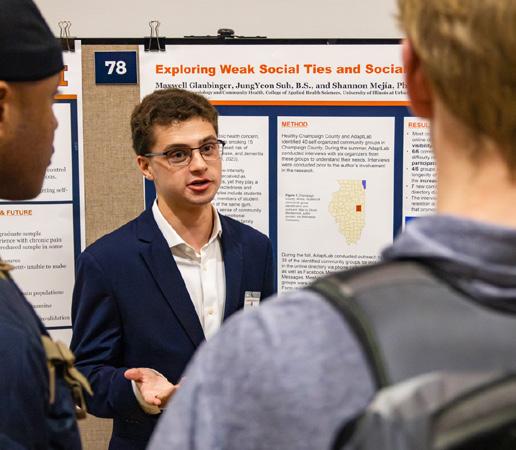
The Undergraduate Research Symposium provides undergraduate students with a platform to present their research through exhibits, posters and oral presentations. The research spans various areas of study, ranging from STEM to the humanities.
Maxwell Tetrick, coordinator of research programs, said that students often have the misconception that research presentations are reserved for juniors or seniors. In reality, there are many opportunities for students to explore research early on.
“There are a multitude of di erent opportunities on campus, but it sometimes just takes a little bit of digging and searching to nd the right t,” Tetrick said. “That’s kind of where our o ce steps in and can sort of help facilitate that process.”
Sai Smriti Gogineni, senior in LAS, said that it is important to keep an open mind when it comes to nding research.
“I remember applying to a research lab, but it was restricted to juniors and up, but then I talked to some of my friends and found out through word of mouth that you can get connected to di erent labs,” Gogineni said. “Not all labs are restricted to juniors and up, so just keep an open mind.”
Rhea Dcosta, a 2026 graduate in Business, said students do not necessarily have to look for research within their own eld.
“I feel like a lot of people nd research that is not related to what they do, and they end up enjoying that,” Dcosta said. “I did research in a eld that wasn’t exactly related, but I felt like I developed a lot of transferable skills and developed a big network from doing that research experience.”
Dcosta said connecting and talking to others tends to work faster than emailing when looking for research and encourages students to communicate with teaching assistants and professors.
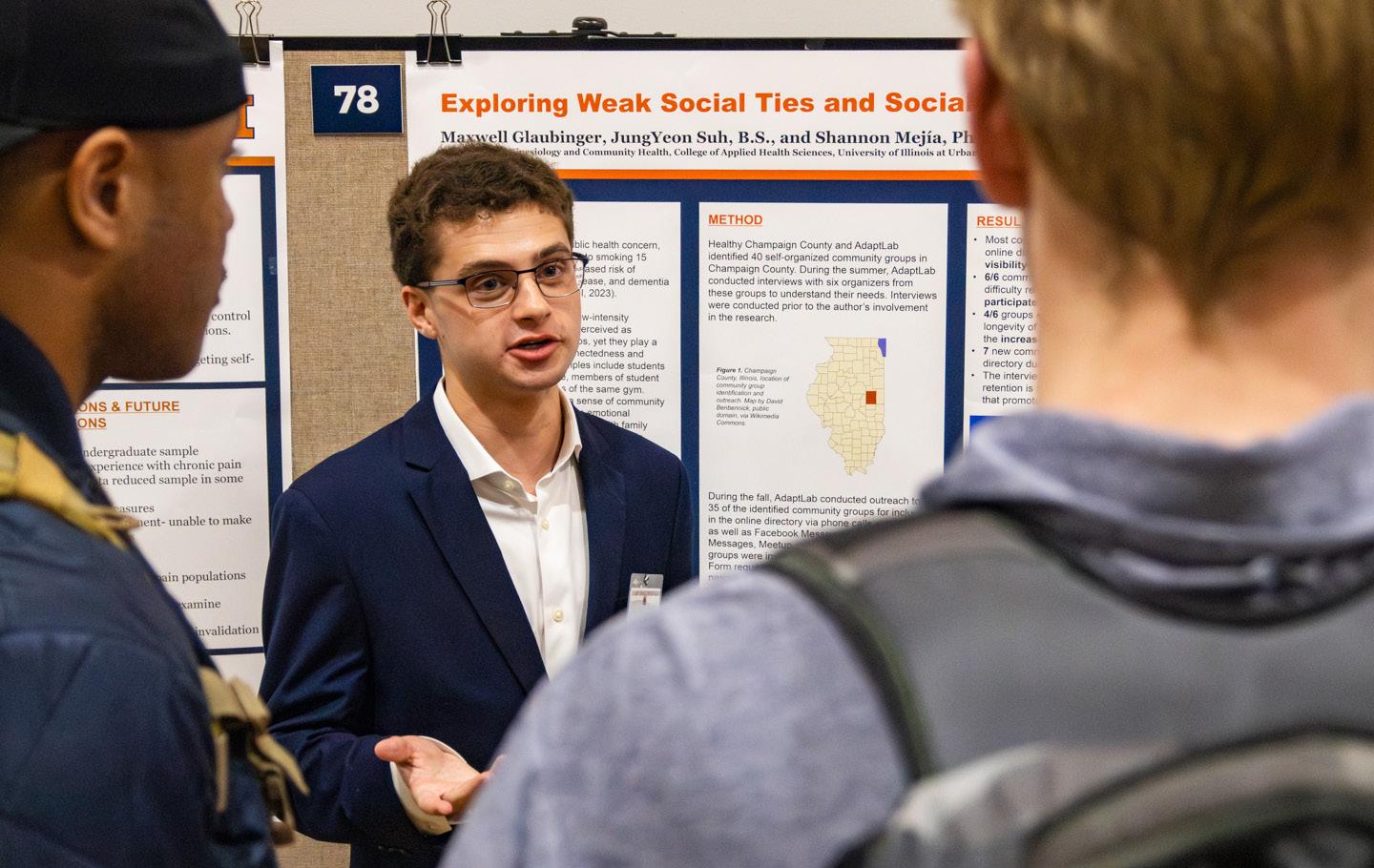
“Cold emailing may not always work, especially if you’re in a major that’s really competitive,” Dcosta said. “Everybody is cold emailing, and you don’t want to be someone who just keeps cold emailing; professors don’t have time for that … try as much as possible to get out there and ask questions, visit o ce hours — I think that’s really helpful if you’re someone who’s new to the process.”
Tetrick added that certain research programs on campus look speci cally for inexperienced students.
The O ce of Undergraduate Research runs the Undergraduate Research Apprenticeship Program, which is open to students with no prior research experience and pairs them with graduate student mentors in elds they are interested in. Tetrick said OUR wants the symposium to be accessible to anyone doing research at any stage in the process.
“Research really is a process; it’s not just this end product that we often see kind of on the back end of it, and so we really try to highlight that with the symposium,” Tetrick said.
Tetrick also hosts a two-part workshop series to help students presenting
at the symposium. The rst workshop gives pointers on the application process, and the second is a follow-up where Tetrick discusses presentation strategies. Students can also schedule meetings with undergraduate research ambassadors to get additional oneon-one help.
Gogineni, who is a research ambassador, said she often suggests that students who will present go to an earlier session of the symposium to ease any nerves.
When it comes down to practicing the presentation, Dcosta said presenting does not involve memorizing a speech but rather pointing out highlights of the project.
“Having a story is something that I nd really draws people in,” Dcosta said. “So having those highlights and talking about those eventually during (the) presentation, you’re going to get so many people listening to you, asking questions … it becomes a conversation.”
Tetrick adds that new students have a multitude of resources relating to research on campus, and they should take advantage of them while keeping an open mind.


STAFF WRITER
SAANVI
MANTHA
saanvim2@dailyillini.com
For many students at the University, graduating earlier than the allotted four years sounds like the fast track to success. It can mean saving thousands of dollars in tuition, getting a job sooner or starting graduate school earlier. But according to academic professionals, the decision is about much more than nishing college as quickly as possible. It comes with other factors students may often overlook.
While graduating early can be seen as a smart nancial or personal decision, advisers encourage students to look beyond the number of semesters they spend in college and think about the experiences they gain — or potentially lose — along the way.
Caroline Helton, director of undergraduate admissions and advising in ACES, believes students who graduate
early can still be well prepared for whatever comes next because, at the end of the day, they complete the same carefully designed curriculum.
“All students have to complete the curriculum that has been carefully reviewed by faculty, sta , administrators and industry partners to ensure that students are prepared to be successful upon graduation, regardless of their destination,” Helton said. “Even if a student graduates early, they have critical academic experiences under their belts to support their transition into their next phase of life.”
However, Helton said students should consider the bigger picture. Financial savings are often the biggest motivation for early graduation, but students should also think about the workload and the opportunities they might miss.
“Graduating early removes students from co-curricular activities that can help develop skills, maturity and prepare them for postgraduate life,” Helton said.

Instead of rushing through college, Helton encourages students to consider alternatives that can reduce costs without sacri cing experiences, like taking community college courses
or participating in lower-cost study abroad programs.
Tenaya Reifsteck, director of academic advising in LAS, shares a similar perspective. While she understands why students want to graduate early, she believes it should primarily be considered when nances make it necessary.
“The only time I outwardly support or encourage early graduation is when a student’s nancial situation requires it,” Reifsteck said. “Otherwise, I do my best to encourage students to spend the full four years so they can gain those extracurricular experiences in addition to their coursework.”
Outside the classroom, advisers said employers and graduate schools value experiences like internships, undergraduate research, leadership positions, volunteer work and involvement in RSOs just as much as academic performance.
Helton has spoken with students who believed graduating early would automatically make them stronger candidates for jobs or graduate school. She said that assumption is often misguided.
“Most of the students in this situation focused mostly on getting their classes done and not much on other experiences, which can be equally important for both job and graduate school applications,” Helton said.
Jason Nankivell, an academic adviser in Engineering, said many students feel pressure to stand out from their peers, and graduating early can seem like another accomplishment to check o the list.


“Many students come in feeling pressure, either internally or externally, to stand out amongst their peers,” Nankivell said. “For many of these students, graduating early is a way to demonstrate how much they can excel.”
Nankivell believes that, sometimes, students become so focused on checking accomplishment boxes that they lose sight of what actually makes college valuable beyond academics.
“No student’s academic journey, especially at a large, four-year public institution such as U of I, is complete solely by taking and completing coursework, ” Nankivell said.
With the perspective that graduating early means giving up opportunities to be involved on campus and nding a sense of community, Nankivell said he becomes skeptical.
“If the decision to graduate early comes at the expense of getting involved in student organizations, participating in undergraduate research or working in an internship or co-op setting, then I question the value of that decision,” Nankivell said.
Nankivell also explained that college is about much more than earning enough credits for a diploma.
“I think college is an excellent time to hone these skills and gain these experiences, so I encourage all students to take advantage of opportunities to get involved one way or another,” Nankivell said.
No student’s academic journey ... is complete solely by taking and completing coursework.
Jason Nankivell, academic adviser
When it comes to confidence and readiness after graduation, advisers agree that there is no single answer. Students who graduate early may feel proud of accomplishing an ambitious goal, but those who miss opportunities to build leadership, teamwork and professional experience may enter the workforce or graduate
school with fewer qualifications to draw upon.
Helton said her role is not to discourage students from graduating early but to ensure they are making a decision that best suits them.
“My position is generally that a student knows themselves best, and I generally support their decisions when they are made from an informed position,” Helton said.
Helton does, however, become concerned when students attempt to overload their schedules or graduate so quickly that they limit opportunities to build competitive graduate school applications.
Ultimately, advisers concur that there is no universal timeline set for success that all college students should follow. While graduating early can provide financial benefits and help students achieve personal goals, staying the full four years can offer experiences that shape careers long after graduation while also allowing students to make the most out of their time here.
At the end of the day, college is — but not limited to — academics. It is also about the memories, benefits and growth.

SENIOR NEWS REPORTER MACY MEDENDORP macym3@dailyillini.com
Halfway through their rst semesters, Norah Manion and Campbell Helgeson started to question one of the most important decisions of their college careers: their majors.
They’re not the only ones. One study found that nearly a third of undergraduates in the United States switch their majors at least once during their studies. It’s common for people to doubt their choice, so don’t fret if you fall into that group.
Manion, now a junior studying nuclear, plasma and radiological engineering, rst came to the University as a physics major. Helgeson started in chemistry and is now a sophomore studying history.
Both said making the change has been a rewarding and foundational experience.
“The di erence was immediately clear,” Helgeson said.
Helgeson said he initially picked chemistry because it was comfortable. He enjoyed his science classes in high school, so he said it made sense to continue with them. Manion said she picked physics because it was broad, so she knew she would have choices for her career.
Soon enough, they both began to second-guess their choices.
According to Manion, physics is mostly research-based, and the classes are highly theoretical, whereas Manion prefers application. On the flip side, her new major has concrete applications, and she said she can see herself working in the field for years to come.
Still, she enjoyed physics enough to pick up a minor in the subject.
Helgeson said taking a general education course in history cemented his pivot. After his switch, he said he looked forward to attending class. Manion, too, said she “really enjoyed” the material of her new courses.
If you’re debating your major, one of the best steps you can take is to talk to an adviser, according to the pair. Both Helgeson
and Manion said the advisers — from their initial majors and their new ones — helped simplify the process.
Melissa Kisubika, University project manager for Student Success, emphasized the importance of utilizing advisers when considering switching majors.
“They’re absolutely one of the best resources on campus when thinking about making a switch,” Kisubika said. “They know the best way to think about your schedule moving forward … and oftentimes they can help you understand the best pathway for you after graduation.”
In addition to talking to your adviser, Kisubika recommended joining RSOs, looking at the course catalog and running a degree audit for the prospective program. If students are considering switching between colleges, Kisubika said they should also check out the Intercollegiate Transfer pages to understand the requirements.
General education courses are also a useful tool for nding passions, according to Kisubika. Hegelson discovered his love of history through a gen-ed, and many others do, too.
Kisubika said leveraging a gen-ed as a tool rather than settling for an easy A is one of the best steps a student can take.
As somebody who herself switched majors as an undergraduate, Kisubika said nding your path can take time — and sometimes jumping straight into a switch is not the best idea.
Taking up a minor, online certi cate or RSO can be a powerful alternative to changing a major, according to Kisubika. She said speaking with an adviser can help students determine if it will be worth it.
“There’s nothing wrong with you for wanting to change your major,” Kisubika said. “We want to make sure that we give you all the skills and the tools and everything you need to be a successful alum.”
When asked what advice they would give to incoming freshmen who are questioning their major, Manion and Helgeson both encouraged students to explore options and follow their passions.
“If you don’t like what you’re doing now, you’re probably not going to like it in 10 years,” Manion said. “Find something you really enjoy.”
“Be con dent going into the switch,” Helgeson said. “You know who you are. It will all work out.”




STAFF WRITER
AMELIA BENSON ameliab8@dailyillini.com
Time is money — deciding whether or not they have enough of both to balance work alongside student life is one of a freshman’s biggest questions.
But to gure out whether or not one should work freshman year, they rst need to get hired. The available positions can determine whether or not working is the right move.
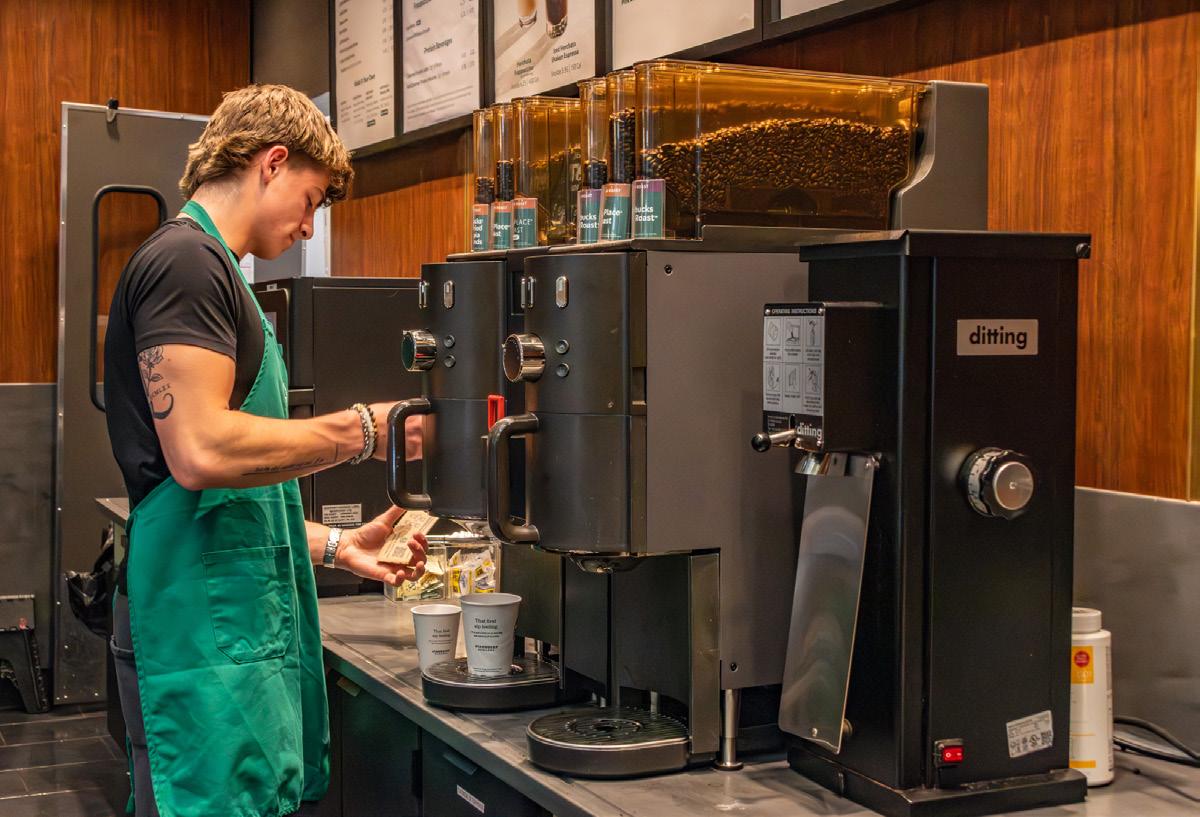
Fast food chains and dining halls seem like they’re always hiring, but students are competing against about 55,000 others. It might be easier to give up and apply to McDonald’s on Neil Street, as University Housing employs only around 1,000 students in Dining Services. But the di erence between the two foodservice jobs is stark.
Anna Aler, junior in Engineering, was lucky enough to transfer from her local Panda Express to Champaign’s own Green Street location. Or so she thought.
Despite working only once a week, the late shift left no time to turn in assignments before 11:59 p.m. Being unavailable the same day every week also meant RSOs with meetings on the same day weren’t an option.
“I only worked until October because it became too much to balance with classes and everything,” Aler said.
University positions, like course assistants, tour guides and more, are a different story. These offer shorter shifts to cram between classes and meetings and a convenient location.
After leaving Panda Express, Aler pivoted to work as a course assistant. The position provided a imsier schedule, and she even found it more relaxing, allowing downtime to study while on the clock.
However, Aler said Panda Express and other traditional foodservice positions in Champaign-Urbana aren’t all
bad. They reinforce real-world skills, essential for any college student who hopes to be employed after school.
“Panda was better for managing interactions with people you don’t know, con ict-resolution type things,” Aler said. “There was always something new happening.”
Ian Shaughnessy, junior in Engineering, got a head start when it came to nding a job at school. Thanks to a connection made in high school, he was immediately employed as an undergraduate researcher.
His lab echoed the typical campus job experience, with a looser schedule and understanding supervisors who knew that being a student comes rst.
“I’ve yet to nd a lab, at least in nuclear, that’s very strict,” Shaughnessy said. “From what I’ve been able to tell, most of them are like, ‘Yep, come in whenever you can.’”
Shaughnessy acknowledged that if a student needs a job for money, they should go for it. But if nances aren’t an issue, they shouldn’t feel pressure.
“It’s OK if you don’t get a job freshman year, because you’ll have dozens of opportunities throughout college to develop yourself professionally,” Shaughnessy said.
Alternatively, when looking for a break from studies, a job unrelated to one’s major may be the right move.
Mallorie Durian, junior in
Engineering, works for the University’s football team, lming practices and games for coaches and players to analyze.
“I’m in engineering, but a lot of my coworkers are more nance and (recreation, sport and tourism), so I probably never would have met them ever on campus,” Durian said.
Jobs, on campus or not, can provide the same benefits as RSOs: camaraderie, professional development and a break from the lecture halls.
If a student went easy on credit hours freshman year, they may nd themself with almost too much free time. What better way to ll schedule gaps than by earning some cash?
“I’m kind of a busybody; I like to have stu to do all the time,” Durian said. “If I don’t, I get kind of bored … I gured I could kind of kill two birds with one stone and ll my time and make money.”
Ultimately, it’s up to the individual. All factors, from course load to physical and mental health, should be considered. But remember, variety is the spice of life, especially in college, and a job might be just what you need to shake things up.

Playing sports at any level is an investment. Yet, athletic careers always have an expiration date, and for many, that day arrives after graduating from high school.
A small percentage of graduating high schoolers move on to play at the Division I level, while lower division and junior college are more common options for students who want to keep playing.
Contemplating this decision was the case for Caitlin Pron, junior in Engineering. Pron has played soccer since she was 5 years old, competing at the club level and eventually for her high school team. While Pron considered a collegiate career, her choices were limited, and the recruiting process seemed daunting, which steered her away.
“I wasn’t on the best club soccer team in the area,” Pron said. “I didn’t have the option of going to all these camps, having these college coaches watch me … I never really thought about even reaching out to D-I schools.”
The academic opportunities the University provides, compared to other colleges, also factored into Pron’s decision to ultimately leave her athletic career behind.
In her sorority, Chi Omega, Pron participated in intramurals, speci cally soccer, where she got to scratch the competitive itch that remained after competing constantly in high school.
“It’s a more joyful environment compared to club soccer and high school soccer,” Pron said. “This is where you can genuinely just have fun and no one’s judging; no one cares.”
As for Keaton Rauman, junior in ACES, he competed on both his high school football and baseball teams and thought the idea of meeting more people at a larger university was enticing.
“I wanted to get out and go to a huge school where I could experience
all the sports from a di erent aspect,” Rauman said.
However, there were still downsides to stepping away from competitive sports for both students. Some of those included losing a built-in community and having to dial back competitiveness while playing recreationally.
One of the biggest transitions, though, is the loss of a structured routine without athletics. As a recreation, sport and tourism adviser, Jason Schroeder interacts with plenty of undergraduates who come to college with a competitive sports background. These students are trying to nd their place on campus with a new type of schedule.
“You kind of think about, in a sense, starting from ground zero again,” Schroeder said. “Now you’re going to be doing all the things that you can get involved in that interest you, and then can prepare you for your next step.”
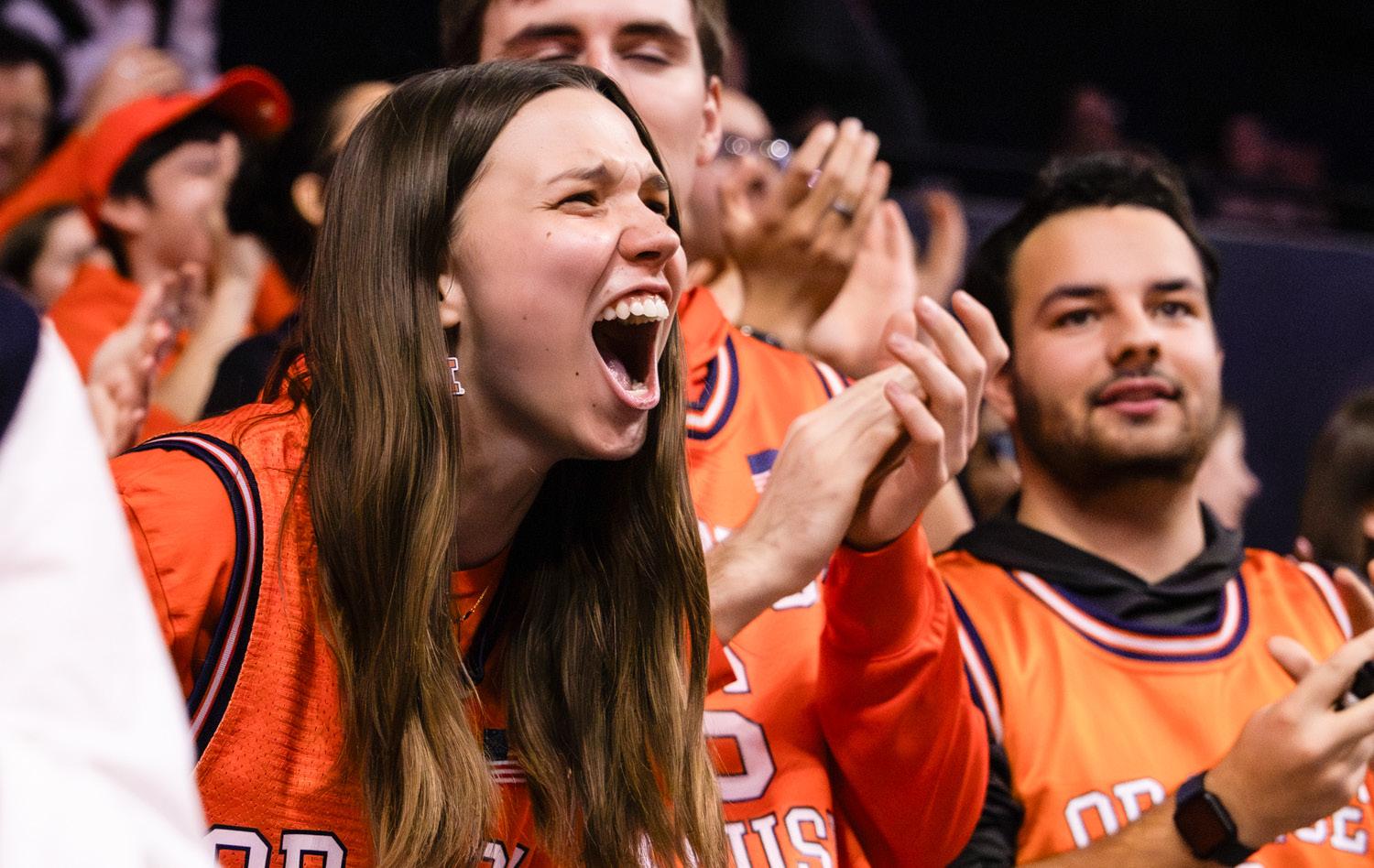
Rauman has found his place in athletics as an in-game chair for the Orange Krush. In this role, some of his responsibilities include getting students hype in line pregame, handing out special Illinois basketball signs to
students and keeping the crowd energized during games.
“I think being a part of the Orange Krush has given me a lot of opportunity to still have that competitive drive … because I still have some aspect of e ect in the game,” Rauman said.
From an academic standpoint, majoring in a sports-based program can also ll the athletic void. In recreation, sport and tourism, students get to see the behind-the-scenes of each sport that they may not have seen while playing competitively.
“An athlete at heart is probably, to some extent, always going to miss the competition and playing, but then when they see this other side, it’s fun to be involved in that piece,” Schroeder said.
College is a place for a fresh start and a chance to open as many doors as possible to new opportunities. However, that doesn’t mean new students have to lose sports altogether.
“It doesn’t have to go away completely,” Pron said. “So when you’re choosing between academics and the school you’re going to versus soccer or whatever sport, just go with your gut.”

STAFF WRITER SAHIL MITTAL sahilsm3@dailyillini.com
Whether you’re a longtime Illini fan or are quickly becoming one, it’ll grow very clear that Champaign is a sports town once you step on campus this fall. From sold-out basketball games at State Farm Center to the largest video board in college football at Gies Memorial Stadium, sports are a foundational piece of campus culture. Here are four key storylines to know as you experience the energy of Illini athletics this semester.
Head coach Bret Bielema brought in a new defensive coordinator this offseason: former Montana head coach Bobby Hauck, who is set to revamp and reenergize Illinois’ defense.
Hauck’s teams ranked in the top five of the Big Sky Conference in scoring defense, total defense and sacks every season he led Montana, and that success is exactly why Bielema pursued him for the position.
“Coach Hauck’s aggressive defensive scheme, which he learned at San Diego State and developed at Montana, will be an exciting new style that has never been seen here at Illinois,” Bielema said in a press release.
Hauck is implementing his signature 3-3-5 defensive scheme, which is a big change for Illinois’ returning players. A focus on aggressive movement and penetration of gaps, rather than a more laid-back approach, was much needed after the defense under Aaron Henry began to stagnate.
With Illinois winning two straight bowl games and focusing on being a perennial top-25 team, it was time for a fresh approach, and Hauck provided just that.
“Initially I was like, ‘Wow, no more hat and hands in the gap,’ but now that it’s unfolded, it’s awesome,” said junior defensive lineman Pat Farrell to Illini Inquirer. “Everyone enjoys it, and it’s just a brand new thing to bring to Illinois football, which I like to see.”
Senior defensive backs Matthew Bailey and Xavier Scott return as the headliners of Illinois’ secondary this season. Scott, who sat out a majority of last season due to injury, is a key piece for the Illini to have back in action, especially after team captain and defensive back Miles Scott made the jump to the NFL.
Additionally, junior defensive back Tanner Heckel and now-healthy senior cornerback Juice Clarke add another layer of returning talent to the mix that Hauck has to play with as he establishes a new defensive culture.
Head coach Chris Tamas is entering his 10th season as head coach, and with that milestone comes a major change for Big Ten volleyball: a conference tournament in late November. To account for the addition of tournament games, each program will now play 17 regular-season conference games, one against every
other school, which is down from the traditional 20.
“I’m genuinely thrilled about the addition of a Big Ten Volleyball Tournament,” Tamas said in a press release. “After years of watching our athletes pour everything into the regular season, having our own conference championship event feels like the perfect way to crown a true Big Ten champion on the court.”
With the emphasis on basketball and football increasing even more due to revenue sharing and NIL, expansion of women’s volleyball is another promising metric for the sport’s growth and success amid the crowded market of college athletics. It’s not just a feeling — the numbers back it up.

Volleyball, from a viewership perspective, has been surging in popularity in recent years, with ABC, ESPN and ESPN2 combining to air a record-high 33 college matches last season. Additionally, the 2025 women’s NCAA tournament had a combined 1.3 billion minutes of watchtime across ESPN platforms — the most ever.
If the trends are saying anything, women’s volleyball isn’t going anywhere but up, and the Big Ten seems to agree. More media coverage and more competition for student-ath letes — it’s a win-win.
Fresh o ance since 2005, the men’s basket ball team more. Despite losing the impressive offensive production of All-American and NBA lot tery pick Keaton

Wagler, as well as key contributions from Kylan Boswell and Ben Humrichous, Illinois retained every other core piece of its team.
Senior wing Andrej Stojaković and sophomore forward David Mirković are primed for All-American-level seasons, and twin 7-foot senior centers Tomislav and Zvonimir Ivi%ić make the frontcourt formidable once again.
In total, the Illini are returning 65.4% of their scoring, which leads the Big Ten alongside Michigan State. “The Retention,” as it has been dubbed on social media by Illinois fans, was a priority for head coach Brad Underwood and his in an era where the transfer portal and multimillion-dollar spending on single players are making continuity

“What we’re building here is special,” said in a video announcing his return. “I believe in this locker room, and I know we have what it takes to win a national championship. So let’s turn the page
Although a majority of the core is returning, a couple of new pieces are set to make an immediate impact. Illinois only turned to the transfer portal to sign one player: sophomore guard Stefan Vaaks, who spent his freshman year at Providence. Vaaks is thought of as the Wagler replacement. He’s a threat from deep and a talented scorer with
The rest of the team’s open roster lled by a six-player freshman class, headlined by ve-star guard Quentin Coleman. Coleman is expected to make an immediate impact, not only with his knack for scoring but also by rebounding at a high rate. Even at 6-foot-4, Coleman led Team USA in boards during the 2026 FIBA U18 AmeriCup (11.4 per game). He is projected to rst-round pick in multiple mock drafts, giving Underwood another potential one-and-done prospect.
“Quentin is one of the most competitive players I watched in the Class of 2026,” Underwood said in a press release. “Quentin is obviously a gifted offensive player, scoring it at all three levels, and he will be an elite defender as well.”
Next year’s roster has the potential to produce multiple rst-round picks, and if the new pieces gel with the returners as expected, that level of talent is sure to take the Illini far. A Final Four is no longer a hope; it’s the standard. The new guys, the returners and the coaches are all chasing the next level: a national championship.
After 11 years at the helm, former women’s tennis head coach Evan Clark retired from coaching at the end of last season. Clark led the Illini to ve total and three consecutive (2023-25) NCAA tournaments and is the program’s alltime winningest coach. Add in that he had a 100% graduation rate, developed three All-Americans and only had one player transfer during his tenure, and it’s clear that continuity has been a major pillar of the women’s tennis program for the last decade. Now, that’s changing.
Despite his departure, Clark stayed on to help with the coaching transition. In June, former UIC head coach Elizabeth Lumpkin Robinson was hired on a ve-year contract. A former standout at Naperville Central High School, Lumpkin Robinson became the rst and only girls’ tennis player in Illinois prep history to win four straight state championships. A college career at UCLA followed, including a 24-1 senior season en route to a team national championship before she spent four years competing professionally.
Not only has Lumpkin Robinson experienced what college players need to do to compete at the highest level, but she has continued her success story as a coach.
In her three years leading UIC, Lumpkin Robinson racked up a 41-24 dual record, led the school to its rst NCAA tournament appearance in 2025 and was named the 2026 Missouri Valley Conference Coach of the Year. She may be new to the Big Ten, but if her track record is any indication, more winning can be expected at Illinois when the new season begins.
“I am excited for the honor and responsibility of joining the Big Ten and striving for greatness,” Lumpkin Robinson said in a press release.



‘IT’S UP TO US’:
After back-to-back successful seasons built on a foundation of program veterans, Illinois football is stepping into uncharted territory. The upcoming campaign will feature a new quarterback and an entirely different defensive scheme.
However, two pillars of the team are back for their final season: senior defensive backs Matthew Bailey and Xavier Scott.
The two are experienced players; both are Illinois lifers and joined the program as freshmen in 2022. Since then, both have played in two bowl games and earned two All-Big Ten team honors.
Scott has been a ballhawk as a corner, tallying six interceptions and 26 passes defended. Bailey has been an all-around wrecking ball at safety, racking up 185 tackles, six tackles for loss, four interceptions and four forced fumbles.
The defensive backs have had solid careers, and they’ll likely impress
once again this season. The biggest test, however, doesn’t involve Bailey and Scott’s prowess on the field; it’s what’s off the field that will be important.
“It’s up to us,” Scott said. “We’re leaders of the unit for sure now.”
Illinois lost all three of its defensive captains this offseason. The New England Patriots drafted linebacker Gabe Jacas, and the Denver Broncos drafted defensive back Miles Scott, while linebacker Dylan Rosiek received a tryout contract for the Tampa Bay Buccaneers’ 2026 rookie minicamp.
Even though Bailey and Xavier Scott have been around for several years, they haven’t seen this big a leadership role on defense.
Miles Scott was the vocal leader last year, according to coaches, especially in the secondary. Without him, Bailey knows that some of the things he relied on Miles Scott for will be up to him.
“I might have to stand up and have a conversation,” Bailey said. “I might have to stand up and speak in front of the team or have a meeting or talk to a specific guy.”

With the influx of fresh faces, Bailey’s leadership is even more crucial. The Illini brought in eight transfers and 15 freshmen on defense. Xavier Scott understands the significance of getting the new guys acclimated.
“There’s more new players than old players,” Xavier Scott said. “We just want to get to know our players first.”
The transfers bring their own experience. They know how a college football program works and how to play the sport.
What they don’t know yet is how Illinois operates.
One of the first steps Xavier Scott is taking as a leader is getting those transfers integrated into the program.
The overall experience they bring can come in handy, though. The transfers come from a wide range of backgrounds.
Senior defensive back Lavon Williams spent the last four years at East Texas A&M. Senior defensive linemen Carter Janki and Darrell Prater have four years of experience at Penn and Jacksonville State, respectively.
While they haven’t spent their careers with Illinois, they’re still veterans. The years of football knowledge they and the five other transfers possess are invaluable, and Bailey plans to utilize them.
“(It) starts with building relationships with the incoming guys who have experience at other places and figuring out, ‘OK, what did you guys experience, and what worked well, and what didn’t work well,’ and how can we implement that in our locker room, into our culture that we have going here,” Bailey said.
It won’t be an easy task. Over the last two seasons, the Illini have lost very few impactful players. The transition from last year to this year isn’t something Illinois has had much experience with recently.
Illinois’ first game of the season against UAB is right around the corner. The Blazers have been fifth or above in the American Conference for passing offense the last three seasons. It will be a solid test for the retooled defense.
With Bailey and Xavier Scott’s leadership, though, the squad should settle in comfortably. They’ve already proven themselves on the field.
Now it’s time to show what they can do off the field.
SENIOR SPORTS REPORTER
LAURA MENDES
laurafm2@dailyillini.com
With a new school year on the horizon, that means a new season of Illinois football. The Illini are on an upward trend in recent seasons, winning back-toback bowl games in 2024 and 2025 and adding more players to the NFL. This success makes Illinois more attractive to recruits and transfers, leading to victories on the eld.
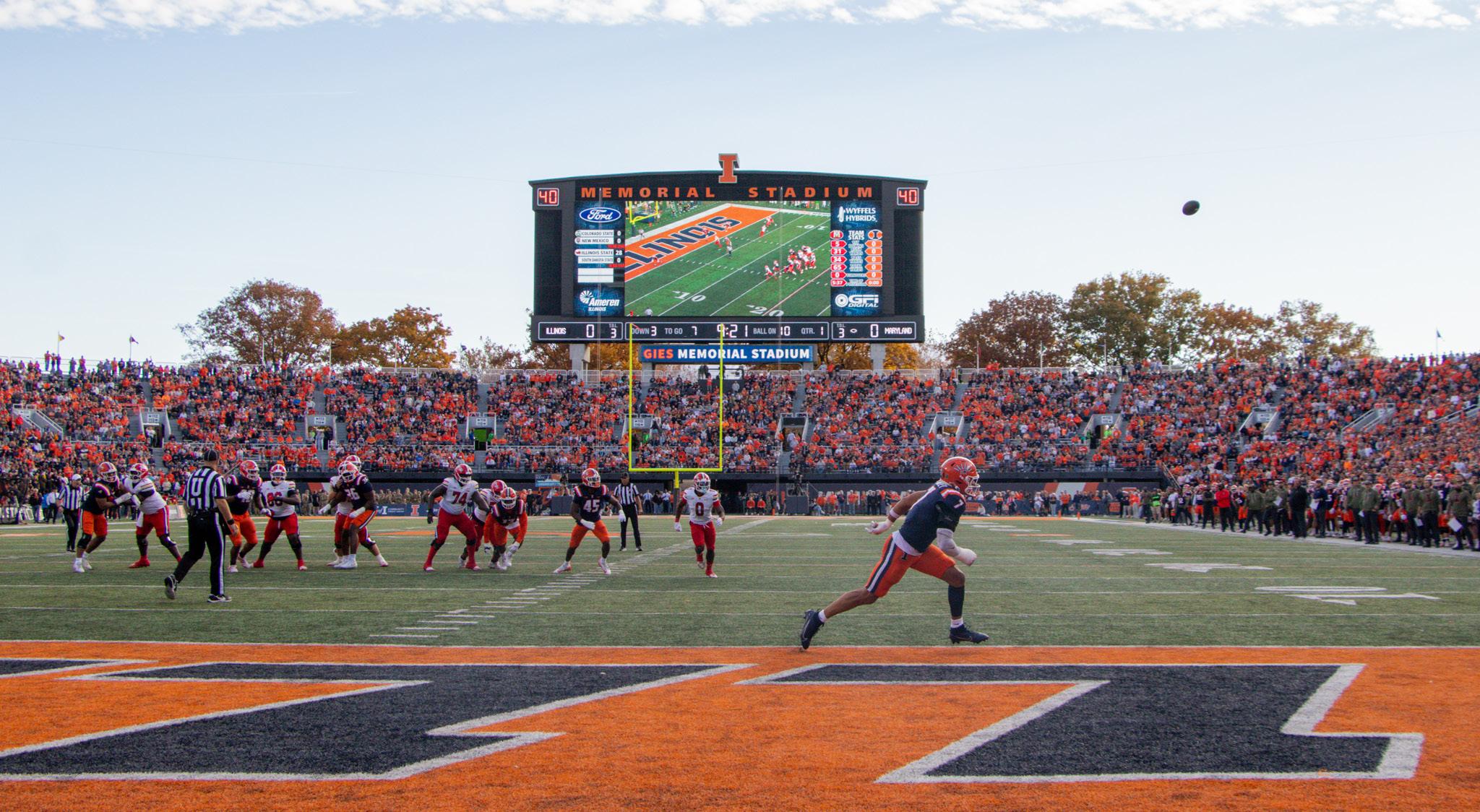
This season, Illinois is scheduled to host seven home games at Gies Memorial Stadium. Out of these seven, four games are against conference opponents.
If you bought student season tickets to sit in the Block I, here’s a preview of the seven home games you can attend at Gies Memorial Stadium during the 2026 season.
Illinois’ home opener is set for Sept. 3 against UAB at 8 p.m. As a non-Power 4 conference, the Blazers should be a solid rst victory for the Illini and their new fans.
Illinois playing its first game against a non-Power 4 school is not something new to the program. However, this will be the first time these two programs meet. It will also be senior quarterback Katin Houser’s debut, who is taking over for now-Detroit Lion Luke Altmyer.
As for the Blazers, it might be redshirt junior Ryder Burton who steps up to the plate and earns the title of starting quarterback. Burton was a crucial part of UAB’s success last season when it defeated then-No. 22 Memphis after a coaching change in the Blazers’ program. During that game, Burton went 20 for 27 for over 250 yards. His three touchdowns helped UAB earn a ranked win.
After travelling to Durham, North Carolina, last year, it’s the Blue Devils’ turn to make their way to Champaign. Illinois is set to take on Duke on Sept. 12, with kicko scheduled for 2:30 p.m.
This game is also the Illini’s Hall of Fame Weekend Game and FamILLy Day game, so the festivities and excitement at Gies Memorial Stadium should be higher than usual.
Last season, then-No. 11 Illinois dominated Duke and took home the win, 45-19. This season, the outcome might be closer, looking at preseason rankings. While CBS Sports has the Illini at No. 28, the Blue Devils aren’t completely out of reach, falling at No. 43.
Rounding out the Illini’s non-conference opponents for the season is the SIU Carbondale Salukis on Sept. 19, with kicko scheduled for 1 p.m.
Similar to UAB, SIUC is another program Illinois will compete against that is not in a Power 4 conference. So this should be another game against what could be considered an easier opponent before the Illini take on nine conference opponents.
The battle for the Cannon is back in Champaign for 2026. Illinois and Purdue will ght for the Cannon trophy on Oct. 3, with a kicko time to be determined. This game will also be the Illini’s Homecoming game.
Illinois is on a mission to claim the Cannon for a third year in a row after a four-year drought from the 2020 to 2023 seasons. Right now, since the Cannon was introduced, the Boilermakers still hold a slight edge, leading the series 40-32-2. If the Illini beat the Boilermakers
again this season, it would also bring the overall win percentage to .500 with 48 wins for both programs and six ties.
With the Cannon rivalry aside, the Illini shouldn’t be too worried about the Boilermakers, who have been in a slump.
CBS has Purdue ranked at N0. 99 for the preseason rankings. This makes plenty of sense considering the Boilermakers haven’t had a winning season since 2022.
The toughest home challenge for the Illini this season will be the Oregon Ducks.
The last time Illinois faced off against Oregon was two seasons ago, when it suffered a significant 38-9 loss at the hands of the opponent. The Ducks are also coming off backto-back seasons in the College Football Playoffs, where they made it to the semifinals in 2025 and the quarterfinals in 2024.
It’s no secret that the Ducks are a force to be reckoned with, especially since joining the Big Ten Conference. For the Illini to come out on top, they need to give it their all and play with agility, precision and perseverance.
One of the Ducks’ undisputed talents is their quarterback room. Not only does Oregon have redshirt junior Dante Moore back for a third season, but transfer junior Dylan Raiola is joining the program as well.
The Illini and Raiola have history. The last time it saw Raiola, it was at Nebraska with an overtime victory in 2024. With two quarterbacks on the roster with plenty of leadership experience against Big Ten competition, the Ducks are set for whatever challenge might come their way this season.
The game is set for Illinois’ Foundation Day game.
It will be a Friday night under the lights when the Illini face off against the Nebraska Cornhuskers on Nov. 6 at 7 p.m. This game is also Dad’s Day with festivities held on campus all weekend long.
Nebraska won’t be an easy victory. The program is currently facing an upward trend in the past few seasons, and with recent coaching changes, anything is possible.
With the Cornhuskers’ quarterback off to Eugene, Oregon, their starting quarterback is yet to be determined. However, the rumored choice expected to lead Nebraska this season is senior UNLV transfer Anthony Colandrea.
Colandrea’s possession of the ball and his ability to gain passing and rushing yards should be a concern for Illinois. At UNLV last season, he passed for over 3,400 yards and 23 touchdowns while
rushing for nearly 650 yards and 10 touchdowns. However, UNLV didn’t play any highly notable opponents and lost in the Mountain West Conference Championship game and in the bowl game it played.
If Colandrea can adapt to the gauntlet that is the Big Ten before making his way to Champaign, he is sure to be a threat for the Illini.
The last time the Illini will play at Gies Memorial Stadium in 2026 will be against the Iowa Hawkeyes on Nov. 21. For the occasion, this game will also serve as Illinois’ Senior Day game. This celebration is usually held before kicko
Despite an overall 39-28-2 record against Iowa, Illinois has struggled as of late. The history between these two programs dates back to 1899, and in this century, the Illini and the Hawkeyes have faced each other 17 times. The Illini have only won three of those matchups.
The last time Illinois played against Iowa at home, it walked away victorious, 9-6, in 2022. In 2023, the Illini almost came home with a win but fell short 15-13.
This last battle at home could be another close one. CBS has the Hawkeyes ranked at No. 23 for the preseason, just ve spots ahead of the Illini. Both Iowa and Illinois have defenses with veterans capable of leading their teams.
For the Illini, senior defensive backs Matthew Bailey and Xavier Scott return for their senior seasons. As for Iowa, junior defensive back Zach Lutmer and senior linebacker Jayden Montgomery. However, both programs are also seeing changes. Iowa has added defensive talent to this season, and Illinois hired a new defensive coordinator, Bobby Hauck.
While these are Illinois’ seven home games of the season, it will also face Ohio State, Michigan State, Maryland, UCLA and Northwestern on the road to round out the 12 regular-season games.



CONTRIBUTING COLUMNIST
ELIZABETH
HANDLEY handley8@dailyillini.com
Historically, there has been a popular piece of advice given when you go to college, which is, “Say yes to everything.” As you pack up your IKEA moving bags and say your goodbyes to hometown friends and family, it is nearly guaranteed that at least one person will mention this saying. That could be anyone from your orientation leader or some random extended family member at your graduation party whose name you just cannot remember.
However, life is all about balance — when does saying yes to everything have its limitations? Should you really say “yes” to everything?
The typical college experience includes a plethora of late nights going out, study crawls, movie nights and everything in between. A key facet of this weird stage of adulthood is that while you are navigating life independently for the first time — which is arduous in itself — you are also discovering your passions, routines
and the person you are becoming.
All of these components are tremendously substantial to what makes college so special and the fond memories it creates.
The spontaneity of it all enhances the experience as a whole, which leads to the advice of saying yes to everything. You truly never know what could unravel just by saying the three-letter magic word.
As a freshman, some of the most meaningful “firsts” include New Student Convocation, recruitment, the first football game and Quad Day, all of which many University students would agree are definite go-to events. These are transformative in meeting those who might become your forever friends and are core memories of university.
While all this rings true, it’s equally important to note that there’s wisdom in knowing when to say “no.”
The plain and rather unglamorous truth is that as a student, one must find an equilibrium between academics, social life and independence. Attending every invite you receive is simply not feasible, and it can slowly but surely become exhausting. There is a stark difference between embracing opportunities and establishing boundaries, and learning the distinction is one of the most valuable lessons of college.

pear out of thin air; it is found through a labyrinth of trial and error. A canon event of college is convincing yourself that going to The Red Lion with friends on the eve of a big exam or presentation is no big deal, only to reap the consequences of that decision the morning after. Big mistake? Certainly. Lesson learned? Definitely.
While these lessons may be painful learning curves, they are frankly ones you must endure to understand personal limitations and when to say, “Maybe next time.”
A major theme of young adulthood is piloting these situations and determining what works best for you. Learning how much time you need to study, your favorite route to lecture and which shoes to wear on rainy days are all decisions made through personal experience. While seemingly small, these discoveries accumulate to help create routines and boundaries and make day-to-day life more manageable.
So the verdict? Perhaps a slight revision to the popular pointer.

The key is to say “yes” to windows of opportunity that genuinely add value to your life or those where the experiences outweigh the outcomes’ consequences. Be spontaneous, step outside your comfort zone and have zest for novel life experiences, but also be keenly aware of when to take a step back.
The reality of college is that the adventure isn’t exclusively about doing everything there is to offer but doing what is meaningful and empowering to you, even if that translates to staying home on a Friday night.
Elizabeth is a junior in LAS.
SENIOR COLUMNIST
ALEXANDER FAKO
afako2@dailyillini.com
As an incoming freshman, you’re probably drowning in everyone’s take on how to optimize your college experience.
Parents may be encouraging strict study habits. Peers may be telling you to rush Delta Tau Chi. Media personalities like Jordan Peterson may be clogging your social media feed with their takes on everything from libido to lampooning.
College advice is everywhere. It isn’t useless — it’s misunderstood.
We live in the Information Age. This is a positive for college and career planning. While basing your life decisions on projected salaries would be naive, it is helpful to have data like the Illini Success report and resources like the U.S. Bureau of Labor Statistics.
And while I’d love to tell prospective Illini to make choices without money in mind, nances play a critical role in determining students’ educational paths.
Long story short: It’s beneficial that we have all these resources to factor into our college planning, people and podcasts alike. However, college advice becomes damaging when it steers decision-making instead of guiding the choices.
Daniel Bugingo, who is pursuing a juris doctorate at Columbia Law School, distinguished between two types of advice: life and practical. For practical advice, like how to lift weights, he suggests instructions — “Do it this way” — as the most e ective form.
For life advice, however, he claims instructions are the worst form of delivery. Bugingo emphasizes questions as the best way to provide life advice. And he’s onto something.
Actor-turned-communication scientist Alan Alda found that empathy was the key to communication. Questions do just that — they increase empathy and encourage dynamic conversations rather than one-way sermons.
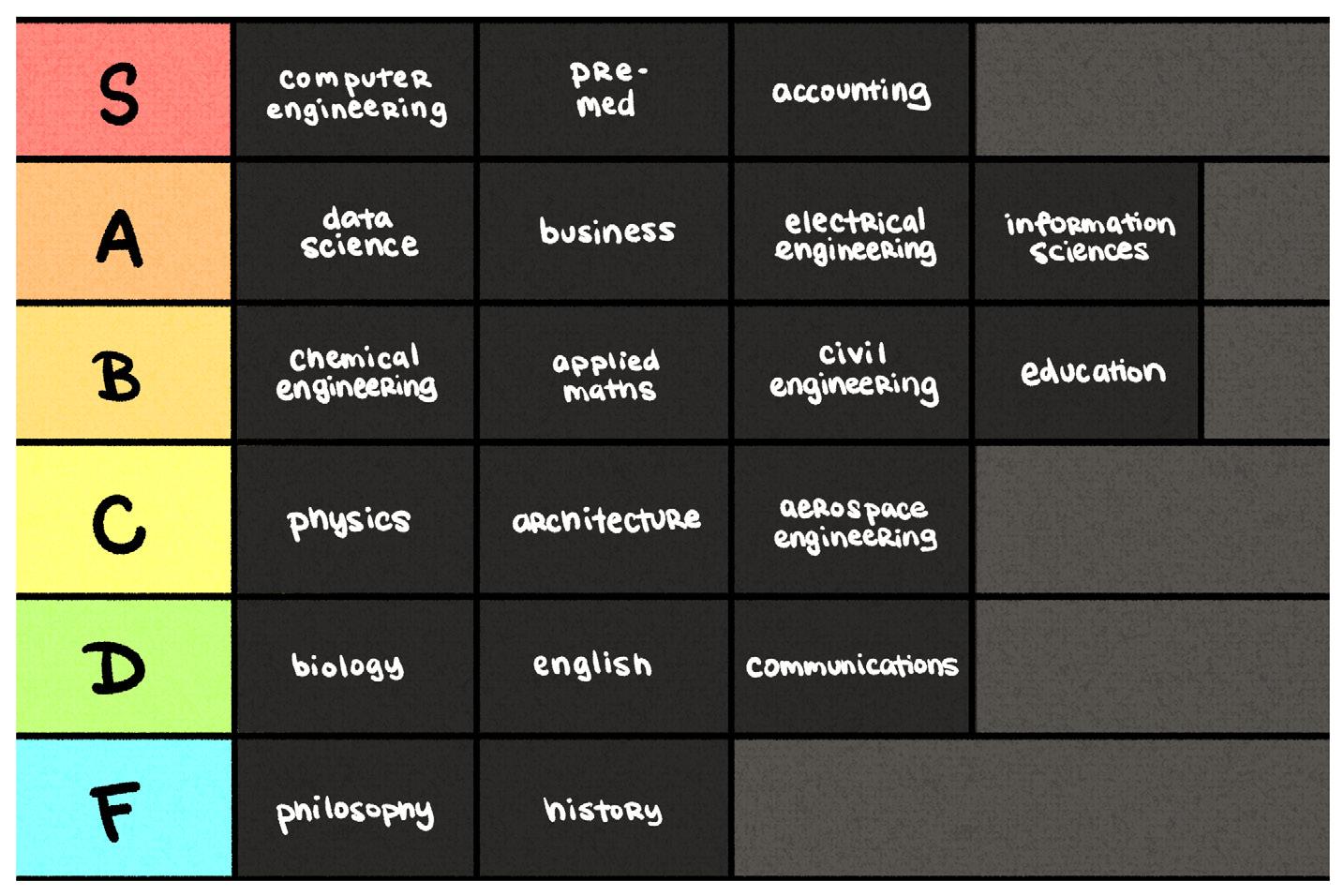
College advice should be interactive. It should involve challenging questions and considerate conversations.
The problem is, most college advice is instructive. While it’s not always direct, videos like “The Most Regretted College Degrees” provide stereotypical signposts for forks in the road between humanities and STEM majors, among others.
Plato warned that writing — lectured advice instead of a question-answer dialogue — could be a ckle “pharmakon” that diminishes philosophical truths.
News ash: In uencers sitting in front of a microphone and ring light making tier list videos is not an interactive discourse. Most college advice fails to be tailored to the individual’s desires; it instead universalizes life goals to a broad audience.
OK, but what about the adults at the graduation party drinking IPAs and professing their advice? Those are conversations, right?
“Decision-makers are significantly more risk averse when choosing for others than when choosing for themselves,” according to Jason Dana, visiting associate professor at the University of Colorado Boulder Leeds School of Business, and Daylian Cain, senior lecturer at the Yale School of Management.
People often disguise regret and worldly cynicism as sage wisdom when it comes to life advice. The 28-year-old cousin saying you’ll be broke if you choose that major is worth a listen but also warrants criticism. Same with your dad’s friend who says, “Two words: Quantum computing.”
Then again, this very article could be a pharmakon. My directing you on which college advice to consider is, itself, instructive advice in the written word. I guess “I contradict myself.”
When it comes to college advice, tread lightly. Use resources to make informed decisions, like whether to take that unsubsidized loan. Listen to trusted adults and professionals, but also remember to take their advice with several grains of salt.
Ensure the advice you actually consider comes from a productive conversation that weighs your personal interests and capabilities. In other words, you don’t have to join business fraternities just because Braxton from Oozma Kappa said they’re great for “networking.”
If I had to o er you one piece of my own advice, it would be the simplest (and most cliche) advice out there: Make mistakes and have fun. And don’t wear nice shoes to your rst frat rush party.
Alex is a junior in LAS.

1001 S Wright St. Champaign, IL 61820