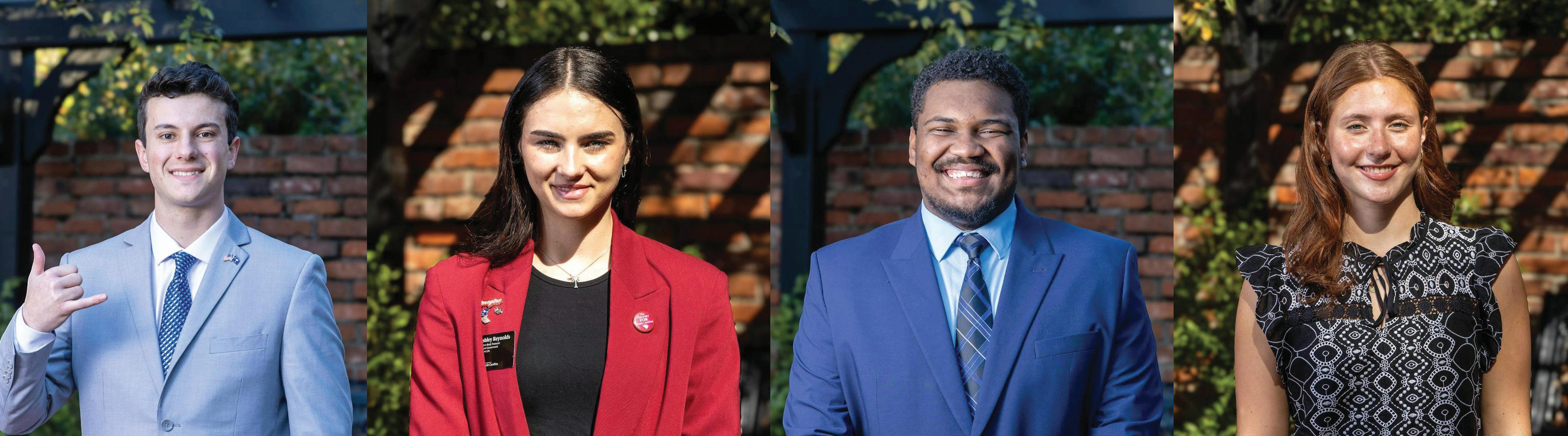
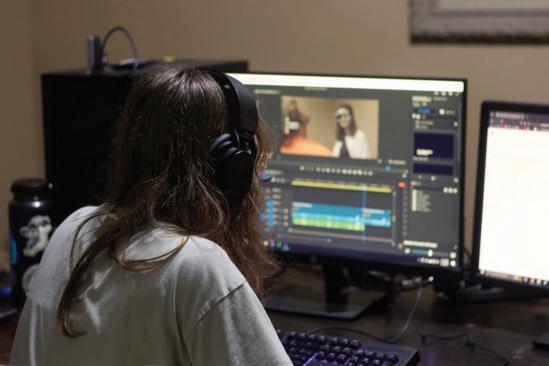
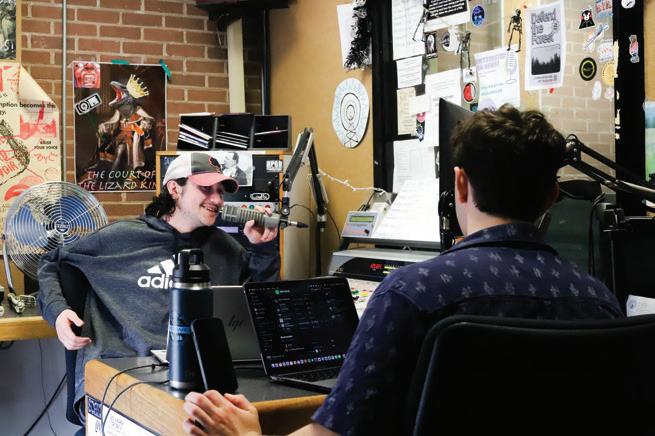
Meet the new student body president, vice president, treasurer and speaker of the student senate.
WEATHER
A variety of factors influence how communities react to environmental events, such as extreme weather.
05 TEN COMMANDMENTS
The South Carolina House of Representatives has drafted a bill that would mandate the display of the Ten Commandments in every public school classroom in the state.
Three USC professors received the National Institutes of Health Fragile X Centers of Excellence grant.
Both Raven and Tessa Johnson contributed heavily to South Carolina’s 79-72 win over LSU on Feb. 14.
Head coach Shane Beamer outlines how he has put together the 2026 football roster after a disappointing 2025 campaign.
South Carolina basketball head coach Lamont Paris’ record sits at 62-67 through four years.
Sophomore infielder Beau Hollins continues to make an impact through his second year on the team.
Through the transfer portal, Caleb Herring committed to South Carolina over other Southeastern Conference teams for multiple reasons.
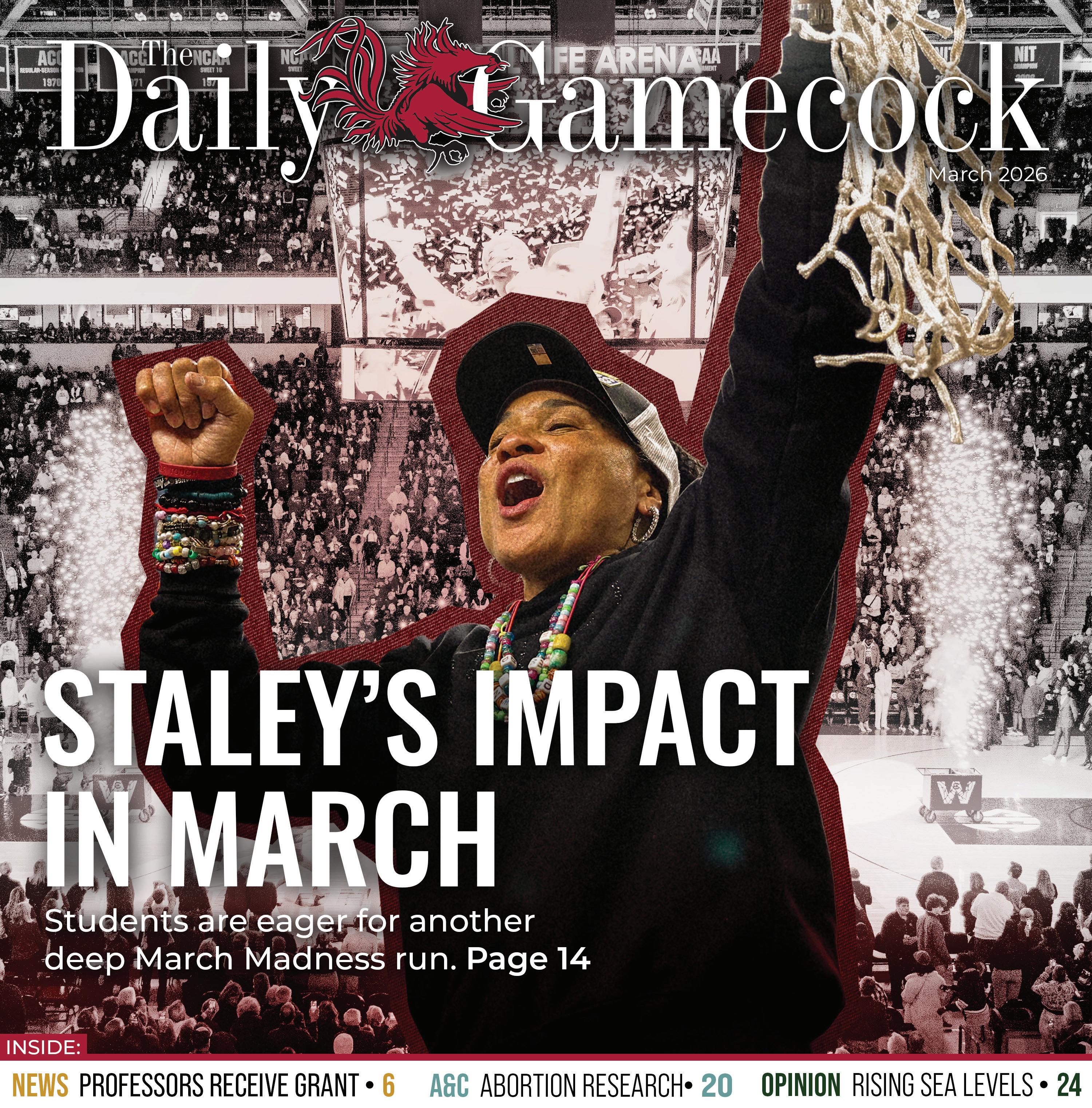
14 STALEY’S IMPACT ON STUDENTS
Students share thoughts on the success of the South Carolina women’s basketball program in the month of March.
16 COOKING TIPS FOR STUDENTS
Three Columbia chefs offer cooking tips and tricks for college students trying to learn how to cook.
Get caught up on some of the nominees for Best Picture at the 98th Academy Awards.
PROFESSORS WIN GRAMMY
USC’s music faculty now features a Grammy winner. Michael Harley and his ensemble took home the award.
ABORTION RESEARCH
USC professors study reproductive healthcare. Their personal stories, beliefs and experiences shape their research.
With spring right around the corner, follow these clues to solve this Easter-themed crossword puzzle.
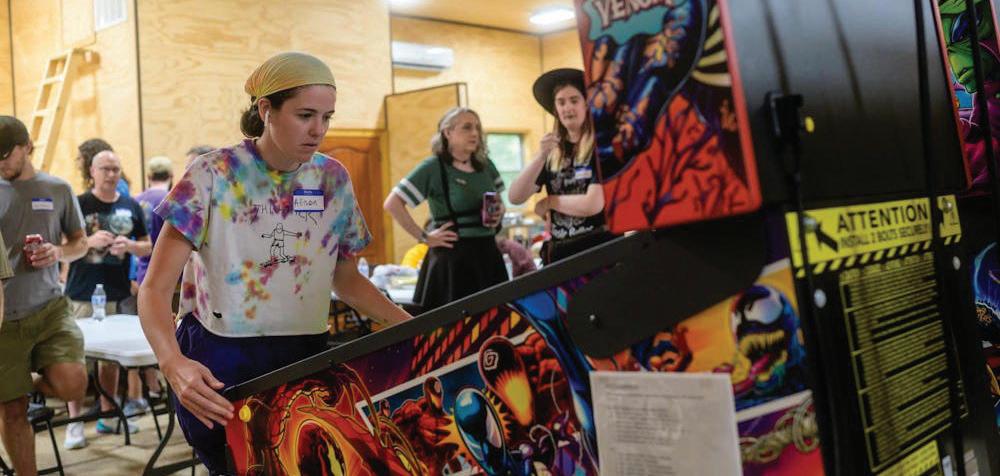
USC advisor Allison Brillhart’s love for pinball fuels her top 16 ranking in South Carolina.
24 SC’S DISAPPEARING SHORELINES
South Carolina’s coastline is disappearing at an accelerating rate due to rising sea levels, erosion and intensifying storms. And everyone’s suffering from it.
House Bill 3795, if passed, would radically change USC’s campus. It would require at least 70% of admitted students to be from South Carolina, which could end the tuition freeze.
March has arrived, and that means it’s time to fill out your bracket, and let’s be honest, does anyone really know what they’re doing?
COVER DESIGN BY: Ransleigh Baldas
COVER PHOTO BY: Jack Bradshaw
Student Government election results 2026
EMILEE DAVIS | STUDENT GOVERNMENT BEAT WRITER
INITIAL ELECTIONS
The initial elections for the 2026 Student Government executive and senate positions were held starting at 9 a.m. on Feb. 24 and ending at 5 p.m. on Feb. 25. The results were announced on Greene Street in front of the Russell House at 6 p.m. on Feb. 25.
During the initial Student Government election results, a runoff election for president between candidates Cole Rotondo and Emma Strickland was announced by elections commissioner Tristan Bonomo.
The commissioner announced the winners of the other executive positions. Myron Harris was elected as vice president, with Ashley Reynolds elected as treasurer and Kiki D’Apolito elected as speaker of the student senate.
Harris ran for vice president against Grant Hunter, while both Reynolds and D’Apolito ran for their positions unopposed. Rotondo and Strickland ran for president against Jordan Cooper, Bradley Gittens and Jacob Whisenant. Harris ran for vice president with
Rotondo as his running mate, while Reynolds ran for treasurer alongside Strickland.
Harris said he is looking forward to representing students as vice president.
“I’m very, very excited,” Harris said. “I’m so glad that the students thought I could be their representative and get things done.”
According to Harris, he will be present and accessible to all students and won’t make promises to them that he isn’t capable of keeping.
D’Apolito, who currently serves as chairwoman of the judiciary committee on the student senate, said she is looking forward to continuing to serve in Student Government.
“I’m very thrilled to keep serving the student body and to still be a part of senate and lead all of our new senators through this journey,”
D’Apolito said.
Reynolds, who is returning to her role as student body treasurer, said she is excited to continue in her position.
“I’m super excited,” Reynolds said. “I can’t wait to work with Myron, can’t wait
to work with Kiki, and I really hope Emma wins.”
The election of 43 senators was also announced by the elections commissioner. Of the senators elected, 17 were returning senators from the 117th student senate. There were 26 senators elected who will be new to the 118th student senate.
RUN-OFF ELECTIONS
The run-off election for student body president was held the week after initial Student Government elections, starting at 9 a.m. on March 3 and ending at 5 p.m. on March 4. The results were also announced on Greene Street in front of the Russell House on March 4 at 6 p.m.
Rotondo was elected as the next student body president in the runoff election, as announced by the elections commissioner.
According to Rotondo, the whole campaign process for him and his team had been centered on hearing students, which is something he wants to continue.
“(The election) was kind of the ‘easy part,’” Rotondo said. “The hard part is making sure we’re working day in and day out to serve students’
needs, to meet them where they are and to make this university the best it could possibly be.”
Rotondo, Harris and D’Apolito follow 2025-26 executive candidates, President Courtney Tkacs, Vice President Jordan Richardson and Speaker of the Senate Maura Hamilton.
Rotondo has previously served in Student Government as historian and chief of staff in the president’s office to Tkacs.
Harris has served in Student Government as a member of freshman council, a member of the liberties and representation council, and currently as Student Government’s director of outreach.
Reynolds had no prior experience in Student Government before running for treasurer and getting elected in the 2025 Student Government election. This will be her second term as treasurer.
D’Apolito will take over as speaker of the student senate following two terms as a student senator, which include one and a half terms as chairwoman of the judiciary committee.
Photos: jack bradshaw
Cole Rotondo, Ashley Reynolds, Myron Harris and Kiki D’Apolito pose outside Kennedy Greenhouse Studio on Feb. 16 and 17. Student Government elections were held Feb. 24-25, and a run-off election was held for Cole Rotondo and Emma Strickland March 3-4.
Environmental phenomena outcomes rely on community response
KATE DURDEN | ENVIRONMENTAL BEAT WRITER
With recent environmental events, such as snow precipitation and earthquakes, Columbia’s response to these messages is part of a greater understanding to unpack the best way to communicate with the community.
Shadya Davis, a research assistant professor in the geography department, explained that the type of environmental event that’s heading toward the community isn’t always the issue, but how the message is communicated that influences the response. Although she’s a trained meteorologist, her research focuses on the community’s reaction to weather.
“What makes it a disaster is how we all respond to it and what’s our threshold for dealing with a situation,” Davis said. “If you’re completely unprepared, it’s catastrophic. If you have some mitigation tools or some preparation, it can be a lot less impactful.”
Over the weekends of Jan. 24 and Jan. 31, Columbia was predicted to have ice storms and snow precipitation. Davis noted how sometimes the best form of communication in times such as these is the one with the simplest message.
said. “Once you’ve hit the grandma category, then you’re usually good to go.”
“A lot of times, it’s like, ‘Can you explain it to your grandma?’” Davis
UNDERSTANDABLE MESSAGE
Greg Carbone, a professor in the Department of Geography, teaches the honors broadcast meteorology class. He hopes to connect students to the relationship the media has with spreading information about environmental events.
“I want them to understand more about weather and climate,” Carbone said. “I really want them to be able to express it in ways that a general audience can understand. I don’t want them to compromise on the science. I want them to explain complex things in very clear ways, accessible ways for a general public.”
Dan Frost, director of the South Carolina Seismic Network and assistant professor in the School of the Earth, Ocean and Environment, said research into community
response is not only consolidated to meteorologists. The research extends across fields to cover all aspects of environmental events, including earthquake warnings on the West Coast.
“They were trying to figure out what the best information to convey in a short period of time is,” Frost said. “What do you have to tell people for them to respond, to know what to do, and to not over- or underreact?”
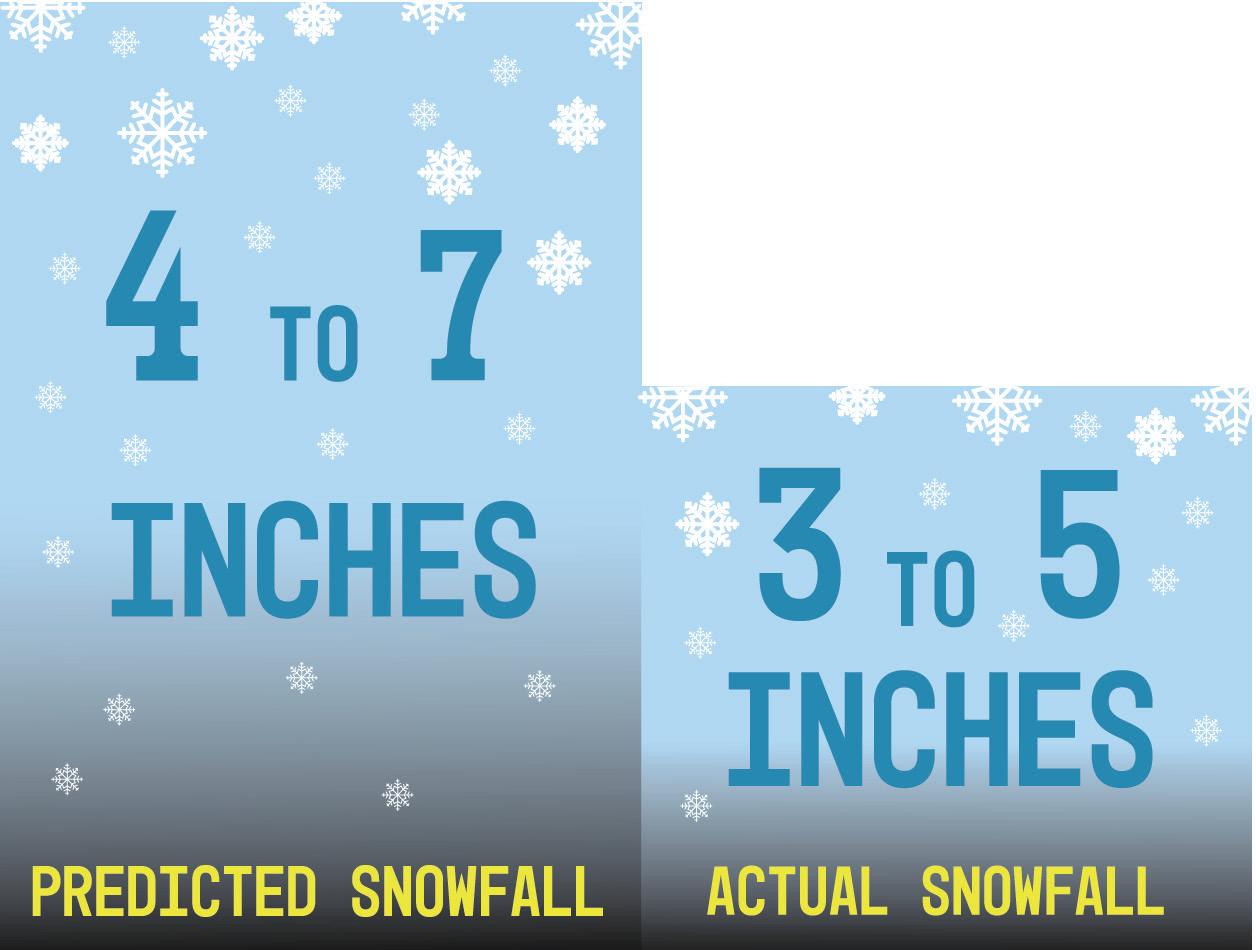
The National Weather Service predicted 4-7 inches of snow to fall for the weekend of Jan. 31. However, Columbia averaged 3-5 inches of snow, according to The Post and Courier. While on the boundary of a mix of different precipitation, Carbone said this prediction was a hard one to communicate.
“Across the board, what they tell us is that people have an underappreciation for how accurate forecasts are, mostly because they don’t notice when it’s a hit,”
Carbone said. “They’re more likely to notice when it’s a miss, because a miss has consequences that they care more about.”
Carbone said the act of overpredicting weather served as a way to over-prepare and best protect the community. Carbone said the snow in January can serve as an engaging opportunity for his students, helping them understand more about weather patterns in Columbia and the role media has in the prediction process.
“I think, in both cases, people responded in a way that made it look like they had a certain level of trust,” Carbone said. “They were taking it seriously and not terribly overreacting, but sort of being aware of it.
PREDICTING RESPONSES
According to WIS 10, the surrounding Columbia area experienced a minor earthquake
DESIGNS: GRACE DE PEÑA
with a magnitude of 2.2 on Jan. 20. With a lack of knowledge on seismology within South Carolina, Frost said similar events give him the opportunity to shed light on the topic in a way that makes it easier to understand.
“I don’t think the residents of Columbia or the greater Columbia area need to worry,” Frost said. “This is a curiosity. It’s almost a thing that reminds us of our place in the world, which is the edge of the Appalachian Mountains. They are here, and we are on the edge of the floor.”
Experiences and location are factors that play into the perspective a community member has when hearing of upcoming environmental events. Having worked on both coastlines now, Frost said it’s a matter of what people expect. California’s response to an earthquake contrasts with what South Carolina’s reaction would resemble.
“Something that’s entirely out of the ordinary, like an earthquake, even if it’s very small, ... people will
still get worried about it because it is so unusual,” Frost said. Connecting the public to information about upcoming
environmental events that could potentially put communities in danger is an action Davis views as a service. How much preparation individuals should take can be attributed to the trust people have in their forecasters.
The entire motto there is to protect life and property.”
Frost said it becomes difficult to tackle communications to spread their information to the public.
“For most meteorologists, the work that they do, it’s in service of helping other people,” Davis said. “That’s why they’re called the National Weather Service. It really is a service.
“It gets tricky because you want the information to be communicated as quickly as possible, but also you need a uniform message,” Frost said. “Everyone needs to know what to say. Really having a single source to refer to is best, but they have to be really rapid at disseminating the information that they think everybody needs to know.”
While it can be overwhelming for the community when environmental events seem to stack as they have the past few weeks, Davis said this is when communication on action is most important.
“Listen to your local meteorologist, and they will tell you their confidence in it, what the risks are, and why they’re saying what they’re saying,” Davis said.
Professor calls South Carolina’s Ten Commandments bill ‘highly
KELLY GRADY | NEWS EDITOR
Aunconstitutional,’ but it may survive
bill requiring the Ten Commandments to be posted in every public school classroom in South Carolina is making its way through the state legislature.
The South Carolina House of Representatives introduced H. 3217 in late 2025. The bill has since garnered 14 sponsors in the House and been referred to the Judiciary Committee.
If passed, the bill would require a poster of the Ten Commandments to be displayed “in a conspicuous place” in every public school classroom in the state.
STATEWIDE OPINION
Four out of five students surveyed were against the bill, and all four cited the separation of church and state as to why.
“I don’t think that it should be required for all classrooms to have it,” said second-year exercise science student Olivia Frost. “Education does fall under ‘state’ ... It shouldn’t be that students are forced to look at or learn about the Ten Commandments. That’s more of a church issue.”
Two surveyed students, Frost and first-year political science student Trista Walter, said that despite their own religious beliefs, they don’t agree with displaying the Ten Commandments in classrooms.
“I would loosely consider myself a Christian, but I don’t think it makes any sense to have a poster of the Ten Commandments in schools,” Walter said.
First-year finance student Andrew Dato, who supported the bill, said having the Ten Commandments in classrooms could help instill their values in public school students.
“I think today those values are really important because of the divide in our country, and I think it’s
just good to get them instilled in kids early,” he said.
Dato, a Catholic, also said learning about the Ten Commandments at a young age could help students decide their religious beliefs later in life.
His view is similar to what proponents of the bill say the goal is. South Carolina Rep. Kathy Landing, a supporter of the bill, said displaying the Ten Commandments in classrooms could improve and strengthen education.
“For our young children to be exposed to that, to be able to ask questions and maybe even be able to debate and discuss sometimes some of those commandments is not a bad thing,” Landing told the South Carolina Daily Gazette on Jan. 23. “It actually helps strengthen the education process, and Lord knows we need plenty of that.”
Though religion can certainly have a place in the classroom, it should be properly contextualized and age-appropriate, said assistant professor of religious studies John Mandsager.
“Just placing the Ten Commandments on the wall doesn’t necessarily lead to civic or moral education but instead could signal that … the state of South Carolina is endorsing that religious perspective above other ones,” Mandsager said.
NATIONAL LANDSCAPE
If the bill passes, South Carolina will become the fourth state to mandate posted Ten Commandment signage in K-12 schools. Texas, Arkansas and Louisiana have already passed similar bills.
These bills are facing challenges in court on the basis that they violate the Establishment Clause, a section of the First Amendment that bars
the government from endorsing or upholding one religion over another.
Kirk Randazzo, a political science professor, said South Carolina’s bill would likely face similar legal challenges if it is passed into law.
In 2022, the Supreme Court abandoned the Lemon Test, a three-prong test used to decide Establishment Clause court cases for over 50 years. If a government policy failed any part of the Lemon Test, it would be declared unconstitutional.
Since 2022, the court has used the historical traditions test, Randazzo said. Using this test, the court will “look at history and see what it says” to determine its decisions, he added.
Jay Thomas, fourth-year political science student and general officer of the USC American Civil Liberties Union, said the ACLU will likely argue that the bill is unconstitutional because it “favors Christianity.”
“Even though there are some things within it, like ‘thou shall not commit murder,’ ... that are easily agreeable to in a non-religious standpoint, ... it still has a connection to
Christianity because it is copy-andpaste from the Bible,” Thomas said. The abandonment of the Lemon Test and the current conservative-majority makeup of the Supreme Court could give Ten Commandments posters a foothold in classrooms, Randazzo said.
“I think there is a better-than-even chance that statutes like this will be successful in court,” Randazzo said. “If you would’ve asked me this a year ago, I’d say there’s no way. Now I’m not so sure.”
Though the test to determine the constitutionality of religious laws has changed, Randazzo said he believes the bill is still “highly unconstitutional.”
“As soon as the government endorses an aspect of religion, whether it’s a poster on the wall, Bibles sitting on the desks, prayer in a classroom, … we have crossed the line that the Establishment Clause was designed to protect,” Randazzo said. “We’ve picked winners and losers when it comes to religion.”
The South Carolina State House located on Gervais Street in Columbia, South Carolina, on Sept. 15, 2025.
Photo: Harrison Hirsch
USC receives national grant funding fragile X research
MORGAN COOK | ASSISTANT NEWS EDITOR
As a doctoral student studying the fragile X full mutation at the University of North Carolina at Chapel Hill, Jane Roberts came across questions she was unable to answer. Families with children who had the fragile X premutation wondered what was going to happen to their children.
At the time, she couldn’t answer questions about the premutation. But now as a Carolina Distinguished Professor and the executive director of the Carolina Autism and Neurodevelopment Research Center, Roberts is able to, with help from the new grant.
USC has been ranked No. 1 in fragile X research involving grants, according to Roberts. With that, Roberts and two other professors have been awarded the National Institutes of Health Center of Excellence Grant that will further fragile X research. Over the next five years, over $6 million will be used to show how fragile X affects children and adults.
“We’re going to answer a lot of questions, but we’re also going to uncover a lot more questions,” Roberts said.
According to Roberts, the National Institutes of Health sets aside certain funding for fragile X research, called the Fragile X Centers of Excellence. Every five years, a worldwide competition takes place to win the funding for the center, she added.
“It’s very prestigious because everybody competes, and it’s a real accomplishment to be one of the three that are selected,” Roberts said.
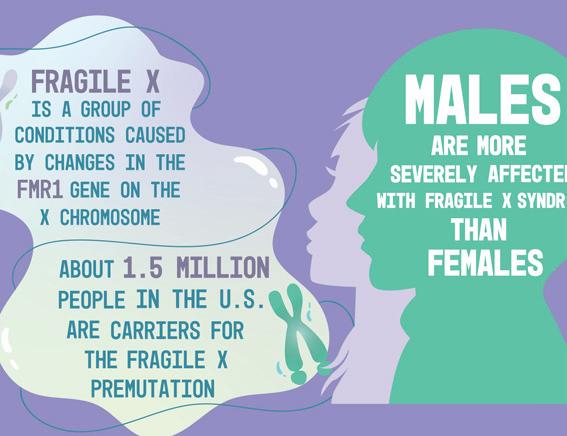
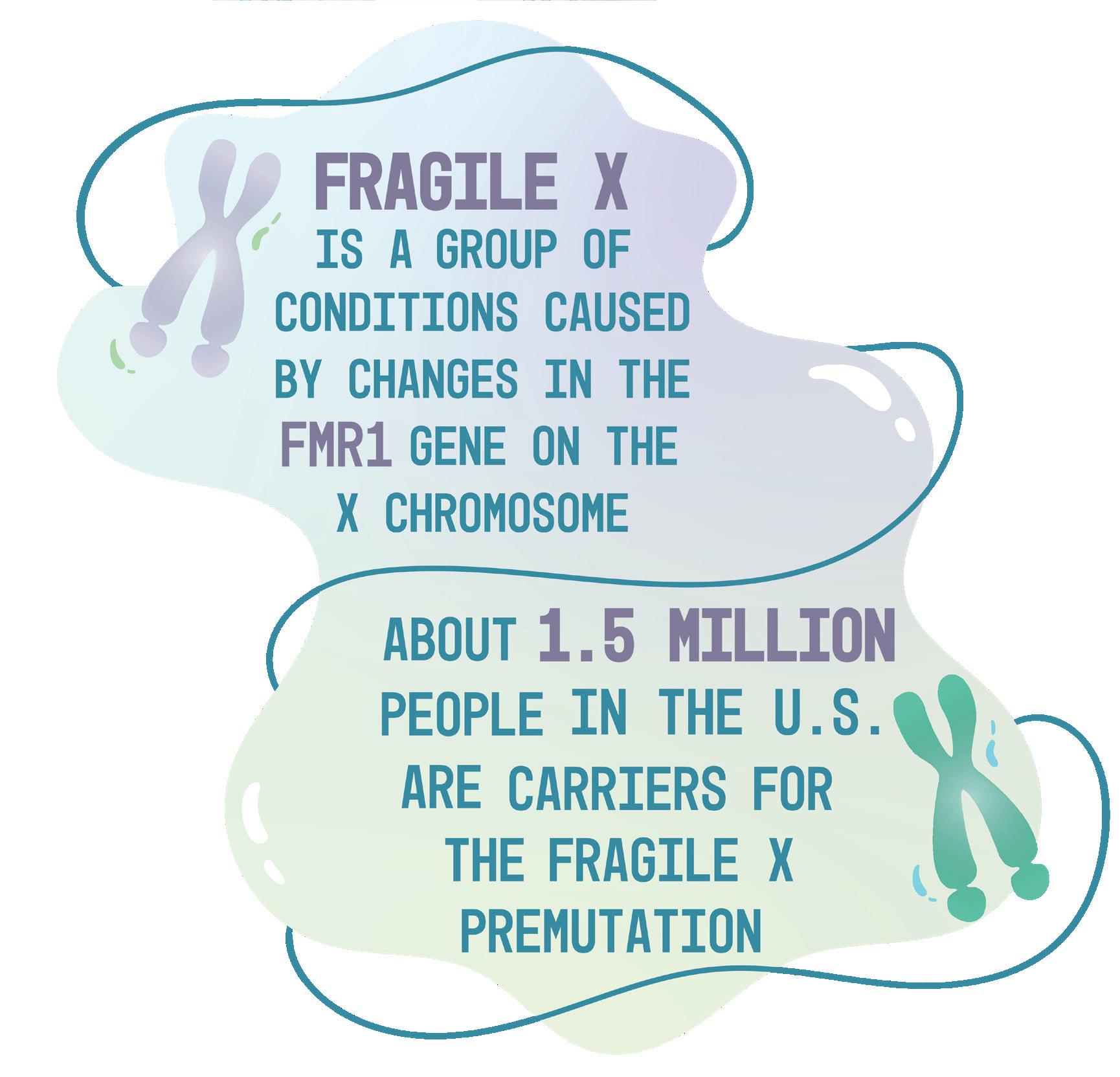
Fragile X is the general term used to cover several related conditions caused by changes in the Fragile X Messenger Ribonucleoprotein 1 gene. This includes both a premutation and a full
mutation, which vary in different risks and conditions.
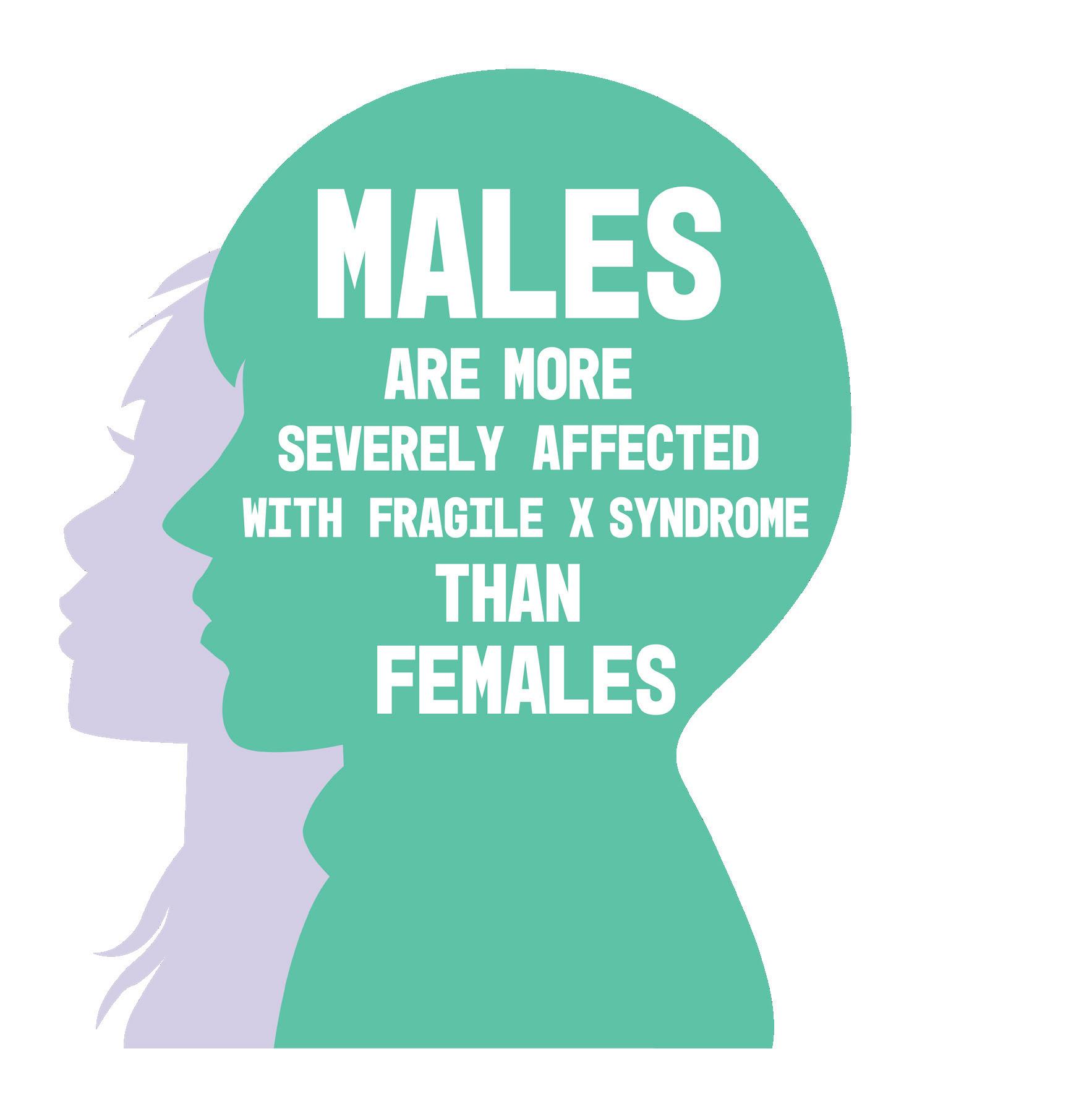
Fragile X disorders are some of the most common yet unknown neurological disorders. They are the most common inherited form of intellectual disabilities and autism. Both males and females are affected, with males normally impacted more severely.
ADVANCING FRAGILE X RESEARCH
The two studies awarded for this grant
will study the fragile X premutation across a lifespan, something that couldn’t continue otherwise due to lack of funds.
The first project, led by Roberts and assistant professor at the Arnold School of Public Health Abigail Hogan, focuses on social communication and sensory processing in young children who have the premutation.
the premutation, which includes mental health and movement
The grant will be split to about $1.2 million a year over the next five years. It will be used to ask deeper, more extensive questions, Roberts said.
“It really puts USC on the map in some ways as being a really strong fragile X-focused institution,” Roberts said.
strokes and aging. Her work, along with the other professors, will primarily focus on the lifespan and younger ages.
“Our work, which is looking at brain health from a single gene disorder, and how those individuals either have healthy or unhealthy outcomes, is also part of brain health,” Roberts said. “We focus a lot on these younger ages, but now we’re able to go across this whole lifespan. So, we’re answering questions about brain health that’ll impact a lot of individuals.”
The second project, led byAssociate Professor of Arnold School of Public Health Jessica Klusek, focuses on adult women with
expansion of brain health research. Roberts said the expansion of USC brain health involves a multitude of areas such as Alzheimer’s,
With a standard grant of $500,000 a year, Roberts is able to look at babies starting at 6 months up until 3 years old. However, she was unable to follow them past that until she received the center’s grant. This grant is also called a multi-disciplinary grant because it brings together multiple fields, such as geneticists, neurologists, speech language pathologists and others to make discoveries for people who need them.
For Klusek, this grant not only allows her to start a new study but also continue to do something she is passionate about.
“The research is not just like what I do is my job,” she said. “I feel it’s very important to collect the data and then publish the studies because there’s so little known about it.
WHAT IS FRAGILE X?
When a mutation takes place on the Fragile X Messenger Ribonucleoprotein 1 gene on the X
DESIGNS: GRACE DE PEÑA
chromosome, causes fragile X disorders.
The gene provides instructions for making a protein important for cognitive development, Klusek said. This protein is known as Fragile X Mental Retardation Protein. This mutation then causes a DNA part to expand, which then leads to either the fragile X premutation or the full mutation. The complete loss of this protein can lead to fragile X syndrome and other health-related risks.
Individuals with the premutation are also referred to as carriers, and those with the full mutation have what is called fragile X syndrome.
“So, when the FMPR, the protein, is reduced, like in fragile X syndrome, it affects everything else too,” Klusek said. “It’s a really central gene for cognitive development.”
OUTCOMES OF MUTATIONS
The full mutation, fragile X syndrome, is an inherited genetic disorder that can lead to intellectual disability and autism spectrum disorder. Despite being the leading genetic cause for autism, fragile X syndrome is considered a rare disease, with 1,625 people affected by it in the state.
The full mutation’s primary risk is intellectual impairment, Roberts said. This includes behavioral and learning challenges, physical characteristics and autism spectrum disorder.
However, the fragile X premutation is not considered rare.
“The estimate of the premutation is about 1.5 million in the U.S.,” Roberts said. “There are thousands of individuals in South Carolina with the premutation.”
Roberts said a carrier with the premutation has the possibility of some disabilities or none at all.
“You might have a subtle learning disability, a touch of ADHD, some anxiety, or you may not,” she said. “But all of those conditions are elevated in the premutation, which is important to know about.”
FRAGILE X IN CHILDREN
Roberts’ study focuses on young children with the premutation.
Roberts was only able to follow these children for a short amount of time. Now, with the grant, she can complete the picture.
“We don’t have the money to follow them after they’re 3,” she said. “This center study lets us follow them at 3, 4 and 5. Then we’re going to get a much more complete picture.”
Fourth-year neuroscience student Maddie Haynes studies the parental stress levels and parent-child relationships between neurotypical, autism spectrum disorder and fragile X premutation children as one of the projects in Roberts’ lab.
As a neuroscience student, Haynes is required to have a research credit, either doing research herself or taking a class that gives the credit. After taking a class taught by individuals working in Roberts’ lab and knowing another person there, she decided to sign up for it.
There, Haynes focuses on coding the behavior of an infant and mother playing together through a video. Haynes is able to watch the interactions between the mother and infant and accurately code the interaction.
“I code them based on how well they work together, how well they play together, if there’s any sort of tension,” Haynes said. “Maybe they’re not comfortable with each other, and then you relate those and see if there’s any sort of trends between maybe the kids who have this fragile X premutation or just the neurotypical kids.”
Haynes said within the lab, others are looking at respiratory rates, heart rates and the infant language.
“It’s really cool that there’s so many different parts, and they all kind of work together to eventually show maybe this greater picture,” Haynes said.
FRAGILE X WITHIN ADULTS
Klusek’s study funded by the grant is based on an age-related disease, fragile X-associated tremor/ ataxia syndrome, which is associated with being a carrier of the premutation. Through
this, Klusek will be able to discover more about this syndrome in women, who have been historically excluded from these studies.
“My project in the center grant is going to try to figure out what percentage of women with the premutation develop FXTAS,” Klusek said. “What are some of the precursors? Can we predict who’s at risk, both in terms of genetic risk factors as well as clinical risk factors?”
As a carrier, one can endure fragile X-associated tremor/ataxia syndrome later in life. This is an age-relating disease associated with being a carrier. Motor decline, balancing issues, tremors, cognitive decline and potential dementia are all symptoms of this syndrome. However, fragile X-associated tremor/ataxia syndrome is more common in males who have the fragile X premutation than females
women. Women carry two X’s, and the second X’s tends to compensate a little bit, Klusek said.
Because women were mostly excluded from studies, it was unknown if women got fragile X-associated tremor/ataxia syndrome.
“Women who are carriers, a lot of them have cared for their fathers, who were carriers and developed FXTAS, and they were the caregiver, and so they’ve seen it,” Klusek said. “Then in the back of their mind, they’re like, ‘Is this going to happen to me? I’m a carrier too.’ We just don’t have the data.”
However, she hopes that through these studies, more information can become available to women who are struggling with symptoms and that they can receive the support they need.
Klusek will also follow the same cohort of women that she’s
Healthcare That Sees You
Johnson and Johnson power South Carolina women’s basketball to biggest win of season against LSU
South Carolina earned a massive conference victory over thenNo. 6 LSU on Feb. 14 in Baton Rouge. Junior guard Tessa Johnson and senior guard Raven Johnson provided crucial contributions on offense that aided the team’s efforts down the stretch.
The matchup was the first top 10 road game of the season for the Gamecocks, having played then-No.
5 Vanderbilt and then-No. 4 Texas at home earlier that month. The team also faced then-No. 8 USC and the Longhorns at neutral sites in the first few weeks of the season.
South Carolina was tested early when the Tigers escaped the first quarter with a 5-point lead. The Gamecocks shot 7-20 from the field in the game’s first 10 minutes, with Tessa Johnson being the only player on the team to knock down more than one shot. Her 5 points led the team in the period.
Following a first quarter where Raven Johnson and Tessa Johnson accounted for 8 of the team’s 16 points, that trend continued in the second quarter. The pair combined for a 19-point second quarter, with Raven Johnson’s 8 points only being outdone by Tessa Johnson’s 11. The duo went 5-8 (62.5%) from beyond the arc.
“(Tessa Johnson) was our offense, to be quite honest,” head coach Dawn Staley said. “It’s not on her fingers long before she’s launching it, and we’re very fortunate she was very efficient.”
Raven Johnson added three rebounds and two assists in the quarter as well. South Carolina managed a 41-40 lead at halftime. Both Tessa Johnson (16) and Raven Johnson (11) were in double-figure, having accounted for 66% of the team’s points.
LSU senior guard Flau’jae Johnson carried the load for the Tigers’ offense early, posting 14 points and four rebounds by the midway mark.
Sophomore forward Joyce Edwards was 1-4 from the field in the first quarter. Her two turnovers by halftime trailed only LSU junior guard and former Gamecock
MiLaysia Fulwiley (3) for the most by any player. Edwards had 4 points in 18 minutes at the break.
South Carolina’s motor in the third quarter was fueled almost exclusively by senior center Madina Okot. In a period where very few shots fell, it was the Gamecocks’ dominance in the paint that helped extend the lead entering the fourth quarter.
The team shot 7-18 from the field, barely edging LSU’s rate of 5-16. Okot single-handedly out-rebounded the Tigers, grabbing nine rebounds compared to LSU’s eight as a team in the quarter. South Carolina earned 6 second-chance points points and earned a 14-8 scoring advantage in the paint.
Prior to the fourth quarter, LSU had attempted more free throws than South Carolina in each of the first three quarters to start the game. The Tigers entered the bonus with 5:48 left to play, but an inability to convert from the charity stripe handicapped the team’s efforts to crawl back into the game.
The Gamecocks capitalized where the Tigers could not. South Carolina went 15-17 (88.2%) from the freethrow line in the game, including a perfect 8-8 in the fourth quarter.
Comparatively, LSU entered the final quarter 11-15 (73.3%) from the free-throw line. The team missed more free throws in the fourth quarter (five) than in the rest of the game combined (four). Most crucially, a pair of missed free throws by Flau’jae Johnson when down by 1 point with 45 seconds to play spoiled an opportunity for the Tigers to either tie the game or take the lead.
Following the two misses, Raven Johnson assisted on an Okot bucket that pushed the lead back to 3. In a display of difference in composure between the two teams, the pair each hit both of their two free throws to push the game out of reach in the final minute.
“Probably the biggest play of the game when Raven gave her the lob,” Staley said.
Raven Johnson grabbed seven rebounds while dishing out a team-high six assists on the night, adding a team-high four steals on the other end. She was the only player with more than one assist and one of two players with more than two rebounds.
“We put the ball in Raven Johnson’s hands to make a play,” Staley said.
She finished with a career-high 19 points, trailing only Tessa Johnson’s 21 in the game. The two both shot better than 50% from the field and each made at least three 3-pointers.
Of the game’s 40 minutes Tessa Johnson played in 37 and Raven Johnson played in 36. Every other player in the game played fewer than 35 minutes.
“They had to,” Staley said. “They’re built for it ... They were exhausted, but they got us over the mountaintop.”
With the win, South Carolina moved to 22-22 all-time against LSU. In the two programs’ first 26 match-ups, the Tigers had captured victory in 22 of them. As of Feb. 14 the Gamecocks have now won 18 consecutive matchups, improving Staley’s record to 19-5 over the team all-time.
“Two of the best teams in our conference and in the country just trying to get a win,” Staley said.
JOHN DAVIS | WOMEN’S BASKETBALL BEAT WRITER
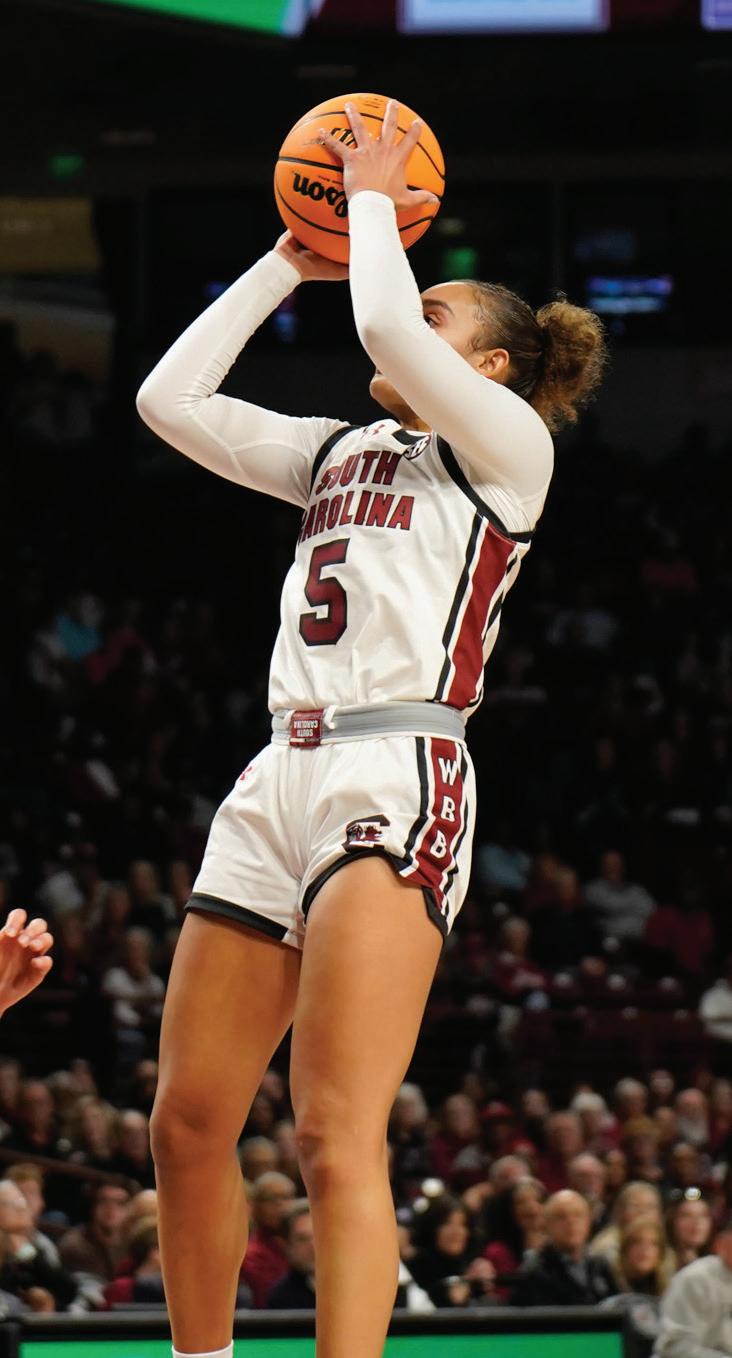
Junior guard Tessa Johnson shoots a jump shot during the game against GCU on Nov. 3, 2025. The Gamecocks won 94-54 in their first game of the season. PHOTO: JUSTIN MARTIN
The Beamer blueprint: How South Carolina football is recruiting for the present, future following 2025 season
GENEVIEVE NAVARE | SPORTS WRITER
South Carolina football is entering a new phase as head coach Shane Beamer and his staff continue to shape the Gamecocks’ roster for the future. The process is moving into a stage where plans and priorities are becoming clearer for the program.
In a press conference, Beamer spoke with the media about the state of the program while touching on recruiting, the transfer portal and how the Gamecocks plan to build sustained success in the SEC.
“We brought in experience. We brought in production. We brought in no entitlement,” Beamer said. “Just guys that want to come in here and compete and work hard and help us get better.”
The heart of South Carolina’s recruiting strategy this cycle has been to blend its high school recruiting and transfer portal additions. South Carolina’s 2026 recruiting class is one of 10 teams to have both a top-20 high school and transfer portal class, ranking among the top 20 nationally.
Beamer emphasized the importance of high school recruiting as the program’s longterm foundation. However, he admitted that the program’s needs for this year’s roster led his staff to “attack the portal a little bit heavier” to fill key roles with experienced, productive players who can contribute immediately.
“It is a great start to 2026 with the people we’ve brought in,” Beamer said. “The high school prospects … the transfers we’ve brought in, the new coaches, new staff members, we’re really fired up about where we are now.”
According to 247 Sports composite rankings, the Gamecocks’ 2026 recruiting class is ranked No.
16 nationally with 17 committed prospects from high school. This includes top-tier talent such as edge rusher Julian Walker, who flipped his commitment from Michigan, and quarterback Landon Duckworth, who solidified his pledge after re-committing earlier in the cycle.
The class features depth at defensive line, cornerback and wide receiver, complemented by transfer additions such as wide receiver Nitro Tuggle and defensive back Quay’sheed Scott. This diversity, from play-makers to foundational blockers, points to Beamer’s intention of building a roster with balance and depth capable of competing in the SEC’s unforgiving landscape.
“It was very evident that we brought in a lot of guys that either were captain-type guys at their
school or have those leadership qualities,” Beamer said.
Early commitments are key in building future success because they give the coaching staff more time to develop relationships and tailor its recruiting plans, which is especially important given the rising competition for elite talent in the Southeast.
South Carolina has been active in the transfer portal, addressing position needs with veteran players who bring experience and impact. These additions, spanning offensive line help, skill-position contributors and defensive reinforcements, are intended not only to fill immediate needs but to provide leaders for younger signees coming in from high school.
The Gamecocks’ coaching staff made a notable hire by bringing in Kendal Briles as offensive coordinator, adding a coach with a strong offensive pedigree to help maximize the potential of recruits already in the fold.
“Everybody’s here now, everybody’s part of the 2026 team, and let’s get ready to go compete and see how good we can be,” Beamer said.
With a strong 2026 class on board, the Gamecocks are positioning themselves to compete at a higher level in the SEC. As Beamer continues to refine his roster and coaching staff, recruiting will remain a central pillar of the program’s long-term success.
PHOTO: Madison Reece
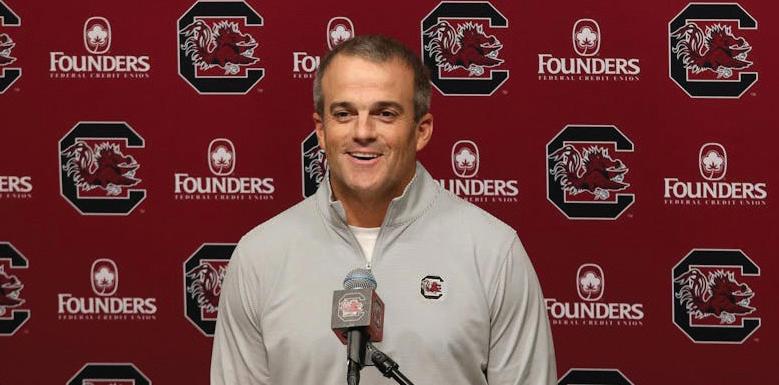
Head coach Shane Beamer speaks at a press conference on Nov. 12, 2024, at the South Carolina football training facility. High school recruiting is a key foundation for building the Gamecocks’ future roster.
Where head coach Lamont Paris stands in his fourth season with South Carolina men’s basketball
With the end of the 2025-26 men’s basketball regular season, the buzz around head coach Lamont Paris’s job security continues to heat up.
In Paris’ four seasons with the program, he has produced a 60-62 record and has been to the NCAA Tournament once with South Carolina in 2024.
Prior to South Carolina, Paris was the head coach at the University of Tennessee at Chattanooga, a Division I program in the Southern Conference. He had a record of 8772 during his five years with the Mocs, which included an NCAA Tournament appearance and a Southern Conference title in 2022.
Coming off a 95–48 loss to Florida on Jan. 28, Paris spoke about the effort of the entire team in recent games.
“There’s nothing to be proud of in that effort in terms of fight,” said Paris. “At some point in every game, there’s a point where you realize, probably, it’s not going to work out for us.”
Junior forward Elijah Strong spoke about how he and his teammates deal with each loss after a 78-59 fall to Missouri on Feb. 7.
“A lot of the games that we lost were absolutely winnable games just due to controllable stuff that we did not handle,” Strong said. “What I can do and what my teammates can do, we can just keep fighting.”
The 2023-24 season was impactful in terms of Paris’ time being extended further with South Carolina. With it being Paris’ only winning season at South Carolina so far, going 268, the University of South Carolina approved a six-year, $26 million deal in March 2024.
Paris is under contract with South Carolina through the 2029–30
season. According to Pete Thamel of ESPN, if Paris left in 2025, his buyout would’ve started at $12.5 million and would continue to decrease until hitting $1 million at the end of the contract.
Redshirt senior guard Meechie Johnson spoke about the pressure on the men’s basketball program.
“He’s definitely been on us more,” Johnson said in a 247 Sports article. “Coach Lamont Paris always wants to win games. He obviously has pressure to win.”
Johnson defended Paris and his coaching style, noting that his approach played a role in Paris earning SEC Coach of the Year honor in 2024, while also shifting responsibility onto himself and the team.
“Coach Paris is doing a great job, he’s coaching us hard and wants to win games. People can put more pressure on me, put it all on me, because he’s allowing us to play,” Johnson said in a 247 Sports article.
Despite the successful season, 2024-25 did not follow suit. The team finished 12-20 (2-16 SEC), which included a 13-game losing streak in conference play. The Gamecocks then went through major roster changes, as six players transferred out, and six new players joined the roster.
Changes were made to improve, but that improvement had not been showcased.
Along with roster changes in the 2025-26 season, Paris and the coaching staff have been tweaking offensive plays and approaching the conference games differently. For example, heading into the Feb. 3 game against Texas, the Gamecocks changed their offensive approach, mirroring Texas’ attack inside. Still, making the change wasn’t
enough to pull off a conference win against the Longhorns.
Even after the Florida loss, when asked about different approaches this far in the season, Paris said challenging the players is the difference to make.
“I think you have to be challenged. I don’t think you can just put your head on the pillow and say, ‘Okay, well, tomorrow will be better, tomorrow, I’ll just play better tomorrow,’” Paris said. “I just don’t think that this is the path forward, not realistic, not in this league, or probably any, but certainly not in this league, trying to continue to find what those buttons are to get guys to play better.”
For South Carolina, changes have been made on and off the court. From mindsets to players being shifted, the coaching staff around Paris has stayed pretty consistent and familiar. Assistant coaches Tanner Bronson,
Eddie Shannon and David McKinley have been with the Gamecocks since Paris was hired in 2022, following Paris from Chattanooga.
Special assistant to the head coach Carey Rich has been in Columbia since 2022. Assistant coach Will Bailey rejoined the Gamecocks in 2024-25 after coaching at South Carolina from 2020-22 and at Loyola University Chicago in 2023-24.
Laying out the past four seasons for the Gamecocks, the pieces of the puzzle have consistently failed to fit together. Change after change continues not to be enough to lead the Gamecocks to a winning record, which continues to turn up the heat on Paris as South Carolina’s head coach.
MAYA AMBUEHL | SPORTS WRITER
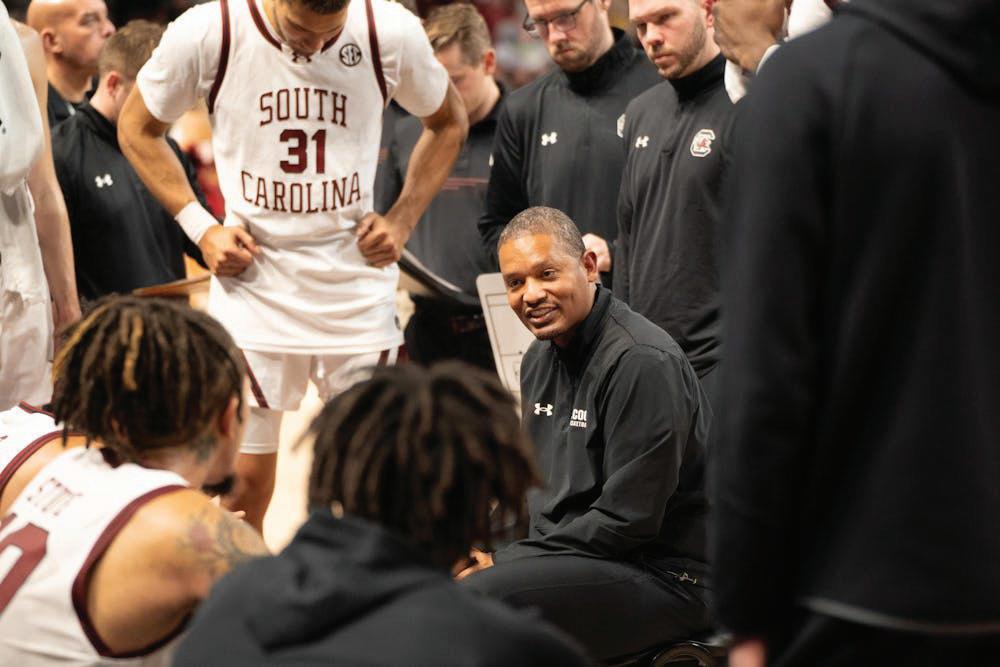
Head coach Lamont Paris talks to his players during a timeout in the second half. The 2025-26 season is Paris’ seventh as a collegiate head coach.
PHOTO: LUCAS STREDWICK
Sophomore first baseman Beau Hollins rebounds through surrounding pressure
As South Carolina begins its 2026 season, many new faces have entered the program. Experienced South Carolina players have also returned to the team, including sophomore first baseman Beau Hollins.
In his debut season, Beau Hollins started 42 games with a .308 batting average and 28 runs scored, six home runs and 24 RBIs.
Despite his promising numbers, the team finished 28-29 and 6-24 in conference play. Beau Hollins said last year’s turnout has fueled him for this season.
“Obviously, we didn’t have the year we wanted to, and when we built a team around hard work and discipline this year, it’s exciting,” Beau Hollins said. “With the guys we have on the team this year, it gives me fuel to want to go out there and play, and not like I didn’t have it last year, but these guys want it, and it’s nice to be around that.”
Beau Hollins spoke about the flip and improvement from his freshman to sophomore season.
“As a freshman last year, I was just getting my feet wet and learning how things were in college baseball,” Beau Hollins said in a University of South Carolina Athletics article. “I worked hard all summer to get stronger, faster, bigger and better. I came in expecting to win that first base job and play because I have high expectations for myself.”
Not just in the summer, but Beau Hollins spent both his summer and winter breaks at the South Carolina facility working with three-time Gold Glove winner and Gamecock baseball alum Christian Walker. Walker was a part of the South Carolina back-to-back National Championship teams in 2010 and
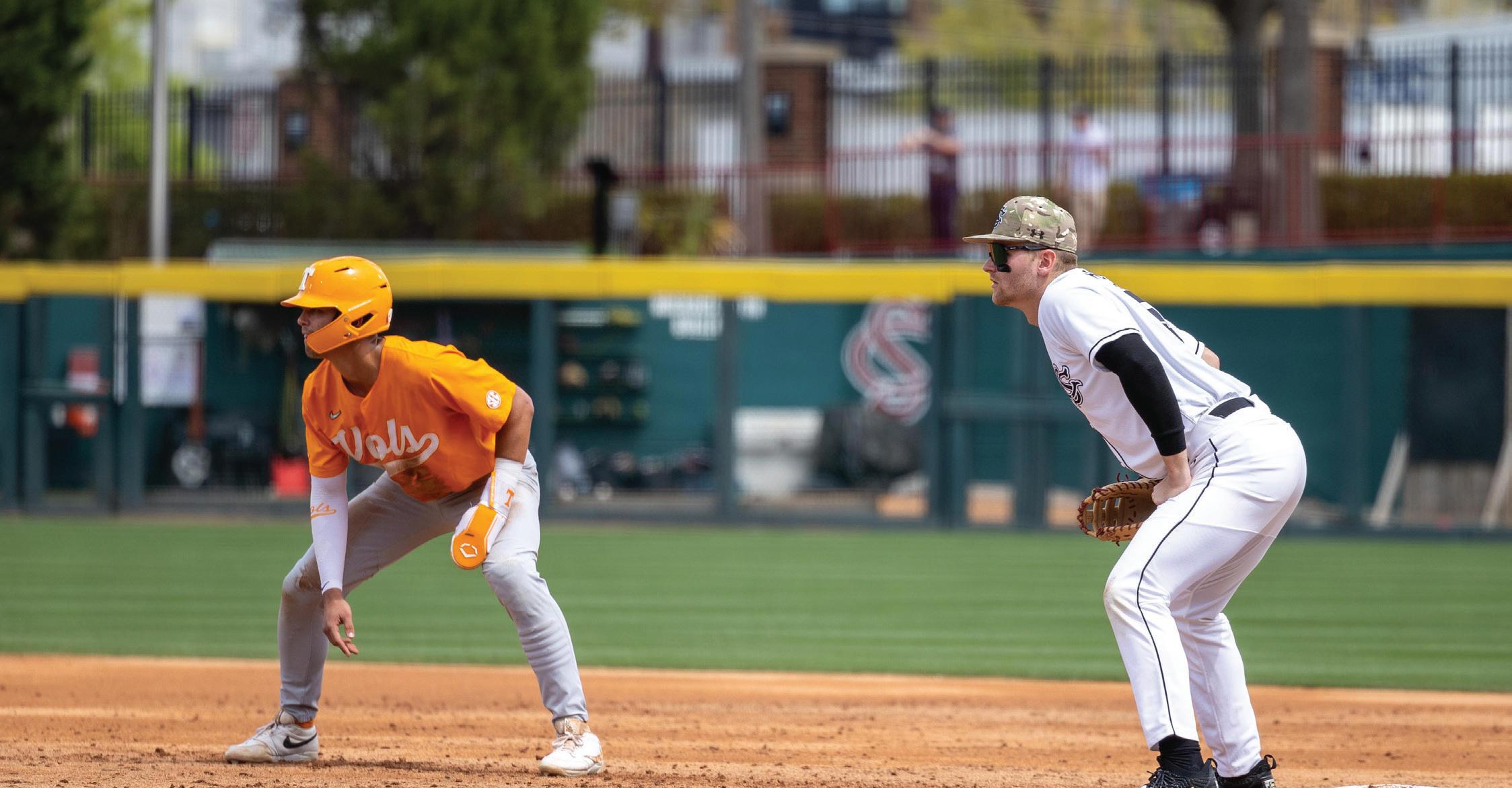
Sophomore infielder Beau Hollins prepares to receive a pick-off throw at first base during South Carolina’s game against Tennessee on March 30, 2025, at Founders Park. The Gamecocks lost to the Volunteers 7-2 and lost the series 3-0.
2011 before he was drafted in the fourth round of the 2012 MLB draft to the Baltimore Orioles. He is now at the Houston Astros playing first baseman. Beau Hollins said they spent time working on everything, including defensive work, hitting, fielding and overall getting stronger and more power.
Head coach Paul Mainieri said he wants to see more out of Beau Hollins, urging pressure on him.
“I think Beau, in order to take it to the next level, has to be more than a five-or-six-home-run-a-year guy.
If he can get, and I hate to put a number on him, but into the double digits, then he’s going to be more of a run producer for us,” Mainieri said.
“He’s got to just be more consistent and do it on a more regular basis. He hit .300 last year, so he’s got the
talent to put the bat on the ball.”
Beau Hollins said he enjoys having that kind of pressure on him, without focusing on personal numbers. He said he wants to go out on the field and do what he can do to get a win for him and his team.
His mentality and efforts are part of his family dynamic and their athleticism. His three sisters played tennis at the collegiate level, his brother played professional baseball for the Miami Marlins, and his father and uncle have family ties to the South Carolina program.
While his uncle played for South Carolina from 1978-81, his father Dave Hollins made his stamp in the major leagues after playing for the Gamecocks as well. Dave Hollins played in the MLB for 12 years, logging time with the
Philadelphia Phillies as a third baseman and earned an All-Star honor in 1993.
The Lexington, South Carolina, native said his father was a big role model in his life growing up, on and off the field. With his father and brother having major baseball experience, Beau Hollins said he was able to see the game a different way than both of them.
“I learned to take what some people call pressure and turn it into fun,” Beau Hollins said in a in a University of South Carolina Athletics article. “Everybody knows how hard the game is. My dad told me he was always hard on himself, and he told me to be the opposite and to have fun and enjoy the game. It’s a blast.”
MAYA AMBUEHL | SPORTS WRITER
PHOTO: SEBASTIAN GODUN
How senior edge Caleb Herring landed in South Carolina’s hands
MAYA AMBUEHL | SPORTS WRITER
As the college football world continues to change, coaches have to bring their A-game to land top recruits. Some programs spend millions. Others roll out the red carpet. But with senior edge rusher Caleb Herring, South Carolina fans can be credited with helping secure the star talent.
Transferring in from Tennessee, Herring spent the first three years of his collegiate career with the Volunteers, appearing in 36 games, while recording five sacks, eight tackles for loss and 25 total tackles.
Midway through his third season at Tennessee, Herring said he felt it was time for a change, despite his coaches trying to get him to stay.
“I was having a great time and was still giving it my all,” Herring said. “But it was probably time for me to
go. I needed new scenery. I felt like if I would have stayed there, because I was getting too comfortable at the same time, but if I had stayed, they probably wouldn’t have gotten the best out of me my last year.”
Herring officially entered the transfer portal on Jan. 2 and quickly drew interest from programs such as Georgia, Texas and Mississippi State.
South Carolina didn’t reach out until just days before the portal closed on Jan. 16. He took a visit to Columbia in mid-January and felt a connection.
“I came here, and I really enjoyed it,” Herring said. “The coaches, they were being real with me, telling me things that I needed to work on instead of just praising me the whole time.”
Later that evening, Herring was spotted in the student section at South Carolina’s women’s basketball game against Texas, alongside incoming running back transfer Christian Clark from Texas.
Along with the honesty from the coaching staff, Herring said the excitement from fans during his visit and after his commitment stood out.
“They showed me how much people really cared for real, especially the South Carolina fans,” Herring said. “Mind you, South Carolina, they didn’t hit me up until my last week of being in the portal.”
Herring also mentioned he egged fans on a bit, asking if he should give South Carolina a shot and saying that he would visit.
The reality of the moment fully set in when he checked X, formerly
known as Twitter, and saw the buzz following his commitment.
With one year of eligibility remaining, Herring knows what he wants from his final season of college football.
“I’ll say dominate,” Herring said. “Really just taking in my last year of college because, I mean, not too many people get this opportunity to be in college, and I feel like this is a once-in-a-lifetime thing.”
Herring will get the opportunity to face his former team this season thanks to the new ninegame conference schedule taking effect this upcoming football season. The Gamecocks are set to host Tennessee in October at Williams-Brice Stadium.
‘This is something to be proud of’: Staley’s
unite students at South Carolina
JOHN DAVIS | WOMEN’S BASKETBALL BEAT WRITER
When South Carolina head coach Dawn Staley took over the women’s basketball program, it was an achievement if the team won 20 games in a season. Fast-forward to 2026, and the now three-time national champion Gamecocks have wrapped up a 29-2 regular season, claiming their fifth consecutive Southeastern Conference regular-season title and their 10th in 13 seasons.
Staley, a former five-time WNBA All-Star and three-time Olympic gold medalist as a player, was appointed to lead the program in 2008 after spending eight seasons as the Temple head coach. When she took over, South Carolina had won 20-plus games just twice since joining the SEC in 1991.
“I never wanted to be a coach,” Staley said. “But sometimes you think you know what you want, and then life happens.”
By her fourth season in 2012, Staley had the Gamecocks in just their third NCAA Tournament appearance in the last 21 seasons. The Gamecocks have made the dance every year since.
“It’s easy to be a fan since it’s basically the only thing that we’re good at,” said William Garner, a second-year mechanical engineering student. “It’s such a dominant sport. I feel like it’s so easy to love, especially growing up a South Carolina fan and watching all the sports teams.”
ELITE TRADITIONS
Staley notched her 500th win at South Carolina this season,
and following a dominant regular season, students are eager to see the Gamecocks return to national glory for a chance to partake in the school’s notorious celebration tradition.
“I remember when we won my sophomore year, it was so much fun jumping in the fountain,” fourthyear public health student Jenna Geesaman said. “Then we had that few hours off from classes. It was just a great boost to everyone. You could see that campus was a lot happier.”
Fourth-year criminal justice and Spanish student Max Brabham noted the spontaneity of the tradition when it occurred in his second year.
“They flooded the fountain last time,” Brabham said. “I was in a study session when I saw everybody running through the fountain, so that was interesting ... It would help boost morale.”
Students in their first or second years haven’t had the chance to jump in the fountain, a school staple many are already well familiar with.
“I would love a chance to go swimming in that disgusting fountain,” said Clara Brown, a second-year film and media studies student. “It’s something that people want to see happen, so that way, they can be like, ‘Oh, where was I the day that we won the national championship?’”
MADE FOR MARCH
South Carolina has gone all the way in two of the last four NCAA Tournaments. In the other two efforts, the team has been knocked out by generational talents. In 2025, it was the UConn Huskies
and guard Paige Bueckers, who became the first overall pick in the WNBA draft eight days later. In 2023, it was the Iowa Hawkeyes and guard Caitlin Clark, the No. 1 overall selection in 2024.
Second-year public health student Mikayla Spencer said a national title could foster excitement after the team fell short last April.
“I know last year, there was a lot of disappointment with what happened when they lost,” Spencer said. “This year could be a big boost in morale for the student body and just bring back more excitement for basketball.”
Staley has led South Carolina to seven of the last 10 Final Fours, including five straight. The team has won the SEC Tournament in nine of the last 11 seasons prior to the 2026 tournament. The program has produced 12 WNBA Draft selections since 2020, tied for the most in the country.
Third-year history and political science student Meredyth Blake said the team’s run to the national championship in 2024 let her know she chose the right university.
“It is probably the thing that made me 100% sure I went to the right school,” Blake said. “I was an out-ofstate student, and the year I decided to come here is the year they were in the nationals, and then they lost, but I was like ‘Oh, my team is in the nationals. This is a great school.’”
For students at SEC schools, little matters more than football. Gamecock football won four games in 2025, five games fewer than its total in 2024. The program
Gamecocks
since I’ve been here,” Hannah said. “Having a team that could bounce back and show the world that South Carolina is an athletic school would
The Gamecock women’s basketball team went undefeated at Colonial Life Arena this season,
“I think it is super cool to be able to just be an example of what it could look like and feel like to
South Carolina women’s basketball season title for the fifth consecutive season this year, the second-longest streak in conference history, trailing only legendary coach Pat Summit’s seven consecutive titles
“Dawn Staley also has made a really huge impact on women’s basketball in general,” third-year English student Gracie Bodine said. “With her Olympic wins and the national championship runs and stuff like that. I think it’s given us another sport we can really come
When it comes to women’s basketball, there may not be a city in the country more supportive than Columbia, South Carolina. For the 12th consecutive season, South Carolina led the nation in women’s basketball average attendance. Back in the 2014-15 season, the team earned the top spot with an average attendance of 12,293 per game. That total was a 6,371 jump from the previous season, the biggest increase in average attendance in
“The (games) that I’ve been to, blown away. It’s awesome,” said Jacob Wood, a first-year aerospace engineering student. “Just the atmosphere of being in the crowd,
This season, the team surpassed the NCAA record of 11 consecutive seasons leading the nation in attendance held by Tennessee from 2004-14. An average of 16,437 fans per game in 2024-25 set a program record.
Opposing coaches have taken note of the team’s roaring home crowd too. Vanderbilt head coach Shea Ralph spoke about how she wishes her team’s home games could mirror that of South Carolina’s.
“This is a really tough environment to prepare for,” Ralph said. “This is why I beg and plead for people to show up to our games because we want to have a home environment like South Carolina has for our kids.”
The Gamecocks, coming off an uncharacteristic loss to then-No. 16 Oklahoma, returned home on Jan. 25 to comfortably handle thenundefeated Vanderbilt in a 29-point victory. South Carolina hasn’t lost back-to-back games since the 2018-19 season.
“I’m happy that we responded to our loss,” Staley said. “I’m happy that we can rise to the challenge of playing the top teams, not just in our conference, but they are top teams in the country.”
Including the win over Vanderbilt, the Gamecocks won 10 straight to end the regular season. A road win over the No. 6 LSU Tigers on Feb. 14 complemented additional ranked wins over No. 16 Kentucky, No. 17 Ole Miss, No. 19 Tennessee and No. 25 Alabama across the final six games.
“A lot of people will say that we are a women’s basketball school,” Jared Blazek, a fourth-year civil engineering student said. “I was there with the celebration when we won (the national championship) in 2024. The whole entire celebration, going into the fountain and everything, I mean, there’s no other place like it.”
When South Carolina won the national championship in 2024, it was the second time in a threeseason stretch the program had done so. The school has appeared in three of the last four national championship games dating back to 2022.
“It makes me feel proud of our school,” Trista Walters, a first-
year political science student said. “I think that women’s sports in general, people talk about it less than men’s sports ... Our student body, we are very proud of our women’s basketball team.”
South Carolina’s final ranked home game hosted a sold-out crowd of 18,000 against Ole Miss. ESPN’s “College GameDay” was in town for the game. The Gamecocks won by 37 points..
“The students have been great,” Staley said. “This section has been filled up, whether they get free T-shirts or free pizza or not, and they have been loud.”
NATIONAL SPOTLIGHT
The Gamecocks’ victory over Tennessee on Feb. 8 averaged 1.46 million viewers on ABC, the most of any women’s basketball game this season. Less than a week later, South Carolina’s matchup against LSU on Feb. 14 overtook that title, averaging 1.7 million viewers.
The matchup in Baton Rouge, Louisiana, was the first time ever that a regular-season women’s college basketball game was featured on ABC’s Saturday primetime slot.
Eight days later, when ESPN’s “College GameDay” came to Columbia on Feb. 22, it earned its most-watched women’s “GameDay” episode ever at an average of 1.2 million viewers.
“I don’t think I could list one person that would be like, ‘I wouldn’t want to see us win a national championship in women’s basketball. I wouldn’t want to jump in the fountain. I wouldn’t want to have that collective experience with all 35,000 other people that go here,’” Garner said.
While attention to women’s basketball continues to surge in popularity nationwide, fandom of the sport has been a key piece to South Carolina for years. The program will compete for its third national championship in six seasons this month.
“Dawn Staley, thank you so much,” said Roberto Santiago, a fourth-year information science student. “You really carry us.”
PHOTO: JACK BRADSHAW DESIGN: RANSLEIGH BALDAS
Columbia chefs suggest cooking tips for college students
Maggie Harmon | FOOD AND BEVERAGE BEAT WRITER
One reason many college students miss home is the lack of homecooked meals. After ordering Chick-fil-A or Panda Express for the third time in a week, fast food starts to get old.
Many college students say they don’t know how to cook, instead relying on fast food and microwave meals.
Kristian Niemi, owner of the Cajun-Creole restaurant and bar called Bourbon, didn’t learn how to cook until college. Niemi was attending the College of Charleston after serving in the army when he had an epiphany.
“I was standing in my apartment one day and realized that, for my entire life, other people have cooked for me, and I had never cooked,” Niemi said.
Niemi was inspired to drive to the nearest bookstore to purchase a cookbook. After that, he went to the grocery store next door to buy the ingredients for his first cooking adventure. Then, Niemi cooked a recipe from the book and realized cooking really wasn’t as challenging as he had thought.
Ricky Mollohan is the co-owner and head chef of Mr. Friendly’s, an upscale Southern bistro. Mr. Friendly’s opened in 1995, and Mollohan started working there as a server the following year when he was a student at the University of South Carolina. In his last year of college, he became manager and now has worked up to co-owner.
As a self-trained chef that grew up surrounded by the restaurant business, Mollohan’s biggest piece of advice for beginners is to be confident.
Mollohan said he encourages people to cook because it gives them a sense of independence.
“I’m always amazed at people that can’t cook because the person
you’re doing it for the most is yourself,” Mollohan said.
Additionally, Mollohan explained that after spending time cooking your own food, you feel accomplished.
Mollohan recommended starting with a meal that doesn’t require a surplus of dishes.
“I’m big on something where you can cook everything in one pan,” Mollohan said. “Pastas, to me, are probably the easiest thing.”
On the other hand, Niemi suggested beginning with a different type of meal.
“If you go to grocery stores like Publix, they’ve got in the meat section partially-prepped meals that you just have to finish, and that’s a great place to start,” Niemi said. “When you’ve made a few of these meals and you see what the ingredients are that they put in them, then you can expand, and you can go and buy those ingredients separately.”
Niemi said the hardest concept for college students to understand when they start cooking is portioning. He said it can be hard because it is often the same amount of work cooking for four people as it is for one. Niemi explained this problem can be solved by meal prepping.
“Take a day, Saturday or Sunday, and meal prep a bunch of meals, and put them in containers,” Niemi said. “Throw some in the fridge and some in the freezer. You’re set for a week or two.”
Niemi also recommended utilizing the internet when cooking.
“If there’s something you want to make, jump on YouTube,” Niemi said. “There’s probably a hundred different people that will show you exactly.”
Harold Pendleton has been the executive chef at The War Mouth, a restaurant focused on Southern cuisine, for 10 years. The War Mouth is a farm-to-table
restaurant, meaning the food at the establishment came from a specific farm without going through a store, market or distributor. Because of this, Pendleton encourages college students to support local Columbia farms.
“Always cook fresh, get good ingredients, and don’t eat processed foods,” Pendleton said.
Since Pendleton’s parents owned a deli, he grew up in the restaurant business. According to Pendleton, the secret to cooking is quite simple.
“If you want to cook, just follow the recipe,” Pendleton said.
Then you can start to experiment, Pendleton said. If experiments don’t turn out as planned or end up a complete mess, Pendleton encouraged new chefs to try again.
“The cool thing about cooking is you can start over,” Pendleton said. “You can learn from your failures to try and get it right the next time.”
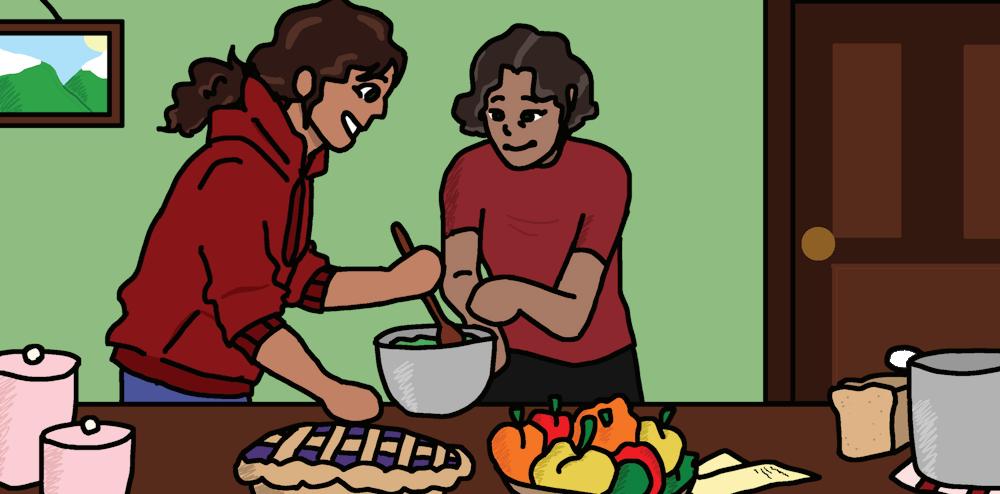
ILLUSTRATION: ISABELLA HUFFINES
2026 Oscars: Top five Best Picture nominees ranked
Nat Campbell | EDITOR-IN-CHIEF
There are several spectacular movies nominated for Best Picture at the 98th Academy Awards, but others leave something to be desired. It hasn’t always been a 10-nominee category, and that may have been for good reason. Here are the five best nominees this year.
No. 5: ‘Sentimental Value’ Rating: A
Joachim Trier’s “Sentimental Value” explores the dynamics between two sisters and their estranged father. Nora (Renate Reinsve) is an actor, and her father, Gustav Borg, (Stellan Skarsgård) writes a script for a film he wants her to star in.
The film is very dialogue-heavy, which its cast shines in. Elle Fanning’s role feels a bit meta, as she plays an American actress, Rachel, who struggles with the Norwegian script. The characters feel real and lived-in thanks to a combination of nuanced performances and a great original script.
The house passed down in the family for generations has a large presence in the film as well.
The memories of it from various generations and how it has changed throughout the years add to the depth of the film.
No. 4: ‘Sinners’ Rating: A
With a record-breaking 16 welldeserved Oscar nominations, Ryan Coogler’s “Sinners” is one of the strongest movies in this year’s lineup. It follows twin brothers Smoke and Stack (Michael B. Jordan) as they encounter supernatural evil powers while trying to open a juke joint for their community.
Pretty much every performance in “Sinners” is beyond amazing. Jordan shines in each of his roles as the twins and creates incredible chemistry with himself. Miles Caton, who plays Sammie, gives one of the best performances in the film. His voice is incredible on the soundtrack’s original songs, with music composed by two-time Oscar winner Ludwig Göransson. Co-stars Delroy Lindo and Wunmi Mosaku also filled their supporting roles beautifully. The costumes, soundtrack and score also each stood out in the film,
helping immerse the audience in the scenes. “Sinners” certainly earned its nominations in both acting and technical categories.
No. 3: ‘Bugonia’ Rating: A
Emma Stone and Yorgos Lanthimos’ third consecutive collaboration, “Bugonia”, follows two young men who kidnap a high-profile CEO, convinced she is an alien.
Jesse Plemons gives a chilling and unsettling performance as the conspiracy-obsessed Teddy, and his disturbingly greasy hair in the film certainly adds to that. Stone’s portrayal of Michelle is a comedic take on a girlboss corporate executive, who wants to “have a dialogue” about her possible alien status.
The film looks fantastic. The colors are incredibly vibrant, and the surrealism of the black and white flashback scenes is amazing. It also features an intense score, which adds to the film’s eeriness.
No. 2: ‘One Battle After Another’ Rating: A
Paul Thomas Anderson’s “One Battle After Another” seems to be the favorite for Best Picture so far in this awards season. The film is a comedic action-thriller that follows an ex-revolutionary and his daughter as they try to evade a corrupt military officer’s pursuit.
The film features great performances from Leonardo DiCaprio, Chase Infiniti and Benicio del Toro. But Sean Penn stands out in his role as Colonel Steven J. Lockjaw. His terrifying yet comedic portrayal of the character was brilliant.
The car chase scene toward the end of the film is perhaps the best scene in a movie this year. Paired with a fantastic and tense score from Jonny Greenwood, the scene is enthralling. The stakes slowly rise as the camera moves over each of the road’s many hills and the gap between the cars closes.
No. 1: ‘Marty Supreme’ Rating: A+
Set in 1950s New York, “Marty Supreme” follows Marty Mauser (Timothée Chalamet) as he strives for greatness as a ping-pong legend. Mauser’s journey grows increasingly chaotic as the stakes get higher.
Chalamet’s performance in the film feels enormous. Mauser’s obnoxious actions make him more and more unlikeable, but he’s still impossible not to root for. With prosthetic acne scars and glasses that distort his eyes, Chalamet disappears into the character. The synth-driven soundtrack and score are very ‘80s, but it works very well for the film. It helps escalate Mauser’s most stressful scenes. And with scenes depicting tense ping-pong matches, wild shootouts and explosions, this movie is certainly stressful.
PHOTOGRAPHIC: Jack Bradshaw
USC music professor wins Grammy as part of ensemble
When USC music professor Michael Harley and his friends formed Alarm Will Sound at the Eastman School of Music in New York, their motivations were simple.
“All of us were playing contemporary music there at the time and wanted to keep playing together as we graduated,” Harley said. “We’ve now been together for 25 years.”
Founded in 2001, Alarm Will Sound is a 16-member contemporary music chamber orchestra that performs at various venues around the U.S. as well as European festivals. On Feb. 1 in Los Angeles, it was honored with the 2026 Grammy award for Best Chamber Music / Small Ensemble Performance.
Harley, who plays bassoon, keyboards and performs vocals for the ensemble, praised the piece it played and won the award with, “Land of Winter.” Written by composer Donnacha Dennehy, Harley said it’s a striking and meaningful piece of music.
Though band members have spread around the country, Harley estimated two-thirds of the current lineup to be founders. He said genuine and strong connection has kept the group together.
Harley works at USC alongside his wife Jennifer Parker-Harley, who teaches the flute and has served as a guest member of Alarm Will Sound, having performed in orchestras full-time for a decade prior to her teaching career.
Parker-Harley said the win was an exciting moment and that the ensemble’s ambitious and innovative goals made it more than deserving.
“They’ve worked hard for so long, and they have done a lot to push the ideas of contemporary classical music forward, make it more accessible, bring in different kinds of musicians,” Parker-Harley said.
“They generally play music by living composers, and living composers have all kinds of influences, not just from classical music, but from world music, from jazz, from pop and rock, and so they are able to bring these different elements together in a way that’s really exciting.”
Fellow founding member Michael Clayville, who plays trombone and serves as director of marketing for Alarm Will Sound, in addition to teaching at Lawrence University in Wisconsin, said the group’s exciting style sets it apart from the typical ensemble.
“(We fill) a very particular niche that not a lot of other ensembles do, where we play this cutting-edge new music,” Clayville said. “My job is easy in that sense, that we’re doing something that’s already different from what everybody else is doing.”
Harley said that growing up, he never even considered the possibility of winning a Grammy, and while it became an aspiration
as Alarm Will Sound gained a reputation and recognition, he always remained driven by a desire to create quality art, regardless of awards.
“In some level, I hope that kind of recognition is immaterial,” Harley said. “I think it only comes when you just try to do good work, when you believe in an artistic product and you work as hard as you can, and that’s the only thing you can control as an artist.”
Clayville said one of the most meaningful parts of the ceremony was seeing the emotions of his longtime friends.
“These are people I’ve known for 25 years,” Clayville said. “Being able to see people celebrate with their families and be able to celebrate what it means to have spent that much time with people and really get to know them has been worthwhile and valuable to me.”
In addition to Harley, the School of Music also has a four-time nominee,
guitar professor Mak Grgic, on staff, who also received a 2026 nod. Harley said he hopes the honors will lead to further recognition of the school’s excellence.
“It’s truly one of the best music schools in the country,” Harley said. “I’m surrounded by faculty that are doing equally cool stuff and are fantastic players and teachers and human beings.”
Clayville said he was excited for the year ahead, with Alarm Will Sound set to release at least three different albums amidst a host of live performances. Now Grammywinners, Harley said he hopes that status will provide the group with even more opportunities.
“We love what we do,” Harley said. “We love working with composers and helping them bring to life amazing new pieces, and so hopefully this notoriety allows us to just do even more of that in the future.”
Miles Shea | ARTS & CULTURE EDITOR
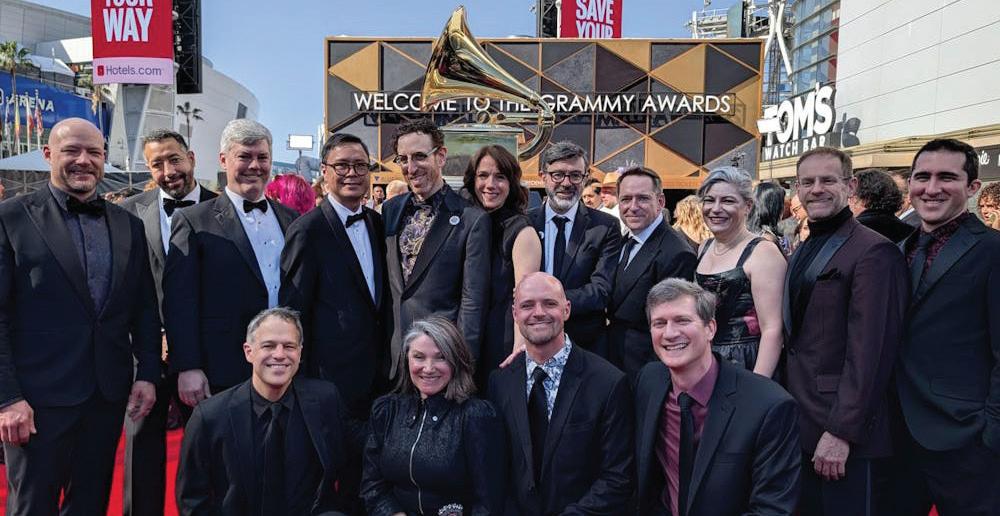
USC music professor Michael Harley (far left), kneels on the red carpet at the 2026 Grammy Awards on Feb. 1.
Photo courtesy of Paul MelnikoW
‘Power of the female body’: Professors talk about reproductive healthcare research
SIMONE MEYER | ASSISTANT ARTS & CULTURE EDITOR
Deborah Billings doesn’t believe in objectivity.
Billings is an affiliate faculty member in the Department of Women’s and Gender Studies. She has been studying and advocating through reproductive healthcare since she was 15 years old, when she ended her own pregnancy with an abortion.
“It’s very personal to me,” Billings said. “I remember how scary that was and complicated it was and also so thankful that I was able to access it.”
According to the Guttmacher Institute, almost one in every five pregnancies ended in abortion in 2020, and this number is rising. Since Billings ended her pregnancy, she has done research all over the world on subjects such as prenatal care, midwifery and the effect of Medicaid on natal health. While Billings said her published work may look impressive, that’s not what’s important to her.
“It’s about making a difference, right?” Billings said. “I’m all for science, for science sake, because we need that too. But that’s just not me.”
Since the fall of Roe v. Wade in 2022, South Carolina legislators have imposed restrictions on reproductive healthcare, including a six-week abortion ban. Proposed legislation includes criminalizing abortion-inducing medication and identifying fertilized human eggs as human beings.
According to the National Library of Medicine, 40-60% of fertilized eggs don’t come to term, meaning that the embryo never becomes a child, which could criminalize
a miscarriage or necessary abortion service.
Billings said if legislators
laws that provide housing and access to education,” Billings said. “They would support Medicaid expansion and job creation. They don’t do any of that. They’re on a mission. They are misogynists.”
Billings said she hopes her research and advocacy experience helps others fight against legislation limiting reproductive justice.
“Unless either we as researchers or somebody else ... can take what we do and translate it to legislators, to students, to physicians,” Billings said. “Then I think we’re all just sort of waiting for our paycheck every two weeks.”
FRAMEWORKS
Billings said abortioncontroversies exist within a larger framework of reproductive health issues.
When people think of limiting abortion restrictions, they don’t consider situations like infertility treatments, miscarriages and stillbirths, said Kathryn Luchok, the senior instructor in the Department of Women’s and Gender Studies.
Luchok is a research professor whose work has brought her to Togo, Nigeria and Nepal.
As a feminist and a person interested in healthcare, she wanted to apply her public health knowledge. She decided to do that through reproductive healthcare research.
Luchok said when considering individuals struggling with infertility and miscarriages, abortion prevention actually criminalizes pregnancy.
According to the National Library of Medicine, childbirth is 14 times more dangerous than abortion, and pregnancy complications may require an abortion.
“These are often people that really wanted to have a child too,” Luchok said. “And yet they end up in jail if they have a pregnancy loss. So, yeah, it is interrelated.”
Luchok’s research on reproductive healthcare focuses on women’s emotional health during pregnancy and use of maternity services, among other things.
For Julia McReynolds-Perez, a professor at the College of Charleston, choosing the right time and place to begin motherhood is personal.
“I can’t imagine what the experience would be like for people who are forced into that relationship and that role when it’s not the right time,” McReynoldsPerez said. “When it’s not the right partner, when it’s not the right place.”
McReynolds-Perez is also department chair and associate professor of sociology. She said she wants to ensure that if others wanted to take on the role of motherhood, they did so on their own volition.
TIME, PLACE, SITUATION
Luchok’s research has found that for women in homeless shelters and domestic violence shelters, it may not be the right time to take on motherhood. Those women had higher rates of pregnancy.
“One of the ways they handled their fertility was to go ahead and get their tubes tied,” Luchok said. “A permanent end of their fertility because their lives were difficult and
they couldn’t find ways to (better their) lives, for the most part.”
Luchok said it can be challenging to access maternity services because there are many maternity deserts in South Carolina. A maternity desert is an absence of reproductive care options, such as birthing hospitals, obstetricians and gynecologist care.
“People don’t have any way to control their fertility, and they use abortion to do that when they have these unintended pregnancies,” Luchok said.
Billings said the limited options are due to what providers offer, contraceptive affordability and gender-based violence, all of which her work has centered on, she said. When it comes to abortion itself, Billings’ research found that putting legal restrictions on abortion doesn’t stop people from getting the procedure. It just makes it more dangerous, especially for those who struggle financially.
“Who’s really suffering the consequences of the restrictive laws? It’s women without access to resources,” Billings said. “If you’ve got money, you can fly to another country, you can find your private provider and pay that person.”
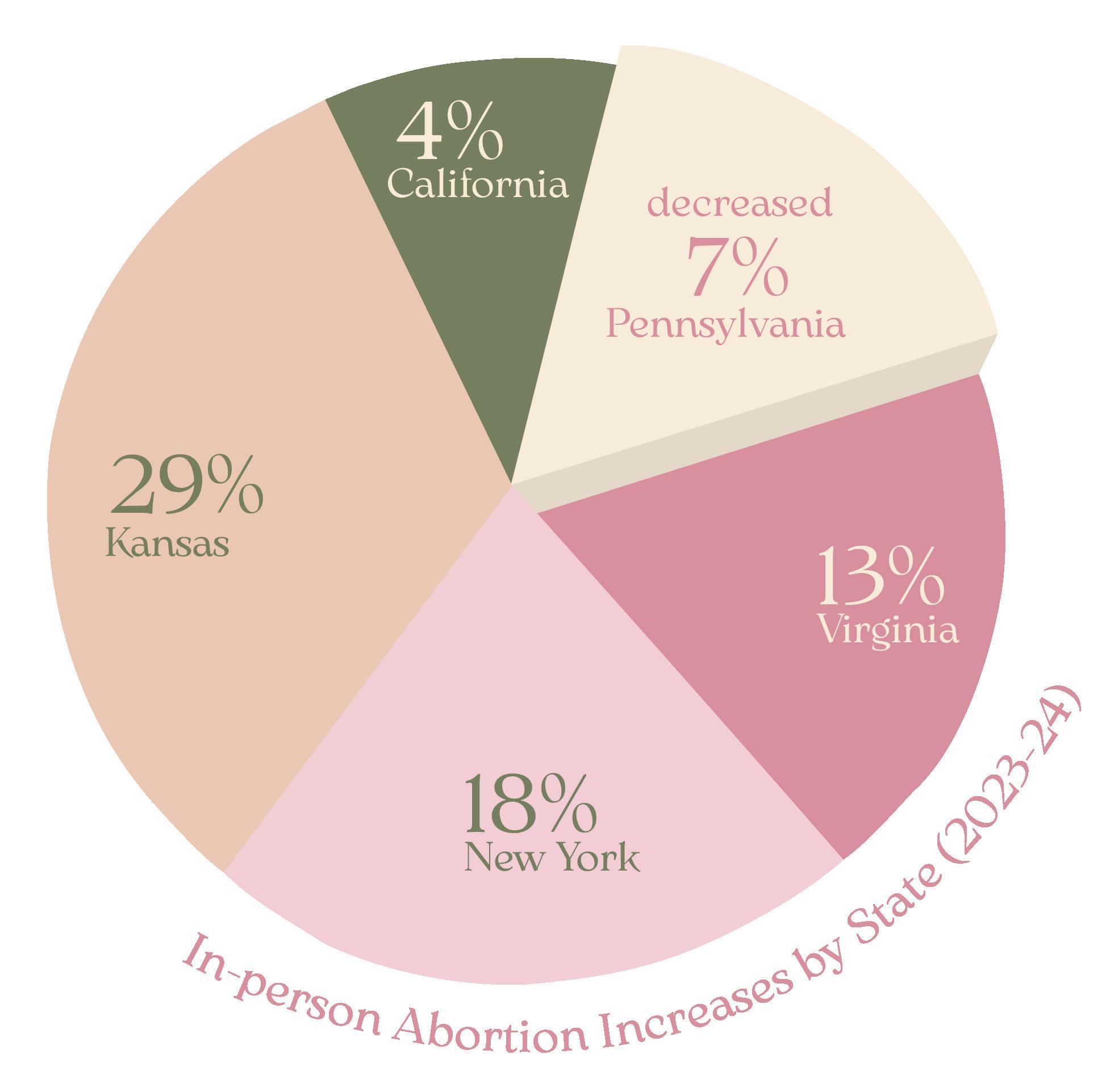
According to the Society of Family Planning, abortion levels increased in 2023 and 2024 after the Dobbs decision. From 2023 to 2024, the average number of in-person abortions in Kansas, New York, Virginia and California has increased.
THE SYSTEM
Underlying this limit of resources is a hierarchical system that will keep all women suppressed, Luchok said.
“Not that people sit down and think that outright so they can talk about it, but it’s the tacit understanding, the underneath, that they don’t even necessarily realize,” Luchok said.
Luchok said society wants to exert control over most natural systems, such as the reproductive system, but there’s more to it than that.
“A lot of the power of the female body is the ability to bring new members of your society into the world,” Luchok said. “And I think that that is seen as dangerous.”
Luchok said the same desire for control applies to childbirth. While this may not be realized, it is prevalent in the patriarchy.
“If you can find something that keeps a group of people oppressed, or down, then you have more
have children, not to glorify one or the other, she said.
DESIGNS: STELLA BRADLEY
being self-interested, you might be wanting more equity in healthcare because that would mean your health would also be better,” she said. “We spend more money than any other country in the world on healthcare. Our outcomes are way down.”
A 2023 United Health Foundation study found that infant mortality rates have improved worldwide, but U.S. rates have not improved at the same rate.
ADVOCATING FOR UNITY
McReynolds-Perez said individuals often think reproductive advocates are anti-motherhood, but this is a misunderstanding. The reproductive movement centers on the right to choose whether or not to
circumstances,” McReynolds-Perez said. “It’s actually a pretty common thing that people live through and live in fear of for decades
According to the Guttmacher Institute, abortion rates are highest for 20- to 24-year-olds and lowest for 15- to 17-year-olds.
McReynolds-Perez said it’s scary to be a human being in South Carolina among proposed legislation. She said people may have to risk their lives to end a lifethreatening pregnancy.
McReynoldsPerez said society values expertise less today. Some examples are the antiglobal-warming and antivaccination movements.
“This is one of those areas where we know these laws are harmful,” McReynoldsPerez said. “I hope I play some role in the community of experts that lets people know how harmful it is to limit these rights.” There’s an idea that qualitative researchers should be objective about their work; McReynoldsPerez said this is a misunderstanding
“It’s not about denying anyone motherhood or parenthood or being against it, but rather taking it really seriously,” McReynolds-Perez said.
Academics aren’t the only ones invested in reproductive activism.
According to the Pew Research Center, 63% of U.S. citizens believe abortion should be legal in all or most cases.
McReynolds-Perez said it’s offensive that people think they know better than the person deciding whether or not to go through with their pregnancy. Allowing reproductive autonomy is essential, she said.
“People think of abortion or unplanned pregnancy as something that onlyhits someone’s life in unusual
“I’ve been accused of being more of a journalist than a researcher,” Billings said. “That was supposed to be an insult. I never took it as an insult.”
Billings said that if people fall silent, restrictions will only get worse.
“I don’t want to go to prison,” Billings said. “But until you knock down my door and take me away in handcuffs, I’m still going to be screaming this stuff because this is ridiculous.”
Easter Crossword
DESIGN: GRACE DE PEÑA, ISABELLA HUFFINES
USC advisor celebrates state ranking, community in women’s pinball
Simone Meyer | ASSISTANT ARTS & CULTURE EDITOR
When USC academic advisor
Allison Brillhart first entered the back room of Firefly Toys and Games, it felt like a casino to her, she said.
“You walk in, and the lights are flashing, and the machines are shouting their lines at you,” Brillhart said.
That immersion keeps Brillhart standing behind a machine for hours at a time, learning the intricacies of the game. Now, five years later, she has been ranked 16th overall in South Carolina women’s pinball three years in a row.
In 2023, women’s pinball competitors established their own league within the International Flipper Pinball Association, where players can earn statewide, national and international rankings. Competitors can rack up points by getting the highest score on a machine.
For Brillhart, it’s not about the competition, it’s about feeling the machine and letting the ball flow.
“I kind of get into a groove,” Brillhart said. “Sometimes I like to
play listening to music, and I can get a little bit into a dance with it.”
By recognizing South Carolina women’s rankings, female competitors in the state can receive those state rankings. They have three overall rankings: a statewide ranking, a ranking against only women in open competitions and a ranking in women-only competitions.
While not currently a member, Brillhart used to be part of Bells and Chimes, a pinball club that organizes tournaments for women. Sarah Kelly, the director of experiential learning for the Honors College, served as chair of a local chapter.
While they’ve only recently been able to score their rankings through the International Flipper Pinball Association, women’s pinball has been around for a while, Kelly said.
“Women’s pinball can and does exist outside of the IFPA. The two are not intrinsically linked,” Kelly said. “However, the majority of events that Bells and Chimes hosts are working with the IFPA to give our players points towards their state and national rankings.”
When Kelly told Brillhart in 2023 that she’d amassed enough points to be ranked in the state, Brillhart was surprised, she said.
“I am so thankful for people like her and others in the community that do so much work to organize and manage those events,” Brillhart said. “Then I just get to reap the benefits and go and enjoy the competition.”
Brillhart said her most recent ranking in 2025 was equally shocking to her.
“This whole year I went thinking there’s no way I’m making it for the third time. I haven’t been committed to it,” Brillhart said. “And that’s okay. It’s like you’ve had your moment in the sun with pinball.”
However, she’s been just as successful this past season. A December tournament secured Brillhart’s spot in the top 16, allowing her to compete in the 2025 South Carolina Women’s Pinball State Finals, held in January.
“I have never felt competitive in anything else the way that I’ve felt competitive in pinball,” Brillhart said. “So yeah, put it on the record. It’s a goal to get to nationals.”
While her ambition keeps her competitive, Brillhart emphasized the inclusivity and eccentricity of the pinball community. Pinball players are weird, nerdy and from all walks of life, and most of them are men, she said.
“Selfishly, I want more community,” Brillhart said. “I want more women in the community to hang out with and teach and learn with.”
Kelly said pinball creates a space for women to share a hobby and create connections. She said she’s met wonderful people through their shared love of the game.
The winner of the state finals gets to move onto nationals, which Brillhart said is an overwhelming, yet exciting possibility for the future.
Pinball lounges foster a welcoming environment, said Bang Back Pinball Lounge event director Rachael Ivy Talbot. Ladies night on Thursdays specifically affords female players five games of free play and a tournament once a month.
“It’s a safe place for people to come,” Talbot said. “We have so many creative people that just come here as patrons.”
The ability to share her passion with fellow players is something Brillhart loves about the sport. New machines and updated games keep her on her toes and excited.
Brillhart said that while she may not always be top ranked in the state, the sport will always have a space in her heart.
“My love for pinball isn’t going anywhere,” Brillhart said. “I think I’ve recognized that there are seasons in my life where maybe I’m going to want it more than others, and I just have to respect that balance.”
PHOTO COURTESY OF ALLISON BRILLHART A woman plays at a pinball machine with a design featuring Venom. Each machine is branded with a different intellectual property.
Column: South Carolina shorelines will disappear within our lifetime
Samuel J. Cancilla | OPINION EDITOR
On a warm summer morning on the coast of the Palmetto State, the waves are crashing, seagulls are squawking, and families are setting up beach chairs for a relaxing day. The smell of sunscreen and salt lingers in the air while kids dig in the sand and splash in the ocean. For generations, this experience has been a keystone to South Carolina’s identity, an experience shared by locals and tourists alike. Myrtle Beach alone welcomes over 17 million visitors yearly, a testament to how important the coast is to South Carolina’s economic success. But the shoreline that has built these traditions won’t be here for generations to come.
economic consequences
The sea level is rising, and it’s rising fast, and it will destroy the South Carolina coastline that many Americans grew up visiting. Cities such as Charleston, which is one of the fastest-growing cities in America, already has significant flooding events, and it will continue to worsen.
The National Centers For Coastal Ocean Science predicts that in Charleston, there will be an average of 60 flood days per year by 2051, as opposed to just four hours total of flooding that took place in 1950. Recent observations show this trend is in the works, with Charleston experiencing an average of 49 minor flood events per year from 2010 to 2020. However, many of these flood events are influenced from variables such as hurricanes and storms, while the predicted flood days in 2051 are solely from high tides and a rising sea level. This significant jump will not only have an obvious impact on day-today life for residents, but also on the
economic prosperity of the city and surrounding areas.
Flooding on that scale would ripple far beyond minor inconveniences. Charleston is not just a historic coastal town. It’s an economic powerhouse for South Carolina. It draws in millions of tourists yearly, generating millions of dollars in revenue from tourism alone, while also hosting a crucial port for the East Coast.
Disruptions to the port are pretty much guaranteed. Rising waters and stronger storm surges can and will disrupt the port, likely causing damage and delays, which will
strain the supply chain that many businesses depend on.
Science behind South Carolina’s risk
These predictions are not random. It is driven by climate change. As global temperatures continue to rise, it causes ocean levels to rise through two main processes: thermal expansion and the melting of glaciers and ice sheets. Our oceans absorb more than 90% of the excess heat trapped in the atmosphere. This absorption of heat causes sea water to heat up and expand, a process known as thermal expansion. This process has led to roughly one-third of the
global sea level rise over the past 100 years, suggesting that even small temperature differences can result in a measurable change in sea levels.
At the same time, melting glaciers and ice sheets across the globe are adding billions of tons of freshwater into the oceans each year. This constant state of increasing temperatures that cause expansion, coupled with an increase in the total volume of water in the ocean from melting ice, spell out disaster for coastlines across the world. But South Carolina’s coastline is particularly vulnerable. This is due
DESIGNS: ISABELLA HUFFINES
to an effect known as subsidence, which is essentially the sinking of the ground. According to Trevor Ponto, an independent researcher, places such as Charleston are sinking by 4 millimeters a year.
This number doesn’t seem like a lot until you factor in the rising sea levels, which can lead to 7-8 millimeters per year of water rise. But rising seas and sinking land aren’t the only forces acting against the South Carolina coast. The shoreline itself is disappearing.
According to the National Oceanic and Atmospheric Administration, “Surging waters from storms and boat wakes eat up much of the state’s shoreline, at an average rate of almost 2 inches annually.” Two inches may not sound like a lot, but the consistency with which it occurs can very quickly lead to the loss of beaches, marshes and natural barrier islands that protect communities from storm surges. These surging waters, coupled
insurance, which would lead to an increase in people having nothing after the next big storm.
Some homeowners in Horry County have already had their insurance providers cancel policy renewals, causing many to move out of the coastal community. Members who wish to stay in the county are forced to go to secondary insurance markets, which can double, triple or even quadruple the original cost of protecting their home.
This should make it clear. There is a crisis on our coast — one that is slowly and silently growing and can only be stopped by meaningful long-term action from both citizens and politicians.
Combatting the issue
Organizations, such as The Nature Conservancy and the South Carolina Office of Resilience, are working toward localized solutions to soften the blows of climate change along the coast. They often rely on
solution to climate change requires the efforts of the global community.
As the largest historical emitter of greenhouse gasses, the United States should have a sense of responsibility to lead the world in fixing the climate crisis and set the example for other countries.
This, however, is not the case. The current administration has shown that it has no intention of stepping up to fix the climate crisis or even trying.
Since 2025, the United States has withdrawn from the Paris Agreement, which is an international agreement between many countries to reduce the amount of greenhouse gasses released in each country. They have restricted the authority of the Environmental Protection Agency, which regulates emissions while working to protect people and the environment. They have also removed references to climate change from Fort Sumter. These decisions are detrimental
States of any responsibility, as the United States remains one of the largest historical greenhouse gas emitters, and climate change is cumulative. Responsibility for this crisis is shared.
Given the global scale of climate change, it is necessary that the United States takes a leadership role. The United States can leverage its diplomatic, economic and political influence on the global stage to pressure other major emitters to change their ways for the better. But leadership begins at home. It begins with changing policies and committing to meaningful emission standards and funding more environmental protection projects, while also acknowledging that a rising sea is not a partisan issue, but a threat to all Americans. We act now, petition lawmakers revise and adapt our policies to combat the rising oceans, saving South Carolina’s coastlines for future
Guest Column: Preference comes with a price tag: Why H. 3795 could end the tuition freeze
JAKE BUZANOWSKI | GUEST OPINION WRITER
While many Gamecocks were distracted by the snow and early rush of midterms, a legislative move in the statehouse was silently introduced and could cause financial chaos for the university. House Bill 3795 was proposed in the 126th General Assembly and would radically change Gamecock demographics.
Starting July 2026, if passed, this bill would require at least 70% of admitted applicants at all public institutions of higher education in South Carolina to be in-state residents. At first glance, this seems like a victory for South Carolina taxpayers. However, there are underlying consequences that could fundamentally alter the cost of education for all students.
In order to understand the associated risks, we must take a look at the numbers. In fall 2025, USC welcomed a record freshman class at 7,829. Of this class, approximately 51% (almost 4,000) were South Carolina residents. This near 50-50 split is not accidental: it’s a factor for keeping in-state tuition so low for the university.
For the 2025-26 academic year, undergraduate tuition for full-time South Carolina residents started at $12,688. For out-of-state friends like me, our tuition began at $37,376. This roughly $25,000 annual premium paid by out-of-state students acts as a massive subsidy that helps to keep the university financially functional. For seven straight years, this very subsidy has helped in-state tuition to remain flat and affordable, while out-of-state residents have suffered increases over the years, including the recent 3% growth.
If H. 3795 passes and receives the governor’s signature, USC would be legally required to accept 20% less of its highest paying students in order
to make room for more residents. If tuition prices were to stay the same under this new bill without a new funding source, the university would most likely be looking at a severe deficit.
Swapping just 1,500 out-of-state spots, roughly 20%, for resident students would result in an estimated $37.5 million annual loss in tuition revenue if we used the same numbers from the current academic year. While this amount may seem immaterial in a $2.3 billion annual budget, this “rounding error” is the very reason that tuition for in-state students has remained at a “freeze” for seven consecutive years. This missing revenue will have to be made up elsewhere. Unless the university gets guaranteed funding from the state legislature, this bill could hurt the very students it claims to protect.
You might think you get the point by now, but there is a critical piece that we have not clearly addressed
yet. This mandate applies to the applicants it accepts for admission to the university, not those who eventually enroll. Let that sink in for a second.
Within the theory of college admissions, “yield” is everything. Out-of-state students often have a lower yield, which means they are accepted but choose to attend another university. By forcing a 70% quota on the group statistically more likely to enroll, this bill is ensuring the final student body class will be more in-state heavy than the legislation intended. This creates a revenue bottleneck. If the university is unable to get enough out-of-state students to fill the budget, it could lose the ability to fund scholarships, faculty hires and campus projects. It is easy to support a bill that pushes for an easier path to USC for South Carolinians. It sounds like common sense. But the economy disagrees. With South Carolina’s plan towards a 0% income tax, the
state is already looking to tighten the purse. Can the Palmetto state afford to pick up the tab that H. 3795 would create for its universities? If not, the burden will fall back on students through higher costs of attendance.
The debate over H. 3795 is a classic struggle between access and excellence. While the bill prioritizes access for South Carolinians, it threatens the fiscal stability that has allowed USC to reach a historic total enrollment of over 46,000 students.
As Gamecocks, we must ask: Is a “more local” university worth a potentially more expensive or less resourced one? Before this bill reaches the House Education and Public Works Committee for a final vote, we owe it to ourselves to look past the emotional headlines and reveal the true cost of preference. Whether we are in-state or out-ofstate, this affects us all.
DESIGN: VANESSA PURPURA
WHY JOIN SCU ?
As a not-for-profit credit union, we return value to our members through:
�� Lower fees
�� Competitive rates on loans
�� Higher dividends on deposits
�� Personal, member-first service
�� Discounts on insurance and tax software
*This image was created using AI*
LEARN MORE AND JOIN TODAY LEARN MORE AND JOIN TODAY
Choosing where to bank matters, and joining State Credit Union means choosing a place that puts YOU first.
WHERE GAMECOCKS FIND THEIR ROOST
UofSC students post for free when using their UofSC email address.