
GAMECOCKS TAKE CARE OF THEIR HEALTH.


CAN Community Health o ers 100% FREE HIV, STI, and Hep C testing services - easy to access, made for your schedule, and always inclusive. STAY INFORMED. STAY EMPOWERED.
02 LEDITOR
A letter from one of the managing editors who is preparing to graduate this May.
03 CAMPUS ARCHITECT UPDATES ON CAMPUS RENOVATIONS
USC architect Derek Gruner provided updates on campus projects that are part of the USC Next master plan.
05 KOREAN LANGUAGE TABLE
USC’s Korean language table is helping to bring students together and explore language and culture through discussions, games and cultural activities.
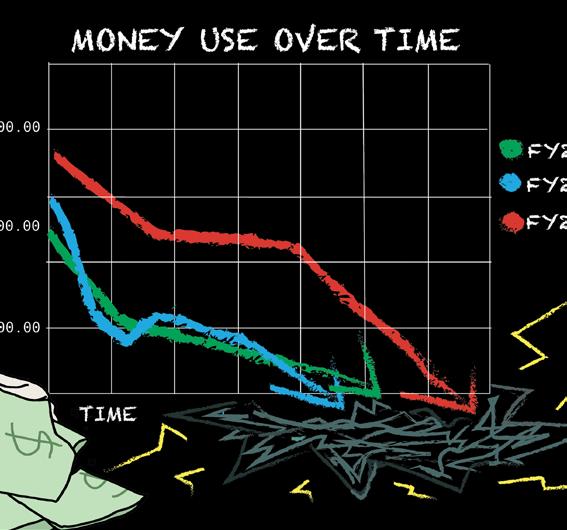
Members of Student Government and student organizations examine the current funding system, including current issues and future solutions.
South Carolina women’s basketball locked up top-ranked UConn to earn a trip to the national championship game, the third straight appearance for the program. Defensive poise helped close the win out late.
13 BRUINS DOMINATE GAMECOCKS IN THE PAINT
South Carolina women’s basketball lost by 28 points to UCLA in the national championship. The Gamecocks struggled to slow down the Bruins in the paint, a trend that dominated the game and resulted in the lopsided outcome.
Is Yik Yak helping students at USC stay informed and connected, or is the anonymity fueling negativity and rumors around campus?

10 NIL BILL VETOED
15 WOODROW WILSON-ERA HISTORY
The Museum of the Reconstruction Era explores a misunderstood time period through former President Woodrow Wilson’s teenage years in Columbia. The museum stands as South Carolina’s only remaining presidential site.
16 LOCAL MAGICIANS SHARE EXPERIENCES

22 SNAP RESTRICTIONS
WON’T IMPROVE OBESITY
Lawmakers have proposed ideas to limit what items SNAP recipients can purchase in order to combat obesity. However, this will require more robust solutions for any longterm solutions.
06 STUDENT GOVERNMENT, ORGANIZATIONS FUNDING 18 COCKSTOCK COMES WITH A COST
08 STALEY LEADS ATHLETIC DEPARTMENT
Dawn Staley has helped bring South Carolina’s Athletic Department to national prominence after winning three-4 national championships while also gaining attention from fans around the country.
Each month, a long-standing group of local magicians meet to hang out and show off tricks. They said they welcome anyone who wants to learn the art.


20 COMIC
Finals are approaching, and students are looking to finish strong in order to avoid getting caught by The Finalizers’ finishing move.
Gov. Henry McMaster vetoed a Name, Image and Likeness bill, which would have allowed public state schools to classify the money they pay student-athletes under revenue-sharing contracts as private.
Jack Bradshaw
The South Carolina women’s basketball team sits on the bench during the game against UCLA in the NCAA Championship on April 5, 2026. The Gamecocks lost to the Bruins 79-51.
Letter from a managing editor
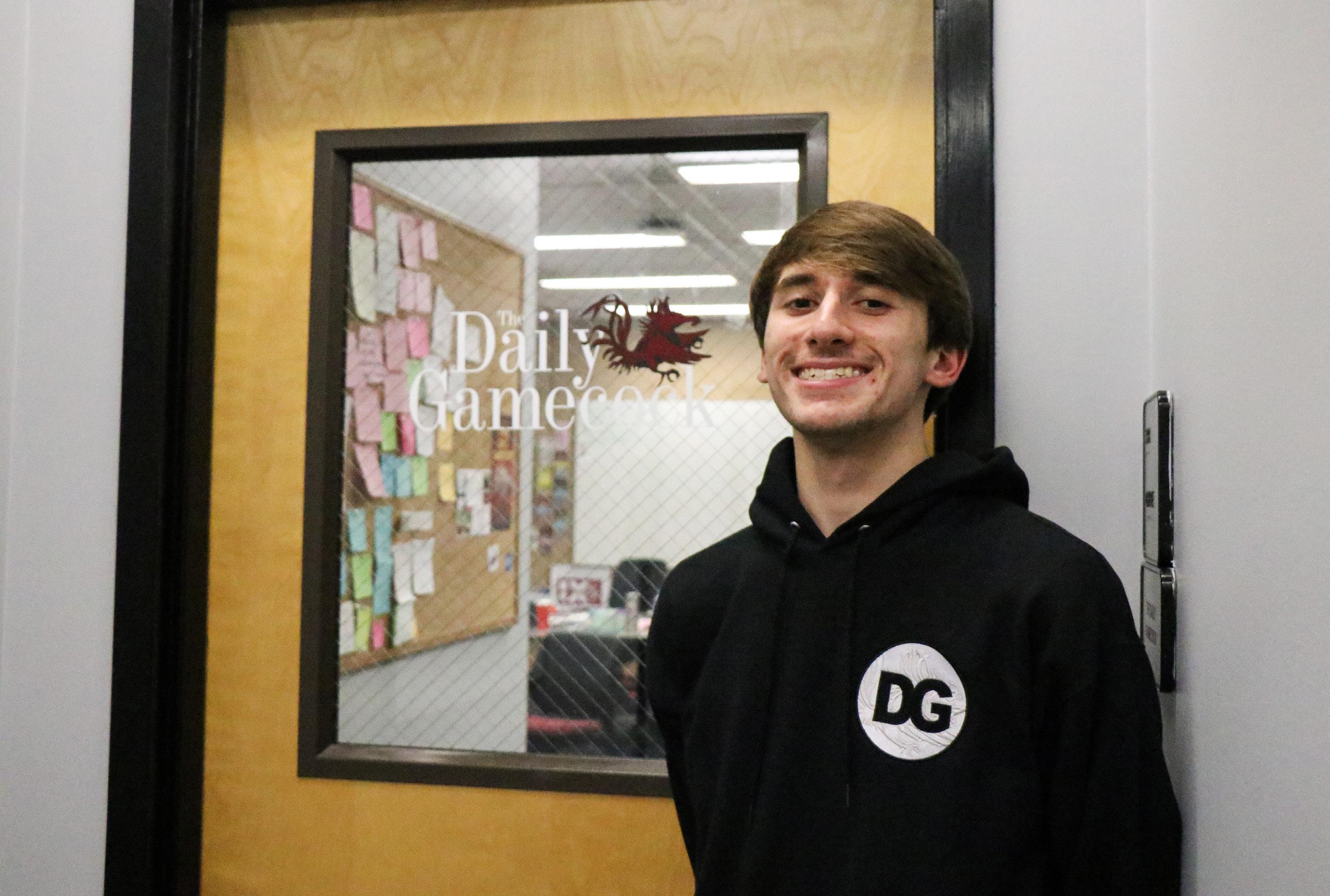
With Dawn Staley and the Gamecocks wrapping up another historical season, even if it ended just a game short of championship number four, it must mean that it’s time for our April print edition.
In our final edition of the semester, you’ll find hot-button topics about Student Government funding, how Carolina Productions goes about planning Cockstock and how women’s basketball continues to be the standard for Gamecock athletics.
I, like many others, will soon be walking across that stage at graduation and will no longer be a student of the university but alumnus instead.
Thanks to The Daily Gamecock, I’ve had the privilege to experience amazing events as a member of this organization.
From covering our team taking down the Tigers in a top 15 showdown in Death Valley to getting to interview some of the coolest people while covering club sports and watching Staley and the Gamecocks win their third straight SEC championship in 2025.
As students, we understand that an integral part of our college experience isn’t just the things you do but the people you meet in our university community. Joining clubs and organizations is a key part of your time in college; whether that’s to explore a niche interest or gain valuable experience in your career path.
This is part of what has made my time at The Daily Gamecock so special. It’s amazing to watch every section each month, especially our design team, come together and put our hard work into something physical that we can share with you all.

USC architect provides updates on campus renovations
EMILeE DAVIS STUDENT GOVERNMENT BEAT WRITER
USC architect Derek Gruner provided an update on the ideas for the university’s facilities based on the USC Next master plan.
According to Gruner and Jeff Stensland, associate vice president of university communications, projects such as the Russell House expansion and South Main Street construction are currently conceptual. Stensland said these projects are still awaiting approval and aren’t guaranteed to happen.
Russell House expansion
Based on a university study done on the Russell House in 2023, Gruner said the main takeaway was that to meet student demand, it needed
to grow by 50%. The Russell House is currently about 200,000 square feet, and the goal is to expand it to 300,000 square feet.
The areas with the greatest need for renovations are spaces for recreation, casual meetings and student organizations, according to Gruner. He said the number of student organizations on campus has significantly increased over the past 10 years, and the Russell House doesn’t currently have enough space to accommodate them.
Gruner said the original 2023 study was done when the university was contemplating fully replacing the Russell House, but said a complete replacement is not feasible.
“It’s really not practical to think that students can go the two or three years it would take to build something like this without a student union, without adequate dining facilities to serve them,” Gruner said.
One of the strategies the university is considering is taking parts of the current building that are beyond their use and fixing them through replacement or renovation while also expanding them, according to Gruner.
This could potentially include removing the old student health building near the Russell House and using that space to add to it. Another potential area of renovation could be creating a larger ballroom and
I hope that our new and returning members continue to serve the USC community with the coverage that it deserves, while also growing as young media members and leaders for future newsrooms.
So whether this is your first or last print edition you pick up, thank you for supporting us the same way we try and support you with news that keeps you informed, safe and entertained.
Forever to thee, Will Miller
STOP IN AND LET US HELP YOU GET READY!

photo: Nat campbell
west wing to include more space for student organizations at the Russell House, Gruner said.
One of the priorities is to make sure the areas around the Russell House that students use as walking paths remain open for that, according to Gruner. He said certain areas of improvement could be adding more areas to the basement for student recreation, courtyard level dining and including rooftop lounges for students.
Gruner said none of these plans are set in stone, and plans involving the Russell House expansion could change going forward.
“A project that is as complex as this requires an enormous amount of study, which has not yet occurred, and (this project) really could evolve quite a bit,” Gruner said.
On-campus housing
According to Gruner, there will be multiple residence halls on campus that are renovated or replaced in the next few years, which include Woodrow, McBryde, Honors and Capstone.
One of the main goals of the USC Next master plan is to have more students living in and around the Horseshoe. Thornwell was recently renovated for this purpose, and Woodrow is now under renovation for the same reason, Gruner said.
The biggest housing construction project is McBryde, which will be a complete replacement, according to Gruner.
“We’re replacing McBryde with a six-story residence hall that is going to really more than triple the number of beds so that we can have more students living in the core of our campus,” Gruner said.
The replacement of McBryde is scheduled to be completed by fall 2028, Gruner said, and it will be able to house 900 students. Gruner said the construction will include adding a common area in the center of the new building for students to socialize. The new building will also have a courtyard behind it and a rooftop garden for students.
According to Gruner, the university is looking to construct the final wing of the Honors residence hall that
was originally conceived when the building was built. The addition of this wing will allow Honors to house approximately 200 more students, Gruner said.
The renovation of Honors and the replacement of McBryde will create a gateway, and the goal is to have their architecture be compatible rather than identical, according to Gruner.
Capstone will be undergoing the least extensive renovation, Gruner said, but students would not be able to live there for at least a year and a half. The renovations will most likely include replacing all mechanical and electrical systems as well as the windows and renovating the restrooms, according to Gruner.
“At the end of the renovation, while it may look still very similar on the outside, (on) the inside, it’s a new building, and it renews the life of that building for another 30 to 40 years,” Gruner said.
Main Street
According to Gruner, the new building would likely be six stories, with retail on the first floor and housing on the upper levels.
Much of USC’s development of Main Street will focus on the Byrnes Building and its block, as the building is currently owned by the university.
According to Gruner, the university is also looking to use Main Street to add more parking structures to meet demand.
“We’ve been informed by some studies, and we have a lot of thoughts that this might be a good place to concentrate retail at the street level,” Gruner said.
According to Gruner, the new building would most likely be six stories tall, and above the first floor, which would contain any retail, would be housing. Gruner said these housing units would either be student housing or market-rate housing.
According to Gruner, the main goal of the Main Street project is to make it a place that is active for the whole year and not just during the academic year.
“The idea here with Main Street is to not make it quite so university-
centric, but to make this a place that the citizens of Columbia might come and shop here,” Gruner said.
Campus Updates
Gruner discussed other projects that the university is currently looking into on campus. Some of the projects include previously announced construction on the Thomas Cooper Library, McKissick Museum and Barnwell College.
Gruner mentioned the university is planning to build a new science building, which is currently in the programming and design phase.
On March 18, the university opened its new Brain Health Center. This is a part of the USC Next master plan and its Brain Health Initiative. This center is part of USC’s School of Medicine, which is having a new building constructed to house it.
According to Gruner, the structure for this new building is entirely in place, and the next phase includes the exterior work and mechanical systems.
Other projects include the neurological and rehabilitation hospital that is part of the Brain Health Initiative, which was approved by the board of trustees at its March 19 meeting. The university is looking to expand the Strom Thurmond Wellness and Fitness Center and improve the university’s parking garages and surface lots.
Construction on campus
With these projects, Gruner said there will be extensive construction on campus in the coming years to make these projects a reality.
“In 2027, a lot of the projects that we have under design right now are now going to be under construction,” Gruner said. “There will be moments in 2027 and 2028 when the construction activity on campus is particularly intense.”
According to Gruner, the university will work to make sure that students can still get safely around campus while construction is occurring through strong messaging to students, faculty and staff.
The Thomas Cooper Library will most likely still be under
construction in 2030, Gruner said. He said that while there is no definitive timeline for the Main Street project, he believes there will be construction by 2030.
Gruner said the university still wants to ensure that students have a strong college experience while the construction is occurring and have access to essential spaces. This is why buildings such as the Russell House and Thomas Cooper Library won’t be completely replaced, according to Gruner.
Even though the construction will significantly change the campus in 2027, Gruner said the long-term benefits will be worth it.
“There is a little bit of a price to pay in the first couple of years, but the benefits for the campus for the next 50 years are just tremendous,” Gruner said.
Korean language table creates cultural bridges for students
Taylor Luczywo NEWS WRITER
Krista Van Fleit, an associate professor of languages, literatures and cultures, said she is noticing that students are losing interest in studying languages. In an effort to make foreign languages more visible to students, South Quad hosts seven language tables.
Van Fleit is also the faculty director of the Global Fellows Living Learning Community in South Quad. She said gaining experience in another language and culture can be helpful in several circumstances. It is important to keep other languages alive and in practice on campus, Van Fleit said.
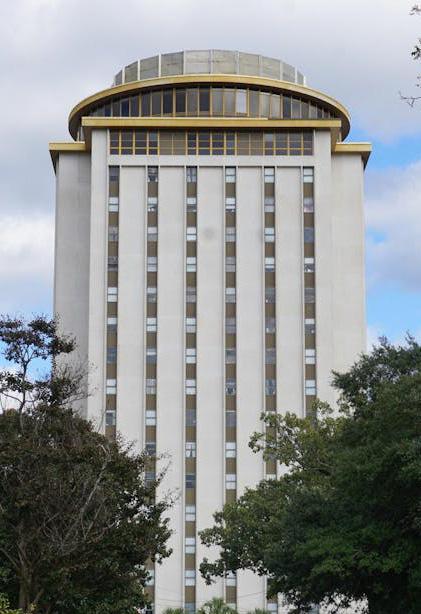
“Language tables have both language and culture embedded in them, so they can also kind of understand what life is like in a different place and other customs and how people exist in these other spaces,” Van Fleit said. “I think it’s important when they then move out into the world and meet people from different places.”
Every Tuesday, students interested in Korean culture meet at the Korean language table hosted in South Quad. The student group discusses Korean-related issues, the Korean language and pop culture such as K-pop and K-dramas.
Graduate linguistics student Rok Sim serves as a Korean instructor and was connected with the Korean language table. Here, he acts as the table leader, preparing discussion topics for each meeting to connect with students outside the classroom.
“What I can deliver in the classroom is limited, ... but students want to learn more and want to go beyond the things that we do in the classroom,” Sim said.
Sim said the language table offers students a space to learn about Korean culture in a more meaningful way, while also discussing pop culture. Having grown up in Korea, he wants to help other students communicate more easily with other cultures.

“I wanted to help those students to be prepared not only about the language but also for learning the cultures, so they can communicate with the people they encounter,” Sim said.
Second-year elementary education student Katie Edelson began learning Korean in middle school and later moved to Korea to live and teach English for a year.
According to Edelson, some of this year’s meetings featured traditional games centered on the Lunar New Year, Korean folktales and baking popular Korean snacks such as Dubai chocolate mochi cookies.
“It’s a very social club. We’re sitting around a table, we’re talking and discussing, we’re playing games together, and cooking together,” Edelson said. “So I think there is an
aspect of getting to know people more.” Edelson also said the club is for those interested in the Korean language and culture, regardless of their experience with the language.
Graduate education student Adriana Carlucci has also traveled to Korea after studying the language for a year at USC. According to Carlucci, the club is more culturally focused, with mostly English discussion and Korean words and concepts sprinkled in.
“It’s welcome for everybody. There is no mastery of the language needed,” Carlucci said.
“So, if you’re a novice, ... it’s more so culture-focused.”
According to Carlucci, the table is for everyone, helping students step out of their comfort zones by opening dialogue with new people in a new language, while still being fun and interesting.
“There is no pressure. And again, it might be awkward at times, but as long as you put in the effort to learn and just be there, being present, that’s a really good thing,” Carlucci said. “Be present, listen, interact and reflect.”
Students are encouraged to come and help grow the program. With greater interest in the Korean language and culture, doors may open for Korea in the future, Van Fleit said.
PHOTO: Kiley Wagner
Design: JACK BRADSHAW

‘I do know that we need more money’: A look into Student
Government’s funding
EMILeE DAVIS STUDENT GOVERNMENT BEAT WRITER AND CONNoR BOGAN ASSISTANT NEWS EDITOR
I
an Funk, a fourth-year marine science student and treasurer of Gamecock SCUBA, said he has told members that Student Government may not fully reimburse them for travel costs and equipment rental fees. As an organization where moving and breathing costs money, this proves to be a challenge.
Funk said Gamecock SCUBA typically spends its Student Government money on portions of its dive charters and the Airbnbs it stays at during trips. Scuba is a hobby that requires a lot of funding, and because of that, the club is heavily reliant on reimbursements for its activities, according to Funk.
His goal is to attempt to reimburse at least some money to his members who pay these trip costs. For the organization’s 2025 spring break trip, it got about 20-30% of its funds reimbursed, Funk said.
“It’s a lot harder, in my opinion, to go about getting the money you need,” Funk said.
There are two kinds of reimbursement with Student Government funding. Organizations request funding to help mediate the costs they spend on their own business.
allocated that the organizations don’t use.
At the beginning of the 2026 spring semester, it was announced that the new Student Organization Funding Assistance Board ran out of money. Student Government funds for student organizations lasted until the end of February.
SOFAB, run by Director of Administration for Student Life Matt Hinds, is an administrative board also responsible for funding student organizations, but it is available to all organizations, where Student Government is only open to undergraduate ones. Due to these shortages, some student organizations on campus have been forced to find other methods of funding. Student Government remains hopeful that it can extend these funds by making more changes to the funding model for the upcoming academic year.
$120,000, which it did not split across semesters, contributing to it not having funds for the spring semester, Reynolds said.
According to Reynolds, once SOFAB ran out of money, the majority of student organizations went directly to Student Government to request funds.
“Even people who can’t get money from us, like sports clubs and grad students, they all came to us,” Reynolds said.
Thomas Spurgeon, chairman of the student senate finance committee, said as long as an organization meets the metrics for funding, it will receive all the funds it requests.
26 academic year was due to the partial funding system she helped to create when she became treasurer in 2025. She said the partial funding system has helped ensure student organizations request money for the right reasons.
from funding 20 organizations in one year to 50 in another and reached 72 this year, she said. More organizations this year got funding from the top 50% of the Student Government budget, which makes Reynolds more optimistic for the future.
“We’re not just giving huge chunks of money to the same people over and over and over again,” Reynolds said.
Some of the funding has been unevenly allocated in previous academic years, according to the data. Around 11% of allocated funds for the 2022-23 academic year went to Mock Trial.
get the money,” Murphy said. “We actually had to go into our education fund that we had to try and pay for it, but we had to drop some people from the competition too because of that so we can make ends meet.”
Gamecock Robotics went to a competition at Auburn University last year, and Murphy had to pay for some of the travel and hotel
them and Jack Holland, a third-year finance and real estate student and Collegiate DECA’s vice president of finance.
According to Jones, Holland was forced to learn the new finance system on his own after a treasurer’s workshop was cancelled with no notice and a one-on-one meeting with the treasury office ended early
it allocated the $185,000 it was given by the university but is still waiting on $90,000 in reimbursement requests for money that needs to be returned to Student Government. Jones said if the current funding system and the communication improve, DECA would feel more confident in asking Student Government for funds. She said she also felt it would be helpful if multiple treasurer’s workshops were held on different topics about finance.
Student Government gets reimbursements from organizations for any money
Student Government recent funding history
Student Government had a budget of $185,000 for the 2025-26 academic year, which former Student Body Treasurer Ashley Reynolds chose to split across the fall and spring semesters.
SOFAB was allocated

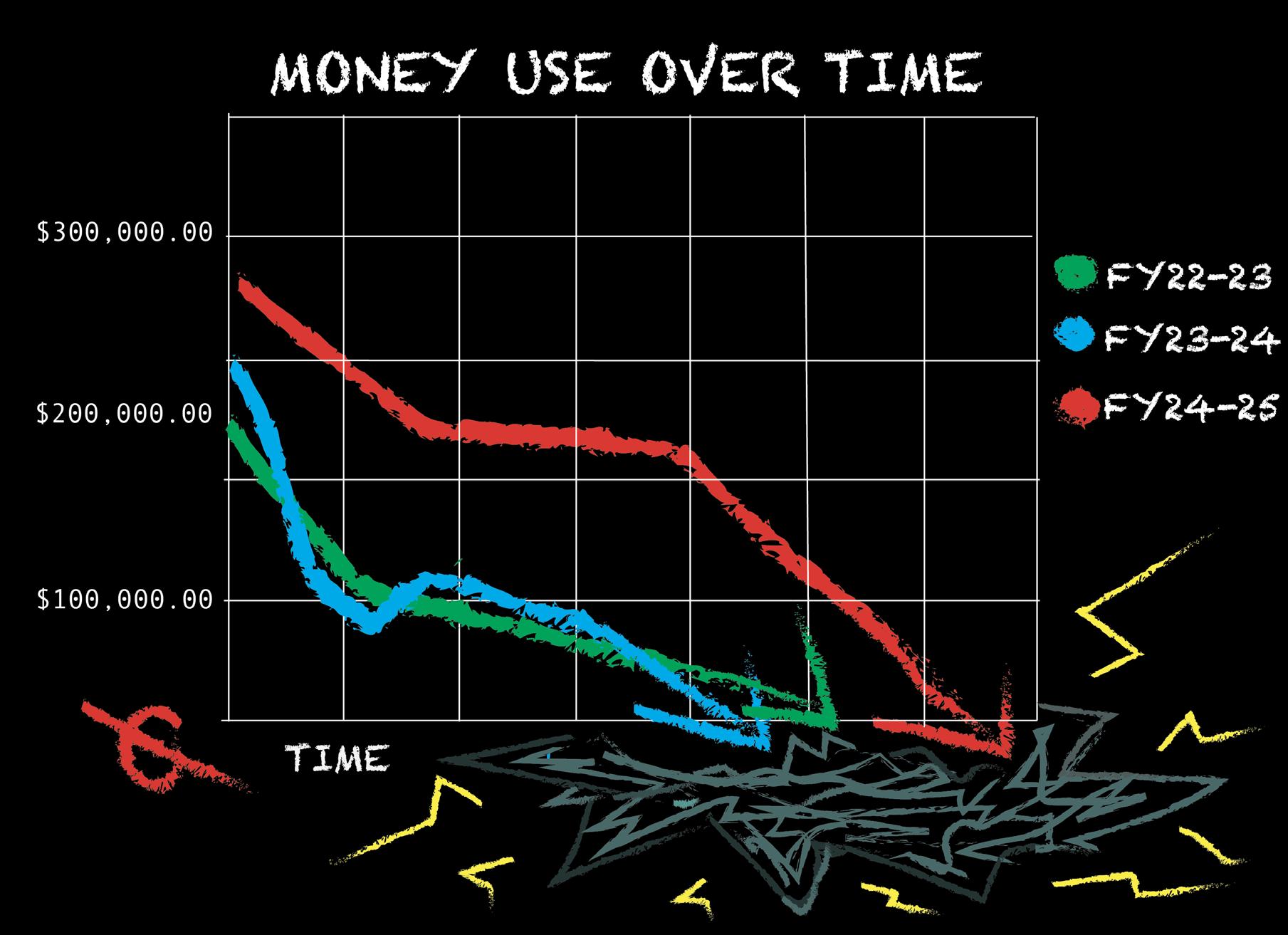
According to data provided by the finance committee, the 202425 academic year saw the allocation of $300,000 in funds to student organizations because of a one-time donation from President Amiridis, with funds split evenly across both semesters. In other years, the totals are similar to the current academic year and are set around $180,000.
Around 80% of the approved funds for organizations were used in the 2024-25 fall semester, with the rest of the allocated amount rolling over into the spring semester.
Because the academic year gave Student Government more funds to use and the remaining money rolled over into the spring, the funds lasted until around April.
Out of the past four academic years, two have seen funds run out at the start of the spring semester in January. Along with the current academic year, this has been a recent trend, according to the data.
Reynolds believes part of the reason the budget was able to last until February in the 2025-
“I think what mainly helped is that it deterred a lot of people from having events just to spend money,” Reynolds said. “I think last year I was even approached by a student organization who looked at me and told me that the whole point of the organization was to spend university funds on ‘dumb stuff.’ I think (partial funding) deters that idea because it’s harder, and they actually have to do things that benefit other people besides just themselves.”
Student Government’s new partial funding system is based around a point-system rubric for funding allocation. Organizations receive points based on how well they meet four areas of criteria for their events, such as physical location and learning outcomes met. Point totals determine what percentage of funding an organization will receive.
Spurgeon said he doesn’t know to what extent the partial funding system numerically helped in preserving the budget, but he doesn’t believe it had a significant impact.
He attributes using measures such as reducing large spending this year to prolonging the budget until the end of February.
“Little bits here and there added up, but there were no enormous partial funding cuts,” Spurgeon said.
Reynolds said more organizations were able to be funded in the 2025-26 academic year under the $185,000 budget than in previous years. Student Government went
Spurgeon said there is a $10,000 hard cap on individual funding allocation written in the Student Government codes in order to prevent any one organization from receiving too much money.
According to Spurgeon, only Model UN received an override this year for that hard cap. Since Student Government had more money in the previous academic year, there were six overrides, according to the data.
Student organizations’ funding experience
Some student organizations said they have had problems with both getting their money from Student Government reimbursed and general communications.
Leyah Murphy, a third-year exercise science student and the treasurer of Gamecock Robotics, said her organization, like Gamecock SCUBA, also ran into problems with reimbursements from Student Government.
Murphy said the organization does not require funds in the fall semester and only requests them in the spring to attend a competition.
For its last competition, some of the accommodations, such as a hotel booking, were already paid for, when members got a notification from Student Government that it had run out of money, according to Murphy.
“We were going that weekend, so it was hard to figure out where to
expenses with her own money. She is still in the process of trying to get that money back through reimbursement, which is frustrating since robotics can be expensive, she said.
Murphy said the interconnectedness of the robotics field in South Carolina allows the organization to have contacts it can go to for help with funding such as high school teams, S.C. college teams and USC itself.
Anna Kate Jones, a second-year business management and Spanish student and president of USC’s Collegiate DECA, said the club hasn’t used Student Government funds this year. This was due to communication issues between
due to the person’s computer dying halfway through.
“The main issue was the lack of communication and then (the meeting) being just a little bit unprofessional,” Jones said.
DECA holds fundraising events, such as bake sales, to obtain funds. Jones said if the organization can’t get funds, it lets members know that if they’d like to attend a competition, they have to pay with their own money.
The future Reynolds said one of the problems to address next year is organizations not submitting their reimbursements for Student Government. She said for this year,
Funk thinks having a smaller pool of money for organizations who don’t need to request as much from Student Government may help in the future. Another minor adjustment he believes could help conserve funds is reimbursing a percentage of what the organization asked for, as opposed to the full amount.
“Some things just cost less, and that is kind of the big thing for me,” Funk said.
Reynolds has also mentioned having the student activity fee raised so Student Government and SOFAB can get more money to give to organizations. Spurgeon said he wants to see more money allocated to Student Government in whatever form that takes.
“I don’t know if there’s money to be cut from somewhere else that could go to us,” Spurgeon said. “I don’t know if the activity fee is the right answer, but I do know that we need more money, and so whatever those administrators would like to do, I like.”
Editor’s note: Ashley Reynolds was interviewed for this article before she resigned as student body treasurer.
Designs: isabella huffines


Women’s basketball program headlines South Carolina Athletics
SOuth Carolina women’s basketball has been a beacon of light for the athletic program through its success. With numerous winning seasons, national championships and consistent talent spewing into the WNBA, the Gamecocks continue to elevate the women’s sports at the university.
However, despite being the most successful program the University of South Carolina has to offer, the women’s basketball team doesn’t earn nearly a fraction of the money that men’s basketball and football does.
In the 2024–25 fiscal year, expenses put the program over budget by more than $6 million. The largest expenses include coach salaries, which are paid by both the university and third parties, according to the 2025 NCAA AUP Report.
South Carolina women’s basketball head coach Dawn Staley signed a five-year, $25.25 million contract extension with the Gamecocks in January 2025, making her the highest-paid women’s college basketball coach ever. In comparison, South Carolina football head coach Shane Beamer makes more than double Staley’s annual salary at $8.15 million .
Both the University of Texas and LSU women’s basketball departments, two Southeastern conference competitors, are also in a loss. In the 2024-25 fiscal year, LSU reported over an $8.5 million loss, and Texas reported a $7.5 million loss. Despite the losses, South Carolina’s expenses hit over $13 million.
According to Jordan Kaye at The
State newspaper, the only other SEC schools that spent more than $10 million on their women’s basketball programs were LSU at $12.1 million and Texas at $10.9 million.
Outside the conference, UConn is one of the few women’s programs that operates in a profit, at $8.5 million in the 2024-25 season.
Despite the women’s program’s success, including winning the 2024 NCAA national championship and advancing further than the men’s team, which lost in the first round, the men’s program still generated twice the ticket revenue, according to CT Insider.
Staley is in her 17th season with the Gamecocks and has accomplished things that other programs may never see. Since arriving in May 2008, she has won three national championships and nine SEC regular-season championships.
VIEWERSHIP, REVENUE
Taking a zoomed out look at South Carolina Athletics, football and men’s basketball are the departments that bring in the most revenue with their media rights and donations. Men’s basketball receives over double the contributions the women’s team does.
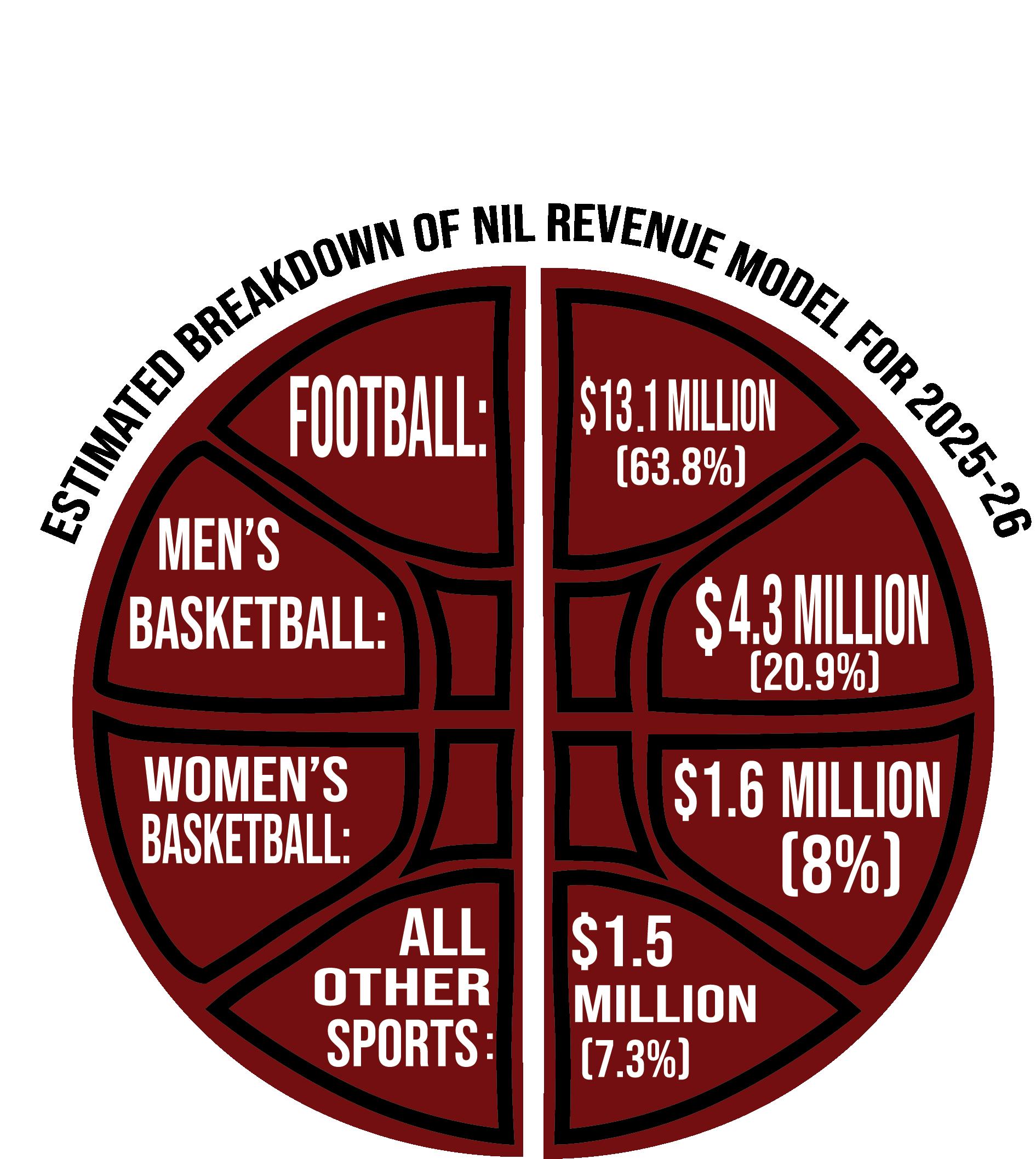
Under the new 2025-26 NCAA revenue-sharing model in direct result from the House v. NCAA settlement, women’s basketball programs are estimated to receive approximately 8% of the total revenue-sharing pool, or about $1.6 million per average school. This is separate from NIL and is used to compete for talent, often
favoring high-revenue sports such as football. Football could be expected to receive around 63.8%, or $13.1 million, and men’s basketball can expect to receive 20.9%, or $4.3 million.
Staley spoke on what she hopes will come from the House v. NCAA settlement in comparison to other high prioritized sports.
“When this lawsuit came out, it was football, men’s basketball and women’s basketball,”
Staley said in a The State article. “I just hope we don’t lose sight of those three sports that started the lawsuit.
And I know when we decide which way that the money’s going to be divvied up, that every school that is receiving the revenue sharing portion will definitely take women’s basketball seriously.”
Since 2020, the South Carolina
appearance was in 2024, where it was a first-round exit.
The women’s basketball team also brings in so many fans and eyes through its victories. In 2024, the women’s NCAA tournament, which included South Carolina’s win against Iowa, had a higher viewership than the men’s, averaging 18.7 million viewers, which was a first in NCAA Tournament history.
Staley’s presence even expands to the South Carolina football team. Beamer has used her inspirational words to bring in recruits and exchange advice. Her phone call with former South Carolina defensive back Nick Emmanwori on draft night left a lasting impact to guide him on his efforts in the NFL.
Post Moves with Aliyah Boston and Candace Parker. “There’s going to be the media, there’s going to be all this stuff that you are going to have to deal with that you didn’t have to deal with, and you don’t have to deal with when you hire a male.”
what players will be briefed and said that the association should be on the right side of history to move women’s basketball forward.
women’s basketball program has reached the Final Four in six straight seasons, winning the NCAA Division I Championship twice in 2022 and 2024. With their acclaimed dominance, Staley and the Gamecocks have cemented themselves as the best athletic program at South Carolina.
Besides women’s basketball, baseball was the last program to make a national championship in its respective sport. South Carolina football has never made the College Football Playoffs and has never won an SEC championship. For the men’s basketball program, its last NCAA Tournament

Under Staley, the Gamecocks hold the SEC record for 57 consecutive league regular-season victories and 16 consecutive winning seasons. The South Carolina men’s basketball program’s longest consecutive winning season streak was from 1969-74, while football’s was from 1928-34.
Staley’s impact also broadens towards her fans’ participation and attendance.
The women’s program sold out all 13,046 2026 season tickets for this season. South Carolina has led the nation in average attendance for the last 10 seasons. The women’s program sold out all 13,046 of its 2026 season tickets. Staley’s track record of winning seasons and continued tournament appearances reflects the standard she has established for the program.
STALEY’S HIGH PRAISE INSIDE, OUTSIDE OF PROGRAM
Through these accomplishments, Staley’s value in all aspects of being a mentor and basketball coach goes far beyond her on-paper success.
She has made a lasting impact not just through wins, but through the relationships she’s built with players and peers. She continues to support her former players as they pursue careers beyond college and gain high respect from her opposing coaches.
Four-time WNBA MVP and former Gamecock forward A’ja Wilson spoke about the impact and continuous support that Staley has towards her pro-career.
“She has really molded me into the player that I am today. She spent countless hours just telling me what I need to do at the pro level,” Wilson said in a Just Women’s Sports article.
During her several NCAA Tournament appearances, she has a history of spreading her knowledge and advice to the then-No.16 seeds.
This past season, after defeating Southern University 103-34 in the first round of the NCAA Tournament, Staley gave the Southern players samples of her perfume. Southern University senior guard D’Shantae Edwards spoke on how the gesture spoke more than just a gift.
“I think it shows how good of a person she is. It’s not just about basketball,” Edwards said in an Athletic article. “I feel like her coming and giving us words of encouragement meant a lot as a team, and honestly meant a lot to me as a person because it’s bigger than the game for her. It’s about growth as a player. It’s about growth as a person and you can see that when she was talking to us.”
When Staley spoke highly of former Virginia Tech women’s basketball coach Kenny Brooks, who is now the Kentucky women’s basketball head coach, he was honored because of his respect for her.
“I wanted to stand up and applaud her because she is the face of women’s basketball right now,” Brooks said.
STALEY EVOLVING WOMEN’S BASKETBALL
During the 2024 offseason, Staley received a job interview with the New York Knicks for the then-vacant head coach position. There have only been two females who have had NBA head coaching interviews: Becky Hammond and Staley. If Staley were picked for the position, she would’ve been the first female full-time NBA head coach.
“You’re going to be asked questions that you don’t have to be asked if you hire a male coach,” Staley said on
Tennessee Tech women’s basketball head coach Kim Rosamond spoke about Staley’s impact.
“There’s so many things I admire about her,” Rosamond said in an Athletic article. “But she is always advancing the game, protecting the game, respecting the game and she does so much for people that within the game that doesn’t always get seen or noticed.”
Through the WNBA players’ fight in pay, Staley has been there supporting them as a first-hand
Staley explained the potential of the deal for senior guard Raven Johnson and junior guard Tessa Johnson.
“When you enter into the league, you’re going to make probably 100 times, 75 times, more than someone 30 years ago, 10 years ago, five years ago,” Staley said in a South Carolina Public Radio article. “You’re going to make much more money than the No. 1 pick and we’ve had two of them.”
In all factors of women’s basketball, Staley has consistently shifted the South Carolina program. People looking into the program may continue to have concerns regarding her high salary, or the continuous money loss, but can see the success and
Gov. McMaster vetoes privacy college athletics compensation bill, calls for federal action
Through the last couple of years, college athletics have continued to change and grow in so many different ways. The newest change involves revenue-sharing privacy and is now being addressed at the federal level rather than state level, as called for by South Carolina Gov. Henry McMaster.
In June 2025, the House v. NCAA settlement was approved and implemented on July 1, 2025. The settlement allowed for college athletics programs to directly compensate student-athletes for their Name, Image and Likeness. Schools were allotted a set cap of $20.5 million, which is expected to increase by about 4% each year, ending at an estimated $32.9 million in 2034-35, according to the National Conference of State Legislatures.
Bill H. 4902 was introduced in the South Carolina State House on Jan. 14 and would allow public state schools to classify the money they pay student-athletes under revenuesharing contracts as private.
This idea was controversial because most other school or public information is accessible under the Freedom of Information Act, yet this would be an exception. Athletic directors provided statements in person in front of the Senate Education Committee on Feb. 25.
Another key note in the bill’s summary is that public institutions are subject to the South Carolina Freedom of Information Act, which allows any person to request access to records from federal agencies in which the agencies must disclose said information.
The schools’ revenue-sharing programs would have an exception from disclosing individual athletes’ payments, sport-specific allocations and negotiation records.

INTENT OF THE BILL
Part of reasoning for H.4902 is to maintain universal competition against surrounding schools. During questioning, Sen. Shane Massey asked a hypothetical question to USC athletic director Jeremiah Donati to help get clarity of the situation.
“If Alabama knows that you’re spending $17 million on football, how does that hurt you?” Massey said.
“Because Alabama would spend $17.1 million,” Donati said.
Both Clemson athletic director Graham Neff and Coastal Carolina athletic director Chance Miller agreed with that
statement and had their own takes on similar experiences.
Miller provided a statement, which caught the attention of the members of the Senate Education Committee.
According to Miller, in regard to football in the Sun Belt Conference, not a single first, second or third team all-conference player remained on their team the next year.
He also said that transparency is nice, but he can guarantee that schools will lose their studentathletes once the numbers are published to their competitors from other states.
Coastal Carolina uses its donations and sponsorship money towards revenue-sharing expenditures,
would say state-appropriated money is involved,” Sen. Richard Cash said. “So y’all state, ‘No, there is not state-appointed money involved. The institutional support comes from tuition.’ Well, at the most basic level, money is fungible.”
Cash even brought the idea of opposing schools calling the selected players’ agents to see how much money they are making. His inquiry went unanswered by the athletic directors.
In its reading before passing in the House of Representatives, Rep. Chris Hart had questions about its ability to be FOIA’d in contrasting issues, though voting for it in the end result.
Jay Bender, attorney with the South Carolina Press Association, expressed concerns with the rushed legislative process, which he said breaks public trust. Bender also said the repeated claims of competitive disadvantage could be a cover for redirecting funds to other uses, pointing to the example of James “Jim” Holderman.
“The University of South Carolina last year in 2025, they raised $260 million from private donors, and that is FOIA-able,

so why are we going to carve out an exception just for the NIL?” Hart said.
In McMaster’s veto message, he acknowledged both sides of the argument when vetoing the bill on March 11.

while Clemson uses separate and distinct expenditure accounts where the revenue-shared payments are processed.
South Carolina pays the revenue-sharing by using the money directly from conference distributions, which is primarily Southeastern Conference media rights with more to spare.
CONCERNS WITH BILL LEAD TO MCMASTER’S VETO
While the selected athletic directors can say it’s not state money, lots of other legislators don’t believe that statement with full proof.




“This legislation presents a conflict between serious concerns and a clear principle,” McMaster said in his veto message. “On the one hand are privacy rights of student-athletes and the competitive interests of our State’s collegiate athletic teams. On the other hand is the right of the People to know how public funds are being spent. Both sides offer compelling considerations.”
While acknowledging wording used to explain the current state of college athletics in several statements as “Wild West” and “shambles,” McMaster also asked for help at the national level.
“Given the NCAA’s lack of moral authority, the federal government may be necessary to help resolve this crisis,” McMaster said in his veto message. “President (Donald) Trump is already hosting discussions at the White House to find solutions.”
If the South Carolina General Assembly brings McMaster a new reformed bill, South Carolina will be the only state to have this lack of transparency. Donati said in part of his statement that communication gets lost between all the factors, but he is not ready to be the first state to take this step.
“If everyone were doing it, yes,” Donati said. “As my colleague, Mr. Neff, pointed out, a big challenge we have in our business right now is the lack of transparency. As we are dealing with athletes’ agents, there’s a tremendous amount of bad information out there. We see abuse or breach of fiduciary duties to these young men and women.”
The future of Name, Image and Likeness remains uncertain, with schools, legislators and media unsure if this was the right or wrong decision until we see some guidance or issues in the future.
Trump has hosted one of college football’s most prominent retired coaches, Nick Saban, at the White House to help guide college athletics talks, in which the president stated he plans to issue another executive order for college athletics.

“I think those who might contend that this should be able to be FOIA’d
The South Carolina State House is located on Gervais Street in Columbia, South Carolina, on Sept. 15, 2025. PHOTO: HARRISON HIRSCH

Gamecocks suffocate Huskies, avenge last season’s title game
JOHN DAVIS| WOMEN’S BASKETBALL BEAT WRITER
PHOENIX — South Carolina made its way back to the national championship, the third consecutive title game appearance for the team and the fourth in five years. Top overall seed UConn was held in check by a swarming Gamecock defense that closed out the Final Four win in the fourth quarter.
The Huskies entered Friday’s matchup on a 54-game win streak dating back to February 2025. The team defeated South Carolina in the national championship to close out last season’s campaign in a commanding 82-59 victory. That result was far from replicated Friday, with the Gamecocks earning a 6248 win to advance to this season’s national championship.
“This time I thought we had enough firepower from an offensive standpoint,” head coach Dawn Staley said. “Then just from a defensive standpoint, this team has gotten better defensively in belief and utilizing their God-given abilities to lock in.”
Prior to the national semifinal game, the Huskies had shot a nation-best 52.03% from the field and averaged 87.9 points per game, the second-best mark in the nation.
South Carolina held the team to 31.1% (19-61) shooting from the field, including 28.6% (6-21) from the 3-point line.
“I thought it was a performance that makes you super proud,” Staley said. “When they’re able to execute, you can see it as a coach. Sometimes the players don’t see it. What they did was just they filled in all the gaps that were created out there. Just super proud of ‘em.”
Most notably, UConn sophomore forward and Naismith Player of the Year Sarah Strong entered the game
averaging 18.6 points per game on 59.4% shooting on the season. Her average ticked up to 19.5 points in tournament games. Against the Gamecocks, Strong was held to just 12 points on 25% (4-16) shooting.
Gamecock sophomore forward Joyce Edwards received most of the responsibility in guarding Strong. She notched a team-high three steals, grabbed eight rebounds and tallied 11 points in the game while aiding in shutting Strong down for most of the night.
South Carolina found itself trailing by 2 at halftime. The team had shot just 31.3% (10-32) across the first two quarters, and Strong had 8 points early, but, per usual, the Gamecocks played their best in the third quarter. Entering the game, the Gamecocks had outscored opponents in SEC and NCAA Tournament games by an average of 8.4 points in the third. Friday was no different; Strong was held scoreless, and no Husky made more than one field goal. South Carolina shot 46.2% (6-13) in the period, its best mark of the day, and entered the fourth with a 5-point lead after winning the third 20-13.
“We were able to execute,” junior guard Tessa Johnson said. “We knew what the game plan was; we studied the game plan, and we stayed together, and we had that connectivity out there on that court.”
Johnson ended the quarter with a 4-point scoring run of her own that helped widen the lead before the fourth quarter. She finished with 10 points,
accompanying three other Gamecocks in doublefigure scoring.
“Going into the fourth quarter, I think it was just important that we stayed poised,” Johnson said. “Anything could happen in 10 minutes; you never know what could happen.
South Carolina was poised in the fourth, indeed, holding UConn to just 9 points in the game’s final 10 minutes. The Gamecocks held the Huskies without a made field goal for the final 4:39 of the game, aiding the team’s 11-1 run to close out the win.

Dominance in paint powers Bruins past Gamecocks
PHOENIX — South Carolina women’s basketball fell to UCLA by a score of 79-51 in the national championship game at Mortgage Matchup Center on Sunday. The Bruins dominated the Gamecocks with their size in the paint, a trend that persisted throughout all four quarters.
“I thought they came out and disrupted from a defensive standpoint,” head coach Dawn Staley said. “Then they pretty much got what they wanted offensively. When they did it, they created second-chance opportunities.”
If it was defensive success that UCLA desired, it achieved it.
South Carolina shot just 29% (1862) from the field and 13.3% (2-15) from the 3-point line.
The Gamecocks racked up 14 turnovers across the 28-point loss.
“We just didn’t have it today,” Staley said. “We tried, but we just didn’t have it today. They were the better team today.”

Things became bleak for South Carolina when the team entered the second quarter trailing 2110. The Gamecocks posted a 16.7% (3-18) success rate from the field in the first quarter and got outrebounded 14-11.
By halftime, that rebound margin grew to 29-17, and UCLA’s lead was up to 13.
“They outrebounded us by probably 20 rebounds,” sophomore forward Joyce Edwards said. “It made a difference. You’ve seen it, offensive rebounds, secondchance points, it all kind of contributes to why we lost.”
Through two quarters, the Bruins had outscored the Gamecocks on second-chance points 102. By the end of the game, that disparity had grown to 25-12 and was outscored 40-28 in the paint across all four quarters.
“Knowing they’re so dominant inside, and their leading scorer is inside the paint, ... it was really, really important just following our scout, rebounding, getting in the paint,” freshman forward Sienna Betts said.
When the Gamecocks are at their best, Edwards and Okot do the heavy lifting from a scoring perspective. Edwards led South Carolina in scoring this season with 19.5 points per game, while Okot averaged a double-double.
The Bruins limited Okot to just 6 points and three rebounds, while Edwards shot 30% (3-10) from the field and notched just 8 points.
“Just really focusing on defense and rebounding,” senior guard Gabriela Jaquez said. “That was a big part of our scouting report.”
The Bruin defense held the Gamecocks to just two scorers with a 50% or better success rate from the field: junior guard Tessa Johnson and freshman guard Agot Makeer.
“They outrebounded us by how much? A whole bunch,” Johnson said. “We knew that they could rebound, and we still didn’t box out or go for the rebounds, do the extra plays and stuff like that.”
Johnson led South Carolina with 14 points on 6-12 shooting. Her and Makeer, who came off the bench, were the only two Gamecocks to reach double-figure scoring, while all five UCLA starters scored 10 or more points in the game.
“I think once we get stops, they’re just not able to do what they want to do,” senior center Lauren Betts said. “I think that’s what we want to get in transition, able to score.”
Lauren Betts scored 14 points, grabbed 11 rebounds and notched two blocks in the win. Her presence in the paint helped push the Bruins comfortably in front entering the fourth quarter, as she grabbed 6 points and four rebounds in the third quarter alone.
South Carolina entered the national championship game having posted a rather successful season in the paint following the addition of Okot, but UCLA’s efficiency on the perimeter, coupled with second-chance opportunities, proved too grand for the Gamecocks to overcome. Edwards’ 11 rebounds led the team, but she was one of just two Gamecocks to notch more than three rebounds in the game. UCLA had four players notch over five rebounds, with Lauren Betts grabbing 11 and Jaquez notching 10. The Bruins’ dominance down low helped spread the ball well enough throughout the second half to capture the program’s first national title.
JOHN DAVIS | WOMEN’S BASKETBALL BEAT WRITER
photo: jack bradshaw


Reconstruction Era museum explores history through life of President Woodrow Wilson
F
rom Sherman’s March to civil rights protests and sit-ins in the 1960s, Columbia is a historical hub. One piece of the city’s history that might not be as familiar is that it was briefly home to a president.
The Woodrow Wilson Family Home is the only remaining presidential site in South Carolina. The home was first opened to the public in the 1930s as a shrine to Woodrow Wilson, but after closing in 2005 for a nine-year renovation, the museum reopened with a new focus on the Reconstruction Era in 2014.
Since then, the home has served as the Museum of the Reconstruction Era, one of the country’s only museums dedicated to this time period. The University of South Carolina played a role in the site’s reimagining as a lens for Reconstruction. John Sherrer, director of preservation at Historic Columbia, said the idea was largely influenced by a university faculty member.
“The interpretive format was determined through partnerships that Historic Columbia forged,” Sherrer said. “Particularly with University of South Carolina professor Tom Brown, who was really one of the primary intellectual driving forces behind research and conceptualizing this as a way of looking at the historic site, ... local history and certainly the Wilson family.”
Private nonprofit group Historic Columbia operates the Woodrow Wilson Family Home, in addition to other historic houses in Columbia. The organization says it aims to
educate the public about Columbia’s history through preservation.
The staff considers the museum to be a 21st-century museum due to its lack of traditional artifacts.
Instead, the museum consists mainly of panels, interactive features and videos. Sherrer said he appreciates the interactive nature of the museum.
“For me and for a lot of folks, while I can certainly learn history from a textbook, I like the immersive experience,” Sherrer said. “I like to be able to go and see things in a variety of contexts. I like threedimensionality. I like artifacts. I like historic photographs that aren’t necessarily on the page.”
Heather Bacon-Rogers, Historic Columbia’s visitor experience manager, also said she likes the museum’s nontraditional format.
All the artifacts that the museum houses relate directly to Woodrow Wilson or his mother’s family.
President Thomas “Tommy” Woodrow Wilson lived at the Columbia home when he was a teenager. Bacon-Rogers said the museum focuses on what Wilson’s life may have looked like during the time period of Reconstruction.
“Even though we are talking about Reconstruction, we’re using the Wilsons because it was their home,” Bacon-Rogers said. “We use them as the lens to look at Reconstruction to give it more of a local idea.”
One of the goals of the museum is to dispel the popular misconceptions people currently have about the Reconstruction Era. Bacon-Rogers said she encourages people to visit the museum in order to refine the
things they have been previously taught about this time period that may not be true.
“There is a whole generation of people who didn’t learn about Reconstruction,” Bacon-Rogers said.
“They learned what’s called ‘The Lost Cause,’ and it’s sort of this idea that Reconstruction was a failure, … but there is this huge first attempt at the Civil Rights Movement really through that time period.”
Historic Columbia’s group tour coordinator Adam Miller said he invites students to the museum for a different reason: the scarcity of museums dedicated to this part of history.
“You do have a lot of museums dedicated to the Civil War but not really too many after. What is the aftermath?” Miller said. “How do people rebuild here in the South and all across the United States?”
One aspect of the museum that Bacon-Rogers said she particularly enjoys is that the tours are semiguided. She said this format allows for visitors to focus on the topics that are specifically interesting to them.
“We sort of introduce the spaces and talk about them, but then people have the opportunity to read and get out of it whatever they want to,”
Bacon-Rogers said.
Miller said he urges the public to understand how learning about the past is necessary in order to understand the present.
“Learning from different ideas or what occurred helps us advance as people, and really studying that time period can be helpful to the time period we are in,” Miller said.

In addition to the home, the site also features a garden that consists of South Carolina native plants that are also time-period accurate. Although the garden is not part of the tour, visitors have the opportunity to check it out before or after their tour. The garden also consists of panels explaining how the Wilsons would have used the garden during that time.
The Museum of the Reconstruction Era is located at 1705 Hampton St. Tours are available Wednesday through Sunday starting at 1:30 p.m. The museum’s garden is open from 10 a.m. to 4 p.m. Monday through Saturday. On Sunday, the garden opens at 1 p.m. and closes at 4 p.m. Tour tickets are available for purchase on Historic Columbia’s website.
On the third Sunday of each month, one of the historic homes owned by Historic Columbia offers free tours to residents of Richland and Lexington County.
MAGGIE HARMON | FOOD AND BEVERAGE BEAT WRITER
PHOTO: LILLY OPPELT
The Woodrow Wilson Family Home at 1705 Hampton St. is pictured on March 25, 2026.
Local magician club shares skills, lasting friendships
On the night of March 20, 2026, many friends gathered to watch the opening night of the men’s NCAA Tournament. But at Tony Metze’s house, IBM Ring 105 was celebrating a different sort of madness: March Mentalism.
Short for International Brotherhood of Magicians, IBM Ring 105 has been around since the 1960s. It is one small piece of a magic community that spans more than 700 individual clubs and 80 countries. It meets at a different member’s home each month to catch up, eat, drink, educate each other, sometimes coordinate trips to conventions and share new carefully crafted tricks.
Mentalism is famously performed by magicians such as David Copperfield and David Blaine, and it focuses on presenting the illusion


of otherworldly mental and intuitive abilities. Mentalism is just one of the several forms of magic that members practice at meetings, using cards, coins and countless other tools.
Metze said the specific type of trick isn’t what defines the performance.
“All magicians can do the same trick, but it’s going to be different,” Metze said. “They’re going to add their own personality, their own flavor.”
In defining magic, club member Christian Tillison said audience participation and investment is critical.
“Magic is an art that exists mostly in the spectator’s mind,” Tillison said.
“What we do physically is not the same as what a person experiences.
When a great painter paints, you can look at the canvas later, but magic is an art in which the primary focus
is the experience of the person witnessing it.”
The group does not require dues. Though there are leadership positions, current President Jay Altemus said, much like meeting location, it’s just a rotation.
“We trade around the responsibilities,” Altemus said. “Being president of the club simply means I try and organize some things so that our meetings have content and meaningful content, rather than just us getting together and talking about old stories and new tricks.”
Tony Campbell is in his early twenties and the youngest illusionist in the ring. He joined a few years ago after his parents saw Altemus perform and put the two in touch.
Campbell first picked up a kit in elementary school, and his passion has continued to grow since.



“I was basically the kid that everyone made fun of. I basically learned magic so they would like me, but that has since changed,”
Campbell said. “I enjoy doing magic just because I love entertaining people, making them smile and giving them the wonder that magic can give.”
Known for bringing something new to each meeting, Rick Soos is a recently retired Air Force veteran and vice president of the state IBM. He became interested in magic at 10 years old, when someone turned a stack of nickels into dimes. Soos went to the library, checked out a book of tricks and has been performing professionally for 47 years and coming to club meetings for 33 years.
hours of practice and the ability to keep moving in the face of mistakes. He said that to nail a trick, a magician must buy into the illusion the way they want their audience to.
“Splitting the mind is the most powerful thing in magic. You have to believe what you’re not doing,” Soos said. “You’ve got to be aware of what they’re thinking and what you’re thinking because that’s two minds splitting both ways.”
performing career. In the face of the language barrier, he had to make his performance universal.



“I knew the athletes did not all speak English, so I had to choose magic tricks that didn’t require an explanation in the English language,” Altemus said. “It could be explained or understood in any language, and that was a nice challenge.”
While they try to learn about as many disciplines of magic as they can, member John Tudor said he’ll never know everything.
Soos said he occasionally gets some pushback from audience members, with someone once attributing his magical skills to the devil, but he said he is happy to teach magic to anyone that’s interested.
“Magic and the literature is enormous,” Tudor said. “You couldn’t in a lifetime read all the magic books, right? Several lifetimes, all the different things that people have added, that’s what always fascinates me, all the diversity and all the different combinations.”


Soos said that like any other performing art, magic requires


In 1996, Altemus performed for gold medalists at the Olympic Village in Atlanta, Georgia. Altemus said that moment was the pinnacle of his
Altemus said he encourages young people to try magic by performing for their friends and reaching out to groups like their club for mentorship. His only condition is that they’re committed to earning other magicians’ respect, truly wanting to learn the art of magic rather than just figuring out the secrets.
Altemus said he knows not everyone likes or understands the appeal of magic, and he’s perfectly
fine with that. He said whether they want to learn or just enjoy, the people who love magic seek it out.
“I like the feeling of being amazed and the wonder it brings,” Altemus said. “There are people who don’t go to magic shows because they’re frustrated by it. But the people who
go to the magic shows, well, they’re going to get entertained because, after all, they wanted to come and be amazed.”
More information about IBM Ring 105, including meeting and event information, can be found on its Facebook page.

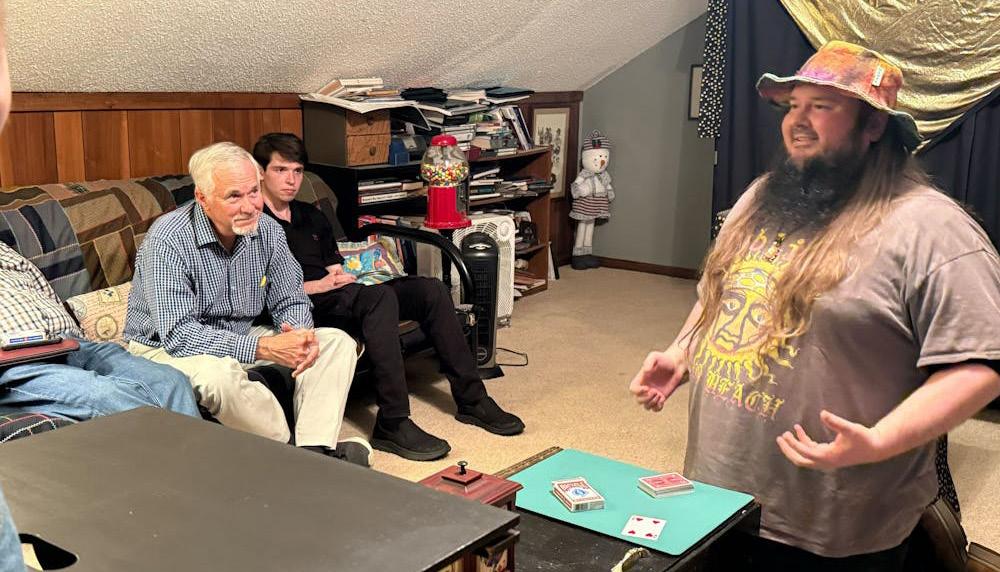
Christian Tillison performs a card trick as Tony Metze and Tony Campbell watch on. All three are members of International Brotherhood of Magicians Ring 105, a local club.
photo: Miles shea
Cockstock, Carolina Productions executives discuss annual performer changes
Cockstock is never the same. The yearly concert changes performers and venues. Students desire recognizable artists, but financing and logistics don’t always allow for them.
Since the event relies on the Student Activity Fee, tickets are typically free with a CarolinaCard or come at a discounted price.
Cockstock features an opening act, a headliner and an exciting environment for students.
Cockstock began in November 2016 with Rae Sremmurd and Kamaiyah at the Strom Thurmond Fields gates. In the past, Carolina Productions, the organization in charge of Cockstock, has brought in artists such as A$AP Ferg, T-Pain, COIN and Quavo.
While not always possible due to the budget, large names are usually followed by small artists and vice versa. For example, COIN was the headliner for 2023, and Quavo was the headliner for 2024.
For its 10th anniversary, Cockstock 2026 stood out from the events in the past. It was the first Cockstock to be held on Blatt Field and with a festival format. The festival had no opener and instead featured three artists: Weston Estate, Social House and Luh Tyler. Many students shared mixed reactions to the lineup on social media platforms such as Instagram and Yik Yak.
Fetty Wap was a popular request for Cockstock 2026, and when Carolina Productions couldn’t deliver, the Fraternity Lots did.
Fetty Wap performed on March 21 at the 9th Annual St. Patrick’s Day Celebration. Not only would Fetty Wap have been a challenge on the already-tight budget, there was another problem: he had a criminal record, D’Asia White, Carolina Productions event coordinator, said.
“We all agreed that (Weston Estate, Social House and Luh Tyler) were our best options out of what we were presented with, considering all the restrictions,” White said. “They can’t be in jail or anything.”
Cockstock began as a part of Homecoming until 2024, when a booking issue caused the event to be postponed to January 2025. Carolina Productions President Branden Miller said Cockstock 2026 was intentionally held during the spring to give students a fun milestone past the beginning of the school year.
associate director for student events and traditions, said. This has led the event to be held at alternate locations, such as Greene Street and Strom Thurmond Fields.
how to use Blatt. We’re using squash ball courts and classrooms on Blatt to serve the green room purpose, especially because we have three
In 2026, Carolina Products has spent $120,000 on Cockstock due to a tighter budget. While Cockstock is paid for by the Student Activity Fee, Buzan said not all of the money can be used by Carolina Productions.
“When you think of the allocation, it’s from the Student Activity Fee, and then it’s the portion of it that is Carolina Productions,” Buzan said. “It’s the student leaders of that organization that determine the percentage of that total allocation that they put in the name of Cockstock every year. So that changes year over year.”
randomly deciding to be more frugal. Cockstock 2025 was partially paid for by $100,000 found by Student Government, which covered the cost of the opener, Mariah the Scientist, and allowed the headliner to be Quavo, a big-name artist. Cockstock 2026 did not have that extra money.
White said that, knowing the constraints, Carolina Productions had a decision to make.
“It was really difficult to decide if someone was necessarily good enough to bring in a big crowd with just one person,”
Pagan also said she listened to Weston Estate and Luh Tyler prior to the event so that she wouldn’t be standing around during their sets. She said the artists were interactive with the crowd. The environment was so lively that students didn’t need to know the music to have a good time, Pagan said.
Carolina Productions met with
Council and Association of African American Students. Cockstock 2026 also had a smaller budget because there were less donations to the Cockstock committee. Budget cuts made it difficult for other organizations associated with Cockstock to financially support the event, White said.

“We start planning Cockstock in the summer,” Miller said. “Where do we want to do this? ... Just looking at a bunch of different places and looking at our budget and looking at what we did, we’re like, ‘Oh, let’s do it on Blatt.’ And then from there, we’re like, ‘What’s that going to look like?’”
The Colonial Life Arena is often a venue for performers, but not without cost. In order to host Cockstock, Carolina Productions must rent out the arena for around $30,000, Courtney Buzan,


Using Blatt as a performing space was technically free, but it came with its own issues. Blatt is a recreational field, it doesn’t have the infrastructure to naturally support Cockstock like Colonial Life Arena does. Despite that, Buzan said Carolina Productions made it work.
“Blatt is not a good place to do green rooms. They don’t exist,” Buzan said. “We had to get really scrappy with

different artists, so three different green-room spaces.”
The biggest problem Carolina Productions faces with Cockstock is how the event depends on an inconsistent budget, Miller said.
The year begins with a baseline budget that is split between Cockstock and other events held by Carolina Productions, Miller said. Some of Carolina Productions’ other events are Cockbuster movie nights, activity nights, petting zoos and the Dating Game.
In 2025, Carolina Productions spent over $300,000 on Cockstock.


Carolina Productions has consistently spent more money than it have brought in, according to the budget records over the past five years.
The differences in spending weren’t from Carolina Productions


White said. “I think we fell more into the, ‘Okay, let’s do multiple artists, and hopefully different artists will bring multiple different people,’ since we had to go with smaller artists because our budget could not even think of affording a big artist.”
Students were surveyed to determine the most popular genres. The top three genres were pop, rap and indie rock. Carolina Productions looked for artists that fit those genres and the budget.
Ahmariah Pagan, a first-year retailing student, went to Cockstock to represent the Association of African American Students. She was most familiar with Social House because of the collaboration with Ariana Grande.
“I went to Café Verde. I had just grabbed me something to eat. So once I got my burger, I was hearing the song,” Pagan said. “I just ran straight back down. It was so fun.”

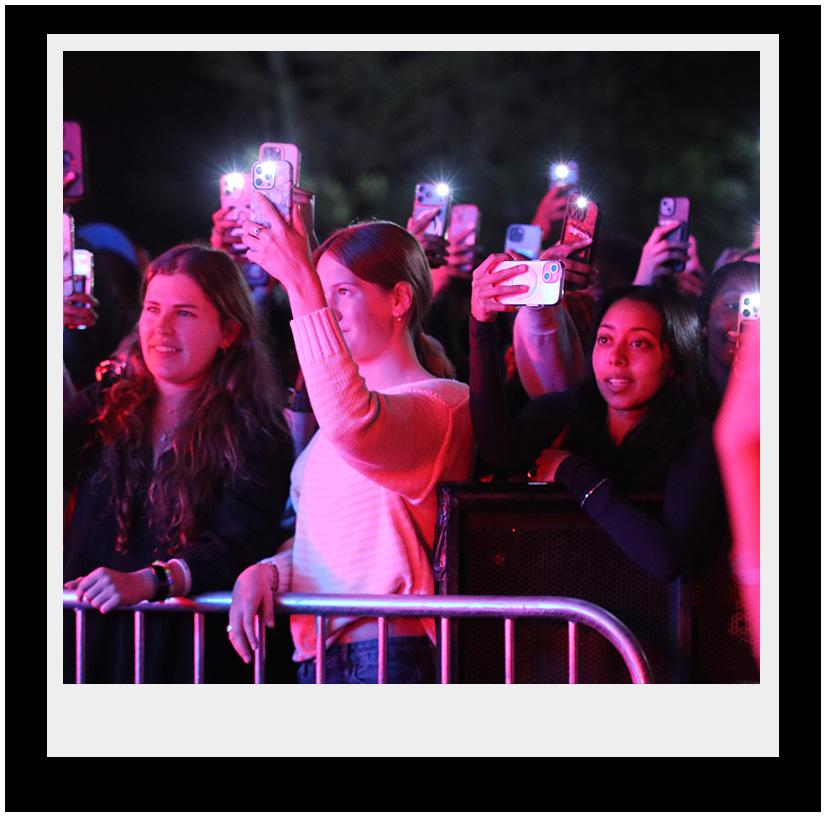
the other partner organizations in September to create a plan, White said. Alongside the president or representative from each organization, White led discussion meetings every other week. The other USC organizations involved are National Pan-Hellenic Council, Student Government, Dance Marathon, Homecoming, Residence Hall Association, Cultural Greek Council, Interfraternity Council, Carolina Traditions
“This year we had one org help us, and that was RHA. They brought the 1,000 shirts that the first 1,000 students will get. But that’s the only help we had,” White said. “We had no help towards the artist or anything.” Performers are only one part of Cockstock. Other costs that must be taken into account are the venue, production, marketing and the middle agent, Buzan said. The middle agent helps Carolina Productions negotiate with artists for fair pricing, which can be difficult when prices continue to rise. Cockstock 2026 spent around $70,000 on performers and $30,000 on production, according to the budget. Fair pricing is important because neither party wants to lose money.
The college performance market isn’t attractive to bigger artists. Artists are less likely to be interested in performing at a smaller venue when they could be selling out 100,000-person arenas, Buzan said. Students who attended Cockstock will receive a feedback survey from Carolina Productions to express their thoughts and opinions on the event, so students can have genres and artists they enjoy in the future.
“We just really wanted to have it so it was every student has something they enjoyed,” Miller said. “There’s really never appeasing everybody ... We just did what we thought genre-wise each student would like and get somebody whose music isn’t bad.”
PHOTOS: GRACE MOYER
PHOTOS: DELANY KRAL
DESIGN: RANSLEIGH BALDAS

Want a Tour?








Column: Yik Yak harbors community full of negativity
Olivia Sciortino| opinion writer
Although many students enjoy the social media app Yik Yak, some might believe it is harmful to the student body since the anonymous aspect of it makes it easier to bully others and spread rumors.
Yik Yak is a social media app in which users can anonymously post about anything for their local community to read. Users can then upvote or downvote posts and comment on them. Many universityrelated topics are constantly being posted, making the app very popular among USC students.
In 2017, Yik Yak was shut down from a severe decline in users due to rampant hate speech and cyberbullying. In 2021, the owners decided to bring back Yik Yak, taking a stronger stance against abuse. The owners claimed that this redeveloped app would be “the same Yik Yak experience millions knew and loved.” The experience many users had in the past was based around hate and negativity, causing them to delete the app. So why would people want to relive this experience?
First-year students Hannah Mazzocchi and Rachael Vavricka both said they used Yik Yak the most during their first semester at the University of South Carolina. They said this is because they just got to Columbia and wanted to learn more about the community, but also because it was football season and formal recruitment for sororities.
These are both big events for USC students, so it makes sense that people have a lot to say about them. Mazzocchi gave an example of how people would constantly post on Yik Yak making fun of South Carolina football head coach Shane Beamer.
Many freshmen such as Mazzocchi use Yik Yak to learn more about USC, but they could be more impressionable than upperclassmen
and know more from experience. The negativity on Yik Yak could be one of the first things freshman students learn about the school, possibly giving USC a bad reputation.
Mazzocchi said that she sees a lot of negativity on Yik Yak, especially towards the football team. She remembered reading posts about people making fun of the football team and Beamer.
The fact that these hateful remarks were the first things that Mazzocchi could recall seeing on Yik Yak shows that the platform truly contributes to online toxicity.
Many freshmen use Yik Yak to learn more about each sorority if they don’t know anything about them. Although this might seem helpful, many comments about each sorority are negative, which might deter new members from joining.
Furthermore, many active members use Yik Yak to see what others are saying about their sorority, so it might be upsetting for them to see pessimistic posts about something that they feel so passionate about.
Sorority rush should be something that is personal and unique to each individual. Potential new members should choose their home based on where they feel the most comfortable, which is why they are encouraged to not discuss their experience with anyone else so that their decision isn’t influenced. Many of the posts on Yik Yak during this time could corrupt potential new members’ decisions, as people post their personal rankings and rumors on the sororities. This personal decision becomes riddled with discouragement from strangers behind a screen.
According to Mazzocchi, some people may use Yik Yak to ask for recommendations on where to go for big-little dates, which are when a new member and existing member

go on a date to see if they want to be in each other’s sorority family.
Despite the fact that anonymously posting can help shy students ask questions or ask for advice confidently, this does not justify a platform that enables hostility.
Anonymously posting also allows for rumors to be spread easier, since, as previously stated, people don’t feel as much of a responsibility for being wrong. This can be seen through the false-alarm shooting that happened on Columbia’s campus during the 2025 fall semester.
Many rumors were being spread through Yik Yak during the shooting hoax, but a notable one involved a student carrying an umbrella across a pedestrian bridge toward Campus Village. Some believed that this man was the shooter, causing many students to panic. This rumor could have caused real danger to the community, since law enforcement could have taken this information seriously, or someone could have attacked this bystander assuming they had a firearm.
“I would lean maybe more towards harmful,” second-year student Maddy Smojice said when asked about Yik Yak. “I feel like it has a lot of negative comments.”
Clearly, Yik Yak does more harm than good to the USC community.
While some think that Yik Yak brings the community together, others don’t agree, since posts are often just personal opinions and thoughts. Some say that when it does bond USC’s community, it is done through negative commentary. For example, even though the posts about Beamer were negative, many students agreed with the posts, creating a community around these shared hateful thoughts.
Yik Yak is a major source of online bullying, which is rarely worth the amusement, since people’s mental health should come first.
In theory, Yik Yak could be a great way for students to ask questions and get others’ advice, especially for freshmen who don’t know much about the school. In reality, many use it as a way to be a bully without the backlash.

Column: SNAP changes won’t solve South Carolina’s obesity problem
South Carolina is fat. It ranks among the most obese states in America, with an adult obesity rate of 36% as of 2023. What’s even more alarming is that nearly 40% of South Carolina public school students are considered overweight or obese. This disease not only affects adults who can understand the consequences of an obese lifestyle, but also children who are particularly susceptible to lifelong impacts from childhood obesity. Clearly, something needs to be done. Obesity is a chronic disease, and according to the Centers for Disease Control and Prevention, obesity in adulthood increases the risk for a multitude of issues, such as heart disease, stroke, cancer, depression, respiratory issues and even death. Obesity is responsible for the death of approximately 300,000 Americans yearly. Not only does obesity affect those with the disease, but it also places a major burden on the already strained American healthcare system. It costs nearly $173 billion yearly to treat preventable conditions caused by obesity, while raising healthcare costs for everyone. However, placing the blame solely on individuals ignores much larger issues, such as education and, more importantly, access.
INCOME DICTATES DIET
In South Carolina, obesity disproportionately affects lowincome communities. According to the CHOICES Project in 2020, the adult obesity rates of South Carolina residents making less than $20,000 per year was 52.8%, while the same residents who
were making $50,000 per year or more saw a 42.6% obesity rate. This disparity between obesity rates is not simply a matter of personal choice, but rather it is directly correlated with income bracket. Higher-income households and communities have a larger budget for healthy, whole foods, while lower-income households and communities experience the
card. The EBT card for SNAP can only be used at authorized retail stores to purchase food, making those stores a lifeline for families who would struggle otherwise.
SNAP ANd HEALTHY FOOD CHOICE PROJECT
South Carolina has begun to focus on what SNAP recipients are buying
the U.S. Department of Agriculture and was requested by Gov. Henry McMaster seeking to exclude candy, energy drinks, soft drinks and sweetened beverages from the eligible foods under SNAP.
On paper, this sounds like an excellent idea. Limiting objectively unhealthy options should, in theory, increase the amount of healthy foods purchased. However, this project fails to address the deeper issue driving the rise in obesity across the United States and South Carolina in lower-income populations — food

income communities rely on the Supplemental Nutrition Assistance Program, or SNAP, which is a benefits program that allows lower-income households to afford food through an Electronic Benefits Transfer, or EBT, card, which is similar to a debit
and what food options those stores are offering. Starting Aug. 31, 2026, South Carolina will launch a SC Healthy Food Choice Project for households receiving EBT benefits. The program has been approved by the Food and Nutrition Service at
and unhealthy options when compared to whole foods. Even when healthier foods are available in stores, they can cost much more than less healthy options. Research consistently shows that diets rich in fruits, veggies, lean proteins and other nutrient-rich foods often cost more than less nutritious, caloric diets. Some studies suggest that healthier food can cost about $1.50 more per person per day on average. This can add up quickly, especially for families attempting to stretch their SNAP benefits. For many, the cheaper option tends to be the only option to survive, not the first choice. Removing certain unhealthy items from SNAP without addressing the heightened cost of whole foods will do little to change dietary habits.
AMERICANS ARE NUTRITIONALLY ILLITERATE
Lawmakers may remove soda and sugary foods from the list of eligible purchases, but if families are trapped in food deserts, they still lack healthy options and are now left with fewer options than before.
These proposed changes represent a step in the right direction. Encouraging or requiring retailers to provide healthier options can
HOLISTIC PATH FORWARD
If policymakers truly want to reduce obesity in South Carolina, they must take a more holistic approach. They must invest in food infrastructure in underserved areas, increase education and support
A food desert is a term used to describe regions where access to healthy, affordable and nutritious food is limited or nonexistent. These areas mostly have gas stations and convenience stores, outnumbering grocery stores, making healthy options limited and more expensive. This pushes people to purchase less healthy options, such as pre-prepared
EBT users can go to these stores and purchase frozen meals that are ready for consumption after heating them up and then eat them at home. These frozen meals tend to be highly processed
Further research by the Cleveland Clinic found that nearly half of Americans say the cost of healthy food is their biggest barrier to eating healthy, causing many lower-income Americans to turn to cheaper packaged and frozen foods. This is because fresh produce and whole foods are more expensive and out of their budget. The Cleveland Clinic also found that “One in 10 Americans think a fast-food diet is heart healthy.” Not only do many Americans think healthy food is too expensive, but they also lack significant education in nutrition. The drastic lack of nutritional education in America likely stems from limited to no education in nutritional sciences growing up. The CDC suggests that students need between 40 and 50 hours of instruction to change behavior, while stating, “U.S. students receive less than 8 hours of required nutrition education each school year.” The lack in instructional hours doesn’t aid in students changing their lifestyle at all. Rather, it teaches them that sugar is bad and vegetables are good — fundamental knowledge that a majority of Americans likely already know.
This creates a major disconnect between policy and reality.
improve national nutrition. These proposals would expand the range of foods that retailers must stock to still accept SNAP benefits and EBT. The requirement would increase from three to seven varieties in each of the four staple food categories: fruits or vegetables, meats, dairy products and bread or cereals. This would lead to more healthy and fresh foods being stocked in stores. Unlike restrictions, these retailfocused policies address the root of the obesity problem. If stores in low-income areas and food deserts are required to carry healthy options, access to healthy foods in those communities would increase, and obesity would slowly decrease, assuming communities were educated and whole foods were priced appropriately.
it’s not just about limiting unhealthy options, but rather increasing the number of healthy options available. However, this must be implemented carefully. Simply requiring stores to stock healthy options does not guarantee that it will be affordable or that SNAP recipients will shift their habits and purchase healthy options. It also does not prevent retailers who think that adhering to the proposed requirements would be too expensive from dropping EBT as a whole, especially smaller mom and pop corner stores, which may not be able to handle the logistical issues brought about by the abrupt change. This is the worstcase scenario and would further fuel the food desert fire.
South Carolina could expand farm-to-school programs, encouraging schools to purchase fresh produce directly from local farmers. This would create a stable market for local farmers while also providing healthy, fresh food to children in schools across the state, regardless of income, increasing the whole food access to children in

They could also implement and expand programs to aid in making healthier foods available for SNAP recipients while pushing food education in public schools for students and parents. The increased education, coupled with children experiencing the endless possibility of meal combos shown through their cafeteria meals, will reinforce good habits, making future generations understand the importance of eating healthy and how harmful obesity is. Ultimately, obesity in South Carolina is not just an issue on the personal level. It is an issue at the community level. While restricting SNAP purchases may appear to be a quick fix, it does little to solve the underlying issues driving the increase in obesity in the state. To make real progress, South Carolina will need policies that address both access and affordability, ensuring that all South Carolinians, regardless of income, will have the opportunity to choose to eat healthy food.
samuel cancilla| opinion editor
Designs: grace de peña