Detained professor speaks out
When public history goes rogue
After Wildcats, who’s No. 2?
PG 5
PG 8
PG 12
Weekender Friday, January 23, 2015
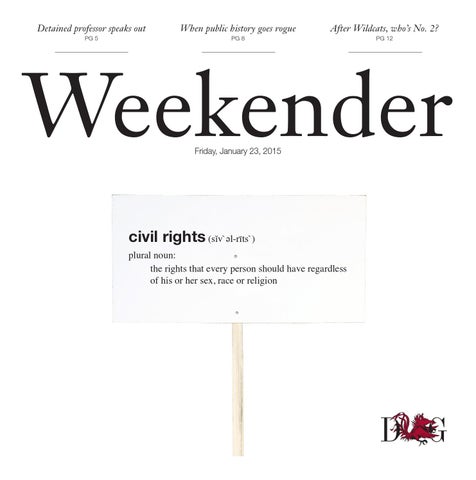
civil rights (sĭv`əl-rīts`) plural noun: the rights that every person should have regardless of his or her sex, race or religion
WEEK ENDER
2
Contents
dailygamecock.com INFORMATION Offices located on the third floor of Russell House EDITOR editor@dailygamecock.com NEWS news@dailygamecock.com OPINION viewpoints@dailygamecock.com Newsroom: 777-7726
ARTS & CULTURE mix@dailygamecock.com SPORTS sports@dailygamecock.com PHOTO photo@dailygamecock.com Editor’s office: 777-3914
Editor-in-Chief HANNAH JEFFREY Managing Editor SAMANTHA LOCKWOOD Online Editor KATIE COLE Design Director BRITTANY WILT Special Sections Director KELLY VILLWOCK Copy Desk Chiefs DREW MUELLER MARY KATE GARMIRE EMILY READY Photo Editors KAMILA MELKO HANNAH CLEAVELAND
Briefing
3
Student voices
5
‘When the media isn’t free’
6
Soundtrack of civil rights
7
When public history goes rogue
8
‘Selma’ shows equality, Academy does not
10
After Wildcats, who’s No. 2?
12
The bigger they are, the harder they fall
14
Classifieds
15
News Editor NATALIE PITA Features Editor LOIS CARLISLE Arts & Culture Editors BELVIN OLASOV ERIKA RYAN Opinion Editors BENJAMIN CRAWFORD BEN TURNER Sports Editor DAVID ROBERTS Assistant Photo Editor CODY SCOGGINS Assistant Design Director BIANCA CORREA Arts Design Director GREY KLEIN
Sports Design Director RACHAEL MCGAHEE Assistant News Editors LAUREN SHIRLEY MADELEINE COLLINS Assistant Sports Editors BRENNAN DOHERTY KELLI CALDWELL Copy Editors DEBBIE CLARK, CHELSEA MORRIS, KELLY ELLIOTT, KEVIN KEATING, MADELEINE VATH, MARY HINNANT, SETH ISMAIL, RANA SOBEIH Faculty Adviser DOUG FISHER Interim Student Media Director SARAH SCARBOROUGH Business Manager KRISTINE CAPPS
Creative Director EDGAR SANTANA Production Manager DEGAN CHEEK Creative Services ASHLEY CROMPTON RANNAH DERRICK LINA LEGARE KODY KRATZER Student Advertising Manager AMBER GRANT Advertising Representatives DAVID CHEETHAM, THOMAS DIGENNARO, MICHELE DRESSLER, DREW HART, IAN PEACOCK, ERIN O’CONNELL, HOLLY HEATON, WRIGHT CLARKSON, JOSHUA DAVISON
WEEK ENDER
Briefing
“It’s just horrible. It doesn’t matter if, you know, if you’re Catholic, or Jewish, or Christian, if I’m gay or not gay or whatever. We should all be loving each other. I mean, there’s no reason to discriminate.” — Marjorie Silva, a cake decorator who refused to pen an anti-gay slogan on a client’s cake and was reported to the Colorado Civil Rights Division
3
“Beginning November 30, 2013, every morning outside Studio 258, I placed a bouquet of flowers in bicycle basket until I am restored the right to travel freely. Day 420, January 23, 2015.” — Ai Weiwei, Chinese dissident artist detained in 2013 for condemning the government
“As Americans, we respect human dignity ... That’s why we defend free speech, and advocate for political prisoners, and condemn the persecution of women, or religious minorities, or people who are lesbian, gay, bisexual or transgender. We do these things not only because they’re right, but because they make us safer.”
— President Barack Obama during his sixth State of the Union address Tuesday
“We condemn these actions that have caused deaths and make an urgent appeal: stop killing your people; don’t march on the ashes of your compatriots.” — Cardinal Mosengwo Pasinya, Catholic leader in Democratic Republic of Congo, following the terrorist attacks against President Joseph Kabila’s supporters Courtesy of MCT Campus
WEEK ENDER
5
Student voices
Photo Illustration by Kamila Melko | Weekender
“Civil rights is the right of each person to choose their own happiness without infringing upon the happiness of others. “I vote. I teach. I pick up trash — nobody likes to see that, you know? And I treat people with respect.” — Justin Peterson, economics graduate student “Civil rights to me means equality not just between races but equality between genders, sexualities, classes — having equal access and equal opportunities in government policy, in social structures, in every day life, and I think that expands not just from policy or law but also to the ways that our daily culture plays out and daily life. “The main part of [my participation] is through advocacy, especially as an historian -— being very conscious of how implications of the past have brought us to what’s going on on campus now and in the world and being mindful of those intricacies and what we can do to correct them. That could be through things like voicing protest for what’s been going on for the past two months, civil rights issues, such as the Black Lives Matter campaign ... I also think it’s just being mindful of people’s backgrounds. In class, knowing that not everyone is coming from the same educational background and being patient with everyone and giving everyone the same opportunities.” — Alyssa Constad, public history graduate student
“Civil rights is the ability of every individual to do as they please as long as it doesn’t hurt themselves or someone else. “I don’ t worry about people and what they think about me being transgender.” — Katrina Nichols, second-year computer science student “I would define civil rights as my ability to be able to say and act how I feel. “I feel like I exercise my civil rights everyday here at USC because here, unlike other schools, you can say what you want to say ... I think that’s the beautiful thing about this school, you do get the opportunity to express yourself.” — Shante’ Sumpter, third-year broadcast journalism student
“I thought I was born with freedom. Not like America, though. I think it was nothing for me until I came here and heard about what happened before [in history]. So, I think that freedom is something important for me. You have to have it. “I like to choose what I want I want to do because I’m here, living alone ... I don’t like to hear someone tell me to do something. I like to choose what I like to do.” — Kenan Aljohani, biomedical engineering student from Saudi Arabia WE
WEEK ENDER
6
‘When the media isn’t free’: detained professor speaks out Madeleine Collins @MADDY_COLLINS37
The U.S. was founded upon the idea that men were endowed with basic human rights and, throughout history, has worked to correct the wrongs of the past and move toward a future where everyone’s inalienable rights are protected. But these rights are not universal ideas. Randy Covington, a journalism professor in the College of Mass Communications and Information Studies, was in Russia in October of last year to teach investigative journalism workshop with Joe Bergantino, the executive director, managing editor and co-founder of the New England Center for Investigative Reporting. On Oct. 16, Russian authorities arrived at the workshop in St. Petersburg, and detained Covington and Bergantino for five hours before releasing them and shutting down the workshop. “We take an awful lot for granted,” Covington said. “And we may complain about things here, but when you look at the world from different perspectives, different cultures, different
countries, different world views, you can see how really fortunate we are here.” Covington teaches classes revolving around new media and ethics in journalism; one of his goals while teaching is to open students’ eyes to the similarities and differences of nations around the world. “I think that it’s helpful to realize that being plugged into what’s happening in the world is part of being a good citizen and part of making the world better,” he said. Covington explained that the media is seen as an aide to the government in places like Russia. In the U.S., the media is used as a check for the government, he said — shutting down the workshop served as a warning to Russian journalists. “The issue here is how do you have progress in a society if the media isn’t free?” Covington asked. “How do you have progress in a society if the role of the news media simply is to say ‘Aren’t things great? We need to support the people in power.’” Covington recalled that his students always
have an opinion, whether it’s about Obamacare, the New England Patriots or parking on campus. But the day he left Russia, he understood that not everyone felt so free to express him or herself. After class was shut down, Covington ran into two Russian students who were enrolled in the course. They wanted to discuss what had happened. “I said, ‘What do you think about that?’ I have never seen so much fear in anyone’s eyes in my life, and they wouldn’t say a word. As I’m standing there, looking at them, I thought about our students at the University of South Carolina,” Covington said. “The fact that these bright, young people were frightened to express an opinion left a lasting impression.” Covington’s thought is that it’s the media’s job to utilize the right to free speech and help bring about change. “Knowledge, free flow of information, is very powerful,” he said. “If we in the news media can’t address those things honestly it’s hard to get them fixed. WE
7
WEEK ENDER
Soundtrack to civil rights: the music of a movement Belvin Olasov @BELVINOLASOV
The civil rights movement was supported by a deep bench of black musicians, whose music galvanized protestors through sit-ins, marches and demonstrations. Here are two of the movement’s most prominent songs:
“We Shall Overcome” As much a song as a slogan, the anthem “We Shall Overcome” came to embody the AfricanAmerican civil rights movement in the ‘50s and ‘60s. The song is rooted in gospel hymns, but doesn’t have any one definite origin. Its earliest use came from the picket lines of the 1945 tobacco worker strike in Charleston, South Carolina, but by 1959, it was on its way to becoming the song of the non-violent civil rights movement. Martin Luther King, Jr. recited the words from the song in his final sermon before his assassination. President Lyndon B. Johnson said, “We shall overcome” in his post-Selma attack speech, symbolically joining the movement. The song was played in South Africa during the protest against apartheid; it was adopted by the
TDG @thegamecock
Northern Ireland independence movement. “We Shall Overcome” is more than just a song — it’s the powerful, deliberate theme song for defiance.
“I Wish I Knew How It Would Feel to Be Free” Though orchestrated by Billy Taylor and Dick Dallas, Nina Simone is to thank for catapulting this jazzy tune to prominence and establishing it as an anthem of the civil rights movement. While “We Shall Overcome” thrives on simplicity, “I Wish I Knew” is explicit — “I wish I could break / All the chains holdin’ me” — and hopeful — “How sweet it would be / If I found I could fly / Oh I’d soar to the sun / And look down at the sea.” Nina Simone was a constant presence in the civil rights movement. While some artists avoiding completely committing to political protest, Simone threw herself wholeheartedly into the movement. She spoke at rallies, participated in marches and constantly
incorporated a strong civil rights message into her music. “I Wish I Knew How It Would Feel to Be Free” isn’t as explicit as “Old Jim Crow” or some of her other activist songs, and that’s part of its charm. The soundtrack to a historical movement needs its hymns and marching songs, but it needs the light, hopeful songs, too. WE
8
9
When public history goes rogue Lois Carlisle @LOISCARLISLE
If you’ve ever walked across the front of the historic Horseshoe on your way to class or to catch a shuttle, you’ve passed the source of one of Columbia’s most recent political disputes. Historical marker 40-27 chronicles the history of the University of South Carolina as told by Richland County residents from nearly 70 years ago, who, some would argue, attempted to drag a blanket of racism over one of the nation’s largest research institutions. Here’s the text, reproduced in full: University of South Carolina Chartered 1801 as the S.C. College, opened January 10, 1805. Entire student body volunteered for Confederate service 1861. Soldiers’ Hospital 1862-65. Rechartered as U. of S.C. 1865. Radical control 1873-77. Closed 1877-80. College of Agriculture and Mechanic Arts 1880-82. S.C. College 188287. U. of S.C. 1887-90. S.C. College 18901905. U. of S.C. 1906. Faithful index to the ambitions and fortunes of the state. Erected 1938 by the Columbia Sesquicentennial Commission of 1936. You’re probably thinking, “What’s the big deal? It’s a historical marker. There are hundreds of these things in every corner of the state. And this particular installation doesn’t look like a pronounced form of bigotry.” The problem is that this immovable metal slab is but one version of history. Moreover, it’s one version that is deemed “faithful ... to the ambitions and fortunes of the state.” And what exactly was the Columbia Sesquicentennial Commission of 1936? A sesquicentennial is the 150th anniversary of an event. (Think, bicentennial, but take away fifty years and add a Q.) In
this case, the committee commemorated South Carolina’s vote to relocate the capitol from Charleston to Columbia in 1786. This transplant — for those of you who never took South Carolina history — was so the state’s seat of power was more centrally located. According to the official State House website, this shift made it so wealthy Charlestonians and upcountry farmers had to travel the same distance to make their case before the legislature. Seems like a pleasant thing to commemorate, so what’s the issue here? It’s that little sentence right in the center there. See it? “Radical control 1873-77.” These are the years following the Civil War, when carpetbaggers and New England intellectuals migrated southward into a decimated Dixieland to reconstruct a more forward-thinking, united nation according to Dr. Walter Edgar, the foremost historian on South Carolina history. This was seen as a slap in the face for many southerners who remained as steadfast in their beliefs as they did before the war. (Think Scarlett O’Hara. That old belle just never gives up.) For these people, Reconstruction was a filthy word. On USC’s campus any professor or student who hadn’t died for their cause (“Entire student body volunteered for Confederate service”) made the decision to leave the university which, in 1873, fell under Republican rule and became one of the first institutions in the South to accept African-American students. Southerners were not happy. Oh, controversy, there you are. For a university that had once been called (by the infamous Ben Tillman) the seedbed of the aristocracy, the admittance
of African-Americans was a bitter blow. Calling this temporary period of equality “radical” (a word as dirty as “reconstruction” at the turn of the century) was a purposeful jibe at a forward attempt to create an immediate sense of change following the war. And to call this prejudice “faithful” to the motivations of the state creates an enduring, albeit false, racist political and social motivation. And for African-Americans who did attend school in these short years, the difference between ante- and postbellum Carolina was immense. Though enrollment numbers dropped, black attendance rose to 90 percent until 1877 when the entire school shut down. The majority of that percentage attended preparatory department, having lacked the prior schooling to prepare them for college courses. Several of these students went on to become political advocates who are featured in South Carolina history, according to Dr. Ehren Foley of the State Historic Preservation Office. In 2014, it was proposed that the marker be changed in order to reflect the more advanced, less humiliatingly racist atmosphere in Columbia and on campus. However, many have made the case that this plaque not only commemorates the history of the university, but also captures the surviving remnants of resentment held by the 1936 commission. In that case, the plaque itself belongs in a museum. Either way, the space between 18731877 framed a pathway for opportunity that lead and still leads into the future, despite whatever phrase is used to characterize it. So, preserve the past or change the future? It may very well be the student WE voice that decides. Hannah Cleaveland | Weekender
WEEK ENDER
10
Long way to go: ‘Selma’ shows equality,
Academy does not Courtesy of MCT Campus
Kelly Villwock @KELLYVILLWOCK
“Selma,” the Martin Luther King Jr. biopic that covers the events in 1965 that led to the Voting Rights Act, in its very essence is about work. In each shot, you can see the immense and thoughtful work director Ava DuVernay put into the film, taking the story from a piece of history to an explosive narrative. In every pause in speech, you can see the work David Oyelowo put into making King the living, breathing, human man so far removed from a historical rendering. And in the film itself, you see the outstanding amount of work, sweat, tears, sacrifice and death it took the people of Selma, Alabama — and Americans across the country — to march across Edmund Pettus Bridge and eventually gain equal voting rights. We also see — perhaps in the timeliness of the movie’s release, or in images of police brutality that parallel those we’ve seen all too recently — that while we’ve come a long way, the fight portrayed in Selma is far from over. This is DuVernay’s overarching message. While the film does reach the hopeful conclusion of King’s speech in Montgomery, or with President Lyndon B. Johnson signing the Voting Rights Act into law, the final minutes are not the crux of the film. Neither is history, although it makes for an incredible story. Instead, the film focuses on racially fueled violence and raw human emotion. This immediacy gives the illusion that these events happened yesterday, rather than a halfcentury ago. A large part of this feat is the performance by Oyelowo, who transforms King from a yearly holiday tribute to a human with flaws, passion and courage. He also embodies King’s love for the theatrical — after all, he goes to Selma specifically because of the possibilities of garnering national attention.
#OSCARSSOWHITE
77%
of Academy voters are male
90%
of lead actors in films are white
94%
of Academy voters are white
96%
of film directors are male
100% of Oscar-winning directors are white. Ava DuVernay would have been the first minority woman nominated.
While Oyelowo’s speeches are grand and incredibly King-like, the most incredible theatrical moments come in silences. When an African-American church is bombed and four young girls are killed, silence creates a haunting, emotional picture. This silence continues across many traumatic points in the film, showing nightsticks and rifles aimed at a community with no voice. These moments allow for simultaneous reflection and wide-eyed horror. The cinematography, while subtle in comparison to art-house Oscar contenders like Grand Budapest Hotel, just builds upon DuVernay’s laser-focused intent. Each shot seems to have been chosen based on importance rather than beauty. Because of the talent of cinematographer Bradford Young both are accomplished. Scenes are concise and packaged well with wonderfully lit black actors — it’s perhaps the only movie to do so. Shots do not distract from what DuVernay is relaying, but instead complement the strong actors and stronger message. This movie is reminiscent of past Oscar winners — Oyelowo’s speech at the beginning is akin to Daniel DayLewis’s initial speech in “Lincoln” and how Chiwetel Ejifor’s performance in “12 Years a Slave” humanized and unabashedly portrayed the history of African-Americans. One can’t help but wonder why this film, while nominated for Best Picture, was noticeably ignored in the Best Acting and Best Directing categories when the film was carried by both. Marked by speculation (is it due to the 2014 win of “12 Years a Slave”?) and the #OscarsSoWhite hashtag, this awards season has generated a conversation based on principles from “Selma” while simultaneously contributing to the issue at hand. Statistics: Bunche Center at UCLA
WE
WEEK ENDER
12
After Wildcats, whos No. 2?
Courtesy of MCT Campus
Brennan Doherty @BRENNAN_DOHERTY
All across college hoops, there are intriguing conference races going on. The Big 12, one of the nation’s deepest conferences from top to bottom, could realistically be won by eight different schools, and a power struggle exists in conferences like the ACC, Pac-12, Big East and the Big Ten. Then there’s the SEC, where one lucky squad will be crowned, “The best team not named Kentucky.” It’s the Wildcats’ world — we’re just living in it. Kentucky is normally the favorite to win the conference most seasons, but the Wildcats were all but handed the regular season conference championship when head coach John Calipari managed to once again reel in one of the nation’s most impressive recruiting classes, while convincing stars like the Harrison twins from last year’s Final Four team to return for another year. That, added in with the fact that Billy Donovan’s Gators don’t appear to be as threatening as they have in past seasons, have the Wildcats poised to cruise through conference play without many problems. Yes, Kentucky is prone to an upset or two, but Calipari’s team is still leaps and bounds ahead of its intra-league competition. With that said, if Kentucky is king, who’s the
best of the rest? At this point, it’s unclear. As much separation as Kentucky has from everyone else in the league, the rest of the SEC is one unpredictable, jumbled mess. As of Jan. 22, second place and 10th place were separated by just two games. Through the first three weeks of conference play, teams that were expected to be among the SEC’s best, such as Florida and Arkansas, have struggled, while teams like Tennessee and Georgia have been pleasant surprises. You could make an argument for several different teams to be the league’s best excluding Kentucky, but there’s always a counterargument. You see, there’s a little unwritten rule that every SEC team has seemingly obliged to: for every impressive win you earn, you must lose an equally disappointing game, as well. For example, a talented but youthful LSU team has picked up respectable road victories over Ole Miss and Florida, but the Tigers have also dropped contests against Missouri and Texas A&M, two of the conference’s lesser skilled teams. L i k e w i s e , Te n n e s s e e h a s a n uncharacteristically bad 18-point loss to eighthplace Alabama as its lone blemish in conference play.
That shows how nearly impossible it is to predict what will happen night in and night out in the SEC because the talent gap between its upper-tier teams and its bottom cellars is so minimal. Essentially, there are several SEC teams that are in the middle of the pack, but no one can quite pull away because of a problem that plagues several of the league’s teams: inconsistency. Just when one team looks ready to jump ahead of its competition, an unexpected loss pulls them back. Meanwhile, few folks thought that South Carolina would start off league play 1-4 after upsetting then-No. 9 Iowa State in its final non-conference game, and yet, the Gamecocks enter Saturday’s matchup with No. 1 Kentucky having played arguably its worst game of the year earlier in the week against Tennessee. Still, hope remains for teams like South Carolina. There’s still a ton of basketball left to be played, and regardless of how weak or strong the SEC is compared to other conferences, the league has proven that even the underdog can come out on top any given night. Of course, even Goliath slipped up once, and if South Carolina could do its best David impersonation Saturday afternoon, the Gamecocks could be right back in the race. WE
WEEK ENDER
13
Weekend Calander: Jan. 23 to 25 FRIDAY
SATURDAY
G-EAZY / KEHLANI / KOOL JOHN / JAY ANT Music Farm Columbia, 1022 Senate St. Fri, 8 p.m., $25-$28 Rapper G-Eazy is coming to Columbia Friday to perform at Music Farm in the Vista. Set to open the show are other up-and-coming musicians R&B singer Kehlani, Jay Ant and Kool John.
SUNDAY
COLUMBIA SPELLS Tapp’s Art Center, 1644 Main St. Sat, 7 p.m., $15 Tapp’s Art Center will host an adult spelling bee this Saturday as a fundraiser for the Columbia Children’s Theatre. Teams will go against one another to put their spelling skills to the test while donations from the audience can also give teams advantages.
IN THE RED AND BROWN WATER Trustus Theater, 520 Lady St. Fri to Sun, 8 p.m. / 3 p.m., $15 for students Trustus’s production, “In the Red and Brown Water,” opens Friday and will run until Feb. 7.
OYSTER AND PIG THROW DOWN
OVERREACTORS IMPROV SHOW Benson Theatre, 226 Bull St. Fri, 11 p.m., $5 USC comedy improv group the OverReactors is having their first show of the spring semester this Friday. This show has a theme of “Greek Tragedy,” so wear your favorite toga.
City Roots, 1005 Airport Blvd. Sat, 11 a.m., $43.19 Columbia’s own sustainable farm City Roots will be hosting an oyster and pig roast lunch this Saturday. The event will also feature live music from Bluegrass group Mountain Feist and the Mustache Brothers.
Five Points 1022 SENATE STREET COLUMBIA, SC 29201 MUSICFARM.COM
Now AcceptING CarolinaCard
ZOSO ZOSO ZOS O The The he Ultimate Ultim Ul tima tim ate ate t Led Led d Zeppelin Zeppe Ze ppelin peli l Experience Experi Exp erienc eri enc nce e JAN 29
THE THE E LOX LO OX JAN JAN 31 31
BOOM BOO BO B OO O OM BOX BO OX X FEB FEB B3 3
SOJA FEB 18
BAD BA BAD AD SUNS AD SUNS FEB FE EB E B 19
BRETT ELDREDGE FEB 6
Cocky
YONDER YO Y YON ON O NDE DER D ER MOUNTAIN ER MO M OUN UNT U NTA NT AIIN AIN IN STRING ST STR S TR RIING IN NG BAND NG BA B AND ND FEB FE EB B7
JUSTIN JUSTIN N TOWNES TOWN TO WN WNE W NES EARLE EA EA ARL AR RL R RLE LE
FEB FEB EB 20 20 20
Come in to enjoy all your favorites! HOURS
Sunday-Wednesday 11:00am–10:00pm
Thursday-Saturday 11:00am– 3:00am
803.799.1950 | 2006 Devine St, Columbia, SC
YOUNG YOU YO Y O OU UNG NG THE THE T TH HE GIANT GIIANT G ANT NT FEB FE FE FEB EB B 25 25 2 5
DAN DAN D DA AN + + SHAY SH SHA S HA AY MAR MA M AR R5
PATRICK P RIC PAT RIICK DAVIS DA AV AVI V VIIS MAR MA M AR A R7
COREY CO COR C O OR RE EY Y SMITH SM SMI S MIITH M TH MAR MA M AR 27 AR 27
WEEK ENDER
14
The bigger they are, the harder they fall David Roberts @DAVIDJAYROBERTS
Hosting a perennial top ranked team in the midst of a humbling losing streak isn’t a formula typically found for turning a team’s season around. But last year’s 72-67 win over Kentucky was anything but ordinary for South Carolina. The Gamecocks were reeling after losing three in a row and 12 of their last 15 contests when they hosted a Kentucky team that ended its 2014 season in the national championship game. South Carolina’s defense smothered the Wildcats all night, holding Kentucky to a modest 26.9 percent from the field. Kentucky’s frustration culminated in the ejection of head coach John Calipari in the fourth quarter. “We didn’t bow our necks until I got tossed. And then we bowed our necks and played. You know, the good news with it is if I get thrown I’m not doing a press conference after,” Calipari said at his weekly press conference. Calipari did not show up to the post-game interview after he was ejected last year during Kentucky’s defeat. After its win, South Carolina peeled off three wins in five games, including victories over Auburn and Arkansas in the SEC tournament. The Gamecocks now have a chance to make lightning strike again a year later. But this time the stakes are a little bit higher. Kentucky will visit as the heralded No. 1 team in the nation, having won every one of its 18 games this season. Similar to last season, the Gamecocks have struggled through SEC play but have maintained their defense prowess that head coach Frank Martin has hammered into the South Carolina program. “They game is going to be physical,” Calipari said. “They come right at you. If you drive, you’ve got three guys running. As you run at
them, they run at you.” Through 17 games, South Carolina has held its opponents to 36.6 percent fi eld goal shooting, which is the eighth-best in the nation. The Gamecocks also average over 38 rebounds per game, good enough to tie them for 39th in the country. The Gamecocks have a unique opportunity Saturday to not only replicate their win from last year, but also to stop the slide they’ve been on since falling to Florida to begin SEC play. “If you try to act like nothing wrong has happened, you’re going to get the same result,” Martin said. “We have to embrace the moment that we’re in. Adversity does two things: either brings you together or breaks you apart. It’s one or the other. Let’s see which way we go.” Colonial Life Arena will be at capacity Saturday afternoon, the university announced Thursday afternoon. The building, which seats 18,000, has only sold out five times before — Saturday will mark the sixth. Four of South Carolina’s sellouts have come when playing Kentucky, including South Carolina’s 6862 upset win over the then-No. 1 Wildcats in 2010. Olivia Barthel | Weekender
1/23/15
15
EMPLOYMENT
EMPLOYMENT
EMPLOYMENT
Experienced Personal Trainers needed Pt and Ft hours available. Gym is 1 mile from campus. Contact Anne Marie for details 803.799.9455. Email mfulmer44@aol.com
GAIN VALUABLE MEDICAL EXPERIENCE Well Established, Fast paced Downtown Columbia Medical practice is interviewing for candidates graduating in May and planning to attend medical school. Gain valuable clinical experience while applying to medical school. The ideal candidate will have a 3.6 and higher GPA, graduate in May 2015, superior work ethic and high energy. On the job training while being paid. This job is full time. One year commitment required. Email resume to: guy@physicianservicessc.com Email guy@physicianservicessc.com
Sodexo at THE NATIONAL ADVOCACY CENTER is now accepting applications for a Food Service Worker I Custodian I PT Front Desk Clerk I Qualified applicants must be able to work a pm shift. Pick up Applications MonThurs 9:00am -1:30pm Sodexo Campus Services 902 Barnwell Street Capstone Bldg. (USC-Gibbes Court) Columbia, SC 29201 No phone calls please!/apply in person. All applicants must be able to pass a background check and drug test!! If student, must be available to work summer schedule; please attach class schedule. Sodexo is a EEO/AA/M/F/D/V employer
Evening Waitstaff Shifts start 4/6 pm and end 10/11 pm, closed Sunday’s. Servers average 15$ per hour with gratuities.
HOUSING
Why USC? Gamecock Connection Positions Available Tell us why you love USC! The Office of Undergraduate Admissions is looking for enthusiastic, dedicated students to assist with recruiting prospective students at Admissions special events. In this role you can share your love for USC with prospective students, admitted students and their parents. Applicants should possess strong communication skills, enthusiasm for USC, good work ethic, and professionalism. We are looking for volunteers to assist with Admissions events this spring, and there will be a mandatory training meeting for new members. Applications are available in the Office of Undergraduate Admissions located on the Horseshoe in Lieber College. Application deadline: Monday, February 2nd at 5:00 pm. For more information, please call Alexandra Scovel at 803-777-9106.
TRAVEL BAHAMAS SPRING BREAK $189 for 5 Days. All prices include: Round-trip luxury party cruise. Accommodations on the island at your choice of thirteen resorts. Appalachia Travel. www.BahamaSun.com 800-867-5018
We will work around school schedule best we can, our servers average one year longevity , that’s what we are looking for. One year casual or fine dining experience required, we generally promote from within, great opportunity for some older student to advance to head waiter position with considerable pay increase. Head servers make between 30/40 k annually. Thanks for looking, need a couple sharp people to add to our staff. Apply on line Als Upstairs Italian Email alloftis@bellsouth.net
Lovely condo at Place on the Greene Lovely 2 bdrm/2ba condo avail 8/1/15 Close to everything/ 5 min walk to campus. $525 a person Fully equipped with W/D, all kitch appliances. Lovely view, oversized rooms. Hardwood floors. Cute condo! Very quiet. Nice place to call home. WON’T LAST LONG! Call/text Mike @413-2516 or E to adzonni@aol.com Txs! includes water/parking Email adzonni@aol.com
room near usc 475 furn.2375516
ACROSS 1 “Now I understand” 6 Congressional proceedings airer 11 Much-studied flavor enhancer 14 Wilt 15 Foodie’s words for subtle flavoring 16 Pint filler 17 Deal with, as a stack of dull paperwork 19 Rocky prominence 20 One may be rolled up 21 Galsworthy’s “The Forsyte __” 22 One of a chair pair 24 Investor’s initial support 28 Very disagreeable 30 Singer Björk’s birthplace 31 Cosby’s “I Spy” co-star 32 Tour de France stage 33 Create an incriminating trail 39 Bring up 40 Simple beds 42 Montana neighbor 45 Defining quality 48 How long to shop, on a spree? 50 AM frequency meas. 51 Bidding site 52 Screwball behavior 54 Kitty’s love in “Exodus” 55 Autumn lunar phenomenon 60 Checker on a board, say 61 French clerics 62 Duck 63 Tallahassee-toTampa dir. 64 Bank job 65 Flighty DOWN 1 National econ. yardstick 2 Fla. NBA team 3 Like overly tight clothing
4 Cry of pain 5 H.S. exam for college credit 6 “Wayne’s World” co-star 7 Did a smith’s work 8 More, musically 9 Filmmaker Lee 10 Math degree 11 “Hakuna __”: “The Lion King” song 12 Maxwell House’s “Good to the last drop,” e.g. 13 Spiro’s successor 18 Obedience school command 21 “Shh!” 22 Preschool song opener 23 Enlist again 25 Bank lead-in 26 Military sch. 27 Animated Le Pew 29 In an economical manner 32 Celebration before the celebration? 34 Not (a one) 35 Jackson 5 brother 36 Rebekah’s eldest 37 Goes kaput
For solutions to today’s puzzle, go to dailygamecock.com
or download our app!
38 Make an engraving 41 “__ who?” 42 First-stringers 43 Some October babies 44 He replaced Ken as Barbie’s beau from 2004 to 2006 45 Actor Borgnine 46 They’re often stewed 47 Was nasty to 49 Barry and Brubeck
53 Mid 10th-century year 55 “A likely story!” 56 16th prez 57 Slugger’s stat 58 Gorges oneself (on) 59 Napoleonic marshal