Rev. Jesse Jackson, Civil Rights Strategist and Architect of Modern Democratic Coalitions, Dies at 84
The Baptist minister and activist also influenced clergy, activists, and politicians on the West Side and in the west suburbs
BY MICHAEL ROMAIN The Culture
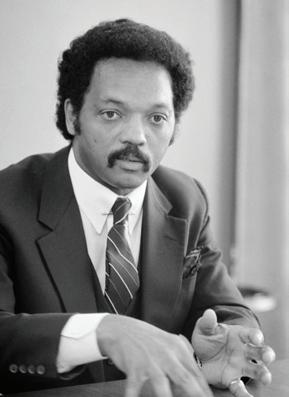
Rev. Jesse Jackson, the Baptist minister, civil rights activist, and twotime presidential candidate whose audacious campaigns reshaped the Democratic Party and helped redefine American political power after the civil rights era, died on Feb. 17. He was 84.
Jackson had been battling with progressive supranuclear palsy (PSP), a rare neurodegenerative disease. In a statement, Jackson’s family said he died peacefully, surrounded by loved ones.
“Our father was a servant leader, not only to our family, but to the oppressed, the voiceless, and the overlooked around the world,” the family said. “We ask you to honor his memory by continuing the fight for the values he lived by.”
For more than half a century, Jackson moved at the intersection of faith, protest, and electoral politics — at once preacher, strategist, diplomat, and provocateur. To admirers, he was the political heir to Rev. Martin Luther King Jr., the figure who carried the civil rights movement into the arena of presidential politics and institutional power. To critics, he was an ambitious and polarizing presence whose audacity sometimes strained alliances within the movement itself.
Yet few disputed his influence. Jackson helped build the modern multiracial Democratic coalition, elevated Black political opera-
tives into positions of national authority, and forced the party to expand its conception of who counted as a governing constituency.
Jackson was born in Greenville, South Carolina, and rose to prominence during the civil rights era, working alongside King in the Southern Christian Leadership Conference. A charismatic orator steeped in the cadences of the Black church, he quickly became known for his ability to mobilize crowds and frame political struggle in moral language.
After King’s assassination in 1968, Jackson emerged as one of the movement’s most visible — and controversial — young leaders. His rapid ascent unsettled some veteran activists who believed leadership should be conferred collectively, but it also positioned him to carry the movement’s message into new arenas.
In Chicago, particularly across the Greater West Side, Jackson’s presence became intertwined with clergy activism and community organizing that linked King’s legacy to contem-
porary struggles against inequality. Ministers and organizers would later describe Jackson as a bridge between the moral authority of the civil rights era and the institutional battles that followed, arguing that the unfinished work of King’s generation demanded political engagement, not simply commemoration.
CHICAGO, THE DEMOCRATIC PARTY, AND A NATIONAL STAGE
Jackson’s political maturation unfolded in Chicago’s rough-and-tumble civic landscape, where he challenged the dominance of Mayor Richard J. Daley’s Democratic machine and helped shape the insurgent coalition that propelled Harold Washington to become the city’s first Black mayor in 1983. His national breakthrough came with his presidential campaigns in 1984 and 1988. Running as an outsider against the rising
On The Cover Cover image design by BP Miller on Unsplash.
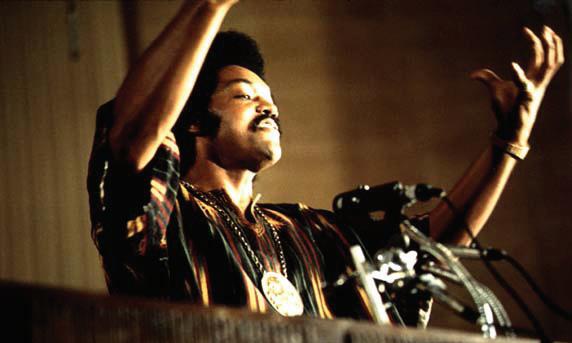
Jackson speaks on a radio broadcast from the headquarters of Operation PUSH (People United to Save Humanity) at its annual convention in July 1973. | JOHN H. WHITE/WIKIMEDIA COMMONS
tide of Reagan-era conservatism, Jackson built what he called the Rainbow Coalition — a multiracial alliance of Black voters, labor activists, students, Latinos, poor whites, farmers, and peace advocates.
Though he did not win the nomination, his campaigns transformed Democratic politics. He won millions of votes, forced changes to delegate rules, and elevated a generation of political operatives who would later shape the party’s leadership and presidential administrations.
Jackson’s insurgent presidential bids helped reshape the Democratic Party’s coalition and opened pathways for a generation of candidates who followed. Party veterans and historians have long noted that the diverse delegate rules and multiracial electoral strategies that emerged from his campaigns helped normalize the national ambitions of figures as varied as vice-presidential nominee Geraldine Ferraro, Sen. Hillary Rodham Clinton and, decades later, President Barack Obama.
His political orbit also produced influential operatives and public figures — from strategists such as Donna Brazile and the late Commerce Secretary Ron Brown to journalists and civic leaders who came of age covering or working within the movement he built — embedding his influence far beyond the elections he himself never won.
In a statement, Illinois House Speaker Emanuel “Chris” Welch described Jackson as a friend and mentor.
“Rev. Jackson was more than a civil rights icon — he was a builder of hope,” Welch said. “Through the Rainbow PUSH Coalition, he turned pain into purpose and protest into progress. He challenged America to be better, to do better, and to live up to its highest ideals […] He poured into leaders like me, reminding us that public service is about lifting those whose voices too often go unheard. His presidential campaigns inspired a generation to believe that our politics could reflect the full diversity and brilliance of this nation.”
His speeches at Democratic National Conventions — particularly his 1988 address urging Americans to find “common ground” — were widely regarded as among the most powerful political orations of the era, blending biblical imagery with a sweeping vision of pluralistic democracy.
Last month, Rev. Ira Acree, the pastor of Greater St. John Bible Church in Austin, who
He Kept Hope Alive
considered Jackson a mentor, explained the personal effect of Jackson’s convention speeches.
“I first heard Rev. Jesse Jackson, Sr. in 1984, when he visited [the University of Illinois at Chicago’s] old Circle Campus while I was a student there,” Acree wrote on Facebook. “His words changed my life.”
AN UNOFFICIAL DIPLOMAT AND POLITICAL FORCE
Jackson’s activism often extended beyond traditional political boundaries. In 1984, during his presidential campaign, he traveled to Syria and negotiated the release of Lt. Robert O. Goodman Jr., a Black U.S. Navy pilot whose detention had drawn national attention. The successful mission led to an unusual White House ceremony in which President Ronald Reagan publicly welcomed Jackson — a moment that underscored both Jackson’s international reach and his ability to force recognition from political adversaries.
Over the decades, Jackson also pressed major corporations to diversify their leadership ranks through Operation PUSH and later the Rainbow/PUSH Coalition, arguing that economic inclusion was inseparable from political justice.
His willingness to engage controversial figures and causes — including his outspoken criticism of U.S. foreign policy and his refusal to fully sever ties with polarizing leaders — made him a lightning rod. Admirers saw a leader willing to absorb personal risk to widen democratic debate; critics accused him of theatricality and divisiveness.
Jackson never held high elected office, but his imprint on American politics was profound. Many of the Democratic Party’s modern coalition strategies, from the centrality of Black Southern voters to the prominence of diverse delegations at conventions, trace their lineage to battles he fought decades earlier.
Figures who emerged from his political orbit — including prominent party strategists and cabinet officials — helped shape the administrations that followed, even as some successors distanced themselves from his more confrontational style.
To supporters, Jackson represented the unfinished promise of a more expansive liberalism, a counter-narrative to the rise of market-driven politics in the late 20th centu-
ry. To detractors, he symbolized the tensions between movement idealism and electoral pragmatism.
What remained constant was his presence — still preaching, organizing, and speaking well into his later years, his voice a reminder of an era when the boundaries of American democracy felt more open and more contested.
A PRESENCE ON THE WEST SIDE
In West Side and west suburban churches and community spaces, where Jackson preached and organized for decades, clergy and residents often spoke of him less as a historical figure than as a living link to a larger struggle.
“Clearly the past has not passed,” said Rev. Marshall Hatch, the pastor of New Mt. Pilgrim Missionary Baptist Church in Garfield Park and the Illinois president of Jackson’s Rainbow PUSH Coalition, during a Martin Luther King commemoration held in January 2022 at the Dr. King Legacy Apartments at 1550 S. Hamlin Ave. in North Lawndale. Rev. Jackson attended the event where clergy addressed a range of political challenges, including obstacles to the right to vote that Republicans were pushing.
“We’re not [only] here because Dr. King occupied this very space, but we’re here because the struggle is ongoing,” Hatch said. “We’re here back again fighting for the right to vote. That should be fundamental and that was, at one point, a bipartisan agreement — that every citizen has a right to vote. And so, in many ways, we’ve gone backwards and that’s why Rev. Jackson continues to challenge us. We can’t stop marching, we can’t stop standing up. We must continue fighting relentlessly.”
“Dr. King was a West Sider,” said Rev. Ira Acree, who is also a longtime leader within Rainbow PUSH, said at the time. “We say that with pride. Rev. Jackson has challenged us to think about what Dr. King would say today.”
West Side clergy recalled Jackson’s insistence that political power must grow from the margins, and that faith communities should serve not only as sanctuaries but as engines of civic engagement.
For many, his death closes a chapter that began with King’s generation but never fully ended — a reminder that the battles Jackson fought over representation, economic justice, and global solidarity remain unresolved.
Jesse L. Jackson Sr. (1941–2026)
• 1941 — Born Oct. 8, Greenville, S.C.
• 1960s — Leads sit-ins at North Carolina A&T; joins civil rights movement.
• 1965 — Marches in Selma; works with Dr. Martin Luther King Jr. and SCLC.
• 1966 — Heads Operation Breadbasket in Chicago.
• 1967 — Helps launch Black Expo to connect Black-owned businesses with major corporations.
• 1968 — With King in Memphis; later founds Operation PUSH in Chicago.
• 1983 — Mobilizes support in election of Chicago Mayor Harold Washington.
• 1984 — First Democratic presidential campaign; wins 3.3 million votes and reshapes party coalition politics.
• 1988 — Wins multiple primaries; pushes Democratic Party toward proportional delegate rules and broader minority inclusion, reforms that later helped pave the way for Barack Obama’s 2008 campaign.
• 1990 — Elected District of Columbia Shadow Senator.
• 1994 — Launches the Wall Street Project to expand minority access to capital and corporate leadership.
• 1997–99 — Secures release of U.S. detainees in international negotiations.
• 2000 — Awarded Presidential Medal of Freedom.
• 2008 — Witnesses election of Barack Obama.
• 2014 — At Platform Summit, presses Silicon Valley on workforce diversity; major tech firms soon begin releasing public diversity reports.
• 2017 — Announces Parkinson’s diagnosis (later clarified as PSP).
• 2023 — Steps back from day-to-day Rainbow/PUSH leadership.
• 2026 — Dies Feb. 17 at 84 — “Keep Hope Alive.”
He Kept Hope Alive
Organizers of Austin Pop-Up Museum Reflect on the West Side Roots of Jesse Jackson’s Rainbow Coalition
A Brother’s Hood, a cultural education group for young people, has organized a temporary museum open Saturdays through March 7
BY MICHAEL ROMAIN
The Culture
On a recent Saturday afternoon inside the gymnasium at Austin College and Career Academy, a panel draped in red, black, and green served as a background for photos of great personalities in Black History, but one photo carried added weight: an image of Jesse Jackson on the Aug. 22, 1983, cover of TIME magazine.
The interactive pop-up museum — open Saturdays from noon to 4 p.m. through March 7 at the high school, 231 N. Pine Ave. — is the second annual Black history exhibition organized by A Brother’s Hood, a West Side youth development group founded in 2024.
The recent death of the Rev. Jesse L. Jackson Sr. prompted organizers to reflect on the civil rights leader’s legacy, particularly his adoption of the Rainbow Coalition, a multiracial political alliance first forged in Chicago by slain Black Panther leader Fred Hampton.
“The rainbow coalition really comes out of Fred Hampton,” said Ieliot Jackson, a co-founder of A Brothers’ Hood. “Fred Hampton Sr. was one of the only individuals in Chicago who could bring Black and Brown people together. That’s why Rev. Jackson, after Fred’s assassination, was able to continue that work on the West Side.”
Hampton, a native of west suburban Maywood and a graduate of Proviso East High School, built alliances in the late 1960s among the Black Panthers, the Young Lords, and the Young Patriots, among other groups, in what became known as the original Rainbow Coalition. Hampton’s work was based on the West
Side, and he was assassinated inside his West Side apartment at 2337 W. Monroe St.
According to journalist Abby Phillip in her biography of Jackson, “A Dream Deferred,” Hampton made appearances at Jackson’s Operation Breadbasket, even when the two organizations were not always tactically aligned.
After Hampton was killed in a 1969 police raid, Jackson delivered the eulogy at his funeral at First Baptist Church in west suburban Melrose Park. Years later, Jackson would carry the Rainbow Coalition banner into his historic presidential campaigns, transforming a Chicago-based grassroots alliance into a national political movement.
At Austin High, those threads of history are woven into a tactile, community-centered experience. Large portraits of Jackson and Hampton share space with local figures, including Jacquelyn Reed, a West Side community leader who founded the nonprofit Westside Health Authority and pastors Every Block a Village Church in Austin.
“Our mentor and spiritual adviser, Jacquelyn Reed, gave us the space to culturally enrich the community,” said Jackson, who was wrongfully convicted and later granted a certificate of innocence after serving years in prison. “We believe cultural enrichment is as important and should be sponsored as any other program, just like violence prevention. There’s big money in Black death, but where is the money in the cultural education of our kids?”
A Brother’s Hood describes its methodology as “PIESS” — an acronym for physical, intellectual, economic, spiritual, and social development. The group’s mantra, “Building Better Bonds Between Brothers,” reflects its focus on reconnecting men in the community, many of whom, organizers say, feel economically and socially disconnected.
Clabe Johnson, another co-founder, said the organization grew out of mutual aid efforts following the 2023 flooding that damaged homes across Austin.
“As we were mucking out homes, we saw
a lot of men felt disconnected,” Johnson said. “They didn’t feel like they had a vested interest. A lot of men are unemployed, couch-surfing. No matter where you’re at, we’re seeking to build a bond there and develop that.”
The group’s first event was a Halloween haunted house at Westside Health Authority that drew dozens of children. A subsequent Halloween festival drew about 500 participants. The Black history exhibition expanded that momentum into a structured cultural program.
Simone Jones, 55, an Austin resident exhibiting her collection of multicultural dolls and Black history collectibles, said Jackson’s death felt personal.
“I was struck when I heard he died,” Jones said. “Even though I didn’t know him, I felt like I did. I met him one time when I was a little kid with my mother. That experience stayed with me.”
For organizers, the exhibit is as much about lineage as memory. They recalled attending last year’s commemoration of the 55th anniversary of Hampton’s assassination at the DuSable Black History Museum and Education Center, where they learned that cultural funding is often limited to established institutions.
“We saw that the only institutions using available cultural funding were museums and libraries,” Jackson said. “But that same funding is available to individuals and institutions in the community that highlight cultural enrichment. So we have to build that space in the community to continue.”
That space now fills the gym at Austin High, where students can scan QR codes beneath historical images, engage with elders, and encounter a living timeline that connects Hampton’s 1960s coalition-building to Jackson’s presidential runs — and to present-day efforts to unify neighborhoods still grappling with economic inequality and racial tension.
“We never want to forget the legacy makers,” Jackson said. “That’s the connection — from Fred Hampton to Rev. Jesse Jackson to the West Side today. The more we give, the more it’s received.”
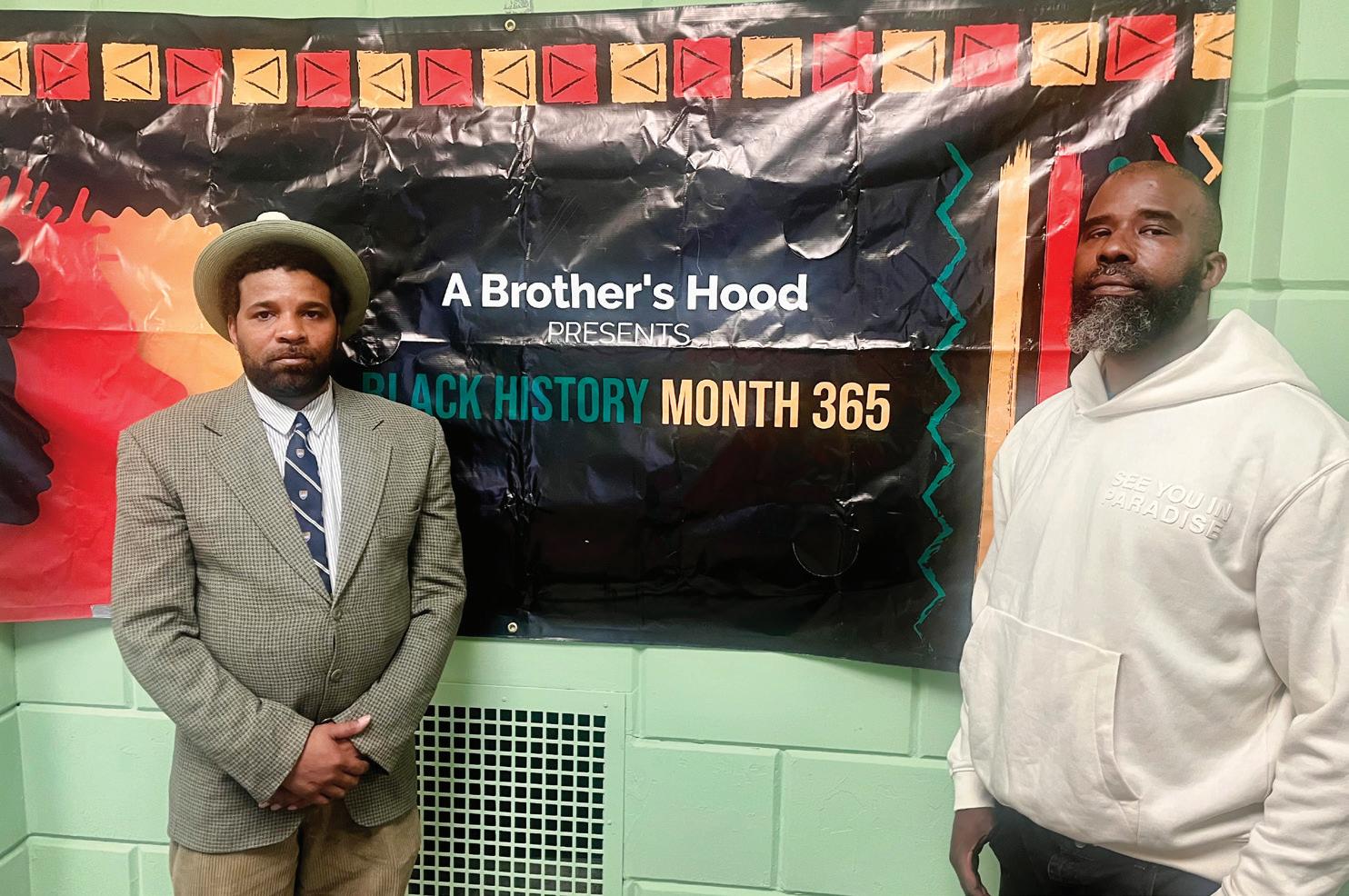
Clabe Johnson and Ieliot Jackson, the co-founders of A Brother’s Hood, stand outside of the gymnasium at Austin College and Career Academy, where their organization is hosting a pop-up Black History museum each Saturday through March 7. | PROVIDED
He Kept Hope Alive
West Side Clergy Remember Life and Legacy of Jesse Jackson, Push for Voting Bill Named After Him
During a Feb. 21, local pastors and leaders recalled Jackson’s ‘Keep Hope Alive’ mantra, while Speaker Welch vowed to pass the Jesse L. Jackson Sr. Young Voters Empowerment Act
BY MICHAEL ROMAIN
The Culture
Hundreds of clergy members, elected officials, and community leaders gathered Feb. 21 at the Rainbow PUSH Coalition headquarters in the South Side Kenwood neighborhood to honor the life and legacy of the Rev. Jesse L. Jackson while calling for renewed civic engagement through a new youth voting proposal bearing his name.
The “Keep Hope Alive: Faith and Community Leaders Tribute,” held at 930 E. 50th St., came days after Jackson’s death on Feb. 17 at age 84 after a long battle with multiple illnesses. West Side pastors who worked alongside the longtime civil rights leader reflected on his organizing legacy, his economic justice campaigns, and his decades-long push to expand voter participation.
The event also took on a legislative focus when Illinois House Speaker Emanuel “Chris” Welch announced support for the Jesse L. Jackson Sr. Young Voters Empowerment Act (House Bill 4339). The proposal would allow eligible students to register to vote while still in high school — a measure Welch said reflects Jackson’s lifelong commitment to expanding democratic participation.
“We will pass House Bill 4339, and we will do it by working together,” Welch told the crowd, describing Jackson as a leader who “expanded voting rights, demanded economic inclusion, and registered millions of new voters.”
CLERGY RECALL ORGANIZING LEGACY
Several West Side pastors tied Jackson’s activism to their own callings, emphasizing how his work informed their social justice approach to ministry.
Rev. Michael Eady, pastor of People’s Church of the Harvest in Garfield Park, recalled participating as a child in the 1963 Chicago Public Schools boycott, an effort led by Martin Luther King Jr. and Jackson that highlighted overcrowded and unequal learning conditions. He said those early organizing efforts planted the seeds for his later ministry.
“Rev. Jackson gave leadership to improving conditions in Black communities through boycotts and negotiations,” Eady said, noting that Operation Breadbasket, which Rev. King directed Jackson to head in 1966, secured thousands of jobs and generated millions in economic gains for Black workers.
Rev. Dr. Phalese Binyon, president and CEO of the Westside Ministers Coalition, said Jackson’s message of hope shaped her faith journey from childhood.
“That slogan, ‘Keep Hope Alive,’ meant hope in every aspect of life,” she said. “It became part of who I am.”
Rev. John Harrell, pastor of Chicago Northside New Hope MB Church in West Humboldt Park and Proviso Baptist Church in west suburban Maywood, described Jackson as a bridge between protest movements and policy change.
“His rallying cry was more than a slogan — it
became a sustaining anthem for generations,” Harrell said.
Rev. Ira Acree, pastor of Greater St. John Bible Church in Austin and a Rainbow PUSH West leader, recalled first hearing Jackson speak as a college student during the Reagan era.
“Hope seemed like a rumor,” Acree said. “Then he thundered, ‘Keep hope alive.’”
Rev. Marshall Hatch Sr., pastor of New Mount Pilgrim Missionary Baptist Church and the Rainbow PUSH Coalition’s national director of Religious Affairs, framed Jackson’s passing as both a spiritual and political moment, urging continued voter registration efforts during an election year. He also noted that Jackson’s death falls on the 100th anniversary of Black History Month and during a pivotal midterm election.
“This champion has made his transition, and in his transition, he’s given us an incredible gift,” Hatch said. “Number one is the divine poetry of Rev. Jackson, making his transition in African American History Month, the 100th anniversary. There is a God who is in charge. Then he’s given us the gift of making his transition during this critical year of the midterm elections. He’s given us a motivation to register
to vote, to vote, and to take America not back but froward.”
PROPOSED VOTING LEGISLATION
Supporters said House Bill 4339, which was introduced by state Rep. Kimberly Du Buclet, aims to institutionalize Jackson’s focus on civic participation by making voter registration more accessible to young people. Under the proposal, eligible high school students could register to vote through school-based initiatives, potentially increasing youth turnout statewide.
Advocates at the tribute said they hope the legislation could serve as a model for similar efforts across the country.
In his remarks, Welch called Jackson’s presidential campaigns and grassroots organizing a blueprint for engaging new generations in the political process.
“As the first Black speaker of the Illinois House, I stand here knowing my journey — and so many others — was made possible by the path he paved,” Welch said.
For information on service times and other arrangements, visit jessejacksonlegacy.com.
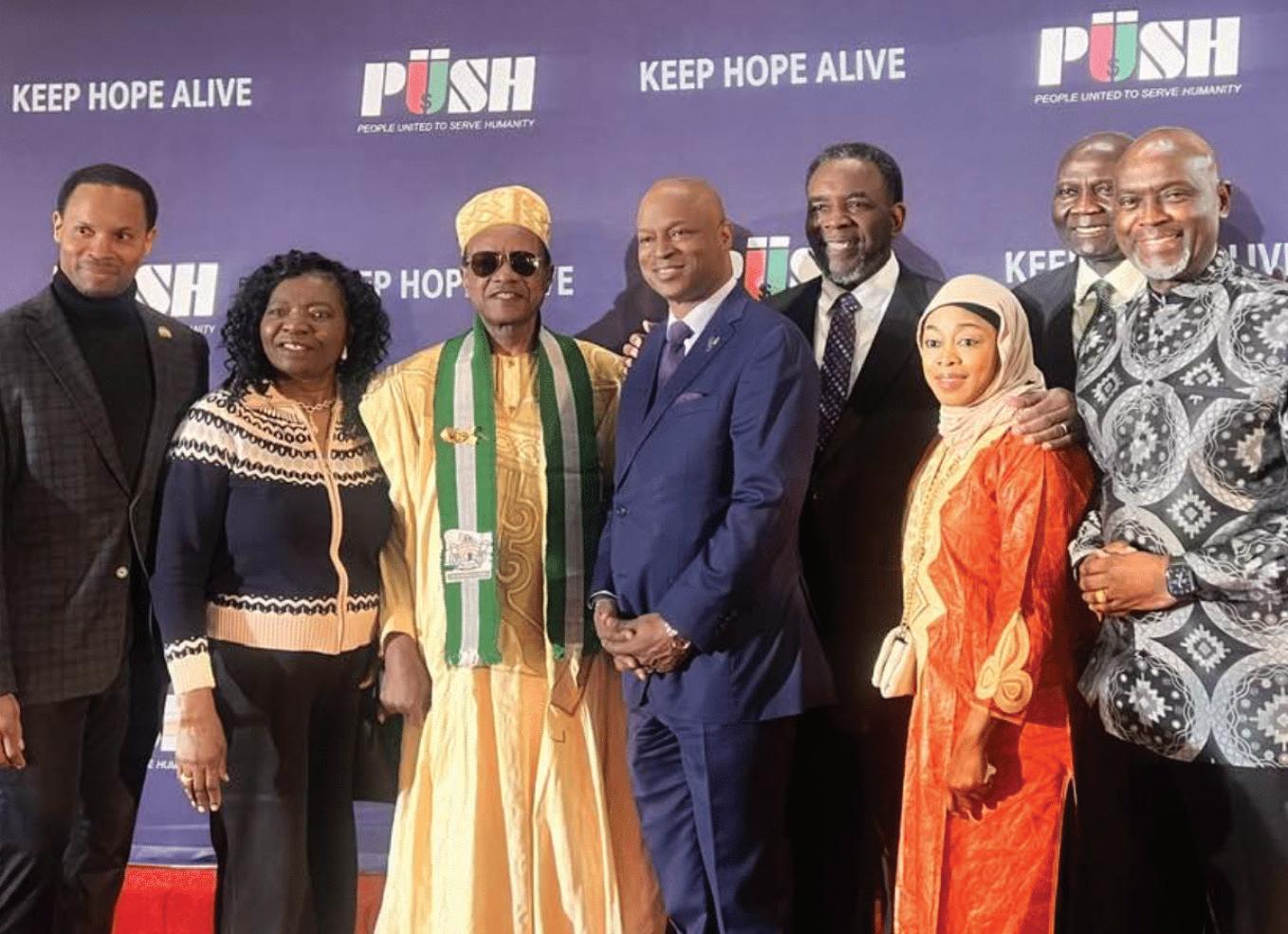
Illinois House Speaker Emanuel “Chris” Welch, fourth from left, and Rev. Ira Acree, fourth from right, were among clergy and elected officials in attendance at a community tribute to Rev. Jesse L. Jackson at Rainbow PUSH Coalition headquarters on Feb. 21. | COURTESY REV. IRA ACREE/FACEBOOK
BALLOT POWER: A GUIDE TO THE 2026 MARCH PRIMARY ELECTION
Key 2026 Races to Set Stage for Major Political Change
Competitive races at the local, state, and federal levels could shift the balance of political power on the West Side and in the west suburbs
By MICHAEL ROMAIN
The Culture
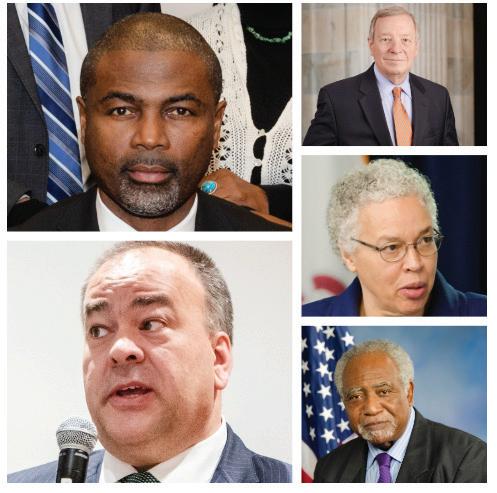
U.S. Sen. Dick Durbin has been Illinois’s senior senator for decades. U.S. Rep. Danny K. Davis has represented the influential 7th Congressional District in the House since 1997. State Rep. La Shawn K. Ford has represented the 8th District in the General Assembly since 2007. Now, Durbin and Davis are retiring, and Ford is leaving his seat for a bid to replace Davis in Congress.
The political shakeup comes as rising property taxes batter homeowners on the West Side and west suburbs, with unprecedented cuts in federal funding poised to upend local and state budgets—and that’s for starters. Here’s a look at the candidates vying to step into this shifting political terrain.
U.S. Senate — Open Seat to Succeed Sen. Dick Durbin
For the first time in decades, Illinois voters will choose a new U.S. Senator following the retirement of Sen. Dick Durbin, who has represented the state since 1997 and currently serves as Senate Majority Whip. His departure opens a powerful seat with national consequences — and major implications for federal investment in Illinois communities.
Candidates in both major parties are seeking to define the future of Illinois’ role in Congress, including federal funding for infrastructure, housing, healthcare, public trans-
portation, criminal justice reform, and economic development on the West Side. A forum scheduled for Feb. 5 for this race has been canceled.
Who’s Running
Democratic
• Sean Brown
• Awisi A. Bustos
• Jonathan Dean
• Robin Kelly
• Raja Krishnamoorthi
• Bryan Maxwell
• Kevin Ryan
• Juliana Stratton
• Christopher Swann
• Steve Botsford Jr.
Republican
• R. Cary Capparelli
• Casey Chlebek
• Casandra Claiborne
• Jeannie Evans
• Pamela Denise Long
• Don Tracy
• Jimmy Lee Tillman II
7TH CONGRESSIONAL DISTRICT — SUCCESSOR TO REP. DANNY DAVIS
After nearly three decades in office, U.S. Rep. Danny Davis is stepping down from the 7th Congressional District, a seat long associated with civil rights leadership, progressive politics, and deep ties to Greater West Side communities. The open contest is one of the most competitive and consequential in Illinois.
Who’s Running
Democratic
• La Shawn K. Ford
• Jazmin J. Robinson
• Melissa Conyears-Ervin
• Jason Friedman
• Rory Hoskins
• Reed Showalter
• Anabel Mendoza
• Anthony Driver Jr.
• Richard R. Boykin
• Felix Tello
• Kina Collins
• David Ehrlich
• Thomas Fisher
Republican
• Chad Koppie
• Patricia “P Rae” Easley
8TH STATE
REPRESENTATIVE DISTRICT
— SUCCESSOR TO REP. LA SHAWN FORD
State Rep. La Shawn Ford, a veteran lawmaker known for mental health advocacy and criminal justice reform, is leaving the Illinois House seat he has held since 2007. The district, which includes significant portions of the West Side and near-west suburbs, now faces a pivotal choice in Springfield.
Who’s Running
Democratic
• Latonya Mitts
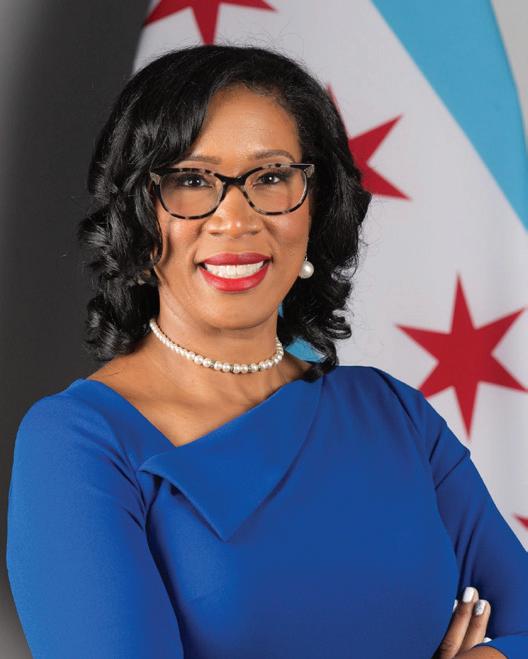
• Shantel Franklin
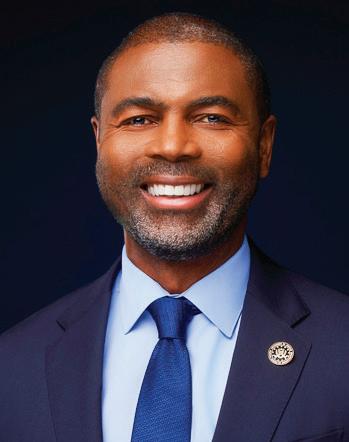
• John Harrell
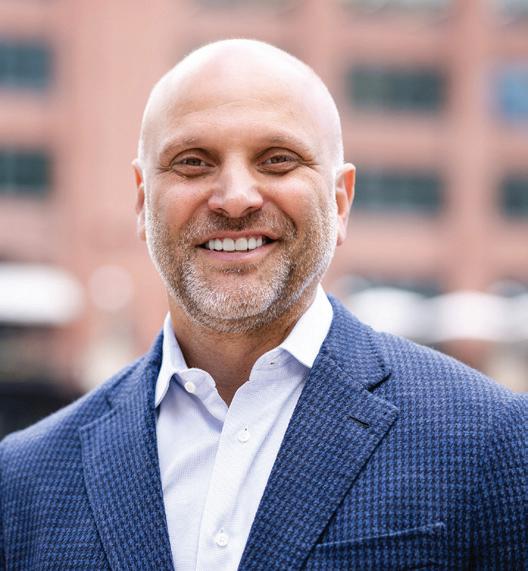
• Jill Bush
Clockwise from top right: U.S. Sen. Dick Durbin, Cook County Board President Toni Preckwinkle, U.S. Rep. Danny Davis, Cook County Assessor Fritz Kaegi, and State Rep. La Shawn Ford. Each is an incumbent whose seat will be on the ballot in 2026, making next year’s elections among the most consequential in decades for the future of Illinois politics and governance. | PROVIDED
COOK COUNTY BOARD PRESIDENT — COUNTYWIDE LEADERSHIP TRANSITION
Cook County Board President Toni Preckwinkle, one of the most powerful officials in Illinois government, is seeking re-election as she oversees a county responsible for healthcare, courts, public safety, transportation, and social services for more than five million residents. Forum details will be announced in the coming weeks.
Who’s Running
Democratic
• Toni Preckwinkle
• Brendan Reilly Libertarian
• Michael Murphy
COOK COUNTY ASSESSOR — PROPERTY TAXES & NEIGHBORHOOD STABILITY
The Cook County Assessor’s Office — currently held by Fritz Kaegi — controls property assessments that directly affect household finances, housing stability, and neighborhood investment. Property tax equity remains one of the most pressing issues across the West Side.
Who’s Running
Democratic
• Fritz Kaegi
• Pat Hynes
Libertarian
• Nico Tsatsoulis
Elections in Cook County are administered by two separate election authorities.
City of Chicago voters
The Chicago Board of Election Commissioners
Visit: chicagoelections.gov
(Check registration, find polling places, apply for mail ballots, or sign up to work the polls.)
Suburban Cook County voters
The Cook County Clerk
Visit: cookcountyclerkil.gov
(Register to vote, confirm your precinct, request mail ballots, or apply to serve as an
suburban communities such as Maywood, Bellwood, and Broadview, use the Cook County Clerk website.
Accessibility
All polling places provide accessible voting equipment. Voters may bring someone to assist them (except an employer or union representative). Language assistance is available in many precincts.
Work on Election Day
Serving as a poll worker is a paid civic opportunity and an essential part of the democratic process.
polling place technicians.
• Responsibilities may include:
– Setting up polling places before opening,
– Checking in voters
– Assisting with voting equipment
– Securing ballots at closing
Training is required and provided. Students and bilingual residents are encouraged to apply.
In Suburban Cook County:
• Apply through cookcountyclerkil.gov
• Election Judges and equipment managers are assigned to suburban precincts.
March 12
• Mail ballots must be postmarked by March 17 and arrive by March 31 to be counted.
• Most roles require:
– Being a registered Cook County voter
– Completing mandatory training
– Working the full Election Day (approximately 5 a.m. until after closing)
Compensation varies by role and training completion.
By STAFF
IThe
Culture/Westside Branch NAACP
n January and February, The Culture, the Westside Branch NAACP, Westside Health Authority, Austin Forward Together’s Civic Engagement Committee, and the South Austin Neighborhood Association partnered to host multiple candidate forums in key races affecting the West Side and west suburbs. You can watch those forums on the Westside Branch NAACP’s Facebook page: facebook. com/CWSNAACP
BALLOT POWER: A GUIDE TO THE 2026 MARCH PRIMARY ELECTION We Asked, They Responded
The Culture and Westside Branch NAACP also sent questionnaires and requests for formal headshots to candidates from all parties running for Cook County Board President, Cook County Assessor, 8th State Representative, and 7th District U.S. Representative. Below are excerpts from the statements of candidates who responded to our requests. You can read their full responses to our questions at ourculture.us.
Cook County Assessor
We asked candidates for Cook County Assessor to discuss their thoughts on why property tax bills in the west suburbs and on the West Side are so high and to lay out some of their plans for remedying the systemic problem. In January and February, we emailed questionnaires to all the candidates in the race, including Democrats Fritz Kaegi (the incumbent) and Pat Hynes; and Libertarian Nico Tsatsoulis. Kaegi and Tsatsoulis responded.
Fritz Kaegi, incumbent Cook County Assessor, is running as a Democrat for his third term
The assessment gap is real, it disproportionately harms Black and Latino residents, and my office has been working to close it since day one. A University of Chicago study found that our reforms saved the bottom 70% of homeowners nearly $2 billion, but there’s more work to do. The Board of Review keeps giving out big commercial tax breaks that shift the burden onto Black and Latino neighborhoods. This year alone, families are paying an average of
The Culture and the Westside Branch NAACP had some questions for candidates running in five key races.
Here are excerpts from those who responded
$700 more than they should because of these cuts.
When large commercial properties get tax cuts at the Board of Review, homeowners and renters make up the difference. If my assessments had held, about two-thirds of homeowners in Black and Latino neighborhoods would have seen flat or lower bills.
Here’s what I’m doing to fix this: I’ll keep fighting to make big corporations pay their fair share. Right now, the Board of Review is cutting commercial assessed values by nearly 18% in Chicago. If those values had held, about two-thirds of Black and Latino neighborhoods would have seen flat or lower bills. I’m
leading the push for circuit breaker legislation in Springfield. HB 3808 would give credits to homeowners whose bills spike more than 25%. Twenty-nine other states already have this protection.
I’ll expand outreach and exemption enrollment where it’s needed most. We hold over 200 events a year, with a third in Spanish. In my last term, we added over 10,000 new exemptions. I want to deepen those partnerships on the West Side and set benchmarks for every community area.
Read Fritz’s questionnaire responses in full at ourculture.us/cook-county-assessor-fritz-kaegi. Learn more about his campaign at fritzforassessor.com.
Nico Tsatsoulis is running for Cook County assessor as a Libertarian
The way the system is set up is to pit one constituent against the other. Politicians have created a zero-sum game and if one homeowner pays less, another one must pay more. It is by design and not by accident. Democrats have been ruling this city and county for over 70 years and what we get is higher property taxes. In real terms, property taxes are up by 48% the last 20 years. Effectively we are paying rent to the government although nominally we own our homes. There exists an “assessment gap”. Only 16% of Black households appeal their tax assessment. The number for Latino is 19%, for Asian 38% and for white 72%. Black and brown households have fewer financial means and information to go about appealing
their inflated assessments. The assessments are overinflated on purpose so that owners with limited means pay more. The biggest victims are the black and brown households. It is a regressive system that by design aims to hurt the less privileged.
The first step to make the assessment fair is to use market values instead of values derived by a clueless bureaucrat who uses a computerized mass appraisal property valuation system. The second step is to limit the tax to 1% of the property’s market value. Third is to limit reassessments to when a property is sold and between sales adjust for inflation. These steps make the system objective instead of subjective and make it predictable and fair. Once you have an objective system in place, the talk about “assessment gaps” ceases to exist.
Read Nico’s questionnaire responses in full at ourculture.us/nico-tsatsoulis. You can learn more about his campaign at NicoTheAssessor. com.
8th District State Representative
We asked candidates for 8th District state representative to discuss their concrete plans for delivering revenue from Springfield to the Greater West Side without outgoing state Rep. LaShawn K. Ford’s nearly two decades of experience. They also discussed their plans for addressing rising property taxes. In January and February, we emailed questionnaires to all the candidates in the race, including Democrats Shantel Franklin, Jill Bush, Latonya Mitts, and Rev. John Harrell. Franklin and Bush responded.
Fritz Kaegi | PROVIDED
Nico Tsatsouli | PROVIDED
BALLOT POWER: A GUIDE TO THE 2026 MARCH PRIMARY ELECTION
Shantel Franklin
is
running for 8th District state representative as a Democrat
Retiring 8th District state Rep. LaShawn K. Ford’s decades of seniority helped deliver critical resources to the 8th District, and I intend to build on that foundation with a focused, strategic approach. Once elected, I will work closely with Rep. Ford during the lame-duck session to understand which organizations have received or pursued state funding, then meet with those partners to align priorities and develop a coordinated FY28 budget strategy. As the only candidate with state legislative experience, I understand the importance of engaging early. I will work directly with the Governor’s Office, budgeteers, and policy staff, while partnering with Senator Lightford and Speaker Welch to advocate for funding. I will also maintain strong relationships with the state agencies responsible for administering grants and appropriations. My approach is simple: be consistent, be prepared, and be relentless in delivering resources for the 8th District.
Rising property tax burdens are a significant threat to housing stability, particularly for longtime Black homeowners on the West Side. I strongly support a property tax circuit breaker policy designed to protect families from being taxed out of their homes. A circuit breaker links property tax liability to income, providing targeted relief or tax credits for homeowners who spend more than a defined share of their
income on property taxes. This approach Is a more equitable solution that recognizes ability to pay while helping preserve homeownership and generational wealth. I also support reforms that improve assessment transparency, strengthen appeal processes, and expand access to exemptions so relief is both fair and accessible.
Read Shantel’s questionnaire responses in full at ourculture.us/shantel-franklin. You can learn more about her campaign at shantelforstaterep.com.
Jill Bush is running for 8th District state representative as a Democrat
I’ll connect with experienced legislators to learn and navigate the legislative process effectively, respecting legislative processes and ethics codes and building relationships with colleagues from both parties to foster trust for any future negotiations. I’ll build strong, trust-based relationships with fellow freshmen navigating these same challenges, and with nonpartisan researchers, legislative attorneys, and fiscal analysts for help with understanding policy impacts, and navigating technicalities, prioritizing committee work, focusing on those with jurisdiction over my priority issues. I’ll be active in hearings, read bills in advance, and become a reliable, informed voice, using data from legislative staff, research organizations, and state agencies to provide evidence-based, reliable information that establishes me as a knowledgeable policymaker.
I support, as former Gov. Pat Quinn has proposed, a 3% surtax on income over $1 million to finance property-tax relief. I also support existing property tax relief programs such as the 5% individual income tax credit on primary residence taxes, the Senior Citizens Assessment Freeze Homestead Exemption, and specific, localized grants such as the Cook County Homeowner Relief Fund.
I also support programs like the Chicago Neighborhood Recovery Program and initiatives focused on Stay in Place offers, critical repair, estate planning, and tax assistance to keep residents in their homes. Strategies include using the Troubled Buildings Initiative to rehabilitate distressed, owner-occupied, 1-4 unit buildings; expanding tenant legal representation, mediation, and eviction prevention programs to stabilize households; implementing policies like the Northwest Side Housing Preservation Ordinance to safeguard affordable rental units and protect long-term residents.
Read Jill’s questionnaire responses in full at ourculture.us/jill-bush. You can learn more about her campaign at https://friendsofjillbush.com.
7th District U.S. House of Representatives
We asked candidates for the 7th District U.S. House of Representatives seat to explain their concrete plans for securing federal funds for the district without outgoing incumbent Congressman Danny K. Davis’ roughly three decades of experience in the House. We also asked about how they might navigate major changes in how federal education policy is administered, among other questions.
In January and February, we emailed questionnaires to all the candidates in the race, including Democratic candidates Rep. La Shawn K. Ford, Jazmin J. Robinson, Chicago Treasurer Melissa Conyears-Ervin, Jason Friedman, Forest Park Mayor Rory Hoskins, Reed Showalter, Anabel Mendoza, Anthony Driver Jr., Richard R. Boykin, Felix Tello, Kina Collins, David Ehrlich, and Thomas Fisher. Republican candidates Chad Koppie and Patricia “P Rae” Easley were also sent questionnaires. Democrats Driver, Friedman, Hoskins, Showalter, and Mendoza responded.
Anthony Driver is running for the 7th District U.S. House seat as a Democrat
I deeply respect Congressman Davis’s strategic use of his decades of seniority and committee positions to bring federal resources directly to our district. That was a truly strategic approach, leveraging institutional power effectively for our community. My commitment is to be equally strategic, but through a different kind of power: collective organizing. While I won’t have immediate seniority, I will work diligently to unite and organize progressive Democrats into a powerful, unified bloc. My experience as a labor leader has taught me that collective strength can move mountains. By strategically leveraging our numbers and shared progressive agenda, we will collectively demand and secure federal funding for infrastructure, healthcare, education, and economic development, ensuring our district gets its fair share from day one.
As a Congressperson, my immediate priority would be to ensure our community deeply understands these complex shifts in federal education policy. I’d initiate regular town halls and partner directly with local school districts, educators, and parent groups to demystify changes in grant administration and Title IX enforcement, focusing on their direct impact on our students and families. Congress has a fundamental responsibility to act as a check on executive power. When executive actions
Shantel Franklin | PROVIDED
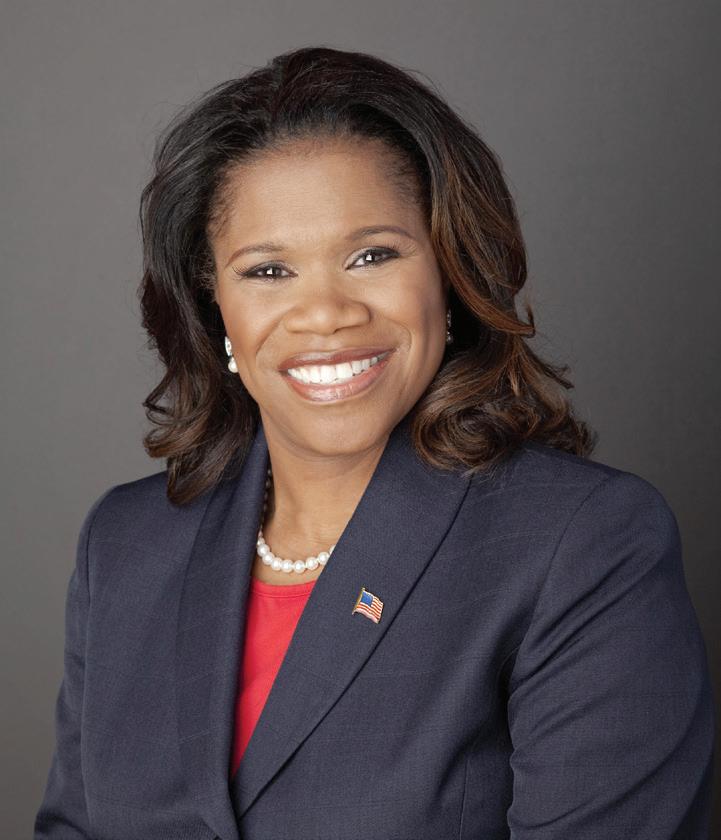
Jill Bush | PROVIDED
Anthony Driver | PROVIDED
BALLOT POWER: A GUIDE TO THE 2026 MARCH PRIMARY ELECTION
BALLOT POWER
Continued from page 9
conflict with legislative intent or existing law, it’s not just an option, but a moral imperative to intervene. My background as an organizer has shown me the importance of upholding established protections and fighting for what’s right. I would champion rigorous oversight and use every legislative tool to ensure federal education policy serves the best interests of our students, not partisan agendas or corporate influence.
Read Anthony’s questionnaire responses in full at ourculture.us/anthony-driver. You can learn more about his campaign at driverforchange.com.
Jason Friedman is running for the 7th District House seat as a Democrat
Winning federal resources for the 7th District requires strategy, persistence, and experience. First, I will pursue strategic committee assignments, particularly Energy and Commerce and Transportation and Infrastructure, that oversee health care, infrastructure, environmental, and transit funding. Second, I will leverage the institutional knowledge I gained as a lawyer in the White House and on Senator Durbin’s Judiciary Committee. Later, as Government
Affairs Committee Chair for the Jewish United Fund – a health and human services organization serving over 500,000 people of all faiths – I lobbied in Washington, D.C. for the West Side’s Mt. Sinai Hospital. I advocated across the aisle for safety-net hospitals. Navigating health care politics taught me that lasting change requires bipartisanship. Finally, I will pair advocacy with strong constituent services, identifying recurring needs that inform legislation.
Rapidly changing federal education policies have created chaos for school districts, educators, students, and families. As Congressman, I will effectively communicate those changes and their impacts. My office will be a reliable source of clear guidance, with legislative staff providing updates for school districts and parents on administrative changes, Title IX resources, and Department of Education changes. My constituent services team will be the boots on the ground operation, ensuring no schools are left wondering if they will be able to provide free lunch, afterschool care, or mental health services. Congress also has the responsibility to act when executive actions conflict with congressional intent or existing law.
Read Jason’s questionnaire responses in full at ourculture.us/jason-friedman. You can learn more about his campaign at friedmanforcongress.com.
Anabel Mendoza is running for the 7th District House seat as a Democrat
Seniority in Congress can help, but waiting decades to deliver results is not a strategy our communities can afford. As a Gen Z candidate, I believe leadership should be measured by impact, not time served. My plan is to fight for federal funding from day one through coalition-building, aggressive advocacy, and clear district priorities. I would work with members and caucuses to advance funding for housing, transit, climate infrastructure, and economic investment. I would aggressively pursue federal grants by coordinating with local leaders, labor, and community organizations so IL-07 projects are ready to compete immediately. I would also use oversight and public pressure to ensure federal agencies prioritize disinvested communities like those on Chicago’s West Side. Real power comes from organizing, building alliances, and fighting unapologetically for resources. Our district should not
have to wait its turn to receive the investment it deserves.
One of my responsibilities in Congress would be to make federal changes clear and accessible by communicating directly with constituents, school leaders, and community organizations through regular community briefings, updates, and strong partnerships with local stakeholders and schools. Congress also has a constitutional duty to provide oversight when executive actions conflict with congressional intent or existing law. If an administration attempts to weaken civil rights protections, undermine Title IX enforcement, or redirect education funding without proper authority, I would support aggressive oversight, legal challenges where appropriate, and legislative action to restore congressional control.
Read Anabel’s questionnaire responses in full at ourculture.us/anabel-mendoza. You can learn more about her campaign at anabelforcongress.com.
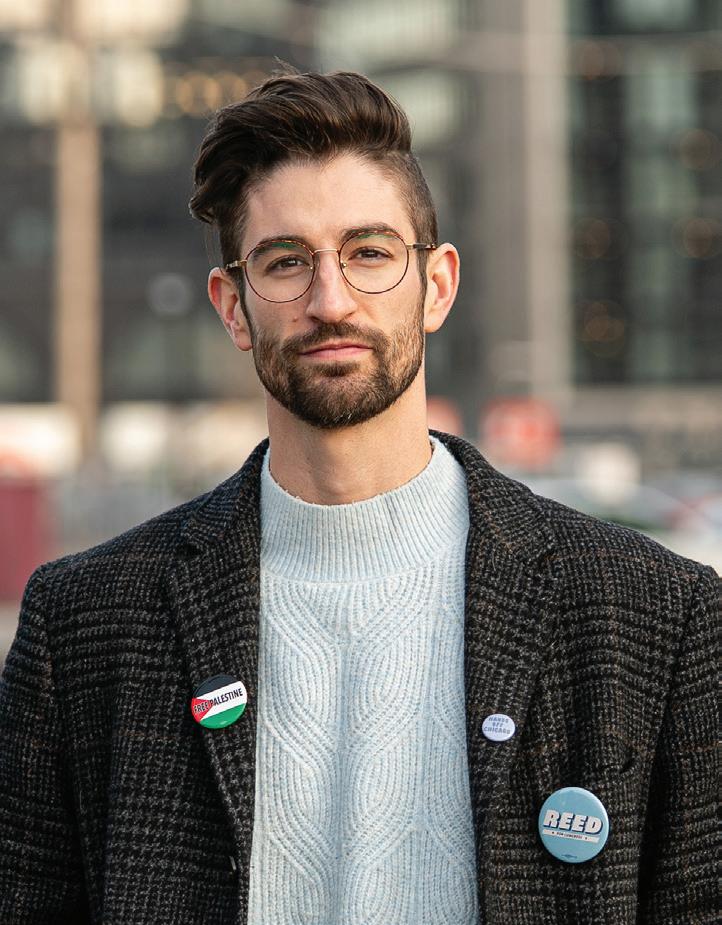
Reed Showalter is running for the 7th District House seat as a Democrat
My approach to federal funding for the district is two-fold: setting goals and building coalitions toward bold, progressive change, and making sure any incremental steps we take are aimed at those goals. While we build coalitions to advance major invest-
ments like Medicare for All, a public housing works program, and public infrastructure for our food system, I will ensure that our district benefits from incremental changes that move toward those goals. For example, the farm bill is often treated as a fight over SNAP and crop subsidies, but it also includes requirements for food procurement. I would propose provisions that require USDA-funded grant programs to purchase food from local farms and businesses, creating access to opportunities for Chicago businesses rather than huge corporations, and driving real local economic growth.
If elected, I would make sure my constituent services offices are equipped to help people, including school districts, navigate these shifts in policy. When institutions are under attack or rules are changing quickly, members of Congress have a responsibility to help communities understand what’s happening and how to respond. Congress also has a clear constitutional role. It is Congress’ job to fight back against cuts and any illegal impoundment of funds that Congress has already allocated. If the executive branch withholds or weaponizes funding in ways that conflict with congressional intent or existing law, Congress must intervene, through oversight, legislation, and, if necessary, the courts.
Read Reed’s questionnaire responses in full at ourculture.us/reed-showalter. Learn more about his campaign at reed4congress.com.
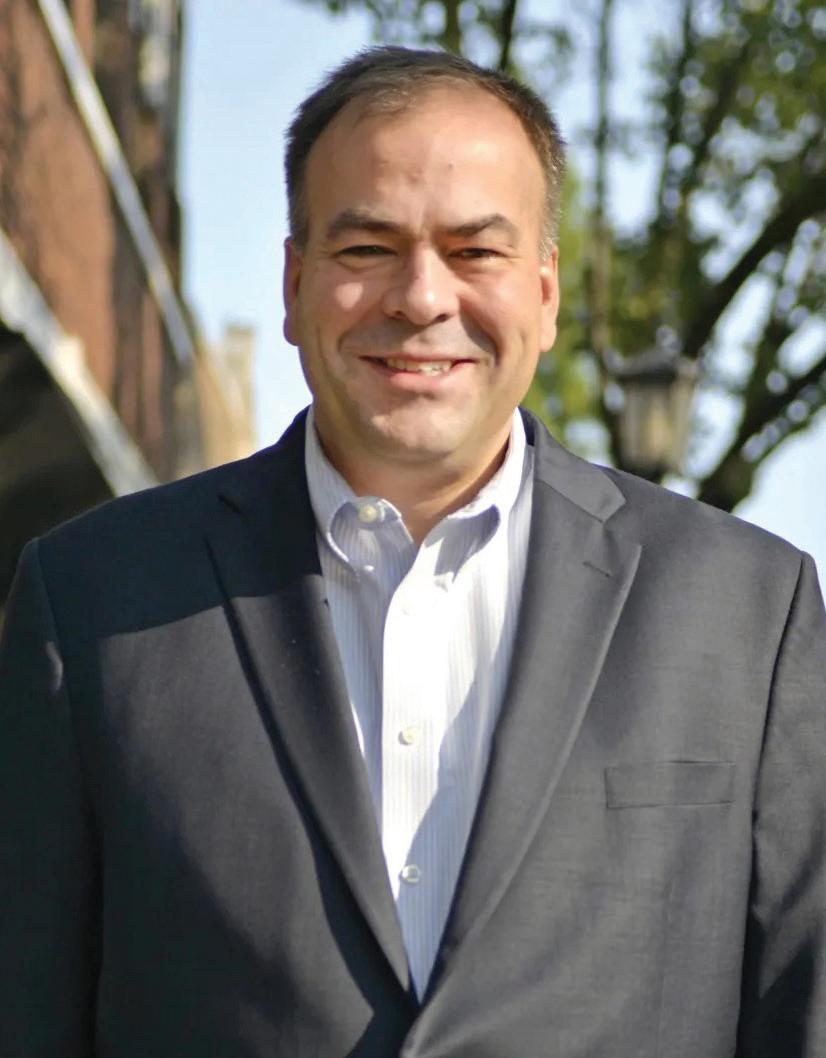
Jason Friedman | PROVIDED
Anabel Mendoza | PROVIDED
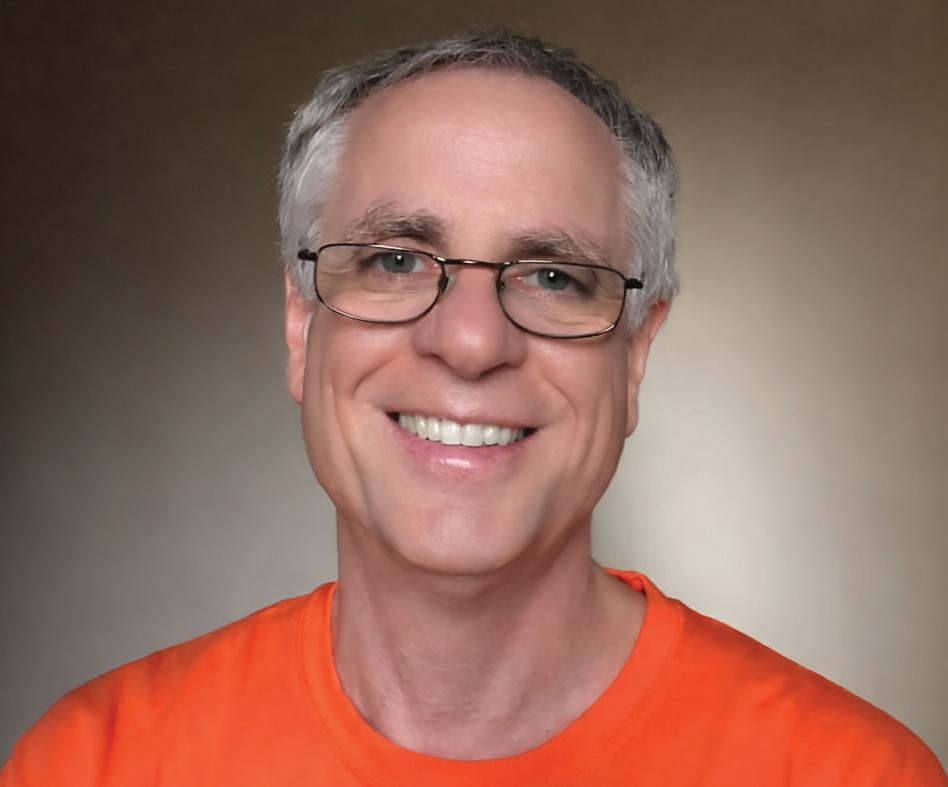
Reed Showalter | PROVIDED
BALLOT POWER: A GUIDE TO THE 2026 MARCH PRIMARY ELECTION
Hoskins | PROVIDED
Rory Hoskins is running for the 7th District House seat as a Democrat
Although I am an active member of the Democratic Party and have twice been elected as a delegate to the Democratic National Convention, I serve in Forest Park as mayor in a community where I am elected on a non-partisan basis. Our board includes commissioners who are not Democrats. The work that we have done to improve Madison Street and our Roosevelt Road corridor was achieved with votes from local officials who identify with both of the two main political parties . When Forest Park adopted Juneteenth as a local holiday it was a unanimous, bipartisan vote. When Forest Park adopted fair contracts that were negotiated in good faith with union represented work groups, the votes were unanimous and bipartisan. When we adopted the “Pay Equity” reforms in 2022, so that women serving as department heads were paid as much as their male colleagues, it was a bipartisan act. And finally, when we passed an antinepotism policy in 2019, it was done in a bipartisan manner.
I will immediately offer legislation to re-establish the Department of Education. Congress has to be thoughtful in providing a record of legislative intent that makes it impossible for a despot to unilaterally dismantle the Department of Education or other important federal agencies. The Department of Education provides funding for important services offered by CPS and other school districts serving large numbers of low income families and families with children who learn differently.
Read Rory’s questionnaire responses in full at ourculture.us/rory-hoskins. Learn more about his campaign at roryforillinois.com.
How the Greater West Side Voted in the Last Primary Election
Turnout lagged below 21% across the West Side and Proviso Township in 2024
BY MICHAEL ROMAIN The Culture
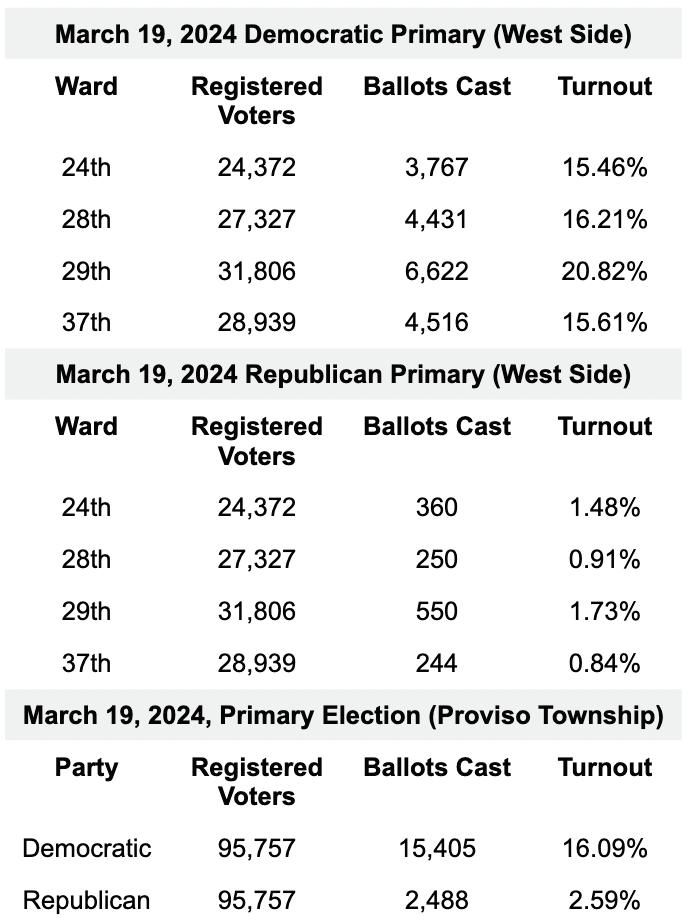
In the last major primary election on March 19, 2024 — which included presidential nominating contests along with a range of federal, state, and county offices — turnout remained below 21% in the four West Side wards and several west suburbs in the Proviso Township area that constitute The Culture’s readership footprint.
Data from the Chicago Board of Elections and the Cook County Clerk’s Office show that Democratic primary participation ranged from 15.46% to 20.82% in the 24th, 28th, 29th, and 37th wards.
The 29th Ward posted the highest Democratic turnout among the four, with 6,622 ballots cast out of 31,806 registered voters, or 20.82%. In the 28th Ward, 4,431 of 27,327 registered voters cast Democratic ballots, a turnout rate of 16.21%.
The 37th Ward recorded 4,516 ballots cast out of 28,939 registered voters, or 15.61%, while the 24th Ward saw the lowest Democratic turnout of the four, with 3,767 ballots cast out of 24,372 registered voters, or 15.46%.
Republican primary participation in those same wards was significantly lower.
In the 29th Ward, 550 Republican ballots were cast, representing 1.73% turnout. The 24th Ward recorded 360 Republican ballots cast, or 1.48%. The 28th Ward saw 250 ballots cast, or 0.91%, and the 37th Ward had 244 ballots cast, or 0.84%.
Although the March 2024 ballot included presidential primaries — contests that often help drive participation — turnout in these heavily Democratic areas remained concentrated in one party’s primary and hovered well below a quarter of registered voters overall.
In west suburban Proviso Township, which includes communities such as Maywood, Bellwood, and Broadview, participation followed a similar pattern.
Of 95,757 registered voters townshipwide, 15,405 cast Democratic primary ballots, for a turnout rate of 16.09%. Republican participation reached 2.59%, with 2,488 ballots cast.
The numbers illustrate how even during a presidential primary year — when the top of the ticket is on the ballot — participation in parts of Chicago’s West Side and neighboring west suburbs remained relatively low compared with registration totals.
In districts where the Democratic nominee is widely expected to prevail in November, the primary often functions as the decisive election. That dynamic means fewer than one in five registered voters in some wards effectively shaped which can-
didates advanced to the general election ballot.
Looking ahead, turnout patterns could shift in 2026. According to reporting by ABC 7 Chicago, five open congressional seats in Illinois could help drive higher participation in the March 2026 primary ahead of the midterm election. In the 7th Congressional District, 13 candidates are running to succeed Congressman Danny K. Davis.
Open seats tend to generate competitive races, increased campaign spending, and heightened voter outreach — all factors that historically boost engagement. Without incumbents on the ballot, primaries often become the central battleground, particularly in districts dominated by one party. Whether that translates into substantially higher turnout on the West Side and in Proviso Township remains to be seen.
Rory
BALLOT POWER: A GUIDE TO THE 2026 MARCH PRIMARY ELECTION
County Assessor Candidates Clash Over Campaign Cash, Assessment Data, and Tax Fairness
A forum at Collins High in North Lawndale highlighted sharp divides between incumbent Fritz Kaegi and his Democratic challenger Pat Hynes over ethics rules and how to fix an inequitable property tax system
By MICHAEL ROMAIN The Culture
AFeb. 11 candidates forum at Collins High School, 1313 S. Sacramento Dr. in North Lawndale, laid bare some of the central dividing lines shaping the race for Cook County assessor, mainly where the candidates are getting their money and contrasting proposals for correcting the inequitable property tax system. The Culture cosponsored the forum alongside the Westside Branch NAACP and other community organizations. You can watch it in full on the Westside Branch NAACP’s Facebook page: facebook.com/CWSNAACP
Incumbent Democrat Fritz Kaegi, Democratic challenger Pat Hynes, and Libertarian candidate Nico Tsatsoulis debated issues ranging from regressive tax burdens in Black neighborhoods to the role of property tax appeal lawyers, but campaign finance and political alliances hovered over the hour-long exchange.
The Cook County assessor’s office determines the market value of roughly 1.8 million parcels, which shapes each property owner’s share of the tax burden, a process that has drawn intense scrutiny as residential bills have climbed fastest in many South and West Side neighborhoods.
Money has become one of the clearest contrasts between the candidates.
Kaegi has raised more than $2.5 million for his campaign, compared with just over $1 million raised by Hynes, according to recent reporting and campaign finance filings.
Much of Kaegi’s fundraising advantage comes from his own wealth and individual donors rather than industry groups. Hynes, by contrast, has built a coalition fueled by labor organizations, real estate professionals, and property tax industry figures — a dynamic that has turned campaign finance into a defining issue in the race.
According to reporting by the Chicago Tribune, Hynes has accepted nearly $90,000 from property tax law firms and attorneys and roughly $13,000 from property tax appraisers since June. Kaegi has repeatedly framed those contributions as a return to the “pay-to-play” culture he ran against in 2018, saying the county inspector general previously warned such donations posed ethical risks.
Kaegi touted an ethics order barring his office from accepting donations from attorneys who handle appeals, say-
ing the practice once fueled inequities that favored large commercial properties over homeowners.
Hynes countered that the real problem is inaccurate data and unpredictable assessments, arguing that better information about property conditions and sales would reduce the need for appeals altogether. According to Tribune reporting, he’s dismissed the criticism about his donations as political spin, arguing that attorneys risk more by backing a challenger than an incumbent.
Public filings show little comparable campaign-finance activity from Tsatsoulis, reflecting the Libertarian candidate’s smaller campaign operation. Tsatsoulis said the inflated assessments generate business for lawyers.
LABOR AND POLITICAL ENDORSEMENTS RESHAPE THE FIELD
Endorsements have further clarified the candidates’ bases of support.
Hynes has secured backing from several major labor organizations — including electricians and building trades groups
— and has appeared alongside union leaders at campaign events, including a rally at IBEW Local 134. He has also won support from a coalition of Black clergy and South and West Side elected officials, with Ald. Jason Ervin (28th) pledging to help mobilize voters in West Side communities.
Hynes told the Tribune that sharp assessment increases were a “breaking point” for many elected officials, arguing that rising bills are forcing residents out of their homes.
Kaegi, meanwhile, has assembled a different political coalition, emphasizing endorsements from prominent Black elected leaders and progressive allies. His campaign highlights support from U.S. Reps. Danny Davis, Robin Kelly, and Jonathan Jackson, along with Chicago alderpersons Maria Hadden, Anthony Beale, and Chris Taliaferro, among others.
The incumbent’s campaign has also leaned heavily on its outreach record, noting that the assessor’s office held over 240 community outreach events and processed 1.5 million homeowner exemptions last year, an effort Kaegi argues demonstrates a focus on protecting residents in historically overtaxed neighborhoods.
COMPETING VISIONS FOR FIXING REGRESSIVE TAXES
Despite broad agreement that Cook County’s tax system often disadvantages lower-value homes, the candidates offered sharply different solutions.
Kaegi emphasized structural reforms, including improving commercial property assessments and pushing for a state “circuit breaker” program to limit tax increases.
Hynes argued the county’s data is fundamentally flawed, calling for more accurate parcel information and consistent valuation methods.
Tsatsoulis advocated a smaller-government approach, proposing caps on property taxes and assessments based strictly on recent market sales.
The debate highlighted a deeper political question for voters, particularly on the South and West sides, where rising tax bills have become a defining issue.
Kaegi is asking voters to continue a reform agenda centered on ethics rules, new data models, and outreach to historically underserved homeowners.
Hynes is positioning himself as an experienced insider backed by labor, clergy, and local elected officials who say the system has reached a breaking point.
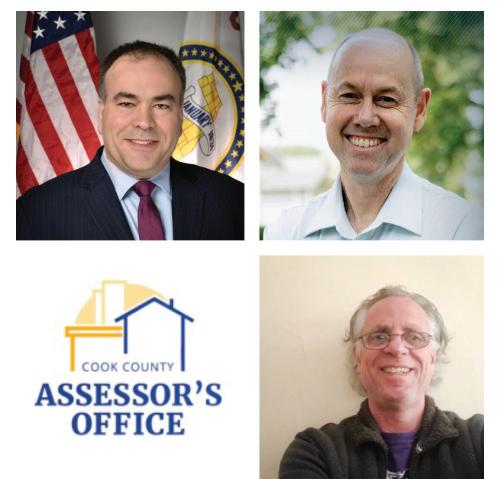
Clockwise from top left: Cook County Assessor Fritz Kaegi, Pat Hynes, and Nico Tsatsoulis squared off at a Feb. 11 candidates forum at Collins High School in North Lawndale. | PROVIDED
BALLOT POWER: A GUIDE TO THE 2026 MARCH PRIMARY ELECTION
State House Hopefuls Draw Lines on Taxes, Pensions, and Public Subsidies
Jill Bush, Shantel Franklin, Latonya Mitts, and Rev. John Harrell stake out positions as they vie to replace Rep. Ford
By STAFF
The Culture
At a Black media roundtable and in written questionnaires, four Democratic candidates vying to succeed 8th District state Rep. La Shawn K. Ford in the Illinois House staked out distinct positions on a range of issues, including the Bears stadium debate, pension reform, and taxation.
The contrasts were on display in written questionnaires submitted to the Chicago Sun-Times and The Culture, as well as during a Feb. 23 Black media roundtable hosted at Chicago News Weekly in Humboldt Park, where the candidates also addressed criticisms about their campaigns.
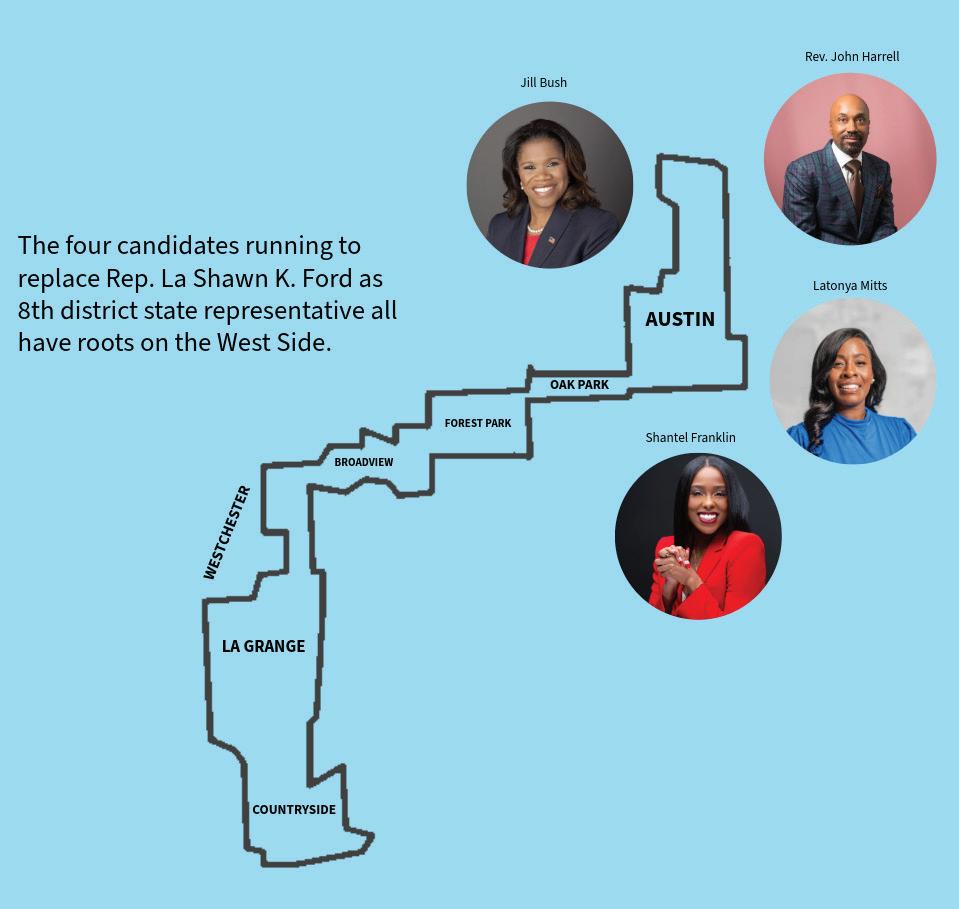
The candidates — Latonya Mitts, Shantel Franklin, Jill Bush, and the Rev. John Harrell — shared their positions on a range of issues, including pensions, taxes, and stadium funding.
Latonya Mitts, 49, an insurance professional and former chief of staff to State Rep. Omar Williams, said billionaires should shoulder the cost of their own facilities.
“Billionaires should be building their own stadiums, not burdening working families with higher property tax bills,” Mitts said in her Sun-Times questionnaire response. Still, she added that she would be open to legislation improving infrastructure around the proposed Soldier Field site.
Shantel Franklin, 32, a legislative liaison in the Illinois Attorney General’s office who is currently on leave, took a firmer stance against tax incentives. She said she does not support freezing property tax assessments for large private developments like a stadium, calling it fiscally irresponsible.
“A blanket tax freeze shifts costs onto homeowners and small businesses, threatens funding for schools and local services, and sets a troubling precedent,” Franklin said, add-
Geographic Area: The district includes parts of Berwyn, Broadview, Cicero, Countryside, Forest Park, Hodgkins, La Grange, La Grange Park, North Riverside, Oak Park, Westchester, Western Springs, and parts of Austin.
ing that any incentives should be limited, transparent, and tied to enforceable public benefits.
Jill Bush, 62, director of community engagement for the 29th Ward, was unequivocal.
“I do not and will not support any tax provision in support of the Chicago Bears on the backs of Illinois taxpayers,” she said.
Harrell, 54, founder of Black Men United, pastor of Proviso Baptist Church in Maywood, and pastor of New Hope Baptist Church in Chicago, emphasized keeping the team in the city but signaled limits.
“I want to do everything possible to keep the Bears in the city of Chicago, within reason,” Harrell said, adding that he opposes relocating the team to Arlington Heights or Indiana.
On pensions, all four candidates said earned benefits must be protected, but they offered different solutions for addressing the state’s long-standing fiscal strain.
“A pension is a promise, and Illinois needs to keep its promises,” Mitts said, arguing that the state should seek progressive revenue streams, including potentially expanding the sales tax to certain services and revisiting a graduated income tax.
Franklin also rejected benefit cuts, instead calling for “disciplined budgeting” and a more sustainable payment structure. She said the state must fully fund its obligations annually and pursue reforms that reduce long-term liabilities without shifting costs to future generations.
Bush proposed more structural changes. She suggested shifting new hires to 401(k)-style plans, adjusting cost-of-living increases over time, increasing state and local contributions, and consolidating pension investments.
“The main thing is to live within our means,” Harrell said, opposing cuts to benefits but warning against overspending that worsens the pension problem.
Mitts said she would support a millionaire’s tax on the wealthiest Illinois residents and is open to expanding progressive revenue sources.
Franklin said she does not support raising income or sales taxes as a first resort. Before considering increases, she said, the state should pursue responsible budgeting and close corporate loopholes. She told The Culture she strongly supports a property tax “circuit breaker” that ties tax liability to income to prevent homeowners from being taxed out of their homes.
Bush said she would prioritize more efficient use of existing tax revenues rather than broad increases, but she expressed support for a 3% surtax on income over $1 million, as proposed by former Gov. Pat Quinn, to finance property tax relief. She also backs existing relief programs, including the state’s income tax credit for property taxes and the Senior Citizens Assessment Freeze Homestead Exemption.
Harrell said he would consider an income tax increase on high earners but opposes expanding the sales tax, which he described as regressive and harmful to low- and middle-income families.
ADDRESSING CRITIQUES
The Feb. 23 roundtable also allowed candidates to respond to criticisms.
Mitts, the daughter of longtime 37th Ward Ald. Emma Mitts, embraced her political lineage.
“Yes, it’s legacy,” she said. “If you’ve done great, you want your children to follow your leadership.”
She described her decision to run as her own and said her mother was initially surprised.
Franklin defended more than $70,000 in campaign contributions from the Chicago Teachers Union (CTU), saying she is proud of her endorsements from four teachers unions and supports fully funding the state’s evidence-based school formula by 2027, a measure strongly backed by the CTU.
Harrell addressed anonymous mailers referencing a prison sentence for financial crimes roughly two decades ago, as previously reported. He said he has been transparent about his past and pointed to his work feeding the hungry and building affordable housing through Black Men United. He called the attacks defamatory and said he is considering legal action.
BALLOT POWER: A GUIDE TO THE 2026 MARCH PRIMARY ELECTION
The 7th District Congressional Race Looks Like It’s a West Sider’s to Lose
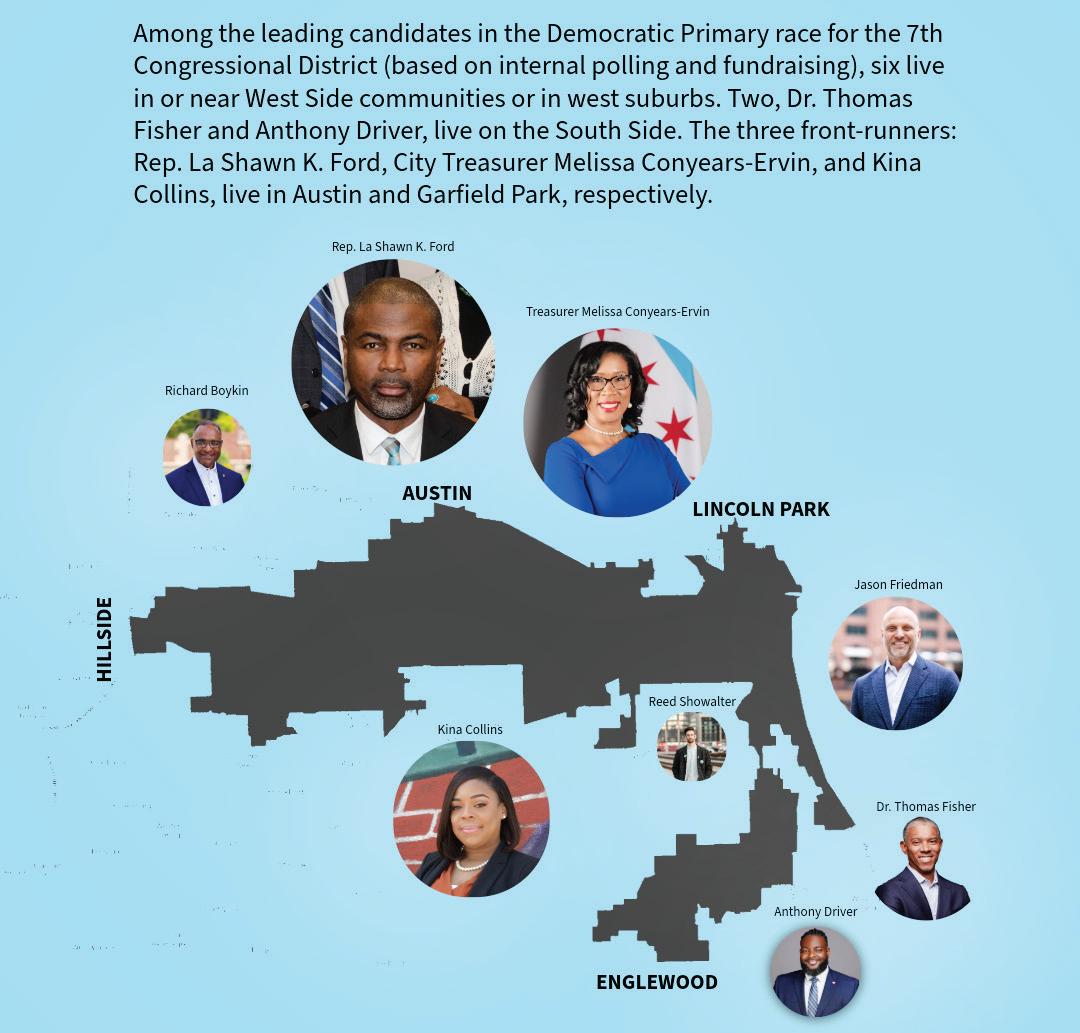
Three of the top four candidates in the race—Ford, Conyears-Ervin, and Collins—live on the West Side
By STAFF
The Culture
Redistricted from the 6th after Cardiss Collins was elected in 1973, the 7th Congressional District has been known for over 50 years as a West Side district, particularly a district represented by a Black West Sider with deep West Side political and organizing roots.
Collins and her husband, George W. Collins, who died in a plane crash in 1972, shortly before the redistricting, was alderman of the rough-and-tumble 24th Ward covering North Lawndale. In 1964, he replaced 24th Ward Ald. Benjamin Lewis, who was mysteriously murdered in his ward office the previous year. As a couple, the Collinses presided over the 24th Ward Democratic Organization.
After Collins, Danny K. Davis—a former alderman and Cook County commissioner—has become the face of the district. Even more than his predecessor, Davis has become synonymous with the West Side, where he’s lived and had a district
Key Facts About the 7th District
Population: 760,384
Median household income: $90,223
Ethnicity: 42.8% Black, 29.5% White, 15.7% Hispanic, 8.6% Asian, 2.5% Two or more races, 0.5% other Area: The district is around 69 square miles, stretching west to Hillside, east to the Lakefront, northwest to Austin, northeast to Lincoln Park, and south to Englewood. For more data about the 7th District, visit census.gov/ mycd
office his entire political career.
The would-be congressman’s commitment to remaining on the West Side prompted praise from legendary Chicago columnist Vernon Jarrett way back in 1979.
“Davis, 38, has lived and worked on the West Side since 1961,” Jarrett wrote. “He went back to his native state to earn a bachelor’s degree from Arkansas A.M.&N. College and later a master’s degree at Chicago State University. He earned a Ph.D. at the Union Graduate School in Yellow Springs, Ohio.
“Davis could have moved away from the West Side on his way up the ladder of professional recognition,” Jarrett added. “But he chose to live there.”
Voters seem poised to elect another West Side resident to federal office. Internal polls shared with The Culture and fundraising disclosures show the top three candidates in the race are West Side residents, two of whom are established elected officials.
A poll released in early January by Dr. Thomas Fisher, a
South Side candidate for the 7th District, showed 8th District state Rep. La Shawn K. Ford, an Austin resident, with 23%, followed by Chicago Treasurer Melissa Conyears-Ervin, of Garfield Park, with 15%, and activist Kina Collins, of Austin, rounding out the top three with 12%. As of March 2, the Fisher poll was the only internal poll that we could find that’s been publicly released, but it’s consistent with other candidates’ internal polling, insiders with multiple campaigns told us.
River North attorney and real estate developer Jason Friedman, who has led the way in fundraising for much of the campaign cycle, polls at 10%. Fisher and Oak Park attorney Richard Boykin polled at 4%. Labor organizer Anthony Driver, a South Side resident, and attorney Reed Showalter, a West Loop resident born and raised in Oak Park, were at 1% in the Fisher poll. According to political insiders in multiple campaigns, however, this is still a race that’s up for grabs, given that roughly a third of likely voters are uncommitted.
BALLOT POWER: A GUIDE TO THE 2026 MARCH PRIMARY ELECTION
Putting the 7th Congressional District Race Into Historical Context
Today’s political climate is more similar to the uncertain and dangerous pre-Civil War 1840s and ‘50s than the 1990s
BY MICHAEL ROMAIN
The Culture
For the first time in about 30 years, the 7th Congressional District will elect a new representative. That alone is monumental, but when you consider the extent of the country’s political fracturing and just how hollowed out the U.S. party system has become, the historic importance of the March 17 Democratic Primary becomes that much more heightened.
The district’s outsized influence in national politics extends at least as far back as 1846, when 7th District voters elected a relatively unknown attorney named Abraham Lincoln who ran as a Whig (a now-defunct political party popular from the 1830s to the 1850s). Of course, the district looked much different then, and politics operated through stronger party machines and civic institutions than it does today.
There were, however, some striking similarities. Then, as now, the country was mired in a war with a power-hungry president. Lincoln was a vocal opponent of the Mexican-American War, which started the year of his election. He rightly saw it as an unconstitutional war of aggression prompted, in part, by President James K. Polk’s desire to acquire more territory for slavery.
In less than a decade, Lincoln would abandon the Whig Party for the Republican Party, created in 1856 primarily to oppose the rapid expansion of slavery and promote “free labor” (in practice, this mostly applied to white men).
In 1860, Lincoln would accept the new party’s nomination for president during the Republican National Convention held at the “Wigwam,” a temporary structure built at Lake and Market streets near what is now Wacker Drive (ironically, a spot that is within the currently configured 7th District).
About a month after Lincoln won the presidency, South Carolina seceded from the Union, the first state to do so, and by April 1861, the country was in a hot Civil War.
A HALF-CENTURY OF PROGRESSIVE POLITICS
It would take three Constitutional amendments (the 13th, 14th, and 15th), multiple civil rights bills (namely the Civil Rights Acts of 1866 and 1964, and the Voting Rights Act of 1965), and decades of grassroots political struggle before the 7th District had its first Black representative.
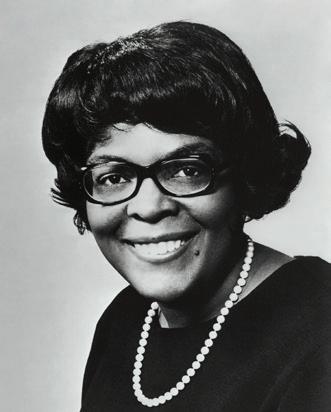
Cardiss Hortense Collins was the fourth Black woman in Congress and the first from Illinois and the Midwest, when she was elected in a 1973 special election to replace her husband, George, who was killed in a plane crash a month after winning his second term.
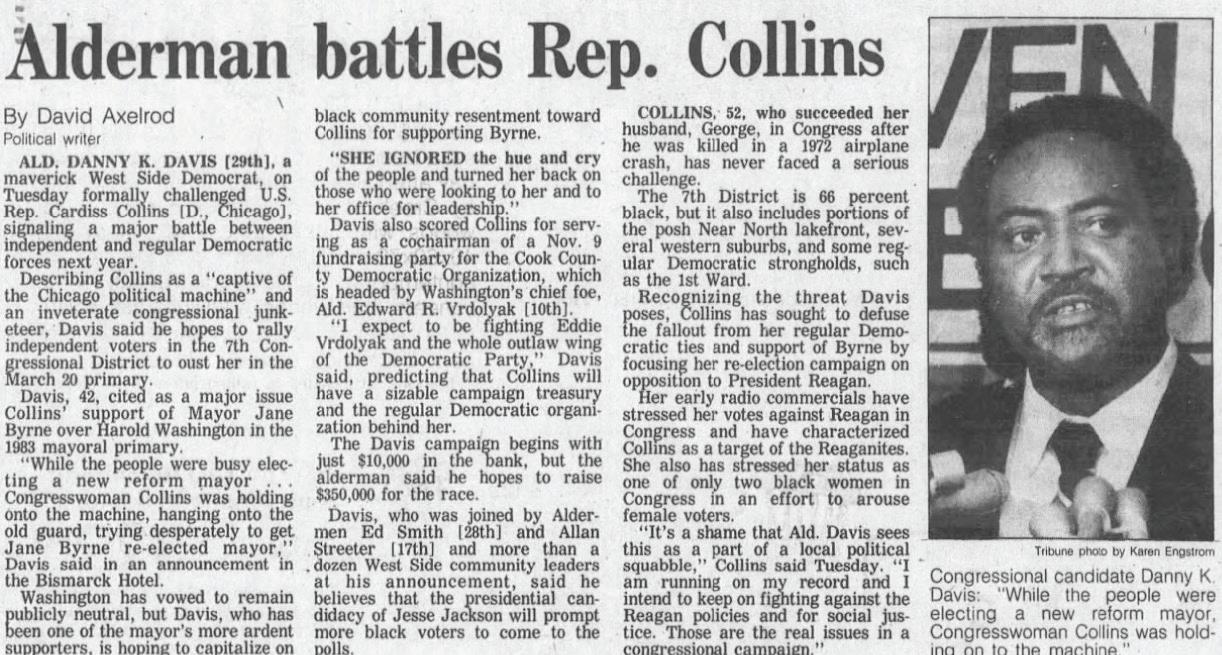
While in Congress, Collins fought for universal health insurance, gender equity, and women’s rights. But by the time Davis began challenging Collins in the early 1980s, he framed her as aligned with the remnants of the old white machine wing of the city’s Democratic Party—at a moment when Harold Washington’s insurgent mayoral coalition had changed what “reform” meant in Chicago politics. Davis, the son of sharecroppers, embraced a politics that was against corruption and against machine discipline. Elected 29th Ward alderman as a reformer, he carried that posture into two unsuccessful congressional runs against Collins, portraying the contest as a fight over
whether the West Side would be represented by an independent coalition builder or by a member anchored to the party apparatus.
That outsider energy later shaped Davis’ own rise to Congress in the mid-1990s after Collins retired, when he ran not only as a Democrat but with the support of a mix of labor and progressive groups—including the AFL–CIO, the Sierra Club, the Teamsters, and Chicago Democratic Socialists.
FROM MASS POLITICS TO “HYPERPOLITICS”
In the 1800s, for all the brutality of the era, national politics operated as mass politics: parties were stronger civic institutions; participation was routinized through organizations, newspapers, and clubs; and conflict—however vicious—ran through recognizable channels. The United States today often feels like the opposite, an era of omnipresent political stimulation by way of X, Facebook, Instagram, TikTok, Bluesky and similar social media platforms, paired with weak, distrusted institutions and thin party capacity.
Political theorist Anton Jäger has argued that modern politics is defined by “hyperpolitics”—a high-intensity, short-horizon environment in which politicians wonder whether they can launch their campaigns in a matter of weeks, while citizens and digital influencers cycle through demonstrations, petitions, and protests with the speed and logic of social media algorithms rather than political parties. All while nothing substantive happens to solve the systemic problems people (or, in many cases, bots) are outraged about online.
That frame matters for the 7th District because the race is not only about “who is the progressive,” but about what kind of progressive politics can actually govern, especially
when the national environment increasingly resembles, in tone and stakes, the volatile pre-Civil War decades more than the relatively stable 1990s-era Congress Rep. Davis entered.
In the 1850s, Northern states responded to the Fugitive Slave Act with “personal liberty laws” designed to blunt federal enforcement. Today, Illinois has enacted sanctuary policies limiting local cooperation with federal immigration authorities. In both eras, the conflict is not only moral but constitutional, centered on who controls the streets. The federal government or the states?
In the 1850s, one of the country’s two main political parties fell apart because it could not hold together people who sharply disagreed over slavery and the future of the nation. A new party rose in its place at a time when many Americans had lost faith in their leaders and institutions. Tensions ran so high that a member of Congress was beaten nearly to death on the House floor, states openly defied federal law, and voters had to ask whether the political system itself could survive the crisis. Today, amid a war with Iran, states are fighting with the federal government over immigration and voting rules, members of Congress face investigations tied to their official duties, and both major parties are struggling to hold together coalitions that no longer fully trust one another or the system itself.
The parallels are not exact. The moral stakes and historical contexts differ. But in a district that once sent Abraham Lincoln to Congress about a decade before a national rupture and later produced its own insurgent reformers, the lessons of political realignment, institutional strain, and coalition-building are difficult to ignore. Anyone seeking to represent the 7th District at this moment would be wise to take them seriously.
A Nov. 2, 1983 Chicago Tribune article about thenAld. Davis' bid to unseat logtime 7th District Congresswoman Cardiss Collins. | NEWSPAPERS.COM
Cardiss Collins | WIKIMEDIA
BALLOT POWER: A GUIDE TO
THE 2026 MARCH PRIMARY ELECTION
Meet the Four Candidates With the Money, Organization, and Name Recognition to Win the 7th District
Rep. Ford, Conyears-Ervin, Collins, and Friedman have the most money, name recognition, and/or organization to succeed Congressman Davis
MELISSA
BY STAFF
The Culture
13 candidates are running in the Democratic Primary for 7th Congressional District representative, and two are running in the Republican Primary. Realistically, however, only a handful have a real shot at succeeding retiring Congressman Danny K. Davis. We selected four candidates with the best shot at the seat based
LA SHAWN K. FORD
Occupation: Self-employed; retiring 8th District state representative (in office since 2007)
Age: 54
Residence: Austin
Education: Bachelor’s degree, Loyola University
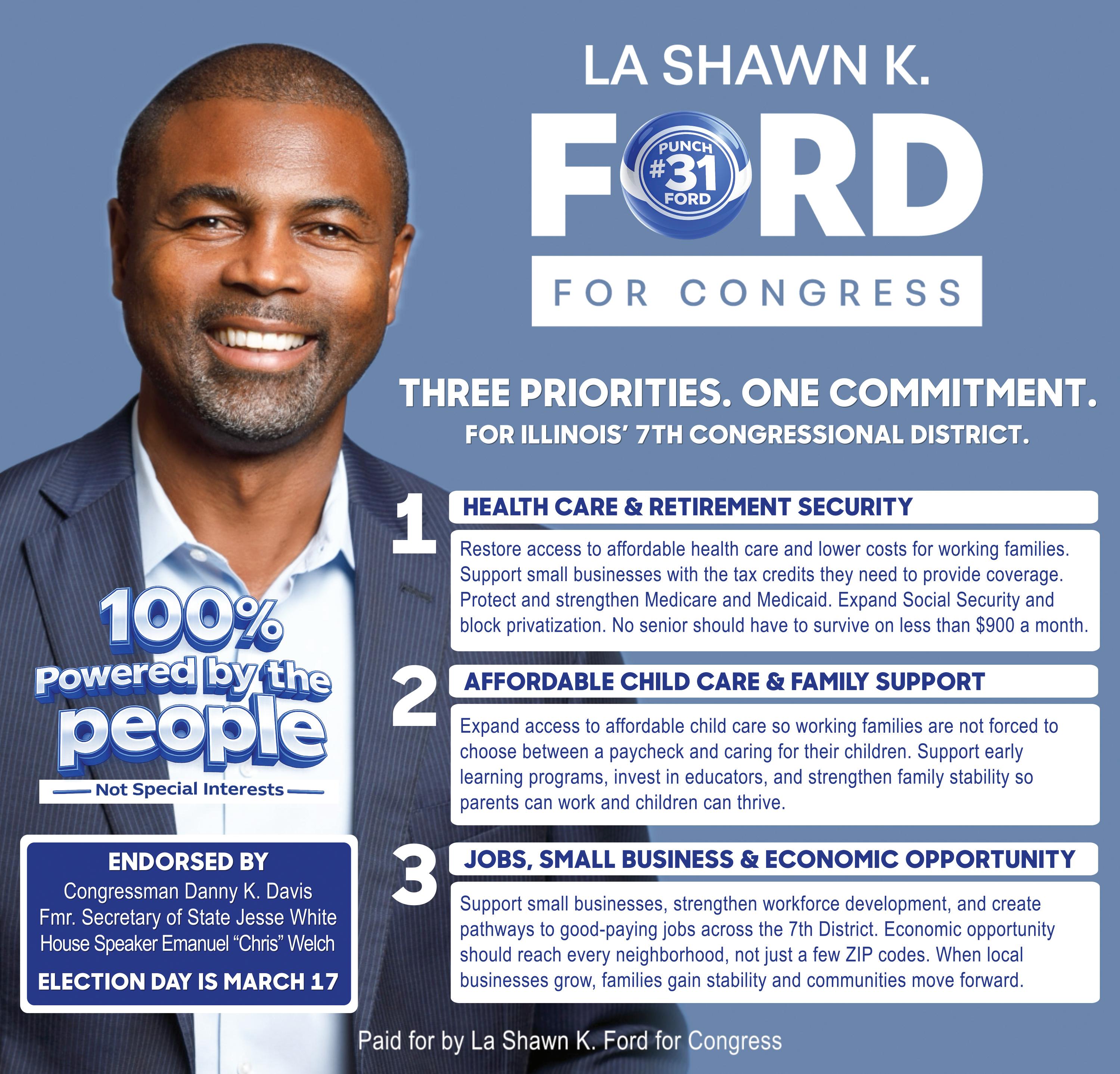
Key endorsements: U.S. Rep. Danny K. Davis (retiring incumbent, IL-07); Illinois House Speaker Emanuel “Chris” Welch; Illinois Senate Majority Leader Kimberly Lightford
on interviews with the candidates themselves, insiders from multiple campaigns, historic 7th District voting patterns (which explains why we didn’t profile the two Republican candidates), fundraising, and internal polls (particularly a poll released by Dr. Thomas Fisher, himself a Democratic candidate, showing how the race stood in January. While several months old, the poll provides a snapshot of how the race stood early this year in a contest
Campaign issues: He’s been vocal in his support for a public option, a government-backed health insurance plan designed to compete alongside private insurers in the market, aiming to lower premiums, increase coverage choices, and reduce administrative overhead. He’s also said, “We need to bring the United Nations in for hearings so we can get it on the Congressional record officially about genocide in Gaza.” Ford specifically supports the Law Enforcement Trust and Accountability Act, proposed legislation designed to improve police-community relations, enhance accountability, and establish national accreditation standards for law enforcement agencies.
Total contributions and receipts received from April 1, 2025, to Dec. 31, 2025: $407,320
Biggest individual contributor: La Shawn K. Ford (loaned his campaign $100,000)
Cash on hand as of Dec. 31, 2025: $307,547
Profile: On his campaign website, Ford touts a range of leg-
without other publicly available polling. The profiles are based on the candidates’ answers to questionnaires put to them by the Chicago Sun-Times and The Culture, their campaign websites, Federal Election Commission financial data, reporting from local media outlets, and interviews conducted by The Culture over the last few weeks. The candidates are shown based on how they appear in the Fisher poll.
islative accomplishments he led, including authoring the “African American Employment Plan Act to expand representation and opportunity in state government,” leading “Ban the Box” legislation that removes “barriers to state employment for people with nonviolent records,” and writing and passing “many of the state’s major record sealing, expungement, and bail cost reduction laws.”
Critics point out: From the perspective of younger candidates like Kina Collins, Anthony Driver, and Reed Showalter—all of whom are in their early 30s and have expressed frustration with the Democratic Party’s unresponsiveness to the needs of real people, particularly in Black communities—Ford may be too connected to the flawed status quo. They also point to an endorsement by the Fraternal Order of Police (FOP), an organization famous for its hostility to police accountability. Counterpoint: In response, Ford said that “there’s no issue” those younger, progressive candidates have expressed “that I don’t.” Ford added that he even supported Sen. Bernie Sanders’ primary run against Hillary Clinton and has served as a delegate for Sanders, a self-proclaimed democratic socialist. On the FOP endorsement, Ford said: “They endorsed me, I don’t endorse them. I’ve gotten money from them over the years, but I don’t vote for everything they ask. I have students (Ford is a former teacher) and family members who are police officers.” Learn more: fordforcongress.com
CONYEARS-ERVIN
Occupation:
Chicago City Treasurer
Age: 50
Residence: Garfield Park
Education: Eastern Illinois University, BS; Roosevelt University, MBA
Key endorsements: Chicago Teachers Union, Illinois Federation of Teachers
Campaign issues: Conyears-Ervin has said, “We need a national commitment to affordable housing and programs that will support first-time homebuyers.” On immigration enforcement, she’s said she’ll help “advance legislation to require strict transparency, civil rights safeguards, and independent oversight before large-scale federal enforcement actions can begin.” On her website, she says she’ll work to “close [tax] loopholes, restore top income tax rates to their Obama-era levels, and back a federal tax on the wealthy.”
Total contributions and receipts received from April 1, 2025, to Dec. 31, 2025 (the latest reporting period): $336,916
Biggest individual contributor in latest reporting period: Michael Tadim, owner of TD Capital Investments ($7,000) Cash on hand as of Dec. 31, 2025: $216,943
Profile: On her campaign website, Conyears-Ervin, who served as 15th District state representative before being elected treasurer, touts her passage of bills providing “more funding for affordable childcare and hundreds of millions in new, more equitable funding for Chicago Public Schools.” As treasurer, she “expanded free financial literacy programs like Building Wealth Today for Tomorrow and connected entrepreneurs to affordable capital and community lenders to help citizens secure their financial futures.” Conyears-Ervin is married to 28th Ward Ald. Jason Ervin.
Critics point out: As treasurer, Conyears-Ervin agreed last year to pay a $30,000 fine to resolve two ethics cases. Before that settlement, the Chicago Board of Ethics had issued total fines of $70,000 in 2024 for 12 separate violations of the city’s Governmental Ethics Ordinance. And last year, a whistleblower in her office filed a “wide-ranging ethics complaint against her
CANDIDATES on page 19
BALLOT POWER: A GUIDE TO THE 2026 MARCH PRIMARY ELECTION
CANDIDATES
Continued from page 17
… alleging the congressional candidate’s political staff pushed a questionable plan to boycott U.S. Treasury bonds in protest of President Donald Trump, despite internal objections over its financial prudence.” The whistleblowers alleged that “interference from her political campaign shows the proposal was ‘messaging, not a legitimate investment-policy action.’” Her opponents have also pointed to millions of dollars from the American Israel Public Affairs Committee (AIPAC) and related dark-money groups that have helped her campaign, arguing that this may affect her independence in areas like Israel’s conduct of the war in Gaza.
Counterpoint: Conyears-Ervin has consistently denied all wrongdoing, often characterizing the ethics investigations into her conduct in office as politically motivated “witch hunts.” Despite agreeing to pay significant fines, she maintains that her actions were not unethical.
Learn more: melissaforcongress.org
JASON FRIEDMAN
Occupation: Former President of Friedman Properties, Ltd.
Age: 52
Residence: River North Education: University of Wisconsin (BBA), London School of Economics (visiting student), Georgetown University Law Center (JD)
Total contributions and receipts received from April 1, 2025, to Dec. 31, 2025: $1,804,997
Biggest individual contributor: Friedman gave his campaign $36,760 in the latest reporting period
Key endorsements: Ravi Parakkat, founder of Takeout25 Oak Park
Campaign issues: Has vowed to “fight to lower costs by [reversing] the sweeping cuts to programs like SNAP, Medicare, and Medicaid, reverse Trump’s destructive tariffs, and help create good-paying jobs.” He wants to “ban Trump’s ICE” and “hold ICE leaders and agents accountable.”
Profile: On his website, Friedman touts his background “in public service and Democratic causes started at a young age as a student volunteer for Senator Paul Simon’s presidential campaign. Jason went on to work in the West Wing of President Bill Clinton’s White House and for Senator Dick Durbin on the Senate Judiciary Committee, and worked on the 1992 Democratic National Committee for President Clinton.” He also points to his private sector bona fides as a business owner, writing that he “knows what it takes to create good jobs and get things done in our community.”
KINA COLLINS
Occupation: Community organizer
Age: 34
Residence: Austin
Education: Bachelor’s degree, Louisiana State University
Total contributions and receipts received from April 1, 2025, to Dec. 31, 2025: $39,471
Biggest individual contributor: No itemized data was available on the FEC’s website; however, Collins loaned her campaign $8,807
Cash on hand as of Dec. 31, 2025: $4,896
Key endorsements: 25th Ward Ald. Byron Sigcho-Lopez, Oak Park Village Trustee Jenna Leving Jacobson
Campaign issues: On her website, Collins writes that she supports “proposals like Senator Elizabeth Warren’s Ultra-Millionaire Tax, which would impose an annual tax on households with a net worth above $50 million.” She also supports ending ICE enforcement funding for “deportation activities, while redirecting essential functions, like human trafficking investigations, to other federal agencies.”
Profile: On her website, Collins touts founding, in 2017, the “Chicago Neighborhood Alliance to empower residents in violence-impacted neighborhoods to build civic power and take action to change their communities.” She adds that, as “a nationally recognized leader in the movement to end
Critics point out: Friedman has consistently outraised his opponents throughout the race. By the end of last year, he had raised close to $2 million, with much of it coming from donors who “have made their living in finance, real estate or law,” WBEZ reported. Rep. Ford vocally criticized Friedman, accusing the real estate developer of “amassing funds from big contributors “to take advantage of … too many Black people being in the race, and ‘I’ll sneak in,’” WBEZ reported. Friedman’s opponents have also criticized him as out of touch with the Black communities in the 7th District.
Counterpoint: Friedman has consistently touted his family’s history on what is now considered the Near West Side. “As the great-grandson of a peddler on Maxwell Street and the grandson of a hot dog stand owner on the West Side, I have deep roots in this community and want to go to Washington to defend our rights and bring relief to working families,” he writes on his campaign website. In an interview with WBEZ, Friedman said fundraising levels reflect “a strong desire to have a doer, someone who’s willing to stand up to fight, someone who’s willing to say that career politicians aren’t working for us anymore and aren’t fighting for us anymore and that Jason Friedman is a person who can get something done and deliver for this community.” He also touts his philanthropic work with Mount Sinai Hospital in North Lawndale. Learn more: friedmanforcongress.com
gun violence, I have worked to hold corporations accountable and push for solutions that treat gun violence as a public health crisis, not just a policing issue.” As the former executive director of One Aim Illinois, she “led efforts to hold gun manufacturers and dealers accountable for fueling the flow of illegal guns into our neighborhoods. I also had the honor of serving on the Biden-Harris transition team, helping to shape the national agenda for gun violence prevention.”
Critics point out: Collins’ opponents have pointed to the lack of money she’s raised as an indication of her viability as a candidate. As of Dec. 31, 2025, her campaign had less than $5,000 in cash on hand. They’ve also pointed to her age and having never been elected to office to argue that she’s not proven enough for Congress.
Counterpoint: Collins argues that her name recognition throughout the district has proven more valuable than dollars. In the 2024 Democratic primary election, she placed a close third behind Treasurer Conyears-Ervin, garnering around 19% of the vote. Conyears-Ervin got 21% of the vote in a race Rep. Davis would win handily (he garnered 52% of the vote in a five-person race). Collins argues that she’s “the only non-career politician” and the only “true progressive” who has a shot at winning the seat, a claim she said is reinforced by the strength of her base in Oak Park, the progressive bastion of the 7th District.