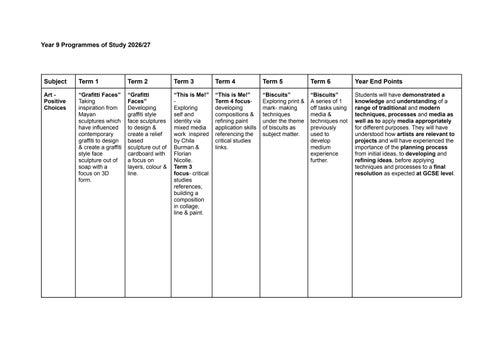
Year 9 Programmes of Study 2026/27
Subject
Term 1
Term 2
Term 3
Term 4
Term 5
Term 6
Year End Points
Art Positive Choices
“Grafitti Faces” Taking inspiration from Mayan sculptures which have influenced contemporary graffiti to design & create a graffiti style face sculpture out of soap with a focus on 3D form.
“Grafitti Faces” Developing graffiti style face sculptures to design & create a relief based sculpture out of cardboard with a focus on layers, colour & line.
“This is Me!” Exploring self and identity via mixed media work inspired by Chila Burman & Florian Nicolle. Term 3 focus- critical studies references, building a composition in collage, line & paint.
“This is Me!” Term 4 focusdeveloping compositions & refining paint application skills referencing the critical studies links.
“Biscuits” Exploring print & mark- making techniques under the theme of biscuits as subject matter.
“Biscuits” A series of 1 off tasks using media & techniques not previously used to develop medium experience further.
Students will have demonstrated a knowledge and understanding of a range of traditional and modern techniques, processes and media as well as to apply media appropriately for different purposes. They will have understood how artists are relevant to projects and will have experienced the importance of the planning process from initial ideas, to developing and refining ideas, before applying techniques and processes to a final resolution as expected at GCSE level.
Computer Science
Module: Python Programming Topics: Variables, sequence, selection and iteration Key Skills: Be able to write programs using a range of techniques in order to solve simple real world problems MP1: Practical Skills MP2: Programming Assessment
Module: Data Representation .
Module: Programming Project
Topics: Boolean logic, operators and arithmetic operations. Computer science legislation and impacts on society
Topics: In this programming project, learners will be expected to plan, write, test and evaluate a simple coded program.
Key Skills: Understand the purpose of data in computer systems being represented in binary form. Understand simple Boolean logic. Construct and interpret pseudocode and data flow diagrams. MP1: CTAP 1 Exam paper MP2: CTAP 2 Exam paper
Key Skills: Create a list of success criteria, develop flowchart solutions to the problem presented, use a range of programming techniques including sequence, selection and iteration. Test and make corrective actions and evaluate the project based
Module: Computer Hardware and Software. Moral, legal and environmental concerns Topics: Input, Output and storage devices. System software, utility software and drivers. Memory and Storage Key Skills: Classify the components of a computer and the basic functions of internal components. State the purpose of different utility software and identify open source and proprietary software. Describe computer science technologies
Module: Vector Graphics
Module: Bitmap Images
Topics: Infographic
Topics: Triptych
Key Skills: Using software, design and develop a vector graphic on an informative topic to the public relaying data in a meaningful way. Understand the characteristics of a vector graphic in terms of scaling and its mathematical characteristics.
Key Skills: Using photo editing software design a triptych using a range of skills. Understand what a bitmap image is, with reference to pixels, scaling, image sizes and metadata.
MP1: Infographic submission
MP2: Bitmap written assessment
MP2: Vector written assessment
MP1: Triptych submission
Understand and apply the fundamental principles and concepts of Computer Science, including problem solving, logic, algorithms, and programming. Analyse problems in computational terms and have exposure to practical experience of writing computer programs in order to solve such problems. Understand the components that make up digital systems, and how they communicate with one another and with other systems. Understand the impacts of digital technology to the individual and to wider society.
on their success criteria MP1: Project Submission MP2: Practical Assessment
with consideration of moral, legal and environmental issues. Also the purpose of each of the following acts; Data Protection Act (1998), Computer Misuse Act (1990) and the Copyright, Design and Patents act (1998) MP1: CS1 Exam paper MP2: CS2 Exam paper
Drama
Devising/Verbati m Overview: -Students to explore Verbatim theatre and use Newspapers articles and secondary source evidence to devise a performance -Students to explore the role of
Blood Brothers
DNA
Physical Theatre
Overview: -Students to explore (read and perform the Blood Brothers story by Willy Russell. -Students to explore the role of the audience and use directing skills.
Overview: -Utilise themes such as bullying and gangs within performance -Study and use a set text for performance scenes -Develop ability to
Overview: -The actor’s body is an endless resource that can be used in an imaginative way to create abstract feelings and concepts. -The difference between
Noughts and Crosses Overview: -Students will read and discuss the text of Noughts and Crosses by Malorie Blackman. -Exploration of what re-interpretation
Lip Sync Battle Overview: -Develop students’ performance skills, confidence and creativity -Enhance students’ non-verbal communication, physical
1)To create self-aware and capable performers who understand the importance of voice, movement and interaction. Students will show how to use these performance tools effectively as well as showing the importance of being a reflective and appreciative audience member. 2) Students will have a deeper understanding of various texts from a range of historical and social contexts
the audience and create characters who are representative of views -Students to explore the role of tone and mood in group work -Students develop credible roles -Students explore shape and structure the work in a meaningful way -Students to self and peer assess Assessment 1 – Assess response to events in performance. .
Reasons for SoW
To spark debate Exploration of scandal and cover
-Students to explore the roles of Mickey and Eddie – their social differences. -Students develop credible roles and perform to a high standard. -Students explore shape and structure the work in a meaningful way -Students to self and peer assess
Assessment 2 – Ability to perform from a text. Assessment 3Written exam
To explore 1980’s Britain – politics.
portray key emotions and communicatio ns of a variety of characters -Understand context of the time at when it was written.
Assessment 3 – Practical performance of DNA scene
naturalistic and non-naturalistic. -That voice can be used to create a character. -Frantic Assembly – exploration of a theatre company. Their meaning and purpose. Watching performance of Frantic assembly (recorded) -How contrast in dynamics and emotions can be dramatically effective. -To work together effectively as a group. -Students to self and peer assess Assessment 5 – use of the body to create a narrative (using Frantic assembly techniques).
Gain knowledge and understanding of context of
To gain knowledge and understanding of
is and creating meaning and message through performance. -Stereotyping and subversion of stereotypes explored. -creating a convincing and credible role -Stage combat -Exploration of the director, performer and audience member. -Students to self and peer assess
Assessment 4– Performance exploring the questions around racism and physical violence.
To discuss the issues of prejudice and racism.
expression, timing and characterisation -Encourage teamwork and time management skills
Assessment 6 – Written exam Assessment 7Group performance
This is to end on a fun, energetic, ensemble SOW for Y9 –
3) Students will be able to create, devise and rehearse for a performance, showing clear understanding of collaborative skills. Students will also be able to reflect on live theatre examples and evaluate effectively.
up – the role and responsibility of the media. To explore function of Verbatim theatre
Placement of SOW – To engage students with a real event that happened and to get them excited about what happened.
English
Dystopia
Characterisation of Mickey and Eddie. To explore and develop the Liverpudlian accent and use of dialogue. Apply the role of the director To explore differences in social class and how this can be shown on stage. Placement of SOW – to explore language and use of voice prior to study of physical action and physical theatre next term.
time for when pieces are written Study and apply a range of acting techniques to a script Rehearse and perform (off script) a chosen section of text.
Shakespeare – Twelfth Night
In the Sea there are Crocodiles
AIM: AIM:
Placement of SOW- This SOW provides students the opportunity to deepen their performance skills, prior to studying GCSE Drama, or carrying on the skills learnt to other aspects of life.
Brecht – ready for GCSE Drama To understand Brecht’s techniques to create epic theatre. To create a piece of epic theatre in groups. To engage in Brecht’s style of acting.
Placement of SOW – For those who are taking Drama to begin to explore Brecht’s epic theatre, prior to study at GCSE Drama level.
Power of Language + SLE
To explore use of empathy for characters and playwright’s intentions. Reading of the text Raising awareness of racism through re-interpretation of Romeo and Juliet.
Placement of SOW – To explore attitudes to race and be able to understand the playwright’s intentions when re-interpreting a script and concept. A SOW to maintain Y9 interest in the middle part of the year.
Unseen Poetry AIM:
especially for those not taking it on to GCSE. Students to develop stage presence, expressiveness and ensemble collaboration. To utilise group work skills, improvisation and character skills developed over KS3 study of Drama. Placement of SOW – A fun energetic end to KS3 drama which is placed at the end of the year to employ skills developed fully.
Unseen Poetry & Project
Reading: Perceptively analyse and evaluate effect and purpose of linguistic and structural
To explore the genre through classic text extracts and film. To make connections between fiction texts and real history as well as current issues. To learn from the literary experts in order to improve own creative writing. KEY SKILLS: Identifying key features of genre and language. Explaining the effects of language and structure on meaning. Creative planning and writing skills. Technical accuracy. Discussion and debate skills.
To study the play in depth by watching a Globe production as well as reading the play text. To know the features of Shakespearean comedy and compare to tragedy (Y8). To develop an appreciation of Shakespeare and make links between the play and real world e.g. festival of fools, lord of misrule. To discuss and debate issues and ideas raised by the play. KEY SKILLS: Identifying key dramatic methods as well as language features. Explaining the
AIM: To enjoy reading a complete novel as a class. To develop an understandin g of refugee experiences. To instil empathy and understandin g of real as well as fictional people, from different backgrounds, cultures, countries and circumstance s. KEY SKILLS: Identifying and commenting on the effects of writers’ choices. Evaluation of opinion. Comprehensi on and interpretation skills.
AIM: To study a range of iconic and powerful speeches in order to improve speech writing skills for the GCSE Spoken Language Endorsement. To build confidence in adapting writing for presenting to an audience. To complete this oracy unit of their GCSE English language course. KEY SKILLS: Identifying and commenting on the effects of writers’ choices. Evaluation of persuasive devices. Researching, planning, writing, not taking and
To study a variety of modern poems with a focus on themes of conflict and emotion. To explore different forms of poetry and know how to identify key ones. To know how to approach an unseen poem with confidence. To express creativity through poetry. KEY SKILLS: Identifying key poetic features as well as language methods. Explaining the effects of language and structure on meaning. Essay writing skills with a focus on thesis
AIM: To continue and complete studying unseen poetry. To collate poems of choice that relate to the same theme. To create a personal poetry anthology. To express creativity through poetry. KEY SKILLS: Identifying key poetic features as well as language methods. Explaining the effects of language and structure on meaning. Essay writing skills with a focus on thesis statements, introductions and conclusions.
features, zooming in to examine writers’ methods, commenting on how writer’s choices produce meanings and effects. Be able to securely cross-reference two different writers’ uses of specific techniques, exploring the use of a wide range of literary devices. Integrate thoughtful and relevant contextual knowledge into a critical response to develop the interpretation of a text, applying deeper cultural capital and critical skills to discuss how meaning is shaped. Writing: Write technically sophisticated responses with a controlled range of vocabulary, sentence forms, grammatical constructions, and accurate spelling of ambitious vocabulary for a wide range of purposes and audiences. Sensitively and insightfully explore characterisation, setting and other narrative features when devising their own creative work, reflecting on feedback and re-drafting to improve. Oracy: •Express sophisticated ideas / information / feelings using a sophisticated repertoire of vocabulary organises and structures his or her presentation using an effective range of strategies to engage the audience an
Geography
CAREER LINKS: Jobs which would help to avoid a dystopian future include beekeeping, environmental law, human rights law, politics, medical research, cyber activism, investigative journalism, archivism, urban planning, disaster management, charity work and farming.
effects of language and structure on meaning. Essay writing skills – following PETAL structure.
READING: Termly reading lists issued. Class reader as HW. All are encouraged to read for read for 20 mins per day.
READING: Termly reading lists issued. All are encouraged to read for read for 20 mins per day.
Tectonics and Development
Glaciated Landscapes
CAREER LINKS: Acting, directing, staging, costume/ lighting/ stage design. Literary criticism and research, curatorship, publishing.
Identifying links between the novel and real world. CAREER LINKS: Charity work, aid work, social care, human rights law, investigative journalism. READING: Termly reading lists issued. All are encouraged to read for read for 20 mins per day.
21st Century Issues:
presenting skills. CAREER LINKS: Any job requiring presentations to audiences, job interviews.
statements, introductions and conclusions. CAREER LINKS: Journalism, poetry, TV/ film production
READING: Termly reading lists issued. All are encouraged to read for read for 20 mins per day.
READING: Termly reading lists issued.
21st Century Issues: Resource Use
GCSE Sustaining Ecosystems
All are encouraged to read for read for 20 mins per day.
Creative writing. Research, collation and presentation skills. CAREER LINKS: Journalism, poetry, TV/ film production
achieve the purpose of their presentation. •listens to questions / feedback, responds perceptively and if appropriate elaborates with further ideas and information.
READING: Termly reading lists Issued. All are encouraged to read for read for 20 mins per day.
GCSE Sustaining Ecosystems
● Understand the causes and consequences of tectonic events.
Earth’s Structure. Processes at plate boundaries. Causes, consequences and responses relating to volcanic eruptions and earthquakes. Methods to improve development levels
Distribution of global ice. Glacial processes. Erosional landforms. Changes in glaciers and the impact on human activity.
Climate Change Causes of climate change. Global variations in emissions. Global variations in impacts. Appropriate solutions to global warming.
Distribution of global resources. Competition for resources. Conflicts arising from resource use.
What is an Ecosystem? Characteristics of world biomes. Characteristics of Tropical Rainforests
Human use of rainforests. Threats to Rainforests. Case study of sustainable use of rainforests.
● Understand how impacts and responses to tectonic events may vary according to levels of development. ● Understand how glacial landscapes can change over long periods of time and how human activity can adapt sustainably to these changes. ● Understand the causes, effects and responses to global climate change. ● Understand how competition for resources can lead to conflict (Middle East, Arctic). ● Know how global agreements can be used to tackle climate change. ● Know the characteristics of global ecosystems and understand the impacts to, and management of, tropical rainforests. ● Understand the basic processes occurring at four types of plate boundaries. ● Know the key locations in Bangladesh and Russia. ● Know how to describe, analyse and present geographical data using complex techniques including statistical testing. ● Know how to provide developed explanations for geographical features. ● Know how to apply geographical knowledge in order to make balanced judgements and evaluations.
History
Topics: Thematic study on tolerance Enquiry question: How fragile is tolerance in Britain? Content: Ancient World, Early Modern, Anne Lister, WW1 & disability, 20th C LGBTQ+ Assessment: Which factor had the biggest impact on tolerance? Skills: Thematic study of change Cultural Capital: Ideas of rights and protection of rights, influence of government, religion and individuals, LGBT individuals, Post WW2 liberalism,
Topics: What was it like to fight in WW1? (emphasis on aspects of trench experience) Enquiry question: What did it take to fight in the trenches?
Topics: Nazi Germany & The Holocaust (emphasis on Holocaust) Enquiry question: How significant was the Holocaust?
Content: Impact of modern weapons, fighting WW1 battles, life in trenches, recruitment & propaganda
Content: Nazi rise to power, life under a dictatorship, Holocaust causes & consequence s
Assessment: What caused the First World War?
Assessment: Why did Hitler become so popular? & knowledge test on Nazis
Skills: Significance Cultural Capital includes: Relevance of Remembrance Day,
Skills: Sources & interpretation s Cultural Capital: How
Topics: World War II & impact on the ‘Home Front’ (emphasis on domestic/social aspect) Enquiry question: What impact did WW2 have on the Home Front? Content: Dunkirk, Blitz, Rationing & evacuation, WW2 presentations Assessment: What had the biggest impact on the ‘Home Front’? & knowledge test on WW2
Topics: Dropping of the A bomb & Cold War (emphasis on nature of conflict)
Topics: Making of modern Britain (focus on increasing equality)
Enquiry question: Was it right to drop the atomic bomb?
Enquiry question: How has Britain become a more equal society post WW2?
Content: Reasons for dropping the A Bomb, causes of Cold War, Cuban Missile Crisis, Vietnam War & protest movement Assessment: Was the dropping of the A Bomb justifiable?
Skills: Significance
Skills: Causes & consequences
Cultural Capital: The ‘victory’ of Dunkirk, Impact of war on
Cultural Capital: Morality of dropping an Atomic Bomb,
Content: Post WW2 Britain, Welfare state & NHS, Immigration, cultural change in 60s & 70s, gender & sexual equality Assessment: End of year exam Skills: Group work & transferable skills Cultural Capital: Post-War
Developed understanding of the interlinked reasons why historical events occur (eg WW1). Deeper understanding of how WW1 & WW2 were ‘total wars’ with wide-ranging impacts. Understanding how 20th century events shaped the modern world (Britain & beyond) & relevance today More complex evaluation of sources usefulness & reliability, including an analysis on their provenance (author, date created, purpose). Writing shows developed analytical thinking, whether through multi-causal explanations of change or different aspects of significance.
Maths
Number Product of prime Factors, HCF & LCM Estimation Error Intervals Bounds Rules of Indices inc. fractional and negative Standard form Surds Non-Calc Exam (contains year 8 content)
MFL French
Technology
experience of WW1 soldiers, use of government propaganda, ‘total war’, Empire troops
can dictatorships start? Aspects of Nazi life, life for Jews in 1930s, responsibility of the Holocaust, memorialisati on
ordinary people, ‘spirit of the Blitz’, WW2 outside of West Europe
was Cold War inevitable? Ideologies of capitalism & communism, dangers of nuclear war
immigration, cultural developments, significance of NHS, growth of tolerance post WW2, LGBTQ+ rights
Manipulating Algebra
Shape
Proportion
Investigating Data
Probability
Circles, arcs and sectors Cones and Spheres Compound Units Bearings
Percentages Ratio Direct proportion equations Pythagoras and SOHCAHTOA
Film review
Environment
Single and double bracket factorising Simplifying algebraic fractions Simultaneous equations Arithmetic Nth term rule Quadratic nth term rule Calc Exam Famous Mathematicians investigation
World of work
Compound interest Frequency tables Cumulative Frequency Quartiles Box Plots Scatter Graphs EOY Exams Non Calc and Calc Exams
Revision and skills
Sample space diagrams Two-way tables Set notation Venn diagrams Tree diagrams
Summer Project
✓ Understand and simplify surds ✓ Write and error interval and calculate with upper and lower bounds ✓ Calculate in standard form ✓ Factorise a quadratic with a=1 including a difference of two squares ✓ Solve a simultaneous equation algebraically ✓ Problem solve with volume and surface areas. ✓ Understand bearings and use it to calculate a return journey ✓ Use Pythagoras and SOHCAHTOA in multistep problems and real-life circumstances ✓ Draw, use and interpret cumulative frequency diagrams and box plots ✓ Find conditional probabilities and use set notation with Venn diagrams ✓ Use and interpret tree diagrams with multiple routes By the end of year 9, students will be able to…
How can we use infinitives? Skills: Discussing the pros and cons of technology and new media. Grammar: Recap of present, past, near future using time markers. Preference verbs + infinitives, advanced negatives, direct object pronouns, adjectival endings. Assessment: Translation Quiz, Reading and Listening
How do you form the conditional tense? Skills: Talking about jobs, careers, future plans and ambitions. Grammar: Using the conditional tense. Expanding range of future phrases. Using pour/afin de + infinitive. Using qui & que. Assessment: Translation Quiz, Speaking
What do these scenes show us? Skills: Film review of La Classe. Discussing key themes, characters and giving opinions. Grammar: Use of literature review vocabulary (il s’agit de…) and KS3 grammatical and GCSE opinion structures to create character descriptions and a film review.
How do you form the imperfect tense? Skills: Discussing what you do to help the environment, environmental problems and their impact. Grammar: Using the imperfect tense and modals. Using si clauses with the imperfect and conditional, recapping il faut & on devrait, using ce qui & ce que.
Skills: Revision techniques for End of Year Exam including speaking skills and consolidation of all topics. Grammar: Consolidation of all KS3 grammar: 5 tenses etc. Assessment: Translation Quiz, Speaking
Skills: Creating a lesson on a cultural topic relating to France or a French-speaki ng country. Creating a magazine in French consolidating Y9 learning.
…express and justify opinions on the topics of technology, the environment, film and work. …conjugate verbs in the present, past, conditional, imperfect and near future tenses. …respond accurately to a photo card prompt. …critically analyse a film and historical events relating to 20th and 21st century France.
Assessment: End of Year 9 Exam
Assessment: Translation Quiz, Speaking
Mid-Year Assessment, Translation Quiz
MFL German
Media and Technology
Environment
Das Wunder von Bern
Work
Speaking Skills
Summer Project
By the end of year 9, students will be able to…
How do you use um zu? Skills: Discussing the pros and cons of technology and new media: social networks and mobile phones. Grammar: Using three time frames together, using weil and wenn clauses, in order to: um …zu, common imperfect forms. Assessment: Translation Quiz, Reading and Listening
Which prepositions take the accusative and which take the dative? Skills: Discussing what you can do to help the environment, environmental and social problems and their impact. Grammar: Consolidate use of three tenses, consolidate modal verbs + infinitive, consolidate um zu, consolidate connectives. Assessment: Translation Quiz, Speaking
MFL Spanish
School
School
What is the genitive case and how is it used? Skills: Reviewing Das Wunder Von Bern film, analysing themes, characters and what the scenes show us. Cross-curricul ar. Grammar: Genitive case, prepositions with accusative and dative cases, two-way prepositions. Assessment: Translation Quiz, Mid-year exam Family and Free Time
How do you form the conditional tense?
How do you tackle a photo card and role play?
Skills: Talking about jobs, careers and future plans, recognising plural nouns, talking about charity work and volunteering.
Skills: Revision techniques for End of Year Exam including speaking skills and consolidation of all topics.
Grammar: Future Tense : werden + infinitive, conditional Tense : möchten and würden, masculine and feminine forms of nouns.
Grammar: Consolidation of KS3 grammar: 5 tenses, verb pullers and kickers, use of um zu, all four cases.
What was the reunification of Germany and why was it important? Skills: Talking about the reunification of Germany and its significance. Grammar: Manipulation of nouns, verbs and adjectives and changing verbs from 1st to 3rd person.
Assessment: Speaking
Assessment: End of Year Exam
Food + Health
Film + TV
…express and justify opinions on the topics of technology, the environment, film and work. …conjugate verbs in the present, perfect, conditional and future tenses. …follow advanced word order rules including um zu, wenn and modals in the past and present. …understand the use of all four cases and a range of prepositions. …respond accurately to a photo card prompt. …critically analyse a film and historical events in 20th century German history.
Assessment: Translation Quiz, Speaking
Where I live
By the end of year 9, students will be able to…
How and why do adjectives change? Skills: Introducing yourself, school subjects, opinions, adjectives, describing teachers. Photo description Grammar: Definite article, adjectival agreement, opinions + plurals, ser + tener in present tense, intensifiers, connectives, comparatives.
How do you form the present tense?
How do you form the near future tense?
How do you form the preterite tense?
What is a modal verb and what is it followed by?
Skills: School activities, uniform, opinions.
Skills: Family members, pets, free time activities, sports
Skills: Describing your town and what you did last weekend
Skills: Describing your diet in three tenses and saying what you should do to stay healthy.
Grammar: Regular present tense verbs, Irregular first person forms, indefinite articles, revise adjective agreement. Assessment: End of Unit Assessment (Listening and Reading)
Assessment: End of Unit Assessment (Reading, Writing and Translation) Music
Film music (OCR GCSE Music: AOS 4: Film Music)
Film music (OCR GCSE Music: AOS 4: Film Music)
Grammar: Regular and irregular present tense verbs, opinions + infinitive, near future tense, using time phrases
Grammar: Preterite tense, including a couple of key irregulars (fui, fuiste, etc); a la va al; time phrases in the past; sequencers; recap un/una/el/la
Assessment: Mid-year exam (Reading, Writing and Translation)
Assessment: End of Unit Assessment (Listening and Speaking)
The Classical Period & Why Was Mozart a
1.1 What makes a good popular song?
Grammar: Recap of three main tenses and time phrases; recap of key connectives and varying opinions; debería/me gustaría + infinitive
What do I need to include in a photo description Skills: Describing your TV and film preferences and a trip to the cinema. Detailed film review.
…express their opinions and justify them on the topics of school, family, free time, town, food and media. …understand the use of genders and adjectival agreement rules. … conjugate verbs in the present, preterite and near future tenses. …use a range of connectives to extend ideas. …respond to photo card and role play prompts.
Grammar: Recap of three main tenses + conditional if possible for those taking GCSE Spanish.
Assessment: End of Unit Assessment (Reading and Translation)
Assessment: End of Year Exam (Reading, Listening, Writing and Translation)
Blues Culmination Project (for 3 weeks) followed by
Skills review Following the results of
ENDPOINTS: Deep understanding of the role of music in film and its importance.
Skills: 1.1 Develop listening skills to understand how music is used in film using technical terminology 1.2 Developing skills to understand, compose and analyse leitmotifs 1.3 Developing the skills to perform more challenging film themes using more complex keyboard technique. 1.4 Will learn how to recognise textural changes in film music 1.5 Develop instrumental performance skills and fluency on keyboards, ukuleles, guitars and untuned percussion 1.6 Develop singing skills (accurate pitch/ensemble/fl
(for 3 weeks) followed by The Classical Period & Why Was Mozart a Genius? Stormzy vs Mozart? (OCR GCSE Music: AOS 2: Concerto through Time) Skills: Continuing to develop and refine skills learnt in Term 1 Skills: 1.1 Understand the main compositional features of the Classical period and Mozart 1.2 Developing the ability to compose in the Classical style (using a range of Mozart’s techniques: tonic/dominant/
Genius? Stormzy vs Mozart? (OCR GCSE Music: AOS 2: Concerto through Time) (for 3 weeks) Followed by What makes a good popular song? (OCR GCSE Music; AOS 5: Conventions of Pop) Skills: Continuing to develop and refine skills learnt in Term 2 Skills: 1.1 Understandin g the key compositional features of what makes a
(OCR GCSE Music; AOS 5: 1.2 Conventions of Pop) (for 3 weeks) Followed by Blues Culmination Project (This Blues project forms part of the end of KS3 skills assessment) Skills: 1.1 Demonstrating the ability to perform a blues inspired piece “C Jam Blues” on keyboards showing fluency and a range of features (12 bar chords/walking bass/riff/improvi sation/blues scale/extended chords)
Preparation and revision for the Y9 End of Year Exam Skills: Continuing to develop and refine skills learnt in Term 4 End of Term 5 assessment:
Term 5 assessments/ End of Year exam: Skills: Specific skills based Performance Composition Listening Theory tasks To ensure all skills are embedded and refined.
Revision/ Theory and Performance tests END OF YEAR Y9 EXAM PLACE DURING THIS TERM
End of KS3 skills portfolio completed
Ability to perform a range of film themes and leitmotifs and develop performance skills (solo/ensemble) Ability to compose a leitmotif and a soundtrack for a storyboard using Musescore 3 or Garageband, using a range of compositional techniques Ability to listen to examples of film music, demonstrating an advanced technical vocabulary. Ability to sing a range of songs in parts with increasing technical skills, secure intonation and expression Deep understanding of Mozart’s compositional style/Classical period Ability to perform at least two pieces by Mozart showing technical mastery/fluency on keyboards Ability to compose a piece using a range of Mozart’s compositional techniques using improvisation and music technology Ability to listen to examples of Mozart’s music/Classical period and recognise the key features using an advanced technical vocabulary Ability to sing a range of songs in parts with increasing technical skills, secure intonation and expression Deep musical understanding of “what makes a good popular song” Ability to perform “Stand by me” in an ensemble maintaining individual instrumental/vocal part Ability to compose a popular song using chords, melodic lines and a clear structure on keyboards/ukuleles/guitars
uency/expressio n) using MMC repertoire 1.7 Develop understanding of major/minor/chro matic chords/consona nce/dissonance/ ostinato 1.8 Learn how to compose a soundtrack to a piece of film, using music technology Topics: 1.1 Just play – film music (game of thrones, pirates of the Caribbean, Halo) 1.2 Film music – Musical contexts 1.3 Film composition Composition & Aural (5 weeks) 1.1 Learn to compose a film soundtrack to a film video, using a range of
Alberti bass/modulatio n to dominant/cade nces etc) 1.3 Developing more complex performance skills and fluency on the keyboard (both hands/more challenging rhythms/pitch range/chromati cism) 1.4 Developing more complex theory/harmoni c skills 1.5 Developing the technical ability to listen to and appraise some more complex pieces with an understanding of purpose. 1.6 Develop singing skills (accurate pitch/ensemble/ fluency/express ion) using MMC repertoire
good popular song 1.2 Developing the ability to compose a chord progression/ melody in a popular style 1.3 Chords – extended and inversions 1.4 Bassline (harmony) 1.5 Developing more complex keyboard, ukulele or guitar performance skills using “Just play” 1.6 Developing the technical ability to listen to and appraise a range of popular songs from the Rock n roll period onwards with an
1.1 Demonstrati ng the ability to listen to a variety of blues inspired pieces and apply a more complex range of technical terminology and musical understandi ng 1.2 Demonstrating an understanding
of the history, context, identity and purpose of the blues Topics: 1.2 Composing/ improvising using the Blues (a blues inspired piece for keyboards/voice
Ability to show mastery and instrumental skill. Ability to sing a range of songs in parts with increasing technical skills, secure intonation and expression Ability to perform a blues inspired piece in an ensemble maintaining either a vocal or instrumental part with mastery, fluency and expression Ability to understand the context/history of the Blues Ability to recognise all the key features in Blues pieces and details of performers. Ability to compose a blues inspired piece with a good understanding of chords/blues scale/melodic shape and other features Ability to demonstrate mastery/fluency (musicality) Ability to sing a range of songs in parts with excellent expression and intonation
composition al devices and music technology (either Musescore or Garageband ) 1.2 Aural dictation using Musical Contexts exercises/F OS plus melody/bass /treble clef: wider intervals Listening/ Appraising (5 weeks) 1.1 Listening starters in Computer room: using MMC Y9 list (developing technical ability to recognise
Topics: 1.1 Performance “Eine kleine Nachtmusik”/” Welcome march” on keyboards to develop understanding, expression and technical skills 1.2 Composing a welcome march in the style of Mozart/Salieri using Music technology 1.3 Improvising new musical ideas of chord patterns (in the Classical style; for example sequential patterns using arpeggios/scale s) 1.4 Comparing Stormzy’s music with Mozart looking at the key musical elements of contemporary music with the
understandin g of purpose. 1.7 Develop singing skills (accurate pitch/ensembl e/fluency/expr ession) using MMC repertoire
Topics: 1.1 Performing “Stand by me” in “band” ensembles 1.2 Performing a range of popular songs on keyboards, guitars and ukeleles 1.3 Developing “Just play” skills on instruments by performing “Africa” “Eye of the tiger” and “Thriller”
/ukuleles and Garageband or Musescore) 1.3 Understanding the History, identity, purpose and context of the Blues 1.1 Listening to a variety of blues inspired pieces, demonstrati ng a high level of technical ability to identify the musical elements Breakdown of 10-week term Practical (5 weeks) 1.1 Performanc e of “C jam blues” /Revisiting “In the mood” from
the musical elements/ 1.2 developing
music of the Classical period.
understanding/
purpose) plus film music listening tasks from Musical Contexts
Practical (5 weeks) 1.1 Performance of Just Play film composition s “Game of thrones” plus revisiting “Pirates of the Caribbean” developing fluency and skill on ukulele/guita r/keyboard 1.2 Performanc e of “Halloween”/
Breakdown of 10-week term Practical (5 weeks) 1.1 Performing “Eine Kleine Nachtmusik” on the keyboard with both hands plus the “Welcome March” (extension “Sonata in C K425) 1.2 Developing skills to improve piano technique and fluency 1.3 Improvising using chord patterns and Classical techniques on the keyboard 1.4 Revisiting and refining Just Play film music ensemble performances
1.4 Composing a popular song (with or without lyrics), featuring chord patterns, melody, bassline and rhythmic contrasts (keyboards and music technology) 1.5 Listening to a range of popular songs and understandin g the key musical features, context and historical aspects 1.6 Completing FOS lessons on chords/band instruments/p op song structure 1.7 Completing aural
Y8/”Hound dog” (Rock n roll using blues chord progression ) (keyboards/ ukuleles/voi ces/guitar/b ass/drums) demonstrati ng a high level of instrumenta l fluency, ensemble and expression 1.2 Singing a range of Blues songs (including from Y9 MMC guidance) showing expression, good intonation and ability to sing in parts. 1.3 Just play-final
”Mission Impossible”/ ”James Bond”/”The Good, the bad and the ugly” developing keyboard fluency (both hands) 1.4 improvise melodies over chord patterns to fit chord sequences on the keyboard/while playing a film video 1.5 Reading staff notation with more complex rhythms/wider pitch range/time signatures and dynamics/ukulel e/guitar TAB 1.6 Sing a range of songs (from MMC Y9) demonstrating expression, ability to maintain individual parts
from last term (Ukeleles/keyb oards/guitars/u ntuned percussion) 1.5 Performing at least one song by Stormzy on the keyboard, looking at chord construction and comparing with Mozart Composition & Aural (5 weeks) 1.1 Composition of a welcome March using Mozart/Classic al period compositional techniques using music technology (Musescore) 1.2 Aural perception exercises (using Mozart’s melodies: aural
perception tasks
Breakdown of 10-week term Practical (5 weeks) 1.1 Performance of “Stand by me” (ensemble task: keyboard/ukul ele/guitar/bas s/drums/vocal s) 1.2 Performance of a range of popular songs – on ukuleles, keyboards and guitars, demonstratin g the ability to play a more complex melodic line, riff, chords and bass lines
performanc e of ensemble pieces learnt over the year (refining/rev isiting) for final assessment of performance
skills progress End of Term 4 Assessment: 1.Performance progress on keyboard/ukelel es: 2.Just Play progress so far (teacher assessed) assessed) 3.Listening tasks based on popular songs (student peer assessed) 4.FOS lessons
and good intonation 1.7 Using Djembes to compose/improvi se atmospheric short film music
End of Term 1 Assessment: 1.Performance progress of film themes on keyboards (student peer assessed) 2.Just play progress (student assessed) 3.Film music composition (teacher assessed) 4.Focus on sound lessons
dictation 1.3 FOS theory lessons (following Y8 MMC guidance) Listening/ Appraising (5 weeks) 1.5 Listening starters in Computer room: using MMC Y9 list (developing technical ability to recognise the musical elements/devel oping understanding/ purpose) plus analysis of Mozart’s style using a range of his pieces, including “Eine kleine Nachtmusik”, “Sonata in C” and Salieri’s “Welcome march”
1.3 Performance of Just play “Thriller medley”/”Afric a”/”Eye of the tiger” demonstratin g a high level of fluency on keyboards, ukuleles, guitar and/or percussion 1.4 Singing a range of popular songs (and some from the MMC Y9 recommende d list Composition & Aural (5 weeks) 1.1 Composi ng chord sequence s on the keyboard, ukulele or guitar in C, G or F major, A, E and D minor
1.6 Listening to three Stormzy songs and comparing them with two Mozart pieces Topics: 1.1 Performance “Eine kleine Nachtmusik”/” Welcome march” on keyboards to develop understanding, expression and technical skills 1.2 Composing a welcome march in the style of Mozart/Salieri using Music technology 1.3 Improvising new musical ideas of chord patterns (in the Classical style; for example sequential patterns
(and a contrastin g chords sequence ) 1.2 Composi ng melodic lines, possibly with lyrics and harmonic intention 1.3 Writing simple bass lines using the root note of each chord (adding rhythm and passing notes) 1.4 Composi ng a popular style song (with or without lyrics) on
using arpeggios/scale s) 1.4 Comparing Stormzy’s music with Mozart looking at the key musical elements of contemporary music with the music of the Classical period. End of Term 2 Assessment 1. Performance progress on Mozart keyboard pieces (student peer assessed) 2.Just play progress (student assessed) 3.“Welcome march” composition (teacher assessed) 4.FOS lessons MID YEAR TEST (THEORY/
the keyboard/ ukulele/v oice/guita r using the features above. 1.5 Composi ng a popular style song using Music technolog y (Garageb and) 1.6 Aural perceptio n/melody/ rhythmic recognitio n tasks using popular songs Listening and appraising 1.7 Listening to a range of
LISTENING)
great popular songs from the rock n roll period up until the present day: analysing chord sequence s, structure, hooks and riffs, basslines , melodic developm ent and how instrumen ts are used. (some from MMC Y9 guidance) 1.8 Analysing the purpose/c ontext and evolution of the
popular song since the 1950s
End of Term 3 assessment: 1.Performance progress on keyboard/ ukeleles: popular songs and Just Play (student peer assessed) 2.Popular song composition (teacher assessed) 3.Listening tasks based on popular songs (student peer assessed) 4.FOS lessons
PD
1 lesson per fortnight
Mental health & wellbeing
Intimate sexual relationships
Careers & future choices
Drug education
Navigating online harms
Managing risk in relation to the law
Students will have built on previous learning and had the opportunity to rehearse essential self-regulation strategies and apply them to new and complex situations. To be able to identify warning signs of emotional and mental health difficulties and what unhealthy coping strategies are. They will be able to explain how internal and external influences can affect self-expression and feelings about body image. They will have revisited learning about consent and learnt about healthy, safe sexual relationships, including using contraception. They will have been supported to prepare for making GCSE option choices by thinking about their career goals and future. They will have focused on developing skills to manage situations involving alcohol, vapes or other substances. They will have explored online harms young people may be exposed to, focusing on how they can respond to deepfake AI images and misogynistic narratives. They will have assessed the ways young people might be drawn into criminal behaviour, and the impact of breaking the law.
RS (AQA Short Course GCSE) Content
Peace and Conflict The legitimacy of violence in the name of justice: just war, holy war, extremism and terrorism.
Peace and Conflict Nuclear weapons, Peace making, Support for victims of war
Relationships Religious and non-religious attitudes towards sexual and familial relationships
Revision Focus on exam technique and timings
Revision/ exam Students sit the AQA short course GCSE, with sections on Christian beliefs and teachings, Islamic beliefs and teachings, Relationships & families and Peace & conflict.
Intro to philosophy What is philosophy, and how does it differ from RS? How do sceptical hypotheses threaten to undermine knowledge? And can this be escaped?
The current Y9s (2026-7) studied Christian and Islamic beliefs for the AQA short course qualification last year, rather than the revised Y8 SOW above. In addition to the revising the Christian and Islamic beliefs studied in Y8, Y9 students should be able to apply and critically evaluate them with regard to: The legitimacy of violence / pacifism, Reasons for war, Nuclear weapons, Peace making, Support for victims of war. Sexuality, Cohabitation, marriage and divorce, Contraception and family planning, Family roles, Gender roles Students should also be able to give informed, considered evaluations of arguments for and against philosophical scepticism (studied in the summer after the short course GCSE exam)
Science
Module: Cell Biology
Module: Transport in Cells
Module: Enzymes
Module: Digestive System
Module: Ecology
Module: Ecology
Topics: Microscopy, cell division and cell Structure.
Topics: Diffusion, exchange surfaces and osmosis.
Topics: Enzymes
Topics: Structure and function of the digestive system and chemical tests.
Topics: Adaptations, competition and food webs and food chain efficiency, sampling.
Topics: Nutrient cycling, human impacts on the environment.
Key Skills: Biological drawings,
Key Skills: Planning and completing
Biology
Key Skills: Planning, completing and
Key Skills: Knowledge acquisition,
Key Skills: Research
● To understand the structural differences between types of cells and how it enables them to perform specific functions. ● To be able to describe and explain the structure and function of the digestive system, including the action of enzymes. ● To identify a range of scientific techniques for conducting a practical including quantitative and qualitative methods.
research Skills, microscopy calculations, use of key terms.
MP: Biological drawing RPA
investigations, graph drawing, comparing structures and functions, precision of language, exam skills MP: Cells Test
Chemistry
Topics: Bespoke: Introduction to GCSE Chemistry
Topics: Atomic Structure Periodic Table
Key Skills: Key words, Compound formulae, balancing equations, ratios, reaction observations and practical skills, calculations. GCSE Required
Key Skills: Literacy (extended wring), creativity, ICT, history, analysing , comparin g, evaluatin g, extended writing,
analysing investigation s, making and recording observations , revision skills. MP: Mid year exam
Topics: Bonding, Structure & the properties of matter Key Skills: Literacy (extended wring), creativit y, ICT, history, analysin g, compari ng, evaluati ng, extende
interpreting results of investigations.
MP: Enzymes and digestion test
Topics: Bonding, Structure & the properties of matter Allotropes of carbon Nanoparticle s Key Skills: key words, drawing dot & cross diagrams, comparin g models,
skills, use of key terminology, interpreting data, sampling techniques applications to the real world, exam skills.
Key Skills: Exam skills, evaluating data on climate change, applications to the real world, revision skills.
● To have an understanding of how organisms interact and are adapted to their environment for survival. ● To understand the process of respiration and its importance for biology. ● To use microscopes to make simple and accurate biological drawings. ● To correctly use scientific language in practical planning and analysis. ● To be able to calculate order of magnitude and magnification.
Topics: Rate of Reaction
Topics: Rate of Reaction Graph & Practical skills
- Understand how to write compound formulae correctly and how to balance symbol equations - Correctly identify bonding types and be able to explain how and why this occurs in terms of electrons - Using key-terms, explain how bonding type affects physical properes & structure - Describe the different allotropes of carbon, their properes & uses - Explain when a chemical reaction will happen, the factors that affect the rate and describe methods to measure this in the laboratory
Key Skills: key words, command words, balancing equations, building practical skills, planning an investigatio n, extended wring, reaction
Key Skills: Key words, comman d words, balancing equations, building practical skills, planning an investigati
practical. MP: Introducti on to GCSE Chemistr y Test
command words, key words
MP : History of the atom & developmen t of the PT assessment
d writing, comma nd words, practical skills, , drawing dot & cross diagrams , key words MP: Half Year Exam
evaluatin g, comparin g, extended wring, command words, application s to real world
observations, comparing, evaluating, graph skills, calculations from data and graphs, tangents. GCSE Required practical.
MP: Bonding, Structure & properties of matter test
on, extended wring, reaction observation s, comparing, evaluating, graph skills, calculation s from data and graphs, tangents. GCSE Required practical. MP: Yr9 EOY Exam
Physics
Topics: Waves 1 (Properties) Key Skills: Calculations, learning equations, units, significant figures, standard form, prefixes, practical skills, key words
Topics: Waves 2 (Electromagneti c Spectrum), Energy 1 (Energy, Work, Power) Key Skills: Calculations, learning equations, units, significant figures, standard form,
Topics: Energy 2 (Energy Resources) Key Skills: key words, comparing, evaluation, discussion, research, ethics, Calculations, units, significant
Topics: Energy 2 (continued) Forces and Motion Key Skills: Graph drawing and interpretation, calculations, learning equations, units, significant figures,
Topics: Forces and Motion
Topics: Forces and Motion
Key Skills: calculating resultant forces, scale drawings
Key Skills: Extended writing, explanation, application
MP5: Motion Test
MP6: End of Year Exam
Use strategies for learning and recalling the key equations Rearrange and use the equations to make calculations, showing clear working and writing the units carry out experiments appropriately, having due regard to the correct manipulation of apparatus, the accuracy of measurements and health and safety considerations Confidently use prefixes and powers of ten for orders of magnitude and express answers in both decimal and standard form. Convert between units Understand that energy can be transferred from one store to another.
MP1: Properties of Waves Test
practical skills, extended writing, literacy, key words
MP2: Mid-year Test
figures, standard form, prefixes
standard form, prefixes MP4: Energy Resources Test
MP3: Specific Heat Capacity GAT
Describe the energy stores and pathways for a variety of scenarios. Apply the principle of conservation of energy to make calculations. Evaluate the use of renewable and non-renewable energy resources and understand the economic, environmental, social and ethical issues surrounding energy resources. Understand the difference between scalar and vector quantities; explain the effects of balanced and unbalanced forces on the motion of objects and draw and interpret motion graphs. Describe the properties of waves and understand the uses and dangers of the waves in the electromagnetic spectrum.
DT Rotation Project
End Points
Ipad Stand iterations In this Year 9 project, students will explore the role materials have on design by creating an Ipad stand in acrylic, in MDF & in fabric. They will apply CAD software to prepare designs for laser cutting and construct high-quality products. Emphasis is placed on modelling, resilience, accuracy, and iterative development throughout.
The students will be able to: ● Use communication techniques to present a range of 2D and 3D drawing ● Critically reviewed own and work of others ● Use 2D design ● Use of CAD and CAM ● Take inspiration from contemporary design processes
Food Technology - 1 lesson per week Objectves
End Points
British and international cuisine
The students will be able to: ● Identify hazards and control methods in the food room. ● Explain how the use of a marinade tenderises meat. ● Explain the scientific principles of shortening. ● Explain the scientific principles of cake making ● Explain the process of gelatinisation. ● Identify traditional ingredients/ dishes from a range of cuisines. ● Explain methods used to grow, rear, and catch food. ● Suggest ways that food waste can be reduced.
In this project, students will develop the ability to select, modify, and make recipes for different religions, cultures, and dietary groups. They will prepare and cook recipes from a range of countries and cuisines, using different equipment and cooking methods. Testing sensory qualities of a wide range of foods. They will evaluate and apply the results of sensory testing. .
● Produce a successful range of products through accurate sequencing of stages and understanding of ingredients. ● Use the 4W’s to select suitable dishes for an event. ● Produce a detailed time plan with relevant health & safety and quality considerations. ● Successfully prepare and cook the chosen dish and clear away in the time available.