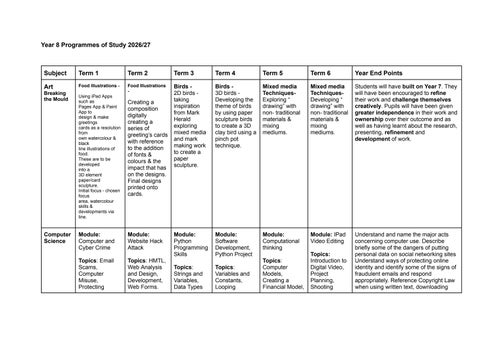
Year 8 Programmes of Study 2026/27
Subject
Term 1
Term 2
Term 3
Term 4
Term 5
Term 6
Year End Points
Art
Food Illustrations -
Food Illustrations -
Birds 2D birds taking inspiration from Mark Herald exploring mixed media and mark making work to create a paper sculpture.
Birds 3D birds Developing the theme of birds by using paper sculpture birds to create a 3D clay bird using a pinch pot technique.
Mixed media TechniquesExploring “ drawing” with non- traditional materials & mixing mediums.
Mixed media TechniquesDeveloping “ drawing” with non- traditional materials & mixing mediums.
Students will have built on Year 7. They will have been encouraged to refine their work and challenge themselves creatively. Pupils will have been given greater independence in their work and ownership over their outcome and as well as having learnt about the research, presenting, refinement and development of work.
Module: Python Programming Skills
Module: Software Development, Python Project
Module: Computational thinking
Module: IPad Video Editing
Understand and name the major acts concerning computer use. Describe briefly some of the dangers of putting personal data on social networking sites Understand ways of protecting online identity and identify some of the signs of fraudulent emails and respond appropriately. Reference Copyright Law when using written text, downloading
Breaking the Mould
Computer Science
Using iPad Apps such as Pages App & Paint App to design & make greetings cards as a resolution from own watercolour & black line illustrations of food. These are to be developed into a 3D element paper/card sculpture. Initial focus - chosen focus area, watercolour skills & developments via line.
Creating a composition digitally creating a series of greeting’s cards with reference to the addition of fonts & colours & the impact that has on the designs. Final designs printed onto cards.
Module: Computer and Cyber Crime
Module: Website Hack Attack
Topics: Email Scams, Computer Misuse, Protecting
Topics: HMTL, Web Analysis and Design, Development, Web Forms.
Topics: Strings and Variables, Data Types
Topics: Variables and Constants, Looping
Topics: Computer Models, Creating a Financial Model,
Topics: Introduction to Digital Video, Project Planning, Shooting
Personal Data, Copyright and Health and Safety Key Skills: Legal safeguards regarding computer use, including overviews of the Computer Misuse Act, Data Protection Act and GDPR and Copyright Law and their implications for computer use. Phishing scams and other email frauds, hacking, “data harvesting” identity theft and safe use of social media are discussed together with ways of protecting online identity and privacy. Health and Safety Law and environmental issues such as the safe disposal
Key Skills: Write HTML code to create a simple web page and display it in a browser. Write CSS to define the styles used in a web page. Create a simple navigation system using HTML. Use a design to create a template for a web page using HTML. Create their own multi-page website. Insert text, images and links on their web pages. MP1: End of Topic Assessment
and Arithmetic, Selection, Iteration, Debugging. Key Skills: Run simple Python programs in Interactive and Script mode. Write pseudocode to outline the steps in an algorithm prior to coding. Write programs using different types of data (e.g. strings and integers). Correctly use different variable types (e.g. integer and floating point), assignment statements, and arithmetic operators. Distinguish between
Conditions, Developing Solutions to Problems Key Skills: Understand the use of variables and constants and when to use one over the other. Using count controlled and conditional loops. Be able to develop a solution to a problem through design and development including pseudocode, data flow diagrams, creating a test plan and selecting appropriate test data.. MP1: End of Topic Assessment
What If Scenarios, Conditional Formatting and Validation, Charts and Analysis. Key Skills: Give examples of how computer models are used in the real world. Format a simple spreadsheet model. Use simple formulae and functions. Name cells in a spreadsheet model. Use a simple spreadsheet model to explore different “what if” scenarios. Create a basic pie chart to display results graphically. Explain what is meant by a financial model
Scenes, Editing and Final Cut. Key Skills: Develop a video to raise awareness of cyber-crime and fraudulent activity. Work as part of a team to complete an appropriate advertisement or movie. Work collaboratively on editing and giving feedback on the work of others. Use of green screen. Show discrimination in selecting accompanying material such as still images, sound effects and background music. Use a range of digital devices. Use video transitions and
music etc. List some of the Health and Safety hazards associated with computer use. Describe how to safely dispose of an old computer in order to minimise impact on the environment. Understand sequence, selection and iteration when constructing programs. Manipulate denary numbers into other number systems through conversions. Be familiar with encryption and the need to protect personal data.
of old computers are also discussed
syntax and logic errors and be able to find and correct both types of error. Describe the purpose of pseudocode in designing algorithms. Use comments to document their programs and explain how they work. Write an error-free, well-documen ted program involving sequence, selection and iteration, but with some help given.
MP1: End of Unit Assessment
MP1: End of Topic Assessment
video effects to improve their movie. Select appropriate material for a specific audience. Combine music and sound effects with moving and still images from different packages and sources into one end product. Add introductory and final pages with appropriate text. MP1: End of Topic Assessment
MP1: End of Topic Assessment Drama
Drama skills Intro to Naturalism
Stage Combat and Script
Macbeth
Missing Person
Frankenstein
Careers in Drama
Overview: Overview:
Overview:
End Points: 1) To extend understanding of skills learnt in Year 7; acting technique and
Overview: -Develop understanding of Naturalistic Drama and its popularity in the C19th -Characterisatio n -Creating a reality -Given Circumstance/ fact and opinion / finding action in the text -Students to self and peer assess
Assessment 1 – Using rehearsal techniques to build a dialogue and character. Practical performance using key techniques.
Overview: -Use of stage combat, using the body, the importance of safe practice, warm-up/cool down -Skill level of focus, observation and strategy -Techniques in theory to practise -Use of timing and communication on stage. -Exploration of use of stage combat in theatre/film -Students to self and peer assess
Assessment 2 – Application of stage combat applied to text and flow of stage combat /script to form assessment.
-Epic scenes and ensemble work -Creating intensity in character and rapport on stage -Exploration of Shakespeare’ s tragedy and use of Shakespeare an language. -Delivery of the text focus on vocal skills. -Application of script to stage techniques -Students to self and peer assess
Assessment 4 –Performanc e of section of Macbeth text,
Overview: -Extend and deepen collaborative and creative skills introduced in year 7. -Develop ability to generate shape and refine ideas as part of a group, using a range of stimuli. -Respond imaginatively and thoughtfully to varied prompts such as text, image, sound or real-world events -Group work to explore different perspectives, negotiation and shared decision-making
Assessment 5 – Practical performance as a response to the story of the
-To explore and understand (read, discuss and perform) the classic text of Frankenstein. -To understand the themes present in the text. - To explore the character in detail using both acting and rehearsal techniques. To work together collaboratively as a group. -Students to self and peer assess
-Inspire and inform students about the wide range of careers available in the performing arts industry. -Develop understanding of professional roles -Build on collaborative skills through practical exploration and reflective learning.
Assessment 6 – Practical assessment of ability to maintain character in a performance and sustain audience attention.
Assessment 7 – Written exam Assessment 8- Practical performance utilising individual roles to create a piece of theatre.
skill is progressed in order to show understanding of how to create a performance from the page to stage. Students will have increased repertoire of performance skills. EG. Vocal skills used in Radio Drama in Yr 7 is utilised and honed when working on Naturalism term 1 Yr 8. The skills of diction, pause, pace are skills in Radio Drama that are built upon to create Naturalistic characterisation in Term 1 of Year 8. 2) Collaborative skills show confidence and logistics of group work skills. How to communicate well with others is evident. 3) Performance stimuli and creation of work shows knowledge of range of cultures and influences in theatre.
Drama Reason for SoW
Recap of last year Transferable skills – helpful for confidence, team building, decision making. Character building – voice, movement, interaction. Use of rehearsal techniques Placement of SOW – To recap and revise knowledge from last year.
Assessment 3- Written exam
showing range of characterisati ons and interpretation of the text.
‘missing person’.
Explore how a script is written (stage directions etc.) Explore physical communication and non-verbal communication Build on acting and directing techniques To reflect on and evaluate performances.
To understand, read and perform Shakespeare. To explore character (voice/movem ent /interaction) Rehearsal techniques – develop further.
Develop understanding of character development through practical and creative exploration of one character’s journey throughout a term. Build core devising skills such as still-image, thought-tracking and responding to a variety of stimuli Promote group collaboration and creative thinking
Placement of SOW – to gain a better understanding of non-verbal communication and precision of movement. Use of stage combat in creative industries today
Placement of SOW – to build upon study of Shakespeare text from year 7. Enhancing cultural
To explore a classic text written in C19th by female writer To gain confidence with a challenging text. To explore themes of loss, isolation, betrayal and societal pressures. To look at adaptations of the story (National Theatre Danny Boyle’s version) Placement of SOW - To complete year with study of a well-known classic text and utilising drama skills learnt throughout KS3.
Provide students with a deeper understanding of the diverse professional opportunities within the performing arts industry. Broaden understanding to include a variety of creative, technical and managerial roles in theatre. Support early career education by linking curriculum learning with
(theatre/film/ad vertising)
English
The Gothic Aim: To introduce students to the gothic genre in preparation for their 19th century novel at GCSE and to develop their analytical skills acquired in Year 7. To help students understand gothic women stereotypes and how they engage with contemporary views.
knowledge of Elizabethan context and Shakespeare’ s influences.
Placement of SOW- Between schemed that focus on traditional texts (Shakespeare and Frankenstein), offering students the opportunity to create their own text within performances.
A Christmas Carol
Travel Writing
Crime and Punishment
Aim: To consolidate prior knowledge of Dickens and his writing and apply the skills used to an entire novel/ to teach a whole GCSE text in preparation for KS4. To develop students’ understanding of cultural and contextual
Aim: To examine the genre and techniques of travel writing to describe/ente rtain/persuad e in prep for GCSE Lang. To understand the skills used for advertising and look a range of contemporary
AIM: To study a range of fiction and non-fiction texts which deal with themes of crime and punishment. To discuss and debate issues of racism, criminality, morality, justice and punishment.
the world of work. Placement of SOW- Place in term 6 just ahead of year 9, at a time when students are beginning to consider routes to their desired future careers. Macbeth AIM: To study the play in depth by watching a Globe production as well as reading the play text. To develop an appreciation of Shakespeare and make links between the play and modern issues e.g. tyrannical rule. To discuss and debate
Culture and Identity Poetry Aim: To introduce to unseen poetry in preparation for Lit Paper 2. To develop an appreciation of different cultures, experiences, attitudes and how these- as well as the poet’s genderimpact their writing.
Reading: Clearly explain effect of linguistic and structural features, zooming in to writers’ methods and commenting on how writer’s choices produce meanings. Be able to explain inferred meanings clearly and confidently, exploring alternative interpretations (including polysemy, symbolism). Clearly compare two writers’ viewpoints, attitudes and the techniques they use to express their ideas. Be confident in reading and interpreting challenging texts, including Shakespeare. Develop appreciation of depth of meaning and the writer’s intentions. Be able to link meanings and ideas in literary texts to specific contextual factors and apply wider knowledge and enhance cultural capital.
Skills: Close textual analysis/ appreciation and effect of context/ aspects of structure and understanding how tension is built- emulating style.
influences on morality and social responsibility. (Writing novels/ short stories for newspapers/tel evision).
non-fiction writers, inspiring students to travel and explore and add cultural capital.
Skills: Essay writing/ evaluating and developing critical response/ close textual analysis/ appreciation and effect of context/ aspects of structure (hitting the same AOs needed for KS4).
Skills: Writing to argue/persua de/ discriminating between and understandin g different attitudes and perspectives.
KEY SKILLS: Identifying language and format features. Explaining the effects of language and structure on meaning. Planning and writing skills. Technical accuracy. Persuasive rhetoric. CAREER LINKS: Journalism, law, ethics, politics, ethical science, social work, advocacy. READING: Termly reading lists issued. Fortnightly reading lessons. All are encouraged to read for read for 20 mins per day
issues and ideas raised by the play. KEY SKILLS: Identifying key dramatic methods as well as language features. Explaining the effects of language and structure on meaning. Non-fiction (opinion article) writing based on study of the play. Technical accuracy. CAREER LINKS: Journalism and content production, TV, charity organisations, finance, social work, law READING: Termly reading lists
Skills: To develop practical skills in annotation and analysis. To remind students of prior learning at KS2 and develop on understanding of poetic techniques.
Writing: Write technically precise responses with a controlled range of vocabulary, sentence forms, grammatical constructions, and accurate spelling of ambitious vocabulary for a wide range of purposes and audiences. Thoughtfully explore characterisation, setting and other narrative features when devising their own creative work, reflecting on feedback and re-drafting to improve. Oracy: -Pupils will be confident with identifying and delivering features of a persuasive speech. •listens to questions / feedback, responds thoughtfully and if appropriate contribute further ideas and information.
issued. Fortnightly reading lessons. All are encouraged to read for read for 20 mins per day
Geography
Urbanisation Growth of settlements. Urban land use in AC and LIDC cities. Challenges of urban areas. Creating sustainable urban areas. Fieldwork
Coastal Landscapes Coastal processes; formation of wave-cut platforms, stacks and spits; Coastal management
Population and Migration Causes of population growth. Patterns of life expectancy. Causes and impacts of migration.
Hydrology & Flooding
Geography of Africa
Water Cycle. Causes of flooding. Hydrographs. Impacts of flooding. Management of floods.
Key locations. Characteristics of Eastern Africa; Physical Geography: climate and biomes. Influence of physical geography on aspects of life e.g. tourism, piracy
International Development
● ● ●
Variations in global development. Causes of variations.
●
●
●
●
●
Understand how and why populations change over time. Understand the causes and effects of internal and international migration. Understand how geomorphological processes and geology create varied coastal landscapes and that these short term changes need to be managed in a sustainable manner. Understand how urban areas have grown, the resulting characteristics and how urban areas can be improved sustainably. Understand how changes in the hydrological cycle and human activity cause flooding. Understand how the impacts and responses to flooding vary between countries. Understand the characteristics and locations of selected ecosystems / biomes such as coral reefs, hot deserts, tropical grasslands. Understand how economic activities can be dependent on physical factors (farming in Africa, tourism in Kenya, piracy in
● ●
● ●
● ●
● ●
●
History
Topics: Dangers of Tudor England
Topics: The Industrial Revolution
Enquiry question: How dangerous was Tudor England?
Enquiry question: How revolutionary was the Industrial Revolution?
Content: Religious conflict between Protestants & Catholics,
Content: Social conditions of
Topics: Growth, morality & resistance towards the British Empire Enquiry question: How were people affected by the British Empire?
Topics: Transatlantic slave trade Enquiry question: How did people resist the slave trade? Content: Origins of slavery, experiences of
Topics: Thematic study of multicultural Britain
Topics: Votes for women
Enquiry question: Has Britain always had a global identity?
Enquiry question: How did women achieve political suffrage?
Content: Roman to medieval
Content: Tactics of Suffragists &
Somalia) and international links (tourism, Chinese investment in Africa). Know how and why development levels vary. Know the physical and human characteristics of Africa and factors influencing these characteristics. Know the key locations in the Middle East. In groups, know how to plan and complete a fieldwork investigation within the school grounds. Know how to use OS map evidence to describe landscape features. Know how to describe, present and/or analyse geographical data using more complex techniques. Know how to provide partly developed explanations for geographical features. Analyse geographical issues by referring to social, economic and environmental features. Apply geographical knowledge in order to make balanced judgements.
To understand how society changed due to the challenges it faced, including reasons for this change. Evaluate the reasons for change (eg religion), starting to differentiate between short & long term causes & consequences. Able to write PEE paragraphs, with a wider range of evidence being used & links made between paragraphs.
Witchcraft, Gunpowder Plot Assessment: How dangerous was Tudor England? Skills: Sources & interpretations Cultural Capital: Minorities in the Early Modern Era, Reformation, Religious intolerance, witchcraft & patriarchy, Black Tudors experience
the Industrial Revolution, Urbanisation, Public Health, Crime & Jack the Ripper Assessment: Did the Industrial Revolution make life better for ordinary people? Skills: Nature & extent of change Cultural Capital includes: Technology and new inventions, Cultural/ political impact of urbanisation, Impact of industrial past on Britain today, government intervention in crime & public health
Content: Development of Empire, Impacts on Britain & colonies, British in India, legacy of Empire Assessment: Mid year exam Skills: Consequence s & impacts Cultural Capital includes: Legacy of the British Empire, Exploitative nature of imperialism, How the Empire has added to Britain’s culture today, Morality of cultural appropriation.
slavery, slave resistance, impact on South West England, campaign for abolition.
migration groups, Irish migration, British empire & post WW2 migration
Assessment: What caused the abolition of the slave trade?
Assessment: What impact have migrants had on British history? (TBC)
Skills: Significance & causation Cultural Capital includes: Experiences of Slavery, Olaudah Equiano, Black abolitionists, legacy of slavery today across the world and locally, Colston Statue debate
Skills: Thematic study of change Cultural Capital: Push/pull factors of migration, political/religious refugees, minorities in British history, Windrush generation & economic migrants post WW2
suffragettes, death of Emily Davison, role of women in WW1, short & long term causes of WW1 Assessment: Summer exam Skills: Causation Cultural Capital includes: Importance of extending the political franchise, tactics used to cause political change, women’s role in the WW1, Traditional gender stereotypes
To analyse the content of sources and draw conclusions about one aspect of provenance. To appreciate there are several aspects of significance to explain the cause of events.
Maths
Number Prime factors, HCF and LCM Estimation and errors Recurring decimals Rules of indices Standard form Non-Calculator assessment (will contain year 7 content)
MFL French
Holidays How do you form the past tense? Skills: Describing your summer holiday (normally, last year, next year, ideal holiday).
Algebraic Thinking Literacy Investigation Expanding single and double brackets Identities Solving equations with unknowns on both sides Sample space diagrams Venn Diagrams and Tree Diagrams
Daily routine and clothes What is a reflexive verb? Skills: Describing our daily routine and clothes. Talking about
Graphs
Shape
Pythagoras Inequalities Calculator assessment Y=mx+c Solving inequalities Changing the subject Non-Calc reverse percentages Compound Interest
Parallel Lines Angles in Polygons Introduction to Trigonometry (SOHCAHTOA) Ratio
Festivals and Health How do French people celebrate?
Food and Drink What is a modal verb?
Skills: Describing French festivals and
Skills: Describing food and mealtimes. Arranging to visit a restaurant or
Investigating Data Rotation Reflection Enlargement Describing Transformations Nth term rule Different types of sequences Collecting Data Averages from frequency tables Pie Charts Scatter Graphs
My interests What is a pronoun? Skills: Describing film and television genres and preferences. Talking about musical
Mensuration EOY Exams Non-Calculat or & Calculator assessment Percentage Multipliers Compound interest Understanding bank accounts Area and perimeter Circles Volume & Surface Area of Prisms
✓ Find the HCF and LCM using product of primes and a Venn diagram ✓ Use the laws of indices for multiplication, division, and power to a power ✓ Understand and convert standard form ✓ Expand two brackets using FOIL ✓ Create a solve equations and inequalities which includes division ✓ Change the subject of a formula when two steps are required ✓ Draw and use a simple probability tree diagram ✓ Find a probability from a Venn diagram ✓ Describe and draw the four transformations ✓ Use Pythagoras with multistep problems ✓ Use SOHCAHTOA to find a length or angle ✓ Calculate mean from a frequency table ✓ Draw and use a line of best fit on a scatter graph and describe correlation ✓ Use and understand y=mx+c
Summer Project
By the end of year 8, students will be able to…
Skills: Summer tourism project in which students write an email requesting information
…express their opinions and justify them on the topics of holidays, festivals, health, food and drink and film, TV and music. …conjugate verbs in the past, present and near future tenses, using a variety of time phrases
Describing the weather, seasons and holiday activities. Grammar: The perfect tense of -er, ir & re verbs using avoir and être. Recapping present and near future tense. Assessment: Grammar and Vocabulary Quiz, Listening
going out and making excuses. Grammar: Reflexive verbs in the present tense. Recapping adjective agreement including adjectives before nouns. Using modal verbs. Assessment: Grammar and Vocabulary Quiz, Speaking, Mid-Year Exam
MFL German
Holidays How do you form the perfect tense? Skills: Describing your summer holiday, transport and holiday activities, holiday destinations,
Daily Routine and clothes What is a separable verb and how are they used? Skills: Talking about daily routine, clothes and fashion, preparing for
celebrations. Describing illnesses and accidents and offering advice. Grammar: Using a wider range of modal verbs. Using avoir mal à. Recapping prepositions. Assessment: Grammar and Vocabulary Quiz, Translation
Festivals and Health When do you need an adjective ending and what endings are there? Skills: Body parts, illlnesses: ich
café and saying what went wrong. Discussing healthy eating. Grammar: Recapping the partitive article. Using manger and boire in 3 tenses. Using negative structures. Asking and answering questions. Assessment: Grammar and Vocabulary Quiz, Translation Food and Drink What is a modal verb and how are they used? Skills: Talking about food, drink and preferences, ordering at the market/restaura
instruments and music preferences. Grammar: Consolidating opinion verbs in 3 tenses. Use of depuis + present tense. Use of comparatives and superlatives. Assessment: Grammar and Vocabulary Quiz, Speaking
Interests What is a verb kicker and how are they used? Skills: Film and television genres and preferences, musical instruments and music preferences.
and complete a peer assessed photocard on holidays.
…understand the use of modal verbs and reflexive verbs. …understand and respond to role play prompts accurately.
Grammar: Consolidation of key grammar from Y8. Assessment: End of Year 8 Exam, Speaking
Summer Project What is the format of a role play? Transactional language and role plays using key skills from Y8 in real-life contexts.
By the end of year 8, students will be able to… …express their opinions and justify them on the topics of holidays, daily routine, festivals, food and drink and film and TV. …conjugate verbs in the past, present and future tenses, using a variety of time phrases
weather, accommodation. Grammar: The perfect tense, use of war and gab, time/manner/pla ce word order rules, mit + dative case Assessment: Grammar and Vocabulary Quiz, Listening
MFL Spanish
Holidays How do you form the preterite tense? Skills: Describing your summer holiday (normally last year, next year, ideal holiday). Describing the weather,
and going out, describing festivals and cultural events. Grammar: Separable verbs, reflexive verbs, future tense, consolidation of adjective endings. Assessment: Grammar and Vocabulary Quiz, Speaking
habe Kopfschmerz en / ich fühle mich), role plays at the hospital, advice using modal verbs. Grammar: tut/tun mir weh, seit + time, modal verbs must/should + infinitives, revise verb second idea.
Mid-year exam
Assessment: Grammar and Vocabulary Quiz, Translation
Daily Routine and clothes What is a reflexive verb?
Festivals and Health How do Spanish people celebrate?
Skills: Describing our daily routine, clothes. Talking about going out and making excuses.
Skills: Describing Spanish festivals and celebrations. Describing
nt, talking about sport and healthy lifestyle. Grammar: Consolidation of three tenses together, introduce möchte + infinitive, revise subordinating conjunctions.
Grammar: Consolidation of three tenses and gern/lieber/am liebsten. Assessment: Grammar and Vocabulary Quiz, Speaking
Summer project in which students write an email requesting information.
…understand the use of modal verbs, reflexive verbs and separable verbs including associated word order rules. …understand and respond to role play prompts accurately.
Assessment: Speaking End of Year Exam
Assessment: Grammar and Vocabulary Quiz, Reading
Food and Drink What is a modal verb?
My Interests How do you present continuous?
Summer Project
Skills: Describing food and mealtimes. Arranging to visit a restaurant or cafe and saying what went
Skills: Describing film and television genres and preferences. Talking about musical instruments and
Summer tourism project in which students write an email requesting information and complete
Skills:
By the end of year 8, students will be able to… …express their opinions and justify them on the topics of holidays, festivals, health, food and drink and film and TV and music. …conjugate verbs in the past, present and future tenses, using a variety of time phrases …understand the use of modal verbs, reflexive verbs.
seasons and holiday activities. Transport and holiday activities. Grammar: The preterite tense including the irregular verb IR. Recapping present and near future tense. Using comparatives.
Music
Grammar: Reflexive verbs in the present tense. Recapping adjective agreement. Using comparatives and superlatives. Using modal verbs.
Assessment: Grammar and Vocabulary Quiz, Listening.
Assessment: Grammar and Vocabulary Quiz,Speaking, Mid-Year Exam
Melody. Harmony & Rhythm (Fanfares)
Melody. Harmony & Rhythm (Fanfares) For 3 weeks followed by
Skills: 1.1 Understanding primary chords 1.2 Developing understanding of staff/Tab notation 1.3 Developing instrumental skill and fluency on
Variations. Structure, Melody, Improvisation (Variations) Skills: Continuing to develop and
illnesses and accidents and offering advice Grammar: Using a wider range of modal verbs. Using impersonal verbs like me duele. Recapping prepositions.. Assessment: Grammar and Vocabulary Quiz, Translation Variations. Structure, Melody, Improvisation
(Variations) For 3 weeks, followed by Tonality, Improvisation,
Chords (Blues and Jazz) Skills:
wrong. Discussing healthy eating. Grammar: Recapping use of 3 tenses. Using negative structures. Asking and answering questions. Assessment: Grammar and Vocabulary Quiz, Translation
Tonality, Improvisation, Chords (Blues and Jazz) For 3 weeks, followed by Texture, Timbre, Articulation, Dynamics, Polyrhythms (Indian Classical
music preferences. Grammar: Consolidation opinion verbs in 3 tenses, including plurals. Use of desde hace + present tense. Assessment: Grammar and Vocabulary Quiz and Speaking.
Texture, Timbre, Articulation, Dynamics, Polyrhythms (Indian Classical Music/African Drumming) For 3 weeks, followed by Preparation and revision
a peer assessed photocard on holidays.
…understand and respond to role play prompts accurately.
Grammar: Consolidation of key grammar of Y8 Assessment: End of Year 8 Exam
1.1 Skills review 1.2 1.3 Following the results of Term 5 assessment/ 1.4 End of Year exam: 1.5 1.6 Skills: Specific skills based
ENDPOINTS: Ability to perform a fanfare on the keyboard with good fluency and technique Ability to compose a fanfare using Musescore 3 and a range of techniques Ability to recognise the key features of a fanfare through listening and also understand cultural importance. Ability to develop instrumental and singing performance skills (both solo and ensemble) Ability to sing a range of songs in parts with increasing technical skills, secure intonation and expression
keyboard/ukulele /guitar/untuned percussion 1.5 How to play in an ensemble 1.6 Recognising different rhythms/dotted notes/triplets 1.7 Developing Listening and appraising skills and technical ability to identify the musical elements (understanding what makes a good melody, how rhythm and harmony are used in a piece of music) 1.8 Developing singing skills with a sense of ensemble and performance (phrasing/pitchin g/dynamics) 1.9 Developing compositional skills using chords, melodic development, staff notation and music technology
refine skills learnt in Term 1
Skills: 1.1 Learn how to compose variations in a piece of music using contrasts of texture, rhythm, tonality and tempo and compositional techniques 1.2 Developing instrumental skills and fluency on ukulele/guitar/ untuned percussion and keyboards by performing themes/ variations 1.3 Learn how to improvise variations within a djembe ensemble 1.4 Developing singing skills with a sense of ensemble and performance
Continuing to develop and refine skills learnt in Term 2 Skills: 1.1 Understandin g of the 12 bar blues structure 1.2 Learning how to improvise using the Blues scale 1.3 Understanding
the contextual features of the Blues/Jazz 1.4 Understanding
chromaticism 1.5 Developing performance fluency on keyboards, ukuleles and guitars 1.6 Learning how to composing a piece in a Blues style
Music/African Drumming)
for the Y8 End of Year Exam
Skills: Continuing to develop and refine skills learnt in Term 2
Skills: Continuing to develop and refine skills learnt in Term 4
Skills: 1.1 Developing
End of Term 5 assessment:
performance
ensemble skills and fluency, through Indian and African performanc e tasks 1.2 Developing an understandi ng of how texture is varied and used within these two musical genres 1.3 Developing an understandi ng of how
Revision/ Theory and Performance tests END OF YEAR Y8 EXAM
Performa nce 1.7 Composit ion 1.8 Listening 1.9 Theory tasks 1.10 To ensure all skills are embedded
and refined. End of term 6 assessment
Skills based tests (as above)
Ability to compose a piece using Variations on Musescore 3 Ability to perform a Theme and Variations on the keyboard Ability to perform an instrumental part in a Ground Bass and understand how to develop a melody. Ability to understand how the concept of variations work within a piece of music from the Classical period Ability to improve and refine performance skills on keyboard, ukulele and singing (solo/ensemble) Deep understanding of how structure, improvisation and chords are used within music Ability to understand the role of music and the culture history of slavery/development of blues and jazz. Ability to perform a blues inspired piece of music using appropriate chord patterns and musical devices with fluency Ability to improvise using the blues scale in an ensemble performance Ability to improve and refine performance skills on keyboard, ukulele and singing (solo/ensemble) Ability to sing a range of songs in parts with increasing technical skills, secure intonation and expression Deep understanding of how texture, articulation, dynamics and polyrhythms are used within music Understanding of the role of Music in India and Africa, the cultural aspects, key features and instruments
Practical (5 weeks) 1.1 Rhythmic awareness and revisiting. 1.2 Instrumental skill: keyboard/uk ulele/untune d percussion 1.3 Performing fanfares on the keyboard 1.4 Compose chord sequences on the ukulele/keyboard or guitar 1.5 Just play lessons/In the hall of the mountain king practical ensemble performance. 1.6 Singing a range of songs (from MMC Y8) 1.7 Reading staff notation/ukulele/ guitar TAB
(phrasing/pitchi ng/dynamics) 1.5 Developing listening skills and the technical ability to recognise the key features/purpos e of the music 1.6 Revising “Just play” ensemble performance pieces to refine and improve. Topics: 1.1 “Twinkle Twinkle little Star” performance/ composition task using keyboards and Music technology 1.2 “Faded” Keyboard performance/ variations task 1.3 Rhythmic “theme and variations” improvisation ensembles task using
using music technology (Garageband) 1.7 Learning to perform a piece of Ragtime using the keyboard Topics: 1.1 Performin g the chords of the 12 bar blues (including sevenths) , walking bass and syncopated
patterns 1.2 Listening to a range of blues inspired pieces and understa nding the stylistic features
polyrhythms are used to create repetition and contrast in music 1.4 Using dynamics and articulation to show contrast. 1.5 Utilising improvisatio n to develop a musical idea 1.6 Developing instrumenta l skills on keyboard and djembes 1.7 Learning and understandi ng the purpose and context of Indian Classical and African drumming
Ability to perform a raga and a tala and use improvisation to compose a piece inspired by the main features of Indian Music Ability to perform, improvise and compose an African inspired percussion piece Ability to use Music technology (Musescore 3) to compose an Indian piece of music Ability to listen to an Indian piece of music and understand the key features using a more detailed technical vocabulary loo Ability to sing a range of songs in parts with increasing technical skills, secure intonation and expression
ORCHESTRAL INSTRUMENT SMALL GROUP TASTER SESSIONS (20 MINS PER PRACTICAL LESSON) WHEN AVAILABLE Topics: 1.1 Fanfare composition and performance (keyboards) 1.2 Just Play – use of chords and melody, timing and pulse/instrument al performance skill 1.3 Chair drumming/classr oom rhythms with untuned percussion 1.4 Aural dictation and MADTSHIRT listening. Composition & Aural (5 weeks) 1.1 Composing a fanfare for ceremony. AABA
Djembes 1.3 Aural perception tasks (melody dictation with wider intervals and more challenging rhythms) 1.4 – Listening tasks (including analysis of Mozart’s variations) and Y8 MMC listening list using MADSHIRT Breakdown of 10-week term Practical (5 weeks) 1.1 “Twinkle Twinkle little star” performance and variations on keyboard 1.2 Djembe ensembles including improvisation (creating variations to
and context. 1.2 Performing “In the mood” in pairs on the keyboard 1.3 Performing “The Entertainer” and learning about the context of “Ragtime” 1.4 Aural perception tasks using the blues scale/melodic and rhythmic dictation using syncopation 1.5 Composing a blues inspired piece using a DAW (Garageband) 1.6 Revising “Just play” ensemble performance pieces to refine and improve.
1.8 Composing using Indian ragas and African rhythms Topics Performing and improvising using the Vibhas (and related) ragas using keyboards/ untuned percussion Performing and improvising using the African “call and response” rhythm grid and the “African Hatsiatsia" Listening to a range of Indian Classical music and African
structure, repetition, Call and response, imitation 1.2 Developing skills of Technology (using Musescore/ Garageband ) 1.3 Composing a melody using root notes from primary chords and staff notation 1.4 Developing aural skills by writing down melodies using staff notation/usin g FOS lessons Listening/appra ising 1.5 Do it now/Listenin g starters: using MMC Y8 list
ostinato patterns/perfor mance pieces) 1.3 “Faded” theme performance and improvising variations on the keyboard. 1.4 Revisiting and refining Just play lessons/In the hall of the mountain king/Game of Thrones (refine ensembles) 1.5 Understanding the concept of “Ground bass”. Performing Pachebel’s Canon 1.5 Singing a range of songs (from MMC Y8) ORCHESTRAL INSTRUMENT SMALL GROUP TASTER
Breakdown of 10-week term Practical (5 weeks) 1.3 Performin g a 12 bar blues chord pattern, seventh chords and walking bass on keyboard s (plus ukuleles/ guitar/dru ms if time) 1.4 Learning the blues scale in C major and then learning how to improvise over the chord pattern
drumming pieces, understandi ng the structure, musical elements and purpose Composing a piece using music technology and keyboards using raga/tala/Af rican polyrhythms /rhythm grids 1.6 Revising “Just play” ensemble performance pieces to refine and improve.
Breakdown of 10-week term
(developing technical ability to recognise the musical elements/de veloping understandi ng/purpose) 1.6 Focus on sound theory lessons (using MMC guidance for Y8) Talk 4 learning/Oracy: questioning/peer assessing/ discussion Metacognition: planning/ organising performances Collaboration: Teamwork Feedback: verbal/whole
SESSIONS (20 MINS PER PRACTICAL LESSON) WHEN AVAILABLE Composition & Aural (5 weeks) 1.1 Composing a set of Variations on “Twinkle Twinkle little star” using a range of compositional techniques 1.2 Focus on sound – Focus on sound theory lessons (using MMC guidance for Y8) 1.3 Composition of a Ground bass and variations 1.3 Aural dictation (melodic dictation 1.4 Using Music technology
1.5 Performin g the 12 bar blues as a whole class 1.2 Revisiting and refining Just play lessons/I n the hall of the mountain king/ 1.3 Game of Thrones (refine ensemble s) 1.4 Singing a range of songs (from MMC Y8)
Composition & Aural (5 weeks) 1.6 Composi ng a blues inspired
Practical (5 weeks) 1.1 Performing “Vibhas” raga on keyboards in four sections, using the Alap/Jhor/J halla/Gat structure and adding a Tala on untuned percussion (groups of 2) 1.2 Performing “African call and response rhythms” and “African Hatsiatsia" in groups of 4, showing excellent fluency, ensemble, expression, timing and use of dynamics.
class/peer assessment/ skills trackers Literacy: musical keywords Music technology skills
END OF TERM 1 ASSESSMENT: 1.Performance progress on keyboard/ukelele s: fanfares and Just Play (student assessed) 2.Fanfare composition (teacher assessed) 3.Listening tasks based on fanfares (student peer assessed) 4.FOS lessons End of term 1 assessment:
(Musescore and Garageband) to compose a set of variations Listening/appra ising 1.5 Do it now/Listening starters: using MMC Y8 list (developing technical ability to recognise the musical elements/devel oping understanding/ purpose) 1.6 Listening to examples of variations/grou nd bass and understanding the key compositional features 1.7 Focus on sound theory lessons (using MMC guidance for Y8)
piece for piano, electric guitar, bass guitar and drum kit using Garageb and. The compositi on will feature a range of Blues compositi onal features 1.7 Aural tasks featuring the blues scale (melody dictation/ blues scale/syn copated rhythms) Listening/ap praising 1.8 Listening to a
1.3 Revisiting and refining “Just play” ensemble performanc e pieces to refine and improve. (add another new piece if time) 1.4 Singing a range of songs (from MMC Y8)
Composition and Aural (5 weeks) 1.1 Composing a piece of Indian Classical inspired music using a raga/tala (keyboards/ untuned percussion/ music technology) 1.2 Composing a piece of
Performance: African drumming – perform own part within group task based upon rhythmic grid (teacher assessed) (Week 10) class ensemble Respond to a Graphic score Developed singing skills reading from notation. Recognising Melody and harmony parts through deliberate listening Aural dictation exercise completed with confidence
Talk 4 learning/Oracy: questioning/pe er assessing/ discussion Metacognition : planning/ organising performances Collaboration: Teamwork Feedback: verbal/whole class/peer assessment/ skills trackers Literacy: musical keywords Music technology skills
DECEMBER: WRITTEN
range of blues/jaz z inspired pieces and developing
the technical ability to recognise the key features 1.9 Listening starters: using MMC Y8 list (developi ng technical ability to recognise the musical elements/ developin g understa nding/pur pose) 1.10 Focu s on sound theory lessons
African Drumming using a rhythm grid (Djembes) 1.3 Aural tasks based upon rhythms and Indian ragas Listening/appr aising 1.4 Listening starters: using MMC Y8 list (developing technical ability to recognise the musical elements/devel oping understanding/p urpose) Focus on sound theory lessons (using MMC guidance for Y8)
Composition variation in Major and Minor keys (Twinkle Twinkle) (week 10)
MID YEAR TEST ~(THEORY/
Group performance of ‘Game of Thrones (week 10)
END OF TERM 2 ASSESSMENT : 1.Performance progress on keyboards/ukul eles: Just Play and Variations performance pieces (students assessed) 2.Variations composition (teacher assessed 3.Listening tasks based on variations (student peer assessed) FOS lessons
Accurate recognition of instruments and instrumental groups Confident understanding of the types of instrumental ensembles Well informed understanding of various textural types in compositions A successful composition using a defined texture Performance of a folk music piece End of term 4 assessment
LISTENING)
(using MMC guidance for Y8) Talk 4 learning/ Oracy: questioning/ peer assessing/ discussion Metacognition
: planning/ organising performances Collaboration:
Teamwork Feedback: verbal/whole class/peer assessment/ skills trackers Literacy: musical keywords
Topics: 1.1 “Twinkle Twinkle little star”performanc e/composition task using keyboards and Music technology 1.2 “Faded” Keyboard performance/va riations task 1.3 Rhythmic “theme and variations” improvisation ensembles task using Djembes 1.3 Aural perception tasks (melody dictation with wider intervals and more challenging rhythms)
Performance of a folk music piece as a class ensemble (eg Wellerman song) (Week 8) Listening exercises Fanfares: Fanfare of the Common Man and Olympic fanfare (week 5) Young Persons Guide to the Orchestra listening test (week 8) Composing Polyphonic or Homophonic composition on Musescore (Week 8) THE CRYPT SCHOOL: PROGRAMME OF STUDY: MUSIC, 2022-2023
Music technology skills (teacher assessed)ton ality and tempo and compositional techniques 1.2 Developing instrumental skills and fluency on ukulele/guitar/ untuned percussion and keyboards by performing themes/variati ons 1.3 Learn how to improvise variations within a djembe ensemble 1.4 Developing singing skills with a sense of ensemble and performance (phrasing/pitc
1.4 – Listening tasks (including analysis of Mozart’s variations) and Y8 MMC listening list using MADSHIRT ORCHESTRAL INSTRUMENT SMALL GROUP TASTER SESSIONS (20 MINS PER PRACTICAL LESSON) WHEN AVAILABLE Composition & Aural (5 weeks) 1.1 Composing a set of Variations on “Twinkle Twinkle little star” using a range of compositional techniques 1.2 Focus on sound – Focus on sound theory lessons (using
Notation test (Focus on sound/theory worksheets from Musical contexts) (Week 5) Composing: Rhythmic composition using Musescore 3 or Garageband using a rhythm grid (devised in performance class) to compose for Samba kit. (Peer assessed) Week 10 Listening: deliberate listening test focusing on rhythm and pulse primarily (Week 5)
hing/dynamic s) 1.5 Developing listening skills and the technical ability to recognise the key features/purp ose of the music 1.6 Revising “Just play” ensemble performance pieces to refine and improve. Topics: 1.1 “Twinkle Twinkle little star”performa nce/compositi on task using keyboards and Music technology 1.2 “Faded” Keyboard performance/ variations task 1.3 Rhythmic “theme and variations”
MMC guidance for Y8) 1.3 Composition of a Ground bass and variations 1.3 Aural dictation (melodic dictation 1.4 Using Music technology (Musescore and Garageband) to compose a set of variations Listening/appr aising 1.5 Do it now/Listeni ng starters: using MMC Y8 list (developing technical ability to recognise the musical elements/de veloping understandi ng/purpose) 1.6 Listening to examples of variations/gr
improvisation ensembles task using Djembes 1.3 Aural perception tasks (melody dictation with wider intervals and more challenging rhythms) 1.4 – Listening tasks (including analysis of Mozart’s variations) and Y8 MMC listening list using MADSHIRT ORCHESTR AL INSTRUMEN T SMALL GROUP TASTER SESSIONS (20 MINS PER PRACTICAL LESSON) WHEN AVAILABLE
ound bass and understandi ng the key composition al features 1.7 Focus on sound theory lessons (using MMC guidance for Y8) END OF TERM 4 ASSESSMENT: 1.Performance progress on keyboard/ ukeleles: 2.Just Play progress so far (teacher assessed) 3.Listening tasks based on fanfares (student peer assessed) 4.FOS lessons
Composition & Aural (5 weeks) 1.1 Composing a set of Variations on “Twinkle Twinkle little star” using a range of compositional techniques 1.2 Focus on sound – Focus on sound theory lessons (using MMC guidance for Y8) 1.3 Composition of a Ground bass and variations 1.3 Aural dictation (melodic dictation 1.4 Using Music technology (Musescore and Garageband)
to compose a set of variations Listening/ appraising 1.5 Do it now/ 1.6 Listening starters: using MMC Y8 list (developi ng technical ability to recognise the musical elements/ developin g understa nding/pur pose) 1.7 Listening to examples of variations /ground bass and understa nding the
key compositi onal features 1.8 Focus on sound theory lessons (using MMC guidance for Y8)
MID YEAR LISTENING EXAM (teacher assessed) END OF TERM 4 ASSESSME NT: 1.Performanc e progress on keyboard/ukel eles: Breakdown of 10-week term Practical (5 weeks)
1.1 “Twinkle Twinkle little star” performance and variations on keyboard 1.2 Djembe ensembles including improvisation (creating variations to ostinato patterns/perfo rmance pieces) 1.3 “Faded” theme performance and improvising variations on the keyboard. 1.4 Revisiting and refining Just play lessons/In the hall of the mountain king/Game of Thrones (refine ensembles) 1.5 Understanding
the concept of “Ground bass”.
Performing Pachebel’s Canon 1.5 Singing a range of songs (from MMC Y8) END OF TERM 3 ASSESSME NT: 1.Performanc e progress on keyboard/ ukeleles: fanfares and Just PLay (student assessed) 2.Blues composition (teacher assessed) 3.Listening tasks based on fanfares (student peer assessed) 4.FOS lessons PD 3 lessons per fortnight
The online world
Healthy & unhealthy relationships
Personal safety & managing risk
Health & wellbeing
Belonging & community
Managing money
Students will have recognised how their behaviour can be manipulated online, through algorithms and targeted content. They will have assessed how
online platforms generate income through users. They will have been introduced to a range of relationship issues facing young people, including harassment, image- sharing and generated violence, and how to get support. They will have assessed risk and support their personal safety in a range of contexts, including on the roads, around water and in relation to alcohol and other drugs. They will have developed decision-making skills that support a healthy lifestyle and their wellbeing: from considerations about food, exercise and sleep, to assessing the impact of climate change on young people’s well-being. They will have focused on creating respectful and cohesive communities, to recognise and challenge bias, stereotypes and discrimination and promote inclusion. They will have explored aspects of daily economic wellbeing, such as managing bank accounts and different ways of saving and borrowing. RSY8 (AQA Short Course GCSE) Content
Christianity & Forgiveness Should Christians always forgive? We approach this through beliefs about the nature of
Christianity and Social Justice How have Christians put Jesus’ teachings into action? We will study Jesus’
Buddhism and suffering Can we escape suffering? A critical comparison of Buddhist views
Islamic Values What is the most important pillar in Islam? Students form their own judgements, based on the
Revision, exam, feedback and improvement Focus on exam technique and timing
Multicultural Britain What effect does religious diversity have on those following the
Students should be able to explain and critically evaluate a range of religious and non-religious views on: - The importance of forgiveness - The duty to promote social justice - Causes and responses to suffering - The relative importance of religious
Science Biology Chemistry Physics
God, Creation and The Fall, the problem of evil, and Jesus’ role in salvation.
life and teachings, and the different ways Christians have applied them to social issues.
with the Christian beliefs studied in term 1, along with any other views you want to consider..
Islamic beliefs and practices studied in lessons
Topics:
Topics:
Topics:
Topics:
Topics:
Topics:
P4 Electricity and Magnetism
B4 Gas Exchange and Health
B5 Inheritance
C6 Our Atmosphere & Us
B6 Photosynthesi s
B7 Ecology
C5 Metals and Acids
P6 Matter
P7 Space
Key Skills:
Key Skills:
Key Skills:
Understandi ng the role of scientists in developing theories, using theories to make predictions, collecting and analysing data,
Calculating, explaining, application of knowledge, practical skills, evaluating data, research techniques, sourcing information, discussing, debating, concluding, ethics,
Applying knowledge, explaining, describing, modelling, practical skills, chromatograph y, microscopy
C4 Chemical reactions
P5 Pressure and Moments
Key Skills:
major faiths we have studied, or smaller faiths such as Pagans, Bahai, Zoroastrians or Rastafarians?
Y8 Maths skills Y8 project – Plastics
Key Skills: Learning equations, calculating, describing, practical skills Assessments: Working Scientifically Baseline Test (Written)
Calculating, analysing, drawing circuit diagrams, explaining, applying knowledge, observations, developing theories, explaining, developing &
Assessments: P7 Space test (MCQ)
-
practices and principles The impact of religious secularism and pluralism
● Understand that science is about working objectively, modifying explanations to take account of new evidence and ideas and subjecting results to peer review. ● Evaluate our use of plastics and their impact on the environment. Understand the role of scientists in developing alternatives and advising governments.
Key Skills:
● Apply knowledge to a range of different contexts
Literacy, design, creativity, presenting, evaluating, ethics, numeracy, working scientifically, sampling, evaluating the human
● Rearrange and use a range of equations to make calculations ● Use the particle model to explain energy transfer through solids, liquids and gases and what happens when substances change state ● Build simple circuits and measure the current and potential difference. Explain, in simple terms, the meaning of current and pd
P4 Electricity and Magnetism test (MCQ)
balancing equations Assessments:
C4 Chemical reactions test (MCQ)
P5 Pressure and Moments test (Written) B4 Gas Exchange and Health test (MCQ)
practical skills, developing & balancing equations
evaluating human impact on environment Assessments:
Assessment s: Half year Assessment B5 Inheritance test (MCQ) C5 Metals and Acids test (MCQ)
C6 Our Atmosphere & Us test (Written) P6 Matter test (MCQ)
B6 Photosynthesi s test (MCQ) End of Year Assessment (Written)
impact on the environment Assessments :
B7 Ecology test (Written)
● Understand how magnets interact, what we mean by a non-contact force and the applications of magnets and electromagnets ● Explain how the Earth fits into the universe and the origin of day and night, the seasons and eclipses
● Begin to understand that a chemical reaction is balanced and hence mass is conserved. ● Begin to write and balance simple chemical equations. ● Understand that the earth’s atmosphere has evolved over time. ● Understand that the products of the reactions which are occurring now are changing the balance of gases in the atmosphere. ● Understand some of the impacts of the changing levels of different gases in our atmosphere
● Understand the function of the gas exchange system in humans, including the importance of exercise and impact of some drugs such as caffeine and alcohol. ● Understand the role of DNA in inheritance, and the impact of the environment on variation and adaptations within a species.
● Understand the process of photosynthesis and the impact of the environment on it. ● Understand relationships between organisms and their interactions with the environment.
DT Rotation Project
End Points
Project 1: Jigsaws This project combines creativity, digital skills, and precision manufacturing. Students are challenged to design and make a laser-cut jigsaw puzzle on the theme of ‘Under the Sea’. Starting with mood boards and visual research, they explore composition using digital tools such as Sketchbook and Picsart. They then apply CAD software to prepare designs for laser cutting and construct a high-quality jigsaw with a personalised package. Emphasis is placed on resilience, accuracy, and iterative development throughout. Project 2: Textile samples This project allows students to understand textile manipulation. With an initial focus on sewing machine induction & hand-stitching basic skills. Students will explore textile manipulation techniques such as tie-dye, friction felting & applique techniques
The students will be able to: ● Demonstrate CAD skills and understand the role of 2D Design in product creation. ● Use Sketchbook and Picsart to create layered digital compositions. ● Understand how research informs design and develop a strong visual concept. ● Produce a laser-cut jigsaw with accuracy and attention to finish. ● Apply graphic skills such as layout and typography for packaging. ● Follow Health & Safety procedures when using specialist tools and machinery.
Food Technology - 1 lesson per week Objectves Macro and micronutrients In this project, students will develop an understanding of the nutritional needs and food choices when selecting recipes, including when making decisions about the ingredients, processes, cooking methods and portion sizes.
The students will be able to: 2 Identify key temperature control points. 3 Explain how to redress the issues of poor hygiene practice. 4 Describe how food tastes using several taste descriptors. 5 Demonstrate safe working practices.
They will be able to plan, prepare, cook, modify, and create recipes to meet different dietary groups and life stages. They will also be able to demonstrate portion sizes according to life stage/PAL level.
6 7 8 9
Explain energy balance. Identify the dietary and energy needs of different age groups. Identify the different types of carbohydrates. Identify sources of HBV and LBV proteins and suggest examples of protein complementation. 10 Evaluate whether vegetarianism/veganism is a positive dietary choice. 11 Identify sources of vitamins and suggest ways to preserve vitamin content in these foods. 12 Identify healthier products using food labels.